Chapter 3
Mechanical Injury
1
◼ Almost any doctor may be called upon
at any time to examine a person who
has suffered injury.
◼ The doctor must correctly describe and
record every injury and treatment on
the patient, which is important not only
for the patient’s benefit, but also for the
protection of the doctor himself.
2
§1 Introduction
1. Definitions
A. Injury
It generally refers any harm caused to a
person by any factor.
There are various kinds of injuries:
physical (body) injury, mind hurt or insult;
pathological damage, mechanical injury.
But in medicolegal terminology, the injury
means specially “mechanical injury”.
3
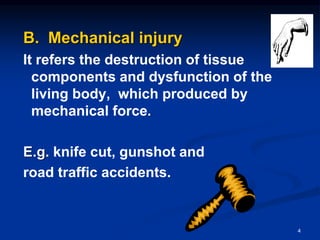
B. Mechanical injury
It refers the destruction of tissue
components and dysfunction of the
living body, which produced by
mechanical force.
E.g. knife cut, gunshot and
road traffic accidents.
4
But, it is not included psychological
and pathological damage.
It also excludes such injury as
mechanical asphyxia, electricity and
burn in forensic medicine despite they
are also the injury produced by
mechanical violence force.
5
2. Mechanism of mechanical injuries
A. The physics factors which influence
function of mechanical force.
B. The structure characteristics and
responding of the tissues and organs.
C. The instruments caused injury.
6
A. The physics factors which influence
function of mechanical force:
The quality and speed of movement of
the instrument which caused the trauma
(外伤).
7
B. The structure characteristics and
responding of the tissues and organs.
E.g. The liver and spleen are apt to be
broken.
But the bone fracture in the long bone
can take place only by greater violence.
8
C. The instruments caused injury
There are a lot of instruments which could
led to mechanical injury to the body.
But it is general divided into 3 kinds:
a. Blunt instrument: fist, brick, stone or
wall;
b. Sharp instrument: knife, dagger;
c. Firearm: bullet, explosion, detonator
(雷管).
9
3. Classification of mechanical injury
A. According to the properties of the
instrument caused injury.
B. According to manner of injury.
C. According to the basic form of injury.
10
A. According to the properties of the
instrument caused injury, it is classified
as:
a. Blunt force injury
It is produced by fist, brick, stone or
stick;
b. Sharp instrument injury
Injury by knife, dagger and scissor;
c. Firearm injury
E.g. gunshot, explosive injury;
d. Special injury
Injury by falling, traffic accident, etc.
11
B. According to manner of injury,
it is divided into:
suicidal,
homicidal,
accidental.
It is very important in forensic
medicine to identify a person dying
from which manner.
12
C. According to the basic form of injury,
it categorized as:
◆ abrasion,
◆ contusions (bruise),
◆ wound (laceration),
◆ fracture,
◆ visceral rupture,
◆ fragmention of whole body.
13
§2 Basic types of mechanical injury
There are different classification
methods, but the most important
one is on the basis of the
morphological feature of injury.
It is divided into 6 types:
14
Types of Mechanical injury
a. abrasion
b. contusions (bruise)
c. wound (laceration)
d. fracture
e. visceral rupture (内脏破裂)
f. fragmention of whole body
15
1. Abrasion
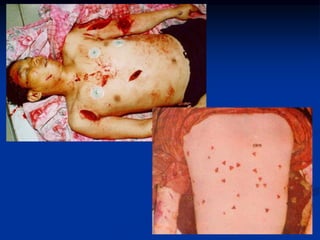
A. Definition
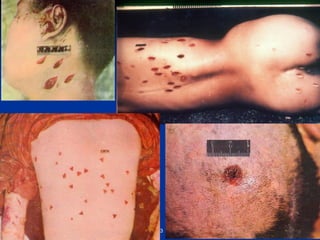
It refers the most superficial type of
injury destruction of the epithelial
covering of skin (epidermis) or mucous
membrane, due to impact with hard,
blunt and rough object or weapon.
16
◼ Abrasion can be present on any part of
the body, but it is more common on
bulgy parts, such as knees, shoulders,
elbows and forehead.
◼ The size and shape of abrasion varies
with the shape of the inflicting object,
the direction of force and the profile of
the target tissue.
17
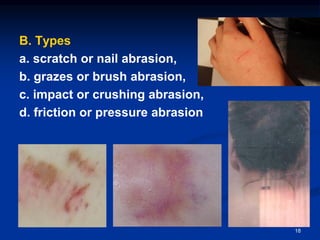
B. Types
a. scratch or nail abrasion,
b. grazes or brush abrasion,
c. impact or crushing abrasion,
d. friction or pressure abrasion
18
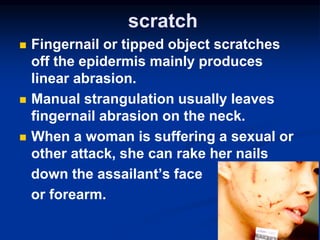
scratch
◼ Fingernail or tipped object scratches
off the epidermis mainly produces
linear abrasion.
◼ Manual strangulation usually leaves
fingernail abrasion on the neck.
◼ When a woman is suffering a sexual or
other attack, she can rake her nails
down the assailant’s face
or forearm.
19
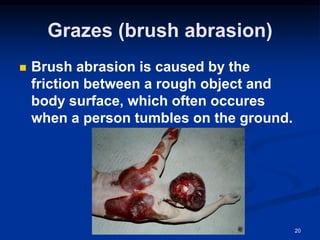
Grazes (brush abrasion)
◼ Brush abrasion is caused by the
friction between a rough object and
body surface, which often occures
when a person tumbles on the ground.
20
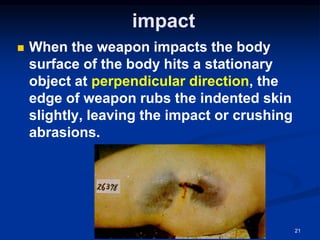
impact
◼ When the weapon impacts the body
surface of the body hits a stationary
object at perpendicular direction, the
edge of weapon rubs the indented skin
slightly, leaving the impact or crushing
abrasions.
21
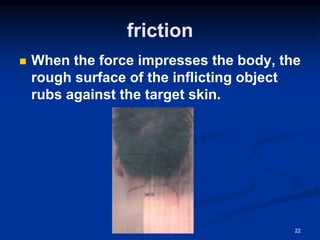
friction
◼ When the force impresses the body, the
rough surface of the inflicting object
rubs against the target skin.
22
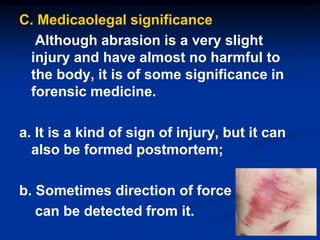
C. Medicaolegal significance
Although abrasion is a very slight
injury and have almost no harmful to
the body, it is of some significance in
forensic medicine.
a. It is a kind of sign of injury, but it can
also be formed postmortem;
b. Sometimes direction of force
can be detected from it.
23
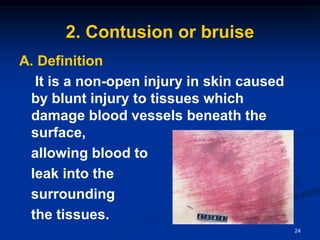
2. Contusion or bruise
A. Definition
It is a non-open injury in skin caused
by blunt injury to tissues which
damage blood vessels beneath the
surface,
allowing blood to
leak into the
surrounding
the tissues.
24
B. Types
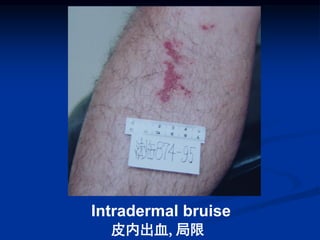
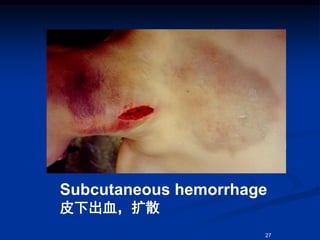
a. Subcutaneous hemorrhage(皮下出血)
b. Intradermal bruise(皮内出血)
C. Medicaolegal significance
Although contusion is also a slight
injury and have a litter harmful to body
if the contusion is not severe, it is of
great significance in forensic medicine.
25
Intradermal bruise
皮内出血, 局限
Subcutaneous hemorrhage
皮下出血,扩散
27
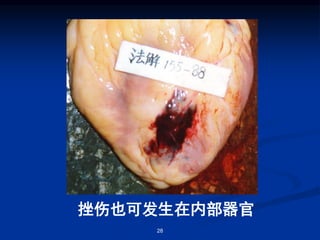
挫伤也可发生在内部器官
28
Medicolegal significance of contusion:
a. The location of contusion marked the
site of violent force.
b. Contusion is a mark of ante-mortem
injury.
c. The pattern and size may give an idea
or clue of the extent and degree of
violence.
29
d. The color change of contusion can be
used to estimate roughly time of
contusion formation.
e. The morphological features of
contusion could be used to infer the
instrument causing trauma.
30
3. Wound
A. Definition of wound
Wound is a kind of open injury in skin,
muscle or visceral organs caused by
greater blunt violent force.
31
B. Types of wound
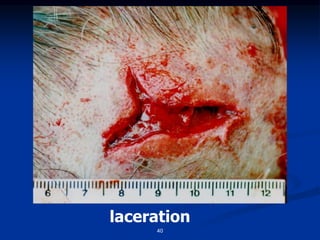
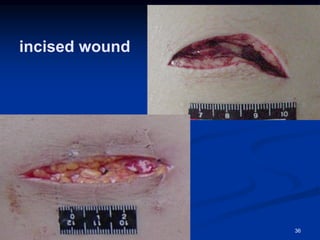
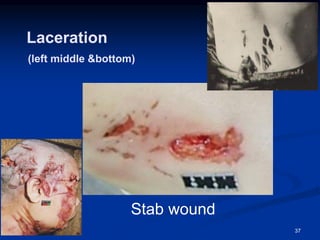
a. Laceration: It is a tear in skin and
underlying tissues produced by blunt
trauma.
b. sharp wound: Wound caused by sharp
instruments incised wound, stab wound,
chop wound and scissors wound.
c. Firearm wound.
32
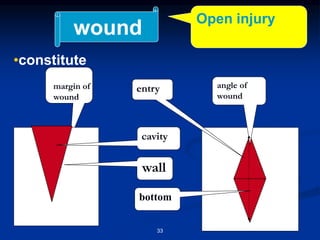
wound
Open injury
•constitute
entry angle of
wound
创缘
创壁
cavity
margin of
wound
wall
bottom
33
C. Characteristics of a sharp wound
a. The formation is spindle shaped and
gaping.
b. The edge are clean cut, well defined,
regular, and everted.
c. Width is broader than the edges of the
weapon because retraction of the
divided tissues.
34
d. Lengthwise of the wound is greater than
the width and depth of the wound.
e. There is no “tissue bridge” in the
wound cavity.
The unbroken tissue, such as nerves, hairs,
fibrous strands and vessels between the
wound walls, is called tissue bridge or tissue
strands, which is often in laceration and is
characteristic of the blunt instrument wound.
35
incised wound
36
Laceration
(left middle &bottom)
Stab wound
37
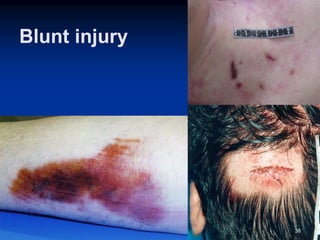
Blunt injury
38
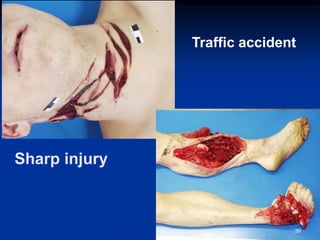
Sharp injury
39
Traffic accident
laceration
40
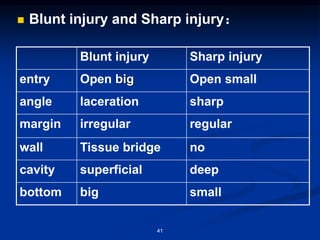
◼ Blunt injury and Sharp injury:
Blunt injury Sharp injury
entry Open big Open small
angle laceration sharp
margin irregular regular
wall Tissue bridge no
cavity superficial deep
bottom big small
41
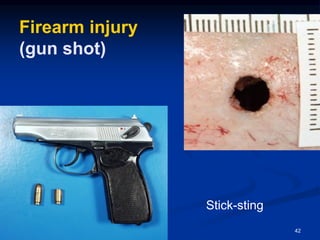
Firearm injury
(gun shot)
42
Stick-sting
4. Fracture
A. Definition
Fracture means the structure of the skeleton
was damaged and broken by very great
mechanical force.
B. Types
(1) open fracture (bone open up to the air)
and close fracture.
(2) depend on its shape and the severity of
fracture
Such as fissured or linear fracture,
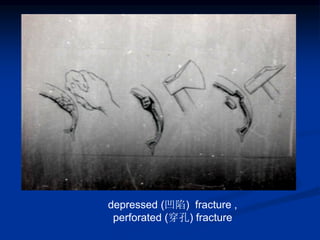
depressed (凹陷) fracture , perforated (穿孔)
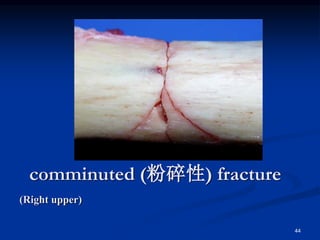
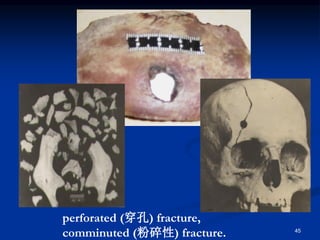
fracture and comminuted (粉碎性) fracture.
43
comminuted (粉碎性) fracture
(Right upper)
44
45
perforated (穿孔) fracture,
comminuted (粉碎性) fracture.
depressed (凹陷) fracture ,
perforated (穿孔) fracture
5. Rupture of viscera
A. Definition
It refers the destruction and broken of the
visceral anatomic integrality caused by
external violent force.
B. Types
There are laceration, incise wound and
stab wound etc.
47
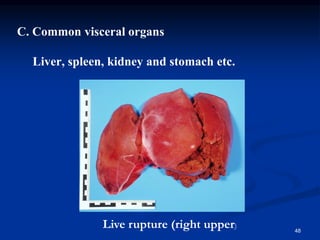
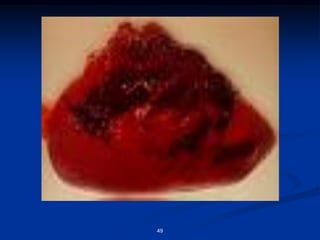
C. Common visceral organs
Liver, spleen, kidney and stomach etc.
48
Live rupture (right upper)
49
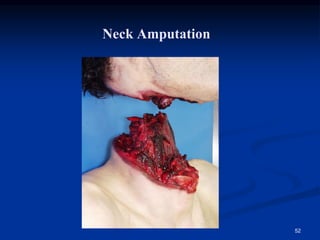
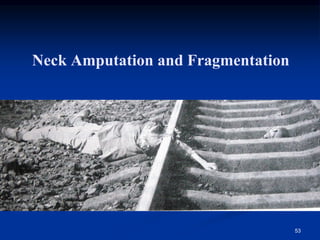
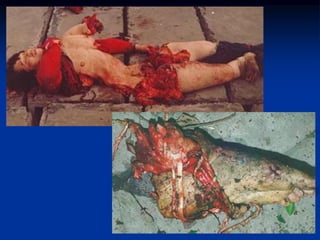
6. Fragmentation of whole body
A. Definition
Some parts of the body were broken and
destructed seriously by very serious
violence.
It is a very severe injury and often, a lethal
injury.
50
B. Common cases
Traffic accident: road traffic accident,
railway accident, aviation (航空) accident;
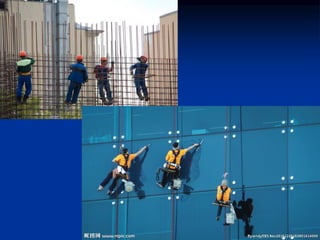
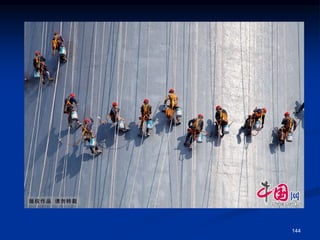
Ii is also occurred during work.
Especially in manufacture and architecture.
51
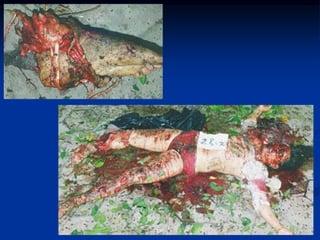
Neck Amputation
52
Neck Amputation and Fragmentation
53
54
functional disturbance
In addition to morphological changes, there
are other damage, such as functional
disorder and psychological hurt.
E.g. neurogenic shock.
Concussive (震荡性的) injury
55
§3 Common mechanical injuries
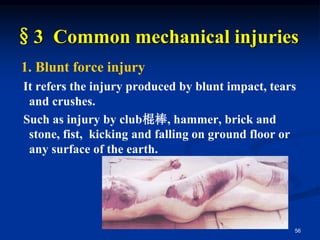
1. Blunt force injury
It refers the injury produced by blunt impact, tears
and crushes.
Such as injury by club棍棒, hammer, brick and
stone, fist, kicking and falling on ground floor or
any surface of the earth.
56
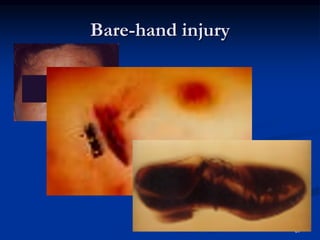
Bare-hand injury
57
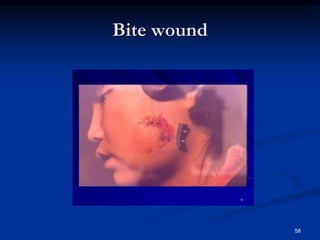
Bite wound
58
59
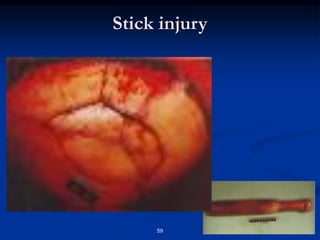
Stick injury
60
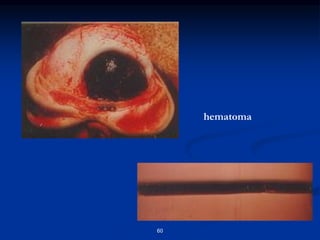
hematoma
61
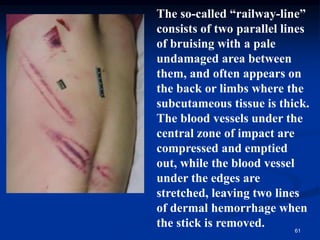
The so-called “railway-line”
consists of two parallel lines
of bruising with a pale
undamaged area between
them, and often appears on
the back or limbs where the
subcutameous tissue is thick.
The blood vessels under the
central zone of impact are
compressed and emptied
out, while the blood vessel
under the edges are
stretched, leaving two lines
of dermal hemorrhage when
the stick is removed.
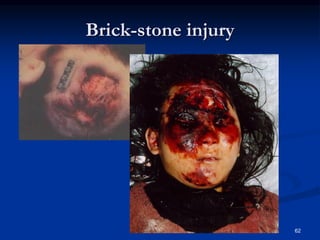
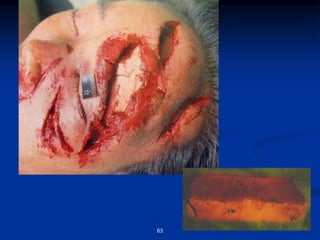
Brick-stone injury
62
63
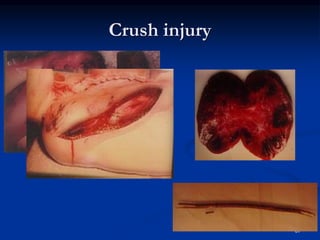
◼ A crush injury is the intensive and extensive
injury to the body surface and inner tissue,
which is compressed or impacted by giant
or heavy objects.
◼ Usually caused by traffic accidents, the
collapse of a mine or a house, and sometime
by torture for a long time.
64
Crush injury
◼ The internal injury is more serious.
◼ If the victim can survive for a period of
time, the crush syndrome may ensue.
◼ Crush syndrome is a kind of acute renal
failure from the block of renal tubule and
traumatic shock.
65
◼ The myoglobin from the damaged muscle
cells and the hemoglobin from ruptured red
cells enter the bloodstream, which is
filtrated by renal glomerulus and then
forms hemoglobin casts in the renal tubule
and blocks it.
66
Crush injury
67
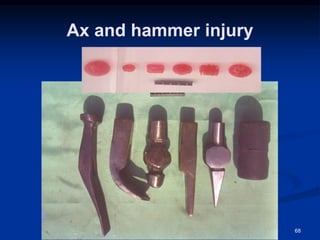
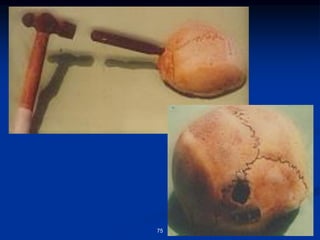
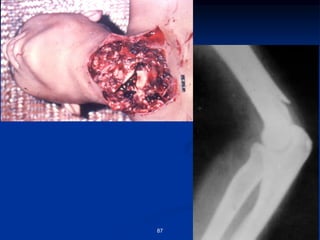
Ax and hammer injury
68
69
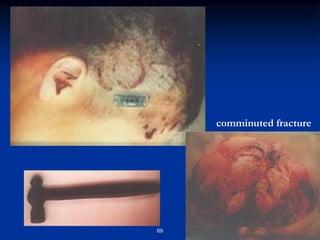
comminuted fracture
70
71
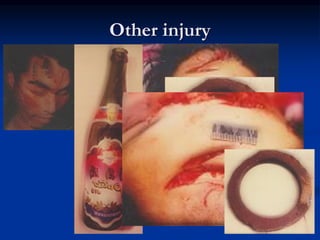
Other injury
72
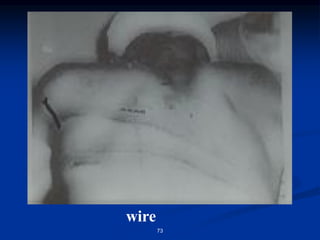
wire
73
74
75
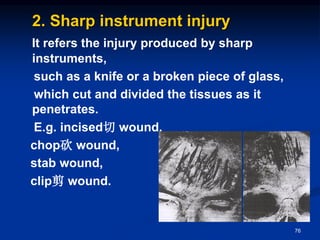
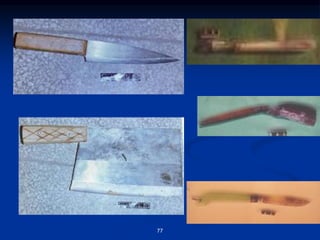
2. Sharp instrument injury
It refers the injury produced by sharp
instruments,
such as a knife or a broken piece of glass,
which cut and divided the tissues as it
penetrates.
E.g. incised切 wound,
chop砍 wound,
stab wound,
clip剪 wound.
76
77
Incised wound
◼ The sharp blade of a weapon is pressed
against skin and then dragged along its
long axis, resulting in the skin and
subcutaneous tissue ruptured apart.
◼ The incised wound is the most
common suicidal injury, but rarely
found in homicide.
78
◼ The usual parts are wrist, neck, elbow
and groin腹股沟 where the vessel is
superficial and can be easily identified.
79
80
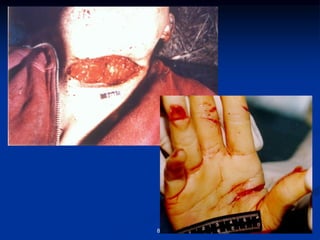
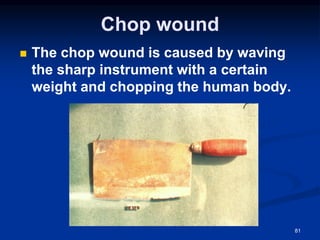
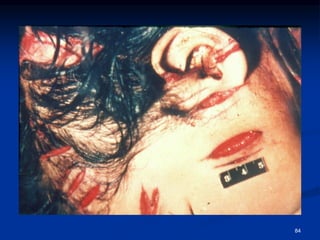
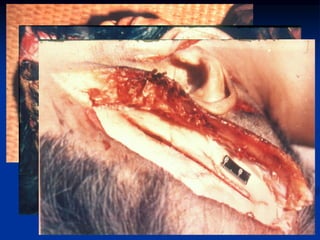
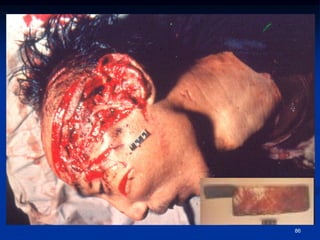
Chop wound
◼ The chop wound is caused by waving
the sharp instrument with a certain
weight and chopping the human body.
81
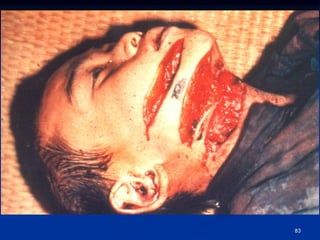
◼ As the strong force is delivered deeply into
body, not only can the skin and
subcutaneous tissue be broken, but also the
bone underneath can be splintered.
◼ Commonly encountered in homicide and
street fighting
◼ mainly located on the head accompanied by
skull fracture, brain concussion, intracranial
hemorrhage, contusion and laceration of
brain.
82
83
84
85
86
87
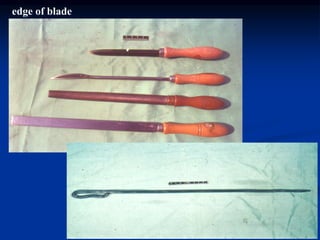
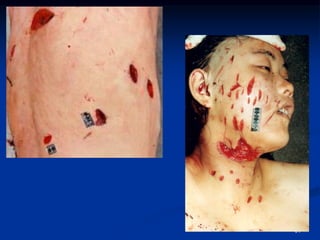
Stab wound
◼ The tip of a sharp instrument moves
along its axis and penetrates the
human body can produce a deep
wound, which is called a stab wound.
◼ Chest and abdomen are the most
preferred target of stab wound because
these areas are the largest on the body.
◼ Commonly seen in homicide and street
fighting, rarely in suicide or accident.
88
◼ Cutting edge (one, two, three or
without)
◼ Features:
(1) the internal organs may be
penetrated, even though the injury on the
body surface is slight.
(2) the volume of hemorrage in the
body cavity is more than that of external
hemorrage
89
edge of blade
90
91
92
93
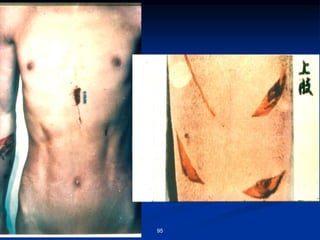
Scissoring wound
◼ A pair of scissors can injure the human
body by stabbing with its tip or clipping
with its blades.
◼ A fatal scissoring wound happens most
often in homicide, which is usually
produced by a stab.
94
95
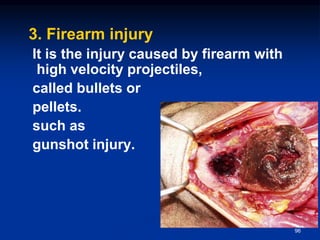
3. Firearm injury
It is the injury caused by firearm with
high velocity projectiles,
called bullets or
pellets.
such as
gunshot injury.
96
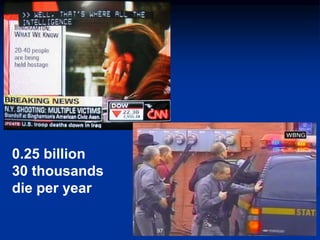
0.25 billion
30 thousands
die per year
97
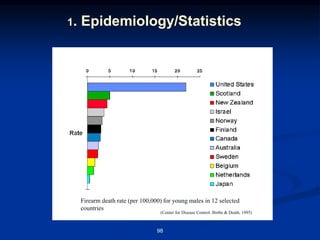
1. Epidemiology/Statistics
Firearm death rate (per 100,000) for young males in 12 selected
countries
(Center for Disease Control. Births & Death, 1995)
98
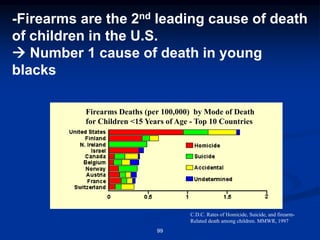
Firearms Deaths (per 100,000) by Mode of Death
for Children <15 Years of Age - Top 10 Countries
C.D.C. Rates of Homicide, Suicide, and firearm-
Related death among children. MMWR, 1997
-Firearms are the 2nd leading cause of death
of children in the U.S.
→ Number 1 cause of death in young
blacks
99
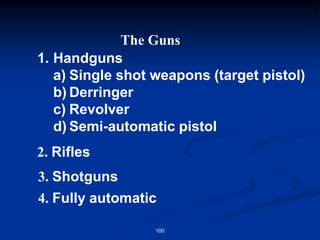
The Guns
1. Handguns
a) Single shot weapons (target pistol)
b) Derringer
c) Revolver
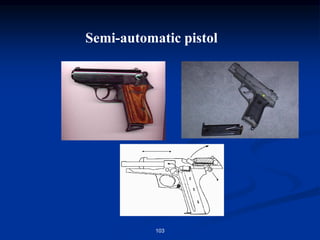
d) Semi-automatic pistol
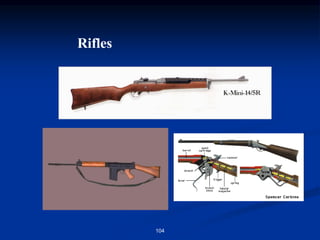
2. Rifles
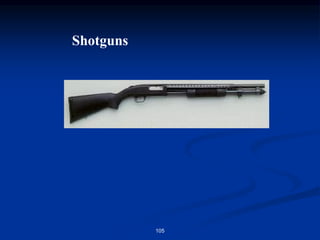
3. Shotguns
4. Fully automatic
100
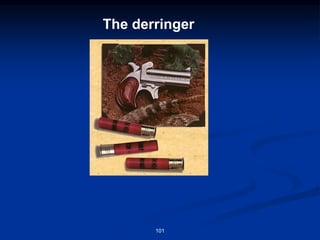
The derringer
101
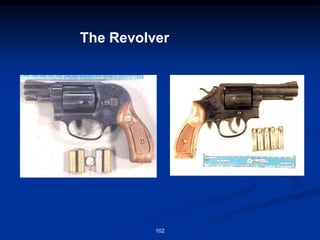
The Revolver
102
Semi-automatic pistol
103
Rifles
104
Shotguns
105
What happens when the bullet hits the target?
106
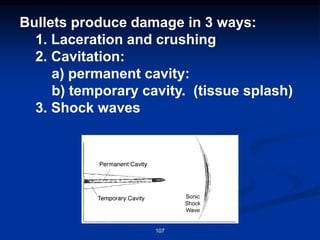
Bullets produce damage in 3 ways:
1. Laceration and crushing
2. Cavitation:
a) permanent cavity:
b) temporary cavity. (tissue splash)
3. Shock waves
107
Clinical Evaluation of G.S.W
The Emergency physician:
- in ideal position to evaluate and document
wounds before they are distorted by
surgical intervention.
- must resist temptation to make
assumptions about findings
→ interpretations are correct in only 47% of
cases.
- do not describe wound as “entrance” or
“exit” without indicating physical features
of each.
108
- must provide complete documentation
of all wounds
→ in 59 patients, only 75% of all
actual wounds was documented.
→ in 258 GSW’s, accurate
anatomical locations were described in
only 37% of wounds
109
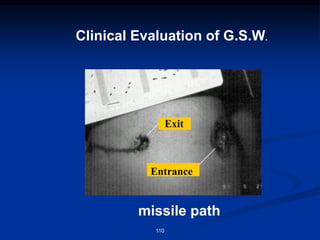
Clinical Evaluation of G.S.W.
Exit
Entrance
missile path
110
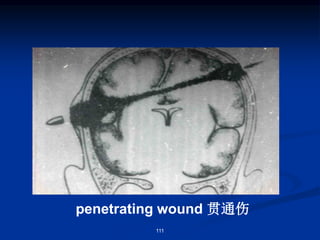
penetrating wound 贯通伤
111
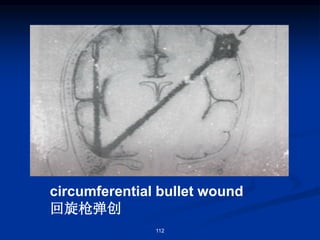
circumferential bullet wound
回旋枪弹创
112
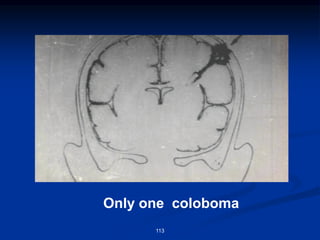
Only one coloboma
113
114
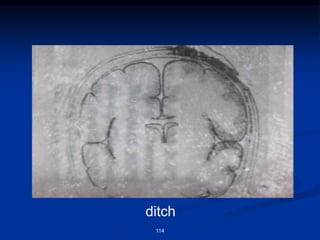
ditch
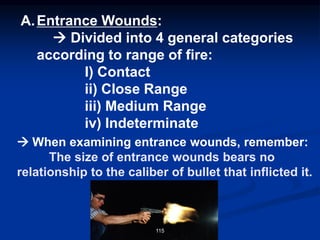
A.Entrance Wounds:
→ Divided into 4 general categories
according to range of fire:
I) Contact
ii) Close Range
iii) Medium Range
iv) Indeterminate
→ When examining entrance wounds, remember:
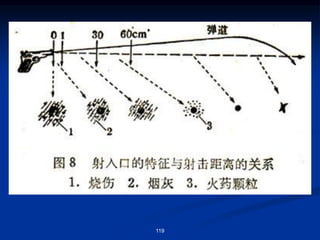
The size of entrance wounds bears no
relationship to the caliber of bullet that inflicted it.
115
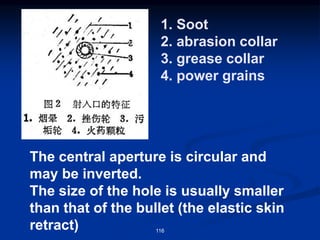
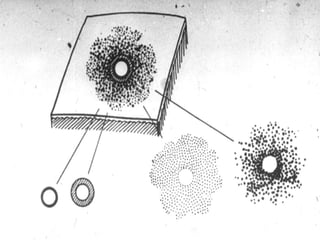
1. Soot
2. abrasion collar
3. grease collar
4. power grains
116
The central aperture is circular and
may be inverted.
The size of the hole is usually smaller
than that of the bullet (the elastic skin
retract)
117
abrasion collar: the epidermis of skin
immediately around the central hole is
inverted, frayed and chafed (擦痛) by
the sides of the rotary bullet.
grease collar: the materials
(lubricating oil, grease and metal
particles) rubbed off from the bullet
surface.
118
119
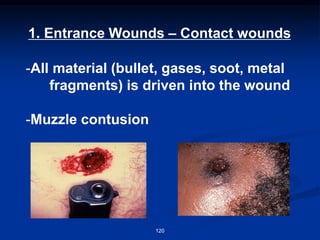
1. Entrance Wounds – Contact wounds
-All material (bullet, gases, soot, metal
fragments) is driven into the wound
-Muzzle contusion
120
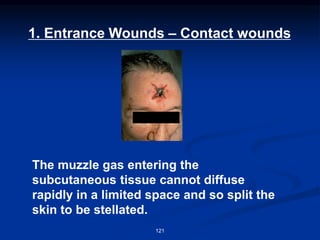
1. Entrance Wounds – Contact wounds
121
The muzzle gas entering the
subcutaneous tissue cannot diffuse
rapidly in a limited space and so split the
skin to be stellated.
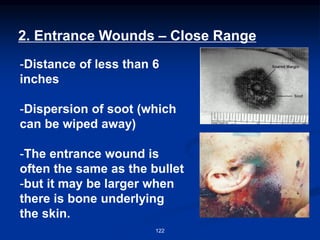
2. Entrance Wounds – Close Range
-Distance of less than 6
inches
-Dispersion of soot (which
can be wiped away)
-The entrance wound is
often the same as the bullet
-but it may be larger when
there is bone underlying
the skin.
122
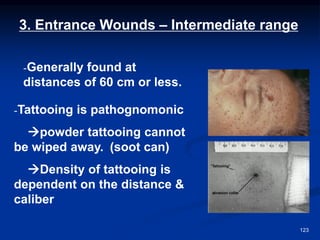
3. Entrance Wounds – Intermediate range
-Tattooing is pathognomonic
→powder tattooing cannot
be wiped away. (soot can)
→Density of tattooing is
dependent on the distance &
caliber
-Generally found at
distances of 60 cm or less.
123
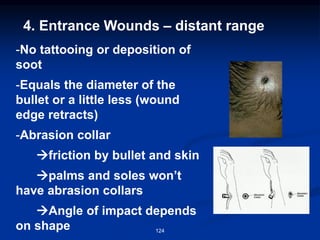
4. Entrance Wounds – distant range
-No tattooing or deposition of
soot
-Equals the diameter of the
bullet or a little less (wound
edge retracts)
-Abrasion collar
→friction by bullet and skin
→palms and soles won’t
have abrasion collars
→Angle of impact depends
on shape 124
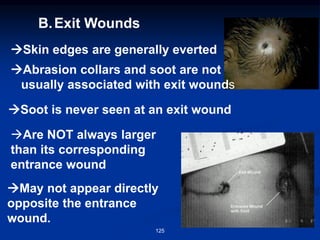
B.Exit Wounds
→Skin edges are generally everted
→Abrasion collars and soot are not
usually associated with exit wounds
→Soot is never seen at an exit wound
→Are NOT always larger
than its corresponding
entrance wound
→May not appear directly
opposite the entrance
wound.
125
126
127
128
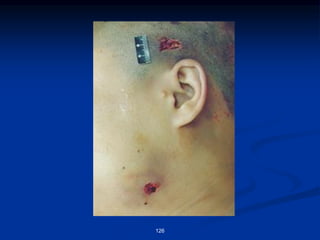
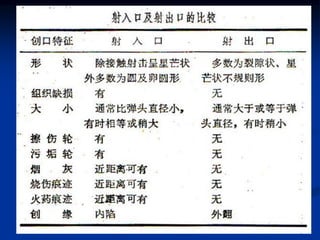
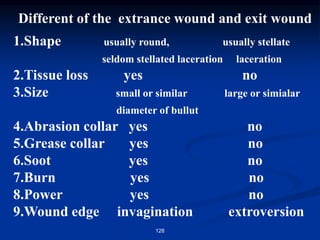
Different of the extrance wound and exit wound
1.Shape usually round, usually stellate
seldom stellated laceration laceration
2.Tissue loss yes no
3.Size small or similar large or simialar
diameter of bullut
4.Abrasion collar yes no
5.Grease collar yes no
6.Soot yes no
7.Burn yes no
8.Power yes no
9.Wound edge invagination extroversion
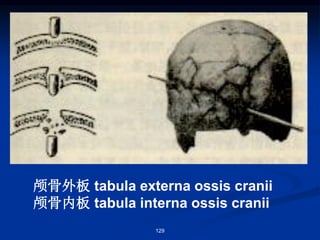
颅骨外板 tabula externa ossis cranii
颅骨内板 tabula interna ossis cranii
129
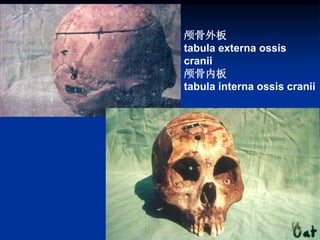
颅骨外板
tabula externa ossis
cranii
颅骨内板
tabula interna ossis cranii
130
C. Other Evidence:
-Opportunity to recognize, preserve, or collect
short-lived evidence.
-Clothing can provide important information.
-→place each item in its own separate paper bag.
--Every bullet and jacket has its own “fingerprint”
-→Try not to obliterate these marking by
removing a bullet with hemostats or pickups
131
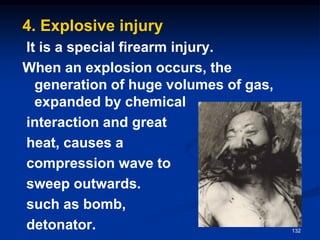
4. Explosive injury
It is a special firearm injury.
When an explosion occurs, the
generation of huge volumes of gas,
expanded by chemical
interaction and great
heat, causes a
compression wave to
sweep outwards.
such as bomb,
detonator. 132
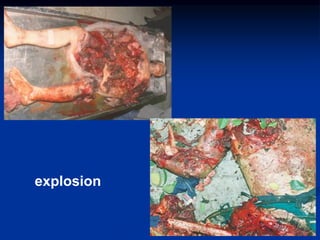
explosion
133
134
135
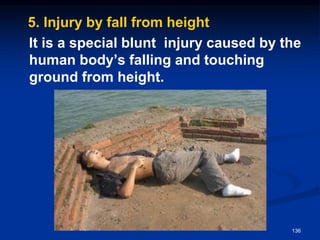
5. Injury by fall from height
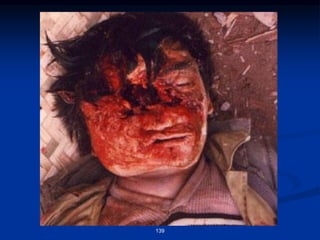
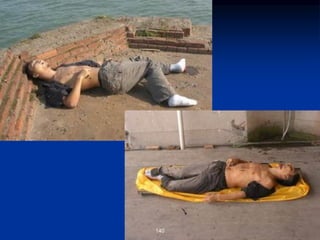
It is a special blunt injury caused by the
human body’s falling and touching
ground from height.
136
◼ Most cases of fatal falls from height are
suicidal
◼ compared to other suicide methods,
falls from height are relatively rare
◼ they have been observed to be a
preferred method in elderly suicides
◼ Accidents occur at work
◼ Homicide are relatively rare
137
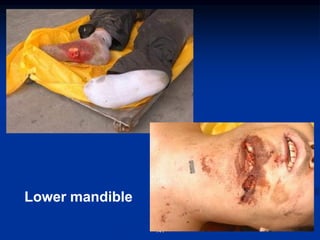
This kind of injury has some features:
a. The degree of injury is slight outside,
but severe inside of body.
b. The injury is extensive and severe and
formed generally one time.
c. The injury locate mainly in one side or
part of the body.
138
139
140
141
Lower mandible
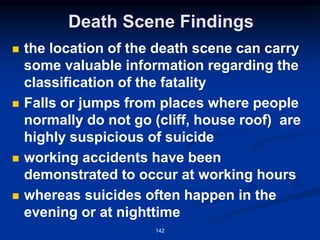
Death Scene Findings
◼ the location of the death scene can carry
some valuable information regarding the
classification of the fatality
◼ Falls or jumps from places where people
normally do not go (cliff, house roof) are
highly suspicious of suicide
◼ working accidents have been
demonstrated to occur at working hours
◼ whereas suicides often happen in the
evening or at nighttime
142
143
144
Psychiatric History
◆A history of psychiatric illness is most
frequently found
◆include depressions, schizophrenia (精
神分裂症) and/or substance abuse,
personality disorders
◆substance abuse is the most frequent
psychiatric illness in accident
145
Injury Patterns
◼ The injury pattern in falls from height is
dependent on the part of the body that
hits the ground first, as well as on the
falling height, the age and body weight
of the victim, the clothing and the
ground composition
146
◼ External Examination:
(1) The examination of the clothing
(2) In general, injuries seen at external
examination tend to be relatively mild
compared to the severe injuries that
are frequently revealed at autopsy
◼ Internal Examination
147
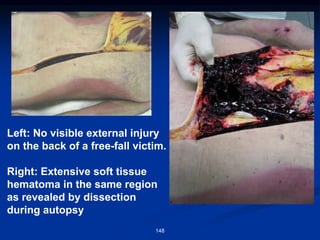
Left: No visible external injury
on the back of a free-fall victim.
Right: Extensive soft tissue
hematoma in the same region
as revealed by dissection
during autopsy
148
Internal Examination
◼ Severe injuries of the internal organs
and/or the musculoskeletal system can
be found
◼ It is generally accepted that the falling
height is a major determinant of the
severity of injuries sustained in a fall,
and multiple injuries are more frequent
in greater falling heights.
149
◼ In feet-first impacts, the vertical
deceleration trauma causes
characteristic injuries like aortic
lacerations and ring fractures of the
skull base.
◼ Aortic lacerations have also been
shown to be frequent in falls with
other landing positions
150
Head Injuries
◼ Head injuries are frequently seen in
falls from heights
◼ include subarachnoid, subdural and
epidural hemorrhage, intracerebral
hemorrhage and brain contusion as
well as severe disruption and the
complete or partial loss of brain
structures.
151
Neck Injuries
◼ When neck injuries are present, the
forensic pathologist always has to
consider strangulation prior to the fall
◼ the possibility of a homicidal infliction
of the injuries must always be taken
into account
152
Thoracic Injuries
◼ Thoracic cage
◼ Heart
◼ Thoracic Blood Vessels
◼ Lungs
◼ Diaphragm
153
Thoracic cage
◼ Thoracic cage injuries like abrasions
and bruises of the chest wall and rib
fractures are found in nearly all fatal
falls from height
◼ Rib fractures can be solitary, but are
most commonly bilateral.
◼ heights above 25 m, multiple
fractures of the whole thoracic cage
154
Heart
◼ Cardiac injuries are frequently seen in
fatal falls from height
◼ Pericardial tears are found in the
majority of cases, most of which show
additional cardiac injuries
155
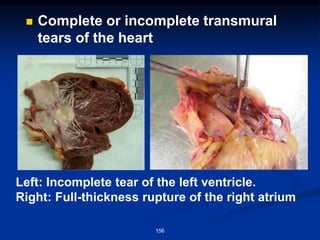
◼ Complete or incomplete transmural
tears of the heart
Left: Incomplete tear of the left ventricle.
Right: Full-thickness rupture of the right atrium
156
◼ Papillary muscle ruptures are less
commonly seen and can involve the
valves.
◼ Myocardial hematoma is not rarely
observed in fatal descents from
height and can be extensive
◼ The left heart is more frequently
involved than the right heart
◼ the hemorrhage is confined to the left
ventricular myocardium
157
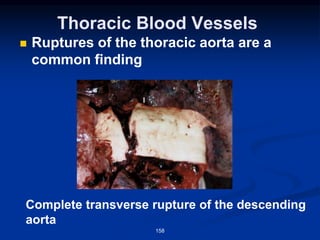
Thoracic Blood Vessels
◼ Ruptures of the thoracic aorta are a
common finding
158
Complete transverse rupture of the descending
aorta
Lungs
◼ Minor or major contusions of the lungs
can be found in almost all fatal falls from
height
◼ In the majority of cases, pulmonary
injury is accompanied by (multiple) rib
fractures
159
Diaphragm
◼ Diaphragmatic (横隔) rupture can result
not only in respiratory failure but can
also be associated with further severe
injuries such as displacement of
abdominal organs into the thorax.
◼ Diaphragm ruptures are relatively rare
in falls from height.
160
Abdominal Injuries
◼ Liver ruptures are more frequent in
falls from height than in other
mechanisms of blunt abdominal
trauma
◼ A frequency between 52% and 68%
◼ The right lobe of the liver is involved
more than the left lobe
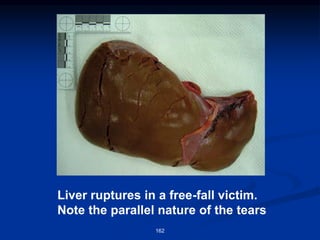
◼ Tears are often irregular but some
times parallel
161
Liver ruptures in a free-fall victim.
Note the parallel nature of the tears
162
◼ Spleen ruptures are common in falls
from height and are often multiple
◼ Ruptures or bruises of the intestinal
root are a common finding in greater
falling heights
◼ Rupture esophagus, stomach and
bowel are rare
163
Cause of Death, Survival Times
◼ The majority of victims of fatal falls
from height die at the scene instantly or
within minutes.
◼ In instantaneous deaths, the most
frequent cause of death is poly-trauma,
followed by head trauma and (mostly
internal) blood loss.
164
◼ Of the survivors, most victims die in
emergency departments shortly after
admission, and only a minority of
victims survives longer than a few
hours
165
Toxicology
◼ Ethanol has been reported with a
frequency of 15–20% up to 35% in free-
fall fatalities
◼ The range of blood alcohol
concentration generally seems to be
wider in suicides than in accidents.
166
Conclusions
◼ The main questions concern the
manner of death and the toxicology
of the fatality in question.
◼ A thorough death scene
investigation should always be
performed, the social and medical
history should be valuated, and
toxicology results should always be
taken into account.
167
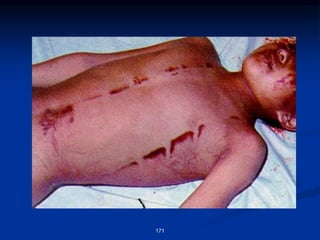
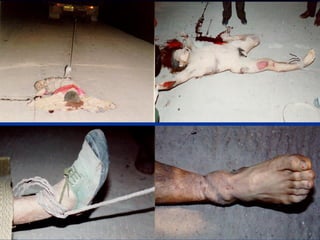
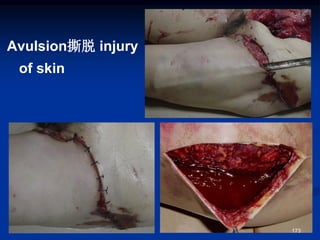
6. Transportation accident injuries
The most common transportation is road
traffic accident. It include:
a. impact injury,
b. extension wound (striate-like
superficial tear),
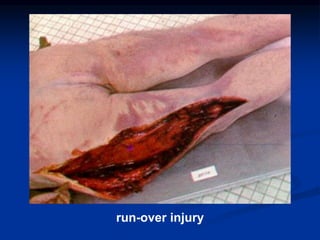
c. run-over injury with or without tire
marks, (avulsion 撕脱 injury of skin)
d. tumbling摔跌 injury,
e. dragging injury. (crush injury)
168
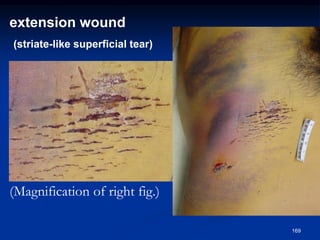
extension wound
(striate-like superficial tear)
(Magnification of right fig.)
169
run-over injury
171
172
Avulsion撕脱 injury
of skin
173
§4 The injuries of important organs
1. Head injuries
It includes scalp injuries, skull injury
(fracture of the skull), brain injury,
intracalvarium hemorrhage or hematoma
and complications after cranio-cerebral
injuries.
The most common and important injury
is cranio-cerebral injury and cranio-
cerebral wound.
174
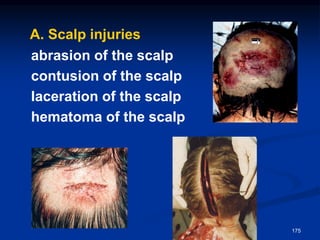
A. Scalp injuries
abrasion of the scalp
contusion of the scalp
laceration of the scalp
hematoma of the scalp
175
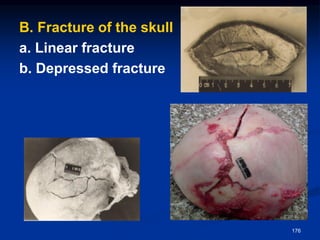
B. Fracture of the skull
a. Linear fracture
b. Depressed fracture
176
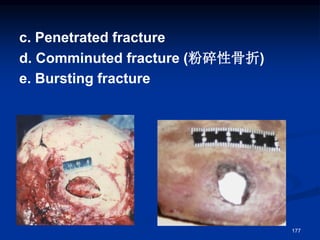
c. Penetrated fracture
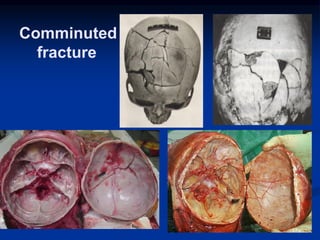
d. Comminuted fracture (粉碎性骨折)
e. Bursting fracture
177
Comminuted
fracture
178
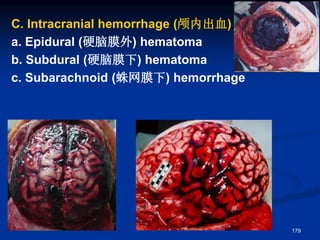
C. Intracranial hemorrhage (颅内出血)
a. Epidural (硬脑膜外) hematoma
b. Subdural (硬脑膜下) hematoma
c. Subarachnoid (蛛网膜下) hemorrhage
179
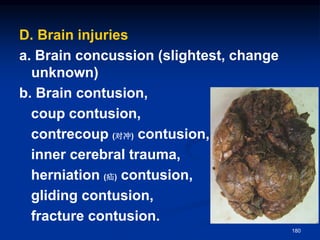
D. Brain injuries
a. Brain concussion (slightest, change
unknown)
b. Brain contusion,
coup contusion,
contrecoup (对冲) contusion,
inner cerebral trauma,
herniation (疝) contusion,
gliding contusion,
fracture contusion.
180
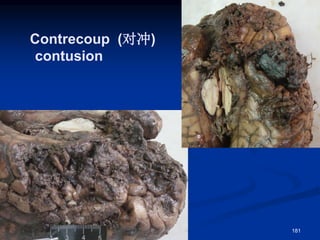
Contrecoup (对冲)
contusion
181
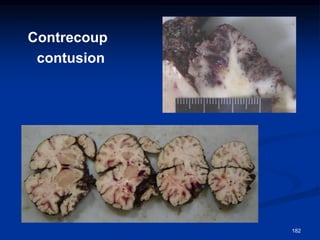
Contrecoup
contusion
182
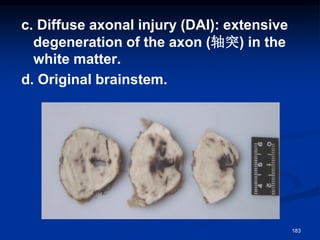
c. Diffuse axonal injury (DAI): extensive
degeneration of the axon (轴突) in the
white matter.
d. Original brainstem.
183
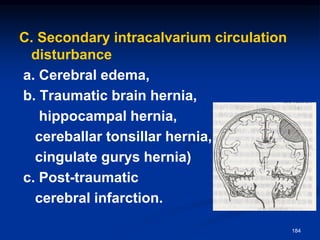
C. Secondary intracalvarium circulation
disturbance
a. Cerebral edema,
b. Traumatic brain hernia,
hippocampal hernia,
cereballar tonsillar hernia,
cingulate gurys hernia)
c. Post-traumatic
cerebral infarction.
184
D. Complications after cranio-cerebral
injuries
a. Traumatic epilepsy (癫痫),
b. traumatic hydrocephalus (脑水肿),
c. traumatic cerebral infarction (脑梗死),
d. bleeding, etc.
185
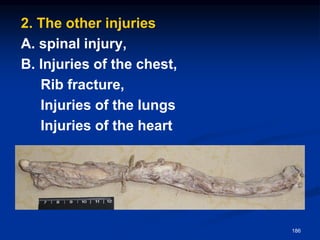
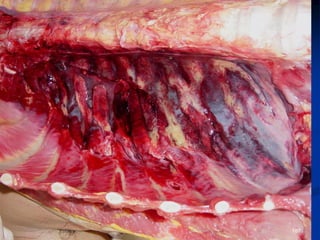
2. The other injuries
A. spinal injury,
B. Injuries of the chest,
Rib fracture,
Injuries of the lungs
Injuries of the heart
186
187
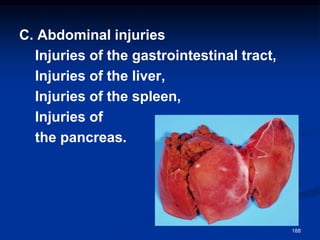
C. Abdominal injuries
Injuries of the gastrointestinal tract,
Injuries of the liver,
Injuries of the spleen,
Injuries of
the pancreas.
188
D. Injuries of the genitourinary organs
Injuries of the kidney,
Injuries of the urinary bladder,
Injuries of the penis, scrotum and
testicle
Injuries the uterus and vagina.
189
§ 5 Medicolegal expertise of
mechanical injuries
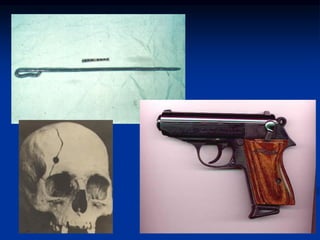
1. The aim of expertise
To provide clue for investigation
and conclusive evidence for
sentence in crime case
To mediate of civil cases.
190
2. Contents and tasks
A. The causes of death
B. Distinguishing of ante-or postmortem
injury
C. Estimation of injury time
D. Estimation of the instrument caused
the trauma
E. The manner of death
F. The relationship between injury and
disease
191
A. The causes of death
a. Primary cause of injury:
hemorrhage, shock and concussion,
injury to the vital organs like brain,
heart, lungs.
b. Secondary causes of injury:
infection, shock, embolism, asphyxia
and other complications of injuries
192
B. Distinguishing of ante-or postmortem
injury
It was done according to vital reaction,
histological changes, changes at
agonal stage, laboratory test, etc.
E.g. Anter-mortem injuries have vital
reactions such as hemorrhage,
inflammatory cells infiltration, but there
are not these changes in postmortem
injuries.
193
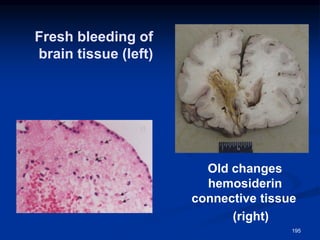
C. Estimation of timing of the wound
It infers to estimation of injury interval.
It based on the morphological changes
of the injuries macroscopically and
microscopically and the results of some
auxiliary examination such as chemical
and immunohistochemical tests.
194
Fresh bleeding of
brain tissue (left)
Old changes
with hemosiderin
and connective tissue
(right)
195
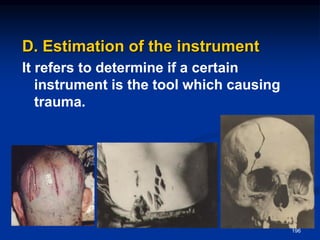
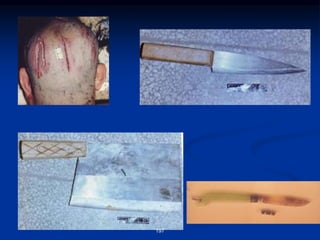
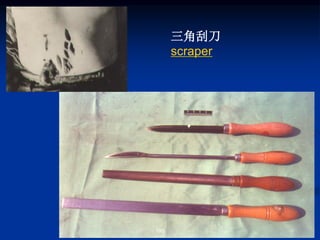
D. Estimation of the instrument
It refers to determine if a certain
instrument is the tool which causing
trauma.
196
197
198
三角刮刀
scraper
199
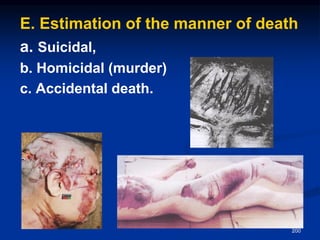
E. Estimation of the manner of death
a. Suicidal,
b. Homicidal (murder)
c. Accidental death.
200
F. The relationship between injury and
disease
The case involved in the relationship
between injury and disease means that there
are not only injury but also disease which
related with death.
In other words, it is referred to determine the
role of injury and natural disease in death
occurrence.
It is of great significance because many
cases in forensic medicine had both injuries
and diseases. 201
questions
◼ 1. Basic forms of mechanical injuries.
◼ 2. what is a typical bullet wound its
morphology?
◼ 3. How to distinguish entrance wounds
and exit wound of the skull ?
◼ 4. what is the aim of medicolegal
expertise of mechanical injury?
◼ 5. what is the “railway-line” injury?
◼ 6. what is difference between sharp
wound and blund wound ?
202
203
See you next time !

3-Mechanical Injury.pdf

  • 1.
  • 2.
    ◼ Almost anydoctor may be called upon at any time to examine a person who has suffered injury. ◼ The doctor must correctly describe and record every injury and treatment on the patient, which is important not only for the patient’s benefit, but also for the protection of the doctor himself. 2
  • 3.
    §1 Introduction 1. Definitions A.Injury It generally refers any harm caused to a person by any factor. There are various kinds of injuries: physical (body) injury, mind hurt or insult; pathological damage, mechanical injury. But in medicolegal terminology, the injury means specially “mechanical injury”. 3
  • 4.
    B. Mechanical injury Itrefers the destruction of tissue components and dysfunction of the living body, which produced by mechanical force. E.g. knife cut, gunshot and road traffic accidents. 4
  • 5.
    But, it isnot included psychological and pathological damage. It also excludes such injury as mechanical asphyxia, electricity and burn in forensic medicine despite they are also the injury produced by mechanical violence force. 5
  • 6.
    2. Mechanism ofmechanical injuries A. The physics factors which influence function of mechanical force. B. The structure characteristics and responding of the tissues and organs. C. The instruments caused injury. 6
  • 7.
    A. The physicsfactors which influence function of mechanical force: The quality and speed of movement of the instrument which caused the trauma (外伤). 7
  • 8.
    B. The structurecharacteristics and responding of the tissues and organs. E.g. The liver and spleen are apt to be broken. But the bone fracture in the long bone can take place only by greater violence. 8
  • 9.
    C. The instrumentscaused injury There are a lot of instruments which could led to mechanical injury to the body. But it is general divided into 3 kinds: a. Blunt instrument: fist, brick, stone or wall; b. Sharp instrument: knife, dagger; c. Firearm: bullet, explosion, detonator (雷管). 9
  • 10.
    3. Classification ofmechanical injury A. According to the properties of the instrument caused injury. B. According to manner of injury. C. According to the basic form of injury. 10
  • 11.
    A. According tothe properties of the instrument caused injury, it is classified as: a. Blunt force injury It is produced by fist, brick, stone or stick; b. Sharp instrument injury Injury by knife, dagger and scissor; c. Firearm injury E.g. gunshot, explosive injury; d. Special injury Injury by falling, traffic accident, etc. 11
  • 12.
    B. According tomanner of injury, it is divided into: suicidal, homicidal, accidental. It is very important in forensic medicine to identify a person dying from which manner. 12
  • 13.
    C. According tothe basic form of injury, it categorized as: ◆ abrasion, ◆ contusions (bruise), ◆ wound (laceration), ◆ fracture, ◆ visceral rupture, ◆ fragmention of whole body. 13
  • 14.
    §2 Basic typesof mechanical injury There are different classification methods, but the most important one is on the basis of the morphological feature of injury. It is divided into 6 types: 14
  • 15.
    Types of Mechanicalinjury a. abrasion b. contusions (bruise) c. wound (laceration) d. fracture e. visceral rupture (内脏破裂) f. fragmention of whole body 15
  • 16.
    1. Abrasion A. Definition Itrefers the most superficial type of injury destruction of the epithelial covering of skin (epidermis) or mucous membrane, due to impact with hard, blunt and rough object or weapon. 16
  • 17.
    ◼ Abrasion canbe present on any part of the body, but it is more common on bulgy parts, such as knees, shoulders, elbows and forehead. ◼ The size and shape of abrasion varies with the shape of the inflicting object, the direction of force and the profile of the target tissue. 17
  • 18.
    B. Types a. scratchor nail abrasion, b. grazes or brush abrasion, c. impact or crushing abrasion, d. friction or pressure abrasion 18
  • 19.
    scratch ◼ Fingernail ortipped object scratches off the epidermis mainly produces linear abrasion. ◼ Manual strangulation usually leaves fingernail abrasion on the neck. ◼ When a woman is suffering a sexual or other attack, she can rake her nails down the assailant’s face or forearm. 19
  • 20.
    Grazes (brush abrasion) ◼Brush abrasion is caused by the friction between a rough object and body surface, which often occures when a person tumbles on the ground. 20
  • 21.
    impact ◼ When theweapon impacts the body surface of the body hits a stationary object at perpendicular direction, the edge of weapon rubs the indented skin slightly, leaving the impact or crushing abrasions. 21
  • 22.
    friction ◼ When theforce impresses the body, the rough surface of the inflicting object rubs against the target skin. 22
  • 23.
    C. Medicaolegal significance Althoughabrasion is a very slight injury and have almost no harmful to the body, it is of some significance in forensic medicine. a. It is a kind of sign of injury, but it can also be formed postmortem; b. Sometimes direction of force can be detected from it. 23
  • 24.
    2. Contusion orbruise A. Definition It is a non-open injury in skin caused by blunt injury to tissues which damage blood vessels beneath the surface, allowing blood to leak into the surrounding the tissues. 24
  • 25.
    B. Types a. Subcutaneoushemorrhage(皮下出血) b. Intradermal bruise(皮内出血) C. Medicaolegal significance Although contusion is also a slight injury and have a litter harmful to body if the contusion is not severe, it is of great significance in forensic medicine. 25
  • 26.
  • 27.
  • 28.
  • 29.
    Medicolegal significance ofcontusion: a. The location of contusion marked the site of violent force. b. Contusion is a mark of ante-mortem injury. c. The pattern and size may give an idea or clue of the extent and degree of violence. 29
  • 30.
    d. The colorchange of contusion can be used to estimate roughly time of contusion formation. e. The morphological features of contusion could be used to infer the instrument causing trauma. 30
  • 31.
    3. Wound A. Definitionof wound Wound is a kind of open injury in skin, muscle or visceral organs caused by greater blunt violent force. 31
  • 32.
    B. Types ofwound a. Laceration: It is a tear in skin and underlying tissues produced by blunt trauma. b. sharp wound: Wound caused by sharp instruments incised wound, stab wound, chop wound and scissors wound. c. Firearm wound. 32
  • 33.
    wound Open injury •constitute entry angleof wound 创缘 创壁 cavity margin of wound wall bottom 33
  • 34.
    C. Characteristics ofa sharp wound a. The formation is spindle shaped and gaping. b. The edge are clean cut, well defined, regular, and everted. c. Width is broader than the edges of the weapon because retraction of the divided tissues. 34
  • 35.
    d. Lengthwise ofthe wound is greater than the width and depth of the wound. e. There is no “tissue bridge” in the wound cavity. The unbroken tissue, such as nerves, hairs, fibrous strands and vessels between the wound walls, is called tissue bridge or tissue strands, which is often in laceration and is characteristic of the blunt instrument wound. 35
  • 36.
  • 37.
  • 38.
  • 39.
  • 40.
  • 41.
    ◼ Blunt injuryand Sharp injury: Blunt injury Sharp injury entry Open big Open small angle laceration sharp margin irregular regular wall Tissue bridge no cavity superficial deep bottom big small 41
  • 42.
  • 43.
    4. Fracture A. Definition Fracturemeans the structure of the skeleton was damaged and broken by very great mechanical force. B. Types (1) open fracture (bone open up to the air) and close fracture. (2) depend on its shape and the severity of fracture Such as fissured or linear fracture, depressed (凹陷) fracture , perforated (穿孔) fracture and comminuted (粉碎性) fracture. 43
  • 44.
  • 45.
  • 46.
    depressed (凹陷) fracture, perforated (穿孔) fracture
  • 47.
    5. Rupture ofviscera A. Definition It refers the destruction and broken of the visceral anatomic integrality caused by external violent force. B. Types There are laceration, incise wound and stab wound etc. 47
  • 48.
    C. Common visceralorgans Liver, spleen, kidney and stomach etc. 48 Live rupture (right upper)
  • 49.
  • 50.
    6. Fragmentation ofwhole body A. Definition Some parts of the body were broken and destructed seriously by very serious violence. It is a very severe injury and often, a lethal injury. 50
  • 51.
    B. Common cases Trafficaccident: road traffic accident, railway accident, aviation (航空) accident; Ii is also occurred during work. Especially in manufacture and architecture. 51
  • 52.
  • 53.
    Neck Amputation andFragmentation 53
  • 54.
  • 55.
    functional disturbance In additionto morphological changes, there are other damage, such as functional disorder and psychological hurt. E.g. neurogenic shock. Concussive (震荡性的) injury 55
  • 56.
    §3 Common mechanicalinjuries 1. Blunt force injury It refers the injury produced by blunt impact, tears and crushes. Such as injury by club棍棒, hammer, brick and stone, fist, kicking and falling on ground floor or any surface of the earth. 56
  • 57.
  • 58.
  • 59.
  • 60.
  • 61.
    61 The so-called “railway-line” consistsof two parallel lines of bruising with a pale undamaged area between them, and often appears on the back or limbs where the subcutameous tissue is thick. The blood vessels under the central zone of impact are compressed and emptied out, while the blood vessel under the edges are stretched, leaving two lines of dermal hemorrhage when the stick is removed.
  • 62.
  • 63.
  • 64.
    ◼ A crushinjury is the intensive and extensive injury to the body surface and inner tissue, which is compressed or impacted by giant or heavy objects. ◼ Usually caused by traffic accidents, the collapse of a mine or a house, and sometime by torture for a long time. 64 Crush injury
  • 65.
    ◼ The internalinjury is more serious. ◼ If the victim can survive for a period of time, the crush syndrome may ensue. ◼ Crush syndrome is a kind of acute renal failure from the block of renal tubule and traumatic shock. 65
  • 66.
    ◼ The myoglobinfrom the damaged muscle cells and the hemoglobin from ruptured red cells enter the bloodstream, which is filtrated by renal glomerulus and then forms hemoglobin casts in the renal tubule and blocks it. 66
  • 67.
  • 68.
    Ax and hammerinjury 68
  • 69.
  • 70.
  • 71.
  • 72.
  • 73.
  • 74.
  • 75.
  • 76.
    2. Sharp instrumentinjury It refers the injury produced by sharp instruments, such as a knife or a broken piece of glass, which cut and divided the tissues as it penetrates. E.g. incised切 wound, chop砍 wound, stab wound, clip剪 wound. 76
  • 77.
  • 78.
    Incised wound ◼ Thesharp blade of a weapon is pressed against skin and then dragged along its long axis, resulting in the skin and subcutaneous tissue ruptured apart. ◼ The incised wound is the most common suicidal injury, but rarely found in homicide. 78
  • 79.
    ◼ The usualparts are wrist, neck, elbow and groin腹股沟 where the vessel is superficial and can be easily identified. 79
  • 80.
  • 81.
    Chop wound ◼ Thechop wound is caused by waving the sharp instrument with a certain weight and chopping the human body. 81
  • 82.
    ◼ As thestrong force is delivered deeply into body, not only can the skin and subcutaneous tissue be broken, but also the bone underneath can be splintered. ◼ Commonly encountered in homicide and street fighting ◼ mainly located on the head accompanied by skull fracture, brain concussion, intracranial hemorrhage, contusion and laceration of brain. 82
  • 83.
  • 84.
  • 85.
  • 86.
  • 87.
  • 88.
    Stab wound ◼ Thetip of a sharp instrument moves along its axis and penetrates the human body can produce a deep wound, which is called a stab wound. ◼ Chest and abdomen are the most preferred target of stab wound because these areas are the largest on the body. ◼ Commonly seen in homicide and street fighting, rarely in suicide or accident. 88
  • 89.
    ◼ Cutting edge(one, two, three or without) ◼ Features: (1) the internal organs may be penetrated, even though the injury on the body surface is slight. (2) the volume of hemorrage in the body cavity is more than that of external hemorrage 89
  • 90.
  • 91.
  • 92.
  • 93.
  • 94.
    Scissoring wound ◼ Apair of scissors can injure the human body by stabbing with its tip or clipping with its blades. ◼ A fatal scissoring wound happens most often in homicide, which is usually produced by a stab. 94
  • 95.
  • 96.
    3. Firearm injury Itis the injury caused by firearm with high velocity projectiles, called bullets or pellets. such as gunshot injury. 96
  • 97.
  • 98.
    1. Epidemiology/Statistics Firearm deathrate (per 100,000) for young males in 12 selected countries (Center for Disease Control. Births & Death, 1995) 98
  • 99.
    Firearms Deaths (per100,000) by Mode of Death for Children <15 Years of Age - Top 10 Countries C.D.C. Rates of Homicide, Suicide, and firearm- Related death among children. MMWR, 1997 -Firearms are the 2nd leading cause of death of children in the U.S. → Number 1 cause of death in young blacks 99
  • 100.
    The Guns 1. Handguns a)Single shot weapons (target pistol) b) Derringer c) Revolver d) Semi-automatic pistol 2. Rifles 3. Shotguns 4. Fully automatic 100
  • 101.
  • 102.
  • 103.
  • 104.
  • 105.
  • 106.
    What happens whenthe bullet hits the target? 106
  • 107.
    Bullets produce damagein 3 ways: 1. Laceration and crushing 2. Cavitation: a) permanent cavity: b) temporary cavity. (tissue splash) 3. Shock waves 107
  • 108.
    Clinical Evaluation ofG.S.W The Emergency physician: - in ideal position to evaluate and document wounds before they are distorted by surgical intervention. - must resist temptation to make assumptions about findings → interpretations are correct in only 47% of cases. - do not describe wound as “entrance” or “exit” without indicating physical features of each. 108
  • 109.
    - must providecomplete documentation of all wounds → in 59 patients, only 75% of all actual wounds was documented. → in 258 GSW’s, accurate anatomical locations were described in only 37% of wounds 109
  • 110.
    Clinical Evaluation ofG.S.W. Exit Entrance missile path 110
  • 111.
  • 112.
  • 113.
  • 114.
  • 115.
    A.Entrance Wounds: → Dividedinto 4 general categories according to range of fire: I) Contact ii) Close Range iii) Medium Range iv) Indeterminate → When examining entrance wounds, remember: The size of entrance wounds bears no relationship to the caliber of bullet that inflicted it. 115
  • 116.
    1. Soot 2. abrasioncollar 3. grease collar 4. power grains 116 The central aperture is circular and may be inverted. The size of the hole is usually smaller than that of the bullet (the elastic skin retract)
  • 117.
    117 abrasion collar: theepidermis of skin immediately around the central hole is inverted, frayed and chafed (擦痛) by the sides of the rotary bullet. grease collar: the materials (lubricating oil, grease and metal particles) rubbed off from the bullet surface.
  • 118.
  • 119.
  • 120.
    1. Entrance Wounds– Contact wounds -All material (bullet, gases, soot, metal fragments) is driven into the wound -Muzzle contusion 120
  • 121.
    1. Entrance Wounds– Contact wounds 121 The muzzle gas entering the subcutaneous tissue cannot diffuse rapidly in a limited space and so split the skin to be stellated.
  • 122.
    2. Entrance Wounds– Close Range -Distance of less than 6 inches -Dispersion of soot (which can be wiped away) -The entrance wound is often the same as the bullet -but it may be larger when there is bone underlying the skin. 122
  • 123.
    3. Entrance Wounds– Intermediate range -Tattooing is pathognomonic →powder tattooing cannot be wiped away. (soot can) →Density of tattooing is dependent on the distance & caliber -Generally found at distances of 60 cm or less. 123
  • 124.
    4. Entrance Wounds– distant range -No tattooing or deposition of soot -Equals the diameter of the bullet or a little less (wound edge retracts) -Abrasion collar →friction by bullet and skin →palms and soles won’t have abrasion collars →Angle of impact depends on shape 124
  • 125.
    B.Exit Wounds →Skin edgesare generally everted →Abrasion collars and soot are not usually associated with exit wounds →Soot is never seen at an exit wound →Are NOT always larger than its corresponding entrance wound →May not appear directly opposite the entrance wound. 125
  • 126.
  • 127.
  • 128.
    128 Different of theextrance wound and exit wound 1.Shape usually round, usually stellate seldom stellated laceration laceration 2.Tissue loss yes no 3.Size small or similar large or simialar diameter of bullut 4.Abrasion collar yes no 5.Grease collar yes no 6.Soot yes no 7.Burn yes no 8.Power yes no 9.Wound edge invagination extroversion
  • 129.
    颅骨外板 tabula externaossis cranii 颅骨内板 tabula interna ossis cranii 129
  • 130.
  • 131.
    C. Other Evidence: -Opportunityto recognize, preserve, or collect short-lived evidence. -Clothing can provide important information. -→place each item in its own separate paper bag. --Every bullet and jacket has its own “fingerprint” -→Try not to obliterate these marking by removing a bullet with hemostats or pickups 131
  • 132.
    4. Explosive injury Itis a special firearm injury. When an explosion occurs, the generation of huge volumes of gas, expanded by chemical interaction and great heat, causes a compression wave to sweep outwards. such as bomb, detonator. 132
  • 133.
  • 134.
  • 135.
  • 136.
    5. Injury byfall from height It is a special blunt injury caused by the human body’s falling and touching ground from height. 136
  • 137.
    ◼ Most casesof fatal falls from height are suicidal ◼ compared to other suicide methods, falls from height are relatively rare ◼ they have been observed to be a preferred method in elderly suicides ◼ Accidents occur at work ◼ Homicide are relatively rare 137
  • 138.
    This kind ofinjury has some features: a. The degree of injury is slight outside, but severe inside of body. b. The injury is extensive and severe and formed generally one time. c. The injury locate mainly in one side or part of the body. 138
  • 139.
  • 140.
  • 141.
  • 142.
    Death Scene Findings ◼the location of the death scene can carry some valuable information regarding the classification of the fatality ◼ Falls or jumps from places where people normally do not go (cliff, house roof) are highly suspicious of suicide ◼ working accidents have been demonstrated to occur at working hours ◼ whereas suicides often happen in the evening or at nighttime 142
  • 143.
  • 144.
  • 145.
    Psychiatric History ◆A historyof psychiatric illness is most frequently found ◆include depressions, schizophrenia (精 神分裂症) and/or substance abuse, personality disorders ◆substance abuse is the most frequent psychiatric illness in accident 145
  • 146.
    Injury Patterns ◼ Theinjury pattern in falls from height is dependent on the part of the body that hits the ground first, as well as on the falling height, the age and body weight of the victim, the clothing and the ground composition 146
  • 147.
    ◼ External Examination: (1)The examination of the clothing (2) In general, injuries seen at external examination tend to be relatively mild compared to the severe injuries that are frequently revealed at autopsy ◼ Internal Examination 147
  • 148.
    Left: No visibleexternal injury on the back of a free-fall victim. Right: Extensive soft tissue hematoma in the same region as revealed by dissection during autopsy 148
  • 149.
    Internal Examination ◼ Severeinjuries of the internal organs and/or the musculoskeletal system can be found ◼ It is generally accepted that the falling height is a major determinant of the severity of injuries sustained in a fall, and multiple injuries are more frequent in greater falling heights. 149
  • 150.
    ◼ In feet-firstimpacts, the vertical deceleration trauma causes characteristic injuries like aortic lacerations and ring fractures of the skull base. ◼ Aortic lacerations have also been shown to be frequent in falls with other landing positions 150
  • 151.
    Head Injuries ◼ Headinjuries are frequently seen in falls from heights ◼ include subarachnoid, subdural and epidural hemorrhage, intracerebral hemorrhage and brain contusion as well as severe disruption and the complete or partial loss of brain structures. 151
  • 152.
    Neck Injuries ◼ Whenneck injuries are present, the forensic pathologist always has to consider strangulation prior to the fall ◼ the possibility of a homicidal infliction of the injuries must always be taken into account 152
  • 153.
    Thoracic Injuries ◼ Thoraciccage ◼ Heart ◼ Thoracic Blood Vessels ◼ Lungs ◼ Diaphragm 153
  • 154.
    Thoracic cage ◼ Thoraciccage injuries like abrasions and bruises of the chest wall and rib fractures are found in nearly all fatal falls from height ◼ Rib fractures can be solitary, but are most commonly bilateral. ◼ heights above 25 m, multiple fractures of the whole thoracic cage 154
  • 155.
    Heart ◼ Cardiac injuriesare frequently seen in fatal falls from height ◼ Pericardial tears are found in the majority of cases, most of which show additional cardiac injuries 155
  • 156.
    ◼ Complete orincomplete transmural tears of the heart Left: Incomplete tear of the left ventricle. Right: Full-thickness rupture of the right atrium 156
  • 157.
    ◼ Papillary muscleruptures are less commonly seen and can involve the valves. ◼ Myocardial hematoma is not rarely observed in fatal descents from height and can be extensive ◼ The left heart is more frequently involved than the right heart ◼ the hemorrhage is confined to the left ventricular myocardium 157
  • 158.
    Thoracic Blood Vessels ◼Ruptures of the thoracic aorta are a common finding 158 Complete transverse rupture of the descending aorta
  • 159.
    Lungs ◼ Minor ormajor contusions of the lungs can be found in almost all fatal falls from height ◼ In the majority of cases, pulmonary injury is accompanied by (multiple) rib fractures 159
  • 160.
    Diaphragm ◼ Diaphragmatic (横隔)rupture can result not only in respiratory failure but can also be associated with further severe injuries such as displacement of abdominal organs into the thorax. ◼ Diaphragm ruptures are relatively rare in falls from height. 160
  • 161.
    Abdominal Injuries ◼ Liverruptures are more frequent in falls from height than in other mechanisms of blunt abdominal trauma ◼ A frequency between 52% and 68% ◼ The right lobe of the liver is involved more than the left lobe ◼ Tears are often irregular but some times parallel 161
  • 162.
    Liver ruptures ina free-fall victim. Note the parallel nature of the tears 162
  • 163.
    ◼ Spleen rupturesare common in falls from height and are often multiple ◼ Ruptures or bruises of the intestinal root are a common finding in greater falling heights ◼ Rupture esophagus, stomach and bowel are rare 163
  • 164.
    Cause of Death,Survival Times ◼ The majority of victims of fatal falls from height die at the scene instantly or within minutes. ◼ In instantaneous deaths, the most frequent cause of death is poly-trauma, followed by head trauma and (mostly internal) blood loss. 164
  • 165.
    ◼ Of thesurvivors, most victims die in emergency departments shortly after admission, and only a minority of victims survives longer than a few hours 165
  • 166.
    Toxicology ◼ Ethanol hasbeen reported with a frequency of 15–20% up to 35% in free- fall fatalities ◼ The range of blood alcohol concentration generally seems to be wider in suicides than in accidents. 166
  • 167.
    Conclusions ◼ The mainquestions concern the manner of death and the toxicology of the fatality in question. ◼ A thorough death scene investigation should always be performed, the social and medical history should be valuated, and toxicology results should always be taken into account. 167
  • 168.
    6. Transportation accidentinjuries The most common transportation is road traffic accident. It include: a. impact injury, b. extension wound (striate-like superficial tear), c. run-over injury with or without tire marks, (avulsion 撕脱 injury of skin) d. tumbling摔跌 injury, e. dragging injury. (crush injury) 168
  • 169.
    extension wound (striate-like superficialtear) (Magnification of right fig.) 169
  • 170.
  • 171.
  • 172.
  • 173.
  • 174.
    §4 The injuriesof important organs 1. Head injuries It includes scalp injuries, skull injury (fracture of the skull), brain injury, intracalvarium hemorrhage or hematoma and complications after cranio-cerebral injuries. The most common and important injury is cranio-cerebral injury and cranio- cerebral wound. 174
  • 175.
    A. Scalp injuries abrasionof the scalp contusion of the scalp laceration of the scalp hematoma of the scalp 175
  • 176.
    B. Fracture ofthe skull a. Linear fracture b. Depressed fracture 176
  • 177.
    c. Penetrated fracture d.Comminuted fracture (粉碎性骨折) e. Bursting fracture 177
  • 178.
  • 179.
    C. Intracranial hemorrhage(颅内出血) a. Epidural (硬脑膜外) hematoma b. Subdural (硬脑膜下) hematoma c. Subarachnoid (蛛网膜下) hemorrhage 179
  • 180.
    D. Brain injuries a.Brain concussion (slightest, change unknown) b. Brain contusion, coup contusion, contrecoup (对冲) contusion, inner cerebral trauma, herniation (疝) contusion, gliding contusion, fracture contusion. 180
  • 181.
  • 182.
  • 183.
    c. Diffuse axonalinjury (DAI): extensive degeneration of the axon (轴突) in the white matter. d. Original brainstem. 183
  • 184.
    C. Secondary intracalvariumcirculation disturbance a. Cerebral edema, b. Traumatic brain hernia, hippocampal hernia, cereballar tonsillar hernia, cingulate gurys hernia) c. Post-traumatic cerebral infarction. 184
  • 185.
    D. Complications aftercranio-cerebral injuries a. Traumatic epilepsy (癫痫), b. traumatic hydrocephalus (脑水肿), c. traumatic cerebral infarction (脑梗死), d. bleeding, etc. 185
  • 186.
    2. The otherinjuries A. spinal injury, B. Injuries of the chest, Rib fracture, Injuries of the lungs Injuries of the heart 186
  • 187.
  • 188.
    C. Abdominal injuries Injuriesof the gastrointestinal tract, Injuries of the liver, Injuries of the spleen, Injuries of the pancreas. 188
  • 189.
    D. Injuries ofthe genitourinary organs Injuries of the kidney, Injuries of the urinary bladder, Injuries of the penis, scrotum and testicle Injuries the uterus and vagina. 189
  • 190.
    § 5 Medicolegalexpertise of mechanical injuries 1. The aim of expertise To provide clue for investigation and conclusive evidence for sentence in crime case To mediate of civil cases. 190
  • 191.
    2. Contents andtasks A. The causes of death B. Distinguishing of ante-or postmortem injury C. Estimation of injury time D. Estimation of the instrument caused the trauma E. The manner of death F. The relationship between injury and disease 191
  • 192.
    A. The causesof death a. Primary cause of injury: hemorrhage, shock and concussion, injury to the vital organs like brain, heart, lungs. b. Secondary causes of injury: infection, shock, embolism, asphyxia and other complications of injuries 192
  • 193.
    B. Distinguishing ofante-or postmortem injury It was done according to vital reaction, histological changes, changes at agonal stage, laboratory test, etc. E.g. Anter-mortem injuries have vital reactions such as hemorrhage, inflammatory cells infiltration, but there are not these changes in postmortem injuries. 193
  • 194.
    C. Estimation oftiming of the wound It infers to estimation of injury interval. It based on the morphological changes of the injuries macroscopically and microscopically and the results of some auxiliary examination such as chemical and immunohistochemical tests. 194
  • 195.
    Fresh bleeding of braintissue (left) Old changes with hemosiderin and connective tissue (right) 195
  • 196.
    D. Estimation ofthe instrument It refers to determine if a certain instrument is the tool which causing trauma. 196
  • 197.
  • 198.
  • 199.
  • 200.
    E. Estimation ofthe manner of death a. Suicidal, b. Homicidal (murder) c. Accidental death. 200
  • 201.
    F. The relationshipbetween injury and disease The case involved in the relationship between injury and disease means that there are not only injury but also disease which related with death. In other words, it is referred to determine the role of injury and natural disease in death occurrence. It is of great significance because many cases in forensic medicine had both injuries and diseases. 201
  • 202.
    questions ◼ 1. Basicforms of mechanical injuries. ◼ 2. what is a typical bullet wound its morphology? ◼ 3. How to distinguish entrance wounds and exit wound of the skull ? ◼ 4. what is the aim of medicolegal expertise of mechanical injury? ◼ 5. what is the “railway-line” injury? ◼ 6. what is difference between sharp wound and blund wound ? 202
  • 203.