Causal Inference
Giridhara
R
Babu
+
What Is Epidemiology?
Studying the distribution & determinants of health-related states in
specific populations
 Usually human, but veterinary too
 Diseases or Health conditions
+
Causation
• Rooster crows at the break of dawn
• then the rooster caused the sun to rise?
+
Epidemiologic Thinking
 A study showed that 30% of drivers in accidents after 8 p.m.
have been drinking alcohol.
 Is alcohol a risk indicator/risk factor/cause of automobile
accidents?
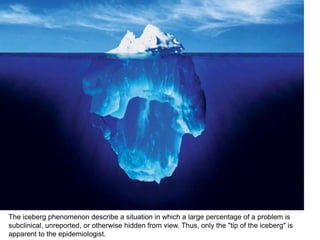
The iceberg phenomenon describe a situation in which a large percentage of a problem is
subclinical, unreported, or otherwise hidden from view. Thus, only the "tip of the iceberg" is
apparent to the epidemiologist.
+
Hill’s Criteria
1. Strength of the association
• Large associations are more likely to be causal – Not True
• Small associations can be causal
2. Consistency
• Different investigators using different methodologies in different
populations are all seeing similar results:
• Absence of consistency does not preclude causation
3. Specificity
• A cause should lead to a single effect, and vice versa
+
Hill’s Criteria
4. Temporality
• Cause must precede the disease
5. Biological Gradient
• strength increases as exposure level increases
• but could be a “threshold effect”; could be curvilinear
relationship; could be inability to accurately ascertain
exposure level
+Hill’s Criteria
6. Plausibility :
• should be existing biologic or social mechanistic model to explain the association
• but could just be beyond our biologic knowledge at this point in time; may require
interdisciplinary research
7. Coherence (consonance with existing knowledge)
• Cause-effect interpretation should not conflict with known facts about the natural
history of the disease (e.g., temporal pattern, histopathology, animal findings)
• Lack of such evidence doesn’t nullify the epidemiologic observations (e.g.,
species)
+
Hill’s Criteria
8. Experiment:
 Well designed and well conducted?
 Infeasible and/or unethical
9. Analogy
 Analogies or similarities between the observed association and
other associations
 Depends on depth of knowledge at a given time point
+
Epidemiological inferences
“ All scientific work is incomplete - whether it be observational or
experimental. All scientific work is liable to be upset or modified by
advancing knowledge.
This does not confer upon us a freedom to ignore the knowledge we
already have, or to postpone the action that it appears to demand at a
given time. Who knows, asked Robert Browning, but that the world might
end tonight? True, but on available evidence most of us make ready to
commute on the 8.30 next day.”
(A. Bradford Hill, 1965)
+
Causal inference
Etiologic inference must face numerous validity problems such
as
 Confounding
 Selection bias, and
 Measurement error / Information bias
 Random error

3-causal inference.ppt

  • 1.
  • 2.
    + What Is Epidemiology? Studyingthe distribution & determinants of health-related states in specific populations  Usually human, but veterinary too  Diseases or Health conditions
  • 3.
    + Causation • Rooster crowsat the break of dawn • then the rooster caused the sun to rise?
  • 4.
    + Epidemiologic Thinking  Astudy showed that 30% of drivers in accidents after 8 p.m. have been drinking alcohol.  Is alcohol a risk indicator/risk factor/cause of automobile accidents?
  • 5.
    The iceberg phenomenondescribe a situation in which a large percentage of a problem is subclinical, unreported, or otherwise hidden from view. Thus, only the "tip of the iceberg" is apparent to the epidemiologist.
  • 6.
    + Hill’s Criteria 1. Strengthof the association • Large associations are more likely to be causal – Not True • Small associations can be causal 2. Consistency • Different investigators using different methodologies in different populations are all seeing similar results: • Absence of consistency does not preclude causation 3. Specificity • A cause should lead to a single effect, and vice versa
  • 7.
    + Hill’s Criteria 4. Temporality •Cause must precede the disease 5. Biological Gradient • strength increases as exposure level increases • but could be a “threshold effect”; could be curvilinear relationship; could be inability to accurately ascertain exposure level
  • 8.
    +Hill’s Criteria 6. Plausibility: • should be existing biologic or social mechanistic model to explain the association • but could just be beyond our biologic knowledge at this point in time; may require interdisciplinary research 7. Coherence (consonance with existing knowledge) • Cause-effect interpretation should not conflict with known facts about the natural history of the disease (e.g., temporal pattern, histopathology, animal findings) • Lack of such evidence doesn’t nullify the epidemiologic observations (e.g., species)
  • 9.
    + Hill’s Criteria 8. Experiment: Well designed and well conducted?  Infeasible and/or unethical 9. Analogy  Analogies or similarities between the observed association and other associations  Depends on depth of knowledge at a given time point
  • 10.
    + Epidemiological inferences “ Allscientific work is incomplete - whether it be observational or experimental. All scientific work is liable to be upset or modified by advancing knowledge. This does not confer upon us a freedom to ignore the knowledge we already have, or to postpone the action that it appears to demand at a given time. Who knows, asked Robert Browning, but that the world might end tonight? True, but on available evidence most of us make ready to commute on the 8.30 next day.” (A. Bradford Hill, 1965)
  • 11.
    + Causal inference Etiologic inferencemust face numerous validity problems such as  Confounding  Selection bias, and  Measurement error / Information bias  Random error