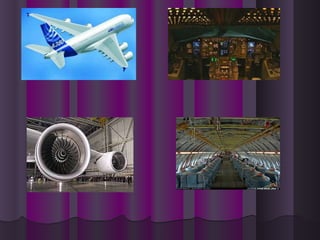
AVIATION
RESEARCH ON AIRBUS A-300 AND A-380
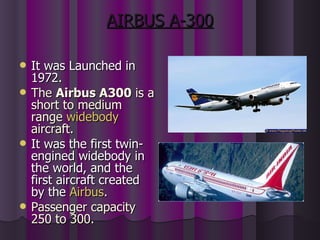
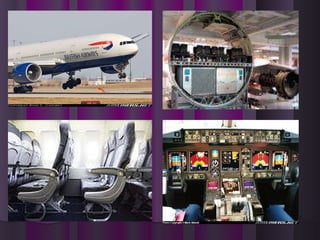
AIRBUS A-300 It was Launched in 1972. The  Airbus A300  is a short to medium range  widebody  aircraft.  It was the first twin-engined widebody in the world, and the first aircraft created by the  Airbus .   Passenger capacity 250 to 300.
The composites used on the A300/A310 lead to considerable weight-saving, helping to reduce fuel-burn. A total of 6.2 tones of composite material is used on the A310, metal while the larger A300-600 has a total of 6.6 t.  The number of parts in the composite vertical tail plane on both aircraft is reduced by 95 per cent, excluding fasteners.
SAFETY EQUIPMENTS ON A-300 LIFE VEST OXYGEN MASK FIRE EXTINGUISHER FIRST AID KIT ESCAPE ROPE
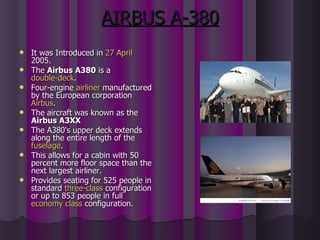
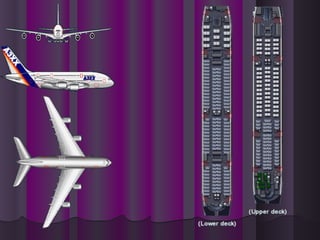
AIRBUS A-380 It was Introduced in  27 April  2005. The  Airbus A380  is a  double-deck . Four-engine  airliner  manufactured by the European corporation  Airbus . The aircraft was known as the  Airbus A3XX   The A380's upper deck extends along the entire length of the  fuselage .  This allows for a cabin with 50 percent more floor space than the next largest airliner. Provides seating for 525 people in standard  three-class  configuration or up to 853 people in full  economy class  configuration.
 
SAFETY EQUIPMENTS ON A-380 ASBESTOS GLOVES SMOKE GOGGLES MEGAPHONE HARNESS SLIDE RAFTS
Measurement A380-800 A380-800F Cockpit crew Two Seating capacity 525 (3-class) [7] 644 (2-class) 853 (1-class) 12 couriers Length 73 m (239  ft  6  in ) Span 79.8 m (261 ft 10 in) Height 24.1 m (79 ft 1 in) Wheelbase 30.4 m (99 ft 8 in) Outside fuselage width 7.14 m (23 ft 6 in) Cabin width, main deck 6.60 m (21 ft 8 in) Cabin width, upper deck 5.94 m (19 ft 6 in) Wing area 845 m² (9,100 sq ft) Operating empty weight 276,800 kg (610,200  lb ) 252,200 kg (556,000 lb) Maximum take-off weight 560,000 kg (1,235,000 lb) 590,000 kg (1,300,000 lb) Maximum payload 90,800 kg (200,000 lb) 152,400 kg (336,000 lb) Cruising speed Mach  0.85 Maximum speed Mach 0.89 Take off run at  MTOW 2,750 m (9,020 ft) [77] 2,900 m (9,510 ft) [77] Range at design load 15,200 km (8,200  nmi ) 10,400 km (5,600 nmi) Service ceiling 13,115 m (43,000 ft) Maximum fuel capacity 310,000 L (81,890  US gal ) 310,000 L (81,890 US gal), 356,000 L (94,000 US gal) option Engines (4 x) GP7270  (A380-861) Trent 970/B  (A380-841) Trent 972/B  (A380-842) GP7277  (A380-863F) Trent 977/B  (A380-843F)
 
ADVANTAGES AND DISADVANTAGES OF THE CURRENT SCENARIO IN THE AVIATION INDUSTRIES
ADVANTAGES TRAVEL EMLOYMENT OPPORTUNITY DISADVANTAGES ACCIDENT WORKING HOUR
THE COMPARISION ON THE LATEST TECHNOLOGY OF AIRBUS A-300 AND A-380
AIRBUS A-300 TWO ENGINE BODY AIRCRAFT WITH A SINGLE DECK PAX CAPACITY 250 TO 300 ADVANCE WINGS
 
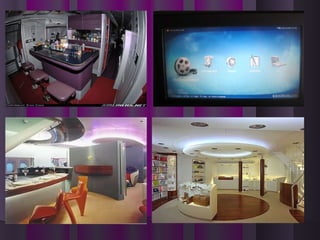
AIRBUS A-380 FOUR ENGINE BODY DOUBLE DECK 800 PAX CAPACITY 60 FLAT BEDS PERSONAL SCREEN  FOR EVERY PAX LOST OF ENTERTAINMENT
 
BIBLIOGRAPHY THE RESEARCH WAS DONE BY THE HELP OF www.google.com , www.airbus.com.

Ppt on aviation

  • 1.
  • 2.
    RESEARCH ON AIRBUSA-300 AND A-380
  • 3.
    AIRBUS A-300 Itwas Launched in 1972. The Airbus A300 is a short to medium range widebody aircraft. It was the first twin-engined widebody in the world, and the first aircraft created by the Airbus . Passenger capacity 250 to 300.
  • 4.
    The composites usedon the A300/A310 lead to considerable weight-saving, helping to reduce fuel-burn. A total of 6.2 tones of composite material is used on the A310, metal while the larger A300-600 has a total of 6.6 t. The number of parts in the composite vertical tail plane on both aircraft is reduced by 95 per cent, excluding fasteners.
  • 5.
    SAFETY EQUIPMENTS ONA-300 LIFE VEST OXYGEN MASK FIRE EXTINGUISHER FIRST AID KIT ESCAPE ROPE
  • 6.
    AIRBUS A-380 Itwas Introduced in 27 April 2005. The Airbus A380 is a double-deck . Four-engine airliner manufactured by the European corporation Airbus . The aircraft was known as the Airbus A3XX The A380's upper deck extends along the entire length of the fuselage . This allows for a cabin with 50 percent more floor space than the next largest airliner. Provides seating for 525 people in standard three-class configuration or up to 853 people in full economy class configuration.
  • 7.
  • 8.
    SAFETY EQUIPMENTS ONA-380 ASBESTOS GLOVES SMOKE GOGGLES MEGAPHONE HARNESS SLIDE RAFTS
  • 9.
    Measurement A380-800 A380-800FCockpit crew Two Seating capacity 525 (3-class) [7] 644 (2-class) 853 (1-class) 12 couriers Length 73 m (239 ft 6 in ) Span 79.8 m (261 ft 10 in) Height 24.1 m (79 ft 1 in) Wheelbase 30.4 m (99 ft 8 in) Outside fuselage width 7.14 m (23 ft 6 in) Cabin width, main deck 6.60 m (21 ft 8 in) Cabin width, upper deck 5.94 m (19 ft 6 in) Wing area 845 m² (9,100 sq ft) Operating empty weight 276,800 kg (610,200 lb ) 252,200 kg (556,000 lb) Maximum take-off weight 560,000 kg (1,235,000 lb) 590,000 kg (1,300,000 lb) Maximum payload 90,800 kg (200,000 lb) 152,400 kg (336,000 lb) Cruising speed Mach 0.85 Maximum speed Mach 0.89 Take off run at MTOW 2,750 m (9,020 ft) [77] 2,900 m (9,510 ft) [77] Range at design load 15,200 km (8,200 nmi ) 10,400 km (5,600 nmi) Service ceiling 13,115 m (43,000 ft) Maximum fuel capacity 310,000 L (81,890 US gal ) 310,000 L (81,890 US gal), 356,000 L (94,000 US gal) option Engines (4 x) GP7270 (A380-861) Trent 970/B (A380-841) Trent 972/B (A380-842) GP7277 (A380-863F) Trent 977/B (A380-843F)
  • 10.
  • 11.
    ADVANTAGES AND DISADVANTAGESOF THE CURRENT SCENARIO IN THE AVIATION INDUSTRIES
  • 12.
    ADVANTAGES TRAVEL EMLOYMENTOPPORTUNITY DISADVANTAGES ACCIDENT WORKING HOUR
  • 13.
    THE COMPARISION ONTHE LATEST TECHNOLOGY OF AIRBUS A-300 AND A-380
  • 14.
    AIRBUS A-300 TWOENGINE BODY AIRCRAFT WITH A SINGLE DECK PAX CAPACITY 250 TO 300 ADVANCE WINGS
  • 15.
  • 16.
    AIRBUS A-380 FOURENGINE BODY DOUBLE DECK 800 PAX CAPACITY 60 FLAT BEDS PERSONAL SCREEN FOR EVERY PAX LOST OF ENTERTAINMENT
  • 17.
  • 18.
    BIBLIOGRAPHY THE RESEARCHWAS DONE BY THE HELP OF www.google.com , www.airbus.com.