www.desc.org Harm Reduction Housing Models presented by Bill Hobson Annual Conference National Alliance to End Homelessness July 12-14, 2010 – Washington D.C.
A Substance Abuse and Mental Health Services Administration (SAMHSA) initiative Funded by SAMHSA’s Center for Mental Health Services and Center for Substance Abuse Treatment Mission is to promote the adoption of evidence-based and promising practices in co-occurring mental health and substance use disorders
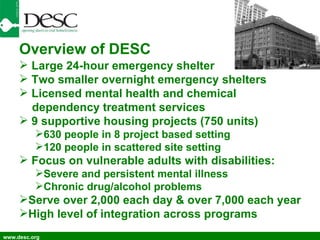
www.desc.org Overview of DESC Large 24-hour emergency shelter Two smaller overnight emergency shelters Licensed mental health and chemical    dependency treatment services 9 supportive housing projects (750 units) 630 people in 8 project based setting 120 people in scattered site setting Focus on vulnerable adults with disabilities: Severe and persistent mental illness Chronic drug/alcohol problems Serve over 2,000 each day & over 7,000 each year High level of integration across programs
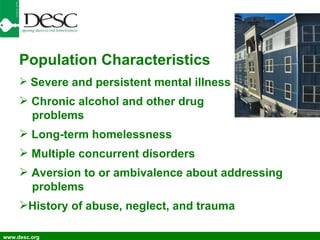
www.desc.org Population Characteristics Severe and persistent mental illness Chronic alcohol and other drug  problems Long-term homelessness Multiple concurrent disorders Aversion to or ambivalence about addressing problems History of abuse, neglect, and trauma
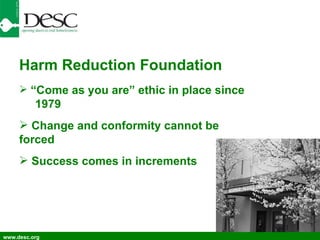
www.desc.org Harm Reduction Foundation “ Come as you are” ethic in place since  1979 Change and conformity cannot be  forced Success comes in increments
www.desc.org Housing First Principles Targeted to the most vulnerable. People moved into housing directly from the streets  without preconditions of treatment acceptance or  compliance. Provider is obligated to bring robust services into the  housing. Continued housing is not dependent on participation in services. Harm reduction approach rather than mandating  abstinence. Residents have leases and tenant protection under the law. Can be implemented in either a project-based or scattered  site model.
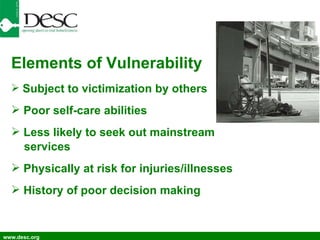
www.desc.org Elements of Vulnerability Subject to victimization by others Poor self-care abilities Less likely to seek out mainstream services Physically at risk for injuries/illnesses History of poor decision making

3.6 Harm Reduction Housing Models (Hobson)

  • 1.
    www.desc.org Harm ReductionHousing Models presented by Bill Hobson Annual Conference National Alliance to End Homelessness July 12-14, 2010 – Washington D.C.
  • 2.
    A Substance Abuseand Mental Health Services Administration (SAMHSA) initiative Funded by SAMHSA’s Center for Mental Health Services and Center for Substance Abuse Treatment Mission is to promote the adoption of evidence-based and promising practices in co-occurring mental health and substance use disorders
  • 3.
    www.desc.org Overview ofDESC Large 24-hour emergency shelter Two smaller overnight emergency shelters Licensed mental health and chemical dependency treatment services 9 supportive housing projects (750 units) 630 people in 8 project based setting 120 people in scattered site setting Focus on vulnerable adults with disabilities: Severe and persistent mental illness Chronic drug/alcohol problems Serve over 2,000 each day & over 7,000 each year High level of integration across programs
  • 4.
    www.desc.org Population CharacteristicsSevere and persistent mental illness Chronic alcohol and other drug problems Long-term homelessness Multiple concurrent disorders Aversion to or ambivalence about addressing problems History of abuse, neglect, and trauma
  • 5.
    www.desc.org Harm ReductionFoundation “ Come as you are” ethic in place since 1979 Change and conformity cannot be forced Success comes in increments
  • 6.
    www.desc.org Housing FirstPrinciples Targeted to the most vulnerable. People moved into housing directly from the streets without preconditions of treatment acceptance or compliance. Provider is obligated to bring robust services into the housing. Continued housing is not dependent on participation in services. Harm reduction approach rather than mandating abstinence. Residents have leases and tenant protection under the law. Can be implemented in either a project-based or scattered site model.
  • 7.
    www.desc.org Elements ofVulnerability Subject to victimization by others Poor self-care abilities Less likely to seek out mainstream services Physically at risk for injuries/illnesses History of poor decision making