www.myopennotes.org
Background
Background information for using these slides:
•

OpenNotes began as a research and demonstration project that ran from 2010 to 2011 in primary
care in three sites, led by Beth Israel Deaconess Medical Center in Boston.

•

The study was funded by the Robert Wood Johnson Foundation (RWJF) and published in the
Annals of Internal Medicine in October 2012: “Inviting Patients to Read Their Doctors' Notes: A
Quasi-experimental Study and a Look Ahead.” The following slides report on these results.

•

Today, the study investigators and others are expanding OpenNotes beyond primary care and
studying further implications for patients, caregivers, and clinicians in specialty care, psychiatry,
and more. RWJF continues to fund OpenNotes projects, including an advocacy campaign to make
sharing visit notes a routine part of care.

•

The team has published several papers and maintains the OpenNotes website
(www.myopennotes.org) where you can find published papers, news, and other materials.

www.myopennotes.org
About the OpenNotes Study
Demonstration project summer 2010 – summer 2011 (and still ongoing)
Patients invited to view their PCPs’ signed notes via secure portals
(only notes signed during the project – not retroactive)
Each patient notified automatically via secure e-mail message when a
note was signed, and reminded to review note(s) before next visit
Patients and doctors completed surveys before and after, and we
collected administrative data (portal clicks, e-mail volume)

Primarily funded by the Robert Wood Johnson Foundation
www.myopennotes.org
The Study’s
Three Principal Questions
Would OpenNotes help patients become more engaged
in their care?
Would OpenNotes affect doctors’workflow negatively?
After one year, would patients and doctors choose to
continue?

www.myopennotes.org
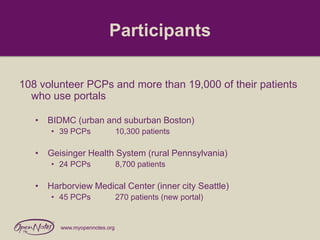
Participants
108 volunteer PCPs and more than 19,000 of their patients
who use portals
•

BIDMC (urban and suburban Boston)
• 39 PCPs

•

Geisinger Health System (rural Pennsylvania)
• 24 PCPs

•

10,300 patients

8,700 patients

Harborview Medical Center (inner city Seattle)
• 45 PCPs

www.myopennotes.org

270 patients (new portal)
PCPs’ Concerns and Experiences
(surveys after 12 months experience with open notes)

www.myopennotes.org
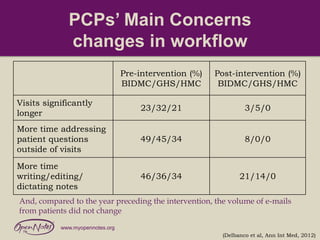
PCPs’ Main Concerns
changes in workflow
Pre-intervention (%)
BIDMC/GHS/HMC

Post-intervention (%)
BIDMC/GHS/HMC

Visits significantly
longer

23/32/21

3/5/0

More time addressing
patient questions
outside of visits

49/45/34

8/0/0

More time
writing/editing/
dictating notes

46/36/34

21/14/0

And, compared to the year preceding the intervention, the volume of e-mails
from patients did not change
www.myopennotes.org
(Delbanco et al, Ann Int Med, 2012)
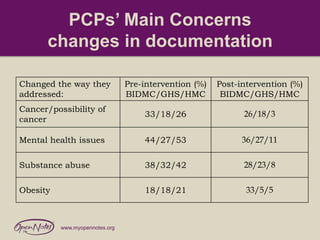
PCPs’ Main Concerns
changes in documentation
Changed the way they
addressed:

Pre-intervention (%)
BIDMC/GHS/HMC

Post-intervention (%)
BIDMC/GHS/HMC

Cancer/possibility of
cancer

33/18/26

26/18/3

Mental health issues

44/27/53

36/27/11

Substance abuse

38/32/42

28/23/8

Obesity

18/18/21

33/5/5

www.myopennotes.org
Patients’ Experiences

www.myopennotes.org
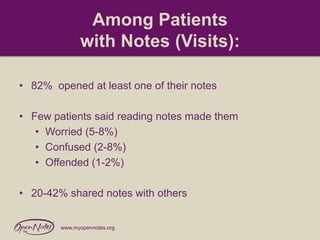
Among Patients
with Notes (Visits):
• 82% opened at least one of their notes
• Few patients said reading notes made them
• Worried (5-8%)
• Confused (2-8%)
• Offended (1-2%)
• 20-42% shared notes with others

www.myopennotes.org
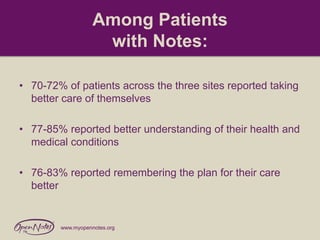
Among Patients
with Notes:
• 70-72% of patients across the three sites reported taking
better care of themselves
• 77-85% reported better understanding of their health and
medical conditions
• 76-83% reported remembering the plan for their care
better

www.myopennotes.org
Among Patients
with Notes:
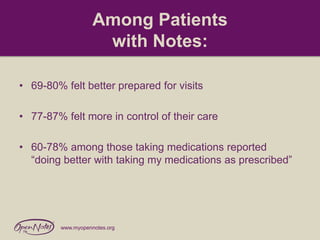
• 69-80% felt better prepared for visits
• 77-87% felt more in control of their care

• 60-78% among those taking medications reported
“doing better with taking my medications as prescribed”

www.myopennotes.org
Comments
and
the Bottom Line

www.myopennotes.org
Comments from Patients
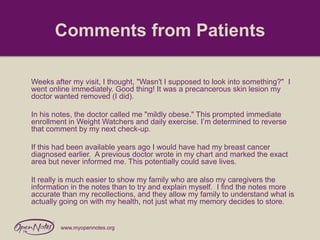
Weeks after my visit, I thought, "Wasn't I supposed to look into something?" I
went online immediately. Good thing! It was a precancerous skin lesion my
doctor wanted removed (I did).
In his notes, the doctor called me "mildly obese." This prompted immediate
enrollment in Weight Watchers and daily exercise. I’m determined to reverse
that comment by my next check-up.

If this had been available years ago I would have had my breast cancer
diagnosed earlier. A previous doctor wrote in my chart and marked the exact
area but never informed me. This potentially could save lives.
It really is much easier to show my family who are also my caregivers the
information in the notes than to try and explain myself. I find the notes more
accurate than my recollections, and they allow my family to understand what is
actually going on with my health, not just what my memory decides to store.

www.myopennotes.org
Comments from Doctors
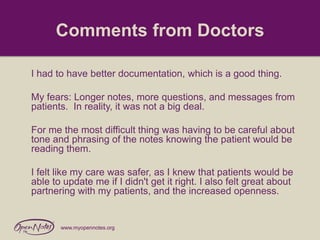
I had to have better documentation, which is a good thing.
My fears: Longer notes, more questions, and messages from
patients. In reality, it was not a big deal.
For me the most difficult thing was having to be careful about
tone and phrasing of the notes knowing the patient would be
reading them.
I felt like my care was safer, as I knew that patients would be
able to update me if I didn't get it right. I also felt great about
partnering with my patients, and the increased openness.

www.myopennotes.org
The Bottom Line for PCPs
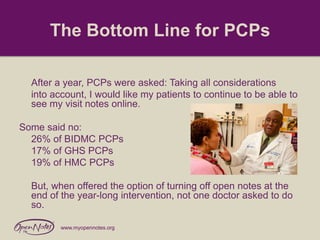
After a year, PCPs were asked: Taking all considerations
into account, I would like my patients to continue to be able to
see my visit notes online.
Some said no:
26% of BIDMC PCPs
17% of GHS PCPs
19% of HMC PCPs
But, when offered the option of turning off open notes at the
end of the year-long intervention, not one doctor asked to do
so.
www.myopennotes.org
The Bottom Line for Patients

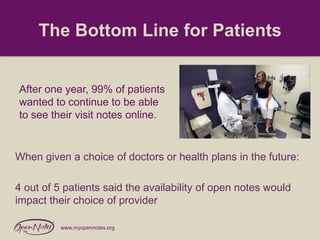
After one year, 99% of patients
wanted to continue to be able
to see their visit notes online.

When given a choice of doctors or health plans in the future:

4 out of 5 patients said the availability of open notes would
impact their choice of provider
www.myopennotes.org
The Bottom Line for
the Three Institutions
All 3 sites decided to expand OpenNotes
• Geisinger and Harborview: MDs/ NPs/PAs in ambulatory
practices

• BIDMC: All clinicians’notes (ambulatory opened in 2013 and
inpatient notes planned for 2014)

www.myopennotes.org
The Inexorable Rise of Online
Access and Transparency
Health care becoming more transparent: Open
disclosure, lab results, pricing, patient portals, Blue
Button…
Consumers:
• “I don’t know if I want to read my entire medical record, but I
want to have it.” (focus group participant)
• Government’s direct-to-consumer promotion of HIT
• Give Me My DaM Data (Data about Me)

www.myopennotes.org
Transparency Makes Headlines

The Road Toward Fully Transparent Medical Records

Letting Patients Read Doctors’ Notes

Consumers Gaining Ground in Healthcare
Ten Ways Patients Get Treated Better

Inviting Patients to Read Their Doctors' Notes:
A Quasi-Experimental Study and a Look Ahead
Will Reading Your Doctor’s Notes Lead to Better Health?

www.myopennotes.org

Should Patients See Their Doctors’ Notes?
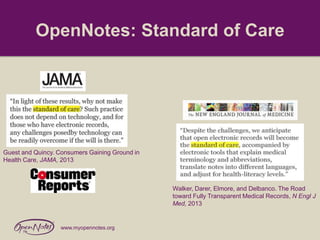
OpenNotes: Standard of Care

Guest and Quincy. Consumers Gaining Ground in
Health Care, JAMA, 2013

Walker, Darer, Elmore, and Delbanco. The Road
toward Fully Transparent Medical Records, N Engl J
Med, 2013

www.myopennotes.org
Patients Pointing
toward the Future
In the study:
49-56% of patients wanted patient proxies to have access
86-88% of patients wanted access to inpatient notes
59-62% of patients wanted to add comments to their notes
30-40% of patients wanted to be able to approve what is
written in a note

www.myopennotes.org
OpenNotes is like a New
Medicine
• Its goal is to help people manage health and illness more
effectively
• It can have side effects and may hurt some patients

• Clinicians and patients will need to learn how to use it
well

www.myopennotes.org
Future Directions
Most organizations adopting OpenNotes begin by sharing clinicians’ notes in
ambulatory care.
Organizations have or will soon begin sharing notes with:
•

Caregivers

•

Psychiatry patients

•

Inpatients

And research continues:

•

Open notes and patient safety

•

Open notes and medication adherence

•

Open notes and end of life care

•

Patients and clinicians co-generating notes
www.myopennotes.org
Join the OpenNotes Movement!
Visit the OpenNotes website www.myopennotes.org and sign up
for the mailing list
Resources for organizations implementing open notes
• Toolkit for implementers

• Roadmap and advice about key decisions
• Sample FAQs for patients and clinicians
• Sample communications materials

• Resources for evaluators

• All open notes surveys are available free of charge
• Links to all open notes papers are on the website

Need something else? Contact the OpenNotes team:
• myopennotes@bidmc.harvard.edu

www.myopennotes.org
Questions

www.myopennotes.org

www.myopennotes.org

OpenNotes: Transparent Clinicians' Notes for Health & Illness

  • 1.
  • 2.
    Background Background information forusing these slides: • OpenNotes began as a research and demonstration project that ran from 2010 to 2011 in primary care in three sites, led by Beth Israel Deaconess Medical Center in Boston. • The study was funded by the Robert Wood Johnson Foundation (RWJF) and published in the Annals of Internal Medicine in October 2012: “Inviting Patients to Read Their Doctors' Notes: A Quasi-experimental Study and a Look Ahead.” The following slides report on these results. • Today, the study investigators and others are expanding OpenNotes beyond primary care and studying further implications for patients, caregivers, and clinicians in specialty care, psychiatry, and more. RWJF continues to fund OpenNotes projects, including an advocacy campaign to make sharing visit notes a routine part of care. • The team has published several papers and maintains the OpenNotes website (www.myopennotes.org) where you can find published papers, news, and other materials. www.myopennotes.org
  • 3.
    About the OpenNotesStudy Demonstration project summer 2010 – summer 2011 (and still ongoing) Patients invited to view their PCPs’ signed notes via secure portals (only notes signed during the project – not retroactive) Each patient notified automatically via secure e-mail message when a note was signed, and reminded to review note(s) before next visit Patients and doctors completed surveys before and after, and we collected administrative data (portal clicks, e-mail volume) Primarily funded by the Robert Wood Johnson Foundation www.myopennotes.org
  • 4.
    The Study’s Three PrincipalQuestions Would OpenNotes help patients become more engaged in their care? Would OpenNotes affect doctors’workflow negatively? After one year, would patients and doctors choose to continue? www.myopennotes.org
  • 5.
    Participants 108 volunteer PCPsand more than 19,000 of their patients who use portals • BIDMC (urban and suburban Boston) • 39 PCPs • Geisinger Health System (rural Pennsylvania) • 24 PCPs • 10,300 patients 8,700 patients Harborview Medical Center (inner city Seattle) • 45 PCPs www.myopennotes.org 270 patients (new portal)
  • 6.
    PCPs’ Concerns andExperiences (surveys after 12 months experience with open notes) www.myopennotes.org
  • 7.
    PCPs’ Main Concerns changesin workflow Pre-intervention (%) BIDMC/GHS/HMC Post-intervention (%) BIDMC/GHS/HMC Visits significantly longer 23/32/21 3/5/0 More time addressing patient questions outside of visits 49/45/34 8/0/0 More time writing/editing/ dictating notes 46/36/34 21/14/0 And, compared to the year preceding the intervention, the volume of e-mails from patients did not change www.myopennotes.org (Delbanco et al, Ann Int Med, 2012)
  • 8.
    PCPs’ Main Concerns changesin documentation Changed the way they addressed: Pre-intervention (%) BIDMC/GHS/HMC Post-intervention (%) BIDMC/GHS/HMC Cancer/possibility of cancer 33/18/26 26/18/3 Mental health issues 44/27/53 36/27/11 Substance abuse 38/32/42 28/23/8 Obesity 18/18/21 33/5/5 www.myopennotes.org
  • 9.
  • 10.
    Among Patients with Notes(Visits): • 82% opened at least one of their notes • Few patients said reading notes made them • Worried (5-8%) • Confused (2-8%) • Offended (1-2%) • 20-42% shared notes with others www.myopennotes.org
  • 11.
    Among Patients with Notes: •70-72% of patients across the three sites reported taking better care of themselves • 77-85% reported better understanding of their health and medical conditions • 76-83% reported remembering the plan for their care better www.myopennotes.org
  • 12.
    Among Patients with Notes: •69-80% felt better prepared for visits • 77-87% felt more in control of their care • 60-78% among those taking medications reported “doing better with taking my medications as prescribed” www.myopennotes.org
  • 13.
  • 14.
    Comments from Patients Weeksafter my visit, I thought, "Wasn't I supposed to look into something?" I went online immediately. Good thing! It was a precancerous skin lesion my doctor wanted removed (I did). In his notes, the doctor called me "mildly obese." This prompted immediate enrollment in Weight Watchers and daily exercise. I’m determined to reverse that comment by my next check-up. If this had been available years ago I would have had my breast cancer diagnosed earlier. A previous doctor wrote in my chart and marked the exact area but never informed me. This potentially could save lives. It really is much easier to show my family who are also my caregivers the information in the notes than to try and explain myself. I find the notes more accurate than my recollections, and they allow my family to understand what is actually going on with my health, not just what my memory decides to store. www.myopennotes.org
  • 15.
    Comments from Doctors Ihad to have better documentation, which is a good thing. My fears: Longer notes, more questions, and messages from patients. In reality, it was not a big deal. For me the most difficult thing was having to be careful about tone and phrasing of the notes knowing the patient would be reading them. I felt like my care was safer, as I knew that patients would be able to update me if I didn't get it right. I also felt great about partnering with my patients, and the increased openness. www.myopennotes.org
  • 16.
    The Bottom Linefor PCPs After a year, PCPs were asked: Taking all considerations into account, I would like my patients to continue to be able to see my visit notes online. Some said no: 26% of BIDMC PCPs 17% of GHS PCPs 19% of HMC PCPs But, when offered the option of turning off open notes at the end of the year-long intervention, not one doctor asked to do so. www.myopennotes.org
  • 17.
    The Bottom Linefor Patients After one year, 99% of patients wanted to continue to be able to see their visit notes online. When given a choice of doctors or health plans in the future: 4 out of 5 patients said the availability of open notes would impact their choice of provider www.myopennotes.org
  • 18.
    The Bottom Linefor the Three Institutions All 3 sites decided to expand OpenNotes • Geisinger and Harborview: MDs/ NPs/PAs in ambulatory practices • BIDMC: All clinicians’notes (ambulatory opened in 2013 and inpatient notes planned for 2014) www.myopennotes.org
  • 19.
    The Inexorable Riseof Online Access and Transparency Health care becoming more transparent: Open disclosure, lab results, pricing, patient portals, Blue Button… Consumers: • “I don’t know if I want to read my entire medical record, but I want to have it.” (focus group participant) • Government’s direct-to-consumer promotion of HIT • Give Me My DaM Data (Data about Me) www.myopennotes.org
  • 20.
    Transparency Makes Headlines TheRoad Toward Fully Transparent Medical Records Letting Patients Read Doctors’ Notes Consumers Gaining Ground in Healthcare Ten Ways Patients Get Treated Better Inviting Patients to Read Their Doctors' Notes: A Quasi-Experimental Study and a Look Ahead Will Reading Your Doctor’s Notes Lead to Better Health? www.myopennotes.org Should Patients See Their Doctors’ Notes?
  • 21.
    OpenNotes: Standard ofCare Guest and Quincy. Consumers Gaining Ground in Health Care, JAMA, 2013 Walker, Darer, Elmore, and Delbanco. The Road toward Fully Transparent Medical Records, N Engl J Med, 2013 www.myopennotes.org
  • 22.
    Patients Pointing toward theFuture In the study: 49-56% of patients wanted patient proxies to have access 86-88% of patients wanted access to inpatient notes 59-62% of patients wanted to add comments to their notes 30-40% of patients wanted to be able to approve what is written in a note www.myopennotes.org
  • 23.
    OpenNotes is likea New Medicine • Its goal is to help people manage health and illness more effectively • It can have side effects and may hurt some patients • Clinicians and patients will need to learn how to use it well www.myopennotes.org
  • 24.
    Future Directions Most organizationsadopting OpenNotes begin by sharing clinicians’ notes in ambulatory care. Organizations have or will soon begin sharing notes with: • Caregivers • Psychiatry patients • Inpatients And research continues: • Open notes and patient safety • Open notes and medication adherence • Open notes and end of life care • Patients and clinicians co-generating notes www.myopennotes.org
  • 25.
    Join the OpenNotesMovement! Visit the OpenNotes website www.myopennotes.org and sign up for the mailing list Resources for organizations implementing open notes • Toolkit for implementers • Roadmap and advice about key decisions • Sample FAQs for patients and clinicians • Sample communications materials • Resources for evaluators • All open notes surveys are available free of charge • Links to all open notes papers are on the website Need something else? Contact the OpenNotes team: • myopennotes@bidmc.harvard.edu www.myopennotes.org
  • 26.

Editor's Notes

  • #4 Background Information for those who plan to use these following slides:OpenNotes was a research and demonstration project that ran from 2010 to 2011 in primary care in three sites, led by Beth Israel Deaconess Medical Center in Boston. The study was funded by the Robert Wood Johnson Foundation (RWJF) and published in the Annals of Internal Medicine in October 2012: “Inviting Patients to Read Their Doctors' Notes: A Quasi-experimental Study and a Look Ahead.”The following slides report on these results. Today, the study investigators and others are expanding OpenNotes beyond primary care and continue to study OpenNotes implications for patients, caregivers, and clinicians. RWJF continues to fund OpenNotes projects, including an advocacy campaign to make sharing visit notes a routine part of care. The team has published more papers and maintains the OpenNotes website (www.myopennotes.org) where you can find published papers, news, and more.
  • #6 Beth Israel Deaconess Medical CenterTeaching hospital of Harvard Medical School in BostonGeisinger Health SystemIntegrated health center serving 2.6 million people in rural PennsylvaniaHarborview Medical Center Safety-net hospital in inner city hospital
  • #13 First question: did they look?From portal use dataSharing usually family members or relativesHMc recruited, not committed portal usersReasons for not reading: forgot couldn’t find no reason
  • #15 new
  • #20 HHS has proposed all labs released directly to ptsVA Blue Button – downloads entire recordMD Anderson – 30,000 pts/yrONC – starting DTC promotion with video about online access to care and records (does not mention notes though)Give Me My DaM Data (spin off from e-Pt Dave TED talk) DaM = Data that’s Mine Danny Sands sings!
  • #23 First question: did they look?From portal use dataSharing usually family members or relativesHMc recruited, not committed portal usersReasons for not reading: forgot couldn’t find no reason