

Clinical Quality Measure 
Reporting in Practice Fusion 
Presented By: 
Emily Richmond, MPH 
Senior Manager, Health Care Quality
Webinar Logistics 
Listening to the webinar 
+ Audio is available through your computer speakers or by 
using your phone: 
Toll: +1 (702) 489-0007 
Access Code: 182-653-947 
Audio PIN: Shown after joining the webinar 
Submitting questions for Q&A 
• Send questions to Practice Fusion webinar staff using the 
Chat module at the bottom of the webinar toolbar 
2
Clinical Quality Measures & Quality Improvement 
+ Clinical quality measures, also called CQMs, are 
tools that help us measure and monitor the quality 
of healthcare and the contribution of those 
healthcare services towards improved health 
outcomes. 
3 
"If you cannot measure it, you cannot improve it." 
Lord Kelvin (1824-1907)
CQM Terminology 
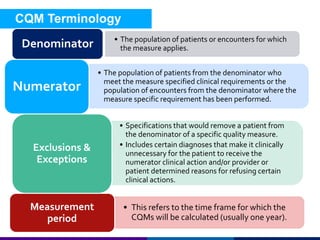
• The population of patients or encounters for which 
the measure applies. Denominator 
• The population of patients from the denominator who 
meet the measure specified clinical requirements or the 
population of encounters from the denominator where the 
measure specific requirement has been performed. 
Numerator 
• Specifications that would remove a patient from 
the denominator of a specific quality measure. 
• Includes certain diagnoses that make it clinically 
unnecessary for the patient to receive the 
numerator clinical action and/or provider or 
patient determined reasons for refusing certain 
clinical actions. 
Exclusions & 
Exceptions 
• This refers to the time frame for which the 
CQMs will be calculated (usually one year). 
Measurement 
period
Quality Measurement Development Process 
5 
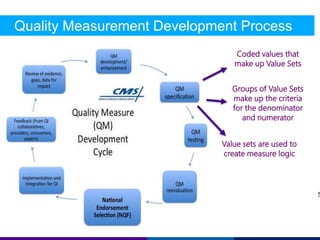
Coded values that 
make up Value Sets 
Groups of Value Sets 
make up the criteria 
for the denominator 
and numerator 
Value sets are used to 
create measure logic
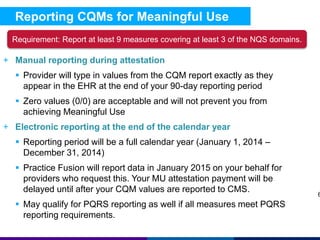
Reporting CQMs for Meaningful Use 
+ Manual reporting during attestation 
 Provider will type in values from the CQM report exactly as they 
appear in the EHR at the end of your 90-day reporting period 
 Zero values (0/0) are acceptable and will not prevent you from 
achieving Meaningful Use 
+ Electronic reporting at the end of the calendar year 
 Reporting period will be a full calendar year (January 1, 2014 – 
December 31, 2014) 
 Practice Fusion will report data in January 2015 on your behalf for 
providers who request this. Your MU attestation payment will be 
delayed until after your CQM values are reported to CMS. 
 May qualify for PQRS reporting as well if all measures meet PQRS 
reporting requirements. 
6 
Requirement: Report at least 9 measures covering at least 3 of the NQS domains.
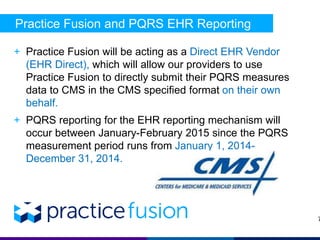
Practice Fusion and PQRS EHR Reporting 
+ Practice Fusion will be acting as a Direct EHR Vendor 
(EHR Direct), which will allow our providers to use 
Practice Fusion to directly submit their PQRS measures 
data to CMS in the CMS specified format on their own 
behalf. 
+ PQRS reporting for the EHR reporting mechanism will 
occur between January-February 2015 since the PQRS 
measurement period runs from January 1, 2014- 
December 31, 2014. 
7
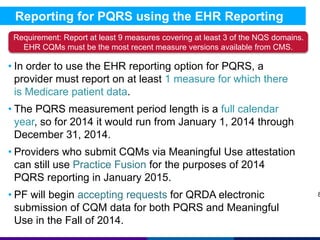
Reporting for PQRS using the EHR Reporting 
• In order to use the EHR reporting option for PQRS, a 
provider must report on at least 1 measure for which there 
is Medicare patient data. 
• The PQRS measurement period length is a full calendar 
year, so for 2014 it would run from January 1, 2014 through 
December 31, 2014. 
• Providers who submit CQMs via Meaningful Use attestation 
can still use Practice Fusion for the purposes of 2014 
PQRS reporting in January 2015. 
• PF will begin accepting requests for QRDA electronic 
submission of CQM data for both PQRS and Meaningful 
Use in the Fall of 2014. 
8 
Requirement: Report at least 9 measures covering at least 3 of the NQS domains. 
EHR CQMs must be the most recent measure versions available from CMS.
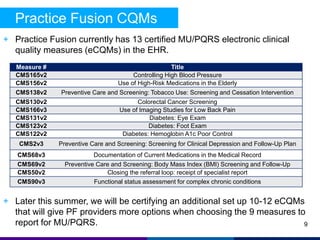
Practice Fusion CQMs 
+ Practice Fusion currently has 13 certified MU/PQRS electronic clinical 
quality measures (eCQMs) in the EHR. 
+ Later this summer, we will be certifying an additional set up 10-12 eCQMs 
that will give PF providers more options when choosing the 9 measures to 
report for MU/PQRS. 
9 
Measure # Title 
CMS165v2 Controlling High Blood Pressure 
CMS156v2 Use of High-Risk Medications in the Elderly 
CMS138v2 Preventive Care and Screening: Tobacco Use: Screening and Cessation Intervention 
CMS130v2 Colorectal Cancer Screening 
CMS166v3 Use of Imaging Studies for Low Back Pain 
CMS131v2 Diabetes: Eye Exam 
CMS123v2 Diabetes: Foot Exam 
CMS122v2 Diabetes: Hemoglobin A1c Poor Control 
CMS2v3 Preventive Care and Screening: Screening for Clinical Depression and Follow-Up Plan 
CMS68v3 Documentation of Current Medications in the Medical Record 
CMS69v2 Preventive Care and Screening: Body Mass Index (BMI) Screening and Follow-Up 
CMS50v2 Closing the referral loop: receipt of specialist report 
CMS90v3 Functional status assessment for complex chronic conditions
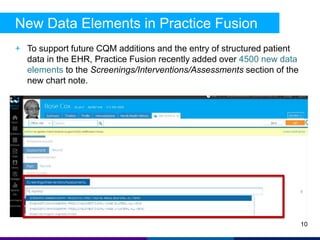
New Data Elements in Practice Fusion 
+ To support future CQM additions and the entry of structured patient 
data in the EHR, Practice Fusion recently added over 4500 new data 
elements to the Screenings/Interventions/Assessments section of the 
new chart note. 
10
What types of data can be recorded? 
+ Screenings 
+ Assessments 
+ Interventions 
+ Procedures 
+ Diagnostic Studies 
+ Documentation of 
ordered or delivered 
follow-up care 
11 
Specialties that new elements are most applicable to: 
Pediatrics 
Primary care 
General medicine/Internal medicine 
OBGYN 
Cardiology 
Neurology
Screenings 
+ Breast cancer screenings 
 Screening mammography 
 Diagnostic mammography 
 Breast mammogram screening 
 Right mammogram screening 
 Bilateral mammogram screening 
 Breast mammogram spot 
 Breast mammogram grid 
12
Assessments 
+ Falls risk assessment 
+ Assessment and interpretation of higher cerebral function, 
cognitive testing 
+ Psychologic cognitive testing and assessment 
+ Other cognitive assessments 
 BIMS summary score 
 SLUMS, IQCODE, AD8, MoCA, BOMC 
+ Pain assessments 
 Wong-Baker FACES 
 Visual analog scale 
 Numeric severity scale 
 General pain severity assessment 
13
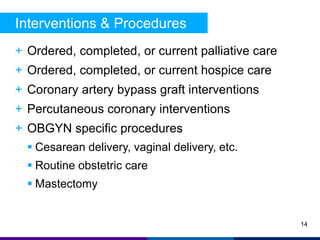
Interventions & Procedures 
+ Ordered, completed, or current palliative care 
+ Ordered, completed, or current hospice care 
+ Coronary artery bypass graft interventions 
+ Percutaneous coronary interventions 
+ OBGYN specific procedures 
 Cesarean delivery, vaginal delivery, etc. 
 Routine obstetric care 
 Mastectomy 
14
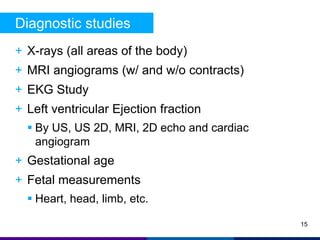
Diagnostic studies 
+ X-rays (all areas of the body) 
+ MRI angiograms (w/ and w/o contracts) 
+ EKG Study 
+ Left ventricular Ejection fraction 
 By US, US 2D, MRI, 2D echo and cardiac 
angiogram 
+ Gestational age 
+ Fetal measurements 
 Heart, head, limb, etc. 
15
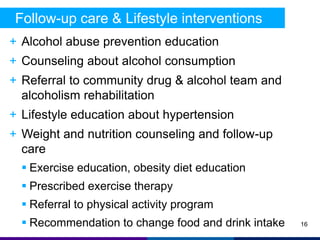
Follow-up care & Lifestyle interventions 
+ Alcohol abuse prevention education 
+ Counseling about alcohol consumption 
+ Referral to community drug & alcohol team and 
alcoholism rehabilitation 
+ Lifestyle education about hypertension 
+ Weight and nutrition counseling and follow-up 
care 
 Exercise education, obesity diet education 
 Prescribed exercise therapy 
 Referral to physical activity program 
 Recommendation to change food and drink intake 
16
Practice Fusion EHR Demonstration 
17
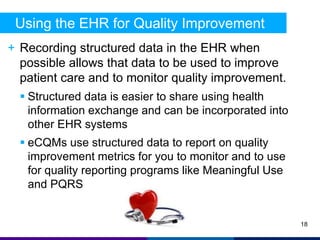
Using the EHR for Quality Improvement 
+ Recording structured data in the EHR when 
possible allows that data to be used to improve 
patient care and to monitor quality improvement. 
 Structured data is easier to share using health 
information exchange and can be incorporated into 
other EHR systems 
 eCQMs use structured data to report on quality 
improvement metrics for you to monitor and to use 
for quality reporting programs like Meaningful Use 
and PQRS 
18
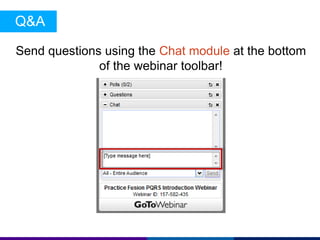
Send questions using the Chat module at the bottom 
of the webinar toolbar! 
Q&A

New clinical quality measure reporting in Practice Fusion [slides]

  • 1.
    Clinical Quality Measure Reporting in Practice Fusion Presented By: Emily Richmond, MPH Senior Manager, Health Care Quality
  • 2.
    Webinar Logistics Listeningto the webinar + Audio is available through your computer speakers or by using your phone: Toll: +1 (702) 489-0007 Access Code: 182-653-947 Audio PIN: Shown after joining the webinar Submitting questions for Q&A • Send questions to Practice Fusion webinar staff using the Chat module at the bottom of the webinar toolbar 2
  • 3.
    Clinical Quality Measures& Quality Improvement + Clinical quality measures, also called CQMs, are tools that help us measure and monitor the quality of healthcare and the contribution of those healthcare services towards improved health outcomes. 3 "If you cannot measure it, you cannot improve it." Lord Kelvin (1824-1907)
  • 4.
    CQM Terminology •The population of patients or encounters for which the measure applies. Denominator • The population of patients from the denominator who meet the measure specified clinical requirements or the population of encounters from the denominator where the measure specific requirement has been performed. Numerator • Specifications that would remove a patient from the denominator of a specific quality measure. • Includes certain diagnoses that make it clinically unnecessary for the patient to receive the numerator clinical action and/or provider or patient determined reasons for refusing certain clinical actions. Exclusions & Exceptions • This refers to the time frame for which the CQMs will be calculated (usually one year). Measurement period
  • 5.
    Quality Measurement DevelopmentProcess 5 Coded values that make up Value Sets Groups of Value Sets make up the criteria for the denominator and numerator Value sets are used to create measure logic
  • 6.
    Reporting CQMs forMeaningful Use + Manual reporting during attestation  Provider will type in values from the CQM report exactly as they appear in the EHR at the end of your 90-day reporting period  Zero values (0/0) are acceptable and will not prevent you from achieving Meaningful Use + Electronic reporting at the end of the calendar year  Reporting period will be a full calendar year (January 1, 2014 – December 31, 2014)  Practice Fusion will report data in January 2015 on your behalf for providers who request this. Your MU attestation payment will be delayed until after your CQM values are reported to CMS.  May qualify for PQRS reporting as well if all measures meet PQRS reporting requirements. 6 Requirement: Report at least 9 measures covering at least 3 of the NQS domains.
  • 7.
    Practice Fusion andPQRS EHR Reporting + Practice Fusion will be acting as a Direct EHR Vendor (EHR Direct), which will allow our providers to use Practice Fusion to directly submit their PQRS measures data to CMS in the CMS specified format on their own behalf. + PQRS reporting for the EHR reporting mechanism will occur between January-February 2015 since the PQRS measurement period runs from January 1, 2014- December 31, 2014. 7
  • 8.
    Reporting for PQRSusing the EHR Reporting • In order to use the EHR reporting option for PQRS, a provider must report on at least 1 measure for which there is Medicare patient data. • The PQRS measurement period length is a full calendar year, so for 2014 it would run from January 1, 2014 through December 31, 2014. • Providers who submit CQMs via Meaningful Use attestation can still use Practice Fusion for the purposes of 2014 PQRS reporting in January 2015. • PF will begin accepting requests for QRDA electronic submission of CQM data for both PQRS and Meaningful Use in the Fall of 2014. 8 Requirement: Report at least 9 measures covering at least 3 of the NQS domains. EHR CQMs must be the most recent measure versions available from CMS.
  • 9.
    Practice Fusion CQMs + Practice Fusion currently has 13 certified MU/PQRS electronic clinical quality measures (eCQMs) in the EHR. + Later this summer, we will be certifying an additional set up 10-12 eCQMs that will give PF providers more options when choosing the 9 measures to report for MU/PQRS. 9 Measure # Title CMS165v2 Controlling High Blood Pressure CMS156v2 Use of High-Risk Medications in the Elderly CMS138v2 Preventive Care and Screening: Tobacco Use: Screening and Cessation Intervention CMS130v2 Colorectal Cancer Screening CMS166v3 Use of Imaging Studies for Low Back Pain CMS131v2 Diabetes: Eye Exam CMS123v2 Diabetes: Foot Exam CMS122v2 Diabetes: Hemoglobin A1c Poor Control CMS2v3 Preventive Care and Screening: Screening for Clinical Depression and Follow-Up Plan CMS68v3 Documentation of Current Medications in the Medical Record CMS69v2 Preventive Care and Screening: Body Mass Index (BMI) Screening and Follow-Up CMS50v2 Closing the referral loop: receipt of specialist report CMS90v3 Functional status assessment for complex chronic conditions
  • 10.
    New Data Elementsin Practice Fusion + To support future CQM additions and the entry of structured patient data in the EHR, Practice Fusion recently added over 4500 new data elements to the Screenings/Interventions/Assessments section of the new chart note. 10
  • 11.
    What types ofdata can be recorded? + Screenings + Assessments + Interventions + Procedures + Diagnostic Studies + Documentation of ordered or delivered follow-up care 11 Specialties that new elements are most applicable to: Pediatrics Primary care General medicine/Internal medicine OBGYN Cardiology Neurology
  • 12.
    Screenings + Breastcancer screenings  Screening mammography  Diagnostic mammography  Breast mammogram screening  Right mammogram screening  Bilateral mammogram screening  Breast mammogram spot  Breast mammogram grid 12
  • 13.
    Assessments + Fallsrisk assessment + Assessment and interpretation of higher cerebral function, cognitive testing + Psychologic cognitive testing and assessment + Other cognitive assessments  BIMS summary score  SLUMS, IQCODE, AD8, MoCA, BOMC + Pain assessments  Wong-Baker FACES  Visual analog scale  Numeric severity scale  General pain severity assessment 13
  • 14.
    Interventions & Procedures + Ordered, completed, or current palliative care + Ordered, completed, or current hospice care + Coronary artery bypass graft interventions + Percutaneous coronary interventions + OBGYN specific procedures  Cesarean delivery, vaginal delivery, etc.  Routine obstetric care  Mastectomy 14
  • 15.
    Diagnostic studies +X-rays (all areas of the body) + MRI angiograms (w/ and w/o contracts) + EKG Study + Left ventricular Ejection fraction  By US, US 2D, MRI, 2D echo and cardiac angiogram + Gestational age + Fetal measurements  Heart, head, limb, etc. 15
  • 16.
    Follow-up care &Lifestyle interventions + Alcohol abuse prevention education + Counseling about alcohol consumption + Referral to community drug & alcohol team and alcoholism rehabilitation + Lifestyle education about hypertension + Weight and nutrition counseling and follow-up care  Exercise education, obesity diet education  Prescribed exercise therapy  Referral to physical activity program  Recommendation to change food and drink intake 16
  • 17.
    Practice Fusion EHRDemonstration 17
  • 18.
    Using the EHRfor Quality Improvement + Recording structured data in the EHR when possible allows that data to be used to improve patient care and to monitor quality improvement.  Structured data is easier to share using health information exchange and can be incorporated into other EHR systems  eCQMs use structured data to report on quality improvement metrics for you to monitor and to use for quality reporting programs like Meaningful Use and PQRS 18
  • 19.
    Send questions usingthe Chat module at the bottom of the webinar toolbar! Q&A

Editor's Notes

  • #4 WHAT ARE CLINICAL QUALITY MEASURES? Clinical quality measures, also called CQMs, are tools that help us measure and monitor the quality of healthcare and the contribution of those healthcare services towards improved health outcomes. In the past, quality measures primarily used data that came from claims, but as technology has improved and become more prominent in the healthcare setting, many quality measures now use data that comes from a provider’s electronic health record (EHR). These electronic CQMs (eCQMs) use EHR data to measure health outcomes, clinical processes, patient safety, efficient use of healthcare resources, care coordination, patient engagement, and population and public health improvement.
  • #5 There are a lot of terms used when discussing and understanding quality measures. The definitions below will help you better use this guide to measure and monitor the quality of care that you provide to your patients. Denominator – The population of patients or encounters for which the measure applies. Numerator - The population of patients from the denominator who meet the measure specified clinical requirements or the population of encounters from the denominator where the measure specific requirement has been performed. Exclusion/Exception – Specifications that would remove a patient from the denominator of a specific quality measure. These exclusions and exceptions include certain diagnoses that make it clinically unnecessary for the patient to receive the numerator clinical action and/or provider or patient determined reasons for refusing certain clinical actions. Measurement period – This is also known as the EHR reporting period and refers to the time frame for which the CQMs will be calculated. For more information on determining your CQM reporting period, refer to the reporting requirements at the end of this guide.
  • #6 The current set of CMS electronic clinical quality measures that can be used for Meaningful Use are much more complex than the quality measures used for the MU program in previous years. The measures included as part of 2014 EHR certification underwent an extensive quality measurement development process that included reviewing evidence, creating the specifications for the patient population and clinical numerator, testing the measure, defining out the data needs to be collected and defined, and going through the national measure endorsement process (usually through the National Quality Forum). The measure specifications that are given to EHR vendors like Practice Fusion include the exact coded values that make up value sets, information on which value sets make up the criteria for the numerator and the denominator, and which value sets are used in creating the measure logic. Because each quality measure has defined value sets that can be used, each measure has very specific data elements that patients must have in their medical record for the denominator and very specific, although sometimes a large set of options, that you as the provider can enter in the EHR in order to receive credit in the numerator. Although it may seem like a checkbox is the easiest option, checkboxes prevent you from recording the care you have provided in a specific and accurate way. As you all know, not all tobacco cessation interventions are the same – because you can now enter in a variety of potential options for indicating that your patients have received a cessation intervention, your medical records – and your patients’ medical records – will not reflect that care more accurately.
  • #7 The CQM reporting requirement for Meaningful Use is to report at least 9 measures that cover at least 3 of the National Quality Strategy domains. Under the 2014 Medicare Physician Fee Schedule Final Rule, CMS made some changes to the rules that govern how providers will need to report CQMs for Meaningful Use. There are now two different reporting options available to providers participating in Meaningful Use. The first reporting option is to manually submit CQM values during attestation to CMS. This is a similar process to how CQM values were submitted to CMS in prior years. When you submit CQM data during attestation, you will need to type in the values from the CQM report exactly as they appear in the EHR at the end of your 90-day period. Zero values are acceptable if you do not have 9 CQMs in your Practice Fusion Clinical Quality Measures report with values in the denominator or numerator. Submitting zero values will not prevent you from achieving Meaningful Use and receiving an incentive payment. The second reporting options is electronic reporting of CQMs to CMS. The reporting period for electronic submission of CQM data will be a full calendar year, from January 1st to December 31st of 2014. Practice Fusion will submit CQM data to CMS at the end of the CQM measurement period for providers who choose the EHR reporting mechanism to report CQMs to CMS for the purposes of Meaningful Use. CQM data will be electronically submitted to CMS as a file that meets the HL7 standards for the Quality Reporting Data Architecture (QRDA). Providers who choose the electronic reporting mechanism for Meaningful Use will have their attestation incentive payments delayed until their CQM values have been reported, but those providers can get credit for both MU and PQRS via this one submission, as long as the measures they are reporting meet the PQRS requirement of having values in the denominator and include data for at least one Medicare patient. Practice Fusion will begin accepting requests for providers who wish to have CQM data submitted to CMS in the fall of 2014. We recommend that providers manually attest to CQM values so that MU payments aren’t delayed, but also continue to monitor the full calendar year reporting period for PQRS.
  • #9 As in past years, PQRS offers multiple reporting mechanisms: claims, registry, or direct EHR. Practice Fusion will now support electronic reporting for PQRS measures starting this year. Providers who wish to report PQRS via their EHR will be required to report 9 measures covering at least 3 of the National Quality Strategy domains using a certified EHR system that has been certified to the most recent version of the CMS electronic CQMs. Practice Fusion’s CQMs are all certified to the most recent version of the measure specifications. In order to use the EHR reporting option for PQRS, a provider must report on at least 1 measure for which there is Medicare patient data. As in past years, measures with a zero value denominator cannot be used for PQRS. The PQRS measurement period length is a full calendar year, so for 2014 it would run from January 1, 2014 through December 31, 2014. Providers who submit CQMs via Meaningful Use attestation can still use electronic submission with Practice Fusion for the purposes of 2014 PQRS reporting in January 2015. Practice Fusion will begin accepting requests for providers who wish to have CQM data submitted to CMS for the purposes of PQRS in the fall of 2014. For additional information on PQRS reporting in 2014, including information on the alternative reporting mechanisms such as claims-based reporting, please sign up to attend the “Understanding PQRS in 2014” webinar, scheduled for Tuesday, February 4th at 12pm Eastern/9am Pacific. A link to register for this event will be sent via email to all attendees of this webinar after today’s presentation.
  • #12 Over 4500 individual data elements were added, but for most providers, only a small subset may be applicable to your patient population and thus used on a regular basis. Let’s go over some new data elements that were added but also others that are not being utilized often in the chart note. Because there are so many individual elements that can represent very specific patient care situations, we will be staying at a slightly higher level for this webinar. However, I encourage you all to explore the new chart note in the EHR and search for terms that may apply to your practice to see what is available.
  • #16 X-rays for all areas of the body, including specific data elements for x-rays of the
  • #20 We will now answer some of the questions you all have been sending through the chat feature. As a reminder, continue to send questions and we will answer as many as we can during this session but will also respond to some questions individually.