Experiences with innovation-related procurement 
OECD Conference Center, Paris, 5th Dec. 2013, Mike Weber 
OECD WORKSHOP ON MEASURING THE LINK BETWEEN PUBLIC PROCUREMENT, R&D AND INNOVATION
Experiences with (the measurement of) innovation-related procurement 
 Research project “purchasing state” 
 Measurement concept 
 Results: Benchmarking 
 Lessons learnt 
Agenda
“Purchasing State” 
Research project and empirical investigations 
About the research project 
 General perspective on innovative procurement and the procurement of innovations 
 Cooperation project: university, market researcher, law firm 
 Funded by the Federal Ministry of Education and Research, Germany 
 Conducted in 2009 
Empirical investigations 
 Interpretation of official statistics 
 Analysis of TED data (and data from other databases) 
 Survey of German procurement agencies 
 Survey of tenderer 
 Case studies of successful procurement projects
“Purchasing State” 
Functions of data in measuring innovation orientation 
 Interpretation of official statistics 
– Overview of total procurement volume including distinction between type of public 
agencies and field of activity 
– Rough estimation of procurement volume related to innovation aspect 
 Analysis of TED data 
– Plausibility test of findings and additional information about procedural aspects 
 Survey of German procurement agencies 
– Comprehensive questionnaire and remarkable response rate 
 Survey of tenderer (not linked to agency survey and low response rate) 
 Case studies of successful procurement projects 
– Deepening the understanding of success dimensions and success factors
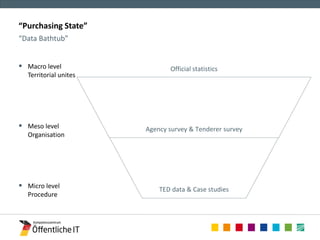
“Purchasing State” 
“Data Bathtub” 
 Macro level 
Territorial unites 
 Meso level 
Organisation 
 Micro level 
Procedure 
Official statistics 
Agency survey & Tenderer survey 
TED data & Case studies
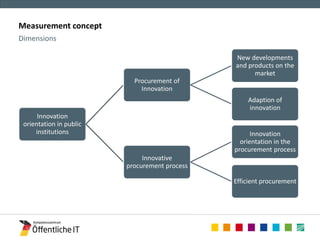
Innovation 
orientation in public 
institutions 
Procurement of 
Innovation 
New developments 
and products on the 
market 
Adaption of 
innovation 
Innovative 
procurement process 
Innovation 
orientation in the 
procurement process 
Efficient procurement 
Measurement concept 
Dimensions
Measurement concept 
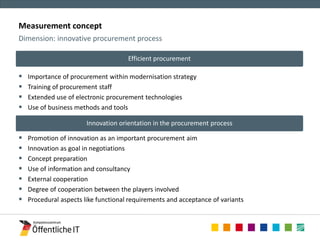
 Importance of procurement within modernisation strategy 
 Training of procurement staff 
 Extended use of electronic procurement technologies 
 Use of business methods and tools 
 Promotion of innovation as an important procurement aim 
 Innovation as goal in negotiations 
 Concept preparation 
 Use of information and consultancy 
 External cooperation 
 Degree of cooperation between the players involved 
 Procedural aspects like functional requirements and acceptance of variants 
Dimension: innovative procurement process 
Innovation orientation in the procurement process 
Efficient procurement
Measurement concept 
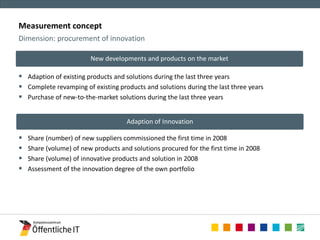
 Adaption of existing products and solutions during the last three years 
 Complete revamping of existing products and solutions during the last three years 
 Purchase of new-to-the-market solutions during the last three years 
 Share (number) of new suppliers commissioned the first time in 2008 
 Share (volume) of new products and solutions procured for the first time in 2008 
 Share (volume) of innovative products and solution in 2008 
 Assessment of the innovation degree of the own portfolio 
Dimension: procurement of innovation 
Adaption of Innovation 
New developments and products on the market
Measurement concept 
Correlation 
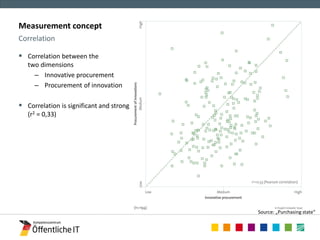
 Correlation between the 
two dimensions 
– Innovative procurement 
– Procurement of innovation 
 Correlation is significant and strong 
(r2 = 0,33) 
Source: „Purchasing state“
Innovation 
orientation in public 
institutions 
Procurement of 
Innovation 
New developments 
and products on the 
market 
Adaption of 
innovation 
Innovative 
procurement process 
Innovation 
orientation in the 
procurement process 
Efficient procurement 
Measurement concept 
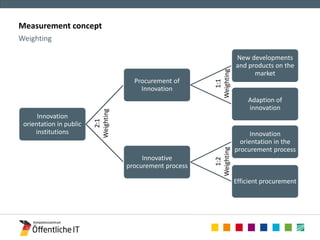
Weighting 
2:1 
Weighting 
1:1 
Weighting 
1:2 
Weighting
Benchmarking of purchasing institutions 
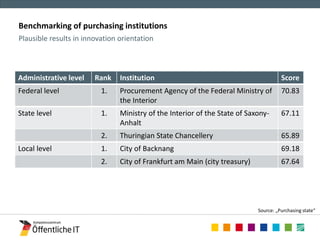
Plausible results in innovation orientation 
Administrative level Rank Institution Score 
Federal level 1. Procurement Agency of the Federal Ministry of 
the Interior 
70.83 
State level 1. Ministry of the Interior of the State of Saxony- 
Anhalt 
67.11 
2. Thuringian State Chancellery 65.89 
Local level 1. City of Backnang 69.18 
2. City of Frankfurt am Main (city treasury) 67.64 
Source: „Purchasing state“
Experiences with (the measurement of) innovation-related procurement 
Lessons learnt: status quo of procurement data in Germany in 2009 
 Data on macro level: 
– Surprisingly good but hidden data 
– Valid and sophisticated collected data 
– Only a rough overview 
– Nearly unused (and not interpreted) 
 Data on organisational level: 
– Difficult access to the field 
– Easily overburdening of the respondents 
– Different stakeholder and difficult assessment of innovation aspects 
 Data on procedural level: 
– Poor information content 
– Many databases and no clearly shaped population
Experiences with (the measurement of) innovation-related procurement 
 Zielsetzungen 
 Methoden 
– Bewährter Methodenkanon 
– Experimentelle Erweiterungen 
Lessons learnt: requirements and potential enhancements 
 Data on micro level 
 Including assessment of innovation aspect 
(from different perspectives) 
 Automatic gathering of micro data 
(by use of electronic procurement) 
 Linking data and linking sources 
(at single procedures) 
 State-of-the-art transformation and analytic tools 
(big data, text mining, …)
Dr. Mike Weber 
Fraunhofer FOKUS 
Kaiserin-Augusta-Allee 31 
D-10589 Berlin, Germany 
Tel: + 49 30 3463 7319 
Fax: + 49 30 3463 99 7319 
E-Mail: mike.weber@fokus.fraunhofer.de 
www.fokus.fraunhofer.de 
www.oeffentliche-it.de

OECD workshop on measuring the link between public procurement, R&D and innovation. "Experiences with innovation-related procurement"

  • 1.
    Experiences with innovation-relatedprocurement OECD Conference Center, Paris, 5th Dec. 2013, Mike Weber OECD WORKSHOP ON MEASURING THE LINK BETWEEN PUBLIC PROCUREMENT, R&D AND INNOVATION
  • 2.
    Experiences with (themeasurement of) innovation-related procurement  Research project “purchasing state”  Measurement concept  Results: Benchmarking  Lessons learnt Agenda
  • 3.
    “Purchasing State” Researchproject and empirical investigations About the research project  General perspective on innovative procurement and the procurement of innovations  Cooperation project: university, market researcher, law firm  Funded by the Federal Ministry of Education and Research, Germany  Conducted in 2009 Empirical investigations  Interpretation of official statistics  Analysis of TED data (and data from other databases)  Survey of German procurement agencies  Survey of tenderer  Case studies of successful procurement projects
  • 4.
    “Purchasing State” Functionsof data in measuring innovation orientation  Interpretation of official statistics – Overview of total procurement volume including distinction between type of public agencies and field of activity – Rough estimation of procurement volume related to innovation aspect  Analysis of TED data – Plausibility test of findings and additional information about procedural aspects  Survey of German procurement agencies – Comprehensive questionnaire and remarkable response rate  Survey of tenderer (not linked to agency survey and low response rate)  Case studies of successful procurement projects – Deepening the understanding of success dimensions and success factors
  • 5.
    “Purchasing State” “DataBathtub”  Macro level Territorial unites  Meso level Organisation  Micro level Procedure Official statistics Agency survey & Tenderer survey TED data & Case studies
  • 6.
    Innovation orientation inpublic institutions Procurement of Innovation New developments and products on the market Adaption of innovation Innovative procurement process Innovation orientation in the procurement process Efficient procurement Measurement concept Dimensions
  • 7.
    Measurement concept Importance of procurement within modernisation strategy  Training of procurement staff  Extended use of electronic procurement technologies  Use of business methods and tools  Promotion of innovation as an important procurement aim  Innovation as goal in negotiations  Concept preparation  Use of information and consultancy  External cooperation  Degree of cooperation between the players involved  Procedural aspects like functional requirements and acceptance of variants Dimension: innovative procurement process Innovation orientation in the procurement process Efficient procurement
  • 8.
    Measurement concept Adaption of existing products and solutions during the last three years  Complete revamping of existing products and solutions during the last three years  Purchase of new-to-the-market solutions during the last three years  Share (number) of new suppliers commissioned the first time in 2008  Share (volume) of new products and solutions procured for the first time in 2008  Share (volume) of innovative products and solution in 2008  Assessment of the innovation degree of the own portfolio Dimension: procurement of innovation Adaption of Innovation New developments and products on the market
  • 9.
    Measurement concept Correlation  Correlation between the two dimensions – Innovative procurement – Procurement of innovation  Correlation is significant and strong (r2 = 0,33) Source: „Purchasing state“
  • 10.
    Innovation orientation inpublic institutions Procurement of Innovation New developments and products on the market Adaption of innovation Innovative procurement process Innovation orientation in the procurement process Efficient procurement Measurement concept Weighting 2:1 Weighting 1:1 Weighting 1:2 Weighting
  • 11.
    Benchmarking of purchasinginstitutions Plausible results in innovation orientation Administrative level Rank Institution Score Federal level 1. Procurement Agency of the Federal Ministry of the Interior 70.83 State level 1. Ministry of the Interior of the State of Saxony- Anhalt 67.11 2. Thuringian State Chancellery 65.89 Local level 1. City of Backnang 69.18 2. City of Frankfurt am Main (city treasury) 67.64 Source: „Purchasing state“
  • 12.
    Experiences with (themeasurement of) innovation-related procurement Lessons learnt: status quo of procurement data in Germany in 2009  Data on macro level: – Surprisingly good but hidden data – Valid and sophisticated collected data – Only a rough overview – Nearly unused (and not interpreted)  Data on organisational level: – Difficult access to the field – Easily overburdening of the respondents – Different stakeholder and difficult assessment of innovation aspects  Data on procedural level: – Poor information content – Many databases and no clearly shaped population
  • 13.
    Experiences with (themeasurement of) innovation-related procurement  Zielsetzungen  Methoden – Bewährter Methodenkanon – Experimentelle Erweiterungen Lessons learnt: requirements and potential enhancements  Data on micro level  Including assessment of innovation aspect (from different perspectives)  Automatic gathering of micro data (by use of electronic procurement)  Linking data and linking sources (at single procedures)  State-of-the-art transformation and analytic tools (big data, text mining, …)
  • 14.
    Dr. Mike Weber Fraunhofer FOKUS Kaiserin-Augusta-Allee 31 D-10589 Berlin, Germany Tel: + 49 30 3463 7319 Fax: + 49 30 3463 99 7319 E-Mail: mike.weber@fokus.fraunhofer.de www.fokus.fraunhofer.de www.oeffentliche-it.de