1 
Using Business Innovation Surveys to Learn about Procurement and PPI - some Experience from Germany Christian Rammer Centre for European Economic Research (ZEW), Mannheim OECD Expert Workshop Measurement of Public Procurement of Innovation Paris, February 4th, 2013
2 
Content 
(1)„Sources of Innovation“ as a way to identify the role of customers/demand (incl. customers/demand from the public sector) for innovation 
(2)Significance of PPI: results from the German Innovation Survey 
(3)Impact of PPI on firms„ innovation performance 
(4)Strengths and limitations of this approach
3 
Sources of Innovation 
- Mansfield (1991): innovations that could not have been developed in the absence of recent academic research 
- Extending to other potential external sources that were indispensible for developing and introducing product or process innovation: - customers/demand - suppliers - competitors - regulation - public science 
- Firms had to assess the significance of each source for their product and process innovations separately 
- For each innovation source (except regulation), data on sector and location of sources was collected (free text) 
 2-page question, included in 1999 and 2003 surveys
4
5 
Public Procurement Innovation 
- PPI: purchase of innovative product the development of which has been explicitly demanded by a public authority 
- Simple purchase of innovative products by public authorities is not PPI 
- Public authorities also include public services
6 
- Sectors were assigned to NACE (rev. 1.1) 3-digit 
-For each innovation source, sales with new products (for product innovation) and cost savings (for process innovation) triggered by that source were calculated using weights: IOk = Si (Si aik wi) IO innovation output S total sales / total costs a sales share of new products / cost savings share triggered by source k w weight of firm i in total firm population - A sector‘s contribution to innovation output was calculated by weighting IOk by the (approximate) share of sector j in all innovation impulses received from source k - Public administration and public services identified through corresponding NACE (rev. 1.1) sectors (75, 80, 85, 40, 41, 60, 70, 73, 90) 
Data Analysis
7 
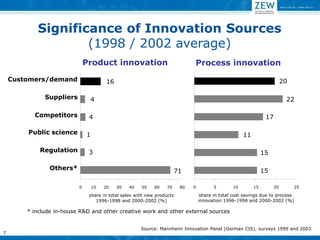
Significance of Innovation Sources 
(1998 / 2002 average) 
0 
10 
20 
30 
40 
50 
60 
70 
80 
Customers/demand 
Suppliers 
Competitors Public science 
Regulation 
Others* 
0 
5 
10 
15 
20 
25 
Product innovation 
Process innovation 
* include in-house R&D and other creative work and other external sources 
share in total sales with new products 
1996-1998 and 2000-2002 (%) 
share in total cost savings due to process 
innovation 1996-1998 and 2000-2002 (%) 
16 
4 4 
1 
3 
71 
20 
22 
17 
11 
15 
15 
Source: Mannheim Innovation Panel (German CIS), surveys 1999 and 2003
8 
Significance of Public Procurement 
as Innovation Source (1998 / 2002) 
Source: Mannheim Innovation Panel (German CIS), surveys 1999 and 2003 
NACE rev 1.1 
product innovation 
process innovation 
product innovation 
process innovation 
75/80 
2.8 
0.5 
0.5 
0.1 
85 
1.2 
0.1 
0.2 
0.0 
73* 
0.2 
0.7 
0.0 
0.1 
90* 
0.1 
0.0 
0.0 
0.0 
60* 
2.4 
0.3 
0.4 
0.1 
70* 
0.4 
0.2 
0.1 
0.0 
40/41* 
0.4 
0.4 
0.1 
0.1 
Total 
7.5 
2.2 
1.2 
0.4 
Regulation 
3.5 
15.4 
Public science 
1.5 
10.8 
* share of innovation impulses from public organisations estimated 
Share in all innovation impulses by customers (%) Share in total innovation output (%) 
Public customers from
9 
Innovativeness of Demand I (1998 / 2002) 
Source: Mannheim Innovation Panel (German CIS), surveys 1999 and 2003 – Federal Statistical Office of Germany: Input-Output-Tables 
0 
5 
10 
15 
20 
25 
30 
35 
34 
95 
60_63 65_67 
29 
50/52 
22 
75/80 
15_16 
31 
24* 
70_71 
32 
45 
01_05 
51 
64 
74 
85 33 
35 
36_37 
24.4 
72 
28 
17_19 
25 
40_41 
20_21 
30 
26 
27 
55 
73 
23 10_14 
90_93 
innovation impulses by customers 
domestic demand 
share in total innovation impulses by customers/demand / share in total domestic intermediate consumption/final use/capital expenditure (%) 
Customer sector 
NACE rev 1.1 
* 24 excl. 
24.4 
Share in total
10 
Innovativeness of Demand II (1998 / 2002) 
Source: Mannheim Innovation Panel (German CIS), surveys 1999 and 2003 – Federal Statistical Office of Germany: Input-Output-Tables 
* 24 excl. 
24.4 
share of sales of innovative products 
based on innovation impulses 
from customers 
in total domestic intermediate consumption, final use and capital expenditure 
of the customer sector 
(export share of innovators estimated) 
share of demanded innovation in total domestic demand (%) 
0 
5 10 
15 
20 
25 
30 
35 
40 
45 
34 
24.4 
65_67 
50, 52 
36_37 
22 
60_63 
32 29 
35 
72 
30 
01_05 
17_19 
31 
33 
23 
73 
64 
15_16 
Total 
51 
25 
10_14 85 
26 
24* 
28 
45 
40_41 
20_21 
55 
74 
95 
70 
27 
75_80 
90 
Customer sector 
NACE rev 1.1
11 Impact of PP on Innovation Performance 
Aschhoff & Sofka (“Innovation on Demand – Can Public Procurement Drive Market Success of Innovations?” Research Policy 38, 1235-1247, 2009): 
- PPI contributes to higher sales with new products (which is true for customer/demand impulses in general) 
- no such effect found for defence demand, however 
- SMEs, services and firms from eastern Germany profit most from PPI 
Beise & Rammer (“Local User-Producer Interaction in Innovation and Export Performance of Firms”, Small Business Economics 27(2-3), 207- 222, 2006): 
- PPI tend to limit export activities of firms, particularly for service firms that use PPI from the health sector 
- „ideosyncratic‟ demand evident for private households
12 
Strengths and Limitations of the Approach 
-Collecting data on various external sources for innovation helps to provide a balanced picture of the drivers of innovation 
-Information on sectors and location of innovation sources offers a great potential for analysis 
-Focussing on only one potential source (e.g. PP) risks to overestimate the role of PP for industrial innovation 
-Collecting full information on innovation sources requires substantial questionnaire space and puts high burden on respondents (and on statistical offices for coding texts) - Limited opportunity to add additional questions on PP & innovation
13 
Thank you for 
your attention! 
rammer@zew.de

Using Business Innovation Surveys to Learn about Procurement and PPI, Experience from Germany

  • 1.
    1 Using BusinessInnovation Surveys to Learn about Procurement and PPI - some Experience from Germany Christian Rammer Centre for European Economic Research (ZEW), Mannheim OECD Expert Workshop Measurement of Public Procurement of Innovation Paris, February 4th, 2013
  • 2.
    2 Content (1)„Sourcesof Innovation“ as a way to identify the role of customers/demand (incl. customers/demand from the public sector) for innovation (2)Significance of PPI: results from the German Innovation Survey (3)Impact of PPI on firms„ innovation performance (4)Strengths and limitations of this approach
  • 3.
    3 Sources ofInnovation - Mansfield (1991): innovations that could not have been developed in the absence of recent academic research - Extending to other potential external sources that were indispensible for developing and introducing product or process innovation: - customers/demand - suppliers - competitors - regulation - public science - Firms had to assess the significance of each source for their product and process innovations separately - For each innovation source (except regulation), data on sector and location of sources was collected (free text)  2-page question, included in 1999 and 2003 surveys
  • 4.
  • 5.
    5 Public ProcurementInnovation - PPI: purchase of innovative product the development of which has been explicitly demanded by a public authority - Simple purchase of innovative products by public authorities is not PPI - Public authorities also include public services
  • 6.
    6 - Sectorswere assigned to NACE (rev. 1.1) 3-digit -For each innovation source, sales with new products (for product innovation) and cost savings (for process innovation) triggered by that source were calculated using weights: IOk = Si (Si aik wi) IO innovation output S total sales / total costs a sales share of new products / cost savings share triggered by source k w weight of firm i in total firm population - A sector‘s contribution to innovation output was calculated by weighting IOk by the (approximate) share of sector j in all innovation impulses received from source k - Public administration and public services identified through corresponding NACE (rev. 1.1) sectors (75, 80, 85, 40, 41, 60, 70, 73, 90) Data Analysis
  • 7.
    7 Significance ofInnovation Sources (1998 / 2002 average) 0 10 20 30 40 50 60 70 80 Customers/demand Suppliers Competitors Public science Regulation Others* 0 5 10 15 20 25 Product innovation Process innovation * include in-house R&D and other creative work and other external sources share in total sales with new products 1996-1998 and 2000-2002 (%) share in total cost savings due to process innovation 1996-1998 and 2000-2002 (%) 16 4 4 1 3 71 20 22 17 11 15 15 Source: Mannheim Innovation Panel (German CIS), surveys 1999 and 2003
  • 8.
    8 Significance ofPublic Procurement as Innovation Source (1998 / 2002) Source: Mannheim Innovation Panel (German CIS), surveys 1999 and 2003 NACE rev 1.1 product innovation process innovation product innovation process innovation 75/80 2.8 0.5 0.5 0.1 85 1.2 0.1 0.2 0.0 73* 0.2 0.7 0.0 0.1 90* 0.1 0.0 0.0 0.0 60* 2.4 0.3 0.4 0.1 70* 0.4 0.2 0.1 0.0 40/41* 0.4 0.4 0.1 0.1 Total 7.5 2.2 1.2 0.4 Regulation 3.5 15.4 Public science 1.5 10.8 * share of innovation impulses from public organisations estimated Share in all innovation impulses by customers (%) Share in total innovation output (%) Public customers from
  • 9.
    9 Innovativeness ofDemand I (1998 / 2002) Source: Mannheim Innovation Panel (German CIS), surveys 1999 and 2003 – Federal Statistical Office of Germany: Input-Output-Tables 0 5 10 15 20 25 30 35 34 95 60_63 65_67 29 50/52 22 75/80 15_16 31 24* 70_71 32 45 01_05 51 64 74 85 33 35 36_37 24.4 72 28 17_19 25 40_41 20_21 30 26 27 55 73 23 10_14 90_93 innovation impulses by customers domestic demand share in total innovation impulses by customers/demand / share in total domestic intermediate consumption/final use/capital expenditure (%) Customer sector NACE rev 1.1 * 24 excl. 24.4 Share in total
  • 10.
    10 Innovativeness ofDemand II (1998 / 2002) Source: Mannheim Innovation Panel (German CIS), surveys 1999 and 2003 – Federal Statistical Office of Germany: Input-Output-Tables * 24 excl. 24.4 share of sales of innovative products based on innovation impulses from customers in total domestic intermediate consumption, final use and capital expenditure of the customer sector (export share of innovators estimated) share of demanded innovation in total domestic demand (%) 0 5 10 15 20 25 30 35 40 45 34 24.4 65_67 50, 52 36_37 22 60_63 32 29 35 72 30 01_05 17_19 31 33 23 73 64 15_16 Total 51 25 10_14 85 26 24* 28 45 40_41 20_21 55 74 95 70 27 75_80 90 Customer sector NACE rev 1.1
  • 11.
    11 Impact ofPP on Innovation Performance Aschhoff & Sofka (“Innovation on Demand – Can Public Procurement Drive Market Success of Innovations?” Research Policy 38, 1235-1247, 2009): - PPI contributes to higher sales with new products (which is true for customer/demand impulses in general) - no such effect found for defence demand, however - SMEs, services and firms from eastern Germany profit most from PPI Beise & Rammer (“Local User-Producer Interaction in Innovation and Export Performance of Firms”, Small Business Economics 27(2-3), 207- 222, 2006): - PPI tend to limit export activities of firms, particularly for service firms that use PPI from the health sector - „ideosyncratic‟ demand evident for private households
  • 12.
    12 Strengths andLimitations of the Approach -Collecting data on various external sources for innovation helps to provide a balanced picture of the drivers of innovation -Information on sectors and location of innovation sources offers a great potential for analysis -Focussing on only one potential source (e.g. PP) risks to overestimate the role of PP for industrial innovation -Collecting full information on innovation sources requires substantial questionnaire space and puts high burden on respondents (and on statistical offices for coding texts) - Limited opportunity to add additional questions on PP & innovation
  • 13.
    13 Thank youfor your attention! rammer@zew.de