+ 
Impact Assessment of Pre-commercial Procurement 
John Rigby 
Manchester University 
United Kingdom 
OECD WORKSHOP ON MEASURING THE LINK BETWEEN 
PUBLIC PROCUREMENT, R&D AND INNOVATION 
Session 4: Assessing the innovation impact of public procurement policies 
Paris, 5-6 December 2013 
Room CC5 - OECD Conference Centre 
2, Rue André Pascal, 75016 Paris 
Manchester Institute of Innovation Research, Manchester Business School 
1
+ 
Impact Assessment of PCP 
Definitions and Contexts 
Aims and Objectives of PCP 
Evaluation of PCP 
Manchester Institute of Innovation Research, Manchester Business School 
2
+ 
Definitions - SEC(2011) 1427 final 
Procurement: contracts in order to obtain, against payment of a price the supply of movable or immovable assets, the execution of works or the provision of services. This may include: 
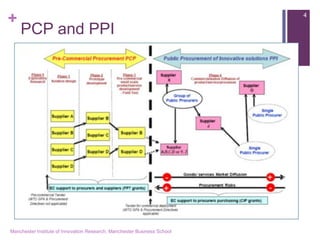
(1) Public pre-commercial procurement, which is an approach to procuring R&D services which involves risk-benefit sharing under market conditions, and competitive development in phases, where there is a separation of the R&D phase from deployment of commercial volumes of end-products; 
(2) Public procurement of innovative solutions, which refers to the case where contracting authorities act as a launch customer for innovative goods or services which are not yet available on a large-scale commercial basis, and may include conformance testing. 
Large-scale public intervention in research and innovation is needed, through both supply and demand measures, such as pre-commercial public procurement of innovation 
Communication in all EU languages (COM(2007)799 final) 
Staff Working Document in all EU languages (SEC(2007)1668) 
Manchester Institute of Innovation Research, Manchester Business School 
3
+ 
PCP and PPI 
Manchester Institute of Innovation Research, Manchester Business School 
4
+ 
Opinion of the Committee of the Regions on ‘Public procurement package’ (2012/C 39 1/09) 
finds it regrettable that some new proposals are also difficult to understand and extraordinarily detailed, as well as adding a number of new provisions. Certain provisions to facilitate procurement have also been added, but other new additions add to the administrative burden on contracting authorities despite the fact that legal stability is required in order for public procurement to be carried out smoothly; 
believes that it is certainly possible to develop simpler – but no less effective – rules for procurement, as demonstrated, not least, by the fact that the WTO's Government Procurement Agreement (GPA) is much simpler than the equivalent EU rules. The Commission is asked to significantly increase the thresholds for procurement. Given that a minuscule percentage of public procurement is cross-border, and in view of the administrative burden the regulatory framework creates for authorities and suppliers, the thresholds do not need to be as low as they are; 
A simple regulatory framework would be useful in this context, too, as such enterprises do not have access to experts in procurement law and other fields. Businesses are experts in their own goods or services, not in procurement rules. 
Manchester Institute of Innovation Research, Manchester Business School 
5
+ 
Pre-commercial Procurement (PCP): Contexts for Application 
Complexity 
An approach to innovation using demand rather than supply 
Public sector organisations can choose between Procurement of Innovation and Pre-commercial Procurement 
Legally complex 
Innovation Partnerships in the new version of the Procurement Directives brings new approach 
Increasing interest 
Recent adoption in the EU and MS, styled on US SBIR 
As legal framework based, variety in applications: 
Range of schemes (EU, MS outside the EU) 
Scale of application: local/ regional, national, cross border 
Agency based (NL Agency (NL), TSB (UK), versus procurer/user 
Manchester Institute of Innovation Research, Manchester Business School 
6
+ 
Aims and Objectives 
Explicitly (not necessarily new or different) 
Prototype / idea IPR? capable of commercialization or decision not to go ahead 
Direct Public Sector 
Catalytic Private Users 
Shared Needs – Cooperative Public Private 
Gateway to a product or service but not a guarantee *risk* 
IPR use rights in public hands 
Objectives achieved by competition and new method > greater speed of innovation + closer match to user needs + leverage 
Cross border 
Implicitly 
Capabilities in firms (winners and losers) 
Manchester Institute of Innovation Research, Manchester Business School 
7
+ 
Aspects of the Evaluation of PCP 
Process and Procedure 
Impact 
Manchester Institute of Innovation Research, Manchester Business School 
8
+ 
Evaluation of PCP: Process / Procedural 
Start with the specification – who is involved? 
Meet the needs of the potential users? 
Correct application of the procedure to the problem? 
Cross border? 
Market potential? 
External justifications (supervision) of procedures? 
Operational costs of implementing a procurement? 
Manchester Institute of Innovation Research, Manchester Business School 
9
+ 
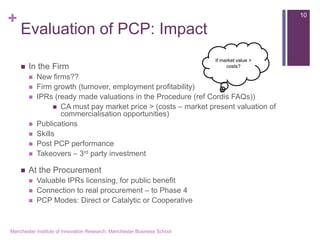
Evaluation of PCP: Impact 
In the Firm 
New firms?? 
Firm growth (turnover, employment profitability) 
IPRs (ready made valuations in the Procedure (ref Cordis FAQs)) 
CA must pay market price > (costs – market present valuation of commercialisation opportunities) 
Publications 
Skills 
Post PCP performance 
Takeovers – 3rd party investment 
At the Procurement 
Valuable IPRs licensing, for public benefit 
Connection to real procurement – to Phase 4 
PCP Modes: Direct or Catalytic or Cooperative 
Manchester Institute of Innovation Research, Manchester Business School 
10 
If market value > costs?
+ 
Impact of PCP as Policy 
Comparison with alternatives, procurement of innovation, “ordinary procurement”, procurement under the directives 
Fit other measures 
Raises R&D spend of firms involved and in the shadows 
Externalities 
Access to PCP? 
Engagement of SMEs? 
Sectoral coverage 
Manchester Institute of Innovation Research, Manchester Business School 
11
+ 
Afterword 
Opportunities for learning? 
Many schemes, different forms, different contexts 
Manchester Institute of Innovation Research, Manchester Business School 
12

OECD workshop on measuring the link between public procurement, R&D and innovation. "Impact Assessment of Pre-commercial Procurement"

  • 1.
    + Impact Assessmentof Pre-commercial Procurement John Rigby Manchester University United Kingdom OECD WORKSHOP ON MEASURING THE LINK BETWEEN PUBLIC PROCUREMENT, R&D AND INNOVATION Session 4: Assessing the innovation impact of public procurement policies Paris, 5-6 December 2013 Room CC5 - OECD Conference Centre 2, Rue André Pascal, 75016 Paris Manchester Institute of Innovation Research, Manchester Business School 1
  • 2.
    + Impact Assessmentof PCP Definitions and Contexts Aims and Objectives of PCP Evaluation of PCP Manchester Institute of Innovation Research, Manchester Business School 2
  • 3.
    + Definitions -SEC(2011) 1427 final Procurement: contracts in order to obtain, against payment of a price the supply of movable or immovable assets, the execution of works or the provision of services. This may include: (1) Public pre-commercial procurement, which is an approach to procuring R&D services which involves risk-benefit sharing under market conditions, and competitive development in phases, where there is a separation of the R&D phase from deployment of commercial volumes of end-products; (2) Public procurement of innovative solutions, which refers to the case where contracting authorities act as a launch customer for innovative goods or services which are not yet available on a large-scale commercial basis, and may include conformance testing. Large-scale public intervention in research and innovation is needed, through both supply and demand measures, such as pre-commercial public procurement of innovation Communication in all EU languages (COM(2007)799 final) Staff Working Document in all EU languages (SEC(2007)1668) Manchester Institute of Innovation Research, Manchester Business School 3
  • 4.
    + PCP andPPI Manchester Institute of Innovation Research, Manchester Business School 4
  • 5.
    + Opinion ofthe Committee of the Regions on ‘Public procurement package’ (2012/C 39 1/09) finds it regrettable that some new proposals are also difficult to understand and extraordinarily detailed, as well as adding a number of new provisions. Certain provisions to facilitate procurement have also been added, but other new additions add to the administrative burden on contracting authorities despite the fact that legal stability is required in order for public procurement to be carried out smoothly; believes that it is certainly possible to develop simpler – but no less effective – rules for procurement, as demonstrated, not least, by the fact that the WTO's Government Procurement Agreement (GPA) is much simpler than the equivalent EU rules. The Commission is asked to significantly increase the thresholds for procurement. Given that a minuscule percentage of public procurement is cross-border, and in view of the administrative burden the regulatory framework creates for authorities and suppliers, the thresholds do not need to be as low as they are; A simple regulatory framework would be useful in this context, too, as such enterprises do not have access to experts in procurement law and other fields. Businesses are experts in their own goods or services, not in procurement rules. Manchester Institute of Innovation Research, Manchester Business School 5
  • 6.
    + Pre-commercial Procurement(PCP): Contexts for Application Complexity An approach to innovation using demand rather than supply Public sector organisations can choose between Procurement of Innovation and Pre-commercial Procurement Legally complex Innovation Partnerships in the new version of the Procurement Directives brings new approach Increasing interest Recent adoption in the EU and MS, styled on US SBIR As legal framework based, variety in applications: Range of schemes (EU, MS outside the EU) Scale of application: local/ regional, national, cross border Agency based (NL Agency (NL), TSB (UK), versus procurer/user Manchester Institute of Innovation Research, Manchester Business School 6
  • 7.
    + Aims andObjectives Explicitly (not necessarily new or different) Prototype / idea IPR? capable of commercialization or decision not to go ahead Direct Public Sector Catalytic Private Users Shared Needs – Cooperative Public Private Gateway to a product or service but not a guarantee *risk* IPR use rights in public hands Objectives achieved by competition and new method > greater speed of innovation + closer match to user needs + leverage Cross border Implicitly Capabilities in firms (winners and losers) Manchester Institute of Innovation Research, Manchester Business School 7
  • 8.
    + Aspects ofthe Evaluation of PCP Process and Procedure Impact Manchester Institute of Innovation Research, Manchester Business School 8
  • 9.
    + Evaluation ofPCP: Process / Procedural Start with the specification – who is involved? Meet the needs of the potential users? Correct application of the procedure to the problem? Cross border? Market potential? External justifications (supervision) of procedures? Operational costs of implementing a procurement? Manchester Institute of Innovation Research, Manchester Business School 9
  • 10.
    + Evaluation ofPCP: Impact In the Firm New firms?? Firm growth (turnover, employment profitability) IPRs (ready made valuations in the Procedure (ref Cordis FAQs)) CA must pay market price > (costs – market present valuation of commercialisation opportunities) Publications Skills Post PCP performance Takeovers – 3rd party investment At the Procurement Valuable IPRs licensing, for public benefit Connection to real procurement – to Phase 4 PCP Modes: Direct or Catalytic or Cooperative Manchester Institute of Innovation Research, Manchester Business School 10 If market value > costs?
  • 11.
    + Impact ofPCP as Policy Comparison with alternatives, procurement of innovation, “ordinary procurement”, procurement under the directives Fit other measures Raises R&D spend of firms involved and in the shadows Externalities Access to PCP? Engagement of SMEs? Sectoral coverage Manchester Institute of Innovation Research, Manchester Business School 11
  • 12.
    + Afterword Opportunitiesfor learning? Many schemes, different forms, different contexts Manchester Institute of Innovation Research, Manchester Business School 12