Public procurement of innovation: 
Evidence and policy implications from the UNDERPINN study 
OECD, Paris, December 5 2013 
Jakob Edler 
Manchester Institute of Innovation Research 
(full team: Luke Georghiou, Elvira Uyarra Sally Gee, Andrew 
James, Su Maddock, Jillian Yeow) 
Manchester Institute of Innovation Research, Manchester Business School 1
1. Survey evidence 
I. Procurement and Innovation 
II. Barriers 
2. Understanding and supporting procurement of innovation – 
main messages from cases 
3. The role of policy 
4. Conclusion 
2 
Structure 
Manchester Institute of Innovation Research, Manchester Business School
Survey details 
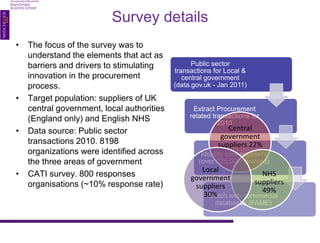
• The focus of the survey was to 
understand the elements that act as 
barriers and drivers to stimulating 
innovation in the procurement 
process. 
• Target population: suppliers of UK 
central government, local authorities 
(England only) and English NHS 
• Data source: Public sector 
transactions 2010. 8198 
organizations were identified across 
the three areas of government 
• CATI survey. 800 responses 
organisations (~10% response rate) 
Public sector 
transactions for Local & 
central government 
(data.gov.uk - Jan 2011) 
Extract Procurement 
related transactions for 
2010 
Identify core suppliers 
(over £25,000 treshold) 
Match with commercial 
databases (FAME) 
Central	 
government	 
suppliers	22%	 
NHS	 
suppliers	 
49%	 
Local	 
government	 
suppliers	 
30%
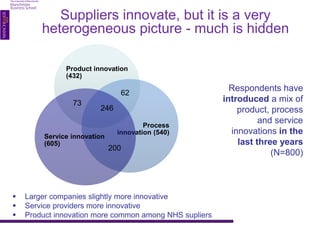
Product innovation 
(432) 
Process 
innovation (540) 
Service innovation 
(605) 
Respondents have 
introduced a mix of 
product, process 
and service 
innovations in the 
last three years 
(N=800) 
200 
73 
246 
62 
Suppliers innovate, but it is a very 
heterogeneous picture - much is hidden 
 Larger companies slightly more innovative 
 Service providers more innovative 
 Product innovation more common among NHS supliers
Public Procurement can lead to innovation 
and broader economic effects 
Manchester Institute of Innovation Research, Manchester Business School 5
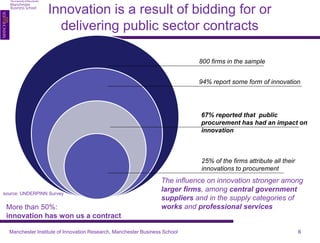
Innovation is a result of bidding for or 
delivering public sector contracts 
800 firms in the sample 
94% report some form of innovation 
67% reported that public 
procurement has had an impact on 
innovation 
25% of the firms attribute all their 
innovations to procurement 
The influence on innovation stronger among 
larger firms, among central government 
suppliers and in the supply categories of 
More than 50%: works and professional services 
innovation has won us a contract 
source: UNDERPINN Survey 
Manchester Institute of Innovation Research, Manchester Business School 6
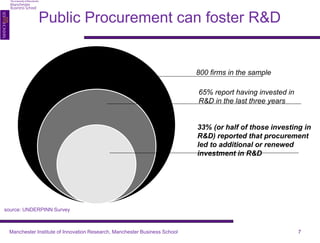
Public Procurement can foster R&D 
800 firms in the sample 
65% report having invested in 
R&D in the last three years 
33% (or half of those investing in 
R&D) reported that procurement 
led to additional or renewed 
investment in R&D 
source: UNDERPINN Survey 
Manchester Institute of Innovation Research, Manchester Business School 7
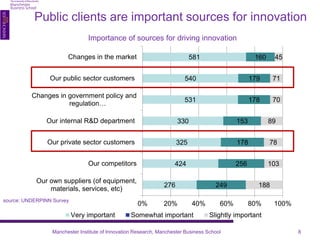
Public clients are important sources for innovation 
Importance of sources for driving innovation 
276 
424 
325 
330 
531 
540 
581 
249 
256 
178 
153 
178 
179 
160 
188 
103 
78 
89 
70 
71 
45 
0% 20% 40% 60% 80% 100% 
Our own suppliers (of equipment, 
materials, services, etc) 
Our competitors 
Our private sector customers 
Our internal R&D department 
Changes in government policy and 
regulation… 
Our public sector customers 
Changes in the market 
Very important Somewhat important Slightly important 
Manchester Institute of Innovation Research, Manchester Business School 8 
source: UNDERPINN Survey
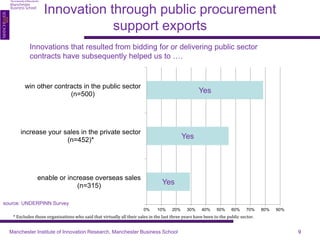
Innovation through public procurement 
support exports 
Innovations that resulted from bidding for or delivering public sector 
contracts have subsequently helped us to …. 
Yes 
Yes 
Yes 
0% 10% 20% 30% 40% 50% 60% 70% 80% 90% 
enable or increase overseas sales 
(n=315) 
increase your sales in the private sector 
(n=452)* 
win other contracts in the public sector 
(n=500) 
* Excludes those organisations who said that virtually all their sales in the last three years have been to the public sector. 
source: UNDERPINN Survey 
Manchester Institute of Innovation Research, Manchester Business School 9
…but 
a range of barriers and frustrations 
Manchester Institute of Innovation Research, Manchester Business School 10
0.00% 10.00% 20.00% 30.00% 40.00% 50.00% 60.00% 70.00% 80.00% 
Provisions related to intellectual property 
E-auctions 
Restricted tender 
Non-OJ tender procedure 
Private finance initiative 
Electronic submission of tenders 
Framework agreement 
Open competitive tender 
Negotiated tender 
Incentive contracts such as profit-sharing arrangements 
Competitive dialogue 
Full life-cycle costing considerations 
Emphasis on sustainability criteria 
Advanced communication of future needs 
Outcome-based specifications 
Early interaction with procuring organisation 
Innovation requirements in tenders 
encouraged innovation (% out of those that experience it) 
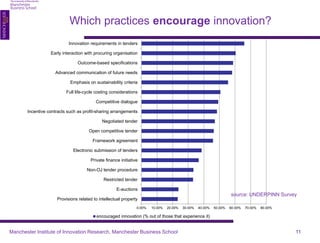
Which practices encourage innovation? 
source: UNDERPINN Survey 
Manchester Institute of Innovation Research, Manchester Business School 11
0.00% 10.00% 20.00% 30.00% 40.00% 50.00% 60.00% 70.00% 80.00% 
Provisions related to intellectual property 
E-auctions 
Restricted tender 
Non-OJ tender procedure 
Private finance initiative 
Electronic submission of tenders 
Framework agreement 
Open competitive tender 
Negotiated tender 
Incentive contracts such as profit-sharing arrangements 
Competitive dialogue 
Full life-cycle costing considerations 
Emphasis on sustainability criteria 
Advanced communication of future needs 
Outcome-based specifications 
Early interaction with procuring organisation 
Innovation requirements in tenders 
encouraged innovation (% out of those that experience it) frequently experienced 
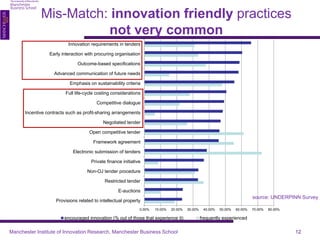
Mis-Match: innovation friendly practices 
not very common 
source: UNDERPINN Survey 
Manchester Institute of Innovation Research, Manchester Business School 12
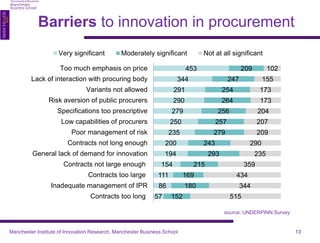
Barriers to innovation in procurement 
57 
86 
111 
154 
194 
200 
235 
250 
279 
290 
291 
344 
453 
152 
180 
169 
215 
293 
243 
279 
257 
256 
264 
254 
247 
209 
515 
344 
434 
359 
235 
290 
209 
207 
204 
173 
173 
155 
102 
Contracts too long 
Inadequate management of IPR 
Contracts too large 
Contracts not large enough 
General lack of demand for innovation 
Contracts not long enough 
Poor management of risk 
Low capabilities of procurers 
Specifications too prescriptive 
Risk aversion of public procurers 
Variants not allowed 
Lack of interaction with procuring body 
Too much emphasis on price 
Very significant Moderately significant Not at all significant 
source: UNDERPINN Survey 
Manchester Institute of Innovation Research, Manchester Business School 13
Supplier Assessment: 
Risk aversion and lack of knowledge 
 Majority rates public procurers as: 
 not willing to take risk 
 not knowledgeable enough 
 about technical aspects of product or service 
 about the relevant markets 
 not able to make effective use of supply chain 
 much less able and willing to ask for and buy 
innovation than private clients 
source: UNDERPINN Survey 
Manchester Institute of Innovation Research, Manchester Business School 14
2. Understanding and supporting 
procurement of innovation. 
Main messages from case work 
Manchester Institute of Innovation Research, Manchester Business School
Basic Challenges for Public Bodies 
 Demands for public bodies 
– Markets for innovation (in principle) not established 
– Novel and often ill-defined needs 
– New solutions from suppliers, no established business case for buyer 
– Iterative interactions needed (“co-adaptation”, “co-construction”) 
– Joint risk challenge 
– High learning and adoption costs at different levels 
 Public organisations often overwhelmed by such demands 
 Challenges differ 
– asking for something new 
– adopting innovations offered 
– Level of „novelty“ 
Manchester Institute of Innovation Research, Manchester Business School 16
Adopting an innovation. 
Intra-organisational change and co-construction. 
Example: Adopting Managed Print Service 
 Efficiency gains through buying printing service package instead of hardware 
 Public sector was lagging 
 Radical organisational innovation for the client, large savings made 
 Snr Mgt support and responsibility, strong motivation 
 Adaptation / co-generation of the solution 
 Pilots and pre-contract ‘flexible’ period 
 Longer term, close relationship with supplier (both commit resources) 
 Joint learning 
 Client (need audit, change mgt) 
 Supplier (business models, tailor solution, standardised procedures, new IT and 
hardware) 
 Conducive Frameworks needed (flexibility, relationships) 
 Trend to commodification and centralisation problematic 
Manchester Institute of Innovation Research, Manchester Business School
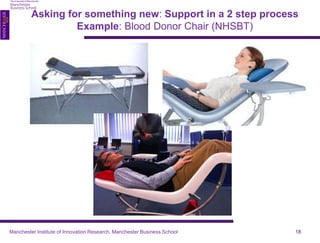
Asking for something new: Support in a 2 step process 
Example: Blood Donor Chair (NHSBT) 
Manchester Institute of Innovation Research, Manchester Business School 18
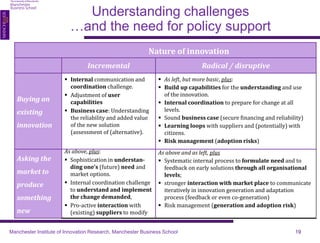
Nature of innovation 
Incremental Radical / disruptive 
Buying an 
existing 
innovation 
Asking the 
market to 
produce 
something 
new 
Manchester Institute of Innovation Research, Manchester Business School 19 
Understanding challenges 
…and the need for policy support 
 Internal communication and 
coordination challenge. 
 Adjustment of user 
capabilities 
 Business case: Understanding 
the reliability and added value 
of the new solution 
(assessment of (alternative). 
 As left, but more basic, plus: 
 Build up capabilities for the understanding and use 
of the innovation. 
 Internal coordination to prepare for change at all 
levels. 
 Sound business case (secure financing and reliability) 
 Learning loops with suppliers and (potentially) with 
citizens. 
 Risk management (adoption risks) 
As above, plus: 
 Sophistication in understan-ding 
one’s (future) need and 
market options. 
 Internal coordination challenge 
to understand and implement 
the change demanded, 
 Pro-active interaction with 
(existing) suppliers to modify 
As above and as left, plus 
 Systematic internal process to formulate need and to 
feedback on early solutions through all organisational 
levels; 
 stronger interaction with market place to communicate 
iteratively in innovation generation and adaptation 
process (feedback or even co-generation) 
 Risk management (generation and adoption risk)
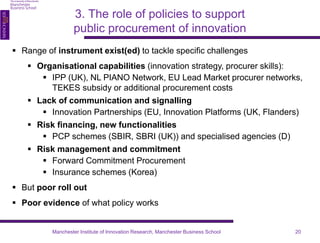
3. The role of policies to support 
public procurement of innovation 
 Range of instrument exist(ed) to tackle specific challenges 
 Organisational capabilities (innovation strategy, procurer skills): 
 IPP (UK), NL PIANO Network, EU Lead Market procurer networks, 
TEKES subsidy or additional procurement costs 
 Lack of communication and signalling 
 Innovation Partnerships (EU, Innovation Platforms (UK, Flanders) 
 Risk financing, new functionalities 
 PCP schemes (SBIR, SBRI (UK)) and specialised agencies (D) 
 Risk management and commitment 
 Forward Commitment Procurement 
 Insurance schemes (Korea) 
 But poor roll out 
 Poor evidence of what policy works 
Manchester Institute of Innovation Research, Manchester Business School 20
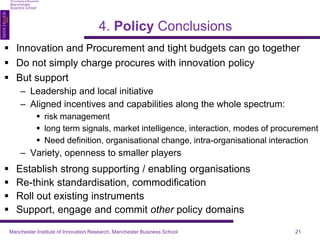
 Innovation and Procurement and tight budgets can go together 
 Do not simply charge procures with innovation policy 
 But support 
– Leadership and local initiative 
– Aligned incentives and capabilities along the whole spectrum: 
 risk management 
 long term signals, market intelligence, interaction, modes of procurement 
 Need definition, organisational change, intra-organisational interaction 
– Variety, openness to smaller players 
 Establish strong supporting / enabling organisations 
 Re-think standardisation, commodification 
 Roll out existing instruments 
 Support, engage and commit other policy domains 
4. Policy Conclusions 
Manchester Institute of Innovation Research, Manchester Business School 21
Thank you for your attention 
22 
CONTACTS 
Jakob Edler, Professor of Innovation Policy and Strategy, Executive Director MIoIR , 
jakob.edler@mbs.ac.uk, 
Project: https://underpinn.portals.mbs.ac.uk/ 
Publications: https://underpinn.portals.mbs.ac.uk/Publications/tabid/1580/language/en- 
GB/Default.aspx 
Manchester Institute of Innovation Research (MIoIR) 
https://research.mbs.ac.uk/innovation/ 
Manchester Business School ,University of Manchester, 
Harold Hankins Building, Manchester, UK M13 9PL 
0044 (0) 161 275-0919 (secr. 5924) 
Manchester Institute of Innovation Research, Manchester Business School
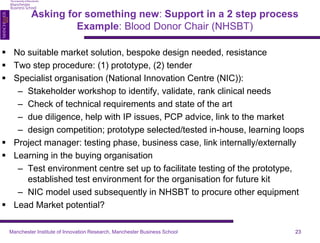
Asking for something new: Support in a 2 step process 
Example: Blood Donor Chair (NHSBT) 
 No suitable market solution, bespoke design needed, resistance 
 Two step procedure: (1) prototype, (2) tender 
 Specialist organisation (National Innovation Centre (NIC)): 
– Stakeholder workshop to identify, validate, rank clinical needs 
– Check of technical requirements and state of the art 
– due diligence, help with IP issues, PCP advice, link to the market 
– design competition; prototype selected/tested in-house, learning loops 
 Project manager: testing phase, business case, link internally/externally 
 Learning in the buying organisation 
– Test environment centre set up to facilitate testing of the prototype, 
established test environment for the organisation for future kit 
– NIC model used subsequently in NHSBT to procure other equipment 
 Lead Market potential? 
Manchester Institute of Innovation Research, Manchester Business School 23
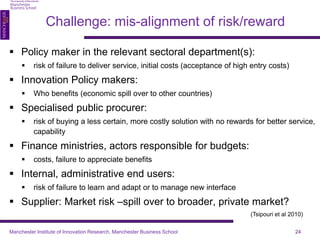
 Policy maker in the relevant sectoral department(s): 
 risk of failure to deliver service, initial costs (acceptance of high entry costs) 
 Innovation Policy makers: 
 Who benefits (economic spill over to other countries) 
 Specialised public procurer: 
 risk of buying a less certain, more costly solution with no rewards for better service, 
capability 
 Finance ministries, actors responsible for budgets: 
 costs, failure to appreciate benefits 
 Internal, administrative end users: 
 risk of failure to learn and adapt or to manage new interface 
 Supplier: Market risk –spill over to broader, private market? 
Challenge: mis-alignment of risk/reward 
Manchester Institute of Innovation Research, Manchester Business School 24 
(Tsipouri et al 2010)
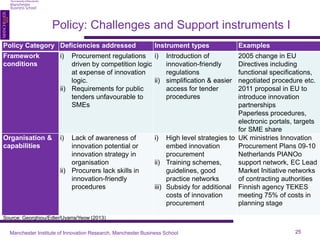
Policy: Challenges and Support instruments I 
25 
Policy Category Deficiencies addressed Instrument types Examples 
Framework 
conditions 
i) Procurement regulations 
driven by competition logic 
at expense of innovation 
logic. 
ii) Requirements for public 
tenders unfavourable to 
SMEs 
i) Introduction of 
innovation-friendly 
regulations 
ii) simplification & easier 
access for tender 
procedures 
2005 change in EU 
Directives including 
functional specifications, 
negotiated procedure etc. 
2011 proposal in EU to 
introduce innovation 
partnerships 
Paperless procedures, 
electronic portals, targets 
for SME share 
Organisation & 
capabilities 
i) Lack of awareness of 
innovation potential or 
innovation strategy in 
organisation 
ii) Procurers lack skills in 
innovation-friendly 
procedures 
i) High level strategies to 
embed innovation 
procurement 
ii) Training schemes, 
guidelines, good 
practice networks 
iii) Subsidy for additional 
costs of innovation 
procurement 
UK ministries Innovation 
Procurement Plans 09-10 
Netherlands PIANOo 
support network, EC Lead 
Market Initiative networks 
of contracting authorities 
Finnish agency TEKES 
meeting 75% of costs in 
planning stage 
Source: Georghiou/Edler/Uyarra/Yeow (2013) 
Manchester Institute of Innovation Research, Manchester Business School
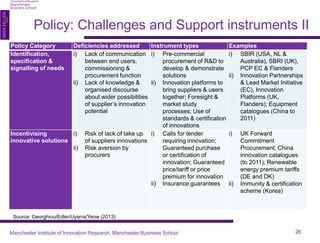
Policy: Challenges and Support instruments II 
26 
Policy Category Deficiencies addressed Instrument types Examples 
Identification, 
specification & 
signalling of needs 
i) Lack of communication 
between end users, 
commissioning & 
procurement function 
ii) Lack of knowledge & 
organised discourse 
about wider possibilities 
of supplier’s innovation 
potential 
i) Pre-commercial 
procurement of R&D to 
develop & demonstrate 
solutions 
ii) Innovation platforms to 
bring suppliers & users 
together; Foresight & 
market study 
processes; Use of 
standards & certification 
of innovations 
i) SBIR (USA, NL & 
Australia), SBRI (UK), 
PCP EC & Flanders 
ii) Innovation Partnerships 
& Lead Market Initiative 
(EC), Innovation 
Platforms (UK, 
Flanders); Equipment 
catalogues (China to 
2011) 
Incentivising 
innovative solutions 
i) Risk of lack of take up 
of suppliers innovations 
ii) Risk aversion by 
procurers 
i) Calls for tender 
requiring innovation; 
Guaranteed purchase 
or certification of 
innovation; Guaranteed 
price/tariff or price 
premium for innovation 
ii) Insurance guarantees 
i) UK Forward 
Commitment 
Procurement; China 
innovation catalogues 
(to 2011); Renewable 
energy premium tariffs 
(DE and DK) 
ii) Immunity & certification 
scheme (Korea) 
Source: Georghiou/Edler/Uyarra/Yeow (2013) 
Manchester Institute of Innovation Research, Manchester Business School
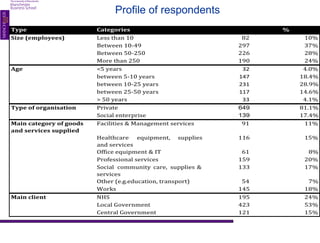
Type Categories 		 % 
Size	(employees) Less	than	10 82 10% 
Between	10-49 297 37% 
Between	50-250 226 28% 
More	than	250 190 24% 
Age <5	years 32 4.0% 
between	5-10	years 147 18.4% 
between	10-25	years 231 28.9% 
between	25-50	years 117 14.6% 
>	50	years 33 4.1% 
Type	of	organisation Private 649 81.1% 
Social	enterprise 139 17.4% 
Main	category	of	goods	 
and	services	supplied 
Facilities	&	Management	services 91 11% 
Healthcare equipment, supplies 
and	services	 
116 15% 
Office	equipment	&	IT 61 8% 
Professional	services 159 20% 
Social community care, supplies & 
services 
133 17% 
Other	(e.g.education,	transport) 54 7% 
Works 145 18% 
Main	client NHS 195 24% 
Local	Government 423 53% 
Central	Government	 121 15% 
Profile of respondents
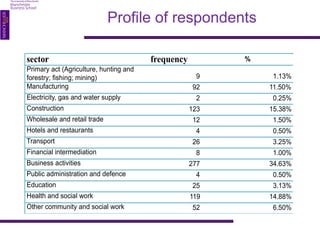
Profile of respondents 
sector frequency % 
Primary act (Agriculture, hunting and 
forestry; fishing; mining) 9 1.13% 
Manufacturing 92 11.50% 
Electricity, gas and water supply 2 0.25% 
Construction 123 15.38% 
Wholesale and retail trade 12 1.50% 
Hotels and restaurants 4 0.50% 
Transport 26 3.25% 
Financial intermediation 8 1.00% 
Business activities 277 34.63% 
Public administration and defence 4 0.50% 
Education 25 3.13% 
Health and social work 119 14.88% 
Other community and social work 52 6.50%
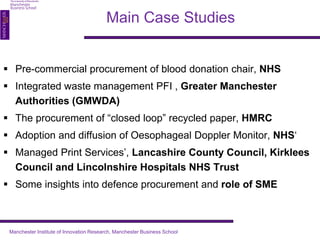
Main Case Studies 
 Pre-commercial procurement of blood donation chair, NHS 
 Integrated waste management PFI , Greater Manchester 
Authorities (GMWDA) 
 The procurement of “closed loop” recycled paper, HMRC 
 Adoption and diffusion of Oesophageal Doppler Monitor, NHS‘ 
 Managed Print Services’, Lancashire County Council, Kirklees 
Council and Lincolnshire Hospitals NHS Trust 
 Some insights into defence procurement and role of SME 
Manchester Institute of Innovation Research, Manchester Business School

Public procurement of innovation: Evidence and policy implications from the UNDERPINN study

  • 1.
    Public procurement ofinnovation: Evidence and policy implications from the UNDERPINN study OECD, Paris, December 5 2013 Jakob Edler Manchester Institute of Innovation Research (full team: Luke Georghiou, Elvira Uyarra Sally Gee, Andrew James, Su Maddock, Jillian Yeow) Manchester Institute of Innovation Research, Manchester Business School 1
  • 2.
    1. Survey evidence I. Procurement and Innovation II. Barriers 2. Understanding and supporting procurement of innovation – main messages from cases 3. The role of policy 4. Conclusion 2 Structure Manchester Institute of Innovation Research, Manchester Business School
  • 3.
    Survey details •The focus of the survey was to understand the elements that act as barriers and drivers to stimulating innovation in the procurement process. • Target population: suppliers of UK central government, local authorities (England only) and English NHS • Data source: Public sector transactions 2010. 8198 organizations were identified across the three areas of government • CATI survey. 800 responses organisations (~10% response rate) Public sector transactions for Local & central government (data.gov.uk - Jan 2011) Extract Procurement related transactions for 2010 Identify core suppliers (over £25,000 treshold) Match with commercial databases (FAME) Central government suppliers 22% NHS suppliers 49% Local government suppliers 30%
  • 4.
    Product innovation (432) Process innovation (540) Service innovation (605) Respondents have introduced a mix of product, process and service innovations in the last three years (N=800) 200 73 246 62 Suppliers innovate, but it is a very heterogeneous picture - much is hidden  Larger companies slightly more innovative  Service providers more innovative  Product innovation more common among NHS supliers
  • 5.
    Public Procurement canlead to innovation and broader economic effects Manchester Institute of Innovation Research, Manchester Business School 5
  • 6.
    Innovation is aresult of bidding for or delivering public sector contracts 800 firms in the sample 94% report some form of innovation 67% reported that public procurement has had an impact on innovation 25% of the firms attribute all their innovations to procurement The influence on innovation stronger among larger firms, among central government suppliers and in the supply categories of More than 50%: works and professional services innovation has won us a contract source: UNDERPINN Survey Manchester Institute of Innovation Research, Manchester Business School 6
  • 7.
    Public Procurement canfoster R&D 800 firms in the sample 65% report having invested in R&D in the last three years 33% (or half of those investing in R&D) reported that procurement led to additional or renewed investment in R&D source: UNDERPINN Survey Manchester Institute of Innovation Research, Manchester Business School 7
  • 8.
    Public clients areimportant sources for innovation Importance of sources for driving innovation 276 424 325 330 531 540 581 249 256 178 153 178 179 160 188 103 78 89 70 71 45 0% 20% 40% 60% 80% 100% Our own suppliers (of equipment, materials, services, etc) Our competitors Our private sector customers Our internal R&D department Changes in government policy and regulation… Our public sector customers Changes in the market Very important Somewhat important Slightly important Manchester Institute of Innovation Research, Manchester Business School 8 source: UNDERPINN Survey
  • 9.
    Innovation through publicprocurement support exports Innovations that resulted from bidding for or delivering public sector contracts have subsequently helped us to …. Yes Yes Yes 0% 10% 20% 30% 40% 50% 60% 70% 80% 90% enable or increase overseas sales (n=315) increase your sales in the private sector (n=452)* win other contracts in the public sector (n=500) * Excludes those organisations who said that virtually all their sales in the last three years have been to the public sector. source: UNDERPINN Survey Manchester Institute of Innovation Research, Manchester Business School 9
  • 10.
    …but a rangeof barriers and frustrations Manchester Institute of Innovation Research, Manchester Business School 10
  • 11.
    0.00% 10.00% 20.00%30.00% 40.00% 50.00% 60.00% 70.00% 80.00% Provisions related to intellectual property E-auctions Restricted tender Non-OJ tender procedure Private finance initiative Electronic submission of tenders Framework agreement Open competitive tender Negotiated tender Incentive contracts such as profit-sharing arrangements Competitive dialogue Full life-cycle costing considerations Emphasis on sustainability criteria Advanced communication of future needs Outcome-based specifications Early interaction with procuring organisation Innovation requirements in tenders encouraged innovation (% out of those that experience it) Which practices encourage innovation? source: UNDERPINN Survey Manchester Institute of Innovation Research, Manchester Business School 11
  • 12.
    0.00% 10.00% 20.00%30.00% 40.00% 50.00% 60.00% 70.00% 80.00% Provisions related to intellectual property E-auctions Restricted tender Non-OJ tender procedure Private finance initiative Electronic submission of tenders Framework agreement Open competitive tender Negotiated tender Incentive contracts such as profit-sharing arrangements Competitive dialogue Full life-cycle costing considerations Emphasis on sustainability criteria Advanced communication of future needs Outcome-based specifications Early interaction with procuring organisation Innovation requirements in tenders encouraged innovation (% out of those that experience it) frequently experienced Mis-Match: innovation friendly practices not very common source: UNDERPINN Survey Manchester Institute of Innovation Research, Manchester Business School 12
  • 13.
    Barriers to innovationin procurement 57 86 111 154 194 200 235 250 279 290 291 344 453 152 180 169 215 293 243 279 257 256 264 254 247 209 515 344 434 359 235 290 209 207 204 173 173 155 102 Contracts too long Inadequate management of IPR Contracts too large Contracts not large enough General lack of demand for innovation Contracts not long enough Poor management of risk Low capabilities of procurers Specifications too prescriptive Risk aversion of public procurers Variants not allowed Lack of interaction with procuring body Too much emphasis on price Very significant Moderately significant Not at all significant source: UNDERPINN Survey Manchester Institute of Innovation Research, Manchester Business School 13
  • 14.
    Supplier Assessment: Riskaversion and lack of knowledge  Majority rates public procurers as:  not willing to take risk  not knowledgeable enough  about technical aspects of product or service  about the relevant markets  not able to make effective use of supply chain  much less able and willing to ask for and buy innovation than private clients source: UNDERPINN Survey Manchester Institute of Innovation Research, Manchester Business School 14
  • 15.
    2. Understanding andsupporting procurement of innovation. Main messages from case work Manchester Institute of Innovation Research, Manchester Business School
  • 16.
    Basic Challenges forPublic Bodies  Demands for public bodies – Markets for innovation (in principle) not established – Novel and often ill-defined needs – New solutions from suppliers, no established business case for buyer – Iterative interactions needed (“co-adaptation”, “co-construction”) – Joint risk challenge – High learning and adoption costs at different levels  Public organisations often overwhelmed by such demands  Challenges differ – asking for something new – adopting innovations offered – Level of „novelty“ Manchester Institute of Innovation Research, Manchester Business School 16
  • 17.
    Adopting an innovation. Intra-organisational change and co-construction. Example: Adopting Managed Print Service  Efficiency gains through buying printing service package instead of hardware  Public sector was lagging  Radical organisational innovation for the client, large savings made  Snr Mgt support and responsibility, strong motivation  Adaptation / co-generation of the solution  Pilots and pre-contract ‘flexible’ period  Longer term, close relationship with supplier (both commit resources)  Joint learning  Client (need audit, change mgt)  Supplier (business models, tailor solution, standardised procedures, new IT and hardware)  Conducive Frameworks needed (flexibility, relationships)  Trend to commodification and centralisation problematic Manchester Institute of Innovation Research, Manchester Business School
  • 18.
    Asking for somethingnew: Support in a 2 step process Example: Blood Donor Chair (NHSBT) Manchester Institute of Innovation Research, Manchester Business School 18
  • 19.
    Nature of innovation Incremental Radical / disruptive Buying an existing innovation Asking the market to produce something new Manchester Institute of Innovation Research, Manchester Business School 19 Understanding challenges …and the need for policy support  Internal communication and coordination challenge.  Adjustment of user capabilities  Business case: Understanding the reliability and added value of the new solution (assessment of (alternative).  As left, but more basic, plus:  Build up capabilities for the understanding and use of the innovation.  Internal coordination to prepare for change at all levels.  Sound business case (secure financing and reliability)  Learning loops with suppliers and (potentially) with citizens.  Risk management (adoption risks) As above, plus:  Sophistication in understan-ding one’s (future) need and market options.  Internal coordination challenge to understand and implement the change demanded,  Pro-active interaction with (existing) suppliers to modify As above and as left, plus  Systematic internal process to formulate need and to feedback on early solutions through all organisational levels;  stronger interaction with market place to communicate iteratively in innovation generation and adaptation process (feedback or even co-generation)  Risk management (generation and adoption risk)
  • 20.
    3. The roleof policies to support public procurement of innovation  Range of instrument exist(ed) to tackle specific challenges  Organisational capabilities (innovation strategy, procurer skills):  IPP (UK), NL PIANO Network, EU Lead Market procurer networks, TEKES subsidy or additional procurement costs  Lack of communication and signalling  Innovation Partnerships (EU, Innovation Platforms (UK, Flanders)  Risk financing, new functionalities  PCP schemes (SBIR, SBRI (UK)) and specialised agencies (D)  Risk management and commitment  Forward Commitment Procurement  Insurance schemes (Korea)  But poor roll out  Poor evidence of what policy works Manchester Institute of Innovation Research, Manchester Business School 20
  • 21.
     Innovation andProcurement and tight budgets can go together  Do not simply charge procures with innovation policy  But support – Leadership and local initiative – Aligned incentives and capabilities along the whole spectrum:  risk management  long term signals, market intelligence, interaction, modes of procurement  Need definition, organisational change, intra-organisational interaction – Variety, openness to smaller players  Establish strong supporting / enabling organisations  Re-think standardisation, commodification  Roll out existing instruments  Support, engage and commit other policy domains 4. Policy Conclusions Manchester Institute of Innovation Research, Manchester Business School 21
  • 22.
    Thank you foryour attention 22 CONTACTS Jakob Edler, Professor of Innovation Policy and Strategy, Executive Director MIoIR , jakob.edler@mbs.ac.uk, Project: https://underpinn.portals.mbs.ac.uk/ Publications: https://underpinn.portals.mbs.ac.uk/Publications/tabid/1580/language/en- GB/Default.aspx Manchester Institute of Innovation Research (MIoIR) https://research.mbs.ac.uk/innovation/ Manchester Business School ,University of Manchester, Harold Hankins Building, Manchester, UK M13 9PL 0044 (0) 161 275-0919 (secr. 5924) Manchester Institute of Innovation Research, Manchester Business School
  • 23.
    Asking for somethingnew: Support in a 2 step process Example: Blood Donor Chair (NHSBT)  No suitable market solution, bespoke design needed, resistance  Two step procedure: (1) prototype, (2) tender  Specialist organisation (National Innovation Centre (NIC)): – Stakeholder workshop to identify, validate, rank clinical needs – Check of technical requirements and state of the art – due diligence, help with IP issues, PCP advice, link to the market – design competition; prototype selected/tested in-house, learning loops  Project manager: testing phase, business case, link internally/externally  Learning in the buying organisation – Test environment centre set up to facilitate testing of the prototype, established test environment for the organisation for future kit – NIC model used subsequently in NHSBT to procure other equipment  Lead Market potential? Manchester Institute of Innovation Research, Manchester Business School 23
  • 24.
     Policy makerin the relevant sectoral department(s):  risk of failure to deliver service, initial costs (acceptance of high entry costs)  Innovation Policy makers:  Who benefits (economic spill over to other countries)  Specialised public procurer:  risk of buying a less certain, more costly solution with no rewards for better service, capability  Finance ministries, actors responsible for budgets:  costs, failure to appreciate benefits  Internal, administrative end users:  risk of failure to learn and adapt or to manage new interface  Supplier: Market risk –spill over to broader, private market? Challenge: mis-alignment of risk/reward Manchester Institute of Innovation Research, Manchester Business School 24 (Tsipouri et al 2010)
  • 25.
    Policy: Challenges andSupport instruments I 25 Policy Category Deficiencies addressed Instrument types Examples Framework conditions i) Procurement regulations driven by competition logic at expense of innovation logic. ii) Requirements for public tenders unfavourable to SMEs i) Introduction of innovation-friendly regulations ii) simplification & easier access for tender procedures 2005 change in EU Directives including functional specifications, negotiated procedure etc. 2011 proposal in EU to introduce innovation partnerships Paperless procedures, electronic portals, targets for SME share Organisation & capabilities i) Lack of awareness of innovation potential or innovation strategy in organisation ii) Procurers lack skills in innovation-friendly procedures i) High level strategies to embed innovation procurement ii) Training schemes, guidelines, good practice networks iii) Subsidy for additional costs of innovation procurement UK ministries Innovation Procurement Plans 09-10 Netherlands PIANOo support network, EC Lead Market Initiative networks of contracting authorities Finnish agency TEKES meeting 75% of costs in planning stage Source: Georghiou/Edler/Uyarra/Yeow (2013) Manchester Institute of Innovation Research, Manchester Business School
  • 26.
    Policy: Challenges andSupport instruments II 26 Policy Category Deficiencies addressed Instrument types Examples Identification, specification & signalling of needs i) Lack of communication between end users, commissioning & procurement function ii) Lack of knowledge & organised discourse about wider possibilities of supplier’s innovation potential i) Pre-commercial procurement of R&D to develop & demonstrate solutions ii) Innovation platforms to bring suppliers & users together; Foresight & market study processes; Use of standards & certification of innovations i) SBIR (USA, NL & Australia), SBRI (UK), PCP EC & Flanders ii) Innovation Partnerships & Lead Market Initiative (EC), Innovation Platforms (UK, Flanders); Equipment catalogues (China to 2011) Incentivising innovative solutions i) Risk of lack of take up of suppliers innovations ii) Risk aversion by procurers i) Calls for tender requiring innovation; Guaranteed purchase or certification of innovation; Guaranteed price/tariff or price premium for innovation ii) Insurance guarantees i) UK Forward Commitment Procurement; China innovation catalogues (to 2011); Renewable energy premium tariffs (DE and DK) ii) Immunity & certification scheme (Korea) Source: Georghiou/Edler/Uyarra/Yeow (2013) Manchester Institute of Innovation Research, Manchester Business School
  • 27.
    Type Categories % Size (employees) Less than 10 82 10% Between 10-49 297 37% Between 50-250 226 28% More than 250 190 24% Age <5 years 32 4.0% between 5-10 years 147 18.4% between 10-25 years 231 28.9% between 25-50 years 117 14.6% > 50 years 33 4.1% Type of organisation Private 649 81.1% Social enterprise 139 17.4% Main category of goods and services supplied Facilities & Management services 91 11% Healthcare equipment, supplies and services 116 15% Office equipment & IT 61 8% Professional services 159 20% Social community care, supplies & services 133 17% Other (e.g.education, transport) 54 7% Works 145 18% Main client NHS 195 24% Local Government 423 53% Central Government 121 15% Profile of respondents
  • 28.
    Profile of respondents sector frequency % Primary act (Agriculture, hunting and forestry; fishing; mining) 9 1.13% Manufacturing 92 11.50% Electricity, gas and water supply 2 0.25% Construction 123 15.38% Wholesale and retail trade 12 1.50% Hotels and restaurants 4 0.50% Transport 26 3.25% Financial intermediation 8 1.00% Business activities 277 34.63% Public administration and defence 4 0.50% Education 25 3.13% Health and social work 119 14.88% Other community and social work 52 6.50%
  • 29.
    Main Case Studies  Pre-commercial procurement of blood donation chair, NHS  Integrated waste management PFI , Greater Manchester Authorities (GMWDA)  The procurement of “closed loop” recycled paper, HMRC  Adoption and diffusion of Oesophageal Doppler Monitor, NHS‘  Managed Print Services’, Lancashire County Council, Kirklees Council and Lincolnshire Hospitals NHS Trust  Some insights into defence procurement and role of SME Manchester Institute of Innovation Research, Manchester Business School