Making earth little softer
Earthsoft Foundation of Guidance
Edge-Aggressive-Reliable-Trust-Honesty-Soft-Obedient-Fun-Transparent
Making earth little softer
Earthsoft Foundation of Guidance (EFG) has uploaded following
presentations at http://myefg.in/downloads.aspx
Be mentor using your education, knowledge & experience to
contribute for a social cause & do conduct free training seeking
help of existing platforms. Kindly share with your friends
•Motivation for higher study, Planning for study, Education
guidance, Career guidance, Career available after SSC & HSC
•Personality development – 3 files
•How to prepare resume, Tips to attend interview successfully
•Religion related –To understand basic religion, Do & Don’t tips
•Health related - Be vegetarian, Be healthy, Manage health
•Corporate - Project management, Assertiveness, Ownership,
Effective communication, Leadership, Be entrepreneur
•Finance - To avoid speculation in stock market
•Social - Women empowerment, Choosing life partner, conflict
resolution, stop ragging, stop alcohol, snakebite treatment
About us
Making earth little softer
• Water pollutants
• Types of water pollution
• Types of water pollutants
• Contamination
• Pollutants generation
• Pollutants:Landfills Leachates
• Pollutants control
Index
Making earth little softer
Water pollutants
• Water is one of the most precious gift of nature
without this no life could survive on earth.
• Water is combination of hydrogen and oxygen.
• Normally water is never pure in chemical sense.
• Water pollutants are natural and man made.
Making earth little softer
Types of water pollution
• Inorganic Pollutants
• Organic Pollutants
• Biologic Pollutants
Making earth little softer
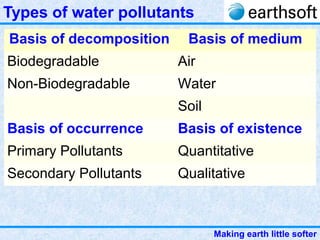
Types of water pollutants
Basis of decomposition Basis of medium
Biodegradable Air
Non-Biodegradable Water
Soil
Basis of occurrence Basis of existence
Primary Pollutants Quantitative
Secondary Pollutants Qualitative
Making earth little softer
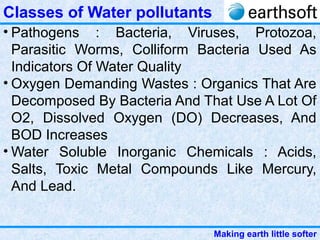
Classes of Water pollutants
• Pathogens : Bacteria, Viruses, Protozoa,
Parasitic Worms, Colliform Bacteria Used As
Indicators Of Water Quality
• Oxygen Demanding Wastes : Organics That Are
Decomposed By Bacteria And That Use A Lot Of
O2, Dissolved Oxygen (DO) Decreases, And
BOD Increases
• Water Soluble Inorganic Chemicals : Acids,
Salts, Toxic Metal Compounds Like Mercury,
And Lead.
Making earth little softer
Classes of Water pollutants
• Inorganic Plant Nutrients : Water Soluble
Phosphates, Nitrates => Algal Blooms,
Decreased Dissolved O2, Increased BOD,
Methemoglobinemia (="blue baby syndrome")
• Organic Chemicals - Oil, Gas, Plastics,
Pesticides, Cleaning Solvents, Detergents, Etc.
• Sediment & Suspended Mater - Insoluble Soil
Particulates & Other Solids. Clouds The Water,
Decreasing Photosynthesis, Carries Pesticides
And Disrupts Aquatic Food Webs.
Making earth little softer
Classes of Water pollutants
• Radioactive Isotopes - Are Biologically Amplified
To Higher Concentrations In The Food Chain.
Ionizing Radiation & Birth Defects, Cancer.
• Warmed Water - From Power Plants, Decreases
DO And Increases Susceptibility To Diseases
And Parasites And Toxic Wastes.
• Alien Species - Zebra Mussels, Asiatic Catfish,
Sea Lamprey, etc. Out compete Native Species
And Ultimately Decrease Biodiversity
Making earth little softer
Drinking Water Quality
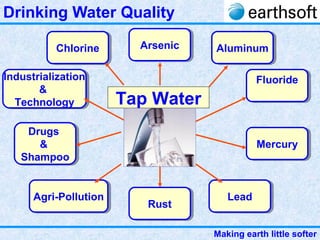
Industrialization
&
Technology
Industrialization
&
Technology
LeadLead
MercuryMercury
Agri-PollutionAgri-Pollution
Drugs
&
Shampoo
Drugs
&
Shampoo
ChlorineChlorine ArsenicArsenic
FluorideFluoride
AluminumAluminum
Tap Water
RustRust
Making earth little softer
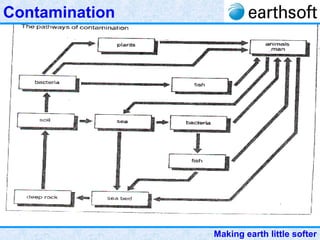
Contamination
Making earth little softer
Contamination
• One or more organic chemicals contaminate
about 45% of municipal groundwater supplies in
the US
• About 26000 industrial waste ponds in US do
not have liners
• Leaking undergraound storage tanks
• Nitrates, fluoride, arsenic
Making earth little softer
Water pollutants (degradable)
• Domestic sewage
• Fertilizers
• Some industrial wastes
Making earth little softer
Water pollutants
• Sewage/waste water;
• Fertilizers/Pesticides;
• Alien species
• Global Warming
• Atmospheric Deposition;
• Pathogens; from untreated sewage, storm
drains, septic tanks, runoff from farms
• Petroleum;
• Radioactive substances;
• Heat;
• Siltation/sediments;
Making earth little softer
Water pollutants
• Salinization- Increased salinization and salt
runoff from irrigated farms causes salinization of
major rivers.;
• Heavy metals cause unpleasant taste and odour
to drinking water;
• Suspended particles like sediments
Making earth little softer
Water pollutants
• Warm water from cooling towers (thermal
pollution)
• Floating debris
• Garbage
• Foam
• These physical pollutants interfere mainly with
the usability and/or aesthetic appeal of the
water. In certain cases, thermal pollution can kill
fish.
Making earth little softer
Water pollutants
• Industrial Effluents - This waste water may
contain acids, alkalis, salts, poisons, oils and in
some cases harmful bacteria.
• Mining and Agricultural Wastes Mines,
especially gold and coal mines, are responsible
for large quantities of acid water.
• Agricultural pesticides, fertilizers and herbicides
may wash into rivers and stagnant water bodies.
• Sewage Disposal and Domestic Wastes
Sewage as well as domestic and farm wastes
were often allowed to pollute rivers and dams.
Making earth little softer
Pollutants : Unsewered Towns
• Wastewaters and pollutants from unsewered
Towns
• 22% of wastewater (Class I cities) and 14% of
wastewater (Class II cities) is collected through
sewerage.
• Most cities / towns do not have sewerage
system.
Making earth little softer
Pollutant – Sewage & sullage
• Sewage, sullage and pollutants from Urban
Areas
• Only 40 – 50% of population of major metro
cities are served by sewer systems.
• Sewers often leak
Making earth little softer
Pollutants : Industrial
• Industrial pollutants from cottage / small scale
industries
• 3 million SME in the country
• Causes significant water pollution
Making earth little softer
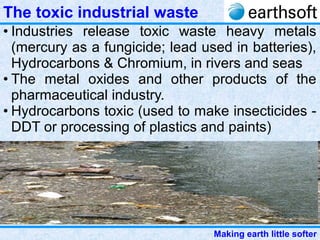
The toxic industrial waste
• Industries release toxic waste heavy metals
(mercury as a fungicide; lead used in batteries),
Hydrocarbons & Chromium, in rivers and seas
• The metal oxides and other products of the
pharmaceutical industry.
• Hydrocarbons toxic (used to make insecticides -
DDT or processing of plastics and paints)
Making earth little softer
Pollutants : Industrial
• Industrial pollutants from large industries
• Installed Treatment and disposal
• Treated effluents having some pollutants get
leached and causes pollution.
• Waste dumping, ash-ponds, sludge-pits, etc.
Making earth little softer
Water pollutants
• Major water pollutants :
• Pesticides and biocides like BHC, DDT,
Alluminium phosphide, chlor benzilate, lindane,
nicotine sulphate which are highly pollutant so
such pesticide are restricted in India.
Making earth little softer
Water pollutants
• Cadmium and its compounds are used in
various industry they are cadmium acetate,
cadmium sulphide, cadmium oxide, cadmium
carbonate etc.
• The sulphate, chloride and acetate of cadmium
are soluble in water which leads toxicity.
• Floride is universally present in varing amount in
soil and water atmosphere, vegetation and
animal tissue.
• Toxic substance like cyanide, phenol, heavy
metals like mercury, lead, arsenic cause
damage to flora and fauna
Making earth little softer
Water pollutants-Heavy metal
• They are present in all the phase of
environment-air, water and land
• Metal pollutant is include copper, lead, zinc,
chromium, nickel, cadmium, mercury and
selenium.
• Lead is one of the heavy metal pollutant of both
atmosphere and ocean, which is mainly derived
from vehicle burning fuel.
• Mercury is the another very toxic pollutant
Making earth little softer
Water pollutants
• These pollutants enter waterways through
untreated sewage, storm drains, septic tanks,
runoff from farms, and particularly boats that
dump sewage.
• Though microscopic, these pollutants have a
tremendous effect evidenced by their ability to
cause sickness.
Making earth little softer
Water pollutants : Detergents
• Stories about particular pollutant forms:
Detergents
• The nitrates in fertilizers promote excessive
growth of algae and larger aquatic plants,
causing offensive algae blooms and driving out
sport fish.
• Phosphates are often thought to culprit, nitrogen
is the “limiting factor” in most aquatic systems.
Making earth little softer
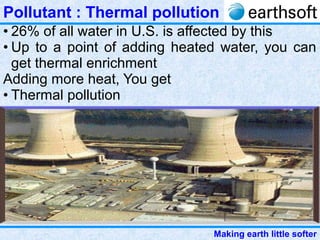
Pollutant : Thermal pollution
• 26% of all water in U.S. is affected by this
• Up to a point of adding heated water, you can
get thermal enrichment
Adding more heat, You get
• Thermal pollution
Making earth little softer
Non-persistent (degradable)
• These compounds can be broken down by
chemical reactions or by natural bacteria into
simple, non-polluting substances such as
carbon dioxide and nitrogen.
• if the pollution load is high, this process can
lead to low oxygen levels and eutrophication.
• This damage is reversible.
Making earth little softer
Persistent Water pollutants
• Some pesticides (e.g., DDT, dieldrin)
• Some leachate components from landfill sites
(municipal, industrial)
• Petroleum and petroleum products
• PCBs, dioxins, polyaromatic hydrocarbons
(PAHs)
• Radioactive materials such as strontium-90,
cesium-137, radium-226, and uranium
• Metals such as lead, mercury, cadmium
Making earth little softer
Persistent Water pollutants
• This is the most rapidly growing type of pollution
• This includes substances that degrade very
slowly or cannot be broken down at all;
• They may remain in the aquatic environment
for years or longer periods of time.
• The damage they cause is either irreversible or
repairable only over decades or centuries
Making earth little softer
Pollutant : Detergents
• The nitrates in fertilizers promote excessive
growth of algae and larger aquatic plants,
causing offensive algae blooms and driving out
sport fish.
• Phosphates are often thought to culprit, nitrogen
is the “limiting factor” in most aquatic systems.
Making earth little softer
Pollutant : Sediments
• The largest form of water pollution
• Erosion is source – we’ve sped up rate of
erosion, e.g. during urban construction can lose
up to 43 tons of topsoil/acre/year
• Natural rates of erosion: leads to aquatic
succession
Making earth little softer
Organic Pollutants
• Three classes of compounds
• Pesticides and Herbicides
• Materials for common household and industrial
use
• Materials for industrial use
Making earth little softer
Inorganic Pollutants
• Examples:
• Pb in gasoline
• Radionuclides
• Phosphorus, nitrogen (Great Lakes)
• Other heavy metals
Making earth little softer
Inorganic Pollutants
• 3 groups
• 1) Produce no heavlth effects until a threshold
concentration is exceeded—e.g., NO3 –ook at ,
50mg/liter; at higher levels:
methaemoglobinaemia
• 2) No threshold—e.g.—genotoxic substances:
some natural and synthetic organic compounds,
microorganic compunds, some pesticides,
arsenic
• 3) Essential to diets: F, I, Se—absence causes
problems, but too much also causes problems
Making earth little softer
Inorganic trace contaminants
• Mercury—methyl Hg and dimethyl Hg in fish—
probably most significant path to humans—
Minamata Bay, Japan, 1950’s
• Rhine River drains 185,000 sq km—heavily
polluted by 1970’s
• Lead—toxicity has been known for a long time
• 1859 book
• Tetraethyl lead—anti-knowck additive for gas,
1930-1966
Making earth little softer
Radionuclides
• Bikini Atoll in South Pacific: > 20 tests, 1946-
1958
• Inhabitants evacuated before 1946 tests; their
descendents are still exiled
• Atmospheric testing of nuclear weapons is now
banned
• National labs…now trying to clean up (Hanford)
Making earth little softer
Phosphates and Nitrates
• Phosphates—mostly a result of sewage outflow
and phosphate detergents
• Additional phosphate grows excess algae…
oxygen depletion, Lake Erie…1972 phosphate
management plant…$7.6 billion
• Nitrates—sewage and fertilizers
Making earth little softer
Pesticides
• Pesticides are one of the most significant
causes of water pollution.
• Farmers spraying large crop fields with chemical
pesticides
• The lawn products that everyday residents
apply to their home lawns results in a higher
pollution per square foot than the farms
• In-ability to remove specific pesticide
contaminants in the water purification process
Making earth little softer
Scale of Pesticide Use in US
• Since 1959: 50-fold increase in pesticide use
• Most present pesticides are 10-100 x more toxic
than those used in 1050’s
• About 25% of pesticide use in US is in houses,
gardens, lawns, parks, swimming pools, and
golf courses
• Average lawn receives 10x more pesticides than
equivalent area of cropland
• 2.4 million tons of pesticides are used per year
• 600 active chemicals mixes with 1200 solvents,
‘inactive’ ingredients
• About 25000 commercial pesticide products
Making earth little softer
Pesticides
• Each year about 250,000 people are admitted to
hospitals and/or emergency rooms with
pesticide poisoning
• Broad spectrum vs narrow spectrum
• Persistence
Making earth little softer
Pesticides
• Chlorinated hydrocarbons
• DDT, heptachlor, etc—2-15 years
• Organophosphates
• Malathion, methyl parathion—1-2 weeks
• Carbamates
• Carbaryl, maneb, aldicarb—days to weeks
• Pyrethroids
• Pemethrin, decamethrin—days to weeks
Making earth little softer
Herbicides
• Contact
• Triazines—e.g. atrazine, paraquat (interfere with
photosynthesis)
• Systemic—phenoxy compounds, N compounds,
Alar, glyphosate (create excess growth
hormones)
• Soil sterilants
• trifluralin, dalapon (kill soil microorganisms)
Making earth little softer
Pollutants generation
• Chloride (Tanneries)
• Fluorides (Fertilizer – Phosphate)
• Sulphide (Oil refineries)
• Total Wastewater generation from industries is
10,125 MLD
Making earth little softer
Pollutants:Landfills Leachates
• They are strong polluters
• BOD (200 mg/L), COD (340 mg/L) and TS (900
mg/L)
Making earth little softer
Pollutants : Handling
• Pollutants in leakages and due to accidents
during transportation, storage or handling
• Contribution from this is growing
Making earth little softer
Washover from Cattle-farms
• Washover from Cattle-farms and Animal
Husbandry
• No adequate, arrangements for collection,
treatment and proper disposal of liquid wastes
Making earth little softer
Pollutants : Agricultural
• Pollutants in Agricultural Drainage waters
• High in salts
• Intensive use of chemical fertilizers, pesticides
• Contribute significant loads of salts, nutrients,
chemicals, etc.
Making earth little softer
Deposition of Air Pollutants
• Acid rain cause water pollution
• Heavy metal deposition from air emissions on to
water
Making earth little softer
Thank You
Making earth little softer
References
• www.wikipedia.org; www.google.com, www.slideshare.net
• Gannon; Osmond, , Humenik, Gale, Spooner, Agricultural Water Quality Water resource
• U.S.A. Environmental protection agency, washington, dc (usa)
• MacKenzie, SH The Ecosystem ISLAND PRESS, CA (USA), 1996, 240
• Water pollution and society ByDavid Krantz and Brad Kifferstein
• Water pollution, By Mahesh & Ram, By Shohail Motahir Choudhury, Prasen Raptan,Executive
Director,Jankalyana
• Living in the Environment, By G. Tyler Miller’s
• Authors Arnone Matteo,Belingheri Omar,Fasce Federico,Migliorino Lorenzo,Ernest Kyć,
• Michał Stolarski,Adam Chłąd,Kamil Tratkiewicz
• Water Pollution by Dr. B. Victor
• Refresher course on sewage treatment plant design by PAUL
• Trends and Scenarios in Agricultural Development by COLIN CHARTRES; International Water Management
Institute
• Diamond Energy Water. The close relationship between Water & Our Body. 19 April 2008
• <http://www.be-with-you.com/dew/WaterAndOurBody.html>.
• We Rise. Water Facts. Allabout_facts. 15 May 2008 <www.werise.us/allabout_facts.html>
• “Olympic Science: The Hydration Rate.” Popular Mechanics. August 2008. 68.
• Water Security: Leadership and Commitment by Shuichi Hirayama
• Environmental Pollutants By Dr.Rathnakar U.P.MD.DIH.PGDHM (K.M.C. Mangalore)
• Water Pollution By DiGiT
• Water Pollution & Cleanup By Andrew J Penniman
• Water Pollution by Home
• Air, Water and Soil pollution - By B.Tungalagtuya
• John Rodgers - Lecture 8: Water Pollution
• pppst.com
• kangenforall.com

33 part 5-earthsoft-water - pollutants

  • 1.
    Making earth littlesofter Earthsoft Foundation of Guidance Edge-Aggressive-Reliable-Trust-Honesty-Soft-Obedient-Fun-Transparent
  • 2.
    Making earth littlesofter Earthsoft Foundation of Guidance (EFG) has uploaded following presentations at http://myefg.in/downloads.aspx Be mentor using your education, knowledge & experience to contribute for a social cause & do conduct free training seeking help of existing platforms. Kindly share with your friends •Motivation for higher study, Planning for study, Education guidance, Career guidance, Career available after SSC & HSC •Personality development – 3 files •How to prepare resume, Tips to attend interview successfully •Religion related –To understand basic religion, Do & Don’t tips •Health related - Be vegetarian, Be healthy, Manage health •Corporate - Project management, Assertiveness, Ownership, Effective communication, Leadership, Be entrepreneur •Finance - To avoid speculation in stock market •Social - Women empowerment, Choosing life partner, conflict resolution, stop ragging, stop alcohol, snakebite treatment About us
  • 3.
    Making earth littlesofter • Water pollutants • Types of water pollution • Types of water pollutants • Contamination • Pollutants generation • Pollutants:Landfills Leachates • Pollutants control Index
  • 4.
    Making earth littlesofter Water pollutants • Water is one of the most precious gift of nature without this no life could survive on earth. • Water is combination of hydrogen and oxygen. • Normally water is never pure in chemical sense. • Water pollutants are natural and man made.
  • 5.
    Making earth littlesofter Types of water pollution • Inorganic Pollutants • Organic Pollutants • Biologic Pollutants
  • 6.
    Making earth littlesofter Types of water pollutants Basis of decomposition Basis of medium Biodegradable Air Non-Biodegradable Water Soil Basis of occurrence Basis of existence Primary Pollutants Quantitative Secondary Pollutants Qualitative
  • 7.
    Making earth littlesofter Classes of Water pollutants • Pathogens : Bacteria, Viruses, Protozoa, Parasitic Worms, Colliform Bacteria Used As Indicators Of Water Quality • Oxygen Demanding Wastes : Organics That Are Decomposed By Bacteria And That Use A Lot Of O2, Dissolved Oxygen (DO) Decreases, And BOD Increases • Water Soluble Inorganic Chemicals : Acids, Salts, Toxic Metal Compounds Like Mercury, And Lead.
  • 8.
    Making earth littlesofter Classes of Water pollutants • Inorganic Plant Nutrients : Water Soluble Phosphates, Nitrates => Algal Blooms, Decreased Dissolved O2, Increased BOD, Methemoglobinemia (="blue baby syndrome") • Organic Chemicals - Oil, Gas, Plastics, Pesticides, Cleaning Solvents, Detergents, Etc. • Sediment & Suspended Mater - Insoluble Soil Particulates & Other Solids. Clouds The Water, Decreasing Photosynthesis, Carries Pesticides And Disrupts Aquatic Food Webs.
  • 9.
    Making earth littlesofter Classes of Water pollutants • Radioactive Isotopes - Are Biologically Amplified To Higher Concentrations In The Food Chain. Ionizing Radiation & Birth Defects, Cancer. • Warmed Water - From Power Plants, Decreases DO And Increases Susceptibility To Diseases And Parasites And Toxic Wastes. • Alien Species - Zebra Mussels, Asiatic Catfish, Sea Lamprey, etc. Out compete Native Species And Ultimately Decrease Biodiversity
  • 10.
    Making earth littlesofter Drinking Water Quality Industrialization & Technology Industrialization & Technology LeadLead MercuryMercury Agri-PollutionAgri-Pollution Drugs & Shampoo Drugs & Shampoo ChlorineChlorine ArsenicArsenic FluorideFluoride AluminumAluminum Tap Water RustRust
  • 11.
    Making earth littlesofter Contamination
  • 12.
    Making earth littlesofter Contamination • One or more organic chemicals contaminate about 45% of municipal groundwater supplies in the US • About 26000 industrial waste ponds in US do not have liners • Leaking undergraound storage tanks • Nitrates, fluoride, arsenic
  • 13.
    Making earth littlesofter Water pollutants (degradable) • Domestic sewage • Fertilizers • Some industrial wastes
  • 14.
    Making earth littlesofter Water pollutants • Sewage/waste water; • Fertilizers/Pesticides; • Alien species • Global Warming • Atmospheric Deposition; • Pathogens; from untreated sewage, storm drains, septic tanks, runoff from farms • Petroleum; • Radioactive substances; • Heat; • Siltation/sediments;
  • 15.
    Making earth littlesofter Water pollutants • Salinization- Increased salinization and salt runoff from irrigated farms causes salinization of major rivers.; • Heavy metals cause unpleasant taste and odour to drinking water; • Suspended particles like sediments
  • 16.
    Making earth littlesofter Water pollutants • Warm water from cooling towers (thermal pollution) • Floating debris • Garbage • Foam • These physical pollutants interfere mainly with the usability and/or aesthetic appeal of the water. In certain cases, thermal pollution can kill fish.
  • 17.
    Making earth littlesofter Water pollutants • Industrial Effluents - This waste water may contain acids, alkalis, salts, poisons, oils and in some cases harmful bacteria. • Mining and Agricultural Wastes Mines, especially gold and coal mines, are responsible for large quantities of acid water. • Agricultural pesticides, fertilizers and herbicides may wash into rivers and stagnant water bodies. • Sewage Disposal and Domestic Wastes Sewage as well as domestic and farm wastes were often allowed to pollute rivers and dams.
  • 18.
    Making earth littlesofter Pollutants : Unsewered Towns • Wastewaters and pollutants from unsewered Towns • 22% of wastewater (Class I cities) and 14% of wastewater (Class II cities) is collected through sewerage. • Most cities / towns do not have sewerage system.
  • 19.
    Making earth littlesofter Pollutant – Sewage & sullage • Sewage, sullage and pollutants from Urban Areas • Only 40 – 50% of population of major metro cities are served by sewer systems. • Sewers often leak
  • 20.
    Making earth littlesofter Pollutants : Industrial • Industrial pollutants from cottage / small scale industries • 3 million SME in the country • Causes significant water pollution
  • 21.
    Making earth littlesofter The toxic industrial waste • Industries release toxic waste heavy metals (mercury as a fungicide; lead used in batteries), Hydrocarbons & Chromium, in rivers and seas • The metal oxides and other products of the pharmaceutical industry. • Hydrocarbons toxic (used to make insecticides - DDT or processing of plastics and paints)
  • 22.
    Making earth littlesofter Pollutants : Industrial • Industrial pollutants from large industries • Installed Treatment and disposal • Treated effluents having some pollutants get leached and causes pollution. • Waste dumping, ash-ponds, sludge-pits, etc.
  • 23.
    Making earth littlesofter Water pollutants • Major water pollutants : • Pesticides and biocides like BHC, DDT, Alluminium phosphide, chlor benzilate, lindane, nicotine sulphate which are highly pollutant so such pesticide are restricted in India.
  • 24.
    Making earth littlesofter Water pollutants • Cadmium and its compounds are used in various industry they are cadmium acetate, cadmium sulphide, cadmium oxide, cadmium carbonate etc. • The sulphate, chloride and acetate of cadmium are soluble in water which leads toxicity. • Floride is universally present in varing amount in soil and water atmosphere, vegetation and animal tissue. • Toxic substance like cyanide, phenol, heavy metals like mercury, lead, arsenic cause damage to flora and fauna
  • 25.
    Making earth littlesofter Water pollutants-Heavy metal • They are present in all the phase of environment-air, water and land • Metal pollutant is include copper, lead, zinc, chromium, nickel, cadmium, mercury and selenium. • Lead is one of the heavy metal pollutant of both atmosphere and ocean, which is mainly derived from vehicle burning fuel. • Mercury is the another very toxic pollutant
  • 26.
    Making earth littlesofter Water pollutants • These pollutants enter waterways through untreated sewage, storm drains, septic tanks, runoff from farms, and particularly boats that dump sewage. • Though microscopic, these pollutants have a tremendous effect evidenced by their ability to cause sickness.
  • 27.
    Making earth littlesofter Water pollutants : Detergents • Stories about particular pollutant forms: Detergents • The nitrates in fertilizers promote excessive growth of algae and larger aquatic plants, causing offensive algae blooms and driving out sport fish. • Phosphates are often thought to culprit, nitrogen is the “limiting factor” in most aquatic systems.
  • 28.
    Making earth littlesofter Pollutant : Thermal pollution • 26% of all water in U.S. is affected by this • Up to a point of adding heated water, you can get thermal enrichment Adding more heat, You get • Thermal pollution
  • 29.
    Making earth littlesofter Non-persistent (degradable) • These compounds can be broken down by chemical reactions or by natural bacteria into simple, non-polluting substances such as carbon dioxide and nitrogen. • if the pollution load is high, this process can lead to low oxygen levels and eutrophication. • This damage is reversible.
  • 30.
    Making earth littlesofter Persistent Water pollutants • Some pesticides (e.g., DDT, dieldrin) • Some leachate components from landfill sites (municipal, industrial) • Petroleum and petroleum products • PCBs, dioxins, polyaromatic hydrocarbons (PAHs) • Radioactive materials such as strontium-90, cesium-137, radium-226, and uranium • Metals such as lead, mercury, cadmium
  • 31.
    Making earth littlesofter Persistent Water pollutants • This is the most rapidly growing type of pollution • This includes substances that degrade very slowly or cannot be broken down at all; • They may remain in the aquatic environment for years or longer periods of time. • The damage they cause is either irreversible or repairable only over decades or centuries
  • 32.
    Making earth littlesofter Pollutant : Detergents • The nitrates in fertilizers promote excessive growth of algae and larger aquatic plants, causing offensive algae blooms and driving out sport fish. • Phosphates are often thought to culprit, nitrogen is the “limiting factor” in most aquatic systems.
  • 33.
    Making earth littlesofter Pollutant : Sediments • The largest form of water pollution • Erosion is source – we’ve sped up rate of erosion, e.g. during urban construction can lose up to 43 tons of topsoil/acre/year • Natural rates of erosion: leads to aquatic succession
  • 34.
    Making earth littlesofter Organic Pollutants • Three classes of compounds • Pesticides and Herbicides • Materials for common household and industrial use • Materials for industrial use
  • 35.
    Making earth littlesofter Inorganic Pollutants • Examples: • Pb in gasoline • Radionuclides • Phosphorus, nitrogen (Great Lakes) • Other heavy metals
  • 36.
    Making earth littlesofter Inorganic Pollutants • 3 groups • 1) Produce no heavlth effects until a threshold concentration is exceeded—e.g., NO3 –ook at , 50mg/liter; at higher levels: methaemoglobinaemia • 2) No threshold—e.g.—genotoxic substances: some natural and synthetic organic compounds, microorganic compunds, some pesticides, arsenic • 3) Essential to diets: F, I, Se—absence causes problems, but too much also causes problems
  • 37.
    Making earth littlesofter Inorganic trace contaminants • Mercury—methyl Hg and dimethyl Hg in fish— probably most significant path to humans— Minamata Bay, Japan, 1950’s • Rhine River drains 185,000 sq km—heavily polluted by 1970’s • Lead—toxicity has been known for a long time • 1859 book • Tetraethyl lead—anti-knowck additive for gas, 1930-1966
  • 38.
    Making earth littlesofter Radionuclides • Bikini Atoll in South Pacific: > 20 tests, 1946- 1958 • Inhabitants evacuated before 1946 tests; their descendents are still exiled • Atmospheric testing of nuclear weapons is now banned • National labs…now trying to clean up (Hanford)
  • 39.
    Making earth littlesofter Phosphates and Nitrates • Phosphates—mostly a result of sewage outflow and phosphate detergents • Additional phosphate grows excess algae… oxygen depletion, Lake Erie…1972 phosphate management plant…$7.6 billion • Nitrates—sewage and fertilizers
  • 40.
    Making earth littlesofter Pesticides • Pesticides are one of the most significant causes of water pollution. • Farmers spraying large crop fields with chemical pesticides • The lawn products that everyday residents apply to their home lawns results in a higher pollution per square foot than the farms • In-ability to remove specific pesticide contaminants in the water purification process
  • 41.
    Making earth littlesofter Scale of Pesticide Use in US • Since 1959: 50-fold increase in pesticide use • Most present pesticides are 10-100 x more toxic than those used in 1050’s • About 25% of pesticide use in US is in houses, gardens, lawns, parks, swimming pools, and golf courses • Average lawn receives 10x more pesticides than equivalent area of cropland • 2.4 million tons of pesticides are used per year • 600 active chemicals mixes with 1200 solvents, ‘inactive’ ingredients • About 25000 commercial pesticide products
  • 42.
    Making earth littlesofter Pesticides • Each year about 250,000 people are admitted to hospitals and/or emergency rooms with pesticide poisoning • Broad spectrum vs narrow spectrum • Persistence
  • 43.
    Making earth littlesofter Pesticides • Chlorinated hydrocarbons • DDT, heptachlor, etc—2-15 years • Organophosphates • Malathion, methyl parathion—1-2 weeks • Carbamates • Carbaryl, maneb, aldicarb—days to weeks • Pyrethroids • Pemethrin, decamethrin—days to weeks
  • 44.
    Making earth littlesofter Herbicides • Contact • Triazines—e.g. atrazine, paraquat (interfere with photosynthesis) • Systemic—phenoxy compounds, N compounds, Alar, glyphosate (create excess growth hormones) • Soil sterilants • trifluralin, dalapon (kill soil microorganisms)
  • 45.
    Making earth littlesofter Pollutants generation • Chloride (Tanneries) • Fluorides (Fertilizer – Phosphate) • Sulphide (Oil refineries) • Total Wastewater generation from industries is 10,125 MLD
  • 46.
    Making earth littlesofter Pollutants:Landfills Leachates • They are strong polluters • BOD (200 mg/L), COD (340 mg/L) and TS (900 mg/L)
  • 47.
    Making earth littlesofter Pollutants : Handling • Pollutants in leakages and due to accidents during transportation, storage or handling • Contribution from this is growing
  • 48.
    Making earth littlesofter Washover from Cattle-farms • Washover from Cattle-farms and Animal Husbandry • No adequate, arrangements for collection, treatment and proper disposal of liquid wastes
  • 49.
    Making earth littlesofter Pollutants : Agricultural • Pollutants in Agricultural Drainage waters • High in salts • Intensive use of chemical fertilizers, pesticides • Contribute significant loads of salts, nutrients, chemicals, etc.
  • 50.
    Making earth littlesofter Deposition of Air Pollutants • Acid rain cause water pollution • Heavy metal deposition from air emissions on to water
  • 51.
    Making earth littlesofter Thank You
  • 52.
    Making earth littlesofter References • www.wikipedia.org; www.google.com, www.slideshare.net • Gannon; Osmond, , Humenik, Gale, Spooner, Agricultural Water Quality Water resource • U.S.A. Environmental protection agency, washington, dc (usa) • MacKenzie, SH The Ecosystem ISLAND PRESS, CA (USA), 1996, 240 • Water pollution and society ByDavid Krantz and Brad Kifferstein • Water pollution, By Mahesh & Ram, By Shohail Motahir Choudhury, Prasen Raptan,Executive Director,Jankalyana • Living in the Environment, By G. Tyler Miller’s • Authors Arnone Matteo,Belingheri Omar,Fasce Federico,Migliorino Lorenzo,Ernest Kyć, • Michał Stolarski,Adam Chłąd,Kamil Tratkiewicz • Water Pollution by Dr. B. Victor • Refresher course on sewage treatment plant design by PAUL • Trends and Scenarios in Agricultural Development by COLIN CHARTRES; International Water Management Institute • Diamond Energy Water. The close relationship between Water & Our Body. 19 April 2008 • <http://www.be-with-you.com/dew/WaterAndOurBody.html>. • We Rise. Water Facts. Allabout_facts. 15 May 2008 <www.werise.us/allabout_facts.html> • “Olympic Science: The Hydration Rate.” Popular Mechanics. August 2008. 68. • Water Security: Leadership and Commitment by Shuichi Hirayama • Environmental Pollutants By Dr.Rathnakar U.P.MD.DIH.PGDHM (K.M.C. Mangalore) • Water Pollution By DiGiT • Water Pollution & Cleanup By Andrew J Penniman • Water Pollution by Home • Air, Water and Soil pollution - By B.Tungalagtuya • John Rodgers - Lecture 8: Water Pollution • pppst.com • kangenforall.com

Editor's Notes

  • #41 Pesticides are one of the most significant causes of water pollution.  Many think this only applies to farmers whom spray large crop fields with chemical pesticides.  The reality is, the lawn products that everyday suburban residents apply to their home lawns results in a higher pollution per square foot than the farms.  In some regions, the ability to remove specific pesticide contaminants in the water purification process is an investment that can cost hundreds of millions of dollars per year.