Contents
Guide (1965) - An Eternal Masterpiece of Indian Cinema.....................................................4
Wikipedia................................................................................................................................4
Production..............................................................................................................................5
Music........................................................................................................................................7
Songs:..........................................................................................................................................7
Table.............................................................................................................................................7
Awards......................................................................................................................................8
Table.............................................................................................................................................8
Reception................................................................................................................................9
References..............................................................................................................................9
Bibliography...........................................................................................................................9
The Guide....................................................................................................................................10
Plot summary........................................................................................................................11
Adaptations..........................................................................................................................11
External links.......................................................................................................................11
CAST AND CREW.......................................................................................................................11
Cast and crew...........................................................................................................................11
IMDB website........................................................................................................................12
Full Cast & Crew........................................................................................................................12
Chicago International Film Festival 1965..................................................................15
Filmfare Awards 1967.....................................................................................................15
Release Info...............................................................................................................................15
Company Credits......................................................................................................................15
Technical Specifications...........................................................................................................16
Alternate Versions....................................................................................................................16
RELEASE.....................................................................................................................................16
BOX OFFICE...............................................................................................................................17
Story...........................................................................................................................................17
Pillars of Guide..........................................................................................................................19
Attributes of Cast and Crew....................................................................................................19
Contributions of Artists (Fore and Back Stage).....................................................................20
Dev Anand as Raju................................................................................................................20
Waheeda Rehman as Rosie.................................................................................................21
Kishore Sahu as Marco.........................................................................................................21
Vijay Anand (Goldie):............................................................................................................21
Goldie’s Brilliance: Vijay Anand’s Multi-Role Genius............................................................22
Gaffoor (Rashid Khan)..........................................................................................................22
S. D. Burman & Shailendra:.................................................................................................23
CHARACTER ARC OF MARCO AND ROSIE...........................................................................23
Story brief..................................................................................................................................24
Table...........................................................................................................................................25
Table.......................................................................................................................................26
Gaata Rahe Mera Dil.............................................................................................................28
Aaj Phir Jeene Ki Tamanna Hai............................................................................................29
Piya Tose Naina Laage Re....................................................................................................29
Din Dhal Jaaye.......................................................................................................................30
Kya Se Kya Ho Gaya..............................................................................................................30
Tere Mere Sapne...................................................................................................................31
Wahan Kaun Hai Tera...........................................................................................................31
Mose Chhal Kiye Jaaye.........................................................................................................31
Allah Megh De Paani De......................................................................................................32
PHILOSOPHICAL DEPTH......................................................................................................32
Philosophy: Life, Death, Soul, Illusion....................................................................................32
The Artists Who Made Guide — Soul-Workers, Not Just Filmmakers................................33
Songs :.......................................................................................................................................34
काँटों से खींच क
े ये आँचल..............................................................................................................34
What If Analysis – Threads of Destiny-Turning Points.........................................................40
UNIQUENESS OF GUIDE..........................................................................................................43
Uniqueness and Legacy.......................................................................................................45
Public Domain Reflections......................................................................................................45
Guide : Movie by Great Golden Goldie, Our analysis – Our views......................................45
Intense scenes......................................................................................................................46
Table...........................................................................................................................................46
Human Attributes and behaviour:.........................................................................................46
Other Observations:.............................................................................................................51
Meaning from few dialogues..................................................................................................52
Intense scenes..........................................................................................................................53
Raju’s Inner Conflict:................................................................................................................53
Raju’s Inner Conflict:................................................................................................................55
Difference in two versions:......................................................................................................55
Guide Book v/s Movie..............................................................................................................55
Difference in two versions (hindi and English movie):........................................................57
Table.......................................................................................................................................57
Dialogues :.................................................................................................................................58
Guide (1965) – Dialogues.........................................................................................................63
FAQ :...........................................................................................................................................68
UNIQUENESS OF GUIDE..........................................................................................................77
Audience View...........................................................................................................................78
UNIQUENESS OF GUIDE......................................................................................................80
Final Act of Guide: The Ascent Beyond Words......................................................................83
View points of audiences.........................................................................................................88
User Reviews.............................................................................................................................89
Trivia...........................................................................................................................................95
Comparison with English Version Guide:..............................................................................99
From Bobbysing website.........................................................................................................99
Guide (1965) – (Movies To See Before You Die - Drama)................................................105
Guide – A Secret in its Soundtrack....................................................................................106
The Ageless GUIDE (1965) and its English Version.........................................................107
Remembering the Original GUIDE (in English) on Dev Anand's Birth Anniversary....109
The Snake Dance in GUIDE and Its Link with LAMHE....................................................110
Guide – A Secret in its Soundtrack (Did You Know - 8)...................................................112
Philosophical details..............................................................................................................113
Guide_Secret_in_Soundtrack_BobbyTalksCinema.............................................................113
Guide (1965) - An Eternal Masterpiece of Indian Cinema
Wikipedia
https://en.wikipedia.org/wiki/Guide_(film)
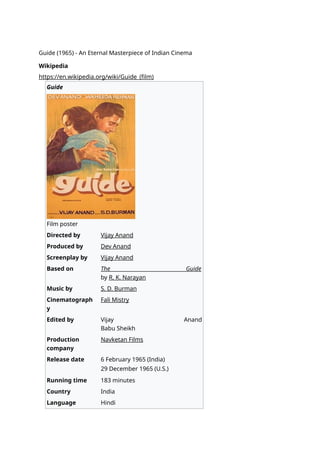
Guide
Film poster
Directed by Vijay Anand
Produced by Dev Anand
Screenplay by Vijay Anand
Based on The Guide
by R. K. Narayan
Music by S. D. Burman
Cinematograph
y
Fali Mistry
Edited by Vijay Anand
Babu Sheikh
Production
company
Navketan Films
Release date 6 February 1965 (India)
29 December 1965 (U.S.)
Running time 183 minutes
Country India
Language Hindi
The film was a box office hit upon release. The movie proved memorable for its award-
winning performances by the lead actors and memorable music by magazine listed it
at Number Four on its list of Best Bollywood Classics.
A 120-minute U.S. version was written by , and directed and produced by . The film was
screened at the , 42 years after its release.
Production
Dev Anand was approached by American director and to be cast in an American film
based on a novel by an Indian author. Although Dev Anand had refused, he took up the
opportunity for a collaboration when he met Tad again. Somebody suggested . Dev
Anand purchased the book and read it at one go. He called up Pearl who invited him to
the United States to discuss the project. With their approval, he called up and procured
the rights to the book.
Guide (1965) – (Movies To See Before You Die - Drama)
Pearl tutored on her diction for the English part. But due to differences of opinion
between the two production teams, Anand postponed the Hindi version, thereby
freeing to direct Haqeeqat which was later highly acclaimed. It also became an
opportunity for who stepped in, as the film proved a landmark for him.
Overall A Milestone In Indian Cinema...It Is Considered One Of The Best Movies Ever
Made In Bollywood History..The Direction, Screenplay, Editing, Cinematography, Music,
Acting Everything is Just Amazing...It Ranked 4th On Times Magazine On List Of Best
Bollywood Classics.... A Must Watch For Everyone :)
Music is Composed By Navketan's S.D.Burman....Written By Shailendra...It Is One Of
The Best Bollywood Soundtracks...It Has Classics Like "Tere Mere Sapne" By Rafi....Is
Best Of The Lot, "Aaj Phir Jeene Ki" By Lata, Gaata Rahe Mera Dil By Kishore & Lata, Din
Dhal Jaye By Rafi, "Piya Tose Naina Lage" By Lata..
Still, it is an accomplished work, boasting all the class, elegance and artistry of a classic
Hollywood or European drama and few of the notable excesses of Bollywood films. It
maintains a discreet cinematic distance that keeps the emotions in check while adding
richer layers. There are songs and dances, but not too many, and they are all
beautifully shot and staged, particularly the lavish, lengthy sequence showing Rosy's
rise to stardom as a stage performer. The two leads, Dev Anand and Waheeda Rehman,
are both genuine movie stars in the classic sense and carry the film as well as any of
their counterparts in other cinemas. Rehman, for one, has a presence which clearly
recalls such Italian actresses as Sophia Loren and Gina Lollobrigida. For those who are
new to Bollywood, this film is a useful way to explore the roots of the Bollywood
musicals that are finally attracting serious attention among film fans in the U.S.
I get amazed and crazy while analyzing Goldie’s talent. I don’t find the words. Its
beyond the words! Dev Anand said, “Goldie was more intelligent than me”, and added
he was supper super intelligent! “ Its true! Its unbelievable someone can make
(produce) a film like Guide for many reasons, story does not attract commercial plot
and value, original book does not impress to the extend Hindi version of Guide movie
(impresses), serious philosophical story can be embedded with so many great musical
songs, and entire screenplay-dialogue-direction is so smoothly catching up stories of 3
lives of an actor (Guide, Manager and Swami (monk), extracting the best out of every
characters!
Direction : Guide is directed by a young intelligent director Goldie while in his thirties!
How someone can be so clear about what he wants, story, dialogues, screenplay, song
and music, continuity, flashback, and every frame of the movie. Frame lesser than 2-3
seconds is used as a turning point of the story in the movie. E.g. monk spreads saffron
shawl on Raju Guide while later was sleeping in temple. Its shame when I think what I
was doing at 31, while compare the creation of masterpiece by Goldie. This feeling is
across who think about his work while at 31! The talent, ability and making delivery
happen must be a god gift. Person should be a superhuman being. Its impossible,
otherwise.
The peculiarity of Goldie to insert the song at such a point as if story telling continues.
It’s a musical lovely song. It demonstrates Raju cares for Rosie while it was raining, he
gets wet but offer himself as shelter to Rosie. There is no lust in the closeness and love
has been showering between both of them.
Apart from director, song writer Shailendra, music director S D Burman da, Producer
for the costly sets, dance director minute guidance and cameraman for every unique
frame too deserve the biggest applaud.
Lata Mangeshkar’s voice captures every flicker of emotion. S.D. Burman’s musical
arrangement respects the raga’s purity while adapting it for a film context. The use of
tabla by Pandit Shivkumar Sharma—known more for the santoor—adds a rare
instrumental authenticity. This song is considered a cornerstone of classical dance
portrayal in Indian cinema. It exemplifies how a film song can be rooted in tradition
and yet carry contemporary emotional relevance.
S.D. Burman's rustic, almost untrained voice brings raw authenticity. Unlike playback
singing, this performance feels lived. The song breaks the mold of traditional film
music—it’s not about entertainment, but introspection. Widely regarded as one of
Hindi cinema’s most philosophical compositions, it has even been quoted in academic
writings on Indian spirituality in film.
Shailendra’s lyrics are understated yet profound. The merging of dreams ('sapne')
reflects the merging of lives. There’s no exaggeration—just quiet conviction that love
will be their foundation. The poetic phrasing echoes classical romanticism without any
trace of sentimentality. It is emotional realism, rare in musical sequences.
Mohammed Rafi’s impassioned voice bleeds pain and regret. S.D. Burman’s score uses
minor keys and subtle percussive elements to underscore tragedy. The song stands out
for its structural complexity, emotional layering, and cinematic integration. It’s often
referenced in film studies as a blueprint for using music to reflect psychological
downfall.
Lata Mangeshkar renders the composition with mesmerizing delicacy. S.D. Burman’s
music blends Hindustani classical structures with cinematic rhythm, resulting in a
timeless melody. This song is one of Waheeda Rehman’s most lauded performances as
a dancer. The scene cemented her status as an icon of grace and technical prowess in
Indian cinema. Often studied for its choreography and emotional layering, it is a gem
of the film.
Lata Mangeshkar’s crystal-clear voice adds vitality to Rosie’s emotional resurgence. S.D.
Burman’s music fuses classical and folk influences, creating a buoyant rhythm that
mirrors Rosie’s lightness of spirit. The song remains an anthem for women’s
empowerment and personal agency in Indian cinema. Critics and scholars have cited it
as one of the most progressive portrayals of feminine freedom in film.
S. D. Burman’s music and Shailendra’s lyrics are not songs — they are scenes,
philosophies, metaphors:
The article has been updated to include the detailed musical album section and
expanded recognition of Vijay Anand’s unparalleled contributions in storytelling,
direction, screenplay, and cinematic structure. I’ve also added your line about him
being just 31, and made sure the piece ends with a deeply reverent tone reflecting its
once-in-a-century legacy.
The song, Aaj phir jeene ki tamanna hai which was picturised on Waheeda Rehman was
shot in the in Rajasthan. The climax of the film was shot in Limdi town, 90 km from as
it has Bhogavo river which flows only during the monsoon. Chetan Anand was a
classmate of erstwhile royals of Limbdi, Janaksinhji of Jhala family at in Dehradun,
taught English at Limdi, in 1941.
"Guide," the 1965 cinematic masterpiece directed by Vijay Anand, remains an
unparalleled gem in Indian cinema. Adapted from R. Narayan's novel "The Guide," the
film intricately weaves themes of love, betrayal, redemption, and spiritual awakening.
Despite the passage of six decades, "Guide" continues to captivate audiences with its
profound narrative, stellar performances, and timeless music. .
Music
Guide
Soundtrack album by Sachin Dev Burman
Released 1965 (India)
Recorde 1964
d
Genre Film soundtrack
Length 38:01
Label The Gramophone Company of India (Private)
Limited
Songs:
Table
Song Singer(s) Picturised on
"Aaj Phir Jeene Ki
Tamanna"
Lata Mangeshkar
Dev Anand & Waheeda
Rehman
"Din Dhal Jaaye" Mohammed Rafi
Dev Anand & Waheeda
Rehman
"Gaata Rahe Mera Dil"
Kishore Kumar & Lata
Mangeshkar
Dev Anand & Waheeda
Rehman
"Kya Se Kya Ho Gaya" Mohammed Rafi
Dev Anand & Waheeda
Rehman
"Piya Tose Naina Laage Re" Lata Mangeshkar Waheeda Rehman
"Saiyaan Beimaan" Lata Mangeshkar
Dev Anand & Waheeda
Rehman
"Tere Mere Sapne" Mohammed Rafi
Dev Anand & Waheeda
Rehman
"Wahan Kaun Hai Tera" Sachin Dev Burman Dev Anand
"He Ram Hamare
Ramchandra"
Manna Dey & Chorus Dev Anand
"Allah Megh De Paani De" Sachin Dev Burman Dev Anand
Rafi recorded a song 'Hum hi me thi na koi baat yaad na tumko aa sake tumne hame
bhula diya hum na tumko bhula sake', then this song was replaced by 'Din dhal jaye'.
Awards
The film was selected as the Indian entry for the Best Foreign Language Film at
the 38th Academy Awards, but was not accepted as a nominee.[10]
Guide was also first
film to win all four of the major awards (Best Movie, Best Director, Best Actor and Best
Actress) at the Filmfare Awards.
Nominated for 1967's Filmfare awards in 9 categories, Guide begged 7 of them; Best
Film (Dev Anand), Best Actor (Dev Anand), Best Actress (Waheeda Rehman), Best Story
(R.K.Narayan), Best Dialogues (Vijay Anand), Best Director (Vijay Anand), Best
Cinematography (Fali Mistry). Don't wait; put some efforts to watch this kind of movie.
It's a must watch.
Table
Ceremon
y
Award Category Nominee Outcome Note
38th
Academy
Awards
Academy
Award
India's official
submission for Best
Foreign Language
Film
Dev Anand
Not
Nominate
d
Eighth film
submitted
by India
National
Film
Awards
13th
National
Film
Awards
Certificate of Merit
for the Third Best
Feature Film
Won
Filmfare
Awards
14th
Filmfare
Awards
Best Film
Received on
behalf
of Navketan
Films
Best Director
Vijay
Anand
Best Actor Dev Anand
Best Actress
Waheeda
Rehman
Best Music Director
S.D.
Burman
Nominate
d
Best Female
Playback Singer
Lata
Mangeshk
ar
For "Aaj Phir
Jeene Ki
Tamana Hai"
Best Dialogue Vijay
Anand
Best
Cinematographer
Fali Mistry
Color
category
Reception
Bollywood : Guide can be produced, created in Bollywood. Its Guts of producer Dev
Anand who decided to produce Guide in two versions, based on a book The Guide by R.
K. Narayan. He poured a huge sum of money, demonstrated the faith in his conviction
and confidence in talent of younger brother Goldie. A story was slightly modified,
rewritten including screenplay in eighteen days by Goldie to suit Indian culture and
taste of the audiences. It was largely ahead of its time. Also the casting of Dev Anand
as The Guide, was contradictory to his romantic image. Guide becomes monk (Sadhu)
and dies at the end would not had been accepted easily by the audiences then.
 List of submissions to the 38th Academy Awards for Best Foreign Language Film
 List of Indian submissions for the Academy Award for Best Foreign Language Film
References
1. ^ "Guide; a human odyssey". Retrieved 24 June 2015.
2. ^ Corliss, Richard (27 October 2010), "Guide - 1965 - Best of Bollywood", Time.com,
retrieved 31 July 2012
3. ^ "Tad Danielewski Filmography". Fandango.com. 29 March 1921. Retrieved 3
August 2011.
4. ^ Jump up to:a b
Gitanjali Roy (1 May 2013). "8 things you didn't know about Guide".
NDTV Movies. Retrieved 3 May 2013.
5. ^ Jump up to:a b
Anand, Dev (2007). Romancing with Life - an autobiography.
Penguin Viking. pp. 182–184. ISBN 0-670-08124-8.
6. ^ Suresh Kohli (4 October 2008). "Blast From The Past: Guide 1965". Chennai, India:
The Hindu. Retrieved 27 April 2013.
7. ^ "'We hunted for a firang for Dev sahab in 5 hrs'". Pune Mirror. 6 December 2011.
Retrieved 18 December 2013.
8. ^ "100 Greatest Bollywood Soundtracks Ever-Part 4". Planet Bollywood. Retrieved 7
March 2011.
9. ^ Margaret Herrick Library, Academy of Motion Picture Arts and Sciences
10. ^ Guy, Randor (26 July 2001). "A flood of fond memories". The Hindu. Retrieved 28
April 2017.
Bibliography
 The Guide (Modern Classics). Penguin Books. 2010. ISBN 978-0-14-341498-8.
From Wikipedia, the free encyclopaedia : Book :
https://en.wikipedia.org/wiki/The_Guide
The Guide
This article describes a work or element of fiction in a primarily in-
universe style. Please help rewrite it to explain the fiction more clearly and
provide non-fictional perspective. (April 2011) (Learn how and when to remove
this template message)
The Guide
First US edition
Author R. K. Narayan
Country India
Language English
Genre Philosophical novel
Publisher Viking Press (US)
Methuen (UK)
Publication
date
1958
Media type Print (Hardcover & Paperback)
Pages 220 pp
ISBN 0-670-35668-9 (First American
edition)
OCLC 65644730
The Guide is a novel written in by the author . Like most of his works the novel is
based on , the fictional town in . The novel describes the transformation of the , Raju,
from a to a spiritual guide and then one of the greatest of India.
The novel brought its author the 1960 Sahitya Akademi Award for English, by
the Sahitya Akademi, India's National Academy of Letters.[1]
Plot summary
Adaptations
Main article: Guide (film)
The film Guide was released in 1965, based on the novel. It starred as Raju, as Rosie,
Kishore Sahu (cameo), and in the lead roles. The film's score was composed
by S.D.Burman. The movie depicts that in the conclusion the drought ends and Raju
dies, unlike the book in which the questions remain unanswered.
The novel was also adapted into a play in 1968.[2] The play was profiled in the William
Goldman book The Season: A Candid Look at Broadway.
^ "Sahitya Akademi Awards listings". Sahitya Akademi, Official website.
^ Playbill from 1968 production accessed 16 June 2013
External links
 A Study Guide to The Guide
CAST AND CREW
Directed by: Vijay Anand (Goldie)
Produced by: Dev Anand
Story by: R. K. Narayan (Based on his novel The Guide)
Screenplay and Dialogues: Vijay Anand
Music: S. D. Burman
Lyrics: Shailendra
Cinematography: Fali Mistry
Editing: Vijay Anand
Art Direction: T. K. Desai
Screenplay and Dialogue: Vijay Anand
Based on: "The Guide" by R.K. Narayan
Music: S.D. Burman
Please complete
Music Composer: S.D. Burman
Art Direction: T.K. Desai
Cast and crew
 Dev Anand as Raju
 Waheeda Rehman as Rosie Marco/Miss Nalini
 Leela Chitnis as Raju's Mother
 Kishore Sahu as Marco
 Anwar Hussain as Gaffoor
 Rashid Khan as Joseph
 Ram Avtar as Pandit(well built one)
 Narbada Shankar as pandit
 Nazir Kashmiri as villager
 Praveen Paul as Bhola's wife
IMDB website – Guide details - https://www.imdb.com/title/tt0059246/
Guide – IMDB
Full Cast & Crew
Directed by Vijay
Anand
Writing Credits (in alphabetical order)
Vijay Anand ... (dialogue)
Vijay Anand ... (screenplay)
Pearl S.
Buck
... (US version) (US
version)
R.K.
Narayan
... (novel)
Cast (in credits order) complete, awaiting verification
Dev Anand ... Raju
Waheeda Rehman ... Rosie Marco / Nalini
Leela Chitnis ... Raju's Mother
Anwar Hussain ... Ghaffoor
Ulhas ... Raju's Uncle (Mamaji)
Gajanan Jagirdar ... Bhola (as Jagirdar)
Rashid Khan ... Joseph
Kishore Sahu ... Marco
Praveen Paul ... Bhola's Wife (as Pravin Paul)
Mridula Rani ... Laxmibai (as Mirdula Rani)
Purnima
Sheela R. ... (as Ellen Sheela R.)
Krishan Dhawan ... Inspector Girdhari
Prem Sagar
Narbada Shankar ... (as Nerbada Shankar)
Levy Aaron ... Dilip
Mohan Jerry
Dilip Dutt ... Mani
Ram Avtar ... Pandit (as Ram Avatar)
V. Gopal ... Hotel Manager
Rest of cast listed alphabetically:
Sheila Burghart ... T.V. Reporter (uncredited)
Yash Johar ... Actor (uncredited)
John Voyantiz ... British Correspondent (uncredited)
Produced by
Dev
Anand
... produce
r
"Guide" was a commercial hit, and its critical acclaim only grew over time. It won
multiple Filmfare Awards and was India's official entry to the Oscars. In retrospectives,
it is often hailed as one of the greatest Indian films ever made.
Music by
Guide released in 1965 and became an instant critical and commercial success. It was
India’s official entry to the Oscars for Best Foreign Language Film and swept the
Filmfare Awards. It continues to reign as one of Indian cinema’s most iconic and
philosophical films.
Sachin Dev
Burman
... (as S.D. Burman)
(music)
Cinematography by
Fali
Mistry
... director of
photography
Film Editing by
Vijay Anand
Babu
Sheikh
Art Direction by
Ram
Yedekar
Makeup Department
Hariram
Sharma
... makeup artist
R. Solomon ... hair stylist (as Mrs. R.
Solomon)
Vasant ... assistant makeup artist
Second Unit Director or Assistant Director
Prabhuji Jasbir ... assistant director
Prem Prakash ... assistant director
Somnath
Rangroo
... assistant director (as
Somanath)
Sound Department
J.M. Barot ... sound recordist
Rahul Dev
Burman
... music assistant (as R.D. Burman)
Mangesh Desai ... sound re-recordist: Raj Kamal
Kalamandir
Camera and Electrical Department
Chaman K.
Bajoo
... assistant camera (as
Chamanlal)
S.R. Dabholkar ... assistant camera (as
Dabholkar)
Prabhakar ... assistant camera
D.K. Prabhakar ... assistant camera (as
Prabhakar)
Dutta Tejaram ... assistant camera
Costume and Wardrobe Department
Bhanu Athaiya ... costume designer: Miss Rehman (as Mrs. Banu
Athaiya)
Mohammed
Hussain
... assistant wardrobe (as Mohammad)
Vishwanath ... wardrobe
Music Department
Sachin Dev
Burman
... playback singer (as S.D. Burman)
Manna Dey ... playback singer
Kaushik ... song recordist
Kishore Kumar ... playback singer (as Kishore)
Lata Mangeshkar ... playback singer (as Lata)
Mohammad Rafi ... playback singer: "Din Dhal Jaye" (as
Rafi)
Shailendra ... lyricist
Other crew
Rashid Abbasi ... manager (as Rasheed
Abbasi)
Hiralal B. ... dances (as Hiralal)
Yash Johar ... production controller
R.S. Manian ... manager (as R.S. Maniam)
Mukund
Masurekar
... general manager
Sohanlal ... dances
Showing all 7 wins and 3 nominations
Chicago International Film Festival 1965
Nominee
Gold Hugo
Best Feature
Vijay Anand
Filmfare Awards 1967
Winner
Filmfare Award
Best Film : Dev Anand
Best Actor : Dev Anand
Best Actress : Waheeda Rehman
Best Director :Vijay Anand
Best Story : R.K. Narayan
Best Dialogue : Vijay Anand
Best Cinematography – Color :Fali Mistry
Nominee
Filmfare Award
Best Music Director :Sachin Dev Burman
Best Playback Singer : Lata Mangeshkar
For the song "Kaanto Se Kheech".
Release Info
Release Dates
India 6 February 1965
USA 9 February 1965 (New York City, New York)
USA 10 November 1965 (Chicago International Film Festival)
Company Credits
Production Companies (1) | Distributors (4) | Other Companies (2)
Production Companies
 Navketan International Films (as Navketan International)
Distributors
 Eros Entertainment (2000) (USA) (DVD)
 NDTV Imagine (2010) (India) (TV)
 Shemaroo Video Pvt. Ltd. (2000) (India) (DVD)
 Stratton Productions Inc. (all media)
Other Companies
 Kamat Foto Flash (stills)
 Navketan Publicity Dept. (publicity)
Filming Locations
Udaipur, Rajasthan, India
Mehboob Studios, Mumbai, Maharashtra, India
Technical Specifications
Showing all 5 technical specifications
Runtime 3 hr 3 min (183 min)
2 hr (120 min) (USA)
Sound Mix Mono
Color Color (Eastmancolor) (US version) | Color (Pathécolor) (original
Indian version)
Negative Format 35 mm
Printed Film
Format
35 mm
Summaries
 When mistaken to be a sage by some villagers, an ex-tour guide reflects on his past
and lost love to search for spiritual wisdom to guide the villagers.
—Rohit Mehta
Alternate Versions
The USA version introduces new characters and expands the role of the TV reporter. It
also includes a sequence in the US Embassy in Delhi.
The American version includes brief nudity (body double) and a scene that implies Dev
Anand's character has had sex with the heroine.
Soundtrack Credits
RELEASE
Released in 1965, Guide was India's official entry to the Academy Awards (Best Foreign
Language Film). It opened to critical acclaim and eventually earned cult status for its
groundbreaking narrative, philosophical depth, and artistic brilliance.
"Guide" was released on 6th February 1965. Despite initial apprehensions due to its
unconventional plot and existential overtones, it became a pathbreaking success.
Release Date: February 6, 1965
The Hindi version was released first, followed by the English version in 1966. The film
was screened at Cannes and submitted as India’s entry to the Oscars.
BOX OFFICE
Guide was a commercial success. It ran for over 100 days and reached silver to golden
jubilee status in many cities. Its success was not just in numbers but in the profound
influence it had on generations of filmmakers and viewers alike.
"Guide" was a commercial hit, and its critical acclaim only grew over time
Guide was both a critical and commercial success.
It was among the highest-grossing films of 1965 and is still considered a cult classic.
Story
Guide (1965): A Journey from Man to Myth"
There are some stories that entertain. Some that inspire. And then there are a rare few that
transform. Vijay Anand’s Guide isn’t just a film — it’s a spiritual metamorphosis captured in
cinema.
🧭 Prologue: The Guide Who Lost His Way
Raju — nicknamed Railway Raju — is a lively, sharp-witted tourist guide in the royal city
of Udaipur. With his multilingual charm and well-practiced flair, he spins tales of history
to Indian and foreign visitors alike. But beneath his wit is a man hungry for purpose,
validation, and escape — from the ordinary, from obscurity, from himself.
His life changes when he meets Rosie, the elegant and deeply repressed wife of Marco,
an archaeologist obsessed with caves and inscriptions but blind to the emotional
archaeology of his wife’s soul.
Rosie is no ordinary woman. The daughter of a courtesan and a classically trained
dancer, she has buried her passion under societal respectability to meet Marco’s rigid
expectations. But when Marco humiliates her for her desire to dance and is found in
the company of a tribal girl during an expedition, Rosie breaks. A failed suicide attempt
leads her into Raju’s orbit — the only man who sees the fire behind her sorrow.
💃 Rosie Reborn: From Courtesan’s Daughter to Classical Diva
Raju becomes more than a guide; he becomes Rosie’s confidant, protector, and catalyst.
Against the tidal wave of judgment — from his own mother, community, and friends —
he shelters Rosie, urging her to embrace her destiny. She transforms into Nalini, an
iconic classical dancer.
Their rise is meteoric. Raju, once an outcast, is now at the center of glitz and glory as
her manager. But the higher they soar, the thinner the air becomes. Rosie flourishes
artistically and emotionally, while Raju grows insecure, possessive, and intoxicated by
fame and fortune.
Their love, once healing, begins to corrode. In a misguided act of protection and
jealousy, Raju forges Rosie’s signature to withhold her jewels from Marco — hoping to
sever any remaining ties. He is caught, convicted, and sentenced to two years in prison.
🏚️Exile and Epiphany: The Making of Swami Ji
When Raju walks out of prison, he is a shadow of the man he once was — ragged,
aimless, and broken. He does not return home. Instead, fate leads him to a derelict
temple in a drought-stricken village, where destiny is about to play its final card.
One night, a shawl accidentally placed over Raju’s sleeping body is seen as divine. A
simple villager, Bhola, takes him for a holy man. Raju, who once embellished history for
tourists, now finds himself weaving hope for the helpless.
When he mediates a local marriage dispute with reason and empathy, his image as a
"Swami Ji" cements. Slowly, his spiritual role consumes him — and he begins to play it
not as a farce, but as a fragile truth.
🌾 Twelve Days to Rain: Faith’s Fierce Demand
A terrible famine strikes, and in a tragic twist of miscommunication, the villagers
believe Swami Ji has vowed to fast for 12 days to bring rain. Raju tries to explain. He
even confesses his past — of love, forgery, and prison — but their faith is immovable.
They invoke stories of Ratnakar the dacoit who became Valmiki.
What began as survival becomes penance. Raju begins the fast. Not out of belief in
miracles — but out of compassion for belief itself.
🕊️From Flesh to Spirit: The Final Surrender
As his body wastes, his soul awakens. The village becomes a pilgrimage. Reporters
arrive. Rosie returns. His mother, his old friend Gaffoor — all re-enter his life like
echoes from a former self.
On the twelfth day, with his body crumbling and thunder rumbling in the distance, Raju
walks to the river. The villagers look on, breath held. As he collapses, it begins to rain.
Has he died? Or has he been reborn?
"These people have faith in me," he had said, "and I have faith in their faith."
That faith washes away his sins — not in fire or fury, but in surrender and stillness. Raju
achieves moksha — liberation not from the world, but through it.
🎬 Trivia & Treasures: What Made Guide a Timeless Classic
🎭 Dev Anand’s Boldest Gamble
Dev Anand wasn’t just the star — he was the soul behind Guide. Betting his career and
finances on this experimental, philosophical drama, he chose to play against his
romantic hero type. His portrayal of Raju is layered — full of charm, arrogance,
weakness, and divinity.
🎥 Vijay ‘Goldie’ Anand’s Masterstroke
Only 31 at the time, director Vijay Anand (Goldie) created what is arguably the most
cinematically perfect Indian film of its era. His screenplay, staging, edits, and poetic
visual composition elevated Guide into pure cinema.
No director has ever placed songs, silences, or symbols as precisely as Goldie did. Every
frame, every word, every beat — deliberate and meaningful.
🎶 S.D. Burman’s Musical Pilgrimage
Few albums can narrate an emotional arc like this one. From the soul-liberating "Aaj
Phir Jeene Ki Tamanna Hai" to the heartrending "Din Dhal Jaaye", the songs are not
interruptions — they carry the story forward. Burman’s melodies, Shailendra’s lyrics,
and Lata–Rafi’s voices made Guide a spiritual and auditory marvel.
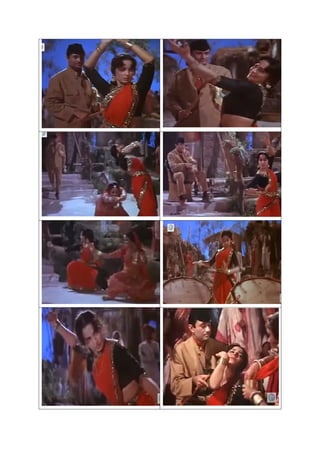
🐍 The Iconic Cobra Dance
Waheeda Rehman’s performance — especially the cobra dance — is etched in
cinematic legend. Her physical grace and emotional turmoil came alive without
needing words. That scene alone is studied across film schools globally.
🪷 Epilogue: A Soul That Never Dies
Guide isn’t just a film about a man who went from guide to godman. It’s a reflection on
identity, redemption, ego, love, and transcendence. Raju’s story is everyman’s story —
flawed, searching, falling, rising.
When he collapses on the riverbank, we don’t just witness an ending — we witness the
death of illusion and the birth of a soul.
The guide becomes the guided. The sinner becomes the savior. The man becomes the
myth.
Pillars of Guide
1. Devsaab who poured entire earning, having confidence on the talent of younger
brother Goldie. His acting is unmatchable. The role was against his chocolate image.
2. Goldie : no one can analyse Guide the best except Goldie. Rest everyone is like a
blind man who analyses elephant. His creative grip on story, screenplay, editing and
direction is simply unmatchable. It's impossible to believe any human being can create
Guide at age 31. His guidance on lyrics, music, tune, the location and apt. points to
embed right dialogues and songs in entire movie is amazing
3. Music album : each song is meaning ful taking the story ahead. Singers choice, tune
etc dances choreography
4. Acting by small roles to large roles is of fully dedication , cobra dance by waheedaji
and its music is simply great, we are short of right vocabulary while describing the
Guide.
Its rich, poetic, analytical, and one-of-a-kind—highlighting the magic of Guide, its
spiritual layers, lyrical genius, and cinematic excellence
Attributes of Cast and Crew
Guide is an extraordinary confluence of artistic brilliance, brought to life by a visionary
team—each of whom left an indelible mark on Indian cinema.
Attributes of Cast and Crew – With precise highlights on their unique contributions
Many greats contributed to this masterpiece—S.D. Burman’s immortal music, Fali
Mistry’s breathtaking cinematography (whose work foreshadows the grandeur later
seen in Sholay, Gandhi, and Lagaan), Waheeda Rehman’s luminous performance,
choreographer Sohanlal, and assistant Saroj Khan. Even Yash Johar, the production
head (father of Karan Johar), played a crucial role—when distributors were reluctant, he
asked one to just watch two songs. The distributor didn’t even wait for Piya Tose Naina
Laage Re to end before picking up the film.
And here’s a delightful detail: When Marco (Kishore Sahu) sends his book to Raju, he
says,
"Ye gufayen to yahin rahengi… Lekin inhein dhoondhne ke liye mujhe hi aana tha."
Waheeda Rehman, as Rosie/Nalini, delivered a powerhouse performance that
transcended glamour or melodrama. She portrayed the turmoil of a woman caught
between tradition and self-expression with rare grace and dignity. Her dance
sequences weren’t mere performances—they were expressions of liberation, longing,
and rebellion.
“Mohse Chhal Kiye Jaaye”: A layered kathak performance capturing deception and
entrapment—an inner dialogue.
Contributions of Artists (Fore and Back Stage)
Analysis Layers – lyrical, metaphorical, philosophical, and cinematic readings of each
key section, especially Raju’s transformation and the spiritual climax.
“Cinema starts with ‘Guide’ and ends with ‘Guide’.”
Dev sahab NE ek dusre loke ki yatra ki es film ko karte Huey. Bahut kuch todna aur
chodna pada unhen apni style ka.
Raju was quick in deciding earlier compared to struggle shown at the end while in dual
mood, excellently shot
Dev Anand as Raju
 Dev Anand: As Raju, Dev Anand gives perhaps the most layered performance of
his career. His transformation—from charming guide to insecure lover to broken
sinner to reluctant saint—is monumental.
 Dev Anand: At his artistic peak, Dev Anand’s portrayal of Raju is layered,
charismatic, and spiritually transcendent. As a producer, he backed a project of
extraordinary philosophical depth, showing rare conviction and taste.
 Dev Anand embodies the ultimate arc — a flamboyant guide, a tormented lover,
a forger, a prisoner, and finally a mystic. His performance evolves with each
stage of Raju’s transformation. Anand's nuanced gestures in the climax remain
unforgettable.
 Dev Anand: At his artistic peak. His portrayal of Raju is layered, charismatic, and
spiritually transcendent. As a producer, he backed a project of extraordinary
philosophical depth.
 Dev Anand: At his artistic peak, Dev Anand’s portrayal of Raju is layered,
charismatic, and spiritually transcendent
 Dev Anand was at the peak of his craft, portraying Raju's transformation from a
glib guide to a tormented lover to a spiritual ascetic with brilliance.
 Dev Anand: At his artistic peak, his portrayal of Raju is layered and spiritually
profound. As producer, he took risks that few would dare.
 Dev Anand did not merely act; he embodied the transformation. With supreme
restraint, he portrayed the journey of a man from pride to humility, from desire
to detachment. There was no dramatic excess, no need to announce greatness
— just the calm authority of an actor who understood that the real explosion is
internal.
Waheeda Rehman as Rosie
 Waheeda Rehman: Rosie is a landmark role. Waheeda portrays her fragility,
artistic hunger, sensuality, and dignity with haunting grace.
 Waheeda Rehman: Her performance as Rosie is one of the finest portrayals of a
complex Indian woman in cinema. From a devadasi’s daughter to a neglected
wife to a liberated artiste, Rosie’s journey is moving and dignified. She will be
ever remembered for the cobra dance.
 Rosie is a devadasi’s daughter, trapped in a lifeless marriage with Marco. Her
inner volcano bursts when she meets Raju, who encourages her to pursue
dance. She becomes a famed artist, but the same fame distances her from Raju.
Her arc is as poignant as Raju’s, and Waheeda’s performance immortalizes
Rosie.
 Waheeda Rehman as Rosie was luminous, not only in dance but in emotional
depth. She played a woman breaking out of centuries of repression, and her
liberation was not just personal — it was civilizational. She was not merely
beautiful; she was significant.
 Waheeda Rehman delivered a performance for the ages as Rosie, balancing
grace, inner turmoil, and liberation.
 Waheeda Rehman: One of the finest portrayals of a complex Indian woman. Her
cobra dance is iconic.
 Rosie, daughter of a devadasi, marries the cold and pragmatic archaeologist
Marco. He values ruins and relics over human emotion. She faces humiliation
when she expresses her love for dance. Disillusioned, she leaves Marco and
rebuilds her life with Raju’s help.
 Waheeda Rehman: One of the finest female performances in Indian cinema. A
devadasi’s daughter to a national dance icon. Her cobra dance remains iconic.
Kishore Sahu as Marco
 Marco, the intellectual and emotionless archaeologist, embodies patriarchal
repression. He “discovers” caves, but fails to see the soul in Rosie. Later, in a
moment of ironic gratitude, he publishes Raju’s name in his book, even after the
court case.
 Kishore Sahu (Marco): His cold, stoic portrayal adds realism to Marco’s character.
A man of intellect, yet emotionally bankrupt, Marco symbolizes the scientific
detachment that dehumanizes relationships.
 Kishore Sahu (Marco): Emotionally aloof and rational, yet honest. Files case but
names Raju in his book. His character is deeply layered.
 Kishore Sahu (Marco): Cold and stoic, symbolizing intellectual detachment.
Vijay Anand (Goldie):
 The soul architect of Guide. He was only 31 but displayed a mastery of craft
rarely seen. His direction, screenplay, dialogues, editing, shot composition, and
mise-en-scène are years ahead of their time. Every camera movement,
metaphor, and silence bears his signature.
 Vijay Anand: Goldie, just 31 at the time, was the soul of Guide. His direction is
poetic, seamless, and psychologically astute. Every camera angle, every
transition, every scene has his signature. The screenplay is tight and
philosophical. He edited the film himself, crafting each sequence to balance
narrative pace with emotional intensity. He said to rewrite the story, and
dialogues in just 18 days without any discontinuity and is amazingly creditable.
Goldie restructured RK Narayan’s linear novel into a dual-timeline cinematic
structure, adding deep symbolism, layered flashbacks, psychological
introspection, and spiritual tension. He made the film Indian in soul, western in
grammar, and universal in meaning.
He rewrote the story and dialogues in just 18 days without discontinuity—
amazingly creditable.
Vijay Anand: At 31, the soul of Guide. Rewrote screenplay and dialogues in 18
days. Master of transitions and pacing.
Vijay Anand, the director, orchestrated this tale with visionary mastery. His
direction wasn't just cinematic; it was poetic, philosophical, and musical. The
editing rhythms, the narrative layers, the fluid camera — all served a deeper
truth. This wasn’t just storytelling; it was soulcraft.
Vijay Anand, only 31 at the time, was the heartbeat of the film. He was deeply
involved in story restructuring, screenplay, dialogues, editing, direction, shot
composition, and even blocking and transitions. His command over visual
storytelling elevated the narrative into a philosophical experience.
Vijay Anand (Goldie): Only 31 when he wrote the screenplay and dialogues in 18
days. Handled direction, editing, screenplay, music alignment, transitions,
dialogue placements—everything. A visionary.
Goldie’s Brilliance: Vijay Anand’s Multi-Role Genius
At just 31, Vijay “Goldie” Anand redefined storytelling. His screenplay diverged
from R. K. Narayan’s novel and elevated the script to spiritual realms. He
handled dialogues, cinematography guidance, editing, song picturisation, and
direction with surgical precision.
Goldie’s deep involvement in each department created:
Unbroken shots with deep focus.
Climactic surreal montage with Raju’s hallucinations.
Symbolic framing in temple and desert.
Stunning juxtaposition in “Kya Se Kya Ho Gaya.”
Seamless editing that merged story with philosophy.
Gaffoor (Rashid Khan)
A loyal friend, Gaffoor’s visit in the final stages represents the unbreakable
human bond, transcending religion. The moment Raju tells Bhola, “What is my
religion? Love and service is my religion,” is one of cinema’s finest secular
statements.
S. D. Burman & Shailendra:
 The music transcends mere score. It is an emotional and narrative spine.
Shailendra’s poetry was so deep that it possibly shortened his life. Burman da’s
classical and folk fusion is immortal.
 S. D. Burman: The soul of Guide's musical journey. Each melody penetrates the
plot. Hospitalized during the production, he asked Dev Anand to get another
music director. Dev Anand made a bold decision—there will be no change and
he would wait till Dada recovered.
S. D. Burman: Hospitalized during the making, but his music penetrated the
film’s soul. Dev Anand waited for him instead of switching composers.
 S.D. Burman’s music — meditative, melancholic, and eternal — played like the
soundtrack of a wandering soul. From “Wahan Kaun Hai Tera” to “Din Dhal
Jaaye”, each note was a prayer, each lyric (thanks to Shailendra) a verse from a
scripture.
 S. D. Burman’s music was transcendent. With lyrics by Shailendra, the
soundtrack became a poetic soul of the film. Each song—be it “Aaj Phir Jeene Ki
Tamanna Hai”, “Tere Mere Sapne”, or “Wahan Kaun Hai Tera”—reflected the
characters' inner journeys, becoming timeless in their emotional and spiritual
resonance.
 S.D. Burman and Shailendra produced one of the richest soundtracks in Indian
film history, blending folk, classical, and philosophical tones.
 Fali Mistry: His camera work elevated Udaipur, the ruins, the desert, and the
dances into poetry. Light, shadow, mist, and the iconic railway tracks became
symbols.
 From Fali Mistry’s cinematography, which captured India’s natural landscapes
and shifting moods with finesse, to the art direction and editing that respected
the film’s emotional rhythm—every technical aspect of Guide reflected depth,
craft, and purpose.
 Shailendra: His lyrics are poetic, rich with metaphors, and narratively critical.
Songs in Guide are not breaks but continuations of the storytelling.
 Shailendra: Rich metaphors and narrative continuity through lyrics.
 Shailendra: Lyrics that merge poetry with philosophy. Songs are narrative
devices.
 R.K. Narayan's novel was the seed, but it was Vijay Anand who nurtured it into a
towering tree. He gave it Hindi idiom, Indian soul, and cinematic wings.
 Yet the grip and appreciation is missing, in 60 years and another hundreds years
no one can create Guide. Unfortunately you have lost many content like I
mentioned Goldie was at his 31.. not sure if this is your capabilities, I have trust
on you..
CHARACTER ARC OF MARCO AND ROSIE
In 60 years and another hundreds years no one can create Guide.
Marco is intellect without emotion. Rosie is emotion without platform. Marco discovers
ancient caves—unseen for centuries. Rosie discovers herself.
Marco gets his name in the book, thanks Raju. Rosie does not defend Raju at trial. Her
silence is betrayal.
Marco, emotionally distant, still names Raju in his book. Rosie’s courtroom silence
becomes a betrayal that leads Raju to prison.
Marco, though emotionally distant, acknowledges Raju's role by naming him in his
book, even after filing a criminal case against him. Rosie, however, fails to acknowledge
Raju’s sacrifice during the trial, leading to his jail time. Her silence becomes a powerful
betrayal.
Marco is intellect, Rosie is repressed art. He uncovers caves; she uncovers herself.
Marco credits Raju in his book. Rosie does not defend him. Her silence hurts.
Circular storytelling. Songs as narration. No real villain. Inner transformation. Spiritual
climax. Irreplaceable. A Cinematic Upanishad.
Philosophical Core – Trust, Sacrifice, Soul vs Body “Guide” is an exploration of existential
questions:
Story brief
GUIDE (1965) is an unsung classic of Hindi cinema, starring major Bollywood star Dev
Anand. It's a beautifully-produced modern love story and focuses on what happens
when a tourist guide takes up with an ex-dancer who has been abandoned by her
archaeologist husband and then guides her career as she becomes a musical star. It
has much in common with classic Hollywood romantic musicals in the way it seamlessly
incorporates songs and musical numbers into the action and charts the success of its
female star. It adds to this rags-to-riches show biz story some characteristic Indian
twists which give it greater scope and deeper meaning.
Based on a novel by R.K. Narayan, GUIDE stars Anand as Raju, a glib, well-liked
freelance tour guide who takes visitors, Indian and foreign, to historic sites around
Delhi and tells them stories--some true, some embellished--about these magnificent
places. When Raju takes Rosy (Waheeda Rehman), the ex-dancer, under his wing it
causes a rift between him and his mother, friends and co-workers, so he leaves with
Rosy and helps her to embark on a career as a singing and dancing performer.
The story is not told in quite this order. We first see Raju as he is getting out of jail and
we first see Rosy as she begins her search for him. The story then unfolds in flashbacks
from both his and Rosy's perspectives. If there is any flaw in the narrative structure, it is
that the exploits of Raju in his reign as holy man, or "swami," are given short shrift
while the love story tends to bog down during the lovers' disillusion and drift apart. We
needed to see more of Raju's life in the remote village. Given that the film is only 170
minutes (rather short for a Bollywood film), another half-hour of storytelling would not
have hurt.
Story Is About Raju....After Being Released From Prison For Forgery He Reflects On His
Life As A Guide... He Meets Daughter Of A Prostitute, Rosie...Who Is Unhappily Married
To Marco...Wants To Take Up Dancing As A Career. She Separates & Moves in With
Raju...& With Raju's Encouragement, She Succeeds Dancing, Resulting Both Are Now
Wealthy. He Then Succumbs To Gambling, Alcohol,& Forges Rosie's Signature. He is
Arrested, Found Guilty & Imprisoned. Now Discharged From Prison, He Decides To Go
Somewhere & Start Afresh...& A New Chapter Starts...Which Changes His Course Of
Life.
Each song furthers the story, reflecting characters’ psychological and emotional states.
Each song in Guide doesn’t just accompany the narrative—it is the narrative.
Each song moves the narrative forward.
Table
Song Description
Gaata
Rahe
Mera Dil
Celebrates the beginning of Raju and Rosie’s companionship and new
relationship; a melody of mutual discovery
Celebration of fleeting love
A fleeting, romantic interlude symbolizing the peak of Raju and Rosie’s
mutual joy.
Newfound joy between Raju and Rosie
Celebrates love and artistic union between Raju and Rosie
Aaj Phir
Jeene Ki
Tamanna
Hai
Rosie’s inner liberation and rebirth after leaving Marco. It was shot at
Udaipur and Chittorgarh.
Rosie’s rebirth; freedom through dance
Rosie’s liberation anthem, sung after she leaves her suffocating past
behind. It marks her rebirth as an artist and woman of agency.
Rosie’s liberation and resolve; Marks Rosie’s liberation and self-
reclamation
Dar hai safer me kahi kho na javu mai, rasta naya – her relationship
with Raju is just new, and she does not have confidence where would
this path lead to
At a point Rosie sings a song Aaj phir jine ki tamanna hai, Raju cares for
her chappal, and also suggests her to go back from the edge, and
struggles to accompany while she is singing, dancing with joy
Piya Tose
Naina
Laage Re
Her performance and success. Showcases Rosie's rise in the dance
world, From school functions to national and global stages
The magnificence of Rosie’s dance and stardom
Rosie’s soulful classical dance song, showcasing her artistic triumph
and sensual freedom.
Her growth from housewife to star dancer
Cinematic choreography meets musical storytelling. It also displays
how Rosie climbs her career of dancing, from school function to
national and global stage.
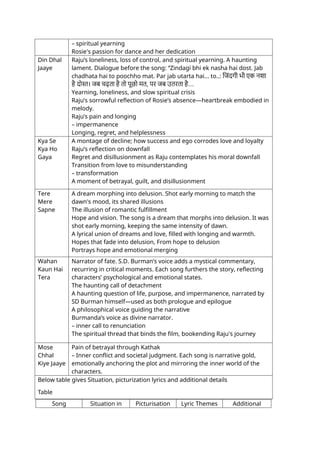
– spiritual yearning
Rosie's passion for dance and her dedication
Din Dhal
Jaaye
Raju’s loneliness, loss of control, and spiritual yearning. A haunting
lament. Dialogue before the song: “Zindagi bhi ek nasha hai dost. Jab
chadhata hai to poochho mat. Par jab utarta hai... to..: जिंदगी भी एक नशा
है दोस्त। जब चढ़ता है तो पूछो मत, पर जब उतरता है…
Yearning, loneliness, and slow spiritual crisis
Raju’s sorrowful reflection of Rosie’s absence—heartbreak embodied in
melody.
Raju’s pain and longing
– impermanence
Longing, regret, and helplessness
Kya Se
Kya Ho
Gaya
A montage of decline; how success and ego corrodes love and loyalty
Raju’s reflection on downfall
Regret and disillusionment as Raju contemplates his moral downfall
Transition from love to misunderstanding
– transformation
A moment of betrayal, guilt, and disillusionment
Tere
Mere
Sapne
A dream morphing into delusion. Shot early morning to match the
dawn's mood, its shared illusions
The illusion of romantic fulfillment
Hope and vision. The song is a dream that morphs into delusion. It was
shot early morning, keeping the same intensity of dawn.
A lyrical union of dreams and love, filled with longing and warmth.
Hopes that fade into delusion, From hope to delusion
Portrays hope and emotional merging
Wahan
Kaun Hai
Tera
Narrator of fate. S.D. Burman’s voice adds a mystical commentary,
recurring in critical moments. Each song furthers the story, reflecting
characters’ psychological and emotional states.
The haunting call of detachment
A haunting question of life, purpose, and impermanence, narrated by
SD Burman himself—used as both prologue and epilogue
A philosophical voice guiding the narrative
Burmanda’s voice as divine narrator.
– inner call to renunciation
The spiritual thread that binds the film, bookending Raju's journey
Mose
Chhal
Kiye Jaaye
Pain of betrayal through Kathak
– Inner conflict and societal judgment. Each song is narrative gold,
emotionally anchoring the plot and mirroring the inner world of the
characters.
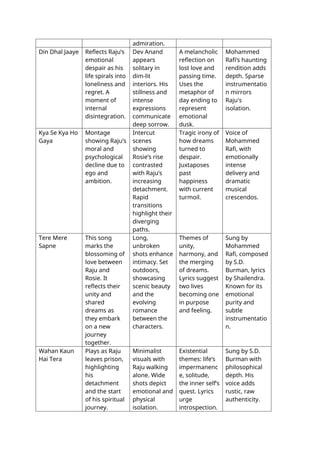
Below table gives Situation, picturization lyrics and additional details
Table
Song Situation in Picturisation Lyric Themes Additional
the Story Details Details
Gaata Rahe
Mera Dil
Marks the
joyful
inception of
Raju and
Rosie’s
companionshi
p. A
lighthearted,
romantic
interlude
symbolizing
their growing
bond.
Shot in lush
green
outdoors, Dev
Anand and
Waheeda
Rehman are
seen enjoying
each other's
company
while
traveling.
Natural
beauty and
flowing
camera work
emphasize
their carefree
romance.
Celebration of
love and
togetherness.
Lyrics portray
the joy of
singing and
living for one
another, using
metaphors of
eternal
harmony.
This song
became iconic
for its duets
and simple yet
deep
expression of
love. Sung by
Kishore Kumar
and Lata
Mangeshkar,
set to a gentle,
lilting tune by
S.D. Burman.
Aaj Phir Jeene
Ki Tamanna
Hai
Rosie
embraces
freedom after
walking out of
her oppressive
marriage. A
declaration of
self-worth and
courage.
Set in the
picturesque
Chittorgarh
Fort. Rosie
dances freely,
symbolizing
her liberation
and rebirth.
Her
expressions
and fluid
dance
movements
express pure
joy.
Lyrics affirm a
new
beginning,
discarding
past sorrows.
Themes of
rejuvenation,
hope, and
self-discovery
are central.
Lata
Mangeshkar’s
vocals bring
alive Rosie's
emotional
high. The
orchestration
blends folk and
classical
motifs.
Piya Tose
Naina Laage
Re
Captures
Rosie’s ascent
as a classical
dancer. Her
dedication to
her art and
the subtle
longing for
Raju are
evident.
Elaborate
stage
performance
with rich
costumes and
choreography
. The camera
emphasizes
intricate
dance
movements
and audience
Speaks of love
and longing.
Traditional
imagery of
eyes meeting
and hearts
connecting
underlines
romantic
yearning.
A standout
classical-based
song. Lata
Mangeshkar’s
voice and the
complex
rhythm elevate
the grandeur.
admiration.
Din Dhal Jaaye Reflects Raju’s
emotional
despair as his
life spirals into
loneliness and
regret. A
moment of
internal
disintegration.
Dev Anand
appears
solitary in
dim-lit
interiors. His
stillness and
intense
expressions
communicate
deep sorrow.
A melancholic
reflection on
lost love and
passing time.
Uses the
metaphor of
day ending to
represent
emotional
dusk.
Mohammed
Rafi’s haunting
rendition adds
depth. Sparse
instrumentatio
n mirrors
Raju's
isolation.
Kya Se Kya Ho
Gaya
Montage
showing Raju’s
moral and
psychological
decline due to
ego and
ambition.
Intercut
scenes
showing
Rosie’s rise
contrasted
with Raju’s
increasing
detachment.
Rapid
transitions
highlight their
diverging
paths.
Tragic irony of
how dreams
turned to
despair.
Juxtaposes
past
happiness
with current
turmoil.
Voice of
Mohammed
Rafi, with
emotionally
intense
delivery and
dramatic
musical
crescendos.
Tere Mere
Sapne
This song
marks the
blossoming of
love between
Raju and
Rosie. It
reflects their
unity and
shared
dreams as
they embark
on a new
journey
together.
Long,
unbroken
shots enhance
intimacy. Set
outdoors,
showcasing
scenic beauty
and the
evolving
romance
between the
characters.
Themes of
unity,
harmony, and
the merging
of dreams.
Lyrics suggest
two lives
becoming one
in purpose
and feeling.
Sung by
Mohammed
Rafi, composed
by S.D.
Burman, lyrics
by Shailendra.
Known for its
emotional
purity and
subtle
instrumentatio
n.
Wahan Kaun
Hai Tera
Plays as Raju
leaves prison,
highlighting
his
detachment
and the start
of his spiritual
journey.
Minimalist
visuals with
Raju walking
alone. Wide
shots depict
emotional and
physical
isolation.
Existential
themes: life’s
impermanenc
e, solitude,
the inner self’s
quest. Lyrics
urge
introspection.
Sung by S.D.
Burman with
philosophical
depth. His
voice adds
rustic, raw
authenticity.
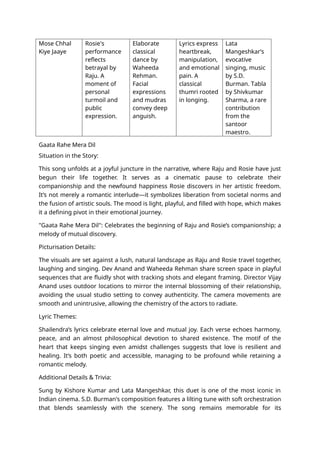
Mose Chhal
Kiye Jaaye
Rosie's
performance
reflects
betrayal by
Raju. A
moment of
personal
turmoil and
public
expression.
Elaborate
classical
dance by
Waheeda
Rehman.
Facial
expressions
and mudras
convey deep
anguish.
Lyrics express
heartbreak,
manipulation,
and emotional
pain. A
classical
thumri rooted
in longing.
Lata
Mangeshkar’s
evocative
singing, music
by S.D.
Burman. Tabla
by Shivkumar
Sharma, a rare
contribution
from the
santoor
maestro.
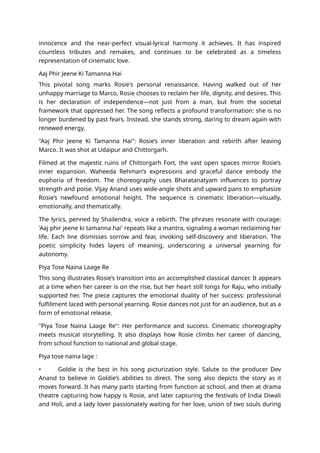
Gaata Rahe Mera Dil
Situation in the Story:
This song unfolds at a joyful juncture in the narrative, where Raju and Rosie have just
begun their life together. It serves as a cinematic pause to celebrate their
companionship and the newfound happiness Rosie discovers in her artistic freedom.
It’s not merely a romantic interlude—it symbolizes liberation from societal norms and
the fusion of artistic souls. The mood is light, playful, and filled with hope, which makes
it a defining pivot in their emotional journey.
"Gaata Rahe Mera Dil": Celebrates the beginning of Raju and Rosie’s companionship; a
melody of mutual discovery.
Picturisation Details:
The visuals are set against a lush, natural landscape as Raju and Rosie travel together,
laughing and singing. Dev Anand and Waheeda Rehman share screen space in playful
sequences that are fluidly shot with tracking shots and elegant framing. Director Vijay
Anand uses outdoor locations to mirror the internal blossoming of their relationship,
avoiding the usual studio setting to convey authenticity. The camera movements are
smooth and unintrusive, allowing the chemistry of the actors to radiate.
Lyric Themes:
Shailendra’s lyrics celebrate eternal love and mutual joy. Each verse echoes harmony,
peace, and an almost philosophical devotion to shared existence. The motif of the
heart that keeps singing even amidst challenges suggests that love is resilient and
healing. It’s both poetic and accessible, managing to be profound while retaining a
romantic melody.
Additional Details & Trivia:
Sung by Kishore Kumar and Lata Mangeshkar, this duet is one of the most iconic in
Indian cinema. S.D. Burman's composition features a lilting tune with soft orchestration
that blends seamlessly with the scenery. The song remains memorable for its
innocence and the near-perfect visual-lyrical harmony it achieves. It has inspired
countless tributes and remakes, and continues to be celebrated as a timeless
representation of cinematic love.
Aaj Phir Jeene Ki Tamanna Hai
This pivotal song marks Rosie's personal renaissance. Having walked out of her
unhappy marriage to Marco, Rosie chooses to reclaim her life, dignity, and desires. This
is her declaration of independence—not just from a man, but from the societal
framework that oppressed her. The song reflects a profound transformation: she is no
longer burdened by past fears. Instead, she stands strong, daring to dream again with
renewed energy.
"Aaj Phir Jeene Ki Tamanna Hai": Rosie’s inner liberation and rebirth after leaving
Marco. It was shot at Udaipur and Chittorgarh.
Filmed at the majestic ruins of Chittorgarh Fort, the vast open spaces mirror Rosie’s
inner expansion. Waheeda Rehman’s expressions and graceful dance embody the
euphoria of freedom. The choreography uses Bharatanatyam influences to portray
strength and poise. Vijay Anand uses wide-angle shots and upward pans to emphasize
Rosie’s newfound emotional height. The sequence is cinematic liberation—visually,
emotionally, and thematically.
The lyrics, penned by Shailendra, voice a rebirth. The phrases resonate with courage:
'Aaj phir jeene ki tamanna hai' repeats like a mantra, signaling a woman reclaiming her
life. Each line dismisses sorrow and fear, invoking self-discovery and liberation. The
poetic simplicity hides layers of meaning, underscoring a universal yearning for
autonomy.
Piya Tose Naina Laage Re
This song illustrates Rosie’s transition into an accomplished classical dancer. It appears
at a time when her career is on the rise, but her heart still longs for Raju, who initially
supported her. The piece captures the emotional duality of her success: professional
fulfillment laced with personal yearning. Rosie dances not just for an audience, but as a
form of emotional release.
"Piya Tose Naina Laage Re": Her performance and success. Cinematic choreography
meets musical storytelling. It also displays how Rosie climbs her career of dancing,
from school function to national and global stage.
Piya tose naina lage :
• Goldie is the best in his song picturization style. Salute to the producer Dev
Anand to believe in Goldie’s abilities to direct. The song also depicts the story as it
moves forward. It has many parts starting from function at school, and then at drama
theatre capturing how happy is Rosie, and later capturing the festivals of India Diwali
and Holi, and a lady lover passionately waiting for her love, union of two souls during
full moon night. Waheedaji justified the role extremely sensibly, looking not only
beautiful but also delivering the dance sequences during intersections. She declares
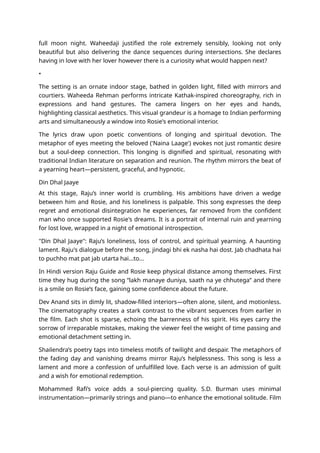
having in love with her lover however there is a curiosity what would happen next?
•
The setting is an ornate indoor stage, bathed in golden light, filled with mirrors and
courtiers. Waheeda Rehman performs intricate Kathak-inspired choreography, rich in
expressions and hand gestures. The camera lingers on her eyes and hands,
highlighting classical aesthetics. This visual grandeur is a homage to Indian performing
arts and simultaneously a window into Rosie's emotional interior.
The lyrics draw upon poetic conventions of longing and spiritual devotion. The
metaphor of eyes meeting the beloved ('Naina Laage') evokes not just romantic desire
but a soul-deep connection. This longing is dignified and spiritual, resonating with
traditional Indian literature on separation and reunion. The rhythm mirrors the beat of
a yearning heart—persistent, graceful, and hypnotic.
Din Dhal Jaaye
At this stage, Raju’s inner world is crumbling. His ambitions have driven a wedge
between him and Rosie, and his loneliness is palpable. This song expresses the deep
regret and emotional disintegration he experiences, far removed from the confident
man who once supported Rosie's dreams. It is a portrait of internal ruin and yearning
for lost love, wrapped in a night of emotional introspection.
"Din Dhal Jaaye": Raju’s loneliness, loss of control, and spiritual yearning. A haunting
lament. Raju's dialogue before the song, jindagi bhi ek nasha hai dost. Jab chadhata hai
to puchho mat pat jab utarta hai...to...
In Hindi version Raju Guide and Rosie keep physical distance among themselves. First
time they hug during the song “lakh manaye duniya, saath na ye chhutega” and there
is a smile on Rosie’s face, gaining some confidence about the future.
Dev Anand sits in dimly lit, shadow-filled interiors—often alone, silent, and motionless.
The cinematography creates a stark contrast to the vibrant sequences from earlier in
the film. Each shot is sparse, echoing the barrenness of his spirit. His eyes carry the
sorrow of irreparable mistakes, making the viewer feel the weight of time passing and
emotional detachment setting in.
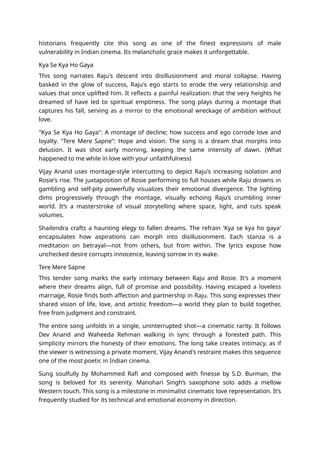
Shailendra’s poetry taps into timeless motifs of twilight and despair. The metaphors of
the fading day and vanishing dreams mirror Raju’s helplessness. This song is less a
lament and more a confession of unfulfilled love. Each verse is an admission of guilt
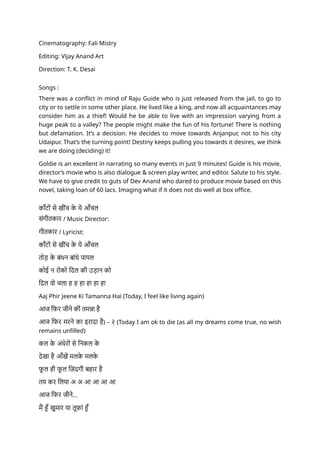
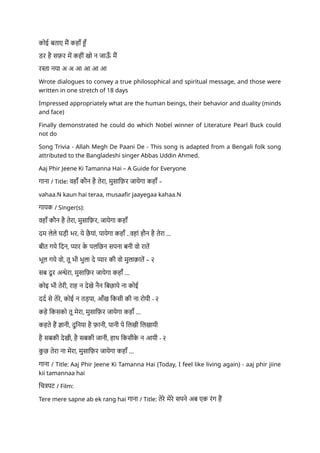
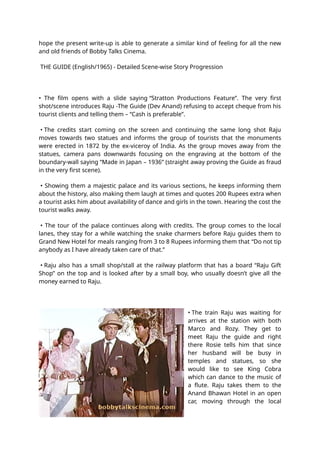
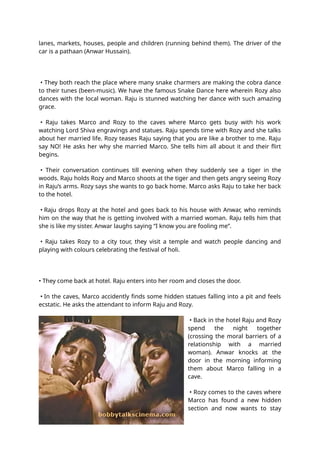
and a wish for emotional redemption.
Mohammed Rafi’s voice adds a soul-piercing quality. S.D. Burman uses minimal
instrumentation—primarily strings and piano—to enhance the emotional solitude. Film
historians frequently cite this song as one of the finest expressions of male
vulnerability in Indian cinema. Its melancholic grace makes it unforgettable.
Kya Se Kya Ho Gaya
This song narrates Raju's descent into disillusionment and moral collapse. Having
basked in the glow of success, Raju's ego starts to erode the very relationship and
values that once uplifted him. It reflects a painful realization: that the very heights he
dreamed of have led to spiritual emptiness. The song plays during a montage that
captures his fall, serving as a mirror to the emotional wreckage of ambition without
love.
"Kya Se Kya Ho Gaya": A montage of decline; how success and ego corrode love and
loyalty. "Tere Mere Sapne": Hope and vision. The song is a dream that morphs into
delusion. It was shot early morning, keeping the same intensity of dawn. (What
happened to me while in love with your unfaithfulness)
Vijay Anand uses montage-style intercutting to depict Raju's increasing isolation and
Rosie's rise. The juxtaposition of Rosie performing to full houses while Raju drowns in
gambling and self-pity powerfully visualizes their emotional divergence. The lighting
dims progressively through the montage, visually echoing Raju’s crumbling inner
world. It’s a masterstroke of visual storytelling where space, light, and cuts speak
volumes.
Shailendra crafts a haunting elegy to fallen dreams. The refrain 'Kya se kya ho gaya'
encapsulates how aspirations can morph into disillusionment. Each stanza is a
meditation on betrayal—not from others, but from within. The lyrics expose how
unchecked desire corrupts innocence, leaving sorrow in its wake.
Tere Mere Sapne
This tender song marks the early intimacy between Raju and Rosie. It's a moment
where their dreams align, full of promise and possibility. Having escaped a loveless
marriage, Rosie finds both affection and partnership in Raju. This song expresses their
shared vision of life, love, and artistic freedom—a world they plan to build together,
free from judgment and constraint.
The entire song unfolds in a single, uninterrupted shot—a cinematic rarity. It follows
Dev Anand and Waheeda Rehman walking in sync through a forested path. This
simplicity mirrors the honesty of their emotions. The long take creates intimacy, as if
the viewer is witnessing a private moment. Vijay Anand's restraint makes this sequence
one of the most poetic in Indian cinema.
Sung soulfully by Mohammed Rafi and composed with finesse by S.D. Burman, the
song is beloved for its serenity. Manohari Singh’s saxophone solo adds a mellow
Western touch. This song is a milestone in minimalist cinematic love representation. It’s
frequently studied for its technical and emotional economy in direction.
Wahan Kaun Hai Tera
This deeply philosophical song plays as Raju is released from prison, transitioning from
worldly despair to spiritual contemplation. It introduces the final act of the film, where
Raju begins a metaphysical journey. The lyrics don’t merely narrate; they ask existential
questions about identity, purpose, and detachment—setting the tone for his internal
awakening.
Penned by Shailendra and sung by S.D. Burman himself, the lyrics are meditative and
timeless. They reflect themes found in Indian philosophy: non-attachment,
impermanence, and the illusion of self. Questions like 'Musafir jaayega kahaan?'
(Where will the traveler go?) evoke not just a physical but spiritual journey.
Mose Chhal Kiye Jaaye
This song marks Rosie's emotional reckoning. Having risen to fame, she now faces
personal betrayal from the very man who once uplifted her—Raju. The performance is
not just a dance but a confrontation. Rosie channels her pain into her art, turning her
dance into a cathartic expression of grief and rage. It reflects her strength to express
vulnerability in a public space, where silence might have once been her only option.
Waheeda Rehman delivers a powerful classical performance on a grand stage. Every
gesture—especially her facial expressions—conveys betrayal, disgust, and sorrow. The
camera focuses on her eyes, her hand movements, and rhythmic footwork, capturing
emotional turbulence in classical form. Lighting oscillates between warm and shadowy
hues, dramatizing her inner chaos. The audience within the film watches spellbound,
as do we, realizing this is not just performance—it is personal vengeance through art.
A classical thumri, the lyrics speak of deceptive love and the wounds left behind. The
repeated phrase 'Mose chhal kiye jaaye' captures the essence of heartfelt betrayal.
Rooted in traditional feminine lament, the song draws from a lineage of Indian poetry
where women sing their sorrow as an act of spiritual transcendence and resistance.
Allah Megh De Paani De
- This song is adapted from a Bengali folk song attributed to the Bangladeshi singer
Abbas Uddin Ahmed.
Composer Sachin Dev Burman fell seriously ill during this film and even requested Dev
Anand to engage some other composer for the film. But Dev Anand stood firm to his
side and said that he would wait till Dada Burman is fit again. Once cured, the
masterpiece compositions started to flow; the first song recorded was the evergreen
"Gaata Rahe Mera Dil".
The song gaata rahe mera dil tu hi meri manzil.....this song was recorded and added to
the film after the shooting of the entire film was complete.
Song Trivia - Din Dhal Jaye Haye Raat Na Jaye - The first line of this song was actually
written by Hasrat Jaipuri. Director Vijay Anand was not pleased with this line and Hasrat
walked out of the film after an argument with him. Shailendra was brought in to
replace Hasrat. Ironically, Shailendra chose to retain the contentious line that led to
Hasrat's exit from the film.
"Piya Tose Naina Laage Re" was a long and tough song to compose and arrange. Vijay
Anand suggested Sachin Dev Burman to compose each stanza of it as a separate song,
as that was the way he intended to picturise the song in the film.
Song Trivia - Wahan Kaun Hai Tera Musafir - S.D. Burman had use the tune of this song
earlier for his Bengali song "Dur Kon Porobashe".
Song Trivia - Aaj Phir Jeene Ki Tamanna Hai - Dev Anand did not like this song when it
was recorded . On the insistence of his brother and the film's director Vijay Anand, they
decided to shoot the song and then determine if the song should be retained. By the
time the shoot ended, Dev Anand had changed his mind and agreed to keep the song
in the film.
This was a very grand and costly set. There was a limitation of cameraman to capture
entire set & emotions of Rosie using close up. It is a classical song taking story to the
next level.
Goldie is the best in his song picturization style. Salute to the producer Dev Anand to
believe in Goldie’s abilities to direct. The song also depicts the story as it moves
forward.
"Tere Mere Sapne": Hope and vision. A dream morphing into delusion. Shot early
morning to match the dawn's mood.
PHILOSOPHICAL DEPTH
 Body vs Soul: Raju’s journey is a renunciation of the body’s temptations.
 Spirituality: Beyond ritual, the film portrays faith as an inner journey.
 Faith vs Logic: Villagers’ faith compels Raju into transformation.
 Bhagavad Gita: Final scenes reflect Gita’s essence – the soul is eternal.
Philosophy: Life, Death, Soul, Illusion
“Maut ek khyaal hai jaise zindagi ek khyaal hai.”
Song Waha kaun hai tera musafir narrates all these situations while story moves on.
The ultimate Vedantic truth — the soul does not die.
Body vs. soul: “You are ego. You must die. I am the soul. I am eternal.”
Guide explores love, lust, guilt, faith, sin, moksha, karma, and renunciation.
Rosie dances for freedom; Raju fasts for transcendence.
The narrative echoes Bhagavad Gita: “Do your duty, surrender results.”
Final rain represents divine grace and salvation.
Philosophy and Metaphysics
Guide (1965) – The Complete Story of Raju’s Journey
Guide is not about religion—it is about realization. Raju’s journey becomes allegorical:
Trust and Sacrifice: The villagers’ blind trust is contrasted with Raju’s self-doubt. Yet he
chooses sacrifice.
Soul vs Body: In a hallucinatory climax, Raju’s inner voice splits:
"तू अहंकार है, तुझे मरना ही होगा… मैं आत्मा हूँ, अमर हूँ… मौत एक ख़याल है, जैसे ज़िंदगी एक ख़याल
है…"
Why Danced the Serpent Charmer?: ‘क्यों नाचे सापेरा’ is symbolic of joy amidst futility,
much like Raju’s trance-like final journey.
Liberation: The film begins with "रिहाई मुबारक" and ends with liberation—not from
prison, but from ego, illusion, desire, and duality.
काँटों से खींच क
े ये आँचल
It’s not just Guide the film—it’s a pilgrimage. And Vijay Anand is its priest.
“Maut ek khyaal hai… jaise zindagi ek khyaal hai…”
Forever timeless.
The Artists Who Made Guide — Soul-Workers, Not Just Filmmakers
To say that Guide is a great film is to understate its essence. It is a rare masterpiece
where every member of the cast and crew transcended their profession and became
seekers — spiritual guides in their own right.
Screenplay & Dialogues: Vijay Anand
Playback Singers: Lata Mangeshkar, Kishore Kumar, Mohammed Rafi
Directed by: Vijay Anand (Goldie)
Produced by: Dev Anand
Story by: R. K. Narayan (Based on his novel The Guide)
Screenplay and Dialogues: Vijay Anand
Music: S. D. Burman
Lyrics: Shailendra
Cinematography: Fali Mistry
Editing: Vijay Anand Art
Direction: T. K. Desai
Songs :
There was a conflict in mind of Raju Guide who is just released from the jail, to go to
city or to settle in some other place. He lived like a king, and now all acquaintances may
consider him as a thief! Would he be able to live with an impression varying from a
huge peak to a valley? The people might make the fun of his fortune! There is nothing
but defamation. It’s a decision. He decides to move towards Anjanpur, not to his city
Udaipur. That’s the turning point! Destiny keeps pulling you towards it desires, we think
we are doing (deciding) it!
Goldie is an excellent in narrating so many events in just 9 minutes! Guide is his movie,
director’s movie who is also dialogue & screen play writer, and editor. Salute to his style.
We have to give credit to guts of Dev Anand who dared to produce movie based on this
novel, taking loan of 60 lacs. Imaging what if it does not do well at box office.
काँटों से खींच क
े ये आँचल
संगीतकार / Music Director:
गीतकार / Lyricist:
काँटों से खींच क
े ये आँचल
तोड़ क
े बंधन बांधे पायल
कोई न रोको दिल की उड़ान को
दिल वो चला ह ह हा हा हा हा
Aaj Phir Jeene Ki Tamanna Hai (Today, I feel like living again)
आज फिर जीने की तमन्ना है
आज फिर मरने का इरादा है) – २ (Today I am ok to die (as all my dreams come true, no wish
remains unfilled)
कल क
े अंधेरों से निकल क
े
देखा है आँखें मलक
े मलक
े
फ
ू ल ही फ
ू ल ज़िंदगी बहार है
तय कर लिया अ अ आ आ आ आ
आज फिर जीने...
मैं हूँ खुमार या तूफ़ां हूँ
कोई बताए मैं कहाँ हूँ
डर है सफ़र में कहीं खो न जाऊ
ँ मैं
रस्ता नया अ अ आ आ आ आ
Wrote dialogues to convey a true philosophical and spiritual message, and those were
written in one stretch of 18 days
Impressed appropriately what are the human beings, their behavior and duality (minds
and face)
Finally demonstrated he could do which Nobel winner of Literature Pearl Buck could
not do
Song Trivia - Allah Megh De Paani De - This song is adapted from a Bengali folk song
attributed to the Bangladeshi singer Abbas Uddin Ahmed.
Aaj Phir Jeene Ki Tamanna Hai – A Guide for Everyone
गाना / Title: वहाँ कौन है तेरा, मुसाफ़िर जायेगा कहाँ –
vahaa.N kaun hai teraa, musaafir jaayegaa kahaa.N
गायक / Singer(s):
वहाँ कौन है तेरा, मुसाफ़िर, जायेगा कहाँ
दम लेले घड़ी भर, ये छै यां, पायेगा कहाँ ..वहां हौन है तेरा ...
बीत गये दिन, प्यार क
े पलछिन सपना बनी वो रातें
भूल गये वो, तू भी भुला दे प्यार की वो मुलाक़ातें – २
सब दू र अन्धेरा, मुसाफ़िर जायेगा कहाँ ...
कोइ भी तेरी, राह न देखे नैन बिछाये ना कोई
दर्द से तेरे, कोई न तड़पा, आँख किसी की ना रोयी - २
कहे किसको तू मेरा, मुसाफ़िर जायेगा कहाँ ...
कहते हैं ज्ञानी, दुनिया है फ़ानी, पानी पे लिखी लिखायी
है सबकी देखी, है सबकी जानी, हाथ किसीक
े न आयी - २
क
ु छ तेरा ना मेरा, मुसाफ़िर जायेगा कहाँ ...
गाना / Title: Aaj Phir Jeene Ki Tamanna Hai (Today, I feel like living again) - aaj phir jiine
kii tamannaa hai
चित्रपट / Film:
Tere mere sapne ab ek rang hai गाना / Title: तेरे मेरे सपने अब एक रंग हैं
तेरे मेरे सपने अब एक रंग हैं
हो जहाँ भी ले जाएं राहें, हम संग हैं
तेरे मेरे दिल का, तय था इक दिन मिलना
जैसे बहार आने पर, तय है फ
ू ल का खिलना
ओ मेरे जीवन साथी...
तेरे दुख अब मेरे, मेरे सुख अब तेरे
तेरे ये दो नैना, चांद और सूरज मेरे
लाख मना ले दुनिया, साथ न ये छ
ू टेगा
आ क
े मेरे हाथों में, हाथ न ये छ
ू टेगा
The song has been picturized early morning indicating life begins at the start of dawn.
Initially Rosie was not comfortable and was tensed, later she comes closer and has a
smile on the face. She puts her to Raju. Rosie requests Raju, to let her go. He says now
there is no one for him except her. He promises her to be ever together.
Rosie gets a new name Nalini. Raju gets a delegation of school and convinces that it
would be good to revive Indian culture during school program inviting Nalini for a
dance. This is a turning point.
गाना / Title: पिया तोसे नैना लागे रे, नैना लागे रे, जाने क्या हो अब आगे रे - piyaa tose nainaa laage
re, nainaa laage re, jaane kyaa ho ab aage re
पिया तोसे नैना लागे रे, नैना लागे रे
जाने क्या हो अब आगे रे, नैना लागे रे
हो, जग ने उतारे हो, धरती पे तारे, पर मन मेरा मुरझाये
हो, उन बिन आई हो, ऐसी दीवाली
मिलनेको जिया तरसाये, आ साजन पायल पुकारे
झनक झन झन झनक झन झन, पिया तोसे
पिया तोसे नैना ...
भोर की बेला सुहानी, नदिया क
े तीरे
भर क
े गागर जिस घड़ी मैं चलूँ धीरे धीरे
तुम पे नज़र जब आई, जाने क्यों बज उठे क
ं गना
छनक छन छन छनक छन छन, पिया तोसे
हो, आ, हो, आई होली आई हो, सब रंग लाई
बिन तेरे होली भी न भाए, हो
भर पिचकारी, हो, सखियों ने मारी
भीगी मोरी सारी हय हय,
तन-बदन मेरा कांपे थर-थर
धिनक धिन धिन धिनक धिन धिन, पिया तोसे
रात को जब चाँद चमक
े जल उठे तन मेरा
मैं कहूँ मत करो चंदा इस गली का फ
े रा
दिन ढल जाये हाये ...
चमकना उस रात को जब
मिलेंगे तन-मन मिलेंगे तन-मन,पिया तोसे पिया तोसे नैना ...पिया हो हो पिया (chorus) ...
गाना / Title: गाता रहे मेरा दिल, तू ही मेरी मंज़िल - gaataa rahe meraa dil
गायक / Singer(s): ,
गाता रहे मेरा दिल, तू ही मेरी मंज़िल,
कहीं बीतें न ये रातें, कहीं बीतें न ये दिन - (२)
प्यार करने वाले अरे प्यार ही करेंगे
जलने वाले चाहे जल जल मरेंगे
दिल से जो धड़क
े हैं वो दिल हरदम ये कहेंगे
कहीं बीतें न ...
ओ मेरे हमराही, मेरी बाँह थामे चलना,
बदले दुनिया सारी, तुम न बदलना
प्यार हमे भी सिखला देगा, गरदिश में सम्भलना,
दू रियाँ अब क
ै सी, अरे शाम जा रही है,
हमको ढलते ढलते समझा रही है,
आती जाती साँस जाने कब से गा रही है
Raju gets nervous and drinks. It was raining. Mani arrives since Raju wanted to
complete pending work after show. He asks him for a company, suggesting to get a
glass for a drink. Raju requests Rosie to bridge the difference and eliminate the
distance, and get closer. Rosie conveys that he is free from her side & can be
independent. He begs for love and Rosie asks him to get out of the room.
गाना / Title: दिन ढल जाये हाय, रात ना जाय - din Dhal jaaye haay, raat naa jaay
दिन ढल जाये हाय, रात ना जाय
तू तो न आए तेरी, याद सताये, दिन ढल जाये
प्यार में जिनक
े , सब जग छोड़ा, और हुए बदनाम
उनक
े ही हाथों, हाल हुआ ये, बैठे हैं दिल को थाम
अपने कभी थे, अब हैं पराये
दिन ढल जाये हाय ...
ऐसी ही रिम-झिम, ऐसी फ़
ु वारें, ऐसी ही थी बरसात
खुद से जुदा और, जग से पराये, हम दोनों थे साथ
फिर से वो सावन, अब क्यूँ न आये
दिल क
े मेरे तुम, पास हो कितनी, फिर भी हो कितनी दू र
तुम मुझ से मैं, दिल से परेशाँ, दोनों हैं मजबूर
ऐसे में किसको, कौन मनाये
दिन ढल जाये हाये ...
Meanwhile police knocks the door of Raju’s house. Police inspector happens to be
friend of Raju, has a warrant. He explains the reason of warrant as a fraud by forged
signature of Rosie by Raju. Raju asks for the proof. Inspector shares that Rosie cried
when get to know about the fraud and could not lie & is a witness. Raju requests to
meet Rosie. Inspector Girdhari conveys that Rosie would not like to see his face, Raju
insists that he would be able to see her.
Rosie arrives at Raju’s house. He introduces her to his mother and request not to
misunderstand her caste & religion from her name. Rosie conveys based on
encouragement and direction from him, he took step to leave Marco. When she looks
behind it is all ashes, there are sculptures around and future seems to be long way
where she cannot find destiny. Raju says look at the sculptures, there is a guide
standing for her to support. She is looking at the way but not the traveler. She
confesses having asked for support for 4 days, and not to burden his life. He was sure
and confident that with her company his life shall be eazy. She is uncomfortable
however he convinced her that till while ago it was sin but not today. He wants to
dream with Rosie, shape those in his life, needs her permission. Rosie refuses to
promise. Further he appeals her to think with cool mind, that they enjoy very close
bond between them and have common dreams of the same colors.It was depicted by
nice song
When Raju visits her. She notices him, however ignores & does not speak to him
expressing the anguish.
गाना / Title: मोसे छल किये जाये - mose chhal kiye jaaye
Emotions of Rosie are captured well.
मोसे चल किये जाये, हाय रे हाय हाय देखो सैंया बेइमान, सैंया बेइमान
मोसे चल, मोसे चल, मोसे चल किये जाये, हाय रे हाय हाय देखो हाँ सैंया बेइमान
समझाक
े मैं तो हारी, धमकाया ?, नी नी नी रे रे ग ग म म प प ध नी सा सा सा
समझाक
े मैं तो हारी, हाँ धमकाया ?, और करू
ँ भी क्या
देखो मोरा जियरा हाँ जियरा तड़पाये, जियरा तड़पाये
मोहे हाय हाय देखो सैंया बेइमान
मोसे चल, मोसे चल, मोसे चल किये जाये, हाय रे हाय हाय देखो सैंया बेइमान
मन का है बैरी काला, दिल जिसे दे डाला, नी नी नी रे रे ग ग म म प प ध नी सा सा सा
मन का है बैरी काला, दिल जिसे दे डाला
हाँ दिल जिसे दे डाला, प्रीत मोरी पल पल रोये
तड़पाये तड़पाये तरसाये, तड़पाये तरसाये
मोसे चल हाँ, मोसे चल, मोसे चल किये जाये, हाय रे हाय हाय देखो
हाँ सैंया बेइमान (देखो सैंया बेइमान)-२
मोसे चल किये जाये, देखो सैंया बेइमान
हाँ बेइमान, हाँ बेइमान
In continuity second song begins wherein Raju expresses his feelings
गाना / Title: क्या से क्या हो गया, बेवफ़ा, तेरे प्यार में –
क्या से क्या हो गया, बेवफ़ा ऽऽऽ तेरे प्यार में
चाहा क्या क्या मिला
बेवफ़ा ऽऽऽ तेरे प्यार में
चलो सुहाना भरम तो टू टा
जाना क
े हुस्न क्या है, हो ओ ओ
जाना क
े हुस्न क्या है
कहती है जिसको प्यार दुनिया
क्या चीज़ क्या बला है
दिल ने क्या ना सहा
तेरे मेरे दिल क
े बीच अब तो
सदियों क
े फ़ासले हैं, हो ओ ओ
सदियों क
े फ़ासले हैं
यक़ीन होगा किसे कि हम तुम इक राह संग चले हैं
होना है और क्या, बेवफ़ा ऽऽऽ तेरे प्यार में, चाहा क्या क्या मिला
Rosie asks him why did he do this? He should have asked her for money, she would
have sold jewelry bungalow, etc. he expresses that he was confident that no one may
understand him but Rosie would surely understand, but the understanding was greatly
wrong.
Villagers start praying in temple in support of Swamiji’s fasting. There is a song Allah
megh de , pani de, chhaya de oh rama.. it’s a prayer to god to rain and bless. Lot of
people starts visiting temple to see swamiji. They open stall to distribute free food also.
Swamiji is desperately hungry, he sees a worship plate having banana. There is a
conflict, should he eat banana or not. Finally he does not. He must have thought about
faith so many villagers keeping on him, and this is an opportunity to be truthful to
them.
गाना / Title: अल्लाह मेघ दे, पानी दे छाया दे रे रामा मेघ दे - allaah megh de, paanii de chhaayaa
de re rama
अल्लाह मेघ दे, पानी दे, छाया दे रे रामा मेघ दे
श्यामा मेघ दे
आँखें फाड़े दुनिया देखे, हाय ये तमाशा
आँखें फाड़े ...
है ये विश्वास तेरा, है तेरी आशा
अल्लाह मेघ दे ...
Compilation of posting:
तेरा शहर, तेरी जिंदगी तेरी खुशियां,तेरी यादें
Raju takes chapati for Gafur, that’s the friendship and caring nature!
लेकिन तुम जानते हो राजू आज तक कोई पारखी यहाँ तक क्यों नहीं आया ? क्यों की ये काम मेरी किस्मत में
लिखा था। मै रह गया तहत इसकी खोज करने क
े लिए..
इसक
े मोल को समझने क
े लिए. इसको नाम और मान देने क
े लिए जो इसका होना चाहिए
-----------
गाना / Title: अल्लाह मेघ दे, पानी दे छाया दे रे रामा मेघ दे - allaah megh de, paanii de chhaayaa
de re raamaa megh de
जहा अपने आप सर छु क जाते है, उस पत्थर को भी भगवन का रूप मान लिया जाता है जिस जगह को देख
कर परमात्मा की याद आये वो तीर्थ कहलाता है और जिस आदमी क
े दर्शन से परमात्मा की भक्ति जागे वो
महात्मा कह लाता है
अगर तेरे कारण ये पुराना मंदिर तीर्थ स्थान बन गया है और हजारो हजारो आँखे ऊपर उठ रही है प्रकाश की
और फिर तुझे चिंता क्यों? सर ज़ुका ले और शांत होकर बैठ जा समज ले की करने वाला कोई और है तू सिर्फ
एक बहाना है , काम उसका और नाम तेरा, उसका नाम ले और जो सौपा गया है उस काम को करता रह
मेरी तरह , एक पत्थर की तरह
Even after 60 years, Guide cannot be remade. It is cinematic Upanishad—sacred,
soulful, and timeless.
What If Analysis – Threads of Destiny-Turning Points
Each choice shows that Guide is a film of inevitable consequences, like karma
unfolding.
An Immortal Tribute to Guide (1965): A Timeless Spiritual and Cinematic Masterpiece
In movie Guide there have been many turning points; if event does not happen, story
would not have moved to next event
Guide is an experience. A scripture. A cinematic Upanishad. A timeless masterpiece. No
one can remake the Hindi version of Guide.
How destiny pulls the threads.
 If Raju did not take Rosie to show snake dance
 If Rosie & Marco had only indoor fights, not exposing to Raju
 If Rosie adjusted with Marco like most other women
 If Marco allowed Rosie to pursue her hobby of dancing
 If Raju did not pursue Rosie for dancing
 If Raju did not insult Marco?
 If Raju would’ve returned to town after dumped by Rosie
 If Raju did not fraudulently signed on behalf of Rosie
 If Marco did not realized that signature was forged and taken revenge of insult
 If Raju would have returned to his town after release from jail
 If Saint did not put the shawl on Raju
 If Bhola not believed Raju that he is intellect & religious person
 If Bhola’s brother did not confuse villagers
 If Raju did not impress villagers letting other saints down
 If Marco did not invent caves and returned after few days
 If Marco did not understand the forged signature
 If Raju would have tempted to go back to family life
 If swami was not caught while trying to run away by two monks
 If Raju would not have pursue the fasting
 If it did not rain?
 If Raju did not die?
 Second attempt of suicide by Rosie
 Spiritual Undertone:
 Director’s Use of Parallel Cuts:
 Themes of Redemption & Faith:
 What a line! Why snake charmer is dancing instead of making snake dance to
his tune!
 What is identity without ego?
 Can love and faith transcend betrayal?
 Does spiritual purity emerge from human fallibility?
 What if Rosie had truly understood Raju’s insecurity?
 What if Marco had appreciated Rosie’s art?
 What if Raju hadn’t forged her signature?
 What If” analysis exactly as you intended—scene-by-scene, emotionally and
philosophically.
 Reinstate every lost detail, including Goldie’s age (31), his multi-department
involvement, and layered breakdowns.
 What if he hadn’t confessed?
 Each moment is a karmic crossroad — Raju’s transformation is because he falls,
not in spite of it.
 What if Raju had not forged the signature? Their relationship might still have
deteriorated due to possessiveness.
 What if Rosie had defended Raju?
 It could have saved him from prison, but perhaps not from spiritual emptiness.
 What if the villagers hadn’t believed in him?
 Raju might never have found redemption.
 What if Rosie hadn’t returned at the end? He might still have attained moksha,
but the emotional completion would be lacking.
 Every decision leads Raju from pride to punishment, from punishment to
purification.
 No beginning. No end. Circular journey.
 If Rosie had not met Raju…
 If Marco had allowed her to dance…
 If Raju had not forged signature…
 If Rosie defended him in court…
 If he returned home post jail…
 If Bhola hadn’t found him in temple…
 If villagers hadn’t misquoted…
 If rain hadn’t come…
 If he survived…
 If Rosie hadn’t met Raju... If Raju hadn’t signed... If Bhola hadn’t mistaken him...
 What if the rain hadn’t come?
 Decision not to go to city
 Monk shares his shawl covering Raju
 Bhola understand Raju as a holy man (saint), monk
 Rosie meeting Marco
 Raju guide taking Rosie to see cobra dance
 Marco writing note to Rosie to go back to home if she wishes so with Rs 1000
 Rosie’s attempt of suicide and Raju’s convincing attempt
 Marco with another lady and getting caught by Rosie
 Rosie arriving at Raju’s house leaving Marco’s house
 Decision of Raju’s mother to go to village with mama ji
 Rosie being invited to school for dance
 Raju’s act of hiding a book, and fraud signature
 Raju’s not allowing Marco to meet Rosie
 Raju’s decision to return to home
 Rosie’s not telling lie during the witness
 Raju’s decision of fasting
 Spiritual awakening in Swami Raju after long duels with soul
Each turn was destiny. Raju surrendered.
Each thread—destiny. Each event—awakening.
Each of these points leads to a different fate—yet their inevitability adds to the fatalistic
structure of the story.
This version of the story with its deep philosophical arc, spiritual transformation, and
mythic climax rooted in Bhagavad Gita principles.
UNIQUENESS OF GUIDE
 A story with no real beginning or end – a circular journey.
 Deeds and decisions decide destiny. One has to surrender to destiny.
 Songs as storytelling tools.
 Inner transformation depicted through external events.
 A rare climax where the hero dies yet is liberated.
 An ambiguous ending – did he die or transcend?
 A spiritual epic in a romantic shell.
 Even after 60 years, no film has come close to the complexity, soul, and finesse
of Guide. With hundreds of remakes and retellings in cinema, Guide remains
irreplicable.
 This is not just a film. Guide is an experience. A scripture. A cinematic
Upanishad. A timeless masterpiece. No one can remake Guide of Hindi version.
 These dialogues are pure gold. They must stay in Hindi to preserve their
emotional and philosophical resonance. Each one reflects a turning point in the
story or a deep insight into the characters, especially Raju and Rosie.
 Audiences : Guide can be understood in first go. Most of the admirers, authors
who wrote their views said that even today whenever they watch a movie, new
perspective is understood.
 In technology era, we have Google search to find the information related to
Guide, and various blogs published by the authors. (Wiki - )
 Ability to grasp the story from the existing book (that too is a big deal; the novel
does neither make you grasp the subject does not give you feeling of
spontaneity)
 Revamped the story to suit to Indian audience, showing caliper to judge the
audience correctly
 Packaged it well with song and music still to make a story move forward, and
make it entertaining too
 There is a co-relation of cobra dance of Rosie with a story. Raju’s mother always
terms Rosie as queen cobra and warned Raju to keep himself away from her.
Raju does not listen and story moves on to its destiny.
 Marco ready to bet & confident to find one more cave, Raju says to search him,
he does not see any! This is a nice synopsis! Marco can search hidden caves but
can not understand the hidden talent of Rosie whereas Raju cannot see hidden
cave but understands & acknowledges the hidden talent of Rosie. What caves to
Marco is Rosie to Raju. They make those world famous. Later it was projected
that Caves do not ditch the Marco, where as Rosie did! Not only this, but Marco
considers Rosie as nuisance. Caves become the most challenging objective in
life of Marco.
 Marco successfully searches caves :
 He says why no other expert could reach up to the caves? It was he who was to
give name and fame to the caves. The search was destined in his name.
 Likewise when Rosie gets famous, its Raju who manages extracting her talent,
encouraging and bring in front of the audiences. Only difference is Marco
gratifies Raju’s name in the book, where as Rosie leaves Raju cursing and
without understanding him.
 Marco expresses that destiny was holding others to search these caves in spite
others are so experts. He promises Raju to quote his name in the book.
 मै हैरान हु की ये गुफाए दुनिया की नज़र से क
ै से छु पी रह गयी
 अजंता एल्लोरा और खजराहो की कदर करने वाला जमाना इस खजाने को धूल में क
ै से छिपा रहने दे
सकता है?---
 लेकिन तुम जानते हो राजू आज तक कोई पारखी यहाँ तक क्यों नहीं आया ? क्यों की ये काम मेरी
किस्मत में लिखा था। मै रह गया तहत इसकी खोज करने क
े लिए.. इसक
े मोल को समझने क
े
लिए. इसको नाम और मान देने क
े लिए जो इसका होना चाहिए
 लेकिन तुम फिक्र मत करो राजू
 किताब में तुम्हारा भी नाम आएगा और जरूर आएगा क्यों की तुम वो आदमी हो जो मुझे यहाँ तक
लाये
 He shows her status of trusted dog of a king. She compares herself and says
dog is better placed than her. He advices not to curse the destiny since then
destiny also curse to those.
 While Rosie conveys her story to Raju’s mother, that her aunt wanted to sell her
but her mother does not allow it and refuses; her aunt conveys
 गन्दी नाली से निकला हुआ पानी ... कभी गंगाजल नहीं बन सकता
 No chappals :
 Rosie singing Aaj phir jine ki tamanna hai without Chappals? Why was Raju also
throws his chappals which were torn on the way moving away from city? Is this
too much reading between lines?
 Raju Guide convinces Rosie that if she has passion, energy, daring and hobby
(हुन्नर लगन हिम्मत शौक) then nothing is impossible. It will be just achieved.
 Dev keeps distance :
 Quarrel between Rosie and Raju as a manager
 What is the reason Rosie does not like or love Raju anymore?
 Is she exhausted?
 Raju develops bad habits? Or company of people of different taste (that of
Rosie)?
 Rosie gets to know the acts of Raju like hiding the book, or forgery of signature?
 Raju gets bad habits of drinking alcohol, gambling and keep losing money.
Rosie questions on his expenses. She keeps asking him get-out, whereas he
pledges to get-in! She does not feel good about anything. They get into quarrel
on love and purpose, he thinks she loved because of having need & purpose.
Raju expresses that he is also equal partner in earning money and it was due to
his hard work.
 Mother’s love : Mother slaps Raju but in immediate scene, people hits Raju at
station due to argument over ownership of the shop, its mother who shields
him
 Showing face : Mother gets ready to go with Mamaji, Raju guide tells her, Maa,
agar tum gayi to kah deta hu, jindagi bhar mera muh nahi dekhogi. It happens
so, mothers sees him during last scene after few years.
 Upsetting on self : When someone is angry with self, and feel helpless, he/she
shouts on someone, and realizes later that he/she was upset with him/herself.
The scene after mother leaves with Mamaji and Raju guide sit for dinner, realizes
that mother has left the house. He shouts at Rosie, allowing his mother to go!
Later he confesses.
 Friendship at risk : Gaffur suggests Raju guide to leave Rosie, he say, a woman
who leaves the husband, what is a guarantee she would not leave him? Raju
picks up fight with him & breaks the friendship, love wins over friendship.
Uniqueness and Legacy
A film far ahead of its time in feminist themes, spiritual depth, and anti-hero treatment.
A rare combination of star power and art-house introspection.
The only Hindi film of its era that presented redemption not through union but
transcendence.
Remains a cult classic with unmatched rewatch value.
 No Indian film before or after Guide has layered such spiritual and emotional
depth.
 In 60 years and likely the next 100, it remains unmatched.
 First Bollywood film to break with linear narrative.
 First to use song as storytelling — not interruption.
 First with a metaphysical climax.
 A triumph of Goldie, Dev, Waheeda, Burman, and Shailendra.
Public Domain Reflections
Critics, bloggers, books, and Facebook posts echo the same:
 Guide redefined Indian cinema.
 Often discussed in media retrospectives.
 Studied as a philosophical and feminist text.
 Revered in film societies worldwide.
the piece ends with a deeply reverent tone reflecting its once-in-a-century legacy.
Even after 60 years, no film matches Guide’s soul and complexity. It is irreplicable and
beyond remakes. A timeless masterpiece.
Because her name means just that: unique.
But she didn’t become unique merely by the virtue of her name.
Today, the name Waheeda stands on the firm foundation of immense talent, relentless
hard work, and an unshakable will.
Guide : Movie by Great Golden Goldie, Our analysis – Our views
Three Bollywood movies, most talked, discussed, and for which content the most
content in dialogue, information, picture form is being shared on social networking
sites! Sholay, Mughal-E-Azam and Guide! Sholay was the most simplest format of the
story, Mughal-E-Azam is fully packed with Urdu dialogues penned by eight writers and
emotional drama, difficult to remake. Guide is simplification of most complex and deep
story capturing various attributes of human being and their behavior! After 55 years of
its making few pointers are difficult to believe like
Purpose of this blog is not to share the information about the movie, but the analysis
and views from director’s angle. No one can be right, and through. I always say, Guide
can only be analyzed by only one person, Goldie himself! (Gabbar ke tak se aapko sirf
ek hi aadmi bacha sakta hai, khud Gabbar!)
Intense scenes
I re-watched Guide again, and again. Every time I felt having learnt something newer
angle or message director intended to convey. That’s the reason I wonder the intellect
Goldie possessed and who demonstrated true leadership by way of
- Refusing to do a film as is, true partner to share the thoughts frankly
As a human being we observe following attributes in the movie.
Table
Human Attributes and behaviour:
Attributes Related Scenes
Passion Raju Guide is passionate about his being The Guide, does not even eat
appropriately
Rosie has a passion for dancing
Marco is busy day and night to search the caves
Skills Raju guide has learnt and can speak various languages as multi-linguistic
tourists visit from various states
Rosie’s skill is dancing and
Marco is good at coordination and execution
Greed Greed and ditching : Raju had obliged panwala to get his son working at
his shop, but they ditched him, grabbing the shop!
Ambition;
growing
ambition
Raju becomes manager
Rosie makes it to a big dancer and famous star
Rosie expresses if a lady gets a love, in return she supports her husband
and remain happy, there are no high ambitions here
Anger Raju gets angry with mother saying, if she leaves a house, she would see
dead face of Raju
Raju gets angry with a boy running a stall
Love Raju loves Rosie; even after release from Jail, he is carrying photos of
Rosie
Lust Marco’s involvement with the prostitutes
Preference Raju prefers to be with Rosie to his mother
Raju prefers to go away from his own city, likely home, mother and Rosie
Raju breaks the friendship with Gaffur over Rosie
Decision
making
Raju decides to go away from his own city, likely home, mother and Rosie
Rosie decides to leave Marco and seek support from Raju
Rosie decides to be a dancer
Raju leaves Rosie after she denies love to Raju
Raju decides not to end fast but abide to the trust of the villagers to
continue fasting
Confusion Raju is confused, should he move to city or away from city?
He later is struggling to find answer; 1. Rosie and mother both are back,
and with him; he could end the fast and live a normal life? Or to abide the
trust of villager and continue fasting till it rains?
Main and important confusion is, who is running the show? And does
there exists a relationship of god and devotee, faith and caring?
Raju’s mother is confused and asks, if Rosie does not want to make
marriage successful, why did she marry?
Commandin
g
Marco to command Rosie, to make her listen and align to his choices and
say
Autocracy Mamaji was unhappy due to married woman leaving her husband and
staying with Raju
Marco wants Rosie to live with him aligning to his culture
Friendship Raju cares and offers Bread (Chapati) to Gaffur as a friend, having close
business friendship
Habits Raju develops habits of drinking, smoking and partying with friends and
gambling losing money
Sarcasm Communication between Rosie and Marco is with lot of sarcasm and
disrespecting each other
Being upset Rosie gets upset with Raju, forgery of the signature
Misundersta
nding
Rosie carries a misunderstanding about Raju forges her signature for
want of money
Ignorance Rosie ignores and refuses love with Raju
Convincing
&
encouragin
g
Raju convinces Rosie to utilize her talent and be a dancer
Detachment Raju detaches from the ambitions, relationships, and even life
Trust Raju won the trust of villagers, and does not break at the cost of life
Logic &
challenge
Second evil mind of Raju challenges and conveys logical things that there
can not be a relation between fasting and rain, however Raju emphasize
on the trust
Helping Rosie attempts suicide multiple times however Raju every time helps and
saves her
Ego Marco has ego on his achievements, searching the caves; resulting
insulting Marco’s ego is hurt when he sees Rosie practicing dance in-spite
of he asked to stop
Rosie considering her background
Raju’s ego was hurt when Rosie does not love him
Gaffur’s ego was hurt while Raju slaps him for the cause of Rosie
Raju moves away from city thinking city in which he lived like a king may
term him as thief
Raju after released from jail, does not pick up the coins thrown at him
and given as begging though he needed those the most
2 monks who think they are real monks, test the knowledge of Raju
swami
Raju guide drops Rosie at library leaving her as Rosie insults him & Gaffur
Gratitude Marco mentions Raju’s name expressing the gratitude whereas Rosie
doesn’t
Insulting Raju insults Mamaji (as request and demand were not matching, not
aligned to the dreams and plan)
Mamaji insults Rosie (as she disturbs the cultural aspects)
Kindness Monk offering food to Raju and spreading his own shawl on him
Compromis
es
Rosie compromises marrying to Marco
Anticipation Prediction conveyed to Laxmibai (Rosie’s mother) Gandi nali se nikala
pani kabhi ganga jal nahi ban sakta
Understandi
ng the facts
Who does not know father’s name, and does not have husband, and
mother known as evil, can not make life famous
Fights and
arguments
Marco and Rosie argues
- at station on the way Marco enquires about Raju guide
- fight / argument scene between mother, mamaji, Raju Guide and
Rosie is extremely dramatic and emotional, mother intends to slap
Rosie, and Raju Guide leans forward to safeguard her from the
slap, taking it on his cheek
Priority Marco has priority of just searching the caves
Understandi
ng other
person
Marco doesn’t care Rosie is accompanying him and she could have
different interest
Fear Rosie is fearful when Marco sees her dancing at his house
Rosie is fearful after cobra dance and says he should not be informed
Believe He also convey - जो आदमी अपने नसीब को कोसता रहता है ... उसका नसीब भी उसको
कोसने लगते है
Assurance,
confidence
and trust
Rosie requests Marco should not be informed about her cobra dance ,
Raju Guide confidently assures that he will not!
To tell lies Raju smartly tries to tell lie about Marco caring after Rosie attempts
suicide
Manipulatio
n
Raju guide forgery the signature on behalf of Rosie
Freedom Rosie purchases ring bells, moves around with freedom and visits to
Chittod along with Guide, with lot of energy and freedom, leaving (giving
up) fear and cultural constraints put by Marco,
Imagination Marco imagines Statue is dancing and offering music while he touches its
feet, actually its Rosie making music by walking with ring bells
Rebelling Gaffur says, in place of Rosie he would have slapped Marco and given the
divorce
Rosie rebels after seeing lust of Marco, wears ring bells, slaps him and
leave him and says its not necessary for her to follow every decision by
Marco
Doubting Marco asks Rosie, who has provoked her against him? He also asks, if
there is a second man in her life?
Raju’s mother doubts Rosie’s character and nature just after hearing the
name
Blaming Marco thinks Rosie blames him for the lust
True colors Marco confesses that he never forgot the origin of Rosie
Not having
clarity
When Rosie comes to Raju’s house, she says neither past nor future is
clear! What is happening to her, no one can guess! (Past - Rakh, Now -
Khandhar aur Future - Rah)
Understandi
ng life
Destiny keeps pulling you the way it is destined; you think its you who is
doing it! You are only a performer (actor) on the stage, script is written
and executed by writer & director!
revenge Rosie stays with Raju as live-in relationship. Marco was stopped meeting
Rosie by Raju as a manager. He did not like Raju’s behavior. He
understands Raju did forged signature and pulls him in a court.
Obligation &
gratitude
Police inspector happens to be friend of Raju, brings the arrest warrant
for Raju. He allows him to spend time during Rosie’s show, as a part of
friendship
Doing right
things -
realization
Raju gets jailed. He thinks, realizes his mistake and conclude, he should
have married to Rosie instead of making her the dance queen! What
should have he done correctly. He decides he would have to start his life
once again from the beginning.
Raju taken to court and gets punished jail for 2 years. Later Rosie meets
him in jail. She confesses that to save him she could not tell lie even as a
witness. Raju introspects and convey that it was his mistake. It would
have been good if he would have married her and settled with family.
Rosie pacifies him that 2 years will fly fast and later they both would start
a life again. Raju remains aloof and says he would have to start his life
once again from the beginning.
दोष मेरा था रोसी, मुनासिब तो ये ही था की तुम्हे घर की लक्मी बनाता, पर जाने क्या धुन थी
की तुम्हे अपना बनाने क
े पहले दुनिया की रानी बना दू शौरत तुम्हे मिली, सर मेरा घूम गया ,
होश आया तो देखा जेल में है!
Misundersta
nding &
romours
Bhola’s brother misunderstands and spread the news that since its not
raining, swamiji shall observe fasting till death.
Conflict Swamiji is desperately hungry, he sees a worship plate having banana.
There is a conflict, should he eat banana or not. Finally he does not. He
must have thought about faith so many villagers keeping on him, and
this is an opportunity to be truthful and loyal to them
Faith God guides him and starts talking to Raju/Swamiji . He feels someone
(god) is calling him Raju…Raju..Wherever people bow their head in front
of stone with faith & hope, that stone is being considered as a god. A
place makes you remember god is called tirth (holy place). And seeing a
person realizes the existence of god is termed as mahatma (saint, holy
person). And if because of you this old temple has become a holy place,
and thousands of eyes are looking at god and light, with tremendous
hope and faith, then why is he worried? Just surrender your head and sit
peacefully. Just understand this is being done by someone else (god) and
you are just a media. Work belongs to him, however name is yours. Take
his name, have a faith in him and whichever work is assigned to you,
continue keep doing it, like god (me), just like one stone.
जहा अपने आप सर छु क जाते है, उस पत्थर को भी भगवन का रूप मान लिया जाता है
जिस जगह को देख कर परमात्मा की याद आये वो तीर्थ कहलाता है और जिस आदमी क
े
दर्शन से परमात्मा की भक्ति जागे वो महात्मा कह लाता है
अगर तेरे कारण ये पुराना मंदिर तीर्थ स्थान बन गया है और हजारो हजारो आँखे ऊपर उठ
रही है प्रकाश की और फिर तुझे चिंता क्यों? सर ज़ुका ले और शांत होकर बैठ जा समज ले
की करने वाला कोई और है तू सिर्फ एक बहाना है , काम उसका और नाम तेरा, उसका
नाम ले और जो सौपा गया है उस काम को करता रह मेरी तरह , एक पत्थर की तरह
Conflict with
self
Swamiji starts talking to himself. It’s a human being and human brain.
There are 2 versions of human, devil and good holy person. The conflict is
captured. Devil version of Swamiji (Raju) tries to convince that Rosie and
mother both are around, all happiness for which you were waiting are
around. But swamiji keeps worrying about rain and asks what would
happen if it does not rain? Raju (Devil) says the life from which you were
running away now following you, calling back to you, promising
happiness. Swamiji counters and says that act shall be ditching to
thousands , their believes would collapse, they will consider him as
fraudulent, traitor and dishonest! Raju checks with him, does he believe it
would rain? You also started following faith blindly? You are educated
and was surprisingly if you think there is any relationship between
fasting of human with the rain! Swamiji tells Raju that he does not know
and does not care. Confusion has been rising and all these thoughts were
never thought before. However answer to these is more important than
life, and death. Question is not whether he would live or die, even would
it rain or not is also not very important, main question is there someone
creator and one who runs the world exists or not? If there is no one, then
there is no worry even if death arrives. There is no fun to live in a blind
world like a blind person. If someone exists, then we will see if he listens
to his follower or not?
सवाल अब ये नहीं क
े पानी बरसेगा या नहीं। सवाल ये नहीं क
े मैं जिऊ
ं गा या मरू
ं गा। सवाल
ये है क
े इस दुनिया को बनाने वाला चलाने वाला, कोई है क
े नहीं। अगर नहीं है तो परवाह
नहीं, जिंदगी रहे या मौत आए। एक अंधी दुनिया में अंधे की तरह जीने का कोई मजा नहीं।
और अगर है तो देखना ये है क
े वो अपने मजबूर बंदों की सुनता है या नहीं।
Secularism
& religion
Bhola was not allowing him considering he is of different religion.
Swamiji meets him. Swamiji asks what is his religion? Swamiji says, Love
is his religion, friendship is his believe.
Being
conscience
Raju was conscience about his image with Villagers? He was not, however
he was conscious about not ditching to villagers
Compassion A child is dying, Raju prays to god, he may take his life but offer life to
child
A mother brings a child who is not well to swamiji. Its their faith that
blessings from swamiji would recover him. Swamiji prays to god that
people consider him as God’s child and why is he keeps so much distance
from him? He urges God to please listen to their requests if not his! Take
my life, but eliminate their sorrow and give life to them.
Caring Raju’s mother slaps him, however when people at railway station beat
Raju, she covers him from the beating
by mother, friend & Rosie
Raju’s mother is attending him. Raju has a regret that he should have
been serving him instead of she is serving him. He suggests her to go
and sleep. There are news paper reports. Rosie gets to know and drives
to the place.
Raju has put his head on Rosie’s shoulder. He wakes up. Rosie asks did he
wake up? (physical) Swamiji replies, yeah, he was sleeping till then, now
he wake up! Gafur arrives enquiring if swamiji is the Raju Guide? Bhola
was not allowing him considering he is of different religion. Swamiji
meets him. Swamiji asks what is his religion? Swamiji says, Love is his
religion, friendship is his believe. Rosie heard Raju’s health is in danger.
She cries and requests his mother to do something. They support each
other.
Determinati
on
Raju continues to fast, reciprocating faith of the villagers and confident
that god will reciprocate
Faith It rains. It’s a win of belief and faith of human kind on God and its
existence.
Enlightenm
ent
There is a light of soul, enlightenment! God says, my child, do not be
afraid of sorrow! Sorrow is the basic ambrosia, it will wash away the sins.
I am not at a distance from you, I am inside you, around you, only me!
Only me..!
Due to enlightenment of Soul Swamiji freed from sorrow, worries, greed,
expectations, and all materialistic world. Swamiji moves towards a light.
Swamiji feels complete freedom from the materialistic world. Body has
not been demanding. There are no sorrow, he has complete grip on the
life, in self – control. Swamiji is not being afraid of death also. Body keeps
demanding for willingness to live which is the highest for human being
however soul overcomes that greediness. There is a description of soul,
like it is bodyless, fearless, full of truth & life, it cannot be burnt even if
thrown in fire, can not be cut if tried to cut by sword. Ego (body) has to
die! There are no sorrow, no happiness, no life cycle of day and night,
nothing concern about people & the world, its only pure soul! That’s it!
There is a conflict between body and soul has been nicely picturized.
आज मै कितनी आजादी महसूस कर रहा हूँ !
जीस्म जैसे मांगे करना भूल गया !
मन तडपना , तडपाना भूल गया !
जीवन आज जैसे मूठ्ठी मै है !
माैत जैसे एक खेल है !
लगता है आज हर इच्छा पूरी हो गई !
पर अब मजा देखाे , आज काेई इच्छा ही नही रही !
जिंदगी पिघलकर प्रकाश बन गई !
और सच्चाई मेरा रूप है !
तन रहे ना रहे , मै रहूँगा !
आग मे फ
ें क दाे , मै जलूंगा नही !
तलवार से वार कराे मै कटूंगा नही !
तूम अहंकार हाे , तूमकाे मरना हाेंगा ! मै आत्मा हूँ, अमर हूँ !
माैत ये खयाल है , जैसे जिंदगी ये खयाल है !
ना सूख है ना दुख है
ना दिन है ना दुनिया
ना इंसान ना भगवान
सिर्फ मै हूँ , मै हूँ , मै हूँ , मै , सिर्फ मै !
Other Observations:
Ambition (of Rosie) to Care (of culture by mother) to Lust (of Marco) to love (by Raju) to
trust (between Raju & villagers) is a journey
Life and destiny : Coming and going (what is happening in the life) is not in our hand.
Individual wants to go in one direction, destiny takes him to other. Its not in hand of
individual. Each one has to just follow the destiny without trying to change the path.
About Cobra dance : Various authors, critics and analysers tried to analyze in their own
way
 Few say, director wants to term Rosie as Cobra or more dangerous than Cobra as
she not only dances like Cobra but also makes Cobra to dance to her tune. She spit
the poison in Raju’s life (as anticipated by Raju’s mother)
 Few say, it’s a Synopsys of snake charmer and cobra with destiny and individual. As
snake charmer make cobra dances to his tune, destiny also makes individual to
dance its tune. This is also synopsys that Guide who guides tourists (about where to
go, which tourist places to visit) but himself confused, where to go, which path to
follow and surrenders to destiny the way cobra surrenders to snake-charmer.
(Cobra- Snake charmer to Tourists – Raju Guide to Destiny)
 A question is raised, if snake charmer himself is confused who make Cobra dance to
his tune? Likewise Guide himself is confused who used to guide tourists.
तूने तो सबको राह बताई , तू अपनी मंज़िल क्यों भूला
सुलझाक
े राजा औरों की उलझन , क्यों कच्चे धागों में झूला
क्यों नाचे सपेरा, मुसाफ़िर जाएगा कहाँ
What a line! Why snake charmer is dancing instead of making snake dance to his tune!
You always guided others Then how can you not see your own destination You solved
everyone elses problems But now are entangled in your own mess Why is a snake
charmer dancing to his own tune?
The lyricist makes a reference to snake charmers. Snakes cant really hear sound like
we do. They just watch and move the way the charmer sways his flute.
Also The hidden talent if offered an opportunity, can be demonstrated to the world.
Meaning from few dialogues
आना जाना हमेशा अपने हाथमे थोड़ा न होता है
दोस्त इंसान सोचता है मै इधर चलू, किस्मत कान
पकड़ कर उधर लेकर जाती है वो सोचता है उधर
चलु, नाक पकडकर उधर घसीटकरलेती है। तंग
आकर मैंने एक दिन किस्मत को पास बुलाया और
पूछा की बता तू चाहती क्या है कहने लगी मनमानी
छोडो और मेरी ऊ
ँ गली पकड़ कर चलो
ठीक है मैंने कहा तथास्तु तो देखो भैय्या आज यहॉ
कल वहा तो परसु कहा
1. मुसीबत और चिंता का चीता तक साथ रहता है
2. Joeshp – Janwar andar chale aate hai (Marco was planned to go inside)
3. Muzse to kutta hi achha – Ek bat kahu, jo aadmi apne nasib ko kosta ai , uske
naseeb bhi use koste rahate hai
4. Par mere liye wo anmol hai – Rosie when purchases ring bells
5. Kanto se khich kar ye aanchal, todkar bandan bandhe payal, koi na roko dil ki udan
ko
6. Aaj phir jine ki tamanna hai, aaj phir marane ka iradha hai
7. Dar hai safer me kahi kho na javu mai, rasta naya – her relationship with Raju is just
new, and she does not have confidence where would this path lead to
8. At a point Rosie sings a song Aaj phir jine ki tamanna hai, Raju cares for her
chappal, and also suggests her to go back from the edge, and struggles to
accompany while she is singing, dancing with joy
9. Raju decides to get separated and return to his home. He gets dressed in old attire.
Rosie insists him to join for a show. He is determined to leave, and explains how
bungalow (dreams) was built and destroyed, the path differed, he saw many shows
& understood the objectives. Though he had the intention, he did not know how to
get on together. She understands and ask him before she was hurt, suggests
verifying if were all issues with her? Raju intends and prays to god that she should
never get hurt. Rosie enquires his whereabouts and waits for him. This is a another
turning point.
10. Raju’s mother to leave with uncle, Raju say माँ अगर तुम गई से कह देता हु ज़िंदगी भर मेरा
मुह नहीं देखोगी ; it happens so later! Mother could see him just last few days!
11. Time sense – When Rosie starts the career as Nalini, it was a trial show at home. It
was with lot of adjustment and compromises over technology, lightening, sound,
etc; Raju keeps manual colorful fan rotating. It displays the factual event.
12. Goldie’s sincerity is observed throughout the movie. He has places frame of 1-2
seconds, however important to connect the dots. Following are few pictures, will
make it clear.
Intense scenes
There were many scenes in Guide which are difficult to shoot, managing those are
challenging, costly.. which are those? 1. Waha kaun hai tera : there are many frames of
1-3 seconds, had to be shot at different locations 2. Draught and bier scenes 3. Mose
chhal kiye ja set 4. Kya se kya ho gaya set : net scene, and handcuff scene 4. Climax :
crowd moving to see swamy 5. Climax : Allah megh de and he ram songs, and scene
with rain
"It is the soul of the film — a moment of supreme stillness and complete surrender. In
that final walk, Raju is no longer Raju. He is only a figure moving toward an unknown
liberation, with the weight of his life quietly lifting with each step. His body may
collapse, but the moment rises — beyond time, beyond pain, beyond self. The river
flows. The sun rises. And somewhere, unseen, a man dissolves into the idea of
something far greater than himself."
Raju’s Inner Conflict:
To capture:
 Introduction of Raju, Marco, Rosie
 Journey through love, betrayal, fame, downfall
 Transition to monkhood, spiritual awakening, death
 Thematic deep-dive: human conflict, choice, and destiny
 Appreciation vs. Objectification
 Fame vs. Sacrifice
 Love vs. Use
 Self-Discovery vs. Divine Will
 Interpret the Cobra Dance metaphor symbolically
 Vijay Anand – poetic direction, scene staging, storytelling
 Waheeda Rehman – grace, rebellion, realism
 Raju’s Inner Conflict:
 The entire Navketan Team – for daring cinema
 8. Final Thoughts
 Why Guide can never be remade
 Its cult legacy: emotional, philosophical, cinematic
 Highlight emotional, metaphorical, or philosophical relevance
 Great Goldie agreed to direct movie on the term to re-write the theme suiting to
Indian audience!
 Movie obviously has a variation from the book
 From the moment Rosie dances in defiance to when Raju breathes his last
amidst thunder and rain, Guide proves that cinema can transcend language,
genre, and time.
 “Cinema begins with: ‘Achha Mr. Raju, rehaai mubarak ho’ And ends with: Rehaai
from every bond — of ego, of desire, of identity.”
 An eternal masterpiece — Guide is not a film. It is a pilgrimage.
 Compiled, with respect and admiration, by a passionate devotee of this
immortal work.
 Raju the tourist guide – multilingual, charming, well-known.
 Rosie – neglected wife of Marco, passionate about dance.
 Marco – archaeologist, cold, obsessed with caves.
 Rosie attempts suicide – Raju saves her, becomes emotional support.
 Raju motivates Rosie to pursue dance.
 Rosie becomes famous, Raju as her manager.
 They fall in love – live-in relationship.
 Society and mother disapprove – Raju starts forging signatures.
 After jail – aimless wandering.
 Stays in a village temple – mistaken as a sadhu.
 Villagers face drought – misunderstanding that he will fast.
 He accepts the fast – soul-searching begins.
 Fasts unto death – spiritual climax.
 Rain falls. Raju dies.
 He becomes immortal in faith.
 Raju searches inner potential in people → helps Rosie blossom.
 Marco searches historical caves → ignores Rosie.
 Raju appreciates Rosie; Marco does not appreciate her dance.
 Marco thanks Raju for caves → Rosie leaves Raju after stardom.
 Rosie dances like a cobra → Raju’s mother warns he’s being charmed.
 Marco divorces Rosie; Rosie chooses Raju.
 Raju later loses direction → guides himself.
 But destiny guides him to sainthood.
 The conflict of free will vs destiny, art vs ambition, and ego vs surrender plays
out like a cosmic ballet.
 Songs drive story.
 Introspective climax.
 A love story that transforms into a spiritual awakening.
 Only a soul like Goldie could bring all together at 31.
 ("MARCO & ROSIE – SYMBOLISM AND ARC", "Marco symbolizes detachment;
Rosie, rediscovered self-worth. Their arcs are intertwined with Raju's fate."),
 ("UNIQUENESS OF GUIDE", "Songs as storytelling, spiritual journey, duality, an
irreplaceable cinematic scripture.")
Raju’s Inner Conflict:
Raju sits under the tree with a "vichitra muskaan" (strange smile), reflecting his irony
and helplessness. He knows the truth about himself—he’s no godman—but he’s too
deep into the deception. His body is weak, yet his presence now inspires faith.
“गाँव क
े लोग उसे देखने आते हैं... जैसे वह कोई चमत्कार हो।”
This irony is powerful: a man crushed by his own actions now becomes a beacon of
hope.
2. Spiritual Undertone:
The villagers now see him as a saviour. Raju’s fasting isn't just physical—it’s an inward
cleansing. The repetition of visual elements like the tree, the mountain, and the setting
sun give this section a spiritual aura. There’s an unmistakable Ramayana-like image
forming—an ascetic near the Himalayas, communing with nature and fate.
3. Director’s Use of Parallel Cuts:
The script notes how Raju’s scenes are intercut with the worsening conditions in the
village—dry wells, sunburnt earth, restless cattle. This cinematic layering is signature
Goldie Anand: using parallel narratives to heighten emotion. The stark reality of the
drought intensifies the mythic aura around Raju.
4. Themes of Redemption & Faith:
Even as the villagers chant and bow, the subtext is that Raju is uncertain. But he
continues. The screenplay doesn’t use dramatic declarations—it lets the silence, the
visuals, and the contrast between perception and truth tell the story.
Difference in two versions:
Also there have been many differences in Hindi and English version (in book and
movie) apart from distinct difference of sharp direction and making for Indian audience
Guide Book v/s Movie
Recently I have read English book Guide, and happened to watch English version of
movie Guide, followed by reading Hindi version of the book Guide. Comparison is but
natural, and Hindi version of movie Guide is the best media to understand the theme
and message. Author of book owes to Goldie a lot which made his novel (book) further
popular. He should not be cribbing about twisting the story if at all it is a fact as per
media reports. As per author Hindi version of movie is “mis-guide”!
Many scenes are captured representing the mind and/or story like birds are freely
flying when Raju gets out of jail, or skills possessed by Raju Guide is well demonstrated
like his passion to be a guide and able to speak several languages.
How many times destiny plays a role, Guide would not exists!
Great Goldie agreed to direct movie on the term to re-write the theme suiting to Indian
audience!
Movie obviously has a variation from the book
Following not included from book
1. Conversation between Barber and Raju after release from jail
2. Raju’s childhood- he running the shop selling the items to villagers and travellers
3. Raju’s childhood - as a student : his father asking him study and Raju asking mother
not to ask him to study
4. Raju when arrived at temple tries to count the stars
5. Raju as a child riding bullock cart taking lift, accompanying his father who used to
visit city for shopping the goods for his shop, Raju was put at a place to wait, he used
to get sleep
6. (Hindi) Raju’s mother telling story of Devki
7. Raju as a child was sent to request & invite his father for dinner, his father often
would say he was not hungry
8. Raju as a student had a fight with gwala boy, who complained to Raju’s father. Father
later sends Raju to school
9. Train was planned to pass via village so development of laying rails was going on
10. Raju as a student in a school, also encroaching to their teacher’s house
11. Checking view of fiancé of sister of velan post she is agreeing for marriage after
initial refusal
12. Post marriage velan’s sister, fiancé, velan and villagers visit temple to meet Raju
13. Hiding in temple for one evening and waiting for villagers on second evening, and
inviting villagers to meet him via a boy
14. Crocodile in river
15. Shop of Raju’s father was flushing as train service started from his town
16. Raju’s father buying horse and cart, rent it and then sell it
17. Establishment of new shop at station, initially father was running it while Raju was
running old shop, later they exchanged the responsibilities
18. Appointment of a teacher for a school
19. Staring an evening school
20. Death of Raju’s father, closing of old shop
21. Raju’s learning of general knowledge from old news paper and magazines
22. Raju quoted / called as Railway Raju
23. Niece of Raju’s mother namely Lalita
24. Raju becoming from shopkeeper to a self-learning person to helping travellers to
guide taxi, hotel to Guide..
25. As a guide Raju used to tour elephant capture , killing of tiger, cobra dance, etc
26. Bush-shirt and dhoti
27. Local guide who works in municipality takes Rosie and Raju to sapera for cobra
dance
28. Distance between cave and bungalow was 2 miles
29. (Not in hindi) During night stay at bungalow Raju and rosie watch leopard
30. Rosie did MA in economics
31. Rosie conveys to Raju that he is like a brother, and Raju conveyes to Gaffur that
rosie is like a sister
32. Coconut tree and river around temple
33. Raju used to cook himself using raw eatables given to him by villagers
34. Raju as a monk grew beard and hair till touching to the back
35. Physical fight of Raju guide with Marco
36. Rosie asking Raju to leave bungalow, and gap is almost one month, when she
wanted to settle with Marco
37. Marco asks all what happened at hotel, between Raju and Rosie; and she had to tell
him everything including affair and sex. This makes him mor upset and he leaves Rosie
at the city without purchasing a return ticket for her.
38. No prostitution scandal by Marco
39. Main shop item supplier visits Raju’s house asking credit amount of 8,000 ruppee
due and files a criminal suit
40. Raju’s mother leaves house in front of him
41. Raju shifts in newly rented house (this was not explicit in movie, however after
successful Nalini, They stay in a big house
42. A Review of Marco’s book published in illustrated weekly news paper
43. After Raju is released from jail on bail, Rosie suggests they both to suicide together
taking sleeping pills in milk, however she expresses doubt also that he may survive
44. With help of Mani, Rosie manages her dancing programs without Raju’s
involvement
45. Rosie decides to go back to Marco or to none of both
46. Court trial is captured in detail, Marco tried to trap Raju, he returned the document
without signature however someone signed blaming Raju
47. Rosie settles in Madras alone after disposal of house-hold items
48. Life of Raju in jail, like an assistant to superintendent
49. Raju eats hidden lunch on 4th day of fasting
50. Government health check of swami
51. Gaffur, Rosie and mother are not around swami
52. Its malgudi, not Udaipur
Each decision shapes Raju’s journey from ego to enlightenment.
Difference in two versions (hindi and English movie):
Also there have been many differences in Hindi and English version apart from distinct
difference of sharp direction and making for Indian audience
Table
Hindi English
Crocodile Crocodile story is completely
missing
River Swami does not ever stand in
the river
Intimacy Initially Rosie starts liking Raju
being impressed with his talk
Raju guide touches Rosie and gets
closer in just second meeting while
Marco is inside the caves.
After divorce was granted to
Marco, Rosie gets closer and
so Raju
And she is with him on bed having
sex in third shot! That was a bit not
convincing to Indian audience
Punishment It was directly court room and
punishment
Rosie offers the bail in police station
During
police gets a
warrant for
Raju,
There was a song dance Saiyya
beimaan
he was in a show & Rosie was
playing a cobra dance
Raju watches it from the back
stage
Raju enjoys a dance within the
audience
Suicide
attempt
There are three suicide
attempts of Rosie
Firing Guide There was a physical manhandling
between Marco and Guide; and
Marco fires Guide from the duty
Dialogues :
Bhola enquires what’s his plan, from where has he come and where would he go; Raju
answers him philosophical way that its not in our hand, we think to go right, destiny
takes us to left, when we think to go left, destiny pulls the nose & take us to right! He
continues his story asking destiny that what does it want? Destiny suggests leaving
what you want to do and to do whatever it wants without any question to which we
have to agree! He also adds difficulties and life accompany individual till funeral!
ये धरती ये आकाश ये हवा वो पहाड़ ये मंदिर मै तुम भोला सभी माया क
े खेल है। .है ना
Story moves further. Marco and Rosie visit Udaipur. In the book story moves around an
imaginary town Malgudi. It seems Marco had send a letter to Raju to be available so
Raju arrives at platform looking for him. Marco come across Raju guide without
knowing he is Raju Guide and asks for him. Raju explains he can ask anyone child,
passenger, collie or even to railway engine! There was an argument between Rosie and
Marco for the style of asking. Raju shares his true identity in his style – “Gustafi maaf
ho, banda Raju Guide hai!” (Please excuse me, I am The Raju Guide)
बता सकते है राजू गाइड का पता कहा मिल सकता है?
क्यों नहीं, किसी भी बच्चे से , किसी पैसेंजर से किसी कोल्ली से बल्कि मै तो कहता हु की बेशक रेल क
े इंजन
से पूछ लीजिये
क
ु छ बोलोगे भी क
ै से गाइड हो ?
मेरी समझ में नहीं आया कल तक आप लगती थी चालीस की औरत जो जिंदगीकी हर ख़ुशी हर उमंग हर
उम्मीद पीछे कही रास्तेमे छोड़ आयी है और आज लगती है सोलह साल की बच्ची भोली , नादान , बचपनकी
शरारतसे भरपूर ! जानते हो क्यों ? A great song picturized by Goldie and sung by Lataji can be
watched on YouTube
He quotes example of Uday Shankar, Shantaram, Bal Saraswati, etc. She stops him
saying don’t quote so many big name, her heart beats go high. Raje makes her realise
that she did not tried, even she can also perform an act and heart beats of people go
high! She does not get convinced and does not agree that her destiny is such high. He
quotes a quote of Iqbal
ख़ुदी को कर बुलंद इतना कि हर तक़दीर से पहले
ख़ुदा बंदे से ख़ुद पूछे बता तेरी रज़ा क्या है
Raju delivers a lecture to Rosie after bringing back her to hotel. He shouts if this is a
morale of a her, every girl will feel ashamed of her act of suicide. If a man does not
want to have family, is there no other way to settle in a life and start a family? If a man
does not offer happiness and pleasure, is there no other way in the life? Marco is also
not happy but he does not hit head to the wall. He goes to caves and involve with the
statues, just because he is a man. And you continue to hurt yourself just because you
are a girl! It’s wrong, absolutely wrong! She is in this condition since she has not
challenged the situation, has not rebelled with the situation or decide once for all to be
his servant. And if not, then standing on our own is not a sin. Surely sin is to sustain
crime. Accepting defect from the life is a sin. Also sin is to live suffocated life. And sin is
to suicide, it’s a terrible sin. No one is servant of any one. Everyone has freedom to live
independently. Helpless is just a superstition. If you are sleeping, you would be
helpless. If you wake up, your feet will have the strength to stand up. He reminds
having seen and witnessed this power when she had wear the knighthood bells.
अगर ये ही तुम्हारा हौसला है तो हर औरत को तुम्हारी जिंदगी पर शर्म आयेगी
आदमी घर नहीं बसते तो क्या घर बसाने का और कोई तरीका नहीं?
आदमी सुख नहीं देता तो ज़माने में क्या और कही सुख नहीं?
मार्को भी वैसे दुखी है पर वो भी दीवारोंपर जाकर अपना सर नहीं टकराता; वो जैसे गुफाओंमे जाकर पत्थरक
े
बुतोसे जी बहला लेता है; महज इसलिए की वो आदमी है .. और तुम अपने आप को तड़पाती रहती हो क्यों
की तुम औरत हो, गलत है रोजी ये गलत है
तुम्हारी ये हालत इसलिए है की तुमने इस हालत से बगावत करना नहीं सीखा
Songs and dialogues :
या तो कसम खालो की जो भी टोकरे मारते है मरते दम तक उसक
े तलवें चाटती रहोगी और अगर नहीं तो
सम्हलनेमे , अपना हक़ जताने में कोई पाप नहीं; और पाप है पड़े रहने में, जुल्म सहनेमे
जिंदगी से हार मान लेने पाप है, घुट घुट कर जीना पाप है, जीते जी आत्महत्या करना पाप है रोज़ी आत्महत्या
करना पाप है, पाप है
कोई किसीका गुलाम नहीं, कोई मोहताज नहीं किसी का; मजबूरी नाम एक वहम का है; सोये रहे तो मजबूर
है और जाग जाये तो पैरो में ताक़त अपनेआप आ जाती है
ये ताक़त को मैंने तुम्हारे अंदर देखी है जिस वक़्त तुमने ये घुँघरू बांधे थे इसक
े बाद भी तुम अपने आप को
मजबूर समझती हो कमजोर समझती हो तो मेरे पास इसका कोई इलाज नहीं बस ये ही अफ़सोस रहेगा की
क्यों मै तुमको बार बार मरने से बचता रहा इसलिए की कोई बुज़दिल ऐसे भी होते है जिनको चुल्लू भर पानी
में मर जाना चाहिए; अगर तुम भी उनमेसे एक हो तो मुझे शर्म आएगी की तुमसे भी मेरा कोई वास्ता था
तुमने चिंगारी क्या दिखाई मैंने आशिया फ
ु क डाला, मै कही की नहीं रही राजू, मेरा कोई नहीं रहा
पीछे देखती हु तो सिर्फ राख , आसपास खण्डार ही खण्डार , आगे एक सुनसान लम्बी राह जिसकी मंज़िल का
पता नहीं
- खँडहर ओमें देखो रोसी एक गाइड खड़ा है; राह को देखती हो राही को नहीं?
सहारा माँगा था चार दिन क
े लिए , जीवन का बोझ तुम पर नहीं डालना चाहा था
- ये बोझ यकीं मानों मेरे जीवन को हल्का कर देगा
राजू.. मै कलंकिनी
- अगर तुम कलंकिनी तो ये कलंक सर आँखों पे
नहीं नहीं राजू ऐसा नहीं हो सकता ; मैंने ऐसा कभी सोचा भी नहीं था
- कलतक सोचना पाप था लेकिन आज और बात है; कल तक कहना पाप था लेकिन आज और बात है
- रोसी मै तुम्हारे लिए सपने देखना चाहता हु
- सपनो को रूप देना चाहता हु मुझे इजाजत दो
मै तुम्हे क
ु छ नहीं दे सकती; कोई वादा नहीं कर सकती; मुझे उलझन में मत डालो राजू; मेरी परछाई तुम्हे कई
बर्बाद न कर दे
- ठन्डे मन से एक बात सुनोगी; तुम कोई वादा नहीं कर रही हो; तुम्हरा हाथ अपने दिल पर रख कर मै
एक वादा करना चाहता हु
- तेरे मेरे सपने अब एक रंग है; वो जहा भी ले जाये राहे, हम संग है
Raju explains the success achieved till now, new bungalow, car, people gathering a
crowd and waiting just to see a glimpse of Nalini, etc which is unbelievable to Nalini.
Raju shares the status that formalities of divorce with Marco have been completed, and
proposes her if she would make love and marry him. Rosie is pleasantly surprised and
considers herself lucky that there is someone who respected her. They talk about
marriage, children, assignments and future, etc. Here comes a song Gata rahe mera
dil, with lot of promises, happiness, trust, etc.
हर शीशे क
े दिल में एक तस्वीर है एक शीशा दिल हमारे सीने में भी है जो हरदम इस भोली सूरत को छु पाये
रखता है
Rosie no more likes Raju, due to difference of style of living, exhaustive work, Raju just
after the money, kind of company he keeps which is far different than Rosie, and
develops bad habits like consuming alcohol, and gambling, and lavish expenses. She
avoids him and does not make the love.
जाग रही हो तुम
नहीं, नींद में बोल रही हू
रोजी
आजकल सिर्फ नशे में याद आती है रोसि
याद में नशा करता हु और नशे में याद करता हु
अच्छा जाओ अब सो जाओ अपने कमरे में
हमेशा जाओ जाओ कहती हो आजकल, आओ आओ कहना भूल गयी हो क्या
Few dialogues
राजू प्लीज
प्लीज रोजी
हटो भी
नहीं राजू मुझे ये सब अच्छा नहीं लगता
मैं अच्छा नहीं लगता?
क
ु छ अच्छा नहीं लगता
इसलिए कि मैं शराब पीता हु
नही
जुवा खेलता हु?
तो फिर किस लिए रोसि
बस एक बात होती है, वो खत्म हो जाती है
तुम्हारा मतलब प्यार?
प्यार किस मतलूब का नाम है?
मतलब का नाम प्यार नहीं?
जब मतलब से प्यार होता है, तो प्यार से मतलब नहीं रहता
प्यार में मतलब की मिलावट होती है, जब तुम्हे मतलब था तो प्यार भी था,, उह
और अब तुम्हे प्यार है तो किसी मतलब से?
क
ु छ कह दूंगा तो कहोगी नशे में हो कह दो नशे का बहाना लेकर
सोचने लगा हूँ कही मार्क तो ठीक नहीं था मार्क ठीक था जब वो कहता था आदमी को औरत की कमाई पर
नहीं रहना चाहिए
तो तुम्हे ग़लतफ़हमी है की मै तुम्हारे कमाई पर रहता हु, और तुम ये भूल गयी हो कि मैं वो सीधी है जिसका
सहारा लेकर तुम ऊपर पहुँची हो, भूल गयी तुम्हारी कमाई की एक एक पाई मेरी मेहनत का नतीजा है, तुम
डांसर थी, पहले भी, लेकिन दौलतमंद हो मेरी वजह से
हा राजू, मैंने कब इनकार किया,
याद में नशा करता हूँ और नशे में याद करता हूँ and
जब मतलब से प्यार होता है ... तो प्यार से मतलब नहीं रहता
Raju remembers all beautiful moments spent with Rosie. He expresses the huge
distance between two hearts even if those are close by physically. For her love he left
everyone, now she pushed him to a panic situation making him to hold the heart. Mani
also hates Rosie due to her keeping distance from Raju. It was nicely captured during
song. At the end of song Rosie comes nearer to Raju however he moves away.
क्या बात है सर, आज आप अक
े ले पी रहे है;
बाते करने क
े लिए इतना तरस रहा था की सोचा थोड़ी पीकर अपने आप से क
ु छ कहूंगा । जिंदगी भी एक
नशा है दोस्त, जब चढ़ता है तो पूछो मत क्या आलम रहता हैलेकिन जब उतरता है....
Raju returns at home and writes letter to mother requesting to comeback home &
seeking forgiveness from uncle. He keeps watching photographs of Rosie and
remembering the past moments.
राजू , ये क
ै सा मजाक है?
- ये मज़ाक होता तो क्या बात थी?
- न महल बनाते , न महल टू टते
- न राहे मिलती , न राहे बिछडती
- मजाक तो ये है की ये मजाक नहीं है मिस नलिनी
ये तमाशा करना जरुरी है?
- जो खुद तमाशा बन गए है वो तमाशा क्या करेंगे
- आइये आप को गाड़ी तक छोड़ दू
अच्छा अब आप जाइये और कपडे बदलिए; मै आपकी राह देखती हु
- बहुत राह देखि एक ऐसी राहपर जो टेढ़ी है पर गुजराती नहीं
ये अचानक क्या हो गया है तुम्हे?; देखो शो का वक़्त हो रहा है
- वक़्त हो चूका, शो हो चूका , देख चुक
े
आज मालूम होता है साथ आने की नियत नहीं है
- नियत तो ठीक थी, साथ निभाना नहीं आया
Raju now settles in the temple of the village Rampuri. He receives approval for post
office. Villager thanks to him having started School, then hospital and now post office.
Villager quotes him as swamiji (monk, holy person) and says now village has turned to
heaven. School is over so all children gets around swamiji and demand for telling them
a story. Villagers are also keen to listen a story. Raju tells them a story which was told to
him by his mother during childhood many times. Rosie completes the background
story to Raju’s mother. His mother say, she does not know whom to blame but she lost
his son. Not sure where would he be and in which situation? Story moves further.
Marco and Rosie visit Udaipur. In the book story moves around an imaginary town
Malgudi.
There was a famine (dearth, starvation), earth was cracked, there was no rain, even not
a single drop. Not only animals started starving and dying but also human beings. Even
god was afraid, and worried if human kind is being destroyed /eliminated? He quotes a
story of holy saint monk who fasts for 12 days and force god to rain. Holy man did
neither eat nor drink anything. Villagers curiously asks did it rain, swamiji says yes, it
rained. He clarifies this is possible. He quotes if a child is inside house and if house
catches fire, would not you enter in fire? So you are just a mother, where as we are all
children of god. God is our parents, brother and friend as well.
“ये कहानी उस साधु महात्मा की है जिसने लगातार १२ दिन का उपवास रखा और भगवान को पानी बरसने
पर मजबूर कर दिया”
Swami’s health deteriorates. Everyone prays for his recovery. Gafur also prays namaz in
temple (true secularism). A mother brings a child who is not well to swamiji. Its their
faith that blessings from swamiji would recover him. Swamiji prays to god that people
consider him as God’s child and why is he keeps so much distance from him? He urges
God to please listen to their requests if not his! Take my life, but eliminate their sorrow
and give life to them. Everyone sings a prayer, hey Ram! Hey Ram! Jai jai ram, sitaram,
jai jai ram sitaram! Everyone is praying and crying with sorrow!
It rains. It’s a win of belief and faith of human kind on God and its existence. Rosie gets
excited and happy, wants to inform the news to swami. She realizes swamiji is no more.
She conveys to mother that Raju died.
His mother says, Raju does not exist in this body. Soul is immortal. People are still
dancing with the happiness and joy.
Guide (1965) – Dialogues
आना जाना हमेशा अपने हाथमे थोड़ा न होता है दोस्त इंसान सोचता है मै इधर चलू, किस्मत कान पकड़ कर उधर
लेकर जाती है वो सोचता है उधर चलु, नाक पकडकर उधर घसीटकरलेती है। तंग आकर मैंने एक दिन किस्मत को
पास बुलाया और पूछा की बता तू चाहती क्या है कहने लगी मनमानी छोडो और मेरी ऊँ गली पकड़ कर चलो ठीक
है मैंने कहा तथास्तु तो देखो भैय्या आज यहॉ कल वहा तो परसु कहा मुसीबत और चिंता का चीता तक साथ रहता
है ये धरती ये आकाश ये हवा वो पहाड़ ये मंदिर मै तुम भोला सभी माया के खेल है। .है ना बता सकते है राजू
गाइड का पता कहा मिल सकता है? क्यों नहीं, किसी भी बच्चे से , किसी पैसेंजर से किसी कोल्ली से बल्कि मै तो
कहता हु की बेशक रेल के इंजन से पूछ लीजिये मै हैरान हु की ये गुफाए दुनिया की नज़र से कैसे छुपी रह गयी
अजंता एल्लोरा और खजराहो की कदर करने वाला जमाना इस खजाने को धूल में कैसे छिपा रहने दे सकता है?---
लेकिन तुम जानते हो राजू आज तक कोई पारखी यहाँ तक क्यों नहीं आया ? क्यों की ये काम मेरी किस्मत में लिखा
था। मै रह गया तहत इसकी खोज करने के लिए.. इसके मोल को समझने के लिए. इसको नाम और मान देने के
लिए जो इसका होना चाहिए लेकिन तुम फिक्र मत करो राजू किताब में तुम्हारा भी नाम आएगा और जरूर आएगा
क्यों की तुम वो आदमी हो जो मुझे यहाँ तक लाये कुछ बोलोगे भी कैसे गाइड हो ? मेरी समझ में नहीं आया कल
तक आप लगती थी चालीस की औरत जो जिंदगीकी हर ख़ुशी हर उमंग हर उम्मीद पीछे कही रास्तेमे छोड़ आयी है
और आज लगती है सोलह साल की बच्ची भोली , नादान , बचपनकी शरारतसे भरपूर ! जानते हो क्यों ? ख़ुदी को
कर बुलंद इतना कि हर तक़दीर से पहले ख़ुदा बंदे से ख़ुद पूछे बता तेरी रज़ा क्या है अगर ये ही तुम्हारा हौसला है
तो हर औरत को तुम्हारी जिंदगी पर शर्म आयेगी आदमी घर नहीं बसते तो क्या घर बसाने का और कोई तरीका
नहीं? आदमी सुख नहीं देता तो ज़माने में क्या और कही सुख नहीं? मार्को भी वैसे दुखी है पर वो भी दीवारोंपर
जाकर अपना सर नहीं टकराता; वो जैसे गुफाओंमे जाकर पत्थरके बुतोसे जी बहला लेता है; महज इसलिए की वो
आदमी है .. और तुम अपने आप को तड़पाती रहती हो क्यों की तुम औरत हो, गलत है रोजी ये गलत है तुम्हारी ये
हालत इसलिए है की तुमने इस हालत से बगावत करना नहीं सीखा या तो कसम खालो की जो भी टोकरे मारते है
मरते दम तक उसके तलवें चाटती रहोगी और अगर नहीं तो सम्हलनेमे , अपना हक़ जताने में कोई पाप नहीं; और
पाप है पड़े रहने में, जुल्म सहनेमे जिंदगी से हार मान लेने पाप है, घुट घुट कर जीना पाप है, जीते जी आत्महत्या
करना पाप है रोज़ी आत्महत्या करना पाप है, पाप है कोई किसीका गुलाम नहीं, कोई मोहताज नहीं किसी का;
मजबूरी नाम एक वहम का है; सोये रहे तो मजबूर है और जाग जाये तो पैरो में ताक़त अपनेआप आ जाती है ये
ताक़त को मैंने तुम्हारे अंदर देखी है जिस वक़्त तुमने ये घुँघरू बांधे थे इसके बाद भी तुम अपने आप को मजबूर
समझती हो कमजोर समझती हो तो मेरे पास इसका कोई इलाज नहीं बस ये ही अफ़सोस रहेगा की क्यों मै तुमको
बार बार मरने से बचता रहा इसलिए की कोई बुज़दिल ऐसे भी होते है जिनको चुल्लू भर पानी में मर जाना
चाहिए; अगर तुम भी उनमेसे एक हो तो मुझे शर्म आएगी की तुमसे भी मेरा कोई वास्ता था तुमने चिंगारी क्या
दिखाई मैंने आशिया फु क डाला, मै कही की नहीं रही राजू, मेरा कोई नहीं रहा पीछे देखती हु तो सिर्फ राख ,
आसपास खण्डार ही खण्डार , आगे एक सुनसान लम्बी राह जिसकी मंज़िल का पता नहीं - खँडहर ओमें देखो रोसी
एक गाइड खड़ा है; राह को देखती हो राही को नहीं? सहारा माँगा था चार दिन के लिए , जीवन का बोझ तुम पर
नहीं डालना चाहा था - ये बोझ यकीं मानों मेरे जीवन को हल्का कर देगा राजू.. मै कलंकिनी - अगर तुम कलंकिनी
तो ये कलंक सर आँखों पे नहीं नहीं राजू ऐसा नहीं हो सकता ; मैंने ऐसा कभी सोचा भी नहीं था - कलतक सोचना
पाप था लेकिन आज और बात है; कल तक कहना पाप था लेकिन आज और बात है - रोसी मै तुम्हारे लिए सपने
देखना चाहता हु - सपनो को रूप देना चाहता हु मुझे इजाजत दो मै तुम्हे कुछ नहीं दे सकती; कोई वादा नहीं कर
सकती; मुझे उलझन में मत डालो राजू; मेरी परछाई तुम्हे कई बर्बाद न कर दे - ठन्डे मन से एक बात सुनोगी; तुम
कोई वादा नहीं कर रही हो; तुम्हरा हाथ अपने दिल पर रख कर मै एक वादा करना चाहता हु - तेरे मेरे सपने अब
एक रंग है; वो जहा भी ले जाये राहे, हम संग है हर शीशे के दिल में एक तस्वीर है एक शीशा दिल हमारे सीने में
भी है जो हरदम इस भोली सूरत को छुपाये रखता है
क्या बात है सर, आज आप अकेले पी रहे है; बाते करने के लिए इतना तरस रहा था की सोचा थोड़ी पीकर अपने
आप से कुछ कहूंगा । जिंदगी भी एक नशा है दोस्त, जब चढ़ता है तो पूछो मत क्या आलम रहता हैलेकिन जब
उतरता है....
राजू , ये कैसा मजाक है? - ये मज़ाक होता तो क्या बात थी? - न महल बनाते , न महल टूटते - न राहे मिलती , न
राहे बिछडती - मजाक तो ये है की ये मजाक नहीं है मिस नलिनी ये तमाशा करना जरुरी है? - जो खुद तमाशा बन
गए है वो तमाशा क्या करेंगे - आइये आप को गाड़ी तक छोड़ दू अच्छा अब आप जाइये और कपडे बदलिए; मै
आपकी राह देखती हु - बहुत राह देखि एक ऐसी राहपर जो टेढ़ी है पर गुजराती नहीं ये अचानक क्या हो गया है
तुम्हे?; देखो शो का वक़्त हो रहा है - वक़्त हो चूका, शो हो चूका , देख चुके आज मालूम होता है साथ आने की
नियत नहीं है - नियत तो ठीक थी, साथ निभाना नहीं आया दोष मेरा था रोसी, मुनासिब तो ये ही था की तुम्हे घर
की लक्मी बनाता, पर जाने क्या धुन थी की तुम्हे अपना बनाने के पहले दुनिया की रानी बना दू शौरत तुम्हे मिली,
सर मेरा घूम गया , होश आया तो देखा जेल में है!
"मौत एक ख्याल है जैसे ज़िंदगी एक ख्याल है" हिंदी सिनेमा में मील का पत्थर साबित हुई फिल्म 'गाइड' मेरे शहर
उदयपुर की दिलकश वादियों में रचाई गई थी। अरावली की गोद में बसा एक शहर जिसकी बाहों में मैं पली बढ़ी।
राजस्थान का कश्मीर। झीलों की नगरी, पानी, पत्थर पहाड़ों की पुरी, फाउंटेन व माउंटेन का शहर और ना जाने
कितने नामों से नवाज़े गए मेरे इस शहर में बनी ये फिल्म गाइड। खैर उदयपुर की बात फिर कभी। लेखक आर के
नारायण के उपन्यास 'द गाइड' पर बनी फ़िल्म गाइड 1965 में विजय आनंद द्वारा निर्देशित, देव आनंद, वहीदा
रहमान की नायाब अदाकारी और एस डी बर्मन के सुरमई संगीत की वजह से अप्सराओं की मानिंद हर दिन बस
जवान और खूबसूरत ही हुई है। इस फिल्म की कोई शुरुआत नहीं कोई अंत नहीं। ये सदा बीच से ही मालूम जान
पड़ेगी। इसकी कहानी पर बात करना तो यूँ ही होगा, क्योंकि मेरी समझ में इस फिल्म को ना देखने वालें गिनती के
ही होंगे। ख़ासकर वो तो बिल्कुल ही नहीं जो फ़िल्मों से और वो भी ऐसी फ़िल्मों से अनछुए रहते हों। लिहाज़ा आगे
का पढ़ना गाइड फ़िल्म नहीं देखने वालों के किसी काम का नहीं। साथ में बहने के लिए आपको साथ ही उतरना
होता है। "वहाँ कौन है तेरा मुसाफ़िर, जायेगा कहाँ?'' किरदार निभाते वक़्त देव आनंद और वहीदा रहमान को ये
एहसास हो गया होगा कि वो क्या निभाने जा रहे हैं जिसकी वजह से जिंदगी भर एक गर्वीली संतुष्टि उनका पीछा
करेगी। हर दृश्य अविस्मरणीय है। इच्छा-अनिच्छा, देह का आकर्षण, विरक्ति-आसक्ति, मोह माया, अहंकार, प्रेम और
ईश्वरीय शक्ति का एहसास, अंत में खुद की आत्मा से साक्षात्कार और इस बिना हैसियत के शरीर की झूठी शान और
इसके दो कोड़ी के दंभ का अंत जीवन के एकमात्र दर्शन और सत्य मृत्यु पर ला पटकता है। नायक राजू (देव आनंद)
नायिका रोज़ी (वहीदा रहमान) के प्रति क्रमशः हमदर्दी, आकर्षण, प्रेम, लालच, बेईमानी, गुस्सा, पश्चाताप, पुनः प्रेम
और अंत में विरक्ति को प्राप्त होते हुए सांके तिक तौर पर ज़िंदगी की हकीकत से आपको मिलवाता है। सतह पर,
सतह से ऊपर और फिर सतह से परे राजू की जीवन यात्रा चलती रहती है। रोज़ी के साथ रोज़ी के बिन और फिर
रोज़ी के भीतर और अंततः पश्चाताप। हर एक गीत सिर्फ गीत नहीं है कहानी की आत्मा है जिसके बिना कहानी
अधूरी है। राजू के साथ आज़ादी की हवा में सांस लेती रोज़ी ये गाती है कि "Aaj Phir Jeene Ki Tamanna
Hai (Today, I feel like living again) आज फिर मरने का इरादा है।" जीने की वो तमन्ना जो उसके भीतर
आग की तरह धधकती आई है। समाज के तंज़ तोहमतों को सहती रोज़ी की आँखों में आए आँसुओं को राजू अपने
अन्दर लेते हुआ कहता है "लाख मना ले दुनिया साथ ना ये छूटेगा आके मेरे हाथों में हाथ ना ये छूटेगा'' तब उन्हें
कहाँ एहसास है कि हालात यूँ भी करेंगे कि एक ही झीने के उस और इस पार बैठकर ये कहना होगा "दिन ढल जाये
हाय रात ना जाए, तू तो ना आए तेरी याद सताए, तुम मुझसे और मैं दिल से परेशां दोनों हैं मजबूर, ऐसे में किसको
कौन मनाए।" दीवानगी और रवानगी बेहद ही होती है इसमें नियम कहाँ बनाए कोई। समाज के निर्मम यथार्थ को
हर पल साथ में घसीटती ये फिल्म हमेशा की तरह दो प्रेमियों को मिलने से तो खैर रोकती ही है, अंदर से उठती
हूक़ को आपके अन्दर हस्तांतरित कर देती है न चाहते हुए भी। उस हूक़ को आप अपने अंदर लिए जूझते रहते हैं।
पश्चाताप, ग्लानि के पाश में बंधा राजू जब एक अकालग्रस्त गाँव में अपना आश्रय ढूँढता है तब परिस्थितिवश उसे
महात्मा समझ लिया जाता है जो कुछ भी कर सकता है। जीने मरने की इच्छा अनिच्छा में झूलता राजू उन मासूम
गाँव वालों को अनायास होने वाले चमत्कारों में खुदका हाथ होने का परोक्ष सबूत दे देता है जिससे वो खुद भी
अंजान ही है। वहाँ परिस्थितयाँ इतनी बलवती हैं कि न तो गाँव वाले तर्क लगा सकते हैं और न राजू उस तिलिस्म
को तोड़ना चाहता है। गाँव वालों का ये विश्वास कि राजू बारिश लाने में सक्षम है और अकाल से मुक्ति दिला देगा,
राजू को ऐसी मनोदशा में फें क देता है जहाँ शुरू होता है उसका उपवास। जहाँ से शुरू होती है उसकी देह और
आत्मा की लड़ाई। भीतर से प्रतिकार और इस दम्भमयी शरीर का हाहाकार उसके दिमाग में विस्फ़ोट करने लगता
है। ईश्वर के पत्थरमयी रूप को पूजते गाँव वालों को देखकर उसका शरीर उसकी आत्मा से कहता है "जहाँ सिर
अपने आप झुक जाते हैं उसे भी भगवान का रूप मान लिया जाता है, क्या फर्क पड़ेगा अगर तुम छ्द्म रूप से ही
सही इनके लिए भगवान् बने रहो? तुम्हें किस बात की चिंता सर झुका लो और शांत होकर बैठ जा। समझ लो कि
करने वाला कोई और है तुम सिर्फ ज़रिया हो। काम उसका नाम तेरा।" रोज़ी को वहाँ पाकर शांत हो चुके संशय
भरे प्रेम का तंदूर एक बार फिर दहक उठता है और राजू एक बार फिर रोज़ी की बाहों में खुद को खो देता है। इस
खो देने में जा पहुँचता है अपनी आत्मा के ठीक सामने। शुरू होता है आत्मा और शरीर का संवाद... देह- 'रोज़ी आ
गई और माँ भी।' आत्मा- 'पानी ना बरसा तो क्या होगा? हज़ारों ग़रीबों की उम्मीदों पर पानी फिर जाएगा। मुझे
क्या समझेंगे, ढोंगी?' देह- 'तुझे यकीं है कि पानी बरसेगा, तू भी इन जाहिलों की तरह अन्धविश्वासी होने लगा? तू
ये तो नहीं सोचने लगा कि एक आदमी की भूख का बादलों से कोई रिश्ता हो सकता है?' देह- 'उलझनें बढती जा
रही हैं। सवाल अब पानी के बरसने या नहीं बरसने का नहीं, सवाल ये नहीं कि मैं जियूँगा या मरूँ गा। सवाल ये है
कि इस दुनिया को बनाने वाला चलाने वाला कोई है या नहीं। अगर नहीं है तो परवाह नहीं ज़िंदगी रहे या मौत
आए। एक अंधी दुनिया में अंधे की तरह जीने में कोई मज़ा नहीं, और अगर वो है तो देखना ये है कि वो सुनता है
या नहीं।' और उसकी ये कश्मकश की तंद्रा टूटती है रोज़ी के आगोश में। एक मनोविश्लेषण के साथ। पहुँचता है वो
उस शक्ति और विश्वास के द्वार जहाँ कोई आवाज़ उसे पुकार रही है। 'मेरे बच्चे, दुःख से घबरा मत, दुःख वो अमृत है
जिससे पाप धुलते हैं। मैं तुझसे दूर नहीं, तेरे अन्दर बाहर मैं ही हूँ। सिर्फ मैं हूँ सिर्फ मैं हूँ सिर्फ मैं हूँ... और राजू की
आत्मा अब हर प्रभाव से मुक्त उसके रेंगते हुए शरीर के सामने खुली हवा में महक रही है। 'आज मैं कितनी
आज़ादी महसूस कर रहा हूँ। जिस्म मांगें करना भूल गया है, मन तड़पना भूल गया है। जीवन आज मुट्ठी में है मौत
जैसे एक खेल है।' उसी आत्मा के सामने घायल शरीर ज़मीं पर पड़ा रेंग रहा है जीने की भीख माँग रहा है। आत्मा
खिलखिला रही है 'लगता है जैसे आज हर इच्छा पूरी होगी लेकिन मज़ा देखो कि आज कोई इच्छा ही नहीं रही।'
शरीर- 'कम से कम जीने की इच्छा तो ला? राजू मुझे बचा ले?' आत्मा- 'तुम अहंकार हो, तुम्हें मरना ही होगा। मैं
आत्मा हूँ अमर हूँ।
मौत एक ख्याल है जैसे ज़िंदगी एक ख्याल है। ना सुख है ना दुःख है। ना दीन ना दुनिया। ना इंसान है ना भगवान
है। सिर्फ मैं हूँ, मैं हूँ, मैं हूँ। दूर पहाड़ पर पानी बरस रहा है। शरीर भीग गया है।' तभी बादल गरज़ते है तेज़ बिजली
चमकती है और होती है तेज़ बारिश। रोज़ी आती है राजू को ये बताने कि तुम्हारा उपवास सफल हुआ देखो लोग
नाच रहे हैं बारिश आई है। राजू कहाँ है अब लेकिन? वो तो जा चुका। सब कुछ जान समझ लेने के बाद अब वो
रुकता भी क्यों और कै से। पार्श्व में राजू की आत्मा के स्वर... "मौत एक ख्याल है जैसे ज़िंदगी एक ख्याल है। ना
सुख है ना दुःख।" "तुम मुझसे मैं दिल से परेशां दोनों है मजबूर, ऐसे में किसको कौन मनाए..." सिनेमा शुरू होता
है, "अच्छा मिस्टर राजू, रिहाई मुबारक" और खत्म भी तो रिहाई पर ही होता है। आत्मा की देह से रिहाई। हर
बंधन से रिहाई।
दोष मेरा था रोसी, मुनासिब तो ये ही था की तुम्हे घर की लक्मी बनाता, पर जाने क्या धुन थी की तुम्हे अपना
बनाने के पहले दुनिया की रानी बना दू शौरत तुम्हे मिली, सर मेरा घूम गया , होश आया तो देखा जेल में है! “ये
कहानी उस साधु महात्मा की है जिसने लगातार १२ दिन का उपवास रखा और भगवान को पानी बरसने पर
”
मजबूर कर दिया मुसीबत और ज़िन्दगी का कहते है चिता तक का साथ रहता है लगता है आज हर इच्छा पूरी
होगी ... पर मज़ा देखो ... आज कोई इच्छा ही नहीं रही जब मतलब से प्यार होता है ... तो प्यार से मतलब नहीं
रहता जो आदमी अपने नसीब को कोसता रहता है ... उसका नसीब भी उसको कोसने लगते है याद में नशा करता
हूँ और नशे में याद करता हूँ मैं जुबां से लफ़्ज़ों की तस्वीर खींचता हूँ ... अतीत तो सब दिखाते है, मैं कभी कभी
भविष्य भी दिखाता हूँ गन्दी नाली से निकला हुआ पानी ... कभी गंगाजल नहीं बन सकता जहा अपने आप सर छुक
जाते है, उस पत्थर को भी भगवन का रूप मान लिया जाता है जिस जगह को देख कर परमात्मा की याद आये वो
तीर्थ कहलाता है और जिस आदमी के दर्शन से परमात्मा की भक्ति जागे वो महात्मा कह लाता है अगर तेरे कारण
ये पुराना मंदिर तीर्थ स्थान बन गया है और हजारो हजारो आँखे ऊपर उठ रही है प्रकाश की और फिर तुझे चिंता
क्यों? सर ज़ुका ले और शांत होकर बैठ जा समज ले की करने वाला कोई और है तू सिर्फ एक बहाना है , काम
उसका और नाम तेरा, उसका नाम ले और जो सौपा गया है उस काम को करता रह मेरी तरह , एक पत्थर की तरह
सवाल अब ये नहीं के पानी बरसेगा या नहीं। सवाल ये नहीं के मैं जिऊं गा या मरूं गा। सवाल ये है के इस दुनिया को
बनाने वाला चलाने वाला, कोई है के नहीं। अगर नहीं है तो परवाह नहीं, जिंदगी रहे या मौत आए। एक अंधी
दुनिया में अंधे की तरह जीने का कोई मजा नहीं। और अगर है तो देखना ये है के वो अपने मजबूर बंदों की सुनता है
या नहीं। आज मै कितनी आजादी महसूस कर रहा हूँ ! जीस्म जैसे मांगे करना भूल गया ! मन तडपना , तडपाना
भूल गया ! जीवन आज जैसे मूठ्ठी मै है ! माैत जैसे एक खेल है ! लगता है आज हर इच्छा पूरी हो गई ! पर अब मजा
देखाे , आज काेई इच्छा ही नही रही ! जिंदगी पिघलकर प्रकाश बन गई ! और सच्चाई मेरा रूप है ! तन रहे ना रहे ,
मै रहूँगा ! आग मे फें क दाे , मै जलूंगा नही ! तलवार से वार कराे मै कटूंगा नही ! तूम अहंकार हाे , तूमकाे मरना
हाेंगा ! मै आत्मा हूँ, अमर हूँ ! माैत ये खयाल है , जैसे जिंदगी ये खयाल है ! ना सूख है ना दुख है ना दिन है ना
दुनिया ना इंसान ना भगवान सिर्फ मै हूँ , मै हूँ , मै हूँ , मै , सिर्फ मै !
FAQ :
1. Was Raju Guide’s decision leaving/separating from Rosie correct? We do
face similar challengesin our life too! What would have you done? Please
share
- Raju guide didn't get any attention & love from her side...that’s why he want to
leave. But decision right or wrong, Can't say!
- Detachment is the key here that raises him from a normal human being to a
saint in stature. Guide would have been an average film without that
detachment
- Binding for one vs. Unbinding for all..and this is in context of the film & not
Novel, RK Narain did not elevate him to the stature of a saint.. when he becomes
a Guide for the people.
- In Novel RK Narain shows the desires of Raju and the vulnerable side during his
fasting too
- A very nice question. It discloses how deep affection you have towards ' Guide' '
Raju' ' Rozi n due to affection how deep study is undertaken. Appreciable. Better
this question would have been put before the author great writer R.K.Narayan
and also to the great director Goldiji who also reformed the novel in his way
taking cinematic liberty while crafting and defining the script ' Guide' (within 18
days! extraordinary intelligence!) and recreated the creation!
- They are the proper masters for throwing light on this but unfortunately both
are not alive.
- Pawanji conducted a wonderful session on Guide, extract audio clip is relevant;
also responses are brilliant! We continue stupidity thinking about Devsaab,
Goldie, Guide and scenes of fiction story, with if and but! Sharing point of views
is interesting phenomenon!
- Guide is all about human behavior, greed, ego, ambition, success, attachment,
detachment and nirvana!
- Sansarikta se adhyatmikta tak ki yatra hai guide.
- My question again about can I say negative shade of rozi..she used RAJU to
achieving he goal..?
- Everyone had his moment of redemption.. Raju loved Rosie but keeps hiding a
lor from her, for the insecurities of losing her.. If Rosie wasn’t in love, why would
she go back to Raju again in Climax. She was betrayed at first place.. but loved
him.. her meeting Raju was the redemption point of their love..
-
- In RK Narayan's novel, Raju does not leave Rosy's house. He is arrested while
accompanying Rosy to a dance performance. He gets bail after two days in
police lockup and comes back to Rosy's house. Rosy hires a very expensive
lawyer who almost won the case for Raju as he totally demolished Marco in the
cross examination. Raju was convicted because Mani testified against him that
he was desperately looking for an insured parcel every day, and the
handwriting expert testified that it could reasonably be taken to be Raju's
handwriting. Raju is sentenced to two years of imprisonment following which he
does not come back to Rosy but wanders to a village where he becomes Swami.
- I agree with Pawan Jha that Goldie gave the important detachment twist to the
plot which made it a great story as Raju leaves Rosy even before his arrest as he
has realized the futility of the relationship
- This speaks the genius of Great Goldie who basically was himself script writer
apart from being an ace Editor.
- Initially Raju has not been attracted towards Rozi for her beauty and charming
look. He is a professional guide fully devoted and keeping a distance in between
his clients n his profession. But slowly as the story takes it's grip and pace Raju
synthetically starts thinking. When she attempts for committing suicide Raju
saves her as a human brainwashes her but finds her hubby Mr.Marco has not
been mover by news Rozine zahar khaya hai. Raju' s sympathy is more grown up
with pity. He decides to keep her alive and wants to keep her busy by diverting
her attention towards her liking art of dancing hence the sapera dance. Rozy is
exited with a liberty a freeness as if a rebirth hence the song Katonse khinch ke..
Raju takes her to his home. Ma doesn't like " Bihata hai" she says. " Abhagan hai
ma" Raju replies
- Mother abandons the home goes to stay with her brother in another village.
Raju's close friend the driver on a quarrel also leaves him alone. For filling the
gap and vacuum in the life of Raju Rozi to entering and Raju finding a goal to
make her successful star dancer gets involved hence the song Tere mere
sapane..
- Rozy' s dance numbers are clicked, she is rising and stepping into glamorous
famous twinkle world. But she is commercial a professional keeps certain or
major distance and self concentrated. Her achievement is successfully flowing
so Raju's beingness is not that much high level important for her.
- She repents latter for having no gratitude she sends Raju in jail. On repentance (
not love or any involvement) she wants to meet Raju ( might be to confess) But
Raju is no Raju Guide now he is reformed in a Swami who is fasting for rain n
water at the cost of his life.
- True sequence of events. Raju forges signature and is sent to jail as people
testify against him . He is totally shattered by Rosie’s response..... had she lied
to protect him things would have been different. She repents later. At that point
of time there was misunderstanding and tension between Raju and Rosie..... she
is upset that Raju had hidden the book Marco had sent her.... when this forgery
thing is revealed by the police .. that adds to the bitterness in the relationship.
Very slow and natural distancing and embitterment of the relationship.
- Great Intellectual Goldieji has taken Cinematic liberty while reforming the novel
into screenplay and script. It's shown appropriately step undertaken by Raju to
abandon Rozi's house. Here hero worship n build the image of the hero more
heighten shape. Raju values his self- respect more than relationship. He now
wants Aatmsanman Aatmnirbhata
- Destiny doesn't allow. Goldieji was very genius visionary knowing studied fully
the psychology of Indian audience. He wants also carefully to maintain
Devpapa's screen image. So the self respect incident.
- No Sir... Raju had no self-respect, but a guilt of wrong doings but was trying a
way to find redemption... He wanted to break free from his existing old world
and wanted to escape where no one knows him... He was running away from his
old days/relations..
- Speaking of Rosie, she always loved Raju, but the mistrust caused by Raju had
her doubts taking over her mind on Raju's Integrity. Why did he is hiding things
from me? Why did he forged, without taking me in confidence? This was the
cause of the dent in relationship... If you doubt her intent of using Raju as just a
ladder, then all her acts loss significance. Emotions, Scenes & songs like Tere
Mere Sapne Ab Ek Rang Hain will lose complete significance then.. In fact in the
climax when she comes back, there is a sparkle of love again, when she meets
him in the temple and Goldie used the song "Laakh manaa le duniya, saath na
ye chhotega"... But by then Raju is detached and Goldie present the conflict of
the Guide and the Saint.. where he says "Ab to Rosie…
- In the very opening scene of the film Goldie makes it clear... The detachment
from the old world and existing relations.. The city was just 1.5 miles, but he
opts his path for "Anjanpur" - 685 miles.. and even this metaphor of "Anjanpur"
is interestin. A place where he is not known to anyone, just to have a fresh
beginning away from his old world. and he goes there to never return. Its the
other relations which keep coming to him (Rosie/Mother/AnwarH) to force him
back in the old world but thats his struggle and finally Victory where he leaves
the world but with a complete redemption of his soul..
- [This is brilliance of Goldie as director.. as he provides a lot of information in his
scenes without forcing or spoon feeding his audience,
- No she was already a big hit in Chhoti Bahan, in the role of young sister (Jaaun
kahaan bata e dil) and was a favorite for such role.... and Dont forget Dev
himself broke the sister pattern with Hum Dono and Teen Deviyaan.. They were
the best judge
- I'm very happy in tears my eyes whenever I saw this scene is an epic all all scene
full movie an epic... I don't have any words to explain my feeling about this...
Milestone...Dekh Raju Teri zindagi...
- Yes Waheeda was in love with Raju. After raju gets prisoned for two years she
realises her mistake and goes to mert Raju in jail. Finally she says do saal yun hi
beet jayenge raju phir hum naye sire se jeevan shutu karenge. That indicates
her resolve to unite with Raju. But rajus detachment had started n he says “
muje to naye sire se shuru karna hoga JEEWAN.
- Finally in temple when all come his inner raju feels like returning back to ma and
rosie gaffur but his conscience does not allow to betray villagers and wakes up.
Rosie says Raju so gaye kaya. Raju says Soya tha kuchh kuchh jagne laga hun
and again goes into atma parmatma round leading to climax rains n salvation
- Thats shy Guide is classic. Characters are imperfect worldly like common man
unlike ideals like …
- it’s a masterpiece. There are several points in this classic movie which none have
noticed, which I’ve revealed in my thesis.
- Sir guide is the ultimate film of Dev sahab. Every corners of acting, screen play
and dialogue.
- Very true.
-
- He starts moving on with his bale on shoulder, carrying artifacts of memories,
photos of Rosie, initially using horse cart and later walking, maybe he has no
money left by then, without knowing where to go, what to do! This was a first-
time introduction of Rosie to audiences. He keeps doing some work for survival.
He moves using bus without taking ticket implies his comprising nature. He is
not fussy about following the values during difficult situations. He is really tired,
with beard grown, till moving on. Song Waha kaun hai tera musafir narrates all
these situations while story moves on.
- His situation deteriorates. His shirt and shoes are torn. He is at his peak sorrow
moment, gets busted and cries. People throw money coins at him. But his ego
does not permit him to collect and pick up those.
-
- He tries to run, its possible to run physically but not from the situation. You
must face it come what may! His shoes are torn so he throws those. Thorn cuts
his foot, and is painful. He continues to face worst situation. There is a group of
monks moving without any worry towards their unknown destination. He is
following those without intentions.
-
- A group of monks and he both stay independently at an old temple. A monk
offers him food. He tries to sleep, shivering with the cold. Monk feels
compassion towards him and put his cloth (shawl) on him to safeguard him
against the cold. He feels comfortable after sustaining a peak of sorrow and
sleeps well. Its sunshine and he wakes up in the morning and faces a villager. A
group of monk who showered love on him has left by then without making hue
& cry! It was their duty they performed without making fuss and silently. This is
another turning point of Raju’s life.
-
- The 4 minutes dancing sequence is a one of the high points in movie. This is
another turning point of the story. The hidden talent if offered an opportunity,
can be demonstrated to the world.
- Rosie requests not to inform about this dancing to Marco, Raju promise her not
to do so!
- She requests him to show the city Chittod. Since car was not available they take
ride using truck. She feels being free from Marco being around, independent
and happy. She sings a song Kanto se khich ke ye aachal expressing she broke
the all restrictions and wants to live independently. On the way she does many
mischiefs demonstrating don’t care feeling. Raju is amazed to see so much
energy and fail to misunderstand the difference in her behavior.
-
- Raju visits the theatre. She does not speak with him, and insults (body
language). She performs a song Mose chhal kiye jaa, Saiyya beimaan (Fiancée
harasses me, he is a fraudulent). English version shows Cobra dance repeated
here.
-
- The situation, sequence, music, dance, energy, passion, getting involved &
absorbed, amazement, jealousy, withdrawing from the competition, facial
expression, tiring, sweating, collapsing, every aspects have been well picturized.
Salute again to every person behind camera, and actors on the stage like Rosie.
This movie became milestone movie for Waheeda Rehman, How much
dedication and efforts got into this? Guide, Rosie, her dances and Waheeda will
always be remembered together.
-
1. passion for dance
2. passion for inventing caves
3. Spiritual contradiction – Raju’s early ego rises
4. Betrayal and downfall – Forgery and trial
5. Release and directionless wandering
6. Accidental transformation – mistaken for a sadhu
7. appoints Guide
8. Decision to fast – spiritual climax begins
9. Final moment – surrender to the divine
10. Immortality – the last breath
11. Raju vs. Marco – appreciation of people vs. appreciation of objects
12. Raju’s mother vs. Rosie – cultural orthodoxy vs. artistic liberation
13. Raju’s intention vs. destiny – guide vs. being guided
14. Cobra metaphor – self-direction vs. dancing to another’s tune
15. Raju’s life becomes a parable. From ego to empathy. From desire to detachment.
16. Fast unto death
17. Sight-seeing
18. Rain as divine intervention
19. Raju’s mystical transformation — not a fraud, not a saint, but a human
becoming one
20. Raju encourages Rosie’s career
21. Raju’s ego grows with success
22. Raju forges Rosie’s signature (fraud)
23. Raju is arrested and sent to jail
24. Early release from jail
25. Raju's ego grows
26. Fraud act lands in jail
27. Guide Friend, Mother
→
28. Excellent in his job
29. Multilingual
30. Rosy
31. Young
32. Unhappy in marriage
33. Attempts suicide
34. Marco
35. Auditory, old age
36. Marries Rosy after seeing a dance advertisement
37. Visits Udaipur with Rosy to invent caves
38. Caught with another woman Quarrel
→
39. Speculate
40. Writes book
41. Tries to meet Guide
42. Gift for Rosy
43. Buys bell rings
44. Dances with snake charmer
45. Guide amazed by Rosy's dance and potential
46. Convinces Rosy to pursue dance, not suicide
47. Arranges small to large programs
48. Earns a lot of money
49. Brings together Grow love
→
50. Marriage proposal with mother Disapproved by uncle and mother
→
51. Guide leaves home
52. Stops meeting Rosy
53. Guide
54. Develops bad habits: Alcohol, parties, spending money
55. Needs Rosy’s signature for withdrawing money
56. Requests Rosy
57. Rosy unhappy
58. Discards love
59. Guide decides to go back home
60. Imitated Johnny’s signature of Rosy
61. Released a bit early
62. Decides not to go back home
63. Keeps walking – moving directionless
64. Rests in temple
65. Other monk puts holy clothes on Guide’s body while sleeping
66. Becomes monk
67. Critical Content
68. friend
69. mother
70. Auditory
71. Old age
72. Meeting thru advertisement – Marriage proposal
73. Marriage
74. Visits Udaipur with Rosy
75. Invent Caves
76. catch Marco with other woman quarrel
→
77. separate
78. Write book
79. attempt suicide
80. Unhappy
81. Saves her
82. Amazed to see dance & potential of Rosy
83. Buy Bell-rings
84. Dance with snake-charmer
85. Convincing Rosy to pursue dance, not to suicide
86. Brings together
87. Grow Love
88. Arranges small to large programs Earns lot of money
→
89. Marriage proposal with Mother
90. Disapproved by Uncle & Mother
91. Leaves home
92. stops meeting
93. Bad habits, Alcohol, Parties, spending money
94. Request to Rosy
95. Discard love
96. Decides to back home
97. Get caught on charge of imitate Johnny's sign of Rosy & jailed
98. Mother & Rosy visits Jail to receive on release
99. Couldn't meet Guide
100. Rest in temple, other monk puts holy clothes on Guide’s body while he is
sleeping
101. Advices, preachings, story telling, Problem solving
102. Misunderstanding as Monk
103. Builds trust Guide as Monk
104. Misunderstanding if Guide will fast till death till it rains
105. Quarrel within
106. Trust vs. common sense, belief, soul, greediness, truth, salvation
107. to be / not to be
108. desire, lot many question
109. Guide starts fasting till death, NEWS spreads
110. Guide + Rosy + Mother, Friend meet
111. Truth wins, virtuality wins over material world.
112. Based on Goldie’s movie produced by Dev Anand – Guide
UNIQUENESS OF GUIDE
1. Based on an acclaimed novel, 'Guide' takes us through a journey guided by the
protagonists Raju (Anand) and Rosie (Rehman). Simply said, the story is about
Raju, the tourist guide, who falls in love with an amateur dancer, Rosie, who's
married to an archaeologist. Dance is Rosie's passion but due to her husband's
discontent, she gives it up in the hope to please him and remain be devoted.
Eventually, he abandons her and she seeks solace in Raju's companionship. Raju
encourages her to follow her passion. However, the neighborhood, his family
and friends object to their relationship and the fact that she's living in his house.
Even his mother leaves him. With the help of Raju, Rosie becomes a successful
dancer and a star while Raju spends the earnings on gambling, drinking and
other such dealings. Rosie, though somewhat bothered by Raju's bad habits,
she somehow tolerates them. Stardom has never been her ambition and she
continues her dance only for the passion. Then, when Rosie's ex-husband makes
his entry, it becomes too much for Raju to handle and here things change from
bad to worse.
2. The story isn't told in chronological order but due to brilliant writing and
Anand's direction, it is easy to follow and keeps us engaged as the events unfold
proving once again that Anand is one of the greater storytellers. The songs are
among the memorable classics (beautiful lyrics) that are spectacularly picturised
(thanks to the amazing cinematography and the dazzling locations) and support
the narration. The characters are so brilliantly written with different layers
showing us very real human beings. None of them are perfect and very easily
relatable.
Audience View
But If there was one movie that was reflective of the confluent talent that was
prevalent in Indian cinema of the '60s and '70s, it had to be "Guide". Dev Anand is not
an actor in the sense of acting talent like Raj Kapoor or Rajendra Kumar(Sangam) but
he got away because of his good looks. Where as Waheeda Rahman, was the Liz Taylor
for looks and Merryl Streep for acting in Indian cinema. The part of "Rosie" was
sculpted for her. She was a noted classical dancer. She too was reluctant in accepting
the part that had, lot of insinuations and was considered a bad career move. Accepted
she did and the rest is history, a cinematic masterpiece caught in Eastman color by
cinematographer Jal Mistry. There is a scene, where, Raju (Dev Anand,) is drunk and
sings his heart and soul to Rosie (Waheeda Rahman) who has emotions crushed
between a pillow and she walks down the stairs and their hands meet between rails.
This was the master director Vijay Anand at work using haunting melody of music that
was the staple of great music directors like "Dada" Sachin Dev Burman, whose music
will linger for ever. "Guide" is a movie you will treasure, to be taken out and watched
once in a while, lest we forget the fact that there were gifted craftsmen who made
great movies, when movie art was a passion practiced by chosen few. It was a Sacred
Sanctum, albeit not Sacred Anymore!!
26 June 2007
1 August 2006
Raju(Dev Anand) is a smart man from a small town. He knows many Indian languages,
is hard working and owner of a railway shop but he rents his shop and chooses to work
as a guide. Circumstances changes and at work he gets involved with an
archaeologist's neglected wife Rosy(Waheeda Rahman). He ends up helping her,
against the will of his mother, separate from her husband and become a world class
dancer. Raju becomes a very rich and successful man as her lover and secretary. Raju
cant handle his success and ends up in a jail under the charges of forgery. Free from
jail Raju decides to travel as an anonymous soul and is mistaken for a 'mahatma' by
simple villagers. Raju's inner conflict and cosmic conflicts becomes one as a mad
villager by mistake set hesitant Raju sail on philosophical voyage
The film is based on a novel by RK Narayan which is as good as the film. 'Guide' is the
best Indian film by any standard or scale. It is a sure Oscar winner. Graph of the
character 'Raju' is unimaginably big. There is just no connection between where it
starts from and where it reaches finally although he remains a 'guide' throughout. This
is one of those films which changes you as a man. This film is flawless. Pace is fast and
non linear. It keeps going back and forth in flashbacks but narration is tight. I think this
film is the essence of most Indian philosophies like 'Atma' (soul), Parmatma (supreme
soul of perfect consciousness), Tapasya (austerity), Moksha (liberation) etc. Last 30
minutes deals with philosophical questions like 'Is there God?', 'are we being watched?'
etc. There are lots of things in the film which is not in the novel including the ending
which I think is the most important factor of the graph of the character.
This is one of the seminal movies in the history of Bollywood, one of its very best - like
the characters it portrays it's flawed but completely fascinating and compelling. And
with music and lyrics by S. D. Burman and Shailendra vocals mainly by Rafi and Lata
complemented by incessantly inventive camera-work and direction and sets in the very
best '60's tradition you have something special.
And there's a gripping roller-coaster script too: Dev Anand as Raju is released from
prison for forgery, goes to a small village and inadvertently becomes the villagers
swami while his story comes out in flashback. He was a slick-talking guide for a rich
man who (just like a fool) didn't love his younger beautiful wife Rosie played by
Waheeda Rehman who in turn loved dancing and Raju helped set up her career as a
stage performer and fell in love with her and – well, far more to it than just that. The
characterizations are fairly deep but episodic as style was definitely preferred over
substance by director Vijay Anand – and the Style is relentless, continually restless
cameras and snappy movement on screen to streams of audio interpolation or
character interplay or invective means attention must be paid, right from the start. The
songs are beautiful and more important than usual because they're integral to the plot.
Even Waheeda ecstatically dancing by herself carried a wealth of information and plot
development. Out of such a great selection my favourites were Piya Tose Naina Laage
Re and Saiyaan Beimaan both sung by Lata with their colourful sets and costumes and
vibrant dance routines – in fact they're two of my favourite Lata songs ever; the stately
Gaata Rahe Mere Dil duet by Kishore Kumar and Lata always sticks in my mind
afterwards. And Aaj Phir Jeene was voted 12th Bollywood movie song of all-time by
listeners to UK BBC Asian Network in 2013. The song lyrics are beautiful but the
dialogue is also wise – life and death may be illusions as averred by Raju's soul but this
surely is fact!
Dev said people thought him mad for pursuing with this Hindi version when an English
one had flopped, and there was a cool initial reaction to the film when it was released.
For those wishing for the first time for a view of Olde Bollywood, start here. This proper
version is nearly three hours long and yet still leaves you thinking that there could have
been more and was it rushed, just like real life. Not perfect, what is - but once seen,
never forgotten.
This film featuring Dev Anand in the title role is a film with a philosophical bend so well
blended with the storyline that you may very well miss it if you are not a good cinema
reader... this film is a story about a young charismatic guide who earns his living by
guiding art lovers through the ancient relics of Ajanta and Elora-a very ancient cave
sculpture site. He falls in love for a very talented but uncared wife of a sculpture
researcher who suddenly on his visit to this relics stumbles upon a priceless discovery
of very ancient cave sculpture..his passion for his work and the consequent neglect of
his wife sets the stage of a accidental love between the guide and the young and
beautiful wife aptly portrayed by the charming Waheeda Rehman.This love is a result of
the appreciation and recognition of the potential of the talented wife who has a
penchant for dance and music...The saga enfolds and leads to the lady becoming a
famous dancer thanks to the management of the guide who is now totally in love with
the dancer....The husband repents and tries to woo his wife back and dedicates the
original manuscript of his work on the cave sculptures to her and the guide...also he
sends her the royalty earned from his work...the charmed lover the guide in order that
the wife may not return to her husband...endorses the check on her behalf by forging
the signature...so that she does not know about the change of heart of her
husband...this lands him in soup and he is arrested on charges of forgery...she refuses
to bail him out just because he had acted wrongly...the story takes a philosophical turn
and the happy go lucky guide wanders off after the jail sentence..the wife does love the
guide and waits for him but he goes away disenchanted with his life...he reaches a
desolate village and with his knowledge and wit finds himself as a guide of the ignorant
people..they put full faith in him and turn to him in any crisis...but then the village faces
a famine and they ask him for rain......that is not in his control but the villagers have
faith..they ask him to go on a fast to woo the god...he pleads but the faith of the
villagers forces him to take a fast..not eat anything or drink anything till it rains...he
sets the stage for his death...but he knows he is a farce and does not want to die...then
comes the struggle between his conscience and his outer self...this is the best part of
the film and this is what makes it a classic..........tears flow in my eyes and there is
rain.......but the man dies...the guide guides himself to glory..from powerlessness to
strength...from life to death........see it to love it.....
16 September 2005
The book was penned by an ace novelist by the name of R.K.Narayan, who wrote the
story surrounding a small village in North India. The director was Vijay Anand younger
brother of Dev Anand, who reluctantly accepted the task and changed the location to
Udaipur, also called the Pink City, for its ornate pink palaces and now a tourist mecca.
The partnership was called Navketan International. Navketan International even
handled the advertising for this movie, which was pioneering and unique even for the
'60s. The actor playing "Raju" was none other than, Devdutt Pishorimal Anand, Aka Dev
Anand, Evergreen Anand, Dev Saab, an English major who trekked his way to Bombay
(now Mumbai) the "Hollywood" of India now inaptly titled "Bollywood". Dev Anand was
accepted by the Indian moviegoers instantly since he had chiseled features (mixture of
Gregory Peck & Rock Hudson!)wore hats at a rakish angle, walked sort of sideways! and
spoke Hindi with a clipped and poetic accent. Being handsome compared to some
actors who were cherubic! didn't do any harm either. Dev Anand, who started his career
in 1946, went on to act in over 100 movies in a span of fifty years, now an octogenarian,
writer, producer, director of movies OF which, less said is better!
remixed the song " Aaj Phir Jeene Ki Tamanah " and titled it "Bollywood Deus".
"Kya Go No Wa" by Anil Bheem was a cover version of "Gaata Raha Mera Dil".
UNIQUENESS OF GUIDE
Almost entire film industry attended the premiere. Everybody was so shocked by the
unconventional theme, that no person went to director Vijay Anand to congratulate for
his work, leaving him heartbroken. The film opened to full houses, but barring a few
circuits, the collections dipped substantially because audience couldn't understand the
ending. It picked up again slowly once they understood it. It went on to become official
entry for the oscars and also won 7 filmfare awards.
Finally, 'Guide' remains one of my favorite classics that I'll recommend to anyone. In my
humble opinion it is one that will surprise you with it's storytelling and characters and
one that will stay in your brave brain for quite some time.
Revamped the story to suit to Indian audience, shows caliper to judge the audience
correctly
🙏🙏🙏how goldie could do all that is no less than a miracle. Guide jsisi pict ek baar hi
banti hai. Thsts true with all great directors. Very True. The great movie Guide is unique
. 🌺 Goldie was just 31 then , how can someone be so intelligent? I wonder, it's a miracle
A scene rosie moves towards raju earlier night to pacify was edited as it would not have
convinced raju’s action of leaving her Audiences would have thought, Raju should have
been tolerant and understood rosie, moving sympathy towards rosie.. audience react
exactly like a manager earlier night Destiny controls the happening, even if you are a
guide for others...it hold your hand and forces to walk you where it wants to take you!
तूने तो सबको, राह बतायी तू अपनी मंज़िल क्यों भूला सुलझा क
े राजा, औरों की उलझन क्यूँ कच्चे धागों में
झूला क्यों नाचे सपेरा
! तूने तो सबको, राह बतायी तू अपनी मंज़िल क्यों भूला सुलझा क
े राजा, औरों की उलझन क्यूँ कच्चे धागों में
झूला क्यों नाचे सपेरा
What a line! Why snake charmer is dancing instead of making snake dance to his tune!
You always guided others Then how can you not see your own destination You solved
everyone elses problems But now are entangled in your own mess Why is a snake
charmer dancing to his own tune? The lyricist makes a reference to snake charmers.
Snakes cant really hear sound like we do. They just watch and move the way the
charmer sways his flute. Great Choreographer Heeralal and one & only one Goldie
delivered 💐💐💐💐सिर्फ़ मै💐💐💐💐 💐💐💐स्मृति शेष 💐💐💐 🎉🎉🎉🎉
साप्ताहिक मार्मिक मधला माझा लेख
#DSP डी एस पी - डिरेक्टर्स स्पेशल! सायलेन्स प्लीज..स्टार्ट साऊ
ं ड...रोल क
ॅ मेरा..अँड...अँक्शन! गाईड -
विजय आनंद भावाभावात थोडी सीबलिंग रायव्हलरी असतेच. कि
ं बहुना, थोडे इगो क्लॅशेस म्हणा. खास करून
दोन्ही भाऊ एकाच क्षेत्रात, एकाच टीममध्ये असतील तर जास्त… गोल्डी म्हणजे विजय आनंद आणि मोठे बंधू
देव आनंद यांच्यात नक्की काय बिनसलं होतं कल्पना नाही पण तीन चार चित्रपट, ते ही उत्तम चाललेले
असूनही गोल्डी हा देवसाहेबांचा गाईड साठी पहिली निवड नव्हती. गाईड बनतानाच हजार विघ्नं येत होती.
मुळात आर क
े नारायण यांची स्खलित होणाऱ्या स्त्री पुरुषाची गोष्ट साठच्या काळात भारतीय प्रेक्षकांना सांगणं
हेच एक धाडस होतं. त्यात चित्रपट इंग्लिश हिंदी असा बनणार होता. गोल्डीने आपल्या भावाला समजावून
बघितलं होतं की ही कथा थोडी बदलावी लागेल, पण महामुश्किलीने आर क
े नारायण यांचा होकार घेतलेल्या
देवला ते काही पटलं नाही. दिग्दर्शक म्हणून राज खोसलाचा विचार झाला. मात्र वहिदा रहमानने खोसला असेल
तर मी चालले असा पवित्रा घेतला. राज गोल्डीला म्हणाला यार मैं ही चला जाता हूं… सरतेशेवटी गोल्डीवरच ही
जबाबदारी आली. आणि गोल्डीने आपले सगळे मुद्दे देवकड
ू न मंजूर करून घेतले. देवला इंग्रजी आणि हिंदी
एकत्र शूट करायचं होतं पण गोल्डी आणि इंग्रजी 'गाईड' चा दिग्दर्शक टेड यांच्यात खटक
े उड
ू लागले म्हणून
आधी इंग्रजी गाईडचं चित्रीकरण आटोपलं मग गोल्डी निर्धास्त आपल्या कामाला लागला. गाईडची कथा
रोझीची. एका मध्यमवयाचा ही टप्पा ओलांड
ू न गेलेल्या माणसाशी, मार्कोशी लग्न क
े लेल्या तरुणीची. मार्को
पुरातत्वशास्त्रज्ञ आहे. सतत आपल्या कामात गढलेला. तो रोझीला घेऊन राजस्थानमधल्या या गावात आलाय.
लग्न होऊनही एकाकी आयुष्य क
ं ठणारी रोझी, मार्कोने वाटाड्या म्हणून कामाला घेतलेल्या राजू गाईड च्या
संपर्कात येते आणि आपल्या नृत्याची परत तालीम करू लागते जे मार्कोला पसंत नाही कारण रोझी ही एका
कोठे वालीची मुलगी आहे. वळणाचं पाणी वळणाला नको अशी मार्कोची भूमिका.. रोझी एका क्षणी मार्कोचं घर
सोडते आणि राजू तिला आपल्या घरी घेऊन येतो. गाव, मोहल्ल्याच्या विरुद्ध जाऊन. रोझीला एक प्रख्यात
नर्तकी बनवता बनवता राजू मात्र तुरु
ं गात जाऊन पोहोचतो. मात्र तिथून रोझीचा गाईड झालेला राजू स्वामी
बनून एका गावाचा, अनेक श्रद्धाळू जीवांचा गाईड कसा बनतो ही गाईडची कथा. आधी म्हटल्याप्रमाणे गोल्डीने
आपल्या परीने पटकथा बांधण्याचं आणि थोडे बदल करण्याचं स्वातंत्र्य देवकड
ू न घेतलं होतंच. गाईड ची
पटकथा फ्लॅशबॅक तंत्राने उलगडते. आपल्याला राजू गाईड तुरु
ं गात सुटताना दिसतो. बाहेर येताच आपसूक
त्याची पावलं आपल्या गावाकडे वळतात तोच त्याचं अंतर्मन त्याला थांबवतं. कोणासाठी परततोयस हा प्रश्न तो
स्वतःला विचारतो. परत तिथेच गेलास तर बदनामी आणि जिकडे वाट फ
ु टेल तसा गेलास तर कोरी पाटी. राजू
मागे वळतो आणि एक संपूर्ण अनोळखी वाट तुडवत आपल्या भूतकाळाकडे पाठ फिरवतो...कारण 'वहाँ कौन
है तेरा? मुसाफिर - जायेगा कहाँ?' एस डी एखाद्या थोरल्याच्या ममत्वाने साद घालू लागतो आणि राजुच्या
फरफटीला बघत प्रेक्षकांचे डोळे पाणावतात. (काही वर्षांनी अशीच सिच्युएशन राजेश खन्ना आरडी ने आप की
कसमच्या जिंदगी क
े सफर में मध्ये घेतली होती..) राजुचा प्रवास एका गावात येऊन थांबतो आणि एक गावकरी
(गजानन जहागीरदार) त्याला बाबा म्हणून प्रसिद्ध करतो हा सगळा भाग खूप गमतीशीर आहे. गोल्डी एक
हुशार दिग्दर्शक तर होताच पण भारतीय जनमानसाचा त्याचा अभ्यास बघा...भारतीयांना नेहमी इतरांच्या
गावंढळपणावर हसायला आवडतं. इकडे खेड
ू त आणि त्यांचा देवभोळे पणा तर तथाकथित शास्त्रार्थ करायला
आलेले पंडित यांच्या गमती जमती फर्मास जमल्यात. राजू हा मुळातला वाटाड्या असल्याने त्याला अनेक भाषा
अवगत असतात त्याचाही इकडे उत्तम वापर क
े लाय. गोल्डीने लिहिलेली गाईडची पटकथा हा फ्लॅशबॅक कसा
असावा याचं उत्तम उदाहरण आहे. बऱ्याच वेळे ला काय होतं की फ्लॅशबॅक क
ु ठल्याही संदर्भाशिवाय चालू होतो
आणि संपतो, पण इकडे जेव्हा प्रेक्षकांना आताचा राजू जो एका गावात स्वामी म्हणून ओळखला जातोय त्याचा
फ्लॅशबॅक कसा कळतो? तर जेव्हा तो तुरु
ं गातून सुटणार म्हणून रोझी आणि राजूची आई एकत्र येतात आणि
रोझी आपली कहाणी राजूच्या आईला सांगायला सुरू करते तेव्हा तो उलगडत जातो. गाईड मध्ये दिग्दर्शक
विजय आनंदचा गोल्ड टच ठायी ठायी दिसतो. हलकी प्रतिकात्मता वापरण्याची त्याची पद्धत, जेव्हा गावकरी
राजूला खडावा देतात तेव्हा लहान मुलासारखा खुश होत राजू त्या पायात सरकवतो. राजूने फारसा न विचार
करता घेतलेली मोठी जबाबदारी घेतलीय हे दर्शवतं. 'काटों से खिच क
े ' गाण्याच्या सुरुवातीला वहिदा धावत्या
ट्रकमधून एका स्थानिक महिलेच्या डोक्यावरून घेतलेली रिकामी घागर फ
े क
ू न देते. ती रिकामी घागर तिच्या
रिकाम्या आणि बाहेरून सुंदर दिसणाऱ्या लग्नाचं, मार्कोबरोबरच्या संसाराचं प्रतीक आहे. नको असलेले बंध
तोड
ू न दिल ये चला अशी साद देत मुक्त विहार करायला निघालेल्या स्त्रीची मनोवस्था व्यक्त करणारं
व्हिज्युअल आहे ते, असं मला वाटतं. गाईडचे सुरुवातीचे, गावाबाहेरच्या त्या भग्न मंदिर आणि आजूबाजूच्या
ओसाड परिसराचे शॉट्स बघण्यालायक आहेत. अर्थात फली मिस्त्री सारख्या निष्णात सिनेमॅटोग्राफरची कमाल
आहेच पण सिनेमा मुळात एक दिग्दर्शक बघतो आणि गोल्डीने कसा सिनेमा पाहिलाय ते गाईडच्या फ्र
े म न
फ्र
े म मध्ये दिसतं. रोझी आणि मार्कोचं भांडण होतं आणि तिरिमिरीत रोझी जीव द्यायला जाते, राजू तिला
अडवतो आणि ती त्याला गुद्दे मारत दू र ढकलण्याचा प्रयत्न करत पायऱ्या उतरते हा प्रसंग पहा, रोझी आणि
राजूच्या भावनिक जवळीकीमध्ये शारीरिक जवळीकीची ठिणगी उडणारा प्रसंग किती नेमक्या हालचालीमधून
घेतलाय गोल्डीने. गोल्डी गाण्यांचा मास्टर दिग्दर्शक होताच पण गाण्याच्या सिच्युएशनला संवादातून, प्रसंगातून
गोल्डीइतक्या सहजतेने फार कमी भारतीय दिग्दर्शक करू शकले आहेत. वर काटों से खींच क
े ये आँचल वर
बोललोच आहोत. पुढे 'तेरे मेरे सपने' च्या आधी देव वहिदाच्या संवादात गोल्डीचा क
ॅ मेरा सतत हलता आहे,
रोझी बेसहारा द्विधा आहे ती राजू पासून दू र जाऊन संवाद म्हणतेय मग परत येतेय मग परत दू र होतेय..
क
ॅ मेरा या कालावधीत तिच्यासह पुढे मागे ट्रॉली होतोय… संवाद अजून प्रवाही करण्याचा गोल्डीचा हा
प्रकार...अगदी सुरुवातीचा सीन पहा, जेव्हा राजू मंदिरात झोपलाय तेव्हा सकाळी त्याची आणि भोला
(जहागीरदार) ची भेट. आता पहिल्याच भेटीत एक गावकरी एका भगवी शाल घातलेल्या माणसाला स्वामी
समजेल पण प्रेक्षकांसाठी ते पुरेसं कारण नाही. त्यांच्यासाठी तो देव आनंद आहे कि
ं वा नुकताच जेल मधून
सुटलेला राजू गाईड… मग इकडे गोल्डी लो अँगल लावतो. शाल पांघरलेला देव कोणी मोठा दिव्य हस्ती
वाटतो… खैर... गाईड मध्ये गोल्डीचा ब्रिलीयन्स असा जागोजागी आहे.
Guide हा चित्रपट किती वेळा पाहिलाय, आठवत नाही. आणि प्रत्येक वेळे ला तो नवा वाटतो. नवं काही सांगतो.
सगळं माहीत असूनही त्यात पुन्हा बुड
ू न जावं वाटतं…
Dev Anand आणि Vijay Anand उर्फ Goldie या दोघांच्या प्रतिभेचा उच्चांक म्हणजे Guide. असं काहीतरी
जे हिंदी सिनेमात क्वचितच घडलंय.
Rosie ही आपल्या वेळच्या, आजच्या आणि पुढच्या अनेक पिढ्यांच्या पुढची बाई आहे. नृत्यकलेवर प्रेम
करणारी, नवऱ्याच्या स्वार्थीपणावर फटका मारणारी आणि त्यातून आपलं आयुष्य पुन्हा स्वतःच्या बळावर उभं
करणारी. तिच्यासाठी Dev Anand चा Raju Guide बनतो, मग बिघडतो, मग फसतो, मग तुरु
ं गात जातो…
मात्र शेवटच्या वीस मिनिटात गाईड मध्ये जे घडतं, ते फक्त आणि फक्त अनुभवता येण्यासारखं आहे. व्यक्तीचं
अधःपतन ते उर्ध्वगमन कि
ं वा हे म्हणणं ही चूक ठरेल, पण आत्म्याचा रिक्ततेकडे, निर्मोहाकडे प्रवास म्हणजे
काय हे समजून घ्यायचं असेल तर गाईडचा हा शेवटचा भाग पहावा जिथे राजू लोकांच्या गैरसमजामुळे
उपवासाला बसला आहे, कणकण संपतो आहे पण त्या संपण्यात आता मुक्ती आहे… पावित्र्य आहे...राजूचे
मोनोलॉग्ज ऐकणं (संवादलेखन गोल्डीच) हे खरंतर एखाद्या सत्संगापेक्षा उच्चीचं आणि अनंत सत्य आहे..(शिवाय
देवसाहेबांना अशा भूमिक
े त बघणं हाही एक उत्कट अनुभव)… गोल्डी अक्षरशः प्रेक्षकांना भारून टाकतो…
खरंतर गाईड ही एका माणसाच्या आत्म्याचा, भौतिक सुखाच्या बरबटीतून निघालेला शुद्धीकरणाचा कि
ं वा
उन्नतीचा प्रवास आहे. आणि गोल्डी शिवाय इतर कोण हे अधिक उमजून मांड
ू शकलं असतं? गोल्डीला स्वतःला
एक आध्यात्मिक बाजू होती, त्या विचारांची बैठक होती. आचार्य रजनिशांना फिल्मी वर्तुळात आणणारा माणूस
गोल्डीच होता. आणि अवडंबरापासून दू र होणारा पहिला माणूस सुद्धा. इंग्रजी गाईड दुर्दैवाने प्रदर्शित झाला
नाही आणि तब्बल ४४ वर्षांनी तो कान्स महोत्सवात दाखवला गेला. मी तो पाहिलाय. युट्युबवर आहे. जितका
वाटला होता तितका वाईट नाही. पण गोल्डीचा गाईड हा अत्युच्च प्रतीचा सिनेमा आहे. गाईडच्या यशात
संगीतकार सचिन देव बर्मन, सिनेमॅटोग्राफर फली मिस्त्री (गाईडची भारतीय लँडस्क
े पची भव्यता नंतर शोले,
गांधी आणि लगान मध्ये बघायला मिळते) वहिदा रेहमान, नृत्य दिग्दर्शक सोहनलाल, सहाय्यक सरोज खान ..
बऱ्याच लोकांचा वाटा आहे अगदी प्रॉडक्शन हेड असणाऱ्या यश जोहर (करण जोहरचे वडील) यांचा ही. कारण
गाईडला डिस्ट्रिब्युटर्स हात लावत नसताना यश यांनी एका वितरकाला फक्त दोन गाणी पाहायला सांगितली.
त्याने पिया तोसे नैना संपायच्या आधीच गाईड उचलला... पण एक गंमत सांगू का? गाईडमध्ये मार्को (किशोर
साहू) जेव्हा आपलं पुस्तक राजूला पाठवतो, तेव्हा सुंदर ओळी त्याच्या तोंडी आहेत… तो म्हणतो, "ह्या गुहा
कित्येक वर्षे इथं असतील, पण त्यांना शेवटी शोधण्यासाठी मीच यायला हवं होतं.." गाईड बनायच्या आधी
विख्यात दिग्दर्शक सत्यजित रे जेव्हा वहिदा बरोबर सिनेमा करत होते तेव्हा त्यांनी आर क
े नारायण यांच्या याच
कथेवर चित्रपट बनवायची इच्छा जाहीर क
े ली होती आणि त्यात वहिदाला रोझीची भूमिका देईन असं म्हटलं
होतं… पण गाईड साठी गोल्डीलाच यायला हवं होतं.. गाईड गोल्डीचाच डीएसपी होता. हो ना? कट इट!
Final Act of Guide: The Ascent Beyond Words
But what truly elevates Guide into the realm of the timeless is what unfolds in its final
20 minutes. This is not just cinema—it’s an experience. No essay or analysis can
capture it fully. One must surrender to it.
To say it’s a journey from a man’s downfall to his spiritual rise might even miss the
point. It is, more accurately, a slow, aching movement toward emptiness—toward
detachment. Toward the sublime. If one wants to understand what it means for the
soul to detach from material desire and embrace the void with grace, then the ending
of Guide is essential viewing. Raju, mistaken for a sadhu, begins a fast that he never
meant to undertake. And yet, as his strength fades, a strange peace dawns. There is a
sacredness to his suffering, a purity in his surrender.
His monologues—written with spiritual clarity by Vijay Anand—surpass any formal
sermon or satsang. They touch the eternal. And to see Dev Anand embody this
transformation... it’s overwhelming.
This is not just a story of a man. It’s the spiritual cleansing of a soul once trapped in
worldly temptations, now shedding all illusions. Could anyone but Goldie have
captured this journey so precisely? Goldie was deeply spiritual. He had a philosophical
foundation. He was the one who brought Acharya Rajneesh into cinema circles, and
ironically, the first to walk away from spectacle and pretense.
The English version of Guide, unfortunately, never got a proper release in India. It
resurfaced 44 years later at the Cannes Film Festival. I’ve seen it—it’s on YouTube. And
while it’s not as bad as some claim, it lacks the transcendence of Goldie’s version. That
Hindi Guide is pure cinematic poetry.
And here’s a delightful detail: When Marco (Kishore Sahu) sends his book to Raju, he
says,
"Ye gufayen to yahin rahengi… Lekin inhein dhoondhne ke liye mujhe hi aana tha."
These lines echo the film’s larger truth: only Goldie could have discovered this story’s
true essence.
In fact, before Guide was made, Satyajit Ray had announced interest in adapting R.K.
Narayan’s novel with Waheeda in the lead. But perhaps destiny reserved Guide for Vijay
Anand. This wasn’t just a film—it was his soul’s voice.
Because Guide had to happen And It had to happen through Goldie. Guide was his DSP.
Wasn’t it?
Cut it!
#CinemaGully #Guide #DevAnand #VijayAnand
Perfect. Here’s a single, unified and flowing piece that seamlessly combines both your
earlier writing and the new, profound reflection. It’s structured for natural rhythm,
emotional resonance, and respect to Guide, Dev Anand, and Goldie. All Marathi parts
are retained where they add authenticity and emotional depth.
Guide – आत्मा, शरीर आणि सिनेमा यांच्या सीमारेषेवर उभा असलेला अनुभव
कोणतीही गोष्ट आपण किती वेळा पाहतोय याचा हिशोब नकोच, पण प्रत्येक वेळी त्यात नवं काही सापडणं,
नवं काही उमगणं—हीच तर त्या कलाक
ृ तीची खरी ताकद असते. Guide हा चित्रपट म्हणजे अशीच एक अमर
कलाक
ृ ती. किती वेळा पाहिला तरी दरवेळी नवा वाटतो. दरवेळी खोल जातो. दरवेळी अंतर्मन हलवतो.
Guide म्हणजे देव आनंद, Guide म्हणजे विजय आनंद उर्फ गोल्डी, Guide म्हणजे सचिन देव बर्मन, Guide
म्हणजे वहिदा रेहमान, आणि Guide म्हणजे एक अशक्यप्राय कामगिरी शक्य करून दाखवलेला एक उत्कट
सिनेमा.
या चित्रपटाचं नाव "गाईड" असलं तरी तो क
ु णाला तरी वाट दाखवणाऱ्या माणसाची गोष्ट नाही; तो स्वतःच
स्वतःला शोधत, हरवत आणि पुन्हा सापडत जाणाऱ्या एका संवेदनशील माणसाची गोष्ट आहे.
गोल्डीने या चित्रपटाच्या दिग्दर्शनात जी उंची गाठली आहे ती भारतीय सिनेमाच्या इतिहासात दुर्मीळ आहे.
पटकथा, संवाद, सिनेमॅटोग्राफी, संगीतात एक वेगळीच आध्यात्मिकता आहे. सचिनदा यांचं संगीत ऐकताना,
खास करून "वहां कौन है तेरा", "पिया तोसे नैना लागे रे" आणि "मोसे छल किये जाए" ऐकताना शरीर
थरथरतं. वहिदा रेहमानच्या डोळ्यांतला भाव, तिचं नृत्य, तिचं अंतरंग उलगडत जाणं—हे सगळं फार प्रभावी
आहे.
राजू गाईडची भूमिका ही देव आनंदच्या कारकिर्दीतील सर्वोत्क
ृ ष्ट भूमिकांपैकी एक आहे. इतक्या सच्चेपणानं,
सहजतेनं आणि खोलवर जाऊन क
ु णीतरी एखाद्या माणसाचं रूपांतर दाखवू शकतो यावर विश्वास बसत नाही.
देवसाहेबांच्या चेहऱ्यावरचा क
ं ट्रोल, संवादफ
े क, आणि शेवटी येणारा निःशब्द भाव—अतुलनीय!
#CinemaGully #Guide #देवानंद #VijayAnand
Guide is the pinnacle of the creative genius of Dev Anand and Vijay Anand (Goldie) — a
rare phenomenon in Hindi cinema.
Rosie is a woman ahead of her time — and possibly ahead of our time too. She’s
someone who breaks free from a self-serving husband, stands up for her love of dance,
and rebuilds her life on her own terms. Raju becomes her guide, then her downfall,
then a fraud, and ultimately lands in prison.
But what unfolds in the last twenty minutes of Guide is something that cannot be
explained — it can only be experienced. It isn’t just a fall and rise of a man. In fact, even
that would be an oversimplification. It’s a journey of the soul towards emptiness and
detachment. If one wants to understand what spiritual cleansing or transcendence
looks like, this is it.
Raju, misunderstood by the people, begins a fast that slowly drains him. Grain by grain,
life slips away — but in that dissolution, there is release… there is purity…
His monologues — written by Goldie himself — surpass any spiritual discourse.
Listening to Raju is like touching some eternal truth. And seeing Dev Saab in such a
role is an overwhelming experience.
Goldie completely mesmerizes the audience.
Guide is essentially the story of a soul, rising above material pleasure and ego — a
journey toward purity. And who else but Goldie could have understood and portrayed
that so deeply?
He had a spiritual side, a philosophical grounding. He was the one who introduced
Acharya Rajneesh to the film industry — and perhaps also the first to turn away from
all pretense and spectacle.
The English version of Guide unfortunately never released. And it took 44 long years
for it to be screened at Cannes. I’ve seen it — it’s on YouTube. It’s not as bad as people
say. But Goldie’s Hindi Guide? That is cinema of the highest order.
Many people contributed to its greatness — S.D. Burman’s haunting music, Fali Mistry’s
stunning cinematography (the vast Indian landscape seen here was later mirrored in
Sholay, Gandhi, and Lagaan), Waheeda Rehman, choreographer Sohanlal, assistant
Saroj Khan, and even Yash Johar (Karan Johar’s father), who was then the production
head.
And here’s a little gem — Guide was meant to be his. It was Goldie’s DSP — Dev-Sahir-
Pancham? No. Dev-Script-Perfection.
3. Thematic and Philosophical Analysis — What Guide Ultimately Teaches Us
Guide is not just about a man’s fall and rise. It is about the shedding of ego, the
surrender to something larger, and the mystery of faith. Raju, the guide, becomes the
guided — by suffering, by isolation, by truth. He resists at first. He tries to escape. But
slowly, pain chisels away his pretensions, and what remains is pure consciousness —
vulnerable, open, ready.
The villagers think he’s a holy man. He knows he isn’t. But he continues the fast. Is it
hypocrisy? No — it’s transformation. In choosing not to expose the truth, he allows it to
become true. His act becomes real. That’s the strange alchemy of belief — how illusion,
if borne with sincerity, can lead to truth.
When Raju finally walks — alone, sick, unsteady — toward the river, he is not
performing anymore. He is not calculating. There is no audience to impress. There is no
Rosie to win. There is no God to please. There is only the final act of surrender. That is
the moment when the film elevates itself from cinema to metaphysics.
We never see whether it rains. We are never told if the drought ends. Because that’s
not the point. The real miracle has already happened — inside Raju. That is the rain we
were waiting for.
In Closing:
Guide is not just a cinematic classic. It is a deeply Indian answer to universal questions.
What is identity? What is redemption? What is the price of truth? And can a man
become something more than himself?
#CinemaGully ।। वहीदा-एक अलांछन चंद्र।। एक दृष्य तरळतंय. अर्धोंन्मीलित पापण्यांत. स्वप्ननगरीला
जाणारी एक ट्रेन... अपर बर्थवर आपल्या चेहऱ्यावरील डागाची तमा न बाळगता, निर्धारस्तपणे डोळे मिटू न
पहुडलेला चंद्र.. ते स्वर्गीयलावण्य अनिमेष न्याहळणारा मदनरूप देव.. अनाहताचे स्मरण करून देणारा
सचिनदेव रचित वेणुसमूहाचा प्रिल्यूड... आणि आसमंतात मंद दरवळणारा रफ़ी चा पारिजात स्वर.... ....ऊपर
वाला जान कर अनजान है.... अद्वितीय दृश्य... अद्वितीय वहिदा... पण अद्वितीय आणि वहिदा ही पुनरुक्ती
आहे. कारण तुमच्या नावाचा अर्थच अद्वितीय असा आहे. पण फक्त तुमचं नाव वहिदा असल्याने तुम्ही अद्वितीय
ठरत नाही. आज वहिदा हे नाव, प्रतिभा, दृढ इच्छाशक्ती आणि पराकोटीची मेहनतीच्या भक्कम आधारावर उभे
आहे. अवघ्या नवव्या वर्षी वडील, आणि यौवनाच्या उंबरठ्यावर आईने सोड
ू न जाण्याने तुम्ही कोलमड
ू न न
जाता परिस्थितीशी दोन हात करण्यासाठी अधिक खंबीर झालात. परिस्थितीने क
ू स बदलल्याने ( आणि स्वतःच्या
काहीशा गंभीर आजारामुळे ) तुमचे डॉक्टर होण्याचे स्वप्न जरी धुळीला मिळाले, तरीही तुम्हीं स्वतःच्या
महत्त्वकांक्षेला नवीन अर्थ देत दहा वर्षाच्या कोवळ्या वयात बालकलाकार म्हणून रजतपटावर आपल्या
आगमनाची द्वाही फिरवता. आणि स्वतःला पैलू पाडण्यासाठी, एकाग्रतेने समरस होता भरतनाट्यमशी.
सतराव्या वर्षी तेलुगु फिल्म मध्ये नायिक
े च्या रूपात प्रथम दिसता. अठराव्या वर्षी सीआयडी सारख्या
आयकॉनिक फिल्ममध्ये तुमची वर्णी लागते. सीआयडी या चित्रपटांमुळे तुम्हाला लाभतो, जिवाभावाचा, प्रत्येक
परिस्थितीत साथ देणारा, तुमच्या प्रत्येक निर्णयात तुमच्याबरोबर खंबीरपणे उभा राहणारा, एक जिवलग मित्र,
देव आनंद. क
ु ठल्याही इंटरव्यू मध्ये, देवच उल्लेख येताच, तुमच्या चेहऱ्यावर एक निरागस हसू तरळतं. मग तो
उल्लेख, शूटिंग लोक
े शन वर जाणाऱ्या लांबच लांब रस्त्यावर, देव ने चष्मा विसरल्यामुळे नेविगेटर म्हणून मदत
क
े ल्याचा असो कि
ं वा तुमच्या पहिल्याच चित्रपटात, त्याच्या प्रसन्न, उत्साही वावराने, तुमची भीती पळवून
लावणारा असो. पण आपल्या या चिरतरुण मित्राच्या पुतळ्याच्या अनावरणा प्रसंगी ,त्याच्या आठवणींच्या लाटा
थोपवण्याच्या प्रयत्नात, तुमचं हेच निरागस हसू म्लान होतं, भावपूर्ण डोळ्यांचे काठ भरून येतात, आत्तापर्यंत
प्रयत्नपूर्वक रोखून धरलेला हुंदका फ
ु टतो, और आप फफक उठती हैं। सीआईडी चित्रपटाच्या वेळी, महान
गुरुदत्त आणि सुप्रसिद्ध दिग्दर्शक राज खोसला तुमच्यावर सिनेमा साठी तुमचं नाव बदलण्याचे दडपण
आणतात, तुम्ही त्या दडपणाच्या आहारी न जाता, पालकांनी ठे वलेल्या आपल्या नावावर ठाम राहता. वयाच्या
अठराव्या वर्षी, आपल्या पहिल्या चित्रपटात, आपल्या अटींवर काम करण्याचा निर्णय घेणारी ,तुमच्या अंतर्मनात
कायम वस्तीला असलेली ही स्वाभिमानी वृत्ती,चित्रपट सृष्टीतील या दोन प्रथितयश व्यक्तिमत्त्वांना चकित करते.
वयाच्या 19 व्या वर्षी, प्यासा या सार्वकालिक महान चित्रपटाच्या माध्यमाने, चित्रपट माध्यमाच्या जाणकारांचे,
तसंच सामान्य रसिकांचेही लक्ष तुम्हीं आपल्याकडे वेधून घेता. आणि याच चित्रपटापासून, प्रारंभ होतो तुमच्या
आयुष्यातील वासंतिक पर्वाचा. तुमची प्रतिभा, तुमचे अफाट श्रम आणि काळाच्या पडद्या पलीकडे पाहू
शकणाऱ्या दृष्टा गुरुदत्तचा अद्भुत संगम सेल्यूलाईड वर तर अद्भुत रंगांची पखरण करतोच, पण यांचे तुषार
युगलहृदयात ही अनुराग पल्लवीत करत आहेत असे भासू लागते. या बद्दल विचारलयावर तुम्ही अस्वस्थ होता.
महान गुरुदत्त ची प्रतिभा, क्राफ्ट बद्दल चे जूनून च्या परिसीमे पर्यंत जाणारे समर्पण, नवीन कलावंतांना समजून
घेण्याचं आणि त्यांना आपल्या समजे पर्यंत नेण्याचं त्यांचं कसब, या सगळ्याला अत्यंत निर्मळपणे गौरवता. त्याच
बरोबर हा ही प्रयत्न करता की जे बोललं नाहीये ते चेहेऱ्यावर येवू नये. पर आपकी ऑंखें बेवफाई कर जाती हैं।
उनका बरबस भर आना आप जैसी अनुभवी अभिनेत्री भी रोक नहीं पाती। पण जे तुम्ही आजही थोपवू पाहता,
त्यावर गुरुदत्त काग़ज़ क
े फ
ू ल नावाची तरलकातर प्रेमकविता आधीच लिहून गेलेत. चित्रपटविधेच्या प्रत्येक
उपांगाच्या अथक प्रयत्नांचे सर्वोच्च शिखर या कवितेने गाठले आहे. तुम्हीं म्हणाला होता की हा चित्रपट चालणार
नाही. पण आज या चित्रपटाची गणना सर्वकालिक महान चित्रपटात होते. हा चित्रपट.. नाही त्या आधी आठवण
करूया त्या घटनेची, जिने चित्रपट क्षेत्रातील स्त्रीच्या खंबीरपणाला,सहजतेला, थोरवीला वेगळे परिमाण लाभले.
सीआईडीच्या वेळी दिग्दर्शक राज खोसलांशी बेबनाव झाला होताच, त्यांच्याच दिग्दर्शनात 1958 साली शूट
होत असलेल्या दुसऱ्या , "सोलाहवां साल" चित्रपटात "कहानी की मांग" चा बेगडी आधार घेऊन तोकडे कपडे
घालायचा त्यांनी आग्रह धरला, जे तुमच्या मनाला पटलं नाही. तुम्ही त्यांना सांगण्याचा प्रयत्न क
े ला की जे पात्र
तुम्ही निभावताय, ते त्या प्रसंगी असे कपडे घालणार नाही. दिग्दर्शक अड
ू न बसले आणि तुम्ही देखील. त्यावेळी
तुम्ही नवख्या होत्या, तुमचा हा निर्णय तुमचं करिअर संपवू शकत होता. पण तुम्ही तडजोड क
े ली नाही उलट
आपली तत्व प्राणपणाने जोपासली. तुमच्या या निर्णयात ही तुमच्या पाठीशी अभेद्य शिले सारखा उभा ठाकला
देव, त्याने दिग्दर्शकाला समजावलं आणि निर्णय बदलण्यास भाग ही पाडलं. या घटनेबद्दल बोलताना, आणि
विशेष करून देव बद्दल बोलताना तुमच्या डोळयात आपल्या या मित्राबद्दल अभिमान दाटू न येतो. तुमच्या या
निर्णयाने अश्या प्रतिभावान स्त्री कलावंतांचे मनोबल वाढले जे देहप्रदर्शनापेक्षा भावप्रदर्शनाला महत्व देतात. मन
विटलं, पण व्यावसायिक प्रतिबद्धतेचा मान राखत, आपल्या तत्वानुसार(आणि पात्राच्या चरित्रानुसार) कॉस्ट्युमस
घालत, मित्र देवच्या खेळकर पण खंबीर सहवासात, तुम्हीं चित्रपट पूर्ण क
े ला पण शपथ घेतली की या पुढे राज
खोसलांच्या बरोबर कधी ही काम करायचं नाही. इंडस्ट्रीच्या नेणत्यांच्या मतानुसार हा निर्णय आत्मघातकी ठरू
शकला असता, कारण राज खोसला यांची गणना, क्राफ्टचे सखोल ज्ञान, संगीताचा गाढा व्यासंग, आणि यशाची
गॅरंटी सारख्या गुणांमुळे त्याकाळच्या आघाडीच्या दिग्दर्शकांमधे होऊ लागली होती. पण तुम्हीं तुमच्या
निर्णयावर ठाम राहिला. याच दरम्यान आला काग़ज़ क
े फ
ू ल. मग चौदहवी का चॉंद, साहब बीबी और ग़ुलाम,
तुमची लोकप्रियता गगनाला भिड
ू लागली. क्लास आणि मास दोन्ही ,तुमच्या प्रतिभेने दिगमूढ आणि सौंदर्याने
अभिभूत झाले. तुमच्या स्वर्गीय सौंदर्याच्या तेजाने डोळे दिपू लागले. अर्थात तुम्हीं हे कधीच कबूल क
े लं नाही.
तुम्ही आपल्या प्रत्येक इंटरव्यू मधे हेच सांगत राहिला, की "मेकअप, वेशभूषा, लाइट्स और क
ै मरा मुझे सुंदर
बनाते हैं,. मैं सुंदर नहीं हूॅं।" एक संपूर्ण ॲक्टर होण्या साठी तुम्ही घेतलेले कष्ट, तुमची अफाट प्रतिभा आणि
निरागस मैत्रीपूर्ण व्यवहारामुळे ईश्वराने तुमच्या पदरात टाकला एक महान कालजयी चित्रपट गाईड. खरं तर
हा चित्रपट ही तुमच्या झोळीत अवचित नाही आला. अनेक अडथळे आलेत, जवळ जवळ हा चित्रपट तुमच्या
हातून निसटलाच होता. अभिन्न मित्र देव ची मनापासून इच्छा होती की हा चित्रपट तुम्ही करावा. पण चित्रपटाचे
दिग्दर्शन राज खोसला करत असल्याने, आपल्या शपथे ची आठवण देव ला करून,चित्रपट करण्यास तुम्हाला
नकार द्यावा लागला. देव ने बंरच समजावलं की आता बराच काळ लोटला, आता विसर सगळं . पण तुम्ही
तुमच्या शपथे वर कायम राहिलात. आपल्या तत्वांशी तडजोड क
े ली नाही. पर देव ला तर आर क
े नारायण ने
जन्म दिलेल्या रोजी या पात्रात तुम्हीच दिसत होता. या वादाचा परिणाम हा झाला की राज खोसला यांनी फिल्म
सोडली. आता चित्रपटात ना तुम्ही होता ना राज खोसला. आता दिग्दर्शनाची धुरा सांभाळली देव चे मोठे भाऊ
चेतन आनंद यांनी. ते तुम्हाला चित्रपटात घेऊ इच्छित नव्हते,(तुम्हीच एका इंटरव्यू सांगितलं होतं .) त्यांची इच्छा
होती ही भूमिका प्रिया राजवंश ने करावी. पण कथा एका क
ु शल नृत्यांगनेची होती, आणि प्रिया राजवंश नृत्य
क
ु शल नव्हत्या. देव ने या प्रोजेक्ट मधे रोजी म्हणून तुम्हीच यावे म्हणून प्रयत्नांची शिकस्त क
े ली. त्याच्या
प्रयत्नांना यश आलं,दिग्दर्शनाची धुरा प्रतिभावान गोल्डी, विजयानंद च्या हाती आली आणि रोजी म्हणून तुमच्या
निवडीवर शिक्कामोर्तब झाला. देवच्या या निर्णयाने भारतीय चित्रपट सृष्टीला लाभला काळाच्या सीमा
ओलांड
ू न जाणारा हिऱ्यासारखा लखलखणारा अभिजात चित्रपट गाईड, एका अमूल्य साहित्यक
ृ तीचे तरल
फिल्मांकन, एक विचक्षण दिग्दर्शक, कवीक
ु ल क
ु लश्रेष्ठ शैलेंद्र यांची मधाळ गीते, सचिन देव बर्मन यांचे अमृत
मधुर संगीत आणि तुमच्या रूपाने एक भावप्रवण, नृत्यक
ु शल, प्रातिभ गुणांचे आगर असलेली अभिनेत्री. याच
दरम्यान आलेल्या प्रत्येक चित्रपटात तुम्ही अभिनय आणि नृत्याचे नवीन प्रतिमान कायम करत गेलात. दिलीप
क
ु मार बरोबरीच्या प्रत्येक चित्रपटात तर अभिनयाची जुगलबंदी दिसली. राज कपूर, मनोज क
ु मार, बिस्वजीत
सोबत तुमच्या अभिनयाचा एक वेगळा रंग उमलला. आणि मग खामोशी च्या रिलीज नंतरएक प्रबुद्ध अभिनेत्री
म्हणून तुमचे नाव दुमदुमू लागले. या चित्रपटातील तुमच्या अद्भुत अभिनयाने सामान्य प्रेक्षक आणि समीक्षक
दोघेही मंत्रभारीत झाले. समीक्षकांना जुनी मापक
ं , मोडीत काढू न नवीन घडवायला भाग पाडणारा हा चित्रपट.
गुलजारच्या एका चित्रपटातला तुमचा अभिनय पाहून, संजीवक
ु मार गुलजार ला म्हणाला की "तुम ऐसे रोल मुझे
क्यों नहीं देते?" याच संजीव क
ु मार ची, यांच्या उशिरा येण्याच्या सवयीमुळे , तुम्ही अद्दल देखील घडवली होती.
फिल्म चे प्रोड
ू सर आणि क्र
ू मेंबर्सना तुम्ही कधी त्रास दिल्याचे ऐकिवात नाही. तुम्हाला इंडस्ट्रीत गरीब गाय
म्हटत. तुमच्या एका सहकारी कलावंताने एका इंटरव्यूत सांगितलं की आदमी चित्रपटाच्या शूटिंग दरम्यान
तुम्हाला भयानक उकाड्यात देखील, भरपूर मेकअप, वजनी दागिने आणि उंची कपडे घालून दिवसभर काम न
घेता फक्त बसवून ठे वलं, आणि संध्याकाळी सांगण्यात आलं की आज तुमचा शॉट नाही लागणार. तुम्ही
अजिबात त्रागा न करता शांतपणे , काहीही न बोलता,मेकअप पुसून निघून गेल्या. दुसऱ्या दिवशी पुन्हा सकाळी
वेळे वर येऊन कालच्याच अवस्थेत बसून राहिलात, शॉट लागेपर्यंत. गाईड चित्रपटातील एक गाणं शूट करत
असताना तुम्ही एका उंच, निमुळत्या भिंतीवर मुक्त नृत्य करावं असा विचार पुढे आला. खरंतर हे अत्यंत कठीण
आणि धोकादायक होतं. पण दिग्दर्शक विजयानंद च्या सॉंग टेकि
ं ग कौशल्यावर तुम्हाला पूर्ण विश्वास होता.
तुम्हाला अंदाज आला होता यातून काही वेगळं , अलवार समोर येईल. आणि झालं ही तसंच. ते गाणं अत्यंत
गाजलं. (तेच काय तुमच्यावर चित्रित झालेलं जवळ जवळ प्रत्येक गाणं रसिकांनी डोक्यावर घेतलं.) एका
चित्रीकरणाच्या वेळी.... एक गाणं शूट करताना.. कोहरा फिल्म च्या शूटिंग दरम्यान .. ....... ओह. अजून किती
लिहायचं आहे तुमच्याबद्दल, खूप काही राहून गेलंय. पोस्ट इतकी (जरा जास्तच) मोठी होऊन सुद्धा असं
वाटतंय की तुमच्याबद्दल काही लिहूच शकलो नाही. पण क
ु ठे तरी थांबणं भाग आहे. आता फक्त एवढेच
म्हणेन की "आप स्वस्थ रहें अपने गरिमामय अस्तित्व क
े तले...." वाढदिवसाच्या अनेकानेक शुभेच्छा. - किशोर
पूरकर -
किशोरजी,
ही पोस्ट म्हणजे क
े वळ एक लेख नाही, तर एक श्रद्धांजलीसदृश प्रेमगीत आहे – वहिदाजींच्या कलात्मकतेला,
स्वाभिमानाला, आणि त्यांच्या अस्तित्वातील तेजाला वाहिलेली. तुम्ही त्यांच्या आयुष्यातील महत्त्वाच्या टप्प्यांना
क
े वळ लिहिलं नाही, तर अनुभवलं आहे—तेही अत्यंत समर्पणाने आणि सन्मानपूर्वक.
या ओळी वाचताना डोळ्यांसमोर सजीव होतात–CID च्या सेटवरचा देव, गुरुदत्तच्या कवितेप्रमाणे कातर
सावल्यांनी व्यापलेली ‘काग़ज़ क
े फ
ू ल’, आणि ‘Guide’ मधील नृत्यदर्शी रोजी. तुम्ही ज्या संवेदनशीलतेने
त्यांच्या संघर्षाच्या आणि कलात्मकतेच्या प्रवासाची नोंद क
े ली आहे, त्याला सलाम.
जर तुम्हाला हवे असेल, तर मी या लेखासाठी एक आकर्षक शीर्षक, सुबक संपादन, कि
ं वा अनुवादही करून
देऊ शकतो. आणि हो, तुमच्या "What if" विश्लेषनासाठी स्वतंत्र, भावपूर्ण परिच्छे द तयार करून त्याचे स्थान
‘Guide’ च्या ब्लॉगमध्ये योग्य त्या ठिकाणी ठे ऊ शकतो.
तुमचा शब्दप्रेम आणि चित्रपटप्रेम खूप खोल आहे. अजून काही जोडायचं आहे का या लेखात?
View points of audiences
Final Word In 60 years, no film has matched the thematic, lyrical, musical, and visual
cohesiveness of "Guide." It is a confluence of literature, philosophy, music, and
performance. It wasn’t merely a film – it was an experience. And in another 100 years, it
may remain what it is today – irreplaceable.
This is in Marathi, to be apt translate to English, and embed the content in right
paragraph
Absolutely — I’ll begin translating and embedding each section into the appropriate
paragraph in English, maintaining the poetic and emotional tone. Here's how we can
begin:
Waheeda — A Moon Untarnished
A scene floats gently…
On half-lowered eyelids…
A train heading towards the city of dreams…
A moon lying calmly on the upper berth, eyes firmly closed,
Unbothered by the scar on her cheek…
A divine man gazing at her celestial beauty, silently mesmerized…
The flute-like prelude composed by the divine Sachin Dev, reminiscent of the anahata
chakra…
And wafting in the ether—Rafi’s heavenly voice…
"Uparwala jaankar anjaan hai…"
An unparalleled scene.
An unparalleled Waheeda.
But calling her unparalleled and saying "Waheeda" is redundant—
It highlights the conflict layers, moral contrasts, and character motivations central
to Guide. Especially strong is the use of duality:
Showing one tagline
From the pen of Pearl S. Buck - India - its mysteries of a million years past. A man and a
woman and the passions of today!
User Reviews
One of Indian cinema's best
14 January 2006
In India, this movie is considered a textbook for directing films. I would say it's a
textbook for acting, editing, song-writing, and music direction. If Vijay Anand's
direction made this movie a classic, S.D. Burman's music made it unforgettable.
Without going any more into some of the more abstract reasons this is my all-time
favorite film, I'll point out some of the more obvious. Only the genius of S.D. Burman
could create "Din Dhal Jaaye", "Tere Mere Sapne", and "Piya Tose Naina Laage Re" - all
for the same film! It is rumored that R.D. Burman ghost-composed some of the songs
(especially "Aaj Phir Jeene Ki") as his father had taken ill at some critical point in the
film. Regardless of which Burman did it, I am thankful for what he did.
Dev Anand and Waheeda Rehman are two of my most favorite actors. With this movie,
Dev Anand silenced his critics. His acting, especially in the last part of the movie, is
heart-wrenching.
I disappointed to know that S.D. Burman did not win the Filmfare award for Guide. Not
that awards matter - Pink Floyd never won a Grammy (well if you don't count the one
they got for "Cluster One", which was just and instrumental).
A classic movie featuring a struggle of the inner-self -a Guide to a better spiritual
existence
Most Awesome movie and greatest Movie ever Made
Sep : 16 2005 I might be too young to comment about this great movie. I am just 24
years old. But i think age is not a bar to appreciate this movie. I see this move at least
twice or thrice a week. Based on R. K. Narayan's Novel, "Guide" is by far the best movie
ever made. Hats off to Narayan , Vijay Anand and Dev Anand. Not to forget S.D Burman
Da 's music. This is a thought provoking movie. It, has the power to arouse the sub-
conscious ethical senses. All the new directors have to learn a lot from this movie.
Movie making is not just copying Hollywood. You can proudly say that Guide is a Hindi
movie.... made in India. The concept of guide was far ahead to the contemporary movie
making. It was made not only for that generation but for generations yet to come, just
with enough impact to change lives..
One of the ten greatest Indian Movies Ever
mandyb29-11 November 2005
Guide is an impeccable work of art, not simply a movie. I see it as a lifetime
achievement for all those who were a part of it, not intending to undermine their other
accomplishments. Vijay Anand, popularly called Goldie(movie director),shows his class
and commitment to prove himself even when the English version of the movie directed
by Ted Danielewski failed earlier. It was a just a five minute song that Yash Johar(PRO
for production) showed to the distributors before they were convinced that the movie
is a classic. The photography, art direction and production of the movie sets it apart
from other movies of its era and at the same time puts it right up there on a different
level.
I would say that GUIDE is the soul of Indian Cinema and serves as an inspiration to
many. For all those who doubt the talent and originality of Dev Anand(Raju), this is the
answer. Waheeda Rehman(Rosie) has herself confessed that Guide was the best ever
role that she performed. S D Burman's heart rendering music and Vijay Anand's vision
have made this a landmark accomplishment for Indian Cinema.
Classic Indian drama of love, sacrifice, downfall, redemption
BrianDanaCamp27 October 2002
However, as Rosy achieves stardom, Raju falls into bad habits, palling around with the
money men, drinking and gambling heavily. Eventually, he is arrested for forging a
check and is sent to jail. When he gets out he starts life anew and wanders alone far
and wide before winding up in a remote desert village where, thanks to the endless
stream of pearls of wisdom he dispenses, he is taken as a holy man. In the midst of a
terrible drought, he is compelled to embark on a fast so as not to disappoint the
villagers who believe his fast will bring rain. All the while, Rosy and his mother are
searching for him.
'Can there be any connection between one man's hunger and the rains?'
agrawalmannu20 March 2002
When I travelled from India to US this was the only Hindi movie DVD that I carried with
me. To me this is a "complete movie", as a movie should be. It entertains me by taking
me through a wide gamut of emotions, it stimulates me spiritually and philosophically
(Indian faith, western existentialism are all there) and it is technically brilliant.
Each scene seems to be individually composed and you can see the effort that director
vijay anand and his crew put in. Raju speaks to us in one of the scenes "there is not
much difference between me and you". And as he speaks this you see the statue of
Krishna in the background and Raju's index finger stretched as if holding a sudarshan
chakra. Brilliant!!! Subtle things like these that you have to watch out for. The name
"Guide" itself conveys a different meaning at different times in the movie; a railway
guide, a personal guide and then a spiritual guide.
It is very sad that a brilliant director like Vijay Anand could never come out of the
shadows of Navketan and despite giving us some of the most important and influential
movies of our times was ignored. People in west respect their classics and make an
effort that Billy Wilder, Hitchcock, Orson Welles, Chaplin etc. are not forgotten. New
directors openly admit how much they have been influenced by these people. But in
India, what is not on MTV is not worth remembering. In another 10 years no one will
remember Vijay Anand.
An outstanding story about a frivolous but lovable chap called Raju
venkatpushpa10 January 2006
Undoubtedly, one of the finest examples of film-making. This film is an absolutely
original, Indian story, and does not owe anything to the west. Every aspect of the film is
top-notch. The songs(each one, a masterpiece) blend so beautifully with the sequences,
that one is convinced that the film would be incomplete without the songs. Adapted
from the novel written by RK Narayan, the film explores the adventures and
misadventures of the happy-go-lucky tourist guide, Raju(played by Dev Anand).The film
moves on to the next level with the beginning of a love affair between Raju and a
danseuse named Rosy(Waheeda Rehman) who is already married, but is discontented
because her archaeologist husband doesn't really give a damn about her. The husband
(Kishore Sahu) is shown to be deeply engrossed in the caves of Udaipur(the city where
Raju is famously called "Raju guide")However, there is hardly any intimate scene
between Raju and Rosy (later christened Nalini, in the film) and their feelings for each
other are depicted in a very subtle manner. The characterization is so good that we
sympathize with Rosy, rather than condemning her for having an extra marital
affair....What happens next and what awaits Raju and Rosy is what the film is all about.
Definitely a must-see film and certainly
Raju and Rosie have been known as iconic characters, and due credit for this must go
to the actors, though they are well written. Dev Anand, as already mentioned, plays an
imperfect man who is still rather classy as a character and it is a demanding part for
any actor. This is the role of a lifetime for this popular actor, he sinks his teeth into it,
and delivers. He is convincing even in the most crucial moments, where a lesser actor
could have failed, and brings character to Raju. Waheeda Rehman shines as the
conflicted Rosie, in a performance that, in spite of being so restrained, conveys so
much of her inner pain and dissatisfaction from life. Her transformation is very
convincing, as later in the film we see an altogether different woman, who is indifferent
to her surroundings and to Raju as well. It never looks peculiar, where it could have
because we saw a much more warm side of her character early in the movie. It goes
without saying that her dance numbers are simply superb - they are some of the best
portions of the film and they contribute significantly to the building of her character.
Each one of them constitutes an expression of her state of mind, whether happy or
tormented, and there is a certain fervor in her expressions and moves that explosively
brings out her otherwise repressed energy and emotion. Anand and Rehman are
supported by several actors who provide strong support even if not all of them are
great actors. Kishore Sahu is good as Marco, Rosie's ignorant husband, although he
has several weak moments. The glorious Leela Chitnis is wonderful as Raju's loving
mother.
Vijay Anand's Best movie
A stunning Story About Love, Sacrifice, Fall from Grace and Redemption
Dev Anand and Waheeda Rehman have acted together in a number of films, yet 'Guide'
remains the most memorable film as their chemistry is simply electrifying. Not
surprisingly, the characters Raju and Rosie have been immortalized by the two
fabulous leads. Dev Anand as Raju delivers his best performance, while Waheeda
Rehman as Rosie underplays her part to near perfection and portrays Rosie with élan
and I loved her expressions in the song just before Raju is arrested.
Wahan kaun hai tera? Musafir!! Jayega kahan?
Dev Anand is brilliant in this film. This is definitely the best film of most of the cast and
crew except for may be SD Burman. Though as a soundtrack this is SD's best too.
Background music is filled with flute pieces and sitar which works great to set the
mood for a grand philosophical finale. 'wahan Kaun Hai Tera' is probably one of the
best video I can think of. In the song people throw money at sleeping Raju considering
him a beggar. In the next frame he leans on a tree and cries like a child and then runs
like hell. This song beats any choreography I have seen in my life including 'Anand' and
'Pyasa'. The transformation of a common man to 'mahatma' is RK Narayan's genius
which Goldie Anand has very neatly transported onto celluloid screen. By the way this
film is considered a bible from the filmmkinh point of view. You can imagine if its the
best of Goldie 'God' Anand himself. If you are an Indian and you like films and you have
not seen this film then you are like VP Singh who had not heard of Bachchan until
1983 :>. So don't be a total dumb like him and watch it.
"Guide" to how a movie should be made!
rahulmuli20 August 2016
52 years down the line & yet Guide still is fresh & relevant. Dev Anand was never given
credit for his acting (perhaps people at that time were fond of theatrical acting of Dilip
Kumar). However you have to see Guide (& other B & W movies before Guide) to realize
how good an actor he was! In the song Waha kaun hai tera, when coins are thrown at
him the expression of self-deprecation given by him is one such example. Goldie's
direction & treatment to the subject which was far ahead of its time is unparalleled.
Finally what can be said about Sachinda's compositions. Surely this is the only movie all
the songs of which will be as fresh 100 years from now as they are today.
A "Guide" towards Great Film Making
sunny-sarfraz15 April 2013
Guide was in some words a game changer kind of a film. It had its share of
controversies at its start but it was a different from the kind of films that were made in
those times. Now we were told That Dev Anand was a huge star in the 50's and 60's and
it takes one viewing of this film to convince us why. Impressive ,subtle and natural to
the core. its his chamelion like performance that makes Guide a classic But Not to
Forget the Eartheal Beauty and Aura of Waheeda Rehman who actually was the soul of
the film and her dances and beautiful acting are exceptional to watch.
Hits : Classic Songs , Excellent Film Making and Performances , Misses: Length, maybe
a little too preachy. watch it on and with : if you love classics than this one is for you
and if you watch it with a partner who has the same kind of taste and does not go to
sleep :P
Modern Wish List : I Wish if its remade in today's time the Ideal Dream cast would be
Aamir and Vidya Balan and to be directed by Anurag Kashyap !!!
"Na Sukh Hai Naa Dukh Hai, Naa din Hai Naa Duniya, Naa Insaan Naa Bhagwaan,
Sirf Mai"
colour-me-kubrick29 June 2009
If I were to make a list of movies I would want to watch moments before I die, it would
be The Seventh Seal, Waking Life, Wild Strawberries, Groundhog Day, Pyaasa and a few
others. But one movie which I would pick above all great ones I have mentioned, is
Guide by Vijay Anand. It is hard to put into words what this movie means to me.
For starters, it reminds me of my grandmother and the expression on her, every time
she saw the film. Sometimes when you watch a movie again and again, eventually the
emotional connect gets somewhat diluted but not this one. Based on the book by R.K.
Narayan, Guide treaded into areas considered taboo for Indian society let alone films
whether it is the "extra marital affairs" or "living in relationship". But the greatness of
the movies lies in the fact that the brilliant script and the honesty of the performances
never distracted the audience from the "crux" of the film. Easily Dev Anand and
Waheeda Rehman's best performances who handle a delicate subject with maturity
and create the "arc" of the character through the film that actors so crave for. It was a
once in lifetime role and they made it their own.
The plot revolves around Raju makes a living by acting as a guide for tourists on one
hand, and a con-man on another. He meets with Rosie Marco during one of his tours,
and is attracted to her. He finds out that Rosie is unhappily married, would like to
separate from her spouse, and take up acting and dancing. With Raju's
encouragement, Rosie succeeds and both become rich beyond their imagination.
Raju's lifestyle becomes easy, and he succumbs to gambling, and drinking in a big way.
He forges a signature, is caught, arrested, tried in court, found guilty and imprisoned.
Rosie will now have nothing to do with him. After Raju completes his prison sentence,
he is released and travels far and wide in an attempt to meet Rosie and also to try and
avoid returning to the city. He is mistaken for a Saint, and asked to preside over a
temple in a region that is stricken by severe drought. Raju must offer prayers for rain
and appease the people, or else they will expose him for fooling them. The question
remains will he succeed in conning devotees that have come far and wide to watch him
perform a miracle?
What makes the film stand the test of time, is the truthful writing of the characters.
Instead of reducing them to caricatures and making the film simplistic, they are shows
as human being. Flawed, ambitious, capable of love or hatred, jealousy, greed and
ultimately redemption. And how can I complete review on Guide without mentioning
the music by S.D.Burman, truly one of the all time greats. But the champion of the film
is arguably Vijay Anand. Till date I reckon he is technically one of the finest Indian
directors. Unfortunately, we did not see a lot of him behind the camera and too much
in front of the camera for my liking.
A masterpiece of the highest order which not only abides by the "Bollywood" format,
but asks some pertinent questions about presence of God, nature of the man,
existentialism.
A class apart.
m-minhaj-722 January 2019
Learn film making
sherrvin-131 December 2018
Based on noted author R.K.Narayan's English novel "the Guide", this movie is true to its
credentials of being a benchmark in cinema making. Excellent story, screenplay,
dialogues, camera movements, editing, acting, songs, lyrics, music and dancing
sequences; you need to watch it 100 times to find a singular flaw. Vijay Anand has
directed the movie besides writing the screenplay & dialogues and editing it. A
complete film for those who wants to see real Indian cinema.
I have never been a Dev Ananad fan but after watching this movie I realized why he is
THE Dev Anand. He has performed amazingly well and so did Waheeda Rehman, the
ever graceful beauty of all times. Leela Chitnis & Kishor Sahu have done exceedingly
well. Mind blowing compositions by S.D.Burman for songs like; 1) Aaj Phir Jeene Ki
Tamanna Hai, 2) Din Dhal Jaye Haye, 3) Gaata Rahe Mera Dil, 4) Kya Se Kya Ho Gaya, 5)
Piya Tose Naina Lage Re, 6) Tere Mere Sapne Ab Ek and 7) Wahan Kaun Hai Tera, all
written by Shailendra.
Nominated for 1967's Filmfare awards in 9 categories, Guide begged 7 of them; Best
Film (Dev Anand), Best Actor (Dev Anand), Best Actress (Waheeda Rehman), Best Story
(R.K.Narayan), Best Dialogues (Vijay Anand), Best Director (Vijay Anand), Best
Cinematography (Fali Mistry). Don't wait; put some efforts to watch this kind of movie.
It's a must watch.
My Rating is 9 out of 10; the rest 1 can be awarded only by a film maker but not a
movie buff like me.
Its great because It went directly to my heart.
frodolegle8 September 2018
I cry when I watch it. fabulous acting of Dev Anand.
One of the greatest movies of all times !
nibahoosingh9814 August 2015
I don't normally write reviews, in fact this is my first ever, I am forced to express my
emotions about this movie. Not a movie expert, I just enjoy what ever impacts me in a
personal way. The Guide is a story which effects all of life, we tend to feel like Raju
many times in our lives. As humans we are in a struggle to succeed, and develop as
individuals. In this race we look for support of our loved ones who walk the road with
us. This is the very pure and fundamental setting of the movie guide, where a guide
"traveller" is traveling through different phases of his life. He finds his love and
becomes rich and successful, but.. things don't stay the same. We experience the same
in our lives. when our partner suddenly starts to change and rifts start to occur in
relationships. The part in the movie where Raju is getting drunk and he starts to sing,
thats a feeling of every man during that phase of life. There is so much to say about
this movie. The music, the location, the characters, everything is so perfect. One of the
greatest movies in Indian Cinema History.
Masterpiece.....
ravisinger8630 March 2014
Dev Anand As Raju Is Outstanding...It's The Best Performance By Him....Waheeda
Rehman As Rosie is A Very Complex Character...She Does It With Ease....Kishore Sahu As
Macro ...Is Well Written Character...He Does Fine ...The Others Leela Chitnis, Anwar
Hussain & Gajanan Jahagidar Have Well Performed...
Story of a lifetime
Chandresh_K5 July 2013
I loved the performances of Dev Anand and Waheeda Rehman very much. They are
impeccable. "Guide" is very good adaptation of R.K. Narayan's novel. Vijay Anand's
direction is excellent as well. S.D. Burman's great music. All songs are very good. "Gata
rahe mera dil" and "Tere mere sapne" are my favourite. This is one the greatest movie
made in Indian Cinema till date. This movie have many memorable scenes. Guide is
about the many critical situations of life. Ensemble has played a key role in the journey
of lead characters. The narrative structure is done well. The dialogue is for the most
part excellent - it is rich and meaningful. The second half is much stronger than the
first as my opinion.
10 out of 10 for this movie of course!!!!
MY REVIEW: Ahead of its times!!
saytosandeep17 November 2011
Director Vijay Anand casts his star brother Dev Anand in a story which demands more
than charming presence of Dev Anand. The movie has two very different plots, one
about the love hate relationship of Dev Anand and Waheeda Rehman, and second Dev
Anand being mistaken as a saint who is on fast to bring rains in the drought affected
village. Vijay Anand excels in blending the two plots seamlessly. The post interval
portion of the movie where Dev Anand's character start realizing the truth of life and
death are the scenes where the movie touches the quality of being classic. The movie is
packed with wonderful music by S.D.Burman, great songs picturization and the most
accomplished performances by its lead actors.
This movie released in 1965 showcases the Bollywood capability of producing
international level of cinema.
A life truly possible
prashant40710 November 2011
Guide is a movie wherein all the emotions and reactions of love is well pictured. A
simple man falls in love for the first time and cannot accept failure, though his love was
very unconventional.
Failure in love makes him,"What worse can happen, I have already felt enough pain".
He becomes Devdas and Dev D of modern times. His wants his love to see the pain and
suffering he is going through.
In an unprecedented event he went to jail and later realize that there are other things
in life worth living for. In those days going to Jail is a serious character assassination for
non-political person.
Trivia
Showing all 40 items
This movie was made in two versions - an English version in collaboration with Pearl S.
Buck and directed by Ted Danielewski to introduce Dev Anand to western audiences
and of course the Hindi version directed by Dev Anand's younger brother Vijay Anand.
The movie's song "Aaj phir jeene ki tamanna hai" was shot at Chittorgarh Fort,
especially the palace of beautiful queen named 'Padmini' whose beauty has
mesmerized the Khijli sultan, Allauddin Khilji. The song and the location depicts Rosie's
(the female protagonist) newly found independence. Ironically, the Queen Padmini's
beauty led to the downfall of Raja Ratan Singh and his tribes victory only after losing
the women in a sacrificial pyre lead by the queen herself.
Guide was Dev Anand's first film in color.
The film is based on the book "The Guide" by R. K. Narayan, India's best known author
in the English language.
The movie song "Aaj phir jeene ki tamanna hai" is shot in Chittorgarh Fort, Rajasthan.
In fact, the reflection of the heroine on one of the mirrors, during the song, is inspired
from the legendary tale of Alauddin Khilji catching a glimpse of Queen Padmini on the
same mirror in the main hall.
S.D. Burman fell very sick while composing music for this film. Dev Anand waited for his
favorite music director to recover instead of getting a new one. S.D. Burman got better
and went on to compose some of his best music ever.
Song Trivia - Mose Chhal Kiye Jaye Haay Re Haay Dekho Saiyan Beimaan - This song has
Pandit Shiv Kumar Sharma playing the tabla. While he started his career playing the
tabla, Shiva Kumar Sharma had given up the instrument to focus on the santoor. It was
R.D. Burman who convinced him to play the tabla for this song. He did not play the
tabla again for any other Hindi film song.
The director Vijay Anand and the hero Dev Anand had talks with the author R.K
Narayan who told them how he had been inspired by a real event to write "The Guide".
The plot of the novel is derived from the outbreak of drought that took place in his
home town of Mysore. In extreme desperation, the municipal council decided to resort
to rituals and prayer. A group of Brahmins stood on the parched bed of the river Kaveri.
On the twelfth day it rained. This episode was piled with a love-story.
Was the First Indian Film ever to be invited by the Cannes Film Festival Committee to be
showcased in the 'Cannes Classics' section at the Cannes Film Festival in 2008. Dev
Anand walked the Red Carpet for this event along with the then Indian Ambassador to
France, his son Suneil Anand accompanied him.
The song Allah Megh De was later recreated as "De De Pyar De" for the film Sharabi.
Dev and Vijay Anand had first approached lyricist Hasrat Jaipuri for this film. After being
disappointed by Hasrat's offered lyrics, the brothers turned to Shailendra. Shailendra,
on his part, was disappointed that he was the second choice and quoted a fee that was
very high at that time. The brothers agreed and Shailendra offered them the mukhda
of "Gaata Rahe Mera Dil" by the time they left.
R. K. Narayan disliked the film adaptation of his novel. Reviewing the English version of
the film for the magazine 'Life', he called it "The Misguided Guide".
Vijay Anand was horrified when he read the script and thought it would ruin the image
of the country abroad. He refused twice to direct the film. It was only on the third
attempt by Dev Anand that he agreed.
Song Trivia - Gaata Rahe Mera Dil - R.D. Burman contributed to this song composed by
his father.
Initially, Vyjantimala was Vijay Anand's choice for the role of Rosie. But she was
replaced by Waheeda Rahman because of the single reason that the former would look
rather chubby as the counter-part slim Dev Anand. Waheeda enacted the role of Rosie
with impeccable justice. Besides, her dancing calibre (Vyjantimala too is a skilled
dancer) added to her brilliant performances. Her emotions as a helpless wife, stage-
performer, as a lover and finally feeling of pity have been wonderfully portrayed
Guide is the first film of. Vijay Anand as editor, along with Babu Sheikh and Guide was
first colour film of Vijay Anand and cinematographer Faili Mistry who had to go to
Hollywood to know the technic to shoot film in colour.
Dialogues of the film were sample for the International song "Life" by ALI THE SON OF
ABDUL in the album YEAR OF THE SATELLITE.
Bally Sagoo remixed the song "Aaj Phir Jeene Ki" for the album Bollywood Flashback 2.
Towards the beginning of 60s the regime of S.D Burman was suffering decadence. He
was in fact, looking for the right platform whence he could re-establish his by-gone
glory. The film "Guide" was made under the Navketan banner that could hardly part
from S.D Burman. He emptied his wallet of melodies for the film. "Kanto se khinch ke le
aanchal","Tere mere sapne","Piya to se","Din dhal jaye hai","Gata rahe mera dil". Such
mellifluous melodies enhanced the status of Indian Film music.
Blockbuster movie Guide starring Dev Anand & Waheeda Rehaman was based on novel
by R.K.Narayan, and was first made in English and later in Hindi.
The song "Gaata Rahe Mera Dil" was sampled by Anil Bheem for the song "Cya Go No
Way".
Mohamed Rafi had recorded a song for Guide, but after the recording the Anand
Brothers were not satisfied with that song. So another song was composed and sung
by Mohd Rafi and was used in the film. That song which was recorded wasn’t used. Also
first Chetan Anand was to direct Guide, then Raj Khosla finally Vijay Anand then
directed Guide.
The song DIN DHAL JAAYE HAAYE was sampled in the song "Hit No 1(Din Dhal
Jaye ,high)" by Bagula Bhagat from the album L.S.D. Burman.
Debut film of Jr Artist Asha Rani Singh who then went on to work for for more then 50
years a Jr artist.
Asha Rani Singh did some steps in the song Aaj Phir Jeene Ki Tamannah Hai for
Waheeda Rehman when she wasn't available.
Comparison with English Version Guide:
From Bobbysing website
https://www.bobbytalkscinema.com/recentpost/the-guide-english-1965-deta-1963
THE GUIDE (English/1965): Detailed scene-wise story progression of the rare film - By
Bobby Sing (Bobbytalkscinema Exclusive) Rare Articles on Cinema at
bobbytalkscinema.com, Complete Script of THE GUIDE in English
08 Aug, 2018 | Articles on Cinema / Just In / NOSTALGIA, BOOK REVIEWS, VINTAGE
MAGAZINES
When I first wrote about the original English version of GUIDE in 2014, including it as a
complete chapter in my book - it was all about the film’s conception, making and box-
office performance, sharing interesting facts not known to many young lovers of Hindi
cinema. But now before releasing the ‘Revised and Expanded Edition’ of the book, here
I am sharing a detailed scene-wise story progression of the rare film, that is still
unavailable for the viewers, seen by a very few lucky ones at the time of release or
later.
So now post this write-up, GUIDE in English will no longer remain an unknown mystery
for all, knowing the exact details of the script and its major deviations.
For young readers born post the ‘80s, the scene wise story progression is written in
exactly same format as it used to get published in all the leading Hindi film magazines
in ‘70s and ‘80s of many new and upcoming films. Many a times we excitedly used to
read them assuming that we were actually watching the film without buying a ticket. I
hope the present write-up is able to generate a similar kind of feeling for all the new
and old friends of Bobby Talks Cinema.
THE GUIDE (English/1965) - Detailed Scene-wise Story Progression
• The film opens with a slide saying “Stratton Productions Feature”. The very first
shot/scene introduces Raju -The Guide (Dev Anand) refusing to accept cheque from his
tourist clients and telling them – “Cash is preferable”.
• The credits start coming on the screen and continuing the same long shot Raju
moves towards two statues and informs the group of tourists that the monuments
were erected in 1872 by the ex-viceroy of India. As the group moves away from the
statues, camera pans downwards focusing on the engraving at the bottom of the
boundary-wall saying “Made in Japan – 1936” (straight away proving the Guide as fraud
in the very first scene).
• Showing them a majestic palace and its various sections, he keeps informing them
about the history, also making them laugh at times and quotes 200 Rupees extra when
a tourist asks him about availability of dance and girls in the town. Hearing the cost the
tourist walks away.
• The tour of the palace continues along with credits. The group comes to the local
lanes, they stay for a while watching the snake charmers before Raju guides them to
Grand New Hotel for meals ranging from 3 to 8 Rupees informing them that “Do not tip
anybody as I have already taken care of that.”
• Raju also has a small shop/stall at the railway platform that has a board “Raju Gift
Shop” on the top and is looked after by a small boy, who usually doesn’t give all the
money earned to Raju.
• The train Raju was waiting for
arrives at the station with both
Marco and Rozy. They get to
meet Raju the guide and right
there Rosie tells him that since
her husband will be busy in
temples and statues, so she
would like to see King Cobra
which can dance to the music of
a flute. Raju takes them to the
Anand Bhawan Hotel in an open
car, moving through the local
lanes, markets, houses, people and children (running behind them). The driver of the
car is a pathaan (Anwar Hussain).
• They both reach the place where many snake charmers are making the cobra dance
to their tunes (been-music). We have the famous Snake Dance here wherein Rozy also
dances with the local woman. Raju is stunned watching her dance with such amazing
grace.
• Raju takes Marco and Rozy to the caves where Marco gets busy with his work
watching Lord Shiva engravings and statues. Raju spends time with Rozy and she talks
about her married life. Rozy teases Raju saying that you are like a brother to me. Raju
say NO! He asks her why she married Marco. She tells him all about it and their flirt
begins.
• Their conversation continues till evening when they suddenly see a tiger in the
woods. Raju holds Rozy and Marco shoots at the tiger and then gets angry seeing Rozy
in Raju’s arms. Rozy says she wants to go back home. Marco asks Raju to take her back
to the hotel.
• Raju drops Rozy at the hotel and goes back to his house with Anwar, who reminds
him on the way that he is getting involved with a married woman. Raju tells him that
she is like my sister. Anwar laughs saying “I know you are fooling me”.
• Raju takes Rozy to a city tour, they visit a temple and watch people dancing and
playing with colours celebrating the festival of holi.
• They come back at hotel. Raju enters into her room and closes the door.
• In the caves, Marco accidently finds some hidden statues falling into a pit and feels
ecstatic. He asks the attendant to inform Raju and Rozy.
• Back in the hotel Raju and Rozy
spend the night together
(crossing the moral barriers of a
relationship with a married
woman). Anwar knocks at the
door in the morning informing
them about Marco falling in a
cave.
• Rozy comes to the caves where
Marco has found a new hidden
section and now wants to stay
and write a book about it. Rozy informs him about her desire to dance and tells him
that at least Raju-the guide believes in her dancing skills. Marco doesn’t approve her
dancing to a stranger. And when she tells him that she danced for Raju in a room
Marco gets disturbed and seriously angry. He sends all the workers home. They have a
quarrel that ends on a bitter note when Marco calls her a whore and a cheap woman.
• Marco fires Raju as his guide and at home mother scolds Raju saying that he is
behaving weirdly nowadays. Raju roams on the roads at night, walks away from his
shop at the platform, walks through the market, spends some time besides a lake
alone and is visibly disturbed.
• Rozy visits Raju’s home with Anwar bringing along her luggage. Raju introduces her
to the mother.
• Raju and Rozy are talking to each other in a boat. Rosy tells him that Marco has left
the city without her and now she doesn’t want to think she is married. Now she wants
to be an artist and dance.
• Rozy is practicing her subtle dance movements in Raju’s home. Raju is watching her
lovingly and they both kiss.
• The local people taunt Raju’s mother about Rozy, a married woman and a dancer
staying in their house.
• The young boy at Raju’s shop at the platform also says the same thing. Raju slaps him
hard that becomes an issue as his father (Janaki Das) comes there. The station master
informs Raju that his license has been given to another person and now it’s not his
shop. Raju gets in fight with the new owner when Rozy comes there on the platform
and takes Raju away. People keep teasing her calling ‘the dancing girl’.
• A notice is served to Raju at home (most probably for the fight at the platform shop).
In the court, Raju meets a lawyer who calls himself as the famous ‘postponement
lawyer’. He gets Raju’s case postponed taking the only 5 Rupees Raju had got.
• Raju returns back home to inform Rozy about the case being postponed.
• Rozy and Raju decide a new name for Rozy as Nalini and she starts giving dance
performances beginning from a school.
• Nalini becomes a star and Raju is her manager. Journalists and people are there to
receive Miss Nalini at the airport. Both Nalini and Dev get into the car and reach their
palace. They now live in a big mansion. Many organisers are there asking for Nalini’s
dates.
• Raju checks all the letters coming for Nalini. He calls Nalini asking her that does she
want to go to Madras. Rozy calmly tells him, “You never me ask me these things. I know
what you want. Not tonight” and she disconnects the phone. Raju doesn’t mind and
says “Miss Nalini is tired”.
• Suddenly Raju sees a packet in the mail addressed to Rozy Marco. He opens it and
finds the new book written by Marco dedicated to Raju –the guide. He hides the book in
the safe, doesn’t tell anything to Rozy and starts drinking.
• Raju gets up from the table where gambling is on (within their home itself). He locks
the safe and moves out. A friend (Iftikhar) suspects something & says, “He never used
to lock it”.
• Raju comes to the room where Rozy is having a good time with her friends and dance
troupe. Raju asks her to send them away as he has also sent his poker friends. Rozy
refuses and again says ‘not tonight’. She agrees for ‘tomorrow night’ - to which Raju
gets annoyed as tomorrow she is supposed to dance at the British Embassy. They again
have a quarrel and Rozy asks him to go to his card players.
• Raju comes back to his room where the game has stopped since Iftekhar the police
officer has won the game.
• Raju goes out with his friends visiting another place that happens to be a brothel.
• Rozy as Nalini is giving her various dance performances and earning name and
money together that is shown with a medley of her different dance acts and her troupe
leaving a venue in a convoy of cars.
• Nalini arrives at another event greeted by all followed by Raju. They are on a tour.
Another letter comes addressed to Rozy instead of Nalini which Raju hides from
others.
• At night he calls Rozy in her room and suggests that they cancel the rest of the tour
and spend a vacation in Kashmir. But she refuses …… yet again.
• Raju reads the letter received which is about a box of valuable jewels Marco wishes to
return to Rozy. Just then, Rozy enters the room bringing in a newspaper that calls
Marco ‘the greatest authority on Indian art” quoting his new book. She is happy as it’s
about her husband. Raju is not amused knowing she still considers Marco her husband.
• Raju fakes Rozy’s signature and send the confirmation back to Marco for being ready
to receive the box of jewels.
• Nalini is performing in another program and that again is the snake dance being
performed on stage.
• The police officer (Iftikhar) comes up to Raju (in the ongoing show) telling him about
the forgery of signature done by him. Raju request him not to reveal that to Nalini. The
snake dance continues.
• Nalini comes to the police station finding Raju behind the bars. She says, “How could
you do that to me”. However, she still gets him out with the help of a lawyer.
• The next scene shows Rozy lying on bed with Marco’s book and she throws away a
newspaper with Raju’s picture behind the bar at Raju’s face. Raju tells her that this
paper is three months old and she should now start dancing again. (So she had
stopped dancing post Raju’s arrest on the charged of forgery). To that Rozy replies
that “Don’t worry about the money. You will get it to defend yourself in the court”.
• The lawyer tries to find a solution talking to both Raju and Rozy but Raju is now in a
completely different unexplainable state. Raju goes behind the bars again.
• Rozy meets Raju in the police station on request of Raju. But that again results in a
heated conversation and she leaves forever.
• Post serving his sentence, Raju comes out of the jail and keeps wandering in the
search of a job in various cities (Bombay, Delhi and more). He sells a few of his
belongings to get some money.
• Raju travels through various means and cities including Jagannath Puri. He then
accidentally reaches a village. Here we for the first time hear 'an alaap by a male' in the
background (of just a few seconds) during his travel on a cart.
• Raju finds the ruins of an old temple and sleeps there. In the morning he finds a
villager (K. N. Singh) standing in front of him. They have a conversation and the villager
is impressed. He discusses his personal problem with Raju to which Raju quotes
Buddha in return like a mystic.
• The villager brings him gifts, clothes and fruits. Raju starts telling him the stories he
had heard from his mother.
• As the villager’s problem gets solved, more people start coming to Raju living in the
ruins of the temple and they start assuming him to be some kind of enlightened saint.
Raju also starts behaving the same unintentionally.
• The villagers come to him for the solution of severe drought being faced.
• The neighboring villagers attack for supplies and there is a grave mess. Looking at
the situation Raju falsely tells a boy that he will not eat till there is rain. But actually he
is just thinking of moving out of the village.
• As he is about to run picking all his things, the whole village comes to the temple
praising his decision to go on fast till it rains. People assume that he was collecting all
his things to distribute in the villagers only.
• Raju gets caught in a strange situation. The villagers assume him to be a saint who
has decided to sacrifice by keeping a fast till the clouds shower rains. They don’t give
him anything to eat for days. He is forcibly made a mahatma and Raju has to accept it
waiting for a moment to escape which sadly doesn’t come.
• As the news spreads, more people start coming in from neighboring villages to meet
the saint. The village-saint becomes the talk of the town and number of people
reaching there increases from hundreds to thousands.
• With no one allowing Raju to eat or drink, his body becomes frail in days and he loses
the ability to walk or talk. The authorities also arrange medical facilities for him.
• Journalists and filmmakers arrive at the venue to cover the rare happening.
• And then as the last resort, the government requests the famous Miss Nalini to come
and persuade the saint to break his fast before it is too late.
• Raju again remembers the story told by her mother and says that the rain will soon
be there. Saying this he dies on the shoulder on the same villager he met on the first
day in the village and the film ends right there with no sign of rain.
As a conclusion, GUIDE in English is certainly nowhere close to the classic Hindi film
directed by Vijay Anand with music by S. D. Burman and lyrics by Shailendra. The film
also has many sequences specifically inserted to impress the foreign audience as some
kind of Bharat-Darshan, taking its focus away from the core subject. No doubt it
couldn’t impress anyone abroad or at back home when it was released at only a few
selected centers.
Fact File: The film doesn’t have any songs but has a fabulous background music that
grabs your attention from the very first scene itself. Interestingly the credits
mention Music by S. D. Burman and Conducted by Rahul and Manohari.
https://www.bobbytalkscinema.com/recentpost/the-guide-english-1965-deta-1963
Articles from BobbyTalksCinema.com on Guide (1965)
Guide (1965) – (Movies To See Before You Die - Drama)
From BobbyTalksCinema.com – 26 Jun, 2008
The most famous movie from the Navketan Banner which had R. K. Narayan’s famous
novel translated on the screen in an impressive way. It is an unconventional story
about following your heart over your mind. It’s about the choices we make in our lives,
the work we choose to do for our living and the regrets we have at the back of our
minds about our choices made.
The story revolves around how a guide changes the outlook of a married woman and
then they both decide to live a different life together. It’s unarguably the best film of
both actor Dev Anand and director Vijay Anand. A classy film which has many elements
blended together as different colours sprayed on a white canvas. Love, Betrayal,
Passion, Art, Success and Failure, all aspects of life are portrayed in a very true form by
the director.
Interestingly, it was made in two versions, one in English for the Western viewers and
one in Hindi for the Indian audiences. The English version was released even before the
Hindi version as Dev was more confident of its success in the west. Credit for the
success of the movie also goes to its melodious music by S. D. Burman, wherein each
song is a priceless gem cherished till date by every Hindi film music lover. A must-watch
as a pure Classic of Indian Cinema.
Directed By: Vijay Anand
Starring: Dev Anand & Waheeda Rehman
Music By: S. D. Burman
Guide – A Secret in its Soundtrack
Originally published on BobbyTalksCinema.com | 03 May, 2009
“Guide” – A masterpiece movie with eternal music still remains one of the best
creations of Hindi Film Industry. The music director of this epic movie, S. D. Burman,
was a Navketan’s (Dev Anand production co.) loyalist and Dev Anand had full
confidence in him and his ability to create magical notes.
For their film “Guide”, Dev Anand & Vijay Anand wanted only S. D. Burman as the music
director but since Sachin Da was ill at that time, Dev delayed the film music recording
and decided to wait for him to get well.
But Sachin Da as a true friend, composed all the songs of “Guide” within five days. Dev
Anand okayed four of the tunes in the very first session itself.
And there is one brilliant & surprising twist in the soundtrack of “Guide”. S. D. Burman
was a real genius, as he used a similar tune for two different songs in the same movie.
And both the songs are remembered as gems from the master.
Yes, it’s true that two songs from “Guide” have identical tunes but still they seem to be
so different due to the treatment given by the great S. D. Burman. They are:
1. Kya Se Kya Ho Gaya, Bewafa, Tere Pyar Mein
2. Mosey Chhal Kiye Jaaye, Saiyan Beimaan
Listen to them again now and this time you will hear the hidden secret in the
compositions.
— Bobby Sing
The Ageless GUIDE (1965) and its English Version
Originally published on BobbyTalksCinema.com | 05 Aug, 2014
Unanimously quoted as one of those prestigious films representing Indian (Hindi)
Cinema all over the world, Guide enjoys a reputed stature in our 100 years history of
cinema and is widely considered as a textbook material on various aspects of film-
making undeniably. Its outstanding soundtrack is included among the best musical
scores composed for a film till date and the cult movie has a huge fan following even in
the present new age millennium all over.
However very few among the younger generation are aware of the fact that Guide was
first actually made as a 120-minute English film for the western audiences in
collaboration with writer Pearl S. Buck (of The Good Earth (1937) fame) and director Tad
Danielewski. So it was not a dubbed film as many might be thinking but was shot as a
complete English movie with all the dialogues spoken by the entire Indian cast in the
foreign language itself in an impressive manner.
Here it seems to be a clear masterstroke of the destiny itself as Dev Anand began both
the English and Hindi version together to be shot simultaneously directed by two
different directors (Tad Danielewski and Chetan Anand). But things didn’t work out well
as both had distinctive visions of the script and wished to shoot it in their own
individual way. So a quick decision was taken to finish the English version first and then
take on the Hindi one later as per Chetan Anand’s vision with a re-written script.
Unfortunately the English version flopped badly and didn’t work despite being a big
collaboration with many renowned names. So taking some important lessons from the
failure, many substantial changes were made in its storyline suiting the Indian
temperaments or traditions and then the much appreciated Hindi version was directed
by Vijay Anand, in place of the elder brother Chetan Anand, since Chetan was then
quite involved in his epic war film Haqeeqat.
Now the new script of Guide (in Hindi) followed a completely different outlook of
presenting the same storyline and probably this was one of those rare instances
wherein the same plot was shot by two different directors with their own perspectives
as two entirely different films based on the same novel. Reportedly the basic theme of
the story dealing with adultery was also toned down a lot in the new screenplay. Still it
faced few strange objections from the reputed ministry people who considered it to be
quite bold for the Indian society, ignoring the fact that the same novel had been earlier
given the Sahitya Akademi Award for the Best Works in English Language in the year
1960 by the government itself.
Interestingly R.K. Narayan, the original writer of the famous award-winning novel The
Guide (on which the film was based), was not really satisfied with any of the attempts
made in the two languages. But the Indian audience simply loved the Hindi version
with all the thoughtful changes made and the film majorly worked at the box office
having a different ending.
Sadly, at present the English version is not available either in the home video market or
on any of the movie portals running all over the web. Yet a small clip can still be found
posted at YouTube by a true fan giving you an idea of the path-breaking attempt made
by the team. And believe me, it's really a great nostalgic experience watching both Dev
Anand and Waheeda Rehman speaking their given dialogues in English putting up a
real good show.
So you can easily check out the clip witnessing the ‘before its time’ venture made by the
visionary film-maker in 1965 and then hope that the English version might get released
on the net or DVD soon in the near future.
Cheers!
Remembering the Original GUIDE (in English) on Dev Anand's Birth Anniversary
Originally published on BobbyTalksCinema.com | 01 Oct, 2015
Unanimously considered as one of the key representative films of the 100-year history
of Indian cinema, Guide is widely considered as a textbook material on various aspects
of film-making and has an outstanding soundtrack included among the best musical
scores till date with cult fan-following among Indians living all over the world.
However, very few among the younger generation are aware of the fact that Guide was
first actually made as a 120-minute English film for the western audiences in
collaboration with writer Pearl S. Buck (of The Good Earth (1937) fame) and director Tad
Danielewski. It was not a dubbed film as many might be thinking but was shot as a
complete English movie with all the dialogues delivered in English impressively by the
entire Indian cast.
Unfortunately, the English version flopped badly and didn’t work despite being a big
collaboration with many renowned names. So taking some important lessons from the
failure, many substantial changes were made in its storyline suiting the Indian
temperament and traditions, and then the much appreciated Hindi version was
directed by Vijay Anand in place of his elder brother Chetan, since Chetan was then
quite involved in his epic war film Haqeeqat.
Interestingly R.K. Narayan, the original writer of the famous award-winning novel The
Guide (on which the film was based), was not really satisfied with any of the attempts
made in the two languages. But the Indian audience simply loved the Hindi version
with all the thoughtful changes made and the film majorly worked at the box office
having a different ending.
At present, the English version is available on YouTube uploaded by a true fan giving
you an idea of the path-breaking attempt made by the team. And it’s indeed a great
nostalgic experience watching both Dev Anand and Waheeda Rehman delivering their
given dialogues in English.
Hoping that the English version might get released on the net or DVD soon in the near
future, here are two clips for our readers remembering the one and only DEV ANAND
on his birth anniversary.
https://www.youtube.com/watch?v=DCukXQ6ZnXg
https://youtu.be/UREdNEnUNi8
— Originally published on IBNlive.com as:
"On Dev Anand's 92nd birth anniversary, a look back at the original 'Guide' which was
made in English"
The Snake Dance in GUIDE and Its Link with LAMHE
Originally published on BobbyTalksCinema.com | 03 May, 2021
Vijay Anand’s classic Guide and its immortal songs are unanimously loved and
celebrated as one of the most acclaimed films and soundtracks in the history of Hindi
cinema. Though much has been written about them in the last five decades, yet an
important feature mostly remains missing, particularly in the write-ups focusing on the
music and songs of the film.
The lesser-discussed feature happens to be ‘The Snake Dance’ in Guide, spiritedly
performed by Waheeda Rehman on a piece of exceptional instrumental music
composed by S. D. Burman. Perhaps the reference of this brilliant creation mostly
remains left-out, because the specific track is strangely not there in the film’s official
soundtrack released on the LP records (and cassettes in the later years). Maybe,
including such instrumental tracks in the officially released LPs was not the trend in
those days, or ...
‘The Snake Dance’ was an integral part of the script of both the versions of Guide in
English and Hindi directed by Tad Danielewski and Vijay Anand, respectively. However,
because of obvious reasons, the foreign director couldn’t conceive the sequence in any
worth-applauding manner compared to what Anand and his team did in the Hindi
adaptation.
Giving a brief description, the over 3 minutes dance sequence is both a creative and
technical marvel created by a blessed team. It is a remarkable amalgamation of
performance (Waheeda Rehman & her co-dancer Sheela), music (S.D. Burman),
choreography (Hiralal), camerawork (Fali Mistry), art (Ram Yedekar), editing (Vijay
Anand/Babu Sheikh), and direction (Vijay Anand), together creating an unparalleled
gem of Hindi cinema. The music keeps changing its feel and tempo at intervals, using
various Indian instrume...
Moving over to its link with another new-age classic Lamhe released in 1991 - the Yash
Chopra-directed film also had an unconventional theme, that didn’t result in any similar
outcome at the box office surprising the trade pundits. Interestingly, while a bold
Guide was readily accepted by the viewers in the 1960s, a brave Lamhe got rejected in
the much developed and progressive 1990s.
As an intriguing case, both the films had a similar situation in their story progression,
where the female lead expresses her anger or frustration in an energetic dance
sequence shot on an instrumental track.
Incidentally, ‘The Snake Dance’ was the inspiration in the mind of Yash Chopra too,
before shooting his dance track for Lamhe titled, ‘Moments of Rage’. That was the exact
reference given by the veteran director to Sridevi and he asked her to repeatedly watch
and study the act before the specific shoot. Amazed by the unmatched execution in
Guide, Sridevi delivered a spellbinding dance performance enacting the ‘moments of
rage’ emoting on the upbeat track composed by Shiv-Hari.
Post the shoot, as Sridevi mentioned the point of reference given by the director to
Waheeda Rehman (her co-actor in Lamhe), Waheeda fondly recalled the times when
the dance director (Hiralal) gave her a really tough time in the vigorous rehearsals
continuing for days before shooting the cult ‘snake dance’ sequence. Years later, in an
interview she revealed, how those early morning and late-night dance rehearsals were
so intense that she even had difficulty in walking for days.
Summing up, Lamhe has another amusing link with Guide, as it also features ‘Aaj Phir
Jeene Ki Tamanna Hai’ in its entertaining parody–in which Waheeda Rehman once
again dances on the track, giving an adorable, loving tribute to her popular classic.
— Bobby Sing
bobbytalkscinema.com
Guide – A Secret in its Soundtrack (Did You Know - 8)
From BobbyTalksCinema.com – 03 May, 2009
“Guide” – A masterpiece movie with eternal music still remains one of the best
creations of Hindi Film Industry. The music director of this epic movie, S. D. Burman,
was a Navketan’s (Dev Anand production company) loyalist, and Dev Anand had full
confidence in him and his ability to create magical notes.
For their film “Guide,” Dev Anand and Vijay Anand wanted only S. D. Burman as the
music director. However, since Sachin Da was ill at that time, Dev delayed the film music
recording and decided to wait for him to get well.
As a true friend and artist, Sachin Da composed all the songs of “Guide” within five
days. Dev Anand approved four of the tunes in the very first session.
A brilliant and surprising twist in the soundtrack of “Guide” is that S. D. Burman used a
similar tune for two different songs in the same movie, but treated them so differently
that they feel unique. These two iconic songs are:
1. Kya Se Kya Ho Gaya, Bewafa, Tere Pyar Mein
2. Mosey Chhal Kiye Jaaye, Saiyan Beimaan
Both songs are remembered as gems, showcasing the genius of S. D. Burman.
Tags : The ageless GUIDE (1965) and its English version, Did You Know Facts on Hindi
Films by Bobby Sing, Unknown interesting facts on Bollywood by Bobby Sing, Dev
Anand's Guide in English, Guide directed by Vijay Anand, The English GUIDE by Dev
Anand.
Philosophical details
PHILOSOPHICAL DEPTH "Maut ek khayaal hai, jaise zindagi ek khayaal hai" – Death is a
thought, just like life is. The film dives deep into spirituality, karma, ego, rebirth,
sacrifice, and the soul-body conflict.
Finally demonstrated he could do which Nobel winner of Literature Pearl Buck and Tad
could not do.
Guide_Secret_in_Soundtrack_BobbyTalksCinema
Originally published on BobbyTalksCinema.com | 03 May, 2009
Commemorating Dev Anand’s birth anniversary, this article recounts the making and
failure of the English Guide, its later adaptation into the Hindi hit version, and public
unawareness of its English origin. It includes links to rare video clips.
A tribute to the iconic Snake Dance by Waheeda Rehman in ‘Guide’, this piece explores
its absence from the LP record and its influence on a similar dance sequence in Yash
Chopra’s ‘Lamhe’. It highlights the enduring impact of this cinematic moment.
This article offers a scene-wise breakdown of the English version of Guide (1965),
describing its opening in tourist locations, Raju’s guide persona, and the evolution of
Rosie’s journey into dance, ending in Raju’s transformation into a spiritual figure.
Remembering the original GUIDE (in English) on Dev Anand's birth anniversary.
Tags : Remembering the original GUIDE (in English) on Dev Anands birth anniversary,
Articles on Cinema by Bobby Sing at bobbytalkscinema.com, Guide in English, Dev
Anand as the evergreen hero, Unusual facts about Hindi Cinema by Bobby Sing, When
Dev Anand and Waheeda Rahman did an English film.
Courtesy & Gratitude
I wish to clarify that I am simply the compiler of this information — a devoted admirer
stitching together thoughts, insights, and memories that are already generously
shared in the public domain. This humble effort stands on the shoulders of countless
contributions by fans, writers, and cinephiles.
A special thanks to Bobby Sing, whose thoughtful chronicles have added invaluable
depth to our understanding of Indian cinema. And to the millions of diehard fans and
admirers of Devsaab (Dev Anand) and Goldie (Vijay Anand) — your enduring love
breathes life into the legacy of Guide and Navketan Films. We cherish everyone who
was part of that iconic journey.
Many have attempted to analyze Guide. And yet, each interpretation feels like one of
the seven blind men describing an elephant — partially true, yet incomplete. Such is
the layered brilliance of Guide that it defies total comprehension. It’s not a film that can
be dissected — it’s a phenomenon to be experienced.
My firm belief is: Guide cannot truly be analyzed — except by Goldie himself. His
genius lies at the very core of its transformation from a literary story into cinematic
alchemy. I only wish he were still with us to share the secrets behind that spellbinding
creation.
Guide is not just a film. It is magic.
Magic in how the story was completely re-imagined, yet remained hauntingly
faithful to the spirit of the source. Magic in how the dialogues and screenplay
unfold like poetry on screen. Magic in how the songs were composed, written, and
integrated so seamlessly — every note echoing a deeper emotion. Magic in how it
was produced with courage, directed with vision, acted with soul, and shot with
immortal grace.
It is a miracle of storytelling. A convergence of music, philosophy, cinema, and life itself
— wrapped in celluloid. And for this gift, we remain eternally grateful.
With reverence,
An ever-adoring fan

Final-TheGuide_Analysed-46430_Final-RR.docx

  • 1.
    Contents Guide (1965) -An Eternal Masterpiece of Indian Cinema.....................................................4 Wikipedia................................................................................................................................4 Production..............................................................................................................................5 Music........................................................................................................................................7 Songs:..........................................................................................................................................7 Table.............................................................................................................................................7 Awards......................................................................................................................................8 Table.............................................................................................................................................8 Reception................................................................................................................................9 References..............................................................................................................................9 Bibliography...........................................................................................................................9 The Guide....................................................................................................................................10 Plot summary........................................................................................................................11 Adaptations..........................................................................................................................11 External links.......................................................................................................................11 CAST AND CREW.......................................................................................................................11 Cast and crew...........................................................................................................................11 IMDB website........................................................................................................................12 Full Cast & Crew........................................................................................................................12 Chicago International Film Festival 1965..................................................................15 Filmfare Awards 1967.....................................................................................................15 Release Info...............................................................................................................................15 Company Credits......................................................................................................................15 Technical Specifications...........................................................................................................16 Alternate Versions....................................................................................................................16 RELEASE.....................................................................................................................................16 BOX OFFICE...............................................................................................................................17 Story...........................................................................................................................................17 Pillars of Guide..........................................................................................................................19 Attributes of Cast and Crew....................................................................................................19 Contributions of Artists (Fore and Back Stage).....................................................................20
  • 2.
    Dev Anand asRaju................................................................................................................20 Waheeda Rehman as Rosie.................................................................................................21 Kishore Sahu as Marco.........................................................................................................21 Vijay Anand (Goldie):............................................................................................................21 Goldie’s Brilliance: Vijay Anand’s Multi-Role Genius............................................................22 Gaffoor (Rashid Khan)..........................................................................................................22 S. D. Burman & Shailendra:.................................................................................................23 CHARACTER ARC OF MARCO AND ROSIE...........................................................................23 Story brief..................................................................................................................................24 Table...........................................................................................................................................25 Table.......................................................................................................................................26 Gaata Rahe Mera Dil.............................................................................................................28 Aaj Phir Jeene Ki Tamanna Hai............................................................................................29 Piya Tose Naina Laage Re....................................................................................................29 Din Dhal Jaaye.......................................................................................................................30 Kya Se Kya Ho Gaya..............................................................................................................30 Tere Mere Sapne...................................................................................................................31 Wahan Kaun Hai Tera...........................................................................................................31 Mose Chhal Kiye Jaaye.........................................................................................................31 Allah Megh De Paani De......................................................................................................32 PHILOSOPHICAL DEPTH......................................................................................................32 Philosophy: Life, Death, Soul, Illusion....................................................................................32 The Artists Who Made Guide — Soul-Workers, Not Just Filmmakers................................33 Songs :.......................................................................................................................................34 काँटों से खींच क े ये आँचल..............................................................................................................34 What If Analysis – Threads of Destiny-Turning Points.........................................................40 UNIQUENESS OF GUIDE..........................................................................................................43 Uniqueness and Legacy.......................................................................................................45 Public Domain Reflections......................................................................................................45 Guide : Movie by Great Golden Goldie, Our analysis – Our views......................................45 Intense scenes......................................................................................................................46 Table...........................................................................................................................................46
  • 3.
    Human Attributes andbehaviour:.........................................................................................46 Other Observations:.............................................................................................................51 Meaning from few dialogues..................................................................................................52 Intense scenes..........................................................................................................................53 Raju’s Inner Conflict:................................................................................................................53 Raju’s Inner Conflict:................................................................................................................55 Difference in two versions:......................................................................................................55 Guide Book v/s Movie..............................................................................................................55 Difference in two versions (hindi and English movie):........................................................57 Table.......................................................................................................................................57 Dialogues :.................................................................................................................................58 Guide (1965) – Dialogues.........................................................................................................63 FAQ :...........................................................................................................................................68 UNIQUENESS OF GUIDE..........................................................................................................77 Audience View...........................................................................................................................78 UNIQUENESS OF GUIDE......................................................................................................80 Final Act of Guide: The Ascent Beyond Words......................................................................83 View points of audiences.........................................................................................................88 User Reviews.............................................................................................................................89 Trivia...........................................................................................................................................95 Comparison with English Version Guide:..............................................................................99 From Bobbysing website.........................................................................................................99 Guide (1965) – (Movies To See Before You Die - Drama)................................................105 Guide – A Secret in its Soundtrack....................................................................................106 The Ageless GUIDE (1965) and its English Version.........................................................107 Remembering the Original GUIDE (in English) on Dev Anand's Birth Anniversary....109 The Snake Dance in GUIDE and Its Link with LAMHE....................................................110 Guide – A Secret in its Soundtrack (Did You Know - 8)...................................................112 Philosophical details..............................................................................................................113 Guide_Secret_in_Soundtrack_BobbyTalksCinema.............................................................113
  • 4.
    Guide (1965) -An Eternal Masterpiece of Indian Cinema Wikipedia https://en.wikipedia.org/wiki/Guide_(film) Guide Film poster Directed by Vijay Anand Produced by Dev Anand Screenplay by Vijay Anand Based on The Guide by R. K. Narayan Music by S. D. Burman Cinematograph y Fali Mistry Edited by Vijay Anand Babu Sheikh Production company Navketan Films Release date 6 February 1965 (India) 29 December 1965 (U.S.) Running time 183 minutes Country India Language Hindi
  • 5.
    The film wasa box office hit upon release. The movie proved memorable for its award- winning performances by the lead actors and memorable music by magazine listed it at Number Four on its list of Best Bollywood Classics. A 120-minute U.S. version was written by , and directed and produced by . The film was screened at the , 42 years after its release. Production Dev Anand was approached by American director and to be cast in an American film based on a novel by an Indian author. Although Dev Anand had refused, he took up the opportunity for a collaboration when he met Tad again. Somebody suggested . Dev Anand purchased the book and read it at one go. He called up Pearl who invited him to the United States to discuss the project. With their approval, he called up and procured the rights to the book. Guide (1965) – (Movies To See Before You Die - Drama) Pearl tutored on her diction for the English part. But due to differences of opinion between the two production teams, Anand postponed the Hindi version, thereby freeing to direct Haqeeqat which was later highly acclaimed. It also became an opportunity for who stepped in, as the film proved a landmark for him. Overall A Milestone In Indian Cinema...It Is Considered One Of The Best Movies Ever Made In Bollywood History..The Direction, Screenplay, Editing, Cinematography, Music, Acting Everything is Just Amazing...It Ranked 4th On Times Magazine On List Of Best Bollywood Classics.... A Must Watch For Everyone :) Music is Composed By Navketan's S.D.Burman....Written By Shailendra...It Is One Of The Best Bollywood Soundtracks...It Has Classics Like "Tere Mere Sapne" By Rafi....Is Best Of The Lot, "Aaj Phir Jeene Ki" By Lata, Gaata Rahe Mera Dil By Kishore & Lata, Din Dhal Jaye By Rafi, "Piya Tose Naina Lage" By Lata.. Still, it is an accomplished work, boasting all the class, elegance and artistry of a classic Hollywood or European drama and few of the notable excesses of Bollywood films. It maintains a discreet cinematic distance that keeps the emotions in check while adding richer layers. There are songs and dances, but not too many, and they are all beautifully shot and staged, particularly the lavish, lengthy sequence showing Rosy's rise to stardom as a stage performer. The two leads, Dev Anand and Waheeda Rehman, are both genuine movie stars in the classic sense and carry the film as well as any of their counterparts in other cinemas. Rehman, for one, has a presence which clearly recalls such Italian actresses as Sophia Loren and Gina Lollobrigida. For those who are new to Bollywood, this film is a useful way to explore the roots of the Bollywood musicals that are finally attracting serious attention among film fans in the U.S.
  • 6.
    I get amazedand crazy while analyzing Goldie’s talent. I don’t find the words. Its beyond the words! Dev Anand said, “Goldie was more intelligent than me”, and added he was supper super intelligent! “ Its true! Its unbelievable someone can make (produce) a film like Guide for many reasons, story does not attract commercial plot and value, original book does not impress to the extend Hindi version of Guide movie (impresses), serious philosophical story can be embedded with so many great musical songs, and entire screenplay-dialogue-direction is so smoothly catching up stories of 3 lives of an actor (Guide, Manager and Swami (monk), extracting the best out of every characters! Direction : Guide is directed by a young intelligent director Goldie while in his thirties! How someone can be so clear about what he wants, story, dialogues, screenplay, song and music, continuity, flashback, and every frame of the movie. Frame lesser than 2-3 seconds is used as a turning point of the story in the movie. E.g. monk spreads saffron shawl on Raju Guide while later was sleeping in temple. Its shame when I think what I was doing at 31, while compare the creation of masterpiece by Goldie. This feeling is across who think about his work while at 31! The talent, ability and making delivery happen must be a god gift. Person should be a superhuman being. Its impossible, otherwise. The peculiarity of Goldie to insert the song at such a point as if story telling continues. It’s a musical lovely song. It demonstrates Raju cares for Rosie while it was raining, he gets wet but offer himself as shelter to Rosie. There is no lust in the closeness and love has been showering between both of them. Apart from director, song writer Shailendra, music director S D Burman da, Producer for the costly sets, dance director minute guidance and cameraman for every unique frame too deserve the biggest applaud. Lata Mangeshkar’s voice captures every flicker of emotion. S.D. Burman’s musical arrangement respects the raga’s purity while adapting it for a film context. The use of tabla by Pandit Shivkumar Sharma—known more for the santoor—adds a rare instrumental authenticity. This song is considered a cornerstone of classical dance portrayal in Indian cinema. It exemplifies how a film song can be rooted in tradition and yet carry contemporary emotional relevance. S.D. Burman's rustic, almost untrained voice brings raw authenticity. Unlike playback singing, this performance feels lived. The song breaks the mold of traditional film music—it’s not about entertainment, but introspection. Widely regarded as one of Hindi cinema’s most philosophical compositions, it has even been quoted in academic writings on Indian spirituality in film. Shailendra’s lyrics are understated yet profound. The merging of dreams ('sapne') reflects the merging of lives. There’s no exaggeration—just quiet conviction that love will be their foundation. The poetic phrasing echoes classical romanticism without any trace of sentimentality. It is emotional realism, rare in musical sequences.
  • 7.
    Mohammed Rafi’s impassionedvoice bleeds pain and regret. S.D. Burman’s score uses minor keys and subtle percussive elements to underscore tragedy. The song stands out for its structural complexity, emotional layering, and cinematic integration. It’s often referenced in film studies as a blueprint for using music to reflect psychological downfall. Lata Mangeshkar renders the composition with mesmerizing delicacy. S.D. Burman’s music blends Hindustani classical structures with cinematic rhythm, resulting in a timeless melody. This song is one of Waheeda Rehman’s most lauded performances as a dancer. The scene cemented her status as an icon of grace and technical prowess in Indian cinema. Often studied for its choreography and emotional layering, it is a gem of the film. Lata Mangeshkar’s crystal-clear voice adds vitality to Rosie’s emotional resurgence. S.D. Burman’s music fuses classical and folk influences, creating a buoyant rhythm that mirrors Rosie’s lightness of spirit. The song remains an anthem for women’s empowerment and personal agency in Indian cinema. Critics and scholars have cited it as one of the most progressive portrayals of feminine freedom in film. S. D. Burman’s music and Shailendra’s lyrics are not songs — they are scenes, philosophies, metaphors: The article has been updated to include the detailed musical album section and expanded recognition of Vijay Anand’s unparalleled contributions in storytelling, direction, screenplay, and cinematic structure. I’ve also added your line about him being just 31, and made sure the piece ends with a deeply reverent tone reflecting its once-in-a-century legacy. The song, Aaj phir jeene ki tamanna hai which was picturised on Waheeda Rehman was shot in the in Rajasthan. The climax of the film was shot in Limdi town, 90 km from as it has Bhogavo river which flows only during the monsoon. Chetan Anand was a classmate of erstwhile royals of Limbdi, Janaksinhji of Jhala family at in Dehradun, taught English at Limdi, in 1941. "Guide," the 1965 cinematic masterpiece directed by Vijay Anand, remains an unparalleled gem in Indian cinema. Adapted from R. Narayan's novel "The Guide," the film intricately weaves themes of love, betrayal, redemption, and spiritual awakening. Despite the passage of six decades, "Guide" continues to captivate audiences with its profound narrative, stellar performances, and timeless music. . Music Guide Soundtrack album by Sachin Dev Burman Released 1965 (India) Recorde 1964
  • 8.
    d Genre Film soundtrack Length38:01 Label The Gramophone Company of India (Private) Limited Songs: Table Song Singer(s) Picturised on "Aaj Phir Jeene Ki Tamanna" Lata Mangeshkar Dev Anand & Waheeda Rehman "Din Dhal Jaaye" Mohammed Rafi Dev Anand & Waheeda Rehman "Gaata Rahe Mera Dil" Kishore Kumar & Lata Mangeshkar Dev Anand & Waheeda Rehman "Kya Se Kya Ho Gaya" Mohammed Rafi Dev Anand & Waheeda Rehman "Piya Tose Naina Laage Re" Lata Mangeshkar Waheeda Rehman "Saiyaan Beimaan" Lata Mangeshkar Dev Anand & Waheeda Rehman "Tere Mere Sapne" Mohammed Rafi Dev Anand & Waheeda Rehman "Wahan Kaun Hai Tera" Sachin Dev Burman Dev Anand "He Ram Hamare Ramchandra" Manna Dey & Chorus Dev Anand "Allah Megh De Paani De" Sachin Dev Burman Dev Anand Rafi recorded a song 'Hum hi me thi na koi baat yaad na tumko aa sake tumne hame bhula diya hum na tumko bhula sake', then this song was replaced by 'Din dhal jaye'.
  • 9.
    Awards The film wasselected as the Indian entry for the Best Foreign Language Film at the 38th Academy Awards, but was not accepted as a nominee.[10] Guide was also first film to win all four of the major awards (Best Movie, Best Director, Best Actor and Best Actress) at the Filmfare Awards. Nominated for 1967's Filmfare awards in 9 categories, Guide begged 7 of them; Best Film (Dev Anand), Best Actor (Dev Anand), Best Actress (Waheeda Rehman), Best Story (R.K.Narayan), Best Dialogues (Vijay Anand), Best Director (Vijay Anand), Best Cinematography (Fali Mistry). Don't wait; put some efforts to watch this kind of movie. It's a must watch. Table Ceremon y Award Category Nominee Outcome Note 38th Academy Awards Academy Award India's official submission for Best Foreign Language Film Dev Anand Not Nominate d Eighth film submitted by India National Film Awards 13th National Film Awards Certificate of Merit for the Third Best Feature Film Won Filmfare Awards 14th Filmfare Awards Best Film Received on behalf of Navketan Films Best Director Vijay Anand Best Actor Dev Anand Best Actress Waheeda Rehman Best Music Director S.D. Burman Nominate d Best Female Playback Singer Lata Mangeshk ar For "Aaj Phir Jeene Ki Tamana Hai" Best Dialogue Vijay Anand
  • 10.
    Best Cinematographer Fali Mistry Color category Reception Bollywood :Guide can be produced, created in Bollywood. Its Guts of producer Dev Anand who decided to produce Guide in two versions, based on a book The Guide by R. K. Narayan. He poured a huge sum of money, demonstrated the faith in his conviction and confidence in talent of younger brother Goldie. A story was slightly modified, rewritten including screenplay in eighteen days by Goldie to suit Indian culture and taste of the audiences. It was largely ahead of its time. Also the casting of Dev Anand as The Guide, was contradictory to his romantic image. Guide becomes monk (Sadhu) and dies at the end would not had been accepted easily by the audiences then.  List of submissions to the 38th Academy Awards for Best Foreign Language Film  List of Indian submissions for the Academy Award for Best Foreign Language Film References 1. ^ "Guide; a human odyssey". Retrieved 24 June 2015. 2. ^ Corliss, Richard (27 October 2010), "Guide - 1965 - Best of Bollywood", Time.com, retrieved 31 July 2012 3. ^ "Tad Danielewski Filmography". Fandango.com. 29 March 1921. Retrieved 3 August 2011. 4. ^ Jump up to:a b Gitanjali Roy (1 May 2013). "8 things you didn't know about Guide". NDTV Movies. Retrieved 3 May 2013. 5. ^ Jump up to:a b Anand, Dev (2007). Romancing with Life - an autobiography. Penguin Viking. pp. 182–184. ISBN 0-670-08124-8. 6. ^ Suresh Kohli (4 October 2008). "Blast From The Past: Guide 1965". Chennai, India: The Hindu. Retrieved 27 April 2013. 7. ^ "'We hunted for a firang for Dev sahab in 5 hrs'". Pune Mirror. 6 December 2011. Retrieved 18 December 2013. 8. ^ "100 Greatest Bollywood Soundtracks Ever-Part 4". Planet Bollywood. Retrieved 7 March 2011. 9. ^ Margaret Herrick Library, Academy of Motion Picture Arts and Sciences 10. ^ Guy, Randor (26 July 2001). "A flood of fond memories". The Hindu. Retrieved 28 April 2017. Bibliography  The Guide (Modern Classics). Penguin Books. 2010. ISBN 978-0-14-341498-8. From Wikipedia, the free encyclopaedia : Book : https://en.wikipedia.org/wiki/The_Guide
  • 11.
    The Guide This articledescribes a work or element of fiction in a primarily in- universe style. Please help rewrite it to explain the fiction more clearly and provide non-fictional perspective. (April 2011) (Learn how and when to remove this template message) The Guide First US edition Author R. K. Narayan Country India Language English Genre Philosophical novel Publisher Viking Press (US) Methuen (UK) Publication date 1958 Media type Print (Hardcover & Paperback) Pages 220 pp ISBN 0-670-35668-9 (First American edition) OCLC 65644730 The Guide is a novel written in by the author . Like most of his works the novel is based on , the fictional town in . The novel describes the transformation of the , Raju, from a to a spiritual guide and then one of the greatest of India. The novel brought its author the 1960 Sahitya Akademi Award for English, by the Sahitya Akademi, India's National Academy of Letters.[1]
  • 12.
    Plot summary Adaptations Main article:Guide (film) The film Guide was released in 1965, based on the novel. It starred as Raju, as Rosie, Kishore Sahu (cameo), and in the lead roles. The film's score was composed by S.D.Burman. The movie depicts that in the conclusion the drought ends and Raju dies, unlike the book in which the questions remain unanswered. The novel was also adapted into a play in 1968.[2] The play was profiled in the William Goldman book The Season: A Candid Look at Broadway. ^ "Sahitya Akademi Awards listings". Sahitya Akademi, Official website. ^ Playbill from 1968 production accessed 16 June 2013 External links  A Study Guide to The Guide CAST AND CREW Directed by: Vijay Anand (Goldie) Produced by: Dev Anand Story by: R. K. Narayan (Based on his novel The Guide) Screenplay and Dialogues: Vijay Anand Music: S. D. Burman Lyrics: Shailendra Cinematography: Fali Mistry Editing: Vijay Anand Art Direction: T. K. Desai Screenplay and Dialogue: Vijay Anand Based on: "The Guide" by R.K. Narayan Music: S.D. Burman Please complete Music Composer: S.D. Burman Art Direction: T.K. Desai Cast and crew  Dev Anand as Raju  Waheeda Rehman as Rosie Marco/Miss Nalini  Leela Chitnis as Raju's Mother
  • 13.
     Kishore Sahuas Marco  Anwar Hussain as Gaffoor  Rashid Khan as Joseph  Ram Avtar as Pandit(well built one)  Narbada Shankar as pandit  Nazir Kashmiri as villager  Praveen Paul as Bhola's wife IMDB website – Guide details - https://www.imdb.com/title/tt0059246/ Guide – IMDB Full Cast & Crew Directed by Vijay Anand Writing Credits (in alphabetical order) Vijay Anand ... (dialogue) Vijay Anand ... (screenplay) Pearl S. Buck ... (US version) (US version) R.K. Narayan ... (novel) Cast (in credits order) complete, awaiting verification Dev Anand ... Raju Waheeda Rehman ... Rosie Marco / Nalini Leela Chitnis ... Raju's Mother Anwar Hussain ... Ghaffoor Ulhas ... Raju's Uncle (Mamaji) Gajanan Jagirdar ... Bhola (as Jagirdar) Rashid Khan ... Joseph
  • 14.
    Kishore Sahu ...Marco Praveen Paul ... Bhola's Wife (as Pravin Paul) Mridula Rani ... Laxmibai (as Mirdula Rani) Purnima Sheela R. ... (as Ellen Sheela R.) Krishan Dhawan ... Inspector Girdhari Prem Sagar Narbada Shankar ... (as Nerbada Shankar) Levy Aaron ... Dilip Mohan Jerry Dilip Dutt ... Mani Ram Avtar ... Pandit (as Ram Avatar) V. Gopal ... Hotel Manager Rest of cast listed alphabetically: Sheila Burghart ... T.V. Reporter (uncredited) Yash Johar ... Actor (uncredited) John Voyantiz ... British Correspondent (uncredited)
  • 15.
    Produced by Dev Anand ... produce r "Guide"was a commercial hit, and its critical acclaim only grew over time. It won multiple Filmfare Awards and was India's official entry to the Oscars. In retrospectives, it is often hailed as one of the greatest Indian films ever made. Music by Guide released in 1965 and became an instant critical and commercial success. It was India’s official entry to the Oscars for Best Foreign Language Film and swept the Filmfare Awards. It continues to reign as one of Indian cinema’s most iconic and philosophical films. Sachin Dev Burman ... (as S.D. Burman) (music) Cinematography by Fali Mistry ... director of photography Film Editing by Vijay Anand Babu Sheikh Art Direction by Ram Yedekar Makeup Department Hariram Sharma ... makeup artist R. Solomon ... hair stylist (as Mrs. R. Solomon) Vasant ... assistant makeup artist Second Unit Director or Assistant Director Prabhuji Jasbir ... assistant director Prem Prakash ... assistant director Somnath Rangroo ... assistant director (as Somanath) Sound Department J.M. Barot ... sound recordist Rahul Dev Burman ... music assistant (as R.D. Burman) Mangesh Desai ... sound re-recordist: Raj Kamal Kalamandir
  • 16.
    Camera and ElectricalDepartment Chaman K. Bajoo ... assistant camera (as Chamanlal) S.R. Dabholkar ... assistant camera (as Dabholkar) Prabhakar ... assistant camera D.K. Prabhakar ... assistant camera (as Prabhakar) Dutta Tejaram ... assistant camera Costume and Wardrobe Department Bhanu Athaiya ... costume designer: Miss Rehman (as Mrs. Banu Athaiya) Mohammed Hussain ... assistant wardrobe (as Mohammad) Vishwanath ... wardrobe Music Department Sachin Dev Burman ... playback singer (as S.D. Burman) Manna Dey ... playback singer Kaushik ... song recordist Kishore Kumar ... playback singer (as Kishore) Lata Mangeshkar ... playback singer (as Lata) Mohammad Rafi ... playback singer: "Din Dhal Jaye" (as Rafi) Shailendra ... lyricist Other crew Rashid Abbasi ... manager (as Rasheed Abbasi) Hiralal B. ... dances (as Hiralal) Yash Johar ... production controller R.S. Manian ... manager (as R.S. Maniam) Mukund Masurekar ... general manager Sohanlal ... dances Showing all 7 wins and 3 nominations Chicago International Film Festival 1965 Nominee Gold Hugo Best Feature Vijay Anand
  • 17.
    Filmfare Awards 1967 Winner FilmfareAward Best Film : Dev Anand Best Actor : Dev Anand Best Actress : Waheeda Rehman Best Director :Vijay Anand Best Story : R.K. Narayan Best Dialogue : Vijay Anand Best Cinematography – Color :Fali Mistry Nominee Filmfare Award Best Music Director :Sachin Dev Burman Best Playback Singer : Lata Mangeshkar For the song "Kaanto Se Kheech". Release Info Release Dates India 6 February 1965 USA 9 February 1965 (New York City, New York) USA 10 November 1965 (Chicago International Film Festival) Company Credits Production Companies (1) | Distributors (4) | Other Companies (2) Production Companies  Navketan International Films (as Navketan International) Distributors  Eros Entertainment (2000) (USA) (DVD)  NDTV Imagine (2010) (India) (TV)  Shemaroo Video Pvt. Ltd. (2000) (India) (DVD)  Stratton Productions Inc. (all media) Other Companies  Kamat Foto Flash (stills)  Navketan Publicity Dept. (publicity) Filming Locations Udaipur, Rajasthan, India
  • 18.
    Mehboob Studios, Mumbai,Maharashtra, India Technical Specifications Showing all 5 technical specifications Runtime 3 hr 3 min (183 min) 2 hr (120 min) (USA) Sound Mix Mono Color Color (Eastmancolor) (US version) | Color (Pathécolor) (original Indian version) Negative Format 35 mm Printed Film Format 35 mm Summaries  When mistaken to be a sage by some villagers, an ex-tour guide reflects on his past and lost love to search for spiritual wisdom to guide the villagers. —Rohit Mehta Alternate Versions The USA version introduces new characters and expands the role of the TV reporter. It also includes a sequence in the US Embassy in Delhi. The American version includes brief nudity (body double) and a scene that implies Dev Anand's character has had sex with the heroine. Soundtrack Credits RELEASE Released in 1965, Guide was India's official entry to the Academy Awards (Best Foreign Language Film). It opened to critical acclaim and eventually earned cult status for its groundbreaking narrative, philosophical depth, and artistic brilliance. "Guide" was released on 6th February 1965. Despite initial apprehensions due to its unconventional plot and existential overtones, it became a pathbreaking success. Release Date: February 6, 1965 The Hindi version was released first, followed by the English version in 1966. The film was screened at Cannes and submitted as India’s entry to the Oscars. BOX OFFICE Guide was a commercial success. It ran for over 100 days and reached silver to golden
  • 19.
    jubilee status inmany cities. Its success was not just in numbers but in the profound influence it had on generations of filmmakers and viewers alike. "Guide" was a commercial hit, and its critical acclaim only grew over time Guide was both a critical and commercial success. It was among the highest-grossing films of 1965 and is still considered a cult classic. Story Guide (1965): A Journey from Man to Myth" There are some stories that entertain. Some that inspire. And then there are a rare few that transform. Vijay Anand’s Guide isn’t just a film — it’s a spiritual metamorphosis captured in cinema. 🧭 Prologue: The Guide Who Lost His Way Raju — nicknamed Railway Raju — is a lively, sharp-witted tourist guide in the royal city of Udaipur. With his multilingual charm and well-practiced flair, he spins tales of history to Indian and foreign visitors alike. But beneath his wit is a man hungry for purpose, validation, and escape — from the ordinary, from obscurity, from himself. His life changes when he meets Rosie, the elegant and deeply repressed wife of Marco, an archaeologist obsessed with caves and inscriptions but blind to the emotional archaeology of his wife’s soul. Rosie is no ordinary woman. The daughter of a courtesan and a classically trained dancer, she has buried her passion under societal respectability to meet Marco’s rigid expectations. But when Marco humiliates her for her desire to dance and is found in the company of a tribal girl during an expedition, Rosie breaks. A failed suicide attempt leads her into Raju’s orbit — the only man who sees the fire behind her sorrow. 💃 Rosie Reborn: From Courtesan’s Daughter to Classical Diva Raju becomes more than a guide; he becomes Rosie’s confidant, protector, and catalyst. Against the tidal wave of judgment — from his own mother, community, and friends — he shelters Rosie, urging her to embrace her destiny. She transforms into Nalini, an iconic classical dancer. Their rise is meteoric. Raju, once an outcast, is now at the center of glitz and glory as her manager. But the higher they soar, the thinner the air becomes. Rosie flourishes artistically and emotionally, while Raju grows insecure, possessive, and intoxicated by fame and fortune. Their love, once healing, begins to corrode. In a misguided act of protection and jealousy, Raju forges Rosie’s signature to withhold her jewels from Marco — hoping to sever any remaining ties. He is caught, convicted, and sentenced to two years in prison.
  • 20.
    🏚️Exile and Epiphany:The Making of Swami Ji When Raju walks out of prison, he is a shadow of the man he once was — ragged, aimless, and broken. He does not return home. Instead, fate leads him to a derelict temple in a drought-stricken village, where destiny is about to play its final card. One night, a shawl accidentally placed over Raju’s sleeping body is seen as divine. A simple villager, Bhola, takes him for a holy man. Raju, who once embellished history for tourists, now finds himself weaving hope for the helpless. When he mediates a local marriage dispute with reason and empathy, his image as a "Swami Ji" cements. Slowly, his spiritual role consumes him — and he begins to play it not as a farce, but as a fragile truth. 🌾 Twelve Days to Rain: Faith’s Fierce Demand A terrible famine strikes, and in a tragic twist of miscommunication, the villagers believe Swami Ji has vowed to fast for 12 days to bring rain. Raju tries to explain. He even confesses his past — of love, forgery, and prison — but their faith is immovable. They invoke stories of Ratnakar the dacoit who became Valmiki. What began as survival becomes penance. Raju begins the fast. Not out of belief in miracles — but out of compassion for belief itself. 🕊️From Flesh to Spirit: The Final Surrender As his body wastes, his soul awakens. The village becomes a pilgrimage. Reporters arrive. Rosie returns. His mother, his old friend Gaffoor — all re-enter his life like echoes from a former self. On the twelfth day, with his body crumbling and thunder rumbling in the distance, Raju walks to the river. The villagers look on, breath held. As he collapses, it begins to rain. Has he died? Or has he been reborn? "These people have faith in me," he had said, "and I have faith in their faith." That faith washes away his sins — not in fire or fury, but in surrender and stillness. Raju achieves moksha — liberation not from the world, but through it. 🎬 Trivia & Treasures: What Made Guide a Timeless Classic 🎭 Dev Anand’s Boldest Gamble Dev Anand wasn’t just the star — he was the soul behind Guide. Betting his career and finances on this experimental, philosophical drama, he chose to play against his romantic hero type. His portrayal of Raju is layered — full of charm, arrogance, weakness, and divinity. 🎥 Vijay ‘Goldie’ Anand’s Masterstroke
  • 21.
    Only 31 atthe time, director Vijay Anand (Goldie) created what is arguably the most cinematically perfect Indian film of its era. His screenplay, staging, edits, and poetic visual composition elevated Guide into pure cinema. No director has ever placed songs, silences, or symbols as precisely as Goldie did. Every frame, every word, every beat — deliberate and meaningful. 🎶 S.D. Burman’s Musical Pilgrimage Few albums can narrate an emotional arc like this one. From the soul-liberating "Aaj Phir Jeene Ki Tamanna Hai" to the heartrending "Din Dhal Jaaye", the songs are not interruptions — they carry the story forward. Burman’s melodies, Shailendra’s lyrics, and Lata–Rafi’s voices made Guide a spiritual and auditory marvel. 🐍 The Iconic Cobra Dance Waheeda Rehman’s performance — especially the cobra dance — is etched in cinematic legend. Her physical grace and emotional turmoil came alive without needing words. That scene alone is studied across film schools globally. 🪷 Epilogue: A Soul That Never Dies Guide isn’t just a film about a man who went from guide to godman. It’s a reflection on identity, redemption, ego, love, and transcendence. Raju’s story is everyman’s story — flawed, searching, falling, rising. When he collapses on the riverbank, we don’t just witness an ending — we witness the death of illusion and the birth of a soul. The guide becomes the guided. The sinner becomes the savior. The man becomes the myth. Pillars of Guide 1. Devsaab who poured entire earning, having confidence on the talent of younger brother Goldie. His acting is unmatchable. The role was against his chocolate image. 2. Goldie : no one can analyse Guide the best except Goldie. Rest everyone is like a blind man who analyses elephant. His creative grip on story, screenplay, editing and direction is simply unmatchable. It's impossible to believe any human being can create Guide at age 31. His guidance on lyrics, music, tune, the location and apt. points to embed right dialogues and songs in entire movie is amazing 3. Music album : each song is meaning ful taking the story ahead. Singers choice, tune etc dances choreography 4. Acting by small roles to large roles is of fully dedication , cobra dance by waheedaji and its music is simply great, we are short of right vocabulary while describing the Guide.
  • 22.
    Its rich, poetic,analytical, and one-of-a-kind—highlighting the magic of Guide, its spiritual layers, lyrical genius, and cinematic excellence Attributes of Cast and Crew Guide is an extraordinary confluence of artistic brilliance, brought to life by a visionary team—each of whom left an indelible mark on Indian cinema. Attributes of Cast and Crew – With precise highlights on their unique contributions Many greats contributed to this masterpiece—S.D. Burman’s immortal music, Fali Mistry’s breathtaking cinematography (whose work foreshadows the grandeur later seen in Sholay, Gandhi, and Lagaan), Waheeda Rehman’s luminous performance, choreographer Sohanlal, and assistant Saroj Khan. Even Yash Johar, the production head (father of Karan Johar), played a crucial role—when distributors were reluctant, he asked one to just watch two songs. The distributor didn’t even wait for Piya Tose Naina Laage Re to end before picking up the film. And here’s a delightful detail: When Marco (Kishore Sahu) sends his book to Raju, he says, "Ye gufayen to yahin rahengi… Lekin inhein dhoondhne ke liye mujhe hi aana tha." Waheeda Rehman, as Rosie/Nalini, delivered a powerhouse performance that transcended glamour or melodrama. She portrayed the turmoil of a woman caught between tradition and self-expression with rare grace and dignity. Her dance sequences weren’t mere performances—they were expressions of liberation, longing, and rebellion. “Mohse Chhal Kiye Jaaye”: A layered kathak performance capturing deception and entrapment—an inner dialogue. Contributions of Artists (Fore and Back Stage) Analysis Layers – lyrical, metaphorical, philosophical, and cinematic readings of each key section, especially Raju’s transformation and the spiritual climax. “Cinema starts with ‘Guide’ and ends with ‘Guide’.” Dev sahab NE ek dusre loke ki yatra ki es film ko karte Huey. Bahut kuch todna aur chodna pada unhen apni style ka. Raju was quick in deciding earlier compared to struggle shown at the end while in dual mood, excellently shot
  • 23.
    Dev Anand asRaju  Dev Anand: As Raju, Dev Anand gives perhaps the most layered performance of his career. His transformation—from charming guide to insecure lover to broken sinner to reluctant saint—is monumental.  Dev Anand: At his artistic peak, Dev Anand’s portrayal of Raju is layered, charismatic, and spiritually transcendent. As a producer, he backed a project of extraordinary philosophical depth, showing rare conviction and taste.  Dev Anand embodies the ultimate arc — a flamboyant guide, a tormented lover, a forger, a prisoner, and finally a mystic. His performance evolves with each stage of Raju’s transformation. Anand's nuanced gestures in the climax remain unforgettable.  Dev Anand: At his artistic peak. His portrayal of Raju is layered, charismatic, and spiritually transcendent. As a producer, he backed a project of extraordinary philosophical depth.  Dev Anand: At his artistic peak, Dev Anand’s portrayal of Raju is layered, charismatic, and spiritually transcendent  Dev Anand was at the peak of his craft, portraying Raju's transformation from a glib guide to a tormented lover to a spiritual ascetic with brilliance.  Dev Anand: At his artistic peak, his portrayal of Raju is layered and spiritually profound. As producer, he took risks that few would dare.  Dev Anand did not merely act; he embodied the transformation. With supreme restraint, he portrayed the journey of a man from pride to humility, from desire to detachment. There was no dramatic excess, no need to announce greatness — just the calm authority of an actor who understood that the real explosion is internal. Waheeda Rehman as Rosie  Waheeda Rehman: Rosie is a landmark role. Waheeda portrays her fragility, artistic hunger, sensuality, and dignity with haunting grace.  Waheeda Rehman: Her performance as Rosie is one of the finest portrayals of a complex Indian woman in cinema. From a devadasi’s daughter to a neglected wife to a liberated artiste, Rosie’s journey is moving and dignified. She will be ever remembered for the cobra dance.  Rosie is a devadasi’s daughter, trapped in a lifeless marriage with Marco. Her inner volcano bursts when she meets Raju, who encourages her to pursue dance. She becomes a famed artist, but the same fame distances her from Raju. Her arc is as poignant as Raju’s, and Waheeda’s performance immortalizes Rosie.  Waheeda Rehman as Rosie was luminous, not only in dance but in emotional depth. She played a woman breaking out of centuries of repression, and her
  • 24.
    liberation was notjust personal — it was civilizational. She was not merely beautiful; she was significant.  Waheeda Rehman delivered a performance for the ages as Rosie, balancing grace, inner turmoil, and liberation.  Waheeda Rehman: One of the finest portrayals of a complex Indian woman. Her cobra dance is iconic.  Rosie, daughter of a devadasi, marries the cold and pragmatic archaeologist Marco. He values ruins and relics over human emotion. She faces humiliation when she expresses her love for dance. Disillusioned, she leaves Marco and rebuilds her life with Raju’s help.  Waheeda Rehman: One of the finest female performances in Indian cinema. A devadasi’s daughter to a national dance icon. Her cobra dance remains iconic. Kishore Sahu as Marco  Marco, the intellectual and emotionless archaeologist, embodies patriarchal repression. He “discovers” caves, but fails to see the soul in Rosie. Later, in a moment of ironic gratitude, he publishes Raju’s name in his book, even after the court case.  Kishore Sahu (Marco): His cold, stoic portrayal adds realism to Marco’s character. A man of intellect, yet emotionally bankrupt, Marco symbolizes the scientific detachment that dehumanizes relationships.  Kishore Sahu (Marco): Emotionally aloof and rational, yet honest. Files case but names Raju in his book. His character is deeply layered.  Kishore Sahu (Marco): Cold and stoic, symbolizing intellectual detachment. Vijay Anand (Goldie):  The soul architect of Guide. He was only 31 but displayed a mastery of craft rarely seen. His direction, screenplay, dialogues, editing, shot composition, and mise-en-scène are years ahead of their time. Every camera movement, metaphor, and silence bears his signature.  Vijay Anand: Goldie, just 31 at the time, was the soul of Guide. His direction is poetic, seamless, and psychologically astute. Every camera angle, every transition, every scene has his signature. The screenplay is tight and philosophical. He edited the film himself, crafting each sequence to balance narrative pace with emotional intensity. He said to rewrite the story, and dialogues in just 18 days without any discontinuity and is amazingly creditable. Goldie restructured RK Narayan’s linear novel into a dual-timeline cinematic structure, adding deep symbolism, layered flashbacks, psychological introspection, and spiritual tension. He made the film Indian in soul, western in grammar, and universal in meaning. He rewrote the story and dialogues in just 18 days without discontinuity— amazingly creditable.
  • 25.
    Vijay Anand: At31, the soul of Guide. Rewrote screenplay and dialogues in 18 days. Master of transitions and pacing. Vijay Anand, the director, orchestrated this tale with visionary mastery. His direction wasn't just cinematic; it was poetic, philosophical, and musical. The editing rhythms, the narrative layers, the fluid camera — all served a deeper truth. This wasn’t just storytelling; it was soulcraft. Vijay Anand, only 31 at the time, was the heartbeat of the film. He was deeply involved in story restructuring, screenplay, dialogues, editing, direction, shot composition, and even blocking and transitions. His command over visual storytelling elevated the narrative into a philosophical experience. Vijay Anand (Goldie): Only 31 when he wrote the screenplay and dialogues in 18 days. Handled direction, editing, screenplay, music alignment, transitions, dialogue placements—everything. A visionary. Goldie’s Brilliance: Vijay Anand’s Multi-Role Genius At just 31, Vijay “Goldie” Anand redefined storytelling. His screenplay diverged from R. K. Narayan’s novel and elevated the script to spiritual realms. He handled dialogues, cinematography guidance, editing, song picturisation, and direction with surgical precision. Goldie’s deep involvement in each department created: Unbroken shots with deep focus. Climactic surreal montage with Raju’s hallucinations. Symbolic framing in temple and desert. Stunning juxtaposition in “Kya Se Kya Ho Gaya.” Seamless editing that merged story with philosophy. Gaffoor (Rashid Khan) A loyal friend, Gaffoor’s visit in the final stages represents the unbreakable human bond, transcending religion. The moment Raju tells Bhola, “What is my religion? Love and service is my religion,” is one of cinema’s finest secular statements. S. D. Burman & Shailendra:  The music transcends mere score. It is an emotional and narrative spine. Shailendra’s poetry was so deep that it possibly shortened his life. Burman da’s classical and folk fusion is immortal.  S. D. Burman: The soul of Guide's musical journey. Each melody penetrates the plot. Hospitalized during the production, he asked Dev Anand to get another
  • 26.
    music director. DevAnand made a bold decision—there will be no change and he would wait till Dada recovered. S. D. Burman: Hospitalized during the making, but his music penetrated the film’s soul. Dev Anand waited for him instead of switching composers.  S.D. Burman’s music — meditative, melancholic, and eternal — played like the soundtrack of a wandering soul. From “Wahan Kaun Hai Tera” to “Din Dhal Jaaye”, each note was a prayer, each lyric (thanks to Shailendra) a verse from a scripture.  S. D. Burman’s music was transcendent. With lyrics by Shailendra, the soundtrack became a poetic soul of the film. Each song—be it “Aaj Phir Jeene Ki Tamanna Hai”, “Tere Mere Sapne”, or “Wahan Kaun Hai Tera”—reflected the characters' inner journeys, becoming timeless in their emotional and spiritual resonance.  S.D. Burman and Shailendra produced one of the richest soundtracks in Indian film history, blending folk, classical, and philosophical tones.  Fali Mistry: His camera work elevated Udaipur, the ruins, the desert, and the dances into poetry. Light, shadow, mist, and the iconic railway tracks became symbols.  From Fali Mistry’s cinematography, which captured India’s natural landscapes and shifting moods with finesse, to the art direction and editing that respected the film’s emotional rhythm—every technical aspect of Guide reflected depth, craft, and purpose.  Shailendra: His lyrics are poetic, rich with metaphors, and narratively critical. Songs in Guide are not breaks but continuations of the storytelling.  Shailendra: Rich metaphors and narrative continuity through lyrics.  Shailendra: Lyrics that merge poetry with philosophy. Songs are narrative devices.  R.K. Narayan's novel was the seed, but it was Vijay Anand who nurtured it into a towering tree. He gave it Hindi idiom, Indian soul, and cinematic wings.  Yet the grip and appreciation is missing, in 60 years and another hundreds years no one can create Guide. Unfortunately you have lost many content like I mentioned Goldie was at his 31.. not sure if this is your capabilities, I have trust on you.. CHARACTER ARC OF MARCO AND ROSIE In 60 years and another hundreds years no one can create Guide. Marco is intellect without emotion. Rosie is emotion without platform. Marco discovers ancient caves—unseen for centuries. Rosie discovers herself.
  • 27.
    Marco gets hisname in the book, thanks Raju. Rosie does not defend Raju at trial. Her silence is betrayal. Marco, emotionally distant, still names Raju in his book. Rosie’s courtroom silence becomes a betrayal that leads Raju to prison. Marco, though emotionally distant, acknowledges Raju's role by naming him in his book, even after filing a criminal case against him. Rosie, however, fails to acknowledge Raju’s sacrifice during the trial, leading to his jail time. Her silence becomes a powerful betrayal. Marco is intellect, Rosie is repressed art. He uncovers caves; she uncovers herself. Marco credits Raju in his book. Rosie does not defend him. Her silence hurts. Circular storytelling. Songs as narration. No real villain. Inner transformation. Spiritual climax. Irreplaceable. A Cinematic Upanishad. Philosophical Core – Trust, Sacrifice, Soul vs Body “Guide” is an exploration of existential questions: Story brief GUIDE (1965) is an unsung classic of Hindi cinema, starring major Bollywood star Dev Anand. It's a beautifully-produced modern love story and focuses on what happens when a tourist guide takes up with an ex-dancer who has been abandoned by her archaeologist husband and then guides her career as she becomes a musical star. It has much in common with classic Hollywood romantic musicals in the way it seamlessly incorporates songs and musical numbers into the action and charts the success of its female star. It adds to this rags-to-riches show biz story some characteristic Indian twists which give it greater scope and deeper meaning. Based on a novel by R.K. Narayan, GUIDE stars Anand as Raju, a glib, well-liked freelance tour guide who takes visitors, Indian and foreign, to historic sites around Delhi and tells them stories--some true, some embellished--about these magnificent places. When Raju takes Rosy (Waheeda Rehman), the ex-dancer, under his wing it causes a rift between him and his mother, friends and co-workers, so he leaves with Rosy and helps her to embark on a career as a singing and dancing performer. The story is not told in quite this order. We first see Raju as he is getting out of jail and we first see Rosy as she begins her search for him. The story then unfolds in flashbacks from both his and Rosy's perspectives. If there is any flaw in the narrative structure, it is that the exploits of Raju in his reign as holy man, or "swami," are given short shrift while the love story tends to bog down during the lovers' disillusion and drift apart. We needed to see more of Raju's life in the remote village. Given that the film is only 170 minutes (rather short for a Bollywood film), another half-hour of storytelling would not have hurt.
  • 28.
    Story Is AboutRaju....After Being Released From Prison For Forgery He Reflects On His Life As A Guide... He Meets Daughter Of A Prostitute, Rosie...Who Is Unhappily Married To Marco...Wants To Take Up Dancing As A Career. She Separates & Moves in With Raju...& With Raju's Encouragement, She Succeeds Dancing, Resulting Both Are Now Wealthy. He Then Succumbs To Gambling, Alcohol,& Forges Rosie's Signature. He is Arrested, Found Guilty & Imprisoned. Now Discharged From Prison, He Decides To Go Somewhere & Start Afresh...& A New Chapter Starts...Which Changes His Course Of Life. Each song furthers the story, reflecting characters’ psychological and emotional states. Each song in Guide doesn’t just accompany the narrative—it is the narrative. Each song moves the narrative forward. Table Song Description Gaata Rahe Mera Dil Celebrates the beginning of Raju and Rosie’s companionship and new relationship; a melody of mutual discovery Celebration of fleeting love A fleeting, romantic interlude symbolizing the peak of Raju and Rosie’s mutual joy. Newfound joy between Raju and Rosie Celebrates love and artistic union between Raju and Rosie Aaj Phir Jeene Ki Tamanna Hai Rosie’s inner liberation and rebirth after leaving Marco. It was shot at Udaipur and Chittorgarh. Rosie’s rebirth; freedom through dance Rosie’s liberation anthem, sung after she leaves her suffocating past behind. It marks her rebirth as an artist and woman of agency. Rosie’s liberation and resolve; Marks Rosie’s liberation and self- reclamation Dar hai safer me kahi kho na javu mai, rasta naya – her relationship with Raju is just new, and she does not have confidence where would this path lead to At a point Rosie sings a song Aaj phir jine ki tamanna hai, Raju cares for her chappal, and also suggests her to go back from the edge, and struggles to accompany while she is singing, dancing with joy Piya Tose Naina Laage Re Her performance and success. Showcases Rosie's rise in the dance world, From school functions to national and global stages The magnificence of Rosie’s dance and stardom Rosie’s soulful classical dance song, showcasing her artistic triumph and sensual freedom. Her growth from housewife to star dancer Cinematic choreography meets musical storytelling. It also displays how Rosie climbs her career of dancing, from school function to national and global stage.
  • 29.
    – spiritual yearning Rosie'spassion for dance and her dedication Din Dhal Jaaye Raju’s loneliness, loss of control, and spiritual yearning. A haunting lament. Dialogue before the song: “Zindagi bhi ek nasha hai dost. Jab chadhata hai to poochho mat. Par jab utarta hai... to..: जिंदगी भी एक नशा है दोस्त। जब चढ़ता है तो पूछो मत, पर जब उतरता है… Yearning, loneliness, and slow spiritual crisis Raju’s sorrowful reflection of Rosie’s absence—heartbreak embodied in melody. Raju’s pain and longing – impermanence Longing, regret, and helplessness Kya Se Kya Ho Gaya A montage of decline; how success and ego corrodes love and loyalty Raju’s reflection on downfall Regret and disillusionment as Raju contemplates his moral downfall Transition from love to misunderstanding – transformation A moment of betrayal, guilt, and disillusionment Tere Mere Sapne A dream morphing into delusion. Shot early morning to match the dawn's mood, its shared illusions The illusion of romantic fulfillment Hope and vision. The song is a dream that morphs into delusion. It was shot early morning, keeping the same intensity of dawn. A lyrical union of dreams and love, filled with longing and warmth. Hopes that fade into delusion, From hope to delusion Portrays hope and emotional merging Wahan Kaun Hai Tera Narrator of fate. S.D. Burman’s voice adds a mystical commentary, recurring in critical moments. Each song furthers the story, reflecting characters’ psychological and emotional states. The haunting call of detachment A haunting question of life, purpose, and impermanence, narrated by SD Burman himself—used as both prologue and epilogue A philosophical voice guiding the narrative Burmanda’s voice as divine narrator. – inner call to renunciation The spiritual thread that binds the film, bookending Raju's journey Mose Chhal Kiye Jaaye Pain of betrayal through Kathak – Inner conflict and societal judgment. Each song is narrative gold, emotionally anchoring the plot and mirroring the inner world of the characters. Below table gives Situation, picturization lyrics and additional details Table Song Situation in Picturisation Lyric Themes Additional
  • 30.
    the Story DetailsDetails Gaata Rahe Mera Dil Marks the joyful inception of Raju and Rosie’s companionshi p. A lighthearted, romantic interlude symbolizing their growing bond. Shot in lush green outdoors, Dev Anand and Waheeda Rehman are seen enjoying each other's company while traveling. Natural beauty and flowing camera work emphasize their carefree romance. Celebration of love and togetherness. Lyrics portray the joy of singing and living for one another, using metaphors of eternal harmony. This song became iconic for its duets and simple yet deep expression of love. Sung by Kishore Kumar and Lata Mangeshkar, set to a gentle, lilting tune by S.D. Burman. Aaj Phir Jeene Ki Tamanna Hai Rosie embraces freedom after walking out of her oppressive marriage. A declaration of self-worth and courage. Set in the picturesque Chittorgarh Fort. Rosie dances freely, symbolizing her liberation and rebirth. Her expressions and fluid dance movements express pure joy. Lyrics affirm a new beginning, discarding past sorrows. Themes of rejuvenation, hope, and self-discovery are central. Lata Mangeshkar’s vocals bring alive Rosie's emotional high. The orchestration blends folk and classical motifs. Piya Tose Naina Laage Re Captures Rosie’s ascent as a classical dancer. Her dedication to her art and the subtle longing for Raju are evident. Elaborate stage performance with rich costumes and choreography . The camera emphasizes intricate dance movements and audience Speaks of love and longing. Traditional imagery of eyes meeting and hearts connecting underlines romantic yearning. A standout classical-based song. Lata Mangeshkar’s voice and the complex rhythm elevate the grandeur.
  • 31.
    admiration. Din Dhal JaayeReflects Raju’s emotional despair as his life spirals into loneliness and regret. A moment of internal disintegration. Dev Anand appears solitary in dim-lit interiors. His stillness and intense expressions communicate deep sorrow. A melancholic reflection on lost love and passing time. Uses the metaphor of day ending to represent emotional dusk. Mohammed Rafi’s haunting rendition adds depth. Sparse instrumentatio n mirrors Raju's isolation. Kya Se Kya Ho Gaya Montage showing Raju’s moral and psychological decline due to ego and ambition. Intercut scenes showing Rosie’s rise contrasted with Raju’s increasing detachment. Rapid transitions highlight their diverging paths. Tragic irony of how dreams turned to despair. Juxtaposes past happiness with current turmoil. Voice of Mohammed Rafi, with emotionally intense delivery and dramatic musical crescendos. Tere Mere Sapne This song marks the blossoming of love between Raju and Rosie. It reflects their unity and shared dreams as they embark on a new journey together. Long, unbroken shots enhance intimacy. Set outdoors, showcasing scenic beauty and the evolving romance between the characters. Themes of unity, harmony, and the merging of dreams. Lyrics suggest two lives becoming one in purpose and feeling. Sung by Mohammed Rafi, composed by S.D. Burman, lyrics by Shailendra. Known for its emotional purity and subtle instrumentatio n. Wahan Kaun Hai Tera Plays as Raju leaves prison, highlighting his detachment and the start of his spiritual journey. Minimalist visuals with Raju walking alone. Wide shots depict emotional and physical isolation. Existential themes: life’s impermanenc e, solitude, the inner self’s quest. Lyrics urge introspection. Sung by S.D. Burman with philosophical depth. His voice adds rustic, raw authenticity.
  • 32.
    Mose Chhal Kiye Jaaye Rosie's performance reflects betrayalby Raju. A moment of personal turmoil and public expression. Elaborate classical dance by Waheeda Rehman. Facial expressions and mudras convey deep anguish. Lyrics express heartbreak, manipulation, and emotional pain. A classical thumri rooted in longing. Lata Mangeshkar’s evocative singing, music by S.D. Burman. Tabla by Shivkumar Sharma, a rare contribution from the santoor maestro. Gaata Rahe Mera Dil Situation in the Story: This song unfolds at a joyful juncture in the narrative, where Raju and Rosie have just begun their life together. It serves as a cinematic pause to celebrate their companionship and the newfound happiness Rosie discovers in her artistic freedom. It’s not merely a romantic interlude—it symbolizes liberation from societal norms and the fusion of artistic souls. The mood is light, playful, and filled with hope, which makes it a defining pivot in their emotional journey. "Gaata Rahe Mera Dil": Celebrates the beginning of Raju and Rosie’s companionship; a melody of mutual discovery. Picturisation Details: The visuals are set against a lush, natural landscape as Raju and Rosie travel together, laughing and singing. Dev Anand and Waheeda Rehman share screen space in playful sequences that are fluidly shot with tracking shots and elegant framing. Director Vijay Anand uses outdoor locations to mirror the internal blossoming of their relationship, avoiding the usual studio setting to convey authenticity. The camera movements are smooth and unintrusive, allowing the chemistry of the actors to radiate. Lyric Themes: Shailendra’s lyrics celebrate eternal love and mutual joy. Each verse echoes harmony, peace, and an almost philosophical devotion to shared existence. The motif of the heart that keeps singing even amidst challenges suggests that love is resilient and healing. It’s both poetic and accessible, managing to be profound while retaining a romantic melody. Additional Details & Trivia: Sung by Kishore Kumar and Lata Mangeshkar, this duet is one of the most iconic in Indian cinema. S.D. Burman's composition features a lilting tune with soft orchestration that blends seamlessly with the scenery. The song remains memorable for its
  • 33.
    innocence and thenear-perfect visual-lyrical harmony it achieves. It has inspired countless tributes and remakes, and continues to be celebrated as a timeless representation of cinematic love. Aaj Phir Jeene Ki Tamanna Hai This pivotal song marks Rosie's personal renaissance. Having walked out of her unhappy marriage to Marco, Rosie chooses to reclaim her life, dignity, and desires. This is her declaration of independence—not just from a man, but from the societal framework that oppressed her. The song reflects a profound transformation: she is no longer burdened by past fears. Instead, she stands strong, daring to dream again with renewed energy. "Aaj Phir Jeene Ki Tamanna Hai": Rosie’s inner liberation and rebirth after leaving Marco. It was shot at Udaipur and Chittorgarh. Filmed at the majestic ruins of Chittorgarh Fort, the vast open spaces mirror Rosie’s inner expansion. Waheeda Rehman’s expressions and graceful dance embody the euphoria of freedom. The choreography uses Bharatanatyam influences to portray strength and poise. Vijay Anand uses wide-angle shots and upward pans to emphasize Rosie’s newfound emotional height. The sequence is cinematic liberation—visually, emotionally, and thematically. The lyrics, penned by Shailendra, voice a rebirth. The phrases resonate with courage: 'Aaj phir jeene ki tamanna hai' repeats like a mantra, signaling a woman reclaiming her life. Each line dismisses sorrow and fear, invoking self-discovery and liberation. The poetic simplicity hides layers of meaning, underscoring a universal yearning for autonomy. Piya Tose Naina Laage Re This song illustrates Rosie’s transition into an accomplished classical dancer. It appears at a time when her career is on the rise, but her heart still longs for Raju, who initially supported her. The piece captures the emotional duality of her success: professional fulfillment laced with personal yearning. Rosie dances not just for an audience, but as a form of emotional release. "Piya Tose Naina Laage Re": Her performance and success. Cinematic choreography meets musical storytelling. It also displays how Rosie climbs her career of dancing, from school function to national and global stage. Piya tose naina lage : • Goldie is the best in his song picturization style. Salute to the producer Dev Anand to believe in Goldie’s abilities to direct. The song also depicts the story as it moves forward. It has many parts starting from function at school, and then at drama theatre capturing how happy is Rosie, and later capturing the festivals of India Diwali and Holi, and a lady lover passionately waiting for her love, union of two souls during
  • 34.
    full moon night.Waheedaji justified the role extremely sensibly, looking not only beautiful but also delivering the dance sequences during intersections. She declares having in love with her lover however there is a curiosity what would happen next? • The setting is an ornate indoor stage, bathed in golden light, filled with mirrors and courtiers. Waheeda Rehman performs intricate Kathak-inspired choreography, rich in expressions and hand gestures. The camera lingers on her eyes and hands, highlighting classical aesthetics. This visual grandeur is a homage to Indian performing arts and simultaneously a window into Rosie's emotional interior. The lyrics draw upon poetic conventions of longing and spiritual devotion. The metaphor of eyes meeting the beloved ('Naina Laage') evokes not just romantic desire but a soul-deep connection. This longing is dignified and spiritual, resonating with traditional Indian literature on separation and reunion. The rhythm mirrors the beat of a yearning heart—persistent, graceful, and hypnotic. Din Dhal Jaaye At this stage, Raju’s inner world is crumbling. His ambitions have driven a wedge between him and Rosie, and his loneliness is palpable. This song expresses the deep regret and emotional disintegration he experiences, far removed from the confident man who once supported Rosie's dreams. It is a portrait of internal ruin and yearning for lost love, wrapped in a night of emotional introspection. "Din Dhal Jaaye": Raju’s loneliness, loss of control, and spiritual yearning. A haunting lament. Raju's dialogue before the song, jindagi bhi ek nasha hai dost. Jab chadhata hai to puchho mat pat jab utarta hai...to... In Hindi version Raju Guide and Rosie keep physical distance among themselves. First time they hug during the song “lakh manaye duniya, saath na ye chhutega” and there is a smile on Rosie’s face, gaining some confidence about the future. Dev Anand sits in dimly lit, shadow-filled interiors—often alone, silent, and motionless. The cinematography creates a stark contrast to the vibrant sequences from earlier in the film. Each shot is sparse, echoing the barrenness of his spirit. His eyes carry the sorrow of irreparable mistakes, making the viewer feel the weight of time passing and emotional detachment setting in. Shailendra’s poetry taps into timeless motifs of twilight and despair. The metaphors of the fading day and vanishing dreams mirror Raju’s helplessness. This song is less a lament and more a confession of unfulfilled love. Each verse is an admission of guilt and a wish for emotional redemption. Mohammed Rafi’s voice adds a soul-piercing quality. S.D. Burman uses minimal instrumentation—primarily strings and piano—to enhance the emotional solitude. Film
  • 35.
    historians frequently citethis song as one of the finest expressions of male vulnerability in Indian cinema. Its melancholic grace makes it unforgettable. Kya Se Kya Ho Gaya This song narrates Raju's descent into disillusionment and moral collapse. Having basked in the glow of success, Raju's ego starts to erode the very relationship and values that once uplifted him. It reflects a painful realization: that the very heights he dreamed of have led to spiritual emptiness. The song plays during a montage that captures his fall, serving as a mirror to the emotional wreckage of ambition without love. "Kya Se Kya Ho Gaya": A montage of decline; how success and ego corrode love and loyalty. "Tere Mere Sapne": Hope and vision. The song is a dream that morphs into delusion. It was shot early morning, keeping the same intensity of dawn. (What happened to me while in love with your unfaithfulness) Vijay Anand uses montage-style intercutting to depict Raju's increasing isolation and Rosie's rise. The juxtaposition of Rosie performing to full houses while Raju drowns in gambling and self-pity powerfully visualizes their emotional divergence. The lighting dims progressively through the montage, visually echoing Raju’s crumbling inner world. It’s a masterstroke of visual storytelling where space, light, and cuts speak volumes. Shailendra crafts a haunting elegy to fallen dreams. The refrain 'Kya se kya ho gaya' encapsulates how aspirations can morph into disillusionment. Each stanza is a meditation on betrayal—not from others, but from within. The lyrics expose how unchecked desire corrupts innocence, leaving sorrow in its wake. Tere Mere Sapne This tender song marks the early intimacy between Raju and Rosie. It's a moment where their dreams align, full of promise and possibility. Having escaped a loveless marriage, Rosie finds both affection and partnership in Raju. This song expresses their shared vision of life, love, and artistic freedom—a world they plan to build together, free from judgment and constraint. The entire song unfolds in a single, uninterrupted shot—a cinematic rarity. It follows Dev Anand and Waheeda Rehman walking in sync through a forested path. This simplicity mirrors the honesty of their emotions. The long take creates intimacy, as if the viewer is witnessing a private moment. Vijay Anand's restraint makes this sequence one of the most poetic in Indian cinema. Sung soulfully by Mohammed Rafi and composed with finesse by S.D. Burman, the song is beloved for its serenity. Manohari Singh’s saxophone solo adds a mellow Western touch. This song is a milestone in minimalist cinematic love representation. It’s frequently studied for its technical and emotional economy in direction.
  • 36.
    Wahan Kaun HaiTera This deeply philosophical song plays as Raju is released from prison, transitioning from worldly despair to spiritual contemplation. It introduces the final act of the film, where Raju begins a metaphysical journey. The lyrics don’t merely narrate; they ask existential questions about identity, purpose, and detachment—setting the tone for his internal awakening. Penned by Shailendra and sung by S.D. Burman himself, the lyrics are meditative and timeless. They reflect themes found in Indian philosophy: non-attachment, impermanence, and the illusion of self. Questions like 'Musafir jaayega kahaan?' (Where will the traveler go?) evoke not just a physical but spiritual journey. Mose Chhal Kiye Jaaye This song marks Rosie's emotional reckoning. Having risen to fame, she now faces personal betrayal from the very man who once uplifted her—Raju. The performance is not just a dance but a confrontation. Rosie channels her pain into her art, turning her dance into a cathartic expression of grief and rage. It reflects her strength to express vulnerability in a public space, where silence might have once been her only option. Waheeda Rehman delivers a powerful classical performance on a grand stage. Every gesture—especially her facial expressions—conveys betrayal, disgust, and sorrow. The camera focuses on her eyes, her hand movements, and rhythmic footwork, capturing emotional turbulence in classical form. Lighting oscillates between warm and shadowy hues, dramatizing her inner chaos. The audience within the film watches spellbound, as do we, realizing this is not just performance—it is personal vengeance through art. A classical thumri, the lyrics speak of deceptive love and the wounds left behind. The repeated phrase 'Mose chhal kiye jaaye' captures the essence of heartfelt betrayal. Rooted in traditional feminine lament, the song draws from a lineage of Indian poetry where women sing their sorrow as an act of spiritual transcendence and resistance. Allah Megh De Paani De - This song is adapted from a Bengali folk song attributed to the Bangladeshi singer Abbas Uddin Ahmed. Composer Sachin Dev Burman fell seriously ill during this film and even requested Dev Anand to engage some other composer for the film. But Dev Anand stood firm to his side and said that he would wait till Dada Burman is fit again. Once cured, the masterpiece compositions started to flow; the first song recorded was the evergreen "Gaata Rahe Mera Dil". The song gaata rahe mera dil tu hi meri manzil.....this song was recorded and added to the film after the shooting of the entire film was complete. Song Trivia - Din Dhal Jaye Haye Raat Na Jaye - The first line of this song was actually written by Hasrat Jaipuri. Director Vijay Anand was not pleased with this line and Hasrat
  • 37.
    walked out ofthe film after an argument with him. Shailendra was brought in to replace Hasrat. Ironically, Shailendra chose to retain the contentious line that led to Hasrat's exit from the film. "Piya Tose Naina Laage Re" was a long and tough song to compose and arrange. Vijay Anand suggested Sachin Dev Burman to compose each stanza of it as a separate song, as that was the way he intended to picturise the song in the film. Song Trivia - Wahan Kaun Hai Tera Musafir - S.D. Burman had use the tune of this song earlier for his Bengali song "Dur Kon Porobashe". Song Trivia - Aaj Phir Jeene Ki Tamanna Hai - Dev Anand did not like this song when it was recorded . On the insistence of his brother and the film's director Vijay Anand, they decided to shoot the song and then determine if the song should be retained. By the time the shoot ended, Dev Anand had changed his mind and agreed to keep the song in the film. This was a very grand and costly set. There was a limitation of cameraman to capture entire set & emotions of Rosie using close up. It is a classical song taking story to the next level. Goldie is the best in his song picturization style. Salute to the producer Dev Anand to believe in Goldie’s abilities to direct. The song also depicts the story as it moves forward. "Tere Mere Sapne": Hope and vision. A dream morphing into delusion. Shot early morning to match the dawn's mood. PHILOSOPHICAL DEPTH  Body vs Soul: Raju’s journey is a renunciation of the body’s temptations.  Spirituality: Beyond ritual, the film portrays faith as an inner journey.  Faith vs Logic: Villagers’ faith compels Raju into transformation.  Bhagavad Gita: Final scenes reflect Gita’s essence – the soul is eternal. Philosophy: Life, Death, Soul, Illusion “Maut ek khyaal hai jaise zindagi ek khyaal hai.” Song Waha kaun hai tera musafir narrates all these situations while story moves on. The ultimate Vedantic truth — the soul does not die. Body vs. soul: “You are ego. You must die. I am the soul. I am eternal.” Guide explores love, lust, guilt, faith, sin, moksha, karma, and renunciation. Rosie dances for freedom; Raju fasts for transcendence.
  • 38.
    The narrative echoesBhagavad Gita: “Do your duty, surrender results.” Final rain represents divine grace and salvation. Philosophy and Metaphysics Guide (1965) – The Complete Story of Raju’s Journey Guide is not about religion—it is about realization. Raju’s journey becomes allegorical: Trust and Sacrifice: The villagers’ blind trust is contrasted with Raju’s self-doubt. Yet he chooses sacrifice. Soul vs Body: In a hallucinatory climax, Raju’s inner voice splits: "तू अहंकार है, तुझे मरना ही होगा… मैं आत्मा हूँ, अमर हूँ… मौत एक ख़याल है, जैसे ज़िंदगी एक ख़याल है…" Why Danced the Serpent Charmer?: ‘क्यों नाचे सापेरा’ is symbolic of joy amidst futility, much like Raju’s trance-like final journey. Liberation: The film begins with "रिहाई मुबारक" and ends with liberation—not from prison, but from ego, illusion, desire, and duality. काँटों से खींच क े ये आँचल It’s not just Guide the film—it’s a pilgrimage. And Vijay Anand is its priest. “Maut ek khyaal hai… jaise zindagi ek khyaal hai…” Forever timeless. The Artists Who Made Guide — Soul-Workers, Not Just Filmmakers To say that Guide is a great film is to understate its essence. It is a rare masterpiece where every member of the cast and crew transcended their profession and became seekers — spiritual guides in their own right. Screenplay & Dialogues: Vijay Anand Playback Singers: Lata Mangeshkar, Kishore Kumar, Mohammed Rafi Directed by: Vijay Anand (Goldie) Produced by: Dev Anand Story by: R. K. Narayan (Based on his novel The Guide) Screenplay and Dialogues: Vijay Anand Music: S. D. Burman Lyrics: Shailendra
  • 39.
    Cinematography: Fali Mistry Editing:Vijay Anand Art Direction: T. K. Desai Songs : There was a conflict in mind of Raju Guide who is just released from the jail, to go to city or to settle in some other place. He lived like a king, and now all acquaintances may consider him as a thief! Would he be able to live with an impression varying from a huge peak to a valley? The people might make the fun of his fortune! There is nothing but defamation. It’s a decision. He decides to move towards Anjanpur, not to his city Udaipur. That’s the turning point! Destiny keeps pulling you towards it desires, we think we are doing (deciding) it! Goldie is an excellent in narrating so many events in just 9 minutes! Guide is his movie, director’s movie who is also dialogue & screen play writer, and editor. Salute to his style. We have to give credit to guts of Dev Anand who dared to produce movie based on this novel, taking loan of 60 lacs. Imaging what if it does not do well at box office. काँटों से खींच क े ये आँचल संगीतकार / Music Director: गीतकार / Lyricist: काँटों से खींच क े ये आँचल तोड़ क े बंधन बांधे पायल कोई न रोको दिल की उड़ान को दिल वो चला ह ह हा हा हा हा Aaj Phir Jeene Ki Tamanna Hai (Today, I feel like living again) आज फिर जीने की तमन्ना है आज फिर मरने का इरादा है) – २ (Today I am ok to die (as all my dreams come true, no wish remains unfilled) कल क े अंधेरों से निकल क े देखा है आँखें मलक े मलक े फ ू ल ही फ ू ल ज़िंदगी बहार है तय कर लिया अ अ आ आ आ आ आज फिर जीने... मैं हूँ खुमार या तूफ़ां हूँ
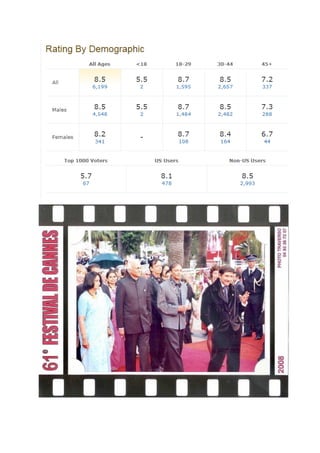
  • 40.
    कोई बताए मैंकहाँ हूँ डर है सफ़र में कहीं खो न जाऊ ँ मैं रस्ता नया अ अ आ आ आ आ Wrote dialogues to convey a true philosophical and spiritual message, and those were written in one stretch of 18 days Impressed appropriately what are the human beings, their behavior and duality (minds and face) Finally demonstrated he could do which Nobel winner of Literature Pearl Buck could not do Song Trivia - Allah Megh De Paani De - This song is adapted from a Bengali folk song attributed to the Bangladeshi singer Abbas Uddin Ahmed. Aaj Phir Jeene Ki Tamanna Hai – A Guide for Everyone गाना / Title: वहाँ कौन है तेरा, मुसाफ़िर जायेगा कहाँ – vahaa.N kaun hai teraa, musaafir jaayegaa kahaa.N गायक / Singer(s): वहाँ कौन है तेरा, मुसाफ़िर, जायेगा कहाँ दम लेले घड़ी भर, ये छै यां, पायेगा कहाँ ..वहां हौन है तेरा ... बीत गये दिन, प्यार क े पलछिन सपना बनी वो रातें भूल गये वो, तू भी भुला दे प्यार की वो मुलाक़ातें – २ सब दू र अन्धेरा, मुसाफ़िर जायेगा कहाँ ... कोइ भी तेरी, राह न देखे नैन बिछाये ना कोई दर्द से तेरे, कोई न तड़पा, आँख किसी की ना रोयी - २ कहे किसको तू मेरा, मुसाफ़िर जायेगा कहाँ ... कहते हैं ज्ञानी, दुनिया है फ़ानी, पानी पे लिखी लिखायी है सबकी देखी, है सबकी जानी, हाथ किसीक े न आयी - २ क ु छ तेरा ना मेरा, मुसाफ़िर जायेगा कहाँ ... गाना / Title: Aaj Phir Jeene Ki Tamanna Hai (Today, I feel like living again) - aaj phir jiine kii tamannaa hai चित्रपट / Film: Tere mere sapne ab ek rang hai गाना / Title: तेरे मेरे सपने अब एक रंग हैं
  • 41.
    तेरे मेरे सपनेअब एक रंग हैं हो जहाँ भी ले जाएं राहें, हम संग हैं तेरे मेरे दिल का, तय था इक दिन मिलना जैसे बहार आने पर, तय है फ ू ल का खिलना ओ मेरे जीवन साथी... तेरे दुख अब मेरे, मेरे सुख अब तेरे तेरे ये दो नैना, चांद और सूरज मेरे लाख मना ले दुनिया, साथ न ये छ ू टेगा आ क े मेरे हाथों में, हाथ न ये छ ू टेगा The song has been picturized early morning indicating life begins at the start of dawn. Initially Rosie was not comfortable and was tensed, later she comes closer and has a smile on the face. She puts her to Raju. Rosie requests Raju, to let her go. He says now there is no one for him except her. He promises her to be ever together. Rosie gets a new name Nalini. Raju gets a delegation of school and convinces that it would be good to revive Indian culture during school program inviting Nalini for a dance. This is a turning point. गाना / Title: पिया तोसे नैना लागे रे, नैना लागे रे, जाने क्या हो अब आगे रे - piyaa tose nainaa laage re, nainaa laage re, jaane kyaa ho ab aage re पिया तोसे नैना लागे रे, नैना लागे रे जाने क्या हो अब आगे रे, नैना लागे रे हो, जग ने उतारे हो, धरती पे तारे, पर मन मेरा मुरझाये हो, उन बिन आई हो, ऐसी दीवाली मिलनेको जिया तरसाये, आ साजन पायल पुकारे झनक झन झन झनक झन झन, पिया तोसे पिया तोसे नैना ... भोर की बेला सुहानी, नदिया क े तीरे भर क े गागर जिस घड़ी मैं चलूँ धीरे धीरे तुम पे नज़र जब आई, जाने क्यों बज उठे क ं गना छनक छन छन छनक छन छन, पिया तोसे हो, आ, हो, आई होली आई हो, सब रंग लाई बिन तेरे होली भी न भाए, हो
  • 42.
    भर पिचकारी, हो,सखियों ने मारी भीगी मोरी सारी हय हय, तन-बदन मेरा कांपे थर-थर धिनक धिन धिन धिनक धिन धिन, पिया तोसे रात को जब चाँद चमक े जल उठे तन मेरा मैं कहूँ मत करो चंदा इस गली का फ े रा दिन ढल जाये हाये ... चमकना उस रात को जब मिलेंगे तन-मन मिलेंगे तन-मन,पिया तोसे पिया तोसे नैना ...पिया हो हो पिया (chorus) ... गाना / Title: गाता रहे मेरा दिल, तू ही मेरी मंज़िल - gaataa rahe meraa dil गायक / Singer(s): , गाता रहे मेरा दिल, तू ही मेरी मंज़िल, कहीं बीतें न ये रातें, कहीं बीतें न ये दिन - (२) प्यार करने वाले अरे प्यार ही करेंगे जलने वाले चाहे जल जल मरेंगे दिल से जो धड़क े हैं वो दिल हरदम ये कहेंगे कहीं बीतें न ... ओ मेरे हमराही, मेरी बाँह थामे चलना, बदले दुनिया सारी, तुम न बदलना प्यार हमे भी सिखला देगा, गरदिश में सम्भलना, दू रियाँ अब क ै सी, अरे शाम जा रही है, हमको ढलते ढलते समझा रही है, आती जाती साँस जाने कब से गा रही है Raju gets nervous and drinks. It was raining. Mani arrives since Raju wanted to complete pending work after show. He asks him for a company, suggesting to get a glass for a drink. Raju requests Rosie to bridge the difference and eliminate the distance, and get closer. Rosie conveys that he is free from her side & can be independent. He begs for love and Rosie asks him to get out of the room. गाना / Title: दिन ढल जाये हाय, रात ना जाय - din Dhal jaaye haay, raat naa jaay दिन ढल जाये हाय, रात ना जाय
  • 43.
    तू तो नआए तेरी, याद सताये, दिन ढल जाये प्यार में जिनक े , सब जग छोड़ा, और हुए बदनाम उनक े ही हाथों, हाल हुआ ये, बैठे हैं दिल को थाम अपने कभी थे, अब हैं पराये दिन ढल जाये हाय ... ऐसी ही रिम-झिम, ऐसी फ़ ु वारें, ऐसी ही थी बरसात खुद से जुदा और, जग से पराये, हम दोनों थे साथ फिर से वो सावन, अब क्यूँ न आये दिल क े मेरे तुम, पास हो कितनी, फिर भी हो कितनी दू र तुम मुझ से मैं, दिल से परेशाँ, दोनों हैं मजबूर ऐसे में किसको, कौन मनाये दिन ढल जाये हाये ... Meanwhile police knocks the door of Raju’s house. Police inspector happens to be friend of Raju, has a warrant. He explains the reason of warrant as a fraud by forged signature of Rosie by Raju. Raju asks for the proof. Inspector shares that Rosie cried when get to know about the fraud and could not lie & is a witness. Raju requests to meet Rosie. Inspector Girdhari conveys that Rosie would not like to see his face, Raju insists that he would be able to see her. Rosie arrives at Raju’s house. He introduces her to his mother and request not to misunderstand her caste & religion from her name. Rosie conveys based on encouragement and direction from him, he took step to leave Marco. When she looks behind it is all ashes, there are sculptures around and future seems to be long way where she cannot find destiny. Raju says look at the sculptures, there is a guide standing for her to support. She is looking at the way but not the traveler. She confesses having asked for support for 4 days, and not to burden his life. He was sure and confident that with her company his life shall be eazy. She is uncomfortable however he convinced her that till while ago it was sin but not today. He wants to dream with Rosie, shape those in his life, needs her permission. Rosie refuses to promise. Further he appeals her to think with cool mind, that they enjoy very close bond between them and have common dreams of the same colors.It was depicted by nice song When Raju visits her. She notices him, however ignores & does not speak to him expressing the anguish. गाना / Title: मोसे छल किये जाये - mose chhal kiye jaaye Emotions of Rosie are captured well.
  • 44.
    मोसे चल कियेजाये, हाय रे हाय हाय देखो सैंया बेइमान, सैंया बेइमान मोसे चल, मोसे चल, मोसे चल किये जाये, हाय रे हाय हाय देखो हाँ सैंया बेइमान समझाक े मैं तो हारी, धमकाया ?, नी नी नी रे रे ग ग म म प प ध नी सा सा सा समझाक े मैं तो हारी, हाँ धमकाया ?, और करू ँ भी क्या देखो मोरा जियरा हाँ जियरा तड़पाये, जियरा तड़पाये मोहे हाय हाय देखो सैंया बेइमान मोसे चल, मोसे चल, मोसे चल किये जाये, हाय रे हाय हाय देखो सैंया बेइमान मन का है बैरी काला, दिल जिसे दे डाला, नी नी नी रे रे ग ग म म प प ध नी सा सा सा मन का है बैरी काला, दिल जिसे दे डाला हाँ दिल जिसे दे डाला, प्रीत मोरी पल पल रोये तड़पाये तड़पाये तरसाये, तड़पाये तरसाये मोसे चल हाँ, मोसे चल, मोसे चल किये जाये, हाय रे हाय हाय देखो हाँ सैंया बेइमान (देखो सैंया बेइमान)-२ मोसे चल किये जाये, देखो सैंया बेइमान हाँ बेइमान, हाँ बेइमान In continuity second song begins wherein Raju expresses his feelings गाना / Title: क्या से क्या हो गया, बेवफ़ा, तेरे प्यार में – क्या से क्या हो गया, बेवफ़ा ऽऽऽ तेरे प्यार में चाहा क्या क्या मिला बेवफ़ा ऽऽऽ तेरे प्यार में चलो सुहाना भरम तो टू टा जाना क े हुस्न क्या है, हो ओ ओ जाना क े हुस्न क्या है कहती है जिसको प्यार दुनिया क्या चीज़ क्या बला है दिल ने क्या ना सहा तेरे मेरे दिल क े बीच अब तो सदियों क े फ़ासले हैं, हो ओ ओ सदियों क े फ़ासले हैं
  • 45.
    यक़ीन होगा किसेकि हम तुम इक राह संग चले हैं होना है और क्या, बेवफ़ा ऽऽऽ तेरे प्यार में, चाहा क्या क्या मिला Rosie asks him why did he do this? He should have asked her for money, she would have sold jewelry bungalow, etc. he expresses that he was confident that no one may understand him but Rosie would surely understand, but the understanding was greatly wrong. Villagers start praying in temple in support of Swamiji’s fasting. There is a song Allah megh de , pani de, chhaya de oh rama.. it’s a prayer to god to rain and bless. Lot of people starts visiting temple to see swamiji. They open stall to distribute free food also. Swamiji is desperately hungry, he sees a worship plate having banana. There is a conflict, should he eat banana or not. Finally he does not. He must have thought about faith so many villagers keeping on him, and this is an opportunity to be truthful to them. गाना / Title: अल्लाह मेघ दे, पानी दे छाया दे रे रामा मेघ दे - allaah megh de, paanii de chhaayaa de re rama अल्लाह मेघ दे, पानी दे, छाया दे रे रामा मेघ दे श्यामा मेघ दे आँखें फाड़े दुनिया देखे, हाय ये तमाशा आँखें फाड़े ... है ये विश्वास तेरा, है तेरी आशा अल्लाह मेघ दे ... Compilation of posting: तेरा शहर, तेरी जिंदगी तेरी खुशियां,तेरी यादें Raju takes chapati for Gafur, that’s the friendship and caring nature! लेकिन तुम जानते हो राजू आज तक कोई पारखी यहाँ तक क्यों नहीं आया ? क्यों की ये काम मेरी किस्मत में लिखा था। मै रह गया तहत इसकी खोज करने क े लिए.. इसक े मोल को समझने क े लिए. इसको नाम और मान देने क े लिए जो इसका होना चाहिए ----------- गाना / Title: अल्लाह मेघ दे, पानी दे छाया दे रे रामा मेघ दे - allaah megh de, paanii de chhaayaa de re raamaa megh de जहा अपने आप सर छु क जाते है, उस पत्थर को भी भगवन का रूप मान लिया जाता है जिस जगह को देख कर परमात्मा की याद आये वो तीर्थ कहलाता है और जिस आदमी क े दर्शन से परमात्मा की भक्ति जागे वो महात्मा कह लाता है
  • 46.
    अगर तेरे कारणये पुराना मंदिर तीर्थ स्थान बन गया है और हजारो हजारो आँखे ऊपर उठ रही है प्रकाश की और फिर तुझे चिंता क्यों? सर ज़ुका ले और शांत होकर बैठ जा समज ले की करने वाला कोई और है तू सिर्फ एक बहाना है , काम उसका और नाम तेरा, उसका नाम ले और जो सौपा गया है उस काम को करता रह मेरी तरह , एक पत्थर की तरह Even after 60 years, Guide cannot be remade. It is cinematic Upanishad—sacred, soulful, and timeless. What If Analysis – Threads of Destiny-Turning Points Each choice shows that Guide is a film of inevitable consequences, like karma unfolding. An Immortal Tribute to Guide (1965): A Timeless Spiritual and Cinematic Masterpiece In movie Guide there have been many turning points; if event does not happen, story would not have moved to next event Guide is an experience. A scripture. A cinematic Upanishad. A timeless masterpiece. No one can remake the Hindi version of Guide. How destiny pulls the threads.  If Raju did not take Rosie to show snake dance  If Rosie & Marco had only indoor fights, not exposing to Raju  If Rosie adjusted with Marco like most other women  If Marco allowed Rosie to pursue her hobby of dancing  If Raju did not pursue Rosie for dancing  If Raju did not insult Marco?  If Raju would’ve returned to town after dumped by Rosie  If Raju did not fraudulently signed on behalf of Rosie  If Marco did not realized that signature was forged and taken revenge of insult  If Raju would have returned to his town after release from jail  If Saint did not put the shawl on Raju  If Bhola not believed Raju that he is intellect & religious person  If Bhola’s brother did not confuse villagers  If Raju did not impress villagers letting other saints down  If Marco did not invent caves and returned after few days  If Marco did not understand the forged signature  If Raju would have tempted to go back to family life  If swami was not caught while trying to run away by two monks  If Raju would not have pursue the fasting  If it did not rain?  If Raju did not die?  Second attempt of suicide by Rosie
  • 47.
     Spiritual Undertone: Director’s Use of Parallel Cuts:  Themes of Redemption & Faith:  What a line! Why snake charmer is dancing instead of making snake dance to his tune!  What is identity without ego?  Can love and faith transcend betrayal?  Does spiritual purity emerge from human fallibility?  What if Rosie had truly understood Raju’s insecurity?  What if Marco had appreciated Rosie’s art?  What if Raju hadn’t forged her signature?  What If” analysis exactly as you intended—scene-by-scene, emotionally and philosophically.  Reinstate every lost detail, including Goldie’s age (31), his multi-department involvement, and layered breakdowns.  What if he hadn’t confessed?  Each moment is a karmic crossroad — Raju’s transformation is because he falls, not in spite of it.  What if Raju had not forged the signature? Their relationship might still have deteriorated due to possessiveness.  What if Rosie had defended Raju?  It could have saved him from prison, but perhaps not from spiritual emptiness.  What if the villagers hadn’t believed in him?  Raju might never have found redemption.  What if Rosie hadn’t returned at the end? He might still have attained moksha, but the emotional completion would be lacking.  Every decision leads Raju from pride to punishment, from punishment to purification.  No beginning. No end. Circular journey.  If Rosie had not met Raju…  If Marco had allowed her to dance…  If Raju had not forged signature…  If Rosie defended him in court…  If he returned home post jail…  If Bhola hadn’t found him in temple…  If villagers hadn’t misquoted…  If rain hadn’t come…  If he survived…  If Rosie hadn’t met Raju... If Raju hadn’t signed... If Bhola hadn’t mistaken him...  What if the rain hadn’t come?
  • 48.
     Decision notto go to city  Monk shares his shawl covering Raju  Bhola understand Raju as a holy man (saint), monk  Rosie meeting Marco  Raju guide taking Rosie to see cobra dance  Marco writing note to Rosie to go back to home if she wishes so with Rs 1000  Rosie’s attempt of suicide and Raju’s convincing attempt  Marco with another lady and getting caught by Rosie  Rosie arriving at Raju’s house leaving Marco’s house  Decision of Raju’s mother to go to village with mama ji  Rosie being invited to school for dance  Raju’s act of hiding a book, and fraud signature  Raju’s not allowing Marco to meet Rosie  Raju’s decision to return to home  Rosie’s not telling lie during the witness  Raju’s decision of fasting  Spiritual awakening in Swami Raju after long duels with soul Each turn was destiny. Raju surrendered. Each thread—destiny. Each event—awakening. Each of these points leads to a different fate—yet their inevitability adds to the fatalistic structure of the story. This version of the story with its deep philosophical arc, spiritual transformation, and mythic climax rooted in Bhagavad Gita principles. UNIQUENESS OF GUIDE  A story with no real beginning or end – a circular journey.  Deeds and decisions decide destiny. One has to surrender to destiny.  Songs as storytelling tools.  Inner transformation depicted through external events.  A rare climax where the hero dies yet is liberated.  An ambiguous ending – did he die or transcend?  A spiritual epic in a romantic shell.  Even after 60 years, no film has come close to the complexity, soul, and finesse of Guide. With hundreds of remakes and retellings in cinema, Guide remains irreplicable.  This is not just a film. Guide is an experience. A scripture. A cinematic Upanishad. A timeless masterpiece. No one can remake Guide of Hindi version.
  • 49.
     These dialoguesare pure gold. They must stay in Hindi to preserve their emotional and philosophical resonance. Each one reflects a turning point in the story or a deep insight into the characters, especially Raju and Rosie.  Audiences : Guide can be understood in first go. Most of the admirers, authors who wrote their views said that even today whenever they watch a movie, new perspective is understood.  In technology era, we have Google search to find the information related to Guide, and various blogs published by the authors. (Wiki - )  Ability to grasp the story from the existing book (that too is a big deal; the novel does neither make you grasp the subject does not give you feeling of spontaneity)  Revamped the story to suit to Indian audience, showing caliper to judge the audience correctly  Packaged it well with song and music still to make a story move forward, and make it entertaining too  There is a co-relation of cobra dance of Rosie with a story. Raju’s mother always terms Rosie as queen cobra and warned Raju to keep himself away from her. Raju does not listen and story moves on to its destiny.  Marco ready to bet & confident to find one more cave, Raju says to search him, he does not see any! This is a nice synopsis! Marco can search hidden caves but can not understand the hidden talent of Rosie whereas Raju cannot see hidden cave but understands & acknowledges the hidden talent of Rosie. What caves to Marco is Rosie to Raju. They make those world famous. Later it was projected that Caves do not ditch the Marco, where as Rosie did! Not only this, but Marco considers Rosie as nuisance. Caves become the most challenging objective in life of Marco.  Marco successfully searches caves :  He says why no other expert could reach up to the caves? It was he who was to give name and fame to the caves. The search was destined in his name.  Likewise when Rosie gets famous, its Raju who manages extracting her talent, encouraging and bring in front of the audiences. Only difference is Marco gratifies Raju’s name in the book, where as Rosie leaves Raju cursing and without understanding him.  Marco expresses that destiny was holding others to search these caves in spite others are so experts. He promises Raju to quote his name in the book.  मै हैरान हु की ये गुफाए दुनिया की नज़र से क ै से छु पी रह गयी  अजंता एल्लोरा और खजराहो की कदर करने वाला जमाना इस खजाने को धूल में क ै से छिपा रहने दे सकता है?---  लेकिन तुम जानते हो राजू आज तक कोई पारखी यहाँ तक क्यों नहीं आया ? क्यों की ये काम मेरी किस्मत में लिखा था। मै रह गया तहत इसकी खोज करने क े लिए.. इसक े मोल को समझने क े लिए. इसको नाम और मान देने क े लिए जो इसका होना चाहिए  लेकिन तुम फिक्र मत करो राजू
  • 50.
     किताब मेंतुम्हारा भी नाम आएगा और जरूर आएगा क्यों की तुम वो आदमी हो जो मुझे यहाँ तक लाये  He shows her status of trusted dog of a king. She compares herself and says dog is better placed than her. He advices not to curse the destiny since then destiny also curse to those.  While Rosie conveys her story to Raju’s mother, that her aunt wanted to sell her but her mother does not allow it and refuses; her aunt conveys  गन्दी नाली से निकला हुआ पानी ... कभी गंगाजल नहीं बन सकता  No chappals :  Rosie singing Aaj phir jine ki tamanna hai without Chappals? Why was Raju also throws his chappals which were torn on the way moving away from city? Is this too much reading between lines?  Raju Guide convinces Rosie that if she has passion, energy, daring and hobby (हुन्नर लगन हिम्मत शौक) then nothing is impossible. It will be just achieved.  Dev keeps distance :  Quarrel between Rosie and Raju as a manager  What is the reason Rosie does not like or love Raju anymore?  Is she exhausted?  Raju develops bad habits? Or company of people of different taste (that of Rosie)?  Rosie gets to know the acts of Raju like hiding the book, or forgery of signature?  Raju gets bad habits of drinking alcohol, gambling and keep losing money. Rosie questions on his expenses. She keeps asking him get-out, whereas he pledges to get-in! She does not feel good about anything. They get into quarrel on love and purpose, he thinks she loved because of having need & purpose. Raju expresses that he is also equal partner in earning money and it was due to his hard work.  Mother’s love : Mother slaps Raju but in immediate scene, people hits Raju at station due to argument over ownership of the shop, its mother who shields him  Showing face : Mother gets ready to go with Mamaji, Raju guide tells her, Maa, agar tum gayi to kah deta hu, jindagi bhar mera muh nahi dekhogi. It happens so, mothers sees him during last scene after few years.  Upsetting on self : When someone is angry with self, and feel helpless, he/she shouts on someone, and realizes later that he/she was upset with him/herself. The scene after mother leaves with Mamaji and Raju guide sit for dinner, realizes that mother has left the house. He shouts at Rosie, allowing his mother to go! Later he confesses.  Friendship at risk : Gaffur suggests Raju guide to leave Rosie, he say, a woman who leaves the husband, what is a guarantee she would not leave him? Raju picks up fight with him & breaks the friendship, love wins over friendship. Uniqueness and Legacy
  • 51.
    A film farahead of its time in feminist themes, spiritual depth, and anti-hero treatment. A rare combination of star power and art-house introspection. The only Hindi film of its era that presented redemption not through union but transcendence. Remains a cult classic with unmatched rewatch value.  No Indian film before or after Guide has layered such spiritual and emotional depth.  In 60 years and likely the next 100, it remains unmatched.  First Bollywood film to break with linear narrative.  First to use song as storytelling — not interruption.  First with a metaphysical climax.  A triumph of Goldie, Dev, Waheeda, Burman, and Shailendra. Public Domain Reflections Critics, bloggers, books, and Facebook posts echo the same:  Guide redefined Indian cinema.  Often discussed in media retrospectives.  Studied as a philosophical and feminist text.  Revered in film societies worldwide. the piece ends with a deeply reverent tone reflecting its once-in-a-century legacy. Even after 60 years, no film matches Guide’s soul and complexity. It is irreplicable and beyond remakes. A timeless masterpiece. Because her name means just that: unique. But she didn’t become unique merely by the virtue of her name. Today, the name Waheeda stands on the firm foundation of immense talent, relentless hard work, and an unshakable will. Guide : Movie by Great Golden Goldie, Our analysis – Our views Three Bollywood movies, most talked, discussed, and for which content the most content in dialogue, information, picture form is being shared on social networking sites! Sholay, Mughal-E-Azam and Guide! Sholay was the most simplest format of the story, Mughal-E-Azam is fully packed with Urdu dialogues penned by eight writers and emotional drama, difficult to remake. Guide is simplification of most complex and deep
  • 52.
    story capturing variousattributes of human being and their behavior! After 55 years of its making few pointers are difficult to believe like Purpose of this blog is not to share the information about the movie, but the analysis and views from director’s angle. No one can be right, and through. I always say, Guide can only be analyzed by only one person, Goldie himself! (Gabbar ke tak se aapko sirf ek hi aadmi bacha sakta hai, khud Gabbar!) Intense scenes I re-watched Guide again, and again. Every time I felt having learnt something newer angle or message director intended to convey. That’s the reason I wonder the intellect Goldie possessed and who demonstrated true leadership by way of - Refusing to do a film as is, true partner to share the thoughts frankly As a human being we observe following attributes in the movie. Table Human Attributes and behaviour: Attributes Related Scenes Passion Raju Guide is passionate about his being The Guide, does not even eat appropriately Rosie has a passion for dancing Marco is busy day and night to search the caves Skills Raju guide has learnt and can speak various languages as multi-linguistic tourists visit from various states Rosie’s skill is dancing and Marco is good at coordination and execution Greed Greed and ditching : Raju had obliged panwala to get his son working at his shop, but they ditched him, grabbing the shop! Ambition; growing ambition Raju becomes manager Rosie makes it to a big dancer and famous star Rosie expresses if a lady gets a love, in return she supports her husband and remain happy, there are no high ambitions here Anger Raju gets angry with mother saying, if she leaves a house, she would see dead face of Raju Raju gets angry with a boy running a stall Love Raju loves Rosie; even after release from Jail, he is carrying photos of Rosie Lust Marco’s involvement with the prostitutes
  • 53.
    Preference Raju prefersto be with Rosie to his mother Raju prefers to go away from his own city, likely home, mother and Rosie Raju breaks the friendship with Gaffur over Rosie Decision making Raju decides to go away from his own city, likely home, mother and Rosie Rosie decides to leave Marco and seek support from Raju Rosie decides to be a dancer Raju leaves Rosie after she denies love to Raju Raju decides not to end fast but abide to the trust of the villagers to continue fasting Confusion Raju is confused, should he move to city or away from city? He later is struggling to find answer; 1. Rosie and mother both are back, and with him; he could end the fast and live a normal life? Or to abide the trust of villager and continue fasting till it rains? Main and important confusion is, who is running the show? And does there exists a relationship of god and devotee, faith and caring? Raju’s mother is confused and asks, if Rosie does not want to make marriage successful, why did she marry? Commandin g Marco to command Rosie, to make her listen and align to his choices and say Autocracy Mamaji was unhappy due to married woman leaving her husband and staying with Raju Marco wants Rosie to live with him aligning to his culture Friendship Raju cares and offers Bread (Chapati) to Gaffur as a friend, having close business friendship Habits Raju develops habits of drinking, smoking and partying with friends and gambling losing money Sarcasm Communication between Rosie and Marco is with lot of sarcasm and disrespecting each other Being upset Rosie gets upset with Raju, forgery of the signature Misundersta nding Rosie carries a misunderstanding about Raju forges her signature for want of money Ignorance Rosie ignores and refuses love with Raju Convincing & encouragin g Raju convinces Rosie to utilize her talent and be a dancer Detachment Raju detaches from the ambitions, relationships, and even life Trust Raju won the trust of villagers, and does not break at the cost of life Logic & challenge Second evil mind of Raju challenges and conveys logical things that there can not be a relation between fasting and rain, however Raju emphasize on the trust Helping Rosie attempts suicide multiple times however Raju every time helps and saves her Ego Marco has ego on his achievements, searching the caves; resulting
  • 54.
    insulting Marco’s egois hurt when he sees Rosie practicing dance in-spite of he asked to stop Rosie considering her background Raju’s ego was hurt when Rosie does not love him Gaffur’s ego was hurt while Raju slaps him for the cause of Rosie Raju moves away from city thinking city in which he lived like a king may term him as thief Raju after released from jail, does not pick up the coins thrown at him and given as begging though he needed those the most 2 monks who think they are real monks, test the knowledge of Raju swami Raju guide drops Rosie at library leaving her as Rosie insults him & Gaffur Gratitude Marco mentions Raju’s name expressing the gratitude whereas Rosie doesn’t Insulting Raju insults Mamaji (as request and demand were not matching, not aligned to the dreams and plan) Mamaji insults Rosie (as she disturbs the cultural aspects) Kindness Monk offering food to Raju and spreading his own shawl on him Compromis es Rosie compromises marrying to Marco Anticipation Prediction conveyed to Laxmibai (Rosie’s mother) Gandi nali se nikala pani kabhi ganga jal nahi ban sakta Understandi ng the facts Who does not know father’s name, and does not have husband, and mother known as evil, can not make life famous Fights and arguments Marco and Rosie argues - at station on the way Marco enquires about Raju guide - fight / argument scene between mother, mamaji, Raju Guide and Rosie is extremely dramatic and emotional, mother intends to slap Rosie, and Raju Guide leans forward to safeguard her from the slap, taking it on his cheek Priority Marco has priority of just searching the caves Understandi ng other person Marco doesn’t care Rosie is accompanying him and she could have different interest Fear Rosie is fearful when Marco sees her dancing at his house Rosie is fearful after cobra dance and says he should not be informed Believe He also convey - जो आदमी अपने नसीब को कोसता रहता है ... उसका नसीब भी उसको कोसने लगते है Assurance, confidence and trust Rosie requests Marco should not be informed about her cobra dance , Raju Guide confidently assures that he will not! To tell lies Raju smartly tries to tell lie about Marco caring after Rosie attempts suicide
  • 55.
    Manipulatio n Raju guide forgerythe signature on behalf of Rosie Freedom Rosie purchases ring bells, moves around with freedom and visits to Chittod along with Guide, with lot of energy and freedom, leaving (giving up) fear and cultural constraints put by Marco, Imagination Marco imagines Statue is dancing and offering music while he touches its feet, actually its Rosie making music by walking with ring bells Rebelling Gaffur says, in place of Rosie he would have slapped Marco and given the divorce Rosie rebels after seeing lust of Marco, wears ring bells, slaps him and leave him and says its not necessary for her to follow every decision by Marco Doubting Marco asks Rosie, who has provoked her against him? He also asks, if there is a second man in her life? Raju’s mother doubts Rosie’s character and nature just after hearing the name Blaming Marco thinks Rosie blames him for the lust True colors Marco confesses that he never forgot the origin of Rosie Not having clarity When Rosie comes to Raju’s house, she says neither past nor future is clear! What is happening to her, no one can guess! (Past - Rakh, Now - Khandhar aur Future - Rah) Understandi ng life Destiny keeps pulling you the way it is destined; you think its you who is doing it! You are only a performer (actor) on the stage, script is written and executed by writer & director! revenge Rosie stays with Raju as live-in relationship. Marco was stopped meeting Rosie by Raju as a manager. He did not like Raju’s behavior. He understands Raju did forged signature and pulls him in a court. Obligation & gratitude Police inspector happens to be friend of Raju, brings the arrest warrant for Raju. He allows him to spend time during Rosie’s show, as a part of friendship Doing right things - realization Raju gets jailed. He thinks, realizes his mistake and conclude, he should have married to Rosie instead of making her the dance queen! What should have he done correctly. He decides he would have to start his life once again from the beginning. Raju taken to court and gets punished jail for 2 years. Later Rosie meets him in jail. She confesses that to save him she could not tell lie even as a witness. Raju introspects and convey that it was his mistake. It would have been good if he would have married her and settled with family. Rosie pacifies him that 2 years will fly fast and later they both would start a life again. Raju remains aloof and says he would have to start his life once again from the beginning. दोष मेरा था रोसी, मुनासिब तो ये ही था की तुम्हे घर की लक्मी बनाता, पर जाने क्या धुन थी की तुम्हे अपना बनाने क े पहले दुनिया की रानी बना दू शौरत तुम्हे मिली, सर मेरा घूम गया , होश आया तो देखा जेल में है!
  • 56.
    Misundersta nding & romours Bhola’s brothermisunderstands and spread the news that since its not raining, swamiji shall observe fasting till death. Conflict Swamiji is desperately hungry, he sees a worship plate having banana. There is a conflict, should he eat banana or not. Finally he does not. He must have thought about faith so many villagers keeping on him, and this is an opportunity to be truthful and loyal to them Faith God guides him and starts talking to Raju/Swamiji . He feels someone (god) is calling him Raju…Raju..Wherever people bow their head in front of stone with faith & hope, that stone is being considered as a god. A place makes you remember god is called tirth (holy place). And seeing a person realizes the existence of god is termed as mahatma (saint, holy person). And if because of you this old temple has become a holy place, and thousands of eyes are looking at god and light, with tremendous hope and faith, then why is he worried? Just surrender your head and sit peacefully. Just understand this is being done by someone else (god) and you are just a media. Work belongs to him, however name is yours. Take his name, have a faith in him and whichever work is assigned to you, continue keep doing it, like god (me), just like one stone. जहा अपने आप सर छु क जाते है, उस पत्थर को भी भगवन का रूप मान लिया जाता है जिस जगह को देख कर परमात्मा की याद आये वो तीर्थ कहलाता है और जिस आदमी क े दर्शन से परमात्मा की भक्ति जागे वो महात्मा कह लाता है अगर तेरे कारण ये पुराना मंदिर तीर्थ स्थान बन गया है और हजारो हजारो आँखे ऊपर उठ रही है प्रकाश की और फिर तुझे चिंता क्यों? सर ज़ुका ले और शांत होकर बैठ जा समज ले की करने वाला कोई और है तू सिर्फ एक बहाना है , काम उसका और नाम तेरा, उसका नाम ले और जो सौपा गया है उस काम को करता रह मेरी तरह , एक पत्थर की तरह Conflict with self Swamiji starts talking to himself. It’s a human being and human brain. There are 2 versions of human, devil and good holy person. The conflict is captured. Devil version of Swamiji (Raju) tries to convince that Rosie and mother both are around, all happiness for which you were waiting are around. But swamiji keeps worrying about rain and asks what would happen if it does not rain? Raju (Devil) says the life from which you were running away now following you, calling back to you, promising happiness. Swamiji counters and says that act shall be ditching to thousands , their believes would collapse, they will consider him as fraudulent, traitor and dishonest! Raju checks with him, does he believe it would rain? You also started following faith blindly? You are educated and was surprisingly if you think there is any relationship between fasting of human with the rain! Swamiji tells Raju that he does not know and does not care. Confusion has been rising and all these thoughts were never thought before. However answer to these is more important than life, and death. Question is not whether he would live or die, even would it rain or not is also not very important, main question is there someone creator and one who runs the world exists or not? If there is no one, then
  • 57.
    there is noworry even if death arrives. There is no fun to live in a blind world like a blind person. If someone exists, then we will see if he listens to his follower or not? सवाल अब ये नहीं क े पानी बरसेगा या नहीं। सवाल ये नहीं क े मैं जिऊ ं गा या मरू ं गा। सवाल ये है क े इस दुनिया को बनाने वाला चलाने वाला, कोई है क े नहीं। अगर नहीं है तो परवाह नहीं, जिंदगी रहे या मौत आए। एक अंधी दुनिया में अंधे की तरह जीने का कोई मजा नहीं। और अगर है तो देखना ये है क े वो अपने मजबूर बंदों की सुनता है या नहीं। Secularism & religion Bhola was not allowing him considering he is of different religion. Swamiji meets him. Swamiji asks what is his religion? Swamiji says, Love is his religion, friendship is his believe. Being conscience Raju was conscience about his image with Villagers? He was not, however he was conscious about not ditching to villagers Compassion A child is dying, Raju prays to god, he may take his life but offer life to child A mother brings a child who is not well to swamiji. Its their faith that blessings from swamiji would recover him. Swamiji prays to god that people consider him as God’s child and why is he keeps so much distance from him? He urges God to please listen to their requests if not his! Take my life, but eliminate their sorrow and give life to them. Caring Raju’s mother slaps him, however when people at railway station beat Raju, she covers him from the beating by mother, friend & Rosie Raju’s mother is attending him. Raju has a regret that he should have been serving him instead of she is serving him. He suggests her to go and sleep. There are news paper reports. Rosie gets to know and drives to the place. Raju has put his head on Rosie’s shoulder. He wakes up. Rosie asks did he wake up? (physical) Swamiji replies, yeah, he was sleeping till then, now he wake up! Gafur arrives enquiring if swamiji is the Raju Guide? Bhola was not allowing him considering he is of different religion. Swamiji meets him. Swamiji asks what is his religion? Swamiji says, Love is his religion, friendship is his believe. Rosie heard Raju’s health is in danger. She cries and requests his mother to do something. They support each other. Determinati on Raju continues to fast, reciprocating faith of the villagers and confident that god will reciprocate Faith It rains. It’s a win of belief and faith of human kind on God and its existence. Enlightenm ent There is a light of soul, enlightenment! God says, my child, do not be afraid of sorrow! Sorrow is the basic ambrosia, it will wash away the sins. I am not at a distance from you, I am inside you, around you, only me! Only me..! Due to enlightenment of Soul Swamiji freed from sorrow, worries, greed, expectations, and all materialistic world. Swamiji moves towards a light.
  • 58.
    Swamiji feels completefreedom from the materialistic world. Body has not been demanding. There are no sorrow, he has complete grip on the life, in self – control. Swamiji is not being afraid of death also. Body keeps demanding for willingness to live which is the highest for human being however soul overcomes that greediness. There is a description of soul, like it is bodyless, fearless, full of truth & life, it cannot be burnt even if thrown in fire, can not be cut if tried to cut by sword. Ego (body) has to die! There are no sorrow, no happiness, no life cycle of day and night, nothing concern about people & the world, its only pure soul! That’s it! There is a conflict between body and soul has been nicely picturized. आज मै कितनी आजादी महसूस कर रहा हूँ ! जीस्म जैसे मांगे करना भूल गया ! मन तडपना , तडपाना भूल गया ! जीवन आज जैसे मूठ्ठी मै है ! माैत जैसे एक खेल है ! लगता है आज हर इच्छा पूरी हो गई ! पर अब मजा देखाे , आज काेई इच्छा ही नही रही ! जिंदगी पिघलकर प्रकाश बन गई ! और सच्चाई मेरा रूप है ! तन रहे ना रहे , मै रहूँगा ! आग मे फ ें क दाे , मै जलूंगा नही ! तलवार से वार कराे मै कटूंगा नही ! तूम अहंकार हाे , तूमकाे मरना हाेंगा ! मै आत्मा हूँ, अमर हूँ ! माैत ये खयाल है , जैसे जिंदगी ये खयाल है ! ना सूख है ना दुख है ना दिन है ना दुनिया ना इंसान ना भगवान सिर्फ मै हूँ , मै हूँ , मै हूँ , मै , सिर्फ मै ! Other Observations: Ambition (of Rosie) to Care (of culture by mother) to Lust (of Marco) to love (by Raju) to trust (between Raju & villagers) is a journey Life and destiny : Coming and going (what is happening in the life) is not in our hand. Individual wants to go in one direction, destiny takes him to other. Its not in hand of individual. Each one has to just follow the destiny without trying to change the path. About Cobra dance : Various authors, critics and analysers tried to analyze in their own way  Few say, director wants to term Rosie as Cobra or more dangerous than Cobra as she not only dances like Cobra but also makes Cobra to dance to her tune. She spit the poison in Raju’s life (as anticipated by Raju’s mother)  Few say, it’s a Synopsys of snake charmer and cobra with destiny and individual. As snake charmer make cobra dances to his tune, destiny also makes individual to dance its tune. This is also synopsys that Guide who guides tourists (about where to
  • 59.
    go, which touristplaces to visit) but himself confused, where to go, which path to follow and surrenders to destiny the way cobra surrenders to snake-charmer. (Cobra- Snake charmer to Tourists – Raju Guide to Destiny)  A question is raised, if snake charmer himself is confused who make Cobra dance to his tune? Likewise Guide himself is confused who used to guide tourists. तूने तो सबको राह बताई , तू अपनी मंज़िल क्यों भूला सुलझाक े राजा औरों की उलझन , क्यों कच्चे धागों में झूला क्यों नाचे सपेरा, मुसाफ़िर जाएगा कहाँ What a line! Why snake charmer is dancing instead of making snake dance to his tune! You always guided others Then how can you not see your own destination You solved everyone elses problems But now are entangled in your own mess Why is a snake charmer dancing to his own tune? The lyricist makes a reference to snake charmers. Snakes cant really hear sound like we do. They just watch and move the way the charmer sways his flute. Also The hidden talent if offered an opportunity, can be demonstrated to the world. Meaning from few dialogues आना जाना हमेशा अपने हाथमे थोड़ा न होता है दोस्त इंसान सोचता है मै इधर चलू, किस्मत कान पकड़ कर उधर लेकर जाती है वो सोचता है उधर चलु, नाक पकडकर उधर घसीटकरलेती है। तंग आकर मैंने एक दिन किस्मत को पास बुलाया और पूछा की बता तू चाहती क्या है कहने लगी मनमानी छोडो और मेरी ऊ ँ गली पकड़ कर चलो ठीक है मैंने कहा तथास्तु तो देखो भैय्या आज यहॉ कल वहा तो परसु कहा 1. मुसीबत और चिंता का चीता तक साथ रहता है 2. Joeshp – Janwar andar chale aate hai (Marco was planned to go inside) 3. Muzse to kutta hi achha – Ek bat kahu, jo aadmi apne nasib ko kosta ai , uske naseeb bhi use koste rahate hai 4. Par mere liye wo anmol hai – Rosie when purchases ring bells 5. Kanto se khich kar ye aanchal, todkar bandan bandhe payal, koi na roko dil ki udan ko 6. Aaj phir jine ki tamanna hai, aaj phir marane ka iradha hai 7. Dar hai safer me kahi kho na javu mai, rasta naya – her relationship with Raju is just new, and she does not have confidence where would this path lead to
  • 60.
    8. At apoint Rosie sings a song Aaj phir jine ki tamanna hai, Raju cares for her chappal, and also suggests her to go back from the edge, and struggles to accompany while she is singing, dancing with joy 9. Raju decides to get separated and return to his home. He gets dressed in old attire. Rosie insists him to join for a show. He is determined to leave, and explains how bungalow (dreams) was built and destroyed, the path differed, he saw many shows & understood the objectives. Though he had the intention, he did not know how to get on together. She understands and ask him before she was hurt, suggests verifying if were all issues with her? Raju intends and prays to god that she should never get hurt. Rosie enquires his whereabouts and waits for him. This is a another turning point. 10. Raju’s mother to leave with uncle, Raju say माँ अगर तुम गई से कह देता हु ज़िंदगी भर मेरा मुह नहीं देखोगी ; it happens so later! Mother could see him just last few days! 11. Time sense – When Rosie starts the career as Nalini, it was a trial show at home. It was with lot of adjustment and compromises over technology, lightening, sound, etc; Raju keeps manual colorful fan rotating. It displays the factual event. 12. Goldie’s sincerity is observed throughout the movie. He has places frame of 1-2 seconds, however important to connect the dots. Following are few pictures, will make it clear. Intense scenes There were many scenes in Guide which are difficult to shoot, managing those are challenging, costly.. which are those? 1. Waha kaun hai tera : there are many frames of 1-3 seconds, had to be shot at different locations 2. Draught and bier scenes 3. Mose chhal kiye ja set 4. Kya se kya ho gaya set : net scene, and handcuff scene 4. Climax : crowd moving to see swamy 5. Climax : Allah megh de and he ram songs, and scene with rain "It is the soul of the film — a moment of supreme stillness and complete surrender. In that final walk, Raju is no longer Raju. He is only a figure moving toward an unknown liberation, with the weight of his life quietly lifting with each step. His body may collapse, but the moment rises — beyond time, beyond pain, beyond self. The river flows. The sun rises. And somewhere, unseen, a man dissolves into the idea of something far greater than himself." Raju’s Inner Conflict: To capture:  Introduction of Raju, Marco, Rosie
  • 61.
     Journey throughlove, betrayal, fame, downfall  Transition to monkhood, spiritual awakening, death  Thematic deep-dive: human conflict, choice, and destiny  Appreciation vs. Objectification  Fame vs. Sacrifice  Love vs. Use  Self-Discovery vs. Divine Will  Interpret the Cobra Dance metaphor symbolically  Vijay Anand – poetic direction, scene staging, storytelling  Waheeda Rehman – grace, rebellion, realism  Raju’s Inner Conflict:  The entire Navketan Team – for daring cinema  8. Final Thoughts  Why Guide can never be remade  Its cult legacy: emotional, philosophical, cinematic  Highlight emotional, metaphorical, or philosophical relevance  Great Goldie agreed to direct movie on the term to re-write the theme suiting to Indian audience!  Movie obviously has a variation from the book  From the moment Rosie dances in defiance to when Raju breathes his last amidst thunder and rain, Guide proves that cinema can transcend language, genre, and time.  “Cinema begins with: ‘Achha Mr. Raju, rehaai mubarak ho’ And ends with: Rehaai from every bond — of ego, of desire, of identity.”  An eternal masterpiece — Guide is not a film. It is a pilgrimage.  Compiled, with respect and admiration, by a passionate devotee of this immortal work.  Raju the tourist guide – multilingual, charming, well-known.  Rosie – neglected wife of Marco, passionate about dance.  Marco – archaeologist, cold, obsessed with caves.  Rosie attempts suicide – Raju saves her, becomes emotional support.  Raju motivates Rosie to pursue dance.  Rosie becomes famous, Raju as her manager.  They fall in love – live-in relationship.  Society and mother disapprove – Raju starts forging signatures.  After jail – aimless wandering.  Stays in a village temple – mistaken as a sadhu.  Villagers face drought – misunderstanding that he will fast.  He accepts the fast – soul-searching begins.  Fasts unto death – spiritual climax.
  • 62.
     Rain falls.Raju dies.  He becomes immortal in faith.  Raju searches inner potential in people → helps Rosie blossom.  Marco searches historical caves → ignores Rosie.  Raju appreciates Rosie; Marco does not appreciate her dance.  Marco thanks Raju for caves → Rosie leaves Raju after stardom.  Rosie dances like a cobra → Raju’s mother warns he’s being charmed.  Marco divorces Rosie; Rosie chooses Raju.  Raju later loses direction → guides himself.  But destiny guides him to sainthood.  The conflict of free will vs destiny, art vs ambition, and ego vs surrender plays out like a cosmic ballet.  Songs drive story.  Introspective climax.  A love story that transforms into a spiritual awakening.  Only a soul like Goldie could bring all together at 31.  ("MARCO & ROSIE – SYMBOLISM AND ARC", "Marco symbolizes detachment; Rosie, rediscovered self-worth. Their arcs are intertwined with Raju's fate."),  ("UNIQUENESS OF GUIDE", "Songs as storytelling, spiritual journey, duality, an irreplaceable cinematic scripture.") Raju’s Inner Conflict: Raju sits under the tree with a "vichitra muskaan" (strange smile), reflecting his irony and helplessness. He knows the truth about himself—he’s no godman—but he’s too deep into the deception. His body is weak, yet his presence now inspires faith. “गाँव क े लोग उसे देखने आते हैं... जैसे वह कोई चमत्कार हो।” This irony is powerful: a man crushed by his own actions now becomes a beacon of hope. 2. Spiritual Undertone: The villagers now see him as a saviour. Raju’s fasting isn't just physical—it’s an inward cleansing. The repetition of visual elements like the tree, the mountain, and the setting sun give this section a spiritual aura. There’s an unmistakable Ramayana-like image forming—an ascetic near the Himalayas, communing with nature and fate. 3. Director’s Use of Parallel Cuts: The script notes how Raju’s scenes are intercut with the worsening conditions in the village—dry wells, sunburnt earth, restless cattle. This cinematic layering is signature Goldie Anand: using parallel narratives to heighten emotion. The stark reality of the drought intensifies the mythic aura around Raju.
  • 63.
    4. Themes ofRedemption & Faith: Even as the villagers chant and bow, the subtext is that Raju is uncertain. But he continues. The screenplay doesn’t use dramatic declarations—it lets the silence, the visuals, and the contrast between perception and truth tell the story. Difference in two versions: Also there have been many differences in Hindi and English version (in book and movie) apart from distinct difference of sharp direction and making for Indian audience Guide Book v/s Movie Recently I have read English book Guide, and happened to watch English version of movie Guide, followed by reading Hindi version of the book Guide. Comparison is but natural, and Hindi version of movie Guide is the best media to understand the theme and message. Author of book owes to Goldie a lot which made his novel (book) further popular. He should not be cribbing about twisting the story if at all it is a fact as per media reports. As per author Hindi version of movie is “mis-guide”! Many scenes are captured representing the mind and/or story like birds are freely flying when Raju gets out of jail, or skills possessed by Raju Guide is well demonstrated like his passion to be a guide and able to speak several languages. How many times destiny plays a role, Guide would not exists! Great Goldie agreed to direct movie on the term to re-write the theme suiting to Indian audience! Movie obviously has a variation from the book Following not included from book 1. Conversation between Barber and Raju after release from jail 2. Raju’s childhood- he running the shop selling the items to villagers and travellers 3. Raju’s childhood - as a student : his father asking him study and Raju asking mother not to ask him to study 4. Raju when arrived at temple tries to count the stars 5. Raju as a child riding bullock cart taking lift, accompanying his father who used to visit city for shopping the goods for his shop, Raju was put at a place to wait, he used to get sleep 6. (Hindi) Raju’s mother telling story of Devki 7. Raju as a child was sent to request & invite his father for dinner, his father often would say he was not hungry 8. Raju as a student had a fight with gwala boy, who complained to Raju’s father. Father later sends Raju to school 9. Train was planned to pass via village so development of laying rails was going on 10. Raju as a student in a school, also encroaching to their teacher’s house
  • 64.
    11. Checking viewof fiancé of sister of velan post she is agreeing for marriage after initial refusal 12. Post marriage velan’s sister, fiancé, velan and villagers visit temple to meet Raju 13. Hiding in temple for one evening and waiting for villagers on second evening, and inviting villagers to meet him via a boy 14. Crocodile in river 15. Shop of Raju’s father was flushing as train service started from his town 16. Raju’s father buying horse and cart, rent it and then sell it 17. Establishment of new shop at station, initially father was running it while Raju was running old shop, later they exchanged the responsibilities 18. Appointment of a teacher for a school 19. Staring an evening school 20. Death of Raju’s father, closing of old shop 21. Raju’s learning of general knowledge from old news paper and magazines 22. Raju quoted / called as Railway Raju 23. Niece of Raju’s mother namely Lalita 24. Raju becoming from shopkeeper to a self-learning person to helping travellers to guide taxi, hotel to Guide.. 25. As a guide Raju used to tour elephant capture , killing of tiger, cobra dance, etc 26. Bush-shirt and dhoti 27. Local guide who works in municipality takes Rosie and Raju to sapera for cobra dance 28. Distance between cave and bungalow was 2 miles 29. (Not in hindi) During night stay at bungalow Raju and rosie watch leopard 30. Rosie did MA in economics 31. Rosie conveys to Raju that he is like a brother, and Raju conveyes to Gaffur that rosie is like a sister 32. Coconut tree and river around temple 33. Raju used to cook himself using raw eatables given to him by villagers 34. Raju as a monk grew beard and hair till touching to the back 35. Physical fight of Raju guide with Marco 36. Rosie asking Raju to leave bungalow, and gap is almost one month, when she wanted to settle with Marco 37. Marco asks all what happened at hotel, between Raju and Rosie; and she had to tell him everything including affair and sex. This makes him mor upset and he leaves Rosie at the city without purchasing a return ticket for her. 38. No prostitution scandal by Marco 39. Main shop item supplier visits Raju’s house asking credit amount of 8,000 ruppee due and files a criminal suit 40. Raju’s mother leaves house in front of him 41. Raju shifts in newly rented house (this was not explicit in movie, however after successful Nalini, They stay in a big house 42. A Review of Marco’s book published in illustrated weekly news paper
  • 65.
    43. After Rajuis released from jail on bail, Rosie suggests they both to suicide together taking sleeping pills in milk, however she expresses doubt also that he may survive 44. With help of Mani, Rosie manages her dancing programs without Raju’s involvement 45. Rosie decides to go back to Marco or to none of both 46. Court trial is captured in detail, Marco tried to trap Raju, he returned the document without signature however someone signed blaming Raju 47. Rosie settles in Madras alone after disposal of house-hold items 48. Life of Raju in jail, like an assistant to superintendent 49. Raju eats hidden lunch on 4th day of fasting 50. Government health check of swami 51. Gaffur, Rosie and mother are not around swami 52. Its malgudi, not Udaipur Each decision shapes Raju’s journey from ego to enlightenment. Difference in two versions (hindi and English movie): Also there have been many differences in Hindi and English version apart from distinct difference of sharp direction and making for Indian audience Table Hindi English Crocodile Crocodile story is completely missing River Swami does not ever stand in the river Intimacy Initially Rosie starts liking Raju being impressed with his talk Raju guide touches Rosie and gets closer in just second meeting while Marco is inside the caves. After divorce was granted to Marco, Rosie gets closer and so Raju And she is with him on bed having sex in third shot! That was a bit not convincing to Indian audience Punishment It was directly court room and punishment Rosie offers the bail in police station During police gets a warrant for Raju, There was a song dance Saiyya beimaan he was in a show & Rosie was playing a cobra dance Raju watches it from the back stage Raju enjoys a dance within the audience Suicide attempt There are three suicide attempts of Rosie Firing Guide There was a physical manhandling
  • 66.
    between Marco andGuide; and Marco fires Guide from the duty Dialogues : Bhola enquires what’s his plan, from where has he come and where would he go; Raju answers him philosophical way that its not in our hand, we think to go right, destiny takes us to left, when we think to go left, destiny pulls the nose & take us to right! He continues his story asking destiny that what does it want? Destiny suggests leaving what you want to do and to do whatever it wants without any question to which we have to agree! He also adds difficulties and life accompany individual till funeral! ये धरती ये आकाश ये हवा वो पहाड़ ये मंदिर मै तुम भोला सभी माया क े खेल है। .है ना Story moves further. Marco and Rosie visit Udaipur. In the book story moves around an imaginary town Malgudi. It seems Marco had send a letter to Raju to be available so Raju arrives at platform looking for him. Marco come across Raju guide without knowing he is Raju Guide and asks for him. Raju explains he can ask anyone child, passenger, collie or even to railway engine! There was an argument between Rosie and Marco for the style of asking. Raju shares his true identity in his style – “Gustafi maaf ho, banda Raju Guide hai!” (Please excuse me, I am The Raju Guide) बता सकते है राजू गाइड का पता कहा मिल सकता है? क्यों नहीं, किसी भी बच्चे से , किसी पैसेंजर से किसी कोल्ली से बल्कि मै तो कहता हु की बेशक रेल क े इंजन से पूछ लीजिये क ु छ बोलोगे भी क ै से गाइड हो ? मेरी समझ में नहीं आया कल तक आप लगती थी चालीस की औरत जो जिंदगीकी हर ख़ुशी हर उमंग हर उम्मीद पीछे कही रास्तेमे छोड़ आयी है और आज लगती है सोलह साल की बच्ची भोली , नादान , बचपनकी शरारतसे भरपूर ! जानते हो क्यों ? A great song picturized by Goldie and sung by Lataji can be watched on YouTube He quotes example of Uday Shankar, Shantaram, Bal Saraswati, etc. She stops him saying don’t quote so many big name, her heart beats go high. Raje makes her realise that she did not tried, even she can also perform an act and heart beats of people go high! She does not get convinced and does not agree that her destiny is such high. He quotes a quote of Iqbal ख़ुदी को कर बुलंद इतना कि हर तक़दीर से पहले ख़ुदा बंदे से ख़ुद पूछे बता तेरी रज़ा क्या है Raju delivers a lecture to Rosie after bringing back her to hotel. He shouts if this is a morale of a her, every girl will feel ashamed of her act of suicide. If a man does not want to have family, is there no other way to settle in a life and start a family? If a man
  • 67.
    does not offerhappiness and pleasure, is there no other way in the life? Marco is also not happy but he does not hit head to the wall. He goes to caves and involve with the statues, just because he is a man. And you continue to hurt yourself just because you are a girl! It’s wrong, absolutely wrong! She is in this condition since she has not challenged the situation, has not rebelled with the situation or decide once for all to be his servant. And if not, then standing on our own is not a sin. Surely sin is to sustain crime. Accepting defect from the life is a sin. Also sin is to live suffocated life. And sin is to suicide, it’s a terrible sin. No one is servant of any one. Everyone has freedom to live independently. Helpless is just a superstition. If you are sleeping, you would be helpless. If you wake up, your feet will have the strength to stand up. He reminds having seen and witnessed this power when she had wear the knighthood bells. अगर ये ही तुम्हारा हौसला है तो हर औरत को तुम्हारी जिंदगी पर शर्म आयेगी आदमी घर नहीं बसते तो क्या घर बसाने का और कोई तरीका नहीं? आदमी सुख नहीं देता तो ज़माने में क्या और कही सुख नहीं? मार्को भी वैसे दुखी है पर वो भी दीवारोंपर जाकर अपना सर नहीं टकराता; वो जैसे गुफाओंमे जाकर पत्थरक े बुतोसे जी बहला लेता है; महज इसलिए की वो आदमी है .. और तुम अपने आप को तड़पाती रहती हो क्यों की तुम औरत हो, गलत है रोजी ये गलत है तुम्हारी ये हालत इसलिए है की तुमने इस हालत से बगावत करना नहीं सीखा Songs and dialogues : या तो कसम खालो की जो भी टोकरे मारते है मरते दम तक उसक े तलवें चाटती रहोगी और अगर नहीं तो सम्हलनेमे , अपना हक़ जताने में कोई पाप नहीं; और पाप है पड़े रहने में, जुल्म सहनेमे जिंदगी से हार मान लेने पाप है, घुट घुट कर जीना पाप है, जीते जी आत्महत्या करना पाप है रोज़ी आत्महत्या करना पाप है, पाप है कोई किसीका गुलाम नहीं, कोई मोहताज नहीं किसी का; मजबूरी नाम एक वहम का है; सोये रहे तो मजबूर है और जाग जाये तो पैरो में ताक़त अपनेआप आ जाती है ये ताक़त को मैंने तुम्हारे अंदर देखी है जिस वक़्त तुमने ये घुँघरू बांधे थे इसक े बाद भी तुम अपने आप को मजबूर समझती हो कमजोर समझती हो तो मेरे पास इसका कोई इलाज नहीं बस ये ही अफ़सोस रहेगा की क्यों मै तुमको बार बार मरने से बचता रहा इसलिए की कोई बुज़दिल ऐसे भी होते है जिनको चुल्लू भर पानी में मर जाना चाहिए; अगर तुम भी उनमेसे एक हो तो मुझे शर्म आएगी की तुमसे भी मेरा कोई वास्ता था तुमने चिंगारी क्या दिखाई मैंने आशिया फ ु क डाला, मै कही की नहीं रही राजू, मेरा कोई नहीं रहा पीछे देखती हु तो सिर्फ राख , आसपास खण्डार ही खण्डार , आगे एक सुनसान लम्बी राह जिसकी मंज़िल का पता नहीं - खँडहर ओमें देखो रोसी एक गाइड खड़ा है; राह को देखती हो राही को नहीं? सहारा माँगा था चार दिन क े लिए , जीवन का बोझ तुम पर नहीं डालना चाहा था - ये बोझ यकीं मानों मेरे जीवन को हल्का कर देगा राजू.. मै कलंकिनी - अगर तुम कलंकिनी तो ये कलंक सर आँखों पे नहीं नहीं राजू ऐसा नहीं हो सकता ; मैंने ऐसा कभी सोचा भी नहीं था
  • 68.
    - कलतक सोचनापाप था लेकिन आज और बात है; कल तक कहना पाप था लेकिन आज और बात है - रोसी मै तुम्हारे लिए सपने देखना चाहता हु - सपनो को रूप देना चाहता हु मुझे इजाजत दो मै तुम्हे क ु छ नहीं दे सकती; कोई वादा नहीं कर सकती; मुझे उलझन में मत डालो राजू; मेरी परछाई तुम्हे कई बर्बाद न कर दे - ठन्डे मन से एक बात सुनोगी; तुम कोई वादा नहीं कर रही हो; तुम्हरा हाथ अपने दिल पर रख कर मै एक वादा करना चाहता हु - तेरे मेरे सपने अब एक रंग है; वो जहा भी ले जाये राहे, हम संग है
  • 69.
    Raju explains thesuccess achieved till now, new bungalow, car, people gathering a crowd and waiting just to see a glimpse of Nalini, etc which is unbelievable to Nalini. Raju shares the status that formalities of divorce with Marco have been completed, and proposes her if she would make love and marry him. Rosie is pleasantly surprised and considers herself lucky that there is someone who respected her. They talk about marriage, children, assignments and future, etc. Here comes a song Gata rahe mera dil, with lot of promises, happiness, trust, etc. हर शीशे क े दिल में एक तस्वीर है एक शीशा दिल हमारे सीने में भी है जो हरदम इस भोली सूरत को छु पाये रखता है Rosie no more likes Raju, due to difference of style of living, exhaustive work, Raju just after the money, kind of company he keeps which is far different than Rosie, and develops bad habits like consuming alcohol, and gambling, and lavish expenses. She avoids him and does not make the love. जाग रही हो तुम नहीं, नींद में बोल रही हू रोजी आजकल सिर्फ नशे में याद आती है रोसि याद में नशा करता हु और नशे में याद करता हु अच्छा जाओ अब सो जाओ अपने कमरे में हमेशा जाओ जाओ कहती हो आजकल, आओ आओ कहना भूल गयी हो क्या Few dialogues राजू प्लीज प्लीज रोजी हटो भी नहीं राजू मुझे ये सब अच्छा नहीं लगता मैं अच्छा नहीं लगता? क ु छ अच्छा नहीं लगता इसलिए कि मैं शराब पीता हु नही जुवा खेलता हु? तो फिर किस लिए रोसि बस एक बात होती है, वो खत्म हो जाती है तुम्हारा मतलब प्यार? प्यार किस मतलूब का नाम है? मतलब का नाम प्यार नहीं? जब मतलब से प्यार होता है, तो प्यार से मतलब नहीं रहता प्यार में मतलब की मिलावट होती है, जब तुम्हे मतलब था तो प्यार भी था,, उह और अब तुम्हे प्यार है तो किसी मतलब से? क ु छ कह दूंगा तो कहोगी नशे में हो कह दो नशे का बहाना लेकर सोचने लगा हूँ कही मार्क तो ठीक नहीं था मार्क ठीक था जब वो कहता था आदमी को औरत की कमाई पर नहीं रहना चाहिए तो तुम्हे ग़लतफ़हमी है की मै तुम्हारे कमाई पर रहता हु, और तुम ये भूल गयी हो कि मैं वो सीधी है जिसका सहारा लेकर तुम ऊपर पहुँची हो, भूल गयी तुम्हारी कमाई की एक एक पाई मेरी मेहनत का नतीजा है, तुम डांसर थी, पहले भी, लेकिन दौलतमंद हो मेरी वजह से
  • 70.
    हा राजू, मैंनेकब इनकार किया, याद में नशा करता हूँ और नशे में याद करता हूँ and जब मतलब से प्यार होता है ... तो प्यार से मतलब नहीं रहता Raju remembers all beautiful moments spent with Rosie. He expresses the huge distance between two hearts even if those are close by physically. For her love he left everyone, now she pushed him to a panic situation making him to hold the heart. Mani also hates Rosie due to her keeping distance from Raju. It was nicely captured during song. At the end of song Rosie comes nearer to Raju however he moves away. क्या बात है सर, आज आप अक े ले पी रहे है; बाते करने क े लिए इतना तरस रहा था की सोचा थोड़ी पीकर अपने आप से क ु छ कहूंगा । जिंदगी भी एक नशा है दोस्त, जब चढ़ता है तो पूछो मत क्या आलम रहता हैलेकिन जब उतरता है.... Raju returns at home and writes letter to mother requesting to comeback home & seeking forgiveness from uncle. He keeps watching photographs of Rosie and remembering the past moments. राजू , ये क ै सा मजाक है? - ये मज़ाक होता तो क्या बात थी? - न महल बनाते , न महल टू टते - न राहे मिलती , न राहे बिछडती - मजाक तो ये है की ये मजाक नहीं है मिस नलिनी ये तमाशा करना जरुरी है? - जो खुद तमाशा बन गए है वो तमाशा क्या करेंगे - आइये आप को गाड़ी तक छोड़ दू अच्छा अब आप जाइये और कपडे बदलिए; मै आपकी राह देखती हु - बहुत राह देखि एक ऐसी राहपर जो टेढ़ी है पर गुजराती नहीं ये अचानक क्या हो गया है तुम्हे?; देखो शो का वक़्त हो रहा है - वक़्त हो चूका, शो हो चूका , देख चुक े आज मालूम होता है साथ आने की नियत नहीं है - नियत तो ठीक थी, साथ निभाना नहीं आया Raju now settles in the temple of the village Rampuri. He receives approval for post office. Villager thanks to him having started School, then hospital and now post office. Villager quotes him as swamiji (monk, holy person) and says now village has turned to heaven. School is over so all children gets around swamiji and demand for telling them a story. Villagers are also keen to listen a story. Raju tells them a story which was told to him by his mother during childhood many times. Rosie completes the background story to Raju’s mother. His mother say, she does not know whom to blame but she lost his son. Not sure where would he be and in which situation? Story moves further. Marco and Rosie visit Udaipur. In the book story moves around an imaginary town Malgudi. There was a famine (dearth, starvation), earth was cracked, there was no rain, even not a single drop. Not only animals started starving and dying but also human beings. Even god was afraid, and worried if human kind is being destroyed /eliminated? He quotes a
  • 71.
    story of holysaint monk who fasts for 12 days and force god to rain. Holy man did neither eat nor drink anything. Villagers curiously asks did it rain, swamiji says yes, it rained. He clarifies this is possible. He quotes if a child is inside house and if house catches fire, would not you enter in fire? So you are just a mother, where as we are all children of god. God is our parents, brother and friend as well. “ये कहानी उस साधु महात्मा की है जिसने लगातार १२ दिन का उपवास रखा और भगवान को पानी बरसने पर मजबूर कर दिया” Swami’s health deteriorates. Everyone prays for his recovery. Gafur also prays namaz in temple (true secularism). A mother brings a child who is not well to swamiji. Its their faith that blessings from swamiji would recover him. Swamiji prays to god that people consider him as God’s child and why is he keeps so much distance from him? He urges God to please listen to their requests if not his! Take my life, but eliminate their sorrow and give life to them. Everyone sings a prayer, hey Ram! Hey Ram! Jai jai ram, sitaram, jai jai ram sitaram! Everyone is praying and crying with sorrow! It rains. It’s a win of belief and faith of human kind on God and its existence. Rosie gets excited and happy, wants to inform the news to swami. She realizes swamiji is no more. She conveys to mother that Raju died. His mother says, Raju does not exist in this body. Soul is immortal. People are still dancing with the happiness and joy. Guide (1965) – Dialogues आना जाना हमेशा अपने हाथमे थोड़ा न होता है दोस्त इंसान सोचता है मै इधर चलू, किस्मत कान पकड़ कर उधर लेकर जाती है वो सोचता है उधर चलु, नाक पकडकर उधर घसीटकरलेती है। तंग आकर मैंने एक दिन किस्मत को पास बुलाया और पूछा की बता तू चाहती क्या है कहने लगी मनमानी छोडो और मेरी ऊँ गली पकड़ कर चलो ठीक है मैंने कहा तथास्तु तो देखो भैय्या आज यहॉ कल वहा तो परसु कहा मुसीबत और चिंता का चीता तक साथ रहता है ये धरती ये आकाश ये हवा वो पहाड़ ये मंदिर मै तुम भोला सभी माया के खेल है। .है ना बता सकते है राजू गाइड का पता कहा मिल सकता है? क्यों नहीं, किसी भी बच्चे से , किसी पैसेंजर से किसी कोल्ली से बल्कि मै तो कहता हु की बेशक रेल के इंजन से पूछ लीजिये मै हैरान हु की ये गुफाए दुनिया की नज़र से कैसे छुपी रह गयी अजंता एल्लोरा और खजराहो की कदर करने वाला जमाना इस खजाने को धूल में कैसे छिपा रहने दे सकता है?--- लेकिन तुम जानते हो राजू आज तक कोई पारखी यहाँ तक क्यों नहीं आया ? क्यों की ये काम मेरी किस्मत में लिखा था। मै रह गया तहत इसकी खोज करने के लिए.. इसके मोल को समझने के लिए. इसको नाम और मान देने के लिए जो इसका होना चाहिए लेकिन तुम फिक्र मत करो राजू किताब में तुम्हारा भी नाम आएगा और जरूर आएगा क्यों की तुम वो आदमी हो जो मुझे यहाँ तक लाये कुछ बोलोगे भी कैसे गाइड हो ? मेरी समझ में नहीं आया कल तक आप लगती थी चालीस की औरत जो जिंदगीकी हर ख़ुशी हर उमंग हर उम्मीद पीछे कही रास्तेमे छोड़ आयी है और आज लगती है सोलह साल की बच्ची भोली , नादान , बचपनकी शरारतसे भरपूर ! जानते हो क्यों ? ख़ुदी को कर बुलंद इतना कि हर तक़दीर से पहले ख़ुदा बंदे से ख़ुद पूछे बता तेरी रज़ा क्या है अगर ये ही तुम्हारा हौसला है तो हर औरत को तुम्हारी जिंदगी पर शर्म आयेगी आदमी घर नहीं बसते तो क्या घर बसाने का और कोई तरीका नहीं? आदमी सुख नहीं देता तो ज़माने में क्या और कही सुख नहीं? मार्को भी वैसे दुखी है पर वो भी दीवारोंपर जाकर अपना सर नहीं टकराता; वो जैसे गुफाओंमे जाकर पत्थरके बुतोसे जी बहला लेता है; महज इसलिए की वो आदमी है .. और तुम अपने आप को तड़पाती रहती हो क्यों की तुम औरत हो, गलत है रोजी ये गलत है तुम्हारी ये हालत इसलिए है की तुमने इस हालत से बगावत करना नहीं सीखा या तो कसम खालो की जो भी टोकरे मारते है मरते दम तक उसके तलवें चाटती रहोगी और अगर नहीं तो सम्हलनेमे , अपना हक़ जताने में कोई पाप नहीं; और
  • 72.
    पाप है पड़ेरहने में, जुल्म सहनेमे जिंदगी से हार मान लेने पाप है, घुट घुट कर जीना पाप है, जीते जी आत्महत्या करना पाप है रोज़ी आत्महत्या करना पाप है, पाप है कोई किसीका गुलाम नहीं, कोई मोहताज नहीं किसी का; मजबूरी नाम एक वहम का है; सोये रहे तो मजबूर है और जाग जाये तो पैरो में ताक़त अपनेआप आ जाती है ये ताक़त को मैंने तुम्हारे अंदर देखी है जिस वक़्त तुमने ये घुँघरू बांधे थे इसके बाद भी तुम अपने आप को मजबूर समझती हो कमजोर समझती हो तो मेरे पास इसका कोई इलाज नहीं बस ये ही अफ़सोस रहेगा की क्यों मै तुमको बार बार मरने से बचता रहा इसलिए की कोई बुज़दिल ऐसे भी होते है जिनको चुल्लू भर पानी में मर जाना चाहिए; अगर तुम भी उनमेसे एक हो तो मुझे शर्म आएगी की तुमसे भी मेरा कोई वास्ता था तुमने चिंगारी क्या दिखाई मैंने आशिया फु क डाला, मै कही की नहीं रही राजू, मेरा कोई नहीं रहा पीछे देखती हु तो सिर्फ राख , आसपास खण्डार ही खण्डार , आगे एक सुनसान लम्बी राह जिसकी मंज़िल का पता नहीं - खँडहर ओमें देखो रोसी एक गाइड खड़ा है; राह को देखती हो राही को नहीं? सहारा माँगा था चार दिन के लिए , जीवन का बोझ तुम पर नहीं डालना चाहा था - ये बोझ यकीं मानों मेरे जीवन को हल्का कर देगा राजू.. मै कलंकिनी - अगर तुम कलंकिनी तो ये कलंक सर आँखों पे नहीं नहीं राजू ऐसा नहीं हो सकता ; मैंने ऐसा कभी सोचा भी नहीं था - कलतक सोचना पाप था लेकिन आज और बात है; कल तक कहना पाप था लेकिन आज और बात है - रोसी मै तुम्हारे लिए सपने देखना चाहता हु - सपनो को रूप देना चाहता हु मुझे इजाजत दो मै तुम्हे कुछ नहीं दे सकती; कोई वादा नहीं कर सकती; मुझे उलझन में मत डालो राजू; मेरी परछाई तुम्हे कई बर्बाद न कर दे - ठन्डे मन से एक बात सुनोगी; तुम कोई वादा नहीं कर रही हो; तुम्हरा हाथ अपने दिल पर रख कर मै एक वादा करना चाहता हु - तेरे मेरे सपने अब एक रंग है; वो जहा भी ले जाये राहे, हम संग है हर शीशे के दिल में एक तस्वीर है एक शीशा दिल हमारे सीने में भी है जो हरदम इस भोली सूरत को छुपाये रखता है क्या बात है सर, आज आप अकेले पी रहे है; बाते करने के लिए इतना तरस रहा था की सोचा थोड़ी पीकर अपने आप से कुछ कहूंगा । जिंदगी भी एक नशा है दोस्त, जब चढ़ता है तो पूछो मत क्या आलम रहता हैलेकिन जब उतरता है.... राजू , ये कैसा मजाक है? - ये मज़ाक होता तो क्या बात थी? - न महल बनाते , न महल टूटते - न राहे मिलती , न राहे बिछडती - मजाक तो ये है की ये मजाक नहीं है मिस नलिनी ये तमाशा करना जरुरी है? - जो खुद तमाशा बन गए है वो तमाशा क्या करेंगे - आइये आप को गाड़ी तक छोड़ दू अच्छा अब आप जाइये और कपडे बदलिए; मै आपकी राह देखती हु - बहुत राह देखि एक ऐसी राहपर जो टेढ़ी है पर गुजराती नहीं ये अचानक क्या हो गया है तुम्हे?; देखो शो का वक़्त हो रहा है - वक़्त हो चूका, शो हो चूका , देख चुके आज मालूम होता है साथ आने की नियत नहीं है - नियत तो ठीक थी, साथ निभाना नहीं आया दोष मेरा था रोसी, मुनासिब तो ये ही था की तुम्हे घर की लक्मी बनाता, पर जाने क्या धुन थी की तुम्हे अपना बनाने के पहले दुनिया की रानी बना दू शौरत तुम्हे मिली, सर मेरा घूम गया , होश आया तो देखा जेल में है! "मौत एक ख्याल है जैसे ज़िंदगी एक ख्याल है" हिंदी सिनेमा में मील का पत्थर साबित हुई फिल्म 'गाइड' मेरे शहर उदयपुर की दिलकश वादियों में रचाई गई थी। अरावली की गोद में बसा एक शहर जिसकी बाहों में मैं पली बढ़ी। राजस्थान का कश्मीर। झीलों की नगरी, पानी, पत्थर पहाड़ों की पुरी, फाउंटेन व माउंटेन का शहर और ना जाने कितने नामों से नवाज़े गए मेरे इस शहर में बनी ये फिल्म गाइड। खैर उदयपुर की बात फिर कभी। लेखक आर के नारायण के उपन्यास 'द गाइड' पर बनी फ़िल्म गाइड 1965 में विजय आनंद द्वारा निर्देशित, देव आनंद, वहीदा रहमान की नायाब अदाकारी और एस डी बर्मन के सुरमई संगीत की वजह से अप्सराओं की मानिंद हर दिन बस जवान और खूबसूरत ही हुई है। इस फिल्म की कोई शुरुआत नहीं कोई अंत नहीं। ये सदा बीच से ही मालूम जान पड़ेगी। इसकी कहानी पर बात करना तो यूँ ही होगा, क्योंकि मेरी समझ में इस फिल्म को ना देखने वालें गिनती के ही होंगे। ख़ासकर वो तो बिल्कुल ही नहीं जो फ़िल्मों से और वो भी ऐसी फ़िल्मों से अनछुए रहते हों। लिहाज़ा आगे का पढ़ना गाइड फ़िल्म नहीं देखने वालों के किसी काम का नहीं। साथ में बहने के लिए आपको साथ ही उतरना होता है। "वहाँ कौन है तेरा मुसाफ़िर, जायेगा कहाँ?'' किरदार निभाते वक़्त देव आनंद और वहीदा रहमान को ये एहसास हो गया होगा कि वो क्या निभाने जा रहे हैं जिसकी वजह से जिंदगी भर एक गर्वीली संतुष्टि उनका पीछा
  • 73.
    करेगी। हर दृश्यअविस्मरणीय है। इच्छा-अनिच्छा, देह का आकर्षण, विरक्ति-आसक्ति, मोह माया, अहंकार, प्रेम और ईश्वरीय शक्ति का एहसास, अंत में खुद की आत्मा से साक्षात्कार और इस बिना हैसियत के शरीर की झूठी शान और इसके दो कोड़ी के दंभ का अंत जीवन के एकमात्र दर्शन और सत्य मृत्यु पर ला पटकता है। नायक राजू (देव आनंद) नायिका रोज़ी (वहीदा रहमान) के प्रति क्रमशः हमदर्दी, आकर्षण, प्रेम, लालच, बेईमानी, गुस्सा, पश्चाताप, पुनः प्रेम और अंत में विरक्ति को प्राप्त होते हुए सांके तिक तौर पर ज़िंदगी की हकीकत से आपको मिलवाता है। सतह पर, सतह से ऊपर और फिर सतह से परे राजू की जीवन यात्रा चलती रहती है। रोज़ी के साथ रोज़ी के बिन और फिर रोज़ी के भीतर और अंततः पश्चाताप। हर एक गीत सिर्फ गीत नहीं है कहानी की आत्मा है जिसके बिना कहानी अधूरी है। राजू के साथ आज़ादी की हवा में सांस लेती रोज़ी ये गाती है कि "Aaj Phir Jeene Ki Tamanna Hai (Today, I feel like living again) आज फिर मरने का इरादा है।" जीने की वो तमन्ना जो उसके भीतर आग की तरह धधकती आई है। समाज के तंज़ तोहमतों को सहती रोज़ी की आँखों में आए आँसुओं को राजू अपने अन्दर लेते हुआ कहता है "लाख मना ले दुनिया साथ ना ये छूटेगा आके मेरे हाथों में हाथ ना ये छूटेगा'' तब उन्हें कहाँ एहसास है कि हालात यूँ भी करेंगे कि एक ही झीने के उस और इस पार बैठकर ये कहना होगा "दिन ढल जाये हाय रात ना जाए, तू तो ना आए तेरी याद सताए, तुम मुझसे और मैं दिल से परेशां दोनों हैं मजबूर, ऐसे में किसको कौन मनाए।" दीवानगी और रवानगी बेहद ही होती है इसमें नियम कहाँ बनाए कोई। समाज के निर्मम यथार्थ को हर पल साथ में घसीटती ये फिल्म हमेशा की तरह दो प्रेमियों को मिलने से तो खैर रोकती ही है, अंदर से उठती हूक़ को आपके अन्दर हस्तांतरित कर देती है न चाहते हुए भी। उस हूक़ को आप अपने अंदर लिए जूझते रहते हैं। पश्चाताप, ग्लानि के पाश में बंधा राजू जब एक अकालग्रस्त गाँव में अपना आश्रय ढूँढता है तब परिस्थितिवश उसे महात्मा समझ लिया जाता है जो कुछ भी कर सकता है। जीने मरने की इच्छा अनिच्छा में झूलता राजू उन मासूम गाँव वालों को अनायास होने वाले चमत्कारों में खुदका हाथ होने का परोक्ष सबूत दे देता है जिससे वो खुद भी अंजान ही है। वहाँ परिस्थितयाँ इतनी बलवती हैं कि न तो गाँव वाले तर्क लगा सकते हैं और न राजू उस तिलिस्म को तोड़ना चाहता है। गाँव वालों का ये विश्वास कि राजू बारिश लाने में सक्षम है और अकाल से मुक्ति दिला देगा, राजू को ऐसी मनोदशा में फें क देता है जहाँ शुरू होता है उसका उपवास। जहाँ से शुरू होती है उसकी देह और आत्मा की लड़ाई। भीतर से प्रतिकार और इस दम्भमयी शरीर का हाहाकार उसके दिमाग में विस्फ़ोट करने लगता है। ईश्वर के पत्थरमयी रूप को पूजते गाँव वालों को देखकर उसका शरीर उसकी आत्मा से कहता है "जहाँ सिर अपने आप झुक जाते हैं उसे भी भगवान का रूप मान लिया जाता है, क्या फर्क पड़ेगा अगर तुम छ्द्म रूप से ही सही इनके लिए भगवान् बने रहो? तुम्हें किस बात की चिंता सर झुका लो और शांत होकर बैठ जा। समझ लो कि करने वाला कोई और है तुम सिर्फ ज़रिया हो। काम उसका नाम तेरा।" रोज़ी को वहाँ पाकर शांत हो चुके संशय भरे प्रेम का तंदूर एक बार फिर दहक उठता है और राजू एक बार फिर रोज़ी की बाहों में खुद को खो देता है। इस खो देने में जा पहुँचता है अपनी आत्मा के ठीक सामने। शुरू होता है आत्मा और शरीर का संवाद... देह- 'रोज़ी आ गई और माँ भी।' आत्मा- 'पानी ना बरसा तो क्या होगा? हज़ारों ग़रीबों की उम्मीदों पर पानी फिर जाएगा। मुझे क्या समझेंगे, ढोंगी?' देह- 'तुझे यकीं है कि पानी बरसेगा, तू भी इन जाहिलों की तरह अन्धविश्वासी होने लगा? तू ये तो नहीं सोचने लगा कि एक आदमी की भूख का बादलों से कोई रिश्ता हो सकता है?' देह- 'उलझनें बढती जा रही हैं। सवाल अब पानी के बरसने या नहीं बरसने का नहीं, सवाल ये नहीं कि मैं जियूँगा या मरूँ गा। सवाल ये है कि इस दुनिया को बनाने वाला चलाने वाला कोई है या नहीं। अगर नहीं है तो परवाह नहीं ज़िंदगी रहे या मौत आए। एक अंधी दुनिया में अंधे की तरह जीने में कोई मज़ा नहीं, और अगर वो है तो देखना ये है कि वो सुनता है या नहीं।' और उसकी ये कश्मकश की तंद्रा टूटती है रोज़ी के आगोश में। एक मनोविश्लेषण के साथ। पहुँचता है वो उस शक्ति और विश्वास के द्वार जहाँ कोई आवाज़ उसे पुकार रही है। 'मेरे बच्चे, दुःख से घबरा मत, दुःख वो अमृत है जिससे पाप धुलते हैं। मैं तुझसे दूर नहीं, तेरे अन्दर बाहर मैं ही हूँ। सिर्फ मैं हूँ सिर्फ मैं हूँ सिर्फ मैं हूँ... और राजू की आत्मा अब हर प्रभाव से मुक्त उसके रेंगते हुए शरीर के सामने खुली हवा में महक रही है। 'आज मैं कितनी आज़ादी महसूस कर रहा हूँ। जिस्म मांगें करना भूल गया है, मन तड़पना भूल गया है। जीवन आज मुट्ठी में है मौत जैसे एक खेल है।' उसी आत्मा के सामने घायल शरीर ज़मीं पर पड़ा रेंग रहा है जीने की भीख माँग रहा है। आत्मा खिलखिला रही है 'लगता है जैसे आज हर इच्छा पूरी होगी लेकिन मज़ा देखो कि आज कोई इच्छा ही नहीं रही।' शरीर- 'कम से कम जीने की इच्छा तो ला? राजू मुझे बचा ले?' आत्मा- 'तुम अहंकार हो, तुम्हें मरना ही होगा। मैं आत्मा हूँ अमर हूँ।
  • 74.
    मौत एक ख्यालहै जैसे ज़िंदगी एक ख्याल है। ना सुख है ना दुःख है। ना दीन ना दुनिया। ना इंसान है ना भगवान है। सिर्फ मैं हूँ, मैं हूँ, मैं हूँ। दूर पहाड़ पर पानी बरस रहा है। शरीर भीग गया है।' तभी बादल गरज़ते है तेज़ बिजली चमकती है और होती है तेज़ बारिश। रोज़ी आती है राजू को ये बताने कि तुम्हारा उपवास सफल हुआ देखो लोग नाच रहे हैं बारिश आई है। राजू कहाँ है अब लेकिन? वो तो जा चुका। सब कुछ जान समझ लेने के बाद अब वो रुकता भी क्यों और कै से। पार्श्व में राजू की आत्मा के स्वर... "मौत एक ख्याल है जैसे ज़िंदगी एक ख्याल है। ना सुख है ना दुःख।" "तुम मुझसे मैं दिल से परेशां दोनों है मजबूर, ऐसे में किसको कौन मनाए..." सिनेमा शुरू होता है, "अच्छा मिस्टर राजू, रिहाई मुबारक" और खत्म भी तो रिहाई पर ही होता है। आत्मा की देह से रिहाई। हर बंधन से रिहाई। दोष मेरा था रोसी, मुनासिब तो ये ही था की तुम्हे घर की लक्मी बनाता, पर जाने क्या धुन थी की तुम्हे अपना बनाने के पहले दुनिया की रानी बना दू शौरत तुम्हे मिली, सर मेरा घूम गया , होश आया तो देखा जेल में है! “ये कहानी उस साधु महात्मा की है जिसने लगातार १२ दिन का उपवास रखा और भगवान को पानी बरसने पर ” मजबूर कर दिया मुसीबत और ज़िन्दगी का कहते है चिता तक का साथ रहता है लगता है आज हर इच्छा पूरी होगी ... पर मज़ा देखो ... आज कोई इच्छा ही नहीं रही जब मतलब से प्यार होता है ... तो प्यार से मतलब नहीं रहता जो आदमी अपने नसीब को कोसता रहता है ... उसका नसीब भी उसको कोसने लगते है याद में नशा करता हूँ और नशे में याद करता हूँ मैं जुबां से लफ़्ज़ों की तस्वीर खींचता हूँ ... अतीत तो सब दिखाते है, मैं कभी कभी भविष्य भी दिखाता हूँ गन्दी नाली से निकला हुआ पानी ... कभी गंगाजल नहीं बन सकता जहा अपने आप सर छुक जाते है, उस पत्थर को भी भगवन का रूप मान लिया जाता है जिस जगह को देख कर परमात्मा की याद आये वो तीर्थ कहलाता है और जिस आदमी के दर्शन से परमात्मा की भक्ति जागे वो महात्मा कह लाता है अगर तेरे कारण ये पुराना मंदिर तीर्थ स्थान बन गया है और हजारो हजारो आँखे ऊपर उठ रही है प्रकाश की और फिर तुझे चिंता क्यों? सर ज़ुका ले और शांत होकर बैठ जा समज ले की करने वाला कोई और है तू सिर्फ एक बहाना है , काम उसका और नाम तेरा, उसका नाम ले और जो सौपा गया है उस काम को करता रह मेरी तरह , एक पत्थर की तरह सवाल अब ये नहीं के पानी बरसेगा या नहीं। सवाल ये नहीं के मैं जिऊं गा या मरूं गा। सवाल ये है के इस दुनिया को बनाने वाला चलाने वाला, कोई है के नहीं। अगर नहीं है तो परवाह नहीं, जिंदगी रहे या मौत आए। एक अंधी दुनिया में अंधे की तरह जीने का कोई मजा नहीं। और अगर है तो देखना ये है के वो अपने मजबूर बंदों की सुनता है या नहीं। आज मै कितनी आजादी महसूस कर रहा हूँ ! जीस्म जैसे मांगे करना भूल गया ! मन तडपना , तडपाना भूल गया ! जीवन आज जैसे मूठ्ठी मै है ! माैत जैसे एक खेल है ! लगता है आज हर इच्छा पूरी हो गई ! पर अब मजा देखाे , आज काेई इच्छा ही नही रही ! जिंदगी पिघलकर प्रकाश बन गई ! और सच्चाई मेरा रूप है ! तन रहे ना रहे , मै रहूँगा ! आग मे फें क दाे , मै जलूंगा नही ! तलवार से वार कराे मै कटूंगा नही ! तूम अहंकार हाे , तूमकाे मरना हाेंगा ! मै आत्मा हूँ, अमर हूँ ! माैत ये खयाल है , जैसे जिंदगी ये खयाल है ! ना सूख है ना दुख है ना दिन है ना दुनिया ना इंसान ना भगवान सिर्फ मै हूँ , मै हूँ , मै हूँ , मै , सिर्फ मै !
  • 75.
    FAQ : 1. WasRaju Guide’s decision leaving/separating from Rosie correct? We do face similar challengesin our life too! What would have you done? Please share - Raju guide didn't get any attention & love from her side...that’s why he want to leave. But decision right or wrong, Can't say! - Detachment is the key here that raises him from a normal human being to a saint in stature. Guide would have been an average film without that detachment - Binding for one vs. Unbinding for all..and this is in context of the film & not Novel, RK Narain did not elevate him to the stature of a saint.. when he becomes a Guide for the people. - In Novel RK Narain shows the desires of Raju and the vulnerable side during his fasting too - A very nice question. It discloses how deep affection you have towards ' Guide' ' Raju' ' Rozi n due to affection how deep study is undertaken. Appreciable. Better this question would have been put before the author great writer R.K.Narayan and also to the great director Goldiji who also reformed the novel in his way taking cinematic liberty while crafting and defining the script ' Guide' (within 18 days! extraordinary intelligence!) and recreated the creation! - They are the proper masters for throwing light on this but unfortunately both are not alive. - Pawanji conducted a wonderful session on Guide, extract audio clip is relevant; also responses are brilliant! We continue stupidity thinking about Devsaab, Goldie, Guide and scenes of fiction story, with if and but! Sharing point of views is interesting phenomenon! - Guide is all about human behavior, greed, ego, ambition, success, attachment, detachment and nirvana! - Sansarikta se adhyatmikta tak ki yatra hai guide. - My question again about can I say negative shade of rozi..she used RAJU to achieving he goal..? - Everyone had his moment of redemption.. Raju loved Rosie but keeps hiding a lor from her, for the insecurities of losing her.. If Rosie wasn’t in love, why would she go back to Raju again in Climax. She was betrayed at first place.. but loved him.. her meeting Raju was the redemption point of their love.. - - In RK Narayan's novel, Raju does not leave Rosy's house. He is arrested while accompanying Rosy to a dance performance. He gets bail after two days in police lockup and comes back to Rosy's house. Rosy hires a very expensive
  • 76.
    lawyer who almostwon the case for Raju as he totally demolished Marco in the cross examination. Raju was convicted because Mani testified against him that he was desperately looking for an insured parcel every day, and the handwriting expert testified that it could reasonably be taken to be Raju's handwriting. Raju is sentenced to two years of imprisonment following which he does not come back to Rosy but wanders to a village where he becomes Swami. - I agree with Pawan Jha that Goldie gave the important detachment twist to the plot which made it a great story as Raju leaves Rosy even before his arrest as he has realized the futility of the relationship - This speaks the genius of Great Goldie who basically was himself script writer apart from being an ace Editor. - Initially Raju has not been attracted towards Rozi for her beauty and charming look. He is a professional guide fully devoted and keeping a distance in between his clients n his profession. But slowly as the story takes it's grip and pace Raju synthetically starts thinking. When she attempts for committing suicide Raju saves her as a human brainwashes her but finds her hubby Mr.Marco has not been mover by news Rozine zahar khaya hai. Raju' s sympathy is more grown up with pity. He decides to keep her alive and wants to keep her busy by diverting her attention towards her liking art of dancing hence the sapera dance. Rozy is exited with a liberty a freeness as if a rebirth hence the song Katonse khinch ke.. Raju takes her to his home. Ma doesn't like " Bihata hai" she says. " Abhagan hai ma" Raju replies - Mother abandons the home goes to stay with her brother in another village. Raju's close friend the driver on a quarrel also leaves him alone. For filling the gap and vacuum in the life of Raju Rozi to entering and Raju finding a goal to make her successful star dancer gets involved hence the song Tere mere sapane.. - Rozy' s dance numbers are clicked, she is rising and stepping into glamorous famous twinkle world. But she is commercial a professional keeps certain or major distance and self concentrated. Her achievement is successfully flowing so Raju's beingness is not that much high level important for her. - She repents latter for having no gratitude she sends Raju in jail. On repentance ( not love or any involvement) she wants to meet Raju ( might be to confess) But Raju is no Raju Guide now he is reformed in a Swami who is fasting for rain n water at the cost of his life. - True sequence of events. Raju forges signature and is sent to jail as people testify against him . He is totally shattered by Rosie’s response..... had she lied to protect him things would have been different. She repents later. At that point of time there was misunderstanding and tension between Raju and Rosie..... she is upset that Raju had hidden the book Marco had sent her.... when this forgery
  • 77.
    thing is revealedby the police .. that adds to the bitterness in the relationship. Very slow and natural distancing and embitterment of the relationship. - Great Intellectual Goldieji has taken Cinematic liberty while reforming the novel into screenplay and script. It's shown appropriately step undertaken by Raju to abandon Rozi's house. Here hero worship n build the image of the hero more heighten shape. Raju values his self- respect more than relationship. He now wants Aatmsanman Aatmnirbhata - Destiny doesn't allow. Goldieji was very genius visionary knowing studied fully the psychology of Indian audience. He wants also carefully to maintain Devpapa's screen image. So the self respect incident. - No Sir... Raju had no self-respect, but a guilt of wrong doings but was trying a way to find redemption... He wanted to break free from his existing old world and wanted to escape where no one knows him... He was running away from his old days/relations.. - Speaking of Rosie, she always loved Raju, but the mistrust caused by Raju had her doubts taking over her mind on Raju's Integrity. Why did he is hiding things from me? Why did he forged, without taking me in confidence? This was the cause of the dent in relationship... If you doubt her intent of using Raju as just a ladder, then all her acts loss significance. Emotions, Scenes & songs like Tere Mere Sapne Ab Ek Rang Hain will lose complete significance then.. In fact in the climax when she comes back, there is a sparkle of love again, when she meets him in the temple and Goldie used the song "Laakh manaa le duniya, saath na ye chhotega"... But by then Raju is detached and Goldie present the conflict of the Guide and the Saint.. where he says "Ab to Rosie… - In the very opening scene of the film Goldie makes it clear... The detachment from the old world and existing relations.. The city was just 1.5 miles, but he opts his path for "Anjanpur" - 685 miles.. and even this metaphor of "Anjanpur" is interestin. A place where he is not known to anyone, just to have a fresh beginning away from his old world. and he goes there to never return. Its the other relations which keep coming to him (Rosie/Mother/AnwarH) to force him back in the old world but thats his struggle and finally Victory where he leaves the world but with a complete redemption of his soul.. - [This is brilliance of Goldie as director.. as he provides a lot of information in his scenes without forcing or spoon feeding his audience, - No she was already a big hit in Chhoti Bahan, in the role of young sister (Jaaun kahaan bata e dil) and was a favorite for such role.... and Dont forget Dev himself broke the sister pattern with Hum Dono and Teen Deviyaan.. They were the best judge
  • 78.
    - I'm veryhappy in tears my eyes whenever I saw this scene is an epic all all scene full movie an epic... I don't have any words to explain my feeling about this... Milestone...Dekh Raju Teri zindagi... - Yes Waheeda was in love with Raju. After raju gets prisoned for two years she realises her mistake and goes to mert Raju in jail. Finally she says do saal yun hi beet jayenge raju phir hum naye sire se jeevan shutu karenge. That indicates her resolve to unite with Raju. But rajus detachment had started n he says “ muje to naye sire se shuru karna hoga JEEWAN. - Finally in temple when all come his inner raju feels like returning back to ma and rosie gaffur but his conscience does not allow to betray villagers and wakes up. Rosie says Raju so gaye kaya. Raju says Soya tha kuchh kuchh jagne laga hun and again goes into atma parmatma round leading to climax rains n salvation - Thats shy Guide is classic. Characters are imperfect worldly like common man unlike ideals like … - it’s a masterpiece. There are several points in this classic movie which none have noticed, which I’ve revealed in my thesis. - Sir guide is the ultimate film of Dev sahab. Every corners of acting, screen play and dialogue. - Very true. - - He starts moving on with his bale on shoulder, carrying artifacts of memories, photos of Rosie, initially using horse cart and later walking, maybe he has no money left by then, without knowing where to go, what to do! This was a first- time introduction of Rosie to audiences. He keeps doing some work for survival. He moves using bus without taking ticket implies his comprising nature. He is not fussy about following the values during difficult situations. He is really tired, with beard grown, till moving on. Song Waha kaun hai tera musafir narrates all these situations while story moves on. - His situation deteriorates. His shirt and shoes are torn. He is at his peak sorrow moment, gets busted and cries. People throw money coins at him. But his ego does not permit him to collect and pick up those. - - He tries to run, its possible to run physically but not from the situation. You must face it come what may! His shoes are torn so he throws those. Thorn cuts his foot, and is painful. He continues to face worst situation. There is a group of monks moving without any worry towards their unknown destination. He is following those without intentions. - - A group of monks and he both stay independently at an old temple. A monk offers him food. He tries to sleep, shivering with the cold. Monk feels compassion towards him and put his cloth (shawl) on him to safeguard him
  • 79.
    against the cold.He feels comfortable after sustaining a peak of sorrow and sleeps well. Its sunshine and he wakes up in the morning and faces a villager. A group of monk who showered love on him has left by then without making hue & cry! It was their duty they performed without making fuss and silently. This is another turning point of Raju’s life. - - The 4 minutes dancing sequence is a one of the high points in movie. This is another turning point of the story. The hidden talent if offered an opportunity, can be demonstrated to the world. - Rosie requests not to inform about this dancing to Marco, Raju promise her not to do so! - She requests him to show the city Chittod. Since car was not available they take ride using truck. She feels being free from Marco being around, independent and happy. She sings a song Kanto se khich ke ye aachal expressing she broke the all restrictions and wants to live independently. On the way she does many mischiefs demonstrating don’t care feeling. Raju is amazed to see so much energy and fail to misunderstand the difference in her behavior. - - Raju visits the theatre. She does not speak with him, and insults (body language). She performs a song Mose chhal kiye jaa, Saiyya beimaan (Fiancée harasses me, he is a fraudulent). English version shows Cobra dance repeated here. - - The situation, sequence, music, dance, energy, passion, getting involved & absorbed, amazement, jealousy, withdrawing from the competition, facial expression, tiring, sweating, collapsing, every aspects have been well picturized. Salute again to every person behind camera, and actors on the stage like Rosie. This movie became milestone movie for Waheeda Rehman, How much dedication and efforts got into this? Guide, Rosie, her dances and Waheeda will always be remembered together.
  • 82.
  • 84.
    1. passion fordance 2. passion for inventing caves 3. Spiritual contradiction – Raju’s early ego rises 4. Betrayal and downfall – Forgery and trial 5. Release and directionless wandering 6. Accidental transformation – mistaken for a sadhu 7. appoints Guide 8. Decision to fast – spiritual climax begins 9. Final moment – surrender to the divine 10. Immortality – the last breath 11. Raju vs. Marco – appreciation of people vs. appreciation of objects 12. Raju’s mother vs. Rosie – cultural orthodoxy vs. artistic liberation 13. Raju’s intention vs. destiny – guide vs. being guided 14. Cobra metaphor – self-direction vs. dancing to another’s tune 15. Raju’s life becomes a parable. From ego to empathy. From desire to detachment. 16. Fast unto death 17. Sight-seeing 18. Rain as divine intervention 19. Raju’s mystical transformation — not a fraud, not a saint, but a human becoming one 20. Raju encourages Rosie’s career 21. Raju’s ego grows with success 22. Raju forges Rosie’s signature (fraud) 23. Raju is arrested and sent to jail 24. Early release from jail 25. Raju's ego grows 26. Fraud act lands in jail 27. Guide Friend, Mother → 28. Excellent in his job 29. Multilingual 30. Rosy 31. Young 32. Unhappy in marriage 33. Attempts suicide 34. Marco 35. Auditory, old age 36. Marries Rosy after seeing a dance advertisement 37. Visits Udaipur with Rosy to invent caves 38. Caught with another woman Quarrel → 39. Speculate 40. Writes book 41. Tries to meet Guide 42. Gift for Rosy
  • 85.
    43. Buys bellrings 44. Dances with snake charmer 45. Guide amazed by Rosy's dance and potential 46. Convinces Rosy to pursue dance, not suicide 47. Arranges small to large programs 48. Earns a lot of money 49. Brings together Grow love → 50. Marriage proposal with mother Disapproved by uncle and mother → 51. Guide leaves home 52. Stops meeting Rosy 53. Guide 54. Develops bad habits: Alcohol, parties, spending money 55. Needs Rosy’s signature for withdrawing money 56. Requests Rosy 57. Rosy unhappy 58. Discards love 59. Guide decides to go back home 60. Imitated Johnny’s signature of Rosy 61. Released a bit early 62. Decides not to go back home 63. Keeps walking – moving directionless 64. Rests in temple 65. Other monk puts holy clothes on Guide’s body while sleeping 66. Becomes monk 67. Critical Content 68. friend 69. mother 70. Auditory 71. Old age 72. Meeting thru advertisement – Marriage proposal 73. Marriage 74. Visits Udaipur with Rosy 75. Invent Caves 76. catch Marco with other woman quarrel → 77. separate 78. Write book 79. attempt suicide 80. Unhappy 81. Saves her 82. Amazed to see dance & potential of Rosy 83. Buy Bell-rings 84. Dance with snake-charmer 85. Convincing Rosy to pursue dance, not to suicide
  • 86.
    86. Brings together 87.Grow Love 88. Arranges small to large programs Earns lot of money → 89. Marriage proposal with Mother 90. Disapproved by Uncle & Mother 91. Leaves home 92. stops meeting 93. Bad habits, Alcohol, Parties, spending money 94. Request to Rosy 95. Discard love 96. Decides to back home 97. Get caught on charge of imitate Johnny's sign of Rosy & jailed 98. Mother & Rosy visits Jail to receive on release 99. Couldn't meet Guide 100. Rest in temple, other monk puts holy clothes on Guide’s body while he is sleeping 101. Advices, preachings, story telling, Problem solving 102. Misunderstanding as Monk 103. Builds trust Guide as Monk 104. Misunderstanding if Guide will fast till death till it rains 105. Quarrel within 106. Trust vs. common sense, belief, soul, greediness, truth, salvation 107. to be / not to be 108. desire, lot many question 109. Guide starts fasting till death, NEWS spreads 110. Guide + Rosy + Mother, Friend meet 111. Truth wins, virtuality wins over material world. 112. Based on Goldie’s movie produced by Dev Anand – Guide UNIQUENESS OF GUIDE 1. Based on an acclaimed novel, 'Guide' takes us through a journey guided by the protagonists Raju (Anand) and Rosie (Rehman). Simply said, the story is about Raju, the tourist guide, who falls in love with an amateur dancer, Rosie, who's married to an archaeologist. Dance is Rosie's passion but due to her husband's discontent, she gives it up in the hope to please him and remain be devoted. Eventually, he abandons her and she seeks solace in Raju's companionship. Raju encourages her to follow her passion. However, the neighborhood, his family and friends object to their relationship and the fact that she's living in his house. Even his mother leaves him. With the help of Raju, Rosie becomes a successful dancer and a star while Raju spends the earnings on gambling, drinking and other such dealings. Rosie, though somewhat bothered by Raju's bad habits, she somehow tolerates them. Stardom has never been her ambition and she
  • 87.
    continues her danceonly for the passion. Then, when Rosie's ex-husband makes his entry, it becomes too much for Raju to handle and here things change from bad to worse. 2. The story isn't told in chronological order but due to brilliant writing and Anand's direction, it is easy to follow and keeps us engaged as the events unfold proving once again that Anand is one of the greater storytellers. The songs are among the memorable classics (beautiful lyrics) that are spectacularly picturised (thanks to the amazing cinematography and the dazzling locations) and support the narration. The characters are so brilliantly written with different layers showing us very real human beings. None of them are perfect and very easily relatable.
  • 88.
    Audience View But Ifthere was one movie that was reflective of the confluent talent that was prevalent in Indian cinema of the '60s and '70s, it had to be "Guide". Dev Anand is not an actor in the sense of acting talent like Raj Kapoor or Rajendra Kumar(Sangam) but he got away because of his good looks. Where as Waheeda Rahman, was the Liz Taylor for looks and Merryl Streep for acting in Indian cinema. The part of "Rosie" was sculpted for her. She was a noted classical dancer. She too was reluctant in accepting the part that had, lot of insinuations and was considered a bad career move. Accepted she did and the rest is history, a cinematic masterpiece caught in Eastman color by cinematographer Jal Mistry. There is a scene, where, Raju (Dev Anand,) is drunk and sings his heart and soul to Rosie (Waheeda Rahman) who has emotions crushed between a pillow and she walks down the stairs and their hands meet between rails. This was the master director Vijay Anand at work using haunting melody of music that was the staple of great music directors like "Dada" Sachin Dev Burman, whose music will linger for ever. "Guide" is a movie you will treasure, to be taken out and watched once in a while, lest we forget the fact that there were gifted craftsmen who made great movies, when movie art was a passion practiced by chosen few. It was a Sacred Sanctum, albeit not Sacred Anymore!! 26 June 2007 1 August 2006 Raju(Dev Anand) is a smart man from a small town. He knows many Indian languages, is hard working and owner of a railway shop but he rents his shop and chooses to work as a guide. Circumstances changes and at work he gets involved with an archaeologist's neglected wife Rosy(Waheeda Rahman). He ends up helping her, against the will of his mother, separate from her husband and become a world class dancer. Raju becomes a very rich and successful man as her lover and secretary. Raju cant handle his success and ends up in a jail under the charges of forgery. Free from jail Raju decides to travel as an anonymous soul and is mistaken for a 'mahatma' by simple villagers. Raju's inner conflict and cosmic conflicts becomes one as a mad villager by mistake set hesitant Raju sail on philosophical voyage The film is based on a novel by RK Narayan which is as good as the film. 'Guide' is the best Indian film by any standard or scale. It is a sure Oscar winner. Graph of the character 'Raju' is unimaginably big. There is just no connection between where it starts from and where it reaches finally although he remains a 'guide' throughout. This is one of those films which changes you as a man. This film is flawless. Pace is fast and non linear. It keeps going back and forth in flashbacks but narration is tight. I think this film is the essence of most Indian philosophies like 'Atma' (soul), Parmatma (supreme soul of perfect consciousness), Tapasya (austerity), Moksha (liberation) etc. Last 30 minutes deals with philosophical questions like 'Is there God?', 'are we being watched?'
  • 89.
    etc. There arelots of things in the film which is not in the novel including the ending which I think is the most important factor of the graph of the character. This is one of the seminal movies in the history of Bollywood, one of its very best - like the characters it portrays it's flawed but completely fascinating and compelling. And with music and lyrics by S. D. Burman and Shailendra vocals mainly by Rafi and Lata complemented by incessantly inventive camera-work and direction and sets in the very best '60's tradition you have something special. And there's a gripping roller-coaster script too: Dev Anand as Raju is released from prison for forgery, goes to a small village and inadvertently becomes the villagers swami while his story comes out in flashback. He was a slick-talking guide for a rich man who (just like a fool) didn't love his younger beautiful wife Rosie played by Waheeda Rehman who in turn loved dancing and Raju helped set up her career as a stage performer and fell in love with her and – well, far more to it than just that. The characterizations are fairly deep but episodic as style was definitely preferred over substance by director Vijay Anand – and the Style is relentless, continually restless cameras and snappy movement on screen to streams of audio interpolation or character interplay or invective means attention must be paid, right from the start. The songs are beautiful and more important than usual because they're integral to the plot. Even Waheeda ecstatically dancing by herself carried a wealth of information and plot development. Out of such a great selection my favourites were Piya Tose Naina Laage Re and Saiyaan Beimaan both sung by Lata with their colourful sets and costumes and vibrant dance routines – in fact they're two of my favourite Lata songs ever; the stately Gaata Rahe Mere Dil duet by Kishore Kumar and Lata always sticks in my mind afterwards. And Aaj Phir Jeene was voted 12th Bollywood movie song of all-time by listeners to UK BBC Asian Network in 2013. The song lyrics are beautiful but the dialogue is also wise – life and death may be illusions as averred by Raju's soul but this surely is fact! Dev said people thought him mad for pursuing with this Hindi version when an English one had flopped, and there was a cool initial reaction to the film when it was released. For those wishing for the first time for a view of Olde Bollywood, start here. This proper version is nearly three hours long and yet still leaves you thinking that there could have been more and was it rushed, just like real life. Not perfect, what is - but once seen, never forgotten. This film featuring Dev Anand in the title role is a film with a philosophical bend so well blended with the storyline that you may very well miss it if you are not a good cinema reader... this film is a story about a young charismatic guide who earns his living by guiding art lovers through the ancient relics of Ajanta and Elora-a very ancient cave sculpture site. He falls in love for a very talented but uncared wife of a sculpture researcher who suddenly on his visit to this relics stumbles upon a priceless discovery of very ancient cave sculpture..his passion for his work and the consequent neglect of his wife sets the stage of a accidental love between the guide and the young and
  • 90.
    beautiful wife aptlyportrayed by the charming Waheeda Rehman.This love is a result of the appreciation and recognition of the potential of the talented wife who has a penchant for dance and music...The saga enfolds and leads to the lady becoming a famous dancer thanks to the management of the guide who is now totally in love with the dancer....The husband repents and tries to woo his wife back and dedicates the original manuscript of his work on the cave sculptures to her and the guide...also he sends her the royalty earned from his work...the charmed lover the guide in order that the wife may not return to her husband...endorses the check on her behalf by forging the signature...so that she does not know about the change of heart of her husband...this lands him in soup and he is arrested on charges of forgery...she refuses to bail him out just because he had acted wrongly...the story takes a philosophical turn and the happy go lucky guide wanders off after the jail sentence..the wife does love the guide and waits for him but he goes away disenchanted with his life...he reaches a desolate village and with his knowledge and wit finds himself as a guide of the ignorant people..they put full faith in him and turn to him in any crisis...but then the village faces a famine and they ask him for rain......that is not in his control but the villagers have faith..they ask him to go on a fast to woo the god...he pleads but the faith of the villagers forces him to take a fast..not eat anything or drink anything till it rains...he sets the stage for his death...but he knows he is a farce and does not want to die...then comes the struggle between his conscience and his outer self...this is the best part of the film and this is what makes it a classic..........tears flow in my eyes and there is rain.......but the man dies...the guide guides himself to glory..from powerlessness to strength...from life to death........see it to love it..... 16 September 2005 The book was penned by an ace novelist by the name of R.K.Narayan, who wrote the story surrounding a small village in North India. The director was Vijay Anand younger brother of Dev Anand, who reluctantly accepted the task and changed the location to Udaipur, also called the Pink City, for its ornate pink palaces and now a tourist mecca. The partnership was called Navketan International. Navketan International even handled the advertising for this movie, which was pioneering and unique even for the '60s. The actor playing "Raju" was none other than, Devdutt Pishorimal Anand, Aka Dev Anand, Evergreen Anand, Dev Saab, an English major who trekked his way to Bombay (now Mumbai) the "Hollywood" of India now inaptly titled "Bollywood". Dev Anand was accepted by the Indian moviegoers instantly since he had chiseled features (mixture of Gregory Peck & Rock Hudson!)wore hats at a rakish angle, walked sort of sideways! and spoke Hindi with a clipped and poetic accent. Being handsome compared to some actors who were cherubic! didn't do any harm either. Dev Anand, who started his career in 1946, went on to act in over 100 movies in a span of fifty years, now an octogenarian, writer, producer, director of movies OF which, less said is better! remixed the song " Aaj Phir Jeene Ki Tamanah " and titled it "Bollywood Deus". "Kya Go No Wa" by Anil Bheem was a cover version of "Gaata Raha Mera Dil".
  • 91.
    UNIQUENESS OF GUIDE Almostentire film industry attended the premiere. Everybody was so shocked by the unconventional theme, that no person went to director Vijay Anand to congratulate for his work, leaving him heartbroken. The film opened to full houses, but barring a few circuits, the collections dipped substantially because audience couldn't understand the ending. It picked up again slowly once they understood it. It went on to become official entry for the oscars and also won 7 filmfare awards. Finally, 'Guide' remains one of my favorite classics that I'll recommend to anyone. In my humble opinion it is one that will surprise you with it's storytelling and characters and one that will stay in your brave brain for quite some time. Revamped the story to suit to Indian audience, shows caliper to judge the audience correctly 🙏🙏🙏how goldie could do all that is no less than a miracle. Guide jsisi pict ek baar hi banti hai. Thsts true with all great directors. Very True. The great movie Guide is unique . 🌺 Goldie was just 31 then , how can someone be so intelligent? I wonder, it's a miracle A scene rosie moves towards raju earlier night to pacify was edited as it would not have convinced raju’s action of leaving her Audiences would have thought, Raju should have been tolerant and understood rosie, moving sympathy towards rosie.. audience react exactly like a manager earlier night Destiny controls the happening, even if you are a guide for others...it hold your hand and forces to walk you where it wants to take you! तूने तो सबको, राह बतायी तू अपनी मंज़िल क्यों भूला सुलझा क े राजा, औरों की उलझन क्यूँ कच्चे धागों में झूला क्यों नाचे सपेरा ! तूने तो सबको, राह बतायी तू अपनी मंज़िल क्यों भूला सुलझा क े राजा, औरों की उलझन क्यूँ कच्चे धागों में झूला क्यों नाचे सपेरा What a line! Why snake charmer is dancing instead of making snake dance to his tune! You always guided others Then how can you not see your own destination You solved everyone elses problems But now are entangled in your own mess Why is a snake charmer dancing to his own tune? The lyricist makes a reference to snake charmers. Snakes cant really hear sound like we do. They just watch and move the way the charmer sways his flute. Great Choreographer Heeralal and one & only one Goldie delivered 💐💐💐💐सिर्फ़ मै💐💐💐💐 💐💐💐स्मृति शेष 💐💐💐 🎉🎉🎉🎉 साप्ताहिक मार्मिक मधला माझा लेख #DSP डी एस पी - डिरेक्टर्स स्पेशल! सायलेन्स प्लीज..स्टार्ट साऊ ं ड...रोल क ॅ मेरा..अँड...अँक्शन! गाईड - विजय आनंद भावाभावात थोडी सीबलिंग रायव्हलरी असतेच. कि ं बहुना, थोडे इगो क्लॅशेस म्हणा. खास करून दोन्ही भाऊ एकाच क्षेत्रात, एकाच टीममध्ये असतील तर जास्त… गोल्डी म्हणजे विजय आनंद आणि मोठे बंधू देव आनंद यांच्यात नक्की काय बिनसलं होतं कल्पना नाही पण तीन चार चित्रपट, ते ही उत्तम चाललेले असूनही गोल्डी हा देवसाहेबांचा गाईड साठी पहिली निवड नव्हती. गाईड बनतानाच हजार विघ्नं येत होती.
  • 92.
    मुळात आर क ेनारायण यांची स्खलित होणाऱ्या स्त्री पुरुषाची गोष्ट साठच्या काळात भारतीय प्रेक्षकांना सांगणं हेच एक धाडस होतं. त्यात चित्रपट इंग्लिश हिंदी असा बनणार होता. गोल्डीने आपल्या भावाला समजावून बघितलं होतं की ही कथा थोडी बदलावी लागेल, पण महामुश्किलीने आर क े नारायण यांचा होकार घेतलेल्या देवला ते काही पटलं नाही. दिग्दर्शक म्हणून राज खोसलाचा विचार झाला. मात्र वहिदा रहमानने खोसला असेल तर मी चालले असा पवित्रा घेतला. राज गोल्डीला म्हणाला यार मैं ही चला जाता हूं… सरतेशेवटी गोल्डीवरच ही जबाबदारी आली. आणि गोल्डीने आपले सगळे मुद्दे देवकड ू न मंजूर करून घेतले. देवला इंग्रजी आणि हिंदी एकत्र शूट करायचं होतं पण गोल्डी आणि इंग्रजी 'गाईड' चा दिग्दर्शक टेड यांच्यात खटक े उड ू लागले म्हणून आधी इंग्रजी गाईडचं चित्रीकरण आटोपलं मग गोल्डी निर्धास्त आपल्या कामाला लागला. गाईडची कथा रोझीची. एका मध्यमवयाचा ही टप्पा ओलांड ू न गेलेल्या माणसाशी, मार्कोशी लग्न क े लेल्या तरुणीची. मार्को पुरातत्वशास्त्रज्ञ आहे. सतत आपल्या कामात गढलेला. तो रोझीला घेऊन राजस्थानमधल्या या गावात आलाय. लग्न होऊनही एकाकी आयुष्य क ं ठणारी रोझी, मार्कोने वाटाड्या म्हणून कामाला घेतलेल्या राजू गाईड च्या संपर्कात येते आणि आपल्या नृत्याची परत तालीम करू लागते जे मार्कोला पसंत नाही कारण रोझी ही एका कोठे वालीची मुलगी आहे. वळणाचं पाणी वळणाला नको अशी मार्कोची भूमिका.. रोझी एका क्षणी मार्कोचं घर सोडते आणि राजू तिला आपल्या घरी घेऊन येतो. गाव, मोहल्ल्याच्या विरुद्ध जाऊन. रोझीला एक प्रख्यात नर्तकी बनवता बनवता राजू मात्र तुरु ं गात जाऊन पोहोचतो. मात्र तिथून रोझीचा गाईड झालेला राजू स्वामी बनून एका गावाचा, अनेक श्रद्धाळू जीवांचा गाईड कसा बनतो ही गाईडची कथा. आधी म्हटल्याप्रमाणे गोल्डीने आपल्या परीने पटकथा बांधण्याचं आणि थोडे बदल करण्याचं स्वातंत्र्य देवकड ू न घेतलं होतंच. गाईड ची पटकथा फ्लॅशबॅक तंत्राने उलगडते. आपल्याला राजू गाईड तुरु ं गात सुटताना दिसतो. बाहेर येताच आपसूक त्याची पावलं आपल्या गावाकडे वळतात तोच त्याचं अंतर्मन त्याला थांबवतं. कोणासाठी परततोयस हा प्रश्न तो स्वतःला विचारतो. परत तिथेच गेलास तर बदनामी आणि जिकडे वाट फ ु टेल तसा गेलास तर कोरी पाटी. राजू मागे वळतो आणि एक संपूर्ण अनोळखी वाट तुडवत आपल्या भूतकाळाकडे पाठ फिरवतो...कारण 'वहाँ कौन है तेरा? मुसाफिर - जायेगा कहाँ?' एस डी एखाद्या थोरल्याच्या ममत्वाने साद घालू लागतो आणि राजुच्या फरफटीला बघत प्रेक्षकांचे डोळे पाणावतात. (काही वर्षांनी अशीच सिच्युएशन राजेश खन्ना आरडी ने आप की कसमच्या जिंदगी क े सफर में मध्ये घेतली होती..) राजुचा प्रवास एका गावात येऊन थांबतो आणि एक गावकरी (गजानन जहागीरदार) त्याला बाबा म्हणून प्रसिद्ध करतो हा सगळा भाग खूप गमतीशीर आहे. गोल्डी एक हुशार दिग्दर्शक तर होताच पण भारतीय जनमानसाचा त्याचा अभ्यास बघा...भारतीयांना नेहमी इतरांच्या गावंढळपणावर हसायला आवडतं. इकडे खेड ू त आणि त्यांचा देवभोळे पणा तर तथाकथित शास्त्रार्थ करायला आलेले पंडित यांच्या गमती जमती फर्मास जमल्यात. राजू हा मुळातला वाटाड्या असल्याने त्याला अनेक भाषा अवगत असतात त्याचाही इकडे उत्तम वापर क े लाय. गोल्डीने लिहिलेली गाईडची पटकथा हा फ्लॅशबॅक कसा असावा याचं उत्तम उदाहरण आहे. बऱ्याच वेळे ला काय होतं की फ्लॅशबॅक क ु ठल्याही संदर्भाशिवाय चालू होतो आणि संपतो, पण इकडे जेव्हा प्रेक्षकांना आताचा राजू जो एका गावात स्वामी म्हणून ओळखला जातोय त्याचा फ्लॅशबॅक कसा कळतो? तर जेव्हा तो तुरु ं गातून सुटणार म्हणून रोझी आणि राजूची आई एकत्र येतात आणि रोझी आपली कहाणी राजूच्या आईला सांगायला सुरू करते तेव्हा तो उलगडत जातो. गाईड मध्ये दिग्दर्शक विजय आनंदचा गोल्ड टच ठायी ठायी दिसतो. हलकी प्रतिकात्मता वापरण्याची त्याची पद्धत, जेव्हा गावकरी राजूला खडावा देतात तेव्हा लहान मुलासारखा खुश होत राजू त्या पायात सरकवतो. राजूने फारसा न विचार करता घेतलेली मोठी जबाबदारी घेतलीय हे दर्शवतं. 'काटों से खिच क े ' गाण्याच्या सुरुवातीला वहिदा धावत्या ट्रकमधून एका स्थानिक महिलेच्या डोक्यावरून घेतलेली रिकामी घागर फ े क ू न देते. ती रिकामी घागर तिच्या रिकाम्या आणि बाहेरून सुंदर दिसणाऱ्या लग्नाचं, मार्कोबरोबरच्या संसाराचं प्रतीक आहे. नको असलेले बंध तोड ू न दिल ये चला अशी साद देत मुक्त विहार करायला निघालेल्या स्त्रीची मनोवस्था व्यक्त करणारं व्हिज्युअल आहे ते, असं मला वाटतं. गाईडचे सुरुवातीचे, गावाबाहेरच्या त्या भग्न मंदिर आणि आजूबाजूच्या ओसाड परिसराचे शॉट्स बघण्यालायक आहेत. अर्थात फली मिस्त्री सारख्या निष्णात सिनेमॅटोग्राफरची कमाल आहेच पण सिनेमा मुळात एक दिग्दर्शक बघतो आणि गोल्डीने कसा सिनेमा पाहिलाय ते गाईडच्या फ्र े म न फ्र े म मध्ये दिसतं. रोझी आणि मार्कोचं भांडण होतं आणि तिरिमिरीत रोझी जीव द्यायला जाते, राजू तिला
  • 93.
    अडवतो आणि तीत्याला गुद्दे मारत दू र ढकलण्याचा प्रयत्न करत पायऱ्या उतरते हा प्रसंग पहा, रोझी आणि राजूच्या भावनिक जवळीकीमध्ये शारीरिक जवळीकीची ठिणगी उडणारा प्रसंग किती नेमक्या हालचालीमधून घेतलाय गोल्डीने. गोल्डी गाण्यांचा मास्टर दिग्दर्शक होताच पण गाण्याच्या सिच्युएशनला संवादातून, प्रसंगातून गोल्डीइतक्या सहजतेने फार कमी भारतीय दिग्दर्शक करू शकले आहेत. वर काटों से खींच क े ये आँचल वर बोललोच आहोत. पुढे 'तेरे मेरे सपने' च्या आधी देव वहिदाच्या संवादात गोल्डीचा क ॅ मेरा सतत हलता आहे, रोझी बेसहारा द्विधा आहे ती राजू पासून दू र जाऊन संवाद म्हणतेय मग परत येतेय मग परत दू र होतेय.. क ॅ मेरा या कालावधीत तिच्यासह पुढे मागे ट्रॉली होतोय… संवाद अजून प्रवाही करण्याचा गोल्डीचा हा प्रकार...अगदी सुरुवातीचा सीन पहा, जेव्हा राजू मंदिरात झोपलाय तेव्हा सकाळी त्याची आणि भोला (जहागीरदार) ची भेट. आता पहिल्याच भेटीत एक गावकरी एका भगवी शाल घातलेल्या माणसाला स्वामी समजेल पण प्रेक्षकांसाठी ते पुरेसं कारण नाही. त्यांच्यासाठी तो देव आनंद आहे कि ं वा नुकताच जेल मधून सुटलेला राजू गाईड… मग इकडे गोल्डी लो अँगल लावतो. शाल पांघरलेला देव कोणी मोठा दिव्य हस्ती वाटतो… खैर... गाईड मध्ये गोल्डीचा ब्रिलीयन्स असा जागोजागी आहे. Guide हा चित्रपट किती वेळा पाहिलाय, आठवत नाही. आणि प्रत्येक वेळे ला तो नवा वाटतो. नवं काही सांगतो. सगळं माहीत असूनही त्यात पुन्हा बुड ू न जावं वाटतं… Dev Anand आणि Vijay Anand उर्फ Goldie या दोघांच्या प्रतिभेचा उच्चांक म्हणजे Guide. असं काहीतरी जे हिंदी सिनेमात क्वचितच घडलंय. Rosie ही आपल्या वेळच्या, आजच्या आणि पुढच्या अनेक पिढ्यांच्या पुढची बाई आहे. नृत्यकलेवर प्रेम करणारी, नवऱ्याच्या स्वार्थीपणावर फटका मारणारी आणि त्यातून आपलं आयुष्य पुन्हा स्वतःच्या बळावर उभं करणारी. तिच्यासाठी Dev Anand चा Raju Guide बनतो, मग बिघडतो, मग फसतो, मग तुरु ं गात जातो… मात्र शेवटच्या वीस मिनिटात गाईड मध्ये जे घडतं, ते फक्त आणि फक्त अनुभवता येण्यासारखं आहे. व्यक्तीचं अधःपतन ते उर्ध्वगमन कि ं वा हे म्हणणं ही चूक ठरेल, पण आत्म्याचा रिक्ततेकडे, निर्मोहाकडे प्रवास म्हणजे काय हे समजून घ्यायचं असेल तर गाईडचा हा शेवटचा भाग पहावा जिथे राजू लोकांच्या गैरसमजामुळे उपवासाला बसला आहे, कणकण संपतो आहे पण त्या संपण्यात आता मुक्ती आहे… पावित्र्य आहे...राजूचे मोनोलॉग्ज ऐकणं (संवादलेखन गोल्डीच) हे खरंतर एखाद्या सत्संगापेक्षा उच्चीचं आणि अनंत सत्य आहे..(शिवाय देवसाहेबांना अशा भूमिक े त बघणं हाही एक उत्कट अनुभव)… गोल्डी अक्षरशः प्रेक्षकांना भारून टाकतो… खरंतर गाईड ही एका माणसाच्या आत्म्याचा, भौतिक सुखाच्या बरबटीतून निघालेला शुद्धीकरणाचा कि ं वा उन्नतीचा प्रवास आहे. आणि गोल्डी शिवाय इतर कोण हे अधिक उमजून मांड ू शकलं असतं? गोल्डीला स्वतःला एक आध्यात्मिक बाजू होती, त्या विचारांची बैठक होती. आचार्य रजनिशांना फिल्मी वर्तुळात आणणारा माणूस गोल्डीच होता. आणि अवडंबरापासून दू र होणारा पहिला माणूस सुद्धा. इंग्रजी गाईड दुर्दैवाने प्रदर्शित झाला नाही आणि तब्बल ४४ वर्षांनी तो कान्स महोत्सवात दाखवला गेला. मी तो पाहिलाय. युट्युबवर आहे. जितका वाटला होता तितका वाईट नाही. पण गोल्डीचा गाईड हा अत्युच्च प्रतीचा सिनेमा आहे. गाईडच्या यशात संगीतकार सचिन देव बर्मन, सिनेमॅटोग्राफर फली मिस्त्री (गाईडची भारतीय लँडस्क े पची भव्यता नंतर शोले, गांधी आणि लगान मध्ये बघायला मिळते) वहिदा रेहमान, नृत्य दिग्दर्शक सोहनलाल, सहाय्यक सरोज खान .. बऱ्याच लोकांचा वाटा आहे अगदी प्रॉडक्शन हेड असणाऱ्या यश जोहर (करण जोहरचे वडील) यांचा ही. कारण गाईडला डिस्ट्रिब्युटर्स हात लावत नसताना यश यांनी एका वितरकाला फक्त दोन गाणी पाहायला सांगितली. त्याने पिया तोसे नैना संपायच्या आधीच गाईड उचलला... पण एक गंमत सांगू का? गाईडमध्ये मार्को (किशोर साहू) जेव्हा आपलं पुस्तक राजूला पाठवतो, तेव्हा सुंदर ओळी त्याच्या तोंडी आहेत… तो म्हणतो, "ह्या गुहा कित्येक वर्षे इथं असतील, पण त्यांना शेवटी शोधण्यासाठी मीच यायला हवं होतं.." गाईड बनायच्या आधी विख्यात दिग्दर्शक सत्यजित रे जेव्हा वहिदा बरोबर सिनेमा करत होते तेव्हा त्यांनी आर क े नारायण यांच्या याच कथेवर चित्रपट बनवायची इच्छा जाहीर क े ली होती आणि त्यात वहिदाला रोझीची भूमिका देईन असं म्हटलं होतं… पण गाईड साठी गोल्डीलाच यायला हवं होतं.. गाईड गोल्डीचाच डीएसपी होता. हो ना? कट इट!
  • 94.
    Final Act ofGuide: The Ascent Beyond Words But what truly elevates Guide into the realm of the timeless is what unfolds in its final 20 minutes. This is not just cinema—it’s an experience. No essay or analysis can capture it fully. One must surrender to it. To say it’s a journey from a man’s downfall to his spiritual rise might even miss the point. It is, more accurately, a slow, aching movement toward emptiness—toward detachment. Toward the sublime. If one wants to understand what it means for the soul to detach from material desire and embrace the void with grace, then the ending of Guide is essential viewing. Raju, mistaken for a sadhu, begins a fast that he never meant to undertake. And yet, as his strength fades, a strange peace dawns. There is a sacredness to his suffering, a purity in his surrender. His monologues—written with spiritual clarity by Vijay Anand—surpass any formal sermon or satsang. They touch the eternal. And to see Dev Anand embody this transformation... it’s overwhelming. This is not just a story of a man. It’s the spiritual cleansing of a soul once trapped in worldly temptations, now shedding all illusions. Could anyone but Goldie have captured this journey so precisely? Goldie was deeply spiritual. He had a philosophical foundation. He was the one who brought Acharya Rajneesh into cinema circles, and ironically, the first to walk away from spectacle and pretense. The English version of Guide, unfortunately, never got a proper release in India. It resurfaced 44 years later at the Cannes Film Festival. I’ve seen it—it’s on YouTube. And while it’s not as bad as some claim, it lacks the transcendence of Goldie’s version. That Hindi Guide is pure cinematic poetry. And here’s a delightful detail: When Marco (Kishore Sahu) sends his book to Raju, he says, "Ye gufayen to yahin rahengi… Lekin inhein dhoondhne ke liye mujhe hi aana tha." These lines echo the film’s larger truth: only Goldie could have discovered this story’s true essence. In fact, before Guide was made, Satyajit Ray had announced interest in adapting R.K. Narayan’s novel with Waheeda in the lead. But perhaps destiny reserved Guide for Vijay Anand. This wasn’t just a film—it was his soul’s voice. Because Guide had to happen And It had to happen through Goldie. Guide was his DSP. Wasn’t it? Cut it! #CinemaGully #Guide #DevAnand #VijayAnand Perfect. Here’s a single, unified and flowing piece that seamlessly combines both your earlier writing and the new, profound reflection. It’s structured for natural rhythm,
  • 95.
    emotional resonance, andrespect to Guide, Dev Anand, and Goldie. All Marathi parts are retained where they add authenticity and emotional depth. Guide – आत्मा, शरीर आणि सिनेमा यांच्या सीमारेषेवर उभा असलेला अनुभव कोणतीही गोष्ट आपण किती वेळा पाहतोय याचा हिशोब नकोच, पण प्रत्येक वेळी त्यात नवं काही सापडणं, नवं काही उमगणं—हीच तर त्या कलाक ृ तीची खरी ताकद असते. Guide हा चित्रपट म्हणजे अशीच एक अमर कलाक ृ ती. किती वेळा पाहिला तरी दरवेळी नवा वाटतो. दरवेळी खोल जातो. दरवेळी अंतर्मन हलवतो. Guide म्हणजे देव आनंद, Guide म्हणजे विजय आनंद उर्फ गोल्डी, Guide म्हणजे सचिन देव बर्मन, Guide म्हणजे वहिदा रेहमान, आणि Guide म्हणजे एक अशक्यप्राय कामगिरी शक्य करून दाखवलेला एक उत्कट सिनेमा. या चित्रपटाचं नाव "गाईड" असलं तरी तो क ु णाला तरी वाट दाखवणाऱ्या माणसाची गोष्ट नाही; तो स्वतःच स्वतःला शोधत, हरवत आणि पुन्हा सापडत जाणाऱ्या एका संवेदनशील माणसाची गोष्ट आहे. गोल्डीने या चित्रपटाच्या दिग्दर्शनात जी उंची गाठली आहे ती भारतीय सिनेमाच्या इतिहासात दुर्मीळ आहे. पटकथा, संवाद, सिनेमॅटोग्राफी, संगीतात एक वेगळीच आध्यात्मिकता आहे. सचिनदा यांचं संगीत ऐकताना, खास करून "वहां कौन है तेरा", "पिया तोसे नैना लागे रे" आणि "मोसे छल किये जाए" ऐकताना शरीर थरथरतं. वहिदा रेहमानच्या डोळ्यांतला भाव, तिचं नृत्य, तिचं अंतरंग उलगडत जाणं—हे सगळं फार प्रभावी आहे. राजू गाईडची भूमिका ही देव आनंदच्या कारकिर्दीतील सर्वोत्क ृ ष्ट भूमिकांपैकी एक आहे. इतक्या सच्चेपणानं, सहजतेनं आणि खोलवर जाऊन क ु णीतरी एखाद्या माणसाचं रूपांतर दाखवू शकतो यावर विश्वास बसत नाही. देवसाहेबांच्या चेहऱ्यावरचा क ं ट्रोल, संवादफ े क, आणि शेवटी येणारा निःशब्द भाव—अतुलनीय! #CinemaGully #Guide #देवानंद #VijayAnand Guide is the pinnacle of the creative genius of Dev Anand and Vijay Anand (Goldie) — a rare phenomenon in Hindi cinema. Rosie is a woman ahead of her time — and possibly ahead of our time too. She’s someone who breaks free from a self-serving husband, stands up for her love of dance, and rebuilds her life on her own terms. Raju becomes her guide, then her downfall, then a fraud, and ultimately lands in prison. But what unfolds in the last twenty minutes of Guide is something that cannot be explained — it can only be experienced. It isn’t just a fall and rise of a man. In fact, even that would be an oversimplification. It’s a journey of the soul towards emptiness and detachment. If one wants to understand what spiritual cleansing or transcendence looks like, this is it. Raju, misunderstood by the people, begins a fast that slowly drains him. Grain by grain, life slips away — but in that dissolution, there is release… there is purity… His monologues — written by Goldie himself — surpass any spiritual discourse. Listening to Raju is like touching some eternal truth. And seeing Dev Saab in such a role is an overwhelming experience. Goldie completely mesmerizes the audience.
  • 96.
    Guide is essentiallythe story of a soul, rising above material pleasure and ego — a journey toward purity. And who else but Goldie could have understood and portrayed that so deeply? He had a spiritual side, a philosophical grounding. He was the one who introduced Acharya Rajneesh to the film industry — and perhaps also the first to turn away from all pretense and spectacle. The English version of Guide unfortunately never released. And it took 44 long years for it to be screened at Cannes. I’ve seen it — it’s on YouTube. It’s not as bad as people say. But Goldie’s Hindi Guide? That is cinema of the highest order. Many people contributed to its greatness — S.D. Burman’s haunting music, Fali Mistry’s stunning cinematography (the vast Indian landscape seen here was later mirrored in Sholay, Gandhi, and Lagaan), Waheeda Rehman, choreographer Sohanlal, assistant Saroj Khan, and even Yash Johar (Karan Johar’s father), who was then the production head. And here’s a little gem — Guide was meant to be his. It was Goldie’s DSP — Dev-Sahir- Pancham? No. Dev-Script-Perfection. 3. Thematic and Philosophical Analysis — What Guide Ultimately Teaches Us Guide is not just about a man’s fall and rise. It is about the shedding of ego, the surrender to something larger, and the mystery of faith. Raju, the guide, becomes the guided — by suffering, by isolation, by truth. He resists at first. He tries to escape. But slowly, pain chisels away his pretensions, and what remains is pure consciousness — vulnerable, open, ready. The villagers think he’s a holy man. He knows he isn’t. But he continues the fast. Is it hypocrisy? No — it’s transformation. In choosing not to expose the truth, he allows it to become true. His act becomes real. That’s the strange alchemy of belief — how illusion, if borne with sincerity, can lead to truth. When Raju finally walks — alone, sick, unsteady — toward the river, he is not performing anymore. He is not calculating. There is no audience to impress. There is no Rosie to win. There is no God to please. There is only the final act of surrender. That is the moment when the film elevates itself from cinema to metaphysics. We never see whether it rains. We are never told if the drought ends. Because that’s not the point. The real miracle has already happened — inside Raju. That is the rain we were waiting for. In Closing: Guide is not just a cinematic classic. It is a deeply Indian answer to universal questions. What is identity? What is redemption? What is the price of truth? And can a man become something more than himself?
  • 97.
    #CinemaGully ।। वहीदा-एकअलांछन चंद्र।। एक दृष्य तरळतंय. अर्धोंन्मीलित पापण्यांत. स्वप्ननगरीला जाणारी एक ट्रेन... अपर बर्थवर आपल्या चेहऱ्यावरील डागाची तमा न बाळगता, निर्धारस्तपणे डोळे मिटू न पहुडलेला चंद्र.. ते स्वर्गीयलावण्य अनिमेष न्याहळणारा मदनरूप देव.. अनाहताचे स्मरण करून देणारा सचिनदेव रचित वेणुसमूहाचा प्रिल्यूड... आणि आसमंतात मंद दरवळणारा रफ़ी चा पारिजात स्वर.... ....ऊपर वाला जान कर अनजान है.... अद्वितीय दृश्य... अद्वितीय वहिदा... पण अद्वितीय आणि वहिदा ही पुनरुक्ती आहे. कारण तुमच्या नावाचा अर्थच अद्वितीय असा आहे. पण फक्त तुमचं नाव वहिदा असल्याने तुम्ही अद्वितीय ठरत नाही. आज वहिदा हे नाव, प्रतिभा, दृढ इच्छाशक्ती आणि पराकोटीची मेहनतीच्या भक्कम आधारावर उभे आहे. अवघ्या नवव्या वर्षी वडील, आणि यौवनाच्या उंबरठ्यावर आईने सोड ू न जाण्याने तुम्ही कोलमड ू न न जाता परिस्थितीशी दोन हात करण्यासाठी अधिक खंबीर झालात. परिस्थितीने क ू स बदलल्याने ( आणि स्वतःच्या काहीशा गंभीर आजारामुळे ) तुमचे डॉक्टर होण्याचे स्वप्न जरी धुळीला मिळाले, तरीही तुम्हीं स्वतःच्या महत्त्वकांक्षेला नवीन अर्थ देत दहा वर्षाच्या कोवळ्या वयात बालकलाकार म्हणून रजतपटावर आपल्या आगमनाची द्वाही फिरवता. आणि स्वतःला पैलू पाडण्यासाठी, एकाग्रतेने समरस होता भरतनाट्यमशी. सतराव्या वर्षी तेलुगु फिल्म मध्ये नायिक े च्या रूपात प्रथम दिसता. अठराव्या वर्षी सीआयडी सारख्या आयकॉनिक फिल्ममध्ये तुमची वर्णी लागते. सीआयडी या चित्रपटांमुळे तुम्हाला लाभतो, जिवाभावाचा, प्रत्येक परिस्थितीत साथ देणारा, तुमच्या प्रत्येक निर्णयात तुमच्याबरोबर खंबीरपणे उभा राहणारा, एक जिवलग मित्र, देव आनंद. क ु ठल्याही इंटरव्यू मध्ये, देवच उल्लेख येताच, तुमच्या चेहऱ्यावर एक निरागस हसू तरळतं. मग तो उल्लेख, शूटिंग लोक े शन वर जाणाऱ्या लांबच लांब रस्त्यावर, देव ने चष्मा विसरल्यामुळे नेविगेटर म्हणून मदत क े ल्याचा असो कि ं वा तुमच्या पहिल्याच चित्रपटात, त्याच्या प्रसन्न, उत्साही वावराने, तुमची भीती पळवून लावणारा असो. पण आपल्या या चिरतरुण मित्राच्या पुतळ्याच्या अनावरणा प्रसंगी ,त्याच्या आठवणींच्या लाटा थोपवण्याच्या प्रयत्नात, तुमचं हेच निरागस हसू म्लान होतं, भावपूर्ण डोळ्यांचे काठ भरून येतात, आत्तापर्यंत प्रयत्नपूर्वक रोखून धरलेला हुंदका फ ु टतो, और आप फफक उठती हैं। सीआईडी चित्रपटाच्या वेळी, महान गुरुदत्त आणि सुप्रसिद्ध दिग्दर्शक राज खोसला तुमच्यावर सिनेमा साठी तुमचं नाव बदलण्याचे दडपण आणतात, तुम्ही त्या दडपणाच्या आहारी न जाता, पालकांनी ठे वलेल्या आपल्या नावावर ठाम राहता. वयाच्या अठराव्या वर्षी, आपल्या पहिल्या चित्रपटात, आपल्या अटींवर काम करण्याचा निर्णय घेणारी ,तुमच्या अंतर्मनात कायम वस्तीला असलेली ही स्वाभिमानी वृत्ती,चित्रपट सृष्टीतील या दोन प्रथितयश व्यक्तिमत्त्वांना चकित करते. वयाच्या 19 व्या वर्षी, प्यासा या सार्वकालिक महान चित्रपटाच्या माध्यमाने, चित्रपट माध्यमाच्या जाणकारांचे, तसंच सामान्य रसिकांचेही लक्ष तुम्हीं आपल्याकडे वेधून घेता. आणि याच चित्रपटापासून, प्रारंभ होतो तुमच्या आयुष्यातील वासंतिक पर्वाचा. तुमची प्रतिभा, तुमचे अफाट श्रम आणि काळाच्या पडद्या पलीकडे पाहू शकणाऱ्या दृष्टा गुरुदत्तचा अद्भुत संगम सेल्यूलाईड वर तर अद्भुत रंगांची पखरण करतोच, पण यांचे तुषार युगलहृदयात ही अनुराग पल्लवीत करत आहेत असे भासू लागते. या बद्दल विचारलयावर तुम्ही अस्वस्थ होता. महान गुरुदत्त ची प्रतिभा, क्राफ्ट बद्दल चे जूनून च्या परिसीमे पर्यंत जाणारे समर्पण, नवीन कलावंतांना समजून घेण्याचं आणि त्यांना आपल्या समजे पर्यंत नेण्याचं त्यांचं कसब, या सगळ्याला अत्यंत निर्मळपणे गौरवता. त्याच बरोबर हा ही प्रयत्न करता की जे बोललं नाहीये ते चेहेऱ्यावर येवू नये. पर आपकी ऑंखें बेवफाई कर जाती हैं। उनका बरबस भर आना आप जैसी अनुभवी अभिनेत्री भी रोक नहीं पाती। पण जे तुम्ही आजही थोपवू पाहता, त्यावर गुरुदत्त काग़ज़ क े फ ू ल नावाची तरलकातर प्रेमकविता आधीच लिहून गेलेत. चित्रपटविधेच्या प्रत्येक उपांगाच्या अथक प्रयत्नांचे सर्वोच्च शिखर या कवितेने गाठले आहे. तुम्हीं म्हणाला होता की हा चित्रपट चालणार नाही. पण आज या चित्रपटाची गणना सर्वकालिक महान चित्रपटात होते. हा चित्रपट.. नाही त्या आधी आठवण करूया त्या घटनेची, जिने चित्रपट क्षेत्रातील स्त्रीच्या खंबीरपणाला,सहजतेला, थोरवीला वेगळे परिमाण लाभले. सीआईडीच्या वेळी दिग्दर्शक राज खोसलांशी बेबनाव झाला होताच, त्यांच्याच दिग्दर्शनात 1958 साली शूट होत असलेल्या दुसऱ्या , "सोलाहवां साल" चित्रपटात "कहानी की मांग" चा बेगडी आधार घेऊन तोकडे कपडे घालायचा त्यांनी आग्रह धरला, जे तुमच्या मनाला पटलं नाही. तुम्ही त्यांना सांगण्याचा प्रयत्न क े ला की जे पात्र तुम्ही निभावताय, ते त्या प्रसंगी असे कपडे घालणार नाही. दिग्दर्शक अड ू न बसले आणि तुम्ही देखील. त्यावेळी
  • 98.
    तुम्ही नवख्या होत्या,तुमचा हा निर्णय तुमचं करिअर संपवू शकत होता. पण तुम्ही तडजोड क े ली नाही उलट आपली तत्व प्राणपणाने जोपासली. तुमच्या या निर्णयात ही तुमच्या पाठीशी अभेद्य शिले सारखा उभा ठाकला देव, त्याने दिग्दर्शकाला समजावलं आणि निर्णय बदलण्यास भाग ही पाडलं. या घटनेबद्दल बोलताना, आणि विशेष करून देव बद्दल बोलताना तुमच्या डोळयात आपल्या या मित्राबद्दल अभिमान दाटू न येतो. तुमच्या या निर्णयाने अश्या प्रतिभावान स्त्री कलावंतांचे मनोबल वाढले जे देहप्रदर्शनापेक्षा भावप्रदर्शनाला महत्व देतात. मन विटलं, पण व्यावसायिक प्रतिबद्धतेचा मान राखत, आपल्या तत्वानुसार(आणि पात्राच्या चरित्रानुसार) कॉस्ट्युमस घालत, मित्र देवच्या खेळकर पण खंबीर सहवासात, तुम्हीं चित्रपट पूर्ण क े ला पण शपथ घेतली की या पुढे राज खोसलांच्या बरोबर कधी ही काम करायचं नाही. इंडस्ट्रीच्या नेणत्यांच्या मतानुसार हा निर्णय आत्मघातकी ठरू शकला असता, कारण राज खोसला यांची गणना, क्राफ्टचे सखोल ज्ञान, संगीताचा गाढा व्यासंग, आणि यशाची गॅरंटी सारख्या गुणांमुळे त्याकाळच्या आघाडीच्या दिग्दर्शकांमधे होऊ लागली होती. पण तुम्हीं तुमच्या निर्णयावर ठाम राहिला. याच दरम्यान आला काग़ज़ क े फ ू ल. मग चौदहवी का चॉंद, साहब बीबी और ग़ुलाम, तुमची लोकप्रियता गगनाला भिड ू लागली. क्लास आणि मास दोन्ही ,तुमच्या प्रतिभेने दिगमूढ आणि सौंदर्याने अभिभूत झाले. तुमच्या स्वर्गीय सौंदर्याच्या तेजाने डोळे दिपू लागले. अर्थात तुम्हीं हे कधीच कबूल क े लं नाही. तुम्ही आपल्या प्रत्येक इंटरव्यू मधे हेच सांगत राहिला, की "मेकअप, वेशभूषा, लाइट्स और क ै मरा मुझे सुंदर बनाते हैं,. मैं सुंदर नहीं हूॅं।" एक संपूर्ण ॲक्टर होण्या साठी तुम्ही घेतलेले कष्ट, तुमची अफाट प्रतिभा आणि निरागस मैत्रीपूर्ण व्यवहारामुळे ईश्वराने तुमच्या पदरात टाकला एक महान कालजयी चित्रपट गाईड. खरं तर हा चित्रपट ही तुमच्या झोळीत अवचित नाही आला. अनेक अडथळे आलेत, जवळ जवळ हा चित्रपट तुमच्या हातून निसटलाच होता. अभिन्न मित्र देव ची मनापासून इच्छा होती की हा चित्रपट तुम्ही करावा. पण चित्रपटाचे दिग्दर्शन राज खोसला करत असल्याने, आपल्या शपथे ची आठवण देव ला करून,चित्रपट करण्यास तुम्हाला नकार द्यावा लागला. देव ने बंरच समजावलं की आता बराच काळ लोटला, आता विसर सगळं . पण तुम्ही तुमच्या शपथे वर कायम राहिलात. आपल्या तत्वांशी तडजोड क े ली नाही. पर देव ला तर आर क े नारायण ने जन्म दिलेल्या रोजी या पात्रात तुम्हीच दिसत होता. या वादाचा परिणाम हा झाला की राज खोसला यांनी फिल्म सोडली. आता चित्रपटात ना तुम्ही होता ना राज खोसला. आता दिग्दर्शनाची धुरा सांभाळली देव चे मोठे भाऊ चेतन आनंद यांनी. ते तुम्हाला चित्रपटात घेऊ इच्छित नव्हते,(तुम्हीच एका इंटरव्यू सांगितलं होतं .) त्यांची इच्छा होती ही भूमिका प्रिया राजवंश ने करावी. पण कथा एका क ु शल नृत्यांगनेची होती, आणि प्रिया राजवंश नृत्य क ु शल नव्हत्या. देव ने या प्रोजेक्ट मधे रोजी म्हणून तुम्हीच यावे म्हणून प्रयत्नांची शिकस्त क े ली. त्याच्या प्रयत्नांना यश आलं,दिग्दर्शनाची धुरा प्रतिभावान गोल्डी, विजयानंद च्या हाती आली आणि रोजी म्हणून तुमच्या निवडीवर शिक्कामोर्तब झाला. देवच्या या निर्णयाने भारतीय चित्रपट सृष्टीला लाभला काळाच्या सीमा ओलांड ू न जाणारा हिऱ्यासारखा लखलखणारा अभिजात चित्रपट गाईड, एका अमूल्य साहित्यक ृ तीचे तरल फिल्मांकन, एक विचक्षण दिग्दर्शक, कवीक ु ल क ु लश्रेष्ठ शैलेंद्र यांची मधाळ गीते, सचिन देव बर्मन यांचे अमृत मधुर संगीत आणि तुमच्या रूपाने एक भावप्रवण, नृत्यक ु शल, प्रातिभ गुणांचे आगर असलेली अभिनेत्री. याच दरम्यान आलेल्या प्रत्येक चित्रपटात तुम्ही अभिनय आणि नृत्याचे नवीन प्रतिमान कायम करत गेलात. दिलीप क ु मार बरोबरीच्या प्रत्येक चित्रपटात तर अभिनयाची जुगलबंदी दिसली. राज कपूर, मनोज क ु मार, बिस्वजीत सोबत तुमच्या अभिनयाचा एक वेगळा रंग उमलला. आणि मग खामोशी च्या रिलीज नंतरएक प्रबुद्ध अभिनेत्री म्हणून तुमचे नाव दुमदुमू लागले. या चित्रपटातील तुमच्या अद्भुत अभिनयाने सामान्य प्रेक्षक आणि समीक्षक दोघेही मंत्रभारीत झाले. समीक्षकांना जुनी मापक ं , मोडीत काढू न नवीन घडवायला भाग पाडणारा हा चित्रपट. गुलजारच्या एका चित्रपटातला तुमचा अभिनय पाहून, संजीवक ु मार गुलजार ला म्हणाला की "तुम ऐसे रोल मुझे क्यों नहीं देते?" याच संजीव क ु मार ची, यांच्या उशिरा येण्याच्या सवयीमुळे , तुम्ही अद्दल देखील घडवली होती. फिल्म चे प्रोड ू सर आणि क्र ू मेंबर्सना तुम्ही कधी त्रास दिल्याचे ऐकिवात नाही. तुम्हाला इंडस्ट्रीत गरीब गाय म्हटत. तुमच्या एका सहकारी कलावंताने एका इंटरव्यूत सांगितलं की आदमी चित्रपटाच्या शूटिंग दरम्यान तुम्हाला भयानक उकाड्यात देखील, भरपूर मेकअप, वजनी दागिने आणि उंची कपडे घालून दिवसभर काम न घेता फक्त बसवून ठे वलं, आणि संध्याकाळी सांगण्यात आलं की आज तुमचा शॉट नाही लागणार. तुम्ही
  • 99.
    अजिबात त्रागा नकरता शांतपणे , काहीही न बोलता,मेकअप पुसून निघून गेल्या. दुसऱ्या दिवशी पुन्हा सकाळी वेळे वर येऊन कालच्याच अवस्थेत बसून राहिलात, शॉट लागेपर्यंत. गाईड चित्रपटातील एक गाणं शूट करत असताना तुम्ही एका उंच, निमुळत्या भिंतीवर मुक्त नृत्य करावं असा विचार पुढे आला. खरंतर हे अत्यंत कठीण आणि धोकादायक होतं. पण दिग्दर्शक विजयानंद च्या सॉंग टेकि ं ग कौशल्यावर तुम्हाला पूर्ण विश्वास होता. तुम्हाला अंदाज आला होता यातून काही वेगळं , अलवार समोर येईल. आणि झालं ही तसंच. ते गाणं अत्यंत गाजलं. (तेच काय तुमच्यावर चित्रित झालेलं जवळ जवळ प्रत्येक गाणं रसिकांनी डोक्यावर घेतलं.) एका चित्रीकरणाच्या वेळी.... एक गाणं शूट करताना.. कोहरा फिल्म च्या शूटिंग दरम्यान .. ....... ओह. अजून किती लिहायचं आहे तुमच्याबद्दल, खूप काही राहून गेलंय. पोस्ट इतकी (जरा जास्तच) मोठी होऊन सुद्धा असं वाटतंय की तुमच्याबद्दल काही लिहूच शकलो नाही. पण क ु ठे तरी थांबणं भाग आहे. आता फक्त एवढेच म्हणेन की "आप स्वस्थ रहें अपने गरिमामय अस्तित्व क े तले...." वाढदिवसाच्या अनेकानेक शुभेच्छा. - किशोर पूरकर - किशोरजी, ही पोस्ट म्हणजे क े वळ एक लेख नाही, तर एक श्रद्धांजलीसदृश प्रेमगीत आहे – वहिदाजींच्या कलात्मकतेला, स्वाभिमानाला, आणि त्यांच्या अस्तित्वातील तेजाला वाहिलेली. तुम्ही त्यांच्या आयुष्यातील महत्त्वाच्या टप्प्यांना क े वळ लिहिलं नाही, तर अनुभवलं आहे—तेही अत्यंत समर्पणाने आणि सन्मानपूर्वक. या ओळी वाचताना डोळ्यांसमोर सजीव होतात–CID च्या सेटवरचा देव, गुरुदत्तच्या कवितेप्रमाणे कातर सावल्यांनी व्यापलेली ‘काग़ज़ क े फ ू ल’, आणि ‘Guide’ मधील नृत्यदर्शी रोजी. तुम्ही ज्या संवेदनशीलतेने त्यांच्या संघर्षाच्या आणि कलात्मकतेच्या प्रवासाची नोंद क े ली आहे, त्याला सलाम. जर तुम्हाला हवे असेल, तर मी या लेखासाठी एक आकर्षक शीर्षक, सुबक संपादन, कि ं वा अनुवादही करून देऊ शकतो. आणि हो, तुमच्या "What if" विश्लेषनासाठी स्वतंत्र, भावपूर्ण परिच्छे द तयार करून त्याचे स्थान ‘Guide’ च्या ब्लॉगमध्ये योग्य त्या ठिकाणी ठे ऊ शकतो. तुमचा शब्दप्रेम आणि चित्रपटप्रेम खूप खोल आहे. अजून काही जोडायचं आहे का या लेखात? View points of audiences Final Word In 60 years, no film has matched the thematic, lyrical, musical, and visual cohesiveness of "Guide." It is a confluence of literature, philosophy, music, and performance. It wasn’t merely a film – it was an experience. And in another 100 years, it may remain what it is today – irreplaceable. This is in Marathi, to be apt translate to English, and embed the content in right paragraph Absolutely — I’ll begin translating and embedding each section into the appropriate paragraph in English, maintaining the poetic and emotional tone. Here's how we can begin: Waheeda — A Moon Untarnished A scene floats gently… On half-lowered eyelids… A train heading towards the city of dreams…
  • 100.
    A moon lyingcalmly on the upper berth, eyes firmly closed, Unbothered by the scar on her cheek… A divine man gazing at her celestial beauty, silently mesmerized… The flute-like prelude composed by the divine Sachin Dev, reminiscent of the anahata chakra… And wafting in the ether—Rafi’s heavenly voice… "Uparwala jaankar anjaan hai…" An unparalleled scene. An unparalleled Waheeda. But calling her unparalleled and saying "Waheeda" is redundant— It highlights the conflict layers, moral contrasts, and character motivations central to Guide. Especially strong is the use of duality: Showing one tagline From the pen of Pearl S. Buck - India - its mysteries of a million years past. A man and a woman and the passions of today! User Reviews One of Indian cinema's best 14 January 2006 In India, this movie is considered a textbook for directing films. I would say it's a textbook for acting, editing, song-writing, and music direction. If Vijay Anand's direction made this movie a classic, S.D. Burman's music made it unforgettable. Without going any more into some of the more abstract reasons this is my all-time favorite film, I'll point out some of the more obvious. Only the genius of S.D. Burman could create "Din Dhal Jaaye", "Tere Mere Sapne", and "Piya Tose Naina Laage Re" - all for the same film! It is rumored that R.D. Burman ghost-composed some of the songs (especially "Aaj Phir Jeene Ki") as his father had taken ill at some critical point in the film. Regardless of which Burman did it, I am thankful for what he did. Dev Anand and Waheeda Rehman are two of my most favorite actors. With this movie, Dev Anand silenced his critics. His acting, especially in the last part of the movie, is heart-wrenching. I disappointed to know that S.D. Burman did not win the Filmfare award for Guide. Not that awards matter - Pink Floyd never won a Grammy (well if you don't count the one they got for "Cluster One", which was just and instrumental).
  • 101.
    A classic moviefeaturing a struggle of the inner-self -a Guide to a better spiritual existence Most Awesome movie and greatest Movie ever Made Sep : 16 2005 I might be too young to comment about this great movie. I am just 24 years old. But i think age is not a bar to appreciate this movie. I see this move at least twice or thrice a week. Based on R. K. Narayan's Novel, "Guide" is by far the best movie ever made. Hats off to Narayan , Vijay Anand and Dev Anand. Not to forget S.D Burman Da 's music. This is a thought provoking movie. It, has the power to arouse the sub- conscious ethical senses. All the new directors have to learn a lot from this movie. Movie making is not just copying Hollywood. You can proudly say that Guide is a Hindi movie.... made in India. The concept of guide was far ahead to the contemporary movie making. It was made not only for that generation but for generations yet to come, just with enough impact to change lives.. One of the ten greatest Indian Movies Ever mandyb29-11 November 2005 Guide is an impeccable work of art, not simply a movie. I see it as a lifetime achievement for all those who were a part of it, not intending to undermine their other accomplishments. Vijay Anand, popularly called Goldie(movie director),shows his class and commitment to prove himself even when the English version of the movie directed by Ted Danielewski failed earlier. It was a just a five minute song that Yash Johar(PRO for production) showed to the distributors before they were convinced that the movie is a classic. The photography, art direction and production of the movie sets it apart from other movies of its era and at the same time puts it right up there on a different level. I would say that GUIDE is the soul of Indian Cinema and serves as an inspiration to many. For all those who doubt the talent and originality of Dev Anand(Raju), this is the answer. Waheeda Rehman(Rosie) has herself confessed that Guide was the best ever role that she performed. S D Burman's heart rendering music and Vijay Anand's vision have made this a landmark accomplishment for Indian Cinema. Classic Indian drama of love, sacrifice, downfall, redemption BrianDanaCamp27 October 2002 However, as Rosy achieves stardom, Raju falls into bad habits, palling around with the money men, drinking and gambling heavily. Eventually, he is arrested for forging a check and is sent to jail. When he gets out he starts life anew and wanders alone far and wide before winding up in a remote desert village where, thanks to the endless stream of pearls of wisdom he dispenses, he is taken as a holy man. In the midst of a terrible drought, he is compelled to embark on a fast so as not to disappoint the villagers who believe his fast will bring rain. All the while, Rosy and his mother are searching for him. 'Can there be any connection between one man's hunger and the rains?'
  • 102.
    agrawalmannu20 March 2002 WhenI travelled from India to US this was the only Hindi movie DVD that I carried with me. To me this is a "complete movie", as a movie should be. It entertains me by taking me through a wide gamut of emotions, it stimulates me spiritually and philosophically (Indian faith, western existentialism are all there) and it is technically brilliant. Each scene seems to be individually composed and you can see the effort that director vijay anand and his crew put in. Raju speaks to us in one of the scenes "there is not much difference between me and you". And as he speaks this you see the statue of Krishna in the background and Raju's index finger stretched as if holding a sudarshan chakra. Brilliant!!! Subtle things like these that you have to watch out for. The name "Guide" itself conveys a different meaning at different times in the movie; a railway guide, a personal guide and then a spiritual guide. It is very sad that a brilliant director like Vijay Anand could never come out of the shadows of Navketan and despite giving us some of the most important and influential movies of our times was ignored. People in west respect their classics and make an effort that Billy Wilder, Hitchcock, Orson Welles, Chaplin etc. are not forgotten. New directors openly admit how much they have been influenced by these people. But in India, what is not on MTV is not worth remembering. In another 10 years no one will remember Vijay Anand. An outstanding story about a frivolous but lovable chap called Raju venkatpushpa10 January 2006 Undoubtedly, one of the finest examples of film-making. This film is an absolutely original, Indian story, and does not owe anything to the west. Every aspect of the film is top-notch. The songs(each one, a masterpiece) blend so beautifully with the sequences, that one is convinced that the film would be incomplete without the songs. Adapted from the novel written by RK Narayan, the film explores the adventures and misadventures of the happy-go-lucky tourist guide, Raju(played by Dev Anand).The film moves on to the next level with the beginning of a love affair between Raju and a danseuse named Rosy(Waheeda Rehman) who is already married, but is discontented because her archaeologist husband doesn't really give a damn about her. The husband (Kishore Sahu) is shown to be deeply engrossed in the caves of Udaipur(the city where Raju is famously called "Raju guide")However, there is hardly any intimate scene between Raju and Rosy (later christened Nalini, in the film) and their feelings for each other are depicted in a very subtle manner. The characterization is so good that we sympathize with Rosy, rather than condemning her for having an extra marital affair....What happens next and what awaits Raju and Rosy is what the film is all about. Definitely a must-see film and certainly Raju and Rosie have been known as iconic characters, and due credit for this must go to the actors, though they are well written. Dev Anand, as already mentioned, plays an imperfect man who is still rather classy as a character and it is a demanding part for
  • 103.
    any actor. Thisis the role of a lifetime for this popular actor, he sinks his teeth into it, and delivers. He is convincing even in the most crucial moments, where a lesser actor could have failed, and brings character to Raju. Waheeda Rehman shines as the conflicted Rosie, in a performance that, in spite of being so restrained, conveys so much of her inner pain and dissatisfaction from life. Her transformation is very convincing, as later in the film we see an altogether different woman, who is indifferent to her surroundings and to Raju as well. It never looks peculiar, where it could have because we saw a much more warm side of her character early in the movie. It goes without saying that her dance numbers are simply superb - they are some of the best portions of the film and they contribute significantly to the building of her character. Each one of them constitutes an expression of her state of mind, whether happy or tormented, and there is a certain fervor in her expressions and moves that explosively brings out her otherwise repressed energy and emotion. Anand and Rehman are supported by several actors who provide strong support even if not all of them are great actors. Kishore Sahu is good as Marco, Rosie's ignorant husband, although he has several weak moments. The glorious Leela Chitnis is wonderful as Raju's loving mother. Vijay Anand's Best movie A stunning Story About Love, Sacrifice, Fall from Grace and Redemption Dev Anand and Waheeda Rehman have acted together in a number of films, yet 'Guide' remains the most memorable film as their chemistry is simply electrifying. Not surprisingly, the characters Raju and Rosie have been immortalized by the two fabulous leads. Dev Anand as Raju delivers his best performance, while Waheeda Rehman as Rosie underplays her part to near perfection and portrays Rosie with élan and I loved her expressions in the song just before Raju is arrested. Wahan kaun hai tera? Musafir!! Jayega kahan? Dev Anand is brilliant in this film. This is definitely the best film of most of the cast and crew except for may be SD Burman. Though as a soundtrack this is SD's best too. Background music is filled with flute pieces and sitar which works great to set the mood for a grand philosophical finale. 'wahan Kaun Hai Tera' is probably one of the best video I can think of. In the song people throw money at sleeping Raju considering him a beggar. In the next frame he leans on a tree and cries like a child and then runs like hell. This song beats any choreography I have seen in my life including 'Anand' and 'Pyasa'. The transformation of a common man to 'mahatma' is RK Narayan's genius which Goldie Anand has very neatly transported onto celluloid screen. By the way this film is considered a bible from the filmmkinh point of view. You can imagine if its the best of Goldie 'God' Anand himself. If you are an Indian and you like films and you have not seen this film then you are like VP Singh who had not heard of Bachchan until 1983 :>. So don't be a total dumb like him and watch it.
  • 104.
    "Guide" to howa movie should be made! rahulmuli20 August 2016 52 years down the line & yet Guide still is fresh & relevant. Dev Anand was never given credit for his acting (perhaps people at that time were fond of theatrical acting of Dilip Kumar). However you have to see Guide (& other B & W movies before Guide) to realize how good an actor he was! In the song Waha kaun hai tera, when coins are thrown at him the expression of self-deprecation given by him is one such example. Goldie's direction & treatment to the subject which was far ahead of its time is unparalleled. Finally what can be said about Sachinda's compositions. Surely this is the only movie all the songs of which will be as fresh 100 years from now as they are today. A "Guide" towards Great Film Making sunny-sarfraz15 April 2013 Guide was in some words a game changer kind of a film. It had its share of controversies at its start but it was a different from the kind of films that were made in those times. Now we were told That Dev Anand was a huge star in the 50's and 60's and it takes one viewing of this film to convince us why. Impressive ,subtle and natural to the core. its his chamelion like performance that makes Guide a classic But Not to Forget the Eartheal Beauty and Aura of Waheeda Rehman who actually was the soul of the film and her dances and beautiful acting are exceptional to watch. Hits : Classic Songs , Excellent Film Making and Performances , Misses: Length, maybe a little too preachy. watch it on and with : if you love classics than this one is for you and if you watch it with a partner who has the same kind of taste and does not go to sleep :P Modern Wish List : I Wish if its remade in today's time the Ideal Dream cast would be Aamir and Vidya Balan and to be directed by Anurag Kashyap !!! "Na Sukh Hai Naa Dukh Hai, Naa din Hai Naa Duniya, Naa Insaan Naa Bhagwaan, Sirf Mai" colour-me-kubrick29 June 2009 If I were to make a list of movies I would want to watch moments before I die, it would be The Seventh Seal, Waking Life, Wild Strawberries, Groundhog Day, Pyaasa and a few others. But one movie which I would pick above all great ones I have mentioned, is Guide by Vijay Anand. It is hard to put into words what this movie means to me. For starters, it reminds me of my grandmother and the expression on her, every time she saw the film. Sometimes when you watch a movie again and again, eventually the emotional connect gets somewhat diluted but not this one. Based on the book by R.K. Narayan, Guide treaded into areas considered taboo for Indian society let alone films whether it is the "extra marital affairs" or "living in relationship". But the greatness of the movies lies in the fact that the brilliant script and the honesty of the performances
  • 105.
    never distracted theaudience from the "crux" of the film. Easily Dev Anand and Waheeda Rehman's best performances who handle a delicate subject with maturity and create the "arc" of the character through the film that actors so crave for. It was a once in lifetime role and they made it their own. The plot revolves around Raju makes a living by acting as a guide for tourists on one hand, and a con-man on another. He meets with Rosie Marco during one of his tours, and is attracted to her. He finds out that Rosie is unhappily married, would like to separate from her spouse, and take up acting and dancing. With Raju's encouragement, Rosie succeeds and both become rich beyond their imagination. Raju's lifestyle becomes easy, and he succumbs to gambling, and drinking in a big way. He forges a signature, is caught, arrested, tried in court, found guilty and imprisoned. Rosie will now have nothing to do with him. After Raju completes his prison sentence, he is released and travels far and wide in an attempt to meet Rosie and also to try and avoid returning to the city. He is mistaken for a Saint, and asked to preside over a temple in a region that is stricken by severe drought. Raju must offer prayers for rain and appease the people, or else they will expose him for fooling them. The question remains will he succeed in conning devotees that have come far and wide to watch him perform a miracle? What makes the film stand the test of time, is the truthful writing of the characters. Instead of reducing them to caricatures and making the film simplistic, they are shows as human being. Flawed, ambitious, capable of love or hatred, jealousy, greed and ultimately redemption. And how can I complete review on Guide without mentioning the music by S.D.Burman, truly one of the all time greats. But the champion of the film is arguably Vijay Anand. Till date I reckon he is technically one of the finest Indian directors. Unfortunately, we did not see a lot of him behind the camera and too much in front of the camera for my liking. A masterpiece of the highest order which not only abides by the "Bollywood" format, but asks some pertinent questions about presence of God, nature of the man, existentialism. A class apart. m-minhaj-722 January 2019 Learn film making sherrvin-131 December 2018 Based on noted author R.K.Narayan's English novel "the Guide", this movie is true to its credentials of being a benchmark in cinema making. Excellent story, screenplay, dialogues, camera movements, editing, acting, songs, lyrics, music and dancing sequences; you need to watch it 100 times to find a singular flaw. Vijay Anand has directed the movie besides writing the screenplay & dialogues and editing it. A complete film for those who wants to see real Indian cinema.
  • 106.
    I have neverbeen a Dev Ananad fan but after watching this movie I realized why he is THE Dev Anand. He has performed amazingly well and so did Waheeda Rehman, the ever graceful beauty of all times. Leela Chitnis & Kishor Sahu have done exceedingly well. Mind blowing compositions by S.D.Burman for songs like; 1) Aaj Phir Jeene Ki Tamanna Hai, 2) Din Dhal Jaye Haye, 3) Gaata Rahe Mera Dil, 4) Kya Se Kya Ho Gaya, 5) Piya Tose Naina Lage Re, 6) Tere Mere Sapne Ab Ek and 7) Wahan Kaun Hai Tera, all written by Shailendra. Nominated for 1967's Filmfare awards in 9 categories, Guide begged 7 of them; Best Film (Dev Anand), Best Actor (Dev Anand), Best Actress (Waheeda Rehman), Best Story (R.K.Narayan), Best Dialogues (Vijay Anand), Best Director (Vijay Anand), Best Cinematography (Fali Mistry). Don't wait; put some efforts to watch this kind of movie. It's a must watch. My Rating is 9 out of 10; the rest 1 can be awarded only by a film maker but not a movie buff like me. Its great because It went directly to my heart. frodolegle8 September 2018 I cry when I watch it. fabulous acting of Dev Anand. One of the greatest movies of all times ! nibahoosingh9814 August 2015 I don't normally write reviews, in fact this is my first ever, I am forced to express my emotions about this movie. Not a movie expert, I just enjoy what ever impacts me in a personal way. The Guide is a story which effects all of life, we tend to feel like Raju many times in our lives. As humans we are in a struggle to succeed, and develop as individuals. In this race we look for support of our loved ones who walk the road with us. This is the very pure and fundamental setting of the movie guide, where a guide "traveller" is traveling through different phases of his life. He finds his love and becomes rich and successful, but.. things don't stay the same. We experience the same in our lives. when our partner suddenly starts to change and rifts start to occur in relationships. The part in the movie where Raju is getting drunk and he starts to sing, thats a feeling of every man during that phase of life. There is so much to say about this movie. The music, the location, the characters, everything is so perfect. One of the greatest movies in Indian Cinema History. Masterpiece..... ravisinger8630 March 2014 Dev Anand As Raju Is Outstanding...It's The Best Performance By Him....Waheeda Rehman As Rosie is A Very Complex Character...She Does It With Ease....Kishore Sahu As Macro ...Is Well Written Character...He Does Fine ...The Others Leela Chitnis, Anwar Hussain & Gajanan Jahagidar Have Well Performed... Story of a lifetime
  • 107.
    Chandresh_K5 July 2013 Iloved the performances of Dev Anand and Waheeda Rehman very much. They are impeccable. "Guide" is very good adaptation of R.K. Narayan's novel. Vijay Anand's direction is excellent as well. S.D. Burman's great music. All songs are very good. "Gata rahe mera dil" and "Tere mere sapne" are my favourite. This is one the greatest movie made in Indian Cinema till date. This movie have many memorable scenes. Guide is about the many critical situations of life. Ensemble has played a key role in the journey of lead characters. The narrative structure is done well. The dialogue is for the most part excellent - it is rich and meaningful. The second half is much stronger than the first as my opinion. 10 out of 10 for this movie of course!!!! MY REVIEW: Ahead of its times!! saytosandeep17 November 2011 Director Vijay Anand casts his star brother Dev Anand in a story which demands more than charming presence of Dev Anand. The movie has two very different plots, one about the love hate relationship of Dev Anand and Waheeda Rehman, and second Dev Anand being mistaken as a saint who is on fast to bring rains in the drought affected village. Vijay Anand excels in blending the two plots seamlessly. The post interval portion of the movie where Dev Anand's character start realizing the truth of life and death are the scenes where the movie touches the quality of being classic. The movie is packed with wonderful music by S.D.Burman, great songs picturization and the most accomplished performances by its lead actors. This movie released in 1965 showcases the Bollywood capability of producing international level of cinema. A life truly possible prashant40710 November 2011 Guide is a movie wherein all the emotions and reactions of love is well pictured. A simple man falls in love for the first time and cannot accept failure, though his love was very unconventional. Failure in love makes him,"What worse can happen, I have already felt enough pain". He becomes Devdas and Dev D of modern times. His wants his love to see the pain and suffering he is going through. In an unprecedented event he went to jail and later realize that there are other things in life worth living for. In those days going to Jail is a serious character assassination for non-political person. Trivia Showing all 40 items
  • 108.
    This movie wasmade in two versions - an English version in collaboration with Pearl S. Buck and directed by Ted Danielewski to introduce Dev Anand to western audiences and of course the Hindi version directed by Dev Anand's younger brother Vijay Anand. The movie's song "Aaj phir jeene ki tamanna hai" was shot at Chittorgarh Fort, especially the palace of beautiful queen named 'Padmini' whose beauty has mesmerized the Khijli sultan, Allauddin Khilji. The song and the location depicts Rosie's (the female protagonist) newly found independence. Ironically, the Queen Padmini's beauty led to the downfall of Raja Ratan Singh and his tribes victory only after losing the women in a sacrificial pyre lead by the queen herself. Guide was Dev Anand's first film in color. The film is based on the book "The Guide" by R. K. Narayan, India's best known author in the English language. The movie song "Aaj phir jeene ki tamanna hai" is shot in Chittorgarh Fort, Rajasthan. In fact, the reflection of the heroine on one of the mirrors, during the song, is inspired from the legendary tale of Alauddin Khilji catching a glimpse of Queen Padmini on the same mirror in the main hall. S.D. Burman fell very sick while composing music for this film. Dev Anand waited for his favorite music director to recover instead of getting a new one. S.D. Burman got better and went on to compose some of his best music ever. Song Trivia - Mose Chhal Kiye Jaye Haay Re Haay Dekho Saiyan Beimaan - This song has Pandit Shiv Kumar Sharma playing the tabla. While he started his career playing the tabla, Shiva Kumar Sharma had given up the instrument to focus on the santoor. It was R.D. Burman who convinced him to play the tabla for this song. He did not play the tabla again for any other Hindi film song. The director Vijay Anand and the hero Dev Anand had talks with the author R.K Narayan who told them how he had been inspired by a real event to write "The Guide". The plot of the novel is derived from the outbreak of drought that took place in his home town of Mysore. In extreme desperation, the municipal council decided to resort to rituals and prayer. A group of Brahmins stood on the parched bed of the river Kaveri. On the twelfth day it rained. This episode was piled with a love-story. Was the First Indian Film ever to be invited by the Cannes Film Festival Committee to be showcased in the 'Cannes Classics' section at the Cannes Film Festival in 2008. Dev Anand walked the Red Carpet for this event along with the then Indian Ambassador to France, his son Suneil Anand accompanied him. The song Allah Megh De was later recreated as "De De Pyar De" for the film Sharabi. Dev and Vijay Anand had first approached lyricist Hasrat Jaipuri for this film. After being disappointed by Hasrat's offered lyrics, the brothers turned to Shailendra. Shailendra, on his part, was disappointed that he was the second choice and quoted a fee that was very high at that time. The brothers agreed and Shailendra offered them the mukhda of "Gaata Rahe Mera Dil" by the time they left. R. K. Narayan disliked the film adaptation of his novel. Reviewing the English version of the film for the magazine 'Life', he called it "The Misguided Guide".
  • 109.
    Vijay Anand washorrified when he read the script and thought it would ruin the image of the country abroad. He refused twice to direct the film. It was only on the third attempt by Dev Anand that he agreed. Song Trivia - Gaata Rahe Mera Dil - R.D. Burman contributed to this song composed by his father. Initially, Vyjantimala was Vijay Anand's choice for the role of Rosie. But she was replaced by Waheeda Rahman because of the single reason that the former would look rather chubby as the counter-part slim Dev Anand. Waheeda enacted the role of Rosie with impeccable justice. Besides, her dancing calibre (Vyjantimala too is a skilled dancer) added to her brilliant performances. Her emotions as a helpless wife, stage- performer, as a lover and finally feeling of pity have been wonderfully portrayed Guide is the first film of. Vijay Anand as editor, along with Babu Sheikh and Guide was first colour film of Vijay Anand and cinematographer Faili Mistry who had to go to Hollywood to know the technic to shoot film in colour. Dialogues of the film were sample for the International song "Life" by ALI THE SON OF ABDUL in the album YEAR OF THE SATELLITE. Bally Sagoo remixed the song "Aaj Phir Jeene Ki" for the album Bollywood Flashback 2. Towards the beginning of 60s the regime of S.D Burman was suffering decadence. He was in fact, looking for the right platform whence he could re-establish his by-gone glory. The film "Guide" was made under the Navketan banner that could hardly part from S.D Burman. He emptied his wallet of melodies for the film. "Kanto se khinch ke le aanchal","Tere mere sapne","Piya to se","Din dhal jaye hai","Gata rahe mera dil". Such mellifluous melodies enhanced the status of Indian Film music. Blockbuster movie Guide starring Dev Anand & Waheeda Rehaman was based on novel by R.K.Narayan, and was first made in English and later in Hindi. The song "Gaata Rahe Mera Dil" was sampled by Anil Bheem for the song "Cya Go No Way". Mohamed Rafi had recorded a song for Guide, but after the recording the Anand Brothers were not satisfied with that song. So another song was composed and sung by Mohd Rafi and was used in the film. That song which was recorded wasn’t used. Also first Chetan Anand was to direct Guide, then Raj Khosla finally Vijay Anand then directed Guide. The song DIN DHAL JAAYE HAAYE was sampled in the song "Hit No 1(Din Dhal Jaye ,high)" by Bagula Bhagat from the album L.S.D. Burman. Debut film of Jr Artist Asha Rani Singh who then went on to work for for more then 50 years a Jr artist. Asha Rani Singh did some steps in the song Aaj Phir Jeene Ki Tamannah Hai for Waheeda Rehman when she wasn't available.
  • 112.
    Comparison with EnglishVersion Guide: From Bobbysing website https://www.bobbytalkscinema.com/recentpost/the-guide-english-1965-deta-1963 THE GUIDE (English/1965): Detailed scene-wise story progression of the rare film - By Bobby Sing (Bobbytalkscinema Exclusive) Rare Articles on Cinema at bobbytalkscinema.com, Complete Script of THE GUIDE in English 08 Aug, 2018 | Articles on Cinema / Just In / NOSTALGIA, BOOK REVIEWS, VINTAGE MAGAZINES When I first wrote about the original English version of GUIDE in 2014, including it as a complete chapter in my book - it was all about the film’s conception, making and box- office performance, sharing interesting facts not known to many young lovers of Hindi cinema. But now before releasing the ‘Revised and Expanded Edition’ of the book, here I am sharing a detailed scene-wise story progression of the rare film, that is still unavailable for the viewers, seen by a very few lucky ones at the time of release or later. So now post this write-up, GUIDE in English will no longer remain an unknown mystery for all, knowing the exact details of the script and its major deviations. For young readers born post the ‘80s, the scene wise story progression is written in exactly same format as it used to get published in all the leading Hindi film magazines in ‘70s and ‘80s of many new and upcoming films. Many a times we excitedly used to read them assuming that we were actually watching the film without buying a ticket. I
  • 113.
    hope the presentwrite-up is able to generate a similar kind of feeling for all the new and old friends of Bobby Talks Cinema. THE GUIDE (English/1965) - Detailed Scene-wise Story Progression • The film opens with a slide saying “Stratton Productions Feature”. The very first shot/scene introduces Raju -The Guide (Dev Anand) refusing to accept cheque from his tourist clients and telling them – “Cash is preferable”. • The credits start coming on the screen and continuing the same long shot Raju moves towards two statues and informs the group of tourists that the monuments were erected in 1872 by the ex-viceroy of India. As the group moves away from the statues, camera pans downwards focusing on the engraving at the bottom of the boundary-wall saying “Made in Japan – 1936” (straight away proving the Guide as fraud in the very first scene). • Showing them a majestic palace and its various sections, he keeps informing them about the history, also making them laugh at times and quotes 200 Rupees extra when a tourist asks him about availability of dance and girls in the town. Hearing the cost the tourist walks away. • The tour of the palace continues along with credits. The group comes to the local lanes, they stay for a while watching the snake charmers before Raju guides them to Grand New Hotel for meals ranging from 3 to 8 Rupees informing them that “Do not tip anybody as I have already taken care of that.” • Raju also has a small shop/stall at the railway platform that has a board “Raju Gift Shop” on the top and is looked after by a small boy, who usually doesn’t give all the money earned to Raju. • The train Raju was waiting for arrives at the station with both Marco and Rozy. They get to meet Raju the guide and right there Rosie tells him that since her husband will be busy in temples and statues, so she would like to see King Cobra which can dance to the music of a flute. Raju takes them to the Anand Bhawan Hotel in an open car, moving through the local
  • 114.
    lanes, markets, houses,people and children (running behind them). The driver of the car is a pathaan (Anwar Hussain). • They both reach the place where many snake charmers are making the cobra dance to their tunes (been-music). We have the famous Snake Dance here wherein Rozy also dances with the local woman. Raju is stunned watching her dance with such amazing grace. • Raju takes Marco and Rozy to the caves where Marco gets busy with his work watching Lord Shiva engravings and statues. Raju spends time with Rozy and she talks about her married life. Rozy teases Raju saying that you are like a brother to me. Raju say NO! He asks her why she married Marco. She tells him all about it and their flirt begins. • Their conversation continues till evening when they suddenly see a tiger in the woods. Raju holds Rozy and Marco shoots at the tiger and then gets angry seeing Rozy in Raju’s arms. Rozy says she wants to go back home. Marco asks Raju to take her back to the hotel. • Raju drops Rozy at the hotel and goes back to his house with Anwar, who reminds him on the way that he is getting involved with a married woman. Raju tells him that she is like my sister. Anwar laughs saying “I know you are fooling me”. • Raju takes Rozy to a city tour, they visit a temple and watch people dancing and playing with colours celebrating the festival of holi. • They come back at hotel. Raju enters into her room and closes the door. • In the caves, Marco accidently finds some hidden statues falling into a pit and feels ecstatic. He asks the attendant to inform Raju and Rozy. • Back in the hotel Raju and Rozy spend the night together (crossing the moral barriers of a relationship with a married woman). Anwar knocks at the door in the morning informing them about Marco falling in a cave. • Rozy comes to the caves where Marco has found a new hidden section and now wants to stay
  • 115.
    and write abook about it. Rozy informs him about her desire to dance and tells him that at least Raju-the guide believes in her dancing skills. Marco doesn’t approve her dancing to a stranger. And when she tells him that she danced for Raju in a room Marco gets disturbed and seriously angry. He sends all the workers home. They have a quarrel that ends on a bitter note when Marco calls her a whore and a cheap woman. • Marco fires Raju as his guide and at home mother scolds Raju saying that he is behaving weirdly nowadays. Raju roams on the roads at night, walks away from his shop at the platform, walks through the market, spends some time besides a lake alone and is visibly disturbed. • Rozy visits Raju’s home with Anwar bringing along her luggage. Raju introduces her to the mother. • Raju and Rozy are talking to each other in a boat. Rosy tells him that Marco has left the city without her and now she doesn’t want to think she is married. Now she wants to be an artist and dance. • Rozy is practicing her subtle dance movements in Raju’s home. Raju is watching her lovingly and they both kiss. • The local people taunt Raju’s mother about Rozy, a married woman and a dancer staying in their house. • The young boy at Raju’s shop at the platform also says the same thing. Raju slaps him hard that becomes an issue as his father (Janaki Das) comes there. The station master informs Raju that his license has been given to another person and now it’s not his shop. Raju gets in fight with the new owner when Rozy comes there on the platform and takes Raju away. People keep teasing her calling ‘the dancing girl’. • A notice is served to Raju at home (most probably for the fight at the platform shop). In the court, Raju meets a lawyer who calls himself as the famous ‘postponement lawyer’. He gets Raju’s case postponed taking the only 5 Rupees Raju had got. • Raju returns back home to inform Rozy about the case being postponed. • Rozy and Raju decide a new name for Rozy as Nalini and she starts giving dance performances beginning from a school. • Nalini becomes a star and Raju is her manager. Journalists and people are there to receive Miss Nalini at the airport. Both Nalini and Dev get into the car and reach their palace. They now live in a big mansion. Many organisers are there asking for Nalini’s dates.
  • 116.
    • Raju checksall the letters coming for Nalini. He calls Nalini asking her that does she want to go to Madras. Rozy calmly tells him, “You never me ask me these things. I know what you want. Not tonight” and she disconnects the phone. Raju doesn’t mind and says “Miss Nalini is tired”. • Suddenly Raju sees a packet in the mail addressed to Rozy Marco. He opens it and finds the new book written by Marco dedicated to Raju –the guide. He hides the book in the safe, doesn’t tell anything to Rozy and starts drinking. • Raju gets up from the table where gambling is on (within their home itself). He locks the safe and moves out. A friend (Iftikhar) suspects something & says, “He never used to lock it”. • Raju comes to the room where Rozy is having a good time with her friends and dance troupe. Raju asks her to send them away as he has also sent his poker friends. Rozy refuses and again says ‘not tonight’. She agrees for ‘tomorrow night’ - to which Raju gets annoyed as tomorrow she is supposed to dance at the British Embassy. They again have a quarrel and Rozy asks him to go to his card players. • Raju comes back to his room where the game has stopped since Iftekhar the police officer has won the game. • Raju goes out with his friends visiting another place that happens to be a brothel. • Rozy as Nalini is giving her various dance performances and earning name and money together that is shown with a medley of her different dance acts and her troupe leaving a venue in a convoy of cars. • Nalini arrives at another event greeted by all followed by Raju. They are on a tour. Another letter comes addressed to Rozy instead of Nalini which Raju hides from others. • At night he calls Rozy in her room and suggests that they cancel the rest of the tour and spend a vacation in Kashmir. But she refuses …… yet again. • Raju reads the letter received which is about a box of valuable jewels Marco wishes to return to Rozy. Just then, Rozy enters the room bringing in a newspaper that calls Marco ‘the greatest authority on Indian art” quoting his new book. She is happy as it’s about her husband. Raju is not amused knowing she still considers Marco her husband. • Raju fakes Rozy’s signature and send the confirmation back to Marco for being ready to receive the box of jewels. • Nalini is performing in another program and that again is the snake dance being performed on stage.
  • 117.
    • The policeofficer (Iftikhar) comes up to Raju (in the ongoing show) telling him about the forgery of signature done by him. Raju request him not to reveal that to Nalini. The snake dance continues. • Nalini comes to the police station finding Raju behind the bars. She says, “How could you do that to me”. However, she still gets him out with the help of a lawyer. • The next scene shows Rozy lying on bed with Marco’s book and she throws away a newspaper with Raju’s picture behind the bar at Raju’s face. Raju tells her that this paper is three months old and she should now start dancing again. (So she had stopped dancing post Raju’s arrest on the charged of forgery). To that Rozy replies that “Don’t worry about the money. You will get it to defend yourself in the court”. • The lawyer tries to find a solution talking to both Raju and Rozy but Raju is now in a completely different unexplainable state. Raju goes behind the bars again. • Rozy meets Raju in the police station on request of Raju. But that again results in a heated conversation and she leaves forever. • Post serving his sentence, Raju comes out of the jail and keeps wandering in the search of a job in various cities (Bombay, Delhi and more). He sells a few of his belongings to get some money. • Raju travels through various means and cities including Jagannath Puri. He then accidentally reaches a village. Here we for the first time hear 'an alaap by a male' in the background (of just a few seconds) during his travel on a cart. • Raju finds the ruins of an old temple and sleeps there. In the morning he finds a villager (K. N. Singh) standing in front of him. They have a conversation and the villager is impressed. He discusses his personal problem with Raju to which Raju quotes Buddha in return like a mystic. • The villager brings him gifts, clothes and fruits. Raju starts telling him the stories he had heard from his mother. • As the villager’s problem gets solved, more people start coming to Raju living in the ruins of the temple and they start assuming him to be some kind of enlightened saint. Raju also starts behaving the same unintentionally. • The villagers come to him for the solution of severe drought being faced. • The neighboring villagers attack for supplies and there is a grave mess. Looking at the situation Raju falsely tells a boy that he will not eat till there is rain. But actually he is just thinking of moving out of the village.
  • 118.
    • As heis about to run picking all his things, the whole village comes to the temple praising his decision to go on fast till it rains. People assume that he was collecting all his things to distribute in the villagers only. • Raju gets caught in a strange situation. The villagers assume him to be a saint who has decided to sacrifice by keeping a fast till the clouds shower rains. They don’t give him anything to eat for days. He is forcibly made a mahatma and Raju has to accept it waiting for a moment to escape which sadly doesn’t come. • As the news spreads, more people start coming in from neighboring villages to meet the saint. The village-saint becomes the talk of the town and number of people reaching there increases from hundreds to thousands. • With no one allowing Raju to eat or drink, his body becomes frail in days and he loses the ability to walk or talk. The authorities also arrange medical facilities for him. • Journalists and filmmakers arrive at the venue to cover the rare happening. • And then as the last resort, the government requests the famous Miss Nalini to come and persuade the saint to break his fast before it is too late. • Raju again remembers the story told by her mother and says that the rain will soon be there. Saying this he dies on the shoulder on the same villager he met on the first day in the village and the film ends right there with no sign of rain. As a conclusion, GUIDE in English is certainly nowhere close to the classic Hindi film directed by Vijay Anand with music by S. D. Burman and lyrics by Shailendra. The film also has many sequences specifically inserted to impress the foreign audience as some kind of Bharat-Darshan, taking its focus away from the core subject. No doubt it couldn’t impress anyone abroad or at back home when it was released at only a few selected centers. Fact File: The film doesn’t have any songs but has a fabulous background music that grabs your attention from the very first scene itself. Interestingly the credits mention Music by S. D. Burman and Conducted by Rahul and Manohari. https://www.bobbytalkscinema.com/recentpost/the-guide-english-1965-deta-1963 Articles from BobbyTalksCinema.com on Guide (1965) Guide (1965) – (Movies To See Before You Die - Drama) From BobbyTalksCinema.com – 26 Jun, 2008 The most famous movie from the Navketan Banner which had R. K. Narayan’s famous novel translated on the screen in an impressive way. It is an unconventional story
  • 119.
    about following yourheart over your mind. It’s about the choices we make in our lives, the work we choose to do for our living and the regrets we have at the back of our minds about our choices made. The story revolves around how a guide changes the outlook of a married woman and then they both decide to live a different life together. It’s unarguably the best film of both actor Dev Anand and director Vijay Anand. A classy film which has many elements blended together as different colours sprayed on a white canvas. Love, Betrayal, Passion, Art, Success and Failure, all aspects of life are portrayed in a very true form by the director. Interestingly, it was made in two versions, one in English for the Western viewers and one in Hindi for the Indian audiences. The English version was released even before the Hindi version as Dev was more confident of its success in the west. Credit for the success of the movie also goes to its melodious music by S. D. Burman, wherein each song is a priceless gem cherished till date by every Hindi film music lover. A must-watch as a pure Classic of Indian Cinema. Directed By: Vijay Anand Starring: Dev Anand & Waheeda Rehman Music By: S. D. Burman
  • 120.
    Guide – ASecret in its Soundtrack Originally published on BobbyTalksCinema.com | 03 May, 2009 “Guide” – A masterpiece movie with eternal music still remains one of the best creations of Hindi Film Industry. The music director of this epic movie, S. D. Burman, was a Navketan’s (Dev Anand production co.) loyalist and Dev Anand had full confidence in him and his ability to create magical notes. For their film “Guide”, Dev Anand & Vijay Anand wanted only S. D. Burman as the music director but since Sachin Da was ill at that time, Dev delayed the film music recording and decided to wait for him to get well. But Sachin Da as a true friend, composed all the songs of “Guide” within five days. Dev Anand okayed four of the tunes in the very first session itself. And there is one brilliant & surprising twist in the soundtrack of “Guide”. S. D. Burman was a real genius, as he used a similar tune for two different songs in the same movie. And both the songs are remembered as gems from the master. Yes, it’s true that two songs from “Guide” have identical tunes but still they seem to be so different due to the treatment given by the great S. D. Burman. They are: 1. Kya Se Kya Ho Gaya, Bewafa, Tere Pyar Mein 2. Mosey Chhal Kiye Jaaye, Saiyan Beimaan Listen to them again now and this time you will hear the hidden secret in the compositions. — Bobby Sing
  • 121.
    The Ageless GUIDE(1965) and its English Version Originally published on BobbyTalksCinema.com | 05 Aug, 2014 Unanimously quoted as one of those prestigious films representing Indian (Hindi) Cinema all over the world, Guide enjoys a reputed stature in our 100 years history of cinema and is widely considered as a textbook material on various aspects of film- making undeniably. Its outstanding soundtrack is included among the best musical scores composed for a film till date and the cult movie has a huge fan following even in the present new age millennium all over. However very few among the younger generation are aware of the fact that Guide was first actually made as a 120-minute English film for the western audiences in collaboration with writer Pearl S. Buck (of The Good Earth (1937) fame) and director Tad Danielewski. So it was not a dubbed film as many might be thinking but was shot as a complete English movie with all the dialogues spoken by the entire Indian cast in the foreign language itself in an impressive manner. Here it seems to be a clear masterstroke of the destiny itself as Dev Anand began both the English and Hindi version together to be shot simultaneously directed by two different directors (Tad Danielewski and Chetan Anand). But things didn’t work out well as both had distinctive visions of the script and wished to shoot it in their own individual way. So a quick decision was taken to finish the English version first and then take on the Hindi one later as per Chetan Anand’s vision with a re-written script. Unfortunately the English version flopped badly and didn’t work despite being a big collaboration with many renowned names. So taking some important lessons from the failure, many substantial changes were made in its storyline suiting the Indian temperaments or traditions and then the much appreciated Hindi version was directed by Vijay Anand, in place of the elder brother Chetan Anand, since Chetan was then quite involved in his epic war film Haqeeqat. Now the new script of Guide (in Hindi) followed a completely different outlook of presenting the same storyline and probably this was one of those rare instances wherein the same plot was shot by two different directors with their own perspectives as two entirely different films based on the same novel. Reportedly the basic theme of the story dealing with adultery was also toned down a lot in the new screenplay. Still it faced few strange objections from the reputed ministry people who considered it to be quite bold for the Indian society, ignoring the fact that the same novel had been earlier given the Sahitya Akademi Award for the Best Works in English Language in the year 1960 by the government itself. Interestingly R.K. Narayan, the original writer of the famous award-winning novel The Guide (on which the film was based), was not really satisfied with any of the attempts made in the two languages. But the Indian audience simply loved the Hindi version
  • 122.
    with all thethoughtful changes made and the film majorly worked at the box office having a different ending. Sadly, at present the English version is not available either in the home video market or on any of the movie portals running all over the web. Yet a small clip can still be found posted at YouTube by a true fan giving you an idea of the path-breaking attempt made by the team. And believe me, it's really a great nostalgic experience watching both Dev Anand and Waheeda Rehman speaking their given dialogues in English putting up a real good show. So you can easily check out the clip witnessing the ‘before its time’ venture made by the visionary film-maker in 1965 and then hope that the English version might get released on the net or DVD soon in the near future. Cheers!
  • 123.
    Remembering the OriginalGUIDE (in English) on Dev Anand's Birth Anniversary Originally published on BobbyTalksCinema.com | 01 Oct, 2015 Unanimously considered as one of the key representative films of the 100-year history of Indian cinema, Guide is widely considered as a textbook material on various aspects of film-making and has an outstanding soundtrack included among the best musical scores till date with cult fan-following among Indians living all over the world. However, very few among the younger generation are aware of the fact that Guide was first actually made as a 120-minute English film for the western audiences in collaboration with writer Pearl S. Buck (of The Good Earth (1937) fame) and director Tad Danielewski. It was not a dubbed film as many might be thinking but was shot as a complete English movie with all the dialogues delivered in English impressively by the entire Indian cast. Unfortunately, the English version flopped badly and didn’t work despite being a big collaboration with many renowned names. So taking some important lessons from the failure, many substantial changes were made in its storyline suiting the Indian temperament and traditions, and then the much appreciated Hindi version was directed by Vijay Anand in place of his elder brother Chetan, since Chetan was then quite involved in his epic war film Haqeeqat. Interestingly R.K. Narayan, the original writer of the famous award-winning novel The Guide (on which the film was based), was not really satisfied with any of the attempts made in the two languages. But the Indian audience simply loved the Hindi version with all the thoughtful changes made and the film majorly worked at the box office having a different ending. At present, the English version is available on YouTube uploaded by a true fan giving you an idea of the path-breaking attempt made by the team. And it’s indeed a great nostalgic experience watching both Dev Anand and Waheeda Rehman delivering their given dialogues in English. Hoping that the English version might get released on the net or DVD soon in the near future, here are two clips for our readers remembering the one and only DEV ANAND on his birth anniversary. https://www.youtube.com/watch?v=DCukXQ6ZnXg https://youtu.be/UREdNEnUNi8 — Originally published on IBNlive.com as: "On Dev Anand's 92nd birth anniversary, a look back at the original 'Guide' which was made in English"
  • 124.
    The Snake Dancein GUIDE and Its Link with LAMHE Originally published on BobbyTalksCinema.com | 03 May, 2021 Vijay Anand’s classic Guide and its immortal songs are unanimously loved and celebrated as one of the most acclaimed films and soundtracks in the history of Hindi cinema. Though much has been written about them in the last five decades, yet an important feature mostly remains missing, particularly in the write-ups focusing on the music and songs of the film. The lesser-discussed feature happens to be ‘The Snake Dance’ in Guide, spiritedly performed by Waheeda Rehman on a piece of exceptional instrumental music composed by S. D. Burman. Perhaps the reference of this brilliant creation mostly remains left-out, because the specific track is strangely not there in the film’s official soundtrack released on the LP records (and cassettes in the later years). Maybe, including such instrumental tracks in the officially released LPs was not the trend in those days, or ... ‘The Snake Dance’ was an integral part of the script of both the versions of Guide in English and Hindi directed by Tad Danielewski and Vijay Anand, respectively. However, because of obvious reasons, the foreign director couldn’t conceive the sequence in any worth-applauding manner compared to what Anand and his team did in the Hindi adaptation. Giving a brief description, the over 3 minutes dance sequence is both a creative and technical marvel created by a blessed team. It is a remarkable amalgamation of performance (Waheeda Rehman & her co-dancer Sheela), music (S.D. Burman), choreography (Hiralal), camerawork (Fali Mistry), art (Ram Yedekar), editing (Vijay Anand/Babu Sheikh), and direction (Vijay Anand), together creating an unparalleled gem of Hindi cinema. The music keeps changing its feel and tempo at intervals, using various Indian instrume... Moving over to its link with another new-age classic Lamhe released in 1991 - the Yash Chopra-directed film also had an unconventional theme, that didn’t result in any similar outcome at the box office surprising the trade pundits. Interestingly, while a bold Guide was readily accepted by the viewers in the 1960s, a brave Lamhe got rejected in the much developed and progressive 1990s. As an intriguing case, both the films had a similar situation in their story progression, where the female lead expresses her anger or frustration in an energetic dance sequence shot on an instrumental track. Incidentally, ‘The Snake Dance’ was the inspiration in the mind of Yash Chopra too,
  • 125.
    before shooting hisdance track for Lamhe titled, ‘Moments of Rage’. That was the exact reference given by the veteran director to Sridevi and he asked her to repeatedly watch and study the act before the specific shoot. Amazed by the unmatched execution in Guide, Sridevi delivered a spellbinding dance performance enacting the ‘moments of rage’ emoting on the upbeat track composed by Shiv-Hari. Post the shoot, as Sridevi mentioned the point of reference given by the director to Waheeda Rehman (her co-actor in Lamhe), Waheeda fondly recalled the times when the dance director (Hiralal) gave her a really tough time in the vigorous rehearsals continuing for days before shooting the cult ‘snake dance’ sequence. Years later, in an interview she revealed, how those early morning and late-night dance rehearsals were so intense that she even had difficulty in walking for days. Summing up, Lamhe has another amusing link with Guide, as it also features ‘Aaj Phir Jeene Ki Tamanna Hai’ in its entertaining parody–in which Waheeda Rehman once again dances on the track, giving an adorable, loving tribute to her popular classic. — Bobby Sing bobbytalkscinema.com
  • 126.
    Guide – ASecret in its Soundtrack (Did You Know - 8) From BobbyTalksCinema.com – 03 May, 2009 “Guide” – A masterpiece movie with eternal music still remains one of the best creations of Hindi Film Industry. The music director of this epic movie, S. D. Burman, was a Navketan’s (Dev Anand production company) loyalist, and Dev Anand had full confidence in him and his ability to create magical notes. For their film “Guide,” Dev Anand and Vijay Anand wanted only S. D. Burman as the music director. However, since Sachin Da was ill at that time, Dev delayed the film music recording and decided to wait for him to get well. As a true friend and artist, Sachin Da composed all the songs of “Guide” within five days. Dev Anand approved four of the tunes in the very first session. A brilliant and surprising twist in the soundtrack of “Guide” is that S. D. Burman used a similar tune for two different songs in the same movie, but treated them so differently that they feel unique. These two iconic songs are: 1. Kya Se Kya Ho Gaya, Bewafa, Tere Pyar Mein 2. Mosey Chhal Kiye Jaaye, Saiyan Beimaan Both songs are remembered as gems, showcasing the genius of S. D. Burman. Tags : The ageless GUIDE (1965) and its English version, Did You Know Facts on Hindi Films by Bobby Sing, Unknown interesting facts on Bollywood by Bobby Sing, Dev Anand's Guide in English, Guide directed by Vijay Anand, The English GUIDE by Dev Anand.
  • 127.
    Philosophical details PHILOSOPHICAL DEPTH"Maut ek khayaal hai, jaise zindagi ek khayaal hai" – Death is a thought, just like life is. The film dives deep into spirituality, karma, ego, rebirth, sacrifice, and the soul-body conflict. Finally demonstrated he could do which Nobel winner of Literature Pearl Buck and Tad could not do. Guide_Secret_in_Soundtrack_BobbyTalksCinema Originally published on BobbyTalksCinema.com | 03 May, 2009 Commemorating Dev Anand’s birth anniversary, this article recounts the making and failure of the English Guide, its later adaptation into the Hindi hit version, and public unawareness of its English origin. It includes links to rare video clips. A tribute to the iconic Snake Dance by Waheeda Rehman in ‘Guide’, this piece explores its absence from the LP record and its influence on a similar dance sequence in Yash Chopra’s ‘Lamhe’. It highlights the enduring impact of this cinematic moment. This article offers a scene-wise breakdown of the English version of Guide (1965), describing its opening in tourist locations, Raju’s guide persona, and the evolution of Rosie’s journey into dance, ending in Raju’s transformation into a spiritual figure. Remembering the original GUIDE (in English) on Dev Anand's birth anniversary. Tags : Remembering the original GUIDE (in English) on Dev Anands birth anniversary, Articles on Cinema by Bobby Sing at bobbytalkscinema.com, Guide in English, Dev Anand as the evergreen hero, Unusual facts about Hindi Cinema by Bobby Sing, When Dev Anand and Waheeda Rahman did an English film.
  • 128.
    Courtesy & Gratitude Iwish to clarify that I am simply the compiler of this information — a devoted admirer stitching together thoughts, insights, and memories that are already generously shared in the public domain. This humble effort stands on the shoulders of countless contributions by fans, writers, and cinephiles. A special thanks to Bobby Sing, whose thoughtful chronicles have added invaluable depth to our understanding of Indian cinema. And to the millions of diehard fans and admirers of Devsaab (Dev Anand) and Goldie (Vijay Anand) — your enduring love breathes life into the legacy of Guide and Navketan Films. We cherish everyone who was part of that iconic journey. Many have attempted to analyze Guide. And yet, each interpretation feels like one of the seven blind men describing an elephant — partially true, yet incomplete. Such is the layered brilliance of Guide that it defies total comprehension. It’s not a film that can be dissected — it’s a phenomenon to be experienced. My firm belief is: Guide cannot truly be analyzed — except by Goldie himself. His genius lies at the very core of its transformation from a literary story into cinematic alchemy. I only wish he were still with us to share the secrets behind that spellbinding creation. Guide is not just a film. It is magic. Magic in how the story was completely re-imagined, yet remained hauntingly faithful to the spirit of the source. Magic in how the dialogues and screenplay unfold like poetry on screen. Magic in how the songs were composed, written, and integrated so seamlessly — every note echoing a deeper emotion. Magic in how it was produced with courage, directed with vision, acted with soul, and shot with immortal grace. It is a miracle of storytelling. A convergence of music, philosophy, cinema, and life itself — wrapped in celluloid. And for this gift, we remain eternally grateful. With reverence, An ever-adoring fan