Water Pollution
PreparedPrepared
ByBy
Jhansirani. RAP/ECEJhansirani. RAP/ECE
Jhansirani.R AP/ECE
Definition
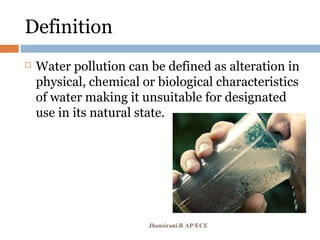
 Water pollution can be defined as alteration in
physical, chemical or biological characteristics
of water making it unsuitable for designated
use in its natural state.
Jhansirani.R AP/ECE
Types and Sources of Water Pollution
 Water is an essential commodity for survival.
We need water for drinking, cooking,
bathing, washing, irrigation and for
industrial operations. Water has the
property to dissolve many substances in it.
Therefore it can easily get polluted. Pollution of
water can be caused by
Jhansirani.R AP/ECE
Point sources
Nonpoint sources
Pg. 535
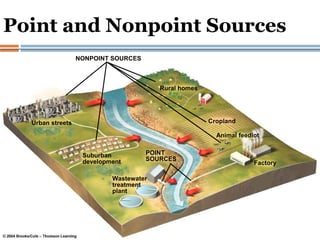
Point sources
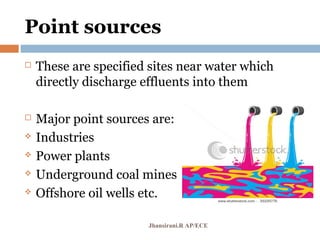
 These are specified sites near water which
directly discharge effluents into them
 Major point sources are:
 Industries
 Power plants
 Underground coal mines
 Offshore oil wells etc.
Jhansirani.R AP/ECE
Non-point sources
 The discharge from non-point sources is not at
any particular site rather, these sources are
scattered, which individually or collectively
pollute water
 Ex:
 Surface run-off from agricultural fields
 Overflowing small drains
 Rain water sweeping roads & fields
 Atmospheric deposition etc.,
Jhansirani.R AP/ECE
Point and Nonpoint Sources
Jhansirani.R AP/ECE
NONPOINT SOURCES
Urban streets
Suburban
development
Wastewater
treatment
plant
Rural homes
Cropland
Factory
Animal feedlot
POINT
SOURCES
Ground water pollution
 Ground water forms about 6.2% of the total water
available on planet earth and is about 30 times more
than surface water (i.e. streams, lakes and estuaries).
 Main responsible for ground water pollution is
 Septic tanks,
 Industry (textile, chemical, and tanneries),
 Deep well injection,
 Mining etc.,
 Ground water pollution with arsenic, fluoride and
nitrate are posing serious health hazards.
Jhansirani.R AP/ECE
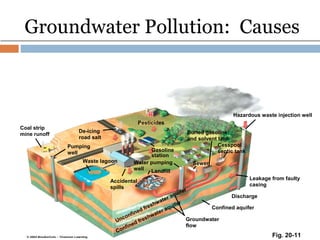
Groundwater Pollution: Causes
Jhansirani.R AP/ECE
Coal strip
mine runoff
Pumping
well
Waste lagoon
Accidental
spills
Groundwater
flow
Confined aquifer
Discharge
Leakage from faulty
casing
Hazardous waste injection well
Pesticides
Gasoline
station
Buried gasoline
and solvent tank
Sewer
Cesspool
septic tank
De-icing
road salt
Unconfined freshwater aquifer
Confined freshwater aquifer
Water pumping
well Landfill
Fig. 20-11
Surface water pollution
 The major sources of surface water pollution are:
1 .Sewage: Emptying drains & sewers
2. Industrial effluents: Toxic chemicals, acids,
salts
3. Synthetic detergents: In washing & cleaning
4. Agrochemicals: Fertilizers, insecticides etc.,
5. Oil: oil spill in sea water
6. Waste heat: from industrial discharge
Jhansirani.R AP/ECE
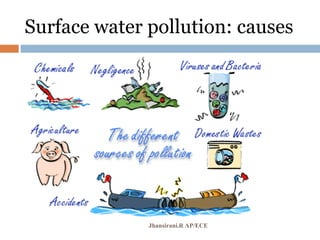
Surface water pollution: causes
Jhansirani.R AP/ECE
Effects of Water pollution
Jhansirani.R AP/ECE
 Effects of various types of water pollutants:
 Bacteria, Viruses, Protozoa, Parasitic
worms
 Oxygen demanding wastes
 Nitrogen and Phosphorus Compounds
(Nutrients)
 Pathogens
 Toxic Compounds
Oxygen demanding wastes
 Organic matter which reaches water bodies is
decomposed by micro-organisms present in water.
For this degradation oxygen dissolved in water is
consumed.
 Dissolved oxygen (DO) is the amount of oxygen
dissolved in a given quantity of water at a particular
temperature and atmospheric pressure
 Amount of DO depends on:
Aeration, photosynthetic activity in
water, respiration of animals and plants and
ambient temperature.
Jhansirani.R AP/ECE
Oxygen demanding wastes
 The saturation value of DO varies from 8-15 mg/L.
 Active fish species requires 5-8 mg/L of DO
 Less desirable species like carp can survive at 3
mg/L of DO
 Lower DO may be harmful to animals especially fish
population
 Oxygen depletion helps in release of phosphates
from bottom sediments and causes
eutrophication.
Jhansirani.R AP/ECE
Nitrogen & phosphorus compounds
(nutrients)
 Addition of compounds containing nitrogen and
phosphorus helps in the growth of algae and other
plants which when die and decay consume oxygen of
water
 Under anaerobic conditions foul smelling gases are
produced
 Excess growth or decomposition of plant material will
change the concentration of CO2 which will further
change pH of water
 Changes in pH, oxygen and temperature will change
many physic-chemical characteristics of water.
Jhansirani.R AP/ECE
Pathogens
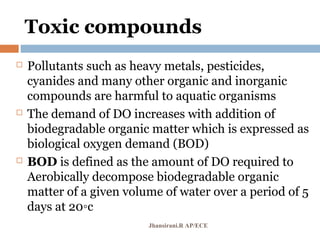
 Many waste water especially
sewage contain many
pathogenic and non pathogenic
micro-organisms and many
viruses.
 Water borne diseases like
cholera, dysentery, typhoid,
jaundice etc., are spread by
water contaminated with
sewage.
Jhansirani.R AP/ECE
Toxic compounds
 Pollutants such as heavy metals, pesticides,
cyanides and many other organic and inorganic
compounds are harmful to aquatic organisms
 The demand of DO increases with addition of
biodegradable organic matter which is expressed as
biological oxygen demand (BOD)
 BOD is defined as the amount of DO required to
Aerobically decompose biodegradable organic
matter of a given volume of water over a period of 5
days at 20◦c
Jhansirani.R AP/ECE
Toxic compounds
 More BOD values of any water sample are
associated with poor water quality
 The non biodegradable toxic compounds
biomagnify in the food chain and causes toxic
effects at various levels of food chain
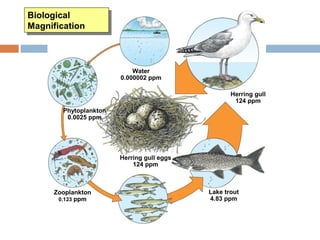
 DDT is not water soluble and gets accumulated in
the organisms body. This process is called
bioaccumulation
 The concentration of these toxic substances builds
up at successive levels of food chain. This process is
called Biomagnification Jhansirani.R AP/ECE
Rainbow smelt
1.04 ppm
Zooplankton
0.123 ppm
Phytoplankton
0.0025 ppm
Water
0.000002 ppm
Herring gull
124 ppm
Lake trout
4.83 ppm
Herring gull eggs
124 ppm
Biological
Magnification
Biological
Magnification
Effects of Water pollution
 Toxic substances polluting the water ultimately
affect human health
 Heavy metals like lead, mercury, cadmium causes
various types of diseases
 Mercury in water is transformed into methyl
mercury
 Minamata disease is occurred due to consumption
of methyl mercury contaminated fish
 Disease called Itai-Itai was caused by cadmium
contaminated rice.
Jhansirani.R AP/ECE
Effects of Water pollution
 Arsenic pollution of ground water is causing various
types of abnormalities
 Nitrate when present excess in drinking water causes
blue baby syndrome
 Nitrate in stomach partly gets changed into nitrites
which can produce cancer in stomach
 Fluoride in drinking water causes defects in teeth
and bones called fluorosis
 Pesticides in drinking water causes health problems
 DDT, aldrin, dieldrin etc., have been banned.
Jhansirani.R AP/ECE
Control of water pollution
 It is easy to reduce water pollution from point
sources by legislation. However it is difficult to
prevent water pollution from non-point sources,
The following points may help to reduce water
pollution from non-point sources.
1. Judicious use of agrochemicals like pesticides and
fertilizers which will reduce their surface run-off
and leaching. Avoid use of these on sloped lands.
Jhansirani.R AP/ECE
Control of water pollution
2. Use of nitrogen fixing plants to supplement the use of
fertilizers.
3. Adopting integrated pest management to reduce
reliance on pesticides.
4. Prevent run-off of manure. Divert such run-off to basin
for settlement. The nutrient rich water can be used as
fertilizer in the fields.
5. Separate drainage of sewage and rain water should be
provided.
6. Plantation of trees would reduce pollution and will also
prevent soil erosion. Jhansirani.R AP/ECE
Control of water pollution
 Controlling water pollution from point source
 Treatment of waste water is essential before being
discharged
 Parameters like total solids, BOD, COD, nitrates &
phosphates, oil & grease, toxic metals etc., to be
considered for reduction in waters
 Waste water should be properly treated by primary
and secondary treatments to reduce the BOD,COD
levels
Jhansirani.R AP/ECE
Waste water treatment
 The type of treatment of water depends upon its
characteristics and the desired quality of water after
treatment.
 Thus waste water treatment plants are primary,
secondary or advanced treatment.
 The purpose of waste water treatment is to
remove/reduce organic and inorganic substances,
nutrients, toxic substances, kill pathogenic organisms,…
 Treatment of water thus aims at reduction of BOD, COD,
eutrophication etc., and prevent biomagnifications,
prevent diseases due to pathogenic organisms in waste
water. Jhansirani.R AP/ECE
Steps involved in waste water treatment
 Primary treatment
 Secondary treatment
 Trickling filters
 Activated sludge process
 Rotating biological contractor (RBC)
 Advanced sewage treatment
 Upflow anaerobic sludge blanket (UASB) reactor
Jhansirani.R AP/ECE
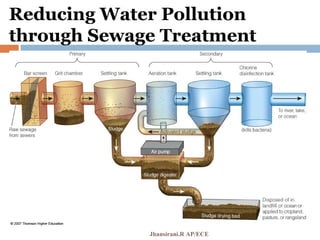
Reducing Water Pollution
through Sewage Treatment
Jhansirani.R AP/ECE
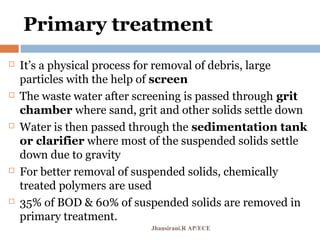
Primary treatment
 It’s a physical process for removal of debris, large
particles with the help of screen
 The waste water after screening is passed through grit
chamber where sand, grit and other solids settle down
 Water is then passed through the sedimentation tank
or clarifier where most of the suspended solids settle
down due to gravity
 For better removal of suspended solids, chemically
treated polymers are used
 35% of BOD & 60% of suspended solids are removed in
primary treatment.
Jhansirani.R AP/ECE
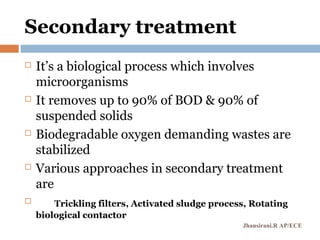
Secondary treatment
 It’s a biological process which involves
microorganisms
 It removes up to 90% of BOD & 90% of
suspended solids
 Biodegradable oxygen demanding wastes are
stabilized
 Various approaches in secondary treatment
are
 Trickling filters, Activated sludge process, Rotating
biological contactor
Jhansirani.R AP/ECE
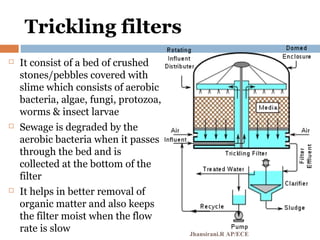
Trickling filters
 It consist of a bed of crushed
stones/pebbles covered with
slime which consists of aerobic
bacteria, algae, fungi, protozoa,
worms & insect larvae
 Sewage is degraded by the
aerobic bacteria when it passes
through the bed and is
collected at the bottom of the
filter
 It helps in better removal of
organic matter and also keeps
the filter moist when the flow
rate is slow Jhansirani.R AP/ECE
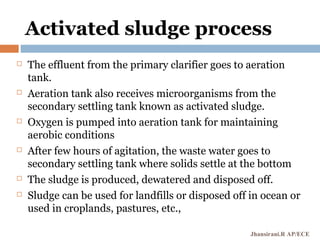
Activated sludge process
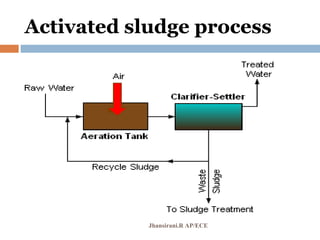
 The effluent from the primary clarifier goes to aeration
tank.
 Aeration tank also receives microorganisms from the
secondary settling tank known as activated sludge.
 Oxygen is pumped into aeration tank for maintaining
aerobic conditions
 After few hours of agitation, the waste water goes to
secondary settling tank where solids settle at the bottom
 The sludge is produced, dewatered and disposed off.
 Sludge can be used for landfills or disposed off in ocean or
used in croplands, pastures, etc.,
Jhansirani.R AP/ECE
Activated sludge process
Jhansirani.R AP/ECE
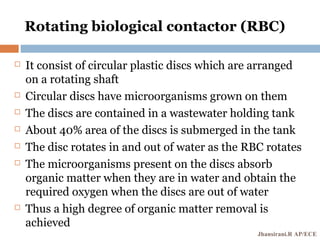
Rotating biological contactor (RBC)
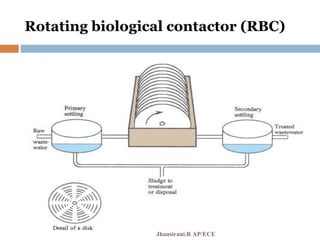
 It consist of circular plastic discs which are arranged
on a rotating shaft
 Circular discs have microorganisms grown on them
 The discs are contained in a wastewater holding tank
 About 40% area of the discs is submerged in the tank
 The disc rotates in and out of water as the RBC rotates
 The microorganisms present on the discs absorb
organic matter when they are in water and obtain the
required oxygen when the discs are out of water
 Thus a high degree of organic matter removal is
achieved
Jhansirani.R AP/ECE
Rotating biological contactor (RBC)
Jhansirani.R AP/ECE
Advanced sewage treatment
 After primary & secondary treatment many undesirable
substances still remain in the effluent
 Advanced water treatment involves the removal of such
substances
 The materials to be removed in such treatment may
include nitrates and phosphates, color, bacteria, viruses,
pesticides, toxic metals, etc.,
 Chlorination of water is generally done to kill harmful
bacteria & viruses
 However chlorine can produce cancer causing
chlorinated hydrocarbons by reacting with organic
matter
Jhansirani.R AP/ECE
Advanced sewage treatment
 Other, but costly methods of disinfection are the
use of ultraviolet light and ozone
treatment
 The sludge produced after such treatment is
used as a fertilizer in the fields
 However, there are chances of toxic metals and
other untreated substances to build up in the
food chain or leach to the groundwater.
Jhansirani.R AP/ECE
Up flow anaerobic sludge blanket
(UASB) Reactor
 Anaerobic treatment is gaining importance as a
method of wastewater treatment due to its
effectiveness in treating wastewater and
economic advantages
 USAB process consists of 4 stages
* Hydrolysis
* Acidogenesis
* Acetogenesis
* Methanogenesis
Jhansirani.R AP/ECE
USAB Reactor
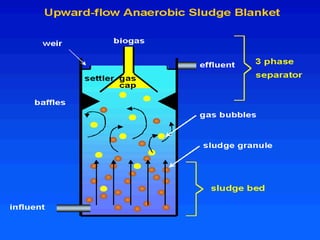
 A dense blanket of granular anaerobic biomass is used to
convert organic compounds that are passed through the
sludge blanket continuously
 Biogas produced is collected at the top of the reactor
 Wastewater to be treated is fed into the reactor at the bottom
 As the influent flows through the loops and enters the reactor
chamber, hydrolysis occurs
 The above mentioned 4 processes convert the influent into
H2, CO2, CH4, Acetate, new cell-matter etc.,
 COD removal up to 80% is achieved
 Methane and CO2 produced are separated from the reactor
Jhansirani.R AP/ECE
Jhansirani.R AP/ECE
What Can You Do?
Water Pollution
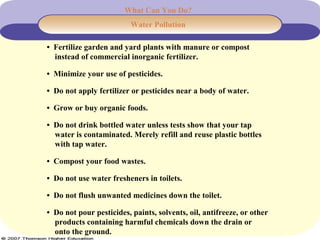
• Fertilize garden and yard plants with manure or compost
instead of commercial inorganic fertilizer.
• Minimize your use of pesticides.
• Do not apply fertilizer or pesticides near a body of water.
• Grow or buy organic foods.
• Do not drink bottled water unless tests show that your tap
water is contaminated. Merely refill and reuse plastic bottles
with tap water.
• Compost your food wastes.
• Do not use water fresheners in toilets.
• Do not flush unwanted medicines down the toilet.
• Do not pour pesticides, paints, solvents, oil, antifreeze, or other
products containing harmful chemicals down the drain or
onto the ground.
Jhansirani.R AP/ECE

Water pollution

  • 1.
  • 2.
    Definition  Water pollutioncan be defined as alteration in physical, chemical or biological characteristics of water making it unsuitable for designated use in its natural state. Jhansirani.R AP/ECE
  • 3.
    Types and Sourcesof Water Pollution  Water is an essential commodity for survival. We need water for drinking, cooking, bathing, washing, irrigation and for industrial operations. Water has the property to dissolve many substances in it. Therefore it can easily get polluted. Pollution of water can be caused by Jhansirani.R AP/ECE Point sources Nonpoint sources Pg. 535
  • 4.
    Point sources  Theseare specified sites near water which directly discharge effluents into them  Major point sources are:  Industries  Power plants  Underground coal mines  Offshore oil wells etc. Jhansirani.R AP/ECE
  • 5.
    Non-point sources  Thedischarge from non-point sources is not at any particular site rather, these sources are scattered, which individually or collectively pollute water  Ex:  Surface run-off from agricultural fields  Overflowing small drains  Rain water sweeping roads & fields  Atmospheric deposition etc., Jhansirani.R AP/ECE
  • 6.
    Point and NonpointSources Jhansirani.R AP/ECE NONPOINT SOURCES Urban streets Suburban development Wastewater treatment plant Rural homes Cropland Factory Animal feedlot POINT SOURCES
  • 7.
    Ground water pollution Ground water forms about 6.2% of the total water available on planet earth and is about 30 times more than surface water (i.e. streams, lakes and estuaries).  Main responsible for ground water pollution is  Septic tanks,  Industry (textile, chemical, and tanneries),  Deep well injection,  Mining etc.,  Ground water pollution with arsenic, fluoride and nitrate are posing serious health hazards. Jhansirani.R AP/ECE
  • 8.
    Groundwater Pollution: Causes Jhansirani.RAP/ECE Coal strip mine runoff Pumping well Waste lagoon Accidental spills Groundwater flow Confined aquifer Discharge Leakage from faulty casing Hazardous waste injection well Pesticides Gasoline station Buried gasoline and solvent tank Sewer Cesspool septic tank De-icing road salt Unconfined freshwater aquifer Confined freshwater aquifer Water pumping well Landfill Fig. 20-11
  • 9.
    Surface water pollution The major sources of surface water pollution are: 1 .Sewage: Emptying drains & sewers 2. Industrial effluents: Toxic chemicals, acids, salts 3. Synthetic detergents: In washing & cleaning 4. Agrochemicals: Fertilizers, insecticides etc., 5. Oil: oil spill in sea water 6. Waste heat: from industrial discharge Jhansirani.R AP/ECE
  • 10.
    Surface water pollution:causes Jhansirani.R AP/ECE
  • 11.
    Effects of Waterpollution Jhansirani.R AP/ECE  Effects of various types of water pollutants:  Bacteria, Viruses, Protozoa, Parasitic worms  Oxygen demanding wastes  Nitrogen and Phosphorus Compounds (Nutrients)  Pathogens  Toxic Compounds
  • 12.
    Oxygen demanding wastes Organic matter which reaches water bodies is decomposed by micro-organisms present in water. For this degradation oxygen dissolved in water is consumed.  Dissolved oxygen (DO) is the amount of oxygen dissolved in a given quantity of water at a particular temperature and atmospheric pressure  Amount of DO depends on: Aeration, photosynthetic activity in water, respiration of animals and plants and ambient temperature. Jhansirani.R AP/ECE
  • 13.
    Oxygen demanding wastes The saturation value of DO varies from 8-15 mg/L.  Active fish species requires 5-8 mg/L of DO  Less desirable species like carp can survive at 3 mg/L of DO  Lower DO may be harmful to animals especially fish population  Oxygen depletion helps in release of phosphates from bottom sediments and causes eutrophication. Jhansirani.R AP/ECE
  • 14.
    Nitrogen & phosphoruscompounds (nutrients)  Addition of compounds containing nitrogen and phosphorus helps in the growth of algae and other plants which when die and decay consume oxygen of water  Under anaerobic conditions foul smelling gases are produced  Excess growth or decomposition of plant material will change the concentration of CO2 which will further change pH of water  Changes in pH, oxygen and temperature will change many physic-chemical characteristics of water. Jhansirani.R AP/ECE
  • 15.
    Pathogens  Many wastewater especially sewage contain many pathogenic and non pathogenic micro-organisms and many viruses.  Water borne diseases like cholera, dysentery, typhoid, jaundice etc., are spread by water contaminated with sewage. Jhansirani.R AP/ECE
  • 16.
    Toxic compounds  Pollutantssuch as heavy metals, pesticides, cyanides and many other organic and inorganic compounds are harmful to aquatic organisms  The demand of DO increases with addition of biodegradable organic matter which is expressed as biological oxygen demand (BOD)  BOD is defined as the amount of DO required to Aerobically decompose biodegradable organic matter of a given volume of water over a period of 5 days at 20◦c Jhansirani.R AP/ECE
  • 17.
    Toxic compounds  MoreBOD values of any water sample are associated with poor water quality  The non biodegradable toxic compounds biomagnify in the food chain and causes toxic effects at various levels of food chain  DDT is not water soluble and gets accumulated in the organisms body. This process is called bioaccumulation  The concentration of these toxic substances builds up at successive levels of food chain. This process is called Biomagnification Jhansirani.R AP/ECE
  • 18.
    Rainbow smelt 1.04 ppm Zooplankton 0.123ppm Phytoplankton 0.0025 ppm Water 0.000002 ppm Herring gull 124 ppm Lake trout 4.83 ppm Herring gull eggs 124 ppm Biological Magnification Biological Magnification
  • 19.
    Effects of Waterpollution  Toxic substances polluting the water ultimately affect human health  Heavy metals like lead, mercury, cadmium causes various types of diseases  Mercury in water is transformed into methyl mercury  Minamata disease is occurred due to consumption of methyl mercury contaminated fish  Disease called Itai-Itai was caused by cadmium contaminated rice. Jhansirani.R AP/ECE
  • 20.
    Effects of Waterpollution  Arsenic pollution of ground water is causing various types of abnormalities  Nitrate when present excess in drinking water causes blue baby syndrome  Nitrate in stomach partly gets changed into nitrites which can produce cancer in stomach  Fluoride in drinking water causes defects in teeth and bones called fluorosis  Pesticides in drinking water causes health problems  DDT, aldrin, dieldrin etc., have been banned. Jhansirani.R AP/ECE
  • 21.
    Control of waterpollution  It is easy to reduce water pollution from point sources by legislation. However it is difficult to prevent water pollution from non-point sources, The following points may help to reduce water pollution from non-point sources. 1. Judicious use of agrochemicals like pesticides and fertilizers which will reduce their surface run-off and leaching. Avoid use of these on sloped lands. Jhansirani.R AP/ECE
  • 22.
    Control of waterpollution 2. Use of nitrogen fixing plants to supplement the use of fertilizers. 3. Adopting integrated pest management to reduce reliance on pesticides. 4. Prevent run-off of manure. Divert such run-off to basin for settlement. The nutrient rich water can be used as fertilizer in the fields. 5. Separate drainage of sewage and rain water should be provided. 6. Plantation of trees would reduce pollution and will also prevent soil erosion. Jhansirani.R AP/ECE
  • 23.
    Control of waterpollution  Controlling water pollution from point source  Treatment of waste water is essential before being discharged  Parameters like total solids, BOD, COD, nitrates & phosphates, oil & grease, toxic metals etc., to be considered for reduction in waters  Waste water should be properly treated by primary and secondary treatments to reduce the BOD,COD levels Jhansirani.R AP/ECE
  • 24.
    Waste water treatment The type of treatment of water depends upon its characteristics and the desired quality of water after treatment.  Thus waste water treatment plants are primary, secondary or advanced treatment.  The purpose of waste water treatment is to remove/reduce organic and inorganic substances, nutrients, toxic substances, kill pathogenic organisms,…  Treatment of water thus aims at reduction of BOD, COD, eutrophication etc., and prevent biomagnifications, prevent diseases due to pathogenic organisms in waste water. Jhansirani.R AP/ECE
  • 25.
    Steps involved inwaste water treatment  Primary treatment  Secondary treatment  Trickling filters  Activated sludge process  Rotating biological contractor (RBC)  Advanced sewage treatment  Upflow anaerobic sludge blanket (UASB) reactor Jhansirani.R AP/ECE
  • 26.
    Reducing Water Pollution throughSewage Treatment Jhansirani.R AP/ECE
  • 27.
    Primary treatment  It’sa physical process for removal of debris, large particles with the help of screen  The waste water after screening is passed through grit chamber where sand, grit and other solids settle down  Water is then passed through the sedimentation tank or clarifier where most of the suspended solids settle down due to gravity  For better removal of suspended solids, chemically treated polymers are used  35% of BOD & 60% of suspended solids are removed in primary treatment. Jhansirani.R AP/ECE
  • 28.
    Secondary treatment  It’sa biological process which involves microorganisms  It removes up to 90% of BOD & 90% of suspended solids  Biodegradable oxygen demanding wastes are stabilized  Various approaches in secondary treatment are  Trickling filters, Activated sludge process, Rotating biological contactor Jhansirani.R AP/ECE
  • 29.
    Trickling filters  Itconsist of a bed of crushed stones/pebbles covered with slime which consists of aerobic bacteria, algae, fungi, protozoa, worms & insect larvae  Sewage is degraded by the aerobic bacteria when it passes through the bed and is collected at the bottom of the filter  It helps in better removal of organic matter and also keeps the filter moist when the flow rate is slow Jhansirani.R AP/ECE
  • 30.
    Activated sludge process The effluent from the primary clarifier goes to aeration tank.  Aeration tank also receives microorganisms from the secondary settling tank known as activated sludge.  Oxygen is pumped into aeration tank for maintaining aerobic conditions  After few hours of agitation, the waste water goes to secondary settling tank where solids settle at the bottom  The sludge is produced, dewatered and disposed off.  Sludge can be used for landfills or disposed off in ocean or used in croplands, pastures, etc., Jhansirani.R AP/ECE
  • 31.
  • 32.
    Rotating biological contactor(RBC)  It consist of circular plastic discs which are arranged on a rotating shaft  Circular discs have microorganisms grown on them  The discs are contained in a wastewater holding tank  About 40% area of the discs is submerged in the tank  The disc rotates in and out of water as the RBC rotates  The microorganisms present on the discs absorb organic matter when they are in water and obtain the required oxygen when the discs are out of water  Thus a high degree of organic matter removal is achieved Jhansirani.R AP/ECE
  • 33.
    Rotating biological contactor(RBC) Jhansirani.R AP/ECE
  • 34.
    Advanced sewage treatment After primary & secondary treatment many undesirable substances still remain in the effluent  Advanced water treatment involves the removal of such substances  The materials to be removed in such treatment may include nitrates and phosphates, color, bacteria, viruses, pesticides, toxic metals, etc.,  Chlorination of water is generally done to kill harmful bacteria & viruses  However chlorine can produce cancer causing chlorinated hydrocarbons by reacting with organic matter Jhansirani.R AP/ECE
  • 35.
    Advanced sewage treatment Other, but costly methods of disinfection are the use of ultraviolet light and ozone treatment  The sludge produced after such treatment is used as a fertilizer in the fields  However, there are chances of toxic metals and other untreated substances to build up in the food chain or leach to the groundwater. Jhansirani.R AP/ECE
  • 36.
    Up flow anaerobicsludge blanket (UASB) Reactor  Anaerobic treatment is gaining importance as a method of wastewater treatment due to its effectiveness in treating wastewater and economic advantages  USAB process consists of 4 stages * Hydrolysis * Acidogenesis * Acetogenesis * Methanogenesis Jhansirani.R AP/ECE
  • 37.
    USAB Reactor  Adense blanket of granular anaerobic biomass is used to convert organic compounds that are passed through the sludge blanket continuously  Biogas produced is collected at the top of the reactor  Wastewater to be treated is fed into the reactor at the bottom  As the influent flows through the loops and enters the reactor chamber, hydrolysis occurs  The above mentioned 4 processes convert the influent into H2, CO2, CH4, Acetate, new cell-matter etc.,  COD removal up to 80% is achieved  Methane and CO2 produced are separated from the reactor Jhansirani.R AP/ECE
  • 38.
  • 39.
    What Can YouDo? Water Pollution • Fertilize garden and yard plants with manure or compost instead of commercial inorganic fertilizer. • Minimize your use of pesticides. • Do not apply fertilizer or pesticides near a body of water. • Grow or buy organic foods. • Do not drink bottled water unless tests show that your tap water is contaminated. Merely refill and reuse plastic bottles with tap water. • Compost your food wastes. • Do not use water fresheners in toilets. • Do not flush unwanted medicines down the toilet. • Do not pour pesticides, paints, solvents, oil, antifreeze, or other products containing harmful chemicals down the drain or onto the ground.
  • 40.

Editor's Notes

  • #4 Water quality indication of what beneficial uses of water- spawning, recreation, swimming,drinking.
  • #12 Bacteria viruses Eat oxygen, phosphates, heat, introduction of non native species Table 19-2 tells all the things from bacteria,…vomiting, diarreha,dehydration
  • #19 Why we need good water quality. Higher in food chain means more concentrated is contamination. Where are we on the food chain. Why Audobuan society devotes money to water quality. To protect birds.
  • #40 Figure 21.19 Individuals matter: ways to help reduce water pollution. QUESTION: Which three of these actions do you think are the most important?