3/12/12           A/B Day
LEQ: How are aquatic and terrestrial
food webs connected?
1. What is a wetland?
2. What is a tributary?
3. What is a watershed?
4. How are estuaries and wetlands similar?
How are they different?
5. Copy and complete: Most of our freshwater
is located [underground/in lakes and
rivers/frozen in glaciers and polar ice caps]
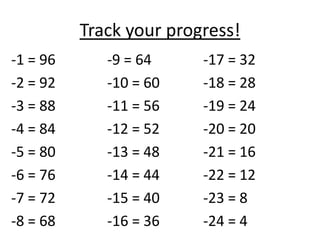
Track your progress!
-1 = 96      -9 = 64     -17 = 32
-2 = 92      -10 = 60    -18 = 28
-3 = 88      -11 = 56    -19 = 24
-4 = 84      -12 = 52    -20 = 20
-5 = 80      -13 = 48    -21 = 16
-6 = 76      -14 = 44    -22 = 12
-7 = 72      -15 = 40    -23 = 8
-8 = 68      -16 = 36    -24 = 4
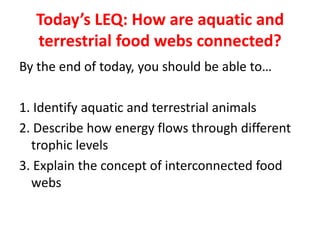
Today’s LEQ: How are aquatic and
  terrestrial food webs connected?
By the end of today, you should be able to…

1. Identify aquatic and terrestrial animals
2. Describe how energy flows through different
  trophic levels
3. Explain the concept of interconnected food
  webs
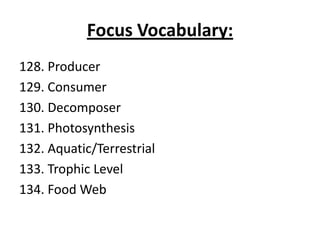
Focus Vocabulary:
128. Producer
129. Consumer
130. Decomposer
131. Photosynthesis
132. Aquatic/Terrestrial
133. Trophic Level
134. Food Web
Draw a T-Chart in your notes:
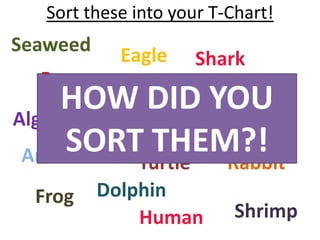
Sort these into your T-Chart!
Seaweed     Eagle     Shark
  Bear                  Tree
Algae
     HOW DID YOU
           Mouse
             Fish Krill
       Snake
 Ant  SORT THEM?!
              Turtle      Rabbit
  Frog    Dolphin
              Human        Shrimp
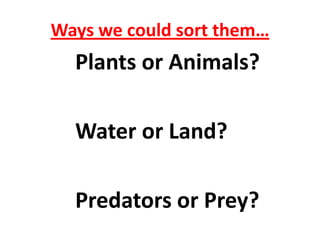
Ways we could sort them…
  Plants or Animals?

  Water or Land?

  Predators or Prey?
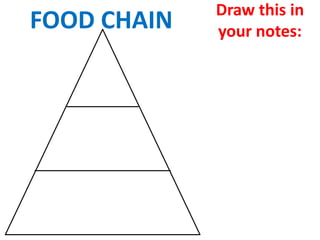
Draw this in
FOOD CHAIN   your notes:
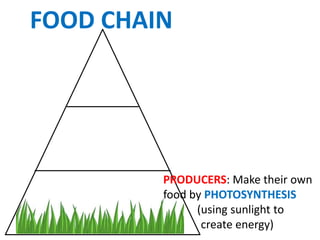
FOOD CHAIN


         PRODUCERS: Make their own
         food by PHOTOSYNTHESIS
               (using sunlight to
                create energy)
BrainPop: Photosynthesis
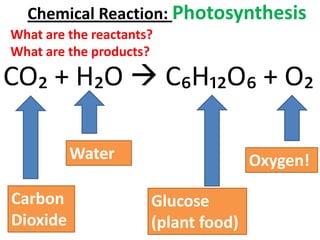
Chemical Reaction: Photosynthesis
What are the reactants?
What are the products?

CO₂ + H₂O  C₆H₁₂O₆ + O₂

          Water                      Oxygen!

Carbon                Glucose
Dioxide               (plant food)
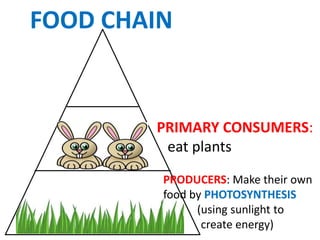
FOOD CHAIN


        PRIMARY CONSUMERS:
         eat plants
         PRODUCERS: Make their own
         food by PHOTOSYNTHESIS
               (using sunlight to
                create energy)
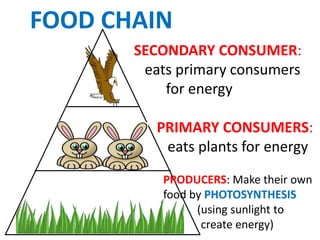
FOOD CHAIN
       SECONDARY CONSUMER:
        eats primary consumers
           for energy

          PRIMARY CONSUMERS:
           eats plants for energy
           PRODUCERS: Make their own
           food by PHOTOSYNTHESIS
                 (using sunlight to
                  create energy)
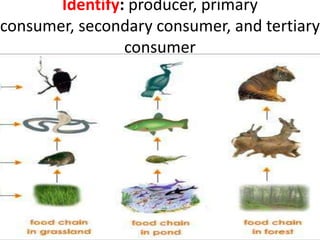
Identify: producer, primary
consumer, secondary consumer, and tertiary
                consumer
Draw this in your notes:
Producers     Consumers
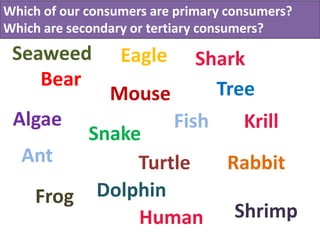
Which of our consumers areyour T-Chart!
      Sort these into primary consumers?
Which are secondary or tertiary consumers?
 Seaweed         Eagle     Shark
    Bear                     Tree
               Mouse
 Algae                   Fish     Krill
        Snake
  Ant        Turtle             Rabbit
   Frog  Dolphin
             Human               Shrimp
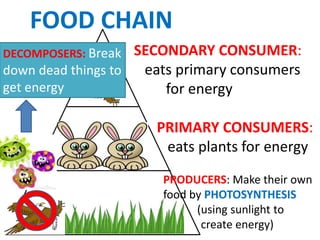
FOOD CHAIN
DECOMPOSERS: Break  SECONDARY CONSUMER:
down dead things to  eats primary consumers
get energy              for energy

                      PRIMARY CONSUMERS:
                       eats plants for energy
                       PRODUCERS: Make their own
                       food by PHOTOSYNTHESIS
                             (using sunlight to
                              create energy)
Brainpop: Food Chains
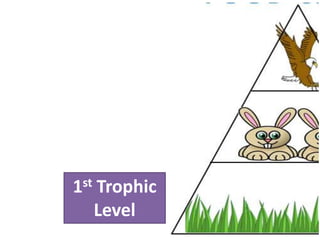
1st Trophic
   Level
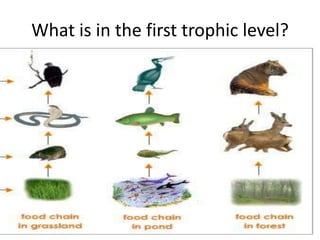
What is in the first trophic level?
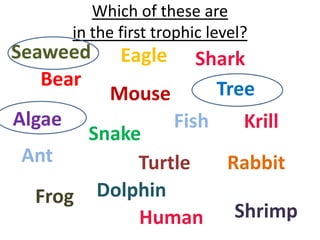
Which of these are
        in the first trophic level?
Seaweed        Eagle      Shark
   Bear                     Tree
             Mouse
Algae                  Fish       Krill
      Snake
Ant        Turtle              Rabbit
 Frog  Dolphin
           Human                 Shrimp
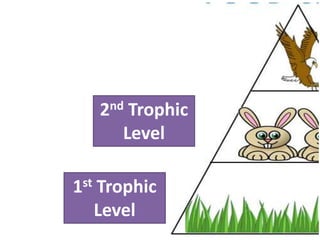
2nd Trophic
      Level

1st Trophic
   Level
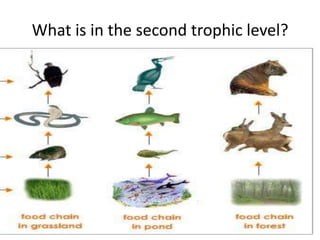
What is in the second trophic level?
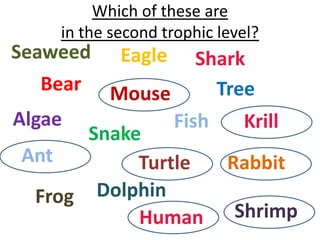
Which of these are
     in the second trophic level?
Seaweed Eagle Shark
   Bear Mouse        Tree
Algae           Fish    Krill
       Snake
 Ant        Turtle    Rabbit
  Frog  Dolphin
            Human Shrimp
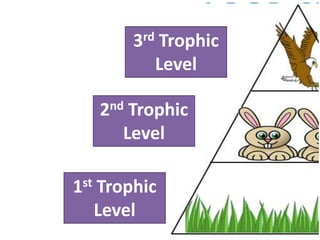
3rd   Trophic
               Level

   2nd Trophic
      Level

1st Trophic
   Level
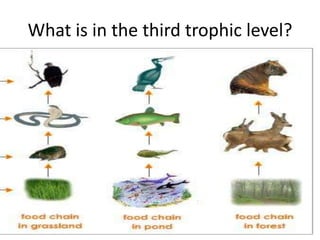
What is in the third trophic level?
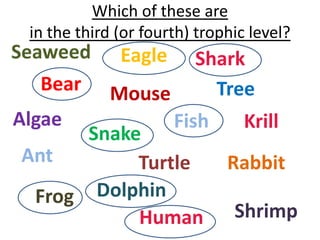
Which of these are
 in the third (or fourth) trophic level?
Seaweed Eagle Shark
   Bear Mouse        Tree
Algae           Fish    Krill
       Snake
 Ant        Turtle    Rabbit
  Frog  Dolphin
            Human Shrimp
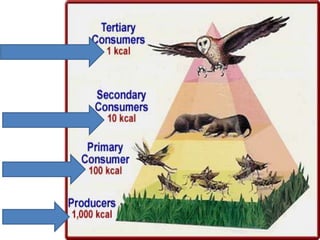
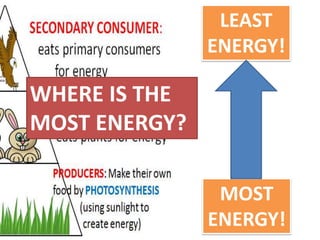
How does energy go through the food chain?
       Not all trophic levels in the food chain are created
equal! Every organism in the food chain takes in
energy, either from the sun (through photosynthesis) or from
eating something else. But, every time something gets
eaten, it doesn’t transfer all of its energy—just some of it. For
example, it takes a rabbit lots of energy to grow bones and
teeth, but hawks don’t EAT bones and teeth, so the hawk
doesn’t get all of the energy that a rabbit has!
       As a result, every time we go UP one trophic level, only
about 10% of the energy gets passed on. That’s why we draw
food chains in a pyramid—the 1st trophic level (the producers)
have a TON of energy, so it’s place on the pyramid is much
bigger than the secondary and tertiary consumers (like eagles
or sharks) at the top of the pyramid.
LEAST
               ENERGY!

WHERE IS THE
MOST ENERGY?

                MOST
               ENERGY!
CONTEXT CLUES:
“Fish, shrimp, whales, krill, coral reefs, and
  kelp are all a part of the aquatic world”

“The terrestrial environment around my
 house is very interesting—there are
 trees, grasses, rocks, insects, and
 mammals such as raccoons and
 squirrels.”
                   Stop and Jot: Write your own definition of
Aquaman!
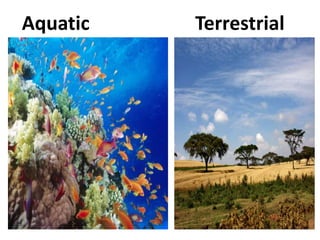
Aquatic   Terrestrial
WORD WEB: What words do
you associate with “aquatic”?


     Aquatic
WORD WEB: What words do
you associate with “terrestrial”?


     Terrestrial
Draw this in your notes:
Aquatic       Terrestrial
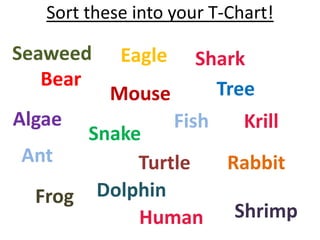
Sort these into your T-Chart!

Seaweed     Eagle     Shark
   Bear                 Tree
           Mouse
Algae               Fish    Krill
      Snake
Ant        Turtle          Rabbit
 Frog  Dolphin
           Human           Shrimp
Video on a bear eating a fish
• http://www.youtube.com/watch?v=QzZ4sy
  stdZc&feature=fvwrel @ 1:45
Bears and Salmon:

How are these animals
      related?

How are they different?
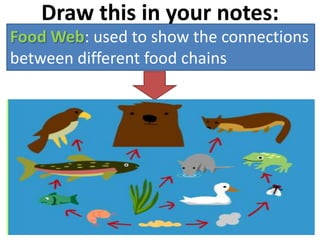
Draw this in your notes:
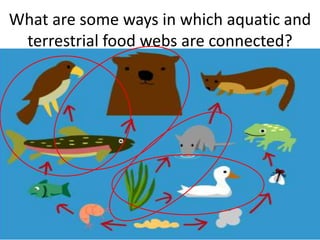
Food Web: used to show the connections
between different food chains
What are some ways in which aquatic and
 terrestrial food webs are connected?
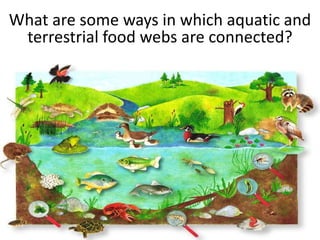
What are some ways in which aquatic and
 terrestrial food webs are connected?
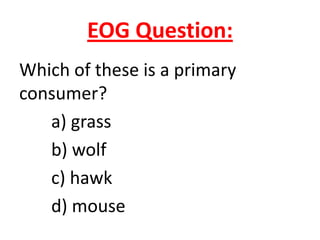
EOG Question:
Which of these is a primary
consumer?
   a) grass
   b) wolf
   c) hawk
   d) mouse
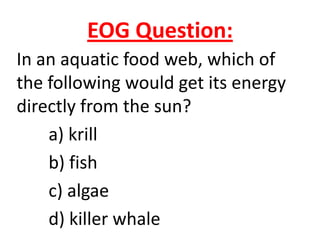
EOG Question:
In an aquatic food web, which of
the following would get its energy
directly from the sun?
    a) krill
    b) fish
    c) algae
    d) killer whale
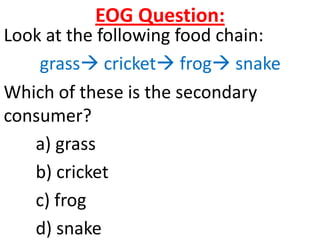
EOG Question:
Look at the following food chain:
    grass cricket frog snake
Which of these is the secondary
consumer?
   a) grass
   b) cricket
   c) frog
   d) snake
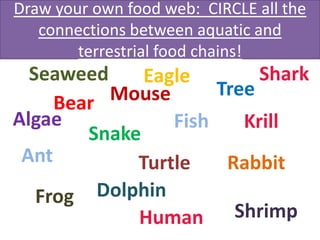
Draw your own food web: CIRCLE all the
   connections between aquatic and
        terrestrial food chains!
  Seaweed      Eagle        Shark
           Mouse       Tree
     Bear
Algae             Fish    Krill
        Snake
 Ant          Turtle    Rabbit
   Frog   Dolphin
              Human Shrimp
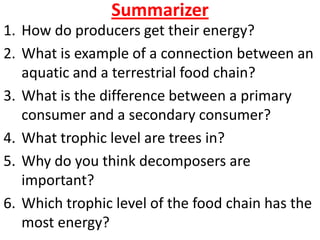
Summarizer
1. How do producers get their energy?
2. What is example of a connection between an
   aquatic and a terrestrial food chain?
3. What is the difference between a primary
   consumer and a secondary consumer?
4. What trophic level are trees in?
5. Why do you think decomposers are
   important?
6. Which trophic level of the food chain has the
   most energy?
Discovery Education:
Food Chains and Food Webs

3/12/12

  • 1.
    3/12/12 A/B Day LEQ: How are aquatic and terrestrial food webs connected? 1. What is a wetland? 2. What is a tributary? 3. What is a watershed? 4. How are estuaries and wetlands similar? How are they different? 5. Copy and complete: Most of our freshwater is located [underground/in lakes and rivers/frozen in glaciers and polar ice caps]
  • 2.
    Track your progress! -1= 96 -9 = 64 -17 = 32 -2 = 92 -10 = 60 -18 = 28 -3 = 88 -11 = 56 -19 = 24 -4 = 84 -12 = 52 -20 = 20 -5 = 80 -13 = 48 -21 = 16 -6 = 76 -14 = 44 -22 = 12 -7 = 72 -15 = 40 -23 = 8 -8 = 68 -16 = 36 -24 = 4
  • 3.
    Today’s LEQ: Howare aquatic and terrestrial food webs connected? By the end of today, you should be able to… 1. Identify aquatic and terrestrial animals 2. Describe how energy flows through different trophic levels 3. Explain the concept of interconnected food webs
  • 4.
    Focus Vocabulary: 128. Producer 129.Consumer 130. Decomposer 131. Photosynthesis 132. Aquatic/Terrestrial 133. Trophic Level 134. Food Web
  • 5.
    Draw a T-Chartin your notes:
  • 6.
    Sort these intoyour T-Chart! Seaweed Eagle Shark Bear Tree Algae HOW DID YOU Mouse Fish Krill Snake Ant SORT THEM?! Turtle Rabbit Frog Dolphin Human Shrimp
  • 7.
    Ways we couldsort them… Plants or Animals? Water or Land? Predators or Prey?
  • 8.
    Draw this in FOODCHAIN your notes:
  • 9.
    FOOD CHAIN PRODUCERS: Make their own food by PHOTOSYNTHESIS (using sunlight to create energy)
  • 10.
  • 11.
    Chemical Reaction: Photosynthesis Whatare the reactants? What are the products? CO₂ + H₂O  C₆H₁₂O₆ + O₂ Water Oxygen! Carbon Glucose Dioxide (plant food)
  • 12.
    FOOD CHAIN PRIMARY CONSUMERS: eat plants PRODUCERS: Make their own food by PHOTOSYNTHESIS (using sunlight to create energy)
  • 13.
    FOOD CHAIN SECONDARY CONSUMER: eats primary consumers for energy PRIMARY CONSUMERS: eats plants for energy PRODUCERS: Make their own food by PHOTOSYNTHESIS (using sunlight to create energy)
  • 14.
    Identify: producer, primary consumer,secondary consumer, and tertiary consumer
  • 15.
    Draw this inyour notes: Producers Consumers
  • 16.
    Which of ourconsumers areyour T-Chart! Sort these into primary consumers? Which are secondary or tertiary consumers? Seaweed Eagle Shark Bear Tree Mouse Algae Fish Krill Snake Ant Turtle Rabbit Frog Dolphin Human Shrimp
  • 17.
    FOOD CHAIN DECOMPOSERS: Break SECONDARY CONSUMER: down dead things to eats primary consumers get energy for energy PRIMARY CONSUMERS: eats plants for energy PRODUCERS: Make their own food by PHOTOSYNTHESIS (using sunlight to create energy)
  • 18.
  • 19.
  • 20.
    What is inthe first trophic level?
  • 21.
    Which of theseare in the first trophic level? Seaweed Eagle Shark Bear Tree Mouse Algae Fish Krill Snake Ant Turtle Rabbit Frog Dolphin Human Shrimp
  • 22.
    2nd Trophic Level 1st Trophic Level
  • 23.
    What is inthe second trophic level?
  • 24.
    Which of theseare in the second trophic level? Seaweed Eagle Shark Bear Mouse Tree Algae Fish Krill Snake Ant Turtle Rabbit Frog Dolphin Human Shrimp
  • 25.
    3rd Trophic Level 2nd Trophic Level 1st Trophic Level
  • 26.
    What is inthe third trophic level?
  • 27.
    Which of theseare in the third (or fourth) trophic level? Seaweed Eagle Shark Bear Mouse Tree Algae Fish Krill Snake Ant Turtle Rabbit Frog Dolphin Human Shrimp
  • 28.
    How does energygo through the food chain? Not all trophic levels in the food chain are created equal! Every organism in the food chain takes in energy, either from the sun (through photosynthesis) or from eating something else. But, every time something gets eaten, it doesn’t transfer all of its energy—just some of it. For example, it takes a rabbit lots of energy to grow bones and teeth, but hawks don’t EAT bones and teeth, so the hawk doesn’t get all of the energy that a rabbit has! As a result, every time we go UP one trophic level, only about 10% of the energy gets passed on. That’s why we draw food chains in a pyramid—the 1st trophic level (the producers) have a TON of energy, so it’s place on the pyramid is much bigger than the secondary and tertiary consumers (like eagles or sharks) at the top of the pyramid.
  • 30.
    LEAST ENERGY! WHERE IS THE MOST ENERGY? MOST ENERGY!
  • 31.
    CONTEXT CLUES: “Fish, shrimp,whales, krill, coral reefs, and kelp are all a part of the aquatic world” “The terrestrial environment around my house is very interesting—there are trees, grasses, rocks, insects, and mammals such as raccoons and squirrels.” Stop and Jot: Write your own definition of
  • 32.
  • 33.
    Aquatic Terrestrial
  • 34.
    WORD WEB: Whatwords do you associate with “aquatic”? Aquatic
  • 35.
    WORD WEB: Whatwords do you associate with “terrestrial”? Terrestrial
  • 36.
    Draw this inyour notes: Aquatic Terrestrial
  • 37.
    Sort these intoyour T-Chart! Seaweed Eagle Shark Bear Tree Mouse Algae Fish Krill Snake Ant Turtle Rabbit Frog Dolphin Human Shrimp
  • 38.
    Video on abear eating a fish • http://www.youtube.com/watch?v=QzZ4sy stdZc&feature=fvwrel @ 1:45
  • 39.
    Bears and Salmon: Howare these animals related? How are they different?
  • 40.
    Draw this inyour notes: Food Web: used to show the connections between different food chains
  • 41.
    What are someways in which aquatic and terrestrial food webs are connected?
  • 42.
    What are someways in which aquatic and terrestrial food webs are connected?
  • 43.
    EOG Question: Which ofthese is a primary consumer? a) grass b) wolf c) hawk d) mouse
  • 44.
    EOG Question: In anaquatic food web, which of the following would get its energy directly from the sun? a) krill b) fish c) algae d) killer whale
  • 45.
    EOG Question: Look atthe following food chain: grass cricket frog snake Which of these is the secondary consumer? a) grass b) cricket c) frog d) snake
  • 46.
    Draw your ownfood web: CIRCLE all the connections between aquatic and terrestrial food chains! Seaweed Eagle Shark Mouse Tree Bear Algae Fish Krill Snake Ant Turtle Rabbit Frog Dolphin Human Shrimp
  • 47.
    Summarizer 1. How doproducers get their energy? 2. What is example of a connection between an aquatic and a terrestrial food chain? 3. What is the difference between a primary consumer and a secondary consumer? 4. What trophic level are trees in? 5. Why do you think decomposers are important? 6. Which trophic level of the food chain has the most energy?
  • 48.