2 Chapter   Information  Systems in the Enterprise
OBJECTIVES Evaluate the role played by the major types of systems in a business and their relationship to each other Describe the information systems supporting the major business functions: sales and marketing, manufacturing and production, finance and accounting, and human resources Management Information Systems Chapter 2 Information Systems in the Enterprise
Analyze the relationship between organizations, information systems, and business processes Explain how enterprise applications promote business process integration and improve organizational performance Assess the challenges posed by information systems in the enterprise and management solutions Management Information Systems Chapter 2 Information Systems in the Enterprise OBJECTIVES (continued)
Challenge:  monthly changes in fashions; Mango has 731 stores in 72 countries Solutions.  Inventory replenishment system  tracks all sales and matches stores with inventory.  Design teams  meet weekly to adjust to trends. Distribution system  allocates bar-coded items to specific stores based on store/product mix. Reduces time to market, increases agility Increases accuracy of decision making Management Information Systems Chapter 2 Information Systems in the Enterprise Mango Case: Fast Fashion, Hot Systems
Management Information Systems Chapter 2 Information Systems in the Enterprise MAJOR TYPES OF SYSTEMS IN ORGANIZATIONS   Types of Information Systems Figure 2-1
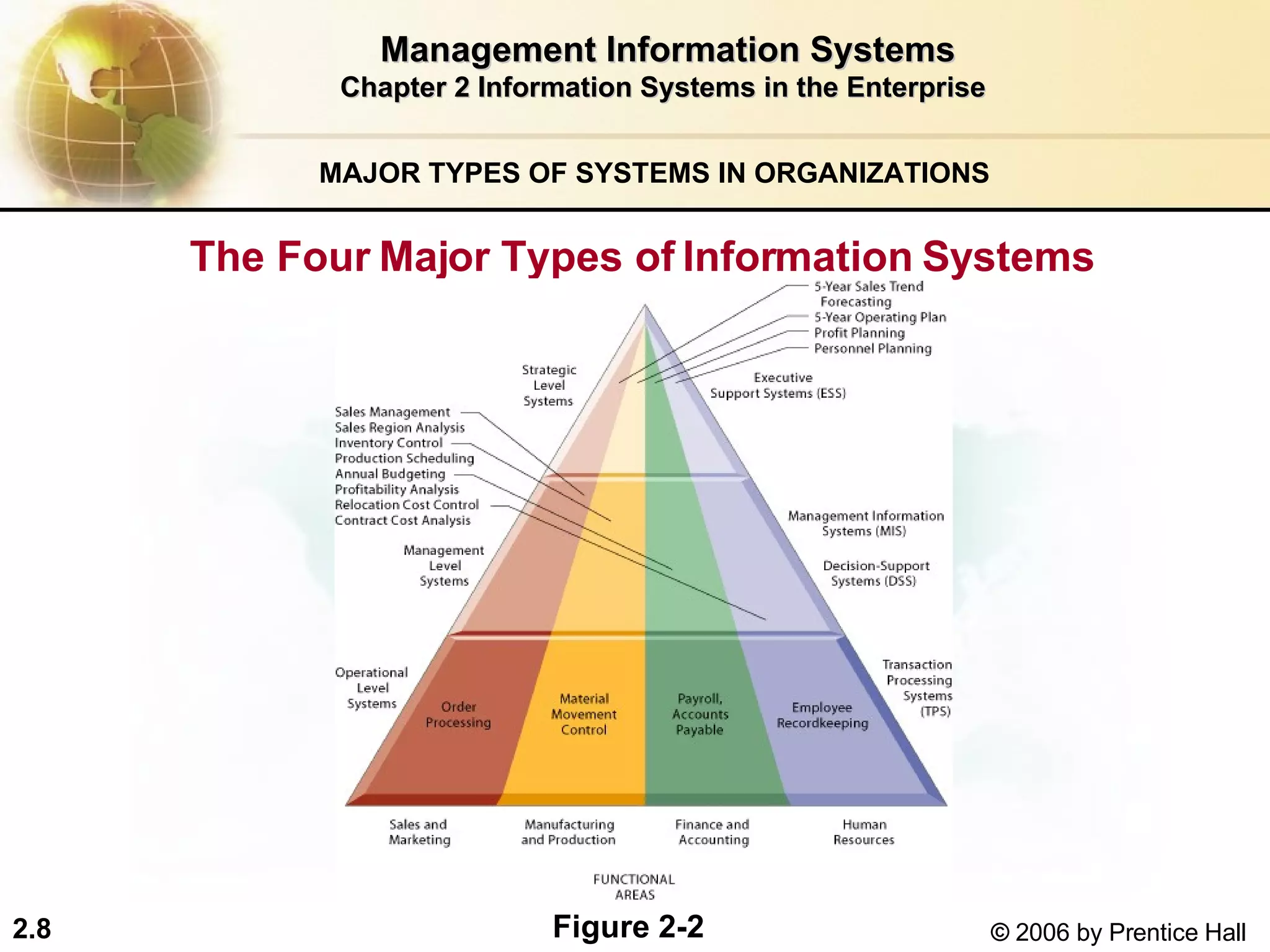
Management Information Systems Chapter 2 Information Systems in the Enterprise MAJOR TYPES OF SYSTEMS IN ORGANIZATIONS   Different Kinds of Systems Operational-level systems:   support operational managers, keeping track of the elementary activities and transactions Management-level systems:   serve the monitoring, controlling, decision-making, and administrative activities Strategic-level systems:   help senior management tackle and address strategic issues Three main categories of information systems serve different organizational levels:
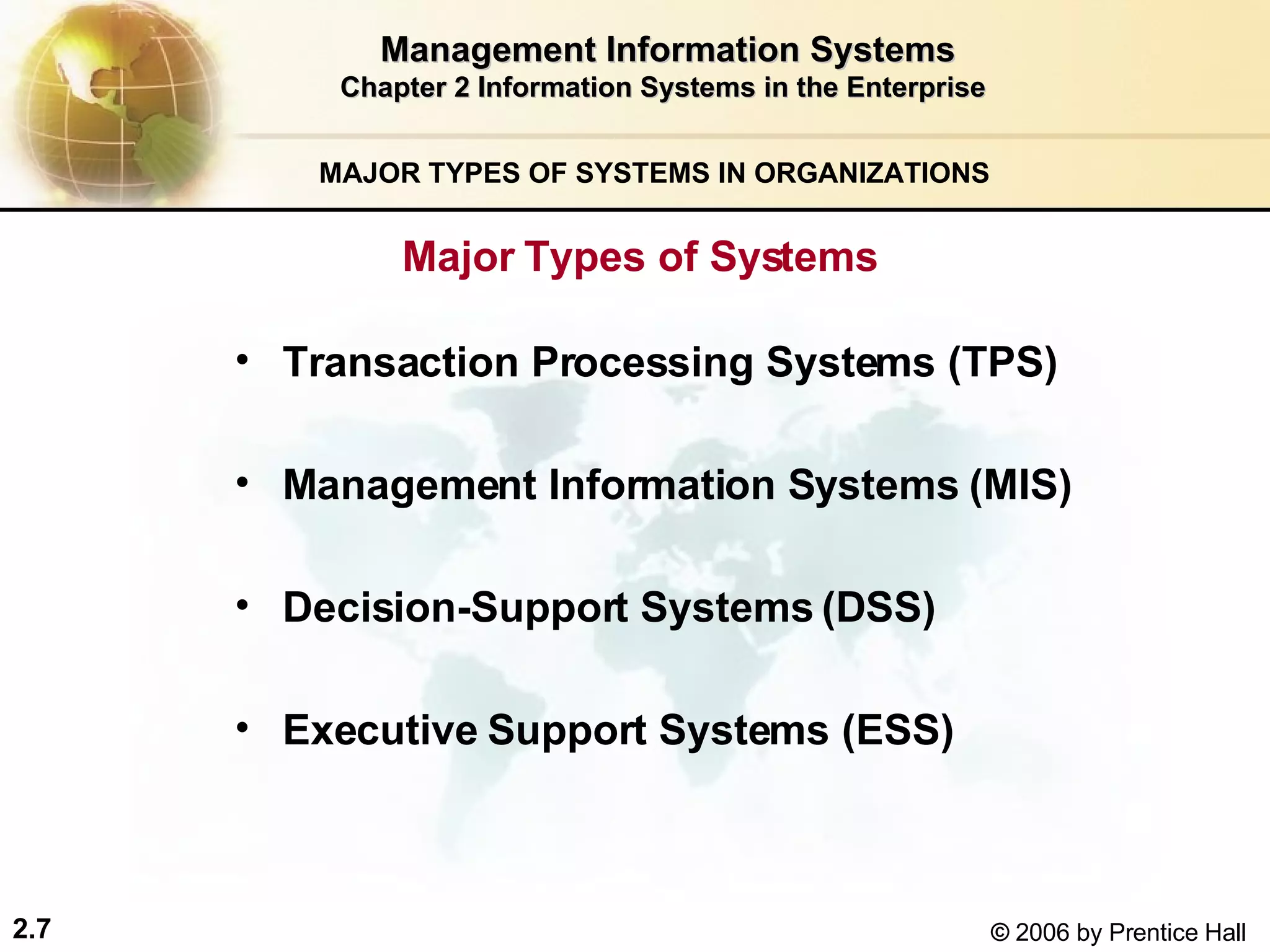
Management Information Systems Chapter 2 Information Systems in the Enterprise MAJOR TYPES OF SYSTEMS IN ORGANIZATIONS   Major Types of Systems  Transaction Processing Systems (TPS)   Management Information Systems (MIS)   Decision-Support Systems (DSS)   Executive Support Systems (ESS)
Management Information Systems Chapter 2 Information Systems in the Enterprise MAJOR TYPES OF SYSTEMS IN ORGANIZATIONS   The Four Major Types of Information Systems   Figure 2-2
Management Information Systems Chapter 2 Information Systems in the Enterprise MAJOR TYPES OF SYSTEMS IN ORGANIZATIONS   Transaction Processing Systems (TPS) Basic business systems that serve the operational level A computerized system that performs and records the daily routine transactions necessary to the conduct of the business
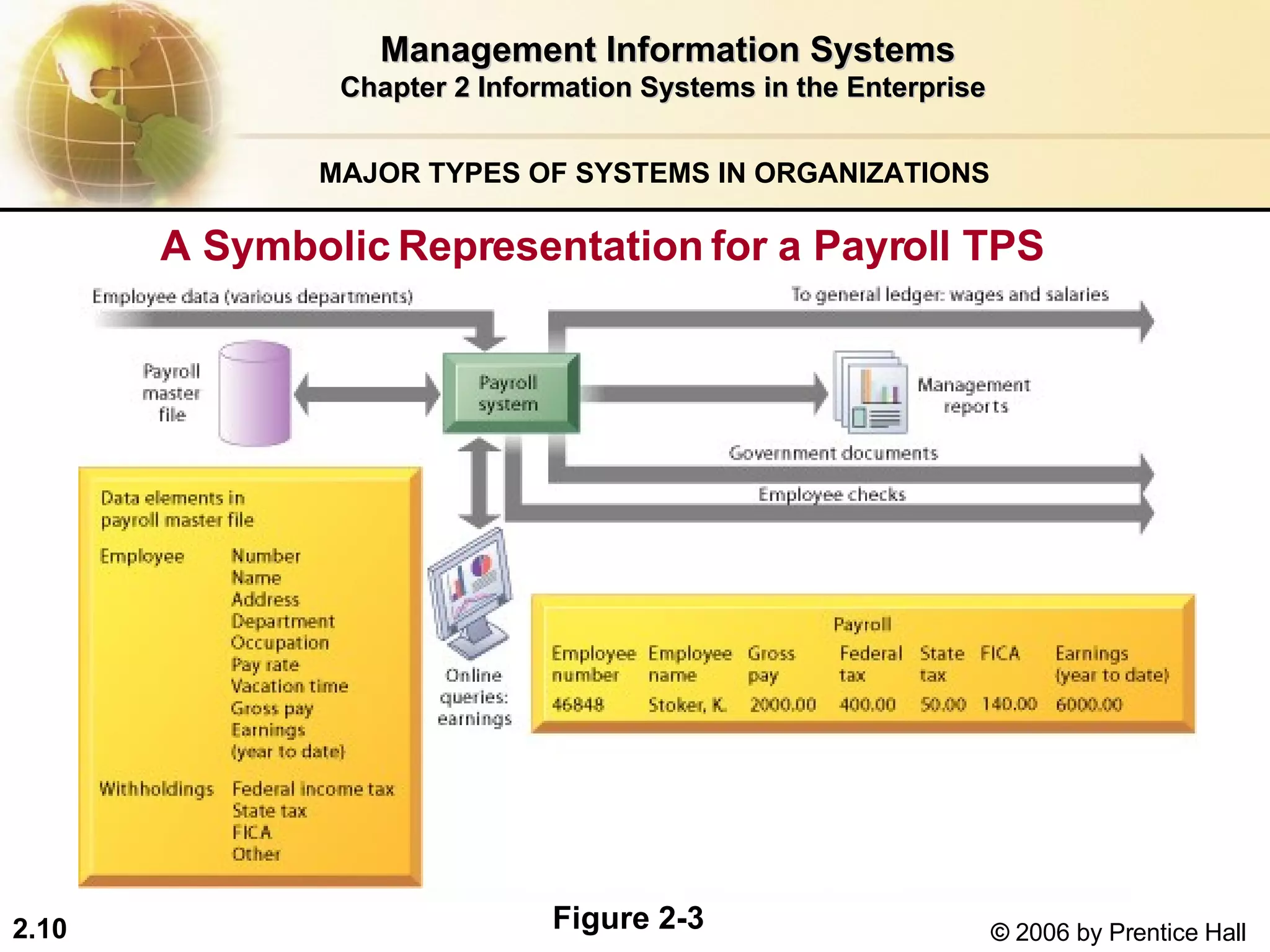
Management Information Systems Chapter 2 Information Systems in the Enterprise MAJOR TYPES OF SYSTEMS IN ORGANIZATIONS   A Symbolic Representation for a Payroll TPS  Figure 2-3
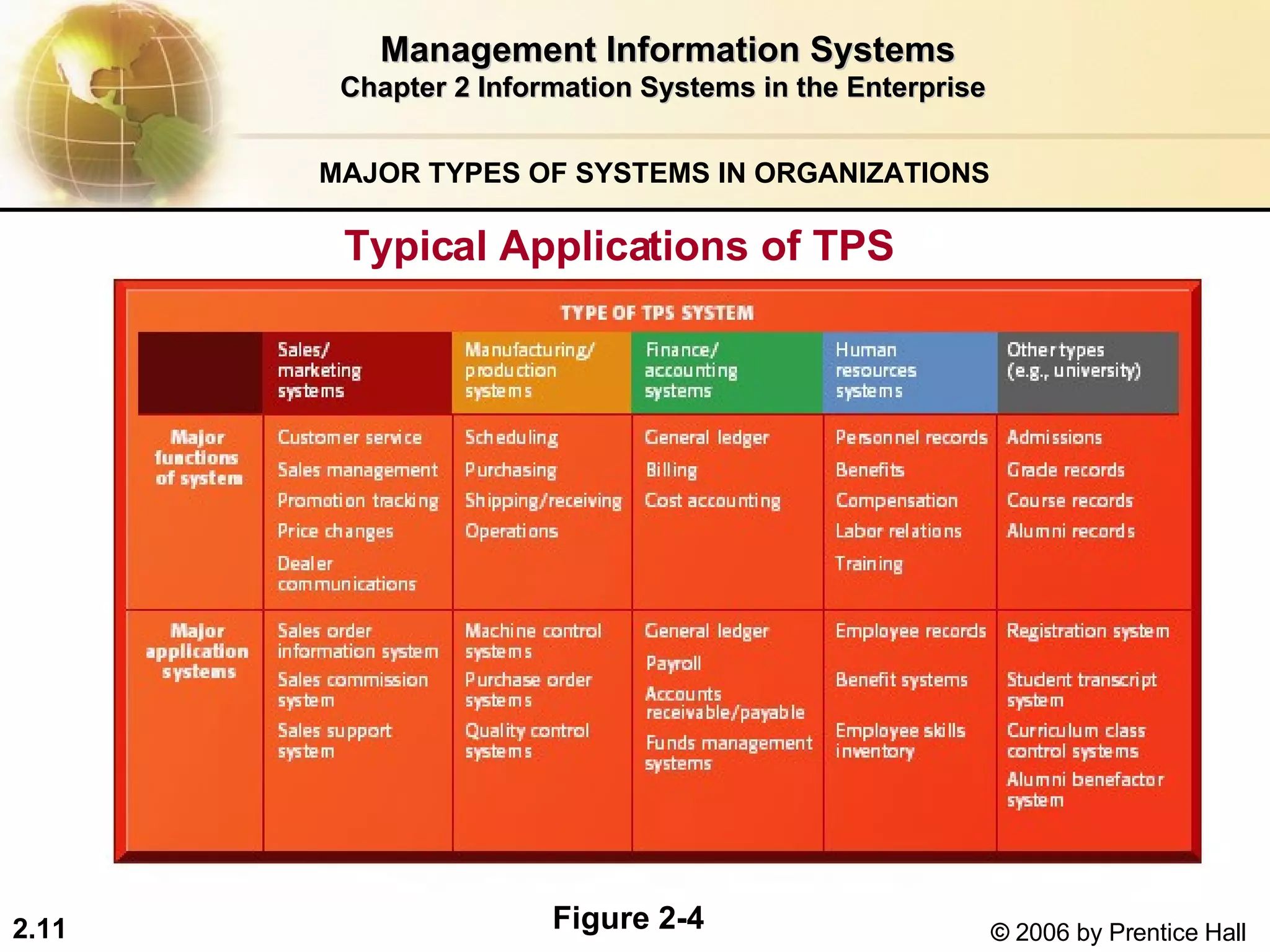
Management Information Systems Chapter 2 Information Systems in the Enterprise MAJOR TYPES OF SYSTEMS IN ORGANIZATIONS   Typical Applications of TPS  Figure 2-4
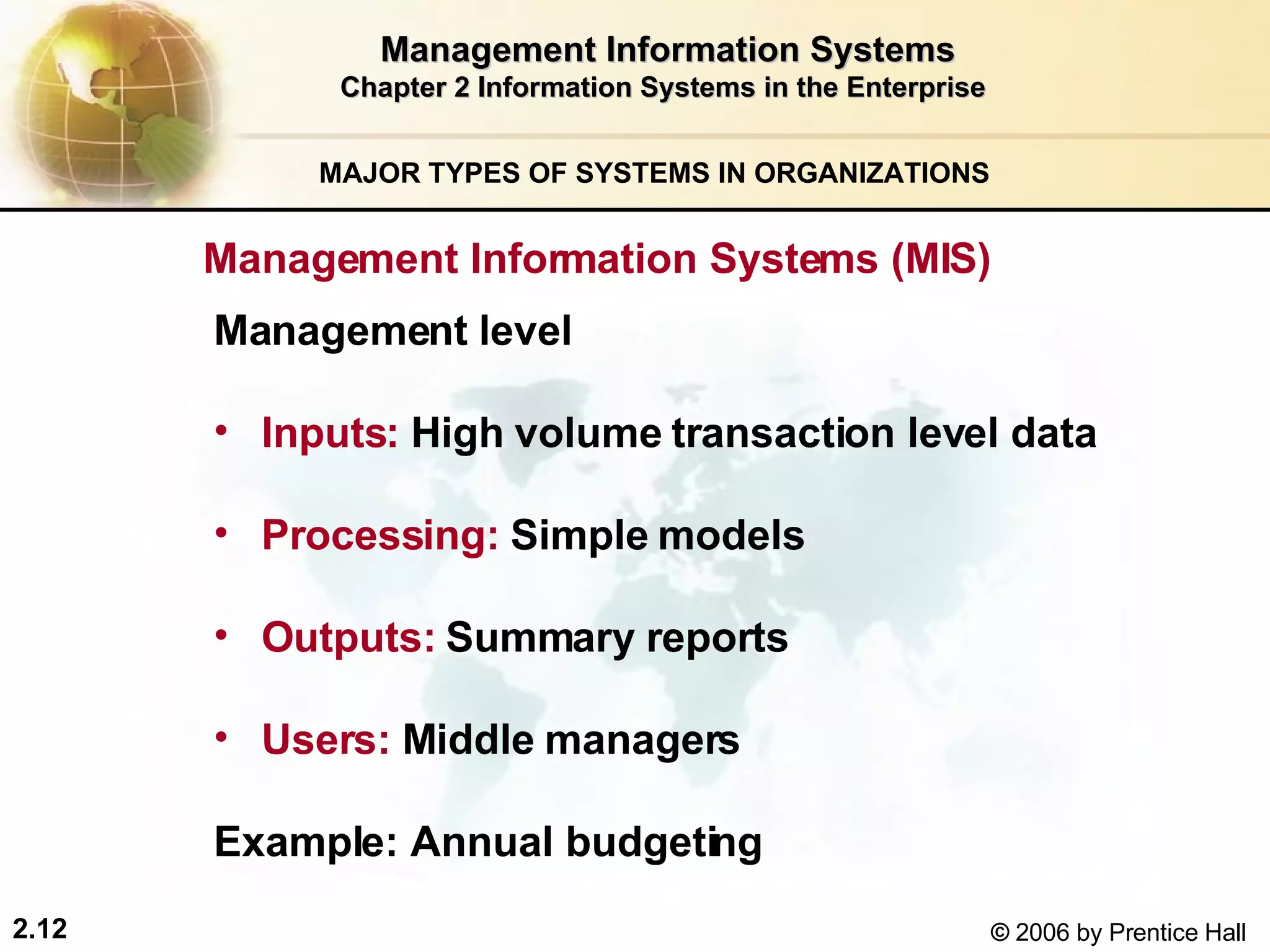
Management Information Systems Chapter 2 Information Systems in the Enterprise MAJOR TYPES OF SYSTEMS IN ORGANIZATIONS   Management Information Systems (MIS)  Management level Inputs:   High volume transaction level data   Processing:  Simple models Outputs:  Summary reports Users:  Middle managers   Example: Annual budgeting
Management Information Systems Chapter 2 Information Systems in the Enterprise MAJOR TYPES OF SYSTEMS IN ORGANIZATIONS   Management Information Systems (MIS) (continued) Figure 2-5
Management Information Systems Chapter 2 Information Systems in the Enterprise MAJOR TYPES OF SYSTEMS IN ORGANIZATIONS   Management Information Systems (MIS)  (continued) A sample MIS report   Figure 2-6
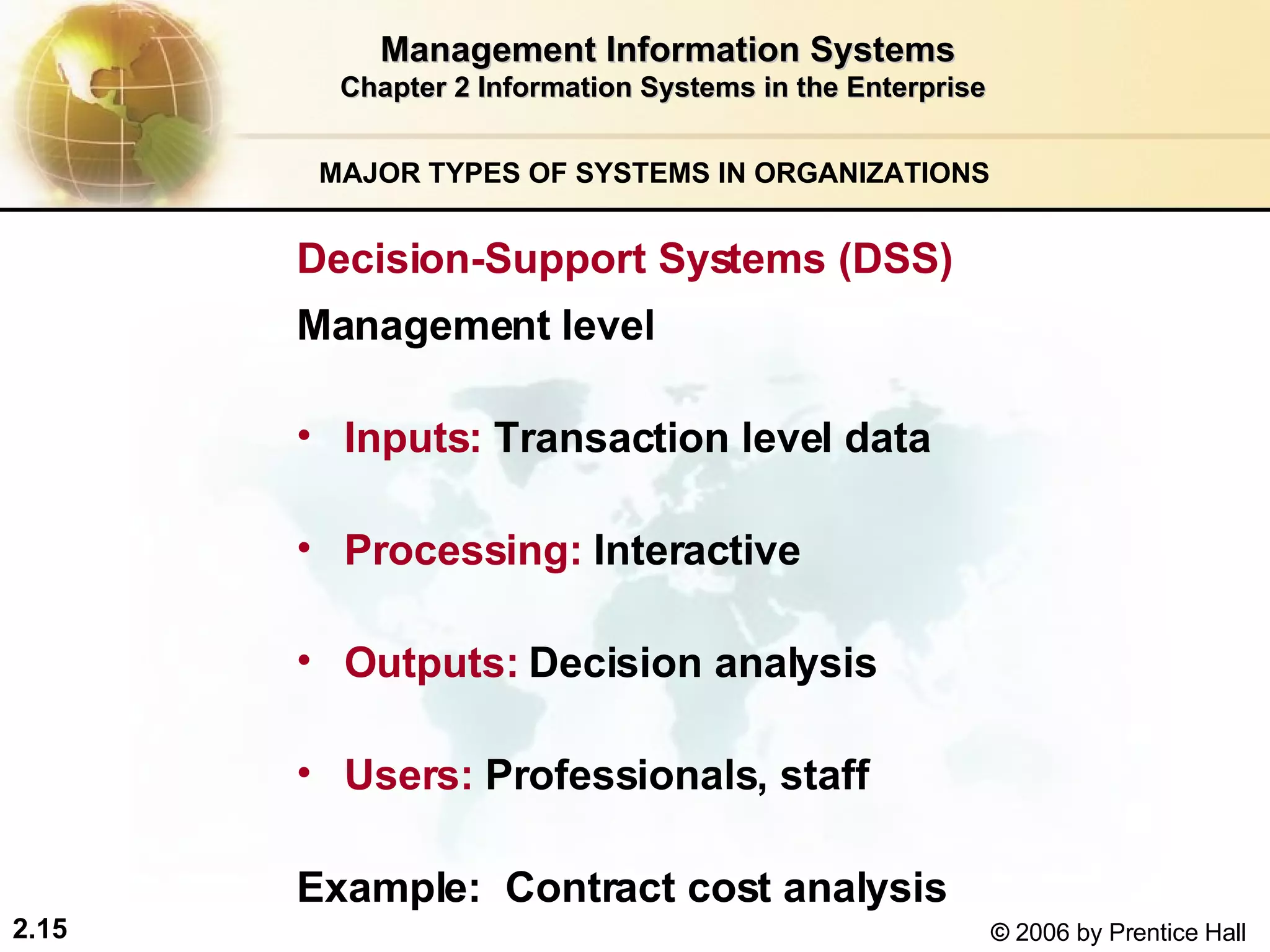
Management Information Systems Chapter 2 Information Systems in the Enterprise MAJOR TYPES OF SYSTEMS IN ORGANIZATIONS   Decision-Support Systems (DSS)  Management level Inputs:   Transaction level data   Processing:  Interactive Outputs:  Decision analysis Users:  Professionals, staff Example:  Contract cost analysis
Management Information Systems Chapter 2 Information Systems in the Enterprise MAJOR TYPES OF SYSTEMS IN ORGANIZATIONS   Decision-Support Systems (DSS) (Continued) Voyage-estimating decision-support system Figure 2-7
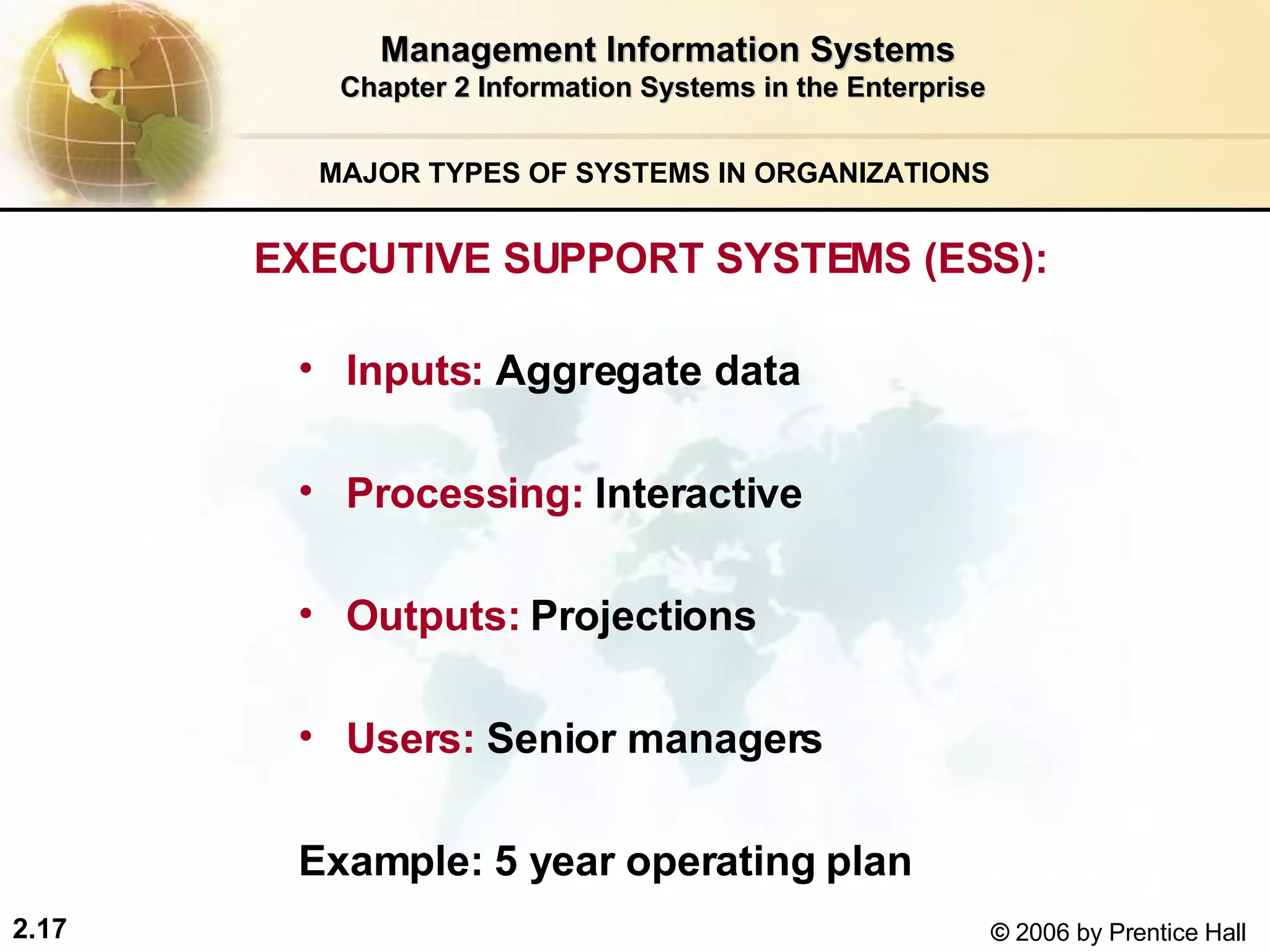
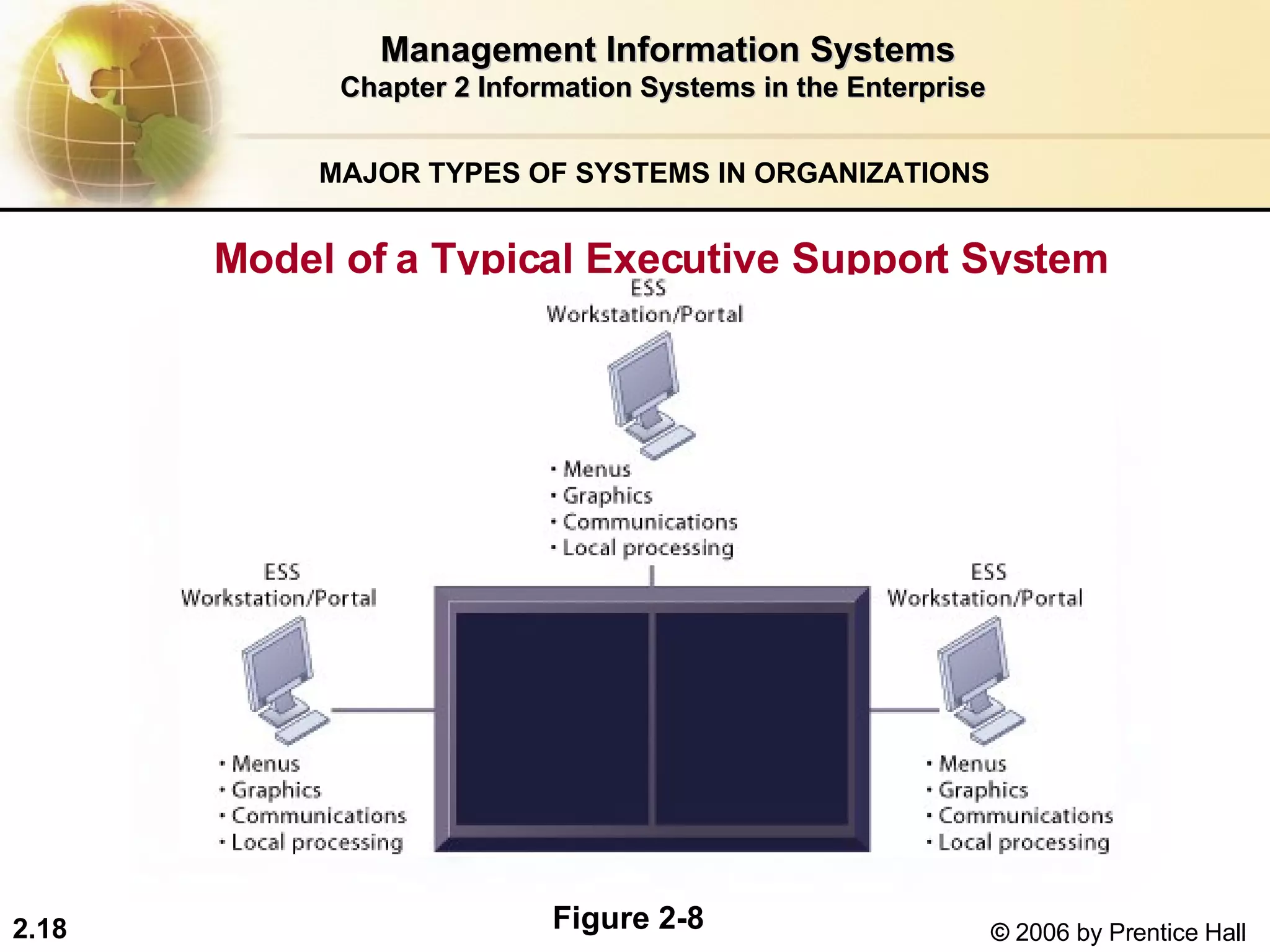
Management Information Systems Chapter 2 Information Systems in the Enterprise MAJOR TYPES OF SYSTEMS IN ORGANIZATIONS   EXECUTIVE SUPPORT SYSTEMS (ESS):  Inputs:   Aggregate data   Processing:   Interactive  Outputs:   Projections   Users:   Senior managers Example:  5 year operating plan
Management Information Systems Chapter 2 Information Systems in the Enterprise MAJOR TYPES OF SYSTEMS IN ORGANIZATIONS   Model of a Typical Executive Support System   Figure 2-8
Management Information Systems Chapter 2 Information Systems in the Enterprise MAJOR TYPES OF SYSTEMS IN ORGANIZATIONS   EXECUTIVE SUPPORT SYSTEMS (ESS)  (Continued) Top Level Management Designed to the individual  senior manager   Ties CEO to all levels Very expensive to keep up Extensive support staff
Management Information Systems Chapter 2 Information Systems in the Enterprise MAJOR TYPES OF SYSTEMS IN ORGANIZATIONS   Relationship of Systems to One Another   Interrelationships among systems   Figure 2-9
Management Information Systems Chapter 2 Information Systems in the Enterprise MAJOR TYPES OF SYSTEMS IN ORGANIZATIONS   Relationship of Systems to One Another   In contemporary digital firms, the different types of systems are closely linked to one another.  This is the ideal.  In traditional firms these systems tend to be isolated from one another, and information does not flow seamlessly from one end of the organization to the other. Efficiency and business value tend to suffer greatly in these traditional firms
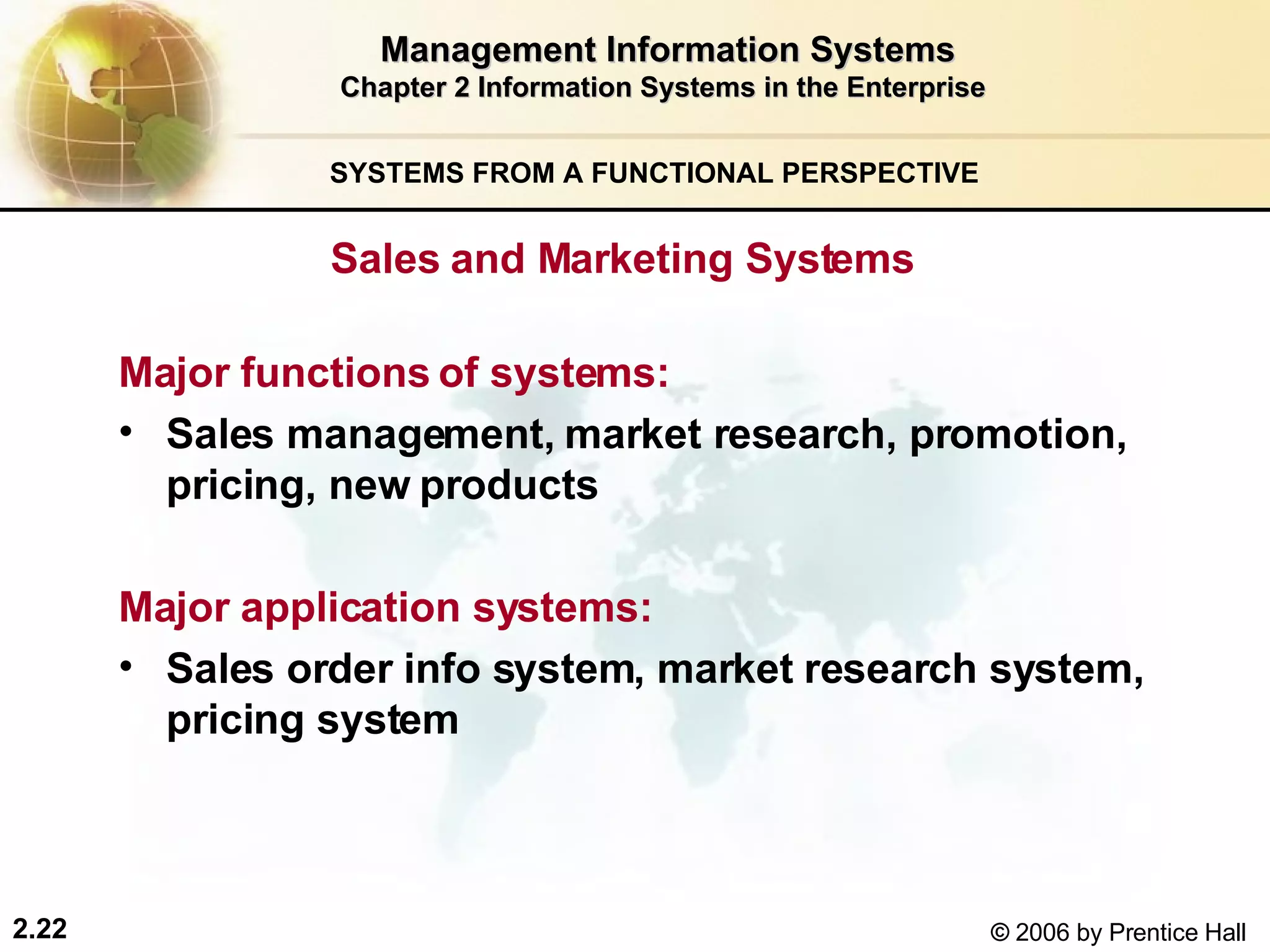
Management Information Systems Chapter 2 Information Systems in the Enterprise SYSTEMS FROM A FUNCTIONAL PERSPECTIVE  Sales and Marketing Systems  Major functions of systems:   Sales management, market research, promotion, pricing, new products Major application systems:   Sales order info system, market research system, pricing system
Management Information Systems Chapter 2 Information Systems in the Enterprise SYSTEMS FROM A FUNCTIONAL PERSPECTIVE  Sales and Marketing Systems      Table 2-2 SYSTEM  DESCRIPTION  ORGANIZATIONAL LEVEL       Order processing  Enter, process, and track orders Operational        Pricing analysis Determine prices for products and services Management        Sales trend forecasting Prepare 5-year sales forecasts Strategic
Management Information Systems Chapter 2 Information Systems in the Enterprise SYSTEMS FROM A FUNCTIONAL PERSPECTIVE  Manufacturing and Production Systems  Major functions of systems:   Scheduling, purchasing, shipping, receiving, engineering, operations  Major application systems:   Materials resource planning systems, purchase order control systems, engineering systems, quality control systems
Management Information Systems Chapter 2 Information Systems in the Enterprise SYSTEMS FROM A FUNCTIONAL PERSPECTIVE    Manufacturing and Production Systems  SYSTEM DESCRIPTION  ORGANIZATIONAL LEVEL        Machine control Control the actions of machines and equipment Operational       Production planning Decide when and how many products should be produced  Management       Facilities location  Decide where to locate new production facilities Strategic
Management Information Systems Chapter 2 Information Systems in the Enterprise Overview of an Inventory System  SYSTEMS FROM A FUNCTIONAL PERSPECTIVE  Figure 2-10
Management Information Systems Chapter 2 Information Systems in the Enterprise SYSTEMS FROM A FUNCTIONAL PERSPECTIVE  Financing and Accounting Systems  Major functions of systems:   Budgeting, general ledger, billing, cost accounting Major application systems:   General ledger, accounts receivable, accounts payable, budgeting, funds management systems
Management Information Systems Chapter 2 Information Systems in the Enterprise SYSTEMS FROM A FUNCTIONAL PERSPECTIVE  Financing & Accounting Systems (Continued)   Table 2-4 SYSTEM  DESCRIPTION  ORGANIZATION-AL LEVEL        Accounts receivable  Tracks money owed the firm Operational       Budgeting Prepares short-term budgets Management       Profit planning Plans long-term profits Strategic
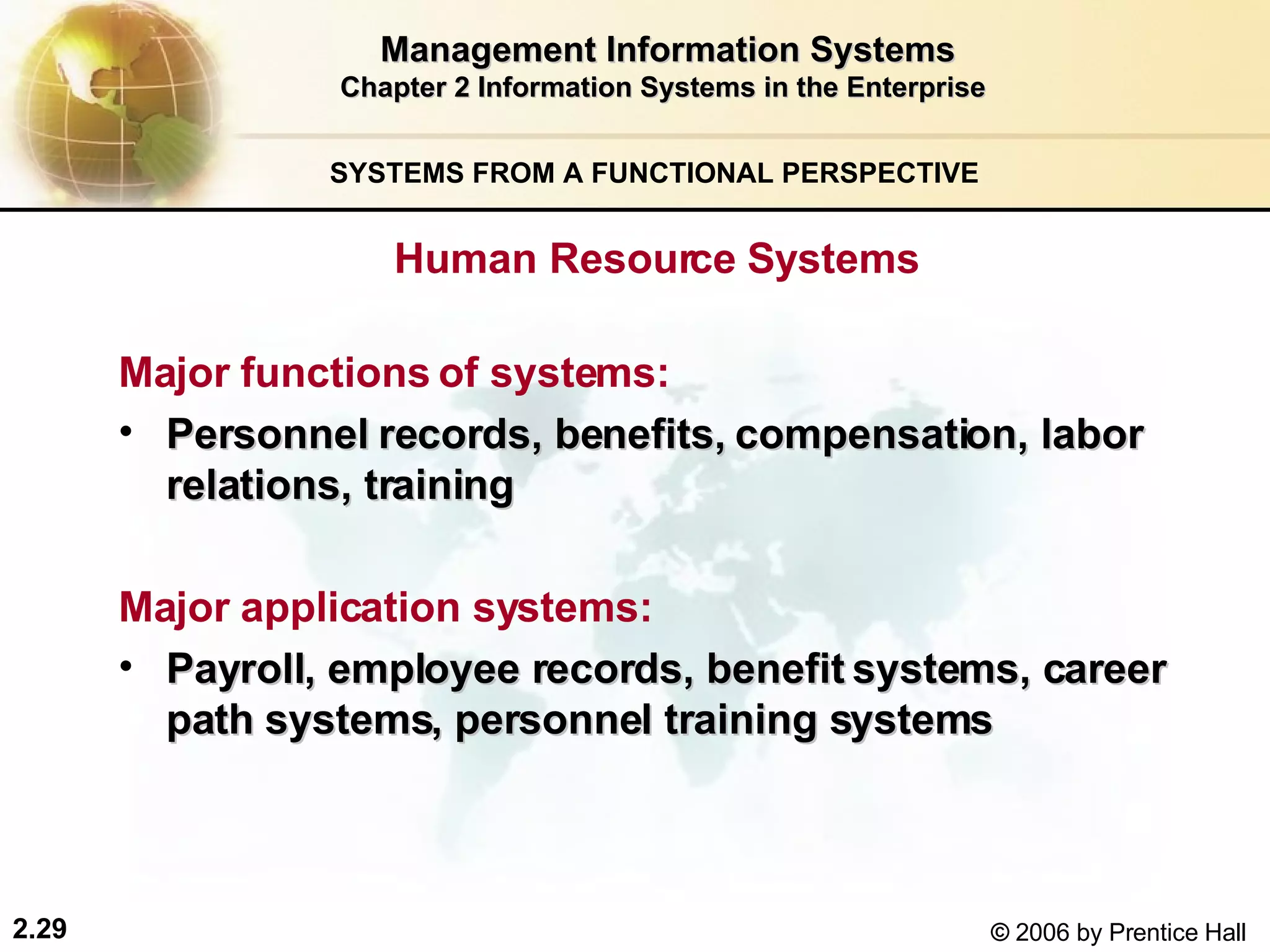
Management Information Systems Chapter 2 Information Systems in the Enterprise SYSTEMS FROM A FUNCTIONAL PERSPECTIVE  Human Resource Systems  Major functions of systems:   Personnel records, benefits, compensation, labor relations, training Major application systems:   Payroll, employee records, benefit systems, career path systems, personnel training systems
  Management Information Systems Chapter 2 Information Systems in the Enterprise SYSTEMS FROM A FUNCTIONAL PERSPECTIVE  Human Resource Systems  (Continued) Table 2-5 SYSTEM  DESCRIPTION ORGANIZATIONAL LEVEL       Training and development Tracks employee training, skills, and performance appraisals Operational Compensation analysis Monitors the range and distribution of employee wages, salaries, and benefits Management Human resources planning Plans the long-term labor force needs of the organization    Strategic            
Management Information Systems Chapter 2 Information Systems in the Enterprise Human Resource Systems (Continued) An Employee Recordkeeping System SYSTEMS FROM A FUNCTIONAL PERSPECTIVE  Figure 2-11
Management Information Systems Chapter 2 Information Systems in the Enterprise Business Processes and Information Systems Business processes: Manner in which work is organized, coordinated, and focused to produce a valuable product or service Concrete work flows of material, information, and knowledge—sets of activities Unique ways to coordinate work, information, and knowledge Ways in which management chooses to coordinate work  INTEGRATING FUNCTIONS AND BUSINESS PROCESSES: Introduction to Enterprise Applications
Management Information Systems Chapter 2 Information Systems in the Enterprise Business Processes and Information Systems (Continued) Information systems help organizations achieve great efficiencies by automating parts of processes  IS also contributes to completely rethinking processes.  Business processes typically span several different functional areas.   INTEGRATING FUNCTIONS AND BUSINESS PROCESSES: Introduction to Enterprise Applications
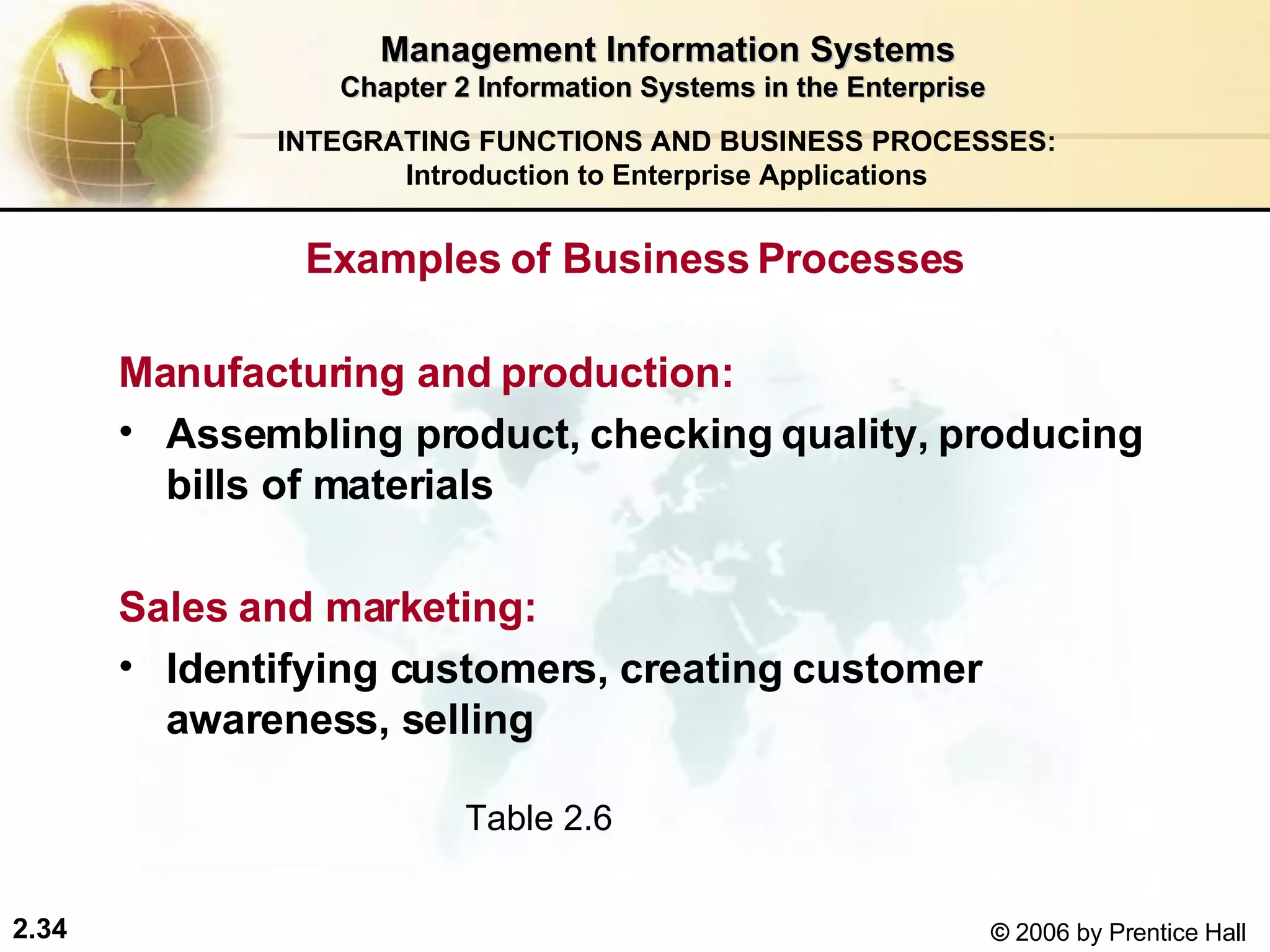
Management Information Systems Chapter 2 Information Systems in the Enterprise Examples of Business Processes Manufacturing and production:   Assembling product, checking quality, producing bills of materials Sales and marketing:   Identifying customers, creating customer awareness, selling INTEGRATING FUNCTIONS AND BUSINESS PROCESSES: Introduction to Enterprise Applications Table 2.6
Management Information Systems Chapter 2 Information Systems in the Enterprise Finance & accounting :   Paying creditors, creating financial statements, managing cash accounts Human resources :   Hiring employees, evaluating performance, enrolling employees in benefits plans INTEGRATING FUNCTIONS AND BUSINESS PROCESSES: Introduction to Enterprise Applications Examples of Business Processes (Continued) Table 2.6 continued
Management Information Systems Chapter 2 Information Systems in the Enterprise Business Processes and Information Systems Cross-Functional Business Processes:  Transcend boundary between sales, marketing, manufacturing, and research and development Group employees from different functional specialties to a complete piece of work Example: Order Fulfillment Process   INTEGRATING FUNCTIONS AND BUSINESS PROCESSES: Introduction to Enterprise Applications
Management Information Systems Chapter 2 Information Systems in the Enterprise The Order Fulfillment Process INTEGRATING FUNCTIONS AND BUSINESS PROCESSES: Introduction to Enterprise Applications Figure 2-12
Management Information Systems Chapter 2 Information Systems in the Enterprise Systems for Enterprise-Wide Process Integration  Enterprise applications:  Designed to support organization-wide process coordination and integration INTEGRATING FUNCTIONS AND BUSINESS PROCESSES: Introduction to Enterprise Applications
Consist of  :   Enterprise systems  Supply chain management systems  Customer relationship management systems Knowledge management systems Management Information Systems Chapter 2 Information Systems in the Enterprise Systems for Enterprise-Wide Process Integration (Continued) INTEGRATING FUNCTIONS AND BUSINESS PROCESSES: Introduction to Enterprise Applications
Management Information Systems Chapter 2 Information Systems in the Enterprise Enterprise Systems  Enterprise systems, also known as enterprise resource planning (ERP) systems, provide a single information system for organization-wide coordination and integration of key business processes. Information that was previously fragmented in different systems can seamlessly flow throughout the firm so that it can be shared by business processes in manufacturing, accounting, human resources, and other areas. INTEGRATING FUNCTIONS AND BUSINESS PROCESSES: Introduction to Enterprise Applications
Management Information Systems Chapter 2 Information Systems in the Enterprise Enterprise Application Architecture  INTEGRATING FUNCTIONS AND BUSINESS PROCESSES: Introduction to Enterprise Applications Figure 2-13
Management Information Systems Chapter 2 Information Systems in the Enterprise Traditional  “Silo” View of Information  Systems  Within the business:   There are functions, each having its uses of information systems Outside the organization’s boundaries:   There are customers and vendors Functions tend to work in isolation   INTEGRATING FUNCTIONS AND BUSINESS PROCESSES: Introduction to Enterprise Applications
Management Information Systems Chapter 2 Information Systems in the Enterprise Traditional View of Systems  INTEGRATING FUNCTIONS AND BUSINESS PROCESSES: Introduction to Enterprise Applications Figure 2-14
Management Information Systems Chapter 2 Information Systems in the Enterprise Enterprise Systems  INTEGRATING FUNCTIONS AND BUSINESS PROCESSES: Introduction to Enterprise Applications Figure 2-15
Management Information Systems Chapter 2 Information Systems in the Enterprise Benefits of Enterprise Systems  Help to unify the firm’s structure and organization:  One organization Management:  Firm wide knowledge-based management processes Technology:  Unified platform Business:  More efficient operations & customer-driven business processes   INTEGRATING FUNCTIONS AND BUSINESS PROCESSES: Introduction to Enterprise Applications
Management Information Systems Chapter 2 Information Systems in the Enterprise Challenges of Enterprise Systems  Difficult to build:  Require fundamental changes in the way the business operates Technology:  Require complex pieces of software and large investments of time, money, and expertise Centralized organizational coordination and decision making:  Not the best way for the firms to operate INTEGRATING FUNCTIONS AND BUSINESS PROCESSES: Introduction to Enterprise Applications
Management Information Systems Chapter 2 Information Systems in the Enterprise Supply Chain Management (SCM)  Close linkage and coordination of activities involved in buying, making, and moving a product   Integrates supplier, manufacturer, distributor, and customer logistics time Reduces time, redundant effort, and inventory costs Network of organizations and business processes INTEGRATING FUNCTIONS AND BUSINESS PROCESSES: Introduction to Enterprise Applications
Management Information Systems Chapter 2 Information Systems in the Enterprise Helps in procurement of  materials, transformation of raw materials into intermediate and finished products Helps in distribution of the finished products to customers Includes reverse logistics - returned items flow in the reverse direction from the buyer back to the seller Supply Chain Management (SCM)  INTEGRATING FUNCTIONS AND BUSINESS PROCESSES: Introduction to Enterprise Applications
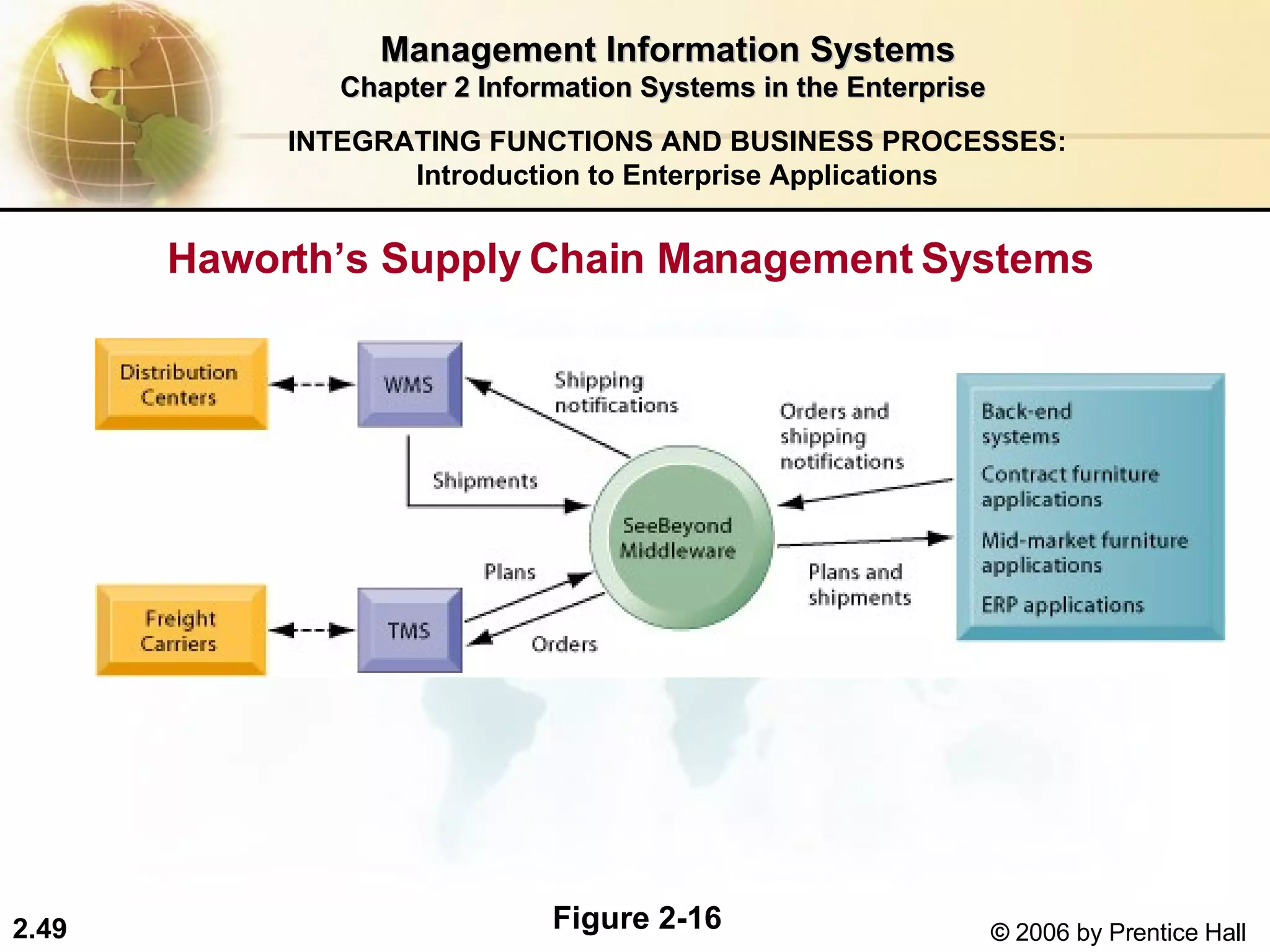
Management Information Systems Chapter 2 Information Systems in the Enterprise Haworth’s Supply Chain Management Systems  INTEGRATING FUNCTIONS AND BUSINESS PROCESSES: Introduction to Enterprise Applications Figure 2-16
Management Information Systems Chapter 2 Information Systems in the Enterprise Information from Supply Chain Management Systems helps firms:  Decide when and what to produce, store, and move Rapidly communicate orders Track the status of orders Check inventory availability and monitor inventory levels INTEGRATING FUNCTIONS AND BUSINESS PROCESSES: Introduction to Enterprise Applications
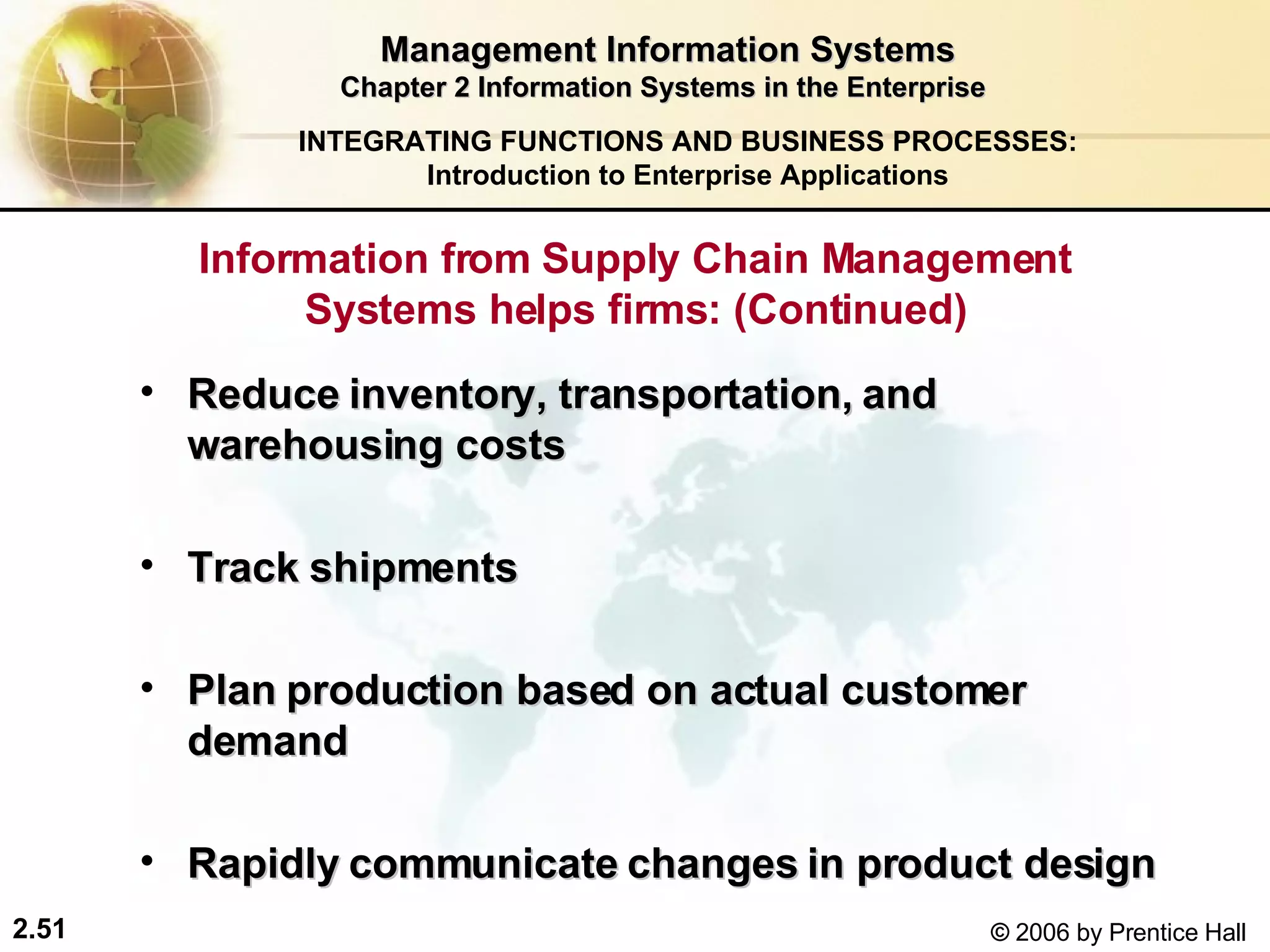
Management Information Systems Chapter 2 Information Systems in the Enterprise Information from Supply Chain Management Systems helps firms: (Continued) Reduce inventory, transportation, and warehousing costs Track shipments Plan production based on actual customer demand Rapidly communicate changes in product design   INTEGRATING FUNCTIONS AND BUSINESS PROCESSES: Introduction to Enterprise Applications
Management Information Systems Chapter 2 Information Systems in the Enterprise Customer Relationship Management (CRM)  Manages all ways used by firms to deal with existing and potential new customers Business and technology discipline Uses information system to coordinate entire business processes of a firm INTEGRATING FUNCTIONS AND BUSINESS PROCESSES: Introduction to Enterprise Applications
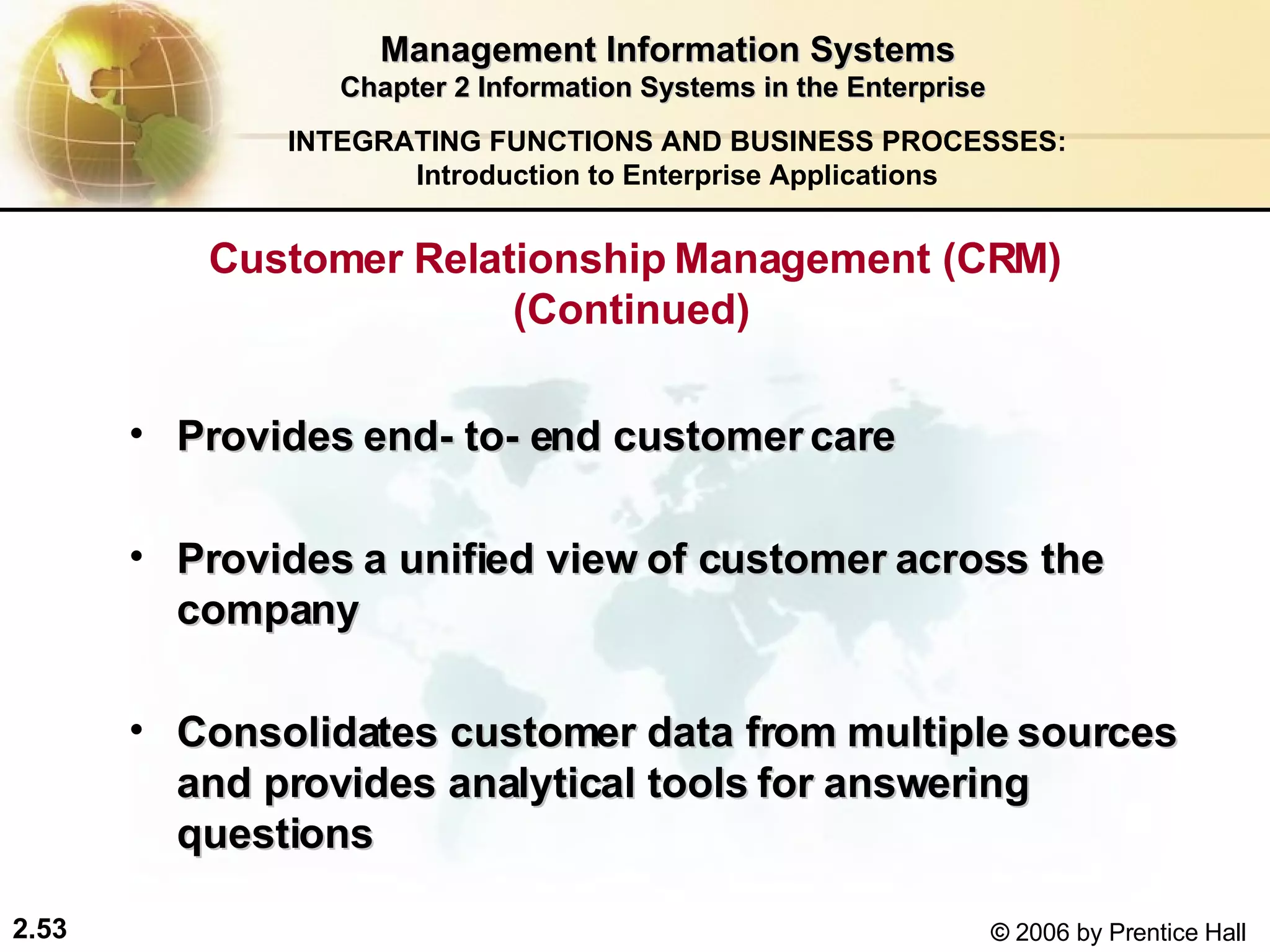
Management Information Systems Chapter 2 Information Systems in the Enterprise Customer Relationship Management (CRM) (Continued)  Provides end- to- end customer care Provides a unified view of customer across the company Consolidates customer data from multiple sources and provides analytical tools for answering questions   INTEGRATING FUNCTIONS AND BUSINESS PROCESSES: Introduction to Enterprise Applications
Management Information Systems Chapter 2 Information Systems in the Enterprise Customer Relationship Management (CRM )   INTEGRATING FUNCTIONS AND BUSINESS PROCESSES: Introduction to Enterprise Applications Figure 2-17
Management Information Systems Chapter 2 Information Systems in the Enterprise Knowledge Management Systems  Collects relevant knowledge and make it available wherever and whenever it is needed Support business processes and management decisions Also link the firm to external sources of knowledge Support processes for acquiring, storing, distributing, and applying knowledge INTEGRATING FUNCTIONS AND BUSINESS PROCESSES: Introduction to Enterprise Applications
Management Information Systems Chapter 2 Information Systems in the Enterprise There are extraordinary opportunities to use information systems to achieve business value, and increase profitability  MANAGEMENT OPPORTUNITIES, CHALLENGES, AND SOLUTIONS  Management Opportunities:
Management Information Systems Chapter 2 Information Systems in the Enterprise Integration and the whole firm view:   Given the different interests and perspectives within a firm, it is difficult to achieve consensus about the need for the "whole firm" viewpoint.  Management and employee training:  Training a large number of employees on many systems in a large organization involves commensurately large  investments. MANAGEMENT OPPORTUNITIES, CHALLENGES, AND SOLUTIONS  Management Challenges:
Management Information Systems Chapter 2 Information Systems in the Enterprise Accounting for the cost of systems and managing demands for systems:   Given the large number of different types of systems in a firm, and the large number of people involved with using them,  it is a complex task to understand which  systems are truly necessary and productive with high returns on investment  MANAGEMENT OPPORTUNITIES, CHALLENGES, AND SOLUTIONS  Management Challenges: (Continued)
Management Information Systems Chapter 2 Information Systems in the Enterprise MANAGEMENT OPPORTUNITIES, CHALLENGES, AND SOLUTIONS  Solution Guidelines: Inventory the firm’s information systems:  Develop a list of firm-wide information requirements to give a 360-degree view of the most important information needs of the firm. Employee and management education:  Ensure that you understand how much training is required. Account for the costs and benefits:  Develop an accounting system for information services firm- wide.
305 Chapter 2

  • 1.
    2 Chapter Information Systems in the Enterprise
  • 2.
    OBJECTIVES Evaluate therole played by the major types of systems in a business and their relationship to each other Describe the information systems supporting the major business functions: sales and marketing, manufacturing and production, finance and accounting, and human resources Management Information Systems Chapter 2 Information Systems in the Enterprise
  • 3.
    Analyze the relationshipbetween organizations, information systems, and business processes Explain how enterprise applications promote business process integration and improve organizational performance Assess the challenges posed by information systems in the enterprise and management solutions Management Information Systems Chapter 2 Information Systems in the Enterprise OBJECTIVES (continued)
  • 4.
    Challenge: monthlychanges in fashions; Mango has 731 stores in 72 countries Solutions. Inventory replenishment system tracks all sales and matches stores with inventory. Design teams meet weekly to adjust to trends. Distribution system allocates bar-coded items to specific stores based on store/product mix. Reduces time to market, increases agility Increases accuracy of decision making Management Information Systems Chapter 2 Information Systems in the Enterprise Mango Case: Fast Fashion, Hot Systems
  • 5.
    Management Information SystemsChapter 2 Information Systems in the Enterprise MAJOR TYPES OF SYSTEMS IN ORGANIZATIONS Types of Information Systems Figure 2-1
  • 6.
    Management Information SystemsChapter 2 Information Systems in the Enterprise MAJOR TYPES OF SYSTEMS IN ORGANIZATIONS Different Kinds of Systems Operational-level systems: support operational managers, keeping track of the elementary activities and transactions Management-level systems: serve the monitoring, controlling, decision-making, and administrative activities Strategic-level systems: help senior management tackle and address strategic issues Three main categories of information systems serve different organizational levels:
  • 7.
    Management Information SystemsChapter 2 Information Systems in the Enterprise MAJOR TYPES OF SYSTEMS IN ORGANIZATIONS Major Types of Systems Transaction Processing Systems (TPS) Management Information Systems (MIS) Decision-Support Systems (DSS) Executive Support Systems (ESS)
  • 8.
    Management Information SystemsChapter 2 Information Systems in the Enterprise MAJOR TYPES OF SYSTEMS IN ORGANIZATIONS The Four Major Types of Information Systems Figure 2-2
  • 9.
    Management Information SystemsChapter 2 Information Systems in the Enterprise MAJOR TYPES OF SYSTEMS IN ORGANIZATIONS Transaction Processing Systems (TPS) Basic business systems that serve the operational level A computerized system that performs and records the daily routine transactions necessary to the conduct of the business
  • 10.
    Management Information SystemsChapter 2 Information Systems in the Enterprise MAJOR TYPES OF SYSTEMS IN ORGANIZATIONS A Symbolic Representation for a Payroll TPS Figure 2-3
  • 11.
    Management Information SystemsChapter 2 Information Systems in the Enterprise MAJOR TYPES OF SYSTEMS IN ORGANIZATIONS Typical Applications of TPS Figure 2-4
  • 12.
    Management Information SystemsChapter 2 Information Systems in the Enterprise MAJOR TYPES OF SYSTEMS IN ORGANIZATIONS Management Information Systems (MIS) Management level Inputs: High volume transaction level data Processing: Simple models Outputs: Summary reports Users: Middle managers Example: Annual budgeting
  • 13.
    Management Information SystemsChapter 2 Information Systems in the Enterprise MAJOR TYPES OF SYSTEMS IN ORGANIZATIONS Management Information Systems (MIS) (continued) Figure 2-5
  • 14.
    Management Information SystemsChapter 2 Information Systems in the Enterprise MAJOR TYPES OF SYSTEMS IN ORGANIZATIONS Management Information Systems (MIS) (continued) A sample MIS report Figure 2-6
  • 15.
    Management Information SystemsChapter 2 Information Systems in the Enterprise MAJOR TYPES OF SYSTEMS IN ORGANIZATIONS Decision-Support Systems (DSS) Management level Inputs: Transaction level data Processing: Interactive Outputs: Decision analysis Users: Professionals, staff Example: Contract cost analysis
  • 16.
    Management Information SystemsChapter 2 Information Systems in the Enterprise MAJOR TYPES OF SYSTEMS IN ORGANIZATIONS Decision-Support Systems (DSS) (Continued) Voyage-estimating decision-support system Figure 2-7
  • 17.
    Management Information SystemsChapter 2 Information Systems in the Enterprise MAJOR TYPES OF SYSTEMS IN ORGANIZATIONS EXECUTIVE SUPPORT SYSTEMS (ESS): Inputs: Aggregate data Processing: Interactive Outputs: Projections Users: Senior managers Example: 5 year operating plan
  • 18.
    Management Information SystemsChapter 2 Information Systems in the Enterprise MAJOR TYPES OF SYSTEMS IN ORGANIZATIONS Model of a Typical Executive Support System Figure 2-8
  • 19.
    Management Information SystemsChapter 2 Information Systems in the Enterprise MAJOR TYPES OF SYSTEMS IN ORGANIZATIONS EXECUTIVE SUPPORT SYSTEMS (ESS) (Continued) Top Level Management Designed to the individual senior manager Ties CEO to all levels Very expensive to keep up Extensive support staff
  • 20.
    Management Information SystemsChapter 2 Information Systems in the Enterprise MAJOR TYPES OF SYSTEMS IN ORGANIZATIONS Relationship of Systems to One Another Interrelationships among systems Figure 2-9
  • 21.
    Management Information SystemsChapter 2 Information Systems in the Enterprise MAJOR TYPES OF SYSTEMS IN ORGANIZATIONS Relationship of Systems to One Another In contemporary digital firms, the different types of systems are closely linked to one another. This is the ideal. In traditional firms these systems tend to be isolated from one another, and information does not flow seamlessly from one end of the organization to the other. Efficiency and business value tend to suffer greatly in these traditional firms
  • 22.
    Management Information SystemsChapter 2 Information Systems in the Enterprise SYSTEMS FROM A FUNCTIONAL PERSPECTIVE Sales and Marketing Systems Major functions of systems: Sales management, market research, promotion, pricing, new products Major application systems: Sales order info system, market research system, pricing system
  • 23.
    Management Information SystemsChapter 2 Information Systems in the Enterprise SYSTEMS FROM A FUNCTIONAL PERSPECTIVE Sales and Marketing Systems     Table 2-2 SYSTEM DESCRIPTION ORGANIZATIONAL LEVEL       Order processing Enter, process, and track orders Operational       Pricing analysis Determine prices for products and services Management       Sales trend forecasting Prepare 5-year sales forecasts Strategic
  • 24.
    Management Information SystemsChapter 2 Information Systems in the Enterprise SYSTEMS FROM A FUNCTIONAL PERSPECTIVE Manufacturing and Production Systems Major functions of systems: Scheduling, purchasing, shipping, receiving, engineering, operations Major application systems: Materials resource planning systems, purchase order control systems, engineering systems, quality control systems
  • 25.
    Management Information SystemsChapter 2 Information Systems in the Enterprise SYSTEMS FROM A FUNCTIONAL PERSPECTIVE   Manufacturing and Production Systems SYSTEM DESCRIPTION ORGANIZATIONAL LEVEL       Machine control Control the actions of machines and equipment Operational       Production planning Decide when and how many products should be produced Management       Facilities location Decide where to locate new production facilities Strategic
  • 26.
    Management Information SystemsChapter 2 Information Systems in the Enterprise Overview of an Inventory System SYSTEMS FROM A FUNCTIONAL PERSPECTIVE Figure 2-10
  • 27.
    Management Information SystemsChapter 2 Information Systems in the Enterprise SYSTEMS FROM A FUNCTIONAL PERSPECTIVE Financing and Accounting Systems Major functions of systems: Budgeting, general ledger, billing, cost accounting Major application systems: General ledger, accounts receivable, accounts payable, budgeting, funds management systems
  • 28.
    Management Information SystemsChapter 2 Information Systems in the Enterprise SYSTEMS FROM A FUNCTIONAL PERSPECTIVE Financing & Accounting Systems (Continued)   Table 2-4 SYSTEM DESCRIPTION ORGANIZATION-AL LEVEL       Accounts receivable Tracks money owed the firm Operational       Budgeting Prepares short-term budgets Management       Profit planning Plans long-term profits Strategic
  • 29.
    Management Information SystemsChapter 2 Information Systems in the Enterprise SYSTEMS FROM A FUNCTIONAL PERSPECTIVE Human Resource Systems Major functions of systems: Personnel records, benefits, compensation, labor relations, training Major application systems: Payroll, employee records, benefit systems, career path systems, personnel training systems
  • 30.
      Management InformationSystems Chapter 2 Information Systems in the Enterprise SYSTEMS FROM A FUNCTIONAL PERSPECTIVE Human Resource Systems (Continued) Table 2-5 SYSTEM DESCRIPTION ORGANIZATIONAL LEVEL       Training and development Tracks employee training, skills, and performance appraisals Operational Compensation analysis Monitors the range and distribution of employee wages, salaries, and benefits Management Human resources planning Plans the long-term labor force needs of the organization   Strategic            
  • 31.
    Management Information SystemsChapter 2 Information Systems in the Enterprise Human Resource Systems (Continued) An Employee Recordkeeping System SYSTEMS FROM A FUNCTIONAL PERSPECTIVE Figure 2-11
  • 32.
    Management Information SystemsChapter 2 Information Systems in the Enterprise Business Processes and Information Systems Business processes: Manner in which work is organized, coordinated, and focused to produce a valuable product or service Concrete work flows of material, information, and knowledge—sets of activities Unique ways to coordinate work, information, and knowledge Ways in which management chooses to coordinate work INTEGRATING FUNCTIONS AND BUSINESS PROCESSES: Introduction to Enterprise Applications
  • 33.
    Management Information SystemsChapter 2 Information Systems in the Enterprise Business Processes and Information Systems (Continued) Information systems help organizations achieve great efficiencies by automating parts of processes IS also contributes to completely rethinking processes. Business processes typically span several different functional areas. INTEGRATING FUNCTIONS AND BUSINESS PROCESSES: Introduction to Enterprise Applications
  • 34.
    Management Information SystemsChapter 2 Information Systems in the Enterprise Examples of Business Processes Manufacturing and production: Assembling product, checking quality, producing bills of materials Sales and marketing: Identifying customers, creating customer awareness, selling INTEGRATING FUNCTIONS AND BUSINESS PROCESSES: Introduction to Enterprise Applications Table 2.6
  • 35.
    Management Information SystemsChapter 2 Information Systems in the Enterprise Finance & accounting : Paying creditors, creating financial statements, managing cash accounts Human resources : Hiring employees, evaluating performance, enrolling employees in benefits plans INTEGRATING FUNCTIONS AND BUSINESS PROCESSES: Introduction to Enterprise Applications Examples of Business Processes (Continued) Table 2.6 continued
  • 36.
    Management Information SystemsChapter 2 Information Systems in the Enterprise Business Processes and Information Systems Cross-Functional Business Processes: Transcend boundary between sales, marketing, manufacturing, and research and development Group employees from different functional specialties to a complete piece of work Example: Order Fulfillment Process INTEGRATING FUNCTIONS AND BUSINESS PROCESSES: Introduction to Enterprise Applications
  • 37.
    Management Information SystemsChapter 2 Information Systems in the Enterprise The Order Fulfillment Process INTEGRATING FUNCTIONS AND BUSINESS PROCESSES: Introduction to Enterprise Applications Figure 2-12
  • 38.
    Management Information SystemsChapter 2 Information Systems in the Enterprise Systems for Enterprise-Wide Process Integration Enterprise applications: Designed to support organization-wide process coordination and integration INTEGRATING FUNCTIONS AND BUSINESS PROCESSES: Introduction to Enterprise Applications
  • 39.
    Consist of : Enterprise systems Supply chain management systems Customer relationship management systems Knowledge management systems Management Information Systems Chapter 2 Information Systems in the Enterprise Systems for Enterprise-Wide Process Integration (Continued) INTEGRATING FUNCTIONS AND BUSINESS PROCESSES: Introduction to Enterprise Applications
  • 40.
    Management Information SystemsChapter 2 Information Systems in the Enterprise Enterprise Systems Enterprise systems, also known as enterprise resource planning (ERP) systems, provide a single information system for organization-wide coordination and integration of key business processes. Information that was previously fragmented in different systems can seamlessly flow throughout the firm so that it can be shared by business processes in manufacturing, accounting, human resources, and other areas. INTEGRATING FUNCTIONS AND BUSINESS PROCESSES: Introduction to Enterprise Applications
  • 41.
    Management Information SystemsChapter 2 Information Systems in the Enterprise Enterprise Application Architecture INTEGRATING FUNCTIONS AND BUSINESS PROCESSES: Introduction to Enterprise Applications Figure 2-13
  • 42.
    Management Information SystemsChapter 2 Information Systems in the Enterprise Traditional “Silo” View of Information Systems Within the business: There are functions, each having its uses of information systems Outside the organization’s boundaries: There are customers and vendors Functions tend to work in isolation INTEGRATING FUNCTIONS AND BUSINESS PROCESSES: Introduction to Enterprise Applications
  • 43.
    Management Information SystemsChapter 2 Information Systems in the Enterprise Traditional View of Systems INTEGRATING FUNCTIONS AND BUSINESS PROCESSES: Introduction to Enterprise Applications Figure 2-14
  • 44.
    Management Information SystemsChapter 2 Information Systems in the Enterprise Enterprise Systems INTEGRATING FUNCTIONS AND BUSINESS PROCESSES: Introduction to Enterprise Applications Figure 2-15
  • 45.
    Management Information SystemsChapter 2 Information Systems in the Enterprise Benefits of Enterprise Systems Help to unify the firm’s structure and organization: One organization Management: Firm wide knowledge-based management processes Technology: Unified platform Business: More efficient operations & customer-driven business processes INTEGRATING FUNCTIONS AND BUSINESS PROCESSES: Introduction to Enterprise Applications
  • 46.
    Management Information SystemsChapter 2 Information Systems in the Enterprise Challenges of Enterprise Systems Difficult to build: Require fundamental changes in the way the business operates Technology: Require complex pieces of software and large investments of time, money, and expertise Centralized organizational coordination and decision making: Not the best way for the firms to operate INTEGRATING FUNCTIONS AND BUSINESS PROCESSES: Introduction to Enterprise Applications
  • 47.
    Management Information SystemsChapter 2 Information Systems in the Enterprise Supply Chain Management (SCM) Close linkage and coordination of activities involved in buying, making, and moving a product Integrates supplier, manufacturer, distributor, and customer logistics time Reduces time, redundant effort, and inventory costs Network of organizations and business processes INTEGRATING FUNCTIONS AND BUSINESS PROCESSES: Introduction to Enterprise Applications
  • 48.
    Management Information SystemsChapter 2 Information Systems in the Enterprise Helps in procurement of materials, transformation of raw materials into intermediate and finished products Helps in distribution of the finished products to customers Includes reverse logistics - returned items flow in the reverse direction from the buyer back to the seller Supply Chain Management (SCM) INTEGRATING FUNCTIONS AND BUSINESS PROCESSES: Introduction to Enterprise Applications
  • 49.
    Management Information SystemsChapter 2 Information Systems in the Enterprise Haworth’s Supply Chain Management Systems INTEGRATING FUNCTIONS AND BUSINESS PROCESSES: Introduction to Enterprise Applications Figure 2-16
  • 50.
    Management Information SystemsChapter 2 Information Systems in the Enterprise Information from Supply Chain Management Systems helps firms: Decide when and what to produce, store, and move Rapidly communicate orders Track the status of orders Check inventory availability and monitor inventory levels INTEGRATING FUNCTIONS AND BUSINESS PROCESSES: Introduction to Enterprise Applications
  • 51.
    Management Information SystemsChapter 2 Information Systems in the Enterprise Information from Supply Chain Management Systems helps firms: (Continued) Reduce inventory, transportation, and warehousing costs Track shipments Plan production based on actual customer demand Rapidly communicate changes in product design INTEGRATING FUNCTIONS AND BUSINESS PROCESSES: Introduction to Enterprise Applications
  • 52.
    Management Information SystemsChapter 2 Information Systems in the Enterprise Customer Relationship Management (CRM) Manages all ways used by firms to deal with existing and potential new customers Business and technology discipline Uses information system to coordinate entire business processes of a firm INTEGRATING FUNCTIONS AND BUSINESS PROCESSES: Introduction to Enterprise Applications
  • 53.
    Management Information SystemsChapter 2 Information Systems in the Enterprise Customer Relationship Management (CRM) (Continued) Provides end- to- end customer care Provides a unified view of customer across the company Consolidates customer data from multiple sources and provides analytical tools for answering questions INTEGRATING FUNCTIONS AND BUSINESS PROCESSES: Introduction to Enterprise Applications
  • 54.
    Management Information SystemsChapter 2 Information Systems in the Enterprise Customer Relationship Management (CRM ) INTEGRATING FUNCTIONS AND BUSINESS PROCESSES: Introduction to Enterprise Applications Figure 2-17
  • 55.
    Management Information SystemsChapter 2 Information Systems in the Enterprise Knowledge Management Systems Collects relevant knowledge and make it available wherever and whenever it is needed Support business processes and management decisions Also link the firm to external sources of knowledge Support processes for acquiring, storing, distributing, and applying knowledge INTEGRATING FUNCTIONS AND BUSINESS PROCESSES: Introduction to Enterprise Applications
  • 56.
    Management Information SystemsChapter 2 Information Systems in the Enterprise There are extraordinary opportunities to use information systems to achieve business value, and increase profitability MANAGEMENT OPPORTUNITIES, CHALLENGES, AND SOLUTIONS Management Opportunities:
  • 57.
    Management Information SystemsChapter 2 Information Systems in the Enterprise Integration and the whole firm view: Given the different interests and perspectives within a firm, it is difficult to achieve consensus about the need for the "whole firm" viewpoint. Management and employee training: Training a large number of employees on many systems in a large organization involves commensurately large investments. MANAGEMENT OPPORTUNITIES, CHALLENGES, AND SOLUTIONS Management Challenges:
  • 58.
    Management Information SystemsChapter 2 Information Systems in the Enterprise Accounting for the cost of systems and managing demands for systems: Given the large number of different types of systems in a firm, and the large number of people involved with using them, it is a complex task to understand which systems are truly necessary and productive with high returns on investment MANAGEMENT OPPORTUNITIES, CHALLENGES, AND SOLUTIONS Management Challenges: (Continued)
  • 59.
    Management Information SystemsChapter 2 Information Systems in the Enterprise MANAGEMENT OPPORTUNITIES, CHALLENGES, AND SOLUTIONS Solution Guidelines: Inventory the firm’s information systems: Develop a list of firm-wide information requirements to give a 360-degree view of the most important information needs of the firm. Employee and management education: Ensure that you understand how much training is required. Account for the costs and benefits: Develop an accounting system for information services firm- wide.