Arabic Vowel Marks (Tashkeel Or Harakat)
In Arabic there are three kinds of vowels:
1) The three vowel letters, which are (Alef, Waw
and Ya') and are used for long vowels (You should
be familiar with them by now).
2) The "Hamza" which will be explained in the last.
3) The vowel marks which are used for short
vowels. They are called "Tashkeel" in Arabic and
they are explained in this lesson (They are also
known as Harakat.. just a different name by some
references).
To make short vowels distinct from long ones when
words are read, the Arabic script uses vowel marks
to do so. This is implemented by writing the marks
over or under a letter. Let's write the letter "Seen "
with the four different vowel marks applied to it:
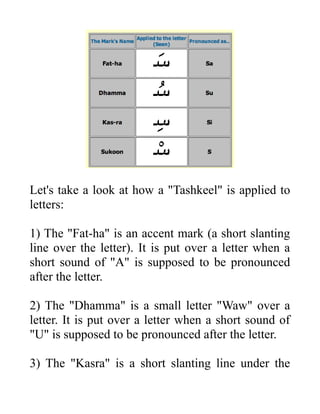
Let's take a look at how a "Tashkeel" is applied to
letters:
1) The "Fat-ha" is an accent mark (a short slanting
line over the letter). It is put over a letter when a
short sound of "A" is supposed to be pronounced
after the letter.
2) The "Dhamma" is a small letter "Waw" over a
letter. It is put over a letter when a short sound of
"U" is supposed to be pronounced after the letter.
3) The "Kasra" is a short slanting line under the
letter. It is put under a letter when a short sound of
"i" is supposed to be pronounced after the letter.
4) The "Sukoon" is a small circle over the letter. It
is put over a letter when no sound should be
pronounced after the letter.
Notes :
In Arabic the the words (Fat-ha, Dhamma, Kasra &
Sukun) originally have the following meanings:
Fat-ha means "an opening".
Dhamma means "a closing".
Kasra means "a breaking".
Sukoon means "Static".
These meanings refer to the shape of the mouth.
For example, you open your mouth wide when you
say the sound of the Fat-ha (which is "A"), and you
close your mouth when you say the sound of the
"Dhamma" (which is "U"), and your mouth is static
when you say a letter that have a "Sukoon" put on
top of it. I just wanted you to know this because I
think it could help you understand how "Tashkeel"
works.
Using the Tashkeel is not obligatory when writing
in Arabic, but it is most helpful in some cases (The
words are read with the right pronunciation
-without writing Tashkeel- by convention and the
context of the sentence).
Vowel marks are very important in Arabic. The
word's meaning may differ completely if a vowel
mark applied to one letter is changed. Take a look
at these examples:
Vowel marks play a major role in grammar in
Arabic (oh! Just forget grammar for now!!! Maybe
later!!!!).
About the "My name" from previous lesson, I think
that it should be written (FADY) in English
because in Arabic it ends with the letter "Ya'
"which is a "Y" in English, but if the name was to
be written in Arabic with a "Kasra" at the end
instead of the letter "Ya' " then it will be "Fadi"
with an "I" at the end (what we are talking about
here is the difference between the pronunciation of
the letter "Ya' " and the "Kasra", and this is true for
the letter "Alef" and a "Fat-ha" and for the letter
"Waw" and the "Dhamma"). Anyway I think that I
first learnt to write my name in non-Arabic
alphabets in French..... ( just forget it !!!).
There are two other marks used in Arabic script and
they represent an extra letter, they are:
1 - Shadda:
"Shadda" represents the doubling of a letter and it
is a small shape that looks like the letter "Seen" and
is put over the letter. For example, the following is
the word "Qissah" (which means "Story" by the
way) notice the "Shadda" over the letter "Sad":
Notes :
When a shadda is applied to a letter and the
"Tashkeel" is also written, the tashkeel is put over
or under the shadda itself not the letter.
Notice the two dots over the last letter at the end of
the word "Qissah" above. It looks like a "Ha' " but
in fact it is not a "Ha' " but the other form of the
letter "Ta' " (it is called "Ta' Marbootah" which
means "Tied Ta' " from its tied shape. It looks like a
"Ha' " because it is pronounced as one in general
(The word above is pronounced "Qissah"), but
when other letters (suffix) are added at the end of
the word (for grammatical reasons) the letter "Ta' "
is written in its ordinary form. let's look at the word
"Qissatuna" (which means "Our Story") after
adding the letters "NA" at the end of the word
which is a pronoun:
I know that this is confusing but I just wanted to
give you an idea about the "Ta' Marboota" to
understand its concept for a start.
2 - Tanween :
The "Tanween" is pronouncing the letter "Noon" at
the end of a word (This is also grammar, so just
have a general idea for now!!). It has three forms
very similar to the "Tashkeel" but it is only put over
or under the last letter of a word. The following
table show the "Tanween" for the letters "Alef",
"Ba' " and "Ta' ":
Hamza
Now, you should be wondering about the letter
"Hamza" that was the last letter in the table back in
lesson 1, well.. this lesson is all about it:
The "Hamza" is one of the three kinds of vowels in
Arabic (vowel marks were explained in the
previous lesson). It may be the most complicated
subject in Arabic scripting, I think that it needs a
tutorial on its own (even some Arab natives can't
get it right in dictation in some cases). Anyway I'll
try to make it as easy as possible giving only the
basics, so here we go:
First, the "Hamza" is the pronunciation of "U" as
in "UGH" (that was the first appropriate word that
came to my mind) where ever it is used in a word,
this means that the word should be cut at the
"Hamza" and an "U" should be pronounced
whenever it appears. Let's have an example on this:
This word is pronounced as "Sa - Al" (Which
means "Asked") this means that you should cut the
word when you pronounce it into two parts. You
pronounce the part before the "Hamza" then you
pronounce the second part as a new word (There is
no similar case in English. You may consider the
word above as two separate words when they are
pronounced).
There are four forms of the "Hamza" which is
decided by the "Tashkeel" of the "Hamza" itself
and the "Tashkeel" of the letter that comes just
before it whether it is a "Fat-ha", "Dhamma",
"kasra" or "Sukun". The following table has an
example for each form of the four forms:
Notes:
When the "Hamza" comes at the beginning of the
word, it is always written over an "Alef " or under
it depending on the "Tashkeel" of the "Hamza"
itself, if it was "Fat-ha" or "Dhama" then the
"Hamza" is written over the "Alef". If the
"Tashkeel" was "Kasra" then the "Hamza" Is
written under the "Alef". The following word
"Ana" (which means "me") is written like this :
The word "Eeman" (which means "faith") is written
as follows:
You should have noticed from that table above that
the "Hamza" is written in four different cases
depending on the "Tashkeel" of the "Hamza" itself
and the "Tashkeel" of the letter just before it. I
think that this is what you need to know as a
beginner. If you want to learn the rules of writing
the "Hamza " then ask me and I'll send them to you
via email.
Some sources don't consider "Hamza" neither a
letter nor a vowel mark, it may be in a category of
its own!!!

3 theory

  • 1.
    Arabic Vowel Marks(Tashkeel Or Harakat) In Arabic there are three kinds of vowels: 1) The three vowel letters, which are (Alef, Waw and Ya') and are used for long vowels (You should be familiar with them by now). 2) The "Hamza" which will be explained in the last. 3) The vowel marks which are used for short vowels. They are called "Tashkeel" in Arabic and they are explained in this lesson (They are also known as Harakat.. just a different name by some references). To make short vowels distinct from long ones when words are read, the Arabic script uses vowel marks to do so. This is implemented by writing the marks over or under a letter. Let's write the letter "Seen " with the four different vowel marks applied to it:
  • 2.
    Let's take alook at how a "Tashkeel" is applied to letters: 1) The "Fat-ha" is an accent mark (a short slanting line over the letter). It is put over a letter when a short sound of "A" is supposed to be pronounced after the letter. 2) The "Dhamma" is a small letter "Waw" over a letter. It is put over a letter when a short sound of "U" is supposed to be pronounced after the letter. 3) The "Kasra" is a short slanting line under the
  • 3.
    letter. It isput under a letter when a short sound of "i" is supposed to be pronounced after the letter. 4) The "Sukoon" is a small circle over the letter. It is put over a letter when no sound should be pronounced after the letter. Notes : In Arabic the the words (Fat-ha, Dhamma, Kasra & Sukun) originally have the following meanings: Fat-ha means "an opening". Dhamma means "a closing". Kasra means "a breaking". Sukoon means "Static". These meanings refer to the shape of the mouth. For example, you open your mouth wide when you say the sound of the Fat-ha (which is "A"), and you close your mouth when you say the sound of the "Dhamma" (which is "U"), and your mouth is static when you say a letter that have a "Sukoon" put on top of it. I just wanted you to know this because I
  • 4.
    think it couldhelp you understand how "Tashkeel" works. Using the Tashkeel is not obligatory when writing in Arabic, but it is most helpful in some cases (The words are read with the right pronunciation -without writing Tashkeel- by convention and the context of the sentence). Vowel marks are very important in Arabic. The word's meaning may differ completely if a vowel mark applied to one letter is changed. Take a look at these examples: Vowel marks play a major role in grammar in Arabic (oh! Just forget grammar for now!!! Maybe later!!!!).
  • 5.
    About the "Myname" from previous lesson, I think that it should be written (FADY) in English because in Arabic it ends with the letter "Ya' "which is a "Y" in English, but if the name was to be written in Arabic with a "Kasra" at the end instead of the letter "Ya' " then it will be "Fadi" with an "I" at the end (what we are talking about here is the difference between the pronunciation of the letter "Ya' " and the "Kasra", and this is true for the letter "Alef" and a "Fat-ha" and for the letter "Waw" and the "Dhamma"). Anyway I think that I first learnt to write my name in non-Arabic alphabets in French..... ( just forget it !!!). There are two other marks used in Arabic script and they represent an extra letter, they are: 1 - Shadda: "Shadda" represents the doubling of a letter and it is a small shape that looks like the letter "Seen" and is put over the letter. For example, the following is the word "Qissah" (which means "Story" by the way) notice the "Shadda" over the letter "Sad":
  • 6.
    Notes : When ashadda is applied to a letter and the "Tashkeel" is also written, the tashkeel is put over or under the shadda itself not the letter. Notice the two dots over the last letter at the end of the word "Qissah" above. It looks like a "Ha' " but in fact it is not a "Ha' " but the other form of the letter "Ta' " (it is called "Ta' Marbootah" which means "Tied Ta' " from its tied shape. It looks like a "Ha' " because it is pronounced as one in general (The word above is pronounced "Qissah"), but when other letters (suffix) are added at the end of the word (for grammatical reasons) the letter "Ta' " is written in its ordinary form. let's look at the word "Qissatuna" (which means "Our Story") after adding the letters "NA" at the end of the word which is a pronoun:
  • 7.
    I know thatthis is confusing but I just wanted to give you an idea about the "Ta' Marboota" to understand its concept for a start. 2 - Tanween : The "Tanween" is pronouncing the letter "Noon" at the end of a word (This is also grammar, so just have a general idea for now!!). It has three forms very similar to the "Tashkeel" but it is only put over or under the last letter of a word. The following table show the "Tanween" for the letters "Alef", "Ba' " and "Ta' ":
  • 8.
    Hamza Now, you shouldbe wondering about the letter "Hamza" that was the last letter in the table back in lesson 1, well.. this lesson is all about it: The "Hamza" is one of the three kinds of vowels in Arabic (vowel marks were explained in the previous lesson). It may be the most complicated subject in Arabic scripting, I think that it needs a tutorial on its own (even some Arab natives can't get it right in dictation in some cases). Anyway I'll try to make it as easy as possible giving only the basics, so here we go: First, the "Hamza" is the pronunciation of "U" as
  • 9.
    in "UGH" (thatwas the first appropriate word that came to my mind) where ever it is used in a word, this means that the word should be cut at the "Hamza" and an "U" should be pronounced whenever it appears. Let's have an example on this: This word is pronounced as "Sa - Al" (Which means "Asked") this means that you should cut the word when you pronounce it into two parts. You pronounce the part before the "Hamza" then you pronounce the second part as a new word (There is no similar case in English. You may consider the word above as two separate words when they are pronounced). There are four forms of the "Hamza" which is decided by the "Tashkeel" of the "Hamza" itself and the "Tashkeel" of the letter that comes just before it whether it is a "Fat-ha", "Dhamma", "kasra" or "Sukun". The following table has an example for each form of the four forms:
  • 10.
    Notes: When the "Hamza"comes at the beginning of the word, it is always written over an "Alef " or under it depending on the "Tashkeel" of the "Hamza" itself, if it was "Fat-ha" or "Dhama" then the "Hamza" is written over the "Alef". If the "Tashkeel" was "Kasra" then the "Hamza" Is written under the "Alef". The following word "Ana" (which means "me") is written like this : The word "Eeman" (which means "faith") is written
  • 11.
    as follows: You shouldhave noticed from that table above that the "Hamza" is written in four different cases depending on the "Tashkeel" of the "Hamza" itself and the "Tashkeel" of the letter just before it. I think that this is what you need to know as a beginner. If you want to learn the rules of writing the "Hamza " then ask me and I'll send them to you via email. Some sources don't consider "Hamza" neither a letter nor a vowel mark, it may be in a category of its own!!!