www.quranicarabic.wordpress.com Page 1
Introductory
Lesson
QUR'AAN
SCRIPT
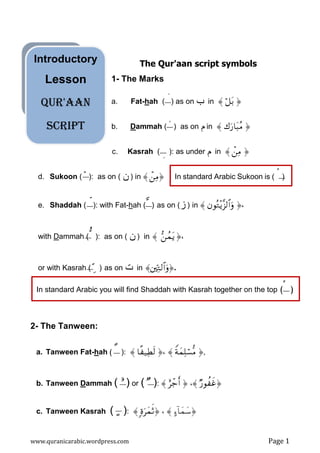
The Qur'aan script symbols
1- The Marks
a. Fat-hah ( َ) as on ‫ﺏ‬ in 〈 ö≅t/ 
b. Dammah ( ُ ) as on ‫ﻡ‬ in 〈 8u‘$t6ãΒ 
c. Kasrah ( ِ ): as under ‫ﻡ‬ in 〈 ôÏΒ 
d. Sukoon (ô ): as on ( ‫ﻥ‬ ) in 〈 ôÏΒ
e. Shaddah ( ّ): with Fat-hah (¨ ) as on (‫ﺯ‬ ) in 〈 βθçG÷ƒ¨“9$#uρ ،
with Dammah (– ): as on ( ‫ﻥ‬ ) in 〈 ÷ ßϑtƒ ،
or with Kasrah ( Ïn ) as on ‫ﺕ‬ in 〈ÏnG9$#uρ.
2- The Tanween:
a. Tanween Fat-hah ( ¸ ): 〈 $¸ ‹ÏÜs9 ، 〈 ZπyϑÏ=ó¡–Β ,
b. Tanween Dammah ( í ) or ( Ö ): 〈 íô_r&  ،〈 Ö‘θà xî
c. Tanween Kasrah ( ٍ ): 〈 ;οuyϑrO ، 〈 >!$yϑy™
In standard Arabic Sukoon is ( ْ )
In standard Arabic you will find Shaddah with Kasrah together on the top ‫ﱢ‬( )
www.quranicarabic.wordpress.com Page 2
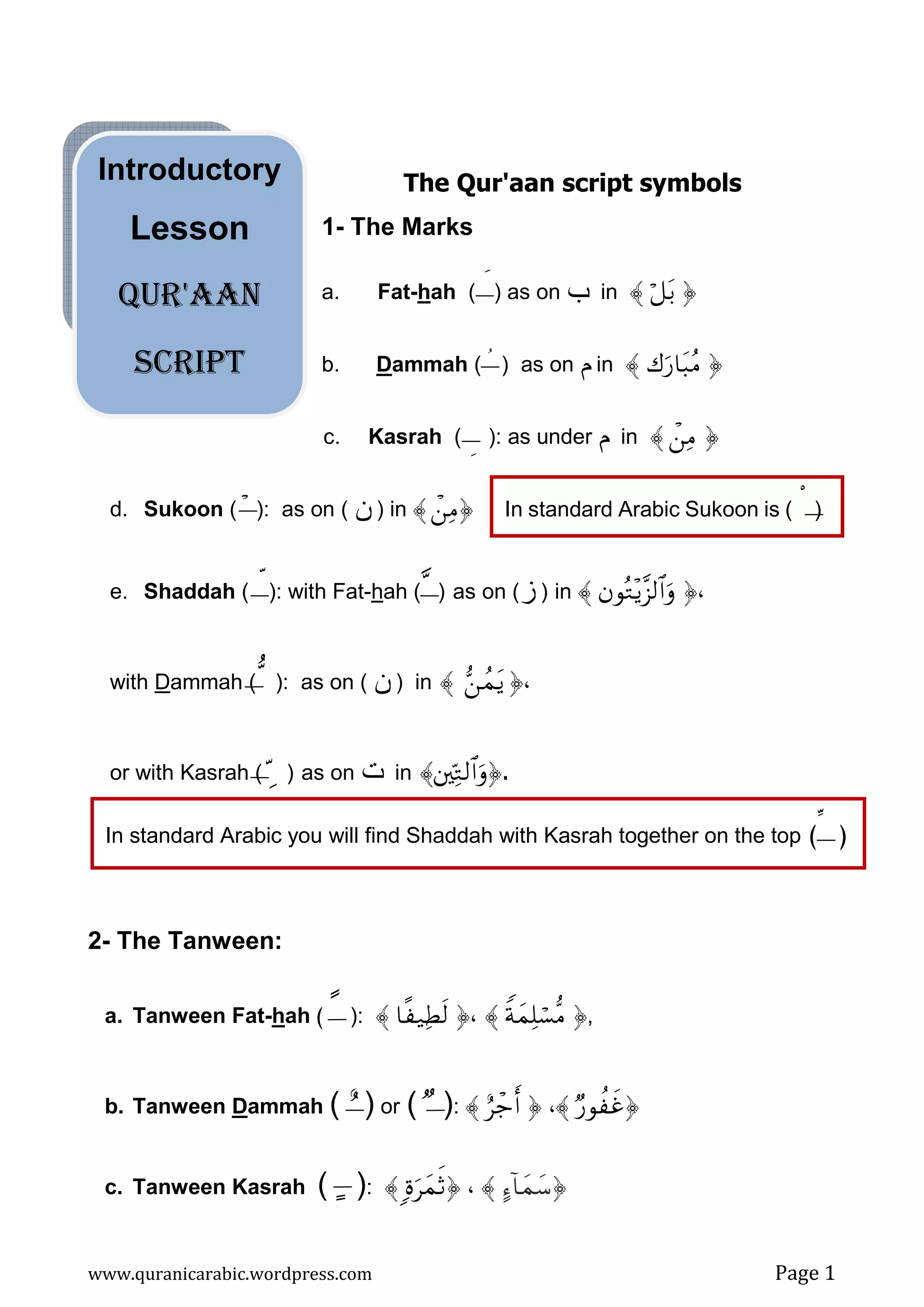
3- The letters written smaller than usual:
They are pronounced like the normal ones.
a. Small Alif ‫ﹲ‬‫ﺓ‬‫ﺭ‬‫ﻴ‬‫ﻐ‬‫ﺼ‬ ‫ﹲ‬‫ﻑ‬ِ‫ﻝ‬َ‫ﺃ‬( ¨ :) as in 〈 Å7Ï=≈tΒ = ‫ﻙ‬ِ‫ﻝ‬‫ﺎ‬‫ﻤ‬ (maalik),
〈3“uθø)s? = ‫ﻯ‬‫ﻭ‬‫ﹾ‬‫ﻘ‬‫ﹶ‬‫ﺘ‬ (taqwaa) (This one is Alif Maqsoorah we mentioned
before in "reading and writing skills" book in page 15)
b.Small Yaa' (‫ﺀ‬‫ﺎ‬‫ﻴ‬‫ﹲ‬‫ﺓ‬‫ﺭ‬‫ﻴ‬‫ﻐ‬‫ﺼ‬  :) as in 〈 z↵Íh‹Î;¨Ζ9$# ‫ﻥ‬‫ﹺﻴﻴ‬‫ﺒ‬‫ﱠ‬‫ﻨ‬‫ﺍﻝ‬= (an-nabiyyeen),
〈ϵÎ7ù=s%  ‫ﻪ‬‫ﹺ‬‫ﺒ‬‫ﹾ‬‫ﻠ‬‫ﹶ‬‫ﻗ‬= (qalbihee: if we continue reading, qalbih: if we pause.)
(Notice that this small Yaa' at the end of the word after a Haa', is not
written in the standard Arabic but we still pronounce it)
c. Small waaw ‫ﻭ‬‫ﺍ‬‫ﻭ‬‫ﹲ‬‫ﺓ‬‫ﺭ‬‫ﻴ‬‫ﻐ‬‫ﺼ‬ ( ………… :) as in 〈yŠ…ãρ#yŠ ‫ﺩﺍﻭﻭﺩ‬= (Dawood),
〈…çµç6ù=s% ‫ﻪ‬‫ﺒ‬‫ﹾ‬‫ﻠ‬‫ﹶ‬‫ﻗ‬= (qalbuhoo: if we continue reading, qalbuh: if we pause.)
(Notice that this small Waaw at the end of the word after a Haa', is not
written in the standard Arabic but we still pronounce it.)
d. Small noon ‫ﻥ‬‫ﹸﻭ‬‫ﻨ‬‫ﹲ‬‫ﺓ‬‫ﺭ‬‫ﻴ‬‫ﻐ‬‫ﺼ‬ ( G :) as in 〈 Å√GçΡ  ‫ﹺﻲ‬‫ﺠ‬‫ﹾ‬‫ﻨ‬‫ﹸ‬‫ﻨ‬= (nunjee)
e. Letter Alif on the top of letter Waaw: as in 〈 äο4θn=¢Á9$#  ‫ﹸ‬‫ﺓ‬‫ﻼ‬‫ﺼ‬‫ﺍﻝ‬=
(as-salaah) (We read Alif and eliminate the sound of the Waaw)
f. Letter Seen on the top of letter Saad 〈 äÝ+Áö6tƒ  ‫ﹸ‬‫ﻁ‬‫ﺴ‬‫ﺒ‬‫ﻴ‬= (yabsut)
(We read Seen and eliminate the sound of the Saad)
www.quranicarabic.wordpress.com Page 3
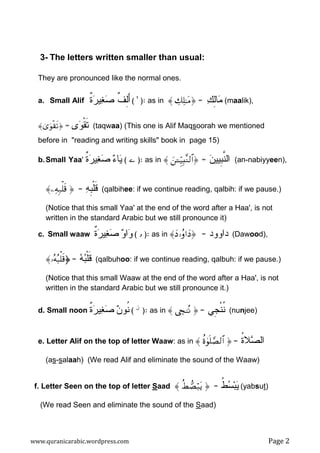
4- The Small Zero ( ' )
Sometimes found on the letters Alif, waaw and Yaa', means that these
letters should not be pronounced at all.
As in 〈 7‰&‹‹‹‹÷ƒr'Î/ (bi'ayd)، 〈 y7Í×‾≈s9''''ρρρρé&  (ulaa'ika) ،〈 ((((####θä9$s% (qaaloo)
5- The big zero ( O$ )
Always over Alif at the end of the word 〈 O$tΡr&  and sometimes over some
others Alifs coming also at the end of the word.
We pronounce the Alif when we pause on that word, and we eliminate it,
if we continue.
〈 O$tΡr&  = ‫ﹶﺎ‬‫ﻨ‬‫ﺃ‬ if we continue we say: (ana) with short vowel Fat-hah and if we
pause, we say: (anaa)
6- The Maddah ( ! ) Sometimes found over the long vowels: Alif, waaw
and Yaa'. It means that the long vowel has to be longer than usual.
〈 >!$yϑy™  (samaaaa'), 〈 ôMt↔ÿ‹Å™  (seeee'at), 〈 uûθß™  (soooo').
In standard Arabic this mark comes only on Alif )‫ﺁ‬( equals to )‫ﺀ‬+‫ﺍ‬( ,
In the Qur'aan )‫ﺀ‬+‫ﺍ‬( = (‫ﺍ‬‫ﺀ‬). Ex. 〈z tΒ#u  = ‫ﻥ‬‫ﻤ‬‫ﺁ‬ 'aamana.
In standard Arabic there is nothing on the top of such Alif
www.quranicarabic.wordpress.com Page 4
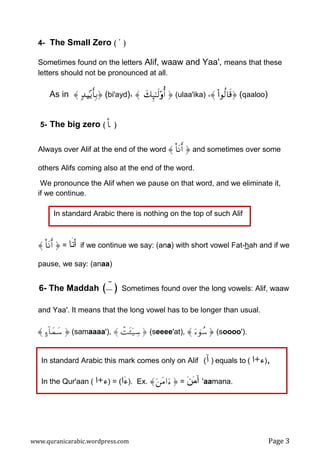
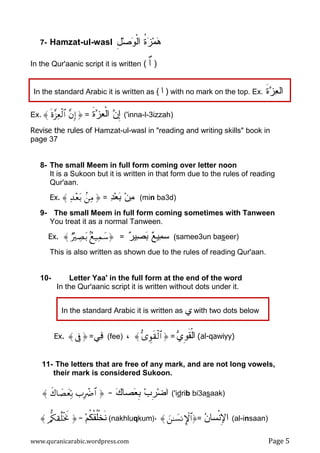
6- Pausing Symbols
These are written to achieve a correct pause when reading The Qur'aan.
A wrong pause can change the meaning of the verse.
Ÿωuρy7Ρâ“øts†óΟßγä9öθs%¢¨βÎ)n﨓Ïèø9$#¬!$—èŠÏϑy_〈)¢¢¢¢(a. Compulsory stop
y7Ï9$uΖèδèπu‹≈s9uθø9$#¬!Èd,utù:$#4uθèδÖŽöyz〈 $/#uθrO)4444(b. Permissible stop
.)(((((c. Permissible stop but it is preferable to continue
y7ù=Ï?×π¨Βé&ô‰s%ôMn=yz($yγs9$tΒôMt6|¡x.〈
)3(d. Permissible to continue but preferable to stop.
öΝèδìM≈y_u‘yŠy‰ΨÏã«!$#3ª!$#uρ7ŽÅÁt/〈
)¡¡¡¡¡¡¡¡(e. Stop at either of these two places but not at both.
y7Ï9¨sŒÜ=≈tGÅ6ø9$#Ÿω|=÷ƒu‘¡Ïµ‹Ïù¡“Y‰èδzŠÉ)−Fßϑù=Ïj9〈
d.The breathless pause ( 2222 :) Stop at the letter without taking a fresh
breath, then continue the recitation.
Ÿ≅ŠÏ%uρôtΒ25−#u‘〈
www.quranicarabic.wordpress.com Page 5
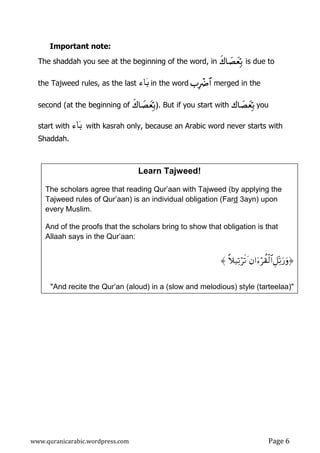
7- Hamzat-ul-wasl ‫ﻫ‬‫ﻤ‬ِ‫ل‬‫ﺼ‬‫ﻭ‬‫ﹾ‬‫ﻝ‬‫ﺍ‬ ‫ﹸ‬‫ﺓ‬‫ﺯ‬
In the Qur'aanic script it is written ( $# )
Ex. 〈 n﨓Ïèø9$# ¨βÎ)  = ‫ﹶ‬‫ﺓ‬‫ﺯ‬‫ﻌ‬‫ﹾ‬‫ﻝ‬‫ﺍ‬ ‫ﻥ‬ِ‫ﺇ‬ ('inna-l-3izzah)
Revise the rules of Hamzat-ul-wasl in "reading and writing skills" book in
page 37
8- The small Meem in full form coming over letter noon
It is a Sukoon but it is written in that form due to the rules of reading
Qur'aan.
Ex. 〈 ω÷èt/ .ÏΒ  = ‫ﺩ‬‫ﻌ‬‫ﺒ‬ ‫ﻥ‬‫ﻤ‬ (min ba3d)
9- The small Meem in full form coming sometimes with Tanween
You treat it as a normal Tanween.
eer)ssamee3un ba(‫ﺭ‬‫ﻴ‬‫ﺼ‬‫ﺒ‬ ‫ﻊ‬‫ﻴ‬‫ﻤ‬‫ﺴ‬=™yϑÏ‹ì7/tÁōŽÖ〈Ex.
This is also written as shown due to the rules of reading Qur'aan.
10- Letter Yaa' in the full form at the end of the word
In the Qur'aanic script it is written without dots under it.
Ex. 〈 ’Îû  =‫ﻲ‬‫ﻓ‬ (fee) ، 〈‘ “Èθs)ø9$#  = ‫ﻱ‬‫ﹺ‬‫ﻭ‬‫ﹶ‬‫ﻘ‬‫ﹾ‬‫ﻝ‬‫ﺍ‬ (al-qawiyy)
11- The letters that are free of any mark, and are not long vowels,
their mark is considered Sukoon.
aak)sbi3abrid'i(‫ﻙ‬‫ﺼﺎ‬‫ﻌ‬‫ﹺ‬‫ﺒ‬ ‫ﺏ‬‫ﹺ‬‫ﺭ‬‫ﻀ‬‫ﺍ‬=#$ÑôŽÎ>/nÎèyÁ|$8x〈
(al-insaan)‫ﻥ‬‫ﹾﺴﺎ‬‫ﻨ‬ِ‫ﻹ‬‫ﺍ‬=z≈|¡ΡM}$#〈،(nakhluqkum)‫ﻡ‬‫ﹸ‬‫ﻜ‬‫ﹾ‬‫ﻘ‬‫ﹸ‬‫ﻠ‬‫ﹾ‬‫ﺨ‬‫ﹶ‬‫ﻨ‬=/œ3)è=øƒwΥ〈
In the standard Arabic it is written as ( ‫ﺍ‬ ) with no mark on the top. Ex. ‫ﹶ‬‫ﺓ‬‫ﺯ‬‫ﻌ‬‫ﺍﻝ‬
In the standard Arabic it is written as ‫ﻱ‬ with two dots below
www.quranicarabic.wordpress.com Page 6
Important note:
The shaddah you see at the beginning of the word, in xxxx8888$$$$||||ÁÁÁÁyyyyèèèèÎÎÎÎnnnn//// is due to
the Tajweed rules, as the last ‫ﺎﺀ‬‫ﺒ‬ in the word >>>>ÎÎÎÎŽŽŽŽôôôôÑÑÑÑ$$$$#### merged in the
second (at the beginning of xxxx8888$$$$||||ÁÁÁÁyyyyèèèèÎÎÎÎnnnn////). But if you start with 8888$$$$||||ÁÁÁÁyyyyèèèèÎÎÎÎnnnn//// you
start with ‫ﺎﺀ‬‫ﺒ‬ with kasrah only, because an Arabic word never starts with
Shaddah.
Learn Tajweed!
The scholars agree that reading Qur’aan with Tajweed (by applying the
Tajweed rules of Qur’aan) is an individual obligation (Fard 3ayn) upon
every Muslim.
And of the proofs that the scholars bring to show that obligation is that
Allaah says in the Qur’aan:
〈 ¸ξ‹Ï?ös?t β#uöà)ø9$#È≅Ïo?u‘uρ
"And recite the Qur’an (aloud) in a (slow and melodious) style (tarteelaa)"

Lesson quraan-script

  • 1.
    www.quranicarabic.wordpress.com Page 1 Introductory Lesson QUR'AAN SCRIPT TheQur'aan script symbols 1- The Marks a. Fat-hah ( َ) as on ‫ﺏ‬ in 〈 ö≅t/  b. Dammah ( ُ ) as on ‫ﻡ‬ in 〈 8u‘$t6ãΒ  c. Kasrah ( ِ ): as under ‫ﻡ‬ in 〈 ôÏΒ  d. Sukoon (ô ): as on ( ‫ﻥ‬ ) in 〈 ôÏΒ e. Shaddah ( ّ): with Fat-hah (¨ ) as on (‫ﺯ‬ ) in 〈 βθçG÷ƒ¨“9$#uρ ، with Dammah (– ): as on ( ‫ﻥ‬ ) in 〈 ÷ ßϑtƒ ، or with Kasrah ( Ïn ) as on ‫ﺕ‬ in 〈ÏnG9$#uρ. 2- The Tanween: a. Tanween Fat-hah ( ¸ ): 〈 $¸ ‹ÏÜs9 ، 〈 ZπyϑÏ=ó¡–Β , b. Tanween Dammah ( í ) or ( Ö ): 〈 íô_r&  ،〈 Ö‘θà xî c. Tanween Kasrah ( ٍ ): 〈 ;οuyϑrO ، 〈 >!$yϑy™ In standard Arabic Sukoon is ( ْ ) In standard Arabic you will find Shaddah with Kasrah together on the top ‫ﱢ‬( )
  • 2.
    www.quranicarabic.wordpress.com Page 2 3-The letters written smaller than usual: They are pronounced like the normal ones. a. Small Alif ‫ﹲ‬‫ﺓ‬‫ﺭ‬‫ﻴ‬‫ﻐ‬‫ﺼ‬ ‫ﹲ‬‫ﻑ‬ِ‫ﻝ‬َ‫ﺃ‬( ¨ :) as in 〈 Å7Ï=≈tΒ = ‫ﻙ‬ِ‫ﻝ‬‫ﺎ‬‫ﻤ‬ (maalik), 〈3“uθø)s? = ‫ﻯ‬‫ﻭ‬‫ﹾ‬‫ﻘ‬‫ﹶ‬‫ﺘ‬ (taqwaa) (This one is Alif Maqsoorah we mentioned before in "reading and writing skills" book in page 15) b.Small Yaa' (‫ﺀ‬‫ﺎ‬‫ﻴ‬‫ﹲ‬‫ﺓ‬‫ﺭ‬‫ﻴ‬‫ﻐ‬‫ﺼ‬  :) as in 〈 z↵Íh‹Î;¨Ζ9$# ‫ﻥ‬‫ﹺﻴﻴ‬‫ﺒ‬‫ﱠ‬‫ﻨ‬‫ﺍﻝ‬= (an-nabiyyeen), 〈ϵÎ7ù=s%  ‫ﻪ‬‫ﹺ‬‫ﺒ‬‫ﹾ‬‫ﻠ‬‫ﹶ‬‫ﻗ‬= (qalbihee: if we continue reading, qalbih: if we pause.) (Notice that this small Yaa' at the end of the word after a Haa', is not written in the standard Arabic but we still pronounce it) c. Small waaw ‫ﻭ‬‫ﺍ‬‫ﻭ‬‫ﹲ‬‫ﺓ‬‫ﺭ‬‫ﻴ‬‫ﻐ‬‫ﺼ‬ ( ………… :) as in 〈yŠ…ãρ#yŠ ‫ﺩﺍﻭﻭﺩ‬= (Dawood), 〈…çµç6ù=s% ‫ﻪ‬‫ﺒ‬‫ﹾ‬‫ﻠ‬‫ﹶ‬‫ﻗ‬= (qalbuhoo: if we continue reading, qalbuh: if we pause.) (Notice that this small Waaw at the end of the word after a Haa', is not written in the standard Arabic but we still pronounce it.) d. Small noon ‫ﻥ‬‫ﹸﻭ‬‫ﻨ‬‫ﹲ‬‫ﺓ‬‫ﺭ‬‫ﻴ‬‫ﻐ‬‫ﺼ‬ ( G :) as in 〈 Å√GçΡ  ‫ﹺﻲ‬‫ﺠ‬‫ﹾ‬‫ﻨ‬‫ﹸ‬‫ﻨ‬= (nunjee) e. Letter Alif on the top of letter Waaw: as in 〈 äο4θn=¢Á9$#  ‫ﹸ‬‫ﺓ‬‫ﻼ‬‫ﺼ‬‫ﺍﻝ‬= (as-salaah) (We read Alif and eliminate the sound of the Waaw) f. Letter Seen on the top of letter Saad 〈 äÝ+Áö6tƒ  ‫ﹸ‬‫ﻁ‬‫ﺴ‬‫ﺒ‬‫ﻴ‬= (yabsut) (We read Seen and eliminate the sound of the Saad)
  • 3.
    www.quranicarabic.wordpress.com Page 3 4-The Small Zero ( ' ) Sometimes found on the letters Alif, waaw and Yaa', means that these letters should not be pronounced at all. As in 〈 7‰&‹‹‹‹÷ƒr'Î/ (bi'ayd)، 〈 y7Í×‾≈s9''''ρρρρé&  (ulaa'ika) ،〈 ((((####θä9$s% (qaaloo) 5- The big zero ( O$ ) Always over Alif at the end of the word 〈 O$tΡr&  and sometimes over some others Alifs coming also at the end of the word. We pronounce the Alif when we pause on that word, and we eliminate it, if we continue. 〈 O$tΡr&  = ‫ﹶﺎ‬‫ﻨ‬‫ﺃ‬ if we continue we say: (ana) with short vowel Fat-hah and if we pause, we say: (anaa) 6- The Maddah ( ! ) Sometimes found over the long vowels: Alif, waaw and Yaa'. It means that the long vowel has to be longer than usual. 〈 >!$yϑy™  (samaaaa'), 〈 ôMt↔ÿ‹Å™  (seeee'at), 〈 uûθß™  (soooo'). In standard Arabic this mark comes only on Alif )‫ﺁ‬( equals to )‫ﺀ‬+‫ﺍ‬( , In the Qur'aan )‫ﺀ‬+‫ﺍ‬( = (‫ﺍ‬‫ﺀ‬). Ex. 〈z tΒ#u  = ‫ﻥ‬‫ﻤ‬‫ﺁ‬ 'aamana. In standard Arabic there is nothing on the top of such Alif
  • 4.
    www.quranicarabic.wordpress.com Page 4 6-Pausing Symbols These are written to achieve a correct pause when reading The Qur'aan. A wrong pause can change the meaning of the verse. Ÿωuρy7Ρâ“øts†óΟßγä9öθs%¢¨βÎ)n﨓Ïèø9$#¬!$—èŠÏϑy_〈)¢¢¢¢(a. Compulsory stop y7Ï9$uΖèδèπu‹≈s9uθø9$#¬!Èd,utù:$#4uθèδÖŽöyz〈 $/#uθrO)4444(b. Permissible stop .)(((((c. Permissible stop but it is preferable to continue y7ù=Ï?×π¨Βé&ô‰s%ôMn=yz($yγs9$tΒôMt6|¡x.〈 )3(d. Permissible to continue but preferable to stop. öΝèδìM≈y_u‘yŠy‰ΨÏã«!$#3ª!$#uρ7ŽÅÁt/〈 )¡¡¡¡¡¡¡¡(e. Stop at either of these two places but not at both. y7Ï9¨sŒÜ=≈tGÅ6ø9$#Ÿω|=÷ƒu‘¡Ïµ‹Ïù¡“Y‰èδzŠÉ)−Fßϑù=Ïj9〈 d.The breathless pause ( 2222 :) Stop at the letter without taking a fresh breath, then continue the recitation. Ÿ≅ŠÏ%uρôtΒ25−#u‘〈
  • 5.
    www.quranicarabic.wordpress.com Page 5 7-Hamzat-ul-wasl ‫ﻫ‬‫ﻤ‬ِ‫ل‬‫ﺼ‬‫ﻭ‬‫ﹾ‬‫ﻝ‬‫ﺍ‬ ‫ﹸ‬‫ﺓ‬‫ﺯ‬ In the Qur'aanic script it is written ( $# ) Ex. 〈 n﨓Ïèø9$# ¨βÎ)  = ‫ﹶ‬‫ﺓ‬‫ﺯ‬‫ﻌ‬‫ﹾ‬‫ﻝ‬‫ﺍ‬ ‫ﻥ‬ِ‫ﺇ‬ ('inna-l-3izzah) Revise the rules of Hamzat-ul-wasl in "reading and writing skills" book in page 37 8- The small Meem in full form coming over letter noon It is a Sukoon but it is written in that form due to the rules of reading Qur'aan. Ex. 〈 ω÷èt/ .ÏΒ  = ‫ﺩ‬‫ﻌ‬‫ﺒ‬ ‫ﻥ‬‫ﻤ‬ (min ba3d) 9- The small Meem in full form coming sometimes with Tanween You treat it as a normal Tanween. eer)ssamee3un ba(‫ﺭ‬‫ﻴ‬‫ﺼ‬‫ﺒ‬ ‫ﻊ‬‫ﻴ‬‫ﻤ‬‫ﺴ‬=™yϑÏ‹ì7/tÁōŽÖ〈Ex. This is also written as shown due to the rules of reading Qur'aan. 10- Letter Yaa' in the full form at the end of the word In the Qur'aanic script it is written without dots under it. Ex. 〈 ’Îû  =‫ﻲ‬‫ﻓ‬ (fee) ، 〈‘ “Èθs)ø9$#  = ‫ﻱ‬‫ﹺ‬‫ﻭ‬‫ﹶ‬‫ﻘ‬‫ﹾ‬‫ﻝ‬‫ﺍ‬ (al-qawiyy) 11- The letters that are free of any mark, and are not long vowels, their mark is considered Sukoon. aak)sbi3abrid'i(‫ﻙ‬‫ﺼﺎ‬‫ﻌ‬‫ﹺ‬‫ﺒ‬ ‫ﺏ‬‫ﹺ‬‫ﺭ‬‫ﻀ‬‫ﺍ‬=#$ÑôŽÎ>/nÎèyÁ|$8x〈 (al-insaan)‫ﻥ‬‫ﹾﺴﺎ‬‫ﻨ‬ِ‫ﻹ‬‫ﺍ‬=z≈|¡ΡM}$#〈،(nakhluqkum)‫ﻡ‬‫ﹸ‬‫ﻜ‬‫ﹾ‬‫ﻘ‬‫ﹸ‬‫ﻠ‬‫ﹾ‬‫ﺨ‬‫ﹶ‬‫ﻨ‬=/œ3)è=øƒwΥ〈 In the standard Arabic it is written as ( ‫ﺍ‬ ) with no mark on the top. Ex. ‫ﹶ‬‫ﺓ‬‫ﺯ‬‫ﻌ‬‫ﺍﻝ‬ In the standard Arabic it is written as ‫ﻱ‬ with two dots below
  • 6.
    www.quranicarabic.wordpress.com Page 6 Importantnote: The shaddah you see at the beginning of the word, in xxxx8888$$$$||||ÁÁÁÁyyyyèèèèÎÎÎÎnnnn//// is due to the Tajweed rules, as the last ‫ﺎﺀ‬‫ﺒ‬ in the word >>>>ÎÎÎÎŽŽŽŽôôôôÑÑÑÑ$$$$#### merged in the second (at the beginning of xxxx8888$$$$||||ÁÁÁÁyyyyèèèèÎÎÎÎnnnn////). But if you start with 8888$$$$||||ÁÁÁÁyyyyèèèèÎÎÎÎnnnn//// you start with ‫ﺎﺀ‬‫ﺒ‬ with kasrah only, because an Arabic word never starts with Shaddah. Learn Tajweed! The scholars agree that reading Qur’aan with Tajweed (by applying the Tajweed rules of Qur’aan) is an individual obligation (Fard 3ayn) upon every Muslim. And of the proofs that the scholars bring to show that obligation is that Allaah says in the Qur’aan: 〈 ¸ξ‹Ï?ös?t β#uöà)ø9$#È≅Ïo?u‘uρ "And recite the Qur’an (aloud) in a (slow and melodious) style (tarteelaa)"