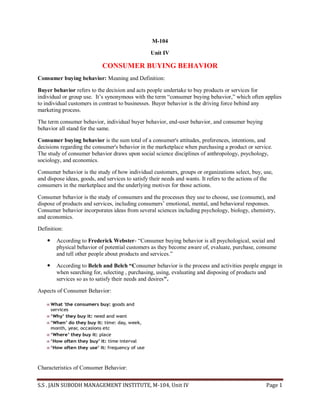
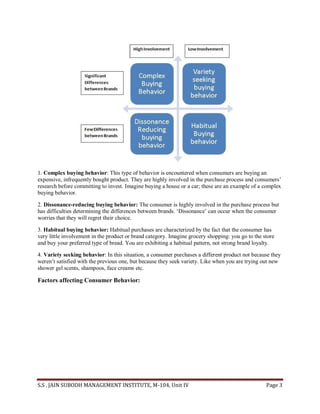
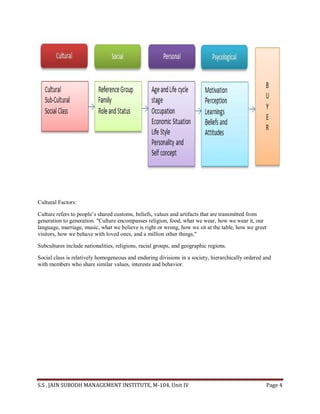
1. Consumer buying behavior refers to the processes consumers use to choose, purchase, use, and dispose of products and services. It is influenced by cultural, social, personal and psychological factors.
2. The consumer decision making process involves problem recognition, information search, alternative evaluation, purchase decision, and post-purchase evaluation. Consumers progress through these stages when making purchase decisions.
3. Cognitive dissonance occurs when a consumer experiences tension between their purchase decision and existing attitudes or beliefs. To reduce dissonance, consumers may change their beliefs or behaviors.



![S.S . JAIN SUBODH MANAGEMENT INSTITUTE, M-104, Unit IV Page 12
c) Psychoanalytic model: The psychoanalytical model takes into consideration the fact that
consumer behavior is influenced by both the conscious and the subconscious mind. The three
levels of consciousness discussed by Sigmund Freud (id, ego and superego) all work to influence
one's buying decisions and behaviors. A hidden symbol in a company's name or logo may have an
effect on a person's subconscious mind and may influence him to buy that product instead of a
similar product from another company.
d) Sociological model: The sociological model primarily considers the idea that a consumer's
buying pattern is based on his role and influence in the society. A consumer's behavior may also
be influenced by the people she associates with and the culture that her society exhibits. For
instance, a manager and an employee may have different buying behaviors given their respective
roles in the company they work for, but if they live in the same community or attend the same
church, they may buy products from the same company or brand.
II. Contemporary models
The important contemporary models of consumer behavior are:
a) Engel-Kollat-Blackwell Model
b) Nicosia Model
c) Stimulus-Response Model
d) Howard-Sheth model
[A] Engel-Kollat-Blackwell Model:
The Engel Kollat Blackwell Model of Consumer Behavior was created to describe the increasing, fast-
growing body of knowledge concerning consumer behavior. This model, like in other models, has gone
through many revisions to improve its descriptive ability of the basic relationships between components
and sub-components.
The Engel Kollat Blackwell Model of Consumer Behavior or consists of four distinct stages;
1. Information Input Stage: At this stage the consumer gets information from marketing and non-
marketing sources, which also influence the problem recognition stage of the decision-making process. If
the consumer still does not arrive to a specific decision, the search for external information will be
activated in order to arrive to a choice or in some cases if the consumer experience dissonance because
the selected alternative is less satisfactory than expected.
2. Information Processing Stage: This stage consists of the consumer’s exposure, attention,
perception, acceptance, and retention of incoming information. The consumer must first be
exposed to the message, allocate space for this information, interpret the stimuli, and retain the
message by transferring the input to long-term memory.
3. Decision Process Stage: The central focus of the model is on five basic decision-process stages:
Problem recognition, search for alternatives, alternate evaluation (during which beliefs may lead
to the formation of attitudes, which in turn may result in a purchase intention) purchase, and
outcomes. But it is not necessary for every consumer to go through all these stages; it depends on
whether it is an extended or a routine problem-solving behavior.
4. Variables Influencing the Decision Process: This stage consists of individual and
environmental influences that affect all five stages of the decision process. Individual
characteristics include motives, values, lifestyle, and personality; the social influences are culture,
reference groups, and family. Situational influences, such as a consumer’s financial condition,
also influence the decision process.](https://image.slidesharecdn.com/mmunitiv-220531081211-aee7b514/85/MMUnit-IV-pdf-12-320.jpg)
![S.S . JAIN SUBODH MANAGEMENT INSTITUTE, M-104, Unit IV Page 13
[B]Nicosia Model:
Nicosia Model of Consumer Behavior was developed in 1966, by Professor Francesco M. Nicosia, an
expert in consumer motivation and behavior. This model focuses on the relationship between the firm
and its potential consumers. The model suggests that messages from the firm (advertisements) first
influences the predisposition of the consumer towards the product or service. Based on the situation, the
consumer will have a certain attitude towards the product. This may result in a search for the product or
an evaluation of the product attributes by the consumer. If the above step satisfies the consumer, it may
result in a positive response, with a decision to buy the product otherwise the reverse may occur. Looking
to the model we will find that the firm and the consumer are connected with each other, the firm tries to
influence the consumer and the consumer is influencing the firm by his decision.
The Nicosia model of Consumer Behavior is divided into four major fields:
1. Field 1: The firm’s attributes and the consumer’s attributes. The first field is divided into two
subfields. The first subfield deals with the firm’s marketing environment and communication efforts that
affect consumer attitudes, the competitive environment, and characteristics of target market. Subfield two
specifies the consumer characteristics e.g., experience, personality, and how he perceives the promotional
idea toward the product in this stage the consumer forms his attitude toward the firm’s product based on
his interpretation of the message.
2. Field 2: Search and evaluation. The consumer will start to search for other firm’s brand and evaluate the
firm’s brand in comparison with alternate brands. In this case the firm motivates the consumer to
purchase its brands.
3. Field 3: The act of the purchase. The result of motivation will arise by convincing the consumer to
purchase the firm products from a specific retailer.
4. Field 4: Feedback of sales results. This model analyses the feedback of both the firm and the consumer
after purchasing the product. The firm will benefit from its sales data as a feedback, and the consumer
will use his experience with the product affects the individual’s attitude and predisposition’s concerning
future messages from the firm.](https://image.slidesharecdn.com/mmunitiv-220531081211-aee7b514/85/MMUnit-IV-pdf-13-320.jpg)
![S.S . JAIN SUBODH MANAGEMENT INSTITUTE, M-104, Unit IV Page 14
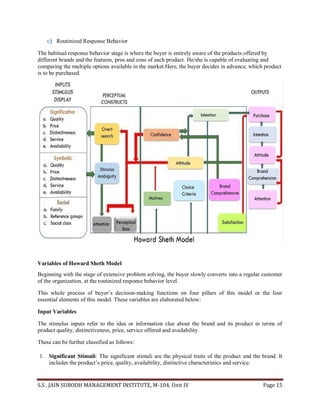
[C] Howard Sheth model:
The Howard Sheth Model is an approach for analyzing the combined impact of the social, psychological
and marketing factors on the buying behaviour or preference of the consumers and the industrial buyers
into a logical order of information processing.
John Howard and Jagadish Sheth introduced the Howard Sheth Model in the year 1969. The concept was
published in their book ‘The Theory of Buyer Behaviour’.
Three Levels of Decision-Making in Howard Sheth Model
The model has described the three significant stages of the buyer’s decision-making or selection of a
particular brand. Let us now discuss each of these in details below:
a) Extensive Problem Solving
This is the initial stage of decision-making, where the buyer is new to the market. He/she has no or little
information about the brands and has no preference for a particular product or service. Thus, a consumer
is an information seeker at this level, who checks out different brands available in the market, before
making a buying decision.
b) Limited Problem Solving
At this level, the buyer has inadequate or incomplete information about the product, market or the brands
operating in it. Sometimes the buyer is confused among the various alternatives. Therefore, to make a
buying decision, he/she look for a comparative study of the different brands and the products available in
the market.](https://image.slidesharecdn.com/mmunitiv-220531081211-aee7b514/85/MMUnit-IV-pdf-14-320.jpg)

![S.S . JAIN SUBODH MANAGEMENT INSTITUTE, M-104, Unit IV Page 17
1. Attention: The buyer’s level of concentration and alertness with which he/she understands the
information provided, is termed as attention.
2. Brand Comprehension: The awareness of the buyer regarding a particular brand and its products is
known as brand comprehension.
3. Attitude: The buyer’s evaluation of a brand in terms of individual likes and dislikes, determines
his/her behaviour, interest and awareness towards it.
4. Intention: The aim or objective of the buyer for purchasing a product can be seen as the buying
intention.
5. Purchase Behaviour: All the above elements result in the actual purchase of a product by the buyer.
Exogenous Variables
There are certain other external factors which influence the buying behavior of an individual or a firm by
hampering the product purchase of a preferred brand.
The exogenous variables are the environmental forces or components of this model. These are as follows:
1. Importance of Purchase: If the buyer perceives the product to be less crucial, involving a low cost,
then there is a little brand preference.
2. Personality Variables: Personal traits like ego, self-esteem, anxiety, dominance, authoritarian, etc.
influences a buyer’s decision-making while purchasing a product.
3. Social Class: A buyer’s social group, including the family, friends and other reference groups impact
the selection or rejection of a particular brand.
4. Culture: The buyer’s values, beliefs and ideas frame his/her purchase motive and inhibitors.
5. Organization: The buyer’s interaction with the social groups defines their authority, status and
power. The hypothetical constructs of a buyer are affected by such formal or informal
communications.
6. Time Pressure: The buyer, at times, is under the pressure of taking a timely decision, which makes
him/her look for alternatives if the product of the preferred brand is unavailable at the moment.
7. Financial Status: The buyer’s inability to purchase a product or unaffordability restricts him/her
from buying it.
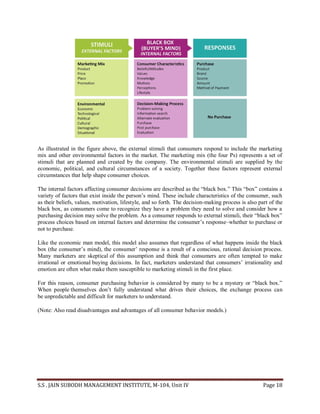
[D] Stimulus Response Model:
Another model of consumer behavior, called the stimulus-response or “black box” model, focuses on the
consumer as a thinker and problem solver who responds to a range of external and internal factors when
deciding whether or not to buy. These factors are shown in Figure below:](https://image.slidesharecdn.com/mmunitiv-220531081211-aee7b514/85/MMUnit-IV-pdf-17-320.jpg)


![Buy Twitter Ads Account [ X Verified & Ready for Campaigns].docx](https://cdn.slidesharecdn.com/ss_thumbnails/buytwitteradsaccountxverifiedreadyforcampaigns-260114201150-9fcc4249-thumbnail.jpg?width=640&height=640&fit=bounds)


