COMMUNICATIONCOMMUNICATION
SKILLSSKILLS Active ListeningActive Listening
 Verbal and Non-verbalVerbal and Non-verbal
MessagesMessages
 AttendingAttending
 RespondingResponding
 ParaphrasingParaphrasing
 SummarizingSummarizing
 Ask QuestionsAsk Questions
 Probing.Probing.
Wednesday, February 7, 2018Wednesday, February 7, 2018angstha, Banglabazar, Dhaka-1100; ISBN: 978-984-8798-22-5, Dkaka - 1100; smskabir@psy.jnu.ac.bd; smskabir218@gmail.comangstha, Banglabazar, Dhaka-1100; ISBN: 978-984-8798-22-5, Dkaka - 1100; smskabir@psy.jnu.ac.bd; smskabir218@gmail.com
CommunicationSkillsCommunicationSkills
 It means using a set of skills thatIt means using a set of skills that
encourage the person you are listening toencourage the person you are listening to
talk, to help them feel heard andtalk, to help them feel heard and
understood.understood.
 It is called “active” because youIt is called “active” because you
intentionally do things to help them feelintentionally do things to help them feel
able to talk, and because you engageable to talk, and because you engage
with all your attention on what thewith all your attention on what the
speaker is saying, how they are acting,speaker is saying, how they are acting,
and how they are feeling.and how they are feeling.
Wednesday, February 7, 2018Wednesday, February 7, 2018angstha, Banglabazar, Dhaka-1100; ISBN: 978-984-8798-22-5, Dkaka - 1100; smskabir@psy.jnu.ac.bd; smskabir218@gmail.comangstha, Banglabazar, Dhaka-1100; ISBN: 978-984-8798-22-5, Dkaka - 1100; smskabir@psy.jnu.ac.bd; smskabir218@gmail.com
ActiveActive
ListeningListening
CommunicationSkillsCommunicationSkills
Active listening skills are –Active listening skills are –
 Using minimal encouragers – small signals orUsing minimal encouragers – small signals or
words that let the speaker know you arewords that let the speaker know you are
listening and understanding – words like “uh-listening and understanding – words like “uh-
huh”, “yes”, “no”, “mmm”.huh”, “yes”, “no”, “mmm”.
 Using open body language – helping make theUsing open body language – helping make the
speaker feel comfortable and safe with you.speaker feel comfortable and safe with you.
 Repeating back some of the speaker’s words,Repeating back some of the speaker’s words,
oror
a phrase, to help prompt them to say more.a phrase, to help prompt them to say more.
 Paraphrasing – putting what the speaker saysParaphrasing – putting what the speaker says
into your own words.into your own words.
 Summarizing – putting in a nutshell, in aSummarizing – putting in a nutshell, in a
sentence or two, what the speaker has beensentence or two, what the speaker has been
talking about over an extended period.talking about over an extended period.Wednesday, February 7, 2018Wednesday, February 7, 2018angstha, Banglabazar, Dhaka-1100; ISBN: 978-984-8798-22-5, Dkaka - 1100; smskabir@psy.jnu.ac.bd; smskabir218@gmail.comangstha, Banglabazar, Dhaka-1100; ISBN: 978-984-8798-22-5, Dkaka - 1100; smskabir@psy.jnu.ac.bd; smskabir218@gmail.com
Active ListeningActive Listening
CommunicationSkillsCommunicationSkills
 Mirroring the Speaker – adopting aspects ofMirroring the Speaker – adopting aspects of
their body language, voice tone and language totheir body language, voice tone and language to
develop rapport and help them feel more atdevelop rapport and help them feel more at
ease.ease.
 Reflecting – picking up on the speaker’s feelingReflecting – picking up on the speaker’s feeling
or mood and feeding your perceptions back toor mood and feeding your perceptions back to
them.them.
 Using silence – so that the speaker has aUsing silence – so that the speaker has a
respectful space to stay with their feelings andrespectful space to stay with their feelings and
to work up to what they want to say.to work up to what they want to say.
 Questioning skills – when and how to useQuestioning skills – when and how to use
questions to help the speaker to open up andquestions to help the speaker to open up and
tell you more.tell you more.
Wednesday, February 7, 2018Wednesday, February 7, 2018angstha, Banglabazar, Dhaka-1100; ISBN: 978-984-8798-22-5, Dkaka - 1100; smskabir@psy.jnu.ac.bd; smskabir218@gmail.comangstha, Banglabazar, Dhaka-1100; ISBN: 978-984-8798-22-5, Dkaka - 1100; smskabir@psy.jnu.ac.bd; smskabir218@gmail.com
Active ListeningActive Listening
CommunicationSkillsCommunicationSkills
Active listening intentionally focuses on who you areActive listening intentionally focuses on who you are
listening to, whether in a group or one-on-one, in order tolistening to, whether in a group or one-on-one, in order to
understand what s/he is saying. Some of these areunderstand what s/he is saying. Some of these are
explored below-explored below-
 Information – getting a clear picture.Information – getting a clear picture.
SpeakerSpeaker:: To tell them what you want.To tell them what you want.
ListenerListener:: To find out and confirm what they are saying.To find out and confirm what they are saying.
 Affirmation – affirming, acknowledging, exploring theAffirmation – affirming, acknowledging, exploring the
problem.problem.
SpeakerSpeaker:: To tell someone (counselor) about the problem.To tell someone (counselor) about the problem.
ListenerListener:: To help them hear what they are saying.To help them hear what they are saying.
 Inflammation – responding to a complaint.Inflammation – responding to a complaint.
SpeakerSpeaker:: To tell the counselor that they are theTo tell the counselor that they are the
problem.problem.
ListenerListener:: Let them know that they have taken in whatLet them know that they have taken in what
they are saying and to defuse the strong emotion.they are saying and to defuse the strong emotion.
Wednesday, February 7, 2018Wednesday, February 7, 2018angstha, Banglabazar, Dhaka-1100; ISBN: 978-984-8798-22-5, Dkaka - 1100; smskabir@psy.jnu.ac.bd; smskabir218@gmail.comangstha, Banglabazar, Dhaka-1100; ISBN: 978-984-8798-22-5, Dkaka - 1100; smskabir@psy.jnu.ac.bd; smskabir218@gmail.com
Active ListeningActive Listening
CommunicationSkillsCommunicationSkills
Counselors should refrain from -Counselors should refrain from -
 Talking about themselves and introducing their ownTalking about themselves and introducing their own
reactions or well intended comments.reactions or well intended comments.
 Changing topics and thinking about what they will say next.Changing topics and thinking about what they will say next.
 Advising, diagnosing, reassuring, encouraging, criticizingAdvising, diagnosing, reassuring, encouraging, criticizing
or baiting a client.or baiting a client.
 Using “mm” or “ah ah” exclusively or inappropriately orUsing “mm” or “ah ah” exclusively or inappropriately or
parrot their words.parrot their words.
 Pretending to have understood the person or theirPretending to have understood the person or their
meaning if they haven’t.meaning if they haven’t.
 Fixing, changing or improving what they have said – orFixing, changing or improving what they have said – or
finishing their sentences for them.finishing their sentences for them.
 Filling every space with talk.Filling every space with talk.
 Ignoring their feelings in the situation.Ignoring their feelings in the situation.
Wednesday, February 7, 2018Wednesday, February 7, 2018angstha, Banglabazar, Dhaka-1100; ISBN: 978-984-8798-22-5, Dkaka - 1100; smskabir@psy.jnu.ac.bd; smskabir218@gmail.comangstha, Banglabazar, Dhaka-1100; ISBN: 978-984-8798-22-5, Dkaka - 1100; smskabir@psy.jnu.ac.bd; smskabir218@gmail.com
Active ListeningActive Listening
CommunicationSkillsCommunicationSkills
Active listening involves the following four skills –Active listening involves the following four skills –
 Listening to and understanding the client’sListening to and understanding the client’s
verbal messages.verbal messages.
 Listening to and interpreting the client'sListening to and interpreting the client's
nonverbal messages.nonverbal messages.
 Listening to and understanding the client inListening to and understanding the client in
context.context.
 Listening with empathy. Empathic listeningListening with empathy. Empathic listening
involves attending, observing and listening ininvolves attending, observing and listening in
such a way that the counselor develops ansuch a way that the counselor develops an
understanding of the client and his or herunderstanding of the client and his or her
world.world.
Wednesday, February 7, 2018Wednesday, February 7, 2018angstha, Banglabazar, Dhaka-1100; ISBN: 978-984-8798-22-5, Dkaka - 1100; smskabir@psy.jnu.ac.bd; smskabir218@gmail.comangstha, Banglabazar, Dhaka-1100; ISBN: 978-984-8798-22-5, Dkaka - 1100; smskabir@psy.jnu.ac.bd; smskabir218@gmail.com
Active ListeningActive Listening
CommunicationSkillsCommunicationSkills
Counselors should be aware of – [Egan, 1998]Counselors should be aware of – [Egan, 1998]
 Inadequate ListeningInadequate Listening: Counselors are often: Counselors are often
distracted because they have problems of theirdistracted because they have problems of their
own, feel ill, or because they become distracted byown, feel ill, or because they become distracted by
social and cultural differences between themselvessocial and cultural differences between themselves
and their clients.and their clients.
 Evaluative ListeningEvaluative Listening: Most people listen evaluatively: Most people listen evaluatively
to others. Judging and labeling what the otherto others. Judging and labeling what the other
person is saying as either right/wrong, good/ bad,person is saying as either right/wrong, good/ bad,
acceptable/ unacceptable, relevant/ irrelevant etc.acceptable/ unacceptable, relevant/ irrelevant etc.
 Filtered ListeningFiltered Listening: We tend to listen to ourselves,: We tend to listen to ourselves,
other people and the world around us throughother people and the world around us through
biased (often prejudiced) filters.biased (often prejudiced) filters.
Wednesday, February 7, 2018Wednesday, February 7, 2018angstha, Banglabazar, Dhaka-1100; ISBN: 978-984-8798-22-5, Dkaka - 1100; smskabir@psy.jnu.ac.bd; smskabir218@gmail.comangstha, Banglabazar, Dhaka-1100; ISBN: 978-984-8798-22-5, Dkaka - 1100; smskabir@psy.jnu.ac.bd; smskabir218@gmail.com
Active ListeningActive Listening
CommunicationSkillsCommunicationSkills
 Labels as FiltersLabels as Filters: Diagnostic labels can prevent: Diagnostic labels can prevent
you from really listening to your client.you from really listening to your client.
 Fact-centered rather than Person-centeredFact-centered rather than Person-centered
ListeningListening: Asking only informational or factual: Asking only informational or factual
questions won't solve the client's problems.questions won't solve the client's problems.
 RehearsingRehearsing: If you mentally rehearse your: If you mentally rehearse your
answers, you are also not listening attentively.answers, you are also not listening attentively.
Counselors who listen carefully to the themesCounselors who listen carefully to the themes
and core messages in a client's story alwaysand core messages in a client's story always
know how to respond.know how to respond.
 Sympathetic ListeningSympathetic Listening: It can distort the: It can distort the
counselor’s listening to the client's story. Tocounselor’s listening to the client's story. To
sympathize with someone is to become thatsympathize with someone is to become that
person's accomplice.person's accomplice.
Wednesday, February 7, 2018Wednesday, February 7, 2018angstha, Banglabazar, Dhaka-1100; ISBN: 978-984-8798-22-5, Dkaka - 1100; smskabir@psy.jnu.ac.bd; smskabir218@gmail.comangstha, Banglabazar, Dhaka-1100; ISBN: 978-984-8798-22-5, Dkaka - 1100; smskabir@psy.jnu.ac.bd; smskabir218@gmail.com
Active ListeningActive Listening
It’s not what you say but HOW you say it!It’s not what you say but HOW you say it!
 Majority of communication (80%) isMajority of communication (80%) is
non-verbal.non-verbal.
 Counselors need to be aware of whatCounselors need to be aware of what
they may be communicating to clientsthey may be communicating to clients
through their non-verbal behavior.through their non-verbal behavior.
 They also need to give attention toThey also need to give attention to
what is being communicated throughwhat is being communicated through
the non-verbal behavior of their clients.the non-verbal behavior of their clients.
Wednesday, February 7, 2018Wednesday, February 7, 2018angstha, Banglabazar, Dhaka-1100; ISBN: 978-984-8798-22-5, Dkaka - 1100; smskabir@psy.jnu.ac.bd; smskabir218@gmail.comangstha, Banglabazar, Dhaka-1100; ISBN: 978-984-8798-22-5, Dkaka - 1100; smskabir@psy.jnu.ac.bd; smskabir218@gmail.com
Verbal andVerbal and
Non-verbalNon-verbal
MessageMessage
CommunicationCommunication
SkillsSkills
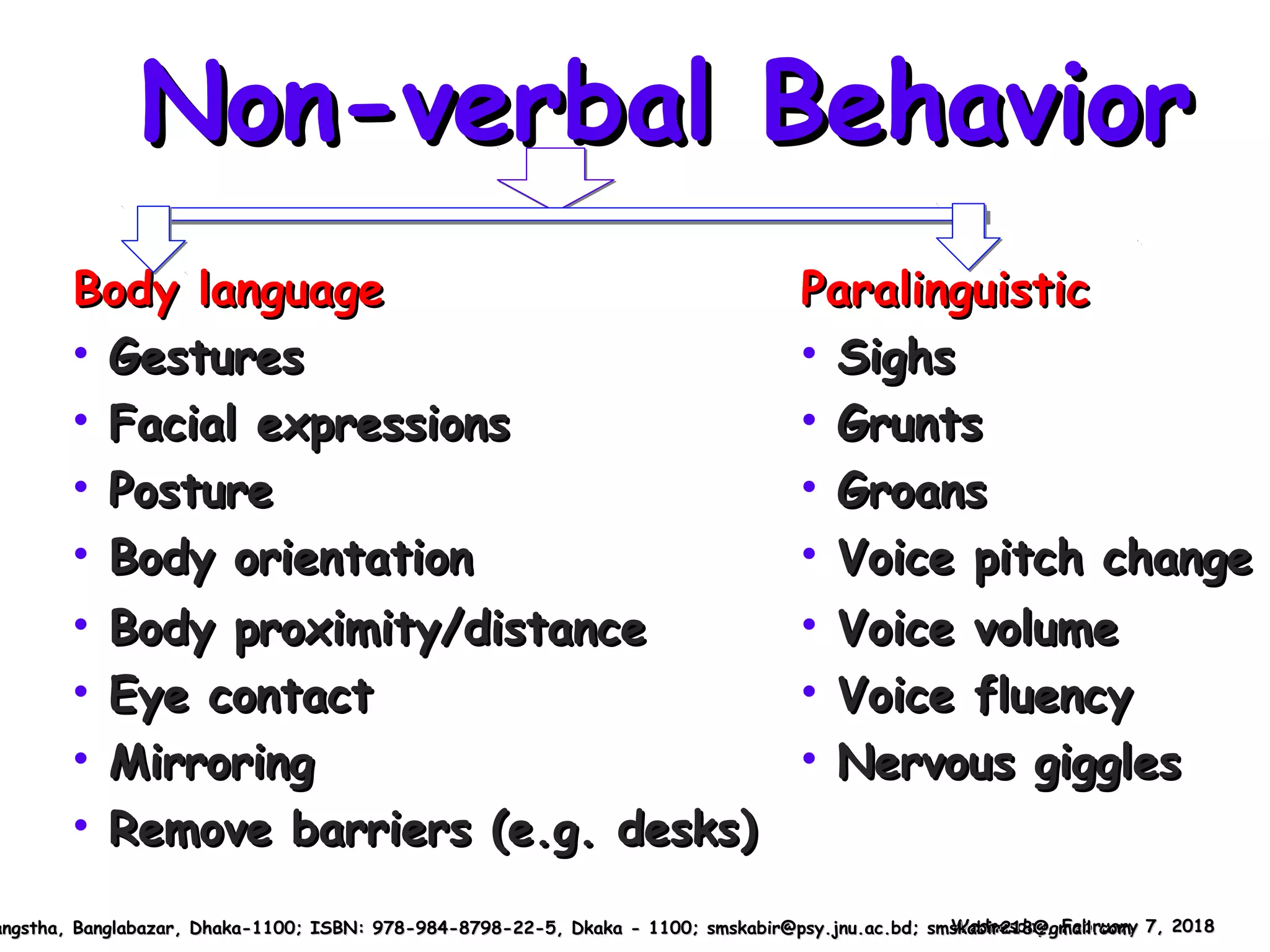
Non-verbal BehaviorNon-verbal Behavior
Wednesday, February 7, 2018Wednesday, February 7, 2018angstha, Banglabazar, Dhaka-1100; ISBN: 978-984-8798-22-5, Dkaka - 1100; smskabir@psy.jnu.ac.bd; smskabir218@gmail.comangstha, Banglabazar, Dhaka-1100; ISBN: 978-984-8798-22-5, Dkaka - 1100; smskabir@psy.jnu.ac.bd; smskabir218@gmail.com
Body languageBody language ParalinguisticParalinguistic
• GesturesGestures • SighsSighs
• Facial expressionsFacial expressions • GruntsGrunts
• PosturePosture • GroansGroans
• Body orientationBody orientation • Voice pitch changeVoice pitch change
• Body proximity/distanceBody proximity/distance • Voice volumeVoice volume
• Eye contactEye contact • Voice fluencyVoice fluency
• MirroringMirroring • Nervous gigglesNervous giggles
• Remove barriers (e.g. desks)Remove barriers (e.g. desks)
Quick Reference for Counseling Micro-skillsQuick Reference for Counseling Micro-skills
VerbalVerbal Non-verbalNon-verbal
Uses language that the clientUses language that the client
understandsunderstands
Uses a tone of voiceUses a tone of voice
similar to the client’ssimilar to the client’s
Repeats the client’s story inRepeats the client’s story in
other wordsother words
Looks client in the eyeLooks client in the eye
(as appropriate)(as appropriate)
Clarifies client’s statementsClarifies client’s statements Nods occasionallyNods occasionally
Explains clearly andExplains clearly and
adequatelyadequately
Uses facial expressionsUses facial expressions
SummarizesSummarizes Uses occasional gesturesUses occasional gestures
Responds to primary messageResponds to primary message Keeps suitableKeeps suitable
conversational distanceconversational distance
Encourages: “I see”, “Yes”,Encourages: “I see”, “Yes”,
“Mm-hmm”“Mm-hmm”
Speaks at an appropriateSpeaks at an appropriate
pacepace
Addresses client in a mannerAddresses client in a manner
appropriate to the client’s ageappropriate to the client’s age
Physically relaxedPhysically relaxed
Gives needed informationGives needed information Open postureOpen posture
Wednesday, February 7, 2018Wednesday, February 7, 2018angstha, Banglabazar, Dhaka-1100; ISBN: 978-984-8798-22-5, Dkaka - 1100; smskabir@psy.jnu.ac.bd; smskabir218@gmail.comangstha, Banglabazar, Dhaka-1100; ISBN: 978-984-8798-22-5, Dkaka - 1100; smskabir@psy.jnu.ac.bd; smskabir218@gmail.com
Examples of Non-supportive Behavior in a Selected CultureExamples of Non-supportive Behavior in a Selected Culture
VerbalVerbal Non-verbalNon-verbal
AdvisingAdvising Looking away frequentlyLooking away frequently
Preaching and moralizingPreaching and moralizing Keeping an inappropriateKeeping an inappropriate
distancedistance
Blaming, judging and labelingBlaming, judging and labeling SneeringSneering
Cajoling (persuading by flatteryCajoling (persuading by flattery
or deceit)or deceit)
Frowning, scowling andFrowning, scowling and
yawningyawning
““Why” questions, interrogatingWhy” questions, interrogating Using an unpleasant tone ofUsing an unpleasant tone of
speechspeech
Directing, demandingDirecting, demanding Speaking too quicklySpeaking too quickly
Excessive reassuringExcessive reassuring Speaking too slowlySpeaking too slowly
Straying from the topicStraying from the topic Having a blank facialHaving a blank facial
expressionexpression
Encouraging dependenceEncouraging dependence StaringStaring
Patronizing (condescending)Patronizing (condescending)
attitudeattitude
Moving around too much,Moving around too much,
fidgetingfidgeting
Criticizing or censuringCriticizing or censuring Environmental barriers orEnvironmental barriers or
distractionsdistractions
Wednesday, February 7, 2018tials of Counseling. Abosar Prokashana Sangstha, Banglabazar, Dhaka-1100; ISBN: 978-984-8798-22-5, Dkaka - 1100; smskabi
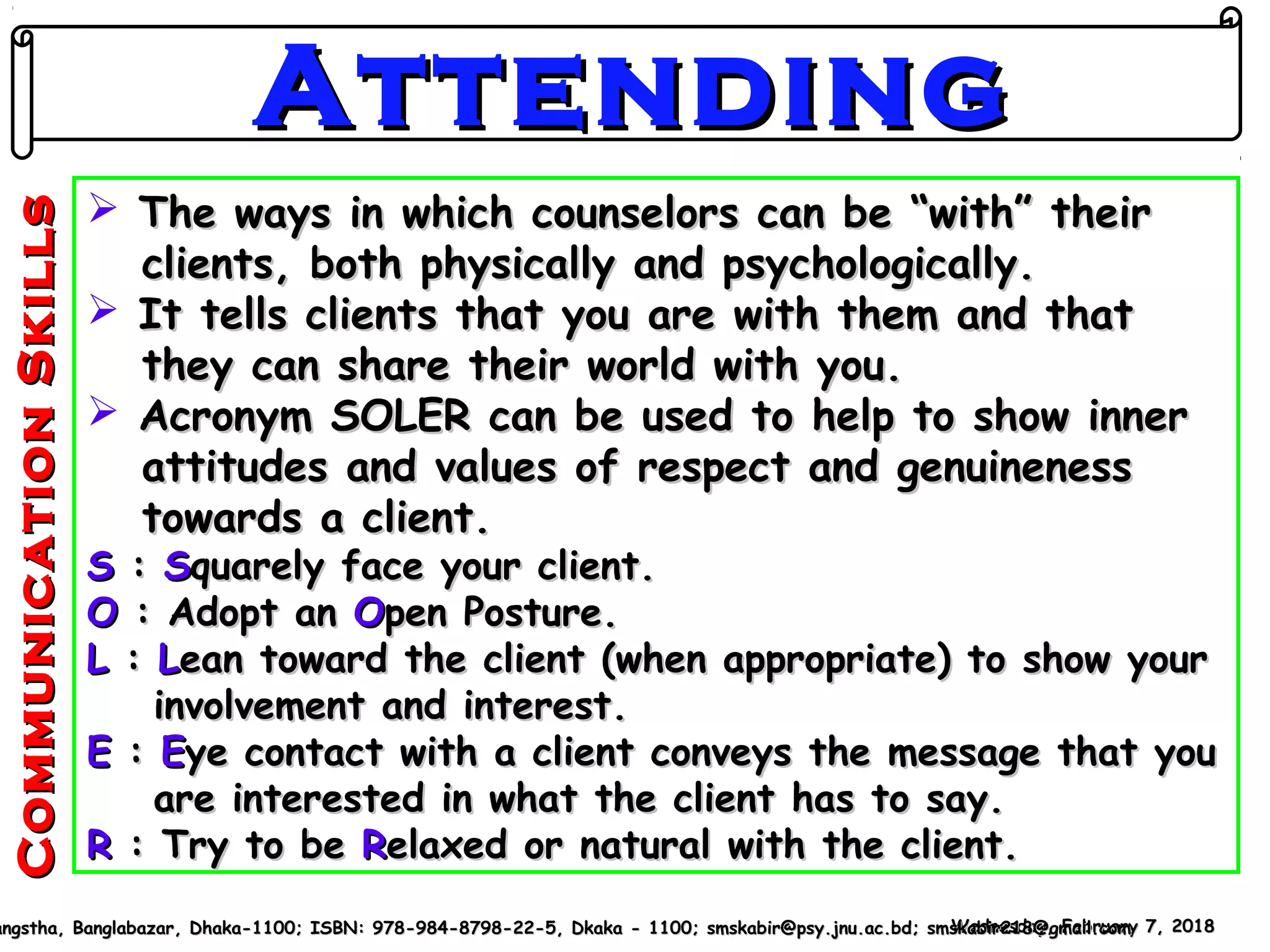
 The ways in which counselors can be “with” theirThe ways in which counselors can be “with” their
clients, both physically and psychologically.clients, both physically and psychologically.
 It tells clients that you are with them and thatIt tells clients that you are with them and that
they can share their world with you.they can share their world with you.
 Acronym SOLER can be used to help to show innerAcronym SOLER can be used to help to show inner
attitudes and values of respect and genuinenessattitudes and values of respect and genuineness
towards a client.towards a client.
SS :: SSquarely face your client.quarely face your client.
OO : Adopt an: Adopt an OOpen Posture.pen Posture.
LL :: LLean toward the client (when appropriate) to show yourean toward the client (when appropriate) to show your
involvement and interest.involvement and interest.
EE :: EEye contact with a client conveys the message that youye contact with a client conveys the message that you
are interested in what the client has to say.are interested in what the client has to say.
RR : Try to be: Try to be RRelaxed or natural with the client.elaxed or natural with the client.
Wednesday, February 7, 2018Wednesday, February 7, 2018angstha, Banglabazar, Dhaka-1100; ISBN: 978-984-8798-22-5, Dkaka - 1100; smskabir@psy.jnu.ac.bd; smskabir218@gmail.comangstha, Banglabazar, Dhaka-1100; ISBN: 978-984-8798-22-5, Dkaka - 1100; smskabir@psy.jnu.ac.bd; smskabir218@gmail.com
AttendingAttending
CommunicationSkillsCommunicationSkills
Attending PhysicallyAttending Physically
 A Posture of InvolvementA Posture of Involvement
 Appropriate Body MotionAppropriate Body Motion
 Eye ContactEye Contact
 Creating a Non DestructingCreating a Non Destructing
EnvironmentEnvironment
Wednesday, February 7, 2018Wednesday, February 7, 2018angstha, Banglabazar, Dhaka-1100; ISBN: 978-984-8798-22-5, Dkaka - 1100; smskabir@psy.jnu.ac.bd; smskabir218@gmail.comangstha, Banglabazar, Dhaka-1100; ISBN: 978-984-8798-22-5, Dkaka - 1100; smskabir@psy.jnu.ac.bd; smskabir218@gmail.com
AttendingAttending
CommunicationSkillsCommunicationSkills
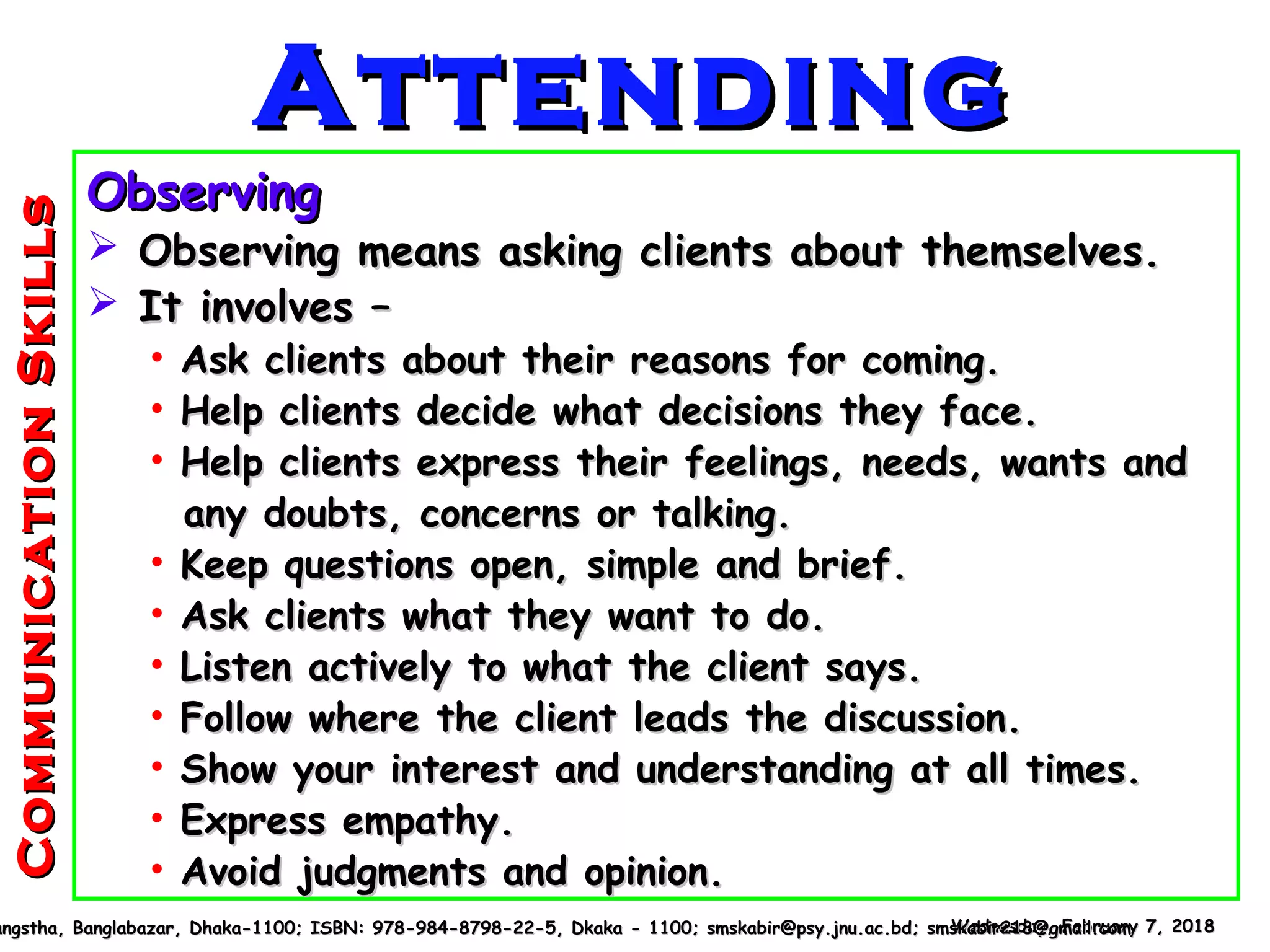
ObservingObserving
 Observing means asking clients about themselves.Observing means asking clients about themselves.
 It involves –It involves –
• Ask clients about their reasons for coming.Ask clients about their reasons for coming.
• Help clients decide what decisions they face.Help clients decide what decisions they face.
• Help clients express their feelings, needs, wants andHelp clients express their feelings, needs, wants and
any doubts, concerns or talking.any doubts, concerns or talking.
• Keep questions open, simple and brief.Keep questions open, simple and brief.
• Ask clients what they want to do.Ask clients what they want to do.
• Listen actively to what the client says.Listen actively to what the client says.
• Follow where the client leads the discussion.Follow where the client leads the discussion.
• Show your interest and understanding at all times.Show your interest and understanding at all times.
• Express empathy.Express empathy.
• Avoid judgments and opinion.Avoid judgments and opinion.
Wednesday, February 7, 2018Wednesday, February 7, 2018angstha, Banglabazar, Dhaka-1100; ISBN: 978-984-8798-22-5, Dkaka - 1100; smskabir@psy.jnu.ac.bd; smskabir218@gmail.comangstha, Banglabazar, Dhaka-1100; ISBN: 978-984-8798-22-5, Dkaka - 1100; smskabir@psy.jnu.ac.bd; smskabir218@gmail.com
AttendingAttending
CommunicationSkillsCommunicationSkills
Listening SkillsListening Skills
 Goal of listening is understanding what is trying toGoal of listening is understanding what is trying to
be communicated.be communicated.
1)1) Door OpenersDoor Openers:: It includes-It includes-
(a)(a) Description on other person’s body language (ie youDescription on other person’s body language (ie you
don’t look like you are feeling well today).don’t look like you are feeling well today).
(b) An invitation to talk(b) An invitation to talk
(c) Silence(c) Silence
(d) Attending.(d) Attending.
2)2) Infrequent QuestionsInfrequent Questions:: This trick is to ask questionsThis trick is to ask questions
that are designed to spur the conversation on when itthat are designed to spur the conversation on when it
gets struck.gets struck.
3)3) Attentive SilenceAttentive Silence:: Silence is an opportunity for theSilence is an opportunity for the
speaker to reflect on what s/he has said and to gatherspeaker to reflect on what s/he has said and to gather
their thoughts before their next statement.their thoughts before their next statement.
Wednesday, February 7, 2018Wednesday, February 7, 2018angstha, Banglabazar, Dhaka-1100; ISBN: 978-984-8798-22-5, Dkaka - 1100; smskabir@psy.jnu.ac.bd; smskabir218@gmail.comangstha, Banglabazar, Dhaka-1100; ISBN: 978-984-8798-22-5, Dkaka - 1100; smskabir@psy.jnu.ac.bd; smskabir218@gmail.com
AttendingAttendingCommunicationSkillsCommunicationSkills
 It requires focus, concentration and an interest in theIt requires focus, concentration and an interest in the
other person, and what is being expressed.other person, and what is being expressed.
 Without the use of clear responding skills, a client willWithout the use of clear responding skills, a client will
not be sufficient to motivate and encourage to continuenot be sufficient to motivate and encourage to continue
with open disclosure.with open disclosure.
 Being encouraging, motivating, reassuring, coaxing, beingBeing encouraging, motivating, reassuring, coaxing, being
challenging and praising all provide the client with achallenging and praising all provide the client with a
positive response to their comments.positive response to their comments.
 Asking questions, making statements and suggestions,Asking questions, making statements and suggestions,
offering solutions and informing also provide effectiveoffering solutions and informing also provide effective
methods of good response.methods of good response.
 Offering a nod of the head, an um-hmn or byOffering a nod of the head, an um-hmn or by
encouraging the client to continue speaking by sayingencouraging the client to continue speaking by saying
‘‘And then?’, provide a further positive response, whichAnd then?’, provide a further positive response, which
will keep the comments flowing.will keep the comments flowing.
Wednesday, February 7, 2018Wednesday, February 7, 2018angstha, Banglabazar, Dhaka-1100; ISBN: 978-984-8798-22-5, Dkaka - 1100; smskabir@psy.jnu.ac.bd; smskabir218@gmail.comangstha, Banglabazar, Dhaka-1100; ISBN: 978-984-8798-22-5, Dkaka - 1100; smskabir@psy.jnu.ac.bd; smskabir218@gmail.com
RespondingResponding
CommunicationSkillsCommunicationSkills
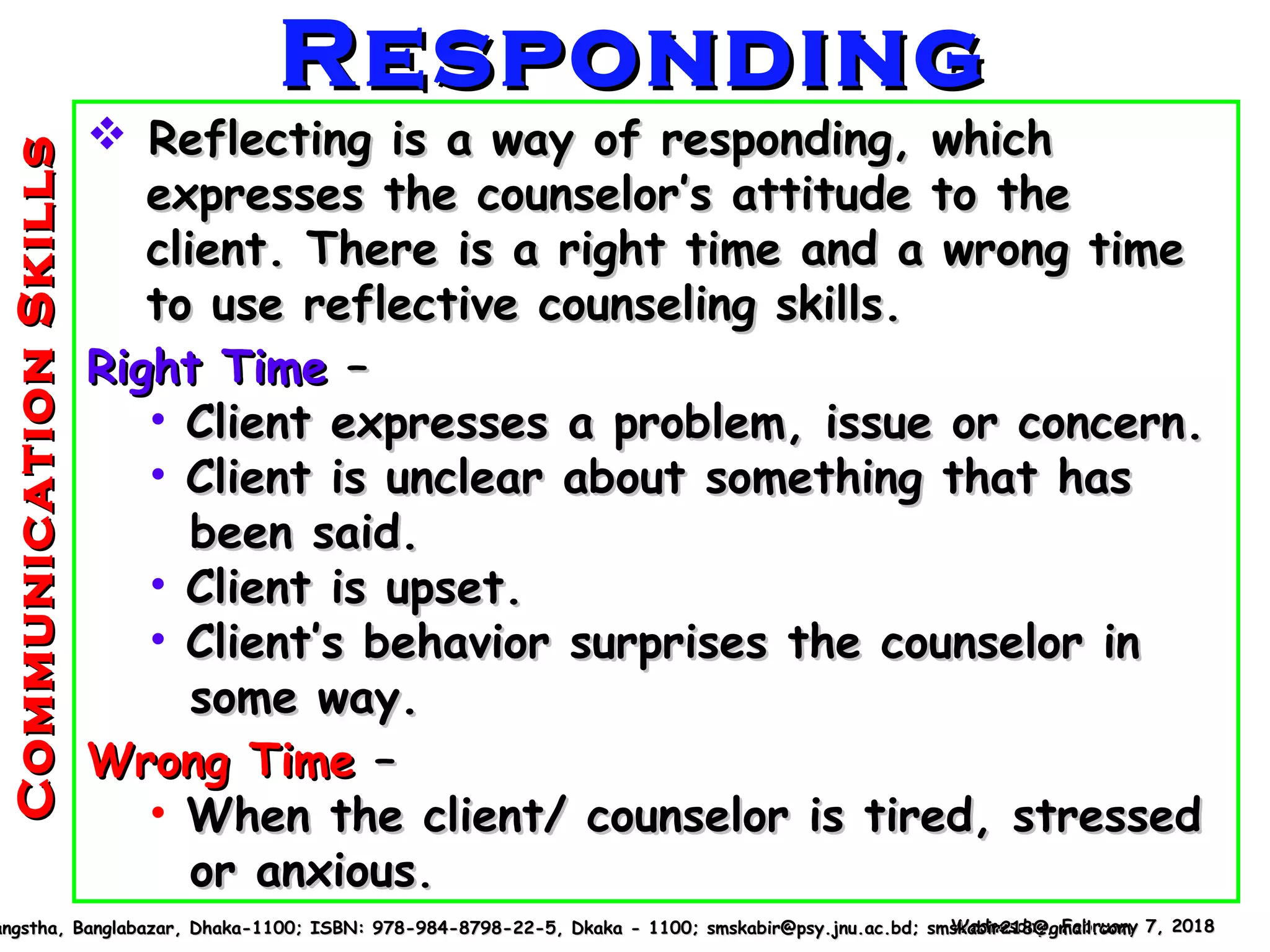
 Reflecting is a way of responding, whichReflecting is a way of responding, which
expresses the counselor’s attitude to theexpresses the counselor’s attitude to the
client. There is a right time and a wrong timeclient. There is a right time and a wrong time
to use reflective counseling skills.to use reflective counseling skills.
Right TimeRight Time ––
• Client expresses a problem, issue or concern.Client expresses a problem, issue or concern.
• Client is unclear about something that hasClient is unclear about something that has
been said.been said.
• Client is upset.Client is upset.
• Client’s behavior surprises the counselor inClient’s behavior surprises the counselor in
some way.some way.
Wrong TimeWrong Time ––
• When the client/ counselor is tired, stressedWhen the client/ counselor is tired, stressed
or anxiousor anxious..
Wednesday, February 7, 2018Wednesday, February 7, 2018angstha, Banglabazar, Dhaka-1100; ISBN: 978-984-8798-22-5, Dkaka - 1100; smskabir@psy.jnu.ac.bd; smskabir218@gmail.comangstha, Banglabazar, Dhaka-1100; ISBN: 978-984-8798-22-5, Dkaka - 1100; smskabir@psy.jnu.ac.bd; smskabir218@gmail.com
RespondingRespondingCommunicationSkillsCommunicationSkills
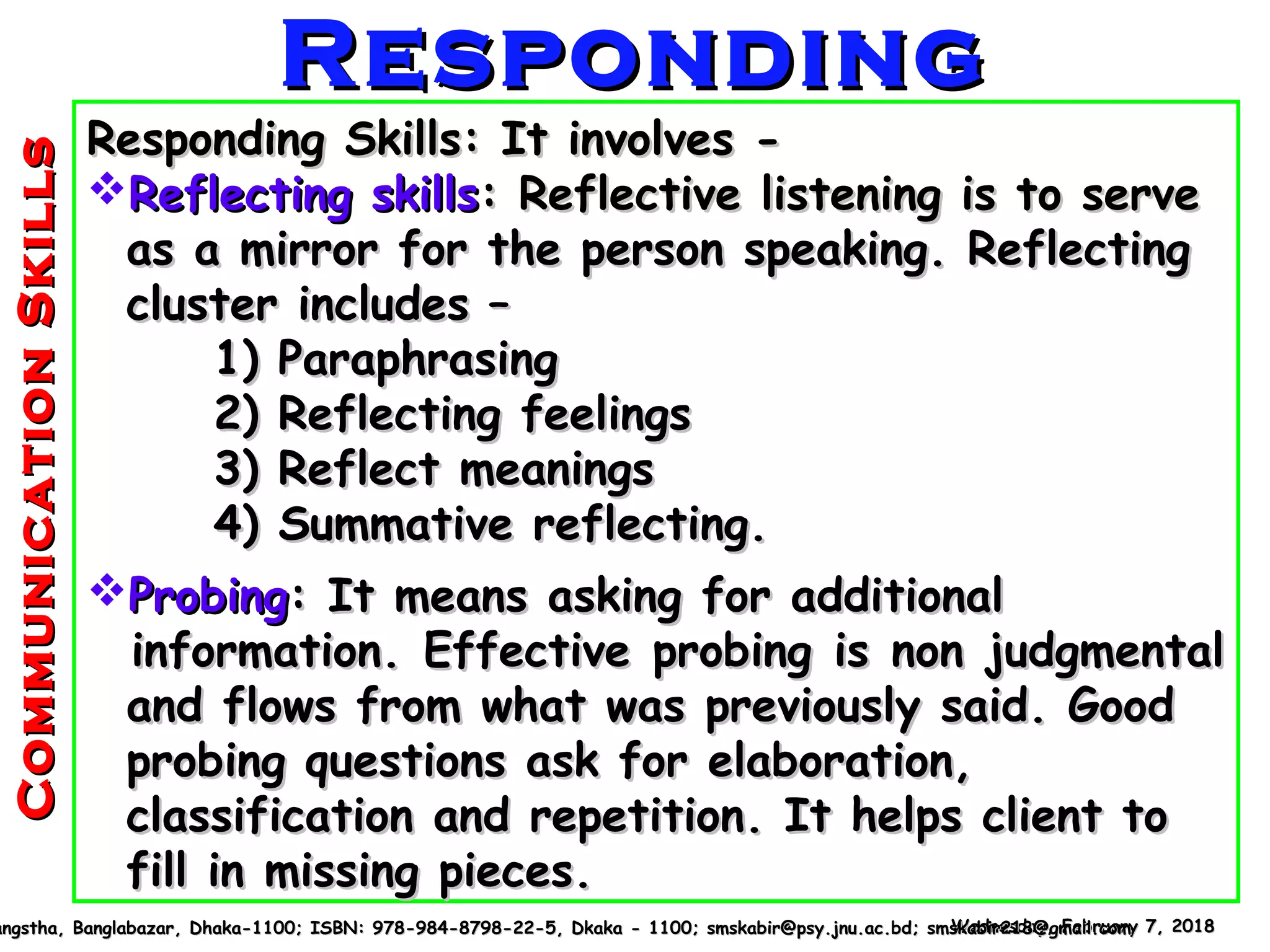
Responding Skills: It involves -Responding Skills: It involves -
Reflecting skillsReflecting skills: Reflective listening is to serve: Reflective listening is to serve
as a mirror for the person speaking. Reflectingas a mirror for the person speaking. Reflecting
cluster includes –cluster includes –
1) Paraphrasing1) Paraphrasing
2) Reflecting feelings2) Reflecting feelings
3) Reflect meanings3) Reflect meanings
4) Summative reflecting.4) Summative reflecting.
ProbingProbing: It means asking for additional: It means asking for additional
information. Effective probing is non judgmentalinformation. Effective probing is non judgmental
and flows from what was previously said. Goodand flows from what was previously said. Good
probing questions ask for elaboration,probing questions ask for elaboration,
classification and repetition. It helps client toclassification and repetition. It helps client to
fill in missing pieces.fill in missing pieces.
Wednesday, February 7, 2018Wednesday, February 7, 2018angstha, Banglabazar, Dhaka-1100; ISBN: 978-984-8798-22-5, Dkaka - 1100; smskabir@psy.jnu.ac.bd; smskabir218@gmail.comangstha, Banglabazar, Dhaka-1100; ISBN: 978-984-8798-22-5, Dkaka - 1100; smskabir@psy.jnu.ac.bd; smskabir218@gmail.com
RespondingRespondingCommunicationSkillsCommunicationSkills
Wednesday, February 7, 2018Wednesday, February 7, 2018angstha, Banglabazar, Dhaka-1100; ISBN: 978-984-8798-22-5, Dkaka - 1100; smskabir@psy.jnu.ac.bd; smskabir218@gmail.comangstha, Banglabazar, Dhaka-1100; ISBN: 978-984-8798-22-5, Dkaka - 1100; smskabir@psy.jnu.ac.bd; smskabir218@gmail.com
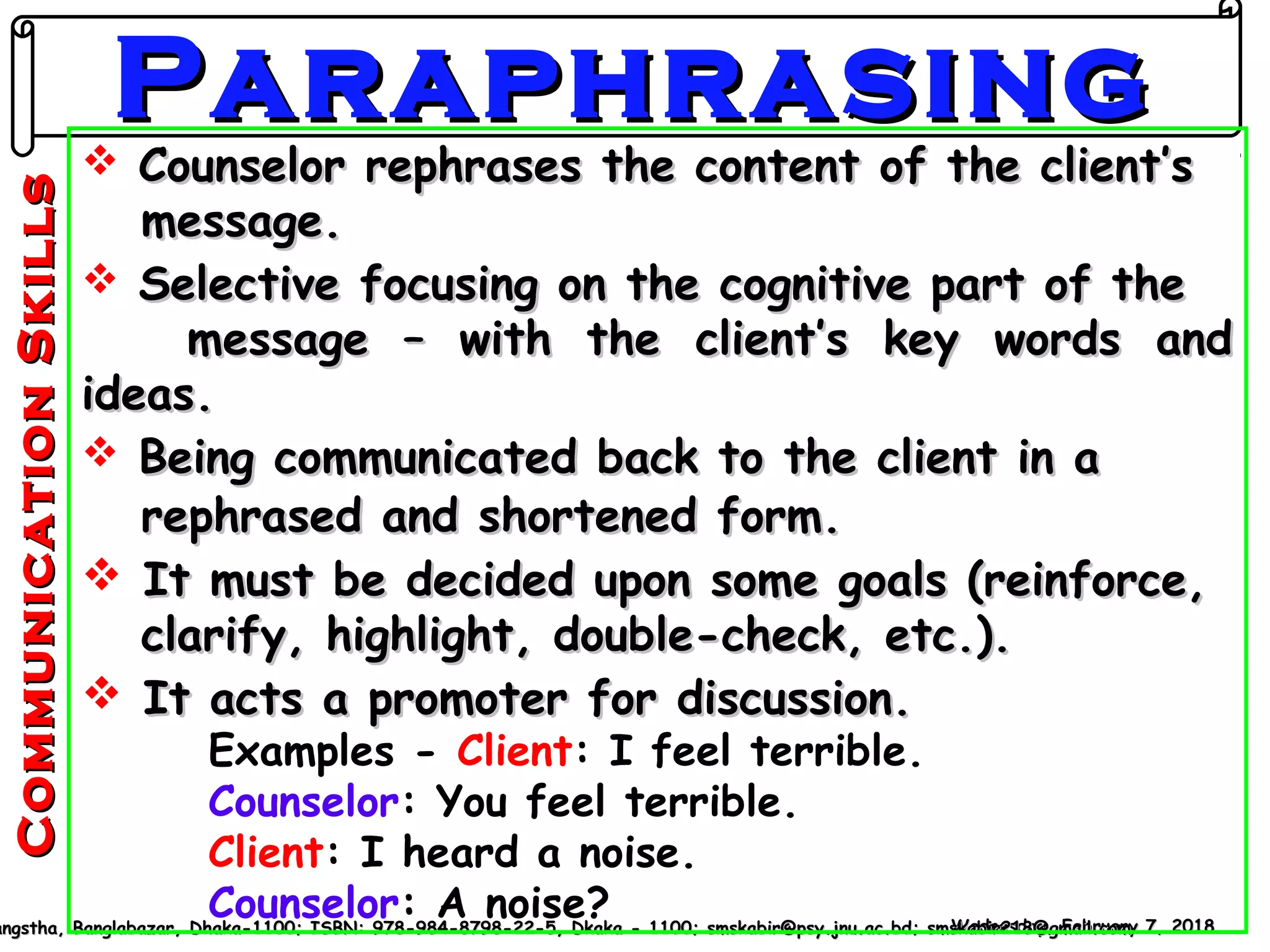
 Counselor rephrases the content of the client’sCounselor rephrases the content of the client’s
message.message.
 Selective focusing on the cognitive part of theSelective focusing on the cognitive part of the
message – with the client’s key words andmessage – with the client’s key words and
ideas.ideas.
 Being communicated back to the client in aBeing communicated back to the client in a
rephrased and shortened form.rephrased and shortened form.
 It must be decided upon some goals (reinforce,It must be decided upon some goals (reinforce,
clarify, highlight, double-check, etc.).clarify, highlight, double-check, etc.).
 It acts a promoter for discussion.It acts a promoter for discussion.
Examples - Client: I feel terrible.
Counselor: You feel terrible.
Client: I heard a noise.
Counselor: A noise?
ParaphrasingParaphrasing
CommunicationSkillsCommunicationSkills
Four steps in effective paraphrasing-Four steps in effective paraphrasing-
A.A.Listen and recallListen and recall: Entire client message recalled and do: Entire client message recalled and do
not omit any significant parts.not omit any significant parts.
B.B. Identify the contentIdentify the content:: Part of the message by decidingPart of the message by deciding
what event, situation, idea, or person the client is talkingwhat event, situation, idea, or person the client is talking
about.about.
C.C. RephraseRephrase: key words and ideas the client has used to: key words and ideas the client has used to
communicate their concerns in a fresh or differentcommunicate their concerns in a fresh or different
perspective.perspective.
D.D. Perception checkPerception check:: Usually in the form of a briefUsually in the form of a brief
question, e.g. “It sounds like...”, “Let me see if Iquestion, e.g. “It sounds like...”, “Let me see if I
understand this”, which allows the client to agree orunderstand this”, which allows the client to agree or
disagree with the accuracy of your paraphrasing.disagree with the accuracy of your paraphrasing.
Wednesday, February 7, 2018Wednesday, February 7, 2018angstha, Banglabazar, Dhaka-1100; ISBN: 978-984-8798-22-5, Dkaka - 1100; smskabir@psy.jnu.ac.bd; smskabir218@gmail.comangstha, Banglabazar, Dhaka-1100; ISBN: 978-984-8798-22-5, Dkaka - 1100; smskabir@psy.jnu.ac.bd; smskabir218@gmail.com
ParaphrasingParaphrasing
CommunicationSkillsCommunicationSkills
Purposes of ParaphrasingPurposes of Paraphrasing
• Convey that you are understanding him/herConvey that you are understanding him/her
• Help the client by simplifying, focusing andHelp the client by simplifying, focusing and
crystallizing what they saidcrystallizing what they said
• May encourage the client to elaborateMay encourage the client to elaborate
• Provide a check on the accuracy of your perceptions.Provide a check on the accuracy of your perceptions.
When to UseWhen to Use
 When you have an hypothesis about what’s going onWhen you have an hypothesis about what’s going on
with the clientwith the client
 When the client is in a decision making conflictWhen the client is in a decision making conflict
 When the client has presented a lot of material andWhen the client has presented a lot of material and
you feel confused.you feel confused.
Wednesday, February 7, 2018Wednesday, February 7, 2018angstha, Banglabazar, Dhaka-1100; ISBN: 978-984-8798-22-5, Dkaka - 1100; smskabir@psy.jnu.ac.bd; smskabir218@gmail.comangstha, Banglabazar, Dhaka-1100; ISBN: 978-984-8798-22-5, Dkaka - 1100; smskabir@psy.jnu.ac.bd; smskabir218@gmail.com
CommunicationSkillsCommunicationSkills
ParaphrasingParaphrasing
Wednesday, February 7, 2018Wednesday, February 7, 2018angstha, Banglabazar, Dhaka-1100; ISBN: 978-984-8798-22-5, Dkaka - 1100; smskabir@psy.jnu.ac.bd; smskabir218@gmail.comangstha, Banglabazar, Dhaka-1100; ISBN: 978-984-8798-22-5, Dkaka - 1100; smskabir@psy.jnu.ac.bd; smskabir218@gmail.com
Collection of two or more paraphrases orCollection of two or more paraphrases or
reflections that condenses the client’s messagesreflections that condenses the client’s messages
or the session.or the session.
Purposes of a SummaryPurposes of a Summary
• tie together multiple elements of clienttie together multiple elements of client
messagesmessages
• identify a common theme or patternidentify a common theme or pattern
• interrupt excessive ramblinginterrupt excessive rambling
• start a sessionstart a session
• end a sessionend a session
• pace a sessionpace a session
• review progressreview progress
• serve as a transition when changing topics.serve as a transition when changing topics.
SummarySummary
CommunicationSkillsCommunicationSkills
Wednesday, February 7, 2018Wednesday, February 7, 2018angstha, Banglabazar, Dhaka-1100; ISBN: 978-984-8798-22-5, Dkaka - 1100; smskabir@psy.jnu.ac.bd; smskabir218@gmail.comangstha, Banglabazar, Dhaka-1100; ISBN: 978-984-8798-22-5, Dkaka - 1100; smskabir@psy.jnu.ac.bd; smskabir218@gmail.com
Steps in a SummarySteps in a Summary
Example- Client, an young girl.Example- Client, an young girl.
At the beginning of the sessionAt the beginning of the session --
““I don’t understand why my parents can’t live togetherI don’t understand why my parents can’t live together
anymore. I’m not blaming anybody, but it just feelsanymore. I’m not blaming anybody, but it just feels
very confusing to me”. [Said in a low, soft voice withvery confusing to me”. [Said in a low, soft voice with
lowered, moist eyes]lowered, moist eyes]
Near the middle of the same session-Near the middle of the same session-
““I wish they could keep it together. I guess I feelI wish they could keep it together. I guess I feel
like they can’t because they fight about me so much.like they can’t because they fight about me so much.
Maybe I’m the reason they don’t want to live togetherMaybe I’m the reason they don’t want to live together
anymore”.anymore”.
SummarySummary
CommunicationSkillsCommunicationSkills
Wednesday, February 7, 2018Wednesday, February 7, 2018angstha, Banglabazar, Dhaka-1100; ISBN: 978-984-8798-22-5, Dkaka - 1100; smskabir@psy.jnu.ac.bd; smskabir218@gmail.comangstha, Banglabazar, Dhaka-1100; ISBN: 978-984-8798-22-5, Dkaka - 1100; smskabir@psy.jnu.ac.bd; smskabir218@gmail.com
Steps in a SummarySteps in a Summary
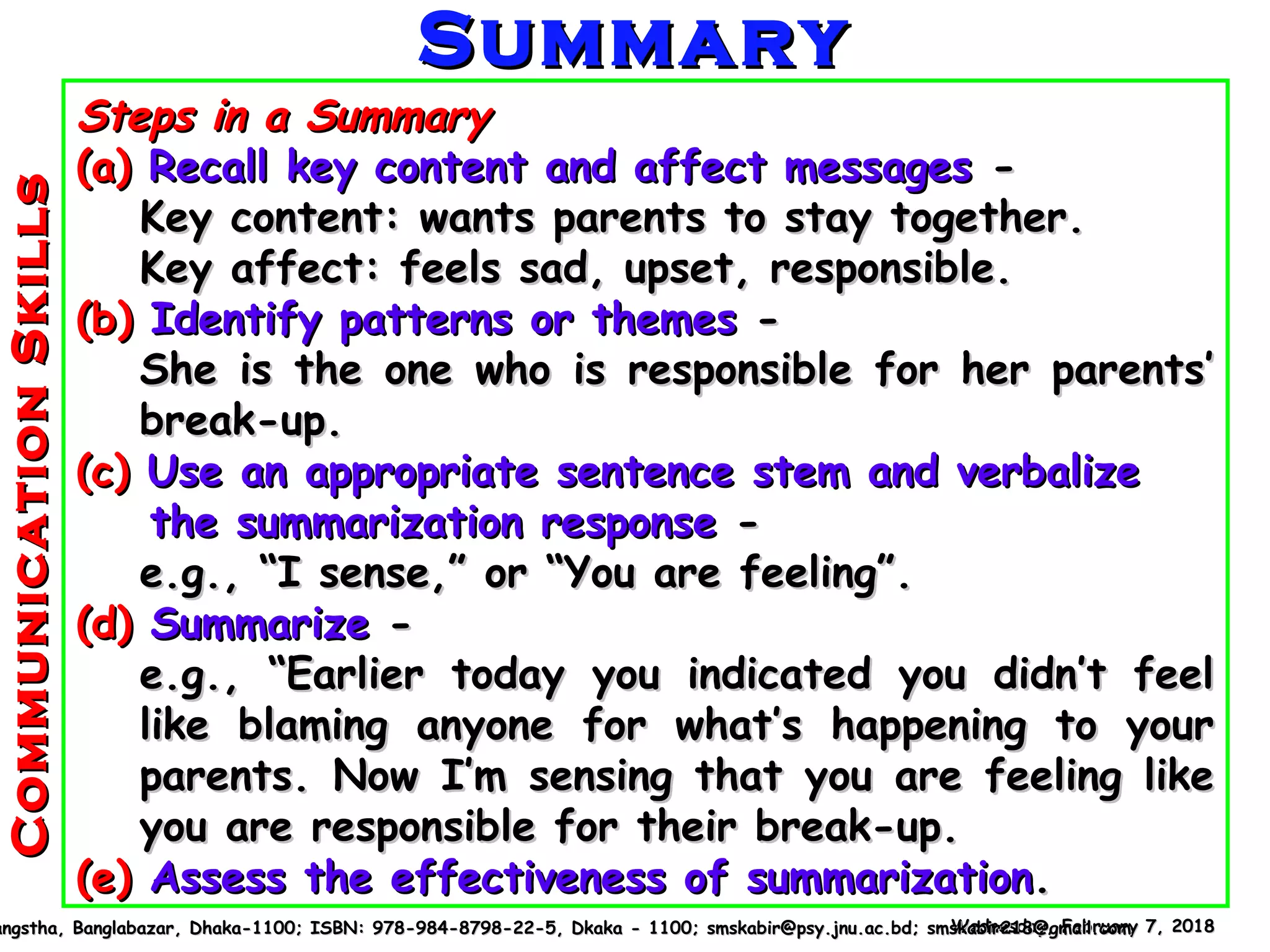
(a)(a) Recall key content and affect messagesRecall key content and affect messages --
Key content: wants parents to stay together.Key content: wants parents to stay together.
Key affect: feels sad, upset, responsible.Key affect: feels sad, upset, responsible.
(b)(b) Identify patterns or themesIdentify patterns or themes --
She is the one who is responsible for her parents’She is the one who is responsible for her parents’
break-up.break-up.
(c)(c) Use an appropriate sentence stem and verbalizeUse an appropriate sentence stem and verbalize
the summarization responsethe summarization response --
e.g., “I sense,” or “You are feeling”.e.g., “I sense,” or “You are feeling”.
(d)(d) SummarizeSummarize --
e.g., “Earlier today you indicated you didn’t feele.g., “Earlier today you indicated you didn’t feel
like blaming anyone for what’s happening to yourlike blaming anyone for what’s happening to your
parents. Now I’m sensing that you are feeling likeparents. Now I’m sensing that you are feeling like
you are responsible for their break-up.you are responsible for their break-up.
(e)(e) Assess the effectiveness of summarizationAssess the effectiveness of summarization..
SummarySummaryCommunicationSkillsCommunicationSkills
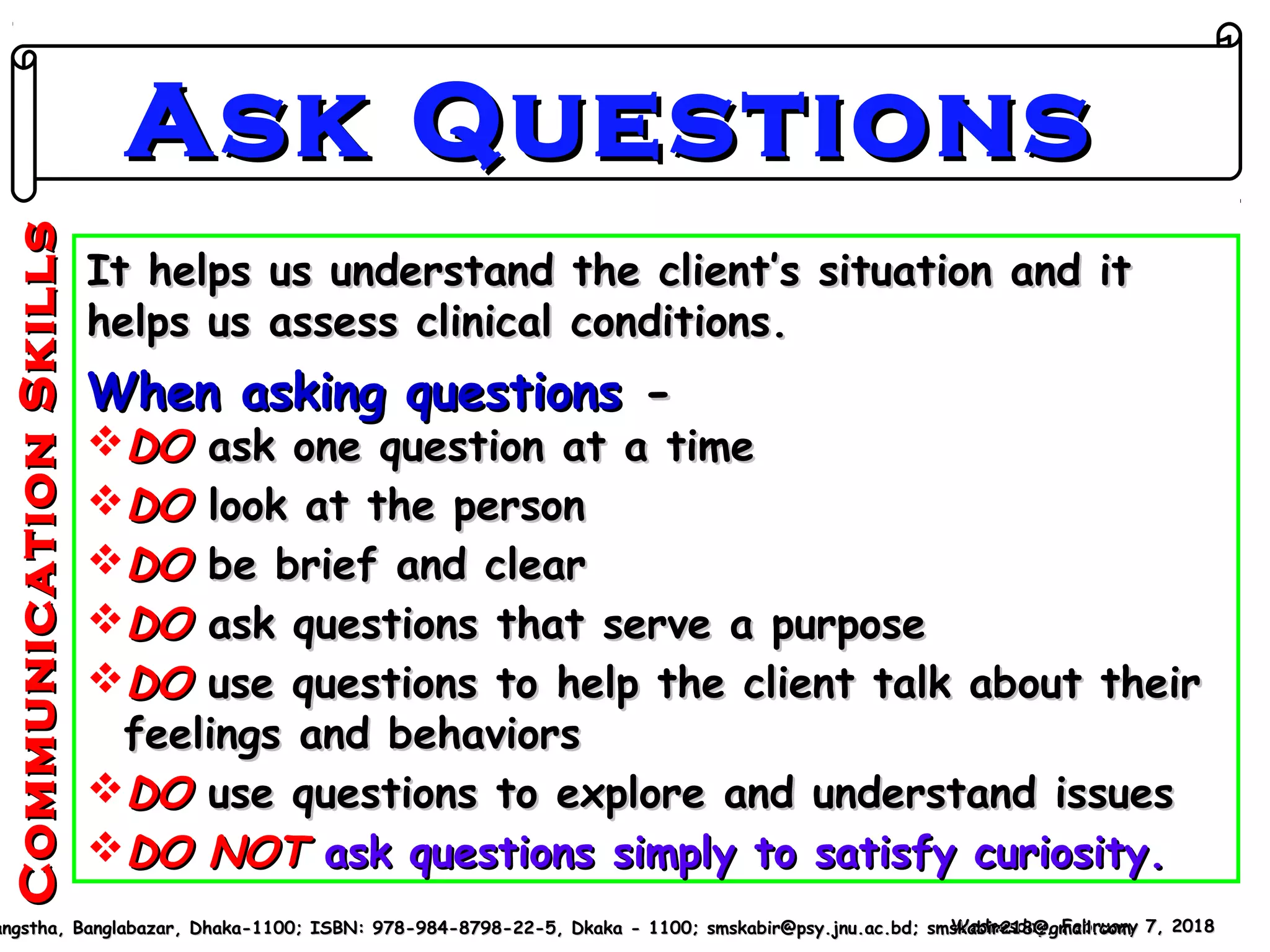
It helps us understand the client’s situation and itIt helps us understand the client’s situation and it
helps us assess clinical conditions.helps us assess clinical conditions.
When asking questionsWhen asking questions --
DODO ask one question at a timeask one question at a time
DODO look at the personlook at the person
DODO be brief and clearbe brief and clear
DODO ask questions that serve a purposeask questions that serve a purpose
DODO use questions to help the client talk about theiruse questions to help the client talk about their
feelings and behaviorsfeelings and behaviors
DODO use questions to explore and understand issuesuse questions to explore and understand issues
DO NOTDO NOT ask questions simply to satisfy curiosity.ask questions simply to satisfy curiosity.
Wednesday, February 7, 2018Wednesday, February 7, 2018angstha, Banglabazar, Dhaka-1100; ISBN: 978-984-8798-22-5, Dkaka - 1100; smskabir@psy.jnu.ac.bd; smskabir218@gmail.comangstha, Banglabazar, Dhaka-1100; ISBN: 978-984-8798-22-5, Dkaka - 1100; smskabir@psy.jnu.ac.bd; smskabir218@gmail.com
Ask QuestionsAsk Questions
CommunicationSkillsCommunicationSkills
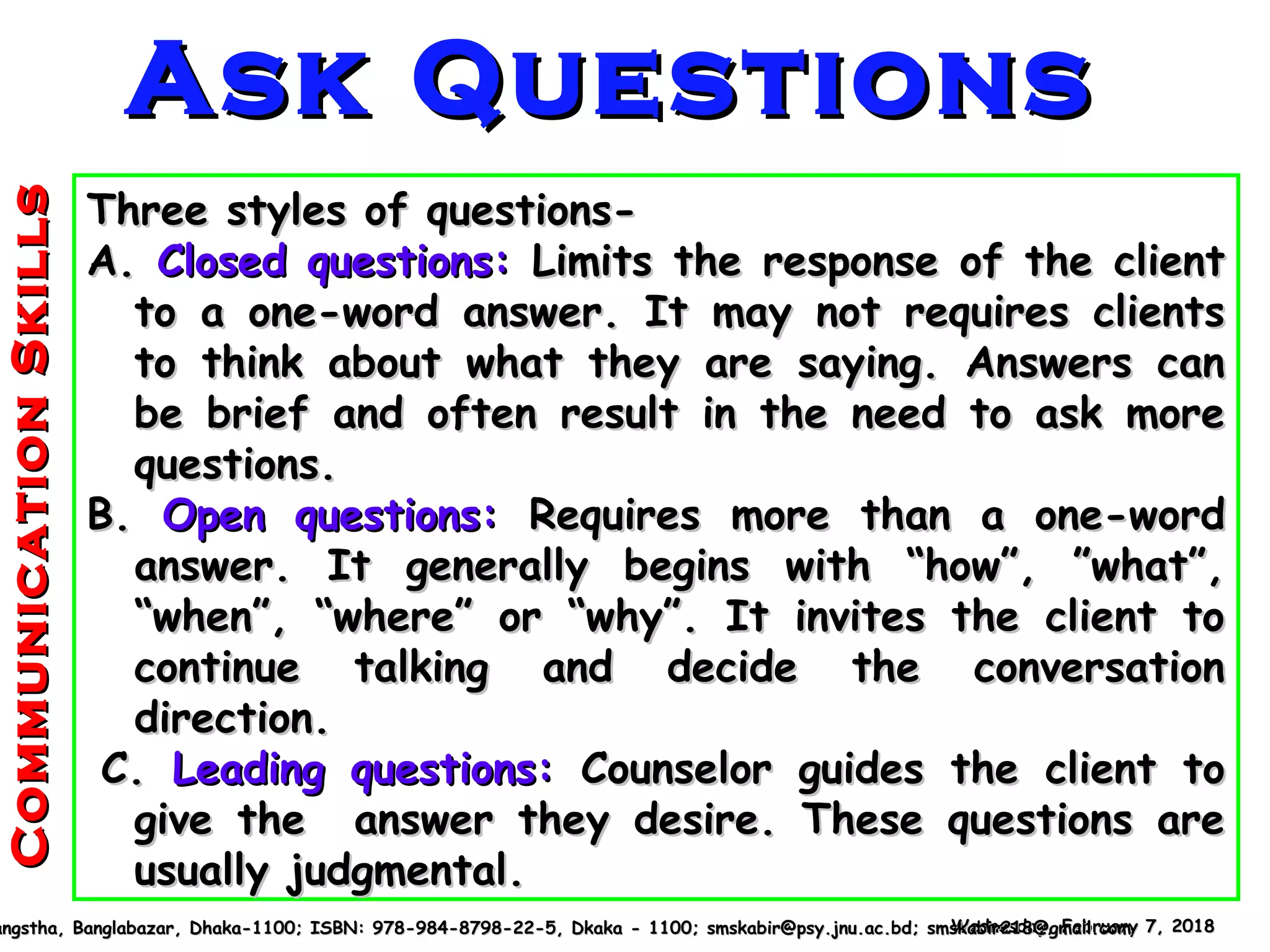
Three styles of questions-Three styles of questions-
A.A. Closed questions:Closed questions: Limits the response of the clientLimits the response of the client
to a one-word answer. It may not requires clientsto a one-word answer. It may not requires clients
to think about what they are saying. Answers canto think about what they are saying. Answers can
be brief and often result in the need to ask morebe brief and often result in the need to ask more
questions.questions.
B.B. Open questions:Open questions: Requires more than a one-wordRequires more than a one-word
answer. It generally begins with “how”, ”what”,answer. It generally begins with “how”, ”what”,
“when”, “where” or “why”. It invites the client to“when”, “where” or “why”. It invites the client to
continue talking and decide the conversationcontinue talking and decide the conversation
direction.direction.
C.C. Leading questions:Leading questions: Counselor guides the client toCounselor guides the client to
give the answer they desire. These questions aregive the answer they desire. These questions are
usually judgmental.usually judgmental.
Wednesday, February 7, 2018Wednesday, February 7, 2018angstha, Banglabazar, Dhaka-1100; ISBN: 978-984-8798-22-5, Dkaka - 1100; smskabir@psy.jnu.ac.bd; smskabir218@gmail.comangstha, Banglabazar, Dhaka-1100; ISBN: 978-984-8798-22-5, Dkaka - 1100; smskabir@psy.jnu.ac.bd; smskabir218@gmail.com
CommunicationSkillsCommunicationSkills
Ask QuestionsAsk Questions
Questions that can easily answer with a “Yes,” “No,” or one- orQuestions that can easily answer with a “Yes,” “No,” or one- or
two-word responses-two-word responses-
 ““Are you going to have the test done?”Are you going to have the test done?”
 ““Did you drink before you got into the car?”Did you drink before you got into the car?”
 ““Do you drink often?”Do you drink often?”
 ““Do you exercise?”Do you exercise?”
 ““Do you like your job?”Do you like your job?”
Purposes of Closed-Ended QuestionsPurposes of Closed-Ended Questions
• Obtain specific informationObtain specific information
• Identify parameters of a problem or issueIdentify parameters of a problem or issue
• Narrow the topic of discussionNarrow the topic of discussion
• Interrupt an over-talkative client.Interrupt an over-talkative client.
Wednesday, February 7, 2018Wednesday, February 7, 2018angstha, Banglabazar, Dhaka-1100; ISBN: 978-984-8798-22-5, Dkaka - 1100; smskabir@psy.jnu.ac.bd; smskabir218@gmail.comangstha, Banglabazar, Dhaka-1100; ISBN: 978-984-8798-22-5, Dkaka - 1100; smskabir@psy.jnu.ac.bd; smskabir218@gmail.com
Closed-Ended QuestionsClosed-Ended Questions
CommunicationSkillsCommunicationSkills
Ask QuestionsAsk Questions
Questions that clients cannot easily answer withQuestions that clients cannot easily answer with
“Yes”, “No,” or one- or two-word responses.“Yes”, “No,” or one- or two-word responses.
Most often –Most often –
Wednesday, February 7, 2018Wednesday, February 7, 2018angstha, Banglabazar, Dhaka-1100; ISBN: 978-984-8798-22-5, Dkaka - 1100; smskabir@psy.jnu.ac.bd; smskabir218@gmail.comangstha, Banglabazar, Dhaka-1100; ISBN: 978-984-8798-22-5, Dkaka - 1100; smskabir@psy.jnu.ac.bd; smskabir218@gmail.com
Open-Ended QuestionsOpen-Ended Questions
How:How: enables talk about feelings and/orenables talk about feelings and/or
process.process.
What:What: leads to facts and information.leads to facts and information.
When:When: brings out the timing of the problem.brings out the timing of the problem.
Where:Where: enables discussion about theenables discussion about the
environment and situations.environment and situations.
Why?:Why?: brings out reasons.brings out reasons.
Ask QuestionsAsk Questions
CommunicationSkillsCommunicationSkills
Wednesday, February 7, 2018Wednesday, February 7, 2018angstha, Banglabazar, Dhaka-1100; ISBN: 978-984-8798-22-5, Dkaka - 1100; smskabir@psy.jnu.ac.bd; smskabir218@gmail.comangstha, Banglabazar, Dhaka-1100; ISBN: 978-984-8798-22-5, Dkaka - 1100; smskabir@psy.jnu.ac.bd; smskabir218@gmail.com
Open-Ended QuestionsOpen-Ended Questions
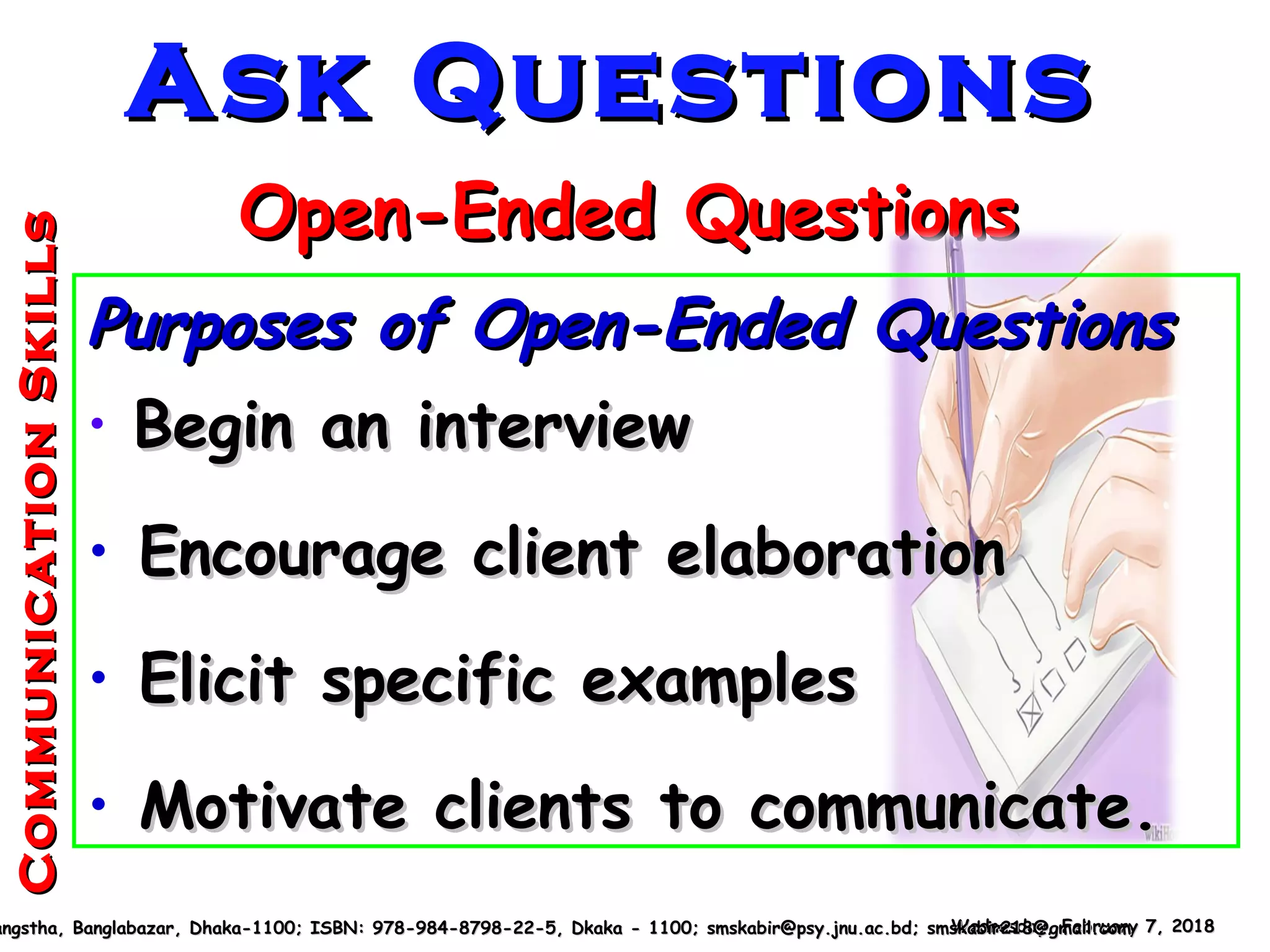
Purposes of Open-Ended QuestionsPurposes of Open-Ended Questions
• Begin an interviewBegin an interview
• Encourage client elaborationEncourage client elaboration
• Elicit specific examplesElicit specific examples
• Motivate clients to communicate.Motivate clients to communicate.
CommunicationSkillsCommunicationSkills
Ask QuestionsAsk Questions
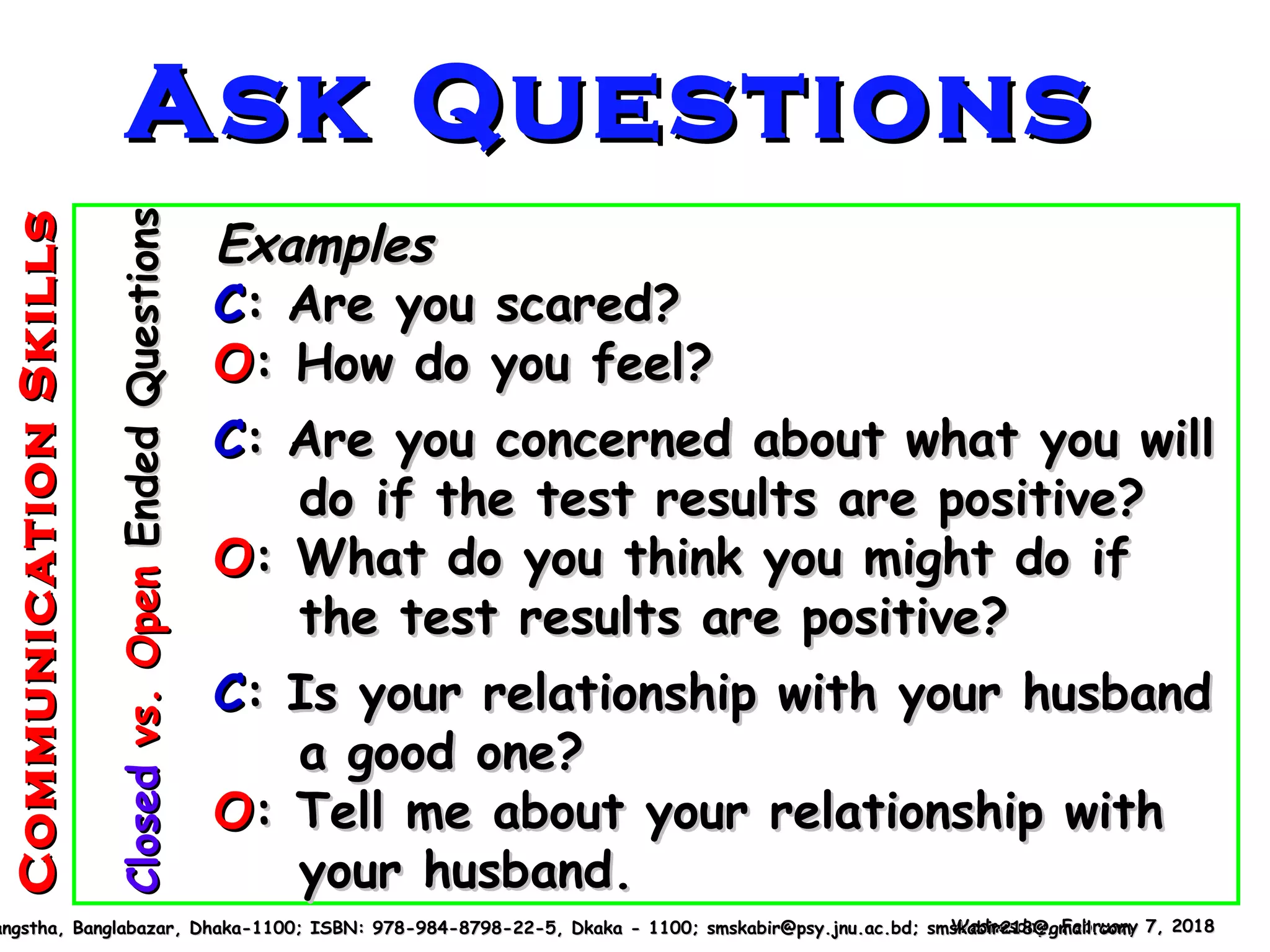
ExamplesExamples
CC: Are you scared?: Are you scared?
OO: How do you feel?: How do you feel?
CC: Are you concerned about what you will: Are you concerned about what you will
do if the test results are positive?do if the test results are positive?
OO: What do you think you might do if: What do you think you might do if
the test results are positive?the test results are positive?
CC: Is your relationship with your husband: Is your relationship with your husband
a good one?a good one?
OO: Tell me about your relationship with: Tell me about your relationship with
your husband.your husband.
Wednesday, February 7, 2018Wednesday, February 7, 2018angstha, Banglabazar, Dhaka-1100; ISBN: 978-984-8798-22-5, Dkaka - 1100; smskabir@psy.jnu.ac.bd; smskabir218@gmail.comangstha, Banglabazar, Dhaka-1100; ISBN: 978-984-8798-22-5, Dkaka - 1100; smskabir@psy.jnu.ac.bd; smskabir218@gmail.com
ClosedClosedvs.Openvs.OpenEndedQuestionsEndedQuestionsAsk QuestionsAsk Questions
CommunicationSkillsCommunicationSkills
Counselor guides the client to give the answer theyCounselor guides the client to give the answer they
desire. These questions are usually judgmental.desire. These questions are usually judgmental.
For example-For example-
You came to consider this, didn’t you?You came to consider this, didn’t you?
You are enjoying your job, aren’t you?You are enjoying your job, aren’t you?
 It can be used positively to draw out and clarifyIt can be used positively to draw out and clarify
issues relevant to the counseling session.issues relevant to the counseling session.
 Over-using questions can have a negative impact onOver-using questions can have a negative impact on
the session.the session.
 Wrong types of questioning techniques, at theWrong types of questioning techniques, at the
wrong time, in the hands of an unskilledwrong time, in the hands of an unskilled
interviewer/ counselor, can cause unnecessaryinterviewer/ counselor, can cause unnecessary
discomfort and confusion to the client.discomfort and confusion to the client.
Wednesday, February 7, 2018Wednesday, February 7, 2018angstha, Banglabazar, Dhaka-1100; ISBN: 978-984-8798-22-5, Dkaka - 1100; smskabir@psy.jnu.ac.bd; smskabir218@gmail.comangstha, Banglabazar, Dhaka-1100; ISBN: 978-984-8798-22-5, Dkaka - 1100; smskabir@psy.jnu.ac.bd; smskabir218@gmail.com
Leading QuestionsLeading Questions
CommunicationSkillsCommunicationSkills
Ask QuestionsAsk Questions
 It involves statements and questions from the counselorIt involves statements and questions from the counselor
that enable clients to explore more fully any relevantthat enable clients to explore more fully any relevant
issue of their lives.issue of their lives.
 It can take the form of statements, questions, requests,It can take the form of statements, questions, requests,
single word or phrases and non-verbal prompts.single word or phrases and non-verbal prompts.
Probes serve the following purposes –Probes serve the following purposes –
• encourage non-assertive/ reluctant clients to tell theirencourage non-assertive/ reluctant clients to tell their
stories;stories;
• help clients to remain focused on relevant and importanthelp clients to remain focused on relevant and important
issues;issues;
• help clients to identify experiences, behaviors andhelp clients to identify experiences, behaviors and
feelings, to fill in missing pieces of the picture;feelings, to fill in missing pieces of the picture;
• help clients to move forward in the helping process; andhelp clients to move forward in the helping process; and
• help clients understand themselves and their problemhelp clients understand themselves and their problem
situations more fully.situations more fully.
Wednesday, February 7, 2018Wednesday, February 7, 2018angstha, Banglabazar, Dhaka-1100; ISBN: 978-984-8798-22-5, Dkaka - 1100; smskabir@psy.jnu.ac.bd; smskabir218@gmail.comangstha, Banglabazar, Dhaka-1100; ISBN: 978-984-8798-22-5, Dkaka - 1100; smskabir@psy.jnu.ac.bd; smskabir218@gmail.com
ProbingProbing
CommunicationSkillsCommunicationSkills
Keep the following in mind when use probes -Keep the following in mind when use probes -
 Use questions with caution.Use questions with caution.
 Don't ask too many questions.Don't ask too many questions.
 Don't ask a question if you don't really want toDon't ask a question if you don't really want to
know the answer!know the answer!
 Avoid asking too many close-ended questions thatAvoid asking too many close-ended questions that
begin with “does”, “did”, or “is”.begin with “does”, “did”, or “is”.
 Ask open-ended questions - questions that requireAsk open-ended questions - questions that require
more than a simple yes or no answer. Startmore than a simple yes or no answer. Start
sentences with: “how”, “tell me about”, or “what”.sentences with: “how”, “tell me about”, or “what”.
Open-ended questions are non-threatening and theyOpen-ended questions are non-threatening and they
encourage description.encourage description.
Wednesday, February 7, 2018Wednesday, February 7, 2018angstha, Banglabazar, Dhaka-1100; ISBN: 978-984-8798-22-5, Dkaka - 1100; smskabir@psy.jnu.ac.bd; smskabir218@gmail.comangstha, Banglabazar, Dhaka-1100; ISBN: 978-984-8798-22-5, Dkaka - 1100; smskabir@psy.jnu.ac.bd; smskabir218@gmail.com
ProbingProbing
CommunicationSkillsCommunicationSkills
angstha, Banglabazar, Dhaka-1100; ISBN: 978-984-8798-22-5, Dkaka - 1100; smskabir@psy.jnu.ac.bd; smskabir218@gmail.comangstha, Banglabazar, Dhaka-1100; ISBN: 978-984-8798-22-5, Dkaka - 1100; smskabir@psy.jnu.ac.bd; smskabir218@gmail.comWednesday, February 7, 2018Wednesday, February 7, 2018
QuestionsQuestions
AnswersAnswers
Wednesday, February 7, 2018
TThhaannkkWednesday, February 7, 2018tials of Counseling. Abosar Prokashana Sangstha, Banglabazar, Dhaka-1100; ISBN: 978-984-8798-22-5, Dkaka - 1100; smskabi

Communication Skills

  • 1.
    COMMUNICATIONCOMMUNICATION SKILLSSKILLS Active ListeningActiveListening  Verbal and Non-verbalVerbal and Non-verbal MessagesMessages  AttendingAttending  RespondingResponding  ParaphrasingParaphrasing  SummarizingSummarizing  Ask QuestionsAsk Questions  Probing.Probing. Wednesday, February 7, 2018Wednesday, February 7, 2018angstha, Banglabazar, Dhaka-1100; ISBN: 978-984-8798-22-5, Dkaka - 1100; smskabir@psy.jnu.ac.bd; smskabir218@gmail.comangstha, Banglabazar, Dhaka-1100; ISBN: 978-984-8798-22-5, Dkaka - 1100; smskabir@psy.jnu.ac.bd; smskabir218@gmail.com
  • 2.
    CommunicationSkillsCommunicationSkills  It meansusing a set of skills thatIt means using a set of skills that encourage the person you are listening toencourage the person you are listening to talk, to help them feel heard andtalk, to help them feel heard and understood.understood.  It is called “active” because youIt is called “active” because you intentionally do things to help them feelintentionally do things to help them feel able to talk, and because you engageable to talk, and because you engage with all your attention on what thewith all your attention on what the speaker is saying, how they are acting,speaker is saying, how they are acting, and how they are feeling.and how they are feeling. Wednesday, February 7, 2018Wednesday, February 7, 2018angstha, Banglabazar, Dhaka-1100; ISBN: 978-984-8798-22-5, Dkaka - 1100; smskabir@psy.jnu.ac.bd; smskabir218@gmail.comangstha, Banglabazar, Dhaka-1100; ISBN: 978-984-8798-22-5, Dkaka - 1100; smskabir@psy.jnu.ac.bd; smskabir218@gmail.com ActiveActive ListeningListening
  • 3.
    CommunicationSkillsCommunicationSkills Active listening skillsare –Active listening skills are –  Using minimal encouragers – small signals orUsing minimal encouragers – small signals or words that let the speaker know you arewords that let the speaker know you are listening and understanding – words like “uh-listening and understanding – words like “uh- huh”, “yes”, “no”, “mmm”.huh”, “yes”, “no”, “mmm”.  Using open body language – helping make theUsing open body language – helping make the speaker feel comfortable and safe with you.speaker feel comfortable and safe with you.  Repeating back some of the speaker’s words,Repeating back some of the speaker’s words, oror a phrase, to help prompt them to say more.a phrase, to help prompt them to say more.  Paraphrasing – putting what the speaker saysParaphrasing – putting what the speaker says into your own words.into your own words.  Summarizing – putting in a nutshell, in aSummarizing – putting in a nutshell, in a sentence or two, what the speaker has beensentence or two, what the speaker has been talking about over an extended period.talking about over an extended period.Wednesday, February 7, 2018Wednesday, February 7, 2018angstha, Banglabazar, Dhaka-1100; ISBN: 978-984-8798-22-5, Dkaka - 1100; smskabir@psy.jnu.ac.bd; smskabir218@gmail.comangstha, Banglabazar, Dhaka-1100; ISBN: 978-984-8798-22-5, Dkaka - 1100; smskabir@psy.jnu.ac.bd; smskabir218@gmail.com Active ListeningActive Listening
  • 4.
    CommunicationSkillsCommunicationSkills  Mirroring theSpeaker – adopting aspects ofMirroring the Speaker – adopting aspects of their body language, voice tone and language totheir body language, voice tone and language to develop rapport and help them feel more atdevelop rapport and help them feel more at ease.ease.  Reflecting – picking up on the speaker’s feelingReflecting – picking up on the speaker’s feeling or mood and feeding your perceptions back toor mood and feeding your perceptions back to them.them.  Using silence – so that the speaker has aUsing silence – so that the speaker has a respectful space to stay with their feelings andrespectful space to stay with their feelings and to work up to what they want to say.to work up to what they want to say.  Questioning skills – when and how to useQuestioning skills – when and how to use questions to help the speaker to open up andquestions to help the speaker to open up and tell you more.tell you more. Wednesday, February 7, 2018Wednesday, February 7, 2018angstha, Banglabazar, Dhaka-1100; ISBN: 978-984-8798-22-5, Dkaka - 1100; smskabir@psy.jnu.ac.bd; smskabir218@gmail.comangstha, Banglabazar, Dhaka-1100; ISBN: 978-984-8798-22-5, Dkaka - 1100; smskabir@psy.jnu.ac.bd; smskabir218@gmail.com Active ListeningActive Listening
  • 5.
    CommunicationSkillsCommunicationSkills Active listening intentionallyfocuses on who you areActive listening intentionally focuses on who you are listening to, whether in a group or one-on-one, in order tolistening to, whether in a group or one-on-one, in order to understand what s/he is saying. Some of these areunderstand what s/he is saying. Some of these are explored below-explored below-  Information – getting a clear picture.Information – getting a clear picture. SpeakerSpeaker:: To tell them what you want.To tell them what you want. ListenerListener:: To find out and confirm what they are saying.To find out and confirm what they are saying.  Affirmation – affirming, acknowledging, exploring theAffirmation – affirming, acknowledging, exploring the problem.problem. SpeakerSpeaker:: To tell someone (counselor) about the problem.To tell someone (counselor) about the problem. ListenerListener:: To help them hear what they are saying.To help them hear what they are saying.  Inflammation – responding to a complaint.Inflammation – responding to a complaint. SpeakerSpeaker:: To tell the counselor that they are theTo tell the counselor that they are the problem.problem. ListenerListener:: Let them know that they have taken in whatLet them know that they have taken in what they are saying and to defuse the strong emotion.they are saying and to defuse the strong emotion. Wednesday, February 7, 2018Wednesday, February 7, 2018angstha, Banglabazar, Dhaka-1100; ISBN: 978-984-8798-22-5, Dkaka - 1100; smskabir@psy.jnu.ac.bd; smskabir218@gmail.comangstha, Banglabazar, Dhaka-1100; ISBN: 978-984-8798-22-5, Dkaka - 1100; smskabir@psy.jnu.ac.bd; smskabir218@gmail.com Active ListeningActive Listening
  • 6.
    CommunicationSkillsCommunicationSkills Counselors should refrainfrom -Counselors should refrain from -  Talking about themselves and introducing their ownTalking about themselves and introducing their own reactions or well intended comments.reactions or well intended comments.  Changing topics and thinking about what they will say next.Changing topics and thinking about what they will say next.  Advising, diagnosing, reassuring, encouraging, criticizingAdvising, diagnosing, reassuring, encouraging, criticizing or baiting a client.or baiting a client.  Using “mm” or “ah ah” exclusively or inappropriately orUsing “mm” or “ah ah” exclusively or inappropriately or parrot their words.parrot their words.  Pretending to have understood the person or theirPretending to have understood the person or their meaning if they haven’t.meaning if they haven’t.  Fixing, changing or improving what they have said – orFixing, changing or improving what they have said – or finishing their sentences for them.finishing their sentences for them.  Filling every space with talk.Filling every space with talk.  Ignoring their feelings in the situation.Ignoring their feelings in the situation. Wednesday, February 7, 2018Wednesday, February 7, 2018angstha, Banglabazar, Dhaka-1100; ISBN: 978-984-8798-22-5, Dkaka - 1100; smskabir@psy.jnu.ac.bd; smskabir218@gmail.comangstha, Banglabazar, Dhaka-1100; ISBN: 978-984-8798-22-5, Dkaka - 1100; smskabir@psy.jnu.ac.bd; smskabir218@gmail.com Active ListeningActive Listening
  • 7.
    CommunicationSkillsCommunicationSkills Active listening involvesthe following four skills –Active listening involves the following four skills –  Listening to and understanding the client’sListening to and understanding the client’s verbal messages.verbal messages.  Listening to and interpreting the client'sListening to and interpreting the client's nonverbal messages.nonverbal messages.  Listening to and understanding the client inListening to and understanding the client in context.context.  Listening with empathy. Empathic listeningListening with empathy. Empathic listening involves attending, observing and listening ininvolves attending, observing and listening in such a way that the counselor develops ansuch a way that the counselor develops an understanding of the client and his or herunderstanding of the client and his or her world.world. Wednesday, February 7, 2018Wednesday, February 7, 2018angstha, Banglabazar, Dhaka-1100; ISBN: 978-984-8798-22-5, Dkaka - 1100; smskabir@psy.jnu.ac.bd; smskabir218@gmail.comangstha, Banglabazar, Dhaka-1100; ISBN: 978-984-8798-22-5, Dkaka - 1100; smskabir@psy.jnu.ac.bd; smskabir218@gmail.com Active ListeningActive Listening
  • 8.
    CommunicationSkillsCommunicationSkills Counselors should beaware of – [Egan, 1998]Counselors should be aware of – [Egan, 1998]  Inadequate ListeningInadequate Listening: Counselors are often: Counselors are often distracted because they have problems of theirdistracted because they have problems of their own, feel ill, or because they become distracted byown, feel ill, or because they become distracted by social and cultural differences between themselvessocial and cultural differences between themselves and their clients.and their clients.  Evaluative ListeningEvaluative Listening: Most people listen evaluatively: Most people listen evaluatively to others. Judging and labeling what the otherto others. Judging and labeling what the other person is saying as either right/wrong, good/ bad,person is saying as either right/wrong, good/ bad, acceptable/ unacceptable, relevant/ irrelevant etc.acceptable/ unacceptable, relevant/ irrelevant etc.  Filtered ListeningFiltered Listening: We tend to listen to ourselves,: We tend to listen to ourselves, other people and the world around us throughother people and the world around us through biased (often prejudiced) filters.biased (often prejudiced) filters. Wednesday, February 7, 2018Wednesday, February 7, 2018angstha, Banglabazar, Dhaka-1100; ISBN: 978-984-8798-22-5, Dkaka - 1100; smskabir@psy.jnu.ac.bd; smskabir218@gmail.comangstha, Banglabazar, Dhaka-1100; ISBN: 978-984-8798-22-5, Dkaka - 1100; smskabir@psy.jnu.ac.bd; smskabir218@gmail.com Active ListeningActive Listening
  • 9.
    CommunicationSkillsCommunicationSkills  Labels asFiltersLabels as Filters: Diagnostic labels can prevent: Diagnostic labels can prevent you from really listening to your client.you from really listening to your client.  Fact-centered rather than Person-centeredFact-centered rather than Person-centered ListeningListening: Asking only informational or factual: Asking only informational or factual questions won't solve the client's problems.questions won't solve the client's problems.  RehearsingRehearsing: If you mentally rehearse your: If you mentally rehearse your answers, you are also not listening attentively.answers, you are also not listening attentively. Counselors who listen carefully to the themesCounselors who listen carefully to the themes and core messages in a client's story alwaysand core messages in a client's story always know how to respond.know how to respond.  Sympathetic ListeningSympathetic Listening: It can distort the: It can distort the counselor’s listening to the client's story. Tocounselor’s listening to the client's story. To sympathize with someone is to become thatsympathize with someone is to become that person's accomplice.person's accomplice. Wednesday, February 7, 2018Wednesday, February 7, 2018angstha, Banglabazar, Dhaka-1100; ISBN: 978-984-8798-22-5, Dkaka - 1100; smskabir@psy.jnu.ac.bd; smskabir218@gmail.comangstha, Banglabazar, Dhaka-1100; ISBN: 978-984-8798-22-5, Dkaka - 1100; smskabir@psy.jnu.ac.bd; smskabir218@gmail.com Active ListeningActive Listening
  • 10.
    It’s not whatyou say but HOW you say it!It’s not what you say but HOW you say it!  Majority of communication (80%) isMajority of communication (80%) is non-verbal.non-verbal.  Counselors need to be aware of whatCounselors need to be aware of what they may be communicating to clientsthey may be communicating to clients through their non-verbal behavior.through their non-verbal behavior.  They also need to give attention toThey also need to give attention to what is being communicated throughwhat is being communicated through the non-verbal behavior of their clients.the non-verbal behavior of their clients. Wednesday, February 7, 2018Wednesday, February 7, 2018angstha, Banglabazar, Dhaka-1100; ISBN: 978-984-8798-22-5, Dkaka - 1100; smskabir@psy.jnu.ac.bd; smskabir218@gmail.comangstha, Banglabazar, Dhaka-1100; ISBN: 978-984-8798-22-5, Dkaka - 1100; smskabir@psy.jnu.ac.bd; smskabir218@gmail.com Verbal andVerbal and Non-verbalNon-verbal MessageMessage CommunicationCommunication SkillsSkills
  • 11.
    Non-verbal BehaviorNon-verbal Behavior Wednesday,February 7, 2018Wednesday, February 7, 2018angstha, Banglabazar, Dhaka-1100; ISBN: 978-984-8798-22-5, Dkaka - 1100; smskabir@psy.jnu.ac.bd; smskabir218@gmail.comangstha, Banglabazar, Dhaka-1100; ISBN: 978-984-8798-22-5, Dkaka - 1100; smskabir@psy.jnu.ac.bd; smskabir218@gmail.com Body languageBody language ParalinguisticParalinguistic • GesturesGestures • SighsSighs • Facial expressionsFacial expressions • GruntsGrunts • PosturePosture • GroansGroans • Body orientationBody orientation • Voice pitch changeVoice pitch change • Body proximity/distanceBody proximity/distance • Voice volumeVoice volume • Eye contactEye contact • Voice fluencyVoice fluency • MirroringMirroring • Nervous gigglesNervous giggles • Remove barriers (e.g. desks)Remove barriers (e.g. desks)
  • 12.
    Quick Reference forCounseling Micro-skillsQuick Reference for Counseling Micro-skills VerbalVerbal Non-verbalNon-verbal Uses language that the clientUses language that the client understandsunderstands Uses a tone of voiceUses a tone of voice similar to the client’ssimilar to the client’s Repeats the client’s story inRepeats the client’s story in other wordsother words Looks client in the eyeLooks client in the eye (as appropriate)(as appropriate) Clarifies client’s statementsClarifies client’s statements Nods occasionallyNods occasionally Explains clearly andExplains clearly and adequatelyadequately Uses facial expressionsUses facial expressions SummarizesSummarizes Uses occasional gesturesUses occasional gestures Responds to primary messageResponds to primary message Keeps suitableKeeps suitable conversational distanceconversational distance Encourages: “I see”, “Yes”,Encourages: “I see”, “Yes”, “Mm-hmm”“Mm-hmm” Speaks at an appropriateSpeaks at an appropriate pacepace Addresses client in a mannerAddresses client in a manner appropriate to the client’s ageappropriate to the client’s age Physically relaxedPhysically relaxed Gives needed informationGives needed information Open postureOpen posture Wednesday, February 7, 2018Wednesday, February 7, 2018angstha, Banglabazar, Dhaka-1100; ISBN: 978-984-8798-22-5, Dkaka - 1100; smskabir@psy.jnu.ac.bd; smskabir218@gmail.comangstha, Banglabazar, Dhaka-1100; ISBN: 978-984-8798-22-5, Dkaka - 1100; smskabir@psy.jnu.ac.bd; smskabir218@gmail.com
  • 13.
    Examples of Non-supportiveBehavior in a Selected CultureExamples of Non-supportive Behavior in a Selected Culture VerbalVerbal Non-verbalNon-verbal AdvisingAdvising Looking away frequentlyLooking away frequently Preaching and moralizingPreaching and moralizing Keeping an inappropriateKeeping an inappropriate distancedistance Blaming, judging and labelingBlaming, judging and labeling SneeringSneering Cajoling (persuading by flatteryCajoling (persuading by flattery or deceit)or deceit) Frowning, scowling andFrowning, scowling and yawningyawning ““Why” questions, interrogatingWhy” questions, interrogating Using an unpleasant tone ofUsing an unpleasant tone of speechspeech Directing, demandingDirecting, demanding Speaking too quicklySpeaking too quickly Excessive reassuringExcessive reassuring Speaking too slowlySpeaking too slowly Straying from the topicStraying from the topic Having a blank facialHaving a blank facial expressionexpression Encouraging dependenceEncouraging dependence StaringStaring Patronizing (condescending)Patronizing (condescending) attitudeattitude Moving around too much,Moving around too much, fidgetingfidgeting Criticizing or censuringCriticizing or censuring Environmental barriers orEnvironmental barriers or distractionsdistractions Wednesday, February 7, 2018tials of Counseling. Abosar Prokashana Sangstha, Banglabazar, Dhaka-1100; ISBN: 978-984-8798-22-5, Dkaka - 1100; smskabi
  • 14.
     The waysin which counselors can be “with” theirThe ways in which counselors can be “with” their clients, both physically and psychologically.clients, both physically and psychologically.  It tells clients that you are with them and thatIt tells clients that you are with them and that they can share their world with you.they can share their world with you.  Acronym SOLER can be used to help to show innerAcronym SOLER can be used to help to show inner attitudes and values of respect and genuinenessattitudes and values of respect and genuineness towards a client.towards a client. SS :: SSquarely face your client.quarely face your client. OO : Adopt an: Adopt an OOpen Posture.pen Posture. LL :: LLean toward the client (when appropriate) to show yourean toward the client (when appropriate) to show your involvement and interest.involvement and interest. EE :: EEye contact with a client conveys the message that youye contact with a client conveys the message that you are interested in what the client has to say.are interested in what the client has to say. RR : Try to be: Try to be RRelaxed or natural with the client.elaxed or natural with the client. Wednesday, February 7, 2018Wednesday, February 7, 2018angstha, Banglabazar, Dhaka-1100; ISBN: 978-984-8798-22-5, Dkaka - 1100; smskabir@psy.jnu.ac.bd; smskabir218@gmail.comangstha, Banglabazar, Dhaka-1100; ISBN: 978-984-8798-22-5, Dkaka - 1100; smskabir@psy.jnu.ac.bd; smskabir218@gmail.com AttendingAttending CommunicationSkillsCommunicationSkills
  • 15.
    Attending PhysicallyAttending Physically A Posture of InvolvementA Posture of Involvement  Appropriate Body MotionAppropriate Body Motion  Eye ContactEye Contact  Creating a Non DestructingCreating a Non Destructing EnvironmentEnvironment Wednesday, February 7, 2018Wednesday, February 7, 2018angstha, Banglabazar, Dhaka-1100; ISBN: 978-984-8798-22-5, Dkaka - 1100; smskabir@psy.jnu.ac.bd; smskabir218@gmail.comangstha, Banglabazar, Dhaka-1100; ISBN: 978-984-8798-22-5, Dkaka - 1100; smskabir@psy.jnu.ac.bd; smskabir218@gmail.com AttendingAttending CommunicationSkillsCommunicationSkills
  • 16.
    ObservingObserving  Observing meansasking clients about themselves.Observing means asking clients about themselves.  It involves –It involves – • Ask clients about their reasons for coming.Ask clients about their reasons for coming. • Help clients decide what decisions they face.Help clients decide what decisions they face. • Help clients express their feelings, needs, wants andHelp clients express their feelings, needs, wants and any doubts, concerns or talking.any doubts, concerns or talking. • Keep questions open, simple and brief.Keep questions open, simple and brief. • Ask clients what they want to do.Ask clients what they want to do. • Listen actively to what the client says.Listen actively to what the client says. • Follow where the client leads the discussion.Follow where the client leads the discussion. • Show your interest and understanding at all times.Show your interest and understanding at all times. • Express empathy.Express empathy. • Avoid judgments and opinion.Avoid judgments and opinion. Wednesday, February 7, 2018Wednesday, February 7, 2018angstha, Banglabazar, Dhaka-1100; ISBN: 978-984-8798-22-5, Dkaka - 1100; smskabir@psy.jnu.ac.bd; smskabir218@gmail.comangstha, Banglabazar, Dhaka-1100; ISBN: 978-984-8798-22-5, Dkaka - 1100; smskabir@psy.jnu.ac.bd; smskabir218@gmail.com AttendingAttending CommunicationSkillsCommunicationSkills
  • 17.
    Listening SkillsListening Skills Goal of listening is understanding what is trying toGoal of listening is understanding what is trying to be communicated.be communicated. 1)1) Door OpenersDoor Openers:: It includes-It includes- (a)(a) Description on other person’s body language (ie youDescription on other person’s body language (ie you don’t look like you are feeling well today).don’t look like you are feeling well today). (b) An invitation to talk(b) An invitation to talk (c) Silence(c) Silence (d) Attending.(d) Attending. 2)2) Infrequent QuestionsInfrequent Questions:: This trick is to ask questionsThis trick is to ask questions that are designed to spur the conversation on when itthat are designed to spur the conversation on when it gets struck.gets struck. 3)3) Attentive SilenceAttentive Silence:: Silence is an opportunity for theSilence is an opportunity for the speaker to reflect on what s/he has said and to gatherspeaker to reflect on what s/he has said and to gather their thoughts before their next statement.their thoughts before their next statement. Wednesday, February 7, 2018Wednesday, February 7, 2018angstha, Banglabazar, Dhaka-1100; ISBN: 978-984-8798-22-5, Dkaka - 1100; smskabir@psy.jnu.ac.bd; smskabir218@gmail.comangstha, Banglabazar, Dhaka-1100; ISBN: 978-984-8798-22-5, Dkaka - 1100; smskabir@psy.jnu.ac.bd; smskabir218@gmail.com AttendingAttendingCommunicationSkillsCommunicationSkills
  • 18.
     It requiresfocus, concentration and an interest in theIt requires focus, concentration and an interest in the other person, and what is being expressed.other person, and what is being expressed.  Without the use of clear responding skills, a client willWithout the use of clear responding skills, a client will not be sufficient to motivate and encourage to continuenot be sufficient to motivate and encourage to continue with open disclosure.with open disclosure.  Being encouraging, motivating, reassuring, coaxing, beingBeing encouraging, motivating, reassuring, coaxing, being challenging and praising all provide the client with achallenging and praising all provide the client with a positive response to their comments.positive response to their comments.  Asking questions, making statements and suggestions,Asking questions, making statements and suggestions, offering solutions and informing also provide effectiveoffering solutions and informing also provide effective methods of good response.methods of good response.  Offering a nod of the head, an um-hmn or byOffering a nod of the head, an um-hmn or by encouraging the client to continue speaking by sayingencouraging the client to continue speaking by saying ‘‘And then?’, provide a further positive response, whichAnd then?’, provide a further positive response, which will keep the comments flowing.will keep the comments flowing. Wednesday, February 7, 2018Wednesday, February 7, 2018angstha, Banglabazar, Dhaka-1100; ISBN: 978-984-8798-22-5, Dkaka - 1100; smskabir@psy.jnu.ac.bd; smskabir218@gmail.comangstha, Banglabazar, Dhaka-1100; ISBN: 978-984-8798-22-5, Dkaka - 1100; smskabir@psy.jnu.ac.bd; smskabir218@gmail.com RespondingResponding CommunicationSkillsCommunicationSkills
  • 19.
     Reflecting isa way of responding, whichReflecting is a way of responding, which expresses the counselor’s attitude to theexpresses the counselor’s attitude to the client. There is a right time and a wrong timeclient. There is a right time and a wrong time to use reflective counseling skills.to use reflective counseling skills. Right TimeRight Time –– • Client expresses a problem, issue or concern.Client expresses a problem, issue or concern. • Client is unclear about something that hasClient is unclear about something that has been said.been said. • Client is upset.Client is upset. • Client’s behavior surprises the counselor inClient’s behavior surprises the counselor in some way.some way. Wrong TimeWrong Time –– • When the client/ counselor is tired, stressedWhen the client/ counselor is tired, stressed or anxiousor anxious.. Wednesday, February 7, 2018Wednesday, February 7, 2018angstha, Banglabazar, Dhaka-1100; ISBN: 978-984-8798-22-5, Dkaka - 1100; smskabir@psy.jnu.ac.bd; smskabir218@gmail.comangstha, Banglabazar, Dhaka-1100; ISBN: 978-984-8798-22-5, Dkaka - 1100; smskabir@psy.jnu.ac.bd; smskabir218@gmail.com RespondingRespondingCommunicationSkillsCommunicationSkills
  • 20.
    Responding Skills: Itinvolves -Responding Skills: It involves - Reflecting skillsReflecting skills: Reflective listening is to serve: Reflective listening is to serve as a mirror for the person speaking. Reflectingas a mirror for the person speaking. Reflecting cluster includes –cluster includes – 1) Paraphrasing1) Paraphrasing 2) Reflecting feelings2) Reflecting feelings 3) Reflect meanings3) Reflect meanings 4) Summative reflecting.4) Summative reflecting. ProbingProbing: It means asking for additional: It means asking for additional information. Effective probing is non judgmentalinformation. Effective probing is non judgmental and flows from what was previously said. Goodand flows from what was previously said. Good probing questions ask for elaboration,probing questions ask for elaboration, classification and repetition. It helps client toclassification and repetition. It helps client to fill in missing pieces.fill in missing pieces. Wednesday, February 7, 2018Wednesday, February 7, 2018angstha, Banglabazar, Dhaka-1100; ISBN: 978-984-8798-22-5, Dkaka - 1100; smskabir@psy.jnu.ac.bd; smskabir218@gmail.comangstha, Banglabazar, Dhaka-1100; ISBN: 978-984-8798-22-5, Dkaka - 1100; smskabir@psy.jnu.ac.bd; smskabir218@gmail.com RespondingRespondingCommunicationSkillsCommunicationSkills
  • 21.
    Wednesday, February 7,2018Wednesday, February 7, 2018angstha, Banglabazar, Dhaka-1100; ISBN: 978-984-8798-22-5, Dkaka - 1100; smskabir@psy.jnu.ac.bd; smskabir218@gmail.comangstha, Banglabazar, Dhaka-1100; ISBN: 978-984-8798-22-5, Dkaka - 1100; smskabir@psy.jnu.ac.bd; smskabir218@gmail.com  Counselor rephrases the content of the client’sCounselor rephrases the content of the client’s message.message.  Selective focusing on the cognitive part of theSelective focusing on the cognitive part of the message – with the client’s key words andmessage – with the client’s key words and ideas.ideas.  Being communicated back to the client in aBeing communicated back to the client in a rephrased and shortened form.rephrased and shortened form.  It must be decided upon some goals (reinforce,It must be decided upon some goals (reinforce, clarify, highlight, double-check, etc.).clarify, highlight, double-check, etc.).  It acts a promoter for discussion.It acts a promoter for discussion. Examples - Client: I feel terrible. Counselor: You feel terrible. Client: I heard a noise. Counselor: A noise? ParaphrasingParaphrasing CommunicationSkillsCommunicationSkills
  • 22.
    Four steps ineffective paraphrasing-Four steps in effective paraphrasing- A.A.Listen and recallListen and recall: Entire client message recalled and do: Entire client message recalled and do not omit any significant parts.not omit any significant parts. B.B. Identify the contentIdentify the content:: Part of the message by decidingPart of the message by deciding what event, situation, idea, or person the client is talkingwhat event, situation, idea, or person the client is talking about.about. C.C. RephraseRephrase: key words and ideas the client has used to: key words and ideas the client has used to communicate their concerns in a fresh or differentcommunicate their concerns in a fresh or different perspective.perspective. D.D. Perception checkPerception check:: Usually in the form of a briefUsually in the form of a brief question, e.g. “It sounds like...”, “Let me see if Iquestion, e.g. “It sounds like...”, “Let me see if I understand this”, which allows the client to agree orunderstand this”, which allows the client to agree or disagree with the accuracy of your paraphrasing.disagree with the accuracy of your paraphrasing. Wednesday, February 7, 2018Wednesday, February 7, 2018angstha, Banglabazar, Dhaka-1100; ISBN: 978-984-8798-22-5, Dkaka - 1100; smskabir@psy.jnu.ac.bd; smskabir218@gmail.comangstha, Banglabazar, Dhaka-1100; ISBN: 978-984-8798-22-5, Dkaka - 1100; smskabir@psy.jnu.ac.bd; smskabir218@gmail.com ParaphrasingParaphrasing CommunicationSkillsCommunicationSkills
  • 23.
    Purposes of ParaphrasingPurposesof Paraphrasing • Convey that you are understanding him/herConvey that you are understanding him/her • Help the client by simplifying, focusing andHelp the client by simplifying, focusing and crystallizing what they saidcrystallizing what they said • May encourage the client to elaborateMay encourage the client to elaborate • Provide a check on the accuracy of your perceptions.Provide a check on the accuracy of your perceptions. When to UseWhen to Use  When you have an hypothesis about what’s going onWhen you have an hypothesis about what’s going on with the clientwith the client  When the client is in a decision making conflictWhen the client is in a decision making conflict  When the client has presented a lot of material andWhen the client has presented a lot of material and you feel confused.you feel confused. Wednesday, February 7, 2018Wednesday, February 7, 2018angstha, Banglabazar, Dhaka-1100; ISBN: 978-984-8798-22-5, Dkaka - 1100; smskabir@psy.jnu.ac.bd; smskabir218@gmail.comangstha, Banglabazar, Dhaka-1100; ISBN: 978-984-8798-22-5, Dkaka - 1100; smskabir@psy.jnu.ac.bd; smskabir218@gmail.com CommunicationSkillsCommunicationSkills ParaphrasingParaphrasing
  • 24.
    Wednesday, February 7,2018Wednesday, February 7, 2018angstha, Banglabazar, Dhaka-1100; ISBN: 978-984-8798-22-5, Dkaka - 1100; smskabir@psy.jnu.ac.bd; smskabir218@gmail.comangstha, Banglabazar, Dhaka-1100; ISBN: 978-984-8798-22-5, Dkaka - 1100; smskabir@psy.jnu.ac.bd; smskabir218@gmail.com Collection of two or more paraphrases orCollection of two or more paraphrases or reflections that condenses the client’s messagesreflections that condenses the client’s messages or the session.or the session. Purposes of a SummaryPurposes of a Summary • tie together multiple elements of clienttie together multiple elements of client messagesmessages • identify a common theme or patternidentify a common theme or pattern • interrupt excessive ramblinginterrupt excessive rambling • start a sessionstart a session • end a sessionend a session • pace a sessionpace a session • review progressreview progress • serve as a transition when changing topics.serve as a transition when changing topics. SummarySummary CommunicationSkillsCommunicationSkills
  • 25.
    Wednesday, February 7,2018Wednesday, February 7, 2018angstha, Banglabazar, Dhaka-1100; ISBN: 978-984-8798-22-5, Dkaka - 1100; smskabir@psy.jnu.ac.bd; smskabir218@gmail.comangstha, Banglabazar, Dhaka-1100; ISBN: 978-984-8798-22-5, Dkaka - 1100; smskabir@psy.jnu.ac.bd; smskabir218@gmail.com Steps in a SummarySteps in a Summary Example- Client, an young girl.Example- Client, an young girl. At the beginning of the sessionAt the beginning of the session -- ““I don’t understand why my parents can’t live togetherI don’t understand why my parents can’t live together anymore. I’m not blaming anybody, but it just feelsanymore. I’m not blaming anybody, but it just feels very confusing to me”. [Said in a low, soft voice withvery confusing to me”. [Said in a low, soft voice with lowered, moist eyes]lowered, moist eyes] Near the middle of the same session-Near the middle of the same session- ““I wish they could keep it together. I guess I feelI wish they could keep it together. I guess I feel like they can’t because they fight about me so much.like they can’t because they fight about me so much. Maybe I’m the reason they don’t want to live togetherMaybe I’m the reason they don’t want to live together anymore”.anymore”. SummarySummary CommunicationSkillsCommunicationSkills
  • 26.
    Wednesday, February 7,2018Wednesday, February 7, 2018angstha, Banglabazar, Dhaka-1100; ISBN: 978-984-8798-22-5, Dkaka - 1100; smskabir@psy.jnu.ac.bd; smskabir218@gmail.comangstha, Banglabazar, Dhaka-1100; ISBN: 978-984-8798-22-5, Dkaka - 1100; smskabir@psy.jnu.ac.bd; smskabir218@gmail.com Steps in a SummarySteps in a Summary (a)(a) Recall key content and affect messagesRecall key content and affect messages -- Key content: wants parents to stay together.Key content: wants parents to stay together. Key affect: feels sad, upset, responsible.Key affect: feels sad, upset, responsible. (b)(b) Identify patterns or themesIdentify patterns or themes -- She is the one who is responsible for her parents’She is the one who is responsible for her parents’ break-up.break-up. (c)(c) Use an appropriate sentence stem and verbalizeUse an appropriate sentence stem and verbalize the summarization responsethe summarization response -- e.g., “I sense,” or “You are feeling”.e.g., “I sense,” or “You are feeling”. (d)(d) SummarizeSummarize -- e.g., “Earlier today you indicated you didn’t feele.g., “Earlier today you indicated you didn’t feel like blaming anyone for what’s happening to yourlike blaming anyone for what’s happening to your parents. Now I’m sensing that you are feeling likeparents. Now I’m sensing that you are feeling like you are responsible for their break-up.you are responsible for their break-up. (e)(e) Assess the effectiveness of summarizationAssess the effectiveness of summarization.. SummarySummaryCommunicationSkillsCommunicationSkills
  • 27.
    It helps usunderstand the client’s situation and itIt helps us understand the client’s situation and it helps us assess clinical conditions.helps us assess clinical conditions. When asking questionsWhen asking questions -- DODO ask one question at a timeask one question at a time DODO look at the personlook at the person DODO be brief and clearbe brief and clear DODO ask questions that serve a purposeask questions that serve a purpose DODO use questions to help the client talk about theiruse questions to help the client talk about their feelings and behaviorsfeelings and behaviors DODO use questions to explore and understand issuesuse questions to explore and understand issues DO NOTDO NOT ask questions simply to satisfy curiosity.ask questions simply to satisfy curiosity. Wednesday, February 7, 2018Wednesday, February 7, 2018angstha, Banglabazar, Dhaka-1100; ISBN: 978-984-8798-22-5, Dkaka - 1100; smskabir@psy.jnu.ac.bd; smskabir218@gmail.comangstha, Banglabazar, Dhaka-1100; ISBN: 978-984-8798-22-5, Dkaka - 1100; smskabir@psy.jnu.ac.bd; smskabir218@gmail.com Ask QuestionsAsk Questions CommunicationSkillsCommunicationSkills
  • 28.
    Three styles ofquestions-Three styles of questions- A.A. Closed questions:Closed questions: Limits the response of the clientLimits the response of the client to a one-word answer. It may not requires clientsto a one-word answer. It may not requires clients to think about what they are saying. Answers canto think about what they are saying. Answers can be brief and often result in the need to ask morebe brief and often result in the need to ask more questions.questions. B.B. Open questions:Open questions: Requires more than a one-wordRequires more than a one-word answer. It generally begins with “how”, ”what”,answer. It generally begins with “how”, ”what”, “when”, “where” or “why”. It invites the client to“when”, “where” or “why”. It invites the client to continue talking and decide the conversationcontinue talking and decide the conversation direction.direction. C.C. Leading questions:Leading questions: Counselor guides the client toCounselor guides the client to give the answer they desire. These questions aregive the answer they desire. These questions are usually judgmental.usually judgmental. Wednesday, February 7, 2018Wednesday, February 7, 2018angstha, Banglabazar, Dhaka-1100; ISBN: 978-984-8798-22-5, Dkaka - 1100; smskabir@psy.jnu.ac.bd; smskabir218@gmail.comangstha, Banglabazar, Dhaka-1100; ISBN: 978-984-8798-22-5, Dkaka - 1100; smskabir@psy.jnu.ac.bd; smskabir218@gmail.com CommunicationSkillsCommunicationSkills Ask QuestionsAsk Questions
  • 29.
    Questions that caneasily answer with a “Yes,” “No,” or one- orQuestions that can easily answer with a “Yes,” “No,” or one- or two-word responses-two-word responses-  ““Are you going to have the test done?”Are you going to have the test done?”  ““Did you drink before you got into the car?”Did you drink before you got into the car?”  ““Do you drink often?”Do you drink often?”  ““Do you exercise?”Do you exercise?”  ““Do you like your job?”Do you like your job?” Purposes of Closed-Ended QuestionsPurposes of Closed-Ended Questions • Obtain specific informationObtain specific information • Identify parameters of a problem or issueIdentify parameters of a problem or issue • Narrow the topic of discussionNarrow the topic of discussion • Interrupt an over-talkative client.Interrupt an over-talkative client. Wednesday, February 7, 2018Wednesday, February 7, 2018angstha, Banglabazar, Dhaka-1100; ISBN: 978-984-8798-22-5, Dkaka - 1100; smskabir@psy.jnu.ac.bd; smskabir218@gmail.comangstha, Banglabazar, Dhaka-1100; ISBN: 978-984-8798-22-5, Dkaka - 1100; smskabir@psy.jnu.ac.bd; smskabir218@gmail.com Closed-Ended QuestionsClosed-Ended Questions CommunicationSkillsCommunicationSkills Ask QuestionsAsk Questions
  • 30.
    Questions that clientscannot easily answer withQuestions that clients cannot easily answer with “Yes”, “No,” or one- or two-word responses.“Yes”, “No,” or one- or two-word responses. Most often –Most often – Wednesday, February 7, 2018Wednesday, February 7, 2018angstha, Banglabazar, Dhaka-1100; ISBN: 978-984-8798-22-5, Dkaka - 1100; smskabir@psy.jnu.ac.bd; smskabir218@gmail.comangstha, Banglabazar, Dhaka-1100; ISBN: 978-984-8798-22-5, Dkaka - 1100; smskabir@psy.jnu.ac.bd; smskabir218@gmail.com Open-Ended QuestionsOpen-Ended Questions How:How: enables talk about feelings and/orenables talk about feelings and/or process.process. What:What: leads to facts and information.leads to facts and information. When:When: brings out the timing of the problem.brings out the timing of the problem. Where:Where: enables discussion about theenables discussion about the environment and situations.environment and situations. Why?:Why?: brings out reasons.brings out reasons. Ask QuestionsAsk Questions CommunicationSkillsCommunicationSkills
  • 31.
    Wednesday, February 7,2018Wednesday, February 7, 2018angstha, Banglabazar, Dhaka-1100; ISBN: 978-984-8798-22-5, Dkaka - 1100; smskabir@psy.jnu.ac.bd; smskabir218@gmail.comangstha, Banglabazar, Dhaka-1100; ISBN: 978-984-8798-22-5, Dkaka - 1100; smskabir@psy.jnu.ac.bd; smskabir218@gmail.com Open-Ended QuestionsOpen-Ended Questions Purposes of Open-Ended QuestionsPurposes of Open-Ended Questions • Begin an interviewBegin an interview • Encourage client elaborationEncourage client elaboration • Elicit specific examplesElicit specific examples • Motivate clients to communicate.Motivate clients to communicate. CommunicationSkillsCommunicationSkills Ask QuestionsAsk Questions
  • 32.
    ExamplesExamples CC: Are youscared?: Are you scared? OO: How do you feel?: How do you feel? CC: Are you concerned about what you will: Are you concerned about what you will do if the test results are positive?do if the test results are positive? OO: What do you think you might do if: What do you think you might do if the test results are positive?the test results are positive? CC: Is your relationship with your husband: Is your relationship with your husband a good one?a good one? OO: Tell me about your relationship with: Tell me about your relationship with your husband.your husband. Wednesday, February 7, 2018Wednesday, February 7, 2018angstha, Banglabazar, Dhaka-1100; ISBN: 978-984-8798-22-5, Dkaka - 1100; smskabir@psy.jnu.ac.bd; smskabir218@gmail.comangstha, Banglabazar, Dhaka-1100; ISBN: 978-984-8798-22-5, Dkaka - 1100; smskabir@psy.jnu.ac.bd; smskabir218@gmail.com ClosedClosedvs.Openvs.OpenEndedQuestionsEndedQuestionsAsk QuestionsAsk Questions CommunicationSkillsCommunicationSkills
  • 33.
    Counselor guides theclient to give the answer theyCounselor guides the client to give the answer they desire. These questions are usually judgmental.desire. These questions are usually judgmental. For example-For example- You came to consider this, didn’t you?You came to consider this, didn’t you? You are enjoying your job, aren’t you?You are enjoying your job, aren’t you?  It can be used positively to draw out and clarifyIt can be used positively to draw out and clarify issues relevant to the counseling session.issues relevant to the counseling session.  Over-using questions can have a negative impact onOver-using questions can have a negative impact on the session.the session.  Wrong types of questioning techniques, at theWrong types of questioning techniques, at the wrong time, in the hands of an unskilledwrong time, in the hands of an unskilled interviewer/ counselor, can cause unnecessaryinterviewer/ counselor, can cause unnecessary discomfort and confusion to the client.discomfort and confusion to the client. Wednesday, February 7, 2018Wednesday, February 7, 2018angstha, Banglabazar, Dhaka-1100; ISBN: 978-984-8798-22-5, Dkaka - 1100; smskabir@psy.jnu.ac.bd; smskabir218@gmail.comangstha, Banglabazar, Dhaka-1100; ISBN: 978-984-8798-22-5, Dkaka - 1100; smskabir@psy.jnu.ac.bd; smskabir218@gmail.com Leading QuestionsLeading Questions CommunicationSkillsCommunicationSkills Ask QuestionsAsk Questions
  • 34.
     It involvesstatements and questions from the counselorIt involves statements and questions from the counselor that enable clients to explore more fully any relevantthat enable clients to explore more fully any relevant issue of their lives.issue of their lives.  It can take the form of statements, questions, requests,It can take the form of statements, questions, requests, single word or phrases and non-verbal prompts.single word or phrases and non-verbal prompts. Probes serve the following purposes –Probes serve the following purposes – • encourage non-assertive/ reluctant clients to tell theirencourage non-assertive/ reluctant clients to tell their stories;stories; • help clients to remain focused on relevant and importanthelp clients to remain focused on relevant and important issues;issues; • help clients to identify experiences, behaviors andhelp clients to identify experiences, behaviors and feelings, to fill in missing pieces of the picture;feelings, to fill in missing pieces of the picture; • help clients to move forward in the helping process; andhelp clients to move forward in the helping process; and • help clients understand themselves and their problemhelp clients understand themselves and their problem situations more fully.situations more fully. Wednesday, February 7, 2018Wednesday, February 7, 2018angstha, Banglabazar, Dhaka-1100; ISBN: 978-984-8798-22-5, Dkaka - 1100; smskabir@psy.jnu.ac.bd; smskabir218@gmail.comangstha, Banglabazar, Dhaka-1100; ISBN: 978-984-8798-22-5, Dkaka - 1100; smskabir@psy.jnu.ac.bd; smskabir218@gmail.com ProbingProbing CommunicationSkillsCommunicationSkills
  • 35.
    Keep the followingin mind when use probes -Keep the following in mind when use probes -  Use questions with caution.Use questions with caution.  Don't ask too many questions.Don't ask too many questions.  Don't ask a question if you don't really want toDon't ask a question if you don't really want to know the answer!know the answer!  Avoid asking too many close-ended questions thatAvoid asking too many close-ended questions that begin with “does”, “did”, or “is”.begin with “does”, “did”, or “is”.  Ask open-ended questions - questions that requireAsk open-ended questions - questions that require more than a simple yes or no answer. Startmore than a simple yes or no answer. Start sentences with: “how”, “tell me about”, or “what”.sentences with: “how”, “tell me about”, or “what”. Open-ended questions are non-threatening and theyOpen-ended questions are non-threatening and they encourage description.encourage description. Wednesday, February 7, 2018Wednesday, February 7, 2018angstha, Banglabazar, Dhaka-1100; ISBN: 978-984-8798-22-5, Dkaka - 1100; smskabir@psy.jnu.ac.bd; smskabir218@gmail.comangstha, Banglabazar, Dhaka-1100; ISBN: 978-984-8798-22-5, Dkaka - 1100; smskabir@psy.jnu.ac.bd; smskabir218@gmail.com ProbingProbing CommunicationSkillsCommunicationSkills
  • 36.
    angstha, Banglabazar, Dhaka-1100;ISBN: 978-984-8798-22-5, Dkaka - 1100; smskabir@psy.jnu.ac.bd; smskabir218@gmail.comangstha, Banglabazar, Dhaka-1100; ISBN: 978-984-8798-22-5, Dkaka - 1100; smskabir@psy.jnu.ac.bd; smskabir218@gmail.comWednesday, February 7, 2018Wednesday, February 7, 2018 QuestionsQuestions AnswersAnswers Wednesday, February 7, 2018
  • 37.
    TThhaannkkWednesday, February 7,2018tials of Counseling. Abosar Prokashana Sangstha, Banglabazar, Dhaka-1100; ISBN: 978-984-8798-22-5, Dkaka - 1100; smskabi

Editor's Notes

  • #2 Becoming a Counselor Topics Covered 3.1 Basic Counseling Skills 3.2 Counseling Micro-skills 3.3 Being a Good Counselor 3.4 Personal Characteristics of Effective Counselor.
  • #13 Quick reference for counseling micro-skills Verbal Non-verbal Uses language that the client understands Uses a tone of voice similar to the client’s Repeats the client’s story in other words Looks client in the eye (as appropriate) Clarifies client’s statements Nods occasionally Explains clearly and adequately Uses facial expressions Summarizes Uses occasional gestures Responds to primary message Keeps suitable conversational distance Encourages: “I see”, “Yes”, “Mm-hmm” Speaks at an appropriate pace Addresses client in a manner appropriate to the client’s age Physically relaxed Gives needed information Open posture
  • #14 Examples of non-supportive behavior in a selected culture Advising Looking away frequently Preaching and moralising Keeping an inappropriate distance Blaming, judging and labelling Sneering Cajoling (persuading by flattery or deceit) Frowning, scowling and yawning “Why” questions, interrogating Using an unpleasant tone of speech Directing, demanding Speaking too quickly Excessive reassuring Speaking too slowly Straying from the topic Having a blank facial expression Encouraging dependence Staring Patronizing (condescending) attitude Moving around too much, fidgeting Criticizing or censuring Environmental barriers or distractions