Work Package 3: Sustainable Livestock
Productivity for Gender Equity and
Social Inclusion
Alessandra Galie, ILRI
SAPLING Initiative Launch, Online,
15 June 2022
GTA/GAA Livestock
pillar
Gender approach
incl GTA/GAA
Intervention focused on
a livestock pillar
WP3 -2.
WP3-3.
Genetics intervention
that may include
GTA/GAA
Interventions combining
livestock pillars WP4
F&F intervention that
may include GTA/GAA
AH intervention that
may include GTA/GAA
WP3
WP1
Livestock pillar
technologies
developed in
combination
GI
Integrated -
gender
analysis (GI)
to improve
intervention
performance
Strategic – gender analysis (GS)
to progress towards gender
equality
Study
performance of
innovation
packages
WP5
1 specific F&F
intervention+ 1 specific
genetics+ 1 specific for
gender + 1 specific
institutional arrangement
FOR SCALING
Study performance of 1
chosen innovation package in
other contexts
WP2
Nutrition
Study nutrition
Institutional
arrangements
Research focus Main entry point Integrated issues
Enabling women
to benefit from
forage business
How GTAs and GAAs
compare in
supporting women’s
ability to run a
forage business
Ensuring a
nutrition
intervention
reaches boys
and girls
Ensuring a forage
intervention
addresses needs
of male and
female farmers
Gender-responsive forage
varieties + forage cutter +
improved dairy breed + dairy
hubs for vaccine and market
access
examples
Implementing and
testing gender-
responsive dairy hubs
+…. (best performance
in WP4) in new
locations
GI
GS
GI+GS
GI+GS
Outcomes within Initiative Timeline
Work Package 3: Sustainable Livestock Productivity for Gender Equity and Social Inclusion
End of Initiative Outcome
Community and household
members in selected
livestock value chains adopt
more gender-equitable
behaviour to enable
participation and benefitting
from livestock assets and
opportunities for 400,000
women and 150,000 youth.
In 4 target countries scientists
and practitioners and extension
agents in animal health, feeds
and forages, genetics and
environment collaborate with
gender scientists to generate
gender- and youth-responsive
livestock innovation bundles
In 4 selected countries policy,
private sector and development
community acknowledge gender-
and youth-based discrimination in
livestock value chains; co-develop
strategies to close the gender and
age gap; and monitor progress
towards achieving that (using
WELI ,WELBI and other WP tools).
Public and private
decision makers
utilize the Initiative
innovation packages
to inform policies
and investments in 7
countries towards an
inclusive and
sustainable livestock
system, including
progress towards
equity and inclusion
1
2
3
Ethiopia
Tanzania
Uganda
Vietnam
Work Package 3: Sustainable Livestock Productivity for Gender Equity and Social Inclusion
Outcome within Initiative Timeline
Outputs
2. Evidence on best practices that lead to
women's empowerment via implementation of
accommodative and transformative
approaches
4. Evidence on best-bet entry points for youth
empowerment in selected livestock value chains
End of Initiative Outcome
Community and household
members in selected livestock
value chains adopt more gender-
equitable behaviour to enable
participation and benefitting
from livestock assets and
opportunities for 400,000
women and 150,000 youth.
In 4 target countries scientists
and practitioners and extension
agents in animal health, feeds
and forages, genetics and
environment collaborate with
gender scientists to generate
gender- and youth-responsive
livestock innovation bundles
In 4 selected countries policy,
private sector and development
community acknowledge gender-
and youth-based discrimination in
livestock value chains; co-develop
strategies to close the gender and
age gap; and monitor progress
towards achieving that (using
WELI ,WELBI and other WP tools).
Public and private
decision makers utilize
the Initiative innovation
packages to inform
policies and
investments in 7
countries towards an
inclusive and
sustainable livestock
system, including
progress towards equity
and inclusion
Extension agents,
CGIAR and NARS
Scientists,
development
practitioners
Communities
and
household
members
Public and
private
decision
makers
Policy makers,
development
practitioners,
private sector
actors
1
2
3
4
4
3. Evidence on best approaches to progress
towards gender equality and women
empowerment in livestock development across
the 3 livestock technical pillars
1. Women empowerment monitoring tools
generated and/or sharpened at farm (WELI) and
business (WELBI) levels to measure progress
towards gender-equality and women’s
empowerment- in livestock value chains
Work Package 3: Sustainable Livestock Productivity for Gender Equity and Social Inclusion
T
O
O
L
S
E
V
I
D
E
N
C
E
B
E
S
T
A
P
P
R
O
A
C
H
E
S
2. Evidence on best practices that lead to
women's empowerment via implementation of
accommodative and transformative
approaches
4. Evidence on best-bet entry points for youth
empowerment in selected livestock value chains
3. Evidence on best approaches to progress
towards gender equality and women
empowerment in livestock development across
the 3 livestock technical pillars
Work Package 3: Sustainable Livestock Productivity for Gender Equity and Social Inclusion
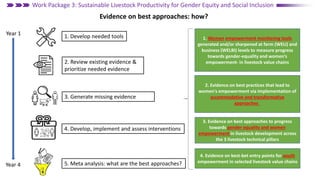
Evidence on best approaches: how?
1. Develop needed tools
2. Review existing evidence &
prioritize needed evidence
3. Generate missing evidence
4. Develop, implement and assess interventions
5. Meta analysis: what are the best approaches?
Year 1
Year 4
1. Women empowerment monitoring tools
generated and/or sharpened at farm (WELI) and
business (WELBI) levels to measure progress
towards gender-equality and women’s
empowerment- in livestock value chains
Outcome within Initiative Timeline
Outputs
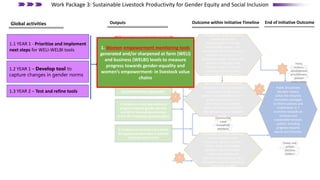
Global activities
1.1 YEAR 1 - Prioritize and implement
next steps for WELI-WELBI tools
End of Initiative Outcome
1.3 YEAR 2 – Test and refine tools
2. Evidence on best practices that
lead to women's empowerment via
implementation of accommodative
and transformative approaches
4. Evidence on best-bet entry points
for youth empowerment in selected
livestock value chains
1. Women empowerment monitoring
tools generated and/or sharpened at
farm (WELI) and business (WELBI)
levels to measure progress towards
gender-equality and women’s
empowerment- in livestock value
chains
Community and household
members in selected livestock
value chains adopt more
gender-equitable behaviour to
enable participation and
benefitting from livestock
assets and opportunities for
400,000 women and 150,000
youth.
In 4 target countries scientists
and practitioners and
extension agents in animal
health, feeds and forages,
genetics and environment
collaborate with gender
scientists to generate gender-
and youth-responsive livestock
innovation bundles
In 4 selected countries policy,
private sector and
development community
acknowledge gender- and
youth-based discrimination in
livestock value chains; co-
develop strategies to close the
gender and age gap; and
monitor progress towards
achieving that (using WELI
,WELBI and other WP tools).
Public and private
decision makers
utilize the Initiative
innovation packages
to inform policies and
investments in 7
countries towards an
inclusive and
sustainable livestock
system, including
progress towards
equity and inclusion
Communitie
s and
household
members
Public and
private
decision
makers
Policy
makers,
development
practitioners,
private
sector actors
1
2
3
4
4
3. Evidence on best approaches to
progress towards gender equality
and WE in livestock development
across the 3 livestock technical pillars
1.2 YEAR 1 – Develop tool to
capture changes in gender norms
1. Women empowerment monitoring tools
generated and/or sharpened at farm (WELI)
and business (WELBI) levels to measure
progress towards gender-equality and
women’s empowerment- in livestock value
chains
Work Package 3: Sustainable Livestock Productivity for Gender Equity and Social Inclusion
Outcome within Initiative Timeline
Outputs End of Initiative Outcome
2. Evidence on best practices that
lead to women's empowerment via
implementation of accommodative
and transformative approaches
4. Evidence on best-bet entry points
for youth empowerment in selected
livestock value chains
1. Women empowerment monitoring
tools generated and/or sharpened at
farm (WELI) and business (WELBI)
levels to measure progress towards
gender-equality and women’s
empowerment- in livestock value
chains
Community and household
members in selected livestock
value chains adopt more
gender-equitable behaviour to
enable participation and
benefitting from livestock
assets and opportunities for
400,000 women and 150,000
youth.
In 4 target countries scientists
and practitioners and
extension agents in animal
health, feeds and forages,
genetics and environment
collaborate with gender
scientists to generate gender-
and youth-responsive livestock
innovation bundles
In 4 selected countries policy,
private sector and
development community
acknowledge gender- and
youth-based discrimination in
livestock value chains; co-
develop strategies to close the
gender and age gap; and
monitor progress towards
achieving that (using WELI
,WELBI and other WP tools).
Public and private
decision makers
utilize the Initiative
innovation packages
to inform policies and
investments in 7
countries towards an
inclusive and
sustainable livestock
system, including
progress towards
equity and inclusion
Communitie
s and
household
members
Public and
private
decision
makers
Policy
makers,
development
practitioners,
private
sector actors
1
2
3
4
4
3. Evidence on best approaches to
progress towards gender equality
and WE in livestock development
across the 3 livestock technical pillars
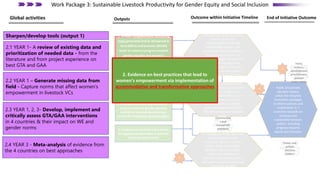
2.1 YEAR 1- A review of existing data and
prioritization of needed data - from the
literature and from project experience on
best GTA and GAA
2.3 YEAR 1, 2, 3- Develop, implement and
critically assess GTA/GAA interventions
in 4 countries & their impact on WE and
gender norms
2.4 YEAR 3 - Meta-analysis of evidence from
the 4 countries on best approaches
2.2 YEAR 1 – Generate missing data from
field - Capture norms that affect women’s
empowerment in livestock VCs
Sharpen/develop tools (output 1)
2. Evidence on best practices that lead to
women's empowerment via implementation of
accommodative and transformative approaches
Work Package 3: Sustainable Livestock Productivity for Gender Equity and Social Inclusion
Global activities
Outcome within Initiative Timeline
Outputs End of Initiative Outcome
2. Evidence on best practices that
lead to women's empowerment via
implementation of accommodative
and transformative approaches
4. Evidence on best-bet entry points
for youth empowerment in selected
livestock value chains
1. Women empowerment monitoring
tools generated and/or sharpened at
farm (WELI) and business (WELBI)
levels to measure progress towards
gender-equality and women’s
empowerment- in livestock value
chains
Community and household
members in selected livestock
value chains adopt more
gender-equitable behaviour to
enable participation and
benefitting from livestock
assets and opportunities for
400,000 women and 150,000
youth.
In 4 target countries scientists
and practitioners and
extension agents in animal
health, feeds and forages,
genetics and environment
collaborate with gender
scientists to generate gender-
and youth-responsive livestock
innovation bundles
In 4 selected countries policy,
private sector and
development community
acknowledge gender- and
youth-based discrimination in
livestock value chains; co-
develop strategies to close the
gender and age gap; and
monitor progress towards
achieving that (using WELI
,WELBI and other WP tools).
Public and private
decision makers
utilize the Initiative
innovation packages
to inform policies and
investments in 7
countries towards an
inclusive and
sustainable livestock
system, including
progress towards
equity and inclusion
Communitie
s and
household
members
Public and
private
decision
makers
Policy
makers,
development
practitioners,
private
sector actors
1
2
3
4
4
3. Evidence on best approaches to
progress towards gender equality
and WE in livestock development
across the 3 livestock technical pillars
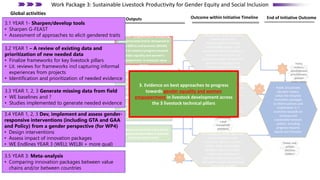
3.3 YEAR 1, 2, 3 Generate missing data from field
• WE baselines and ?
• Studies implemented to generate needed evidence
3.2 YEAR 1 – A review of existing data and
prioritization of new needed data
• Finalize frameworks for key livestock pillars
• Lit. reviews for frameworks incl capturing informal
experiences from projects
• Identification and prioritization of needed evidence
3.5 YEAR 3: Meta-analysis
• Comparing innovation packages between value
chains and/or between countries
3. Evidence on best approaches to progress
towards gender equality and women
empowerment in livestock development across
the 3 livestock technical pillars
3.1 YEAR 1- Sharpen/develop tools
• Sharpen G-FEAST
• Assessment of approaches to elicit gendered traits
3.4 YEAR 1, 2, 3 Dev, implement and assess gender-
responsive interventions (including GTA and GAA
and Policy) from a gender perspective (for WP4)
• Design interventions
• Assess impact of innovation packages
• WE Endlines YEAR 3 (WELI; WELBI + more qual)
Work Package 3: Sustainable Livestock Productivity for Gender Equity and Social Inclusion
Global activities
Outcome within Initiative Timeline
Outputs End of Initiative Outcome
2. Evidence on best practices that
lead to women's empowerment via
implementation of accommodative
and transformative approaches
4. Evidence on best-bet entry points
for youth empowerment in selected
livestock value chains
1. Women empowerment monitoring
tools generated and/or sharpened at
farm (WELI) and business (WELBI)
levels to measure progress towards
gender-equality and women’s
empowerment- in livestock value
chains
Community and household
members in selected livestock
value chains adopt more
gender-equitable behaviour to
enable participation and
benefitting from livestock
assets and opportunities for
400,000 women and 150,000
youth.
In 4 target countries scientists
and practitioners and
extension agents in animal
health, feeds and forages,
genetics and environment
collaborate with gender
scientists to generate gender-
and youth-responsive livestock
innovation bundles
In 4 selected countries policy,
private sector and
development community
acknowledge gender- and
youth-based discrimination in
livestock value chains; co-
develop strategies to close the
gender and age gap; and
monitor progress towards
achieving that (using WELI
,WELBI and other WP tools).
Public and private
decision makers
utilize the Initiative
innovation packages
to inform policies and
investments in 7
countries towards an
inclusive and
sustainable livestock
system, including
progress towards
equity and inclusion
Communitie
s and
household
members
Public and
private
decision
makers
Policy
makers,
development
practitioners,
private
sector actors
1
2
3
4
4
3. Evidence on best approaches to
progress towards gender equality
and WE in livestock development
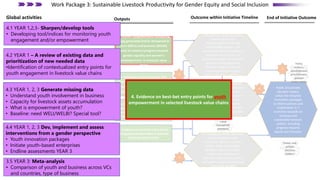
across the 3 livestock technical pillars
4. Evidence on best-bet entry points for youth
empowerment in selected livestock value chains
4.1 YEAR 1,2,3- Sharpen/develop tools
• Developing tool/indices for monitoring youth
engagement and/or empowerment
4.3 YEAR 1, 2, 3 Generate missing data
• Understand youth involvement in business
• Capacity for livestock assets accumulation
• What is empowerment of youth?
• Baseline: need WELI/WELBI? Special tool?
4.4 YEAR 1, 2, 3 Dev, implement and assess
interventions from a gender perspective
• Youth innovation packages
• Initiate youth-based enterprises
• Endline assessments YEAR 3
4.2 YEAR 1 – A review of existing data and
prioritization of new needed data
•Identification of contextualized entry points for
youth engagement in livestock value chains
3.5 YEAR 3: Meta-analysis
• Comparison of youth and business across VCs
and countries, type of business
Work Package 3: Sustainable Livestock Productivity for Gender Equity and Social Inclusion
Global activities
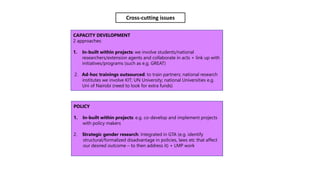
CAPACITY DEVELOPMENT
2 approaches:
1. In-built within projects: we involve students/national
researchers/extension agents and collaborate in acts + link up with
initiatives/programs (such as e.g. GREAT)
2. Ad-hoc trainings outsourced: to train partners; national research
institutes we involve KIT; UN University; national Universities e.g.
Uni of Nairobi (need to look for extra funds)
POLICY
1. In-built within projects: e.g. co-develop and implement projects
with policy makers
2. Strategic gender research: Integrated in GTA (e.g. identify
structural/formalized disadvantage in policies, laws etc that affect
our desired outcome – to then address it) + LMP work
Cross-cutting issues
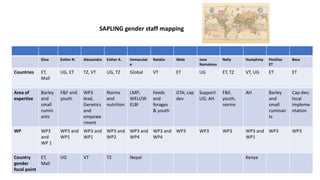
Dina Esther N. Alessandra Esther A. Immaculat
e
Natalia Wole Jane
Namatovu
Nelly Humphrey PostDoc
ET
Beza
Countries ET,
Mali
UG, ET TZ, VT UG, TZ Global VT ET UG ET, TZ VT, UG ET ET
Area of
expertise
Barley
and
small
rumin
ants
F&F and
youth
WP3
lead,
Genetics
and
empowe
rment
Norms
and
nutrition
LMP;
WELI/W
ELBI
Feeds
and
forages
& youth
GTA; cap
dev
Support
UG; AH
F&F,
youth,
norms
AH Barley
and
small
ruminan
ts
Cap dev;
local
impleme
ntation
WP WP3
and
WP 1
WP3 and
WP1
WP3 and
WP1
WP3 and
WP2
WP3 and
WP4
WP3 and
WP4
WP3 WP3 WP3 WP3 and
WP1
WP3 WP3
Country
gender
focal point
ET,
Mali
UG VT TZ Nepal Kenya
SAPLING gender staff mapping
www.cgiar.org
About 620 ILRI staff work in Africa and Asia to enhance incomes and livelihoods, improve food security, and reduce disease
and environmental degradation. Australian animal scientist and Nobel Prize laureate Peter Doherty serves as ILRI’s patron.
Organizations that fund ILRI through their contributions to CGIAR make ILRI’s work possible. Organizations that partner ILRI in
its mission make livestock research for development a reality.
www.ilri.org
This presentation is licensed for use under the Creative Commons Attribution 4.0 International Licence.
THANK YOU

Work Package 3: Sustainable Livestock Productivity for Gender Equity and Social Inclusion

  • 1.
    Work Package 3:Sustainable Livestock Productivity for Gender Equity and Social Inclusion Alessandra Galie, ILRI SAPLING Initiative Launch, Online, 15 June 2022
  • 2.
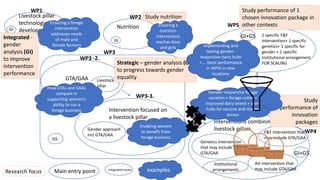
    GTA/GAA Livestock pillar Gender approach inclGTA/GAA Intervention focused on a livestock pillar WP3 -2. WP3-3. Genetics intervention that may include GTA/GAA Interventions combining livestock pillars WP4 F&F intervention that may include GTA/GAA AH intervention that may include GTA/GAA WP3 WP1 Livestock pillar technologies developed in combination GI Integrated - gender analysis (GI) to improve intervention performance Strategic – gender analysis (GS) to progress towards gender equality Study performance of innovation packages WP5 1 specific F&F intervention+ 1 specific genetics+ 1 specific for gender + 1 specific institutional arrangement FOR SCALING Study performance of 1 chosen innovation package in other contexts WP2 Nutrition Study nutrition Institutional arrangements Research focus Main entry point Integrated issues Enabling women to benefit from forage business How GTAs and GAAs compare in supporting women’s ability to run a forage business Ensuring a nutrition intervention reaches boys and girls Ensuring a forage intervention addresses needs of male and female farmers Gender-responsive forage varieties + forage cutter + improved dairy breed + dairy hubs for vaccine and market access examples Implementing and testing gender- responsive dairy hubs +…. (best performance in WP4) in new locations GI GS GI+GS GI+GS
  • 3.
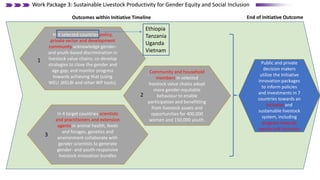
    Outcomes within InitiativeTimeline Work Package 3: Sustainable Livestock Productivity for Gender Equity and Social Inclusion End of Initiative Outcome Community and household members in selected livestock value chains adopt more gender-equitable behaviour to enable participation and benefitting from livestock assets and opportunities for 400,000 women and 150,000 youth. In 4 target countries scientists and practitioners and extension agents in animal health, feeds and forages, genetics and environment collaborate with gender scientists to generate gender- and youth-responsive livestock innovation bundles In 4 selected countries policy, private sector and development community acknowledge gender- and youth-based discrimination in livestock value chains; co-develop strategies to close the gender and age gap; and monitor progress towards achieving that (using WELI ,WELBI and other WP tools). Public and private decision makers utilize the Initiative innovation packages to inform policies and investments in 7 countries towards an inclusive and sustainable livestock system, including progress towards equity and inclusion 1 2 3 Ethiopia Tanzania Uganda Vietnam Work Package 3: Sustainable Livestock Productivity for Gender Equity and Social Inclusion
  • 4.
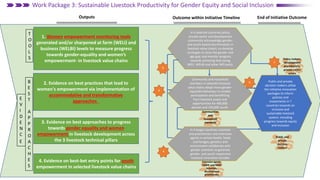
    Outcome within InitiativeTimeline Outputs 2. Evidence on best practices that lead to women's empowerment via implementation of accommodative and transformative approaches 4. Evidence on best-bet entry points for youth empowerment in selected livestock value chains End of Initiative Outcome Community and household members in selected livestock value chains adopt more gender- equitable behaviour to enable participation and benefitting from livestock assets and opportunities for 400,000 women and 150,000 youth. In 4 target countries scientists and practitioners and extension agents in animal health, feeds and forages, genetics and environment collaborate with gender scientists to generate gender- and youth-responsive livestock innovation bundles In 4 selected countries policy, private sector and development community acknowledge gender- and youth-based discrimination in livestock value chains; co-develop strategies to close the gender and age gap; and monitor progress towards achieving that (using WELI ,WELBI and other WP tools). Public and private decision makers utilize the Initiative innovation packages to inform policies and investments in 7 countries towards an inclusive and sustainable livestock system, including progress towards equity and inclusion Extension agents, CGIAR and NARS Scientists, development practitioners Communities and household members Public and private decision makers Policy makers, development practitioners, private sector actors 1 2 3 4 4 3. Evidence on best approaches to progress towards gender equality and women empowerment in livestock development across the 3 livestock technical pillars 1. Women empowerment monitoring tools generated and/or sharpened at farm (WELI) and business (WELBI) levels to measure progress towards gender-equality and women’s empowerment- in livestock value chains Work Package 3: Sustainable Livestock Productivity for Gender Equity and Social Inclusion T O O L S E V I D E N C E B E S T A P P R O A C H E S
  • 5.
    2. Evidence onbest practices that lead to women's empowerment via implementation of accommodative and transformative approaches 4. Evidence on best-bet entry points for youth empowerment in selected livestock value chains 3. Evidence on best approaches to progress towards gender equality and women empowerment in livestock development across the 3 livestock technical pillars Work Package 3: Sustainable Livestock Productivity for Gender Equity and Social Inclusion Evidence on best approaches: how? 1. Develop needed tools 2. Review existing evidence & prioritize needed evidence 3. Generate missing evidence 4. Develop, implement and assess interventions 5. Meta analysis: what are the best approaches? Year 1 Year 4 1. Women empowerment monitoring tools generated and/or sharpened at farm (WELI) and business (WELBI) levels to measure progress towards gender-equality and women’s empowerment- in livestock value chains
  • 6.
    Outcome within InitiativeTimeline Outputs Global activities 1.1 YEAR 1 - Prioritize and implement next steps for WELI-WELBI tools End of Initiative Outcome 1.3 YEAR 2 – Test and refine tools 2. Evidence on best practices that lead to women's empowerment via implementation of accommodative and transformative approaches 4. Evidence on best-bet entry points for youth empowerment in selected livestock value chains 1. Women empowerment monitoring tools generated and/or sharpened at farm (WELI) and business (WELBI) levels to measure progress towards gender-equality and women’s empowerment- in livestock value chains Community and household members in selected livestock value chains adopt more gender-equitable behaviour to enable participation and benefitting from livestock assets and opportunities for 400,000 women and 150,000 youth. In 4 target countries scientists and practitioners and extension agents in animal health, feeds and forages, genetics and environment collaborate with gender scientists to generate gender- and youth-responsive livestock innovation bundles In 4 selected countries policy, private sector and development community acknowledge gender- and youth-based discrimination in livestock value chains; co- develop strategies to close the gender and age gap; and monitor progress towards achieving that (using WELI ,WELBI and other WP tools). Public and private decision makers utilize the Initiative innovation packages to inform policies and investments in 7 countries towards an inclusive and sustainable livestock system, including progress towards equity and inclusion Communitie s and household members Public and private decision makers Policy makers, development practitioners, private sector actors 1 2 3 4 4 3. Evidence on best approaches to progress towards gender equality and WE in livestock development across the 3 livestock technical pillars 1.2 YEAR 1 – Develop tool to capture changes in gender norms 1. Women empowerment monitoring tools generated and/or sharpened at farm (WELI) and business (WELBI) levels to measure progress towards gender-equality and women’s empowerment- in livestock value chains Work Package 3: Sustainable Livestock Productivity for Gender Equity and Social Inclusion
  • 7.
    Outcome within InitiativeTimeline Outputs End of Initiative Outcome 2. Evidence on best practices that lead to women's empowerment via implementation of accommodative and transformative approaches 4. Evidence on best-bet entry points for youth empowerment in selected livestock value chains 1. Women empowerment monitoring tools generated and/or sharpened at farm (WELI) and business (WELBI) levels to measure progress towards gender-equality and women’s empowerment- in livestock value chains Community and household members in selected livestock value chains adopt more gender-equitable behaviour to enable participation and benefitting from livestock assets and opportunities for 400,000 women and 150,000 youth. In 4 target countries scientists and practitioners and extension agents in animal health, feeds and forages, genetics and environment collaborate with gender scientists to generate gender- and youth-responsive livestock innovation bundles In 4 selected countries policy, private sector and development community acknowledge gender- and youth-based discrimination in livestock value chains; co- develop strategies to close the gender and age gap; and monitor progress towards achieving that (using WELI ,WELBI and other WP tools). Public and private decision makers utilize the Initiative innovation packages to inform policies and investments in 7 countries towards an inclusive and sustainable livestock system, including progress towards equity and inclusion Communitie s and household members Public and private decision makers Policy makers, development practitioners, private sector actors 1 2 3 4 4 3. Evidence on best approaches to progress towards gender equality and WE in livestock development across the 3 livestock technical pillars 2.1 YEAR 1- A review of existing data and prioritization of needed data - from the literature and from project experience on best GTA and GAA 2.3 YEAR 1, 2, 3- Develop, implement and critically assess GTA/GAA interventions in 4 countries & their impact on WE and gender norms 2.4 YEAR 3 - Meta-analysis of evidence from the 4 countries on best approaches 2.2 YEAR 1 – Generate missing data from field - Capture norms that affect women’s empowerment in livestock VCs Sharpen/develop tools (output 1) 2. Evidence on best practices that lead to women's empowerment via implementation of accommodative and transformative approaches Work Package 3: Sustainable Livestock Productivity for Gender Equity and Social Inclusion Global activities
  • 8.
    Outcome within InitiativeTimeline Outputs End of Initiative Outcome 2. Evidence on best practices that lead to women's empowerment via implementation of accommodative and transformative approaches 4. Evidence on best-bet entry points for youth empowerment in selected livestock value chains 1. Women empowerment monitoring tools generated and/or sharpened at farm (WELI) and business (WELBI) levels to measure progress towards gender-equality and women’s empowerment- in livestock value chains Community and household members in selected livestock value chains adopt more gender-equitable behaviour to enable participation and benefitting from livestock assets and opportunities for 400,000 women and 150,000 youth. In 4 target countries scientists and practitioners and extension agents in animal health, feeds and forages, genetics and environment collaborate with gender scientists to generate gender- and youth-responsive livestock innovation bundles In 4 selected countries policy, private sector and development community acknowledge gender- and youth-based discrimination in livestock value chains; co- develop strategies to close the gender and age gap; and monitor progress towards achieving that (using WELI ,WELBI and other WP tools). Public and private decision makers utilize the Initiative innovation packages to inform policies and investments in 7 countries towards an inclusive and sustainable livestock system, including progress towards equity and inclusion Communitie s and household members Public and private decision makers Policy makers, development practitioners, private sector actors 1 2 3 4 4 3. Evidence on best approaches to progress towards gender equality and WE in livestock development across the 3 livestock technical pillars 3.3 YEAR 1, 2, 3 Generate missing data from field • WE baselines and ? • Studies implemented to generate needed evidence 3.2 YEAR 1 – A review of existing data and prioritization of new needed data • Finalize frameworks for key livestock pillars • Lit. reviews for frameworks incl capturing informal experiences from projects • Identification and prioritization of needed evidence 3.5 YEAR 3: Meta-analysis • Comparing innovation packages between value chains and/or between countries 3. Evidence on best approaches to progress towards gender equality and women empowerment in livestock development across the 3 livestock technical pillars 3.1 YEAR 1- Sharpen/develop tools • Sharpen G-FEAST • Assessment of approaches to elicit gendered traits 3.4 YEAR 1, 2, 3 Dev, implement and assess gender- responsive interventions (including GTA and GAA and Policy) from a gender perspective (for WP4) • Design interventions • Assess impact of innovation packages • WE Endlines YEAR 3 (WELI; WELBI + more qual) Work Package 3: Sustainable Livestock Productivity for Gender Equity and Social Inclusion Global activities
  • 9.
    Outcome within InitiativeTimeline Outputs End of Initiative Outcome 2. Evidence on best practices that lead to women's empowerment via implementation of accommodative and transformative approaches 4. Evidence on best-bet entry points for youth empowerment in selected livestock value chains 1. Women empowerment monitoring tools generated and/or sharpened at farm (WELI) and business (WELBI) levels to measure progress towards gender-equality and women’s empowerment- in livestock value chains Community and household members in selected livestock value chains adopt more gender-equitable behaviour to enable participation and benefitting from livestock assets and opportunities for 400,000 women and 150,000 youth. In 4 target countries scientists and practitioners and extension agents in animal health, feeds and forages, genetics and environment collaborate with gender scientists to generate gender- and youth-responsive livestock innovation bundles In 4 selected countries policy, private sector and development community acknowledge gender- and youth-based discrimination in livestock value chains; co- develop strategies to close the gender and age gap; and monitor progress towards achieving that (using WELI ,WELBI and other WP tools). Public and private decision makers utilize the Initiative innovation packages to inform policies and investments in 7 countries towards an inclusive and sustainable livestock system, including progress towards equity and inclusion Communitie s and household members Public and private decision makers Policy makers, development practitioners, private sector actors 1 2 3 4 4 3. Evidence on best approaches to progress towards gender equality and WE in livestock development across the 3 livestock technical pillars 4. Evidence on best-bet entry points for youth empowerment in selected livestock value chains 4.1 YEAR 1,2,3- Sharpen/develop tools • Developing tool/indices for monitoring youth engagement and/or empowerment 4.3 YEAR 1, 2, 3 Generate missing data • Understand youth involvement in business • Capacity for livestock assets accumulation • What is empowerment of youth? • Baseline: need WELI/WELBI? Special tool? 4.4 YEAR 1, 2, 3 Dev, implement and assess interventions from a gender perspective • Youth innovation packages • Initiate youth-based enterprises • Endline assessments YEAR 3 4.2 YEAR 1 – A review of existing data and prioritization of new needed data •Identification of contextualized entry points for youth engagement in livestock value chains 3.5 YEAR 3: Meta-analysis • Comparison of youth and business across VCs and countries, type of business Work Package 3: Sustainable Livestock Productivity for Gender Equity and Social Inclusion Global activities
  • 10.
    CAPACITY DEVELOPMENT 2 approaches: 1.In-built within projects: we involve students/national researchers/extension agents and collaborate in acts + link up with initiatives/programs (such as e.g. GREAT) 2. Ad-hoc trainings outsourced: to train partners; national research institutes we involve KIT; UN University; national Universities e.g. Uni of Nairobi (need to look for extra funds) POLICY 1. In-built within projects: e.g. co-develop and implement projects with policy makers 2. Strategic gender research: Integrated in GTA (e.g. identify structural/formalized disadvantage in policies, laws etc that affect our desired outcome – to then address it) + LMP work Cross-cutting issues
  • 11.
    Dina Esther N.Alessandra Esther A. Immaculat e Natalia Wole Jane Namatovu Nelly Humphrey PostDoc ET Beza Countries ET, Mali UG, ET TZ, VT UG, TZ Global VT ET UG ET, TZ VT, UG ET ET Area of expertise Barley and small rumin ants F&F and youth WP3 lead, Genetics and empowe rment Norms and nutrition LMP; WELI/W ELBI Feeds and forages & youth GTA; cap dev Support UG; AH F&F, youth, norms AH Barley and small ruminan ts Cap dev; local impleme ntation WP WP3 and WP 1 WP3 and WP1 WP3 and WP1 WP3 and WP2 WP3 and WP4 WP3 and WP4 WP3 WP3 WP3 WP3 and WP1 WP3 WP3 Country gender focal point ET, Mali UG VT TZ Nepal Kenya SAPLING gender staff mapping
  • 12.
  • 13.
    About 620 ILRIstaff work in Africa and Asia to enhance incomes and livelihoods, improve food security, and reduce disease and environmental degradation. Australian animal scientist and Nobel Prize laureate Peter Doherty serves as ILRI’s patron. Organizations that fund ILRI through their contributions to CGIAR make ILRI’s work possible. Organizations that partner ILRI in its mission make livestock research for development a reality. www.ilri.org This presentation is licensed for use under the Creative Commons Attribution 4.0 International Licence. THANK YOU