2D to 3D conversion at CRC
A visual perception approach

                           Carlos Vazquez and Wa James Tam
                           3D-TV Research
                           Advanced Video Systems
2D to S3D video conversion


       Why?                                      Where/When?                           How?
       •Many S3D cinema screens available        •Post-production: For cinema and      •Fully manual
       •Introduction of 3D-enabled TV sets        TV production                        •Semi-automatic
       •Large amount of 2D content               •Broadcasting: For live content and   •Automatic off-line
        available                                 legacy material                      •Automatic in real-time
       •Limited content in original              •TV set, STB: Legacy content from
        stereoscopic format                       viewer library or 2D program
       •Still difficult to capture
        stereoscopic content


June 4, 2012            Advanced Video Systems -- 3D-TV Research                                                 2
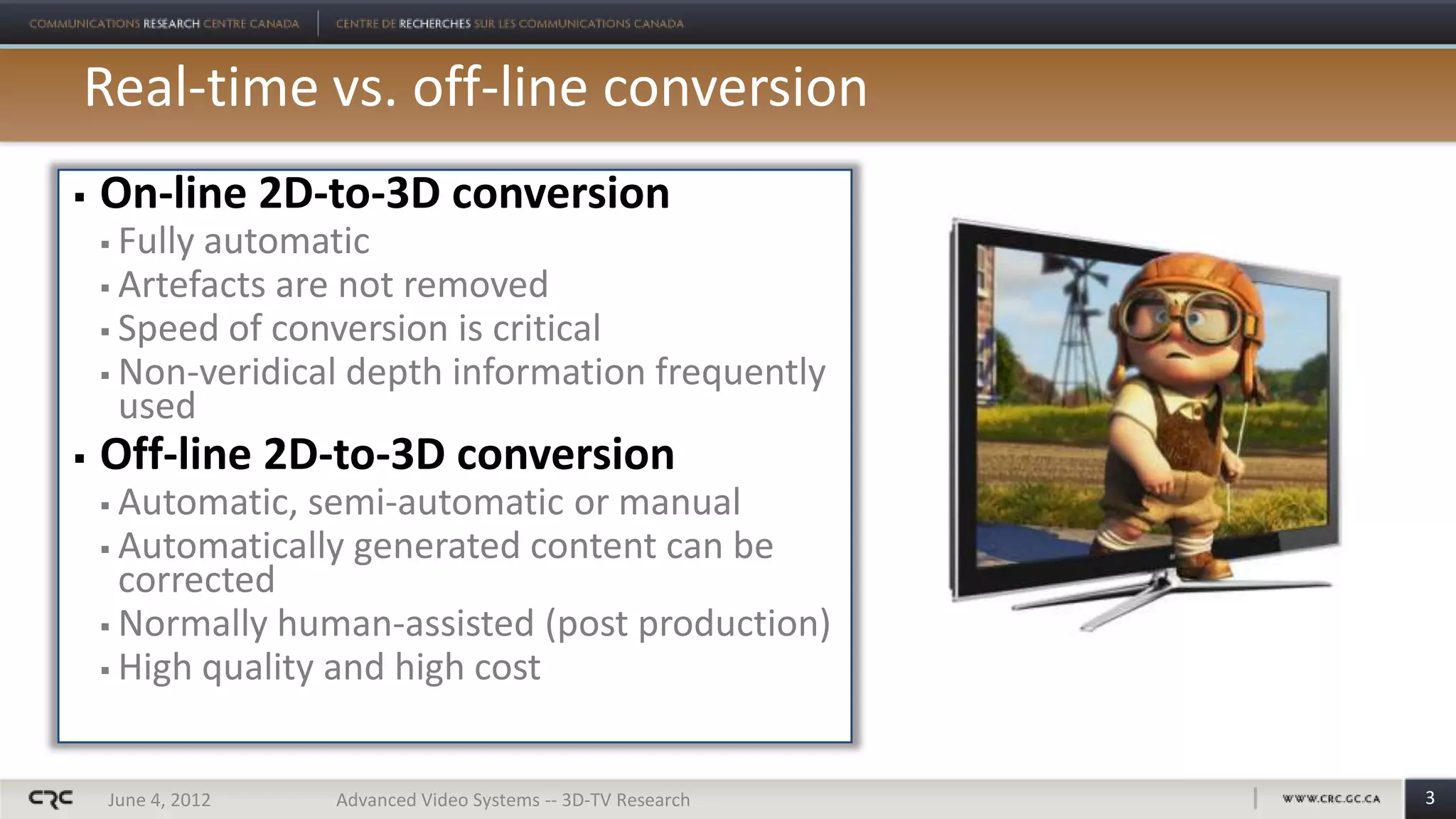
Real-time vs. off-line conversion
   On-line 2D-to-3D conversion
     Fully automatic
     Artefacts are not removed
     Speed of conversion is critical
     Non-veridical depth information frequently
      used
   Off-line 2D-to-3D conversion
     Automatic, semi-automatic or manual
     Automatically generated content can be
      corrected
     Normally human-assisted (post production)
     High quality and high cost


    June 4, 2012   Advanced Video Systems -- 3D-TV Research   3
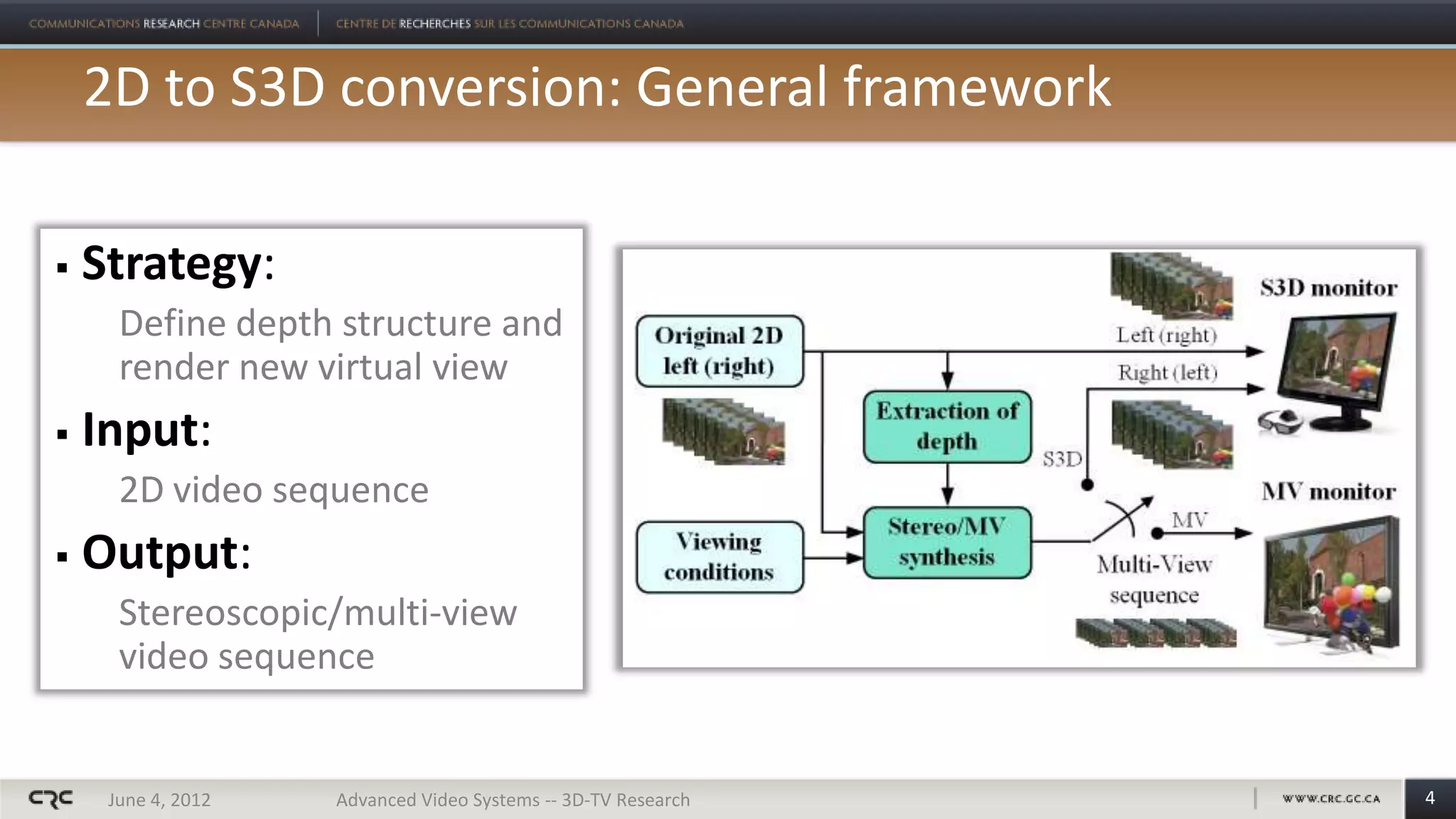
2D to S3D conversion: General framework

   Strategy:
      Define depth structure and
      render new virtual view
   Input:
      2D video sequence
   Output:
      Stereoscopic/multi-view
      video sequence


     June 4, 2012   Advanced Video Systems -- 3D-TV Research   4
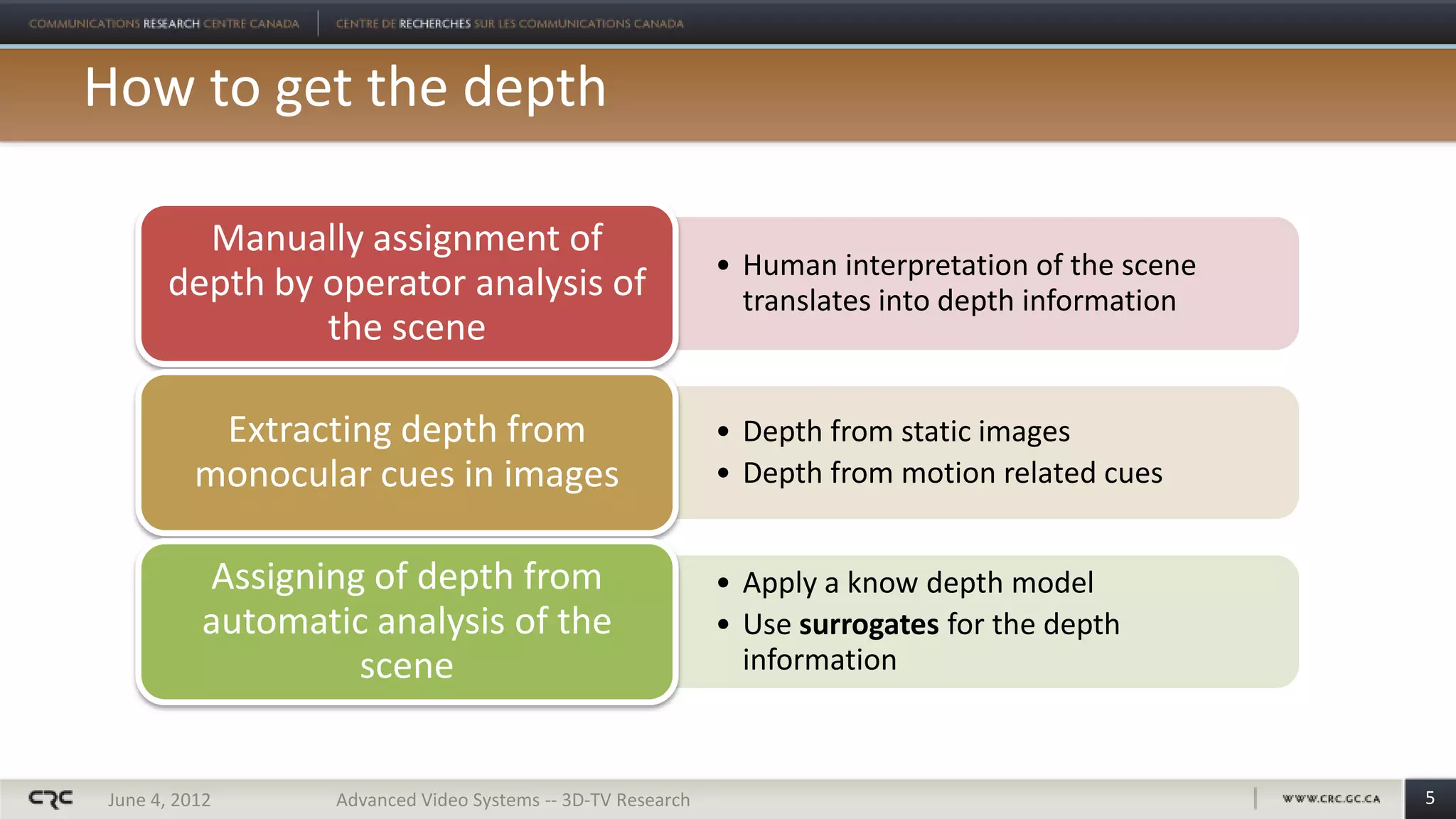
How to get the depth

        Manually assignment of
                                                             • Human interpretation of the scene
      depth by operator analysis of                            translates into depth information
               the scene

           Extracting depth from                             • Depth from static images
          monocular cues in images                           • Depth from motion related cues


          Assigning of depth from                            • Apply a know depth model
          automatic analysis of the                          • Use surrogates for the depth
                   scene                                       information


June 4, 2012      Advanced Video Systems -- 3D-TV Research                                         5
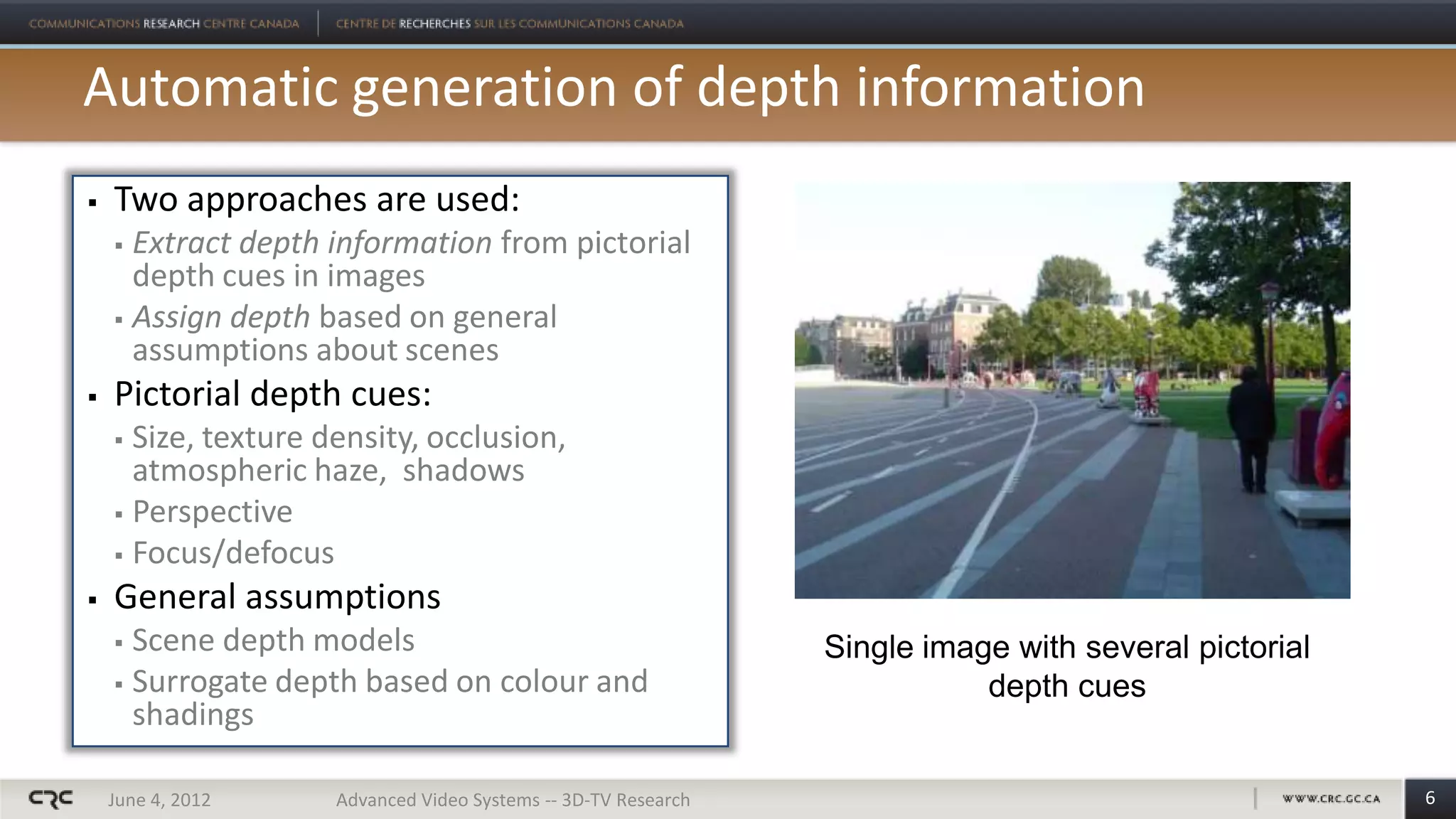
Automatic generation of depth information
   Two approaches are used:
     Extract depth information from pictorial
      depth cues in images
     Assign depth based on general
      assumptions about scenes
   Pictorial depth cues:
     Size, texture density, occlusion,
      atmospheric haze, shadows
     Perspective

     Focus/defocus

   General assumptions
     Scene depth models                                        Single image with several pictorial
     Surrogate depth based on colour and                                  depth cues
      shadings

    June 4, 2012     Advanced Video Systems -- 3D-TV Research                                         6
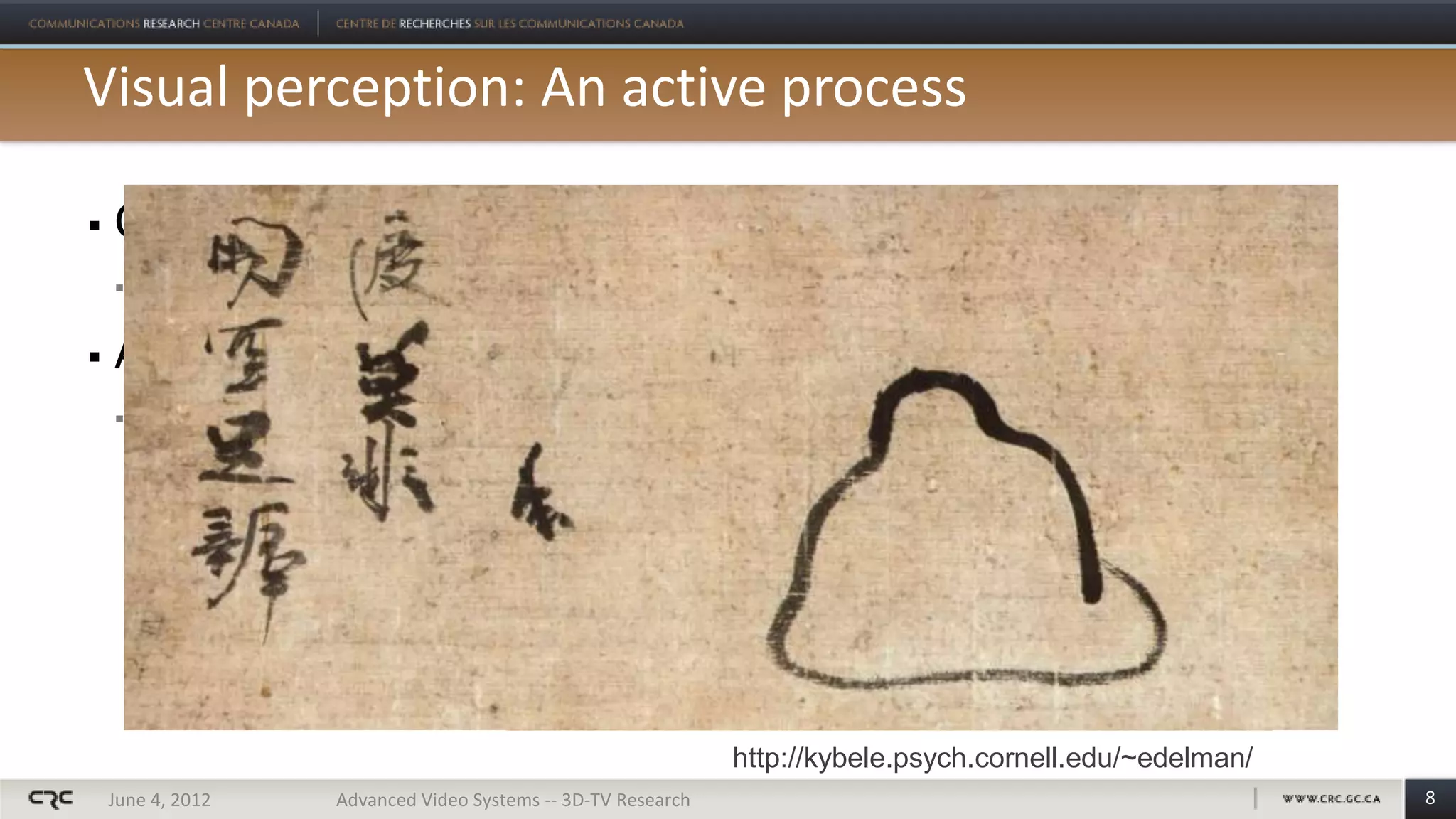
Visual perception: An active process

   Content dependency:
    
       Aoccdrnig to rscheearch at an Elingsh uinervtisy,
        Past experience help in interpretation of visual content
           it deosn't mttaer in waht oredr the ltteers in a
 Auto-correction:
          wrod are, olny taht the frist and lsat ltteres are
   Fill-in missing information or minimize conflicting information
          at the rghit pcleas. The rset can be a toatl mses
         and you can sitll raed it wouthit a porbelm. Tihs
          is bcuseae we do not raed ervey lteter by ilstef,
                          but the wrod as a wlohe.

                                                                http://kybele.psych.cornell.edu/~edelman/
    June 4, 2012     Advanced Video Systems -- 3D-TV Research                                               8
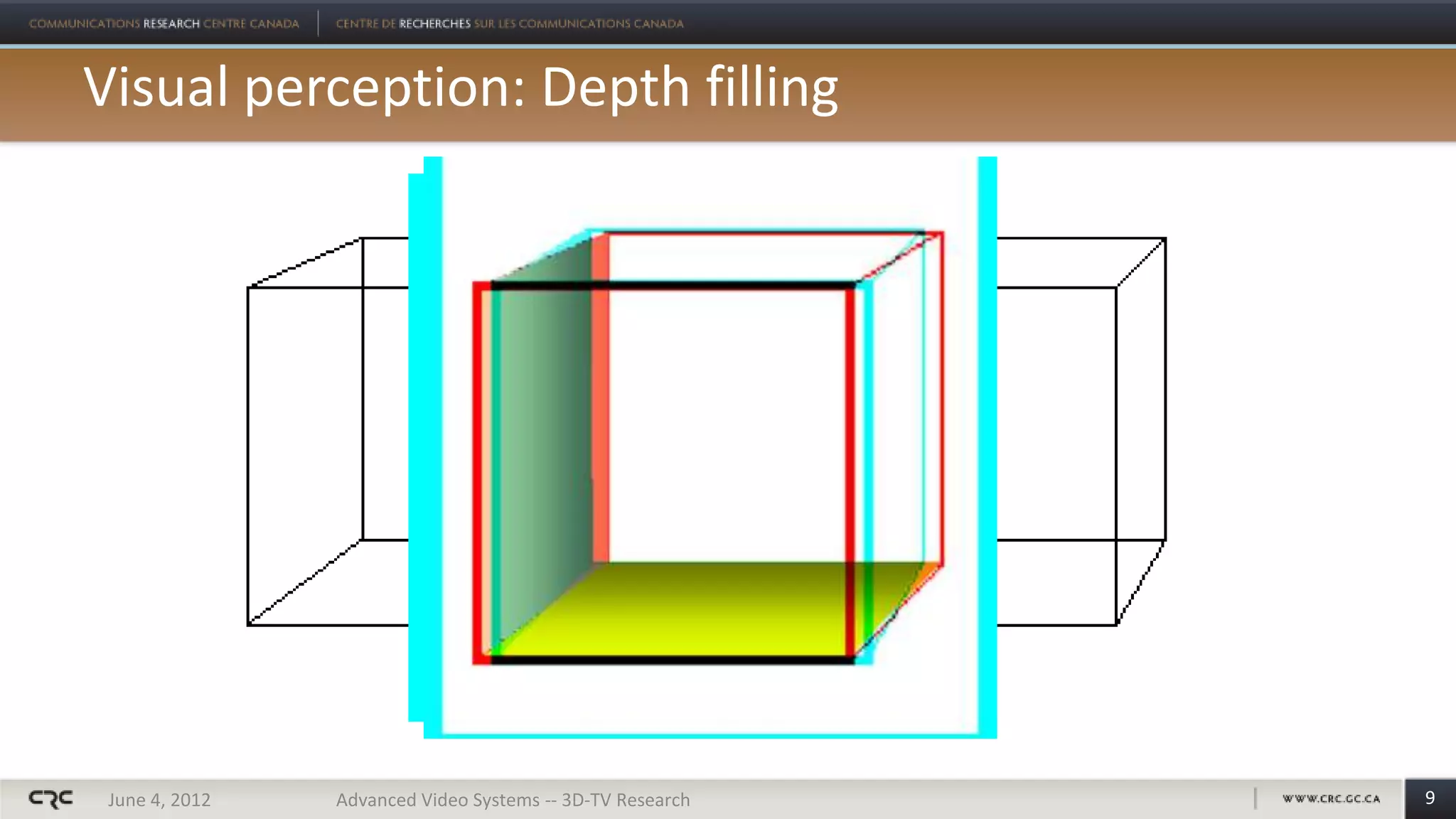
Visual perception: Depth filling


 June 4, 2012   Advanced Video Systems -- 3D-TV Research   9
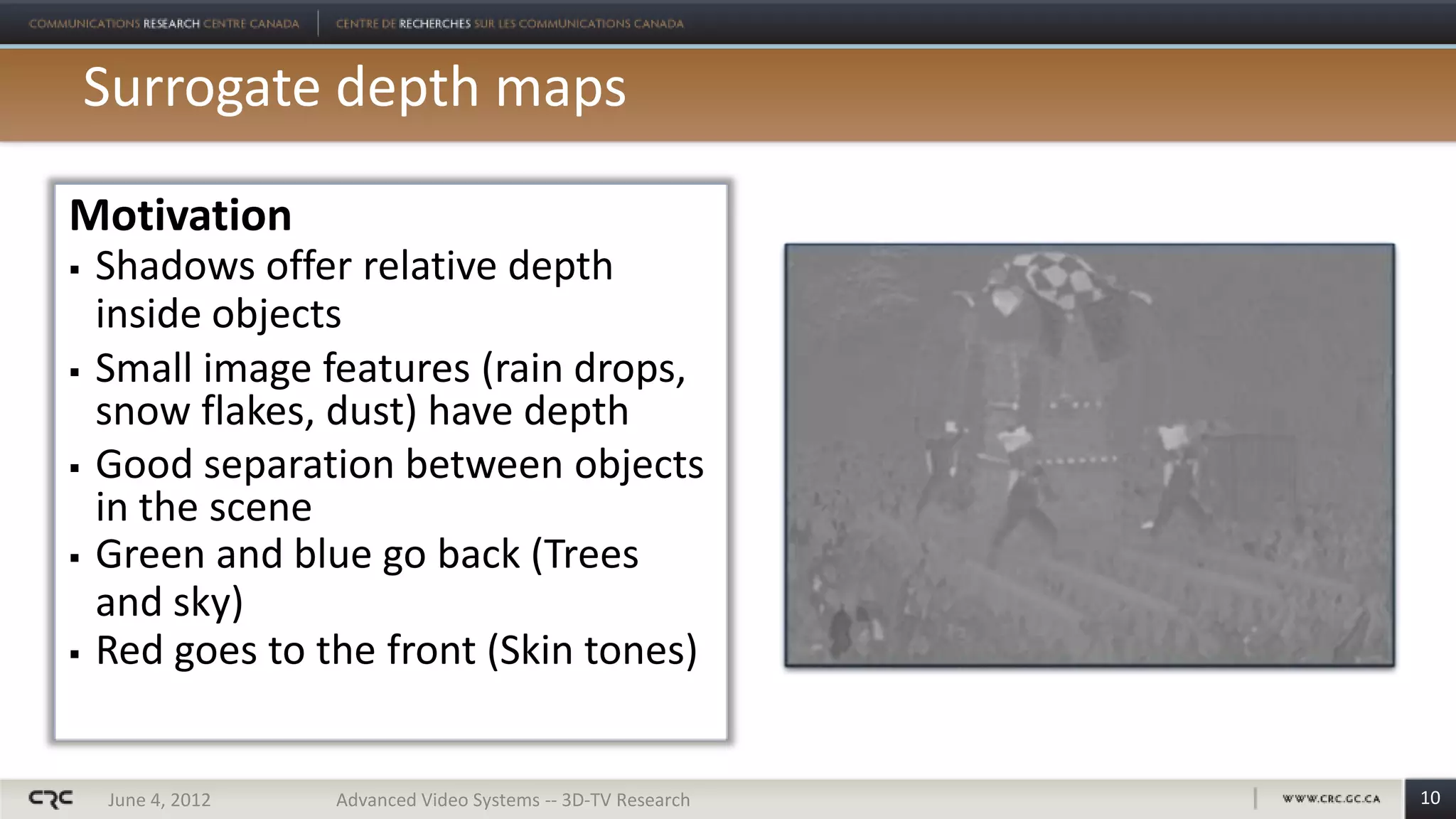
Surrogate depth maps

Motivation
   Shadows offer relative depth
    inside objects
   Small image features (rain drops,
    snow flakes, dust) have depth
   Good separation between objects
    in the scene
   Green and blue go back (Trees
    and sky)
   Red goes to the front (Skin tones)


    June 4, 2012   Advanced Video Systems -- 3D-TV Research   10
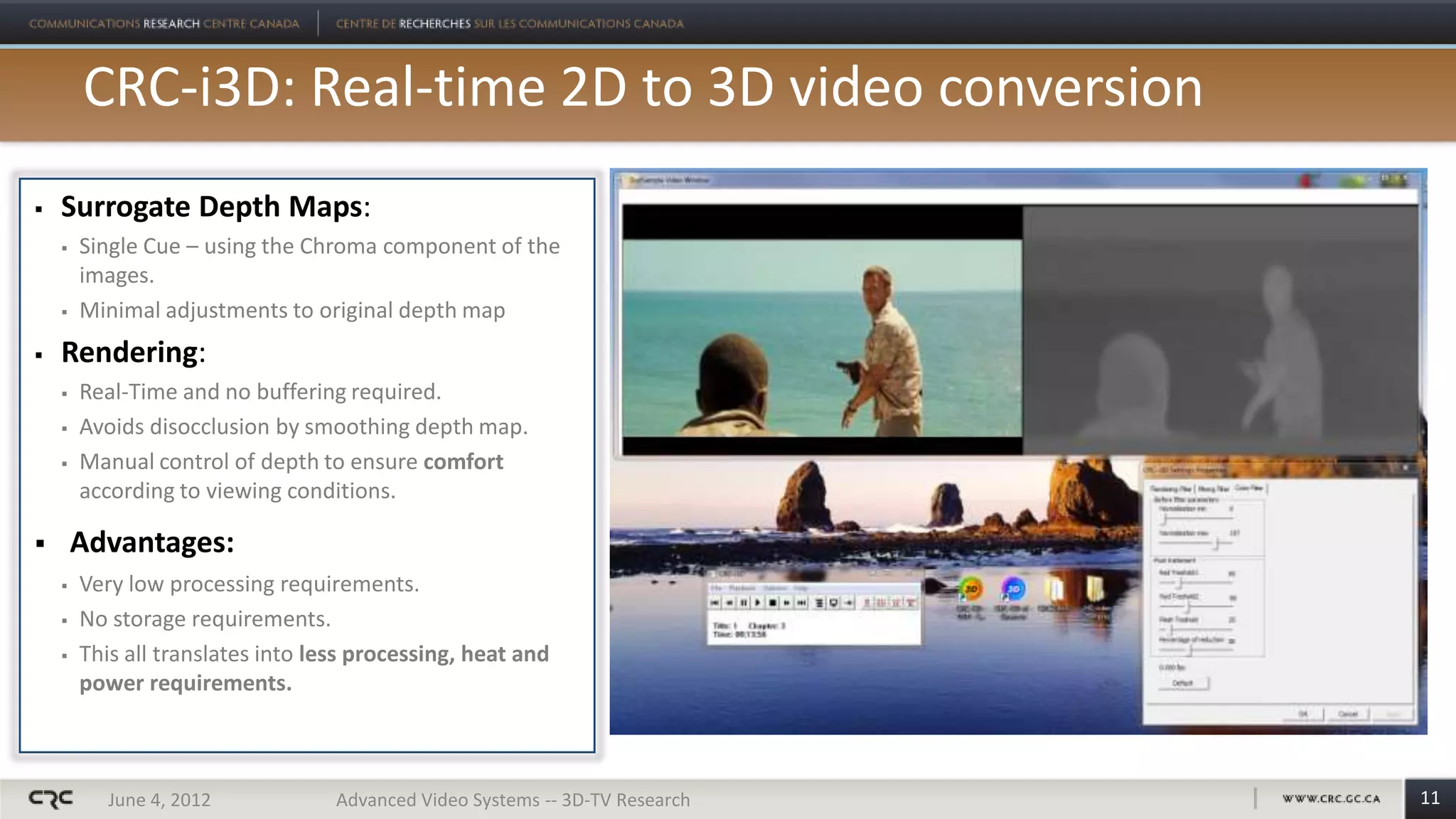
CRC-i3D: Real-time 2D to 3D video conversion
   Surrogate Depth Maps:
       Single Cue – using the Chroma component of the
        images.
       Minimal adjustments to original depth map
   Rendering:
       Real-Time and no buffering required.
       Avoids disocclusion by smoothing depth map.
       Manual control of depth to ensure comfort
        according to viewing conditions.

       Advantages:
       Very low processing requirements.
       No storage requirements.
       This all translates into less processing, heat and
        power requirements.


           June 4, 2012            Advanced Video Systems -- 3D-TV Research   11
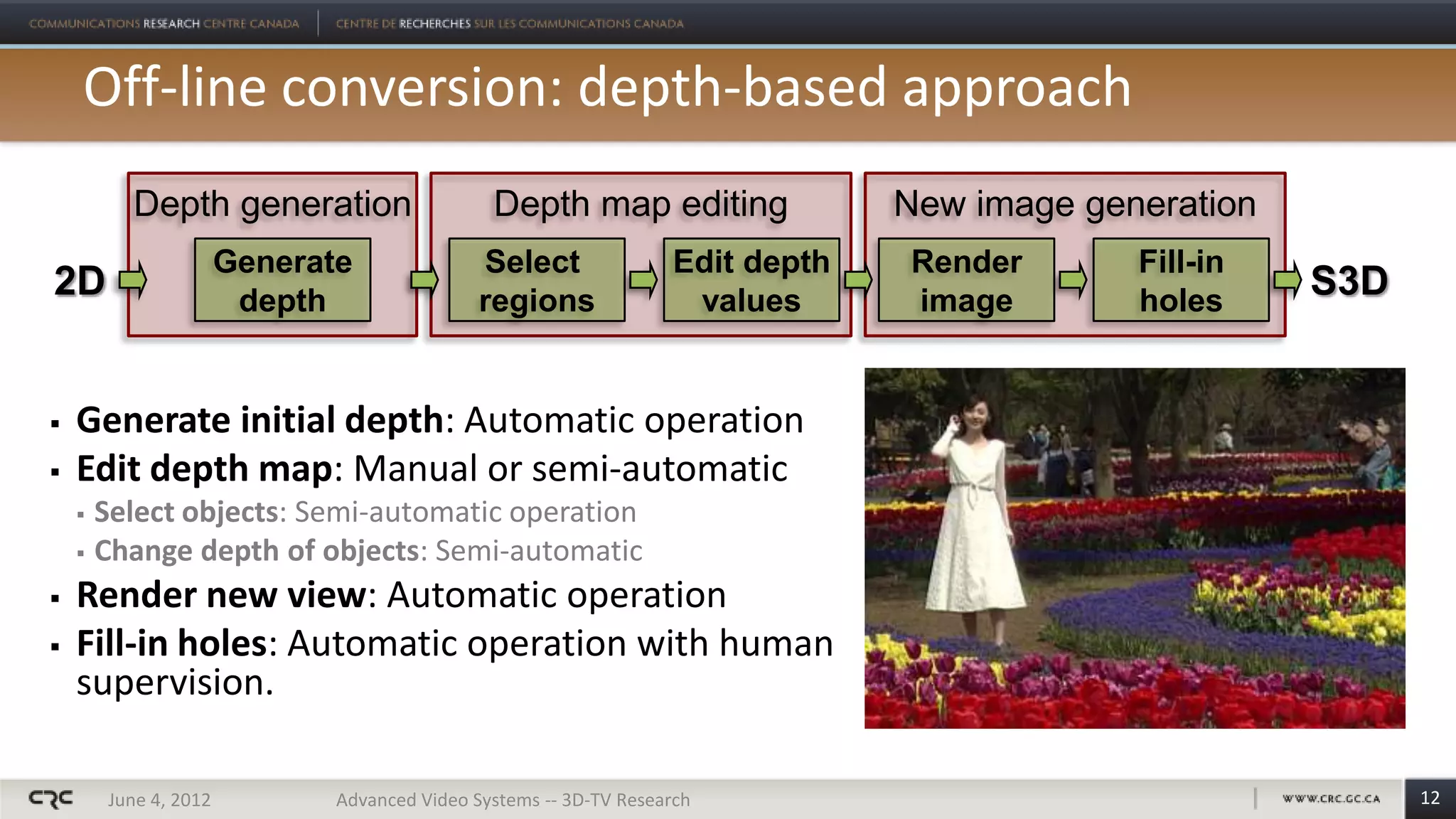
Off-line conversion: depth-based approach
          Depth generation                     Depth map editing                 New image generation
                       Generate               Select                Edit depth   Render       Fill-in
2D                      depth                 regions                values      image        holes
                                                                                                        S3D


   Generate initial depth: Automatic operation
   Edit depth map: Manual or semi-automatic
     Select objects: Semi-automatic operation
     Change depth of objects: Semi-automatic

   Render new view: Automatic operation
   Fill-in holes: Automatic operation with human
    supervision.

        June 4, 2012          Advanced Video Systems -- 3D-TV Research                                        12
Depth-based approach: Main characteristics

 Intermediate depth master: Can be used to render the
  stereoscopic content for different targets
 Depth relations are easy to evaluate

 Depth is continuous: Slow variations in depth are easily

  represented
 Depth information is represented as an image: Easy to

  store and transmit

    June 4, 2012   Advanced Video Systems -- 3D-TV Research   13
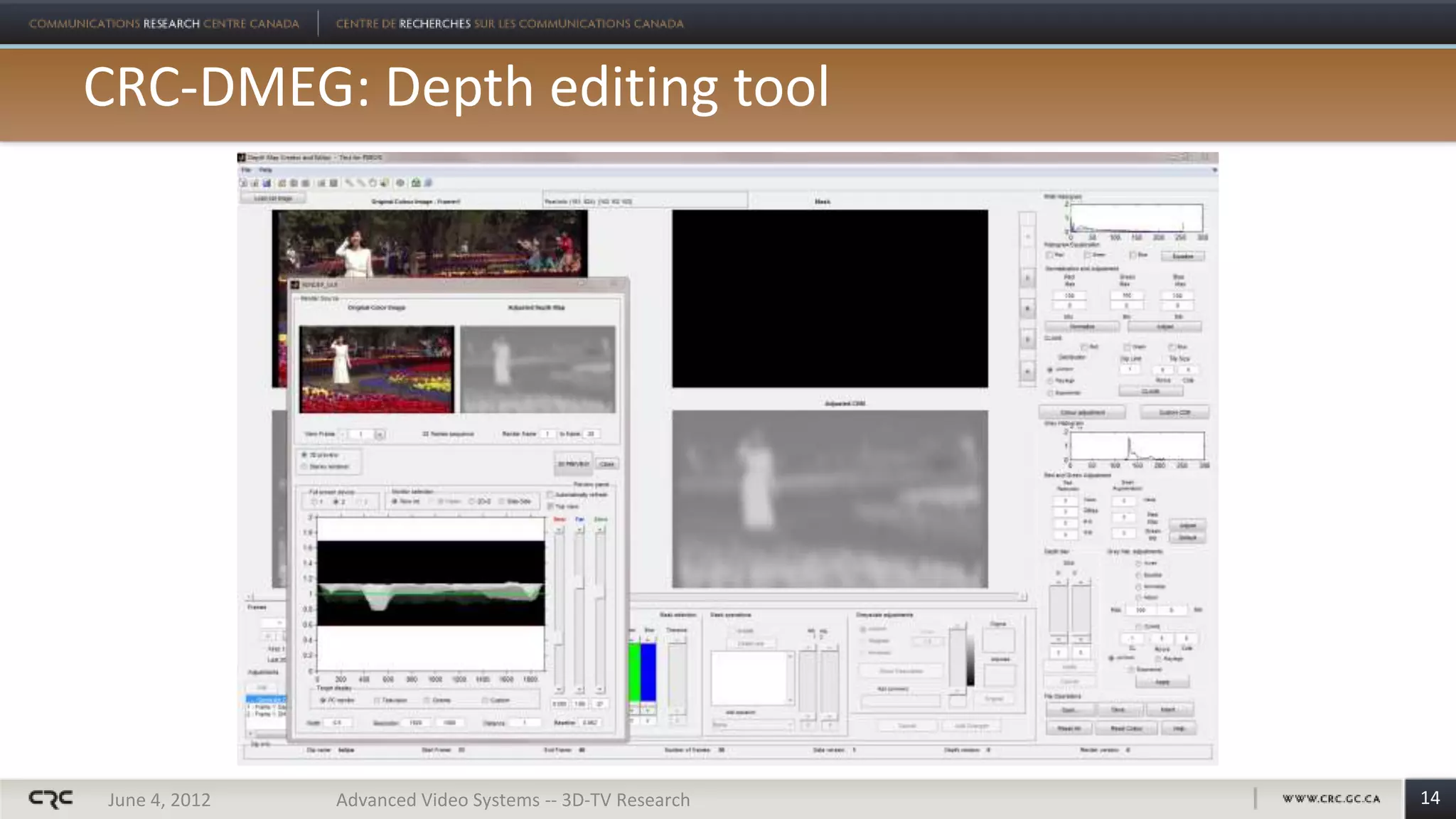
CRC-DMEG: Depth editing tool


June 4, 2012   Advanced Video Systems -- 3D-TV Research   14
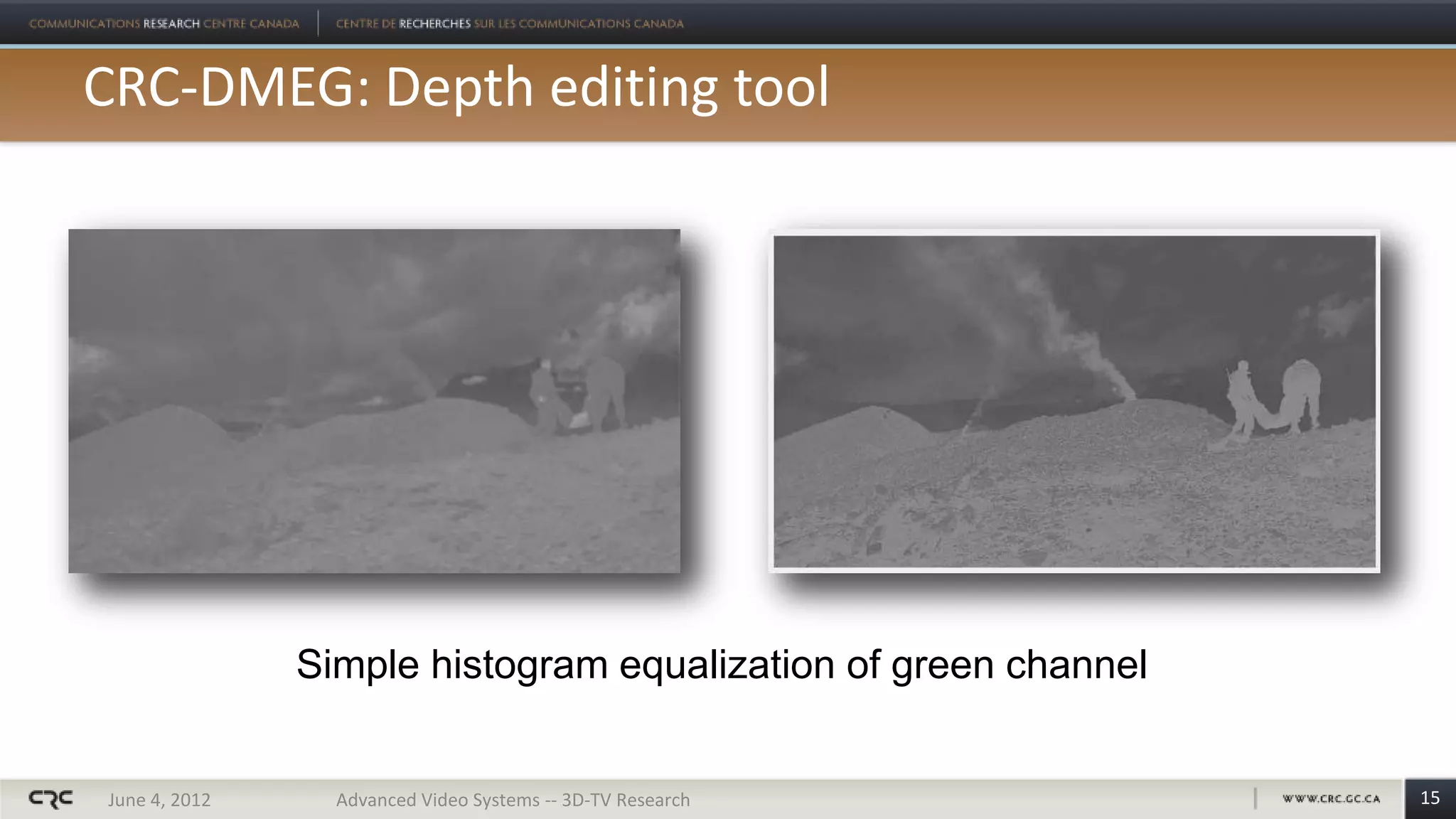
CRC-DMEG: Depth editing tool


               Simple histogram equalization of green channel


June 4, 2012     Advanced Video Systems -- 3D-TV Research       15
June 4, 2012   Advanced Video Systems -- 3D-TV Research   16

2D to 3D conversion at CRC: A visual perception approach.

  • 1.
    2D to 3Dconversion at CRC A visual perception approach Carlos Vazquez and Wa James Tam 3D-TV Research Advanced Video Systems
  • 2.
    2D to S3Dvideo conversion Why? Where/When? How? •Many S3D cinema screens available •Post-production: For cinema and •Fully manual •Introduction of 3D-enabled TV sets TV production •Semi-automatic •Large amount of 2D content •Broadcasting: For live content and •Automatic off-line available legacy material •Automatic in real-time •Limited content in original •TV set, STB: Legacy content from stereoscopic format viewer library or 2D program •Still difficult to capture stereoscopic content June 4, 2012 Advanced Video Systems -- 3D-TV Research 2
  • 3.
    Real-time vs. off-lineconversion  On-line 2D-to-3D conversion  Fully automatic  Artefacts are not removed  Speed of conversion is critical  Non-veridical depth information frequently used  Off-line 2D-to-3D conversion  Automatic, semi-automatic or manual  Automatically generated content can be corrected  Normally human-assisted (post production)  High quality and high cost June 4, 2012 Advanced Video Systems -- 3D-TV Research 3
  • 4.
    2D to S3Dconversion: General framework  Strategy: Define depth structure and render new virtual view  Input: 2D video sequence  Output: Stereoscopic/multi-view video sequence June 4, 2012 Advanced Video Systems -- 3D-TV Research 4
  • 5.
    How to getthe depth Manually assignment of • Human interpretation of the scene depth by operator analysis of translates into depth information the scene Extracting depth from • Depth from static images monocular cues in images • Depth from motion related cues Assigning of depth from • Apply a know depth model automatic analysis of the • Use surrogates for the depth scene information June 4, 2012 Advanced Video Systems -- 3D-TV Research 5
  • 6.
    Automatic generation ofdepth information  Two approaches are used:  Extract depth information from pictorial depth cues in images  Assign depth based on general assumptions about scenes  Pictorial depth cues:  Size, texture density, occlusion, atmospheric haze, shadows  Perspective  Focus/defocus  General assumptions  Scene depth models Single image with several pictorial  Surrogate depth based on colour and depth cues shadings June 4, 2012 Advanced Video Systems -- 3D-TV Research 6
  • 8.
    Visual perception: Anactive process  Content dependency:  Aoccdrnig to rscheearch at an Elingsh uinervtisy, Past experience help in interpretation of visual content it deosn't mttaer in waht oredr the ltteers in a  Auto-correction: wrod are, olny taht the frist and lsat ltteres are  Fill-in missing information or minimize conflicting information at the rghit pcleas. The rset can be a toatl mses and you can sitll raed it wouthit a porbelm. Tihs is bcuseae we do not raed ervey lteter by ilstef, but the wrod as a wlohe. http://kybele.psych.cornell.edu/~edelman/ June 4, 2012 Advanced Video Systems -- 3D-TV Research 8
  • 9.
    Visual perception: Depthfilling June 4, 2012 Advanced Video Systems -- 3D-TV Research 9
  • 10.
    Surrogate depth maps Motivation  Shadows offer relative depth inside objects  Small image features (rain drops, snow flakes, dust) have depth  Good separation between objects in the scene  Green and blue go back (Trees and sky)  Red goes to the front (Skin tones) June 4, 2012 Advanced Video Systems -- 3D-TV Research 10
  • 11.
    CRC-i3D: Real-time 2Dto 3D video conversion  Surrogate Depth Maps:  Single Cue – using the Chroma component of the images.  Minimal adjustments to original depth map  Rendering:  Real-Time and no buffering required.  Avoids disocclusion by smoothing depth map.  Manual control of depth to ensure comfort according to viewing conditions.  Advantages:  Very low processing requirements.  No storage requirements.  This all translates into less processing, heat and power requirements. June 4, 2012 Advanced Video Systems -- 3D-TV Research 11
  • 12.
    Off-line conversion: depth-basedapproach Depth generation Depth map editing New image generation Generate Select Edit depth Render Fill-in 2D depth regions values image holes S3D  Generate initial depth: Automatic operation  Edit depth map: Manual or semi-automatic  Select objects: Semi-automatic operation  Change depth of objects: Semi-automatic  Render new view: Automatic operation  Fill-in holes: Automatic operation with human supervision. June 4, 2012 Advanced Video Systems -- 3D-TV Research 12
  • 13.
    Depth-based approach: Maincharacteristics  Intermediate depth master: Can be used to render the stereoscopic content for different targets  Depth relations are easy to evaluate  Depth is continuous: Slow variations in depth are easily represented  Depth information is represented as an image: Easy to store and transmit June 4, 2012 Advanced Video Systems -- 3D-TV Research 13
  • 14.
    CRC-DMEG: Depth editingtool June 4, 2012 Advanced Video Systems -- 3D-TV Research 14
  • 15.
    CRC-DMEG: Depth editingtool Simple histogram equalization of green channel June 4, 2012 Advanced Video Systems -- 3D-TV Research 15
  • 16.
    June 4, 2012 Advanced Video Systems -- 3D-TV Research 16