Screen Selection
for Digital 2D & 3D Cinema
Andrew Robinson
Managing Director
Harkness Screens
ICTA June 2009
Amsterdam
This presentation will cover the following
topics:
• Brightness standards for digital cinema.
• Differences between digital and 35mm projection.
• Screen selection for digital projection.
• Use of ā€œgainā€ screens.
• Digital 3D – screen implications.
• Mixed digital 2D/3D applications.
Standards for screen luminance
SMPTE luminance standard for digital cinema is:
• 14 fl in screen centre +/- 3fl.
• 75% of centre brightness at the sides, minimum
9 fl. SMPTE 431-1-2006.
• Luminance standard for 35mm projection is 16 fl.
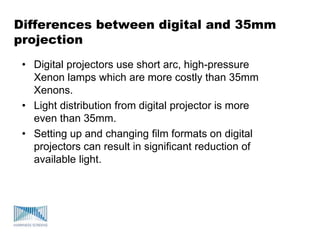
Differences between digital and 35mm
projection
• Digital projectors use short arc, high-pressure
Xenon lamps which are more costly than 35mm
Xenons.
• Light distribution from digital projector is more
even than 35mm.
• Setting up and changing film formats on digital
projectors can result in significant reduction of
available light.
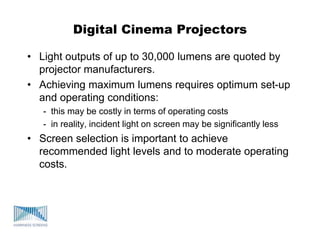
Digital Cinema Projectors
• Light outputs of up to 30,000 lumens are quoted by
projector manufacturers.
• Achieving maximum lumens requires optimum set-up
and operating conditions:
- this may be costly in terms of operating costs
- in reality, incident light on screen may be significantly less
• Screen selection is important to achieve
recommended light levels and to moderate operating
costs.
Screen light efficiency
• Screens cannot create light; but they can optimise the reflection
of it.
• Reflectivity of a screen is measurable and is usually called
ā€œgainā€
• Gain is measured by comparing reflectivity of the screen with a
reference standard and is expressed as a factor (e.g. 0.8 or 1.2).
• There is a British Standard for gain measurement (BS 5550),
which uses a reference standard to compare screen materials.
• There are other measurement standards, but the BS is widely
recognised and is used by Harkness to classify screen gain.
• This enables screen materials to be compared in the laboratory.
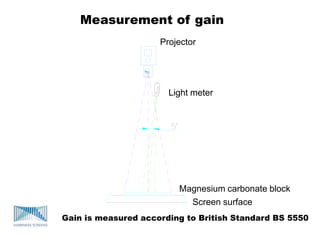
Measurement of gain
Projector
Light meter
Magnesium carbonate block
Screen surface
Gain is measured according to British Standard BS 5550
Types of cinema screen
Screens are available with various gain levels:
• matt white: 'gain' typically 0.8 – 1.0
• 'gain' screens: up to 2.0 or more
: typically mid gain (~1.4)
: or high gain (~1.8)
: above 1.8 gain there is a risk
of 'hot spotting'
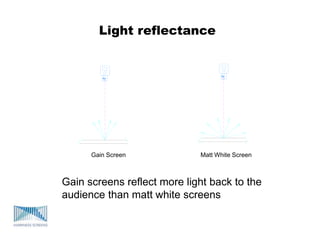
Light reflectance
Gain screens reflect more light back to the
audience than matt white screens
Gain Screen Matt White Screen
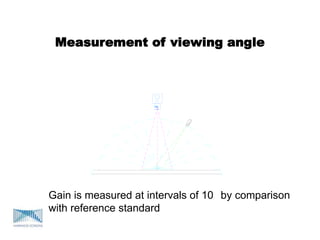
Measurement of viewing angle
Gain is measured at intervals of 10 by comparison
with reference standard
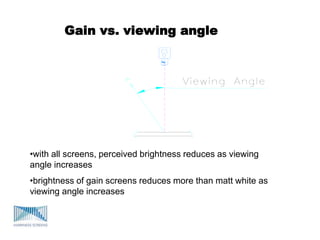
Gain vs. viewing angle
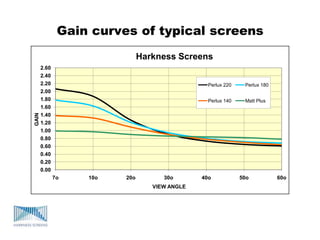
•with all screens, perceived brightness reduces as viewing
angle increases
•brightness of gain screens reduces more than matt white as
viewing angle increases
Gain curves of typical screens
0.00
0.20
0.40
0.60
0.80
1.00
1.20
1.40
1.60
1.80
2.00
2.20
2.40
2.60
7o 10o 20o 30o 40o 50o 60o
GAIN
VIEW ANGLE
Harkness Screens
Perlux 220 Perlux 180
Perlux 140 Matt Plus
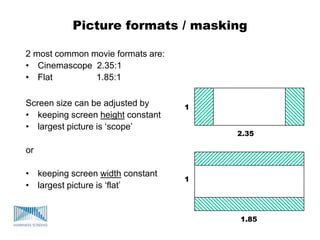
Picture formats / masking
2 most common movie formats are:
• Cinemascope 2.35:1
• Flat 1.85:1
Screen size can be adjusted by
• keeping screen height constant
• largest picture is ā€žscopeā€Ÿ
or
• keeping screen width constant
• largest picture is ā€žflatā€Ÿ
1
1
2.35
1.85
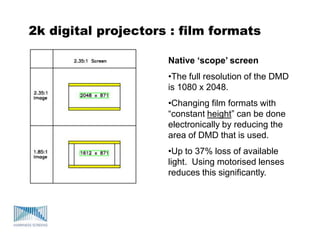
2k digital projectors : film formats
Native ā€˜scope’ screen
•The full resolution of the DMD
is 1080 x 2048.
•Changing film formats with
ā€œconstant heightā€ can be done
electronically by reducing the
area of DMD that is used.
•Up to 37% loss of available
light. Using motorised lenses
reduces this significantly.
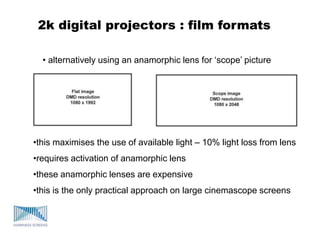
2k digital projectors : film formats
• alternatively using an anamorphic lens for ā€žscopeā€Ÿ picture
•this maximises the use of available light – 10% light loss from lens
•requires activation of anamorphic lens
•these anamorphic lenses are expensive
•this is the only practical approach on large cinemascope screens
2k digital projectors : film formats
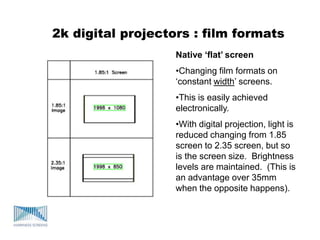
Native ā€˜flat’ screen
•Changing film formats on
ā€žconstant widthā€Ÿ screens.
•This is easily achieved
electronically.
•With digital projection, light is
reduced changing from 1.85
screen to 2.35 screen, but so
is the screen size. Brightness
levels are maintained. (This is
an advantage over 35mm
when the opposite happens).
Xenon lamp light losses
• Digital projectors use high performance Xenon
lamps.
• Usually more expensive, and have shorter warranty
lives than 35mm lamps.
• Light loss at warranty life can be up to 40%.
• Running beyond warranty life further reduces light.
Screen light levels
• Light losses from set-up and life-point of lamp can be
as much as 50% of theoretical maximum.
• Screen gain level can make a big difference to
screen brightness or lumens required.
• Medium to high gain screens (1.4 to 1.8) will reduce
lamp power needs and can significantly reduce
operating costs.
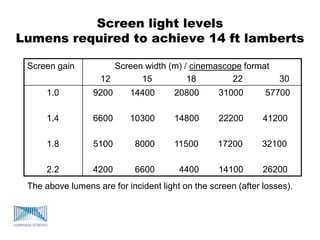
Screen light levels
Lumens required to achieve 14 ft lamberts
Screen gain Screen width (m) / cinemascope format
12 15 18 22 30
1.0
1.4
1.8
2.2
9200 14400 20800 31000 57700
6600 10300 14800 22200 41200
5100 8000 11500 17200 32100
4200 6600 4400 14100 26200
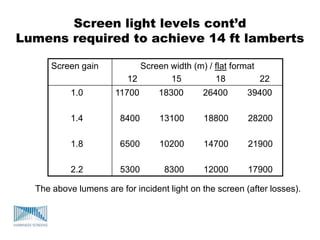
The above lumens are for incident light on the screen (after losses).
Screen light levels cont’d
Lumens required to achieve 14 ft lamberts
Screen gain Screen width (m) / flat format
12 15 18 22
1.0
1.4
1.8
2.2
11700 18300 26400 39400
8400 13100 18800 28200
6500 10200 14700 21900
5300 8300 12000 17900
The above lumens are for incident light on the screen (after losses).
2k digital projectors : film formats
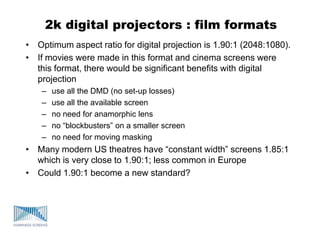
• Optimum aspect ratio for digital projection is 1.90:1 (2048:1080).
• If movies were made in this format and cinema screens were
this format, there would be significant benefits with digital
projection
– use all the DMD (no set-up losses)
– use all the available screen
– no need for anamorphic lens
– no ā€œblockbustersā€ on a smaller screen
– no need for moving masking
• Many modern US theatres have ā€œconstant widthā€ screens 1.85:1
which is very close to 1.90:1; less common in Europe
• Could 1.90:1 become a new standard?
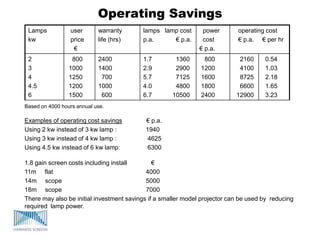
Operating Savings
Based on 4000 hours annual use.
Examples of operating cost savings € p.a.
Using 2 kw instead of 3 kw lamp : 1940
Using 3 kw instead of 4 kw lamp : 4625
Using 4.5 kw instead of 6 kw lamp: 6300
1.8 gain screen costs including install €
11m flat 4000
14m scope 5000
18m scope 7000
There may also be initial investment savings if a smaller model projector can be used by reducing
required lamp power.
Lamps
kw
user
price
€
warranty
life (hrs)
lamps lamp cost
p.a. € p.a.
power
cost
€ p.a.
operating cost
€ p.a. € per hr
2
3
4
4.5
6
800
1000
1250
1200
1500
2400
1400
700
1000
600
1.7 1360
2.9 2900
5.7 7125
4.0 4800
6.7 10500
800
1200
1600
1800
2400
2160
4100
8725
6600
12900
0.54
1.03
2.18
1.65
3.23
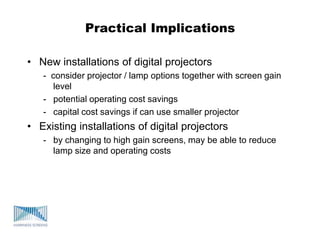
Practical Implications
• New installations of digital projectors
- consider projector / lamp options together with screen gain
level
- potential operating cost savings
- capital cost savings if can use smaller projector
• Existing installations of digital projectors
- by changing to high gain screens, may be able to reduce
lamp size and operating costs
Measuring screen gain in existing theatres
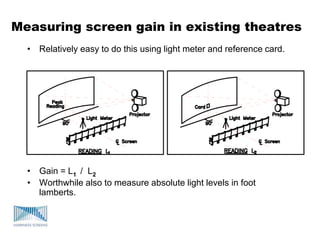
• Relatively easy to do this using light meter and reference card.
• Gain = L1 / L2
• Worthwhile also to measure absolute light levels in foot
lamberts.
Gain screens and viewing angles
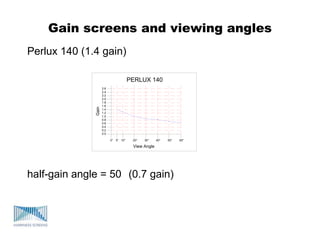
Perlux 140 (1.4 gain)
half-gain angle = 50 (0.7 gain)
0° 10° 20° 30° 40° 50° 60°
0.0
0.2
View Angle
Gain
0.4
0.6
0.8
1.0
1.2
1.4
1.6
1.8
2.0
2.2
2.4
2.6
5°
PERLUX 140
Gain screens and viewing angles cont’d
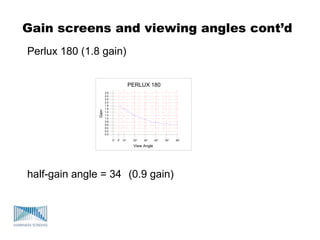
Perlux 180 (1.8 gain)
half-gain angle = 34 (0.9 gain)
0° 10° 20° 30° 40° 50° 60°
0.0
0.2
View Angle
Gain
0.4
0.6
0.8
1.0
1.2
1.4
1.6
1.8
2.0
2.2
2.4
2.6
5°
PERLUX 180
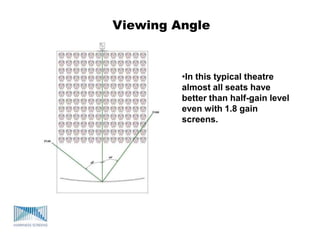
•In this typical theatre
almost all seats have
better than half-gain level
even with 1.8 gain
screens.
Viewing Angle
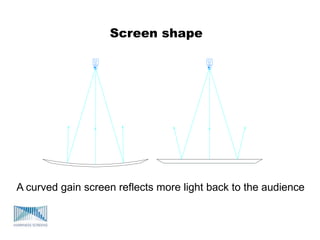
Screen shape
A curved gain screen reflects more light back to the audience
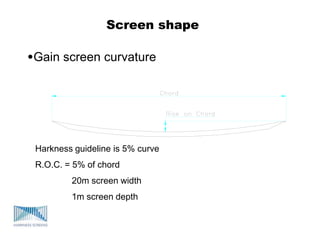
Screen shape
•Gain screen curvature
Harkness guideline is 5% curve
R.O.C. = 5% of chord
20m screen width
1m screen depth
3D Cinema
• Stereoscopic 3D is growing fast, particularly in US.
• Over 2,500 3D screens operational worldwide end
2008.
• Forecast of 6,000 3D screens by end 2009 and 9,000
by end 2010.
• 17 3D titles releasing in 2009; more in 2010/11.
• Single digital projector gives economic 3D
performance.
• High quality of digital 3D images.
3D Cinema Technologies
There are 3 main technologies used in digital 3D cinema:
• Polarised light systems
– polarising filter / silver screen / passive eyewear
– e.g. Real D, Master Image, Imax
• Colour filters
– colour filter wheel / white screen / passive eyewear
– e.g. Dolby
• ā€œActiveā€ eyewear
– white screen / electronic ā€œshuttersā€ in eyewear
– e.g. Xpand
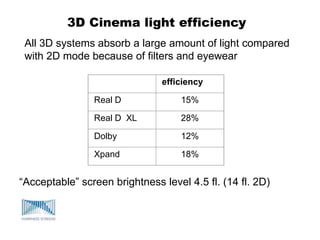
efficiency
Real D 15%
Real D XL 28%
Dolby 12%
Xpand 18%
3D Cinema light efficiency
ā€œAcceptableā€ screen brightness level 4.5 fl. (14 fl. 2D)
All 3D systems absorb a large amount of light compared
with 2D mode because of filters and eyewear
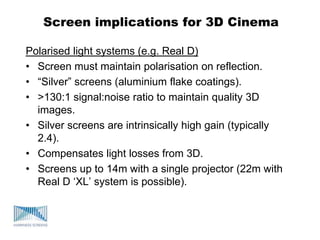
Screen implications for 3D Cinema
Polarised light systems (e.g. Real D)
• Screen must maintain polarisation on reflection.
• ā€œSilverā€ screens (aluminium flake coatings).
• >130:1 signal:noise ratio to maintain quality 3D
images.
• Silver screens are intrinsically high gain (typically
2.4).
• Compensates light losses from 3D.
• Screens up to 14m with a single projector (22m with
Real D ā€žXLā€Ÿ system is possible).
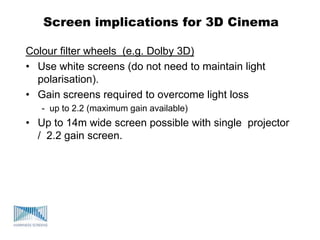
Screen implications for 3D Cinema
Colour filter wheels (e.g. Dolby 3D)
• Use white screens (do not need to maintain light
polarisation).
• Gain screens required to overcome light loss
- up to 2.2 (maximum gain available)
• Up to 14m wide screen possible with single projector
/ 2.2 gain screen.
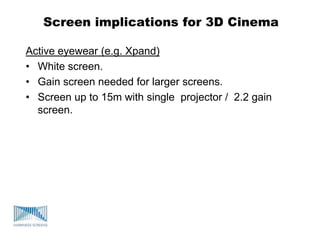
Screen implications for 3D Cinema
Active eyewear (e.g. Xpand)
• White screen.
• Gain screen needed for larger screens.
• Screen up to 15m with single projector / 2.2 gain
screen.
Mixed 2D / 3D applications
• Acceptable brightness level with 3D is 4.5 fl
– efficiency level 15%
• Recommended brightness level for 2D is 14 fl
• Switching 2D / 3D modes
– 2D image too bright
– change lamp / reduce power in 2D mode
– Real D ā€žXLā€Ÿ system 2D / 3D modes in balance
• Increased risk of visible defects due to high gain
• All Harkness 3D screens will support 2D content
– useful for mixed programming
Theatre shape
• 3D systems use high gain screens.
• High gain screens have reduced viewing angles:
– Spectral 240 half-gain angle 24Āŗ
– Perlux 220 half-gain angle 25Āŗ
• Best to use theatres for 3D which are long relative to
width
– throw minimum 1.5 x screen width
• With 3D, curving the screen is strongly
recommended.
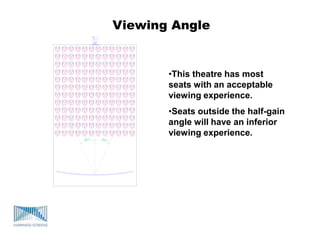
•This theatre has most
seats with an acceptable
viewing experience.
•Seats outside the half-gain
angle will have an inferior
viewing experience.
Viewing Angle
 
Summary
• For digital projection, it is recommended to use gain
screens.
• Benefits in power use/lamp life can give big operating
cost savings.
• Screen must be consistent with 3D technology
chosen.
• For 3D digital screens, it is usually necessary to
change the screen for the highest possible gain.

Screen selection-for-digital-cinema (1)

  • 1.
    Screen Selection for Digital2D & 3D Cinema Andrew Robinson Managing Director Harkness Screens ICTA June 2009 Amsterdam
  • 2.
    This presentation willcover the following topics: • Brightness standards for digital cinema. • Differences between digital and 35mm projection. • Screen selection for digital projection. • Use of ā€œgainā€ screens. • Digital 3D – screen implications. • Mixed digital 2D/3D applications.
  • 3.
    Standards for screenluminance SMPTE luminance standard for digital cinema is: • 14 fl in screen centre +/- 3fl. • 75% of centre brightness at the sides, minimum 9 fl. SMPTE 431-1-2006. • Luminance standard for 35mm projection is 16 fl.
  • 4.
    Differences between digitaland 35mm projection • Digital projectors use short arc, high-pressure Xenon lamps which are more costly than 35mm Xenons. • Light distribution from digital projector is more even than 35mm. • Setting up and changing film formats on digital projectors can result in significant reduction of available light.
  • 5.
    Digital Cinema Projectors •Light outputs of up to 30,000 lumens are quoted by projector manufacturers. • Achieving maximum lumens requires optimum set-up and operating conditions: - this may be costly in terms of operating costs - in reality, incident light on screen may be significantly less • Screen selection is important to achieve recommended light levels and to moderate operating costs.
  • 6.
    Screen light efficiency •Screens cannot create light; but they can optimise the reflection of it. • Reflectivity of a screen is measurable and is usually called ā€œgainā€ • Gain is measured by comparing reflectivity of the screen with a reference standard and is expressed as a factor (e.g. 0.8 or 1.2). • There is a British Standard for gain measurement (BS 5550), which uses a reference standard to compare screen materials. • There are other measurement standards, but the BS is widely recognised and is used by Harkness to classify screen gain. • This enables screen materials to be compared in the laboratory.
  • 7.
    Measurement of gain Projector Lightmeter Magnesium carbonate block Screen surface Gain is measured according to British Standard BS 5550
  • 8.
    Types of cinemascreen Screens are available with various gain levels: • matt white: 'gain' typically 0.8 – 1.0 • 'gain' screens: up to 2.0 or more : typically mid gain (~1.4) : or high gain (~1.8) : above 1.8 gain there is a risk of 'hot spotting'
  • 9.
    Light reflectance Gain screensreflect more light back to the audience than matt white screens Gain Screen Matt White Screen
  • 10.
    Measurement of viewingangle Gain is measured at intervals of 10 by comparison with reference standard
  • 11.
    Gain vs. viewingangle •with all screens, perceived brightness reduces as viewing angle increases •brightness of gain screens reduces more than matt white as viewing angle increases
  • 12.
    Gain curves oftypical screens 0.00 0.20 0.40 0.60 0.80 1.00 1.20 1.40 1.60 1.80 2.00 2.20 2.40 2.60 7o 10o 20o 30o 40o 50o 60o GAIN VIEW ANGLE Harkness Screens Perlux 220 Perlux 180 Perlux 140 Matt Plus
  • 13.
    Picture formats /masking 2 most common movie formats are: • Cinemascope 2.35:1 • Flat 1.85:1 Screen size can be adjusted by • keeping screen height constant • largest picture is ā€žscopeā€Ÿ or • keeping screen width constant • largest picture is ā€žflatā€Ÿ 1 1 2.35 1.85
  • 14.
    2k digital projectors: film formats Native ā€˜scope’ screen •The full resolution of the DMD is 1080 x 2048. •Changing film formats with ā€œconstant heightā€ can be done electronically by reducing the area of DMD that is used. •Up to 37% loss of available light. Using motorised lenses reduces this significantly.
  • 15.
    2k digital projectors: film formats • alternatively using an anamorphic lens for ā€žscopeā€Ÿ picture •this maximises the use of available light – 10% light loss from lens •requires activation of anamorphic lens •these anamorphic lenses are expensive •this is the only practical approach on large cinemascope screens
  • 16.
    2k digital projectors: film formats Native ā€˜flat’ screen •Changing film formats on ā€žconstant widthā€Ÿ screens. •This is easily achieved electronically. •With digital projection, light is reduced changing from 1.85 screen to 2.35 screen, but so is the screen size. Brightness levels are maintained. (This is an advantage over 35mm when the opposite happens).
  • 17.
    Xenon lamp lightlosses • Digital projectors use high performance Xenon lamps. • Usually more expensive, and have shorter warranty lives than 35mm lamps. • Light loss at warranty life can be up to 40%. • Running beyond warranty life further reduces light.
  • 18.
    Screen light levels •Light losses from set-up and life-point of lamp can be as much as 50% of theoretical maximum. • Screen gain level can make a big difference to screen brightness or lumens required. • Medium to high gain screens (1.4 to 1.8) will reduce lamp power needs and can significantly reduce operating costs.
  • 19.
    Screen light levels Lumensrequired to achieve 14 ft lamberts Screen gain Screen width (m) / cinemascope format 12 15 18 22 30 1.0 1.4 1.8 2.2 9200 14400 20800 31000 57700 6600 10300 14800 22200 41200 5100 8000 11500 17200 32100 4200 6600 4400 14100 26200 The above lumens are for incident light on the screen (after losses).
  • 20.
    Screen light levelscont’d Lumens required to achieve 14 ft lamberts Screen gain Screen width (m) / flat format 12 15 18 22 1.0 1.4 1.8 2.2 11700 18300 26400 39400 8400 13100 18800 28200 6500 10200 14700 21900 5300 8300 12000 17900 The above lumens are for incident light on the screen (after losses).
  • 21.
    2k digital projectors: film formats • Optimum aspect ratio for digital projection is 1.90:1 (2048:1080). • If movies were made in this format and cinema screens were this format, there would be significant benefits with digital projection – use all the DMD (no set-up losses) – use all the available screen – no need for anamorphic lens – no ā€œblockbustersā€ on a smaller screen – no need for moving masking • Many modern US theatres have ā€œconstant widthā€ screens 1.85:1 which is very close to 1.90:1; less common in Europe • Could 1.90:1 become a new standard?
  • 22.
    Operating Savings Based on4000 hours annual use. Examples of operating cost savings € p.a. Using 2 kw instead of 3 kw lamp : 1940 Using 3 kw instead of 4 kw lamp : 4625 Using 4.5 kw instead of 6 kw lamp: 6300 1.8 gain screen costs including install € 11m flat 4000 14m scope 5000 18m scope 7000 There may also be initial investment savings if a smaller model projector can be used by reducing required lamp power. Lamps kw user price € warranty life (hrs) lamps lamp cost p.a. € p.a. power cost € p.a. operating cost € p.a. € per hr 2 3 4 4.5 6 800 1000 1250 1200 1500 2400 1400 700 1000 600 1.7 1360 2.9 2900 5.7 7125 4.0 4800 6.7 10500 800 1200 1600 1800 2400 2160 4100 8725 6600 12900 0.54 1.03 2.18 1.65 3.23
  • 23.
    Practical Implications • Newinstallations of digital projectors - consider projector / lamp options together with screen gain level - potential operating cost savings - capital cost savings if can use smaller projector • Existing installations of digital projectors - by changing to high gain screens, may be able to reduce lamp size and operating costs
  • 24.
    Measuring screen gainin existing theatres • Relatively easy to do this using light meter and reference card. • Gain = L1 / L2 • Worthwhile also to measure absolute light levels in foot lamberts.
  • 25.
    Gain screens andviewing angles Perlux 140 (1.4 gain) half-gain angle = 50 (0.7 gain) 0° 10° 20° 30° 40° 50° 60° 0.0 0.2 View Angle Gain 0.4 0.6 0.8 1.0 1.2 1.4 1.6 1.8 2.0 2.2 2.4 2.6 5° PERLUX 140
  • 26.
    Gain screens andviewing angles cont’d Perlux 180 (1.8 gain) half-gain angle = 34 (0.9 gain) 0° 10° 20° 30° 40° 50° 60° 0.0 0.2 View Angle Gain 0.4 0.6 0.8 1.0 1.2 1.4 1.6 1.8 2.0 2.2 2.4 2.6 5° PERLUX 180
  • 27.
    •In this typicaltheatre almost all seats have better than half-gain level even with 1.8 gain screens. Viewing Angle
  • 28.
    Screen shape A curvedgain screen reflects more light back to the audience
  • 29.
    Screen shape •Gain screencurvature Harkness guideline is 5% curve R.O.C. = 5% of chord 20m screen width 1m screen depth
  • 30.
    3D Cinema • Stereoscopic3D is growing fast, particularly in US. • Over 2,500 3D screens operational worldwide end 2008. • Forecast of 6,000 3D screens by end 2009 and 9,000 by end 2010. • 17 3D titles releasing in 2009; more in 2010/11. • Single digital projector gives economic 3D performance. • High quality of digital 3D images.
  • 31.
    3D Cinema Technologies Thereare 3 main technologies used in digital 3D cinema: • Polarised light systems – polarising filter / silver screen / passive eyewear – e.g. Real D, Master Image, Imax • Colour filters – colour filter wheel / white screen / passive eyewear – e.g. Dolby • ā€œActiveā€ eyewear – white screen / electronic ā€œshuttersā€ in eyewear – e.g. Xpand
  • 32.
    efficiency Real D 15% RealD XL 28% Dolby 12% Xpand 18% 3D Cinema light efficiency ā€œAcceptableā€ screen brightness level 4.5 fl. (14 fl. 2D) All 3D systems absorb a large amount of light compared with 2D mode because of filters and eyewear
  • 33.
    Screen implications for3D Cinema Polarised light systems (e.g. Real D) • Screen must maintain polarisation on reflection. • ā€œSilverā€ screens (aluminium flake coatings). • >130:1 signal:noise ratio to maintain quality 3D images. • Silver screens are intrinsically high gain (typically 2.4). • Compensates light losses from 3D. • Screens up to 14m with a single projector (22m with Real D ā€žXLā€Ÿ system is possible).
  • 34.
    Screen implications for3D Cinema Colour filter wheels (e.g. Dolby 3D) • Use white screens (do not need to maintain light polarisation). • Gain screens required to overcome light loss - up to 2.2 (maximum gain available) • Up to 14m wide screen possible with single projector / 2.2 gain screen.
  • 35.
    Screen implications for3D Cinema Active eyewear (e.g. Xpand) • White screen. • Gain screen needed for larger screens. • Screen up to 15m with single projector / 2.2 gain screen.
  • 36.
    Mixed 2D /3D applications • Acceptable brightness level with 3D is 4.5 fl – efficiency level 15% • Recommended brightness level for 2D is 14 fl • Switching 2D / 3D modes – 2D image too bright – change lamp / reduce power in 2D mode – Real D ā€žXLā€Ÿ system 2D / 3D modes in balance • Increased risk of visible defects due to high gain • All Harkness 3D screens will support 2D content – useful for mixed programming
  • 37.
    Theatre shape • 3Dsystems use high gain screens. • High gain screens have reduced viewing angles: – Spectral 240 half-gain angle 24Āŗ – Perlux 220 half-gain angle 25Āŗ • Best to use theatres for 3D which are long relative to width – throw minimum 1.5 x screen width • With 3D, curving the screen is strongly recommended.
  • 38.
    •This theatre hasmost seats with an acceptable viewing experience. •Seats outside the half-gain angle will have an inferior viewing experience. Viewing Angle  
  • 39.
    Summary • For digitalprojection, it is recommended to use gain screens. • Benefits in power use/lamp life can give big operating cost savings. • Screen must be consistent with 3D technology chosen. • For 3D digital screens, it is usually necessary to change the screen for the highest possible gain.