Shri Ganeshay Namah

Photoelectrocatalytic Degradation of Salicylic
acid using Sprayed Gold Doped Iron Oxide Thin
Films
by

M.A. Mahadik
under the guidance of

Prof. (Dr.) C.H. Bhosale
Electrochemical Materials Laboratory,
Department of Physics,
Shivaji University,
Kolhapur - 416004
Outline of the presentation

Introduction
Experimental
Results and Discussion
PEC
 XRD
 Optical properties
 SEM
 Electrical resistivity measurements
 Photoelectrocatalytic degradation of salicylic acid

Conclusions

2
Introduction
Importance of problem
Recently, TiO2 (Eg = 3.2 eV):promising material but absorbs ~ 3-4% of
solar spectrum
Alternative Fe2O3 with band gap (2.2 eV) absorbs ~ 40% visible light

-2. µ m
)

Spectral distribution of sunlight. AM0 and AM1.5
with radiation distribution at 6000K.
2.5

6000 K black body

2.0
AM0 radiation

1.5

AM1.5 radiation

1.0
0.5

m
/
W
k
(
o
u
b
t
s
i
D
y
g
r
e
n
E

0.0
0.0

0.2

0.4

0.6

0.8

1.0

1.2

Wavelength (µ m)

1.4

1.6

1.8

2.0
3
Methodology
Spray pyrolysis technique (SPT) is a simple and inexpensive
chemical deposition method for producing thin films

Schematic of spray pyrolysis showing its various parts

4
Experimental
Precursors

Ferric trichloride (FeCl3. 6H2O,
M.W= 270.29 g mol-1) (AR grade,
98.8% pure) by s.d. fine-chem limited,
Mumbai.
 Chloroauric acide (HAuCl4).3H2O,
MW = 393.83 gm mol-1) (LR grade, 49.0
% pure)
supplied by s.d. fine-chem limited,
Mumbai.

Solvent

Absolute Ethanol

Deposition temperature

400 0C

Concentration of FeCl3

0.1 M

Doping percentage of gold

Varies from 1-4 at %

Spray rate

4 cc/min

5
Undoped

1 at %

2 at %

3 at %

4 at %

Photograph of undoped and Au doped Fe2O3 thin films deposited on glass and FTO substrates

6
Results and Discussion
A
V

The variation of Isc and Voc at different
temperatures and Au doping
concentrations

hν > Eg

180

240

140

230

120

220

200

160
140
120

20

100
10

80

300

350

400

Subs trate Temperature (0C )

(a)

450

60

100

210

80

200

60

190

40
20

180

1.0

1.5

2.0

2.5

3.0

3.5

4.0

4.5

Au doping percentage

(b)

7

V oc (mV)

30

Is c (µ A )

180

40

0

250

160

50

V oc (mV)

Isc (µ A )

PEC technique
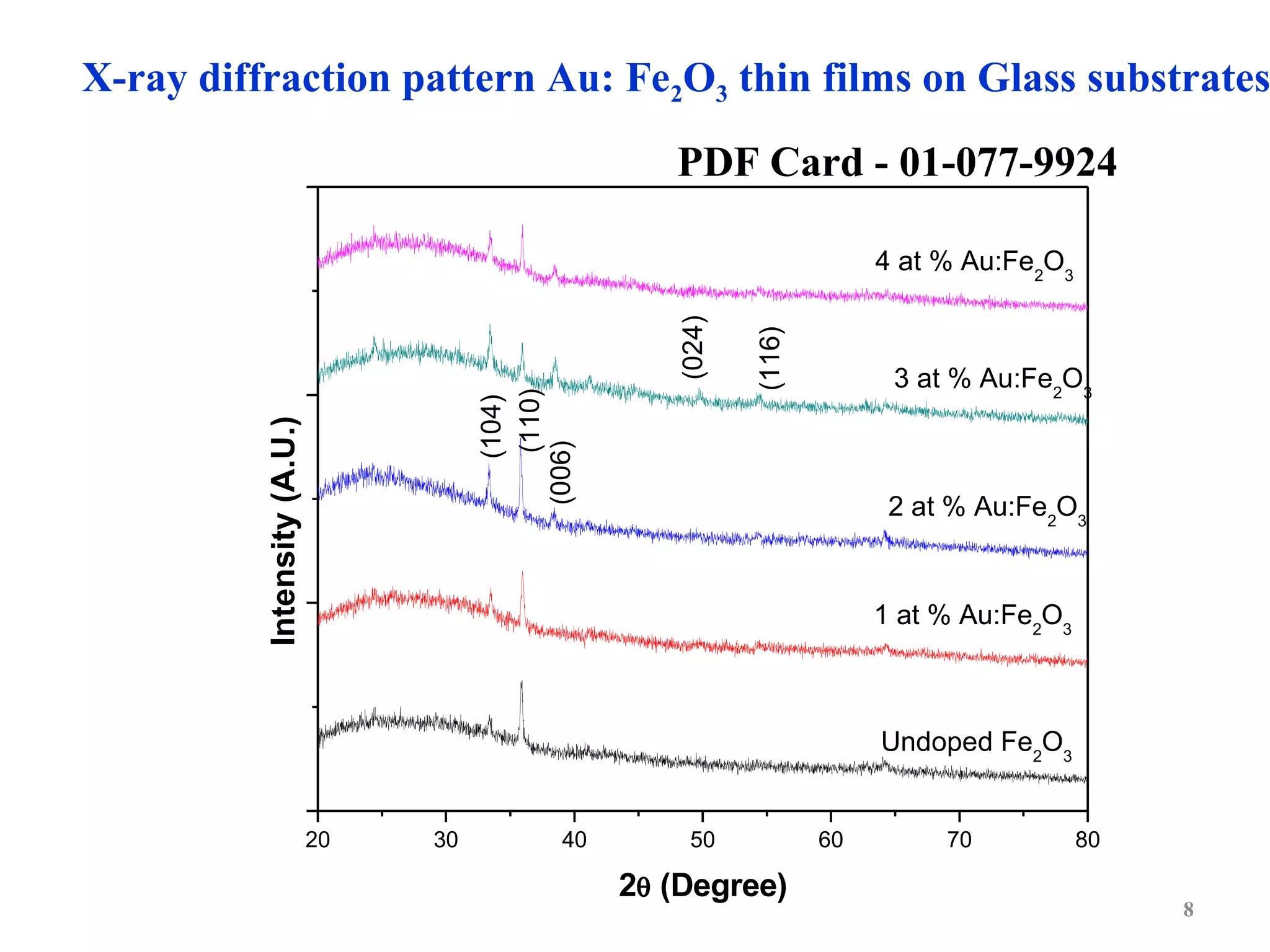
X-ray diffraction pattern Au: Fe2O3 thin films on Glass substrates
PDF Card - 01-077-9924

Intensity (A.U.)

(116)

(104)
(110)
(006)

(024)

4 at % Au:Fe2O3

3 at % Au:Fe2O3

2 at % Au:Fe2O3

1 at % Au:Fe2O3

Undoped Fe2O3
20

30

40

50

2θ (Degree)

60

70

80
8
a

b

SEM of undoped and 2at % Au doped Fe2O3 thin film deposited
at 400 oC substrate temperature
9
12

0.090

 ∆E 
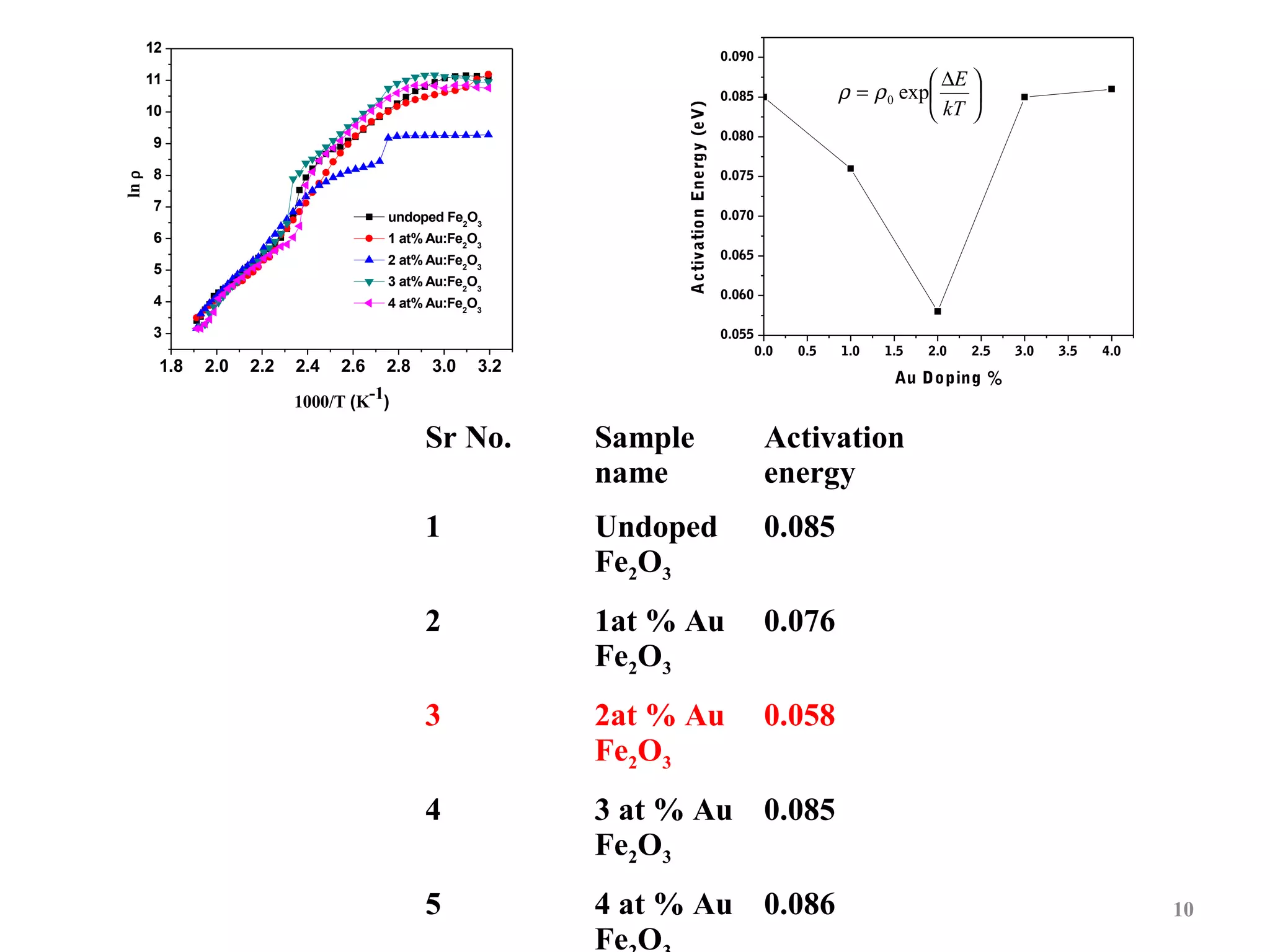
ρ = ρ 0 exp

 kT 

10

ln ρ

9
8
7

undoped Fe2O3

6

1 at% Au:Fe2O3

5

2 at% Au:Fe2O3

4

A ctivation Energy (eV)

11

4 at% Au:Fe2O3

3 at% Au:Fe2O3

3

1.8

0.085
0.080
0.075
0.070
0.065
0.060
0.055

2.0

2.2

2.4

2.6

2.8

3.0

0.0

3.2

0.5

1.0

1.5

2.0

2.5

3.0

3.5

4.0

Au Doping %

1000/T (K-1)

Sr No.

Sample
name

Activation
energy

1

Undoped
Fe2O3

0.085

2

1at % Au
Fe2O3

0.076

3

2at % Au
Fe2O3

0.058

4

3 at % Au 0.085
Fe2O3

5

4 at % Au 0.086
Fe O

10
100
60

80

(eV.cm )

40

1 at % Au:Fe2O3
2 at % Au:Fe2O3
3 at % Au:Fe2O3

20

4 at % Au:Fe2O3

0

400

600

800

wavelength (nm)

1000

11

undoped Fe2O3

2

60

(ahv ) .10

Transmittance (%)

2

50
40
30
20

Undoped Fe2O3
1at% Au:Fe2O3
2at% Au:Fe2O3
3at% Au:Fe2O3

10
0
1.8

4at% Au:Fe2O3

2.0

2.2

2.4

2.6

Energy (eV)

Transmittance and band gap of Au doped Fe2O3 thin
films deposited at various Au doping concentrations
11
10 cm

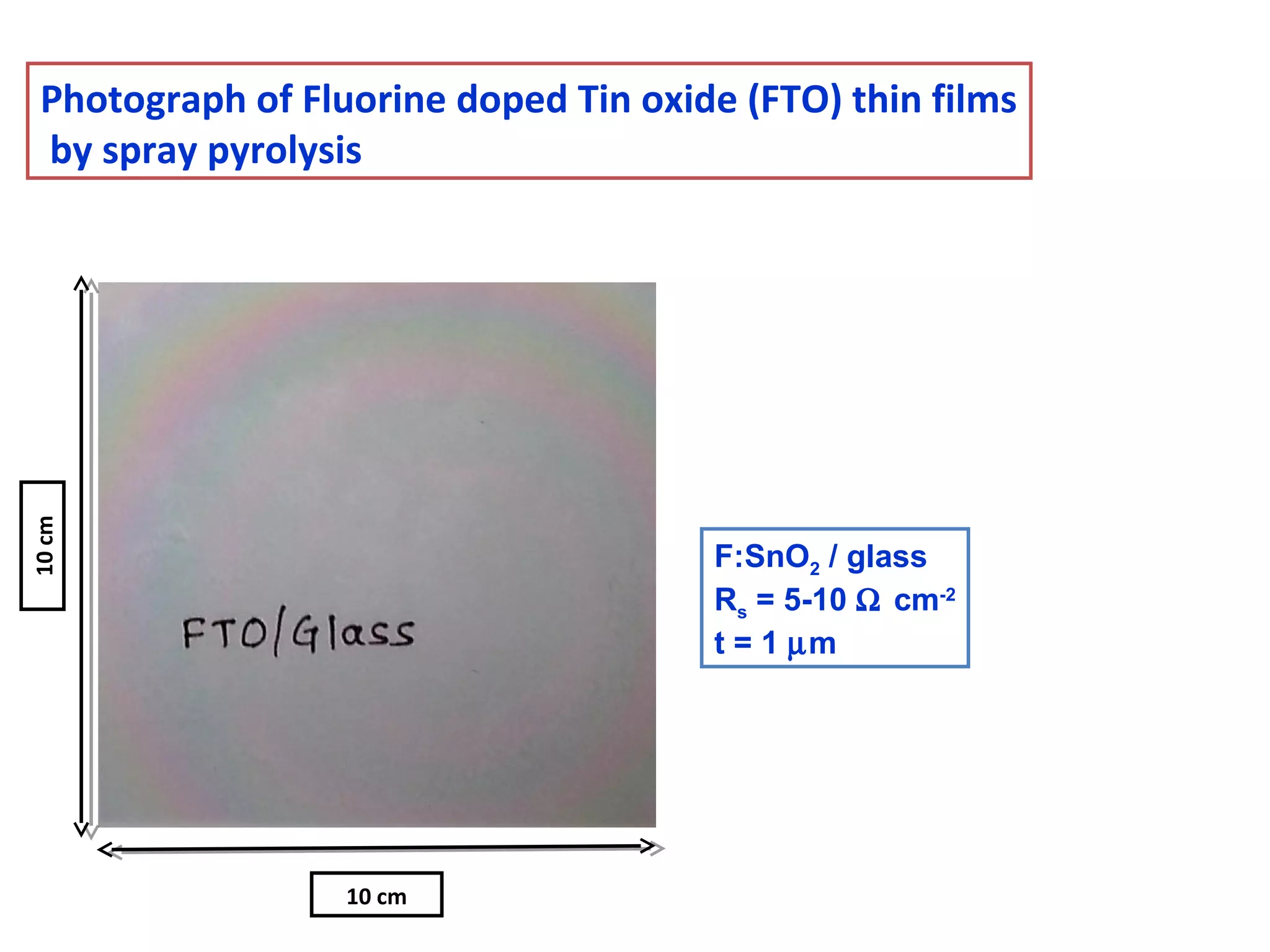
Photograph of Fluorine doped Tin oxide (FTO) thin films
by spray pyrolysis

F:SnO2 / glass
Rs = 5-10 Ω cm-2
t = 1 µm

10 cm
Photograph of undoped and 2at % Au doped Fe2O3 thin
films by spray pyrolysis
10 cm

13
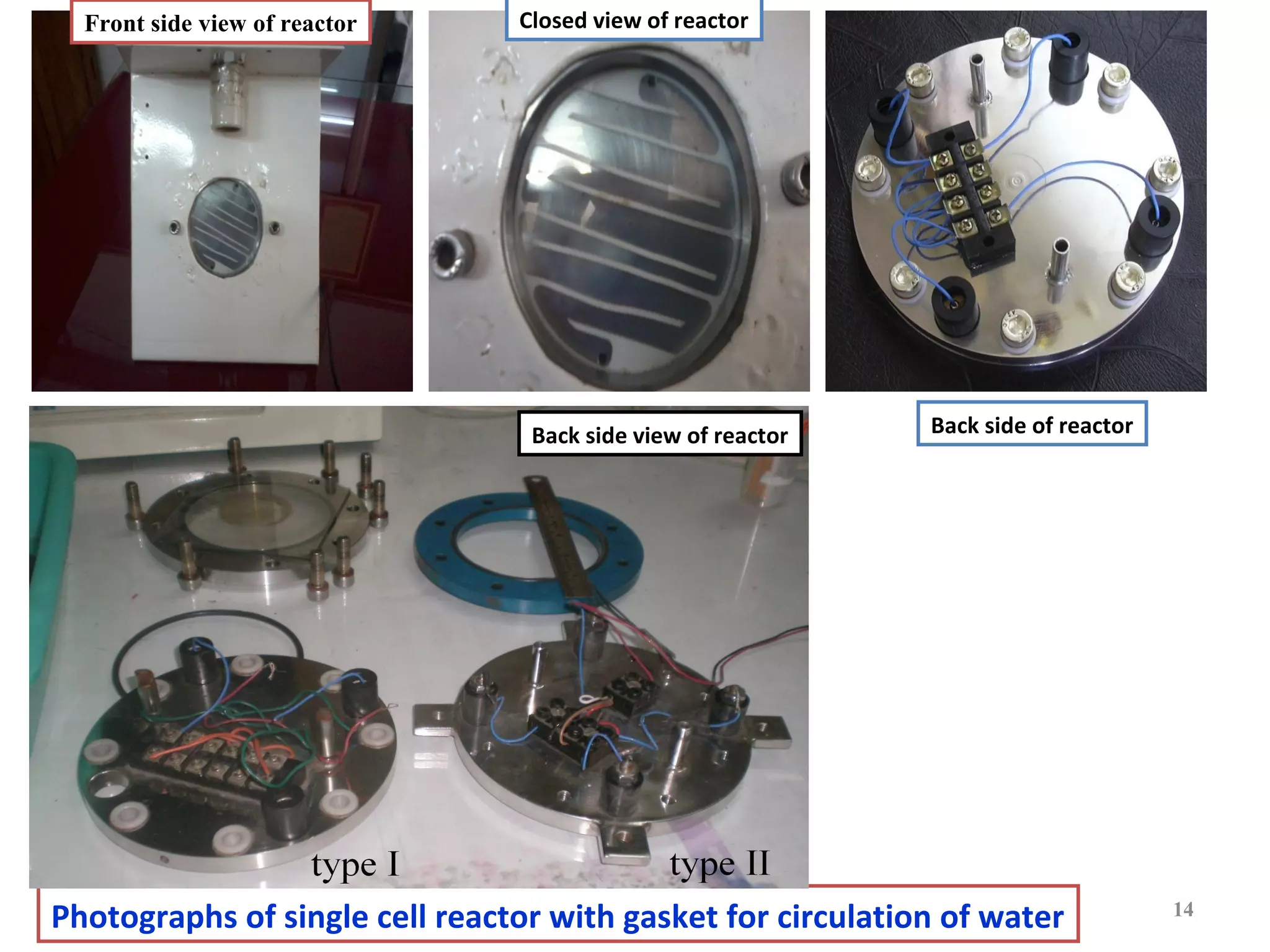
Front side view of reactor

Closed view of reactor

Back side view of reactor

Back side of reactor

Photographs of single cell reactor with gasket for circulation of water

14
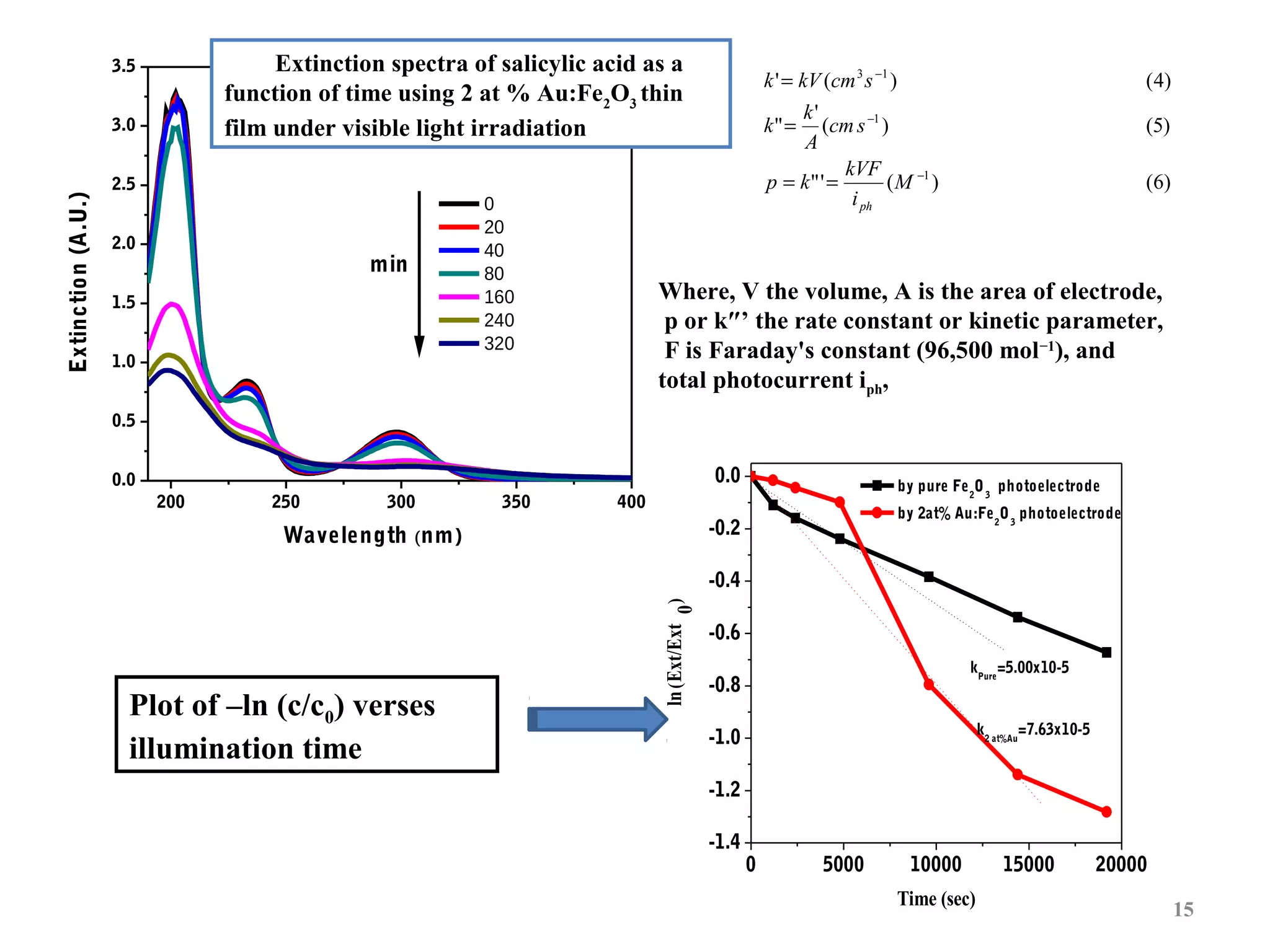
Extinction spectra of salicylic acid as a
function of time using 2 at % Au:Fe2O3 thin
film under visible light irradiation

3.5

2.5
2.0

min

1.5
1.0

0
20
40
80
160
240
320

(4)
(5)
(6)

Where, V the volume, A is the area of electrode,
p or k″’ the rate constant or kinetic parameter,
F is Faraday's constant (96,500 mol−1), and
total photocurrent iph,

0.5

0.0

0.0
200

250

300

350

by pure Fe 2O 3 photoelectrode

400

by 2at% Au:Fe 2O 3 photoelectrode

-0.2

Wavelength ( nm )

-0.4

Plot of –ln (c/c0) verses
illumination time

ln ( Ext/Ext )
0

Extinction (A.U.)

3.0

k ' = kV (cm 3 s −1 )
k'
k " = (cm s −1 )
A
kVF
p = k" ' =
( M −1 )
i ph

-0.6
kPure =5.00x10⁻⁵

-0.8

k2 at%Au =7.63x10⁻⁵

-1.0
-1.2
-1.4

0

5000

10000
Time (sec)

15000

20000

15
6

Ph o to c u rre n t (m A )

5
4
3
Electrolyte: 1 mM s alicylic acid
in 10 mM HclO

2

4

Flow rate : 12 L/h
Applied revers e bias : 1.5 V vs . s teel

1

Illumination : Vis ible Light (Tuns ten lamp)
Location: Phys ics , SUK

0
0

3000

6000

9000

12000

Time (Sec)

Plot of photocurrent as a function of degradation time for single Au doped
Fe2O3 electrode under sunlight
16
Photoelectrochemical degradation of salicylic acid (C6H4(OH)COOH) in
single reactor
At working electrode
(Fe 2 O 3 )O + hν ⇒ e- + h+ + Fe O
1) Fe
2

3

2

3

2)
3)

e- + h+ ⇒ heat (recombination)
h+ + OH- ⇒ •OH

4)

C6H4(OH)COOH + •OH ⇒ [C6H4(OH)COOH ]*

5)

[C6H4(OH)COOH ]* + •OH ⇒ H2O + CO2 ↑

6)

HO• + HO• ⇒ H2O2

7)

H2O2+ 2h+ ⇒ O2 + 2H+

At counter electrode
1)

e - + O 2 ⇒ O 2-

2)

2 H + + O 2- ⇒ H2O

17
20

40

COD
TOC

18
16

35
30

CO D (mg/L)

25
12
20
10

TO C (mg/L)

14

15

8

10

6
0

5000

10000

15000

20000

Reaction time (Sec)

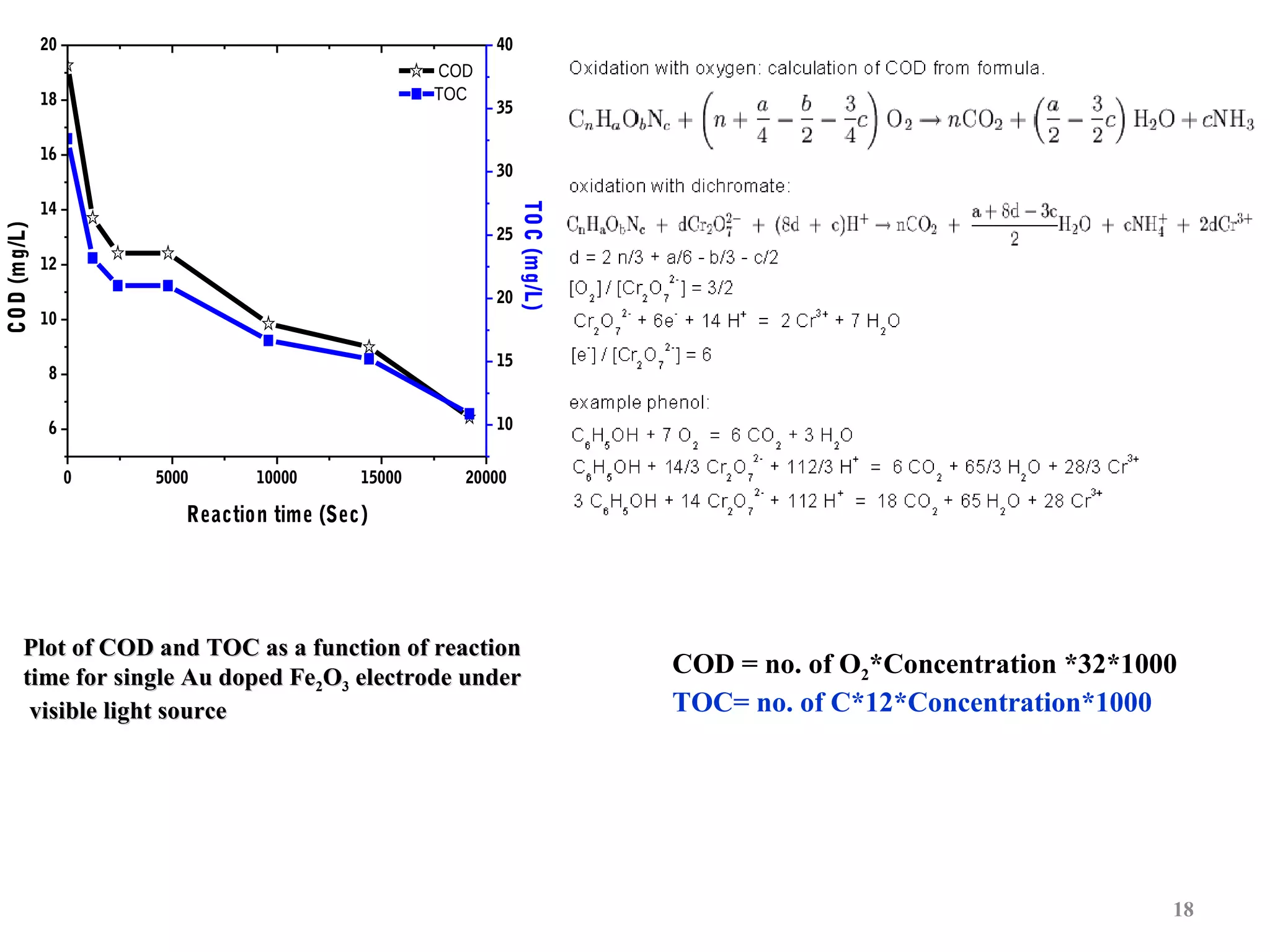
Plot of COD and TOC as a function of reaction
time for single Au doped Fe2O3 electrode under
visible light source

COD = no. of O2*Concentration *32*1000
TOC= no. of C*12*Concentration*1000

18
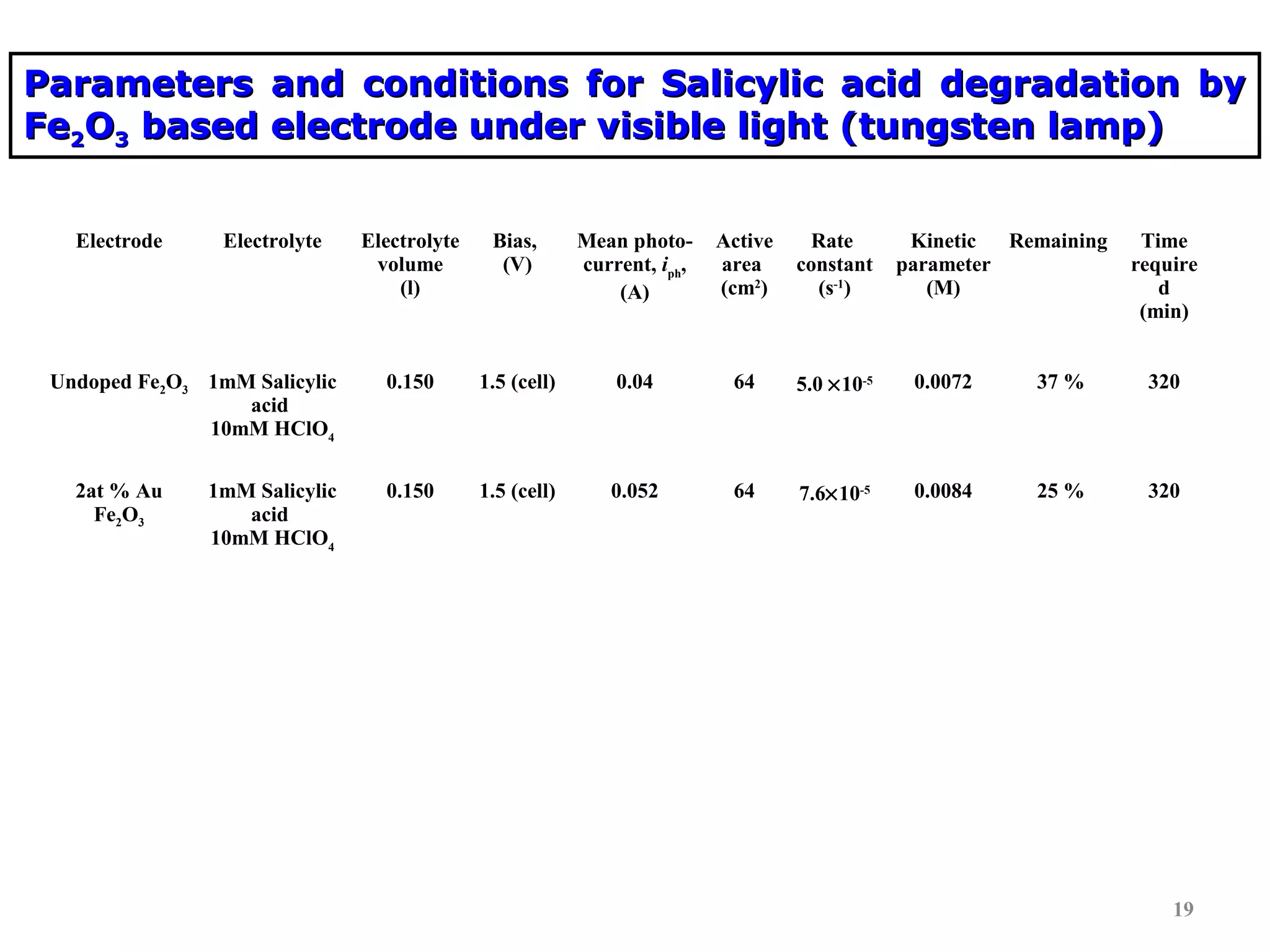
Parameters and conditions for Salicylic acid degradation by
Fe2O3 based electrode under visible light (tungsten lamp)
Electrode

Electrolyte

Undoped Fe2O3 1mM Salicylic
acid
10mM HClO4
2at % Au
Fe2O3

1mM Salicylic
acid
10mM HClO4

Electrolyte
volume
(l)

Bias,
(V)

Mean photocurrent, iph,
(A)

Active
area
(cm2)

Rate
constant
(s-1)

Kinetic
Remaining
parameter
(M)

Time
require
d
(min)

0.150

1.5 (cell)

0.04

64

5.0 ×10⁻⁵

0.0072

37 %

320

0.150

1.5 (cell)

0.052

64

7.6×10⁻⁵

0.0084

25 %

320

19
Summary and conclusions
Phase and structure

Hematite, polycrystalline,
Rhombohedral

Morphology

needle shaped , with grains of size 100150 nm

Optimized deposition conditions

Ts= 400 oC
Conc = 0.1M
Qty = 50 ml
Au doping = 2at %

Film thickness

∼ Varies from 189 to 253 nm

1 mM Salicylic acid degradation in visible light 75 % in 320 min
using Au doped Fe2O3 single cell

2 at % Au doped Fe2O3 thin film is the best photoelectrode for removal of
salicylic acid

20
21

296 mahadik

  • 1.
    Shri Ganeshay Namah PhotoelectrocatalyticDegradation of Salicylic acid using Sprayed Gold Doped Iron Oxide Thin Films by M.A. Mahadik under the guidance of Prof. (Dr.) C.H. Bhosale Electrochemical Materials Laboratory, Department of Physics, Shivaji University, Kolhapur - 416004
  • 2.
    Outline of thepresentation Introduction Experimental Results and Discussion PEC  XRD  Optical properties  SEM  Electrical resistivity measurements  Photoelectrocatalytic degradation of salicylic acid Conclusions 2
  • 3.
    Introduction Importance of problem Recently,TiO2 (Eg = 3.2 eV):promising material but absorbs ~ 3-4% of solar spectrum Alternative Fe2O3 with band gap (2.2 eV) absorbs ~ 40% visible light -2. µ m ) Spectral distribution of sunlight. AM0 and AM1.5 with radiation distribution at 6000K. 2.5 6000 K black body 2.0 AM0 radiation 1.5 AM1.5 radiation 1.0 0.5 m / W k ( o u b t s i D y g r e n E 0.0 0.0 0.2 0.4 0.6 0.8 1.0 1.2 Wavelength (µ m) 1.4 1.6 1.8 2.0 3
  • 4.
    Methodology Spray pyrolysis technique(SPT) is a simple and inexpensive chemical deposition method for producing thin films Schematic of spray pyrolysis showing its various parts 4
  • 5.
    Experimental Precursors Ferric trichloride (FeCl3.6H2O, M.W= 270.29 g mol-1) (AR grade, 98.8% pure) by s.d. fine-chem limited, Mumbai.  Chloroauric acide (HAuCl4).3H2O, MW = 393.83 gm mol-1) (LR grade, 49.0 % pure) supplied by s.d. fine-chem limited, Mumbai. Solvent Absolute Ethanol Deposition temperature 400 0C Concentration of FeCl3 0.1 M Doping percentage of gold Varies from 1-4 at % Spray rate 4 cc/min 5
  • 6.
    Undoped 1 at % 2at % 3 at % 4 at % Photograph of undoped and Au doped Fe2O3 thin films deposited on glass and FTO substrates 6
  • 7.
    Results and Discussion A V Thevariation of Isc and Voc at different temperatures and Au doping concentrations hν > Eg 180 240 140 230 120 220 200 160 140 120 20 100 10 80 300 350 400 Subs trate Temperature (0C ) (a) 450 60 100 210 80 200 60 190 40 20 180 1.0 1.5 2.0 2.5 3.0 3.5 4.0 4.5 Au doping percentage (b) 7 V oc (mV) 30 Is c (µ A ) 180 40 0 250 160 50 V oc (mV) Isc (µ A ) PEC technique
  • 8.
    X-ray diffraction patternAu: Fe2O3 thin films on Glass substrates PDF Card - 01-077-9924 Intensity (A.U.) (116) (104) (110) (006) (024) 4 at % Au:Fe2O3 3 at % Au:Fe2O3 2 at % Au:Fe2O3 1 at % Au:Fe2O3 Undoped Fe2O3 20 30 40 50 2θ (Degree) 60 70 80 8
  • 9.
    a b SEM of undopedand 2at % Au doped Fe2O3 thin film deposited at 400 oC substrate temperature 9
  • 10.
    12 0.090  ∆E  ρ= ρ 0 exp   kT  10 ln ρ 9 8 7 undoped Fe2O3 6 1 at% Au:Fe2O3 5 2 at% Au:Fe2O3 4 A ctivation Energy (eV) 11 4 at% Au:Fe2O3 3 at% Au:Fe2O3 3 1.8 0.085 0.080 0.075 0.070 0.065 0.060 0.055 2.0 2.2 2.4 2.6 2.8 3.0 0.0 3.2 0.5 1.0 1.5 2.0 2.5 3.0 3.5 4.0 Au Doping % 1000/T (K-1) Sr No. Sample name Activation energy 1 Undoped Fe2O3 0.085 2 1at % Au Fe2O3 0.076 3 2at % Au Fe2O3 0.058 4 3 at % Au 0.085 Fe2O3 5 4 at % Au 0.086 Fe O 10
  • 11.
    100 60 80 (eV.cm ) 40 1 at% Au:Fe2O3 2 at % Au:Fe2O3 3 at % Au:Fe2O3 20 4 at % Au:Fe2O3 0 400 600 800 wavelength (nm) 1000 11 undoped Fe2O3 2 60 (ahv ) .10 Transmittance (%) 2 50 40 30 20 Undoped Fe2O3 1at% Au:Fe2O3 2at% Au:Fe2O3 3at% Au:Fe2O3 10 0 1.8 4at% Au:Fe2O3 2.0 2.2 2.4 2.6 Energy (eV) Transmittance and band gap of Au doped Fe2O3 thin films deposited at various Au doping concentrations 11
  • 12.
    10 cm Photograph ofFluorine doped Tin oxide (FTO) thin films by spray pyrolysis F:SnO2 / glass Rs = 5-10 Ω cm-2 t = 1 µm 10 cm
  • 13.
    Photograph of undopedand 2at % Au doped Fe2O3 thin films by spray pyrolysis 10 cm 13
  • 14.
    Front side viewof reactor Closed view of reactor Back side view of reactor Back side of reactor Photographs of single cell reactor with gasket for circulation of water 14
  • 15.
    Extinction spectra ofsalicylic acid as a function of time using 2 at % Au:Fe2O3 thin film under visible light irradiation 3.5 2.5 2.0 min 1.5 1.0 0 20 40 80 160 240 320 (4) (5) (6) Where, V the volume, A is the area of electrode, p or k″’ the rate constant or kinetic parameter, F is Faraday's constant (96,500 mol−1), and total photocurrent iph, 0.5 0.0 0.0 200 250 300 350 by pure Fe 2O 3 photoelectrode 400 by 2at% Au:Fe 2O 3 photoelectrode -0.2 Wavelength ( nm ) -0.4 Plot of –ln (c/c0) verses illumination time ln ( Ext/Ext ) 0 Extinction (A.U.) 3.0 k ' = kV (cm 3 s −1 ) k' k " = (cm s −1 ) A kVF p = k" ' = ( M −1 ) i ph -0.6 kPure =5.00x10⁻⁵ -0.8 k2 at%Au =7.63x10⁻⁵ -1.0 -1.2 -1.4 0 5000 10000 Time (sec) 15000 20000 15
  • 16.
    6 Ph o toc u rre n t (m A ) 5 4 3 Electrolyte: 1 mM s alicylic acid in 10 mM HclO 2 4 Flow rate : 12 L/h Applied revers e bias : 1.5 V vs . s teel 1 Illumination : Vis ible Light (Tuns ten lamp) Location: Phys ics , SUK 0 0 3000 6000 9000 12000 Time (Sec) Plot of photocurrent as a function of degradation time for single Au doped Fe2O3 electrode under sunlight 16
  • 17.
    Photoelectrochemical degradation ofsalicylic acid (C6H4(OH)COOH) in single reactor At working electrode (Fe 2 O 3 )O + hν ⇒ e- + h+ + Fe O 1) Fe 2 3 2 3 2) 3) e- + h+ ⇒ heat (recombination) h+ + OH- ⇒ •OH 4) C6H4(OH)COOH + •OH ⇒ [C6H4(OH)COOH ]* 5) [C6H4(OH)COOH ]* + •OH ⇒ H2O + CO2 ↑ 6) HO• + HO• ⇒ H2O2 7) H2O2+ 2h+ ⇒ O2 + 2H+ At counter electrode 1) e - + O 2 ⇒ O 2- 2) 2 H + + O 2- ⇒ H2O 17
  • 18.
    20 40 COD TOC 18 16 35 30 CO D (mg/L) 25 12 20 10 TOC (mg/L) 14 15 8 10 6 0 5000 10000 15000 20000 Reaction time (Sec) Plot of COD and TOC as a function of reaction time for single Au doped Fe2O3 electrode under visible light source COD = no. of O2*Concentration *32*1000 TOC= no. of C*12*Concentration*1000 18
  • 19.
    Parameters and conditionsfor Salicylic acid degradation by Fe2O3 based electrode under visible light (tungsten lamp) Electrode Electrolyte Undoped Fe2O3 1mM Salicylic acid 10mM HClO4 2at % Au Fe2O3 1mM Salicylic acid 10mM HClO4 Electrolyte volume (l) Bias, (V) Mean photocurrent, iph, (A) Active area (cm2) Rate constant (s-1) Kinetic Remaining parameter (M) Time require d (min) 0.150 1.5 (cell) 0.04 64 5.0 ×10⁻⁵ 0.0072 37 % 320 0.150 1.5 (cell) 0.052 64 7.6×10⁻⁵ 0.0084 25 % 320 19
  • 20.
    Summary and conclusions Phaseand structure Hematite, polycrystalline, Rhombohedral Morphology needle shaped , with grains of size 100150 nm Optimized deposition conditions Ts= 400 oC Conc = 0.1M Qty = 50 ml Au doping = 2at % Film thickness ∼ Varies from 189 to 253 nm 1 mM Salicylic acid degradation in visible light 75 % in 320 min using Au doped Fe2O3 single cell 2 at % Au doped Fe2O3 thin film is the best photoelectrode for removal of salicylic acid 20
  • 21.