GIRN
(GOVERNMENT
INTEGRATED
RADIO NETWORK)
Introduction
• GIRN is a system used by the Ministry of Health
(MOH) for easy communication between Pre
Hospital Care Team & designated Medical
Base/Hospitals coordinated by Malaysia’s National
Security Council (MKN).
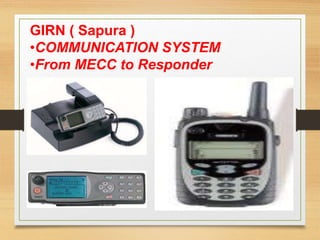
GIRN ( Sapura )
•COMMUNICATION SYSTEM
•From MECC to Responder
Important Things We Need To
Know
• Open channel communications
• Must identify clearly both callers
• Only one person can talk at one time
• Wait for your turn
• Pass-over when you finish by saying “Over”
• Limited time per message
• No need for unnecessary pleasantries
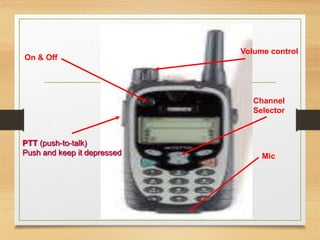
PTT (push-to-talk)
Push and keep it depressed Mic
Channel
Selector
On & Off
Volume control
IMPORTANT ELEMENT FOR GIRN
COMMUNICATION
ABC
• Accuracy (message yang tepat)
• Brightness (maksud yang jelas)
• Clarity (kualiti suara)
Procedure – Using your radio set
• Listen first to make sure that no one else is talking
(for at least 2 seconds)
• Press down the PTT (push-to-talk) button and keep
it depressed
• Start your message
• At the end of your message, say “Over” and release
the PTT button (eg. Teluk Intan 1, Teluk Intan 1 dari
MECC panggilan , over )
Good Radio Habits
• Wait to see if someone else in talking
• Talk slowly and clearly
• Do not use unnecessary codes or short-forms
• Use proper international codes
• Plan your message, if possible
• Keep your conversations short
When to communicate
• Ambulance Units
1. When you leave the hospital for a call
2. When you have arrived at the patient
3. When you’ve almost reached hospital with a critical case
4. When you need help / directions from the call centre
5. When arrive at receiving hospital / departing for home
• Base Units
1. Daily TIME and RADIO Check with PENMEC Control
2. Inform receiving base about in-coming critical case
3. Find out report about ambulance units
4. Request units to switch channels
Communication Scenarios
• Normal ambulance function – emergency call
• Normal ambulance function – inter-hospital referral
• Ambulance unable to find location
• Need for medical direction
• Medical standby
• Mass casualty incident
GIRN.ppt

GIRN.ppt

  • 1.
  • 2.
    Introduction • GIRN isa system used by the Ministry of Health (MOH) for easy communication between Pre Hospital Care Team & designated Medical Base/Hospitals coordinated by Malaysia’s National Security Council (MKN).
  • 3.
    GIRN ( Sapura) •COMMUNICATION SYSTEM •From MECC to Responder
  • 4.
    Important Things WeNeed To Know • Open channel communications • Must identify clearly both callers • Only one person can talk at one time • Wait for your turn • Pass-over when you finish by saying “Over” • Limited time per message • No need for unnecessary pleasantries
  • 5.
    PTT (push-to-talk) Push andkeep it depressed Mic Channel Selector On & Off Volume control
  • 6.
    IMPORTANT ELEMENT FORGIRN COMMUNICATION ABC • Accuracy (message yang tepat) • Brightness (maksud yang jelas) • Clarity (kualiti suara)
  • 7.
    Procedure – Usingyour radio set • Listen first to make sure that no one else is talking (for at least 2 seconds) • Press down the PTT (push-to-talk) button and keep it depressed • Start your message • At the end of your message, say “Over” and release the PTT button (eg. Teluk Intan 1, Teluk Intan 1 dari MECC panggilan , over )
  • 8.
    Good Radio Habits •Wait to see if someone else in talking • Talk slowly and clearly • Do not use unnecessary codes or short-forms • Use proper international codes • Plan your message, if possible • Keep your conversations short
  • 9.
    When to communicate •Ambulance Units 1. When you leave the hospital for a call 2. When you have arrived at the patient 3. When you’ve almost reached hospital with a critical case 4. When you need help / directions from the call centre 5. When arrive at receiving hospital / departing for home • Base Units 1. Daily TIME and RADIO Check with PENMEC Control 2. Inform receiving base about in-coming critical case 3. Find out report about ambulance units 4. Request units to switch channels
  • 10.
    Communication Scenarios • Normalambulance function – emergency call • Normal ambulance function – inter-hospital referral • Ambulance unable to find location • Need for medical direction • Medical standby • Mass casualty incident