NAME : SHABANA KALANI
ROLL NO:30
CLASS: M A SEM 2
SUBMITTED TO: DEPARTMENT OF ENGLISH
GUIDED BY: DILIP BARAD
Topic-Theme of sense and sensibility
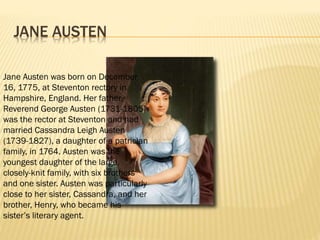
JANE AUSTEN
Jane Austen was born on December
16, 1775, at Steventon rectory in
Hampshire, England. Her father,
Reverend George Austen (1731-1805)
was the rector at Steventon and had
married Cassandra Leigh Austen
(1739-1827), a daughter of a patrician
family, in 1764. Austen was the
youngest daughter of the large,
closely-knit family, with six brothers
and one sister. Austen was particularly
close to her sister, Cassandra, and her
brother, Henry, who became his
sister’s literary agent.
MAJOR WORK
 Sense and sensibility
 Pride and Prejudice
 Northanghern Abbey
 Manfield Park
 Emma
THEME
 Money/Inheritance
 Laws surrounding inheritance are what put the
Dashwood women in limbo at the beginning of the
novel; and their lack of money, compounded with
their inability to work, means that they cannot
ease their situation, except through marrying well.
Money also dictates the eligibility of Elinor and
Marianne, as women with larger dowries are of
course seen as better prospects for marriage.
GENDER
 There are very definite gender limitations involved in
the society Austen describes; women cannot own
property, are expected to stay in the home, marry,
and be polite and good company. Men can decide
whether or not to pursue a career if they have
enough money, and have more latitude within society
in regards to their behavior and life choices. Gender
dictates acceptable roles and behavior, and even in
the world of the novel, there is little room to deviate.
EXPECTATIONS VS. REALITY
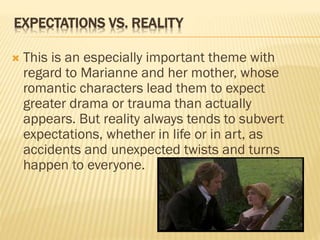
 This is an especially important theme with
regard to Marianne and her mother, whose
romantic characters lead them to expect
greater drama or trauma than actually
appears. But reality always tends to subvert
expectations, whether in life or in art, as
accidents and unexpected twists and turns
happen to everyone.
DISCRETION
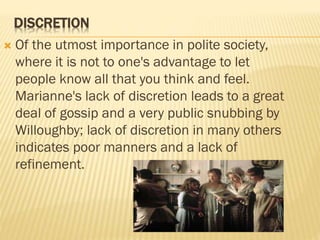
 Of the utmost importance in polite society,
where it is not to one's advantage to let
people know all that you think and feel.
Marianne's lack of discretion leads to a great
deal of gossip and a very public snubbing by
Willoughby; lack of discretion in many others
indicates poor manners and a lack of
refinement.
APPEARANCE VS. REALITY
 Pertains to character especially, as many
characters in the novel present themselves
as one thing, and end up being another.
Willoughby is the prime example of this, as
he seems romantic, open, and genuine, but
ends up exposing himself as vain, idle, and
cruel. Also pertains to Lucy Steele, who ends
up conniving, despite her innocent
appearance.
EXPECTATION AND DISAPPOINTMENT
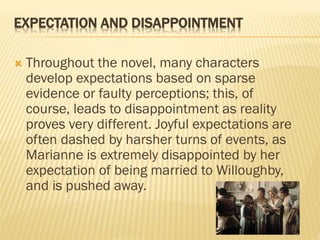
 Throughout the novel, many characters
develop expectations based on sparse
evidence or faulty perceptions; this, of
course, leads to disappointment as reality
proves very different. Joyful expectations are
often dashed by harsher turns of events, as
Marianne is extremely disappointed by her
expectation of being married to Willoughby,
and is pushed away.
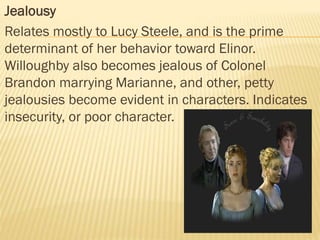
 Jealousy
 Relates mostly to Lucy Steele, and is the prime
determinant of her behavior toward Elinor.
Willoughby also becomes jealous of Colonel
Brandon marrying Marianne, and other, petty
jealousies become evident in characters. Indicates
insecurity, or poor character.
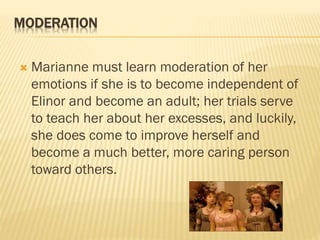
MODERATION
 Marianne must learn moderation of her
emotions if she is to become independent of
Elinor and become an adult; her trials serve
to teach her about her excesses, and luckily,
she does come to improve herself and
become a much better, more caring person
toward others.
Thank you……

29 sense and sensibility

  • 1.
    NAME : SHABANAKALANI ROLL NO:30 CLASS: M A SEM 2 SUBMITTED TO: DEPARTMENT OF ENGLISH GUIDED BY: DILIP BARAD Topic-Theme of sense and sensibility
  • 2.
    JANE AUSTEN Jane Austenwas born on December 16, 1775, at Steventon rectory in Hampshire, England. Her father, Reverend George Austen (1731-1805) was the rector at Steventon and had married Cassandra Leigh Austen (1739-1827), a daughter of a patrician family, in 1764. Austen was the youngest daughter of the large, closely-knit family, with six brothers and one sister. Austen was particularly close to her sister, Cassandra, and her brother, Henry, who became his sister’s literary agent.
  • 3.
    MAJOR WORK  Senseand sensibility  Pride and Prejudice  Northanghern Abbey  Manfield Park  Emma
  • 4.
    THEME  Money/Inheritance  Lawssurrounding inheritance are what put the Dashwood women in limbo at the beginning of the novel; and their lack of money, compounded with their inability to work, means that they cannot ease their situation, except through marrying well. Money also dictates the eligibility of Elinor and Marianne, as women with larger dowries are of course seen as better prospects for marriage.
  • 5.
    GENDER  There arevery definite gender limitations involved in the society Austen describes; women cannot own property, are expected to stay in the home, marry, and be polite and good company. Men can decide whether or not to pursue a career if they have enough money, and have more latitude within society in regards to their behavior and life choices. Gender dictates acceptable roles and behavior, and even in the world of the novel, there is little room to deviate.
  • 6.
    EXPECTATIONS VS. REALITY This is an especially important theme with regard to Marianne and her mother, whose romantic characters lead them to expect greater drama or trauma than actually appears. But reality always tends to subvert expectations, whether in life or in art, as accidents and unexpected twists and turns happen to everyone.
  • 7.
    DISCRETION  Of theutmost importance in polite society, where it is not to one's advantage to let people know all that you think and feel. Marianne's lack of discretion leads to a great deal of gossip and a very public snubbing by Willoughby; lack of discretion in many others indicates poor manners and a lack of refinement.
  • 8.
    APPEARANCE VS. REALITY Pertains to character especially, as many characters in the novel present themselves as one thing, and end up being another. Willoughby is the prime example of this, as he seems romantic, open, and genuine, but ends up exposing himself as vain, idle, and cruel. Also pertains to Lucy Steele, who ends up conniving, despite her innocent appearance.
  • 9.
    EXPECTATION AND DISAPPOINTMENT Throughout the novel, many characters develop expectations based on sparse evidence or faulty perceptions; this, of course, leads to disappointment as reality proves very different. Joyful expectations are often dashed by harsher turns of events, as Marianne is extremely disappointed by her expectation of being married to Willoughby, and is pushed away.
  • 10.
     Jealousy  Relatesmostly to Lucy Steele, and is the prime determinant of her behavior toward Elinor. Willoughby also becomes jealous of Colonel Brandon marrying Marianne, and other, petty jealousies become evident in characters. Indicates insecurity, or poor character.
  • 11.
    MODERATION  Marianne mustlearn moderation of her emotions if she is to become independent of Elinor and become an adult; her trials serve to teach her about her excesses, and luckily, she does come to improve herself and become a much better, more caring person toward others.
  • 12.