Rabindranath Tagore’s
character: Bimala and
Kandambini
By Nidhi Jethava
Prepared by : Nidhi Jethava
Batch : 20-22 MKBU English Department
Paper No. : 201 (IEL-Pre-Independence)
Roll Number : 13
Enrollment Number : 3069206420200009
Email Id : jethavanidhi8@gmail.com
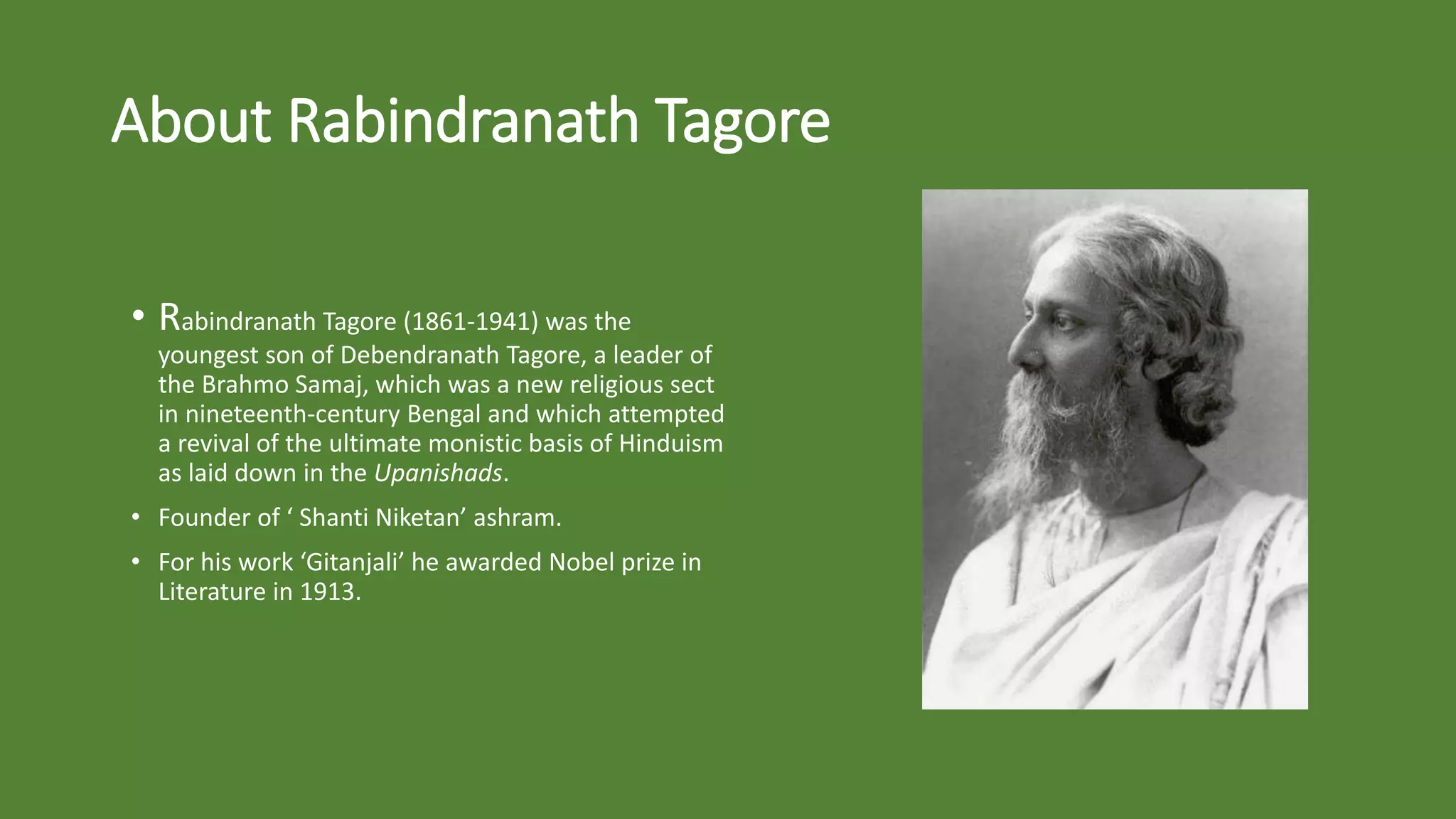
About Rabindranath Tagore
• Rabindranath Tagore (1861-1941) was the
youngest son of Debendranath Tagore, a leader of
the Brahmo Samaj, which was a new religious sect
in nineteenth-century Bengal and which attempted
a revival of the ultimate monistic basis of Hinduism
as laid down in the Upanishads.
• Founder of ‘ Shanti Niketan’ ashram.
• For his work ‘Gitanjali’ he awarded Nobel prize in
Literature in 1913.
Work Introduction
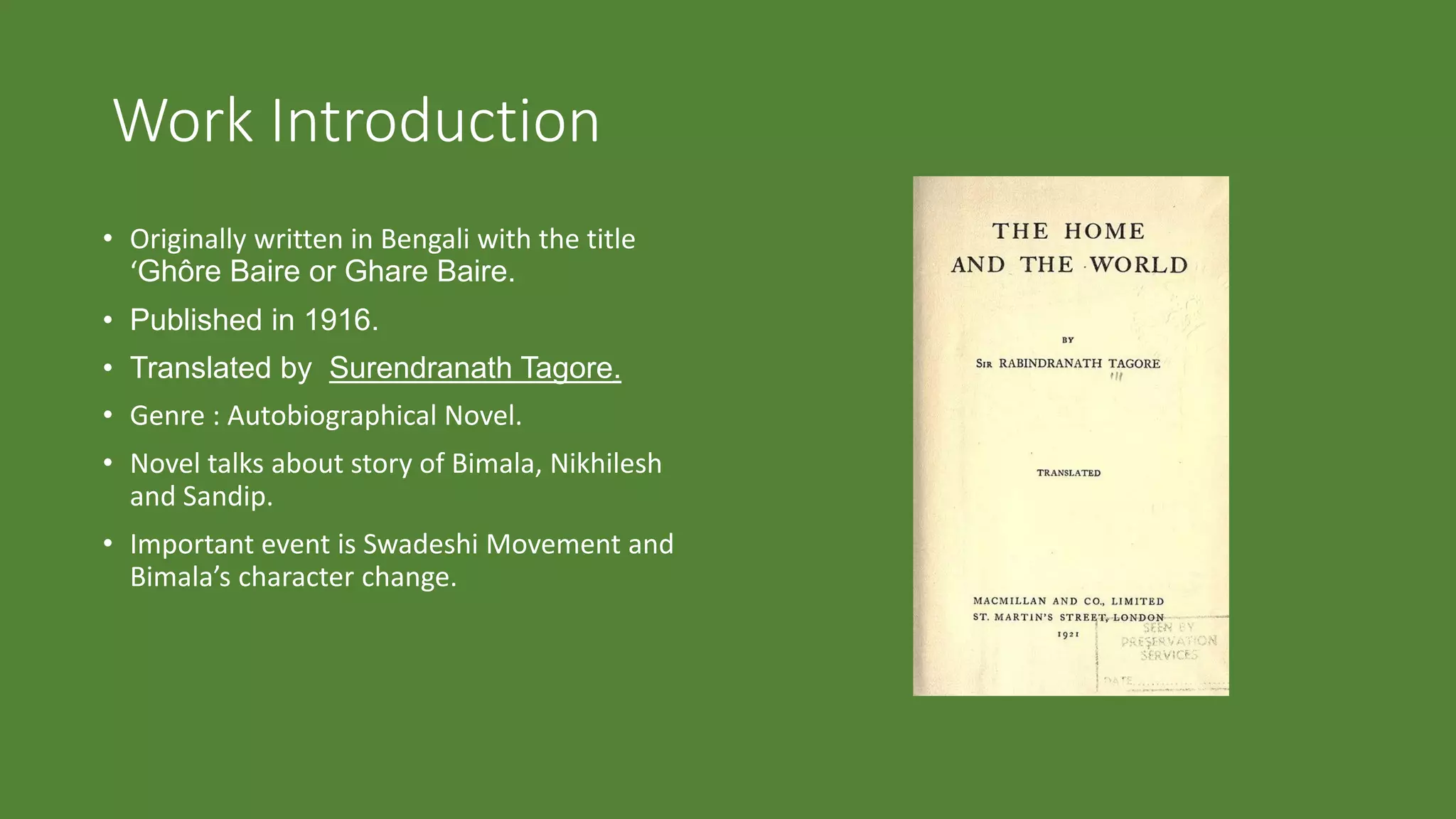
• Originally written in Bengali with the title
‘Ghôre Baire or Ghare Baire.
• Published in 1916.
• Translated by Surendranath Tagore.
• Genre : Autobiographical Novel.
• Novel talks about story of Bimala, Nikhilesh
and Sandip.
• Important event is Swadeshi Movement and
Bimala’s character change.
Work Introduction
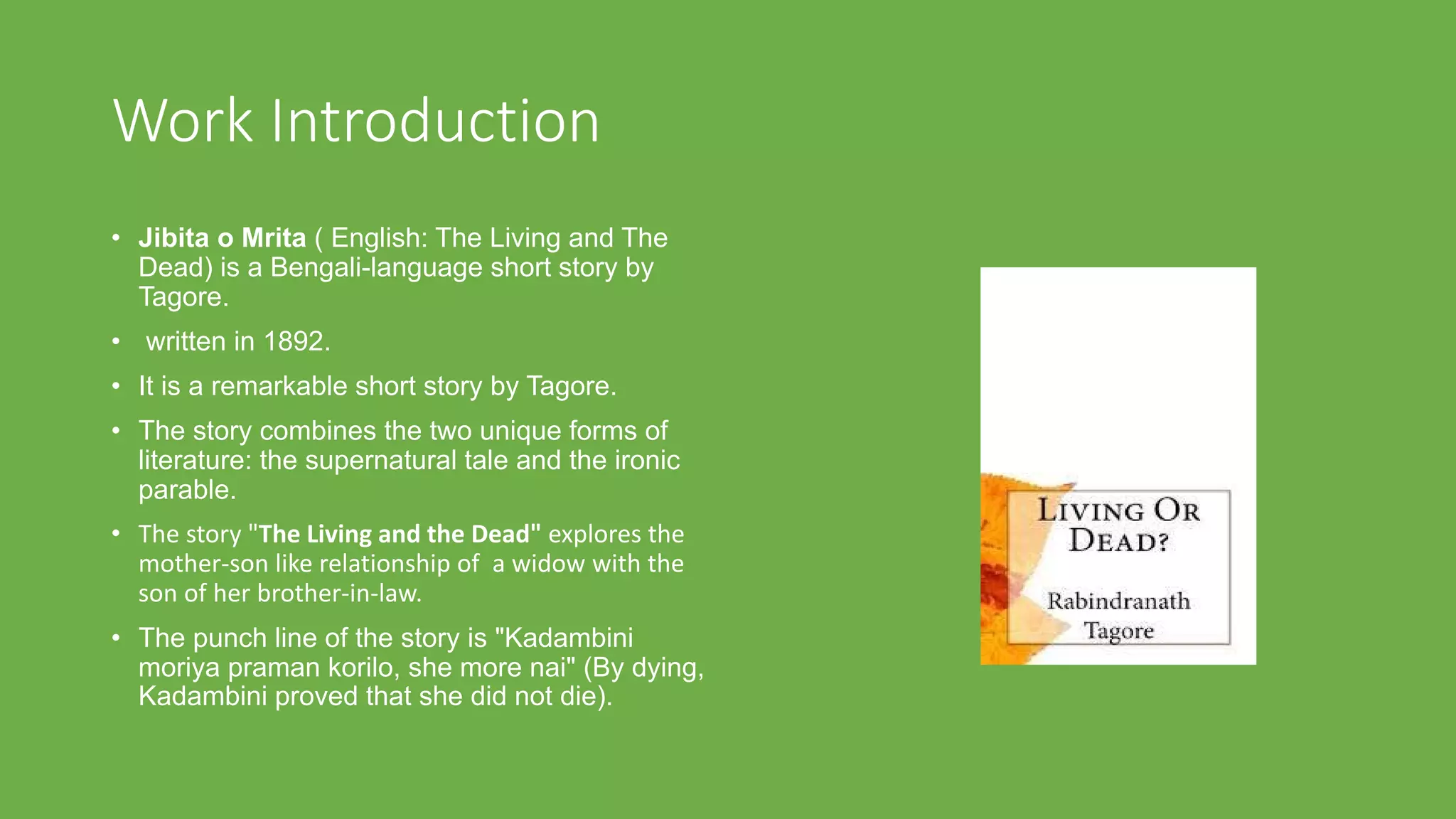
• Jibita o Mrita ( English: The Living and The
Dead) is a Bengali-language short story by
Tagore.
• written in 1892.
• It is a remarkable short story by Tagore.
• The story combines the two unique forms of
literature: the supernatural tale and the ironic
parable.
• The story "The Living and the Dead" explores the
mother-son like relationship of a widow with the
son of her brother-in-law.
• The punch line of the story is "Kadambini
moriya praman korilo, she more nai" (By dying,
Kadambini proved that she did not die).
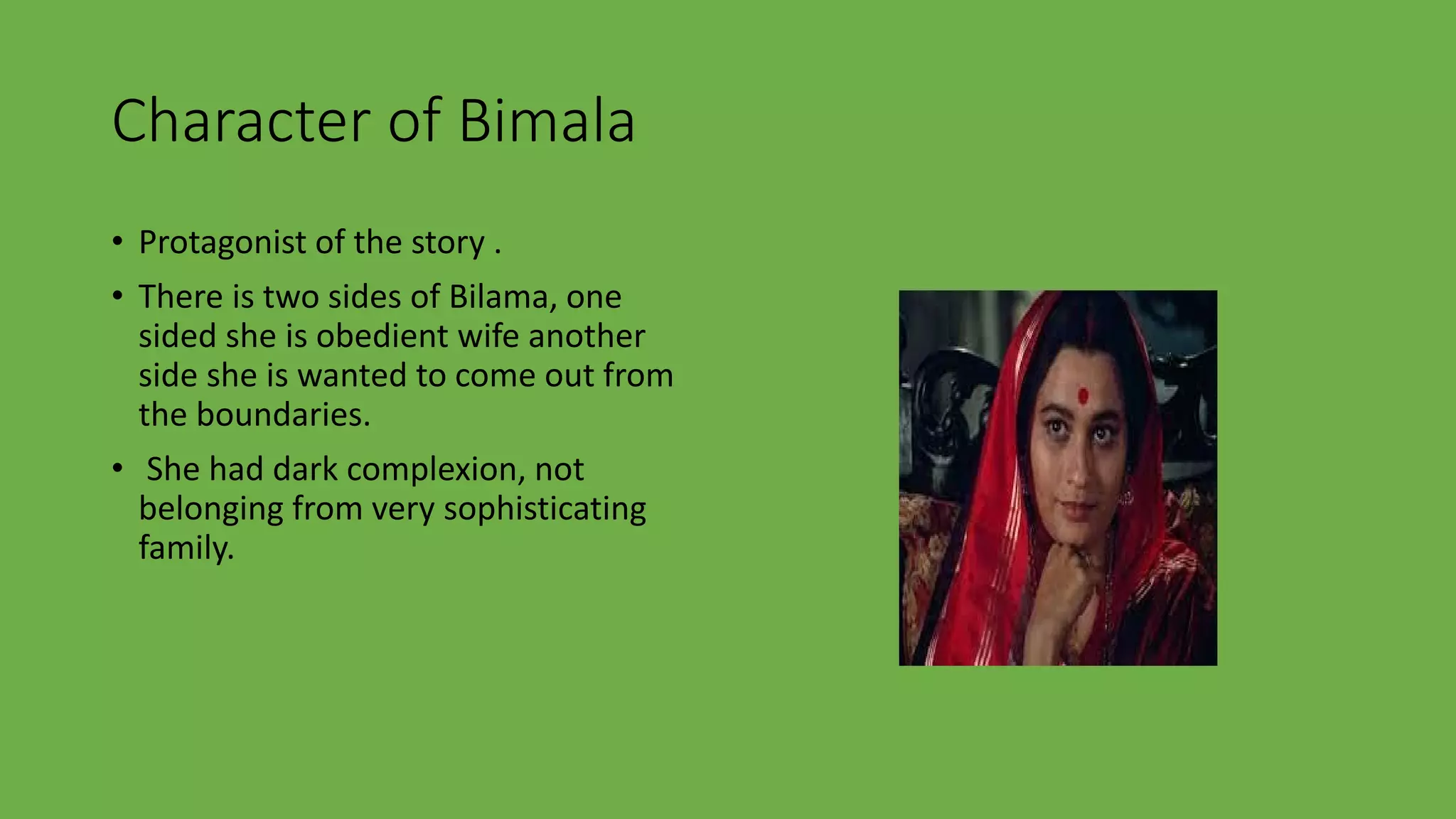
Character of Bimala
• Protagonist of the story .
• There is two sides of Bilama, one
sided she is obedient wife another
side she is wanted to come out from
the boundaries.
• She had dark complexion, not
belonging from very sophisticating
family.
According to Barnana Guha Thakurta (Banerjee)
- “ through Bimala Tagore actually wanted to construct a ‘new woman’
who will be more lady like i.e.. educated, sophisticated, holding on to
the Victorian values unlike common women who were more “course,
vulgar, loud, quarrelsome, devoid of superior moral sense, sexually
promiscuous, subjected to brutal physical oppression by males”.
According to David W. Atkinson,
• Bimala is caught between the two men. Initially she is seduced by
Sandip's cause, although in her mind the exact nature of the cause is
never clear; it remains an ambiguous "fanaticism for truth" . Her
personal attraction to Sandip feeds and sustains her commitment to
his cause, and only late in the novel, when she has been driven to
betray and abandon her husband, does she stop to reflect on what
Sandip represents. The freedom she thought Sandip represented is
reduced to "a dried-up water course with all its rocks and pebbles laid
bare."
According to DR. K. HARIKISHAN
• Bimala, the wife of Nikhil, leads a highly contented life of her own. Her home is
her world. Her husband is equal to god for her. Nikhil who believes in freedom
and dignity of the individual does not like her treatment of him. Though Bimala is
an uneducated, she is status conscious. In order to appear civilized and refined
she develops taste for current fashions. In spite of all this, she is dedicated to her
household duties. The swadeshi movement changes her outlook. Though she
does not grasp the true spirit of the movement, she acts on impulse. At this
moment, Sandip a friend of her husband enters her life. Her admiration for
Sandip is due to his active involvement in the swadesi movement. Slowly her
admiration for Sandip transforms in to a strong passion. Now her home is not her
world, her world is Sandip. She is quite aware of this fact.
Character of Kadambini
• Kadambini is young widow.
• She is a noble lady but much dejected by society
for her widowhood.
• The widow Kadambini is very close to her nephew
• She is a noble lady but much dejected by society
for her widowhood. .
• Patient and thoughtful woman.
• The main character in "The Living and the Dead" is a widow who dies
suddenly and, just a few hours later, comes back to live.
• She exists in a liminal space between life and death, obviously present
as a person, yet believed by all around her to be a ghost.
• It’s a tormenting existence, and her second death at the end of the
story proves an ironic confirmation that she was indeed alive the
whole time.
• According to Monami Mukherjee
Her inability to relate to the living world and her unconscious declaration of
envy is, ironically not entirely her own responsibility. She was rather a victim of
what Lacan would have called “The Symbolic Order”, of social and cultural
codes controlling her assessment of herself, codes that are beyond the control
of her mental frame. Her situation was beyond the scope of any conventional
linguistic articulation and hence she became doubtful of the very meaning of
her existence. Death was not seen as a termination of life-processes but an
undeniable fact solidified by social rituals and other people’s conceptions.
Despite being instinctively aware that she was alive, she is unable to deny the
expectation of society that considered her to be dead.
Bimala
• Bimala is belonging from simple family
and married in aristocratic family.
• Bimala is protagonist.
• Her character development is the main
idea of novel.
• First time meet another man bedside her
husband, that was Sandip.
• Her stealing money from his husband’s.
• At the end she become widow of
Nikilesh.
Kadambini
• At the beginning story we found she is
widow.
• Whole story around her character.
• Climax when she return after her
cremation.
• Belonging from aristocratic family.
• Depicting her Tagore discussed the
situation of widow’s situation before
independence.
• At the end she have to killed herself.
• Bengali widow’s situation.
Citation
• Atkinson, David W. "Tagore's The Home and the World: A Call for a New World order ." (n.d.): 4.
• Harikishan, Dr. K. "Women Characters in Tagore: A Comparative Study from His Novels and Stories ." Pune
Research An international Journal in English (n.d.): 14.
• Mukherji, Monami. "The Living and The Dead: Transforming through Un-Reality ." nibblepop December
2016.
• Tagore, Rabindranath. The Home and the World. Macmillan and Co., Limited , 1916.
• Tagore, Rabindranath. Living or Dead ? 1892.
• Thakurta, Barnana Guha. "Beyond a Conjugal Life ; Tagore's Home and the World: A Gendered Perspective
." NSOU Journal od Social Science (n.d.): 6.
Rabindranath tagore’s characters

Rabindranath tagore’s characters

  • 1.
    Rabindranath Tagore’s character: Bimalaand Kandambini By Nidhi Jethava
  • 2.
    Prepared by :Nidhi Jethava Batch : 20-22 MKBU English Department Paper No. : 201 (IEL-Pre-Independence) Roll Number : 13 Enrollment Number : 3069206420200009 Email Id : jethavanidhi8@gmail.com
  • 3.
    About Rabindranath Tagore •Rabindranath Tagore (1861-1941) was the youngest son of Debendranath Tagore, a leader of the Brahmo Samaj, which was a new religious sect in nineteenth-century Bengal and which attempted a revival of the ultimate monistic basis of Hinduism as laid down in the Upanishads. • Founder of ‘ Shanti Niketan’ ashram. • For his work ‘Gitanjali’ he awarded Nobel prize in Literature in 1913.
  • 4.
    Work Introduction • Originallywritten in Bengali with the title ‘Ghôre Baire or Ghare Baire. • Published in 1916. • Translated by Surendranath Tagore. • Genre : Autobiographical Novel. • Novel talks about story of Bimala, Nikhilesh and Sandip. • Important event is Swadeshi Movement and Bimala’s character change.
  • 5.
    Work Introduction • Jibitao Mrita ( English: The Living and The Dead) is a Bengali-language short story by Tagore. • written in 1892. • It is a remarkable short story by Tagore. • The story combines the two unique forms of literature: the supernatural tale and the ironic parable. • The story "The Living and the Dead" explores the mother-son like relationship of a widow with the son of her brother-in-law. • The punch line of the story is "Kadambini moriya praman korilo, she more nai" (By dying, Kadambini proved that she did not die).
  • 6.
    Character of Bimala •Protagonist of the story . • There is two sides of Bilama, one sided she is obedient wife another side she is wanted to come out from the boundaries. • She had dark complexion, not belonging from very sophisticating family.
  • 7.
    According to BarnanaGuha Thakurta (Banerjee) - “ through Bimala Tagore actually wanted to construct a ‘new woman’ who will be more lady like i.e.. educated, sophisticated, holding on to the Victorian values unlike common women who were more “course, vulgar, loud, quarrelsome, devoid of superior moral sense, sexually promiscuous, subjected to brutal physical oppression by males”.
  • 8.
    According to DavidW. Atkinson, • Bimala is caught between the two men. Initially she is seduced by Sandip's cause, although in her mind the exact nature of the cause is never clear; it remains an ambiguous "fanaticism for truth" . Her personal attraction to Sandip feeds and sustains her commitment to his cause, and only late in the novel, when she has been driven to betray and abandon her husband, does she stop to reflect on what Sandip represents. The freedom she thought Sandip represented is reduced to "a dried-up water course with all its rocks and pebbles laid bare."
  • 9.
    According to DR.K. HARIKISHAN • Bimala, the wife of Nikhil, leads a highly contented life of her own. Her home is her world. Her husband is equal to god for her. Nikhil who believes in freedom and dignity of the individual does not like her treatment of him. Though Bimala is an uneducated, she is status conscious. In order to appear civilized and refined she develops taste for current fashions. In spite of all this, she is dedicated to her household duties. The swadeshi movement changes her outlook. Though she does not grasp the true spirit of the movement, she acts on impulse. At this moment, Sandip a friend of her husband enters her life. Her admiration for Sandip is due to his active involvement in the swadesi movement. Slowly her admiration for Sandip transforms in to a strong passion. Now her home is not her world, her world is Sandip. She is quite aware of this fact.
  • 10.
    Character of Kadambini •Kadambini is young widow. • She is a noble lady but much dejected by society for her widowhood. • The widow Kadambini is very close to her nephew • She is a noble lady but much dejected by society for her widowhood. . • Patient and thoughtful woman.
  • 11.
    • The maincharacter in "The Living and the Dead" is a widow who dies suddenly and, just a few hours later, comes back to live. • She exists in a liminal space between life and death, obviously present as a person, yet believed by all around her to be a ghost. • It’s a tormenting existence, and her second death at the end of the story proves an ironic confirmation that she was indeed alive the whole time.
  • 12.
    • According toMonami Mukherjee Her inability to relate to the living world and her unconscious declaration of envy is, ironically not entirely her own responsibility. She was rather a victim of what Lacan would have called “The Symbolic Order”, of social and cultural codes controlling her assessment of herself, codes that are beyond the control of her mental frame. Her situation was beyond the scope of any conventional linguistic articulation and hence she became doubtful of the very meaning of her existence. Death was not seen as a termination of life-processes but an undeniable fact solidified by social rituals and other people’s conceptions. Despite being instinctively aware that she was alive, she is unable to deny the expectation of society that considered her to be dead.
  • 13.
    Bimala • Bimala isbelonging from simple family and married in aristocratic family. • Bimala is protagonist. • Her character development is the main idea of novel. • First time meet another man bedside her husband, that was Sandip. • Her stealing money from his husband’s. • At the end she become widow of Nikilesh. Kadambini • At the beginning story we found she is widow. • Whole story around her character. • Climax when she return after her cremation. • Belonging from aristocratic family. • Depicting her Tagore discussed the situation of widow’s situation before independence. • At the end she have to killed herself. • Bengali widow’s situation.
  • 14.
    Citation • Atkinson, DavidW. "Tagore's The Home and the World: A Call for a New World order ." (n.d.): 4. • Harikishan, Dr. K. "Women Characters in Tagore: A Comparative Study from His Novels and Stories ." Pune Research An international Journal in English (n.d.): 14. • Mukherji, Monami. "The Living and The Dead: Transforming through Un-Reality ." nibblepop December 2016. • Tagore, Rabindranath. The Home and the World. Macmillan and Co., Limited , 1916. • Tagore, Rabindranath. Living or Dead ? 1892. • Thakurta, Barnana Guha. "Beyond a Conjugal Life ; Tagore's Home and the World: A Gendered Perspective ." NSOU Journal od Social Science (n.d.): 6.