An Inspector Calls Revision Sheet
Plot
1. The Birling Family and Gerald Croft are having a celebratory dinner.
2. Just as Mr Birling is at his most confident; an inspector arrives to investigate a suicide.
3. Mr Birling reveals he sacked Eva Smith.
4. Sheila explains that she had Eva sacked from her next job and Milwards.
5. Gerald recognises the name Daisy Renton
6. Gerald admits that he kept Daisy as his mistress.
7. Mrs Birling tells the group that she denied help to a pregnant girl when she went to Mrs
Birling’s charity organisation
8. Eric enters, just as we realise he is the father of the child.
9. Eric explains his relationship with the girl and how he stole money to help her.
10. The Inspector leaves.
11. The family gradually realises the Inspector could have been a fraud.
12. The celebratory mood is almost restored – then a phone call announces that an Inspector
is on his way to investigate a girl’s suicide.
Characters
• about fifty, a rather cold woman and her husband's social superior
• "She was giving herself ridiculous airs"
• she refuses to believe that she did anything wrong and doesn't
accept responsibility for her part in Eva's death
Mrs Birling
• He speaks carefully, weightily, and has a disconcerting habit of
looking hard at the person he addresses before actually speaking
• "We are responsible for each other"
• He works very systematically
Inspector
• In his early twenties, not quite at ease, half shy, half assertive
• "Why shouldn't they try for higher wages?"
• he is fully aware of his social responsibility
Eric
• an attractive chap about thirty, rather too manly to be a dandy but
very much the easy well-bred man-about-town
• "She was young and pretty and warm-hearted - and intensely
grateful."
• he tries to come up with as much evidence as possible to prove that
the Inspector is a fake - because that would get him off the hook
Gerald
• heavy-looking, rather portentous man in his middle fifties but rather
provincial in his speech
• "a man has to make his own way"
• optimistic for the future and confident that there will not be a war.
Mr Birling
• a pretty girl in her early twenties, very pleased with life and rather
excited
• "But these girls aren't cheap labour - they're people."
• feels full of guilt for her jealous actions
Sheila
Themes
LB2008
An Inspector Calls Revision Sheet
Responsibility: The Inspector wanted each member of the family to share the responsibility
of Eva's death: he tells them, "each of you helped to kill her." However, his final speech is
aimed not only at the characters on stage, but at the audience too:
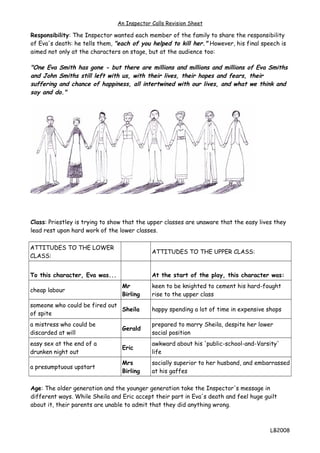
"One Eva Smith has gone - but there are millions and millions and millions of Eva Smiths
and John Smiths still left with us, with their lives, their hopes and fears, their
suffering and chance of happiness, all intertwined with our lives, and what we think and
say and do."
Class: Priestley is trying to show that the upper classes are unaware that the easy lives they
lead rest upon hard work of the lower classes.
ATTITUDES TO THE LOWER
CLASS:
ATTITUDES TO THE UPPER CLASS:
To this character, Eva was... At the start of the play, this character was:
cheap labour
Mr
Birling
keen to be knighted to cement his hard-fought
rise to the upper class
someone who could be fired out
of spite
Sheila happy spending a lot of time in expensive shops
a mistress who could be
discarded at will
Gerald
prepared to marry Sheila, despite her lower
social position
easy sex at the end of a
drunken night out
Eric
awkward about his 'public-school-and-Varsity'
life
a presumptuous upstart
Mrs
Birling
socially superior to her husband, and embarrassed
at his gaffes
Age: The older generation and the younger generation take the Inspector's message in
different ways. While Sheila and Eric accept their part in Eva's death and feel huge guilt
about it, their parents are unable to admit that they did anything wrong.
LB2008
An Inspector Calls Revision Sheet
The Old (Mr and Mrs Birling) The Young (Sheila and Eric)
The old are set in their ways. They are
utterly confident that they are right
and they see the young as foolish.
The young are open to new ideas. This is first seen
early in Act 1 when both Eric and Sheila express
sympathy for the strikers - an idea which horrifies
Birling, who can only think of production costs and
ignores the human side of the issue.
The old will do anything to protect
themselves: Mrs Birling lies to the
Inspector when he first shows her the
photograph; Mr Birling wants to cover
up a potential scandal.
The young are honest and admit their faults. Eric
refuses to try to cover his part up, saying, "the
fact remains that I did what I did."
They have never been forced to
examine their consciences before and
find they cannot do it now - as the
saying goes, 'you can't teach an old dog
new tricks.'
Sheila and Eric see the human side of Eva's story
and are very troubled by their part in it. They do
examine their consciences.
Mr and Mrs Birling have much to fear
from the visit of the 'real' inspector
because they know they will lose
everything.
Sheila and Eric have nothing to fear from the visit
of the 'real' inspector because they have already
admitted what they have done wrong, and will change
Gerald Croft is caught in the middle, being neither very young nor old. In the end he sides
with the older generation, perhaps because his aristocratic roots influence him to want to
keep the status quo and protect his own interests.
Ultimately, we can be optimistic that the young - those who will shape future society - are
able to take on board the Inspector's message.
LB2008

Revision Sheet

  • 1.
    An Inspector CallsRevision Sheet Plot 1. The Birling Family and Gerald Croft are having a celebratory dinner. 2. Just as Mr Birling is at his most confident; an inspector arrives to investigate a suicide. 3. Mr Birling reveals he sacked Eva Smith. 4. Sheila explains that she had Eva sacked from her next job and Milwards. 5. Gerald recognises the name Daisy Renton 6. Gerald admits that he kept Daisy as his mistress. 7. Mrs Birling tells the group that she denied help to a pregnant girl when she went to Mrs Birling’s charity organisation 8. Eric enters, just as we realise he is the father of the child. 9. Eric explains his relationship with the girl and how he stole money to help her. 10. The Inspector leaves. 11. The family gradually realises the Inspector could have been a fraud. 12. The celebratory mood is almost restored – then a phone call announces that an Inspector is on his way to investigate a girl’s suicide. Characters • about fifty, a rather cold woman and her husband's social superior • "She was giving herself ridiculous airs" • she refuses to believe that she did anything wrong and doesn't accept responsibility for her part in Eva's death Mrs Birling • He speaks carefully, weightily, and has a disconcerting habit of looking hard at the person he addresses before actually speaking • "We are responsible for each other" • He works very systematically Inspector • In his early twenties, not quite at ease, half shy, half assertive • "Why shouldn't they try for higher wages?" • he is fully aware of his social responsibility Eric • an attractive chap about thirty, rather too manly to be a dandy but very much the easy well-bred man-about-town • "She was young and pretty and warm-hearted - and intensely grateful." • he tries to come up with as much evidence as possible to prove that the Inspector is a fake - because that would get him off the hook Gerald • heavy-looking, rather portentous man in his middle fifties but rather provincial in his speech • "a man has to make his own way" • optimistic for the future and confident that there will not be a war. Mr Birling • a pretty girl in her early twenties, very pleased with life and rather excited • "But these girls aren't cheap labour - they're people." • feels full of guilt for her jealous actions Sheila Themes LB2008
  • 2.
    An Inspector CallsRevision Sheet Responsibility: The Inspector wanted each member of the family to share the responsibility of Eva's death: he tells them, "each of you helped to kill her." However, his final speech is aimed not only at the characters on stage, but at the audience too: "One Eva Smith has gone - but there are millions and millions and millions of Eva Smiths and John Smiths still left with us, with their lives, their hopes and fears, their suffering and chance of happiness, all intertwined with our lives, and what we think and say and do." Class: Priestley is trying to show that the upper classes are unaware that the easy lives they lead rest upon hard work of the lower classes. ATTITUDES TO THE LOWER CLASS: ATTITUDES TO THE UPPER CLASS: To this character, Eva was... At the start of the play, this character was: cheap labour Mr Birling keen to be knighted to cement his hard-fought rise to the upper class someone who could be fired out of spite Sheila happy spending a lot of time in expensive shops a mistress who could be discarded at will Gerald prepared to marry Sheila, despite her lower social position easy sex at the end of a drunken night out Eric awkward about his 'public-school-and-Varsity' life a presumptuous upstart Mrs Birling socially superior to her husband, and embarrassed at his gaffes Age: The older generation and the younger generation take the Inspector's message in different ways. While Sheila and Eric accept their part in Eva's death and feel huge guilt about it, their parents are unable to admit that they did anything wrong. LB2008
  • 3.
    An Inspector CallsRevision Sheet The Old (Mr and Mrs Birling) The Young (Sheila and Eric) The old are set in their ways. They are utterly confident that they are right and they see the young as foolish. The young are open to new ideas. This is first seen early in Act 1 when both Eric and Sheila express sympathy for the strikers - an idea which horrifies Birling, who can only think of production costs and ignores the human side of the issue. The old will do anything to protect themselves: Mrs Birling lies to the Inspector when he first shows her the photograph; Mr Birling wants to cover up a potential scandal. The young are honest and admit their faults. Eric refuses to try to cover his part up, saying, "the fact remains that I did what I did." They have never been forced to examine their consciences before and find they cannot do it now - as the saying goes, 'you can't teach an old dog new tricks.' Sheila and Eric see the human side of Eva's story and are very troubled by their part in it. They do examine their consciences. Mr and Mrs Birling have much to fear from the visit of the 'real' inspector because they know they will lose everything. Sheila and Eric have nothing to fear from the visit of the 'real' inspector because they have already admitted what they have done wrong, and will change Gerald Croft is caught in the middle, being neither very young nor old. In the end he sides with the older generation, perhaps because his aristocratic roots influence him to want to keep the status quo and protect his own interests. Ultimately, we can be optimistic that the young - those who will shape future society - are able to take on board the Inspector's message. LB2008