


LocallyAdvancedPCa:Pro Surgery Hein Van PoppelUZ Gasthuisberg Leuven, BelgiumECCLU 2011 is held under the auspices ofthe European School of UrologyLugano 2011
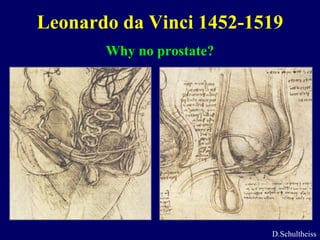
Leonardo da Vinci 1452-1519Why no prostate?D.Schultheiss
Leuven-Louvain-Loven-Lovania
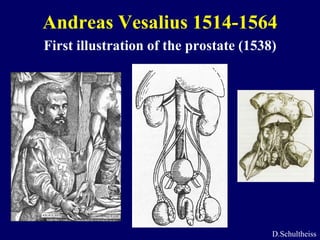
Andreas Vesalius 1514-1564First illustration of theprostate (1538)D.Schultheiss
LeuvenPhilippusVerheyen       Loven  1711Prostate and Seminalvesicles
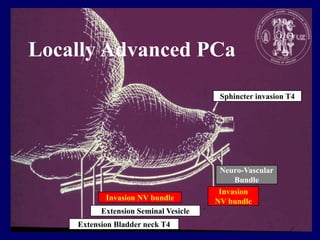
LocallyAdvancedPCaSphincter invasion T4Neuro-VascularBundleInvasionNV bundleInvasion NV bundleExtension Seminal VesicleExtension Bladder neck T4
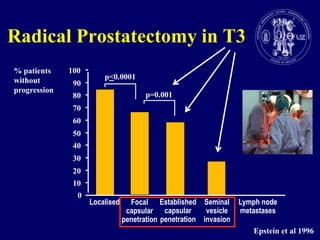
Radical Prostatectomy in T3% patientswithoutprogression100p<0.000190p=0.00180706050403020100LocalisedEstablishedcapsularpenetrationSeminalvesicleinvasionLymph nodemetastasesFocalcapsularpenetrationEpstein et al 1996
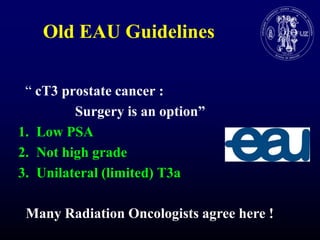
Old EAU Guidelines  “ cT3 prostate cancer :                 Surgery is an option”Low PSANot high gradeUnilateral (limited) T3aManyRadiationOncologistsagreehere !
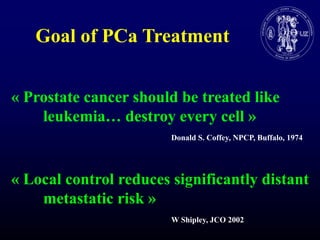
Goal of PCa Treatment« Prostate cancer shouldbetreatedlikeleukemia… destroy everycell »Donald S. Coffey, NPCP, Buffalo, 1974« Local control reducessignificantly distant metastaticrisk »W Shipley, JCO 2002
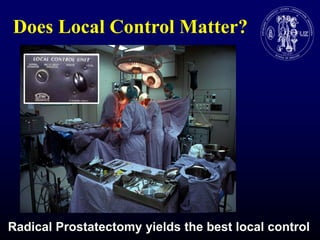
  Does LocalControl Matter?RadicalProstatectomyyields the best localcontrol
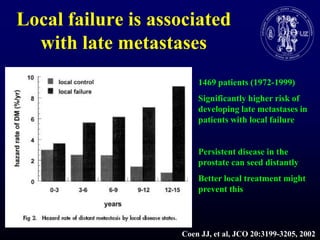
Local failure is associated with late metastases 1469 patients (1972-1999)Significantly higher risk of developing late metastases in patients with local failurePersistent disease in the prostate can seed distantlyBetter local treatment might prevent thisCoen JJ, et al, JCO 20:3199-3205, 2002
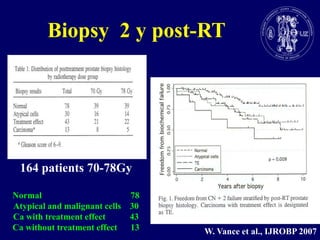
Biopsy  2 y post-RT164 patients 70-78GyNormal78Atypical and malignantcells    30Ca withtreatment effect           43Ca without treatment effect      13W. Vance et al., IJROBP 2007
RT vs Surgery Long-termcure ?No randomized studies to provide  anycomparisonObservational studies, Cohort studies, cancerRegistries…
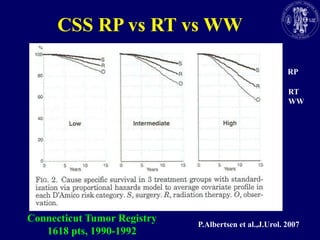
          CSS RP vs RT vs WW RPRTWWConnecticut Tumor Registry1618 pts, 1990-1992              P.Albertsen et al.,J.Urol. 2007
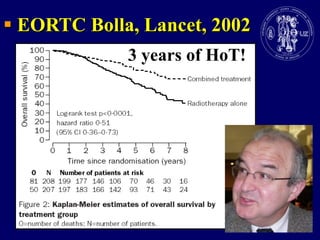
 EORTC Bolla, Lancet, 20023 years of HoT!
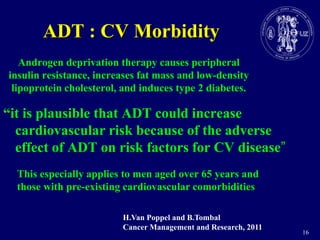
16ADT : CV MorbidityAndrogendeprivationtherapycausesperipheralinsulin resistance, increases fat mass and low-density lipoprotein cholesterol, and induces type 2 diabetes.“it is plausible that ADT could increase cardiovascular risk because of the adverse effect of ADT on risk factors for CV disease”This especially applies to men aged over 65 years and those with pre-existingcardiovascularcomorbiditiesH.Van Poppel and B.TombalCancer Management and Research, 2011
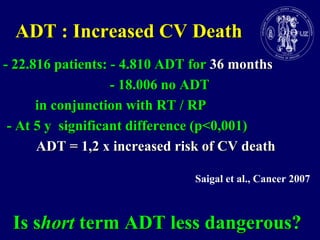
ADT : Increased CV Death- 22.816 patients: - 4.810 ADT for 36 months			            - 18.006 no ADT         in conjunction with RT / RP - At 5 y  significant difference (p<0,001)ADT = 1,2 x increased risk of CV deathSaigal et al., Cancer 2007  Is short term ADT less dangerous?
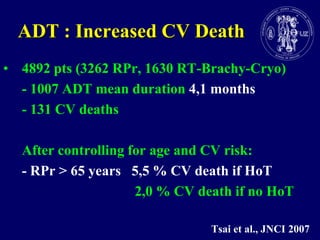
ADT : Increased CV Death4892 pts (3262 RPr, 1630 RT-Brachy-Cryo)	- 1007 ADT mean duration 4,1 months	- 131 CV deaths	After controlling for age and CV risk:- RPr > 65 years   5,5 % CV death if HoT		 	                   2,0 % CV death if no HoT                                                                              Tsai et al., JNCI 2007
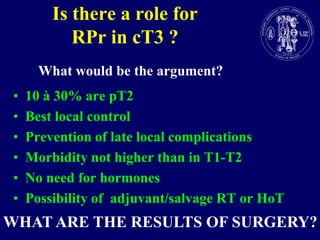
Is there a role for RPr in cT3 ?What would be the argument?10 à 30% are pT2 Best local control Prevention of late local complications Morbidity not higher than in T1-T2No need for hormonesPossibility of  adjuvant/salvage RT or HoTWHAT ARE THE RESULTS OF SURGERY?
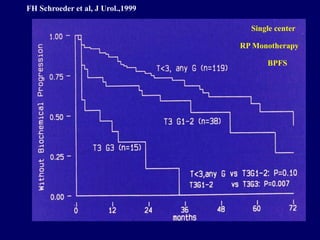
FH Schroeder et al, J Urol.,1999Single centerRP MonotherapyBPFS
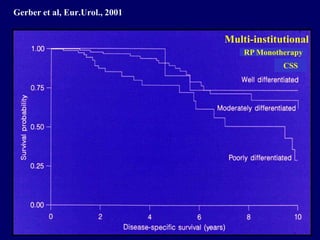
Gerber et al, Eur.Urol., 2001Multi-institutionalRP MonotherapyCSS
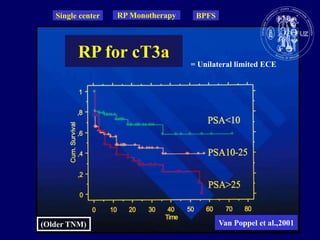
Single centerRP MonotherapyBPFSRP for cT3a= Unilaterallimited ECEVan Poppel et al.,2001(Older TNM)
Old EAU Guidelines  “ cT3 prostate cancer :                 Surgery is an option”Low PSANot high gradeUnilateral (limited) T3a    These are the indicationswheresurgerymonotherapywillgive excellent results   The role of surgery is howevernotlimited to these cases
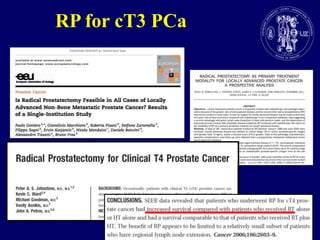
RP for cT3 PCa
Why  Surgery?Surgery monotherapycures the overstaged cT3 patients (pT2) butalso a numberwith significant extracapsularextension ( including pT3b)  thatwillneverneedanyadjuvantorsalvagetreatmentThosenotcuredcanstillberescued…
Multimodaltreatment                of cT3 RadicalProstatectomywithAdjuvantorSalvageRadiotherapy orHormonotherapy
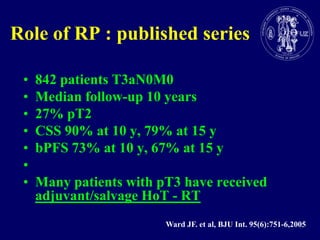
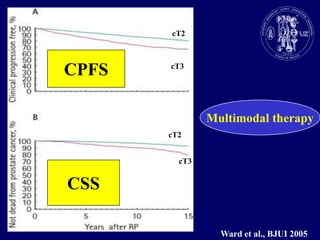
Role of RP : published series842 patients T3aN0M0Median follow-up 10 years27% pT2CSS 90% at 10 y, 79% at 15 ybPFS 73% at 10 y, 67% at 15 yMany patients with pT3 have received adjuvant/salvage HoT - RTWard JF. et al, BJU Int. 95(6):751-6,2005
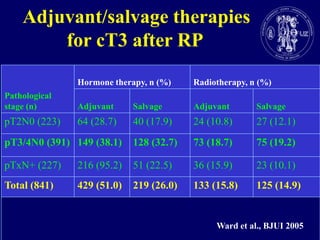
Ward et al., BJUI 2005
cT2CPFScT3MultimodaltherapycT2cT3CSSWard et al., BJUI 2005
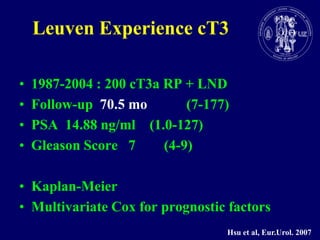
Leuven Experience cT31987-2004 : 200 cT3a RP + LNDFollow-up  70.5 mo           (7-177)PSA  14.88 ng/ml    (1.0-127)Gleason Score   7        (4-9)Kaplan-MeierMultivariate Cox forprognostic factorsHsu et al, Eur.Urol. 2007
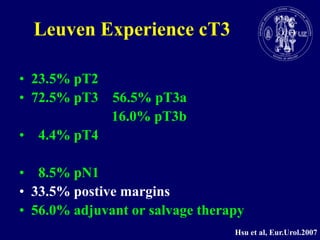
Leuven Experience cT323.5% pT272.5% pT3    56.5% pT3a 16.0% pT3b  4.4% pT4  8.5% pN133.5% postivemargins56.0% adjuvantorsalvagetherapyHsu et al, Eur.Urol.2007
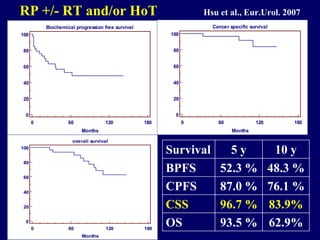
RP +/- RT and/or HoTHsu et al., Eur.Urol. 2007
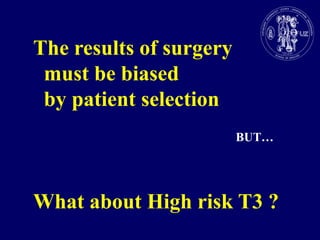
The results of surgery  must bebiasedbypatientselectionWhatabout High risk T3 ?BUT…
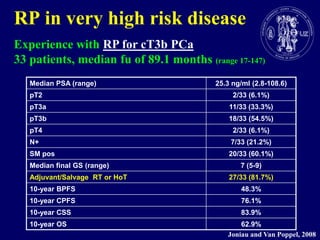
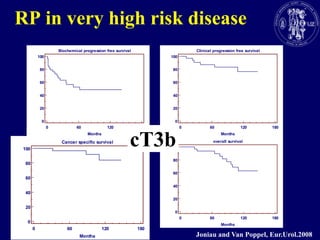
RP in very high risk diseaseExperiencewithRP for cT3b PCa33 patients, medianfu of 89.1 months(range 17-147)Joniau and Van Poppel, 2008
RP in very high risk diseasecT3bJoniau and Van Poppel, Eur.Urol.2008
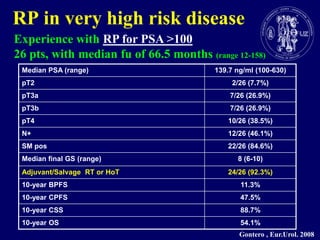
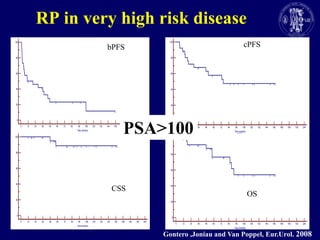
RP in very high risk diseaseExperiencewithRP for PSA >10026 pts, withmedianfu of 66.5 months(range 12-158)Gontero , Eur.Urol. 2008
RP in very high risk diseasecPFSbPFSPSA>100CSSOSGontero ,Joniau and Van Poppel, Eur.Urol. 2008
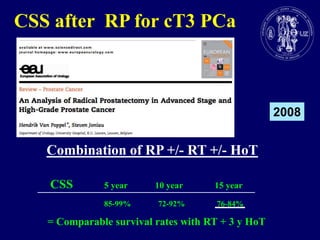
CSS afterRP for cT3 PCa2008Combinationof RP +/- RT +/- HoTCSS          5 year    10 year  15 year                           85-99%	      72-92%               76-84%           = Comparable survival rates withRT + 3 y HoT
Shift from RP for T2 to T3 ?For most cT2 aboutevery management willachievereasonable CSSFor cT3 not all treatmentswillbeequallyeffectiveLow risk T3 obviouslywill have a good prognosis withsurgeryHoweverHigh risk cT3 shouldnotanylongerbedeniedsurgery as first step
There is a place for Surgery ,also in high-risk cT3 PCa
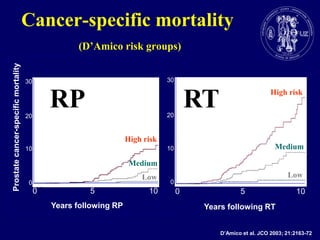
Cancer-specific mortality(D’Amico risk groups)3030RTRPHigh risk2020Prostate cancer-specificmortalityHigh riskMedium1010MediumLowLow0010501050Yearsfollowing RPYearsfollowing RTD’Amico et al. JCO 2003; 21:2163-72
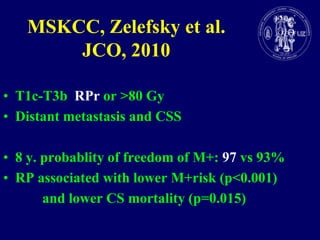
MSKCC, Zelefsky et al. JCO, 2010T1c-T3b  RPror >80 GyDistantmetastasis and CSS8 y. probablity of freedom of M+: 97vs 93%RP associatedwithlower M+risk (p<0.001)           and lower CS mortality (p=0.015)
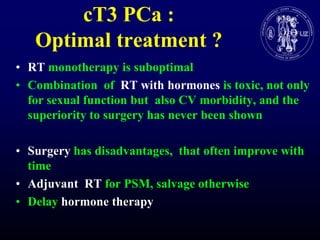
cT3 PCa : Optimaltreatment ?RTmonotherapy is suboptimalCombination  of  RT withhormonesis toxic, notonlyforsexualfunctionbutalso CV morbidity, and the superiority to surgery has never been shownSurgery has disadvantages,  thatoftenimprovewith timeAdjuvant  RT for PSM, salvageotherwiseDelayhormonetherapy
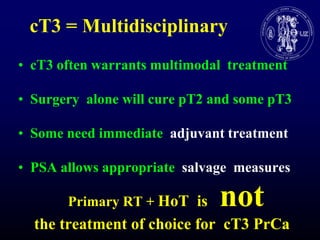
cT3 = MultidisciplinarycT3 often warrants multimodaltreatmentSurgery  alonewillcure pT2 and some pT3SomeneedimmediateadjuvanttreatmentPSA allowsappropriatesalvagemeasuresPrimary RT + HoT  is   not    the treatment of choicefor  cT3 PrCa
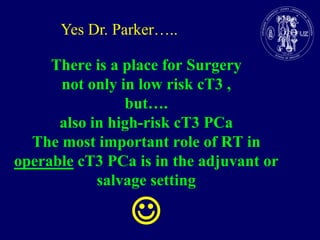
Yes Dr. Parker…..There is a place for Surgery notonly in low risk cT3 ,but….also in high-risk cT3 PCaThe most important role of RT in operable cT3 PCa is in the adjuvantorsalvage setting
ECCLU 2011 - H. Van Poppel - Controversy: Locally advanced prostate cancer - Pro surgery

ECCLU 2011 - H. Van Poppel - Controversy: Locally advanced prostate cancer - Pro surgery

  • 1.
    LocallyAdvancedPCa:Pro Surgery HeinVan PoppelUZ Gasthuisberg Leuven, BelgiumECCLU 2011 is held under the auspices ofthe European School of UrologyLugano 2011
  • 2.
    Leonardo da Vinci1452-1519Why no prostate?D.Schultheiss
  • 3.
  • 4.
    Andreas Vesalius 1514-1564Firstillustration of theprostate (1538)D.Schultheiss
  • 5.
    LeuvenPhilippusVerheyen Loven 1711Prostate and Seminalvesicles
  • 6.
    LocallyAdvancedPCaSphincter invasion T4Neuro-VascularBundleInvasionNVbundleInvasion NV bundleExtension Seminal VesicleExtension Bladder neck T4
  • 7.
    Radical Prostatectomy inT3% patientswithoutprogression100p<0.000190p=0.00180706050403020100LocalisedEstablishedcapsularpenetrationSeminalvesicleinvasionLymph nodemetastasesFocalcapsularpenetrationEpstein et al 1996
  • 8.
    Old EAU Guidelines “ cT3 prostate cancer : Surgery is an option”Low PSANot high gradeUnilateral (limited) T3aManyRadiationOncologistsagreehere !
  • 9.
    Goal of PCaTreatment« Prostate cancer shouldbetreatedlikeleukemia… destroy everycell »Donald S. Coffey, NPCP, Buffalo, 1974« Local control reducessignificantly distant metastaticrisk »W Shipley, JCO 2002
  • 10.
    DoesLocalControl Matter?RadicalProstatectomyyields the best localcontrol
  • 11.
    Local failure isassociated with late metastases 1469 patients (1972-1999)Significantly higher risk of developing late metastases in patients with local failurePersistent disease in the prostate can seed distantlyBetter local treatment might prevent thisCoen JJ, et al, JCO 20:3199-3205, 2002
  • 12.
    Biopsy 2y post-RT164 patients 70-78GyNormal78Atypical and malignantcells 30Ca withtreatment effect 43Ca without treatment effect 13W. Vance et al., IJROBP 2007
  • 13.
    RT vs SurgeryLong-termcure ?No randomized studies to provide anycomparisonObservational studies, Cohort studies, cancerRegistries…
  • 14.
    CSS RP vs RT vs WW RPRTWWConnecticut Tumor Registry1618 pts, 1990-1992 P.Albertsen et al.,J.Urol. 2007
  • 15.
    EORTC Bolla,Lancet, 20023 years of HoT!
  • 16.
    16ADT : CVMorbidityAndrogendeprivationtherapycausesperipheralinsulin resistance, increases fat mass and low-density lipoprotein cholesterol, and induces type 2 diabetes.“it is plausible that ADT could increase cardiovascular risk because of the adverse effect of ADT on risk factors for CV disease”This especially applies to men aged over 65 years and those with pre-existingcardiovascularcomorbiditiesH.Van Poppel and B.TombalCancer Management and Research, 2011
  • 17.
    ADT : IncreasedCV Death- 22.816 patients: - 4.810 ADT for 36 months - 18.006 no ADT in conjunction with RT / RP - At 5 y significant difference (p<0,001)ADT = 1,2 x increased risk of CV deathSaigal et al., Cancer 2007 Is short term ADT less dangerous?
  • 18.
    ADT : IncreasedCV Death4892 pts (3262 RPr, 1630 RT-Brachy-Cryo) - 1007 ADT mean duration 4,1 months - 131 CV deaths After controlling for age and CV risk:- RPr > 65 years 5,5 % CV death if HoT 2,0 % CV death if no HoT Tsai et al., JNCI 2007
  • 19.
    Is there arole for RPr in cT3 ?What would be the argument?10 à 30% are pT2 Best local control Prevention of late local complications Morbidity not higher than in T1-T2No need for hormonesPossibility of adjuvant/salvage RT or HoTWHAT ARE THE RESULTS OF SURGERY?
  • 20.
    FH Schroeder etal, J Urol.,1999Single centerRP MonotherapyBPFS
  • 21.
    Gerber et al,Eur.Urol., 2001Multi-institutionalRP MonotherapyCSS
  • 22.
    Single centerRP MonotherapyBPFSRPfor cT3a= Unilaterallimited ECEVan Poppel et al.,2001(Older TNM)
  • 23.
    Old EAU Guidelines “ cT3 prostate cancer : Surgery is an option”Low PSANot high gradeUnilateral (limited) T3a These are the indicationswheresurgerymonotherapywillgive excellent results The role of surgery is howevernotlimited to these cases
  • 24.
  • 25.
    Why Surgery?Surgerymonotherapycures the overstaged cT3 patients (pT2) butalso a numberwith significant extracapsularextension ( including pT3b) thatwillneverneedanyadjuvantorsalvagetreatmentThosenotcuredcanstillberescued…
  • 26.
    Multimodaltreatment of cT3 RadicalProstatectomywithAdjuvantorSalvageRadiotherapy orHormonotherapy
  • 27.
    Role of RP: published series842 patients T3aN0M0Median follow-up 10 years27% pT2CSS 90% at 10 y, 79% at 15 ybPFS 73% at 10 y, 67% at 15 yMany patients with pT3 have received adjuvant/salvage HoT - RTWard JF. et al, BJU Int. 95(6):751-6,2005
  • 28.
    Ward et al.,BJUI 2005
  • 29.
  • 30.
    Leuven Experience cT31987-2004: 200 cT3a RP + LNDFollow-up 70.5 mo (7-177)PSA 14.88 ng/ml (1.0-127)Gleason Score 7 (4-9)Kaplan-MeierMultivariate Cox forprognostic factorsHsu et al, Eur.Urol. 2007
  • 31.
    Leuven Experience cT323.5%pT272.5% pT3 56.5% pT3a 16.0% pT3b 4.4% pT4 8.5% pN133.5% postivemargins56.0% adjuvantorsalvagetherapyHsu et al, Eur.Urol.2007
  • 32.
    RP +/- RTand/or HoTHsu et al., Eur.Urol. 2007
  • 33.
    The results ofsurgery must bebiasedbypatientselectionWhatabout High risk T3 ?BUT…
  • 34.
    RP in veryhigh risk diseaseExperiencewithRP for cT3b PCa33 patients, medianfu of 89.1 months(range 17-147)Joniau and Van Poppel, 2008
  • 35.
    RP in veryhigh risk diseasecT3bJoniau and Van Poppel, Eur.Urol.2008
  • 36.
    RP in veryhigh risk diseaseExperiencewithRP for PSA >10026 pts, withmedianfu of 66.5 months(range 12-158)Gontero , Eur.Urol. 2008
  • 37.
    RP in veryhigh risk diseasecPFSbPFSPSA>100CSSOSGontero ,Joniau and Van Poppel, Eur.Urol. 2008
  • 38.
    CSS afterRP forcT3 PCa2008Combinationof RP +/- RT +/- HoTCSS 5 year 10 year 15 year 85-99% 72-92% 76-84% = Comparable survival rates withRT + 3 y HoT
  • 39.
    Shift from RPfor T2 to T3 ?For most cT2 aboutevery management willachievereasonable CSSFor cT3 not all treatmentswillbeequallyeffectiveLow risk T3 obviouslywill have a good prognosis withsurgeryHoweverHigh risk cT3 shouldnotanylongerbedeniedsurgery as first step
  • 40.
    There is aplace for Surgery ,also in high-risk cT3 PCa
  • 41.
    Cancer-specific mortality(D’Amico riskgroups)3030RTRPHigh risk2020Prostate cancer-specificmortalityHigh riskMedium1010MediumLowLow0010501050Yearsfollowing RPYearsfollowing RTD’Amico et al. JCO 2003; 21:2163-72
  • 42.
    MSKCC, Zelefsky etal. JCO, 2010T1c-T3b RPror >80 GyDistantmetastasis and CSS8 y. probablity of freedom of M+: 97vs 93%RP associatedwithlower M+risk (p<0.001) and lower CS mortality (p=0.015)
  • 43.
    cT3 PCa :Optimaltreatment ?RTmonotherapy is suboptimalCombination of RT withhormonesis toxic, notonlyforsexualfunctionbutalso CV morbidity, and the superiority to surgery has never been shownSurgery has disadvantages, thatoftenimprovewith timeAdjuvant RT for PSM, salvageotherwiseDelayhormonetherapy
  • 44.
    cT3 = MultidisciplinarycT3often warrants multimodaltreatmentSurgery alonewillcure pT2 and some pT3SomeneedimmediateadjuvanttreatmentPSA allowsappropriatesalvagemeasuresPrimary RT + HoT is not the treatment of choicefor cT3 PrCa
  • 45.
    Yes Dr. Parker…..Thereis a place for Surgery notonly in low risk cT3 ,but….also in high-risk cT3 PCaThe most important role of RT in operable cT3 PCa is in the adjuvantorsalvage setting