Ch. 3 – The Constitution
The Six Principles of Government
• These are the basic foundational principles
that the Constitution is based on:
Popular Sovereignty
• The people are the only source of power.
Limited Government
• Government may only do that which the
people allow.
• No one is above the law, not even government
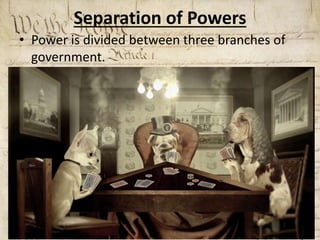
Separation of Powers
• Power is divided between three branches of
government.
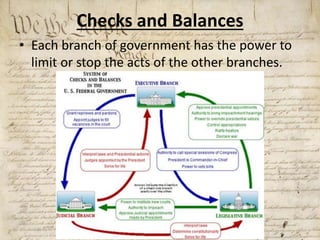
Checks and Balances
• Each branch of government has the power to
limit or stop the acts of the other branches.
Judicial Review
• Courts determine whether acts of Congress
and the President are constitutional.
• Created by court case Marbury v. Madison.
Federalism
• Power of government is divided between the
state and federal governments.
How is the Constitution Organized?
• Seven Articles – Each with a specific topic:
– Preamble (introduction) – Six purposes of govt
– Article I – Legislative Branch
– Article II – Executive Branch
– Article III – Judicial Branch
– Article IV – Relations among States
– Article V – Provisions for Amendments
– Article VI – Public Debts, Supremacy of National
Law
– Article VII – Ratification of the Constitution
Quick Review
• Articles of Confederation was first national
Constitution, legislative branch only, weak.
• New Constitution was written in 1787, ratified
in 1789.
• Federalists supported, Anti-Federalists
opposed.
• Bill of Rights written in 1789, ratified in 1791.
Formally Amending the Constitution
• A formal amendment changes written
language of Constitution itself.
• Four methods of formally amending:
# of Times Proposed By: Ratified By:
A. Used 26
times
Both houses of Congress have to
approve it with a 2/3 vote
Sent to 50 State legislatures and ¾
must approve (38 states)
B. Used 1
time (21st A)
Both houses of Congress have to
approve it with a 2/3 vote
Sent to 50 State Conventions and ¾
must approve
C. Never used National convention is called
propose a new amendment…2/3
of States vote to approve it
Sent to 50 State legislatures and ¾
must approve
D. Never
used
National convention is called to
propose a new amendment…2/3
of states vote to approve it
Sent to 50 State Conventions and ¾
must approve
Amendments worth noting
• 27 Amendments total
• #1-10 – Bill of Rights
• #13, 14, 15 – Civil War Amendments
• #18 – Prohibition
• #21 – Repealed Prohibition
• #5 & #14 – Due process of law
– Govt must follow the law.
• #19 – Women can vote in Fed elections
• #26 – Lowers voting age to 18 from 21
• More amendments deal with voting than
anything else.
Informally Amending the Constitution
• Changes to the Constitution through everyday acts of
government.
• Legislation – making laws, often to flesh out what
Constitution says.
– Ex – Judiciary Act of 1789 – Established Fed Courts in every
state.
– Can be vetoed by the President.
• Executive Action – President can act on his own within
constitutional limits.
– Ex – Executive Agreement – Pact b/t Prez & foreign head of
state.
• Court Decisions – Interpret & apply Constitution to
court cases.
– Marbury v Madison – Case established Judicial Review.
• SCOTUS determines constitutionality of laws bases on court cases.
Continued
• Political Parties – Shape law, even though
they are not mentioned in Constitution.
– Ex – Federalists & Anti-Federalists
• Customs – Presidential and Congressional
traditions.
– Ex – President’s Cabinet (14 Executive branch
department heads)
– Ex – Vice-Prez sworn in by custom until passage of
25th Amendment in 1967.
Criticisms of the Constitution
• It is not a perfect system.
• Checks and Balances can lead to Gridlock.
– Inability of government to get things done.
• Representation – in states with small
populations, people have far more influence
over their Senators.
• Electoral College – you can win the vote of the
people, but still lose the Presidency due to the
Electoral College system.
Test Review!!
1. The “Father of the Constitution” was _____________________________.
2. The Constitution was written in ________________, but it was not ratified
until ______________________.
3. The first ten amendments were ratified in __________, and they are
known as the _________________________.
4. The ___ Amendment about __________________ was the only one to
be ratified by method “B”.
5. The _______ Amendment cancelled #4
6. Who were the Federalists? Leaders?
7. Who were the Anti-Federalists? Leaders?
8. Why is Marbury v. Madison such a significant Supreme Court decision?
What did it determine?
9. What did the National Judiciary Act of 1789 provide?
10. What is the significance of the 13th, 14th, and 15th Amendments?
19. When the courts determine if the actions of the Legislative or Executive
branches are constitutional that is __________________
20. The President’s power to veto a bill passed by Congress is an example of
___________________________.
21. The principle of _______________________ means that the govt. must
operate within certain bounds set by the people.
22. The __________________ has the power to ask for war, but
_______________________ has to approve it (C and B).
23. How does Congress informally amend the Constitution?
24. The most common method of formally amending the Constitution is when
2/3s of ____________________ proposes the Amendment and 3/4s of
______________________________ ratify it.
25. The President has the power to appoint all federal _____________, but
_____________________ can remove them by impeachment.
26. The fact that govt. officials are subject to the law, not above is known as
_______________________; this is part of the principle of
___________________________________.
27. Each President selects a _____________________, or group of advisors;
this is also an ______________________ amendment.
28. The ______________ Amendment gave all citizens the right to vote at the
age of ____________.
29. The 27th Amendment does not allow __________________ to receive a
pay raise until the next term.
30. The principle of _______________________ states that govt. can only
govern if it has the consent of the _____________________.
31. One strong central government and several regional governments is the
principle of __________________________.
32. An ___________________________ can be made between the President
and one other head of state.
33. When something violates or is in contradiction to the Constitution then it
is ____________________________.
34. So far all amendments have been proposed by ________________, but a
___________________________ can be called to propose an
amendment.
35. The _________________________ was written as a compromise between
the Federalists and Anti-Federalists.
36. James Madison wrote extensive details about the Constitutional
Convention and this collection of information is known as _________

Ch_3_-_The_Constitution.pptx

  • 1.
    Ch. 3 –The Constitution
  • 2.
    The Six Principlesof Government • These are the basic foundational principles that the Constitution is based on:
  • 3.
    Popular Sovereignty • Thepeople are the only source of power.
  • 4.
    Limited Government • Governmentmay only do that which the people allow. • No one is above the law, not even government
  • 5.
    Separation of Powers •Power is divided between three branches of government.
  • 6.
    Checks and Balances •Each branch of government has the power to limit or stop the acts of the other branches.
  • 7.
    Judicial Review • Courtsdetermine whether acts of Congress and the President are constitutional. • Created by court case Marbury v. Madison.
  • 8.
    Federalism • Power ofgovernment is divided between the state and federal governments.
  • 9.
    How is theConstitution Organized? • Seven Articles – Each with a specific topic: – Preamble (introduction) – Six purposes of govt – Article I – Legislative Branch – Article II – Executive Branch – Article III – Judicial Branch – Article IV – Relations among States – Article V – Provisions for Amendments – Article VI – Public Debts, Supremacy of National Law – Article VII – Ratification of the Constitution
  • 10.
    Quick Review • Articlesof Confederation was first national Constitution, legislative branch only, weak. • New Constitution was written in 1787, ratified in 1789. • Federalists supported, Anti-Federalists opposed. • Bill of Rights written in 1789, ratified in 1791.
  • 11.
    Formally Amending theConstitution • A formal amendment changes written language of Constitution itself. • Four methods of formally amending: # of Times Proposed By: Ratified By: A. Used 26 times Both houses of Congress have to approve it with a 2/3 vote Sent to 50 State legislatures and ¾ must approve (38 states) B. Used 1 time (21st A) Both houses of Congress have to approve it with a 2/3 vote Sent to 50 State Conventions and ¾ must approve C. Never used National convention is called propose a new amendment…2/3 of States vote to approve it Sent to 50 State legislatures and ¾ must approve D. Never used National convention is called to propose a new amendment…2/3 of states vote to approve it Sent to 50 State Conventions and ¾ must approve
  • 12.
    Amendments worth noting •27 Amendments total • #1-10 – Bill of Rights • #13, 14, 15 – Civil War Amendments • #18 – Prohibition • #21 – Repealed Prohibition • #5 & #14 – Due process of law – Govt must follow the law. • #19 – Women can vote in Fed elections • #26 – Lowers voting age to 18 from 21 • More amendments deal with voting than anything else.
  • 13.
    Informally Amending theConstitution • Changes to the Constitution through everyday acts of government. • Legislation – making laws, often to flesh out what Constitution says. – Ex – Judiciary Act of 1789 – Established Fed Courts in every state. – Can be vetoed by the President. • Executive Action – President can act on his own within constitutional limits. – Ex – Executive Agreement – Pact b/t Prez & foreign head of state. • Court Decisions – Interpret & apply Constitution to court cases. – Marbury v Madison – Case established Judicial Review. • SCOTUS determines constitutionality of laws bases on court cases.
  • 14.
    Continued • Political Parties– Shape law, even though they are not mentioned in Constitution. – Ex – Federalists & Anti-Federalists • Customs – Presidential and Congressional traditions. – Ex – President’s Cabinet (14 Executive branch department heads) – Ex – Vice-Prez sworn in by custom until passage of 25th Amendment in 1967.
  • 15.
    Criticisms of theConstitution • It is not a perfect system. • Checks and Balances can lead to Gridlock. – Inability of government to get things done. • Representation – in states with small populations, people have far more influence over their Senators. • Electoral College – you can win the vote of the people, but still lose the Presidency due to the Electoral College system.
  • 16.
    Test Review!! 1. The“Father of the Constitution” was _____________________________. 2. The Constitution was written in ________________, but it was not ratified until ______________________. 3. The first ten amendments were ratified in __________, and they are known as the _________________________. 4. The ___ Amendment about __________________ was the only one to be ratified by method “B”. 5. The _______ Amendment cancelled #4 6. Who were the Federalists? Leaders? 7. Who were the Anti-Federalists? Leaders? 8. Why is Marbury v. Madison such a significant Supreme Court decision? What did it determine? 9. What did the National Judiciary Act of 1789 provide? 10. What is the significance of the 13th, 14th, and 15th Amendments?
  • 17.
    19. When thecourts determine if the actions of the Legislative or Executive branches are constitutional that is __________________ 20. The President’s power to veto a bill passed by Congress is an example of ___________________________. 21. The principle of _______________________ means that the govt. must operate within certain bounds set by the people. 22. The __________________ has the power to ask for war, but _______________________ has to approve it (C and B). 23. How does Congress informally amend the Constitution? 24. The most common method of formally amending the Constitution is when 2/3s of ____________________ proposes the Amendment and 3/4s of ______________________________ ratify it. 25. The President has the power to appoint all federal _____________, but _____________________ can remove them by impeachment. 26. The fact that govt. officials are subject to the law, not above is known as _______________________; this is part of the principle of ___________________________________. 27. Each President selects a _____________________, or group of advisors; this is also an ______________________ amendment.
  • 18.
    28. The ______________Amendment gave all citizens the right to vote at the age of ____________. 29. The 27th Amendment does not allow __________________ to receive a pay raise until the next term. 30. The principle of _______________________ states that govt. can only govern if it has the consent of the _____________________. 31. One strong central government and several regional governments is the principle of __________________________. 32. An ___________________________ can be made between the President and one other head of state. 33. When something violates or is in contradiction to the Constitution then it is ____________________________. 34. So far all amendments have been proposed by ________________, but a ___________________________ can be called to propose an amendment. 35. The _________________________ was written as a compromise between the Federalists and Anti-Federalists. 36. James Madison wrote extensive details about the Constitutional Convention and this collection of information is known as _________