Contents
CHAPTER 1: Introduction 1
EXERCISES 1.1: Background, page 5 . . . . . . . . . . . . . . . . . . . . . . . . . . 1
EXERCISES 1.2: Solutions and Initial Value Problems, page 14 . . . . . . . . . . . 3
EXERCISES 1.3: Direction Fields, page 22 . . . . . . . . . . . . . . . . . . . . . . . 10
EXERCISES 1.4: The Approximation Method of Euler, page 28 . . . . . . . . . . . 17
CHAPTER 2: First Order Differential Equations 27
EXERCISES 2.2: Separable Equations, page 46 . . . . . . . . . . . . . . . . . . . . 27
EXERCISES 2.3: Linear Equations, page 54 . . . . . . . . . . . . . . . . . . . . . . 41
EXERCISES 2.4: Exact Equations, page 65 . . . . . . . . . . . . . . . . . . . . . . 59
EXERCISES 2.5: Special Integrating Factors, page 71 . . . . . . . . . . . . . . . . . 72
EXERCISES 2.6: Substitutions and Transformations, page 78 . . . . . . . . . . . . 79
REVIEW PROBLEMS: page 81 . . . . . . . . . . . . . . . . . . . . . . . . . . . . . 90
CHAPTER 3: Mathematical Models and Numerical Methods Involving First
Order Equations 103
EXERCISES 3.2: Compartmental Analysis, page 98 . . . . . . . . . . . . . . . . . . 103
EXERCISES 3.3: Heating and Cooling of Buildings, page 107 . . . . . . . . . . . . 116
EXERCISES 3.4: Newtonian Mechanics, page 115 . . . . . . . . . . . . . . . . . . . 123
EXERCISES 3.5: Electrical Circuits, page 122 . . . . . . . . . . . . . . . . . . . . . 137
EXERCISES 3.6: Improved Euler’s Method, page 132 . . . . . . . . . . . . . . . . . 139
EXERCISES 3.7: Higher Order Numerical Methods: Taylor and Runge-Kutta, page 142 153
CHAPTER 4: Linear Second Order Equations 167
EXERCISES 4.1: Introduction: The Mass-Spring Oscillator, page 159 . . . . . . . . 167
EXERCISES 4.2: Homogeneous Linear Equations; The General Solution, page 167 . 169
EXERCISES 4.3: Auxiliary Equations with Complex Roots, page 177 . . . . . . . . 177
iii
EXERCISES 4.4: Nonhomogeneous Equations: The Method of Undetermined
Coefficients, page 186 . . . . . . . . . . . . . . . . . . . . . . . . . . . . . . . . . 189
EXERCISES 4.5: The Superposition Principle and Undetermined Coefficients
Revisited, page 192 . . . . . . . . . . . . . . . . . . . . . . . . . . . . . . . . . . . 196
EXERCISES 4.6: Variation of Parameters, page 197 . . . . . . . . . . . . . . . . . . 211
EXERCISES 4.7: Qualitative Considerations for Variable-Coefficient and Nonlinear
Equations, page 208 . . . . . . . . . . . . . . . . . . . . . . . . . . . . . . . . . . 226
EXERCISES 4.8: A Closer Look at Free Mechanical Vibrations, page 219 . . . . . . 232
EXERCISES 4.9: A Closer Look at Forced Mechanical Vibrations, page 227 . . . . 241
REVIEW PROBLEMS: page 228 . . . . . . . . . . . . . . . . . . . . . . . . . . . . 246
CHAPTER 5: Introduction to Systems and Phase Plane Analysis 259
EXERCISES 5.2: Elimination Method for Systems, page 250 . . . . . . . . . . . . . 259
EXERCISES 5.3: Solving Systems and Higher–Order Equations Numerically, page 261 282
EXERCISES 5.4: Introduction to the Phase Plane, page 274 . . . . . . . . . . . . . 293
EXERCISES 5.5: Coupled Mass-Spring Systems, page 284 . . . . . . . . . . . . . . 307
EXERCISES 5.6: Electrical Circuits, page 291 . . . . . . . . . . . . . . . . . . . . . 317
EXERCISES 5.7: Dynamical Systems, Poincar`e Maps, and Chaos, page 301 . . . . . 325
REVIEW PROBLEMS: page 304 . . . . . . . . . . . . . . . . . . . . . . . . . . . . 331
CHAPTER 6: Theory of Higher Order Linear Differential Equations 341
EXERCISES 6.1: Basic Theory of Linear Differential Equations, page 324 . . . . . . 341
EXERCISES 6.2: Homogeneous Linear Equations with Constant Coefficients, page 331 351
EXERCISES 6.3: Undetermined Coefficients and the Annihilator Method, page 337 361
EXERCISES 6.4: Method of Variation of Parameters, page 341 . . . . . . . . . . . . 375
REVIEW PROBLEMS: page 344 . . . . . . . . . . . . . . . . . . . . . . . . . . . . 384
CHAPTER 7: Laplace Transforms 389
EXERCISES 7.2: Definition of the Laplace Transform, page 359 . . . . . . . . . . . 389
EXERCISES 7.3: Properties of the Laplace Transform, page 365 . . . . . . . . . . . 396
EXERCISES 7.4: Inverse Laplace Transform, page 374 . . . . . . . . . . . . . . . . 402
EXERCISES 7.5: Solving Initial Value Problems, page 383 . . . . . . . . . . . . . . 413
EXERCISES 7.6: Transforms of Discontinuous and Periodic Functions, page 395 . . 428
EXERCISES 7.7: Convolution, page 405 . . . . . . . . . . . . . . . . . . . . . . . . 450
EXERCISES 7.8: Impulses and the Dirac Delta Function, page 412 . . . . . . . . . 459
EXERCISES 7.9: Solving Linear Systems with Laplace Transforms, page 416 . . . . 466
REVIEW PROBLEMS: page 418 . . . . . . . . . . . . . . . . . . . . . . . . . . . . 481
iv
CHAPTER 8: Series Solutions of Differential Equations 491
EXERCISES 8.1: Introduction: The Taylor Polynomial Approximation, page 430 . . 491
EXERCISES 8.2: Power Series and Analytic Functions, page 438 . . . . . . . . . . . 496
EXERCISES 8.3: Power Series Solutions to Linear Differential Equations, page 449 505
EXERCISES 8.4: Equations with Analytic Coefficients, page 456 . . . . . . . . . . . 520
EXERCISES 8.5: Cauchy-Euler (Equidimensional) Equations Revisited, page 460 . 529
EXERCISES 8.6: Method of Frobenius, page 472 . . . . . . . . . . . . . . . . . . . 534
EXERCISES 8.7: Finding a Second Linearly Independent Solution, page 482 . . . . 547
EXERCISES 8.8: Special Functions, page 493 . . . . . . . . . . . . . . . . . . . . . 559
REVIEW PROBLEMS: page 497 . . . . . . . . . . . . . . . . . . . . . . . . . . . . 563
CHAPTER 9: Matrix Methods for Linear Systems 569
EXERCISES 9.1: Introduction, page 507 . . . . . . . . . . . . . . . . . . . . . . . . 569
EXERCISES 9.2: Review 1: Linear Algebraic Equations, page 512 . . . . . . . . . . 570
EXERCISES 9.3: Review 2: Matrices and Vectors, page 521 . . . . . . . . . . . . . 573
EXERCISES 9.4: Linear Systems in Normal Form, page 530 . . . . . . . . . . . . . 577
EXERCISES 9.5: Homogeneous Linear Systems with Constant Coefficients, page 541 584
EXERCISES 9.6: Complex Eigenvalues, page 549 . . . . . . . . . . . . . . . . . . . 596
EXERCISES 9.7: Nonhomogeneous Linear Systems, page 555 . . . . . . . . . . . . 602
EXERCISES 9.8: The Matrix Exponential Function, page 566 . . . . . . . . . . . . 617
CHAPTER 10: Partial Differential Equations 629
EXERCISES 10.2: Method of Separation of Variables, page 587 . . . . . . . . . . . 629
EXERCISES 10.3: Fourier Series, page 603 . . . . . . . . . . . . . . . . . . . . . . . 635
EXERCISES 10.4: Fourier Cosine and Sine Series, page 611 . . . . . . . . . . . . . 639
EXERCISES 10.5: The Heat Equation, page 624 . . . . . . . . . . . . . . . . . . . . 644
EXERCISES 10.6: The Wave Equation, page 636 . . . . . . . . . . . . . . . . . . . 653
EXERCISES 10.7: Laplace’s Equation, page 649 . . . . . . . . . . . . . . . . . . . . 660
CHAPTER 11: Eigenvalue Problems and Sturm-Liouville Equations 675
EXERCISES 11.2: Eigenvalues and Eigenfunctions, page 671 . . . . . . . . . . . . . 675
EXERCISES 11.3: Regular Sturm-Liouville Boundary Value Problems, page 682 . . 683
EXERCISES 11.4: Nonhomogeneous Boundary Value Problems and the Fredholm Al-
ternative, page 692 . . . . . . . . . . . . . . . . . . . . . . . . . . . . . . . . . . . 687
EXERCISES 11.5: Solution by Eigenfunction Expansion, page 698 . . . . . . . . . . 690
EXERCISES 11.6: Green’s Functions, page 706 . . . . . . . . . . . . . . . . . . . . 694
EXERCISES 11.7: Singular Sturm-Liouville Boundary Value Problems, page 715 . . 701
v
EXERCISES 11.8: Oscillation and Comparison Theory, page 725 . . . . . . . . . . . 705
CHAPTER 12: Stability of Autonomous Systems 707
EXERCISES 12.2: Linear Systems in the Plane, page 753 . . . . . . . . . . . . . . . 707
EXERCISES 12.3: Almost Linear Systems, page 764 . . . . . . . . . . . . . . . . . 709
EXERCISES 12.4: Energy Methods, page 774 . . . . . . . . . . . . . . . . . . . . . 716
EXERCISES 12.5: Lyapunov’s Direct Method, page 782 . . . . . . . . . . . . . . . 718
EXERCISES 12.6: Limit Cycles and Periodic Solutions, page 791 . . . . . . . . . . 719
EXERCISES 12.7: Stability of Higher-Dimensional Systems, page 798 . . . . . . . . 722
CHAPTER 13: Existence and Uniqueness Theory 725
EXERCISES 13.1: Introduction: Successive Approximations, page 812 . . . . . . . . 725
EXERCISES 13.2: Picard’s Existence and Uniqueness Theorem, page 820 . . . . . . 733
EXERCISES 13.3: Existence of Solutions of Linear Equations, page 826 . . . . . . 741
EXERCISES 13.4: Continuous Dependence of Solutions, page 832 . . . . . . . . . . 743
vi
CHAPTER 1: Introduction
EXERCISES 1.1: Background, page 5
1. This equation involves only ordinary derivatives of x with respect to t, and the highest deriva-
tive has the second order. Thus it is an ordinary differential equation of the second order with
independent variable t and dependent variable x. It is linear because x, dx/dt, and d2
x/dt2
appear in additive combination (even with constant coefficients) of their first powers.
3. This equation is an ODE because it contains no partial derivatives. Since the highest order
derivative is dy/dx, the equation is a first order equation. This same term also shows us that
the independent variable is x and the dependent variable is y. This equation is nonlinear
because of the y in the denominator of the term [y(2 − 3x)]/[x(1 − 3y)] .
5. This equation is an ODE because it contains only ordinary derivatives. The term dp/dt is the
highest order derivative and thus shows us that this is a first order equation. This term also
shows us that the independent variable is t and the dependent variable is p. This equation
is nonlinear since in the term kp(P − p) = kPp − kp2
the dependent variable p is squared
(compare with equation (7) on page 5 of the text).
7. This equation is an ordinary first order differential equation with independent variable x and
dependent variable y. It is nonlinear because it contains the square of dy/dx.
9. This equation contains only ordinary derivative of y with respect to x. Hence, it is an ordi-
nary differential equation of the second order (the highest order derivative is d2
y/dx2
) with
independent variable x and dependent variable y. This equation is of the form (7) on page 5
of the text and, therefore, is linear.
1
Chapter 1
11. This equation contains partial derivatives, thus it is a PDE. Because the highest order deriva-
tive is a second order partial derivative, the equation is a second order equation. The terms
∂N/∂t and ∂N/∂r show that the independent variables are t and r and the dependent variable
is N.
13. Since the rate of change of a quantity means its derivative, denoting the coefficient propor-
tionality between dp/dt and p(t) by k (k > 0), we get
dp
dt
= kp.
15. In this problem, T ≥ M (coffee is hotter than the air), and T is a decreasing function of t,
that is dT/dt ≤ 0. Thus
dT
dt
= k(M − T),
where k > 0 is the proportionality constant.
17. In classical physics, the instantaneous acceleration, a, of an object moving in a straight line
is given by the second derivative of distance, x, with respect to time, t; that is
d2
x
dt2
= a.
Integrating both sides with respect to t and using the given fact that a is constant we obtain
dx
dt
= at + C. (1.1)
The instantaneous velocity, v, of an object is given by the first derivative of distance, x,
with respect to time, t. At the beginning of the race, t = 0, both racers have zero velocity.
Therefore we have C = 0. Integrating equation (1.1) with respect to t we obtain
x =
1
2
at2
+ C1 .
For this problem we will use the starting position for both competitors to be x = 0 at t = 0.
Therefore, we have C1 = 0. This gives us a general equation used for both racers as
x =
1
2
at2
or t =
2x
a
,
2
Exercises 1.2
where the acceleration constant a has different values for Kevin and for Alison. Kevin covers
the last 1
4
of the full distance, L, in 3 seconds. This means Kevin’s acceleration, aK, is
determined by:
tK − t3/4 = 3 =
2L
aK
−
2(3L/4)
aK
,
where tK is the time it takes for Kevin to finish the race. Solving this equation for aK gives,
aK =
√
2 − 3/2
2
9
L.
Therefore the time required for Kevin to finish the race is given by:
tK =
2L
√
2 − 3/2
2
L/9
=
3
√
2 − 3/2
√
2 = 12 + 6
√
3 ≈ 22.39 sec.
Alison covers the last 1/3 of the distance, L, in 4 seconds. This means Alison’s acceleration,
aA, is found by:
tA − t2/3 = 4 =
2L
aA
−
2(2L/3)
aA
,
where tA is the time required for Alison to finish the race. Solving this equation for aA gives
aA =
√
2 − 4/3
2
16
L.
Therefore the time required for Alison to finish the race is given by:
tA =
2L
√
2 − 4/3
2
(L/16)
=
4
√
2 − 4/3
√
2 = 12 + 4
√
6 ≈ 21.80 sec.
The time required for Alison to finish the race is less than Kevin; therefore Alison wins the
race by 6
√
3 − 4
√
6 ≈ 0.594 seconds.
EXERCISES 1.2: Solutions and Initial Value Problems, page 14
1. (a) Differentiating φ(x) yields φ (x) = 6x2
. Substitution φ and φ for y and y into the given
equation, xy = 3y, gives
x 6x2
= 3 2x3
,
3
Chapter 1
which is an identity on (−∞, ∞). Thus φ(x) is an explicit solution on (−∞, ∞).
(b) We compute
dφ
dx
=
d
dx
(ex
− x) = ex
− 1.
Functions φ(x) and φ (x) are defined for all real numbers and
dφ
dx
+φ(x)2
= (ex
− 1)+(ex
− x)2
= (ex
− 1)+ e2x
− 2xex
+ x2
= e2x
+(1−2x)ex
+x2
−1,
which is identically equal to the right-hand side of the given equation. Thus φ(x) is an
explicit solution on (−∞, ∞).
(c) Note that the function φ(x) = x2
− x−1
is not defined at x = 0. Differentiating φ(x)
twice yields
dφ
dx
=
d
dx
x2
− x−1
= 2x − (−1)x−2
= 2x + x−2
;
d2
φ
dx2
=
d
dx
dφ
dx
=
d
dx
2x + x−2
= 2 + (−2)x−3
= 2 1 − x−3
.
Therefore
x2 d2
φ
dx2
= x2
· 2 1 − x−3
= 2 x2
− x−1
= 2φ(x),
and φ(x) is an explicit solution to the differential equation x2
y = 2y on any interval not
containing the point x = 0, in particular, on (0, ∞).
3. Since y = sin x+x2
, we have y = cos x+2x and y = − sin x+2. These functions are defined
on (−∞, ∞). Substituting these expressions into the differential equation y + y = x2
+ 2
gives
y + y = − sin x + 2 + sin x + x2
= 2 + x2
= x2
+ 2 for all x in (−∞, ∞).
Therefore, y = sin x + x2
is a solution to the differential equation on the interval (−∞, ∞).
5. Differentiating x(t) = cos 2t, we get
dx
dt
=
d
dt
(cos 2t) = (− sin 2t)(2) = −2 sin 2t.
4
Exercises 1.2
So,
dx
dt
+ tx = −2 sin 2t + t cos 2t ≡ sin 2t
on any interval. Therefore, x(t) is not a solution to the given differential equation.
7. We differentiate y = e2x
− 3e−x
twice:
dy
dx
=
d
dx
e2x
− 3e−x
= e2x
(2) − 3e−x
(−1) = 2e2x
+ 3e−x
;
d2
y
dx2
=
d
dx
dy
dx
=
d
dx
2e2x
+ 3e−x
= 2e2x
(2) + 3e−x
(−1) = 4e2x
− 3e−x
.
Substituting y, y , and y into the differential equation and collecting similar terms, we get
d2
y
dx2
−
dy
dx
− 2y = 4e2x
− 3e−x
− 2e2x
+ 3e−x
− 2 e2x
− 3e−x
= (4 − 2 − 2)e2x
+ (−3 − 3 − 2(−3))e−x
= 0.
Hence y = e2x
− 3e−x
is an explicit solution to the given differential equation.
9. Differentiating the equation x2
+ y2
= 6 implicitly, we obtain
2x + 2yy = 0 ⇒ y = −
x
y
.
Since there can be no function y = f(x) that satisfies the differential equation y = x/y and
the differential equation y = −x/y on the same interval, we see that x2
+ y2
= 6 does not
define an implicit solution to the differential equation.
11. Differentiating the equation exy
+ y = x − 1 implicitly with respect to x yields
d
dx
(exy
+ y) =
d
dx
(x − 1)
⇒ exy d
dx
(xy) +
dy
dx
= 1
⇒ exy
y + x
dy
dx
+
dy
dx
= 1
⇒ yexy
+
dy
dx
(xexy
+ 1) = 1
⇒
dy
dx
=
1 − yexy
1 + xexy
=
exy
(e−xy
− y)
exy (e−xy + x)
=
e−xy
− y
e−xy + x
.
5
Chapter 1
Therefore, the function y(x) defined by exy
+ y = x − 1 is an implicit solution to the given
differential equation.
13. Differentiating the equation sin y + xy − x3
= 2 implicitly with respect to x, we obtain
y cos y + xy + y − 3x2
= 0
⇒ (cos y + x)y = 3x2
− y ⇒ y =
3x2
− y
cos y + x
.
Differentiating the second equation above again, we obtain
(−y sin y + 1)y + (cos y + x)y = 6x − y
⇒ (cos y + x)y = 6x − y + (y )2
sin y − y = 6x − 2y + (y )2
sin y
⇒ y =
6x − 2y + (y )2
sin y
cos y + x
.
Multiplying the right-hand side of this last equation by y /y = 1 and using the fact that
y =
3x2
− y
cos y + x
,
we get
y =
6x − 2y + (y )2
sin y
cos y + x
·
y
(3x2 − y)/(cos y + x)
=
6xy − 2(y )2
+ (y )3
sin y
3x2 − y
.
Thus y is an implicit solution to the differential equation.
15. We differentiate φ(x) and substitute φ and φ into the differential equation for y and y . This
yields
φ(x) = Ce3x
+ 1 ⇒
dφ(x)
dx
= Ce3x
+ 1 = 3Ce3x
;
dφ
dx
− 3φ = 3Ce3x
− 3 Ce3x
+ 1 = (3C − 3C)e3x
− 3 = −3,
which holds for any constant C and any x on (−∞, ∞). Therefore, φ(x) = Ce3x
+ 1 is a
one-parameter family of solutions to y −3y = −3 on (−∞, ∞). Graphs of these functions for
C = 0, ±0.5, ±1, and ±2 are sketched in Figure 1-A.
6
Exercises 1.2
–10
10
–0.5 0.5
C=2
C=1
C=0.5
C=0
C=−0.5
C=−1
C=−2
Figure 1–A: Graphs of the functions y = Ce3x
+ 1 for C = 0, ±0.5, ±1, and ±2.
17. Differentiating φ(x), we find that
φ (x) =
2
1 − cex
= 2 (1 − cex
)−1
= 2(−1) (1 − cex
)−2
(1 − cex
) = 2cex
(1 − cex
)−2
. (1.2)
On the other hand, substitution of φ(x) for y into the right-hand side of the given equation
yields
φ(x)(φ(x) − 2)
2
=
1
2
2
1 − cex
2
1 − cex
− 2
=
2
1 − cex
1
1 − cex
− 1 =
2
1 − cex
1 − (1 − cex
)
1 − cex
=
2cex
(1 − cex)2
,
which is identical to φ (x) found in (1.2).
19. Squaring and adding the terms dy/dx and y in the equation (dy/dx)2
+ y2
+ 3 = 0 gives a
nonnegative number. Therefore when these two terms are added to 3, the left-hand side will
always be greater than or equal to three and hence can never equal the right-hand side which
is zero.
7
Chapter 1
21. For φ(x) = xm
, we have φ (x) = mxm−1
and φ (x) = m(m − 1)xm−2
.
(a) Substituting these expressions into the differential equation, 3x2
y + 11xy − 3y = 0,
gives
3x2
m(m − 1)xm−2
+ 11x mxm−1
− 3xm
= 0
⇒ 3m(m − 1)xm
+ 11mxm
− 3xm
= 0
⇒ [3m(m − 1) + 11m − 3] xm
= 0
⇒ 3m2
+ 8m − 3 xm
= 0.
For the last equation to hold on an interval for x, we must have
3m2
+ 8m − 3 = (3m − 1)(m + 3) = 0.
Thus either (3m − 1) = 0 or (m + 3) = 0, which gives m =
1
3
, −3.
(b) Substituting the above expressions for φ(x), φ (x), and φ (x) into the differential equa-
tion, x2
y − xy − 5y = 0, gives
x2
m(m − 1)xm−2
− x mxm−1
− 5xm
= 0 ⇒ m2
− 2m − 5 xm
= 0.
For the last equation to hold on an interval for x, we must have
m2
− 2m − 5 = 0.
To solve for m we use the quadratic formula:
m =
2 ±
√
4 + 20
2
= 1 ±
√
6 .
23. In this problem, f(x, y) = x3
− y3
and so
∂f
∂y
=
∂ (x3
− y3
)
∂y
= −3y2
.
Clearly, f and ∂f/∂y (being polynomials) are continuous on the whole xy-plane. Thus the
hypotheses of Theorem 1 are satisfied, and the initial value problem has a unique solution for
any initial data, in particular, for y(0) = 6.
8
Exercises 1.2
25. Writing
dx
dt
= −
4t
x
= −4tx−1
,
we see that f(t, x) = −4tx−1
and ∂f(t, x)/∂x = ∂(−4tx−1
)/∂x = 4tx−2
. The functions
f(t, x) and ∂f(t, x)/∂x are not continuous only when x = 0. Therefore, they are continuous
in any rectangle R that contains the point (2, −π), but does not intersect the t-axis; for
instance, R = {(t, x) : 1 < t < 3, −2π < x < 0}. Thus, Theorem 1 applies, and the given
initial problem has a unique solution.
26. Here f(x, y) = 3x − 3
√
y − 1 and ∂f(x, y)/∂y = −1
3
(y − 1)−2/3
. Unfortunately, ∂f/∂y is not
continuous or defined when y = 1. So there is no rectangle containing (2, 1) in which both f
and ∂f/∂y are continuous. Therefore, we are not guaranteed a unique solution to this initial
value problem.
27. Rewriting the differential equation in the form dy/dx = x/y, we conclude that f(x, y) = x/y.
Since f is not continuous when y = 0, there is no rectangle containing the point (1, 0) in
which f is continuous. Therefore, Theorem 1 cannot be applied.
29. (a) Clearly, both functions φ1(x) ≡ 0 and φ2(x) = (x − 2)3
satisfy the initial condition,
y(2) = 0. Next, we check that they also satisfy the differential equation dy/dx = 3y2/3
.
dφ1
dx
=
d
dx
(0) = 0 = 3φ1(x)2/3
;
dφ2
dx
=
d
dx
(x − 2)3
= 3(x − 2)2
= 3 (x − 2)3 2/3
= 3φ2(x)2/3
.
Hence both functions, φ1(x) and φ2(x), are solutions to the initial value problem of
Exapmle 9.
(b) In this initial value problem,
f(x, y) = 3y2/3
⇒
∂f(x, y)
∂y
= 3
2
3
y2/3−1
=
2
y1/3
,
x0 = 0 and y0 = 10−7
. The function f(x, y) is continuous everywhere; ∂f(x, y)/∂y is
continuous in any region which does not intersect the x-axis (where y = 0). In particular,
9
Chapter 1
both functions, f(x, y) and ∂f(x, y)/∂y, are continuous in the rectangle
R = (x, y) : −1 < x < 1, (1/2)10−7
< y < (2)10−7
containing the initial point (0, 10−7
). Thus, it follows from Theorem 1 that the given
initial value problem has a unique solution in an interval about x0.
31. (a) To try to apply Theorem 1 we must first write the equation in the form y = f(x, y).
Here f(x, y) = 4xy−1
and ∂f(x, y)/∂y = −4xy−2
. Neither f nor ∂f/∂y are continuous
or defined when y = 0. Therefore there is no rectangle containing (x0, 0) in which both
f and ∂f/∂y are continuous, so Theorem 1 cannot be applied.
(b) Suppose for the moment that there is such a solution y(x) with y(x0) = 0 and x0 = 0.
Substituting into the differential equation we get
y(x0)y (x0) − 4x0 = 0 (1.3)
or
0 · y (x0) − 4x0 = 0 ⇒ 4x0 = 0.
Thus x0 = 0, which is a contradiction.
(c) Taking C = 0 in the implicit solution 4x2
− y2
= C given in Example 5 on page 9 gives
4x2
− y2
= 0 or y = ±2x. Both solutions y = 2x and y = −2x satisfy y(0) = 0.
EXERCISES 1.3: Direction Fields, page 22
1. (a) For y = ±2x,
dy
dx
=
d
dx
(±2x) = ±2 and
4x
y
=
4x
±2x
= ±2, x = 0.
Thus y = 2x and y = −2x are solutions to the differential equation dy/dx = 4x/y on
any interval not containing the point x = 0.
(b) , (c) See Figures B.1 and B.2 in the answers of the text.
10
Exercises 1.3
(d) As x → ∞ or x → −∞, the solution in part (b) increases unboundedly and has the lines
y = 2x and y = −2x, respectively, as slant asymptotes. The solution in part (c) also
increases without bound as x → ∞ and approaches the line y = 2x, while it is not even
defined for x < 0.
3. From Figure B.3 in the answers section of the text, we conclude that, regardless of the initial
velocity, v(0), the corresponding solution curve v = v(t) has the line v = 8 as a horizontal
asymptote, that is, limt→∞ v(t) = 8. This explains the name “terminal velocity” for the value
v = 8.
5. (a) The graph of the directional field is shown in Figure B.4 in the answers section of the
text.
(b), (c) The direction field indicates that all solution curves (other than p(t) ≡ 0) will approach
the horizontal line (asymptote) p = 1.5 as t → +∞. Thus limt→+∞ p(t) = 1.5 .
(d) No. The direction field shows that populations greater than 1500 will steadily decrease,
but can never reach 1500 or any smaller value, i.e., the solution curves cannot cross
the line p = 1.5 . Indeed, the constant function p(t) ≡ 1.5 is a solution to the given
logistic equation, and the uniqueness part of Theorem 1, page 12, prevents intersections
of solution curves.
6. (a) The slope of a solution to the differential equation dy/dx = x + sin y is given by dy/dx .
Therefore the slope at (1, π/2) is equal to
dy
dx
= 1 + sin
π
2
= 2.
(b) The solution curve is increasing if the slope of the curve is greater than zero. From part
(a) we know the slope to be x + sin y. The function sin y has values ranging from −1 to
1; therefore if x is greater than 1 then the slope will always have a value greater than
zero. This tells us that the solution curve is increasing.
(c) The second derivative of every solution can be determined by finding the derivative of
11
Chapter 1
the differential equation dy/dx = x + sin y. Thus
d
dx
dy
dx
=
d
dx
(x + sin y);
⇒
d2
y
dx2
= 1 + (cos y)
dy
dx
(chain rule)
= 1 + (cos y)(x + sin y) = 1 + x cos y + sin y cos y;
⇒
d2
y
dx2
= 1 + x cos y +
1
2
sin 2y.
(d) Relative minima occur when the first derivative, dy/dx, is equal to zero and the second
derivative, d2
y/dx2
, is greater than zero. The value of the first derivative at the point
(0, 0) is given by
dy
dx
= 0 + sin 0 = 0.
This tells us that the solution has a critical point at the point (0, 0). Using the second
derivative found in part (c) we have
d2
y
dx2
= 1 + 0 · cos 0 +
1
2
sin 0 = 1.
This tells us the point (0, 0) is a relative minimum.
7. (a) The graph of the directional field is shown in Figure B.5 in the answers section of the
text.
(b) The direction field indicates that all solution curves with p(0) > 1 will approach the
horizontal line (asymptote) p = 2 as t → +∞. Thus limt→+∞ p(t) = 2 when p(0) = 3.
(c) The direction field shows that a population between 1000 and 2000 (that is 1 < p(0) < 2)
will approach the horizontal line p = 2 as t → +∞.
(d) The direction field shows that an initial population less than 1000 (that is 0 ≤ p(0) < 1)
will approach zero as t → +∞.
(e) As noted in part (d), the line p = 1 is an asymptote. The direction field indicates that a
population of 900 (p(0) = 0.9) steadily decreases with time and therefore cannot increase
to 1100.
12
Exercises 1.3
9. (a) The function φ(x), being a solution to the given initial value problem, satisfies
dφ
dx
= x − φ(x), φ(0) = 1. (1.4)
Thus
d2
φ
dx2
=
d
dx
dφ
dx
=
d
dx
(x − φ(x)) = 1 −
dφ
dx
= 1 − x + φ(x),
where we have used (1.4) substituting (twice) x − φ(x) for dφ/dx.
(b) First we note that any solution to the given differential equation on an interval I is
continuously diferentiable on I. Indeed, if y(x) is a solution on I, then y (x) does exist
on I, and so y(x) is continuous on I because it is differentiable. This immediately implies
that y (x) is continuous as the difference of two continuous functions, x and y(x).
From (1.4) we conclude that
dφ
dx x=0
= [x − φ(x)] x=0
= 0 − φ(0) = −1 < 0
and so the continuity of φ (x) implies that, for |x| small enough, φ (x) < 0. By the
Monotonicity Test, negative derivative of a function results that the function itself is
decreasing.
When x increases from zero, as far as φ(x) > x, one has φ (x) < 0 and so φ(x) decreases.
On the other hand, the function y = x increases unboundedly, as x → ∞. Thus, by
intermediate value theorem, there is a point, say, x∗
> 0, where the curve y = φ(x)
crosses the line y = x. At this point, φ(x∗
) = x∗
and hence φ (x∗
) = x∗
− φ(x∗
) = 0.
(c) From (b) we conclude that x∗
is a critical point for φ(x) (its derivative vanishes at this
point). Also, from part (a), we see that
φ (x∗
) = 1 − φ (x∗
) = 1 > 0.
Hence, by Second Derivative Test, φ(x) has a relative minimum at x∗
.
(d) Remark that the arguments, used in part (c), can be applied to any point x, where
φ (x) = 0, to conclude that φ(x) has a relative minimum at x. Since a continuously
13
Chapter 1
differentiable function on an interval cannot have two relative minima on an interval
without having a point of relative maximum, we conclude that x∗
is the only point where
φ (x) = 0. Continuity of φ (x) implies that it has the same sign for all x > x∗
and,
therefore, it is positive there since it is positive for x > x∗
and close to x∗
(φ (x∗
) = 0
and φ (x∗
) > 0). By Monotonicity Test, φ(x) increases for x > x∗
.
(e) For y = x − 1, dy/dx = 1 and x − y = x − (x − 1) = 1. Thus the given differential
equation is satisfied, and y = x − 1 is indeed a solution.
To show that the curve y = φ(x) always stays above the line y = x − 1, we note that the
initial value problem
dy
dx
= x − y, y(x0) = y0 (1.5)
has a unique solution for any x0 and y0. Indeed, functions f(x, y) = x−y and ∂f/∂y ≡ −1
are continuous on the whole xy-plane, and Theorem 1, Section 1.2, applies. This implies
that the curve y = φ(x) always stays above the line y = x − 1:
φ(0) = 1 > −1 = (x − 1) x=0
,
and the existence of a point x with φ (x) ≤ (x − 1) would imply, by intermediate value
theorem, the existence of a point x0, 0 < x0 ≤ x, satisfying y0 := φ(x0) = x0 − 1 and,
therefore, there would be two solutions to the initial value problem (1.5).
Since, from part (a), φ (x) = 1−φ (x) = 1−x+φ(x) = φ(x)−(x−1) > 0, we also conclude
that φ (x) is an increasing function and φ (x) < 1. Thus there exists limx→∞ φ (x) ≤ 1.
The strict inequality would imply that the values of the function y = φ(x), for x large
enough, become smaller than those of y = x − 1. Therefore,
lim
x→∞
φ (x) = 1 ⇔ lim
x→∞
[x − φ(x)] = 1,
and so the line y = x − 1 is a slant asymptote for φ(x).
(f), (g) The direction field for given differential equation and the curve y = φ(x) are shown in
Figure B.6 in the answers of the text.
14
Exercises 1.3
11. For this equation, the isoclines are given by 2x = c. These are vertical lines x = c/2. Each
element of the direction field associated with a point on x = c/2 has slope c. (See Figure B.7
in the answers of the text.)
13. For the equation ∂y/∂x = −x/y, the isoclines are the curves −x/y = c. These are lines that
pass through the origin and have equations of the form y = mx, where m = −1/c , c = 0. If
we let c = 0 in −x/y = c, we see that the y-axis (x = 0) is also an isocline. Each element
of the direction field associated with a point on an isocline has slope c and is, therefore,
perpendicular to that isocline. Since circles have the property that at any point on the circle
the tangent at that point is perpendicular to a line from that point to the center of the circle,
we see that the solution curves will be circles with their centers at the origin. But since we
cannot have y = 0 (since −x/y would then have a zero in the denominator) the solutions will
not be defined on the x-axis. (Note however that a related form of this differential equation is
yy + x = 0. This equation has implicit solutions given by the equations y2
+ x2
= C. These
solutions will be circles.) The graph of φ(x), the solution to the equation satisfying the initial
condition y(0) = 4, is the upper semicircle with center at the origin and passing through the
point (0, 4) (see Figure B.8 in the answers of the text).
15. For the equation dy/dx = 2x2
−y, the isoclines are the curves 2x2
−y = c, or y = 2x2
−c. The
curve y = 2x2
− c is a parabola which is open upward and has the vertex at (0, −c). Three of
them, for c = −1, 0, and 2 (dotted curves), as well as the solution curve satisfying the initial
condition y(0) = 0, are depicted in Figure B.9.
17. The isoclines for the equation
dy
dx
= 3 − y +
1
x
are given by
3 − y +
1
x
= c ⇔ y =
1
x
+ 3 − c,
which are hyperbolas having x = 0 as a vertical asymptote and y = 3 − c as a horizontal
asymptote. Each element of the direction field associated with a point on such a hyperbola
has slope c. For x > 0 large enough: if an isocline is located above the line y = 3, then c ≤ 0,
15
Chapter 1
0
5
5 10
c=−5
c=−4
c=−3
c=−2
c=−1
c=1
c=2
c=3
c=4
3
Figure 1–B: Isoclines and the direction field for Problem 17.
and so the elements of the direction field have negative or zero slope; if an isocline is located
below the line y = 3, then c > 0, and so the elements of the direction field have positive slope.
In other words, for x > 0 large enough, at any point above the line y = 3 a solution curve
decreases passing through this point, and any solution curve increases passing through a point
below y = 3. The direction field for this differential equation is depicted in Figure 1-B. From
this picture we conclude that any solution to the differential equation dy/dx = 3 − y + 1/x
has the line y = 3 as a horizontal asymptote.
19. Integrating both sides of the equation dy/y = −dx/x yields
1
y
dy = −
1
x
dx ⇒ ln |y| = − ln |x| + C1 ⇒ ln |y| = ln
eC1
|x|
⇒ |y| =
eC1
|x|
⇒ |y| =
C2
|x|
,
where C1 is an arbitrary constant and so C2 := eC1
is an arbitrary positive constant. The last
equality can be written as
y = ±
C2
x
=
C
x
,
16
Exercises 1.4
where C = ±C2 is any nonzero constant. The value C = 0 gives y ≡ 0 (for x = 0), which is,
clearly, also a solution to the given equation.
EXERCISES 1.4: The Approximation Method of Euler, page 28
1. In this initial value problem, f(x, y) = x/y, x0 = 0, and y0 = −1. Thus, with h = 0.1, the
recursive formulas (2) and (3) on page 25 of the text become
xn+1 = xn + h = xn + 0.1 ,
yn+1 = yn + hf(xn, yn) = yn + 0.1 ·
xn
yn
, n = 0, 1, . . ..
We set n = 0 in these formulas and obtain
x1 = x0 + 0.1 = 0 + 0.1 = 0.1 ,
y1 = y0 + 0.1 ·
x0
y0
= −1 + 0.1 ·
0
−1
= −1.
Putting n = 1 in the recursive formulas yields
x2 = x1 + 0.1 = 0.1 + 0.1 = 0.2 ,
y2 = y1 + 0.1 ·
x1
y1
= −1 + 0.1 ·
0.1
−1
= −1.01 .
Continuing in the same manner, we find for n = 2, 3, and 4:
x3 = 0.2 + 0.1 = 0.3 , y3 = −1.01 + 0.1 ·
0.2
−1.01
= −1.02980 ;
x4 = 0.3 + 0.1 = 0.4 , y4 = −1.02980 + 0.1 ·
0.3
−1.02980
= −1.05893 ;
x5 = 0.4 + 0.1 = 0.5 , y5 = −1.05893 + 0.1 ·
0.4
−1.05893
= −1.09671 ,
where we have rounded off all answers to five decimal places.
2. In this problem, x0 = 0, y0 = 4, h = 0.1, and f(x, y) = −x/y. Thus, the recursive formulas
given in equations (2) and (3) on page 25 of the text become
xn+1 = xn + h = xn + 0.1 ,
17
Chapter 1
yn+1 = yn + hf(xn, yn) = yn + 0.1 · −
xn
yn
, n = 0, 1, 2, . . . .
To find an approximation for the solution at the point x1 = x0 + 0.1 = 0.1, we let n = 0 in
the last recursive formula to find
y1 = y0 + 0.1 · −
x0
y0
= 4 + 0.1 · (0) = 4.
To approximate the value of the solution at the point x2 = x1 + 0.1 = 0.2, we let n = 1 in the
last recursive formula to obtain
y2 = y1 + 0.1 · −
x1
y1
= 4 + 0.1 · −
0.1
4
= 4 −
1
400
= 3.9975 ≈ 3.998 .
Continuing in this way we find
x3 = x2 + 0.1 = 0.3 , y3 = y2 + 0.1 · −
x2
y2
= 3.9975 + 0.1 · −
0.2
3.9975
≈ 3.992 ,
x4 = 0.4 , y4 ≈ 3.985 ,
x5 = 0.5 , y5 ≈ 3.975 ,
where all of the answers have been rounded off to three decimal places.
3. Here f(x, y) = y(2 − y), x0 = 0, and y0 = 3. We again use recursive formulas from Euler’s
method with h = 0.1. Setting n = 0, 1, 2, 3, and 4 and rounding off results to three decimal
places, we get
x1 = x0 + 0.1 = 0.1 , y1 = y0 + 0.1 · [y0(2 − y0)] = 3 + 0.1 · [3(2 − 3)] = 2.700;
x2 = 0.1 + 0.1 = 0.2 , y2 = 2.700 + 0.1 · [2.700(2 − 2.700)] = 2.511;
x3 = 0.2 + 0.1 = 0.3 , y3 = 2.511 + 0.1 · [2.511(2 − 2.511)] ≈ 2.383;
x4 = 0.3 + 0.1 = 0.4 , y4 = 2.383 + 0.1 · [2.383(2 − 2.383)] ≈ 2.292;
x5 = 0.4 + 0.1 = 0.5 , y5 = 2.292 + 0.1 · [2.292(2 − 2.292)] ≈ 2.225 .
5. In this problem, f(x, y) = (y2
+ y)/x, x0 = y0 = 1, and h = 0.2. The recursive formulas (2)
and (3) on page 25 of the text, applied succesively with n = 1, 2, 3, and 4, yield
x1 = x0 + 0.2 = 1.2 , y1 = y0 + 0.2
y2
0 + y0
x0
= 1 + 0.2
12
+ 1
1
= 1.400;
18
Exercises 1.4
x2 = 1.2 + 0.2 = 1.4 , y2 = 1.400 + 0.2
1.4002
+ 1.400
1.2
≈ 1.960;
x3 = 1.4 + 0.2 = 1.6 , y3 = 1.960 + 0.2
1.9602
+ 1.960
1.4
≈ 2.789;
x4 = 1.6 + 0.2 = 1.8 , y4 = 2.789 + 0.2
2.7892
+ 2.789
1.6
≈ 4.110 .
7. For this problem notice that the independent variable is t and the dependent variable is x.
Hence, the recursive formulas given in equations (2) and (3) on page 25 of the text become
tn+1 = tn + h and φ(tn+1) ≈ xn+1 = xn + hf(tn, xn), n = 0, 1, 2, . . . .
For this problem, f(t, x) = 1+t sin(tx), t0 = 0, and x0 = 0. Thus the second recursive formula
above becomes
xn+1 = xn + h [1 + tn sin(tnxn)] , n = 0, 1, 2, . . . .
For the case N = 1, we have h = (1 − 0)/1 = 1 which gives us
t1 = 0 + 1 = 1 and φ(1) ≈ x1 = 0 + 1 · (1 + 0 · sin 0) = 1.
For the case N = 2, we have h = 1/2 = 0.5 . Thus we have
t1 = 0 + 0.5 = 0.5 , x1 = 0 + 0.5 · (1 + 0 · sin 0) = 0.5 ,
and
t2 = 0.5 + 0.5 = 1, φ(1) ≈ x2 = 0.5 + 0.5 · [1 + 0.5 · sin(0.25)] ≈ 1.06185 .
For the case N = 4, we have h = 1/4 = 0.25 , and so the recursive formulas become
tn+1 = tn + 0.25 and xn+1 = xn + 0.25 · [1 + tn sin(tnxn)] .
Therefore, we have
t1 = 0 + 0.25 = 0.25 , x1 = 0 + 0.25 · [1 + 0 · sin(0)] = 0.25 .
19
Chapter 1
Plugging these values into the recursive equations above yields
t2 = 0.25 + 0.25 = 0.5 and x2 = 0.25 + 0.25 · [1 + 0.25 · sin(0.0625)] = 0.503904 .
Continuing in this way gives
t3 = 0.75 and x3 = 0.503904 + 0.25 · [1 + 0.5 · sin(0.251952)] = 0.785066 ,
t4 = 1.00 and φ(1) ≈ x4 = 1.13920 .
For N = 8, we have h = 1/8 = 0.125 . Thus, the recursive formulas become
tn+1 = tn + 0.125 and xn+1 = xn + 0.125 · [1 + tn sin(tnxn)] .
Using these formulas and starting with t0 = 0 and x0 = 0, we can fill in Table 1-A. From this
we see that φ(1) ≈ x8 = 1.19157, which is rounded to five decimal places.
Table 1–A: Euler’s method approximations for the solution of x = 1+t sin(tx), x(0) = 0,
at t = 1 with 8 steps (h = 1/8).
nnn tttnnn xxxnnn
1 0.125 0.125
2 0.250 0.250244
3 0.375 0.377198
4 0.500 0.508806
5 0.625 0.649535
6 0.750 0.805387
7 0.875 0.983634
8 1.000 1.191572
9. To approximate the solution on the whole interval [1, 2] by Euler’s method with the step
h = 0.1, we first approximate the solution at the points xn = 1 + 0.1n, n = 1, . . ., 10. Then,
on each subinterval [xn, xn+1], we approximate the solution by the linear interval, connecting
20
Exercises 1.4
(xn, yn) with (xn+1, yn+1), n = 0, 1, . . ., 9. Since f(x, y) = x−2
− yx−1
− y2
, the recursive
formulas have the form
xn+1 = xn + 0.1 ,
yn+1 = yn + 0.1
1
x2
n
−
yn
xn
− y2
n , n = 0, 1, . . ., 9 ,
x0 = 1, y0 = −1. Therefore,
x1 = 1 + 0.1 = 1.1 , y1 = −1 + 0.1
1
12
−
−1
1
− (−1)2
= −0.9 ;
x2 = 1.1 + 0.1 = 1.2 , y2 = −0.9 + 0.1
1
1.12
−
−0.9
1.1
− (−0.9)2
≈ −0.81653719 ;
x3 = 1.2 + 0.1 = 1.3 , y3 = −0.81653719 + 0.1
1
1.22
−
−0.81653719
1.2
− (−0.81653719)2
≈ −0.74572128 ;
x4 = 1.3 + 0.1 = 1.4 , y4 = −0.74572128 + 0.1
1
1.32
−
−0.74572128
1.3
− (−0.74572128)2
≈ −0.68479653 ;
etc.
The results of these computations (rounded to five decimal places) are shown in Table 1-B.
Table 1–B: Euler’s method approximations for the solutions of y = x−2
− yx−1
− y2
,
y(1) = −1, on [1, 2] with h = 0.1.
nnn xxxnnn yyynnn nnn xxxnnn yyynnn
0 1.0 −1.00000 6 1.6 −0.58511
1 1.1 −0.90000 7 1.7 −0.54371
2 1.2 −0.81654 8 1.8 −0.50669
3 1.3 −0.74572 9 1.9 −0.47335
4 1.4 −0.68480 10 2.0 −0.44314
5 1.5 −0.63176
The function y(x) = −1/x = x−1
, obviously, satisfies the initial condition, y(1) = −1. Further
21
Chapter 1
–1
0
1.2 1.4 1.6 1.8 2
Polygonal approximation
y=−1/x
Figure 1–C: Polygonal line approximation and the actual solution for Problem 9.
we compute both sides of the given differential equation:
y (x) = −x−1
= x−2
,
f(x, y(x)) = x−2
− −x−1
x−1
− −x−1 2
= x−2
+ x−2
− x−2
= x−2
.
Thus, the function y(x) = −1/x is, indeed, the solution to the given initial value problem.
The graphs of the obtained polygonal line approximation and the actual solution are sketched
in Figure 1-C.
11. In this problem, the independent variable is t and the dependent variable is x; f(t, x) = 1+x2
,
t0 = 0, and x0 = 0.
The function φ(t) = tan t satisfies the initial condition: φ(0) = tan 0 = 0. The differential
equation is also satisfied:
dφ
dt
= sec2
t = 1 + tan2
t = 1 + φ(t)2
.
Therefore, φ(t) is the solution to the given initial value problem.
22
Exercises 1.4
For approximation of φ(t) at the point t = 1 with N = 20 steps, we take the step size
h = (1 − t0)/20 = 0.05. Thus, the recursive formulas for Euler’s method are
tn+1 = tn + 0.05 ,
xn+1 = xn + 0.05 1 + x2
n .
Applying these formulas with n = 0, 1, . . ., 19, we obtain
x1 = x0 + 0.05 1 + x2
0 = 0.05 ,
x2 = x1 + 0.05 1 + x2
1 = 0.05 + 0.05 1 + 0.052
= 0.100125 ,
x3 = x2 + 0.05 1 + x2
2 = 0.100125 + 0.05 1 + 0.1001252
≈ 0.150626 ,
...
x19 = x18 + 0.05 1 + x2
18 ≈ 1.328148 ,
φ(1) ≈ x20 = x19 + 0.05 1 + x2
19 = 1.328148 + 0.05 1 + 1.3281482
≈ 1.466347 ,
which is a good enough approximation to φ(1) = tan 1 ≈ 1.557408.
13. From Problem 12, yn = (1 + 1/n)n
and so limn→∞ [(e − yn)/(1/n)] is a 0/0 indeterminant. If
we let h = 1/n in yn and use L’Hospital’s rule, we get
lim
n→∞
e − yn
1/n
= lim
h→0
e − (1 + h)1/h
h
= lim
h→0
g(h)
h
= lim
h→0
g (h)
1
,
where g(h) = e − (1 + h)1/h
. Writing (1 + h)1/h
as eln(1+h)/h
the function g(h) becomes
g(h) = e − eln(1+h)/h
.
The first derivative is given by
g (h) = 0 −
d
dh
eln(1+h)/h
= −eln(1+h)/h d
dh
1
h
ln(1 + h) .
Substituting Maclaurin’s series for ln(1 + h) we obtain
g (h) = −(1 + h)1/h d
dh
1
h
h −
1
2
h2
+
1
3
h3
−
1
4
h4
+ · · ·
23
Chapter 1
= −(1 + h)1/h d
dh
1 −
1
2
h +
1
3
h2
−
1
4
h3
+ · · ·
= −(1 + h)1/h
−
1
2
+
2
3
h −
3
4
h2
+ · · · .
Hence
lim
h→0
g (h) = lim
h→0
−(1 + h)1/h
−
1
2
+
2
3
h −
3
4
h2
+ · · ·
= − lim
h→0
(1 + h)1/h
· lim
h→0
−
1
2
+
2
3
h −
3
4
h2
+ · · · .
From calculus we know that e = lim
h→0
(1 + h)1/h
, which gives
lim
h→0
g (h) = −e −
1
2
=
e
2
.
So we have
lim
n→∞
e − yn
1/n
=
e
2
.
15. The independent variable in this problem is the time t and the dependent variable is the
temperature T(t) of a body. Thus, we will use the recursive formulas (2) and (3) on page 25
with x replaced by t and y replaced by T. In the differential equation describing the Newton’s
Law of Cooling, f(t, T) = K(M(t) − T). With the suggested values of K = 1 (min)−1
,
M(t) ≡ 70◦
, h = 0.1, and the initial condition T(0) = 100◦
, the initial value problem becomes
dT
dt
= 70 − T, T(0) = 100,
and so the recursive formulas are
tn+1 = tn + 0.1 ,
Tn+1 = Tn + 0.1(70 − Tn).
For n = 0,
t1 = t0 + 0.1 = 0.1 , T1 = T0 + 0.1(70 − T0) = 100 + 0.1(70 − 100) = 97 ;
24
Exercises 1.4
for n = 1,
t2 = t1 + 0.1 = 0.2 , T2 = T1 + 0.1(70 − T1) = 97 + 0.1(70 − 97) = 94.3 ;
for n = 2,
t3 = t2 + 0.1 = 0.3 , T3 = T2 + 0.1(70 − T2) = 94.3 + 0.1(70 − 94.3) = 91.87 .
Table 1–C: Euler’s method approximations for the solutions of T = K(M − T),
T(0) = 100, with K = 1, M = 70, and h = 0.1.
nnn tttnnn TTTnnn nnn tttnnn TTTnnn
0 0.0 100.00 11 1.1 79.414
1 0.1 97.000 12 1.2 78.473
2 0.2 94.300 13 1.3 77.626
3 0.3 91.870 14 1.4 76.863
4 0.4 89.683 15 1.5 76.177
5 0.5 87.715 16 1.6 75.559
6 0.6 85.943 17 1.7 75.003
7 0.7 84.349 18 1.8 74.503
8 0.8 82.914 19 1.9 74.053
9 0.9 81.623 20 2.0 73.647
10 1.0 80.460
By continuing this way and rounding results to three decimal places, we fill in Table 1-C.
From this table we conclude that
(a) the temperature of a body after 1 minute T(1) ≈ 80.460◦
and
(b) its temperature after 2 minutes T(2) ≈ 73.647◦
.
16. For this problem notice that the independent variable is t and the dependent variable is T.
Hence, in the recursive formulas for Euler’s method, the t will take the place of the x and the
25
Chapter 1
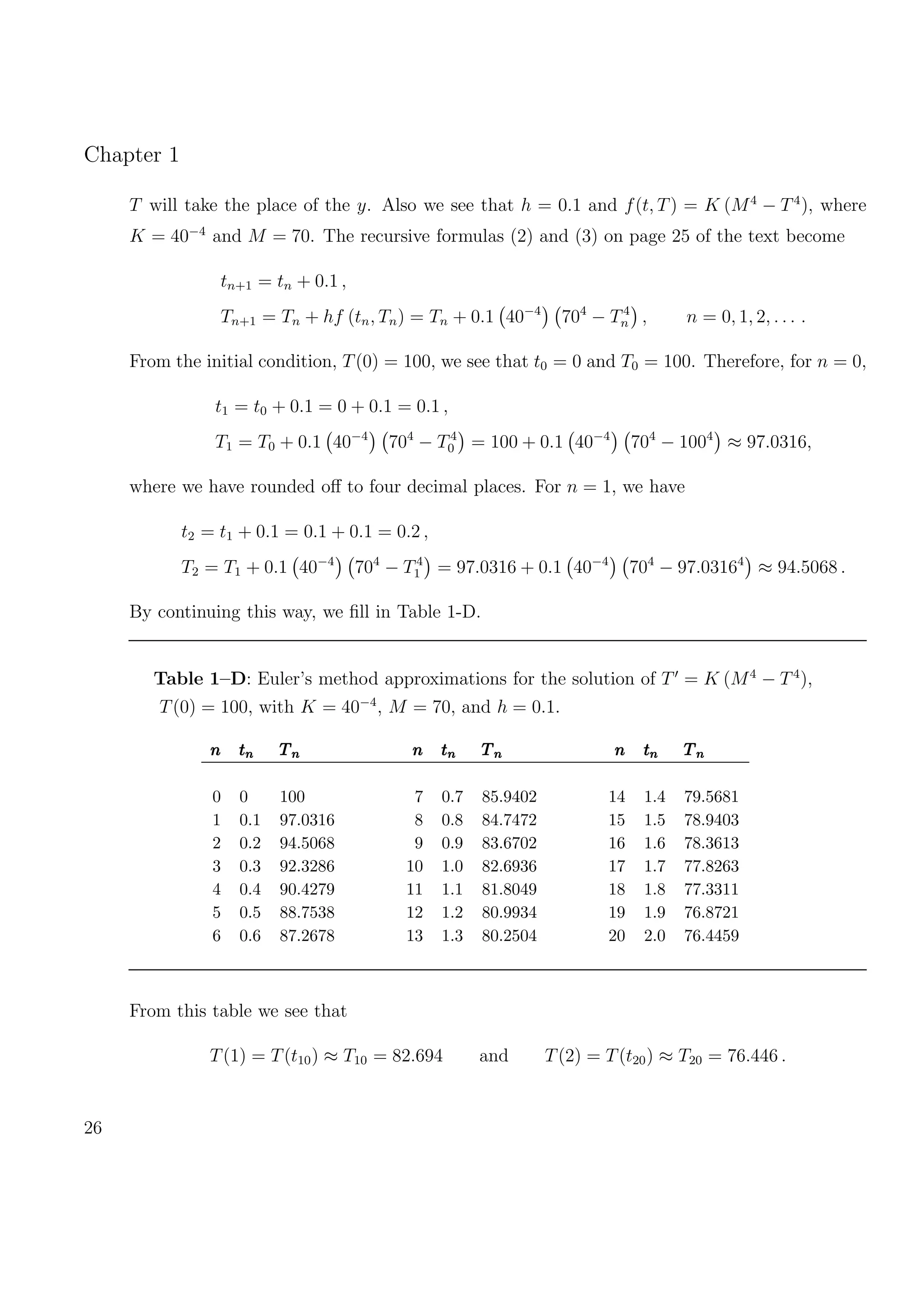
T will take the place of the y. Also we see that h = 0.1 and f(t, T) = K (M4
− T4
), where
K = 40−4
and M = 70. The recursive formulas (2) and (3) on page 25 of the text become
tn+1 = tn + 0.1 ,
Tn+1 = Tn + hf (tn, Tn) = Tn + 0.1 40−4
704
− T4
n , n = 0, 1, 2, . . . .
From the initial condition, T(0) = 100, we see that t0 = 0 and T0 = 100. Therefore, for n = 0,
t1 = t0 + 0.1 = 0 + 0.1 = 0.1 ,
T1 = T0 + 0.1 40−4
704
− T4
0 = 100 + 0.1 40−4
704
− 1004
≈ 97.0316,
where we have rounded off to four decimal places. For n = 1, we have
t2 = t1 + 0.1 = 0.1 + 0.1 = 0.2 ,
T2 = T1 + 0.1 40−4
704
− T4
1 = 97.0316 + 0.1 40−4
704
− 97.03164
≈ 94.5068 .
By continuing this way, we fill in Table 1-D.
Table 1–D: Euler’s method approximations for the solution of T = K (M4
− T4
),
T(0) = 100, with K = 40−4
, M = 70, and h = 0.1.
nnn tttnnn TTTnnn nnn tttnnn TTTnnn nnn tttnnn TTTnnn
0 0 100 7 0.7 85.9402 14 1.4 79.5681
1 0.1 97.0316 8 0.8 84.7472 15 1.5 78.9403
2 0.2 94.5068 9 0.9 83.6702 16 1.6 78.3613
3 0.3 92.3286 10 1.0 82.6936 17 1.7 77.8263
4 0.4 90.4279 11 1.1 81.8049 18 1.8 77.3311
5 0.5 88.7538 12 1.2 80.9934 19 1.9 76.8721
6 0.6 87.2678 13 1.3 80.2504 20 2.0 76.4459
From this table we see that
T(1) = T(t10) ≈ T10 = 82.694 and T(2) = T(t20) ≈ T20 = 76.446 .
26
CHAPTER 2: First Order Differential Equations
EXERCISES 2.2: Separable Equations, page 46
1. This equation is separable because we can separate variables by multiplying both sides by dx
and dividing by 2y3
+ y + 4.
3. This equation is separable because
dy
dx
=
yex+y
x2 + 2
=
ex
x2 + 2
yey
= g(x)p(y).
5. Writing the equation in the form
ds
dt
=
s + 1
st
− s2
,
we see that the right-hand side cannot be represented in the form g(t)p(s). Therefore, the
equation is not separable.
7. Multiplying both sides of the equation by y2
dx and integrating yields
y2
dy = (1 − x2
)dx ⇒ y2
dy = (1 − x2
)dx
⇒
1
3
y3
= x −
1
3
x3
+ C1 ⇒ y3
= 3x − x3
+ C ⇒ y =
3
√
3x − x3 + C ,
where C := 3C1 is an arbitrary constant.
9. To separate variables, we divide the equation by y and multiply by dx. This results
dy
dx
= y(2 + sin x) ⇒
dy
y
= (2 + sin x)dx
⇒
dy
y
= (2 + sin x)dx ⇒ ln |y| = 2x − cos x + C1
⇒ |y| = e2x−cos x+C1
= eC1
e2x−cos x
= C2e2x−cos x
,
27
Chapter 2
where C1 is an arbitrary constant and, therefore, C2 := eC1
is an arbitrary positive constant.
We can rewrite the above solution in the form
y = ±C2e2x−cos x
= Ce2x−cos x
, (2.1)
with C := C2 or C = −C2. Thus C is an arbitrary nonzero constant. The value C = 0 in
(2.1) gives y(x) ≡ 0, which is, clearly, is also a solution to the differential equation. Therefore,
the answer to the problem is given by (2.1) with an arbitrary constant C.
11. Separating variables, we obtain
dy
sec2 y
=
dx
1 + x2
.
Using the trigonometric identities sec y = 1/ cos y and cos2
y = (1 + cos 2y)/2 and integrating,
we get
dy
sec2 y
=
dx
1 + x2
⇒
(1 + cos 2y)dy
2
=
dx
1 + x2
⇒
(1 + cos 2y)dy
2
=
dx
1 + x2
⇒
1
2
y +
1
2
sin 2y = arctan x + C1
⇒ 2y + sin 2y = 4 arctan x + 4C1 ⇒ 2y + sin 2y = 4 arctan x + C.
The last equation defines implicit solutions to the given differential equation.
13. Writing the given equation in the form dx/dt = x − x2
, we separate the variables to get
dx
x − x2
= dt .
Integrate (the left side is integrated by partial fractions, with 1/(x − x2
) = 1/x + 1/(1 − x))
to obtain:
ln |x| − ln |1 − x| = t + c ⇒ ln
x
1 − x
= t + c
⇒
x
1 − x
= ±et+c
= Cet
, where C = ec
⇒ x = Cet
− xCet
⇒ x + xCet
= Cet
28
Exercises 2.2
⇒ x 1 + Cet
= Cet
⇒ x =
Cet
1 + Cet
.
Note: When C is replaced by −K, this answer can also be written as x = Ket
/(Ket
− 1).
Further we observe that since we divide by x − x2
= x(1 − x), then x ≡ 0 and x ≡ 1 are also
solutions. Allowing K to be zero gives x ≡ 0, but no choice for K will give x ≡ 1, so we list
this as a separate solution.
15. To separate variables, we move the term containin dx to the right-hand side of the equation
and divide both sides of the result by y. This yields
y−1
dy = −yecos x
sin x dx ⇒ y−2
dy = −ecos x
sin x dx.
Integrating the last equation, we obtain
y−2
dy = (−ecos x
sin x) dx ⇒ −y−1
+ C = eu
du (u = cos x)
⇒ −
1
y
+ C = eu
= ecos x
⇒ y =
1
C − ecos x
,
where C is an arbitrary constant.
17. First we find a general solution to the equation. Separating variables and integrating, we get
dy
dx
= x3
(1 − y) ⇒
dy
1 − y
= x3
dx
⇒
dy
1 − y
= x3
dx ⇒ − ln |1 − y| + C1 =
x4
4
⇒ |1 − y| = exp C1 −
x4
4
= Ce−x4/4
.
To find C, we use the initial condition, y(0) = 3. Thus, substitution 3 for y and 0 for x into
the last equation yields
|1 − 3| = Ce−04/4
⇒ 2 = C.
Therefore, |1 − y| = 2e−x4/4
. Finally, since 1 − y(0) = 1 − 3 < 0, on an interval containing
x = 0 one has 1 − y(x) < 0 and so |1 − y(x)| = y(x) − 1. The solution to the problem is then
y − 1 = 2e−x4/4
or y = 2e−x4/4
+ 1.
29
Chapter 2
19. For a general solution, separate variables and integrate:
dy
dθ
= y sin θ ⇒
dy
y
= sin θ dθ
⇒
dy
y
= sin θ dθ ⇒ ln |y| = − cos θ + C1
⇒ |y| = e− cos θ+C1
= Ce− cos θ
⇒ y = −Ce− cos θ
(because at the initial point, θ = π, y(π) < 0). We substitute now the initial condition,
y(π) = −3, and obtain
−3 = y(π) = −Ce− cos π
= −Ce ⇒ C = 3e−1
.
Hence, the answer is given by y = −3e−1
e− cos θ
= −3e−1−cos θ
.
21. Separate variables to obtain
1
2
(y + 1)−1/2
dy = cos x dx.
Integrating, we have
(y + 1)1/2
= sin x + C.
Using the fact that y(π) = 0, we find
1 = sin π + C ⇒ C = 1.
Thus
(y + 1)1/2
= sin x + 1 ⇒ y = (sin x + 1)2
− 1 = sin2
x + 2 sin x .
23. We have
dy
dx
= 2x cos2
y ⇒
dy
cos2 y
= 2x dx ⇒ sec2
y dy = 2x dx
⇒ sec2
y dy = 2x dx ⇒ tan y = x2
+ C.
Since y = π/4 when x = 0, we get tan(π/4) = 02
+ C and so C = 1. The solution, therefore,
is
tan y = x2
+ 1 ⇔ y = arctan x2
+ 1 .
30
Exercises 2.2
25. By separating variables we obtain (1 + y)−1
dy = x2
dx. Integrating yields
ln |1 + y| =
x3
3
+ C . (2.2)
Substituting y = 3 and x = 0 from the initial condition, we get ln 4 = 0 + C, which implies
that C = ln 4. By substituting this value for C into equation (2.2) above, we have
ln |1 + y| =
x3
3
+ ln 4 .
Hence,
eln |1+y|
= e(x3/3)+ln 4
= ex3/3
eln 4
= 4ex3/3
⇒ 1 + y = 4ex3/3
⇒ y = 4ex3/3
− 1 .
We can drop the absolute signs above because we are assuming from the initial condition that
y is close to 3 and therefore 1 + y is positive.
27. (a) The differential equation dy/dx = ex2
separates if we multiply by dx. We integrate the
separated equation from x = 0 to x = x1 to obtain
x1
0
ex2
dx =
x=x1
x=0
dy = y
x=x1
x=0
= y(x1) − y(0).
If we let t be the variable of integration and replace x1 by x and y(0) by 0, then we can
express the solution to the initial value problem as
y(x) =
x
0
et2
dt.
(b) The differential equation dy/dx = ex2
y−2
separates if we multiply by y2
and dx. We
integrate the separated equation from x = 0 to x = x1 to obtain
x1
0
ex2
dx =
x1
0
y2
dy =
1
3
y3
x=x1
x=0
=
1
3
y(x1)3
− y(0)3
.
31
Chapter 2
If we let t be the variable of integration and replace x1 by x and y(0) by 1 in the above
equation, then we can express the initial value problem as
x
0
et2
dt =
1
3
y(x)3
− 1 .
Solving for y(x) we arrive at
y(x) =

1 + 3
x
0
et2
dt


1/3
. (2.3)
(c) The differential equation dy/dx =
√
1 + sin x(1 + y2
) separates if we divide by (1 + y2
)
and multiply by dx. We integrate the separated equation from x = 0 to x = x1 and find
x1
0
√
1 + sin x dx =
x=x1
x=0
(1 + y2
)−1
dy = tan−1
y(x1) − tan−1
y(0).
If we let t be the variable of integration and replace x1 by x and y(0) by 1 then we can
express the solution to the initial value problem by
y(x) = tan


x
0
√
1 + sin t dt +
π
4

 .
(d) We will use Simpson’s rule (Appendix B) to approximate the definite integral found in
part (b). (Simpson’s rule is implemented on the website for the text.) Simpson’s rule
requires an even number of intervals, but we don’t know how many are required to obtain
the desired three-place accuracy. Rather than make an error analysis, we will compute
the approximate value of y(0.5) using 2, 4, 6, . . . intervals for Simpson’s rule until the
approximate values for y(0.5) change by less than five in the fourth place.
For n = 2, we divide [0, 0.5] into 4 equal subintervals. Thus each interval will be of length
(0.5 − 0)/4 = 1/8 = 0.125. Therefore, the integral is approximated by
0.5
0
ex2
dx =
1
24
e0
+ 4e(0.125)2
+ 2e(0.25)2
+ 4e(0.325)2
+ e(0.5)2
≈ 0.544999003 .
32
Exercises 2.2
Substituting this value into equation (2.3) from part (b) yields
y(0.5) ≈ [1 + 3(0.544999003)]1/3
≈ 1.38121 .
Repeating these calculations for n = 3, 4, and 5 yields Table 2-A.
Table 2–A: Successive approximations for y(0.5) using Simpson’s rule.
Number of Intervals yyy(0.5)
6 1.38120606
8 1.38120520
10 1.38120497
Since these values do not change by more than 5 in the fourth place, we can conclude that
the first three places are accurate and that we have obtained an approximate solution
y(0.5) ≈ 1.381 .
29. (a) Separating variables and integrating yields
dy
y1/3
= dx ⇒
dy
y1/3
= dx
⇒
1
2/3
y2/3
= x + C1 ⇒ y =
2
3
x +
2
3
C1
3/2
=
2x
3
+ C
3/2
.
(b) Using the initial condition, y(0) = 0, we find that
0 = y(0) =
2(0)
3
+ C
3/2
= C3/2
⇒ C = 0 ,
and so y = (2x/3 + 0)3/2
= (2x/3)3/2
, x ≥ 0, is a solution to the initial value problem.
(c) The function y(x) ≡ 0, clearly, satisfies both, the differential equation dy/dx = y1/3
and
the initial condition y(0) = 0.
(d) In notation of Theorem 1 on page 12, f(x, y) = y1/3
and so
∂f
∂y
=
d
dy
y1/3
=
1
3
y−2/3
=
1
3y2/3
.
33
Chapter 2
Since ∂f/∂y is not continuous when y = 0, there is no rectangle containing the point
(0, 0) in which both, f and ∂f/∂y, are continuous. Therefore, Theorem 1 does not apply
to this initial value problem.
30. (a) Dividing the equation by (y + 1)2/3
and multiplying by dx separate variables. Thus we
get
dy
dx
= (x − 3)(y + 1)2/3
⇒
dy
(y + 1)2/3
= (x − 3)dx
⇒
dy
(y + 1)2/3
= (x − 3)dx ⇒ 3(y + 1)1/3
=
x2
2
− 3x + C1
⇒ y + 1 =
x2
6
− x +
C1
3
3
⇒ y = −1 +
x2
6
− x + C
3
. (2.4)
(b) Substitution y(x) ≡ −1 into the differential equation gives
d(−1)
dx
= (x − 3)[(−1) + 1]2/3
⇒ 0 = (x − 3) · 0,
which is an identity. Therefore, y(x) ≡ −1 is, indeed, a solution.
(c) With any choice of constant C, x2
/6 − x + C is a quadratic polynomial which is not
identically zero. So, in (2.4), y = −1 + (x2
/6 − x + C)
3
≡ − 1 for all C, and the solution
y(x) ≡ −1 was lost in separation of variables.
31. (a) Separating variables and integrating yields
dy
y3
= x dx ⇒
dy
y3
= x dx
⇒
1
−2
y−2
=
1
2
x2
+ C1 ⇒ y−2
= −x2
− 2C1
⇒ x2
+ y−2
= C, (2.5)
where C := −2C1 is an arbitrary constant.
(b) To find the solution satisfying the initial condition y(0) = 1, we substitute in (2.5) 0 for
x and 1 for y and obtain
02
+ 1−2
= C ⇒ C = 1 ⇒ x2
+ y−2
= 1.
34
Exercises 2.2
Solving for y yields
y = ±
1
√
1 − x2
. (2.6)
Since, at the initial point, x = 0, y(0) = 1 > 1, we choose the positive sign in the above
expression for y. Thus, the solution is
y =
1
√
1 − x2
.
Similarly we find solutions for the other two initial conditions:
y(0) =
1
2
⇒ C = 4 ⇒ y =
1
√
4 − x2
;
y(0) = 2 ⇒ C =
1
4
⇒ y =
1
(1/4) − x2
.
(c) For the solution to the first initial problem in (b), y(0) = 1, the domain is the set of all
values of x satisfying two conditions
1 − x2
≥ 0 (for existence of the square root)
1 − x2
= 0 (for existence of the quotient)
⇒ 1 − x2
> 0.
Solving for x, we get
x2
< 1 ⇒ |x| < 1 or − 1 < x < 1.
In the same manner, we find domains for solutions to the other two initial value problems:
y(0) =
1
2
⇒ −2 < x < 2 ;
y(0) = 2 ⇒ −
1
2
< x <
1
2
.
(d) First, we find the solution to the initial value problem y(0) = a, a > 0, and its domain.
Following the lines used in (b) and (c) for particular values of a, we conclude that
y(0) = a ⇒ 02
+ a−2
= C ⇒ y =
1
√
a−2 − x2
and so its domain is
a−2
− x2
> 0 ⇒ x2
< a−2
⇒ −
1
a
< x <
1
a
.
As a → +0, 1/a → +∞, and the domain expands to the whole real line; as a → +∞,
1/a → 0, and the domain shrinks to x = 0.
35
Chapter 2
–4
–2
0
2
4
–2 2
a=
1
2 a=1 a=2
a=−
1
2 a=−1 a=−2
Figure 2–A: Solutions to the initial value problem y = xy3
, y(0) = a, a ± 0.5, ±1,
and ±2.
(e) For the values a = 1/2, 1, and 2 the solutions are found in (b); for a = −1, we just have
to choose the negative sign in (2.6); similarly, we reverse signs in the other two solutions
in (b) to obtain the answers for a = −1/2 and −2. The graphs of these functions are
shown in Figure 2-A.
33. Let A(t) be the number of kilograms of salt in the tank at t minutes after the process begins.
Then we have
dA(t)
dt
= rate of salt in − rate of salt out.
rate of salt in = 10 L/min × 0.3 kg/L = 3 kg/min.
Since the tank is kept uniformly mixed, A(t)/400 is the mass of salt per liter that is flowing
out of the tank at time t. Thus we have
rate of salt out = 10 L/min ×
A(t)
400
kg/L =
A(t)
40
kg/min.
36
Exercises 2.2
Therefore,
dA
dt
= 3 −
A
40
=
120 − A
40
.
Separating this differential equation and integrating yield
40
120 − A
dA = dt ⇒ −40 ln |120 − A| = t + C
⇒ ln |120 − A| = −
t
40
+ C, where −
C
40
is replaced by C
⇒ 120 − A = Ce−t/40
, where C can now be positive or negative
⇒ A = 120 − Ce−t/40
.
There are 2 kg of salt in the tank initially, thus A(0) = 2. Using this initial condition, we find
2 = 120 − C ⇒ C = 118 .
Substituting this value of C into the solution, we have
A = 120 − 118e−t/40
.
Thus
A(10) = 120 − 118e−10/40
≈ 28.1 kg.
Note: There is a detailed discussion of mixture problems in Section 3.2.
35. In Problem 34 we saw that the differential equation dT/dt = k(M − T) can be solved by
separation of variables to yield
T = Cekt
+ M.
When the oven temperature is 120◦
we have M = 120. Also T(0) = 40. Thus
40 = C + 120 ⇒ C = −80.
Because T(45) = 90, we have
90 = −80e45k
+ 120 ⇒
3
8
= e45k
⇒ 45k = ln
3
8
.
Thus k = ln(3/8)/45 ≈ −0.02180. This k is independent of M. Therefore, we have the
general equation
T(t) = Ce−0.02180t
+ M.
37
Chapter 2
(a) We are given that M = 100. To find C we must solve the equation T(0) = 40 = C +100.
This gives C = −60. Thus the equation becomes
T(t) = −60e−0.02180t
+ 100.
We want to solve for t when T(t) = 90. This gives us
90 = −60e−0.02180t
+ 100 ⇒
1
6
= e−0.02180t
⇒ −0.0218t = ln
1
6
⇒ 0.0218t = ln 6 .
Therefore t = ln 6/0.0218 ≈ 82.2 min.
(b) Here M = 140, so we solve
T(0) = 40 = C + 140 ⇒ C = −100.
As above, solving for t in the equation
T(t) = −100e−0.02180t
+ 140 = 90 ⇒ t ≈ 31.8 .
(c) With M = 80, we solve
40 = C + 80,
yielding C = −40. Setting
T(t) = −40e−0.02180t
+ 80 = 90 ⇒ −
1
4
= e−0.02180t
.
This last equation is impossible because an exponential function is never negative. Hence
it never attains desired temperature. The physical nature of this problem would lead
us to expect this result. A further discussion of Newton’s law of cooling is given in
Section 3.3.
37. The differential equation
dP
dt
=
r
100
P
38
Exercises 2.2
separates if we divide by P and multiply by dt.
1
P
dP =
r
100
dt ⇒ ln P =
r
100
t + C ⇒ P(t) = Kert/100
,
where K is the initial amount of money in the savings account, K = $1000, and r% is the
interest rate, r = 5. This results in
P(t) = 1000e5t/100
. (2.7)
(a) To determine the amount of money in the account after 2 years we substitute t = 2 into
equation (2.7), which gives
P(2) = 1000e10/100
= $1105.17 .
(b) To determine when the account will reach $4000 we solve equation (2.7) for t with
P = $4000:
4000 = 1000e5t/100
⇒ e5t/100
= 4 ⇒ t = 20 ln 4 ≈ 27.73 years.
(c) To determine the amount of money in the account after 31
2
years we need to determine
the value of each $1000 deposit after 31
2
years has passed. This means that the initial
$1000 is in the account for the entire 31
2
years and grows to the amount which is given
by P0 = 1000e5(3.5)/100
. For the growth of the $1000 deposited after 12 months, we take
t = 2.5 in equation (2.7) because that is how long this $1000 will be in the account. This
gives P1 = 1000e5(2.5)/100
. Using the above reasoning for the remaining deposits we arrive
at P2 = 1000e5(1.5)/100
and P3 = 1000e5(0.5)/100
. The total amount is determined by the
sum of the Pi’s.
P = 1000 e5(3.5)/100
+ e5(2.5)/100
+ e5(1.5)/100
+ e5(0.5)/100
≈ $4, 427.59 .
39. Let s(t), t > 0, denote the distance traveled by driver A from the time t = 0 when he ran
out of gas to time t. Then driver A’s velocity vA(t) = ds/dt is a solution to the initial value
problem
dvA
dt
= −kv2
A , vA(0) = vB ,
39
Chapter 2
where vB is driver B’s constant velocity, and k > 0 is a positive constant. Separating variables
we get
dvA
v2
A
= −k dt ⇒
dvA
v2
A
= − k dt ⇒
1
vA(t)
= kt + C .
From the initial condition we find
1
vB
=
1
vA(0)
= k · 0 + C = C ⇒ C =
1
vB
.
Thus
vA(t) =
1
kt + 1/vB
=
vB
vBkt + 1
.
The function s(t) therefore satisfies
ds
dt
=
vB
vBkt + 1
, s(0) = 0.
Integrating we obtain
s(t) =
vB
vBkt + 1
dt =
1
k
ln (vBkt + 1) + C1 .
To find C1 we use the initial condition:
0 = s(0) =
1
k
ln (vBk · 0 + 1) + C1 = C1 ⇒ C1 = 0.
So,
s(t) =
1
k
ln (vBkt + 1) .
At the moment t = t1 when driver A’s speed was halved, i.e., vA(t1) = vA(0)/2 = vB/2, we
have
1
2
vB = vA(t1) =
vB
vBkt1 + 1
and 1 = s(t1) =
1
k
ln (vBkt1 + 1)
⇒ vBkt1 + 1 = 2 and so k = ln (vBkt1 + 1) = ln 2
⇒ s(t) =
1
ln 2
ln (vBt ln 2 + 1) .
40
Exercises 2.3
Since driver B was 3 miles behind driver A at time t = 0, and his speed remained constant,
he finished the race at time tB = (3 + 2)/vB = 5/vB. At this moment, driver A had already
gone
s(tB) =
1
ln 2
ln (vBtB ln 2 + 1) =
1
ln 2
ln
5
vB
vB ln 2 + 1
=
1
ln 2
ln (5 ln 2 + 1) ≈ 2.1589 > 2 miles,
i.e., A won the race.
EXERCISES 2.3: Linear Equations, page 54
1. Writing
dy
dx
− x−2
y = −x−2
cos x ,
we see that this equation has the form (4) on page 50 of the text with P(x) = −x−2
and
Q(x) = −x−2
cos x. Therefore, it is linear.
Isolating dy/dx yields
dy
dx
=
y − cos x
x2
.
Since the right-hand side cannot be represented as a product g(x)p(y), the equation is not
separable.
3. In this equation, the independent variable is t and the dependent variable is x. Dividing by
x, we obtain
dx
dt
=
sin t
x
− t2
.
Therefore, it is neither linear, because of the sin t/x term, nor separable, because the right-
hand side is not a product of functions of single variables x and t.
5. This is a linear equation with independent variable t and dependent variable y. This is also
a separable equation because
dy
dt
=
y(t − 1)
t2 + 1
=
t − 1
t2 + 1
y = g(t)p(y).
41
Chapter 2
7. In this equation, P(x) ≡ −1 and Q(x) = e3x
. Hence the integrating factor
µ(x) = exp P(x)dx = exp (−1)dx = e−x
.
Multiplying both sides of the equation by µ(x) and integrating, we obtain
e−x dy
dx
− e−x
y = e−x
e3x
= e2x
⇒
d (e−x
y)
dx
= e2x
⇒ e−x
y = e2x
dx =
1
2
e2x
+ C
⇒ y =
1
2
e2x
+ C ex
=
e3x
2
+ Cex
.
9. This is a linear equation with dependent variable r and independent variable θ. The method
we will use to solve this equation is exactly the same as the method we use to solve an
equation in the variables x and y since these variables are just dummy variables. Thus we
have P(θ) = tan θ and Q(θ) = sec θ which are continuous on any interval not containing odd
multiples of π/2. We proceed as usual to find the integrating factor µ(θ). We have
µ(θ) = exp tan θ dθ = e− ln | cos θ|+C
= K ·
1
| cos θ|
= K| sec θ|, where K = eC
.
Thus we have
µ(θ) = sec θ,
where we can drop the absolute value sign by making K = 1 if θ is in an interval where sec θ is
positive or by making K = −1 if sec θ is negative. Multiplying the equation by the integrating
factor yields
sec θ
dr
dθ
+ (sec θ tan θ)r = sec2
θ ⇒ Dθ(r sec θ) = sec2
θ .
Integrating with respect to θ yields
r sec θ = sec2
θ dθ = tan θ + C ⇒ r = cos θ tan θ + C cos θ ⇒ r = sin θ + C cos θ .
Because of the continuity of P(θ) and Q(θ) this solution is valid on any open interval that
has end points that are consecutive odd multiples of π/2.
42
Exercises 2.3
11. Choosing t as the independent variable and y as the dependent variable, we put the equation
put into standard form:
t + y + 1 −
dy
dt
= 0 ⇒
dy
dt
− y = t + 1. (2.8)
Thus P(t) ≡ −1 and so µ(t) = exp (−1)dt = e−t
. We multiply both sides of the second
equation in (2.8) by µ(t) and integrate. This yields
e−t dy
dt
− e−t
y = (t + 1)e−t
⇒
d
dt
e−t
y = (t + 1)e−t
⇒ e−t
y = (t + 1)e−t
dt = −(t + 1)e−t
+ e−t
dt
= −(t + 1)e−t
− e−t
+ C = −(t + 2)e−t
+ C
⇒ y = et
−(t + 2)e−t
+ C = −t − 2 + Cet
,
where we have used integration by parts to find (t + 1)e−t
dt.
13. In this problem, the independent variable is y and the dependent variable is x. So, we divide
the equation by y to rewrite it in standard form.
y
dx
dy
+ 2x = 5y2
⇒
dx
dy
+
2
y
x = 5y2
.
Therefore, P(y) = 2/y and the integrating factor, µ(y), is
µ(y) = exp
2
y
dy = exp (2 ln |y|) = |y|2
= y2
.
Multiplying the equation (in standard form) by y2
and integrating yield
y2 dx
dy
+ 2y x = 5y4
⇒
d
dy
y2
x = 5y4
⇒ y2
x = 5y4
dy = y5
+ C ⇒ x = y−2
y5
+ C = y3
+ Cy−2
.
15. To put this linear equation in standard form, we divide by (x2
+ 1) to obtain
dy
dx
+
x
x2 + 1
y =
x
x2 + 1
. (2.9)
43
Chapter 2
Here P(x) = x/(x2
+ 1), so
P(x) dx =
x
x2 + 1
dx =
1
2
ln(x2
+ 1).
Thus the integrating factor is
µ(x) = e(1/2) ln(x2+1)
= eln[(x2+1)1/2
] = (x2
+ 1)1/2
.
Multiplying equation (2.9) by µ(x) yields
(x2
+ 1)1/2 dy
dx
+
x
(x2 + 1)1/2
y =
x
(x2 + 1)1/2
,
which becomes
d
dx
(x2
+ 1)1/2
y =
x
(x2 + 1)1/2
.
Now we integrate both sides and solve for y to find
(x2
+ 1)1/2
y = (x2
+ 1)1/2
+ C ⇒ y = 1 + C(x2
+ 1)−1/2
.
This solution is valid for all x since P(x) and Q(x) are continuous for all x.
17. This is a linear equation with P(x) = −1/x and Q(x) = xex
which is continuous on any
interval not containing 0. Therefore, the integrating factor is given by
µ(x) = exp −
1
x
dx = e− ln x
=
1
x
, for x > 0.
Multiplying the equation by this integrating factor yields
1
x
dy
dx
−
y
x2
= ex
⇒ Dx
y
x
= ex
.
Integrating gives
y
x
= ex
+ C ⇒ y = xex
+ Cx.
Now applying the initial condition, y(1) = e − 1, we have
e − 1 = e + C ⇒ C = −1.
44
Exercises 2.3
Thus, the solution is
y = xex
− x, on the interval (0, ∞).
Note: This interval is the largest interval containing the initial value x = 1 in which P(x) and
Q(x) are continuous.
19. In this problem, t is the independent variable and x is the dependent variable. One can notice
that the left-hand side is the derivative of xt3
with respect to t. Indeed, using product rule
for differentiation, we get
d
dt
xt3
=
dx
dt
t3
+ x
d (t3
)
dt
= t3 dx
dt
+ 3t2
x.
Thus the equation becomes
d
dt
xt3
= t ⇒ xt3
= t dt =
t2
2
+ C
⇒ x = t−3 t2
2
+ C =
1
2t
+
C
t3
.
(Of course, one could divide the given equation by t3
to get standard form, conclude that
P(t) = 3/t, find that µ(t) = t3
, multiply by t3
back, and come up with the original equation.)
We now use the initial condition, x(2) = 0, to find C.
0 = x(2) =
1
2(2)
+
C
23
⇒
1
4
+
C
8
= 0 ⇒ C = −2.
Hence, the solution is x = 1/(2t) − 2/(t3
).
21. Putting the equation in standard form yields
dy
dx
+
sin x
cos x
y = 2x cos x ⇒
dy
dx
+ (tan x)y = 2x cos x.
Therefore, P(x) = tan x and so
µ(x) = exp tan x dx = exp (− ln | cos x|) = | cos x|−1
.
45
Chapter 2
At the initial point, x = π/4, cos(π/4) > 0 and, therefore, we can take µ(x) = (cos x)−1
.
Multiplying the standard form of the given equation by µ(x) gives
1
cos x
dy
dx
+
sin x
cos2 x
y = 2x ⇒
d
dx
1
cos x
y = 2x
⇒
1
cos x
y = 2x dx = x2
+ C ⇒ y = cos x x2
+ C .
From the initial condition, we find C:
−15
√
2π2
32
= y
π
4
= cos
π
4
π
4
2
+ C ⇒ C = −π2
.
Hence, the solution is given by y = cos x (x2
− π2
).
23. We proceed similarly to Example 2 on page 52 and obtain an analog of the initial value
problem (13), that is,
dy
dt
+ 5y = 40e−20t
, y(0) = 10. (2.10)
Thus P(t) ≡ 5 and µ(t) = exp 5dt = e5t
. Multiplying the differential equation in (2.10)
by µ(t) and integrating, we obtain
e5t dy
dt
+ 5e5t
y = 40e−20t
e5t
= 40e−15t
⇒
d (e5t
y)
dt
= 40e−15t
⇒ e5t
y = 40e−15t
dt =
40
−15
e−15t
+ C.
Therefore, a general solution to the differential equation in (2.10) is
y = e−5t 40
−15
e−15t
+ C = Ce−5t
−
8
3
e−20t
.
Finally, we find C using the initial condition.
10 = y(0) = Ce−5·0
−
8
3
e−20·0
= C −
8
3
⇒ C = 10 +
8
3
=
38
3
.
Hence, the mass of RA2 for t ≥ 0 is given by
y(t) =
38
3
e−5t
−
8
3
e−20t
.
46
Exercises 2.3
25. (a) This is a linear problem and so an integrating factor is
µ(x) = exp 2x dx = exp x2
.
Multiplying the equation by this integrating factor yields
ex2 dy
dx
+ 2xex2
y = ex2
⇒ Dx yex2
= ex2
⇒
x
2
Dt yet2
dt =
x
2
et2
dt,
where we have changed the dummy variable x to t and integrated with respect to t from
2 (since the initial value for x in the initial condition is 2) to x. Thus, since y(2) = 1,
yex2
− e4
=
x
2
et2
dt ⇒ y = e−x2

e4
+
x
2
et2
dt

 = e4−x2
+ e−x2
x
2
et2
dt .
(b) We will use Simpson’s rule (page A.3 of the Appendix B) to approximate the definite
integral found in part (a) with upper limit x = 3. Simpson’s rule requires an even
number of intervals, but we don’t know how many are required to obtain the desired 3
place accuracy. Rather than make an error analysis, we will compute the approximate
value of y(3) using 4, 6, 8, 10, 12, . . . intervals for Simpson’s rule until the approximate
values for y(3) change by less than 5 in the fourth place. For n = 2 we divide [2, 3] into 4
equal subintervals. Thus, each subinterval will be of length (3 − 2)/4 = 1/4. Therefore,
the integral is approximated by
3
2
et2
dt ≈
1
12
e(2)2
+ e(2.25)2
+ e(2.5)2
+ e(2.75)2
+ e(3)2
≈ 1460.354350 .
Dividing this by e(3)2
and adding e4−32
= e−5
, gives
y(3) ≈ 0.186960 .
Doing calculations for 6, 8, 10, and 12 intervals yields Table 2-B.
47
Chapter 2
Table 2–B: Successive approximations for y(3) using Simpson’s rule.
Number of Intervals yyy(3)
6 0.183905
8 0.183291
10 0.183110
12 0.183043
Since the last 3 approximate values do not change by more than 5 in the fourth place,
it appears that their first three places are accurate and the approximate solution is
y(3) ≈ 0.183 .
27. (a) The given differential equation is in standard form. Thus P(x) =
√
1 + sin2
x. Since
we cannot express P(x) dx as an elementary function, we use fundamental theorem of
calculus to conclude that, with any fixed constant a,


x
a
P(t)dt

 = P(x),
that is, the above definite integral with variable upper bound is an antiderivative of P(x).
Since, in the formula for µ(x), one can choose any antiderivative of P(x), we take the
above definite integral with a = 0. (Such a choice of a comes from the initial point x = 0
and makes it easy to satisfy the initial condition.) Therefore, the integrating factor µ(x)
can be chosen as
µ(x) = exp


x
0
1 + sin2
t dt

 .
Multiplying the differential equaion by µ(x) and integrating from x = 0 to x = s, we
obtain
d[µ(x)y]
dx
= µ(x)x ⇒ d[µ(x)y] = µ(x)x dx
48
Exercises 2.3
⇒
s
0
d[µ(x)y] =
s
0
µ(x)x dx ⇒ µ(x)y(x)
x=s
x=0
=
s
0
µ(x)x dx
⇒ µ(s)y(s) − µ(0)y(0) =
s
0
µ(x)x dx .
From the initial condition, y(0) = 2. Also, note that
µ(0) = exp


0
0
1 + sin2
t dt

 = e0
= 1.
This yields µ(0)y(0) = 2 and so
µ(s)y(s) =
s
0
µ(x)x dx + 2 .
Dividing by µ(s) and interchanging x and s give the required.
(b) The values of µ(x), x = 0.1, 0.2, . . ., 1.0, approximated by using Simpson’s rule, are
given in Table 2-C.
Table 2–C: Approximations of ν(x) =
x
0
√
1 + sin2
t dt and µ(x) = eν(x)
using Simpson’s
rule.
xxx ν(x)ν(x)ν(x) µ(x)µ(x)µ(x) xxx ν(x)ν(x)ν(x) µ(x)µ(x)µ(x)
0.0 0.0 1.0000 0.6 0.632016 1.881401
0.1 0.100166 1.105354 0.7 0.748903 2.114679
0.2 0.201315 1.223010 0.8 0.869917 2.386713
0.3 0.304363 1.355761 0.9 0.994980 2.704670
0.4 0.410104 1.506975 1.0 1.123865 3.076723
0.5 0.519172 1.680635
We now use these values of µ(x) to approximate
1
0
µ(s)s ds by applying Simpson’s rule
again. With n = 5 and
h =
1 − 0
2n
= 0.1
49
Chapter 2
the Simpson’s rule becomes
1
0
µ(s)s ds ≈
0.1
3
[µ(0)(0) + 4µ(0.1)(0.1) + 2µ(0.2)(0.2) + 4µ(0.3)(0.3)
+2µ(0.4)(0.4) + 4µ(0.5)(0.5) + 2µ(0.6)(0.6) + 4µ(0.7)(0.7)
+2µ(0.8)(0.8) + 4µ(0.9)(0.9) + µ(1.0)(1.0)] ≈ 1.064539 .
Therefore,
y(1) ≈
1
µ(1)
1
0
µ(s)s ds +
2
µ(1)
=
1
3.076723
· 1.064539 +
2
3.076723
= 0.9960 .
(c) We rewrite the differential equation in the form used in Euler’s method,
dy
dx
= x − 1 + sin2
x y , y(0) = 2,
and conclude that f(x, y) = x −
√
1 + sin2
xy. Thus the recursive formulas (2) and (3)
on page 25 of the text become
xn+1 = xn + h,
yn+1 = yn + h xn − 1 + sin2
xn yn , n = 0, 1, . . . ,
x0 = 0, y0 = 2. With h = 0.1 we need (1 − 0)/0.1 steps to get an approximation at
x = 1.
n = 0 : x1 = 0.1 , y1 = (2) + 0.1[(0) − 1 + sin2
(0) (2)] = 1.8000;
n = 1 : x2 = 0.2 , y2 = (1.8) + 0.1[(0.1) − 1 + sin2
(0.1) (1.8)] ≈ 1.6291;
n = 2 : x3 = 0.3 , y3 = (1.6291) + 0.1[(0.2) − 1 + sin2
(0.2) (1.6291)] ≈ 1.4830;
...
Results of these computations, rounded off to four decimal places, are given in Table 2-D.
Thus Euler’s method with step h = 0.1 gives y(1) ≈ 0.9486 .
Next we take h = 0.05 and fill in the Table 2-E. So, with step h = 0.05, we have
y(1) ≈ 0.9729 .
50
Exercises 2.3
Table 2–D: Euler’s method approximations for the solution of y + y
√
1 + sin2
x = x,
y(0) = 2, at x = 1 with h = 0.1.
kkk xxxkkk yyykkk kkk xxxkkk yyykkk kkk xxxkkk yyykkk
0 0.0 2.0000 4 0.4 1.3584 8 0.8 1.0304
1 0.1 1.8000 5 0.5 1.2526 9 0.9 0.9836
2 0.2 1.6291 6 0.6 1.1637 10 1.0 0.9486
3 0.3 1.4830 7 0.7 1.0900
Table 2–E: Euler’s method approximations for the solution of y + y
√
1 + sin2
x = x,
y(0) = 2, at x = 1 with h = 0.05.
nnn xxxnnn yyynnn nnn xxxnnn yyynnn nnn xxxnnn yyynnn
0 0.00 2.0000 7 0.35 1.4368 14 0.70 1.1144
1 0.05 1.9000 8 0.40 1.3784 15 0.75 1.0831
2 0.10 1.8074 9 0.45 1.3244 16 0.80 1.0551
3 0.15 1.7216 10 0.50 1.2747 17 0.85 1.0301
4 0.20 1.6420 11 0.55 1.2290 18 0.90 1.0082
5 0.25 1.5683 12 0.60 1.1872 19 0.95 0.9892
6 0.30 1.5000 13 0.65 1.1490 20 1.00 0.9729
29. In the presented form, the equation
dy
dx
=
1
e4y + 2x
is, clearly, not linear. But, if we switch the roles of variables and consider y as the independent
variable and x as the dependent variable (using the connection between derivatives of inverse
functions, that is, the formula y (x) = 1/x (y)), then the equation transforms to
dx
dy
= e4y
+ 2x ⇒
dx
dy
− 2x = e4y
.
This is a linear equation with P(y) = −2. Thus the integrating factor is
µ(y) = exp (−2)dy = e−2y
51
Chapter 2
and so
d
dy
e−2y
x = e−2y
e4y
= e2y
⇒ e−2y
x = e2y
dy =
e2y
2
+ C.
Solving for x yields
x = e2y e2y
2
+ C =
e4y
2
+ Ce2y
.
31. (a) On the interval 0 ≤ x ≤ 2, we have P(x) = 1. Thus we are solving the equation
dy
dx
+ y = x, y(0) = 1.
The integrating factor is given by
µ(x) = exp dx = ex
.
Multiplying the equation by the integrating factor, we obtain
ex dy
dx
+ ex
y = xex
⇒ Dx [ex
y] = xex
⇒ ex
y = xex
dx .
Calculating this integral by parts and dividing by ex
yields
y = e−x
(xex
− ex
+ C) = x − 1 + Ce−x
.
(b) Using the initial condition, y(0) = 1, we see that
1 = y(0) = 0 − 1 + C = −1 + C ⇒ C = 2.
Thus the solution becomes
y = x − 1 + 2e−x
.
(c) In the interval x > 2, we have P(x) = 3. Therefore, the integrating factor is given by
µ(x) = exp 3 dx = e3x
.
Multiplying the equation by this factor and solving yields
e3x dy
dx
+ 3e3x
y = xe3x
⇒ Dx e3x
y = xe3x
⇒ e3x
y = xe3x
dx .
Integrating by parts and dividing by e3x
gives
y = e−3x 1
3
xe3x
−
1
9
e3x
+ C =
x
3
−
1
9
+ Ce−3x
.
52
Exercises 2.3
(d) We want the value of the initial point for the solution in part (c) to be the value of the
solution found in part (b) at the point x = 2. This value is given by
y(2) = 2 − 1 + 2e−2
= 1 + 2e−2
.
Thus the initial point we seek is
y(2) = 1 + 2e−2
.
Using this initial point to find the constant C given in part (c) yields
1 + 2e−2
= y(2) =
2
3
−
1
9
+ Ce−6
⇒ C =
4
9
e6
+ 2e4
.
Thus, the solution of the equation on the interval x > 2 is given by
y =
x
3
−
1
9
+
4
9
e6
+ 2e4
e−3x
.
Patching these two solutions together gives us a continuous solution to the original equa-
tion on the interval x ≥ 0:
y =



x − 1 + 2e−x
, 0 ≤ x ≤ 2;
x
3
−
1
9
+
4
9
e6
+ 2e4
e−3x
, 2 < x.
(e) The graph of the solution is given in Figure B.18 of the answers in the text.
33. (a) Writing the equation in standard form yields
dy
dx
+
2
x
y = 3.
Therefore, P(x) = 2/x and
µ(x) = exp
2
x
dx = exp (2 ln |x|) = |x|2
= x2
.
Hence
d
dx
x2
y = 3x2
⇒ x2
y = 3x2
dx = x3
+ C ⇒ y = x +
C
x2
53
Chapter 2
is a general solution to the given differential equation. Unless C = 0 and so y = x, the
function y = x + C/x2
is not defined when x = 0. Therefore, among all solutions, the
only function defined at x = 0 is φ(x) = x, and the initial value problem with y(0) = y0
has a solution (and unique) if and only if
y0 = φ(x)
x=0
= 0.
(b) Standard form of the equation xy − 2y = 3x is
dy
dx
−
2
x
y = 3.
This gives P(x) = −2/x, µ(x) = exp (−2/x)dx = x−2
, and
d
dx
x−2
y = 3x−2
⇒ x−2
y = 3x−2
dx = −3x−1
+ C ⇒ y = −3x + Cx2
.
Therefore, any solution is a polynomial and so is defined for all real numbers. Moreover,
any solution satisfies the initial condition y(0) = 0 because
−3x + Cx2
x=0
= −3(0) + C(0)2
= 0
and, therefore, is a solution to the initial value problem. (This also implies that the
initial value problem with y(0) = y0 = 0 has no solution.)
35. (a) This part of the problem is similar to Problem 33 in Section 2.2. So, we proceed in the
same way.
Let A(t) denote the mass of salt in the tank at t minutes after the process begins. Then
we have
rate of input = 5 L/min × 0.2 kg/L = 1 kg/min ,
rate of exit = 5 L/min ×
A(t)
500
kg/L =
A(t)
100
kg/min ,
dA
dt
= 1 −
A
100
=
100 − A
100
.
Separating this differential equation yields dA/(100 − A) = dt/100. Integrating, we
obtain
− ln |100 − A| =
t
100
+ C1 ⇒ |100 − A| = e−t/100−C1
= e−C1
e−t/100
54
Exercises 2.3
⇒ 100 − A = Ce−t/100
C = ±e−C1
⇒ A = 100 − Ce−t/100
.
The initial condition, A(0) = 5 (initially, there were 5 kg of salt in the tank) implies that
5 = A(0) = 100 − C ⇒ C = 95.
Substituting this value of C into the solution, we have
A(t) = 100 − 95e−t/100
.
Thus the mass of salt in the tank after 10 min is
A(10) = 100 − 95e−10/100
≈ 14.04 kg ,
which gives the concentration 14.04 kg/500 L ≈ 0.0281 kg/L.
(b) After the leak develops, the system satisfies a new differential equation. While the rate of
input remains the same, 1 kg/min, the rate of exit is now different. Since, every minute,
5 liters of the solution is coming in and 5 + 1 = 6 liters are going out, the volume of
the solution in the tank decreases by 6 − 5 = 1 liter per minute. Thus, for t ≥ 10, the
volume of the solution in the tank is 500 − 1 · (t − 10) = 510 − t liters. This gives the
concentration of salt in the tank
A(t)
510 − t
kg/L (2.11)
and
rate of exit = 6 L/min ×
A(t)
510 − t
kg/L =
6A(t)
510 − t
kg/min .
Hence, the differential equation, for t > 10, becomes
dA
dt
= 1 −
6A
510 − t
⇒
dA
dt
+
6A
510 − t
= 1
with the initial condition A(10) = 14.04 (the value found in (a) ). This equation is a
linear equation. We have
µ(t) = exp
6
510 − t
dt = exp (−6 ln |510 − t|) = (510 − t)−6
55
Chapter 2
⇒
d
dt
(510 − t)−6
A = 1 · (510 − t)−6
= (510 − t)−6
⇒ (510 − t)−6
A = (510 − t)−6
dt =
1
5
(510 − t)−5
+ C
⇒ A =
1
5
(510 − t) + C(510 − t)6
.
Using the initial condition, A(10) = 14.04, we compute C.
14.04 = A(10) =
1
5
(510 − 10) + C(510 − 10)6
⇒ C = −
85.96
(500)6
.
Therefore,
A(t) =
1
5
(510 − t) −
85.96
(500)6
(510 − t)6
=
1
5
(510 − t) − 85.96
510 − t
500
6
and, according to (2.11), the concentration of salt is given by
A(t)
510 − t
=
1
5
−
85.96
510 − t
·
510 − t
500
6
.
20 minutes after the leak develops, that is, when t = 30, the concentration will be
1
5
−
85.96
510 − 30
·
510 − 30
500
6
≈ 0.0598 kg/L .
37. We are solving the equation
dx
dt
+ 2x = 1 − cos
πt
12
, x(0) = 10.
This is a linear problem with dependent variable x and independent variable t so that P(t) = 2.
Therefore, to solve this equation we first must find the integrating factor µ(t).
µ(t) = exp 2 dt = e2t
.
Multiplying the equation by this factor yields
e2t dx
dt
+ 2xe2t
= e2t
1 − cos
πt
12
= e2t
− e2t
cos
πt
12
⇒ xe2t
= e2t
dt − e2t
cos
πt
12
dt =
1
2
e2t
− e2t
cos
πt
12
dt.
56
Exercises 2.3
The last integral can be found by integrating by parts twice which leads back to an integral
similar to the original. Combining these two similar integrals and simplifying, we obtain
e2t
cos
πt
12
dt =
e2t
2 cos πt
12
+ π
12
sin πt
12
4 + ( π
12
)2
+ C.
Thus we see that
x(t) =
1
2
−
2 cos πt
12
+ π
12
sin πt
12
4 + ( π
12
)2
+ Ce−2t
.
Using the initial condition, t = 0 and x = 10, to solve for C, we obtain
C =
19
2
+
2
4 + ( π
12
)2
.
Therefore, the desired solution is
x(t) =
1
2
−
2 cos πt
12
+ π
12
sin πt
12
4 + ( π
12
)2
+
19
2
+
2
4 + ( π
12
)2
e−2t
.
39. Let Tj(t), j = 0, 1, 2, . . ., denote the temperature in the classroom for 9 + j ≤ t < 10 + j,
where t = 13 denotes 1 : 00 p.m., t = 14 denotes 2 : 00 p.m., etc. Then
T(9) = 0, (2.12)
and the continuity of the temperature implies that
lim
t→10+j
= Tj+1(10 + j), j = 0, 1, 2, . . . . (2.13)
According to the work of the heating unit, the temperature satisfies the equation
dTj
dt
=
1 − Tj , if j = 2k
−Tj , if j = 2k + 1
, 9 + j < t < 10 + j k = 0, 1, . . . .
The general solutions of these equations are:
for j even
dTj
dt
= 1 − Tj ⇒
dTj
1 − Tj
= dt
⇒ ln |1 − Tj| = −t + cj ⇒ Tj(t) = 1 − Cje−t
;
57
Chapter 2
for j odd
dTj
dt
= −Tj ⇒
dTj
−Tj
= dt
⇒ ln |Tj| = −t + cj ⇒ Tj(t) = Cje−t
;
where Cj = 0 are constants. From (2.12) we have:
0 = T0(9) = 1 − C0e−t
t=9
= 1 − C0e−9
⇒ C0 = e9
.
Also from (2.13), for even values of j (say, j = 2k) we get
1 − C2ke−t
t=9+(2k+1)
= C2k+1e−t
t=9+(2k+1)
⇒ 1 − C2ke−(10+2k)
= C2k+1e−(10+2k)
⇒ C2k+1 = e10+2k
− C2k .
Similarly from (2.13) for odd values of j (say, j = 2k + 1) we get
C2k+1e−t
t=9+(2k+2)
= 1 − C2k+2e−t
t=9+(2k+2)
⇒ C2k+1e−(11+2k)
= 1 − C2k+2e−(11+2k)
⇒ C2k+2 = e11+2k
− C2k+1 .
In general we see that for any integer j (even or odd) the following formula holds:
Cj = e9+j
− Cj−1.
Using this recurrence formula we successively compute
C1 = e10
− C0 = e10
− e9
= e9
(e − 1)
C2 = e11
− C1 = e11
− e10
+ e9
= e9
(e2
− e + 1)
...
Cj = e9
j
k=0
(−1)j−k
ek
.
58
Exercises 2.4
Therefore, the temperature at noon (when t = 12 and j = 3) is
T3(12) = C3e−12
= e−12
e9
3
k=0
(−1)3−k
ek
= 1 − e−1
+ e−2
− e−3
≈ 0.718 = 71.8◦
F.
At 5 p.m.(when t = 17 and j = 8), we find
T8(17) = 1 − C8e−17
= 1 − e−17
e9
8
k=0
(−1)8−k
ek
=
8
k=1
(−1)k+1
e−k
= e−1
·
1 − (−e−1
)8
1 + e−1
≈ 0.269 = 26.9◦
F.
EXERCISES 2.4: Exact Equations, page 65
1. In this equation, M(x, y) = x2
y + x4
cos x and N(x, y) = −x3
. Taking partial derivatives, we
obtain
∂M
∂y
=
∂
∂y
x2
y + x4
= x2
= −3x2
=
∂N
∂x
.
Therefore, according to Theorem 2 on page 61 of the text, the equation is not exact.
Rewriting the equation in the form
dy
dx
=
x2
y + x4
cos x
x3
=
1
x
y + x cos x, (2.14)
we conclude that it is not separable because the right-hand side in (2.14) cannot be factored
as p(x)q(y). We also see that the equation is linear with y as the dependent variable.
3. Here M(x, y) = yexy
+ 2x, N(x, y) = xexy
− 2y. Thus
∂M
∂y
=
∂
∂y
(yexy
+ 2x) = exy
+ y
∂
∂y
(exy
) = exy
+ yexy
x = exy
(1 + yx),
∂N
∂x
=
∂
∂x
(xexy
− 2y) = exy
+ x
∂
∂x
(exy
) = exy
+ xexy
y = exy
(1 + xy),
∂M/∂y = ∂N/∂x, and the equation is exact.
We write the equation in the form
dy
dx
= −
yexy
+ 2x
xexy − 2y
59
Chapter 2
and conclude that it is not separable because the right-hand side cannot be represented as a
product of two functions of single variables x and y. Also, the right-hand side is not linear
with respect to y which implies that the equation is not linear with y as the dependent
variable. Similarly, choosing x as the dependent variable (taking the reciprocals of both sides)
we conclude that the equation is not linear either.
5. The differential equation is not separable because (2xy + cos y) cannot be factored. This
equation can be put in standard form by defining x as the dependent variable and y as the
independent variable. This gives
dx
dy
+
2
y
x =
− cos y
y2
,
so we see that the differential equation is linear.
If we set M(x, y) = y2
and N(x, y) = 2xy + cos y we are able to see that the differential
equation is also exact because My(x, y) = 2y = Nx(x, y).
7. In this problem, the variables are r and θ, M(r, θ) = θ, and N(r, θ) = 3r − θ − 1. Because
∂M
∂θ
= 1 = 3 =
∂N
∂r
,
the equation is not exact. With r as the dependent variable, the equation takes the form
dr
dθ
= −
3r − θ − 1
θ
= −
3
θ
r +
θ + 1
θ
,
and it is linear. Since the right-hand side in the above equation cannot be factored as p(θ)q(r),
the equation is not separable.
9. We have that M(x, y) = 2xy + 3 and N(x, y) = x2
− 1. Therefore, My(x, y) = 2x = Nx(x, y)
and so the equation is exact. We will solve this equation by first integrating M(x, y) with
respect to x, although integration of N(x, y) with respect to y is equally easy. Thus
F(x, y) = (2xy + 3) dx = x2
y + 3x + g(y).
60
Exercises 2.4
Differentiating F(x, y) with respect to y gives Fy(x, y) = x2
+ g (y) = N(x, y) = x2
− 1.
From this we see that g = −1. (As a partial check we note that g (y) does not involve x.)
Integrating gives
g(y) = (−1) dy = −y.
Since the constant of integration will be incorporated into the parameter of the solution, it is
not written here. Substituting this expression for g(y) into the expression that we found for
F(x, y) yields
F(x, y) = x2
y + 3x − y.
Therefore, the solution of the differential equation is
x2
y + 3x − y = C ⇒ y =
C − 3x
x2 − 1
.
The given equation could be solved by the method of grouping. To see this, express the differ-
ential equation in the form
(2xy dx + x2
dy) + (3 dx − dy) = 0.
The first term of the left-hand side we recognize as the total differential of x2
y. The second
term is the total differential of (3x − y). Thus we again find that
F(x, y) = x2
y + 3x − y
and, again, the solution is x2
y + 3x − y = C.
11. Computing partial derivatives of M(x, y) = cos x cos y + 2x and N(x, y) = −(sin x sin y + 2y),
we obtain
∂M
∂y
=
∂
∂y
(cos x cos y + 2x) = − cos x sin y ,
∂N
∂x
=
∂
∂x
[− (sin x sin y + 2y)] = − cos x sin y ,
⇒
∂M
∂y
=
∂N
∂x
,
and the equation is exact.
61
Chapter 2
Integrating M(x, y) with respect to x yields
F(x, y) = M(x, y)dx = (cos x cos y + 2x) dx
= cos y cos x dx + 2x dx = sin x cos y + x2
+ g(y).
To find g(y), we compute the partial derivative of F(x, y) with respect to y and compare the
result with N(x, y).
∂F
∂y
=
∂
∂y
sin x cos y + x2
+ g(y) = − sin x sin y + g (y) = − (sin x sin y + 2y)
⇒ g (y) = −2y ⇒ g(y) = (−2y)dy = −y2
.
(We take the integration constant C = 0.) Therefore,
F(x, y) = sin x cos y + x2
− y2
= c
is a general solution to the given equation.
13. In this equation, the variables are y and t, M(y, t) = t/y, N(y, t) = 1 + ln y. Since
∂M
∂t
=
∂
∂t
t
y
=
1
y
and
∂N
∂y
=
∂
∂y
(1 + ln y) =
1
y
,
the equation is exact.
Integrating M(y, t) with respect to y, we get
F(y, t) =
t
y
dy = t ln |y| + g(t) = t ln y + g(t).
(From N(y, t) = 1 + ln y we conclude that y > 0.) Therefore,
∂F
∂t
=
∂
∂t
[t ln y + g(t)] = ln y + g (t) = 1 + ln y
⇒ g (t) = 1 ⇒ g(t) = t
⇒ F(y, t) = t ln y + t,
and a general solution is given by t ln y + t = c (or, explicitly, t = c/(ln y + 1)).
62
Exercises 2.4
15. This differential equation is expressed in the variables r and θ. Since the variables x and y
are dummy variables, this equation is solved in exactly the same way as an equation in x and
y. We will look for a solution with independent variable θ and dependent variable r. We see
that the differential equation is expressed in the differential form
M(r, θ) dr + N(r, θ) dθ = 0, where M(r, θ) = cos θ and N(r, θ) = −r sin θ + eθ
.
This implies that
Mθ(r, θ) = − sin θ = Nr(r, θ),
and so the equation is exact. Therefore, to solve the equation we need to find a function
F(r, θ) that has cos θ dr + (−r sin θ + eθ
) dθ as its total differential. Integrating M(r, θ) with
respect to r we see that
F(r, θ) = cos θ dr = r cos θ + g(θ)
⇒ Fθ(r, θ) = −r sin θ + g (θ) = N(r, θ) = −r sin θ + eθ
.
Thus we have that
g (θ) = eθ
⇒ g(θ) = eθ
,
where the constant of integration will be incorporated into the parameter of the solution.
Substituting this expression for g(θ) into the expression we found for F(r, θ) yields
F(r, θ) = r cos θ + eθ
.
From this we see that the solution is given by the one parameter family r cos θ + eθ
= C, or,
solving for r,
r =
C − eθ
cos θ
= (C − eθ
) sec θ.
17. Partial derivatives of M(x, y) = 1/y and N(x, y) = − (3y − x/y2
) are
∂M
∂y
=
∂
∂y
1
y
= −
1
y2
and
∂N
∂x
=
∂
∂x
−3y +
x
y2
=
1
y2
.
Since ∂M/∂y = ∂N/∂x, the equation is not exact.
63
Chapter 2
19. Taking partial derivatives of M(x, y) = 2x + y/(1 + x2
y2
) and N(x, y) = −2y + x/(1 + x2
y2
)
with respect to y and x, respectively, we get
∂M
∂y
=
∂
∂y
2x +
y
1 + x2y2
=
(1)(1 + x2
y2
) − yx2
(2y)
(1 + x2y2)2
=
1 − x2
y2
(1 + x2y2)2
,
∂N
∂x
=
∂
∂x
−2y +
x
1 + x2y2
=
(1)(1 + x2
y2
) − xy2
(2x)
(1 + x2y2)2
=
1 − x2
y2
(1 + x2y2)2
.
Therefore, the equation is exact.
F(x, y) = 2x +
y
1 + x2y2
dx = x2
+
d(xy)
1 + (xy)2
= x2
+ arctan(xy) + g(y)
∂F
∂y
=
∂
∂y
x2
+ arctan(xy) + g(y) =
x
1 + (xy)2
+ g (y) = −2y +
x
1 + x2y2
⇒ g (y) = −2y ⇒ g(y) = −y2
⇒ F(x, y) = x2
− y2
+ arctan(xy)
and a general solution then is given implicitly by x2
− y2
+ arctan(xy) = c.
21. We check the equation for exactness. We have M(x, y) = 1/x + 2y2
x, N(x, y) = 2yx2
− cos y,
∂M
∂y
=
∂
∂y
1
x
+ 2y2
x = 4yx,
∂N
∂x
=
∂
∂x
2yx2
− cos y = 4yx.
Thus ∂M/∂y = ∂N/∂x. Integrating M(x, y) with respect to x yields
F(x, y) =
1
x
+ 2y2
x dx = ln |x| + x2
y2
+ g(y).
Therefore,
∂F
∂y
=
∂
∂y
ln |x| + x2
y2
+ g(y) = 2x2
y + g (y) = N(x, y) = 2yx2
− cos y
⇒ g (y) = − cos y ⇒ g(y) = (− cos y)dy = − sin y
⇒ F(x, y) = ln |x| + x2
y2
− sin y,
and a general solution to the given differential equation is
ln |x| + x2
y2
− sin y = c.
64
Exercises 2.4
Substituting the initial condition, y = π when x = 1, we find c.
ln |1| + 12
π2
− sin π = c ⇒ c = π2
.
Therefore, the answer is given implicitly by ln |x| + x2
y2
− sin y = π2
. (We also used the fact
that at the initial point, (1, π), x > 0 to skip the absolute value sign in the logarithmic term.)
23. Here M(t, y) = et
y + tet
y and N(t, y) = tet
+ 2. Thus My(t, y) = et
+ tet
= Nt(t, y) and so
the equation is exact. To find F(t, y) we first integrate N(t, y) with respect to y to obtain
F(t, y) = (tet
+ 2) dy = (tet
+ 2)y + h(t),
where we have chosen to integrate N(t, y) because this integration is more easily accomplished.
Thus
Ft(t, y) = et
y + tet
y + h (t) = M(t, y) = et
y + tet
y
⇒ h (t) = 0 ⇒ h(t) = C.
We will incorporate this constant into the parameter of the solution. Combining these results
gives F(t, y) = tet
y + 2y. Therefore, the solution is given by tet
y + 2y = C. Solving for y
yields y = C/(tet
+ 2). Now we use the initial condition y(0) = −1 to find the solution that
passes through the point (0, −1). Thus
y(0) =
C
0 + 2
= −1 ⇒
C
2
= −1 ⇒ C = −2.
This gives us the solution
y = −
2
tet + 2
.
25. One can check that the equation is not exact (∂M/∂y = ∂N/∂x), but it is separable because
it can be written in the form
y2
sin x dx +
1 − y
x
dy = 0 ⇒ y2
sin x dx =
y − 1
x
dy
⇒ x sin x dx =
y − 1
y2
dy.
65
Chapter 2
Integrating both sides yields
x sin x dx =
y − 1
y2
dy ⇒ x(− cos x) − (− cos x)dx =
1
y
−
1
y2
dy
⇒ −x cos x + sin x = ln |y| +
1
y
+ C,
where we applied integration by parts to find x sin x dx. Substitution of the initial condition,
y(π) = 1, results
−π cos π + sin π = ln |1| +
1
1
+ C ⇒ C = π − 1.
So, the solution to the initial value problem is
−x cos x + sin x = ln y + 1/y + π − 1 .
(Since y(π) = 1 > 0, we have removed the absolute value sign in the logarithmic term.)
27. (a) We want to find M(x, y) so that for N(x, y) = sec2
y − x/y we have
My(x, y) = Nx(x, y) = −
1
y
.
Therefore, we must integrate this last expression with respect to y. That is,
M(x, y) = −
1
y
dy = − ln |y| + f(x),
where f(x), the “constant” of integration, is a function only of x.
(b) We want to find M(x, y) so that for
N(x, y) = sin x cos y − xy − e−y
we have
My(x, y) = Nx(x, y) = cos x cos y − y.
Therefore, we must integrate this last expression with respect to y. That is
M(x, y) = (cos x cos y − y) dy = cos x cos y dy − y dy
= cos x sin y −
y2
2
+ f(x),
where f(x), a function only of x, is the “constant” of integration.
66
Exercises 2.4
29. (a) We have M(x, y) = y2
+ 2xy and N(x, y) = −x2
. Therefore My(x, y) = 2y + 2x and
Nx(x, y) = −2x. Thus My(x, y) = Nx(x, y), so the differential equation is not exact.
(b) If we multiply (y2
+ 2xy)dx − x2
dy = 0 by y−2
, we obtain
1 +
2x
y
dx −
x2
y2
dy = 0.
In this equation we have M(x, y) = 1 + 2xy−1
and N(x, y) = −x2
y−2
. Therefore,
∂M(x, y)
∂y
= −
2x
y2
=
∂N(x, y)
∂x
.
So the new differential equation is exact.
(c) Following the method for solving exact equations we integrate M(x, y) in part (b) with
respect to x to obtain
F(x, y) = 1 + 2
x
y
dx = x +
x2
y
+ g(y) .
To determine g(y), take the partial derivative of both sides of the above equation with
respect to y to obtain
∂F
∂y
= −
x2
y2
+ g (y) .
Substituting N(x, y) (given in part (b)) for ∂F/∂y, we can now solve for g (y) to obtain
N(x, y) = −
x2
y2
= −
x2
y2
+ g (y) ⇒ g (y) = 0 .
The integral of g (y) will yield a constant and the choice of the constant of integration
is not important so we can take g(y) = 0. Hence we have F(x, y) = x + x2
/y and the
solution to the equation is given implicitly by
x +
x2
y
= C .
Solving the above equation for y, we obtain
y =
x2
C − x
.
67
Chapter 2
(d) By dividing both sides by y2
we lost the solution y ≡ 0.
31. Following the proof of Theorem 2, we come to the expression (10) on page 63 of the text for
g (y), that is
g (y) = N(x, y) −
∂
∂y
x
x0
M(s, y) ds (2.15)
(where we have replaced the integration variable t by s). In other words, g(y) is an antideriva-
tive of the right-hand side in (2.15). Since an antiderivative is defined up to an additive
constant and, in Theorem 2, such a constant can be chosen arbitrarily (that is, g(y) can be
any antiderivative), we choose g(y) that vanishes at y0. According to fundamental theorem
of calculus, this function can be written in the form
g(y) =
y
y0
g (t) dt =
y
y0

N(x, t) −
∂
∂t
x
x0
M(s, t) ds

 dt
=
y
y0
N(x, t) dt −
y
y0
∂
∂t


x
x0
M(s, t) ds

 dt
=
y
y0
N(x, t) dt −


x
x0
M(s, t) ds


t=y
t=y0
=
y
y0
N(x, t) dt −
x
x0
M(s, y) ds +
x
x0
M(s, y0) ds .
Substituting this function into the formula (9) on page 63 of the text, we conclude that
F(x, y) =
x
x0
M(t, y) dt +


y
y0
N(x, t) dt −
x
x0
M(s, y) ds +
x
x0
M(s, y0) ds


=
y
y0
N(x, t) dt +
x
x0
M(s, y0) ds .
(a) In the differential form used in Example 1, M(x, y) = 2xy2
+ 1 and N(x, y) = 2x2
y.
68
Exercises 2.4
Thus, N(x, t) = 2x2
t and M(s, y0) = 2s · 02
+ 1 = 1, and (18) yields
F(x, y) =
y
0
2x2
t dt +
x
0
1 · ds = x2
y
0
2t dt +
x
0
ds
= x2
t2
t=y
t=0
+s
s=x
s=0
= x2
y2
+ x.
(b) Since M(x, y) = 2xy − sec2
x and N(x, y) = x2
+ 2y, we have
N(x, t) = x2
+ 2t and M(s, y0) = 2s · 0 − sec2
s = − sec2
s,
F(x, y) =
y
0
x2
+ 2t dt +
x
0
− sec2
s ds
= x2
t + t2
t=y
t=0
− tan s
s=x
s=0
= x2
y + y2
− tan x.
(c) Here, M(x, y) = 1 + ex
y + xex
y and N(x, y) = xex
+ 2. Therefore,
N(x, t) = xex
+ 2 and M(s, y0) = 1 + es
· 0 + ses
· 0 = 1,
F(x, y) =
y
0
(xex
+ 2) dt +
x
0
1 · ds
= (xex
+ 2) t
t=y
t=0
+s
s=x
s=0
= (xex
+ 2) y + x,
which is identical to F(x, y) obtained in Example 3.
32. (a) The slope of the orthogonal curves, say m⊥, must be −1/m, where m is the slope of the
original curves. Therefore, we have
m⊥ =
Fy(x, y)
Fx(x, y)
⇒
dy
dx
=
Fy(x, y)
Fx(x, y)
⇒ Fy(x, y) dx − Fx(x, y) dy = 0.
(b) Let F(x, y) = x2
+ y2
. Then we have Fx(x, y) = 2x and Fy(x, y) = 2y. Plugging these
expressions into the final result of part (a) gives
2y dx − 2x dy = 0 ⇒ y dx − x dy = 0.
69
Chapter 2
To find the orthogonal trajectories, we must solve this differential equation. To this end,
note that this equation is separable and thus
1
x
dx =
1
y
dy ⇒ ln |x| = ln |y| + C
⇒ eln |x|−C
= eln |y|
⇒ y = kx, where k = ±e−C
.
Therefore, the orthogonal trajectories are lines through the origin.
(c) Let F(x, y) = xy. Then we have Fx(x, y) = y and Fy(x, y) = x. Plugging these expres-
sions into the final result of part (a) gives
x dx − y dy = 0.
To find the orthogonal trajectories, we must solve this differential equation. To this end,
note that this equation is separable and thus
x dx = y dy ⇒
x2
2
=
y2
2
+ C ⇒ x2
− y2
= k ,
where k := 2C. Therefore, the orthogonal trajectories are hyperbolas.
33. We use notations and results of Problem 32, that is, for a family of curves given by F(x, y) = k,
the orthogonal trajectories satisfy the differential equation
∂F(x, y)
∂y
dx −
∂F(x, y)
∂x
dy = 0. (2.16)
(a) In this problem, F(x, y) = 2x2
+ y2
and the equation (2.16) becomes
∂(2x2
+ y2
)
∂y
dx −
∂(2x2
+ y2
)
∂x
dy = 0 ⇒ 2y dx − 4x dy = 0. (2.17)
Separating variables and integrating yield
2y dx = 4x dy ⇒
dx
x
=
2dy
y
⇒
dx
x
=
2dy
y
⇒ ln |x| = 2 ln |y| + c1 ⇒ eln |x|
= e2 ln |y|+c1
⇒ |x| = ec1
|y|2
= c2y2
⇒ x = ±c2y2
= cy2
,
70
Exercises 2.4
where c as any nonzero constant.
Separating variables, we divided the equation (2.17) by xy. As a result, we lost two
constant solutions x ≡ 0 and y ≡ 0 (see the discussion on pages 44–45 of Section 2.2
of the text). Thus the orthogonal trajectories for the family 2x2
+ y2
= k are x = cy2
,
c = 0, x ≡ 0, and y ≡ 0. (Note that x ≡ 0 can be obtained from x = cy2
by taking c = 0
while y ≡ 0 cannot.)
(b) First we rewrite the equation defining the family of curves in the form F(x, y) = k by
dividing it by x4
. This yields yx−4
= k. We use (2.17) to set up an equation for the
orthogonal trajectories:
∂F
∂x
= −4yx−5
,
∂F
∂y
= x−4
⇒ x−4
dx − −4yx−5
dy = 0 .
Solving this separable equation yields
x−4
dx = −4yx−5
dy = 0 ⇒ x dx = −4y dy
⇒ x dx = (−4y)dy ⇒
x2
2
= −2y2
+ c1 ⇒ x2
+ 4y2
= c.
Thus, the family of orthogonal trajectories is x2
+ 4y2
= c.
(c) Taking logarithm of both sides of the equation, we obtain
ln y = kx ⇒
ln y
x
= k,
and so F(x, y) = (ln y)/x, ∂F/∂x = −(ln y)/x2
, ∂F/∂y = 1/(xy). The equation (2.17)
becomes
1
xy
dx − −
ln y
x2
dy = 0 ⇒
1
xy
dx = −
ln y
x2
dy.
Separating variables and integrating, we obtain
x dx = −y ln y dy ⇒ x dx = − y ln y dy
⇒
x2
2
= −
y2
2
ln y +
y2
2
·
1
y
dy = −
y2
2
ln y +
y2
4
+ c1
⇒
x2
2
+
y2
2
ln y −
y2
4
= c1 ⇒ 2x2
+ 2y2
ln y − y2
= c,
where c := 4c1, and we have used integration by parts to find y ln y dy.
71
Chapter 2
(d) We divide the equation, y2
= kx, by x and get y2
/x = k. Thus, F(x, y) = y2
/x and
∂F
∂x
= −
y2
x2
,
∂F
∂y
=
2y
x
⇒
2y
x
dx − −
y2
x2
dy = 0 ⇒
2y
x
dx = −
y2
x2
dy
⇒ 2x dx = −y dy ⇒ x2
= −
y2
2
+ c1 ⇒ 2x2
+ y2
= c.
35. Applying Leibniz’s theorem, we switch the order of differentiation (with respect to y) and
integration. This yields
g = N(x, y) −
x
x0
∂
∂y
M(t, y) dt.
Therefore, g is differentiable (even continuously) with respect to x as a difference of two
(continuously) differentiable functions, N(x, y) and an integral with variable upper bound of
a continuous function My(t, y). Taking partial derivatives of both sides with respect to x and
using fundamental theorem of calculus, we obtain
∂ (g )
∂x
=
∂
∂x

N(x, y) −
x
x0
∂
∂y
M(t, y) dt


=
∂
∂x
N(x, y) −
∂
∂x


x
x0
∂
∂y
M(t, y) dt

 =
∂
∂x
N(x, y) −
∂
∂y
M(x, y) = 0
due to (5). Thus ∂ (g ) /∂x ≡ 0 which implies that g does not depend on x (a consequence of
mean value theorem).
EXERCISES 2.5: Special Integrating Factors, page 71
1. Here M(x, y) = 2y3
+ 2y2
and N(x, y) = 3y2
x + 2xy. Computing
∂M
∂y
= 6y2
+ 4y and
∂N
∂x
= 3y2
+ 2y ,
we conclude that this equation is not exact. Note that these functions, as well as M itself,
depend on y only. Then, clearly, so does the expression (∂N/∂x − ∂M/∂y)/M, and the
72
Exercises 2.5
equation has an integrating factor depending on y alone. Also, since
∂M/∂y − ∂N/∂x
N
=
(6y2
+ 4y) − (3y2
+ 2y)
3y2x + 2xy
=
3y2
+ 2y
x(3y2 + 2y)
=
1
x
,
the equation has an integrating factor depending on x.
Writing the equation in the form
dx
dy
= −
3y2
x + 2xy
2y3 + y2
= −
xy(3y + 2)
2y2(y + 1)
= −
y(3y + 2)
2y2(y + 1)
x
we conclude that it is separable and linear with x as the dependent variable.
3. This equation is not separable because of the factor (y2
+ 2xy). It is not linear because of the
factor y2
. To see if it is exact, we compute My(x, y) and Nx(x, y), and see that
My(x, y)2y + 2x = −2x = Nx(x, y).
Therefore, the equation is not exact. To see if we can find an integrating factor of the form
µ(x), we compute
∂M
∂y
−
∂N
∂x
N
=
2y + 4x
−x2
,
which is not a function of x alone. To see if we can find an integrating factor of the form µ(y),
we compute
∂N
∂x
−
∂M
∂y
M
=
−4x − 2y
y2 + 2xy
=
−2(2x + y)
y(y + 2x)
=
−2
y
.
Thus the equation has an integrating factor that is a function of y alone.
5. In this problem, M(x, y) = 2y2
x − y and N(x, y) = x. Therefore,
∂M
∂y
= 4yx − 1 and
∂N
∂x
= 1 ⇒
∂N
∂x
−
∂M
∂y
= 2 − 4yx .
The equation is not exact, because ∂M/∂y = ∂N/∂x, but it has an integrating factor depend-
ing just on y since
∂N/∂x − ∂M/∂y
M
=
2 − 4yx
2y2x − y
=
−2(2yx − 1)
y(2yx − 1)
=
−2
y
.
73
Chapter 2
Isolating dy/dx, we obtain
dy
dx
=
y − 2y2
x
x
=
y
x
− 2y2
.
The right-hand side cannot be factorized as p(x)q(y), and so the equation is not separable.
Also, it is not linear with y as the dependent variable (because of 2y2
term). By taking the
reciprocals we also conclude that it is not linear with the dependent variable x.
7. The equation (3x2
+ y) dx + (x2
y − x) dy = 0 is not separable or linear. To see if it is exact,
we compute
∂M
∂y
= 1 = 2xy − 1 =
∂N
∂x
.
Thus, the equation is not exact. To see if we can find an integrating factor, we compute
∂M/∂y − ∂N/∂x
N
=
2 − 2xy
x2y − x
=
−2(xy − 1)
x(xy − 1)
=
−2
x
.
From this we see that the integrating factor will be
µ(x) = exp
−2
x
dx = exp (−2 ln |x|) = x−2
.
To solve the equation, we multiply it by the integrating factor x−2
to obtain
(3 + yx−2
) dx + (y − x−1
) dy = 0.
This is now exact. Thus, we want to find F(x, y). To do this, we integrate M(x, y) = 3+yx−2
with respect to x to get
F(x, y) = 3 + yx−2
dx = 3x − yx−1
+ g(y)
⇒ Fy(x, y) = −x−1
+ g (y) = N(x, y) = y − x−1
⇒ g (y) = y ⇒ g(y) =
y2
2
.
Therefore,
F(x, y) = 3x − yx−1
+
y2
2
.
And so we see that an implicit solution is
y2
2
−
y
x
+ 3x = C.
74
Exercises 2.5
Since µ(x) = x−2
we must check to see if the solution x ≡ 0 was either gained or lost. The
function x ≡ 0 is a solution to the original equation, but is not given by the above implicit
solution for any choice of C. Hence,
y2
2
−
y
x
+ 3x = C and x ≡ 0
are solutions.
9. We compute partial derivatives of M(x, y) = 2y2
+ 2y + 4x2
and N(x, y) = 2xy + x.
∂M
∂y
=
∂
∂y
2y2
+ 2y + 4x2
= 4y + 2,
∂N
∂x
=
∂
∂x
(2xy + x) = 2y + 1.
Although the equation is not exact (∂M/∂y = ∂N/∂x), the quotient
∂M/∂y − ∂N/∂x
N
=
(4y + 2) − (2y + 1)
2xy + x
=
2y + 1
x(2y + 1)
=
1
x
depends on x only, and so the equation has an integrating factor, which can be found by
applying formula (8) on page 70 of the text. Namely,
µ(x) = exp
1
x
dx = exp (ln |x|) = |x|.
Note that if µ is an integrating factor, then −µ is an integrating factor as well. This observation
allows us to take µ(x) = x. Multiplying given differential equation by x yields an exact
equation
2y2
+ 2y + 4x2
x dx + x2
(2y + 1) dy = 0.
Therefore,
F(x, y) = x2
(2y + 1) dy = x2
y2
+ y + h(x)
⇒
∂F
∂x
= 2x y2
+ y + h (x) = 2y2
+ 2y + 4x2
x
⇒ h (x) = 4x3
⇒ h(x) = 4x3
dx = x4
⇒ F(x, y) = x2
y2
+ y + x4
= x2
y2
+ x2
y + x4
,
and x2
y2
+ x2
y + x4
= c is a general solution.
75
Chapter 2
11. In this differential equation, M(x, y) = y2
+ 2xy, N(x, y) = −x2
. Therefore,
∂M
∂y
= 2y + 2x,
∂N
∂x
= −2x,
and so (∂N/∂x − ∂M/∂y)/M = (−4x − 2y)/(y2
+ 2xy) = −2/y is a function of y. Then
µ(y) = exp −
2
y
dy = exp (−2 ln |y|) = y−2
.
Multiplying the differential equation by µ(y) and solving the obtained exact equation, we get
y−2
y2
+ 2xy dx − y−2
x2
dy = 0
⇒ F(x, y) = −y−2
x2
dy = y−1
x2
+ h(x)
⇒
∂F
∂x
=
∂
∂x
y−1
x2
+ h(x) = 2y−1
x + h (x) = y−2
y2
+ 2xy = 1 + 2xy−1
⇒ h (x) = 1 ⇒ h(x) = x ⇒ F(x, y) = y−1
x2
+ x.
Since we multiplied given equation by µ(y) = y−2
(in fact, divided by y2
) to get an exact
equation, we could lose the solution y ≡ 0, and this, indeed, happened: y ≡ 0 is, clearly, a
solution to the original equation. Thus a general solution is
y−1
x2
+ x = c and y ≡ 0.
13. We will multiply the equation by the factor xn
ym
and try to make it exact. Thus, we have
2xn
ym+2
− 6xn+1
ym+1
dx + 3xn+1
ym+1
− 4xn+2
ym
dy = 0.
We want My(x, y) = Nx(x, y). Since
My(x, y) = 2(m + 2)xn
ym+1
− 6(m + 1)xn+1
ym
,
Nx(x, y) = 3(n + 1)xn
ym+1
− 4(n + 2)xn+1
ym
,
we need
2(m + 2) = 3(n + 1) and 6(m + 1) = 4(n + 2).
76
Exercises 2.5
Solving these equations simultaneously, we obtain n = 1 and m = 1. So,
µ(x, y) = xy.
With these choices for n and m we obtain the exact equation
(2xy3
− 6x2
y2
) dx + (3x2
y2
− 4x3
y) dy = 0.
Solving this equation, we have
F(x, y) = (2xy3
− 6x2
y2
) dx = x2
y3
− 2x3
y2
+ g(y)
⇒ Fy(x, y) = 3x2
y2
− 4x3
y + g (y) = N(x, y) = 3x2
y2
− 4x3
y.
Therefore, g (y) = 0. Since the constant of integration can be incorporated into the constant
C of the solution, we can pick g(y) ≡ 0. Thus, we have
F(x, y) = x2
y3
− 2x3
y2
and the solution becomes
x2
y3
− 2x3
y2
= C.
Since we have multiplied the original equation by xy we could have added the extraneous
solutions y ≡ 0 or x ≡ 0. But, since y ≡ 0 implies that dy/dx ≡ 0 or x ≡ 0 implies that
dx/dy ≡ 0, y ≡ 0 and x ≡ 0 are solutions of the original equation as well as the transformed
equation.
15. Assume that, for a differential equation
M(x, y)dx + N(x, y)dy = 0, (2.18)
the expression
∂N/∂x − ∂M/∂y
xM − yN
= H(xy) (2.19)
is a function of xy only. Denoting
µ(z) = exp H(z)dz
77
Chapter 2
and multiplying (2.18) by µ(xy), we get a differential equation
µ(xy)M(x, y)dx + µ(xy)N(x, y)dy = 0. (2.20)
Let us check it for exactness. First we note that
µ (z) = exp H(z)dz = exp H(z)dz H(z)dz = µ(z)H(z).
Next, using this fact, we compute partial derivatives of the coefficients in (2.20).
∂
∂y
{µ(xy)M(x, y)} = µ (xy)
∂(xy)
∂y
M(x, y) + µ(xy)
∂M(x, y)
∂y
= µ(xy)H(xy) xM(x, y) + µ(xy)
∂M(x, y)
∂y
= µ(xy) H(xy) xM(x, y) +
∂M(x, y)
∂y
,
∂
∂x
{µ(xy)N(x, y)} = µ (xy)
∂(xy)
∂x
N(x, y) + µ(xy)
∂N(x, y)
∂x
= µ(xy)H(xy) yN(x, y) + µ(xy)
∂N(x, y)
∂x
= µ(xy) H(xy) yN(x, y) +
∂N(x, y)
∂x
.
But (2.19) implies that
∂N
∂x
−
∂M
∂y
= (xM − yN)H(xy) ⇔ yNH(xy) +
∂N
∂x
= xMH(xy) +
∂M
∂y
,
and, therefore,
∂[µ(xy)M(x, y)]
∂y
=
∂[µ(xy)N(x, y)]
∂x
.
This means that the equation (2.20) is exact.
17. (a) Expressing the family y = x − 1 + ke−x
in the form (y − x + 1)ex
= k, we have (with
notation of Problem 32) F(x, y) = (y − x + 1)ex
. We compute
∂F
∂x
=
∂
∂x
[(y − x + 1)ex
] =
∂(y − x + 1)
∂x
ex
+ (y − x + 1)
d(ex
)
dx
= −ex
+ (y − x + 1)ex
= (y − x)ex
,
78
Exercises 2.6
∂F
∂y
=
∂
∂y
[(y − x + 1)ex
] =
∂(y − x + 1)
∂y
ex
= ex
.
Now we can use the result of Problem 32 to derive an equation for the orthogonal
trajectories (i.e., velocity potentials) of the given family of curves:
∂F
∂y
dx −
∂F
∂x
dy = 0 ⇒ ex
dx − (y − x)ex
dy = 0 ⇒ dx + (x − y)dy = 0.
(b) In the differential equation dx + (x − y)dy = 0, M = 1 and N = x − y. Therefore,
∂N/∂x − ∂M/∂y
M
=
∂(x − y)/∂x − ∂(1)/∂y
(1)
= 1,
and an integrating factor µ(y) is given by µ(y) = exp (1)dy = ey
. Multiplying the
equation from part (a) by µ(y) yields an exact equation, and we look for its solutions of
the form G(x, y) = c.
ey
dx + (x − y)ey
dy = 0
⇒ G(x, y) = ey
dx = xey
+ g(y)
⇒
∂G
∂y
= xey
+ g (y) = (x − y)ey
⇒ g (y) = −yey
⇒ g(y) = (−yey
)dy = − yey
− ey
dy = −yey
+ ey
.
Thus, the velocity potentials are given by
G(x, y) = xey
− yey
+ ey
= c or x = y − 1 + ce−y
.
EXERCISES 2.6: Substitutions and Transformations, page 78
1. We can write the equation in the form
dy
dx
= (y − 4x − 1)2
= [(y − 4x) − 1]2
= G(y − 4x),
where G(t) = (t − 1)2
. Thus, it is of the form dy/dx = G(ax + by).
3. In this equation, the variables are x and t. Its coefficients, t + x + 2 and 3t − x − 6, are linear
functions of x and t. Therefore, given equation is an equation with linear coefficients.
79
Chapter 2
5. The given differential equation is not homogeneous due to the e−2x
terms. The equation
(ye−2x
+ y3
) dx − e−2x
dy = 0 is a Bernoulli equation because it can be written in the form
dy/dx + P(x)y = Q(x)yn
as follows:
dy
dx
− y = e2x
y3
.
The differential equation does not have linear coefficients nor is it of the form y = G(ax+by).
7. Here, the variables are y and θ. Writing
dy
dθ
= −
y3
− θy2
2θ2y
= −
(y/θ)3
− (y/θ)2
2(y/θ)
,
we see that the right-hand side is a function of y/θ alone. Hence, the equation is homogeneous.
9. First, we write the equation in the form
dy
dx
=
−3x2
+ y2
xy − x3y−1
=
y3
− 3x2
y
xy2 − x3
=
(y/x)3
− 3(y/x)
(y/x)2 − 1
.
Therefore, it is homogeneous, and we we make a substitution y/x = u or y = xu. Then
y = u + xu , and the equation becomes
u + x
du
dx
=
u3
− 3u
u2 − 1
.
Separating variables and integrating yield
du
dx
=
u3
− 3u
u2 − 1
− u = −
2u
u2 − 1
⇒
u2
− 1
u
du = −
2
x
dx
⇒
u2
− 1
u
du = −
2
x
dx ⇒ u −
1
u
du = −2
dx
x
⇒
1
2
u2
− ln |u| = −2 ln |x| + C1 ⇒ u2
− ln u2
+ ln(x4
) = C.
Substituting back y/x for u and simplifying, we finally get
y
x
2
− ln
y2
x2
+ ln(x4
) = C ⇒
y2
x2
+ ln
x6
y2
= C,
which can also be written as
ln
y2
x6
−
y2
x2
= K.
80
Exercises 2.6
11. From
dx
dy
=
xy − y2
x2
=
y
x
−
y
x
2
we conclude that given equation is homogeneous. Let u = y/x. Then y = xu and y = u+xu .
Substitution yields
u + x
du
dx
= u − u2
⇒ x
du
dx
= −u2
⇒ −
du
u2
=
dx
x
⇒ −
du
u2
=
dx
x
⇒
1
u
= ln |x| + C
⇒
x
y
= ln |x| + C ⇒ y =
x
ln |x| + C
.
Note that, solving this equation, we have performed two divisions: by x2
and u2
. In doing
this, we lost two solutions, x ≡ 0 and u ≡ 0. (The latter gives y ≡ 0.) Therefore, a general
solution to the given equation is
y =
x
ln |x| + C
, x ≡ 0, and y ≡ 0.
13. Since we can express f(t, x) in the form G(x/t), that is, (dividing numerator and denominator
by t2
)
x2
+ t
√
t2 + x2
tx
=
(x/t)2
+ (x/t)2
(x/t)
,
the equation is homogeneous. Substituting v = x/t and dx/dt = v + tdv/dt into the equation
yields
v + t
dv
dt
= v +
√
1 + v2
v
⇒ t
dv
dt
=
√
1 + v2
v
.
This transformed equation is separable. Thus we have
v
√
1 + v2
dv =
1
t
dt ⇒
√
1 + v2 = ln |t| + C,
where we have integrated with the integration on the left hand side being accomplished by
the substitution u = 1 + v2
. Substituting x/t for v in this equation gives the solution to the
original equation which is
1 +
x2
t2
= ln |t| + C.
81
Chapter 2
15. This equation is homogeneous because
dy
dx
=
x2
− y2
3xy
=
1 − (y/x)2
3(y/x)
.
Thus, we substitute u = y/x (y = xu and so y = u + xu ) to get
u + x
du
dx
=
1 − u2
3u
⇒ x
du
dx
=
1 − 4u2
3u
⇒
3u du
1 − 4u2
=
dx
x
⇒
3u du
1 − 4u2
=
dx
x
⇒ −
3
8
ln 1 − 4u2
= ln |x| + C1
⇒ −3 ln 1 − 4
y
x
2
= 8 ln |x| + C2
⇒ 3 ln(x2
) − 3 ln x2
− 4y2
= 8 ln |x| + C2 ,
which, after some algebra, gives (x2
− 4y2
)
3
x2
= C.
17. With the substitutions z = x + y and dz/dx = 1 + dy/dx or dy/dx = dz/dx − 1 this equation
becomes the separable equation
dz
dx
− 1 =
√
z − 1 ⇒
dz
dx
=
√
z
⇒ z−1/2
dz = dx ⇒ 2z1/2
= x + C .
Substituting x + y for z in this solution gives the solution of the original equation
2
√
x + y = x + C
which, on solving for y, yields
y =
x
2
+
C
2
2
− x.
Thus, we have
y =
(x + C)2
4
− x.
19. The right-hand side of this equation has the form G(x − y) with G(t) = (t + 5)2
. Thus we
substitute
t = x − y ⇒ y = x − t ⇒ y = 1 − t ,
82
Exercises 2.6
separate variables, and integrate.
1 −
dt
dx
= (t + 5)2
⇒
dt
dx
= 1 − (t + 5)2
= (1 − t − 5)(1 + t + 5) = −(t + 4)(t + 6)
⇒
dt
(t + 4)(t + 6)
= −dx ⇒
dt
(t + 4)(t + 6)
= − dx
⇒
1
2
1
t + 4
−
1
t + 6
dt = − dx ⇒ ln
t + 4
t + 6
= −2x + C1
⇒ ln
x − y + 4
x − y + 6
= −2x + C1 ⇒
x − y + 6
x − y + 4
= C2e2x
⇒ 1 +
2
x − y + 4
= C2e2x
⇒ y = x + 4 +
2
Ce2x + 1
.
Also, the solution
t + 4 ≡ 0 ⇒ y = x + 4
has been lost in separation variables.
21. This is a Bernoulli equation with n = 2. So, we make a substitution u = y1−n
= y−1
. We
have y = u−1
, y = −u−2
u , and the equation becomes
−
1
u2
du
dx
+
1
ux
=
x2
u2
⇒
du
dx
−
1
x
u = −x2
.
The last equation is a linear equation with P(x) = −1/x. Following the procedure of solving
linear equations, we find an integrating factor µ(x) = 1/x and multiply the equation by µ(x)
to get
1
x
du
dx
−
1
x2
u = −x ⇒
d
dx
1
x
u = −x
⇒
1
x
u = (−x)dx = −
1
2
x2
+ C1 ⇒ u = −
1
2
x3
+ C1x
⇒ y =
1
−x3/2 + C1x
=
2
Cx − x3
.
Also, y ≡ 0 is a solution which was lost when we multiplied the equation by u2
(in terms of
y, divided by y2
) to obtain a linear equation.
83
Chapter 2
23. This is a Bernoulli equation with n = 2. Dividing it by y2
and rewriting gives
y−2 dy
dx
− 2x−1
y−1
= −x2
.
Making the substitution v = y−1
and hence dv/dx = −y−2
dy/dx, the above equation becomes
dv
dx
+ 2
v
x
= x2
.
This is a linear equation in v and x. The integrating factor µ(x) is given by
µ(x) = exp
2
x
dx = exp (2 ln |x|) = x2
.
Multiplying the linear equation by this integrating factor and solving, we have
x2 dv
dx
+ 2vx = x4
⇒ Dx x2
v = x4
⇒ x2
v = x4
dx =
x5
5
+ C1 ⇒ v =
x3
5
+
C1
x2
.
Substituting y−1
for v in this solution gives a solution to the original equation. Therefore, we
find
y−1
=
x3
5
+
C1
x2
⇒ y =
x5
+ 5C1
5x2
−1
.
Letting C = 5C1 and simplifying yields
y =
5x2
x5 + C
.
Note: y ≡ 0 is also a solution to the original equation. It was lost in the first step when we
divided by y2
.
25. In this Bernoulli equation, n = 3. Dividing the equation by x3
, we obtain
x−3 dx
dt
+
1
t
x−2
= −t.
Now we make a substitution u = x−2
to obtain a linear equation. Since u = −2x−3
x , the
equation becomes
−
1
2
du
dt
+
1
t
u = −t ⇒
du
dt
−
2
t
u = 2t
84
Exercises 2.6
⇒ µ(t) = exp −
2
t
dt = t−2
⇒
d (t−2
u)
dt
=
2
t
⇒ t−2
u =
2
t
dt = 2 ln |t| + C
⇒ u = 2t2
ln |t| + Ct2
⇒ x−2
= 2t2
ln |t| + Ct2
.
x ≡ 0 is also a solution, which we lost dividing the equation by x3
.
27. This equation is a Bernoulli equation with n = 2, because it can be written in the form
dr
dθ
−
2
θ
r = r2
θ−2
.
Dividing by r2
and making the substitution u = r−1
, we obtain a linear equation.
r−2 dr
dθ
−
2
θ
r−1
= θ−2
⇒ −
du
dθ
−
2
θ
u = θ−2
⇒
du
dθ
+
2
θ
u = −θ−2
⇒ µ(θ) = exp
2
θ
dθ = θ2
⇒
d (θ2
u)
dθ
= −1 ⇒ θ2
u = −θ + C ⇒ u =
−θ + C
θ2
.
Making back substitution (and adding the lost solution r ≡ 0), we obtain a general solution
r =
θ2
C − θ
and r ≡ 0.
29. Solving for h and k in the linear system
−3h + k − 1 = 0
h + k + 3 = 0
gives h = −1 and k = −2. Thus, we make the substitutions x = u − 1 and y = v − 2, so that
dx = du and dy = dv, to obtain
(−3u + v) du + (u + v) dv = 0.
This is the same transformed equation that we encountered in Example 4 on page 77 of the
text. There we found that its solution is
v2
+ 2uv − 3u2
= C.
85
Chapter 2
Substituting x + 1 for u and y + 2 for v gives the solution to the original equation
(y + 2)2
+ 2(x + 1)(y + 2) − 3(x + 1)2
= C.
31. In this equation with linear coefficients, we make a substitution x = u + h, y = v + k, where
h and k satisfy
2h − k = 0
4h + k = 3
⇒
k = 2h
4h + 2h = 3
⇒
k = 1,
h = 1/2.
Thus x = u + 1/2, y = v + 1. As dx = du and dy = dv, substitution yields
(2u − v)du + (4u + v)dv = 0 ⇒
du
dv
= −
4u + v
2u − v
= −
4(u/v) + 1
2(u/v) − 1
⇒ z =
u
v
⇒ u = vz ⇒
du
dv
= z + v
dz
dv
⇒ z + v
dz
dv
= −
4z + 1
2z − 1
⇒ v
dz
dv
= −
4z + 1
2z − 1
− z = −
(2z + 1)(z + 1)
2z − 1
⇒
2z − 1
(2z + 1)(z + 1)
dz = −
1
v
dv ⇒
2z − 1
(2z + 1)(z + 1)
dz = −
1
v
dv .
To find the integral in the left-hand side of the above equation, we use the partial fraction
decomposition
2z − 1
(2z + 1)(z + 1)
= −
4
2z + 1
+
3
z + 1
.
Therefore, the integration yields
−2 ln |2z + 1| + 3 ln |z + 1| = − ln |v| + C1 ⇒ |z + 1|3
|v| = eC1
|2z + 1|2
⇒
u
v
+ 1
3
v = C2 2
u
v
+ 1
2
⇒ (u + v)3
= C2(2u + v)2
⇒ (x − 1/2 + y − 1)3
= C2(2x − 1 + y − 1)2
⇒ (2x + 2y − 3)3
= C(2x + y − 2)2
.
33. In Problem 1, we found that the given equation is of the form dy/dx = G(y − 4x) with
G(u) = (u − 1)2
. Thus we make a substitution u = y − 4x to get
dy
dx
= (y − 4x − 1)2
⇒ 4 +
du
dx
= (u − 1)2
86
Exercises 2.6
⇒
du
dx
= (u − 1)2
− 4 = (u − 3)(u + 1) ⇒
du
(u − 3)(u + 1)
= dx .
To integrate the left-hand side, we use partial fractions:
1
(u − 3)(u + 1)
=
1
4
1
u − 3
−
1
u + 1
.
Thus
1
4
(ln |u − 3| − ln |u + 1|) = x + C1 ⇒ ln
u − 3
u + 1
= 4x + C2
⇒
u − 3
u + 1
= Ce4x
⇒ u =
Ce4x
+ 3
1 − Ce4x
⇒ y = 4x +
Ce4x
+ 3
1 − Ce4x
, (2.21)
where C = 0 is an arbitrary constant. Separating variables, we lost the constant solutions
u ≡ 3 and u ≡ −1, that is, y = 4x + 3 and y = 4x − 1. While y = 4x + 3 can be obtained
from (2.21) by setting C = 0, the solution y = 4x − 1 is not included in (2.21). Therefore, a
general solution to the given equation is
y = 4x +
Ce4x
+ 3
1 − Ce4x
and y = 4x − 1.
35. This equation has linear coefficients. Thus we make a substitution t = u + h and x = v + k
with h and k satisfying
h + k + 2 = 0
3h − k − 6 = 0
⇒
h = 1,
k = −3.
As dt = du and dx = dv, the substitution yields
(u + v)dv + (3u − v)du = 0 ⇒
du
dv
= −
u + v
3u − v
= −
(u/v) + 1
3(u/v) − 1
.
With z = u/v, we have u = vz, u = z + vz , and the equation becomes
z + v
dz
dv
= −
z + 1
3z − 1
⇒ v
dz
dv
= −
3z2
+ 1
3z − 1
⇒
3z − 1
3z2 + 1
dz = −
1
v
dv ⇒
3z − 1
3z2 + 1
dz = −
1
v
dv
87
Chapter 2
⇒
3zdz
3z2 + 1
−
dz
3z2 + 1
= − ln |v| + C1
⇒
1
2
ln 3z2
+ 1 −
1
√
3
arctan z
√
3 = − ln |v| + C1
⇒ ln (3z2
+ 1)v2
−
2
√
3
arctan z
√
3 = C2.
Making back substitution, after some algebra we get
ln 3(t − 1)2
+ (x + 3)2
+
2
√
3
arctan
x + 3
√
3(t − 1)
= C.
37. In Problem 5, we have written the equation in the form
dy
dx
− y = e2x
y3
⇒ y−3 dy
dx
− y−2
= e2x
.
Making a substitution u = y−2
(and so u = −2y−3
y ) in this Bernoulli equation, we get
du
dx
+ 2u = −2e2x
⇒ µ(x) = exp 2dx = e2x
⇒
d (e2x
u)
dx
= −2e2x
e2x
= −2e4x
⇒ e2x
u = −2e4x
dx = −
1
2
e4x
+ C
⇒ u = −
1
2
e2x
+ Ce−2x
⇒ y−2
= −
1
2
e2x
+ Ce−2x
.
The constant function y ≡ 0 is also a solution, which we lost dividing the equation by y3
.
39. Since the equation is homogeneous, we make a substitution u = y/θ. Thus we get
dy
dθ
= −
(y/θ)3
− (y/θ)2
2(y/θ)
⇒ u + θ
du
dθ
= −
u3
− u2
2u
= −
u2
− u
2
⇒ θ
du
dθ
= −
u2
+ u
2
⇒
2du
u(u + 1)
= −
dθ
θ
⇒
2du
u(u + 1)
= −
dθ
θ
⇒ ln
u2
(u + 1)2
= − ln |θ| + C1
⇒
u2
(u + 1)2
=
C
θ
, C = 0.
Back substitution u = y/θ yields
y2
(y + θ)2
=
C
θ
⇒ θy2
= C(y + θ)2
, C = 0.
88
Exercises 2.6
When C = 0, the above formula gives θ ≡ 0 or y ≡ 0, which were lost in separating variables.
Also, we lost another solution, u + 1 ≡ 0 or y = −θ. Thus, the answer is
θy2
= C(y + θ)2
and y = −θ,
where C is an arbitrary constant.
41. The right-hand side of (8) from Example 2 of the text can be written as
y − x − 1 + (x − y + 2)−1
= −(x − y + 2) + 1 + (x − y + 2)−1
= G(x − y + 2)
with G(v) = −v +v−1
+1. With v = x−y +2, we have y = 1−v , and the equation becomes
1 −
dv
dx
= −v + v−1
+ 1 ⇒
dv
dx
=
v2
− 1
v
⇒
v
v2 − 1
dv = dx
⇒ ln |v2
− 1| = 2x + C1 ⇒ v2
− 1 = Ce2x
, C = 0.
Dividing by v2
−1, we lost constant solutions v = ±1, which can be obtained by taking C = 0
in the above formula. Therefore, a general solution to the given equation is
(x − y + 2)2
= Ce2x
+ 1,
where C is an arbitrary constant.
43. (a) If f(tx, ty) = f(x, y) for any t, then, substituting t = 1/x, we obtain
f(tx, ty) = f
1
x
· x,
1
x
· y = f 1,
y
x
,
which shows that f(x, y) depends, in fact, on y/x alone.
(b) Since
dy
dx
= −
M(x, y)
N(x, y)
=: f(x, y)
and the function f(x, y) satisfies
f(tx, ty) = −
M(tx, ty)
N(tx, ty)
= −
tn
M(x, y)
tnN(x, y)
= −
M(x, y)
N(x, y)
= f(x, y),
we apply (a) to conclude that the equation M(x, y)dx + N(x, y)dy = 0 is homogeneous.
89
Chapter 2
45. To obtain (17), we divide given equations:
dy
dx
= −
4x + y
2x − y
=
4 + (y/x)
(y/x) − 2
.
Therefore, the equation is homogeneous, and the substitution u = y/x yields
u + x
du
dx
=
4 + u
u − 2
⇒ x
du
dx
=
4 + u
u − 2
− u =
−u2
+ 3u + 4
u − 2
⇒
u − 2
u2 − 3u − 4
du = −
1
x
dx ⇒
u − 2
u2 − 3u − 4
du = −
1
x
dx .
Using partial fractions, we get
u − 2
u2 − 3u − 4
=
2
5
1
u − 4
+
3
5
1
u + 1
,
and so
2
5
ln |u − 4| +
3
5
ln |u + 1| = − ln |x| + C1
⇒ (u − 4)2
(u + 1)3
x5
= C
⇒
y
x
− 4
2 y
x
+ 1
3
x5
= C ⇒ (y − 4x)2
(y + x)3
= C.
REVIEW PROBLEMS: page 81
1. Separation variables yields
y − 1
ey
dy = ex
dx ⇒ (y − 1)e−y
dy = ex
dx
⇒ (y − 1)e−y
dy = ex
dx
⇒ −(y − 1)e−y
+ e−y
dy = ex
+ C ⇒ −(y − 1)e−y
− e−y
= ex
+ C
⇒ ex
+ ye−y
= −C,
and we can replace −C by K.
3. The differential equation is an exact equation with M = 2xy−3x2
and N = x2
−2y−3
because
My = 2x = Nx. To solve this problem we will follow the procedure for solving exact equations
90
Review Problems
given in Section 2.4. First we integrate M(x, y) with respect to x to get
F(x, y) = 2xy − 3x2
dx + g(y)
⇒ F(x, y) = x2
y − x3
+ g(y). (2.22)
To determine g(y) take the partial derivative with respect to y of both sides and substitute
N(x, y) for ∂F(x, y)/∂y to obtain
N = x2
− 2y−3
= x2
+ g (y).
Solving for g (y) yields
g (y) = −2y−3
.
Since the choice of the constant of integration is arbitrary we will take g(y) = y−2
. Hence,
from equation (2.22) we have F(x, y) = x2
y − x3
+ y−2
and the solution to the differential
equation is given implicitly by x2
y − x3
+ y−2
= C.
5. In this problem,
M(x, y) = sin(xy) + xy cos(xy), N(x, y) = 1 + x2
cos(xy).
We check the equation for exactness:
∂M
∂y
= [x cos(xy)] + [x cos(xy) − xy sin(xy)x] = 2x cos(xy) − x2
y sin(xy),
∂N
∂x
= 0 + [2x cos(xy) − x2
sin(xy)y] = 2x cos(xy) − x2
y sin(xy).
Therefore, the equation is exact. So, we use the method discussed in Section 2.4 and obtain
F(x, y) = N(x, y)dy = 1 + x2
cos(xy) dy = y + x sin(xy) + h(x)
⇒
∂F
∂x
= sin(xy) + x cos(xy)y + h (x) = M(x, y) = sin(xy) + xy cos(xy)
⇒ h (x) = 0 ⇒ h(x) ≡ 0,
and a general solution is given implicitly by y + x sin(xy) = c.
91
Chapter 2
7. This equation is separable. Separating variables and integrating, we get
t3
y2
dt = −t4
y−6
dy ⇒
dt
t
= −
dy
y8
⇒ ln |t| + C1 =
1
7
y−7
⇒ y = (7 ln |t| + C)−1/7
.
The function t ≡ 0 is also a solution. (We lost it when divided the equation by t4
.)
9. The given differential equation can be written in the form
dy
dx
+
1
3x
y = −
x
3
y−1
.
This is a Bernoulli equation with n = −1, P(x) = 1/(3x), and Q(x) = −x/3. To transform
this equation into a linear equation, we first multiply by y to obtain
y
dy
dx
+
1
3x
y2
= −
1
3
x.
Next we make the substitution v = y2
. Since v = 2yy , the transformed equation is
1
2
v +
1
3x
v = −
1
3
x,
⇒ v +
2
3x
v = −
2
3
x. (2.23)
The above equation is linear, so we can solve it for v using the method for solving linear
equations discussed in Section 2.3. Following this procedure, the integrating factor µ(x) is
found to be
µ(x) = exp
2
3x
dx = exp
2
3
ln |x| = x2/3
.
Multiplying equation (2.23) by x2/3
gives
x2/3
v +
2
3x1/3
v = −
2
3
x5/3
⇒ x2/3
v = −
2
3
x5/3
.
We now integrate both sides and solve for v to find
x2/3
v =
−2
3
x5/3
dx =
−1
4
x8/3
+ C ⇒ v =
−1
4
x2
+ Cx−2/3
.
Substituting v = y2
gives the solution
y2
= −
1
4
x2
+ Cx−2/3
⇒ (x2
+ 4y2
)x2/3
= 4C
or, cubing both sides, (x2
+ 4y2
)3
x2
= C1, where C1 := (4C)3
is an arbitrary constant.
92
Review Problems
11. The right-hand side of this equation is of the form G(t − x) with G(u) = 1 + cos2
u. Thus we
make a substitution
t − x = u ⇒ x = t − u ⇒ x = 1 − u ,
which yields
1 −
du
dt
= 1 + cos2
u ⇒
du
dt
= − cos2
u
⇒ sec2
u du = −dt ⇒ sec2
u du = − dt
⇒ tan u = −t + C ⇒ tan(t − x) + t = C.
13. This is a linear equation with P(x) = −1/x. Following the method for solving linear equations
given on page 51 of the text, we find that an integrating factor µ(x) = 1/x, and so
d[(1/x)y]
dx
=
1
x
x2
sin 2x = x sin 2x
⇒
y
x
= x sin 2x dx = −
1
2
x cos 2x +
1
2
cos 2x dx = −
1
2
x cos 2x +
1
4
sin 2x + C
⇒ y = −
x2
2
cos 2x +
x
4
sin 2x + Cx.
15. The right-hand side of the differential equation y = 2 −
√
2x − y + 3 is a function of 2x − y
and so can be solved using the method for equations of the form y = G(ax + by) on page 74
of the text. By letting z = 2x − y we can transform the equation into a separable one. To
solve, we differentiate z = 2x − y with respect to x to obtain
dz
dx
= 2 −
dy
dx
⇒
dy
dx
= 2 −
dz
dx
.
Substituting z = 2x − y and y = 2 − z into the differential equation yields
2 −
dz
dx
= 2 −
√
z + 3 or
dz
dx
=
√
z + 3 .
To solve this equation we divide by
√
z + 3, multiply by dx, and integrate to obtain
(z + 3)−1/2
dz = dx ⇒ 2(z + 3)1/2
= x + C .
93
Chapter 2
Thus we get
z + 3 =
(x + C)2
4
.
Finally, replacing z by 2x − y yields
2x − y + 3 =
(x + C)2
4
.
Solving for y, we obtain
y = 2x + 3 −
(x + C)2
4
.
17. This equation is a Bernoulli equation with n = 2. So, we divide it by y2
and substitute
u = y−1
to get
−
du
dθ
+ 2u = 1 ⇒
du
dθ
− 2u = −1 ⇒ µ(θ) = exp (−2)dθ = e−2θ
⇒
d e−2θ
u
dθ
= −e−2θ
⇒ e−2θ
u = −e−2θ
dθ =
e−2θ
2
+ C1
⇒ y−1
=
1
2
+ C1e2θ
=
1 + Ce2θ
2
⇒ y =
2
1 + Ce2θ
.
This formula, together with y ≡ 0, gives a general solution to the given equation.
19. In the differential equation M(x, y) = x2
− 3y2
and N(x, y) = 2xy. The differential equation
is not exact because
∂M
∂y
= −6y = 2x =
∂N
∂x
.
However, because (∂M/∂y − ∂N/∂x) /N = (−8y)/(2xy) = −4/x depends only on x, we can
determine µ(x) from equation (8) on page 70 of the text. This gives
µ(x) = exp
−4
x
dx = x−4
.
When we multiply the differential equation by µ(x) = x−4
we get the exact equation
(x−2
− 3x−4
y2
) dx + 2x−3
y dy = 0.
To find F(x, y) we integrate (x−2
− 3x−4
y2
) with respect to x:
F(x, y) = x−2
− 3x−4
y2
dx = −x−1
+ x−3
y2
+ g(y).
94
Review Problems
Next we take the partial derivative of F with respect to y and substitute 2x−3
y for ∂F/∂y:
2x−3
y = 2x−3
y + g (y).
Thus g (y) = 0 and since the choice of the constant of integration is not important, we will
take g(y) ≡ 0. Hence, we have F(x, y) = −x−1
+ x−3
y2
and the implicit solution to the
differential equation is
−x−1
+ x−3
y2
= C.
Solving for y2
yields y2
= x2
+ Cx3
.
Finally we check to see if any solutions were lost in the process. We multiplied by the
integrating factor µ(x) = x−4
so we check x ≡ 0. This is also a solution to the original
equation.
21. This equation has linear coefficients. Therefore, we are looking for a substitution x = u + h
and y = v + k with h and k satisfying
−2h + k − 1 = 0
h + k − 4 = 0
⇒
h = 1,
k = 3.
So, x = u + 1 (dx = du) and y = v + 3 (dy = dv), and the equation becomes
(−2u + v)du + (u + v)dv = 0 ⇒
dv
du
=
2u − v
u + v
=
2 − (v/u)
1 + (v/u)
.
With z = v/u, we have v = z + uz , and so
z + u
dz
du
=
2 − z
1 + z
⇒ u
dz
du
=
2 − z
1 + z
− z =
−z2
− 2z + 2
1 + z
⇒
z + 1
z2 + 2z − 2
dz = −
du
u
⇒
1 + z
z2 + 2z − 2
dz = −
du
u
⇒
1
2
ln z2
+ 2z − 2 = − ln |u| + C1 ⇒ z2
+ 2z − 2 u2
= C2.
Back substitution, z = v/u = (y − 3)/(x − 1), yields
v2
+ 2uv − 2u2
= C2 ⇒ (y − 3)2
+ 2(x − 1)(y − 3) − 2(x − 1)2
= C2
⇒ y2
− 8y − 2x2
− 2x + 2xy = C.
95
Chapter 2
23. Given equation is homogeneous because
dy
dx
=
x − y
x + y
=
1 − (y/x)
1 + (y/x)
.
Therefore, substituting u = y/x, we obtain a separable equation.
u + x
du
dx
=
1 − u
1 + u
⇒ x
du
dx
=
−u2
− 2u + 1
1 + u
⇒
u + 1
u2 + 2u − 1
du = −
dx
x
⇒
1 + u
u2 + 2u − 1
du = −
dx
x
⇒
1
2
ln |u2
+ 2u − 1| = − ln |x| + C1 ⇒ u2
+ 2u − 1 x2
= C,
and, substituting back u = y/x, after some algebra we get a general solution y2
+2xy−x2
= C.
25. In this differential form, M(x, y) = y(x − y − 2) and N(x, y) = x(y − x + 4). Therefore,
∂M
∂y
= x − 2y − 2,
∂N
∂x
= y − 2x + 4
⇒
∂N/∂x − ∂M/∂y
M
=
(y − 2x + 4) − (x − 2y − 2)
y(x − y − 2)
=
−3(x − y − 2)
y(x − y − 2)
=
−3
y
,
which is a function of y alone. Therefore, the equation has a special integrating factor µ(y).
We use formula (9) on page 70 of the text to find that µ(y) = y−3
. Multiplying the equation
by µ(y) yields
y−2
(x − y − 2) dx + xy−3
(y − x + 4) dy = 0
⇒ F(x, y) = y−2
(x − y − 2) dx =
y−2
x2
2
− y−1
+ 2y−2
x + g(y)
⇒
∂F
∂y
= −y−3
x2
− −y−2
− 4y−3
x + g (y) = N(x, y) = xy−3
(y − x + 4)
⇒ g (x) = 0 ⇒ g(y) ≡ 0,
and so
F(x, y) =
y−2
x2
2
− x y−1
+ 2y−2
= C1 ⇒ x2
y−2
− 2xy−1
− 4xy−2
= C
is a general solution. In addition, y ≡ 0 is a solution that we lost when multiplied the equation
by µ(y) = y−3
(i.e., divided by y3
).
96
Review Problems
27. This equation has linear coefficients. Thus we make a substitution x = u + h, y = v + k with
h and k satisfying
3h − k − 5 = 0
h − k + 1 = 0
⇒
h = 3,
k = 4.
With this substitution,
(3u − v)du + (u − v)dv = 0 ⇒
dv
du
= −
3u − v
u − v
= −
3 − (v/u)
1 − (v/u)
⇒ z =
v
u
, v = uz, v = z + uz
⇒ z + u
dz
du
= −
3 − z
1 − z
⇒ u
dz
du
= −
3 − z
1 − z
− z = −
z2
− 3
z − 1
⇒
z − 1
z2 − 3
dz = −
du
u
⇒
z − 1
z2 − 3
dz = −
du
u
.
We use partial fractions to find the integral in the left-hand side. Namely,
z − 1
z2 − 3
=
A
z −
√
3
+
B
z +
√
3
, A =
1
2
−
1
2
√
3
, B =
1
2
+
1
2
√
3
.
Therefore, integration yields
A ln z −
√
3 + B ln z +
√
3 = − ln |u| + C1
⇒ z −
√
3
1−1/
√
3
z +
√
3
1+1/
√
3
u2
= C
⇒ v − u
√
3
1−1/
√
3
v + u
√
3
1+1/
√
3
= C
⇒ v2
− 3u2 v + u
√
3
v − u
√
3
1/
√
3
= C
⇒ (y − 4)2
− 3(x − 3)2 (y − 4) + (x − 3)
√
3
(y − 4) − (x − 3)
√
3
1/
√
3
= C.
29. Here M(x, y) = 4xy3
− 9y2
+ 4xy2
and N(x, y) = 3x2
y2
− 6xy + 2x2
y. We compute
∂M
∂y
= 12xy2
− 18y + 8xy,
∂N
∂x
= 6xy2
− 6y + 4xy,
∂M/∂y − ∂N/∂x
N
=
(12xy2
− 18y + 8xy) − (6xy2
− 6y + 4xy)
3x2y2 − 6xy + 2x2y
=
2y(3xy − 6 + 2x)
xy(3xy − 6 + 2x)
=
2
x
,
97
Chapter 2
which is a function of x alone. Thus, the equation has a special integrating factor
µ(x) = exp
2
x
dx = x2
.
Multiplying the equation by µ(x), we find that
F(x, y) = x2
4xy3
− 9y2
+ 4xy2
dx = x4
y3
− 3x3
y2
+ x4
y2
+ g(y)
⇒
∂F
∂y
= 3x4
y2
− 6x3
y + 2x4
y + g (y) = x2
N(x, y) = x2
3x2
y2
− 6xy + 2x2
y
⇒ g (y) = 0 ⇒ g(y) ≡ 0
⇒ F(x, y) = x4
y3
− 3x3
y2
+ x4
y2
= C
is a general solution.
31. In this problem,
∂M
∂y
= −1,
∂N
∂x
= 1, and so
∂M/∂y − ∂N/∂x
N
= −
2
x
.
Therefore, the equation has a special integrating factor
µ(x) = exp
−2
x
dx = x−2
.
We multiply the given equation by µ(x) to get an exact equation.
x −
y
x2
dx +
1
x
dy = 0
⇒ F(x, y) =
1
x
dy =
y
x
+ h(x)
⇒
∂F
∂x
= −
y
x2
+ h (x) = x −
y
x2
⇒ h (x) = x ⇒ h(x) =
x2
2
,
and a general solution is given by
F(x, y) =
y
x
+
x2
2
= C and x ≡ 0.
(The latter has been lost in multiplication by µ(x).) Substitution the initial values, y = 3
when x = 1, yields
3
1
+
12
2
= C ⇒ C =
7
2
.
98
Review Problems
Hence, the answer is
y
x
+
x2
2
=
7
2
⇒ y = −
x3
2
+
7x
2
.
33. Choosing x as the dependent variable, we transform the equation to
dx
dt
+ x = −(t + 3).
This equation is linear, P(t) ≡ 1. So, µ(t) = exp dt = et
and
d (et
x)
dt
= −(t + 3)et
⇒ et
x = − (t + 3)et
dt = −(t + 3)et
+ et
dt = −(t + 2)et
+ C
⇒ x = −(t + 2) + Ce−t
.
Using the initial condition, x(0) = 1, we find that
1 = x(0) = −(0 + 2) + Ce−0
⇒ C = 3,
and so x = −t − 2 + 3e−t
.
35. For M(x, y) = 2y2
+ 4x2
and N(x, y) = −xy, we compute
∂M
∂y
= 4y,
∂N
∂x
= −y ⇒
∂M/∂y − ∂N/∂x
N
=
4y − (−y)
−xy
=
−5
x
,
which is a function of x only. Using (8) on page 70 of the text, we find an integrating factor
µ(x) = x−5
and multiply the equation by µ(x) to get an exact equation,
x−5
2y2
+ 4x2
dx − x−4
y dy = 0.
Hence,
F(x, y) = −x−4
y dy = −
x−4
y2
2
+ h(x)
⇒
∂F
∂x
=
4x−5
y2
2
+ h (x) = x−5
M(x, y) = 2x−5
y2
+ 4x−3
⇒ h (x) = 4x−3
⇒ h(x) = −2x−2
99
Chapter 2
⇒ F(x, y) = −
x−4
y2
2
− 2x−2
= C.
We find C by substituting the initial condition, y(1) = −2:
−
(1)−4
(−2)2
2
− 2(1)−2
= C ⇒ C = −4 .
So, the solution is
−
x−4
y2
2
− 2x−2
= −4
⇒ y2
+ 4x2
= 8x4
⇒ y2
= 8x4
− 4x2
= 4x2
2x2
− 1
⇒ y = −2x
√
2x2 − 1 ,
where, taking the square root, we have chosen the negative sign because of the initial negative
value for y.
37. In this equation with linear coefficients we make a substitution x = u + h, y = v + k with h
and k such that
2h − k = 0
h + k = 3
⇒
k = 2h
h + (2h) = 3
⇒
k = 2,
h = 1.
Therefore,
(2u − v)du + (u + v)dv = 0
⇒
dv
du
=
v − 2u
v + u
=
(v/u) − 2
(v/u) + 1
⇒ z = v/u, v = uz, v = z + uz
⇒ z + u
dz
du
=
z − 2
z + 1
⇒ u
dz
du
= −
z2
+ 2
z + 1
⇒
z + 1
z2 + 2
dz = −
du
u
.
Integration yields
z + 1
z2 + 2
dz = −
du
u
⇒
z dz
z2 + 2
+
dz
z2 + 2
= −
du
u
100
Review Problems
⇒
1
2
ln z2
+ 2 +
1
√
2
arctan
z
√
2
= − ln |u| + C1
⇒ ln z2
+ 2 u2
+
√
2 arctan
z
√
2
= C
⇒ ln v2
+ 2u2
+
√
2 arctan
v
u
√
2
= C
⇒ ln (y − 2)2
+ 2(x − 1)2
+
√
2 arctan
y − 2
(x − 1)
√
2
= C.
The initial condition, y(0) = 2, gives C = ln 2, and so the answer is
ln (y − 2)2
+ 2(x − 1)2
+
√
2 arctan
y − 2
(x − 1)
√
2
= ln 2 .
39. Multiplying the equation by y, we get
y
dy
dx
−
2
x
y2
=
1
x
.
We substitute u = y2
and obtain
1
2
du
dx
−
2
x
u =
1
x
⇒
du
dx
−
4
x
u =
2
x
,
which is linear and has an integrating factor
µ(x) = exp −
4
x
dx = x−4
.
Hence,
d (x−4
u)
dx
= 2x−5
⇒ x−4
u = 2x−5
dx = −
x−4
2
+ C
⇒ x−4
y2
= −
x−4
2
+ C
⇒ y2
= −
1
2
+ Cx4
.
Substitution y(1) = 3 yields
32
= −
1
2
+ C(1)4
or C =
19
2
.
101
Chapter 2
Therefore, the solution to the given initial value problem is
y2
= −
1
2
+
19x4
2
or y =
19x4 − 1
2
.
102
CHAPTER 3:Mathematical Models and Numerical
Methods Involving First Order Equations
EXERCISES 3.2: Compartmental Analysis, page 98
1. Let x(t) denote the mass of salt in the tank at time t with t = 0 denoting the moment when
the process started. Thus we have x(0) = 0.5 kg. We use the mathematical model described
by equation (1) on page 90 of the text to find x(t). Since the solution is entering the tank
with rate 8 L/min and contains 0.05 kg/L of salt,
input rate = 8 (L/min) · 0.05 (kg/L) = 0.4 (kg/min).
We can determine the concentration of salt in the tank by dividing x(t) by the volume of the
solution, which remains constant, 100 L, because the flow rate in is the same as the flow rate
out. Therefore, the concentration of salt at time t is x(t)/100 kg/L and
output rate =
x(t)
100
(kg/L) · 8 (L/min) =
2x(t)
25
(kg/min).
Then the equation (1) yields
dx
dt
= 0.4 −
2x
25
⇒
dx
dt
+
2x
25
= 0.4 , x(0) = 0.5 .
This equation is linear, has integrating factor µ(t) = exp (2/25)dt = e2t/25
, and so
d e2t/25
x
dt
= 0.4e2t/25
⇒ e2t/25
x = 0.4
25
2
e2t/25
+ C = 5e2t/25
+ C ⇒ x = 5 + Ce−2t/25
.
Using the initial condition, we find C.
0.5 = x(0) = 5 + C ⇒ C = −4.5 ,
103
Chapter 3
and so the mass of salt in the tank after t minutes is
x(t) = 5 − 4.5e−2t/25
.
If the concentration of salt in the tank is 0.02 kg/L, then the mass of salt is 0.02×100 = 2 kg,
and, to find this moment, we solve
5 − 4.5e−2t/25
= 2 ⇒ e−2t/25
=
2
3
⇒ t =
25 ln(3/2)
2
≈ 5.07 (min).
3. Let x(t) be the volume of nitric acid in the tank at time t. The tank initially held 200 L
of a 0.5% nitric acid solution; therefore, x(0) = 200 × 0.005 = 1. Since 6 L of 20% nitric
acid solution are flowing into the tank per minute, the rate at which nitric acid is entering
is 6 × 0.2 = 1.2 L/min. Because the rate of flow out of the tank is 8 L/min and the rate
of flow in is only 6 L/min, there is a net loss in the tank of 2 L of solution every minute.
Thus, at any time t, the tank will be holding 200 − 2t liters of solution. Combining this
with the fact that the volume of nitric acid in the tank at time t is x(t), we see that the
concentration of nitric acid in the tank at time t is x(t)/(200−2t). Here we are assuming that
the tank is kept well stirred. The rate at which nitric acid flows out of the tank is, therefore,
8 × [x(t)/(200 − 2t)] L/min. From all of these facts, we see that
input rate = 1.2 L/min,
output rate =
8x(t)
200 − 2t
L/min.
We know that
dx
dt
= input rate − output rate .
Thus we must solve the differential equation
dx
dt
= 1.2 −
4x(t)
100 − t
, x(0) = 1.
This is the linear equation
dx
dt
+
4
100 − t
x = 1.2 , x(0) = 1.
104
Exercises 3.2
An integrating factor for this equation has the form
µ(t) = exp
4
100 − t
dt = e−4 ln(100−t)
= (100 − t)−4
.
Multiplying the linear equation by the integrating factor yields
(100 − t)−4 dx
dt
+ 4x(100 − t)−5
= (1.2)(100 − t)−4
⇒ Dt (100 − t)−4
x = (1.2)(100 − t)−4
⇒ (100 − t)−4
x = 1.2 (100 − t)−4
dt =
1.2
3
(100 − t)−3
+ C
⇒ x(t) = (0.4)(100 − t) + C(100 − t)4
.
To find the value of C, we use the initial condition x(0) = 1. Therefore,
x(0) = (0.4)(100) + C(100)4
= 1 ⇒ C =
−39
1004
= −3.9 × 10⁻⁷
.
This means that at time t there is
x(t) = (0.4)(100 − t) − (3.9 × 10⁻⁷
)(100 − t)4
liters of nitric acid in the tank. When the percentage of nitric acid in the tank is 10%, the
concentration of nitric acid is 0.1. Thus we want to solve the equation
x(t)
200 − 2t
= 0.1 .
Therefore, we divide the solution x(t) that we found above by 2(100−t) and solve for t. That
is, we solve
(0.2) − (1.95 × 10⁻⁷
)(100 − t)3
= 0.1
⇒ t = − 0.1 ·
107
1.95
1/3
+ 100 ≈ 19.96 (min).
5. Let x(t) denote the volume of chlorine in the pool at time t. Then in the formula
rate of change = input rate − output rate
105
Chapter 3
we have
input rate = 5 (gal/min) ·
0.001%
100%
= 5 · 10−5
(gal/min),
output rate = 5 (gal/min) ·
x(t) (gal)
10, 000 (gal)
= 5 · 10−4
x(t) (gal/min),
and the equation for x(t) becomes
dx
dt
= 5 · 10−5
− 5 · 10−4
x ⇒
dx
dt
+ 5 · 10−4
x = 5 · 10−5
.
This is a linear equation. Solving yields
x(t) = 0.1 + Ce5·10−4t
= 0.1 + Ce−0.0005t
.
Using the initial condition,
x(0) = 10, 000 (gal) ·
0.01%
100%
= 1 (gal),
we find the value of C:
1 = 0.1 + Ce−0.0005·0
⇒ C = 0.9 .
Therefore, x(t) = 0.1 + 0.9e−0.0005t
and the concentration of chlorine, say, c(t), in the pool at
time t is
c(t) =
x(t) (gal)
10, 000 (gal)
· 100% =
x(t)
100
% = 0.001 + 0.009e−0.0005t
%.
After 1 hour (i.e., t = 60 min),
c(60) = 0.001 + 0.009e−0.0005·60
= 0.001 + 0.009e−0.03
≈ 0.0097 %.
To answer the second question, we solve the equation
c(t) = 0.001 + 0.009e−0.0005t
= 0.002 ⇒ t =
ln(1/9)
−0.0005
≈ 4394.45 (min) ≈ 73.24 (h).
7. Let x(t) denote the mass of salt in the first tank at time t. Assuming that the initial mass is
x(0) = x0, we use the mathematical model described by equation (1) on page 90 of the text to
106
Exercises 3.2
find x(t). We can determine the concentration of salt in the first tank by dividing x(t) by the
its volume, i.e., x(t)/60 kg/gal. Note that the volume of brine in this tank remains constant
because the flow rate in is the same as the flow rate out. Then
output rate1 = (3 gal/min) ·
x(t)
60
kg/gal =
x(t)
20
kg/min.
Since the incoming liquid is pure water, we conclude that
input rate1 = 0.
Therefore, x(t) satisfies the initial value problem
dx
dt
= input rate1 − output rate1 = −
x
20
, x(0) = x0 .
This equation is linear and separable. Solving and using the initial condition to evaluate the
arbitrary constant, we find
x(t) = x0e−t/20
.
Now, let y(t) denote the mass of salt in the second tank at time t. Since initially this tank
contained only pure water, we have y(0) = 0. The function y(t) can be described by the same
mathematical model. We get
input rate2 = output rate1 =
x(t)
20
=
x0
20
e−t/20
kg/min.
Further since the volume of the second tank also remains constant, we have
output rate2 = (3 gal/min) ·
y(t)
60
kg/gal =
y(t)
20
kg/min.
Therefore, y(t) satisfies the initial value problem
dy
dt
= input rate2 − output rate2 =
x0
20
e−t/20
−
y(t)
20
, y(0) = 0 .
or
dy
dt
+
y(t)
20
=
x0
20
e−t/20
, y(0) = 0 .
107
Chapter 3
This is a linear equation in standard form. Using the method given on page 51 of the text we
find the general solution to be
y(t) =
x0
20
te−t/20
+ Ce−t/20
.
The constant C can be found from the initial condition:
0 = y(0) =
x0
20
· 0 · e−0/20
+ Ce−0/20
⇒ C = 0.
Therefore, y(t) = (x0/20) te−t/20
. To investigate y(t) for maximum value we calculate
dy
dt
=
x0
20
e−t/20
−
y(t)
20
=
x0
20
e−t/20
1 −
t
20
.
Thus
dy
dt
= 0 ⇔ 1 −
t
20
= 0 ⇔ t = 20,
which is the point of global maximum (notice that dy/dt > 0 for t < 20 and dy/dt < 0 for
t > 20). In other words, at this moment the water in the second tank will taste saltiest, and
comparing concentrations, it will be
y(20)/60
x0/60
=
y(20)
x0
=
1
20
· 20 · e−20/20
= e−1
times as salty as the original brine.
9. Let p(t) be the population of splake in the lake at time t. We start counting the population
in 1980. Thus, we let t = 0 correspond to the year 1980. By the Malthusian law stated on
page 93 of the text, we have
p(t) = p0ekt
.
Since p0 = p(0) = 1000, we see that
p(t) = 1000ekt
.
To find k we use the fact that the population of splake was 3000 in 1987. Therefore,
p(7) = 3000 = 1000ek·7
⇒ 3 = ek·7
⇒ k =
ln 3
7
.
108
Exercises 3.2
< < < • > > > > > • < < < < <
0 a/b
Figure 3–A: The phase line for p = (a − bp)p.
Putting this value for k into the equation for p(t) gives
p(t) = 1000e(t ln 3)/7
= 1000 · 3t/7
.
To estimate the population in 2010 we plug t = 2010 − 1980 = 30 into this formula to get
p(30) = 1000 · 330/7
≈ 110, 868 splakes.
11. In this problem, the dependent variable is p, the independent variable is t, and the function
f(t, p) = (a−bp)p. Since f(t, p) = f(p), i.e., does not depend on t, the equation is autonomous.
To find equilibrium solutions, we solve
f(p) = 0 ⇒ (a − bp)p = 0 ⇒ p1 = 0, p2 =
a
b
.
Thus, p1(t) ≡ 0 and p2(t) ≡ a/b are equilibrium solutions. For p1 < p < p2, f(p) > 0, and
f(p) < 0 when p > p2. (Also, f(p) < 0 for p < p1.) Thus the phase line for the given equation
is as it is shown in Figure 3-A. From this picture, we conclude that the equilibrium p = p1 is
a source while p = p2 is a sink. Thus, regardless of an initial point p0 > 0, the solution to the
corresponding initial value problem will approach p2 = a/b as t → ∞.
13. With year 1980 corresponding to t = 0, the data given can be written as
t0 = 0, p0 = p(t0) = 1000;
ta = 1987 − 1980 = 7, pa = p(ta) = 3000;
tb = 1994 − 1980 = 14, pb = p(tb) = 5000.
Since tb = 2ta, we can use formulas in Problem 12 to compute parameters p1 and A in the
logistic model (14) on page 94 of the text. We have:
p1 =
(3000)(5000) − 2(1000)(5000) + (1000)(3000)
(3000)2 − (1000)(5000)
(3000) = 6000;
109
Chapter 3
A =
1
(6000)7
ln
5000(3000 − 1000)
1000(5000 − 3000)
=
ln 5
42000
.
Thus the formula (15) on page 95 of the text becomes
p(t) =
p0p1
p0 + (p1 − p0)e−Ap1t
=
(1000)(6000)
(1000) + (6000 − 1000)e−(ln 5/42000)6000t
=
6000
1 + 51−t/7
. (3.1)
In the year 2010, t = 2010 − 1980 = 30, and the estimated population of splake is
p(30) =
6000
1 + 51−30/7
≈ 5970.
Taking the limit in (3.1), as t → ∞, yields
lim
t→∞
p(t) = lim
t→∞
6000
1 + 51−t/7
=
6000
1 + lim
t→∞
51−t/7
= 6000.
Therefore, the predicted limiting population is 6000.
15. Counting time from the year 1970, we have the following data:
t0 = 0, p0 = p(t0) = 300;
ta = 1975 − 1970 = 5, pa = p(ta) = 1200;
tb = 1980 − 1970 = 10, pb = p(tb) = 1500.
Since tb = 2ta, we use the formulas in Problem 12 to find parameters in the logistic model.
p1 =
(1200)(1500) − 2(300)(1500) + (300)(1200)
(1200)2 − (300)(1500)
(1200) =
16800
11
;
A =
1
(16800/11)5
ln
(1500)(1200 − 300)
(300)(1500 − 1200)
=
11 ln(15)
84000
.
Therefore,
p(t) =
300(16800/11)
300 + [(16800/11) − 300]e− ln(15)t/5
=
16800
11 + 3 · 151−t/5
.
In the year 2010, t = 2010 − 1970 = 40, and so the estimated population of alligators is
p(40) =
16800
11 + 3 · 151−40/5
=
16800
11 + 3 · 15−7
≈ 1527.
Taking the limit of p(t), as t → ∞, we get the predicted limiting population of
lim
t→∞
16800
11 + 3 · 151−t/5
=
16800
11
≈ 1527.
110
Exercises 3.2
16. By definition,
p (t) = lim
h→0
p(t + h) − p(t)
h
.
Replacing h by −h in the above equation, we obtain
p (t) = lim
h→0
p(t − h) − p(t)
−h
= lim
h→0
p(t) − p(t − h)
h
.
Adding the previous two equations together yields
2p (t) = lim
h→0
p(t + h) − p(t)
h
+
p(t) − p(t − h)
h
= lim
h→0
p(t + h) − p(t − h)
h
.
Thus
p (t) = lim
h→0
p(t + h) − p(t − h)
2h
.
19. This problem can be regarded as a compartmental analysis problem for the population of
fish. If we let m(t) denote the mass in million tons of a certain species of fish, then the
mathematical model for this process is given by
dm
dt
= increase rate − decrease rate.
The increase rate of fish is given by 2m million tons/yr. The decrease rate of fish is given as
15 million tons/yr. Substituting these rates into the above equation we obtain
dm
dt
= 2m − 15, m(0) = 7 (million tons).
This equation is linear and separable. Using the initial condition, m(0) = 7 to evaluate the
arbitrary constant we obtain
m(t) = −
1
2
e2t
+
15
2
.
Knowing this equation we can now find when all the fish will be gone. To determine when all
the fish will be gone we set m(t) = 0 and solve for t. This gives
0 = −
1
2
e2t
+
15
2
111
Chapter 3
and, hence,
t =
1
2
ln(15) ≈ 1.354 (years).
To determine the fishing rate required to keep the fish mass constant we solve the general
problem
dm
dt
= 2m − r, m(0) = 7,
with r as the fishing rate. Thus we obtain
m(t) = Ke2t
+
r
2
.
The initial mass was given to be 7 million tons. Substituting this into the above equation we
can find the arbitrary constant K:
m(0) = 7 = K +
r
2
⇒ K = 7 −
r
2
.
Thus m(t) is given by
m(t) = 7 −
r
2
e2t
+
r
2
.
A fishing rate of r = 14 million tons/year will give a constant mass of fish by canceling out
the coefficient of the e2t
term.
21. Let D = D(t), S(t), and V (t) denote the diameter, surface area, and volume of the snowball
at time t, respectively. From geometry, we know that V = πD3
/6 and S = πD2
. Since we are
given that V (t) is proportional to S(t), the equation describing the melting process is
dV
dt
= kS ⇒
d
dt
π
6
D3
= k πD2
⇒
π
2
D2 dD
dt
= kπD2
⇒
dD
dt
= 2k = const.
Solving, we get D = 2kt + C. Initially, D(0) = 4, and we also know that D(30) = 3. These
data allow us to find k and C.
4 = D(0) = 2k · 0 + C ⇒ C = 4;
3 = D(30) = 2k · 30 + C = 2k · 30 + 4 ⇒ 2k = −
1
30
.
112
Exercises 3.2
Thus
D(t) = −
t
30
+ 4 .
The diameter D(t) of the snowball will be 2 inches when
−
t
30
+ 4 = 2 ⇒ t = 60 (min) = 1 (h),
and the snowball will disappear when
−
t
30
+ 4 = 0 ⇒ t = 120 (min) = 2 (h).
23. If m(t) (with t measured in “days”) denotes the mass of a radioactive substance, the law of
decay says that
dm
dt
= km(t) ,
with the decay constant k depending on the substance. Solving this equation yields
m(t) = Cekt
.
If the initial mass of the substance is m(0) = m0, then, similarly to the equation (11) on
page 93 of the text, we find that
m(t) = m0ekt
. (3.2)
In this problem, m0 = 50 g, and we know that m(3) = 10 g. These data yield
10 = m(3) = 50 · ek(3)
⇒ k = −
ln 5
3
,
and so the decay is governed by the equation
m(t) = 50e−(ln 5)t/3
= (50)5−t/3
.
After 4 days, the remaining amount will be m(4) = (50)5−4/3
g, which is
(50)5−4/3
50
· 100% = 5−4/3
· 100% ≈ 11.7%
of the original amount.
113
Chapter 3
25. Let M(t) denote the mass of carbon-14 present in the burnt wood of the campfire. Then since
carbon-14 decays at a rate proportional to its mass, we have
dM
dt
= −αM,
where α is the proportionality constant. This equation is linear and separable. Using the
initial condition, M(0) = M0 we obtain
M(t) = M0e−αt
.
Given the half-life of carbon-14 to be 5600 years, we solve for α since we have
1
2
M0 = M0e−α(5600)
⇒
1
2
= e−α(5600)
,
which yields
α =
ln(0.5)
−5600
≈ 0.000123776 .
Thus,
M(t) = M0e−0.000123776t
.
Now we are told that after t years 2% of the original amount of carbon-14 remains in the
campfire and we are asked to determine t. Thus
0.02M0 = M0e−0.000123776t
⇒ 0.02 = e−0.000123776t
⇒ t =
ln 0.02
−0.000123776
≈ 31, 606 (years).
27. The element Hh decays according to the general law of a radioactive decay, which is described
by (3.2) (this time, with t measured in “years”). Since the initial mass of Hh is m0 = 1 kg
and the decay constant k = kHh = −2/yr, we get
Hh(t) = ekHht
= e−2t
. (3.3)
For It, the process is more complicated: it has an incoming mass from the decay of Hh and,
at the same, looses its mass decaying to Bu. (This process is very similar to “brine solution”
114
Exercises 3.2
problems.) Thus we use the general idea in getting a differential equation describing this
process:
rate of change = input rate − output rate. (3.4)
The “input rate” is the rate of mass coming from Hh’s decay, which is opposite to the rate of
decay of Hh (Hh looses the mass but It gains it), i.e.,
input rate = −
dHh
dt
= 2e−2t
, (3.5)
where we have used (3.3). The “output rate” is the rate with which It decays, which (again,
according to the general law of a radioactive decay) is proportional to its current mass. Since
the decay constant for It is k = kIt = −1/yr,
output rate = kItIt(t) = −It(t). (3.6)
Therefore, combining (3.4)–(3.6) we get the equation for It, that is,
dIt(t)
dt
= 2e−2t
− It(t) ⇒
dIt(t)
dt
+ It(t) = 2e−2t
.
This is a linear equation with P(t) ≡ 1 and an integrating factor µ(t) = exp (1)dt = et
.
Multiplying the equation by µ(t) yields
d [et
It(t)]
dt
= 2e−t
⇒ et
It(t) = −2e−t
+ C ⇒ It(t) = −2e−2t
+ Ce−t
.
Initially, there were no It, which means that It(0) = 0. With this initial condition we find
that
0 = It(0) = −2e−2(0)
+ Ce−(0)
= −2 + C ⇒ C = 2,
and the mass of It remaining after t years is
It(t) = −2e−2t
+ 2e−t
= 2 e−t
− e−2t
. (3.7)
The element Bu only gains its mass from It, and the rate with which it does this is opposite
to the rate with which It looses its mass. Hence (3.6) yields
dBu(t)
dt
= It(t) = 2 e−t
− e−2t
.
115
Chapter 3
Integrating, we obtain
Bu(t) = 2 e−t
− e−2t
dt = −2e−t
+ e−2t
+ C,
and the initial condition Bu(0) = 0 gives C = 1. Therefore,
Bu(t) = −2e−t
+ e−2t
+ 1.
EXERCISES 3.3: Heating and Cooling of Buildings, page 107
1. Let T(t) denote the temperature of coffee at time t (in minutes). According to the Newton’s
Law (1) on page 102 of the text,
dT
dt
= K[21 − T(t)],
where we have taken H(t) ≡ U(t) ≡ 0, M(t) ≡ 21◦
C, with the initial condition T(0) = 95◦
C.
Solving this initial value problem yields
dT
21 − T
= K dt ⇒ − ln |T − 21| = Kt + C1 ⇒ T(t) = 21 + Ce−Kt
;
95 = T(0) = 21 + Ce−K(0)
⇒ C = 74 ⇒ T(t) = 21 + 74e−Kt
.
To find K, we use the fact that after 5 min the temperature of coffee was 80◦
C. Thus
80 = T(5) = 21 + 74e−K(5)
⇒ K =
ln(74/59)
5
,
and so
T(t) = 21 + 74e− ln(74/59)t/5
= 21 + 74
74
59
−t/5
.
Finally, we solve the equation T(t) = 50 to find the time appropriate for drinking coffee:
50 = 21 + 74
74
59
−t/5
⇒
74
59
−t/5
=
29
74
⇒ t =
5 ln(74/29)
ln(74/59)
≈ 20.7 (min).
3. This problem is similar to one of cooling a building. In this problem we have no additional
heating or cooling so we can say that the rate of change of the wine’s temperature, T(t) is
given by Newton’s law of cooling
dT
dt
= K[M(t) − T(t)],
116
Exercises 3.3
where M(t) = 32 is the temperature of ice. This equation is linear and is rewritten in the
standard form as
dT
dt
+ KT(t) = 32K.
We find that the integrating factor is eKt
. Multiplying both sides by eKt
and integrating gives
eKt dT
dt
+ eKt
KT(t) = 32KeKt
⇒ eKt
T(t) = 32KeKt
dt
⇒ eKt
T(t) = 32eKt
+ C ⇒ T(t) = 32 + Ce−Kt
.
By setting t = 0 and using the initial temperature 70◦
F, we find the constant C.
70 = 32 + C ⇒ C = 38 .
Knowing that it takes 15 minutes for the wine to chill to 60◦
F, we can find the constant, K:
60 = 32 + 38e−K(15)
.
Solving for K yields
K =
−1
15
ln
60 − 32
38
≈ 0.02035 .
Therefore,
T(t) = 32 + 38e−0.02035t
.
We can now determine how long it will take for the wine to reach 56◦
F. Using our equation
for temperature T(t), we set
56 = 32 + 38e−0.02035t
and, solving for t, obtain
t =
−1
0.02035
ln
56 − 32
38
≈ 22.6 min.
5. This problem can be treated as one similar to that of a cooling building. If we assume the air
surrounding the body has not changed since the death, we can say that the rate of change of
the body’s temperature, T(t) is given by Newton’s law of cooling:
dT
dt
= K[M(t) − T(t)],
117
Chapter 3
where M(t) represents the surrounding temperature which we’ve assumed to be a constant
16◦
C. This differential equation is linear and is solved using an integrating factor of eKt
.
Rewriting the above equation in standard form, multiplying both sides by eKt
and integrating
gives
dT
dt
+ KT(t) = K(16) ⇒ eKt dT
dt
+ eKt
KT(t) = 16KeKt
⇒ eKt
T(t) = 16eKt
+ C ⇒ T(t) = 16 + Ce−Kt
.
Let us take t = 0 as the time at which the person died. Then T(0) = 37◦
C (normal body
temperature) and we get
37 = 16 + C ⇒ C = 21 .
Now we know that at sometime, say X hours after death, the body temperature was measured
to be 34.5◦
C and that at X + 1 hours after death the body temperature was measured to be
33.7◦
C. Therefore, we have
34.5 = 16 + 21e−KX
and 33.7 = 16 + 21e−K(X+1)
.
Solving the first equation for KX we arrive at
KX = − ln
34.5 − 16
21
= 0.12675 . (3.8)
Substituting this value into the second equation we, can solve for K as follows:
33.7 = 16 + 21e−0.12675−K
⇒ K = − 0.12675 + ln
33.7 − 16
21
= 0.04421 .
This results in an equation for the body temperature of
T(t) = 16 + 21e−0.04421t
.
From equation (3.8) we now find the number of hours X before 12 Noon when the person
died.
X =
0.12675
K
=
0.12675
0.04421
≈ 2.867 (hours).
Therefore, the time of death is 2.867 hours (2 hours and 52 min) before Noon or 9 : 08 a.m.
118
Exercises 3.3
7. The temperature function T(t) changes according to Newton’s law of cooling (1) on page 102
of the text. Similarly to Example 1 we conclude that, with H(t) ≡ U(t) ≡ 0 and the outside
temperature M(t) ≡ 35◦
C, a general solution formula (4) on page 102 becomes
T(t) = 35 + Ce−Kt
.
To find C, we use the initial condition,
T(0) = T(at noon) = 24◦
C ,
and get
24 = T(0) = 35 + Ce−K(0)
⇒ C = 24 − 35 = −11 ⇒ T(t) = 35 − 11e−Kt
.
The time constant for the building 1/K = 4 hr; so K = 1/4 and T(t) = 35 − 11e−t/4
.
At 2 : 00 p.m. t = 2, and t = 6 at 6 : 00 p.m. Substituting this values into the solution, we
obtain that the temperature
at 2 : 00 p.m. will be T(2) = 35 − 11e−2/4
≈ 28.3◦
C;
at 6 : 00 p.m. will be T(6) = 35 − 11e−6/4
≈ 32.5◦
C.
Finally, we solve the equation
T(t) = 35 − 11e−t/4
= 27
to find the time when the temperature inside the building reaches 27◦
C.
35 − 11e−t/4
= 27 ⇒ 11e−t/4
= 8 ⇒ t = 4 ln
11
8
≈ 1.27 .
Thus, the temperature inside the building will be 27◦
C at 1.27 hr after noon, that is, at
1 : 16 : 12 p.m.
9. Since we are evaluating the temperature in a warehouse, we can assume that any heat gener-
ated by people or equipment in the warehouse will be negligible. Therefore, we have H(t) = 0.
119
Chapter 3
Also, we are assuming that there is no heating or air conditioning in the warehouse. There-
fore, we have that U(t). We are also given that the outside temperature has a sinusoidal
fluctuation. Thus, as in Example 2, page 103, we see that
M(t) = M0 − B cos ωt ,
where M0 is the average outside temperature, B is a positive constant for the magnitude of
the temperature shift from this average, and ω = π/2 radians per hour. To find M0 and B,
we are given that at 2 : 00 a.m., M(t) reaches a low of 16◦
C and at 2 : 00 p.m. it reaches a
high of 32◦
C. This gives
M0 =
16 + 32
2
= 24◦
C.
By letting t = 0 at 2 : 00 a.m. (so that low for the outside temperature corresponds to the
low for the negative cosine function), we can calculate the constant B. That is
16 = 24 − B cos 0 = 24 − B ⇒ B = 8.
Therefore, we see that
M(t) = 24 − 8 cos ωt,
where ω = π/12. As in Example 2, using the fact that B0 = M0 + H0/K = M0 + 0/K = M0,
we see that
T(t) = 24 − 8F(t) + Ce−Kt
,
where
F(t) =
cos ωt + (ω/K) sin ωt
1 + (ω/K)2
= 1 +
ω
K
2 −1/2
cos(ωt − α).
In the last expression, α is chosen such that tan α = ω/K. By assuming that the exponential
term dies off, we obtain
T(t) = 24 − 8 1 +
ω
K
2 −1/2
cos(ωt − α).
This function will reach a minimum when cos(ωt − α) = 1 and it will reach a maximum when
cos(ωt − α) = −1.
120
Exercises 3.3
For the case when the time constant for the building is 1, we see that 1/K = 1 which implies
that K = 1. Therefore, the temperature will reach a maximum of K
T = 24 + 8 1 +
π
12
2 −1/2
≈ 31.7◦
C.
It will reach a minimum of
T = 24 − 8 1 +
π
12
2 −1/2
≈ 16.3◦
C.
For the case when the time constant of the building is 5, we have
1
K
= 5 ⇒ K =
1
5
.
Then, the temperature will reach a maximum of
T = 24 + 8 1 +
5π
12
2 −1/2
≈ 28.9◦
C,
and a minimum of
T = 24 − 8 1 +
5π
12
2 −1/2
≈ 19.1◦
C.
11. As in Example 3, page 105 of the text, this problem involves a thermostat to regulate the
temperature in the van. Hence, we have
U(t) = KU [TD − T(t)] ,
where TD is the desired temperature 16◦
C and KU is a proportionality constant. We will
assume that H(t) = 0 and that the outside temperature M(t) is a constant 35◦
C. The time
constant for the van is 1/K = 2 hr, hence K = 0.5. Since the time constant for the van
with its air conditioning system is 1/K1 = 1/3 hr, then K1 = K + KU = 3. Therefore,
KU = 3 − 0.5 = 2.5. The temperature in the van is governed by the equation
dT
dt
= (0.5)(35 − T) + (2.5)(16 − T) = 57.5 − 3T.
121
Chapter 3
Solving this separable equation yields
T(t) = 19.17 + Ce−3t
.
When t = 0 we are given T(0) = 55. Using this information to solve for C gives C = 35.83.
Hence, the van temperature is given by
T(t) = 19.17 + 35.83e−3t
.
To find out when the temperature in the van will reach 27◦
C, we let T(t) = 27 and solve for
t. Thus, we see that
27 = 19.17 + 35.83e−3t
⇒ e−3t
=
7.83
35.83
≈ 0.2185
⇒ t ≈
ln(0.2185)
3
≈ 0.5070 (hr) or 30.4 min.
13. Since the time constant is 64, we have K = 1/64. The temperature in the tank increases at
the rate of 2◦
F for every 1000 Btu. Furthermore, every hour of sunlight provides an input of
2000 Btu to the tank. Thus,
H(t) = 2 × 2 = 4◦
F per hr.
We are given that T(0) = 110, and that the temperature M(t) outside the tank is a constant
80◦
F. Hence the temperature in the tank is governed by
dT
dt
=
1
64
[80 − T(t)] + 4 = −
1
64
T(t) + 5.25 , T(0) = 110.
Solving this separable equation gives
T(t) = 336 + Ce−t/64
.
To find C, we use the initial condition to see that
T(0) = 110 = 336 + C ⇒ C = −226.
This yields the equation
T(t) = 336 − 226e−t/64
.
122
Exercises 3.4
After 12 hours of sunlight, the temperature will be
T(12) = 336 − 226e−12/64
≈ 148.6◦
F.
15. The equation dT/dt = k (M4
− T4
) is separable. Separation variables yields
dT
T4 − M4
= −k dt ⇒
dT
T4 − M4
= − k dt = −kt + C1. (3.9)
Since T4
− M4
= (T2
− M2
) (T2
+ M2
), we have
1
T4 − M4
=
1
2M2
(M2
+ T2
) + (M2
− T2
)
(T2 − M2) (T2 + M2)
=
1
2M2
1
T2 − M2
−
1
T2 + M2
,
and the integral in the left-hand side of (3.9) becomes
dT
T4 − M4
=
1
2M2
dT
T2 − M2
−
dT
T2 + M2
=
1
4M3
ln
T − M
T + M
− 2 arctan
T
M
.
Thus a general solution to Stefan’s equation is given implicitly by
1
4M3
ln
T − M
T + M
− 2 arctan
T
M
= −kt + C1
or
T − M = C(T + M) exp 2 arctan
T
M
− 4M3
kt .
When T is close to M,
M4
− T4
= (M − T)(M + T) M2
+ T2
≈ (M − T)(2M) 2M2
≈ 4M3
(M − T),
and so
dT
dt
≈ k · 4M3
(M − T)4M3
= k1(M − T)
with k1 = 4M3
k, which constitutes Newton’s law.
EXERCISES 3.4: Newtonian Mechanics, page 115
1. This problem is a particular case of Example 1 on page 110 of the text. Therefore, we can
use the general formula (6) on page 111 with m = 5, b = 50, and v0 = v(0) = 0. But let us
follow the general idea of Section 3.4, find an equation of the motion, and solve it.
123
Chapter 3
With given data, the force due to gravity is F1 = mg = 5g and the air resistance force is
F2 = −50v. Therefore, the velocity v(t) satisfies
m
dv
dt
= F1 + F2 = 5g − 50v ⇒
dv
dt
= g − 10v, v(0) = 0.
Separating variables yields
dv
10v − g
= −dt ⇒
1
10
ln |10v − g| = −t + C1
⇒ v(t) =
g
10
+ Ce−10t
.
Substituting the initial condition, v(0) = 0, we get C = −g/10, and so
v(t) =
g
10
1 − e−10t
.
Integrating this equation yields
x(t) = v(t) dt =
g
10
1 − e−10t
dt =
g
10
t +
1
10
e−10t
+ C,
and we find C using the initial condition x(0) = 0:
0 =
g
10
0 +
1
10
e−10(0)
+ C ⇒ C = −
g
100
⇒ x(t) =
g
10
t +
g
100
e−10t
− 1 = (0.981)t + (0.0981)e−10t
− 0.0981 (m).
When the object hits the ground, x(t) = 1000 m. Thus we solve
(0.981)t + (0.0981)e−10t
− 0.0981 = 1000,
which gives (t is nonnegative!) t ≈ 1019.468 ≈ 1019 sec.
3. For this problem, m = 500 kg, v0 = 0, g = 9.81 m/sec2
, and b = 50 kg/sec. We also see that
the object has 1000 m to fall before it hits the ground. Plugging these variables into equation
(6) on page 111 of the text gives the equation
x(t) =
(500)(9.81)
50
t +
500
50
0 −
(500)(9.81)
50
1 − e−50t/500
124
Exercises 3.4
⇒ x(t) = 98.1t + 981e−t/10
− 981.
To find out when the object will hit the ground, we solve x(t) = 1000 for t. Therefore, we
have
1000 = 98.1t + 981e−t/10
− 981 ⇒ 98.1t + 981e−t/10
= 1981.
In this equation, if we ignore the term 981e−t/10
we will find that t ≈ 20.2. But this means
that we have ignored the term similar to 981e−2
≈ 132.8 which we see is to large to ignore.
Therefore, we must try to approximate t. We will use Newton’s method on the equation
f(t) = 98.1t + 981e−t/10
− 1981 = 0.
(If we can find a root to this equation, we will have found the t we want.) Newton’s method
generates a sequence of approximations given by the formula
tn+1 = tn −
f(tn)
f (tn)
.
Since f (t) = 98.1 − 98.1e−t/10
= 98.1 1 − e−t/10
, the recursive equation above becomes
tn+1 = tn −
tn + 10e−tn/10
− (1981/98.1)
1 − e−tn/10
. (3.10)
To start the process, let t0 = 1981/98.1 ≈ 20.19368, which was the approximation we obtained
when we neglected the exponential term. Then, by equation (3.10) above we have
t1 = 20.19368 −
20.19368 + 10e−2.019368
− 20.19368
1 − e−2.019368
⇒ t1 ≈ 18.663121 .
To find t2 we plug this value for t1 into equation (3.10). This gives t2 ≈ 18.643753. Continuing
this process, we find that t3 ≈ 18.643749. Since t2 and t3 agree to four decimal places, an
approximation for the time it takes the object to strike the ground is t ≈ 18.6437 sec.
5. We proceed similarly to the solution of Problem 1 to get
F1 = 5g, F2 = −10g
125
Chapter 3
⇒ 5
dv
dt
= F1 + F2 = 5g − 10v
⇒
dv
dt
= g − 2v, v(0) = 50.
Solving this iniial value problem yields
v(t) =
g
2
+ Ce−2t
;
50 = v(0) =
g
2
+ Ce−2(0)
⇒ C =
100 − g
2
⇒ v(t) =
g
2
+
100 − g
2
e−2t
.
We now integrate v(t) to obtain the equation of the motion of the object:
x(t) = v(t) dt =
g
2
+
100 − g
2
e−2t
dt =
g
2
t −
100 − g
4
e−2t
+ C,
where C is such that x(0) = 0. Computing
0 = x(0) =
g
2
(0) −
100 − g
4
e−2(0)
+ C ⇒ C =
100 − g
4
,
we answer the first question in this problem, that is,
x(t) =
g
2
t −
100 − g
4
e−2t
+
100 − g
4
≈ 4.905t + 22.5475 − 22.5475 e−2t
.
Answering the second question, we solve the equation x(t) = 500 to find time t when the
object passes 500 m, and so strikes the ground.
4.905t + 22.5475 − 22.5475 e−2t
= 500 ⇒ t ≈ 97.34 (sec).
7. Since the air resistance force has different coefficients of proportionality for closed and for
opened chute, we need two differential equations describing the motion. Let x1(t), x1(0) = 0,
denote the distance the parachutist has fallen in t seconds, and let v1(t) = dx/dt denote her
velocity. With m = 75, b = b1 = 30 N-sec/m, and v0 = 0 the initial value problem (4) on
page 111 of the text becomes
75
dv1
dt
= 75g − 30v1 ⇒
dv1
dt
+
2
5
v1 = g, v1(0) = 0.
126
Exercises 3.4
This is a linear equation. Solving yields
d e2t/5
v1 = e2t/5
g dt ⇒ v1(t) =
5g
2
+ C1e−2t/5
;
0 = v1(0) =
5g
2
+ C1e0
=
5g
2
+ C1 ⇒ C1 = −
5g
2
⇒ v1(t) =
5g
2
1 − e−2t/5
⇒ x1(t) =
t
0
v1(s)ds =
5g
2
s +
5
2
e−2s/5
s=t
s=0
=
5g
2
t +
5
2
e−2t/5
−
5
2
.
To find the time t∗ when the chute opens, we solve
20 = v1 (t∗) ⇒ 20 =
5g
2
1 − e−2t∗/5
⇒ t∗ = −
5
2
ln 1 −
8
g
≈ 4.225 (sec).
By this time the parachutist has fallen
x1 (t∗) =
5g
2
t∗ +
5
2
e−2t∗/5
−
5
2
≈
5g
2
4.225 +
5
2
e−2·4.225/5
−
5
2
≈ 53.62 (m),
and so she is 2000 −53.62 = 1946.38 m above the ground. Setting the second equation, we for
convenience reset the time t. Denoting by x2(t) the distance passed by the parachutist from
the moment when the chute opens, and by v2(t) := x2(t) – her velocity, we have
75
dv2
dt
= 75g − 90v2, v2(0) = v1 (t∗) = 20, x2(0) = 0.
Solving, we get
v2(t) =
5g
6
+ C2e−6t/5
;
20 = v2(0) =
5g
6
+ C2 ⇒ C2 = 20 −
5g
6
⇒ v2(t) =
5g
6
+ 20 −
5g
6
e−6t/5
⇒ x2(t) =
t
0
v2(s)ds =
5g
6
s −
5
6
20 −
5g
6
e−6s/5
s=t
s=0
=
5g
6
t +
5
6
20 −
5g
6
1 − e−6t/5
.
127
Chapter 3
With the chute open, the parachutist falls 1946.38 m. It takes t∗
seconds, where t∗
satisfies
x2 (t∗
) = 1946.38. Solving yields
5g
6
t∗
+
5
6
20 −
5g
6
1 − e−6t∗/5
= 1946.38 ⇒ t∗
≈ 236.884 (sec).
Therefore, the parachutist will hit the ground after t∗
+ t∗ ≈ 241.1 seconds.
9. This problem is similar to Example 1 on page 110 of the text with the addition of a buoyancy
force of magnitude (1/40)mg. If we let x(t) be the distance below the water at time t and
v(t) the velocity, then the total force acting on the object is
F = mg − bv −
1
40
mg.
We are given m = 100 kg, g = 9.81 m/sec2
, and b = 10 kg/sec. Applying Newton’s Second
Law gives
100
dv
dt
= (100)(9.81) − 10v −
10
4
(9.81) ⇒
dv
dt
= 9.56 − (0.1)v .
Solving this equation by separation of variables, we have
v(t) = 95.65 + Ce−t/10
.
Since v(0) = 0, we find C = −95.65 and, hence,
v(t) = 95.65 − 95.65e−t/10
.
Integrating yields
x(t) = 95.65t − 956.5e−t/10
+ C1 .
Using the fact that x(0) = 0, we find C1 = −956.5. Therefore, the equation of motion of the
object is
x(t) = 95.65t − 956.5e−t/10
− 956.5 .
To determine when the object is traveling at the velocity of 70 m/sec, we solve v(t) = 70.
That is,
70 = 95.65 − 95.65e−t/10
= 95.65 1 − e−t/10
⇒ t = −10 ln 1 −
70
95.65
≈ 13.2 sec.
128
Exercises 3.4
11. Let v(t) = V [x(t)]. Then, using the chain rule, we get
dv
dt
=
dV
dx
dx
dt
=
dV
dx
V
and so, for V (x), the initial value problem (4) on page 111 of the text becomes
m
dV
dx
V = mg − bV, V (0) = V [x(0)] = v(0) = v0.
This differential equation is separable. Solving yields
V
g − (b/m)V
dV = dx ⇒
m
b
g
g − (b/m)V
− 1 dV = dx
⇒
m
b
g
g − (b/m)V
− 1 dV = dx
⇒
m
b
−
mg
b
ln |g − (b/m)V | − V = x + C
⇒ mg ln |mg − bV | + bV = −
b2
x
m
+ C1 .
Substituting the initial condition, V (0) = v0, we find that C1 = mg ln |mg − bv0| + bv0 and
hence
mg ln |mg − bV | + bV = −
b2
x
m
+ mg ln |mg − bv0| + bv0
⇒ ebV
|mg − bV |mg
= ebv0
|mg − bv0|mg
e−b2x/m
.
13. There are two forces acting on the shell: a constant force due to the downward pull of gravity
and a force due to air resistance that acts in opposition to the motion of the shell. All of the
motion occurs along a vertical axis. On this axis, we choose the origin to be the point where
the shell was shot from and let x(t) denote the position upward of the shell at time t. The
forces acting on the object can be expressed in terms of this axis. The force due to gravity is
F1 = −mg,
where g is the acceleration due to gravity near Earth. Note we have a minus force because our
coordinate system was chosen with up as positive and gravity acts in a downward direction.
The force due to air resistance is
F2 = −(0.1)v2
.
129
Chapter 3
The negative sign is present because air resistance acts in opposition to the motion of the
object. Therefore the net force acting on the shell is
F = F1 + F2 = −mg − (0.1)v2
.
We now apply Newton’s second law to obtain
m
dv
dt
= − mg + (0.1)v2
.
Because the initial velocity of the shell is 500 m/sec, a model for the velocity of the rising
shell is expressed as the initial-value problem
m
dv
dt
= − mg + (0.1)v2
, v(t = 0) = 500, (3.11)
where g = 9.81. Separating variables, we get
dv
10mg + v2
= −
dt
10m
and so
dv
10mg + v2
= −
dt
10m
⇒
1
√
10mg
tan−1 v
√
10mg
= −
t
10m
+ C.
Setting m = 3, g = 9.81 and v = 500 when t = 0, we find
C =
1
10(3)(9.81)
tan−1 500
10(3)(9.81)
≈ 0.08956 .
Thus the equation of velocity v as a function of time t is
1
√
10mg
tan−1 v
√
10mg
= −
t
10m
+ 0.08956 .
From physics we know that when the shell reaches its maximum height the shell’s velocity
will be zero; therefore tmax will be
tmax = −10(3)
1
10(3)(9.81)
tan−1 0
10(3)(9.81)
− 0.08956
= −(30)(−0.08956) ≈ 2.69 (seconds).
130
Exercises 3.4
Using equation (3.11) and noting that dv/dt = (dv/dx)(dx/dt) = (dv/dx)v, we can determine
the maximum height attained by the shell. With the above substitution, equation (3.11)
becomes
mv
dv
dx
= − mg + 0.1v2
, v(0) = 500.
Using separation of variables and integration, we get
v dv
10mg + v2
= −
dx
10m
⇒
1
2
ln 10mg + v2
= −
x
10m
+ C ⇒ 10mg + v2
= Ke−x/(5m)
.
Setting v = 500 when x = 0, we find
K = e0
10(3)(9.81) + (500)2
= 250294.3 .
Thus the equation of velocity as a function of distance is
v2
+ 10mg = (250294.3)e−x/(5m)
.
The maximum height will occur when the shell’s velocity is zero, therefore xmax is
xmax = −5(3) ln
0 + 10(3)(9.81)
250294.3
≈ 101.19 (meters).
15. The total torque exerted on the flywheel is the sum of the torque exerted by the motor and
the retarding torque due to friction. Thus, by Newton’s second law for rotation, we have
I
dω
dt
= T − kω with ω(0) = ω0 ,
where I is the moment of inertia of the flywheel, ω(t) is the angular velocity, dω/dt is the
angular acceleration, T is the constant torque exerted by the motor, and k is a positive
constant of proportionality for the torque due to friction. Solving this separable equation
gives
ω(t) =
T
k
+ Ce−kt/I
.
Using the initial condition ω(0) = ω0 we find C = (ω0 − T/k). Hence,
ω(t) =
T
k
+ ω0 −
T
k
e−kt/I
.
131
Chapter 3
17. Since the motor is turned off, its torque is T = 0, and the only torque acting on the flywheel
is the retarding one, −5
√
ω. Then Newton’s second law for rotational motion becomes
I
dω
dt
= −5
√
ω with ω(0) = ω0 = 225 (rad/sec) and I = 50 kg/m2
.
The general solution to this separable equation is
ω(t) = −
5
2I
t + C = −0.05t + C.
Using the initial condition, we find
ω(0) = −0.05 · 0 + C ⇒ C = ω(0) =
√
225 = 15.
Thus
t =
1
0.05
15 − ω(t) = 20 15 − ω(t) .
At the moment t = tstop when the flywheel stops rotating we have ω (tstop) = 0 and so
tstop = 20(15 −
√
0) = 300 (sec).
19. There are three forces acting on the object: F1, the force due to gravity, F2, the air resistance
force, and F3, the friction force. Using Figure 3.11 (with 30◦
replaced by 45◦
), we obtain
F1 = mg sin 45◦
= mg
√
2/2 ,
F2 = −3v,
F3 = −µN = −µmg cos 45◦
= −µmg
√
2/2 ,
and so the equation describing the motion is
m
dv
dt
=
mg
√
2
2
−
µmg
√
2
2
− 3v ⇒
dv
dt
= 0.475g
√
2 −
v
20
with the initial condition v(0) = 0. Solving yields
v(t) = 9.5g
√
2 + Ce−t/20
;
0 = v(0) = 9.5g
√
2 + C ⇒ C = −9.5g
√
2
132
Exercises 3.4
⇒ v(t) = 9.5g
√
2 1 − e−t/20
.
Since x(0) = 0, integrating the above equation, we obtain
x(t) =
t
0
v(s)ds =
t
0
9.5g
√
2 1 − e−s/20
ds = 9.5g
√
2 s + 20e−s/20
s=t
s=0
= 9.5g
√
2 t + 20e−t/20
− 20 ≈ 131.8t + 2636e−t/20
− 2636.
The object reaches the end of the inclined plane when
x(t) = 131.8t + 2636e−t/20
− 2636 = 10 ⇒ t ≈ 1.768 (sec).
21. In this problem there are two forces acting on a sailboat: A constant horizontal force due to
the wind and a force due to the water resistance that acts in opposition to the motion of the
sailboat. All of the motion occurs along a horizontal axis. On this axis, we choose the origin
to be the point where the hard blowing wind begins and x(t) denotes the distance the sailboat
travels in time t. The forces on the sailboat can be expressed in terms of this axis. The force
due to the wind is
F1 = 600 N.
The force due to water resistance is
F2 = −100v N.
Applying Newton’s second law we obtain
m
dv
dt
= 600 − 100v.
Since the initial velocity of the sailboat is 1 m/sec, a model for the velocity of the moving
sailboat is expressed as the initial-value problem
m
dv
dt
= 600 − 100v, v(0) = 1 .
Using separation of variables, we get, with m = 50 kg,
dv
6 − v
= 2dt ⇒ −6 ln(6 − v) = 2t + C.
133
Chapter 3
Therefore, the velocity is given by v(t) = 6 − Ke−2t
. Setting v = 1 when t = 0, we find that
1 = 6 − K ⇒ K = 5.
Thus the equation for velocity v(t) is v(t) = 6 − 5e−2t
. The limiting velocity of the sailboat
under these conditions is found by letting time approach infinity:
lim
t→∞
v(t) = lim
t→∞
6 − 5e−2t
= 6 (m/sec).
To determine the equation of motion we will use the equation of velocity obtained previously
and substitute dx/dt for v(t) to obtain
dx
dt
= 6 − 5e−2t
, x(0) = 0.
Integrating this equation we obtain
x(t) = 6t +
5
2
e−2t
+ C1.
Setting x = 0 when t = 0, we find
0 = 0 +
5
2
+ C1 ⇒ C1 = −
5
2
.
Thus the equation of motion for the sailboat is given by
x(t) = 6t +
5
2
e−2t
−
5
2
.
23. In this problem, there are two forces acting on a boat: the wind force F1 and the water
resistance force F2. Since the proportionality constant in the water resistance force is different
for the velocities below and above of a certain limit (5 m/sec for the boat A and 6 m/sec for
the boat B), for each boat we have two differential equations. (Compare with Problem 7.)
Let x
(A)
1 (t) denote the distance passed by the boat A for the time t, v
(A)
1 (t) := dx
(A)
1 (t)/dt.
Then the equation describing the motion of the boat A before it reaches the velocity 5 m/sec
is
m
dv
(A)
1
dt
= F1 + F2 = 650 − b1v
(A)
1 ⇒
dv
(A)
1
dt
=
65
6
−
4
3
v
(A)
1 . (3.12)
134
Exercises 3.4
Solving this linear equation and using the initial condition, v
(A)
1 (0) = 2, we get
v
(A)
1 (t) =
65
8
−
49
8
e−4t/3
,
and so
x
(A)
1 (t) =
t
0
65
8
−
49
8
e−4s/3
ds =
65
8
t −
147
32
e−4t/3
− 1 .
The boat A will have the velocity 5 m/sec at t = t∗ satisfying
65
8
−
49
8
e−4t∗/3
= 5 ⇒ t∗ = −
3 ln(25/49)
4
≈ 0.5 (sec),
and it will be
x
(A)
1 (t∗) =
65
8
t∗ −
147
32
e−4t∗/3
− 1 ≈ 1.85 (m)
away from the starting point or, equivalently, 500−1.85 = 498.15 meters away from the finish.
Similarly to (3.12), resetting the time, we obtain an equation of the motion of the boat A
starting from the moment when its velocity reaches 5 m/sec. Denoting by x
(A)
2 (t) the distance
passed by the boat A and by v
(A)
2 (t) its velocity, we get x
(A)
2 (0) = 0, v
(A)
2 (0) = 5, and
m
dv
(A)
2
dt
= 650 − b2v
(A)
2
⇒
dv
(A)
2
dt
=
65
6
− v
(A)
2 ⇒ v
(A)
2 (t) =
65
6
−
35
6
e−t
⇒ x
(A)
2 (t) =
t
0
65
6
−
35
6
e−s
ds =
65
6
t +
35
6
e−t
− 1 .
Solving the equation x
(A)
2 (t) = 498.15, we find the time (counting from the moment when the
boat A’s velocity has reached 5 m/sec) t∗
≈ 46.5 sec, which is necessary to come to the end
of the first leg. Therefore, the total time for the boat A is t∗ + t∗
≈ 0.5 + 46.5 = 47 sec.
Similarly, for the boat B, we find that
v
(B)
1 (t) =
65
8
−
49
8
e−5t/3
, x
(B)
1 (t) =
65
8
t +
147
40
e−5t/3
− 1 , t∗ = −
3 ln(17/49)
5
≈ 0.635 ;
v
(B)
2 (t) =
65
5
−
35
5
e−5t/6
, x
(B)
2 (t) =
65
5
t +
42
5
e−5t/6
− 1 , t∗
≈ 38.895 .
Thus, t∗ + t∗
< 40 sec, and so the boat B will be leading at the end of the first leg.
135
Chapter 3
25. (a) From Newton’s second law we have
m
dv
dt
=
−GMm
r2
.
Dividing both sides by m, the mass of the rocket, and letting g = GM/R2
we get
dv
dt
=
−gR2
r2
,
where g is the gravitational force of Earth, R is the radius of Earth and r is the distance
between Earth and the projectile.
(b) Using the equation found in part (a), letting dv/dt = (dv/dr)(dr/dt) and knowing that
dr/dt = v, we get
v
dv
dr
= −
gR2
r2
.
(c) The differential equation found in part (b) is separable and can be written in the form
v dv = −
gR2
r2
dr.
If the projectile leaves Earth with a velocity of v0 we have the initial value problem
v dv = −
gR2
r2
dr , v
r=R
= v0 .
Integrating we get
v2
2
=
gR2
r
+ K,
where K is an arbitrary constant. We can find the constant K by using the initial value
as follows:
K =
v2
0
2
−
gR2
R
=
v2
0
2
− gR.
Substituting this formula for K and solving for the velocity we obtain
v2
=
2gR2
r
+ v2
0 − 2gR.
(d) In order for the velocity of the projectile to always remain positive, (2gR2
/r) + v2
0 must
be greater than 2gR as r approaches infinity. This means
lim
r→∞
2gR2
r
+ v2
0 > 2gR ⇒ v2
0 > 2gR.
Therefore, v2
0 − 2gR > 0.
136
Exercises 3.5
(e) Using the equation ve =
√
2gR for the escape velocity and converting meters to kilometers
we have
ve = 2gR = 2 · 9.81 m/sec2
· (1 km/1000 m)(6370 km) ≈ 11.18 km/sec.
(f) Similarly to (e), we find
ve = 2(g/6)R = 2(9.81/6)(1/1000)(1738) = 2.38 (km/sec).
EXERCISES 3.5: Electrical Circuits, page 122
1. In this problem, R = 5 Ω, L = 0.05 H, and the voltage function is given by E(t) = 5 cos 120t V.
Substituting these data into a general solution (3) to the Kirchhoff’s equation (2) yields
I(t) = e−Rt/L
eRt/L E(t)
L
dt + K
= e−5t/0.05
e5t/0.05 5 cos 120t
0.05
dt + K = e−100t
100 e100t
cos 120t dt + K .
Using the integral tables, we evaluate the integral in the right-hand side and obtain
I(t) = e−100t
100
e100t
(100 cos 120t + 120 sin 120t)
(100)2 + (120)2
+ K =
cos 120t + 1.2 sin 120t
2.44
+ Ke−100t
.
The initial condition, I(0) = 1, implies that
1 = I(0) =
cos(120(0)) + 1.2 sin(120(0))
2.44
+Ke−100(0)
=
1
2.44
+K ⇒ K = 1−
1
2.44
=
1.44
2.44
and so
I(t) =
1.44e−100t
+ cos 120t + 1.2 sin 120t
2.44
.
The subsequent inductor voltage is then determined by
EL(t) = L
dI
dt
= 0.05
d
dt
1.44e−100t
+ cos 120t + 1.2 sin 120t
2.44
=
−7.2e−100t
− 6 sin 120t + 7.2 cos 120t
2.44
.
137
Chapter 3
3. In this RC circuit, R = 100 Ω, C = 10−12
F, the initial charge of the capacitor is Q = q(0) = 0
coulombs, and the applied constant voltage is V = 5 volts. Thus we can use a general equation
for the charge q(t) of the capacitor derived in Example 2. Substitution of given data yields
q(t) = CV + [Q − CV ]e−t/RC
= 10−12
(5) 1 − e−t/(100·10−12
) = 5 · 10−12
1 − e−1010t
and so
EC(t) =
q(t)
C
= 5 1 − e−1010t
.
Solving the equation EC(t) = 3, we get
5 1 − e−1010t
= 3 ⇒ e−1010t
= 0.4 ⇒ t = −
ln 0.4
1010
≈ 9.2 × 10⁻¹¹
(sec).
Therefore, it will take about 9.2×10⁻¹¹
seconds for the voltage to reach 3 volts at the receiving
gate.
5. Let V (t) denote the voltage across an element, and let I(t) be the current through this element.
Then for the power, say P = P(t), generated or dissipated by the element we have
P = I(t)V (t). (3.13)
We use formulas given in (a), (b), and (c) on page 119–120 of the text to find P for a resistor,
an inductor, and a capacitor.
(a) Resistor. In this case,
V (t) = ER(t) = RI(t),
and substitution into (3.13) yields
PR = I(t) [RI(t)] = I(t)2
R.
(b) Inductor. We have
V (t) = EL(t) = L
dI(t)
dt
⇒ PL = I(t) L
dI(t)
dt
=
L
2
2I(t)
dI(t)
dt
=
L
2
d [I(t)2
]
dt
=
d [LI(t)2
/2]
dt
.
138
Exercises 3.6
(c) Capacitor. Here, with q(t) denoting the electrical charge on the capacitor,
V (t) = EC(t) =
1
C
q(t) ⇒ q(t) = CEC(t) ⇒ I(t) =
dq(t)
dt
=
d [CEC(t)]
dt
and so
PC =
d [CEC(t)]
dt
EC(t) =
C
2
2EC(t)
dEC(t)
dt
=
C
2
d [EC(t)2
]
dt
=
d [CEC(t)2
/2]
dt
.
7. First, we find a formula for the current I(t). Given that R = 3 Ω, L = 10 H, and the voltage
function E(t) is a constant, say, V , the formula (3) on page 121 (which describes currents in
RL circuits) becomes
I(t) = e−3t/10
e3t/10 V
10
dt + K = e−3t/10 V
3
e3t/10
+ K =
V
3
+ Ke−3t/10
.
The initial condition, I(0) = 0 (there were no current in the electromagnet before the voltage
source was applied), yields
0 =
V
3
+ Ke−3(0)/10
⇒ K = −
V
3
⇒ I(t) =
V
3
1 − e−3t/10
.
Next, we find the limiting value I∞ of I(t), that is,
I∞ = lim
t→∞
V
3
1 − e−3t/10
=
V
3
(1 − 0) =
V
3
.
Therefore, we are looking for the moment t when I(t) = (0.9)I∞ = (0.9)V/3. Solving yields
0.9V
3
=
V
3
1 − e−3t/10
⇒ e−3t/10
= 0.1 ⇒ t = −
10 ln 0.1
3
≈ 7.68 .
Thus it takes approximately 7.68 seconds for the electromagnet to reach 90% of its final value.
EXERCISES 3.6: Improved Euler’s Method, page 132
1. Given the step size h and considering equally spaced points we have
xn+1 = xn + nh, n = 0, 1, 2, . . . .
139
Chapter 3
Euler’s method is defined by equation (4) on page 125 of the text to be
yn+1 = yn + hf(xn, yn), n = 0, 1, 2, . . . ,
where f(x, y) = 5y. Starting with the given value of y0 = 1, we compute
y1 = y0 + h(5y0) = 1 + 5h.
We can then use this value to compute y2 to be
y2 = y1 + h(5y1) = (1 + 5h)y1 = (1 + 5h)2
.
Proceeding in this manner, we can generalize to yn:
yn = (1 + 5h)n
.
Referring back to our equation for xn and using the given values of x0 = 0 and x1 = 1 we find
1 = nh ⇒ n =
1
h
.
Substituting this back into the formula for yn we find the approximation to the initial value
problem
y = 5y, y(0) = 1
at x = 1 to be (1 + 5h)1/h
.
3. In this initial value problem, f(x, y) = y, x0 = 0, and y0 = 1. Formula (8) on page 127 of the
text then becomes
yn+1 = yn +
h
2
(yn + yn+1) .
Solving this equation for yn+1 yields
1 −
h
2
yn+1 = 1 +
h
2
yn ⇒ yn+1 =
1 + h/2
1 − h/2
yn , n = 0, 1, . . . . (3.14)
If n ≥ 1, we can use (3.14) to express yn in terms of yn−1 and substitute this expression into
the right-hand side of (3.14). Continuing this process, we get
yn+1 =
1 + h/2
1 − h/2
1 + h/2
1 − h/2
yn−1 =
1 + h/2
1 − h/2
2
yn−1 = · · · =
1 + h/2
1 − h/2
n+1
y0 .
140
Exercises 3.6
In order to approximate the solution φ(x) = ex
at the point x = 1 with N steps, we take
h = (x − x0)/N = 1/N, and so N = 1/h. Then the above formula becomes
yN =
1 + h/2
1 − h/2
N
y0 =
1 + h/2
1 − h/2
N
=
1 + h/2
1 − h/2
1/h
and hence
e = φ(1) ≈ yN =
1 + h/2
1 − h/2
1/h
.
Substituting h = 10−k
, k = 0, 1, 2, 3, and 4, we fill in Table 3-A.
Table 3–A: Approximations
1 + h/2
1 + h/2
1/h
to e ≈ 2.718281828 . . ..
hhh Approximation Error
1 3 0.281718172
10−1 2.720551414 0.002269586
10−2 2.718304481 0.000022653
10−3 2.718282055 0.000000227
10−4 2.718281831 0.000000003
These approximations are better then those in Tables 3.4 and 3.5 of the text.
5. In this problem, we have f(x, y) = 4y. Thus, we have
f(xn, yn) = 4yn and f (xn + h, yn + hf(xn, yn)) = 4 [yn + h(4yn)] = 4yn + 16hyn .
By equation (9) on page 128 of the text, we have
yn+1 = yn +
h
2
(4yn + 4yn + 16hyn) = 1 + 4h + 8h2
yn . (3.15)
Since the initial condition y(0) = 1/3 implies that x0 = 0 and y0 = 1/3, equation (3.15) above
yields
y1 = 1 + 4h + 8h2
y0 =
1
3
1 + 4h + 8h2
,
141
Chapter 3
y2 = 1 + 4h + 8h2
y1 = 1 + 4h + 8h2 1
3
1 + 4h + 8h2
=
1
3
1 + 4h + 8h2 2
,
y3 = 1 + 4h + 8h2
y2 = 1 + 4h + 8h2 1
3
1 + 4h + 8h2 2
=
1
3
1 + 4h + 8h2 3
.
Continuing this way we see that
yn =
1
3
1 + 4h + 8h2 n
. (3.16)
(This can be proved by induction using equation (3.15) above.) We are looking for an ap-
proximation to our solution at the point x = 1/2. Therefore, we have
h =
1/2 − x0
n
=
1/2 − 0
n
=
1
2n
⇒ n =
1
2h
.
Substituting this value for n into equation (3.16) yields
yn =
1
3
1 + 4h + 8h2 1/(2h)
.
7. For this problem, f(x, y) = x−y2
. We need to approximate the solution on the interval [1, 1.5]
using a step size of h = 0.1. Thus the number of steps needed is N = 5. The inputs to the
subroutine on page 129 are x0 = 1, y0 = 0, c = 1.5, and N = 5. For Step 3 of the subroutine
we have
F = f(x, y) = x − y2
,
G = f (x + h, y + hF) = (x + h) − (y + hF)2
= (x + h) − y + h(x − y2
)
2
.
Starting with x = x0 = 1 and y = y0 = 0 we get h = 0.1 (as specified) and
F = 1 − 02
= 1,
G = (1 + 0.1) − 0 + 0.1(1 − 02
)
2
= 1.1 − (0.1)2
= 1.09 .
Hence in Step 4 we compute
x = 1 + 0.1 = 1.1 ,
y = 0 + 0.05(1 + 1.09) = 0.1045 .
142
Exercises 3.6
Thus the approximate value of the solution at 1.1 is 0.1045. Next we repeat Step 3 with
x = 1.1 and y = 0.1045 to obtain
F = 1.1 + (0.1045)2
≈ 1.0891,
G = (1.1 + 0.1) − 0.1045 + 0.1 1.1 − (0.1045)2 2
≈ 1.1545 .
Hence in Step 4 we compute
x = 1.1 + 0.1 = 1.2 ,
y = 0.1045 + 0.05(1.0891 + 1.1545) ≈ 0.21668 .
Thus the approximate value of the solution at 1.2 is 0.21668. By continuing in this way, we
fill in Table 3-B. (The reader can also use the software provided free with the text.)
Table 3–B: Improved Euler’s method to approximate the solution of y = x−y2
, y(1) = 0,
with h = 0.1 .
iii xxx yyy
0 1 0
1 1.1 0.10450
2 1.2 0.21668
3 1.3 0.33382
4 1.4 0.45300
5 1.5 0.57135
9. In this initial value problem, f(x, y) = x + 3 cos(xy), x0 = 0, and y0 = 0. To approximate the
solution on [0, 2] with a step size h = 0.2, we need N = 10 steps. The functions F and G in
the improved Euler’s method subroutine are
F = f(x, y) = x + 3 cos(xy);
G = f(x + h, y + hF) = x + h + 3 cos[(x + h)(y + hF)]
= x + 0.2 + 3 cos[(x + 0.2)(y + 0.2 {x + 3 cos(xy)})].
143
Chapter 3
Starting with x = x0 = 0 and y = y0 = 0, we compute
F = 0 + 3 cos(0 · 0) = 3 ;
G = 0 + 0.2 + 3 cos[(0 + 0.2)(0 + 0.2 {0 + 3 cos(0 · 0)})] ≈ 3.178426 .
Using these values, we find on Step 4 that
x = 0 + 0.2 = 0.2 ,
y = 0 + 0.1(3 + 3.178426) ≈ 0.617843 .
With these new values of x and y, we repeat the Step 3 and obtain
F = 0.2 + 3 cos(0.2 · 0.617843) ≈ 3.177125 ;
G = 0.2 + 0.2 + 3 cos[(0.2 + 0.2)(0.617843 + 0.2 {0.2 + 3 cos(0.2 · 0.617843)})] ≈ 3.030865 .
Step 4 then yields an approximation of the solution at x = 0.4:
x = 0.2 + 0.2 = 0.4 ,
y = 0.617843 + 0.1(3.177125 + 3.030865) ≈ 1.238642 .
By continuing in this way, we obtain Table 3-C.
Table 3–C: Improved Euler’s method approximations to the solution of y = x+3 cos(xy),
y(0) = 0, on [0, 2] with h = 0.2 .
iii xxx y ≈y ≈y ≈ iii xxx y ≈y ≈y ≈
0 0 0 6 1.2 1.884609
1 0.2 0.617843 7 1.4 1.724472
2 0.4 1.238642 8 1.6 1.561836
3 0.6 1.736531 9 1.8 1.417318
4 0.8 1.981106 10 2.0 1.297794
5 1.0 1.997052
144
Exercises 3.6
0
0.5
1
1.5
2
0.2 0.4 0.6 0.8 1 1.2 1.4 1.6 1.8 2
y
x
Figure 3–B: Polygonal line approximation to the solution of y = x + 3 cos(xy), y(0) = 0.
A polygonal line, approximating the graph of the solution to the given initial value problem,
which has vertices at points (x, y) from Table 3-C, is sketched in Figure 3-B.
13. We want to approximate the solution φ(x) to y = 1 − y + y3
, y(0) = 0, at x = 1. (In other
words, we want to find an approximate value for φ(1).) To do this, we will use the algorithm
on page 130 of the text. (We assume that the reader has a programmable calculator or
microcomputer available and can transform the step-by-step outline on page 130 into an
executable program. Alternatively, the reader can use the software provided free with the
text.)
The inputs to the program are x0 = 0, y0 = 0, c = 1, ε = 0.003, and, say, M = 100. Notice
that by Step 6 of the improved Euler’s method with tolerance, the computations should
terminate when two successive approximations differ by less that 0.003. The initial value for
h in Step 1 of the improved Euler’s method subroutine is
h = (1 − 0)2−0
= 1.
For the given equation, we have f(x, y) = 1 − y + y3
, and so the numbers F and G in Step 3
145
Chapter 3
of the improved Euler’s method subroutine are
F = f(x, y) = 1 − y + y3
,
G = f(x + h, y + hF) = 1 − (y + hF) + (y + hF)3
.
From Step 4 of the improved Euler’s method subroutine with x = 0, y = 0, and h = 1, we get
x = x + h = 0 + 1 = 1,
y = y +
h
2
(F + G) = 0 +
1
2
1 + (1 − 1 + 13
) = 1.
Thus,
φ(1) ≈ y(1; 1) = 1.
The algorithm (Step 1 of the improved Euler’s method subroutine) next sets h = 2−1
= 0.5.
The inputs to the subroutine are x = 0, y = 0, c = 1, and N = 2. For Step 3 of the subroutine
we have
F = 1 − 0 + 0 = 1,
G = 1 − [0 + 0.5(1)] + [0 + 0.5(1)]3
= 0.625 .
Hence in Step 4 we compute
x = 0 + 0.5 = 0.5 ,
y = 0 + 0.25(1 + 0.625) = 0.40625 .
Thus the approximate value of the solution at 0.5 is 0.40625. Next we repeat Step 3 with
x = 0.5 and y = 0.40625 to obtain
F = 1 − 0.40625 + (0.40625)3
= 0.6607971 ,
G = 1 − [0.40625 + 0.5(0.6607971)] + [0.40625 + 0.5(0.6607971)]3
≈ 0.6630946 .
In Step 4 we compute
x = 0.5 + 0.5 = 1,
146
Exercises 3.6
Table 3–D: Improved Euler’s method approximations to φ(1), where φ(x) is the solution
to y = 1 − y + y3
, y(0) = 0.
hhh y(1; h) ≈ φ(1)y(1; h) ≈ φ(1)y(1; h) ≈ φ(1)
1 1.0
2−1 0.7372229
2−2 0.7194115
2−3 0.7169839
y = 0.40625 + 0.25(0.6607971 + 0.6630946) ≈ 0.7372229 .
Thus the approximate value of the solution at x = 1 is 0.7372229. Further outputs of the
algorithm are given in Table 3-D.
Since
y(1; 2−3
) − y(1; 2−2
) = |0.7169839 − 0.7194115| < 0.003 ,
the algorithm stops (see Step 6 of the improved Euler’s method with tolerance) and prints
out that φ(1) is approximately 0.71698.
15. For this problem, f(x, y) = (x + y + 2)2
. We want to approximate the solution, satisfying
y(0) = −2, on the interval [0, 1.4] to find the point, with two decimal places of accuracy, where
it crosses the x-axis, that is y = 0. Our approach is to use a step size of 0.005 and look for a
change in the sign of y. This requires 280 steps. For this procedure inputs to the improved
Euler’s method subroutine are x0 = 0, y0 = −2, c = 1.4, and N = 280. We will stop the
subroutine when we see a sign change in the value of y. (The subroutine is implemented on
the software package provided free with the text.)
For Step 3 of the subroutine we have
F = f(x, y) = (x + y + 2)2
,
G = f(x + h, y + hF) = (x + h + y + hF + 2)2
= [x + y + 2 + h(1 + F)]2
.
147
Chapter 3
Starting with the inputs x = x0 = 0, y = y0 = −2, and h = 0.005 we obtain
F = (0 − 2 + 2)2
= 0,
G = [0 − 2 + 2 + 0.005(1 + 0)]2
= 0.000025 .
Thus, in Step 4 we compute
x = 0 + 0.005 = 0.005 ,
y = −2 + 0.005(0 + 0.000025)(1/2) ≈ −2.
Thus the approximate value of the solution at x = 0.005 is −2. We continue with Steps 3 and 4
of the improved Euler’s method subroutine until we arrive at x = 1.270 and y ≈ −0.04658269.
The next iteration, with x = 1.275, yields y ≈ 0.006295411. This tells us that y = 0 is occurs
somewhere between x = 1.270 and x = 1.275. Therefore, rounding off to two decimal places
yields x = 1.27.
17. In this initial value problem, f(x, y) = −20y, x0 = 0, and y0 = 1. By applying formula (4) on
page 125 of the text, we can find a general formula for yn in terms of h. Indeed,
yn = yn−1 + h(−20yn−1) = (1 − 20h)yn−1 = · · · = (1 − 20h)n
y0 = (1 − 20h)n
= [c(h)]n
,
where c(h) = 1 − 20h. For suggested values of h, we have
h = 0.1 ⇒ c(0.1) = −1 ⇒ xn = 0.1n, yn = (−1)n
, n = 1, . . ., 10;
h = 0.025 ⇒ c(0.025) = 0.5 ⇒ xn = 0.025n, yn = (0.5)n
, n = 1, . . ., 40;
h = 0.2 ⇒ c(0.2) = −3 ⇒ xn = 0.2n, yn = (−3)n
, n = 1, . . ., 5.
These values are shown in Table 3-E.
Thus, for h = 0.1 we have alternating yn = ±1; for h = 0.2, yn’s have an increasing magnitude
and alternating sign; h = 0.025 is a good step size. From this example we conclude that, in
Euler’s method, one should be very careful in choosing a step size. Wrong choice can even
lead to a diverging process.
148
Exercises 3.6
Table 3–E: Euler’s method approximations to the solution of y = −20y, y(0) = 1, on
[0, 1] with h = 0.1, 0.2 , and 0.025.
xnxnxn
ynynyn
(h = 0.2)(h = 0.2)(h = 0.2)
ynynyn
(h = 0.1)(h = 0.1)(h = 0.1)
ynynyn
(h = 0.025)(h = 0.025)(h = 0.025)
0.1 −1 0.062500
0.2 −3 1 0.003906
0.3 −1 0.000244
0.4 9 1 0.000015
0.5 −1 0.000001
0.6 −27 1 0.000000
0.7 −1 0.000000
0.8 81 1 0.000000
0.9 −1 0.000000
1.0 −243 1 0.000000
19. In this problem, the variables are t and p. With suggested values of parameters, the initial
value problem (13) becomes
dp
dt
= 3p − pr
, p(0) = 1.
Therefore, f(t, p) = 3p − pr
and, with h = 0.25, functions F and G in improved Euler’s
method subroutine have the form
F = f(t, p) = 3p − pr
;
G = f(t + 0.25, p + 0.25F) = 3[p + 0.25F] − [p + 0.25F]r
= 3 [p + 0.25 (3p − pr
)] − [p + 0.25 (3p − pr
)]r
.
The results of computations are shown in Table 3-F.
These results indicate that the limiting populations for r = 1.5, r = 2, and r = 3 are p∞ = 9,
p∞ = 3, and p∞ =
√
3, respectively.
Since the right-hand side of the given logistic equation, f(t, p) = 3p − pr
, does not depend on
t, we conclude that this equation is autonomous. Therefore, its equilibrium solutions (if any)
149
Chapter 3
Table 3–F: Improved Euler’s method approximations to the solution of p = 3p − pr
,
p(0) = 1, on [0, 5] with h = 0.25 for r = 1.5, 2, and 3.
xnxnxn
ynynyn
(r = 1.5)(r = 1.5)(r = 1.5)
ynynyn
(r = 2)(r = 2)(r = 2)
ynynyn
(r = 3)(r = 3)(r = 3)
0.25 1.582860 1.531250 1.390625
0.5 2.351441 2.049597 1.553472
0.75 3.267498 2.440027 1.628847
1.0 4.253156 2.686754 1.669992
1.25 5.216751 2.829199 1.694056
1.5 6.083402 2.908038 1.708578
1.75 6.811626 2.950802 1.717479
2.0 7.392146 2.973767 1.722980
2.25 7.837090 2.986037 1.726396
2.5 8.168507 2.992574 1.728522
2.75 8.410362 2.996053 1.729847
3.0 8.584317 2.997903 1.730674
3.25 8.708165 2.998886 1.731191
3.5 8.795710 2.999408 1.731513
3.75 8.857285 2.999685 1.731715
4.0 8.900443 2.999833 1.731841
4.25 8.930619 2.999911 1.731920
4.5 8.951682 2.999953 1.731969
4.75 8.966366 2.999975 1.732000
5.0 8.976596 2.999987 1.732019
can be found by solving
f(p) = 3p − pr
= 0 ⇔ p 3 − pr−1
= 0 ⇔ p = 0 or p = 31/(r−1)
.
The condition r > 1 implies that f(p) > 0 on 0, 31/(r−1)
and f(p) < 0 on 31/(r−1)
, ∞ .
Therefore, p = 31/(r−1)
is a sink and, regardless of the initial value p(0) = p0 > 0, there holds
lim
t→∞
p(t) = 31/(r−1)
.
21. We will use the improved Euler’s method with h = 2/3 to approximate the solution of the
150
Exercises 3.6
problem
75 − 20 cos
πt
12
− T(t) + 0.1 + 1.5[70 − T(t)], T(0) = 65,
with K = 0.2 . Since h = 2/3, it will take 36 steps to go from t = 0 to t = 24. By simplifying
the above expression, we obtain
dT
dt
= (75K + 105.1) − 20K cos
πt
12
− (K + 1.5)T(t), T(0) = 65.
(Note that here t takes the place of x and T takes the place of y.) Therefore, with K = 0.2
the inputs to the subroutine are t0 = 0, T0 = 65, c = 24, and N = 36. For Step 3 of the
subroutine we have
F = f(t, T) = (75K + 105.1) − 20K cos
πt
12
− (K + 1.5)T, (3.17)
G = f(t + h, T + hF)
= (75K + 105.1) − 20K cos
π(t + h)
12
− (K + 1.5){T + hF}. (3.18)
For Step 4 in the subroutine we have
t = t + h,
T = T +
h
2
(F + G).
Now, starting with t = t0 = 0 and T = T0 = 65, and h = 2/3 (as specified) we have Step 3 of
the subroutine to be
F = [75(0.2) + 105.1] − 20(0.2) cos 0 − [(0.2) + 1.5](65) = 5.6 ,
G = [75(0.2) + 105.1]−20(0.2) cos
π(0.6667)
12
−[(0.2) + 1.5][65 + (0.6667)(5.6)] ≈ −0.6862 .
Hence in Step 4 we compute
t = 0 + 0.6667 = 0.6667
T = 65 + 0.3333(5.6 − 0.6862) ≈ 66.638 .
151
Chapter 3
Table 3–G: Improved Euler’s method to approximate the temperature in a building over
a 24-hour period (with K = 0.2).
Time tntntn TnTnTn
Midnight 0 65
12:40 a.m. 0.6667 66.63803
1:20 a.m. 1.3333 67.52906
2:00 a.m. 2.0000 68.07270
2:40 a.m. 2.6667 68.46956
3:20 a.m. 3.3333 68.81808
4:00 a.m. 4.0000 69.16392
8:00 a.m. 8.0000 71.48357
Noon 12.000 72.90891
4:00 p.m. 16.000 72.07140
8:00 p.m. 20.000 69.80953
Midnight 24.000 68.38519
Recalling that t0 is midnight, we see that these results imply that at 0.6667 hours after
midnight (or 12 : 40 a.m.) the temperature is approximately 66.638 . Continuing with this
process for n = 1, 2, . . ., 35 gives us the approximate temperatures in a building with K = 0.2
over a 24 hr period. These results are given in Table 3-G. (This is just a partial table.)
The next step is to redo the above work with K = 0.4. That is, we substitute K = 0.4 and
h = 2/3 ≈ 0.6667 into equations (3.17) and (3.18) above. This yields
F = 135.1 − 8 cos
πt
12
− 1.9T,
G = 135.1 − 8 cos
π(t + 0.6667)
12
− 1.9(T + 0.6667F),
and
T = T + (0.3333)(F + G).
Then, using these equations, we go through the process of first finding F, then using this
result to find G, and finally using both results to find T. (This process must be done for
152
Exercises 3.7
n = 0, 1, 2, . . ., 35.) Lastly, we redo this work with K = 0.6 and h = 2/3. By so doing, we
obtain the results given in the table in the answers of the text. (Note that the values for T0,
T6, T12, T18, T24, T30, and T36 are given in the answers.)
EXERCISES 3.7: Higher Order Numerical Methods: Taylor and Runge-Kutta, page 142
1. In this problem, f(x, y) = cos(x + y). Applying formula (4) on page 135 of the text we
compute
∂f(x, y)
∂x
=
∂
∂x
[cos(x + y)] = − sin(x + y)
∂
∂x
(x + y) = − sin(x + y);
∂f(x, y)
∂y
=
∂
∂y
[cos(x + y)] = − sin(x + y)
∂
∂y
(x + y) = − sin(x + y);
f2(x, y) =
∂f(x, y)
∂x
+
∂f(x, y)
∂y
f(x, y) = − sin(x + y) + [− sin(x + y)] cos(x + y)
= − sin(x + y)[1 + cos(x + y)],
and so, with p = 2, (5) and (6) on page 135 yield
xn+1 = xn + h ,
yn+1 = yn + h cos (xn + yn) −
h2
2
sin (xn + yn) [1 + cos (xn + yn)] .
3. Here we have f(x, y) = x − y and so
f2(x, y) =
∂(x − y)
∂x
+
∂(x − y)
∂y
(x − y) = 1 + (−1)(x − y) = 1 − x + y.
To obtain f3(x, y) and then f4(x, y), we differentiate the equation y = f2(x, y) twice. This
yields
y (x) = [f2(x, y)] = (1 − x + y) = −1 + y = −1 + x − y =: f3(x, y);
y(4)
(x) = [f3(x, y)] = (−1 + x − y) = 1 − y = 1 − x + y =: f4(x, y).
153
Chapter 3
Therefore, the recursive formulas of order 4 for the Taylor method are
xn+1 = xn + h,
yn+1 = yn + h (xn − yn) +
h2
2
(1 − xn + yn) +
h3
3!
(−1 + xn − yn) +
h4
4!
(1 − xn + yn)
= yn + h (xn − yn) +
h2
2
(1 − xn + yn) −
h3
6
(1 − xn + yn) +
h4
24
(1 − xn + yn)
= yn + h + (1 − xn + yn) −h +
h2
2
−
h3
6
+
h4
24
= yn + h (xn − yn) + (1 − xn − yn)
h2
2
−
h3
6
+
h4
24
.
5. For the Taylor method of order 2, we need to find (see equation (4) on page 135 of the text)
f2(x, y) =
∂f(x, y)
∂x
+
∂f(x, y)
∂y
f(x, y)
for f(x, y) = x + 1 − y. Thus, we have
f2(x, y) = 1 + (−1)(x + 1 − y) = y − x.
Therefore, by equations (5) and (6) on page 135 of the text, we see that the recursive formulas
with h = 0.25 become
xn+1 = xn + 0.25 ,
yn+1 = yn + 0.25 (xn + 1 − yn) +
(0.25)2
2
(yn − xn) .
By starting with x0 = 0 and y0 = 1 (the initial values for the problem), we find
y1 = 1 +
0.0625
2
≈ 1.03125 .
Plugging this value into the recursive formulas yields
y2 = 1.03125 + 0.25(0.25 + 1 − 1.03125) +
0.0625
2
(1.03125 − 0.25) ≈ 1.11035 .
By continuing in this way, we can fill in the first three columns in Table 3-H.
154
Exercises 3.7
For the Taylor method of order 4, we need to find f3 and f4. Thus, we have
f3(x, y) =
∂f2(x, y)
∂x
+
∂f2(x, y)
∂y
f(x, y) = −1 + 1 · (x + 1 − y) = x − y,
f4(x, y) =
∂f3(x, y)
∂x
+
∂f3(x, y)
∂y
f(x, y) = 1 + (−1) · (x + 1 − y) = y − x.
Hence, by equation (6) on page 135 of the text, we see that the recursive formula for yn+1 for
the Taylor method of order 4 with h = 0.25 is given by
yn+1 = yn + 0.25 (xn + 1 − yn) +
(0.25)2
2
(yn − xn) +
(0.25)3
6
(xn − yn) +
(0.25)4
24
(yn − xn) .
By starting with x0 = 0 and y0 = 1, we can fill in the fourth column of Table 3-H.
Table 3–H: Taylor approximations of order 2 and 4 for the equation y = x + 1 − y.
nnn xnxnxn ynynyn (order 2) ynynyn (order 4)
0 0 1 1
1 0.25 1.03125 1.02881
2 0.50 1.11035 1.10654
3 0.75 1.22684 1.22238
4 1.00 1.37253 1.36789
Thus, the approximation (rounded to 4 decimal places) of the solution by the Taylor method
at the point x = 1 is given by φ2(1) = 1.3725 if we use order 2 and by φ4(1) = 1.3679 if we use
order 4. The actual solution is y = x + e−x
and so has the value y(1) = 1 + e−1
≈ 1.3678794
at x = 1. Comparing these results, we see that
|y(1) − φ2(1)| = 0.00462 and |y(1) − φ4(1)| = 0.00002 .
7. We will use the 4th order Runge-Kutta subroutine described on page 138 of the text. Since
x0 = 0 and h = 0.25, we need N = 4 steps to approximate the solution at x = 1. With
f(x, y) = 2y − 6, we set x = x0 = 0, y = y0 = 1 and go to Step 3 to compute kj’s.
k1 = hf(x, y) = 0.25[2(1) − 6] = −1 ;
155
Chapter 3
k2 = hf(x + h/2, y + k1/2) = 0.25[2(1 + (−1)/2) − 6] = −1.25 ;
k3 = hf(x + h/2, y + k2/2) = 0.25[2(1 + (−1.25)/2) − 6] = −1.3125 ;
k4 = hf(x + h, y + k3) = 0.25[2(1 + (−1.3125)) − 6] = −1.65625 .
Step 4 then yields
x = 0 + 0.25 = 0.25 ,
y = 1 +
1
6
(k1 + 2k2 + 2k3 + k4) = 1 +
1
6
(−1 − 2 · 1.25 − 2 · 1.3125 − 1.65625) ≈ −0.29688 .
Now we go back to Step 3 and recalculate kj’s for new values of x and y.
k1 = 0.25[2(−0.29688) − 6] = −1.64844 ;
k2 = 0.25[2(−0.29688 + (−1.64844)/2) − 6] = −2.06055 ;
k3 = 0.25[2(−0.29688 + (−2.06055)/2) − 6] = −2.16358 ;
k4 = 0.25[2(−0.29688 + (−2.16358)) − 6] = −2.73022 ;
x = 0.25 + 0.25 = 0.5 ,
y = −0.29688 +
1
6
(−1.64844 − 2 · 2.06055 − 2 · 2.16358 − 2.73022) ≈ −2.43470 .
We repeat the cycle two more times:
k1 = 0.25[2(−2.43470) − 6] = −2.71735 ;
k2 = 0.25[2(−2.43470 + (−2.71735)/2) − 6] = −3.39670 ;
k3 = 0.25[2(−2.43470 + (−3.39670)/2) − 6] = −3.56652 ;
k4 = 0.25[2(−2.43470 + (−3.56652)) − 6] = −4.50060 ;
x = 0.5 + 0.25 = 0.75 ,
y = −2.43470 +
1
6
(−2.71735 − 2 · 3.39670 − 2 · 3.56652 − 4.50060) ≈ −5.95876
and
k1 = 0.25[2(−5.95876) − 6] = −4.47938 ;
k2 = 0.25[2(−5.95876 + (−4.47938)/2) − 6] = −5.59922 ;
156
Exercises 3.7
k3 = 0.25[2(−5.95876 + (−5.59922)/2) − 6] = −5.87918 ;
k4 = 0.25[2(−5.95876 + (−5.87918)) − 6] = −7.41895 ;
x = 0.75 + 0.25 = 1.00 ,
y = −5.95876 +
1
6
(−4.47938 − 2 · 5.59922 − 2 · 5.87918 − 7.41895) ≈ −11.7679 .
Thus φ(1) ≈ −11.7679 . The actual solution, φ(x) = 3 − 2e2x
, evaluated at x = 1, gives
φ(1) = 3 − 2e2(1)
= 3 − 2e2
≈ −11.7781 .
9. For this problem we will use the 4th order Runge-Kutta subroutine with f(x, y) = x + 1 − y.
Using the step size of h = 0.25, the number of steps needed is N = 4 to approximate the
solution at x = 1. For Step 3 we have
k1 = hf(x, y) = 0.25(x + 1 − y),
k2 = hf x +
h
2
, y +
k1
2
= 0.25(0.875x + 1 − 0.875y),
k3 = hf x +
h
2
, y +
k2
2
= 0.25(0.890625x + 1 − 0.890625y),
k4 = hf (x + h, y + k3) = 0.25(0.77734375x + 1 − 0.77734375y).
Hence, in Step 4 we have
x = x + 0.25 ,
y = y +
1
6
(k1 + 2k2 + 2k3 + k4) .
Using the initial conditions x0 = 0 and y0 = 1, c = 1, and N = 4 for Step 3 we obtain
k1 = 0.25(0 + 1 − 1) = 0,
k2 = 0.25(0.875(0) + 1 − 0.875(1)) = 0.03125,
k3 = 0.25(0.890625(0) + 1 − 0.890625(1)) ≈ 0.0273438,
k4 = 0.25(0.77734375(0) + 1 − 0.77734375(1)) ≈ 0.0556641.
Thus, Step 4 gives
x = 0 + 0.25 = 0.25 ,
157
Chapter 3
y ≈ 1 +
1
6
[0 + 2(0.03125) + 2(0.0273438) + 0.0556641] ≈ 1.02881 .
Thus the approximate value of the solution at 0.25 is 1.02881. By repeating Steps 3 and 4 of
the algorithm we fill in the following Table 3-I.
Table 3–I: 4th order Runge-Kutta subroutine approximations for y = x + 1 − y at x = 1
with h = 0.25 .
xxx 0 0.25 0.50 0.75 1.0
yyy 1 1.02881 1.10654 1.22238 1.36789
Thus, our approximation at x = 1 is approximately 1.36789. Comparing this with Problem 5,
we see we have obtained accuracy to four decimal places as we did with the Taylor method
of order four, but without having to compute any partial derivatives.
11. In this problem, f(x, y) = 2x−4
− y2
. To find the root of the solution within two decimal
places of accuracy, we choose a step size h = 0.005 in 4th order Runge-Kutta subroutine. It
will require (2 − 1)/0.005 = 200 steps to approximate the solution on [1, 2]. With the initial
input x = x0 = 1, y = y0 = −0.414, we get
k1 = hf(x, y) = 0.005[2(1)−4
− (−0.414)2
] = 0.009143;
k2 = hf(x + h/2, y + k1/2) = 0.005[2(1 + 0.005/2)−4
− (−0.414 + 0.009143/2)2
] = 0.009062;
k3 = hf(x + h/2, y + k2/2) = 0.005[2(1 + 0.005/2)−4
− (−0.414 + 0.009062/2)2
] = 0.009062;
k4 = hf(x + h, y + k3) = 0.005[2(1 + 0.005)−4
− (−0.414 + 0.009062)2
] = 0.008983;
⇓
x = 1 + 0.005 = 1.005,
y = −0.414 +
1
6
(0.009143 + 2 · 0.009062 + 2 · 0.009062 + 0.008983) ≈ −0.404937;
...
158
Exercises 3.7
On the 82nd step we get
x = 1.405 + 0.005 = 1.410 ,
y = −0.004425 +
1
6
(0.002566 + 2 · 0.002548 + 2 · 0.002548 + 0.002530) ≈ −0.001876 ,
and the next step gives
k1 = 0.005[2(1.410)−4
− (−0.001876)2
] = 0.002530 ;
k2 = 0.005[2(1.410 + 0.005/2)−4
− (−0.001876 + 0.002530/2)2
] = 0.002512 ;
k3 = 0.005[2(1.410 + 0.005/2)−4
− (−0.001876 + 0.002512/2)2
] = 0.002512 ;
k4 = 0.005[2(1.410 + 0.005)−4
− (−0.001876 + 0.002512)2
] = 0.002494 ;
⇓
x = 1.410 + 0.005 = 1.415 ,
y = −0.414 +
1
6
(0.002530 + 2 · 0.002512 + 2 · 0.002512 + 0.002494) ≈ 0.000636 .
Since y(1.41) < 0 and y(1.415) > 0 we conclude that the root of the solution is on the interval
(1.41, 1.415).
As a check, we apply the 4th order Runge-Kutta subroutine to approximate the solution
to the given initial value problem on [1, 1.5] with a step size h = 0.001, which requires
N = (1.5 − 1)/0.001 = 500 steps. This yields y(1.413) ≈ −0.000367, y(1.414) ≈ 0.000134,
and so, within two decimal places of accuracy, x ≈ 1.41 .
13. For this problem f(x, y) = y2
−2ex
y+e2x
+ex
. We want to find the vertical asymptote located
in the interval [0, 2] within two decimal places of accuracy using the Forth Order Runge-Kutta
subroutine. One approach is to use a step size of 0.005 and look for y to approach infinity.
This would require 400 steps. We will stop the subroutine when the value of y (“blows up”)
becomes very large. For Step 3 we have
k1 = hf(x, y) = 0.005 y2
− 2ex
y + e2x
+ ex
,
k2 = hf x +
h
2
, y +
k1
2
= 0.005 y +
k1
2
2
− 2e(x+h/2)
y +
k1
2
+ e2(x+h/2)
+ e(x+h/2)
,
159
Chapter 3
k3 = hf x +
h
2
, y +
k2
2
= 0.005 y +
k2
2
2
− 2e(x+h/2)
y +
k2
2
+ e2(x+h/2)
+ e(x+h/2)
,
k4 = hf(x + h, y + k3) = 0.005 (y + k3)2
− 2e(x+h)
(y + k3) + e2(x+h)
+ e(x+h)
.
Hence in Step 4 we have
x = x + 0.005 ,
y = y +
1
6
(k1 + 2k2 + 2k3 + k4) .
Using the initial conditions x0 = 0, y0 = 3, c = 2, and N = 400 on Step 3 we obtain
k1 = 0.005 32
− 2e0
(3) + e2(0)
+ e0
= 0.025 ,
k2 = 0.005 (3 + 0.0125)2
− 2e(0+0.0025)
(3 + 0.0125) + e2(0+0.0025)
+ e(0+0.0025)
≈ 0.02522 ,
k3 = 0.005 (3 + 0.01261)2
− 2e(0+0.0025)
(3 + 0.01261) + e2(0+0.0025)
+ e(0+0.0025)
≈ 0.02522 ,
k4 = 0.005 (3 + 0.02522)2
− 2e(0+0.0025)
(3 + 0.02522) + e2(0+0.0025)
+ e(0+0.0025)
≈ 0.02543 .
Thus, Step 4 yields
x = 0 + 0.005 = 0.005
and
y ≈ 3 +
1
6
(0.025 + 2(0.02522) + 2(0.02522) + 0.02543) ≈ 3.02522 .
Thus the approximate value at x = 0.005 is 3.02522. By repeating Steps 3 and 4 of the
subroutine we find that, at x = 0.505, y = 2.0201 · 1013
. The next iteration gives a floating
point overflow. This would lead one to think the asymptote occurs at x = 0.51 .
As a check lets apply the 4th order Runge-Kutta subroutine with the initial conditions x0 = 0,
y0 = 3, c = 1, and N = 400. This gives a finer step size of h = 0.0025. With these inputs, we
find y(0.5025) ≈ 4.0402 · 1013
.
Repeating the subroutine one more time with a step size of 0.00125, we obtain the value
y(0.50125) ≈ 8.0804 · 1013
. Therefore we conclude that the vertical asymptote occurs at
x = 0.50 and not at 0.51 as was earlier thought.
160
Exercises 3.7
–3
–2
–1
0
0.5 1 1.5 2 2.5 3
y
x
Figure 3–C: Polygonal line approximation to the solution of y = cos(5y) − x, y(0) = 0,
on [0, 3].
15. Here f(x, y) = cos(5y) − x, x0 = 0, and y0 = 0. With a step size h = 0.1 we take N = 30 in
order to approximate the solution on [0, 3]. We set x = x0 = 0, y = y0 = 0 and compute
k1 = hf(x, y) = 0.1[cos(5 · 0) − 0] = 0.1 ;
k2 = hf(x + h/2, y + k1/2) = 0.1[cos(5(0 + 0.1/2)) − (0 + 0.1/2)] = 0.091891 ;
k3 = hf(x + h/2, y + k2/2) = 0.1[cos(5(0 + 0.091891/2)) − (0 + 0.1/2)] = 0.092373 ;
k4 = hf(x + h, y + k3) = 0.1[cos(5(0 + 0.092373)) − (0 + 0.1)] = 0.079522 ;
⇓
x = 0 + 0.1 = 0.1 ,
y = 0 +
1
6
(0.1 + 2 · 0.091891 + 2 · 0.092373 + 0.079522) ≈ 0.091342 ;
...
The results of computations are shown in Table 3-J.
Using these value, we sketch a polygonal line approximating the graph of the solution on [0, 3].
See Figure 3-C.
161
Chapter 3
Table 3–J: 4th order Runge-Kutta approximations to the solution of y = cos(5y) − x,
y(0) = 0, on [0, 3] with h = 0.1 .
xnxnxn ynynyn xnxnxn ynynyn
0 0 1.5 −0.02668
0.1 0.09134 1.6 −0.85748
0.2 0.15663 1.7 −0.17029
0.3 0.19458 1.8 −0.30618
0.4 0.21165 1.9 −0.53517
0.5 0.21462 2.0 −0.81879
0.6 0.20844 2.1 −1.02887
0.7 0.19629 2.2 −1.17307
0.8 0.18006 2.3 −1.30020
0.9 0.16079 2.4 −1.45351
1.0 0.13890 2.5 −1.69491
1.1 0.11439 2.6 −2.03696
1.2 0.08686 2.7 −2.30917
1.3 0.05544 2.8 −2.50088
1.4 0.01855 2.9 −2.69767
3.0 −2.99510
17. Taylor method of order 2 has recursive formulas given by equations (5) and (6) on page 135
of the text: that is
xj+1 = xj + h and yj+1 = yj + hf(xj, yj) +
h2
2!
f2 (xj, yj) .
With f(x, y) = y, we have
f2(x, y) = y =
∂f(x, y)
∂x
+
∂f(x, y)
∂y
f(x, y) = 0 + 1 · (y) = y.
Therefore, since h = 1/n, the recursive formula for yj+1 is given by the equation
yj+1 = yj +
1
n
yj +
1
2n2
yj = 1 +
1
n
+
1
2n2
yj .
We are starting the process at x0 = 0 and y0 = 1, and we are taking steps of size 1/n until we
reach x = 1. This means that we will take n steps. Thus, yn will be an approximation for the
162
Exercises 3.7
solution to the differential equation at x = 1. Since the actual solution is y = ex
, this means
that yn ≈ e. To find the equation we are looking for, we see that
y1 = 1 +
1
n
+
1
2n2
y0 = 1 +
1
n
+
1
2n2
,
y2 = 1 +
1
n
+
1
2n2
y1 = 1 +
1
n
+
1
2n2
2
,
y3 = 1 +
1
n
+
1
2n2
y2 = 1 +
1
n
+
1
2n2
3
,
y4 = 1 +
1
n
+
1
2n2
y3 = 1 +
1
n
+
1
2n2
4
,
...
yn = 1 +
1
n
+
1
2n2
yn−1 = 1 +
1
n
+
1
2n2
n
.
(This can be proved rigorously by mathematical induction.) As we observed above, yn ≈ e,
and so we have
e ≈ 1 +
1
n
+
1
2n2
n
.
19. In this initial value problem, the independent variable is u, the dependent variable is v, u0 = 2,
v0 = 0.1, and
f(u, v) = u
u
2
+ 1 v3
+ u +
5
2
v2
.
We will use the classical 4th order Runge-Kutta algorithm with tolerance given on page 139 of
the text but, since the stopping criteria should be based on the relative error, we will replace
the condition |z − v| < ε in Step 6 by |(z − v)/v| < ε (see Step 6 on page 138).
We start with m = 0, N = 2m
= 1, and a step size h = (3 − 2)/N = 1. Setting u = u0 = 2,
v = v0 = 0.1, on Step 4 we compute
k1 = hf(u, v) = (1) 2
2
2
+ 1 (0.1)3
+ 2 +
5
2
(0.1)2
= 0.049;
k2 = hf (u + h/2, v + k1/2) = (1) (2 + 1/2)
2 + 1/2
2
+ 1 (0.1 + 0.049/2)3
+ (2 + 1/2) +
5
2
(0.1 + 0.049/2)2
= 0.088356 ;
163
Chapter 3
k3 = hf(u + h/2, v + k2/2) = (1) (2 + 1/2)
2 + 1/2
2
+ 1 (0.1 + 0.088356/2)3
+ (2 + 1/2) +
5
2
(0.1 + 0.088356/2)2
= 0.120795 ;
k4 = hf(u + h, v + k3) = (1) (2 + 1)
2 + 1
2
+ 1 (0.1 + 0.120795)3
+ (2 + 1) +
5
2
(0.1 + 0.120795)2
= 0.348857 .
So,
u = u + h = 2 + 1 = 3 ,
v = v +
1
6
(0.049 + 2 · 0.088356 + 2 · 0.120795 + 0.348857) ≈ 0.236027 .
Because the relative error between two successive approximations, v(3; 20
) = 0.236027 and
v = 0.1 is ε = |(0.236027 − 0.1)/0.236027| ≈ 0.576320 > 0.0001, we go back to Step 2 and
set m = 1, take N = 2m
= 2 on Step 3, compute h = 1/N = 0.5, and use the 4th order
Runge-Kutta subroutine on page 138 of the text to find v(3; 0.5). This takes two steps and
yields
k1 = (0.5) 2
2
2
+ 1 (0.1)3
+ 2 +
5
2
(0.1)2
= 0.0245;
k2 = (0.5) (2 + 0.5/2)
2 + 0.5/2
2
+ 1 (0.1 + 0.0245/2)3
+ (2 + 0.5/2) +
5
2
(0.1 + 0.0245/2)2
= 0.033306 ;
k3 = (0.5) (2 + 0.5/2)
2 + 0.5/2
2
+ 1 (0.1 + 0.033306/2)3
+ (2 + 0.5/2) +
5
2
(0.1 + 0.033306/2)2
= 0.036114 ;
k4 = (0.5) (2 + 0.5)
2 + 0.5
2
+ 1 (0.1 + 0.036114)3
+ (2 + 0.5) +
5
2
(0.1 + 0.036114)2
= 0.053410 .
164
Exercises 3.7
This gives
u = 2 + 0.5 = 2.5 ,
v = 0.1 +
1
6
(0.0245 + 2 · 0.033306 + 2 · 0.036114 + 0.053410) ≈ 0.136125 .
We compute kj’s again and find an approximate value of v(3).
k1 = (0.5) 2.5
2.5
2
+ 1 (0.136125)3
+ 2.5 +
5
2
(0.136125)2
= 0.053419;
k2 = (0.5) (2.5 + 0.5/2)
2.5 + 0.5/2
2
+ 1 (0.136125 + 0.053419/2)3
+ (2.5 + 0.5/2) +
5
2
(0.136125 + 0.053419/2)2
= 0.083702 ;
k3 = (0.5) (2.5 + 0.5/2)
2.5 + 0.5/2
2
+ 1 (0.136125 + 0.083702/2)3
+ (2.5 + 0.5/2) +
5
2
(0.136125 + 0.083702/2)2
= 0.101558 ;
k4 = (0.5) (2.5 + 0.5)
2.5 + 0.5
2
+ 1 (0.136125 + 0.101558)3
+ (2.5 + 0.5) +
5
2
(0.136125 + 0.101558)2
= 0.205709 .
Therefore, at u = 2.5 + 0.5 = 3.0,
v = 0.136125 +
1
6
(0.053419 + 2 · 0.083702 + 2 · 0.101558 + 0.205709) ≈ 0.241066 .
This time the relative error is
ε =
v(3; 2−1
) − v(3; 20
)
v(3; 2−1)
=
0.241066 − 0.236027
0.241066
≈ 0.020903 > 0.0001 .
Thus we set m = 2, N = 2m
= 4, h = 1/N = 0.25, repeat computations with this new step,
and find that v(3; 2−2
) ≈ 0.241854 and
ε =
v(3; 2−2
) − v(3; 2−1
)
v(3; 2−1)
=
0.241854 − 0.241066
0.241854
≈ 0.003258 > 0.0001 .
165
Chapter 3
We continue increasing m and get
m = 3, h = 0.125 , v(3; 2−3
) = 0.241924 , ε =
0.241924 − 0.241854
0.241924
≈ 0.00029 > 10−4
;
m = 4, h = 0.0625 , v(3; 2−4
) = 0.241929 , ε =
0.241929 − 0.241924
0.241929
≈ 0.00002 < 10−4
.
Therefore, within an accuracy of 0.0001, v(3) ≈ 0.24193 .
166
CHAPTER 4: Linear Second Order Equations
EXERCISES 4.1: Introduction: The Mass-Spring Oscillator, page 159
1. With b = 0 and Fext = 0, equation (3) on page 155 becomes
my + ky = 0.
Substitution y = sin ωt, where ω = k/m, yields
m(sin ωt) + k(sin ωt) = −mω2
sin ωt + k sin ωt
= sin ωt −mω2
+ k = sin ωt (−m(k/m) + k) = 0.
Thus y = sin ωt is indeed a solution.
3. Differentiating y(t), we find
y = 2 sin 3t + cos 3t
⇒ y = 6 cos 3t − 3 sin 3t
⇒ y = −18 sin 3t − 9 cos 3t.
Substituting y, y , and y into the given equation, we get
2y + 18y = 2(−18 sin 3t − 9 cos 3t) + 18(2 sin 3t + cos 3t)
= [2(−18) + 18(2)] sin 3t + [2(−9) + 18(1)] cos 3t = 0.
Next, we check that the initial conditions are satisfied.
y(0) = (2 sin 3t + cos 3t) t=0
= 2 sin 0 + cos 0 = 1,
y (0) = (6 cos 3t − 3 sin 3t) t=0
= 6 cos 0 − 3 sin 0 = 6.
167
Chapter 4
Writing y(t) in the form
y(t) =
√
5
2
√
5
sin 3t +
1
√
5
cos 3t =
√
5 sin(3t + γ),
where γ = arctan(1/2), we conclude that |y(t)| =
√
5| sin(3t + γ)|, and so max |y(t)| =
√
5
(since max | sin(3t + γ)| = 1).
5. We differentiate y(t) twice and obtain
y(t) = e−2t
sin(
√
2t)
y (t) = e−2t
[(−2) sin(
√
2t) +
√
2 cos(
√
2t)]
y (t) = e−2t
(−2)2
sin(
√
2t) + (−2)
√
2 cos(
√
2t) + (−2)
√
2 cos(
√
2t) − (
√
2)2
sin(
√
2t)
= e−2t
2 sin(
√
2t) − 4
√
2 cos(
√
2t) .
Substituting these functions into the differential equation, we get
my + by + ky = y + 4y + 6y = e−2t
2 sin(
√
2t) − 4
√
2 cos(
√
2t)
+4e−2t
[(−2) sin(
√
2t) +
√
2 cos(
√
2t)] + 6e−2t
sin(
√
2t)
= e−2t
(2 − 8 + 6) sin(
√
2t) + (−4
√
2 + 4
√
2) cos(
√
2t) = 0.
Therefore, y = e−2t
sin(
√
2t) is a solution. As t → +∞, e−2t
→ 0 while sin(
√
2t) remains
bounded. Therefore, lim
t→+∞
y(t) = 0.
7. For y = A cos 5t + B sin 5t,
y = −5A sin 5t + 5B cos 5t, y = −25A cos 5t − 25B sin 5t.
Inserting y, y , and y into the given equation and matching coefficients yield
y + 2y + 4y = 3 sin 5t
⇒ (−25A cos 5t − 25B sin 5t) + 2(−5A sin 5t + 5B cos 5t) + 4(A cos 5t + B sin 5t)
= (−21A + 10B) cos 5t + (−10A − 21B) sin 5t = 3 sin 5t
⇒
−21A + 10B = 0,
−10A − 21B = 3
⇒
A = −30/541,
B = −63/541.
Thus, y = −(30/541) cos 5t−(63/541) sin 5t is a synchronous solution to y +2y +4y = 3 sin 5t.
168
Exercises 4.2
9. We differentiate y = A cos 2t + B sin 2t twice to get
y = −2A sin 2t + 2B cos 2t and y = −4A cos 2t − 4B sin 2t,
substitute y, y , and y into the given equation, and compare coefficients. This yields
y + 2y + 4y = (−4A cos 2t − 4B sin 2t) + 2(−2A sin 2t + 2B cos 2t) + 4(A cos 2t + B sin 2t)
= 4B cos 2t − 4A sin 2t = 3 cos 2t + 4 sin 2t
⇒
4B = 3,
−4A = 4
⇒
A = −1,
B = 3/4
⇒ y = − cos 2t + (3/4) sin 2t.
EXERCISES 4.2: Homogeneous Linear Equations; The General Solution, page 167
1. The auxiliary equation for this problem is r2
+ 5r + 6 = (r + 2)(r + 3) = 0, which has the
roots r = −2 and r = −3. Thus {e−2t
, e−3t
} is a set of two linearly independent solutions for
this differential equation. Therefore, a general solution is given by
y(t) = c1e−2t
+ c2e−3t
,
where c1 and c2 are arbitrary constants.
3. The auxiliary equation, r2
+8r +16 = (r +4)2
= 0, has a double root r = −4. Therefore, e−4t
and te−4t
are two linearly independent solutions for this differential equation, and a general
solution is given by
y(t) = c1e−4t
+ c2te−4t
,
where c1 and c2 are arbitrary constants.
5. The auxiliary equation for this problem is r2
+ r − 1 = 0. By the quadratic formula, we have
r =
−1 ±
√
1 + 4
2
=
−1 ±
√
5
2
.
Therefore, a general solution is
z(t) = c1e(−1−
√
5)t/2
+ c2e(−1+
√
5)t/2
.
169
Chapter 4
7. Solving the auxiliary equation, 2r2
+ 7r − 4 = 0, yields r = 1/2, −4. Thus a general solution
is given by
u(t) = c1et/2
+ c2e−4t
,
where c1 and c2 are arbitrary constants.
9. The auxiliary equation for this problem is r2
− r − 11 = 0, which has roots
r =
1 ±
√
1 + 4 · 11
2
=
1 ± 3
√
5
2
.
Thus, a general solution to the given equation is
y(t) = c1e(1+3
√
5)t/2
+ c2e(1−3
√
5)t/2
.
11. Solving the auxiliary equation, 4r2
+ 20r + 25 = (2r + 5)2
= 0, we conclude that r = −5/2 is
its double root. Therefore, a general solution to the given differential equation is
w(t) = c1e−5t/2
+ c2te−5t/2
.
13. The auxiliary equation for this problem is r2
+ 2r − 8 = 0, which has roots r = −4, 2. Thus,
a general solution is given by
y(t) = c1e−4t
+ c2e2t
,
where c1, c2 are arbitrary constants. To satisfy the initial conditions, y(0) = 3, y (0) = −12,
we find the derivative y (t) = −4c1e−4t
+ 2c2e2t
and solve the system
y(0) = c1e−4·0
+ c2e2·0
= c1 + c2 = 3,
y (0) = −4c1e−4·0
+ 2c2e2·0
= −4c1 + 2c2 = −12
⇒
c1 = 3,
c2 = 0.
Therefore, the solution to the given initial value problem is
y(t) = (3)e−4t
+ (0)e2t
= 3e−4t
.
15. The auxiliary equation for this equation is r2
+ 2r + 1 = (r + 1)2
= 0. We see that r = −1
is a repeated root. Thus, two linearly independent solutions are y1(t) = e−t
and y2(t) = te−t
.
This means that a general solution is given by y(t) = c1e−t
+ c2te−t
.
170
Exercises 4.2
To find the constants c1 and c2, we substitute the initial conditions into the general solution
and its derivative, y (t) = −c1e−t
+ c2 (e−t
− te−t
), and obtain
y(0) = 1 = c1e0
+ c2 · 0 = c1 ,
y (0) = −3 = −c1e0
+ c2 (e0
− 0) = −c1 + c2 .
So, c1 = 1 and c2 = −2. Therefore, the solution that satisfies the initial conditions is given by
y(t) = e−t
− 2te−t
.
17. The auxiliary equation for this problem, r2
− 2r − 2 = 0, has roots r = 1 ±
√
3. Thus,
a general solution is given by z(t) = c1e(1+
√
3)t
+ c2e(1−
√
3)t
. Differentiating, we find that
z (t) = c1(1 +
√
3)e(1+
√
3)t
+ c2(1 −
√
3)e(1−
√
3)t
. Substitution of z(t) and z (t) into the initial
conditions yields the system
z(0) = c1 + c2 = 0,
z (0) = c1(1 +
√
3) + c2(1 −
√
3) =
√
3(c1 − c2) = 3
⇒
c1 =
√
3/2,
c2 = −
√
3/2.
Thus, the solution satisfying the given initial conditions is
z(t) =
√
3
2
e(1+
√
3)t
−
√
3
2
e(1−
√
3)t
=
√
3
2
e(1+
√
3)t
− e(1−
√
3)t
.
19. Here, the auxiliary equation is r2
− 4r − 5 = (r − 5)(r + 1) = 0, which has roots r = 5, −1.
Consequently, a general solution to the differential equation is y(t) = c1e5t
+ c2e−t
, where
c1 and c2 are arbitrary constants. To find the solution that satisfies the initial conditions,
y(−1) = 3 and y (−1) = 9, we first differentiate the solution found above, then plug in y and
y into the initial conditions. This gives
y(−1) = 3 = c1e−5
+ c2e
y (−1) = 9 = 5c1e−5
− c2e.
Solving this system yields c1 = 2e5
, c2 = e−1
. Thus y(t) = 2e5(t+1)
+ e−(t+1)
is the desired
solution.
171
Chapter 4
21. (a) With y(t) = ert
, y (t) = rert
, the equation becomes
arert
+ bert
= (ar + b)ert
= 0.
Since the function ert
is never zero on (−∞, ∞), to satisfy the above equation we must
have
ar + b = 0.
(b) Solving the characteristic equation, ar+b = 0, obtained in part (a), we get r = −b/a. So
y(t) = ert
= e−bt/a
, and a general solution is given by y = ce−bt/a
, where c is an arbitrary
constant.
23. We form the characteristic equation, 5r + 4 = 0, and find its root r = −4/5. Therefore,
y(t) = ce−4t/5
is a general solution to the given equation.
25. The characteristic equation, 6r − 13 = 0, has the root r = 13/6. Therefore, a general solution
is given by w(t) = ce13t/6
.
27. Assuming that y1(t) = e−t
cos 2t and y2(t) = e−t
sin 2t are linearly dependent on (0, 1), we
conclude that, for some constant c and all t ∈ (0, 1),
y1(t) = cy2(t) ⇒ e−t
cos 2t = ce−t
sin 2t ⇒ cos 2t = c sin 2t.
Choosing, say, t = π/4, we get cos(π/2) = c sin(π/2) or c = 0. This implies that
cos 2t ≡ 0 · sin 2t ≡ 0, t ∈ (0, 1),
which is a contradiction. Thus, y1(t) and y2(t) are linearly independent on (0, 1) (and so on
(−∞, ∞); see Problem 33(a) below).
29. These functions are linearly independent, because the equality y1(t) ≡ cy2(t) would imply
that, for some constant c,
te2t
≡ ce2t
⇒ t ≡ c
on (0, 1).
172
Exercises 4.2
31. Using the trigonometric identity 1 + tan2
t ≡ sec2
t, we conclude that
y1(t) = tan2
t − sec2
t ≡ −1 ⇒ y2(t) ≡ 3 ≡ (−3)y1(t),
and so y1(t) and y2(t) are linearly dependent on (0, 1) (even on (−∞, ∞)).
33. (a) True. Since y1(t) and y2(t) are linearly dependent on [a, b], there exists a constant c such
that y1(t) = cy2(t) (or y2(t) = cy1(t)) for all t in [a, b]. In particular, this equality is
satisfied on any smaller interval [c, d], and so y1(t) and y2(t) are linearly dependent on
[c, d].
(b) False. As an example, consider y1(t) = t and y2(t) = |t| on [−1, 1]. For t in [0, 1],
y2(t) = t = y1(t), and so y2(t) ≡ c1y1(t) with constant c1 = 1. For t in [−1, 0], we have
y2(t) = −t = −y1(t), and so y2(t) ≡ c2y1(t) with constant c2 = −1. Therefore, these two
functions are linearly dependent on [0, 1] and on [−1, 0]. Since c1 = c2, there is no such
a constant c that y1(t) ≡ cy2(t) on [−1, 1]. So, y1(t) and y2(t) are linearly independent
on [−1, 1].
35. (a) No, because, for t ≥ 0, y2(t) = |t3
| = t3
= y1(t).
(b) No, because, for t ≤ 0, y2(t) = |t3
| = −t3
= −y1(t).
(c) Yes, because there is no constant c such that y2(t) = cy1(t) is satisfied for all t (for
positive t we have c = 1, and c = −1 for negative t).
(d) While y1(t) = 3t2
on (−∞, ∞), for the derivative of y2(t) we consider three different
cases: t < 0, t = 0, and t > 0. For t < 0, y2(t) = −t3
, y2(t) = −3t2
, and so
W[y1, y2](t) =
t3
−t3
3t2
−3t2
= t3
(−3t2
) − 3t2
(−t3
) = 0.
Similarly, for t > 0, y2(t) = t3
, y2(t) = 3t2
, and
W[y1, y2](t) =
t3
t3
3t2
3t2
= t3
· 3t2
− 3t2
· t3
= 0.
173
Chapter 4
For t = 0, y1(0) = 3·02
= 0 and y2(0) = 0. The latter follows from the fact that one-sided
derivatives of y2(t), 3t2
and −3t2
, are both zero at t = 0. Also, y1(0) = y2(0) = 0. Hence
W[y1, y2](0) =
0 0
0 0
= 0,
and so W[y1, y2](t) ≡ 0 on (−∞, ∞). This result does not contradict part (b) in Prob-
lem 34 because these functions are not a pair of solutions to a homogeneous linear
equation with constant coefficients.
37. If y1(t) and y2(t) are solutions to the equation ay + by + c = 0, then, by Abel’s formula,
W[y1, y2](t) = Ce−bt/a
, where C is a constant depending on y1 and y2. Thus, if C = 0, then
W[y1, y2](t) = 0 for any t in (−∞, ∞), because the exponential function, e−bt/a
, is never zero.
For C = 0, W[y1, y2](t) ≡ 0 on (−∞, ∞).
39. (a) A linear combination of y1(t) = 1, y2(t) = t, and y3(t) = t2
,
C1 · 1 + C2 · t + C3 · t2
= C1 + C2t + C3t2
,
is a polynomial of degree at most two and so can have at most two real roots, unless it is
a zero polynomial, i.e., has all zero coefficients. Therefore, the above linear combination
vanishes on (−∞, ∞) if and only if C1 = C2 = C3 = 0, and y1(t), y2(t), and y3(t) are
linearly independent on (−∞, ∞).
(b) Since
5y1(t) + 3y2(t) + 15y3(t) = −15 + 15 sin2
t + 15 cos2
t = 15(−1 + sin2
t + cos2
t) ≡ 0
on (−∞, ∞) (the Pythagorean identity), given functions are linearly dependent.
(c) These functions are linearly independent. Indeed, since the function et
does not vanish
on (−∞, ∞),
C1y1 + C2y2 + C3y3 = C1et
+ C2tet
+ C3t2
et
= C1 + C2t + C3t2
et
= 0
if and only if C1 + C2t + C3t2
= 0. But functions 1, t, and t2
are linearly independent
on (−∞, ∞) (see (a)) and so their linear combination is identically zero if and only if
C1 = C2 = C3 = 0.
174
Exercises 4.2
(d) By the definition of cosh t,
y3(t) = cosh t =
et
+ e−t
2
=
1
2
et
+
1
2
e−t
=
1
2
y1(t) +
1
2
y2(t) ,
and given functions are linearly dependent on (−∞, ∞).
41. The auxiliary equation for this problem is r3
+ r2
− 6r + 4 = 0. Factoring yields
r3
+ r2
− 6r + 4 = r3
− r2
+ 2r2
− 2r + (−4r + 4)
= r2
(r − 1) + 2r(r − 1) − 4(r − 1) = (r − 1)(r2
+ 2r − 4).
Thus the roots of the auxiliary equation are
r = 1 and r =
−2 ± (−2)2 − 4(1)(−4)
2
= −1 ±
√
5 .
Therefore, the functions et
, e(−1−
√
5)t
, and e(−1+
√
5)t
are solutions to the given equation, and
they are linearly independent on (−∞, ∞) (see Problem 40). Hence, a general solution to
y + y − 6y + 4y = 0 is given by
y(t) = c1et
+ c2e(−1−
√
5)t
+ c3e(−1+
√
5)t
.
42. The auxiliary equation associated with this differential equation is r3
− 6r2
− r + 6 = 0. We
see, by inspection, that r = 1 is a root. Dividing the cubic polynomial r3
− 6r2
− r + 6 by
r − 1, we find that
r3
− 6r2
− r + 6 = (r − 1)(r2
− 5r − 6) = (r − 1)(r + 1)(r − 6).
Hence r = −1, 1, 6 are the roots to the auxiliary equation, and a general solution is
y(t) = c1e−t
+ c2et
+ c3e6t
.
43. Factoring the auxiliary polynomial yields
r3
+ 2r2
− 4r − 8 = (r3
+ 2r2
) − (4r + 8)
= r2
(r + 2) − 4(r + 2) = (r + 2) (r2
− 4) = (r + 2)(r + 2)(r − 2).
175
Chapter 4
Therefore, the auxiliary equation has a double root −2 and a root 2. The functions e−2t
,
te−2t
, and e2t
form a linearly independent solution set. Therefore, a general solution in this
problem is
z(t) = c1e−2t
+ c2te−2t
+ c3e2t
.
45. By inspection, we see that r = 2 is a root of the auxiliary equation, r3
+ 3r2
− 4r − 12 = 0.
Dividing the polynomial r3
+ 3r2
− 4r − 12 by r − 2 yields
r3
+ 3r2
− 4r − 12 = (r − 2) r2
+ 5r + 6 = (r − 2)(r + 2)(r + 3).
Hence, two other roots of the auxiliary equation are r = −2 and r = −3. The functions e−3t
,
e−2t
, and e2t
are three linearly independent solutions to the given equation, and a general
solution is given by
y(t) = c1e−3t
+ c2e−2t
+ c3e2t
.
47. First we find a general solution to the equation y − y = 0. Its characteristic equation,
r3
− r = 0, has roots r = 0, −1, and 1, and so a general solution is given by
y(t) = c1e(0)t
+ c2e(−1)t
+ c3e(1)t
= c1 + c2e−t
+ c3et
.
Differentiating y(t) twice yields
y (t) = −c2e−t
+ c3et
, y (t) = c2e−t
+ c3et
.
Now we substitute y, y , and y into the initial conditions and find c1, c2, and c3.
y(0) = c1 + c2 + c3 = 2,
y (0) = −c2 + c3 = 3,
y (0) = c2 + c3 = −1
⇒
c1 = 3,
c2 = −2,
c3 = 1.
Therefore, the solution to the given initial value problem is
y(t) = 3 − 2e−t
+ et
.
176
Exercises 4.3
49. (a) To find the roots of the auxiliary equation, p(r) := 3r3
+ 18r2
+ 13r − 19 = 0, one can
use Newton’s method or intermediate value theorem. We note that
p(−5) = −9 < 0, p(−4) = 25 > 0,
p(−2) = 3 > 0, p(−1) = −17 < 0,
p(0) = −19 < 0, p(1) = 15 > 0.
Therefore, the roots of p(r) belong to the intervals [−5, −4], [−2, −1], and [0, 1], and
we can take r = −5, r = −2, and r = 0 as initial quesses. Approximation yields
r1 ≈ −4.832, r2 ≈ −1.869, and r3 ≈ 0.701. So, a general solution is given by
y(t) = c1er1t
+ c2er2t
+ c3er3t
= c1e−4.832t
+ c2e−1.869t
+ c3e0.701t
.
(b) The auxiliary equation, r4
− 5r2
+ 5 = 0, is of quadratic type. The substitution s = r2
yields
s2
− 5s + 5 = 0 ⇒ s =
5 ±
√
5
2
⇒ r = ±
√
s = ±
5 ±
√
5
2
.
Therefore,
r1 =
5 −
√
5
2
≈ 1.176 , r2 =
5 +
√
5
2
≈ 1.902 , r3 = −r1 , and r4 = −r2
are the roots of the auxiliary equation, and a general solution to y(ıv)
− 5y + 5y = 0 is
given by y(t) = c1er1t
+ c2e−r1t
+ c3er2t
+ c4e−r2t
.
(c) We can use numerical tools to find the roots of the auxiliary fifth degree polynomial
equation r5
− 3r4
− 5r3
+ 15r2
+ 4r − 12 = 0. Alternatively, one can involve the rational
root theorem and examine the divisors of the free coefficient, −12. These divisors are
±1, ±2, ±3, ±4, ±6, and ±12. By inspection, r = ±1, ±2, and 3 satisfy the equation.
Thus, a general solution is y(t) = c1e−t
+ c2et
+ c3e−2t
+ c4e2t
+ c5e3t
.
EXERCISES 4.3: Auxiliary Equations with Complex Roots, page 177
1. The auxiliary equation in this problem is r2
+ 9 = 0, which has roots r = ±3i. We see that
α = 0 and β = 3. Thus, a general solution to the differential equation is given by
y(t) = c1e(0)t
cos 3t + c2e(0)t
sin 3t = c1 cos 3t + c2 sin 3t.
177
Chapter 4
3. The auxiliary equation, r2
− 6r + 10 = 0, has roots r = 6 ±
√
62 − 40 /2 = 3 ± i. So α = 3,
β = 1, and
z(t) = c1e3t
cos t + c2e3t
sin t
is a general solution.
5. This differential equation has the auxiliary equation r2
+4r+6 = 0. The roots of this auxiliary
equation are r = −4 ±
√
16 − 24 /2 = −2 ±
√
2 i. We see that α = −2 and β =
√
2. Thus,
a general solution to the differential equation is given by
w(t) = c1e−2t
cos
√
2t + c2e−2t
sin
√
2t.
7. The auxiliary equation for this problem is given by
4r2
− 4r + 26 = 0 ⇒ 2r2
− 2r + 13 = 0 ⇒ r =
2 ±
√
4 − 104
4
=
1
2
±
5
2
i.
Therefore, α = 1/2 and β = 5/2. Thus, a general solution is given by
y(t) = c1et/2
cos
5t
2
+ c2et/2
sin
5t
2
.
9. The associated auxiliary equation, r2
− 8r + 7 = 0, has two real roots, r = 1, 7. Thus the
answer is
y(t) = c1et
+ c2e7t
.
11. The auxiliary equation for this problem is r2
+ 10r + 25 = (r + 5)2
= 0. We see that r = −5
is a repeated root. Thus two linearly independent solutions are z1(t) = e−5t
and z2(t) = te−5t
.
This means that a general solution is given by
z(t) = c1e−5t
+ c2te−5t
,
where c1 and c2 are arbitrary constants.
13. Solving the auxiliary equation yields complex roots
r2
+ 2r + 5 = 0 ⇒ r =
−2 ± 22 − 4(1)(5)
2
= −1 ± 2i.
178
Exercises 4.3
So, α = −1, β = 2, and a general solution is given by
y(t) = c1e−t
cos 2t + c2e−t
sin 2t.
15. First, we find the roots of the auxiliary equation.
r2
+ 10r + 41 = 0 ⇒ r =
−10 ± 102 − 4(1)(41)
2
= −5 ± 4i.
These are complex numbers with α = −5 and β = 4. Hence, a general solution to the given
differential equation is
y(t) = c1e−5t
cos 4t + c2e−5t
sin 4t.
17. The auxiliary equation in this problem, r2
− r + 7 = 0, has the roots
r =
1 ± 12 − 4(1)(7)
2
=
1 ±
√
−27
2
=
1
2
±
3
√
3
2
i.
Therefore, a general solution is
y(t) = c1et/2
cos
3
√
3
2
t + c2et/2
sin
3
√
3
2
t .
19. The auxiliary equation, r3
+r2
+3r −5 = 0, is a cubic equation. Since any cubic equation has
a real root, first we examine the divisors of the free coefficient, 5, to find integer real roots (if
any). By inspection, r = 1 satisfies the equation. Dividing r3
+ r2
+ 3r − 5 by r − 1 yields
r3
+ r2
+ 3r − 5 = (r − 1)(r2
+ 2r + 5).
Therefore, the other two roots of the auxiliary equation are the roots of the quadratic equation
r2
+ 2r + 5 = 0, which are r = −1 ± 2i. A general solution to the given equation is then given
by
y(t) = c1et
+ c2e−t
cos 2t + c3e−t
sin 2t.
21. The auxiliary equation for this problem is r2
+ 2r + 2 = 0, which has the roots
r =
−2 ±
√
4 − 8
2
= −1 ± i.
179
Chapter 4
So, a general solution is given by
y(t) = c1e−t
cos t + c2e−t
sin t ,
where c1 and c2 are arbitrary constants. To find the solution that satisfies the initial conditions,
y(0) = 2 and y (0) = 1, we first differentiate the solution found above, then plug in given
initial conditions. This yields y (t) = c1e−t
(− cos t − sin t) + c2e−t
(cos t − sin t) and
y(0) = c1 = 2,
y (0) = −c1 + c2 = 1 .
Thus c1 = 2, c2 = 3, and the solution is given by
y(t) = 2e−t
cos t + 3e−t
sin t .
23. The auxiliary equation for this problem is r2
− 4r + 2 = 0. The roots of this equation are
r =
4 ±
√
16 − 8
2
= 2 ±
√
2 ,
which are real numbers. A general solution is given by w(t) = c1e(2+
√
2)t
+ c2e(2−
√
2)t
, where
c1 and c2 are arbitrary constants. To find the solution that satisfies the initial conditions,
w(0) = 0 and w (0) = 1, we first differentiate the solution found above, then plug in our
initial conditions. This gives
w(0) = c1 + c2 = 0,
w (0) = 2 +
√
2 c1 + 2 −
√
2 c2 = 1 .
Solving this system of equations yields c1 = 1/(2
√
2) and c2 = −1/(2
√
2). Thus
w(t) =
1
2
√
2
e(2+
√
2)t
−
1
2
√
2
e(2−
√
2)t
=
√
2
4
e(2+
√
2)t
− e(2−
√
2)t
is the desired solution.
180
Exercises 4.3
25. The auxiliary equation, r2
− 2r + 2 = 0, has the roots r = 1 ± i. Thus, a general solution is
y(t) = c1et
cos t + c2et
sin t ,
where c1 and c2 are arbitrary constants. To find the solution that satisfies the initial conditions,
y(π) = eπ
and y (π) = 0, we find y (t) = c1et
(cos t − sin t) + c2et
(sin t + cos t) and solve the
system
eπ
= y(π) = −c1eπ
,
0 = y (π) = −c1eπ
− c2eπ
.
This yields c1 = −1, c2 = −c1 = 1. So, the answer is
y(t) = −et
cos t + et
sin t = et
(sin t − cos t) .
27. To solve the auxiliary equation, r3
− 4r2
+ 7r − 6 = 0, which is of the third order, we find its
real root first. Examining the divisors of −6, that is, ±1, ±2, ±3, and ±6, we find that r = 2
satisfies the equation. Next, we divide r3
− 4r2
+ 7r − 6 by r − 2 and obtain
r3
− 4r2
+ 7r − 6 = (r − 2) r2
− 2r + 3 .
Therefore, the other two roots of the auxiliary equation are
r =
2 ±
√
4 − 12
2
= 1 ±
√
2i ,
and a general solution to the given differential equation is given by
y(t) = c1e2t
+ c2et
cos
√
2t + c3et
sin
√
2t .
Next, we find the derivatives,
y (t) = 2c1e2t
+ c2et
cos
√
2t −
√
2 sin
√
2t + c3et
sin
√
2t +
√
2 cos
√
2t ,
y (t) = 4c1e2t
+ c2et
− cos
√
2t − 2
√
2 sin
√
2t + c3et
− sin
√
2t + 2
√
2 cos
√
2t ,
181
Chapter 4
and substitute y, y , and y into the initial conditions. This yields
c1 + c2 = 1,
2c1 + c2 +
√
2c3 = 0,
4c1 − c2 + 2
√
2c3 = 0
⇒
c1 = 1,
c2 = 0,
c3 = −
√
2 .
With these values of the constants c1, c2, and c3, the solution becomes
y(t) = e2t
−
√
2et
sin
√
2t .
29. (a) As it was stated in Section 4.2, third order linear homogeneous differential equations
with constant coefficients can be handled in the same way as second order equations.
Therefore, we look for the roots of the auxiliary equation r3
− r2
+ r + 3 = 0. By
the rational root theorem, the only possible rational roots are r = ±1 and ±3. By
checking these values, we find that one of the roots of the auxiliary equation is r = −1.
Factorization yields
r3
− r2
+ r + 3 = (r + 1)(r2
− 2r + 3).
Using the quadratic formula, we find that the other two roots are
r =
2 ±
√
4 − 12
2
= 1 ±
√
2 i.
A general solution is, therefore,
y(t) = c1e−t
+ c2et
cos
√
2t + c3et
sin
√
2t .
(b) By inspection, r = 2 is a root of the auxiliary equation, r3
+ 2r2
+ 5r − 26 = 0. Since
r3
+ 2r2
+ 5r − 26 = (r − 2) r2
+ 4r + 13 ,
the other two roots are the roots of r2
+ 4r + 13 = 0, that is, r = −2 ± 3i. Therefore, a
general solution to the given equation is
y(t) = c1e2t
+ c2e−2t
cos 3t + c3e−2t
sin 3t .
182
Exercises 4.3
(c) The fourth order auxiliary equation r4
+ 13r2
+ 36 = 0 can be reduced to a quadratic
equation by making a substitution s = r2
. This yields
s2
+ 13r + 36 = 0 ⇒ s =
−13 ±
√
169 − 144
2
=
−13 ± 5
2
.
Thus, s = (−13+5)/2 = −4 or s = (−13−5)/2 = −9, and the solutions to the auxiliary
equation are r = ±
√
−4 = ±2i and r = ±
√
−9 = ±3i. A general solution, therefore,
has the form
y(t) = c1 cos 2t + c2 sin 2t + c3 cos 3t + c4 sin 3t .
31. (a) Comparing the equation y + 16y = 0 with the mass-spring model (16) in Example 4,
we conclude that the damping coefficient b = 0 and the stiffness constant k = 16 > 0.
Thus, solutions should have an oscillatory behavior.
Indeed, the auxiliary equation, r2
+ 16 = 0, has roots r = ±4i, and a general solution is
given by
y(t) = c1 cos 4t + c2 sin 4t .
Evaluating y (t) and substituting the initial conditions, we get
y(0) = c1 = 2,
y (0) = 4c2 = 0
⇒
c1 = 2,
c2 = 0
⇒ y(t) = 2 cos 4t .
(b) Positive damping b = 100 and stiffness k = 1 imply that the displacement y(t) tends to
zero, as t → ∞.
To confirm this prediction, we solve the given initial value problem explicitly. The roots
of the associated equation are
r =
−100 ±
√
1002 − 4
2
= −50 ±
√
2499 .
Thus the roots r1 = −50 −
√
2499 and r2 = −50 +
√
2499 are both negative. A general
solution is given by
y(t) = c1er1t
+ c2er2t
⇒ y (t) = c1r1er1t
+ c2r2er2t
.
183
Chapter 4
Solving the initial value problem yields
y(0) = 1 = c1 + c2 ,
y (0) = 0 = c1r1 + c2r2
⇒
c1 = r2/(r2 − r1),
c2 = r1/(r1 − r2),
and so the desired solution is
y(t) =
−50 +
√
2499
2
√
2499
e(−50−
√
2499)t
+
50 +
√
2499
2
√
2499
e(−50+
√
2499)t
.
Since both powers in exponential functions tend to −∞ as t → ∞, y(t) → 0.
(c) The corresponding mass-spring model has negative damping b = −6 and positive stiffness
k = 8. Thus the magnitude |y(t)| of the displacement y(t) will increase without bound,
as t → ∞. Moreover, because of the positive initial displacement and initial zero velocity,
the mass will move in the negative direction. Thus, our guess is that y(t) → −∞ as
t → ∞.
Now we find the actual solution. Since the roots of the auxiliary equation are r = 2 and
r = 4, a general solution to the given equation is y(t) = c1e2t
+ c2e4t
. Next, we find c1
and c2 satisfying the initial conditions.
y(0) = 1 = c1 + c2 ,
y (0) = 0 = 2c1 + 4c2
⇒
c1 = 2,
c2 = −1.
Thus, the desired solution is
y(t) = 2e2t
− e4t
,
and it approaches −∞ as t → ∞.
(d) In this problem, the stiffness k = −3 is negative. In the mass-spring model, this means
that the spring forces the mass to move in the same direction as the sign of the displace-
ment is. Initially, the displacement y(0) = −2 is negative, and the mass has no initial
velocity. Thus the mass, when released, will move in the negative direction, and the
spring will enforce this movement. So, we expect that y(t) → −∞ as t → ∞.
To find the actual solution, we solve the auxiliary equation r2
+ 2r − 3 = 0 and obtain
r = −3, 1. Therefore, a general solution is given by y(t) = c1e−3t
+ c2et
. We find c1 and
184
Exercises 4.3
c2 from the initial conditions.
y(0) = −2 = c1 + c2 ,
y (0) = 0 = −3c1 + c2
⇒
c1 = −1/2,
c2 = −3/2.
Thus, the solution to the initial value problem is
y(t) = −
e−3t
2
−
3et
2
,
and, as t → ∞, it approaches −∞.
(e) As in the previous problem, we have negative stiffness k = −6. But this time the initial
displacement, y(0) = 1, as well as the initial velocity, y (0) = 1, is positive. So, the
mass will start moving in the positive direction, and will continue doing this (due to the
negative stiffness) with increasing velocity. Thus our prediction is that y(t) → ∞ when
t → ∞.
Indeed, the roots of the characteristic equation in this problem are r = −2 and 3, and
so a general solution has the form y(t) = c1e−2t
+ c2e3t
. To satisfy the initial conditions,
we solve the system
y(0) = 1 = c1 + c2 ,
y (0) = 1 = −2c1 + 3c2
⇒
c1 = 2/5,
c2 = 3/5.
Thus, the solution to the initial value problem is
y(t) =
2e−2t
5
+
3e3t
5
,
and it approaches ∞ as t → ∞.
33. From Example 3 we see that, in the study of a vibrating spring with damping, we have the
initial value problem
my (t) + by (t) + ky(t) = 0; y(0) = y0 , y (0) = v0 ,
where m is the mass of the spring system, b is the damping constant, k is the spring constant,
y(0) is the initial displacement, y (0) is the initial velocity, and y(t) is the displacement of the
mass from the equilibrium at time t.
185
Chapter 4
(a) We want to determine the equation of motion for a spring system with m = 10 kg,
b = 60 kg/sec, k = 250 kg/sec2
, y(0) = 0.3 m, and y (0) = −0.1 m/sec. That is, we seek
the solution to the initial value problem
10y (t) + 60y (t) + 250y(t) = 0; y(0) = 0.3 , y (0) = −0.1 .
The auxiliary equation for the above differential equation is
10r2
+ 60r + 250 = 0 ⇒ r2
+ 6r + 25 = 0,
which has the roots
r =
−6 ±
√
36 − 100
2
=
−6 ± 8i
2
= −3 ± 4i.
Hence α = −3 and β = 4, and the displacement y(t) has the form
y(t) = c1e−3t
cos 4t + c2e−3t
sin 4t.
We find c1 and c2 by using the initial conditions. We first differentiate y(t) to get
y (t) = (−3c1 + 4c2)e−3t
cos 4t + (−4c1 − 3c2)e−3t
sin 4t.
Substituting y and y into the initial conditions, we obtain the system
y(0) = 0.3 = c1 ,
y (0) = −0.1 = −3c1 + 4c2 .
Solving, we find that c1 = 0.3 and c2 = 0.2. Therefore the equation of motion is given
by
y(t) = 0.3e−3t
cos 4t + 0.2e−3t
sin 4t (m).
(b) From Problem 32 we know that the frequency of oscillation is given by β/(2π). In part
(a) we found that β = 4. Therefore the frequency of oscillation is 4/(2π) = 2/π.
(c) We see a decrease in the frequency of oscillation. We also have the introduction of the
factor e−3t
, which causes the solution to decay to zero. This is a result of energy loss due
to the damping.
186
Exercises 4.3
35. The equation of the motion of a swinging door is similar to that for mass-spring model (with
the mass m replaced by the moment of inertia I and the displacement y(t) replaced by the
angle θ that the door is open). So, from the discussion following Example 3 we conclude that
the door will not continually swing back and forth (that is, the solution θ(t) will not oscillate)
if b ≥
√
4Ik = 2
√
Ik.
37. (a) The auxiliary equation for this problem is r4
+ 2r2
+ 1 = (r2
+ 1)2
= 0. This equation
has the roots r1 = r2 = −i, r3 = r4 = i. Thus, cos t and sin t are solutions and, since the
roots are repeated, we get two more solutions by multiplying cos t and sin t by t, that is,
t cos t and t sin t are also solutions. This gives a general solution
y(t) = c1 cos t + c2 sin t + c3t cos t + c4t sin t.
(b) The auxiliary equation in this problem is
r4
+ 4r3
+ 12r2
+ 16r + 16 = (r2
+ 2r + 4)2
= 0.
The roots of the quadratic equation r2
+ 2r + 4 = 0 are
r =
−2 ±
√
4 − 16
2
= −1 ±
√
3i.
Hence the roots of the auxiliary equation are r1 = r2 = −1−
√
3i and r3 = r4 = −1+
√
3i.
Thus two linearly independent solutions are e−t
cos(
√
3t) and e−t
sin(
√
3t), and we get
two more linearly independent by multiplying them by t. This gives a general solution
of the form
y(t) = (c1 + c2t)e−t
cos(
√
3t) + (c3 + c4t)e−t
sin(
√
3t).
39. (a) Comparing given equation with the Cauchy-Euler equation (21) in general form, we
conclude that a = 3, b = 11, and c = −3. Thus, the substitution x = et
leads to the
equation (22) in Problem 38 with these values of parameters. That is,
a
d2
y
dt2
+ (b − a)
dy
dt
+ cy = 0 ⇒ 3
d2
y
dt2
+ 8
dy
dt
− 3y = 0.
187
Chapter 4
(b) The auxiliary equation to the differential equation obtained in (a) is 3r2
+ 8r − 3 = 0,
which has the roots
r =
−8 ± 64 − 4(3)(−3)
6
=
−8 ± 10
6
⇒ r = −3,
1
3
.
This yields a general solution y(t) = c1et/3
+ c2e−3t
.
(c) Since x = et
, we can express y(t) as a function of x by writing
y = c1et/3
+ c2e−3t
= c1 et 1/3
+ c2 et −3
= c1x1/3
+ c2x−3
.
41. This equation is a Cauchy-Euler equation. The substitution x = et
leads to the equation (22)
with a = 1, b = 2, and c = −6. Thus we have
a
d2
y
dt2
+ (b − a)
dy
dt
+ cy = 0 ⇒
d2
y
dt2
+
dy
dt
− 6y = 0.
The auxiliary equation, r2
+ r − 6 = 0, has the roots r = −3 and r = 2. Therefore, a general
solution can be written as
y = c1e−3t
+ c2e2t
= c1 et −3
+ c2 et 2
= c1x−3
+ c2x2
.
43. The substitution x = et
yields the equation
d2
y
dt2
+ (9 − 1)
dy
dt
+ 17y = 0 ⇒
d2
y
dt2
+ 8
dy
dt
+ 17y = 0.
Solving the characteristic equation, r2
+ 8r + 17 = 0, we get
r =
−8 ±
√
64 − 68
2
= −4 ± i.
Thus, the roots are complex with α = −4, β = 1, and a general solution, as a function of t, is
given by y(t) = c1e−4t
cos t + c2e−4t
sin t. Now we make the back substitution. Since x = et
,
we have t = ln x and so
y = et −4
(c1 cos t + c2 sin t) = x−4
[c1 cos(ln x) + c2 sin(ln x)] .
188
Exercises 4.4
EXERCISES 4.4: Nonhomogeneous Equations: The Method of Undetermined
Coefficients, page 186
1. We cannot use the method of undetermined coefficients to find a particular solution because
of the t−1
term, which is not a polynomial.
3. Rewriting the right-hand side in the form 3t
= e(ln 3)t
= ert
, where r = ln 3, we conclude that
the method of undetermined coefficients can be applied.
5. Since sec θ = 1/ cos θ, we cannot use the method of undetermined coefficients.
7. Given equation is not an equation with constant coefficients. Thus the method of undeter-
mined coefficients cannot be applied.
9. The roots of the auxiliary equation, r2
+ 3 = 0, are r = ±
√
3i. Since they are different from
zero, we look for a particular solution of the form yp(t) ≡ A. Substitution into the original
equation yields
(A) + 3A = −9 ⇒ 3A = −9 ⇒ A = −3.
Thus, yp(t) ≡ −3 is a particular solution to the given nonhomogeneous equation.
11. The auxiliary equation in this problem, 2r2
+1 = 0, has complex roots. Therefore, e2t
is not a
solution to the corresponding homogeneous equation, and a particular solution to the original
nonhomogeneous equation has the form zp(t) = Ae2t
. Substituting this expression into the
equation, we find the constant A.
2 Ae2t
+ Ae2t
= 2 4Ae2t
+ Ae2t
= 9Ae2t
= 9e2t
⇒ A = 1.
Hence, zp(t) = e2t
.
12. This equation is a linear first order differential equation with constant coefficients. The
corresponding homogeneous equation, 2x +x = 0, can be solved by the methods of Chapter 2.
Alternatively, one can use the result of Problem 21 in Section 4.2. Either approach yields
189
Chapter 4
xh(t) = Ce−t/2
. So, the homogeneous equation does not have a polynomial solution (other
than x(t) ≡ 0), and we look for a particular solution to the nonhomogeneous equation of the
form xp(t) = A2t2
+ A1t + A0. Substitution into the original differential equation yields
2xp(t) + xp(t) = 2 (2A2t + A1) + A2t2
+ A1t + A0 = A2t2
+ (4A2 + A1) t + (2A1 + A0) = 3t2
.
By equating coefficients we obtain
A2 = 3,
4A2 + A1 = 0 ⇒ A1 = −12,
2A1 + A0 = 0 ⇒ A0 = 24.
Therefore, a particular solution is xp(t) = 3t2
− 12t + 24.
13. The right-hand side of the original nonhomogeneous equation suggest us the form
yp(t) = ts
(A cos 3t + B sin 3t)
for a particular solution. Since the roots of the auxiliary equation, r2
−r +9 = 0, are different
from 3i, neither cos 3t nor sin 3t is a solution to the corresponding homogeneous equation.
Therefore, we can choose s = 0, and so
yp(t) = A cos 3t + B sin 3t,
yp(t) = −3A sin 3t + 3B cos 3t,
yp (t) = −9A cos 3t − 9B sin 3t.
Substituting these expressions into the original equation and equating the corresponding co-
efficients, we conclude that
(−9A cos 3t − 9B sin 3t) − (−3A sin 3t + 3B cos 3t) + 9 (A cos 3t + B sin 3t) = 3 sin 3t
⇒ −3B cos 3t + 3A sin 3t = 3 sin 3t ⇒ A = 1, B = 0.
Hence, the answer is yp(t) = cos 3t.
190
Exercises 4.4
15. For this problem, the corresponding homogeneous equation is y − 5y + 6y = 0, which has
the associated auxiliary equation r2
− 5r + 6 = 0. The roots of this equation are r = 3 and
r = 2. Therefore, neither y = ex
nor y = xex
satisfies the homogeneous equation, and in the
expression yp(x) = xs
(Ax + B)ex
for a particular solution we can take s = 0. So
yp(x) = (Ax + B)ex
⇒ yp(x) = (Ax + B + A)ex
⇒ yp (x) = (Ax + B + 2A)ex
⇒ (Ax + B + 2A)ex
− 5(Ax + B + A)ex
+ 6(Ax + B)ex
= xex
⇒ (2Ax − 3A + 2B)ex
= xex
⇒
2A = 1,
−3A + 2B = 0
⇒
A = 1/2,
B = 3/4 ,
and yp(x) = (x/2 + 3/4)ex
.
16. The corresponding homogeneous equation has the auxiliary equation r2
− 1 = 0, whose roots
are r = ±1. Thus, in the expression θp(t) = (A1t + A0) cos t + (B1t + B0) sin t none of the
terms is a solution to the homogeneous equation. We find
θp(t) = (A1t + A0) cos t + (B1t + B0) sin t
⇒ θp(t) = A1 cos t − (A1t + A0) sin t + B1 sin t + (B1t + B0) cos t
= (B1t + A1 + B0) cos t + (−A1t − A0 + B1) sin t
⇒ θp (t) = B1 cos t − (B1t + B0 + A1) sin t − A1 sin t + (−A1t − A0 + B1) cos t
= (−A1t − A0 + B1) cos t + (−B1t − B0 − 2A1) sin t.
Substituting these expressions into the original differential equation, we get
θp − θp = (−A1t − A0 + 2B1) cos t + (−B1t − B0 − 2A1) sin t
− (A1t + A0) cos t − (B1t + B0) sin t
= −2A1t cos t + (−2A0 + 2B1) cos t − 2B1t sin t + (−2A1 − 2B0) sin t
= t sin t.
191
Chapter 4
Equating the coefficients, we see that
−2A1 = 0 ⇒ A1 = 0,
−2A0 + 2B1 = 0 ⇒ B1 = A0 ,
−2B1 = 1 ⇒ B1 = −
1
2
and so A0 = −
1
2
,
−2A1 − 2B0 = 0 ⇒ B0 = 0.
Therefore, a particular solution of the nonhomogeneous equation θ − θ = t sin t is given by
θp(t) = −
t sin t + cos t
2
.
17. The right-hand side of the original equation suggests that a particular solution should be of
the form yp(t) = Ats
et
. Since r = 1 is a double root of the corresponding auxiliary equation,
r2
− 2r + 1 = (r − 1)2
= 0, we take s = 2. Hence
yp(t) = At2
et
⇒ yp(t) = A t2
+ 2t et
⇒ yp(t) = A t2
+ 4t + 2 et
.
Substituting these expressions into the original equation, we find the constant A.
A t2
+ 4t + 2 et
− 2A t2
+ 2t et
+ At2
et
= 8et
⇒ 2Aet
= 8et
⇒ A = 4.
Thus, yp(t) = 4t2
et
.
19. According to the right-hand side of the given equation, a particular solution has the form
yp(t) = ts
(A1t + A0)e−3t
. To choose s, we solve the auxiliary equation, 4r2
+ 11r − 3 = 0, and
find that r = −3 is its simple root. Therefore, we take s = 1, and so
yp(t) = t (A1t + A0) e−3t
= A1t2
+ A0t e−3t
.
Differentiating yields
yp(t) = −3A1t2
+ (2A1 − 3A0) t + A0 e−3t
,
yp (t) = 9A1t2
+ (9A0 − 12A1) t + 2A1 − 6A0 e−3t
.
192
Exercises 4.4
Substituting y, y , and y into the original equation, after some algebra we get
[−26A1t + (8A1 − 13A0)]e−3t
= −2te−3t
⇒
−26A1 = −2,
8A1 − 13A0 = 0
⇒
A1 = 1/13,
A0 = 8/169.
Therefore,
yp(t) =
t
13
+
8
169
te−3t
.
21. The nonhomogeneous term of the original equation is te2t
. Therefore, a particular solution
has the form xp(t) = ts
(A1t + A0) e2t
. The corresponding homogeneous differential equation
has the auxiliary equation r2
− 4r + 4 = (r − 2)2
= 0. Since r = 2 is its double root, s is
chosen to be 2. Thus a particular solution to the nonhomogeneous equation has the form
xp(t) = t2
(A1t + A0) e2t
= A1t3
+ A0t2
e2t
.
We compute
xp = 3A1t2
+ 2A0t e2t
+ 2 A1t3
+ A0t2
e2t
,
xp = (6A1t + 2A0) e2t
+ 4 3A1t2
+ 2A0t e2t
+ 4 A1t3
+ A0t2
e2t
.
Substituting these expressions into the original differential equation yields
xp − 4xp + 4xp = (6A1t + 2A0) e2t
+ 4 3A1t2
+ 2A0t e2t
+ 4 A1t3
+ A0t2
e2t
−4 3A1t2
+ 2A0t e2t
− 8 A1t3
+ A0t2
e2t
+ 4 A1t3
+ A0t2
e2t
= (6A1t + 2A0) e2t
= te2t
.
Equating coefficients yields A0 = 0 and A1 = 1/6. Therefore xp(t) = t3
e2t
/6 is a particular
solution to the given nonhomogeneous equation.
23. The right-hand side of this equation suggests that yp(θ) = θs
(A2θ2
+ A1θ + A0). We choose
s = 1 because r = 0 is a simple root of the auxiliary equation, r2
− 7r = 0. Therefore,
yp(θ) = θ(A2θ2
+ A1θ + A0) = A2θ3
+ A1θ2
+ A0θ
⇒ yp(θ) = 3A2θ2
+ 2A1θ + A0 ⇒ yp(θ) = 6A2θ + 2A1 .
193
Chapter 4
So,
yp −7yp = (6A2θ + 2A1)−7 3A2θ2
+ 2A1θ + A0 = −21A2θ2
+(6A2−14A1)θ+2A1−7A0 = θ2
.
Comparing the corresponding coefficients, we find A2, A1, and A0.
−21A2 = 1,
6A2 − 14A1 = 0,
2A1 − 7A0 = 0
⇒
A2 = −1/21,
A1 = 3A2/7 = −1/49,
A0 = 2A1/7 = −2/343.
Hence
yp(θ) = −
1
21
θ3
−
1
49
θ2
−
2
343
θ.
25. We look for a particular solution of the form yp(t) = ts
(A cos 3t+B sin 3t)e2t
. Since r = 2+3i
is not a root of the auxiliary equation, which is r2
+ 2r + 4 = 0, we can take s = 0. Thus,
yp(t) = (A cos 3t + B sin 3t)e2t
⇒ yp(t) = [(2A + 3B) cos 3t + (−3A + 2B) sin 3t)]e2t
⇒ yp(t) = [(−5A + 12B) cos 3t + (−12A − 5B) sin 3t)]e2t
.
Next, we substitute yp, yp, and yp into the original equation and compare the corresponding
coefficients.
yp + 2yp + 4yp = [(3A + 18B) cos 3t + (−18A + 3B) sin 3t]e2t
= 111e2t
cos 3t
⇒
3A + 18B = 111,
−18A + 3B = 0.
This system has the solution A = 1, B = 6. So,
yp(t) = (cos 3t + 6 sin 3t)e2t
.
27. The right-hand side of this equation suggests that
yp(t) = ts
A3t3
+ A2t2
+ A1t + A0 cos 3t + ts
B3t3
+ B2t2
+ B1t + B0 sin 3t.
194
Exercises 4.4
To choose s, we find the roots of the characteristic equation, which is r2
+ 9 = 0. Since
r = ±3i are its simple roots, we take s = 1. Thus
yp(t) = t A3t3
+ A2t2
+ A1t + A0 cos 3t + t B3t3
+ B2t2
+ B1t + B0 sin 3t.
29. The characteristic equation r2
− 6r + 9 = (r − 3)2
= 0 has a double root r = 3. Therefore, a
particular solution is of the form
yp(t) = t2
A6t6
+ A5t5
+ A4t4
+ A3t3
+ A2t2
+ A1t + A0 e3t
.
31. From the form of the right-hand side, we conclude that a particular solution should be of the
form
yp(t) = ts
A3t3
+ A2t2
+ A1t + A0 cos t + B3t3
+ B2t2
+ B1t + B0 sin t e−t
.
Since r = −1 ± i are simple roots of the characteristic equation, r2
+ 2r + 2 = 0, we should
take s = 1. Therefore,
yp(t) = t A3t3
+ A2t2
+ A1t + A0 cos t + B3t3
+ B2t2
+ B1t + B0 sin t e−t
.
33. The right-hand side of the equation suggests that yp(t) = ts
(A cos t + B sin t). By inspection,
we see that r = i is not a root of the corresponding auxiliary equation, r3
− r2
+ 1 = 0. Thus,
with s = 0,
yp(t) = A cos t + B sin t,
yp(t) = −A sin t + B cos t,
yp(t) = −A cos t − B sin t,
yp (t) = A sin t − B cos t,
and substitution into the original equation yields
(A sin t − B cos t) − (−A cos t − B sin t) + (A cos t + B sin t) = sin t
⇒ (2A − B) cos t + (A + 2B) sin t = sin t
⇒
2A − B = 0,
A + 2B = 1
⇒
A = 1/5,
B = 2/5
⇒ yp(t) =
1
5
cos t +
2
5
sin t.
195
Chapter 4
35. We look for a particular solution of the form yp(t) = ts
(A1t+ A0)et
, and choose s = 1 because
the auxiliary equation, r3
+ r2
− 2 = (r − 1)(r2
+ 2r + 2) = 0 has r = 1 as a simple root.
Hence,
yp(t) = t(A1t + A0)et
= (A1t2
+ A0t)et
⇒ yp(t) = A1t2
+ (2A1 + A0)t + A0 et
⇒ yp (t) = A1t2
+ (4A1 + A0)t + (2A1 + 2A0) et
⇒ yp (t) = A1t2
+ (6A1 + A0)t + (6A1 + 3A0) et
⇒ y + y − 2y = [10A1t + (8A1 + 5A0)] et
= tet
.
Equating the corresponding coefficients, we find that
10A1 = 1,
8A1 + 5A0 = 0
⇒
A1 = 1/10,
A0 = −8A1/5 = −4/25
⇒ yp(t) =
1
10
t2
−
4
25
t et
.
EXERCISES 4.5: The Superposition Principle and Undetermined Coefficients
Revisited, page 192
1. Let g1(t) := sin t and g2(t) := e2t
. Then y1(t) = cos t is a solution to
y − y + y = g1(t)
and y2(t) = e2t
/3 is a solution to
y − y + y = g2(t).
(a) The right-hand side of the given equation is 5 sin t = 5g1(t). Therefore, the function
y(t) = 5y1(t) = 5 cos t is a solution to y − y + y = 5 sin t.
(b) We can express sin t−3e2t
= g1(t)−3g2(t). So, by the superposition principle the desired
solution is y(t) = y1(t) − 3y2(t) = cos t − e2t
.
(c) Since 4 sin t + 18e2t
= 4g1(t) + 18g2(t), the function
y(t) = 4y1(t) + 18y2(t) = 4 cos t + 6e2t
is a solution to the given equation.
196
Exercises 4.5
3. The corresponding homogeneous equation, y − y = 0, has the associated auxiliary equation
r2
− 1 = (r − 1)(r + 1) = 0. This gives r = ±1 as the roots of this equation, and a general
solution to the homogeneous equation is yh(t) = c1et
+ c2e−t
. Combining this solution with
the particular solution, yp(t) = −t, we find that a general solution is given by
y(t) = yp(t) + yh(t) = −t + c1et
+ c2e−t
.
5. The corresponding auxiliary equation, r2
− r − 2 = 0, has the roots r = −1, 2. Hence, a
general solution to the corresponding homogeneous equation is θh(t) = c1e2t
+ c2e−t
. By the
superposition principle, a general solution to the original nonhomogeneous equation is
θ(t) = θp(t) + θh(t) = t − 1 + c1e2t
+ c2e−t
.
7. First, we rewrite the equation in standard form, that is,
y − 2y + y = 2ex
.
The corresponding homogeneous equation, y − 2y + y = 0, has the associated auxiliary
equation r2
− 2r + 1 = (r − 1)2
= 0. Thus r = 1 is its double root, and a general solution
to the homogeneous equation is yh(x) = c1xex
+ c2ex
. Combining this with the particular
solution, yp(x) = x2
ex
, we find that a general solution is given by
y(x) = yp(x) + yh(x) = x2
ex
+ c1xex
+ c2ex
.
9. We can write the nonhomogeneous term as a difference
t2
+ 4t − t2
et
sin t = (t2
+ 4t) − (t2
et
sin t) = g1(t) − g2(t).
Both, g1(t) and g2(t), have a form suitable for the method of undetermined coefficients. There-
fore, we can apply this method to find particular solutions yp,1(t) and yp,2(t) to
3y + 2y + 8y = g1(t) and 3y + 2y + 8y = g2(t),
respectively. Then, by the superposition principle, yp(t) = yp,1(t) − yp,2(t) is a particular
solution to the given equation.
197
Chapter 4
11. The answer is “no”, because the method of undetermined coefficients cannot be applied to
y − 6y − 4y =
1
t
.
13. In the original form, the function sin2
t does not fit any of the cases in the method of unde-
termined coefficients. But it can be written as sin2
t = (1 − cos 2t)/2, and so
2t + sin2
t + 3 = 2t +
1 − cos 2t
2
+ 3 = 2t +
7
2
−
1
2
cos 2t .
Now, the method of undetermined coefficients can be applied to each term in the above
difference to find a particular solution to the corresponding nonhomogeneous equation, and
the difference of these particular solutions, by the superposition principle, is a particular
solution to the original equation. Thus, the answer is “yes”.
15. “No”, because the given equation is not an equation with constant coefficients.
17. The auxiliary equation in this problem is r2
− 1 = 0 with roots r = ±1. Hence,
yh(t) = c1et
+ c2e−t
is a general solution to the corresponding homogeneous equation. Next, we find a particu-
lar solution yp(t) to the original nonhomogeneous equation. The method of undetermined
coefficients yields
yp(t) = At + B ⇒ yp(t) ≡ A ⇒ yp(t) ≡ 0;
yp − yp = 0 − (At + B) = −At − B = −11t + 1 ⇒ A = 11, B = −1
⇒ yp(t) = 11t − 1.
By the superposition principle, a general solution is given by
y(t) = yp(t) + yh(t) = 11t − 1 + c1et
+ c2e−t
.
19. Solving the auxiliary equation, r2
− 3r + 2 = 0, we find that r = 1, 2. Therefore, a general
solution to the homogeneous equation, y − 3y + 2y = 0, is
yh(x) = c1ex
+ c2e2x
.
198
Exercises 4.5
By the method of undetermined coefficients, a particular solution yp(x) to the original equation
has the form yp(x) = xs
(A cos x + B sin x)ex
. We choose s = 0 because r = 1 + i is not a root
of the auxiliary equation. So,
yp(x) = (A cos x + B sin x)ex
⇒ yp(x) = [(A + B) cos x + (B − A) sin x]ex
⇒ yp(x) = (2B cos x − 2A sin x)ex
.
Substituting these expressions into the equation, we compare the corresponding coefficients
and find A and B.
{(2B cos x − 2A sin x) − 3[(A + B) cos x + (B − A) sin x] + 2(A cos x + B sin x)} ex
= ex
sin x
⇒ −(A + B) cos x + (A − B) sin x = sin x ⇒
A + B = 0,
A − B = 1
⇒
A = 1/2,
B = −1/2.
Therefore,
yp(x) =
(cos x − sin x)ex
2
and
y(x) =
(cos x − sin x)ex
2
+ c1ex
+ c2e2x
is a general solution to the given nonhomogeneous equation.
21. Since the roots of the auxiliary equation, which is r2
+ 2r + 2 = 0, are r = −1 ± i, we have a
general solution to the corresponding homogeneous equation
yh(θ) = c1e−θ
cos θ + c2e−θ
sin θ = (c1 cos θ + c2 sin θ) e−θ
,
and look for a particular solution of the form
yp(θ) = θs
(A cos θ + B sin θ)e−θ
with s = 1.
Differentiating yp(θ), we get
yp(θ) = (A cos θ + B sin θ)e−θ
+ θ (A cos θ + B sin θ)e−θ
,
199
Chapter 4
yp(θ) = 2 (A cos θ + B sin θ)e−θ
+ θ (A cos θ + B sin θ)e−θ
= 2 [(B − A) cos θ − (B + A) sin θ] e−θ
+ θ (A cos θ + B sin θ)e−θ
.
(Note that we did not evaluate the terms containing the factor θ because they give zero result
when substituted into the original equation.) Therefore,
yp + 2yp + 2yp = 2 [(B − A) cos θ − (B + A) sin θ] e−θ
+ 2(A cos θ + B sin θ)e−θ
= 2 (B cos θ − A sin θ) e−θ
= e−θ
cos θ .
Hence A = 0, B = 1/2, yp(θ) = (1/2)θe−θ
sin θ, and a general solution is given by
y(θ) =
1
2
θe−θ
sin θ + (c1 cos θ + c2 sin θ) e−θ
.
23. The corresponding homogeneous equation, y − y = 0, is separable. Solving yields
dy
dt
= y ⇒
dy
y
= dt ⇒ ln |y| = t + c ⇒ y = ±ec
et
= Cet
,
where C = 0 is an arbitrary constant. By inspection, y ≡ 0 is also a solution. Therefore,
yh(t) = Cet
, where C is an arbitrary constant, is a general solution to the homogeneous
equation. (Alternatively, one can apply the method of solving first order linear equations in
Section 2.3 or the method discussed in Problem 21, Section 4.2.) A particular solution has
the form yp(t) = A. Substitution into the original equation yields
(A) − A = 1 ⇒ A = −1.
Thus y(t) = Cet
− 1 is a general solution. To satisfy the initial condition, y(0) = 0, we find
0 = y(0) = Ce0
− 1 = C − 1 ⇒ C = 1.
So, the answer is y(t) = et
− 1.
25. The auxiliary equation, r2
+ 1 = 0, has roots r = ±i. Therefore, a general solution to the
corresponding homogeneous equation is zh(x) = c1 cos x + c2 sin x, and a particular solution
200
Exercises 4.5
to the original equation has the form zp(x) = Ae−x
. Substituting this function into the given
equation, we find the constant A.
z + z = Ae−x
+ Ae−x
= 2Ae−x
= 2e−x
⇒ A = 1,
and a general solution to the given nonhomogeneous equation is
z(x) = e−x
+ c1 cos x + c2 sin x .
Next, since z (x) = −e−x
− c1 sin x + c2 cos x, from the initial conditions we get a system for
determining constants c1 and c2.
0 = z(0) = 1 + c1 ,
0 = z (0) = −1 + c2
⇒
c1 = −1,
c2 = 1.
Hence, z = (x) = e−x
− cos x + sin x is the solution to the given initial value problem.
27. The roots of the auxiliary equation, r2
−r −2 = 0, are r = −1 and r = 2. This gives a general
solution to the corresponding homogeneous equation of the form yh(x) = c1e−x
+ c2e2x
. We
use the superposition principle to find a particular solution to the nonhomogeneous equation.
(i) For the equation
y − y − 2y = cos x,
a particular solution has the form yp,1(x) = A cos x+B sin x. Substitution into the above
equation yields
(−A cos x − B sin x) − (−A sin x + B cos x) − 2(A cos x + B sin x)
= (−3A − B) cos x + (A − 3B) sin x = cos x
⇒
−3A − B = 1,
A − 3B = 0
⇒
A = −3/10,
B = −1/10.
So, yp,1(x) = −(3/10) cos x − (1/10) sin x.
201
Chapter 4
(ii) For the equation
y − y − 2y = sin 2x,
a particular solution has the form yp,2(x) = A cos 2x + B sin 2x. Substitution yields
(−4A cos 2x − 4B sin 2x) − (−2A sin 2x + 2B cos 2x) − 2(A cos 2x + B sin 2x)
= (−6A − 2B) cos 2x + (2A − 6B) sin 2x = sin 2x
⇒
−6A − 2B = 0,
2A − 6B = 1
⇒
A = 1/20,
B = −3/20.
So,
yp,2(x) =
1
20
cos 2x −
3
20
sin 2x.
Therefore, a general solution to the original equation is
y(x) = yp,1(x) − yp,2(x) + yh(x)
= −
3
10
cos x −
1
10
sin x −
1
20
cos 2x +
3
20
sin 2x + c1e−x
+ c2e2x
.
Next, we find c1 and c2 such that the initial conditions are satisfied.
−7/20 = y(0) = −3/10 − 1/20 + c1 + c2 ,
1/5 = y (0) = −1/10 + 2(3/20) − c1 + 2c2
⇒
c1 + c2 = 0,
−c1 + 2c2 = 0
⇒
c1 = 0,
c2 = 0.
With these constants, the solution becomes
y(x) = −
3
10
cos x −
1
10
sin x −
1
20
cos 2x +
3
20
sin 2x .
29. The roots of the auxiliary equation, r2
− 1 = 0, are r = ±1. Therefore, a general solution to
the corresponding homogeneous equation is
yh(θ) = c1eθ
+ c2e−θ
.
(i) For the equation
y − y = sin θ,
202
Exercises 4.5
a particular solution has the form yp,1(x) = A cos θ + B sin θ. Substitution into the
equation yields
(−A cos θ − B sin θ) − (A cos θ + B sin θ) = −2A cos θ − 2B sin θ = sin θ
⇒
−2A = 0,
−2B = 1
⇒
A = 0,
B = −1/2.
So, yp,1(θ) = −(1/2) sin θ.
(ii) For the equation
y − y = e2θ
,
a particular solution has the form yp,2(θ) = Ae2θ
. Substitution yields
Ae2θ
− Ae2θ
= 3Ae2θ
= e2θ
⇒ A = 1/3,
and yp,2(θ) = (1/3)e2θ
.
By the superposition principle, a particular solution to the original nonhomogeneous equation
is given by
yp(θ) = yp,1(θ) − yp,2(θ) = −(1/2) sin θ − (1/3)e2θ
,
and a general solution is
y(θ) = yp(θ) + yh(θ) = −(1/2) sin θ − (1/3)e2θ
+ c1eθ
+ c2e−θ
.
Next, we satisfy the initial conditions.
1 = y(0) = −1/3 + c1 + c2 ,
−1 = y (0) = −1/2 − 2/3 + c1 − c2
⇒
c1 + c2 = 4/3,
c1 − c2 = 1/6
⇒
c1 = 3/4,
c2 = 7/12.
Therefore, the solution to the given initial value problem is
y(θ) = −
1
2
sin θ −
1
3
e2θ
+
3
4
eθ
+
7
12
e−θ
.
203
Chapter 4
31. For the nonhomogeneous term sin t + t cos t, a particular solution has the form
yp,1(t) = (A1t + A0)ts
cos t + (B1t + B0)ts
sin t.
For 10t
= et ln 10
, a particular solution should be of the form
yp,2(t) = Ctp
et ln 10
= Ctp
10t
.
Since the roots of the auxiliary equation, r2
+ 1 = 0, are r = ±i, we choose s = 1 and p = 0.
Thus, by the superposition principle,
yp(t) = yp,1(t) + yp,2(t) = (A1t + A0)t cos t + (B1t + B0)t sin t + C · 10t
.
33. The roots of the auxiliary equation, which is r2
− r − 2 = 0, are r = −1, 2. The right-hand
side of the given equation is a sum of two terms, et
cos t and −t2
+ t + 1. Corresponding
particular solutions have the forms
yp,1(t) = (A cos t + B sin t)ts
et
and yp,2(t) = (C2t2
+ C1t + C0)tp
,
and we can take s = p = 0 since neither r = 1+i nor r = 0 is a root of the auxiliary equation.
By the superposition principle,
yp(t) = (A cos t + B sin t)et
+ C2t2
+ C1t + C0 .
35. Since the roots of the auxiliary equation are
r =
4 ±
√
16 − 20
2
= 2 ± i,
which are different from 5 and 3i, a particular solution has the form
yp(t) = (A1t + A0) cos 3t + (B1t + B0) sin 3t + Ce5t
.
(The last term corresponds to e5t
in the right-hand side of the original equation, and the first
two come from t sin 3t − cos 3t.)
204
Exercises 4.5
37. Clearly, r = 0 is not a root of the auxiliary equation, r3
− 2r2
− r + 2 = 0. (One can find
the roots, say, using the factorization r3
− 2r2
− r + 2 = (r − 2)(r − 1)(r + 1), but they are
not needed for the form of a particular solution: the only important thing is that they are
different from zero.) Therefore, a particular solution has the form
yp(t) = A2t2
+ A1t + A0 .
Substitution into the original equation yields
yp − 2yp − yp + 2yp = (0) − 2(2A2) − (2A2t + A1) + 2(A2t2
+ A1t + A0)
= 2A2t2
+ (A1 − 2A2)t + (A0 − A1 − 4A2) = 2t2
+ 4t − 9.
Equating the coefficients, we obtain
2A2 = 2,
2A1 − 2A2 = 4,
2A0 − A1 − 4A2 = −9
⇒
A2 = 1,
A1 = 3,
A0 = −1.
Therefore, yp(t) = t2
+ 3t − 1.
39. The auxiliary equation in this problem is r3
+ r2
− 2 = 0. By inspection, we see that r = 0 is
not a root. Next, we find that r = 1 is a simple root because
r3
+ r2
− 2
r=1
= 0 and r3
+ r2
− 2
r=1
= 3r2
+ 2r
r=1
= 0.
Therefore, by the superposition principle, a particular solution has the form
yp(t) = t(A1t + A0)et
+ B = (A1t2
+ A0t)et
+ B.
Differentiating, we get
yp(t) = A1t2
+ (A0 + 2A1)t + A0 et
,
yp(t) = A1t2
+ (A0 + 4A1)t + 2A0 + 2A1 et
,
yp (t) = A1t2
+ (A0 + 6A1)t + 3A0 + 6A1 et
.
205
Chapter 4
We substitute yp and its derivatives into the original equation and equate the corresponding
coefficients. This yields
A1t2
+ (A0 + 6A1)t + 3A0 + 6A1 + A1t2
+ (A0 + 4A1)t + 2A0 + 2A1
−2 A1t2
+ A0t et
− 2B = tet
+ 1
⇒ [10A1t + 8A1 + 5A0] et
− 2B = tet
+ 1
⇒
10A1 = 1,
8A1 + 5A0 = 0,
−2B = 1
⇒
A1 = 1/10,
A0 = −4/25,
B = −1/2.
Hence, a particular solution is
yp(t) =
1
10
t −
4
25
tet
−
1
2
.
41. The characteristic equation in this problem is r2
+ 2r + 5 = 0, which has roots r = −1 ± 2i.
Therefore, a general solution to the corresponding homogeneous equation is given by
yh(t) = (c1 cos 2t + c2 sin 2t) e−t
. (4.1)
(a) For 0 ≤ t ≤ 3π/2, g(t) ≡ 10, and so the equation becomes
y + 2y + 5y = 10.
Hence a particular solution has the form yp(t) ≡ A. Substitution into the equation yields
(A) + 2(A) + 5(A) = 10 ⇒ 5A = 10 ⇒ A = 2,
and so, on [0, 3π/2], a general solution to the original equation is
y1(t) = (c1 cos 2t + c2 sin 2t) e−t
+ 2.
We find c1 and c2 by substituting this function into the initial conditions.
0 = y1(0) = c1 + 2,
0 = y1(0) = −c1 + 2c2
⇒
c1 = −2,
c2 = −1
⇒ y1(t) = − (2 cos 2t + sin 2t) e−t
+ 2.
206
Exercises 4.5
(b) For t > 3π/2, g(t) ≡ 0, and so the given equation becomes homogeneous. Thus, a general
solution, y2(t), is given by (4.1), i.e.,
y2(t) = yh(t) = (c1 cos 2t + c2 sin 2t) e−t
.
(c) We want to satisfy the conditions
y1(3π/2) = y2(3π/2),
y1(3π/2) = y2(3π/2).
Evaluating y1, y2, and their derivatives at t = 3π/2, we solve the system
2e−3π/2
+ 2 = −c1e−3π/2
,
0 = (c1 − 2c2)e3π/2
⇒
c1 = −2 e3π/2
+ 1 ,
c2 = − e3π/2
+ 1 .
43. Recall that the motion of a mass-spring system is governed by the equation
my + by + ky = g(t),
where m is the mass, b is the damping coefficient, k is the spring constant, and g(t) is the
external force. Thus, we have an initial value problem
y + 4y + 3y = 5 sin t, y(0) =
1
2
, y (0) = 0.
The roots of the auxiliary equation, r2
+ 4r + 3 = 0, are r = −3, −1, and a general solution
to the corresponding homogeneous equation is
yh(t) = c1e−3t
+ c2e−t
.
We look for a particular solution to the original equation of the form yp(t) = A cos t + B sin t.
Substituting this function into the equation, we get
yp + 4yp + 3yp = (−A cos t − B sin t) + 4(−A sin t + B cos t) + 3(A cos t + B sin t)
= (2A + 4B) cos t + (2B − 4A) sin t = 5 sin t
2A + 4B = 0,
2B − 4A = 5
⇒
A = −1,
B = 1/2.
207
Chapter 4
Thus, a general solution to the equation describing the motion is
y(t) = − cos t +
1
2
sin t + c1e−3t
+ c2e−t
.
Differentiating, we find y (t) = sin t + (1/2) cos t − 3c1e−3t
− c2e−t
. Initial conditions give
y(0) = −1 + c1 + c2 = 1/2,
y (0) = 1/2 − 3c1 − c2 = 0
⇒
c1 = −1/2,
c2 = 2.
Hence, the equation of motion is
y(t) = − cos t +
1
2
sin t −
1
2
e−3t
+ 2e−t
.
45. (a) With m = k = 1 and L = π given initial value problem becomes
y(t) = 0, t ≤ −
π
2V
,
y + y =
cos V t, −π/(2V ) < t < π/(2V ),
0, t ≥ π/(2V ) .
The corresponding homogeneous equation y + y = 0 is the simple harmonic equation
whose general solution is
yh(t) = C1 cos t + C2 sin t . (4.2)
First, we find the solution to the given problem for −π/(2V ) < t < π/(2V ). The
nonhomogeneous term, cos V t, suggests a particular solution of the form
yp(t) = A cos V t + B sin V t.
Substituting yp(t) into the equation yields
(A cos V t + B sin V t) + (A cos V t + B sin V t) = cos V t
⇒ −V 2
A cos V t − V 2
B sin V t + (A cos V t + B sin V t) = cos V t
⇒ 1 − V 2
A cos V t + 1 − V 2
B sin V t = cos V t .
Equating coefficients, we get
A =
1
1 − V 2
, B = 0,
208
Exercises 4.5
Thus a general solution on (−π/(2V ), π/(2V )) is
y1(t) = yh(t) + yp(t) = C1 cos t + C2 sin t +
1
1 − V 2
cos V t . (4.3)
Since y(t) ≡ 0 for t ≤ −π/(2V ), the initial conditions for the above solution are
y1 −
π
2V
= y1 −
π
2V
= 0.
From (4.3) we obtain
y1 −
π
2V
= C1 cos −
π
2V
+ C2 sin −
π
2V
= 0
y1 −
π
2V
= −C1 sin −
π
2V
+ C2 cos −
π
2V
+
V
1 − V 2
= 0.
Solving the system yields
C1 =
V
V 2 − 1
sin
π
2V
, C2 =
V
V 2 − 1
cos
π
2V
,
and
y1(t) =
V
V 2 − 1
sin
π
2V
cos t +
V
V 2 − 1
cos
π
2V
sin t +
1
1 − V 2
cos V t
=
V
V 2 − 1
sin t +
π
2V
−
1
V 2 − 1
cos V t, −
π
2V
< t <
π
2V
.
For t > π/(2V ) given equation is homogeneous, and its general solution, y2(t), is given
by (4.2). That is,
y2(t) = C3 cos t + C4 sin t.
From the initial conditions
y2
π
2V
= y1
π
2V
,
y2
π
2V
= y1
π
2V
,
we conclude that
C3 cos
π
2V
+ C4 sin
π
2V
=
V
V 2 − 1
sin
π
V
,
209
Chapter 4
0
0.5
1
1.5
0.2 0.4 0.6 0.8 1
|A(V )|
0.73
• V
Figure 4–A: The graph of the function |A(V )|.
−C3 sin
π
2V
+ C4 cos
π
2V
=
V
V 2 − 1
cos
π
V
+
V
V 2 − 1
=
2V
V 2 − 1
cos2 π
2V
.
The solution of this system is
C3 = 0, C4 =
2V
V 2 − 1
cos
π
2V
.
So,
y2(t) =
2V
V 2 − 1
cos
π
2V
sin t.
(b) The graph of the function
|A(V )| =
2V
V 2 − 1
cos
π
2V
is given in Figure 4-A. From this graph, we find that the most violent shaking of the
vehicle (the maximum of |A(V )|) happens when the speed V ≈ 0.73 .
47. The auxiliary equation in this problem is r2
+9 = 0 with roots r = ±3i. So, a general solution
to the corresponding homogeneous equation is
yh = c1 cos 3t + c2 sin 3t.
The form of a particular solution, corresponding to the right-hand side, is
yp(t) = A cos 6t + B sin 6t.
210
Exercises 4.6
Substitution into the original equation yields
−27(A cos 6t + B sin 6t) = 27 cos 6t ⇒ A = −1, B = 0 ⇒ yp(t) = − cos 6t.
Therefore, a general solution has the form
y(t) = c1 cos 3t + c2 sin 3t − cos 6t.
In (a)–(c), we have the same boundary condition at t = 0, that is, y(0) = −1. This yields
−1 = y(0) = c1 − 1 ⇒ c1 = 0.
Hence, all the solutions satisfying this condition are given by
y(t) = c2 sin 3t − cos 6t. (4.4)
(a) The second boundary condition gives 3 = y (π/6) = c2 +1 ⇒ c2 = 2, and the answer
is y = 2 sin 3t − cos 6t.
(b) This time we have 5 = y (π/3) = c2 · 0 − 1 ⇒ 5 = −1, and so there is no solution of
the form (4.4) satisfying this second boundary condition.
(c) Now we have −1 = y (π/3) = c2 · 0 − 1 ⇒ −1 = −1, which is a true identity. This
means that any function in (4.4) satisfies both boundary conditions.
EXERCISES 4.6: Variation of Parameters, page 197
1. The auxiliary equation in this problem is r2
+ 4 = 0, which has the roots r = ±2i. Therefore,
y1(t) = cos 2t and y2(t) = sin 2t are two linearly independent solutions, and a general solution
to the corresponding homogeneous equation is given by
yh(t) = c1 cos 2t + c2 sin 2t.
Using the variation of parameters method, we look for a particular solution to the original
nonhomogeneous equation of the form
yp(t) = v1(t)y1(t) + v2(t)y2(t) = v1(t) cos 2t + v2(t) sin 2t.
211
Chapter 4
The system (9) on page 195 in the text becomes
v1(t) cos 2t + v2(t) sin 2t = 0
−2v1(t) sin 2t + 2v2(t) cos 2t = tan 2t.
(4.5)
Multiplying the first equation in (4.5) by sin 2t, the second equation by (1/2) cos 2t, and adding
the resulting equations together, we get
v2(t) =
1
2
sin 2t ⇒ v2 =
1
2
sin 2t dt = −
1
4
cos 2t + c3.
From the first equation in (4.5) we also obtain
v1(t) = −v2(t) tan 2t = −
1
2
sin2
2t
cos 2t
= −
1
2
1 − cos2
2t
cos 2t
=
1
2
(cos 2t − sec 2t)
⇒ v1(t) =
1
2
(cos 2t − sec 2t) dt =
1
4
(sin 2t − ln | sec 2t + tan 2t|) + c4.
We take c3 = c4 = 0 since we need just one particular solution. Thus
yp(t) =
1
4
(sin 2t − ln | sec 2t + tan 2t|) cos 2t −
1
4
cos 2t sin 2t
= −
1
4
cos 2t ln | sec 2t + tan 2t|
and a general solution to the given equation is
y(t) = yh(t) + yp(t) = c1 cos 2t + c2 sin 2t −
1
4
cos 2t ln | sec 2t + tan 2t|.
2. From Example 1 on page 196 in the text, we know that functions y1(t) = cos t and y2(t) = sin t
are two linearly independent solutions to the corresponding homogeneous equation, and so its
general solution is given by
yh(t) = c1 cos t + c2 sin t.
Now we apply the method of variation of parameters to find a particular solution to the
original equation. By the formula (3) on page 194 in the text, yp(t) has the form
yp(t) = v1(t)y1(t) + v2(t)y2(t).
212
Exercises 4.6
Since
y1(t) = (cos t) = − sin t, y2(t) = (sin t) = cos t,
the system (9) on page 195 becomes
v1(t) cos t + v2(t) sin t = 0,
−v1(t) sin t + v2(t) cos t = sec t.
(4.6)
Multiplying the first equation by sin t and the second equation by cos t yields
v1(t) sin t cos t + v2(t) sin2
t = 0,
−v1(t) sin t cos t + v2(t) cos2
t = 1.
Adding these equations together, we obtain
v2(t) cos2
t + sin2
t = 1 or v2(t) = 1.
From the first equation in (4.6), we can now find v1(t):
v1(t) = −v2(t)
sin t
cos t
= − tan t.
So,
v1(t) = − tan t,
v2(t) = 1
⇒
v1(t) = − tan t dt = ln | cos t| + c3 ,
v2(t) = dt = t + c4 .
Since we are looking for a particular solution, we can take c3 = c4 = 0 and get
yp(t) = cos t ln | cos t| + t sin t.
Thus a general solution to the given equation is
y(t) = yp(t) + yh(t) = cos t ln | cos t| + t sin t + c1 cos t + c2 sin t.
3. First, we can simplify the equation by dividing both sides by 2. This yields
x − x − 2x = e3t
.
213
Chapter 4
This equation has associated homogeneous equation x − x − 2x = 0. The roots of the
associated auxiliary equation, r2
− r − 2 = 0, are r = 2 and r = −1. Therefore, a general
solution to this equation is
xh(t) = c1e2t
+ c2e−t
.
For the variation of parameters method, we let
xp(t) = v1(t)x1(t) + v2(t)x2(t) , where x1(t) = e2t
and x2(t) = e−t
.
Thus, x1(t) = 2e2t
and x2(t) = −e−t
. This means that we have to solve the system
e2t
v1 + e−t
v2 = 0,
2e2t
v1 − e−t
v2 = e3t
.
Adding these two equations yields
3e2t
v1 = e3t
⇒ v1 =
1
3
et
⇒ v1(t) =
1
3
et
.
Substututing v1 into the first equation, we get
1
3
e3t
+ e−t
v2 = 0 ⇒ v2 = −
1
3
e4t
⇒ v2(t) = −
1
12
e4t
.
Therefore,
xp(t) =
1
3
et
e2t
−
1
12
e4t
e−t
=
1
4
e3t
,
and a general solution is
x(t) = c1e2t
+ c2e−t
+
1
4
e3t
.
5. This equation has associated homogeneous equation y − 2y + y = 0. Its auxiliary equation,
r2
−2r+1 = 0, has a double root r = 1. Thus a general solution to the homogeneous equation
is
yh(t) = c1et
+ c2tet
.
For the variation of parameters method, we let
yp(t) = v1(t)y1(t) + v2(t)y2(t) , where y1(t) = et
and y2(t) = tet
.
214
Exercises 4.6
Thus, y1(t) = et
and y2(t) = tet
+ et
. This means that we want to solve the system (see
system (9) on page 195 of text)
et
v1 + tet
v2 = 0,
et
v1 + tet
+ et
v2 = t−1
et
.
Subtracting these two equations yields
et
v2 = t−1
et
⇒ v2 = t−1
.
So
v2(t) = t−1
dt = ln |t| + c3 .
Also, we have from the first equation of the system
et
v1 = −tet
v2 = −tet
t−1
= −et
⇒ v1 = −1.
So,
v1(t) = −t + c4 .
By letting c3 and c4 equal to zero, and plugging the expressions found above for v1(t) and
v2(t) into the equation defining yp(t) , we obtain a particular solution
yp(t) = −tet
+ tet
ln |t|.
We obtain a general solution of the nonhomogeneous equation by adding this expression for
yp(t) to the expression for yh(t). Thus, we obtain
y(t) = c1et
+ c2tet
− tet
+ tet
ln |t| = c1et
+ (c2 − 1)tet
+ tet
ln |t|.
If we let C1 = c1 and C2 = c2 − 1, we can express this general solution in the form
y(t) = C1et
+ C2tet
+ tet
ln |t|.
215
Chapter 4
7. The auxiliary equation in this problem is r2
+16 = 0, which has the roots r = ±4i. Therefore,
y1(θ) = cos 4θ and y2(θ) = sin 4θ are two linearly independent solutions, and a general solution
to the corresponding homogeneous equation is given by
yh(θ) = c1 cos 4θ + c2 sin 4θ.
Using the variation of parameters method, we look for a particular solution to the original
nonhomogeneous equation of the form
yp(θ) = v1(θ)y1(θ) + v2(θ)y2(θ) = v1(θ) cos 4θ + v2(θ) sin 4θ.
The system (9) on page 195 in the text becomes
v1(θ) cos 4θ + v2(θ) sin 4θ = 0,
−4v1(θ) sin 4θ + 4v2(θ) cos 4θ = sec 4θ.
(4.7)
Multiplying the first equation in (4.7) by sin 4θ and the second equation by (1/4) cos 4θ, and
adding the resulting equations together, we get
v2(θ) =
1
4
⇒ v2 =
1
4
θ + c3.
From the first equation in (4.7) we also obtain
v1(θ) = −
1
4
tan 4θ ⇒ v1(θ) = −
1
4
tan 4θ dθ =
1
16
ln | cos 4θ| + c4.
Taking c3 = c4 = 0, we obtain
yp(θ) =
cos 4θ
16
ln | cos 4θ| +
1
4
θ sin 4θ
⇒ y(θ) = c1 cos 4θ + c2 sin 4θ +
θ
4
sin 4θ +
cos 4θ
16
ln | cos 4θ|.
9. In this problem, the corresponding homogeneous equation is the same as that in Problem 1.
Hence y1(t) = cos 2t and y2(t) = sin 2t are two linearly independent solutions, and a general
solution to the homogeneous equation is given by
yh(t) = c1 cos 2t + c2 sin 2t,
216
Exercises 4.6
and, in the variation of parameters method, a particular solution has the form
yp(t) = v1(t) cos 2t + v2(t) sin 2t,
where v1(t), v2(t) satisfy the system
v1(t) cos 2t + v2(t) sin 2t = 0,
−2v1(t) sin 2t + 2v2(t) cos 2t = csc2
2t.
Multiplying the first equation by sin 2t and the second equation by (1/2) cos 2t, and adding
the resulting equations, we get
v2(t) =
1
2
csc2
2t cos 2t ⇒ v2 =
1
2
csc2
2t cos 2t dt = −
1
4
csc 2t + c3 .
From the first equation in the system above we also find
v1(t) = −v2(t) tan 2t = −
1
2
csc2
2t cos 2t tan 2t = −
1
2
csc 2t
⇒ v1(t) = −
1
2
csc 2t dt =
1
4
ln | csc 2t + cot 2t| + c4 .
With c3 = c4 = 0,
yp(t) =
1
4
cos 2t ln | csc 2t + cot 2t| −
1
4
csc 2t sin 2t =
1
4
(cos 2t ln | csc 2t + cot 2t| − 1)
⇒ y(t) = c1 cos 2t + c2 sin 2t +
1
4
(cos 2t ln | csc 2t + cot 2t| − 1) .
11. This equation is similar to that in Example 1 on page 196 in the text. Only the nonhomoge-
neous term is different. Thus we will follow steps in Example 1. Two independent solutions
to the corresponding homogeneous equation, y + y = 0, are y1(t) = cos t and y2(t) = sin t. A
particular solution to the original equation is of the form
yp(t) = v1(t) cos t + v2(t) sin t,
where v1(t) and v2(t) satisfy
v1(t) cos t + v2(t) sin t = 0,
−v1(t) sin t + v2(t) cos t = tan2
t.
217
Chapter 4
Multiplying the first equation by sin t and the second equation by cos t, and adding them
together yield
v2(t) = tan2
t cos t = (sec2
t − 1) cos t = sec t − cos t.
We find v1(t) from the first equation in the system.
v1(t) = −v2(t) tan t = −(sec t − cos t) tan t = sin t −
sin t
cos2 t
.
Integrating, we get
v1(t) = sin t −
sin t
cos2 t
dt = − cos t − sec t,
v2(t) = (sec t − cos t) dt = ln | sec t + tan t| − sin t,
where we have taken zero integration constants. Therefore,
yp(t) = −(cos t + sec t) cos t + (ln | sec t + tan t| − sin t) sin t = sin t ln | sec t + tan t| − 2,
and a general solution is given by
y(t) = c1 cos t + c2 sin t + sin t ln | sec t + tan t| − 2.
13. The corresponding homogeneous equation in this problem is the same as that in Problem 1
(with y replaced by v). Similarly to the solution of Problem 1, we conclude that v1(t) = cos 2t
and v2(t) = sin 2t are two linearly independent solutions of the corresponding homogeneous
equation, and a particular solution to the original equation can be found as
vp(t) = u1(t) cos 2t + u2(t) sin 2t ,
where u1(t) and u2(t) satisfy
u1(t) cos 2t + u2(t) sin 2t = 0,
−2u1(t) sin 2t + 2u2(t) cos 2t = sec4
2t.
Multiplying the first equation by sin 2t and the second equation by (1/2) cos 2t, and adding
the results together, we get
u2(t) =
1
2
sec3
2t.
218
Exercises 4.6
From the first equation in the above system we also obtain
u1(t) = −u2(t) tan 2t = −
1
2
sec4
2t sin 2t .
Integrating yields
u1(t) = −
1
2
sec4
2t sin 2t dt = −
1
2
cos−4
2t sin 2t dt = −
1
12
sec3
2t,
u2(t) =
1
2
sec3
2t dt =
1
8
(sec 2t tan 2t + ln | sec 2t + tan 2t|).
Thus,
vp(t) = −
1
12
sec3
2t cos 2t +
1
8
(sec 2t tan 2t + ln | sec 2t + tan 2t|) sin 2t
= −
1
12
sec2
2t +
1
8
tan2
2t +
1
8
sin 2t ln | sec 2t + tan 2t|
=
1
24
sec2
2t −
1
8
+
1
8
sin 2t ln | sec 2t + tan 2t|,
and a general solution to the given equation is
v(t) = c1 cos 2t + c2 sin 2t +
1
24
sec2
2t −
1
8
+
1
8
sin 2t ln | sec 2t + tan 2t|.
15. The corresponding homogeneous equation is y + y = 0. Its auxiliary equation has the roots
r = ±i. Hence, a general solution to the homogeneous problem is given by
yh(t) = c1 cos t + c2 sin t.
We will find a particular solution to the original equation by first finding a particular solution
for each of two problems, one with the nonhomogeneous term g1(t) = 3 sec t and the other one
with the nonhomogeneous term g2(t) = −t2
+ 1. Then we will use the superposition principle
to obtain a particular solution for the original equation. The term 3 sec t is not in a form that
allows us to use the method of undetermined coefficients. Therefore, we will use the method of
variation of parameters. To this end, let y1(t) = cos t and y2(t) = sin t (linearly independent
solutions to the corresponding homogeneous problem). Then a particular solution yp,1 to
y + y = 3 sec t has the form
yp,1(t) = v1(t)y1(t) + v2(t)y2(t) = v1(t) cos t + v2(t) sin t,
219
Chapter 4
where v1(t) and v2(t) are determined by the system
v1 cos t + v2 sin t = 0,
−v1 sin t + v2 cos t = 3 sec t.
Multiplying the first equation by cos t and the second equation by sin t and subtracting the
results, we get
v1 = −3 sec t sin t = −3 tan t.
Hence
v1(t) = −3 tan t dt = 3 ln | cos t| + C1 .
To find v2(t), we multiply the first equation of the above system by sin t, the second by cos t,
and add the results to obtain
v2 = 3 sec t cos t = 3 ⇒ v2(t) = 3t + C2 .
Therefore, for this first equation (with g1(t) = 3 sec t), by letting C1 = C2 = 0, we have a
particular solution given by
yp,1(t) = 3 cos t ln | cos t| + 3t sin t.
The nonhomogeneous term g2(t) = −t2
+ 1 is of a form that allows us to use the method of
undetermined coefficients. Thus, a particular solution to this nonhomogeneous equation will
have the form
yp,2(t) = A2t2
+ A1t + A0 ⇒ yp,2(t) = 2A2t + A1 ⇒ yp,2(t) = 2A2 .
Plugging these expressions into the equation y + y = −t2
+ 1 yields
yp,2 + yp,2 = 2A2 + A2t2
+ A1t + A0 = A2t2
+ A1t + (2A2 + A0) = −t2
+ 1.
By equating coefficients, we obtain
A2 = −1, A1 = 0, 2A2 + A0 = 1 ⇒ A0 = 3.
220
Exercises 4.6
Therefore, we have
yp,2(t) = −t2
+ 3.
By the superposition principle, we see that a particular solution to the original problem is
given by
yp(t) = yp,1(t) + yp,2(t) = 3 cos t ln | cos t| + 3t sin t − t2
+ 3.
Combining this solution with the general solution to the homogeneous equation yields a general
solution to the original differential equation,
y(t) = c1 cos t + c2 sin t − t2
+ 3 + 3t sin t + 3 cos t ln | cos t|.
17. Multiplying the given equation by 2, we get
y + 4y = 2 tan 2t − et
.
The nonhomogeneous term, 2 tan 2t−et
, can be written as a linear combination 2g1(t)−g2(t),
where g1(t) = tan 2t and g2(t) = et
. A particular solution to the equation
y + 4y = tan 2t
is found in Problem 1, that is,
yp,1(t) = −
1
4
cos 2t ln | sec 2t + tan 2t|.
A particular solution to
y + 4y = et
can be found using the method of undetermined coefficients. We look for yp,2 of the form
yp,2(t) = Aet
. Substitution yields
Aet
+ 4 Aet
= et
⇒ 5Aet
= et
⇒ A =
1
5
,
and so yp,2 = (1/5)et
. By the superposition principle, a particular solution to the original
equation is
yp(t) = 2yp,1 − yp,2 = −
1
2
cos 2t ln | sec 2t + tan 2t| −
1
5
et
.
221
Chapter 4
Adding a general solution to the homogeneous equation, we get
y(t) = c1 cos 2t + c2 sin 2t −
1
2
cos 2t ln | sec 2t + tan 2t| −
1
5
et
.
19. A general solution of the corresponding homogeneous equation is given by
yh(t) = c1e−t
+ c2et
.
We will try to find a particular solution to the original nonhomogeneous equation of the form
yp(t) = v1(t)y1(t) + v2(t)y2(t), where y1(t) = e−t
and y2(t) = et
. We apply formulas (10) on
page 195 in the text, but replace indefinite integrals by definite integrals. Note that
y1(t)y2(t) − y1(t)y2(t) = e−x
ex
− −e−x
ex
= 2.
With g(t) = 1/t and integration from 1 to t, formulas (10) yield
v1(t) =
t
1
−g(x)y2(x)
2
dx = −
1
2
t
1
ex
x
dx ,
v2(t) =
t
1
g(x)y1(x)
2
dx =
1
2
t
1
e−x
x
dx .
(Notice that we have chosen the lower limit of integration to be equal to 1 because the initial
conditions are given at 1. We could have chosen any other value for the lower limit, but the
choice of 1 will make the determination of the constants c1 and c2 easier.) Thus
yp(t) =
et
2
t
1
e−x
x
dx −
e−t
2
t
1
ex
x
dx ,
and so a general solution to the original differential equation is
y(t) = c1e−t
+ c2et
+
et
2
t
1
e−x
x
dx −
e−t
2
t
1
ex
x
dx .
By plugging in the first initial condition (and using the fact that the integral of a function
from a to a is zero which is why we have chosen the lower limit of integration to be the initial
point, t = 1), we find that
y(1) = c1e−1
+ c2e1
= 0.
222
Exercises 4.6
Differentiating y(t) yields
y (t) = −c1e−t
+ c2et
+
et
2
t
1
e−x
x
dx +
et
2
e−t
t
+
e−t
2
t
1
ex
x
dx −
e−t
2
et
t
,
where we have used the product rule and the fundamental theorem of calculus to differentiate
the last two terms of y(t). We now plug in the second initial condition into the equation we
just found for y (t) to obtain
y (1) = −c1e−1
+ c2e1
+
−e−1
2
e1
1
+
e1
2
e−1
1
= −c1e−1
+ c2e1
−
1
2
+
1
2
= −2.
Solving the system
c1e−1
+ c2e1
= 0,
−c1e−1
+ c2e1
= −2
yields c2 = −e−1
and c1 = e1
. Therefore, the solution to our problem is given by
y(t) = e1−t
− et−1
+
et
2
t
1
e−x
x
dx −
e−t
2
t
1
ex
x
dx . (4.8)
Simpson’s rule is implemented on the software package provided free with the text (see also
the discussion of the solution to Problem 25 in Exercises 2.3). Simpson’s rule requires an even
number of intervals, but we don’t know how many are required to obtain the 2-place accuracy
desired. We will compute the approximate value of y(t) at t = 2 using 2, 4, 6, . . . intervals
for Simpson’s rule until the approximate value changes by less than five in the third place.
For n = 2, we divide [1, 2] into 4 equal subintervals. Thus each interval will be of length
(2 − 1)/4 = 1/4. Therefore the integrals are approximated by
2
1
ex
x
dx ≈
1
12
e1
1
+ 4
e1.25
1.25
+ 2
e1.5
1.5
+ 4
e1.75
1.75
+
e2
2
≈ 3.0592 ,
2
1
e−x
x
dx ≈
1
12
e−1
1
+ 4
e−1.25
1.25
+ 2
e−1.5
1.5
+ 4
e−1.75
1.75
+
e−2
2
≈ 0.1706 .
223
Chapter 4
Substituting these values into equation (4.8) we obtain
y(2) ≈ e1−2
− e2−1
−
e−2
2
(3.0592) +
e2
2
(0.1706) = −1.9271 .
Repeating these calculations for n = 3, 4, and 5 yields the approximations in Table 4-A.
Table 4–A: Successive approximations for y(2) using Simpson’s rule.
Intervals y(2) ≈y(2) ≈y(2) ≈
6 −1.9275
8 −1.9275
10 −1.9275
Since these values do not change in the third place, we can expect that the first three places
are accurate and we obtained an approximate solution of y(2) = −1.93 .
21. A particular solution to the given equation has the form
yp(t) = v1(t)y1(t) + v2(t)y2(t) = v1(t)et
+ v2(t)(t + 1).
Since y1(t) = et
, y2(t) ≡ 1, the system (9), with a = a(t) = t and g(t) = t2
, becomes
v1(t)et
+ v2(t)(t + 1) = 0,
v1(t)et
+ v2(t) =
t2
t
= t.
Subtracting the second equation from the first one, we get
tv2(t) = −t ⇒ v2(t) = −1 ⇒ v2(t) = −t.
Substituting v2(t) into the first equation yields
v1(t)et
− (t + 1) = 0 ⇒ v1(t) = (t + 1)e−t
⇒ v1(t) = (t + 1)e−t
dt = −(t + 1)e−t
+ e−t
dt = −(t + 2)e−t
.
224
Exercises 4.6
Thus
yp(t) = −(t + 2)e−t
et
− t(t + 1) = −t2
− 2t − 2.
(Note that −2t − 2 = −2(t + 1) = −2y2(t) is a solution to the corresponding homogeneous
equation. Thus, −t2
= yp(t) + 2y2(t) is another particular solution.)
23. We are seeking for a particular solution to the given equation of the form
yp(t) = v1(t)y1(t) + v2(t)y2(t) = v1(t)(5t − 1) + v2(t)e−5t
.
Since y1(t) ≡ 5, y2(t) = −5e−5t
, the system (9), with a = a(t) = t and g(t) = t2
e−5t
, becomes
v1(t)(5t − 1) + v2(t)e−5t
= 0,
5v1(t) − 5v2(t)e−5t
=
t2
e−5t
t
= te−5t
.
Dividing the second equation by 5 and adding to the first equation yields
5tv1(t) =
1
5
te−5t
⇒ v1(t) =
1
25
e−5t
⇒ v1(t) = −
1
125
e−5t
.
Substituting v1(t) into the first equation, we get
1
25
e−5t
(5t − 1) + v2(t)e−5t
= 0 ⇒ v2(t) = −
5t − 1
25
⇒ v2(t) = −
t2
10
+
t
25
.
Thus
yp(t) = −
1
125
e−5t
(5t − 1) + −
t2
10
+
t
25
e−5t
=
1
125
−
t2
10
e−5t
.
(Since (1/125)e−5t
= (1/125)y2(t) is a solution to the corresponding homogeneous equation,
the function −(t2
/10)e−5t
is also a particular solution.)
25. A general solution to the corresponding homogeneous equation is
yh(x) = c1y1(x) + c2y2(x) = x−1/2
(c1 cos x + c2 sin x) .
To find a particular solution to the original equation, we apply the method of variation of
parameters. To form the system (9) on page 195, we need y1 and y2. Applying the product
rule, we get
y1(x) = −
1
2
x−3/2
cos x − x−1/2
sin x,
225
Chapter 4
y2(x) = −
1
2
x−3/2
sin x + x−1/2
cos x.
Thus, functions v1(x) and v2(x) in a particular solution,
yp(x) = v1(x)y1(x) + v2(x)y2(x),
satisfy the system
v1x−1/2
cos x + v2x−1/2
sin x = 0,
v1 −
1
2
x−3/2
cos x − x−1/2
sin x + v2 −
1
2
x−3/2
sin x + x−1/2
cos x =
x5/2
x2
= x1/2
.
From the first equation, we express v1 = −v2 tan x and substitute this expression into the
second equation. After some algebra, the result simplifies to
v2 = x cos x ⇒ v1 = −v2 tan x = −x sin x.
Integrating, we get
v1(x) = − x sin x dx = x cos x − sin x + C1 ,
v2(x) = x cos x dx = x sin x + cos x + C2 .
With C1 = C2 = 0,
yp(x) = (x cos x − sin x)x−1/2
cos x + (x sin x + cos x)x−1/2
sin x = x1/2
.
Therefore, a general solution to the given nonhomogeneous Bessel equation is
y(t) = x1/2
+ x−1/2
(c1 cos x + c2 sin x) .
EXERCISES 4.7: Qualitative Considerations for Variable-Coefficient and Nonlinear
Equations, page 208
1. Let Y (t) := y(−t). Then, using the chain rule, we get
dY
dt
= y (−t)
d(−t)
dt
= −y (−t),
226
Exercises 4.7
d2
Y
dt2
=
d[−y (−t)]
dt
= −y (−t)
d(−t)
dt
= y (−t).
Therefore, denoting −t = s, we obtain
Y (t) + tY (t) = y (−t) + ty(−t) = y (s) − sy(s) = 0.
2. Comparing the given equation with (13) on page 202 in the text, we conclude that
inertia m = 1, damping b = 0, stiffness “k” = −6y.
For y > 0, the stiffness “k” is negative, and it tends to reinforce the displacement. So, we
should expect that the solutions y(t) grow without bound.
3. As in Problem 2, this equation describes the motion of the mass-spring system with unit
mass, no damping, and stiffness “k” = −6y. The initial displacement y(0) = −1 is negative
as well as the initial velocity y (0) = −1. So, starting from t = 0, y(t) will decrease for a
while. This will result increasing positive stiffness, −6y, i.e., “the spring will become stiffer
and stiffer”. Eventually, the spring will become so strong that the mass will stop and then
go in the positive direction. While y(t) is negative, the positive stiffness will force the mass
to approach zero displacement point, y = 0. Thereafter, with y(t) > 0, the stiffness becomes
negative, which means that the spring itself will push the mass further away from y = 0 in
the positive direction with force, which increases with y. Thus, the curve y(t) will increase
unboundedly. Figure 4.23 confirms our prediction.
5. (a) Comparing the equation y = 2y3
with equation (7) in Lemma 3, we conclude that
f(y) = 2y3
, and so
F(y) = 2y3
dy =
1
2
y4
+ C,
where C is a constant. We can choose any particular value for C, say, C = 0. Thus
F(y) = (1/2)y4
. Next, with constant K = 0 and sign “−” in front of the integral,
equation (11) on page 201, becomes
t = −
dy
2(1/2)y4
= − y−2
dy = y−1
+ c,
227
Chapter 4
or, equivalently,
y =
1
t − c
,
where c is an arbitrary constant.
(b) A linear combination of y1(t) := 1/(t − c1) and y2(t) := 1/(t − c2),
C1y1(t) + C2y2(t) =
C1
t − c1
+
C2
t − c2
=
(C1 + C2)t − (C1c2 + C2c1)
(t − c1)(t − c2)
,
is identically zero in a neighborhood of t = 0 if and only if (C1 +C2)t−(C1c2 +C2c1) ≡ 0.
Thus the numerator must be the zero polynomial, i.e., C1 and C2 must satisfy
C1 + C2 = 0,
C1c2 + C2c1 = 0
⇒
C2 = −C1 ,
C1 (c2 − c1) = 0.
Since c1 = c2, the second equation implies that C1 = 0, and then C2 = 0 from the first
equation. Thus, only the trivial linear combination of y1(t) and y2(t) vanishes identically
around the origin, and so these functions are linearly independent.
(c) For any function of the form yc(t) := 1/(t − c), the equality
yc(t) = −
1
(t − c)2
= − [yc(t)]2
holds for all t = c. In particular, at t = 0,
yc(0) = − [yc(0)]2
.
(We assume that c = 0; otherwise, t = 0 is not in the domain.) Obviously, this equality
fails for any positive initial velocity y (0), in particular, it is false for given data, y(0) = 1
and y (0) = 2.
6. Rewriting given equation in the equivalent form y = (−k/m)y, we see that the function f(y)
in the energy integral lemma is (−k/m)y. So,
F(y) = −
k
m
y dy = −
k
2m
y2
+ C.
228
Exercises 4.7
With C = 0, F(y) = −[k/(2m)]y2
, and the energy
E(t) =
1
2
[y (t)]
2
− F[y(t)] =
1
2
[y (t)]
2
− −
k
2m
y2
=
1
2
[y (t)]
2
+
k
2m
y2
.
By the energy integral lemma,
1
2
[y (t)]
2
+
k
2m
y2
= const.
Multiplying both sides by 2m, we get the stated equation.
7. (a) Since, for a point moving along a circle of radius , the magnitude v of its linear velocity
v and the angular velocity ω = dθ/dt are connected by v = ω = (dθ/dt) , and the vector
v is tangent to the circle (and so, perpendicular to the radius), we have
angular momentum = · mv = · m ·
dθ
dt
= m 2 dθ
dt
.
(b) From Figure 4.18, we see that the component of the gravitational force, mg, which is
perpendicular to the level arm, has the magnitude |mg sin θ| and is directed towards
decreasing θ. Thus,
torque = · (−mg sin θ) = − mg sin θ.
(c) According to the Newton’s law of rotational motion,
torque =
d
dt
(angular momentum) ⇒ − mg sin θ =
d
dt
m 2 dθ
dt
⇒ − mg sin θ = m 2 d2
θ
dt2
⇒
d2
θ
dt2
+
g
sin θ = 0.
9. According to Problem 8, with = g, the function θ(t) satisfies the identity
(θ )2
2
− cos θ = C = const. (4.9)
Our first purpose is to determine the constant C. Let ta denote the moment when pendulum is
in the apex point, i.e., θ(ta) = π. Since it doesn’t cross the apex over, we also have θ (ta) = 0.
Substituting these two values into (4.9), we obtain
02
2
− cos π = C ⇒ C = 1.
229
Chapter 4
Thus (4.9) becomes
(θ )2
2
− cos θ = 1.
In particular, at the initial moment, t = 0,
[θ (0)]2
2
− cos[θ(0)] = 1.
Since θ(0) = 0, we get
[θ (0)]2
2
− cos 0 = 1 ⇒ [θ (0)]
2
= 4
⇒ θ (0) = 2 or θ (0) = −2.
11. The “damping coefficient” in the Rayleigh equation is b = (y )2
− 1. Thus, for low velocities
y , we have b < 0, and b > 0 for high velocities. Therefore, the low velocities are boosted,
while high velocities are slowed, and so one should expect a limit cycle.
13. Qualitative features of solutions to Airy, Duffing, and van der Pol equations, are discussed
after Example 3, in Examples 6 and 7, respectively. Comparing curves in Figure 4.26 with
graphs depicted in Figures 4.13, 4.16, and 4.17, we conclude that the answers are
(a) Airy;
(b) Duffing;
(c) van der Pol.
15. (a) Yes, because the “stiffness” t2
is positive and no damping.
(b) No, because of the negative “stiffness” −t2
.
(c) Writing y + y5
= y + (y4
)y, we conclude that the mass-spring model, corresponding to
this equation, has positive “stiffness” y4
and no damping. Thus the answer is “yes”.
(d) Here, the “stiffness” is y5
, which is negative for y < 0. So, “no”.
(e) Yes, because the “stiffness” 4 + 2 cos t ≥ 2 > 0 and no damping.
(f) Since both the “damping” t and the stiffness 1 are positive, all solutions are bounded.
230
Exercises 4.7
(g) No, because the “stiffness”, −1, is negative.
17. For the radius, r(t), we have the initial value problem
r (t) = −GMr−2
, r(0) = a, r (0) = 0.
Thus, in the energy integral lemma, f(r) = −GMr−2
. Since
f(r)dr = −GMr−2
dr = GMR−1
+ C,
we can take F(r) = GMR−1
, and the energy integral lemma yields
1
2
[r (t)]
2
−
GM
r(t)
= C1 = const.
To find the constant C1, we use the initial conditions.
C1 =
1
2
[r (0)]
2
−
GM
r(0)
=
1
2
· 02
−
GM
a
= −
GM
a
.
Therefore, r(t) satisfies
1
2
[r (t)]
2
−
GM
r(t)
= −
GM
a
⇒
1
2
(r )
2
=
GM
r
−
GM
a
⇒ r = −
2GM
a
a − r
r
.
(Remember, r(t) is decreasing, and so r (t) < 0.) Separating variables and integrating, we get
r
a − r
dr = −
2GM
a
dt ⇒ a arctan
r
a − r
−
r(a − r)
a
= −
2GM
a
t+C2 .
We apply the initial condition, r(0) = a, once again to find the constant C2. But this time
we have to be careful because the argument of “arctan” function becomes infinite at r = a.
So, we take the limit of both sides rather than making simple substitution.
lim
t→+0
a arctan
r(t)
a − r(t)
−
r(t)[a − r(t)]
a
= a lim
t→+0
arctan
r(t)
a − r(t)
− lim
t→+0
r(t)[a − r(t)]
a
= a
π
2
− 0 = a
π
2
,
231
Chapter 4
and, in the right-hand side,
lim
t→+0
−
2GM
a
t + C2 = −
2GM
a
· 0 + C2 = C2.
Thus C2 = aπ/2 and r(t) satisfies
a arctan
r(t)
a − r(t)
−
r(t)[a − r(t)]
a
= −
2GM
a
t +
aπ
2
.
At the moment t = T0, when Earth splashes into the sun, we have r(T0) = 0. Substituting
this condition into the last equation yields
a arctan
0
a − 0
−
0(a − 0)
a
= −
2GM
a
T0 +
aπ
2
⇒ 0 = −
2GM
a
T0 +
aπ
2
⇒ T0 =
aπ
2
a
2GM
=
π
2
√
2
a3
GM
.
Then the required ratio is
T0
T
=
π
2
√
2
a3
GM
2π
a3
GM
=
1
4
√
2
.
EXERCISES 4.8: A Closer Look at Free Mechanical Vibrations, page 219
1. In this problem, we have undamped free vibration case governed by equation (2) on page 210
in the text. With m = 3 and k = 48, the equation becomes
3y + 48y = 0 (4.10)
with the initial conditions y(0) = −0.5, y (0) = 2.
The angular velocity of the motion is
ω =
k
m
=
48
3
= 4 .
232
Exercises 4.8
It follows that
period =
2π
ω
=
2π
4
=
π
2
,
natural frequency =
ω
2π
=
2
π
.
A general solution to (4.10), given in (4) on page 211 in the text, becomes
y(t) = C1 cos ωt + C2 sin ωt = C1 cos 4t + C2 sin 4t.
We find C1 and C2 from the initial conditions.
y(0) = (C1 cos 4t + C2 sin 4t) t=0
= C1 = −1/2 ,
y (0) = (−4C1 sin 4t + 4C2 cos 4t) t=0
= 4C2 = 2
⇒
C1 = −1/2,
C2 = 1/2.
Thus, the solution to the initial value problem is
y(t) = −
1
2
cos 4t +
1
2
sin 4t =
√
2
2
sin 4t −
π
4
,
where we have used formulas (6) rewriting the solution in form (5), page 211 in the text. The
amplitude of the motion therefore is
√
2/2.
Setting y = 0 in the above solution, we find values of t when the mass passes through the
point of equilibrium.
√
2
2
sin 4t −
π
4
= 0 ⇒ 4t −
π
4
= nπ, n = 0, 1, . . . .
(Time t is nonnegative.) The first moment when this happens, i.e., the smallest value of t,
corresponds to n = 0. So,
4t −
π
4
= 0 ⇒ t =
π
16
.
3. The characteristic equation in this problem, r2
+ br + 16 = 0, has the roots
r =
−b ±
√
b2 − 64
2
. (4.11)
Substituting given particular values of b into (4.11), we find roots of the characteristic equation
and solutions to the initial value problems in each case.
233
Chapter 4
b = 0b = 0b = 0.
r =
±
√
−64
2
= ±4i.
A general solution has the form y = C1 cos 4t + C2 sin 4t. Constants C1 and C2 can be
found from the initial conditions.
y(0) = (C1 cos 4t + C2 sin 4t) t=0
= C1 = 1 ,
y (0) = (−4C1 sin 4t + 4C2 cos 4t) t=0
= 4C2 = 0
⇒
C1 = 1,
C2 = 0
and so y(t) = cos 4t.
b = 6b = 6b = 6.
r =
−6 ±
√
36 − 64
2
= −3 ±
√
7i.
A general solution has the form y = (C1 cos
√
7t + C2 sin
√
7t)e−3t
. For constants C1 and
C2, we have the system
y(0) = C1 cos
√
7t + C2 sin
√
7t e−3t
t=0
= C1 = 1 ,
y (0) = (
√
7C2 − 3C1) cos
√
7t − (
√
7C1 + 3C2) sin
√
7t e−3t
t=0
=
√
7C2 − 3C1 = 0
⇒
C1 = 1,
C2 = 3/
√
7 ,
and so
y(t) = cos
√
7t +
3
√
7
sin
√
7t e−3t
=
4
√
7
e−3t
sin
√
7t + φ ,
where φ = arctan(
√
7/3) ≈ 0.723 .
b = 8b = 8b = 8.
r =
−8 ±
√
64 − 64
2
= −4.
Thus, r = −4 is a double root of the characteristic equation. So, a general solution has
the form y = (C1t + C0)e−4t
. For constants C1 and C2, we obtain the system
y(0) = (C1t + C0) e−4t
t=0
= C0 = 1 ,
y (0) = (−4C1t − 4C0 + C1) e−4t
t=0
= C1 − 4C0 = 0
⇒
C0 = 1,
C1 = 4,
and so y(t) = (4t + 1)e−4t
.
234
Exercises 4.8
b = 10b = 10b = 10.
r =
−10 ±
√
100 − 64
2
= −5 ± 3.
Thus, r = −2, −8, and a general solution is given by y = C1e−2t
+ C2e−8t
. Initial
conditions yield
y(0) = (C1e−2t
+ C2e−8t
) t=0
= C1 + C2 = 1 ,
y (0) = (−2C1e−2t
− 8C2e−8t
) t=0
= −2C1 − 8C2 = 0
⇒
C1 = 4/3,
C2 = −1/3,
and, therefore, y(t) = (4/3)e−2t
− (1/3)e−8t
is the solution to the initial value problem.
The graphs of the solutions are depicted in Figures B.19–B.22 in the answers in the text.
5. The auxiliary equation associated with given differential equation is r2
+ 10r + k = 0, and its
roots are r = −5 ±
√
25 − k.
k = 20k = 20k = 20. In this case, r = −5 ±
√
25 − 20 = −5 ±
√
5. Thus, a general solution is given
by y = C1e(−5+
√
5)t
+ C2e(−5−
√
5)t
. The initial conditions yield
y(0) = C1e(−5+
√
5)t
+ C2e(−5−
√
5)t
t=0
= C1 + C2 = 1 ,
y (0) = (−5 +
√
5)C1e(−5+
√
5)t
+ (−5 −
√
5)C2e(−5−
√
5)t
t=0
= (−5 +
√
5)C1 + (−5 −
√
5)C2 = 0
⇒
C1 = 1 +
√
5 /2,
C2 = 1 −
√
5 /2,
and, therefore, y(t) = [ 1 +
√
5 /2]e(−5+
√
5)t
+ [ 1 −
√
5 /2]e(−5−
√
5)t
is the solution to
the initial value problem.
k = 25k = 25k = 25. Then r = −5 ±
√
25 − 25 = −5. Thus, r = −5 is a double root of the
characteristic equation. So, a general solution has the form y = (C1t + C0)e−5t
. For
constants C1 and C2, using the initial conditions, we obtain the system
y(0) = (C1t + C0) e−5t
t=0
= C0 = 1 ,
y (0) = (−5C1t − 5C0 + C1) e−5t
t=0
= C1 − 5C0 = 0
⇒
C0 = 1,
C1 = 5,
and so y(t) = (5t + 1)e−5t
.
235
Chapter 4
k = 30k = 30k = 30. In this case, r = −5 ±
√
25 − 30 = −5 ±
√
5i. A general solution has the form
y = (C1 cos
√
5t + C2 sin
√
5t)e−5t
. For constants C1 and C2, we have the system
y(0) = C1 cos
√
5t + C2 sin
√
5t e−5t
t=0
= C1 = 1 ,
y (0) = (
√
5C2 − 5C1) cos
√
5t − (
√
5C1 + 5C2) sin
√
5t e−5t
t=0
=
√
5C2 − 5C1 = 0
⇒
C1 = 1,
C2 =
√
5,
and so
y(t) = cos
√
5t +
√
5 sin
√
5t e−5t
=
√
6e−5t
sin
√
5t + φ ,
where φ = arctan(1/
√
5) ≈ 0.421 .
Graphs of the solutions for k = 20, 25, and 30 are shown in Figures B.23–B.25 in the answers
in the text.
7. The motion of this mass-spring system is governed by equation (12) on page 213 in the text.
With m = 1/8, b = 2, and k = 16 this equation becomes
1
8
y + 2y + 16y = 0, (4.12)
and the initial conditions are y(0) = −3/4, y (0) = −2. Since
b2
− 4mk = 4 − 4(1/8)16 = −4 < 0,
we have a case of underdamped motion. A general solution to (4.12) is given in (16), that is,
with α = −b/(2m) = −8 and β = (1/2m)
√
4mk − b2 = 8, we have
y = (C1 cos 8t + C2 sin 8t) e−8t
.
Using the initial conditions, we find the constants C1 and C2.
y(0) = (C1 cos 8t + C2 sin 8t) e−8t
t=0
= C1 = −3/4 ,
y (0) = 8 [(C2 − C1) cos 8t − (C2 + C1) sin 8t] e−8t
t=0
= 8 (C2 − C1) = −2
⇒
C1 = −3/4,
C2 = −1,
236
Exercises 4.8
and so
y(t) = −
3
4
cos 8t − sin 8t e−8t
=
5
4
e−8t
sin(8t + φ),
where tan φ = (−3/4)/(−1) = 3/4 and cos φ = −1 < 0. Thus,
φ = π + arctan(3/4) ≈ 3.785 .
The damping factor is (5/4)e−8t
, the quasiperiod is P = 2π/8 = π/4, and the quasifrequency
is 1/P = 4/π.
9. Substituting the values m = 2, k = 40, and b = 8
√
5 into equation (12) on page 213 in the
text and using the initial conditions, we obtain the initial value problem
2
d2
y
dt2
+ 8
√
5
dy
dt
+ 40y = 0, y(0) = 0.1 (m), y (0) = 2 (m/sec).
The initial conditions are positive to reflect the fact that we have taken down to be positive
in our coordinate system. The auxiliary equation for this system is
2r2
+ 8
√
5r + 40 = 0 or r2
+ 4
√
5r + 20 = 0.
This equation has a double root at r = −2
√
5. Therefore, this system is critically damped
and the equation of motion has the form
y(t) = (C1 + C2t) e−2
√
5t
.
To find the constants C1 and C2, we use the initial conditions y(0) = 0.1 and y (0) = 2. Thus,
we have
y(0) = 0.1 = C1 ,
y (0) = 2 = C2 − 2
√
5C1 ⇒ C2 = 2 + 0.2
√
5 .
From this we obtain
y(t) = 0.1 + 2 + 0.2
√
5 t e−2
√
5t
.
237
Chapter 4
The maximum displacement of the mass is found by determining the first time the velocity
of the mass becomes zero. Therefore, we have
y (t) = 0 = 2 + 0.2
√
5 e−2
√
5t
− 2
√
5 0.1 + 2 + 0.2
√
5 t e−2
√
5t
,
which gives
t =
2
2
√
5(2 + 0.2
√
5)
=
1
√
5(2 + 0.2
√
5)
.
Thus the maximum displacement is
y
1
√
5(2 + 0.2
√
5)
= 0.1 + 2 + 0.2
√
5
1
√
5(2 + 0.2
√
5)
e−2
√
5/[
√
5(2+0.2
√
5)]
≈ 0.242 (m).
11. The equation of the motion of this mass-spring system is
y + 0.2y + 100y = 0, y(0) = 0, y (0) = 1.
Clearly, this is an underdamped motion because
b2
− 4mk = (0.2)2
− 4(1)(100) = −399.96 < 0.
So, we use use equation (16) on page 213 in the text for a general solution. With
α = −
b
2m
= −
0.2
2
= −0.1 and β =
1
2m
√
4mk − b2 =
1
2
√
399.96 =
√
99.99 ,
equation (16) becomes
y(t) = C1 cos
√
99.99t + C2 sin
√
99.99t e−0.1t
.
From the initial condiions,
y(0) = C1 cos
√
99.99t + C2 sin
√
99.99t e−0.1t
t=0
= C1 = 0 ,
y (0) =
√
99.99C2 − 0.1C1 cos
√
99.99t − 0.1C2 +
√
99.99C1 sin
√
99.99t e−0.1t
t=0
=
√
99.99C2 − 0.1C1 = 1
⇒
C1 = 0,
C2 = 1/
√
99.99 .
238
Exercises 4.8
Therefore, the equation of motion is given by
y(t) =
1
√
99.99
e−0.1t
sin
√
99.99t .
The maximum displacement to the right occurs at the first point of local maximum of y(t).
The critical points of y(t) are solutions to
y (t) =
e−0.1t
√
99.99
√
99.99 cos
√
99.99t − 0.1 sin
√
99.99t = 0
⇒
√
99.99 cos
√
99.99t − 0.1 sin
√
99.99t = 0
⇒ tan
√
99.99t = 10
√
99.99 =
√
9999 .
Solving for t, we conclude that the first point of local maximum is at
t = (1/
√
99.99) arctan
√
9999 ≈ 0.156 sec.
13. In Example 3, the solution was found to be
y(t) =
7
12
e−2t
sin 2
√
3t + φ , (4.13)
where φ = π + arctan(
√
3/2). Therefore, we have
y (t) = −
7
3
e−2t
sin 2
√
3t + φ +
√
7 e−2t
cos 2
√
3t + φ .
Thus, to find the relative extrema for y(t), we set
y (t) = −
7
3
e−2t
sin 2
√
3t + φ +
√
7 e−2t
cos 2
√
3t + φ = 0
⇒
sin 2
√
3t + φ
cos 2
√
3t + φ
=
√
7
7/3
=
√
3
⇒ tan 2
√
3t + φ =
√
3 .
Since tan θ =
√
3 when θ = (π/3)+nπ, where n is an integer, we see that the relative extrema
will occur at the points tn, where
2
√
3tn + φ =
π
3
+ nπ ⇒ tn =
(π/3) + nπ − φ
2
√
3
.
239
Chapter 4
By substituting π + arctan
√
3/2 for φ in the last equation above and by requiring that t be
greater than zero, we obtain
tn =
(π/3) + (n − 1)π − arctan
√
3/2
2
√
3
, n = 1, 2, 3, . . . .
We see that the solution curve given by equation (4.13) above will touch the exponential
curves y(t) = ± 7/12 e−2t
when we have
7
12
e−2t
sin 2
√
3t + φ = ±
7
12
e−2t
,
where φ = π + arctan
√
3/2 . This will occur when sin 2
√
3t + φ = ±1. Since sin θ = ±1
when θ = (π/2) + mπ for any integer m, we see that the times Tm, when the solution touches
the exponential curves, satisfy
2
√
3Tm + φ =
π
2
+ mπ ⇒ Tm =
(π/2) + mπ − φ
2
√
3
,
where φ = π + arctan
√
3/2 and m is an integer. Again requiring that t be positive we see
that y(t) touches the exponential curve when
Tm =
(π/2) + (m − 1)π − arctan
√
3/2
2
√
3
, m = 1, 2, 3, . . . .
From these facts it follows that, for y(t) to be an extremum and, at the same time, touch the
curves y(t) = ± 7/12e−2t
, there must be integers m and n such that
(π/3) + nπ − arctan
√
3/2
2
√
3
=
(π/2) + mπ − arctan
√
3/2
2
√
3
⇒
π
3
+ nπ =
π
2
+ mπ
⇒ n − m =
1
2
−
1
3
=
1
6
.
But, since m and n are integers, their difference is an integer and never 1/6. Thus, the extrema
of y(t) do not occur on the exponential curves.
240
Exercises 4.9
15. Since the exponential function is never zero, from the equation of motion (16) on page 213 in
the text we conclude that the mass passes the equilibrium position, that is, y(t) = 0, if and
only if
sin(ωt + φ) = 0.
Therefore, the time between two successive crossings of the equilibrium position is π/ω, which
is a half of the quasiperiod P. So, we can find the quasiperiod P by multiplying the time
between two successive crossings of the equilibrium position by two. Whenever P is computed,
we can measure the displacement y(t) at any moment t (with y(t) = 0) and then at the moment
t + P. Taking the quotient
y(t + P)
y(t)
=
Ae−(b/2m)(t+P )
sin[ω(t + P) + φ]
Ae−(b/2m)t sin(ωt + φ)
= e−(b/2m)P
,
we can calculate the damping coefficient b as
b = −
2m ln[y(t + P)/y(t)]
P
.
EXERCISES 4.9: A Closer Look at Forced Mechanical Vibrations, page 227
1. The frequency response curve (13) on page 223, with m = 4, k = 1, and b = 2, becomes
M(γ) =
1
(k − mγ2)2 + b2γ2
=
1
(1 − 4γ2)2 + 4γ2
.
The graph of this function is shown in Figure B.26 in the answers in the text.
3. The auxiliary equation in this problem is r2
+9 = 0, which has roots r = ±3i. Thus, a general
solution to the corresponding homogeneous equation has the form
yh(t) = C1 cos 3t + C2 sin 3t.
We look for a particular solution to the original nonhomogeneous equation of the form
yp(t) = ts
(A cos 3t + B sin 3t),
241
Chapter 4
where we take s = 1 because r = 3i is a simple root of the auxiliary equation. Computing
the derivatives
y (t) = A cos 3t + B sin 3t + t(−3A sin 3t + 3B cos 3t),
y (t) = 6B cos 3t − 6A sin 3t + t(−9A cos 3t − 9B sin 3t),
and substituting y(t) and y (t) into the original equation, we get
6B cos 3t − 6A sin 3t + t(−9A cos 3t − 9B sin 3t) + 9t(A cos 3t + B sin 3t) = 2 cos 3t
⇒ 6B cos 3t − 6A sin 3t = 2 cos 3t ⇒
A = 0,
B = 1/3.
So, yp(t) = (1/3)t sin 3t, and y(t) = C1 cos 3t + C2 sin 3t + (1/3)t sin 3t is a general solution.
To satisfy the initial conditions, we solve
y(0) = C1 = 1,
y (0) = 3C2 = 0
⇒
C1 = 1,
C2 = 0.
So, the solution to the given initial value problem is
y(t) = cos 3t +
1
3
t sin 3t .
The graph of y(t) is depicted in Figure B.27 in the answers section in the text.
5. (a) The corresponding homogeneous equation, my + ky = 0, is the equation of a simple
harmonic motion, and so its general solution is given by
yh(t) = C1 cos ωt + C2 sin ωt, ω = k/m .
Since γ = ω, we look for a particular solution of the form
yp(t) = A cos γt + B sin γt
⇒ yp(t) = −Aγ sin γt + Bγ cos γt
⇒ yp (t) = −Aγ2
cos γt − Bγ2
sin γt.
242
Exercises 4.9
Substitution into the original equation yields
m −Aγ2
cos γt − Bγ2
sin γt + k (A cos γt + B sin γt) = F0 cos γt
⇒ A −mγ2
+ k cos γt + B −mγ2
+ k sin γt = F0 cos γt
⇒
A = F0/ (k − mγ2
) ,
B = 0
⇒ yp(t) =
F0
k − mγ2
cos γt.
Therefore, a general solution to the original equation is
y(t) = C1 cos ωt + C2 sin ωt +
F0
k − mγ2
cos γt .
With the initial conditions, y(0) = y (0) = 0, we get
y(0) = C1 + F0/ (k − mγ2
) = 0,
y (0) = ωC2 = 0
⇒
C1 = −F0/ (k − mγ2
) ,
C2 = 0.
Therefore,
y(t) = −
F0
k − mγ2
cos ωt +
F0
k − mγ2
cos γt ,
which can also be written in the form
y(t) =
F0
k − mγ2
(cos γt − cos ωt) =
F0
m(ω2 − γ2)
(cos γt − cos ωt) .
(b) Here one can apply the “difference-to-product” identity
cos A − cos B = 2 sin
B + A
2
sin
B − A
2
with A = γt and B = ωt to get
y(t) =
2F0
m(ω2 − γ2)
sin
ω + γ
2
t sin
ω − γ
2
t .
(c) For F0 = 32, m = 2, ω = 9, and γ = 7, the solution in part (b) becomes
y(t) =
2(32)
2(92 − 72)
sin
9 + 7
2
t sin
9 − 7
2
t = sin 8t sin t .
The graph of this function is shown in Figure B.28.
243
Chapter 4
7. The auxiliary equation to equation (1) on page 220 in the text, mr2
+ br + k = 0, has roots
r =
−b ±
√
b2 − 4mk
2m
,
which are both real (b2
> 4mk) and negative because
√
b2 − 4mk < b. Let
r1 :=
−b −
√
b2 − 4mk
2m
,
r2 :=
−b +
√
b2 − 4mk
2m
.
Then a general solution to the homogeneous equation corresponding to (1) has the form
yh(t) = c1er1t
+ c2er2t
.
A particular solution to (1) is still given by (7) on page 221 in the text. Thus,
y(t) = c1er1t
+ c2er2t
+
F0
(k − mγ2)2 + b2γ2
sin(γt + θ),
tan θ = (k − mγ2
)/(bγ), is a general solution to the forced overdamped equation.
9. If a mass of m = 8 kg stretches the spring by = 1.96 m, then the spring stiffness must be
k =
mg
=
8 · 9.8
1.96
= 40 (N/m).
Substitution m = 8, b = 3, k = 40, and the external force F(t) = cos 2t into the equation (23)
on page 226 in the text yields
8y + 3y + 40y = cos 2t.
The steady-state (a particular) solution to this equation is given in (6) and (7), page 221, that
is,
yp(t) =
F0
(k − mγ2)2 + b2γ2
k − mγ2
cos γt + bγ sin γt
=
1
[40 − (8)(2)2]2 + (3)2(2)2
40 − 8(2)2
cos 2t + (3)(2) sin 2t
=
1
100
{8 cos 2t + 6 sin 2t} =
1
10
sin(2t + θ),
where θ = arctan(8/6) ≈ 0.927 .
244
Exercises 4.9
11. First, we find the mass
m =
8 lb
32 ft/sec2
=
1
4
slug.
Thus the equation (23), describing the motion, with m = 1/4, b = 1, k = 10, and the external
force F(t) = 2 cos 2t becomes
1
4
y + y + 10y = 2 cos 2t, (4.14)
with the initial conditions are y(0) = y (0) = 0. A general solution to the corresponding
homogeneous equation is given in Section 4.8, formula (16). That is,
yh(t) = eαt
(C1 cos βt + C2 sin βt) .
We compute
α = −
b
2m
= −
1
2(1/4)
= −2 and β =
1
2(1/4)
4(1/4)(10) − 12 = 6.
So,
yh(t) = e−2t
(C1 cos 6t + C2 sin 6t) .
For a particular solution, we use formula (7), page 221 in the text.
yp(t) =
F0
(k − mγ2)2 + b2γ2
sin(γt + θ)
=
2
[10 − (1/4)(2)2]2
+ (1)2(2)2
sin(2t + θ) =
2
√
85
sin(2t + θ),
where θ = arctan[(k −mγ2
)/(bγ)] = arctan(9/2) ≈ 1.352 . A general solution to (4.14) is then
given by
y(t) = e−2t
(C1 cos 6t + C2 sin 6t) +
2
√
85
sin(2t + θ) .
From the initial conditions, we find
y(0) = C1 + (2/
√
85) sin θ = 0,
y (0) = −2C1 + 6C2 + (4/
√
85) cos θ = 0
⇒
C1 = −(2/
√
85) sin θ = −18/85,
C2 = C1 − (2/
√
85) cos θ /3 = −22/255.
245
Chapter 4
⇒ y(t) = e−2t
−
18
85
cos 6t −
22
255
sin 6t +
2
√
85
sin(2t + θ) .
The resonance frequency for the system is
γr
2π
=
(k/m) − (b2)/(2m2)
2π
=
√
40 − 8
2π
=
2
√
2
π
,
where we have used formula (15) on page 223 in the text for γr.
13. The mass attached to the spring is
m =
32 lb
32 ft/sec2
= 1 slug.
Thus the equation governing the motion, my + by + ky = Fext, with m = 1, b = 2, k = 5,
and Fext(t) = 3 cos 4t becomes
y + 2y + 5y = 3 cos 4t.
This is an underdamped motion because b2
− 4mk = (2)2
− 4(1)(5) = −16 < 0. For the
steady-state solution of this equation we use formula (6) on page 221 in the text. Since
Fext(t) = 3 cos 4t, we have F0 = 3, and γ = 4. Substituting m, b, k, F0, and γ into (6), we
obtain
yp(t) =
3
[5 − (1)(4)2]2 + (2)2(4)2
[5 − (1)(4)2
] cos 4t + (2)(4) sin 4t
=
3
185
(8 sin 4t − 11 cos 4t) .
REVIEW PROBLEMS: page 228
1. Solving the auxiliary equation, r2
+ 8r − 9 = 0, we find r1 = −9, r2 = 1. Thus a general
solution is given by
y(t) = c1er1t
+ c2er2t
= c1e−9t
+ c2et
.
3. The auxiliary equation, 4r2
− 4r + 10 = 0, has roots r1,2 = (1 ± 3i)/2. Therefore a general
solution is
y(t) = c1 cos
3t
2
+ c2 sin
3t
2
et/2
.
246
Review Problems
5. The roots of the auxiliary equation, 6r2
− 11r + 3 = 0, are r1 = 3/2 and r2 = 1/3. Thus,
y(t) = c1er1t
+ c2er2t
= c1e3t/2
+ c2et/3
is a general solution.
7. Solving the auxiliary equation, 36r2
+ 24r + 5 = 0, we find
r =
−24 ± 242 − 4(36)(5)
2(36)
= −
1
3
±
1
6
i.
Thus a general solution is given by
y(t) = c1 cos
t
6
+ c2 sin
t
6
e−t/3
.
9. The auxiliary equation, 16r2
−56r+49 = (4r−7)2
= 0, has a double root r = 7/4. Therefore,
e7t/4
and te7t/4
are two linearly independent solutions, and a general solution is given by
y(t) = c1e7t/4
+ c2te7t/4
= (c1 + c2t) e7t/4
.
11. This equation is a Cauchy-Euler equation. Using the approach discussed in Problem 38,
Exercises 4.3, we make the substitution t = es
and obtain
dx
ds
=
dx
dt
dt
ds
= t
dx
dt
,
d2
x
ds2
=
d
ds
dx
ds
=
dx
ds
+ t2 d2
x
dt2
,
⇒ t2 d2
x
dt2
+ 5x =
d2
x
ds2
−
dx
ds
+ 5x =
d2
x
ds2
−
dx
ds
+ 5x = 0.
The axiliary equation to this constant coefficient linear equation is r2
− r + 5 = 0, which has
roots
r =
1 ± 12 − 4(1)(5)
2
=
1 ±
√
19
2
.
Thus,
y(s) = es/2
c1 cos
√
19s
2
+ c2 sin
√
19s
2
247
Chapter 4
is a general solution as a function of s. The back substitution, s = ln t, yields
y(t) = t1/2
c1 cos
√
19
2
ln t + c2 sin
√
19
2
ln t .
13. The roots of the auxiliary equation, r2
+ 16 = 0, are r = ±4i. Thus a general solution to the
corresponding homogeneous equation is given by
yh(t) = c1 cos 4t + c2 sin 4t .
The method of undetermined coefficients suggests the form yp(t) = (A1t+A0)et
for a particular
solution to the original equation. We compute
yp(t) = (A1t + A0 + A1)et
, yp (t) = (A1t + A0 + 2A1)et
and substitute yp(t) and yp(t) into the given equation. This yields
yp + 16yp = (A1t + A0 + 2A1)et
+ 16 (A1t + A0)et
= tet
⇒ (17A1t + 17A0 + 2A1) et
= tet
⇒ A1 =
1
17
, A0 = −
2
289
.
Therefore,
yp(t) =
t
17
−
2
289
et
⇒ y(t) = yh(t) + yp(t) = c1 cos 4t + c2 sin 4t +
t
17
−
2
289
et
.
15. This is a third order homogeneous linear differential equation with constant coefficients. Its
auxiliary equation is 3r3
+ 10r2
+ 9r + 2 = 0. Factoring yields
3r3
+ 10r2
+ 9r + 2 = (3r3
+ 3r2
) + (7r2
+ 7r) + (2r + 2) = (3r2
+ 7r + 2)(r + 1).
Thus the roots of the auxiliary equation are
r = −1 and r =
−7 ± 72 − 4(3)(2)
6
= −2, −
1
3
,
and a general solution is given by
y(t) = c1e−2t
+ c2e−t
+ c3e−t/3
.
248
Review Problems
17. To solve the auxiliary equation, r3
+ 10r − 11 = 0, we note that r1 = 1 is a root. Dividing the
polynomial r3
+ 10r − 11 by r − 1 we get
r3
+ 10r − 11 = (r − 1)(r2
+ r + 11),
and so the other two roots are
r2,3 =
−1 ± 1 − 4(1)(11)
2
=
−1
2
±
√
43
2
i.
A general solution is then given by
y(t) = c1et
+ e−t/2
c2 cos
√
43t
2
+ c3 sin
√
43t
2
.
19. By inspection, we find that r = −3 as a root of the auxiliary equation, 4r3
+8r2
−11r+3 = 0.
Using, say, the long division, we get
4r3
+ 8r2
− 11r + 3 = (r + 3)(4r2
− 4r + 1) = (r + 3)(2r − 1)2
.
Thus, in addition, r = 1/2 is a double root of the auxiliary equation. A general solution then
has the form
y(t) = c1e−3t
+ c2et/2
+ c3tet/2
.
21. First, we solve the corresponding homogeneous equation,
y − 3y + 7y = 0.
Since the roots of the auxiliary equation, r2
− 3r + 7 = 0, are
r =
3 ±
√
9 − 28
2
=
3 ±
√
19i
2
,
a general solution to the homogeneous equation is
yh(t) = c1 cos
√
19t
2
+ c2 sin
√
19t
2
e3t/2
.
249
Chapter 4
We use the superposition principle to find a particular solution to the original nonhomogeneous
equation.
A particular solution, yp,1(t) to y − 3y + 7y = 7t2
has the form
yp,1(t) = A2t2
+ A1t + A0 .
Substitution yields
yp,1 − 3yp,1 + 7yp,1 = 2A2 − 3(2A2t + A1) + 7(A2t2
+ A1t + A0) = 7t2
⇒ (7A2)t2
+ (7A1 − 6A2)t + (7A0 − 3A1 + 2A2) = 7t2
⇒
7A2 = 7,
7A1 − 6A2 = 0,
7A0 − 3A1 + 2A2 = 0
⇒
A2 = 1,
A1 = 6/7,
A0 = 4/49,
and so
yp,1(t) = t2
+
6
7
t +
4
49
.
The other term in the right-hand side of the original equation is et
. A particular solution to
y − 3y + 7y = et
has the form yp,2(t) = Aet
. Substitution yields
yp,2 − 3yp,2 + 7yp,2 = 5Aet
= et
⇒ A =
1
5
⇒ yp,2(t) =
1
5
et
.
By the superposition principle, a general solution to the original equation is
y(t) = yh(t) − yp,2(t) + yp,1(t)
= c1 cos
√
19t
2
+ c2 sin
√
19t
2
e3t/2
−
1
5
et
+ t2
+
6
7
t +
4
49
.
23. The corresponding homogeneous equation in this problem is similar to that in Problem 13.
Thus, y1(t) = cos 4θ and y2(t) = sin 4θ are its two linearly independent solutions, and a
general solution is given by
yh(θ) = c1 cos 4θ + c2 sin 4θ .
For a particular solution to the original equation, we use the variation of parameters method.
Letting
yp(θ) = v1(θ) cos 4θ + v2(θ) sin 4θ,
250
Review Problems
we get the following system for v1 and v2 (see (9) on page 195 in the text):
v1(θ) cos 4θ + v2(θ) sin 4θ = 0
−4v1(θ) sin 4θ + 4v2(θ) cos 4θ = tan 4θ.
Multiplying the first equation by sin 4θ and the second equation by (1/4) cos 4θ, and adding
the resulting equations together, we get
v2(θ) =
1
4
sin 4θ ⇒ v2 = −
1
16
cos 4θ + c3.
From the first equation in the above system we also obtain
v1(θ) = −v2(θ) tan 4θ = −
1
4
sin2
4θ
cos 4θ
= −
1
4
(sec 4θ − cos 4θ)
⇒ v1(θ) = −
1
4
(sec 4θ − cos 4θ) dθ = −
1
16
ln | sec 4θ + tan 4θ| +
1
16
sin 4θ + c4.
Taking c3 = c4 = 0, we obtain
yp(θ) = −
1
16
ln | sec 4θ + tan 4θ| +
1
16
sin 4θ cos 4θ + −
1
16
cos θ sin 4θ
= −
1
16
(cos 4θ) ln | sec 4θ + tan 4θ|,
and a general solution to the original equation is
y(θ) = c1 cos 4θ + c2 sin 4θ −
1
16
(cos 4θ) ln | sec 4θ + tan 4θ| .
25. Since the auxiliary equation, 4r2
− 12r + 9 = (2r − 3)2
= 0, has a double root r = 3/2, a
general solution to the corresponding homogeneous equation is
yh(t) = c1e3t/2
+ c2te3t/2
.
By the superposition principle, a particular solution to the original equation has the form
yp(t) = Ae5t
+ Be3t
.
Substituting this expression into the given nonhomogeneous equation, we get
4yp − 12yp + 9yp = 4 25Ae5t
+ 9Be3t
− 12 5Ae5t
+ 3Be3t
+ 9 Ae5t
+ Be3t
251
Chapter 4
= 49Ae5t
+ 9Be3t
= e5t
+ e3t
⇒ A = 1/49, B = 1/9.
Therefore, yp(t) = (1/49)e5t
+ (1/9)e3t
and a general solution to the original equation is
y(t) = c1e3t/2
+ c2te3t/2
+
1
49
e5t
+
1
9
e3t
.
27. This is a Cauchy-Euler equation. Thus we make the substitution x = et
and get
x2 d2
y
dx2
+ 2x
dy
dx
− 2y = 6x−2
+ 3x
⇒
d2
y
dt2
−
dy
dt
+ 2
dy
dt
− 2y = 6(et
)−2
+ 3(et
)
⇒
d2
y
dt2
+
dy
dt
− 2y = 6e−2t
+ 3et
. (4.15)
The auxiliary equation, r2
+ r − 2 = 0, has the roots r = −2, 1. Therefore, a general solution
to the corresponding homogeneous equation is
yh(t) = c1et
+ c2e−2t
.
A particular solution to (4.15) has the form
yp(t) = Ate−2t
+ Btet
.
(The factor t appeared in both terms because et
and e−2t
are both solutions to the homogeneous
equation.) Differentiating, we find
yp(t) = Ate−2t
+ Btet
⇒ yp(t) = A(1 − 2t)e−2t
+ B(t + 1)et
⇒ yp(t) = A(4t − 4)e−2t
+ B(t + 2)et
.
Substitution into (4.15) yields
−3Ae−2t
+ 3Bet
= 6e−2t
+ 3et
⇒ A = −2, B = 1.
Thus a general solution to (4.15) is given by
y(t) = yh(t) + yp(t) = c1et
+ c2e−2t
− 2te−2t
+ tet
.
252
Review Problems
The back substitution et
= x (or t = ln x) results
y(x) = c1x + c2x−2
− 2x−2
ln x + x ln x .
29. The roots of the auxiliary equation in this problem are
r =
−4 ± 42 − 4(1)(7)
2
= −2 ±
√
3i .
Therefore, a general solution is given by
y(t) = c1 cos
√
3t + c2 sin
√
3t e−2t
.
Substituting the initial conditions, we obtain
y(0) = c1 cos
√
3t + c2 sin
√
3t e−2t
t=0
= c1 = 1,
y (0) = (−2c1 +
√
3c2) cos
√
3t − (
√
3c1 + 2c2) sin
√
3t e−2t
t=0
= −2c1 +
√
3c2 = −2.
Solving this system yields c1 = 1, c2 = 0. The solution to the given initial value problem is
y(t) = e−2t
cos
√
3t .
31. We solve the corresponding homogeneous equation. Its auxiliary equation, r2
− 2r + 10 = 0,
has the roots r = 1 ± 3i. Thus
yh(t) = (c1 cos 3t + c2 sin 3t) et
is a general solution.
Now, we apply the method of undetermined coefficients and look for a particular solution to
the original nonhomogeneous equation of the form yp(t) = A cos 3t + B sin 3t. Differentiating
yp(t) twice, we obtain yp(t) = −3A sin 3t+3B cos 3t, yp = −9A cos 3t−9B sin 3t and substitute
these expressions into the original equation. Thus we get
(−9A cos 3t − 9B sin 3t) − 2(−3A sin 3t + 3B cos 3t) + 10(A cos 3t + B sin 3t)
= 6 cos 3t − sin 3t
253
Chapter 4
⇒ (A − 6B) cos 3t + (6A + B) sin 3t = 6 cos 3t − sin 3t
⇒
A − 6B = 6,
6A + B = −1
⇒
A = 0,
B = −1.
So, yp(t) = − sin 3t, and y(t) = (c1 cos 3t + c2 sin 3t) et
− sin 3t is a general solution to the
given equation.
Next, we satisfy the initial conditions.
y(0) = c1 = 2,
y (0) = c1 + 3c2 − 3 = −8
⇒
c1 = 2,
c2 = −7/3.
Hence, the answer is
y(t) = 2 cos 3t −
7
3
sin 3t et
− sin 3t.
33. The associated characteristic equation in this problem is r3
− 12r2
+ 27r + 40 = 0, which is
a third order equation. Using the rational root theorem, we look for its integer roots among
the divisors of 40, which are ±1, ±2, ±4, ±8, ±10, ±20, and ±40. By inspection, r = −1 is
a root. Dividing r3
− 12r2
+ 27r + 40 by r + 1, we get
r3
− 12r2
+ 27r + 40 = (r2
− 13r + 40)(r + 1),
and so the other two roots of the auxiliary equation are the roots of r2
−13r+40 = 0, which are
r = 5 and 8. Therefore, a general solution to the given equation is y(t) = c1e−t
+ c2e5t
+ c3e8t
.
We find the values of c1, c2, and c3 from the initial conditions.
y(0) = (c1e−t
+ c2e5t
+ c3e8t
) t=0
= c1 + c2 + c3 = −3,
y (0) = (−c1e−t
+ 5c2e5t
+ 8c3e8t
) t=0
= −c1 + 5c2 + 8c3 = −6,
y (0) = (c1e−t
+ 25c2e5t
+ 64c3e8t
) t=0
= c1 + 25c2 + 64c3 = −12
⇒
c1 = −1,
c2 = −3,
c3 = 1.
Therefore, y(t) = −e−t
− 3e5t
+ e8t
is the solution to the given initial value problem.
35. Since the roots of the auxiliary equation, r2
+ 1 = 0, are r = ±i, the functions y1(θ) = cos θ
and y2(θ) = sin θ are two linearly independent solutions to the corresponding homogeneous
equation, and its general solution is given by
yh(θ) = c1 cos θ + c2 sin θ .
254
Review Problems
We apply the method of variation of parameters to find a particular solution to the original
equation. We look for a particular solution of the form
yp(θ) = v1(θ) cos θ + v2(θ) sin θ,
where v1(θ) and v2(θ) satisfy the system (9), Section 4.6. That is,
v1 cos θ + v2 sin θ = 0,
−v1 sin θ + v2 cos θ = sec θ .
Multiplying the first equation by sin θ, the second equation by cos θ, and adding them together
yield
v2 sin2
θ + v2 cos2
θ = sec θ cos θ ⇒ v2 = 1 ⇒ v2(θ) = θ.
From the first equation in the above system we also get
v1 = −v2 tan θ = − tan θ ⇒ v1(θ) = − tan θ dθ = ln | cos θ|,
where we have taken the zero integration constant. So,
yp(θ) = cos θ ln | cos θ| + θ sin θ ,
and
y(θ) = c1 cos θ + c2 sin θ + cos θ ln | cos θ| + θ sin θ
is a general solution to the original equation. Differentiating we find that
y (θ) = −c1 sin θ + c2 cos θ − sin θ ln | cos θ| + θ cos θ.
Substitution of y(θ) and y (θ) into the initial conditions yields
y(0) = c1 = 1,
y (0) = c2 = 2
⇒
c1 = 1,
c2 = 2,
and so the answer is y(θ) = cos θ + 2 sin θ + cos θ ln | cos θ| + θ sin θ.
255
Chapter 4
37. Comparing the given homogeneous equations with mass-spring oscillator equation (13) in
Section 4.7,
[inertia] y + [damping] y + [stiffness] y = 0,
we see that in equations (a) through (d) the damping coefficient is 0. So, the behavior, of
solutions, as t → +∞, depends on the sign of the stiffness coefficient “k”.
(a) “k”= t4
> 0. This implies that all the solutions remain bounded as t → +∞.
(b) “k”= −t4
< 0. The stiffness of the system is negative and increases unboundedly as
t → +∞. It reinforces the displacement, y(t), with magnitude increasing with time.
Hence some solutions grow rapidly with time.
(c) “k”= y6
> 0. Similarly to (a), we conclude that all the solutions are bounded.
(d) “k”= y7
. The function f(y) = y7
is positive for positive y and negative if y is negative.
Hence, we can expect that some of the solutions (say, ones satisfying negative initial
conditions) are unbounded.
(e) “k”= 3 + sin t. Since | sin t| ≤ 1 for any t, we conclude that
“k” ≥ 3 + (−1) = 2 > 0,
and all the solutions are bounded as t → +∞.
(f) Here there is positive damping “b”= t2
increasing with time, which results an increasing
drain of energy from the system, and positive constant stiffness k = 1. Thus all the
solutions are bounded.
(g) Negative damping “b”= −t2
increases (in absolute value) with time, which imparts energy
to the system instead of draining it. Note that the stiffness k = −1 is also negative. Thus
we should expect that some of the solutions increase unboundedly as t → +∞.
39. If a weight of w = 32 lb stretches the spring by = 6 in = 0.5 ft, then the spring stiffness must
be
k =
w
=
32
0.5
= 64 (lb/ft).
256
Review Problems
Also, the mass m of the weight is
m =
w
g
=
32
32
= 1 (slug),
and the damping constant b = 2 lb-sec/ft. The external force is given to be F(t) = F0 cos γt
with F0 = 4 and γ = 8.
Clearly, we have an underdamped motion because b2
− 4mk = 4 − 256 < 0. So, we can use
formula (6) in Section 4.9 for the steady-state solution. This yields
yp(t) =
F0
(k − mγ2)2 + b2γ2
(k − mγ2
) cos γt + bγ sin γt
=
4
(64 − 82)2 + 2282
(64 − 82
) cos 8t + (2)(8) sin 8t =
1
4
sin 8t .
The resonant frequency for the system is γr/(2π), where γr is given in (15), Section 4.9.
Applying this formula, we get
resonant frequency =
1
2π
k
m
−
b2
2m2
=
1
2π
64
1
−
22
2(12)
=
√
62
2π
.
257
Chapter 4
258
CHAPTER 5: Introduction to Systems and Phase
Plane Analysis
EXERCISES 5.2: Elimination Method for Systems, page 250
1. Subtracting the second equation in the system from the first one, we eliminate y and obtain
x + y = −2y,
y = x − 2y
⇒ x = −x.
This equation is separable (also, it is linear). Separation yields
dx
x
= −dt ⇒ ln |x| = −t + C ⇒ x(t) = c2e−t
.
Substituting this solution into the second equation, we obtain an equation for y:
y + 2y = x = c2e−t
.
This equation is a first order linear equation. Solving we obtain
µ(t) = exp (2)dt = e2t
⇒ e2t
y = c2e−t
e2t
dt = c2 et
dt = c2et
+ c1
⇒ y(t) = c1e−2t
+ c2e−t
.
Therefore, a general solution is
x(t) = c2e−t
, y(t) = c1e−2t
+ c2e−t
.
3. We eliminate x by subtracting the second equation from the first equation. This yields
y + 2y = 0 ⇒
dy
y
= −2dt ⇒ ln |y| = −2t + c ⇒ y(t) = c2e−2t
.
259
Chapter 5
From the second equation we get
x −y = 0 ⇒ (x−y) = 0 ⇒ x(t)−y(t) = c1 ⇒ x(t) = c1 +c2e−2t
,
and a general solution is given by
x(t) = c1 + c2e−2t
, y(t) = c2e−2t
.
5. Writing this system in operator notation yields the system
(D − 1)[x] + D[y] = 5,
D[x] + (D + 1)[y] = 1.
(5.1)
We will first eliminate the function x(t), although we could proceed just as easily by eliminat-
ing the function y(t). Thus, we apply the operator D to the first equation and the operator
−(D − 1) to the second equation to obtain
D(D − 1)[x] + D2
[y] = D[5] = 0,
−(D − 1)D[x] − (D − 1)(D + 1)[y] = −(D − 1)[1] = 1.
Adding these two equations yields
{D(D − 1) − (D − 1)D} [x] + D2
− (D2
− 1) [y] = 1
⇒ 0 · x + 1 · y = 1 ⇒ y(t) = 1.
To find the function x(t), we will eliminate y from the system given in (5.1). Therefore, we
multiply the first equation in (5.1) by (D + 1) and the second by −D to obtain the system
(D + 1)(D − 1)[x] + (D + 1)D[y] = (D + 1)[5] = 5,
−D2
[x] − D(D + 1)[y] = D[1] = 0.
By adding these two equations we obtain
(D2
− 1) − D2
[x] = 5 ⇒ −x = 5 ⇒ x(t) = −5.
Therefore, this system of linear differential equation is solved by the functions
x(t) = −5 and y(t) = 1.
260
Exercises 5.2
7. In order to eliminate u, we multiply the first equation by (D − 1), the second equation – by
(D + 1), and subtract the results.
(D − 1) {(D + 1)[u] − (D + 1)[v]} = (D − 1) [et
] = (et
) − et
= 0,
(D + 1) {(D − 1)[u] + (2D + 1)[v]} = (D + 1) [5] = (5) + 5 = 5
⇒
(D2
− 1) [u] − (D2
− 1) [v] = 0,
(D2
− 1) [u] + {(D + 1)(2D + 1)} [v] = 5
⇒ (D + 1)(2D + 1) + D2
− 1 [v] = 5 ⇒ {D(D + 1)} [v] =
5
3
. (5.2)
The corresponding homogeneous equation, {D(D + 1)} [v] = 0, has the characteristic equation
r(r + 1) = 0 ⇒ r = 0, −1,
and so its general solution is
vh(t) = c1 + c2e−t
.
Applying the method of undetermined coefficients, we look for a particular solution to (5.2) of
the form vp(t) = cts
, where we choose s = 1 (because the homogeneous equation has constant
solutions and does not have solutions of the form ct). Substitution v = ct into (5.2) yields
{D(D + 1)} [ct] = (D + 1)[c] = c =
5
3
⇒ vp(t) =
5
3
t.
Therefore, a general solution to (5.2) is
v(t) = vh(t) + vp(t) = c1 + c2e−t
+
5
3
t.
We now go back to the original system and subtract the second equation from the first one.
2u − (3D + 2)[v] = et
− 5
⇒ u =
3
2
D + 1 [v] +
1
2
et
−
5
2
⇒ u =
3
2
c1 + c2e−t
+
5
3
t + c1 + c2e−t
+
5
3
t +
1
2
et
−
5
2
⇒ u(t) = c1 −
1
2
c2e−t
+
1
2
et
+
5
3
t.
261
Chapter 5
Thus, a general solution to the given system is
u(t) = c1 −
1
2
c2e−t
+
1
2
et
+
5
3
t,
v(t) = c1 + c2e−t
+
5
3
t.
9. Expressed in operator notation, this system becomes
(D + 2)[x] + D[y] = 0,
(D − 1)[x] + (D − 1)[y] = sin t.
In order to eliminate the function y(t), we will apply the operator (D−1) to the first equation
above and the operator −D to the second one. Thus, we have
(D − 1)(D + 2)[x] + (D − 1)D[y] = (D − 1)[0] = 0,
−D(D − 1)[x] − D(D − 1)[y] = −D[sin t] = − cos t.
Adding these two equations yields the differential equation involving the single function x(t)
given by
(D2
+ D − 2) − (D2
− D) [x] = − cos t
⇒ 2(D − 1)[x] = − cos t. (5.3)
This is a linear first order differential equation with constant coefficients and so can be solved
by the methods of Chapter 2. (See Section 2.3.) However, we will use the methods of
Chapter 4. We see that the auxiliary equation associated with the corresponding homogeneous
equation is given by 2(r − 1) = 0, which has the root r = 1. Thus, a general solution to the
corresponding homogeneous equation is
xh(t) = C1et
.
We will use the method of undetermined coefficients to find a particular solution to the
nonhomogeneous equation. To this end, we note that a particular solution to this differential
equation will have the form
xp(t) = A cos t + B sin t ⇒ xp(t) = −A sin t + B cos t.
262
Exercises 5.2
Substituting these expressions into the nonhomogeneous equation given in (5.3) yields
2xp − 2xp = 2(−A sin t + B cos t) − 2(A cos t + B sin t)
= (2B − 2A) cos t + (−2A − 2B) sin t = − cos t.
By equating coefficients we obtain
2B − 2A = −1 and − 2A − 2B = 0.
By solving these two equations simultaneously for A and B, we see that
A =
1
4
and B = −
1
4
.
Thus, a particular solution to the nonhomogeneous equation given in (5.3) will be
xp(t) =
1
4
cos t −
1
4
sin t
and a general solution to the nonhomogeneous equation (5.3) will be
x(t) = xh(t) + xp(t) = C1et
+
1
4
cos t −
1
4
sin t.
We now must find a function y(t). To do this, we subtract the second of the two differential
equations in the system from the first to obtain
3x + y = − sin t ⇒ y = −3x − sin t.
Therefore, we see that
y(t) = −3 C1et
+
1
4
cos t −
1
4
sin t − sin t
⇒ y(t) = −3C1et
−
3
4
cos t −
1
4
sin t.
Hence this system of differential equations has the general solution
x(t) = C1et
+
1
4
cos t −
1
4
sin t and y(t) = −3C1et
−
3
4
cos t −
1
4
sin t.
263
Chapter 5
11. From the second equation, we obtain u = − (D2
+ 2) [v]/2. Substitution into the first equation
eliminates u and gives
D2
− 1 −
1
2
D2
+ 2 [v] + 5v = et
⇒ D2
− 1 D2
+ 2 − 10 [v] = −2et
⇒ D4
+ D2
− 12 [v] = −2et
. (5.4)
Solving the characteristic equation, r4
+ r2
− 12 = 0,
r4
+ r2
− 12 = 0 ⇒ r2
+ 4 r2
− 3 = 0 ⇒ r = ±2i, ±
√
3 ,
we conclude that a general solution to the corresponding homogeneous equation is
vh(t) = c1 cos 2t + c2 sin 2t + c3e
√
3t
+ c4e−
√
3t
.
A particular solution to (5.4) has the form vp(t) = cet
. Substitution yields
D4
+ D2
− 12 cet
= cet
+ cet
− 12cet
= −10cet
= −2et
⇒ c =
1
5
.
Therefore, v = vh + vp = c1 cos 2t + c2 sin 2t + c3e
√
3t
+ c4e−
√
3t
+ et
/5 and
u = −
1
2
D2
+ 2 [v] = −
1
2
c1 cos 2t + c2 sin 2t + c3e
√
3t
+ c4e−
√
3t
+
1
5
et
− c1 cos 2t + c2 sin 2t + c3e
√
3t
+ c4e−
√
3t
+
1
5
et
= c1 cos 2t + c2 sin 2t −
5
2
c3e
√
3t
−
5
2
c4e−
√
3t
−
3
10
et
.
By replacing (−5/2)c3 by c3 and (−5/2)c4 by c4 we obtain the same answer as given in the
text.
13. Expressing x from the second equation and substituting the result into the first equation, we
obtain
x = y − y ⇒
d(y − y)
dt
= (y − y) − 4y ⇒ y − 2y + 5y = 0.
264
Exercises 5.2
This homogeneous linear equation with constant coefficients has the characteristic equation
r2
− 2r + 5 = 0 with roots r = 1 ± 2i. Thus a general solution is
y = c1et
cos 2t + c2et
sin 2t .
Therefore,
x = c1et
cos 2t + c2et
sin 2t − c1et
cos 2t + c2et
sin 2t
= c1et
cos 2t − 2c1et
sin 2t + c2et
sin 2t + 2c2et
cos 2t − c1et
cos 2t + c2et
sin 2t
= 2c2et
cos 2t − 2c1et
sin 2t.
15. In operator form, the system becomes
−2z + (D − 5)[w] = 5t,
(D − 4)[z] − 3w = 17t.
We multiply the first equation by 3, the second equation by (D − 5), and add the resulting
equations.
{−6 + (D − 5)(D − 4)} [z] = 3(5t) + (D − 5)[17t] = −70t + 17
⇒ D2
− 9D + 14 [z] = −70t + 17.
Solving the characteristic equation, r2
− 9r + 14 = 0, we obtain r = 2, 7. Hence, a general
solution to the corresponding homogeneous equation is zh(t) = c1e2t
+ c2e7t
. A particular
solution has the form zp(t) = At + B. Substitution yields
D2
− 9D + 14 [At + B] = (At + B) − 9(At + B) + 14(At + B)
= 14At − 9A + 14B = −70t + 17
⇒ A =
−70
14
= −5, B =
17 + 9A
14
= −2
⇒ z(t) = zh(t) + zp(t) = c1e2t
+ c2e7t
− 5t − 2.
We use now the second equation from the original system to find w.
w =
1
3
(z − 4z − 17t) = −
2
3
c1e2t
+ c2e7t
+ t + 1.
265
Chapter 5
17. Expressed in operator notation, this system becomes
(D2
+ 5) [x] − 4[y] = 0,
−[x] + (D2
+ 2) [y] = 0.
In order to eliminate the function x(t), we apply the operator (D2
+5) to the second equation.
Thus, we have
D2
+ 5 [x] − 4[y] = 0,
− D2
+ 5 [x] + D2
+ 5 D2
+ 2 [y] = 0.
Adding these two equations together yields the differential equation involving the single func-
tion y(t) given by
(D2
+ 5)(D2
+ 2) − 4 [y] = 0 ⇒ D4
+ 7D2
+ 6 [y] = 0.
The auxiliary equation for this homogeneous equation, r4
+ 7r2
+ 6 = (r2
+ 1)(r2
+ 6) = 0,
has roots r = ±i, ±i
√
6. Thus, a general solution is
y(t) = C1 sin t + C2 cos t + C3 sin
√
6t + C4 cos
√
6t.
We must now find a function x(t) that satisfies the system of differential equations given in
the problem. To do this we solve the second equation of the system of differential equations
for x(t) to obtain
x(t) = D2
+ 2 [y].
Substituting the expression we found for y(t), we see that
x(t) = −C1 sin t − C2 cos t − 6C3 sin
√
6t − 6C4 cos
√
6t
+2 C1 sin t + C2 cos t + C3 sin
√
6t + C4 cos
√
6t
⇒ x(t) = C1 sin t + C2 cos t − 4C3 sin
√
6t − 4C4 cos
√
6t.
Hence this system of differential equations has the general solution
x(t) = C1 sin t + C2 cos t − 4C3 sin
√
6t − 4C4 cos
√
6t
y(t) = C1 sin t + C2 cos t + C3 sin
√
6t + C4 cos
√
6t.
266
Exercises 5.2
19. From the first equation, we conclude that y = x − 4x. Substitution into the second equation
yields
(x − 4x) = −2x + (x − 4x) ⇒ x − 5x + 6x = 0.
The characteristic equation, r2
− 5r + 6 = 0, has roots r = 2, 3, and so a general solution is
x(t) = c1e2t
+ c2e3t
⇒ y(t) = c1e2t
+ c2e3t
− 4 c1e2t
+ c2e3t
= −2c1e2t
− c2e3t
.
We find constants c1 and c2 from the initial condition.
1 = x(0) = c1e2(0)
+ c2e3(0)
= c1 + c2 ,
0 = y(0) = −2c1e2(0)
− c2e3(0)
= −2c1 − c2
⇒
c1 = −1,
c2 = 2.
Therefore, the answer to this problem is
x(t) = −e2t
+ 2e3t
, y(t) = 2e2t
− 2e3t
.
21. To apply the elimination method, we write the system using operator notation:
D2
[x] − y = 0,
−x + D2
[y] = 0.
(5.5)
Eliminating y by applying D2
to the first equation and adding to the second equation gives
D2
D2
− 1 [x] = 0,
which reduces to
D4
− 1 [x] = 0. (5.6)
The corresponding auxiliary equation, r4
−1 = 0, has roots ±1, ±i. Thus, the general solution
to (5.6) is given by
x(t) = C1et
+ C2e−t
+ C3 cos t + C4 sin t. (5.7)
Substituting x(t) into the first equation in (5.5) yields
y(t) = x (t) = C1et
+ C2e−t
− C3 cos t − C4 sin t. (5.8)
267
Chapter 5
We use initial conditions to determine constants C1, C2, C3, and C4. Differentiating (5.7) and
(5.8), we get
3= x(0) = C1e0
+ C2e−0
+ C3 cos 0 + C4 sin 0 = C1 + C2 + C3 ,
1= x (0) = C1e0
− C2e−0
− C3 sin 0 + C4 cos 0 = C1 − C2 + C4 ,
1= y(0) = C1e0
+ C2e−0
− C3 cos 0 − C4 sin 0 = C1 + C2 − C3 ,
−1 = y (0) = C1e0
− C2e−0
+ C3 sin 0 − C4 cos 0 = C1 − C2 − C4
⇒
C1 + C2 + C3 = 3,
C1 − C2 + C4 = 1,
C1 + C2 − C3 = 1,
C1 − C2 − C4 = −1.
Solving we obtain C1 = C2 = C3 = C4 = 1. So, the desired solution is
x(t) = et
+ e−t
+ cos t + sin t,
y(t) = et
+ e−t
− cos t − sin t.
23. We will attempt to solve this system by first eliminating the function y(t). Thus, we multiply
the first equation by (D + 2) and the second by −(D − 1). Therefore, we obtain
(D + 2)(D − 1)[x] + (D + 2)(D − 1)D[y] = (D + 2) −3e−2t
= 6e−2t
− 6e−2t
= 0,
−(D − 1)(D + 2)[x] − (D − 1)(D + 2)[y] = −(D − 1) 3et
= −3et
+ 3et
= 0.
Adding these two equations yields
0 · x + 0 · y = 0,
which will be true for any two functions x(t) and y(t). (But not every pair of functions
will satisfy this system of differential equations.) Thus, this is a degenerate system, and has
infinitely many linearly independent solutions. To see if we can find these solutions, we will
examine the system more closely. Notice that we could write this system as
(D − 1)[x + y] = −3e−2t
,
(D + 2)[x + y] = 3et
.
268
Exercises 5.2
Therefore, let’s try the substitution z(t) = x(t) + y(t). We want a function z(t) that satisfies
the two equations
z (t) − z(t) = −3e−2t
and z (t) + 2z(t) = 3et
, (5.9)
simultaneously. We start by solving the first equation given in (5.9). This is a linear differential
equation with constant coefficients which has the associated auxiliary equation r − 1 = 0.
Hence, the solution to the corresponding homogeneous equation is
zh(t) = Cet
.
By the method of undetermined coefficients, we see that a particular solution will have the
form
zp(t) = Ae−2t
⇒ zp = −2Ae−2t
.
Substituting these expressions into the first differential equation given in (5.9) yields
zp(t) − zp(t) = −2Ae−2t
− Ae−2t
= −3Ae−2t
= −3e−2t
⇒ A = 1.
Thus, the first equation given in (5.9) has the general solution
z(t) = Cet
+ e−2t
.
Now, substituting z(t) into the second equation in (5.9) gives
Cet
− 2e−2t
+ 2 Cet
+ e−2t
= 3et
⇒ 3Cet
= 3et
.
Hence, C must be 1. Therefore, z(t) = et
+ e−2t
is the only solution that satisfies both
differential equations given in (5.9) simultaneously. Thus, any two differentiable functions
that satisfy the equation x(t) + y(t) = et
+ e−2t
will satisfy the original system.
25. Writing the system in operator form yields
(D − 1)[x] − 2y + z = 0,
−x + D[y] − z = 0,
−4x + 4y + (D − 5)[z] = 0.
269
Chapter 5
We use the second equation to express z in terms of x and y.
z = −x + D[y]. (5.10)
Substituting this expression into the other two equations, we obtain
(D − 1)[x] − 2y + (−x + D[y]) = 0,
−4x + 4y + (D − 5)[−x + D[y]] = 0
⇒
(D − 2)[x] + (D − 2)[y]) = 0,
−(D − 1)[x] + (D2
− 5D + 4) [y] = 0.
(5.11)
Now we eliminate x by multiplying the first equation by (D − 1), the second equation – by
(D − 2), and adding the results. This yields
(D − 1)(D − 2) + (D − 2)(D2
− 5D + 4) [y] = 0
⇒ (D − 2)(D2
− 4D + 3) [y] = 0 ⇒ {(D − 2)(D − 1)(D − 3)} [y] = 0.
The roots of the characteristic equation, (r − 2)(r − 1)(r − 3) = 0, are r = 1, 2, and 3. Thus,
a general solution for y is
y = c1et
+ c2e2t
+ c3e3t
.
With h := x + y, the first equation in (5.11) can be written in the form
(D − 2)[h] = 0 or h − 2h = 0,
which has a general solution h = Ke2t
. Therefore,
x = h − y = −c1et
+ (K − c2)e2t
− c3e3t
.
To find K, we substitute the above solutions x(t) and y(t), with c1 = c3 = 0, into the second
equation in (5.11). Thus we get
−(D − 1) (K − c2)e2t
+ D2
− 5D + 4 c2e2t
= 0
⇒ −(K − c2)e2t
+ (4(c2) − 5(2c2) + 4(c2)) e2t
= 0
⇒ −K − c2 = 0 ⇒ K = −c2 .
270
Exercises 5.2
Hence,
x = −c1et
− 2c2e2t
− c3e3t
.
Finally, we find z using (5.10).
z = − −c1et
− 2c2e2t
− c3e3t
+ c1et
+ c2e2t
+ c3e3t
= 2c1et
+ 4c2e2t
+ 4c3e3t
.
27. We eliminate z by expressing
z =
1
4
(−x + 4x) = −
1
4
(D − 4)[x] (5.12)
from the first equation and substituting (5.12) into the second and third equations. We obtain
2 −
1
4
(D − 4)[x] + (D − 4)[y] = 0,
2x + 4y + D −
1
4
(D − 4)[x] − 4 −
1
4
(D − 4)[x] = 0.
After some algebra, the above system simplifies to
−(D − 4)[x] + 2(D − 4)[y] = 0,
D2
− 8D + 8 [x] − 16y = 0.
We use the second equation to find that
y =
1
16
D2
− 8D + 8 [x]. (5.13)
Then the first equation becomes
−(D − 4)[x] + 2(D − 4)
1
16
D2
− 8D + 8 [x] = 0
⇒ (D − 4) −1 +
1
8
D2
− 8D + 8 [x] = 0 ⇒ (D − 4)D(D − 8)[x] = 0.
Solving the characteristic equation, we get r = 0, 4, and 8; so
x = c1e8t
+ c2e4t
+ c3 .
271
Chapter 5
Substitution of this solution into (5.12) and (5.13) yield
z =
1
4
(−x + 4x) = −c1e8t
+ c3 ,
y =
1
16
(x − 8x + 8x) =
1
2
c1e8t
− c2e4t
+ c3 .
29. We begin by expressing the system in operator notation
(D − λ)[x] + y = 0,
−3x + (D − 1)[y] = 0.
We eliminate y by applying (D − 1) to the first equation and subtracting the second equation
from it. This gives
{(D − 1)(D − λ) − (−3)} [x] = 0
⇒ D2
− (λ + 1)D + (λ + 3) [x] = 0. (5.14)
Note that since the given system is homogeneous, y(t) also satisfies this equation (compare
(7) and (8) on page 247 of the text). So, we can investigate solutions x(t) only. The auxiliary
equation, r2
− (λ + 1)r + (λ + 3) = 0, has roots
r1 =
(λ + 1) −
√
∆
2
, r2 =
(λ + 1) +
√
∆
2
,
where the discriminant ∆ := (λ + 1)2
− 4(λ + 3). We consider two cases:
i) If λ + 3 < 0, i.e. λ < −3, then ∆ > (λ + 1)2
and the root
r2 >
(λ + 1) + |λ + 1|
2
= 0.
Therefore, the solution x(t) = er2t
is unbounded as t → +∞.
ii) If λ + 3 ≥ 0, i.e. λ ≥ −3, then ∆ ≤ (λ + 1)2
. If ∆ < 0, then a fundamental solution set
to (5.14) is
e(λ+1)t/2
cos
√
−∆t
2
, e(λ+1)t/2
sin
√
−∆t
2
. (5.15)
272
Exercises 5.2
If ∆ ≥ 0, then
√
∆ < |λ + 1| and a fundamental solution set is
{er1t
, er2t
} , if ∆ > 0,
{er1t
, ter1t
} , if ∆ = 0,
(5.16)
where both roots r1, r2 are non-positive if and only if λ ≤ −1. For λ = −1 we have
∆ = (−1 + 1)2
− 4(−1 + 3) < 0, and we have a particular case of the fundamental
solution set (5.15) (without exponential term) consisting of bounded functions. Finally,
if λ < −1, then r1 < 0, r2 ≤ 0, and all the functions listed in (5.15), (5.16) are bounded.
Any solution x(t) is a linear combination of fundamental solutions and, therefore, all solutions
x(t) are bounded if and only if −3 ≤ λ ≤ −1.
31. Solving this problem, we follow the arguments described in Section 5.1, page 242 of the text,
i.e., x(t), the mass of salt in the tank A, and y(t), the mass of salt in the tank B, satisfy the
system
dx
dt
= inputA − outputA ,
(5.17)
dy
dt
= inputB − outputB ,
with initial conditions x(0) = 0, y(0) = 20. It is important to notice that the volume of each
tank stays at 100 L because the net flow rate into each tank is the same as the net outflow.
Next we observe that “inputA” consists of the salt coming from outside, which is
0.2 kg/L · 6 L/min = 1.2 kg/min,
and the salt coming from the tank B, which is given by
y(t)
100
kg/L · 1 L/min =
y(t)
100
kg/min.
Thus,
inputA = 1.2 +
y(t)
100
kg/min.
273
Chapter 5
“outputA” consists of two flows: one is going out of the system and the other one is going to
the tank B. So,
outputA =
x(t)
100
kg/L · (4 + 3) L/min =
7x(t)
100
kg/min,
and the first equation in (5.17) becomes
dx
dt
= 1.2 +
y
100
−
7x
100
.
Similarly, the second equation in (5.17) can be written as
dy
dt
=
3x
100
−
3y
100
.
Rewriting this system in the operator form, we obtain
(D + 0.07)[x] − 0.01y = 1.2 ,
−0.03x + (D + 0.03)[y] = 0 .
(5.18)
Eliminating y yields
{(D + 0.07)(D + 0.03) − (−0.01)(−0.03)} [x] = (D + 0.03)[1.2] = 0.036 ,
which simplifies to
D2
+ 0.1D + 0.0018 [x] = 0.036 . (5.19)
The auxiliary equation, r2
+ 0.1r + 0.0018 = 0, has roots
r1 = −
1
20
−
1
400
−
18
10000
= −
1
20
−
√
7
100
=
−5 −
√
7
100
≈ −0.0765 ,
r2 =
−5 +
√
7
100
≈ −0.0235 .
Therefore, the general solution the corresponding homogeneous equation is
xh(t) = C1er1t
+ C2er2t
.
Since the nonhomogeneous term in (5.19) is a constant (0.036), we are looking for a particular
solution of the form xp(t) = A =const. Substituting into (5.19) yields
0.0018A = 0.036 ⇒ A = 20,
274
Exercises 5.2
and the general solution, x(t), is
x(t) = xh(t) + xp(t) = C1er1t
+ C2er2t
+ 20.
From the first equation in (5.18) we find
y(t) = 100 · {(D + 0.07)[x] − 1.2} = 100
dx
dt
+ 7x(t) − 120
= 100 r1C1er1t
+ r2C2er2t
+ 7 C1er1t
+ C2er2t
+ 20 − 120
= 2 −
√
7 C1er1t
+ 2 +
√
7 C2er2t
+ 20.
The initial conditions imply
0 = x(0) = C1 + C2 + 20,
20 = y(0) = 2 −
√
7 C1 + 2 +
√
7 C2 + 20
⇒
C1 + C2 = −20,
2 −
√
7 C1 + 2 +
√
7 C2 = 0
⇒ C1 = − 10 +
20
√
7
, C2 = − 10 −
20
√
7
.
Thus the solution to the problem is
x(t) = − 10 +
20
√
7
er1t
− 10 −
20
√
7
er2t
+ 20 (kg),
y(t) =
30
√
7
er1t
−
30
√
7
er2t
+ 20 (kg).
33. Since no solution flows in or out of the system from the tank B, we conclude that the solution
flows from the tank B to the tank A with the same rate as it does from A to B, that is, 1 L/min.
Furthermore, the solution flows in and out of the tank A with the same rate, 4 L/min, and so
the volume of the solution in the tank A (as well as in the tank B) remains constant, 100 L.
Thus, with x(t) and y(t) denoting the amount of salt in the tanks A and B, respectively, the
law “rate of change = input rate − output rate” becomes
Tank A:
x = 4 L/min · 0.2 kg/L + 1 L/min ·
y
100
kg/L −
x
100
kg/L · (1 L/min + 4 L/min);
275
Chapter 5
Tank B:
y = 1 L/min ·
x
100
kg/L − 1 L/min ·
y
100
kg/L.
Hence, we obtain the system
x = 0.8 −
x
20
+
y
100
,
y =
x
100
−
y
100
.
From the second equation, we find that x = 100y + y. Substitution into the first equation
yields
(100y + y) = 0.8 −
100y + y
20
+
y
100
⇒ 100y + 6y +
1
25
y = 0.8 ⇒ y + 0.06y + 0.0004y = 0.008 . (5.20)
The characteristic equation r2
+0.06r+0.0004 = 0 of the corresponding homogeneous equation
has roots
r =
−0.06 ± (0.06)2 − 4(1)(0.0004)
2
=
−3 ±
√
5
100
,
and so
yh(t) = c1e(−3−
√
5)t/100
+ c2e(−3+
√
5)t/100
is a general solution to the homogeneous equation. We now look for a particular solution of
the form yp(t) = c. Substitution into (5.20) gives
0.0004c = 0.008 ⇒ c =
0.008
0.0004
= 20.
Thus
y(t) = yp(t) + yh(t) = 20 + c1e(−3−
√
5)t/100
+ c2e(−3+
√
5)t/100
(5.21)
is a general solution to (5.20). Then
x(t) = y + 100y = 20 + (1 − 3 −
√
5)c1e(−3−
√
5)t/100
+ (1 − 3 +
√
5)c2e(−3+
√
5)t/100
= 20 − (2 +
√
5)c1e(−3−
√
5)t/100
+ (−2 +
√
5)c2e(−3+
√
5)t/100
. (5.22)
276
Exercises 5.2
Next, we use the initial condition, x(0) = 0, y(0) = 20, to find values of c1 and c2.
20 − (2 +
√
5)c1 + (−2 +
√
5)c2 = 0,
20 + c1 + c2 = 20
⇒
c1 = 10/
√
5 ,
c2 = −10/
√
5.
With these values, the solution given in (5.21), (5.22) becomes
x(t) = 20 −
20 + 10
√
5
√
5
e(−3−
√
5)t/100
+
20 − 10
√
5
√
5
e(−3+
√
5)t/100
,
y(t) = 20 +
10
√
5
e(−3−
√
5)t/100
−
10
√
5
e(−3+
√
5)t/100
.
35. Let x(t) and y(t) denote the temperatures at time t in zones A and B, respectively. Therefore,
the rate of change of temperature in zone A will be x (t) and in zone B will be y (t). We
can apply Newton’s law of cooling to help us express these rates of change in an alternate
manner. Thus, we observe that the rate of change of the temperature in zone A due to the
outside temperature is k1[100 − x(t)] and due to the temperature in zone B is k2[y(t) − x(t)].
Since the time constant for heat transfer between zone A and the outside is 2 hrs (= 1/k1),
we see that k1 = 1/2. Similarly, we see that 1/k2 = 4 which implies that k2 = 1/4. Therefore,
since there is no heating or cooling source in zone A, we can write the equation for the rate
of change of the temperature in the attic as
x (t) =
1
2
[100 − x(t)] +
1
4
[y(t) − x(t)].
In the same way, we see that the rate of change of the temperature in zone B due to the
temperature of the attic is k3[x(t) − y(t)], where 1/k3 = 4; and the rate of change of the
temperature in this zone due to the outside temperature is k4[100 − y(t)], where 1/k4 = 4.
In this zone, however, we must consider the cooling due to the air conditioner. Since the
heat capacity of zone B is (1/2)◦
F per thousand Btu and the air conditioner has the cooling
capacity of 24 thousand Btu per hr, we see that the air conditioner removes heat from this
zone at the rate of (1/2) × 24◦
= 12◦
F/hr. (Since heat is removed from the house, this rate
will be negative.) By combining these observations, we see that the rate of change of the
temperature in zone B is given by
y (t) = −12 +
1
4
[x(t) − y(t)] +
1
4
[100 − y(t)].
277
Chapter 5
By simplifying these equations, we observe that this cooling problem satisfies the system
4x (t) + 3x(t) − y(t) = 200,
−x (t) + 4y (t) + 2y(t) = 52.
In operator notation, this system becomes
(4D + 3)[x] − [y] = 200,
−[x] + (4D + 2)[y] = 52.
Since we are interested in the temperature in the attic, x(t), we will eliminate the function
y(t) from the system above by applying (4D+2) to the first equation and adding the resulting
equations to obtain
{(4D + 2)(4D + 3) − 1} [x] = (4D + 2)[200] + 52 = 452
⇒ 16D2
+ 20D + 5 [x] = 452. (5.23)
This last equation is a linear equation with constant coefficients whose corresponding homo-
geneous equation has the associated auxiliary equation 16r2
+ 20r + 5 = 0. By the quadratic
formula, the roots to this auxiliary equation are
r1 =
−5 +
√
5
8
≈ −0.345 and r2 =
−5 −
√
5
8
≈ −0.905 .
Therefore, the homogeneous equation associated with this equation has a general solution
given by
xh(t) = c1er1t
+ c2er2t
,
where r1 and r2 are given above. By the method of undetermined coefficients, we observe that
a particular solution to equation (5.23) will have the form
xp(t) = A ⇒ xp(t) = 0 ⇒ xp(t) = 0.
Substituting these expressions into equation (5.23) yields
16xp + 20xp + 5xp = 5A = 452 ⇒ A = 90.4 .
278
Exercises 5.2
Thus, a particular solution to the differential equation given in (5.23) is xp(t) = 90.4 and the
general solution to this equation will be
x(t) = c1er1t
+ c2er2t
+ 90.4 ,
where r1 = (−5 +
√
5)/8 and r2 = (−5 −
√
5)/8. To determine the maximum temperature of
the attic, we will assume that zones A and B have sufficiently cool initial temperatures. (So
that, for example, c1 and c2 are negative.) Since r1 and r2 are negative, as t goes to infinity,
c1er1t
and c2er2t
each go to zero. Therefore, the maximum temperature that can be attained
in the attic will be
lim
t→∞
x(t) = 90.4◦
F.
37. In this problem, we combine the idea exploded in interconnected tanks problems,
rate of change = rate in − rate out, (5.24)
with the Newton’s law of cooling
dT
dt
= K(T − M). (5.25)
Let x(t) and y(t) denote temperatures in rooms A and B, respectively.
Room A. It gets temperature only from the heater with a rate
rate in = 80, 000 Btu/h ·
1/4◦
1000 Btu
= 20◦
/h.
Temperature goes out of the room A into the room B and outside with different coeffi-
cients of proportionality in (5.25): K1 = 1/2 and K2 = 1/4, respectively. Therefore,
rate out = rate into B + rate outside
=
1
2
(x − y) +
1
4
(x − 0) =
3
4
x −
1
2
y.
Thus, (5.24) implies that
x = 20 −
3
4
x −
1
2
y = 20 −
3
4
x +
1
2
y.
279
Chapter 5
Room B. Similarly, we obtain
y = 1000 ·
2
1000
+
1
2
(x − y) −
1
5
(y − 0) = 2 +
1
2
x −
7
10
y.
Hence, the system governing the temperature exchange is
x = 20 − (3/4)x + (1/2)y,
y = 2 + (1/2)x − (7/10)y.
We find the critical points of this system by solving
20 − (3/4)x + (1/2)y = 0,
2 + (1/2)x − (7/10)y = 0
⇒
3x − 2y = 80,
−5x + 7y = 20
⇒
x = 600/11 ,
y = 460/11 .
Therefore, (600/11, 460/11) is the only critical point of the system. Analyzing the direction
field, we conclude that (600/11, 460/11) is an asymptotically stable node. Hence,
lim
t→∞
y(t) =
460
11
≈ 41.8◦
F.
(One can also find an explicit solution y(t) = 460/11 + c1er1t
+ c2er2t
, where r1 < 0, r2 < 0,
to conclude that y(t) → 460/11 as t → ∞.)
39. Let y be an arbitrary function differentiable as many times as necessary. Note that, for a
differential operator, say, A, A[y] is a function, and so we can use commutative, associative,
and distributive laws operating such functions.
(a) It is straightforward that
(A + B)[y] := A[y] + B[y] = B[y] + A[y] =: (B + A)[y].
To prove commutativity of the multiplication, we will use the linearity of the differential
operator D, that is, D[αx+βy] = αD[x]+βD[y] and the fact that Di
Dj
= Di+j
= Dj
Di
.
For the latter,
Di
Dj
[y] := Di
Dj
[y] = y(j) (i)
= y(i+j)
= y(i) (j)
= Dj
Di
[y] =: Dj
Di
[y].
280
Exercises 5.2
Thus we have
(AB)[y] := A B[y] =
2
j=0
ajDj
2
i=0
biDi
[y]
:=
2
j=0
ajDj
2
i=0
biDi
[y] :=
2
j=0
ajDj
2
i=0
biDi
[y]
=
2
j=0
2
i=0
ajDj
biDi
[y] =
2
i=0
2
j=0
biDi
ajDj
[y]
=
2
i=0
biDi
2
j=0
ajDj
[y] =:
2
i=0
biDi
2
j=0
ajDj
[y]
=:
2
i=0
biDi
2
j=0
ajDj
[y] = B A[y] =: (BA)[y].
(b) We have
{(A + B) + C} [y] := (A + B)[y] + C[y] := (A[y] + B[y]) + C[y]
= A[y] + (B[y] + C[y]) =: A[y] + (B + C)[y] =: {A + (B + C)} [y]
and
{(AB)C} [y] := (AB) C[y] := A B C[y] =: A (BC)[y] =: {A(BC)} [y].
(c) Using the linearity of differential operators, we obtain
{A(B + C)} [y] := A (B + C)[y] := A B[y] + C[y]
= A B[y] +A C[y] =: (AB)[y] + (AC)[y] =: {(AB) + (AC)} [y].
41. As it was noticed in Example 2, we can treat a “polynomial” in D, that is, an expression
of the form p(D) = n
i=0 aiDi
, as a regular polynomial, i.e., p(r) = n
i=0 airi
, while per-
forming arithmetic operations. Hence, the factorization problem for p(D) is equivalent to the
factorization problem for p(r), which is the same as finding its roots.
(a) r =
−3 ± 32 − 4(−4)
2
=
−3 ± 5
2
= −4, 1 ⇒ D2
+ 3D − 4 = (D + 4)(D − 1).
281
Chapter 5
(b) r =
−1 ± 12 − 4(−6)
2
=
−1 ± 5
2
= −3, 2 ⇒ D2
+ D − 6 = (D + 3)(D − 2).
(c) r =
−9 ± 92 − 4(−5)2
4
=
−9 ± 11
4
= −5, 1/2 ⇒ 2D2
+9D −5 = (D +5)(2D −1).
(d) r = ±
√
2 ⇒ D2
− 2 = (D +
√
2)(D −
√
2).
EXERCISES 5.3: Solving Systems and Higher–Order Equations Numerically, page 261
1. We isolate y (t) first and obtain an equivalent equation
y (t) = 3y(t) − ty (t) + t2
.
Denoting x1 := y, x2 := y we conclude that
x1 = y = x2 ,
x2 = (y ) = y = 3y − ty + t2
= 3x1 − tx2 + t2
,
with initial conditions x1(0) = y(0) = 3, x2(0) = y (0) = −6. Therefore, given initial value
problem is equivalent to
x1 = x2 ,
x2 = 3x1 − tx2 + t2
,
x1(0) = 3, x2(0) = −6.
3. Isolating y(4)
(t), we get
y(4)
(t) = y(3)
(t) − 7y(t) + cos t .
In this problem, we need four new variables – for y(t), y (t), y (t), and y(3)
(t). Thus we denote
x1 = y, x2 = y , x3 = y , and x4 = y(3)
.
The initial conditions then become
x1(0) = y(0) = 1, x2(0) = y (0) = 1, x3(0) = y (0) = 0, x4(0) = y(3)
(0) = 2.
We have
x1 = y = x2 ,
282
Exercises 5.3
x2 = (y ) = y = x3 ,
x3 = (y ) = y(3)
= x4 ,
x4 = y(3)
= y(4)
= y(3)
− 7y + cos t = x4 − 7x1 + cos t .
Hence, the required initial value problem for a system in normal form is
x1 = x2 ,
x2 = x3 ,
x3 = x4 ,
x4 = x4 − 7x1 + cos t,
x1(0) = x2(0) = 1, x3(0) = 0, x4(0) = 2 .
5. First we express the given system as
x = x − y + 2t,
y = x − y − 1.
Setting x1 = x, x2 = x , x3 = y, x4 = y we obtain
x1 = x = x2 ,
x2 = x = x2 − x3 + 2t ,
x3 = y = x4 ,
x4 = y = x1 − x3 − 1
⇒
x1 = x2 ,
x2 = x2 − x3 + 2t ,
x3 = x4 ,
x4 = x1 − x3 − 1
with initial conditions x1(3) = 5, x2(3) = 2, x3(3) = 1, and x4(3) = −1.
7. In an equivalent form, we have a system
x = y + t,
y =
2y − 2x + 1
5
.
Setting
x1 = x, x2 = x , x3 = x , x4 = y, x5 = y ,
283
Chapter 5
we obtain a system in normal form
x1 = x2 ,
x2 = x3 ,
x3 = x4 + t ,
x4 = x5 ,
x5 =
1
5
(2x4 − 2x3 + 1)
with initial conditions
x1(0) = x2(0) = x3(0) = 4, x4(0) = x5(0) = 1.
9. To see how the improved Euler’s method can be extended let’s recall, from Section 3.6, the
improved Euler’s method (pages 127–128 of the text). For the initial value problem
x = f(t, x), x(t0) = x0 ,
the recursive formulas for the improved Euler’s method are
tn+1 = tn + h,
xn+1 = xn +
h
2
[f(tn, xn) + f(tn + h, xn + hf(tn, xn))] ,
where h is the step size. Now suppose we want to approximate the solution x1(t), x2(t) to the
system
x1 = f1(t, x1, x2) and x2 = f2(t, x1, x2),
that satisfies the initial conditions
x1(t0) = a1, x2(t0) = a2 .
Let x1;n and x2;n denote approximations to x1(tn) and x2(tn), respectively, where tn = t0 + nh
for n = 0, 1, 2, . . .. The recursive formulas for the improved Euler’s method are obtained by
forming the vector analogue of the scalar formula. We obtain
tn+1 = tn + h,
284
Exercises 5.3
x1;n+1 = x1;n +
h
2
[f1(tn, x1;n, x2;n)
+f1(tn + h, x1;n + hf1(tn, x1;n, x2;n), x2;n + hf2(tn, x1;n, x2;n))],
x2;n+1 = x2;n +
h
2
[f2(tn, x1;n, x2;n)
+f2(tn + h, x1;n + hf1(tn, x1;n, x2;n), x2;n + hf2(tn, x1;n, x2;n))].
The approach can be used more generally for systems of m equations in normal form.
Suppose we want to approximate the solution x1(t), x2(t), . . ., xm(t) to the system
x1 = f1 (t, x1, x2, . . . , xm) ,
x2 = f2 (t, x1, x2, . . . , xm) ,
...
xm = fm (t, x1, x2, . . . , xm) ,
with the initial conditions
x1(t0) = a1 , x2(t0) = a2 , . . . , xm(t0) = am .
We adapt the recursive formulas above to obtain
tn+1 = tn + h, n = 0, 1, 2, . . . ;
x1;n+1 = x1;n +
h
2
[f1(tn, x1;n, x2;n, . . ., xm;n) + f1(tn + h, x1;n + hf1(tn, x1;n, x2;n, . . ., xm;n),
x2;n + hf2(tn, x1;n, x2;n, . . . , xm;n), . . . , xm;n + hfm(tn, x1;n, x2;n, . . . , xm;n))] ,
x2;n+1 = x2;n +
h
2
[f2(tn, x1;n, x2;n, . . ., xm;n) + f2(tn + h, x1;n + hf1(tn, x1;n, x2;n, . . ., xm;n),
x2;n + hf2(tn, x1;n, x2;n, . . . , xm;n), . . . , xm;n + hfm(tn, x1;n, x2;n, . . . , xm;n))] ,
...
xm;n+1 = xm;n +
h
2
[fm(tn, x1;n, x2;n, . . ., xm;n) + fm(tn + h, x1;n + hf1(tn, x1;n, x2;n, . . ., xm;n),
x2;n + hf2(tn, x1;n, x2;n, . . . , xm;n), . . . , xm;n + hfm(tn, x1;n, x2;n, . . . , xm;n))] .
11. See the answer in the text.
285
Chapter 5
13. See the answer in the text.
15. See the answer in the text.
17. Let x1 := u and x2 := v, and denote the independent variable by t (in order to be consistent
with formulas in Section 5.3). In new notation, we have an initial value problem
x1 = 3x1 − 4x2 ,
x2 = 2x1 − 3x2 ,
x1(0) = x2(0) = 1
for a system in normal form. Here
f1(t, x1, x2) = 3x1 − 4x2 , f2(t, x1, x2) = 2x1 − 3x2 .
Thus formulas for ki,j’s in vectorized Runge-Kutta algorithm become
k1,1 = h(3x1;n − 4x2;n),
k2,1 = h(2x1;n − 3x2;n),
k1,2 = h 3 x1;n +
k1,1
2
− 4 x2;n +
k2,1
2
,
k2,2 = h 2 x1;n +
k1,1
2
− 3 x2;n +
k2,1
2
,
k1,3 = h 3 x1;n +
k1,2
2
− 4 x2;n +
k2,2
2
,
k2,3 = h 2 x1;n +
k1,2
2
− 3 x2;n +
k2,2
2
,
k1,4 = h [3 (x1;n + k1,3) − 4 (x2;n + k2,3)] ,
k2,4 = h [2 (x1;n + k1,3) − 3 (x2;n + k2,3)] .
With the inputs t0 = 0, x1;0 = x2;0 = 1, and step size h = 1 we compute
k1,1 = h(3x1;0 − 4x2;0) = 3(1) − 4(1) = −1,
k2,1 = h(2x1;0 − 3x2;0) = 2(1) − 3(1) = −1,
k1,2 = h 3 x1;0 +
k1,1
2
− 4 x2;0 +
k2,1
2
= 3 1 +
−1
2
− 4 1 +
−1
2
= −
1
2
,
286
Exercises 5.3
k2,2 = h 2 x1;0 +
k1,1
2
− 3 x2;0 +
k2,1
2
= 2 1 +
−1
2
− 3 1 +
−1
2
= −
1
2
,
k1,3 = h 3 x1;0 +
k1,2
2
− 4 x2;0 +
k2,2
2
= 3 1 +
−1/2
2
− 4 1 +
−1/2
2
= −
3
4
,
k2,3 = h 2 x1;0 +
k1,2
2
− 3 x2;0 +
k2,2
2
= 2 1 +
−1/2
2
− 3 1 +
−1/2
2
= −
3
4
,
k1,4 = h [3 (x1;0 + k1,3) − 4 (x2;0 + k2,3)] = 3 1 +
−3
4
− 4 1 +
−3
4
= −
1
4
,
k2,4 = h [2 (x1;0 + k1,3) − 3 (x2;0 + k2,3)] = 2 1 +
−3
4
− 3 1 +
−3
4
= −
1
4
.
Using the recursive formulas, we find t1 = t0 + h = 0 + 1 = 1 and
x1;1 = x1;0 +
1
6
(k1,1 + 2k1,2 + 2k1,3 + k1,4) = 1 +
(−1) + 2(−1/2) + 2(−3/4) + (−1/4)
6
=
3
8
,
x2;1 = x2;0 +
1
6
(k2,1 + 2k2,2 + 2k2,3 + k2,4) = 1 +
(−1) + 2(−1/2) + 2(−3/4) + (−1/4)
6
=
3
8
as approximations to x1(1) and x2(1) with step h = 1.
We repeat the algorithm with h = 2−m
, m = 1, 2, . . .. The results of these computations are
listed in Table 5-A.
Table 5–A: Approximations of the solution to Problem 17.
mmm h = 2−mh = 2−m
h = 2−m x1(1; h)x1(1; h)x1(1; h) x2(1; h)x2(1; h)x2(1; h)
0 1.0 0.375 0.375
1 0.5 0.36817 0.36817
2 0.25 0.36789 0.36789
We stopped at m = 2, since
x1(1; 2−1
) − x1(1; 2−2
) = x2(1; 2−1
) − x2(1; 2−2
) = 0.36817 − 0.36789 = 0.00028 < 0.001 .
Hence u(1) = v(1) ≈ 0.36789 .
287
Chapter 5
18. For starting values we take t0 = 0, x0,1 = 10, and x0,2 = 15, which are determined by the
initial conditions. Here h = 0.1, and
f1(t, x1, x2) = −(0.1)x1x2 ,
f2(t, x1, x2) = −x1 .
Now, using the definitions of tn, xi;n, ki,1, ki,2, ki,3, and ki,4 on page 258 of the text, we have
k1,1 = hf1 (tn, x1;n, x2;n) = −h(0.1)x1;nx2;n ,
k2,1 = hf2 (tn, x1;n, x2;n) = −hx1;n,
k1,2 = hf1 tn +
h
2
, x1;n +
k1,1
2
, x2;n +
k2,1
2
= −h(0.1) x1;n +
k1,1
2
x2;n +
k2,1
2
,
k2,2 = hf2 tn +
h
2
, x1;n +
k1,1
2
, x2;n +
k2,1
2
= −h x1;n +
k1,1
2
,
k1,3 = hf1 tn +
h
2
, x1;n +
k1,2
2
, x2;n +
k2,2
2
= −h(0.1) x1;n +
k1,2
2
x2;n +
k2,2
2
,
k2,3 = hf2 tn +
h
2
, x1;n +
k1,2
2
, x2;n +
k2,2
2
= −h x1;n +
k1,2
2
,
k1,4 = hf1 (tn + h, x1;n + k1,3, x2;n + k2,3) = −h(0.1) (x1;n + k1,3) (x2;n + k2,3) ,
k2,4 = hf2 (tn + h, x1;n + k1,3, x2;n + k2,3) = −h (x1;n + k1,3) .
Using these values, we find
tn+1 = tn + h = tn + 0.1 ,
x1;n+1 = x1;n +
1
6
(k1,1 + 2k1,2 + 2k1,3 + k1,4) ,
x2;n+1 = x2;n +
1
6
(k2,1 + 2k2,2 + 2k2,3 + k2,4) .
In Table 5-B we give approximate values for tn, x1;n, and x2;n .
From Table 5-B we see that the strength of the guerrilla troops, x1, approaches zero, therefore
with the combat effectiveness coefficients of 0.1 for guerrilla troops and 1 for conventional
troops the conventional troops win.
19. See the answer in the text.
288
Exercises 5.3
Table 5–B: Approximations of the solutions to Problem 18.
tttnnn x1;n ≈x1;n ≈x1;n ≈ x2;n ≈x2;n ≈x2;n ≈
0 10 15
0.1 3.124 9.353
0.2 1.381 7.254
0.3 0.707 6.256
0.4 0.389 5.726
0.5 0.223 5.428
21. First, we convert given initial value problem to an initial value problem for a normal system.
Let x1(t) = H(t), x2(t) = H (t). Then H (t) = x2(t), x1(0) = H(0) = 0, x2(0) = H (0) = 0,
and we get
x1 = x2 ,
60 − x1 = (77.7)x2 + (19.42)x2
2 ,
x1(0) = x2(0) = 0
⇒
x1 = x2 ,
x2 = [60 − x1 − (19.42)x2
2] /77.7 ,
x1(0) = x2(0) = 0.
Thus f1(t, x1, x2) = x2, f2(t, x1, x2) = [60 − x1 − (19.42)x2
2] /77.7, t0 = 0, x1;0 = 0, and
x2;0 = 0. With h = 0.5, we need (5 − 0)/0.5 = 10 steps to approximate the solution over the
interval [0, 5]. Taking n = 0 in the vectorized Runge-Kutta algorithm, we approximate the
solution at t = 0.5.
k1,1 = hx2;0 = 0.5(0) = 0,
k2,1 = h 60 − x1;0 − (19.42)x2
2;0 /77.7 = 0.5 60 − (0) − (19.42)(0)2
/77.7 = 0.38610 ,
k1,2 = h x2;0 +
k2,1
2
= 0.5 (0) +
0.38610
2
= 0.09653 ,
k2,2 = h 60 − x1;0 +
k1,1
2
− (19.42) x2;0 +
k2,1
2
2
/77.7 = 0.38144 ,
k1,3 = h x2;0 +
k2,2
2
= 0.5 (0) +
0.38144
2
= 0.09536 ,
289
Chapter 5
k2,3 = h 60 − x1;0 +
k1,2
2
− (19.42) x2;0 +
k2,2
2
2
/77.7 = 0.38124 ,
k1,4 = h (x2;0 + k2,3) = 0.5 ((0) + 0.38124) = 0.19062 ,
k2,4 = h 60 − (x1;0 + k1,3) − (19.42) (x2;0 + k2,3)2
/77.7 = 0.36732 .
Using the recursive formulas, we find
t1 = t0 + h = 0 + 0.5 = 0.5
x1(0.5) ≈ x1;1 = x1;0 +
1
6
(k1,1 + 2k1,2 + 2k1,3 + k1,4) = 0.09573 ,
x2(0.5) ≈ x2;1 = x2;0 +
1
6
(k2,1 + 2k2,2 + 2k2,3 + k2,4) = 0.37980 .
Next, we repeat the procedure with n = 1, 2, . . ., 9. The results of these computations (the
values of x1;n only) are presented in Table 5-C.
Table 5–C: Approximations of the solution to Problem 21.
nnn tttnnn x1;n ≈ H(tn)x1;n ≈ H(tn)x1;n ≈ H(tn) nnn tttnnn x1;n ≈ H(tn)x1;n ≈ H(tn)x1;n ≈ H(tn)
0 0 0 6 3.0 2.75497
1 0.5 0.09573 7 3.5 3.52322
2 1.0 0.37389 8 4.0 4.31970
3 1.5 0.81045 9 4.5 5.13307
4 2.0 1.37361 10 5.0 5.95554
5 2.5 2.03111
23. Let x1 = y and x2 = y to give the initial value problem
x1 = f1(t, x1, x2) = x2 ,
x2 = f2(t, x1, x2) = −x1 (1 + rx2
1) ,
x1(0) = a,
x2(0) = 0.
Now, using the definitions of tn, xi;n, ki,1, ki,2, ki,3, and ki,4 on page 258 of the text, we have
k1,1 = hf1 (tn, x1;n, x2;n) = hx2;n ,
290
Exercises 5.3
k2,1 = hf2 (tn, x1;n, x2;n) = −hx1;n 1 + rx2
1;n ,
k1,2 = hf1 tn +
h
2
, x1;n +
k1,1
2
, x2;n +
k2,1
2
= h x2;n +
k2,1
2
,
k2,2 = hf2 tn +
h
2
, x1;n +
k1,1
2
, x2;n +
k2,1
2
= −h x1;n +
k1,1
2
1 + r x1;n +
k1,1
2
2
,
k1,3 = hf1 tn +
h
2
, x1;n +
k1,2
2
, x2;n +
k2,2
2
= h x2;n +
k2,2
2
,
k2,3 = hf2 tn +
h
2
, x1;n +
k1,2
2
, x2;n +
k2,2
2
= −h x1;n +
k1,2
2
1 + r x1;n +
k1,2
2
2
,
k1,4 = hf1 (tn + h, x1;n + k1,3, x2;n + k2,3) = h (x2;n + k2,3),
k2,4 = hf2 (tn + h, x1;n + k1,3, x2;n + k2,3) = −h (x1;n + k1,3) 1 + r (x1;n + k1,3)2
.
Using these values, we find
tn+1 = tn + h = tn + 0.1 ,
x1;n+1 = x1;n +
1
6
(k1,1 + 2k1,2 + 2k1,3 + k1,4) ,
x2;n+1 = x2;n +
1
6
(k2,1 + 2k2,2 + 2k2,3 + k2,4) .
In Table 5-D we give the approximate period for r = 1 and 2 with a = 1, 2 and 3, from this
we see that the period varies as r is varied or as a is varied.
Table 5–D: Approximate period of the solution to Problem 23.
rrr a = 1a = 1a = 1 a = 2a = 2a = 2 a = 3a = 3a = 3
1 4.8 3.3 2.3
2 4.0 2.4 1.7
25. With x1 = y, x2 = y , and x3 = y , the initial value problem can be expressed as the system
x1 = x2 ,
x2 = x3 ,
x3 = t − x3 − x2
1 ,
x1(0) = 1,
x2(0) = 1,
x3(0) = 1.
291
Chapter 5
Here
f1(t, x1, x2, x3) = x2 ,
f2(t, x1, x2, x3) = x3 ,
f3(t, x1, x2, x3) = t − x3 − x2
1 .
Since we are computing the approximations for c = 1, the initial value for h in Step 1 of the
algorithm in Appendix E of the text is h = (1 − 0)2−0
= 1. The equations in Step 3 are
k1,1 = hf1 (t, x1, x2, x3) = hx2 ,
k2,1 = hf2 (t, x1, x2, x3) = hx3 ,
k3,1 = hf3 (t, x1, x2, x3) = h t − x3 − x2
1 ,
k1,2 = hf1 t +
h
2
, x1 +
k1,1
2
, x2 +
k2,1
2
, x3 +
k3,1
2
= h x2 +
k2,1
2
,
k2,2 = hf2 t +
h
2
, x1 +
k1,1
2
, x2 +
k2,1
2
, x3 +
k3,1
2
= h x3 +
k3,1
2
,
k3,2 = hf3 t +
h
2
, x1 +
k1,1
2
, x2 +
k2,1
2
, x3 +
k3,1
2
= h t +
h
2
− x3 −
k3,1
2
− x1 +
k1,1
2
2
,
k1,3 = hf1 t +
h
2
, x1 +
k1,2
2
, x2 +
k2,2
2
, x3 +
k3,2
2
= h x2 +
k2,2
2
,
k2,3 = hf2 t +
h
2
, x1 +
k1,2
2
, x2 +
k2,2
2
, x3 +
k3,2
2
= h x3 +
k3,2
2
,
k3,3 = hf3 t +
h
2
, x1 +
k1,2
2
, x2 +
k2,2
2
, x3 +
k3,2
2
= h t +
h
2
− x3 −
k3,2
2
− x1 +
k1,2
2
2
,
k1,4 = hf1 (t + h, x1 + k1,3, x2 + k2,3, x3 + k3,3) = h (x2 + k2,3) ,
k2,4 = hf2 (t + h, x1 + k1,3, x2 + k2,3, x3 + k3,3) = h (x3 + k3,3) ,
k3,4 = hf3 (t + h, x1 + k1,3, x2 + k2,3, x3 + k3,3) = h t + h − x3 − k3,3 − (x1 + k1,3)2
.
Using the starting values t0 = 0, a1 = 1, a2 = 0, and a3 = 1, we obtain the first approximations
x1(1; 1) = 1.29167 ,
x2(1; 1) = 0.28125 ,
292
Exercises 5.4
x3(1; 1) = 0.03125 .
Repeating the algorithm with h = 2−1
, 2−2
, 2−3
we obtain the approximations in Table 5-E.
Table 5–E: Approximations of the Solution to Problem 25.
nnn hhh y(1) ≈ x1(1; 2−n)y(1) ≈ x1(1; 2−n)y(1) ≈ x1(1; 2−n) x2(1; 2−n)x2(1; 2−n)x2(1; 2−n) x3(1; 2−n)x3(1; 2−n)x3(1; 2−n)
0 1.0 1.29167 0.28125 0.03125
1 0.5 1.26039 0.34509 −0.06642
2 0.25 1.25960 0.34696 −0.06957
3 0.125 1.25958 0.34704 −0.06971
We stopped at n = 3 since
x1(1; 2−3
) − x1(1; 2−2
)
x1(1; 2−3)
=
1.25958 − 1.25960
1.25958
= 0.00002 < 0.01 ,
x2(1; 2−3
) − x2(1; 2−2
)
x2(1; 2−3)
=
0.34704 − 0.34696
0.34704
= 0.00023 < 0.01 , and
x3(1; 2−3
) − x3(1; 2−2
)
x3(1; 2−3)
=
−0.06971 + 0.06957
−0.06971
= 0.00201 < 0.01 .
Hence
y(1) ≈ x1 1; 2−3
= 1.25958 ,
with tolerance 0.01 .
27. See the answer in the text.
29. See the answer in the text.
EXERCISES 5.4: Introduction to the Phase Plane, page 274
1. Substitution of x(t) = e3t
, y(t) = et
into the system yields
dx
dt
=
d
dt
e3t
= 3e3t
= 3 et 3
= 3y3
,
293
Chapter 5
dy
dt
=
d
dt
et
= et
= y.
Thus, given pair of functions is a solution. To sketch the trajectory of this solution, we express
x as a function of y.
x = e3t
= et 3
= y3
for y = et
> 0.
Since y = et
is an increasing function, the flow arrows are directed away from the origin. See
Figure B.29 in the answers of the text.
3. In this problem, f(x, y) = x − y, g(x, y) = x2
+ y2
− 1. To find the critical point set, we solve
the system
x − y = 0,
x2
+ y2
− 1 = 0
⇒
x = y,
x2
+ y2
= 1.
Eliminating y yields
2x2
= 1 ⇒ x = ±
1
√
2
.
Substituting x into the first equation, we find the corresponding value for y. Thus the critical
points of the given system are (1/
√
2, 1/
√
2) and (−1/
√
2, −1/
√
2).
5. In this problem,
f(x, y) = x2
− 2xy, g(x, y) = 3xy − y2
,
and so we find critical points by solving the system
x2
− 2xy = 0,
3xy − y2
= 0
⇒
x(x − 2y) = 0,
y(3x − y) = 0.
From the first equation we conclude that either x = 0 or x = 2y. Substituting these values
into the second equation, we get
x = 0 ⇒ y[3(0) − y] = 0 ⇒ −y2
= 0 ⇒ y = 0;
x = 2y ⇒ y[3(2y) − y] = 0 ⇒ 5y2
= 0 ⇒ y = 0, x = 2(0) = 0.
Therefore, (0, 0) is the only critical point.
294
Exercises 5.4
6. We see by Definition 1 on page 266 of the text that we must solve the system of equations
given by
y2
− 3y + 2 = 0,
(x − 1)(y − 2) = 0.
By factoring the first equation above, we find that this system becomes
(y − 1)(y − 2) = 0,
(x − 1)(y − 2) = 0.
Thus, we observe that if y = 2 and x is any constant, then the system of differential equations
given in this problem will be satisfied. Therefore, one family of critical points is given by the
line y = 2. If y = 2, then the system of equations above simplifies to y −1 = 0, and x−1 = 0.
Hence, another critical point is the point (1, 1).
7. Here f(x, y) = y − 1, g(x, y) = ex+y
. Thus the phase plane equation becomes
dy
dx
=
ex+y
y − 1
=
ex
ey
y − 1
.
Separating variables yields
(y − 1)e−y
dy = ex
dx ⇒ (y − 1)e−y
dy = ex
dx
⇒ −ye−y
+ C = ex
or ex
+ ye−y
= C.
9. The phase plane equation for this system is
dy
dx
=
g(x, y)
f(x, y)
=
ex
+ y
2y − x
.
We rewrite this equation in symmetric form,
−(ex
+ y) dx + (2y − x) dy = 0,
and check it for exactness.
∂M
∂y
=
∂
∂y
[−(ex
+ y)] = −1,
295
Chapter 5
∂N
∂x
=
∂
∂x
(2y − x) = −1.
Therefore, the equation is exact. We have
F(x, y) = N(x, y) dy = (2y − x) dy = y2
− xy + g(x);
M(x, y) =
∂
∂x
F(x, y) =
∂
∂x
y2
− xy + g(x) = −y + g (x) = − (ex
+ y)
⇒ g (x) = −ex
⇒ g(x) = (−ex
) dx = −ex
.
Hence, a general solution to the phase plane equation is given implicitly by
F(x, y) = y2
− xy − ex
= C or ex
+ xy − y2
= −C = c,
where c is an arbitrary constant.
11. In this problem, f(x, y) = 2y and g(x, y) = 2x. Therefore, the phase plane equation for given
system is
dy
dx
=
2x
2y
=
x
y
.
Separation variables and integration yield
y dy = x dx ⇒ y dy = x dx
⇒
1
2
y2
=
1
2
x2
+ C ⇒ y2
− x2
= c.
Thus, the trajectories are hyperbolas if c = 0 and, for c = 0, the lines y = ±x.
In the upper half-plane, y > 0, we have x = 2y > 0 and, therefore, x(t) increases. In the
lower half-plane, x < 0 and so x(t) decreases. This implies that solutions flow from the left
to the right in the upper half-plane and from the right to the left in the lower half-plane. See
Figure B.30 in the text.
13. First, we will find the critical points of this system. Therefore, we solve the system
(y − x)(y − 1) = 0,
(x − y)(x − 1) = 0.
296
Exercises 5.4
Notice that both of these equations will be satisfied if y = x. Thus, x = C and y = C, for
any fixed constant C, will be a solution to the given system of differential equations and one
family of critical points is the line y = x. We also see that we have a critical point at the
point (1, 1). (This critical point is, of course, also on the line y = x.)
Next we will find the integral curves. Therefore, we must solve the first order differential
equation given by
dy
dx
=
dy/dt
dx/dt
=
(x − y)(x − 1)
(y − x)(y − 1)
⇒
dy
dx
=
1 − x
y − 1
.
We can solve this last differential equation by the method of separation of variables. Thus,
we have
(y − 1)dy = (1 − x)dx
⇒
y2
2
− y = x −
x2
2
+ C
⇒ x2
− 2x + y2
− 2y = 2C.
By completing the square, we obtain
(x − 1)2
+ (y − 1)2
= c,
where c = 2C+2. Therefore, the integral curves are concentric circles with centers at the point
(1, 1), including the critical point for the system of differential equations. The trajectories
associated with the constants c = 1, 4, and 9, are sketched in Figure B.31 in the answers of
the text.
Finally we will determine the flow along the trajectories. Notice that the variable t imparts a
flow to the trajectories of a solution to a system of differential equations in the same manner
as the parameter t imparts a direction to a curve written in parametric form. We will find this
flow by determining the regions in the xy-plane where x(t) is increasing (moving from left to
right on each trajectory) and the regions where x(t) is decreasing (moving from right to left on
each trajectory). Therefore, we will use four cases to study the equation dx/dt = (y−x)(y−1),
the first equation in our system.
297
Chapter 5
Case 1 : y > x and y < 1. (This region is above the line y = x but below the line y = 1.)
In this case, y − x > 0 but y − 1 < 0. Thus, dx/dt = (y − x)(y − 1) < 0. Hence, x(t)
will be decreasing here. Therefore, the flow along the trajectories will be from right to
left and so the movement is clockwise.
Case 2 : y > x and y > 1. (This region is above the lines y = x and y = 1.) In this case,
we see that y − x > 0 and y − 1 > 0. Hence, dx/dt = (y − x)(y − 1) > 0. Thus, x(t) will
be increasing and the flow along the trajectories in this region will still be clockwise.
Case 3 : y < x and y < 1. (This region is below the lines y = x and y = 1.) In this case,
y −x < 0 and y −1 < 0. Thus, dx/dt > 0 and so x(t) is increasing. Thus, the movement
is from left to right and so the flow along the trajectories will be counterclockwise.
Case 4 : y < x and y > 1. (This region is below the line y = x but above the line y = 1.)
In this case, y − x < 0 and y − 1 > 0. Thus, dx/dt < 0 and so x(t) will be decreasing
here. Therefore, the flow is from right to left and, thus, counterclockwise here also.
Therefore, above the line y = x the flow is clockwise and below that line the flow is counter-
clockwise. See Figure B.31 in the answers of the text.
15. From Definition 1 on page 266 of the text, we must solve the system of equations given by
2x + y + 3 = 0,
−3x − 2y − 4 = 0.
By eliminating y in the first equation we obtain
x + 2 = 0
and by eliminating x in the first equation we obtain
−y + 1 = 0.
Thus, we observe that x = −2 and y = 1 will satisfy both equations. Therefore (−2, 1) is a
critical point.
From Figure B.32 in the answers of the text we see that all solutions passing near the point
(−2, 1) do not stay close to it therefore the critical point (−2, 1) is unstable.
298
Exercises 5.4
17. For critical points, we solve the system
f(x, y) = 0,
g(x, y) = 0
⇒
2x + 13y = 0,
−x − 2y = 0
⇒
2(−2y) + 13y = 0,
x = 2y
⇒
y = 0,
x = 0.
Therefore, the system has just one critical point, (0, 0). The direction field is shown in
Figure B.33 in the text. From this picture we conclude that (0, 0) is a center (stable).
19. We set v = y . Then y = (y ) = v and so given equation is equivalent to the system
y = v,
v − y = 0
⇒
y = v,
v = y.
In this system, f(y, v) = v and g(y, v) = y. For critical points we solve
f(y, v) = v = 0,
g(y, v) = y = 0
⇒
y = 0,
v = 0
and conclude that, in yv-plane, the system has only one critical point, (0, 0). In the upper
half-plane, y = v > 0 and, therefore, y increases and solutions flow to the right; similarly,
solutions flow to the left in the lower half-plane. See Figure B.34 in the answers of the text.
The phase plane equation for the system is
dv
dy
=
dv/dx
dy/dx
=
y
v
⇒ v dv = y dy ⇒ v2
− y2
= c.
Thus, the integral curves are hyperbolas for c = 0 and lines v = ±y for c = 0. On the line
v = −y, the solutions flow into the critical point (0, 0), whereas solutions flow away from (0, 0)
on v = y. So, (0, 0) is a saddle point (unstable).
21. First we convert the given equation into a system of first order equations involving the func-
tions y(t) and v(t) by using the substitution
v(t) = y (t) ⇒ v (t) = y (t).
Therefore, this equation becomes the system
y = v,
v = −y − y5
= −y (1 + y4
) .
299
Chapter 5
To find the critical points, we solve the system of equations given by v = 0 and −y (1 + y4
) = 0.
This system is satisfied only when v = 0 and y = 0. Thus, the only critical point is the point
(0, 0). To find the integral curves, we solve the first order equation given by
dv
dy
=
dv/dt
dy/dt
=
−y − y5
v
.
This is a separable equation and can be written as
v dv = −y − y5
dy ⇒
v2
2
= −
y2
2
−
y6
6
+ C
⇒ 3v2
+ 3y2
+ y6
= c (c = 6C),
where we have integrated to obtain the second equation above. Therefore, the integral curves
for this system are given by the equations 3v2
+ 3y2
+ y6
= c for each positive constant c.
To determine the flow along the trajectories, we will examine the equation dy/dt = v. Thus,
we see that
dy
dt
> 0 when v > 0, and
dy
dt
< 0 when v < 0.
Therefore, y will be increasing when v > 0 and decreasing when v < 0. Hence, above the
y-axis the flow will be from left to right and below the x-axis the flow will be from right to
left. Thus, the flow on these trajectories will be clockwise (Figure B.35 in the answers of the
text). Thus (0, 0) is a center (stable).
23. With v = y , v = y , the equation transforms to the system
y = v,
v + y − y4
= 0
⇒
y = v,
v = y4
− y.
(5.26)
Therefore, f(y, v) = v and g(y, v) = y4
− y = y(y3
− 1). We find critical points by solving
v = 0,
y(y3
− 1) = 0
⇒
v = 0,
y = 0 or y = 1.
Hence, system (5.26) has two critical points, (0, 0) and (1, 0).
In the upper half plane, y = v > 0 and so solutions flow to the right; similarly, solutions flow
to the left in the lower half-plane. See Figure B.36 in the text for the direction field. This
300
Exercises 5.4
figure indicates that (0, 0) is a stable critical point (center) whereas (1, 0) is a saddle point
(unstable).
25. This system has two critical points, (0, 0) and (1, 0), which are solutions to the system
y = 0,
−x + x3
= 0.
The direction field for this system is depicted in Figure B.37. From this figure we conclude
that
(a) the solution passing through the point (0.25, 0.25) flows around (0, 0) and thus is periodic;
(b) for the solution (x(t), y(t)) passing through the point (2, 2), y(t) → ∞ as t → ∞, and so
this solution is not periodic;
(c) the solution passing through the critical point (1, 0) is a constant (equilibrium) solution
and so is periodic.
27. The direction field for given system is shown in Figure B.38 in the answers of the text. From
the starting point, (1, 1), following the direction arrows the solution flows down and to the left,
crosses the x-axis, has a turning point in the fourth quadrant, and then does to the left and
up toward the critical point (0, 0). Thus we predict that, as t → ∞, the solution (x(t), y(t))
approaches (0, 0).
29. (a) The phase plane equation for this system is
dy
dx
=
3y
x
.
It is separable. Separating variables and integrating, we get
dy
y
=
3dx
x
⇒ ln |y| = 3 ln |x| + C ⇒ y = cx3
.
So, integral curves are cubic curves. Since in the right half-plane x = x > 0, in the left
half-plane x < 0, the solutions flow to the right in the right half-plane and to the left
301
Chapter 5
in the left half-plane. Solutions starting on the y-axis stay on it (x = 0); they flow up
if the initial point is in the upper half-plane (because y = y > 0) and flow down if the
initial point in the lower half-plane. This matches the figure for unstable node.
(b) Solving the phase plane equation for this system, we get
dy
dx
=
−4x
y
⇒ y dy = −4x dx ⇒ y2
+ 4x2
= C.
Thus the integral curves are ellipses. (Also, notice that the solutions flow along these
ellipses in clockwise direction because x increases in the upper half-plane and decreases
in the lower half-plane.) Therefore, here we have a center (stable).
(c) Solving −5x + 2y > 0 and x − 4y > 0 we find that x increases in the half-plane y > 5x
and decreases in the half-plane y < 5x, and y increases in the half-plane y < x/4 and
decreases in the half-plane y > x/4. This leads to the scheme for the solution’s
flows. Thus all solutions approach the critical point (0, 0), as t → ∞, which corresponds
to a stable node.
(d) An analysis, similar to that in (c), shows that all the solutions flow away from (0, 0).
Among pictures shown in Figure 5.7, only the unstable node and the unstable spiral have
this feature. Since the unstable node is the answer to (a), we have the unstable spiral in
this case.
(e) The phase plane equation
dy
dx
=
4x − 3y
5x − 3y
,
has two linear solutions, y = 2x and y = 2x/3. (One can find them by substituting
y = ax into the above phase plane equation and solving for a.) Solutions starting from
a point on y = 2x in the first quadrant, have x = 5x − 3(2x) = −x < 0 and so flow
toward (0, 0); similarly, solutions, starting from a point on this line in the third quadrant,
have x = −x > 0 and, again, flow to (0, 0). On the other line, y = 2x/3, the picture
is opposite: in the first quadrant, x = 5x − 3(2x/3) = 3x > 0, and x < 0 in the third
quadrant. Therefore, there are two lines, passing through the critical point (0, 0), such
302
Exercises 5.4
that solutions to the system flow into (0, 0) on one of them and flow away from (0, 0) on
the other. This is the case of a saddle (unstable) point.
(f) The only remaining picture is the asymptotically stable spiral. (One can also get a
diagram for solution’s flows with just one matching picture in Figure 5.7.)
31. (a) Setting y = v and so y = v , we transform given equation to a first order system
dy
dx
= v,
dv
dx
= f(y).
(b) By the chain rule,
dv
dy
=
dv
dx
·
dx
dy
=
dv
dx
dy
dx
=
f(y)
v
⇒
dv
dy
=
f(y)
v
.
This equation is separable. Separation variables and integration yield
v dv = f(y) dy ⇒ v dv = f(y) dy
⇒
1
2
v2
= F(y) + K,
where F(y) is an antiderivative of f(y). Substituting back v = y gives the required.
33. Since S(t) and I(t) represent population and we cannot have a negative population, we are
only interested in the first quadrant of the SI-plane.
(a) In order to find the trajectory corresponding to the initial conditions I(0) = 1 and
S(0) = 700, we must solve the first order equation
dI
dS
=
dI/dt
dS/dt
=
aSI − bI
−aSI
= −
aS − b
aS
⇒
dI
dS
= −1 +
b
a
1
S
. (5.27)
By integrating both sides of equation (5.27) with respect to S, we obtain the integral
curves given by
I(S) = −S +
b
a
ln S + C.
303
Chapter 5
A sketch of this curve for a = 0.003 and b = 0.5 is shown in Figure B.39 in the answers
of the text.
(b) From the sketch in Figure B.39 in the answers of the text we see that the peak number
of infected people is 295.
(c) The peak number of infected people occurs when dI/dS = 0. From equation (5.27) we
have
dI
dS
= 0 = −1 +
b
a
1
S
.
Solving for S we obtain
S =
b
a
=
0.5
0.003
≈ 167 people.
35. (a) We denote v(t) = x (t) to transform the equation
d2
x
dt2
= −x +
1
λ − x
to an equivalent system of two first order differential equations, that is
dx
dt
= v,
dv
dt
= −x +
1
λ − x
.
(b) The phase plane equation in xv-plane for the system in (a) is
dv
dx
=
−x + 1/(λ − x)
v
.
This equation is separable. Separating variables and integrating, we obtain
v dv = −x +
1
λ − x
dx ⇒ v dv = −x +
1
λ − x
dx
⇒
1
2
v2
= −
1
2
x2
− ln |λ − x| + C1 ⇒ v2
= C − x2
− 2 ln |λ − x|
⇒ v = ± C − x2 − 2 ln(λ − x) .
(The absolute value sign is not necessary because x < λ.)
304
Exercises 5.4
(c) To find critical points for the system in (a), we solve
v = 0,
−x +
1
λ − x
= 0
⇒
v = 0,
x2
− λx + 1 = 0
⇒
v = 0,
x =
λ ±
√
λ2 − 4
2
.
For 0 < λ < 2, λ2
− 4 < 0 and so both roots are complex numbers. However, for λ > 2
there are two distinct real solutions,
x1 =
λ −
√
λ2 − 4
2
and x2 =
λ +
√
λ2 − 4
2
,
and the critical points are
λ −
√
λ2 − 4
2
, 0 and
λ +
√
λ2 − 4
2
, 0 .
(d) The phase plane diagrams for λ = 1 and λ = 3 are shown in Figures B.40 and B.41 in
the answers section of the text.
(e) From Figures B.40 we conclude that, for λ = 1, all solution curves approach the vertical
line x = 1(= λ). This means that the bar is attracted to the magnet. The case λ = 3
is more complicated. The behavior of the bar depends on the initial displacement x(0)
and the initial velocity v(0) = x (0). From Figure B.41 we see that (with v(0) = 0) if
x(0) is small enough, then the bar will oscillate about the position x = x1; if x(0) is
close enough to λ, then the bar will be attracted to the magnet. It is also possible that,
with an appropriate combination of x(0) and v(0), the bar will come to rest at the saddle
point (x2, 0).
37. (a) Denoting y = v, we have y = v , and (with m = µ = k = 1) (16) can be written as a
system
y = v,
v = −y +



y, if |y| < 1, v = 0,
sign(y), if |y| ≥ 1, v = 0,
−sign(v), if v = 0
=



0, if |y| < 1, v = 0,
−y + sign(y), if |y| ≥ 1, v = 0,
−y − sign(v), if v = 0.
305
Chapter 5
(b) The condition v = 0 corresponds to the third case in (5.28), i.e., the system has the form
y = v,
v = −y − sign(v).
The phase plane equation for this system is
dv
dy
=
dv/dt
dy/dt
=
−y − sign(v)
v
.
We consider two cases.
1) v > 0. In this case sign(v) = 1 and we have
dv
dy
=
−y − 1
v
⇒ v dv = −(y + 1)dy
⇒ v dv = − (y + 1)dy
⇒
1
2
v2
= −
1
2
(y + 1)2
+ C ⇒ v2
+ (y + 1)2
= c,
where c = 2C.
2) v < 0. In this case sign(v) = −1 and we have
dv
dy
=
−y + 1
v
⇒ v dv = −(y − 1)dy
⇒ v dv = − (y − 1)dy
⇒
1
2
v2
= −
1
2
(y − 1)2
+ C ⇒ v2
+ (y − 1)2
= c.
(c) The equation v2
+ (y + 1)2
= c defines a circle in the yv-plane centered at (−1, 0) and of
the radius
√
c if c > 0, and it is the empty set if c < 0. The condition v > 0 means that
we have to take only the half of these circles lying in the upper half plane. Moreover, the
first equation, y = v, implies that trajectories flow from left to right. Similarly, in the
lower half plane, v < 0, we have concentric semicircles v2
+ (y − 1)2
= c, c ≥ 0, centered
at (1, 0) and flowing from right to left.
306
Exercises 5.5
(d) For the system found in (a),
f(y, v) = v,
g(y, v) =



0, if |y| < 1, v = 0,
−y + sign(y), if |y| ≥ 1, v = 0,
−y − sign(v), if v = 0.
Since f(y, v) = 0 ⇔ v = 0 and
g(y, 0) =
0, if |y| < 1,
−y + sign(y), if |y| ≥ 1,
we consider two cases. If y < 1, then g(y, 0) ≡ 0. This means that any point of the
interval −1 < y < 1 is a critical point. If |y| ≥ 1, then g(y, 0) = −y + sign(y) which is 0
if y = ±1. Thus the critical point set is the segment v = 0, −1 ≤ y ≤ 1.
(e) According to (c), the mass released at (7.5, 0) goes in the lower half plane from right to
left along a semicircle centered at (1, 0). The radius of this semicircle is 7.5 − 1 = 6.5,
and its other end is (1 − 6.5, 0) = (−5.5, 0). From this point, the mass goes from left to
right in the upper half plane along the semicircle centered at (−1, 0) and of the radius
−1 − (−5.5) = 4.5, and comes to the point (−1 + 4.5, 0) = (3.5, 0). Then the mass
again goes from right to left in the lower half plane along the semicircle centered at
(1, 0) and of the radius 3.5 − 1 = 2.5, and comes to the point (1 − 2.5, 0) = (−1.5, 0).
From this point, the mass goes in the upper half plane from left to right along the
semicircle centered at (−1, 0) and of the radius −1 − (−1.5) = 0.5, and comes to the
point (−1 + 0.5, 0) = (−0.5, 0). Here it comes to rest because | − 0.5| < 1, and there is
not a lower semicircle starting at this point. See the colored curve in Figure B.42 of the
text.
EXERCISES 5.5: Coupled Mass-Spring Systems, page 284
1. For the mass m1 there is only one force acting on it; that is the force due to the spring with
constant k1. This equals −k1(x − y). Hence, we get
m1x = −k1(x − y).
307
Chapter 5
For the mass m2 there are two forces acting on it: the force due to the spring with constant
k2 is −k2y; and the force due to the spring with constant k1 is k1(y − x). So we get
m2y = k1(x − y) − k2y.
So the system is
m1x = k1(y − x),
m2y = −k1(y − x) − k2y,
or, in operator form,
m1D2
+ k1 [x] − k1y = 0,
−k1x + m2D2
+ (k1 + k2) [y] = 0.
With m1 = 1, m2 = 2, k1 = 4, and k2 = 10/3, we get
(D2
+ 4) [x] − 4y = 0,
−4x + (2D2
+ 22/3) [y] = 0,
(5.28)
with initial conditions:
x(0) = −1, x (0) = 0, y(0) = 0, y (0) = 0.
Multiplying the second equation of the system given in (5.28) by 4, applying (2D2
+ 22/3) to
the first equation of this system, and adding the results, we get
D2
+ 4 2D2
+
22
3
[x] − 16x = 0
⇒ 2D4
+
46
3
D2
+
40
3
[x] = 0
⇒ 3D4
+ 23D2
+ 20 [x] = 0.
The characteristic equation is
3r4
+ 23r2
+ 20 = 0,
308
Exercises 5.5
which is a quadratic in r2
. So
r2
=
−23 ±
√
529 − 240
6
=
−23 ± 17
6
.
Since −20/3 and −1 are negative, the roots of the characteristic equation are ±iβ1 and ±iβ2,
where
β1 =
20
3
, β2 = 1.
Hence
x(t) = c1 cos β1t + c2 sin β1t + c3 cos β2t + c4 sin β2t.
Solving the first equation of the system given in (5.28) for y, we get
y(t) =
1
4
D2
+ 4 [x] =
1
4
−β2
1 + 4 c1 cos β1t + −β2
1 + 4 c2 sin β1t
+ −β2
2 + 4 c3 cos β2t + −β2
2 + 4 c4 sin β2t .
Next we substitute into the initial conditions. Setting x(0) = −1, x (0) = 0 yields
−1 = c1 + c3 ,
0 = c2β1 + c4β2 .
From the initial conditions y(0) = 0, y (0) = 0, we get
0 =
1
4
−β2
1 + 4 c1 + −β2
2 + 4 c3 ,
0 =
1
4
β1 −β2
1 + 4 c2 + β2 −β2
2 + 4 c4 .
The solution to the above system is
c2 = c4 = 0, c1 = −
9
17
, c3 = −
8
17
,
which yields the solutions
x(t) = −
9
17
cos
20
3
t −
8
17
cos t ,
y(t) =
6
17
cos
20
3
t −
6
17
cos t .
309
Chapter 5
3. We define the displacements of masses from equilibrium, x, y, and z, as in Example 2. For
each mass, there are two forces acting on it due to Hook’s law.
For the mass on the left,
F11 = −kx and F12 = k(y − x);
for the mass in the middle,
F21 = −k(y − x) and F22 = k(z − y);
finally, for the mass on the right,
F31 = −k(z − y) and F32 = −kz.
Applying Newton’s second law for each mass, we obtain the following system
mx = −kx + k(y − x),
my = −k(y − x) + k(z − y),
mz = −k(z − y) − kz,
or, in operator form,
mD2
+ 2k [x] − ky = 0,
−kx + mD2
+ 2k [y] − kz = 0,
−ky + mD2
+ 2k [z] = 0.
From the first equation, we express
y =
1
k
mD2
+ 2k [x] (5.29)
and substitute this expression into the other two equations to get
−kx + mD2
+ 2k
1
k
mD2
+ 2k [x] − kz = 0,
− mD2
+ 2k [x] + mD2
+ 2k [z] = 0.
310
Exercises 5.5
The first equation yields
z = −x +
1
k
mD2
+ 2k
2
[x] =
1
k2
mD2
+ 2k
2
− 1 [x], (5.30)
and so
− mD2
+ 2k [x] + mD2
+ 2k
1
k2
mD2
+ 2k
2
− 1 [x]
= mD2
+ 2k
1
k2
mD2
+ 2k
2
− 2 [x] = 0.
The characteristic equation for this homogeneous linear equation with constant coefficients is
mr2
+ 2k
1
k2
mr2
+ 2k
2
− 2 = 0,
which splits onto two equations,
mr2
+ 2k = 0 ⇒ r = ±i
2k
m
(5.31)
and
1
k2
mr2
+ 2k
2
− 2 = 0 ⇒ mr2
+ 2k
2
− 2k2
= 0
⇒ mr2
+ 2k −
√
2k mr2
+ 2k +
√
2k = 0
⇒ r = ±i
(2 −
√
2)k
m
, r = ±i
(2 +
√
2)k
m
. (5.32)
Solutions (5.31) and (5.32) give normal frequences
ω1 =
1
2π
2k
m
, ω2 =
1
2π
(2 −
√
2)k
m
, ω3 =
1
2π
(2 +
√
2)k
m
.
Thus, a general solution x(t) has the form x(t) = x1(t) + x2(t) + x3(t), where functions
xj(t) = c1j cos(2πωjt) + c2j sin(2πωjt).
Note that xj’s satisfy the following differential equations:
mD2
+ 2k [x1] = 0,
311
Chapter 5
mD2
+ 2k −
√
2k [x2] = 0, (5.33)
mD2
+ 2k +
√
2k [x3] = 0.
For normal modes, we find solutions yj(t) and zj(t), corresponding to xj, j = 1, 2, and 3 by
using (5.29), (5.30), and identities (5.33).
ω1:
y1 =
1
k
mD2
+ 2k [x1] ≡ 0,
z1 =
1
k
mD2
+ 2k
2
− 1 [x1] = −x1;
ω2:
y2 =
1
k
mD2
+ 2k [x2] =
1
k
mD2
+ 2k −
√
2k +
√
2 [x2] =
√
2x2,
z2 =
1
k
mD2
+ 2k
2
− 1 [x2] =
1
k
mD2
+ 2k
2
− 2 + 1 [x2] = x2;
ω3:
y3 =
1
k
mD2
+ 2k [x3] =
1
k
mD2
+ 2k +
√
2k −
√
2 [x3] = −
√
2x3,
z3 =
1
k
mD2
+ 2k
2
− 1 [x3] =
1
k
mD2
+ 2k
2
− 2 + 1 [x3] = x3;
5. This spring system is similar to the system in Example 2 on page 282 of the text, except the
middle spring has been replaced by a dashpot. We proceed as in Example 1. Let x and y
represent the displacement of masses m1 and m2 to the right of their respective equilibrium
positions. The mass m1 has a force F1 acting on its left side due to the left spring and a force
F2 acting on its right side due to the dashpot. Applying Hooke’s law, we see that
F1 = −k1x.
Assuming as we did in Section 4.1 that the damping force due to the dashpot is proportional
to the magnitude of the velocity, but opposite in direction, we have
F2 = b (y − x ) ,
312
Exercises 5.5
where b is the damping constant. Notice that velocity of the arm of the dashpot is the
difference between the velocities of mass m2 and mass m1. The mass m2 has a force F3 acting
on its left side due to the dashpot and a force F4 acting on its right side due to the right
spring. Using similar arguments, we find
F3 = −b (y − x ) and F4 = −k2y.
Applying Newton’s second law to each mass gives
m1x (t) = F1 + F2 = −k1x(t) + b [y (t) − x (t)] ,
m2y (t) = F3 + F4 = −b [y (t) − x (t)] − k2y.
Plugging in the constants m1 = m2 = 1, k1 = k2 = 1, and b = 1, and simplifying yields
x (t) + x (t) + x(t) − y (t) = 0,
−x (t) + y (t) + y (t) + y(t) = 0.
(5.34)
The initial conditions for the system will be y(0) = 0 (m2 is held in its equilibrium position),
x(0) = −2 (m1 is pushed to the left 2 ft), and x (0) = y (0) = 0 (the masses are simply
released at time t = 0 with no additional velocity). In operator notation this system becomes
(D2
+ D + 1) [x] − D[y] = 0,
−D[x] + y (t) + (D2
+ D + 1) [y] = 0.
By multiplying the first equation above by D and the second by (D2
+ D + 1) and adding the
resulting equations, we can eliminate the function y(t). Thus, we have
D2
+ D + 1
2
− D2
[x] = 0
⇒ D2
+ D + 1 − D · D2
+ D + 1 + D [x] = 0
⇒ D2
+ 1 (D + 1)2
[x] = 0.
This last equation is a fourth order linear differential equation with constant coefficients whose
associated auxiliary equation has roots r = −1, −1, i, and −i. Therefore, the solution to this
differential equation is
x(t) = c1e−t
+ c2te−t
+ c3 cos t + c4 sin t
313
Chapter 5
⇒ x (t) = (−c1 + c2)e−t
− c2te−t
− c3 sin t + c4 cos t
⇒ x (t) = (c1 − 2c2)e−t
+ c2te−t
− c3 cos t − c4 sin t.
To find y(t), note that by the first equation of the system given in (5.34), we have
y (t) = x (t) + x (t) + x(t).
Substituting x(t), x (t), and x (t) into this equation yields
y (t) = (c1 − 2c2)e−t
+ c2te−t
− c3 cos t − c4 sin t
+(−c1 + c2)e−t
− c2te−t
− c3 sin t + c4 cos t + c1e−t
+ c2te−t
+ c3 cos t + c4 sin t
⇒ y (t) = (c1 − c2)e−t
+ c2te−t
− c3 sin t + c4 cos t.
By integrating both sides of this equation with respect to t, we obtain
y(t) = −(c1 − c2)e−t
− c2te−t
− c2e−t
+ c3 cos t + c4 sin t + c5 ,
where we have integrated c2te−t
by parts. Simplifying yields
y(t) = −c1e−t
− c2te−t
+ c3 cos t + c4 sin t + c5 .
To determine the five constants, we will use the four initial conditions and the second equation
in system (5.34). (We used the first equation to determine y). Substituting into the second
equation in (5.34) gives
− (−c1 + c2)e−t
− c2te−t
− c3 sin t + c4 cos t
+ (−c1 + 2c2)e−t
− c2te−t
− c3 cos t − c4 sin t
+ (c1 − c2)e−t
+ c2te−t
− c3 sin t + c4 cos t
+ −c1e−t
− c2te−t
+ c3 cos t + c4 sin t + c5 = 0,
which reduces to c5 = 0. Using the initial conditions and the fact that c5 = 0, we see that
x(0) = c1 + c3 = −2,
y(0) = −c1 + c3 = 0,
x (0) = (−c1 + c2) + c4 = 0,
y (0) = (c1 − c2) + c4 = 0 .
314
Exercises 5.5
By solving these equations simultaneously, we find
c1 = −1, c2 = −1, c3 = −1, and c4 = 0.
Therefore, the solution to this spring-mass-dashpot system is
x(t) = −e−t
− te−t
− cos t, y(t) = e−t
+ te−t
− cos t.
7. In operator notations,
D2
+ 5 [x] − 2y = 0,
−2x + D2
+ 2 [y] = 3 sin 2t.
Multiplying the first equation by (D2
+ 2) and the second equation by 2, and adding the
results, we obtain
D2
+ 2 D2
+ 5 − 4 [x] = 6 sin 2t
⇒ D4
+ 7D2
+ 6 [x] = 6 sin 2t
⇒ D2
+ 1 D2
+ 6 [x] = 6 sin 2t . (5.35)
Since the characteristic equation, (r2
+ 1)(r2
+ 6) = 0, has the roots r = ±i and r = ±i
√
6, a
general solution to the corresponding homogeneous equation is given by
xh(t) = c1 cos t + c2 sin t + c3 cos
√
6t + c4 sin
√
6t .
Due to the right-hand side in (5.35), a particular solution has the form
xp(t) = A cos 2t + B sin 2t .
In order to simplify computations, we note that both functions, cos 2t and sin 2t, and so xp(t),
satisfy the differential equation (D2
+ 4)[x] = 0. Thus,
D2
+ 1 D2
+ 6 [xh] = (D2
+ 4) − 3 (D2
+ 4) + 2 [xh] = 2 (D2
+ 4) − 3 [xh]
= −6xh = −6A cos 2t − 6B sin 2t = 6 sin 2t
315
Chapter 5
⇒ A = 0, B = −1 ⇒ xh(t) = − sin 2t
and
x(t) = xh(t) + xp(t) = c1 cos t + c2 sin t + c3 cos
√
6t + c4 sin
√
6t − sin 2t .
From the first equation in the original system, we have
y(t) =
1
2
(x + 5x)
= 2c1 cos t + 2c2 sin t −
1
2
c3 cos
√
6t −
1
2
c4 sin
√
6t −
1
2
sin 2t .
We determine constants c1 and c3 using the initial conditions x(0) = 0 and y(0) = 1.
0 = x(0) = c1 + c3 ,
1 = y(0) = 2c1 − c3/2
⇒
c3 = −c1 ,
2c1 − (−c1) /2 = 1
⇒
c3 = −2/5,
c1 = 2/5.
To find c2 and c4, compute x (t) and y (t), evaluate these functions at t = 0, and use the other
two initial conditions, x (0) = y (0) = 0. This yields
0 = x (0) = c2 +
√
6c4 − 2,
0 = y (0) = 2c2 −
√
6c4/2 − 1
⇒
c4 =
√
6/5,
c2 = 4/5.
Therefore, the required solution is
x(t) =
2
5
cos t +
4
5
sin t −
2
5
cos
√
6t +
√
6
5
sin
√
6t − sin 2t ,
y(t) =
4
5
cos t +
8
5
sin t +
1
5
cos
√
6t −
√
6
10
sin
√
6t −
1
2
sin 2t .
9. Writing the equations of this system in operator form we obtain
mD2
+
mg
l
+ k [x1] − kx2 = 0,
−kx1 + mD2
+
mg
l
+ k [x2] = 0.
Applying {mD2
+ (mg/l + k)} to the first equation, multiplying the second equation by k,
and then adding, results in
mD2
+
mg
l
+ k
2
− k2
[x1] = 0.
316
Exercises 5.6
This equation has the auxiliary equation
mr2
+
mg
l
+ k
2
− k2
= mr2
+
mg
l
mr2
+
mg
l
+ 2k = 0
with roots ±i g/l and ±i (g/l) + (2k/m). As discussed on page 211 of the text g/l
and (g/l) + (2k/m) are the normal angular frequencies. To find the normal frequencies we
divide each one by 2π and obtain
1
2π
g
l
and
1
2π
g
l
+
2k
m
.
EXERCISES 5.6: Electrical Circuits, page 291
1. In this problem, R = 100 Ω, L = 4 H, C = 0.01 F, and E(t) = 20 V. Therefore, the equation
(4) on page 287 of the text becomes
4
d2
I
dt2
+ 100
dI
dt
+ 100I =
d(20)
dt
= 0 ⇒
d2
I
dt2
+ 25
dI
dt
+ 25I = 0.
The roots of the characteristic equation, r2
+ 25r + 25 = 0, are
r =
−25 ± (25)2 − 4(25)(1)
2
=
−25 ± 5
√
21
2
,
and so a general solution is
I(t) = c1e(−25−5
√
21)t/2
+ c2e(−25+5
√
21)t/2
.
To determine constants c1 and c2, first we find the initial value I (0) using given I(0) = 0 and
q(0) = 4. Substituting t = 0 into equation (3) on page 287 of the text (with dq/dt replaced
by I(t)), we obtain
L
d[I(t)]
dt
+ RI(t) +
1
C
q(t) = E(t)
⇒ 4I (0) + 100(0) +
1
0.01
(4) = 20
⇒ I (0) = −95.
317
Chapter 5
Thus, I(t) satisfies I(0) = 0, I (0) = −95. Next, we compute
I (t) =
c1(−25 − 5
√
21)
2
e(−25−5
√
21)t/2
+
c2(−25 + 5
√
21)
2
e(−25+5
√
21)t/2
,
substitute t = 0 into formulas for I(t) and I (t), and obtain the system
0 = I(0) = c1 + c2 ,
−95 = I (0) = c1(−25 − 5
√
21)/2 + c2(−25 + 5
√
21)/2
⇒
c1 = 19/
√
21 ,
c2 = −19/
√
21.
So, the solution is
I(t) =
19
√
21
e(−25−5
√
21)t/2
− e(−25+5
√
21)t/2
.
3. In this problem L = 4, R = 120, C = (2200)−1
, and E(t) = 10 cos 20t. Therefore, we see
that 1/C = 2200 and E (t) = −200 sin 20t. By substituting these values into equation (4) on
page 287 of the text, we obtain the equation
4
d2
I
dt2
+ 120
dI
dt
+ 2200I = −200 sin 20t.
By simplifying, we have
d2
I
dt2
+ 30
dI
dt
+ 550I = −50 sin 20t. (5.36)
The auxiliary equation associated with the homogeneous equation corresponding to (5.36)
above is r2
+ 30r + 550 = 0. This equation has roots r = −15 ± 5
√
13i. Therefore, the
transient current, that is Ih(t), is given by
Ih(t) = e−15t
C1 cos 5
√
13t + C2 sin 5
√
13t .
By the method of undetermined coefficients, a particular solution, Ip(t), of equation (5.36) will
be of the form Ip(t) = ts
[A cos 20t + B sin 20t]. Since neither y(t) = cos 20t nor y(t) = sin 20t
is a solution to the homogeneous equation (that is the system is not at resonance), we can let
s = 0 in Ip(t). Thus, we see that Ip(t), the steady-state current, has the form
Ip(t) = A cos 20t + B sin 20t.
318
Exercises 5.6
To find the steady-state current, we must, therefore, find A and B. To accomplish this, we
observe that
Ip(t) = −20A sin 20t + 20B cos 20t,
Ip (t) = −400A cos 20t − 400B sin 20t.
Plugging these expressions into equation (5.36) yields
Ip (t) + 30Ip(t) + 550I(t) = −400A cos 20t − 400B sin 20t − 600A sin 20t + 600B cos 20t
+550A cos 20t + 550B sin 20t = −50 sin 20t
⇒ (150A + 600B) cos 20t + (150B − 600A) sin 20t = −50 sin 20t.
By equating coefficients we obtain the system of equations
15A + 60B = 0,
−60A + 15B = −5.
By solving these equations simultaneously for A and B, we obtain A = 4/51 and B = −1/51.
Thus, we have the steady-state current given by
Ip(t) =
4
51
cos 20t −
1
51
sin 20t.
As was observed on page 290 of the text, there is a correlation between the RLC series circuits
and mechanical vibration. Therefore, we can discuss the resonance frequency of the RLC series
circuit. To do so we associate the variable L with m, R with b, and 1/C with k. Thus, we see
that the resonance frequency for an RLC series circuit is given by γr/(2π), where
γr =
1
CL
−
R2
2L2
,
provided that R2
< 2L/C. For this problem
R2
= 14, 400 < 2L/C = 17, 600 .
Therefore, we can find the resonance frequency of this circuit. To do so we first find
γr =
1
CL
−
R2
2L2
=
2200
4
−
14400
32
= 10.
Hence the resonance frequency of this circuit is 10/(2π) = 5/π.
319
Chapter 5
5. In this problem, C = 0.01 F, L = 4 H, and R = 10 Ω. Hence, the equation governing the RLC
circuit is
4
d2
I
dt2
+ 10
dI
dt
+
1
0.01
I =
d
dt
(E0 cos γt) = −
E0γ
4
sin γt .
The frequency response curve M(γ) for an RLC curcuit is determined by
M(γ) =
1
[(1/C) − Lγ2]2 + R2γ2
,
which comes from the comparison Table 5.3 on page 290 of the text and equation (13) in
Section 4.9. Therefore
M(γ) =
1
[(1/0.01) − 4γ2]2 + (10)2γ2
=
1
(100 − 4γ2)2 + 100γ2
.
The graph of this function is shown in Figure B.43 in the answers of the text. M(γ) has its
maximal value at the point γ0 =
√
x0, where x0 is the point where the quadratic function
(100 − 4x)2
+ 100x attains its minimum (the first coordinate of the vertex). We find that
γ0 =
175
8
and M(γ0) =
2
25
√
15
≈ 0.02 .
7. This spring system satisfies the differential equation
7
d2
x
dt2
+ 2
dx
dt
+ 3x = 10 cos 10t.
Since we want to find an RLC series circuit analog for the spring system with R = 10 ohms,
we must find L, 1/C, and E(t) so that the differential equation
L
d2
q
dt2
+ 10
dq
dt
+
1
C
q = E(t)
corresponds to the one above. Thus, we want E(t) = 50 cos 10t volts, L = 35 henrys, and
C = 1/15 farads.
11. For this electric network, there are three loops. Loop 1 is through a 10V battery, a 10Ω resistor,
and a 20H inductor. Loop 2 is through a 10V battery, a 10Ω resistor, a 5Ω resistor, and a
(1/30)F capacitor. Loop 3 is through a 5Ω resistor, a (1/30)F capacitor, and a 20H inductor.
320
Exercises 5.6
Therefore, applying Kirchhoff’s second law to this network yields the three equations given
by
Loop 1 : 10I1 + 20
dI2
dt
= 10,
Loop 2 : 10I1 + 5I3 + 30q3 = 10,
Loop 3 : 5I3 + 30q3 − 20
dI2
dt
= 0.
Since the equation for Loop 2 minus the equation for Loop 1 yields the remaining equation,
we will use the first and second equations above for our calculations. By examining a junction
point, we see that we also have the equation I1 = I2 +I3. Thus, we have I1 = I2 +I3. We begin
by dividing the equation for Loop 1 by 10 and the equation for Loop 2 by 5. Differentiating
the equation for Loop 2 yields the system
I1 + 2
dI2
dt
= 1,
2
dI1
dt
+
dI3
dt
+ 6I3 = 0,
where I3 = q3. Since I1 = I2 + I3 and I1 = I2 + I3, we can rewrite the system using operator
notation in the form
(2D + 1)[I2] + I3 = 1,
(2D)[I2] + (3D + 6)[I3] = 0.
If we multiply the first equation above by (3D + 6) and then subtract the second equation,
we obtain
{(3D + 6)(2D + 1) − 2D} [I2] = 6 ⇒ 6D2
+ 13D + 6 [I2] = 6.
This last differential equation is a linear equation with constant coefficients whose associated
equation, 6r2
+13r+6 = 0, has roots −3/2, −2/3. Therefore, the solution to the homogeneous
equation corresponding to the equation above is given by
I2h(t) = c1e−3t/2
+ c2e−2t/3
.
By the method of undetermined coefficients, the form of a particular solution to the differential
equation above will be I2p(t) = A. By substituting this function into the differential equation,
321
Chapter 5
we see that a particular solution is given by
I2p(t) = 1.
Thus, the current, I2, will satisfy the equation
I2(t) = c1e−3t/2
+ c2e−2t/3
+ 1.
As we noticed above, I3 can now be found from the first equation
I3(t) = −(2D + 1)[I2] + 1 = −2 −
3
2
c1e−3t/2
−
2
3
c2e−2t/3
− c1e−3t/2
+ c2e−2t/3
+ 1 + 1
⇒ I3(t) = 2c1e−3t/2
+
1
3
c2e−2t/3
.
To find I1, we will use the equation I1 = I2 + I3. Therefore, we have
I1(t) = c1e−3t/2
+ c2e−2t/3
+ 1 + 2c1e−3t/2
+
1
3
c2e−2t/3
⇒ I1(t) = 3c1e−3t/2
+
4
3
c2e−2t/3
+ 1.
We will use the initial condition I2(0) = I3(0) = 0 to find the constants c1 and c2. Thus, we
have
I2(0) = c1 + c2 + 1 = 0 and I3(0) = 2c1 +
1
3
c2 = 0.
Solving these two equations simultaneously yields c1 = 1/5 and c2 = −6/5. Therefore, the
equations for the currents for this electric network are given by
I1(t) =
3
5
e−3t/2
−
8
5
e−2t/3
+ 1,
I2(t) =
1
5
e−3t/2
−
6
5
e−2t/3
+ 1,
I3(t) =
2
5
e−3t/2
−
2
5
e−2t/3
.
13. In this problem, there are three loops. Loop 1 is through a 0.5 H inductor and a 1 Ω resistor.
Loop 2 is through is through a 0.5 H inductor, a 0.5 F capacitor, and a voltage source supplying
the voltage cos 3t V at time t. Loop 3 is through a 1 Ω resistor, a 0.5 F capacitor, and the
322
Exercises 5.6
voltage source. We apply Kirchhoff’s voltage law, EL + ER + EC = E(t), to Loop 1 and
Loop 2 to get two equations connecting currents in the network. (Similarly to Example 2 and
Problem 11, there is no need to apply Kirchhoff’s voltage law to Loop 3 because the resulting
equation is just a linear combination of those for other two loops.)
Loop 1:
EL + ER = 0 ⇒ 0.5
dI1
dt
+ 1 · I2 = 0 ⇒
dI1
dt
+ 2I2 = 0. (5.37)
Loop 2:
EL + EC = cos 3t ⇒ 0.5
dI1
dt
+
q3
0.5
= cos 3t ⇒
dI1
dt
+ 4q3 = 2 cos 3t. (5.38)
Additionally, at joint points, by Kirchhoff’s current law,
−I1 + I2 + I3 = 0 ⇒ −I1 + I2 +
dq3
dt
= 0. (5.39)
Putting (5.37)–(5.39) together yields the following system:
dI1
dt
+ 2I2 = 0,
dI1
dt
+ 4q3 = 2 cos 3t,
−I1 + I2 +
dq3
dt
= 0
or, in operator form,
D[I1] + 2I2 = 0,
D[I1] + 4q3 = 2 cos 3t,
−I1 + I2 + D[q3] = 0
with the initial condition I1(0) = I2(0) = I3(0) = 0 (I3 = dq3/dt).
From the first equation, I2 = −(1/2)D[I1], which (when substituted into the third equation)
leads to the system
D[I1] + 4q3 = 2 cos 3t,
−(D + 2)[I1] + 2D[q3] = 0.
323
Chapter 5
Multiplying the first equation by D, the second equation – by 2, and subtracting the results,
we eliminate q3:
D2
+ 2(D + 2) [I1] = −6 sin 3t ⇒ D2
+ 2D + 4 [I1] = −6 sin 3t.
The roots of the characteristic equation, r2
+ 2r + 4 = 0, are r = −1 ±
√
3i, and so a general
solution to the corresponding homogeneous equation is
I1h = C1e−t
cos
√
3t + C2e−t
sin
√
3t.
A particular solution has the form I1p = A cos 3t + B sin 3t. Substitution into the equation
yields
(−5A + 6B) cos 3t + (−6A − 5B) sin 3t = −6 sin 3t
⇒
−5A + 6B = 0,
−6A − 5B = −6
⇒
A = 36/61,
B = 30/61.
Therefore,
I1 = I1h + I1p
= C1e−t
cos
√
3t + C2e−t
sin
√
3t +
36
61
cos 3t +
30
61
sin 3t.
Substituting this solution into (5.37)we find that
I2 = −
1
2
dI1
dt
=
C1 − C2
√
3
2
e−t
cos
√
3t +
C1
√
3 + C2
2
e−t
sin
√
3t −
45
61
cos 3t +
54
61
sin 3t.
The initial condition, I1(0) = I2(0) = 0 yields
C1 + 36/61 = 0,
(C1 − C2
√
3)/2 − 45/61 = 0
⇒
C1 = −36/61,
C2 = −42
√
3/61.
Thus
I1 = −
36
61
e−t
cos
√
3t −
42
√
3
61
e−t
sin
√
3t +
36
61
cos 3t +
30
61
sin 3t,
I2 =
45
61
e−t
cos
√
3t −
39
√
3
61
e−t
sin
√
3t −
45
61
cos 3t +
54
61
sin 3t,
I3 = I1 − I2 = −
81
61
e−t
cos
√
3t −
3
√
3
61
e−t
sin
√
3t +
81
61
cos 3t −
24
61
sin 3t.
324
Exercises 5.7
EXERCISES 5.7: Dynamical Systems, Poincar`e Maps, and Chaos, page 301
1. Let ω = 3/2. Using system (3) on page 294 of the text with A = F = 1, φ = 0, and ω = 3/2,
we define the Poincar´e map
xn = sin(3πn) +
1
(9/4) − (4/4)
= sin(3πn) +
4
5
=
4
5
,
vn =
3
2
cos(3πn) = (−1)n 3
2
,
for n = 0, 1, 2, . . .. Calculating the first few values of (xn, vn), we find that they alternate
between (4/5, 3/2) and (4/5, −3/2). Consequently, we can deduce that there is a subharmonic
solution of period 4π. Let ω = 3/5. Using system (3) on page 294 of the text with A = F = 1,
φ = 0, and ω = 3/5, we define the Poincar´e map
xn = sin
6πn
5
+
1
(9/25) − 1
= sin
6πn
5
− 1.5625 ,
vn =
3
5
cos
6πn
5
= (0.6) cos
6πn
5
,
for n = 0, 1, 2, . . .. Calculating the first few values of (xn, vn), we find that the Poincar´e map
cycles through the points
(−1.5625, 0.6), n = 0, 5, 10, . . . ,
(−2.1503, −0.4854), n = 1, 6, 11, . . . ,
(−0.6114, 0.1854), n = 2, 7, 12, . . . ,
(−2.5136, 0.1854), n = 3, 8, 13, . . . ,
(−0.9747, −0.4854), n = 4, 9, 14, . . . .
Consequently, we can deduce that there is a subharmonic solution of period 10π.
3. With A = F = 1, φ = 0, ω = 1, b = −0.1, and θ = 0 (because tan θ = (ω2
− 1)/b = 0) the
solution (5) to equation (4) becomes
x(t) = e0.05t
sin
√
3.99
2
t + 10 sin t.
Thus
v(t) = x (t) = e0.05t
0.05 sin
√
3.99
2
t +
√
3.99
2
cos
√
3.99
2
t + 10 cos t
325
Chapter 5
100
200
300
400
500
–80 –60 –40 –20 0
v
x
Figure 5–A: Poincar´e section for Problem 3.
and, therefore,
xn = x(2πn) ≈ e0.1πn
sin(1.997498πn),
vn = v(2πn) ≈ e0.1πn
(0.05 sin(1.997498πn) + 0.998749 cos(1.997498πn)) + 10.
The values of xn and vn for n = 0, 1, . . ., 20 are listed in Table 5-F, and points (xn, vn) are
shown in Figure 5-A. When n → ∞, the points (xn, vn) become unbounded because of e0.1πn
term.
5. We want to construct the Poincar´e map using t = 2πn for x(t) given in equation (5) on
page 295 of the text with A = F = 1, φ = 0, ω = 1/3, and b = 0.22. Since
tan θ =
ω2
− 1
b
= −4.040404 ,
we take θ = tan−1
(−4.040404) = −1.328172 and get
xn = x(2πn) = e−0.22πn
sin(0.629321πn) − (1.092050) sin(1.328172),
vn = x (2πn) = −0.11e−0.22πn
sin(0.629321πn) + (1.258642)e−0.22πn
cos(0.629321πn)
+(1.092050) cos(1.328172).
326
Exercises 5.7
Table 5–F: Poincar´e map for Problem 3.
nnn xnxnxn vnvnvn nnn xnxnxn vnvnvn
0 0 10.998749 11 −2.735915 41.387469
1 −0.010761 11.366815 12 −4.085318 52.925111
2 −0.029466 11.870407 13 −6.057783 68.700143
3 −0.060511 12.559384 14 −8.929255 90.267442
4 −0.110453 13.501933 15 −13.09442 119.75193
5 −0.189009 14.791299 16 −19.11674 160.05736
6 −0.310494 16.554984 17 −27.79923 215.15152
7 −0.495883 18.967326 18 −40.28442 290.45581
8 −0.775786 22.266682 19 −58.19561 393.37721
9 −1.194692 26.778923 20 −83.83579 534.03491
10 −1.817047 32.949532
In Table 5-G we have listed the first 21 values of the Poincar´e map.
As n gets large, we see that
xn ≈ −(1.092050) sin(1.328172) ≈ −1.060065 ,
vn ≈ (1.092050) cos(1.328172) ≈ 0.262366 .
Hence, as n → ∞, the Poincar´e map approaches the point (−1.060065, 0.262366).
7. Let A, φ and A∗
, φ∗
denote the values of constants A, φ in solution formula (2), corresponding
to initial values (x0, v0) and (x∗
0, v∗
0), respectively.
(i) From recursive formulas (3) we conclude that
xn − F/(ω2
− 1) = A sin(2πωn + φ),
vn/ω = A cos(2πωn + φ),
and so (A, 2πωn+φ) are polar coordinates of the point (vn/ω, xn−F/(ω2
−1)) in vx-plane.
Similarly, (A∗
, 2πωn+φ∗
) represent polar coordinates of the point (v∗
n/ω, x∗
n−F/(ω2
−1)).
327
Chapter 5
Table 5–G: Poincar´e map for Problem 5.
nnn xnxnxn vnvnvn nnn xnxnxn vnvnvn
0 −1.060065 1.521008 11 −1.059944 0.261743
1 −0.599847 0.037456 12 −1.060312 0.262444
2 −1.242301 0.065170 13 −1.059997 0.262491
3 −1.103418 0.415707 14 −1.060030 0.262297
4 −0.997156 0.251142 15 −1.060096 0.262362
5 −1.074094 0.228322 16 −1.060061 0.262385
6 −1.070300 0.278664 17 −1.060058 0.262360
7 −1.052491 0.264458 18 −1.060068 0.262364
8 −1.060495 0.257447 19 −1.060065 0.262369
9 −1.061795 0.263789 20 −1.060064 0.262366
10 −1.059271 0.263037
Therefore,
(v∗
n/ω, x∗
n − F/(ω2
− 1)) → (vn/ω, xn − F/(ω2
− 1))
as A∗
→ A and φ∗
→ φ if A = 0 or as A∗
→ 0 (regardless of φ∗
) if A = 0. Note that
the convergence is uniform with respect to n. (One can easily see this from the distance
formula in polar coordinates.) This is equivalent to
x∗
n − F/(ω2
− 1) → xn − F/(ω2
− 1),
v∗
n/ω → vn/ω
⇔
x∗
n → xn ,
v∗
n → vn
uniformly with respect to n.
(ii) On the other hand, A∗
and φ∗
satisfy
A∗
sin φ∗
+ F/(ω2
− 1) = x∗
0 ,
ωA∗
cos φ∗
= v∗
0
⇒
A∗
= (x∗
0 − F/(ω2 − 1))2
+ (v∗
0/ω)2
,
cos φ∗
= v∗
0/ (ωA∗
) .
Therefore, A∗
is a continuous function of (x∗
0, v∗
0) and so A∗
→ A as (x∗
0, v∗
0) → (x0, v0).
If (x0, v0) is such that A = 0, then φ∗
, as a function of (x∗
0, v∗
0), is also continuous at
(x0, v0) and, therefore, φ∗
→ φ as (x∗
0, v∗
0) → (x0, v0).
328
Exercises 5.7
Combining (i) and (ii) we conclude that
(x∗
n, v∗
n) → (xn, vn) as (x∗
0, v∗
0) → (x0, v0)
uniformly with respect to n. Thus, if (x∗
0, v∗
0) is close to (x0, v0), (x∗
n, v∗
n) is close to (xn, vn)
for all n.
9. (a) When x0 = 1/7, the doubling modulo 1 map gives
x1 =
2
7
(mod 1) =
2
7
,
x3 =
8
7
(mod 1) =
1
7
,
x2 =
4
7
(mod 1) =
4
7
,
x4 =
2
7
(mod 1) =
2
7
,
x5 =
4
7
(mod 1) =
4
7
,
x7 =
2
7
(mod 1) =
2
7
,
x6 =
8
7
(mod 1) =
1
7
,
etc.
This is the sequence
1
7
,
2
7
,
4
7
,
1
7
, . . . . For x0 =
k
7
, k = 2, . . ., 6, we obtain
2
7
,
4
7
,
1
7
,
2
7
, . . . ,
3
7
,
6
7
,
5
7
,
3
7
, . . . ,
4
7
,
1
7
,
2
7
,
4
7
, . . . ,
5
7
,
3
7
,
6
7
,
5
7
, . . . ,
6
7
,
5
7
,
3
7
,
6
7
, . . . .
These sequences fall into two classes. The first has the repeating sequence
1
7
,
2
7
,
4
7
and
the second has the repeating sequence
3
7
,
6
7
,
5
7
.
(c) To see what happens, when x0 =
k
2j
, let’s consider the special case when x0 =
3
22
=
3
4
.
Then,
x1 = 2
3
4
(mod 1) =
3
2
(mod 1) =
1
2
,
329
Chapter 5
x2 = 2
1
2
(mod 1) = 1 (mod 1) = 0,
x3 = 0,
x4 = 0,
etc.
Observe that
x2 = 22 3
22
(mod 1) = 3 (mod 1) = 0.
In general,
xj = 2j k
2j
(mod 1) = k (mod 1) = 0.
Consequently, xn = 0 for n ≥ j.
11. (a) A general solution to equation (6) is given by x(t) = xh(t) + xp(t), where
xh(t) = Ae−0.11t
sin
√
9879t + φ
is the transient term (a general solution to the corresponding homogeneous equation)
and
xp(t) =
1
0.22
sin t +
1
1 + 2(0.22)2
sin
√
2t + ψ , tan ψ = −
1
0.22
√
2
,
is the steady-state term (a particular solution to (6)). (xp(t) can be found, say, by
applying formula (7), Section 4.12, and using Superposition Principle of Section 4.7.)
Differentiating x(t) we get
v(t) = xh(t) + xp(t) = xh(t) +
1
0.22
cos t +
√
2
1 + 2(0.22)2
cos
√
2t + ψ .
The steady-state solution does not depend on initial values x0 and v0; these values affect
only constants A and φ in the transient part. But, as t → ∞, xh(t) and xh(t) tend to zero
and so the values of x(t) and v(t) approach the values of xp(t) and xp(t), respectively.
Thus the limit set of points (x(t), v(t)) is the same as that of (xp(t), xp(t)) which is
independent of initial values.
330
Review Problems
(b) Substitution t = 2πn into xp(t) and xp(t) yields
xn = x(2πn) = xh(2πn) +
1
1 + 2(0.22)2
sin
√
22πn + ψ ,
vn = v(2πn) = xh(2πn) +
1
0.22
+
√
2
1 + 2(0.22)2
cos
√
22πn + ψ .
As n → ∞, xh(2πn) → 0 and xh(2πn) → 0. Therefore, for n large,
xn ≈
1
1 + 2(0.22)2
sin
√
22πn + ψ = a sin 2
√
2πn + ψ ,
vn ≈
1
0.22
+
√
2
1 + 2(0.22)2
cos
√
22πn + ψ = c +
√
2a cos 2
√
2πn + ψ .
(c) From part (b) we conclude that, for n large
x2
n ≈ a2
sin2
2
√
2πn + ψ and (vn − c)2
≈ 2a2
cos2
2
√
2πn + ψ .
Dividing the latter by 2 and summing yields
x2
n +
(vn − c)2
2
≈ a2
sin2
2
√
2πn + ψ + cos2
2
√
2πn + ψ = a2
,
and the error (coming from the transient part) tends to zero as n → ∞. Thus any
limiting point of the sequence (xn, vn) satisfies the equation
x2
+
(v − c)2
2
= a2
,
which is an ellipse centered at (0, c) with semiaxes a and a
√
2.
REVIEW PROBLEMS: page 304
1. Expressing the system in the operator notation gives
D[x] + D2
+ 1 [y] = 0,
D2
[x] + D[y] = 0.
331
Chapter 5
Eliminating x by applying D to the first equation and subtracting the second equation from
it yields
D D2
+ 1 − D [y] = 0 ⇒ D3
[y] = 0.
Thus on integrating 3 times we get
y(t) = C3 + C2t + C1t2
.
We substitute this solution into the first equation of given system to get
x = − (y + y) = − (2C1) + (C3 + C2t + C1t2
) = − (C3 + 2C1) + C2t + C1t2
.
Integrating we obtain
x(t) = − (C3 + 2C1) + C2t + C1t2
dt = C4 − (C3 + 2C1)t −
1
2
C2t2
−
1
3
C1t3
.
Thus the general solution of the given system is
x(t) = C4 − (C3 + 2C1)t −
1
2
C2t2
−
1
3
C1t3
,
y(t) = C3 + C2t + C1t2
.
3. Writing the system in operator form yields
(2D − 3)[x] − (D + 1)[y] = et
,
(−4D + 15)[x] + (3D − 1)[y] = e−t
.
(5.40)
We eliminate y by multiplying the first equation by (3D − 1), the second – by (D + 1), and
summing the results.
{(2D − 3)(3D − 1) + (−4D + 15)(D + 1)} [x] = (3D − 1)[et
] + (D + 1)[e−t
]
⇒ (D2
+ 9)[x] = et
.
Since the characterictic equation, r2
+ 9 = 0, has roots r = ±3i, a general solution to the
corresponding homogeneous equation is
xh(t) = c1 cos 3t + c2 sin 3t.
332
Review Problems
We look for a particular solution of the form xp(t) = Aet
. Substituting this function into the
equation, we obtain
Aet
+ 9Aet
= et
⇒ A =
1
10
⇒ xp(t) =
et
10
,
and so
x(t) = xh(t) + xp(t) = c1 cos 3t + c2 sin 3t +
et
10
.
To find y, we multiply the first equation in (5.40) by 3 and add to the second equation. This
yields
2(D + 3)[x] − 4y = 3et
+ e−t
.
Thus
y =
1
2
(D + 3)[x] −
3
4
et
−
1
4
e−t
=
3(c1 + c2)
2
cos 3t −
3(c1 − c2)
2
sin 3t −
11
20
et
−
1
4
e−t
.
5. Differentiating the second equation, we obtain y = z . We eliminate z from the first and the
third equations by substituting y for z and y for z into them:
x = y − y,
y = y − x
⇒
x − y + y = 0,
y − y + x = 0
(5.41)
or, in operator notation,
D[x] − (D − 1)[y] = 0,
x + (D2
− D)[y] = 0.
We eliminate y by applying D to the first equation and adding the result to the second
equation:
D2
[x] − D(D − 1)[y] + x + (D2
− D)[y] = 0 ⇒ D2
+ 1 [x] = 0.
This equation is the simple harmonic equation, and its general solution is given by
x(t) = C1 cos t + C2 sin t.
333
Chapter 5
Substituting x(t) into the first equation of the system (5.41) yields
y − y = −C1 sin t + C2 cos t. (5.42)
The general solution to the corresponding homogeneous equation, y − y = 0, is
yh(t) = C3et
.
We look for a particular solution to (5.42) of the form yp(t) = C4 cos t+C5 sin t. Differentiating,
we obtain yp(t) = −C4 sin t + C5 cos t. Thus the equation (5.42) becomes
−C1 sin t + C2 cos t = yp − y = (−C4 sin t + C5 cos t) − (C4 cos t + C5 sin t)
= (C5 − C4) cos t − (C5 + C4) sin t.
Equating the coefficients yields
C5 − C4 = C2 ,
C5 + C4 = C1
(5.43)
⇒ (by adding the equations) 2C5 = C1 + C2 ⇒ C5 =
C1 + C2
2
.
From the second equation in (5.43), we find
C4 = C1 − C5 =
C1 − C2
2
.
Therefore, the general solution to the equation (5.42) is
y(t) = yh(t) + yp(t) = C3et
+
C1 − C2
2
cos t +
C1 + C2
2
sin t.
Finally, we find z(t) from the second equation:
z(t) = y (t) = C3et
+
C1 − C2
2
cos t +
C1 + C2
2
sin t
= C3et
−
C1 − C2
2
sin t +
C1 + C2
2
cos t.
Hence, the general solution to the given system is
x(t) = C1 cos t + C2 sin t,
334
Review Problems
y(t) = C3et
+
C1 − C2
2
cos t +
C1 + C2
2
sin t,
z(t) = C3et
−
C1 − C2
2
sin t +
C1 + C2
2
cos t.
To find constants C1, C2, and C3, we use the initial conditions. So we get
0 = x(0) = C1 cos 0 + C2 sin 0 = C1 ,
0 = y(0) = C3e0
+
C1 − C2
2
cos 0 +
C1 + C2
2
sin 0 = C3 +
C1 − C2
2
,
2 = z(0) = C3e0
−
C1 − C2
2
sin 0 +
C1 + C2
2
cos 0 = C3 +
C1 + C2
2
,
which simplifies to
C1 = 0,
C1 − C2 + 2C3 = 0,
C1 + C2 + 2C3 = 4.
Solving we obtain C1 = 0, C2 = 2, C3 = 1 and so
x(t) = 2 sin t, y(t) = et
− cos t + sin t, z(t) = et
+ cos t + sin t.
7. Let x(t) and y(t) denote the mass of salt in tanks A and B, respectively. The only difference
between this problem and the problem in Section 5.1 is that a brine solution flows in tank A
instead of pure water. This change affects the input rate for tank A only, adding
6 L/min × 0.2 kg/L = 1.2 kg/min
to the original (y/12) kg/min. Thus the system (1) on page 242 becomes
x = −
1
3
x +
1
12
y + 1.2 ,
y =
1
3
x −
1
3
y.
Following the solution in Section 5.1, we express x = 3y + y from the second equation and
substitute it into the first equation.
(3y + y) = −
1
3
(3y + y) +
1
12
y + 1.2 ⇒ 3y + 2y +
1
4
y = 1.2 .
335
Chapter 5
A general solution to the corresponding homogeneous equation is given in (3) on page 243 of
the text:
yh(t) = c1e−t/2
+ c2e−t/6
.
A particular solution has the form yp(t) ≡ C, which results
3(C) + 2(C) +
1
4
C = 1.2 ⇒ C = 4.8 .
Therefore, yp(t) ≡ 4.8, and a general solution to the system is
y(t) = yh(t) + yp(t) = c1e−t/2
+ c2e−t/6
+ 4.8 ,
x(t) = 3y (t) + y(t) = −
c1
2
e−t/2
+
c2
2
e−t/6
+ 4.8 .
We find constants c1 and c2 from the initial conditions, x(0) = 0.1 and y(0) = 0.3 . Substitu-
tion yields the system
−
c1
2
+
c2
2
+ 4.8 = 0.1 ,
c1 + c2 + 4.8 = 0.3 .
Solving, we obtain c1 = 49/20, c2 = −139/20, and so
x(t) = −
49
40
e−t/2
−
139
40
e−t/6
+ 4.8 ,
y(t) =
49
20
e−t/2
−
139
20
e−t/6
+ 4.8 .
9. We first rewrite the given differential equation in an equivalent form as
y =
1
3
5 + et
y − 2y .
Denoting x1(t) = y(t), x2(t) = y (t), and x3(t) = y (t), we conclude that
x1 = y = x2 ,
x2 = (y ) = y = x3 ,
x3 = (y ) = y =
1
3
5 + et
x1 − 2x2 ,
336
Review Problems
that is,
x1 = x2 ,
x2 = x3 ,
x3 =
1
3
5 + et
x1 − 2x2 .
11. This system is equivalent to
x = t − y − y ,
y = x − x .
Next, we introduce, as additional unknowns, derivatives of x(t) and y(t):
x1(t) := x(t), x2(t) := x (t), x3(t) := x (t),
x4(t) := y(t), x5(t) := y (t), x6(t) := y (t).
With new variables, the system becomes
x = (x ) =: x3 = t − y − y =: t − x5 − x6 ,
y = (y ) =: x6 = x − x =: x2 − x3 .
Also, we have four new equations connecting xj’s:
x1 = x =: x2 ,
x2 = (x ) = x =: x3 ,
x4 = y =: x5 ,
x5 = (y ) = y =: x6 .
Therefore, the answer is
x1 = x2 ,
x2 = x3 ,
x3 = t − x5 − x6 ,
337
Chapter 5
x4 = x5 ,
x5 = x6 ,
x6 = x2 − x3 .
13. With the notation used in (1) on page 264 of the text,
f(x, y) = 4 − 4y,
g(x, y) = −4x,
and the phase plane equation (see equation (2) on page 265 of the text) can be written as
dy
dx
=
g(x, y)
f(x, y)
=
−4x
4 − 4y
=
x
y − 1
.
This equation is separable. Separating variables yields
(y − 1) dy = x dx ⇒ (y − 1) dy = x dx ⇒ (y − 1)2
+ C = x2
or x2
− (y − 1)2
= C, where C is an arbitrary constant. We find the critical points by solving
the system
f(x, y) = 4 − 4y = 0,
g(x, y) = −4x = 0
⇒
y = 1,
x = 0.
So, (0, 1) is the unique critical point. For y > 1,
dx
dt
= 4(1 − y) < 0,
which implies that trajectories flow to the left. Similarly, for y < 1, trajectories flow to the
right. Comparing the phase plane diagram with those given on Figure 5.12 on page 270 of
the text, we conclude that the critical point (0, 1) is a saddle (unstable) point.
15. Some integral curves and the direction field for the given system are shown in Figure 5-B.
Comparing this picture with Figure 5.12 on page 270 of the text, we conclude that the origin
is an asymptotically stable spiral point.
338
Review Problems
–1
–0.5
0
0.5
1
y
–1 –0.5 0.5 1
x
Figure 5–B: Integral curves and the direction field for Problem 15.
17. A trajectory is a path traced by an actual solution pair (x(t), y(t)) as t increases; thus it is
a directed (oriented) curve. An integral curve is the graph of a solution to the phase plane
equation; it has no direction. All trajectories lie along (parts of) integral curves. A given
integral curve can be the underlying point set for several different trajectories.
19. We apply Kirchhoff’s voltage law to Loops 1 and 2.
Loop 1 contains a capacitor C and a resistor R2; note that the direction of the loop is
opposite to that of I2. Thus we have
q
C
− R2I2 = 0 ⇒
q
C
= R2I2 ,
where q denotes the charge of the capacitor.
Loop 2 consists of an inductor L and two resistors R1 and R2; note that the loop direction
is opposite to the direction of I3. Therefore,
R2I2 − R1I3 − LI3 = 0 ⇒ R2I2 = R1I3 + LI3 .
339
Chapter 5
For the top juncture, all the currents flow out, and the Kirchhoff’s current law gives
−I1 − I2 − I3 = 0 ⇒ I1 + I2 + I3 = 0.
Therefore, the system, describing the current in RLC, is
q
C
= R2I2 ,
R2I2 = R1I3 + LI3 ,
I1 + I2 + I3 = 0.
With given data, R1 = R2 = 1 Ω, L = 1 H, and C = 1 F, and the relation I1 = dq/dt, this
system becomes
q = I2 ,
I2 = I3 + I3 ,
q + I2 + I3 = 0.
Replacing in the last two equations I2 by q, we get
I3 + I3 − q = 0,
q + q + I3 = 0.
We eliminate q by substituting q = I3 + I3 into the second equation and obtain
I3 + 2I3 + 2I3 = 0.
The characteristic equation, r2
+ 2r + 2 = 0, has roots r = −1 ± i and so, a general solution
to this homogeneous equation is I3 = e−t
(A cos t + B sin t). Thus
I2 = q = I3 + I3
= −e−t
(A cos t + B sin t) + e−t
(−A sin t + B cos t) + e−t
(A cos t + B sin t)
= e−t
(B cos t − A sin t)
and
I1 =
dq
dt
= −e−t
(B cos t − A sin t) + e−t
(−B sin t − A cos t)
= e−t
[(A − B) sin t − (A + B) cos t].
340
CHAPTER 6: Theory of Higher Order Linear
Differential Equations
EXERCISES 6.1: Basic Theory of Linear Differential Equations, page 324
1. Putting the equation in standard form,
y −
3
x
y +
ex
x
y =
x2
− 1
x
,
we find that
p1(x) ≡ 0, p2(x) = −
3
x
, p3(x) =
ex
x
, and q(x) =
x2
− 1
x
.
Functions p2(x), p3(x), and q(x) have only one point of discontinuity, x = 0, while p1(x) is
continuous everywhere. Therefore, all these functions are continuous on (−∞, 0) and (0, ∞).
Since the initial point, x0 = 2, belongs to (−∞, 0), Theorem 1 guarantees the existence of a
unique solution to the given initial value problem on (−∞, 0).
3. For this problem, p1(x) = −1, p2(x) =
√
x − 1, and g(x) = tan x. Note that p1(x) is contin-
uous everywhere, p2(x) is continuous for x ≥ 1, and g(x) is continuous everywhere except at
odd multiples of π/2. Therefore, these three functions are continuous simultaneously on the
intervals
1,
π
2
,
π
2
,
3π
2
,
3π
2
,
5π
2
, . . . .
Because 5, the initial point, is in the interval (3π/2, 5π/2), Theorem 1 guarantees that we
have a unique solution to the initial value problem on this interval.
5. Dividing the equation by x
√
x + 1, we obtain
y −
1
x
√
x + 1
y +
1
√
x + 1
y = 0.
341
Chapter 6
Thus p1(x) ≡ 0, p2(x) = 1/(x
√
x + 1), p3(x) = 1/
√
x + 1, and g(x) ≡ 0. Functions p1(x) and
q(x) are continuous on whole real line; p3(x) is defined and continuous for x > −1; p2(x) is
defined and continuous for x > −1 and x = 0. Therefore, all these function is continuous on
(−1, 0) and (0, ∞). The initial point lies on (0, ∞), and so, by Theorem 1, the given initial
value problem has a unique solution on (0, ∞).
7. Assume that c1, c2, and c3 are constants for which
c1e3x
+ c2e5x
+ c3e−x
≡ 0 on (−∞, ∞). (6.1)
If we show that this is possible only if c1 = c2 = c3 = 0, then linear independence will follow.
Evaluating the linear combination in (6.1) at x = 0, x = ln 2, and x = − ln 2, we find that
constants c1, c2, and c3 satisfy
c1 + c2 + c3 = 0,
8c1 + 32c2 +
1
2
c3 = 0,
1
8
c1 +
1
32
c2 + 2c3 = 0.
This system is a homogeneous system of linear equations whose determinant
1 1 1
8 32 1/2
1/8 1/32 2
=
32 1/2
1/32 2
−
8 1/2
1/8 2
+
8 32
1/8 1/32
=
2827
64
= 0.
Hence it has the unique trivial solution, that is, c1 = c2 = c3 = 0.
9. Let y1 = sin2
x, y2 = cos2
x, and y3 = 1. We want to find c1, c2, and c3, not all zero, such that
c1y1 + c2y2 + c3y3 = c1 sin2
x + c2 cos2
x + c3 · 1 = 0,
for all x in the interval (−∞, ∞). Since sin2
x + cos2
x = 1 for all real numbers x, we can
choose c1 = 1, c2 = 1, and c3 = −1. Thus, these functions are linearly dependent.
342
Exercises 6.1
11. Let y1 = x−1
, y2 = x1/2
, and y3 = x. We want to find constants c1, c2, and c3 such that
c1y1 + c2y2 + c3y3 = c1x−1
+ c2x1/2
+ c3x = 0,
for all x on the interval (0, ∞). This equation must hold if x = 1, 4, or 9 (or any other values
for x in the interval (0, ∞)). By plugging these values for x into the equation above, we see
that c1, c2, and c3 must satisfy the three equations
c1 + c2 + c3 = 0,
c1
4
+ 2c2 + 4c3 = 0,
c1
9
+ 3c2 + 9c3 = 0.
Solving these three equations simultaneously yields c1 = c2 = c3 = 0. Thus, the only way for
c1x−1
+ c2x1/2
+ c3x = 0 for all x on the interval (0, ∞), is for c1 = c2 = c3 = 0. Therefore,
these three functions are linearly independent on (0, ∞).
13. A linear combination, c1x + c2x2
+ c3x3
+ c4x4
, is a polynomial of degree at most four, and so,
by the fundamental theorem of algebra, it cannot have more than four zeros unless it is the
zero polynomial (that is, it has all zero coefficients). Thus, if this linear combination vanishes
on an interval, then c1 = c2 = c3 = c4 = 0. Therefore, the functions x, x2
, x3
, and x4
are
linearly independent on any interval, in particular, on (−∞, ∞).
15. Since, by inspection, r = 3, r = −1, and r = −4 are the roots of the characteristic equation,
r3
+ 2r2
− 11r − 12 = 0, the functions e3x
, e−x
, and e−4x
form a solution set. Next, we check
that these functions are linearly independent by showing that their Wronskian is never zero.
W e3x
, e−x
, e−4x
(x) =
e3x
e−x
e−4x
3e3x
−e−x
−4e−4x
9e3x
e−x
16e−4x
= e3x
e−x
e−4x
1 1 1
3 −1 −4
9 1 16
= −84e−2x
,
which does not vanish. Therefore, {e3x
, e−x
, e−4x
} is a fundamental solution set and, by
Theorem 4, a general solution to the given differential equation is
y = C1e3x
+ C2e−x
+ C3e−4x
.
343
Chapter 6
17. Writing the given differential equation,
x3
y − 3x2
y + 6xy − 6y = 0,
in standard form (17), we see that its coefficients, −3/x, 6/x2
, and −6/x3
are continuous on
the specified interval, which is x > 0.
Next, substituting x, x2
, and x3
into the differential equation, we verify that these functions
are indeed solutions.
x3
(x) − 3x2
(x) + 6x(x) − 6(x) = 0 − 0 + 6x − 6x = 0,
x3
(x2
) − 3x2
(x2
) + 6x(x2
) − 6(x2
) = 0 − 6x2
+ 12x2
− 6x2
= 0,
x3
(x3
) − 3x2
(x3
) + 6x(x3
) − 6(x3
) = 6x3
− 18x3
+ 18x3
− 6x3
= 0.
Evaluating the Wronskian yields
W x, x2
, x3
(x) =
x x2
x3
1 2x 3x2
0 2 6x
= x
2x 3x2
2 6x
−
x2
x3
2 6x
= x 6x2
− 4x3
= 2x3
.
Thus W[x, x2
, x3
] (x) = 0 on (0, ∞) and so {x, x2
, x3
} is a fundamental solution set for the
given differential equation. We involve Theorem 2 to conclude that
y = C1x + C2x2
+ C3x3
is a general solution.
19. (a) Since {ex
, e−x
cos 2x, e−x
sin 2x, } is a fundamental solution set for the associated homo-
geneous differential equation and since yp = x2
is a solution to the nonhomogeneous
equation, by the superposition principle, we have a general solution given by
y(x) = C1ex
+ C2e−x
cos 2x + C3e−x
sin 2x + x2
.
344
Exercises 6.1
(b) To find the solution that satisfies the initial conditions, we must differentiate the general
solution y(x) twice with respect to x. Thus, we have
y (x) = C1ex
− C2e−x
cos 2x − 2C2e−x
sin 2x − C3e−x
sin 2x + 2C3e−x
cos 2x + 2x
= C1ex
+ (−C2 + 2C3) e−x
cos 2x + (−2C2 − C3) e−x
sin 2x + 2x ,
y (x) = C1ex
+ (C2 − 2C3) e−x
cos 2x − 2 (−C2 + 2C3) e−x
sin 2x
− (−2C2 − C3) e−x
sin 2x + 2 (−2C2 − C3) e−x
cos 2x + 2
= C1ex
+ (−3C2 − 4C3) e−x
cos 2x + (4C2 − 3C3) e−x
sin 2x + 2 .
Plugging the initial conditions into these formulas, yields the equations
y(0) = C1 + C2 = −1,
y (0) = C1 − C2 + 2C3 = 1,
y (0) = C1 − 3C2 − 4C3 + 2 = −3.
By solving these equations simultaneously, we obtain C1 = −1, C2 = 0, and C3 = 1.
Therefore, the solution to the initial value problem is given by
y(x) = −ex
+ e−x
sin 2x + x2
.
21. In the standard form, given equation becomes
y +
1
x2
y −
1
x3
y =
3 − ln x
x3
.
Since its coefficients are continuous on (0, ∞), we can apply Theorems 2 and 4 to conclude
that a general solution to the corresponding homogeneous equation is
yh(x) = C1x + C2x ln x + C3x(ln x)2
and a general solution to the given nonhomogeneous equation is
y(x) = yp(x) + yh(x) = ln x + C1x + C2x ln x + C3x(ln x)2
.
345
Chapter 6
To satisfy the initial conditions, first we find
y (x) =
1
x
+ C1 + C2(ln x + 1) + C3 (ln x)2
+ 2 ln x ,
y (x) = −
1
x2
+
C2
x
+ C3
2 ln x
x
+
2
x
.
Substituting the initial conditions, y(1) = 3, y (1) = 3, and y (1) = 0, we get the system
3 = y(1) = C1 ,
3 = y (1) = 1 + C1 + C2 ,
0 = y (1) = −1 + C2 + 2C3
⇒
C1 = 3,
C1 + C2 = 2,
C2 + 2C3 = 1
⇒
C1 = 3,
C2 = −1,
C3 = 1.
Thus,
y(x) = ln x + 3x − x ln x + x(ln x)2
is the desired solution.
23. Substituting y1(x) = sin x and y2(x) = x into the given differential operator yields
L[sin x] = (sin x) + (sinx) + x(sin x) = − cos x + cos x + x sin x = x sin x,
L[x] = (x) + (x) + x(x) = 0 + 1 + x2
= x2
+ 1.
Note that L[y] is a linear operator of the form (7). So, we can use the superposition principle.
(a) Since 2x sin x − x2
− 1 = 2(x sin x) − (x2
+ 1), by the superposition principle,
y(x) = 2y1(x) − y2(x) = 2 sin x − x
is a solution to L[y] = 2x sin x − x2
− 1.
(b) We can express 4x2
+ 4 − 6x sin x = 4(x2
+ 1) − 6(x sin x). Hence,
y(x) = 4y2(x) − 6y1(x) = 4x − 6 sin x
is a solution to L[y] = 4x2
+ 4 − 6x sin x.
346
Exercises 6.1
25. Clearly, it is sufficient to prove (9) just for two functions, y1 and y2. Using the linear property
of differentiation, we have
L [y1 + y2] = [y1 + y2](n)
+ p1 [y1 + y2](n−1)
+ · · · + pn [y1 + y2]
= y
(n)
1 + y
(n)
2 + p1 y
(n−1)
1 + y
(n−1)
2 + · · · + pn [y1 + y2]
= y
(n)
1 + p1y
(n−1)
1 + · · · + pny1 + y
(n)
2 + p1y
(n−1)
2 + · · · + pny2 = L [y1] + L [y1] .
Next, we verify (10).
L [cy] = [cy](n)
+ p1 [cy](n−1)
+ · · · + pn [cy] = cy(n)
+ p1cy(n−1)
+ · · · + pncy
= c y(n)
+ p1y(n−1)
+ · · · + pny = cL [y] .
27. A linear combination
c0 + c1x + c2x2
+ · · · + cnxn
of the functions from the given set is a polynomial of degree at most n and so, by the funda-
mental theorem of algebra, it cannot have more than n zeros unless it is the zero polynomial,
i.e., it has all zero coefficients. Thus, if this linear combination vanishes on a whole interval
(a, b), then it follows that c0 = c1 = c2 = . . . = cn = 0. Therefore, the set of functions
{1, x, x2
, . . . , xn
} is linearly independent on any interval (a, b).
29. (a) Assuming that functions f1 , f2 , . . . , fm are linearly dependent on (−∞, ∞), we can find
their nontrivial linear combination vanishing identically on (−∞, ∞), i.e.,
c1f1 + c2f2 + · · · + cmfm ≡ 0 on (−∞, ∞),
where not all cj’s are zeros. In particular, this linear combination vanishes on (−1, 1),
which contradicts the assumption that f1 , f2 , . . . , fm are linearly independent on (−1, 1).
(b) Let
f1(x) := |x − 1| , f2(x) := x − 1 .
347
Chapter 6
On (−1, 1) (even on (−∞, 1) ) we have f1(x) ≡ −f2(x) or, equivalently, f1(x)+f2(x) ≡ 0
and so these functions are linearly dependent on (−1, 1). However, their linear combina-
tion
c1f1(x) + c2f2(x) =
(c2 − c1) (x − 1), x ≤ 1;
(c1 + c2) (x − 1), x > 1
cannot vanish identically on (−∞, ∞) unless c1 − c2 = 0 and c1 + c2 = 0, which implies
c1 = c2 = 0.
31. (a) Linearity of differentiation and the product rule yield
y (x) = (v(x)ex
) = v (x)ex
+ v(x) (ex
) = [v (x) + v(x)] ex
,
y (x) = [v (x) + v(x)] ex
+ [v (x) + v(x)] (ex
) = [v (x) + 2v (x) + v(x)] ex
,
y (x) = [v (x) + 2v (x) + v(x)] ex
+ [v (x) + 2v (x) + v(x)] (ex
)
= [v (x) + 3v (x) + 3v (x) + v(x)] ex
.
(b) Substituting y, y , y , and y into the differential equation (32), we obtain
[v + 3v + 3v + v] ex
− 2 [v + 2v + v] ex
− 5 [v + v] ex
+ 6vex
= 0
⇒ [(v + 3v + 3v + v) − 2 (v + 2v + v) − 5 (v + v) + 6v] ex
= 0
⇒ v + v − 6v = 0,
where we have used the fact that the function ex
is never zero. Let v =: w. Then
v = w , v = w , and so the above equation becomes
w + w − 6w = 0. (6.2)
(c) The auxiliary equation for (6.2), r2
+ r − 6 = 0, has the roots r = −3 and r = 2.
Therefore, a general solution to this differential equation is
w(x) = C1e−3x
+ C2e2x
,
where C1 and C2 are arbitrary constants. Choosing, say, C1 = −3, C2 = 0 and C1 = 0,
C2 = 2, we find two linearly independent solutions,
w1(x) = −3e−3x
and w2(x) = 2e2x
.
348
Exercises 6.1
Integration yields
v1(x) = w1(x) dx = −3e−3x
dx = e−3x
,
v2(x) = w2(x) dx = 2e2x
dx = e2x
,
where we have chosen zero integration constants.
(d) With functions v1(x) and v2(x) obtained in (c), we have
y1(x) = v1(x)ex
= e−3x
ex
= e−2x
, y2(x) = v2(x)ex
= e2x
ex
= e3x
.
To show that the functions ex
, e−2x
, and e3x
are linearly independent on (−∞, ∞), we
can use the approach similar to that in Problem 7. Alternatively, since these functions
are solutions to the differential equation (32), one can apply Theorem 3, as we did in
Problem 15. To this end,
W ex
, e−2x
, e3x
(x) =
ex
e−2x
e3x
ex
−2e−2x
3e3x
ex
4e−2x
9e3x
= ex
e−2x
e3x
1 1 1
1 −2 3
1 4 9
= −30e2x
= 0
on (−∞, ∞) and so the functions ex
, e−2x
, and e3x
are linearly independent on (−∞, ∞).
33. Let y(x) = v(x)e2x
. Differentiating y(x), we obtain
y (x) = [v (x) + 2v(x)] e2x
,
y (x) = [v (x) + 4v (x) + 4v(x)] e2x
,
y (x) = [v (x) + 6v (x) + 12v (x) + 8v(x)] e2x
.
Substituting these expressions into the given differential equation yields
[(v + 6v + 12v + 8v) − 2 (v + 4v + 4v) + (v + 2v) − (2v)] e2x
= 0
⇒ [v + 4v + 5v ] e2x
= 0 ⇒ v + 4v + 5v = 0.
With w(x) := v (x), the above equation becomes
w (x) + 4w (x) + 5w(x) = 0.
349
Chapter 6
The roots of the auxiliary equation, r2
+ 4r + 5 = 0, for this second order equation are
r = −2 ± i. Therefore,
{w1(x), w2(x)} = e−2x
cos x, e−2x
sin x
form a fundamental solution set. Integrating, we get
v1(x) = w1(x) = e−2x
cos x dx =
e−2x
(sin x − 2 cos x)
5
,
v2(x) = w2(x) = e−2x
sin x dx = −
e−2x
(2 sin x + cos x)
5
,
where we have chosen integration constants to be zero. Thus, functions
f(x) = e2x
,
y1(x) = v1(x)f(x) =
e−2x
(sin x − 2 cos x)
5
e2x
=
sin x − 2 cos x
5
,
y2(x) = v2(x)f(x) =
e−2x
(2 sin x + cos x)
5
e2x
=
2 sin x + cos x
5
are three linearly independent solutions to the given differential equation.
35. First, let us evaluate the Wronskian of the system {x, sin x, cos x} to make sure that the result
of Problem 34 can be applied.
W [x, sin x, cos x] =
x sin x cos x
1 cos x − sin x
0 − sin x − cos x
= x
cos x − sin x
− sin x − cos x
−
sin x cos x
− sin x − cos x
= x − cos2
x − sin2
x − (− sin x cos x + sin x cos x) = −x.
Thus, W [x, sin x, cos x] = 0 on (−∞, 0) and (0, ∞). Therefore, on either of these two intervals,
{x, sin x, cos x} is a fundamental solution set for the third order linear differential equation
350
Exercises 6.2
given in Problem 34. Expanding the determinant over its last column yields
x sin x cos x y
1 cos x − sin x y
0 − sin x − cos x y
0 − cos x sin x y
= y W [x, sin x, cos x] − y
x sin x cos x
1 cos x − sin x
0 − cos x sin x
+y
x sin x cos x
0 − sin x − cos x
0 − cos x sin x
− y
1 cos x − sin x
0 − sin x − cos x
0 − cos x sin x
= −xy − y x
cos x − sin x
− cos x sin x
−
sin x cos x
− cos x sin x
+y x
− sin x − cos x
− cos x sin x
− y
− sin x − cos x
− cos x sin x
= −xy + y − xy + y = 0.
EXERCISES 6.2: Homogeneous Linear Equations with Constant Coefficients, page 331
1. The auxiliary equation
r3
+ 2r2
− 8r = 0 ⇒ r r2
+ 2r − 8 = r(r − 2)(r + 4) = 0
has the roots r = 0, 2, and −4. Thus a general solutions to the differential equation has the
form
y = c1 + c2e2x
+ c3e−4x
.
3. The auxiliary equation for this problem is 6r3
+ 7r2
− r − 2 = 0. By inspection we see that
r = −1 is a root to this equation and so we can factor it as follows
6r3
+ 7r2
− r − 2 = (r + 1)(6r2
+ r − 2) = (r + 1)(3r + 2)(2r − 1) = 0.
Thus, we see that the roots to the auxiliary equation are r = −1, −2/3, and 1/2. These roots
are real and non-repeating. Therefore, a general solution to this problem is given by
z(x) = c1e−x
+ c2e−2x/3
+ c3ex/2
.
351
Chapter 6
5. We can factor the auxiliary equation, r3
+ 3r2
+ 28r + 26 = 0, as follows:
r3
+ 3r2
+ 28r + 26 = (r3
+ r2
) + (2r2
+ 2r) + (26r + 26)
= r2
(r + 1) + 2r(r + 1) + 26(r + 1) = (r + 1)(r2
+ 2r + 26) = 0.
Thus either r + 1 = 0 ⇒ r = −1 or r2
+ 2r + 26 = 0 ⇒ r = −1 ± 5i. Therefore, a
general solution is given by
y(x) = c1e−x
+ c2e−x
cos 5x + c3e−x
sin 5x .
7. Factoring the characteristic polynomial yields
2r3
− r2
− 10r − 7 = (2r3
+ 2r2
) + (−3r2
− 3r) + (−7r − 7)
= 2r2
(r + 1) − 3r(r + 1) − 7(r + 1) = (r + 1)(2r2
− 3r − 7).
Thus the roots of the characteristic equation, 2r3
− r2
− 10r − 7 = 0, are
r + 1 = 0 ⇒ r = −1 ,
2r2
− 3r − 7 = 0 ⇒ r =
3 ± 32 − 4(2)(−7)
4
=
3 ±
√
65
4
,
and a general solution is
y(x) = c1e−x
+ c2e(3+
√
65)x/4
+ c3e(3−
√
65)x/4
.
9. In the characteristic equation, r3
− 9r2
+ 27r − 27 = 0, we recognize a complete cube, namely,
(r − 3)3
= 0. Thus, it has just one root, r = 3, of multiplicity three. Therefore, a general
solution to the given differential equation is given by
u(x) = c1e3x
+ c2xe3x
+ c3x2
e3x
.
11. Since r4
+4r3
+6r2
+4r+1 = (r+1)4
, the characteristic equation becomes (r+1)4
= 0, and it
has the root r = −1 of multiplicity four. Therefore, the functions e−x
, xe−x
, x2
e−x
, and x3
e−x
form a fundamental solution set and a general solution to the given differential equation is
y(x) = c1e−x
+ c2xe−x
+ c3x2
e−x
+ c4x3
e−x
= c1 + c2x + c3x2
+ c4x3
e−x
.
352
Exercises 6.2
13. The auxiliary equation in this problem is r4
+4r2
+4 = 0. This can be factored as (r2
+ 2)
2
= 0.
Therefore, this equation has roots r =
√
2i, −
√
2i,
√
2i, −
√
2i, which we see are repeated and
complex. Therefore, a general solution to this problem is given by
y(x) = c1 cos
√
2x + c2x cos
√
2x + c3 sin
√
2x + c4x sin
√
2x .
15. The roots to this auxiliary equation, (r − 1)2
(r + 3)(r2
+ 2r + 5)2
= 0, are
r = 1, 1, −3, −1 ± 2i, −1 ± 2i ,
where we note that 1 and −1 ± 2i are repeated roots. Therefore, a general solution to the
differential equation with the given auxiliary equation is
y(x) = c1ex
+ c2xex
+ c3e−3x
+ (c4 + c5x)e−x
cos 2x + (c6 + c7x)e−x
sin 2x .
17. From the differential operator, replacing D by r, we obtain the characteristic equation
(r + 4)(r − 3)(r + 2)3
(r2
+ 4r + 5)2
r5
= 0 ,
whose roots
r + 4 = 0 ⇒ r = −4,
r − 3 = 0 ⇒ r = 3,
(r + 2)3
= 0 ⇒ r = −2 of multiplicity 3,
(r2
+ 4r + 5)2
= 0 ⇒ r = −2 ± i of multiplicity 2,
r5
= 0 ⇒ r = 0 of multiplicity 5.
Therefore, a general solution is given by
y(x) = c1e−4x
+ c2e3x
+ c3 + c4x + c5x2
e−2x
+ (c6 + c7x) e−2x
cos x + (c8 + c9x) e−2x
sin x
+c10 + c11x + c12x2
+ c13x3
+ c14x4
.
19. First, we find a general solution to the given equation. Solving the auxiliary equation,
r3
− r2
− 4r + 4 = (r3
− r2
) − (4r − 4) = (r − 1)(r2
− 4) = (r − 1)(r + 2)(r − 2) = 0,
353
Chapter 6
yields the roots r = 1, −2, and 2. Thus a general solution has the form
y(x) = c1ex
+ c2e−2x
+ c3e2x
.
Next, we find constants c1, c2, and c3 such that the solution satisfies the initial conditions.
Differentiating y(x) and substituting the initial conditions, we obtain the system
y(0) = c1ex
+ c2e−2x
+ c3e2x
x=0
= c1 + c2 + c3 = −4,
y (0) = c1ex
− 2c2e−2x
+ 2c3e2x
x=0
= c1 − 2c2 + 2c3 = −1,
y (0) = c1ex
+ 4c2e−2x
+ 4c3e2x
x=0
= c1 + 4c2 + 4c3 = −19.
Solving yields
c1 = 1, c2 = −2, c3 = −3.
With these coefficients, the solution to the given initial problem is
y(x) = ex
− 2e−2x
− 3e2x
.
21. By inspection, r = 2 is a root of the characteristic equation, r3
− 4r2
+ 7r − 6 = 0. Factoring
yields
r3
− 4r2
+ 7r − 6 = (r − 2)(r2
− 2r + 3) = 0.
Therefore, the other two roots are the roots of r2
− 2r + 3 = 0, which are r = 1 ±
√
2i, and
so a general solution to the given differential equation is given by
y(x) = c1e2x
+ c2 cos
√
2x + c3 sin
√
2x ex
.
Differentiating, we obtain
y = 2c1e2x
+ c2 + c3
√
2 cos
√
2x + c3 − c2
√
2 sin
√
2x ex
,
y = 4c1e2x
+ 2c3
√
2 − c2 cos
√
2x − 2c2
√
2 + c3 sin
√
2x ex
.
Hence, the initial conditions yield
y(0) = c1 + c2 = 1,
y (0) = 2c1 + c2 + c3
√
2 = 0,
y (0) = 4c1 − c2 + 2c3
√
2 = 0
⇒
c1 = 1,
c2 = 0,
c3 = −
√
2 .
354
Exercises 6.2
Substituting these constants into the general solution, we get the answer
y(x) = e2x
−
√
2ex
sin
√
2x .
23. Rewriting the system in operator form yields
(D3
− 1) [x] + (D + 1)[y] = 0,
(D − 1)[x] + y = 0.
Multiplying the second equation in this sytem by (D + 1) and subtracting the result from the
first equation, we get
D3
− 1 − (D + 1)(D − 1) [x] = D2
(D − 1)[x] = 0.
Since the roots of the characteristic equation, r2
(r − 1) = 0 are r = 0 of multiplicity two and
r = 1, a general solution x(t) is given by
x(t) = c1 + c2t + c3et
.
From the second equation in the original system, we obtain
y(t) = x(t) − x (t) = c1 + c2t + c3et
− c1 + c2t + c3et
= (c1 − c2) + c2t.
25. A linear combination of the given functions
c0erx
+ c1xerx
+ c2x2
erx
+ · · · + cm−1xm−1
erx
= c0 + c1x + c2x2
+ · · · + cmxm
erx
(6.3)
vanishes on an interval if and only if its polynomial factor, c0 + c1x + c2x2
+ · · · + cm−1xm−1
,
vanishes on this interval (the exponential factor, erx
, is never zero). But, as we have proved
in Problem 27, Section 6.1, the system of monomials {1, x, . . . , xn
} is linearly independent on
any interval. Thus, the linear combination (6.3) vanishes on an inteval if and only if it has all
zero coefficients, i.e., c0 = c1 = . . . = cm−1 = 0. Therefore, the system {erx
, xerx
, . . ., xm−1
erx
}
is linearly independent on any interval, in particular, on (−∞, ∞).
355
Chapter 6
27. Solving the auxiliary equation, r4
+ 2r3
− 3r2
− r + (1/2) = 0, using computer software yields
the roots
r1 = 1.119967680, r2 = 0.2963247800, r3 = −0.5202201098, r4 = −2.896072350 .
Thus, all the roots are real and distinct. A general solution to the given equation is, therefore,
y(x) = c1er1x
+ c2er2x
+ c3er3x
+ c4er4x
≈ c1e1.120x
+ c2e0.296x
+ c3e−0.520x
+ c4e−2.896x
.
29. The auxiliary equation in this problem is r4
+ 2r3
+ 4r2
+ 3r + 2 = 0. Let
g(r) = r4
+ 2r3
+ 4r2
+ 3r + 2
⇒ g (r) = 4r3
+ 6r2
+ 8r + 3.
Then the Newton’s recursion formula (2) in Appendix A of the text becomes
rn+1 = rn −
r4
n + 2r3
n + 4r2
n + 3rn + 2
4r3
n + 6r2
n + 8rn + 3
.
With initial guess r0 = 1 + i, this formula yields
r1 = (1 + i) −
(1 + i)4
+ 2(1 + i)3
+ 4(1 + i)2
+ 3(1 + i) + 2
4(1 + i)3 + 6(1 + i)2 + 8(1 + i) + 3
≈ 0.481715 + 0.837327i ,
r2 = r1 −
r4
1 + 2r3
1 + 4r2
1 + 3r1 + 2
4r3
1 + 6r2
1 + 8r1 + 3
≈ 0.052833 + 0.763496i ,
r3 = r2 −
r4
2 + 2r3
2 + 4r2
2 + 3r2 + 2
4r3
2 + 6r2
2 + 8r2 + 3
≈ −0.284333 + 0.789859i ,
...
r7 = r6 −
r4
6 + 2r3
6 + 4r2
6 + 3r6 + 2
4r3
6 + 6r2
6 + 8r6 + 3
≈ −0.500000 + 0.866025i ,
r8 = r7 −
r4
7 + 2r3
7 + 4r2
7 + 3r7 + 2
4r3
7 + 6r2
7 + 8r7 + 3
≈ −0.500000 + 0.866025i .
Therefore, first two roots of the auxiliary equation are
r ≈ −0.5 + 0.866i and r = −0.5 + 0.866i = −0.5 − 0.866i .
356
Exercises 6.2
Similarly, we find other two roots. With the initial guess r0 = −1 − 2i, we find that
r1 = (−1 − 2i) −
(−1 − 2i)4
+ 2(−1 − 2i)3
+ 4(−1 − 2i)2
+ 3(−1 − 2i) + 2
4(−1 − 2i)3 + 6(−1 − 2i)2 + 8(−1 − 2i) + 3
≈ −0.830703 − 1.652798i ,
...
r6 ≈ −0.499994 − 1.322875i ,
r7 ≈ −0.500000 − 1.322876i ,
r8 ≈ −0.500000 − 1.322876i .
Therefore, the other two roots are
r ≈ −0.5 − 1.323i and r = −0.5 − 1.323i = −0.5 + 1.323i .
Thus, the auxiliary equation has four complex roots, and a general solution to the given
differential equation is given by
y(x) ≈ c1e−0.5x
cos(0.866x) + c2e−0.5x
sin(0.866x) + c3e−0.5x
cos(1.323x) + c4e−0.5x
sin(1.323x) .
31. (a) If we let y(x) = xr
, then we see that
y = rxr−1
,
y = r(r − 1)xr−2
= (r2
− r)xr−2
,
y = r(r − 1)(r − 2)xr−3
= (r3
− 3r2
+ 2r)xr−3
.
(6.4)
Thus, if y = xr
is a solution to this third order Cauchy-Euler equation, then we must
have
x3
(r3
− 3r2
+ 2r)xr−3
+ x2
(r2
− r)xr−2
− 2xrxr−1
+ 2xr
= 0
⇒ (r3
− 3r2
+ 2r)xr
+ (r2
− r)xr
− 2rxr
+ 2xr
= 0
⇒ (r3
− 2r2
− r + 2)xr
= 0. (6.5)
Therefore, in order for y = xr
to be a solution to the equation with x > 0, we must have
r3
− 2r2
− r + 2 = 0. Factoring this equation yields
r3
− 2r2
− r + 2 = (r3
− 2r2
) − (r − 2) = (r − 2)(r2
− 1) = (r − 2)(r + 1)(r − 1) = 0.
357
Chapter 6
Equation (6.5) will equal zero and, therefore, the differential equation will be satisfied for
r = ±1 and r = 2. Thus, three solutions to the differential equation are y = x, y = x−1
,
and y = x2
. Since these functions are linearly independent, they form a fundamental
solution set.
(b) Let y(x) = xr
. In addition to (6.4), we need the fourth derivative of y(x).
y(4)
= (y ) = r(r − 1)(r − 2)(r − 3)xr−4
= (r4
− 6r3
+ 11r2
− 6r)xr−4
.
Thus, if y = xr
is a solution to this fourth order Cauchy-Euler equation, then we must
have
x4
(r4
− 6r3
+ 11r2
− 6r)xr−4
+ 6x3
(r3
− 3r2
+ 2r)xr−3
+2x2
(r2
− r)xr−2
− 4xrxr−1
+ 4xr
= 0
⇒ (r4
− 6r3
+ 11r2
− 6r)xr
+ 6(r3
− 3r2
+ 2r)xr
+ 2(r2
− r)xr
− 4rxr
+ 4xr
= 0
⇒ (r4
− 5r2
+ 4)xr
= 0. (6.6)
Therefore, in order for y = xr
to be a solution to the equation with x > 0, we must have
r4
− 5r2
+ 4 = 0. Factoring this equation yields
r4
− 5r2
+ 4 = (r2
− 4)(r2
− 1) = (r − 2)(r + 2)(r − 1)(r + 1) = 0.
Equation (6.6) will be satisfied if r = ±1, ±2. Thus, four solutions to the differential
equation are y = x, y = x−1
, y = x2
, and y = x−2
. These functions are linearly
independent, and so form a fundamental solution set.
(c) Substituting y = xr
into this differential equation yields
(r3
− 3r2
+ 2r)xr
− 2(r2
− r)xr
+ 13rxr
− 13xr
= 0
⇒ (r3
− 5r2
+ 17r − 13)xr
= 0.
Thus, in order for y = xr
to be a solution to this differential equation with x > 0, we
must have r3
− 5r2
+ 17r − 13 = 0. By inspection we find that r = 1 is a root to this
equation. Therefore, we can factor this equation as follows
(r − 1)(r2
− 4r + 13) = 0.
358
Exercises 6.2
We find the remaining roots by using the quadratic formula. Thus, we obtain the roots
r = 1, 2 ± 3i. From the root r = 1, we obtain the solution y = x. From the roots
r = 2 ± 3i, by applying the hint given in the problem, we see that a solution is given by
y(x) = x2+3i
= x2
{cos(3 ln x) + i sin(3 ln x)} .
Therefore, by Lemma 2 on page 172 of the text, we find that two real-valued solutions to
this differential equation are y(x) = x2
cos(3 ln x) and y(x) = x2
sin(3 ln x). Since these
functions and the function y(x) = x are linearly independent, we obtain the fundamental
solution set
x, x2
cos(3 ln x), x2
sin(3 ln x) .
33. With suggested values of parameters m1 = m2 = 1, k1 = 3, and k2 = 2, the system (34)–(35)
becomes
x + 5x − 2y = 0,
y − 2x + 2y = 0.
(6.7)
(a) Expressing y = (x + 5x) /2 from the first equation and substituting this expression into
the second equation, we obtain
1
2
(x + 5x) − 2x + (x + 5x) = 0
⇒ x(4)
+ 5x − 4x + 2 (x + 5x) = 0
⇒ x(4)
+ 7x + 6x = 0, (6.8)
as it is stated in (36).
(b) The characteristic equation corresponding to (6.8) is r4
+ 7r2
+ 6 = 0. This equation is
of quadratic type. Substitution s = r2
yields
s2
+ 7s + 6 = 0 ⇒ s = −1, −6.
Thus
r = ±
√
−1 = ±i and r = ±
√
−6 = ±i
√
6 ,
and a general solution to (6.8) is given by
x(t) = c1 cos t + c2 sin t + c3 cos
√
6t + c4 sin
√
6t .
359
Chapter 6
(c) As we have mentioned in (a), the first equation in (6.7) implies that y = (x + 5x) /2.
Substituting the solution x(t) yields
y(t) =
1
2
c1 cos t + c2 sin t + c3 cos
√
6t + c4 sin
√
6t
+5 c1 cos t + c2 sin t + c3 cos
√
6t + c4 sin
√
6t
=
1
2
−c1 cos t − c2 sin t − 6c3 cos
√
6t − 6c4 sin
√
6t
+5 c1 cos t + c2 sin t + c3 cos
√
6t + c4 sin
√
6t
= 2c1 cos t + 2c2 sin t −
c3
2
cos
√
6t −
c4
2
sin
√
6t .
(d) Initial conditions x(0) = y(0) = 1 and x (0) = y (0) = 0 imply the system of linear
equations for c1, c2, c3, and c4. Namely,
x(0) = c1 + c3 = 1,
y(0) = 2c1 − (c3/2) = 1,
x (0) = c2 + c4
√
6 = 0,
y (0) = 2c2 − (c4
√
6/2) = 0
⇒
c1 = 3/5,
c3 = 2/5,
c2 = 0,
c4 = 0.
Thus, the solution to this initial value problem is
x(t) =
3
5
cos t +
2
5
cos
√
6t , y(t) =
6
5
cos t −
1
5
cos
√
6t .
35. Solving the characteristic equation yields
EIr4
− k = 0 ⇒ r4
=
k
EI
⇒ r2
=
k
EI
or r2
= −
k
EI
⇒ r = ±
4 k
EI
or r = ±
4
−
k
EI
= ±i
4 k
EI
.
The first two roots are real numbers, the other two are pure imaginary numbers. Therefore,
a general solution to the vibrating beam equation is
y(x) = C1e
√
k/(EI)x
+ C2e−
√
k/(EI)x
+ C3 sin
4 k
EI
x + C4 cos
4 k
EI
x .
360
Exercises 6.3
Using the identities
eax
= cosh ax + sinh ax, e−ax
= cosh ax − sinh ax,
we can express the solution in terms of hyperbolic and trigonometric functions as follows.
y(x) = C1e
√
k/(EI)x
+ C2e−
√
k/(EI)x
+ C3 sin
4 k
EI
x + C4 cos
4 k
EI
x
= C1 cosh
4 k
EI
x + sinh
4 k
EI
x + C2 cosh
4 k
EI
x − sinh
4 k
EI
x
+C3 sin
4 k
EI
x + C4 cos
4 k
EI
x
= c1 cosh
4 k
EI
x + c2 sinh
4 k
EI
x + c3 sin
4 k
EI
x + c4 cos
4 k
EI
x ,
where c1 := C1 + C2, c2 := C1 − C2, c3 := C3, and c4 := C4 are arbitrary constants.
EXERCISES 6.3: Undetermined Coefficients and the Annihilator Method, page 337
1. The corresponding homogeneous equation for this problem is y − 2y − 5y + 6y = 0 which
has the associated auxiliary equation given by r3
− 2r2
− 5r + 6 = 0. By inspection we see
that r = 1 is a root to this equation. Therefore, this equation can be factored as follows
r3
− 2r2
− 5r + 6 = (r − 1)(r2
− r − 6) = (r − 1)(r − 3)(r + 2) = 0.
Thus, the roots to the auxiliary equation are given by r = 1, 3, and −2, and a general solution
to the homogeneous equation is
yh(x) = c1ex
+ c2e3x
+ c3e−2x
.
The nonhomogeneous term, g(x) = ex
+x2
, is the sum of an exponential term and a polynomial
term. Therefore, according to Section 4.5, this equation has a particular solution of the form
yp(x) = xs1
C1ex
+ xs2
C2 + C3x + C4x2
.
361
Chapter 6
Since ex
is a solution to the associated homogeneous equation and xex
is not, we set s1 = 1.
Since none of the terms x2
, x, or 1 is a solution to the associated homogeneous equation, we
set s2 = 0. Thus, the form of a particular solution is
yp(x) = C1xex
+ C2 + C3x + C4x2
.
3. The associated homogeneous equation for this equation is y + 3y − 4y = 0. This equation
has the corresponding auxiliary equation y3
+ 3r2
− 4 = 0, which, by inspection, has r = 1 as
one of its roots. Thus, the auxiliary equation can be factored as follows
(r − 1)(r2
+ 4r + 4) = (r − 1)(r + 2)2
= 0.
From this we see that the roots to the auxiliary equation are r = 1, −2, −2. Therefore, a
general solution to the homogeneous equation is
yh(x) = c1ex
+ c2e−2x
+ c3xe−2x
.
The nonhomogeneous term is g(x) = e−2x
. Therefore, a particular solution to the original
differential equation has the form yp(x) = xs
c1e−2x
. Since both e−2x
and xe−2x
are solutions
to the associated homogeneous equation, we set s = 2. (Note that this means that r = −2 will
be a root of multiplicity three of the auxiliary equation associated with the operator equation
A[L[y]](x) = 0, where A is an annihilator of the nonhomogeneous term g(x) = e−2x
and L
is the linear operator L := D3
+ 3D2
− 4.) Thus, the form of a particular solution to this
equation is
yp(x) = C1x2
e−2x
.
5. In the solution to Problem 1, we determined that a general solution to the homogeneous
differential equation associated with this problem is
yh(x) = c1ex
+ c2e3x
+ c3e−2x
,
and that a particular solution has the form
yp(x) = C1xex
+ C2 + C3x + C4x2
.
362
Exercises 6.3
By differentiating yp(x), we find
yp(x) = C1xex
+ C1ex
+ C3 + 2C4x
⇒ yp(x) = C1xex
+ 2C1ex
+ 2C4
⇒ yp (x) = C1xex
+ 3C1ex
.
Substituting these expressions into the original differential equation, we obtain
yp (x) − 2yp(x) − 5yp(x) + 6yp(x) = C1xex
+ 3C1ex
− 2C1xex
− 4C1ex
− 4C4
−5C1xex
− 5C1ex
− 5C3 − 10C4x + 6C1xex
+ 6C2 + 6C3x + 6C4x2
= ex
+ x2
⇒ −6C1ex
+ (−4C4 − 5C3 + 6C2) + (−10C4 + 6C3)x + 6C4x2
= ex
+ x2
.
Equating coefficients yields
−6C1 = 1 ⇒ C1 =
−1
6
,
6C4 = 1 ⇒ C4 =
1
6
,
−10C4 + 6C3 = 0 ⇒ C3 =
10C4
6
=
10
36
=
5
18
,
−4C4 − 5C3 + 6C2 = 0 ⇒ C2 =
4C4 + 5C3
6
=
4(1/6) + 5(5/18)
6
=
37
108
.
Thus, a general solution to the nonhomogeneous equation is given by
y(x) = yh(x) + yp(x) = c1ex
+ c2e3x
+ c3e−2x
−
1
6
xex
+
1
6
x2
+
5
18
x +
37
108
.
7. In Problem 3, a general solution to the associated homogeneous equation was found to be
yh(x) = c1ex
+ c2e−2x
+ c3xe−2x
,
and the form of a particular solution to the nonhomogeneous equation was
yp(x) = C1x2
e−2x
.
363
Chapter 6
Differentiating yp(x) yields
yp(x) = 2C1xe−2x
− 2C1x2
e−2x
= 2C1(x − x2
)e−2x
⇒ yp(x) = −4C1(x − x2
)e−2x
+ 2C1(1 − 2x)e−2x
= 2C1(2x2
− 4x + 1)e−2x
⇒ yp (x) = −4C1(2x2
− 4x + 1)e−2x
+ 2C1(4x − 4)e−2x
= 4C1(−2x2
+ 6x − 3)e−2x
.
By substituting these expressions into the nonhomogeneous equation, we obtain
yp (x) + 3yp (x) − 4yp(x) = 4C1(−2x2
+ 6x − 3)e−2x
+6C1(2x2
− 4x + 1)e−2x
− 4C1x2
e−2x
= e−2x
⇒ −6C1e−2x
= e−2x
.
By equating coefficients, we see that C1 = −1/6. Thus, a general solution to the nonhomoge-
neous differential equation is given by
y(x) = yh(x) + yp(x) = c1ex
+ c2e−2x
+ c3xe−2x
−
1
6
x2
e−2x
.
9. Solving the auxiliary equation, r3
− 3r2
+ 3r − 1 = (r − 1)3
= 0, we find that r = 1 is its root
of multiplicity three. Therefore, a general solution to the associated homogeneous equation is
given by
yh(x) = c1ex
+ c2xex
+ c3x2
ex
.
The nonhomogeneous term, ex
, suggests a particular solution of the form yp(x) = Axs
ex
,
where we have to choose s = 3 since the root r = 1 of the auxiliary equation is of multiplicity
three. Thus
yp(x) = Ax3
ex
.
Differentiating yp(x) yields
yp(x) = A x3
+ 3x2
ex
,
yp(x) = A x3
+ 6x2
+ 6x ex
,
yp (x) = A x3
+ 9x2
+ 18x + 6 ex
.
364
Exercises 6.3
By substituting these expressions into the original equation, we obtain
yp − 3yp + 3yp − y = ex
⇒ A x3
+ 9x2
+ 18x + 6 ex
− 3 A x3
+ 6x2
+ 6x ex
+3 A x3
+ 3x2
ex
− Ax3
ex
= ex
⇒ 6Aex
= ex
⇒ A =
1
6
,
and so yp(x) = x3
ex
/6. A general solution to the given equation then has the form
y(x) = yh(x) + yp(x) = c1ex
+ c2xex
+ c3x2
ex
+
1
6
x3
ex
.
11. The operator D5
, that is, the fifth derivative operator, annihilates any polynomial of degree
at most four. In particular, D5
annihilates the polynomial x4
− x2
+ 11.
13. According to (i) on page 334 of the text, the operator [D − (−7)] = (D + 7) annihilates the
exponential function e−7x
.
15. The operator (D−2) annihilates the function f1(x) := e2x
and the operator (D−1) annihilates
the function f2(x) := ex
. Thus, the composition of these operators, namely, (D − 2)(D − 1),
annihilates both of these functions and so, by linearity, it annihilates their algebraic sum.
17. This function has the same form as the functions given in (iv) on page 334 of the text. Here
we see that α = −1, β = 2, and m − 1 = 2. Thus, the operator
(D − {−1})2
+ 22 3
= (D + 1)2
+ 4
3
annihilates this function.
19. Given function as a sum of two functions. The first term, xe−2x
, is of the type (ii) on the
page 334 of the text with m = 2 and r = −2; so [D − (−2)]2
= (D + 2)2
annihilates this
function. The second term, xe−5x
sin 3x, is annihilated by
(D − (−5))2
+ 32 2
= (D + 5)2
+ 9
2
according to (iv). Therefore, the composition [(D + 2)2
(D + 5)2
+ 9]
2
annihilates the function
xe−2x
+ xe−5x
sin 3x.
365
Chapter 6
21. In operator form, the given equation can be written as
D2
− 5D + 6 [u] = cos 2x + 1.
The function g(x) = cos 2x+1 is a sum of two functions: cos 2x is of the type (iii) on page 334
of the text with β = 2, and so it is innihilated by (D2
+ 4); 1, as a constant, is annihilated
by D. Therefore, the operator D(D2
+ 4) innihilates the right-hand side, g(x). Applying this
operator to both sides of the differential equation given in this problem yields
D D2
+ 4 D2
− 5D + 6 [u] = D D2
+ 4 [cos 2x + 1] = 0
⇒ D D2
+ 4 (D − 3)(D − 2)[u] = 0.
This last equation has the associated auxiliary equation r (r2
+ 4) (r − 3)(r − 2) = 0, which
has roots r = 2, 3, 0, ±2i. Thus, a general solution to the differential equation associated
with this auxiliary equation is
u(x) = c1e2x
+ c2e3x
+ c3 cos 2x + c4 sin 2x + c5 .
The homogeneous equation, u − 5u + 6u = 0, associated with the original problem, has as
its corresponding auxiliary equation r2
− 5r + 6 = (r − 2)(r − 3) = 0. Therefore, the solution
to the homogeneous equation associated with the original problem is uh(x) = c1e2x
+ c2e3x
.
Since a general solution to this original problem is given by
u(x) = uh(x) + up(x) = c1e2x
+ c2e3x
+ up(x)
and since u(x) must be of the form
u(x) = c1e2x
+ c2e3x
+ c3 cos 2x + c4 sin 2x + c5 ,
we see that
up(x) = c3 cos 2x + c4 sin 2x + c5 .
23. The function g(x) = e3x
− x2
is annihilated by the operator A := D3
(D − 3). Applying the
operator A to both sides of the differential equation given in this problem yields
A [y − 5y + 6y] = A e3x
− x2
= 0
366
Exercises 6.3
⇒ D3
(D − 3)(D2
− 5D + 6)[y] = D3
(D − 3)2
(D − 2)[y] = 0.
This last equation has the associated auxiliary equation
r3
(r − 3)2
(r − 2) = 0,
which has roots r = 0, 0, 0, 3, 3, 2. Thus, a general solution to the differential equation
associated with this auxiliary equation is
y(x) = c1e2x
+ c2e3x
+ c3xe3x
+ c4x2
+ c5x + c6 .
The homogeneous equation, y − 5y + 6y = 0, associated with the original problem, is the
same as in Problem 21 (with u replaced by y). Therefore, the solution to the homogeneous
equation associated with the original problem is yh(x) = c1e2x
+c2e3x
. Since a general solution
to this original problem is given by
y(x) = yh(x) + yp(x) = c1e2x
+ c2e3x
+ yp(x)
and since y(x) must be of the form
y(x) = c1e2x
+ c2e3x
+ c3xe3x
+ c4x2
+ c5x + c6 ,
we see that
yp(x) = c3xe3x
+ c4x2
+ c5x + c6 .
25. First, we rewrite the equation in operator form, that is,
D2
− 6D + 9 [y] = sin 2x + x ⇒ (D − 3)2
[y] = sin 2x + x .
In this problem, the right-hand side is a sum of two functions. The first function, sin 2x, is
annihilated by (D2
+ 4), and the operator D2
annihilates the term x. Thus A := D2
(D2
+ 4)
annihilates the function sin 2x+x. Applying this operator to the original equation (in operator
form) yields
D2
(D2
+ 4)(D − 3)2
[y] = D2
(D2
+ 4)[sin 2x + x] = 0. (6.9)
367
Chapter 6
This homogeneous equation has associated characteristic equation
r2
(r2
+ 4)(r − 3)2
= 0
with roots ±2i, and double roots r = 0 and r = 3. Therefore, a general solution to (6.9) is
given by
y(x) = c1e3x
+ c2xe3x
+ c3 + c4x + c5 cos 2x + c6 sin 2x . (6.10)
Since the homogeneous equation, (D −3)2
[y] = 0, which corresponds to the original equation,
has a general solution yh(x) = c1e3x
+c2xe3x
, the “tail” in (6.10) gives the form of a particular
solution to the given equation.
27. Since
y + 2y + 2y = D2
+ 2D + 2 [y] = (D + 1)2
+ 1 [y],
the auxiliary equation in this problm is (r+1)2
+1 = 0, whose roots are r = −1±i. Therefore,
a general solution to the homogeneous equation, corresponding to the original equation, is
yh(x) = (c1 cos x + c2 sin x) e−x
.
Applying the operator D3
{(D+1)2
+1} to the given equation, which annihilates its right-hand
side, yields
D3
(D + 1)2
+ 1 (D + 1)2
+ 1 [y] = D3
(D + 1)2
+ 1 e−x
cos x + x2
= 0
⇒ D3
(D + 1)2
+ 1
2
[y] = 0. (6.11)
The corresponding auxiliary equation, r3
[(r + 1)2
+ 1]2
= 0 has a root r = 0 of multiplicity
three and double roots r = −1 ± i. Therefore, a general solution to (6.11) is given by
y(x) = (c1 cos x + c2 sin x) e−x
+ (c3 cos x + c4 sin x) xe−x
+ c5x2
+ c6x + c7 .
Since y(x) = yh(x) + yp(x), we conclude that
yp(x) = (c3 cos x + c4 sin x) xe−x
+ c5x2
+ c6x + c7 .
368
Exercises 6.3
29. In operator form, the equation becomes
D3
− 2D2
+ D [z] = D(D − 1)2
[z] = x − ex
. (6.12)
Solving the corresponding auxiliary equation, r(r − 1)2
= 0, we find that r = 0, 1, and 1.
Thus
zh(x) = C1 + C2ex
+ C3xex
is a general solution to the homogeneous equation associated with the original equation. To
annihilate the right-hand side in (6.12), we apply the operator D2
(D − 1) to this equation.
Thus we obtain
D2
(D − 1)D(D − 1)2
[z] = D2
(D − 1) [x − ex
] ⇒ D3
(D − 1)3
= 0.
Solving the corresponding auxiliary equation, r3
(r − 1)3
= 0, we see that r = 0 and r = 1 are
its roots of multiplicity three. Hence, a general solution is given by
z(x) = c1 + c2x + c3x2
+ c4ex
+ c5xex
+ c6x2
ex
.
This general solution, when compared with zh(x), gives
zp(x) = c2x + c3x2
+ c6x2
ex
.
31. Writing this equation in operator form yields
D3
+ 2D2
− 9D − 18 [y] = −18x2
− 18x + 22 . (6.13)
Since,
D3
+ 2D2
− 9D − 18 = D2
(D + 2) − 9(D + 2) = (D + 2) D2
− 9 = (D + 2)(D − 3)(D + 3),
(6.13) becomes
(D + 2)(D − 3)(D + 3)[y] = −18x2
− 18x + 22 .
The auxiliary equation in this problem is (r + 2)(r − 3)(r + 3) = 0 with roots r = −2, 3, and
−3. Hence, a general solution to the corresponding homogeneous equation has the form
yh(x) = c1e−2x
+ c2e3x
+ c3e−3x
.
369
Chapter 6
Since the operator D3
annihilates the nonhomogeneous term in the original equation and
r = 0 is not a root of the auxiliary equation, we seek for a particular solution of the form
yp(x) = C0x2
+ C1x + C2 .
Substituting yp into the given equation (for convenience, in operator form) yileds
D3
+ 2D2
− 9D − 18 C0x2
+ C1x + C2 = −18x2
− 18x + 22
⇒ 0 + 2 (2C0) − 9 [2C0x + C1] − 18 C0x2
+ C1x + C2 = −18x2
− 18x + 22
⇒ −18C0x2
+ (−18C1 − 18C0)x + (−18C2 − 9C1 + 4C0) = −18x2
− 18x + 22.
Equating coefficients, we obtain the system
−18C0 = −18,
−18C1 − 18C0 = −18,
−18C2 − 9C1 + 4C0 = 22
⇒
C0 = 1,
C1 = 0,
C2 = −1.
Thus, yp(x) = x2
− 1 and
y(x) = yh(x) + yp(x) = c1e−2x
+ c2e3x
+ c3e−3x
+ x2
− 1
is a general solution to the original nonhomogeneous equation. Next, we satisfy the initial
conditions. Differentiation yields
y (x) = −2c1e−2x
+ 3c2e3x
− 3c3e−3x
+ 2x,
y (x) = 4c1e−2x
+ 9c2e3x
+ 9c3e−3x
+ 2.
Therefore,
−2 = y(0) = c1 + c2 + c3 − 1,
−8 = y (0) = −2c1 + 3c2 − 3c3,
−12 = y (0) = 4c1 + 9c2 + 9c3 + 2
⇒
c1 + c2 + c3 = −1,
−2c1 + 3c2 − 3c3 = −8,
4c1 + 9c2 + 9c3 = −14.
Solving this system, we find that c1 = 1, c2 = −2, and c3 = 0, and so
y(x) = e−2x
− 2e3x
+ x2
− 1
gives the solution to the given initial value problem.
370
Exercises 6.3
33. Let us write given equation in operator form.
D3
− 2D2
− 3D + 10 [y] = (34x − 16)e−2x
− 10x2
+ 6x + 34 .
By inspection, r = −2 is a root of the characteristic equation, r3
− 2r2
− 3r + 10 = 0. Using,
say, long division we find that
r3
− 2r2
− 3r + 10 = (r + 2) r2
− 4r + 5 = (r + 2) (r − 2)2
+ 1
and so the other two roots of the auxiliary equation are r = 2±i. This gives a general solution
to the corresponding homogeneous equation
yh(x) = c1e−2x
+ (c2 cos x + c3 sin x) e2x
.
According to the nonhomogeneous term, we look for a particular solution to the original
equation of the form
yp(x) = x (C0x + C1) e−2x
+ C2x2
+ C3x + C4 ,
where the factor x in the exponential term appears due to the fact that r = −2 is a root of
the characteristic equation. Substituting yp(x) into the given equation and simplifying yield
D3
− 2D2
− 3D + 10 [yp(x)] = (34x − 16)e−2x
− 10x2
+ 6x + 34
⇒ (34C0x + 17C1 − 16C0) e−2x
+ 10C2x2
+ (10C3 − 6C2)x
+10C4 − 3C3 − 4C2 = (34x − 16)e−2x
− 10x2
+ 6x + 34.
Equating corresponding coefficients, we obtain the system
34C0 = 34,
17C1 − 16C0 = −16,
10C2 = −10,
10C3 − 6C2 = 6,
10C4 − 3C3 − 4C2 = 34
⇒
C0 = 1,
C1 = 0,
C2 = −1,
C3 = 0,
C4 = 3.
Thus, yp(x) = x2
e−2x
− x2
+ 3 and
y(x) = yh(x) + yp(x) = c1e−2x
+ (c2 cos x + c3 sin x) e2x
+ x2
e−2x
− x2
+ 3
371
Chapter 6
is a general solution to the given nonhomogeneous equation. Next, we find constants c1, c2,
and c3 such that the initial conditions are satisfied. Differentiation yields
y (x) = −2c1e−2x
+ [(2c2 + c3) cos x + (2c3 − c2) sin x] e2x
+ (2x − 2x2
)e−2x
− 2x,
y (x) = 4c1e−2x
+ [(3c2 + 4c3) cos x + (3c3 − 4c2) sin x] e2x
+ (2 − 8x + 4x2
)e−2x
− 2.
Therefore,
3 = y(0) = c1 + c2 + 3,
0 = y (0) = −2c1 + 2c2 + c3,
0 = y (0) = 4c1 + 3c2 + 4c3
⇒
c1 + c2 = 0,
−2c1 + 2c2 + c3 = 0,
4c1 + 3c2 + 4c3 = 0.
The solution of this homogeneous linear system is c1 = c2 = c3 = 0. Hence, the answer is
y(x) = x2
e−2x
− x2
+ 3.
35. If a0 = 0, then equation (4) becomes
any(n)
+ an−1y(n−1)
+ · · · + a1y = f(x)
or, in operator form,
anDn
+ an−1Dn−1
+ · · · + a1D [y] = f(x)
⇒ D anDn−1
+ an−1Dn−2
+ · · · + a1 [y] = f(x). (6.14)
Since the operator Dm+1
annihilates any polynomial f(x) = bmxm
+ · · · + b0, applying Dm+1
to both sides in (6.14) yields
Dm+1
D anDn−1
+ an−1Dn−2
+ · · · + a1 [y] = Dm+1
[f(x)] = 0
⇒ Dm+2
anDn−1
+ an−1Dn−2
+ · · · + a1 [y] = 0. (6.15)
The auxiliary equation, corresponding to this homogeneous equation is,
rm+2
anrn−1
+ an−1rn−2
+ · · · + a1 = 0. (6.16)
Since a1 = 0,
anrn−1
+ an−1rn−2
+ · · · + a1 r=0
= a1 = 0,
372
Exercises 6.3
which means that r = 0 is not a root of this polynomial. Thus, for the auxiliary equation
(6.16), r = 0 is a root of exact multiplicity m + 2, and so a general solution to (6.15) is given
by
y(x) = c0 + c1x + · · · + cm+1xm+1
+ Y (x), (6.17)
where Y (x), being associated with roots of anrn−1
+ an−1rn−2
+ · · · + a1 = 0, is a general
solution to (anDn−1
+ an−1Dn−2
+ · · · + a1) [y] = 0. (One can write down Y (x) explicitly but
there is no need in doing this.)
On the other hand, the auxiliary equation for the homogeneous equation, associated with
(6.14), is r(anrn−1
+ an−1rn−2
+ · · · + a1) = 0, and r = 0 is its simple root. Hence, a general
solution yh(x) to the homogeneous equation is given by
yh(x) = c0 + Y (x), (6.18)
where Y (x) is the same as in (6.17). Since y(x) = yh(x) + yp(x), it follows from (6.17) and
(6.18) that
yp(x) = c1x + · · · + cm+1xm+1
= x (c1 + · · · + cm+1xm
) ,
as stated.
37. Writing equation (4) in operator form yields
anDn
+ an−1Dn−1
+ · · · + a0 [y] = f(x). (6.19)
The characteristic equation, corresponding to the associated homogeneous equation, is
anrn
+ an−1rn−1
+ · · · + a0 = 0. (6.20)
Suppose that r = βi is a root of (6.20) of multiplicity s ≥ 0. (s = 0 means that r = βi is not
a root.) Then (6.20) can be factored as
anrn
+ an−1rn−1
+ · · · + a0 = r2
+ β2 s
anrn−2s
+ · · · + a0/β2s
= 0
and so a general solution to the homogeneous equation is given by
yh(x) = (c1 cos βx + c2 sin βx) + x(c3 cos βx + c4 sin βx)
+ · · · + xs−1
(c2s−1 cos βx + c2s sin βx) + Y (x),
(6.21)
373
Chapter 6
where Y (x) is the part of yh(x) corresponding to the roots of anrn−2s
+ · · · + a0/β2s
= 0.
Since the operator (D2
+ β2
) annihilates f(x) = a cos βx + b sin βx, applying this operator to
both sides in (6.19), we obtain
(D2
+ β2
) anDn
+ an−1Dn−1
+ · · · + a0 [y] = (D2
+ β2
)[f(x)] = 0.
The corresponding auxiliary equation,
(r2
+ β2
) anrn
+ an−1rn−1
+ · · · + a0 = 0 ⇒ r2
+ β2 s+1
anrn−2s
+ · · · + a0/β2s
= 0
has r = βi as its root of multiplicity s + 1. Therefore, a general solution to this equation is
given by
y(x) = (c1 cos βx + c2 sin βx) + x(c3 cos βx + c4 sin βx)
+ · · · + xs−1
(c2s−1 cos βx + c2s sin βx) + xs
(c2s+1 cos βx + c2s+2 sin βx) + Y (x).
Since, y(x) = yh(x) + yp(x), comparing y(x) with yh(x) given in (6.21), we conclude that
yp(x) = xs
(c2s+1 cos βx + c2s+2 sin βx).
All that remains is to note that, for any m < s, the functions xm
cos βx and xm
sin βx are
presented in (6.21), meaning that they are solutions to the homogeneous equation correspond-
ing to (6.19). Thus s is the smallest number m such that xm
cos βx and xm
sin βx are not
solutions to the corresponding homogeneous equation.
39. Writing the system in operator form yields
(D2
− 1) [x] + y = 0,
x + (D2
− 1) [y] = e3t
.
Subtracting the first equation from the second equation multiplied by (D2
− 1), we get
D2
− 1 [x] + D2
− 1
2
[y] − D2
− 1 [x] + y = D2
− 1 e3t
− 0 = 8e3t
⇒ D2
− 1
2
− 1 [y] = 8e3t
⇒ D2
D2
− 2 [y] = 8e3t
. (6.22)
374
Exercises 6.4
The auxiliary equation, r2
(r2
− 2) = 0, has roots r = ±
√
2 and a double root r = 0. Hence,
yh(t) = c1 + c2t + c3e
√
2t
+ c4e−
√
2t
is a general solution to the homogeneous equation coresponding to (6.22). A particular solution
to (6.22) has the form yp(t) = Ae3t
. Substitution yields
D2
D2
− 2 Ae3x
= D4
− 2D2
Ae3x
= 81Ae3x
− (2)9Ae3x
= 63Ae3x
= 8e3x
⇒ yp(t) = Ae3x
=
8e3x
63
,
and so
y(t) = yp(t) + yh(t) =
8e3x
63
+ c1 + c2t + c3e
√
2t
+ c4e−
√
2t
is a general solution to (6.22). We find x(t) from the second equation in the original system.
x(t) = e3t
+ y(t) − y (t)
= e3t
+
8e3x
63
+ c1 + c2t + c3e
√
2t
+ c4e−
√
2t
−
72e3x
63
+ 2c3e
√
2t
+ 2c4e−
√
2t
= −
e3x
63
+ c1 + c2t − c3e
√
2t
− c4e−
√
2t
.
EXERCISES 6.4: Method of Variation of Parameters, page 341
1. To apply the method of variation of parameters, first we have to find a fundamental solution
set for the corresponding homogeneous equation, which is
y − 3y + 4y = 0.
Factoring the auxiliary polynomial, r3
− 3r2
+ 4, yields
r3
− 3r2
+ 4 = r3
+ r2
− 4r2
− 4 = r2
(r + 1) − 4(r − 1)(r + 1) = (r + 1)(r − 2)2
.
Therefore, r = −1, 2, and 2 are the roots of the auxiliary equation, and y1 = e−x
, y2 = e2x
,
and y3 = xe2x
form a fundamental solution set. According to the variation of parameters
method, we seek for a particular solution of the form
yp(x) = v1(x)y1(x) + v2(x)y2(x) + v3(x)y3(x) = v1(x)e−x
+ v2(x)e2x
+ v3(x)xe2x
.
375
Chapter 6
To find functions vj’s we need four determinants, the Wronskian W[y1, y2, y3](x) and W1(x),
W2(x), and W3(x) given in (10) on page 340 of the text. Thus we compute
W e−x
, e2x
, xe2x
(x) =
e−x
e2x
xe2x
−e−x
2e2x
(1 + 2x)e2x
e−x
4e2x
(4 + 4x)e2x
= e−x
e2x
e2x
1 1 x
−1 2 1 + 2x
1 4 4 + 4x
= 9e3x
,
W1(x) = (−1)3−1
W e2x
, xe2x
(x) =
e2x
xe2x
2e2x
(1 + 2x)e2x
= e4x
,
W2(x) = (−1)3−2
W e−x
, xe2x
(x) = −
e−x
xe2x
−e−x
(1 + 2x)e2x
= −(1 + 3x)ex
,
W3(x) = (−1)3−3
W e−x
, e2x
(x) =
e−x
e2x
−e−x
2e2x
= 3ex
.
Substituting these expressions into the formula (11) for determining vj’s, we obtain
v1(x) =
g(x)W1(x)
W[e−x, e2x, xe2x]
dx =
e2x
e4x
9e3x
dx =
1
27
e3x
,
v2(x) =
g(x)W2(x)
W[e−x, e2x, xe2x]
dx =
−e2x
(1 + 3x)ex
9e3x
dx = −
1
9
(1 + 3x) dx = −
x
9
−
x2
6
,
v3(x) =
g(x)W3(x)
W[e−x, e2x, xe2x]
dx =
e2x
3ex
9e3x
dx =
x
3
,
where we have chosen zero integration constants. Then formula (12), page 340 of the text,
gives a particular solution
yp(x) =
1
27
e3x
e−x
−
x
9
+
x2
6
e2x
+
x
3
xe2x
=
1
27
e2x
−
xe2x
9
+
x2
e2x
6
.
Note that the first two terms in yp(x) are solutions to the corresponding homogeneous equa-
tion. Thus, another (and simpler) answer is yp(x) = x2
e2x
/6.
3. Let us find a fundamental solution set for the corresponding homogeneous equation,
z + 3z − 4z = 0.
Factoring the auxiliary polynomial, r3
+ 3r2
− 4, yields
r3
+ 3r2
− 4 = r3
− r2
+ 4r2
− 4 = r2
(r − 1) + 4(r + 1)(r − 1) = (r − 1)(r + 2)2
.
376
Exercises 6.4
Therefore, r = 1, −2, and −2 are the roots of the auxiliary equation, and so the functions
z1 = ex
, z2 = e−2x
, and z3 = xe−2x
form a fundamental solution set. A particular solution
then has the form
zp(x) = v1(x)z1(x) + v2(x)z2(x) + v3(x)z3(x) = v1(x)ex
+ v2(x)e−2x
+ v3(x)xe−2x
. (6.23)
To find functions vj’s we need four determinants, the Wronskian W[z1, z2, z3](x) and W1(x),
W2(x), and W3(x) given in (10) on page 340 of the text. Thus we compute
W ex
, e−2x
, xe−2x
(x) =
ex
e−2x
xe−2x
ex
−2e−2x
(1 − 2x)e−2x
ex
4e−2x
(4x − 4)e−2x
= e−3x
1 1 x
1 −2 1 − 2x
1 4 4x − 4
= 9e−3x
,
W1(x) = (−1)3−1
W e−2x
, xe−2x
(x) =
e−2x
xe−2x
−2e−2x
(1 − 2x)e−2x
= e−4x
,
W2(x) = (−1)3−2
W ex
, xe−2x
(x) = −
ex
xe−2x
ex
(1 − 2x)e−2x
= (3x − 1)e−x
,
W3(x) = (−1)3−3
W ex
, e−2x
(x) =
ex
e−2x
ex
−2e−2x
= −3e−x
.
Substituting these expressions into the formula (11) on page 340 of the text, we obtain
v1(x) =
g(x)W1(x)
W[ex, e−2x, xe−2x]
dx =
e2x
e−4x
9e−3x
dx =
1
9
ex
,
v2(x) =
g(x)W2(x)
W[ex, e−2x, xe−2x]
dx =
e2x
(3x − 1)e−x
9e−3x
dx
=
1
9
(3x − 1)e4x
dx =
x
12
−
7
144
e4x
,
v3(x) =
g(x)W3(x)
W[ex, e−2x, xe−2x]
dx =
e2x
(−3e−x
)
9e−3x
dx = −
1
12
e4x
.
Substituting these expressions into (6.23) yields
zp(x) =
1
9
ex
ex
+
x
12
−
7
144
e4x
e−2x
−
1
12
e4x
xe−2x
=
1
16
e2x
.
377
Chapter 6
5. Since the nonhomogeneous term, g(x) = tan x, is not a solution to a homogeneous linear
differential equation with constant coefficients, we will find a particular solution by the method
of variation of parameters. To do this, we must first find a fundamental solution set for the
corresponding homogeneous equation, y + y = 0. Its auxiliary equation is r3
+ r = 0,
which factors as r3
+ r = r(r2
+ 1). Thus, the roots to this auxiliary equation are r = 0, ±i.
Therefore, a fundamental solution set to the homogeneous equation is {1, cos x, sin x} and
yp(x) = v1(x) + v2(x) cos x + v3(x) sin x.
To accomplish this, we must find the four determinants W[1, cos x, sin x](x), W1(x), W2(x),
W3(x). That is, we calculate
W[1, cos x, sin x](x) =
1 cos x sin x
0 − sin x cos x
0 − cos x − sin x
= sin2
x + cos2
x = 1,
W1(x) = (−1)3−1
W[cos x, sin x](x) =
cos x sin x
− sin x cos x
= cos2
x + sin2
x = 1,
W2(x) = (−1)3−2
W[1, sin x](x) = −
1 sin x
0 cos x
= − cos x,
W3(x) = (−1)3−3
W[1, cos x](x) =
1 cos x
0 − sin x
= − sin x.
By using formula (11) on page 340 of the text, we can now find v1(x), v2(x), and v3(x). Since
g(x) = tan x, we have (assuming that all constants of integration are zero)
v1(x) =
g(x)W1(x)
W[1, cos x, sin x](x)
dx = tan x dx = ln(sec x),
v2(x) =
g(x)W2(x)
W[1, cos x, sin x](x)
dx = tan x(− cos x) dx = − sin x dx = cos x,
v3(x) =
g(x)W3(x)
W[1, cos x, sin x](x)
dx = tan x(− sin x) dx = −
sin2
x
cos x
dx
= −
1 − cos2
x
cos x
dx = (cos x − sec x) dx = sin x − ln(sec x + tan x).
378
Exercises 6.4
Therefore, we have
yp(x) = v1(x) + v2(x) cos x + v3(x) sin x
= ln(sec x) + cos2
x + sin2
x − sin x ln(sec x + tan x)
⇒ yp(x) = ln(sec x) − sin x ln(sec x + tan x) + 1.
Since y ≡ 1 is a solution to the homogeneous equation, we may choose
yp(x) = ln(sec x) − sin x ln(sec x + tan x).
Note: We left the absolute value signs off ln(sec x) and ln(sec x + tan x) because of the stated
domain: 0 < x < π/2.
7. First, we divide the differential equation by x3
to obtain the standard form
y − 3x−1
y + 6x−2
y − 6x−3
y = x−4
, x > 0,
from which we see that g(x) = x−4
. Given that {x, x2
, x3
} is a fundamental solution set for
the corresponding homogeneous equation, we are looking for a particular solution of the form
yp(x) = v1(x)x + v3(x)x2
+ v3(x)x3
. (6.24)
Evaluating determinants W[x, x2
, x3
](x), W1(x), W2(x), and W3(x) yileds
W[x, x2
, x3
](x) =
x x2
x3
1 2x 3x2
0 2 6x
= x
2x 3x2
2 6x
−
x2
x3
2 6x
= 2x3
,
W1(x) = (−1)3−1
W[x2
, x3
](x) =
x2
x3
2x 3x2
= x4
,
W2(x) = (−1)3−2
W[x, x3
](x) = −
x x3
1 3x2
= −2x3
,
W3(x) = (−1)3−3
W[x, x2
](x) =
x x2
1 2x
= x2
.
379
Chapter 6
So,
v1(x) =
g(x)W1(x)
W[x, x2, x3](x)
dx =
x−4
x4
2x3
dx = −
1
4x2
+ c1 ,
v2(x) =
g(x)W2(x)
W[x, x2, x3](x)
dx =
x−4
(−2x3
)
2x3
dx =
1
3x3
+ c2 ,
v3(x) =
g(x)W3(x)
W[x, x2, x3](x)
dx =
x−4
(x2
)
2x3
dx = −
1
8x4
+ c3 ,
where c1, c2, and c3 are constants of integration. Substitution back into (6.24) yields
yp(x) = −
1
4x2
+ c1 x +
1
3x3
+ c2 x2
+ −
1
8x4
+ c3 x3
= −
1
24x
+ c1x + c2x2
+ c3x3
.
Since {x, x2
, x3
} is a fundamental solution set for the homogeneous equation, taking c1, c2,
and c3 to be arbitrary constants, we obtain a general solution to the original nonhomogeneous
equation. That is,
y(x) = −
1
24x
+ c1x + c2x2
+ c3x3
.
9. To find a particular solution to the nonhomogeneous equation, we will use the method of
variation of parameters. We must first calculate the four determinants W[ex
, e−x
, e2x
](x),
W1(x), W2(x), W3(x). Thus, we have
W[ex
, e−x
, e2x
](x) =
ex
e−x
e2x
ex
−e−x
2e2x
ex
e−x
4e2x
= −4e2x
+ 2e2x
+ e2x
+ e2x
− 2e2x
− 4e2x
= −6e2x
,
W1(x) =
0 e−x
e2x
0 −e−x
2e2x
1 e−x
4e2x
= (−1)3−1 e−x
e2x
−e−x
2e2x
= 2ex
+ ex
= 3ex
,
W2(x) =
ex
0 e2x
ex
0 2e2x
ex
1 4e2x
= (−1)3−2 ex
e2x
ex
2e2x
= − 2e3x
− e3x
= −e3x
,
W3(x) =
ex
e−x
0
ex
−e−x
0
ex
e−x
1
= (−1)3−3 ex
e−x
ex
−e−x
= −1 − 1 = −2.
380
Exercises 6.4
Therefore, according to formula (12) on page 340 of the text, a particular solution, yp(x), will
be given by
yp(x) = ex 3ex
g(x)
−6e2x
dx + e−x −e3x
g(x)
−6e2x
dx + e2x −2g(x)
−6e2x
dx
⇒ yp(x) = −
1
2
ex
e−x
g(x) dx +
1
6
e−x
ex
g(x) dx +
1
3
e2x
e−2x
g(x) dx.
11. First, we find a fundamental solution set to the corresponding homogeneous equation,
x3
y − 3xy + 3y = 0. (6.25)
Here we involve the procedure of solving Cauchy-Euler equations discussed in Problem 38,
Section 4.3. Thus, let x = et
. Then dx/dt = et
= x and so the chain rule yields
dy
dt
=
dy
dx
dx
dt
= x
dy
dx
,
d2
y
dt2
=
d
dt
dy
dt
=
d
dx
x
dy
dx
dx
dt
=
dy
dx
+ x
d2
y
dx2
x == x
dy
dx
+ x2 d2
y
dx2
=
dy
dt
+ x2 d2
y
dx2
,
⇒ x2 d2
y
dx2
=
d2
y
dt2
−
dy
dt
,
d3
y
dt3
=
d
dt
d2
y
dt2
=
d
dx
x
dy
dx
+ x2 d2
y
dx2
dx
dt
=
dy
dx
+ 3x
d2
y
dx2
+ x2 d3
y
dx3
x
= x
dy
dx
+ 3x2 d2
y
dx2
+ x3 d3
y
dx3
=
dy
dt
+ 3
d2
y
dt2
−
dy
dt
+ x3 d3
y
dx3
= 3
d2
y
dt2
− 2
dy
dt
+ x3 d3
y
dx3
⇒ x3 d3
y
dx3
=
d3
y
dt3
− 3
d2
y
dt2
+ 2
dy
dt
.
Substituting these expressions into (6.25), we obtain
d3
y
dt3
− 3
d2
y
dt2
+ 2
dy
dt
− 3
dy
dt
+ 3y = 0 ⇒
d3
y
dt3
− 3
d2
y
dt2
−
dy
dt
+ 3y = 0.
The auxiliary equation corresponding to this linear homogeneous equation with constant co-
efficients is
r3
− 3r2
− r + 3 = 0 ⇒ r2
(r − 3) − (r − 3) = 0 ⇒ (r − 3)(r + 1)(r − 1) = 0,
381
Chapter 6
whose roots are r = 1, −1, and 3. Therefore, the functions
y1(t) = et
, y2(t) = e−t
, and y3(t) = e3t
form a fundamental solution set. Substituting back et
= x we find that
y1(x) = et
= x ,
y2(x) = e−t
= (et
)
−1
= x−1
,
y3(x) = e3t
= (et
)
3
= x3
form a fundamental solution set for the homogeneous equation (6.25). Next, we apply the
variation of parameters to find a particular solution to the original equation. A particular
solution has the form
yp(x) = v1(x)x + v2(x)x−1
+ v3(x)x3
. (6.26)
To find functions v1(x), v2(x), and v3(x) we use formula (11) on page 340 of the text. We
compute
W[x, x−1
, x3
](x) =
x x−1
x3
1 −x−2
3x2
0 2x−3
6x
= x
−x−2
3x2
2x−3
6x
−
x−1
x3
2x−3
6x
= −16 ,
W1(x) = (−1)3−1
W[x−1
, x3
](x) =
x−1
x3
−x−2
3x2
= 4x ,
W2(x) = (−1)3−2
W[x, x3
](x) = −
x x3
1 3x2
= −2x3
,
W3(x) = (−1)3−3
W[x, x−1
](x) =
x x−1
1 −x−2
= −2x−1
.
Also, writing the given equation in standard form,
y −
3
x2
y +
3
x3
y = x cos x,
we see that the nonhomogeneous term is g(x) = x cos x. Thus, by (11),
v1(x) =
x cos x(4x)
−16
dx = −
1
4
x2
cos x dx = −
1
4
x2
sin x + 2x cos x − 2 sin x + c1 ,
382
Exercises 6.4
v2(x) =
x cos x(−2x3
)
−16
dx =
1
8
x4
cos x dx
=
1
8
x4
sin x + 4x3
cos x − 12x2
sin x − 24x cos x + 24 sin x + c2 ,
v3(x) =
x cos x(−2x−1
)
−16
dx =
1
8
cos x dx =
1
8
sin x + c3 ,
where c1, c2, c3 are constants of integration, and we have used integration by parts to evaluate
v1(x) and v2(x). Substituting these functions into (6.26) and simplifying yields
yp(x) = −
(x2
sin x + 2x cos x − 2 sin x) x
4
+ c1x
+
(x4
sin x + 4x3
cos x − 12x2
sin x − 24x cos x + 24 sin x) x−1
8
+ c2x−1
+
x3
sin x
8
+ c3x3
= c1x + c2x−1
+ c3x3
− x sin x − 3 cos x + 3x−1
sin x .
If we allow c1, c2, and c3 in the above formula to be arbitrary constants, we obtain a general
solution to the original Cauchy-Euler equation. Thus, the answer is
y(x) = c1x + c2x−1
+ c3x3
− x sin x − 3 cos x + 3x−1
sin x .
13. Since
Wk(x) =
y1 . . . yk−1 0 yk+1 . . . yn
...
...
...
...
...
y
(n−2)
1 . . . y
(n−2)
k−1 0 y
(n−2)
k+1 . . . y
(n−2)
n
y
(n−1)
1 . . . y
(n−1)
k−1 1 y
(n−1)
k+1 . . . y
(n−1)
n
,
the kth column of this determinant consists of all zeros except the last entry, which is 1.
Therefore, expanding Wk(x) by the cofactors in the kth column, we get
Wk(x) = (0)C1,k + (0)C2,k + · · · + (0)Cn−1,n + (1)Cn,k
= (1)(−1)n+k
y1 . . . yk−1 yk+1 . . . yn
...
...
...
...
y
(n−2)
1 . . . y
(n−2)
k−1 y
(n−2)
k+1 . . . y
(n−2)
n
383
Chapter 6
= (−1)n+k
W [y1, . . . , yk−1, yk+1, . . . , yn] (x).
Finally,
(−1)n+k
= (−1)(n−k)+(2k)
= (−1)n−k
.
REVIEW PROBLEMS: page 344
1. (a) In notation of Theorem 1, we have p1(x) ≡ 0, p2(x) = − ln x, p3(x) = x, p4(x) ≡ 2,
and g(x) = cos 3x. All these functions, except p2(x), are continuous on (−∞, ∞), and
p2(x) is defined and continuous on (0, ∞). Thus, Theorem 1 guarantees the existence of
a unique solution on (0, ∞).
(b) By dividing both sides of the given differential equation by x2
−1, we rewrite the equation
in standard form, that is,
y +
sin x
x2 − 1
y +
√
x + 4
x2 − 1
y +
ex
x2 − 1
y =
x2
+ 3
x2 − 1
.
Thus we see that
p1(x) =
sin x
x2 − 1
, p2(x) =
√
x + 4
x2 − 1
, p3(x) =
ex
x2 − 1
, and g(x) =
x2
+ 3
x2 − 1
.
Functions p1(x), p3(x), and g(x) are defined and continuous on (−∞, ∞) except x = ±1;
p2(x) is defined and continuous on {x ≥ −4, x = ±1}. Thus, the common domain for
p1(x), p2(x), p3(x), and g(x) is {x ≥ −4, x = ±1}, and, in addition, these functions are
continuous there. This set consists of three intervals,
[−4, −1), (−1, 1), and (1, ∞).
Theorem 1 guarantees the existence of a unique solution on each of these intervals.
3. A linear combination,
c1 sin x + c2x sin x + c3x2
sin x + c4x3
sin x = c1 + c2x + c3x2
+ c4x3
sin x (6.27)
vanishes identically on (−∞, ∞) if and only if the polynomial c1 + c2x + c3x2
+ c4x3
vanishes
identically on (−∞, ∞). Since the number of real zeros of a polynomial does not exceed
384
Review Problems
its degree, unless it’s the zero polynomial, we conclude that the linear combination (6.27)
vanishes identically on (−∞, ∞) if and only if c1 = c2 = c3 = c4 = 0. This means that the
given functions are linearly independent on (−∞, ∞).
5. (a) Solving the auxiliary equation yields
(r + 5)2
(r − 2)3
(r2
+ 1)2
= 0 ⇒
(r + 5)2
= 0 or
(r − 2)3
= 0 or
(r2
+ 1)2
= 0.
Thus, the roots of the auxiliary equation are
r = −5 of multiplicity 2,
r = 2 of multiplicity 3,
r = ±i of multiplicity 2.
According to (22) on page 329 and (28) on page 330 of the text, the set of functions
(assuming that x is the independent variable)
e−5x
, xe−5x
, e2x
, xe2x
, x2
e2x
, cos x, x cos x, sin x, x sin x
forms an independent solution set. Thus, a general solution is given by
c1e−5x
+ c2xe−5x
+ c3e2x
+ c4xe2x
+ c5x2
e2x
+ c6 cos x + c7x cos x + c8 sin x + c9x sin x .
(b) Solving the auxiliary equation yields
r4
(r − 1)2
(r2
+ 2r + 4)2
= 0 ⇒
r4
= 0 or
(r − 1)2
= 0 or
(r2
+ 2r + 4)2
= 0.
Thus, the roots of the auxiliary equation are
r = 0 of multiplicity 4,
r = 1 of multiplicity 2,
r = −1 ±
√
3i of multiplicity 2.
385
Chapter 6
Using (22) on page 329 and (28) on page 330 of the text, we conclude that the set of
functions (with x as the independent variable)
1 , x , x2
, x3
, ex
, xex
, e−x
cos
√
3x, xe−x
cos
√
3x, sin
√
3x, xe−x
sin
√
3x
forms an independent solution set. A general solution is given then by
c1 + c2x + c3x2
+ c4x3
+ c5ex
+ c6xex
+ c7e−x
cos
√
3x + c8xe−x
cos
√
3x
+c9 sin
√
3x + c10xe−x
sin
√
3x
= c1 + c2x + c3x2
+ c4x3
+ (c5 + c6x)ex
+ (c7 + c8x)e−x
cos
√
3x
+(c9 + c10x)e−x
sin
√
3x .
7. (a) D3
, since the third derivative of a quadratic polynomial is identically zero.
(b) The function e3x
+x−1 is the sum of e3x
and x−1. The function x−1 is annihilated by
D2
, the second derivative operator, and, according to (i) on page 334 of the text, (D −3)
annihilates e3x
. Therefore, the composite operator
D2
(D − 3) = (D − 3)D2
annihilates both functions and, hence, there sum.
(c) The function x sin 2x is of the form given in (iv) on page 334 of the text with m = 2,
α = 0, and β = 2. Thus, the operator
(D − 0)2
+ 22 2
= D2
+ 4
2
annihilates this function.
(d) We again use (iv) on page 334 of the text, this time with m = 3, α = −2, and β = 3, to
conclude that the given function is annihilated by
[D − (−2)]2
+ 32 3
= (D + 2)2
+ 9
3
.
386
Review Problems
(e) Representing the given function as a linear combination,
x2
− 2x + xe−x
+ (sin 2x) − (cos 3x),
we find an annihilator for each term. Thus, we have:
x2
− 2x is annihilated by D3
,
xe−x
is annihilated by [D − (−1)]2
= (D + 1)2
(by (ii), page 334) ,
sin 2x is annihilated by D2
+ 22
= D2
+ 4 (by (iii), page 334) ,
cos 3x is annihilated by D2
+ 32
= D2
+ 9 (by (iii), page 334) .
Therefore, the product D3
(D + 1)2
(D2
+ 4)(D2
+ 9) annihilates the given function.
9. A general solution to the corresponding homogeneous equation,
x3
y − 2x2
y − 5xy + 5y = 0,
is given by yh(x) = c1x + c2x5
+ c3x−1
. We now apply the variation of parameters method
described in Section 6.4, and seek for a particular solution to the original nonhomogeneous
equation in the form
yp(x) = v1(x)x + v2(x)x5
+ v3(x)x−1
.
Since
(x) = 1, (x) = 0 ,
(x5
) = 5x4
, (x5
) = 20x3
,
(x−1
) = −x−2
, (x−1
) = 2x−3
,
the Wronskian W[x, x5
, x−1
](x) and determinants Wk(x) given in (10) on page 340 of the text
become
W[x, x5
, x−1
](x) =
x x5
x−1
1 5x4
−x−2
0 20x3
2x−3
= (x)
5x4
−x−2
20x3
2x−3
− (1)
x5
x−1
20x3
2x−3
= (x)(30x) − (−18x2
) = 48x2
,
W1(x) = (−1)3−1 x5
x−1
5x4
−x−2
= −6x3
,
387
Chapter 6
W2(x) = (−1)3−2 x x−1
1 −x−2
= 2x−1
,
W3(x) = (−1)3−3 x x5
1 5x4
= 4x5
.
Now we divide both sides of the given equation by x3
to obtain an equation in standard form,
that is,
y − 2x−1
y − 5x−2
y + 5x−3
y = x−5
.
Hence, the right-hand side, g(x), in formula (1) on page 339 of the text equals to x−5
. Applying
formula (11), page 340 of the text, yields
v1(x) =
x−5
(−6x3
)
48x2
dx = −
1
8
x−4
dx =
1
24
x−3
,
v2(x) =
x−5
(2x−1
)
48x2
dx =
1
24
x−8
dx = −
1
168
x−7
,
v3(x) =
x−5
(4x5
)
48x2
dx =
1
12
x−2
dx = −
1
12
x−1
.
Therefore,
yp(x) =
1
24
x−3
x + −
1
168
x−7
x5
+ −
1
12
x−1
x−1
=
1
24
−
1
168
−
1
12
x−2
= −
1
21
x−2
,
and a general solution to the given equation is given by
y(x) = yh(x) + yp(x) = c1x + c2x5
+ c3x−1
−
1
21
x−2
.
388
CHAPTER 7: Laplace Transforms
EXERCISES 7.2: Definition of the Laplace Transform, page 359
1. For s > 0, using Definition 1 on page 351 and integration by parts, we compute
L {t} (s) =
∞
0
e−st
t dt = lim
N→∞
N
0
e−st
t dt = lim
N→∞
N
0
t d −
e−st
s
= lim
N→∞

−
te−st
s
N
0
+
1
s
N
0
e−st
dt

 = lim
N→∞
−
te−st
s
N
0
−
e−st
s2
N
0
= lim
N→∞
−
Ne−sN
s
+ 0 −
e−sN
s2
+
1
s2
=
1
s2
because, for s > 0, e−sN
→ 0 and Ne−sN
= N/esN
→ 0 as N → ∞.
3. For s > 6, we have
L {t} (s) =
∞
0
e−st
e6t
dt =
∞
0
e(6−s)t
dt = lim
N→∞
N
0
e(6−s)t
dt
= lim
N→∞
e(6−s)t
6 − s
N
0
= lim
N→∞
e(6−s)N
6 − s
−
1
6 − s
= 0 −
1
6 − s
=
1
s − 6
.
5. For s > 0,
L {cos 2t} (s) =
∞
0
e−st
cos 2t dt = lim
N→∞
N
0
e−st
cos 2t dt
= lim
N→∞
e−st
(−s cos 2t + 2 sin 2t)
s2 + 4
N
0
= lim
N→∞
e−sN
(−s cos 2N + 2 sin 2N)
s2 + 4
−
−s
s2 + 4
=
s
s2 + 4
,
where we have used integration by parts to find an antiderivative of e−st
cos 2t.
389
Chapter 7
7. For s > 2,
L e2t
cos 3t (s) =
∞
0
e−st
e2t
cos 3t dt =
∞
0
e(2−s)t
cos 3t dt
= lim
N→∞
e(2−s)t
((2 − s) cos 3t + 3 sin 3t)
(2 − s)2 + 9
N
0
= lim
N→∞
e(2−s)N
[(2 − s) cos 3N + 3 sin 3N] − (2 − s)
(2 − s)2 + 9
=
s − 2
(s − 2)2 + 9
.
9. As in Example 4 on page 353 in the text, we first break the integral into separate parts. Thus,
L {f(t)} (s) =
∞
0
e−st
f(t) dt =
2
0
e−st
· 0 dt +
∞
2
te−st
dt =
∞
2
te−st
dt .
An antiderivative of te−st
was, in fact, obtained in Problem 1 using integration by parts. Thus,
we have
∞
2
te−st
dt = lim
N→∞
−
te−st
s
−
e−st
s2
N
2
= lim
N→∞
−
Ne−sN
s
−
e−sN
s2
+
2e−2s
s
+
e−2s
s2
=
2e−2s
s
+
e−2s
s2
= e−2s 2
s
+
1
s2
= e−2s 2s + 1
s2
.
11. In this problem, f(t) is also a piecewise defined function. So, we split the integral and obtain
L {f(t)} (s) =
∞
0
e−st
f(t) dt =
π
0
e−st
sin t dt +
∞
π
e−st
· 0 dt =
π
0
e−st
sin t dt
=
e−st
(−s sin t − cos t)
s2 + 1
π
0
=
e−πs
− (−1)
s2 + 1
=
e−πs
+ 1
s2 + 1
,
which is valid for all s.
13. By the linearity of the Laplace transform,
L 6e−3t
− t2
+ 2t − 8 (s) = 6L e−3t
(s) − L t2
(s) + 2L {t} (s) − 8L {1} (s).
From Table 7.1 on page 358 in the text, we see that
L e−3t
(s) =
1
s − (−3)
=
1
s + 3
, s > −3;
390
Exercises 7.2
L t2
(s) =
2!
s2+1
=
2
s3
, L {t} (s) =
1!
s1+1
=
1
s2
, L {1} (s) =
1
s
, s > 0.
Thus the formula
L 6e−3t
− t2
+ 2t − 8 (s) = 6
1
s + 3
−
2
s3
+ 2
1
s2
− 8
1
s
=
6
s + 3
−
2
s3
+
2
s2
−
8
s
,
is valid for s in the intersection of the sets s > −3 and s > 0, which is s > 0.
15. Using the linearity of Laplace transform and Table 7.1 on page 358 in the text, we get
L t3
− tet
+ e4t
cos t (s) = L t3
(s) − L tet
(s) + L e4t
cos t (s)
=
3!
s3+1
−
1!
(s − 1)1+1
+
s − 4
(s − 4)2 + 12
=
6
s4
−
1
(s − 1)2
+
s − 4
(s − 4)2 + 1
,
which is valid for s > 4.
17. Using the linearity of Laplace transform and Table 7.1 on page 358 in the text, we get
L e3t
sin 6t − t3
+ et
(s) = L e3t
sin 6t (s) − L t3
(s) + L et
(s)
=
6
(s − 3)2 + 62
−
3!
s3+1
+
1
s − 1
=
6
(s − 3)2 + 36
−
6
s4
+
1
s − 1
,
valid for s > 3.
19. For s > 5, we have
L t4
e5t
− et
cos
√
7t (s) = L t4
e5t
(s) − L et
cos
√
7t (s)
=
4!
(s − 5)4+1
−
s − 1
(s − 1)2 + (
√
7)2
=
24
(s − 5)5
−
s − 1
(s − 1)2 + 7
.
21. Since the function g1(t) ≡ 1 is continuous on (−∞, ∞) and f(t) = g1(t) for t in [0, 1], we
conclude that f(t) is continuous on [0, 1) and continuous from the left at t = 1. The function
g2(t) ≡ (t − 2)2
is also continuous on (−∞, ∞), and so f(t) (which is the same as g2(t) on
(1, 10]) is continuous on (1, 10]. Moreover,
lim
t→1+
f(t) = lim
t→1+
g2(t) = g2(1) = (1 − 2)2
= 1 = f(1),
391
Chapter 7
which implies that f(t) is continuous from the right at t = 1. Thus f(t) is continuous at t = 1
and, therefore, is continuous at any t in [0, 10].
23. All the functions involved in the definition of f(t), that is, g1(t) ≡ 1, g2(t) = t − 1, and
g3(t) = t2
− 4, are continuous on (−∞, ∞). So, f(t), being a restriction of these functions, on
[0, 1), (1, 3), and (3, 10], respectively, is continuous on these three intervals. At points t = 1
and 3, f(t) is not defined and so is not continuous. But one-sided limits
lim
t→1−
f(t) = lim
t→1−
g1(t) = g1(1) = 1,
lim
t→1+
f(t) = lim
t→1+
g2(t) = g2(1) = 0,
lim
t→3−
f(t) = lim
t→3−
g2(t) = g2(3) = 2,
lim
t→3+
f(t) = lim
t→3+
g3(t) = g3(3) = 5,
exist and pairwise different. Therefore, f(t) has jump discontinuities at t = 1 and t = 3, and
hence piecewise continuous on [0, 10].
25. Given function is a rational function and, therefore, continuous on its domain, which is all
reals except zeros of the denominator. Solving t2
+ 7t + 10 = 0, we conclude that the points
of discontinuity of f(t) are t = −2 and t = −5. These points are not in [0, 10]. So, f(t) is
continuous on [0, 10].
27. Since
lim
t→0+
f(t) = lim
t→0+
1
t
= ∞,
f(t) has infinite discontinuity at t = 0, and so neither continuous nor piecewise continuous
[0, 10].
29. (a) First observe that |t3
sin t| ≤ |t3
| for all t. Next, three applications of L’Hospital’s rule
show that
lim
t→∞
t3
eαt
= lim
t→∞
3t2
αeαt
= lim
t→∞
6t
α2eαt
= lim
t→∞
6
α3eαt
= 0
392
Exercises 7.2
for all α > 0. Thus, fixed α > 0, for some T = T(α) > 0, we have |t3
| < eαt
for all t > T,
and so
t3
sin t ≤ t3
< eαt
, t > T.
Therefore, t3
sin t is of exponential order α, for any α > 0.
(b) Clearly, for any t, |f(t)| = 100e49t
, and so Definition 3 is satisfied with M = 100, α = 49,
and any T. Hence, f(t) is of exponential order 49.
(c) Since
lim
t→∞
f(t)
eαt
= lim
t→∞
et3−αt
= lim
t→∞
e(t2−α)t
= ∞,
we see that f(t) grows faster than eαt
for any α. Thus f(t) is not of exponential order.
(d) Similarly to (a), for any α > 0, we get
lim
t→∞
|t ln t|
eαt
= lim
t→∞
t ln t
eαt
= lim
t→∞
ln t + 1
αeαt
= lim
t→∞
1/t
α2eαt
= 0 ,
and so f(t) is of exponential order α for any positive α.
(e) Since,
f(t) = cosh t2
=
et2
+ e−t2
2
>
1
2
et2
and et2
grows faster than eαt
for any fixed α (see page 357 in the text), we conclude that
cosh (t2
) is not of exponential order.
(f) This function is bounded:
|f(t)| =
1
t2 + 1
= fr1t2
+ 1 ≤
1
0 + 1
= 1,
and so Definition 3 is satisfied with M = 1 and α = 0. Hence, f(t) is of exponential
order 0.
(g) The function sin (t2
) is bounded, namely, |sin (t2
)| ≤ 1. For any fixed β > 0, the limit of
t4
/eβt
, as t → ∞, is 0, which implies that t4
≤ eβt
for all t > T = T(β). Thus,
sin t2
+ t4
e6t
≤ 1 + eβt
e6t
= 2eβ+6t
.
This means that f(t) is of exponential order α for any α > 6.
393
Chapter 7
(h) The function 3 + cos 4t is bounded because
|3 + cos 4t| ≤ 3 + | cos 4t| ≤ 4.
Therefore, by the triangle inequality,
|f(t)| ≥ et2
− |3 + cos 4t| ≥ et2
− 4,
and, therefore, for any fixed α, f(t) grows faster than eαt
(because et2
does, and the other
term is bounded). So, f(t) is not of exponential order.
(i) Clearly, for any t > 0,
t2
t + 1
=
t
t + 1
t < (1)t = t.
Therefore,
et2/(t+1)
< et
,
and Definition 3 holds with M = 1, α = 1, and T = 0.
(j) Since, for any x, −1 ≤ sin x ≤ 1, the given function is bounded. Indeed,
sin et2
+ esin t
≤ sin et2
+ esin t
≤ 1 + e
Thus it is of exponential order 0.
31. (a)
L e(a+ib)t
(s) :=
∞
0
e−st
e(a+ib)t
dt =
∞
0
e(a+ib−s)t
dt = lim
N→∞
N
0
e(a+ib−s)t
dt
= lim
N→∞
e(a+ib−s)t
a + ib − s
N
0
=
1
a + ib − s
lim
N→∞
e(a−s+ib)N
− 1 . (7.1)
Since
e(a−s+ib)x
= e(a−s)x
eibx
,
where the first factor vanishes at ∞ if a − s < 0 while the second factor is a bounded
( eibx
≡ 1) and periodic function, the limit in (7.1) exists if and only if a − s < 0.
Assuming that s > a, we get
1
a + ib − s
lim
N→∞
e(a−s+ib)N
− 1 =
1
a + ib − s
(0 − 1) =
1
s − (a + ib)
.
394
Exercises 7.2
(b) Note that s − (a + ib) = (s − a) − ib. Multiplying the result in (a) by the complex
conjugate of the denominator, that is, (s − a) + bi, we get
1
s − (a + ib)
=
(s − a) + ib
[(s − a) − ib] · [(s − a) + ib]
=
(s − a) + ib
(s − a)2 + b2
,
where we used the fact that, for any complex number z, zz = |z|2
.
(c) From (a) and (b) we klnow that
L e(a+ib)t
(s) =
(s − a) + ib
(s − a)2 + b2
.
Writing
(s − a) + ib
(s − a)2 + b2
=
s − a
(s − a)2 + b2
+
b
(s − a)2 + b2
i,
we see that
Re L e(a+ib)t
(s) = Re
s − a
(s − a)2 + b2
+
b
(s − a)2 + b2
i =
s − a
(s − a)2 + b2
, (7.2)
Im L e(a+ib)t
(s) = Im
s − a
(s − a)2 + b2
+
b
(s − a)2 + b2
i =
b
(s − a)2 + b2
. (7.3)
On the other hand, by Euler’s formulas,
Re e−st
e(a+ib)t
= e−st
Re eat
(cos bt + i sin bt) = e−st
eat
cos bt
and so
Re L e(a+ib)t
(s) = Re


∞
0
e−st
e(a+ib)t
dt

 = Re


∞
0
e−s
e(a+ib)t
dt


=
∞
0
Re e−s
e(a+ib)t
dt =
∞
0
e−st
eat
cos bt dt = L eat
cos bt (s),
which together with (7.2) gives the last entry in Table 7.1. Similarly,
Im L e(a+ib)t
(s) = L eat
sin bt (s),
and so (7.3) gives the Laplace transform of eat
sin bt.
395
Chapter 7
33. Let f(t) be a piecewise continuous function on [a, b], and let a function g(t) be continuous on
[a, b]. At any point of continuity of f(t), the function (fg)(t) is continuous as the product of
two continuous functions at this point. Suppose now that c is a point of discontinuity of f(t).
Then one-sided limits
lim
t→c−
f(t) = L− and lim
t→c+
f(t) = L+
exist. At the same time, continuity of g(t) yields
lim
t→c−
g(t) = lim
t→c+
g(t) = lim
t→c
g(t) = g(c).
Thus, the product rule implies that one-sided limits
lim
t→c−
(fg)(t) = lim
t→c−
f(t) · lim
t→c−
g(t) = L−g(c)
lim
t→c+
(fg)(t) = lim
t→c+
f(t) lim
t→c+
g(t) = L+g(c)
exist. So, fg has a jump (even removable if g(c) = 0) discontinuity at t = c.
Therefore, the product (fg)(t) is continuous at any point on [a, b] except possibly a finite
number of points (namely, points of discontinuity of f(t)).
EXERCISES 7.3: Properties of the Laplace Transform, page 365
1. Using the linearity of the Laplace transform we get
L t2
+ et
sin 2t (s) = L t2
(s) + L et
sin 2t (s).
From Table 7.1 in Section 7.2 we know that
L t2
(s) =
2!
s3
=
2
s3
, L et
sin 2t (s) =
2
(s − 1)2 + 22
=
2
(s − 1)2 + 4
.
Thus
L t2
+ et
sin 2t (s) =
2
s3
+
2
(s − 1)2 + 4
.
396
Exercises 7.3
3. By the linearity of the Laplace transform,
L e−t
cos 3t + e6t
− 1 (s) = L e−t
cos 3t (s) + L e6t
(s) − L {1} (s).
From Table 7.1 of the text we see that
L e−t
cos 3t (s) =
s − (−1)
[s − (−1)]2 + 32
=
s + 1
(s + 1)2 + 9
, s > −1; (7.4)
L e6t
(s) =
1
s − 6
, s > 6; (7.5)
L {1} (s) =
1
s
, s > 0. (7.6)
Since (7.4), (7.5), and (7.6) all hold for s > 6, we see that our answer,
L e−t
cos 3t + e6t
− 1 (s) =
s + 1
(s + 1)2 + 9
+
1
s − 6
−
1
s
,
is valid for s > 6. Note that (7.4) and (7.5) could also be obtained from the Laplace transforms
for cos 3t and 1, respectively, by applying the translation Theorem 3.
5. We use the linearity of the Laplace transform and Table 7.1 to get
L 2t2
e−t
− t + cos 4t (s) = 2L t2
e−t
(s) − L {t} (s) + L {cos 4t} (s)
= 2 ·
2
(s + 1)3
−
1
s2
+
s
s2 + 42
= ·
4
(s + 1)3
−
1
s2
+
s
s2 + 16
,
which is valid for s > 0.
7. Since (t − 1)4
= t4
− 4t3
+ 6t2
− 4t + 1, we have from the linearity of the Laplace transform
that
L (t − 1)4
(s) = L t4
(s) − 4L t3
(s) + 6L t2
(s) − 4L {t} (s) + L {1} (s).
From Table 7.1 of the text, we get that, for s > 0,
L t4
(s) =
4!
s5
=
24
s5
,
L t3
(s) =
3!
s4
=
6
s4
,
397
Chapter 7
L t2
(s) =
2!
s3
=
2
s3
,
L {t} (s) =
1!
s2
=
1
s2
,
L {1} (s) =
1
s
.
Thus
L (t − 1)4
(s) =
24
s5
−
24
s4
+
12
s3
−
4
s2
+
1
s
, s > 0.
9. Since
L e−t
sin 2t (s) =
2
(s + 1)2 + 4
,
we use Theorem 6 to get
L e−t
t sin 2t (s) = L t e−t
sin 2t (s) = − L e−t
sin 2t (s) = −
2
(s + 1)2 + 4
= −2(−1) (s + 1)2
+ 4
−2
(s + 1)2
+ 4 =
4(s + 1)
[(s + 1)2 + 4]2 .
11. We use the definition of cosh x and the linear property of the Laplace transform.
L {cosh bt} (s) = L
ebt
+ e−bt
2
(s)
=
1
2
L ebt
(s) + L e−bt
(s) =
1
2
1
s − b
+
1
s + b
=
s
s2 − b2
.
13. In this problem, we need the trigonometric identity sin2
t = (1 − cos 2t)/2 and the linearity of
the Laplace transform.
L sin2
t (s) = L
1 − cos 2t
2
(s)
=
1
2
[L {1} (s) − L {cos 2t} (s)] =
1
2
1
s
−
s
s2 + 4
=
2
s(s2 + 4)
.
15. From the trigonometric identity cos2
t = (1 + cos 2t)/2, we find that
cos3
t = cos t cos2
t =
1
2
cos t +
1
2
cos t cos 2t .
398
Exercises 7.3
Next we write
cos t cos 2t =
1
2
[cos(2t + t) + cos(2t − t)] =
1
2
cos 3t +
1
2
cos t.
Thus,
cos3
t =
1
2
cos t +
1
4
cos 3t +
1
4
cos t =
3
4
cos t +
1
4
cos 3t.
We now use the linearity of the Laplace transform and Table 7.1 to find that
L cos3
t (s) =
3
4
L {cos t} (s) +
1
4
L {cos 3t} (s) =
3
4
s
s2 + 1
+
1
4
s
s2 + 9
,
which holds for s > 0.
17. Since sin A sin B = [cos(A − B) − cos(A + B)]/2, we get
L {sin 2t sin 5t} (s) = L
cos 3t − cos 7t
2
(s) =
1
2
[L {cos 3t} (s) − L {cos 7t} (s)]
=
1
2
s
s2 + 9
−
s
s2 + 49
=
20s
(s2 + 9)(s2 + 49)
.
19. Since sin A cos B = [sin(A + B) + sin(A − B)]/2, we get
L {cos nt sin mt} (s) = L
sin[(m + n)t] + sin[(m − n)t]
2
(s)
=
1
2
m + n
s2 + (m + n)2
+
1
2
m − n
s2 + (m − n)2
.
21. By the translation property of the Laplace transform (Theorem 3),
L eat
cos bt (s) = L {cos bt} (s − a) =
u
u2 + b2 u=s−a
=
s − a
(s − a)2 + b2
.
23. Clearly,
(t sin bt) = (t) sin bt + t(sin bt) = sin bt + bt cos bt.
Therefore, using Theorem 4 and the entry 30, that is, L {t sin bt} (s) = (2bs)/[(s2
+ b2
)2
], we
obtain
L {sin bt + bt cos bt} (s) = L {(t sin bt) } (s) = sL {t sin bt} (s) − (t sin bt) t=0
=
s(2bs)
(s2 + b2)2
− 0 =
2bs2
(s2 + b2)2
.
399
Chapter 7
25. (a) By property (6) on page 363 of the text,
L {t cos bt} (s) = − [L {cos bt} (s)] = −
s
s2 + b2
=
s2
− b2
(s2 + b2)2
, s > 0.
(b) Again using the same property, we get
L t2
cos bt (s) = L {t(t cos bt)} (s) = − [L {t cos bt} (s)]
= −
s2
− b2
(s2 + b2)2
=
2s3
− 6sb2
(s2 + b2)3
, s > 0.
27. First observe that since f(t) is piecewise continuous on [0, ∞) and f(t)/t approaches a finite
limit as t → 0+
, we conclude that f(t)/t is also piecewise continuous on [0, ∞). Next, since
for t ≥ 1 we have |f(t)/t| ≤ |f(t)|, we see that f(t)/t is of exponential order α since f(t) is.
These observations and Theorem 2 on page 357 of the text show that L{f(t)/t} exists. When
the results of Problem 26 are applied to f(t)/t, we see that
lim
N→∞
L
f(t)
t
(N) = 0.
By Theorem 6, we have that
F(s) =
∞
0
e−st
f(t) dt =
∞
0
te−st
f(t)
t
dt = −
d
ds
L
f(t)
t
(s) .
Thus,
∞
s
F(u) du =
∞
s
−
d
du
L
f(t)
t
(u) du =
s
∞
d
du
L
f(t)
t
(u) du
= L
f(t)
t
(s) − lim
N→∞
L
f(t)
t
(N) = L
f(t)
t
(s) .
29. From the linearity properties (2) and (3) on page 354 of the text we have
L {g(t)} (s) = L {y (t) + 6y (t) + 10y(t)} (s) = L {y (t)} (s) + 6L {y (t)} (s) + 10L {y(t)} (s).
Next, applying properties (2) and (4) on pages 361 and 362 yields
L {g} (s) = s2
L {y} (s) − sy(0) − y (0) + 6 [sL {y} (s) − y(0)] + 10L {y} (s).
400
Exercises 7.3
Keeping in mind the fact that all initial conditions are zero the above becomes
G(s) = s2
+ 6s + 10 Y (s), where Y (s) = L {y} (s).
Therefore, the transfer function H(s) is given by
H(s) =
Y (s)
G(s)
=
1
s2 + 6s + 10
.
31. Using Definition 1 of the Laplace transform in Section 7.2, we obtain
L {g(t)} (s) =
∞
0
e−st
g(t) dt =
c
0
(0) dt +
∞
c
e−st
f(t − c) dt = t − c → u, dt → du
=
∞
0
e−s(u+c)
f(u) du = e−cs
∞
0
e−su
f(u) du = e−cs
L {f(t)} (s).
33. The graphs of the function f(t) = t and its translation g(t) to the right by c = 1 are shown
in Figure 7-A(a).
We use the result of Problem 31 to find L{g(t)}.
L {g(t)} (s) = e−(1)s
L {t} (s) =
e−s
s2
.
35. The graphs of the function f(t) = sin t and its translation g(t) to the right by c = π/2 units
are shown in Figure 7-A(b).
We use the formula in Problem 31 to find L{g(t)}.
L {g(t)} (s) = e−(π/2)s
L {sin t} (s) =
e−(π/2)s
s2 + 1
.
37. Since f (t) is of exponential order on [0, ∞), for some α, M > 0, and T > 0,
|f (t)| ≤ Meαt
, for all t ≥ T. (7.7)
On the other hand, piecewise continuity of f (t) on [0, ∞) implies that f (t) is bounded on
any finite interval, in particular, on [0, T]. That is,
|f (t)| ≤ C, for all t in [0, T]. (7.8)
401
Chapter 7
0
2
1 2 3
f(t)=t
g(t)
(a)
0
g(t)
π/2 π
f(t)=sin t
(b)
Figure 7–A: Graphs of functions in Problems 33 and 35.
From (7.7) and (7.8) it follows that, for s > α,
∞
0
e−st
|f (t)| dt =
T
0
e−st
|f (t)| dt +
∞
T
e−st
|f (t)| dt ≤ C
T
0
e−st
dt + M
∞
T
e−st
eαt
dt
=
Ce−st
−s
T
0
+ lim
N→∞
Me(α−s)t
α − s
N
T
=
C 1 − e−sT
s
+
Me(α−s)T
s − α
−→ 0
as s → ∞. Therefore, (7) yields
0 ≤ |sL {f} (s) − f(0)| =
∞
0
e−st
f (t) dt ≤
∞
0
e−st
|f (t)| dt −→ 0 as s → ∞.
Hence, by the squeeze theorem,
lim
s→∞
|sL {f} (s) − f(0)| = 0 ⇔ lim
s→∞
[sL {f} (s) − f(0)] = 0 ⇔ lim
s→∞
sL {f} (s) = f(0).
EXERCISES 7.4: Inverse Laplace Transform, page 374
1. From Table 7.1, the function 6/(s − 1)4
= (3!)/(s − 1)4
is the Laplace transform of eαt
tn
with
α = 1 and n = 3. Therefore,
L−1 6
(s − 1)4
(t) = et
t3
.
402
Exercises 7.4
3. Writing
s + 1
s2 + 2s + 10
=
s + 1
(s2 + 2s + 1) + 9
=
s + 1
(s + 1)2 + 32
,
we see that this function is the Laplace transform of e−t
cos 3t (the last entry in Table 7.1
with α = −1 and b = 3). Hence
L−1 s + 1
s2 + 2s + 10
(t) = e−t
cos 3t .
5. We complete the square in the denominator and use the linearity of the inverse Laplace
transform to get
L−1 1
s2 + 4s + 8
(t) = L−1 1
(s + 2)2 + 22
(t) =
1
2
L−1 2
(s + 2)2 + 22
(t) =
1
2
e−2t
sin 2t.
(See the Laplace transform formula for eαt
sin bt in Table 7.1).
7. By completing the square in the denominator, we can rewrite (2s + 16)/(s2
+ 4s + 13) as
2s + 16
s2 + 4s + 4 + 9
=
2s + 16
(s + 2)2 + 32
=
2(s + 2)
(s + 2)2 + 32
+
4(3)
(s + 2)2 + 32
.
Thus, by the linearity of the inverse Laplace transform,
L−1 2s + 16
s2 + 4s + 13
(t) = 2L−1 s + 2
(s + 2)2 + 32
(t) + 4L−1 3
(s + 2)2 + 32
(t)
= 2e−2t
cos 3t + 4e−2t
sin 3t .
9. We complete the square in the denominator, rewrite the given function as a sum of two entries
in Table 7.1, and use the linearity of the inverse Laplace transform. This yields
3s − 15
2s2 − 4s + 10
=
3
2
·
s − 5
s2 − 2s + 5
=
3
2
·
(s − 1) − 4
(s − 1)2 + 22
=
(3/2)(s − 1)
(s − 1)2 + 22
−
3(2)
(s − 1)2 + 22
⇒ L−1 3s − 15
2s2 − 4s + 10
=
3
2
L−1 s − 1
(s − 1)2 + 22
− 3L−1 2
(s − 1)2 + 22
=
3
2
et
cos 2t − 3et
sin 2t.
403
Chapter 7
11. In this problem, we use the partial fractions decomposition method. Since the denominator,
(s − 1)(s + 2)(s + 5), is a product of three nonrepeated linear factors, the expansion has the
form
s2
− 26s − 47
(s − 1)(s + 2)(s + 5)
=
A
s − 1
+
B
s + 2
+
C
s + 5
=
A(s + 2)(s + 5) + B(s − 1)(s + 5) + C(s − 1)(s + 2)
(s − 1)(s + 2)(s + 5)
.
Therefore,
s2
− 26s − 47 = A(s + 2)(s + 5) + B(s − 1)(s + 5) + C(s − 1)(s + 2). (7.9)
Evaluating both sides of (7.9) for s = 1, s = −2, and s = −5, we find constants A, B, and C.
s = 1 : (1)2
− 26(1) − 47 = A(1 + 2)(1 + 5) ⇒ A = −4,
s = −2 : (−2)2
− 26(−2) − 47 = B(−2 − 1)(−2 + 5) ⇒ B = −1,
s = −5 : (−5)2
− 26(−5) − 47 = C(−5 − 1)(−5 + 2) ⇒ C = 6.
Hence,
s2
− 26s − 47
(s − 1)(s + 2)(s + 5)
=
6
s + 5
−
1
s + 2
−
4
s − 1
.
13. The denominator has a simple linear factor, s, and a double linear factor, s + 1. Thus, we
look for the decomposition of the form
−2s2
− 3s − 2
s(s + 1)2
=
A
s
+
B
s + 1
+
C
(s + 1)2
=
A(s + 1)2
+ Bs(s + 1) + Cs
s(s + 1)2
,
which yields
−2s2
− 3s − 2 = A(s + 1)2
+ Bs(s + 1) + Cs. (7.10)
Evaluating this equality for s = 0 and s = −1, we find A and C, respectively.
s = 0 : −2 = A(0 + 1)2
⇒ A = −2,
s = −1 : −2(−1)2
− 3(−1) − 2 = C(−1) ⇒ C = 1.
To find B, we compare the coefficients at s2
in both sides of (7.10).
−2 = A + B ⇒ B = −2 − A = 0.
404
Exercises 7.4
Hence,
−2s2
− 3s − 2
s(s + 1)2
=
1
(s + 1)2
−
2
s
.
15. First, we complete the square in the quadratic s2
− 2s + 5 to make sure that this polynomial
is irreducible and to find the form of the decomposition. Since
s2
− 2s + 5 = (s2
− 2s + 1) + 4 = (s − 1)2
+ 22
,
we have
−8s − 2s2
− 14
(s + 1)(s2 − 2s + 5)
=
A
s + 1
+
B(s − 1) + C(2)
(s − 1)2 + 22
=
A [(s − 1)2
+ 4] + [B(s − 1) + 2C] (s + 1)
(s + 1) [(s − 1)2 + 4]
which implies that
−8s − 2s2
− 14 = A (s − 1)2
+ 4 + [B(s − 1) + 2C] (s + 1).
Taking s = −1, s = 1, and s = 0, we find A, B, and C, respectively.
s = −1 : 8(−1) − 2(−1)2
− 14 = A [(−1 − 1)2
+ 4] ⇒ A = −3,
s = 1 : 8(1) − 2(1)2
− 14 = A [(1 − 1)2
+ 4] + 2C(1 + 1) ⇒ C = 1,
s = 0 : 8(0) − 2(0)2
− 14 = A [(0 − 1)2
+ 4] + [B(0 − 1) + 2C] (0 + 1) ⇒ B = 1,
and so
−8s − 2s2
− 14
(s + 1)(s2 − 2s + 5)
= −
3
s + 1
+
(s − 1) + 2
(s − 1)2 + 4
17. First we need to completely factor the denominator. Since s2
+s−6 = (s−2)(s+3), we have
3s + 5
s(s2 + s − 6)
=
3s + 5
s(s − 2)(s + 3)
.
Since the denominator has only nonrepeated linear factors, we can write
3s + 5
s(s − 2)(s + 3)
=
A
s
+
B
s − 2
+
C
s + 3
for some choice of A, B and C. Clearing fractions gives us
3s + 5 = A(s − 2)(s + 3) + Bs(s + 3) + Cs(s − 2).
405
Chapter 7
With s = 0, this yields 5 = A(−2)(3) so that A = −5/6. With s = 2, we get 11 = B(2)(5) so
that B = 11/10. Finally, s = −3 yields −4 = C(−3)(−5) so that C = −4/15. Thus,
3s + 5
s(s2 + s − 6)
= −
5
6s
+
11
10(s − 2)
−
4
15(s + 3)
.
19. First observe that the quadratic polynomial s2
+2s+2 is irreducible because the discriminant
22
− 4(1)(2) = −4 is negative. Since the denominator has one nonrepeated linear factor and
one nonrepeated quadratic factor, we can write
1
(s − 3)(s2 + 2s + 2)
=
1
(s − 3)[(s + 1)2 + 1]
=
A
s − 3
+
B(s + 1) + C
(s + 1)2 + 1
,
where we have chosen a form which is more convenient for taking the inverse Laplace trans-
form. Clearing fractions gives us
1 = A (s + 1)2
+ 1 + [B(s + 1) + C] (s − 3). (7.11)
With s = 3, this yields 1 = 17A so that A = 1/17. Substituting s = −1, we see that
1 = A(1)+C(−4), or C = (A−1)/4 = −4/17. Finally, the coefficient A+B at s2
in the right-
hand side of (7.11) must be the same as in the left-hand side, that is, 0. So B = −A = −1/17
and
1
(s − 3)(s2 + 2s + 2)
=
1
17
1
s − 3
−
s + 1
(s + 1)2 + 1
−
4
(s + 1)2 + 1
.
21. Since the denominator contains only nonrepeated linear factors, the partial fractions decom-
position has the form
6s2
− 13s + 2
s(s − 1)(s − 6)
=
A
s
+
B
s − 1
+
C
s − 6
=
A(s − 1)(s − 6) + Bs(s − 6) + Cs(s − 1)
s(s − 1)(s − 6)
.
Therefore,
6s2
− 13s + 2 = A(s − 1)(s − 6) + Bs(s − 6) + Cs(s − 1).
Evaluating both sides of this equation for s = 0, s = 1, and s = 6, we find constants A, B,
and C.
s = 0 : 2 = 6A ⇒ A = 1/3,
s = 1 : −5 = −5B ⇒ B = 1,
s = 6 : 140 = 30C ⇒ C = 14/3.
406
Exercises 7.4
Hence,
6s2
− 13s + 2
s(s − 1)(s − 6)
=
1/3
s
+
1
s − 1
+
14/3
s − 6
and the linear property of the inverse Laplace transform yields
L−1 6s2
− 13s + 2
s(s − 1)(s − 6)
=
1
3
L−1 1
s
+ L−1 1
s − 1
+
14
3
L−1 1
s − 6
=
1
3
+ et
+
14
3
e6t
.
23. In this problem, the denominator of F(s) has a simple linear factor, s+1, and a double linear
factor, s + 3. Thus, the decomposition is the form
5s2
+ 34s + 53
(s + 3)2(s + 1)
=
A
(s + 3)2
+
B
s + 3
+
C
s + 1
=
A(s + 1) + B(s + 1)(s + 3) + C(s + 3)2
(s + 3)2(s + 1)
.
Therefore, we must have
5s2
+ 34s + 53 = A(s + 1) + B(s + 1)(s + 3) + C(s + 3)2
.
Substitutions s = −3 and s = −1 yield values of A and C, respectively.
s = −3 : −4 = −2A ⇒ A = 2,
s = −1 : 24 = 4C ⇒ C = 6.
To find B, we take, say, s = 0 and get
53 = A + 3B + 9C ⇒ B =
53 − A − 9C
3
= −1.
Hence,
L−1 5s2
+ 34s + 53
(s + 3)2(s + 1)
(t) = 2L−1 1
(s + 3)2
(t) − L−1 1
s + 3
(t) + 6L−1 1
s + 1
(t)
= 2te−3t
− e−3t
+ 6e−t
.
25. Observing that the quadratic s2
+ 2s + 5 = (s + 1)2
+ 22
is irreducible, the partial fractions
decomposition for F(s) has the form
7s2
+ 23s + 30
(s − 2)(s2 + 2s + 5)
=
A
s − 2
+
B(s + 1) + C(2)
(s + 1)2 + 22
.
407
Chapter 7
Clearing fractions gives us
7s2
+ 23s + 30 = A (s + 1)2
+ 4 + [B(s + 1) + C(2)] (s − 2).
With s = 2, this yields 104 = 13A so that A = 8; s = −1 gives 14 = A(4) + C(−6), or C = 3.
Finally, the coefficient A+ B at s2
in the right-hand side must match the one in the left-hand
side, which is 7. So B = 7 − A = −1. Therefore,
7s2
+ 23s + 30
(s − 2)(s2 + 2s + 5)
=
8
s − 2
+
−(s + 1) + 3(2)
(s + 1)2 + 22
,
which yields
L−1 7s2
+ 23s + 30
(s − 2)(s2 + 2s + 5)
= 8L−1 1
s − 2
− L−1 s + 1
(s + 1)2 + 22
+ 3L−1 2
(s + 1)2 + 22
= 8e2t
− e−t
cos 2t + 3e−t
sin 2t .
27. First, we find F(s).
F(s) s2
− 4 =
5
s + 1
⇒ F(s) =
5
(s + 1)(s2 − 4)
=
5
(s + 1)(s − 2)(s + 2)
.
The partial fractions expansion yields
5
(s + 1)(s − 2)(s + 2)
=
A
s + 1
+
B
s − 2
+
C
s + 2
.
Clearing fractions gives us
5 = A(s − 2)(s + 2) + B(s + 1)(s + 2) + C(s + 1)(s − 2).
With s = −1, s = 2, and s = −2 this yields A = −5/3, B = 5/12, and C = 5/4. So,
L−1
{F(s)} (t) = −
5
3
L−1 1
s + 1
(t) +
5
12
L−1 1
s − 2
(t) +
5
4
L−1 1
s + 2
(t)
= −
5
3
e−t
+
5
12
e2t
+
5
4
e−2t
.
29. Solving for F(s) yields
F(s) =
10s2
+ 12s + 14
(s + 2)(s2 − 2s + 2)
=
10s2
+ 12s + 14
(s + 2)[(s − 1)2 + 1]
.
408
Exercises 7.4
Since, in the denominator, we have nonrepeated linear and quadratic factors, we seek for the
decomposition
10s2
+ 12s + 14
(s + 2)[(s − 1)2 + 1]
=
A
s + 2
+
B(s − 1) + C(1)
(s − 1)2 + 1
.
Clearing fractions, we conclude that
10s2
+ 12s + 14 = A[(s − 1)2
+ 1] + [B(s − 1) + C] (s + 2).
Substitution s = −2 into this equation yields 30 = 10A or A = 3. With s = 1, we get
36 = A+3C and so C = (36−A)/3 = 11. Finally, substitution s = 0 results 14 = 2A+2(C−B)
or B = A + C − 7 = 7. Now we apply the linearity of the inverse Laplace transform and
obtain
L−1
{F(s)} (t) = 3L−1 1
s + 2
(t) + 7L−1 s − 1
(s − 1)2 + 1
(t) + 11L−1 1
(s − 1)2 + 1
(t)
= 3e−2t
+ 7et
cos t + 11et
sin t .
31. Functions f1(t), f2(t), and f3(t) coincide for all t in [0, ∞) except a finite number of points.
Since the Laplace transform a function is a definite integral, it does not depend on values of
the function at finite number of points. Therefore, in (a), (b), and (c) we have one and the
same answer, that is
L {f1(t)} (s) = L {f2(t)} (s) = L {f3(t)} (s) = L {t} (s) =
1
s2
.
By Definition 4, the inverse Laplace transform is a continuous function on [0, ∞). f3(t) = t
clearly satisfies this condition while f1(t) and f2(t) have removable discontinuities at t = 2
and t = 1, 6, respectively. Therefore,
L−1 1
s2
(t) = f3(t) = t.
33. We are looking for L−1
{F(s)} (t) = f(t). According to the formula given just before this
problem,
f(t) =
−1
t
L−1 dF
ds
(t)
409
Chapter 7
(take n = 1 in the formula). Since
F(s) = ln
s + 2
s − 5
= ln(s + 2) − ln(s − 5),
we have
dF(s)
ds
=
d
ds
(ln(s + 2) − ln(s − 5)) =
1
s + 2
−
1
s − 5
⇒ L−1 dF
ds
(t) = L−1 1
s + 2
−
1
s − 5
(t) = e−2t
− e5t
⇒ L−1
{F(s)} (t) =
−1
t
e−2t
− e5t
=
e5t
− e−2t
t
.
35. Taking the derivative of F(s), we get
dF(s)
ds
=
d
ds
ln
s2
+ 9
s2 + 1
=
d
ds
ln(s2
+ 9) − ln(s2
+ 1) =
2s
s2 + 9
−
2s
s2 + 1
.
So, using the linear property of the inverse Laplace transform, we obtain
L−1 dF(s)
ds
(t) = 2L−1 s
s2 + 9
(t) − 2L−1 s
s2 + 1
(t) = 2(cos 3t − cos t).
Thus
L−1
{F(s)} (t) =
−1
t
L−1 dF(s)
ds
(t) =
2(cos t − cos 3t)
t
.
37. By the definition, both, L−1
{F1} (t) and L−1
{F2} (t), are continuous functions on [0, ∞).
Therefore, their sum, (L−1
{F1} + L−1
{F2}) (t), is also continuous on [0, ∞). Furthermore,
the linearity of the Laplace transform yields
L L−1
{F1} + L−1
{F2} (s) = L L−1
{F1} (s) + L L−1
{F2} (s) = F1(s) + F2(s).
Therefore, L−1
{F1} + L−1
{F2} is a continuous function on [0, ∞) whose Laplace transform
is F1 + F2. By the definition of the inverse Laplace transform, this function is the inverse
Laplace transform of F1 + F2, that is,
L−1
{F1} (t) + L−1
{F2} (t) = L−1
{F1 + F2} (t),
410
Exercises 7.4
and (3) in Theorem 7 is proved.
To show (4), we use the continuity of L−1
{F} to conclude that cL−1
{F} is a continuous
function. Since the linearity of the Laplace transform yields
L cL−1
{F} (s) = cL L−1
{F} (s) = cF(s),
we have cL−1
{F} (t) = L−1
{cF} (t).
39. In this problem, the denominator Q(s) := s(s − 1)(s + 2) has only nonrepeated linear factors,
and so the partial fractions decomposition has the form
F(s) :=
2s + 1
s(s − 1)(s + 2)
=
A
s
+
B
s − 1
+
C
s + 2
.
To find A, B, and C, we use the residue formula in Problem 38. This yields
A = lim
s→0
sF(s) = lim
s→0
2s + 1
(s − 1)(s + 2)
=
2(0) + 1
(0 − 1)(0 + 2)
= −
1
2
,
B = lim
s→1
(s − 1)F(s) = lim
s→1
2s + 1
s(s + 2)
=
2(1) + 1
(1)(1 + 2)
= 1 ,
C = lim
s→−2
(s + 2)F(s) = lim
s→2
2s + 1
s(s − 1)
=
2(−2) + 1
(−2)(−2 − 1)
= −
1
2
.
Therefore,
2s + 1
s(s − 1)(s + 2)
= −
1/2
s
+
1
s − 1
−
1/2
s + 2
.
41. In notation of Problem 40,
P(s) = 3s2
− 16s + 5, Q(s) = (s + 1)(s − 3)(s − 2).
We can apply the Heaviside’s expansion formula because Q(s) has only nonrepeated linear
factors. We need the values of P(s) and Q (s) at the points r1 = −1, r2 = 3, and r3 = 2.
Using the product rule, we find that
Q (s) = (s − 3)(s − 2) + (s + 1)(s − 2) + (s + 1)(s − 3),
and so
Q (−1) = (−1 − 3)(−1 − 2) = 12, Q (3) = (3 + 1)(3 − 2) = 4, Q (2) = (2 + 1)(2 − 3) = −3.
411
Chapter 7
Also, we compute
P(−1) = 24, P(3) = −16, P(2) = −15.
Therefore,
L−1 3s2
− 16s + 5
(s + 1)(s − 3)(s − 2)
(t) =
P(−1)
Q (−1)
e(−1)t
+
P(3)
Q (3)
e(3)t
+
P(2)
Q (2)
e(2)t
= 2e−t
−4e3t
+5e2t
.
43. Since s2
− 2s + 5 = (s − 1)2
+ 22
, we see that the denominator of F(s) has nonrepeated linear
factor s + 2 and nonrepeated irreducible quadratic factor s2
− 2s + 5 with α = 1 and β = 2
(in notation of Problem 40). Thus the partial fractions decomposition has the form
F(s) =
6s2
+ 28
(s2 − 2s + 5)(s + 2)
=
A(s − 1) + 2B
(s − 1)2 + 22
+
C
s + 2
.
We find C by applying the real residue formula derived in Problem 38.
C = lim
s→−2
(s + 2)(6s2
+ 28)
(s2 − 2s + 5)(s + 2)
= lim
s→−2
6s2
+ 28
s2 − 2s + 5
=
52
13
= 4.
Next, we use the complex residue formula given in Problem 42, to find A and B. Since α = 1
and β = 2, the formula becomes
2B + i2A = lim
s→1+2i
(s2
− 2s + 5)(6s2
+ 28)
(s2 − 2s + 5)(s + 2)
= lim
s→1+2i
6s2
+ 28
s + 2
=
6(1 + 2i)2
+ 28
(1 + 2i) + 2
=
10 + 24i
3 + 2i
.
Dividing we get
2B + i2A =
(10 + 24i)(3 − 2i)
(3 + 2i)(3 − 2i)
=
78 + 52i
13
= 6 + 4i.
Taking the real and imaginary parts yields
2B = 6,
2A = 4
⇒
B = 3,
A = 2.
Therefore,
6s2
+ 28
(s2 − 2s + 5)(s + 2)
=
2(s − 1) + 2(3)
(s − 1)2 + 22
+
4
s + 2
.
412
Exercises 7.5
EXERCISES 7.5: Solving Initial Value Problems, page 383
1. Let Y (s) := L {y} (s). Taking the Laplace transform of both sides of the given differential
equation and using its linearity, we obtain
L {y } (s) − 2L {y } (s) + 5Y (s) = L {0} (s) = 0. (7.12)
We can express L {y } (s) and L {y } (s) in terms of Y (s) using the initial conditions and
Theorem 5 in Section 7.3.
L {y } (s) = sY (s) − y(0) = sY (s) − 2,
L {y } (s) = s2
Y (s) − sy(0) − y (0) = s2
Y (s) − 2s − 4.
Substituting back into (7.12) and solving for Y (s) yield
s2
Y (s) − 2s − 4 − 2 [sY (s) − 2] + 5Y (s) = 0
⇒ Y (s) s2
− 2s + 5 = 2s
⇒ Y (s) =
2s
s2 − 2s + 5
=
2s
(s − 1)2 + 22
=
2(s − 1)
(s − 1)2 + 22
+
2
(s − 1)2 + 22
.
Applying now the inverse Laplace transform to both sides, we obtain
y(t) = 2L−1 s − 1
(s − 1)2 + 22
(t) + L−1 2
(s − 1)2 + 22
(t) = 2et
cos 2t + et
sin 2t.
3. Let Y (s) := L {y} (s). Taking the Laplace transform of both sides of the given differential
equation, y + 6y + 9y = 0, and using the linearity of the Laplace transform, we obtain
L {y } (s) + 6L {y } (s) + 9Y (s) = 0.
We use formula (4), page 362, to express L {y } (s) and L {y } (s) in terms of Y (s).
L {y } (s) = sY (s) − y(0) = sY (s) + 1,
L {y } (s) = s2
Y (s) − sy(0) − y (0) = s2
Y (s) + s − 6.
Therefore,
s2
Y (s) + s − 6 + 6 [sY (s) + 1] + 9Y (s) = 0
413
Chapter 7
⇒ Y (s) s2
+ 6s + 9 = −s
⇒ Y (s) =
−s
s2 + 6s + 9
=
−s
(s + 3)2
=
3
(s + 3)2
−
1
s + 3
,
where the last equality comes from the partial fraction expansion of −s/(s + 32
). We apply
the inverse Laplace transform to both sides and use Table 7.1 to obtain
y(t) = 3L−1 1
(s + 3)2
(t) − L−1 1
s + 3
(t) = 3te−3t
− e−3t
.
5. Let W(s) = L {w} (s). Then taking the Laplace transform of the equation and using linearity
yield
L {w } (s) + W(s) = L t2
+ 2 (s) = L t2
(s) + 2L {1} (s) =
2
s3
+
2
s
.
Since L {w } (s) = s2
W(s) − sw(0) − w (0) = s2
W(s) − s + 1, we have
s2
W(s) − s + 1 + W(s) =
2
s3
+
2
s
⇒ s2
+ 1 W(s) = s − 1 +
2(s2
+ 1)
s3
⇒ W(s) =
s
s2 + 1
−
1
s2 + 1
+
2
s3
.
Now, taking the inverse Laplace transform, we obtain
w = L−1 s
s2 + 1
− L−1 1
s2 + 1
+ L−1 2
s3
= cos t − sin t + t2
.
7. Let Y (s) := L {y} (s). Using the initial conditions and Theorem 5 in Section 7.3 we can
express L {y } (s) and L {y } (s) in terms of Y (s), namely,
L {y } (s) = sY (s) − y(0) = sY (s) − 5,
L {y } (s) = s2
Y (s) − sy(0) − y (0) = s2
Y (s) − 5s + 4.
Taking the Laplace transform of both sides of the given differential equation and using its
linearity, we obtain
L {y − 7y + 10y} (s) = L {9 cos t + 7 sin t} (s)
⇒ s2
Y (s) − 5s + 4 − 7 [sY (s) − 5] + 10Y (s) =
9s
s2 + 1
+
7
s2 + 1
414
Exercises 7.5
⇒ s2
− 7s + 10 Y (s) =
9s + 7
s2 + 1
+ 5s − 39 =
5s3
− 39s2
+ 14s − 32
s2 + 1
⇒ Y (s) =
9s + 7
s2 + 1
+ 5s − 39 =
5s3
− 39s2
+ 14s − 32
(s2 + 1)(s2 − 7s + 10)
=
5s3
− 39s2
+ 14s − 32
(s2 + 1)(s − 5)(s − 2)
.
The partial fractions decomposition of Y (s) has the form
5s3
− 39s2
+ 14s − 32
(s2 + 1)(s − 5)(s − 2)
=
As + B
s2 + 1
+
C
s − 5
+
D
s − 2
.
Clearing fractions yields
5s3
− 39s2
+ 14s − 32 = (As + B)(s − 5)(s − 2) + C(s2
+ 1)(s − 2) + D(s2
+ 1)(s − 5).
We substitute s = 5 and s = 2 to find C and D, resprectively, and then s = 0 to find B.
s = 5 : −312 = 78C ⇒ C = −4,
s = 2 : −120 = −15D ⇒ D = 8,
s = 0 : −32 = 10B − 2C − 5D ⇒ B = 0.
Equating the coefficients at s3
, we also get A + C + D = 5, which implies that A = 1. Thus
Y (s) =
s
s2 + 1
−
4
s − 5
+
8
s − 2
⇒ y(t) = L−1
{Y (s)} (t) = cos t − 4e5t
+ 8e2t
.
9. First, note that the initial conditions are given at t = 1. Thus, to use the method of Laplace
transform, we make a shift in t and move the initial conditions to t = 0.
z (t) + 5z (t) − 6z(t) = 21et−1
⇒ z (t + 1) + 5z (t + 1) − 6z(t + 1) = 21e(t+1)−1
= 21et
. (7.13)
Now, let y(t) := z(t + 1). Then the chain rule yields
y (t) = z (t + 1)(t + 1) = z (t + 1),
y (t) = [y (t)] = z (t + 1)(t + 1) = z (t + 1),
and (7.13) becomes
y (t) + 5y (t) − 6y(t) = 21et
(7.14)
415
Chapter 7
with initial conditions
y(0) = z(0 + 1) = z(1) = −1, y (0) = z (0 + 1) = z (1) = 9.
With Y (s) := L {y(t)} (s), we apply the Laplace transform to both sides of (7.14) and obtain
L {y } (s) + 5L {y } (s) − 6Y (s) = L 21et
(s) =
21
s − 1
. (7.15)
By Theorem 5, Section 7.3,
L {y } (s) = sY (s) − y(0) = sY (s) + 1,
L {y } (s) = s2
Y (s) − sy(0) − y (0) = s2
Y (s) + s − 9.
Substituting these expressions back into (7.15) and solving for Y (s) yield
s2
Y (s) + s − 9 + 5 [sY (s) + 1] − 6Y (s) =
21
s − 1
⇒ s2
+ 5s − 6 Y (s) =
21
s − 1
− s + 4 =
−s2
+ 5s + 17
s − 1
⇒ Y (s) =
−s2
+ 5s + 17
(s − 1)(s2 + 5s − 6)
=
−s2
+ 5s + 17
(s − 1)(s − 1)(s + 6)
=
−s2
+ 5s + 17
(s − 1)2(s + 6)
.
The partial fractions decomposition for Y (s) has the form
−s2
+ 5s + 17
(s − 1)2(s + 6)
=
A
(s − 1)2
+
B
s − 1
+
C
s + 6
.
Clearing fractions yields
−s2
+ 5s + 17 = A(s + 6) + B(s − 1)(s + 6) + C(s − 1)2
.
Substitutions s = 1 and s = −6 give A = 3 and C = −1. Also, with s = 0, we have
17 = 6A − 6B + C or B = 0. Therefore,
Y (s) =
3
(s − 1)2
−
1
s + 6
⇒ y(t) = L−1 3
(s − 1)2
−
1
s + 6
(t) = 3tet
− e−6t
.
Finally, shifting the argument back, we obtain
z(t) = y(t − 1) = 3(t − 1)et−1
− e−6(t−1)
.
416
Exercises 7.5
11. As in the previous problem (and in Example 3 in the text), we first need to shift the initial
conditions to 0. If we set v(t) = y(t + 2), the initial value problem for v(t) becomes
v (t) − v(t) = (t + 2) − 2 = t, v(0) = y(2) = 3, v (0) = y (2) = 0.
Taking the Laplace transform of both sides of this new differential equation gives us
L {v } (s) − L {v} (s) = L {t} (s) =
1
s2
.
If we denote V (s) := L {v} (s) and express L {v } (s) in terms of V (s) using (4) in Section 4.3
(with n = 2), that is, L {v } (s) = s2
V (s) − 3s, we obtain
s2
V (s) − 3s − V (s) =
1
s2
⇒ V (s) =
3s3
+ 1
s2(s2 − 1)
=
3s3
+ 1
s2(s + 1)(s − 1)
= −
1
s2
+
1
s + 1
+
2
s − 1
.
Hence,
v(t) = L−1
{V (s)} (t) = L−1
−
1
s2
+
1
s + 1
+
2
s − 1
(t) = −t + e−t
+ 2et
.
Since v(t) = y(t + 2), we have y(t) = v(t − 2) and so
y(t) = −(t − 2) + e−(t−2)
+ 2et−2
= 2 − t + e2−t
+ 2et−2
.
13. To shift the initial conditions to t = 0, we make the substitution x(t) := y(t + π/2) in the
original equation and use the fact that
x (t) := y (t + π/2), x (t) := y (t + π/2).
This yields
y (t) − y (t) − 2y(t) = −8 cos t − 2 sin t
⇒ −8 cos t +
π
2
− 2 sin t +
π
2
= −8 cos t +
π
2
− 2 sin t +
π
2
= 8 sin t − 2 cos t
⇒ x (t) − x (t) − 2x(t) = 8 sin t − 2 cos t, x(0) = 1, x (0) = 0.
417
Chapter 7
Taking the Laplace transform of both sides in this last differential equation and using the fact
that, with X(s) := L {x} (s),
L {x } (s) = sX(s) − 1 and L {x } (s) = s2
X(s) − s
(which comes from the initial conditions and (4) in Section 7.3), we obtain
s2
X(s) − s − [sX(s) − 1] − 2X(s) = L {8 sin t − 2 cos t} (s) =
8
s2 + 1
−
2s
s2 + 1
⇒ s2
− s − 2 X(s) =
8 − 2s
s2 + 1
+ s − 1 =
s3
− s2
− s + 7
s2 + 1
⇒ X(s) =
s3
− s2
− s + 7
(s2 + 1)(s2 − s − 2)
=
s3
− s2
− s + 7
(s2 + 1)(s − 2)(s + 1)
.
We seek for the partial fractions decomposition of X(s) in the form
s3
− s2
− s + 7
(s2 + 1)(s − 2)(s + 1)
=
As + B
s2 + 1
+
C
(s − 2)
+
D
s + 1
.
Solving yields
A =
7
5
, B = −
11
5
, C =
3
5
, D = −1.
Therefore,
X(s) =
(7/5)s
s2 + 1
+
(−11/5)
s2 + 1
+
(3/5)
(s − 2)
−
1
s + 1
⇒ x(t) = L−1
{X(s)} (t) =
7
5
cos t −
11
5
sin t +
3
5
e2t
− e−t
.
Finally, since y(t) = x(t − π/2), we obtain the solution
y(t) =
7
5
cos t −
π
2
−
11
5
sin t −
π
2
+
3
5
e2(t−π/2)
− e−(t−π/2)
=
7
5
sin t +
11
5
cos t +
3
5
e2t−π
− e(π/2)−t)
15. Taking the Laplace transform of y −3y +2y = cos t and applying the linearity of the Laplace
transform yields
L {y } (s) − 3L {y } (s) + 2L {y} (s) = L {cos t} (s) =
s
s2 + 1
. (7.16)
418
Exercises 7.5
If we put Y (s) = L {y} (s) and apply the property (4), page 362 of the text, we get
L {y } (s) = sY (s), L {y } (s) = s2
Y (s) + 1.
Substitution back into (7.16) yields
s2
Y (s) + 1 − 3 [sY (s)] + 2Y (s) =
s
s2 + 1
⇒ s2
− 3s + 2 Y (s) =
s
s2 + 1
− 1 =
−s2
+ s − 1
s2 + 1
⇒ Y (s) =
−s2
+ s − 1
(s2 + 1)(s2 − 3s + 2)
=
−s2
+ s − 1
(s2 + 1)(s − 1)(s − 2)
.
17. With Y (s) := L {y} (s), we find that
L {y } (s) = sY (s) − y(0) = sY (s) − 1, L {y } (s) = s2
Y (s) − sy(0) − y (0) = s2
Y (s) − s,
and so the Laplace transform of both sides of the original equation yields
L {y + y − y} (s) = L t3
(s)
⇒ s2
Y (s) − s + [sY (s) − 1] − Y (s) =
6
s4
⇒ Y (s) =
1
s2 + s − 1
6
s4
+ s + 1 =
s5
+ s4
+ 6
s4(s2 + s − 1)
.
19. Let us denote Y (s) := L {y} (s). From the initial conditions and formula (4) on page 362 of
the text we get
L {y } (s) = sY (s) −y(0) = sY (s) −1, L {y } (s) = s2
Y (s) −sy(0) −y (0) = s2
Y (s) −s −1.
The Laplace transform, applied to both sides of the given equation, yields
s2
Y (s) − s − 1 + 5 [sY (s) − 1] − Y (s) = L et
(s) − L {1} (s) =
1
s − 1
−
1
s
=
1
s(s − 1)
⇒ s2
+ 5s − 1 Y (s) =
1
s(s − 1)
+ s + 6 =
s3
+ 5s2
− 6s + 1
s(s − 1)
⇒ Y (s) =
s3
+ 5s2
− 6s + 1
s(s − 1)(s2 + 5s − 1)
.
419
Chapter 7
21. Applying the Laplace transform to both sides of the given equation yields
L {y } (s) − 2L {y } (s) + L {t} (s) = L {cos t} (s) − L {sin t} (s) =
s − 1
s2 + 1
.
If L {y} (s) =: Y (s), then it follows from the initial conditions and (4) on page 362 of the text
that
L {y } (s) = sY (s) − 1, L {y } (s) = s2
Y (s) − s − 3.
Therefore, Y (s) satisfies
s2
Y (s) − s − 3 − 2 [sY (s) − 1] + Y (s) =
s − 1
s2 + 1
.
Solving for Y (s) gives us
s2
− 2s + 1 Y (s) =
s − 1
s2 + 1
+ s + 1 =
s3
+ s2
+ 2s
s2 + 1
⇒ Y (s) =
s3
+ s2
+ 2s
(s2 + 1)(s2 − 2s + 1)
=
s3
+ s2
+ 2s
(s2 + 1)(s − 1)2
.
23. In this equation, the right-hand side is a piecewise defined function. Let us find its Laplace
transform first.
L {g(t)} (s) =
∞
0
e−st
g(t) dt =
2
0
e−st
t dt +
∞
2
e−st
5 dt
=
te−st
−s
2
0
−
2
0
e−st
−s
dt + lim
N→∞
5e−st
−s
N
2
= −
2e−2s
s
−
e−2s
s2
+
1
s2
+
5e−2s
s
=
1 + 3se−2s
− e−2s
s2
,
where we used integration by parts integrating e−st
t.
Using this formula and applying the Laplace transform to the given equation yields
L {y } (s) + 4L {y} (s) = L {g(t)} (s)
⇒ s2
L {y} (s) + s + 4L {y} (s) = L {g(t)} (s)
⇒ s2
+ 4 L {y} (s) = L {g(t)} (s) − s =
−s3
+ 1 + 3se−2s
− e−2s
s2
420
Exercises 7.5
⇒ L {y} (s) =
−s3
+ 1 + 3se−2s
− e−2s
s2(s2 + 4)
.
25. Taking the Laplace transform of y −y +y −y = 0 and applying the linearity of the Laplace
transform yields
L {y } (s) − L {y } (s) + L {y } (s) − L {y} (s) = L {0} (s) = 0. (7.17)
If we denote Y (s) := L {y} (s) and and apply property (4) on page 362 of the text, we get
L {y } (s) = sY (s) − 1, L {y } (s) = s2
Y (s) − s − 1, LTy = s3
Y (s) − s2
− s − 3.
Combining these equations with (7.17) gives us
s3
Y (s) − s2
− s − 3 − s2
Y (s) − s − 1 + [sY (s) − 1] − Y (s) = 0
⇒ s3
− s2
+ s − 1 Y (s) = s2
+ 3
⇒ Y (s) =
s2
+ 3
s3 − s2 + s − 1
=
s2
+ 3
(s − 1)(s2 + 1)
.
Expanding Y (s) by partial fractions results
Y (s) =
2
s − 1
−
s + 1
s2 + 1
=
2
s − 1
−
s
s2 + 1
−
1
s2 + 1
.
From Table 7.1 on page 358 of the text, we see that
y(t) = L−1
{Y (s)} (t) = 2et
− cos t − sin t.
27. Let Y (s) := L {y} (s). Then, by Theorem 5 in Section 7.3,
L {y } (s) = sY (s) − y(0) = sY (s) + 4,
L {y } (s) = s2
Y (s) − sy(0) − y (0) = s2
Y (s) + 4s − 4,
L {y } (s) = s3
Y (s) − s2
y(0) − sy (0) − y (0) = s3
Y (s) + 4s2
− 4s + 2.
Using these equations and applying the Laplace transform to both sides of the given differential
equation, we get
s3
Y (s) + 4s2
− 4s + 2 + 3 s2
Y (s) + 4s − 4 + 3 [sY (s) + 4] + Y (s) = 0
421
Chapter 7
⇒ s3
+ 3s2
+ 3s + 1 Y (s) + 4s2
+ 8s + 2 = 0
⇒ Y (s) = −
4s2
+ 8s + 2
s3 + 3s2 + 3s + 1
= −
4s2
+ 8s + 2
(s + 1)3
.
Therefore, the partial fractions decomposition of Y (s) has the form
−
4s2
+ 8s + 2
(s + 1)3
=
A
(s + 1)3
+
B
(s + 1)2
+
C
s + 1
=
A + B(s + 1) + C(s + 1)2
(s + 1)3
⇒ −(4s2
+ 8s + 2) = A + B(s + 1) + C(s + 1)2
.
Substitution s = −1 yields A = 2. Equating coefficients at s2
, we get C = −4. At last,
substituting s = 0 we obtain
−2 = A + B + C ⇒ B = −2 − A − C = 0.
Therefore,
Y (s) =
2
(s + 1)3
+
−4
s + 1
⇒ y(t) = L−1
{Y } (t) = t2
e−t
− 4e−t
= t2
− 4 e−t
.
29. Using the initial conditions, y(0) = a and y (0) = b, and formula (4) on page 362 of the text,
we conclude that
L {y } (s) = sY (s) − y(0) = sY (s) − a,
L {y } (s) = s2
Y (s) − sy(0) − y (0) = s2
Y (s) − as − b,
where Y (s) = L {y} (s). Applying the Laplace transform to the original equation yields
s2
Y (s) − as − b − 4 [sY (s) − a] + 3Y (s) = L {0} (s) = 0
⇒ s2
− 4s + 3 Y (s) = as + b − 4a
⇒ Y (s) =
as + b − 4a
s2 − 4s + 3
=
as + b − 4a
(s − 1)(s − 3)
=
A
s − 1
+
B
s − 3
.
Solving for A and B, we find that A = (3a − b)/2, B = (b − a)/2. Hence
Y (s) =
(3a − b)/2
s − 1
+
(b − a)/2
s − 3
⇒ y(t) = L−1
{Y } (t) =
3a − b
2
L−1 1
s − 1
(t) +
b − a
2
L−1 1
s − 3
(t)
=
3a − b
2
et
+
b − a
2
e3t
.
422
Exercises 7.5
31. Similarly to Problem 29, we have
L {y } (s) = sY (s)−y(0) = sY (s)−a, L {y } (s) = s2
Y (s)−sy(0)−y (0) = s2
Y (s)−as−b,
with Y (s) := L {y} (s). Thus the Laplace transform of both sides of the the given equation
yields
L {y + 2y + 2y} (s) = L {5} (s)
⇒ s2
Y (s) − as − b + 2 [sY (s) − a] + 2Y (s) =
5
s
⇒ s2
+ 2s + 2 Y (s) =
5
s
+ as + 2a + b =
as2
+ (2a + b)s + 5
s
⇒ Y (s) =
as2
+ (2a + b)s + 5
s(s2 + 2s + 2)
=
as2
+ (2a + b)s + 5
s[(s + 1)2 + 1]
.
We seek for an expansion of Y (s) of the form
as2
+ (2a + b)s + 5
s[(s + 1)2 + 1]
=
A
s
+
B(s + 1) + C
(s + 1)2 + 1
.
Clearing fractions, we obtain
as2
+ (2a + b)s + 5 = A (s + 1)2
+ 1 + [B(s + 1) + C] s .
Substitutions s = 0 and s = −1 give us
s = 0 : 5 = 2A ⇒ A = 5/2,
s = −1 : 5 − a − b = A − C ⇒ C = A + a + b − 5 = a + b − 5/2.
To find B, we can compare coefficients at s2
:
a = A + B ⇒ B = a − A = a − 5/2.
So,
Y (s) =
5/2
s
+
(a − 5/2)(s + 1)
(s + 1)2 + 1
+
a + b − 5/2
(s + 1)2 + 1
⇒ y(t) = L−1
{Y } (t) =
5
2
+ a −
5
2
e−t
cos t + a + b −
5
2
e−t
sin t .
423
Chapter 7
33. By Theorem 6 in Section 7.3,
L t2
y (t) (s) = (−1)2 d2
ds2
[L {y (t)} (s)] =
d2
ds2
[L {y (t)} (s)] . (7.18)
On the other hand, equation (4) on page 362 says that
L {y (t)} (s) = sY (s) − y(0), Y (s) := L {y} (s).
Substitution back into (7.18) yields
L t2
y (t) (s) =
d2
ds2
[sY (s) − y(0)] =
d
ds
d
ds
[sY (s) − y(0)]
=
d
ds
[sY (s) + Y (s)] = (sY (s) + Y (s)) + Y (s) = sY (s) + 2Y (s).
35. Taking the Laplace transform of y + 3ty − 6y = 1 and applying the linearity of the Laplace
transform yields
L {y } (s) + 3L {ty } (s) − 6L {y} (s) = L {1} (s) =
1
s
. (7.19)
If we put Y (s) = L {y} (s) and apply property (4) on page 362 of the text with n = 2, we get
L {y } (s) = s2
Y (s) − sy(0) − y (0) = s2
Y (s). (7.20)
Furthermore, as it was shown in Example 4, Section 4.5,
L {ty } (s) = −sY (s) − Y (s). (7.21)
Substitution (7.20) and (7.21) back into (7.19) yields
s2
Y (s) + 3 [−sY (s) − Y (s)] − 6Y (s) =
1
s
⇒ −3sY (s) + s2
− 9 Y (s) =
1
s
⇒ Y (s) +
3
s
−
s
3
Y (s) = −
1
3s2
.
This is a first order linear differential equation in Y (s), which can be solved by the techniques
of Section 2.3. Namely, it has the integrating factor
µ(s) = exp
3
s
−
s
3
ds = exp 3 ln s −
s2
6
= s3
e−s2/6
.
424
Exercises 7.5
Thus
Y (s) =
1
µ(s)
µ(s) −
1
3s2
ds =
1
s3e−s2/6
−s
3
e−s2/6
ds
=
1
s3e−s2/6
e−s2/6
+ C =
1
s3
1 + Ces2/6
.
Just as in Example 4 on page 380 of the text, C must be zero in order to ensure that Y (s) → 0
as s → ∞. Thus Y (s) = 1/s3
, and from Table 7.1 on page 358 of the text we get
y(t) = L−1 1
s3
(t) =
1
2
L−1 2
s3
(t) =
t2
2
.
37. We apply the Laplace transform to the given equation and obtain
L {ty } (s) − 2L {y } (s) + L {ty} (s) = 0. (7.22)
Using Theorem 5 (Section 7.3) and the initial conditions, we express L {y } (s) and L {y } (s)
in terms of Y (s) := L {y} (s).
L {y } (s) = sY (s) − y(0) = sY (s) − 1, (7.23)
L {y } (s) = s2
Y (s) − sy(0) − y (0) = s2
Y (s) − s. (7.24)
We now involve Theorem 6 in Section 7.3 to get
L {ty} (s) = −
d
ds
[L {y} (s)] = −Y (s). (7.25)
Also, Theorem 6 and equation (7.24) yield
L {ty } (s) = −
d
ds
[L {y } (s)] = −
d
ds
s2
Y (s) − s = 1 − 2sY (s) − s2
Y (s). (7.26)
Substituting (7.23), (7.25), and (7.26) into (7.22), we obtain
1 − 2sY (s) − s2
Y (s) − 2 [sY (s) − 1] + [−Y (s)] = 0
⇒ − s2
+ 1 Y (s) − 4sY (s) + 3 = 0
⇒ Y (s) +
4s
s2 + 1
Y (s) =
3
s2 + 1
.
425
Chapter 7
The integrating factor of this first order linear differential equation is
µ(s) = exp
4s
s2 + 1
ds = exp 2 ln s2
+ 1 = s2
+ 1
2
.
Hence
Y (s) =
1
µ(s)
µ(s)
3
s2 + 1
ds =
1
(s2 + 1)2
3 s2
+ 1 ds
=
1
(s2 + 1)2
s3
+ 3s + C =
(s3
+ s) + (2s + C)
(s2 + 1)2
=
s
s2 + 1
+
2s
(s2 + 1)2
+
C
(s2 + 1)2
,
where C is an arbitrary constant. Therefore,
y(t) = L−1
{Y } (t) = L−1 s
s2 + 1
(t) + L−1 2s
(s2 + 1)2
(t) +
C
2
L−1 2
(s2 + 1)2
(t) .
Using formulas (24), (29) and (30) on the inside back cover of the text, we finally get
y(t) = cos t + t sin t + c(sin t − t cos t),
where c := C/2 is an arbitrary constant.
39. Similarly to Example 5, we have the initial value problem (18), namely,
Iy (t) = −ke(t), y(0) = 0, y (0) = 0,
for the model of the mechanism. This equation leads to equation (19) for the Laplace trans-
forms Y (s) := L {y(t)} (s) and E(s) := L {e(t)} (s):
s2
IY (s) = −kE(s). (7.27)
But, this time, e(t) = y(t) − a and so
E(s) = L {y(t) − a} (s) = Y (s) −
a
s
⇒ Y (s) = E(s) +
a
s
.
Substituting this relation into (7.27) yields
s2
IE(s) + aIs = −kE(s) ⇒ E(s) = −
−aIs
s2I + k
= −
as
s2 + (k/I)
.
Taking the inverse Laplace transform, we obtain
e(t) = L−1
{E(s)} (t) = −aL−1 s
s2 + ( k/I)2
(t) = −a cos k/It .
426
Exercises 7.5
41. As in Problem 40, the differential equation modeling the automatic pilot is
Iy (t) = −ke(t) − µe (t) , (7.28)
but now the error e(t) is given by e(t) = y(t) − at.
Let Y (s) := L {y(t)} (s), E(s) := L {e(t)} (s). Notice that, as in Example 5 on page 382,
we have y(0) = y (0) = 0, and so e(0) = 0. Using these initial conditions and Theorem 5 in
Section 7.3, we obtain
L {y (t)} (s) = s2
Y (s) and L {e (t)} (s) = sE(s).
Applying the Laplace transform to both sides of (7.28) we then conclude that
IL {y (t)} (s) = −kL {e(t)} (s) − µL {e (t)} (s)
⇒ Is2
Y (s) = −kE(s) − µsE(s) = −(k + µs)E(s). (7.29)
Since e(t) = y(t) − at,
E(s) = L {e(t)} (s) = L {y(t) − at} (s) = Y (s) − aL {t} (s) = Y (s) −
a
s2
or Y (s) = E(s) + a/s2
. Substitution back into (7.29) yields
Is2
E(s) +
a
s2
= −(k + µs)E(s)
⇒ Is2
+ µs + k E(s) = −aI
⇒ E(s) =
−aI
Is2 + µs + k
=
−a
s2 + (µ/I)s + (k/I)
.
Completing the square in the denominator, we write E(s) in the form suitable for inverse
Laplace transform.
E(s) =
−a
[s + µ/(2I)]2 + (k/I) − µ2/(4I2)
=
−a
[s + µ/(2I)]2 + (4kI − µ2)/(4I2)
=
−2Ia
4kI − µ2
4kI − µ2/(2I)
[s + µ/(2I)]2 + (4kI − µ2)/(4I2)
.
427
Chapter 7
Thus, using Table 7.1 on page 358 of the text, we find that
e(t) = L−1
{E(s)} (t) =
−2Ia
4kI − µ2
e−µt/(2I)
sin
4kI − µ2t
2I
.
Compare this with Example 5 of the text and observe, how for moderate damping with
µ < 2
√
kI, the oscillations of Example 5 die out exponentially.
EXERCISES 7.6: Transforms of Discontinuous and Periodic Functions, page 395
1. To find the Laplace transform of g(t) = (t − 1)2
u(t − 1) we apply formula (5) on page 387 of
the text with a = 1 and f(t) = t2
. This yields
L (t − 1)2
u(t − 1) (s) = e−s
L t2
(s) =
2e−s
s3
.
The graph of g(t) = (t − 1)2
u(t − 1) is shown in Figure 7-B(a).
3. The graph of the function y = t2
u(t−2) is shown in Figure 7-B(b). For this function, formula
(8) on page 387 is more convenient. To apply the shifting property, we observe that g(t) = t2
and a = 2. Hence
g(t + a) = g(t + 2) = (t + 2)2
= t2
+ 4t + 4.
Now the Laplace transform of g(t + 2) is
L t2
+ 4t + 4 (s) = L t2
(s) + 4L {t} (s) + 4L {1} (s) =
2
s3
+
4
s2
+
4
s
.
Hence, by formula (8), we have
L t2
u(t − 2) (s) = e−2s
L {g(t + 2)} (s) = e−2s 2
s3
+
4
s2
+
4
s
=
e−2s
(4s2
+ 4s + 2)
s3
.
5. The function g(t) equals zero until t reaches 1, at which point g(t) jumps to 2. We can express
this jump by (2 − 0)u(t − 1). At t = 2 the function g(t) jumps from the value 2 to the value
1. This can be expressed by adding the term (1 − 2)u(t − 2). Finally, the jump at t = 3 from
1 to 3 can be accomplished by the function (3 − 1)u(t − 3). Hence
g(t) = 0 + (2 − 0)u(t − 1) + (1 − 2)u(t − 2) + (3 − 1)u(t − 3) = 2u(t − 1) − u(t − 2) + 2u(t − 3)
428
Exercises 7.6
0
2
4
1 2 3
y=(t−1)2u(t−1)
(a)
0
5
2
y=t2u(t−2)
(b)
Figure 7–B: Graphs of functions in Problems 1 and 3.
and, by the linearity of the Laplace transform,
L {g(t)} (s) = 2L {u(t − 1)} (s) − L {u(t − 2)} (s) + 2L {u(t − 3)} (s)
= 2
e−s
s
−
e−2s
s
+ 2
e−3s
s
=
e−s
− e−2s
+ 2e−3s
s
.
7. Observe from the graph that g(t) is given by



0, t < 1,
t, 1 < t < 2,
1, 2 < t.
The function g(t) equals zero until t reaches 1, at which point g(t) jumps to the function t.
We can express this jump by tu(t − 1). At t = 2 the function g(t) jumps from the function t
to the value 1. This can be expressed by adding the term (1 − t)u(t − 2). Hence
g(t) = 0 + tu(t − 1) + (1 − t)u(t − 2) = tu(t − 1) − (t − 1)u(t − 2).
429
Chapter 7
Taking the Laplace transform of both sides and using formula (8) on page 387, we find that
the Laplace transform of the function g(t) is given by
L {g(t)} (s) = L {tu(t − 1)} (s) − L {(t − 1)u(t − 2)} (s)
= e−s
L {(t + 1)} (s) − e−2s
L {(t − 1) + 2} (s)
= e−s
− e−2s
L {t + 1} (s) = e−s
− e−2s 1
s2
+
1
s
=
(e−s
− e−2s
)(s + 1)
s2
.
9. First, we find the formula for g(t) from the picture given.



0, t < 1,
t − 1, 1 < t < 2,
3 − t, 2 < t < 3,
0, 3 < t.
Thus, this function jumps from 0 to t − 1 at t = 1, from t − 1 to 3 − t at t = 2, and from
3 − t to 0 at t = 3. Since the function u(t − a) has the unit jump from 0 to 1 at t = a, we can
express g(t) as
g(t) = [(t − 1) − 0]u(t − 1) + [(3 − t) − (t − 1)]u(t − 2) + [0 − (3 − t)]u(t − 3)
= (t − 1)u(t − 1) + (4 − 2t)u(t − 2) + (t − 3)u(t − 3).
Therefore,
L {g(t)} (s) = L {(t − 1)u(t − 1)} (s) + L {(4 − 2t)u(t − 2)} (s) + L {(t − 3)u(t − 3)} (s)
= e−s
L {(t + 1) − 1} (s) + e−2s
L {4 − 2(t + 2)} (s) + e−3s
L {(t + 3) − 3} (s)
= e−s
L {t} (s) − 2e−2s
L {t} (s) + e−3s
L {t} (s) =
e−s
− 2e−2s
+ e−3s
s2
.
11. We use formula (6) on page 387 of the text with a = 2 and F(s) = 1/(s − 1). Since
f(t) = L−1
{F(s)} (t) = L−1 1
s − 1
(t) = et
⇒ f(t − 2) = et−2
,
we get
L−1 e−2s
s − 1
(t) = f(t − 2)u(t − 2) = et−2
u(t − 2).
430
Exercises 7.6
13. Using the linear property of the inverse Laplace transform, we obtain
L−1 e−2s
− 3e−4s
s + 2
(t) = L−1 e−2s
s + 2
(t) − 3L−1 e−4s
s + 2
(t) .
To each term in the above equation, we can apply now formula (6), page 387 of the text with
F(s) = 1/(s + 2) and a = 2 and a = 4, respectively. Since
f(t) := L−1
{F(s)} (t) = L−1
{1/(s + 2)} (t) = e−2t
,
we get
L−1 e−2s
s + 2
(t) − 3L−1 e−4s
s + 2
(t) = f(t − 2)u(t − 2) − 3f(t − 4)u(t − 4)
= e−2(t−2)
u(t − 2) − 3e−2(t−4)
u(t − 4) .
15. Since
F(s) :=
s
s2 + 4s + 5
=
s
(s + 2)2 + 12
=
s + 2
(s + 2)2 + 12
− 2
1
(s + 2)2 + 12
⇒ f(t) := L−1
{F(s)} (t) = e−2t
(cos t − 2 sin t) ,
applying Theorem 8 we get
L−1 se−3s
s2 + 4s + 5
(t) = f(t − 3)u(t − 3) = e−2(t−3)
[cos(t − 3) − 2 sin(t − 3)] u(t − 3).
17. By partial fractions,
s − 5
(s + 1)(s + 2)
= −
6
s + 1
+
7
s + 2
so that
L−1 e−3s
(s − 5)
(s + 1)(s + 2)
(t) = −6L−1 e−3s
s + 1
(t) + 7L−1 e−3s
s + 2
(t)
= −6L−1 1
s + 1
(t − 3)u(t − 3) + 7L−1 1
s + 2
(t − 3)u(t − 3)
= −6e−(t−3)
+ 7e−2(t−3)
u(t − 3) = 7e6−2t
− 6e3−t
u(t − 3).
431
Chapter 7
19. In this problem, we apply methods of Section 7.5 of solving initial value problems using the
Laplace transform. Taking the Laplace transform of both sides of the given equation and
using the linear property of the Laplace transform, we get
L {I } (s) + 2L {I } (s) + 2L {I} (s) = L {g(t)} (s). (7.30)
Let us denote I(s) := L {I} (s). By Theorem 5, Section 7.3,
L {I } (s) = sI(s) − I(0) = sI(s) − 10,
L {I } (s) = s2
I(s) − sI(0) − I (0) = s2
I(s) − 10s.
(7.31)
To find the Laplace transform of g(t), we express this function using the unit step function
u(t). Since g(t) identically equals to 20 for 0 < t < 3π, jumps from 20 to 0 at t = 3π and
then jumps from 0 to 20 at t = 4π, we can write
g(t) = 20 + (0 − 20)u(t − 3π) + (20 − 0)u(t − 4π) = 20 − 20u(t − 3π) + 20u(t − 4π).
Therefore,
L {g(t)} (s) = L {20 − 20u(t − 3π) + 20u(t − 4π)} (s)
= 20L {1 − u(t − 3π) + u(t − 4π)} (s) = 20
1
s
− e−3πs
+ e−4πs
.
Substituting this equation and (7.31) into (7.30) yields
s2
I(s) − 10s + 2 [sI(s) − 10] + 2I(s) = 20
1
s
−
e−3πs
s
+
e−4πs
s
⇒ I(s) = 10
1
s
+ 20
−e−3πs
+ e−4πs
s[(s + 1)2 + 1]
. (7.32)
Since L−1
{1/s} (t) = 1 and
L−1 1
s[(s + 1)2 + 1]
(t) = L−1 1
2
1s −
s + 1
(s + 1)2 + 1
−
1
(s + 1)2 + 1
(t)
=
1
2
1 − e−t
(cos t + sin t) ,
applying the inverse Laplace transform to both sides of (7.32) yields
I(t) = L−1
10
1
s
+ 20
−e−3πs
s[(s + 1)2 + 1]
+ 20
e−4πs
s[(s + 1)2 + 1]
(t)
432
Exercises 7.6
0
10
y=I(t)
3π 4π 8π
Figure 7–C: The graph of the function y = I(t) in Problem 19.
= 10 − 10u(t − 3π) 1 − e−(t−3π)
(cos(t − 3π) + sin(t − 3π))
+10u(t − 4π) 1 − e−(t−4π)
(cos(t − 4π) + sin(t − 4π))
= 10 − 10u(t − 3π) 1 + e−(t−3π)
(cos t + sin t)
+10u(t − 4π) 1 − e−(t−4π)
(cos t + sin t) .
The graph of the solution, y = I(t), 0 < t < 8π, is depicted in Figure 7-C.
21. In the windowed version (11) of f(t), fT (t) = t and T = 2. Thus
FT (s) :=
∞
0
e−st
fT (t) dt =
2
0
e−st
t dt = −
te−st
s
−
e−st
s2
2
0
= −
2e−2s
s
−
e−2s
s2
+
1
s2
=
1 − 2se−2s
− e−2s
s2
.
From Theorem 9 on page 391 of the text, we obtain
L {f(t)} (s) =
FT (s)
1 − e−2s
=
1 − 2se−2s
− e−2s
s2(1 − e−2s)
.
The graph of the function y = f(t) is given in Figure B.45 in the answers of the text.
23. We use formula (12) on page 391 of the text. With the period T = 2, the windowed version
433
Chapter 7
fT (t) of f(t) is
fT (t) =
f(t), 0 < t < 2,
0, otherwise
=



e−t
, 0 < t < 1,
1, 1 < t < 2,
0, otherwise.
Therefore,
FT (s) =
∞
0
e−st
fT (t) dt =
1
0
e−st
e−t
dt +
2
1
e−st
dt
=
e−(s+1)t
−(s + 1)
1
0
+
e−st
−s
2
1
=
1 − e−(s+1)
s + 1
+
e−s
− e−2s
s
and, by (12),
L {f(t)} (s) =
1
1 − e−2s
1 − e−(s+1)
s + 1
+
e−s
− e−2s
s
.
The graph of f(t) is shown in Figure B.46 in the answers of the text.
25. Similarly to Example 6 on page 392 of the text, f(t) is a periodic function with period T = 2a,
whose windowed version has the form
f2a(t) = 1 − u(t − a), 0 < t < 2a.
Thus, using the linearity of the Laplace transform and formula (4) on page 386 for the Laplace
transform of the unit step function, we have
F2a(s) = L {f2a(t)} (s) = L {1} (s) − L {u(t − a)} (s) =
1
s
−
e−as
s
=
1 − e−as
s
.
Applying now Theorem 9 yields
L {f(t)} (s) =
1
1 − e−2as
1 − e−as
s
=
1
(1 − e−as)(1 + e−as)
1 − e−as
s
=
1
s(1 + e−as)
.
27. Observe that if we let
f2a(t) =
f(t), 0 < t < 2a,
0, otherwise,
434
Exercises 7.6
denote the windowed version of f(t), then from formula (12) on page 391 of the text we have
L {f(t)} (s) =
L {f2a(t)} (s)
1 − e−2as
=
L {f2a(t)} (s)
(1 − e−as)(1 + e−as)
.
Now
f2a(t) =
t
a
+ 2 −
t
a
−
t
a
u(t − a) + 0 − 2 −
t
a
u(t − 2a)
=
t
a
−
2(t − a)u(t − a)
a
+
(t − 2a)u(t − 2a)
a
.
Hence,
L {f2a(t)} (s) =
1
a
L {t} (s) −
2
a
L {(t − a)u(t − a)} (s) +
1
a
L {(t − 2a)u(t − 2a)} (s)
=
1
a
1
s2
−
2
a
e−as
s2
+
1
a
e−as
s2
=
1
as2
1 − 2e−as
+ e−2as
=
(1 − e−as
)
2
as2
and
L {f(t)} (s) =
(1 − e−as
)
2
/(as2
)
(1 − e−as)(1 + e−as)
=
1 − e−as
as2(1 + e−as)
.
29. Applying the Laplace transform to both sides of the given differential equation, we obtain
L {y } (s) + L {y} (s) = L {u(t − 3)} (s) =
e−3s
s
.
Since
L {y } (s) = s2
L {y} (s) − sy(0) − y (0) = s2
L {y} (s) − 1,
substitution yields
s2
L {y} (s) − 1 + L {y} (s) =
e−3s
s
⇒ L {y} (s) =
1
s2 + 1
+
e−3s
s(s2 + 1)
=
1
s2 + 1
+ e−3s 1
s
−
s
s2 + 1
.
By formula (6) on page 387 of the text,
L−1
e−3s 1
s
−
s
s2 + 1
(t) = L−1 1
s
−
s
s2 + 1
(t − 3)u(t − 3) = [1 − cos(t − 3)]u(t − 3).
Hence
y(t) = L−1 1
s2 + 1
+ e−3s 1
s
−
s
s2 + 1
(t) = sin t + [1 − cos(t − 3)]u(t − 3)
The graph of the solution is shown in Figure B.47 in the answers of the text.
435
Chapter 7
31. We apply the Laplace transform to both sides of the differential equation and get
L {y } (s) + L {y} (s) = L {t − (t − 4)u(t − 2)} (s) =
1
s2
− L {(t − 4)u(t − 2)} (s) . (7.33)
Since (t − 4)u(t − 2) = [(t − 2) − 2]u(t − 2), we can use formula (5) from Theorem 8 to find
its Laplace transform. With f(t) = t − 2 and a = 2, this formula yields
L {(t − 4)u(t − 2)} (s) = e−2s
L {t − 2} (s) = e−2s 1
s2
−
2
s
.
Also,
L {y } (s) = s2
L {y} (s) − sy(0) − y (0) = s2
L {y} (s) − 1.
Substitution back into (7.33) yields
s2
L {y} (s) − 1 + L {y} (s) =
1
s2
− e−2s 1
s2
−
2
s
⇒ L {y} (s) =
1
s2
− e−2s 1 − 2s
s2(s2 + 1)
=
1
s2
− e−2s 1
s2
−
2
s
+
2s
s2 + 1
−
1
s2 + 1
.
Applying now the inverse Laplace transform and using formula (6) on page 387 of the text,
we obtain
y(t) = L−1 1
s2
− e−2s 1
s2
−
2
s
+
2s
s2 + 1
−
1
s2 + 1
(t)
= t − L−1 1
s2
−
2
s
+
2s
s2 + 1
−
1
s2 + 1
(t − 2)u(t − 2)
= t − [(t − 2) − 2 + 2 cos(t − 2) − sin(t − 2)] u(t − 2)
= t + [4 − t + sin(t − 2) − 2 cos(t − 2)] u(t − 2).
See Figure B.48 in the answers of the text.
33. By formula (4) on page 386 of the text,
L {u(t − 2π) − u(t − 4π)} (s) =
e−2πs
s
−
e−4πs
s
.
Thus, taking the Laplace transform of y + 2y + 2y = u(t − 2π) − u(t − 4π) and applying the
initial conditions y(0) = y (0) gives us
s2
Y (s) − s − 1 + 2 [sY (s) − 1] + 2Y (s) =
e−2πs
− e−4πs
s
,
436
Exercises 7.6
where Y (s) is the Laplace transform of y(t). Solving for Y (s) yields
Y (s) =
s + 3
s2 + 2s + 2
+
e−2πs
− e−4πs
s(s2 + 2s + 2)
=
s + 1
(s + 1)2 + 12
+
2(1)
(s + 1)2 + 12
+
e−2πs
s[(s + 1)2 + 12]
−
e−4πs
s[(s + 1)2 + 12]
. (7.34)
Since
1
s[(s + 1)2 + 12]
=
1
2
(s2
+ 2s + 2) − (s2
+ 2s)
s[(s + 1)2 + 12]
=
1
2
1
s
−
s + 1
(s + 1)2 + 12
−
1
(s + 1)2 + 12
,
we have
L−1 1
s[(s + 1)2 + 12]
(t) = L−1 1
2
1
s
−
s + 1
(s + 1)2 + 12
−
1
(s + 1)2 + 12
(t)
=
1
2
1 − e−t
cos t − e−t
sin t
and, by formula (6) on page 387 of the text,
L−1 e−2πs
s[(s + 1)2 + 12]
(t) =
1
2
1 − e−(t−2π)
cos(t − 2π) − e−(t−2π)
sin(t − 2π) u(t − 2π)
=
1
2
1 − e2π−t
(cos t + sin t) u(t − 2π)
L−1 e−4πs
s[(s + 1)2 + 12]
(t) =
1
2
1 − e−(t−4π)
cos(t − 4π) − e−(t−4π)
sin(t − 4π) u(t − 4π)
=
1
2
1 − e4π−t
(cos t + sin t) u(t − 4π).
Finally, taking the inverse Laplace transform in (7.34) yields
y(t) = e−t
cos t + 2e−t
sin t +
1
2
1 − e2π−t
(cos t + sin t) u(t − 2π)
−
1
2
1 − e4π−t
(cos t + sin t) u(t − 4π) .
35. We take the Laplace transform of the both sides of the given equation and obtain
L {z } (s) + 3L {z } (s) + 2L {z} (s) = L e−3t
u(t − 2) (s). (7.35)
437
Chapter 7
We use the initial conditions, z(0) = 2 and z (0) = −3, and formula (4) from Section 7.3 to
express L {z } (s) and L {z } (s) in terms of Z(s) := L {z} (s). That is,
L {z } (s) = sZ(s)−z(0) = sZ(s)−2, L {z } (s) = s2
Z(s)−sz(0)−z (0) = s2
Z(s)−2s+3.
In the right-hand side of (7.35), we can use, say, the translation property of the Laplace
transform (Theorem 3, Section 7.3) and the Laplace transform of the unit step function
(formula (4), Section 7.6).
L e−3t
u(t − 2) (s) = L {u(t − 2)} (s + 3) =
e−2(s+3)
s + 3
.
Therefore, (7.35) becomes
s2
Z(s) − 2s + 3 + 3 [sZ(s) − 2] + 2Z(s) =
e−2(s+3)
s + 3
⇒ s2
+ 3s + 2 Z(s) = 2s + 3 +
e−2(s+3)
s + 3
⇒ Z(s) =
2s + 3
s2 + 3s + 2
+ e−2s−6 1
(s + 3)(s2 + 3s + 2)
=
1
s + 1
+
1
s + 2
+ e−2s−6 1/2
s + 3
−
1
s + 2
+
1/2
s + 1
.
Hence,
z(t) = L−1 1
s + 1
+
1
s + 2
+ e−6
e−2s 1/2
s + 3
−
1
s + 2
+
1/2
s + 1
(t)
= L−1 1
s + 1
(t) + L−1 1
s + 2
(t)
+
e−6
2
L−1 1
s + 3
− 2L−1 1
s + 2
+ L−1 1
s + 1
(t − 2)u(t − 2)
= e−t
+ e−2t
+
e−6
2
e−3(t−2)
− 2e−2(t−2)
+ e−(t−2)
u(t − 2)
= e−t
+ e−2t
+
1
2
e−3t
− 2e−2(t+1)
+ e−(t+4)
u(t − 2)
37. Since
L {g(t)} (s) =
∞
0
e−st
g(t) dt =
2π
0
e−st
sin t dt =
e−st
s2 + 1
(−s sin t − cos t)
2π
0
=
1 − e−2πs
s2 + 1
,
438
Exercises 7.6
applying the Laplace transform to the original equation yields
L {y } (s) + 4L {y} (s) = L {g(t)} (s)
⇒ s2
L {y} (s) − s − 3 + 4L {y} (s) =
1 − e−2πs
s2 + 1
⇒ L {y} (s) =
s + 3
s2 + 4
+
1
(s2 + 1)(s2 + 4)
−
e−2πs
(s2 + 1)(s2 + 4)
.
Using the partial fractions decomposition
1
(s2 + 1)(s2 + 4)
=
1
3
(s2
+ 4) − (s2
+ 1)
(s2 + 1)(s2 + 4)
=
1
3
1
s2 + 1
−
1
6
2
s2 + 4
,
we conclude that
L {y} (s) =
s
s2 + 4
+
4
3
2
s2 + 4
+
1
3
1
s2 + 1
− e−2πs 1
3
1
s2 + 1
−
1
6
2
s2 + 4
and so
y(t) = L−1 s
s2 + 4
(t) +
4
3
L−1 2
s2 + 4
(t) + L−1 1
3
1
s2 + 1
(t)
−L−1 1
3
1
s2 + 1
−
1
6
2
s2 + 4
(t − 2π)u(t − 2π)
= cos 2t +
4
3
sin 2t +
1
3
sin t −
1
3
sin(t − 2π) −
1
6
sin 2(t − 2π) u(t − 2π)
= cos 2t +
4
3
sin 2t +
1
3
sin t −
1
3
sin t −
1
6
sin 2t u(t − 2π)
= cos 2t +
1
3
[1 − u(t − 2π)] sin t +
1
6
[8 + u(t − 2π)] sin 2t .
39. We can express g(t) using the unit step function as
g(t) = tu(t − 1) + (1 − t)u(t − 5) = [(t − 1) + 1]u(t − 1) − [(t − 5) + 4]u(t − 5).
Thus, formula (5) on page 387 of the text yields
L {g(t)} (s) = e−s
L {t + 1} (s) − e−5s
L {t + 4} (s) = e−s 1
s2
+
1
s
− e−5s 1
s2
+
4
s
.
439
Chapter 7
Let Y (s) = L {y} (s). Applying the Laplace transform to the given equation and using the
initial conditions, we obtain
L {y } (s) + 5L {y } (s) + 6Y (s) = L {g(t)} (s)
⇒ s2
Y (s) − 2 + 5 [sY (s)] + 6Y (s) = L {g(t)} (s)
⇒ s2
+ 5s + 6 Y (s) = 2 + e−s 1
s2
+
1
s
− e−5s 1
s2
+
4
s
⇒ Y (s) =
2
s2 + 5s + 6
+ e−s s + 1
s2(s2 + 5s + 6)
− e−5s 4s + 1
s2(s2 + 5s + 6)
. (7.36)
Using partial fractions decomposition, we can write
2
s2 + 5s + 6
=
2
s + 2
−
2
s + 3
,
s + 1
s2(s2 + 5s + 6)
=
1/36
s
+
1/6
s2
−
1/4
s + 2
+
2/9
s + 3
,
4s + 1
s2(s2 + 5s + 6)
=
1/6
s2
+
19/36
s
−
7/4
s + 2
+
11/9
s + 3
.
Therefore,
L−1 2
s2 + 5s + 6
(t) = 2e−2t
− 2e−3t
,
L−1 s + 1
s2(s2 + 5s + 6)
(t) =
1
36
+
t
6
−
e−2t
4
+
2e−3t
9
,
L−1 4s + 1
s2(s2 + 5s + 6)
(t) =
19
36
+
t
6
−
7e−2t
4
+
11e−3t
9
.
Using these equations and taking the inverse Laplace transform in (7.36), we finally obtain
y(t) = 2e−2t
− 2e−3t
+
1
36
+
t − 1
6
−
e−2(t−1)
4
+
2e−3(t−1)
9
u(t − 1)
+
19
36
+
t − 5
6
−
7e−2(t−5)
4
+
11e−3(t−5)
9
u(t − 5).
41. First observe that for s > 0, T > 0, we have 0 < e−Ts
< 1 so that
1
1 − e−Ts
= 1 + e−Ts
+ e−2Ts
+ e−3Ts
+ · · · (7.37)
440
Exercises 7.6
and the series converges for all s > 0. Thus,
1
(s + α)(1 − e−Ts)
=
1
s + α
1
1 − e−Ts
=
1
s + α
1 + e−Ts
+ e−2Ts
+ e−3Ts
+ · · ·
=
1
s + α
+
e−Ts
s + α
+
e−2Ts
s + α
+ · · · ,
and so
L−1 1
(s + α)(1 − e−Ts)
(t) = L−1 1
s + α
+
e−Ts
s + α
+
e−2Ts
s + α
+ · · · (t). (7.38)
Taking for granted that the linearity of the inverse Laplace transform extends to the infinite
sum in (7.38) and ignoring convergence questions yields
L−1 1
(s + α)(1 − e−Ts)
= L−1 1
s + α
+ L−1 e−Ts
s + α
+ L−1 e−2Ts
s + α
+ · · ·
= e−αt
+ e−α(t−T)
u(t − T) + e−α(t−2T)
u(t − 2T) + · · ·
as claimed.
43. Using the expansion (7.37) obtained in Problem 41, we can represent L {g} (s) as
L {g} (s) =
β
s2 + β2
1
1 − e−Ts
=
β
s2 + β2
1 + e−Ts
+ e−2Ts
+ e−3Ts
+ · · ·
=
β
s2 + β2
+ e−Ts β
s2 + β2
+ e−2Ts β
s2 + β2
+ · · · .
Since L−1
{β/(s2
+ β2
)} (t) = sin βt, using the linearity of the inverse Laplace transform
(extended to infinite series) and formula (6) in Theorem 8, we obtain
g(t) = L−1 β
s2 + β2
(t) + L−1 β
s2 + β2
(t − T)u(t − T)
+L−1 β
s2 + β2
(t − 2T)u(t − 2T) + · · ·
= sin βt + [sin β(t − T)]u(t − T) + [sin β(t − 2T)]u(t − 2T) + · · ·
as stated.
441
Chapter 7
45. In order to apply the method of Laplace transform to given initial value problem, let us find
L {f} (s) first. Since the period of f(t) is T = 1 and f(t) = et
on (0, 1), the windowed version
of f(t) is
f1(t) =
et
, 0 < t < 1,
0, otherwise,
and so
F1(s) =
∞
0
e−st
f1(t) dt =
1
0
e−st
et
dt =
e(1−s)t
1 − s
1
0
=
1 − e1−s
s − 1
.
Hence, Theorem 9 yields the following formula for L {f} (s):
L {f} (s) =
1 − e1−s
(s − 1)(1 − e−s)
.
We can now apply the Laplace transform to the given differential equation and obtain
L {y } (s) + 3L {y } (s) + 2L {y} (s) =
1 − e1−s
(s − 1)(1 − e−s)
⇒ s2
L {y} (s) + 3 [sL {y} (s)] + 2L {y} (s) =
1 − e1−s
(s − 1)(1 − e−s)
⇒ L {y} (s) =
1 − e1−s
(s − 1)(s2 + 3s + 2)(1 − e−s)
=
1 − e1−s
(s − 1)(s + 1)(s + 2)(1 − e−s)
⇒ L {y} (s) =
e
(s − 1)(s + 1)(s + 2)
+
1 − e
1 − e−s
1
(s − 1)(s + 1)(s + 2)
.
Using the partial fractions decomposition
1
(s − 1)(s + 1)(s + 2)
=
1/6
s − 1
−
1/2
s + 1
+
1/3
s + 2
we find that
L {y} (s) =
e/6
s − 1
−
e/2
s + 1
+
e/3
s + 2
+
1 − e
6
1
(s − 1)(1 − e−s)
−
1 − e
2
1
(s + 1)(1 − e−s)
+
1 − e
3
1
(s + 2)(1 − e−s)
⇒ y(t) =
e
6
et
−
e
2
e−t
+
e
3
e−2t
+
1 − e
6
L−1 1
(s − 1)(1 − e−s)
(t)
−
1 − e
2
L−1 1
(s + 1)(1 − e−s)
(t) +
1 − e
3
L−1 1
(s + 2)(1 − e−s)
(t). (7.39)
442
Exercises 7.6
To each of the three inverse Laplace transforms in the above formula we can apply results of
Problem 42(a) with T = 1 and α = −1, 1, and 2, respectively. Thus, for n < t < n + 1, we
have
L−1 1
(s − 1)(1 − e−s)
(t) = et e−(n+1)
− 1
e−1 − 1
,
L−1 1
(s + 1)(1 − e−s)
(t) = e−t en+1
− 1
e − 1
,
L−1 1
(s + 2)(1 − e−s)
(t) = e−2t e2(n+1)
− 1
e2 − 1
.
Finally, substitution back into (7.39) yields
y(t) =
e
6
et
−
e
2
e−t
+
e
3
e−2t
+
1 − e
6
et e−(n+1)
− 1
e−1 − 1
−
1 − e
2
e−t en+1
− 1
e − 1
+
1 − e
3
e−2t e2(n+1)
− 1
e2 − 1
=
et−n
6
−
e−t
(1 + e − en+1
)
2
+
e−2t
(1 + e + e2
− e2n+2
)
3(e + 1)
.
47. Since
et
=
∞
k=0
tk
k!
and
L tk
(s) =
k!
sk+1
,
using the linearity of the Laplace transform we have
L et
(s) = L
∞
k=0
tk
k!
(s) =
∞
k=0
L tk
(s)
k!
=
∞
k=0
k!/sk+1
k!
=
1
s
∞
k=0
1
s
k
. (7.40)
We can apply now the summation formula for geometric series, that is,
1 + x + x2
+ · · · =
1
1 − x
,
which is valid for |x| < 1. With x = 1/s, s > 1, (7.40) yields
L et
(s) =
1
s
1
1 − (1/s)
=
1
s − 1
.
443
Chapter 7
49. Recall that the Taylor’s series for cos t about t = 0 is
cos t = 1 −
t2
2!
+
t4
4!
−
t6
6!
+ · · · + (−1)n t2n
(2n)!
+ · · ·
so that
1 − cos t
t
=
t
2!
−
t3
4!
+
t5
6!
+ · · · + (−1)n+1 t2n−1
(2n)!
+ · · · .
Thus
L
1 − cos t
t
(s) =
1
2!
L {t} (s) −
1
4!
L t3
(s) + · · · +
(−1)n+1
(2n)!
L t2n−1
(s) + · · ·
=
1
2
1
s2
−
1
4
1
s4
+ · · · +
(−1)n+1
2n
1
s2n
+ · · ·
=
∞
n=1
(−1)n+1
2n
1
s2n
=
∞
n=1
(−1)n+1
2ns2n
.
To sum this series, recall that
ln(1 − x) = −
∞
n=1
xn
n
.
Hence,
ln 1 +
1
s2
= −
∞
n=1
(−1)n
ns2n
=
∞
n=1
(−1)n+1
ns2n
.
Thus, we have
1
2
ln 1 +
1
s2
=
∞
n=1
(−1)n+1
2ns2n
= L
1 − cos t
t
(s) .
This formula can also be obtained by using the result of Problem 27 in Section 7.3 of the text.
51. We use formula (17) on page 394 of the text.
(a) With r = −1/2, (17) yields
L t−1/2
(s) =
Γ[(−1/2) + 1]
s(−1/2)+1
=
Γ(1/2)
s1/2
=
√
π
√
s
=
π
s
.
(b) This time, r = 7/2, and (17) becomes
L t7/2
(s) =
Γ[(7/2) + 1]
s(7/2)+1
=
Γ(9/2)
s9/2
.
444
Exercises 7.6
From the recursive formula (16) we find that
Γ
9
2
= Γ
7
2
+ 1 =
7
2
Γ
7
2
=
7
2
5
2
Γ
5
2
=
7
2
5
2
3
2
Γ
3
2
=
7
2
5
2
3
2
1
2
Γ
1
2
=
105
√
π
16
.
Therefore,
L t7/2
(s) =
105
√
π
16s9/2
.
53. According to the definition (11) of the function fT (t), fT (t − kT) = 0 if the point t − kT does
not belong to (0, T). Therefore, fixed t, in the series (13) all the terms containing fT (t − kT)
with k’s such that t − kT ≤ 0 or t − kT ≥ T vanish. In the remaining terms, k satisfies
0 < t − kT < T ⇔
t
T
− 1 < k <
t
T
.
But, for any fixed t, there is at most one k satisfying this condition.
55. Recall that
ex
= 1 + x +
x2
2!
+ · · · +
xn
n!
+ · · · .
Substituting −1/s for x above yields
e−1/s
= 1 −
1
s
+
1
2!s2
−
1
3!s3
+ · · · +
(−1)n
n!sn
+ · · · .
Thus, we have
s−1/2
e−1/s
=
1
s1/2
−
1
s3/2
+
1
2!s5/2
+ · · · +
(−1)n
n!sn+1/2
+ · · · =
∞
n=0
(−1)n
n!sn+1/2
.
By Problem 52 of this section,
L−1 1
sn+(1/2)
(t) =
2n
tn−(1/2)
1 · 3 · 5 · · ·(2n − 1)
√
π
,
so that
L−1
s−1/2
e−1/s
(t) = L−1
∞
n=0
(−1)n
n!sn+1/2
(t)
=
∞
n=0
(−1)n
n!
L−1 1
sn+(1/2)
(t) =
∞
n=0
(−1)n
n!
2n
tn−(1/2)
1 · 3 · 5 · · ·(2n − 1)
√
π
.
445
Chapter 7
Multiplying the nth term by [2 · 4 · · ·(2n)]/[2 · 4 · · ·(2n)], we obtain
L−1
s−1/2
e−1/s
(t) =
∞
n=0
(−1)n
(2n
)2
tn−(1/2)
(2n)!
√
π
=
∞
n=0
(−1)n
(2n
)2
tn
(2n)!
√
πt
=
1
√
πt
∞
n=0
(−1)n
(2
√
t)2n
(2n)!
=
1
√
πt
cos 2
√
t .
57. Recall that the Maclaurin expansion of ln(1 − x) is
ln(1 − x) = −
∞
n=1
xn
n
,
which converges for |x| < 1. Hence, substitution −1/s2
for x yields
ln 1 +
1
s2
= −
∞
n=1
(−1)n
ns2n
=
∞
n=1
(−1)n+1
ns2n
.
Assuming that the inverse Laplace transform can be computed termwise, we obtain
L−1
ln 1 +
1
s2
= L−1
∞
n=1
(−1)n+1
ns2n
=
∞
n=1
(−1)n+1
n
L−1 1
s2n
.
From Table 7.1 in Section 7.2, L tk
= k!/sk+1
, k = 1, 2, . . .. Thus L−1
1/sk+1
= tk
/k!.
With k = 2n − 1, this yields
L−1 1
s2n
(t) =
t2n−1
(2n − 1)!
, n = 1, 2, . . .
and, therefore,
L−1
ln 1 +
1
s2
(t) =
∞
n=1
(−1)n+1
n
t2n−1
(2n − 1)!
= −
2
t
∞
n=1
(−1)n
(2n)!
t2n
. (7.41)
Since
cos t =
∞
n=0
(−1)n
(2n)!
t2n
= 1 +
∞
n=1
(−1)n
(2n)!
t2n
,
(7.41) implies that
L−1
ln 1 +
1
s2
(t) = −
2
t
(cos t − 1) =
2(1 − cos t)
t
.
446
Exercises 7.6
59. Applying the Laplace transform to both sides of the original equation and using its linearity,
we obtain
L {y } (s) − L {y} (s) = L {G3(t − 1)} (s). (7.42)
Initial conditions, y(0) = 0 and y (0)=2, and Theorem 5 in Section 7.3 imply that
L {y } (s) = s2
L {y} (s) − sy(0) − y (0) = s2
L {y} (s) − 2.
In the right-hand side of (7.42), we can apply the result of Problem 58(c) with a = 3 and
b = 1 to get
L {G3(t − 1)} (s) =
e−s
− e−4s
s
.
Thus (7.42) becomes
s2
L {y} (s) − 2 − L {y} (s) =
e−s
− e−4s
s
⇒ L {y} (s) =
2
s2 − 1
+
e−s
− e−4s
s(s2 − 1)
.
Substituting partial fraction decompositions
2
s2 − 1
=
1
s − 1
−
1
s + 1
,
1
s(s2 − 1)
=
1/2
s − 1
+
1/2
s + 1
−
1
s
yields
L {y} (s) =
1
s − 1
−
1
s + 1
+ e−s
− e−4s 1/2
s − 1
+
1/2
s + 1
−
1
s
=
1
s − 1
−
1
s + 1
+ e−s 1/2
s − 1
+
1/2
s + 1
−
1
s
− e−4s 1/2
s − 1
+
1/2
s + 1
−
1
s
. (7.43)
Since
L−1 1/2
s − 1
+
1/2
s + 1
−
1
s
(t) =
et
+ e−t
− 2
2
,
formula (6) on page 387 of the text gives us
L−1
e−s 1/2
s − 1
+
1/2
s + 1
−
1
s
(t) = L−1 1/2
s − 1
+
1/2
s + 1
−
1
s
(t − 1)u(t − 1)
=
et−1
+ e1−t
− 2
2
u(t − 1),
447
Chapter 7
L−1
e−4s 1/2
s − 1
+
1/2
s + 1
−
1
s
(t) = L−1 1/2
s − 1
+
1/2
s + 1
−
1
s
(t − 4)u(t − 4)
=
et−4
+ e4−t
− 2
2
u(t − 4).
Taking the inverse Laplace transform in (7.43) yields
y(t) = et
− e−t
+
et−1
+ e1−t
− 2
2
u(t − 1) −
et−4
+ e4−t
− 2
2
u(t − 4).
61. In this problem, we use the method of solving “mixing problems” discussed in Section 3.2.
So, let x(t) denote the mass of salt in the tank at time t with t = 0 denoting the moment
when the process started. Thus, using the formula
mass = volume × concentration ,
we have the initial condition
x(0) = 500 (L) × 0.2 (kg/L) = 100 (kg).
For the rate of change of x(t), that is, x (t), we use then relation
x (t) = input rate − output rate . (7.44)
While the output rate (through the exit valve C) can be computed as
output rate =
x(t)
500
(kg/L) × 12 (L/min) =
3x(t)
125
(kg/min)
for all t, the input rate has different formulas for the first 10 minute and after that. Namely,
0 < t < 10 (valve A) : input rate = 12 (L/min) × 0.4 (kg/L) = 4.8 (kg/min);
10 < t (valve B) : input rate = 12 (L/min) × 0.6 (kg/L) = 7.2 (kg/min).
In other words, the input rate is a function of t, which can be written as
input rate = g(t) =
4.8, 0 < t < 10,
7.2, 10 < t.
448
Exercises 7.6
Using the unit step function, we can express g(t) = 4.8 + 2.4u(t − 10) (kg/min). Therefore
(7.44) becomes
x (t) = g(t) −
3x(t)
125
⇒ x (t) +
3
125
x(t) = 4.8 + 2.4u(t − 10) (7.45)
with the initial condition x(0) = 100. Taking the Laplace transform of both sides yields
L {x } (s) +
3
125
L {x} (s) = L {4.8 + 2.4u(t − 10)} (s) =
4.8
s
+
2.4e−10s
s
⇒ [sL {x} (s) − 100] +
3
125
L {x} (s) =
4.8
s
+
2.4e−10s
s
⇒ L {x} (s) =
100s + 4.8
s[s + (3/125)]
+
2.4
s[s + (3/125)]
e−10s
. (7.46)
Since
2.4
s[s + (3/125)]
= 100
1
s
−
1
s + (3/125)
,
100s + 4.8
s[s + (3/125)]
= 100
2
s
−
1
s + (3/125)
,
applying the inverse Laplace transform in (7.46), we get
x(t) = 100 2 − e−3t/125
+ 100 1 − e−3(t−10)/125
u(t − 10).
Finally, dividing by the volume of the solution in the tank, which constantly equals to 500 L,
we conclude that
concentration = 0.4 − 0.2e−3t/125
+ 0.2 1 − e−3(t−10)/125
u(t − 10).
63. In this problem, the solution still enters the tank at the rate 12 L/min, but leaves the tank at
the rate only 6 L/min. Thus, every minute, the volume of the solution in the tank increases
by 12 − 6 = 6 L. Therefore, the volume, as a function of t, is given by 500 + 6t and so
output rate =
x(t)
500 + 6t
(kg/L) × 6 (L/min) =
3x(t)
250 + 3t
(kg/min).
Instead of equation (7.45) in Problem 61, we now have
x (t) = g(t) −
3x(t)
250 + 3t
⇒ (250 + 3t)x (t) + 3x(t) = (250 + 3t)[48 + 24u(t − 10)].
449
Chapter 7
This equation has polynomial coefficients and can also be solved using the Laplace transform
method. (See the discussion in Section 7.5, page 380, and Example 4.) But, as an intermediate
step, one will obtain a first order linear differential equation for L {x} (s).
EXERCISES 7.7: Convolution, page 405
1. Let Y (s) := L {y} (s), G(s) := L {g} (s). Taking the Laplace transform of both sides of the
given differential equation and using the linear property of the Laplace transform, we obtain
L {y } (s) − 2L {y } (s) + Y (s) = G(s).
The initial conditions and Theorem 5, Section 7.3, imply that
L {y } (s) = sY (s) + 1,
L {y } (s) = s2
Y (s) + s − 1.
Thus, substitution yields
s2
Y (s) + s − 1 − 2 [sY (s) + 1] + Y (s) = G(s)
⇒ s2
− 2s + 1 Y (s) = 3 − s + G(s)
⇒ Y (s) =
3 − s
s2 − 2s + 1
+
G(s)
s2 − 2s + 1
=
2
(s − 1)2
−
1
s − 1
+
G(s)
(s − 1)2
.
Taking now the inverse Laplace transform, we obtain
y(t) = 2L−1 1
(s − 1)2
(t) − L−1 1
s − 1
(t) + L−1 G(s)
(s − 1)2
(t) .
Using Table 7.1, we find that
L−1 1
s − 1
(t) = et
, L−1 1
(s − 1)2
(t) = tet
,
and, by the convolution theorem,
L−1 G(s)
(s − 1)2
(t) = L−1 1
(s − 1)2
G(s) (t) = tet
∗ g(t) =
t
0
(t − v)et−v
g(v) dv.
450
Exercises 7.7
Thus
y(t) = 2tet
− et
+
t
0
(t − v)et−v
g(v) dv.
3. Taking the Laplace transform of y + 4y + 5y = g(t) and applying the initial conditions
y(0) = y (0) = 1 gives us
s2
Y (s) − s − 1 + 4 [sY (s) − 1] + 5Y (s) = G(s),
where Y (s) := L {y} (s), G(s) := L {g} (s). Thus
Y (s) =
s + 5
s2 + 4s + 5
+
G(s)
s2 + 4s + 5
=
s + 2
(s + 2)2 + 1
+
3
(s + 2)2 + 1
+
G(s)
(s + 2)2 + 1
.
Taking the inverse Laplace transform of Y (s) with the help of the convolution theorem yields
y(t) = e−2t
cos t + 3e−2t
sin t +
t
0
e−2(t−v)
sin(t − v)g(v) dv..
5. Since L−1
{1/s} (t) = 1 and L−1
{1/(s2
+ 1)} (t) = sin t, writing
1
s(s2 + 1)
=
1
s
·
1
s2 + 1
and using the convolution theorem, we obtain
L−1 1
s(s2 + 1)
(t) = 1 ∗ sin t =
t
0
sin v dv = − cos v
t
0
= 1 − cos t.
7. From Table 7.1, L−1
{1/(s − a)} (t) = eat
. Therefore, using the linearity of the inverse Laplace
transform and the convolution theorem, we have
L−1 14
(s + 2)(s − 5)
(t) = 14L−1 1
s + 2
·
1
s − 5
(t) = 14e−2t
∗ e5t
= 14
t
0
e−2(t−v)
e5v
dv
= 14e−2t
t
0
e7v
dv = 2e−2t
e7t
− 1 = 2 e5t
− e−2t
.
451
Chapter 7
9. Since s/(s2
+ 1)2
= [s/(s2
+ 1)] · [1/(s2
+ 1)] the convolution theorem tells us that
L−1 s
(s2 + 1)2
(t) = L−1 s
s2 + 1
·
s
s2 + 1
(t) = cos t ∗ sin t =
t
0
cos(t − v) sin v dv.
Using the identity sin α cos β = [sin(α + β) + sin(α − β)]/2, we get
L−1 s
(s2 + 1)2
(t) =
1
2
t
0
[sin t + sin(t − 2v)] dv
=
1
2
v sin t +
cos(t − 2v)
2
t
0
=
t sin t
2
.
11. Using the hint, we can write
s
(s − 1)(s + 2)
=
1
s + 2
+
1
(s − 1)(s + 2)
,
so that by the convolution theorem, Theorem 11 on page 400 of the text,
L−1 s
(s − 1)(s + 2)
(t) = L−1 1
s + 2
(t) + L−1 1
(s − 1)(s + 2)
(t)
= e−2t
+ et
∗ e−2t
= e−2t
+
t
0
et−v
e−2v
dv
= e−2t
+ et
t
0
e−3v
dv = e−2t
−
et
3
e−3t
− 1 =
2e−2t
3
+
et
3
.
13. Note that f(t) = t ∗ e3t
. Hence, by (8) on page 400 of the text,
L {f(t)} (s) = L {t} (s)L e3t
(s) =
1
s2
·
1
s − 3
=
1
s2(s − 3)
.
15. Note that
t
0
y(v) sin(t − v) dv = sin t ∗ y(t).
Let Y (s) := L {y} (s). Taking the Laplace transform of the original equation, we obtain
Y (s) + 3L {sin t ∗ y(t)} (s) = L {t} (s)
452
Exercises 7.7
⇒ Y (s) + 3L {sin t} (s)Y (s) =
1
s2
⇒ Y (s) +
3
s2 + 1
Y (s) =
1
s2
⇒ Y (s) =
s2
+ 1
s2(s2 + 4)
=
(1/4)
s2
+
(3/8)2
s2 + 22
⇒ y(t) = L−1 (1/4)
s2
+
(3/8)2
s2 + 22
(t) =
t
4
+
3 sin 2t
8
.
17. We use the convolution Theorem 11 to find the Laplace transform of the integral term.
L



t
0
(t − v)y(v) dv



(s) = L {t ∗ y(t)} (s) = L {t} (s)L {y(t)} (s) =
Y (s)
s2
,
where Y (s) denotes the Laplace transform of y(t). Thus taking the Laplace transform of both
sides of the given equation yields
Y (s) +
Y (s)
s2
=
1
s
⇒ Y (s) =
s
s2 + 1
⇒ y(t) = L−1 s
s2 + 1
(t) = cos t .
19. By the convolution theorem,
L



t
0
(t − v)2
y(v) dv



(s) = L t2
∗ y(t) (s) = L t2
(s)L {y(t)} (s) =
2Y (s)
s3
.
Hence, applying the Laplace transform to the original equation yields
Y (s) +
2Y (s)
s3
= L t3
+ 3 (s) =
6
s4
+
3
s
⇒ Y (s) =
s3
s3 + 2
·
6 + 3s3
s4
=
3
s
⇒ y(t) = L−1 3
s
(t) = 3.
21. As in Example 3 on page 402 of the text, we first rewrite the integro-differential equation as
y (t) + y(t) − y(t) ∗ sin t = − sin t , y(0) = 1. (7.47)
We now take the Laplace transform of (7.47) to obtain
[sY (s) − 1] + Y (s) −
1
s2 + 1
Y (s) = −
1
s2 + 1
,
453
Chapter 7
where Y (s) = L {y} (s). Thus,
Y (s) =
s2
s3 + s2 + s
=
s
s2 + s + 1
=
s
(s + 1/2)2 + 3/4
=
s + 1/2
(s + 1/2)2 + 3/4
−
(1/
√
3)(
√
3/2)
(s + 1/2)2 + 3/4
.
Taking the inverse Laplace transform yields
y(t) = e−t/2
cos
√
3t
2
−
1
√
3
e−t/2
sin
√
3t
2
.
23. Taking the Laplace transform of the differential equation, and assuming zero initial conditions,
we obtain
s2
Y (s) + 9Y (s) = G(s),
where Y = L {y}, G = L {g}. Thus,
H(s) =
Y (s)
G(s)
=
1
s2 + 9
.
The impulse response function is then
h(t) = L−1
{H(s)} (t) = L−1 1
s2 + 9
(t) =
1
3
L−1 3
s2 + 32
(t) =
sin 3t
3
.
To solve the initial value problem, we need the solution to the corresponding homogeneous
problem. The auxiliary equation, r2
+ 9 = 0, has roots, r = ±3i. Thus, a general solution to
the homogeneous equation is
yh(t) = C1 cos 3t + C2 sin 3t.
Applying the initial conditions y(0) = 2 and y (0) = −3, we obtain
2 = y(0) = (C1 cos 3t + C2 sin 3t) t=0
= C1 ,
−3 = y (0) = (−3C1 sin 3t + 3C2 cos 3t t=0
= 3C2
⇒
C1 = 2 ,
C2 = −1 .
So
yk(t) = 2 cos 3t − sin 3t,
454
Exercises 7.7
and the formula for the solution to the original initial value problem is
y = (h ∗ g)(t) + yk(t) =
1
3
t
0
g(v) sin 3(t − v) dv + 2 cos 3t − sin 3t.
25. Taking the Laplace transform of both sides of the given equation and assuming zero initial
conditions, we get
L {y − y − 6y} (s) = L {g(t)} (s) ⇒ s2
Y (s) − sY (s) − 6Y (s) = G(s).
Thus,
H(s) =
Y (s)
G(s)
=
1
s2 − s − 6
=
1
(s − 3)(s + 2)
is the transfer function. The impulse response function h(t) is then given by
h(t) = L−1 1
(s − 3)(s + 2)
(t) = e3t
∗ e−2t
=
t
0
e3(t−v)
e−2v
dv = e3t e−5v
−5
t
0
=
e3t
− e−2t
5
.
To solve the given initial value problem, we use Theorem 12. To this end, we need the solution
yk(t) to the corresponding initial value problem for the homogeneous equation. That is,
y − y − 6y = 0, y(0) = 1, y (0) = 8
(see (19) in the text). Applying the Laplace transform yields
s2
Yk(s) − s − 8 − [sYk(s) − 1] − 6Yk(s) = 0
⇒ Yk(s) =
s + 7
s2 − s − 6
=
s + 7
(s − 3)(s + 2)
=
2
s − 3
−
1
s + 2
⇒ yk(t) = L−1
{Yk(s)} (t) = L−1 2
s − 3
−
1
s + 2
(t) = 2e3t
− e−2t
.
So,
y(t) = (h ∗ g)(t) + yk(t) =
1
5
t
0
e3(t−v)
− e−2(t−v)
g(v) dv + 2e3t
− e−2t
.
455
Chapter 7
27. Taking the Laplace transform and assuming zero initial conditions, we find the transfer func-
tion H(s).
s2
Y (s) − 2sY (s) + 5Y (s) = G(s) ⇒ H(s) =
Y (s)
G(s)
=
1
s2 − 2s + 5
.
Therefore, the impulse response function is
h(t) = L−1
{H(s)} (t) = L−1 1
(s − 1)2 + 22
(t) =
1
2
L−1 2
(s − 1)2 + 22
(t) =
1
2
et
sin 2t .
Next, we find the solution yk(t) to the corresponding initial value problem for the homogeneous
equation,
y − 2y + 5y = 0, y(0) = 0, y (0) = 2.
Since the associated equation, r2
− 2r + 5 = 0, has roots r = 1 ± 2i, a general solution to the
homogeneous equations is
yh(t) = et
(C1 cos 2t + C2 sin 2t) .
We satisfy the initial conditions by solving
0 = y(0) = C1
2 = y (0) = C1 + 2C2
⇒
C1 = 0,
C2 = 1.
Hence, yk(t) = et
sin 2t and
y(t) = (h ∗ g)(t) + yk(t) =
1
2
t
0
et−v
sin 2(t − v)g(v) dv + et
sin 2t
is the desired solution.
29. With given data, the initial value problem becomes
5I (t) + 20I (t) +
1
0.005
I(t) = e(t), I(0) = −1, I (0) = 8.
Using formula (15) on page 403 of the text, we find the transfer function
H(s) =
1
5s2 + 20s + 200
=
1
5
1
(s + 2)2 + 62
.
456
Exercises 7.7
Therefore,
h(t) = L−1 1
5
1
(s + 2)2 + 62
(t) =
1
30
L−1 6
(s + 2)2 + 62
(t) =
1
30
e−2t
sin 6t.
Next, we consider the initial value problem
5I (t) + 20I (t) + 200I(t) = 0, I(0) = −1, I (0) = 8
for the corresponding homogeneous equation. Its characteristic equation, 5r2
+20r +200 = 0,
has roots r = −2 ± 6i, which yield a general solution
Ih(t) = e−2t
(C1 cos 6t + C2 sin 6t) .
We find constants C1 and C2 so that the solution satisfies the initial conditions. Thus we have
−1 = I(0) = C1 ,
8 = I (0) = −2C1 + 6C2
⇒
C1 = −1 ,
C2 = 1 ,
and so Ik(t) = e−2t
(sin 6t − cos 6t). Finally,
I(t) = h(t) ∗ e(t) + Ik(t) =
1
30
t
0
e(v)e−2(t−v)
sin 6(t − v) dv + e−2t
(sin 6t − cos 6t) .
31. By the convolution theorem, we get
L {1 ∗ 1 ∗ 1} (s) = L {1} (s)L {1 ∗ 1} (s) = L {1} (s)L {1} (s)L {1} (s) =
1
s
3
=
1
s3
.
Therefore, the definition of the inverse Laplace transform yields
1 ∗ 1 ∗ 1 = L−1 1
s3
(t) =
1
2
L−1 2
s3
(t) =
1
2
t2
.
33. Using the linear property of integrals, we have
f ∗ (g + h) =
t
0
f(t − v)[g + h](v) dv =
t
0
f(t − v)[g(v) + h(v)] dv
=
t
0
f(t − v)g(v) dv +
t
0
f(t − v)h(v) dv = f ∗ g + f ∗ h.
457
Chapter 7
35. Since
t
0
f(v) dv =
t
0
1 · f(v) dv = 1 ∗ f(t),
we conclude that
L



t
0
f(v) dv



(s) = L {1 ∗ f(t)} (s) = L {1} (s)L {f(t)} (s) =
1
s
F(s).
Hence, by the definition of the inverse Laplace transform,
t
0
f(v) dv = L−1 1
s
F(s) (t).
(Note that the integral in the left-hand side is a continuous function.)
37. Actually, this statement holds for any continuously differentiable function h(t) on [0, ∞)
satisfying h(0) = 0. Indeed, first of all,
(h ∗ g)(0) =
t
0
h(t − v)g(v) dv
t=0
=
0
0
h(−v)g(v) dv = 0
since the interval of integration has zero length. Next, we apply the Leibniz’s rule to find the
derivative of (h ∗ g)(t).
(h ∗ g) (t) =


t
0
h(t − v)g(v) dv

 =
t
0
∂h(t − v)g(v)
∂t
dv + h(t − v)g(v)
v=t
=
t
0
h (t − v)g(v) dv + h(0)g(t) =
t
0
h (t − v)g(v) dv
since h(0) = 0. Therefore,
(h ∗ g) (0) =
0
0
h (−v)g(v) dv = 0,
again as a definite integral with equal limits of integration.
458
Exercises 7.8
EXERCISES 7.8: Impulses and the Dirac Delta Function, page 412
1. By equation (3) on page 407 of the text,
∞
−∞
(t2
− 1)δ(t) dt = t2
− 1 t=0
= −1.
3. By equation (3) on page 407 of the text,
∞
−∞
(sin 3t)δ t −
π
2
dt = sin 3 ·
π
2
= −1.
5. Formula (6) of the Laplace transform of the Dirac delta function yields
∞
0
e−2t
δ(t − 1) dt = L {δ(t − 1)} (2) = e−s
s=2
= e−2
.
7. Using the linearity of the Laplace transform and (6) on page 409 of the text, we get
L {δ(t − 1) − δ(t − 3)} (s) = L {δ(t − 1)} (s) − L {δ(t − 3)} (s) = e−s
− e−3s
.
9. Since δ(t − 1) = 0 for t < 1,
L {tδ(t − 1)} (s) :=
∞
0
e−st
tδ(t − 1) dt =
∞
−∞
e−st
tδ(t − 1) dt = e−st
t t=1
= e−s
by equation (3) on page 407 of the text.
Another way to solve this problem is to use Theorem 6 inj Section 7.3. This yields
L {tδ(t − 1)} (s) = −
d
ds
L {δ(t − 1)} (s) = −
d (e−s
)
ds
= e−s
.
11. Since δ(t − π) = 0 for t < π, we use the definition of the Laplace transform and formula (3),
page 407 of the text, to conclude that
L {(sin t)δ(t − π)} (s) :=
∞
0
e−st
(sin t)δ(t − π) dt =
∞
−∞
e−st
(sin t)δ(t − π) dt = e−πt
sin π = 0.
459
Chapter 7
13. Let W(s) := L {w} (s). Using the initial conditions and Theorem 5 in Section 7.3, we find
that
L {w } (s) = s2
W(s) − sw(0) − w (0) = s2
W(s).
Thus, applying the Laplace transform to both sides of the given equation yields
s2
W(s) + W(s) = L {δ(t − π)} (s) = e−πs
⇒ W(s) =
e−πs
s2 + 1
.
Taking the inverse Laplace transform of both sides of the last equation and using Theorem 8
in Section 7.6, we get
w(t) = L−1 e−πs
s2 + 1
(t) = L−1 1
s2 + 1
(t−π)u(t−π) = sin(t−π)u(t−π) = −(sin t)u(t−π).
15. Let Y := L {y}. Taking the Laplace transform of y + 2y − 3y = δ(t − 1) − δ(t − 2) and
applying the initial conditions y(0) = 2, y (0) = −2, we obtain
s2
Y (s) − 2s + 2 + 2 [sY (s) − 2] − 3Y (s) = L {δ(t − 1) − δ(t − 2)} (s) = e−s
− e−2s
⇒ Y (s) =
2s + 2 + e−s
− e−2s
s2 + 2s − 3
=
2s + 2
(s + 3)(s − 1)
+
e−s
(s + 3)(s − 1)
−
e−2s
(s + 3)(s − 1)
=
1
s − 1
+
1
s + 3
+
e−s
4
1
s − 1
−
1
s + 3
−
e−2s
4
1
s − 1
−
1
s + 3
,
so that by Theorem 8 on page 387 of the text we get
y(t) = et
+ e−3t
+
1
4
et−1
− e−3(t−1)
u(t − 1) −
1
4
et−2
− e−3(t−2)
u(t − 2).
17. Let Y := L {y}. We use the initial conditions to find that
L {y } (s) = s2
Y (s) − sy(0) − y (0) = s2
Y (s) − 2.
Thus taking the Laplace transform of both sides of the given equation and using formula (6)
on page 409, we get
s2
Y (s) − 2 − Y (s) = 4L {δ(t − 2)} (s) + L t2
(s) = 4e−2s
+
2
s3
⇒ Y (s) =
4e−2s
s2 − 1
+
2(s3
+ 1)
s3(s2 − 1)
= 2e−2s 1
s − 1
−
1
s + 1
+
2
s − 1
−
2
s3
−
2
s
.
460
Exercises 7.8
Now we can apply the inverse Laplace transform.
y(t) = L−1
2e−2s 1
s − 1
−
1
s + 1
+
2
s − 1
−
2
s3
−
2
s
(t)
= 2 L−1 1
s − 1
− L−1 1
s + 1
(t − 2)u(t − 2)
+2L−1 1
s − 1
(t) − L−1 2
s3
(t) − 2L−1 1
s
(t)
= 2 et−2
− e2−t
u(t − 2) + 2et
− t2
− 2.
19. Let W(s) := L {w} (s). We apply the Laplace transform to the given equation and obtain
L {w } (s) + 6L {w } (s) + 5W(s) = L et
δ(t − 1) (s). (7.48)
From formula (4) on page 362 of the text we see that
L {w } (s) = sW(s) − w(0) = sW(s),
L {w } (s) = s2
W(s) − sw(0) − w (0) = s2
W(s) − 4.
(7.49)
Also, the translation property (1), Section 7.3, of the Laplace transform yields
L et
δ(t − 1) (s) = L {δ(t − 1)} (s − 1) = e−(s−1)
= e1−s
. (7.50)
Substituting (7.49) and (7.50) back into (7.48), we obtain
s2
W(s) − 4 + 6 [sW(s)] + 5W(s) = e1−s
⇒ W(s) =
4 + e1−s
s2 + 6s + 5
=
4 + e1−s
(s + 1)(s + 5)
=
1
s + 1
−
1
s + 5
+
e
4
e−s 1
s + 1
−
1
s + 5
.
Finally, the inverse Laplace transform of both sides of this equation yields
w(t) = e−t
− e−5t
+
e
4
e−(t−1)
− e−5(t−1)
u(t − 1) .
21. We apply the Laplace transform to the given equation, solve the resulting equation for
L {y} (s), and then use the inverse Laplace transforms. This yields
L {y } (s) + L {y} (s) = L {δ(t − 2π)} (s)
461
Chapter 7
⇒ s2
L {y} (s) − 1 + L {y} (s) = e−2πs
⇒ L {y} (s) =
1 + e−2πs
s2 + 1
⇒ y(t) = L−1 1
s2 + 1
(t) + L−1 1
s2 + 1
(t − 2π)u(t − 2π)
= sin t + [sin(t − 2π)]u(t − 2π) = [1 + u(t − 2π)] sin t.
The graph of the solution is shown in Figure B.49 in the answers of the text.
23. The solution to the initial value problem
y + y = δ(t − 2π), y(0) = 0, y (0) = 1
is given in Problem 21, that is
y1(t) = [1 + u(t − 2π)] sin t.
Thus, if y2(t) is the solution to the initial value problem
y + y = −δ(t − π), y(0) = 0, y (0) = 0, (7.51)
then, by the superposition principle (see Section 4.5), y(t) = y1(t) + y2(t) is the desired
solution. The Laplace transform of both sides in (7.51) yields
s2
L {y} (s) + L {y} (s) = −e−πs
⇒ L {y} (s) = −
e−πs
s2 + 1
⇒ y2(t) = −L−1 1
s2 + 1
(t − π)u(t − π) = −[sin(t − π)]u(t − π) = u(t − π) sin t.
(We have used zero initial conditions to express L {y } in terms of L {y}.) Therefore, the
answer is
y(t) = y1(t) + y2(t) = [1 + u(t − 2π)] sin t + u(t − π) sin t = [1 + u(t − π) + u(t − 2π)] sin t.
The sketch of this curve is given in Figure B.50 .
25. Taking the Laplace transform of y + 4y + 8y = δ(t) with zero initial conditions yields
s2
Y (s) + 4sY (s) + 8Y (s) = L {δ(t)} (s) = 1.
462
Exercises 7.8
Solving for Y (s), we obtain
Y (s) =
1
s2 + 4s + 8
=
1
(s + 2)2 + 4
=
1
2
2
(s + 2)2 + 22
so that
h(t) = L−1 1
2
2
(s + 2)2 + 22
(t) =
1
2
e−2t
sin 2t .
Notice that H(s) for y +4y +8y = g(t) with y(0) = y (0) = 0 is given by H(s) = 1/(s2
+4s+8),
so that again
h(t) = L−1
{H(s)} (t) =
1
2
e−2t
sin 2t .
27. The Laplace transform of both sides of the given equation, with zero initial conditions and
g(t) = δ(t), gives us
s2
L {y} (s) − 2sL {y} (s) + 5L {y} (s) = L {δ(t)} (s)
⇒ L {y} (s) =
1
s2 − 2s + 5
=
1
(s − 1)2 + 22
.
The inverse Laplace transform now yields
h(t) = L−1 1
(s − 1)2 + 22
(t) =
1
2
L−1 2
(s − 1)2 + 22
(t) =
1
2
et
sin 2t .
29. We solve the given initial value problem to find the displacement x(t). Let X(s) := L {x} (s).
Applying the Laplace transform to the differential equation yields
L {x } (s) + 9X(s) = L −3δ t −
π
2
(s) = −3e−πs/2
.
Since
L {x } (s) = s2
X(s) − sx(0) − x (0) = s2
X(s) − s,
the above equation becomes
s2
X(s) − s + 9X(s) = −3e−πs/2
⇒ X(s) =
s − 3e−πs/2
s2 + 9
=
s
s2 + 32
− e−πs/2 3
s2 + 32
.
Therefore,
x(t) = L−1 s
s2 + 32
− e−πs/2 3
s2 + 32
(t)
463
Chapter 7
= cos 3t − sin 3 t −
π
2
u t −
π
2
= 1 − u t −
π
2
cos 3t .
Since, for t > π/2, u(t − π/2) ≡ 1, we conclude that
x(t) ≡ 0 for t >
π
2
.
This means that the mass stops after the hit and remains in the equilibrium position thereafter.
31. By taking the Laplace transform of
ay + by = cy = δ(t), y(0) = y (0) = 0,
and solving for Y := L {y}, we find that the transfer function is given by
H(s) =
1
as2 + bs + c
.
If the roots of the polynomial as2
+ bs + c are real and distinct, say r1, r2, then
H(s) =
1
(s − r1)(s − r2)
=
1/(r1 − r2)
s − r1
−
1/(r1 − r2)
s − r2
.
Thus
h(t) =
1
r1 − r2
er1t
− er2t
and clearly h(t) is bounded as t → ∞ if and only if r1 and r2 are less than or equal to zero.
If the roots of as2
+ bs + c are complex, then, by the quadratic formula, they are given by
−
b
2a
±
√
4ac − b2
2a
i
so that the real part of the roots is −b/(2a). Now
H(s) =
1
as2 + bs + c
=
1
a
·
1
s2 + (b/a)s + (c/a)
=
1
a
·
1
[s + b/(2a)]2 + (4ac − b2)/(4a2)
=
2
√
4ac − b2
·
√
4ac − b2/(2a)
[s + b/(2a)]2 + [
√
4ac − b2/(2a)]2
so that
h(t) =
2
√
4ac − b2
e−(b/2a)t
sin
√
4ac − b2
2a
t ,
and again it is clear that h(t) is bounded if and only if −b/(2a), the real part of the roots of
as2
+ bs + c, is less than or equal to zero.
464
Exercises 7.8
33. Let a function f(t) be defined on (−∞, ∞) and continuous in a neighborhood of the origin,
t = 0. Since δ(t) = 0 for any t = 0, so does the product f(t)δ(t). Therefore,
∞
−∞
f(t)δ(t) dt =
ε
−ε
f(t)δ(t) dt for any ε > 0. (7.52)
By the mean value theorem, for any ε small enough (so that f(t) is continuous on (−ε, ε))
there exists a point ζε in (−ε, ε) such that
ε
−ε
f(t)δ(t) dt = f (ζε)
ε
−ε
δ(t) dt = f (ζε)
∞
−∞
δ(t) dt = f (ζε) .
Together with (7.52) this yields
∞
−∞
f(t)δ(t) dt = f (ζε) , for any ε > 0.
Now we take limit, as ε → 0, in both sides.
lim
ε→0


∞
−∞
f(t)δ(t) dt

 = lim
ε→0
[f (ζε)] .
Note that the integral in the left-hand side does not depend on ε, and so the limit equals
to the integral itself. In the right-hand side, since ζε belongs to (−ε, ε), ζε → 0 as ε → 0,
and the continuity of f(t) implies that f (ζε) converges to f(0), as ε → 0. Combining these
observations, we get the required.
35. Following the hint, we solve the initial value problem
EIy(4)
(x) = Lδ(x − λ), y(0) = y (0) = 0, y (0) = A, y (0) = B.
Using these initial conditions and Theorem 5 in Section 7.3 with n = 4, we obtain
L y(4)
(x) (s) = s4
L {y(x)} (s) − sA − B,
465
Chapter 7
and so the Laplace transform of the given equation yields
EI s4
L {y(x)} (s) − sA − B = LL {δ(x − λ)} (s) = Le−λs
.
Therefore,
L {y(x)} (s) =
L
EI
e−λs
s4
+
A
s3
+
B
s4
⇒ y(x) = L−1 L
EI
e−λs
s4
+
A
s3
+
B
s4
(x)
=
L
EI3!
L−1 3!
s4
(x − λ)u(x − λ) +
A
2!
L−1 2!
s3
(x) +
B
3!
L−1 3!
s4
(x)
=
L
6EI
(x − λ)3
u(x − λ) +
A
2
x2
+
B
6
x3
. (7.53)
Next, we are looking for A and B such that y (2λ) = y (2λ) = 0. Note that, for x > λ,
u(x − λ) ≡ 1 and so (7.53) becomes
y(x) =
L
6EI
(x − λ)3
+
A
2
x2
+
B
6
x3
.
Differentiating we get
y (x) =
L
EI
(x − λ) + A + Bx and y (x) =
L
EI
+ B.
Hence, A and B must satisfy
0 = y (2λ) = [L/(EI)](2λ − λ) + A + 2Bλ,
0 = y (2λ) = L/(EI) + B
⇒
A = λL/(EI),
B = −L/(EI).
Substitution back into (7.53) yields the solution
y(x) =
L
6EI
(x − λ)3
u(x − λ) + 3λx2
− x3
.
EXERCISES 7.9: Solving Linear Systems with Laplace Transforms, page 416
1. Let X(s) = L {x} (s), Y (s) = L {y} (s). Applying the Laplace transform to both sides of the
given equations yields
L {x } (s) = 3X(s) − 2Y (s),
L {y } (s) = 3Y (s) − 2X(s).
(7.54)
466
Exercises 7.9
Since
L {x } (s) = sX(s) − x(0) = sX(s) − 1,
L {y } (s) = sY (s) − y(0) = sY (s) − 1,
the system (7.54) becomes
sX(s) − 1 = 3X(s) − 2Y (s),
sY (s) − 1 = 3Y (s) − 2X(s)
⇒
(s − 3)X(s) + 2Y (s) = 1,
2X(s) + (s − 3)Y (s) = 1.
(7.55)
Subtracting the second equation from the first equation yields
(s − 5)X(s) + (5 − s)Y (s) = 0 ⇒ X(s) = Y (s).
So, from the first equation in (7.55) we get
(s − 3)X(s) + 2X(s) = 1 ⇒ X(s) =
1
s − 1
⇒ x(t) = L−1 1
s − 1
(t) = et
.
Since Y (s) = X(s), y(t) = x(t) = et
.
3. Let Z(s) = L {z} (s), W(s) = L {w} (s). Using the initial conditions we conclude that
L {z } (s) = sZ(s) − z(0) = sZ(s) − 1, L {w } (s) = sW(s) − w(0) = sW(s).
Using these equations and taking the Laplace transform of the equations in the given system,
we obtain
[sZ(s) − 1] + [sW(s)] = Z(s) − W(s),
sZ(s) − 1] − [sW(s)] = Z(s) − W(s)
⇒
(s − 1)W(s) + (s + 1)W(s) = 1,
(s − 1)W(s) − (s − 1)W(s) = 1.
(7.56)
Subtracting equations yields
2sW(s) = 0 ⇒ W(s) = 0 ⇒ w(t) = L−1
{0} (t) ≡ 0.
Substituting W(s) into either equation in (7.56), we obtain
(s − 1)Z(s) = 1 ⇒ Z(s) =
1
s − 1
⇒ z(t) = L−1 1
s − 1
(t) = et
.
467
Chapter 7
5. Denote X(s) = L {x} (s), Y (s) = L {y} (s). The Laplace transform of the given equations
yields
L {x } (s) = Y (s) + L {sin t} (s),
L {y } (s) = X(s) + 2L {cos t} (s),
which becomes
sX(s) − 2 = Y (s) + 1/(s2
+ 1),
sY (s) = X(s) + 2s/(s2
+ 1)
⇒
sX(s) − Y (s) = (2s2
+ 3)/(s2
+ 1),
−X(s) + sY (s) = 2s/(s2
+ 1)
after expressing L {x } and L {y } in terms of X(s) and Y (s). Multiplying the second equation
by s and adding the result to the first equation, we get
s2
− 1 Y (s) =
4s2
+ 3
s2 + 1
⇒ Y (s) =
4s2
+ 3
(s − 1)(s + 1)(s2 + 1)
.
Since the partial fractions decomposition for Y (s) is
4s2
+ 3
(s − 1)(s + 1)(s2 + 1)
=
7/4
s − 1
−
7/4
s + 1
+
1/2
s2 + 1
,
taking the inverse Laplace transform yields
y(t) = L−1 7/4
s − 1
−
7/4
s + 1
+
1/2
s2 + 1
(t) =
7
4
et
−
7
4
e−t
+
1
2
sin t .
From the second equation in the original system,
x(t) = y − 2 cos t =
7
4
et
+
7
4
e−t
−
3
2
cos t .
7. We will first write this system without using operator notation. Thus, we have
x − 4x + 6y = 9e−3t
,
x − y + y = 5e−3t
.
(7.57)
By taking the Laplace transform of both sides of both of these differential equations and using
the linearity of the Laplace transform, we obtain
L {x } (s) − 4X(s) + 6Y (s) = 9/(s + 3) ,
X(s) − L {y } (s) + Y (s) = 5/(s + 3) ,
(7.58)
468
Exercises 7.9
where X(s) and Y (s) are the Laplace transforms of x(t) and y(t), respectively. Using the
initial conditions x(0) = −9 and y(0) = 4, we can express
L {x } (s) = sX(s) − x(0) = sX(s) + 9,
L {y } (s) = sY (s) − y(0) = sY (s) − 4.
Substituting these expressions into the system given in (7.58) and simplifying yields
(s − 4)X(s) + 6Y (s) = −9 +
9
s + 3
=
−9s − 18
s + 3
,
X(s) + (−s + 1)Y (s) = −4 +
5
s + 3
=
−4s − 7
s + 3
.
By multiplying the second equation above by −(s − 4), adding the resulting equations, and
simplifying, we obtain
s2
− 5s + 10 Y (s) =
(4s + 7)(s − 4)
s + 3
+
−9s − 18
s + 3
=
4s2
− 18s − 46
s + 3
⇒ Y (s) =
4s2
− 18s − 46
(s + 3)(s2 − 5s + 10)
.
Note that the quadratic s2
− 5s + 10 = (s − 5/2)2
+ 15/4 is irreducible. The partial fractions
decomposition yields
Y (s) =
1
17
46s − 334
(s − 5/2)2 + 15/4
+
22
s + 3
=
1
17
46
s − 5/2
(s − 5/2)2 + 15/4
−
146
√
15
5
√
15/2
(s − 5/2)2 + 15/4
+ 22
1
s + 3
,
and so
y(t) = L−1
{Y (s)} (t) =
46
17
e5t/2
cos
√
15t
2
−
146
√
15
85
e5t/2
sin
√
15t
2
+
22
17
e−3t
.
From the second equation in the system (7.57) above, we find that
x(t) = 5e−3t
+ y (t) − y(t) = 5e−3t
+
115
17
e5t/2
cos
√
15t
2
−
23
√
15
17
+
73
√
15
17
e5t/2
sin
√
15t
2
−
219
17
e5t/2
cos
√
15t
2
−
66
17
e−3t
469
Chapter 7
= −
150
17
e5t/2
cos
√
15t
2
−
334
√
15
85
e5t/2
sin
√
15t
2
−
3
17
e−3t
.
9. Taking the Laplace transform of both sides of both of these differential equations yields the
system
L {x } (s) + X(s) + 2L {y } (s) = 0,
−3L {x } (s) − 3X(s) + 2L {y } (s) + 4Y (s) = 0,
where X(s) = L {x} (s), Y (s) = L {y} (s). Using the initial conditions x(0) = 2, x (0) = −7
and y(0) = 4, y (0) = −9, we see that
L {x } (s) = s2
X(s) − sx(0) − x (0) = s2
X(s) − 2s + 7,
L {y } (s) = sY (s) − y(0) = sY (s) − 4,
L {y } (s) = s2
Y (s) − sy(0) − y (0) = s2
Y (s) − 4s + 9.
Substituting these expressions into the system given above yields
[s2
X(s) − 2s + 7] + X(s) + 2 [sY (s) − 4] = 0,
−3 [s2
X(s) − 2s + 7] − 3X(s) + 2 [s2
Y (s) − 4s + 9] + 4Y (s) = 0,
which simplifies to
(s2
+ 1) X(s) + 2sY (s) = 2s + 1,
−3 (s2
+ 1) X(s) + 2 (s2
+ 2) Y (s) = 2s + 3.
(7.59)
Multiplying the first equation by 3 and adding the two resulting equations eliminates the
function X(s). Thus, we obtain
2s2
+ 6s + 4 Y (s) = 8s + 6 ⇒ Y (s) =
4s + 3
(s + 2)(s + 1)
=
5
s + 2
−
1
s + 1
,
where we have factored the expression 2s2
+ 6s + 4 and used the partial fractions expansion.
Taking the inverse Laplace transform, we obtain
y(t) = L−1
{Y (s)} (t) = 5L−1 1
s + 2
(t) − L−1 1
s + 1
(t) = 5e−2t
− e−t
.
To find the solution x(t), we again examine the system given in (7.59) above. This time we
will eliminate the function Y (s) by multiplying the first equation by s2
+ 2 and the second
470
Exercises 7.9
equation by −s and adding the resulting equations. Thus, we have
s2
+ 3s + 2 s2
+ 1 X(s) = 2s3
− s2
+ s + 2
⇒ X(s) =
2s3
− s2
+ s + 2
(s + 2)(s + 1)(s2 + 1)
.
Expressing X(s) in a partial fractions expansion, we find that
X(s) =
4
s + 2
−
1
s + 1
−
s
s2 + 1
and so
x(t) = L−1 4
s + 2
−
1
s + 1
−
s
s2 + 1
(t) = 4e−2t
− e−t
− cos t.
Hence, the solution to this initial value problem is
x(t) = 4e−2t
− e−t
− cos t and y(t) = 5e−2t
− e−t
.
11. Since
L {x } (s) = sX(s) − x(0) = sX(s) and
L {y } (s) = sY (s) − y(0) = sY (s) ,
applying the Laplace transform to the given equations yields
sX(s) + Y (s) = L {1 − u(t − 2)} (s) =
1
s
−
e−2s
s
=
1 − e−2s
s
,
X(s) + sY (s) = L {0} (s) = 0 .
From the second equation, X(s) = −sY (s). Substituting this into the first equation, we
eliminate X(s) and obtain
−s2
Y (s) + Y (s) =
1 − e−2s
s
⇒ Y (s) =
1 − e−2s
s(1 − s2)
= 1 − e−2s 1
s
−
1/2
s − 1
−
1/2
s + 1
.
Using now the linear property of the inverse Laplace transform and formula (6) on page 387,
we get
y(t) = L−1 1
s
−
1/2
s − 1
−
1/2
s + 1
(t) − L−1 1
s
−
1/2
s − 1
−
1/2
s + 1
(t − 2)u(t − 2)
471
Chapter 7
= 1 −
et
+ e−t
2
− 1 −
et−2
+ e−(t−2)
2
u(t − 2).
Since, from the second equation in the original system, x = −y , we have
x(t) = − 1 −
et
+ e−t
2
− 1 −
et−2
+ e−(t−2)
2
u(t − 2)
=
et
− e−t
2
−
et−2
− e−(t−2)
2
u(t − 2).
13. Since, by formula (8) on page 387 of the text,
L {(sin t)u(t − π)} (s) = e−πs
L {sin(t + π)} (s) = e−πs
L {− sin t} (s) = −
e−πs
s2 + 1
,
applying the Laplace transform to the given system yields
L {x } (s) − L {y } (s) = L {(sin t)u(t − π)} (s),
L {x} (s) + L {y } (s) = L {0} (s)
⇒
[sX(s) − 1] − [sY (s) − 1] = −
e−πs
s2 + 1
,
X(s) + [sY (s) − 1] = 0,
where we have used the initial conditions, x(0) = 1 and y(0) = 1, and Theorem 4, Section 7.3,
to express L {x } (s) and L {y } (s) in terms of X(s) = L {x} (s) and Y (s) = L {y} (s). The
above system simplifies to
X(s) − Y (s) = −
e−πs
s(s2 + 1)
,
X(s) + sY (s) = 1.
From the second equation, X(s) = 1 − sY (s), and with this substitution the first equation
becomes
1 − sY (s) − Y (s) = −
e−πs
s(s2 + 1)
⇒ Y (s) = 1 +
e−πs
s(s2 + 1)
1
s + 1
=
1
s + 1
+
e−πs
s(s + 1)(s2 + 1)
.
Using partial fractions we express
Y (s) =
1
s + 1
+ e−πs 1
s
−
1/2
s + 1
−
(1/2)s
s2 + 1
−
1/2
s2 + 1
472
Exercises 7.9
and so
y(t) = e−t
+ 1 −
1
2
e−(t−π)
−
1
2
cos(t − π) −
1
2
sin(t − π) u(t − π)
= e−t
+ 1 −
1
2
e−(t−π)
+
1
2
cos t +
1
2
sin t u(t − π).
Finally,
x(t) = −y (t) = e−t
−
1
2
e−(t−π)
−
1
2
sin t +
1
2
cos t u(t − π).
15. First, note that the initial conditions are given at the point t = 1. Thus, for the Laplace
transform method, we have to shift the argument to get zero initial point. Let us denote
u(t) := x(t + 1) and v(t) := y(t + 1).
The chain rule yields
u (t) = x (t + 1)(t + 1) = x (t + 1), v (t) = y (t + 1)(t + 1) = y (t + 1).
In the original system, we substitute t + 1 for t to get
x (t + 1) − 2y(t + 1) = 2,
x (t + 1) + x(t + 1) − y (t + 1) = (t + 1)2
+ 2(t + 1) − 1,
and make u and v substitution. This yields
u (t) − 2v(t) = 2,
u (t) + u(t) − v (t) = (t + 1)2
+ 2(t + 1) − 1 = t2
+ 4t + 2
with initial conditions u(0) = 1, v(0) = 0. Taking the Laplace transform and using formula
(2) on page 361 of the text, we obtain the system
[sU(s) − 1] − 2V (s) =
2
s
,
[sU(s) − 1] + U(s) − sV (s) =
2
s3
+
4
s2
+
2
s
,
where U(s) = L {u} (s), V (s) = L {v} (s). Expressing
U(s) =
2V (s)
s
+
2
s2
+
1
s
473
Chapter 7
from the first equation and substituting this into the second equation, we obtain
2
s
+ 2V (s) +
2V (s)
s
+
2
s2
+
1
s
− sV (s) =
2
s3
+
4
s2
+
2
s
,
which yields
V (s) =
1
s2
⇒ U(s) =
2
s3
+
2
s2
+
1
s
.
Applying now inverse Laplace transforms yields
u(t) = t2
+ 2t + 1 = (t + 1)2
, v(t) = L−1 1
s2
(t) = t.
Finally,
x(t) = u(t − 1) = t2
and y(t) = v(t − 1) = t − 1.
17. As in Problem 15, first we make a shift in t to move the initial conditions to t = 0. Let
u(t) := x(t + 2) and v(t) := y(t + 2).
With t replaced by t + 2, the original system becomes
x (t + 2) + x(t + 2) − y (t + 2) = 2tet
,
x (t + 2) − x (t + 2) − 2y(t + 2) = −et
or
u (t) + u(t) − v (t) = 2tet
,
u (t) − u (t) − 2v(t) = −et
,
with
u(0) = 0,
u (0) = 1,
v(0) = 1.
Applying the Laplace transform to these equations and expressing L {u }, L {u }, and L {v }
in terms of U = L {u} and V = L {v} (see formula (4) on page 362 of the text, we obtain
[sU(s)] + U(s) − [sV (s) − 1] = 2L tet
(s) =
2
(s − 1)2
,
s2
U(s) − 1 − [sU(s)] − 2V (s) = −
1
s − 1
.
We multiply the first equation by 2, the second equation by s, and subtract the resulting
equations in order to eliminate V (s). Thus we get
s(s2
− s) − 2(s + 1) U(s) = s −
s
s − 1
−
4
(s − 1)2
+ 2
474
Exercises 7.9
⇒ s3
− s2
− 2s − 2 U(s) =
s3
− s2
− 2s − 2
(s − 1)2
⇒ U(s) =
1
(s − 1)2
.
The inverse Laplace transform then yields
u(t) = L−1 1
(s − 1)2
(t) = tet
⇒ x(t) = u(t − 2) = (t − 2)et−2
.
We find y(t) from the second equation in the original system.
y(t) =
x (t) − x (t) + et−2
2
=
tet−2
− (t − 1)et−2
+ et−2
2
= et−2
.
19. We first take the Laplace transform of both sides of all three of these equations and use the
initial conditions to obtain a system of equations for the Laplace transforms of the solution
functions:
sX(s) + 6 = 3X(s) + Y (s) − 2Z(s),
sY (s) − 2 = −X(s) + 2Y (s) + Z(s),
sZ(s) + 12 = 4X(s) + Y (s) − 3Z(s).
Simplifying yields
(s − 3)X(s) − Y (s) + 2Z(s) = −6,
X(s) + (s − 2)Y (s) − Z(s) = 2,
−4X(s) − Y (s) + (s + 3)Z(s) = −12.
(7.60)
To solve this system, we will use substitution to eliminate the function Y (s). Therefore, we
solve for Y (s) in the first equation in (7.60) to obtain
Y (s) = (s − 3)X(s) + 2Z(s) + 6.
Substituting this expression into the two remaining equations in (7.60) and simplifying yields
(s2
− 5s + 7)X(s) + (2s − 5)Z(s) = −6s + 14,
−(s + 1)X(s) + (s + 1)Z(s) = −6.
(7.61)
Next we will eliminate the function X(s) from the system given in (7.61). To do this we can
either multiply the first equation by (s + 1) and the second by (s2
− 5s + 7) and add, or we
can solve the last equation given in (7.61) for X(s) to obtain
X(s) = Z(s) +
6
s + 1
, (7.62)
475
Chapter 7
and substitute this into the first equation in (7.61). By either method we see that
Z(s) =
−12s2
+ 38s − 28
(s + 1)(s2 − 3s + 2)
=
−12s2
+ 38s − 28
(s + 1)(s − 2)(s − 1)
.
Now, Z(s) has the partial fraction expansion
Z(s) =
−13
s + 1
+
1
s − 1
.
Therefore, by taking inverse Laplace transforms of both sides of this equation, we obtain
z(t) = L−1
{Z(s)} (t) = L−1 −13
s + 1
+
1
s − 1
(t) = −13e−t
+ et
.
To find X(s), we will use equation (7.62) and the expression found above for Z(s). Thus, we
have
X(s) = Z(s) +
6
s + 1
=
−13
s + 1
+
1
s − 1
+
6
s + 1
=
−7
s + 1
+
1
s − 1
⇒ x(t) = L−1
{X(s)} (t) = L−1 −7
s + 1
+
1
s − 1
(t) = −7e−t
+ et
.
To find y(t), we could substitute the expressions that we have already found for X(s) and
Z(s) into the Y (s) = (s − 3)X(s) + 2Z(s) + 6, which we found above, or we could return to
the original system of differential equations and use x(t) and z(t) to solve for y(t). For the
latter method, we solve the first equation in the original system for y(t) to obtain
y(t) = x (t) − 3x(t) + 2z(t)
= 7e−t
+ et
+ 21e−t
− 3et
− 26e−t
+ 2et
= 2e−t
.
Therefore, the solution to the initial value problem is
x(t) = −7e−t
+ et
, y(t) = 2e−t
, z(t) = −13e−t
+ et
.
21. We refer the reader to the discussion in Section 5.1 in obtaining the system (1) on page 242 of
the text governing interconnected tanks. All the arguments provided remain in force except
for the one affected by the new “valve condition”, which the formula for the input rate for
476
Exercises 7.9
the tank A. In Section 5.1, just fresh water was pumped into the tank A and so there was no
salt coming from outside of the system into the tank A . Now we have more complicated rule:
the incoming liquid is fresh water for the first 5 min, but then it changes to a solution having
a concentration 2 kg/L. This solution contributes additional
2 (kg/L) × 6 (L/min) = 12 (kg/min)
to the input rate into the tank A. Thus, from the valve, we have
0, t < 5,
12, t > 5
= 12u(t − 5) (kg/min)
of salt coming to the tank A. With this change, the system (1) in the text becomes
x = −x/3 + y/12 + 12u(t − 5),
y = x/3 − y/3.
(7.63)
Also, we have the initial conditions x(0) = x0 = 0, y(0) = y0 = 4. Let X := L {x} and
Y := L {y}. Taking the Laplace transform of both equations in the system above, we get
L {x } (s) = −
1
3
X(s) +
1
12
Y (s) + 12L {u(t − 5)} (s),
L {y } (s) =
1
3
X(s) −
1
3
Y (s).
Since L {u(t − 5)} (s) = e−5s
/s and
L {x } (s) = sX(s) − x(0) = sX(s),
L {y } (s) = sY (s) − y(0) = sY (s) − 4,
we obtain
sX(s) = −
1
3
X(s) +
1
12
Y (s) +
12e−5s
s
,
sY (s) − 4 =
1
3
X(s) −
1
3
Y (s)
which simplifies to
4(3s + 1)X(s) − Y (s) =
144e−5s
s
,
−X(s) + (3s + 1)Y (s) = 12.
477
Chapter 7
From the second equation in this system, we have X(s) = (3s + 1)Y (s) − 12. Substitution
into the first equation yields
4(3s + 1) [(3s + 1)Y (s) − 12] − Y (s) =
144e−5s
s
⇒ 4(3s + 1)2
− 1 Y (s) = 48(3s + 1) +
144e−5s
s
.
Note that
4(3s + 1)2
− 1 = [2(3s + 1) + 1] · [2(3s + 1) − 1] = (6s + 3)(6s + 1) = 36 s +
1
2
s +
1
6
.
Therefore,
Y (s) =
4(3s + 1)
3(s + 1/2)(s + 1/6)
+
4e−5s
s(s + 1/2)(s + 1/6)
=
2
(s + 1/2)
+
2
(s + 1/6)
+ e−5s 48
s
+
24
s + 1/2
−
72
s + 1/6
,
where we have applied the partial fractions decomposition. Taking the inverse Laplace trans-
form and using Theorem 8 in Section 7.6 for the inverse Laplace transform of the term having
the exponential factor, we get
y(t) = 2L−1 1
(s + 1/2)
(t) + 2L−1 1
(s + 1/6)
(t)
+ 48L−1 1
s
+ 24L−1 1
s + 1/2
− 72L−1 1
s + 1/6
(t − 5)u(t − 5)
= 2e−t/2
+ 2e−t/6
+ 48 + 24e−(t−5)/2
− 72e−(t−5)/6
u(t − 5).
From the second equation in (7.63), after some algebra, we find x(t).
x(t) = 3y (t) + y = −e−t/2
+ e−t/6
+ 48 − 12e−(t−5)/2
− 36e−(t−5)/6
u(t − 5).
23. Recall that Kirchhoff’s voltage law says that, in an electrical circuit consisting of an inductor
of L H, a resistor of R Ω, a capacitor of C F, and a voltage source of E V,
EL + ER + EC = E, (7.64)
478
Exercises 7.9
where EL, ER, and EC denote the voltage drops across the inductor, resistor, and capacitor,
respectively. These voltage grops are given by
EL = L
dI
dt
, ER := RI, EC :=
q
C
, (7.65)
where I denotes the current passing through the correspondent element.
Also, Kirchhoff’s current law states that the algebraic sum of currents passing through any
point in an electrical network equals to zero.
The electrical network shown in Figure 7.28 consists of three closed circuits: loop 1 through
the battery, R1 = 2 Ω resistor, L1 = 0.1 H inductor, and L2 = 0.2 H inductor; loop 2 through
the inductor L1 and R2 = 1 Ω resistor; loop 3 through the battery, resistors R1 and R2, and
inductor L2. We apply Kirchhoff’s voltage law (7.64) to two of these loops, say, the loop 1 and
the loop 2, and (since the equation obtained from Kirchhoff’s voltage law for the third loop is
a linear combination of the other two) Kirchhoff’s current law to one of the junction points,
say, the upper one. Thus, choosing the clockwise direction in the loops and using formulas
(7.65), we obtain
Loop 1:
ER1 + EL1 + EL2 = E ⇒ 2I1 + 0.1I3 + 0.2I1 = 6;
Loop 2:
EL1 + ER2 = 0 ⇒ 0.1I3 − I2 = 0
with the negative sign due to the counterclockwise direction of the current I2 in this loop;
Upper junction point:
I1 − I2 − I3 = 0.
Therefore, we have the following system for the currents I1, I2, and I3:
2I1 + 0.1I3 + 0.2I1 = 6,
0.1I3 − I2 = 0,
I1 − I2 − I3 = 0
(7.66)
479
Chapter 7
with initial conditions I1(0) = I2(0) = I3(0) = 0.
Let I1(s) := L {I1} (s), I2(s) := L {I2} (s), and I3(s) := L {I3} (s). Using the initial condi-
tions, we conclude that
L {I1} (s) = sI1(s) − I1(0) = sI1(s),
L {I3} (s) = sI3(s) − I3(0) = sI3(s).
Using these equations and taking the Laplace transform of the equations in (7.66), we come
up with
(0.2s + 2)I1(s) + 0.1sI3(s) =
6
s
,
0.1sI3(s) − I2(s) = 0,
I1(s) − I2(s) − I3(s) = 0
Expressing I2(s) = 0.1sI3(s) from the second equation and substituting this into the third
equation, we get
I1(s) − 0.1sI3(s) − I3(s) = 0 ⇒ I1(s) = (0.1s + 1)I3(s).
The latter, when substituted into the first equation, yields
(0.2s + 2)(0.1s + 1)I3(s) + 0.1sI3(s) =
6
s
⇒ 2(0.1s + 1)2
+ 0.1s I3(s) =
6
s
⇒ I3(s) =
6
s[2(0.1s + 1)2 + 0.1s]
=
300
s(s + 20)(s + 5)
.
We use the partial fractions decomposition to find that
I3(s) =
3
s
+
1
s + 20
−
4
s + 5
and so
I3(t) = L−1 3
s
+
1
s + 20
−
4
s + 5
(t) = 3 + e−20t
− 4e−5t
.
Now we can find I2(t) using the second equation in (7.66).
I2(t) = 0.1I3(t) = 0.1 3 + e−20t
− 4e−5t
= −2e−20t
+ 2e−5t
.
Finally, the third equation in (7.66) yields
I1(t) = I2(t) + I3(t) = 3 − e−20t
− 2e−5t
.
480
Review Problems
REVIEW PROBLEMS: page 418
1. By the definition of Laplace transform,
L {f} (s) =
∞
0
e−st
f(t) dt =
2
0
e−st
(3) dt +
∞
2
e−st
(6 − t) dt.
For the first integral, we have
2
0
e−st
(3) dt =
3e−st
−s
t=2
t=0
=
3(1 − e−2s
)
s
.
The second integral is an improper integral. Using integration by parts, we obtain
∞
2
e−st
(6 − t) dt = lim
M→∞
M
2
e−st
(6 − t) dt = lim
M→∞

(6 − t)
e−st
−s
t=M
t=2
−
M
2
e−st
−s
(−1)dt


= lim
M→∞
4e−2s
s
−
(6 − M)e−sM
s
+
e−st
s2
t=M
t=2
= lim
M→∞
4e−2s
s
−
(6 − M)e−sM
s
+
e−sM
s2
−
e−2s
s2
=
4e−2s
s
−
e−2s
s2
.
Thus
L {f} (s) =
3(1 − e−2s
)
s
+
4e−2s
s
−
e−2s
s2
=
3
s
+ e−2s 1
s
−
1
s2
.
3. From Table 7.1 on page 358 of the text, using the formula for the Laplace transform of eat
tn
with n = 2 and a = −9, we get
L t2
e−9t
(s) =
2!
[s − (−9)]3
=
2
(s + 9)3
.
5. We use the linearity of the Laplace transform and Table 7.1 to obtain
L e2t
− t3
+ t2
− sin 5t (s) = L e2t
(s) − L t3
(s) + L t2
(s) − L {sin 5t} (s)
=
1
s − 2
−
3!
s4
+
2!
s3
−
5
s2 + 52
=
1
s − 2
−
6
s4
+
2
s3
−
5
s2 + 25
.
481
Chapter 7
7. We apply Theorem 6 in Section 7.3 and obtain
L {t cos 6t} (s) = −
d
ds
L {cos 6t} (s) = −
d
ds
s
s2 + 62
= −
(s2
+ 36) − s(2s)
(s2 + 36)2
=
s2
− 36
(s2 + 36)2
.
9. We apply formula (8), Section 7.6, on page 387 of the text and the linear property of the
Laplace transform to get
L t2
u(t − 4) (s) = e−4s
L (t + 4)2
(s) = e−4s
L t2
+ 8s + 16 (s)
= e−4s 2
s3
+
8
s2
+
16
s
= 2e−4s 1
s3
+
4
s2
+
8
s
.
11. Using the linearity of the inverse Laplace transform and Table 7.1 we find
L−1 7
(s + 3)3
(t) =
7
2!
L−1 2!
[s − (−3)]3
(t) =
7
2
t2
e−3t
.
13. We apply partial fractions to find the inverse Laplace transform. Since the quadratic poly-
nomial s2
+ 4s + 13 = (s + 2)2
+ 32
is irreducible, the partial fraction decomposition for the
given function has the form
4s2
+ 13s + 19
(s − 1)(s2 + 4s + 13)
=
A
s − 1
+
B(s + 2) + C(3)
(s + 2)2 + 32
.
Clearing fractions yields
4s2
+ 13s + 19 = A[(s + 2)2
+ 32
] + [B(s + 2) + C(3)](s − 1) .
With s = 1, this gives 36 = 18A or A = 2. Substituting s = −2, we get
9 = 9A − 9C ⇒ C = A − 1 = 1.
Finally, with s = 0, we compute
19 = 13A + (2B + 3C)(−1) ⇒ B = 2.
Thus
4s2
+ 13s + 19
(s − 1)(s2 + 4s + 13)
=
2
s − 1
+
2(s + 2) + (1)(3)
(s + 2)2 + 32
,
482
Review Problems
and so
L−1 4s2
+ 13s + 19
(s − 1)(s2 + 4s + 13)
(t) = 2L−1 1
s − 1
(t) + 2L−1 s + 2
(s + 2)2 + 32
(t)
+L−1 3
(s + 2)2 + 32
(t)
= 2et
+ 2e−2t
cos 3t + e−2t
sin 3t .
15. The partial fraction decomposition for the given function has the form
2s2
+ 3s − 1
(s + 1)2(s + 2)
=
A
(s + 1)2
+
B
s + 1
+
C
s + 2
=
A(s + 2) + B(s + 1)(s + 2) + C(s + 1)2
(s + 1)2(s + 2)
.
Thus
2s2
+ 3s − 1 = A(s + 2) + B(s + 1)(s + 2) + C(s + 1)2
.
We evaluate both sides of this equation at s = −2, −1, and 0. This yields
s = −2 : 2(−2)2
+ 3(−2) − 1 = C(−2 + 1)2
⇒ C = 1,
s = −1 : 2(−1)2
+ 3(−1) − 1 = A(−1 + 2) ⇒ A = −2,
s = 0 : −1 = 2A + 2B + C ⇒ B = (−1 − 2A − C)/2 = 1.
Therefore,
L−1 2s2
+ 3s − 1
(s + 1)2(s + 2)
(t) = L−1 −2
(s + 1)2
+
1
s + 1
+
1
s + 2
(t) = −2te−t
+ e−t
+ e−2t
.
17. First we apply Theorem 8 in Section 7.6 to get
L−1 e−2s
(4s + 2)
(s − 1)(s + 2)
(t) = L−1 4s + 2
(s − 1)(s + 2)
(t − 2)u(t − 2). (7.67)
Applying partial fractions yields
4s + 2
(s − 1)(s + 2)
=
2
s − 1
+
2
s + 2
⇒ L−1 4s + 2
(s − 1)(s + 2)
(t) = 2et
+ 2e−2t
.
Therefore, it follows from (7.67) that
L−1 e−2s
(4s + 2)
(s − 1)(s + 2)
(t) = 2et−2
+ 2e−2(t−2)
u(t − 2) = 2et−2
+ 2e4−2t
u(t − 2).
483
Chapter 7
19. Applying the Laplace transform to both sides of the given equation and using the linearity of
the Laplace transform yields
L {y − 7y + 10y} (s) = L {y } (s) − 7L {y } (s) + 10L {y} (s) = 0. (7.68)
By Theorem 5 in Section 7.3,
L {y } (s) = sL {y} (s) − y(0) = sL {y} (s),
L {y } (s) = s2
L {y} (s) − sy(0) − y (0) = s2
L {y} (s) + 3,
where we have used the initial conditions, y(0) = 0 and y (0) = −3. Substituting these
expressions into (7.68), we get
s2
L {y} (s) + 3 − 7 [sL {y} (s)] + 10L {y} (s) = 0
⇒ (s2
− 7s + 10)L {y} (s) + 3 = 0
⇒ L {y} (s) =
−3
s2 − 7s + 10
=
−3
(s − 2)(s − 5)
=
1
s − 2
−
1
s − 5
.
Thus
y(t) = L−1 1
s − 2
−
1
s − 5
(t) = L−1 1
s − 2
(t) − L−1 1
s − 5
(t) = e2t
− e5t
.
21. Let Y (s) := L {y} (s). Taking the Laplace transform of the given equation and using proper-
ties of the Laplace transform, we obtain
L {y + 2y + 2y} (s) = L t2
+ 4t (s) =
2
s3
+
4
s2
=
2 + 4s
s3
.
Since
L {y } (s) = sY (s) − y(0) = sY (s), L {y } (s) = s2
Y (s) − sy(0) − y (0) = s2
Y (s) + 1,
we have
s2
Y (s) + 1 + 2 [sY (s)] + 2Y (s) =
2 + 4s
s3
⇒ (s2
+ 2s + 2)Y (s) =
2 + 4s
s3
− 1 =
2 + 4s − s3
s3
484
Review Problems
⇒ Y (s) =
2 + 4s − s3
s3(s2 + 2s + 2)
=
2 + 4s − s3
s3[(s + 1)2 + 12]
.
The partial fraction decomposition for Y (s) has the form
2 + 4s − s3
s3[(s + 1)2 + 12]
=
A
s3
+
B
s2
+
C
s
+
D(s + 1) + E(1)
(s + 1)2 + 12
.
Clearing fractions, we obtain
2 + 4s − s3
= A[(s + 1)2
+ 1] + Bs[(s + 1)2
+ 1] + Cs2
[(s + 1)2
+ 1] + [D(s + 1) + E]s3
.
Comparing coefficients at the corresponding power of s in both sides of this equation yields
s0
: 2 = 2A ⇒ A = 1,
s1
: 4 = 2A + 2B ⇒ B = (4 − 2A)/2 = 1,
s2
: 0 = A + 2B + 2C ⇒ C = −(A + 2B)/2 = −3/2,
s4
: 0 = C + D ⇒ D = −C = 3/2,
s3
: −1 = B + 2C + D + E ⇒ E = −1 − B − 2C − D = −1/2.
Therefore,
Y (s) =
1
s3
+
1
s2
−
3/2
s
+
(3/2)(s + 1)
(s + 1)2 + 12
−
(1/2)(1)
(s + 1)2 + 12
⇒ y(t) = L−1
{Y (s)} (t) =
t2
2
+ t −
3
2
+
3
2
e−t
cos t −
1
2
e−t
sin t .
23. By formula (4) in Section 7.6,
L {u(t − 1)} (s) =
e−s
s
.
Thus, applying the Laplace transform to both sides of the given equation and using the initial
conditions, we get
L {y + 3y + 4y} (s) =
e−s
s
⇒ s2
Y (s) − 1 + 3 [sY (s)] + 4Y (s) =
e−s
s
⇒ Y (s) =
1
s2 + 3s + 4
+
e−s
s(s2 + 3s + 4)
485
Chapter 7
⇒ Y (s) =
1
(s + 3/2)2 + (
√
7/2)2
+ e−s 1
s[(s + 3/2)2 + (
√
7/2)2]
,
where Y (s) := L {y} (s). To apply the inverse Laplace transform, we need the partial fraction
decomposition of the last fraction above.
1
s[(s + 3/2)2 + (
√
7/2)2]
=
A
s
+
B(s + 3/2) + C(
√
7/2)
(s + 3/2)2 + (
√
7/2)2
.
Solving for A, B, and C yields
A =
1
4
, B = −
1
4
, C = −
3
4
√
7
.
Therefore,
Y (s) =
1
(s + 3/2)2 + (
√
7/2)2
+ e−s 1/4
s
−
(1/4)(s + 3/2)
(s + 3/2)2 + (
√
7/2)2
−
(3/4
√
7)(
√
7/2)
(s + 3/2)2 + (
√
7/2)2
and the inverse Laplace transform gives
y(t) = L−1 1
(s + 3/2)2 + (
√
7/2)2
(t)
+L−1 1/4
s
−
(1/4)(s + 3/2)
(s + 3/2)2 + (7/4)
−
(3/4
√
7)(
√
7/2)
(s + 3/2)2 + (7/4)
(t − 1)u(t − 1)
=
2
√
7
e−3t/2
sin
√
7t
2
+
1
4
−
1
4
e−3(t−1)/2
cos
√
7(t − 1)
2
−
3
4
√
7
e−3(t−1)/2
sin
√
7(t − 1)
2
u(t − 1).
25. Let Y (s) := L {y} (s). Then, from the initial conditions, we have
L {y } (s) = sY (s) − y(0) = sY (s), L {y } (s) = s2
Y (s) − sy(0) − y (0) = s2
Y (s).
Moreover, Theorem 6 in Section 7.3 yields
L {ty } (s) = −
d
ds
L {y } (s) = −
d
ds
[sY (s)] = −sY (s) − Y (s),
L {ty } (s) = −
d
ds
L {y } (s) = −
d
ds
s2
Y (s) = −s2
Y (s) − 2sY (s).
486
Review Problems
Hence, applying the Laplace transform to the given equation and using the linearity of the
Laplace transform, we obtain
L {ty + 2(t − 1)y − 2y} (s) = L {ty } (s) + 2L {ty } (s) − 2L {y } (s) − 2L {y} (s) = 0
⇒ −s2
Y (s) − 2sY (s) + 2 [−sY (s) − Y (s)] − 2 [sY (s)] − 2Y (s) = 0
⇒ −s(s + 2)Y (s) − 4(s + 1)Y (s) = 0 ⇒ Y (s) +
4(s + 1)
s(s + 2)
Y (s) = 0.
Separating variables and integrating yields
dY
Y
= −
4(s + 1)
s(s + 2)
ds = −2
1
s
+
1
s + 2
ds
⇒ ln |Y | = −2(ln |s| + ln |s + 2|) + C
⇒ Y (s) = ±
eC
s2(s + 2)2
=
c1
s2(s + 2)2
,
where c1 = 0 is an arbitrary constant. Allowing c1 = 0, we also get the solution Y (s) ≡ 0,
which was lost in separation of variables. Thus
Y (s) =
c1
s2(s + 2)2
=
c1
4
1
s2
−
1
s
+
1
(s + 2)2
+
1
s + 2
and so
y(t) = L−1
{Y (s)} (t) =
c1
4
t − 1 + te−2t
+ e−2t
= c t − 1 + te−2t
+ e−2t
,
where c = c1/4 is an arbitrary constant.
27. Note that the original equation can be written in the form
y(t) + t ∗ y(t) = e−3t
.
Let Y (s) := L {y} (s). Applying the Laplace transform to both sides of this equation and
using Theorem 11 in Section 7.7, we obtain
L {y(t) + t ∗ y(t)} (s) = Y (s) + L {t} (s)Y (s) = L e−3t
(s)
⇒ Y (s) +
1
s2
Y (s) =
1
s + 3
⇒ Y (s) =
s2
(s + 3)(s2 + 1)
.
487
Chapter 7
The partial fraction decomposition for Y (s) has the form
s2
(s + 3)(s2 + 1)
=
A
s + 3
+
Bs + C
s2 + 1
=
A(s2
+ 1) + (Bs + C)(s + 3)
(s + 3)(s2 + 1)
.
Thus
s2
= A(s2
+ 1) + (Bs + C)(s + 3).
Evaluating both sides of this equation at s = −3, 0, and −2 yields
s = −3 : ⇒ 9 = A(10) ⇒ A = 9/10,
s = 0 : ⇒ 0 = A + 3C ⇒ C = −A/3 = −3/10,
s = −2 : ⇒ 4 = 5A − 2B + C ⇒ B = (5A + C − 4)/2 = 1/10.
Therefore,
Y (s) =
9/10
s + 3
+
(1/10)s
s2 + 1
−
3/10
s2 + 1
⇒ y(t) = L−1
{Y (s)} (t) =
9
10
e−3t
+
1
10
cos t −
3
10
sin t .
29. To find the transfer function, we use formula (15) on page 403 of the text. Comparing given
equation with (14), we find that a = 1, b = −5, and c = 6. Thus (15) yields
H(s) =
1
as2 + bs + c
=
1
s2 − 5s + 6
.
The impulse response function h(t) is defined as L−1
{H} (t). Using partial fractions, we see
that
H(s) =
1
s2 − 5s + 6
=
1
(s − 3)(s − 2)
=
1
s − 3
−
1
s − 2
⇒ h(t) = L−1 1
s − 3
−
1
s − 2
(t) = e3t
− e2t
.
31. Let X(s) := L {x} (s), Y (s) := L {y} (s). Using the initial condition, we obtain
L {x } (s) = sX(s) − x(0) = sX(s), L {y } (s) = sY (s) − y(0) = sY (s).
488
Review Problems
Therefore, applying the Laplace transform to both sides of the equations in the given system
yields
sX(s) + Y (s) = L {0} (s) = 0,
X(s) + sY (s) = L {1 − u(t − 2)} (s) =
1
s
−
e−2s
s
=
1 − e−2s
s
.
Expressing Y (s) = −sX(s) from the first equation and substituting this into the second
equation, we eliminate Y (s):
X(s) − s2
X(s) =
1 − e−2s
s
⇒ X(s) = −
1 − e−2s
s(s2 − 1)
= −
1 − e−2s
s(s − 1)(s + 1)
.
Since
−
1
s(s − 1)(s + 1)
=
1
s
−
1/2
s − 1
−
1/2
s + 1
,
the inverse Laplace transform yields
x(t) = L−1
1 − e−2s 1
s
−
1/2
s − 1
−
1/2
s + 1
(t)
= L−1 1
s
−
1/2
s − 1
−
1/2
s + 1
(t) − L−1 1
s
−
1/2
s − 1
−
1/2
s + 1
(t − 2)u(t − 2)
= 1 −
et
+ e−t
2
− 1 −
et−2
+ e−(t−2)
2
u(t − 2) .
We now find y(t) from the first equation in the original system.
y(t) = −x (t) =
et
− e−t
2
−
et−2
− e−(t−2)
2
u(t − 2) .
489
Chapter 7
490
CHAPTER 8: Series Solutions of Differential
Equations
EXERCISES 8.1: Introduction: The Taylor Polynomial Approximation, page 430
1. To find Taylor approximations
y(0) +
y (0)
1!
x +
y (0)
2!
x2
+
y (0)
3!
x3
+ · · · ,
we need the values of y(0), y (0), y (0), etc. y(0) is provided by the initial condition, y(0) = 1.
Substituting x = 0 into the given differential equation,
y (x) = x2
+ y(x)2
, (8.1)
we obtain
y (0) = 02
+ y(0)2
= 0 + 12
= 1.
Differentiating both sides of (8.1) yields
y (x) = 2x + 2y(x)y (x),
and so
y (0) = 2(0) + 2y(0)y (0) = 0 + 2(1)(1) = 2.
Hence
y(x) = 1 +
1
1!
x +
2
2!
x2
+ · · · = 1 + x + x2
+ · · · .
3. Using the initial condition, y(0) = 0 we substitute x = 0 and y = 0 into the given equation
and find y (0).
y (0) = sin(0) + e0
= 1.
491
Chapter 8
To determine y (0), we differentiate the given equation with respect to x and substitute x = 0,
y = 0, and y = 1 in the formula obtained:
y (0) = (sin y + ex
) = (sin y) + (ex
) = y cos y + ex
,
y (0) = 1 · cos 0 + e0
= 2.
Similarly, differentiating y (x) and substituting, we obtain
y = (y cos y + ex
) = (y cos y) + (ex
) = y cos y + (y )
2
(− sin y) + ex
,
y (0) = y (0) cos 0 + (y (0))
2
(− sin y(0)) + e0
= 2 cos 0 + (1)2
(− sin 0) + 1 = 3.
Thus the first three nonzero terms in the Taylor polynomial approximations to the solution
of the given initial value problem are
y(x) = y(0) +
y (0)
1!
x +
y (0)
2!
x2
+
y (0)
3!
x3
+ · · ·
= 0 +
1
1
x +
2
2
x2
+
3
6
x3
+ · · · = x + x2
+
1
2
x3
+ · · · .
5. We need the values of x(0), x (0), x (0), etc. The first two are given by the initial conditions:
x(0) = 1, x (0) = 0.
Writing the given equation in the form
x (t) = −tx(t) (8.2)
we find that
x (0) = −0 · x(0) = −0 · 1 = 0.
Differentiating (8.2) and substituting t = 0 we conclude that
x (t) = − [tx (t) + x(t)] ⇒ x (0) = − [0 · x (0) + x(0)] = −1,
x(4)
(t) = − [tx (t) + 2x (t)] ⇒ x(4)
(0) = − [0 · x (0) + 2x (0)] = 0,
x(5)
(t) = − [tx (t) + 3x (t)] ⇒ x(5)
(0) = − [0 · x (0) + 3x (0)] = 0,
x(6)
(t) = − tx(4)
(t) + 4x (t) ⇒ x(6)
(0) = − 0 · x(4)
(0) + 4x (0) = 4.
Therefore,
x(t) = 1 −
1
3!
t3
+
4
6!
t6
+ · · · = 1 −
t3
6
+
t6
180
+ · · · .
492
Exercises 8.1
7. We use the initial conditions to find y (0). Writing the given equation in the form
y (θ) = −y(θ)3
+ sin θ
and substituting θ = 0, y(0) = 0 we get
y (0) = −y(0)3
+ sin 0 = 0.
Differentiating the given equation we obtain
y = (y ) = − y3
+ (sin θ) = −3y2
y + cos θ
⇒ y (0) = −3y(0)2
y (0) + cos 0 = −3(0)2
(0) + 1 = 1.
Similarly, we get
y(4)
= (y ) = −3y2
y − 6y (y )
2
− sin θ
⇒ y(4)
(0) = −3y(0)2
y (0) − 6y(0) (y (0))
2
− sin 0 = 0.
To simplify further computations we observe that since the Taylor expansion for y(θ) has the
form
y(θ) =
1
3!
θ3
+ · · · ,
then the Taylor expansion for y(θ)3
must begin with the term (1/3!)3
θ9
, so that
y(θ)3 (k)
θ=0
= 0 for k = 0, 1, . . ., 8 .
Hence
y(5)
= − y3 (3)
− cos θ ⇒ y(5)
(0) = − y3 (3)
θ=0
− cos 0 = −1,
y(6)
= − y3 (4)
+ sin θ ⇒ y(6)
(0) = − y3 (4)
θ=0
− sin 0 = 0,
y(7)
= − y3 (5)
+ cos θ ⇒ y(7)
(0) = − y3 (5)
θ=0
+ cos 0 = 1.
Thus, the first three nonzero terms of the Taylor approximations are
y(θ) =
1
3!
θ3
−
1
5!
θ5
+
1
7!
θ7
+ · · · =
1
6
θ3
−
1
120
θ5
+
1
5040
θ7
+ · · ·
493
Chapter 8
9. (a) To construct p3(x) we need f(1), f (1), f (1), and f (1). Thus we have
f(x) = ln x ⇒ f(1) = ln 1 = 0,
f (x) = x−1
⇒ f (1) = (1)−1
= 1,
f (x) = −x−2
⇒ f (1) = −(1)−2
= −1,
f (x) = 2x−3
⇒ f (1) = 2(1)−3
= 2,
and so
p3(x) = 0 +
1
1!
(x − 1) +
−1
2!
(x − 1)2
+
2
3!
(x − 1)3
= x − 1 −
(x − 1)2
2
+
(x − 1)3
3
.
(b) To apply formula (6), we first compute
f(4)
(x) = [f (x)] = 2x−3
= −6x−4
.
Thus, the error formula (6) yields
ln x − p3(x) =: e3(x) =
f(4)
(ξ)
4!
(x − x0)4
=
−6ξ−4
24
(x − 1)4
= −
(x − 1)4
4ξ4
⇒ |ln(1.5) − p3(1.5)| = −
(1.5 − 1)4
4ξ4
=
(0.5)4
4ξ4
⇒ |ln(1.5) − p3(1.5)| ≤
(0.5)4
4
=
1
64
= 0.015625 ,
where we have used the fact ξ > 1.
(c) Direct calculations yield
|ln(1.5) − p3(1.5)| ≈ 0.405465 − 0.5 −
(0.5)2
2
+
(0.5)3
3
≈ 0.011202 .
(d) See Figure B.51 in the answers of the text.
11. First, we rewrite the given equation in the form
y = −py − qy + g.
494
Exercises 8.1
On the right-hand side of this equation, the function y is differentiable (y exists) and the
functions y, p, q, and g are differentiable (even twice). Thus we conclude that its left-hand
side, y , is differentiable being the product, sum, and difference of differentiable functions.
Therefore, y = (y ) exists and is given by
y = (−py − qy + g) = −p y − py − q y − qy + g .
Similarly, we conclude that the right-hand side of the equation above is a differentiable func-
tion since all the functions involved are differentiable (notice that we have just proved the
differentiability of y ). Hence, y , its left-hand side is differentiable as well, i.e., (y ) = y(4)
does exist.
13. With form k = r = A = 1 and ω = 10, the Duffing’s equation becomes
y + y + y3
= cos 10t or y = −y − y3
+ cos 10t.
Substituting the initial conditions, y(0) = 0 and y (0) = 1 into the latter equation yields
y (0) = −y(0) − y(0)3
+ cos(10 · 0) = −0 − (0)3
+ cos 0 = 1.
Differentiating the given equation, we conclude that
y = −y − y3
+ cos 10t = −y − 3y2
y − 10 sin 10t,
which, at t = 0, gives
y (0) = −y (0) − 3y(0)2
y (0) − 10 sin(10 · 0) = −1 − 3(0)2
(1) − 10 sin 0 = −1.
Thus, the Taylor polynomial approximations to the solution of the given initial value problem
are
y(t) = y(0) +
y (0)
1!
t +
y (0)
2!
t2
+
y (0)
3!
t3
+ · · · = t +
1
2
t2
−
1
6
t3
+ · · · .
15. For the Taylor polynomial p2(x), we need y(0), y (0), and y (0). We already know y(0) and
y (0) from the initial conditions:
y(0) = 1 and y (0) = 0.
495
Chapter 8
Expressing y (x) from the given equation yields
y (x) = −
2y (x) + xy(x)
x
. (8.3)
The formal substitution of x = 0 in (8.3) gives “0/0”–indeterminate form. On the other hand,
since the differentiability of a function implies its continuity, and we are given that y(x) has
derivatives of all orders at x = 0, we conclude that all the derivatives of y(x) are continuous
at x = 0. Therefore,
y (0) = lim
x→0
y (x),
and we can find the above limit by applying L’Hospital’s rule. Namely,
y (0) = lim
x→0
−
2y (x) + xy(x)
x
= − lim
x→0
[2y (x) + xy(x)]
(x)
= − lim
x→0
[2y (x) + xy (x) + y(x)] ,
and the last limit can be found by substitution due to the continuity of y(x) and its derivatives
at x = 0. Hence,
y (0) = − [2y (0) + 0 · y (0) + y(0)] = −2y (0) − 1.
Solving for y (0) yields y (0) = −1/3, and so
p2(x) = y(0) +
y (0)
1!
x +
y (0)
2!
x2
= 1 −
x2
6
.
EXERCISES 8.2: Power Series and Analytic Functions, page 438
1. Since an = 2−n
/(n + 1), the ratio test yields
lim
n→∞
an+1
an
= lim
n→∞
2−(n+1)
/(n + 2)
2−n/(n + 1)
= lim
n→∞
2−1
(n + 1)
n + 2
=
1
2
= L.
So, the radius of convergence is
ρ =
1
L
= 2.
496
Exercises 8.2
In this power series, x0 = 1. Hence, the endpoints of the interval of convergence are
x1 = x0 + ρ = 1 + 2 = 3,
x2 = x0 − ρ = 1 − 2 = −1.
At the point x1, the series becomes
∞
n=0
2−n
n + 1
(3 − 1)n
=
∞
n=0
1
n + 1
= ∞
(harmonic series); at the point x2 we have
∞
n=0
2−n
n + 1
(−1 − 1)n
=
∞
n=0
(−1)n
n + 1
< ∞
by alternating series test. Therefore, the set of convergence is [−1, 3).
3. We will use the ratio test given in Theorem 2 on page 432 of the text to find the radius of
convergence for this power series. Since an = n2
/2n
, we see that
an+1
an
=
(n + 1)2
/2n+1
n2/2n
=
(n + 1)2
2n2
.
Therefore, we have
lim
n→∞
an+1
an
= lim
n→∞
(n + 1)2
2n2
=
1
2
lim
n→∞
(n + 1)2
n2
=
1
2
lim
n→∞
1 +
1
n
2
=
1
2
.
Thus, the radius of convergence is ρ = 2. Hence, this power series converges absolutely for
|x + 2| < 2. That is, for
−2 < x + 2 < 2 or − 4 < x < 0.
We must now check the end points of this interval. We first check the end point −4 or
x + 2 = −2 which yields the series
∞
n=0
n2
(−2)n
2n
=
∞
n=0
(−1)n
n2
.
This series diverges since the nth term, an = (−1)n
n2
, does not approach zero as n goes to
infinity. (Recall that it is necessary for the nth term of a convergent series to approach zero
497
Chapter 8
as n goes to infinity. But this fact in itself does not prove that a series converges.) Next, we
check the end point x = 0 or x + 2 = 2 which yields the series
∞
n=0
n2
2n
2n
=
∞
n=0
n2
.
Again, as above, this series diverges. Therefore, this power series converges in the open interval
(−4, 0) and diverges outside of this interval.
5. With an = 3/n3
, the ratio test gives
L = lim
n→∞
3/(n + 1)3
3/n3
= lim
n→∞
n
n + 1
3
= lim
n→∞
n
n + 1
3
= 1.
Therefore, the radius of convergence is ρ = 1/L = 1. At the points x0 ± ρ = 2 ± 1, that is,
x = 3 and x = 1, we have the series
∞
n=0
3
n3
and
∞
n=0
3(−1)n
n3
,
which are known to converge. Therefore, the set of convergence of the given series is the closed
interval [1, 3].
7. By writing
∞
k=0
a2kx2k
=
∞
k=0
a2k x2 k
=
∞
k=0
bkzk
,
where bk := a2k and z := x2
, we obtain a power series centered at the origin. The ratio test
then yields the radius of convergence to be 1/L, where
L = lim
k→∞
bk+1
bk
= lim
k→∞
a2(k+1)
a2k
= lim
k→∞
a2k+2
a2k
.
So, the series ∞
k=0 bkzk
converges for |z| < 1/L and diverges for |z| > 1/L. Since z = x2
,
|z| <
1
L
⇔ x2
<
1
L
⇔ |x| <
1
√
L
.
Hence, the original series converges for |x| < 1/
√
L and diverges for |x| > 1/
√
L. By the
definition, 1/
√
L is its radius of convergence.
498
Exercises 8.2
The second statement can be proved in a similar way, since
∞
k=0
a2k+1x2k+1
= x
∞
k=0
a2k+1 x2 k
= x
∞
k=0
bkzk
,
where bk := a2k+1 and z := x2
.
9. Since the addition of power series reduces to the addition of the coefficients at the correspond-
ing powers of the variable, we make the following changes in indices of summation.
f(x) : n → k ⇒ f(x) = ∞
k=0 [1/(k + 1)] xk
,
g(x) : n − 1 → k ⇒ g(x) = ∞
k=0 2−(k+1)
xk
.
Therefore,
f(x) + g(x) =
∞
k=0
1
k + 1
xk
+
∞
k=0
2−(k+1)
xk
=
∞
k=0
1
k + 1
+ 2−k−1
xk
.
11. We want to find the product f(x)g(x) of the two series
f(x) =
∞
n=0
xn
n!
= 1 + x +
x2
2
+
x3
6
+
x4
24
+ · · · ,
and
g(x) = sin x =
∞
k=0
(−1)k
(2k + 1)!
x2k+1
= x −
x3
6
+
x5
120
−
x7
7!
+ · · · .
Therefore, we have
f(x)g(x) = 1 + x +
x2
2
+
x3
6
+
x4
24
+ · · · x −
x3
6
+
x5
120
−
x7
7!
+ · · ·
= x + x2
+
1
2
−
1
6
x3
+
1
6
−
1
6
x4
+
1
24
−
1
12
+
1
120
x5
+ · · ·
= x + x2
+ +
1
3
x3
+ · · · .
Note that since the radius of convergence for both of the given series is ρ = ∞, the expansion
of the product f(x)g(x) also converges for all values of x.
499
Chapter 8
13. Using formula (6) on page 434 of the text, we obtain
f(x)g(x) =
∞
n=0
(−1)n
n!
xn
∞
n=0
(−1)n
xn
= 1 − x +
1
2
x2
−
1
6
x3
+ · · · 1 − x + x2
− x3
+ · · ·
= (1)(1) + [(1)(−1) + (−1)(1)] x + (1)(1) + (−1)(−1) +
1
2
(1) x2
+ · · ·
= 1 − 2x +
5
2
x2
+ · · ·
15. (a) Let q(x) = ∞
n=0 anxn
. Multiplying both sides of the given equation by ∞
n=0 xn
/n!, we
obtain
∞
n=0
anxn
∞
n=0
1
n!
xn
=
∞
n=0
1
2n
xn
.
Thus, the right-hand side, ∞
n=0 xn
/2n
, is the Cauchy product of q(x) and ∞
n=0 xn
/n!.
(b) With cn = 1/2n
and bn = 1/n!, formula (6) on page 434 of the text yields:
n = 0 :
1
20
= c0 = a0b0 = a0 ·
1
0!
= a0 ;
n = 1 :
1
21
= c1 = a0b1 + a1b0 = a0 ·
1
1!
+ a1 ·
1
0!
= a0 + a1 ;
n = 2 :
1
22
= c2 = a0b2 + a1b1 + a2b0 = a0 ·
1
2!
+ a1 ·
1
1!
+ a2 ·
1
0!
=
a0
2
+ a1 + a2 ;
n = 3 :
1
23
= c3 = a0b3 + a1b2 + a2b1 + a3b0 =
a0
6
+
a1
2
+ a2 + a3 ;
etc.
(c) The system in (b) simplifies to
1 = a0 ,
1/2 = a0 + a1 ,
1/4 = a0/2 + a1 + a2 ,
1/8 = a0/6 + a1/2 + a2 + a3 ,
...
⇒
a0 = 1 ,
a1 = 1/2 − a0 = −1/2 ,
a2 = 1/4 − a0/2 − a1 = 1/4 ,
a3 = 1/8 − a0/6 − a1/2 − a2 = −1/24 ,
...
500
Exercises 8.2
Thus,
q(x) = 1 −
1
2
x +
1
4
x2
−
1
24
x3
+ · · · .
17. Since
lim
n→∞
an+1
an
= lim
n→∞
(−1)n+1
(−1)n
= lim
n→∞
1 = 1,
by the ratio test, we find the radius of convergence of the given series to be ρ = 1/1 = 1 > 0.
Therefore, Theorem 4 of page 434 of the text can be applied. This yields
(1 + x)−1
=
∞
n=1
(−1)n
nxn−1
⇒ −(1 + x)−2
=
∞
n=1
(−1)n
nxn−1
,
and the radius of convergence of this series is also ρ = 1.
19. Here we will assume that this series has a positive radius of convergence. Thus, since we have
f(x) =
∞
n=0
anxn
= a0 + a1x + a2x2
+ a3x3
+ · · · + anxn
+ · · · ,
we can differentiate term by term to obtain
f (x) = 0 + a1 + a22x + a33x2
+ · · · + annxn−1
+ · · · =
∞
n=1
annxn−1
.
Note that the summation for f(x) starts at zero while the summation for f (x) starts at one.
21. Using the ratio test, we find that the radius ρ of convergence of the given series is
ρ =
1
limn→∞ |(−1)n+1/(−1)n|
=
1
1
= 1 > 0.
Thus, by Theorem 4 on page 434 of the text,
g(x) =
x
0
f(t) dt =
x
0
∞
n=0
(−1)n
tn
dt
=
∞
n=0
(−1)n
x
0
tn
dt =
∞
n=0
(−1)n 1
n + 1
tn+1
x
0
=
∞
n=0
(−1)n
n + 1
xn+1
.
501
Chapter 8
On the other hand,
g(x) =
x
0
dt
1 + t
= ln(1 + t)
x
0
= ln(1 + x), x ∈ (−1, 1).
23. Setting k = n − 1, we have n = k + 1. Note that k = 0 when n = 1. Hence, substitution into
the given series yields
∞
n=1
nanxn−1
=
∞
k=0
(k + 1)ak+1xk
.
25. We let n + 1 = k so that n = k − 1; when n = 0, then k = 1. Thus,
∞
n=0
anxn+1
=
∞
k=1
ak−1xk
.
27. Termwise multiplication yields
x2
∞
n=0
n(n + 1)anxn
=
∞
n=0
n(n + 1)anxn
x2
=
∞
n=0
n(n + 1)anxn+2
.
Now we can shift the summation index by letting k = n + 2. Then we have n = k − 2,
n + 1 = k − 1, k = 2 when n = 0, and so
∞
n=0
n(n + 1)anxn+2
=
∞
k=2
(k − 2)(k − 1)ak−2xk
.
By replacing k by n, we obtain the desired form.
29. We need to determine the nth derivative of f(x) at the point x = π. Thus, we observe that
f(x) = f(0)
(x) = cos x ⇒ f(π) = f(0)
(π) = cos π = −1,
f (x) = − sin x ⇒ f (π) = − sin π = 0,
f (x) = − cos x ⇒ f (π) = − cos π = 1,
f (x) = sin x ⇒ f (π) = sin π = 0,
f(4)
(x) = cos x ⇒ f(4)
(π) = cos π = −1.
Since f(4)
(x) = cos x = f(x), the four derivatives given above will be repeated indefinitely.
Thus, we see that f(n)
(π) = 0 if n is odd and f(n)
(π) = ±1 if n is even (where the signs
502
Exercises 8.2
alternate starting at −1 when n = 0). Therefore, the Taylor series for f about the point
x0 = π is given by
f(x) = −1 + 0 +
1
2!
(x − π)2
+ 0 −
1
4!
(x − π)4
+ · · · +
(−1)n+1
(x − π)2n
(2n)!
+ · · ·
=
∞
n=0
(−1)n+1
(x − π)2n
(2n)!
.
31. Writing
f(x) =
1 + x
1 − x
=
(1 − x) + 2x
1 − x
= 1 + 2x
1
1 − x
,
we can use the power series expansion (3) on page 433 of the text (geometric series) to obtain
the desired Taylor series. Thus we have
f(x) = 1 + 2x
1
1 − x
= 1 + 2x
∞
k=0
xk
= 1 +
∞
k=0
2xk+1
.
Shifting the summation index, that is, letting k + 1 = n, yields
f(x) = 1 +
∞
k=0
2xk+1
= 1 +
∞
n=1
2xn
.
33. Using the formula
cj =
f(j)
(x0)
j!
for the coefficients of the Taylor series for f(x) about x0, we find
f(x0) = x3
+ 3x − 4 x=1
= 0 ⇒ c0 = 0,
f (x0) = 3x2
+ 3 x=1
= 6 ⇒ c1 = 6/1! = 6,
f (x0) = 6x x=1
= 6 ⇒ c2 = 6/2! = 3,
f (x) ≡ 6 ⇒ c3 = 6/3! = 1,
f(j)
(x) ≡ 0 ⇒ cj = 0 for j ≥ 4.
Therefore,
x3
+ 3x − 4 = 6(x − 1) + 3(x − 1)2
+ (x − 1)3
.
503
Chapter 8
35. (a) We have
1
x
=
1
1 + (x − 1)
=
1
1 − s
, where s = −(x − 1).
Since 1/(1 − s) = ∞
n=0 sn
, the substitution s = −(x − 1) into both sides of this equality
yields the expansion
1
x
=
1
1 − s
=
∞
n=0
sn
=
∞
n=0
[−(x − 1)]n
=
∞
n=0
(−1)n
(x − 1)n
,
which is valid for
|s| = |x − 1| < 1 ⇒ 0 < x < 2 .
(b) Since the above series has positive radius of convergence ρ = 1, Theorem 4 on page 434
of the text can be applied. Hence, for 0 < x < 2,
ln x =
x
1
1
t
dt =
x
1
∞
n=0
(−1)n
(t − 1)n
dt =
∞
n=0
(−1)n
x
1
(t − 1)n
dt
=
∞
n=0
(−1)n 1
n + 1
(t − 1)n+1
x
1
=
∞
n=0
(−1)n
n + 1
(x − 1)n+1
=
∞
k=1
(−1)k−1
k
(x − 1)k
.
37. For n = 0, f(0)
(0) := f(0) = 0 by the definition of f(x).
To find f (0), we use the definition of the derivative.
f (0) = lim
x→0
f(x) − f(0)
x − 0
= lim
x→0
e−1/x2
x
. (8.4)
We compute left-hand and right-hand side limits by making the substitution t = 1/x. Note
that t → +∞ when x → 0+
and t → −∞ when x → 0−
. Thus we have
lim
x→0±
e−1/x2
x
= lim
t→±∞
te−t2
= lim
t→±∞
t
et2 = lim
t→±∞
1
2tet2 = 0,
where we applied L’Hospital’s rule to the indeterminate form ∞/∞. Therefore, the limit in
(8.4) exists and equals 0. For any x = 0,
f (x) = e−1/x2
= e−1/x2
−
1
x2
=
2
x3
e−1/x2
.
504
Exercises 8.3
Next, we proceed by induction. Assuming that, for some n ≥ 1,
f(n)
(0) = 0 and f(n)
(x) = p
1
x
e−1/x2
, x = 0,
where p(t) is a polynomial in t, we show that
f(n+1)
(0) = 0 and f(n+1)
(x) = q
1
x
e−1/x2
, x = 0,
where q(t) is a polynomial in t. This will imply that f(n)
(0) = 0 for all n ≥ 0.
Indeed, the substitution t = 1/x in the one-sided limits yields
lim
x→0±
f(n)
(x) − f(n)
(0)
x − 0
= lim
x→0±
p(1/x)e−1/x2
x
= lim
t→±∞
tp(t)
et2 = lim
t→±∞
r(t)
et2 ,
where r(t) = a0tk
+· · ·+ak is a polynomial. Applying the L’Hospital’s rule k times, we obtain
lim
t→±∞
r(t)
et2 = lim
t→±∞
r (t)
(et2
)
= lim
t→±∞
r (t)
2tet2
= lim
t→±∞
r (t)
(4t2 + 2)et2 = · · · = lim
t→±∞
k!a0
(2ktk + · · · )et2 = 0 .
Since both one-sided limits exist and are equal, the regular limit exists and equals to the same
number. That is,
f(n+1)
(0) = lim
x→0
f(n)
(x) − f(n)
(0)
x − 0
= 0.
For any x = 0,
f(n+1)
(x) = p
1
x
e−1/x2
= p
1
x
1
x
e−1/x2
+ p
1
x
e−1/x2
−
1
x2
= −p
1
x
1
x2
+ p
1
x
2
x3
e−1/x2
= q
1
x
e−1/x2
,
where q(t) = −p (t)t2
+ p(t)2t3
.
EXERCISES 8.3: Power Series Solutions to Linear Differential Equations, page 449
1. Dividing the given equation by (x + 1) yields
y −
x2
x + 1
y +
3
x + 1
y = 0.
505
Chapter 8
Thus we see that
p(x) = −
x2
x + 1
, q(x) =
3
x + 1
.
These are rational functions and so they are analytic everywhere except, perhaps, at zeros
of their denominators. Solving x + 1 = 0, we find that x = −1, which is a point of infinite
discontinuity for both functions. Consequently, x = −1 is the only singular point of the given
equation.
3. Writing the equation in standard form yields
y +
2
θ2 − 2
y +
sin θ
θ2 − 2
y = 0.
The coefficients
p(θ) =
2
θ2 − 2
and q(θ) =
sin θ
θ2 − 2
are quotients of analytic functions, and so they are analytic everywhere except zeros θ = ±
√
2
of the denominator where they have infinite discontinuities. Hence, the given equation has
two singular points, θ = ±
√
2.
5. In standard form, the equation becomes
x +
t + 1
t2 − t − 2
x −
t − 2
t2 − t − 2
x = 0.
Hence
p(t) =
t + 1
t2 − t − 2
=
t + 1
(t + 1)(t − 2)
, q(t) = −
t − 2
t2 − t − 2
= −
t − 2
(t + 1)(t − 2)
.
The point t = −1 is a removable singularity for p(t) since, for t = −1, we can cancel (t+1)-term
in the numerator and denominator, and so p(t) becomes analytic at t = −1 if we set
p(−1) := lim
t→−1
p(t) = lim
t→−1
1
t − 2
= −
1
3
.
At the point t = 2, p(t) has infinite discontinuity. Thus p(t) is analytic everywhere except
t = 2. Similarly, q(t) is analytic everywhere except t = −1. Therefore, the given equation has
two singular points, t = −1 and t = 2.
506
Exercises 8.3
7. In standard form, this equation becomes
y +
cos x
sin x
y = 0.
Thus, p(x) = 0 and, hence, is analytic everywhere. We also see that
q(x) =
cos x
sin x
= cot x.
Note that q(x) is the quotient of two functions (cos x and sin x) that each have a power series
expansion with a positive radius of convergence about each real number x. Thus, according to
page 434 of the text, we see that q(x) will also have a power series expansion with a positive
radius of convergence about every real number x as long as the denominator, sin x, is not
equal to zero. Since the cotangent function is ±∞ at integer multiples of π, we see that q(x)
is not defined and, therefore, not analytic at nπ. Hence, the differential equation is singular
only at the points nπ, where n is an integer.
9. Dividing the differential equation by sin θ, we get
y −
ln θ
sin θ
y = 0.
Thus, p(θ) ≡ 0 and q(θ) = − ln θ/ sin θ. The function q(θ) is not defined for θ ≤ 0 because
of the logarithmic term and has infinite discontinuities at positive zeros of the denominator.
Namely,
sin θ = 0 ⇒ θ = kπ, k = 1, 2, 3, . . . .
At all other points θ, q(θ) is analytic as a quotient of two analytic functions. Hence, the
singular points of the given equation are
θ ≤ 0 and θ = kπ, k = 1, 2, 3, . . . .
11. The coefficient, x + 2, is a polynomial, and so it is analytic everywhere. Therefore, x = 0 is
an ordinary point of the given equation. We seek a power series solution of the form
y(x) =
∞
n=0
anxn
⇒ y (x) =
∞
n=1
nanxn−1
,
507
Chapter 8
where we have applied Theorem 4 on page 434 of the text to find the power series expansion
of y (x). We now substitute the power series for y and y into the given differential equation
and obtain
∞
n=1
nanxn−1
+ (x + 2)
∞
n=0
anxn
= 0
⇒
∞
n=1
nanxn−1
+
∞
n=0
2anxn
+
∞
n=0
anxn+1
= 0. (8.5)
To sum these series, we make shifts in indices of summation so that they sum over the same
power of x. In the first sum, we set k = n − 1 so that n = k + 1 and k runs from 0 to ∞; in
the second sum, we just replace n by k; in the third sum, we let k = n + 1 and so n = k − 1,
and the summation starts from 1. Thus the equation (8.5) becomes
∞
k=0
(k + 1)ak+1xk
+
∞
k=0
2akxk
+
∞
k=1
ak−1xk
= 0
⇒ a1 +
∞
k=1
(k + 1)ak+1xk
+ 2a0 +
∞
k=1
2akxk
+
∞
k=1
ak−1xk
= 0
⇒ (a1 + 2a0) +
∞
k=1
[(k + 1)ak+1 + 2ak + ak−1] xk
= 0.
For the power series on the left-hand side to be identically zero, we must have all zero coeffi-
cients. Hence,
a1 + 2a0 = 0 and (k + 1)ak+1 + 2ak + ak−1 = 0 for all k ≥ 1.
This yields
a1 + 2a0 = 0 ⇒ a1 = −2a0 ,
k = 1 : 2a2 + 2a1 + a0 = 0 ⇒ a2 = (−2a1 − a0) /2 = (4a0 − a0) /2 = 3a0/2 ,
k = 2 : 3a3 + 2a2 + a1 = 0 ⇒ a3 = (−2a2 − a1) /3 = (−3a0 + 2a0) /3 = −a0/3 ,
...
Therefore,
y(x) = a0 − 2a0x +
3a0
2
x2
−
a0
3
x3
+ · · · = a0 1 − 2x +
3x2
2
−
x3
3
+ · · · ,
where a0 is an arbitrary constant (which is, actually, y(0)).
508
Exercises 8.3
13. This equation has no singular points since the coefficients p(x) ≡ 0 and q(x) = −x2
are
analytic everywhere. So, let
z(x) =
∞
k=0
akxk
⇒ z (x) =
∞
k=1
kakxk−1
⇒ z (x) =
∞
k=2
k(k − 1)akxk−2
,
where we used Theorem 4 on page 434 of the text differentiating the series termwise. Substi-
tution z and z into the given equation yields
z − x2
z =
∞
k=2
k(k − 1)akxk−2
− x2
∞
k=0
akxk
=
∞
k=2
k(k − 1)akxk−2
−
∞
k=0
akxk+2
.
We now shift indices of summation so that they sum over the same power of x. For the first
sum, we substitute n = k − 2 so that k = n + 2, k − 1 = n + 1, and the summation starts
from n = 0. In the second summation, we let n = k + 2 which yields k = n − 2 and n = 2 as
the starting index. Thus we obtain
z − x2
z =
∞
n=0
(n + 2)(n + 1)an+2xn
−
∞
n=2
an−2xn
.
Next step in writing the right-hand side as a single power series is to start both summations
at the same point. To do this we observe that
∞
n=0
(n + 2)(n + 1)an+2xn
−
∞
n=2
an−2xn
= 2a2 + 6a3x +
∞
n=2
(n + 2)(n + 1)an+2xn
−
∞
n=2
an−2xn
= 2a2 + 6a3x +
∞
n=2
[(n + 2)(n + 1)an+2 − an−2] xn
.
In order for this power series to equal zero, each coefficient must be zero. Therefore, we obtain
2a2 = 0, 6a3 = 0 and (n + 2)(n + 1)an+2 − an−2 = 0, n ≥ 2 .
From the first two equations we find that a2 = 0 and a3 = 0. Next we take n = 2 and n = 3
in the above recurrence relation and get
n = 2 : (4)(3)a4 − a0 = 0 ⇒ a4 = a0/12 ,
n = 3 : (5)(4)a5 − a1 = 0 ⇒ a5 = a1/20 .
509
Chapter 8
Hence,
z(x) =
∞
k=0
akxk
= a0 + a1x + (0)x2
+ (0)x3
+
a0
12
x4
+
a1
20
x5
+ · · ·
= a0 1 +
x4
12
+ · · · + a1 x +
x5
20
+ · · · .
15. Zero is an ordinary point for this equation since the functions p(x) = x − 1 and q(x) = 1
are both analytic everywhere and, hence, at the point x = 0. Thus, we can assume that the
solution to this linear differential equation has a power series expansion with a positive radius
of convergence about the point x = 0. That is, we assume that
y(x) = a0 + a1x + a2x2
+ a3x3
+ · · · =
∞
n=0
anxn
.
In order to solve the differential equation we must find the coefficients an. To do this, we must
substitute y(x) and its derivatives into the given differential equation. Hence, we must find
y (x) and y (x). Since y(x) has a power series expansion with a positive radius of convergence
about the point x = 0, we can find its derivative by differentiating term by term. We can
similarly differentiate y (x) to find y (x). Thus, we have
y (x) = 0 + a1 + 2a2x + 3a3x2
+ · · · =
∞
n=1
nanxn−1
⇒ y (x) = 2a2 + 6a3x + · · · =
∞
n=2
n(n − 1)anxn−2
.
By substituting these expressions into the differential equation, we obtain
y + (x − 1)y + y =
∞
n=2
n(n − 1)anxn−2
+ (x − 1)
∞
n=1
nanxn−1
+
∞
n=0
anxn
= 0.
Simplifying yields
∞
n=2
n(n − 1)anxn−2
+
∞
n=1
nanxn
−
∞
n=1
nanxn−1
+
∞
n=0
anxn
= 0. (8.6)
We want to be able to write the left-hand side of this equation as a single power series. This
will allow us to find expressions for the coefficient of each power of x. Therefore, we first need
510
Exercises 8.3
to shift the indices in each power series above so that they sum over the same powers of x.
Thus, we let k = n − 2 in the first summation and note that this means that n = k + 2 and
that k = 0 when n = 2. This yields
∞
n=2
n(n − 1)anxn−2
=
∞
k=0
(k + 2)(k + 1)ak+2xk
.
In the third power series, we let k = n − 1 which implies that n = k + 1 and k = 0 when
n = 1. Thus, we see that
∞
n=1
nanxn−1
=
∞
k=0
(k + 1)ak+1xk
.
For the second and last power series we need only to replace n with k. Substituting all of
these expressions into their appropriate places in equation (8.6) above yields
∞
k=0
(k + 2)(k + 1)ak+2xk
+
∞
k=1
kakxk
−
∞
k=0
(k + 1)ak+1xk
+
∞
k=0
akxk
= 0.
Our next step in writing the left-hand side as a single power series is to start all of the
summations at the same point. To do this we observe that
∞
k=0
(k + 2)(k + 1)ak+2xk
= (2)(1)a2x0
+
∞
k=1
(k + 2)(k + 1)ak+2xk
,
∞
k=0
(k + 1)ak+1xk
= (1)a1x0
+
∞
k=1
(k + 1)ak+1xk
,
∞
k=0
akxk
= a0x0
+
∞
k=1
akxk
.
Thus, all of the summations now start at one. Therefore, we have
(2)(1)a2x0
+
∞
k=1
(k + 2)(k + 1)ak+2xk
+
∞
k=1
kakxk
−(1)a1x0
−
∞
k=1
(k + 1)ak+1xk
+ a0x0
+
∞
k=1
akxk
= 0
⇒ 2a2 − a1 + a0 +
∞
k=1
(k + 2)(k + 1)ak+2xk
+ kakxk
− (k + 1)ak+1xk
+ akxk
= 0
511
Chapter 8
⇒ 2a2 − a1 + a0 +
∞
k=1
((k + 2)(k + 1)ak+2 + (k + 1)ak − (k + 1)ak+1) xk
= 0.
In order for this power series to equal zero, each coefficient must be zero. Therefore, we obtain
2a2 − a1 + a0 = 0 ⇒ a2 =
a1 − a0
2
,
and
(k + 2)(k + 1)ak+2 + (k + 1)ak − (k + 1)ak+1 = 0, k ≥ 1
⇒ ak+2 =
ak+1 − ak
k + 2
, k ≥ 1,
where we have canceled the factor (k + 1) from the recurrence relation, the last equation
obtained above. Note that in this recurrence relation we have solved for the coefficient with
the largest subscript, namely ak+2. Also, note that the first value for k in the recurrence
relation is the same as the first value for k used in the summation notation. By using the
recurrence relation with k = 1, we find that
a3 =
a2 − a1
3
=
a1 − a0
2
− a1
3
=
−(a1 + a0)
6
,
where we have plugged in the expression for a2 that we found above. By letting k = 2 in the
recurrence equation, we obtain
a4 =
a3 − a2
4
=
−(a1 + a0)
6
−
a1 − a0
2
4
=
−2a1 + a0)
12
,
where we have plugged in the values for a2 and a3 found above. Continuing this process will
allow us to find as many coefficients for the power series of the solution to the differential
equation as we may want. Notice that the coefficients just found involve only the variables a0
and a1. From the recurrence equation, we see that this will be the case for all coefficients of the
power series solution. Thus, a0 and a1 are arbitrary constants and these variables will be our
arbitrary variables in the general solution. Hence, substituting the values for the coefficients
that we found above into the solution
y(x) =
∞
n=0
anxn
= a0 + a1x + a2x2
+ a3x3
+ a4x4
+ · · · ,
512
Exercises 8.3
yields the solution
y(x) = a0 + a1x +
a1 − a0
2
x2
+
−(a1 + a0)
6
x3
+
−2a1 + a0
12
x4
+ · · ·
= a0 1 −
x2
2
−
x3
6
+
x4
12
+ · · · + a1 x +
x2
2
−
x3
6
−
x4
6
+ · · · .
19. Since x = 0 is an ordinary point for the given equation, we seek for a power series expansion
of a general solution of the form
y(x) =
∞
n=0
anxn
⇒ y (x) =
∞
n=1
nanxn−1
.
Substituting y(x) and y (x) into the given equation, we obtain
∞
n=1
nanxn−1
− 2x
∞
n=0
anxn
=
∞
n=1
nanxn−1
−
∞
n=0
2anxn+1
= 0.
We shift the indices of summations so that they sum over the same powers of x. In the first
sum, we let k = n − 1. Then n = k + 1 and the summation starts from k = 0. In the second
sum, let k = n + 1. Then n = k − 1 and k = 1 when n = 0. Thus we have
∞
k=0
(k + 1)ak+1xk
−
∞
k=1
2ak−1xk
= a1 +
∞
k=1
[(k + 1)ak+1 − 2ak−1]xk
= 0.
In order for this power series to equal zero, each coefficient must be zero. That is,
a1 = 0,
(k + 1)ak+1 − 2ak−1 = 0, k ≥ 1
⇒
a1 = 0,
ak+1 = 2ak−1/(k + 1) , k ≥ 1.
Since a1 = 0, it follows from this recurrence relation that all odd coefficients are zeros. Indeed,
a3 =
2a1
3
= 0, a5 =
2a3
5
= 0, etc.
For even coefficients, we have
k = 1 : a2 = 2a0/2 ,
k = 3 : a4 = 2a2/4 = 2[2a0/2]/4 = 22
a0/(2 · 4) ,
k = 5 : a6 = 2a4/6 = 2[22
a0/(2 · 4)]/6 = 23
a0/(2 · 4 · 6) ,
...
513
Chapter 8
The pattern for the even coefficients is now apparent. Namely,
a2k =
2k
a0
2 · 4 · · ·(2k)
=
2k
a0
2k(1 · 2 · · · k)
=
a0
k!
, k = 1, 2, . . . .
This formula remains correct for k = 0 as well with 0! := 1. Thus
y(x) =
∞
k=0
a0
k!
x2k
= a0
∞
k=0
x2k
k!
,
where a0 is an arbitrary constant.
21. Since x = 0 is an ordinary point for this differential equation, we will assume that the solution
has a power series expansion with a positive radius of convergence about the point x = 0.
Thus, we have
y(x) =
∞
n=0
anxn
⇒ y (x) =
∞
n=1
nanxn−1
⇒ y (x) =
∞
n=2
n(n − 1)anxn−2
.
By plugging these expressions into the differential equation, we obtain
y − xy + 4y =
∞
n=2
n(n − 1)anxn−2
− x
∞
n=1
nanxn−1
+ 4
∞
n=0
anxn
= 0
⇒
∞
n=2
n(n − 1)anxn−2
−
∞
n=1
nanxn
+
∞
n=0
4anxn
= 0.
In order for each power series to sum over the same powers of x, we will shift the index in
the first summation by letting k = n − 2, and we will let k = n in the other two power series.
Thus, we have
∞
k=0
(k + 2)(k + 1)ak+2xk
−
∞
k=1
kakxk
+
∞
k=0
4akxk
= 0.
Next we want all of the summations to start at the same point. Therefore, we will take the
first term in the first and last power series out of the summation sign. This yields
(2)(1)a2x0
+
∞
k=1
(k + 2)(k + 1)ak+2xk
−
∞
k=1
kakxk
+ 4a0x0
+
∞
k=1
4akxk
= 0
⇒ 2a2 + 4a0 +
∞
k=1
(k + 2)(k + 1)ak+2xk
−
∞
k=1
kakxk
+
∞
k=1
4akxk
= 0
514
Exercises 8.3
⇒ 2a2 + 4a0 +
∞
k=1
[(k + 2)(k + 1)ak+2 + (−k + 4)ak] xk
= 0.
By setting each coefficient of the power series equal to zero, we see that
2a2 + 4a0 = 0 ⇒ a2 =
−4a0
2
= −2a0 ,
(k + 2)(k + 1)ak+2 + (−k + 4)ak = 0 ⇒ ak+2 =
(k − 4)ak
(k + 2)(k + 1)
, k ≥ 1,
where we have solved the recurrence equation, the last equation above, for ak+2, the coefficient
with the largest subscript. Thus, we have
k = 1 ⇒ a3 =
−3a1
3 · 2
=
−a1
2
,
k = 2 ⇒ a4 =
−2a2
4 · 3
=
(−2)(−4)a0
4 · 3 · 2
=
a0
3
,
k = 3 ⇒ a5 =
−a3
5 · 4
=
(−3)(−1)a1
5 · 4 · 3 · 2
=
a1
40
,
k = 4 ⇒ a6 = 0,
k = 5 ⇒ a7 =
a5
7 · 6
=
(−3)(−1)(1)a1
7 · 6 · 5 · 4 · 3 · 2
=
a1
560
,
k = 6 ⇒ a8 =
2a6
8 · 7
= 0,
k = 7 ⇒ a9 =
3a7
9 · 8
=
(−3)(−1)(1)(3)a1
9!
,
k = 8 ⇒ a10 =
4a8
10 · 9
= 0,
k = 9 ⇒ a11 =
5a9
11 · 10
=
(−3)(−1)(1)(3)(5)a1
11!
.
Now we can see a pattern starting to develop. (Note that it is easier to determine sucha pattern
if we consider specific coefficients that have not been multiplied out.) We first note that a0 and
a1 can be chosen arbitrarily. Next we notice that the coefficients with even subscripts larger
than 4 are zero. We also see that the general formula for a coefficient with an odd subscript
is given by
a2n+1 =
(−3)(−1)(1) · · · (2n − 5)a1
(2n + 1)!
.
515
Chapter 8
Notice that this formula is also valid for a3 and a5. Substituting these expressions for the
coefficients into the solution
y(x) =
∞
n=0
anxn
= a0 + a1x + a2x2
+ a3x3
+ a4x4
+ · · · ,
yields
y(x) = a0 + a1x − 2a0x2
−
a1
2
x3
+
a0
3
x4
+
a1
40
x5
+ · · ·
+
(−3)(−1)(1) · · ·(2n − 5)a1
(2n + 1)!
x2n+1
+ · · ·
= a0 1 − 2x2
+
x4
3
+ a1 x −
x3
2
+
x5
40
+ · · · +
(−3)(−1)(1) · · ·(2n − 5)
(2n + 1)!
x2n+1
+ · · ·
= a0 1 − 2x2
+
x4
3
+ a1 x +
∞
k=1
(−3)(−1)(1) · · ·(2k − 5)
(2k + 1)!
x2k+1
.
29. Since x = 0 is an ordinary point for this differential equation, we can assume that a solution
to this problem is given by
y(x) =
∞
n=0
anxn
⇒ y (x) =
∞
n=1
nanxn−1
⇒ y (x) =
∞
n=2
n(n − 1)anxn−2
.
By substituting the initial conditions, y(0) = 1 and y (0) = −2, into the first two equations
above, we see that
y(0) = a0 = 1, and y (0) = a1 = −2.
Next we will substitute the expressions found above for y(x), y (x), and y (x) into the differ-
ential equation to obtain
y + y − xy =
∞
n=2
n(n − 1)anxn−2
+
∞
n=1
nanxn−1
− x
∞
n=0
anxn
= 0
⇒
∞
n=2
n(n − 1)anxn−2
+
∞
n=1
nanxn−1
−
∞
n=0
anxn+1
= 0.
By setting k = n − 2 in the first power series above, k = n − 1 in the second power series
above, and k = n + 1 in the last power series, we can shift the indices so that x is raised to
516
Exercises 8.3
the power k in each power series. Thus, we obtain
∞
k=0
(k + 2)(k + 1)ak+2xk
+
∞
k=0
(k + 1)ak+1xk
−
∞
k=1
ak−1xk
= 0.
We can start all of the summations at the same point if we remove the first term from each
of the first two power series above. Therefore, we have
(2)(1)a2 +
∞
k=1
(k + 2)(k + 1)ak+2xk
+ (1)a1 +
∞
k=1
(k + 1)ak+1xk
−
∞
k=1
ak−1xk
= 0
⇒ 2a2 + a1 +
∞
k=1
[(k + 2)(k + 1)ak+2 + (k + 1)ak+1 − ak−1] xk
= 0.
By equating coefficients, we see that all of the coefficients of the terms in the power series
above must be zero. Thus, we have
2a2 + a1 = 0 ⇒ a2 =
−a1
2
,
(k + 2)(k + 1)ak+2 + (k + 1)ak+1 − ak−1 = 0
⇒ ak+1 =
ak−1 − (k + 1)ak+1
(k + 2)(k + 1)
, k ≥ 1.
Thus, we see that
k = 1 ⇒ a3 =
a0 − 2a2
3 · 2
=
a0
6
+
a1
6
.
Using the fact that a0 = 1 and a1 = −2, which we found from the initial conditions, we
calculate
a2 =
−(−2)
2
= 1,
a3 =
1
6
+
−2
6
= −
1
6
.
By substituting these coefficients, we obtain the cubic polynomial approximation
y(x) = 1 − 2x + x2
−
x3
6
.
The graphs of the linear, quadratic and cubic polynomial approximations are easily generated
by using the software supplied with the text.
517
Chapter 8
31. The point x0 = 0 is an ordinary point for the given equation since p(x) = 2x/(x2
+ 2) and
q(x) = 3/(x2
+ 2) are analytic at zero. Hence we can express a general solution in the form
y(x) =
∞
n=0
anxn
.
Substituting this expansion into the given differential equation yields
(x2
+ 2)
∞
n=2
n(n − 1)anxn−2
+ 2x
∞
n=1
nanxn−1
+ 3
∞
n=0
anxn
= 0
⇒
∞
n=2
n(n − 1)anxn
+
∞
n=2
2n(n − 1)anxn−2
+
∞
n=1
2nanxn
+
∞
n=0
3anxn
= 0.
To sum over like powers xk
, we put k = n − 2 into the second summation and k = n into the
other summations. This gives
∞
k=2
k(k − 1)akxk
+
∞
k=0
2(k + 2)(k + 1)ak+2xk
+
∞
k=1
2kakxk
+
∞
k=0
3akxk
= 0.
Next we separate the terms corresponding to k = 0 and k = 1 and combine the rest under
one summation.
(4a2 + 3a0) + (12a3 + 5a1)x +
∞
k=2
[k(k − 1)ak + 2(k + 2)(k + 1)ak+2 + 2kak + 3ak] xk
= 0.
Setting the coefficients equal to zero and simplifying, we get
4a2 + 3a0 = 0,
12a3 + 5a1 = 0,
(k2
+ k + 3)ak + 2(k + 2)(k + 1)ak+2 = 0, k ≥ 2
⇒
a2 = −3a0/4 ,
a3 = −5a1/12 ,
ak+2 = −(k2
+ k + 3)ak/[2(k + 2)(k + 1)], k ≥ 2.
From the initial conditions, we have
a0 = y(0) = 1 and a1 = y (0) = 2.
518
Exercises 8.3
Therefore,
a2 = −3(1)/4 = −3/4 ,
a3 = −5(2)/12 = −5/6 ,
and the cubic polynomial approximation for the solution is
y(x) = a0 + a1x + x2x2
+ a3x3
= 1 + 2x −
3x2
4
−
5x3
6
.
33. In Problem 7, Exercises 8.2 we showed that the radius of convergence of a power series
∞
n=0 a2nx2n
is ρ = 1/
√
L, where
L = lim
n→∞
a2(n+1)
a2n
.
In the series (13), a2n = (−1)n
/n! and so
L = lim
n→∞
(−1)n+1
/(n + 1)!
(−1)n/n!
= lim
n→∞
1
n + 1
= 0.
Therefore,
√
L = 0 and ρ = ∞.
35. With the given values of parameters, we have an initial value problem
0.1q (t) + 1 +
t
10
q (t) +
1
2
q(t) = 0, q(0) = 10, q (0) = 0.
Simplifying yields
q (t) + (10 + t) q (t) + 5q(t) = 0, q(0) = 10, q (0) = 0.
The point t = 0 is an ordinary point for this equation. Let q(t) = ∞
n=0 antn
be the power
series expansion of q(t) about t = 0. Substituting this series into the above differential
equation, we obtain
∞
n=2
n(n − 1)antn−2
+ (10 + t)
∞
n=1
nantn−1
+ 5
∞
n=0
antn
= 0
⇒
∞
n=2
n(n − 1)antn−2
+
∞
n=1
10nantn−1
+
∞
n=1
nantn
+
∞
n=0
5antn
= 0.
519
Chapter 8
Setting k = n − 2 in the first summation, k = n − 1 in the second summation, and k = n in
the last two summations, we obtain
∞
k=0
(k + 2)(k + 1)ak+2tk
+
∞
k=0
10(k + 1)ak+1tk
+
∞
k=1
kaktk
+
∞
k=0
5aktk
= 0.
Separating the terms corresponding to k = 0 and combining the rest under one sum yields
(2a2 + 10a1 + 5a0) +
∞
k=1
[(k + 2)(k + 1)ak+2 + 10(k + 1)ak+1 + (k + 5)ak] tk
= 0.
Setting the coefficients equal to zero, we obtain the recurrence relations
2a2 + 10a1 + 5a0 = 0,
(k + 2)(k + 1)ak+2 + 10(k + 1)ak+1 + (k + 5)ak = 0, k ≥ 1.
(8.7)
Next we use the initial conditions to find a0 and a1.
a0 = q(0) = 10, a1 = q (0) = 0.
From the first equation in (8.7) we have
a2 =
−10a1 − 5a0
2
= −25.
Taking k = 1 and k = 2 in the second equation in (8.7), we find a3 and a4.
k = 1 : 6a3 + 20a2 + 6a1 = 0 ⇒ a3 = −(20a2 + 6a1)/6 = 250/3,
k = 2 : 12a4 + 30a3 + 7a2 = 0 ⇒ a4 = −(30a3 + 7a2)/12 = −775/4.
Hence
q(t) = 10 + (0)t − 25t2
+
250t3
3
−
775t4
4
+ · · · = 10 − 25t2
+
250t3
3
−
775t4
4
+ · · · .
EXERCISES 8.4: Equations with Analytic Coefficients, page 456
3. For this equation, p(x) = 0 and q(x) =
−3
1 + x + x2
. Therefore, singular points will occur
when
1 + x + x2
= 0 ⇒ x = −
1
2
±
√
3
2
i.
520
Exercises 8.4
Thus, x = 1 is an ordinary point for this equation, and we can find a power series solution
with a radius of convergence of at least the minimum of the distances between 1 and points
(−1/2) ± (
√
3/2)i, which, in fact, are equal. Recall that the distance between two complex
numbers, z1 = a + bi and z2 = c + di, is given by
dist (z1, z2) = (a − c)2 + (b − d)2.
Thus, the distance between (1 + 0 · i) and (−1/2) + (
√
3/2)i is
1 − −
1
2
2
+ 0 −
√
3
2
2
=
9
4
+
3
4
=
√
3.
Therefore, the radius of convergence for the power series solution of this differential equation
about x = 1 will be at least ρ =
√
3.
9. We see that x = 0 and x = 2 are the only singular points for this differential equation and,
thus, x = 1 is an ordinary point. Therefore, according to Theorem 5 on page 451 of the text,
there exists a power series solution of this equation about the point x = 1 with a radius of
convergence of at least one, the distance from 1 to either 0 or 2. That is, we have a general
solution for this differential equation of the form
y(x) =
∞
n=0
an(x − 1)n
,
which is convergent for all x at least in the interval (0, 2), the interval on which the inequality
|x − 1| < 1 is satisfied. To find this solution we will proceed as in Example 3 on page 453 of
the text. Thus, we make the substitution t = x − 1, which implies that x = t + 1. (Note that
dx/dt = 1.) We then define a new function
Y (t) := y(t + 1) = y(x)
⇒
dY
dt
=
dy
dx
dx
dt
=
dy
dx
· 1 =
dy
dx
⇒
d2
Y
dt2
=
d
dt
dY
dt
=
d
dt
dy
dx
=
d2
y
dx2
dx
dt
=
d2
y
dx2
.
521
Chapter 8
Hence, with the substitutions t = x − 1 and Y (t) = y(t + 1), we transform the differential
equation, (x2
− 2x) y (x) + 2y(x) = 0, into the differential equation
(t + 1)2
− 2(t + 1) y (t + 1) + 2y(t + 1) = 0
⇒ (t + 1)2
− 2(t + 1) Y (t) + 2Y (t) = 0
⇒ t2
− 1 Y (t) + 2Y (t) = 0. (8.8)
To find a general solution to (8.8), we first note that zero is an ordinary point of equation
(8.8). Thus, we can assume that we have a power series solution of equation (8.8) of the form
Y (t) =
∞
n=0
antn
,
which converges for all t in (−1, 1). (This means that x = t + 1 will be in the interval (0, 2)
as desired.) Substituting into equation (8.8) yields
t2
− 1
∞
n=2
n(n − 1)antn−2
+ 2
∞
n=0
antn
= 0
⇒
∞
n=2
n(n − 1)antn
−
∞
n=2
n(n − 1)antn−2
+
∞
n=0
2antn
= 0.
Making the shift in the index, k = n − 2, in the second power series above and replacing n
with k in the other two power series allows us to take each summation over the same power
of t. This gives us
∞
k=2
k(k − 1)aktk
−
∞
k=0
(k + 2)(k + 1)ak+2tk
+
∞
k=0
2aktk
= 0.
In order to start all of these summations at the same point, we must take the first two terms
out of the summation sign in the last two power series. Thus we have,
∞
k=2
k(k − 1)aktk
− (2)(1)a2 − (3)(2)a3t −
∞
k=2
(k + 2)(k + 1)ak+2tk
+2a0 + 2a1t +
∞
k=2
2aktk
= 0
522
Exercises 8.4
⇒ 2a0 − 2a2 + (2a1 − 6a3) t +
∞
k=2
[k(k − 1)ak − (k + 2)(k + 1)ak+2 + 2ak] tk
= 0.
For this power series to equal zero, each coefficient must be zero. Thus, we have
2a0 − 2a2 = 0 ⇒ a2 = a0 , 2a1 − 6a3 = 0 ⇒ a3 =
a1
3
,
k(k − 1)ak − (k + 2)(k + 1)ak+2 + 2ak = 0, k ≥ 2
⇒ ak+2 =
k(k − 1)ak + 2ak
(k + 2)(k + 1)
, k ≥ 2 ⇒ ak+2 =
(k2
− k + 2)ak
(k + 2)(k + 1)
, k ≥ 2.
Therefore, we see that
k = 2 ⇒ a4 =
4a2
4 · 3
=
a2
3
=
a0
3
,
k = 3 ⇒ a5 =
8a3
5 · 4
=
2a1
15
, etc.
Plugging these values for the coefficients into the power series solution,
Y (t) =
∞
n=0
antn
= a0 + a1t + a2t2
+ a3t3
+ a4t4
+ · · · ,
yields
Y (t) = a0 + a1t + a0t2
+
a1t3
3
+
a0t4
3
+
2a1t5
15
+ · · ·
⇒ Y (t) = a0 1 + t2
+
t4
3
+ · · · + a1 t +
t3
3
+
2t5
15
+ · · · .
Lastly, we want to change back to the independent variable x. To do this, we recall that
Y (t) = y(t + 1). Thus, if t = x − 1, then
Y (t) = Y (x − 1) = y ([x − 1] + 1) = y(x).
Thus, we replace t with x−1 in the solution just found, and we obtain a power series expansion
for a general solution in the independent variable x. Substituting, we have
y(x) = a0 1 + (x − 1)2
+
1
3
(x − 1)4
+ · · · + a1 (x − 1) +
1
3
(x − 1)3
+
2
15
(x − 1)5
+ · · · .
523
Chapter 8
17. Here p(x) = 0 and q(x) = − sin x both of which are analytic everywhere. Thus, x = π is an
ordinary point for this differential equation, and there are no singular points. Therefore, by
Theorem 5 on page 451 of the text, we can assume that this equation has a general power
series solution about the point x = π with an infinite radius of convergence (i.e., ρ = ∞).
That is, we assume that we have a solution to this differential equation given by
y(x) =
∞
n=0
an(x − π)n
⇒ y (x) =
∞
n=1
nan(x − π)n−1
,
which converges for all x. If we apply the initial conditions, y(π) = 1 and y (π) = 0, we
see that a0 = 1 and a1 = 0. To find a general solution of this differential equation, we will
combine the methods of Example 3 and Example 4 on pages 453–455 of the text. Thus, we
will first define a new function, Y (t), using the transformation t = x − π. Thus, we define
Y (t) := y(t + π) = y(x).
Hence, by the chain rule (using the fact that x = t + π which implies that dx/dt = 1), we
have dY/dt = (dy/dx)(dx/dt) = dy/dx, and similarly d2
Y/dt2
= d2
y/dx2
. We now solve the
transformed differential equation
d2
Y
dt2
− sin(t + π)Y (t) = 0 ⇒
d2
Y
dt2
+ (sin t)Y (t) = 0, (8.9)
where we have used the fact that sin(t + π) = − sin t. When we have found the solution Y (t),
we will use the fact that y(x) = Y (x − π) to obtain the solution to the original differential
equation in terms of the independent variable x. Hence, we seek a power series solution to
equation (8.9) of the form
Y (t) =
∞
n=0
antn
⇒ Y (t) =
∞
n=1
nantn−1
⇒ Y (t) =
∞
n=2
n(n − 1)antn−2
.
Since the initial conditions, y(π) = 1 and y (π) = 0, transform into Y (0) = 1 and Y (0) = 0,
we must have
Y (0) = a0 = 1 and Y (0) = a1 = 0.
524
Exercises 8.4
Next we note that q(t) = sin t is an analytic function with a Maclaurin series given by
sin t =
∞
n=0
(−1)n
t2n+1
(2n + 1)!
= t −
t3
6
+
t5
120
−
t7
5040
+ · · · .
By substituting the expressions that we found for Y (t), Y (t), and sin t into equation (8.9),
we obtain ∞
n=2
n(n − 1)antn−2
+ t −
t3
6
+
t5
120
−
t7
5040
+ · · ·
∞
n=0
antn
= 0.
Therefore, expanding this last equation (and explicitly showing only terms of up to order
four), yields
2a2 + 6a3t + 12a4t2
+ 20a5t3
+ 30a6t4
+ · · · + t a0 + a1t + a2t2
+ a3t3
+ · · ·
−
t3
6
(a0 + a1t + · · ·) + · · · = 0
⇒ 2a2 + 6a3t + 12a4t2
+ 20a5t3
+ 30a6t4
+ · · · + t a0 + a1t + a2t2
+ a3t3
+ · · ·
+ −
a0t3
6
−
a1t4
6
− · · · + · · · = 0.
By grouping these terms according to their powers of t, we obtain
2a2 + (6a3 + a0) t + (12a4 + a1) t2
+ 20a5 + a2 −
a0
6
t3
+ 30a6 + a3 −
a1
6
t4
+ · · · = 0.
Setting these coefficients to zero and recalling that a0 = 1 and a1 = 0 yields the system of
equations
2a2 = 0 ⇒ a2 = 0,
6a3 + a0 = 0 ⇒ a3 =
−a0
6
=
−1
6
,
12a4 + a1 = 0 ⇒ a4 =
−a1
12
= 0,
20a5 + a2 −
a0
6
= 0 ⇒ a5 =
a0
6
− a2
20
=
1
6
20
=
1
120
,
30a6 + a3 −
a1
6
= 0 ⇒ a6 =
a1
6
− a3
30
=
0 +
1
6
30
=
1
180
.
525
Chapter 8
Plugging these coefficients into the power series solution
Y (t) =
∞
n=0
antn
= a0 + a1t + a2t2
+ · · · ,
yields the solution to equation (8.9):
Y (t) = 1 + 0 + 0 −
t3
6
+ 0 +
t5
120
+
t6
180
+ · · · = 1 −
t3
6
+
t5
120
+
t6
180
+ · · · .
Lastly we want to find the solution to the original equation with the independent variable x.
In order to do this, we recall that t = x − π and Y (x − π) = y(x). Therefore, by substituting
these values into the equation above, we obtain the solution
y(x) = 1 −
1
6
(x − π)3
+
1
120
(x − π)5
+
1
180
(x − π)6
+ · · · .
21. We assume that this differential equation has a power series solution with a positive radius of
convergence about the point x = 0. This is reasonable because all of the coefficients and the
forcing function g(x) = sin x are analytic everywhere. Thus, we assume that
y(x) =
∞
n=0
anxn
⇒ y (x) =
∞
n=1
nanxn−1
.
By substituting these expressions and the Maclaurin expansion for sin x into the differential
equation, y (x) − xy(x) = sin x, we obtain
∞
n=1
nanxn−1
− x
∞
n=0
anxn
=
∞
n=0
(−1)n x2n+1
(2n + 1)!
.
In the first power series on the left, we make the shift k = n − 1. In the second power series
on the left, we make the shift k = n + 1. Thus, we obtain
∞
k=0
(k + 1)ak+1xk
−
∞
k=1
ak−1xk
=
∞
n=0
(−1)n x2n+1
(2n + 1)!
.
Separating out the first term of the first power series on the left yields
a1 +
∞
k=1
(k + 1)ak+1xk
−
∞
k=1
ak−1xk
=
∞
n=0
(−1)n x2n+1
(2n + 1)!
526
Exercises 8.4
⇒ a1 +
∞
k=1
[(k + 1)ak+1 − ak−1] xk
=
∞
n=0
(−1)n x2n+1
(2n + 1)!
.
Therefore, by expanding both of the power series, we have
a1 + (2a2 − a0) x + (3a3 − a1) x2
+ (4a4 − a2) x3
+ (5a5 − a3) x4
+ (6a6 − a4) x5
+ (7a7 − a5) x6
+ · · · = x −
x3
6
+
x5
120
−
x7
5040
+ · · · .
By equating the coefficients of like powers of x, we obtain
a1 = 0,
2a2 − a0 = 1 ⇒ a2 =
a0 + 1
2
,
3a3 − a1 = 0 ⇒ a3 =
a1
3
= 0,
4a4 − a2 =
−1
6
⇒ a4 =
a2 − 1/6
4
=
a0
8
+
1
12
,
5a5 − a3 = 0 ⇒ a5 =
a3
5
= 0,
6a6 − a4 =
1
120
⇒ a6 =
a4 − 1/120
6
=
a0
48
+
11
720
.
Substituting these coefficients into the power series solution and noting that a0 is an arbitrary
number, yields
y(x) =
∞
n=0
anxn
= a0 + 0 +
a0
2
+
1
2
x2
+ 0 +
a0
8
+
1
12
x4
+ 0 +
a0
48
+
11
720
x6
+ · · ·
= a0 1 +
1
2
x2
+
1
8
x4
+
1
48
x6
+ · · · +
1
2
x2
+
1
12
x4
+
11
720
x6
+ · · · .
27. Observe that x = 0 is an ordinary point for this differential equation. Therefore, we can
assume that this equation has a power series solution about the point x = 0 with a positive
527
Chapter 8
radius of convergence. Thus, we assume that
y(x) =
∞
n=0
anxn
⇒ y (x) =
∞
n=1
nanxn−1
⇒ y (x) =
∞
n=2
n(n − 1)anxn−2
.
The Maclaurin series for tan x is
tan x = x +
x3
3
+
2x5
15
+ · · · ,
which is given in the table on the inside front cover of the text. Substituting the expressions
for y(x), y (x), y (x), and the Maclaurin series for the function tan x into the differential
equation, (1 − x2
)y − y + y = tan x, yields
1 − x2
∞
n=2
n(n − 1)anxn−2
−
∞
n=1
nanxn−1
+
∞
n=0
anxn
= x +
x3
3
+
2x5
15
+ · · ·
⇒
∞
n=2
n(n − 1)anxn−2
−
∞
n=2
n(n − 1)anxn
−
∞
n=1
nanxn−1
+
∞
n=0
anxn
= x +
x3
3
+
2x5
15
+ · · · .
By shifting the indices of the power series on the left-hand side of this equation, we obtain
∞
k=0
(k +2)(k +1)ak+2xk
−
∞
k=2
k(k −1)akxk
−
∞
k=0
(k +1)ak+1xk
+
∞
k=0
akxk
= x+
x3
3
+
2x5
15
+· · · .
Removing the first two terms from the summation notation in the first, third and fourth power
series above yields
(2)(1)a2 + (3)(2)a3x +
∞
k=2
(k + 2)(k + 1)ak+2xk
−
∞
k=2
k(k − 1)akxk
− (1)a1 − (2)a2x
−
∞
k=2
(k + 1)ak+1xk
+ a0 + a1x +
∞
k=2
akxk
= x +
x3
3
+
2x5
15
+ · · ·
⇒ (2a2 − a1 + a0) + (6a3 − 2a2 + a1) x
+
∞
k=2
[(k + 2)(k + 1)ak+2 − k(k − 1)ak − (k + 1)ak+1 + ak] xk
= x +
x3
3
+
2x5
15
+ · · · .
528
Exercises 8.5
By equating the coefficients of the two power series, we see that
2a2 − a1 + a0 = 0 ⇒ a2 =
a1 − a0
2
,
6a3 − 2a2 + a1 = 1 ⇒ a3 =
2a2 − a1 + 1
6
=
1 − a0
6
,
4 · 3a4 − 2 · 1a2 − 3a3 + a2 = 0 ⇒ a4 =
a2 + 3a3
12
=
a1 − 2a0 + 1
24
.
Therefore, noting that a0 and a1 are arbitrary, we can substitute these coefficients into the
power series solution y(x) = ∞
n=0 anxn
= a0 + a1x + a2x2
+ a3x3
+ a4x4
+ · · · to obtain
y(x) = a0 + a1x +
a1
2
−
a0
2
x2
+
1
6
−
a0
6
x3
+
a1
24
−
a0
12
+
1
24
x4
+ · · ·
= a0 1 −
1
2
x2
−
1
6
x3
−
1
12
x4
+ · · · + a1 x +
1
2
x2
+
1
24
x4
+ · · ·
+
1
6
x3
+
1
24
x4
+ · · · .
EXERCISES 8.5: Cauchy-Euler (Equidimensional) Equations Revisited, page 460
5. Notice that, since x > 0, we can multiply this differential equation by x2
and rewrite it to
obtain
x2 d2
y
dx2
− 5x
dy
dx
+ 13y = 0.
We see that this is a Cauchy-Euler equation. Thus, we will assume that a solution has the
form
y(x) = xr
⇒ y (x) = rxr−1
⇒ y (x) = r(r − 1)xr−2
.
Substituting these expressions into the differential equation above yields
r(r − 1)xr
− 5rxr
+ 13xr
= 0
⇒ r2
− 6r + 13 xr
= 0 ⇒ r2
− 6r + 13 = 0.
We obtained this last equation by using the assumption that x > 0. (We also could arrive at
this equation by using equation (4) on page 458 of the text.) Using the quadratic formula, we
529
Chapter 8
see that the roots to this equation are
r =
6 ±
√
36 − 52
2
= 3 ± 2i.
Therefore, using formulas (5) and (6) on page 458 of the text with complex conjugates roots
(and using Euler’s formula), we have two linearly independent solutions give by
y1(x) = x3
cos(2 ln x), y2(x) = x3
sin(2 ln x).
Hence the general solution to this equation is given by
y(x) = c1x3
cos(2 ln x) + c2x3
sin(2 ln x).
7. This equation is a third order Cauchy-Euler equation, and, thus, we will assume that a solution
has the form y(x) = xr
. This implies that
y (x) = rxr−1
⇒ y (x) = r(r − 1)xr−2
⇒ y (x) = r(r − 1)(r − 2)xr−3
.
By substituting these expressions into the differential equation, we obtain
[r(r − 1)(r − 2) + 4r(r − 1) + 10r − 10] xr
= 0
⇒ r3
+ r2
+ 8r − 10 xr
= 0 ⇒ r3
+ r2
+ 8r − 10 = 0.
By inspection we see that r = 1 is a root of this last equation. Thus, one solution to this
differential equation will be given by y1(x) = x and we can factor the indicial equation above
as follows:
(r − 1)(r2
+ 2r + 10) = 0.
Therefore, using the quadratic formula, we see that the roots to this equation are r = 1, −1±3i.
Thus, we can find two more linearly independent solutions to this equation by using Euler’s
formula as was done on page 458 of the text. Thus, three linearly independent solutions to
this problem are given by
y1(x) = x, y2(x) = x−1
cos(3 ln x), y3(x) = x−1
sin(3 ln x).
Hence, the general solution to this differential equation is
y(x) = c1x + c2x−1
cos(3 ln x) + c3x−1
sin(3 ln x).
530
Exercises 8.5
13. We first must find two linearly independent solutions to the associated homogeneous equation.
Since this is a Cauchy-Euler equation, we assume that there are solutions of the form
y(x) = xr
⇒ y (x) = rxr−1
⇒ y (x) = r(r − 1)xr−2
.
Substituting these expressions into the associated homogeneous equation yields
[r(r − 1) − 2r + 2] xr
= 0 ⇒ r2
− 3r + 2 = 0 ⇒ (r − 1)(r − 2) = 0.
Thus, the roots to this indicial equation are r = 1, 2. Therefore, a general solution to the
associated homogeneous equation is
yh(x) = c1x + c2x2
.
For the variation of parameters method, let y1(x) = x and y2(x) = x2
, and then assume that
a particular solution has the form
yp(x) = v1(x)y1(x) + v2(x)y2(x) = v1(x)x + v2(x)x2
.
In order to find v1(x) and v2(x), we would like to use formula (10) on page 195 of the text.
To use equation (10), we must first find the Wronskian of y1 and y2. Thus, we compute
W [y1, y2] (x) = y1(x)y2(x) − y2(x)y1(x) = 2x2
− x2
= x2
.
Next we must write the differential equation given in this problem in standard form. When
we do this, we see that g(x) = x−5/2
. Therefore, by equation (10), we have
v1(x) =
−x−5/2
x2
x2
dx = (−x−5/2
)dx =
2
3
x−3/2
and
v2(x) =
x−5/2
x
x2
dx = x−7/2
dx =
−2
5
x−5/2
.
Thus, a particular solution is given by
yp(x) =
2
3
x−3/2
x +
−2
5
x−5/2
x2
=
4
15
x−1/2
.
Therefore, a general solution of the nonhomogeneous differential equation is given by
y(x) = yh(x) + yp(x) = c1x + c2x2
+
4
15
x−1/2
.
531
Chapter 8
19. (a) For this linear differential operator L, we have
L [xr
] (x) = x3
r(r − 1)(r − 2)xr−3
+ x rxr−1
− xr
= r(r − 1)(r − 2)xr
+ rxr
− xr
= r3
− 3r2
+ 3r − 1 xr
= (r − 1)3
xr
.
(b) From part (a) above, we see that r = 1 is a root of multiplicity three of the indicial
equation. Thus, we have one solution given by
y1(x) = x. (8.10)
To find two more linearly independent solutions, we use a method similar to that used
in the text. By taking the partial derivative of L [xr
] (x) = (r − 1)3
xr
with respect to r,
we have
∂
∂r
{L [xr
] (x)} =
∂
∂r
(r − 1)3
xr
= 3(r − 1)2
xr
+ (r − 1)3
xr
ln x
⇒
∂2
∂r2
{L [xr
] (x)} =
∂
∂r
3(r − 1)2
xr
+ (r − 1)3
xr
ln x
= 6(r − 1)xr
+ 6(r − 1)2
xr
ln x + (r − 1)3
xr
(ln x)2
.
Since r − 1 is a factor of every term in ∂ {L [xr
] (x)} /∂r and ∂2
{L [xr
] (x)} /∂r2
above,
we see that
∂
∂r
{L [xr
] (x)}
r=1
= 0, (8.11)
and
∂2
∂r2
{L [xr
] (x)}
r=1
= 0, (8.12)
We can use these facts to find the two solutions that we seek. In order to find a second
solution, we would like an alternative form for
∂ {L [xr
] (x)}
∂r r=1
.
Using the fact that
L[y](x) = x3
y (x) + xy (x) − y(x)
532
Exercises 8.5
and proceeding as in equation (9) on page 458 of the text with w(r, x) = xr
, we have
∂
∂r
{L [xr
] (x)} =
∂
∂r
{L[w](x)} =
∂
∂r
x3 ∂3
w
∂x3
+ x
∂w
∂x
− w
= x3 ∂4
w
∂r∂x3
+ x
∂2
w
∂r∂x
−
∂w
∂r
= x3 ∂4
w
∂x3∂r
+ x
∂2
w
∂x∂r
−
∂w
∂r
= x3 ∂3
∂x3
∂w
∂r
+ x
∂
∂x
∂w
∂r
−
∂w
∂r
= L
∂w
∂r
(x),
where we are using the fact that mixed partials of w(r, x) are equal. Therefore, combining
this with equation (8.11) above yields
∂
∂r
{L [xr
] (x)}
r=1
L
∂xr
∂r r=1
= L xr
ln x r=1
= L[x ln x] = 0.
Thus, a second linearly independent solution is given by
y2(x) = x ln x.
To find a third solution, we will use equation (8.12) above. Hence, we would like to find
an alternative form for ∂2
{L [xr
] (x)} /∂r2
. To do this, we use the fact that
∂
∂r
{L [xr
] (x)} = x3 ∂4
w
∂r∂x3
+ x
∂2
w
∂r∂x
−
∂w
∂r
,
which we found above and the fact that mixed partial derivatives of w(r, x) are equal.
Thus, we have
∂2
∂r2
{L [xr
] (x)} =
∂
∂r
∂
∂r
{L [xr
] (x)} =
∂
∂r
x3 ∂4
w
∂r∂x3
+ x
∂2
w
∂r∂x
−
∂w
∂r
= x3 ∂5
w
∂r2∂x3
+ x
∂3
w
∂r2∂x
−
∂2
w
∂r2
= x3 ∂5
w
∂x3∂r2
+ x
∂3
w
∂x∂r2
−
∂2
w
∂r2
= x3 ∂3
∂x3
∂2
w
∂r2
+ x
∂
∂x
∂2
w
∂r2
−
∂2
w
∂r2
= L
∂2
w
∂r2
(x) = 0.
Therefore, combining this with equation (8.12) above yields
∂2
∂r2
{L [xr
] (x)}
r=1
= L
∂2
(xr
)
∂r2 r=1
= L x(ln x)2
= 0,
533
Chapter 8
where we have used the fact that ∂2
xr
/∂r2
= xr
(ln x)2
. Thus we see that another solution
is
y3(x) = x(ln x)2
,
which, by inspection, is linearly independent from y1 and y2. Thus, a general solution to
the differential equation is y(x) = C1x + C2x ln x + C3x(ln x)2
.
EXERCISES 8.6: Method of Frobenius, page 472
5. By putting this equation in standard form, we see that
p(x) == −
x − 1
(x2 − 1)2
= −
x − 1
(x − 1)2(x + 1)2
= −
1
(x − 1)(x + 1)2
,
and
q(x) =
3
(x2 − 1)2
=
3
(x − 1)2(x + 1)2
.
Thus, x = 1, −1 are singular points of this equation. To check if x = 1 is regular, we note
that
(x − 1)p(x) = −
1
(x + 1)2
and (x − 1)2
q(x) =
3
(x + 1)2
.
These functions are analytic at x = 1. Therefore, x = 1 is a regular singular point for this
differential equation. Next we check the singular point x = −1. Here
(x + 1)p(x) = −
1
(x − 1)(x + 1)
is not analytic at x = −1. Therefore, x = −1 is an irregular singular point for this differential
equation.
13. By putting this equation in standard form, we see that
p(x) =
x2
− 4
(x2 − x − 2)2
=
(x − 2)(x + 2)
(x − 2)2(x + 1)2
=
x + 2
(x − 2)(x + 1)2
,
q(x) =
−6x
(x − 2)2(x + 1)2)
.
Thus, we have
(x − 2)p(x) =
x + 2
(x + 1)2
and (x − 2)2
q(x) =
−6x
(x + 1)2
.
534
Exercises 8.6
Therefore, x = 2 is a regular singular point of this differential equation. We also observe that
lim
x→2
(x − 2)p(x) = lim
x→2
x + 2
(x + 1)2
=
4
9
= p0 ,
lim
x→2
(x − 2)2
q(x) = − lim
x→2
6x
(x + 1)2
= −
12
9
= −
4
3
= q0 .
Thus, we can use equation (16) on page 463 of the text to obtain the indicial equation
r(r − 1) +
4r
9
−
4
3
= 0 ⇒ r2
−
5r
9
−
4
3
= 0.
By the quadratic formula, we see that the roots to this equation and, therefore, the exponents
of the singularity x = 2, are given by
r1 =
5 +
√
25 + 432
18
=
5 +
√
457
18
,
r2 =
5 −
√
457
18
.
21. Here p(x) = x−1
and q(x) = 1. This implies that xp(x) = 1 and x2
q(x) = x2
. Therefore, we
see that x = 0 is a regular singular point for this differential equation, and so we can use the
method of Frobenius to find a solution to this problem. (Note also that x = 0 is the only
singular point for this equation.) Thus, we will assume that this solution has the form
w(r, x) = xr
∞
n=0
anxn
=
∞
n=0
anxn+r
.
We also notice that
p0 = lim
x→0
xp(x) = lim
x→0
1 = 1,
q0 = lim
x→0
x2
q(x) = lim
x→0
x2
= 0.
Hence, we see that the indicial equation is given by
r(r − 1) + r = r2
= 0.
This means that r1 = r2 = 0. Since x = 0 is the only singular point for this differential
equation, we observe that the series solution w(0, x) which we will find by the method of
535
Chapter 8
Frobenius converges for all x > 0. To find the solution, we note that
w(r, x) =
∞
n=0
anxn+r
⇒ w (r, x) =
∞
n=0
(n + r)anxn+r−1
⇒ w (r, x) =
∞
n=0
(n + r)(n + r − 1)anxn+r−2
.
Notice that the power series for w and w start at n = 0. Substituting these expressions into
the differential equation and simplifying yields
∞
n=0
(n + r)(n + r − 1)anxn+r
+
∞
n=0
(n + r)anxn+r
+
∞
n=0
anxn+r+2
= 0.
Next we want each power series to sum over xk+r
. Thus, we let k = n in the first and second
power series and shift the index in the last power series by letting k = n + 2. Therefore, we
have ∞
k=0
(k + r)(k + r − 1)akxk+r
+
∞
k=0
(k + r)akxk+r
+
∞
k=2
ak−2xk+r
= 0.
We will separate out the first two terms from the first two power series above so that we can
start all of our power series at the same place. Thus, we have
(r − 1)ra0xr
+ r(1 + r)a1x1+r
+
∞
k=2
(k + r)(k + r − 1)akxk+r
+ra0xr
+ (1 + r)a1x1+r
+
∞
k=2
(k + r)akxk+r
+
∞
k=2
ak−2xk+r
= 0
⇒ [r(r − 1) + r] a0xr
+ [r(r + 1) + (r + 1)] a1x1+r
+
∞
k=2
[(k + r)(k + r − 1)ak + (k + r)ak + ak−2] xk+r
= 0.
By equating coefficients and assuming that a0 = 0, we obtain
r(r − 1) + r = 0 (the indicial equation),
[r(r + 1) + (r + 1)] a1 = 0 ⇒ (r + 1)2
a1 = 0,
536
Exercises 8.6
and, for k ≥ 2, the recurrence relation
(k + r)(k + r − 1)ak + (k + r)ak + ak−2 = 0 ⇒ ak =
−ak−2
(k + r)2
, k ≥ 2.
Using the fact (which we found from the indicial equation above) that r1 = 0, we observe that
a1 = 0. Next, using the recurrence relation (and the fact that r1 = 0), we see that
ak =
−ak−2
k2
, k ≥ 2.
Hence,
k = 2 ⇒ a2 =
−a0
4
,
k = 3 ⇒ a3 =
−a1
9
= 0 ,
k = 4 ⇒ a4 =
−a2
16
=
−
−a0
4
16
=
a0
64
,
k = 5 ⇒ a5 =
−a3
25
= 0 ,
k = 6 ⇒ a6 =
−a4
36
=
−
a0
64
36
= −
a0
2304
.
Substituting these coefficients into the solution
w(0, x) =
∞
n=0
anxn
= a0 + a1x + a2x2
+ a3x3
+ a4x4
+ a5x5
+ a6x6
+ · · · ,
we obtain the series solution for x > 0 given by
w(0, x) = a0 1 −
1
4
x2
+
1
64
x4
−
1
2304
x6
+ · · · .
25. For this equation, we see that xp(x) = x/2 and x2
q(x) = −(x+ 3)/4. Thus, x = 0 is a regular
singular point for this equation and we can use the method of Frobenius to find a solution.
To this end, we compute
lim
x→0
xp(x) = lim
x→0
x
2
= 0, and lim
x→0
x2
q(x) = lim
x→0
−(x + 3)
4
=
−3
4
.
537
Chapter 8
Therefore, by equation (16) on page 463 of the text, the indicial equation is
r(r − 1) −
3
4
= 0 ⇒ 4r2
− 4r − 3 = 0 ⇒ (2r + 1)(2r − 3) = 0.
This indicial equation has roots r1 = 3/2 and r2 = −1/2. By the method of Frobenius, we
can assume that a solution to this differential equation will have the form
w(r, x) =
∞
n=0
anxn+r
⇒ w (r, x) =
∞
n=0
(n + r)anxn+r−1
⇒ w (r, x) =
∞
n=0
(n + r − 1)(n + r)anxn+r−2
,
where r = r1 = 3/2. Since x = 0 is the only singular point for this equation, we see that
the solution, w(3/2, x), converges for all x > 0. The first step in finding this solution is to
plug w(r, x) and its first and second derivatives (which we have found above by term by term
differentiation) into the differential equation. Thus, we obtain
∞
n=0
4(n + r − 1)(n + r)anxn+r
+
∞
n=0
2(n + r)anxn+r+1
−
∞
n=0
anxn+r+1
−
∞
n=0
3anxn+r
= 0.
By shifting indices, we can sum each power series over the same power of x, namely xk+r
.
Thus, with the substitution k = n in the first and last power series and the substitution
k = n + 1 in the two remaining power series, we obtain
∞
k=0
4(k + r − 1)(k + r)akxk+r
+
∞
k=1
2(k + r − 1)ak−1xk+r
−
∞
k=1
ak−1xk+r
−
∞
k=0
3akxk+r
= 0.
Next removing the first term (the k = 0 term) from the first and last power series above and
writing the result as a single power series yields
4(r − 1)ra0xr
+
∞
k=1
4(k + r − 1)(k + r)akxk+r
+
∞
k=1
2(k + r − 1)ak−1xk+r
−
∞
k=1
ak−1xk+r
− 3a0xr
−
∞
k=1
3akxk+r
= 0
538
Exercises 8.6
⇒ [4(r − 1)r − 3] a0xr
+
∞
k=1
[4(k + r − 1)(k + r)ak + 2(k + r − 1)ak−1 − ak−1 − 3ak] xk+r
= 0.
By equating coefficients we see that each coefficient in the power series must be zero. Also we
are assuming that a0 = 0. Therefore, we have
4(r − 1)r − 3 = 0, (the indicial equation),
4(k + r − 1)(k + r)ak + 2(k + r − 1)ak−1 − ak−1 − 3ak = 0, k ≥ 1.
Thus, the recurrence equation is given by
ak =
(3 − 2k − 2r)ak−1
4(k + r − 1)(k + r) − 3
, k ≥ 1.
Therefore, for r = r1 = 3/2, we have
ak =
−2kak−1
4(k + 1/2)(k + 3/2) − 3
, k ≥ 1 ⇒ ak =
−ak−1
2(k + 2)
, k ≥ 1.
Thus, we see that
k = 1 ⇒ a1 =
−a0
2 · 3
=
−a0
20 · 3!
,
k = 2 ⇒ a2 =
−a1
2 · 4
=
a0
2 · 2 · 3 · 4
=
a0
21 · 4!
,
k = 3 ⇒ a3 =
−a2
2 · 5
=
−a0
22 · 5!
,
k = 4 ⇒ a4 =
−a3
2 · 6
=
a0
23 · 6!
.
Inspection of this sequence shows that we can write the nth coefficient, an, for n ≥ 1 as
an =
(−1)n
a0
2n−1(n + 2)!
.
Substituting these coefficients into the solution given by
w
3
2
, x =
∞
n=0
anxn+(3/2)
,
539
Chapter 8
yields a power series solution for x > 0 given by
w
3
2
, x = a0x3/2
+ a0
∞
n=1
(−1)n
xn+(3/2)
2n−1(n + 2)!
.
But since substituting n = 0 into the general coefficient, an, yields (−1)0
a0/(2−1
2!) = a0, the
solution that we found above can be written as
w
3
2
, x = a0
∞
n=0
(−1)n
xn+(3/2)
2n−1(n + 2)!
.
27. In this equation, we see that p(x) = −1/x and q(x) = −1. Thus, the only singular point is
x = 0. Since xp(x) = −1 and x2
q(x) = −x2
, we see that x = 0 is a regular singular point for
this equation and so we can use the method of Frobenius to find a solution to this equation.
We also note that the solution that we find by this method will converge for all x > 0. To
find this solution we observe that
p0 = lim
x→0
xp(x) = lim
x→0
(−1) = −1 and q0 = lim
x→0
x2
q(x) = lim
x→0
(−x2
) = 0.
Thus, according to equation (16) on page 463 of the text, the indicial equation for the point
x = 0 is
r(r − 1) − r = 0 ⇒ r(r − 2) = 0.
Therefore, the roots to the indicial equation are r1 = 2, r2 = 0. Hence, we will use the method
of Frobenius to find the solution w(2, x). If we let
w(r, x) =
∞
n=0
anxn+r
,
then
w (r, x) =
∞
n=0
(n + r)anxn+r−1
, and w (r, x) =
∞
n=0
(n + r − 1)(n + r)anxn+r−2
.
By substituting these expressions into the differential equation and simplifying, we obtain
∞
n=0
(n + r − 1)(n + r)anxn+r−1
−
∞
n=0
(n + r)anxn+r−1
−
∞
n=0
anxn+r+1
= 0.
540
Exercises 8.6
Next we shift the indices by letting k = n−1 in the first two power series above and k = n+1
in the last power series above. Therefore, we have
∞
k=−1
(k + r)(k + r + 1)ak+1xk+r
−
∞
k=−1
(k + r + 1)ak+1xk+r
−
∞
k=1
ak−1xk+r
= 0.
We can start all three of these summations at the same term, the k = 1 term, if we separate
out the first two terms (the k = −1 and k = 0 terms) from the first two power series. Thus,
we have
(r − 1)ra0xr−1
+ r(r + 1)a1xr
+
∞
k=1
(k + r)(k + r + 1)ak+1xk+r
−ra0xr−1
− (r + 1)a1xr
−
∞
k=1
(k + r + 1)ak+1xk+r
−
∞
k=1
ak−1xk+r
= 0
⇒ [(r − 1)r − r] a0xr−1
+ [r(r + 1) − (r + 1)] a1xr
+
∞
k=1
[(k + r)(k + r + 1)ak+1 − (k + r + 1)ak+1 − ak−1] xk+r
= 0.
By equating coefficients and assuming that a0 = 0, we obtain
r(r − 1) − r = 0, (the indicial equation),
(r + 1)(r − 1)a1 = 0, (8.13)
(k + r)(k + r + 1)ak+1 − (k + r + 1)ak+1 − ak−1 = 0, k ≥ 1,
where the last equation above is the recurrence relation. Simplifying this recurrence relation
yields
ak+1 =
ak−1
(k + r + 1)(k + r − 1)
, k ≥ 1. (8.14)
Next we let r = r1 = 2 in equation (8.13) and in the recurrence relation, equation (8.14), to
obtain
3a1 = 0 ⇒ a1 = 0,
ak+1 =
ak−1
(k + 3)(k + 1)
, k ≥ 1.
541
Chapter 8
Thus, we have
k = 1 ⇒ a2 =
a0
4 · 2
,
k = 2 ⇒ a3 =
a1
5 · 3
= 0 ,
k = 3 ⇒ a4 =
a2
6 · 4
=
a0
6 · 4 · 4 · 2
=
a0
24 · 3 · 2 · 2 · 1 · 1
=
a0
24 · 3! · 2!
,
k = 4 ⇒ a5 =
a3
7 · 5
= 0 ,
k = 5 ⇒ a6 =
a4
8 · 6
=
a0
8 · 6 · 24 · 3! · 2!
=
a0
26 · 4! · 3!
.
By inspection we can now see that the coefficients of the power series solution w(2, x) are
a2n−1 = 0
and
a2n =
a0
22n · (n + 1)!n!
,
for all n ≥ 1. Thus, substituting these coefficients into the power series solution yields the
solution
w(2, x) = a0
∞
n=0
x2n+2
22n · (n + 1)!n!
.
35. In applying the method of Frobenius to this third order linear differential equation, we will
seek a solution of the form
w(r, x) =
∞
n=0
anxn+r
⇒ w (r, x) =
∞
n=0
(n + r)anxn+r−1
⇒ w (r, x) =
∞
n=0
(n + r − 1)(n + r)anxn+r−2
⇒ w (r, x) =
∞
n=0
(n + r − 2)(n + r − 1)(n + r)anxn+r−3
,
where we have differentiated term by term. Substituting these expressions into the differential
equation and simplifying yields
542
Exercises 8.6
∞
n=0
6(n + r − 2)(n + r − 1)(n + r)anxn+r
+
∞
n=0
13(n + r − 1)(n + r)anxn+r
+
∞
n=0
(n + r)anxn+r
+
∞
n=0
(n + r)anxn+r+1
+
∞
n=0
anxn+r+1
= 0.
By the shift of index k = n + 1 in the last two power series above and the shift k = n in all
of the other power series, we obtain
∞
k=0
6(k + r − 2)(k + r − 1)(k + r)akxk+r
+
∞
k=0
13(k + r − 1)(k + r)akxk+r
+
∞
k=0
(k + r)akxk+r
+
∞
k=1
(k − 1 + r)ak−1xk+r
+
∞
k=1
ak−1xk+r
= 0.
Next we remove the first term from each of the first three power series above so that all of
these series start at k = 1. Thus, we have
6(r − 2)(r − 1)ra0xr
+
∞
k=1
6(k + r − 2)(k + r − 1)(k + r)akxk+r
+13(r − 1)ra0xr
+
∞
k=1
13(k + r − 1)(k + r)akxk+r
+ ra0xr
+
∞
k=1
(k + r)akxk+r
+
∞
k=1
(k − 1 + r)ak−1xk+r
+
∞
k=1
ak−1xk+r
= 0
⇒ [6(r − 2)(r − 1)r + 13(r − 1)r + r] a0xr
+
∞
k=1
[6(k + r − 2)(k + r − 1)(k + r)ak + 13(k + r − 1)(k + r)ak
+(k + r)ak + (k − 1 + r)ak−1 + ak−1] xk+r
= 0. (8.15)
If we assume that a0 = 0 and set the coefficient of xr
equal to zero, we find that the indicial
equation is
6(r − 2)(r − 1)r + 13(r − 1)r + r = 0 ⇒ r2
(6r − 5) = 0.
Hence, the roots to the indicial equation are 0, 0, and 5/6. We will find the solution associated
with the largest of these roots. That is, we will find w(5/6, x). Also, from equation (8.15), we
543
Chapter 8
see that we have the recurrence relation
6(k + r − 2)(k + r − 1)(k + r)ak + 13(k + r − 1)(k + r)ak
+(k + r)ak + (k − 1 + r)ak−1 + ak−1 = 0, k ≥ 1
⇒ ak =
−ak−1
6(k + r − 2)(k + r − 1) + 13(k + r − 1) + 1
, k ≥ 1.
If we assume that r = 5/6, then this recurrence relation simplifies to
ak =
−ak−1
k(6k + 5)
, k ≥ 1.
Therefore, we have
k = 1 ⇒ a1 =
−a0
11
,
k = 2 ⇒ a2 =
−a1
34
=
a0
374
,
k = 3 ⇒ a3 =
−a2
69
=
−a0
25, 806
.
By substituting these coefficients into the solution w(5/6, x) = ∞
n=0 anxn+(5/6)
, we obtain
w
5
6
, x = a0 x5/6
−
x11/6
11
+
x17/6
374
−
x23/6
25, 806
+ · · · .
41. If we let z = 1/x (⇒ dz/dx = −1/x2
), then we can define a new function Y (z) as
Y (z) := y
1
z
= y(x).
Thus, by the chain rule, we have
dy
dx
=
dY
dx
=
dY
dz
dz
dx
=
dY
dz
−
1
x2
(8.16)
⇒ −x2 dy
dx
=
dY
dz
. (8.17)
Therefore, using the product rule and chain rule, we see that
d2
y
dx2
=
d2
Y
dx2
=
d
dx
dY
dx
=
d
dx
−
1
x2
dY
dz
(by (8.16) above)
544
Exercises 8.6
=
d
dx
−
1
x2
×
dY
dz
+ −
1
x2
×
d
dx
dY
dz
(by product rule)
=
2
x3
×
dY
dz
+ −
1
x2
×
d2
Y
dz2
dz
dx
(by chain rule)
=
2
x3
×
dY
dz
+ −
1
x2
2
×
d2
Y
dz2
since
dz
dx
= −
1
x2
=
2
x3
dY
dz
+
1
x4
d2
Y
dz2
.
Hence, we have
x3 d2
y
dx2
= 2
dY
dz
+
1
x
d2
Y
dz2
= 2
dY
dz
+ z
d2
Y
dz2
. (8.18)
By using the fact that Y (z) = y(x) and equations (8.17) and (8.18) above, we can now
transform the original differential equation into the differential equation
2
dY
dz
+ z
d2
Y
dz2
+
dY
dz
− Y = 0 ⇒ zY + 3Y − Y = 0. (8.19)
We will now solve this transformed differential equation. To this end, we first note that
p(z) =
3
z
⇒ zp(z) = 3,
and
q(z)
−1
z
⇒ z2
g(z) = −z.
Therefore, z = 0 is a regular singular point of this equation and so infinity is a regular singular
point of the original equation.
To find a power series solution for equation (8.19), we first compute
p0 = lim
z→0
zp(z) = 3 and q0 = lim
z→0
z2
q(z) = 0.
Thus, the indicial equation for equation (8.19) is
r(r − 1) + 3r = 0 ⇒ r(r + 2) = 0.
Hence, this indicial equation has roots r1 = 0 and r2 = −2. We seek a solution of the form
w(r, z) =
∞
n=0
anzn+r
.
545
Chapter 8
Substituting this expression into equation (8.19) above yields
z
∞
n=0
(n + r − 1)(n + r)anzn+r−2
+ 3
∞
n=0
(n + r)anzn+r−1
−
∞
n=0
anzn+r
= 0.
By simplifying, this equation becomes
∞
n=0
(n + r − 1)(n + r)anzn+r−1
+
∞
n=0
3(n + r)anzn+r−1
−
∞
n=0
anzn+r
= 0.
Making the shift of index k = n − 1 in the first two power series and k = n in the last power
series allows us to sum each power series over the same powers of z, namely zk+r
. Thus, we
have
∞
k=−1
(k + r)(k + r + 1)ak+1zk+r
+
∞
k=−1
3(k + r + 1)ak+1zn+r
−
∞
k=0
akzk+r
= 0.
By removing the first term from the first two power series above, we can write these three
summations as a single power series. Therefore, we have
(r − 1)ra0zr−1
+
∞
k=0
(k + r)(k + r + 1)ak+1zk+r
+3ra0zr−1
+
∞
k=0
3(k + r + 1)ak+1zn+r
−
∞
k=0
akzk+r
= 0
⇒ [(r − 1)r + 3r] a0zr−1
+
∞
k=0
[(k + r)(k + r + 1)ak+1 + 3(k + r + 1)ak+1 − ak] zk+r
= 0.
Equating coefficients and assuming that a0 = 0 yields the indicial equation, (r −1)r + 3r = 0,
and the recurrence relation
(k + r)(k + r + 1)ak+1 + 3(k + r + 1)ak+1 − ak = 0, k ≥ 0
⇒ ak+1 =
ak
(k + r + 1)(k + r + 3)
, k ≥ 0.
Thus, with r = r1 = 0, we obtain the recurrence relation
ak+1 =
ak
(k + 1)(k + 3)
, k ≥ 3.
546
Exercises 8.7
Since a0 is an arbitrary number, we see from this recurrence equation that the next three
coefficients are given by
k = 0 ⇒ a1 =
a0
3
,
k = 1 ⇒ a2 =
a1
8
=
a0
24
,
k = 2 ⇒ a3 =
a2
15
=
a0
360
.
Thus, from the method of Frobenius, we obtain a power series solution for equation (8.19)
given by
Y (z) = w(0, z) =
∞
n=0
anzn
= a0 1 +
1
3
z +
1
24
z2
+
1
360
z3
+ · · · .
In order to find the solution of the original differential equation, we again make the substitution
z = 1/x and Y (z) = Y (x−1
) = y(x). Therefore, in the solution found above, we replace the
z’s with 1/x to obtain the solution given by
y(x) = Y x−1
= a0 1 +
1
3
x−1
+
1
24
x−2
+
1
360
x−3
+ · · · .
EXERCISES 8.7: Finding a Second Linearly Independent Solution, page 482
3. In Problem 21 of Exercises 8.6, we found one power series solution for this differential equation
about the point x = 0 given by
y1(x) = 1 −
1
4
x2
+
1
64
x4
−
1
2304
x6
+ · · · ,
where we let a0 = 1. We also found that the roots to the indicial equation are r1 = r2 = 0.
Thus, to find a second linearly independent solution about the regular singular point x = 0,
we will use part (b) of Theorem 7 on page 475 of the text. Therefore, we see that this second
linearly independent solution will have the form given by
y2(x) = y1(x) ln x +
∞
n=1
bnxn
⇒ y2(x) = y1(x) ln x + x−1
y1(x) +
∞
n=1
nbnxn−1
547
Chapter 8
⇒ y2 (x) = y1 (x) ln x + 2x−1
y1(x) − x−2
y1(x) +
∞
n=1
n(n − 1)bnxn−2
.
Substituting these expressions into the differential equation yields
x2
y1(x) ln x + 2x−1
y1(x) − x−2
y1(x) +
∞
n=1
n(n − 1)bnxn−2
+x y1(x) ln x + x−1
y1(x) +
∞
n=1
nbnxn−1
+ x2
y1(x) ln x +
∞
n=1
bnxn
= 0,
which simplifies to
x2
y1(x) ln x + 2xy1(x) − y1(x) +
∞
n=1
n(n − 1)bnxn
+xy1(x) ln x + y1(x) +
∞
n=1
nbnxn
+ x2
y1(x) ln x +
∞
n=1
bnxn+2
= 0,
⇒ x2
y1(x) + xy1(x) + x2
y1(x) ln x + 2xy1(x)
+
∞
n=1
n(n − 1)bnxn
+
∞
n=1
nbnxn
+
∞
n=1
bnxn+2
= 0.
Therefore, since y1(x) is a solution to the differential equation, the term in braces is zero and
the above equation reduces to
2xy1(x) +
∞
n=1
n(n − 1)bnxn
+
∞
n=1
nbnxn
+
∞
n=1
bnxn+2
= 0.
Next we make the substitution k = n + 2 in the last power series above and the substitution
k = n in the other two power series so that we can sum all three of the power series over the
same power of x, namely xk
. Thus, we have
2xy1(x) +
∞
k=1
k(k − 1)bkxk
+
∞
k=1
kbkxk
+
∞
k=3
bk−2xk
= 0.
By separating out the first two terms in the first two summations above and simplifying, we
obtain
2xy1(x) + 0 + 2b2x2
+
∞
k=3
k(k − 1)bkxk
+ b1x + 2b2x2
+
∞
k=3
kbkxk
+
∞
k=3
bk−2xk
= 0
548
Exercises 8.7
⇒ 2xy1(x) + b1x + 4b2x2
+
∞
k=3
k2
bk + bk−2 xk
= 0. (8.20)
By differentiating the series for y1(x) term by term, we obtain
y1(x) = −
1
2
x +
1
16
x3
−
1
384
x5
+ · · · .
Thus, substituting this expression for y1(x) into equation (8.20) above and simplifying yields
−x2
+
1
8
x4
−
1
192
x6
+ · · · + b1x + 4b2x2
+
∞
k=3
k2
bk + bk−2 xk
= 0.
Therefore, by equating coefficients, we see that
b1 = 0;
4b2 − 1 = 0 ⇒ b2 =
1
4
;
9b3 + b1 = 0 ⇒ b3 = 0;
1
8
+ 16b4 + b2 = 0 ⇒ b4 =
−3
128
;
25b5 + b3 = 0 ⇒ b5 = 0;
−1
192
+ 36b6 + b4 = 0 ⇒ b6 =
11
13, 824
.
Substituting these coefficients into the solution
y2(x) = y1(x) ln x +
∞
n=1
bnxn
,
yields
y2(x) = y1(x) ln x +
1
4
x2
−
3
128
x4
+
11
13, 824
x6
+ · · · .
Thus, a general solution of this differential equation is given by
y(x) = c1y1(x) + c2y2(x),
where
y1(x) = 1 −
1
4
x2
+
1
64
x4
−
1
2304
x6
+ · · · ,
y2(x) = y1(x) ln x +
1
4
x2
−
3
128
x4
+
11
13, 824
x6
+ · · · .
549
Chapter 8
7. In Problem 25 of Section 8.6, we found a solution to this differential equation about the regular
singular point x = 0 given by
y1(x) =
∞
n=0
(−1)n
xn+(3/2)
2n−1(n + 2)!
= x3/2
−
1
6
x5/2
+
1
48
x7/2
+ · · · ,
where we let a0 = 1. We also found that the roots to the indicial equation for this problem
are r1 = 3/2 and r2 = −1/2, and so r1 − r2 = 2. Thus, in order to find a second linearly
independent solution about x = 0, we will use part (c) of Theorem 7 on page 475 of the text.
Therefore, we will assume that this second solution has the form
y2(x) = Cy1(x) ln x +
∞
n=0
bnxn−(1/2)
, b0 = 0
⇒ y2(x) = Cy1(x) ln x + C
1
x
y1(x) +
∞
n=0
n −
1
2
bnxn−(3/2)
⇒ y2(x) = Cy1(x) ln x + 2C
1
x
y1(x) − C
1
x2
y1(x) +
∞
n=0
n −
3
2
n −
1
2
bnxn−(5/2)
.
Substituting these expressions into the differential equation yields
4x2
Cy1 (x) ln x + 2C
1
x
y1(x) − C
1
x2
y1(x) +
∞
n=0
n −
3
2
n −
1
2
bnxn−(5/2)
+2x2
Cy1(x) ln x + C
1
x
y1(x) +
∞
n=0
n −
1
2
bnxn−(3/2)
−(x + 3) Cy1(x) ln x +
∞
n=0
bnxn−(1/2)
= 0.
Multiplying through, we get
4x2
Cy1 (x) ln x + 8Cxy1(x) − 4Cy1(x) +
∞
n=0
4 n −
3
2
n −
1
2
bnxn−(1/2)
+ 2x2
Cy1(x) ln x + 2Cxy1(x) +
∞
n=0
2 n −
1
2
bnxn+(1/2)
− Cxy1(x) ln x +
∞
n=0
bnxn+(1/2)
+ 3Cy1(x) ln x +
∞
n=0
3bnxn−(1/2)
= 0,
550
Exercises 8.7
which simplifies to
C 4x2
y1 (x) + 2x2
y1(x) − xy1(x) − 3y1(x) ln x + 8Cxy1(x) + 2C(x − 2)y1(x)
+
∞
n=0
(2n − 3) (2n − 1) bnxn−(1/2)
+
∞
n=0
(2n − 1) bnxn+(1/2)
−
∞
n=0
bnxn+(1/2)
−
∞
n=0
3bnxn−(1/2)
= 0.
Since y1(x) is a solution to the differential equation, the term in brackets is zero. By shifting
indices so that each power series is summed over the same power of x, we have
8Cxy1(x) + 2C(x − 2)y1(x) +
∞
k=0
(2k − 3) (2k − 1) bkxk−(1/2)
+
∞
k=1
(2k − 3) bk−1xk−(1/2)
−
∞
k=1
bk−1xk−(1/2)
−
∞
k=0
3bkxk−(1/2)
= 0.
By writing all of these summations as a single power series (noting that the k = 0 term of the
first and last summations add to zero), we obtain
8Cxy1(x) + 2C(x − 2)y1(x) +
∞
k=0
(2k − 3) (2k − 1) bkxk−(1/2)
+
∞
k=1
[(2k − 3) (2k − 1) bk + (2k − 3) bk−1 − bk−1 − 3bk] xk−(1/2)
= 0.
Substituting into this equation the expressions for y1(x) and y1(x) given by
y1(x) =
∞
n=0
(−1)n
xn+(3/2)
2n−1(n + 2)!
, y1(x) =
∞
n=0
(−1)n
[n + (3/2)]xn+(1/2)
2n−1(n + 2)!
,
yields
∞
n=0
8C(−1)n
[n + (3/2)]xn+(3/2)
2n−1(n + 2)!
+
∞
n=0
2C(−1)n
xn+(5/2)
2n−1(n + 2)!
−
∞
n=0
4C(−1)n
xn+(3/2)
2n−1(n + 2)!
+
∞
k=1
[4k(k − 2)bk + 2(k − 2)bk−1] xk−(1/2)
= 0,
551
Chapter 8
where we have simplified the expression inside the last summation. Combining the first and
third power series yields
∞
n=0
8C(−1)n
(n + 1)xn+(3/2)
2n−1(n + 2)!
+
∞
n=0
2C(−1)n
xn+(5/2)
2n−1(n + 2)!
+
∞
k=1
[4k(k − 2)bk + 2(k − 2)bk−1] xk−(1/2)
= 0, (8.21)
By writing out the terms up to order x7/2
, we obtain
8C x3/2
−
1
3
x5/2
+
3
16
x7/2
+ · · · + 2C x5/2
−
1
6
x7/2
+ · · ·
+ (−4b1 − 2b0)x1/2
+ (12b3 + 2b2)x5/2
+ (32b4 + 4b3)x7/2
+ · · · = 0.
Setting the coefficients equal to zero, yields
−4b1 − 2b0 = 0 ⇒ b1 = −b0/2;
8C = 0 ⇒ C = 0;
−(8/3)C + 2C + 12b3 + 2b2 = 0 ⇒ b3 = −b2/6;
(2/3)C − (1/3)C + 32b4 + 4b3 = 0 ⇒ b4 = −b3/8 = b2/48.
From this we see that b0 and b2 are arbitrary constants and that C = 0. Also, since C = 0, we
can use the last power series in (8.21) to obtain the recurrence equation bk = bk−1/(2k). Thus,
every coefficient after b4 will depend only on b2 (not on b0). Substituting these coefficients
into the solution,
y2(x) = Cy1(x) ln x +
∞
n=0
bnxn−(1/2)
,
yields
y2(x) = b0 x−1/2
−
1
2
x1/2
+ b2 x3/2
−
1
6
x5/2
+
1
48
x7/2
+ · · ·
The expression in the brackets following b2 is just the series expansion for y1(x). Hence, in
order to obtain a second linearly independent solution, we must choose b0 to be nonzero.
Taking b0 = 1 and b2 = 0 gives
y2(x) = x−1/2
−
1
2
x1/2
.
552
Exercises 8.7
Therefore, a general solution is
y(x) = c1y1(x) + c2y2(x),
where
y1(x) = x3/2
−
1
6
x5/2
+
1
48
x7/2
+ · · · and y2(x) = x−1/2
−
1
2
x1/2
.
17. In Problem 35 of Section 8.6, we assumed that there exists a series solution to this problem of
the form w(r, x) = ∞
n=0 anxn+r
. This led to the equation (cf. equation (8.15), of the solution
to Problem 35, Exercises 8.6)
r2
(6r − 5)a0xr
+
∞
k=1
(k + r)2
[6(k + r) − 5]ak + (k + r)ak−1 xk+r
= 0. (8.22)
From this we found the indicial equation r2
(6r − 5) = 0, which has roots r = 0, 0, 5/6. By
using the root 5/6, we found the solution w(5/6, x). Hence one solution is
y1(x) = x5/6
−
x11/6
11
+
x17/6
374
−
x23/6
25, 806
+ · · · ,
where we have chosen a0 = 1 in w(5/6, x). We now seek two more linearly independent
solutions to this differential equation. To find a second linearly independent solution, we will
use the root r = 0 and set the coefficients in equation (8.22) to zero to obtain the recurrence
relation
k2
(6k − 5)ak + kak−1 = 0, k ≥ 1.
Solving for ak in terms of ak−1 gives
ak =
−ak−1
k(6k − 5)
, k ≥ 1.
Thus, we have
k = 1 ⇒ a1 = −a0 ,
k = 2 ⇒ a2 =
−a1
14
=
a0
14
,
553
Chapter 8
k = 3 ⇒ a3 =
−a2
39
=
−a0
546
,
k = 4 ⇒ a4 =
−a3
76
=
a0
41, 496
,
k = 5 ⇒ a5 =
−a4
125
=
−a0
5, 187, 000
.
Plugging these coefficients into the solution w(0, x) and setting a0 = 1 yields a second linearly
independent solution
y2(x) = 1 − x +
1
14
x2
−
1
546
x3
+
1
41, 496
x4
−
1
5, 187, 000
x5
+ · · · .
To find a third linearly independent solution, we will use the repeated root r = 0 and assume
that, as in the case of second order equations with repeated roots, the solution that we seek
will have the form
y3(x) = y2(x) ln x +
∞
n=1
cnxn
.
Since the first three derivatives of y3(x) are given by
y3(x) = y2(x) ln x + x−1
y2(x) +
∞
n=1
ncnxn−1
,
y3 (x) = y2 (x) ln x + 2x−1
y2(x) − x−2
y2(x) +
∞
n=1
(n − 1)ncnxn−2
,
y3 (x) = y2 (x) ln x + 3x−1
y2 (x) − 3x−2
y2(x) + 2x−3
y2(x) +
∞
n=1
(n − 2)(n − 1)ncnxn−3
,
substituting y3(x) into the differential equation yields
6x3
y (x) + 13x2
y (x) + x + x2
y (x) + xy(x)
= 6x3
y2 (x) ln x + 3x−1
y2(x) − 3x−2
y2(x) + 2x−3
y2(x) +
∞
n=1
(n − 2)(n − 1)ncnxn−3
+13x2
y2(x) ln x + 2x−1
y2(x) − x−2
y2(x) +
∞
n=1
(n − 1)ncnxn−2
+ x + x2
y2(x) ln x + x−1
y2(x) +
∞
n=1
ncnxn−1
+ x y2(x) ln x +
∞
n=1
cnxn
= 0.
554
Exercises 8.7
Since y2(x) is a solution to the given equation, this simplifies to
18x2
y2 (x) + 8xy2(x) + xy2(x) +
∞
n=1
6(n − 2)(n − 1)ncnxn
+
∞
n=1
13(n − 1)ncnxn
+
∞
n=1
ncnxn
+
∞
n=1
ncnxn+1
+
∞
n=1
cnxn+1
= 0.
By shifting indices and then starting all of the resulting power series at the same point, we
can combine all of the summations above into a single power series. Thus, we have
18x2
y2 (x) + 8xy2(x) + xy2(x)
+c1x +
∞
k=2
[6(k − 2)(k − 1)kck + 13(k − 1)kck + kck + kck−1] xk
= 0. (8.23)
By computing y2(x) and y2(x), we obtain
y2(x) = −1 +
1
7
x −
1
182
x2
+
1
10374
x3
+ · · · ,
y2(x) =
1
7
−
1
91
x +
1
3458
x2
+ · · · .
By substituting these expressions into equation (8.23), we have
18x2 1
7
−
x
91
+
x2
3458
+ · · · + 8x −1 +
x
7
−
x2
182
+
x3
10374
+ · · ·
+x 1 − x +
x2
14
−
x3
546
+
x4
41, 496
+ · · · + c1x +
∞
k=2
(6k3
− 5k2
)ck + kck−1 xk
= 0.
Writing out the terms up to orderx3
we find
(−7 + c1) x +
19
7
+ 28c2 + 2c1 x2
+ −
31
182
+ 117c3 + 3c2 x3
+ · · · = 0.
By equating coefficients to zero, we obtain
−7 + c1 = 0 ⇒ c1 = 7;
19/7 + 28c2 + 2c1 = 0 ⇒ c2 = −117/196;
−31/182 + 117c3 + 3c2 = 0 ⇒ c3 = 4997/298116.
555
Chapter 8
Therefore, plugging these coefficients into the expansion
y3(x) = y2(x) ln x +
∞
n=1
cnxn
,
yields a third linearly independent solution is given by
y3(x) = y2(x) ln x + 7x −
117
196
x2
+
4997
298116
x3
+ · · · .
Thus, a general solution is
y(x) = c1y1(x) + c2y2(x) + c3y3(x),
where
y1(x) = x5/6
−
x11/6
11
+
x17/6
374
−
x23/6
25, 806
+ · · · ,
y2(x) = 1 − x +
x2
14
−
x3
546
+
x4
41, 496
−
x5
5, 187, 000
+ · · · ,
y3(x) = y2(x) ln x + 7x −
117x2
196
+
4997x3
298, 116
+ · · · .
23. We will try to find a solution of the form
y(x) =
∞
n=0
anxn+r
⇒ y (x) =
∞
n=0
(n + r)anxn+r−1
⇒ y (x) =
∞
n=0
(n + r)(n + r − 1)anxn+r−2
.
Therefore, we substitute these expressions into the differential equation to obtain
x2
y + y − 2y = x2
∞
n=0
(n + r)(n + r − 1)anxn+r−2
+
∞
n=0
(n + r)anxn+r−1
− 2
∞
n=0
anxn+r
= 0
⇒
∞
k=0
(k + r)(k + r − 1)akxk+r
+
∞
k=−1
(k + r + 1)ak+1xk+r
−
∞
k=0
2akxk+r
= 0
556
Exercises 8.7
⇒ ra0xr−1
+
∞
k=0
[(k + r)(k + r − 1)ak + (k + r + 1)ak+1 − 2ak] xk+r
= 0,
where we have changed all of the indices and the starting point for the second summation so
that we could write these three power series as a single power series. By assuming that a0 = 0
and ra0xr−1
= 0, we see that r = 0. Plugging r = 0 into the coefficients in the summation
and noting that each of these coefficients must be zero yields the recurrence relation
k(k − 1)ak + (k + 1)ak+1 − 2ak = 0, k ≥ 0
⇒ ak+1 = (2 − k)ak, k ≥ 0.
Thus, we see that the coefficients of the solution are given by
k = 0 ⇒ a1 = 2a0 ; k = 1 ⇒ a2 = a1 = 2a0 ;
k = 2 ⇒ a3 = 0 ; k = 3 ⇒ a4 = −a3 = 0 .
Since each coefficient is a multiple of the previous coefficient, we see that an = 0 for n ≥ 3. If
we take a0 = 1, then one solution is
y1(x) = 1 + 2x + 2x2
.
We will now use the reduction of order procedure described in Problem 31, Section 6.1, on
page 326 of the text to find a second linearly independent solution. Thus we seek for a solution
of the form
y(x) = y1(x)v(x)
⇒ y (x) = y1(x)v(x) + y1(x)v (x)
⇒ y (x) = y1 (x)v(x) + 2y1(x)v (x) + y1(x)v (x).
Substituting y(x), y (x), and y (x) into the given equation yields
x2
y + y − 2y = x2
[y1v + 2y1v + y1v ] + [y1v + y1v ] − 2 [y1v]
= x2
y1 v + 2x2
y1 + y1 v + x2
y1 + y1 − 2y1 v
= x2
y1 v + 2x2
y1 + y1 v = 0
557
Chapter 8
(since y1 is a solution, the coefficient at v equals to zero). With w = v , the last equation
becomes a first order separable equation which can be solved by methods of Section 2.2.
Namely,
x2
y1(x) w (x) + 2x2
y1(x) + y1(x) w(x) = 0
⇒
dw
w
= −
2x2
y1(x) + y1(x)
x2y1(x)
dx = −
2y (x)
y1(x)
+
1
x2
dx
⇒ ln |w| = −
2y (x)dx
y1(x)
−
dx
x2
= −2 ln |y1(x)| +
1
x
⇒ w(x) = exp −2 ln |y1(x)| +
1
x
=
e1/x
[y1(x)]2
, (8.24)
where we have taken zero integration constant and positive function w. Since
[y1(x)]2
= 4x4
+ 8x3
+ 8x2
+ 4x + 1 and
e1/x
= 1 + x−1
+
x−2
2
+
x−3
6
+
x−4
24
+ · · ·
(we have used the Maclaurin expansion for ez
with z = 1/x), performing long division with
descending powers of x in each polynomial, we see that
e1/x
[y1(x)]2
=
1 + x−1
+
x−2
2
+
x−3
6
+
x−4
24
+ · · ·
4x4 + 8x3 + 8x2 + 4x + 1
=
1
4
x−4
−
1
4
x−5
+
1
8
x−6
+ · · · .
Therefore, (8.24) yields
v (x) = w(x) =
1
4
x−4
−
1
4
x−5
+
1
8
x−6
+ · · ·
⇒ v(x) =
1
4
x−4
−
1
4
x−5
+
1
8
x−6
+ · · · dx = −
1
12
x−3
+
1
16
x−4
−
1
40
x−5
+ · · ·
and so
y(x) = y1(x)v(x) = 1 + 2x + 2x2
−
1
12
x−3
+
1
16
x−4
−
1
40
x−5
+ · · ·
= −
1
6
x−1
−
1
24
x−2
−
1
120
x−3
+ · · · .
is a second linearly independent solution. Thus, a general solution to this differential equation
is given by y(x) = c1y1(x) + c2y2(x), where
y1(x) = 1 + 2x + 2x2
and y2(x) = −
1
6
x−1
−
1
24
x−2
−
1
120
x−3
+ · · · .
558
Exercises 8.8
EXERCISES 8.8: Special Functions, page 493
1. For this problem, we see that γ = 1/2, α+β +1/4, and α×β = 2. First we note that γ is not
an integer. Next, by solving in the last two equations above simultaneously for α and β, we
see that either α = 1 and β = 1 or α = 2 and β = 1. Therefore, by assuming that α = 1 and
β = 2, equations (10) on page 485 and (17) on page 486 of the text yield the two solutions
y1(x) = F 1, 2;
1
2
; x and y2(x) = x1/2
F
3
2
,
5
2
;
3
2
; x .
Therefore, a general solution for this differential equation is given by
y(x) = c1F 1, 2;
1
2
; x + c2x1/2
F
3
2
,
5
2
;
3
2
; x .
Notice that
F(α, β; γ; x) = 1 +
∞
n=0
(α)n(β)n
n!(γ)n
xn
= 1 +
∞
n=0
(β)n(α)n
n!(γ)n
xn
= F(β, α; γ; x).
Therefore, letting α = 2 and β = 1 yields an equivalent form of the same solution given by
y(x) = c1F 2, 1;
1
2
; x + c2x1/2
F
5
2
,
3
2
;
3
2
; x .
13. This equation can be written as
x2
y + xy + x2
−
1
4
y = 0.
Thus, ν2
= 1/4 which implies that ν = 1/2. Since this is not an integer (even though 2ν is
an integer), by the discussion on page 487 of the text, two linearly independent solutions to
this problem are given by equations (25) and (26) also on page 487, that is
y1(x) = J1/2(x) =
∞
n=0
(−1)n
n!Γ (3/2 + n)
x
2
2n+1/2
,
y2(x) = J−1/2(x) =
∞
n=0
(−1)n
n!Γ (1/2 + n)
x
2
2n−1/2
.
Therefore, a general solution to this differential equation is given by
y(x) = c1J1/2(x) + c2J−1/2(x).
559
Chapter 8
15. In this problem ν = 1. Thus, one solution to this differential equation is given by
y1(x) = J1(x) =
∞
n=0
(−1)n
n!Γ (2 + n)
x
2
2n+1
.
By the discussion on page 487 of the text, J−1(x) and J1(x) are linearly dependent. Thus,
J−1(x) will not be a second linearly independent solution for this problem. But, a second
linearly independent solution will be given by equation (30) on page 488 of the text with
m = 1. That is we have
y2(x) = Y1(x) = lim
ν→1
cos(νπ)Jν(x) − J−ν(x)
sin(νπ)
.
Therefore, a general solution to this differential equation is given by
y(x) = c1J1(x) + c2Y1(x).
21. Let y(x) = xν
Jν(x). Then, by equation (31) on page 488 of the text, we have
y (x) = xν
Jν−1(x).
Therefore, we see that
y (x) = Dx [y (x)] = Dx [xν
Jν−1(x)] = Dx x xν−1
Jν−1(x)
= xν−1
Jν−1(x) + xDx xν−1
Jν−1(x) = xν−1
Jν−1(x) + xν
Jν−2(x).
Notice that in order to take the last derivative above, we have again used equation (31) on
page 488 of the text. By substituting these expressions into the left-hand side of the first
differential equation given in the problem, we obtain
xy + (1 − 2ν)y + xy = x xν−1
Jν−1(x) + xν
Jν−2(x) + (1 − 2ν) [xν
Jν−1(x)] + x [xν
Jν(x)]
= xν
Jν−1(x) + xν+1
Jν−2(x) + xν
Jν−1(x) − 2νxν
Jν−1(x) + xν+1
Jν(x). (8.25)
Notice that by equation (33) on page 488 of the text, we have
Jν(x) =
2(ν − 1)
x
Jν−1(x) − Jν−2(x)
560
Exercises 8.8
⇒ xν+1
Jν(x) = 2(ν − 1)xν
Jν−1(x) − xν+1
Jν−2(x).
Replacing xν+1
Jν(x) in equation (8.25) with the above expression and simplifying yields
xy + (1 − 2ν)y + xy = xν
Jν−1(x) + xν+1
Jν−2(x) + xν
Jν−1(x)
−2νxν
Jν−1(x) + 2(ν − 1)xν
Jν−1(x) − xν+1
Jν−2(x) = 0.
Therefore, y(x) = xν
Jν(x) is a solution to this type of differential equation.
In order to find a solution to the differential equation xy −2y + xy = 0, we observe that this
equation is of the same type as the equation given above with
1 − 2ν = −2 ⇒ ν =
3
2
.
Thus, a solution to this equation will be
y(x) = x3/2
J3/2(x) = x3/2
∞
n=0
(−1)n
n!Γ(5/2 + n)
x
2
2n+3/2
.
29. In Legendre polynomials, n is a fixed nonnegative integer. Thus, in the first such polynomial,
n equals zero. Therefore, we see that [n/2] = [0/2] = 0 and, by equation (43) on page 491 of
the text, we have
P0(x) = 2−0 (−1)0
0!
0!0!0!
x0
= 1.
Similarly, we have
n = 1 ⇒
1
2
= 0 ⇒ P1(x) = 2−1 (−1)0
2!
1!0!1!
x1
= x,
n = 2 ⇒
2
2
= 1 ⇒ P2(x) = 2−2 (−1)0
4!
2!0!2!
x2
+
(−1)1
2!
1!1!0!
x0
=
3x2
− 1
2
,
n = 3 ⇒
3
2
= 1 ⇒ P3(x) = 2−3 (−1)0
6!
3!0!3!
x3
+
(−1)1
4!
2!1!1!
x1
=
5x3
− 3x
2
,
n = 4 ⇒
4
2
= 2 ⇒ P4(x) = 2−4 (−1)0
8!
4!0!4!
x4
+
(−1)1
6!
3!1!2!
x2
+
(−1)2
4!
2!2!0!
x0
=
35x4
− 30x2
+ 3
8
.
561
Chapter 8
37. Since the Taylor series expansion of an analytic function f(t) about t = 0 is given by
f(t) =
∞
n=0
f(n)
(0)
n!
tn
,
we see that H(x) is just the nth derivative of y(t) = e2tx−t2
with respect to t evaluated at the
point t = 0 (treating x as a fixed parameter). Therefore, we have
y(t) = e2tx−t2
⇒ H0(x) = y(0) = e0
= 1,
y (t) = (2x − 2t)e2tx−t2
⇒ H1(x) = y (0) = 2xe0
= 2x,
y (t) = [−2 + (2x − 2t)2
] e2tx−t2
⇒ H2(x) = y (0) = [−2 + (2x)2
] e0
= 4x2
− 2,
y (t) = [−6(2x − 2t) + (2x − 2t)3
] e2tx−t2
⇒ H3(x) = y (0) = 8x3
− 12x.
39. To find the first four Laguerre polynomials, we need to find the first four derivatives of the
function y(x) = xn
e−x
. Therefore, we have
y(0)
(x) = xn
e−x
,
y (x) = nxn−1
− xn
e−x
,
y (x) = n(n − 1)xn−2
− 2nxn−1
+ xn
e−x
,
y (x) = n(n − 1)(n − 2)xn−3
− 3n(n − 1)xn−2
+ 3nxn−1
− xn
e−x
.
Substituting these expressions into Rodrigues’s formula and plugging in the appropriate values
of n yields
L0(x) =
ex
0!
x0
e−x
= 1,
L1(x) =
ex
1!
1x1−1
− x1
e−x
= 1 − x,
L2(x) =
ex
2!
2(2 − 1)x2−2
− 2 · 2x2−1
+ x2
e−x
=
2 − 4x + x2
2
,
L3(x) =
ex
3!
3(3 − 1)(3 − 2)x3−3
− 3 · 3(3 − 1)x3−2
+ 3 · 3x3−1
− x3
e−x
=
6 − 18x + 9x2
− x3
6
.
562
Review Problems
REVIEW PROBLEMS: page 497
1. (a) To construct the Taylor polynomials
pn(x) = y(0) +
y (0)
1!
x +
y (0)
2!
x2
+ · · · +
y(n)
(0)
n!
xn
approximating the solution to the given initial value problem, we need y(0), y (0), etc.
y(0) is provided by the initial condition, y(0) = 1. The value of y (0) can be deduced
from the differential equation itself. We have
y (0) = (0)y(0) − y(0)2
= (0)(1) − (1)2
= −1.
Differentiating both sides of the given equation, y = xy − y2
, and substituting x = 0
into the resulting equation, we get
y = y + xy − 2yy
⇒ y (0) = y(0) + (0)y (0) − 2y(0)y (0) = (1) + (0)(−1) − 2(1)(−1) = 3.
Differentiating once more yields
y = y + y + xy − 2y y − 2yy
⇒ y (0) = (−1) + (−1) + (0)(3) − 2(−1)(−1) − 2(1)(3) = −10.
Thus,
p3(x) = 1 +
−1
1!
x +
3
2!
x2
+
−10
3!
x3
= 1 − x +
3x2
2
−
5x3
3
.
(b) The values of z(0) and z (0) are given. Namely, z(0) = −1 and z (0) = 1. Substituting
x = 0 into the given equation yields
z (0) − (0)3
z (0) + (0)z(0)2
= 0 ⇒ z (0) = 0.
We now differentiate the given equation and evaluate the result at x = 0.
z − 3x2
z − x3
z + z2
+ 2xzz = 0
563
Chapter 8
⇒ z (0) = 3(0)2
z (0) + (0)3
z (0) − z(0)2
− 2(0)z(0)z (0) = −1.
One more differentiation yields
z(4)
− 6xz − 3x2
z − 3x2
z − x3
z + 2zz + 2zz + 2xz z + 2xzz = 0
⇒ z(4)
(0) = −4z(0)z (0) = 4.
Hence,
p4(x) = −1 +
1
1!
x +
0
2!
x2
+
−1
3!
x3
+
4
4!
x4
= −1 + x −
x3
6
+
x4
6
.
3. (a) Since both p(x) = x2
and q(x) = −2 are analytic at x = 0, a general solution to the
given equation is also analytic at this point. Thus, it has an expansion
y =
∞
k=0
akxk
⇒ y =
∞
k=1
kakxk−1
⇒ y =
∞
k=2
k(k − 1)akxk−2
.
Substituting these expansions for y, y , and y into the original equation yields
∞
k=2
k(k − 1)akxk−2
+ x2
∞
k=1
kakxk−1
− 2
∞
k=0
akxk
= 0
⇒
∞
k=2
k(k − 1)akxk−2
+
∞
k=1
kakxk+1
−
∞
k=0
2akxk
= 0.
We now shift the indices of summation so that all three sums contain like powers xn
. In
the first sum, we let k − 2 = n; in the second sum, let k + 1 = n; and let k = n in the
third sum. This yields
∞
n=0
(n + 2)(n + 1)an+2xn
+
∞
n=2
(n − 1)an−1xn
−
∞
n=0
2anxn
= 0.
Separating the terms corresponding to n = 0 and n = 1, and combining the rest under
one summation, we obtain
(2a2 − 2a0) + (6a3 − 2a1) x +
∞
n=2
[(n + 2)(n + 1)an+2 + (n − 1)an−1 − 2an] xn
= 0.
564
Review Problems
Therefore,
2a2 − 2a0 = 0,
6a3 − 2a1 = 0,
(n + 2)(n + 1)an+2 + (n − 1)an−1 − 2an = 0, n ≥ 2.
This yields
a2 = a0, a3 =
a1
3
, and an+2 =
2an − (n − 1)an−1
(n + 2)(n + 1)
, n ≥ 2.
Hence,
y(x) = a0 + a1x + a2x2
+ a3x3
+ · · · = a0 + a1x + a0x2
+
a1
3
x3
+ · · ·
= a0 1 + x2
+ · · · + a1 x +
x3
3
+ · · · .
5. Clearly, x = 2 is an ordinary point for the given equation because p(x) = x−2 and q(x) = −1
are analytic everywhere. Thus we seek for a solution of the form
w(x) =
∞
k=0
ak(x − 2)k
.
Differentiating this power series yields
w (x) =
∞
k=1
kak(x − 2)k−1
and w (x) =
∞
k=2
k(k − 1)ak(x − 2)k−2
.
Therefore,
w + (x − 2)w − w =
∞
k=2
k(k − 1)ak(x − 2)k−2
+ (x − 2)
∞
k=1
kak(x − 2)k−1
−
∞
k=0
ak(x − 2)k
= 0
⇒
∞
k=2
k(k − 1)ak(x − 2)k−2
+
∞
k=1
kak(x − 2)k
−
∞
k=0
ak(x − 2)k
= 0.
Shifting the index of summation in the first sum yields
∞
n=0
(n + 2)(n + 1)an+2(x − 2)n
+
∞
n=1
nan(x − 2)n
−
∞
n=0
an(x − 2)n
= 0
565
Chapter 8
⇒ 2a2 +
∞
n=1
(n + 2)(n + 1)an+2(x − 2)n
+
∞
n=1
nan(x − 2)n
− a0 +
∞
n=1
an(x − 2)n
= 0
⇒ (2a2 − a0) +
∞
n=1
[(n + 2)(n + 1)an+2 + nan − an] (x − 2)n
= 0,
where we have separated the terms corresponding to n = 0 and collected the rest under one
summation. In order that the above power series equals zero, it must have all zero coefficients.
Thus,
2a2 − a0 = 0,
(n + 2)(n + 1)an+2 + nan − an = 0, n ≥ 1
⇒
a2 = a0/2 ,
an+2 = (1 − n)an/[(n + 2)(n + 1)] , n ≥ 1.
For n = 1 and n = 2, the last equation gives a3 = 0 and a4 = −a2/12 = −a0/24. Therefore,
w(x) = a0 + a1(x − 2) + a2(x − 2)2
+ a3(x − 2)3
+ a4(x − 2)4
+ · · ·
= a0 + a1(x − 2) +
a0
2
(x − 2)2
+ (0)(x − 2)3
−
1
24
a0(x − 2)4
+ · · ·
= a0 1 +
(x − 2)2
2
−
(x − 2)4
24
+ · · · + a1(x − 2).
7. (a) The point x = 0 is a regular singular point for the given equation because
p(x) =
−5x
x2
= −
5
x
, q(x) =
9 − x
x2
,
and the limits
p0 = lim
x→0
xp(x) = lim
x→0
(−5) = −5,
q0 = lim
x→0
x2
q(x) = lim
x→0
(9 − x) = 9
exist. The indicial equation (3) on page 461 of the text becomes
r(r − 1) + (−5)r + 9 = 0 ⇒ r2
− 6r + 9 = 0 ⇒ (r − 3)2
= 0.
566
Review Problems
Hence, r = 3 is the exponent of the singularity x = 0, and a solution to the given
differential equation has the form
y = x3
∞
k=0
akxk
=
∞
k=0
akxk+3
.
Substituting this power series into the given equation yields
x2
∞
k=0
akxk+3
− 5x
∞
k=0
akxk+3
+ (9 − x)
∞
k=0
akxk+3
= 0
⇒
∞
k=0
(k + 3)(k + 2)akxk+3
−
∞
k=0
5(k + 3)akxk+3
+ (9 − x)
∞
k=0
akxk+3
= 0
⇒
∞
k=0
[(k + 3)(k + 2) − 5(k + 3) + 9] akxk+3
−
∞
k=0
akxk+4
= 0
⇒
∞
k=0
k2
akxk+3
−
∞
k=0
akxk+4
= 0
⇒
∞
n=1
n2
anxn+3
−
∞
n=1
an−1xn+3
= 0
⇒
∞
n=1
n2
an − an−1 xn+3
= 0 .
Thus,
n2
an − an−1 = 0 or an =
an−1
n2
, n ≥ 1.
This recurrence relation yields
n = 1 : a1 = a0/(1)2
= a0 ,
n = 2 : a2 = a1/(2)2
= a0/4 ,
n = 3 : a3 = a2/(3)2
= (a0/4) /9 = a0/36 .
Therefore,
y(x) = x3
a0 + a1x + a2x2
+ a3x3
+ · · ·
= x3
a0 + a0x +
a0
4
x2
+
a0
36
x3
+ · · · = a0 x3
+ x4
+
x5
4
+
x6
36
+ · · · .
567
Chapter 8
568
CHAPTER 9: Matrix Methods for Linear Systems
EXERCISES 9.1: Introduction, page 507
3. We start by expressing right-hand sides of all equations as dot products.
x + y + z = [1, 1, 1] · [x, y, z], 2z − x = [−1, 0, 2] · [x, y, z], 4y = [0, 4, 0] · [x, y, z].
Thus, by definition of the product of a matrix and column vector, the matrix form is given by




x
y
z



 =




1 1 1
−1 0 2
0 4 0








x
y
z



 .
7. First we have to express the second derivative, y , as a first derivative in order to rewrite the
equation as a first order system. Denoting y by v we get
y = v,
mv + bv + ky = 0
or
y = v,
v = −
k
m
y −
b
m
v .
Expressing the right-hand side of each equation as a dot product, we obtain
v = [0, 1] · [y, v], −
k
m
y −
b
m
v = −
k
m
, −
b
m
· [y, v].
Thus, the matrix form of the system is
y
v
=
0 1
−k/m −b/m
y
v
.
11. Introducing the auxiliary variables
x1 = x, x2 = x , x3 = y, x4 = y ,
569
Chapter 9
we can rewrite the given system in normal form:
x1 = x2
x3 = x4
x2 + 3x1 + 2x3 = 0
x4 − 2x1 = 0
or
x1 = x2
x2 = −3x1 − 2x3
x3 = x4
x4 = 2x1 .
Since
x2 = [0, 1, 0, 0] · [x1, x2, x3, x4], −3x1 − 2x3 = [−3, 0, −2, 0] · [x1, x2, x3, x4],
x4 = [0, 0, 0, 1] · [x1, x2, x3, x4], 2x1 = [2, 0, 0, 0] · [x1, x2, x3, x4],
the matrix is given by






x1
x2
x3
x4






=






0 1 0 0
−3 0 −2 0
0 0 0 1
2 0 0 0












x1
x2
x3
x4






.
EXERCISES 9.2: Review 1: Linear Algebraic Equations, page 512
3. By subtracting 2 times the first equation from the second, we eliminate x1 from the latter.
Similarly, x1 is eliminated from the third equation by subtracting the first equation from it.
So we get
x1 + 2x2 + x3 = −3,
−3x3 = 6,
x2 − 3x3 = 6
or
(interchanging last two equations)
x1 + 2x2 + x3 = −3,
x2 − 3x3 = 6,
x3 = −2.
The second unknown, x2, can be eliminated from the first equation by subtracting 2 times
the first one from it:
x1 + 7x3 = −15,
x2 − 3x3 = 6,
x3 = −2.
570
Exercises 9.2
Finally, we eliminate x3 from the first two equations by adding (−7) times and 3 times,
respectively, the third equation. This gives
x1 = −1,
x2 = 0,
x3 = −2.
7. Subtracting 3 times the first equation from the second equation yields
−x1 + 3x2 = 0,
0 = 0.
The last equation is trivially satisfied, so we ignore it. Thus, just one equation remains:
−x1 + 3x2 = 0 ⇒ x1 = 3x2 .
Choosing x2 as a free variable, we get x1 = 3s, x2 = s, where s is any number.
9. We eliminate x1 from the first equation by adding (1 − i) times the second equation to it:
[2 − (1 + i)(1 − i)]x2 = 0,
−x1 − (1 + i)x2 = 0.
Since (1 − i)(1 + i) = 12
− i2
= 1 − (−1) = 2, we obtain
0 = 0,
−x1 − (1 + i)x2 = 0
⇒ x2 = −
1
1 + i
x1 =
−1 + i
2
x1 .
Assigning an arbitrary complex value to x1, say 2s, we see that the system has infinitely many
solutions given by
x1 = 2s, x2 = (−1 + i)s, where s is any complex number.
11. It is slightly more convenient to put the last equation at the top:
−x1 + x2 + 5x3 = 0,
2x1 + x3 = −1,
−3x1 + x2 + 4x3 = 1.
571
Chapter 9
We then eliminate x1 from the second equation by adding 2 times the first one to it; and by
subtracting 3 times the first equation from the third, we eliminate x1 in the latter.
−x1 + x2 + 5x3 = 0,
−2x2 − 11x3 = 1,
2x2 + 11x3 = −1.
To make the computations more convenient, we multiply the first equation by 2.
−2x1 + 2x2 + 10x3 = 0,
−2x2 − 11x3 = 1,
2x2 + 11x3 = −1.
Now we add the second equation to each of the remaining, and obtain
−2x1 − x3 = 1,
−2x2 − 11x3 = 1,
0 = 0
or
−2x1 − x3 = 1,
−2x2 − 11x3 = 1.
Choosing x3 as free variable, i.e., x3 = s, yields x1 = −(s + 1)/2, x2 = −(11s + 1)/2,
−∞ < s < ∞.
13. The given system can be written in the equivalent form
(2 − r)x1 − 3x2 = 0,
x1 − (2 + r)x2 = 0.
The variable x1 can be eliminated from the first equation by subtracting (2 − r) times the
second equation:
[−3 + (2 − r)(2 + r)]x2 = 0,
x1 − (2 + r)x2 = 0
or
(1 − r2
) x2 = 0,
x1 − (2 + r)x2 = 0.
If 1 − r2
= 0, i.e., r = ±1, then the first equation implies x2 = 0. Substituting this into
the second equation, we get x1. Thus, the given system has a unique (zero) solution for any
r = ±1, in particular, for r = 2.
572
Exercises 9.3
If r = 1 or r = −1, then the first equation in the latter system becomes trivial 0 = 0, and the
system degenerates to
x1 − (2 + r)x2 = 0 ⇒ x1 = (2 + r)x2 .
Therefore, there are infinitely many solutions to the given system of the form
x1 = (2 + r)s, x2 = s, s ∈ (−∞, ∞), r = ±1 .
In particular, for r = 1 we obtain
x1 = 3s, x2 = s, s ∈ (−∞, ∞).
EXERCISES 9.3: Review 2: Matrices and Vectors, page 521
5. (a) AB =
1 −2
2 −3
1 0
1 1
=
1 − 2 0 − 2
2 − 3 0 − 3
=
−1 −2
−1 −3
.
(b) AC =
1 −2
2 −3
−1 1
2 1
=
−1 − 4 1 − 2
−2 − 6 2 − 3
=
−5 −1
−8 −1
.
(c) By the Distributive Property of matrix multiplication given on page 515 of the text, we
have
A (B + C) = AB + AC =
−1 −2
−1 −3
+
−5 −1
−8 −1
=
−6 −3
−9 −4
.
13. Authors note: We will use Ri + cRj → Rk to denote the row operation “add row i to c times
row j and place the result into row k.” We will use cRj → Rk to denote the row operation
“multiply row j by c and place the result into row k.”
As in Example 1 on page 517 of the text, we will perform row-reduction on the matrix [A|I].
Thus, we have
[A|I] =




−2 −1 1
2 1 0
3 1 −1
1 0 0
0 1 0
0 0 1




573
Chapter 9
R2 + R1 → R2
2R3 + 3R1 → R3




−2 −1 1
0 0 1
0 −1 1
1 0 0
1 1 0
3 0 2




R1 − R3 → R1




−2 0 0
0 0 1
0 −1 1
−2 0 −2
1 1 0
3 0 2




−R1/2 → R1
R3 → R2
R2 → R3




1 0 0
0 −1 1
0 0 1
1 0 1
3 0 2
1 1 0




−R2 + R3 → R2




1 0 0
0 1 0
0 0 1
1 0 1
−2 1 −2
1 1 0



 .
Therefore, the inverse matrix is
A−1
=




1 0 1
−2 1 −2
1 1 0



 .
To check the algebra, it’s a good idea to multiply A by A−1
to verify that the product is the
identity matrix.
19. Authors note: We will use Ri + cRj → Rk to denote the row operation “add row i to c times
row j and place the result into row k.” We will use cRj → Rk to denote the row operation
“multiply row j by c and place the result into row k.”
To find the inverse matrix X−1
(t), we will again use the method of Example 1 on page 517 of
the text. Thus, we start with
[X(t)|I] =




et
e−t
e2t
et
−e−t
2e2t
et
e−t
4e2t
1 0 0
0 1 0
0 0 1




574
Exercises 9.3
R2 − R1 → R2
R3 − R1 → R3




et
e−t
e2t
0 −2e−t
e2t
0 0 3e2t
1 0 0
−1 1 0
−1 0 1




−R2/2 → R2
R3/3 → R3




et
e−t
e2t
0 e−t
−e2t
/2
0 0 e2t
1 0 0
1/2 −1/2 0
−1/3 0 1/3




R1 − R3 → R1
R2 − R3/2 → R2




et
e−t
0
0 e−t
0
0 0 e2t
4/3 0 −1/3
1/3 −1/2 1/6
−1/3 0 1/3




R1 − R2 → R1




et
0 0
0 e−t
0
0 0 e2t
1 1/2 −1/2
1/3 −1/2 1/6
−1/3 0 1/3




e−t
R1 → R1
et
R2 → R2
e−2t
R3 → R3




1 0 0
0 1 0
0 0 1
e−t
e−t
/2 −e−t
/2
et
/3 −et
/2 et
/6
−e−2t
/3 0 e−2t
/3



 .
Thus, the inverse matrix X−1
(t) is given by the matrix
X−1
(t) =




e−t
e−t
/2 −e−t
/2
et
/3 −et
/2 et
/6
−e−2t
/3 0 e−2t
/3



 .
23. We will calculate this determinant by first finding its cofactor expansion about row 1. There-
fore, we have
1 0 0
3 1 2
1 5 −2
= (1)
1 2
5 −2
− 0 + 0 = −2 − 10 = −12.
37. We first calculate X (t) by differentiating each entry of X(t). Therefore, we have
X (t) =
2e2t
3e3t
−2e2t
−6e3t
.
575
Chapter 9
Thus, substituting the matrix X(t) into the differential equation and performing matrix mul-
tiplication yields
2e2t
3e3t
−2e2t
−6e3t
=
1 −1
2 4
e2t
e3t
−e2t
−2e3t
=
e2t
+ e2t
e3t
+ 2e3t
2e2t
− 4e2t
2e3t
− 8e3t
.
Since this equation is true, we see that X(t) does satisfy the given differential equation.
39. (a) To calculate A(t) dt, we integrate each entry of A(t) to obtain
A(t) dt =
t dt e,
dt
1 dt e,
dt
=
t2
/2 + c1 et
+ c2
t + c3 et
+ c4
.
(b) Taking the definite integral of each entry of B(t) yields
1
0
B(t) dt =
1
0
cos t dt −
1
0
sin t dt
1
0
sin t dt
1
0
cos t dt
=
sin t
1
0
cos t
1
0
− cos t
1
0
sin t
1
0
=
sin 1 cos 1 − 1
1 − cos 1 sin 1
.
(c) By the product rule on page 521 of the text, we see that
d
dt
[A(t)B(t)] = A(t)B (t) + A (t)B(t).
Therefore, we first calculate A (t) and B (t) by differentiating each entry of A(t) and
B(t), respectively, to obtain
A (t) =
1 et
0 et
and B (t) =
− sin t − cos t
cos t − sin t
.
Hence, by matrix multiplication we have
d
dt
[A(t)B(t)] = A(t)B (t) + A (t)B(t)
=
t et
1 et
− sin t − cos t
cos t − sin t
+
1 et
0 et
cos t − sin t
sin t cos t
=
et
cos t − t sin t −t cos t − et
sin t
et
cos t − sin t − cos t − et
sin t
+
cos t + et
sin t et
cos t − sin t
et
sin t et
cos t
=
(1 + et
) cos t + (et
− t) sin t (et
− t) cos t − (et
+ 1) sin t
et
cos t + (et
− 1) sin t (et
− 1) cos t − et
sin t
.
576
Exercises 9.4
EXERCISES 9.4: Linear Systems in Normal Form, page 530
1. To write this system in matrix form, we will define the vectors x(t) = col[x(t), y(t)] (which
means that x (t) = col[x (t), y (t)]) and f(t) = col[t2
, et
], and the matrix
A(t) =
3 −1
−1 2
.
Thus, this system becomes the equation in matrix form given by
x (t)
y (t)
=
3 −1
−1 2
x(t)
y(t)
+
t2
et
.
We can see that this equation is equivalent to the original system by performing matrix
multiplication and addition to obtain the vector equation
x (t)
y (t)
=
3x(t) − y(t)
−x(t) + 2y(t)
+
t2
et
=
3x(t) − y(t) + t2
−x(t) + 2y(t) + et
.
Since two vectors are equal only when their corresponding components are equal, we see that
this vector equation implies that
x (t) = 3x(t) − y(t) + t2
,
y (t) = −x(t) + 2y(t) + et
,
which is the original system.
5. This equation can be written as a first order system in normal form by using the substitutions
x1(t) = y(t) and x2(t) = y (t). With these substitutions this differential equation becomes the
system
x1(t) = 0 · x1(t) + x2(t),
x2(t) = 10x1(t) + 3x2(t) + sin t.
We can then write this system as a matrix differential equation by defining the vectors x(t) =
col[x1(t), x2(t)] (which means that x (t) = col[x1(t), x2(t)]), f(t) = col[0, sin t], and the matrix
A =
0 1
10 3
.
577
Chapter 9
Hence, the system above in normal form becomes the differential equation given in matrix
form by
x1(t)
x2(t)
=
0 1
10 3
x1(t)
x2(t)
+
0
sin t
.
(As in Problem 1 above, we can see that this equation in matrix form is equivalent to the
system by performing matrix multiplication and addition and then noting that corresponding
components of equal vectors are equal.)
7. This equation can be written as a first order system in normal form by using the substitutions
x1(t) = w(t), x2(t) = w (t), x3(t) = w (t), and x4(t) = w (t). With these substitutions this
differential equation becomes the system
x1(t) = 0 · x1(t) + x2(t) + 0 · x3(t) + 0 · x4(t),
x2(t) = 0 · x1(t) + 0 · x2(t) + x3(t) + 0 · x4(t),
x3(t) = 0 · x1(t) + 0 · x2(t) + 0 · x3(t) + x4(t),
x4(t) = −x1(t) + 0 · x2(t) + 0 · x3(t) + 0 · x4(t) + t2
.
We can then write this system as a matrix differential equation x = Ax by defining the vectors
x(t) = col[x1(t), x2(t), x3(t), x4(t)] (which means that x (t) = col[x1(t), x2(t), x3(t), x4(t)]),
f(t) = col[0, 0, 0, t2
], and the matrix
A =






0 1 0 0
0 0 1 0
0 0 0 1
−1 0 0 0






.
That is, the given fourth order differential equation is equivalent to the matrix system






x1(t)
x2(t)
x3(t)
x4(t)






=






0 1 0 0
0 0 1 0
0 0 0 1
−1 0 0 0












x1(t)
x2(t)
x3(t)
x4(t)






+






0
0
0
t2






.
578
Exercises 9.4
17. Notice that by scalar multiplication these vector functions can be written as




e2t
0
5e2t



 ,




e2t
e2t
−e2t



 ,




0
e3t
0



 .
Thus, as in Example 2 on page 526 of the text, we will prove that these vectors are linearly
independent by showing that the only way that we can have
c1




e2t
0
5e2t



 + c2




e2t
e2t
−e2t



 + c3




0
e3t
0



 = 0
for all t in (−∞, ∞) is for c1 = c2 = c3 = 0. Since the equation above must be true for all t,
it must be true for t = 0. Thus, c1, c2, and c3 must satisfy
c1




1
0
5



 + c2




1
1
−1



 + c3




0
1
0



 = 0,
which is equivalent to the system
c1 + c2 = 0,
c2 + c3 = 0,
5c1 − c2 = 0.
By solving the first and last of these equations simultaneously, we see that c1 = c2 = 0.
Substituting these values into the second equation above yields c3 = 0. Therefore, the original
set of vectors must be linearly independent on the interval (−∞, ∞).
21. Since it is given that these vectors are solutions to the system x (t) = Ax(t), in order to
determine whether they are linearly independent, we need only calculate their Wronskian.
If their Wronskian is never zero, then these vectors are linearly independent and so form a
fundamental solution set. If the Wronskian is identically zero, then the vectors are linearly
dependent, and they do not form a fundamental solution set. Thus, we observe
W [x1, x2, x3] (t) =
e−t
et
e3t
2e−t
0 −e3t
e−t
et
2e3t
579
Chapter 9
= e−t 0 −e3t
et
2e3t
− et 2e−t
−e3t
e−t
2e3t
+ e3t 2e−t
0
e−t
et
= e−t
0 + e4t
− et
4e2t
+ e2t
+ e3t
(2 − 0) = −2e3t
= 0,
where we have used cofactors to calculate the determinant. Therefore, this set of vectors
is linearly independent and so forms a fundamental solution set for the system. Thus, a
fundamental matrix is given by
X(t) =




e−t
et
e3t
2e−t
0 −e3t
e−t
et
2e3t



 ,
and a general solution of the system will be
x(t) = X(t)c = c1




e−t
2e−t
e−t



 + c2




et
0
et



 + c3




e3t
−e3t
2e3t



 .
27. In order to show that X(t) is a fundamental matrix for the system, we must first show that
each of its column vectors is a solution. Thus, we substitute each of the vectors
x1(t) =




6e−t
−e−t
−5e−t



 , x2(t) =




−3e−2t
e−2t
e−2t



 , x3(t) =




2e3t
e3t
e3t




into the given system to obtain
Ax1(t) =




0 6 0
1 0 1
1 1 0








6e−t
−e−t
−5e−t



 =




−6e−t
e−t
5e−t



 = x1(t),
Ax2(t) =




0 6 0
1 0 1
1 1 0








−3e−2t
e−2t
e−2t



 =




6e−2t
−2e−2t
−2e−2t



 = x2(t),
580
Exercises 9.4
Ax3(t) =




0 6 0
1 0 1
1 1 0








2e3t
e3t
e3t



 =




6e3t
3e3t
3e3t



 = x3(t).
Therefore, each column vector of X(t) is a solution to the system on (−∞, ∞).
Next we must show that these vectors are linearly independent. Since they are solutions to a
differential equation in matrix form, it is enough to show that their Wronskian is never zero.
Thus, we find
W(t) =
6e−t
−3e−2t
2e3t
−e−t
e−2t
e3t
−5e−t
e−2t
e3t
= 6e−t e−2t
e3t
e−2t
e3t
+ 3e−2t −e−t
e3t
−5e−t
e3t
+ 2e3t −e−t
e−2t
−5e−t
e−2t
= 6e−t
et
− et
+ 3e−2t
−e2t
+ 5e2t
+ 2e3t
−e−3t
+ 5e−3t
= 20 = 0,
where we have used cofactors to calculate the determinant. Hence, these three vectors are
linearly independent. Therefore, X(t) is a fundamental matrix for this system.
We will now find the inverse of the matrix X(t) by performing row-reduction on the matrix
[X(t)|I] −→ [I|X−1
(t)].
Thus, we have
[X(t)|I] =




6e−t
−3e−2t
2e3t
−e−t
e−2t
e3t
−5e−t
e−2t
e3t
1 0 0
0 1 0
0 0 1




−R2 → R1
R1 → R2




e−t
−e−2t
−e3t
6e−t
−3e−2t
2e3t
−5e−t
e−2t
e3t
0 −1 0
1 0 0
0 0 1




R2 − 6R1 → R2
R3 + 5R1 → R3




e−t
−e−2t
−e3t
0 3e−2t
8e3t
0 −4e−2t
−4e3t
0 −1 0
1 6 0
0 −5 1




581
Chapter 9
−R3/4 → R2
R2 → R3




e−t
−e−2t
−e3t
0 e−2t
e3t
0 3e−2t
8e3t
0 −1 0
0 5/4 −1/4
1 6 0




R1 + R2 → R1
R3 − 3R2 → R3




e−t
0 0
0 e−2t
e3t
0 0 5e3t
0 1/4 −1/4
0 5/4 −1/4
1 9/4 3/4




1
5
R3 → R3




e−t
0 0
0 e−2t
e3t
0 0 e3t
0 1/4 −1/4
0 5/4 −1/4
1/5 9/20 3/20




R2 − R3 → R2




e−t
0 0
0 e−2t
0
0 0 e3t
0 1/4 −1/4
−1/5 4/5 −2/5
1/5 9/20 3/20




et
R1 → R1
e2t
R2 → R2
e−3t
R3 → R3




1 0 0
0 1 0
0 0 1
0 et
/4 −et
/4
−e2t
/5 4e2t
/5 −2e2t
/5
e−3t
/5 9e−3t
/20 3e−3t
/20



 .
Therefore, we see that
X−1
(t) =




0 et
/4 −et
/4
−e2t
/5 4e2t
/5 −2e2t
/5
e−3t
/5 9e−3t
/20 3e−3t
/20



 .
We now can use Problem 26 to find the solution to this differential equation for any initial
value. For the initial value given here we note that t0 = 0. Thus, substituting t0 = 0 into the
matrix X−1
(t) above yields
X−1
(0) =




0 1/4 −1/4
−1/5 4/5 −2/5
1/5 9/20 3/20



 .
Hence, we see that the solution to this problem is given by
x(t) = X(t)X−1
(0)x(0)
582
Exercises 9.4
=




6e−t
−3e−2t
2e3t
−e−t
e−2t
e3t
−5e−t
e−2t
e3t








0 1/4 −1/4
−1/5 4/5 −2/5
1/5 9/20 3/20








−1
0
1




=




6e−t
−3e−2t
2e3t
−e−t
e−2t
e3t
−5e−t
e−2t
e3t








−1/4
−1/5
−1/20



 =




−(3/2)e−t
+ (3/5)e−2t
− (1/10)e3t
(1/4)e−t
− (1/5)e−2t
− (1/20)e3t
(5/4)e−t
− (1/5)e−2t
− (1/20)e3t



 .
There are two short cuts that can be taken to solve the given problem. First, since we only
need X−1
(0), it suffices to compute the inverse of X(0), not X(t). Second, by producing
X−1
(t) we automatically know that det X(0) = 0 and hence X(t) is a fundamental matrix.
Thus, it was not really necessary to compute the Wronskian.
33. Let φ(t) be an arbitrary solution to the system x (t) = A(t)x(t) on the interval I. We want
to find c = col(c1, c2, . . . , cn) so that
φ(t) = c1x1(t) + c2x2(t) + · · · + cnxn(t),
where x1, x2, . . ., xn are n linearly independent solutions for this system. Since
c1x1(t) + c2x2(t) + · · · + cnxn(t) = X(t)c ,
where X(t) is the fundamental matrix whose columns are the vectors x1, x2, . . . , xn, this
equation can be written as
φ(t) = X(t)c (9.1)
Since x1, x2, . . . , xn are linearly independent solutions of the system x (t) = A(t)x(t), their
Wronskian is never zero. Therefore, as was discussed on page 528 of the text, X(t) has an
inverse at each point in I. Thus, at t0, a point in I, X−1
(t0) exists and equation (9.1) becomes
φ (t0) = X (t0) c ⇒ X−1
(t0) φ (t0) = X−1
(t0) X (t0) c = c .
Hence, if we define c0 to be the vector c0 = X−1
(t0)φ (t0), then equation (9.1) is true at the
point t0 (i. e. φ(t0) = X(t0)X−1
(t0)φ(t0)). To see that, for this definition of c0, equation
(9.1) is true for all t in I (and so this is the vector that we seek), notice that φ(t) and X(t)c0
583
Chapter 9
are both solutions to same initial value problem (with the initial value given at the point t0).
Therefore, by the uniqueness of solutions, Theorem 2 on page 525 of the text, these solutions
must be equal on I, which means that φ(t) = X(t)c0 for all t in I.
EXERCISES 9.5: Homogeneous Linear Systems with Constant Coefficients, page 541
5. The characteristic equation for this matrix is given by
|A − rI| =
1 − r 0 0
0 −r 2
0 2 −r
= (1 − r)
−r 2
2 −r
= (1 − r) r2
− 4 = (1 − r)(r − 2)(r + 2) = 0.
Thus, the eigenvalues of this matrix are r = 1, 2, −2. Substituting the eigenvalue r = 1, into
equation (A − rI)u = 0 yields
(A − I)u =




0 0 0
0 −1 2
0 2 −1








u1
u2
u3



 =




0
0
0



 , (9.2)
which is equivalent to the system
−u2 + 2u3 = 0,
2u2 − u3 = 0.
This system reduces to the system u2 = 0, u3 = 0, which does not assign any value to u1.
Thus, we can let u1 be any value, say u1 = s, and u2 = 0, u3 = 0 and the system given by
(9.2) will be satisfied. From this we see that the eigenvectors associated with the eigenvalue
r = 1 are given by
u1 = col (u1, u2, u3) = col(s, 0, 0) = scol(1, 0, 0).
For r = 2 we observe that the equation (A − rI)u = 0 becomes
(A − 2I)u =




−1 0 0
0 −2 2
0 2 −2








u1
u2
u3



 =




0
0
0



 ,
584
Exercises 9.5
whose corresponding system of equations reduces to u1 = 0, u2 = u3. Therefore, we can pick
u2 to be any value, say u2 = s (which means that u3 = s), and we find that the eigenvectors
for this matrix associated with the eigenvalue r = 2 are given by
u2 = col (u1, u2, u3) = col(0, s, s) = scol(0, 1, 1).
For r = −2, we solve the equation
(A + 2I)u =




3 0 0
0 2 2
0 2 2








u1
u2
u3



 =




0
0
0



 ,
which reduces to the system u1 = 0, u2 = −u3. Hence, u3 is arbitrary, and so we will let u3 = s
(which means that u2 = −s). Thus, solutions to this system and, therefore, eigenvectors for
this matrix associated with the eigenvalue r = −2 are given by the vectors
u3 = col (u1, u2, u3) = col(0, −s, s) = scol(0, −1, 1).
13. We must first find the eigenvalues and eigenvectors associated with the given matrix A. Thus,
we note that the characteristic equation for this matrix is given by
|A − rI| =
1 − r 2 2
2 −r 3
2 3 −r
= 0
⇒ (1 − r)
−r 3
3 −r
− 2
2 3
2 −r
+ 2
2 −r
2 3
= 0
⇒ (1 − r) r2
− 9 − 2(−2r − 6) + 2(6 + 2r) = (1 − r)(r − 2)(r + 2) = 0
⇒ (r + 3)[(1 − r)(r − 3) + 8] = 0 ⇒ (r + 3)(r − 5)(r + 1) = 0.
Therefore, the eigenvalues are r = −3, −1, 5. To find an eigenvector associated with the
eigenvalue r = −3, we must find a vector u = col(u1, u2, u3) which satisfies the equation
(A + 3I)u = 0. Thus, we have
(A + 3I)u =




4 2 2
2 3 3
2 3 3








u1
u2
u3



 =




0
0
0



 ⇒




2 0 0
0 1 1
0 0 0








u1
u2
u3



 =




0
0
0



 ,
585
Chapter 9
where we have obtained the last equation above by using elementary row operations. This
equation is equivalent to the system u1 = 0, u2 = −u3. Hence, if we let u3 have the arbitrary
value s1, then we see that, for the matrix A, the eigenvectors associated with the eigenvalue
r = −3 are given by
u = col (u1, u2, u3) = col (0, −s1, s1) = s1col(0, −1, 1).
Thus, if we choose s1 = 1, then vector u1 = col(0, −1, 1) is one eigenvector associated with this
eigenvalue. For the eigenvalue r = −1, we must find a vector u which satisfies the equation
(A + I)u = 0. Thus, we see that
(A + I)u =




2 2 2
2 1 3
2 3 1








u1
u2
u3



 =




0
0
0



 ⇒




1 2 0
0 1 −1
0 0 0








u1
u2
u3



 =




0
0
0



 ,
which is equivalent to the system u1 = −2u2, u3 = u2. Therefore, if we let u2 = s2, then
we see that vectors which satisfy the equation (A + I)u = 0 and, hence, eigenvectors for the
matrix A associated with the eigenvalue r = −1 are given by
u = col (u1, u2, u3) = col (−2s2, s2, s2) = s2col(−2, 1, 1).
By letting s2 = 1, we find that one such vector will be the vector u2 = col(−2, 1, 1). In
order to find an eigenvector associated with the eigenvalue r = 5, we will solve the equation
(A − 5I)u = 0. Thus, we have
(A − 5I)u =




−4 2 2
2 −5 3
2 3 −5








u1
u2
u3



 =




0
0
0



 ⇒




1 0 −1
0 1 −1
0 0 0








u1
u2
u3



 =




0
0
0



 ,
which is equivalent to the system u1 = u3, u2 = u3. Thus, if we let u3 = s3, then, for the
matrix A, the eigenvectors associated with the eigenvalue r = 5 are given by
u = col (u1, u2, u3) = col (s3, s3, s3) = s3col(1, 1, 1).
586
Exercises 9.5
Hence, by letting s3 = 1, we see that one such vector will be the vector u3 = col(1, 1, 1).
Therefore, by Corollary 1 on page 538 of the text, we see that a fundamental solution set for
this equation is given by
e−3t
u1 , e−t
u2 , e5t
u3 .
Thus, a general solution for this system is
x(t) = c1e−3t
u1 + c2e−t
u2 + c3e5t
u3 = c1e−3t




0
−1
1



 + c2e−t




−2
1
1



 + c3e5t




1
1
1



 .
21. A fundamental matrix for this system has three columns which are linearly independent
solutions. Therefore, we will first find three such solutions. To this end, we will first find the
eigenvalues for the matrix A by solving the characteristic equation given by
|A − rI| =
−r 1 0
0 −r 1
8 −14 7 − r
= 0
⇒ −r
−r 1
−14 7 − r
−
0 1
8 7 − r
= 0
⇒ r3
− 7r2
+ 14r − 8 = 0 ⇒ (r − 1)(r − 2)(r − 4) = 0.
Hence, this matrix has three distinct eigenvalues, r = 1, 2, 4, and, according to Theorem 6
on page 538 of the text, the eigenvectors associated with these eigenvalues will be linearly
independent. Thus, these eigenvectors will be used in finding the three linearly independent
solutions which we seek. To find an eigenvector, u = col(u1, u2, u3), associated with the
eigenvalue r = 1, we will solve the equation (A − I)u = 0. Therefore, we have
(A − I)u =




−1 1 0
0 −1 1
8 −14 6








u1
u2
u3



 =




0
0
0



 ⇒




−1 0 1
0 −1 1
0 0 0








u1
u2
u3



 =




0
0
0



 ,
which is equivalent to the system u1 = u3, u2 = u3. Thus, by letting u3 = 1 (which implies
that u1 = u2 = 1), we find that one eigenvector associated with the eigenvalue r = 1 is given
587
Chapter 9
by the vector u1 = col(1, 1, 1). To find an eigenvector associated with the eigenvalue r = 2,
we solve the equation
(A − 2I)u =




−2 1 0
0 −2 1
8 −14 5








u1
u2
u3



 =




0
0
0



 ⇒




4 0 −1
0 2 −1
0 0 0








u1
u2
u3



 =




0
0
0



 ,
which is equivalent to the system 4u1 = u3, 2u2 = u3. Hence, letting u3 = 4 implies that
u1 = 1 and u2 = 2. Therefore, one eigenvector associated with the eigenvalue r = 2 is the
vector u2 = col(1, 2, 4). In order to find an eigenvector associated with the eigenvalue r = 4,
we will solve the equation
(A−4I)u =




−4 1 0
0 −4 1
8 −14 3








u1
u2
u3



 =




0
0
0



 ⇒




16 0 −1
0 4 −1
0 0 0








u1
u2
u3



 =




0
0
0



 ,
which is equivalent to the system 16u1 = u3, 4u2 = u3. Therefore, letting u3 = 16 implies
that u1 = 1 and u2 = 4. Thus, one eigenvector associated with the eigenvalue r = 4 is the
vector u3 = col(1, 4, 16). Therefore, by Theorem 5 on page 536 of the text (or Corollary 1),
we see that three linearly independent solutions of this system are given by et
u1, e2t
u2, and
e4t
u3. Thus, a fundamental matrix for this system will be the matrix




et
e2t
e4t
et
2e2t
4e4t
et
4e2t
16e4t



 .
33. Since the coefficient matrix for this system is a 3 ×3 real symmetric matrix, by the discussion
on page 540 of the text, we know that we can find three linearly independent eigenvectors for
this matrix. Therefore, to find the solution to this initial value problem, we must first find
three such eigenvectors. To do this we first find eigenvalues for this matrix. Therefore, we
solve the characteristic equation given by
|A − rI| =
1 − r −2 2
−2 1 − r −2
2 −2 1 − r
= 0
588
Exercises 9.5
⇒ (1 − r)
1 − r −2
−2 1 − r
+ 2
−2 −2
2 1 − r
+ 2
−2 1 − r
2 −2
= 0
⇒ (1 − r) (1 − r)2
− 4 + 2 [−2(1 − r) + 4] + 2 [4 − 2(1 − r)] = 0
⇒ (1 − r)(r − 3)(r + 1) + 8(r + 1) = −(r + 1)(r − 5)(r + 1) = 0.
Thus, the eigenvalues are r = −1 and r = 5, with r = −1 an eigenvalue of multiplicity two.
In order to find an eigenvector associated with the eigenvalue r = 5, we solve the equation
(A − 5I)u =




−4 −2 2
−2 −4 −2
2 −2 −4








u1
u2
u3



 =




0
0
0



 ⇒




1 0 −1
0 1 1
0 0 0








u1
u2
u3



 =




0
0
0



 .
This equation is equivalent to the system u1 = u3, u2 = −u3. Thus, if we let u3 = 1, we see that
for this coefficient matrix an eigenvector associated with the eigenvalue r = 5 is given by the
vector u1 = col(u1, u2, u3) = col(1, −1, 1). We must now find two more linearly independent
eigenvectors for this coefficient matrix. By the discussion above, these eigenvectors will be
associated with the eigenvalue r = 1. Thus, we solve the equation
(A + I)u =




2 −2 2
−2 2 −2
2 −2 2








u1
u2
u3



 =




0
0
0



 ⇒




1 −1 1
0 0 0
0 0 0








u1
u2
u3



 =




0
0
0



, (9.3)
which is equivalent to the equation u1 − u2 + u3 = 0. Therefore, if we arbitrarily assign the
value s to u2 and v to u3, we see that u1 = s − v, and solutions to equation (9.3) above will
be given by
u =




s − v
s
v



 = s




1
1
0



 + v




−1
0
1



 .
By taking s = 1 and v = 0, we see that one solution to equation (9.3) will be the vector
u2 = col(1, 1, 0). Hence, this is one eigenvector for the coefficient matrix. Similarly, by letting
s = 0 and v = 1, we find a second eigenvector will be the vector u3 = col(−1, 0, 1). Since the
eigenvectors u1, u2, and u3 are linearly independent, by Theorem 5 on page 536 of the text,
589
Chapter 9
we see that a general solution for this system will be given by
x(t) = c1e5t




1
−1
1



 + c2e−t




1
1
0



 + c3e−t




−1
0
1



 .
To find a solution which satisfies the initial condition, we must solve the equation
x(0) = c1




1
−1
1



 + c2




1
1
0



 + c3




−1
0
1



 ⇒




1 1 −1
−1 1 0
1 0 1








c1
c2
c3



 =




−2
−3
2



 .
This equation can be solved by either using elementary row operations on the augmented
matrix associated with this equation or by solving the system
c1 + c2 − c3 = −2,
−c1 + c2 = −3,
c1 + c3 = 2.
By either method we find that c1 = 1, c2 = −2, and c3 = 1. Therefore, the solution to this
initial value problem is given by
x(t) = e5t




1
−1
1



 − 2e−t




1
1
0



 + e−t




−1
0
1




=




e5t
− 2e−t
− e−t
−e5t
− 2e−t
+ 0
e5t
+ 0 + e−t



 =




−3e−t
+ e5t
−2e−t
− e5t
e−t
+ e5t



 .
37. (a) In order to find the eigenvalues for the matrix A, we will solve the characteristic equation
|A − rI| =
2 − r 1 6
0 2 − r 5
0 0 2 − r
= 0 ⇒ (2 − r)3
= 0.
590
Exercises 9.5
Thus, r = 2 is an eigenvalue of multiplicity three. To find the eigenvectors for the matrix
A associated with this eigenvalue, we solve the equation
(A − 2I)u =




0 1 6
0 0 5
0 0 0








u1
u2
u3



 =




0
0
0



 .
This equation is equivalent to the system u2 = 0, u3 = 0. Therefore, we can assign u1 to
be any arbitrary value, say u1 = s, and we find that the vector
u = col(u1, u2, u3) = col(s, 0, 0) = scol(1, 0, 0)
will solve this equation and will, thus, be an eigenvector for the matrix A. We also notice
that the vectors u = scol(1, 0, 0) are the only vectors that will solve this equation, and,
hence, they will be the only eigenvectors for the matrix A.
(b) By taking s = 1, we find that, for the matrix A, one eigenvector associated with the
eigenvalue r = 2 will be the vector u1 = col(1, 0, 0). Therefore, by the way eigenvalues
and eigenvectors were defined (as was discussed in the text on page 533), we see that
one solution to the system x = Ax will be given by the vector
x1(t) = e2t
u1 = e2t




1
0
0



 .
(c) We know that u1 = col(1, 0, 0) is an eigenvector for the matrix A associated with the
eigenvalue r = 2. Thus, u1 satisfies the equation
(A − 2I)u1 = 0 ⇒ Au1 = 2u1 . (9.4)
We want to find a constant vector u2 = col(v1, v2, v3) such that
x2(t) = te2t
u1 + e2t
u2
will be a second solution to the system x = Ax. To do this, we will first show that
x2 will satisfy the equation x = Ax if and only if the vector u2 satisfies the equation
591
Chapter 9
(A − 2I)u2 = u1. To this end, we find that
x2(t) = 2te2t
u1 + e2t
u1 + 2e2t
u2 = 2te2t
u1 + e2t
(u1 + 2u2) ,
where we have used the fact that u1 and u2 are constant vectors. We also have
Ax2(t) = A (te2t
u1 + e2t
u2)
= A (te2t
u1) + A (e2t
u2) , distributive property of matrix multiplication
(page 515 of the text)
= te2t
(Au1) + e2t
(Au2) , associative property of matrix multiplication
(page 515 of the text)
= 2te2t
u1 + e2t
Au2, by equation (9.4) above.
Thus, if x2(t) is to be a solution to the given system we, must have
x2(t) = Ax2(t)
⇒ 2te2t
u1 + e2t
(u1 + 2u2) = 2te2t
u1 + e2t
Au2
⇒ e2t
(u1 + 2u2) = e2t
Au2 .
By dividing both sides of this equation by the nonzero term e2t
, we obtain
u1 + 2u2 = Au2 ⇒ (A − 2I)u2 = u1 .
Since all of these steps are reversible, if a vector u2 satisfies this last equation, then
x2(t) = te2t
u1 + e2t
u2 will be a solution to the system x = Ax. Now we can use the
formula (A − 2I)u2 = u1 to find the vector u2 = col(v1, v2, v3). Hence, we solve the
equation
(A − 2I)u2 =




0 1 6
0 0 5
0 0 0








v1
v2
v3



 =




1
0
0



 .
This equation is equivalent to the system v2+6v3 = 1, 5v3 = 0, which implies that v2 = 1,
v3 = 0. Therefore, the vector u2 = col(0, 1, 0) will satisfy the equation (A − 2I)u2 = u1
and, thus,
x2(t) = te2t




1
0
0



 + e2t




0
1
0




592
Exercises 9.5
will be a second solution to the given system. We can see by inspection x2(t) and
x1(t) = e2t
u1 are linearly independent.
(d) To find a third linearly independent solution to this system we will try to find a solution
of the form x3(t) =
t2
2
e2t
u1 + te2t
u2 + e2t
u3, where u3 is a constant vector that we must
find, and u1 and u2 are the vectors that we found in parts (b) and (c), respectively.
To find the vector u3, we will proceed as we did in part (c) above. We will first show
that x3(t) will be a solution to the given system if and only if the vector u3 satisfies the
equation (A − 2I)u3 = u2 . To do this we observe that
x3(t) = te2t
u1 + t2
e2t
u1 + e2t
u2 + 2te2t
u2 + 2e2t
u3 .
Also, using the facts that
(A − 2I)u1 = 0 ⇒ Au1 = 2u1 (9.5)
and
(A − 2I)u2 = u1 ⇒ Au2 = u1 + 2u2 , (9.6)
we have
Ax3(t) = A
t2
2
e2t
u1 + te2t
u2 + e2t
u3
= A
t2
2
e2t
u1 + A (te2t
u2) + +A (e2t
u3) , distributive property
=
t2
2
e2t
(Au1) + te2t
(Au2) + e2t
(Au3) , associative property
=
t2
2
e2t
(2u1) + te2t
(u1 + 2u2) + e2t
Au3, equations (9.5) and (9.6)
= t2
e2t
u1 + te2t
u1 + 2te2t
u2 + e2t
Au3 .
Therefore, for x3(t) to satisfy the given system, we must have
x3(t) = Ax3(t)
593
Chapter 9
⇒ te2t
u1 + t2
e2t
u1 + e2t
u2 + 2te2t
u2 + 2e2t
u3 = t2
e2t
u1 + te2t
u1 + 2te2t
u2 + e2t
Au3
⇒ e2t
u2 + 2e2t
u3 = e2t
Au3
⇒ u2 + 2u3 = Au3
⇒ (A − 2I)u3 = u2 .
Again since these steps are reversible, we see that, if a vector u3 satisfies the equation
(A − 2I)u3 = u2, then the vector
x3(t) =
t2
2
e2t
u1 + te2t
u2 + e2t
u3
will be a third linearly independent solution to the given system. Thus, we can use this
equation to find the vector u3 = col(v1, v2, v3). Hence, we solve
(A − 2I)u3 =




0 1 6
0 0 5
0 0 0








v1
v2
v3



 =




0
1
0



 .
This equation is equivalent to the system v2 + 6v3 = 0, 5v3 = 1, which implies that
v3 = 1/5, v2 = −6/5. Therefore, if we let u3 = col(0, −6/5, 1/5), then
x3(t) =
t2
2
e2t




1
0
0



 + te2t




0
1
0



 + e2t




0
−6/5
1/5




will be a third solution to the given system and we see by inspection that this solution
is linearly independent from the solutions x1(t) and x2(t).
(e) Notice that
(A − 2I)3
u3 = (A − 2I)2
[(A − 2I)u3]
= (A − 2I)2
u2 = (A − 2I) [(A − 2I)u2] = (A − 2I)u1 = 0.
43. According to Problem 42, we will look for solutions of the form x(t) = tr
u, where r is an
eigenvalue for the coefficient matrix and u is an associated eigenvector. To find the eigenvalues
594
Exercises 9.5
for this matrix, we solve the equation
|A − rI| =
1 − r 3
−1 5 − r
= 0
⇒ (1 − r)(5 − r) + 3 = 0
⇒ r2
− 6r + 8 = 0 ⇒ (r − 2)(r − 4) = 0.
Therefore, the coefficient matrix has the eigenvalues r = 2, 4. Since these are distinct eigen-
values, Theorem 6 on page 538 of the text assures us that their associated eigenvectors will
be linearly independent. To find an eigenvector u = col(u1, u2) associated with the eigenvalue
r = 2, we solve the system
(A − 2I)u =
−1 3
−1 3
u1
u2
=
0
0
,
which is equivalent to the equation −u1 + 3u2 = 0. Thus, if we let u2 = 1 then, in order to
satisfy this equation, we must have u1 = 3. Hence, we see that the vector u1 = col(3, 1) will
be an eigenvector for the coefficient matrix of the given system associated with the eigenvalue
r = 2. Therefore, according to Problem 42, one solution to this system will be given by
x1(t) = t2
u1 = t2 3
1
.
To find an eigenvector associated with the eigenvalue r = 4, we solve the equation
(A − 4I)u =
−3 3
−1 1
u1
u2
=
0
0
,
which is equivalent to the equation u1 = u2. Thus, if we let u2 = 1, then we must have
u1 = 1 and so an eigenvector associated with the eigenvalue r = 4 will be given by the vector
u2 = col(1, 1). Therefore, another solution to the given system will be
x2(t) = t4
u2 = t4 1
1
.
595
Chapter 9
Clearly the solutions x1(t) and x2(t) are linearly independent. So the general solution to the
given system with t > 0 will be
x(t) = c1t2 3
1
+ c2t4 1
1
= c1
3t2
t2
+ c2
t4
t4
.
EXERCISES 9.6: Complex Eigenvalues, page 549
3. To find the eigenvalues for the matrix A, we solve the characteristic equation given by
|A − rI| =
1 − r 2 −1
0 1 − r 1
0 −1 1 − r
= 0
⇒ (1 − r)
1 − r 1
−1 1 − r
− 0 + 0 = 0
⇒ (1 − r) (1 − r)2
+ 1 = (1 − r) r2
− 2r + 2 = 0.
By this equation and the quadratic formula, we see that the roots to the characteristic equation
and, therefore, the eigenvalues for the matrix A are r = 1, and r = 1±i. To find an eigenvector
u = col(u1, u2, u3) associated with the real eigenvalue r = 1, we solve the system
(A − I)u =




0 2 −1
0 0 1
0 −1 0








u1
u2
u3



 =




0
0
0



 ,
which implies that u2 = 0, u3 = 0. Therefore, we can set u1 arbitrarily to any value, say
u1 = s. Then the vectors
u = col(u1, u2, u3) = col(s, 0, 0) = scol(1, 0, 0)
will satisfy the above equation and, therefore, be eigenvectors for the matrix A. Hence, if we
set s = 1, we see that one eigenvector associated with the eigenvalue r = 1 will be the vector
u1 = col(1, 0, 0). Therefore, one solution to the given system will be
x1(t) = et
u1 = et




1
0
0



 .
596
Exercises 9.6
In order to find an eigenvector z = col(z1, z2, z3) associated with the complex eigenvalue
r = 1 + i, we solve the equation
[A − (1 + i)I]z =




−i 2 −1
0 −i 1
0 −1 i








z1
z2
z3



 =




0
0
0



 .
This equation is equivalent to the system
−iz1 + 2z2 − z3 = 0 and − iz2 + z3 = 0.
Thus, if we let z2 = s, then we see that z3 = is and
−iz1 = −2z2 + z3 = −2s + is ⇒ (i)(−iz1) = (i)(−2s + is)
⇒ z1 = −2is − s = −s − 2is ,
where we have used the fact that i2
= −1. Hence, eigenvectors associated with the eigenvalue
r = 1+i will be z = scol(−1−2i, 1, i). By taking s = 1, we see that one eigenvector associated
with this eigenvalue will be the vector
z1 =




−1 − 2i
1
i



 =




−1
1
0



 + i




−2
0
1



 .
Thus, by the notation on page 545 of the text, we have α = 1, β = 1, a = col(−1, 1, 0), and
b = col(−2, 0, 1). Therefore, according to formulas (6) and (7) on page 546 of the text, two
more linearly independent solutions to the given system will be given by
x2(t) = (et
cos t)a − (et
sin t)b and x3(t) = (et
sin t)a + (et
cos t)b.
Hence, the general solution to the system given in this problem will be
x(t) = c1x2(t) + c2x3(t) + c3x1(t)
= c1et
cos t




−1
1
0



− c1et
sin t




−2
0
1



+ c2et
sin t




−1
1
0



+ c2et
cos t




−2
0
1



+ c3et




1
0
0



.
597
Chapter 9
7. In order to find a fundamental matrix for this system, we must first find three linearly indepen-
dent solutions. Thus, we seek the eigenvalues for the matrix A by solving the characteristic
equation given by
|A − rI| =
−r 0 1
0 −r −1
0 1 −r
= 0
⇒ −r
−r −1
1 −r
− 0 + 0 = 0 ⇒ −r r2
+ 1 = 0.
Hence, the eigenvalues for the matrix A will be r = 0 and r = ±i. To find an eigenvector
u = col(u1, u2, u3) associated with the real eigenvalue r = 0, we solve the equation
(A − 0I)u =




0 0 1
0 0 −1
0 1 0








u1
u2
u3



 =




0
0
0



 ,
which is equivalent to the system u3 = 0, u2 = 0. Thus, if we let u1 have the arbitrary value
u1 = s, then the vectors
u = col(u1, u2, u3) = col(s, 0, 0) = scol(1, 0, 0)
will satisfy this equation and will, therefore, be eigenvectors for the matrix A associated with
the eigenvalue r = 0. Hence, by letting s = 1, we find that one of these eigenvectors will be
the vector u = col(1, 0, 0). Thus, one solution to the given system will be
x1(t) = e0
u =




1
0
0



 .
To find two more linearly independent solutions for this system, we will first look for an
eigenvector associated with the complex eigenvalue r = i. That is, we seek a vector, say,
z = col(z1, z2, z3) which satisfies the equation
(A − iI)z =




−i 0 1
0 −i −1
0 1 −i








z1
z2
z3



 =




0
0
0



 ,
598
Exercises 9.6
which is equivalent to the system
iz1 = z3 and iz2 = −z3 .
Thus, if we let z3 be any arbitrary value, say z3 = is, (which means that we must have z1 = s
and z2 = −s), then we see that the vectors, given by
z = col(z1, z2, z3) = col(s, −s, is) = scol(1, −1, i),
will be eigenvectors for the matrix A associated with the eigenvalue r = i. Therefore, by
letting s = 1, we find that one of these eigenvectors will be the vector
z =




1
−1
i



 =




1
−1
0



 + i




0
0
1



 .
From this, by the notation given on page 546 of the text, we see that α = 0, β = 1, a =
col(1, −1, 0), and b = col(0, 0, 1). Therefore, by formulas (6) and (7) on page 546 of the text,
two more linearly independent solutions for this system will be
x2(t) = (cos t)a − (sin t)b =




cos t
− cos t
0



 −




0
0
sin t



 =




cos t
− cos t
sin t




and
x3(t) = (sin t)a + (cos t)b =




sin t
− sin t
0



 +




0
0
cos t



 =




sin t
− sin t
cos t



 .
Finally, since a fundamental matrix for the system given in this problem must have three
columns which are linearly independent solutions of the system, we see that such a funda-
mental matrix will be given by the matrix
X(t) =




1 cos t sin t
0 − cos t − sin t
0 − sin t cos t



 .
599
Chapter 9
17. We will assume that t > 0. According to Problem 42 in Exercises 9.5, a solution to this
Cauchy-Euler system will have the form x(t) = tr
u, where r is an eigenvalue for the coefficient
matrix of the system and u is an eigenvector associated with this eigenvalue. Therefore, we
first must find the eigenvalues for this matrix by solving the characteristic equation given by
|A − rI| =
−1 − r −1 0
2 −1 − r 1
0 1 −1 − r
= 0
⇒ (−1 − r)
−1 − r 1
1 −1 − r
+
2 1
0 −1 − r
= 0
⇒ (−1 − r) (−1 − r)2
− 1 + 2(−1 − r) = −(1 + r) r2
+ 2r + 2 = 0.
From this equation and by using the quadratic formula, we see that the eigenvalues for this
coefficient matrix will be r = −1, −1±i. The eigenvectors associated with the real eigenvalue
r = −1 will be the vectors u = col(u1, u2, u3) which satisfy the equation
(A + I)u =




0 −1 0
2 0 1
0 1 0








u1
u2
u3



 =




0
0
0



 ,
which is equivalent to the system u2 = 0, 2u1 + u3 = 0. Thus, by letting u1 = 1 (which means
that u3 = −2), we see that the vector
u = col(u1, u2, u3) = col(1, 0, −2)
satisfies this equation and is, therefore, an eigenvector of the coefficient matrix associated
with the eigenvalue r = −1. Hence, according to Problem 42 of Exercises 9.5, we see that a
solution to this Cauchy-Euler system will be given by
x1(t) = t−1
u = t−1




1
0
−2



 =




t−1
0
−2t−1



 .
600
Exercises 9.6
To find the eigenvectors z = col(z1, z2, z3) associated with the complex eigenvalue r = −1 + i,
we solve the equation
(A − (−1 + i)I)z =




−i −1 0
2 −i 1
0 1 −i








z1
z2
z3



 =




0
0
0




⇒




−i −1 0
0 i 1
0 0 0








z1
z2
z3



 =




0
0
0



 ,
which is equivalent to the system −iz1 − z2 = 0, iz2 + z3 = 0. Thus, if we let z1 = 1, we must
let z2 = −i and z3 = −1 in order to satisfy this system. Therefore, one eigenvector for the
coefficient matrix associated with the eigenvalue r = −1+i will be the vector z = col(1, −i, −1)
and another solution to this system will be x(t) = t−1+i
z. We would like to find real solutions
to this problem. Therefore, we note that by Euler’s formula we have
t−1+i
= t−1
ti
= t−1
ei ln t
= t−1
[cos(ln t) + i sin(ln t)],
where we have made use of our assumption that t > 0. Hence, the solution that we have just
found becomes
x(t) = t−1+i
z = t−1
[cos(ln t) + i sin(ln t)]z
= t−1
[cos(ln t) + i sin(ln t)]




1
−i
−1



 =




t−1
cos(ln t)
t−1
sin(ln t)
−t−1
cos(ln t)



 + i




t−1
sin(ln t)
−t−1
cos(ln t)
−t−1
sin(ln t)



 .
Thus, by Lemma 2 (adapted to systems) on page 172 of the text we see that two more linearly
independent solutions to this Cauchy-Euler system will be
x2(t) =




t−1
cos(ln t)
t−1
sin(ln t)
−t−1
cos(ln t)



 and x3(t) =




t−1
sin(ln t)
−t−1
cos(ln t)
−t−1
sin(ln t)



 ,
601
Chapter 9
and, hence, a general solution will be given by
x(t) = c1




t−1
0
−2t−1



 + c2




t−1
cos(ln t)
t−1
sin(ln t)
−t−1
cos(ln t)



 + c3




t−1
sin(ln t)
−t−1
cos(ln t)
−t−1
sin(ln t)



 .
EXERCISES 9.7: Nonhomogeneous Linear Systems, page 555
3. We must first find the general solution to the corresponding homogeneous system. Therefore,
we first find the eigenvalues for the coefficient matrix A by solving the characteristic equation
given by
|A − rI| =
1 − r −2 2
−2 1 − r 2
2 2 1 − r
= 0
⇒ (1 − r)
1 − r 2
2 1 − r
+ 2
−2 2
2 1 − r
+ 2
−2 1 − r
2 2
= 0
⇒ (1 − r) (1 − r)2
− 4 + 2 [−2(1 − r) − 4] + 2 [−4 − 2(1 − r)] = 0
⇒ (1 − r)(r2
− 2r − 3) + 4(2r − 6) = 0
⇒ (1 − r)(r + 1)(r − 3) + 8(r − 3) = (r − 3)(r2
− 9) = (r − 3)(r − 3)(r + 3) = 0.
Thus, the eigenvalues for the matrix A are r = 3, −3, where r = 3 is an eigenvalue of
multiplicity two. Notice that, even though the matrix A has only two distinct eigenvalues, we
are still guaranteed three linearly independent eigenvectors because A is a 3×3 real symmetric
matrix. To find an eigenvector associated with the eigenvalue r = −3, we must find a vector
u = col(u1, u2, u3) which satisfies the system
(A + 3I)u =




4 −2 2
−2 4 2
2 2 4








u1
u2
u3



 =




0
0
0



 ⇒




1 0 1
0 1 1
0 0 0








u1
u2
u3



 =




0
0
0



 ,
which is equivalent to the system u1 + u3 = 0, u2 + u3 = 0. Hence, by letting u3 = −1, we
must have u1 = u2 = 1, and so the vector u1 = col(1, 1, −1) will then satisfy the above system.
602
Exercises 9.7
Therefore, this vector is an eigenvector for the matrix A associated with the eigenvalue r = −3.
Thus, one solution to the corresponding homogeneous system is given by
x1(t) = e−3t
u1 = e−3t




1
1
−1



 .
To find eigenvectors u = col(u1, u2, u3) associated with the eigenvalue r = 3, we solve the
equation given by
(A − 3I)u =




−2 −2 2
−2 −2 2
2 2 −2








u1
u2
u3



 =




0
0
0



 ,
which is equivalent to the equation u1 + u2 − u3 = 0. Thus, if we let u3 = s and u2 = v, then
we must have u1 = s − v. Hence, solutions to the above equation and, therefore, eigenvectors
for A associated with the eigenvalue r = 3 will be the vectors
u =




s − v
v
s



 = s




1
0
1



 + v




−1
1
0



 ,
where s and v are arbitrary scalars. Therefore, letting s = 1 and v = 0 yields the eigenvector
u2 = col(1, 0, 1). Similarly, by letting s = 0 and v = 1, we obtain the eigenvector u3 =
col(−1, 1, 0), which we can see by inspection is linearly independent from u2. Hence, two more
solutions to the corresponding homogeneous system which are linearly independent from each
other and from x1(t) are given by
x2(t) = e3t
u2 = e3t




1
0
1



 and x3(t) = e3t
u3 = e3t




−1
1
0



 .
Thus, the general solution to the corresponding homogeneous system will be
xh(t) = c1e−3t




1
1
−1



 + c2e3t




1
0
1



 + c3e3t




−1
1
0



 .
603
Chapter 9
To find a particular solution to the nonhomogeneous system, we note that
f(t) =




2et
4et
−2et



 = et




2
4
−2



 = et
g ,
where g = col(2, 4, −2). Therefore, we will assume that a particular solution to the nonhomo-
geneous system will have the form xp(t) = et
a, where a = col(a1, a2, a3) is a constant vector
which must be determined. Hence, we see that xp(t) = et
a. By substituting xp(t) into the
given system, we obtain
et
a = Axp(t) + f(t) = Aet
a + et
g = et
Aa + et
g .
Therefore, we have
et
a = et
Aa + et
g ⇒ a = Aa + g ⇒ (I − A)a = g
⇒




0 2 −2
2 0 −2
−2 −2 0








a1
a2
a3



 =




2
4
−2



 .
The last equation above can be solved by either performing elementary row operations on the
augmented matrix or by solving the system
2a2 − 2a3 = 2,
2a1 − 2a3 = 4,
−2a1 − 2a2 = −2.
Either way, we obtain a1 = 1, a2 = 0, and a3 = −1. Thus, a particular solution to the
nonhomogeneous system will be given by
xp(t) = et
a = et




1
0
−1



 ,
and so the general solution to the nonhomogeneous system will be
x(t) = xh(t) + xp(t) = c1e−3t




1
1
−1



 + c2e3t




1
0
1



 + c3e3t




−1
1
0



 + et




1
0
−1



 .
604
Exercises 9.7
13. We must first find a fundamental matrix for the corresponding homogeneous system x = Ax.
To this end, we first find the eigenvalues of the matrix A by solving the characteristic equation
given by
|A − rI| =
2 − r 1
−3 −2 − r
= 0 ⇒ (2 − r)(−2 − r) + 3 = 0 ⇒ r2
− 1 = 0 .
Thus, the eigenvalues of the coefficient matrix A are r = ±1. The eigenvectors associated
with the eigenvalue r = 1 are the vectors u = col(u1, u2) which satisfy the equation
(A − I)u =
1 1
−3 −3
u1
u2
=
0
0
.
This equation is equivalent to the equation u1 + u2 = 0. Therefore, if we let u1 = 1, then
we have u2 = −1, so one eigenvector of the matrix A associated with the eigenvalue r = 1 is
the vector u1 = col(1, −1). Hence, one solution of the corresponding homogeneous system is
given by
x1(t) = et
u1 = et 1
−1
=
et
−et
.
To find an eigenvector associated with the eigenvalue r = −1, we solve the equation
(A + I)u =
3 1
−3 −1
u1
u2
=
0
0
,
which is equivalent to the equation 3u1 + u2 = 0. Since u1 = 1 and u2 = −3 satisfy this
equation, one eigenvector for the matrix A associated with the eigenvalue r = −1 is the
vector u2 = col(1, −3). Thus, another linearly independent solution of the corresponding
homogeneous system is
x2(t) = e−t
u2 = e−t 1
−3
=
e−t
−3e−t
.
Hence, the general solution of the homogeneous system is given by
xh(t) = c1
et
−et
+ c2
e−t
−3e−t
,
605
Chapter 9
and a fundamental matrix is
X(t) =
et
e−t
−et
−3e−t
.
To find the inverse matrix X−1
(t), we will perform row-reduction on the matrix [X(t)|I]. Thus,
we have
[X(t)|I] =
et
e−t
−et
−3e−t
1 0
0 1
−→
et
e−t
0 −2e−t
1 0
1 1
−→
et
0
0 e−t
3/2 1/2
−1/2 −1/2
−→
1 0
0 1
(3/2)e−t
(1/2)e−t
−(1/2)e−t
−(1/2)e−t
.
Therefore, we see that
X−1
(t) =
(3/2)e−t
(1/2)e−t
−(1/2)e−t
−(1/2)e−t
.
Hence, we have
X−1
(t)f(t) =
(3/2)e−t
(1/2)e−t
−(1/2)e−t
−(1/2)e−t
2et
4et
=
5
−3e2t
,
and so we have
X−1
(t)f(t) dt =
(5)dt
−3 e2t
dt
=
5t
−(3/2)e2t
,
where we have taken the constants of integration to be zero. Thus, by equation (8) on page 553
of the text, we see that
xp(t) =
et
e−t
−et
−3e−t
5t
−(3/2)e2t
=
5tet
− (3/2)et
−5tet
+ (9/2)et
.
Therefore, by adding xh(t) and xp(t) we obtain
x(t) = c1
et
−et
+ c2
e−t
−3e−t
+
5tet
− (3/2)et
−5tet
+ (9/2)et
.
We remark that this answer is the same as the answer given in the text as can be seen by
replacing c1 by c1 + 9/4.
606
Exercises 9.7
15. We must first find a fundamental matrix for the associated homogeneous system. We will do
this by finding the solutions derived from the eigenvalues and the associated eigenvectors for
the coefficient matrix A. Therefore, we find these eigenvalues by solving the characteristic
equation given by
|A − rI| =
−4 − r 2
2 −1 − r
= 0
⇒ (−4 − r)(−1 − r) − 4 = 0 ⇒ r2
+ 5r = 0 .
Thus, the eigenvalues for the matrix A are r = −5, 0. An eigenvector for this matrix associated
with the eigenvalue r = 0 is the vector u = col(u1, u2) which satisfies the equation
Au =
−4 2
2 −1
u1
u2
=
0
0
.
This equation is equivalent to the equation 2u1 = u2. Therefore, if we let u1 = 1 and u2 = 2,
then the vector u1 = col(1, 2) satisfies this equation and is, therefore, an eigenvector for the
matrix A associated with the eigenvalue r = 0. Hence, one solution to the homogeneous
system is given by
x1(t) = e(0)t
u1 =
1
2
.
To find an eigenvector associated with the eigenvalue r = −5, we solve the equation
(A + 5I)u =
1 2
2 4
u1
u2
=
0
0
,
which is equivalent to the equation u1 + 2u2 = 0. Thus, by letting u2 = 1 and u1 = −2, the
vector u2 = col(u1, u2) = col(−2, 1) satisfies this equation and is, therefore, an eigenvector for
A associated with the eigenvalue r = −5. Hence, since the two eigenvalues of A are distinct,
we see that another linearly independent solution to the corresponding homogeneous system
is given by
x2(t) = e−5t
u2 = e−5t −2
1
=
−2e−5t
e−5t
.
607
Chapter 9
By combining these two solutions, we see that a general solution to the homogeneous system
is
xh(t) = c1
1
2
+ c2
−2e−5t
e−5t
and a fundamental matrix for this system is the matrix
X(t) =
1 −2e−5t
2 e−5t
.
We will use equation (10) on page 553 of the text to find a particular solution to the nonho-
mogeneous system. Thus, we need to find the inverse matrix X−1
(t). This can be done, for
example, by performing row-reduction on the matrix [X(t)|I] to obtain the matrix [I|X−1
(t)].
In this way, we find that the required inverse matrix is given by
X−1
(t) =
1/5 2/5
−(2/5)e5t
(1/5)e5t
.
Therefore, we have
X−1
(t)f(t) =
1/5 2/5
−(2/5)e5t
(1/5)e5t
t−1
4 + 2t−1
=
t−1
+ (8/5)
(4/5)e5t
.
From this we see that
X−1
(t)f(t) dt =
[t−1
+ (8/5)] dt
(4/5)e5t
dt
=
ln |t| + (8/5)t
(4/25)e5t
,
where we have taken the constants of integration to be zero. Hence, by equation (10) on
page 553 of the text, we obtain
xp(t) = X(t) X−1
(t)f(t) dt
=
1 −2e−5t
2 e−5t
ln |t| + (8/5)t
(4/25)e5t
=
ln |t| + (8/5)t − (8/25)
2 ln |t| + (16/5)t + (4/25)
.
Adding xh(t) and xp(t) yields the general solution to the nonhomogeneous system given by
x(t) = c1
1
2
+ c2
−2e−5t
e−5t
+
ln |t| + (8/5)t − (8/25)
2 ln |t| + (16/5)t + (4/25)
.
608
Exercises 9.7
21. We will find the solution to this initial value problem by using equation (13) on page 554 of
the text. Therefore, we must first find a fundamental matrix for the associated homogeneous
system. This means that we must find the eigenvalues and corresponding eigenvectors for the
coefficient matrix of this system by solving the characteristic equation
|A − rI| =
−r 2
−1 3 − r
⇒ −r(3 − r) + 2 = 0 ⇒ r2
− 3r + 2 = 0 ⇒ (r − 2)(r − 1) = 0.
Hence, r = 1, 2 are the eigenvalues for this matrix. To find an eigenvector u = col(u1, u2) for
this coefficient matrix associated with the eigenvalue r = 1, we solve the system
(A − I)u =
−1 2
−1 2
u1
u2
=
0
0
.
This system is equivalent to the equation u1 = 2u2. Thus, u1 = 2 and u2 = 1 is a set of
values which satisfies this equation and, therefore, the vector u1 = col(2, 1) is an eigenvector
for the coefficient matrix corresponding to the eigenvalue r = 1. Hence, one solution to the
homogeneous system is given by
x1(t) = et
u1 = et 2
1
=
2et
et
.
Similarly, by solving the equation
(A − 2I)u =
−2 2
−1 1
u1
u2
=
0
0
,
we find that one eigenvector for the coefficient matrix associated with the eigenvalue r = 2
is u2 = col(u1, u2) = col(1, 1). Thus, another linearly independent solution to the associated
homogeneous problem is given by
x2(t) = e2t
u2 = e2t 1
1
=
e2t
e2t
.
609
Chapter 9
By combining these two solutions, we obtain a general solution to the homogeneous system
xh(t) = c1
2et
et
+ c2
e2t
e2t
,
and the fundamental matrix
X(t) =
2et
e2t
et
e2t
.
In order to use equation (13) on page 554 of the text, we must also find the inverse of the
fundamental matrix. One way of doing this is to perform row-reduction on the matrix [X(t)|I]
to obtain the matrix [I|X−1
(t)]. Thus, we find that
X−1
(t) =
e−t
−e−t
−e−2t
2e−2t
.
From this we see that
X−1
(s)f(s) =
e−s
−e−s
−e−2s
2e−2s
es
−es
=
2
−3e−s
.
(a) Using the initial condition x(0) = col(5, 4), and t0 = 0, we have
X−1
(0) =
1 −1
−1 2
.
Therefore
t
t0
X−1
(s)f(s) ds =
t
0
X−1
(s)f(s) ds =
t
0
(2)ds
t
0
(−3e−s
) ds
=
2t
3e−t
− 3
,
from which it follows that
X(t)
t
t0
X−1
(s)f(s) ds =
2et
e2t
et
e2t
2t
3e−t
− 3
=
4tet
+ 3et
− 3e2t
2tet
+ 3et
− 3e2t
.
We also find that
X(t)X−1
(t0)x0 =
2et
e2t
et
e2t
1 −1
−1 2
5
4
=
2et
e2t
et
e2t
1
3
=
2et
+ 3e2t
et
+ 3e2t
.
610
Exercises 9.7
Hence, by substituting these expressions into equation (13) on page 554 of the text, we
obtain the solution to this initial value problem given by
x(t) = X(t)X−1
(t0)x0 + X(t)
t
t0
X−1
(s)f(s) ds
=
2et
+ 3e2t
et
+ 3e2t
+
4tet
+ 3et
− 3e2t
2tet
+ 3et
− 3e2t
=
4tet
+ 5et
2tet
+ 4et
.
(b) Using the initial condition x(1) = col(0, 1), and t0 = 1, we have
X−1
(1) =
e−1
−e−1
−e−2
2e−2
.
Therefore
t
t0
X−1
(s)f(s) ds =
t
1
X−1
(s)f(s) ds
=
t
1
(2)ds
t
1
(−3e−s
) ds
=
2t − 2
3e−t
− 3e−1
,
from which it follows that
X(t)
t
t0
X−1
(s)f(s) ds =
2et
e2t
et
e2t
2t − 2
3e−t
− 3e−1
=
4tet
− 4et
+ 3et
− 3e2t−1
2tet
− 2et
+ 3et
− 3e2t−1
=
4tet
− et
− 3e2t−1
2tet
+ et
− 3e2t−1
.
We also find that
X(t)X−1
(t0)x0 =
2et
e2t
et
e2t
e−1
−e−1
−e−2
2e−2
0
1
=
2et
e2t
et
e2t
−e−1
2e−2
=
−2et−1
+ 2e2t−2
−et−1
+ 2e2t−2
.
611
Chapter 9
Hence, by substituting these expressions into equation (13) on page 554 of the text, we
obtain the solution to this initial value problem given by
x(t) = X(t)X−1
(t0)x0 + X(t)
t
t0
X−1
(s)f(s) ds
=
−2et−1
+ 2e2t−2
−et−1
+ 2e2t−2
+
4tet
− et
− 3e2t−1
2tet
+ et
− 3e2t−1
=
−2et−1
+ 2e2t−2
+ 4tet
− et
− 3e2t−1
−et−1
+ 2e2t−2
+ 2tet
+ et
− 3e2t−1
.
(c) Using the initial condition x(5) = col(1, 0), and t0 = 5, we have
X−1
(5) =
e−5
−e−5
−e−10
2e−10
.
Therefore
t
t0
X−1
(s)f(s) ds =
t
5
X−1
(s)f(s) ds =
t
5
(2)ds
t
5
(−3e−s
) ds
=
2t − 10
3e−t
− 3e−5
,
from which it follows that
X(t)
t
t0
X−1
(s)f(s) ds =
2et
e2t
et
e2t
2t − 10
3e−t
− 3e−5
=
4tet
− 20et
+ 3et
− 3e2t−5
2tet
− 10et
+ 3et
− 3e2t−5
=
4tet
− 17et
− 3e2t−5
2tet
− 7et
− 3e2t−5
.
We also find that
X(t)X−1
(t0)x0 =
2et
e2t
et
e2t
e−5
−e−5
−e−10
2e−10
1
0
=
2et
e2t
et
e2t
e−5
−e−10
=
2et−5
− e2t−10
et−5
− e2t−10
.
612
Exercises 9.7
Hence, by substituting these expressions into equation (13) on page 554 of the text, we
obtain the solution to this initial value problem given by
x(t) = X(t)X−1
(t0)x0 + X(t)
t
t0
X−1
(s)f(s) ds
=
2et−5
− e2t−10
et−5
− e2t−10
+
4tet
− 17et
− 3e2t−5
2tet
− 7et
− 3e2t−5
=
2et−5
− e2t−10
+ 4tet
− 17et
− 3e2t−5
et−5
− e2t−10
+ 2tet
− 7et
− 3e2t−5
.
25. (a) We will find a fundamental solutions set for the corresponding homogeneous system by
deriving solutions using the eigenvalues and associated eigenvectors for the coefficient
matrix. Therefore, we first solve the characteristic equation
|A − rI| =
−r 1
−2 3 − r
= 0
⇒ −r(3 − r) + 2 = 0 ⇒ r2
− 3r + 2 = 0 ⇒ (r − 2)(r − 1) = 0.
Therefore, we see that the eigenvalues for the coefficient matrix of this problem are
r = 1, 2. Since these eigenvalues are distinct, the associated eigenvectors will be linearly
independent, and so the solutions derived from these eigenvectors will also be linearly
independent. We find an eigenvector for this matrix associated with the eigenvalue r = 1
by solving the equation
(A − I)u =
−1 1
−2 2
u1
u2
= 0.
Since the vector u1 = col(u1, u2) = col(1, 1) satisfies this equation, we see that this vector
is one such eigenvector and so one solution to the homogeneous problem is given by
x1(t) = et
u1 = et 1
1
.
613
Chapter 9
To find an eigenvector associated with the eigenvalue r = 2, we solve the equation
(A − 2I)u =
−2 1
−2 1
u1
u2
= 0.
The vector u2 = col(u1, u2) = col(1, 2) is one vector which satisfies this equation and
so it is one eigenvector of the coefficient matrix associated with the eigenvalue r = 2.
Thus, another linearly independent solution to the corresponding homogeneous problem
is given by
x2(t) = e2t
u2 = e2t 1
2
,
and a fundamental solution set for this homogeneous system is the set
et
u1 , e2t
u2 , where u1 = col(1, 1) and u2 = col(1, 2).
(b) If we assume that xp(t) = tet
a for some constant vector a = col(a1, a2), then we have
xp(t) = tet
a + et
a =
tet
a1
tet
a2
+
et
a1
et
a2
=
tet
a1 + et
a1
tet
a2 + et
a2
.
We also have
0 1
−2 3
xp(t) + f(t) =
0 1
−2 3
tet
a1
tet
a2
+
et
0
=
tet
a2 + et
−2tet
a1 + 3tet
a2
.
Thus, if xp(t) = tet
a is to satisfy this system, we must have
tet
a1 + et
a1
tet
a2 + et
a2
=
tet
a2 + et
−2tet
a1 + 3tet
a2
,
which means that
tet
a1 + et
a1 = tet
a2 + et
,
tet
a2 + et
a2 = −2tet
a1 + 3tet
a2 .
By dividing out the term et
and equating coefficients, this system becomes the system
a1 = a2 , a1 = 1,
a2 = −2a1 + 3a2 , a2 = 0.
614
Exercises 9.7
Since this set of equations implies that 1 = a1 = a2 = 0, which is of course impossible,
we see that this system has no solutions. Therefore, we cannot find a vector a for which
xp(t) = tet
a is a particular solution to this problem.
(c) Assuming that
xp(t) = tet
a + et
b =
tet
a1
tet
a2
+
et
b1
et
b2
=
tet
a1 + et
b1
tet
a2 + et
b2
,
where a = col(a1, a2) and b = col(b1, b2) are two constant vectors, implies that
xp(t) = tet
a + et
a + et
b =
tet
a1 + et
a1 + et
b1
tet
a2 + et
a2 + et
a2
.
We also see that
0 1
−2 3
xp(t) + f(t) =
0 1
−2 3
tet
a1 + et
b1
tet
a2 + et
b2
+
et
0
=
tet
a2 + et
b2 + et
−2tet
a1 − 2et
b1 + 3tet
a2 + 3et
b2
.
Thus, if xp(t) is to satisfy this system, we must have
tet
a1 + et
a1 + et
b1
tet
a2 + et
a2 + et
b2
=
tet
a2 + et
b2 + et
−2tet
a1 − 2et
b1 + 3tet
a2 + 3et
b2
, (9.7)
which implies the system of equations given by
tet
a1 + et
a1 + et
b1 = tet
a2 + et
b2 + et
,
tet
a2 + et
a2 + et
b2 = −2tet
a1 − 2et
b1 + 3tet
a2 + 3et
b2 .
Dividing each equation by et
and equating the coefficients in the resulting equations
yields the system
a1 = a2 , a1 + b1 = b2 + 1 ,
a2 = −2a1 + 3a2 , a2 + b2 = −2b1 + 3b2 .
(9.8)
Taking the pair of equations on the right and simplifying yields the system
b1 − b2 = 1 − a1 ,
2b1 − 2b2 = −a2 .
(9.9)
615
Chapter 9
By multiplying the first of these equations by 2, we obtain the system
2b1 − 2b2 = 2 − 2a1 ,
2b1 − 2b2 = −a2 ,
which when subtracted yields 2 − 2a1 + a2 = 0. Applying the first equation in (9.8) (the
equation a1 = a2) to this equation yields a1 = a2 = 2. By substituting these values for
a1 and a2 into equation (9.9) above we see that both equations reduce to the equation
b2 = b1 + 1.
(Note also that the remaining equation in (9.8) reduces to the first equation in that set.)
Thus, b1 is free to be any value, say b1 = s, and the set of values a1 = a2 = 2, b1 = s,
b2 = s + 1, satisfies all of the equations given in (9.8) and, hence, the system given
in (9.7). Therefore, particular solutions to the nonhomogeneous equation given in this
problem are
xp(t) = tet 2
2
+ et s
s + 1
= tet 2
2
+ et 0
1
+ set 1
1
.
But, since the vector u = et
col(1, 1) is a solution to the corresponding homogeneous
system, the last term can be incorporated into the solution xh(t) and we obtain one
particular solution to this problem given by
xp(t) = tet 2
2
+ et 0
1
.
(d) To find the general solution to the nonhomogeneous system given in this problem, we
first form the solution to the corresponding homogeneous system using the fundamental
solution set found in part (a). Thus, we have
xh(t) = c1et 1
1
+ c2e2t 1
2
.
By adding the solution found in part (c) to this solution, we obtain the general solution
given by
x(t) = c1et 1
1
+ c2e2t 1
2
+ tet 2
2
+ et 0
1
.
616
Exercises 9.8
EXERCISES 9.8: The Matrix Exponential Function, page 566
3. (a) From the characteristic equation, |A − rI| = 0, we obtain
|A − rI| =
2 − r 1 −1
−3 −1 − r 1
9 3 −4 − r
= 0
⇒ (2 − r)
−1 − r 1
3 −4 − r
−
−3 1
9 −4 − r
+ (−1)
−3 −1 − r
9 3
= 0
⇒ (2 − r)[(−1 − r)(−4 − r) − 3] − [−3(−4 − r) − 9] − [−9 − 9(−1 − r)] = 0
⇒ r3
+ 3r2
+ 3r + 1 = (r + 1)3
= 0.
Therefore, for the matrix A, r = −1 is an eigenvalue of multiplicity three. Thus, by the
Cayley-Hamilton theorem as stated on page 561 of the text, we have
(A + I)3
= 0
(so that r = −1 and k = 3).
(b) In order to find eAt
, we first notice (as was done in the text on page 560) that
eAt
= e[−I+(A+I)]t
, commutative and associative properties of matrix addition
= e−It
e(A+I)t
, property (d) on page 559 of the text [since (A + I)I = I(A + I)]
= e−t
Ie(A+I)t
, property (e) on page 559 of the text
= e−t
e(A+I)t
.
Therefore, to find eAt
we need only to find e(A+I)t
then multiply the resulting expression
by e−t
. By formula (2) on page 558 of the text and using the fact that (A + I)3
= 0
(which implies that (A + I)n
= 0 for n ≥ 3), we have
e(A+I)t
= I + (A + I)t + (A + I)2 t2
2
+ · · · + (A + I)n tn
n!
+ · · ·
= I + (A + I)t + (A + I)2 t2
2
. (9.10)
617
Chapter 9
Since
(A + I)2
=




3 1 −1
−3 0 1
9 3 −3








3 1 −1
−3 0 1
9 3 −3



 =




−3 0 1
0 0 0
−9 0 3



 ,
equation (9.10) becomes
e(A+I)t
=




1 0 0
0 1 0
0 0 1



 +




3t t −t
−3t 0 t
9t 3t −3t



 +




−3(t2
/2) 0 t2
/2
0 0 0
−9(t2
/2) 0 3(t2
/2)




=




1 + 3t − 3t2
/2 t −t + t2
/2
−3t 1 t
9t − 9t2
/2 3t 1 − 3t + 3t2
/2



 .
Hence, we have
eAt
= e−t




1 + 3t − 3t2
/2 t −t + t2
/2
−3t 1 t
9t − 9t2
/2 3t 1 − 3t + 3t2
/2



 .
9. By equation (6) on page 562 of the text, we see that eAt
= X(t)X−1
(0), where X(t) is a
fundamental matrix for the system x = Ax. We will construct this fundamental matrix from
three linearly independent solutions derived from the eigenvalues and associated eigenvectors
for the matrix A. Thus, we solve the characteristic equation
|A − rI| =
−r 1 0
0 −r 1
1 −1 1 − r
= 0
⇒ (−r)
−r 1
−1 1 − r
−
0 1
1 1 − r
= 0
⇒ −r[−r(1 − r) + 1] + 1 = −r3
+ r2
− r + 1 = −(r − 1)(r2
+ 1) = 0.
Therefore, the eigenvalues of the matrix A are r = 1 and r = ±i. To find an eigenvector
618
Exercises 9.8
u = col(u1, u2, u3) associated with the eigenvalue r = 1, we solve the system
(A − I)u = 0 ⇒




−1 1 0
0 −1 1
1 −1 0








u1
u2
u3



=




0
0
0



 ⇒




−1 0 1
0 −1 1
0 0 0








u1
u2
u3



=




0
0
0



.
This system is equivalent to the system u1 = u3, u2 = u3. Hence, u3 is free to be any arbitrary
value, say u3 = 1. Then u1 = u2 = 1, and so the vector u = col(1, 1, 1) is an eigenvector
associated with r = 1. Hence, one solution to the system x = Ax is given by
x1(t) = et
u = et




1
1
1



 =




et
et
et



 .
Since the eigenvalue r = i is complex, we want to find two more linearly independent solutions
for the system x = Ax derived from the eigenvectors associated with this eigenvalue. These
eigenvectors, z = col(z1, z2, z3), must satisfy the equation
(A − iI)z =




−i 1 0
0 −i 1
1 −1 1 − i








z1
z2
z3



 =




0
0
0



 ,
which is equivalent to the system z1 = −z3, z2 = −iz3. Thus, one solution to this system is
z3 = 1, z1 = −1, and z2 = −i and so one eigenvector for A associated with the eigenvalue
r = i is given by
z =




z1
z2
z3



 =




−1
−i
1



 =




−1
0
1



 + i




0
−1
0



 .
By the notation on page 546 of the text, this means that α = 0, β = 1, a = col(−1, 0, 1) and
b = col(0, −1, 0). Therefore, by equations (6) and (7) on page 546 of the text we see that two
more linearly independent solutions to the system x = Ax are given by
x2(t) = e(0)t
(cos t)a − e(0)t
(sin t)b =




− cos t
0
cos t



 −




0
− sin t
0



 =




− cos t
sin t
cos t



 ,
619
Chapter 9
x3(t) = e(0)t
(sin t)a + e(0)t
(cos t)b =




− sin t
0
sin t



 +




0
− cos t
0



 =




− sin t
− cos t
sin t



 .
Thus, a fundamental matrix for this system is
X(t) =




et
− cos t − sin t
et
sin t − cos t
et
cos t sin t



 ⇒ X(0) =




1 −1 0
1 0 −1
1 1 0



 .
To find the inverse of the matrix X(0) we can, for example, perform row-reduction on the
matrix [X(0)|I] to obtain the matrix [I|X−1
(0)]. Thus, we see that
X−1
(0) =




1/2 0 1/2
−1/2 0 1/2
1/2 −1 1/2



 .
Hence, we obtain
eAt
= X(t)X−1
(0) =




et
− cos t − sin t
et
sin t − cos t
et
cos t sin t








1/2 0 1/2
−1/2 0 1/2
1/2 −1 1/2




=
1
2




et
+ cos t − sin t 2 sin t et
− cos t − sin t
et
− cos t − sin t 2 cos t et
− cos t + sin t
et
− cos t + sin t −2 sin t et
+ cos t + sin t



 .
11. The first step in finding eAt
using a fundamental matrix for the system x = Ax is to find the
eigenvalues for the matrix A. Thus, we solve the characteristic equation
|A − rI| =
5 − r −4 0
1 −r 2
0 2 5 − r
= 0
⇒ (5 − r)
−r 2
2 5 − r
+ 4
1 2
0 5 − r
= 0
620
Exercises 9.8
⇒ (5 − r)[−r(5 − r) − 4] + 4(5 − r) = −r(r − 5)2
= 0.
Therefore, the eigenvalues of A are r = 0, 5, with r = 5 an eigenvalue of multiplicity two.
Next we must find the eigenvectors and generalized eigenvectors for the matrix A and from
these vectors derive three linearly independent solutions of the system x = Ax. To find the
eigenvector associated with the eigenvalue r = 0, we solve the equation
Au =




5 −4 0
1 0 2
0 2 5








u1
u2
u3



 =




0
0
0



 ⇒




1 0 2
0 2 5
0 0 0








u1
u2
u3



 =




0
0
0



 .
This equation is equivalent to the system u1 = −2u3, 2u2 = −5u3 and one solution to this
system is u3 = 2, u1 = −4, u2 = −5. Therefore, one eigenvector of the matrix A associated
with the eigenvalue r = 0 is given by the vector
u1 = col (u1 u2 u3) = col(−4, −5, 2),
and so one solution to the system x = Ax is
x1(t) = e0
u1 =




−4
−5
2



 .
To find an eigenvector associated with the eigenvalue r = 5, we solve the equation
(A − 5I)u =




0 −4 0
1 −5 2
0 2 0








u1
u2
u3



 =




0
0
0



 ,
which is equivalent to the system u2 = 0, u1 = −2u3. One solution to this system is u3 = 1,
u1 = −2, u2 = 0. Thus, one eigenvector of the matrix A associated with the eigenvalue r = 5
is the vector
u2 = col (u1 u2 u3) = col(−2, 0, 1),
and so another linearly independent solution to the system x = Ax is given by
x2(t) = e5t
u2 = e5t




−2
0
1



 =




−2e5t
0
e5t



 .
621
Chapter 9
Since r = 5 is an eigenvalue of multiplicity two, we can find a generalized eigenvector (with
k = 2) associated with the eigenvalue r = 5 which will be linearly independent from the vector
u2 found above. Thus, we solve the equation
(A − 5I)2
u = 0. (9.11)
Because
(A − 5I)2
=




0 −4 0
1 −5 2
0 2 0








0 −4 0
1 −5 2
0 2 0



 =




−4 20 −8
−5 25 −10
2 −10 4



 ,
we see that equation (9.11) becomes




−4 20 −8
−5 25 −10
2 −10 4








u1
u2
u3



 =




0
0
0



 ⇒




−1 5 −2
0 0 0
0 0 0








u1
u2
u3



 =




0
0
0



 .
This equation is equivalent to the equation
−u1 + 5u2 − 2u3 = 0
and is, therefore, satisfied if we let u2 = s, u3 = v, and u1 = 5s − 2v for any values of s and
v. Hence, solutions to equation (9.11) are given by
u =




u1
u2
u3



 =




5s − 2v
s
v



 = s




5
1
0



 + v




−2
0
1



 .
Notice that the vectors vcol(−2, 0, 1) are the eigenvectors that we found above associated
with the eigenvalue r = 5. Since we are looking for a vector which satisfies equation (9.11)
and is linearly independent from this eigenvector we will choose s = 1 and v = 0. Thus, a
generalized eigenvector for the matrix A associated with the eigenvalue r = 5 and linearly
independent of the eigenvector u2 is given by
u3 = col(5, 1, 0).
622
Exercises 9.8
Hence, by formula (8) on page 563 of the text, we see that another linearly independent
solution to the system x = Ax is given by
x3(t) = eAt
u3 = e5t
[u3 + t(A − 5I)u3]
= e5t




5
1
0



 + te5t




0 −4 0
1 −5 2
0 2 0








5
1
0




= e5t




5
1
0



 + te5t




−4
0
2



 =




5e5t
− 4te5t
e5t
2te5t



 ,
where we have used the fact that, by our choice of u3, (A−5I)2
u3 = 0 and so (A−5I)n
u3 = 0
for n ≥ 2. (This is the reason why we used the generalized eigenvector to calculate x3(t).
The Cayley-Hamilton theorem, as given on page 561 of the text, states that A satisfies its
characteristic equation, which in this case means that A(A − 5I)2
= 0. However, we cannot
assume from this fact that (A − 5I)2
= 0 because in matrix multiplication it is possible for
two nonzero matrices to have a zero product.)
Our last step is to find a fundamental matrix for the system x = Ax using the linearly
independent solutions found above and then to use this fundamental matrix to calculate eAt
.
Thus, from these three solutions we obtain the fundamental matrix given by
X(t) =




−4 −2e5t
5e5t
− 4te5t
−5 0 e5t
2 e5t
2te5t



 ⇒ X(0) =




−4 −2 5
−5 0 1
2 1 0



 .
We can find the inverse matrix X−1
(0) by (for example) performing row-reduction on the
matrix [X(0)|I] to obtain the matrix [I|X−1
(0)]. Thus, we find
X−1
(0) =
1
25




1 −5 2
−2 10 21
5 0 10



 .
623
Chapter 9
Therefore, by formula (6) on page 562 of the text, we see that
eAt
= X(t)X−1
(0) =
1
25




−4 −2e5t
5e5t
− 4te5t
−5 0 e5t
2 e5t
2te5t








1 −5 2
−2 10 21
5 0 10




=
1
25




−4 + 29e5t
− 20te5t
20 − 20e5t
−8 + 8e5t
− 40te5t
−5 + 5e5t
25 −10 + 10e5t
2 − 2e5t
+ 10te5t
−10 + 10e5t
4 + 21e5t
+ 20te5t



 .
17. We first calculate the eigenvalues for the matrix A by solving the characteristic equation
|A − rI| =
−r 1 0
0 −r 1
−2 −5 −4 − r
= 0
⇒ (−r)
−r 1
−5 −4 − r
−
0 1
−2 −4 − r
= 0
⇒ −r[−r(−4 − r) + 5] − 2 = − r3
+ 4r2
+ 5r + 2 = −(r + 1)2
(r + 2) = 0.
Thus, the eigenvalues for A are r = −1, −2, with r = −1 an eigenvalue of multiplicity two.
To find an eigenvector u = col(u1, u2, u3) associated with the eigenvalue r = −1, we solve the
equation
(A + I)u =




1 1 0
0 1 1
−2 −5 −3








u1
u2
u3



 =




0
0
0



 ,
which is equivalent to the system u1 = u3, u2 = −u3. Therefore, by letting u3 = 1 (so that
u1 = 1 and u2 = −1), we see that one eigenvector for the matrix A associated with the
eigenvalue r = −1 is the vector
u1 = col(u1 , u2 , u3) = col(1, −1, 1).
Hence, one solution to the system x = Ax is given by
x1(t) = e−t
u1 = e−t




1
−1
1



 .
624
Exercises 9.8
Since r = −1 is an eigenvalue of multiplicity two, we can find a generalized eigenvector
associated with this eigenvalue (with k = 2) which will be linearly independent from the
vector u1. To do this, we solve the equation
(A + I)2
u = 0
⇒




1 1 0
0 1 1
−2 −5 −3








1 1 0
0 1 1
−2 −5 −3








u1
u2
u3



 =




0
0
0




⇒




1 2 1
−2 −4 −2
4 8 4








u1
u2
u3



 =




0
0
0



 ⇒




1 2 1
0 0 0
0 0 0








u1
u2
u3



 =




0
0
0



 ,
which is equivalent to the equation u1 + 2u2 + u3 = 0. This equation will be satisfied if we let
u3 = s, u2 = v, and u1 = −2v − s for any values of s and v. Thus, generalized eigenvectors
associated with the eigenvalue r = −1 are given by
u =




u1
u2
u3



 =




−2v − s
v
s



 = s




−1
0
1



 + v




−2
1
0



 .
Hence, by letting s = 2 and v = −1, we find one such generalized eigenvector to be the vector
u2 = col(0, −1, 2),
which we see by inspection is linearly independent from u1. Therefore, by equation (8) on
page 563 of the text, we obtain a second linearly independent solution of the system x = Ax
given by
x2(t) = eAt
u2 = e−t
[u2 + t(A + I)u2]
= e−t




0
−1
2



 + te−t




1 1 0
0 1 1
−2 −5 −3








0
−1
2




625
Chapter 9
= e−t




0
−1
2



 + te−t




−1
1
−1



 = e−t




−t
−1 + t
2 − t



 .
In order to obtain a third linearly independent solution to this system, we will find an eigen-
vector associated with the eigenvalue r = −2 by solving the equation
(A + 2I)u =




2 1 0
0 2 1
−2 −5 −2








u1
u2
u3



 =




0
0
0



 .
This equation is equivalent to the system 2u1 + u2 = 0, 2u2 + u3 = 0. One solution to this
system is given by u1 = 1, u2 = −2, and u3 = 4. Thus, one eigenvector associated with the
eigenvalue r = −2 is the vector
u3 = col(u1 , u2 , u3) = col(1, −2, 4),
and another linearly independent solution to this system is given by
x3(t) = e−2t
u3 = e−2t




1
−2
4



 .
Hence, by combining the three linearly independent solutions that we have just found, we see
that a general solution to this system is
x(t) = c1e−t




1
−1
1



 + c2e−t




−t
−1 + t
2 − t



 + c3e−2t




1
−2
4



 .
23. In Problem 3, we found that
eAt
= e−t




1 + 3t − 3t2
/2 t −t + t2
/2
−3t 1 t
9t − 9t2
/2 3t 1 − 3t + 3t2
/2



 .
626
Exercises 9.8
In order to use the variation of parameters formula (equation (13) on page 565 of the text),
we need to find expressions for eAt
x0 and
t
0
eA(t−s)
f(s) ds, where we have used the fact that
t0 = 0. Thus, we first notice that
t
0
eA(t−s)
f(s) ds =
t
0
eAt−As
f(s) ds = eAt
t
0
e−As
f(s) ds .
Since f(s) = col(0, s, 0), we observe that
e−As
f(s) = es




1 − 3s − 3s2
/2 −s s + s2
/2
3s 1 −
−9s − 9s2
/2 −3s 1 + 3s + 3s2
/2








0
s
0




= es




−s2
s
−3s2



 =




−s2
es
ses
−3s2
es



 .
Therefore, we have
t
0
eA(t−s)
f(s) ds = eAt
t
0
e−As
f(s) ds
= eAt




t
0
(−s2
es
)ds
t
0
(ses
)ds
t
0
(−3s2
es
)ds




= eAt




2 − et
(t2
− 2t + 2)
1 + et
(t − 1)
6 − 3et
(t2
− 2t + 2)



 ,
where we have used integration by parts to evaluate the three integrals above. Next, since
x0 = col(0, 3, 0), we see that
eAt
x0 = e−t




1 + 3t − 3t2
/2 t −t + t2
/2
−3t 1 t
9t − 9t2
/2 3t 1 − 3t + 3t2
/2








0
3
0



 = e−t




3t
3
9t



 .
627
Chapter 9
Finally, substituting these expressions into the variation of parameters formula (13), page 565
of the text, yields
x(t) = eAt
x0 +
t
0
eA(t−s)
f(s) ds
= e−t




3t
3
9t



 + eAt




2 − et
(t2
− 2t + 2)
1 + et
(t − 1)
6 − 3et
(t2
− 2t + 2)



 ,
where eAt
is given above.
628
CHAPTER 10: Partial Differential Equations
EXERCISES 10.2: Method of Separation of Variables, page 587
5. To find a general solution to this equation, we first observe that the auxiliary equation asso-
ciated with the corresponding homogeneous equation is given by r2
− 1 = 0. This equation
has roots r = ±1. Thus, the solution to the corresponding homogeneous equation is given by
yh(x) = C1ex
+ C2e−x
.
By the method of undetermined coefficients, we see that the form of a particular solution to
the nonhomogeneous equation is
yp(x) = A + Bx,
where we have used the fact that neither y = 1 nor y = x is a solution to the corresponding
homogeneous equation. To find A and B, we note that
yp(x) = B and yp (x) = 0.
By substituting these expressions into the original differential equation, we obtain
yp(x) − yp(x) = −A − Bx = 1 − 2x.
By equating coefficients, we see that A = −1 and B = 2. Substituting these values into the
equation for yp(x) yields
yp(x) = −1 + 2x.
Thus, we see that
y(x) = yh(x) + yp(x) = C1ex
+ C2e−x
− 1 + 2x.
629
Chapter 10
Next we try to find C1 and C2 so that the solution y(x) will satisfy the boundary conditions.
That is, we want to find C1 and C2 satisfying
y(0) = C1 + C2 − 1 = 0 and y(1) = C1e + C2e−1
+ 1 = 1 + e.
From the first equation we see that C2 = 1 − C1. Substituting this expression for C2 into the
second equation and simplifying yields
e − e−1
= C1 e − e−1
.
Thus, C1 = 1 and C2 = 0. Therefore,
y(x) = ex
− 1 + 2x
is the only solution to the boundary value problem.
13. First note that the auxiliary equation for this problem is r2
+λ = 0. To find eigenvalues which
yield nontrivial solutions we will consider the three cases: λ < 0, λ = 0, and λ > 0.
Case 1, λ < 0: In this case the roots to the auxiliary equation are r = ±
√
−λ (where we
note that −λ is a positive number). Therefore, a general solution to the differential equation
y + λy = 0 is given by
y(x) = C1e
√
−λx
+ C2e−
√
−λx
.
In order to apply the boundary conditions we need to find y (x). Thus, we have
y (x) =
√
−λC1e
√
−λx
−
√
−λC2e−
√
−λx
.
By applying the boundary conditions we obtain
y(0) − y (0) = C1 + C2 −
√
−λC1 +
√
−λC2 = 0
⇒ 1 −
√
−λ C1 + 1 +
√
−λ C2 = 0,
and
y(π) = C1e
√
−λπ
+ C2e−
√
−λπ
= 0 ⇒ C2 = −C1e2
√
−λπ
.
630
Exercises 10.2
By combining these expressions, we observe that
1 −
√
−λ C1 − 1 +
√
−λ C1e2
√
−λπ
= 0
⇒ C1 1 −
√
−λ − 1 +
√
−λ e2
√
−λπ
= 0. (10.1)
This last expression will be true if C1 = 0 or if
e2
√
−λπ
=
1 −
√
−λ
1 +
√
−λ
.
But since
√
−λ > 0, we see that e2
√
−λπ
> 1 while (1 −
√
−λ)/(1 +
√
−λ) < 1. Therefore, the
only way that equation (10.1) can be true is for C1 = 0. This means that C2 must also equal
zero and so in this case we have only the trivial solution.
Case 2, λ = 0: In this case we are solving the differential equation y = 0. This equation has
a general solution given by
y(x) = C1 + C2x ⇒ y (x) = C2 .
By applying the boundary conditions we obtain
y(0) − y (0) = C1 − C2 = 0 and y(π) = C1 + C2π = 0.
Solving these equations simultaneously yields C1 = C2 = 0. Thus, we again find only the
trivial solution.
Case 3, λ > 0: In this case the roots to the associated auxiliary equation are r = ±
√
λi.
Therefore, the general solution is given by
y(x) = C1 cos
√
λx + C2 sin
√
λx
⇒ y (x) = −
√
λC1 sin
√
λx +
√
λC2 cos
√
λx .
By applying the boundary conditions, we obtain
y(0) − y (0) = C1 −
√
λC2 = 0 ⇒ C1 =
√
λC2 ,
631
Chapter 10
–7
–6
–5
–4
–3
–2
–1
0
2 4 6
y
x
Figure 10–A: The intersection of the graphs y = −x and y = tan(πx), x > 0.
and
y(π) = C1 cos
√
λπ + C2 sin
√
λπ = 0.
By combining these results, we obtain
C2
√
λ cos
√
λπ + sin
√
λπ = 0
Therefore, in order to obtain a solution other than the trivial solution, we must solve the
equation
√
λ cos
√
λπ + sin
√
λπ = 0.
By simplifying this equation becomes
tan
√
λπ = −
√
λ.
To see that there exist values for λ > 0 which satisfy this equation, we examine the graphs
of the equations y = −x and y = tan(πx). For any values of x > 0 where these two graphs
intersect, we set λ = x2
. These values for λ will be the eigenvalues that we seek. From
the graph in Figure 10-A, we see that there are (countably) infinitely many such eigenvalues.
These values satisfy the equations
tan λnπ + λn = 0.
632
Exercises 10.2
As n becomes large, we can also see from the graph that these eigenvalues approach the square
of odd multiples of 1/2. That is,
λn ≈
(2n − 1)2
4
,
when n is large. Corresponding to the eigenvalue λn we obtain the solutions
yn(x) = C1n cos λnx + C2n sin λnx = λnC2n cos λnx + C2n sin λnx
(since C1n =
√
λnC2n). Thus
yn(x) = Cn λn cos λnx + sin λnx ,
where Cn is arbitrary.
17. We are solving the problem
∂u(x, t)
∂t
= 3
∂2
u(x, t)
∂t2
, 0 < x < π, t > 0,
u(0, t) = u(π, t) = 0, t > 0,
u(x, 0) = sin x − 7 sin 3x + sin 5x.
A solution to this partial differential equation satisfying the first boundary condition is given
in equation (11) on page 582 of the text. By letting β = 3 and L = π in this equation we
obtain the series
u(x, t) =
∞
n=1
cne−3n2t
sin nx . (10.2)
To satisfy the initial condition, we let t = 0 in this equation and set the result equal to
sin x − 7 sin 3x + sin 5x. This yields
u(x, t) =
∞
n=1
cn sin nx = sin x − 7 sin 3x + sin 5x.
By equating the coefficients of the like terms, we see that c1 = 1, c3 = −7, c5 = 1, and all
other cn’s are zero. Plugging these values into equation (10.2) gives the solution
u(x, t) = e−3(1)2t
sin x − 7e−3(3)2t
sin 3x + e−3(5)2t
sin 5x
= e−3t
sin x − 7e−27t
sin 3x + e−75t
sin 5x .
633
Chapter 10
21. By letting α = 3 and L = π in formula (24) on page 585 of the text, we see that the solution
we want will have the form
u(x, t) =
∞
n=1
[an cos 3nt + bn sin 3nt] sin nx . (10.3)
Therefore, we see that
∂u
∂t
=
∞
n=1
[−3nan sin 3nt + 3nbn cos 3nt] sin nx .
In order for the solution to satisfy the initial conditions, we must find an and bn such that
u(x, 0) =
∞
n=1
an sin nx = 6 sin 2x + 2 sin 6x,
and
∂u(x, 0)
∂t
=
∞
n=1
3nbn sin nx = 11 sin 9x − 14 sin 15x.
From the first condition, we observe that we must have a term for n = 2, 6 and for these terms
we want a2 = 6 and a6 = 2. All of the other an’s must be zero. By comparing coefficients in
the second condition, we see that we require
3(9)b9 = 11 or b9 =
11
27
and 3(15)b15 = −14 or b15 = −
14
45
.
We also see that all other values for bn must be zero. Therefore, by substituting these values
into equation (10.3) above, we obtain the solution of the vibrating string problem with α = 3,
L = π and f(x) and g(x) as given. This solution is given by
u(x, t) = 6 cos(3·2·t) sin 2x+2 cos(3·6·t) sin 6x+
11
27
sin(3·9·t) sin 9x−
14
45
sin(3·15·t) sin 15x.
Or by simplifying, we obtain
u(x, t) = 6 cos 6t sin 2x + 2 cos 18t sin 6x +
11
27
sin 27t sin 9x −
14
45
sin 45t sin 15x.
23. We know from equation (11) on page 582 of the text that a formal solution to the heat flow
problem is given by
u(x, t) =
∞
n=1
cne−2(nπ)2t
sin nπx , (10.4)
634
Exercises 10.3
where we have made the substitutions β = 2 and L = 1. For this function to be a solution to
the problem it must satisfy the initial condition u(x, 0) = f(x), 0 < x < 1. Therefore, we let
t = 0 in equation (10.4) above and set the result equal to f(x) to obtain
u(x, 0) =
∞
n=1
cn sin nπx =
∞
n=1
1
n2
sin nπx .
By equating coefficients, we see that cn = n−2
. Substituting these values of cn into equation
(10.4) yields the solution
u(x, t) =
∞
n=1
n−2
e−2(nπ)2t
sin nπx .
EXERCISES 10.3: Fourier Series, page 603
5. Note that f(−x) = ex
cos(−3x) = ex
cos 3x. Since
f(−x) = ex
cos 3x = e−x
cos 3x = f(x)
unless x = 0 we see that this function is not even. Similarly since
f(−x) = ex
cos 3x = −e−x
cos 3x = −f(x),
this function is also not odd.
13. For this problem T = 1. Thus, by Definition 1 on page 594 of the text, the Fourier series for
this function will be given by
a0
2
+
∞
n=1
(an cos nπx + bn sin nπx) . (10.5)
To compute a0, we use equation (9) given in Definition 1 in the text noting that cos(0·πx) = 1.
Thus, we have
a0 =
1
−1
x2
dx =
x3
3
1
−1
=
1
3
−
−1
3
=
2
3
.
635
Chapter 10
To find an for n = 1, 2, 3, . . ., we again use equation (9) on page 594 of the text. This yields
an =
1
−1
x2
cos nπx dx = 2
1
0
x2
cos nπx dx,
where we have used the fact that x2
cos nπx is an even function. Thus, using integration by
parts twice, we obtain
an = 2
1
0
x2
cos nπx dx = 2

x2 sin nπx
nπ
1
0
−
2
nπ
1
0
x sin nπx dx


= 2

 sin nπ
nπ
− 0 −
2
nπ

−x
cos nπx
nπ
1
0
+
1
nπ
1
0
cos nπx dx




= 2 0 +
2
n2π2
(cos nπ − 0) −
2
n2π2
1
nπ
sin nπx
1
0
=
4
n2π2
(−1)n
−
4
n3π3
(sin nπ − 0) =
4
n2π2
(−1)n
.
To calculate the bn’s, note that since x2
is even and sin nπx is odd, their product is odd (see
Problem 7 in this section of the text). Since x2
sin nπx is also continuous, by Theorem 1 on
page 590 of the text, we have
bn =
1
−1
x2
sin nπx dx = 0 .
By plugging these coefficients into equation (10.5) above, we see that the Fourier series asso-
ciated with x2
is given by
1
3
+
∞
n=1
4
n2π2
(−1)n
cos nπx .
21. We use Theorem 2 on page 600 of the text. Notice that f(x) = x2
and f (x) = 2x are
continuous on [−1, 1]. Thus, the Fourier series for f converges to f(x) for −1 < x < 1.
Furthermore,
f −1+
= lim
x→−1+
x2
= 1 and f 1−
= lim
x→1−
x2
= 1.
636
Exercises 10.3
Hence,
1
2
f −1+
+ f 1−
=
1
2
(1 + 1) = 1,
and so, by Theorem 2, the sum of the Fourier series equals 1 when x = ±1. Therefore, the
Fourier series converges to
f(x) = x2
for − 1 ≤ x ≤ 1.
Since the sum function must be periodic with period 2, the sum function is the 2-periodic
extension of f(x) which we can write as
g(x) = (x − 2n)2
, 2n − 1 ≤ x < 2n + 1, n = 0, ±1, ±2, . . . .
29. To calculate the coefficients of this expansion we use formula (20) on page 599 of the text.
Thus we have
c0 =
1
−1
f(x) dx
P0
2 =
0
P0
2 = 0,
where we have used the fact that f(x) is an odd function. To find c1 we first calculate the
denominator to be
P1
2
=
1
−1
P2
1 (x) dx =
1
−1
x2
dx =
x3
3
1
−1
=
2
3
.
Therefore, we obtain
c1 =
3
2
1
−1
f(x)P1(x) dx =
3
2
2
1
0
x dx = 3
x2
2
1
0
=
3
2
.
Notice that in order to calculate the above integral, we used the fact that the product of the
two odd functions f(x) and P1(x) is even. To find c2, we first observe that, since f(x) is odd
and P2(x) is even, their product is odd and so we have
1
−1
f(x)P2(x) dx = 0.
Hence
c2 =
1
−1
f(x)P2(x) dx
P2
2 =
0
P2
2 = 0.
637
Chapter 10
31. We need to show that ∞
−∞
Hm(x)Hn(x)e−x2
dx = 0,
for m = n, where m, n = 0, 1, 2. Therefore, we need to calculate several integrals. Let’s begin
with m = 0, n = 2. Here we see that
∞
−∞
H0(x)H2(x)e−x2
dx =
∞
−∞
4x2
− 2 e−x2
dx
= lim
N→∞
N
0
4x2
− 2 e−x2
dx + lim
M→∞
0
−M
4x2
− 2 e−x2
dx .
We will first calculate the indefinite integral using integration by parts with the substitution
u = x, dv = 2xe−x2
dx
du = dx, v = −e−x2
.
That is we find
4x2
− 2 e−x2
dx = 2 2x2
e−x2
dx − 2 e−x2
dx
= 2 −xe−x2
+ e−x2
dx − 2 e−x2
dx = −2xe−x2
+ C.
Substituting this result in for the integrals we are calculating and using L’Hospital’s rule to
find the limits, yields
∞
−∞
H0(x)H2(x)e−x2
dx = lim
N→∞
−2xe−x2 N
0
+ lim
M→∞
−2xe−x2 0
−M
= lim
N→∞
−2N
eN2 + 0 + lim
M→∞
0 −
2M
eM2
= − lim
N→∞
2N
eN2 − lim
M→∞
2M
eM2 = −0 − 0 = 0.
When m = 0, n = 1 and m = 1, n = 2, the integrals are, respectively,
∞
−∞
H0(x)H1(x)e−x2
dx =
∞
−∞
2xe−x2
dx
638
Exercises 10.4
y
1
−3π −5π/2 −2π −3π/2 −π −π/2 π/2 π 3π/2 2π 5π/2 3π x
Figure 10–B: The graph of the π-periodic extension of f.
and
∞
−∞
H1(x)H2(x)e−x2
dx =
∞
−∞
2x(4x2
− 2)e−x2
dx .
In each case the integrands are odd functions and hence their integrals over symmetric intervals
of the form (−N, N) are zero. Since it is easy to show that the above improper integrals are
convergent, we get
∞
−∞
· · · = lim
N→∞
N
−N
· · · = lim
N→∞
0 = 0.
Since we have shown that the 3 integrals above are all equal to zero, the first three Hermite
polynomials are orthogonal.
EXERCISES 10.4: Fourier Cosine and Sine Series, page 611
3. (a) The π-periodic extension f(x) on the interval (−π, π) is
f(x) =



0, −π < x < −π/2,
1, −π/2 < x < 0,
0, 0 < x < π/2,
1, π/2 < x < π,
with f(x + 2π) = f(x). The graph of this function is given in Figure 10-B.
(b) Using the formula on page 607 of the text, the odd 2π-periodic extension fo on the
639
Chapter 10
y
1
−3π −5π/2 −2π −3π/2 −π −π/2 π/2 π 3π/2 2π 5π/2 3π x
Figure 10–C: The graph of the odd 2π-periodic extension of f.
interval (−π, π) is
fo(x) =
−f(−x), −π < x < 0,
f(x), 0 < x < π
=



−1, −π < x < −π/2,
0, −π/2 < x < 0,
0, 0 < x < π/2,
1, π/2 < x < π,
with fo(x + 2π) = fo(x). The graph of fo(x) is given in Figure 10-C.
(c) Using the formula on page 608 of the text, the even 2π-periodic extension fe on the
interval (−π, π) is
fe(x) =
f(−x), −π < x < 0,
f(x), 0 < x < π
=



1, −π < x < −π/2,
0, −π/2 < x < 0,
0, 0 < x < π/2,
1, π/2 < x < π,
with fe(x + 2π) = fe(x). The graph of fe(x) is given in Figure 10-D.
7. Since f is piecewise continuous on the interval [0, π], we can use equation (6) in Definition 2 on
page 609 of the text to calculate its Fourier sine series. In this problem T = π and f(x) = x2
.
Thus we have
f(x) =
∞
n=1
bn sin nx , with bn =
2
π
π
0
x2
sin nx dx .
640
Exercises 10.4
y
1
−3π −5π/2 −2π −3π/2 −π −π/2 π/2 π 3π/2 2π 5π/2 3π 7π/2 x
Figure 10–D: The graph of the even 2π-periodic extension of f.
To calculate the coefficients, we use integration by parts twice to obtain
π
2
bn =
π
0
x2
sin nx dx = −x2 cos nx
n
π
0
+
2
n
π
0
x cos nx dx
= −
π2
cos nπ
n
+ 0 +
2
n

x
sin nx
n
π
0
−
1
n
π
0
sin nx dx


= −
π2
cos nπ
n
+
2
n
0 −
1
n
−
cos nx
n
π
0
= −
π2
cos nπ
n
+
2
n3
(cos nπ − cos 0) ,
where n = 1, 2, 3, . . .. Since cos nπ = 1 if n is even and cos nπ = −1 if n is odd for all
n = 1, 2, 3, . . ., we see that
π
2
bn = −
π2
(−1)n
n
+
2[(−1)n
− 1]
n3
.
Therefore, for n = 1, 2, 3, . . ., we have
bn =
2π(−1)n+1
n
+
4[(−1)n
− 1]
πn3
.
Substituting these coefficients into the Fourier sine series for f(x) = x2
, yields
∞
n=1
2π(−1)n+1
n
+
4[(−1)n
− 1]
πn3
sin nx .
Since f(x) = x2
and f (x) = 2x are piecewise continuous on the interval [0, π], Theorem 2
on page 600 of the text implies that this Fourier series converges pointwise to f(x) on the
641
Chapter 10
interval (0, π). Hence, we can write
f(x) = x2
=
∞
n=1
2π(−1)n+1
n
+
4[(−1)n
− 1]
πn3
sin nx ,
for x in the interval (0, π). But since the odd 2π-periodic extension of f(x) is discontinuous at
odd multiples of π, the Gibbs’ phenomenon (see Problem 39 on page 606 of the text) occurs
around these points, and so the convergence of this Fourier sine series is not uniform on (0, π).
13. Since f(x) = ex
is piecewise continuous on the interval [0, 1], we can use Definition 2 on
page 609 of the text to find its Fourier cosine series. Therefore, we have
a0
2
+
∞
n=1
an cos nπx, where an = 2
1
0
ex
cos nπx dx .
Using the fact that cos 0 = 1, we find the coefficient a0 to be
a0 = 2
1
0
ex
dx = 2(e − 1).
We will use integration by parts twice (or the table of integrals on the inside cover of the text)
to calculate the integrals in the remaining coefficients. This yields
ex
cos nπx dx =
ex
(cos nπx + nπ sin nπx)
1 + n2π2
,
where n = 1, 2, 3, . . .. Thus, the remaining coefficients are given by
an = 2
1
0
ex
cos nπx dx =
2ex
(cos nπx + nπ sin nπx)
1 + n2π2
2
0
=
2e(cos nπ)
1 + n2π2
−
2e(1)
1 + n2π2
=
2 [(−1)n
e − 1]
1 + n2π2
, n = 1, 2, 3, . . . ,
where we have used the fact that cos nπ = 1 if n is even and cos nπ = −1 if n is odd. By
substituting the above coefficients into the Fourier cosine series for f given above, we obtain
ex
= e − 1 + 2
∞
n=1
(−1)n
e − 1
1 + n2π2
cos nπx ,
642
Exercises 10.4
for 0 < x < 1. Note that we can say that ex
for 0 < x < 1 equals its Fourier cosine series
because this series converges uniformly. To see this, first notice that the even 2π-periodic
extension of f(x) = ex
, 0 < x < 1, is given by
fe(x) =
e−x
, −1 < x < 0,
ex
, 0 < x < 1,
with fe(x+2π) = fe(x). Since this extension is continuous on (−∞, ∞) and fe(x) is piecewise
continuous on [−1, 1], Theorem 3 on page 601 of the text states that its Fourier series (which is
the one we found above) converges uniformly to fe(x) on [−1, 1] and so it converges uniformly
to f(x) = ex
on (0, 1).
17. This problem is the same as the heat flow problem on page 580 of the text with β = 5, L = π
and f(x) = 1 − cos 2x. Therefore, the formal solution to this problem is given in equations
(11) and (12) on pages 582 and 583 of the text. Thus, the formal solution is
u(x, t) =
∞
n=1
cne−5n2t
sin nx 0 < x < π, t > 0 , (10.6)
where
f(x) = 1 − cos 2x =
∞
n=1
cn sin nx .
Therefore, we must find the Fourier sine series for 1−cos 2x. To do this, we can use equations
(6) and (7) of Definition 2 on page 609 of the text. Hence, the coefficients are given by
cn =
2
π
π
0
(1 − cos 2x) sin nx dx
=
2
π
π
0
sin nx dx −
2
π
π
0
cos 2x sin nx dx , n = 1, 2, 3, . . . .
Calculating the first integral above yields
2
π
π
0
sin nx dx = −
2
nπ
(cos nπ − 1) =
2
nπ
[1 − (−1)n
] ,
643
Chapter 10
where we have used the fact that cos nπ = 1 if n is even and cos nπ = −1 if n is odd. To
calculate the second integral, we use the fact that 2 cos α sin β = sin(β − α) + sin(β + α), to
obtain
−
2
π
π
0
cos 2x sin nx dx = −
1
π



π
0
sin[(n − 2)x] dx +
π
0
sin[(n + 2)x] dx



=
1
π(n − 2)
{cos[(n − 2)π] − 1} +
1
π(n + 2)
{cos[(n + 2)π] − 1}
=
1
π(n − 2)
[(−1)n
− 1] +
1
π(n + 2)
[(−1)n
− 1] .
Combining these two integrals yields
cn =
2
nπ
[1 − (−1)n
] +
1
π(n − 2)
[(−1)n
− 1] +
1
π(n + 2)
[(−1)n
− 1]
=
0, if n is even,
4/(nπ) − 2/[π(n − 2)] − 2/[π(n + 2)], if n is odd,
for n = 1, 2, 3, . . .. Hence, we obtain the formal solution to this problem by substituting these
coefficients into equation (10.6) above and setting n = 2k − 1. Therefore, we have
u(x, t) =
2
π
∞
k=1
2
2k − 1
−
1
2k − 3
−
1
2k + 1
e−5(2k−1)2t
sin(2k − 1)x .
EXERCISES 10.5: The Heat Equation, page 624
3. If we let β = 3, L = π, and f(x) = x, we see that this problem has the same form as the
problem in Example 1 on page 613 of the text. Therefore, we can find the formal solution to
this problem by substituting these values into equation (14) on page 615 of the text. Hence,
we have
u(x, t) =
∞
n=0
cn cos e−3n2t
cos nx , where f(x) =
∞
n=0
cn cos nx . (10.7)
Thus, we must find the Fourier cosine series coefficients for f(x) = x, 0 < x < π. (Note that
the even 2π-extension for f(x) = x, 0 < x < π, which is given by
fe(x) =
−x, for − π < x < 0,
x, for 0 < x < π,
644
Exercises 10.5
with fe(x + 2π) = fe(x), is continuous. Also note that its derivative is piecewise continuous
on [−π.π]. Therefore, the Fourier series for this extension converges uniformly to fe. This
means that the equality sign in the second equation given in formula (10.7) above is justified
for 0 < x < π.) To find the required Fourier series coefficients, we use equations (4) and (5)
given in Definition 2 on page 609 of the text. Hence, we have
x =
a0
2
+
∞
n=1
an cos nx ,
(so that c0 = a0/2 and cn = an for n = 1, 2, 3, . . .) where
a0 =
2
π
π
0
x dx =
2
π
x2
2
π
0
= π and an =
2
π
π
0
x cos nx dx,
for n = 1, 2, 3, . . .. To calculate the second integral above we use integration by parts to obtain
an =
2
π
π
0
x cos nx dx =
2
π

 x
n
sin nx
π
0
−
1
n
π
0
sin nx dx


=
2
π
0 −
1
n
−
cos nx
n
π
0
=
2
πn2
(cos nπ − 1) =
2
πn2
[(−1)n
− 1] .
Combining these results yields
an =



π, if n = 0,
−4/(πn2
), if n is odd,
0, if n is even and n = 0,
where n = 0, 1, 2, . . .. The formal solution for this problem is, therefore, found by substituting
these coefficients into the first equation given in formula (10.7) above. (Recall that c0 = a0/2
and cn = an for n = 1, 2, 3, . . ..) Thus, we have
u(x, t) =
π
2
e−0
cos 0 −
∞
k=0
4
π(2k + 1)2
e−3(2k+1)2t
cos(2k + 1)x
=
π
2
−
∞
k=0
4
π(2k + 1)2
e−3(2k+1)2t
cos(2k + 1)x
645
Chapter 10
7. This problem has nonhomogeneous boundary conditions and so has the same form as the
problem in Example 2 on page 616 of the text. By comparing these two problems, we see that
for this problem β = 2, L = π, U1 = 5, U2 = 10, and f(x) = sin 3x − sin 5x. To solve this
problem, we assume that the solution consists of a steady state solution v(x) and a transient
solution w(x, t). The steady state solution is given in equation (24) on page 617 of the text
and is
v(x) = 5 +
(10 − 5)x
π
= 5 +
5
π
x .
The formal transient solution is given by equations (39) and (40) on page 619 of the text. By
using these equations and making appropriate substitutions, we obtain
w(x, t) =
∞
n=1
cne−2n2t
sin nx , (10.8)
where the coefficients (the cn’s) are given by
f(x) − v(x) = sin 3x − sin 5x − 5 −
5
π
x =
∞
n=1
cn sin nx , 0 < x < π.
Therefore, we must find the Fourier sine series coefficients for the function f(x) − v(x) for
0 < x < π. Since the function f(x) = sin 3x − sin 5x is already in the form of a sine series, we
only need to find the Fourier sine series for −v(x) = −5 − 5x/π and then add sin 3x − sin 5x
to this series. The resulting coefficients are the ones that we need. (Note that the Fourier sine
series for −5 − 5x/π will converge pointwise but not uniformly to −5 − 5x/π for 0 < x < π.)
To find the desired Fourier series we use equations (6) and (7) in Definition 2 on page 609 of
the text. Thus, with the appropriate substitutions, we have
−5 −
5x
π
=
∞
n=1
bn sin nx , where bn =
2
π
π
0
−5 −
5x
π
sin nx dx .
To find the bn’s, we will use integration by parts to obtain
bn = −
10
π
π
0
sin nx dx −
10
π2
π
0
x sin nx dx
646
Exercises 10.5
=
10
nπ
(cos nπ − 1) −
10
π2

−
x
n
cos nx
π
0
+
1
n
π
0
cos nx dx


=
10
nπ
(cos nπ − 1) −
10
π2
−
π
n
cos nπ + 0
=
10
nπ
(2 cos nπ − 1) =
10
nπ
[2(−1)n
− 1] , n = 1, 2, 3, . . . .
Thus, the Fourier sine series for sin 3x − sin 5x − 5 − 5x/π is given by
sin 3x − sin 5x − 5 −
5x
π
= sin 3x − sin 5x +
∞
n=1
10
nπ
[2(−1)n
− 1] sin nx
= sin 3x − sin 5x −
30
π
sin x +
10
2π
sin 2x −
30
3π
sin 3x +
10
4π
sin 4x
−
30
5π
sin 5x +
∞
n=6
10
nπ
[2(−1)n
− 1] sin nx
= −
30
π
sin x +
5
π
sin 2x + 1 −
10
π
sin 3x +
5
2π
sin 4x
− 1 +
6
π
sin 5x +
∞
n=6
10
nπ
[2(−1)n
− 1] sin nx .
We therefore obtain the formal transient solution by taking the coefficients from this Fourier
series and substituting them in for the cn coefficients in equation (10.8) above. Thus, we find
w(x, t) = −
30
π
e−2(1)2t
sin x +
5
π
e−2(2)2t
sin 2x + 1 −
10
π
e−2(3)2t
sin 3x +
5
2π
e−2(4)2t
sin 4x
− 1 +
6
π
e−2(5)2t
sin 5x +
∞
n=6
10
nπ
[2(−1)n
− 1] e−2n2t
sin nx ,
and so the formal solution to the original problem is given by
u(x, t) = v(x) + w(x, t)
= 5 +
5x
π
−
30
π
e−2t
sin x +
5
π
e−8t
sin 2x + 1 −
10
π
e−18t
sin 3x +
5
2π
e−32t
sin 4x
− 1 +
6
π
e−50t
sin 5x +
∞
n=6
10
nπ
[2(−1)n
− 1] e−2n2t
sin nx .
647
Chapter 10
9. Notice that this problem is a nonhomogeneous partial differential equation and has the same
form as the problem given in Example 3 on page 618 of the text. By comparing these problems,
we see that here β = 1,P(x) = e−x
, L = π, U1 = U2 = 0, and f(x) = sin 2x. As in Example 3,
we will assume that the solution is the sum of a steady state solution v(x) and a transient
solution w(x, t). The steady state solution is the solution to the boundary value problem
v (x) = −e−x
, 0 < x < π, v(0) = v(π) = 0.
Thus the steady state solution can be found either by solving this ODE or by substituting
the appropriate values into equation (35) given on page 618 of the text. By either method we
find
v(x) =
e−π
− 1
π
x − e−x
+ 1.
The formal transient solution is then given by equations (39) and (40) on page 619 of the
text. By making the appropriate substitutions into this equation, we obtain
w(x, t) =
∞
n=1
cne−n2t
sin nx , (10.9)
where the cn’s are given by
f(x) − v(x) = sin 2x −
e−π
− 1
π
x + e−x
− 1 =
∞
n=1
cn sin nx .
Hence, the problem is to find the Fourier sine coefficients for f(x) − v(x). The first term,
f(x) = sin 2x, is already in the desired form. Therefore, the Fourier sine series for f(x)−v(x)
is
sin 2x +
∞
n=1
bn sin nx = b1 sin x + (b2 + 1) sin 2x +
∞
n=3
bn sin nx ,
where the bn’s are the Fourier sine coefficients for −v(x). This implies that if n = 2, then
cn = bn and if n = 2, then cn = bn + 1. The bn coefficients are given by equation (7) on
page 609 of the text. Thus, we have
bn =
2
π
π
0
−
e−π
− 1
π
x + e−x
− 1 sin nx dx
648
Exercises 10.5
=
2
π
−
e−π
− 1
π
π
0
x sin nx dx +
2
π
π
0
e−x
sin nx dx −
2
π
π
0
sin nx dx .
We will calculate each integral separately. The first integral is found by using integration by
parts. This yields
2
π
−
e−π
− 1
π
π
0
x sin nx dx =
−2(e−π
− 1)
π2

−
x
n
cos nx
π
0
+
1
n
π
0
cos nx dx


=
−2(e−π
− 1)
π2
−
π
n
cos nπ + 0 + 0 =
2(e−π
− 1)
nπ
(−1)n
.
To find the second integral we use the table of integrals on the inside front cover of the text
(or use integration by parts twice) to obtain
2
π
π
0
e−x
sin nx dx =
2
π
−e−π
n cos nπ + n
1 + n2
=
2n
(1 + n2)π
e−π
(−1)n+1
+ 1 .
The last integral is found to be
−
2
π
π
0
sin nx dx =
2
nπ
[cos nπ − 1] =
2
nπ
[(−1)n
− 1] .
By combining all of these results, we find that the Fourier coefficients for −v(x) are given by
bn =
2(e−π
− 1)
nπ
(−1)n
+
2n
(1 + n2)π
e−π
(−1)n+1
+ 1 +
2
nπ
[(−1)n
− 1] .
Therefore, the coefficients for the formal transient solution are
cn =



2(e−π
− 1)
nπ
(−1)n
+
2n
(1 + n2)π
e−π
(−1)n+1
+ 1 +
2
nπ
[(−1)n
− 1] , if n = 2,
e−π
− 1
π
+
4
5π
1 − e−π
+ 1, if n = 2.
Since the formal solution to the PDE given in this problem is the sum of its steady state
solution and its transient solution, we find this final solution to be
u(x, t) = v(x) + w(x, t) =
e−π
− 1
π
x − e−x
+ 1 +
∞
n=1
cne−n2t
sin nx ,
where the cn’s are given above.
649
Chapter 10
11. Let u(x, t) = X(x)T(t). Substituting u(x, t) = X(x)T(t) into the PDE yields
T (t)X(x) = 4X (x)T(t) ⇒
T (t)
4T(t)
=
X (x)
X(x)
= K,
where K is a constant. Substituting the solution u(x, t) = X(x)T(t) into the boundary
conditions, we obtain
X (0)T(t) = 0, X(π)T(t) = 0, t > 0.
Thus, we assume that X (0) = 0 and X(π) = 0 since this allows the expressions above to be
true for all t > 0 without implying that u(x, t) ≡ 0. Therefore, we have the two ODE’s
X (x) = KX(x), 0 < x < π,
X (0) = X(π) = 0,
(10.10)
and
T (t) = 4KT(t), t > 0. (10.11)
To solve boundary value problem (10.10), we will examine three cases.
Case 1: Assume K = 0. Now equation (10.10) becomes X = 0. The solution is X(x) = ax+b,
where a and b are arbitrary constants. To find these constants we use the boundary conditions
in (10.10). Thus, we have
X (0) = a = 0 ⇒ a = 0 ⇒ X(x) = b,
and so
X(π) = b = 0 ⇒ b = 0.
Therefore, in this case we have only the trivial solution.
Case 2: Assume K > 0. In this case the auxiliary equation for equation (10.10) is r2
−K = 0.
The roots to this equation are r = ±
√
K. Thus, the solution is
X(x) = C1e
√
Kx
+ C2e−
√
Kx
,
650
Exercises 10.5
where C1 and C2 are arbitrary constants. To find these constants we again use the boundary
conditions in (10.10). We first note that
X (x) = C1
√
Ke
√
Kx
− C2
√
Ke−
√
Kx
.
Therefore,
X (0) = C1
√
K − C2
√
K = 0 ⇒ C1 = C2 ⇒ X(x) = C1 e
√
Kx
+ e−
√
Kx
.
The other boundary condition implies that
X(π) = C1 e
√
Kπ
+ e−
√
Kπ
= 0 ⇒ C1 e2
√
Kπ
+ 1 = 0.
The only way that the final equation above can be zero is for C1 to be zero. Therefore, we
again obtain only the trivial solution.
Case 3: Assume K < 0, so −K > 0. Then the auxiliary equation for equation (10.10) has the
roots r = ±
√
K = ±i
√
−K. Therefore, the solution is
X(x) = C1 sin
√
−Kx + C2 cos
√
−Kx
⇒ X (x) = C1
√
−K cos
√
−Kx − C2
√
−K sin
√
−Kx .
Using the boundary condition X (0) = 0, we obtain
0 = X (0) = C1
√
−K cos 0 − C2
√
−K sin 0 = C1
√
−K ⇒ C1 = 0.
Hence, X(x) = C2 cos
√
−Kx . Applying the other boundary condition yields
0 = X(π) = C2 cos
√
−Kπ
⇒
√
−Kπ = (2n + 1)
π
2
⇒ K = −
(2n + 1)2
4
, n = 0, 1, 2, . . . .
Therefore, nontrivial solutions to problem (10.10) above are given by
Xn(x) = cn cos
2n + 1
2
x , n = 0, 1, 2, . . . .
651
Chapter 10
By substituting the values of K into equation (10.11), we obtain
T (t) = −(2n + 1)2
T(t), t > 0.
This is a separable differential equation, and we find
dT
T
= −(2n + 1)2
dt ⇒
dT
T
= −(2n + 1)2
dt
⇒ ln |T| = −(2n + 1)2
t + A ⇒ Tn(t) = bne−(2n+1)2t
, n = 0, 1, 2, . . . ,
(where bn = ±eA
). Hence, by the superposition principle (and since un(x, t) = Xn(x)Tn(t)),
we see that the formal solution to the original PDE is
u(x, t) =
∞
n=0
bne−(2n+1)2t
cn cos
2n + 1
2
x =
∞
n=0
ane−(2n+1)2t
cos n +
1
2
x , (10.12)
where an = bncn. To find the an’s, we use the initial condition to obtain
u(x, 0) = f(x) =
∞
n=0
an cos n +
1
2
x . (10.13)
Therefore, the formal solution to this PDE is given by equation (10.12), where the an’s are
given by equation (10.13).
17. This problem is similar to the problem given in Example 4 on page 619 of the text with β = 1,
L = W = π, and f(x, y) = y. The formal solution to this problem is given in equation (52)
on page 621 of the text with its coefficients given on pages 621 and 622 in equations (54)
and (55). By making appropriate substitutions in the first of these equations, we see that the
formal solution to this problem is
u(x, y, t) =
∞
m=0
∞
n=1
amne−(m2+n2)t
cos mx sin ny . (10.14)
We can find the coefficients, a0n, n = 1, 2, 3, . . ., by using equation (54) on page 621 of the
text with the appropriate substitutions. This yields
a0n =
2
π2
π
0
π
0
y sin ny dx dy =
2
π2
π
0
y sin ny


π
0
dx

 dy
652
Exercises 10.6
=
2
π
π
0
y sin ny dy (use integration by parts)
=
2
π

−
y
n
cos ny
π
0
+
1
n
π
0
cos ny dy


=
2
π
−
π
n
cos nπ +
1
n2
sin ny
π
0
=
2
π
−
π
n
cos nπ =
2
n
(−1)n+1
.
We will use equation (55) on page 622 of the text to find the other coefficients. Thus for
m ≥ 1 and n ≥ 1, we have
amn =
4
π2
π
0
π
0
y cos mx sin ny dx dy
=
4
π2
π
0
y sin ny


π
0
cos mx dx

 dy =
4
π2
π
0
y sin ny(0) dy = 0.
The formal solution to this problem is found by substituting these coefficients into equation
(10.14). To do this we first note that the coefficients for any terms containing m = 0 are zero.
Hence, only terms containing m = 0 will appears in the summation. Therefore, the formal
solution is given by
u(x, y, t) =
∞
n=1
2
n
(−1)n+1
e−n2t
sin ny = 2
∞
n=1
(−1)n+1
n
e−n2t
sin ny .
EXERCISES 10.6: The Wave Equation, page 636
1. This problem has the form of the problem given in equations (1)–(4) on page 625 of the text.
Here, however, α = 1, L = 1, f(x) = x(1 −x), and g(x) = sin 7πx. This problem is consistent
because
f(0) = 0 = f(1), and g(0) = sin 0 = 0 = sin 7π = g(1).
The solution to this problem was derived in Section 10.2 of the text and given again in equation
(5) on page 625 of the text. Making appropriate substitutions in equation (5) yields a formal
653
Chapter 10
solution given by
u(x, t) =
∞
n=1
[an cos nπt + bn sin nπt] sin nπx . (10.15)
To find the an’s we note that they are the Fourier sine coefficients for x(1 − x) and so are
given by equation (7) on page 609 of the text. Thus, for n = 1, 2, 3, . . ., we have
an = 2
1
0
x(1 − x) sin nπx dx = 2


1
0
x sin nπx dx −
1
0
x2
sin nπx dx

 .
We will use integration by parts to calculate these two integrals. This yields
1
0
x sin nπx dx = −
1
nπ
cos nπ = −
1
nπ
(−1)n
and
1
0
x2
sin nπx dx = −
1
nπ
cos nπ −
2
n2π2
−
1
nπ
cos nπ +
1
nπ
= −
1
nπ
(−1)n
+
2
n3π3
[(−1)n
− 1].
Therefore, for n = 1, 2, 3, . . ., we see that
an = 2 −
1
nπ
(−1)n
+
1
nπ
(−1)n
−
2
n3π3
[(−1)n
− 1] = −
4
n3π3
[(−1)n
− 1] .
This can also be expressed as
an =
0, if n is even,
8/(n3
π3
), if n is odd.
The bn’s were found in equation (7) on page 626. By making appropriate substitutions in this
equations we have
sin 7πx =
∞
n=1
nπbn sin nπx.
From this we see that for n = 7
7πb7 = 1 ⇒ b7 =
1
7π
,
654
Exercises 10.6
and for all other n’s, bn = 0. By substituting these coefficients into the formal solution given
in equation (10.15) above, we obtain
u(x, t) =
1
7π
sin 7πt sin 7πx +
∞
k=0
8
[(2k + 1)π]3
cos[(2k + 1)πt] sin[(2k + 1)πx].
5. First we note that this problem is consistent because
g(0) = 0 = g(L) and f(0) = 0 = f(L).
The formal solution to this problem is given in equation (5) on page 625 of the text with the
coefficients given in equations (6) and (7) on page 626. By equation (7), we see that
g(x) = 0 =
∞
n=1
bn
nπα
L
sin
nπx
L
.
Thus, each term in this infinite series must be zero and so bn = 0 for all n’s. Therefore, the
formal solution given in equation (5) on page 625 of the text becomes
u(x, t) =
∞
n=1
an cos
nπαt
L
sin
nπx
L
. (10.16)
To find the an’s we note that by equation (6) on page 626 of the text these coefficients are the
Fourier sine coefficients for f(x). Therefore, by using equation (7) on page 609 of the text,
for n = 1, 2, 3, . . . we have
an =
2
L
L
0
f(x) sin
nπx
L
dx =
2
L

h0
a
a
0
x sin
nπx
L
dx + h0
L
a
L − x
L − a
sin
nπx
L
dx


=
2h0
L

1
a
a
0
x sin
nπx
L
dx +
L
L − a
L
a
sin
nπx
L
dx −
1
L − a
L
a
x sin
nπx
L
dx

 .
By using integration by parts, we find
x sin
nπx
L
dx = −
xL
nπ
cos
nπx
L
+
L2
n2π2
sin
nπx
L
.
655
Chapter 10
Therefore, for n = 1, 2, 3, . . ., the coefficients become
an =
2h0
L
1
a
−
aL
nπ
cos
nπa
L
+
L2
n2π2
sin
nπa
L
−
L2
nπ(L − a)
cos nπ − cos
nπa
L
−
1
L − a
−
L2
nπ
cos nπ +
aL
nπ
cos
nπa
L
+
L2
n2π2
sin nπ − sin
nπa
L
.
After simplifying, this becomes
an =
2h0L2
n2π2a(L − a)
sin
nπa
L
, n = 1, 2, 3, . . . .
By substituting this result into equation (10.16) above, we obtain the formal solution to this
problem given by
u(x, t) =
2h0L2
π2a(L − a)
∞
n=1
1
n2
sin
nπa
L
cos
nπαt
L
sin
nπx
L
.
7. If we let α = 1, h(x, t) = tx, L = π, f(x) = sin x, and g(x) = 5 sin 2x − 3 sin 5x, then we see
that this problem has the same form as the problem given in Example 1 on page 627 of the
text. The formal solution to the problem in Example 1 is given in equation (16) on page 628
of the text. Therefore, with the appropriate substitutions, the formal solution to this problem
is
u(x, t) =
∞
n=1



an cos nt + bn sin nt +
1
n
t
0
hn(s) sin[n(t − s)] ds



sin nx . (10.17)
The an’s are shown in equation (14) on page 628 of the text to satisfy
sin x =
∞
n=1
an sin nx .
Thus, the only nonzero term in this infinite series is the term for n = 1. Therefore, we see
that a1 = 1 and an = 0 for n = 1. The bn’s are given in equation (15) on page 628 of the text
and so must satisfy
5 sin 2x − 3 sin 5x =
∞
n=1
nbn sin nx ,
which implies that
2b2 = 5 ⇒ b2 =
5
2
and 5b5 = −3 ⇒ b5 = −
3
5
,
656
Exercises 10.6
and bn = 0 for all other values of n. To calculate the integral given in the formal solution we
must first find the functions hn(t). To do this, we note that in Example 1, the functions hn(t),
n = 1, 2, . . ., are the Fourier sine coefficients for h(x, t) = tx with t fixed. These functions are
given below equation (13) on page 628 of the text. (We will assume proper convergence of
this series.) Thus, we have
hn(t) =
2
π
π
0
tx sin nx dx =
2t
π
π
0
x sin nx dx
=
2t
π
−
π
n
cos nπ + 0 +
1
n2
sin nπ − sin 0 = −
2t
π
cos nπ =
2t
π
(−1)n+1
,
n = 1, 2, 3, . . ., where we have used integration by parts to calculate this integral. Substituting
this result into the integral in equation (10.17) above yields
t
0
hn(s) sin[n(t − s)] ds =
t
0
2s
π
(−1)n+1
sin[n(t − s)] ds
=
2(−1)n+1
n
t
n
−
sin nt
n2
=
2(−1)n+1
n3
(nt − sin nt) ,
where n = 1, 2, 3, . . .. By plugging the an’s, the bn’s, and the result we just found into equation
(10.17), we obtain the formal solution to this problem given by
u(x, t) = cos t sin x +
5
2
sin 2t sin 2x −
3
5
sin 5t sin 5x +
∞
n=1
1
n
2(−1)n+1
n3
(nt − sin nt) sin nx
= cos t sin x +
5
2
sin 2t sin 2x −
3
5
sin 5t sin 5x + 2
∞
n=1
(−1)n+1
n3
t −
sin nt
n
sin nx .
11. We will assume that a solution to this problem has the form u(x, t) = X(x)T(t). Substituting
this expression into the partial differential equations yields
X(x)T (t) + X(x)T (t) + X(x)T(t) = α2
X (x)T(t).
Dividing this equation by α2
X(x)T(t) yields
T (t) + T (t) + T(t)
α2T(t)
=
X (x)
X(x)
.
657
Chapter 10
Since these two expressions must be equal for all x in (0, L) and all t > 0, they can not vary.
Therefore, they must both equal a constant, say K. This gives us the two ordinary differential
equations
T (t) + T (t) + T(t)
α2T(t)
= K ⇒ T (t) + T (t) + 1 − α2
K T(t) = 0 (10.18)
and
X (x)
X(x)
= K ⇒ X (x) − KX(x) = 0. (10.19)
Substituting u(x, t) = X(x)T(t) into the boundary conditions, u(0, t) = u(L, t) = 0, t > 0, we
obtain
X(0)T(t) = 0 = X(L)T(t), t > 0.
Since we are seeking a nontrivial solution to the partial differential equation, we do not want
T(t) ≡ 0. Therefore, for the above equation to be zero, we must have X(0) = X(L) = 0.
Combining this fact with equation (10.19) above yields the boundary value problem given by
X (x) − KX(x) = 0, with X(0) = X(L) = 0.
This problem was solved in Section 10.2 of the text. There we found that for K = −(nπ/L)2
,
n = 1, 2, 3, . . ., we obtain nonzero solutions of the form
Xn(x) = An sin
nπx
L
, n = 1, 2, 3, . . . . (10.20)
Plugging these values of K into equation (10.18) above yields the family of linear ordinary
differential equations with constant coefficients given by
T (t) + T (t) + 1 +
α2
n2
π2
L2
T(t) = 0, n = 1, 2, 3, . . . . (10.21)
The auxiliary equations associated with these ODE’s are
r2
+ r + 1 +
α2
n2
π2
L2
= 0 .
By using the quadratic formula, we obtain the roots to these auxiliary equations. Thus, we
have
r =
−1 ± 1 − 4 1 +
α2
n2
π2
L2
2
= −
1
2
±
√
L2 − 4L2 − 4α2n2π2
2L
658
Exercises 10.6
= −
1
2
±
√
3L2 + 4α2n2π2
2L
i , n = 1, 2, 3, . . . .
Hence, the solutions to the linear equations given in equation (10.21) above are
Tn(t) = e−t/2
Bn cos
√
3L2 + 4α2n2π2
2L
t + Cn sin
√
3L2 + 4α2n2π2
2L
t ,
for n = 1, 2, 3, . . .. By letting
βn =
√
3L2 + 4α2n2π2
2L
, (10.22)
for n = 1, 2, 3, . . ., this family of solutions can be more easily written as
Tn(t) = e−t/2
[Bn cos βnt + Cn sin βnt] .
Substituting the solutions we have just found and the solutions given in equation (10.20) above
into u(x, t) = X(x)T(t), yields solutions to the original partial differential equation given by
un(x, t) = Xn(x)Tn(t) = Ane−t/2
[Bn cos βnt + Cn sin βnt] sin
nπx
L
, n = 1, 2, 3, . . . .
By the superposition principle, we see that solutions to the PDE will have the form
u(x, t) =
∞
n=1
e−t/2
[an cos βnt + bn sin βnt] sin
nπx
L
,
where βn is given in equation (10.22) above, an = AnBn, and bn = AnCn. To find the
coefficients an and bn, we use the initial conditions u(x, 0) = f(x) and ∂u(x, 0)/∂t = 0.
Therefore, since
∂u(x, t)
∂t
=
∞
n=1
(−1/2) e−t/2
[an cos βnt + bn sin βnt]
+e−t/2
[−anβn sin βnt + bnβn cos βnt] sin
nπx
L
,
we have
∂u(x, 0)
∂t
= 0 =
∞
n=1
−
an
2
+ bnβn sin
nπx
L
.
659
Chapter 10
Hence, each term in this infinite series must be zero which implies that
−
an
2
+ bnβn = 0 ⇒ bn =
an
2βn
, n = 1, 2, 3, . . . .
Thus, we can write
u(x, t) =
∞
n=1
ane−t/2
cos βnt +
1
2βn
sin βnt sin
nπx
L
, (10.23)
where βn is given above in equation (10.22). To find the an’s, we use the remaining initial
condition to obtain
u(x, 0) = f(x) =
∞
n=1
an sin
nπx
L
.
Therefore, the an’s are the Fourier sine coefficients of f(x) and so satisfy
an =
2
L
L
0
f(x) sin
nπx
L
dx . (10.24)
Combining all of these results, we see that a formal solution to the telegraph problem is given
by equation (10.23) where βn and an are given in equation (10.22) and (10.24), respectively.
15. This problem has the form of the problem solved in Example 2 on page 631 of the text with
f(x) = g(x) = x. There it was found that d’Alembert’s formula given in equation (32) on
page 631 of the text is a solution to this problem. By making the appropriate substitutions
in this equation (and noting that f(x + αt) = x + αt and f(x − αt) = x − αt), we obtain the
solution
u(x, t) =
1
2
[(x + αt) + (x − αt)] +
1
2α
x+αt
x−αt
s ds = x +
1
2α
s2
2
x+αt
x−αt
= x +
1
4α
(x + αt)2
− (x − αt)2
= x +
1
4α
[4αtx] = x + tx .
EXERCISES 10.7: Laplace’s Equation, page 649
3. To solve this problem using separation of variables, we will assume that a solution has the
form u(x, y) = X(x)Y (y). Making this substitution into the partial differential equation yields
X (x)Y (y) + X(x)Y (y) = 0.
660
Exercises 10.7
By dividing the above equation by X(x)Y (y), we obtain
X (x)
X(x)
+
Y (y)
Y (y)
= 0.
Since this equation must be true for 0 < x < π and 0 < y < π, there must be a constant K
such that
X (x)
X(x)
= −
Y (y)
Y (y)
= K, 0 < x < π, and 0 < y < π.
This leads to the two ordinary differential equations given by
X (x) − KX(x) = 0 (10.25)
and
Y (y) + KY (y) = 0 (10.26)
By making the substitution u(x, y) = X(x)Y (y) into the first boundary conditions, that is,
u(0, y) = u(π, y) = 0, we obtain
X(0)Y (y) = X(π)Y (y) = 0.
Since we do not want the trivial solution which would be obtained if we let Y (y) ≡ 0, these
boundary conditions imply that
X(0) = X(π) = 0.
Combining these boundary conditions with equation (10.25) above yields the boundary value
problem
X (x) − KX(x) = 0, with X(0) = X(π) = 0.
To solve this problem, we will consider three cases.
Case 1: K = 0. For this case, the differential equation becomes X (x) = 0, which has solutions
X(x) = A + Bx. By applying the first of the boundary conditions, we obtain
X(0) = A = 0 ⇒ X(x) = Bx.
The second boundary condition yields
X(π) = Bπ = 0 ⇒ B = 0.
661
Chapter 10
Thus, in this case we obtain only the trivial solution.
Case 2: K > 0. In this case, the auxiliary equation associated with this differential equation
is r2
− K = 0, which has the real roots r = ±
√
K. Thus, solutions to this problem are given
by
X(x) = Ae
√
Kx
+ Be−
√
Kx
.
Applying the boundary conditions yields
X(0) = A + B = 0 ⇒ A = −B ⇒ X(x) = −Be
√
Kx
+ Be−
√
Kx
and
X(π) = −Be
√
Kπ
+ Be−
√
Kπ
= 0 ⇒ −B e2
√
Kπ
− 1 = 0.
This last expression is true only if K = 0 or if B = 0. Since we are assuming that K > 0, we
must have B = 0 which means that A = −B = 0. Therefore, in this case we again find only
the trivial solution.
Case 3: K < 0. The auxiliary equation associated with the differential equation in this case
has the complex valued roots r = ±
√
−Ki, (where −K > 0). Therefore, solutions to the
ODE for this case are given by
X(x) = A cos
√
−Kx + B sin
√
−Kx .
By applying the boundary conditions, we obtain
X(0) = A = 0 ⇒ X(x) = B sin
√
−Kx
and
X(π) = B sin
√
−Kπ = 0 ⇒
√
−K = n ⇒ K = −n2
, n = 1, 2, 3, . . . ,
where we have assumed that B = 0 since this would lead to the trivial solution. Therefore,
nontrivial solutions Xn(x) = Bn sin nx are obtained when K = −n2
, n = 1, 2, 3 . . ..
662
Exercises 10.7
To solve the differential equation given in equation (10.26) above, we use these values for K.
This yields the family of linear ordinary differential equations given by
Y (y) − n2
Y (y) = 0, n = 1, 2, 3, . . . .
The auxiliary equations associated with these ODE’s are r2
− n2
= 0, which have the real
roots r = ±n, n = 1, 2, 3, . . .. Hence, the solutions to this family of differential equations are
given by
Yn(y) = Cneny
+ Dne−ny
, n = 1, 2, 3, . . . .
With the substitutions K1n = Cn + Dn and K2n = Cn − Dn, so that
Cn =
K1n + K2n
2
, and Dn =
K1n − K2n
2
,
we see that these solutions can be written as
Yn(y) =
K1n + K2n
2
eny
+
K1n − K2n
2
e−ny
= K1n
eny
+ e−ny
2
+ K2n
eny
− e−ny
2
= K1n cosh ny + K2n sinh ny .
This last expression can in turn be written as
Yn(y) = An sinh (ny + En) ,
where An = K2
2n − K2
1n and En = tanh−1
(K1n/K2n). (See Problem 18.)
The last boundary condition u(x, π) = X(x)Y (π) = 0 implies that Y (π) = 0(since we do
not want the trivial solution). Therefore, by substituting π into the solutions just found, we
obtain
Yn(π) = An sinh (nπ + En) .
Since we do not want An = 0, this implies that sinh (nπ + En) = 0. This will be true only if
nπ + En = 0 or in other words if En = −nπ. Substituting these expressions for En into the
family of solutions we found for Y (y), yields
Yn(y) = An sinh (ny − nπ) .
663
Chapter 10
Therefore, substituting the solutions just found for X(x) and Y (y) into un(x, y) = Xn(x)Yn(y)
we see that
un(x, y) = an sin nx sinh(ny − nπ),
where an = AnBn. By the superposition principle, a formal solution to the original partial
differential equation is given by
u(x, y) =
∞
n=1
un(x, y) =
∞
n=1
an sin nx sinh(ny − nπ). (10.27)
In order to find an expression for the coefficients an, we will apply the remaining boundary
condition, u(x, 0) = f(x). From this condition, we obtain
u(x, 0) = f(x) =
∞
n=1
an sin nx sinh(−nπ),
which implies that an sinh(−nπ) are the coefficients of the Fourier sine series of f(x). There-
fore, by equation (7) on page 609 of the text, we see that (with T = π)
an sinh(−nπ) =
2
π
π
0
f(x) sin nx dx ⇒ an =
2
π sinh(−nπ)
π
0
f(x) sin nx dx .
Thus, a formal solution to this ODE is given in equation (10.27) with the an’s given by the
equation above.
5. This problem has two nonhomogeneous boundary conditions, and, therefore, we will solve two
PDE problems, one for each of these boundary conditions. These problems are
∂2
u
∂x2
+
∂2
u
∂y2
= 0, 0 < x < π, 0 < y < 1;
∂u(0, y)
∂x
=
∂u(π, y)
∂x
= 0, 0 ≤ y ≤ 1,
u(x, 0) = cos x − cos 3x, u(x, 1) = 0, 0 ≤ x ≤ π ,
and
∂2
u
∂x2
+
∂2
u
∂y2
= 0, 0 < x < π, 0 < y < 1;
664
Exercises 10.7
∂u(0, y)
∂x
=
∂u(π, y)
∂x
= 0, 0 ≤ y ≤ 1,
u(x, 0) = 0, u(x, 1) = cos 2x, 0 ≤ x ≤ π .
If u1 and u2 are solutions to the first and second problems, respectively, then u = u1 + u2 will
be a solution to the original problem. To see this notice that
∂2
u
∂x2
+
∂2
u
∂y2
=
∂2
u1
∂x2
+
∂2
u2
∂x2
+
∂2
u1
∂y2
+
∂2
u2
∂y2
=
∂2
u1
∂x2
+
∂2
u1
∂y2
+
∂2
u2
∂x2
+
∂2
u2
∂y2
= 0 + 0 = 0,
∂u(0, y)
∂x
=
∂u1(0, y)
∂x
+
∂u2(0, y)
∂x
= 0 + 0 = 0,
∂u(π, y)
∂x
=
∂u1(π, y)
∂x
+
∂u2(π, y)
∂x
= 0 + 0 = 0,
u(x, 0) = u1(x, 0) + u2(x, 0) = cos x − cos 3x + 0 = cos x − cos 3x ,
u(x, 1) = u1(x, 1) + u2(x, 1) = 0 + cos 2x = cos 2x .
This is an application of the superposition principle.
The first of these two problems has the form of the problem given in Example 1 on page 639
of the text with a = π, b = 1, and f(x) = cos x − cos 3x. A formal solution to this problem is
given in equation (10) on page 641 of the text. Thus, by making the appropriate substitutions,
we find that a formal solution to the first problem is
u1(x, y) = E0(y − 1) +
∞
n=1
En cos nx sinh(ny − n).
To find the coefficients En, we use the nonhomogeneous boundary condition
u(x, 0) = cos x − cos 3x .
Thus, we have
u1(x, 0) = cos x − cos 3x = −E0 +
∞
n=1
En cos nx sinh(−n).
665
Chapter 10
From this we see that for n = 1,
E1 sinh(−1) = 1 ⇒ E1 =
1
sinh(−1)
and for n = 3,
E3 sinh(−3) = −1 ⇒ E1 =
−1
sinh(−3)
.
For all other values of n, En = 0. By substituting these values into the expression found above
for u1, we obtain the formal solution to the first of our two problems given by
u1(x, y) =
cos x sinh(y − 1)
sinh(−1)
−
cos 3x sinh(3y − 3)
sinh(−3)
. (10.28)
To solve the second of our problems, we note that, except for the last two boundary conditions,
it is similar to the problem solved in Example 1 on page 639 of the text. As in that example,
using the separation of variables technique, we find that the ODE
X (x) − KX(x) = 0, X (0) = X (π) = 0,
has solutions Xn(x) = an cos nx, when K = −n2
, n = 1, 2, 3, . . .. By substituting these values
for K into the ODE
Y (y) + KY (y) = 0,
we again find that a family solutions to this differential equation is given by
Y0(y) = A0 + B0y,
Yn(y) = Cn sinh [n (y + Dn)] , n = 1, 2, 3 . . . .
At this point, the problem we are solving differs from the example. The boundary condition
u(x, 0) = X(x)Y (0) = 0, 0 ≤ x ≤ π, implies that Y (0) = 0 (since we don’t want the trivial
solution). Therefore, applying this boundary condition to each of the solutions found above
yields
Y0(0) = A0 + 0 = 0 ⇒ A0 = 0,
Yn(0) = Cn sinh (nDn) = 0 ⇒ Dn = 0,
666
Exercises 10.7
where we have used the fact that sinh x = 0 only when x = 0. By substituting these results
into the solutions found above, we obtain
Y0(y) = B0y,
Yn(y) = Cn sinh ny, n = 1, 2, 3 . . . .
Combining these solutions with the solutions Xn(x) = an cos nx yields
u2,0(x, y) = X0(x)Y0(y) = a0B0y cos 0 = E0y ,
u2,n(x, y) = Xn(x)Yn(y) = anCn cos nx sinh ny = En cos nx sinh ny ,
where E0 = a0B0 and En = anCn. Thus, by the superposition principle, we find that a formal
solution to the second problem is given by
u2(x, y) = E0y +
∞
n=1
En cos nx sinh ny .
By applying the last boundary condition of this second problem, namely u(x, 1) = cos 2x, to
these solutions, we see that
u2(x, 1) = E0 +
∞
n=1
En cos nx sinh n = cos 2x ..
Therefore, when n = 2,
E2 sinh 2 = 1 ⇒ E2 =
1
sinh 2
,
and for all other values of n, En = 0. By substituting these coefficients into the solution
u2(x, y) that we found above, we obtain the formal solution to this second problem
u2(x, y) =
cos 2x sinh 2y
sinh 2
.
By the superposition principle (as noted at the beginning of this problem), a formal solution
to the original partial differential equation is the sum of this solution and the solution given
in equation (10.28). Thus, the solution that we seek is
u(x, y) =
cos x sinh(y − 1)
sinh(−1)
−
cos 3x sinh(3y − 3)
sinh(−3)
+
cos 2x sinh 2y
sinh 2
.
667
Chapter 10
11. In this problem, the technique of separation of variables, as in Example 2 on page 642 of the
text, leads to the two ODE’s
r2
R (r) + rR (r) − λR(r) = 0 and T (θ) + λT(θ) = 0.
Again, as in Example 2, we require the solution u(r, θ) to be continuous on its domain.
Therefore, T(θ) must again be periodic with period 2π. This implies that T(−π) = T(π) and
T (−π) = T (π). Thus, as in Example 2, a family of solutions for the second ODE above
which satisfies these periodic boundary conditions is
T0(θ) = B and Tn(θ) = An cos nθ + Bn sin nθ , n = 1, 2, 3, . . . .
In solving this problem, it was found that λ = n2
, n = 0, 1, 2 . . .. Again, as in Example 2,
substituting these values for λ into the first ODE above leads to the solutions
R0(r) = C + D ln r and Rn(r) = Cnrn
+ Dnr−n
, n = 1, 2, 3, . . . .
Here, however, we are not concerned with what happens when r = 0. By our assumption that
u(r, θ) = R(r)T(θ), we see that solutions of the PDE given in this problem will have the form
u0(r, θ) = B(C + D ln r) and un(r, θ) = Cnrn
+ Dnr−n
(An cos nθ + Bn sin nθ) ,
where n = 1, 2, 3, . . .. Thus, by the superposition principle, we see that a formal solution to
this Dirichlet problem is given by
u(r, θ) = BC + BD ln r +
∞
n=1
Cnrn
+ Dnr−n
(An cos nθ + Bn sin nθ) ,
or
u(r, θ) = a + b ln r +
∞
n=1
cnrn
+ enr−n
cos nθ + dnrn
+ fnr−n
sin nθ , (10.29)
where a = BC, b = BD, cn = CnAn, en = DnAn, dn = CnBn, and fn = DnBn. To find these
coefficients, we apply the boundary conditions u(1, θ) = sin 4θ − cos θ, and u(2, θ) = sin θ,
−π ≤ θ ≤ π. From the first boundary condition, we see that
u(1, θ) = a +
∞
n=1
[(cn + en) cos nθ + (dn + fn) sin nθ] = sin 4θ − cos θ,
668
Exercises 10.7
which implies that a = 0, d4 + f4 = 1, c1 + e1 = −1, and for all other values of n, cn + en = 0
and dn + fn = 0. From the second boundary condition, we have
u(2, θ) = a + b ln 2 +
∞
n=1
cn2n
+ en2−n
cos nθ + dn2n
+ fn2−n
sin nθ = sin θ,
which implies that a = 0, b = 0, 2d1 +2−1
f1 = 1, and for all other values of n, 2n
c1 +2−n
e1 = 0
and 2n
d1 + 2−n
f1 = 0. By combining these results, we obtain a = 0, b = 0, and the three
systems of two equations in two unknowns given by
d4 + f4 = 1,
24
d4 + 2−4
f4 = 0
and
c1 + e1 = −1,
2c1 + 2−1
e1 = 0
and
d1 + f1 = 0,
2d1 + 2−1
f1 = 1,
(where the first equation in each system was derived from the first boundary condition and
the second equation in each system was derived from the second boundary condition), and
for all other values of n, cn = 0 , en = 0, dn = 0, fn = 0. Solving each system of equations
simultaneously yields
d4 = −
1
255
, f4 = −
256
255
, c1 =
1
3
, e1 = −
4
3
, d1 =
2
3
, f1 = −
2
3
.
By substituting these values for the coefficients into equation (10.29) above, we find that a
solution to this Dirichlet problem is given by
u(r, θ) =
1
3
r −
4
3
r−1
cos θ +
2
3
r −
2
3
r−1
sin θ + −
1
255
r4
−
256
255
r−4
sin 4θ .
15. Here, as in Example 2 on page 642 of the text, the technique of separation of variables leads
to the two ODE’s given by
r2
R (r) + rR (r) − λR(r) = 0 and T (θ) + λT(θ) = 0.
Since we want to avoid the trivial solution, the boundary condition u(r, 0) = R(r)T(0) = 0
implies that T(0) = 0 and the boundary condition u(r, π) = R(r)T(π) = 0 implies that
T(π) = 0. Therefore, we seek a nontrivial solution to the ODE
T (θ) + λT(θ) = 0, with T(0) = 0 and T(π) = 0. (10.30)
669
Chapter 10
To do this we will consider three cases for λ.
Case 1: λ = 0. This case leads to the differential equation T (θ) = 0, which has solutions
T(θ) = Aθ+B. Applying the first boundary condition yields 0 = T(0) = B. Thus, T(θ) = Aθ.
The second boundary condition implies that 0 = T(π) = Aπ. Hence, A = 0. Therefore, in
this case we find only the trivial solution.
Case 2: λ < 0. In this case, the auxiliary equation associated with the linear differential equa-
tion given in equation (10.30) above is r2
+λ = 0, which has the real roots r = ±
√
−λ (where
−λ > 0). Thus, the solution to this differential equation has the form
T(θ) = C1e
√
−λθ
+ C2e−
√
−λθ
.
Applying the first boundary condition yields
0 = T(0) = C1 + C2 ⇒ C1 = −C2 ⇒ T(θ) = −C2e
√
−λθ
+ C2e−
√
−λθ
.
From the second boundary condition, we obtain
0 = T(π) = C2 −e
√
−λπ
+ e−
√
−λπ
⇒ C2 e2
√
−λπ
− 1 = 0.
Since we are assuming that λ < 0, the only way that this last expression can be zero is for
C2 = 0. Thus, C1 = −C2 = 0 and we again obtain the trivial solution.
Case 3: λ > 0. In this case, the roots to the auxiliary equation associated with this differential
equation are r = ±
√
λi. Therefore, the solution to the differential equation given in equation
(10.30) is
T(θ) = C1 sin
√
λθ + C2 cos
√
λθ.
From the boundary conditions, we see that
0 = T(0) = C2 ⇒ T(θ) = C1 sin
√
λθ ,
and
0 = T(π) = C1 sin
√
λπ .
670
Exercises 10.7
Since we do not want the trivial solution, this last boundary condition yields sin
√
λπ = 0.
This will be true if
√
λ = n or, in other words, if λ = n2
, n = 1, 2, 3, . . .. With these values
for λ, we find nontrivial solution for the differential equation given in equation (10.30) above
to be
Tn(θ) = Bn sin nθ , n = 1, 2, 3, . . . .
Substituting the values for λ that we have just found into the differential equation
r2
R (r) + rR (r) − λR(r) = 0,
yields the ODE
r2
R (r) + rR (r) − n2
R(r) = 0, n = 1, 2, 3, . . . .
This is the same Cauchy-Euler equation that was solved in Example 2 on page 642 of the
text. There it was found that the solutions have the form
Rn(r) = Cnrn
+ Dnr−n
, n = 1, 2, 3, . . . .
Since we require that u(r, θ) to be bounded on its domain, we see that u(r, θ) = R(r)T(θ)
must be bounded about r = 0. This implies that R(θ) must be bounded. Therefore, Dn = 0
and so the solutions to this Cauchy-Euler equation are given by
Rn(r) = Cnrn
, n = 1, 2, 3, . . . .
Since we have assumed that u(r, θ) = R(r)T(θ), we see that formal solutions to the original
partial differential equation are
un(r, θ) = BnCnrn
sin nθ = cnrn
sin nθ ,
where cn = BnCn. Therefore, by the superposition principle, we obtain the formal solutions
to this Dirichlet problem
u(r, θ) =
∞
n=1
cnrn
sin nθ .
The final boundary condition yields
u(1, θ) = sin 3θ =
∞
n=1
cn sin nθ .
671
Chapter 10
This implies that c3 = 1 and for all other values of n, cn = 0. Substituting these values for the
coefficients into the formal solution found above, yields the solution to this Dirichlet problem
on the half disk
u(r, θ) = r3
sin 3θ .
17. As in Example 2 on page 642 of the text, we solve this problem by separation of variables.
There it was found that we must solve the two ordinary differential equations
r2
R (r) + rR (r) − λR(r) = 0, (10.31)
and
T (θ) + λT(θ) = 0 with T(π) = T(nπ) and T (π) = T (nπ). (10.32)
In Example 2, we found that when λ = n2
, n = 0, 1, 2, . . ., the linear differential equation
given in equation (10.32) has nontrivial solutions of the form
Tn(θ) = An cos nθ + Bn sin nθ , n = 0, 1, 2, . . . ,
and equation (10.31) has solutions of the form
R0(r) = C + D ln r and Rn(r) = Cnrn
+ Dnr−n
, n = 1, 2, 3, . . . .
(Note that here we are not concerned with what happens to u(r, θ) around r = 0.) Thus,
since we are assuming that u(r, θ) = R(r)T(θ), we see that solutions to the original partial
differential equation will be given by
u0(r, θ) = A0(C + D ln r) = a0 + b0 ln r,
and
un(r, θ) = Cnrn
+ Dnr−n
(An cos nθ + Bn sin nθ)
= anrn
+ bnr−n
cos nθ + cnrn
+ dnr−n
sin nθ ,
672
Exercises 10.7
where a0 = A0C, b0 = A0D, an = CnAn, bn = DnAn, cn = CnBn, and dn = DnBn. Thus, by
the superposition principle, we see that a formal solution to the partial differential equation
given in this problem will have the form
u(r, θ) = a0 + b0 ln r +
∞
n=1
anrn
+ bnr−n
cos nθ + cnrn
+ dnr−n
sin nθ . (10.33)
By applying the first boundary condition, we obtain
u(1, θ) = f(θ) = a0 +
∞
n=1
[(an + bn) cos nθ + (cn + dn) sin nθ] ,
where we have used the fact that ln 1 = 0. Comparing this equation with equation (8) on
page 594 of the text, we see that a0, (an + bn), and (cn + dn) are the Fourier coefficients of
f(θ) (with T = π). Therefore, by equations (9) and (10) on that same page we see that
a0 =
1
2π
π
−π
f(θ) dθ ,
an + bn =
1
π
π
−π
f(θ) cos nθ dθ , (10.34)
cn + dn =
1
π
π
−π
f(θ) sin nθ dθ , n = 1, 2, 3 . . . .
To apply the last boundary condition, we must find ∂u/∂r. Hence, we find
∂u(r, θ)
∂r
=
b0
r
+
∞
n=1
annrn−1
− bnnr−n−1
cos nθ + cnnrn−1
− dnnr−n−1
sin nθ .
Applying the last boundary condition yields
∂u(3, θ)
∂r
= g(θ) =
b0
3
+
∞
n=1
ann3n−1
− bnn3−n−1
cos nθ + cnn3n−1
− dnn3−n−1
sin nθ .
Again by comparing this to equation (8) on page 594 of the text, we see that
b0
3
, n3n−1
an − n3−n−1
bn , and n3n−1
cn − n3−n−1
dn
673
Chapter 10
are the Fourier coefficients of g(θ) (with T = π). Thus, by equations (9) and (10) on that
same page of the text, we see that
b0 =
3
2π
π
−π
g(θ) dθ ,
n3n−1
an − n3−n−1
bn =
1
π
π
−π
g(θ) cos nθ dθ , (10.35)
n3n−1
cn − n3−n−1
dn =
1
π
π
−π
g(θ) sin nθ dθ , n = 1, 2, 3 . . . .
Therefore, the formal solution to this partial differential equation will be given by equation
(10.33) with the coefficients given by equations (10.34) and (10.35).
674
CHAPTER 11: Eigenvalue Problems and
Sturm-Liouville Equations
EXERCISES 11.2: Eigenvalues and Eigenfunctions, page 671
1. The auxiliary equation for this problem is r2
+ 2r + 26 = 0, which has roots r = −1 ± 5i.
Hence a general solution to the differential equation y + 2y + 26y = 0 is given by
y(x) = C1e−x
cos 5x + C2e−x
sin 5x.
We will now try to determine C1 and C2 so that the boundary conditions are satisfied. Setting
x = 0 and x = π, we find
y(0) = C1 = 1, y(π) = −C1e−π
= −e−π
.
Both boundary conditions yield the same result, C1 = 1. Hence, there is a one parameter
family of solutions,
y(x) = e−x
cos 5x + C2e−x
sin 5x.,
where C2 is arbitrary.
13. First note that the auxiliary equation for this problem is r2
+λ = 0. To find eigenvalues which
yield nontrivial solutions we will consider the three cases λ < 0, λ = 0, and λ > 0.
Case 1. λ < 0: In this case the roots to the auxiliary equation are ±
√
−λ (where we note that
−λ is a positive number). Therefore, a general solution to the differential equation y +λy = 0
is given by
y(x) = C1e
√
−λx
+ C2e−
√
−λx
.
By applying the first boundary condition, we obtain
y(0) = C1 + C2 = 0 ⇒ C2 = −C1 .
675
Chapter 11
Thus
y(x) = C1 e
√
−λx
− e−
√
−λx
.
In order to apply the second boundary conditions, we need to find y (x). Thus, we have
y(x) = C1
√
−λ e
√
−λx
+ e−
√
−λx
.
Thus
y(1) = C1
√
−λ e
√
−λ
+ e−
√
−λ
= 0. (11.1)
Since
√
−λ > 0 and e
√
−λ
+ e−
√
−λ
= 0, the only way that equation (11.1) can be true is for
C1 = 0. So in this case we have only the trivial solution. Thus, there are no eigenvalues for
λ < 0.
Case 2. λ = 0: In this case we are solving the differential equation y = 0. This equation has
a general solution given by
y(x) = C1 + C2x ⇒ y (x) = C2 .
By applying the boundary conditions, we obtain
y(0) = C1 = 0 and y (1) = C1 = 0.
Thus C1 = C2 = 0, and zero is not an eigenvalue.
Case 3. λ > 0: In this case the roots to the associated auxiliary equation are r = ±
√
λi.
Therefore, the general solution is given by
y(x) = C1 cos
√
λx + C2 sin
√
λx .
By applying the first boundary condition, we obtain
y(0) = C1 = 0 ⇒ y(x) = C2 sin
√
λx .
In order to apply the second boundary conditions we need to find y (x). Thus, we have
y (x) = C2
√
λ cos
√
λx ,
676
Exercises 11.2
and so
y (1) = C2
√
λ cos
√
λ = 0.
Therefore, in order to obtain a solution other than the trivial solution, we must have
cos
√
λ = 0 ⇒
√
λ = n +
1
2
π, n = 0, 1, 2, . . .
⇒ λn = n +
1
2
2
π2
, n = 0, 1, 2, . . . .
For the eigenvalue λn, we have the corresponding eigenfunctions,
yn(x) = Cn sin n +
1
2
πx , n = 0, 1, 2, . . . ,
where Cn is an arbitrary nonzero constant.
19. The equation (xy ) + λx−1
y = 0 can be rewritten as the Cauchy-Euler equation
x2
y + xy + λy = 0, x > 0. (11.2)
Substituting y = xr
gives r2
+ λ = 0 as the auxiliary equation for (11.2). Again we will
consider the three cases λ < 0, λ = 0, and λ > 0.
Case 1. λ < 0: Let λ = −µ2
, for µ > 0. The roots of the auxiliary equation are r = ±µ and
so a general solution to (11.2) is
y(x) = C1xµ
+ C2x−µ
.
We first find y (x).
y (x) = C1µxµ−1
− C2µx−µ−1
= µ C1xµ−1
− C2x−µ−1
.
Substituting into the first boundary condition gives
y (1) = µ (C1 − C2) = 0.
Since µ > 0,
C1 − C2 = 0 ⇒ C1 = C2 ⇒ y(x) = C1 xµ
+ x−µ
.
677
Chapter 11
Substituting this into the second condition yields
y (eπ
) = C1 eµπ
+ e−µπ
= 0. (11.3)
Since eµπ
+ e−µπ
= 0 the only way that equation (11.3) can be true is for C1 = 0. So in this
case we have only the trivial solution. Thus, there is no eigenvalue for λ < 0.
Case 2. λ = 0: In this case we are solving the differential equation (xy ) = 0. This equation
can be solved as follows:
xy = C1 ⇒ y =
C1
x
⇒ y(x) = C2 + C1 ln x .
By applying the boundary conditions, we obtain
y (1) = C1 = 0 and y (eπ
) = C2 + C1 ln (eπ
) = C2 + C1π = 0.
Solving these equations simultaneously yields C1 = C2 = 0. Thus, we again find only the
trivial solution. Therefore, λ = 0 is not an eigenvalue.
Case 3. λ > 0: Let λ = µ2
, for µ > 0. The roots of the auxiliary equation are r = ±µi and so
a general solution (11.2) is
y(x) = C1 cos (µ ln x) + C2 sin (µ ln x) .
We next find y (x).
y (x) = −C1
µ
x
sin (µ ln x) + C2
µ
x
cos (µ ln x) .
By applying the first boundary condition, we obtain
y (1) = C2µ = 0 ⇒ C2 = 0.
Applying the second boundary condition, we obtain
y (eπ
) = C1 cos (µ ln(eπ
)) = C1 cos (µπ) = 0.
Therefore, in order to obtain a solution other than the trivial solution, we must have
cos (µπ) = 0 ⇒ µπ = n +
1
2
π n = 0, 1, 2, . . .
678
Exercises 11.2
⇒ µ = n +
1
2
⇒ λn = n +
1
2
2
, n = 0, 1, 2, . . . .
Corresponding to the eigenvalues, λn’s, we have the eigenfunctions.
yn(x) = Cn cos n +
1
2
ln x , n = 0, 1, 2, . . . ,
where Cn is an arbitrary nonzero constant.
25. As in Problem 13, the auxiliary equation for this problem is r2
+ λ = 0. To find eigenvalues
which yield nontrivial solutions we will consider the three cases λ < 0, λ = 0, and λ > 0.
Case 1. λ < 0: The roots of the auxiliary equation are r = ±
√
−λ and so a general solution
to the differential equation y + λy = 0 is given by
y(x) = C1e
√
−λx
+ C2e−
√
−λx
.
By applying the first boundary condition we obtain
y(0) = C1 + C2 = 0 ⇒ C2 = −C1 .
Thus
y(x) = C1 e
√
−λx
− e−
√
−λx
.
Applying the second boundary conditions yields
y 1 + λ2
= C1 e
√
−λ(1+λ2)
− e−
√
−λ(1+λ2)
= 0.
Multiplying by e
√
−λ(1+λ2)
yields
C1 e2
√
−λ(1+λ2)
− 1 = 0.
Now either C1 = 0 or
e2
√
−λ(1+λ2)
= 1 ⇒
√
−λ(1 + λ2
) = 0 ⇒
√
−λ = 0.
Since λ < 0, we must have C1 = 0 and hence there are no eigenvalues for λ < 0.
679
Chapter 11
Case 2. λ = 0: In this case we are solving the differential equation y = 0. This equation has
a general solution given by
y(x) = C1 + C2x.
By applying the boundary conditions, we obtain
y(0) = C1 = 0 and y 1 + λ2
= C1 + C2 1 + λ2
= 0.
Solving these equations simultaneously yields C1 = C2 = 0. Thus, we find that is λ = 0 not
an eigenvalue.
Case 3. λ > 0: The roots of the auxiliary equation are r = ±
√
λi and so a general solution is
y(x) = C1 cos
√
λx + C2 sin
√
λx .
Substituting in the first boundary condition yields
y(0) = C1 cos
√
λ · 0 + C2 sin
√
λ · 0 = C1 = 0.
By applying the second boundary condition to y(x) = C2 sin
√
λx , we obtain
y 1 + λ2
= C2 sin
√
λ(1 + λ2
) = 0.
Therefore, in order to obtain a solution other than the trivial solution, we must have
sin
√
λ(1 + λ2
) = 0 ⇒
√
λ(1 + λ2
) = nπ, n = 1, 2, 3, . . . .
Hence choose the eigenvalues λn, n = 1, 2, 3, . . ., such that
√
λn(1 + λ2
n) = nπ; and the
corresponding eigenfunctions are
yn(x) = Cn sin λnx , n = 1, 2, 3, . . . ,
where the Cn’s are arbitrary nonzero constants.
33. (a) We assume that u(x, t) = X(x)T(t). Then
utt = X(x)T (t), ux = X (x)T(t), and uxx = X (x)T(t).
680
Exercises 11.2
Substituting these functions into utt = uxx + 2ux, we obtain
X(x)T (t) = X (x)T(t) + 2X (x)T(t).
Separating variables yields
X (x) + 2X (x)
X(x)
= −λ =
T (t)
T(t)
, (11.4)
where λ is some constant. The first equation in (11.4) gives
X (x) + 2X (x) + λX(x) = 0.
Let’s now consider the boundary conditions. From u(0, t) = 0 and u(π, t) = 0, t > 0, we
conclude that
X(0)T(t) = 0 and X(π)T(t) = 0, t > 0.
Hence either T(t) = 0 for all t > 0, which implies u(x, t) ≡ 0, or
X(0) = X(π) = 0.
Ignoring the trivial solution u(x, t) ≡ 0, we obtain the boundary value problem
X (x) + 2X (x) + λX(x) = 0, X(0) = X(π) = 0.
(b) The auxiliary equation for this problem, r2
+ 2r + λ = 0, has roots r = −1 ±
√
1 − λ.
To find eigenvalues which yield nontrivial solutions, we will consider the three cases
1 − λ < 0, 1 − λ = 0, and 1 − λ > 0.
Case 1, 1 − λ < 0 (λ > 1): Let µ = −(1 − λ) =
√
λ − 1. In this case the roots to the
auxiliary equation are r = −1 ± µi (where µ is a positive number). Therefore, a general
solution to the differential equation is given by
X(x) = C1e−x
cos µx + C2e−x
sin µx.
By applying the boundary conditions, we obtain
X(0) = C1 = 0 and X(π) = e−π
(C1 cos µπ + C2 sin µπ) = 0 .
681
Chapter 11
Solving these equations simultaneously yields C1 = 0 and C2 sin µπ = 0. Therefore, in
order to obtain a solution other than the trivial solution, we must have
sin µπ = 0 ⇒ µπ = nπ ⇒ µ = n, n = 1, 2, 3, . . . .
Since µ =
√
λ − 1,
√
λ − 1 = n ⇒ λ = n2
+ 1, n = 1, 2, 3, . . . .
Thus the eigenvalues are given by
λn = n2
+ 1, n = 1, 2, 3, . . . .
Corresponding to the eigenvalue λn, we obtain the solutions
Xn(x) = Cne−x
sin nx, n = 1, 2, 3, . . . ,
where Cn = 0 is arbitrary.
Case 2, 1 − λ = 0 (λ = 1): In this case the associated auxiliary equation has double root
r = −1. Therefore, the general solution is given by
X(x) = C1e−x
+ C2xe−x
.
By applying the boundary conditions we obtain
X(0) = C1 = 0 and X(π) = e−π
(C1 + C2π) = 0 .
Solving these equations simultaneously yields C1 = C2 = 0. So in this case we have only
the trivial solution. Thus, λ = 1 is not an eigenvalue.
Case 3, 1 − λ > 0 (λ < 1): Let µ =
√
1 − λ. In this case the roots to the auxiliary
equation are r = −1 ± µ (where µ is a positive number). Therefore, a general solution
to the differential equation is given by
X(x) = C1e(−1−µ)x
+ C2e(−1+µ)x
.
682
Exercises 11.3
By applying the first boundary condition we find
X(0) = C1 + C2 = 0 ⇒ C2 = −C1 .
So we can express X(x) as
X(x) = C1 e(−1−µ)x
− e(−1+µ)x
.
Thus the second condition gives us
X(π) = C1 e(−1−µ)π
− e(−1+µ)π
.
Since e(−1−µ)π
− e(−1+µ)π
= 0, C1 = 0, and again in this case we have only the trivial
solution. Thus, there are no eigenvalues for λ < 1.
Therefore, the eigenvalues are λn = n2
+1, n = 1, 2, 3, . . ., with corresponding eigenfunc-
tions Xn(x) = Cne−x
sin nx, n = 1, 2, 3, . . ., where Cn is an arbitrary nonzero constant.
EXERCISES 11.3: Regular Sturm-Liouville Boundary Value Problems, page 682
3. Here A2 = x(1 − x) and A1 = −2x. Using formula (4) on page 673 of the text, we find
µ(x) =
1
x(1 − x)
e [A1(x)/A2(x)]dx
=
1
x(1 − x)
e [−2x/x(1−x)]dx
=
1
x(1 − x)
e−2 dx/(1−x)
=
1
x(1 − x)
e2 ln(1−x)
=
1
x(1 − x)
(1 − x)2
=
1 − x
x
.
Multiplying the original equation by µ(x) = (1 − x)/x, we get
(1 − x)2
y (x) − 2(1 − x)y (x) + λ
1 − x
x
y(x) = 0
⇒ (1 − x)2
y (x) + λ
1 − x
x
y(x) = 0.
9. Here we consider the linear differential operator L[y] := y +λy; y(0) = −y(π), y (0) = −y (π).
We must show that
(u, L[v]) = (L[u], v),
683
Chapter 11
where u(x) and v(x) are any functions in the domain of L. Now
(u, L[v]) =
π
0
u(x) [v (x) + λv(x)] dx =
π
0
u(x)v (x) dx + λ
π
0
u(x)v(x) dx
and
(L[u], v) =
π
0
[u (x) + λu(x)] v(x) dx =
π
0
u (x)v(x) dx + λ
π
0
u(x)v(x)dx.
Hence it suffices to show that
π
0
u(x)v (x) dx =
π
0
u (x)v(x) dx. To do this we start with
π
0
u (x)v(x) dx and integrate by parts twice. Doing this we obtain
π
0
u (x)v(x) dx = u (x)v(x)
π
0
−u(x)v (x)
π
0
+
π
0
u(x)v (x) dx.
Hence, we just need to show u (x)v(x)
π
0
−u(x)v (x)
π
0
= 0. Expanding gives
u (x)v(x)
π
0
−u(x)v (x)
π
0
= u (π)v(π) − u (0)v(0) − u(π)v (π) + u(0)v (0).
Since u is in the domain of L, we have u(0) = −u(π), and u (0) = −u (π). Hence,
u (x)v(x)
π
0
−u(x)v (x)
π
0
= u (π) [v(π) + v(0)] − u(π) [v (π) + v (0)] .
But v also lies in the domain of L and hence v(0) = −v(π) and v (0) = −v (π). This makes
the expressions in the brackets zero and we have u (x)v(x)
π
0
−u(x)v (x)
π
0
= 0.
Therefore, L is selfadjoint.
17. In Problem 13 of Section 11.2, we found the eigenvalues to be
λn = n +
1
2
2
π2
, n = 0, 1, 2, . . .
with the corresponding eigenfunctions
yn(x) = Cn sin n +
1
2
πx , n = 0, 1, 2, . . . ,
where Cn is an arbitrary nonzero constant.
684
Exercises 11.3
(a) We need only to choose the Cn so that
1
0
C2
n sin2
n +
1
2
πx dx = 1.
We compute
1
0
C2
n sin2
n +
1
2
πx dx =
1
2
C2
n
1
0
(1 − cos [(2n + 1)πx]) dx
=
1
2
C2
n x −
1
(2n + 1)π
sin [(2n + 1)πx]
1
0
=
1
2
C2
n .
Hence, we can take Cn =
√
2 which gives
√
2 sin n +
1
2
πx
∞
n=0
,
as an orthonormal system of eigenfunctions.
(b) To obtain the eigenfunction expansion for f(x) = x, we use formula (25) on page 679 of
the text. Thus,
cn =
1
0
x
√
2 sin n +
1
2
πx dx .
Using integration by parts with u =
√
2x and dv = sin n + 1
2
πx dx, we find
cn =
−
√
2x cos[(n + 1/2)πx]
(n + 1/2)π
1
0
+
1
0
√
2x cos[(n + 1/2)πx] dx
(n + 1/2)π
=
−
√
2 cos[(n + 1/2)π]
(n + 1/2)π
+
√
2 sin[(n + 1/2)πx]
(n + 1/2)2π2
1
0
= 0 +
√
2 sin[(n + 1/2)π]
(n + 1/2)2π2
=
(−1)n
√
2
(n + 1/2)2π2
.
Therefore
x =
∞
n=0
cn
√
2 sin n +
1
2
πx =
∞
n=0
2(−1)n
(n + 1/2)2π2
sin n +
1
2
πx
=
8
π2
∞
n=0
(−1)n
(2n + 1)2
sin n +
1
2
πx .
685
Chapter 11
23. In Problem 19 of Section 11.2, we found the eigenvalues
λn = n +
1
2
2
, n = 0, 1, 2, . . . ,
with the corresponding eigenfunctions
yn(x) = Cn cos n +
1
2
ln x , n = 0, 1, 2, . . . ,
where Cn is an arbitrary nonzero constant.
(a) We need only to choose the Cn so that
eπ
1
C2
n cos2
n +
1
2
ln x
1
x
dx = 1.
To compute, we let u = ln x and so du = dx/x. Substituting, we find
eπ
1
C2
n cos2
n +
1
2
ln x
1
x
dx = C2
n
π
0
cos2
n +
1
2
u du
=
1
2
C2
n
π
0
{1 + cos [(2n + 1)u]} du
=
1
2
C2
n u +
1
2n + 1
sin [(2n + 1)u]
π
0
=
π
2
C2
n .
Hence, we can take Cn = 2/π, which gives
2
π
cos n +
1
2
ln x
∞
n=0
,
as an orthonormal system of eigenfunctions.
(b) To obtain the eigenfunction expansion for f(x) = x, we use formula (25) on page 679 of
the text. Thus, with w(x) = x−1
, we have
cn =
eπ
1
x
2
π
cos n +
1
2
ln x x−1
dx.
686
Exercises 11.4
Let u = ln x. Then du = dx/x, and we have
cn =
2
π
π
0
eu
cos n +
1
2
u du
=
2
π
eu
cos[(n + 1/2)u] + eu
(n + 1/2) sin[(n + 1/2)u]
1 + (n + 1/2)2
π
0
=
2
π
eπ
(n + 1/2) sin[(n + 1/2)π] − 1
1 + (n + 1/2)2
=
2
π
(−1)n
eπ
(n + 1/2) − 1
1 + (n + 1/2)2
.
Therefore,
x =
∞
n=0
cn
2
π
cos n +
1
2
ln x
=
2
π
∞
n=0
(−1)n
eπ
(n + 1/2) − 1
1 + (n + 1/2)2
cos n +
1
2
ln x .
EXERCISES 11.4: Nonhomogeneous Boundary Value Problems and the Fredholm
Alternative, page 692
3. Here our differential operator is given by
L[y] = 1 + x2
y + 2xy + y.
Substituting into the formula (3) page 684 of the text, we obtain
L+
[y] = (1 + x2
)y − (2xy) + y = 2xy + (1 + x2
)y − 2y − 2xy + y
= 2y + 2xy + 2xy + (1 + x2
)y − 2y − 2xy + y = (1 + x2
)y + 2xy + y.
7. Here our differential operator is given by
L[y] = y − 2y + 10y; y(0) = y(π) = 0.
Hence
L+
[v] = v + 2v + 10v.
687
Chapter 11
To find the D (L+
), we must have
P(u, v)(x)
π
0
= 0 (11.5)
for all u in D(L) and v in D (L+
). Using formula (9) page 685 of the text for P(u, v) with
A1 = −2 and A2 = 1, we find
P(u, v) = −2uv − uv + u v.
Evaluating at π and 0, condition (11.5) becomes
−2u(π)v(π) − u(π)v (π) + u (π)v(π) + 2u(0)v(0) + u(0)v (0) − u (0)v(0) = 0.
Since u in D(L), we know that u(0) = u(π) = 0. Thus the above equation becomes
u (π)v(π) − u (0)v(0) = 0.
Since u (π) and u (0) can take on any value, we must have v(0) = v(π) = 0 for this equation
to hold for all u in D(L). Hence D (L+
) consists of all function v having continuous second
derivatives on [0, π] and satisfying the boundary condition
v(0) = v(π) = 0.
11. Here our differential operator is given by
L[y] = y + 6y + 10y; y (0) = y (π) = 0.
Hence
L+
[v] = v − 6v + 10v.
To find the D (L+
), we must have
P(u, v)(x)
π
0
= 0 (11.6)
for all u in D(L) and v in D (L+
). Again using formula (9) page 685 of the text for P(u, v)
with A1 = 6 and A2 = 1, we find
P(u, v) = 6uv − uv + u v.
688
Exercises 11.4
Evaluating at π and 0, condition (11.6) becomes
6u(π)v(π) − u(π)v (π) + u (π)v(π) − 6u(0)v(0) + u(0)v (0) − u (0)v(0) = 0.
Applying the boundary conditions u (0) = u (π) = 0 to the above equation yields
6u(π)v(π) − u(π)v (π) − 6u(0)v(0) + u(0)v (0) = 0
⇒ u(π) [6v(π) − v (π)] − u(0) [6v(0) − v (0)] = 0.
Since u(π) and u(0) can take on any value, we must have 6v(π)−v (π) = 0 and 6v(0)−v (0) = 0
in order for the equation to hold for all u in D(L). Therefore, the adjoint boundary value
problem is
L+
[v] = v − 6v + 10v; 6v(π) = v (π) and 6v(0) = v (0).
17. In Problem 7 we found the adjoint boundary value problem
L+
[v] = v + 2v + 10v; v(0) = v(π) = 0. (11.7)
The auxiliary equation for (11.7) is r2
+ 2r + 10 = 0, which has roots r = −1 ± 3i. Hence a
general solution to the differential equation in (11.7) is given by
y(x) = C1e−x
cos 3x + C2e−x
sin 3x.
Using the boundary conditions in (11.7) to determine C1 and C2, we find
y(0) = C1 = 0 and y(π) = −C1e−π
= 0.
Thus C1 = 0 and C2 is arbitrary. Therefore, every solution to the adjoint problem (11.7) has
the form
y(x) = C2e−x
sin 3x.
It follows from the Fredholm alternative that if h is continuous, then the nonhomogeneous
problem has a solution if and only if
π
0
h(x)e−x
sin 3x dx = 0.
689
Chapter 11
21. In Problem 11 we found the adjoint boundary value problem
L+
[v] = v − 6v + 10v; 6v(π) = v (π) and 6v(0) = v (0). (11.8)
The auxiliary equation for (11.8) is r2
− 6r + 10 = 0, which has roots r = 3 ± i. Hence a
general solution to the differential equation in (11.8) is given by
y(x) = C1e3x
cos x + C2e3x
sin x.
To apply the boundary conditions in (11.8), we first determine y (x).
y (x) = 3C1e3x
cos x − C1e3x
sin x + 3C2e3x
sin x + C2e3x
cos x.
Applying the first condition, we have
−6C1e3π
= −3C1e3π
− C2e3π
⇒ 3C1 = C2 .
Applying the second condition, we have
6C1 = 3C1 + C2 ⇒ 3C1 = C2 .
Thus C2 = 3C1 where C1 is arbitrary. Therefore, every solution to the adjoint problem (11.8)
has the form
y(x) = C1e3x
(cos x + 3 sin x).
It follows from the Fredholm alternative that if h is continuous, then the nonhomogeneous
problem has a solution if and only if
π
0
h(x)e3x
(cos x + 3 sin x) dx = 0.
EXERCISES 11.5: Solution by Eigenfunction Expansion, page 698
3. In Example 1 on page 696 of the text we noted that the boundary value problem
y + λy = 0; y(0) = 0, y(π) = 0,
690
Exercises 11.5
has eigenvalues λn = n2
, n = 1, 2, 3, . . ., with corresponding eigenfunctions
φn(x) = sin nx, n = 1, 2, 3, . . . .
Here r(x) ≡ 1, so we need to determine coefficients γn such that
f(x) =
f(x)
r(x)
=
∞
n=1
γn sin nx = sin 2x + sin 8x.
Clearly γ2 = γ8 = 1 and the remaining γn’s are zero. Since µ = 4 = λ2 and γ2 = 1 = 0 there
is no solution to this problem.
5. In equation (18) on page 666 of the text we noted that the boundary value problem
y + λy = 0; y (0) = 0, y (π) = 0,
has eigenvalues λn = n2
, n = 0, 1, 2, . . ., with corresponding eigenfunctions
φn(x) = cos nx, n = 0, 1, 2, . . . .
Here r(x) ≡ 1, so we need to determine coefficients γn such that
f(x) =
f(x)
r(x)
=
∞
n=0
γn cos nx = cos 4x + cos 7x.
Clearly γ4 = γ7 = 1 and the remaining γn’s are zero. Since µ = 1 = λ1 and γ1 = 0,
(µ − λ1) c1 − γ1 = 0
is satisfied for any value of c1. Calculating c4 and c7, we get
c4 =
γ4
µ − λ4
=
1
1 − 16
= −
1
15
and
c7 =
γ7
µ − λ7
=
1
1 − 49
= −
1
48
.
Hence a one parameter family of solutions is
φ(x) =
∞
n=0
cnφn(x) = c1 cos x −
1
15
cos 4x −
1
48
cos 7x ,
where c1 is arbitrary.
691
Chapter 11
9. We first find the eigenvalues and corresponding eigenfunctions for this problem. Note that the
auxiliary equation for this problem is r2
+ λ = 0. To find eigenvalues which yield nontrivial
solutions we will consider the three cases λ < 0, λ = 0, and λ > 0.
Case 1, λ < 0: Let µ =
√
−λ, then the roots to the auxiliary equation are r = ±µ and a
general solution to the differential equation is given by
y(x) = C1 sinh µx + C2 cosh µx.
Since
y (x) = C1µ cosh µx + C2µ sinh µx,
by applying the boundary conditions we obtain
y (0) = C1µ = 0 and y(π) = C1 sinh µπ + C2 cosh µπ = 0.
Hence C1 = 0 and y(π) = C2 cosh µπ = 0. Therefore C2 = 0 and we find only the trivial
solution.
Case 2, λ = 0: In this case the differential equation becomes y = 0. This equation has a
general solution given by
y(x) = C1 + C2x.
Since y (x) = C2, by applying the boundary conditions we obtain
y (0) = C2 = 0 and y(π) = C1 + C2π = 0.
Solving these equations simultaneously yields C1 = C2 = 0. Thus, we again find only the
trivial solution.
Case 3, λ > 0: Let λ = µ2
, for µ > 0. The roots of the auxiliary equation are r = ±µi and so
a general solution is
y(x) = C1 cos µx + C2 sin µx.
Since
y (x) = −C1µ sin µx + C2µ cos µx,
692
Exercises 11.5
using the first boundary condition we find
y (0) = −C1µ sin(µ · 0) + C2µ cos(µ · 0) = 0 ⇒ C2µ = 0 ⇒ C2 = 0.
Thus substituting into the second boundary condition yields
y(π) = C1 cos µπ = 0.
Therefore, in order to obtain a solution other than the trivial solution, we must have
cos µπ = 0 ⇒ µ = n +
1
2
, n = 0, 1, 2, . . . .
Hence choose λn = (n + 1/2)2
, n = 0, 1, 2, . . ., and
yn(x) = Cn cos n +
1
2
x ,
where the Cn’s are arbitrary nonzero constants.
Next we need to choose the Cn so that
π
0
C2
n cos2
n +
1
2
x dx = 1.
Computing we find
π
0
C2
n cos2
n +
1
2
x dx =
1
2
C2
n
π
0
{1 + cos[(2n + 1)x]} dx
=
1
2
C2
n x +
1
2n + 1
sin[(2n + 1)x]
π
0
=
π
2
C2
n .
An orthonormal system of eigenfunctions is given when we take Cn = 2/π,
2
π
cos n +
1
2
x
∞
n=0
.
Now f(x) has the eigenfunction expansion
f(x) =
∞
n=0
γn
2
π
cos n +
1
2
x ,
693
Chapter 11
where
γn =
2
π
π
0
f(x) cos n +
1
2
x dx.
Therefore, with γn as described above, the solution to the given boundary value problem has
a formal expansion
φ(x) =
∞
n=0
γn
1 − λn
2
π
cos n +
1
2
x =
∞
n=0
γn
1 − (n + 1/2)2
2
π
cos n +
1
2
x .
EXERCISES 11.6: Green’s Functions, page 706
1. A general solution to the corresponding homogeneous equation, y = 0, is yh(x) = Ax + B.
Thus we seek for paricular solutions z1(x) and z2(x) of this form satisfying
z1(0) = 0,
z2(π) = 0.
(11.9)
The first equation yields
z1(0) = B = 0.
Since A is arbitrary, we choose A = 1 and so z1(x) = x. Next, from the second equation in
(11.9) we get
z2(π) = A = 0.
Taking B = 1, we obtain z2(x) = 1.
With p(x) ≡ 1, we now compute
C = p(x)W [z1, z2] (x) = (1)[(x)(0) − (1)(1)] = −1.
Thus, the Green’s function is
G(x, s) =
−z1(s)z2(x)/C, 0 ≤ s ≤ x,
−z1(x)z2(s)/C, x ≤ s ≤ π
=
s, 0 ≤ s ≤ x,
x, x ≤ s ≤ π.
694
Exercises 11.6
3. A general solution to the homogeneous problem, y = 0, is yh(x) = Ax + B, so z1(x) and
z2(x) must be of this form. To get z1(x) we want to choose A and B so that
z1(0) = B = 0.
Since A is arbitrary, we can set it equal to 1 and z1(x) = x. Next, to get z2(x) we need to
choose A and B so that
z2(π) + z2(π) = Aπ + B + A = 0.
Thus B = −(1 + π)A. Taking A = 1, we get z2(x) = x − 1 − π.
Now compute
C = p(x)W [z1, z2] (x) = (1)[(x)(1) − (1)(x − 1 − π)] = 1 + π.
Thus, the Green’s function is
G(x, s) =
−z1(s)z2(x)/C, 0 ≤ s ≤ x,
−z1(x)z2(s)/C, x ≤ s ≤ π
=



−s(x − 1 − π)
1 + π
, 0 ≤ s ≤ x,
−x(s − 1 − π)
1 + π
, x ≤ s ≤ π.
5. The corresponding homogeneous differential equation, y + 4y = 0, has the characteristic
equation r2
+ 4 = 0, whose roots are r = ±2i. Hence, a general solution to the homogeneous
problem is given by
yh(x) = C1 cos 2x + C2 sin 2x.
A solution z1(x) must satisfy the first boundary condition, z1(0) = 0. Substitution yields
z1(0) = C1 cos(2 · 0) + C2 sin(2 · 0) = 0 ⇒ C1 = 0.
Setting C2 = 1, we get z1(x) = sin 2x. For z2(x), we have to find constants C1 and C2 such
that the second boundary condition is satisfied. Since
yh(x) = −2C1 sin 2x + 2C2 cos 2x,
695
Chapter 11
we have
z2(π) = −2C1 sin(2π) + 2C2 cos(2π) = 2C2 = 0 ⇒ C2 = 0.
With C1 = 1, z2(x) = cos 2x.
Next we find
C = p(x)W [z1, z2] (x) = (1)[(sin 2x)(−2 sin 2x) − (cos 2x)(2 cos 2x)] = −2.
Thus, the Green’s function in this problem is given by
G(x, s) =
−z1(s)z2(x)/C, 0 ≤ s ≤ x,
−z1(x)z2(s)/C, x ≤ s ≤ π
=
(sin 2s cos 2x)/2 , 0 ≤ s ≤ x,
(sin 2x cos 2s)/2 , x ≤ s ≤ π.
13. In Problem 3 we found the Green’s function for this boundary value problem. When f(x) = x,
the solution is given by equation (16) on page 702 of the text. Substituting for f(x) and G(x, s)
yields
y(x) =
b
a
G(x, s)f(s) ds =
π
0
G(x, s)s ds =
x
0
−s2
(x − 1 − π)
1 + π
ds +
π
x
−xs(s − 1 − π)
1 + π
ds.
Computing
x
0
−s2
(x − 1 − π)
1 + π
ds = −
(x − 1 − π)
1 + π
s3
3
x
s=0
= −
(x − 1 − π)
1 + π
x3
3
= −
x4
3(1 + π)
+
x3
3
,
π
x
−xs(s − 1 − π)
1 + π
ds = −
x
1 + π
s3
3
−
(1 + π)s2
2
π
s=x
= −
x
1 + π
π3
3
−
(1 + π)π2
2
+
x
1 + π
x3
3
−
(1 + π)x2
2
= −
π3
x
3(1 + π)
+
π2
x
2
+
x4
3(1 + π)
−
x3
2
,
we finally get
y(x) = −
x4
3(1 + π)
+
x3
3
+ −
π3
x
3(1 + π)
+
π2
x
2
+
x4
3(1 + π)
−
x3
2
= −
x3
6
+
π2
2
−
π3
3(1 + π)
x = −
x3
6
+
π2
(3 + π)x
6(1 + π)
.
696
Exercises 11.6
17. A general solution to the corresponding homogeneous problem y − y = 0 is
yh(x) = C1ex
+ C2e−x
.
So z1(x) and z2(x) must be of this form. To get z1(x) we want to choose constants C1 and C2
so that
z1(0) = C1e0
+ C2e−0
= C1 + C2 = 0.
Let C1 = 1. Then C2 = −1 and so z1(x) = ex
− e−x
. Likewise, to get a z2(x), we find C1 and
C2 so that
z2(1) = C1e1
+ C2e−1
= 0 ⇒ C2 = −C1e2
.
If we let C1 = 1, then C2 = −e2
. Hence z2(x) = ex
− e2
e−x
= ex
− e2−x
. We now compute
C = p(x)W [z1, z2] (x) = (1) ex
− e−x
ex
+ e2−x
− ex
+ e−x
ex
− e2−x
= 2e2
− 2.
Thus, the Green’s function is in this problem is
G(x, s) =
−z1(s)z2(x)/C, 0 ≤ s ≤ x,
−z1(x)z2(s)/C, x ≤ s ≤ 1
=
(es
− e−s
) (ex
− e2−x
) / (2 − 2e2
) , 0 ≤ s ≤ x,
(ex
− e−x
) (es
− e2−s
) / (2 − 2e2
) , x ≤ s ≤ 1.
Here f(x) = −x. Using Green’s function to solve the boundary value problem, we find
y(x) =
b
a
G(x, s)f(s) ds =
x
0
(es
− e−s
)(ex
− e2−x
)(−s)
2 − 2e2
ds +
1
x
(ex
− e−x
)(es
− e2−s
)(−s)
2 − 2e2
ds.
Computing integrals yields
x
0
(es
− e−s
)(ex
− e2−x
)(−s)
2 − 2e2
ds = −
ex
− e2−x
2 − 2e2
x
0
ses
− se−s
ds
= −
ex
− e2−x
2 − 2e2
ses
− es
+ se−s
+ e−s x
0
= −
ex
− e2−x
2 − 2e2
xex
− ex
+ xe−x
+ e−x
,
697
Chapter 11
1
x
(ex
− e−x
)(es
− e2−s
)(−s)
2 − 2e2
ds = −
ex
− e−x
2 − 2e2
1
x
ses
− se2−s
ds
= −
ex
− e−x
2 − 2e2
ses
− es
+ se2−s
+ e2−s 1
x
= −
ex
− e−x
2 − 2e2
2e − xex
− ex
+ xe2−x
+ e2−x
.
Thus
y(x) = −
ex
− e2−x
2 − 2e2
xex
− ex
+ xe−x
+ e−x
−
ex
− e−x
2 − 2e2
2e − xex
− ex
+ xe2−x
+ e2−x
=
−(ex
− e2−x
)(xex
− ex
+ xe−x
+ e−x
) − (ex
− e−x
)(2e − xex
+ ex
− xe2−x
− e2−x
)
2 − 2e2
=
−2x + 2xe2
− 2e1+x
+ 2e1−x
2 − 2e2
= −x +
e1+x
− e1−x
e2 − 1
.
25. Substitution y = xr
into the corresponding homogeneous Cauchy-Euler equation
x2
y − 2xy + 2y = 0,
we obtain the auxiliary equation
r(r − 1) − 2r + 2 = 0 or r2
− 3r + 2 = (r − 1)(r − 2) = 0.
Hence a general solution to the corresponding homogeneous equation is
yh(x) = C1x + C2x2
.
To get z1(x) we want to choose C1 and C2 so that
z1(1) = C1 + C2 = 0 ⇒ C2 = −C1 .
Let C1 = 1, then C2 = −1 and z1(x) = x − x2
. Next we find z2(x) satisfying
z2(2) = 2C1 + 4C2 = 0 ⇒ C1 = −2C2 .
Hence, we let C2 = −1, then C1 = 2 and z2(x) = 2x − x2
. Now compute (see the formula for
K(x, s) in Problem 22)
C(s) = A2(s)W [z1, z2] (s) = s2
(s − s2
)(2 − 2s) − (1 − 2s)(2s − s2
)
698
Exercises 11.6
= s2
2s − 4s2
+ 2s3
− 2s + 5s2
− 2s3
= s4
,
K(x, s) =
−z1(s)z2(x)/C(s), 1 ≤ s ≤ x,
−z1(x)z2(s)/C(s), x ≤ s ≤ 2
=



−
(s − s2
)(2x − x2
)
s4
, 1 ≤ s ≤ x,
−
(x − x2
)(2s − s2
)
s4
, x ≤ s ≤ 2.
Simplifying yields
K(x, s) =
−x(2 − x)(s−3
− s−2
), 1 ≤ s ≤ x,
−x(1 − x)(2s−3
− s−2
), x ≤ s ≤ 2.
Hence, a solution to the boundary value problem with f(x) = −x is
y(x) =
b
a
K(x, s)f(s) ds =
x
1
K(x, s)f(s) ds +
2
x
K(x, s)f(s) ds
=
x
1
[−x(2 − x)(s−3
− s−2
)](−s) ds +
2
x
[−x(1 − x)(2s−3
− s−2
)](−s) ds
= 2x − x2
x
1
s−2
− s−1
ds + x − x2
2
x
2s−2
− s−1
ds
= 2x − x2
−s−1
− ln s
x
1
+ x − x2
−2s−1
− ln s
2
x
= x2
ln 2 − x ln 2 − x ln x .
29. Let f(x) = δ(x − s). Let H(x, s) be the solution to
∂4
H(x, s)
∂x4
= −δ(x − s)
that satisfies the given boundary conditions, the jump condition
lim
x→s+
∂3
H(x, s)
∂x3
− lim
x→s−
∂3
H(x, s)
∂x3
= −1,
and H, ∂H/∂x, ∂2
H/∂x2
are continuous on the square [0, π] × [0, π]. We begin by integrating
to obtain
∂3
H(x, s)
∂x3
= −u(x − s) + C1 ,
699
Chapter 11
where u is the unit step function and C1 is a constant. (Recall in Section 7.8 we observed
that u (t − a) = δ(t − a), at least formally.) ∂3
H/∂x3
is not continuous along the line x = s,
but it does satisfy the jump condition
lim
x→s+
∂3
H(x, s)
∂x3
− lim
x→s−
∂3
H(x, s)
∂x3
= lim
x→s+
[−u(x − s) + C1] − lim
x→s−
[−u(x − s) + C1]
= (−1 + C1) − C1 = −1.
We want H(x, s) to satisfy the boundary condition y (π) = 0. So we solve
∂3
H
∂x3
(π, s) = −u(π − s) + C1 = −1 + C1 = 0
to obtain C1 = 1. Thus
∂3
H(x, s)
∂x3
= −u(x − s) + 1 .
We now integrate again with respect to x to obtain
∂2
H(x, s)
∂x2
= x − u(x − s)(x − s) + C2 .
(The reader should verify this is the antiderivative for x = s by differentiating it.) We
selected this particular form of the antiderivative because we need ∂2
H/∂x2
to be continuous
on [0, π] × [0, π]. (The jump of u(x − s) when x − s is canceled by the vanishing of this term
by the factor (x − s).) Since
lim
x→s
∂2
H(x, s)
∂x2
= s + C2 ,
we can define
∂2
H
∂x2
(s, s) = s + C2 ,
and we now have a continuous function. Next, we want y (π) = 0. Solving we find
0 =
∂2
H
∂x2
(π, s) = π − u(π − s)(π − s) + C2 = π − (π − s) + C2 = s + C2 .
Thus, we find that C2 = −s. Now,
∂2
H(x, s)
∂x2
= (x − s) − u(x − s)(x − s) .
700
Exercises 11.7
We integrate with respect to x again to get
∂H(x, s)
∂x
=
x2
2
− sx − u(x − s)
(x − s)2
2
+ C3 ,
which is continuous on [0, π]×[0, π]. We now want the boundary condition y (0) = 0 satisfied.
Solving, we obtain
0 =
∂H
∂x
(0, s) = −u(0 − s)
s2
2
+ C3 = C3 .
Hence,
∂H(x, s)
∂x
=
x2
2
− sx − u(x − s)
(x − s)2
2
.
Integrating once more with respect to x, we have
H(x, s) =
x3
6
−
sx2
2
− u(x − s)
(x − s)3
6
+ C4 .
Now H(x, s) is continuous on [0, π]×[0, π]. We want H(x, s) to satisfy the boundary condition
y(0) = 0. Solving, we find
0 = H(0, s) = −u(0 − s)
(0 − s)3
6
+ C4 = C4 .
Hence,
H(x, s) =
x3
6
−
sx2
2
− u(x − s)
(x − s)3
6
,
which we can rewrite in the form
H(x, s) =



s2
(s − 3x)
6
, 0 ≤ s ≤ x,
x2
(x − 3s)
6
, x ≤ s ≤ π.
EXERCISES 11.7: Singular Sturm-Liouville Boundary Value Problems, page 715
1. This is a typical singular Sturm-Liouville boundary value problem. Condition (ii) of Lemma 1
on page 710 of the main text holds since
lim
x→0+
p(x) = lim
x→0+
x = 0
701
Chapter 11
and y(x), y (x) remain bounded as x → 0+
. Because
lim
x→1−
p(x) = p(1) = 1
and y(1) = 0, the analogue of condition (i) of Lemma 1 holds at the right endpoint. Hence L
is selfadjoint.
The equation is Bessel’s equation of order 2. On page 712 of the text, we observed that the
solutions to this boundary value problem are given by
yn(x) = cnJ2 (α2nx) ,
where
√
µn = α2n is the increasing sequence of real zeros of J2(x), that is, J2(α2n) = 0.
Now to find an eigenfunction expansion for the given nonhomogeneous equation we compute
the eigenfunction expansion for f(x)/x (see page 694):
f(x)
x
∼
∞
n=1
anJ2 (α2nx) ,
where
an =
1
0
f(x)J2(α2nx) dx
1
0
xJ2
2 (α2nx) dx
, n = 1, 2, 3, . . . .
Therefore,
y(x) =
∞
n=1
an
µ − α2
2n
J2 (α2nx) .
3. Again, this is a typical singular Sturm-Liouville boundary value problem. L is selfadjoint
since condition (ii) of Lemma 1 on page 710 of the main text holds at the left endpoint and
the analogue of condition (i) holds at the right endpoint.
This is Bessel’s equation of order 0. As we observed on page 712 of the text, J0
√
µx satisfies
the boundary conditions at the origin. At the right endpoint, we want J0
√
µ = 0. Now it
follows from equation (32) on page 488 of the text, that the zeros of J0 and J1 are the same.
So if we let
√
µn = α1n, the increasing sequence of zeros of J1, then J0(α1n) = 0. Hence, the
eigenfunctions are given by
yn(x) = J0 (α1nx) , n = 1, 2, 3, . . . .
702
Exercises 11.7
To find an eigenfunction expansion for the solution to the nonhomogeneous equation, we first
expand f(x)/x (see page 694):
f(x)
x
∼
∞
n=1
bnJ0 (α1nx) ,
where
bn =
1
0
f(x)J0(α1nx) dx
1
0
xJ2
0 (α1nx) dx
, n = 1, 2, 3, . . . .
Therefore,
y(x) =
∞
n=1
bn
µ − α2
1n
J0 (α1nx) .
11. (a) Let φ(x) be an eigenfunction for
d
dx
x
dy
dx
−
ν2
x
y + λxy = 0.
Therefore,
d
dx
[xφ (x)] −
ν2
x
φ(x) + λxφ(x) = 0
⇒ φ (x) + xφ (x) −
ν2
x
φ(x) + λxφ(x) = 0.
Multiplying both side by φ(x) and integrating both sides from 0 to 1, we obtain
1
0
φ(x)φ (x) dx +
1
0
xφ(x)φ (x) dx −
1
0
ν2
x
[φ(x)]2
dx +
1
0
λx[φ(x)]2
dx = 0. (11.10)
Now integrating by parts with u = φ(x)φ (x) and dv = dx, we have
1
0
φ(x)φ (x) dx = xφ(x)φ (x)
1
0
−
1
0
x [φ (x)φ (x) + φ(x)φ (x)] dx
= xφ(x)φ (x)
1
0
−
1
0
x [φ (x)]
2
dx −
1
0
xφ(x)φ (x) dx.
703
Chapter 11
Since φ(1) = 0, we have
xφ(x)φ (x)
1
0
= 0,
1
0
φ(x)φ (x) dx = −
1
0
x [φ (x)]
2
dx −
1
0
xφ(x)φ (x) dx.
Thus equation (11.10) reduces to
−
1
0
x [φ (x)]
2
dx −
1
0
xφ(x)φ (x) dx +
1
0
xφ(x)φ (x) dx
−ν2
1
0
x−1
[φ(x)]2
dx + λ
1
0
x[φ(x)]2
dx = 0
⇒ −
1
0
x [φ (x)]
2
dx − ν2
1
0
x−1
[φ(x)]2
dx + λ
1
0
x[φ(x)]2
dx = 0. (11.11)
(b) First note that each integrand in (11.11) is nonnegative on the interval (0, 1), hence
each integral is nonnegative. Moreover, since φ(x) is an eigenfunction, it is a continuous
function which is not the zero function. Hence, the second and third integrals are strictly
positive. Thus, if ν > 0, then λ must be positive in order for the left-hand side of (11.11)
to sum to zero.
(c) If ν = 0, then only the first and third terms remain on the left hand side of equa-
tion (11.11). Since the first integral need only be nonnegative, we only need λ to be
nonnegative in order for equation (11.11) to be satisfied.
To show λ = 0 is not an eigenvalue, we solve Bessel’s equation with ν = 0, that is, we
solve
xy + y = 0,
which is the same as the Cauchy-Euler equation
x2
y + xy = 0.
704
Exercises 11.8
Solving this Cauchy-Euler equation, we find a general solution
y(x) = c1 + c2 ln x.
Since limx→0+ y(x) = −∞ if c2 = 0, we take c2 = 0. Now y(x) = c1 satisfies the boundary
condition (17) in the text. The right endpoint boundary condition (18) is y(1) = 0. So
we want 0 = y(1) = c1. Hence the only solution to Bessel’s equation of order 0 that
satisfies the boundary conditions (17) and (18) is the trivial solution. Hence λ = 0 is not
an eigenvalue.
EXERCISES 11.8: Oscillation and Comparison Theory, page 725
5. To apply the Sturm fundamental theorem to
y + (1 − ex
) y = 0, 0 < x < ∞, (11.12)
we must find a q(x) and a function φ(x) such that q(x) ≥ 1 − ex
, 0 < x < ∞, and φ(x) is a
solution to
y + q(x)y = 0, 0 < x < ∞. (11.13)
Because, for x > 0, 1 − ex
< 0, we choose q(x) ≡ 0. Hence equation (11.13) becomes
y = 0. The function φ(x) = x + 4 is a nontrivial solution to this differential equation. Since
φ(x) = x + 4 does not have a zero for x > 0, any nontrivial solution to (11.12) can have
at most one zero in 0 < x < ∞. To use the Sturm fundamental theorem to show that any
nontrivial solution to
y + (1 − ex
) y = 0, −∞ < x < 0, (11.14)
has infinitely many zeros, we must find a q(x) and a function φ(x) such that q(x) ≤ 1 − ex
,
x < 0, and φ(x) is a solution to
y + q(x)y = 0, −∞ < x < 0.
Because 1 − e−1
≈ 0.632, we choose q(x) ≡ 1/4 and only consider the interval (−∞, −1).
Hence, we obtain
y +
1
4
y = 0,
705
Chapter 11
which has nontrivial solution φ(x) = sin(x/2). Now the function φ(x) has infinitely many
zeros in (−∞, −1) and between any two consecutive zeros of φ(x) any nontrivial solution to
(11.14) must have a zero; hence any nontrivial solution to (11.14) will have infinitely many
zeros in (−∞, −1).
9. First express
y + x−2
y + 4 − e−x
y = 0,
in Strum-Liouville form by multiplying by the integrating factor e−1/x
:
e−1/x
y + e−1/x
x−2
y + e−1/x
4 − e−x
y = 0 ⇒ e−1/x
y + e−1/x
4 − e−x
y = 0.
Now when x gets large, we have
p
q
≈
e−1/large
e−1/large (4 − e−large)
≈
1
(1)(4 − small)
≈
1
4
=
1
2
.
Hence, the distance between consecutive zeros is approximately π/2.
11. We apply Corollary 5 with p(x) = 1 + x, q(x) = e−x
, and r(x) ≡ 1 to a nontrivial solution
on the interval [0, 5]. On this interval we have pM = 6, pm = 1, qM = 1, qm = e−5
, and
rM = rm = 1. Therefore, for
λ > max
−qM
rM
,
−qm
rm
, 0 = 0,
the distance between two consecutive zeros of a nontrivial solution φ(x) to the given equation
is bounded between
π
pm
qM + λrM
= π
1
1 + λ
and π
pM
qm + λrm
= π
6
e−5 + λ
.
706
CHAPTER 12: Stability of Autonomous Systems
EXERCISES 12.2: Linear Systems in the Plane, page 753
3. The characteristic equation for this system is r2
+ 2r + 10 = 0, which has roots r = −1 ± 3i.
Since the real part of each root is negative, the trajectories approach the origin, and the origin
is an asymptotically stable spiral point.
7. The critical point is the solution to the system
−4x + 2y + 8 = 0,
x − 2y + 1 = 0.
Solving this system, we obtain the critical point (3, 2). Now we use the change of variables
x = u + 3, y = v + 2,
to translate the critical point (3, 2) to the origin (0, 0). Substituting into the system of this
problem and simplifying, we obtain a system of differential equations in u and v:
du
dt
=
dx
dt
= −4(u + 3) + 2(v + 2) + 8 = −4u + 2v,
dv
dt
=
dy
dt
= (u + 3) − 2(v + 2) + 1 = u − 2v.
The characteristic equation for this system is r2
+ 6r + 6 = 0, which has roots r = −3 ±
√
3.
Since both roots are distinct and negative, the origin is an asymptotically stable improper node
of the new system. Therefore, the critical point (3, 2) is an asymptotically stable improper
node of the original system.
9. The critical point is the solution to the system
2x + y + 9 = 0,
−5x − 2y − 22 = 0.
707
Chapter 12
Solving this system, we obtain the critical point (−4, −1). Now we use the change of variables
x = u − 4, y = v − 1,
to translate the critical point (−4, −1) to the origin (0, 0). Substituting into the system of
this problem and simplifying, we obtain a system of differential equations in u and v:
du
dt
=
dx
dt
= 2(u − 4) + (v − 1) + 9 = 2u + v,
dv
dt
=
dy
dt
= −5(u − 4) − 2(v − 1) − 22 = −5u − 2v.
The characteristic equation for this system is r2
+ 1 = 0, which has roots r = ±i. Since
both roots are distinct and pure imaginary, the origin is a stable center of the new system.
Therefore, the critical point (−4, −1) is a stable center of the original system.
15. The characteristic equation for this system is r2
+ r − 12 = 0, which has roots r = −4 and
r = 3. Since the roots are real and have opposite signs, the origin is an unstable saddle point.
To sketch the phase plane diagram, we must first determine two lines passing through the
origin that correspond to the transformed axes. To find the transformed axes, we make the
substitution y = mx into
dy
dx
=
dy/dt
dx/dt
=
5x − 2y
x + 2y
to obtain
m =
5x − 2mx
x + 2mx
.
Solving for m yields
m(x + 2mx) = 5x − 2mx ⇒ 2m2
+ 3m − 5 = 0 ⇒ m = −
5
2
or m = 1.
So m = −5/2 or m = 1. Hence, the two axes are y = −5x/2 and y = x. On the line y = x
one finds
dx
dt
= 3x,
so the trajectories move away from the origin. On the line y = −5x/2 one finds
dy
dt
= −4y,
708
Exercises 12.3
so the trajectories move towards the origin. A phase plane diagram is given in Figure B.56 in
the answers of the text.
19. The characteristic equation for this system is (r + 2)(r + 2) = 0 which has roots r = −2, −2.
Since the roots are equal, real, and negative, the origin is an asymptotically stable point. To
sketch the phase plane diagram, we determine the slope of the two lines passing through the
origin that correspond to the transformed axes by substituting y = mx into
dy
dx
=
dy/dt
dx/dt
=
−2y
−2x + y
to obtain
m =
−2mx
−2x + mx
.
Solving for m yields
m(−2x + mx) = −2mx ⇒ m2
= 0 ⇒ m = 0.
Since there is only one line (y = 0) through the origin that is a trajectory, the origin is an
improper node. A phase plane diagram is given in Figure B.58 in the answers of the text.
EXERCISES 12.3: Almost Linear Systems, page 764
5. This system is almost linear since ad − bc = (1)(−1) − (5)(−1) = 0, and the functions
F(x, y) = G(x, y) = −y2
= 0 involve only high order terms in y. Since the characteristic
equation for this system is r2
+ 4 = 0 which has pure imaginary roots r = ±2i, the origin is
either a center or a spiral point and the stability is indeterminant.
7. To see that this system is almost linear, we first express ex+y
, cos x, and cos y using their
respective Maclaurin series. Hence, the system
dx
dt
= ex+y
− cos x ,
dy
dt
= cos y + x − 1 ,
709
Chapter 12
becomes
dx
dt
= 1 + (x + y) +
(x + y)2
2!
+ · · · − 1 −
x2
2!
+ · · ·
= x + y + (higher orders) = x + y + F(x, y),
dy
dt
= 1 −
y2
2!
+ · · · + x − 1 = x + (higher orders) = x + G(x, y).
This system is almost linear since ad − bc = (1)(0) − (1)(1) = 0, and F(x, y), G(x, y) each
only involve higher order forms in x and y. The characteristic equation for this system is
r2
− r − 1 = 0 which has roots r = (1 ±
√
5)/2. Since these roots are real and have different
signs the origin is an unstable saddle point.
9. The critical points for this system are the solutions to the pair of equations
16 − xy = 0,
x − y3
= 0.
Solving the second equation for x in terms of y and substituting this into the first equation
we obtain
16 − y4
= 0
which has solutions y = ±2. Hence the critical points are (8, 2) and (−8, −2).
We consider the critical point (8, 2). Using the change of variables x = u + 8 and y = v + 2,
we obtain the system
du
dt
= 16 − (u + 8)(v + 2),
dv
dt
= (u + 8) − (v + 2)3
,
which simplifies to the almost linear system
du
dt
= −2u − 8v − uv,
dv
dt
= u − 12v − 6v2
− v3
.
The characteristic equation for this system is r2
+14r+32 = 0, which has the distinct negative
roots r = −7 ±
√
17. Hence (8, 2) is an improper node which is asymptotically stable.
710
Exercises 12.3
Next we consider the critical point (−8, −2). Using the change of variables x = u − 8 and
y = v − 2, we obtain the system
du
dt
= 16 − (u − 8)(v − 2),
dv
dt
= (u − 8) − (v − 2)3
,
which simplifies to the almost linear system
du
dt
= 2u + 8v − uv,
dv
dt
= u − 12v + 6v2
− v3
.
The characteristic equation for this system is r2
+ 10r − 32 = 0, which has the distinct roots
r = −5 ±
√
57. Since these roots are real and have different signs, (−8, −2) is an unstable
saddle point.
13. The critical points for this system are the solutions to the pair of equations
1 − xy = 0,
x − y3
= 0.
Solving the second equation for x in terms of y and substituting this into the first equation
we obtain
1 − y4
= 0
which has solutions y = ±1. Hence the critical points are (1, 1) and (−1, −1).
We consider the critical point (1, 1). Using the change of variables x = u + 1 and y = v + 1,
we obtain the almost linear system
du
dt
= 1 − (u + 1)(v + 1) = −u − v − uv,
dv
dt
= (u + 1) − (v + 1)3
= u − 3v − 3v2
− v3
.
The characteristic equation for this system is r2
+4r+4 = 0, which has the equal negative roots
r = −2. Hence (1, 1) is an improper or proper node or spiral point which is asymptotically
stable.
711
Chapter 12
Next we consider the critical point (−1, −1). Using the change of variables x = u − 1 and
y = v − 1, we obtain the almost linear system
du
dt
= 1 − (u − 1)(v − 1) = u + v − uv,
dv
dt
= (u − 1) − (v − 1)3
= u − 3v + 3v2
− v3
.
The characteristic equation for this system is r2
+ 2r − 4 = 0, which has roots r = −1 ±
√
5.
Since these roots are real and have different signs, (−1, −1) is an unstable saddle point. A
phase plane diagram is given in Figure B.59 in the answers of the text.
21. Case 1: h = 0. The critical points for this system are the solutions to the pair of equations
x(1 − 4x − y) = 0,
y(1 − 2y − 5x) = 0.
To solve this system, we first let x = 0, then y(1 − 2y) = 0. So y = 0 or y = 1/2.
When y = 0, we must have x(1 − 4x) = 0. So x = 0 or x = 1/4.
And if x = 0 and y = 0, we have the system
1 − 4x − y = 0,
1 − 2y − 5x = 0,
which has the solution x = 1/3, y = −1/3. Hence the critical points are (0, 0), (0, 1/2),
(1/4, 0), and (1/3, −1/3).
At the critical point (0, 0), the characteristic equation is r2
− 2r + 1 = 0, which has equal
positive roots r = 1. Hence (0, 0) is an improper or proper node or spiral point which is
unstable. From Figure B.61 in the text, we see that (0, 0) is an improper node.
Next we consider the critical point (0, 1/2). Using the change of variables y = v + 1/2 and
x = u, we obtain the almost linear system
du
dt
= u 1 − 4u − v −
1
2
=
1
2
u − 4u2
− uv,
dv
dt
= v +
1
2
(1 − 2v − 1 − 5u) = −
5
2
u − v − 2v2
− 5uv.
712
Exercises 12.3
The characteristic equation for this system is r2
+(1/2)r −(1/2) = 0, which has roots r = 1/2
and r = −1. Since these roots are real and have different signs, (0, 1/2) is an unstable saddle
point.
Now consider the critical point (1/4, 0). Using the change of variables x = u + 1/4 and y = v,
we obtain the almost linear system
du
dt
= u +
1
4
(1 − 4u − 1 − v) = −u −
1
4
v − 4u2
− uv,
dv
dt
= v 1 − 2v − 5u −
5
2
= −
1
4
v − 2v2
− 5uv.
The characteristic equation for this system is r2
+(5/4)r+(1/4) = 0, which has roots r = −1/4
and r = −1. Since these roots are distinct and negative, (1/4, 0) is an improper node which
is asymptotically stable.
At the critical point (1/3, −1/3), we use the change of variables x = u + 1/3 and y = v − 1/3
to obtain the almost linear system
du
dt
= u +
1
3
1 − 4u −
4
3
− v +
1
3
= −
4
3
u −
1
3
v − 4u2
− uv,
dv
dt
= v −
1
3
1 − 2v +
2
3
− 5u −
5
3
=
5
3
u +
2
3
v − 2v2
− 5uv.
The characteristic equation for this system is r2
+ (2/3)r − (1/3) = 0 which has roots r = 1/3
and r = −1. Again since these roots are real and have different signs, (1/3, −1/3) is an
unstable saddle point, but not of interest since y < 0. Species x survives while species y dies
off. A phase plane diagram is given in Figure B.61 in the answers of the text.
Case 2: h = 1/32. The critical points for this system are the solutions to the pair of equations
x(1 − 4x − y) −
1
32
= 0,
y(1 − 2y − 5x) = 0.
To solve this system, we first set y = 0 and solve x(1 − 4x) − 1/32 = 0, which has solutions
x = (2 ±
√
2)/16.
713
Chapter 12
If y = 0, we have 1 − 2y − 5x = 0. So y = (1/2) − (5/2)x. Substituting, we obtain
x 1 − 4x −
1
2
−
5
2
x −
1
32
= 0.
Simplifying, we obtain
−
3
2
x2
+
1
2
x −
1
32
= 0,
which has the solution x = 1/4 or x = 1/12. When x = 1/4, we have
y =
1
2
−
5
2
1
4
= −
1
8
.
And when x = 1/12, we have
y =
1
2
−
5
2
1
12
=
7
24
.
Hence the critical points are
2 −
√
2
16
, 0 ,
2 +
√
2
16
, 0 ,
1
4
, −
1
8
, and
1
12
,
7
24
.
At the critical point
2 −
√
2
16
, 0 , we use the change of variables x = u +
2 −
√
2
16
and y = v
to obtain the almost linear system
du
dt
= u +
2 −
√
2
16
1 − 4u −
2 −
√
2
4
− v −
1
32
=
√
2
2
u −
2 −
√
2
16
v − 4u2
− uv,
dv
dt
= v 1 − 2v − 5u −
10 − 5
√
2
16
=
6 + 5
√
2
16
v − 2v2
− 5uv.
The characteristic equation for this system is
r −
√
2
2
r −
6 + 5
√
2
16
= 0,
which has distinct positive roots. Hence
2 −
√
2
16
, 0 is an unstable improper node.
714
Exercises 12.3
Now consider the critical point
2 +
√
2
16
, 0 , where we use the change of variables y = v and
x = u +
2 +
√
2
16
to obtain the almost linear system
du
dt
= u +
2 +
√
2
16
1 − 4u −
2 +
√
2
4
− v −
1
32
= −
√
2
2
u −
2 +
√
2
16
v − 4u2
− uv,
dv
dt
= v 1 − 2v − 5u −
10 + 5
√
2
16
=
6 − 5
√
2
16
v − 2v2
− 5uv.
The characteristic equation for this system is
r +
√
2
2
r −
6 − 5
√
2
16
= 0,
which has distinct negative roots. Hence
2 +
√
2
16
, 0 is an asymptotically stable improper
node.
When the critical point is (1/12, 7/24), the change of variables x = u+1/12 and y = v +7/24
leads to the almost linear system
du
dt
= u +
1
12
1 − 4u −
1
3
− v −
7
24
−
1
32
=
1
24
u −
1
12
v − 4u2
− uv,
dv
dt
= v +
7
24
1 − 2v −
7
12
− 5u −
5
12
= −
35
24
u −
7
12
v − 2v2
− 5uv.
The characteristic equation for this system is r2
+ (13/24)r − (7/48) = 0, which has roots
r = (−13±
√
505)/48. Since these roots have opposite signs, (1/12, 7/24) is an unstable saddle
point.
And when the critical point is (1/4, −1/8), the change of variables x = u+1/4 and y = v−1/8
leads to the almost linear system
du
dt
= u +
1
4
1 − 4u − 1 − v +
1
8
−
1
32
= −
7
8
u −
1
4
v − 4u2
− uv,
dv
dt
= v −
1
8
1 − 2v +
1
4
− 5u −
5
4
=
5
8
u +
1
4
v − 2v2
− 5uv.
715
Chapter 12
The characteristic equation for this system is r2
+ (5/8)r − (1/16) = 0, which has roots
r = (−5 ±
√
41)/16. Since these roots have opposite signs, (1/4, −1/8) is an unstable saddle
point. But since y < 0, this point is not of interest.
Hence, this is competitive exclusion; one species survives while the other dies off. A phase
plane diagram is given in Figure B.62 in the answers of the text.
Case 3: h = 5/32. The critical points for this system are the solutions to the pair of equations
x(1 − 4x − y) −
5
32
= 0,
y(1 − 2y − 5x) = 0.
To solve this system, we first set y = 0 and solve
x(1 − 4x) −
5
32
= 0,
which has complex solutions. If y = 0, then we must have
1 − 2y − 5x = 0 ⇒ y =
1
2
−
5
2
x.
Substituting we obtain
x 1 − 4x −
1
2
−
5
2
x −
5
32
= 0.
Simplifying, we obtain
−
3
2
x2
+
1
2
x −
5
32
= 0,
which also has only complex solutions. Hence there are no critical points. The phase plane
diagram shows that species y survives while the x dies off. A phase plane diagram is given in
Figure B.63 in the answers of the text.
EXERCISES 12.4: Energy Methods, page 774
3. Here g(x) = x2
/(x − 1) = x + 1 + 1/(x − 1). By integrating g(x), we obtain the potential
function
G(x) =
x2
2
+ x + ln |x − 1| + C,
716
Exercises 12.4
and so
E(x, v) =
v2
2
+
x2
2
+ x + ln |x − 1| + C.
Since E(0, 0) = 0 implies C = 0, let
E(x, v) =
v2
2
+
x2
2
+ x + ln |x − 1|.
Now, since we are interested in E near the origin, we let |x − 1| = 1 − x (because for x near
0, x − 1 < 0). Therefore,
E(x, v) =
v2
2
+
x2
2
+ x + ln(1 − x).
9. Here we have g(x) = 2x2
+ x − 1 and hence the potential function
G(x) =
2x3
3
+
x2
2
− x.
The local maxima and minima of G(x) occur when G (x) = g(x) = 2x2
+ x − 1 = 0. Thus
the phase plane diagram has critical points at (−1, 0) and (1/2, 0). Since G(x) has a strict
local minimum at x = 1/2, the critical point (1/2, 0) is a center. Furthermore, since x = −1
is strict local maximum, the critical point (−1, 0) is a saddle point. A sketch of the potential
plane and phase plane diagram is given in Figure B.65 in the answers of the text.
11. Here we have g(x) = x/(x − 2) = 1 + 2/(x − 2) so the potential function is
G(x) = x + 2 ln |x − 2| = x + 2 ln(2 − x),
for x near zero. Local maxima and minima of G(x) occur when G (x) = g(x) = x/(x−2) = 0.
Thus the phase plane diagram has critical points at (0, 0). Furthermore we note that x = 2
is not in the domain of g(x) nor of G(x). Now G(x) has a strict local maximum at x = 0,
hence the critical point (0, 0) is a saddle point. A sketch of the potential plane and phase
plane diagram for x < 2 is given in Figure B.66 in the answers of the text.
13. We first observe that vh(x, v) = v2
> 0 for v = 0. Hence, the energy is continually decreasing
along a trajectory. The level curves for the energy function
E(x, v) =
v2
2
+
x2
2
−
x4
4
717
Chapter 12
are just the integral curves for Example 2(a) and are sketch in Figure 12.22 on page 770 of
the text. The critical points for this damped system are the same as in the example and
moreover, they are of the same type. The resulting phase plane is given in Figure B.67 in the
answers of the text.
EXERCISES 12.5: Lyapunov’s Direct Method, page 782
3. We compute ˙V (x, y) with V (x, y) = x2
+ y2
.
˙V (x, y) = Vx(x, y)f(x, y) + Vy(x, y)g(x, y)
= 2x y2
+ xy2
− x3
+ 2y −xy + x2
y − y3
= 4x2
y2
− 2x4
− 2y4
= −2 x2
− y2 2
.
According to Theorem 3, since ˙V is negative semidefinite, V is positive definite function, and
(0, 0) is an isolated critical point of the system, the origin is stable.
5. The origin is an isolated critical point for the system. Using the hint, we compute ˙V (x, y)
with V (x, y) = x2
− y2
. Computing, we obtain
˙V (x, y) = Vx(x, y)f(x, y) + Vy(x, y)g(x, y)
= 2x 2x3
− 2y 2x2
y − y3
= 4x4
− 4x2
y2
+ 2y2
= 2x4
+ x2
− y2 2
,
which is positive definite. Now V (0, 0) = 0, and in every disk centered at the origin, V is
positive at some point (namely, those points where |x| > |y|). Therefore, by Theorem 4, the
origin is unstable.
7. We compute ˙V (x, y) with V (x, y) = ax4
+ by2
.
˙V (x, y) = Vx(x, y)f(x, y) + Vy(x, y)g(x, y)
= 4ax3
2y − x3
+ 2by −x3
− y5
= 8ax3
y − 4ax6
− 2bx3
y − 2by6
.
718
Exercises 12.6
To eliminate the x3
y term, we let a = 1 and b = 4, then
˙V (x, y) = −4x6
− 8y6
,
and we get that ˙V is negative definite. Since V is positive definite and the origin is an isolated
critical point, according to Theorem 3, the origin is asymptotically stable.
11. Here we set
y =
dx
dt
⇒
dy
dt
=
d2
x
dt2
.
Then, we obtain the system
dx
dt
= y ,
dy
dt
= − 1 − y2
y − x .
Clearly, the zero solution is a solution to this system. To apply Lyapunov’s direct method,
we try the positive definite function V (x, y) = ax2
+ by2
and compute ˙V .
˙V (x, y) = Vx(x, y)f(x, y) + Vy(x, y)g(x, y)
= 2ax (y) + 2by − 1 − y2
y − x = 2axy − 2by2
+ 2by4
− 2bxy .
To eliminate the xy terms, we choose a = b = 1, then
˙V (x, y) = −2y2
1 − y2
.
Hence ˙V is negative semidefinite for |y| < 1, so by Theorem 3, the origin is stable.
EXERCISES 12.6: Limit Cycles and Periodic Solutions, page 791
5. We compute r
dr
dt
:
r
dr
dt
= x
dx
dt
+ y
dy
dt
= x x − y + x r3
− 4r2
+ 5r − 3 + y x + y + y r3
− 4r2
+ 5r − 3
= x2
− xy + x2
r3
− 4r2
+ 5r − 3 + xy + y2
+ y2
r3
− 4r2
+ 5r − 3
= r2
+ r2
r3
− 4r2
+ 5r − 3 = r2
r3
− 4r2
+ 5r − 2 .
719
Chapter 12
Hence
dr
dt
= r r3
− 4r2
+ 5r − 2 = r(r − 1)2
(r − 2).
Now dr/dt = 0 when r = 0, 1, 2. The critical point is represented by r = 0, and when r = 1
or 2, we have limit cycles of radius 1 and 2. When r lies in (0, 1), we have dr/dt < 0, so
a trajectory in this region spirals into the origin. Therefore, the origin is an asymptotically
stable spiral point. Now, when r lies in (1, 2), we again have dr/dt < 0, so a trajectory in this
region spirals into the limit cycle r = 1. This tells us that r = 1 is a semistable limit cycle.
Finally, when r > 2, dr/dt > 0, so a trajectory in this region spirals away from the limit cycle
r = 2. Hence, r = 2 is an unstable limit cycle.
To find the direction of the trajectories, we compute r2 dθ
dt
.
r2 dθ
dt
= x
dy
dt
− y
dx
dt
= x x + y + y r3
− 4r2
+ 5r − 3 − y x − y + x r3
− 4r2
+ 5r − 3
= x2
+ xy + xy r3
− 4r2
+ 5r − 3 − xy + y2
− xy r3
− 4r2
+ 5r − 3
= x2
+ y2
= r2
.
Hence dθ/dt = 1, which tells us that the trajectories revolve counterclockwise about the origin.
A phase plane diagram is given in Figure B.74 in the answers of the text.
11. We compute r dr/dt:
r
dr
dt
= x
dx
dt
+ y
dy
dt
= x y + x sin
1
r
+ y −x + y sin
1
r
= xy + x2
sin
1
r
− xy + y2
sin
1
r
= r2
sin
1
r
.
Hence,
dr
dt
= r sin
1
r
,
and dr/dt = 0 when r = 1/(nπ), n = 1, 2, . . .. Consequently, the origin (r = 0) is not an
isolated critical point. Observe that
dr
dt
> 0 for
1
(2n + 1)π
< r <
1
2nπ
,
720
Exercises 12.6
dr
dt
< 0 for
1
2nπ
< r <
1
(2n − 1)π
.
Thus, trajectories spiral into the limit cycles r = 1/(2nπ) and away from the limit cycles
r = 1/[(2n + 1)π]. To determine the direction of the spiral, we compute r2
dθ/dt.
r2 dθ
dt
= x
dy
dt
− y
dx
dt
= x −x + y sin
1
r
− y y + x sin
1
r
= −x2
+ xy sin
1
r
− y2
− xy sin
1
r
= −r2
.
Hence dθ/dt = −1, which tells us that the trajectories revolve clockwise about the origin. A
phase plane diagram is given in Figure B.77 in the answers of the text.
15. We compute fx + gy in order to apply Theorem 6. Thus
fx(x, y) + gy(x, y) = −8 + 3x2
+ −7 + 3y2
= 3 x2
+ y2
− 5 ,
which is less than 0 for the given domain. Hence, by Theorem 6, there are no nonconstant
periodic solutions in the disk x2
+ y2
< 5.
19. It is easily seen that (0, 0) is a critical point, however, it is not easily shown that it is the only
critical point for this system. Using the Lyapunov function V (x, y) = 2x2
+ y2
, we compute
˙V (x, y). Thus
˙V (x, y) = Vx(x, y)
dx
dt
+ Vy(x, y)
dy
dt
= 4x 2x − y − 2x3
− 3xy2
+ 2y 2x + 4y − 4y3
− 2x2
y
= 8x2
− 8x4
− 16x2
y2
+ 8y2
− 8y4
= 8 x2
+ y2
− 8 x2
+ y2 2
.
Therefore, ˙V (x, y) < 0 for x2
+ y2
> 1 and ˙V (x, y) > 0 for x2
+ y2
< 1. Let C1 be the curve
2x2
+ y2
= 1/2, which lies inside x2
+ y2
= 1, and let C2 be the curve 2x2
+ y2
= 3, which lies
outside x2
+ y2
= 1. Now ˙V (x, y) > 0 on C1 and ˙V (x, y) < 0 on C2. Hence, we let R be the
region between the curves C1 and C2. Now, any trajectory that enters R is contained in R.
So by Theorem 7, the system has a nonconstant periodic solution in R.
721
Chapter 12
25. To apply Theorem 8, we check to see that all five conditions hold. Here we have g(x) = x and
f(x) = x2
(x2
− 1). Clearly, f(x) is even, hence condition (a) holds. Now
F(x) =
x
0
s2
s2
− 1 ds =
x5
5
−
x3
3
.
Hence F(x) < 0 for 0 < x < 5/3 and F(x) > 0 for x > 5/3. Therefore, condition (b)
holds. Furthermore, condition (c) holds since F(x) → +∞ as x → +∞, monotonically for
x > 5/3. As stated above, g(x) = x is an odd function with g(x) > 0 for x > 0, thus
condition (d) holds. Finally, since
G(x) =
x
0
s ds =
x2
2
,
we clearly have G(x) → +∞ as x → +∞, hence condition (e) holds. It follows from Theo-
rem 8, that the Lienard equation has a unique nonconstant periodic solution.
EXERCISES 12.7: Stability of Higher-Dimensional Systems, page 798
5. From the characteristic equation
−(r − 1) r2
+ 1 = 0,
we find that the eigenvalues are 1, ±i. Since at least one eigenvalue, 1, has a positive real
part, the zero solution is unstable.
9. The characteristic equation is
r2
+ 1 r2
+ 1 = 0,
which has eigenvalues ±i, ±i. Next we determine the eigenspace for the eigenvalue i. Com-
puting we find
i −1 −1 0
1 i 0 −1
0 0 i −1
0 0 1 i
⇒
1 i 0 0
0 0 1 0
0 0 0 1
0 0 0 0
.
722
Exercises 12.7
Hence the eigenspace is degenerate and by Problem 8(c) on page 798 of the text, the zero
solution is unstable. Note: it can be shown that the eigenspace for the eigenvalue −i is also
degenerate.
13. To find the fundamental matrix for this system we first recall the Taylor series ex
, sin x, and
cos x. These are
ex
= 1 + x +
x2
2!
+
x3
3!
+ · · · ,
sin x = x −
x3
3!
+
x5
5!
− · · · ,
cos x = 1 −
x2
2!
+
x4
4!
− · · · .
Hence
dx1
dt
= 1 − x1 +
x2
1
2!
− · · · + 1 −
x2
2
2!
+ · · · − 2 = −x1 +
x2
1
2!
− · · · + −
x2
2
2!
+ · · · ,
dx2
dt
= −x2 + x3 −
x3
3
3!
+ · · · = −x2 − x3 + −
x3
3
3!
+ · · · ,
dx3
dt
= 1 − 1 + (x2 + x3) +
(x2 + x3)2
2!
+ · · · = −x2 − x3 −
(x2 + x3)2
2!
+ · · · .
Thus,
A =




−1 0 0
0 −1 1
0 −1 −1



 .
Calculating the eigenvalues, we have
|A − rI| =
−1 − r 0 0
0 −1 − r 1
0 −1 −1 − r
= 0.
Hence, the characteristic equation is −(r + 1)(r2
+ 2r + 2) = 0. Therefore, the eigenvalues are
−1, −1 ± i. Since the real part of each is negative, the zero solution is asymptotically stable.
723
Chapter 12
15. Solving for the critical points, we must have
−x1 + 1 = 0,
−2x1 − x2 + 2x3 − 4 = 0,
−3x1 − 2x2 − x3 + 1 = 0.
Solving this system, we find that the only solution is (1, −2, 2). We now use the change of
variables
x1 = u + 1, x2 = v − 2, x3 = w + 2
to translate the critical point to the origin. Substituting, we obtain the system
du
dt
= −u,
dv
dt
= −2u − v + 2w,
dw
dt
= −3u − 2v − w.
Here A is given by
A =




−1 0 0
−2 −1 2
−3 −2 −1



 .
Finding the characteristic equation, we have −(r + 1)(r2
+ 2r + 5) = 0. Hence the eigenvalues
are −1, −1 ± 2i. Since each eigenvalue has a negative real part, the critical point (1, −2, 2) is
asymptotically stable.
724
CHAPTER 13: Existence and Uniqueness Theory
EXERCISES 13.1: Introduction: Successive Approximations, page 812
1. In this problem, x0 = 1, y0 = y(x0) = 4, and f(x, y) = x2
− y. Thus, applying formula (3) on
page 807 of the text yields
y(x) = y0 +
x
x0
f(t, y(t)) dt = 4 +
x
1
t2
− y(t) dt = 4 +
x
1
t2
dt −
x
1
y(t) dt .
Since
x
1
t2
dt =
t3
3
x
1
=
x3
3
−
1
3
,
the equation becomes
y(x) = 4 +
x3
3
−
1
3
−
x
1
y(t) dt =
11
3
+
x3
3
−
x
1
y(t) dt .
3. In the initial conditions, x0 = 1 and y0 = −3. Also, f(x, y) = (y − x)2
= y2
− 2xy + x2
.
Therefore,
y(x) = y0 +
x
x0
f(t, y(t)) dt = −3 +
x
1
y2
(t) − 2ty(t) + t2
dt.
Using the linear property of integrals, we find that
x
1
y2
(t) − 2ty(t) + t2
dt =
x
1
y2
(t) dt − 2
x
1
ty(t) dt +
x
1
t2
dt
=
x
1
y2
(t) − 2ty(t) dt +
x3
3
−
1
3
,
725
Chapter 13
we have
y(x) =
x3
3
−
10
3
+
x
1
y2
(t) dt − 2
x
1
ty(t) dt. (13.1)
Note that we can rewrite the last integral using integration by parts in terms of integrals of
the function y(x) alone. Namely,
x
1
ty(t) dt = t
t
1
y(s) ds
t=x
t=1
−
x
1
t
1
y(s) ds dt = x
x
1
y(s) ds −
x
1
t
1
y(s) ds dt
Thus, another form of the answer (13.1) is
y(x) =
x3
3
−
10
3
+
x
1
y2
(t) dt + x
x
1
y(t) dt −
x
1
t
1
y(s) ds dt .
5. In this problem, we have
g(x) =
1
2
x +
3
x
.
Thus the recurrence formula (7) on page 807 of the text becomes
xn+1 = g (xn) =
1
2
xn +
3
xn
, n = 0, 1, . . . .
With x0 = 3 as an initial approximation, we compute
x1 =
1
2
x0 +
3
x0
=
1
2
3 +
3
3
= 2.0 , x2 =
1
2
x1 +
3
x1
=
1
2
2 +
3
2
= 1.75 ,
and so on. The results of these computations is given in Table 13-A.
Table 13–A: Approximations for a solution of x =
1
2
x +
3
x
.
x0 = 3.0 x3 = 1.732142857
x1 = 2.0 x4 = 1.732050810
x2 = 1.75 x5 = 1.732050808
We stopped iterating after x5 because x4 − x5 < 10−8
. Hence x ≈ 1.73205081.
726
Exercises 13.1
7. Since g(x) = 1/ (x2
+ 4), we have the recurrence formula
xn+1 = g (xn) =
1
x2
n + 4
, n = 0, 1, . . .
with an initial approximation x0 = 0.5. Hence
x1 =
1
x2
0 + 4
=
1
(0.5)2 + 4
=
4
17
≈ 0.2352941176,
x2 =
1
x2
1 + 4
≈
1
(0.2352941176)2 + 4
≈ 0.2465870307 , etc.
See Table 13-B. We stopped iterating after x7 because the error x6 − x7 < 10−9
. Hence
x ≈ 0.24626617.
Table 13–B: Approximations for a solution of x =
1
x2 + 4
.
x0 = 0.5 x4 = 0.2462664586
x1 = 0.2352941176 x5 = 0.2462661636
x2 = 0.2465870307 x6 = 0.2462661724
x3 = 0.2462565820 x7 = 0.2462661721
9. To start the method of successive substitutions, we observe that
g(x) =
5 − x
3
1/4
.
Therefore, according to equation (7) on page 807 of the text, we can find the next approxi-
mation from the previous one by using the recurrence relation
xn+1 = g (xn) =
5 − xn
3
1/4
.
We start the procedure at the point x0 = 1. Thus, we obtain
x1 =
5 − x0
3
1/4
=
5 − 1
3
1/4
=
4
3
1/4
≈ 1.074569932 ,
727
Chapter 13
x2 =
5 − x1
3
1/4
≈
5 − 1.074569932
3
1/4
≈ 1.069526372 ,
x3 =
5 − x2
3
1/4
≈
5 − 1.069526372
3
1/4
≈ 1.069869749 .
By continuing this process, we fill in Table 13-C below. Noticing that x7 − x6 < 10−8
, we
stopped the procedure after seven steps. So, x ≈ 1.06984787.
Table 13–C: Approximations for a solution of x =
5 − x
3
1/4
.
x0 = 1.0 x4 = 1.069846382
x1 = 1.074569932 x5 = 1.069847972
x2 = 1.069526372 x6 = 1.069847864
x3 = 1.069869749 x7 = 1.069847871
11. First, we derive an integral equation corresponding to the given initial value problem. We
have f(x, y) = −y, x0 = 0, y0 = y(0) = 2, and so the formula (3) on page 807 of the text
yields
y(x) = 2 +
x
0
[−y(t)] dt = 2 −
x
0
y(t) dt .
Thus, Picard’s recurrence formula (15) becomes
yn+1(x) = 2 −
x
0
yn(t) dt, n = 0, 1, . . . .
Starting with y0(x) ≡ y0 = 2, we compute
y1(x) = 2 −
x
0
y0(t) dt = 2 −
x
0
2 dt = 2 − 2t
t=x
t=0
= 2 − 2x ,
y2(x) = 2 −
x
0
y1(t) dt = 2 −
x
0
(2 − 2t) dt = 2 + (t − 1)2 t=x
t=0
= 2 − 2x + x2
.
728
Exercises 13.1
13. In this problem, f(x, y) = 3x2
, x0 = 1, y0 = y(1) = 2, and so Picard’s iterations to the
solution of the given initial value problem are given by
yn+1(x) = 2 +
x
1
3t2
dt = 2 + t3 t=x
t=1
= x3
+ 1 .
Since the right-hand side does not depend on n, the sequence of iterations yk(x), k = 1, 2, . . .,
is a constant sequence. That is,
yk(x) = x3
+ 1 for any k ≥ 1.
In particular, y1(x) = y2(x) = x3
+ 1.
(In this connection, note the following. If it happens that one of the iterations, say, yk(x),
obtained via (15) matches the exact solution to the integral equation (3), then all the subse-
quent iterations will give the same function yk(x). In other words, the sequence of iterations
will become a constant sequence starting from its kth term. In the given problem, the first
application of (15) gives the exact solution, x3
+ 1, to the original initial value problem and,
hence, to the corresponding integral equation (3).)
15. We first write this differential equation as an integral equation. Integrating both sides from
x0 = 0 to x and using the fact that y(0) = 0, we obtain
y(x) − y(0) =
x
0
y(t) − et
dt ⇒ y(x) =
x
0
y(t) − et
dt .
Hence, by equation (15) on page 811 of the text, the Picard iterations are given by
yn+1(x) =
x
0
yn(t) − et
dt .
Thus, starting with y0(x) ≡ y0 = 0, we calculate
y1(x) =
x
0
y0(t) − et
dt = −
x
0
et
dt = 1 − ex
,
729
Chapter 13
y2(x) =
x
0
y1(t) − et
dt =
x
0
1 − 2et
dt = 1 − ex
= 2 + x − 2ex
.
17. First of all, remark that the function f(x, y(x)) in the integral equation (3), that is,
y(x) = y0 +
x
x0
f(t, y(t)) dt ,
is a continuous function as the composition of f(x, y) and y(x), which are both continuous by
our assumption. Next, if y(x) satisfies (3), then
y (x0) = y0 +
x0
x0
f(t, y(t)) dt = y0 ,
because the integral term is zero as a definite integral of a continuous function with equal
limits of integration. Therefore, y(x) satisfies the initial condition in (1).
We recall that, by the fundamental theorem of calculus, if g(x) is a continuous function on an
interval [a, b], then, for any fixed c in [a, b], the function G(x) :=
x
a
g(t) dt is an antiderivative
for g(x) on (a, b), i.e.,
G (x) =
x
a
g(t) dt = g(x).
Thus,
y (x) =

y0 +
x
x0
f(t, y(t)) dt

 = f(t, y(t)) t=x
= f(x, y(x)),
and so y(x) satisfies the differential equation in (1).
19. The graphs of the functions y = (x2
+ 1)/2 and y = x are sketched on the same coordinate
axes in Figure 13-A.
By examining this figure, we see that these two graphs intersect only at (1, 1). We can find
this point by solving the equation
x =
x2
+ 1
2
,
730
Exercises 13.1
0
1
2
3
4
1 2 3 4
y =
x2 + 1
2
y = x
P1 Q1
P0 Q0
P1
Q1P0 Q0
•
Figure 13–A: The method of successive substitution for the equation x =
x2
+ 1
2
.
for x. Thus, we have
2x = x2
+ 1 ⇒ x2
− 2x + 1 = 0 ⇒ (x − 1)2
= 0 ⇒ x = 1.
Since y = x, the only intersection point is (1, 1).
To approximate the solution to the equation x = (x2
+ 1)/2 using the method of successive
substitutions, we use the recurrence relation
xn+1 =
x2
n + 1
2
.
Starting this method at x0 = 0, we obtain the approximations given in Table 13-D. These
approximations do appear to be approaching the solution x = 1.
However, if we start the process at the point x = 2, we obtain the approximations given in
Table 13-E.
We observe that these approximations are getting larger and so do not seem to approach a
fixed point. This also appears to be the case if we examine the pictorial representation for the
731
Chapter 13
Table 13–D: Approximations for a solution of x =
x2
+ 1
2
starting at x0 = 0.
x1 = 0.5 x15 = 0.89859837
x2 = 0.625 x20 = 0.91988745
x3 = 0.6953125 x30 = 0.94337158
x4 = 0.7417297 x40 = 0.95611749
x5 = 0.7750815 x50 = 0.96414507
x10 = 0.8610982 x99 = 0.98102848
Table 13–E: Approximations for a solution of x =
x2
+ 1
2
starting at x0 = 2.
x1 = 2.5 x4 = 25.4946594
x2 = 3.625 x5 = 325.488829
x3 = 7.0703125 x6 = 52971.9891
method of successive substitutions given in Figure 13-A. By plugging x0 = 0 into the function
(x2
+ 1)/2, we find P0 to be the point (0, 0.5). Then by moving parallel to the x-axis from
the point P0 to the line y = x, we observe that Q0 is the point (0.5, 0.5). Next, by moving
parallel to the y-axis from the point Q0 to the curve y = (x2
+ 1)/2, we find that P1 is the
point (0.5, 0.625). Continuing this process moves us slowly in a step fashion to the point (1, 1).
However, if we start this process at x0 = 2, we observe that this method moves us through
larger and larger steps away from the point of intersection (1, 1).
Note that for this equation, the movement of the method of successive substitutions is to
the right. This is because the term (x2
n + 1)/2, in the recurrence relation, is increasing for
x > 0. Thus, the sequence of approximations {xn} is an increasing sequence. Starting at a
nonnegative point less than 1 moves us to the fixed point at x = 1, but starting at a point
larger that 1 moves us to ever increasing values for our approximations and, therefore, away
from the fixed point.
732
Exercises 13.2
EXERCISES 13.2: Picard’s Existence and Uniqueness Theorem, page 820
1. In order to determine whether this sequence of functions converges uniformly, we find yn − y .
Since
yn(x) − y(x) = 1 −
x
n
− 1 = −
x
n
,
we have
yn − y = max
x∈[−1,1]
|yn(x) − y(x)| = max
x∈[−1,1]
|x|
n
=
1
n
.
Thus
lim
n→∞
yn − y = lim
n→∞
1
n
= 0
and {yn(x)} converges to y(x) uniformly on [−1, 1].
3. In order to determine whether this sequence of functions converges uniformly, we must find
lim
n→∞
yn − y .
Therefore, we first compute
yn − y = yn = max
x∈[0,1]
nx
1 + n2x2
= max
x∈[0,1]
nx
1 + n2x2
,
where we have removed the absolute value signs because the term (nx)/(1 + n2
x2
) is nonneg-
ative when x ∈ [0, 1]. We will use calculus methods to obtain this maximum value. Thus, we
differentiate the function yn(x) = (nx)/(1 + n2
x2
) to obtain
yn(x) =
n(1 − n2
x2
)
(1 + n2x2)2
.
Setting yn(x) equal to zero and solving yields
n 1 − n2
x2
= 0 ⇒ n2
x2
= 1 ⇒ x = ±
1
n
.
Since we are interested in the values of x on the interval [0, 1], we will only examine the critical
point x = 1/n. By the first derivative test, we observe that the function yn(x) has a local
maximum value at the point x = 1/n. At this point, we have
yn
1
n
=
n (n−1
)
1 + n2 (n−1)2 =
1
2
.
733
Chapter 13
Computing
yn(0) =
n(0)
1 + n2(0)2
= 0,
yn(1) =
n(1)
1 + n2(1)2
=
n
1 + n2
<
1
n
≤
1
2
for n ≥ 2,
we conclude that
max
x∈[0,1]
yn(x) =
1
2
.
Therefore,
lim
n→∞
yn − y = lim
n→∞
1
2
=
1
2
= 0.
Thus, the given sequence of functions does not converge uniformly to the function y(x) ≡ 0
on the interval [0, 1].
This sequence of functions does, however, converge pointwise to the function y(x) ≡ 0 on the
interval [0, 1]. To see this, notice that for any fixed x ∈ (0, 1] we have
lim
n→∞
[yn(x) − y(x)] = lim
n→∞
nx
1 + n2x2
= lim
n→∞
1
2nx
= 0,
where we have found this limit by using L’Hospital’s rule. At the point x = 0, we observe
that
lim
n→∞
[yn(0) − y(0)] = lim
n→∞
0
1
= 0.
Thus, we have pointwise convergence but not uniform convergence. See Figure 13-B(a) for
the graphs of functions y1(x), y10(x), y30(x), and y90(x).
5. We know (as was stated on page 433 of the text) that for all x such that |x| < 1 the geometric
series, ∞
k=0 xk
, converges to the function f(x) = 1/(1−x). Thus, for all x ∈ [0, 1/2], we have
1
1 − x
== 1 + x + x2
+ · · · + xk
+ · · · =
∞
k=0
xk
.
Therefore, we see that
yn − y = max
x∈[0,1/2]
|yn(x) − y(x)| = max
x∈[0,1/2]
n
k=0
xk
−
∞
k=0
xk
= max
x∈[0,1/2]
∞
k=n+1
xk
=
∞
k=n+1
1
2
k
734
Exercises 13.2
0
0.5
1
y1(x)
y10(x)
y30(x)
y90(x)
(a)
0
10
20
0.2 0.4 0.6 0.8 1
y20(x)
y15(x)
y10(x)
y5(x)
(b)
Figure 13–B: Graphs of functions in Problems 3 and 7.
and so
lim
n→∞
yn − y = lim
n→∞
∞
k=n+1
1
2
k
.
Since ∞
k=n+1(1/2)k
is the tail end of a convergent series, its limit must be zero. Hence, we
have
lim
n→∞
yn − y = lim
n→∞
∞
k=n+1
1
2
k
= 0.
Therefore, the given sequence of functions converges uniformly to the function y(x) = 1/(1−x)
on the interval [0, 1/2].
7. Let x ∈ [0, 1] be fixed.
If x = 0, then yn(0) = n2
(0) = 0 for any n and so limn→∞ yn(0) = limn→∞ 0 = 0.
For x > 0, let Nx := [2/x] + 1 with [·] denoting the interger part of a number. Then, for
n ≥ Nx, one has
n ≥
2
x
+ 1 >
2
x
⇒ x >
2
n
and so, in evaluating yn(x), the third line in its definition must be used. This yields yn(x) = 0
for all n ≥ Nx, which implies that limn→∞ yn(x) = limn→∞ 0 = 0.
735
Chapter 13
Hence, for any fixed x ∈ [0, 1], limn→∞ yn(x) = 0 = y(x).
On the other hand, for any n, the function yn(x) is a continuous piecewise linear function,
which is increasing on [0, 1/n], decreasing on (1/n, 2/n), and zero on [1/n, 1]. Thus it attains
its maximum value at x = 1/n, which is
yn
1
n
= n2 1
n
= n.
Therefore,
lim
n→∞
yn − y = lim
n→∞
yn = lim
n→∞
n = ∞,
and the sequence does not converge uniformly on [0, 1]. See Figure 13-B(b) for the graphs of
y5(x), y10(x), y15(x), and y20(x).
9. We need to find an h > 0 such that h < min (h1, α1/M, 1/L). We are given that
R1 = {(x, y) : |x − 1| ≤ 1, |y| ≤ 1} = {(x, y) : 0 ≤ x ≤ 2, −1 ≤ y ≤ 1} ,
and so h1 = 1 and α1 = 1. Thus, we must find values for M and L.
In order to find M, notice that, as was stated on page 816 of the text, we require that M
satisfy the condition
|f(x, y)| = |y2
− x| ≤ M,
for all (x, y) in R1. To find this upper bound for |f(x, y)|, we must find the maximum and
the minimum values of f(x, y) on R1. (Since f(x, y) is a continuous function on the closed
and bounded region R1, it will have a maximum and a minimum there.) We will use calculus
methods to find this maximum and this minimum. Since the first partial derivatives of f(x, y),
given by
fx(x, y) = −1, and fy(x, y) = 2y,
are never both zero, the maximum and minimum must occur on the boundary of R1. Notice
that R1 is bounded on the left by the line x = 0, on the right by the line x = 2, on the top
by the line y = 1, and on the bottom by the line y = −1. Therefore, we will examine the
behavior of f(x, y) (and, thus, of |f(x, y)|) on each of these lines.
736
Exercises 13.2
Case 1: On the left side of R1 where x = 0, the function f(x, y) becomes the function in the
single variable y, given by
f(0, y) = F1(y) = y2
− 0 = y2
, y ∈ [−1, 1].
This function has a maximum at y = ±1 and a minimum at y = 0. Thus, on the left
side of R1 we see that f reaches a maximum value of f(0, ±1) = 1 and a minimum value
of f(0, 0) = 0.
Case 2: On the right side of R1 where x = 2, the function f(x, y) becomes the function in the
single variable y, given by
f(2, y) = F2(y) = y2
− 2, y ∈ [−1, 1].
This function also has a maximum at y = ±1 and a minimum at y = 0. Thus, on the
right side of R1, the function f(x, y) reaches a maximum value of f(2, ±1) = −1 and a
minimum value of f(2, 0) = −2.
Case 3: On the top and bottom of R1 where y = ±1, the function f(x, y) becomes the function
given by
f(x, ±1) = F3(x) = (±1)2
− x = 1 − x, x ∈ [0, 2].
This function also has a maximum at x = 0 and a minimum at x = 2. Thus, on both
the top and bottom of the region R1, the function f(x, y) reaches a maximum value of
f(0, ±1) = 1 and a minimum value of f(2, ±1) = −1.
From the above cases we see that the maximum value of f(x, y) is 1 and the minimum value
is −2 on the boundary of R1. Thus, we have |f(x, y)| ≤ 2 for all (x, y) in R1. Hence, we
choose M = 2.
To find L, we observe that L is an upper bound for
∂f
∂y
= |2y| = 2|y|,
on R1. Since y ∈ [−1, 1] in this region, we have |y| ≤ 1. Hence, we see that
∂f
∂y
= 2|y| ≤ 2,
737
Chapter 13
for all (x, y) in R1. Therefore, we choose L = 2.
Now we can choose h ≥ 0 such that
h < min h1 ,
α1
M
,
1
L
= min 1,
1
2
1
2
=
1
2
.
Thus, Theorem 3 guarantees that the given initial value problem will have a unique solution
on the interval [1 − h, 1 + h], where 0 < h < 1/2.
11. We are given that the recurrence relation for these approximations is yn+1 = T [yn]. Using
the definition of T [y], we have
yn+1 = x3
− x + 1
x
0
(u − x)yn(u) du.
Thus, starting these approximations with y0(x) = x3
− x + 1, we obtain
y1(x) = x3
− x + 1 +
x
0
(u − x)y0(u) du = x3
− x + 1 +
x
0
(u − x) u3
− u + 1 du
= x3
− x + 1 +
x
0
(u4
− u2
+ u − xu3
+ xu − x) du
= x3
− x + 1 +
x5
5
−
x3
3
+
x2
2
−
x5
4
+
x3
2
− x2
.
By simplifying, we obtain
y1(x) = −
1
20
x5
+
7
6
x3
−
1
2
x2
− x + 1.
Substituting this result into the recurrence relation yields
y2(x) = x3
− x + 1
x
0
(u − x)y1(u) du
= x3
− x + 1
x
0
(u − x) −
1
20
u5
+
7
6
u3
−
1
2
u2
− u + 1 du
738
Exercises 13.2
= x3
− x + 1 + −
1
140
x7
+
7
30
x5
−
1
8
x4
−
1
3
x3
+
1
2
x2
+
1
120
x7
−
7
24
x5
+
1
6
x4
+
1
2
x3
− x2
.
When simplified, this yields
y2(x) =
1
840
x7
−
7
120
x5
+
1
24
x4
+
7
6
x3
−
1
2
x2
− x + 1.
13. Using properties of limits and the linear property of integrals, we can rewrite the statement
that
lim
n→∞
b
a
yn(x) dx =
b
a
y(x) dx
in an equivalent form
lim
n→∞


b
a
yn(x) −
b
a
y(x) dx

 = 0 ⇔ lim
n→∞
b
a
[yn(x) − y(x)] dx = 0. (13.2)
The sequence {yn} converges uniformly to y on [a, b], which means, by the definitionof uniform
convergence, that
yn − y C[a,b] := max
x∈[a,b]
|yn(x) − y(x)| → 0 as n → ∞.
Since
b
a
[yn(x) − y(x)] dx ≤
b
a
|yn(x) − y(x)| dx ≤ (b − a) yn − y C[a,b] → 0
as n → ∞, we conclude that
lim
n→∞
b
a
[yn(x) − y(x)] dx = 0,
and (13.2) follows. (Recall that limn→∞ an = 0 if and only if limn→∞ |an| = 0.)
739
Chapter 13
15. (a) In the given system,
x (t) = −y2
(t), x(0) = 0;
y (t) = z(t), y(0) = 1;
z (t) = x(t)y(t), z(0) = 0,
(13.3)
replacing t by s, integrating the differential equations from s = 0 to s = t, and using the
fundamental theorem of calculus we obtain
t
0
x (s) ds = −
t
0
y2
(s) ds;
t
0
y (s) ds =
t
0
z(s) ds;
t
0
z (s) ds =
t
0
x(s)y(s) ds
⇒
x(t) − x(0) = −
t
0
y2
(s) ds;
y(t) − y(0) =
t
0
z(s) ds;
z(t) − z(0) =
t
0
x(s)y(s) ds.
By the initial conditions in (13.3), x(0) = 0, y(0) = z(0) = 1. Substituting these values
into the above system yields
x(t) = −
t
0
y2
(s) ds;
y(t) − 1 =
t
0
z(s) ds;
z(t) − 1 =
t
0
x(s)y(s) ds,
(13.4)
which is equivalent to the given system of integral equations. Thus, (13.3) implies (13.4).
Conversely, differentiating equations in (13.4) and using the fundamental theorem of cal-
culus (its part regarding integrals with variable upper bound), we conclude that solutions
x(t), y(t), and z(t) to (13.4) also satisfy differential equations in (13.3). Clearly,
x(0) = −
0
0
y2
(s) ds = 0;
y(0) − 1 =
0
0
z(s) ds = 0;
z(t) − 1 =
0
0
x(s)y(s) ds = 0,
and the initial conditions in (13.3) are satisfied. Therefore, (13.4) implies (13.3).
740
Exercises 13.3
(b) With starting iterations x0(t) ≡ x(0) = 0, y0(t) ≡ y(0) = 1, and z0(t) ≡ z(0) = 1, we
compute x1(t), y1(t), and z1(t).
x1(t) = −
t
0
y2
0(s) ds = −
t
0
(1)2
ds = −t;
y1(t) = 1 +
t
0
z0(s) ds = 1 +
t
0
(1) ds = 1 + t;
z1(t) = 1 +
t
0
x0(s)y0(s) ds = 1 +
t
0
(0) ds = 1.
Applying given recurrence formulas again yields
x2(t) = −
t
0
y2
1(s) ds = −
t
0
(1 + s)2
ds = −(1 + s)3
/3
t
0
= −t − t2
−
t3
3
;
y2(t) = 1 +
t
0
z1(s) ds = 1 +
t
0
1 ds = 1 + t;
z2(t) = 1 +
t
0
x1(s)y1(s) ds = 1 −
t
0
s(1 + s) ds = 1 − (s2
/2 + s3
/3)
t
0
= 1 −
t2
2
−
t3
3
.
EXERCISES 13.3: Existence of Solutions of Linear Equations, page 826
1. In this problem,
A(t) =
cos t
√
t
t3
−1
, f(t) =
tan t
et
.
In A(t), functions cos t, t3
, and −1 are continuous on (−∞, ∞) while
√
t is continuous on
[0, ∞). Therefore, A(t) is continuous on [0, ∞). In f(t), the exponential function is continuous
everywhere, but tan t has infinite discontinuities at t = (k + 1/2)π, k = 0, ±1, ±2, . . .. The
largest interval containing the initial point, t = 2, where tan t and, therefore, f(t), is continuous
is (π/2, 3π/2). Since A(t) is also continuous on (π/2, 3π/2), by Theorem 6, given initial value
problem has a unique solution on this interval.
3. By comparing this problem to the problem given in (14) on page 825 of the text, we see that
in this case
p1(t) = − ln t, p2(t) ≡ 0, p3(t) = tan t, and g(t) = e2t
.
741
Chapter 13
We also observe that t0 = 1. Thus, we must find an interval containing t0 = 1 on which all of
the functions p1(t), p2(t), p3(t), and g(t) are simultaneously continuous. Therefore, we note
that p2(t) and g(t) are continuous everywhere; p1(t) is continuous on the interval (0, ∞); and
the interval which contains t0 = 1 on which p3(t) is continuous is (−π/2, π/2). Hence, these
four functions are simultaneously continuous on the interval (0, π/2) and this interval contains
the point t0 = 1. Therefore, Theorem 7 given on page 825 of the text guarantees that we will
have a unique solution to this initial value problem on the whole interval (0, π/2).
5. In this problem, we use Theorem 5. Since
f(t, x) =
sin x2
3x1
,
we have
∂f
∂x1
(t, x) =
0
3
,
∂f
∂x2
(t, x) =
cos x2
0
.
Vectors f, ∂f/∂x1, and ∂f/∂x2 are continuous on
R = {−∞ < t < ∞, −∞ < x1 < ∞, −∞ < x2 < ∞}
(which is the whole space R3
) since their components are. Moreover,
∂f
∂x1
(t, x) = 3,
∂f
∂x2
(t, x) = | cos x2| ≤ 1
for any (t, x), and the condition (3) in Theorem 5 is satisfied with L = 3. Hence, given initial
value problem has a unique solution on the whole real axis −∞ < t < ∞.
7. The equation
y (t) − (sin t)y (t) + e−t
y(t) = 0
is a linear homogeneous equation and, hence, has a trivial solution, y(t) ≡ 0. Clearly, this
solution satisfies the initial conditions, y(0) = y (0) = y (0) = 0. All that remains to note is
that the coefficients, − sin t and e−t
, are continuous on (−∞, ∞) and so, by Theorem 7, the
solution y ≡ 0 is unique.
742
Exercises 13.4
EXERCISES 13.4: Continuous Dependence of Solutions, page 832
3. To apply Theorem 9, we first determine the constant L for f(x, y) = ecos y
+ x2
. To do this,
we observe that
∂f
∂y
(x, y) = −ecos y
sin y.
Now on any rectangle R0, we have
∂f
∂y
(x, y) = |−ecos y
sin y| = |ecos y
| |sin y| ≤ e.
(More detailed analysis shows that this function attains its maximum at y∗
= (
√
5 − 1)/2,
and this maximum equals to 1.4585 . . ..) Thus, since h = 1, we have by Theorem 9,
|φ(x, y0) − φ(x, y0)| ≤ |y0 − y0| ee
.
Since we are given that |y0 − y0| ≤ 10−2
, we obtain the result
|φ(x, y0) − φ(x, y0)| ≤ 10−2
ee
≈ 0.151543 .
9. We can use inequality (18) in Theorem 10 to obtain the bound, but first must determine the
constant L and the constant ε. Here f(x, y) = sin x + (1 + y2
)−1
and F(x, y) = x + 1 − y2
.
Now,
∂f
∂y
(x, y) =
2y
(1 + y2)2
and
∂F
∂y
(x, y) = |2y| ≤ 2.
To find an upper bound for |∂f/∂y| on R0, we maximize 2y/(1 + y2
)2
. Hence, we obtain
2y
(1 + y2)2
=
2(1 + y2
)2
− 2y · 2(1 + y2
)2y
(1 + y2)4
=
2(1 + y2
) − 8y2
(1 + y2)3
=
2 − 6y2
(1 + y2)3
.
Setting this equal to zero and solving for y, we obtain
2 − 6y2
(1 + y2)3
= 0 ⇒ 2 − 6y2
= 0 ⇒ y = ±
1
√
3
.
743
Chapter 13
Since 2y/(1 + y2
)2
is odd, we need only use y = 1/
√
3. Thus
∂f
∂y
(x, y) ≤
2/
√
3
(1 + 1/3)2
=
3
√
3
8
,
and so L = 3
√
3/8. To obtain ε we seek an upper bound for
|f(x, y) − F(x, y)| = sin x +
1
1 + y2
− x − 1 + y2
≤ |sin x − x| +
1
1 + y2
− 1 + y2
.
Using Taylor’s theorem with remainder we have
sin x = x −
x3
cos ξ
3!
,
where 0 ≤ ξ ≤ x. Thus for −1 ≤ x ≤ 1 we obtain
|sin x − x| = x −
x3
cos ξ
3!
− x =
|x|3
cos ξ
3!
≤
1
6
.
Applying Taylor’s theorem with remainder to 1/(1 + y2
) − 1 + y2
, we obtain
g(y) = (1 + y2
)−1
− 1 + y2
,
g (y) = −2y(1 + y2
)−2
+ 2y ,
g (y) = −2(1 + y2
)−2
+ 2(1 + y2
)−3
(2y)2
+ 2 ,
g (y) = 4(1 + y2
)−3
(2y) − 6(1 + y2
)−4
(2y)3
+ 2(1 + y2
)−3
(8y) .
Since g(0) = g (0) = g (0) = 0, we have
(1 + y2
)−1
− 1 + y2
=
g (ξ)
3!
,
where 0 ≤ ξ ≤ y. Thus, we obtain
(1 + y2
)−1
− 1 + y2
=
g (ξ)
3!
≤
8 + 48 + 16
6
= 12.
Hence
|f(x, y) − F(x, y)| ≤
1
6
+ 12 =
73
6
.
It now follows from inequality (18) in Theorem 10 that
|φ(x) − ψ(x)| ≤
73
6
e3
√
3/8
≈ 23.294541 ,
for x in [−1, 1].
744

Solucionario de ecuaciones diferenciales y problemas con valores en la frontera, 4a ed ejercicios impares

  • 1.
    Contents CHAPTER 1: Introduction1 EXERCISES 1.1: Background, page 5 . . . . . . . . . . . . . . . . . . . . . . . . . . 1 EXERCISES 1.2: Solutions and Initial Value Problems, page 14 . . . . . . . . . . . 3 EXERCISES 1.3: Direction Fields, page 22 . . . . . . . . . . . . . . . . . . . . . . . 10 EXERCISES 1.4: The Approximation Method of Euler, page 28 . . . . . . . . . . . 17 CHAPTER 2: First Order Differential Equations 27 EXERCISES 2.2: Separable Equations, page 46 . . . . . . . . . . . . . . . . . . . . 27 EXERCISES 2.3: Linear Equations, page 54 . . . . . . . . . . . . . . . . . . . . . . 41 EXERCISES 2.4: Exact Equations, page 65 . . . . . . . . . . . . . . . . . . . . . . 59 EXERCISES 2.5: Special Integrating Factors, page 71 . . . . . . . . . . . . . . . . . 72 EXERCISES 2.6: Substitutions and Transformations, page 78 . . . . . . . . . . . . 79 REVIEW PROBLEMS: page 81 . . . . . . . . . . . . . . . . . . . . . . . . . . . . . 90 CHAPTER 3: Mathematical Models and Numerical Methods Involving First Order Equations 103 EXERCISES 3.2: Compartmental Analysis, page 98 . . . . . . . . . . . . . . . . . . 103 EXERCISES 3.3: Heating and Cooling of Buildings, page 107 . . . . . . . . . . . . 116 EXERCISES 3.4: Newtonian Mechanics, page 115 . . . . . . . . . . . . . . . . . . . 123 EXERCISES 3.5: Electrical Circuits, page 122 . . . . . . . . . . . . . . . . . . . . . 137 EXERCISES 3.6: Improved Euler’s Method, page 132 . . . . . . . . . . . . . . . . . 139 EXERCISES 3.7: Higher Order Numerical Methods: Taylor and Runge-Kutta, page 142 153 CHAPTER 4: Linear Second Order Equations 167 EXERCISES 4.1: Introduction: The Mass-Spring Oscillator, page 159 . . . . . . . . 167 EXERCISES 4.2: Homogeneous Linear Equations; The General Solution, page 167 . 169 EXERCISES 4.3: Auxiliary Equations with Complex Roots, page 177 . . . . . . . . 177 iii
  • 2.
    EXERCISES 4.4: NonhomogeneousEquations: The Method of Undetermined Coefficients, page 186 . . . . . . . . . . . . . . . . . . . . . . . . . . . . . . . . . 189 EXERCISES 4.5: The Superposition Principle and Undetermined Coefficients Revisited, page 192 . . . . . . . . . . . . . . . . . . . . . . . . . . . . . . . . . . . 196 EXERCISES 4.6: Variation of Parameters, page 197 . . . . . . . . . . . . . . . . . . 211 EXERCISES 4.7: Qualitative Considerations for Variable-Coefficient and Nonlinear Equations, page 208 . . . . . . . . . . . . . . . . . . . . . . . . . . . . . . . . . . 226 EXERCISES 4.8: A Closer Look at Free Mechanical Vibrations, page 219 . . . . . . 232 EXERCISES 4.9: A Closer Look at Forced Mechanical Vibrations, page 227 . . . . 241 REVIEW PROBLEMS: page 228 . . . . . . . . . . . . . . . . . . . . . . . . . . . . 246 CHAPTER 5: Introduction to Systems and Phase Plane Analysis 259 EXERCISES 5.2: Elimination Method for Systems, page 250 . . . . . . . . . . . . . 259 EXERCISES 5.3: Solving Systems and Higher–Order Equations Numerically, page 261 282 EXERCISES 5.4: Introduction to the Phase Plane, page 274 . . . . . . . . . . . . . 293 EXERCISES 5.5: Coupled Mass-Spring Systems, page 284 . . . . . . . . . . . . . . 307 EXERCISES 5.6: Electrical Circuits, page 291 . . . . . . . . . . . . . . . . . . . . . 317 EXERCISES 5.7: Dynamical Systems, Poincar`e Maps, and Chaos, page 301 . . . . . 325 REVIEW PROBLEMS: page 304 . . . . . . . . . . . . . . . . . . . . . . . . . . . . 331 CHAPTER 6: Theory of Higher Order Linear Differential Equations 341 EXERCISES 6.1: Basic Theory of Linear Differential Equations, page 324 . . . . . . 341 EXERCISES 6.2: Homogeneous Linear Equations with Constant Coefficients, page 331 351 EXERCISES 6.3: Undetermined Coefficients and the Annihilator Method, page 337 361 EXERCISES 6.4: Method of Variation of Parameters, page 341 . . . . . . . . . . . . 375 REVIEW PROBLEMS: page 344 . . . . . . . . . . . . . . . . . . . . . . . . . . . . 384 CHAPTER 7: Laplace Transforms 389 EXERCISES 7.2: Definition of the Laplace Transform, page 359 . . . . . . . . . . . 389 EXERCISES 7.3: Properties of the Laplace Transform, page 365 . . . . . . . . . . . 396 EXERCISES 7.4: Inverse Laplace Transform, page 374 . . . . . . . . . . . . . . . . 402 EXERCISES 7.5: Solving Initial Value Problems, page 383 . . . . . . . . . . . . . . 413 EXERCISES 7.6: Transforms of Discontinuous and Periodic Functions, page 395 . . 428 EXERCISES 7.7: Convolution, page 405 . . . . . . . . . . . . . . . . . . . . . . . . 450 EXERCISES 7.8: Impulses and the Dirac Delta Function, page 412 . . . . . . . . . 459 EXERCISES 7.9: Solving Linear Systems with Laplace Transforms, page 416 . . . . 466 REVIEW PROBLEMS: page 418 . . . . . . . . . . . . . . . . . . . . . . . . . . . . 481 iv
  • 3.
    CHAPTER 8: SeriesSolutions of Differential Equations 491 EXERCISES 8.1: Introduction: The Taylor Polynomial Approximation, page 430 . . 491 EXERCISES 8.2: Power Series and Analytic Functions, page 438 . . . . . . . . . . . 496 EXERCISES 8.3: Power Series Solutions to Linear Differential Equations, page 449 505 EXERCISES 8.4: Equations with Analytic Coefficients, page 456 . . . . . . . . . . . 520 EXERCISES 8.5: Cauchy-Euler (Equidimensional) Equations Revisited, page 460 . 529 EXERCISES 8.6: Method of Frobenius, page 472 . . . . . . . . . . . . . . . . . . . 534 EXERCISES 8.7: Finding a Second Linearly Independent Solution, page 482 . . . . 547 EXERCISES 8.8: Special Functions, page 493 . . . . . . . . . . . . . . . . . . . . . 559 REVIEW PROBLEMS: page 497 . . . . . . . . . . . . . . . . . . . . . . . . . . . . 563 CHAPTER 9: Matrix Methods for Linear Systems 569 EXERCISES 9.1: Introduction, page 507 . . . . . . . . . . . . . . . . . . . . . . . . 569 EXERCISES 9.2: Review 1: Linear Algebraic Equations, page 512 . . . . . . . . . . 570 EXERCISES 9.3: Review 2: Matrices and Vectors, page 521 . . . . . . . . . . . . . 573 EXERCISES 9.4: Linear Systems in Normal Form, page 530 . . . . . . . . . . . . . 577 EXERCISES 9.5: Homogeneous Linear Systems with Constant Coefficients, page 541 584 EXERCISES 9.6: Complex Eigenvalues, page 549 . . . . . . . . . . . . . . . . . . . 596 EXERCISES 9.7: Nonhomogeneous Linear Systems, page 555 . . . . . . . . . . . . 602 EXERCISES 9.8: The Matrix Exponential Function, page 566 . . . . . . . . . . . . 617 CHAPTER 10: Partial Differential Equations 629 EXERCISES 10.2: Method of Separation of Variables, page 587 . . . . . . . . . . . 629 EXERCISES 10.3: Fourier Series, page 603 . . . . . . . . . . . . . . . . . . . . . . . 635 EXERCISES 10.4: Fourier Cosine and Sine Series, page 611 . . . . . . . . . . . . . 639 EXERCISES 10.5: The Heat Equation, page 624 . . . . . . . . . . . . . . . . . . . . 644 EXERCISES 10.6: The Wave Equation, page 636 . . . . . . . . . . . . . . . . . . . 653 EXERCISES 10.7: Laplace’s Equation, page 649 . . . . . . . . . . . . . . . . . . . . 660 CHAPTER 11: Eigenvalue Problems and Sturm-Liouville Equations 675 EXERCISES 11.2: Eigenvalues and Eigenfunctions, page 671 . . . . . . . . . . . . . 675 EXERCISES 11.3: Regular Sturm-Liouville Boundary Value Problems, page 682 . . 683 EXERCISES 11.4: Nonhomogeneous Boundary Value Problems and the Fredholm Al- ternative, page 692 . . . . . . . . . . . . . . . . . . . . . . . . . . . . . . . . . . . 687 EXERCISES 11.5: Solution by Eigenfunction Expansion, page 698 . . . . . . . . . . 690 EXERCISES 11.6: Green’s Functions, page 706 . . . . . . . . . . . . . . . . . . . . 694 EXERCISES 11.7: Singular Sturm-Liouville Boundary Value Problems, page 715 . . 701 v
  • 4.
    EXERCISES 11.8: Oscillationand Comparison Theory, page 725 . . . . . . . . . . . 705 CHAPTER 12: Stability of Autonomous Systems 707 EXERCISES 12.2: Linear Systems in the Plane, page 753 . . . . . . . . . . . . . . . 707 EXERCISES 12.3: Almost Linear Systems, page 764 . . . . . . . . . . . . . . . . . 709 EXERCISES 12.4: Energy Methods, page 774 . . . . . . . . . . . . . . . . . . . . . 716 EXERCISES 12.5: Lyapunov’s Direct Method, page 782 . . . . . . . . . . . . . . . 718 EXERCISES 12.6: Limit Cycles and Periodic Solutions, page 791 . . . . . . . . . . 719 EXERCISES 12.7: Stability of Higher-Dimensional Systems, page 798 . . . . . . . . 722 CHAPTER 13: Existence and Uniqueness Theory 725 EXERCISES 13.1: Introduction: Successive Approximations, page 812 . . . . . . . . 725 EXERCISES 13.2: Picard’s Existence and Uniqueness Theorem, page 820 . . . . . . 733 EXERCISES 13.3: Existence of Solutions of Linear Equations, page 826 . . . . . . 741 EXERCISES 13.4: Continuous Dependence of Solutions, page 832 . . . . . . . . . . 743 vi
  • 5.
    CHAPTER 1: Introduction EXERCISES1.1: Background, page 5 1. This equation involves only ordinary derivatives of x with respect to t, and the highest deriva- tive has the second order. Thus it is an ordinary differential equation of the second order with independent variable t and dependent variable x. It is linear because x, dx/dt, and d2 x/dt2 appear in additive combination (even with constant coefficients) of their first powers. 3. This equation is an ODE because it contains no partial derivatives. Since the highest order derivative is dy/dx, the equation is a first order equation. This same term also shows us that the independent variable is x and the dependent variable is y. This equation is nonlinear because of the y in the denominator of the term [y(2 − 3x)]/[x(1 − 3y)] . 5. This equation is an ODE because it contains only ordinary derivatives. The term dp/dt is the highest order derivative and thus shows us that this is a first order equation. This term also shows us that the independent variable is t and the dependent variable is p. This equation is nonlinear since in the term kp(P − p) = kPp − kp2 the dependent variable p is squared (compare with equation (7) on page 5 of the text). 7. This equation is an ordinary first order differential equation with independent variable x and dependent variable y. It is nonlinear because it contains the square of dy/dx. 9. This equation contains only ordinary derivative of y with respect to x. Hence, it is an ordi- nary differential equation of the second order (the highest order derivative is d2 y/dx2 ) with independent variable x and dependent variable y. This equation is of the form (7) on page 5 of the text and, therefore, is linear. 1
  • 6.
    Chapter 1 11. Thisequation contains partial derivatives, thus it is a PDE. Because the highest order deriva- tive is a second order partial derivative, the equation is a second order equation. The terms ∂N/∂t and ∂N/∂r show that the independent variables are t and r and the dependent variable is N. 13. Since the rate of change of a quantity means its derivative, denoting the coefficient propor- tionality between dp/dt and p(t) by k (k > 0), we get dp dt = kp. 15. In this problem, T ≥ M (coffee is hotter than the air), and T is a decreasing function of t, that is dT/dt ≤ 0. Thus dT dt = k(M − T), where k > 0 is the proportionality constant. 17. In classical physics, the instantaneous acceleration, a, of an object moving in a straight line is given by the second derivative of distance, x, with respect to time, t; that is d2 x dt2 = a. Integrating both sides with respect to t and using the given fact that a is constant we obtain dx dt = at + C. (1.1) The instantaneous velocity, v, of an object is given by the first derivative of distance, x, with respect to time, t. At the beginning of the race, t = 0, both racers have zero velocity. Therefore we have C = 0. Integrating equation (1.1) with respect to t we obtain x = 1 2 at2 + C1 . For this problem we will use the starting position for both competitors to be x = 0 at t = 0. Therefore, we have C1 = 0. This gives us a general equation used for both racers as x = 1 2 at2 or t = 2x a , 2
  • 7.
    Exercises 1.2 where theacceleration constant a has different values for Kevin and for Alison. Kevin covers the last 1 4 of the full distance, L, in 3 seconds. This means Kevin’s acceleration, aK, is determined by: tK − t3/4 = 3 = 2L aK − 2(3L/4) aK , where tK is the time it takes for Kevin to finish the race. Solving this equation for aK gives, aK = √ 2 − 3/2 2 9 L. Therefore the time required for Kevin to finish the race is given by: tK = 2L √ 2 − 3/2 2 L/9 = 3 √ 2 − 3/2 √ 2 = 12 + 6 √ 3 ≈ 22.39 sec. Alison covers the last 1/3 of the distance, L, in 4 seconds. This means Alison’s acceleration, aA, is found by: tA − t2/3 = 4 = 2L aA − 2(2L/3) aA , where tA is the time required for Alison to finish the race. Solving this equation for aA gives aA = √ 2 − 4/3 2 16 L. Therefore the time required for Alison to finish the race is given by: tA = 2L √ 2 − 4/3 2 (L/16) = 4 √ 2 − 4/3 √ 2 = 12 + 4 √ 6 ≈ 21.80 sec. The time required for Alison to finish the race is less than Kevin; therefore Alison wins the race by 6 √ 3 − 4 √ 6 ≈ 0.594 seconds. EXERCISES 1.2: Solutions and Initial Value Problems, page 14 1. (a) Differentiating φ(x) yields φ (x) = 6x2 . Substitution φ and φ for y and y into the given equation, xy = 3y, gives x 6x2 = 3 2x3 , 3
  • 8.
    Chapter 1 which isan identity on (−∞, ∞). Thus φ(x) is an explicit solution on (−∞, ∞). (b) We compute dφ dx = d dx (ex − x) = ex − 1. Functions φ(x) and φ (x) are defined for all real numbers and dφ dx +φ(x)2 = (ex − 1)+(ex − x)2 = (ex − 1)+ e2x − 2xex + x2 = e2x +(1−2x)ex +x2 −1, which is identically equal to the right-hand side of the given equation. Thus φ(x) is an explicit solution on (−∞, ∞). (c) Note that the function φ(x) = x2 − x−1 is not defined at x = 0. Differentiating φ(x) twice yields dφ dx = d dx x2 − x−1 = 2x − (−1)x−2 = 2x + x−2 ; d2 φ dx2 = d dx dφ dx = d dx 2x + x−2 = 2 + (−2)x−3 = 2 1 − x−3 . Therefore x2 d2 φ dx2 = x2 · 2 1 − x−3 = 2 x2 − x−1 = 2φ(x), and φ(x) is an explicit solution to the differential equation x2 y = 2y on any interval not containing the point x = 0, in particular, on (0, ∞). 3. Since y = sin x+x2 , we have y = cos x+2x and y = − sin x+2. These functions are defined on (−∞, ∞). Substituting these expressions into the differential equation y + y = x2 + 2 gives y + y = − sin x + 2 + sin x + x2 = 2 + x2 = x2 + 2 for all x in (−∞, ∞). Therefore, y = sin x + x2 is a solution to the differential equation on the interval (−∞, ∞). 5. Differentiating x(t) = cos 2t, we get dx dt = d dt (cos 2t) = (− sin 2t)(2) = −2 sin 2t. 4
  • 9.
    Exercises 1.2 So, dx dt + tx= −2 sin 2t + t cos 2t ≡ sin 2t on any interval. Therefore, x(t) is not a solution to the given differential equation. 7. We differentiate y = e2x − 3e−x twice: dy dx = d dx e2x − 3e−x = e2x (2) − 3e−x (−1) = 2e2x + 3e−x ; d2 y dx2 = d dx dy dx = d dx 2e2x + 3e−x = 2e2x (2) + 3e−x (−1) = 4e2x − 3e−x . Substituting y, y , and y into the differential equation and collecting similar terms, we get d2 y dx2 − dy dx − 2y = 4e2x − 3e−x − 2e2x + 3e−x − 2 e2x − 3e−x = (4 − 2 − 2)e2x + (−3 − 3 − 2(−3))e−x = 0. Hence y = e2x − 3e−x is an explicit solution to the given differential equation. 9. Differentiating the equation x2 + y2 = 6 implicitly, we obtain 2x + 2yy = 0 ⇒ y = − x y . Since there can be no function y = f(x) that satisfies the differential equation y = x/y and the differential equation y = −x/y on the same interval, we see that x2 + y2 = 6 does not define an implicit solution to the differential equation. 11. Differentiating the equation exy + y = x − 1 implicitly with respect to x yields d dx (exy + y) = d dx (x − 1) ⇒ exy d dx (xy) + dy dx = 1 ⇒ exy y + x dy dx + dy dx = 1 ⇒ yexy + dy dx (xexy + 1) = 1 ⇒ dy dx = 1 − yexy 1 + xexy = exy (e−xy − y) exy (e−xy + x) = e−xy − y e−xy + x . 5
  • 10.
    Chapter 1 Therefore, thefunction y(x) defined by exy + y = x − 1 is an implicit solution to the given differential equation. 13. Differentiating the equation sin y + xy − x3 = 2 implicitly with respect to x, we obtain y cos y + xy + y − 3x2 = 0 ⇒ (cos y + x)y = 3x2 − y ⇒ y = 3x2 − y cos y + x . Differentiating the second equation above again, we obtain (−y sin y + 1)y + (cos y + x)y = 6x − y ⇒ (cos y + x)y = 6x − y + (y )2 sin y − y = 6x − 2y + (y )2 sin y ⇒ y = 6x − 2y + (y )2 sin y cos y + x . Multiplying the right-hand side of this last equation by y /y = 1 and using the fact that y = 3x2 − y cos y + x , we get y = 6x − 2y + (y )2 sin y cos y + x · y (3x2 − y)/(cos y + x) = 6xy − 2(y )2 + (y )3 sin y 3x2 − y . Thus y is an implicit solution to the differential equation. 15. We differentiate φ(x) and substitute φ and φ into the differential equation for y and y . This yields φ(x) = Ce3x + 1 ⇒ dφ(x) dx = Ce3x + 1 = 3Ce3x ; dφ dx − 3φ = 3Ce3x − 3 Ce3x + 1 = (3C − 3C)e3x − 3 = −3, which holds for any constant C and any x on (−∞, ∞). Therefore, φ(x) = Ce3x + 1 is a one-parameter family of solutions to y −3y = −3 on (−∞, ∞). Graphs of these functions for C = 0, ±0.5, ±1, and ±2 are sketched in Figure 1-A. 6
  • 11.
    Exercises 1.2 –10 10 –0.5 0.5 C=2 C=1 C=0.5 C=0 C=−0.5 C=−1 C=−2 Figure1–A: Graphs of the functions y = Ce3x + 1 for C = 0, ±0.5, ±1, and ±2. 17. Differentiating φ(x), we find that φ (x) = 2 1 − cex = 2 (1 − cex )−1 = 2(−1) (1 − cex )−2 (1 − cex ) = 2cex (1 − cex )−2 . (1.2) On the other hand, substitution of φ(x) for y into the right-hand side of the given equation yields φ(x)(φ(x) − 2) 2 = 1 2 2 1 − cex 2 1 − cex − 2 = 2 1 − cex 1 1 − cex − 1 = 2 1 − cex 1 − (1 − cex ) 1 − cex = 2cex (1 − cex)2 , which is identical to φ (x) found in (1.2). 19. Squaring and adding the terms dy/dx and y in the equation (dy/dx)2 + y2 + 3 = 0 gives a nonnegative number. Therefore when these two terms are added to 3, the left-hand side will always be greater than or equal to three and hence can never equal the right-hand side which is zero. 7
  • 12.
    Chapter 1 21. Forφ(x) = xm , we have φ (x) = mxm−1 and φ (x) = m(m − 1)xm−2 . (a) Substituting these expressions into the differential equation, 3x2 y + 11xy − 3y = 0, gives 3x2 m(m − 1)xm−2 + 11x mxm−1 − 3xm = 0 ⇒ 3m(m − 1)xm + 11mxm − 3xm = 0 ⇒ [3m(m − 1) + 11m − 3] xm = 0 ⇒ 3m2 + 8m − 3 xm = 0. For the last equation to hold on an interval for x, we must have 3m2 + 8m − 3 = (3m − 1)(m + 3) = 0. Thus either (3m − 1) = 0 or (m + 3) = 0, which gives m = 1 3 , −3. (b) Substituting the above expressions for φ(x), φ (x), and φ (x) into the differential equa- tion, x2 y − xy − 5y = 0, gives x2 m(m − 1)xm−2 − x mxm−1 − 5xm = 0 ⇒ m2 − 2m − 5 xm = 0. For the last equation to hold on an interval for x, we must have m2 − 2m − 5 = 0. To solve for m we use the quadratic formula: m = 2 ± √ 4 + 20 2 = 1 ± √ 6 . 23. In this problem, f(x, y) = x3 − y3 and so ∂f ∂y = ∂ (x3 − y3 ) ∂y = −3y2 . Clearly, f and ∂f/∂y (being polynomials) are continuous on the whole xy-plane. Thus the hypotheses of Theorem 1 are satisfied, and the initial value problem has a unique solution for any initial data, in particular, for y(0) = 6. 8
  • 13.
    Exercises 1.2 25. Writing dx dt =− 4t x = −4tx−1 , we see that f(t, x) = −4tx−1 and ∂f(t, x)/∂x = ∂(−4tx−1 )/∂x = 4tx−2 . The functions f(t, x) and ∂f(t, x)/∂x are not continuous only when x = 0. Therefore, they are continuous in any rectangle R that contains the point (2, −π), but does not intersect the t-axis; for instance, R = {(t, x) : 1 < t < 3, −2π < x < 0}. Thus, Theorem 1 applies, and the given initial problem has a unique solution. 26. Here f(x, y) = 3x − 3 √ y − 1 and ∂f(x, y)/∂y = −1 3 (y − 1)−2/3 . Unfortunately, ∂f/∂y is not continuous or defined when y = 1. So there is no rectangle containing (2, 1) in which both f and ∂f/∂y are continuous. Therefore, we are not guaranteed a unique solution to this initial value problem. 27. Rewriting the differential equation in the form dy/dx = x/y, we conclude that f(x, y) = x/y. Since f is not continuous when y = 0, there is no rectangle containing the point (1, 0) in which f is continuous. Therefore, Theorem 1 cannot be applied. 29. (a) Clearly, both functions φ1(x) ≡ 0 and φ2(x) = (x − 2)3 satisfy the initial condition, y(2) = 0. Next, we check that they also satisfy the differential equation dy/dx = 3y2/3 . dφ1 dx = d dx (0) = 0 = 3φ1(x)2/3 ; dφ2 dx = d dx (x − 2)3 = 3(x − 2)2 = 3 (x − 2)3 2/3 = 3φ2(x)2/3 . Hence both functions, φ1(x) and φ2(x), are solutions to the initial value problem of Exapmle 9. (b) In this initial value problem, f(x, y) = 3y2/3 ⇒ ∂f(x, y) ∂y = 3 2 3 y2/3−1 = 2 y1/3 , x0 = 0 and y0 = 10−7 . The function f(x, y) is continuous everywhere; ∂f(x, y)/∂y is continuous in any region which does not intersect the x-axis (where y = 0). In particular, 9
  • 14.
    Chapter 1 both functions,f(x, y) and ∂f(x, y)/∂y, are continuous in the rectangle R = (x, y) : −1 < x < 1, (1/2)10−7 < y < (2)10−7 containing the initial point (0, 10−7 ). Thus, it follows from Theorem 1 that the given initial value problem has a unique solution in an interval about x0. 31. (a) To try to apply Theorem 1 we must first write the equation in the form y = f(x, y). Here f(x, y) = 4xy−1 and ∂f(x, y)/∂y = −4xy−2 . Neither f nor ∂f/∂y are continuous or defined when y = 0. Therefore there is no rectangle containing (x0, 0) in which both f and ∂f/∂y are continuous, so Theorem 1 cannot be applied. (b) Suppose for the moment that there is such a solution y(x) with y(x0) = 0 and x0 = 0. Substituting into the differential equation we get y(x0)y (x0) − 4x0 = 0 (1.3) or 0 · y (x0) − 4x0 = 0 ⇒ 4x0 = 0. Thus x0 = 0, which is a contradiction. (c) Taking C = 0 in the implicit solution 4x2 − y2 = C given in Example 5 on page 9 gives 4x2 − y2 = 0 or y = ±2x. Both solutions y = 2x and y = −2x satisfy y(0) = 0. EXERCISES 1.3: Direction Fields, page 22 1. (a) For y = ±2x, dy dx = d dx (±2x) = ±2 and 4x y = 4x ±2x = ±2, x = 0. Thus y = 2x and y = −2x are solutions to the differential equation dy/dx = 4x/y on any interval not containing the point x = 0. (b) , (c) See Figures B.1 and B.2 in the answers of the text. 10
  • 15.
    Exercises 1.3 (d) Asx → ∞ or x → −∞, the solution in part (b) increases unboundedly and has the lines y = 2x and y = −2x, respectively, as slant asymptotes. The solution in part (c) also increases without bound as x → ∞ and approaches the line y = 2x, while it is not even defined for x < 0. 3. From Figure B.3 in the answers section of the text, we conclude that, regardless of the initial velocity, v(0), the corresponding solution curve v = v(t) has the line v = 8 as a horizontal asymptote, that is, limt→∞ v(t) = 8. This explains the name “terminal velocity” for the value v = 8. 5. (a) The graph of the directional field is shown in Figure B.4 in the answers section of the text. (b), (c) The direction field indicates that all solution curves (other than p(t) ≡ 0) will approach the horizontal line (asymptote) p = 1.5 as t → +∞. Thus limt→+∞ p(t) = 1.5 . (d) No. The direction field shows that populations greater than 1500 will steadily decrease, but can never reach 1500 or any smaller value, i.e., the solution curves cannot cross the line p = 1.5 . Indeed, the constant function p(t) ≡ 1.5 is a solution to the given logistic equation, and the uniqueness part of Theorem 1, page 12, prevents intersections of solution curves. 6. (a) The slope of a solution to the differential equation dy/dx = x + sin y is given by dy/dx . Therefore the slope at (1, π/2) is equal to dy dx = 1 + sin π 2 = 2. (b) The solution curve is increasing if the slope of the curve is greater than zero. From part (a) we know the slope to be x + sin y. The function sin y has values ranging from −1 to 1; therefore if x is greater than 1 then the slope will always have a value greater than zero. This tells us that the solution curve is increasing. (c) The second derivative of every solution can be determined by finding the derivative of 11
  • 16.
    Chapter 1 the differentialequation dy/dx = x + sin y. Thus d dx dy dx = d dx (x + sin y); ⇒ d2 y dx2 = 1 + (cos y) dy dx (chain rule) = 1 + (cos y)(x + sin y) = 1 + x cos y + sin y cos y; ⇒ d2 y dx2 = 1 + x cos y + 1 2 sin 2y. (d) Relative minima occur when the first derivative, dy/dx, is equal to zero and the second derivative, d2 y/dx2 , is greater than zero. The value of the first derivative at the point (0, 0) is given by dy dx = 0 + sin 0 = 0. This tells us that the solution has a critical point at the point (0, 0). Using the second derivative found in part (c) we have d2 y dx2 = 1 + 0 · cos 0 + 1 2 sin 0 = 1. This tells us the point (0, 0) is a relative minimum. 7. (a) The graph of the directional field is shown in Figure B.5 in the answers section of the text. (b) The direction field indicates that all solution curves with p(0) > 1 will approach the horizontal line (asymptote) p = 2 as t → +∞. Thus limt→+∞ p(t) = 2 when p(0) = 3. (c) The direction field shows that a population between 1000 and 2000 (that is 1 < p(0) < 2) will approach the horizontal line p = 2 as t → +∞. (d) The direction field shows that an initial population less than 1000 (that is 0 ≤ p(0) < 1) will approach zero as t → +∞. (e) As noted in part (d), the line p = 1 is an asymptote. The direction field indicates that a population of 900 (p(0) = 0.9) steadily decreases with time and therefore cannot increase to 1100. 12
  • 17.
    Exercises 1.3 9. (a)The function φ(x), being a solution to the given initial value problem, satisfies dφ dx = x − φ(x), φ(0) = 1. (1.4) Thus d2 φ dx2 = d dx dφ dx = d dx (x − φ(x)) = 1 − dφ dx = 1 − x + φ(x), where we have used (1.4) substituting (twice) x − φ(x) for dφ/dx. (b) First we note that any solution to the given differential equation on an interval I is continuously diferentiable on I. Indeed, if y(x) is a solution on I, then y (x) does exist on I, and so y(x) is continuous on I because it is differentiable. This immediately implies that y (x) is continuous as the difference of two continuous functions, x and y(x). From (1.4) we conclude that dφ dx x=0 = [x − φ(x)] x=0 = 0 − φ(0) = −1 < 0 and so the continuity of φ (x) implies that, for |x| small enough, φ (x) < 0. By the Monotonicity Test, negative derivative of a function results that the function itself is decreasing. When x increases from zero, as far as φ(x) > x, one has φ (x) < 0 and so φ(x) decreases. On the other hand, the function y = x increases unboundedly, as x → ∞. Thus, by intermediate value theorem, there is a point, say, x∗ > 0, where the curve y = φ(x) crosses the line y = x. At this point, φ(x∗ ) = x∗ and hence φ (x∗ ) = x∗ − φ(x∗ ) = 0. (c) From (b) we conclude that x∗ is a critical point for φ(x) (its derivative vanishes at this point). Also, from part (a), we see that φ (x∗ ) = 1 − φ (x∗ ) = 1 > 0. Hence, by Second Derivative Test, φ(x) has a relative minimum at x∗ . (d) Remark that the arguments, used in part (c), can be applied to any point x, where φ (x) = 0, to conclude that φ(x) has a relative minimum at x. Since a continuously 13
  • 18.
    Chapter 1 differentiable functionon an interval cannot have two relative minima on an interval without having a point of relative maximum, we conclude that x∗ is the only point where φ (x) = 0. Continuity of φ (x) implies that it has the same sign for all x > x∗ and, therefore, it is positive there since it is positive for x > x∗ and close to x∗ (φ (x∗ ) = 0 and φ (x∗ ) > 0). By Monotonicity Test, φ(x) increases for x > x∗ . (e) For y = x − 1, dy/dx = 1 and x − y = x − (x − 1) = 1. Thus the given differential equation is satisfied, and y = x − 1 is indeed a solution. To show that the curve y = φ(x) always stays above the line y = x − 1, we note that the initial value problem dy dx = x − y, y(x0) = y0 (1.5) has a unique solution for any x0 and y0. Indeed, functions f(x, y) = x−y and ∂f/∂y ≡ −1 are continuous on the whole xy-plane, and Theorem 1, Section 1.2, applies. This implies that the curve y = φ(x) always stays above the line y = x − 1: φ(0) = 1 > −1 = (x − 1) x=0 , and the existence of a point x with φ (x) ≤ (x − 1) would imply, by intermediate value theorem, the existence of a point x0, 0 < x0 ≤ x, satisfying y0 := φ(x0) = x0 − 1 and, therefore, there would be two solutions to the initial value problem (1.5). Since, from part (a), φ (x) = 1−φ (x) = 1−x+φ(x) = φ(x)−(x−1) > 0, we also conclude that φ (x) is an increasing function and φ (x) < 1. Thus there exists limx→∞ φ (x) ≤ 1. The strict inequality would imply that the values of the function y = φ(x), for x large enough, become smaller than those of y = x − 1. Therefore, lim x→∞ φ (x) = 1 ⇔ lim x→∞ [x − φ(x)] = 1, and so the line y = x − 1 is a slant asymptote for φ(x). (f), (g) The direction field for given differential equation and the curve y = φ(x) are shown in Figure B.6 in the answers of the text. 14
  • 19.
    Exercises 1.3 11. Forthis equation, the isoclines are given by 2x = c. These are vertical lines x = c/2. Each element of the direction field associated with a point on x = c/2 has slope c. (See Figure B.7 in the answers of the text.) 13. For the equation ∂y/∂x = −x/y, the isoclines are the curves −x/y = c. These are lines that pass through the origin and have equations of the form y = mx, where m = −1/c , c = 0. If we let c = 0 in −x/y = c, we see that the y-axis (x = 0) is also an isocline. Each element of the direction field associated with a point on an isocline has slope c and is, therefore, perpendicular to that isocline. Since circles have the property that at any point on the circle the tangent at that point is perpendicular to a line from that point to the center of the circle, we see that the solution curves will be circles with their centers at the origin. But since we cannot have y = 0 (since −x/y would then have a zero in the denominator) the solutions will not be defined on the x-axis. (Note however that a related form of this differential equation is yy + x = 0. This equation has implicit solutions given by the equations y2 + x2 = C. These solutions will be circles.) The graph of φ(x), the solution to the equation satisfying the initial condition y(0) = 4, is the upper semicircle with center at the origin and passing through the point (0, 4) (see Figure B.8 in the answers of the text). 15. For the equation dy/dx = 2x2 −y, the isoclines are the curves 2x2 −y = c, or y = 2x2 −c. The curve y = 2x2 − c is a parabola which is open upward and has the vertex at (0, −c). Three of them, for c = −1, 0, and 2 (dotted curves), as well as the solution curve satisfying the initial condition y(0) = 0, are depicted in Figure B.9. 17. The isoclines for the equation dy dx = 3 − y + 1 x are given by 3 − y + 1 x = c ⇔ y = 1 x + 3 − c, which are hyperbolas having x = 0 as a vertical asymptote and y = 3 − c as a horizontal asymptote. Each element of the direction field associated with a point on such a hyperbola has slope c. For x > 0 large enough: if an isocline is located above the line y = 3, then c ≤ 0, 15
  • 20.
    Chapter 1 0 5 5 10 c=−5 c=−4 c=−3 c=−2 c=−1 c=1 c=2 c=3 c=4 3 Figure1–B: Isoclines and the direction field for Problem 17. and so the elements of the direction field have negative or zero slope; if an isocline is located below the line y = 3, then c > 0, and so the elements of the direction field have positive slope. In other words, for x > 0 large enough, at any point above the line y = 3 a solution curve decreases passing through this point, and any solution curve increases passing through a point below y = 3. The direction field for this differential equation is depicted in Figure 1-B. From this picture we conclude that any solution to the differential equation dy/dx = 3 − y + 1/x has the line y = 3 as a horizontal asymptote. 19. Integrating both sides of the equation dy/y = −dx/x yields 1 y dy = − 1 x dx ⇒ ln |y| = − ln |x| + C1 ⇒ ln |y| = ln eC1 |x| ⇒ |y| = eC1 |x| ⇒ |y| = C2 |x| , where C1 is an arbitrary constant and so C2 := eC1 is an arbitrary positive constant. The last equality can be written as y = ± C2 x = C x , 16
  • 21.
    Exercises 1.4 where C= ±C2 is any nonzero constant. The value C = 0 gives y ≡ 0 (for x = 0), which is, clearly, also a solution to the given equation. EXERCISES 1.4: The Approximation Method of Euler, page 28 1. In this initial value problem, f(x, y) = x/y, x0 = 0, and y0 = −1. Thus, with h = 0.1, the recursive formulas (2) and (3) on page 25 of the text become xn+1 = xn + h = xn + 0.1 , yn+1 = yn + hf(xn, yn) = yn + 0.1 · xn yn , n = 0, 1, . . .. We set n = 0 in these formulas and obtain x1 = x0 + 0.1 = 0 + 0.1 = 0.1 , y1 = y0 + 0.1 · x0 y0 = −1 + 0.1 · 0 −1 = −1. Putting n = 1 in the recursive formulas yields x2 = x1 + 0.1 = 0.1 + 0.1 = 0.2 , y2 = y1 + 0.1 · x1 y1 = −1 + 0.1 · 0.1 −1 = −1.01 . Continuing in the same manner, we find for n = 2, 3, and 4: x3 = 0.2 + 0.1 = 0.3 , y3 = −1.01 + 0.1 · 0.2 −1.01 = −1.02980 ; x4 = 0.3 + 0.1 = 0.4 , y4 = −1.02980 + 0.1 · 0.3 −1.02980 = −1.05893 ; x5 = 0.4 + 0.1 = 0.5 , y5 = −1.05893 + 0.1 · 0.4 −1.05893 = −1.09671 , where we have rounded off all answers to five decimal places. 2. In this problem, x0 = 0, y0 = 4, h = 0.1, and f(x, y) = −x/y. Thus, the recursive formulas given in equations (2) and (3) on page 25 of the text become xn+1 = xn + h = xn + 0.1 , 17
  • 22.
    Chapter 1 yn+1 =yn + hf(xn, yn) = yn + 0.1 · − xn yn , n = 0, 1, 2, . . . . To find an approximation for the solution at the point x1 = x0 + 0.1 = 0.1, we let n = 0 in the last recursive formula to find y1 = y0 + 0.1 · − x0 y0 = 4 + 0.1 · (0) = 4. To approximate the value of the solution at the point x2 = x1 + 0.1 = 0.2, we let n = 1 in the last recursive formula to obtain y2 = y1 + 0.1 · − x1 y1 = 4 + 0.1 · − 0.1 4 = 4 − 1 400 = 3.9975 ≈ 3.998 . Continuing in this way we find x3 = x2 + 0.1 = 0.3 , y3 = y2 + 0.1 · − x2 y2 = 3.9975 + 0.1 · − 0.2 3.9975 ≈ 3.992 , x4 = 0.4 , y4 ≈ 3.985 , x5 = 0.5 , y5 ≈ 3.975 , where all of the answers have been rounded off to three decimal places. 3. Here f(x, y) = y(2 − y), x0 = 0, and y0 = 3. We again use recursive formulas from Euler’s method with h = 0.1. Setting n = 0, 1, 2, 3, and 4 and rounding off results to three decimal places, we get x1 = x0 + 0.1 = 0.1 , y1 = y0 + 0.1 · [y0(2 − y0)] = 3 + 0.1 · [3(2 − 3)] = 2.700; x2 = 0.1 + 0.1 = 0.2 , y2 = 2.700 + 0.1 · [2.700(2 − 2.700)] = 2.511; x3 = 0.2 + 0.1 = 0.3 , y3 = 2.511 + 0.1 · [2.511(2 − 2.511)] ≈ 2.383; x4 = 0.3 + 0.1 = 0.4 , y4 = 2.383 + 0.1 · [2.383(2 − 2.383)] ≈ 2.292; x5 = 0.4 + 0.1 = 0.5 , y5 = 2.292 + 0.1 · [2.292(2 − 2.292)] ≈ 2.225 . 5. In this problem, f(x, y) = (y2 + y)/x, x0 = y0 = 1, and h = 0.2. The recursive formulas (2) and (3) on page 25 of the text, applied succesively with n = 1, 2, 3, and 4, yield x1 = x0 + 0.2 = 1.2 , y1 = y0 + 0.2 y2 0 + y0 x0 = 1 + 0.2 12 + 1 1 = 1.400; 18
  • 23.
    Exercises 1.4 x2 =1.2 + 0.2 = 1.4 , y2 = 1.400 + 0.2 1.4002 + 1.400 1.2 ≈ 1.960; x3 = 1.4 + 0.2 = 1.6 , y3 = 1.960 + 0.2 1.9602 + 1.960 1.4 ≈ 2.789; x4 = 1.6 + 0.2 = 1.8 , y4 = 2.789 + 0.2 2.7892 + 2.789 1.6 ≈ 4.110 . 7. For this problem notice that the independent variable is t and the dependent variable is x. Hence, the recursive formulas given in equations (2) and (3) on page 25 of the text become tn+1 = tn + h and φ(tn+1) ≈ xn+1 = xn + hf(tn, xn), n = 0, 1, 2, . . . . For this problem, f(t, x) = 1+t sin(tx), t0 = 0, and x0 = 0. Thus the second recursive formula above becomes xn+1 = xn + h [1 + tn sin(tnxn)] , n = 0, 1, 2, . . . . For the case N = 1, we have h = (1 − 0)/1 = 1 which gives us t1 = 0 + 1 = 1 and φ(1) ≈ x1 = 0 + 1 · (1 + 0 · sin 0) = 1. For the case N = 2, we have h = 1/2 = 0.5 . Thus we have t1 = 0 + 0.5 = 0.5 , x1 = 0 + 0.5 · (1 + 0 · sin 0) = 0.5 , and t2 = 0.5 + 0.5 = 1, φ(1) ≈ x2 = 0.5 + 0.5 · [1 + 0.5 · sin(0.25)] ≈ 1.06185 . For the case N = 4, we have h = 1/4 = 0.25 , and so the recursive formulas become tn+1 = tn + 0.25 and xn+1 = xn + 0.25 · [1 + tn sin(tnxn)] . Therefore, we have t1 = 0 + 0.25 = 0.25 , x1 = 0 + 0.25 · [1 + 0 · sin(0)] = 0.25 . 19
  • 24.
    Chapter 1 Plugging thesevalues into the recursive equations above yields t2 = 0.25 + 0.25 = 0.5 and x2 = 0.25 + 0.25 · [1 + 0.25 · sin(0.0625)] = 0.503904 . Continuing in this way gives t3 = 0.75 and x3 = 0.503904 + 0.25 · [1 + 0.5 · sin(0.251952)] = 0.785066 , t4 = 1.00 and φ(1) ≈ x4 = 1.13920 . For N = 8, we have h = 1/8 = 0.125 . Thus, the recursive formulas become tn+1 = tn + 0.125 and xn+1 = xn + 0.125 · [1 + tn sin(tnxn)] . Using these formulas and starting with t0 = 0 and x0 = 0, we can fill in Table 1-A. From this we see that φ(1) ≈ x8 = 1.19157, which is rounded to five decimal places. Table 1–A: Euler’s method approximations for the solution of x = 1+t sin(tx), x(0) = 0, at t = 1 with 8 steps (h = 1/8). nnn tttnnn xxxnnn 1 0.125 0.125 2 0.250 0.250244 3 0.375 0.377198 4 0.500 0.508806 5 0.625 0.649535 6 0.750 0.805387 7 0.875 0.983634 8 1.000 1.191572 9. To approximate the solution on the whole interval [1, 2] by Euler’s method with the step h = 0.1, we first approximate the solution at the points xn = 1 + 0.1n, n = 1, . . ., 10. Then, on each subinterval [xn, xn+1], we approximate the solution by the linear interval, connecting 20
  • 25.
    Exercises 1.4 (xn, yn)with (xn+1, yn+1), n = 0, 1, . . ., 9. Since f(x, y) = x−2 − yx−1 − y2 , the recursive formulas have the form xn+1 = xn + 0.1 , yn+1 = yn + 0.1 1 x2 n − yn xn − y2 n , n = 0, 1, . . ., 9 , x0 = 1, y0 = −1. Therefore, x1 = 1 + 0.1 = 1.1 , y1 = −1 + 0.1 1 12 − −1 1 − (−1)2 = −0.9 ; x2 = 1.1 + 0.1 = 1.2 , y2 = −0.9 + 0.1 1 1.12 − −0.9 1.1 − (−0.9)2 ≈ −0.81653719 ; x3 = 1.2 + 0.1 = 1.3 , y3 = −0.81653719 + 0.1 1 1.22 − −0.81653719 1.2 − (−0.81653719)2 ≈ −0.74572128 ; x4 = 1.3 + 0.1 = 1.4 , y4 = −0.74572128 + 0.1 1 1.32 − −0.74572128 1.3 − (−0.74572128)2 ≈ −0.68479653 ; etc. The results of these computations (rounded to five decimal places) are shown in Table 1-B. Table 1–B: Euler’s method approximations for the solutions of y = x−2 − yx−1 − y2 , y(1) = −1, on [1, 2] with h = 0.1. nnn xxxnnn yyynnn nnn xxxnnn yyynnn 0 1.0 −1.00000 6 1.6 −0.58511 1 1.1 −0.90000 7 1.7 −0.54371 2 1.2 −0.81654 8 1.8 −0.50669 3 1.3 −0.74572 9 1.9 −0.47335 4 1.4 −0.68480 10 2.0 −0.44314 5 1.5 −0.63176 The function y(x) = −1/x = x−1 , obviously, satisfies the initial condition, y(1) = −1. Further 21
  • 26.
    Chapter 1 –1 0 1.2 1.41.6 1.8 2 Polygonal approximation y=−1/x Figure 1–C: Polygonal line approximation and the actual solution for Problem 9. we compute both sides of the given differential equation: y (x) = −x−1 = x−2 , f(x, y(x)) = x−2 − −x−1 x−1 − −x−1 2 = x−2 + x−2 − x−2 = x−2 . Thus, the function y(x) = −1/x is, indeed, the solution to the given initial value problem. The graphs of the obtained polygonal line approximation and the actual solution are sketched in Figure 1-C. 11. In this problem, the independent variable is t and the dependent variable is x; f(t, x) = 1+x2 , t0 = 0, and x0 = 0. The function φ(t) = tan t satisfies the initial condition: φ(0) = tan 0 = 0. The differential equation is also satisfied: dφ dt = sec2 t = 1 + tan2 t = 1 + φ(t)2 . Therefore, φ(t) is the solution to the given initial value problem. 22
  • 27.
    Exercises 1.4 For approximationof φ(t) at the point t = 1 with N = 20 steps, we take the step size h = (1 − t0)/20 = 0.05. Thus, the recursive formulas for Euler’s method are tn+1 = tn + 0.05 , xn+1 = xn + 0.05 1 + x2 n . Applying these formulas with n = 0, 1, . . ., 19, we obtain x1 = x0 + 0.05 1 + x2 0 = 0.05 , x2 = x1 + 0.05 1 + x2 1 = 0.05 + 0.05 1 + 0.052 = 0.100125 , x3 = x2 + 0.05 1 + x2 2 = 0.100125 + 0.05 1 + 0.1001252 ≈ 0.150626 , ... x19 = x18 + 0.05 1 + x2 18 ≈ 1.328148 , φ(1) ≈ x20 = x19 + 0.05 1 + x2 19 = 1.328148 + 0.05 1 + 1.3281482 ≈ 1.466347 , which is a good enough approximation to φ(1) = tan 1 ≈ 1.557408. 13. From Problem 12, yn = (1 + 1/n)n and so limn→∞ [(e − yn)/(1/n)] is a 0/0 indeterminant. If we let h = 1/n in yn and use L’Hospital’s rule, we get lim n→∞ e − yn 1/n = lim h→0 e − (1 + h)1/h h = lim h→0 g(h) h = lim h→0 g (h) 1 , where g(h) = e − (1 + h)1/h . Writing (1 + h)1/h as eln(1+h)/h the function g(h) becomes g(h) = e − eln(1+h)/h . The first derivative is given by g (h) = 0 − d dh eln(1+h)/h = −eln(1+h)/h d dh 1 h ln(1 + h) . Substituting Maclaurin’s series for ln(1 + h) we obtain g (h) = −(1 + h)1/h d dh 1 h h − 1 2 h2 + 1 3 h3 − 1 4 h4 + · · · 23
  • 28.
    Chapter 1 = −(1+ h)1/h d dh 1 − 1 2 h + 1 3 h2 − 1 4 h3 + · · · = −(1 + h)1/h − 1 2 + 2 3 h − 3 4 h2 + · · · . Hence lim h→0 g (h) = lim h→0 −(1 + h)1/h − 1 2 + 2 3 h − 3 4 h2 + · · · = − lim h→0 (1 + h)1/h · lim h→0 − 1 2 + 2 3 h − 3 4 h2 + · · · . From calculus we know that e = lim h→0 (1 + h)1/h , which gives lim h→0 g (h) = −e − 1 2 = e 2 . So we have lim n→∞ e − yn 1/n = e 2 . 15. The independent variable in this problem is the time t and the dependent variable is the temperature T(t) of a body. Thus, we will use the recursive formulas (2) and (3) on page 25 with x replaced by t and y replaced by T. In the differential equation describing the Newton’s Law of Cooling, f(t, T) = K(M(t) − T). With the suggested values of K = 1 (min)−1 , M(t) ≡ 70◦ , h = 0.1, and the initial condition T(0) = 100◦ , the initial value problem becomes dT dt = 70 − T, T(0) = 100, and so the recursive formulas are tn+1 = tn + 0.1 , Tn+1 = Tn + 0.1(70 − Tn). For n = 0, t1 = t0 + 0.1 = 0.1 , T1 = T0 + 0.1(70 − T0) = 100 + 0.1(70 − 100) = 97 ; 24
  • 29.
    Exercises 1.4 for n= 1, t2 = t1 + 0.1 = 0.2 , T2 = T1 + 0.1(70 − T1) = 97 + 0.1(70 − 97) = 94.3 ; for n = 2, t3 = t2 + 0.1 = 0.3 , T3 = T2 + 0.1(70 − T2) = 94.3 + 0.1(70 − 94.3) = 91.87 . Table 1–C: Euler’s method approximations for the solutions of T = K(M − T), T(0) = 100, with K = 1, M = 70, and h = 0.1. nnn tttnnn TTTnnn nnn tttnnn TTTnnn 0 0.0 100.00 11 1.1 79.414 1 0.1 97.000 12 1.2 78.473 2 0.2 94.300 13 1.3 77.626 3 0.3 91.870 14 1.4 76.863 4 0.4 89.683 15 1.5 76.177 5 0.5 87.715 16 1.6 75.559 6 0.6 85.943 17 1.7 75.003 7 0.7 84.349 18 1.8 74.503 8 0.8 82.914 19 1.9 74.053 9 0.9 81.623 20 2.0 73.647 10 1.0 80.460 By continuing this way and rounding results to three decimal places, we fill in Table 1-C. From this table we conclude that (a) the temperature of a body after 1 minute T(1) ≈ 80.460◦ and (b) its temperature after 2 minutes T(2) ≈ 73.647◦ . 16. For this problem notice that the independent variable is t and the dependent variable is T. Hence, in the recursive formulas for Euler’s method, the t will take the place of the x and the 25
  • 30.
    Chapter 1 T willtake the place of the y. Also we see that h = 0.1 and f(t, T) = K (M4 − T4 ), where K = 40−4 and M = 70. The recursive formulas (2) and (3) on page 25 of the text become tn+1 = tn + 0.1 , Tn+1 = Tn + hf (tn, Tn) = Tn + 0.1 40−4 704 − T4 n , n = 0, 1, 2, . . . . From the initial condition, T(0) = 100, we see that t0 = 0 and T0 = 100. Therefore, for n = 0, t1 = t0 + 0.1 = 0 + 0.1 = 0.1 , T1 = T0 + 0.1 40−4 704 − T4 0 = 100 + 0.1 40−4 704 − 1004 ≈ 97.0316, where we have rounded off to four decimal places. For n = 1, we have t2 = t1 + 0.1 = 0.1 + 0.1 = 0.2 , T2 = T1 + 0.1 40−4 704 − T4 1 = 97.0316 + 0.1 40−4 704 − 97.03164 ≈ 94.5068 . By continuing this way, we fill in Table 1-D. Table 1–D: Euler’s method approximations for the solution of T = K (M4 − T4 ), T(0) = 100, with K = 40−4 , M = 70, and h = 0.1. nnn tttnnn TTTnnn nnn tttnnn TTTnnn nnn tttnnn TTTnnn 0 0 100 7 0.7 85.9402 14 1.4 79.5681 1 0.1 97.0316 8 0.8 84.7472 15 1.5 78.9403 2 0.2 94.5068 9 0.9 83.6702 16 1.6 78.3613 3 0.3 92.3286 10 1.0 82.6936 17 1.7 77.8263 4 0.4 90.4279 11 1.1 81.8049 18 1.8 77.3311 5 0.5 88.7538 12 1.2 80.9934 19 1.9 76.8721 6 0.6 87.2678 13 1.3 80.2504 20 2.0 76.4459 From this table we see that T(1) = T(t10) ≈ T10 = 82.694 and T(2) = T(t20) ≈ T20 = 76.446 . 26
  • 31.
    CHAPTER 2: FirstOrder Differential Equations EXERCISES 2.2: Separable Equations, page 46 1. This equation is separable because we can separate variables by multiplying both sides by dx and dividing by 2y3 + y + 4. 3. This equation is separable because dy dx = yex+y x2 + 2 = ex x2 + 2 yey = g(x)p(y). 5. Writing the equation in the form ds dt = s + 1 st − s2 , we see that the right-hand side cannot be represented in the form g(t)p(s). Therefore, the equation is not separable. 7. Multiplying both sides of the equation by y2 dx and integrating yields y2 dy = (1 − x2 )dx ⇒ y2 dy = (1 − x2 )dx ⇒ 1 3 y3 = x − 1 3 x3 + C1 ⇒ y3 = 3x − x3 + C ⇒ y = 3 √ 3x − x3 + C , where C := 3C1 is an arbitrary constant. 9. To separate variables, we divide the equation by y and multiply by dx. This results dy dx = y(2 + sin x) ⇒ dy y = (2 + sin x)dx ⇒ dy y = (2 + sin x)dx ⇒ ln |y| = 2x − cos x + C1 ⇒ |y| = e2x−cos x+C1 = eC1 e2x−cos x = C2e2x−cos x , 27
  • 32.
    Chapter 2 where C1is an arbitrary constant and, therefore, C2 := eC1 is an arbitrary positive constant. We can rewrite the above solution in the form y = ±C2e2x−cos x = Ce2x−cos x , (2.1) with C := C2 or C = −C2. Thus C is an arbitrary nonzero constant. The value C = 0 in (2.1) gives y(x) ≡ 0, which is, clearly, is also a solution to the differential equation. Therefore, the answer to the problem is given by (2.1) with an arbitrary constant C. 11. Separating variables, we obtain dy sec2 y = dx 1 + x2 . Using the trigonometric identities sec y = 1/ cos y and cos2 y = (1 + cos 2y)/2 and integrating, we get dy sec2 y = dx 1 + x2 ⇒ (1 + cos 2y)dy 2 = dx 1 + x2 ⇒ (1 + cos 2y)dy 2 = dx 1 + x2 ⇒ 1 2 y + 1 2 sin 2y = arctan x + C1 ⇒ 2y + sin 2y = 4 arctan x + 4C1 ⇒ 2y + sin 2y = 4 arctan x + C. The last equation defines implicit solutions to the given differential equation. 13. Writing the given equation in the form dx/dt = x − x2 , we separate the variables to get dx x − x2 = dt . Integrate (the left side is integrated by partial fractions, with 1/(x − x2 ) = 1/x + 1/(1 − x)) to obtain: ln |x| − ln |1 − x| = t + c ⇒ ln x 1 − x = t + c ⇒ x 1 − x = ±et+c = Cet , where C = ec ⇒ x = Cet − xCet ⇒ x + xCet = Cet 28
  • 33.
    Exercises 2.2 ⇒ x1 + Cet = Cet ⇒ x = Cet 1 + Cet . Note: When C is replaced by −K, this answer can also be written as x = Ket /(Ket − 1). Further we observe that since we divide by x − x2 = x(1 − x), then x ≡ 0 and x ≡ 1 are also solutions. Allowing K to be zero gives x ≡ 0, but no choice for K will give x ≡ 1, so we list this as a separate solution. 15. To separate variables, we move the term containin dx to the right-hand side of the equation and divide both sides of the result by y. This yields y−1 dy = −yecos x sin x dx ⇒ y−2 dy = −ecos x sin x dx. Integrating the last equation, we obtain y−2 dy = (−ecos x sin x) dx ⇒ −y−1 + C = eu du (u = cos x) ⇒ − 1 y + C = eu = ecos x ⇒ y = 1 C − ecos x , where C is an arbitrary constant. 17. First we find a general solution to the equation. Separating variables and integrating, we get dy dx = x3 (1 − y) ⇒ dy 1 − y = x3 dx ⇒ dy 1 − y = x3 dx ⇒ − ln |1 − y| + C1 = x4 4 ⇒ |1 − y| = exp C1 − x4 4 = Ce−x4/4 . To find C, we use the initial condition, y(0) = 3. Thus, substitution 3 for y and 0 for x into the last equation yields |1 − 3| = Ce−04/4 ⇒ 2 = C. Therefore, |1 − y| = 2e−x4/4 . Finally, since 1 − y(0) = 1 − 3 < 0, on an interval containing x = 0 one has 1 − y(x) < 0 and so |1 − y(x)| = y(x) − 1. The solution to the problem is then y − 1 = 2e−x4/4 or y = 2e−x4/4 + 1. 29
  • 34.
    Chapter 2 19. Fora general solution, separate variables and integrate: dy dθ = y sin θ ⇒ dy y = sin θ dθ ⇒ dy y = sin θ dθ ⇒ ln |y| = − cos θ + C1 ⇒ |y| = e− cos θ+C1 = Ce− cos θ ⇒ y = −Ce− cos θ (because at the initial point, θ = π, y(π) < 0). We substitute now the initial condition, y(π) = −3, and obtain −3 = y(π) = −Ce− cos π = −Ce ⇒ C = 3e−1 . Hence, the answer is given by y = −3e−1 e− cos θ = −3e−1−cos θ . 21. Separate variables to obtain 1 2 (y + 1)−1/2 dy = cos x dx. Integrating, we have (y + 1)1/2 = sin x + C. Using the fact that y(π) = 0, we find 1 = sin π + C ⇒ C = 1. Thus (y + 1)1/2 = sin x + 1 ⇒ y = (sin x + 1)2 − 1 = sin2 x + 2 sin x . 23. We have dy dx = 2x cos2 y ⇒ dy cos2 y = 2x dx ⇒ sec2 y dy = 2x dx ⇒ sec2 y dy = 2x dx ⇒ tan y = x2 + C. Since y = π/4 when x = 0, we get tan(π/4) = 02 + C and so C = 1. The solution, therefore, is tan y = x2 + 1 ⇔ y = arctan x2 + 1 . 30
  • 35.
    Exercises 2.2 25. Byseparating variables we obtain (1 + y)−1 dy = x2 dx. Integrating yields ln |1 + y| = x3 3 + C . (2.2) Substituting y = 3 and x = 0 from the initial condition, we get ln 4 = 0 + C, which implies that C = ln 4. By substituting this value for C into equation (2.2) above, we have ln |1 + y| = x3 3 + ln 4 . Hence, eln |1+y| = e(x3/3)+ln 4 = ex3/3 eln 4 = 4ex3/3 ⇒ 1 + y = 4ex3/3 ⇒ y = 4ex3/3 − 1 . We can drop the absolute signs above because we are assuming from the initial condition that y is close to 3 and therefore 1 + y is positive. 27. (a) The differential equation dy/dx = ex2 separates if we multiply by dx. We integrate the separated equation from x = 0 to x = x1 to obtain x1 0 ex2 dx = x=x1 x=0 dy = y x=x1 x=0 = y(x1) − y(0). If we let t be the variable of integration and replace x1 by x and y(0) by 0, then we can express the solution to the initial value problem as y(x) = x 0 et2 dt. (b) The differential equation dy/dx = ex2 y−2 separates if we multiply by y2 and dx. We integrate the separated equation from x = 0 to x = x1 to obtain x1 0 ex2 dx = x1 0 y2 dy = 1 3 y3 x=x1 x=0 = 1 3 y(x1)3 − y(0)3 . 31
  • 36.
    Chapter 2 If welet t be the variable of integration and replace x1 by x and y(0) by 1 in the above equation, then we can express the initial value problem as x 0 et2 dt = 1 3 y(x)3 − 1 . Solving for y(x) we arrive at y(x) =  1 + 3 x 0 et2 dt   1/3 . (2.3) (c) The differential equation dy/dx = √ 1 + sin x(1 + y2 ) separates if we divide by (1 + y2 ) and multiply by dx. We integrate the separated equation from x = 0 to x = x1 and find x1 0 √ 1 + sin x dx = x=x1 x=0 (1 + y2 )−1 dy = tan−1 y(x1) − tan−1 y(0). If we let t be the variable of integration and replace x1 by x and y(0) by 1 then we can express the solution to the initial value problem by y(x) = tan   x 0 √ 1 + sin t dt + π 4   . (d) We will use Simpson’s rule (Appendix B) to approximate the definite integral found in part (b). (Simpson’s rule is implemented on the website for the text.) Simpson’s rule requires an even number of intervals, but we don’t know how many are required to obtain the desired three-place accuracy. Rather than make an error analysis, we will compute the approximate value of y(0.5) using 2, 4, 6, . . . intervals for Simpson’s rule until the approximate values for y(0.5) change by less than five in the fourth place. For n = 2, we divide [0, 0.5] into 4 equal subintervals. Thus each interval will be of length (0.5 − 0)/4 = 1/8 = 0.125. Therefore, the integral is approximated by 0.5 0 ex2 dx = 1 24 e0 + 4e(0.125)2 + 2e(0.25)2 + 4e(0.325)2 + e(0.5)2 ≈ 0.544999003 . 32
  • 37.
    Exercises 2.2 Substituting thisvalue into equation (2.3) from part (b) yields y(0.5) ≈ [1 + 3(0.544999003)]1/3 ≈ 1.38121 . Repeating these calculations for n = 3, 4, and 5 yields Table 2-A. Table 2–A: Successive approximations for y(0.5) using Simpson’s rule. Number of Intervals yyy(0.5) 6 1.38120606 8 1.38120520 10 1.38120497 Since these values do not change by more than 5 in the fourth place, we can conclude that the first three places are accurate and that we have obtained an approximate solution y(0.5) ≈ 1.381 . 29. (a) Separating variables and integrating yields dy y1/3 = dx ⇒ dy y1/3 = dx ⇒ 1 2/3 y2/3 = x + C1 ⇒ y = 2 3 x + 2 3 C1 3/2 = 2x 3 + C 3/2 . (b) Using the initial condition, y(0) = 0, we find that 0 = y(0) = 2(0) 3 + C 3/2 = C3/2 ⇒ C = 0 , and so y = (2x/3 + 0)3/2 = (2x/3)3/2 , x ≥ 0, is a solution to the initial value problem. (c) The function y(x) ≡ 0, clearly, satisfies both, the differential equation dy/dx = y1/3 and the initial condition y(0) = 0. (d) In notation of Theorem 1 on page 12, f(x, y) = y1/3 and so ∂f ∂y = d dy y1/3 = 1 3 y−2/3 = 1 3y2/3 . 33
  • 38.
    Chapter 2 Since ∂f/∂yis not continuous when y = 0, there is no rectangle containing the point (0, 0) in which both, f and ∂f/∂y, are continuous. Therefore, Theorem 1 does not apply to this initial value problem. 30. (a) Dividing the equation by (y + 1)2/3 and multiplying by dx separate variables. Thus we get dy dx = (x − 3)(y + 1)2/3 ⇒ dy (y + 1)2/3 = (x − 3)dx ⇒ dy (y + 1)2/3 = (x − 3)dx ⇒ 3(y + 1)1/3 = x2 2 − 3x + C1 ⇒ y + 1 = x2 6 − x + C1 3 3 ⇒ y = −1 + x2 6 − x + C 3 . (2.4) (b) Substitution y(x) ≡ −1 into the differential equation gives d(−1) dx = (x − 3)[(−1) + 1]2/3 ⇒ 0 = (x − 3) · 0, which is an identity. Therefore, y(x) ≡ −1 is, indeed, a solution. (c) With any choice of constant C, x2 /6 − x + C is a quadratic polynomial which is not identically zero. So, in (2.4), y = −1 + (x2 /6 − x + C) 3 ≡ − 1 for all C, and the solution y(x) ≡ −1 was lost in separation of variables. 31. (a) Separating variables and integrating yields dy y3 = x dx ⇒ dy y3 = x dx ⇒ 1 −2 y−2 = 1 2 x2 + C1 ⇒ y−2 = −x2 − 2C1 ⇒ x2 + y−2 = C, (2.5) where C := −2C1 is an arbitrary constant. (b) To find the solution satisfying the initial condition y(0) = 1, we substitute in (2.5) 0 for x and 1 for y and obtain 02 + 1−2 = C ⇒ C = 1 ⇒ x2 + y−2 = 1. 34
  • 39.
    Exercises 2.2 Solving fory yields y = ± 1 √ 1 − x2 . (2.6) Since, at the initial point, x = 0, y(0) = 1 > 1, we choose the positive sign in the above expression for y. Thus, the solution is y = 1 √ 1 − x2 . Similarly we find solutions for the other two initial conditions: y(0) = 1 2 ⇒ C = 4 ⇒ y = 1 √ 4 − x2 ; y(0) = 2 ⇒ C = 1 4 ⇒ y = 1 (1/4) − x2 . (c) For the solution to the first initial problem in (b), y(0) = 1, the domain is the set of all values of x satisfying two conditions 1 − x2 ≥ 0 (for existence of the square root) 1 − x2 = 0 (for existence of the quotient) ⇒ 1 − x2 > 0. Solving for x, we get x2 < 1 ⇒ |x| < 1 or − 1 < x < 1. In the same manner, we find domains for solutions to the other two initial value problems: y(0) = 1 2 ⇒ −2 < x < 2 ; y(0) = 2 ⇒ − 1 2 < x < 1 2 . (d) First, we find the solution to the initial value problem y(0) = a, a > 0, and its domain. Following the lines used in (b) and (c) for particular values of a, we conclude that y(0) = a ⇒ 02 + a−2 = C ⇒ y = 1 √ a−2 − x2 and so its domain is a−2 − x2 > 0 ⇒ x2 < a−2 ⇒ − 1 a < x < 1 a . As a → +0, 1/a → +∞, and the domain expands to the whole real line; as a → +∞, 1/a → 0, and the domain shrinks to x = 0. 35
  • 40.
    Chapter 2 –4 –2 0 2 4 –2 2 a= 1 2a=1 a=2 a=− 1 2 a=−1 a=−2 Figure 2–A: Solutions to the initial value problem y = xy3 , y(0) = a, a ± 0.5, ±1, and ±2. (e) For the values a = 1/2, 1, and 2 the solutions are found in (b); for a = −1, we just have to choose the negative sign in (2.6); similarly, we reverse signs in the other two solutions in (b) to obtain the answers for a = −1/2 and −2. The graphs of these functions are shown in Figure 2-A. 33. Let A(t) be the number of kilograms of salt in the tank at t minutes after the process begins. Then we have dA(t) dt = rate of salt in − rate of salt out. rate of salt in = 10 L/min × 0.3 kg/L = 3 kg/min. Since the tank is kept uniformly mixed, A(t)/400 is the mass of salt per liter that is flowing out of the tank at time t. Thus we have rate of salt out = 10 L/min × A(t) 400 kg/L = A(t) 40 kg/min. 36
  • 41.
    Exercises 2.2 Therefore, dA dt = 3− A 40 = 120 − A 40 . Separating this differential equation and integrating yield 40 120 − A dA = dt ⇒ −40 ln |120 − A| = t + C ⇒ ln |120 − A| = − t 40 + C, where − C 40 is replaced by C ⇒ 120 − A = Ce−t/40 , where C can now be positive or negative ⇒ A = 120 − Ce−t/40 . There are 2 kg of salt in the tank initially, thus A(0) = 2. Using this initial condition, we find 2 = 120 − C ⇒ C = 118 . Substituting this value of C into the solution, we have A = 120 − 118e−t/40 . Thus A(10) = 120 − 118e−10/40 ≈ 28.1 kg. Note: There is a detailed discussion of mixture problems in Section 3.2. 35. In Problem 34 we saw that the differential equation dT/dt = k(M − T) can be solved by separation of variables to yield T = Cekt + M. When the oven temperature is 120◦ we have M = 120. Also T(0) = 40. Thus 40 = C + 120 ⇒ C = −80. Because T(45) = 90, we have 90 = −80e45k + 120 ⇒ 3 8 = e45k ⇒ 45k = ln 3 8 . Thus k = ln(3/8)/45 ≈ −0.02180. This k is independent of M. Therefore, we have the general equation T(t) = Ce−0.02180t + M. 37
  • 42.
    Chapter 2 (a) Weare given that M = 100. To find C we must solve the equation T(0) = 40 = C +100. This gives C = −60. Thus the equation becomes T(t) = −60e−0.02180t + 100. We want to solve for t when T(t) = 90. This gives us 90 = −60e−0.02180t + 100 ⇒ 1 6 = e−0.02180t ⇒ −0.0218t = ln 1 6 ⇒ 0.0218t = ln 6 . Therefore t = ln 6/0.0218 ≈ 82.2 min. (b) Here M = 140, so we solve T(0) = 40 = C + 140 ⇒ C = −100. As above, solving for t in the equation T(t) = −100e−0.02180t + 140 = 90 ⇒ t ≈ 31.8 . (c) With M = 80, we solve 40 = C + 80, yielding C = −40. Setting T(t) = −40e−0.02180t + 80 = 90 ⇒ − 1 4 = e−0.02180t . This last equation is impossible because an exponential function is never negative. Hence it never attains desired temperature. The physical nature of this problem would lead us to expect this result. A further discussion of Newton’s law of cooling is given in Section 3.3. 37. The differential equation dP dt = r 100 P 38
  • 43.
    Exercises 2.2 separates ifwe divide by P and multiply by dt. 1 P dP = r 100 dt ⇒ ln P = r 100 t + C ⇒ P(t) = Kert/100 , where K is the initial amount of money in the savings account, K = $1000, and r% is the interest rate, r = 5. This results in P(t) = 1000e5t/100 . (2.7) (a) To determine the amount of money in the account after 2 years we substitute t = 2 into equation (2.7), which gives P(2) = 1000e10/100 = $1105.17 . (b) To determine when the account will reach $4000 we solve equation (2.7) for t with P = $4000: 4000 = 1000e5t/100 ⇒ e5t/100 = 4 ⇒ t = 20 ln 4 ≈ 27.73 years. (c) To determine the amount of money in the account after 31 2 years we need to determine the value of each $1000 deposit after 31 2 years has passed. This means that the initial $1000 is in the account for the entire 31 2 years and grows to the amount which is given by P0 = 1000e5(3.5)/100 . For the growth of the $1000 deposited after 12 months, we take t = 2.5 in equation (2.7) because that is how long this $1000 will be in the account. This gives P1 = 1000e5(2.5)/100 . Using the above reasoning for the remaining deposits we arrive at P2 = 1000e5(1.5)/100 and P3 = 1000e5(0.5)/100 . The total amount is determined by the sum of the Pi’s. P = 1000 e5(3.5)/100 + e5(2.5)/100 + e5(1.5)/100 + e5(0.5)/100 ≈ $4, 427.59 . 39. Let s(t), t > 0, denote the distance traveled by driver A from the time t = 0 when he ran out of gas to time t. Then driver A’s velocity vA(t) = ds/dt is a solution to the initial value problem dvA dt = −kv2 A , vA(0) = vB , 39
  • 44.
    Chapter 2 where vBis driver B’s constant velocity, and k > 0 is a positive constant. Separating variables we get dvA v2 A = −k dt ⇒ dvA v2 A = − k dt ⇒ 1 vA(t) = kt + C . From the initial condition we find 1 vB = 1 vA(0) = k · 0 + C = C ⇒ C = 1 vB . Thus vA(t) = 1 kt + 1/vB = vB vBkt + 1 . The function s(t) therefore satisfies ds dt = vB vBkt + 1 , s(0) = 0. Integrating we obtain s(t) = vB vBkt + 1 dt = 1 k ln (vBkt + 1) + C1 . To find C1 we use the initial condition: 0 = s(0) = 1 k ln (vBk · 0 + 1) + C1 = C1 ⇒ C1 = 0. So, s(t) = 1 k ln (vBkt + 1) . At the moment t = t1 when driver A’s speed was halved, i.e., vA(t1) = vA(0)/2 = vB/2, we have 1 2 vB = vA(t1) = vB vBkt1 + 1 and 1 = s(t1) = 1 k ln (vBkt1 + 1) ⇒ vBkt1 + 1 = 2 and so k = ln (vBkt1 + 1) = ln 2 ⇒ s(t) = 1 ln 2 ln (vBt ln 2 + 1) . 40
  • 45.
    Exercises 2.3 Since driverB was 3 miles behind driver A at time t = 0, and his speed remained constant, he finished the race at time tB = (3 + 2)/vB = 5/vB. At this moment, driver A had already gone s(tB) = 1 ln 2 ln (vBtB ln 2 + 1) = 1 ln 2 ln 5 vB vB ln 2 + 1 = 1 ln 2 ln (5 ln 2 + 1) ≈ 2.1589 > 2 miles, i.e., A won the race. EXERCISES 2.3: Linear Equations, page 54 1. Writing dy dx − x−2 y = −x−2 cos x , we see that this equation has the form (4) on page 50 of the text with P(x) = −x−2 and Q(x) = −x−2 cos x. Therefore, it is linear. Isolating dy/dx yields dy dx = y − cos x x2 . Since the right-hand side cannot be represented as a product g(x)p(y), the equation is not separable. 3. In this equation, the independent variable is t and the dependent variable is x. Dividing by x, we obtain dx dt = sin t x − t2 . Therefore, it is neither linear, because of the sin t/x term, nor separable, because the right- hand side is not a product of functions of single variables x and t. 5. This is a linear equation with independent variable t and dependent variable y. This is also a separable equation because dy dt = y(t − 1) t2 + 1 = t − 1 t2 + 1 y = g(t)p(y). 41
  • 46.
    Chapter 2 7. Inthis equation, P(x) ≡ −1 and Q(x) = e3x . Hence the integrating factor µ(x) = exp P(x)dx = exp (−1)dx = e−x . Multiplying both sides of the equation by µ(x) and integrating, we obtain e−x dy dx − e−x y = e−x e3x = e2x ⇒ d (e−x y) dx = e2x ⇒ e−x y = e2x dx = 1 2 e2x + C ⇒ y = 1 2 e2x + C ex = e3x 2 + Cex . 9. This is a linear equation with dependent variable r and independent variable θ. The method we will use to solve this equation is exactly the same as the method we use to solve an equation in the variables x and y since these variables are just dummy variables. Thus we have P(θ) = tan θ and Q(θ) = sec θ which are continuous on any interval not containing odd multiples of π/2. We proceed as usual to find the integrating factor µ(θ). We have µ(θ) = exp tan θ dθ = e− ln | cos θ|+C = K · 1 | cos θ| = K| sec θ|, where K = eC . Thus we have µ(θ) = sec θ, where we can drop the absolute value sign by making K = 1 if θ is in an interval where sec θ is positive or by making K = −1 if sec θ is negative. Multiplying the equation by the integrating factor yields sec θ dr dθ + (sec θ tan θ)r = sec2 θ ⇒ Dθ(r sec θ) = sec2 θ . Integrating with respect to θ yields r sec θ = sec2 θ dθ = tan θ + C ⇒ r = cos θ tan θ + C cos θ ⇒ r = sin θ + C cos θ . Because of the continuity of P(θ) and Q(θ) this solution is valid on any open interval that has end points that are consecutive odd multiples of π/2. 42
  • 47.
    Exercises 2.3 11. Choosingt as the independent variable and y as the dependent variable, we put the equation put into standard form: t + y + 1 − dy dt = 0 ⇒ dy dt − y = t + 1. (2.8) Thus P(t) ≡ −1 and so µ(t) = exp (−1)dt = e−t . We multiply both sides of the second equation in (2.8) by µ(t) and integrate. This yields e−t dy dt − e−t y = (t + 1)e−t ⇒ d dt e−t y = (t + 1)e−t ⇒ e−t y = (t + 1)e−t dt = −(t + 1)e−t + e−t dt = −(t + 1)e−t − e−t + C = −(t + 2)e−t + C ⇒ y = et −(t + 2)e−t + C = −t − 2 + Cet , where we have used integration by parts to find (t + 1)e−t dt. 13. In this problem, the independent variable is y and the dependent variable is x. So, we divide the equation by y to rewrite it in standard form. y dx dy + 2x = 5y2 ⇒ dx dy + 2 y x = 5y2 . Therefore, P(y) = 2/y and the integrating factor, µ(y), is µ(y) = exp 2 y dy = exp (2 ln |y|) = |y|2 = y2 . Multiplying the equation (in standard form) by y2 and integrating yield y2 dx dy + 2y x = 5y4 ⇒ d dy y2 x = 5y4 ⇒ y2 x = 5y4 dy = y5 + C ⇒ x = y−2 y5 + C = y3 + Cy−2 . 15. To put this linear equation in standard form, we divide by (x2 + 1) to obtain dy dx + x x2 + 1 y = x x2 + 1 . (2.9) 43
  • 48.
    Chapter 2 Here P(x)= x/(x2 + 1), so P(x) dx = x x2 + 1 dx = 1 2 ln(x2 + 1). Thus the integrating factor is µ(x) = e(1/2) ln(x2+1) = eln[(x2+1)1/2 ] = (x2 + 1)1/2 . Multiplying equation (2.9) by µ(x) yields (x2 + 1)1/2 dy dx + x (x2 + 1)1/2 y = x (x2 + 1)1/2 , which becomes d dx (x2 + 1)1/2 y = x (x2 + 1)1/2 . Now we integrate both sides and solve for y to find (x2 + 1)1/2 y = (x2 + 1)1/2 + C ⇒ y = 1 + C(x2 + 1)−1/2 . This solution is valid for all x since P(x) and Q(x) are continuous for all x. 17. This is a linear equation with P(x) = −1/x and Q(x) = xex which is continuous on any interval not containing 0. Therefore, the integrating factor is given by µ(x) = exp − 1 x dx = e− ln x = 1 x , for x > 0. Multiplying the equation by this integrating factor yields 1 x dy dx − y x2 = ex ⇒ Dx y x = ex . Integrating gives y x = ex + C ⇒ y = xex + Cx. Now applying the initial condition, y(1) = e − 1, we have e − 1 = e + C ⇒ C = −1. 44
  • 49.
    Exercises 2.3 Thus, thesolution is y = xex − x, on the interval (0, ∞). Note: This interval is the largest interval containing the initial value x = 1 in which P(x) and Q(x) are continuous. 19. In this problem, t is the independent variable and x is the dependent variable. One can notice that the left-hand side is the derivative of xt3 with respect to t. Indeed, using product rule for differentiation, we get d dt xt3 = dx dt t3 + x d (t3 ) dt = t3 dx dt + 3t2 x. Thus the equation becomes d dt xt3 = t ⇒ xt3 = t dt = t2 2 + C ⇒ x = t−3 t2 2 + C = 1 2t + C t3 . (Of course, one could divide the given equation by t3 to get standard form, conclude that P(t) = 3/t, find that µ(t) = t3 , multiply by t3 back, and come up with the original equation.) We now use the initial condition, x(2) = 0, to find C. 0 = x(2) = 1 2(2) + C 23 ⇒ 1 4 + C 8 = 0 ⇒ C = −2. Hence, the solution is x = 1/(2t) − 2/(t3 ). 21. Putting the equation in standard form yields dy dx + sin x cos x y = 2x cos x ⇒ dy dx + (tan x)y = 2x cos x. Therefore, P(x) = tan x and so µ(x) = exp tan x dx = exp (− ln | cos x|) = | cos x|−1 . 45
  • 50.
    Chapter 2 At theinitial point, x = π/4, cos(π/4) > 0 and, therefore, we can take µ(x) = (cos x)−1 . Multiplying the standard form of the given equation by µ(x) gives 1 cos x dy dx + sin x cos2 x y = 2x ⇒ d dx 1 cos x y = 2x ⇒ 1 cos x y = 2x dx = x2 + C ⇒ y = cos x x2 + C . From the initial condition, we find C: −15 √ 2π2 32 = y π 4 = cos π 4 π 4 2 + C ⇒ C = −π2 . Hence, the solution is given by y = cos x (x2 − π2 ). 23. We proceed similarly to Example 2 on page 52 and obtain an analog of the initial value problem (13), that is, dy dt + 5y = 40e−20t , y(0) = 10. (2.10) Thus P(t) ≡ 5 and µ(t) = exp 5dt = e5t . Multiplying the differential equation in (2.10) by µ(t) and integrating, we obtain e5t dy dt + 5e5t y = 40e−20t e5t = 40e−15t ⇒ d (e5t y) dt = 40e−15t ⇒ e5t y = 40e−15t dt = 40 −15 e−15t + C. Therefore, a general solution to the differential equation in (2.10) is y = e−5t 40 −15 e−15t + C = Ce−5t − 8 3 e−20t . Finally, we find C using the initial condition. 10 = y(0) = Ce−5·0 − 8 3 e−20·0 = C − 8 3 ⇒ C = 10 + 8 3 = 38 3 . Hence, the mass of RA2 for t ≥ 0 is given by y(t) = 38 3 e−5t − 8 3 e−20t . 46
  • 51.
    Exercises 2.3 25. (a)This is a linear problem and so an integrating factor is µ(x) = exp 2x dx = exp x2 . Multiplying the equation by this integrating factor yields ex2 dy dx + 2xex2 y = ex2 ⇒ Dx yex2 = ex2 ⇒ x 2 Dt yet2 dt = x 2 et2 dt, where we have changed the dummy variable x to t and integrated with respect to t from 2 (since the initial value for x in the initial condition is 2) to x. Thus, since y(2) = 1, yex2 − e4 = x 2 et2 dt ⇒ y = e−x2  e4 + x 2 et2 dt   = e4−x2 + e−x2 x 2 et2 dt . (b) We will use Simpson’s rule (page A.3 of the Appendix B) to approximate the definite integral found in part (a) with upper limit x = 3. Simpson’s rule requires an even number of intervals, but we don’t know how many are required to obtain the desired 3 place accuracy. Rather than make an error analysis, we will compute the approximate value of y(3) using 4, 6, 8, 10, 12, . . . intervals for Simpson’s rule until the approximate values for y(3) change by less than 5 in the fourth place. For n = 2 we divide [2, 3] into 4 equal subintervals. Thus, each subinterval will be of length (3 − 2)/4 = 1/4. Therefore, the integral is approximated by 3 2 et2 dt ≈ 1 12 e(2)2 + e(2.25)2 + e(2.5)2 + e(2.75)2 + e(3)2 ≈ 1460.354350 . Dividing this by e(3)2 and adding e4−32 = e−5 , gives y(3) ≈ 0.186960 . Doing calculations for 6, 8, 10, and 12 intervals yields Table 2-B. 47
  • 52.
    Chapter 2 Table 2–B:Successive approximations for y(3) using Simpson’s rule. Number of Intervals yyy(3) 6 0.183905 8 0.183291 10 0.183110 12 0.183043 Since the last 3 approximate values do not change by more than 5 in the fourth place, it appears that their first three places are accurate and the approximate solution is y(3) ≈ 0.183 . 27. (a) The given differential equation is in standard form. Thus P(x) = √ 1 + sin2 x. Since we cannot express P(x) dx as an elementary function, we use fundamental theorem of calculus to conclude that, with any fixed constant a,   x a P(t)dt   = P(x), that is, the above definite integral with variable upper bound is an antiderivative of P(x). Since, in the formula for µ(x), one can choose any antiderivative of P(x), we take the above definite integral with a = 0. (Such a choice of a comes from the initial point x = 0 and makes it easy to satisfy the initial condition.) Therefore, the integrating factor µ(x) can be chosen as µ(x) = exp   x 0 1 + sin2 t dt   . Multiplying the differential equaion by µ(x) and integrating from x = 0 to x = s, we obtain d[µ(x)y] dx = µ(x)x ⇒ d[µ(x)y] = µ(x)x dx 48
  • 53.
    Exercises 2.3 ⇒ s 0 d[µ(x)y] = s 0 µ(x)xdx ⇒ µ(x)y(x) x=s x=0 = s 0 µ(x)x dx ⇒ µ(s)y(s) − µ(0)y(0) = s 0 µ(x)x dx . From the initial condition, y(0) = 2. Also, note that µ(0) = exp   0 0 1 + sin2 t dt   = e0 = 1. This yields µ(0)y(0) = 2 and so µ(s)y(s) = s 0 µ(x)x dx + 2 . Dividing by µ(s) and interchanging x and s give the required. (b) The values of µ(x), x = 0.1, 0.2, . . ., 1.0, approximated by using Simpson’s rule, are given in Table 2-C. Table 2–C: Approximations of ν(x) = x 0 √ 1 + sin2 t dt and µ(x) = eν(x) using Simpson’s rule. xxx ν(x)ν(x)ν(x) µ(x)µ(x)µ(x) xxx ν(x)ν(x)ν(x) µ(x)µ(x)µ(x) 0.0 0.0 1.0000 0.6 0.632016 1.881401 0.1 0.100166 1.105354 0.7 0.748903 2.114679 0.2 0.201315 1.223010 0.8 0.869917 2.386713 0.3 0.304363 1.355761 0.9 0.994980 2.704670 0.4 0.410104 1.506975 1.0 1.123865 3.076723 0.5 0.519172 1.680635 We now use these values of µ(x) to approximate 1 0 µ(s)s ds by applying Simpson’s rule again. With n = 5 and h = 1 − 0 2n = 0.1 49
  • 54.
    Chapter 2 the Simpson’srule becomes 1 0 µ(s)s ds ≈ 0.1 3 [µ(0)(0) + 4µ(0.1)(0.1) + 2µ(0.2)(0.2) + 4µ(0.3)(0.3) +2µ(0.4)(0.4) + 4µ(0.5)(0.5) + 2µ(0.6)(0.6) + 4µ(0.7)(0.7) +2µ(0.8)(0.8) + 4µ(0.9)(0.9) + µ(1.0)(1.0)] ≈ 1.064539 . Therefore, y(1) ≈ 1 µ(1) 1 0 µ(s)s ds + 2 µ(1) = 1 3.076723 · 1.064539 + 2 3.076723 = 0.9960 . (c) We rewrite the differential equation in the form used in Euler’s method, dy dx = x − 1 + sin2 x y , y(0) = 2, and conclude that f(x, y) = x − √ 1 + sin2 xy. Thus the recursive formulas (2) and (3) on page 25 of the text become xn+1 = xn + h, yn+1 = yn + h xn − 1 + sin2 xn yn , n = 0, 1, . . . , x0 = 0, y0 = 2. With h = 0.1 we need (1 − 0)/0.1 steps to get an approximation at x = 1. n = 0 : x1 = 0.1 , y1 = (2) + 0.1[(0) − 1 + sin2 (0) (2)] = 1.8000; n = 1 : x2 = 0.2 , y2 = (1.8) + 0.1[(0.1) − 1 + sin2 (0.1) (1.8)] ≈ 1.6291; n = 2 : x3 = 0.3 , y3 = (1.6291) + 0.1[(0.2) − 1 + sin2 (0.2) (1.6291)] ≈ 1.4830; ... Results of these computations, rounded off to four decimal places, are given in Table 2-D. Thus Euler’s method with step h = 0.1 gives y(1) ≈ 0.9486 . Next we take h = 0.05 and fill in the Table 2-E. So, with step h = 0.05, we have y(1) ≈ 0.9729 . 50
  • 55.
    Exercises 2.3 Table 2–D:Euler’s method approximations for the solution of y + y √ 1 + sin2 x = x, y(0) = 2, at x = 1 with h = 0.1. kkk xxxkkk yyykkk kkk xxxkkk yyykkk kkk xxxkkk yyykkk 0 0.0 2.0000 4 0.4 1.3584 8 0.8 1.0304 1 0.1 1.8000 5 0.5 1.2526 9 0.9 0.9836 2 0.2 1.6291 6 0.6 1.1637 10 1.0 0.9486 3 0.3 1.4830 7 0.7 1.0900 Table 2–E: Euler’s method approximations for the solution of y + y √ 1 + sin2 x = x, y(0) = 2, at x = 1 with h = 0.05. nnn xxxnnn yyynnn nnn xxxnnn yyynnn nnn xxxnnn yyynnn 0 0.00 2.0000 7 0.35 1.4368 14 0.70 1.1144 1 0.05 1.9000 8 0.40 1.3784 15 0.75 1.0831 2 0.10 1.8074 9 0.45 1.3244 16 0.80 1.0551 3 0.15 1.7216 10 0.50 1.2747 17 0.85 1.0301 4 0.20 1.6420 11 0.55 1.2290 18 0.90 1.0082 5 0.25 1.5683 12 0.60 1.1872 19 0.95 0.9892 6 0.30 1.5000 13 0.65 1.1490 20 1.00 0.9729 29. In the presented form, the equation dy dx = 1 e4y + 2x is, clearly, not linear. But, if we switch the roles of variables and consider y as the independent variable and x as the dependent variable (using the connection between derivatives of inverse functions, that is, the formula y (x) = 1/x (y)), then the equation transforms to dx dy = e4y + 2x ⇒ dx dy − 2x = e4y . This is a linear equation with P(y) = −2. Thus the integrating factor is µ(y) = exp (−2)dy = e−2y 51
  • 56.
    Chapter 2 and so d dy e−2y x= e−2y e4y = e2y ⇒ e−2y x = e2y dy = e2y 2 + C. Solving for x yields x = e2y e2y 2 + C = e4y 2 + Ce2y . 31. (a) On the interval 0 ≤ x ≤ 2, we have P(x) = 1. Thus we are solving the equation dy dx + y = x, y(0) = 1. The integrating factor is given by µ(x) = exp dx = ex . Multiplying the equation by the integrating factor, we obtain ex dy dx + ex y = xex ⇒ Dx [ex y] = xex ⇒ ex y = xex dx . Calculating this integral by parts and dividing by ex yields y = e−x (xex − ex + C) = x − 1 + Ce−x . (b) Using the initial condition, y(0) = 1, we see that 1 = y(0) = 0 − 1 + C = −1 + C ⇒ C = 2. Thus the solution becomes y = x − 1 + 2e−x . (c) In the interval x > 2, we have P(x) = 3. Therefore, the integrating factor is given by µ(x) = exp 3 dx = e3x . Multiplying the equation by this factor and solving yields e3x dy dx + 3e3x y = xe3x ⇒ Dx e3x y = xe3x ⇒ e3x y = xe3x dx . Integrating by parts and dividing by e3x gives y = e−3x 1 3 xe3x − 1 9 e3x + C = x 3 − 1 9 + Ce−3x . 52
  • 57.
    Exercises 2.3 (d) Wewant the value of the initial point for the solution in part (c) to be the value of the solution found in part (b) at the point x = 2. This value is given by y(2) = 2 − 1 + 2e−2 = 1 + 2e−2 . Thus the initial point we seek is y(2) = 1 + 2e−2 . Using this initial point to find the constant C given in part (c) yields 1 + 2e−2 = y(2) = 2 3 − 1 9 + Ce−6 ⇒ C = 4 9 e6 + 2e4 . Thus, the solution of the equation on the interval x > 2 is given by y = x 3 − 1 9 + 4 9 e6 + 2e4 e−3x . Patching these two solutions together gives us a continuous solution to the original equa- tion on the interval x ≥ 0: y =    x − 1 + 2e−x , 0 ≤ x ≤ 2; x 3 − 1 9 + 4 9 e6 + 2e4 e−3x , 2 < x. (e) The graph of the solution is given in Figure B.18 of the answers in the text. 33. (a) Writing the equation in standard form yields dy dx + 2 x y = 3. Therefore, P(x) = 2/x and µ(x) = exp 2 x dx = exp (2 ln |x|) = |x|2 = x2 . Hence d dx x2 y = 3x2 ⇒ x2 y = 3x2 dx = x3 + C ⇒ y = x + C x2 53
  • 58.
    Chapter 2 is ageneral solution to the given differential equation. Unless C = 0 and so y = x, the function y = x + C/x2 is not defined when x = 0. Therefore, among all solutions, the only function defined at x = 0 is φ(x) = x, and the initial value problem with y(0) = y0 has a solution (and unique) if and only if y0 = φ(x) x=0 = 0. (b) Standard form of the equation xy − 2y = 3x is dy dx − 2 x y = 3. This gives P(x) = −2/x, µ(x) = exp (−2/x)dx = x−2 , and d dx x−2 y = 3x−2 ⇒ x−2 y = 3x−2 dx = −3x−1 + C ⇒ y = −3x + Cx2 . Therefore, any solution is a polynomial and so is defined for all real numbers. Moreover, any solution satisfies the initial condition y(0) = 0 because −3x + Cx2 x=0 = −3(0) + C(0)2 = 0 and, therefore, is a solution to the initial value problem. (This also implies that the initial value problem with y(0) = y0 = 0 has no solution.) 35. (a) This part of the problem is similar to Problem 33 in Section 2.2. So, we proceed in the same way. Let A(t) denote the mass of salt in the tank at t minutes after the process begins. Then we have rate of input = 5 L/min × 0.2 kg/L = 1 kg/min , rate of exit = 5 L/min × A(t) 500 kg/L = A(t) 100 kg/min , dA dt = 1 − A 100 = 100 − A 100 . Separating this differential equation yields dA/(100 − A) = dt/100. Integrating, we obtain − ln |100 − A| = t 100 + C1 ⇒ |100 − A| = e−t/100−C1 = e−C1 e−t/100 54
  • 59.
    Exercises 2.3 ⇒ 100− A = Ce−t/100 C = ±e−C1 ⇒ A = 100 − Ce−t/100 . The initial condition, A(0) = 5 (initially, there were 5 kg of salt in the tank) implies that 5 = A(0) = 100 − C ⇒ C = 95. Substituting this value of C into the solution, we have A(t) = 100 − 95e−t/100 . Thus the mass of salt in the tank after 10 min is A(10) = 100 − 95e−10/100 ≈ 14.04 kg , which gives the concentration 14.04 kg/500 L ≈ 0.0281 kg/L. (b) After the leak develops, the system satisfies a new differential equation. While the rate of input remains the same, 1 kg/min, the rate of exit is now different. Since, every minute, 5 liters of the solution is coming in and 5 + 1 = 6 liters are going out, the volume of the solution in the tank decreases by 6 − 5 = 1 liter per minute. Thus, for t ≥ 10, the volume of the solution in the tank is 500 − 1 · (t − 10) = 510 − t liters. This gives the concentration of salt in the tank A(t) 510 − t kg/L (2.11) and rate of exit = 6 L/min × A(t) 510 − t kg/L = 6A(t) 510 − t kg/min . Hence, the differential equation, for t > 10, becomes dA dt = 1 − 6A 510 − t ⇒ dA dt + 6A 510 − t = 1 with the initial condition A(10) = 14.04 (the value found in (a) ). This equation is a linear equation. We have µ(t) = exp 6 510 − t dt = exp (−6 ln |510 − t|) = (510 − t)−6 55
  • 60.
    Chapter 2 ⇒ d dt (510 −t)−6 A = 1 · (510 − t)−6 = (510 − t)−6 ⇒ (510 − t)−6 A = (510 − t)−6 dt = 1 5 (510 − t)−5 + C ⇒ A = 1 5 (510 − t) + C(510 − t)6 . Using the initial condition, A(10) = 14.04, we compute C. 14.04 = A(10) = 1 5 (510 − 10) + C(510 − 10)6 ⇒ C = − 85.96 (500)6 . Therefore, A(t) = 1 5 (510 − t) − 85.96 (500)6 (510 − t)6 = 1 5 (510 − t) − 85.96 510 − t 500 6 and, according to (2.11), the concentration of salt is given by A(t) 510 − t = 1 5 − 85.96 510 − t · 510 − t 500 6 . 20 minutes after the leak develops, that is, when t = 30, the concentration will be 1 5 − 85.96 510 − 30 · 510 − 30 500 6 ≈ 0.0598 kg/L . 37. We are solving the equation dx dt + 2x = 1 − cos πt 12 , x(0) = 10. This is a linear problem with dependent variable x and independent variable t so that P(t) = 2. Therefore, to solve this equation we first must find the integrating factor µ(t). µ(t) = exp 2 dt = e2t . Multiplying the equation by this factor yields e2t dx dt + 2xe2t = e2t 1 − cos πt 12 = e2t − e2t cos πt 12 ⇒ xe2t = e2t dt − e2t cos πt 12 dt = 1 2 e2t − e2t cos πt 12 dt. 56
  • 61.
    Exercises 2.3 The lastintegral can be found by integrating by parts twice which leads back to an integral similar to the original. Combining these two similar integrals and simplifying, we obtain e2t cos πt 12 dt = e2t 2 cos πt 12 + π 12 sin πt 12 4 + ( π 12 )2 + C. Thus we see that x(t) = 1 2 − 2 cos πt 12 + π 12 sin πt 12 4 + ( π 12 )2 + Ce−2t . Using the initial condition, t = 0 and x = 10, to solve for C, we obtain C = 19 2 + 2 4 + ( π 12 )2 . Therefore, the desired solution is x(t) = 1 2 − 2 cos πt 12 + π 12 sin πt 12 4 + ( π 12 )2 + 19 2 + 2 4 + ( π 12 )2 e−2t . 39. Let Tj(t), j = 0, 1, 2, . . ., denote the temperature in the classroom for 9 + j ≤ t < 10 + j, where t = 13 denotes 1 : 00 p.m., t = 14 denotes 2 : 00 p.m., etc. Then T(9) = 0, (2.12) and the continuity of the temperature implies that lim t→10+j = Tj+1(10 + j), j = 0, 1, 2, . . . . (2.13) According to the work of the heating unit, the temperature satisfies the equation dTj dt = 1 − Tj , if j = 2k −Tj , if j = 2k + 1 , 9 + j < t < 10 + j k = 0, 1, . . . . The general solutions of these equations are: for j even dTj dt = 1 − Tj ⇒ dTj 1 − Tj = dt ⇒ ln |1 − Tj| = −t + cj ⇒ Tj(t) = 1 − Cje−t ; 57
  • 62.
    Chapter 2 for jodd dTj dt = −Tj ⇒ dTj −Tj = dt ⇒ ln |Tj| = −t + cj ⇒ Tj(t) = Cje−t ; where Cj = 0 are constants. From (2.12) we have: 0 = T0(9) = 1 − C0e−t t=9 = 1 − C0e−9 ⇒ C0 = e9 . Also from (2.13), for even values of j (say, j = 2k) we get 1 − C2ke−t t=9+(2k+1) = C2k+1e−t t=9+(2k+1) ⇒ 1 − C2ke−(10+2k) = C2k+1e−(10+2k) ⇒ C2k+1 = e10+2k − C2k . Similarly from (2.13) for odd values of j (say, j = 2k + 1) we get C2k+1e−t t=9+(2k+2) = 1 − C2k+2e−t t=9+(2k+2) ⇒ C2k+1e−(11+2k) = 1 − C2k+2e−(11+2k) ⇒ C2k+2 = e11+2k − C2k+1 . In general we see that for any integer j (even or odd) the following formula holds: Cj = e9+j − Cj−1. Using this recurrence formula we successively compute C1 = e10 − C0 = e10 − e9 = e9 (e − 1) C2 = e11 − C1 = e11 − e10 + e9 = e9 (e2 − e + 1) ... Cj = e9 j k=0 (−1)j−k ek . 58
  • 63.
    Exercises 2.4 Therefore, thetemperature at noon (when t = 12 and j = 3) is T3(12) = C3e−12 = e−12 e9 3 k=0 (−1)3−k ek = 1 − e−1 + e−2 − e−3 ≈ 0.718 = 71.8◦ F. At 5 p.m.(when t = 17 and j = 8), we find T8(17) = 1 − C8e−17 = 1 − e−17 e9 8 k=0 (−1)8−k ek = 8 k=1 (−1)k+1 e−k = e−1 · 1 − (−e−1 )8 1 + e−1 ≈ 0.269 = 26.9◦ F. EXERCISES 2.4: Exact Equations, page 65 1. In this equation, M(x, y) = x2 y + x4 cos x and N(x, y) = −x3 . Taking partial derivatives, we obtain ∂M ∂y = ∂ ∂y x2 y + x4 = x2 = −3x2 = ∂N ∂x . Therefore, according to Theorem 2 on page 61 of the text, the equation is not exact. Rewriting the equation in the form dy dx = x2 y + x4 cos x x3 = 1 x y + x cos x, (2.14) we conclude that it is not separable because the right-hand side in (2.14) cannot be factored as p(x)q(y). We also see that the equation is linear with y as the dependent variable. 3. Here M(x, y) = yexy + 2x, N(x, y) = xexy − 2y. Thus ∂M ∂y = ∂ ∂y (yexy + 2x) = exy + y ∂ ∂y (exy ) = exy + yexy x = exy (1 + yx), ∂N ∂x = ∂ ∂x (xexy − 2y) = exy + x ∂ ∂x (exy ) = exy + xexy y = exy (1 + xy), ∂M/∂y = ∂N/∂x, and the equation is exact. We write the equation in the form dy dx = − yexy + 2x xexy − 2y 59
  • 64.
    Chapter 2 and concludethat it is not separable because the right-hand side cannot be represented as a product of two functions of single variables x and y. Also, the right-hand side is not linear with respect to y which implies that the equation is not linear with y as the dependent variable. Similarly, choosing x as the dependent variable (taking the reciprocals of both sides) we conclude that the equation is not linear either. 5. The differential equation is not separable because (2xy + cos y) cannot be factored. This equation can be put in standard form by defining x as the dependent variable and y as the independent variable. This gives dx dy + 2 y x = − cos y y2 , so we see that the differential equation is linear. If we set M(x, y) = y2 and N(x, y) = 2xy + cos y we are able to see that the differential equation is also exact because My(x, y) = 2y = Nx(x, y). 7. In this problem, the variables are r and θ, M(r, θ) = θ, and N(r, θ) = 3r − θ − 1. Because ∂M ∂θ = 1 = 3 = ∂N ∂r , the equation is not exact. With r as the dependent variable, the equation takes the form dr dθ = − 3r − θ − 1 θ = − 3 θ r + θ + 1 θ , and it is linear. Since the right-hand side in the above equation cannot be factored as p(θ)q(r), the equation is not separable. 9. We have that M(x, y) = 2xy + 3 and N(x, y) = x2 − 1. Therefore, My(x, y) = 2x = Nx(x, y) and so the equation is exact. We will solve this equation by first integrating M(x, y) with respect to x, although integration of N(x, y) with respect to y is equally easy. Thus F(x, y) = (2xy + 3) dx = x2 y + 3x + g(y). 60
  • 65.
    Exercises 2.4 Differentiating F(x,y) with respect to y gives Fy(x, y) = x2 + g (y) = N(x, y) = x2 − 1. From this we see that g = −1. (As a partial check we note that g (y) does not involve x.) Integrating gives g(y) = (−1) dy = −y. Since the constant of integration will be incorporated into the parameter of the solution, it is not written here. Substituting this expression for g(y) into the expression that we found for F(x, y) yields F(x, y) = x2 y + 3x − y. Therefore, the solution of the differential equation is x2 y + 3x − y = C ⇒ y = C − 3x x2 − 1 . The given equation could be solved by the method of grouping. To see this, express the differ- ential equation in the form (2xy dx + x2 dy) + (3 dx − dy) = 0. The first term of the left-hand side we recognize as the total differential of x2 y. The second term is the total differential of (3x − y). Thus we again find that F(x, y) = x2 y + 3x − y and, again, the solution is x2 y + 3x − y = C. 11. Computing partial derivatives of M(x, y) = cos x cos y + 2x and N(x, y) = −(sin x sin y + 2y), we obtain ∂M ∂y = ∂ ∂y (cos x cos y + 2x) = − cos x sin y , ∂N ∂x = ∂ ∂x [− (sin x sin y + 2y)] = − cos x sin y , ⇒ ∂M ∂y = ∂N ∂x , and the equation is exact. 61
  • 66.
    Chapter 2 Integrating M(x,y) with respect to x yields F(x, y) = M(x, y)dx = (cos x cos y + 2x) dx = cos y cos x dx + 2x dx = sin x cos y + x2 + g(y). To find g(y), we compute the partial derivative of F(x, y) with respect to y and compare the result with N(x, y). ∂F ∂y = ∂ ∂y sin x cos y + x2 + g(y) = − sin x sin y + g (y) = − (sin x sin y + 2y) ⇒ g (y) = −2y ⇒ g(y) = (−2y)dy = −y2 . (We take the integration constant C = 0.) Therefore, F(x, y) = sin x cos y + x2 − y2 = c is a general solution to the given equation. 13. In this equation, the variables are y and t, M(y, t) = t/y, N(y, t) = 1 + ln y. Since ∂M ∂t = ∂ ∂t t y = 1 y and ∂N ∂y = ∂ ∂y (1 + ln y) = 1 y , the equation is exact. Integrating M(y, t) with respect to y, we get F(y, t) = t y dy = t ln |y| + g(t) = t ln y + g(t). (From N(y, t) = 1 + ln y we conclude that y > 0.) Therefore, ∂F ∂t = ∂ ∂t [t ln y + g(t)] = ln y + g (t) = 1 + ln y ⇒ g (t) = 1 ⇒ g(t) = t ⇒ F(y, t) = t ln y + t, and a general solution is given by t ln y + t = c (or, explicitly, t = c/(ln y + 1)). 62
  • 67.
    Exercises 2.4 15. Thisdifferential equation is expressed in the variables r and θ. Since the variables x and y are dummy variables, this equation is solved in exactly the same way as an equation in x and y. We will look for a solution with independent variable θ and dependent variable r. We see that the differential equation is expressed in the differential form M(r, θ) dr + N(r, θ) dθ = 0, where M(r, θ) = cos θ and N(r, θ) = −r sin θ + eθ . This implies that Mθ(r, θ) = − sin θ = Nr(r, θ), and so the equation is exact. Therefore, to solve the equation we need to find a function F(r, θ) that has cos θ dr + (−r sin θ + eθ ) dθ as its total differential. Integrating M(r, θ) with respect to r we see that F(r, θ) = cos θ dr = r cos θ + g(θ) ⇒ Fθ(r, θ) = −r sin θ + g (θ) = N(r, θ) = −r sin θ + eθ . Thus we have that g (θ) = eθ ⇒ g(θ) = eθ , where the constant of integration will be incorporated into the parameter of the solution. Substituting this expression for g(θ) into the expression we found for F(r, θ) yields F(r, θ) = r cos θ + eθ . From this we see that the solution is given by the one parameter family r cos θ + eθ = C, or, solving for r, r = C − eθ cos θ = (C − eθ ) sec θ. 17. Partial derivatives of M(x, y) = 1/y and N(x, y) = − (3y − x/y2 ) are ∂M ∂y = ∂ ∂y 1 y = − 1 y2 and ∂N ∂x = ∂ ∂x −3y + x y2 = 1 y2 . Since ∂M/∂y = ∂N/∂x, the equation is not exact. 63
  • 68.
    Chapter 2 19. Takingpartial derivatives of M(x, y) = 2x + y/(1 + x2 y2 ) and N(x, y) = −2y + x/(1 + x2 y2 ) with respect to y and x, respectively, we get ∂M ∂y = ∂ ∂y 2x + y 1 + x2y2 = (1)(1 + x2 y2 ) − yx2 (2y) (1 + x2y2)2 = 1 − x2 y2 (1 + x2y2)2 , ∂N ∂x = ∂ ∂x −2y + x 1 + x2y2 = (1)(1 + x2 y2 ) − xy2 (2x) (1 + x2y2)2 = 1 − x2 y2 (1 + x2y2)2 . Therefore, the equation is exact. F(x, y) = 2x + y 1 + x2y2 dx = x2 + d(xy) 1 + (xy)2 = x2 + arctan(xy) + g(y) ∂F ∂y = ∂ ∂y x2 + arctan(xy) + g(y) = x 1 + (xy)2 + g (y) = −2y + x 1 + x2y2 ⇒ g (y) = −2y ⇒ g(y) = −y2 ⇒ F(x, y) = x2 − y2 + arctan(xy) and a general solution then is given implicitly by x2 − y2 + arctan(xy) = c. 21. We check the equation for exactness. We have M(x, y) = 1/x + 2y2 x, N(x, y) = 2yx2 − cos y, ∂M ∂y = ∂ ∂y 1 x + 2y2 x = 4yx, ∂N ∂x = ∂ ∂x 2yx2 − cos y = 4yx. Thus ∂M/∂y = ∂N/∂x. Integrating M(x, y) with respect to x yields F(x, y) = 1 x + 2y2 x dx = ln |x| + x2 y2 + g(y). Therefore, ∂F ∂y = ∂ ∂y ln |x| + x2 y2 + g(y) = 2x2 y + g (y) = N(x, y) = 2yx2 − cos y ⇒ g (y) = − cos y ⇒ g(y) = (− cos y)dy = − sin y ⇒ F(x, y) = ln |x| + x2 y2 − sin y, and a general solution to the given differential equation is ln |x| + x2 y2 − sin y = c. 64
  • 69.
    Exercises 2.4 Substituting theinitial condition, y = π when x = 1, we find c. ln |1| + 12 π2 − sin π = c ⇒ c = π2 . Therefore, the answer is given implicitly by ln |x| + x2 y2 − sin y = π2 . (We also used the fact that at the initial point, (1, π), x > 0 to skip the absolute value sign in the logarithmic term.) 23. Here M(t, y) = et y + tet y and N(t, y) = tet + 2. Thus My(t, y) = et + tet = Nt(t, y) and so the equation is exact. To find F(t, y) we first integrate N(t, y) with respect to y to obtain F(t, y) = (tet + 2) dy = (tet + 2)y + h(t), where we have chosen to integrate N(t, y) because this integration is more easily accomplished. Thus Ft(t, y) = et y + tet y + h (t) = M(t, y) = et y + tet y ⇒ h (t) = 0 ⇒ h(t) = C. We will incorporate this constant into the parameter of the solution. Combining these results gives F(t, y) = tet y + 2y. Therefore, the solution is given by tet y + 2y = C. Solving for y yields y = C/(tet + 2). Now we use the initial condition y(0) = −1 to find the solution that passes through the point (0, −1). Thus y(0) = C 0 + 2 = −1 ⇒ C 2 = −1 ⇒ C = −2. This gives us the solution y = − 2 tet + 2 . 25. One can check that the equation is not exact (∂M/∂y = ∂N/∂x), but it is separable because it can be written in the form y2 sin x dx + 1 − y x dy = 0 ⇒ y2 sin x dx = y − 1 x dy ⇒ x sin x dx = y − 1 y2 dy. 65
  • 70.
    Chapter 2 Integrating bothsides yields x sin x dx = y − 1 y2 dy ⇒ x(− cos x) − (− cos x)dx = 1 y − 1 y2 dy ⇒ −x cos x + sin x = ln |y| + 1 y + C, where we applied integration by parts to find x sin x dx. Substitution of the initial condition, y(π) = 1, results −π cos π + sin π = ln |1| + 1 1 + C ⇒ C = π − 1. So, the solution to the initial value problem is −x cos x + sin x = ln y + 1/y + π − 1 . (Since y(π) = 1 > 0, we have removed the absolute value sign in the logarithmic term.) 27. (a) We want to find M(x, y) so that for N(x, y) = sec2 y − x/y we have My(x, y) = Nx(x, y) = − 1 y . Therefore, we must integrate this last expression with respect to y. That is, M(x, y) = − 1 y dy = − ln |y| + f(x), where f(x), the “constant” of integration, is a function only of x. (b) We want to find M(x, y) so that for N(x, y) = sin x cos y − xy − e−y we have My(x, y) = Nx(x, y) = cos x cos y − y. Therefore, we must integrate this last expression with respect to y. That is M(x, y) = (cos x cos y − y) dy = cos x cos y dy − y dy = cos x sin y − y2 2 + f(x), where f(x), a function only of x, is the “constant” of integration. 66
  • 71.
    Exercises 2.4 29. (a)We have M(x, y) = y2 + 2xy and N(x, y) = −x2 . Therefore My(x, y) = 2y + 2x and Nx(x, y) = −2x. Thus My(x, y) = Nx(x, y), so the differential equation is not exact. (b) If we multiply (y2 + 2xy)dx − x2 dy = 0 by y−2 , we obtain 1 + 2x y dx − x2 y2 dy = 0. In this equation we have M(x, y) = 1 + 2xy−1 and N(x, y) = −x2 y−2 . Therefore, ∂M(x, y) ∂y = − 2x y2 = ∂N(x, y) ∂x . So the new differential equation is exact. (c) Following the method for solving exact equations we integrate M(x, y) in part (b) with respect to x to obtain F(x, y) = 1 + 2 x y dx = x + x2 y + g(y) . To determine g(y), take the partial derivative of both sides of the above equation with respect to y to obtain ∂F ∂y = − x2 y2 + g (y) . Substituting N(x, y) (given in part (b)) for ∂F/∂y, we can now solve for g (y) to obtain N(x, y) = − x2 y2 = − x2 y2 + g (y) ⇒ g (y) = 0 . The integral of g (y) will yield a constant and the choice of the constant of integration is not important so we can take g(y) = 0. Hence we have F(x, y) = x + x2 /y and the solution to the equation is given implicitly by x + x2 y = C . Solving the above equation for y, we obtain y = x2 C − x . 67
  • 72.
    Chapter 2 (d) Bydividing both sides by y2 we lost the solution y ≡ 0. 31. Following the proof of Theorem 2, we come to the expression (10) on page 63 of the text for g (y), that is g (y) = N(x, y) − ∂ ∂y x x0 M(s, y) ds (2.15) (where we have replaced the integration variable t by s). In other words, g(y) is an antideriva- tive of the right-hand side in (2.15). Since an antiderivative is defined up to an additive constant and, in Theorem 2, such a constant can be chosen arbitrarily (that is, g(y) can be any antiderivative), we choose g(y) that vanishes at y0. According to fundamental theorem of calculus, this function can be written in the form g(y) = y y0 g (t) dt = y y0  N(x, t) − ∂ ∂t x x0 M(s, t) ds   dt = y y0 N(x, t) dt − y y0 ∂ ∂t   x x0 M(s, t) ds   dt = y y0 N(x, t) dt −   x x0 M(s, t) ds   t=y t=y0 = y y0 N(x, t) dt − x x0 M(s, y) ds + x x0 M(s, y0) ds . Substituting this function into the formula (9) on page 63 of the text, we conclude that F(x, y) = x x0 M(t, y) dt +   y y0 N(x, t) dt − x x0 M(s, y) ds + x x0 M(s, y0) ds   = y y0 N(x, t) dt + x x0 M(s, y0) ds . (a) In the differential form used in Example 1, M(x, y) = 2xy2 + 1 and N(x, y) = 2x2 y. 68
  • 73.
    Exercises 2.4 Thus, N(x,t) = 2x2 t and M(s, y0) = 2s · 02 + 1 = 1, and (18) yields F(x, y) = y 0 2x2 t dt + x 0 1 · ds = x2 y 0 2t dt + x 0 ds = x2 t2 t=y t=0 +s s=x s=0 = x2 y2 + x. (b) Since M(x, y) = 2xy − sec2 x and N(x, y) = x2 + 2y, we have N(x, t) = x2 + 2t and M(s, y0) = 2s · 0 − sec2 s = − sec2 s, F(x, y) = y 0 x2 + 2t dt + x 0 − sec2 s ds = x2 t + t2 t=y t=0 − tan s s=x s=0 = x2 y + y2 − tan x. (c) Here, M(x, y) = 1 + ex y + xex y and N(x, y) = xex + 2. Therefore, N(x, t) = xex + 2 and M(s, y0) = 1 + es · 0 + ses · 0 = 1, F(x, y) = y 0 (xex + 2) dt + x 0 1 · ds = (xex + 2) t t=y t=0 +s s=x s=0 = (xex + 2) y + x, which is identical to F(x, y) obtained in Example 3. 32. (a) The slope of the orthogonal curves, say m⊥, must be −1/m, where m is the slope of the original curves. Therefore, we have m⊥ = Fy(x, y) Fx(x, y) ⇒ dy dx = Fy(x, y) Fx(x, y) ⇒ Fy(x, y) dx − Fx(x, y) dy = 0. (b) Let F(x, y) = x2 + y2 . Then we have Fx(x, y) = 2x and Fy(x, y) = 2y. Plugging these expressions into the final result of part (a) gives 2y dx − 2x dy = 0 ⇒ y dx − x dy = 0. 69
  • 74.
    Chapter 2 To findthe orthogonal trajectories, we must solve this differential equation. To this end, note that this equation is separable and thus 1 x dx = 1 y dy ⇒ ln |x| = ln |y| + C ⇒ eln |x|−C = eln |y| ⇒ y = kx, where k = ±e−C . Therefore, the orthogonal trajectories are lines through the origin. (c) Let F(x, y) = xy. Then we have Fx(x, y) = y and Fy(x, y) = x. Plugging these expres- sions into the final result of part (a) gives x dx − y dy = 0. To find the orthogonal trajectories, we must solve this differential equation. To this end, note that this equation is separable and thus x dx = y dy ⇒ x2 2 = y2 2 + C ⇒ x2 − y2 = k , where k := 2C. Therefore, the orthogonal trajectories are hyperbolas. 33. We use notations and results of Problem 32, that is, for a family of curves given by F(x, y) = k, the orthogonal trajectories satisfy the differential equation ∂F(x, y) ∂y dx − ∂F(x, y) ∂x dy = 0. (2.16) (a) In this problem, F(x, y) = 2x2 + y2 and the equation (2.16) becomes ∂(2x2 + y2 ) ∂y dx − ∂(2x2 + y2 ) ∂x dy = 0 ⇒ 2y dx − 4x dy = 0. (2.17) Separating variables and integrating yield 2y dx = 4x dy ⇒ dx x = 2dy y ⇒ dx x = 2dy y ⇒ ln |x| = 2 ln |y| + c1 ⇒ eln |x| = e2 ln |y|+c1 ⇒ |x| = ec1 |y|2 = c2y2 ⇒ x = ±c2y2 = cy2 , 70
  • 75.
    Exercises 2.4 where cas any nonzero constant. Separating variables, we divided the equation (2.17) by xy. As a result, we lost two constant solutions x ≡ 0 and y ≡ 0 (see the discussion on pages 44–45 of Section 2.2 of the text). Thus the orthogonal trajectories for the family 2x2 + y2 = k are x = cy2 , c = 0, x ≡ 0, and y ≡ 0. (Note that x ≡ 0 can be obtained from x = cy2 by taking c = 0 while y ≡ 0 cannot.) (b) First we rewrite the equation defining the family of curves in the form F(x, y) = k by dividing it by x4 . This yields yx−4 = k. We use (2.17) to set up an equation for the orthogonal trajectories: ∂F ∂x = −4yx−5 , ∂F ∂y = x−4 ⇒ x−4 dx − −4yx−5 dy = 0 . Solving this separable equation yields x−4 dx = −4yx−5 dy = 0 ⇒ x dx = −4y dy ⇒ x dx = (−4y)dy ⇒ x2 2 = −2y2 + c1 ⇒ x2 + 4y2 = c. Thus, the family of orthogonal trajectories is x2 + 4y2 = c. (c) Taking logarithm of both sides of the equation, we obtain ln y = kx ⇒ ln y x = k, and so F(x, y) = (ln y)/x, ∂F/∂x = −(ln y)/x2 , ∂F/∂y = 1/(xy). The equation (2.17) becomes 1 xy dx − − ln y x2 dy = 0 ⇒ 1 xy dx = − ln y x2 dy. Separating variables and integrating, we obtain x dx = −y ln y dy ⇒ x dx = − y ln y dy ⇒ x2 2 = − y2 2 ln y + y2 2 · 1 y dy = − y2 2 ln y + y2 4 + c1 ⇒ x2 2 + y2 2 ln y − y2 4 = c1 ⇒ 2x2 + 2y2 ln y − y2 = c, where c := 4c1, and we have used integration by parts to find y ln y dy. 71
  • 76.
    Chapter 2 (d) Wedivide the equation, y2 = kx, by x and get y2 /x = k. Thus, F(x, y) = y2 /x and ∂F ∂x = − y2 x2 , ∂F ∂y = 2y x ⇒ 2y x dx − − y2 x2 dy = 0 ⇒ 2y x dx = − y2 x2 dy ⇒ 2x dx = −y dy ⇒ x2 = − y2 2 + c1 ⇒ 2x2 + y2 = c. 35. Applying Leibniz’s theorem, we switch the order of differentiation (with respect to y) and integration. This yields g = N(x, y) − x x0 ∂ ∂y M(t, y) dt. Therefore, g is differentiable (even continuously) with respect to x as a difference of two (continuously) differentiable functions, N(x, y) and an integral with variable upper bound of a continuous function My(t, y). Taking partial derivatives of both sides with respect to x and using fundamental theorem of calculus, we obtain ∂ (g ) ∂x = ∂ ∂x  N(x, y) − x x0 ∂ ∂y M(t, y) dt   = ∂ ∂x N(x, y) − ∂ ∂x   x x0 ∂ ∂y M(t, y) dt   = ∂ ∂x N(x, y) − ∂ ∂y M(x, y) = 0 due to (5). Thus ∂ (g ) /∂x ≡ 0 which implies that g does not depend on x (a consequence of mean value theorem). EXERCISES 2.5: Special Integrating Factors, page 71 1. Here M(x, y) = 2y3 + 2y2 and N(x, y) = 3y2 x + 2xy. Computing ∂M ∂y = 6y2 + 4y and ∂N ∂x = 3y2 + 2y , we conclude that this equation is not exact. Note that these functions, as well as M itself, depend on y only. Then, clearly, so does the expression (∂N/∂x − ∂M/∂y)/M, and the 72
  • 77.
    Exercises 2.5 equation hasan integrating factor depending on y alone. Also, since ∂M/∂y − ∂N/∂x N = (6y2 + 4y) − (3y2 + 2y) 3y2x + 2xy = 3y2 + 2y x(3y2 + 2y) = 1 x , the equation has an integrating factor depending on x. Writing the equation in the form dx dy = − 3y2 x + 2xy 2y3 + y2 = − xy(3y + 2) 2y2(y + 1) = − y(3y + 2) 2y2(y + 1) x we conclude that it is separable and linear with x as the dependent variable. 3. This equation is not separable because of the factor (y2 + 2xy). It is not linear because of the factor y2 . To see if it is exact, we compute My(x, y) and Nx(x, y), and see that My(x, y)2y + 2x = −2x = Nx(x, y). Therefore, the equation is not exact. To see if we can find an integrating factor of the form µ(x), we compute ∂M ∂y − ∂N ∂x N = 2y + 4x −x2 , which is not a function of x alone. To see if we can find an integrating factor of the form µ(y), we compute ∂N ∂x − ∂M ∂y M = −4x − 2y y2 + 2xy = −2(2x + y) y(y + 2x) = −2 y . Thus the equation has an integrating factor that is a function of y alone. 5. In this problem, M(x, y) = 2y2 x − y and N(x, y) = x. Therefore, ∂M ∂y = 4yx − 1 and ∂N ∂x = 1 ⇒ ∂N ∂x − ∂M ∂y = 2 − 4yx . The equation is not exact, because ∂M/∂y = ∂N/∂x, but it has an integrating factor depend- ing just on y since ∂N/∂x − ∂M/∂y M = 2 − 4yx 2y2x − y = −2(2yx − 1) y(2yx − 1) = −2 y . 73
  • 78.
    Chapter 2 Isolating dy/dx,we obtain dy dx = y − 2y2 x x = y x − 2y2 . The right-hand side cannot be factorized as p(x)q(y), and so the equation is not separable. Also, it is not linear with y as the dependent variable (because of 2y2 term). By taking the reciprocals we also conclude that it is not linear with the dependent variable x. 7. The equation (3x2 + y) dx + (x2 y − x) dy = 0 is not separable or linear. To see if it is exact, we compute ∂M ∂y = 1 = 2xy − 1 = ∂N ∂x . Thus, the equation is not exact. To see if we can find an integrating factor, we compute ∂M/∂y − ∂N/∂x N = 2 − 2xy x2y − x = −2(xy − 1) x(xy − 1) = −2 x . From this we see that the integrating factor will be µ(x) = exp −2 x dx = exp (−2 ln |x|) = x−2 . To solve the equation, we multiply it by the integrating factor x−2 to obtain (3 + yx−2 ) dx + (y − x−1 ) dy = 0. This is now exact. Thus, we want to find F(x, y). To do this, we integrate M(x, y) = 3+yx−2 with respect to x to get F(x, y) = 3 + yx−2 dx = 3x − yx−1 + g(y) ⇒ Fy(x, y) = −x−1 + g (y) = N(x, y) = y − x−1 ⇒ g (y) = y ⇒ g(y) = y2 2 . Therefore, F(x, y) = 3x − yx−1 + y2 2 . And so we see that an implicit solution is y2 2 − y x + 3x = C. 74
  • 79.
    Exercises 2.5 Since µ(x)= x−2 we must check to see if the solution x ≡ 0 was either gained or lost. The function x ≡ 0 is a solution to the original equation, but is not given by the above implicit solution for any choice of C. Hence, y2 2 − y x + 3x = C and x ≡ 0 are solutions. 9. We compute partial derivatives of M(x, y) = 2y2 + 2y + 4x2 and N(x, y) = 2xy + x. ∂M ∂y = ∂ ∂y 2y2 + 2y + 4x2 = 4y + 2, ∂N ∂x = ∂ ∂x (2xy + x) = 2y + 1. Although the equation is not exact (∂M/∂y = ∂N/∂x), the quotient ∂M/∂y − ∂N/∂x N = (4y + 2) − (2y + 1) 2xy + x = 2y + 1 x(2y + 1) = 1 x depends on x only, and so the equation has an integrating factor, which can be found by applying formula (8) on page 70 of the text. Namely, µ(x) = exp 1 x dx = exp (ln |x|) = |x|. Note that if µ is an integrating factor, then −µ is an integrating factor as well. This observation allows us to take µ(x) = x. Multiplying given differential equation by x yields an exact equation 2y2 + 2y + 4x2 x dx + x2 (2y + 1) dy = 0. Therefore, F(x, y) = x2 (2y + 1) dy = x2 y2 + y + h(x) ⇒ ∂F ∂x = 2x y2 + y + h (x) = 2y2 + 2y + 4x2 x ⇒ h (x) = 4x3 ⇒ h(x) = 4x3 dx = x4 ⇒ F(x, y) = x2 y2 + y + x4 = x2 y2 + x2 y + x4 , and x2 y2 + x2 y + x4 = c is a general solution. 75
  • 80.
    Chapter 2 11. Inthis differential equation, M(x, y) = y2 + 2xy, N(x, y) = −x2 . Therefore, ∂M ∂y = 2y + 2x, ∂N ∂x = −2x, and so (∂N/∂x − ∂M/∂y)/M = (−4x − 2y)/(y2 + 2xy) = −2/y is a function of y. Then µ(y) = exp − 2 y dy = exp (−2 ln |y|) = y−2 . Multiplying the differential equation by µ(y) and solving the obtained exact equation, we get y−2 y2 + 2xy dx − y−2 x2 dy = 0 ⇒ F(x, y) = −y−2 x2 dy = y−1 x2 + h(x) ⇒ ∂F ∂x = ∂ ∂x y−1 x2 + h(x) = 2y−1 x + h (x) = y−2 y2 + 2xy = 1 + 2xy−1 ⇒ h (x) = 1 ⇒ h(x) = x ⇒ F(x, y) = y−1 x2 + x. Since we multiplied given equation by µ(y) = y−2 (in fact, divided by y2 ) to get an exact equation, we could lose the solution y ≡ 0, and this, indeed, happened: y ≡ 0 is, clearly, a solution to the original equation. Thus a general solution is y−1 x2 + x = c and y ≡ 0. 13. We will multiply the equation by the factor xn ym and try to make it exact. Thus, we have 2xn ym+2 − 6xn+1 ym+1 dx + 3xn+1 ym+1 − 4xn+2 ym dy = 0. We want My(x, y) = Nx(x, y). Since My(x, y) = 2(m + 2)xn ym+1 − 6(m + 1)xn+1 ym , Nx(x, y) = 3(n + 1)xn ym+1 − 4(n + 2)xn+1 ym , we need 2(m + 2) = 3(n + 1) and 6(m + 1) = 4(n + 2). 76
  • 81.
    Exercises 2.5 Solving theseequations simultaneously, we obtain n = 1 and m = 1. So, µ(x, y) = xy. With these choices for n and m we obtain the exact equation (2xy3 − 6x2 y2 ) dx + (3x2 y2 − 4x3 y) dy = 0. Solving this equation, we have F(x, y) = (2xy3 − 6x2 y2 ) dx = x2 y3 − 2x3 y2 + g(y) ⇒ Fy(x, y) = 3x2 y2 − 4x3 y + g (y) = N(x, y) = 3x2 y2 − 4x3 y. Therefore, g (y) = 0. Since the constant of integration can be incorporated into the constant C of the solution, we can pick g(y) ≡ 0. Thus, we have F(x, y) = x2 y3 − 2x3 y2 and the solution becomes x2 y3 − 2x3 y2 = C. Since we have multiplied the original equation by xy we could have added the extraneous solutions y ≡ 0 or x ≡ 0. But, since y ≡ 0 implies that dy/dx ≡ 0 or x ≡ 0 implies that dx/dy ≡ 0, y ≡ 0 and x ≡ 0 are solutions of the original equation as well as the transformed equation. 15. Assume that, for a differential equation M(x, y)dx + N(x, y)dy = 0, (2.18) the expression ∂N/∂x − ∂M/∂y xM − yN = H(xy) (2.19) is a function of xy only. Denoting µ(z) = exp H(z)dz 77
  • 82.
    Chapter 2 and multiplying(2.18) by µ(xy), we get a differential equation µ(xy)M(x, y)dx + µ(xy)N(x, y)dy = 0. (2.20) Let us check it for exactness. First we note that µ (z) = exp H(z)dz = exp H(z)dz H(z)dz = µ(z)H(z). Next, using this fact, we compute partial derivatives of the coefficients in (2.20). ∂ ∂y {µ(xy)M(x, y)} = µ (xy) ∂(xy) ∂y M(x, y) + µ(xy) ∂M(x, y) ∂y = µ(xy)H(xy) xM(x, y) + µ(xy) ∂M(x, y) ∂y = µ(xy) H(xy) xM(x, y) + ∂M(x, y) ∂y , ∂ ∂x {µ(xy)N(x, y)} = µ (xy) ∂(xy) ∂x N(x, y) + µ(xy) ∂N(x, y) ∂x = µ(xy)H(xy) yN(x, y) + µ(xy) ∂N(x, y) ∂x = µ(xy) H(xy) yN(x, y) + ∂N(x, y) ∂x . But (2.19) implies that ∂N ∂x − ∂M ∂y = (xM − yN)H(xy) ⇔ yNH(xy) + ∂N ∂x = xMH(xy) + ∂M ∂y , and, therefore, ∂[µ(xy)M(x, y)] ∂y = ∂[µ(xy)N(x, y)] ∂x . This means that the equation (2.20) is exact. 17. (a) Expressing the family y = x − 1 + ke−x in the form (y − x + 1)ex = k, we have (with notation of Problem 32) F(x, y) = (y − x + 1)ex . We compute ∂F ∂x = ∂ ∂x [(y − x + 1)ex ] = ∂(y − x + 1) ∂x ex + (y − x + 1) d(ex ) dx = −ex + (y − x + 1)ex = (y − x)ex , 78
  • 83.
    Exercises 2.6 ∂F ∂y = ∂ ∂y [(y −x + 1)ex ] = ∂(y − x + 1) ∂y ex = ex . Now we can use the result of Problem 32 to derive an equation for the orthogonal trajectories (i.e., velocity potentials) of the given family of curves: ∂F ∂y dx − ∂F ∂x dy = 0 ⇒ ex dx − (y − x)ex dy = 0 ⇒ dx + (x − y)dy = 0. (b) In the differential equation dx + (x − y)dy = 0, M = 1 and N = x − y. Therefore, ∂N/∂x − ∂M/∂y M = ∂(x − y)/∂x − ∂(1)/∂y (1) = 1, and an integrating factor µ(y) is given by µ(y) = exp (1)dy = ey . Multiplying the equation from part (a) by µ(y) yields an exact equation, and we look for its solutions of the form G(x, y) = c. ey dx + (x − y)ey dy = 0 ⇒ G(x, y) = ey dx = xey + g(y) ⇒ ∂G ∂y = xey + g (y) = (x − y)ey ⇒ g (y) = −yey ⇒ g(y) = (−yey )dy = − yey − ey dy = −yey + ey . Thus, the velocity potentials are given by G(x, y) = xey − yey + ey = c or x = y − 1 + ce−y . EXERCISES 2.6: Substitutions and Transformations, page 78 1. We can write the equation in the form dy dx = (y − 4x − 1)2 = [(y − 4x) − 1]2 = G(y − 4x), where G(t) = (t − 1)2 . Thus, it is of the form dy/dx = G(ax + by). 3. In this equation, the variables are x and t. Its coefficients, t + x + 2 and 3t − x − 6, are linear functions of x and t. Therefore, given equation is an equation with linear coefficients. 79
  • 84.
    Chapter 2 5. Thegiven differential equation is not homogeneous due to the e−2x terms. The equation (ye−2x + y3 ) dx − e−2x dy = 0 is a Bernoulli equation because it can be written in the form dy/dx + P(x)y = Q(x)yn as follows: dy dx − y = e2x y3 . The differential equation does not have linear coefficients nor is it of the form y = G(ax+by). 7. Here, the variables are y and θ. Writing dy dθ = − y3 − θy2 2θ2y = − (y/θ)3 − (y/θ)2 2(y/θ) , we see that the right-hand side is a function of y/θ alone. Hence, the equation is homogeneous. 9. First, we write the equation in the form dy dx = −3x2 + y2 xy − x3y−1 = y3 − 3x2 y xy2 − x3 = (y/x)3 − 3(y/x) (y/x)2 − 1 . Therefore, it is homogeneous, and we we make a substitution y/x = u or y = xu. Then y = u + xu , and the equation becomes u + x du dx = u3 − 3u u2 − 1 . Separating variables and integrating yield du dx = u3 − 3u u2 − 1 − u = − 2u u2 − 1 ⇒ u2 − 1 u du = − 2 x dx ⇒ u2 − 1 u du = − 2 x dx ⇒ u − 1 u du = −2 dx x ⇒ 1 2 u2 − ln |u| = −2 ln |x| + C1 ⇒ u2 − ln u2 + ln(x4 ) = C. Substituting back y/x for u and simplifying, we finally get y x 2 − ln y2 x2 + ln(x4 ) = C ⇒ y2 x2 + ln x6 y2 = C, which can also be written as ln y2 x6 − y2 x2 = K. 80
  • 85.
    Exercises 2.6 11. From dx dy = xy− y2 x2 = y x − y x 2 we conclude that given equation is homogeneous. Let u = y/x. Then y = xu and y = u+xu . Substitution yields u + x du dx = u − u2 ⇒ x du dx = −u2 ⇒ − du u2 = dx x ⇒ − du u2 = dx x ⇒ 1 u = ln |x| + C ⇒ x y = ln |x| + C ⇒ y = x ln |x| + C . Note that, solving this equation, we have performed two divisions: by x2 and u2 . In doing this, we lost two solutions, x ≡ 0 and u ≡ 0. (The latter gives y ≡ 0.) Therefore, a general solution to the given equation is y = x ln |x| + C , x ≡ 0, and y ≡ 0. 13. Since we can express f(t, x) in the form G(x/t), that is, (dividing numerator and denominator by t2 ) x2 + t √ t2 + x2 tx = (x/t)2 + (x/t)2 (x/t) , the equation is homogeneous. Substituting v = x/t and dx/dt = v + tdv/dt into the equation yields v + t dv dt = v + √ 1 + v2 v ⇒ t dv dt = √ 1 + v2 v . This transformed equation is separable. Thus we have v √ 1 + v2 dv = 1 t dt ⇒ √ 1 + v2 = ln |t| + C, where we have integrated with the integration on the left hand side being accomplished by the substitution u = 1 + v2 . Substituting x/t for v in this equation gives the solution to the original equation which is 1 + x2 t2 = ln |t| + C. 81
  • 86.
    Chapter 2 15. Thisequation is homogeneous because dy dx = x2 − y2 3xy = 1 − (y/x)2 3(y/x) . Thus, we substitute u = y/x (y = xu and so y = u + xu ) to get u + x du dx = 1 − u2 3u ⇒ x du dx = 1 − 4u2 3u ⇒ 3u du 1 − 4u2 = dx x ⇒ 3u du 1 − 4u2 = dx x ⇒ − 3 8 ln 1 − 4u2 = ln |x| + C1 ⇒ −3 ln 1 − 4 y x 2 = 8 ln |x| + C2 ⇒ 3 ln(x2 ) − 3 ln x2 − 4y2 = 8 ln |x| + C2 , which, after some algebra, gives (x2 − 4y2 ) 3 x2 = C. 17. With the substitutions z = x + y and dz/dx = 1 + dy/dx or dy/dx = dz/dx − 1 this equation becomes the separable equation dz dx − 1 = √ z − 1 ⇒ dz dx = √ z ⇒ z−1/2 dz = dx ⇒ 2z1/2 = x + C . Substituting x + y for z in this solution gives the solution of the original equation 2 √ x + y = x + C which, on solving for y, yields y = x 2 + C 2 2 − x. Thus, we have y = (x + C)2 4 − x. 19. The right-hand side of this equation has the form G(x − y) with G(t) = (t + 5)2 . Thus we substitute t = x − y ⇒ y = x − t ⇒ y = 1 − t , 82
  • 87.
    Exercises 2.6 separate variables,and integrate. 1 − dt dx = (t + 5)2 ⇒ dt dx = 1 − (t + 5)2 = (1 − t − 5)(1 + t + 5) = −(t + 4)(t + 6) ⇒ dt (t + 4)(t + 6) = −dx ⇒ dt (t + 4)(t + 6) = − dx ⇒ 1 2 1 t + 4 − 1 t + 6 dt = − dx ⇒ ln t + 4 t + 6 = −2x + C1 ⇒ ln x − y + 4 x − y + 6 = −2x + C1 ⇒ x − y + 6 x − y + 4 = C2e2x ⇒ 1 + 2 x − y + 4 = C2e2x ⇒ y = x + 4 + 2 Ce2x + 1 . Also, the solution t + 4 ≡ 0 ⇒ y = x + 4 has been lost in separation variables. 21. This is a Bernoulli equation with n = 2. So, we make a substitution u = y1−n = y−1 . We have y = u−1 , y = −u−2 u , and the equation becomes − 1 u2 du dx + 1 ux = x2 u2 ⇒ du dx − 1 x u = −x2 . The last equation is a linear equation with P(x) = −1/x. Following the procedure of solving linear equations, we find an integrating factor µ(x) = 1/x and multiply the equation by µ(x) to get 1 x du dx − 1 x2 u = −x ⇒ d dx 1 x u = −x ⇒ 1 x u = (−x)dx = − 1 2 x2 + C1 ⇒ u = − 1 2 x3 + C1x ⇒ y = 1 −x3/2 + C1x = 2 Cx − x3 . Also, y ≡ 0 is a solution which was lost when we multiplied the equation by u2 (in terms of y, divided by y2 ) to obtain a linear equation. 83
  • 88.
    Chapter 2 23. Thisis a Bernoulli equation with n = 2. Dividing it by y2 and rewriting gives y−2 dy dx − 2x−1 y−1 = −x2 . Making the substitution v = y−1 and hence dv/dx = −y−2 dy/dx, the above equation becomes dv dx + 2 v x = x2 . This is a linear equation in v and x. The integrating factor µ(x) is given by µ(x) = exp 2 x dx = exp (2 ln |x|) = x2 . Multiplying the linear equation by this integrating factor and solving, we have x2 dv dx + 2vx = x4 ⇒ Dx x2 v = x4 ⇒ x2 v = x4 dx = x5 5 + C1 ⇒ v = x3 5 + C1 x2 . Substituting y−1 for v in this solution gives a solution to the original equation. Therefore, we find y−1 = x3 5 + C1 x2 ⇒ y = x5 + 5C1 5x2 −1 . Letting C = 5C1 and simplifying yields y = 5x2 x5 + C . Note: y ≡ 0 is also a solution to the original equation. It was lost in the first step when we divided by y2 . 25. In this Bernoulli equation, n = 3. Dividing the equation by x3 , we obtain x−3 dx dt + 1 t x−2 = −t. Now we make a substitution u = x−2 to obtain a linear equation. Since u = −2x−3 x , the equation becomes − 1 2 du dt + 1 t u = −t ⇒ du dt − 2 t u = 2t 84
  • 89.
    Exercises 2.6 ⇒ µ(t)= exp − 2 t dt = t−2 ⇒ d (t−2 u) dt = 2 t ⇒ t−2 u = 2 t dt = 2 ln |t| + C ⇒ u = 2t2 ln |t| + Ct2 ⇒ x−2 = 2t2 ln |t| + Ct2 . x ≡ 0 is also a solution, which we lost dividing the equation by x3 . 27. This equation is a Bernoulli equation with n = 2, because it can be written in the form dr dθ − 2 θ r = r2 θ−2 . Dividing by r2 and making the substitution u = r−1 , we obtain a linear equation. r−2 dr dθ − 2 θ r−1 = θ−2 ⇒ − du dθ − 2 θ u = θ−2 ⇒ du dθ + 2 θ u = −θ−2 ⇒ µ(θ) = exp 2 θ dθ = θ2 ⇒ d (θ2 u) dθ = −1 ⇒ θ2 u = −θ + C ⇒ u = −θ + C θ2 . Making back substitution (and adding the lost solution r ≡ 0), we obtain a general solution r = θ2 C − θ and r ≡ 0. 29. Solving for h and k in the linear system −3h + k − 1 = 0 h + k + 3 = 0 gives h = −1 and k = −2. Thus, we make the substitutions x = u − 1 and y = v − 2, so that dx = du and dy = dv, to obtain (−3u + v) du + (u + v) dv = 0. This is the same transformed equation that we encountered in Example 4 on page 77 of the text. There we found that its solution is v2 + 2uv − 3u2 = C. 85
  • 90.
    Chapter 2 Substituting x+ 1 for u and y + 2 for v gives the solution to the original equation (y + 2)2 + 2(x + 1)(y + 2) − 3(x + 1)2 = C. 31. In this equation with linear coefficients, we make a substitution x = u + h, y = v + k, where h and k satisfy 2h − k = 0 4h + k = 3 ⇒ k = 2h 4h + 2h = 3 ⇒ k = 1, h = 1/2. Thus x = u + 1/2, y = v + 1. As dx = du and dy = dv, substitution yields (2u − v)du + (4u + v)dv = 0 ⇒ du dv = − 4u + v 2u − v = − 4(u/v) + 1 2(u/v) − 1 ⇒ z = u v ⇒ u = vz ⇒ du dv = z + v dz dv ⇒ z + v dz dv = − 4z + 1 2z − 1 ⇒ v dz dv = − 4z + 1 2z − 1 − z = − (2z + 1)(z + 1) 2z − 1 ⇒ 2z − 1 (2z + 1)(z + 1) dz = − 1 v dv ⇒ 2z − 1 (2z + 1)(z + 1) dz = − 1 v dv . To find the integral in the left-hand side of the above equation, we use the partial fraction decomposition 2z − 1 (2z + 1)(z + 1) = − 4 2z + 1 + 3 z + 1 . Therefore, the integration yields −2 ln |2z + 1| + 3 ln |z + 1| = − ln |v| + C1 ⇒ |z + 1|3 |v| = eC1 |2z + 1|2 ⇒ u v + 1 3 v = C2 2 u v + 1 2 ⇒ (u + v)3 = C2(2u + v)2 ⇒ (x − 1/2 + y − 1)3 = C2(2x − 1 + y − 1)2 ⇒ (2x + 2y − 3)3 = C(2x + y − 2)2 . 33. In Problem 1, we found that the given equation is of the form dy/dx = G(y − 4x) with G(u) = (u − 1)2 . Thus we make a substitution u = y − 4x to get dy dx = (y − 4x − 1)2 ⇒ 4 + du dx = (u − 1)2 86
  • 91.
    Exercises 2.6 ⇒ du dx = (u− 1)2 − 4 = (u − 3)(u + 1) ⇒ du (u − 3)(u + 1) = dx . To integrate the left-hand side, we use partial fractions: 1 (u − 3)(u + 1) = 1 4 1 u − 3 − 1 u + 1 . Thus 1 4 (ln |u − 3| − ln |u + 1|) = x + C1 ⇒ ln u − 3 u + 1 = 4x + C2 ⇒ u − 3 u + 1 = Ce4x ⇒ u = Ce4x + 3 1 − Ce4x ⇒ y = 4x + Ce4x + 3 1 − Ce4x , (2.21) where C = 0 is an arbitrary constant. Separating variables, we lost the constant solutions u ≡ 3 and u ≡ −1, that is, y = 4x + 3 and y = 4x − 1. While y = 4x + 3 can be obtained from (2.21) by setting C = 0, the solution y = 4x − 1 is not included in (2.21). Therefore, a general solution to the given equation is y = 4x + Ce4x + 3 1 − Ce4x and y = 4x − 1. 35. This equation has linear coefficients. Thus we make a substitution t = u + h and x = v + k with h and k satisfying h + k + 2 = 0 3h − k − 6 = 0 ⇒ h = 1, k = −3. As dt = du and dx = dv, the substitution yields (u + v)dv + (3u − v)du = 0 ⇒ du dv = − u + v 3u − v = − (u/v) + 1 3(u/v) − 1 . With z = u/v, we have u = vz, u = z + vz , and the equation becomes z + v dz dv = − z + 1 3z − 1 ⇒ v dz dv = − 3z2 + 1 3z − 1 ⇒ 3z − 1 3z2 + 1 dz = − 1 v dv ⇒ 3z − 1 3z2 + 1 dz = − 1 v dv 87
  • 92.
    Chapter 2 ⇒ 3zdz 3z2 +1 − dz 3z2 + 1 = − ln |v| + C1 ⇒ 1 2 ln 3z2 + 1 − 1 √ 3 arctan z √ 3 = − ln |v| + C1 ⇒ ln (3z2 + 1)v2 − 2 √ 3 arctan z √ 3 = C2. Making back substitution, after some algebra we get ln 3(t − 1)2 + (x + 3)2 + 2 √ 3 arctan x + 3 √ 3(t − 1) = C. 37. In Problem 5, we have written the equation in the form dy dx − y = e2x y3 ⇒ y−3 dy dx − y−2 = e2x . Making a substitution u = y−2 (and so u = −2y−3 y ) in this Bernoulli equation, we get du dx + 2u = −2e2x ⇒ µ(x) = exp 2dx = e2x ⇒ d (e2x u) dx = −2e2x e2x = −2e4x ⇒ e2x u = −2e4x dx = − 1 2 e4x + C ⇒ u = − 1 2 e2x + Ce−2x ⇒ y−2 = − 1 2 e2x + Ce−2x . The constant function y ≡ 0 is also a solution, which we lost dividing the equation by y3 . 39. Since the equation is homogeneous, we make a substitution u = y/θ. Thus we get dy dθ = − (y/θ)3 − (y/θ)2 2(y/θ) ⇒ u + θ du dθ = − u3 − u2 2u = − u2 − u 2 ⇒ θ du dθ = − u2 + u 2 ⇒ 2du u(u + 1) = − dθ θ ⇒ 2du u(u + 1) = − dθ θ ⇒ ln u2 (u + 1)2 = − ln |θ| + C1 ⇒ u2 (u + 1)2 = C θ , C = 0. Back substitution u = y/θ yields y2 (y + θ)2 = C θ ⇒ θy2 = C(y + θ)2 , C = 0. 88
  • 93.
    Exercises 2.6 When C= 0, the above formula gives θ ≡ 0 or y ≡ 0, which were lost in separating variables. Also, we lost another solution, u + 1 ≡ 0 or y = −θ. Thus, the answer is θy2 = C(y + θ)2 and y = −θ, where C is an arbitrary constant. 41. The right-hand side of (8) from Example 2 of the text can be written as y − x − 1 + (x − y + 2)−1 = −(x − y + 2) + 1 + (x − y + 2)−1 = G(x − y + 2) with G(v) = −v +v−1 +1. With v = x−y +2, we have y = 1−v , and the equation becomes 1 − dv dx = −v + v−1 + 1 ⇒ dv dx = v2 − 1 v ⇒ v v2 − 1 dv = dx ⇒ ln |v2 − 1| = 2x + C1 ⇒ v2 − 1 = Ce2x , C = 0. Dividing by v2 −1, we lost constant solutions v = ±1, which can be obtained by taking C = 0 in the above formula. Therefore, a general solution to the given equation is (x − y + 2)2 = Ce2x + 1, where C is an arbitrary constant. 43. (a) If f(tx, ty) = f(x, y) for any t, then, substituting t = 1/x, we obtain f(tx, ty) = f 1 x · x, 1 x · y = f 1, y x , which shows that f(x, y) depends, in fact, on y/x alone. (b) Since dy dx = − M(x, y) N(x, y) =: f(x, y) and the function f(x, y) satisfies f(tx, ty) = − M(tx, ty) N(tx, ty) = − tn M(x, y) tnN(x, y) = − M(x, y) N(x, y) = f(x, y), we apply (a) to conclude that the equation M(x, y)dx + N(x, y)dy = 0 is homogeneous. 89
  • 94.
    Chapter 2 45. Toobtain (17), we divide given equations: dy dx = − 4x + y 2x − y = 4 + (y/x) (y/x) − 2 . Therefore, the equation is homogeneous, and the substitution u = y/x yields u + x du dx = 4 + u u − 2 ⇒ x du dx = 4 + u u − 2 − u = −u2 + 3u + 4 u − 2 ⇒ u − 2 u2 − 3u − 4 du = − 1 x dx ⇒ u − 2 u2 − 3u − 4 du = − 1 x dx . Using partial fractions, we get u − 2 u2 − 3u − 4 = 2 5 1 u − 4 + 3 5 1 u + 1 , and so 2 5 ln |u − 4| + 3 5 ln |u + 1| = − ln |x| + C1 ⇒ (u − 4)2 (u + 1)3 x5 = C ⇒ y x − 4 2 y x + 1 3 x5 = C ⇒ (y − 4x)2 (y + x)3 = C. REVIEW PROBLEMS: page 81 1. Separation variables yields y − 1 ey dy = ex dx ⇒ (y − 1)e−y dy = ex dx ⇒ (y − 1)e−y dy = ex dx ⇒ −(y − 1)e−y + e−y dy = ex + C ⇒ −(y − 1)e−y − e−y = ex + C ⇒ ex + ye−y = −C, and we can replace −C by K. 3. The differential equation is an exact equation with M = 2xy−3x2 and N = x2 −2y−3 because My = 2x = Nx. To solve this problem we will follow the procedure for solving exact equations 90
  • 95.
    Review Problems given inSection 2.4. First we integrate M(x, y) with respect to x to get F(x, y) = 2xy − 3x2 dx + g(y) ⇒ F(x, y) = x2 y − x3 + g(y). (2.22) To determine g(y) take the partial derivative with respect to y of both sides and substitute N(x, y) for ∂F(x, y)/∂y to obtain N = x2 − 2y−3 = x2 + g (y). Solving for g (y) yields g (y) = −2y−3 . Since the choice of the constant of integration is arbitrary we will take g(y) = y−2 . Hence, from equation (2.22) we have F(x, y) = x2 y − x3 + y−2 and the solution to the differential equation is given implicitly by x2 y − x3 + y−2 = C. 5. In this problem, M(x, y) = sin(xy) + xy cos(xy), N(x, y) = 1 + x2 cos(xy). We check the equation for exactness: ∂M ∂y = [x cos(xy)] + [x cos(xy) − xy sin(xy)x] = 2x cos(xy) − x2 y sin(xy), ∂N ∂x = 0 + [2x cos(xy) − x2 sin(xy)y] = 2x cos(xy) − x2 y sin(xy). Therefore, the equation is exact. So, we use the method discussed in Section 2.4 and obtain F(x, y) = N(x, y)dy = 1 + x2 cos(xy) dy = y + x sin(xy) + h(x) ⇒ ∂F ∂x = sin(xy) + x cos(xy)y + h (x) = M(x, y) = sin(xy) + xy cos(xy) ⇒ h (x) = 0 ⇒ h(x) ≡ 0, and a general solution is given implicitly by y + x sin(xy) = c. 91
  • 96.
    Chapter 2 7. Thisequation is separable. Separating variables and integrating, we get t3 y2 dt = −t4 y−6 dy ⇒ dt t = − dy y8 ⇒ ln |t| + C1 = 1 7 y−7 ⇒ y = (7 ln |t| + C)−1/7 . The function t ≡ 0 is also a solution. (We lost it when divided the equation by t4 .) 9. The given differential equation can be written in the form dy dx + 1 3x y = − x 3 y−1 . This is a Bernoulli equation with n = −1, P(x) = 1/(3x), and Q(x) = −x/3. To transform this equation into a linear equation, we first multiply by y to obtain y dy dx + 1 3x y2 = − 1 3 x. Next we make the substitution v = y2 . Since v = 2yy , the transformed equation is 1 2 v + 1 3x v = − 1 3 x, ⇒ v + 2 3x v = − 2 3 x. (2.23) The above equation is linear, so we can solve it for v using the method for solving linear equations discussed in Section 2.3. Following this procedure, the integrating factor µ(x) is found to be µ(x) = exp 2 3x dx = exp 2 3 ln |x| = x2/3 . Multiplying equation (2.23) by x2/3 gives x2/3 v + 2 3x1/3 v = − 2 3 x5/3 ⇒ x2/3 v = − 2 3 x5/3 . We now integrate both sides and solve for v to find x2/3 v = −2 3 x5/3 dx = −1 4 x8/3 + C ⇒ v = −1 4 x2 + Cx−2/3 . Substituting v = y2 gives the solution y2 = − 1 4 x2 + Cx−2/3 ⇒ (x2 + 4y2 )x2/3 = 4C or, cubing both sides, (x2 + 4y2 )3 x2 = C1, where C1 := (4C)3 is an arbitrary constant. 92
  • 97.
    Review Problems 11. Theright-hand side of this equation is of the form G(t − x) with G(u) = 1 + cos2 u. Thus we make a substitution t − x = u ⇒ x = t − u ⇒ x = 1 − u , which yields 1 − du dt = 1 + cos2 u ⇒ du dt = − cos2 u ⇒ sec2 u du = −dt ⇒ sec2 u du = − dt ⇒ tan u = −t + C ⇒ tan(t − x) + t = C. 13. This is a linear equation with P(x) = −1/x. Following the method for solving linear equations given on page 51 of the text, we find that an integrating factor µ(x) = 1/x, and so d[(1/x)y] dx = 1 x x2 sin 2x = x sin 2x ⇒ y x = x sin 2x dx = − 1 2 x cos 2x + 1 2 cos 2x dx = − 1 2 x cos 2x + 1 4 sin 2x + C ⇒ y = − x2 2 cos 2x + x 4 sin 2x + Cx. 15. The right-hand side of the differential equation y = 2 − √ 2x − y + 3 is a function of 2x − y and so can be solved using the method for equations of the form y = G(ax + by) on page 74 of the text. By letting z = 2x − y we can transform the equation into a separable one. To solve, we differentiate z = 2x − y with respect to x to obtain dz dx = 2 − dy dx ⇒ dy dx = 2 − dz dx . Substituting z = 2x − y and y = 2 − z into the differential equation yields 2 − dz dx = 2 − √ z + 3 or dz dx = √ z + 3 . To solve this equation we divide by √ z + 3, multiply by dx, and integrate to obtain (z + 3)−1/2 dz = dx ⇒ 2(z + 3)1/2 = x + C . 93
  • 98.
    Chapter 2 Thus weget z + 3 = (x + C)2 4 . Finally, replacing z by 2x − y yields 2x − y + 3 = (x + C)2 4 . Solving for y, we obtain y = 2x + 3 − (x + C)2 4 . 17. This equation is a Bernoulli equation with n = 2. So, we divide it by y2 and substitute u = y−1 to get − du dθ + 2u = 1 ⇒ du dθ − 2u = −1 ⇒ µ(θ) = exp (−2)dθ = e−2θ ⇒ d e−2θ u dθ = −e−2θ ⇒ e−2θ u = −e−2θ dθ = e−2θ 2 + C1 ⇒ y−1 = 1 2 + C1e2θ = 1 + Ce2θ 2 ⇒ y = 2 1 + Ce2θ . This formula, together with y ≡ 0, gives a general solution to the given equation. 19. In the differential equation M(x, y) = x2 − 3y2 and N(x, y) = 2xy. The differential equation is not exact because ∂M ∂y = −6y = 2x = ∂N ∂x . However, because (∂M/∂y − ∂N/∂x) /N = (−8y)/(2xy) = −4/x depends only on x, we can determine µ(x) from equation (8) on page 70 of the text. This gives µ(x) = exp −4 x dx = x−4 . When we multiply the differential equation by µ(x) = x−4 we get the exact equation (x−2 − 3x−4 y2 ) dx + 2x−3 y dy = 0. To find F(x, y) we integrate (x−2 − 3x−4 y2 ) with respect to x: F(x, y) = x−2 − 3x−4 y2 dx = −x−1 + x−3 y2 + g(y). 94
  • 99.
    Review Problems Next wetake the partial derivative of F with respect to y and substitute 2x−3 y for ∂F/∂y: 2x−3 y = 2x−3 y + g (y). Thus g (y) = 0 and since the choice of the constant of integration is not important, we will take g(y) ≡ 0. Hence, we have F(x, y) = −x−1 + x−3 y2 and the implicit solution to the differential equation is −x−1 + x−3 y2 = C. Solving for y2 yields y2 = x2 + Cx3 . Finally we check to see if any solutions were lost in the process. We multiplied by the integrating factor µ(x) = x−4 so we check x ≡ 0. This is also a solution to the original equation. 21. This equation has linear coefficients. Therefore, we are looking for a substitution x = u + h and y = v + k with h and k satisfying −2h + k − 1 = 0 h + k − 4 = 0 ⇒ h = 1, k = 3. So, x = u + 1 (dx = du) and y = v + 3 (dy = dv), and the equation becomes (−2u + v)du + (u + v)dv = 0 ⇒ dv du = 2u − v u + v = 2 − (v/u) 1 + (v/u) . With z = v/u, we have v = z + uz , and so z + u dz du = 2 − z 1 + z ⇒ u dz du = 2 − z 1 + z − z = −z2 − 2z + 2 1 + z ⇒ z + 1 z2 + 2z − 2 dz = − du u ⇒ 1 + z z2 + 2z − 2 dz = − du u ⇒ 1 2 ln z2 + 2z − 2 = − ln |u| + C1 ⇒ z2 + 2z − 2 u2 = C2. Back substitution, z = v/u = (y − 3)/(x − 1), yields v2 + 2uv − 2u2 = C2 ⇒ (y − 3)2 + 2(x − 1)(y − 3) − 2(x − 1)2 = C2 ⇒ y2 − 8y − 2x2 − 2x + 2xy = C. 95
  • 100.
    Chapter 2 23. Givenequation is homogeneous because dy dx = x − y x + y = 1 − (y/x) 1 + (y/x) . Therefore, substituting u = y/x, we obtain a separable equation. u + x du dx = 1 − u 1 + u ⇒ x du dx = −u2 − 2u + 1 1 + u ⇒ u + 1 u2 + 2u − 1 du = − dx x ⇒ 1 + u u2 + 2u − 1 du = − dx x ⇒ 1 2 ln |u2 + 2u − 1| = − ln |x| + C1 ⇒ u2 + 2u − 1 x2 = C, and, substituting back u = y/x, after some algebra we get a general solution y2 +2xy−x2 = C. 25. In this differential form, M(x, y) = y(x − y − 2) and N(x, y) = x(y − x + 4). Therefore, ∂M ∂y = x − 2y − 2, ∂N ∂x = y − 2x + 4 ⇒ ∂N/∂x − ∂M/∂y M = (y − 2x + 4) − (x − 2y − 2) y(x − y − 2) = −3(x − y − 2) y(x − y − 2) = −3 y , which is a function of y alone. Therefore, the equation has a special integrating factor µ(y). We use formula (9) on page 70 of the text to find that µ(y) = y−3 . Multiplying the equation by µ(y) yields y−2 (x − y − 2) dx + xy−3 (y − x + 4) dy = 0 ⇒ F(x, y) = y−2 (x − y − 2) dx = y−2 x2 2 − y−1 + 2y−2 x + g(y) ⇒ ∂F ∂y = −y−3 x2 − −y−2 − 4y−3 x + g (y) = N(x, y) = xy−3 (y − x + 4) ⇒ g (x) = 0 ⇒ g(y) ≡ 0, and so F(x, y) = y−2 x2 2 − x y−1 + 2y−2 = C1 ⇒ x2 y−2 − 2xy−1 − 4xy−2 = C is a general solution. In addition, y ≡ 0 is a solution that we lost when multiplied the equation by µ(y) = y−3 (i.e., divided by y3 ). 96
  • 101.
    Review Problems 27. Thisequation has linear coefficients. Thus we make a substitution x = u + h, y = v + k with h and k satisfying 3h − k − 5 = 0 h − k + 1 = 0 ⇒ h = 3, k = 4. With this substitution, (3u − v)du + (u − v)dv = 0 ⇒ dv du = − 3u − v u − v = − 3 − (v/u) 1 − (v/u) ⇒ z = v u , v = uz, v = z + uz ⇒ z + u dz du = − 3 − z 1 − z ⇒ u dz du = − 3 − z 1 − z − z = − z2 − 3 z − 1 ⇒ z − 1 z2 − 3 dz = − du u ⇒ z − 1 z2 − 3 dz = − du u . We use partial fractions to find the integral in the left-hand side. Namely, z − 1 z2 − 3 = A z − √ 3 + B z + √ 3 , A = 1 2 − 1 2 √ 3 , B = 1 2 + 1 2 √ 3 . Therefore, integration yields A ln z − √ 3 + B ln z + √ 3 = − ln |u| + C1 ⇒ z − √ 3 1−1/ √ 3 z + √ 3 1+1/ √ 3 u2 = C ⇒ v − u √ 3 1−1/ √ 3 v + u √ 3 1+1/ √ 3 = C ⇒ v2 − 3u2 v + u √ 3 v − u √ 3 1/ √ 3 = C ⇒ (y − 4)2 − 3(x − 3)2 (y − 4) + (x − 3) √ 3 (y − 4) − (x − 3) √ 3 1/ √ 3 = C. 29. Here M(x, y) = 4xy3 − 9y2 + 4xy2 and N(x, y) = 3x2 y2 − 6xy + 2x2 y. We compute ∂M ∂y = 12xy2 − 18y + 8xy, ∂N ∂x = 6xy2 − 6y + 4xy, ∂M/∂y − ∂N/∂x N = (12xy2 − 18y + 8xy) − (6xy2 − 6y + 4xy) 3x2y2 − 6xy + 2x2y = 2y(3xy − 6 + 2x) xy(3xy − 6 + 2x) = 2 x , 97
  • 102.
    Chapter 2 which isa function of x alone. Thus, the equation has a special integrating factor µ(x) = exp 2 x dx = x2 . Multiplying the equation by µ(x), we find that F(x, y) = x2 4xy3 − 9y2 + 4xy2 dx = x4 y3 − 3x3 y2 + x4 y2 + g(y) ⇒ ∂F ∂y = 3x4 y2 − 6x3 y + 2x4 y + g (y) = x2 N(x, y) = x2 3x2 y2 − 6xy + 2x2 y ⇒ g (y) = 0 ⇒ g(y) ≡ 0 ⇒ F(x, y) = x4 y3 − 3x3 y2 + x4 y2 = C is a general solution. 31. In this problem, ∂M ∂y = −1, ∂N ∂x = 1, and so ∂M/∂y − ∂N/∂x N = − 2 x . Therefore, the equation has a special integrating factor µ(x) = exp −2 x dx = x−2 . We multiply the given equation by µ(x) to get an exact equation. x − y x2 dx + 1 x dy = 0 ⇒ F(x, y) = 1 x dy = y x + h(x) ⇒ ∂F ∂x = − y x2 + h (x) = x − y x2 ⇒ h (x) = x ⇒ h(x) = x2 2 , and a general solution is given by F(x, y) = y x + x2 2 = C and x ≡ 0. (The latter has been lost in multiplication by µ(x).) Substitution the initial values, y = 3 when x = 1, yields 3 1 + 12 2 = C ⇒ C = 7 2 . 98
  • 103.
    Review Problems Hence, theanswer is y x + x2 2 = 7 2 ⇒ y = − x3 2 + 7x 2 . 33. Choosing x as the dependent variable, we transform the equation to dx dt + x = −(t + 3). This equation is linear, P(t) ≡ 1. So, µ(t) = exp dt = et and d (et x) dt = −(t + 3)et ⇒ et x = − (t + 3)et dt = −(t + 3)et + et dt = −(t + 2)et + C ⇒ x = −(t + 2) + Ce−t . Using the initial condition, x(0) = 1, we find that 1 = x(0) = −(0 + 2) + Ce−0 ⇒ C = 3, and so x = −t − 2 + 3e−t . 35. For M(x, y) = 2y2 + 4x2 and N(x, y) = −xy, we compute ∂M ∂y = 4y, ∂N ∂x = −y ⇒ ∂M/∂y − ∂N/∂x N = 4y − (−y) −xy = −5 x , which is a function of x only. Using (8) on page 70 of the text, we find an integrating factor µ(x) = x−5 and multiply the equation by µ(x) to get an exact equation, x−5 2y2 + 4x2 dx − x−4 y dy = 0. Hence, F(x, y) = −x−4 y dy = − x−4 y2 2 + h(x) ⇒ ∂F ∂x = 4x−5 y2 2 + h (x) = x−5 M(x, y) = 2x−5 y2 + 4x−3 ⇒ h (x) = 4x−3 ⇒ h(x) = −2x−2 99
  • 104.
    Chapter 2 ⇒ F(x,y) = − x−4 y2 2 − 2x−2 = C. We find C by substituting the initial condition, y(1) = −2: − (1)−4 (−2)2 2 − 2(1)−2 = C ⇒ C = −4 . So, the solution is − x−4 y2 2 − 2x−2 = −4 ⇒ y2 + 4x2 = 8x4 ⇒ y2 = 8x4 − 4x2 = 4x2 2x2 − 1 ⇒ y = −2x √ 2x2 − 1 , where, taking the square root, we have chosen the negative sign because of the initial negative value for y. 37. In this equation with linear coefficients we make a substitution x = u + h, y = v + k with h and k such that 2h − k = 0 h + k = 3 ⇒ k = 2h h + (2h) = 3 ⇒ k = 2, h = 1. Therefore, (2u − v)du + (u + v)dv = 0 ⇒ dv du = v − 2u v + u = (v/u) − 2 (v/u) + 1 ⇒ z = v/u, v = uz, v = z + uz ⇒ z + u dz du = z − 2 z + 1 ⇒ u dz du = − z2 + 2 z + 1 ⇒ z + 1 z2 + 2 dz = − du u . Integration yields z + 1 z2 + 2 dz = − du u ⇒ z dz z2 + 2 + dz z2 + 2 = − du u 100
  • 105.
    Review Problems ⇒ 1 2 ln z2 +2 + 1 √ 2 arctan z √ 2 = − ln |u| + C1 ⇒ ln z2 + 2 u2 + √ 2 arctan z √ 2 = C ⇒ ln v2 + 2u2 + √ 2 arctan v u √ 2 = C ⇒ ln (y − 2)2 + 2(x − 1)2 + √ 2 arctan y − 2 (x − 1) √ 2 = C. The initial condition, y(0) = 2, gives C = ln 2, and so the answer is ln (y − 2)2 + 2(x − 1)2 + √ 2 arctan y − 2 (x − 1) √ 2 = ln 2 . 39. Multiplying the equation by y, we get y dy dx − 2 x y2 = 1 x . We substitute u = y2 and obtain 1 2 du dx − 2 x u = 1 x ⇒ du dx − 4 x u = 2 x , which is linear and has an integrating factor µ(x) = exp − 4 x dx = x−4 . Hence, d (x−4 u) dx = 2x−5 ⇒ x−4 u = 2x−5 dx = − x−4 2 + C ⇒ x−4 y2 = − x−4 2 + C ⇒ y2 = − 1 2 + Cx4 . Substitution y(1) = 3 yields 32 = − 1 2 + C(1)4 or C = 19 2 . 101
  • 106.
    Chapter 2 Therefore, thesolution to the given initial value problem is y2 = − 1 2 + 19x4 2 or y = 19x4 − 1 2 . 102
  • 107.
    CHAPTER 3:Mathematical Modelsand Numerical Methods Involving First Order Equations EXERCISES 3.2: Compartmental Analysis, page 98 1. Let x(t) denote the mass of salt in the tank at time t with t = 0 denoting the moment when the process started. Thus we have x(0) = 0.5 kg. We use the mathematical model described by equation (1) on page 90 of the text to find x(t). Since the solution is entering the tank with rate 8 L/min and contains 0.05 kg/L of salt, input rate = 8 (L/min) · 0.05 (kg/L) = 0.4 (kg/min). We can determine the concentration of salt in the tank by dividing x(t) by the volume of the solution, which remains constant, 100 L, because the flow rate in is the same as the flow rate out. Therefore, the concentration of salt at time t is x(t)/100 kg/L and output rate = x(t) 100 (kg/L) · 8 (L/min) = 2x(t) 25 (kg/min). Then the equation (1) yields dx dt = 0.4 − 2x 25 ⇒ dx dt + 2x 25 = 0.4 , x(0) = 0.5 . This equation is linear, has integrating factor µ(t) = exp (2/25)dt = e2t/25 , and so d e2t/25 x dt = 0.4e2t/25 ⇒ e2t/25 x = 0.4 25 2 e2t/25 + C = 5e2t/25 + C ⇒ x = 5 + Ce−2t/25 . Using the initial condition, we find C. 0.5 = x(0) = 5 + C ⇒ C = −4.5 , 103
  • 108.
    Chapter 3 and sothe mass of salt in the tank after t minutes is x(t) = 5 − 4.5e−2t/25 . If the concentration of salt in the tank is 0.02 kg/L, then the mass of salt is 0.02×100 = 2 kg, and, to find this moment, we solve 5 − 4.5e−2t/25 = 2 ⇒ e−2t/25 = 2 3 ⇒ t = 25 ln(3/2) 2 ≈ 5.07 (min). 3. Let x(t) be the volume of nitric acid in the tank at time t. The tank initially held 200 L of a 0.5% nitric acid solution; therefore, x(0) = 200 × 0.005 = 1. Since 6 L of 20% nitric acid solution are flowing into the tank per minute, the rate at which nitric acid is entering is 6 × 0.2 = 1.2 L/min. Because the rate of flow out of the tank is 8 L/min and the rate of flow in is only 6 L/min, there is a net loss in the tank of 2 L of solution every minute. Thus, at any time t, the tank will be holding 200 − 2t liters of solution. Combining this with the fact that the volume of nitric acid in the tank at time t is x(t), we see that the concentration of nitric acid in the tank at time t is x(t)/(200−2t). Here we are assuming that the tank is kept well stirred. The rate at which nitric acid flows out of the tank is, therefore, 8 × [x(t)/(200 − 2t)] L/min. From all of these facts, we see that input rate = 1.2 L/min, output rate = 8x(t) 200 − 2t L/min. We know that dx dt = input rate − output rate . Thus we must solve the differential equation dx dt = 1.2 − 4x(t) 100 − t , x(0) = 1. This is the linear equation dx dt + 4 100 − t x = 1.2 , x(0) = 1. 104
  • 109.
    Exercises 3.2 An integratingfactor for this equation has the form µ(t) = exp 4 100 − t dt = e−4 ln(100−t) = (100 − t)−4 . Multiplying the linear equation by the integrating factor yields (100 − t)−4 dx dt + 4x(100 − t)−5 = (1.2)(100 − t)−4 ⇒ Dt (100 − t)−4 x = (1.2)(100 − t)−4 ⇒ (100 − t)−4 x = 1.2 (100 − t)−4 dt = 1.2 3 (100 − t)−3 + C ⇒ x(t) = (0.4)(100 − t) + C(100 − t)4 . To find the value of C, we use the initial condition x(0) = 1. Therefore, x(0) = (0.4)(100) + C(100)4 = 1 ⇒ C = −39 1004 = −3.9 × 10⁻⁷ . This means that at time t there is x(t) = (0.4)(100 − t) − (3.9 × 10⁻⁷ )(100 − t)4 liters of nitric acid in the tank. When the percentage of nitric acid in the tank is 10%, the concentration of nitric acid is 0.1. Thus we want to solve the equation x(t) 200 − 2t = 0.1 . Therefore, we divide the solution x(t) that we found above by 2(100−t) and solve for t. That is, we solve (0.2) − (1.95 × 10⁻⁷ )(100 − t)3 = 0.1 ⇒ t = − 0.1 · 107 1.95 1/3 + 100 ≈ 19.96 (min). 5. Let x(t) denote the volume of chlorine in the pool at time t. Then in the formula rate of change = input rate − output rate 105
  • 110.
    Chapter 3 we have inputrate = 5 (gal/min) · 0.001% 100% = 5 · 10−5 (gal/min), output rate = 5 (gal/min) · x(t) (gal) 10, 000 (gal) = 5 · 10−4 x(t) (gal/min), and the equation for x(t) becomes dx dt = 5 · 10−5 − 5 · 10−4 x ⇒ dx dt + 5 · 10−4 x = 5 · 10−5 . This is a linear equation. Solving yields x(t) = 0.1 + Ce5·10−4t = 0.1 + Ce−0.0005t . Using the initial condition, x(0) = 10, 000 (gal) · 0.01% 100% = 1 (gal), we find the value of C: 1 = 0.1 + Ce−0.0005·0 ⇒ C = 0.9 . Therefore, x(t) = 0.1 + 0.9e−0.0005t and the concentration of chlorine, say, c(t), in the pool at time t is c(t) = x(t) (gal) 10, 000 (gal) · 100% = x(t) 100 % = 0.001 + 0.009e−0.0005t %. After 1 hour (i.e., t = 60 min), c(60) = 0.001 + 0.009e−0.0005·60 = 0.001 + 0.009e−0.03 ≈ 0.0097 %. To answer the second question, we solve the equation c(t) = 0.001 + 0.009e−0.0005t = 0.002 ⇒ t = ln(1/9) −0.0005 ≈ 4394.45 (min) ≈ 73.24 (h). 7. Let x(t) denote the mass of salt in the first tank at time t. Assuming that the initial mass is x(0) = x0, we use the mathematical model described by equation (1) on page 90 of the text to 106
  • 111.
    Exercises 3.2 find x(t).We can determine the concentration of salt in the first tank by dividing x(t) by the its volume, i.e., x(t)/60 kg/gal. Note that the volume of brine in this tank remains constant because the flow rate in is the same as the flow rate out. Then output rate1 = (3 gal/min) · x(t) 60 kg/gal = x(t) 20 kg/min. Since the incoming liquid is pure water, we conclude that input rate1 = 0. Therefore, x(t) satisfies the initial value problem dx dt = input rate1 − output rate1 = − x 20 , x(0) = x0 . This equation is linear and separable. Solving and using the initial condition to evaluate the arbitrary constant, we find x(t) = x0e−t/20 . Now, let y(t) denote the mass of salt in the second tank at time t. Since initially this tank contained only pure water, we have y(0) = 0. The function y(t) can be described by the same mathematical model. We get input rate2 = output rate1 = x(t) 20 = x0 20 e−t/20 kg/min. Further since the volume of the second tank also remains constant, we have output rate2 = (3 gal/min) · y(t) 60 kg/gal = y(t) 20 kg/min. Therefore, y(t) satisfies the initial value problem dy dt = input rate2 − output rate2 = x0 20 e−t/20 − y(t) 20 , y(0) = 0 . or dy dt + y(t) 20 = x0 20 e−t/20 , y(0) = 0 . 107
  • 112.
    Chapter 3 This isa linear equation in standard form. Using the method given on page 51 of the text we find the general solution to be y(t) = x0 20 te−t/20 + Ce−t/20 . The constant C can be found from the initial condition: 0 = y(0) = x0 20 · 0 · e−0/20 + Ce−0/20 ⇒ C = 0. Therefore, y(t) = (x0/20) te−t/20 . To investigate y(t) for maximum value we calculate dy dt = x0 20 e−t/20 − y(t) 20 = x0 20 e−t/20 1 − t 20 . Thus dy dt = 0 ⇔ 1 − t 20 = 0 ⇔ t = 20, which is the point of global maximum (notice that dy/dt > 0 for t < 20 and dy/dt < 0 for t > 20). In other words, at this moment the water in the second tank will taste saltiest, and comparing concentrations, it will be y(20)/60 x0/60 = y(20) x0 = 1 20 · 20 · e−20/20 = e−1 times as salty as the original brine. 9. Let p(t) be the population of splake in the lake at time t. We start counting the population in 1980. Thus, we let t = 0 correspond to the year 1980. By the Malthusian law stated on page 93 of the text, we have p(t) = p0ekt . Since p0 = p(0) = 1000, we see that p(t) = 1000ekt . To find k we use the fact that the population of splake was 3000 in 1987. Therefore, p(7) = 3000 = 1000ek·7 ⇒ 3 = ek·7 ⇒ k = ln 3 7 . 108
  • 113.
    Exercises 3.2 < << • > > > > > • < < < < < 0 a/b Figure 3–A: The phase line for p = (a − bp)p. Putting this value for k into the equation for p(t) gives p(t) = 1000e(t ln 3)/7 = 1000 · 3t/7 . To estimate the population in 2010 we plug t = 2010 − 1980 = 30 into this formula to get p(30) = 1000 · 330/7 ≈ 110, 868 splakes. 11. In this problem, the dependent variable is p, the independent variable is t, and the function f(t, p) = (a−bp)p. Since f(t, p) = f(p), i.e., does not depend on t, the equation is autonomous. To find equilibrium solutions, we solve f(p) = 0 ⇒ (a − bp)p = 0 ⇒ p1 = 0, p2 = a b . Thus, p1(t) ≡ 0 and p2(t) ≡ a/b are equilibrium solutions. For p1 < p < p2, f(p) > 0, and f(p) < 0 when p > p2. (Also, f(p) < 0 for p < p1.) Thus the phase line for the given equation is as it is shown in Figure 3-A. From this picture, we conclude that the equilibrium p = p1 is a source while p = p2 is a sink. Thus, regardless of an initial point p0 > 0, the solution to the corresponding initial value problem will approach p2 = a/b as t → ∞. 13. With year 1980 corresponding to t = 0, the data given can be written as t0 = 0, p0 = p(t0) = 1000; ta = 1987 − 1980 = 7, pa = p(ta) = 3000; tb = 1994 − 1980 = 14, pb = p(tb) = 5000. Since tb = 2ta, we can use formulas in Problem 12 to compute parameters p1 and A in the logistic model (14) on page 94 of the text. We have: p1 = (3000)(5000) − 2(1000)(5000) + (1000)(3000) (3000)2 − (1000)(5000) (3000) = 6000; 109
  • 114.
    Chapter 3 A = 1 (6000)7 ln 5000(3000− 1000) 1000(5000 − 3000) = ln 5 42000 . Thus the formula (15) on page 95 of the text becomes p(t) = p0p1 p0 + (p1 − p0)e−Ap1t = (1000)(6000) (1000) + (6000 − 1000)e−(ln 5/42000)6000t = 6000 1 + 51−t/7 . (3.1) In the year 2010, t = 2010 − 1980 = 30, and the estimated population of splake is p(30) = 6000 1 + 51−30/7 ≈ 5970. Taking the limit in (3.1), as t → ∞, yields lim t→∞ p(t) = lim t→∞ 6000 1 + 51−t/7 = 6000 1 + lim t→∞ 51−t/7 = 6000. Therefore, the predicted limiting population is 6000. 15. Counting time from the year 1970, we have the following data: t0 = 0, p0 = p(t0) = 300; ta = 1975 − 1970 = 5, pa = p(ta) = 1200; tb = 1980 − 1970 = 10, pb = p(tb) = 1500. Since tb = 2ta, we use the formulas in Problem 12 to find parameters in the logistic model. p1 = (1200)(1500) − 2(300)(1500) + (300)(1200) (1200)2 − (300)(1500) (1200) = 16800 11 ; A = 1 (16800/11)5 ln (1500)(1200 − 300) (300)(1500 − 1200) = 11 ln(15) 84000 . Therefore, p(t) = 300(16800/11) 300 + [(16800/11) − 300]e− ln(15)t/5 = 16800 11 + 3 · 151−t/5 . In the year 2010, t = 2010 − 1970 = 40, and so the estimated population of alligators is p(40) = 16800 11 + 3 · 151−40/5 = 16800 11 + 3 · 15−7 ≈ 1527. Taking the limit of p(t), as t → ∞, we get the predicted limiting population of lim t→∞ 16800 11 + 3 · 151−t/5 = 16800 11 ≈ 1527. 110
  • 115.
    Exercises 3.2 16. Bydefinition, p (t) = lim h→0 p(t + h) − p(t) h . Replacing h by −h in the above equation, we obtain p (t) = lim h→0 p(t − h) − p(t) −h = lim h→0 p(t) − p(t − h) h . Adding the previous two equations together yields 2p (t) = lim h→0 p(t + h) − p(t) h + p(t) − p(t − h) h = lim h→0 p(t + h) − p(t − h) h . Thus p (t) = lim h→0 p(t + h) − p(t − h) 2h . 19. This problem can be regarded as a compartmental analysis problem for the population of fish. If we let m(t) denote the mass in million tons of a certain species of fish, then the mathematical model for this process is given by dm dt = increase rate − decrease rate. The increase rate of fish is given by 2m million tons/yr. The decrease rate of fish is given as 15 million tons/yr. Substituting these rates into the above equation we obtain dm dt = 2m − 15, m(0) = 7 (million tons). This equation is linear and separable. Using the initial condition, m(0) = 7 to evaluate the arbitrary constant we obtain m(t) = − 1 2 e2t + 15 2 . Knowing this equation we can now find when all the fish will be gone. To determine when all the fish will be gone we set m(t) = 0 and solve for t. This gives 0 = − 1 2 e2t + 15 2 111
  • 116.
    Chapter 3 and, hence, t= 1 2 ln(15) ≈ 1.354 (years). To determine the fishing rate required to keep the fish mass constant we solve the general problem dm dt = 2m − r, m(0) = 7, with r as the fishing rate. Thus we obtain m(t) = Ke2t + r 2 . The initial mass was given to be 7 million tons. Substituting this into the above equation we can find the arbitrary constant K: m(0) = 7 = K + r 2 ⇒ K = 7 − r 2 . Thus m(t) is given by m(t) = 7 − r 2 e2t + r 2 . A fishing rate of r = 14 million tons/year will give a constant mass of fish by canceling out the coefficient of the e2t term. 21. Let D = D(t), S(t), and V (t) denote the diameter, surface area, and volume of the snowball at time t, respectively. From geometry, we know that V = πD3 /6 and S = πD2 . Since we are given that V (t) is proportional to S(t), the equation describing the melting process is dV dt = kS ⇒ d dt π 6 D3 = k πD2 ⇒ π 2 D2 dD dt = kπD2 ⇒ dD dt = 2k = const. Solving, we get D = 2kt + C. Initially, D(0) = 4, and we also know that D(30) = 3. These data allow us to find k and C. 4 = D(0) = 2k · 0 + C ⇒ C = 4; 3 = D(30) = 2k · 30 + C = 2k · 30 + 4 ⇒ 2k = − 1 30 . 112
  • 117.
    Exercises 3.2 Thus D(t) =− t 30 + 4 . The diameter D(t) of the snowball will be 2 inches when − t 30 + 4 = 2 ⇒ t = 60 (min) = 1 (h), and the snowball will disappear when − t 30 + 4 = 0 ⇒ t = 120 (min) = 2 (h). 23. If m(t) (with t measured in “days”) denotes the mass of a radioactive substance, the law of decay says that dm dt = km(t) , with the decay constant k depending on the substance. Solving this equation yields m(t) = Cekt . If the initial mass of the substance is m(0) = m0, then, similarly to the equation (11) on page 93 of the text, we find that m(t) = m0ekt . (3.2) In this problem, m0 = 50 g, and we know that m(3) = 10 g. These data yield 10 = m(3) = 50 · ek(3) ⇒ k = − ln 5 3 , and so the decay is governed by the equation m(t) = 50e−(ln 5)t/3 = (50)5−t/3 . After 4 days, the remaining amount will be m(4) = (50)5−4/3 g, which is (50)5−4/3 50 · 100% = 5−4/3 · 100% ≈ 11.7% of the original amount. 113
  • 118.
    Chapter 3 25. LetM(t) denote the mass of carbon-14 present in the burnt wood of the campfire. Then since carbon-14 decays at a rate proportional to its mass, we have dM dt = −αM, where α is the proportionality constant. This equation is linear and separable. Using the initial condition, M(0) = M0 we obtain M(t) = M0e−αt . Given the half-life of carbon-14 to be 5600 years, we solve for α since we have 1 2 M0 = M0e−α(5600) ⇒ 1 2 = e−α(5600) , which yields α = ln(0.5) −5600 ≈ 0.000123776 . Thus, M(t) = M0e−0.000123776t . Now we are told that after t years 2% of the original amount of carbon-14 remains in the campfire and we are asked to determine t. Thus 0.02M0 = M0e−0.000123776t ⇒ 0.02 = e−0.000123776t ⇒ t = ln 0.02 −0.000123776 ≈ 31, 606 (years). 27. The element Hh decays according to the general law of a radioactive decay, which is described by (3.2) (this time, with t measured in “years”). Since the initial mass of Hh is m0 = 1 kg and the decay constant k = kHh = −2/yr, we get Hh(t) = ekHht = e−2t . (3.3) For It, the process is more complicated: it has an incoming mass from the decay of Hh and, at the same, looses its mass decaying to Bu. (This process is very similar to “brine solution” 114
  • 119.
    Exercises 3.2 problems.) Thuswe use the general idea in getting a differential equation describing this process: rate of change = input rate − output rate. (3.4) The “input rate” is the rate of mass coming from Hh’s decay, which is opposite to the rate of decay of Hh (Hh looses the mass but It gains it), i.e., input rate = − dHh dt = 2e−2t , (3.5) where we have used (3.3). The “output rate” is the rate with which It decays, which (again, according to the general law of a radioactive decay) is proportional to its current mass. Since the decay constant for It is k = kIt = −1/yr, output rate = kItIt(t) = −It(t). (3.6) Therefore, combining (3.4)–(3.6) we get the equation for It, that is, dIt(t) dt = 2e−2t − It(t) ⇒ dIt(t) dt + It(t) = 2e−2t . This is a linear equation with P(t) ≡ 1 and an integrating factor µ(t) = exp (1)dt = et . Multiplying the equation by µ(t) yields d [et It(t)] dt = 2e−t ⇒ et It(t) = −2e−t + C ⇒ It(t) = −2e−2t + Ce−t . Initially, there were no It, which means that It(0) = 0. With this initial condition we find that 0 = It(0) = −2e−2(0) + Ce−(0) = −2 + C ⇒ C = 2, and the mass of It remaining after t years is It(t) = −2e−2t + 2e−t = 2 e−t − e−2t . (3.7) The element Bu only gains its mass from It, and the rate with which it does this is opposite to the rate with which It looses its mass. Hence (3.6) yields dBu(t) dt = It(t) = 2 e−t − e−2t . 115
  • 120.
    Chapter 3 Integrating, weobtain Bu(t) = 2 e−t − e−2t dt = −2e−t + e−2t + C, and the initial condition Bu(0) = 0 gives C = 1. Therefore, Bu(t) = −2e−t + e−2t + 1. EXERCISES 3.3: Heating and Cooling of Buildings, page 107 1. Let T(t) denote the temperature of coffee at time t (in minutes). According to the Newton’s Law (1) on page 102 of the text, dT dt = K[21 − T(t)], where we have taken H(t) ≡ U(t) ≡ 0, M(t) ≡ 21◦ C, with the initial condition T(0) = 95◦ C. Solving this initial value problem yields dT 21 − T = K dt ⇒ − ln |T − 21| = Kt + C1 ⇒ T(t) = 21 + Ce−Kt ; 95 = T(0) = 21 + Ce−K(0) ⇒ C = 74 ⇒ T(t) = 21 + 74e−Kt . To find K, we use the fact that after 5 min the temperature of coffee was 80◦ C. Thus 80 = T(5) = 21 + 74e−K(5) ⇒ K = ln(74/59) 5 , and so T(t) = 21 + 74e− ln(74/59)t/5 = 21 + 74 74 59 −t/5 . Finally, we solve the equation T(t) = 50 to find the time appropriate for drinking coffee: 50 = 21 + 74 74 59 −t/5 ⇒ 74 59 −t/5 = 29 74 ⇒ t = 5 ln(74/29) ln(74/59) ≈ 20.7 (min). 3. This problem is similar to one of cooling a building. In this problem we have no additional heating or cooling so we can say that the rate of change of the wine’s temperature, T(t) is given by Newton’s law of cooling dT dt = K[M(t) − T(t)], 116
  • 121.
    Exercises 3.3 where M(t)= 32 is the temperature of ice. This equation is linear and is rewritten in the standard form as dT dt + KT(t) = 32K. We find that the integrating factor is eKt . Multiplying both sides by eKt and integrating gives eKt dT dt + eKt KT(t) = 32KeKt ⇒ eKt T(t) = 32KeKt dt ⇒ eKt T(t) = 32eKt + C ⇒ T(t) = 32 + Ce−Kt . By setting t = 0 and using the initial temperature 70◦ F, we find the constant C. 70 = 32 + C ⇒ C = 38 . Knowing that it takes 15 minutes for the wine to chill to 60◦ F, we can find the constant, K: 60 = 32 + 38e−K(15) . Solving for K yields K = −1 15 ln 60 − 32 38 ≈ 0.02035 . Therefore, T(t) = 32 + 38e−0.02035t . We can now determine how long it will take for the wine to reach 56◦ F. Using our equation for temperature T(t), we set 56 = 32 + 38e−0.02035t and, solving for t, obtain t = −1 0.02035 ln 56 − 32 38 ≈ 22.6 min. 5. This problem can be treated as one similar to that of a cooling building. If we assume the air surrounding the body has not changed since the death, we can say that the rate of change of the body’s temperature, T(t) is given by Newton’s law of cooling: dT dt = K[M(t) − T(t)], 117
  • 122.
    Chapter 3 where M(t)represents the surrounding temperature which we’ve assumed to be a constant 16◦ C. This differential equation is linear and is solved using an integrating factor of eKt . Rewriting the above equation in standard form, multiplying both sides by eKt and integrating gives dT dt + KT(t) = K(16) ⇒ eKt dT dt + eKt KT(t) = 16KeKt ⇒ eKt T(t) = 16eKt + C ⇒ T(t) = 16 + Ce−Kt . Let us take t = 0 as the time at which the person died. Then T(0) = 37◦ C (normal body temperature) and we get 37 = 16 + C ⇒ C = 21 . Now we know that at sometime, say X hours after death, the body temperature was measured to be 34.5◦ C and that at X + 1 hours after death the body temperature was measured to be 33.7◦ C. Therefore, we have 34.5 = 16 + 21e−KX and 33.7 = 16 + 21e−K(X+1) . Solving the first equation for KX we arrive at KX = − ln 34.5 − 16 21 = 0.12675 . (3.8) Substituting this value into the second equation we, can solve for K as follows: 33.7 = 16 + 21e−0.12675−K ⇒ K = − 0.12675 + ln 33.7 − 16 21 = 0.04421 . This results in an equation for the body temperature of T(t) = 16 + 21e−0.04421t . From equation (3.8) we now find the number of hours X before 12 Noon when the person died. X = 0.12675 K = 0.12675 0.04421 ≈ 2.867 (hours). Therefore, the time of death is 2.867 hours (2 hours and 52 min) before Noon or 9 : 08 a.m. 118
  • 123.
    Exercises 3.3 7. Thetemperature function T(t) changes according to Newton’s law of cooling (1) on page 102 of the text. Similarly to Example 1 we conclude that, with H(t) ≡ U(t) ≡ 0 and the outside temperature M(t) ≡ 35◦ C, a general solution formula (4) on page 102 becomes T(t) = 35 + Ce−Kt . To find C, we use the initial condition, T(0) = T(at noon) = 24◦ C , and get 24 = T(0) = 35 + Ce−K(0) ⇒ C = 24 − 35 = −11 ⇒ T(t) = 35 − 11e−Kt . The time constant for the building 1/K = 4 hr; so K = 1/4 and T(t) = 35 − 11e−t/4 . At 2 : 00 p.m. t = 2, and t = 6 at 6 : 00 p.m. Substituting this values into the solution, we obtain that the temperature at 2 : 00 p.m. will be T(2) = 35 − 11e−2/4 ≈ 28.3◦ C; at 6 : 00 p.m. will be T(6) = 35 − 11e−6/4 ≈ 32.5◦ C. Finally, we solve the equation T(t) = 35 − 11e−t/4 = 27 to find the time when the temperature inside the building reaches 27◦ C. 35 − 11e−t/4 = 27 ⇒ 11e−t/4 = 8 ⇒ t = 4 ln 11 8 ≈ 1.27 . Thus, the temperature inside the building will be 27◦ C at 1.27 hr after noon, that is, at 1 : 16 : 12 p.m. 9. Since we are evaluating the temperature in a warehouse, we can assume that any heat gener- ated by people or equipment in the warehouse will be negligible. Therefore, we have H(t) = 0. 119
  • 124.
    Chapter 3 Also, weare assuming that there is no heating or air conditioning in the warehouse. There- fore, we have that U(t). We are also given that the outside temperature has a sinusoidal fluctuation. Thus, as in Example 2, page 103, we see that M(t) = M0 − B cos ωt , where M0 is the average outside temperature, B is a positive constant for the magnitude of the temperature shift from this average, and ω = π/2 radians per hour. To find M0 and B, we are given that at 2 : 00 a.m., M(t) reaches a low of 16◦ C and at 2 : 00 p.m. it reaches a high of 32◦ C. This gives M0 = 16 + 32 2 = 24◦ C. By letting t = 0 at 2 : 00 a.m. (so that low for the outside temperature corresponds to the low for the negative cosine function), we can calculate the constant B. That is 16 = 24 − B cos 0 = 24 − B ⇒ B = 8. Therefore, we see that M(t) = 24 − 8 cos ωt, where ω = π/12. As in Example 2, using the fact that B0 = M0 + H0/K = M0 + 0/K = M0, we see that T(t) = 24 − 8F(t) + Ce−Kt , where F(t) = cos ωt + (ω/K) sin ωt 1 + (ω/K)2 = 1 + ω K 2 −1/2 cos(ωt − α). In the last expression, α is chosen such that tan α = ω/K. By assuming that the exponential term dies off, we obtain T(t) = 24 − 8 1 + ω K 2 −1/2 cos(ωt − α). This function will reach a minimum when cos(ωt − α) = 1 and it will reach a maximum when cos(ωt − α) = −1. 120
  • 125.
    Exercises 3.3 For thecase when the time constant for the building is 1, we see that 1/K = 1 which implies that K = 1. Therefore, the temperature will reach a maximum of K T = 24 + 8 1 + π 12 2 −1/2 ≈ 31.7◦ C. It will reach a minimum of T = 24 − 8 1 + π 12 2 −1/2 ≈ 16.3◦ C. For the case when the time constant of the building is 5, we have 1 K = 5 ⇒ K = 1 5 . Then, the temperature will reach a maximum of T = 24 + 8 1 + 5π 12 2 −1/2 ≈ 28.9◦ C, and a minimum of T = 24 − 8 1 + 5π 12 2 −1/2 ≈ 19.1◦ C. 11. As in Example 3, page 105 of the text, this problem involves a thermostat to regulate the temperature in the van. Hence, we have U(t) = KU [TD − T(t)] , where TD is the desired temperature 16◦ C and KU is a proportionality constant. We will assume that H(t) = 0 and that the outside temperature M(t) is a constant 35◦ C. The time constant for the van is 1/K = 2 hr, hence K = 0.5. Since the time constant for the van with its air conditioning system is 1/K1 = 1/3 hr, then K1 = K + KU = 3. Therefore, KU = 3 − 0.5 = 2.5. The temperature in the van is governed by the equation dT dt = (0.5)(35 − T) + (2.5)(16 − T) = 57.5 − 3T. 121
  • 126.
    Chapter 3 Solving thisseparable equation yields T(t) = 19.17 + Ce−3t . When t = 0 we are given T(0) = 55. Using this information to solve for C gives C = 35.83. Hence, the van temperature is given by T(t) = 19.17 + 35.83e−3t . To find out when the temperature in the van will reach 27◦ C, we let T(t) = 27 and solve for t. Thus, we see that 27 = 19.17 + 35.83e−3t ⇒ e−3t = 7.83 35.83 ≈ 0.2185 ⇒ t ≈ ln(0.2185) 3 ≈ 0.5070 (hr) or 30.4 min. 13. Since the time constant is 64, we have K = 1/64. The temperature in the tank increases at the rate of 2◦ F for every 1000 Btu. Furthermore, every hour of sunlight provides an input of 2000 Btu to the tank. Thus, H(t) = 2 × 2 = 4◦ F per hr. We are given that T(0) = 110, and that the temperature M(t) outside the tank is a constant 80◦ F. Hence the temperature in the tank is governed by dT dt = 1 64 [80 − T(t)] + 4 = − 1 64 T(t) + 5.25 , T(0) = 110. Solving this separable equation gives T(t) = 336 + Ce−t/64 . To find C, we use the initial condition to see that T(0) = 110 = 336 + C ⇒ C = −226. This yields the equation T(t) = 336 − 226e−t/64 . 122
  • 127.
    Exercises 3.4 After 12hours of sunlight, the temperature will be T(12) = 336 − 226e−12/64 ≈ 148.6◦ F. 15. The equation dT/dt = k (M4 − T4 ) is separable. Separation variables yields dT T4 − M4 = −k dt ⇒ dT T4 − M4 = − k dt = −kt + C1. (3.9) Since T4 − M4 = (T2 − M2 ) (T2 + M2 ), we have 1 T4 − M4 = 1 2M2 (M2 + T2 ) + (M2 − T2 ) (T2 − M2) (T2 + M2) = 1 2M2 1 T2 − M2 − 1 T2 + M2 , and the integral in the left-hand side of (3.9) becomes dT T4 − M4 = 1 2M2 dT T2 − M2 − dT T2 + M2 = 1 4M3 ln T − M T + M − 2 arctan T M . Thus a general solution to Stefan’s equation is given implicitly by 1 4M3 ln T − M T + M − 2 arctan T M = −kt + C1 or T − M = C(T + M) exp 2 arctan T M − 4M3 kt . When T is close to M, M4 − T4 = (M − T)(M + T) M2 + T2 ≈ (M − T)(2M) 2M2 ≈ 4M3 (M − T), and so dT dt ≈ k · 4M3 (M − T)4M3 = k1(M − T) with k1 = 4M3 k, which constitutes Newton’s law. EXERCISES 3.4: Newtonian Mechanics, page 115 1. This problem is a particular case of Example 1 on page 110 of the text. Therefore, we can use the general formula (6) on page 111 with m = 5, b = 50, and v0 = v(0) = 0. But let us follow the general idea of Section 3.4, find an equation of the motion, and solve it. 123
  • 128.
    Chapter 3 With givendata, the force due to gravity is F1 = mg = 5g and the air resistance force is F2 = −50v. Therefore, the velocity v(t) satisfies m dv dt = F1 + F2 = 5g − 50v ⇒ dv dt = g − 10v, v(0) = 0. Separating variables yields dv 10v − g = −dt ⇒ 1 10 ln |10v − g| = −t + C1 ⇒ v(t) = g 10 + Ce−10t . Substituting the initial condition, v(0) = 0, we get C = −g/10, and so v(t) = g 10 1 − e−10t . Integrating this equation yields x(t) = v(t) dt = g 10 1 − e−10t dt = g 10 t + 1 10 e−10t + C, and we find C using the initial condition x(0) = 0: 0 = g 10 0 + 1 10 e−10(0) + C ⇒ C = − g 100 ⇒ x(t) = g 10 t + g 100 e−10t − 1 = (0.981)t + (0.0981)e−10t − 0.0981 (m). When the object hits the ground, x(t) = 1000 m. Thus we solve (0.981)t + (0.0981)e−10t − 0.0981 = 1000, which gives (t is nonnegative!) t ≈ 1019.468 ≈ 1019 sec. 3. For this problem, m = 500 kg, v0 = 0, g = 9.81 m/sec2 , and b = 50 kg/sec. We also see that the object has 1000 m to fall before it hits the ground. Plugging these variables into equation (6) on page 111 of the text gives the equation x(t) = (500)(9.81) 50 t + 500 50 0 − (500)(9.81) 50 1 − e−50t/500 124
  • 129.
    Exercises 3.4 ⇒ x(t)= 98.1t + 981e−t/10 − 981. To find out when the object will hit the ground, we solve x(t) = 1000 for t. Therefore, we have 1000 = 98.1t + 981e−t/10 − 981 ⇒ 98.1t + 981e−t/10 = 1981. In this equation, if we ignore the term 981e−t/10 we will find that t ≈ 20.2. But this means that we have ignored the term similar to 981e−2 ≈ 132.8 which we see is to large to ignore. Therefore, we must try to approximate t. We will use Newton’s method on the equation f(t) = 98.1t + 981e−t/10 − 1981 = 0. (If we can find a root to this equation, we will have found the t we want.) Newton’s method generates a sequence of approximations given by the formula tn+1 = tn − f(tn) f (tn) . Since f (t) = 98.1 − 98.1e−t/10 = 98.1 1 − e−t/10 , the recursive equation above becomes tn+1 = tn − tn + 10e−tn/10 − (1981/98.1) 1 − e−tn/10 . (3.10) To start the process, let t0 = 1981/98.1 ≈ 20.19368, which was the approximation we obtained when we neglected the exponential term. Then, by equation (3.10) above we have t1 = 20.19368 − 20.19368 + 10e−2.019368 − 20.19368 1 − e−2.019368 ⇒ t1 ≈ 18.663121 . To find t2 we plug this value for t1 into equation (3.10). This gives t2 ≈ 18.643753. Continuing this process, we find that t3 ≈ 18.643749. Since t2 and t3 agree to four decimal places, an approximation for the time it takes the object to strike the ground is t ≈ 18.6437 sec. 5. We proceed similarly to the solution of Problem 1 to get F1 = 5g, F2 = −10g 125
  • 130.
    Chapter 3 ⇒ 5 dv dt =F1 + F2 = 5g − 10v ⇒ dv dt = g − 2v, v(0) = 50. Solving this iniial value problem yields v(t) = g 2 + Ce−2t ; 50 = v(0) = g 2 + Ce−2(0) ⇒ C = 100 − g 2 ⇒ v(t) = g 2 + 100 − g 2 e−2t . We now integrate v(t) to obtain the equation of the motion of the object: x(t) = v(t) dt = g 2 + 100 − g 2 e−2t dt = g 2 t − 100 − g 4 e−2t + C, where C is such that x(0) = 0. Computing 0 = x(0) = g 2 (0) − 100 − g 4 e−2(0) + C ⇒ C = 100 − g 4 , we answer the first question in this problem, that is, x(t) = g 2 t − 100 − g 4 e−2t + 100 − g 4 ≈ 4.905t + 22.5475 − 22.5475 e−2t . Answering the second question, we solve the equation x(t) = 500 to find time t when the object passes 500 m, and so strikes the ground. 4.905t + 22.5475 − 22.5475 e−2t = 500 ⇒ t ≈ 97.34 (sec). 7. Since the air resistance force has different coefficients of proportionality for closed and for opened chute, we need two differential equations describing the motion. Let x1(t), x1(0) = 0, denote the distance the parachutist has fallen in t seconds, and let v1(t) = dx/dt denote her velocity. With m = 75, b = b1 = 30 N-sec/m, and v0 = 0 the initial value problem (4) on page 111 of the text becomes 75 dv1 dt = 75g − 30v1 ⇒ dv1 dt + 2 5 v1 = g, v1(0) = 0. 126
  • 131.
    Exercises 3.4 This isa linear equation. Solving yields d e2t/5 v1 = e2t/5 g dt ⇒ v1(t) = 5g 2 + C1e−2t/5 ; 0 = v1(0) = 5g 2 + C1e0 = 5g 2 + C1 ⇒ C1 = − 5g 2 ⇒ v1(t) = 5g 2 1 − e−2t/5 ⇒ x1(t) = t 0 v1(s)ds = 5g 2 s + 5 2 e−2s/5 s=t s=0 = 5g 2 t + 5 2 e−2t/5 − 5 2 . To find the time t∗ when the chute opens, we solve 20 = v1 (t∗) ⇒ 20 = 5g 2 1 − e−2t∗/5 ⇒ t∗ = − 5 2 ln 1 − 8 g ≈ 4.225 (sec). By this time the parachutist has fallen x1 (t∗) = 5g 2 t∗ + 5 2 e−2t∗/5 − 5 2 ≈ 5g 2 4.225 + 5 2 e−2·4.225/5 − 5 2 ≈ 53.62 (m), and so she is 2000 −53.62 = 1946.38 m above the ground. Setting the second equation, we for convenience reset the time t. Denoting by x2(t) the distance passed by the parachutist from the moment when the chute opens, and by v2(t) := x2(t) – her velocity, we have 75 dv2 dt = 75g − 90v2, v2(0) = v1 (t∗) = 20, x2(0) = 0. Solving, we get v2(t) = 5g 6 + C2e−6t/5 ; 20 = v2(0) = 5g 6 + C2 ⇒ C2 = 20 − 5g 6 ⇒ v2(t) = 5g 6 + 20 − 5g 6 e−6t/5 ⇒ x2(t) = t 0 v2(s)ds = 5g 6 s − 5 6 20 − 5g 6 e−6s/5 s=t s=0 = 5g 6 t + 5 6 20 − 5g 6 1 − e−6t/5 . 127
  • 132.
    Chapter 3 With thechute open, the parachutist falls 1946.38 m. It takes t∗ seconds, where t∗ satisfies x2 (t∗ ) = 1946.38. Solving yields 5g 6 t∗ + 5 6 20 − 5g 6 1 − e−6t∗/5 = 1946.38 ⇒ t∗ ≈ 236.884 (sec). Therefore, the parachutist will hit the ground after t∗ + t∗ ≈ 241.1 seconds. 9. This problem is similar to Example 1 on page 110 of the text with the addition of a buoyancy force of magnitude (1/40)mg. If we let x(t) be the distance below the water at time t and v(t) the velocity, then the total force acting on the object is F = mg − bv − 1 40 mg. We are given m = 100 kg, g = 9.81 m/sec2 , and b = 10 kg/sec. Applying Newton’s Second Law gives 100 dv dt = (100)(9.81) − 10v − 10 4 (9.81) ⇒ dv dt = 9.56 − (0.1)v . Solving this equation by separation of variables, we have v(t) = 95.65 + Ce−t/10 . Since v(0) = 0, we find C = −95.65 and, hence, v(t) = 95.65 − 95.65e−t/10 . Integrating yields x(t) = 95.65t − 956.5e−t/10 + C1 . Using the fact that x(0) = 0, we find C1 = −956.5. Therefore, the equation of motion of the object is x(t) = 95.65t − 956.5e−t/10 − 956.5 . To determine when the object is traveling at the velocity of 70 m/sec, we solve v(t) = 70. That is, 70 = 95.65 − 95.65e−t/10 = 95.65 1 − e−t/10 ⇒ t = −10 ln 1 − 70 95.65 ≈ 13.2 sec. 128
  • 133.
    Exercises 3.4 11. Letv(t) = V [x(t)]. Then, using the chain rule, we get dv dt = dV dx dx dt = dV dx V and so, for V (x), the initial value problem (4) on page 111 of the text becomes m dV dx V = mg − bV, V (0) = V [x(0)] = v(0) = v0. This differential equation is separable. Solving yields V g − (b/m)V dV = dx ⇒ m b g g − (b/m)V − 1 dV = dx ⇒ m b g g − (b/m)V − 1 dV = dx ⇒ m b − mg b ln |g − (b/m)V | − V = x + C ⇒ mg ln |mg − bV | + bV = − b2 x m + C1 . Substituting the initial condition, V (0) = v0, we find that C1 = mg ln |mg − bv0| + bv0 and hence mg ln |mg − bV | + bV = − b2 x m + mg ln |mg − bv0| + bv0 ⇒ ebV |mg − bV |mg = ebv0 |mg − bv0|mg e−b2x/m . 13. There are two forces acting on the shell: a constant force due to the downward pull of gravity and a force due to air resistance that acts in opposition to the motion of the shell. All of the motion occurs along a vertical axis. On this axis, we choose the origin to be the point where the shell was shot from and let x(t) denote the position upward of the shell at time t. The forces acting on the object can be expressed in terms of this axis. The force due to gravity is F1 = −mg, where g is the acceleration due to gravity near Earth. Note we have a minus force because our coordinate system was chosen with up as positive and gravity acts in a downward direction. The force due to air resistance is F2 = −(0.1)v2 . 129
  • 134.
    Chapter 3 The negativesign is present because air resistance acts in opposition to the motion of the object. Therefore the net force acting on the shell is F = F1 + F2 = −mg − (0.1)v2 . We now apply Newton’s second law to obtain m dv dt = − mg + (0.1)v2 . Because the initial velocity of the shell is 500 m/sec, a model for the velocity of the rising shell is expressed as the initial-value problem m dv dt = − mg + (0.1)v2 , v(t = 0) = 500, (3.11) where g = 9.81. Separating variables, we get dv 10mg + v2 = − dt 10m and so dv 10mg + v2 = − dt 10m ⇒ 1 √ 10mg tan−1 v √ 10mg = − t 10m + C. Setting m = 3, g = 9.81 and v = 500 when t = 0, we find C = 1 10(3)(9.81) tan−1 500 10(3)(9.81) ≈ 0.08956 . Thus the equation of velocity v as a function of time t is 1 √ 10mg tan−1 v √ 10mg = − t 10m + 0.08956 . From physics we know that when the shell reaches its maximum height the shell’s velocity will be zero; therefore tmax will be tmax = −10(3) 1 10(3)(9.81) tan−1 0 10(3)(9.81) − 0.08956 = −(30)(−0.08956) ≈ 2.69 (seconds). 130
  • 135.
    Exercises 3.4 Using equation(3.11) and noting that dv/dt = (dv/dx)(dx/dt) = (dv/dx)v, we can determine the maximum height attained by the shell. With the above substitution, equation (3.11) becomes mv dv dx = − mg + 0.1v2 , v(0) = 500. Using separation of variables and integration, we get v dv 10mg + v2 = − dx 10m ⇒ 1 2 ln 10mg + v2 = − x 10m + C ⇒ 10mg + v2 = Ke−x/(5m) . Setting v = 500 when x = 0, we find K = e0 10(3)(9.81) + (500)2 = 250294.3 . Thus the equation of velocity as a function of distance is v2 + 10mg = (250294.3)e−x/(5m) . The maximum height will occur when the shell’s velocity is zero, therefore xmax is xmax = −5(3) ln 0 + 10(3)(9.81) 250294.3 ≈ 101.19 (meters). 15. The total torque exerted on the flywheel is the sum of the torque exerted by the motor and the retarding torque due to friction. Thus, by Newton’s second law for rotation, we have I dω dt = T − kω with ω(0) = ω0 , where I is the moment of inertia of the flywheel, ω(t) is the angular velocity, dω/dt is the angular acceleration, T is the constant torque exerted by the motor, and k is a positive constant of proportionality for the torque due to friction. Solving this separable equation gives ω(t) = T k + Ce−kt/I . Using the initial condition ω(0) = ω0 we find C = (ω0 − T/k). Hence, ω(t) = T k + ω0 − T k e−kt/I . 131
  • 136.
    Chapter 3 17. Sincethe motor is turned off, its torque is T = 0, and the only torque acting on the flywheel is the retarding one, −5 √ ω. Then Newton’s second law for rotational motion becomes I dω dt = −5 √ ω with ω(0) = ω0 = 225 (rad/sec) and I = 50 kg/m2 . The general solution to this separable equation is ω(t) = − 5 2I t + C = −0.05t + C. Using the initial condition, we find ω(0) = −0.05 · 0 + C ⇒ C = ω(0) = √ 225 = 15. Thus t = 1 0.05 15 − ω(t) = 20 15 − ω(t) . At the moment t = tstop when the flywheel stops rotating we have ω (tstop) = 0 and so tstop = 20(15 − √ 0) = 300 (sec). 19. There are three forces acting on the object: F1, the force due to gravity, F2, the air resistance force, and F3, the friction force. Using Figure 3.11 (with 30◦ replaced by 45◦ ), we obtain F1 = mg sin 45◦ = mg √ 2/2 , F2 = −3v, F3 = −µN = −µmg cos 45◦ = −µmg √ 2/2 , and so the equation describing the motion is m dv dt = mg √ 2 2 − µmg √ 2 2 − 3v ⇒ dv dt = 0.475g √ 2 − v 20 with the initial condition v(0) = 0. Solving yields v(t) = 9.5g √ 2 + Ce−t/20 ; 0 = v(0) = 9.5g √ 2 + C ⇒ C = −9.5g √ 2 132
  • 137.
    Exercises 3.4 ⇒ v(t)= 9.5g √ 2 1 − e−t/20 . Since x(0) = 0, integrating the above equation, we obtain x(t) = t 0 v(s)ds = t 0 9.5g √ 2 1 − e−s/20 ds = 9.5g √ 2 s + 20e−s/20 s=t s=0 = 9.5g √ 2 t + 20e−t/20 − 20 ≈ 131.8t + 2636e−t/20 − 2636. The object reaches the end of the inclined plane when x(t) = 131.8t + 2636e−t/20 − 2636 = 10 ⇒ t ≈ 1.768 (sec). 21. In this problem there are two forces acting on a sailboat: A constant horizontal force due to the wind and a force due to the water resistance that acts in opposition to the motion of the sailboat. All of the motion occurs along a horizontal axis. On this axis, we choose the origin to be the point where the hard blowing wind begins and x(t) denotes the distance the sailboat travels in time t. The forces on the sailboat can be expressed in terms of this axis. The force due to the wind is F1 = 600 N. The force due to water resistance is F2 = −100v N. Applying Newton’s second law we obtain m dv dt = 600 − 100v. Since the initial velocity of the sailboat is 1 m/sec, a model for the velocity of the moving sailboat is expressed as the initial-value problem m dv dt = 600 − 100v, v(0) = 1 . Using separation of variables, we get, with m = 50 kg, dv 6 − v = 2dt ⇒ −6 ln(6 − v) = 2t + C. 133
  • 138.
    Chapter 3 Therefore, thevelocity is given by v(t) = 6 − Ke−2t . Setting v = 1 when t = 0, we find that 1 = 6 − K ⇒ K = 5. Thus the equation for velocity v(t) is v(t) = 6 − 5e−2t . The limiting velocity of the sailboat under these conditions is found by letting time approach infinity: lim t→∞ v(t) = lim t→∞ 6 − 5e−2t = 6 (m/sec). To determine the equation of motion we will use the equation of velocity obtained previously and substitute dx/dt for v(t) to obtain dx dt = 6 − 5e−2t , x(0) = 0. Integrating this equation we obtain x(t) = 6t + 5 2 e−2t + C1. Setting x = 0 when t = 0, we find 0 = 0 + 5 2 + C1 ⇒ C1 = − 5 2 . Thus the equation of motion for the sailboat is given by x(t) = 6t + 5 2 e−2t − 5 2 . 23. In this problem, there are two forces acting on a boat: the wind force F1 and the water resistance force F2. Since the proportionality constant in the water resistance force is different for the velocities below and above of a certain limit (5 m/sec for the boat A and 6 m/sec for the boat B), for each boat we have two differential equations. (Compare with Problem 7.) Let x (A) 1 (t) denote the distance passed by the boat A for the time t, v (A) 1 (t) := dx (A) 1 (t)/dt. Then the equation describing the motion of the boat A before it reaches the velocity 5 m/sec is m dv (A) 1 dt = F1 + F2 = 650 − b1v (A) 1 ⇒ dv (A) 1 dt = 65 6 − 4 3 v (A) 1 . (3.12) 134
  • 139.
    Exercises 3.4 Solving thislinear equation and using the initial condition, v (A) 1 (0) = 2, we get v (A) 1 (t) = 65 8 − 49 8 e−4t/3 , and so x (A) 1 (t) = t 0 65 8 − 49 8 e−4s/3 ds = 65 8 t − 147 32 e−4t/3 − 1 . The boat A will have the velocity 5 m/sec at t = t∗ satisfying 65 8 − 49 8 e−4t∗/3 = 5 ⇒ t∗ = − 3 ln(25/49) 4 ≈ 0.5 (sec), and it will be x (A) 1 (t∗) = 65 8 t∗ − 147 32 e−4t∗/3 − 1 ≈ 1.85 (m) away from the starting point or, equivalently, 500−1.85 = 498.15 meters away from the finish. Similarly to (3.12), resetting the time, we obtain an equation of the motion of the boat A starting from the moment when its velocity reaches 5 m/sec. Denoting by x (A) 2 (t) the distance passed by the boat A and by v (A) 2 (t) its velocity, we get x (A) 2 (0) = 0, v (A) 2 (0) = 5, and m dv (A) 2 dt = 650 − b2v (A) 2 ⇒ dv (A) 2 dt = 65 6 − v (A) 2 ⇒ v (A) 2 (t) = 65 6 − 35 6 e−t ⇒ x (A) 2 (t) = t 0 65 6 − 35 6 e−s ds = 65 6 t + 35 6 e−t − 1 . Solving the equation x (A) 2 (t) = 498.15, we find the time (counting from the moment when the boat A’s velocity has reached 5 m/sec) t∗ ≈ 46.5 sec, which is necessary to come to the end of the first leg. Therefore, the total time for the boat A is t∗ + t∗ ≈ 0.5 + 46.5 = 47 sec. Similarly, for the boat B, we find that v (B) 1 (t) = 65 8 − 49 8 e−5t/3 , x (B) 1 (t) = 65 8 t + 147 40 e−5t/3 − 1 , t∗ = − 3 ln(17/49) 5 ≈ 0.635 ; v (B) 2 (t) = 65 5 − 35 5 e−5t/6 , x (B) 2 (t) = 65 5 t + 42 5 e−5t/6 − 1 , t∗ ≈ 38.895 . Thus, t∗ + t∗ < 40 sec, and so the boat B will be leading at the end of the first leg. 135
  • 140.
    Chapter 3 25. (a)From Newton’s second law we have m dv dt = −GMm r2 . Dividing both sides by m, the mass of the rocket, and letting g = GM/R2 we get dv dt = −gR2 r2 , where g is the gravitational force of Earth, R is the radius of Earth and r is the distance between Earth and the projectile. (b) Using the equation found in part (a), letting dv/dt = (dv/dr)(dr/dt) and knowing that dr/dt = v, we get v dv dr = − gR2 r2 . (c) The differential equation found in part (b) is separable and can be written in the form v dv = − gR2 r2 dr. If the projectile leaves Earth with a velocity of v0 we have the initial value problem v dv = − gR2 r2 dr , v r=R = v0 . Integrating we get v2 2 = gR2 r + K, where K is an arbitrary constant. We can find the constant K by using the initial value as follows: K = v2 0 2 − gR2 R = v2 0 2 − gR. Substituting this formula for K and solving for the velocity we obtain v2 = 2gR2 r + v2 0 − 2gR. (d) In order for the velocity of the projectile to always remain positive, (2gR2 /r) + v2 0 must be greater than 2gR as r approaches infinity. This means lim r→∞ 2gR2 r + v2 0 > 2gR ⇒ v2 0 > 2gR. Therefore, v2 0 − 2gR > 0. 136
  • 141.
    Exercises 3.5 (e) Usingthe equation ve = √ 2gR for the escape velocity and converting meters to kilometers we have ve = 2gR = 2 · 9.81 m/sec2 · (1 km/1000 m)(6370 km) ≈ 11.18 km/sec. (f) Similarly to (e), we find ve = 2(g/6)R = 2(9.81/6)(1/1000)(1738) = 2.38 (km/sec). EXERCISES 3.5: Electrical Circuits, page 122 1. In this problem, R = 5 Ω, L = 0.05 H, and the voltage function is given by E(t) = 5 cos 120t V. Substituting these data into a general solution (3) to the Kirchhoff’s equation (2) yields I(t) = e−Rt/L eRt/L E(t) L dt + K = e−5t/0.05 e5t/0.05 5 cos 120t 0.05 dt + K = e−100t 100 e100t cos 120t dt + K . Using the integral tables, we evaluate the integral in the right-hand side and obtain I(t) = e−100t 100 e100t (100 cos 120t + 120 sin 120t) (100)2 + (120)2 + K = cos 120t + 1.2 sin 120t 2.44 + Ke−100t . The initial condition, I(0) = 1, implies that 1 = I(0) = cos(120(0)) + 1.2 sin(120(0)) 2.44 +Ke−100(0) = 1 2.44 +K ⇒ K = 1− 1 2.44 = 1.44 2.44 and so I(t) = 1.44e−100t + cos 120t + 1.2 sin 120t 2.44 . The subsequent inductor voltage is then determined by EL(t) = L dI dt = 0.05 d dt 1.44e−100t + cos 120t + 1.2 sin 120t 2.44 = −7.2e−100t − 6 sin 120t + 7.2 cos 120t 2.44 . 137
  • 142.
    Chapter 3 3. Inthis RC circuit, R = 100 Ω, C = 10−12 F, the initial charge of the capacitor is Q = q(0) = 0 coulombs, and the applied constant voltage is V = 5 volts. Thus we can use a general equation for the charge q(t) of the capacitor derived in Example 2. Substitution of given data yields q(t) = CV + [Q − CV ]e−t/RC = 10−12 (5) 1 − e−t/(100·10−12 ) = 5 · 10−12 1 − e−1010t and so EC(t) = q(t) C = 5 1 − e−1010t . Solving the equation EC(t) = 3, we get 5 1 − e−1010t = 3 ⇒ e−1010t = 0.4 ⇒ t = − ln 0.4 1010 ≈ 9.2 × 10⁻¹¹ (sec). Therefore, it will take about 9.2×10⁻¹¹ seconds for the voltage to reach 3 volts at the receiving gate. 5. Let V (t) denote the voltage across an element, and let I(t) be the current through this element. Then for the power, say P = P(t), generated or dissipated by the element we have P = I(t)V (t). (3.13) We use formulas given in (a), (b), and (c) on page 119–120 of the text to find P for a resistor, an inductor, and a capacitor. (a) Resistor. In this case, V (t) = ER(t) = RI(t), and substitution into (3.13) yields PR = I(t) [RI(t)] = I(t)2 R. (b) Inductor. We have V (t) = EL(t) = L dI(t) dt ⇒ PL = I(t) L dI(t) dt = L 2 2I(t) dI(t) dt = L 2 d [I(t)2 ] dt = d [LI(t)2 /2] dt . 138
  • 143.
    Exercises 3.6 (c) Capacitor.Here, with q(t) denoting the electrical charge on the capacitor, V (t) = EC(t) = 1 C q(t) ⇒ q(t) = CEC(t) ⇒ I(t) = dq(t) dt = d [CEC(t)] dt and so PC = d [CEC(t)] dt EC(t) = C 2 2EC(t) dEC(t) dt = C 2 d [EC(t)2 ] dt = d [CEC(t)2 /2] dt . 7. First, we find a formula for the current I(t). Given that R = 3 Ω, L = 10 H, and the voltage function E(t) is a constant, say, V , the formula (3) on page 121 (which describes currents in RL circuits) becomes I(t) = e−3t/10 e3t/10 V 10 dt + K = e−3t/10 V 3 e3t/10 + K = V 3 + Ke−3t/10 . The initial condition, I(0) = 0 (there were no current in the electromagnet before the voltage source was applied), yields 0 = V 3 + Ke−3(0)/10 ⇒ K = − V 3 ⇒ I(t) = V 3 1 − e−3t/10 . Next, we find the limiting value I∞ of I(t), that is, I∞ = lim t→∞ V 3 1 − e−3t/10 = V 3 (1 − 0) = V 3 . Therefore, we are looking for the moment t when I(t) = (0.9)I∞ = (0.9)V/3. Solving yields 0.9V 3 = V 3 1 − e−3t/10 ⇒ e−3t/10 = 0.1 ⇒ t = − 10 ln 0.1 3 ≈ 7.68 . Thus it takes approximately 7.68 seconds for the electromagnet to reach 90% of its final value. EXERCISES 3.6: Improved Euler’s Method, page 132 1. Given the step size h and considering equally spaced points we have xn+1 = xn + nh, n = 0, 1, 2, . . . . 139
  • 144.
    Chapter 3 Euler’s methodis defined by equation (4) on page 125 of the text to be yn+1 = yn + hf(xn, yn), n = 0, 1, 2, . . . , where f(x, y) = 5y. Starting with the given value of y0 = 1, we compute y1 = y0 + h(5y0) = 1 + 5h. We can then use this value to compute y2 to be y2 = y1 + h(5y1) = (1 + 5h)y1 = (1 + 5h)2 . Proceeding in this manner, we can generalize to yn: yn = (1 + 5h)n . Referring back to our equation for xn and using the given values of x0 = 0 and x1 = 1 we find 1 = nh ⇒ n = 1 h . Substituting this back into the formula for yn we find the approximation to the initial value problem y = 5y, y(0) = 1 at x = 1 to be (1 + 5h)1/h . 3. In this initial value problem, f(x, y) = y, x0 = 0, and y0 = 1. Formula (8) on page 127 of the text then becomes yn+1 = yn + h 2 (yn + yn+1) . Solving this equation for yn+1 yields 1 − h 2 yn+1 = 1 + h 2 yn ⇒ yn+1 = 1 + h/2 1 − h/2 yn , n = 0, 1, . . . . (3.14) If n ≥ 1, we can use (3.14) to express yn in terms of yn−1 and substitute this expression into the right-hand side of (3.14). Continuing this process, we get yn+1 = 1 + h/2 1 − h/2 1 + h/2 1 − h/2 yn−1 = 1 + h/2 1 − h/2 2 yn−1 = · · · = 1 + h/2 1 − h/2 n+1 y0 . 140
  • 145.
    Exercises 3.6 In orderto approximate the solution φ(x) = ex at the point x = 1 with N steps, we take h = (x − x0)/N = 1/N, and so N = 1/h. Then the above formula becomes yN = 1 + h/2 1 − h/2 N y0 = 1 + h/2 1 − h/2 N = 1 + h/2 1 − h/2 1/h and hence e = φ(1) ≈ yN = 1 + h/2 1 − h/2 1/h . Substituting h = 10−k , k = 0, 1, 2, 3, and 4, we fill in Table 3-A. Table 3–A: Approximations 1 + h/2 1 + h/2 1/h to e ≈ 2.718281828 . . .. hhh Approximation Error 1 3 0.281718172 10−1 2.720551414 0.002269586 10−2 2.718304481 0.000022653 10−3 2.718282055 0.000000227 10−4 2.718281831 0.000000003 These approximations are better then those in Tables 3.4 and 3.5 of the text. 5. In this problem, we have f(x, y) = 4y. Thus, we have f(xn, yn) = 4yn and f (xn + h, yn + hf(xn, yn)) = 4 [yn + h(4yn)] = 4yn + 16hyn . By equation (9) on page 128 of the text, we have yn+1 = yn + h 2 (4yn + 4yn + 16hyn) = 1 + 4h + 8h2 yn . (3.15) Since the initial condition y(0) = 1/3 implies that x0 = 0 and y0 = 1/3, equation (3.15) above yields y1 = 1 + 4h + 8h2 y0 = 1 3 1 + 4h + 8h2 , 141
  • 146.
    Chapter 3 y2 =1 + 4h + 8h2 y1 = 1 + 4h + 8h2 1 3 1 + 4h + 8h2 = 1 3 1 + 4h + 8h2 2 , y3 = 1 + 4h + 8h2 y2 = 1 + 4h + 8h2 1 3 1 + 4h + 8h2 2 = 1 3 1 + 4h + 8h2 3 . Continuing this way we see that yn = 1 3 1 + 4h + 8h2 n . (3.16) (This can be proved by induction using equation (3.15) above.) We are looking for an ap- proximation to our solution at the point x = 1/2. Therefore, we have h = 1/2 − x0 n = 1/2 − 0 n = 1 2n ⇒ n = 1 2h . Substituting this value for n into equation (3.16) yields yn = 1 3 1 + 4h + 8h2 1/(2h) . 7. For this problem, f(x, y) = x−y2 . We need to approximate the solution on the interval [1, 1.5] using a step size of h = 0.1. Thus the number of steps needed is N = 5. The inputs to the subroutine on page 129 are x0 = 1, y0 = 0, c = 1.5, and N = 5. For Step 3 of the subroutine we have F = f(x, y) = x − y2 , G = f (x + h, y + hF) = (x + h) − (y + hF)2 = (x + h) − y + h(x − y2 ) 2 . Starting with x = x0 = 1 and y = y0 = 0 we get h = 0.1 (as specified) and F = 1 − 02 = 1, G = (1 + 0.1) − 0 + 0.1(1 − 02 ) 2 = 1.1 − (0.1)2 = 1.09 . Hence in Step 4 we compute x = 1 + 0.1 = 1.1 , y = 0 + 0.05(1 + 1.09) = 0.1045 . 142
  • 147.
    Exercises 3.6 Thus theapproximate value of the solution at 1.1 is 0.1045. Next we repeat Step 3 with x = 1.1 and y = 0.1045 to obtain F = 1.1 + (0.1045)2 ≈ 1.0891, G = (1.1 + 0.1) − 0.1045 + 0.1 1.1 − (0.1045)2 2 ≈ 1.1545 . Hence in Step 4 we compute x = 1.1 + 0.1 = 1.2 , y = 0.1045 + 0.05(1.0891 + 1.1545) ≈ 0.21668 . Thus the approximate value of the solution at 1.2 is 0.21668. By continuing in this way, we fill in Table 3-B. (The reader can also use the software provided free with the text.) Table 3–B: Improved Euler’s method to approximate the solution of y = x−y2 , y(1) = 0, with h = 0.1 . iii xxx yyy 0 1 0 1 1.1 0.10450 2 1.2 0.21668 3 1.3 0.33382 4 1.4 0.45300 5 1.5 0.57135 9. In this initial value problem, f(x, y) = x + 3 cos(xy), x0 = 0, and y0 = 0. To approximate the solution on [0, 2] with a step size h = 0.2, we need N = 10 steps. The functions F and G in the improved Euler’s method subroutine are F = f(x, y) = x + 3 cos(xy); G = f(x + h, y + hF) = x + h + 3 cos[(x + h)(y + hF)] = x + 0.2 + 3 cos[(x + 0.2)(y + 0.2 {x + 3 cos(xy)})]. 143
  • 148.
    Chapter 3 Starting withx = x0 = 0 and y = y0 = 0, we compute F = 0 + 3 cos(0 · 0) = 3 ; G = 0 + 0.2 + 3 cos[(0 + 0.2)(0 + 0.2 {0 + 3 cos(0 · 0)})] ≈ 3.178426 . Using these values, we find on Step 4 that x = 0 + 0.2 = 0.2 , y = 0 + 0.1(3 + 3.178426) ≈ 0.617843 . With these new values of x and y, we repeat the Step 3 and obtain F = 0.2 + 3 cos(0.2 · 0.617843) ≈ 3.177125 ; G = 0.2 + 0.2 + 3 cos[(0.2 + 0.2)(0.617843 + 0.2 {0.2 + 3 cos(0.2 · 0.617843)})] ≈ 3.030865 . Step 4 then yields an approximation of the solution at x = 0.4: x = 0.2 + 0.2 = 0.4 , y = 0.617843 + 0.1(3.177125 + 3.030865) ≈ 1.238642 . By continuing in this way, we obtain Table 3-C. Table 3–C: Improved Euler’s method approximations to the solution of y = x+3 cos(xy), y(0) = 0, on [0, 2] with h = 0.2 . iii xxx y ≈y ≈y ≈ iii xxx y ≈y ≈y ≈ 0 0 0 6 1.2 1.884609 1 0.2 0.617843 7 1.4 1.724472 2 0.4 1.238642 8 1.6 1.561836 3 0.6 1.736531 9 1.8 1.417318 4 0.8 1.981106 10 2.0 1.297794 5 1.0 1.997052 144
  • 149.
    Exercises 3.6 0 0.5 1 1.5 2 0.2 0.40.6 0.8 1 1.2 1.4 1.6 1.8 2 y x Figure 3–B: Polygonal line approximation to the solution of y = x + 3 cos(xy), y(0) = 0. A polygonal line, approximating the graph of the solution to the given initial value problem, which has vertices at points (x, y) from Table 3-C, is sketched in Figure 3-B. 13. We want to approximate the solution φ(x) to y = 1 − y + y3 , y(0) = 0, at x = 1. (In other words, we want to find an approximate value for φ(1).) To do this, we will use the algorithm on page 130 of the text. (We assume that the reader has a programmable calculator or microcomputer available and can transform the step-by-step outline on page 130 into an executable program. Alternatively, the reader can use the software provided free with the text.) The inputs to the program are x0 = 0, y0 = 0, c = 1, ε = 0.003, and, say, M = 100. Notice that by Step 6 of the improved Euler’s method with tolerance, the computations should terminate when two successive approximations differ by less that 0.003. The initial value for h in Step 1 of the improved Euler’s method subroutine is h = (1 − 0)2−0 = 1. For the given equation, we have f(x, y) = 1 − y + y3 , and so the numbers F and G in Step 3 145
  • 150.
    Chapter 3 of theimproved Euler’s method subroutine are F = f(x, y) = 1 − y + y3 , G = f(x + h, y + hF) = 1 − (y + hF) + (y + hF)3 . From Step 4 of the improved Euler’s method subroutine with x = 0, y = 0, and h = 1, we get x = x + h = 0 + 1 = 1, y = y + h 2 (F + G) = 0 + 1 2 1 + (1 − 1 + 13 ) = 1. Thus, φ(1) ≈ y(1; 1) = 1. The algorithm (Step 1 of the improved Euler’s method subroutine) next sets h = 2−1 = 0.5. The inputs to the subroutine are x = 0, y = 0, c = 1, and N = 2. For Step 3 of the subroutine we have F = 1 − 0 + 0 = 1, G = 1 − [0 + 0.5(1)] + [0 + 0.5(1)]3 = 0.625 . Hence in Step 4 we compute x = 0 + 0.5 = 0.5 , y = 0 + 0.25(1 + 0.625) = 0.40625 . Thus the approximate value of the solution at 0.5 is 0.40625. Next we repeat Step 3 with x = 0.5 and y = 0.40625 to obtain F = 1 − 0.40625 + (0.40625)3 = 0.6607971 , G = 1 − [0.40625 + 0.5(0.6607971)] + [0.40625 + 0.5(0.6607971)]3 ≈ 0.6630946 . In Step 4 we compute x = 0.5 + 0.5 = 1, 146
  • 151.
    Exercises 3.6 Table 3–D:Improved Euler’s method approximations to φ(1), where φ(x) is the solution to y = 1 − y + y3 , y(0) = 0. hhh y(1; h) ≈ φ(1)y(1; h) ≈ φ(1)y(1; h) ≈ φ(1) 1 1.0 2−1 0.7372229 2−2 0.7194115 2−3 0.7169839 y = 0.40625 + 0.25(0.6607971 + 0.6630946) ≈ 0.7372229 . Thus the approximate value of the solution at x = 1 is 0.7372229. Further outputs of the algorithm are given in Table 3-D. Since y(1; 2−3 ) − y(1; 2−2 ) = |0.7169839 − 0.7194115| < 0.003 , the algorithm stops (see Step 6 of the improved Euler’s method with tolerance) and prints out that φ(1) is approximately 0.71698. 15. For this problem, f(x, y) = (x + y + 2)2 . We want to approximate the solution, satisfying y(0) = −2, on the interval [0, 1.4] to find the point, with two decimal places of accuracy, where it crosses the x-axis, that is y = 0. Our approach is to use a step size of 0.005 and look for a change in the sign of y. This requires 280 steps. For this procedure inputs to the improved Euler’s method subroutine are x0 = 0, y0 = −2, c = 1.4, and N = 280. We will stop the subroutine when we see a sign change in the value of y. (The subroutine is implemented on the software package provided free with the text.) For Step 3 of the subroutine we have F = f(x, y) = (x + y + 2)2 , G = f(x + h, y + hF) = (x + h + y + hF + 2)2 = [x + y + 2 + h(1 + F)]2 . 147
  • 152.
    Chapter 3 Starting withthe inputs x = x0 = 0, y = y0 = −2, and h = 0.005 we obtain F = (0 − 2 + 2)2 = 0, G = [0 − 2 + 2 + 0.005(1 + 0)]2 = 0.000025 . Thus, in Step 4 we compute x = 0 + 0.005 = 0.005 , y = −2 + 0.005(0 + 0.000025)(1/2) ≈ −2. Thus the approximate value of the solution at x = 0.005 is −2. We continue with Steps 3 and 4 of the improved Euler’s method subroutine until we arrive at x = 1.270 and y ≈ −0.04658269. The next iteration, with x = 1.275, yields y ≈ 0.006295411. This tells us that y = 0 is occurs somewhere between x = 1.270 and x = 1.275. Therefore, rounding off to two decimal places yields x = 1.27. 17. In this initial value problem, f(x, y) = −20y, x0 = 0, and y0 = 1. By applying formula (4) on page 125 of the text, we can find a general formula for yn in terms of h. Indeed, yn = yn−1 + h(−20yn−1) = (1 − 20h)yn−1 = · · · = (1 − 20h)n y0 = (1 − 20h)n = [c(h)]n , where c(h) = 1 − 20h. For suggested values of h, we have h = 0.1 ⇒ c(0.1) = −1 ⇒ xn = 0.1n, yn = (−1)n , n = 1, . . ., 10; h = 0.025 ⇒ c(0.025) = 0.5 ⇒ xn = 0.025n, yn = (0.5)n , n = 1, . . ., 40; h = 0.2 ⇒ c(0.2) = −3 ⇒ xn = 0.2n, yn = (−3)n , n = 1, . . ., 5. These values are shown in Table 3-E. Thus, for h = 0.1 we have alternating yn = ±1; for h = 0.2, yn’s have an increasing magnitude and alternating sign; h = 0.025 is a good step size. From this example we conclude that, in Euler’s method, one should be very careful in choosing a step size. Wrong choice can even lead to a diverging process. 148
  • 153.
    Exercises 3.6 Table 3–E:Euler’s method approximations to the solution of y = −20y, y(0) = 1, on [0, 1] with h = 0.1, 0.2 , and 0.025. xnxnxn ynynyn (h = 0.2)(h = 0.2)(h = 0.2) ynynyn (h = 0.1)(h = 0.1)(h = 0.1) ynynyn (h = 0.025)(h = 0.025)(h = 0.025) 0.1 −1 0.062500 0.2 −3 1 0.003906 0.3 −1 0.000244 0.4 9 1 0.000015 0.5 −1 0.000001 0.6 −27 1 0.000000 0.7 −1 0.000000 0.8 81 1 0.000000 0.9 −1 0.000000 1.0 −243 1 0.000000 19. In this problem, the variables are t and p. With suggested values of parameters, the initial value problem (13) becomes dp dt = 3p − pr , p(0) = 1. Therefore, f(t, p) = 3p − pr and, with h = 0.25, functions F and G in improved Euler’s method subroutine have the form F = f(t, p) = 3p − pr ; G = f(t + 0.25, p + 0.25F) = 3[p + 0.25F] − [p + 0.25F]r = 3 [p + 0.25 (3p − pr )] − [p + 0.25 (3p − pr )]r . The results of computations are shown in Table 3-F. These results indicate that the limiting populations for r = 1.5, r = 2, and r = 3 are p∞ = 9, p∞ = 3, and p∞ = √ 3, respectively. Since the right-hand side of the given logistic equation, f(t, p) = 3p − pr , does not depend on t, we conclude that this equation is autonomous. Therefore, its equilibrium solutions (if any) 149
  • 154.
    Chapter 3 Table 3–F:Improved Euler’s method approximations to the solution of p = 3p − pr , p(0) = 1, on [0, 5] with h = 0.25 for r = 1.5, 2, and 3. xnxnxn ynynyn (r = 1.5)(r = 1.5)(r = 1.5) ynynyn (r = 2)(r = 2)(r = 2) ynynyn (r = 3)(r = 3)(r = 3) 0.25 1.582860 1.531250 1.390625 0.5 2.351441 2.049597 1.553472 0.75 3.267498 2.440027 1.628847 1.0 4.253156 2.686754 1.669992 1.25 5.216751 2.829199 1.694056 1.5 6.083402 2.908038 1.708578 1.75 6.811626 2.950802 1.717479 2.0 7.392146 2.973767 1.722980 2.25 7.837090 2.986037 1.726396 2.5 8.168507 2.992574 1.728522 2.75 8.410362 2.996053 1.729847 3.0 8.584317 2.997903 1.730674 3.25 8.708165 2.998886 1.731191 3.5 8.795710 2.999408 1.731513 3.75 8.857285 2.999685 1.731715 4.0 8.900443 2.999833 1.731841 4.25 8.930619 2.999911 1.731920 4.5 8.951682 2.999953 1.731969 4.75 8.966366 2.999975 1.732000 5.0 8.976596 2.999987 1.732019 can be found by solving f(p) = 3p − pr = 0 ⇔ p 3 − pr−1 = 0 ⇔ p = 0 or p = 31/(r−1) . The condition r > 1 implies that f(p) > 0 on 0, 31/(r−1) and f(p) < 0 on 31/(r−1) , ∞ . Therefore, p = 31/(r−1) is a sink and, regardless of the initial value p(0) = p0 > 0, there holds lim t→∞ p(t) = 31/(r−1) . 21. We will use the improved Euler’s method with h = 2/3 to approximate the solution of the 150
  • 155.
    Exercises 3.6 problem 75 −20 cos πt 12 − T(t) + 0.1 + 1.5[70 − T(t)], T(0) = 65, with K = 0.2 . Since h = 2/3, it will take 36 steps to go from t = 0 to t = 24. By simplifying the above expression, we obtain dT dt = (75K + 105.1) − 20K cos πt 12 − (K + 1.5)T(t), T(0) = 65. (Note that here t takes the place of x and T takes the place of y.) Therefore, with K = 0.2 the inputs to the subroutine are t0 = 0, T0 = 65, c = 24, and N = 36. For Step 3 of the subroutine we have F = f(t, T) = (75K + 105.1) − 20K cos πt 12 − (K + 1.5)T, (3.17) G = f(t + h, T + hF) = (75K + 105.1) − 20K cos π(t + h) 12 − (K + 1.5){T + hF}. (3.18) For Step 4 in the subroutine we have t = t + h, T = T + h 2 (F + G). Now, starting with t = t0 = 0 and T = T0 = 65, and h = 2/3 (as specified) we have Step 3 of the subroutine to be F = [75(0.2) + 105.1] − 20(0.2) cos 0 − [(0.2) + 1.5](65) = 5.6 , G = [75(0.2) + 105.1]−20(0.2) cos π(0.6667) 12 −[(0.2) + 1.5][65 + (0.6667)(5.6)] ≈ −0.6862 . Hence in Step 4 we compute t = 0 + 0.6667 = 0.6667 T = 65 + 0.3333(5.6 − 0.6862) ≈ 66.638 . 151
  • 156.
    Chapter 3 Table 3–G:Improved Euler’s method to approximate the temperature in a building over a 24-hour period (with K = 0.2). Time tntntn TnTnTn Midnight 0 65 12:40 a.m. 0.6667 66.63803 1:20 a.m. 1.3333 67.52906 2:00 a.m. 2.0000 68.07270 2:40 a.m. 2.6667 68.46956 3:20 a.m. 3.3333 68.81808 4:00 a.m. 4.0000 69.16392 8:00 a.m. 8.0000 71.48357 Noon 12.000 72.90891 4:00 p.m. 16.000 72.07140 8:00 p.m. 20.000 69.80953 Midnight 24.000 68.38519 Recalling that t0 is midnight, we see that these results imply that at 0.6667 hours after midnight (or 12 : 40 a.m.) the temperature is approximately 66.638 . Continuing with this process for n = 1, 2, . . ., 35 gives us the approximate temperatures in a building with K = 0.2 over a 24 hr period. These results are given in Table 3-G. (This is just a partial table.) The next step is to redo the above work with K = 0.4. That is, we substitute K = 0.4 and h = 2/3 ≈ 0.6667 into equations (3.17) and (3.18) above. This yields F = 135.1 − 8 cos πt 12 − 1.9T, G = 135.1 − 8 cos π(t + 0.6667) 12 − 1.9(T + 0.6667F), and T = T + (0.3333)(F + G). Then, using these equations, we go through the process of first finding F, then using this result to find G, and finally using both results to find T. (This process must be done for 152
  • 157.
    Exercises 3.7 n =0, 1, 2, . . ., 35.) Lastly, we redo this work with K = 0.6 and h = 2/3. By so doing, we obtain the results given in the table in the answers of the text. (Note that the values for T0, T6, T12, T18, T24, T30, and T36 are given in the answers.) EXERCISES 3.7: Higher Order Numerical Methods: Taylor and Runge-Kutta, page 142 1. In this problem, f(x, y) = cos(x + y). Applying formula (4) on page 135 of the text we compute ∂f(x, y) ∂x = ∂ ∂x [cos(x + y)] = − sin(x + y) ∂ ∂x (x + y) = − sin(x + y); ∂f(x, y) ∂y = ∂ ∂y [cos(x + y)] = − sin(x + y) ∂ ∂y (x + y) = − sin(x + y); f2(x, y) = ∂f(x, y) ∂x + ∂f(x, y) ∂y f(x, y) = − sin(x + y) + [− sin(x + y)] cos(x + y) = − sin(x + y)[1 + cos(x + y)], and so, with p = 2, (5) and (6) on page 135 yield xn+1 = xn + h , yn+1 = yn + h cos (xn + yn) − h2 2 sin (xn + yn) [1 + cos (xn + yn)] . 3. Here we have f(x, y) = x − y and so f2(x, y) = ∂(x − y) ∂x + ∂(x − y) ∂y (x − y) = 1 + (−1)(x − y) = 1 − x + y. To obtain f3(x, y) and then f4(x, y), we differentiate the equation y = f2(x, y) twice. This yields y (x) = [f2(x, y)] = (1 − x + y) = −1 + y = −1 + x − y =: f3(x, y); y(4) (x) = [f3(x, y)] = (−1 + x − y) = 1 − y = 1 − x + y =: f4(x, y). 153
  • 158.
    Chapter 3 Therefore, therecursive formulas of order 4 for the Taylor method are xn+1 = xn + h, yn+1 = yn + h (xn − yn) + h2 2 (1 − xn + yn) + h3 3! (−1 + xn − yn) + h4 4! (1 − xn + yn) = yn + h (xn − yn) + h2 2 (1 − xn + yn) − h3 6 (1 − xn + yn) + h4 24 (1 − xn + yn) = yn + h + (1 − xn + yn) −h + h2 2 − h3 6 + h4 24 = yn + h (xn − yn) + (1 − xn − yn) h2 2 − h3 6 + h4 24 . 5. For the Taylor method of order 2, we need to find (see equation (4) on page 135 of the text) f2(x, y) = ∂f(x, y) ∂x + ∂f(x, y) ∂y f(x, y) for f(x, y) = x + 1 − y. Thus, we have f2(x, y) = 1 + (−1)(x + 1 − y) = y − x. Therefore, by equations (5) and (6) on page 135 of the text, we see that the recursive formulas with h = 0.25 become xn+1 = xn + 0.25 , yn+1 = yn + 0.25 (xn + 1 − yn) + (0.25)2 2 (yn − xn) . By starting with x0 = 0 and y0 = 1 (the initial values for the problem), we find y1 = 1 + 0.0625 2 ≈ 1.03125 . Plugging this value into the recursive formulas yields y2 = 1.03125 + 0.25(0.25 + 1 − 1.03125) + 0.0625 2 (1.03125 − 0.25) ≈ 1.11035 . By continuing in this way, we can fill in the first three columns in Table 3-H. 154
  • 159.
    Exercises 3.7 For theTaylor method of order 4, we need to find f3 and f4. Thus, we have f3(x, y) = ∂f2(x, y) ∂x + ∂f2(x, y) ∂y f(x, y) = −1 + 1 · (x + 1 − y) = x − y, f4(x, y) = ∂f3(x, y) ∂x + ∂f3(x, y) ∂y f(x, y) = 1 + (−1) · (x + 1 − y) = y − x. Hence, by equation (6) on page 135 of the text, we see that the recursive formula for yn+1 for the Taylor method of order 4 with h = 0.25 is given by yn+1 = yn + 0.25 (xn + 1 − yn) + (0.25)2 2 (yn − xn) + (0.25)3 6 (xn − yn) + (0.25)4 24 (yn − xn) . By starting with x0 = 0 and y0 = 1, we can fill in the fourth column of Table 3-H. Table 3–H: Taylor approximations of order 2 and 4 for the equation y = x + 1 − y. nnn xnxnxn ynynyn (order 2) ynynyn (order 4) 0 0 1 1 1 0.25 1.03125 1.02881 2 0.50 1.11035 1.10654 3 0.75 1.22684 1.22238 4 1.00 1.37253 1.36789 Thus, the approximation (rounded to 4 decimal places) of the solution by the Taylor method at the point x = 1 is given by φ2(1) = 1.3725 if we use order 2 and by φ4(1) = 1.3679 if we use order 4. The actual solution is y = x + e−x and so has the value y(1) = 1 + e−1 ≈ 1.3678794 at x = 1. Comparing these results, we see that |y(1) − φ2(1)| = 0.00462 and |y(1) − φ4(1)| = 0.00002 . 7. We will use the 4th order Runge-Kutta subroutine described on page 138 of the text. Since x0 = 0 and h = 0.25, we need N = 4 steps to approximate the solution at x = 1. With f(x, y) = 2y − 6, we set x = x0 = 0, y = y0 = 1 and go to Step 3 to compute kj’s. k1 = hf(x, y) = 0.25[2(1) − 6] = −1 ; 155
  • 160.
    Chapter 3 k2 =hf(x + h/2, y + k1/2) = 0.25[2(1 + (−1)/2) − 6] = −1.25 ; k3 = hf(x + h/2, y + k2/2) = 0.25[2(1 + (−1.25)/2) − 6] = −1.3125 ; k4 = hf(x + h, y + k3) = 0.25[2(1 + (−1.3125)) − 6] = −1.65625 . Step 4 then yields x = 0 + 0.25 = 0.25 , y = 1 + 1 6 (k1 + 2k2 + 2k3 + k4) = 1 + 1 6 (−1 − 2 · 1.25 − 2 · 1.3125 − 1.65625) ≈ −0.29688 . Now we go back to Step 3 and recalculate kj’s for new values of x and y. k1 = 0.25[2(−0.29688) − 6] = −1.64844 ; k2 = 0.25[2(−0.29688 + (−1.64844)/2) − 6] = −2.06055 ; k3 = 0.25[2(−0.29688 + (−2.06055)/2) − 6] = −2.16358 ; k4 = 0.25[2(−0.29688 + (−2.16358)) − 6] = −2.73022 ; x = 0.25 + 0.25 = 0.5 , y = −0.29688 + 1 6 (−1.64844 − 2 · 2.06055 − 2 · 2.16358 − 2.73022) ≈ −2.43470 . We repeat the cycle two more times: k1 = 0.25[2(−2.43470) − 6] = −2.71735 ; k2 = 0.25[2(−2.43470 + (−2.71735)/2) − 6] = −3.39670 ; k3 = 0.25[2(−2.43470 + (−3.39670)/2) − 6] = −3.56652 ; k4 = 0.25[2(−2.43470 + (−3.56652)) − 6] = −4.50060 ; x = 0.5 + 0.25 = 0.75 , y = −2.43470 + 1 6 (−2.71735 − 2 · 3.39670 − 2 · 3.56652 − 4.50060) ≈ −5.95876 and k1 = 0.25[2(−5.95876) − 6] = −4.47938 ; k2 = 0.25[2(−5.95876 + (−4.47938)/2) − 6] = −5.59922 ; 156
  • 161.
    Exercises 3.7 k3 =0.25[2(−5.95876 + (−5.59922)/2) − 6] = −5.87918 ; k4 = 0.25[2(−5.95876 + (−5.87918)) − 6] = −7.41895 ; x = 0.75 + 0.25 = 1.00 , y = −5.95876 + 1 6 (−4.47938 − 2 · 5.59922 − 2 · 5.87918 − 7.41895) ≈ −11.7679 . Thus φ(1) ≈ −11.7679 . The actual solution, φ(x) = 3 − 2e2x , evaluated at x = 1, gives φ(1) = 3 − 2e2(1) = 3 − 2e2 ≈ −11.7781 . 9. For this problem we will use the 4th order Runge-Kutta subroutine with f(x, y) = x + 1 − y. Using the step size of h = 0.25, the number of steps needed is N = 4 to approximate the solution at x = 1. For Step 3 we have k1 = hf(x, y) = 0.25(x + 1 − y), k2 = hf x + h 2 , y + k1 2 = 0.25(0.875x + 1 − 0.875y), k3 = hf x + h 2 , y + k2 2 = 0.25(0.890625x + 1 − 0.890625y), k4 = hf (x + h, y + k3) = 0.25(0.77734375x + 1 − 0.77734375y). Hence, in Step 4 we have x = x + 0.25 , y = y + 1 6 (k1 + 2k2 + 2k3 + k4) . Using the initial conditions x0 = 0 and y0 = 1, c = 1, and N = 4 for Step 3 we obtain k1 = 0.25(0 + 1 − 1) = 0, k2 = 0.25(0.875(0) + 1 − 0.875(1)) = 0.03125, k3 = 0.25(0.890625(0) + 1 − 0.890625(1)) ≈ 0.0273438, k4 = 0.25(0.77734375(0) + 1 − 0.77734375(1)) ≈ 0.0556641. Thus, Step 4 gives x = 0 + 0.25 = 0.25 , 157
  • 162.
    Chapter 3 y ≈1 + 1 6 [0 + 2(0.03125) + 2(0.0273438) + 0.0556641] ≈ 1.02881 . Thus the approximate value of the solution at 0.25 is 1.02881. By repeating Steps 3 and 4 of the algorithm we fill in the following Table 3-I. Table 3–I: 4th order Runge-Kutta subroutine approximations for y = x + 1 − y at x = 1 with h = 0.25 . xxx 0 0.25 0.50 0.75 1.0 yyy 1 1.02881 1.10654 1.22238 1.36789 Thus, our approximation at x = 1 is approximately 1.36789. Comparing this with Problem 5, we see we have obtained accuracy to four decimal places as we did with the Taylor method of order four, but without having to compute any partial derivatives. 11. In this problem, f(x, y) = 2x−4 − y2 . To find the root of the solution within two decimal places of accuracy, we choose a step size h = 0.005 in 4th order Runge-Kutta subroutine. It will require (2 − 1)/0.005 = 200 steps to approximate the solution on [1, 2]. With the initial input x = x0 = 1, y = y0 = −0.414, we get k1 = hf(x, y) = 0.005[2(1)−4 − (−0.414)2 ] = 0.009143; k2 = hf(x + h/2, y + k1/2) = 0.005[2(1 + 0.005/2)−4 − (−0.414 + 0.009143/2)2 ] = 0.009062; k3 = hf(x + h/2, y + k2/2) = 0.005[2(1 + 0.005/2)−4 − (−0.414 + 0.009062/2)2 ] = 0.009062; k4 = hf(x + h, y + k3) = 0.005[2(1 + 0.005)−4 − (−0.414 + 0.009062)2 ] = 0.008983; ⇓ x = 1 + 0.005 = 1.005, y = −0.414 + 1 6 (0.009143 + 2 · 0.009062 + 2 · 0.009062 + 0.008983) ≈ −0.404937; ... 158
  • 163.
    Exercises 3.7 On the82nd step we get x = 1.405 + 0.005 = 1.410 , y = −0.004425 + 1 6 (0.002566 + 2 · 0.002548 + 2 · 0.002548 + 0.002530) ≈ −0.001876 , and the next step gives k1 = 0.005[2(1.410)−4 − (−0.001876)2 ] = 0.002530 ; k2 = 0.005[2(1.410 + 0.005/2)−4 − (−0.001876 + 0.002530/2)2 ] = 0.002512 ; k3 = 0.005[2(1.410 + 0.005/2)−4 − (−0.001876 + 0.002512/2)2 ] = 0.002512 ; k4 = 0.005[2(1.410 + 0.005)−4 − (−0.001876 + 0.002512)2 ] = 0.002494 ; ⇓ x = 1.410 + 0.005 = 1.415 , y = −0.414 + 1 6 (0.002530 + 2 · 0.002512 + 2 · 0.002512 + 0.002494) ≈ 0.000636 . Since y(1.41) < 0 and y(1.415) > 0 we conclude that the root of the solution is on the interval (1.41, 1.415). As a check, we apply the 4th order Runge-Kutta subroutine to approximate the solution to the given initial value problem on [1, 1.5] with a step size h = 0.001, which requires N = (1.5 − 1)/0.001 = 500 steps. This yields y(1.413) ≈ −0.000367, y(1.414) ≈ 0.000134, and so, within two decimal places of accuracy, x ≈ 1.41 . 13. For this problem f(x, y) = y2 −2ex y+e2x +ex . We want to find the vertical asymptote located in the interval [0, 2] within two decimal places of accuracy using the Forth Order Runge-Kutta subroutine. One approach is to use a step size of 0.005 and look for y to approach infinity. This would require 400 steps. We will stop the subroutine when the value of y (“blows up”) becomes very large. For Step 3 we have k1 = hf(x, y) = 0.005 y2 − 2ex y + e2x + ex , k2 = hf x + h 2 , y + k1 2 = 0.005 y + k1 2 2 − 2e(x+h/2) y + k1 2 + e2(x+h/2) + e(x+h/2) , 159
  • 164.
    Chapter 3 k3 =hf x + h 2 , y + k2 2 = 0.005 y + k2 2 2 − 2e(x+h/2) y + k2 2 + e2(x+h/2) + e(x+h/2) , k4 = hf(x + h, y + k3) = 0.005 (y + k3)2 − 2e(x+h) (y + k3) + e2(x+h) + e(x+h) . Hence in Step 4 we have x = x + 0.005 , y = y + 1 6 (k1 + 2k2 + 2k3 + k4) . Using the initial conditions x0 = 0, y0 = 3, c = 2, and N = 400 on Step 3 we obtain k1 = 0.005 32 − 2e0 (3) + e2(0) + e0 = 0.025 , k2 = 0.005 (3 + 0.0125)2 − 2e(0+0.0025) (3 + 0.0125) + e2(0+0.0025) + e(0+0.0025) ≈ 0.02522 , k3 = 0.005 (3 + 0.01261)2 − 2e(0+0.0025) (3 + 0.01261) + e2(0+0.0025) + e(0+0.0025) ≈ 0.02522 , k4 = 0.005 (3 + 0.02522)2 − 2e(0+0.0025) (3 + 0.02522) + e2(0+0.0025) + e(0+0.0025) ≈ 0.02543 . Thus, Step 4 yields x = 0 + 0.005 = 0.005 and y ≈ 3 + 1 6 (0.025 + 2(0.02522) + 2(0.02522) + 0.02543) ≈ 3.02522 . Thus the approximate value at x = 0.005 is 3.02522. By repeating Steps 3 and 4 of the subroutine we find that, at x = 0.505, y = 2.0201 · 1013 . The next iteration gives a floating point overflow. This would lead one to think the asymptote occurs at x = 0.51 . As a check lets apply the 4th order Runge-Kutta subroutine with the initial conditions x0 = 0, y0 = 3, c = 1, and N = 400. This gives a finer step size of h = 0.0025. With these inputs, we find y(0.5025) ≈ 4.0402 · 1013 . Repeating the subroutine one more time with a step size of 0.00125, we obtain the value y(0.50125) ≈ 8.0804 · 1013 . Therefore we conclude that the vertical asymptote occurs at x = 0.50 and not at 0.51 as was earlier thought. 160
  • 165.
    Exercises 3.7 –3 –2 –1 0 0.5 11.5 2 2.5 3 y x Figure 3–C: Polygonal line approximation to the solution of y = cos(5y) − x, y(0) = 0, on [0, 3]. 15. Here f(x, y) = cos(5y) − x, x0 = 0, and y0 = 0. With a step size h = 0.1 we take N = 30 in order to approximate the solution on [0, 3]. We set x = x0 = 0, y = y0 = 0 and compute k1 = hf(x, y) = 0.1[cos(5 · 0) − 0] = 0.1 ; k2 = hf(x + h/2, y + k1/2) = 0.1[cos(5(0 + 0.1/2)) − (0 + 0.1/2)] = 0.091891 ; k3 = hf(x + h/2, y + k2/2) = 0.1[cos(5(0 + 0.091891/2)) − (0 + 0.1/2)] = 0.092373 ; k4 = hf(x + h, y + k3) = 0.1[cos(5(0 + 0.092373)) − (0 + 0.1)] = 0.079522 ; ⇓ x = 0 + 0.1 = 0.1 , y = 0 + 1 6 (0.1 + 2 · 0.091891 + 2 · 0.092373 + 0.079522) ≈ 0.091342 ; ... The results of computations are shown in Table 3-J. Using these value, we sketch a polygonal line approximating the graph of the solution on [0, 3]. See Figure 3-C. 161
  • 166.
    Chapter 3 Table 3–J:4th order Runge-Kutta approximations to the solution of y = cos(5y) − x, y(0) = 0, on [0, 3] with h = 0.1 . xnxnxn ynynyn xnxnxn ynynyn 0 0 1.5 −0.02668 0.1 0.09134 1.6 −0.85748 0.2 0.15663 1.7 −0.17029 0.3 0.19458 1.8 −0.30618 0.4 0.21165 1.9 −0.53517 0.5 0.21462 2.0 −0.81879 0.6 0.20844 2.1 −1.02887 0.7 0.19629 2.2 −1.17307 0.8 0.18006 2.3 −1.30020 0.9 0.16079 2.4 −1.45351 1.0 0.13890 2.5 −1.69491 1.1 0.11439 2.6 −2.03696 1.2 0.08686 2.7 −2.30917 1.3 0.05544 2.8 −2.50088 1.4 0.01855 2.9 −2.69767 3.0 −2.99510 17. Taylor method of order 2 has recursive formulas given by equations (5) and (6) on page 135 of the text: that is xj+1 = xj + h and yj+1 = yj + hf(xj, yj) + h2 2! f2 (xj, yj) . With f(x, y) = y, we have f2(x, y) = y = ∂f(x, y) ∂x + ∂f(x, y) ∂y f(x, y) = 0 + 1 · (y) = y. Therefore, since h = 1/n, the recursive formula for yj+1 is given by the equation yj+1 = yj + 1 n yj + 1 2n2 yj = 1 + 1 n + 1 2n2 yj . We are starting the process at x0 = 0 and y0 = 1, and we are taking steps of size 1/n until we reach x = 1. This means that we will take n steps. Thus, yn will be an approximation for the 162
  • 167.
    Exercises 3.7 solution tothe differential equation at x = 1. Since the actual solution is y = ex , this means that yn ≈ e. To find the equation we are looking for, we see that y1 = 1 + 1 n + 1 2n2 y0 = 1 + 1 n + 1 2n2 , y2 = 1 + 1 n + 1 2n2 y1 = 1 + 1 n + 1 2n2 2 , y3 = 1 + 1 n + 1 2n2 y2 = 1 + 1 n + 1 2n2 3 , y4 = 1 + 1 n + 1 2n2 y3 = 1 + 1 n + 1 2n2 4 , ... yn = 1 + 1 n + 1 2n2 yn−1 = 1 + 1 n + 1 2n2 n . (This can be proved rigorously by mathematical induction.) As we observed above, yn ≈ e, and so we have e ≈ 1 + 1 n + 1 2n2 n . 19. In this initial value problem, the independent variable is u, the dependent variable is v, u0 = 2, v0 = 0.1, and f(u, v) = u u 2 + 1 v3 + u + 5 2 v2 . We will use the classical 4th order Runge-Kutta algorithm with tolerance given on page 139 of the text but, since the stopping criteria should be based on the relative error, we will replace the condition |z − v| < ε in Step 6 by |(z − v)/v| < ε (see Step 6 on page 138). We start with m = 0, N = 2m = 1, and a step size h = (3 − 2)/N = 1. Setting u = u0 = 2, v = v0 = 0.1, on Step 4 we compute k1 = hf(u, v) = (1) 2 2 2 + 1 (0.1)3 + 2 + 5 2 (0.1)2 = 0.049; k2 = hf (u + h/2, v + k1/2) = (1) (2 + 1/2) 2 + 1/2 2 + 1 (0.1 + 0.049/2)3 + (2 + 1/2) + 5 2 (0.1 + 0.049/2)2 = 0.088356 ; 163
  • 168.
    Chapter 3 k3 =hf(u + h/2, v + k2/2) = (1) (2 + 1/2) 2 + 1/2 2 + 1 (0.1 + 0.088356/2)3 + (2 + 1/2) + 5 2 (0.1 + 0.088356/2)2 = 0.120795 ; k4 = hf(u + h, v + k3) = (1) (2 + 1) 2 + 1 2 + 1 (0.1 + 0.120795)3 + (2 + 1) + 5 2 (0.1 + 0.120795)2 = 0.348857 . So, u = u + h = 2 + 1 = 3 , v = v + 1 6 (0.049 + 2 · 0.088356 + 2 · 0.120795 + 0.348857) ≈ 0.236027 . Because the relative error between two successive approximations, v(3; 20 ) = 0.236027 and v = 0.1 is ε = |(0.236027 − 0.1)/0.236027| ≈ 0.576320 > 0.0001, we go back to Step 2 and set m = 1, take N = 2m = 2 on Step 3, compute h = 1/N = 0.5, and use the 4th order Runge-Kutta subroutine on page 138 of the text to find v(3; 0.5). This takes two steps and yields k1 = (0.5) 2 2 2 + 1 (0.1)3 + 2 + 5 2 (0.1)2 = 0.0245; k2 = (0.5) (2 + 0.5/2) 2 + 0.5/2 2 + 1 (0.1 + 0.0245/2)3 + (2 + 0.5/2) + 5 2 (0.1 + 0.0245/2)2 = 0.033306 ; k3 = (0.5) (2 + 0.5/2) 2 + 0.5/2 2 + 1 (0.1 + 0.033306/2)3 + (2 + 0.5/2) + 5 2 (0.1 + 0.033306/2)2 = 0.036114 ; k4 = (0.5) (2 + 0.5) 2 + 0.5 2 + 1 (0.1 + 0.036114)3 + (2 + 0.5) + 5 2 (0.1 + 0.036114)2 = 0.053410 . 164
  • 169.
    Exercises 3.7 This gives u= 2 + 0.5 = 2.5 , v = 0.1 + 1 6 (0.0245 + 2 · 0.033306 + 2 · 0.036114 + 0.053410) ≈ 0.136125 . We compute kj’s again and find an approximate value of v(3). k1 = (0.5) 2.5 2.5 2 + 1 (0.136125)3 + 2.5 + 5 2 (0.136125)2 = 0.053419; k2 = (0.5) (2.5 + 0.5/2) 2.5 + 0.5/2 2 + 1 (0.136125 + 0.053419/2)3 + (2.5 + 0.5/2) + 5 2 (0.136125 + 0.053419/2)2 = 0.083702 ; k3 = (0.5) (2.5 + 0.5/2) 2.5 + 0.5/2 2 + 1 (0.136125 + 0.083702/2)3 + (2.5 + 0.5/2) + 5 2 (0.136125 + 0.083702/2)2 = 0.101558 ; k4 = (0.5) (2.5 + 0.5) 2.5 + 0.5 2 + 1 (0.136125 + 0.101558)3 + (2.5 + 0.5) + 5 2 (0.136125 + 0.101558)2 = 0.205709 . Therefore, at u = 2.5 + 0.5 = 3.0, v = 0.136125 + 1 6 (0.053419 + 2 · 0.083702 + 2 · 0.101558 + 0.205709) ≈ 0.241066 . This time the relative error is ε = v(3; 2−1 ) − v(3; 20 ) v(3; 2−1) = 0.241066 − 0.236027 0.241066 ≈ 0.020903 > 0.0001 . Thus we set m = 2, N = 2m = 4, h = 1/N = 0.25, repeat computations with this new step, and find that v(3; 2−2 ) ≈ 0.241854 and ε = v(3; 2−2 ) − v(3; 2−1 ) v(3; 2−1) = 0.241854 − 0.241066 0.241854 ≈ 0.003258 > 0.0001 . 165
  • 170.
    Chapter 3 We continueincreasing m and get m = 3, h = 0.125 , v(3; 2−3 ) = 0.241924 , ε = 0.241924 − 0.241854 0.241924 ≈ 0.00029 > 10−4 ; m = 4, h = 0.0625 , v(3; 2−4 ) = 0.241929 , ε = 0.241929 − 0.241924 0.241929 ≈ 0.00002 < 10−4 . Therefore, within an accuracy of 0.0001, v(3) ≈ 0.24193 . 166
  • 171.
    CHAPTER 4: LinearSecond Order Equations EXERCISES 4.1: Introduction: The Mass-Spring Oscillator, page 159 1. With b = 0 and Fext = 0, equation (3) on page 155 becomes my + ky = 0. Substitution y = sin ωt, where ω = k/m, yields m(sin ωt) + k(sin ωt) = −mω2 sin ωt + k sin ωt = sin ωt −mω2 + k = sin ωt (−m(k/m) + k) = 0. Thus y = sin ωt is indeed a solution. 3. Differentiating y(t), we find y = 2 sin 3t + cos 3t ⇒ y = 6 cos 3t − 3 sin 3t ⇒ y = −18 sin 3t − 9 cos 3t. Substituting y, y , and y into the given equation, we get 2y + 18y = 2(−18 sin 3t − 9 cos 3t) + 18(2 sin 3t + cos 3t) = [2(−18) + 18(2)] sin 3t + [2(−9) + 18(1)] cos 3t = 0. Next, we check that the initial conditions are satisfied. y(0) = (2 sin 3t + cos 3t) t=0 = 2 sin 0 + cos 0 = 1, y (0) = (6 cos 3t − 3 sin 3t) t=0 = 6 cos 0 − 3 sin 0 = 6. 167
  • 172.
    Chapter 4 Writing y(t)in the form y(t) = √ 5 2 √ 5 sin 3t + 1 √ 5 cos 3t = √ 5 sin(3t + γ), where γ = arctan(1/2), we conclude that |y(t)| = √ 5| sin(3t + γ)|, and so max |y(t)| = √ 5 (since max | sin(3t + γ)| = 1). 5. We differentiate y(t) twice and obtain y(t) = e−2t sin( √ 2t) y (t) = e−2t [(−2) sin( √ 2t) + √ 2 cos( √ 2t)] y (t) = e−2t (−2)2 sin( √ 2t) + (−2) √ 2 cos( √ 2t) + (−2) √ 2 cos( √ 2t) − ( √ 2)2 sin( √ 2t) = e−2t 2 sin( √ 2t) − 4 √ 2 cos( √ 2t) . Substituting these functions into the differential equation, we get my + by + ky = y + 4y + 6y = e−2t 2 sin( √ 2t) − 4 √ 2 cos( √ 2t) +4e−2t [(−2) sin( √ 2t) + √ 2 cos( √ 2t)] + 6e−2t sin( √ 2t) = e−2t (2 − 8 + 6) sin( √ 2t) + (−4 √ 2 + 4 √ 2) cos( √ 2t) = 0. Therefore, y = e−2t sin( √ 2t) is a solution. As t → +∞, e−2t → 0 while sin( √ 2t) remains bounded. Therefore, lim t→+∞ y(t) = 0. 7. For y = A cos 5t + B sin 5t, y = −5A sin 5t + 5B cos 5t, y = −25A cos 5t − 25B sin 5t. Inserting y, y , and y into the given equation and matching coefficients yield y + 2y + 4y = 3 sin 5t ⇒ (−25A cos 5t − 25B sin 5t) + 2(−5A sin 5t + 5B cos 5t) + 4(A cos 5t + B sin 5t) = (−21A + 10B) cos 5t + (−10A − 21B) sin 5t = 3 sin 5t ⇒ −21A + 10B = 0, −10A − 21B = 3 ⇒ A = −30/541, B = −63/541. Thus, y = −(30/541) cos 5t−(63/541) sin 5t is a synchronous solution to y +2y +4y = 3 sin 5t. 168
  • 173.
    Exercises 4.2 9. Wedifferentiate y = A cos 2t + B sin 2t twice to get y = −2A sin 2t + 2B cos 2t and y = −4A cos 2t − 4B sin 2t, substitute y, y , and y into the given equation, and compare coefficients. This yields y + 2y + 4y = (−4A cos 2t − 4B sin 2t) + 2(−2A sin 2t + 2B cos 2t) + 4(A cos 2t + B sin 2t) = 4B cos 2t − 4A sin 2t = 3 cos 2t + 4 sin 2t ⇒ 4B = 3, −4A = 4 ⇒ A = −1, B = 3/4 ⇒ y = − cos 2t + (3/4) sin 2t. EXERCISES 4.2: Homogeneous Linear Equations; The General Solution, page 167 1. The auxiliary equation for this problem is r2 + 5r + 6 = (r + 2)(r + 3) = 0, which has the roots r = −2 and r = −3. Thus {e−2t , e−3t } is a set of two linearly independent solutions for this differential equation. Therefore, a general solution is given by y(t) = c1e−2t + c2e−3t , where c1 and c2 are arbitrary constants. 3. The auxiliary equation, r2 +8r +16 = (r +4)2 = 0, has a double root r = −4. Therefore, e−4t and te−4t are two linearly independent solutions for this differential equation, and a general solution is given by y(t) = c1e−4t + c2te−4t , where c1 and c2 are arbitrary constants. 5. The auxiliary equation for this problem is r2 + r − 1 = 0. By the quadratic formula, we have r = −1 ± √ 1 + 4 2 = −1 ± √ 5 2 . Therefore, a general solution is z(t) = c1e(−1− √ 5)t/2 + c2e(−1+ √ 5)t/2 . 169
  • 174.
    Chapter 4 7. Solvingthe auxiliary equation, 2r2 + 7r − 4 = 0, yields r = 1/2, −4. Thus a general solution is given by u(t) = c1et/2 + c2e−4t , where c1 and c2 are arbitrary constants. 9. The auxiliary equation for this problem is r2 − r − 11 = 0, which has roots r = 1 ± √ 1 + 4 · 11 2 = 1 ± 3 √ 5 2 . Thus, a general solution to the given equation is y(t) = c1e(1+3 √ 5)t/2 + c2e(1−3 √ 5)t/2 . 11. Solving the auxiliary equation, 4r2 + 20r + 25 = (2r + 5)2 = 0, we conclude that r = −5/2 is its double root. Therefore, a general solution to the given differential equation is w(t) = c1e−5t/2 + c2te−5t/2 . 13. The auxiliary equation for this problem is r2 + 2r − 8 = 0, which has roots r = −4, 2. Thus, a general solution is given by y(t) = c1e−4t + c2e2t , where c1, c2 are arbitrary constants. To satisfy the initial conditions, y(0) = 3, y (0) = −12, we find the derivative y (t) = −4c1e−4t + 2c2e2t and solve the system y(0) = c1e−4·0 + c2e2·0 = c1 + c2 = 3, y (0) = −4c1e−4·0 + 2c2e2·0 = −4c1 + 2c2 = −12 ⇒ c1 = 3, c2 = 0. Therefore, the solution to the given initial value problem is y(t) = (3)e−4t + (0)e2t = 3e−4t . 15. The auxiliary equation for this equation is r2 + 2r + 1 = (r + 1)2 = 0. We see that r = −1 is a repeated root. Thus, two linearly independent solutions are y1(t) = e−t and y2(t) = te−t . This means that a general solution is given by y(t) = c1e−t + c2te−t . 170
  • 175.
    Exercises 4.2 To findthe constants c1 and c2, we substitute the initial conditions into the general solution and its derivative, y (t) = −c1e−t + c2 (e−t − te−t ), and obtain y(0) = 1 = c1e0 + c2 · 0 = c1 , y (0) = −3 = −c1e0 + c2 (e0 − 0) = −c1 + c2 . So, c1 = 1 and c2 = −2. Therefore, the solution that satisfies the initial conditions is given by y(t) = e−t − 2te−t . 17. The auxiliary equation for this problem, r2 − 2r − 2 = 0, has roots r = 1 ± √ 3. Thus, a general solution is given by z(t) = c1e(1+ √ 3)t + c2e(1− √ 3)t . Differentiating, we find that z (t) = c1(1 + √ 3)e(1+ √ 3)t + c2(1 − √ 3)e(1− √ 3)t . Substitution of z(t) and z (t) into the initial conditions yields the system z(0) = c1 + c2 = 0, z (0) = c1(1 + √ 3) + c2(1 − √ 3) = √ 3(c1 − c2) = 3 ⇒ c1 = √ 3/2, c2 = − √ 3/2. Thus, the solution satisfying the given initial conditions is z(t) = √ 3 2 e(1+ √ 3)t − √ 3 2 e(1− √ 3)t = √ 3 2 e(1+ √ 3)t − e(1− √ 3)t . 19. Here, the auxiliary equation is r2 − 4r − 5 = (r − 5)(r + 1) = 0, which has roots r = 5, −1. Consequently, a general solution to the differential equation is y(t) = c1e5t + c2e−t , where c1 and c2 are arbitrary constants. To find the solution that satisfies the initial conditions, y(−1) = 3 and y (−1) = 9, we first differentiate the solution found above, then plug in y and y into the initial conditions. This gives y(−1) = 3 = c1e−5 + c2e y (−1) = 9 = 5c1e−5 − c2e. Solving this system yields c1 = 2e5 , c2 = e−1 . Thus y(t) = 2e5(t+1) + e−(t+1) is the desired solution. 171
  • 176.
    Chapter 4 21. (a)With y(t) = ert , y (t) = rert , the equation becomes arert + bert = (ar + b)ert = 0. Since the function ert is never zero on (−∞, ∞), to satisfy the above equation we must have ar + b = 0. (b) Solving the characteristic equation, ar+b = 0, obtained in part (a), we get r = −b/a. So y(t) = ert = e−bt/a , and a general solution is given by y = ce−bt/a , where c is an arbitrary constant. 23. We form the characteristic equation, 5r + 4 = 0, and find its root r = −4/5. Therefore, y(t) = ce−4t/5 is a general solution to the given equation. 25. The characteristic equation, 6r − 13 = 0, has the root r = 13/6. Therefore, a general solution is given by w(t) = ce13t/6 . 27. Assuming that y1(t) = e−t cos 2t and y2(t) = e−t sin 2t are linearly dependent on (0, 1), we conclude that, for some constant c and all t ∈ (0, 1), y1(t) = cy2(t) ⇒ e−t cos 2t = ce−t sin 2t ⇒ cos 2t = c sin 2t. Choosing, say, t = π/4, we get cos(π/2) = c sin(π/2) or c = 0. This implies that cos 2t ≡ 0 · sin 2t ≡ 0, t ∈ (0, 1), which is a contradiction. Thus, y1(t) and y2(t) are linearly independent on (0, 1) (and so on (−∞, ∞); see Problem 33(a) below). 29. These functions are linearly independent, because the equality y1(t) ≡ cy2(t) would imply that, for some constant c, te2t ≡ ce2t ⇒ t ≡ c on (0, 1). 172
  • 177.
    Exercises 4.2 31. Usingthe trigonometric identity 1 + tan2 t ≡ sec2 t, we conclude that y1(t) = tan2 t − sec2 t ≡ −1 ⇒ y2(t) ≡ 3 ≡ (−3)y1(t), and so y1(t) and y2(t) are linearly dependent on (0, 1) (even on (−∞, ∞)). 33. (a) True. Since y1(t) and y2(t) are linearly dependent on [a, b], there exists a constant c such that y1(t) = cy2(t) (or y2(t) = cy1(t)) for all t in [a, b]. In particular, this equality is satisfied on any smaller interval [c, d], and so y1(t) and y2(t) are linearly dependent on [c, d]. (b) False. As an example, consider y1(t) = t and y2(t) = |t| on [−1, 1]. For t in [0, 1], y2(t) = t = y1(t), and so y2(t) ≡ c1y1(t) with constant c1 = 1. For t in [−1, 0], we have y2(t) = −t = −y1(t), and so y2(t) ≡ c2y1(t) with constant c2 = −1. Therefore, these two functions are linearly dependent on [0, 1] and on [−1, 0]. Since c1 = c2, there is no such a constant c that y1(t) ≡ cy2(t) on [−1, 1]. So, y1(t) and y2(t) are linearly independent on [−1, 1]. 35. (a) No, because, for t ≥ 0, y2(t) = |t3 | = t3 = y1(t). (b) No, because, for t ≤ 0, y2(t) = |t3 | = −t3 = −y1(t). (c) Yes, because there is no constant c such that y2(t) = cy1(t) is satisfied for all t (for positive t we have c = 1, and c = −1 for negative t). (d) While y1(t) = 3t2 on (−∞, ∞), for the derivative of y2(t) we consider three different cases: t < 0, t = 0, and t > 0. For t < 0, y2(t) = −t3 , y2(t) = −3t2 , and so W[y1, y2](t) = t3 −t3 3t2 −3t2 = t3 (−3t2 ) − 3t2 (−t3 ) = 0. Similarly, for t > 0, y2(t) = t3 , y2(t) = 3t2 , and W[y1, y2](t) = t3 t3 3t2 3t2 = t3 · 3t2 − 3t2 · t3 = 0. 173
  • 178.
    Chapter 4 For t= 0, y1(0) = 3·02 = 0 and y2(0) = 0. The latter follows from the fact that one-sided derivatives of y2(t), 3t2 and −3t2 , are both zero at t = 0. Also, y1(0) = y2(0) = 0. Hence W[y1, y2](0) = 0 0 0 0 = 0, and so W[y1, y2](t) ≡ 0 on (−∞, ∞). This result does not contradict part (b) in Prob- lem 34 because these functions are not a pair of solutions to a homogeneous linear equation with constant coefficients. 37. If y1(t) and y2(t) are solutions to the equation ay + by + c = 0, then, by Abel’s formula, W[y1, y2](t) = Ce−bt/a , where C is a constant depending on y1 and y2. Thus, if C = 0, then W[y1, y2](t) = 0 for any t in (−∞, ∞), because the exponential function, e−bt/a , is never zero. For C = 0, W[y1, y2](t) ≡ 0 on (−∞, ∞). 39. (a) A linear combination of y1(t) = 1, y2(t) = t, and y3(t) = t2 , C1 · 1 + C2 · t + C3 · t2 = C1 + C2t + C3t2 , is a polynomial of degree at most two and so can have at most two real roots, unless it is a zero polynomial, i.e., has all zero coefficients. Therefore, the above linear combination vanishes on (−∞, ∞) if and only if C1 = C2 = C3 = 0, and y1(t), y2(t), and y3(t) are linearly independent on (−∞, ∞). (b) Since 5y1(t) + 3y2(t) + 15y3(t) = −15 + 15 sin2 t + 15 cos2 t = 15(−1 + sin2 t + cos2 t) ≡ 0 on (−∞, ∞) (the Pythagorean identity), given functions are linearly dependent. (c) These functions are linearly independent. Indeed, since the function et does not vanish on (−∞, ∞), C1y1 + C2y2 + C3y3 = C1et + C2tet + C3t2 et = C1 + C2t + C3t2 et = 0 if and only if C1 + C2t + C3t2 = 0. But functions 1, t, and t2 are linearly independent on (−∞, ∞) (see (a)) and so their linear combination is identically zero if and only if C1 = C2 = C3 = 0. 174
  • 179.
    Exercises 4.2 (d) Bythe definition of cosh t, y3(t) = cosh t = et + e−t 2 = 1 2 et + 1 2 e−t = 1 2 y1(t) + 1 2 y2(t) , and given functions are linearly dependent on (−∞, ∞). 41. The auxiliary equation for this problem is r3 + r2 − 6r + 4 = 0. Factoring yields r3 + r2 − 6r + 4 = r3 − r2 + 2r2 − 2r + (−4r + 4) = r2 (r − 1) + 2r(r − 1) − 4(r − 1) = (r − 1)(r2 + 2r − 4). Thus the roots of the auxiliary equation are r = 1 and r = −2 ± (−2)2 − 4(1)(−4) 2 = −1 ± √ 5 . Therefore, the functions et , e(−1− √ 5)t , and e(−1+ √ 5)t are solutions to the given equation, and they are linearly independent on (−∞, ∞) (see Problem 40). Hence, a general solution to y + y − 6y + 4y = 0 is given by y(t) = c1et + c2e(−1− √ 5)t + c3e(−1+ √ 5)t . 42. The auxiliary equation associated with this differential equation is r3 − 6r2 − r + 6 = 0. We see, by inspection, that r = 1 is a root. Dividing the cubic polynomial r3 − 6r2 − r + 6 by r − 1, we find that r3 − 6r2 − r + 6 = (r − 1)(r2 − 5r − 6) = (r − 1)(r + 1)(r − 6). Hence r = −1, 1, 6 are the roots to the auxiliary equation, and a general solution is y(t) = c1e−t + c2et + c3e6t . 43. Factoring the auxiliary polynomial yields r3 + 2r2 − 4r − 8 = (r3 + 2r2 ) − (4r + 8) = r2 (r + 2) − 4(r + 2) = (r + 2) (r2 − 4) = (r + 2)(r + 2)(r − 2). 175
  • 180.
    Chapter 4 Therefore, theauxiliary equation has a double root −2 and a root 2. The functions e−2t , te−2t , and e2t form a linearly independent solution set. Therefore, a general solution in this problem is z(t) = c1e−2t + c2te−2t + c3e2t . 45. By inspection, we see that r = 2 is a root of the auxiliary equation, r3 + 3r2 − 4r − 12 = 0. Dividing the polynomial r3 + 3r2 − 4r − 12 by r − 2 yields r3 + 3r2 − 4r − 12 = (r − 2) r2 + 5r + 6 = (r − 2)(r + 2)(r + 3). Hence, two other roots of the auxiliary equation are r = −2 and r = −3. The functions e−3t , e−2t , and e2t are three linearly independent solutions to the given equation, and a general solution is given by y(t) = c1e−3t + c2e−2t + c3e2t . 47. First we find a general solution to the equation y − y = 0. Its characteristic equation, r3 − r = 0, has roots r = 0, −1, and 1, and so a general solution is given by y(t) = c1e(0)t + c2e(−1)t + c3e(1)t = c1 + c2e−t + c3et . Differentiating y(t) twice yields y (t) = −c2e−t + c3et , y (t) = c2e−t + c3et . Now we substitute y, y , and y into the initial conditions and find c1, c2, and c3. y(0) = c1 + c2 + c3 = 2, y (0) = −c2 + c3 = 3, y (0) = c2 + c3 = −1 ⇒ c1 = 3, c2 = −2, c3 = 1. Therefore, the solution to the given initial value problem is y(t) = 3 − 2e−t + et . 176
  • 181.
    Exercises 4.3 49. (a)To find the roots of the auxiliary equation, p(r) := 3r3 + 18r2 + 13r − 19 = 0, one can use Newton’s method or intermediate value theorem. We note that p(−5) = −9 < 0, p(−4) = 25 > 0, p(−2) = 3 > 0, p(−1) = −17 < 0, p(0) = −19 < 0, p(1) = 15 > 0. Therefore, the roots of p(r) belong to the intervals [−5, −4], [−2, −1], and [0, 1], and we can take r = −5, r = −2, and r = 0 as initial quesses. Approximation yields r1 ≈ −4.832, r2 ≈ −1.869, and r3 ≈ 0.701. So, a general solution is given by y(t) = c1er1t + c2er2t + c3er3t = c1e−4.832t + c2e−1.869t + c3e0.701t . (b) The auxiliary equation, r4 − 5r2 + 5 = 0, is of quadratic type. The substitution s = r2 yields s2 − 5s + 5 = 0 ⇒ s = 5 ± √ 5 2 ⇒ r = ± √ s = ± 5 ± √ 5 2 . Therefore, r1 = 5 − √ 5 2 ≈ 1.176 , r2 = 5 + √ 5 2 ≈ 1.902 , r3 = −r1 , and r4 = −r2 are the roots of the auxiliary equation, and a general solution to y(ıv) − 5y + 5y = 0 is given by y(t) = c1er1t + c2e−r1t + c3er2t + c4e−r2t . (c) We can use numerical tools to find the roots of the auxiliary fifth degree polynomial equation r5 − 3r4 − 5r3 + 15r2 + 4r − 12 = 0. Alternatively, one can involve the rational root theorem and examine the divisors of the free coefficient, −12. These divisors are ±1, ±2, ±3, ±4, ±6, and ±12. By inspection, r = ±1, ±2, and 3 satisfy the equation. Thus, a general solution is y(t) = c1e−t + c2et + c3e−2t + c4e2t + c5e3t . EXERCISES 4.3: Auxiliary Equations with Complex Roots, page 177 1. The auxiliary equation in this problem is r2 + 9 = 0, which has roots r = ±3i. We see that α = 0 and β = 3. Thus, a general solution to the differential equation is given by y(t) = c1e(0)t cos 3t + c2e(0)t sin 3t = c1 cos 3t + c2 sin 3t. 177
  • 182.
    Chapter 4 3. Theauxiliary equation, r2 − 6r + 10 = 0, has roots r = 6 ± √ 62 − 40 /2 = 3 ± i. So α = 3, β = 1, and z(t) = c1e3t cos t + c2e3t sin t is a general solution. 5. This differential equation has the auxiliary equation r2 +4r+6 = 0. The roots of this auxiliary equation are r = −4 ± √ 16 − 24 /2 = −2 ± √ 2 i. We see that α = −2 and β = √ 2. Thus, a general solution to the differential equation is given by w(t) = c1e−2t cos √ 2t + c2e−2t sin √ 2t. 7. The auxiliary equation for this problem is given by 4r2 − 4r + 26 = 0 ⇒ 2r2 − 2r + 13 = 0 ⇒ r = 2 ± √ 4 − 104 4 = 1 2 ± 5 2 i. Therefore, α = 1/2 and β = 5/2. Thus, a general solution is given by y(t) = c1et/2 cos 5t 2 + c2et/2 sin 5t 2 . 9. The associated auxiliary equation, r2 − 8r + 7 = 0, has two real roots, r = 1, 7. Thus the answer is y(t) = c1et + c2e7t . 11. The auxiliary equation for this problem is r2 + 10r + 25 = (r + 5)2 = 0. We see that r = −5 is a repeated root. Thus two linearly independent solutions are z1(t) = e−5t and z2(t) = te−5t . This means that a general solution is given by z(t) = c1e−5t + c2te−5t , where c1 and c2 are arbitrary constants. 13. Solving the auxiliary equation yields complex roots r2 + 2r + 5 = 0 ⇒ r = −2 ± 22 − 4(1)(5) 2 = −1 ± 2i. 178
  • 183.
    Exercises 4.3 So, α= −1, β = 2, and a general solution is given by y(t) = c1e−t cos 2t + c2e−t sin 2t. 15. First, we find the roots of the auxiliary equation. r2 + 10r + 41 = 0 ⇒ r = −10 ± 102 − 4(1)(41) 2 = −5 ± 4i. These are complex numbers with α = −5 and β = 4. Hence, a general solution to the given differential equation is y(t) = c1e−5t cos 4t + c2e−5t sin 4t. 17. The auxiliary equation in this problem, r2 − r + 7 = 0, has the roots r = 1 ± 12 − 4(1)(7) 2 = 1 ± √ −27 2 = 1 2 ± 3 √ 3 2 i. Therefore, a general solution is y(t) = c1et/2 cos 3 √ 3 2 t + c2et/2 sin 3 √ 3 2 t . 19. The auxiliary equation, r3 +r2 +3r −5 = 0, is a cubic equation. Since any cubic equation has a real root, first we examine the divisors of the free coefficient, 5, to find integer real roots (if any). By inspection, r = 1 satisfies the equation. Dividing r3 + r2 + 3r − 5 by r − 1 yields r3 + r2 + 3r − 5 = (r − 1)(r2 + 2r + 5). Therefore, the other two roots of the auxiliary equation are the roots of the quadratic equation r2 + 2r + 5 = 0, which are r = −1 ± 2i. A general solution to the given equation is then given by y(t) = c1et + c2e−t cos 2t + c3e−t sin 2t. 21. The auxiliary equation for this problem is r2 + 2r + 2 = 0, which has the roots r = −2 ± √ 4 − 8 2 = −1 ± i. 179
  • 184.
    Chapter 4 So, ageneral solution is given by y(t) = c1e−t cos t + c2e−t sin t , where c1 and c2 are arbitrary constants. To find the solution that satisfies the initial conditions, y(0) = 2 and y (0) = 1, we first differentiate the solution found above, then plug in given initial conditions. This yields y (t) = c1e−t (− cos t − sin t) + c2e−t (cos t − sin t) and y(0) = c1 = 2, y (0) = −c1 + c2 = 1 . Thus c1 = 2, c2 = 3, and the solution is given by y(t) = 2e−t cos t + 3e−t sin t . 23. The auxiliary equation for this problem is r2 − 4r + 2 = 0. The roots of this equation are r = 4 ± √ 16 − 8 2 = 2 ± √ 2 , which are real numbers. A general solution is given by w(t) = c1e(2+ √ 2)t + c2e(2− √ 2)t , where c1 and c2 are arbitrary constants. To find the solution that satisfies the initial conditions, w(0) = 0 and w (0) = 1, we first differentiate the solution found above, then plug in our initial conditions. This gives w(0) = c1 + c2 = 0, w (0) = 2 + √ 2 c1 + 2 − √ 2 c2 = 1 . Solving this system of equations yields c1 = 1/(2 √ 2) and c2 = −1/(2 √ 2). Thus w(t) = 1 2 √ 2 e(2+ √ 2)t − 1 2 √ 2 e(2− √ 2)t = √ 2 4 e(2+ √ 2)t − e(2− √ 2)t is the desired solution. 180
  • 185.
    Exercises 4.3 25. Theauxiliary equation, r2 − 2r + 2 = 0, has the roots r = 1 ± i. Thus, a general solution is y(t) = c1et cos t + c2et sin t , where c1 and c2 are arbitrary constants. To find the solution that satisfies the initial conditions, y(π) = eπ and y (π) = 0, we find y (t) = c1et (cos t − sin t) + c2et (sin t + cos t) and solve the system eπ = y(π) = −c1eπ , 0 = y (π) = −c1eπ − c2eπ . This yields c1 = −1, c2 = −c1 = 1. So, the answer is y(t) = −et cos t + et sin t = et (sin t − cos t) . 27. To solve the auxiliary equation, r3 − 4r2 + 7r − 6 = 0, which is of the third order, we find its real root first. Examining the divisors of −6, that is, ±1, ±2, ±3, and ±6, we find that r = 2 satisfies the equation. Next, we divide r3 − 4r2 + 7r − 6 by r − 2 and obtain r3 − 4r2 + 7r − 6 = (r − 2) r2 − 2r + 3 . Therefore, the other two roots of the auxiliary equation are r = 2 ± √ 4 − 12 2 = 1 ± √ 2i , and a general solution to the given differential equation is given by y(t) = c1e2t + c2et cos √ 2t + c3et sin √ 2t . Next, we find the derivatives, y (t) = 2c1e2t + c2et cos √ 2t − √ 2 sin √ 2t + c3et sin √ 2t + √ 2 cos √ 2t , y (t) = 4c1e2t + c2et − cos √ 2t − 2 √ 2 sin √ 2t + c3et − sin √ 2t + 2 √ 2 cos √ 2t , 181
  • 186.
    Chapter 4 and substitutey, y , and y into the initial conditions. This yields c1 + c2 = 1, 2c1 + c2 + √ 2c3 = 0, 4c1 − c2 + 2 √ 2c3 = 0 ⇒ c1 = 1, c2 = 0, c3 = − √ 2 . With these values of the constants c1, c2, and c3, the solution becomes y(t) = e2t − √ 2et sin √ 2t . 29. (a) As it was stated in Section 4.2, third order linear homogeneous differential equations with constant coefficients can be handled in the same way as second order equations. Therefore, we look for the roots of the auxiliary equation r3 − r2 + r + 3 = 0. By the rational root theorem, the only possible rational roots are r = ±1 and ±3. By checking these values, we find that one of the roots of the auxiliary equation is r = −1. Factorization yields r3 − r2 + r + 3 = (r + 1)(r2 − 2r + 3). Using the quadratic formula, we find that the other two roots are r = 2 ± √ 4 − 12 2 = 1 ± √ 2 i. A general solution is, therefore, y(t) = c1e−t + c2et cos √ 2t + c3et sin √ 2t . (b) By inspection, r = 2 is a root of the auxiliary equation, r3 + 2r2 + 5r − 26 = 0. Since r3 + 2r2 + 5r − 26 = (r − 2) r2 + 4r + 13 , the other two roots are the roots of r2 + 4r + 13 = 0, that is, r = −2 ± 3i. Therefore, a general solution to the given equation is y(t) = c1e2t + c2e−2t cos 3t + c3e−2t sin 3t . 182
  • 187.
    Exercises 4.3 (c) Thefourth order auxiliary equation r4 + 13r2 + 36 = 0 can be reduced to a quadratic equation by making a substitution s = r2 . This yields s2 + 13r + 36 = 0 ⇒ s = −13 ± √ 169 − 144 2 = −13 ± 5 2 . Thus, s = (−13+5)/2 = −4 or s = (−13−5)/2 = −9, and the solutions to the auxiliary equation are r = ± √ −4 = ±2i and r = ± √ −9 = ±3i. A general solution, therefore, has the form y(t) = c1 cos 2t + c2 sin 2t + c3 cos 3t + c4 sin 3t . 31. (a) Comparing the equation y + 16y = 0 with the mass-spring model (16) in Example 4, we conclude that the damping coefficient b = 0 and the stiffness constant k = 16 > 0. Thus, solutions should have an oscillatory behavior. Indeed, the auxiliary equation, r2 + 16 = 0, has roots r = ±4i, and a general solution is given by y(t) = c1 cos 4t + c2 sin 4t . Evaluating y (t) and substituting the initial conditions, we get y(0) = c1 = 2, y (0) = 4c2 = 0 ⇒ c1 = 2, c2 = 0 ⇒ y(t) = 2 cos 4t . (b) Positive damping b = 100 and stiffness k = 1 imply that the displacement y(t) tends to zero, as t → ∞. To confirm this prediction, we solve the given initial value problem explicitly. The roots of the associated equation are r = −100 ± √ 1002 − 4 2 = −50 ± √ 2499 . Thus the roots r1 = −50 − √ 2499 and r2 = −50 + √ 2499 are both negative. A general solution is given by y(t) = c1er1t + c2er2t ⇒ y (t) = c1r1er1t + c2r2er2t . 183
  • 188.
    Chapter 4 Solving theinitial value problem yields y(0) = 1 = c1 + c2 , y (0) = 0 = c1r1 + c2r2 ⇒ c1 = r2/(r2 − r1), c2 = r1/(r1 − r2), and so the desired solution is y(t) = −50 + √ 2499 2 √ 2499 e(−50− √ 2499)t + 50 + √ 2499 2 √ 2499 e(−50+ √ 2499)t . Since both powers in exponential functions tend to −∞ as t → ∞, y(t) → 0. (c) The corresponding mass-spring model has negative damping b = −6 and positive stiffness k = 8. Thus the magnitude |y(t)| of the displacement y(t) will increase without bound, as t → ∞. Moreover, because of the positive initial displacement and initial zero velocity, the mass will move in the negative direction. Thus, our guess is that y(t) → −∞ as t → ∞. Now we find the actual solution. Since the roots of the auxiliary equation are r = 2 and r = 4, a general solution to the given equation is y(t) = c1e2t + c2e4t . Next, we find c1 and c2 satisfying the initial conditions. y(0) = 1 = c1 + c2 , y (0) = 0 = 2c1 + 4c2 ⇒ c1 = 2, c2 = −1. Thus, the desired solution is y(t) = 2e2t − e4t , and it approaches −∞ as t → ∞. (d) In this problem, the stiffness k = −3 is negative. In the mass-spring model, this means that the spring forces the mass to move in the same direction as the sign of the displace- ment is. Initially, the displacement y(0) = −2 is negative, and the mass has no initial velocity. Thus the mass, when released, will move in the negative direction, and the spring will enforce this movement. So, we expect that y(t) → −∞ as t → ∞. To find the actual solution, we solve the auxiliary equation r2 + 2r − 3 = 0 and obtain r = −3, 1. Therefore, a general solution is given by y(t) = c1e−3t + c2et . We find c1 and 184
  • 189.
    Exercises 4.3 c2 fromthe initial conditions. y(0) = −2 = c1 + c2 , y (0) = 0 = −3c1 + c2 ⇒ c1 = −1/2, c2 = −3/2. Thus, the solution to the initial value problem is y(t) = − e−3t 2 − 3et 2 , and, as t → ∞, it approaches −∞. (e) As in the previous problem, we have negative stiffness k = −6. But this time the initial displacement, y(0) = 1, as well as the initial velocity, y (0) = 1, is positive. So, the mass will start moving in the positive direction, and will continue doing this (due to the negative stiffness) with increasing velocity. Thus our prediction is that y(t) → ∞ when t → ∞. Indeed, the roots of the characteristic equation in this problem are r = −2 and 3, and so a general solution has the form y(t) = c1e−2t + c2e3t . To satisfy the initial conditions, we solve the system y(0) = 1 = c1 + c2 , y (0) = 1 = −2c1 + 3c2 ⇒ c1 = 2/5, c2 = 3/5. Thus, the solution to the initial value problem is y(t) = 2e−2t 5 + 3e3t 5 , and it approaches ∞ as t → ∞. 33. From Example 3 we see that, in the study of a vibrating spring with damping, we have the initial value problem my (t) + by (t) + ky(t) = 0; y(0) = y0 , y (0) = v0 , where m is the mass of the spring system, b is the damping constant, k is the spring constant, y(0) is the initial displacement, y (0) is the initial velocity, and y(t) is the displacement of the mass from the equilibrium at time t. 185
  • 190.
    Chapter 4 (a) Wewant to determine the equation of motion for a spring system with m = 10 kg, b = 60 kg/sec, k = 250 kg/sec2 , y(0) = 0.3 m, and y (0) = −0.1 m/sec. That is, we seek the solution to the initial value problem 10y (t) + 60y (t) + 250y(t) = 0; y(0) = 0.3 , y (0) = −0.1 . The auxiliary equation for the above differential equation is 10r2 + 60r + 250 = 0 ⇒ r2 + 6r + 25 = 0, which has the roots r = −6 ± √ 36 − 100 2 = −6 ± 8i 2 = −3 ± 4i. Hence α = −3 and β = 4, and the displacement y(t) has the form y(t) = c1e−3t cos 4t + c2e−3t sin 4t. We find c1 and c2 by using the initial conditions. We first differentiate y(t) to get y (t) = (−3c1 + 4c2)e−3t cos 4t + (−4c1 − 3c2)e−3t sin 4t. Substituting y and y into the initial conditions, we obtain the system y(0) = 0.3 = c1 , y (0) = −0.1 = −3c1 + 4c2 . Solving, we find that c1 = 0.3 and c2 = 0.2. Therefore the equation of motion is given by y(t) = 0.3e−3t cos 4t + 0.2e−3t sin 4t (m). (b) From Problem 32 we know that the frequency of oscillation is given by β/(2π). In part (a) we found that β = 4. Therefore the frequency of oscillation is 4/(2π) = 2/π. (c) We see a decrease in the frequency of oscillation. We also have the introduction of the factor e−3t , which causes the solution to decay to zero. This is a result of energy loss due to the damping. 186
  • 191.
    Exercises 4.3 35. Theequation of the motion of a swinging door is similar to that for mass-spring model (with the mass m replaced by the moment of inertia I and the displacement y(t) replaced by the angle θ that the door is open). So, from the discussion following Example 3 we conclude that the door will not continually swing back and forth (that is, the solution θ(t) will not oscillate) if b ≥ √ 4Ik = 2 √ Ik. 37. (a) The auxiliary equation for this problem is r4 + 2r2 + 1 = (r2 + 1)2 = 0. This equation has the roots r1 = r2 = −i, r3 = r4 = i. Thus, cos t and sin t are solutions and, since the roots are repeated, we get two more solutions by multiplying cos t and sin t by t, that is, t cos t and t sin t are also solutions. This gives a general solution y(t) = c1 cos t + c2 sin t + c3t cos t + c4t sin t. (b) The auxiliary equation in this problem is r4 + 4r3 + 12r2 + 16r + 16 = (r2 + 2r + 4)2 = 0. The roots of the quadratic equation r2 + 2r + 4 = 0 are r = −2 ± √ 4 − 16 2 = −1 ± √ 3i. Hence the roots of the auxiliary equation are r1 = r2 = −1− √ 3i and r3 = r4 = −1+ √ 3i. Thus two linearly independent solutions are e−t cos( √ 3t) and e−t sin( √ 3t), and we get two more linearly independent by multiplying them by t. This gives a general solution of the form y(t) = (c1 + c2t)e−t cos( √ 3t) + (c3 + c4t)e−t sin( √ 3t). 39. (a) Comparing given equation with the Cauchy-Euler equation (21) in general form, we conclude that a = 3, b = 11, and c = −3. Thus, the substitution x = et leads to the equation (22) in Problem 38 with these values of parameters. That is, a d2 y dt2 + (b − a) dy dt + cy = 0 ⇒ 3 d2 y dt2 + 8 dy dt − 3y = 0. 187
  • 192.
    Chapter 4 (b) Theauxiliary equation to the differential equation obtained in (a) is 3r2 + 8r − 3 = 0, which has the roots r = −8 ± 64 − 4(3)(−3) 6 = −8 ± 10 6 ⇒ r = −3, 1 3 . This yields a general solution y(t) = c1et/3 + c2e−3t . (c) Since x = et , we can express y(t) as a function of x by writing y = c1et/3 + c2e−3t = c1 et 1/3 + c2 et −3 = c1x1/3 + c2x−3 . 41. This equation is a Cauchy-Euler equation. The substitution x = et leads to the equation (22) with a = 1, b = 2, and c = −6. Thus we have a d2 y dt2 + (b − a) dy dt + cy = 0 ⇒ d2 y dt2 + dy dt − 6y = 0. The auxiliary equation, r2 + r − 6 = 0, has the roots r = −3 and r = 2. Therefore, a general solution can be written as y = c1e−3t + c2e2t = c1 et −3 + c2 et 2 = c1x−3 + c2x2 . 43. The substitution x = et yields the equation d2 y dt2 + (9 − 1) dy dt + 17y = 0 ⇒ d2 y dt2 + 8 dy dt + 17y = 0. Solving the characteristic equation, r2 + 8r + 17 = 0, we get r = −8 ± √ 64 − 68 2 = −4 ± i. Thus, the roots are complex with α = −4, β = 1, and a general solution, as a function of t, is given by y(t) = c1e−4t cos t + c2e−4t sin t. Now we make the back substitution. Since x = et , we have t = ln x and so y = et −4 (c1 cos t + c2 sin t) = x−4 [c1 cos(ln x) + c2 sin(ln x)] . 188
  • 193.
    Exercises 4.4 EXERCISES 4.4:Nonhomogeneous Equations: The Method of Undetermined Coefficients, page 186 1. We cannot use the method of undetermined coefficients to find a particular solution because of the t−1 term, which is not a polynomial. 3. Rewriting the right-hand side in the form 3t = e(ln 3)t = ert , where r = ln 3, we conclude that the method of undetermined coefficients can be applied. 5. Since sec θ = 1/ cos θ, we cannot use the method of undetermined coefficients. 7. Given equation is not an equation with constant coefficients. Thus the method of undeter- mined coefficients cannot be applied. 9. The roots of the auxiliary equation, r2 + 3 = 0, are r = ± √ 3i. Since they are different from zero, we look for a particular solution of the form yp(t) ≡ A. Substitution into the original equation yields (A) + 3A = −9 ⇒ 3A = −9 ⇒ A = −3. Thus, yp(t) ≡ −3 is a particular solution to the given nonhomogeneous equation. 11. The auxiliary equation in this problem, 2r2 +1 = 0, has complex roots. Therefore, e2t is not a solution to the corresponding homogeneous equation, and a particular solution to the original nonhomogeneous equation has the form zp(t) = Ae2t . Substituting this expression into the equation, we find the constant A. 2 Ae2t + Ae2t = 2 4Ae2t + Ae2t = 9Ae2t = 9e2t ⇒ A = 1. Hence, zp(t) = e2t . 12. This equation is a linear first order differential equation with constant coefficients. The corresponding homogeneous equation, 2x +x = 0, can be solved by the methods of Chapter 2. Alternatively, one can use the result of Problem 21 in Section 4.2. Either approach yields 189
  • 194.
    Chapter 4 xh(t) =Ce−t/2 . So, the homogeneous equation does not have a polynomial solution (other than x(t) ≡ 0), and we look for a particular solution to the nonhomogeneous equation of the form xp(t) = A2t2 + A1t + A0. Substitution into the original differential equation yields 2xp(t) + xp(t) = 2 (2A2t + A1) + A2t2 + A1t + A0 = A2t2 + (4A2 + A1) t + (2A1 + A0) = 3t2 . By equating coefficients we obtain A2 = 3, 4A2 + A1 = 0 ⇒ A1 = −12, 2A1 + A0 = 0 ⇒ A0 = 24. Therefore, a particular solution is xp(t) = 3t2 − 12t + 24. 13. The right-hand side of the original nonhomogeneous equation suggest us the form yp(t) = ts (A cos 3t + B sin 3t) for a particular solution. Since the roots of the auxiliary equation, r2 −r +9 = 0, are different from 3i, neither cos 3t nor sin 3t is a solution to the corresponding homogeneous equation. Therefore, we can choose s = 0, and so yp(t) = A cos 3t + B sin 3t, yp(t) = −3A sin 3t + 3B cos 3t, yp (t) = −9A cos 3t − 9B sin 3t. Substituting these expressions into the original equation and equating the corresponding co- efficients, we conclude that (−9A cos 3t − 9B sin 3t) − (−3A sin 3t + 3B cos 3t) + 9 (A cos 3t + B sin 3t) = 3 sin 3t ⇒ −3B cos 3t + 3A sin 3t = 3 sin 3t ⇒ A = 1, B = 0. Hence, the answer is yp(t) = cos 3t. 190
  • 195.
    Exercises 4.4 15. Forthis problem, the corresponding homogeneous equation is y − 5y + 6y = 0, which has the associated auxiliary equation r2 − 5r + 6 = 0. The roots of this equation are r = 3 and r = 2. Therefore, neither y = ex nor y = xex satisfies the homogeneous equation, and in the expression yp(x) = xs (Ax + B)ex for a particular solution we can take s = 0. So yp(x) = (Ax + B)ex ⇒ yp(x) = (Ax + B + A)ex ⇒ yp (x) = (Ax + B + 2A)ex ⇒ (Ax + B + 2A)ex − 5(Ax + B + A)ex + 6(Ax + B)ex = xex ⇒ (2Ax − 3A + 2B)ex = xex ⇒ 2A = 1, −3A + 2B = 0 ⇒ A = 1/2, B = 3/4 , and yp(x) = (x/2 + 3/4)ex . 16. The corresponding homogeneous equation has the auxiliary equation r2 − 1 = 0, whose roots are r = ±1. Thus, in the expression θp(t) = (A1t + A0) cos t + (B1t + B0) sin t none of the terms is a solution to the homogeneous equation. We find θp(t) = (A1t + A0) cos t + (B1t + B0) sin t ⇒ θp(t) = A1 cos t − (A1t + A0) sin t + B1 sin t + (B1t + B0) cos t = (B1t + A1 + B0) cos t + (−A1t − A0 + B1) sin t ⇒ θp (t) = B1 cos t − (B1t + B0 + A1) sin t − A1 sin t + (−A1t − A0 + B1) cos t = (−A1t − A0 + B1) cos t + (−B1t − B0 − 2A1) sin t. Substituting these expressions into the original differential equation, we get θp − θp = (−A1t − A0 + 2B1) cos t + (−B1t − B0 − 2A1) sin t − (A1t + A0) cos t − (B1t + B0) sin t = −2A1t cos t + (−2A0 + 2B1) cos t − 2B1t sin t + (−2A1 − 2B0) sin t = t sin t. 191
  • 196.
    Chapter 4 Equating thecoefficients, we see that −2A1 = 0 ⇒ A1 = 0, −2A0 + 2B1 = 0 ⇒ B1 = A0 , −2B1 = 1 ⇒ B1 = − 1 2 and so A0 = − 1 2 , −2A1 − 2B0 = 0 ⇒ B0 = 0. Therefore, a particular solution of the nonhomogeneous equation θ − θ = t sin t is given by θp(t) = − t sin t + cos t 2 . 17. The right-hand side of the original equation suggests that a particular solution should be of the form yp(t) = Ats et . Since r = 1 is a double root of the corresponding auxiliary equation, r2 − 2r + 1 = (r − 1)2 = 0, we take s = 2. Hence yp(t) = At2 et ⇒ yp(t) = A t2 + 2t et ⇒ yp(t) = A t2 + 4t + 2 et . Substituting these expressions into the original equation, we find the constant A. A t2 + 4t + 2 et − 2A t2 + 2t et + At2 et = 8et ⇒ 2Aet = 8et ⇒ A = 4. Thus, yp(t) = 4t2 et . 19. According to the right-hand side of the given equation, a particular solution has the form yp(t) = ts (A1t + A0)e−3t . To choose s, we solve the auxiliary equation, 4r2 + 11r − 3 = 0, and find that r = −3 is its simple root. Therefore, we take s = 1, and so yp(t) = t (A1t + A0) e−3t = A1t2 + A0t e−3t . Differentiating yields yp(t) = −3A1t2 + (2A1 − 3A0) t + A0 e−3t , yp (t) = 9A1t2 + (9A0 − 12A1) t + 2A1 − 6A0 e−3t . 192
  • 197.
    Exercises 4.4 Substituting y,y , and y into the original equation, after some algebra we get [−26A1t + (8A1 − 13A0)]e−3t = −2te−3t ⇒ −26A1 = −2, 8A1 − 13A0 = 0 ⇒ A1 = 1/13, A0 = 8/169. Therefore, yp(t) = t 13 + 8 169 te−3t . 21. The nonhomogeneous term of the original equation is te2t . Therefore, a particular solution has the form xp(t) = ts (A1t + A0) e2t . The corresponding homogeneous differential equation has the auxiliary equation r2 − 4r + 4 = (r − 2)2 = 0. Since r = 2 is its double root, s is chosen to be 2. Thus a particular solution to the nonhomogeneous equation has the form xp(t) = t2 (A1t + A0) e2t = A1t3 + A0t2 e2t . We compute xp = 3A1t2 + 2A0t e2t + 2 A1t3 + A0t2 e2t , xp = (6A1t + 2A0) e2t + 4 3A1t2 + 2A0t e2t + 4 A1t3 + A0t2 e2t . Substituting these expressions into the original differential equation yields xp − 4xp + 4xp = (6A1t + 2A0) e2t + 4 3A1t2 + 2A0t e2t + 4 A1t3 + A0t2 e2t −4 3A1t2 + 2A0t e2t − 8 A1t3 + A0t2 e2t + 4 A1t3 + A0t2 e2t = (6A1t + 2A0) e2t = te2t . Equating coefficients yields A0 = 0 and A1 = 1/6. Therefore xp(t) = t3 e2t /6 is a particular solution to the given nonhomogeneous equation. 23. The right-hand side of this equation suggests that yp(θ) = θs (A2θ2 + A1θ + A0). We choose s = 1 because r = 0 is a simple root of the auxiliary equation, r2 − 7r = 0. Therefore, yp(θ) = θ(A2θ2 + A1θ + A0) = A2θ3 + A1θ2 + A0θ ⇒ yp(θ) = 3A2θ2 + 2A1θ + A0 ⇒ yp(θ) = 6A2θ + 2A1 . 193
  • 198.
    Chapter 4 So, yp −7yp= (6A2θ + 2A1)−7 3A2θ2 + 2A1θ + A0 = −21A2θ2 +(6A2−14A1)θ+2A1−7A0 = θ2 . Comparing the corresponding coefficients, we find A2, A1, and A0. −21A2 = 1, 6A2 − 14A1 = 0, 2A1 − 7A0 = 0 ⇒ A2 = −1/21, A1 = 3A2/7 = −1/49, A0 = 2A1/7 = −2/343. Hence yp(θ) = − 1 21 θ3 − 1 49 θ2 − 2 343 θ. 25. We look for a particular solution of the form yp(t) = ts (A cos 3t+B sin 3t)e2t . Since r = 2+3i is not a root of the auxiliary equation, which is r2 + 2r + 4 = 0, we can take s = 0. Thus, yp(t) = (A cos 3t + B sin 3t)e2t ⇒ yp(t) = [(2A + 3B) cos 3t + (−3A + 2B) sin 3t)]e2t ⇒ yp(t) = [(−5A + 12B) cos 3t + (−12A − 5B) sin 3t)]e2t . Next, we substitute yp, yp, and yp into the original equation and compare the corresponding coefficients. yp + 2yp + 4yp = [(3A + 18B) cos 3t + (−18A + 3B) sin 3t]e2t = 111e2t cos 3t ⇒ 3A + 18B = 111, −18A + 3B = 0. This system has the solution A = 1, B = 6. So, yp(t) = (cos 3t + 6 sin 3t)e2t . 27. The right-hand side of this equation suggests that yp(t) = ts A3t3 + A2t2 + A1t + A0 cos 3t + ts B3t3 + B2t2 + B1t + B0 sin 3t. 194
  • 199.
    Exercises 4.4 To chooses, we find the roots of the characteristic equation, which is r2 + 9 = 0. Since r = ±3i are its simple roots, we take s = 1. Thus yp(t) = t A3t3 + A2t2 + A1t + A0 cos 3t + t B3t3 + B2t2 + B1t + B0 sin 3t. 29. The characteristic equation r2 − 6r + 9 = (r − 3)2 = 0 has a double root r = 3. Therefore, a particular solution is of the form yp(t) = t2 A6t6 + A5t5 + A4t4 + A3t3 + A2t2 + A1t + A0 e3t . 31. From the form of the right-hand side, we conclude that a particular solution should be of the form yp(t) = ts A3t3 + A2t2 + A1t + A0 cos t + B3t3 + B2t2 + B1t + B0 sin t e−t . Since r = −1 ± i are simple roots of the characteristic equation, r2 + 2r + 2 = 0, we should take s = 1. Therefore, yp(t) = t A3t3 + A2t2 + A1t + A0 cos t + B3t3 + B2t2 + B1t + B0 sin t e−t . 33. The right-hand side of the equation suggests that yp(t) = ts (A cos t + B sin t). By inspection, we see that r = i is not a root of the corresponding auxiliary equation, r3 − r2 + 1 = 0. Thus, with s = 0, yp(t) = A cos t + B sin t, yp(t) = −A sin t + B cos t, yp(t) = −A cos t − B sin t, yp (t) = A sin t − B cos t, and substitution into the original equation yields (A sin t − B cos t) − (−A cos t − B sin t) + (A cos t + B sin t) = sin t ⇒ (2A − B) cos t + (A + 2B) sin t = sin t ⇒ 2A − B = 0, A + 2B = 1 ⇒ A = 1/5, B = 2/5 ⇒ yp(t) = 1 5 cos t + 2 5 sin t. 195
  • 200.
    Chapter 4 35. Welook for a particular solution of the form yp(t) = ts (A1t+ A0)et , and choose s = 1 because the auxiliary equation, r3 + r2 − 2 = (r − 1)(r2 + 2r + 2) = 0 has r = 1 as a simple root. Hence, yp(t) = t(A1t + A0)et = (A1t2 + A0t)et ⇒ yp(t) = A1t2 + (2A1 + A0)t + A0 et ⇒ yp (t) = A1t2 + (4A1 + A0)t + (2A1 + 2A0) et ⇒ yp (t) = A1t2 + (6A1 + A0)t + (6A1 + 3A0) et ⇒ y + y − 2y = [10A1t + (8A1 + 5A0)] et = tet . Equating the corresponding coefficients, we find that 10A1 = 1, 8A1 + 5A0 = 0 ⇒ A1 = 1/10, A0 = −8A1/5 = −4/25 ⇒ yp(t) = 1 10 t2 − 4 25 t et . EXERCISES 4.5: The Superposition Principle and Undetermined Coefficients Revisited, page 192 1. Let g1(t) := sin t and g2(t) := e2t . Then y1(t) = cos t is a solution to y − y + y = g1(t) and y2(t) = e2t /3 is a solution to y − y + y = g2(t). (a) The right-hand side of the given equation is 5 sin t = 5g1(t). Therefore, the function y(t) = 5y1(t) = 5 cos t is a solution to y − y + y = 5 sin t. (b) We can express sin t−3e2t = g1(t)−3g2(t). So, by the superposition principle the desired solution is y(t) = y1(t) − 3y2(t) = cos t − e2t . (c) Since 4 sin t + 18e2t = 4g1(t) + 18g2(t), the function y(t) = 4y1(t) + 18y2(t) = 4 cos t + 6e2t is a solution to the given equation. 196
  • 201.
    Exercises 4.5 3. Thecorresponding homogeneous equation, y − y = 0, has the associated auxiliary equation r2 − 1 = (r − 1)(r + 1) = 0. This gives r = ±1 as the roots of this equation, and a general solution to the homogeneous equation is yh(t) = c1et + c2e−t . Combining this solution with the particular solution, yp(t) = −t, we find that a general solution is given by y(t) = yp(t) + yh(t) = −t + c1et + c2e−t . 5. The corresponding auxiliary equation, r2 − r − 2 = 0, has the roots r = −1, 2. Hence, a general solution to the corresponding homogeneous equation is θh(t) = c1e2t + c2e−t . By the superposition principle, a general solution to the original nonhomogeneous equation is θ(t) = θp(t) + θh(t) = t − 1 + c1e2t + c2e−t . 7. First, we rewrite the equation in standard form, that is, y − 2y + y = 2ex . The corresponding homogeneous equation, y − 2y + y = 0, has the associated auxiliary equation r2 − 2r + 1 = (r − 1)2 = 0. Thus r = 1 is its double root, and a general solution to the homogeneous equation is yh(x) = c1xex + c2ex . Combining this with the particular solution, yp(x) = x2 ex , we find that a general solution is given by y(x) = yp(x) + yh(x) = x2 ex + c1xex + c2ex . 9. We can write the nonhomogeneous term as a difference t2 + 4t − t2 et sin t = (t2 + 4t) − (t2 et sin t) = g1(t) − g2(t). Both, g1(t) and g2(t), have a form suitable for the method of undetermined coefficients. There- fore, we can apply this method to find particular solutions yp,1(t) and yp,2(t) to 3y + 2y + 8y = g1(t) and 3y + 2y + 8y = g2(t), respectively. Then, by the superposition principle, yp(t) = yp,1(t) − yp,2(t) is a particular solution to the given equation. 197
  • 202.
    Chapter 4 11. Theanswer is “no”, because the method of undetermined coefficients cannot be applied to y − 6y − 4y = 1 t . 13. In the original form, the function sin2 t does not fit any of the cases in the method of unde- termined coefficients. But it can be written as sin2 t = (1 − cos 2t)/2, and so 2t + sin2 t + 3 = 2t + 1 − cos 2t 2 + 3 = 2t + 7 2 − 1 2 cos 2t . Now, the method of undetermined coefficients can be applied to each term in the above difference to find a particular solution to the corresponding nonhomogeneous equation, and the difference of these particular solutions, by the superposition principle, is a particular solution to the original equation. Thus, the answer is “yes”. 15. “No”, because the given equation is not an equation with constant coefficients. 17. The auxiliary equation in this problem is r2 − 1 = 0 with roots r = ±1. Hence, yh(t) = c1et + c2e−t is a general solution to the corresponding homogeneous equation. Next, we find a particu- lar solution yp(t) to the original nonhomogeneous equation. The method of undetermined coefficients yields yp(t) = At + B ⇒ yp(t) ≡ A ⇒ yp(t) ≡ 0; yp − yp = 0 − (At + B) = −At − B = −11t + 1 ⇒ A = 11, B = −1 ⇒ yp(t) = 11t − 1. By the superposition principle, a general solution is given by y(t) = yp(t) + yh(t) = 11t − 1 + c1et + c2e−t . 19. Solving the auxiliary equation, r2 − 3r + 2 = 0, we find that r = 1, 2. Therefore, a general solution to the homogeneous equation, y − 3y + 2y = 0, is yh(x) = c1ex + c2e2x . 198
  • 203.
    Exercises 4.5 By themethod of undetermined coefficients, a particular solution yp(x) to the original equation has the form yp(x) = xs (A cos x + B sin x)ex . We choose s = 0 because r = 1 + i is not a root of the auxiliary equation. So, yp(x) = (A cos x + B sin x)ex ⇒ yp(x) = [(A + B) cos x + (B − A) sin x]ex ⇒ yp(x) = (2B cos x − 2A sin x)ex . Substituting these expressions into the equation, we compare the corresponding coefficients and find A and B. {(2B cos x − 2A sin x) − 3[(A + B) cos x + (B − A) sin x] + 2(A cos x + B sin x)} ex = ex sin x ⇒ −(A + B) cos x + (A − B) sin x = sin x ⇒ A + B = 0, A − B = 1 ⇒ A = 1/2, B = −1/2. Therefore, yp(x) = (cos x − sin x)ex 2 and y(x) = (cos x − sin x)ex 2 + c1ex + c2e2x is a general solution to the given nonhomogeneous equation. 21. Since the roots of the auxiliary equation, which is r2 + 2r + 2 = 0, are r = −1 ± i, we have a general solution to the corresponding homogeneous equation yh(θ) = c1e−θ cos θ + c2e−θ sin θ = (c1 cos θ + c2 sin θ) e−θ , and look for a particular solution of the form yp(θ) = θs (A cos θ + B sin θ)e−θ with s = 1. Differentiating yp(θ), we get yp(θ) = (A cos θ + B sin θ)e−θ + θ (A cos θ + B sin θ)e−θ , 199
  • 204.
    Chapter 4 yp(θ) =2 (A cos θ + B sin θ)e−θ + θ (A cos θ + B sin θ)e−θ = 2 [(B − A) cos θ − (B + A) sin θ] e−θ + θ (A cos θ + B sin θ)e−θ . (Note that we did not evaluate the terms containing the factor θ because they give zero result when substituted into the original equation.) Therefore, yp + 2yp + 2yp = 2 [(B − A) cos θ − (B + A) sin θ] e−θ + 2(A cos θ + B sin θ)e−θ = 2 (B cos θ − A sin θ) e−θ = e−θ cos θ . Hence A = 0, B = 1/2, yp(θ) = (1/2)θe−θ sin θ, and a general solution is given by y(θ) = 1 2 θe−θ sin θ + (c1 cos θ + c2 sin θ) e−θ . 23. The corresponding homogeneous equation, y − y = 0, is separable. Solving yields dy dt = y ⇒ dy y = dt ⇒ ln |y| = t + c ⇒ y = ±ec et = Cet , where C = 0 is an arbitrary constant. By inspection, y ≡ 0 is also a solution. Therefore, yh(t) = Cet , where C is an arbitrary constant, is a general solution to the homogeneous equation. (Alternatively, one can apply the method of solving first order linear equations in Section 2.3 or the method discussed in Problem 21, Section 4.2.) A particular solution has the form yp(t) = A. Substitution into the original equation yields (A) − A = 1 ⇒ A = −1. Thus y(t) = Cet − 1 is a general solution. To satisfy the initial condition, y(0) = 0, we find 0 = y(0) = Ce0 − 1 = C − 1 ⇒ C = 1. So, the answer is y(t) = et − 1. 25. The auxiliary equation, r2 + 1 = 0, has roots r = ±i. Therefore, a general solution to the corresponding homogeneous equation is zh(x) = c1 cos x + c2 sin x, and a particular solution 200
  • 205.
    Exercises 4.5 to theoriginal equation has the form zp(x) = Ae−x . Substituting this function into the given equation, we find the constant A. z + z = Ae−x + Ae−x = 2Ae−x = 2e−x ⇒ A = 1, and a general solution to the given nonhomogeneous equation is z(x) = e−x + c1 cos x + c2 sin x . Next, since z (x) = −e−x − c1 sin x + c2 cos x, from the initial conditions we get a system for determining constants c1 and c2. 0 = z(0) = 1 + c1 , 0 = z (0) = −1 + c2 ⇒ c1 = −1, c2 = 1. Hence, z = (x) = e−x − cos x + sin x is the solution to the given initial value problem. 27. The roots of the auxiliary equation, r2 −r −2 = 0, are r = −1 and r = 2. This gives a general solution to the corresponding homogeneous equation of the form yh(x) = c1e−x + c2e2x . We use the superposition principle to find a particular solution to the nonhomogeneous equation. (i) For the equation y − y − 2y = cos x, a particular solution has the form yp,1(x) = A cos x+B sin x. Substitution into the above equation yields (−A cos x − B sin x) − (−A sin x + B cos x) − 2(A cos x + B sin x) = (−3A − B) cos x + (A − 3B) sin x = cos x ⇒ −3A − B = 1, A − 3B = 0 ⇒ A = −3/10, B = −1/10. So, yp,1(x) = −(3/10) cos x − (1/10) sin x. 201
  • 206.
    Chapter 4 (ii) Forthe equation y − y − 2y = sin 2x, a particular solution has the form yp,2(x) = A cos 2x + B sin 2x. Substitution yields (−4A cos 2x − 4B sin 2x) − (−2A sin 2x + 2B cos 2x) − 2(A cos 2x + B sin 2x) = (−6A − 2B) cos 2x + (2A − 6B) sin 2x = sin 2x ⇒ −6A − 2B = 0, 2A − 6B = 1 ⇒ A = 1/20, B = −3/20. So, yp,2(x) = 1 20 cos 2x − 3 20 sin 2x. Therefore, a general solution to the original equation is y(x) = yp,1(x) − yp,2(x) + yh(x) = − 3 10 cos x − 1 10 sin x − 1 20 cos 2x + 3 20 sin 2x + c1e−x + c2e2x . Next, we find c1 and c2 such that the initial conditions are satisfied. −7/20 = y(0) = −3/10 − 1/20 + c1 + c2 , 1/5 = y (0) = −1/10 + 2(3/20) − c1 + 2c2 ⇒ c1 + c2 = 0, −c1 + 2c2 = 0 ⇒ c1 = 0, c2 = 0. With these constants, the solution becomes y(x) = − 3 10 cos x − 1 10 sin x − 1 20 cos 2x + 3 20 sin 2x . 29. The roots of the auxiliary equation, r2 − 1 = 0, are r = ±1. Therefore, a general solution to the corresponding homogeneous equation is yh(θ) = c1eθ + c2e−θ . (i) For the equation y − y = sin θ, 202
  • 207.
    Exercises 4.5 a particularsolution has the form yp,1(x) = A cos θ + B sin θ. Substitution into the equation yields (−A cos θ − B sin θ) − (A cos θ + B sin θ) = −2A cos θ − 2B sin θ = sin θ ⇒ −2A = 0, −2B = 1 ⇒ A = 0, B = −1/2. So, yp,1(θ) = −(1/2) sin θ. (ii) For the equation y − y = e2θ , a particular solution has the form yp,2(θ) = Ae2θ . Substitution yields Ae2θ − Ae2θ = 3Ae2θ = e2θ ⇒ A = 1/3, and yp,2(θ) = (1/3)e2θ . By the superposition principle, a particular solution to the original nonhomogeneous equation is given by yp(θ) = yp,1(θ) − yp,2(θ) = −(1/2) sin θ − (1/3)e2θ , and a general solution is y(θ) = yp(θ) + yh(θ) = −(1/2) sin θ − (1/3)e2θ + c1eθ + c2e−θ . Next, we satisfy the initial conditions. 1 = y(0) = −1/3 + c1 + c2 , −1 = y (0) = −1/2 − 2/3 + c1 − c2 ⇒ c1 + c2 = 4/3, c1 − c2 = 1/6 ⇒ c1 = 3/4, c2 = 7/12. Therefore, the solution to the given initial value problem is y(θ) = − 1 2 sin θ − 1 3 e2θ + 3 4 eθ + 7 12 e−θ . 203
  • 208.
    Chapter 4 31. Forthe nonhomogeneous term sin t + t cos t, a particular solution has the form yp,1(t) = (A1t + A0)ts cos t + (B1t + B0)ts sin t. For 10t = et ln 10 , a particular solution should be of the form yp,2(t) = Ctp et ln 10 = Ctp 10t . Since the roots of the auxiliary equation, r2 + 1 = 0, are r = ±i, we choose s = 1 and p = 0. Thus, by the superposition principle, yp(t) = yp,1(t) + yp,2(t) = (A1t + A0)t cos t + (B1t + B0)t sin t + C · 10t . 33. The roots of the auxiliary equation, which is r2 − r − 2 = 0, are r = −1, 2. The right-hand side of the given equation is a sum of two terms, et cos t and −t2 + t + 1. Corresponding particular solutions have the forms yp,1(t) = (A cos t + B sin t)ts et and yp,2(t) = (C2t2 + C1t + C0)tp , and we can take s = p = 0 since neither r = 1+i nor r = 0 is a root of the auxiliary equation. By the superposition principle, yp(t) = (A cos t + B sin t)et + C2t2 + C1t + C0 . 35. Since the roots of the auxiliary equation are r = 4 ± √ 16 − 20 2 = 2 ± i, which are different from 5 and 3i, a particular solution has the form yp(t) = (A1t + A0) cos 3t + (B1t + B0) sin 3t + Ce5t . (The last term corresponds to e5t in the right-hand side of the original equation, and the first two come from t sin 3t − cos 3t.) 204
  • 209.
    Exercises 4.5 37. Clearly,r = 0 is not a root of the auxiliary equation, r3 − 2r2 − r + 2 = 0. (One can find the roots, say, using the factorization r3 − 2r2 − r + 2 = (r − 2)(r − 1)(r + 1), but they are not needed for the form of a particular solution: the only important thing is that they are different from zero.) Therefore, a particular solution has the form yp(t) = A2t2 + A1t + A0 . Substitution into the original equation yields yp − 2yp − yp + 2yp = (0) − 2(2A2) − (2A2t + A1) + 2(A2t2 + A1t + A0) = 2A2t2 + (A1 − 2A2)t + (A0 − A1 − 4A2) = 2t2 + 4t − 9. Equating the coefficients, we obtain 2A2 = 2, 2A1 − 2A2 = 4, 2A0 − A1 − 4A2 = −9 ⇒ A2 = 1, A1 = 3, A0 = −1. Therefore, yp(t) = t2 + 3t − 1. 39. The auxiliary equation in this problem is r3 + r2 − 2 = 0. By inspection, we see that r = 0 is not a root. Next, we find that r = 1 is a simple root because r3 + r2 − 2 r=1 = 0 and r3 + r2 − 2 r=1 = 3r2 + 2r r=1 = 0. Therefore, by the superposition principle, a particular solution has the form yp(t) = t(A1t + A0)et + B = (A1t2 + A0t)et + B. Differentiating, we get yp(t) = A1t2 + (A0 + 2A1)t + A0 et , yp(t) = A1t2 + (A0 + 4A1)t + 2A0 + 2A1 et , yp (t) = A1t2 + (A0 + 6A1)t + 3A0 + 6A1 et . 205
  • 210.
    Chapter 4 We substituteyp and its derivatives into the original equation and equate the corresponding coefficients. This yields A1t2 + (A0 + 6A1)t + 3A0 + 6A1 + A1t2 + (A0 + 4A1)t + 2A0 + 2A1 −2 A1t2 + A0t et − 2B = tet + 1 ⇒ [10A1t + 8A1 + 5A0] et − 2B = tet + 1 ⇒ 10A1 = 1, 8A1 + 5A0 = 0, −2B = 1 ⇒ A1 = 1/10, A0 = −4/25, B = −1/2. Hence, a particular solution is yp(t) = 1 10 t − 4 25 tet − 1 2 . 41. The characteristic equation in this problem is r2 + 2r + 5 = 0, which has roots r = −1 ± 2i. Therefore, a general solution to the corresponding homogeneous equation is given by yh(t) = (c1 cos 2t + c2 sin 2t) e−t . (4.1) (a) For 0 ≤ t ≤ 3π/2, g(t) ≡ 10, and so the equation becomes y + 2y + 5y = 10. Hence a particular solution has the form yp(t) ≡ A. Substitution into the equation yields (A) + 2(A) + 5(A) = 10 ⇒ 5A = 10 ⇒ A = 2, and so, on [0, 3π/2], a general solution to the original equation is y1(t) = (c1 cos 2t + c2 sin 2t) e−t + 2. We find c1 and c2 by substituting this function into the initial conditions. 0 = y1(0) = c1 + 2, 0 = y1(0) = −c1 + 2c2 ⇒ c1 = −2, c2 = −1 ⇒ y1(t) = − (2 cos 2t + sin 2t) e−t + 2. 206
  • 211.
    Exercises 4.5 (b) Fort > 3π/2, g(t) ≡ 0, and so the given equation becomes homogeneous. Thus, a general solution, y2(t), is given by (4.1), i.e., y2(t) = yh(t) = (c1 cos 2t + c2 sin 2t) e−t . (c) We want to satisfy the conditions y1(3π/2) = y2(3π/2), y1(3π/2) = y2(3π/2). Evaluating y1, y2, and their derivatives at t = 3π/2, we solve the system 2e−3π/2 + 2 = −c1e−3π/2 , 0 = (c1 − 2c2)e3π/2 ⇒ c1 = −2 e3π/2 + 1 , c2 = − e3π/2 + 1 . 43. Recall that the motion of a mass-spring system is governed by the equation my + by + ky = g(t), where m is the mass, b is the damping coefficient, k is the spring constant, and g(t) is the external force. Thus, we have an initial value problem y + 4y + 3y = 5 sin t, y(0) = 1 2 , y (0) = 0. The roots of the auxiliary equation, r2 + 4r + 3 = 0, are r = −3, −1, and a general solution to the corresponding homogeneous equation is yh(t) = c1e−3t + c2e−t . We look for a particular solution to the original equation of the form yp(t) = A cos t + B sin t. Substituting this function into the equation, we get yp + 4yp + 3yp = (−A cos t − B sin t) + 4(−A sin t + B cos t) + 3(A cos t + B sin t) = (2A + 4B) cos t + (2B − 4A) sin t = 5 sin t 2A + 4B = 0, 2B − 4A = 5 ⇒ A = −1, B = 1/2. 207
  • 212.
    Chapter 4 Thus, ageneral solution to the equation describing the motion is y(t) = − cos t + 1 2 sin t + c1e−3t + c2e−t . Differentiating, we find y (t) = sin t + (1/2) cos t − 3c1e−3t − c2e−t . Initial conditions give y(0) = −1 + c1 + c2 = 1/2, y (0) = 1/2 − 3c1 − c2 = 0 ⇒ c1 = −1/2, c2 = 2. Hence, the equation of motion is y(t) = − cos t + 1 2 sin t − 1 2 e−3t + 2e−t . 45. (a) With m = k = 1 and L = π given initial value problem becomes y(t) = 0, t ≤ − π 2V , y + y = cos V t, −π/(2V ) < t < π/(2V ), 0, t ≥ π/(2V ) . The corresponding homogeneous equation y + y = 0 is the simple harmonic equation whose general solution is yh(t) = C1 cos t + C2 sin t . (4.2) First, we find the solution to the given problem for −π/(2V ) < t < π/(2V ). The nonhomogeneous term, cos V t, suggests a particular solution of the form yp(t) = A cos V t + B sin V t. Substituting yp(t) into the equation yields (A cos V t + B sin V t) + (A cos V t + B sin V t) = cos V t ⇒ −V 2 A cos V t − V 2 B sin V t + (A cos V t + B sin V t) = cos V t ⇒ 1 − V 2 A cos V t + 1 − V 2 B sin V t = cos V t . Equating coefficients, we get A = 1 1 − V 2 , B = 0, 208
  • 213.
    Exercises 4.5 Thus ageneral solution on (−π/(2V ), π/(2V )) is y1(t) = yh(t) + yp(t) = C1 cos t + C2 sin t + 1 1 − V 2 cos V t . (4.3) Since y(t) ≡ 0 for t ≤ −π/(2V ), the initial conditions for the above solution are y1 − π 2V = y1 − π 2V = 0. From (4.3) we obtain y1 − π 2V = C1 cos − π 2V + C2 sin − π 2V = 0 y1 − π 2V = −C1 sin − π 2V + C2 cos − π 2V + V 1 − V 2 = 0. Solving the system yields C1 = V V 2 − 1 sin π 2V , C2 = V V 2 − 1 cos π 2V , and y1(t) = V V 2 − 1 sin π 2V cos t + V V 2 − 1 cos π 2V sin t + 1 1 − V 2 cos V t = V V 2 − 1 sin t + π 2V − 1 V 2 − 1 cos V t, − π 2V < t < π 2V . For t > π/(2V ) given equation is homogeneous, and its general solution, y2(t), is given by (4.2). That is, y2(t) = C3 cos t + C4 sin t. From the initial conditions y2 π 2V = y1 π 2V , y2 π 2V = y1 π 2V , we conclude that C3 cos π 2V + C4 sin π 2V = V V 2 − 1 sin π V , 209
  • 214.
    Chapter 4 0 0.5 1 1.5 0.2 0.40.6 0.8 1 |A(V )| 0.73 • V Figure 4–A: The graph of the function |A(V )|. −C3 sin π 2V + C4 cos π 2V = V V 2 − 1 cos π V + V V 2 − 1 = 2V V 2 − 1 cos2 π 2V . The solution of this system is C3 = 0, C4 = 2V V 2 − 1 cos π 2V . So, y2(t) = 2V V 2 − 1 cos π 2V sin t. (b) The graph of the function |A(V )| = 2V V 2 − 1 cos π 2V is given in Figure 4-A. From this graph, we find that the most violent shaking of the vehicle (the maximum of |A(V )|) happens when the speed V ≈ 0.73 . 47. The auxiliary equation in this problem is r2 +9 = 0 with roots r = ±3i. So, a general solution to the corresponding homogeneous equation is yh = c1 cos 3t + c2 sin 3t. The form of a particular solution, corresponding to the right-hand side, is yp(t) = A cos 6t + B sin 6t. 210
  • 215.
    Exercises 4.6 Substitution intothe original equation yields −27(A cos 6t + B sin 6t) = 27 cos 6t ⇒ A = −1, B = 0 ⇒ yp(t) = − cos 6t. Therefore, a general solution has the form y(t) = c1 cos 3t + c2 sin 3t − cos 6t. In (a)–(c), we have the same boundary condition at t = 0, that is, y(0) = −1. This yields −1 = y(0) = c1 − 1 ⇒ c1 = 0. Hence, all the solutions satisfying this condition are given by y(t) = c2 sin 3t − cos 6t. (4.4) (a) The second boundary condition gives 3 = y (π/6) = c2 +1 ⇒ c2 = 2, and the answer is y = 2 sin 3t − cos 6t. (b) This time we have 5 = y (π/3) = c2 · 0 − 1 ⇒ 5 = −1, and so there is no solution of the form (4.4) satisfying this second boundary condition. (c) Now we have −1 = y (π/3) = c2 · 0 − 1 ⇒ −1 = −1, which is a true identity. This means that any function in (4.4) satisfies both boundary conditions. EXERCISES 4.6: Variation of Parameters, page 197 1. The auxiliary equation in this problem is r2 + 4 = 0, which has the roots r = ±2i. Therefore, y1(t) = cos 2t and y2(t) = sin 2t are two linearly independent solutions, and a general solution to the corresponding homogeneous equation is given by yh(t) = c1 cos 2t + c2 sin 2t. Using the variation of parameters method, we look for a particular solution to the original nonhomogeneous equation of the form yp(t) = v1(t)y1(t) + v2(t)y2(t) = v1(t) cos 2t + v2(t) sin 2t. 211
  • 216.
    Chapter 4 The system(9) on page 195 in the text becomes v1(t) cos 2t + v2(t) sin 2t = 0 −2v1(t) sin 2t + 2v2(t) cos 2t = tan 2t. (4.5) Multiplying the first equation in (4.5) by sin 2t, the second equation by (1/2) cos 2t, and adding the resulting equations together, we get v2(t) = 1 2 sin 2t ⇒ v2 = 1 2 sin 2t dt = − 1 4 cos 2t + c3. From the first equation in (4.5) we also obtain v1(t) = −v2(t) tan 2t = − 1 2 sin2 2t cos 2t = − 1 2 1 − cos2 2t cos 2t = 1 2 (cos 2t − sec 2t) ⇒ v1(t) = 1 2 (cos 2t − sec 2t) dt = 1 4 (sin 2t − ln | sec 2t + tan 2t|) + c4. We take c3 = c4 = 0 since we need just one particular solution. Thus yp(t) = 1 4 (sin 2t − ln | sec 2t + tan 2t|) cos 2t − 1 4 cos 2t sin 2t = − 1 4 cos 2t ln | sec 2t + tan 2t| and a general solution to the given equation is y(t) = yh(t) + yp(t) = c1 cos 2t + c2 sin 2t − 1 4 cos 2t ln | sec 2t + tan 2t|. 2. From Example 1 on page 196 in the text, we know that functions y1(t) = cos t and y2(t) = sin t are two linearly independent solutions to the corresponding homogeneous equation, and so its general solution is given by yh(t) = c1 cos t + c2 sin t. Now we apply the method of variation of parameters to find a particular solution to the original equation. By the formula (3) on page 194 in the text, yp(t) has the form yp(t) = v1(t)y1(t) + v2(t)y2(t). 212
  • 217.
    Exercises 4.6 Since y1(t) =(cos t) = − sin t, y2(t) = (sin t) = cos t, the system (9) on page 195 becomes v1(t) cos t + v2(t) sin t = 0, −v1(t) sin t + v2(t) cos t = sec t. (4.6) Multiplying the first equation by sin t and the second equation by cos t yields v1(t) sin t cos t + v2(t) sin2 t = 0, −v1(t) sin t cos t + v2(t) cos2 t = 1. Adding these equations together, we obtain v2(t) cos2 t + sin2 t = 1 or v2(t) = 1. From the first equation in (4.6), we can now find v1(t): v1(t) = −v2(t) sin t cos t = − tan t. So, v1(t) = − tan t, v2(t) = 1 ⇒ v1(t) = − tan t dt = ln | cos t| + c3 , v2(t) = dt = t + c4 . Since we are looking for a particular solution, we can take c3 = c4 = 0 and get yp(t) = cos t ln | cos t| + t sin t. Thus a general solution to the given equation is y(t) = yp(t) + yh(t) = cos t ln | cos t| + t sin t + c1 cos t + c2 sin t. 3. First, we can simplify the equation by dividing both sides by 2. This yields x − x − 2x = e3t . 213
  • 218.
    Chapter 4 This equationhas associated homogeneous equation x − x − 2x = 0. The roots of the associated auxiliary equation, r2 − r − 2 = 0, are r = 2 and r = −1. Therefore, a general solution to this equation is xh(t) = c1e2t + c2e−t . For the variation of parameters method, we let xp(t) = v1(t)x1(t) + v2(t)x2(t) , where x1(t) = e2t and x2(t) = e−t . Thus, x1(t) = 2e2t and x2(t) = −e−t . This means that we have to solve the system e2t v1 + e−t v2 = 0, 2e2t v1 − e−t v2 = e3t . Adding these two equations yields 3e2t v1 = e3t ⇒ v1 = 1 3 et ⇒ v1(t) = 1 3 et . Substututing v1 into the first equation, we get 1 3 e3t + e−t v2 = 0 ⇒ v2 = − 1 3 e4t ⇒ v2(t) = − 1 12 e4t . Therefore, xp(t) = 1 3 et e2t − 1 12 e4t e−t = 1 4 e3t , and a general solution is x(t) = c1e2t + c2e−t + 1 4 e3t . 5. This equation has associated homogeneous equation y − 2y + y = 0. Its auxiliary equation, r2 −2r+1 = 0, has a double root r = 1. Thus a general solution to the homogeneous equation is yh(t) = c1et + c2tet . For the variation of parameters method, we let yp(t) = v1(t)y1(t) + v2(t)y2(t) , where y1(t) = et and y2(t) = tet . 214
  • 219.
    Exercises 4.6 Thus, y1(t)= et and y2(t) = tet + et . This means that we want to solve the system (see system (9) on page 195 of text) et v1 + tet v2 = 0, et v1 + tet + et v2 = t−1 et . Subtracting these two equations yields et v2 = t−1 et ⇒ v2 = t−1 . So v2(t) = t−1 dt = ln |t| + c3 . Also, we have from the first equation of the system et v1 = −tet v2 = −tet t−1 = −et ⇒ v1 = −1. So, v1(t) = −t + c4 . By letting c3 and c4 equal to zero, and plugging the expressions found above for v1(t) and v2(t) into the equation defining yp(t) , we obtain a particular solution yp(t) = −tet + tet ln |t|. We obtain a general solution of the nonhomogeneous equation by adding this expression for yp(t) to the expression for yh(t). Thus, we obtain y(t) = c1et + c2tet − tet + tet ln |t| = c1et + (c2 − 1)tet + tet ln |t|. If we let C1 = c1 and C2 = c2 − 1, we can express this general solution in the form y(t) = C1et + C2tet + tet ln |t|. 215
  • 220.
    Chapter 4 7. Theauxiliary equation in this problem is r2 +16 = 0, which has the roots r = ±4i. Therefore, y1(θ) = cos 4θ and y2(θ) = sin 4θ are two linearly independent solutions, and a general solution to the corresponding homogeneous equation is given by yh(θ) = c1 cos 4θ + c2 sin 4θ. Using the variation of parameters method, we look for a particular solution to the original nonhomogeneous equation of the form yp(θ) = v1(θ)y1(θ) + v2(θ)y2(θ) = v1(θ) cos 4θ + v2(θ) sin 4θ. The system (9) on page 195 in the text becomes v1(θ) cos 4θ + v2(θ) sin 4θ = 0, −4v1(θ) sin 4θ + 4v2(θ) cos 4θ = sec 4θ. (4.7) Multiplying the first equation in (4.7) by sin 4θ and the second equation by (1/4) cos 4θ, and adding the resulting equations together, we get v2(θ) = 1 4 ⇒ v2 = 1 4 θ + c3. From the first equation in (4.7) we also obtain v1(θ) = − 1 4 tan 4θ ⇒ v1(θ) = − 1 4 tan 4θ dθ = 1 16 ln | cos 4θ| + c4. Taking c3 = c4 = 0, we obtain yp(θ) = cos 4θ 16 ln | cos 4θ| + 1 4 θ sin 4θ ⇒ y(θ) = c1 cos 4θ + c2 sin 4θ + θ 4 sin 4θ + cos 4θ 16 ln | cos 4θ|. 9. In this problem, the corresponding homogeneous equation is the same as that in Problem 1. Hence y1(t) = cos 2t and y2(t) = sin 2t are two linearly independent solutions, and a general solution to the homogeneous equation is given by yh(t) = c1 cos 2t + c2 sin 2t, 216
  • 221.
    Exercises 4.6 and, inthe variation of parameters method, a particular solution has the form yp(t) = v1(t) cos 2t + v2(t) sin 2t, where v1(t), v2(t) satisfy the system v1(t) cos 2t + v2(t) sin 2t = 0, −2v1(t) sin 2t + 2v2(t) cos 2t = csc2 2t. Multiplying the first equation by sin 2t and the second equation by (1/2) cos 2t, and adding the resulting equations, we get v2(t) = 1 2 csc2 2t cos 2t ⇒ v2 = 1 2 csc2 2t cos 2t dt = − 1 4 csc 2t + c3 . From the first equation in the system above we also find v1(t) = −v2(t) tan 2t = − 1 2 csc2 2t cos 2t tan 2t = − 1 2 csc 2t ⇒ v1(t) = − 1 2 csc 2t dt = 1 4 ln | csc 2t + cot 2t| + c4 . With c3 = c4 = 0, yp(t) = 1 4 cos 2t ln | csc 2t + cot 2t| − 1 4 csc 2t sin 2t = 1 4 (cos 2t ln | csc 2t + cot 2t| − 1) ⇒ y(t) = c1 cos 2t + c2 sin 2t + 1 4 (cos 2t ln | csc 2t + cot 2t| − 1) . 11. This equation is similar to that in Example 1 on page 196 in the text. Only the nonhomoge- neous term is different. Thus we will follow steps in Example 1. Two independent solutions to the corresponding homogeneous equation, y + y = 0, are y1(t) = cos t and y2(t) = sin t. A particular solution to the original equation is of the form yp(t) = v1(t) cos t + v2(t) sin t, where v1(t) and v2(t) satisfy v1(t) cos t + v2(t) sin t = 0, −v1(t) sin t + v2(t) cos t = tan2 t. 217
  • 222.
    Chapter 4 Multiplying thefirst equation by sin t and the second equation by cos t, and adding them together yield v2(t) = tan2 t cos t = (sec2 t − 1) cos t = sec t − cos t. We find v1(t) from the first equation in the system. v1(t) = −v2(t) tan t = −(sec t − cos t) tan t = sin t − sin t cos2 t . Integrating, we get v1(t) = sin t − sin t cos2 t dt = − cos t − sec t, v2(t) = (sec t − cos t) dt = ln | sec t + tan t| − sin t, where we have taken zero integration constants. Therefore, yp(t) = −(cos t + sec t) cos t + (ln | sec t + tan t| − sin t) sin t = sin t ln | sec t + tan t| − 2, and a general solution is given by y(t) = c1 cos t + c2 sin t + sin t ln | sec t + tan t| − 2. 13. The corresponding homogeneous equation in this problem is the same as that in Problem 1 (with y replaced by v). Similarly to the solution of Problem 1, we conclude that v1(t) = cos 2t and v2(t) = sin 2t are two linearly independent solutions of the corresponding homogeneous equation, and a particular solution to the original equation can be found as vp(t) = u1(t) cos 2t + u2(t) sin 2t , where u1(t) and u2(t) satisfy u1(t) cos 2t + u2(t) sin 2t = 0, −2u1(t) sin 2t + 2u2(t) cos 2t = sec4 2t. Multiplying the first equation by sin 2t and the second equation by (1/2) cos 2t, and adding the results together, we get u2(t) = 1 2 sec3 2t. 218
  • 223.
    Exercises 4.6 From thefirst equation in the above system we also obtain u1(t) = −u2(t) tan 2t = − 1 2 sec4 2t sin 2t . Integrating yields u1(t) = − 1 2 sec4 2t sin 2t dt = − 1 2 cos−4 2t sin 2t dt = − 1 12 sec3 2t, u2(t) = 1 2 sec3 2t dt = 1 8 (sec 2t tan 2t + ln | sec 2t + tan 2t|). Thus, vp(t) = − 1 12 sec3 2t cos 2t + 1 8 (sec 2t tan 2t + ln | sec 2t + tan 2t|) sin 2t = − 1 12 sec2 2t + 1 8 tan2 2t + 1 8 sin 2t ln | sec 2t + tan 2t| = 1 24 sec2 2t − 1 8 + 1 8 sin 2t ln | sec 2t + tan 2t|, and a general solution to the given equation is v(t) = c1 cos 2t + c2 sin 2t + 1 24 sec2 2t − 1 8 + 1 8 sin 2t ln | sec 2t + tan 2t|. 15. The corresponding homogeneous equation is y + y = 0. Its auxiliary equation has the roots r = ±i. Hence, a general solution to the homogeneous problem is given by yh(t) = c1 cos t + c2 sin t. We will find a particular solution to the original equation by first finding a particular solution for each of two problems, one with the nonhomogeneous term g1(t) = 3 sec t and the other one with the nonhomogeneous term g2(t) = −t2 + 1. Then we will use the superposition principle to obtain a particular solution for the original equation. The term 3 sec t is not in a form that allows us to use the method of undetermined coefficients. Therefore, we will use the method of variation of parameters. To this end, let y1(t) = cos t and y2(t) = sin t (linearly independent solutions to the corresponding homogeneous problem). Then a particular solution yp,1 to y + y = 3 sec t has the form yp,1(t) = v1(t)y1(t) + v2(t)y2(t) = v1(t) cos t + v2(t) sin t, 219
  • 224.
    Chapter 4 where v1(t)and v2(t) are determined by the system v1 cos t + v2 sin t = 0, −v1 sin t + v2 cos t = 3 sec t. Multiplying the first equation by cos t and the second equation by sin t and subtracting the results, we get v1 = −3 sec t sin t = −3 tan t. Hence v1(t) = −3 tan t dt = 3 ln | cos t| + C1 . To find v2(t), we multiply the first equation of the above system by sin t, the second by cos t, and add the results to obtain v2 = 3 sec t cos t = 3 ⇒ v2(t) = 3t + C2 . Therefore, for this first equation (with g1(t) = 3 sec t), by letting C1 = C2 = 0, we have a particular solution given by yp,1(t) = 3 cos t ln | cos t| + 3t sin t. The nonhomogeneous term g2(t) = −t2 + 1 is of a form that allows us to use the method of undetermined coefficients. Thus, a particular solution to this nonhomogeneous equation will have the form yp,2(t) = A2t2 + A1t + A0 ⇒ yp,2(t) = 2A2t + A1 ⇒ yp,2(t) = 2A2 . Plugging these expressions into the equation y + y = −t2 + 1 yields yp,2 + yp,2 = 2A2 + A2t2 + A1t + A0 = A2t2 + A1t + (2A2 + A0) = −t2 + 1. By equating coefficients, we obtain A2 = −1, A1 = 0, 2A2 + A0 = 1 ⇒ A0 = 3. 220
  • 225.
    Exercises 4.6 Therefore, wehave yp,2(t) = −t2 + 3. By the superposition principle, we see that a particular solution to the original problem is given by yp(t) = yp,1(t) + yp,2(t) = 3 cos t ln | cos t| + 3t sin t − t2 + 3. Combining this solution with the general solution to the homogeneous equation yields a general solution to the original differential equation, y(t) = c1 cos t + c2 sin t − t2 + 3 + 3t sin t + 3 cos t ln | cos t|. 17. Multiplying the given equation by 2, we get y + 4y = 2 tan 2t − et . The nonhomogeneous term, 2 tan 2t−et , can be written as a linear combination 2g1(t)−g2(t), where g1(t) = tan 2t and g2(t) = et . A particular solution to the equation y + 4y = tan 2t is found in Problem 1, that is, yp,1(t) = − 1 4 cos 2t ln | sec 2t + tan 2t|. A particular solution to y + 4y = et can be found using the method of undetermined coefficients. We look for yp,2 of the form yp,2(t) = Aet . Substitution yields Aet + 4 Aet = et ⇒ 5Aet = et ⇒ A = 1 5 , and so yp,2 = (1/5)et . By the superposition principle, a particular solution to the original equation is yp(t) = 2yp,1 − yp,2 = − 1 2 cos 2t ln | sec 2t + tan 2t| − 1 5 et . 221
  • 226.
    Chapter 4 Adding ageneral solution to the homogeneous equation, we get y(t) = c1 cos 2t + c2 sin 2t − 1 2 cos 2t ln | sec 2t + tan 2t| − 1 5 et . 19. A general solution of the corresponding homogeneous equation is given by yh(t) = c1e−t + c2et . We will try to find a particular solution to the original nonhomogeneous equation of the form yp(t) = v1(t)y1(t) + v2(t)y2(t), where y1(t) = e−t and y2(t) = et . We apply formulas (10) on page 195 in the text, but replace indefinite integrals by definite integrals. Note that y1(t)y2(t) − y1(t)y2(t) = e−x ex − −e−x ex = 2. With g(t) = 1/t and integration from 1 to t, formulas (10) yield v1(t) = t 1 −g(x)y2(x) 2 dx = − 1 2 t 1 ex x dx , v2(t) = t 1 g(x)y1(x) 2 dx = 1 2 t 1 e−x x dx . (Notice that we have chosen the lower limit of integration to be equal to 1 because the initial conditions are given at 1. We could have chosen any other value for the lower limit, but the choice of 1 will make the determination of the constants c1 and c2 easier.) Thus yp(t) = et 2 t 1 e−x x dx − e−t 2 t 1 ex x dx , and so a general solution to the original differential equation is y(t) = c1e−t + c2et + et 2 t 1 e−x x dx − e−t 2 t 1 ex x dx . By plugging in the first initial condition (and using the fact that the integral of a function from a to a is zero which is why we have chosen the lower limit of integration to be the initial point, t = 1), we find that y(1) = c1e−1 + c2e1 = 0. 222
  • 227.
    Exercises 4.6 Differentiating y(t)yields y (t) = −c1e−t + c2et + et 2 t 1 e−x x dx + et 2 e−t t + e−t 2 t 1 ex x dx − e−t 2 et t , where we have used the product rule and the fundamental theorem of calculus to differentiate the last two terms of y(t). We now plug in the second initial condition into the equation we just found for y (t) to obtain y (1) = −c1e−1 + c2e1 + −e−1 2 e1 1 + e1 2 e−1 1 = −c1e−1 + c2e1 − 1 2 + 1 2 = −2. Solving the system c1e−1 + c2e1 = 0, −c1e−1 + c2e1 = −2 yields c2 = −e−1 and c1 = e1 . Therefore, the solution to our problem is given by y(t) = e1−t − et−1 + et 2 t 1 e−x x dx − e−t 2 t 1 ex x dx . (4.8) Simpson’s rule is implemented on the software package provided free with the text (see also the discussion of the solution to Problem 25 in Exercises 2.3). Simpson’s rule requires an even number of intervals, but we don’t know how many are required to obtain the 2-place accuracy desired. We will compute the approximate value of y(t) at t = 2 using 2, 4, 6, . . . intervals for Simpson’s rule until the approximate value changes by less than five in the third place. For n = 2, we divide [1, 2] into 4 equal subintervals. Thus each interval will be of length (2 − 1)/4 = 1/4. Therefore the integrals are approximated by 2 1 ex x dx ≈ 1 12 e1 1 + 4 e1.25 1.25 + 2 e1.5 1.5 + 4 e1.75 1.75 + e2 2 ≈ 3.0592 , 2 1 e−x x dx ≈ 1 12 e−1 1 + 4 e−1.25 1.25 + 2 e−1.5 1.5 + 4 e−1.75 1.75 + e−2 2 ≈ 0.1706 . 223
  • 228.
    Chapter 4 Substituting thesevalues into equation (4.8) we obtain y(2) ≈ e1−2 − e2−1 − e−2 2 (3.0592) + e2 2 (0.1706) = −1.9271 . Repeating these calculations for n = 3, 4, and 5 yields the approximations in Table 4-A. Table 4–A: Successive approximations for y(2) using Simpson’s rule. Intervals y(2) ≈y(2) ≈y(2) ≈ 6 −1.9275 8 −1.9275 10 −1.9275 Since these values do not change in the third place, we can expect that the first three places are accurate and we obtained an approximate solution of y(2) = −1.93 . 21. A particular solution to the given equation has the form yp(t) = v1(t)y1(t) + v2(t)y2(t) = v1(t)et + v2(t)(t + 1). Since y1(t) = et , y2(t) ≡ 1, the system (9), with a = a(t) = t and g(t) = t2 , becomes v1(t)et + v2(t)(t + 1) = 0, v1(t)et + v2(t) = t2 t = t. Subtracting the second equation from the first one, we get tv2(t) = −t ⇒ v2(t) = −1 ⇒ v2(t) = −t. Substituting v2(t) into the first equation yields v1(t)et − (t + 1) = 0 ⇒ v1(t) = (t + 1)e−t ⇒ v1(t) = (t + 1)e−t dt = −(t + 1)e−t + e−t dt = −(t + 2)e−t . 224
  • 229.
    Exercises 4.6 Thus yp(t) =−(t + 2)e−t et − t(t + 1) = −t2 − 2t − 2. (Note that −2t − 2 = −2(t + 1) = −2y2(t) is a solution to the corresponding homogeneous equation. Thus, −t2 = yp(t) + 2y2(t) is another particular solution.) 23. We are seeking for a particular solution to the given equation of the form yp(t) = v1(t)y1(t) + v2(t)y2(t) = v1(t)(5t − 1) + v2(t)e−5t . Since y1(t) ≡ 5, y2(t) = −5e−5t , the system (9), with a = a(t) = t and g(t) = t2 e−5t , becomes v1(t)(5t − 1) + v2(t)e−5t = 0, 5v1(t) − 5v2(t)e−5t = t2 e−5t t = te−5t . Dividing the second equation by 5 and adding to the first equation yields 5tv1(t) = 1 5 te−5t ⇒ v1(t) = 1 25 e−5t ⇒ v1(t) = − 1 125 e−5t . Substituting v1(t) into the first equation, we get 1 25 e−5t (5t − 1) + v2(t)e−5t = 0 ⇒ v2(t) = − 5t − 1 25 ⇒ v2(t) = − t2 10 + t 25 . Thus yp(t) = − 1 125 e−5t (5t − 1) + − t2 10 + t 25 e−5t = 1 125 − t2 10 e−5t . (Since (1/125)e−5t = (1/125)y2(t) is a solution to the corresponding homogeneous equation, the function −(t2 /10)e−5t is also a particular solution.) 25. A general solution to the corresponding homogeneous equation is yh(x) = c1y1(x) + c2y2(x) = x−1/2 (c1 cos x + c2 sin x) . To find a particular solution to the original equation, we apply the method of variation of parameters. To form the system (9) on page 195, we need y1 and y2. Applying the product rule, we get y1(x) = − 1 2 x−3/2 cos x − x−1/2 sin x, 225
  • 230.
    Chapter 4 y2(x) =− 1 2 x−3/2 sin x + x−1/2 cos x. Thus, functions v1(x) and v2(x) in a particular solution, yp(x) = v1(x)y1(x) + v2(x)y2(x), satisfy the system v1x−1/2 cos x + v2x−1/2 sin x = 0, v1 − 1 2 x−3/2 cos x − x−1/2 sin x + v2 − 1 2 x−3/2 sin x + x−1/2 cos x = x5/2 x2 = x1/2 . From the first equation, we express v1 = −v2 tan x and substitute this expression into the second equation. After some algebra, the result simplifies to v2 = x cos x ⇒ v1 = −v2 tan x = −x sin x. Integrating, we get v1(x) = − x sin x dx = x cos x − sin x + C1 , v2(x) = x cos x dx = x sin x + cos x + C2 . With C1 = C2 = 0, yp(x) = (x cos x − sin x)x−1/2 cos x + (x sin x + cos x)x−1/2 sin x = x1/2 . Therefore, a general solution to the given nonhomogeneous Bessel equation is y(t) = x1/2 + x−1/2 (c1 cos x + c2 sin x) . EXERCISES 4.7: Qualitative Considerations for Variable-Coefficient and Nonlinear Equations, page 208 1. Let Y (t) := y(−t). Then, using the chain rule, we get dY dt = y (−t) d(−t) dt = −y (−t), 226
  • 231.
    Exercises 4.7 d2 Y dt2 = d[−y (−t)] dt =−y (−t) d(−t) dt = y (−t). Therefore, denoting −t = s, we obtain Y (t) + tY (t) = y (−t) + ty(−t) = y (s) − sy(s) = 0. 2. Comparing the given equation with (13) on page 202 in the text, we conclude that inertia m = 1, damping b = 0, stiffness “k” = −6y. For y > 0, the stiffness “k” is negative, and it tends to reinforce the displacement. So, we should expect that the solutions y(t) grow without bound. 3. As in Problem 2, this equation describes the motion of the mass-spring system with unit mass, no damping, and stiffness “k” = −6y. The initial displacement y(0) = −1 is negative as well as the initial velocity y (0) = −1. So, starting from t = 0, y(t) will decrease for a while. This will result increasing positive stiffness, −6y, i.e., “the spring will become stiffer and stiffer”. Eventually, the spring will become so strong that the mass will stop and then go in the positive direction. While y(t) is negative, the positive stiffness will force the mass to approach zero displacement point, y = 0. Thereafter, with y(t) > 0, the stiffness becomes negative, which means that the spring itself will push the mass further away from y = 0 in the positive direction with force, which increases with y. Thus, the curve y(t) will increase unboundedly. Figure 4.23 confirms our prediction. 5. (a) Comparing the equation y = 2y3 with equation (7) in Lemma 3, we conclude that f(y) = 2y3 , and so F(y) = 2y3 dy = 1 2 y4 + C, where C is a constant. We can choose any particular value for C, say, C = 0. Thus F(y) = (1/2)y4 . Next, with constant K = 0 and sign “−” in front of the integral, equation (11) on page 201, becomes t = − dy 2(1/2)y4 = − y−2 dy = y−1 + c, 227
  • 232.
    Chapter 4 or, equivalently, y= 1 t − c , where c is an arbitrary constant. (b) A linear combination of y1(t) := 1/(t − c1) and y2(t) := 1/(t − c2), C1y1(t) + C2y2(t) = C1 t − c1 + C2 t − c2 = (C1 + C2)t − (C1c2 + C2c1) (t − c1)(t − c2) , is identically zero in a neighborhood of t = 0 if and only if (C1 +C2)t−(C1c2 +C2c1) ≡ 0. Thus the numerator must be the zero polynomial, i.e., C1 and C2 must satisfy C1 + C2 = 0, C1c2 + C2c1 = 0 ⇒ C2 = −C1 , C1 (c2 − c1) = 0. Since c1 = c2, the second equation implies that C1 = 0, and then C2 = 0 from the first equation. Thus, only the trivial linear combination of y1(t) and y2(t) vanishes identically around the origin, and so these functions are linearly independent. (c) For any function of the form yc(t) := 1/(t − c), the equality yc(t) = − 1 (t − c)2 = − [yc(t)]2 holds for all t = c. In particular, at t = 0, yc(0) = − [yc(0)]2 . (We assume that c = 0; otherwise, t = 0 is not in the domain.) Obviously, this equality fails for any positive initial velocity y (0), in particular, it is false for given data, y(0) = 1 and y (0) = 2. 6. Rewriting given equation in the equivalent form y = (−k/m)y, we see that the function f(y) in the energy integral lemma is (−k/m)y. So, F(y) = − k m y dy = − k 2m y2 + C. 228
  • 233.
    Exercises 4.7 With C= 0, F(y) = −[k/(2m)]y2 , and the energy E(t) = 1 2 [y (t)] 2 − F[y(t)] = 1 2 [y (t)] 2 − − k 2m y2 = 1 2 [y (t)] 2 + k 2m y2 . By the energy integral lemma, 1 2 [y (t)] 2 + k 2m y2 = const. Multiplying both sides by 2m, we get the stated equation. 7. (a) Since, for a point moving along a circle of radius , the magnitude v of its linear velocity v and the angular velocity ω = dθ/dt are connected by v = ω = (dθ/dt) , and the vector v is tangent to the circle (and so, perpendicular to the radius), we have angular momentum = · mv = · m · dθ dt = m 2 dθ dt . (b) From Figure 4.18, we see that the component of the gravitational force, mg, which is perpendicular to the level arm, has the magnitude |mg sin θ| and is directed towards decreasing θ. Thus, torque = · (−mg sin θ) = − mg sin θ. (c) According to the Newton’s law of rotational motion, torque = d dt (angular momentum) ⇒ − mg sin θ = d dt m 2 dθ dt ⇒ − mg sin θ = m 2 d2 θ dt2 ⇒ d2 θ dt2 + g sin θ = 0. 9. According to Problem 8, with = g, the function θ(t) satisfies the identity (θ )2 2 − cos θ = C = const. (4.9) Our first purpose is to determine the constant C. Let ta denote the moment when pendulum is in the apex point, i.e., θ(ta) = π. Since it doesn’t cross the apex over, we also have θ (ta) = 0. Substituting these two values into (4.9), we obtain 02 2 − cos π = C ⇒ C = 1. 229
  • 234.
    Chapter 4 Thus (4.9)becomes (θ )2 2 − cos θ = 1. In particular, at the initial moment, t = 0, [θ (0)]2 2 − cos[θ(0)] = 1. Since θ(0) = 0, we get [θ (0)]2 2 − cos 0 = 1 ⇒ [θ (0)] 2 = 4 ⇒ θ (0) = 2 or θ (0) = −2. 11. The “damping coefficient” in the Rayleigh equation is b = (y )2 − 1. Thus, for low velocities y , we have b < 0, and b > 0 for high velocities. Therefore, the low velocities are boosted, while high velocities are slowed, and so one should expect a limit cycle. 13. Qualitative features of solutions to Airy, Duffing, and van der Pol equations, are discussed after Example 3, in Examples 6 and 7, respectively. Comparing curves in Figure 4.26 with graphs depicted in Figures 4.13, 4.16, and 4.17, we conclude that the answers are (a) Airy; (b) Duffing; (c) van der Pol. 15. (a) Yes, because the “stiffness” t2 is positive and no damping. (b) No, because of the negative “stiffness” −t2 . (c) Writing y + y5 = y + (y4 )y, we conclude that the mass-spring model, corresponding to this equation, has positive “stiffness” y4 and no damping. Thus the answer is “yes”. (d) Here, the “stiffness” is y5 , which is negative for y < 0. So, “no”. (e) Yes, because the “stiffness” 4 + 2 cos t ≥ 2 > 0 and no damping. (f) Since both the “damping” t and the stiffness 1 are positive, all solutions are bounded. 230
  • 235.
    Exercises 4.7 (g) No,because the “stiffness”, −1, is negative. 17. For the radius, r(t), we have the initial value problem r (t) = −GMr−2 , r(0) = a, r (0) = 0. Thus, in the energy integral lemma, f(r) = −GMr−2 . Since f(r)dr = −GMr−2 dr = GMR−1 + C, we can take F(r) = GMR−1 , and the energy integral lemma yields 1 2 [r (t)] 2 − GM r(t) = C1 = const. To find the constant C1, we use the initial conditions. C1 = 1 2 [r (0)] 2 − GM r(0) = 1 2 · 02 − GM a = − GM a . Therefore, r(t) satisfies 1 2 [r (t)] 2 − GM r(t) = − GM a ⇒ 1 2 (r ) 2 = GM r − GM a ⇒ r = − 2GM a a − r r . (Remember, r(t) is decreasing, and so r (t) < 0.) Separating variables and integrating, we get r a − r dr = − 2GM a dt ⇒ a arctan r a − r − r(a − r) a = − 2GM a t+C2 . We apply the initial condition, r(0) = a, once again to find the constant C2. But this time we have to be careful because the argument of “arctan” function becomes infinite at r = a. So, we take the limit of both sides rather than making simple substitution. lim t→+0 a arctan r(t) a − r(t) − r(t)[a − r(t)] a = a lim t→+0 arctan r(t) a − r(t) − lim t→+0 r(t)[a − r(t)] a = a π 2 − 0 = a π 2 , 231
  • 236.
    Chapter 4 and, inthe right-hand side, lim t→+0 − 2GM a t + C2 = − 2GM a · 0 + C2 = C2. Thus C2 = aπ/2 and r(t) satisfies a arctan r(t) a − r(t) − r(t)[a − r(t)] a = − 2GM a t + aπ 2 . At the moment t = T0, when Earth splashes into the sun, we have r(T0) = 0. Substituting this condition into the last equation yields a arctan 0 a − 0 − 0(a − 0) a = − 2GM a T0 + aπ 2 ⇒ 0 = − 2GM a T0 + aπ 2 ⇒ T0 = aπ 2 a 2GM = π 2 √ 2 a3 GM . Then the required ratio is T0 T = π 2 √ 2 a3 GM 2π a3 GM = 1 4 √ 2 . EXERCISES 4.8: A Closer Look at Free Mechanical Vibrations, page 219 1. In this problem, we have undamped free vibration case governed by equation (2) on page 210 in the text. With m = 3 and k = 48, the equation becomes 3y + 48y = 0 (4.10) with the initial conditions y(0) = −0.5, y (0) = 2. The angular velocity of the motion is ω = k m = 48 3 = 4 . 232
  • 237.
    Exercises 4.8 It followsthat period = 2π ω = 2π 4 = π 2 , natural frequency = ω 2π = 2 π . A general solution to (4.10), given in (4) on page 211 in the text, becomes y(t) = C1 cos ωt + C2 sin ωt = C1 cos 4t + C2 sin 4t. We find C1 and C2 from the initial conditions. y(0) = (C1 cos 4t + C2 sin 4t) t=0 = C1 = −1/2 , y (0) = (−4C1 sin 4t + 4C2 cos 4t) t=0 = 4C2 = 2 ⇒ C1 = −1/2, C2 = 1/2. Thus, the solution to the initial value problem is y(t) = − 1 2 cos 4t + 1 2 sin 4t = √ 2 2 sin 4t − π 4 , where we have used formulas (6) rewriting the solution in form (5), page 211 in the text. The amplitude of the motion therefore is √ 2/2. Setting y = 0 in the above solution, we find values of t when the mass passes through the point of equilibrium. √ 2 2 sin 4t − π 4 = 0 ⇒ 4t − π 4 = nπ, n = 0, 1, . . . . (Time t is nonnegative.) The first moment when this happens, i.e., the smallest value of t, corresponds to n = 0. So, 4t − π 4 = 0 ⇒ t = π 16 . 3. The characteristic equation in this problem, r2 + br + 16 = 0, has the roots r = −b ± √ b2 − 64 2 . (4.11) Substituting given particular values of b into (4.11), we find roots of the characteristic equation and solutions to the initial value problems in each case. 233
  • 238.
    Chapter 4 b =0b = 0b = 0. r = ± √ −64 2 = ±4i. A general solution has the form y = C1 cos 4t + C2 sin 4t. Constants C1 and C2 can be found from the initial conditions. y(0) = (C1 cos 4t + C2 sin 4t) t=0 = C1 = 1 , y (0) = (−4C1 sin 4t + 4C2 cos 4t) t=0 = 4C2 = 0 ⇒ C1 = 1, C2 = 0 and so y(t) = cos 4t. b = 6b = 6b = 6. r = −6 ± √ 36 − 64 2 = −3 ± √ 7i. A general solution has the form y = (C1 cos √ 7t + C2 sin √ 7t)e−3t . For constants C1 and C2, we have the system y(0) = C1 cos √ 7t + C2 sin √ 7t e−3t t=0 = C1 = 1 , y (0) = ( √ 7C2 − 3C1) cos √ 7t − ( √ 7C1 + 3C2) sin √ 7t e−3t t=0 = √ 7C2 − 3C1 = 0 ⇒ C1 = 1, C2 = 3/ √ 7 , and so y(t) = cos √ 7t + 3 √ 7 sin √ 7t e−3t = 4 √ 7 e−3t sin √ 7t + φ , where φ = arctan( √ 7/3) ≈ 0.723 . b = 8b = 8b = 8. r = −8 ± √ 64 − 64 2 = −4. Thus, r = −4 is a double root of the characteristic equation. So, a general solution has the form y = (C1t + C0)e−4t . For constants C1 and C2, we obtain the system y(0) = (C1t + C0) e−4t t=0 = C0 = 1 , y (0) = (−4C1t − 4C0 + C1) e−4t t=0 = C1 − 4C0 = 0 ⇒ C0 = 1, C1 = 4, and so y(t) = (4t + 1)e−4t . 234
  • 239.
    Exercises 4.8 b =10b = 10b = 10. r = −10 ± √ 100 − 64 2 = −5 ± 3. Thus, r = −2, −8, and a general solution is given by y = C1e−2t + C2e−8t . Initial conditions yield y(0) = (C1e−2t + C2e−8t ) t=0 = C1 + C2 = 1 , y (0) = (−2C1e−2t − 8C2e−8t ) t=0 = −2C1 − 8C2 = 0 ⇒ C1 = 4/3, C2 = −1/3, and, therefore, y(t) = (4/3)e−2t − (1/3)e−8t is the solution to the initial value problem. The graphs of the solutions are depicted in Figures B.19–B.22 in the answers in the text. 5. The auxiliary equation associated with given differential equation is r2 + 10r + k = 0, and its roots are r = −5 ± √ 25 − k. k = 20k = 20k = 20. In this case, r = −5 ± √ 25 − 20 = −5 ± √ 5. Thus, a general solution is given by y = C1e(−5+ √ 5)t + C2e(−5− √ 5)t . The initial conditions yield y(0) = C1e(−5+ √ 5)t + C2e(−5− √ 5)t t=0 = C1 + C2 = 1 , y (0) = (−5 + √ 5)C1e(−5+ √ 5)t + (−5 − √ 5)C2e(−5− √ 5)t t=0 = (−5 + √ 5)C1 + (−5 − √ 5)C2 = 0 ⇒ C1 = 1 + √ 5 /2, C2 = 1 − √ 5 /2, and, therefore, y(t) = [ 1 + √ 5 /2]e(−5+ √ 5)t + [ 1 − √ 5 /2]e(−5− √ 5)t is the solution to the initial value problem. k = 25k = 25k = 25. Then r = −5 ± √ 25 − 25 = −5. Thus, r = −5 is a double root of the characteristic equation. So, a general solution has the form y = (C1t + C0)e−5t . For constants C1 and C2, using the initial conditions, we obtain the system y(0) = (C1t + C0) e−5t t=0 = C0 = 1 , y (0) = (−5C1t − 5C0 + C1) e−5t t=0 = C1 − 5C0 = 0 ⇒ C0 = 1, C1 = 5, and so y(t) = (5t + 1)e−5t . 235
  • 240.
    Chapter 4 k =30k = 30k = 30. In this case, r = −5 ± √ 25 − 30 = −5 ± √ 5i. A general solution has the form y = (C1 cos √ 5t + C2 sin √ 5t)e−5t . For constants C1 and C2, we have the system y(0) = C1 cos √ 5t + C2 sin √ 5t e−5t t=0 = C1 = 1 , y (0) = ( √ 5C2 − 5C1) cos √ 5t − ( √ 5C1 + 5C2) sin √ 5t e−5t t=0 = √ 5C2 − 5C1 = 0 ⇒ C1 = 1, C2 = √ 5, and so y(t) = cos √ 5t + √ 5 sin √ 5t e−5t = √ 6e−5t sin √ 5t + φ , where φ = arctan(1/ √ 5) ≈ 0.421 . Graphs of the solutions for k = 20, 25, and 30 are shown in Figures B.23–B.25 in the answers in the text. 7. The motion of this mass-spring system is governed by equation (12) on page 213 in the text. With m = 1/8, b = 2, and k = 16 this equation becomes 1 8 y + 2y + 16y = 0, (4.12) and the initial conditions are y(0) = −3/4, y (0) = −2. Since b2 − 4mk = 4 − 4(1/8)16 = −4 < 0, we have a case of underdamped motion. A general solution to (4.12) is given in (16), that is, with α = −b/(2m) = −8 and β = (1/2m) √ 4mk − b2 = 8, we have y = (C1 cos 8t + C2 sin 8t) e−8t . Using the initial conditions, we find the constants C1 and C2. y(0) = (C1 cos 8t + C2 sin 8t) e−8t t=0 = C1 = −3/4 , y (0) = 8 [(C2 − C1) cos 8t − (C2 + C1) sin 8t] e−8t t=0 = 8 (C2 − C1) = −2 ⇒ C1 = −3/4, C2 = −1, 236
  • 241.
    Exercises 4.8 and so y(t)= − 3 4 cos 8t − sin 8t e−8t = 5 4 e−8t sin(8t + φ), where tan φ = (−3/4)/(−1) = 3/4 and cos φ = −1 < 0. Thus, φ = π + arctan(3/4) ≈ 3.785 . The damping factor is (5/4)e−8t , the quasiperiod is P = 2π/8 = π/4, and the quasifrequency is 1/P = 4/π. 9. Substituting the values m = 2, k = 40, and b = 8 √ 5 into equation (12) on page 213 in the text and using the initial conditions, we obtain the initial value problem 2 d2 y dt2 + 8 √ 5 dy dt + 40y = 0, y(0) = 0.1 (m), y (0) = 2 (m/sec). The initial conditions are positive to reflect the fact that we have taken down to be positive in our coordinate system. The auxiliary equation for this system is 2r2 + 8 √ 5r + 40 = 0 or r2 + 4 √ 5r + 20 = 0. This equation has a double root at r = −2 √ 5. Therefore, this system is critically damped and the equation of motion has the form y(t) = (C1 + C2t) e−2 √ 5t . To find the constants C1 and C2, we use the initial conditions y(0) = 0.1 and y (0) = 2. Thus, we have y(0) = 0.1 = C1 , y (0) = 2 = C2 − 2 √ 5C1 ⇒ C2 = 2 + 0.2 √ 5 . From this we obtain y(t) = 0.1 + 2 + 0.2 √ 5 t e−2 √ 5t . 237
  • 242.
    Chapter 4 The maximumdisplacement of the mass is found by determining the first time the velocity of the mass becomes zero. Therefore, we have y (t) = 0 = 2 + 0.2 √ 5 e−2 √ 5t − 2 √ 5 0.1 + 2 + 0.2 √ 5 t e−2 √ 5t , which gives t = 2 2 √ 5(2 + 0.2 √ 5) = 1 √ 5(2 + 0.2 √ 5) . Thus the maximum displacement is y 1 √ 5(2 + 0.2 √ 5) = 0.1 + 2 + 0.2 √ 5 1 √ 5(2 + 0.2 √ 5) e−2 √ 5/[ √ 5(2+0.2 √ 5)] ≈ 0.242 (m). 11. The equation of the motion of this mass-spring system is y + 0.2y + 100y = 0, y(0) = 0, y (0) = 1. Clearly, this is an underdamped motion because b2 − 4mk = (0.2)2 − 4(1)(100) = −399.96 < 0. So, we use use equation (16) on page 213 in the text for a general solution. With α = − b 2m = − 0.2 2 = −0.1 and β = 1 2m √ 4mk − b2 = 1 2 √ 399.96 = √ 99.99 , equation (16) becomes y(t) = C1 cos √ 99.99t + C2 sin √ 99.99t e−0.1t . From the initial condiions, y(0) = C1 cos √ 99.99t + C2 sin √ 99.99t e−0.1t t=0 = C1 = 0 , y (0) = √ 99.99C2 − 0.1C1 cos √ 99.99t − 0.1C2 + √ 99.99C1 sin √ 99.99t e−0.1t t=0 = √ 99.99C2 − 0.1C1 = 1 ⇒ C1 = 0, C2 = 1/ √ 99.99 . 238
  • 243.
    Exercises 4.8 Therefore, theequation of motion is given by y(t) = 1 √ 99.99 e−0.1t sin √ 99.99t . The maximum displacement to the right occurs at the first point of local maximum of y(t). The critical points of y(t) are solutions to y (t) = e−0.1t √ 99.99 √ 99.99 cos √ 99.99t − 0.1 sin √ 99.99t = 0 ⇒ √ 99.99 cos √ 99.99t − 0.1 sin √ 99.99t = 0 ⇒ tan √ 99.99t = 10 √ 99.99 = √ 9999 . Solving for t, we conclude that the first point of local maximum is at t = (1/ √ 99.99) arctan √ 9999 ≈ 0.156 sec. 13. In Example 3, the solution was found to be y(t) = 7 12 e−2t sin 2 √ 3t + φ , (4.13) where φ = π + arctan( √ 3/2). Therefore, we have y (t) = − 7 3 e−2t sin 2 √ 3t + φ + √ 7 e−2t cos 2 √ 3t + φ . Thus, to find the relative extrema for y(t), we set y (t) = − 7 3 e−2t sin 2 √ 3t + φ + √ 7 e−2t cos 2 √ 3t + φ = 0 ⇒ sin 2 √ 3t + φ cos 2 √ 3t + φ = √ 7 7/3 = √ 3 ⇒ tan 2 √ 3t + φ = √ 3 . Since tan θ = √ 3 when θ = (π/3)+nπ, where n is an integer, we see that the relative extrema will occur at the points tn, where 2 √ 3tn + φ = π 3 + nπ ⇒ tn = (π/3) + nπ − φ 2 √ 3 . 239
  • 244.
    Chapter 4 By substitutingπ + arctan √ 3/2 for φ in the last equation above and by requiring that t be greater than zero, we obtain tn = (π/3) + (n − 1)π − arctan √ 3/2 2 √ 3 , n = 1, 2, 3, . . . . We see that the solution curve given by equation (4.13) above will touch the exponential curves y(t) = ± 7/12 e−2t when we have 7 12 e−2t sin 2 √ 3t + φ = ± 7 12 e−2t , where φ = π + arctan √ 3/2 . This will occur when sin 2 √ 3t + φ = ±1. Since sin θ = ±1 when θ = (π/2) + mπ for any integer m, we see that the times Tm, when the solution touches the exponential curves, satisfy 2 √ 3Tm + φ = π 2 + mπ ⇒ Tm = (π/2) + mπ − φ 2 √ 3 , where φ = π + arctan √ 3/2 and m is an integer. Again requiring that t be positive we see that y(t) touches the exponential curve when Tm = (π/2) + (m − 1)π − arctan √ 3/2 2 √ 3 , m = 1, 2, 3, . . . . From these facts it follows that, for y(t) to be an extremum and, at the same time, touch the curves y(t) = ± 7/12e−2t , there must be integers m and n such that (π/3) + nπ − arctan √ 3/2 2 √ 3 = (π/2) + mπ − arctan √ 3/2 2 √ 3 ⇒ π 3 + nπ = π 2 + mπ ⇒ n − m = 1 2 − 1 3 = 1 6 . But, since m and n are integers, their difference is an integer and never 1/6. Thus, the extrema of y(t) do not occur on the exponential curves. 240
  • 245.
    Exercises 4.9 15. Sincethe exponential function is never zero, from the equation of motion (16) on page 213 in the text we conclude that the mass passes the equilibrium position, that is, y(t) = 0, if and only if sin(ωt + φ) = 0. Therefore, the time between two successive crossings of the equilibrium position is π/ω, which is a half of the quasiperiod P. So, we can find the quasiperiod P by multiplying the time between two successive crossings of the equilibrium position by two. Whenever P is computed, we can measure the displacement y(t) at any moment t (with y(t) = 0) and then at the moment t + P. Taking the quotient y(t + P) y(t) = Ae−(b/2m)(t+P ) sin[ω(t + P) + φ] Ae−(b/2m)t sin(ωt + φ) = e−(b/2m)P , we can calculate the damping coefficient b as b = − 2m ln[y(t + P)/y(t)] P . EXERCISES 4.9: A Closer Look at Forced Mechanical Vibrations, page 227 1. The frequency response curve (13) on page 223, with m = 4, k = 1, and b = 2, becomes M(γ) = 1 (k − mγ2)2 + b2γ2 = 1 (1 − 4γ2)2 + 4γ2 . The graph of this function is shown in Figure B.26 in the answers in the text. 3. The auxiliary equation in this problem is r2 +9 = 0, which has roots r = ±3i. Thus, a general solution to the corresponding homogeneous equation has the form yh(t) = C1 cos 3t + C2 sin 3t. We look for a particular solution to the original nonhomogeneous equation of the form yp(t) = ts (A cos 3t + B sin 3t), 241
  • 246.
    Chapter 4 where wetake s = 1 because r = 3i is a simple root of the auxiliary equation. Computing the derivatives y (t) = A cos 3t + B sin 3t + t(−3A sin 3t + 3B cos 3t), y (t) = 6B cos 3t − 6A sin 3t + t(−9A cos 3t − 9B sin 3t), and substituting y(t) and y (t) into the original equation, we get 6B cos 3t − 6A sin 3t + t(−9A cos 3t − 9B sin 3t) + 9t(A cos 3t + B sin 3t) = 2 cos 3t ⇒ 6B cos 3t − 6A sin 3t = 2 cos 3t ⇒ A = 0, B = 1/3. So, yp(t) = (1/3)t sin 3t, and y(t) = C1 cos 3t + C2 sin 3t + (1/3)t sin 3t is a general solution. To satisfy the initial conditions, we solve y(0) = C1 = 1, y (0) = 3C2 = 0 ⇒ C1 = 1, C2 = 0. So, the solution to the given initial value problem is y(t) = cos 3t + 1 3 t sin 3t . The graph of y(t) is depicted in Figure B.27 in the answers section in the text. 5. (a) The corresponding homogeneous equation, my + ky = 0, is the equation of a simple harmonic motion, and so its general solution is given by yh(t) = C1 cos ωt + C2 sin ωt, ω = k/m . Since γ = ω, we look for a particular solution of the form yp(t) = A cos γt + B sin γt ⇒ yp(t) = −Aγ sin γt + Bγ cos γt ⇒ yp (t) = −Aγ2 cos γt − Bγ2 sin γt. 242
  • 247.
    Exercises 4.9 Substitution intothe original equation yields m −Aγ2 cos γt − Bγ2 sin γt + k (A cos γt + B sin γt) = F0 cos γt ⇒ A −mγ2 + k cos γt + B −mγ2 + k sin γt = F0 cos γt ⇒ A = F0/ (k − mγ2 ) , B = 0 ⇒ yp(t) = F0 k − mγ2 cos γt. Therefore, a general solution to the original equation is y(t) = C1 cos ωt + C2 sin ωt + F0 k − mγ2 cos γt . With the initial conditions, y(0) = y (0) = 0, we get y(0) = C1 + F0/ (k − mγ2 ) = 0, y (0) = ωC2 = 0 ⇒ C1 = −F0/ (k − mγ2 ) , C2 = 0. Therefore, y(t) = − F0 k − mγ2 cos ωt + F0 k − mγ2 cos γt , which can also be written in the form y(t) = F0 k − mγ2 (cos γt − cos ωt) = F0 m(ω2 − γ2) (cos γt − cos ωt) . (b) Here one can apply the “difference-to-product” identity cos A − cos B = 2 sin B + A 2 sin B − A 2 with A = γt and B = ωt to get y(t) = 2F0 m(ω2 − γ2) sin ω + γ 2 t sin ω − γ 2 t . (c) For F0 = 32, m = 2, ω = 9, and γ = 7, the solution in part (b) becomes y(t) = 2(32) 2(92 − 72) sin 9 + 7 2 t sin 9 − 7 2 t = sin 8t sin t . The graph of this function is shown in Figure B.28. 243
  • 248.
    Chapter 4 7. Theauxiliary equation to equation (1) on page 220 in the text, mr2 + br + k = 0, has roots r = −b ± √ b2 − 4mk 2m , which are both real (b2 > 4mk) and negative because √ b2 − 4mk < b. Let r1 := −b − √ b2 − 4mk 2m , r2 := −b + √ b2 − 4mk 2m . Then a general solution to the homogeneous equation corresponding to (1) has the form yh(t) = c1er1t + c2er2t . A particular solution to (1) is still given by (7) on page 221 in the text. Thus, y(t) = c1er1t + c2er2t + F0 (k − mγ2)2 + b2γ2 sin(γt + θ), tan θ = (k − mγ2 )/(bγ), is a general solution to the forced overdamped equation. 9. If a mass of m = 8 kg stretches the spring by = 1.96 m, then the spring stiffness must be k = mg = 8 · 9.8 1.96 = 40 (N/m). Substitution m = 8, b = 3, k = 40, and the external force F(t) = cos 2t into the equation (23) on page 226 in the text yields 8y + 3y + 40y = cos 2t. The steady-state (a particular) solution to this equation is given in (6) and (7), page 221, that is, yp(t) = F0 (k − mγ2)2 + b2γ2 k − mγ2 cos γt + bγ sin γt = 1 [40 − (8)(2)2]2 + (3)2(2)2 40 − 8(2)2 cos 2t + (3)(2) sin 2t = 1 100 {8 cos 2t + 6 sin 2t} = 1 10 sin(2t + θ), where θ = arctan(8/6) ≈ 0.927 . 244
  • 249.
    Exercises 4.9 11. First,we find the mass m = 8 lb 32 ft/sec2 = 1 4 slug. Thus the equation (23), describing the motion, with m = 1/4, b = 1, k = 10, and the external force F(t) = 2 cos 2t becomes 1 4 y + y + 10y = 2 cos 2t, (4.14) with the initial conditions are y(0) = y (0) = 0. A general solution to the corresponding homogeneous equation is given in Section 4.8, formula (16). That is, yh(t) = eαt (C1 cos βt + C2 sin βt) . We compute α = − b 2m = − 1 2(1/4) = −2 and β = 1 2(1/4) 4(1/4)(10) − 12 = 6. So, yh(t) = e−2t (C1 cos 6t + C2 sin 6t) . For a particular solution, we use formula (7), page 221 in the text. yp(t) = F0 (k − mγ2)2 + b2γ2 sin(γt + θ) = 2 [10 − (1/4)(2)2]2 + (1)2(2)2 sin(2t + θ) = 2 √ 85 sin(2t + θ), where θ = arctan[(k −mγ2 )/(bγ)] = arctan(9/2) ≈ 1.352 . A general solution to (4.14) is then given by y(t) = e−2t (C1 cos 6t + C2 sin 6t) + 2 √ 85 sin(2t + θ) . From the initial conditions, we find y(0) = C1 + (2/ √ 85) sin θ = 0, y (0) = −2C1 + 6C2 + (4/ √ 85) cos θ = 0 ⇒ C1 = −(2/ √ 85) sin θ = −18/85, C2 = C1 − (2/ √ 85) cos θ /3 = −22/255. 245
  • 250.
    Chapter 4 ⇒ y(t)= e−2t − 18 85 cos 6t − 22 255 sin 6t + 2 √ 85 sin(2t + θ) . The resonance frequency for the system is γr 2π = (k/m) − (b2)/(2m2) 2π = √ 40 − 8 2π = 2 √ 2 π , where we have used formula (15) on page 223 in the text for γr. 13. The mass attached to the spring is m = 32 lb 32 ft/sec2 = 1 slug. Thus the equation governing the motion, my + by + ky = Fext, with m = 1, b = 2, k = 5, and Fext(t) = 3 cos 4t becomes y + 2y + 5y = 3 cos 4t. This is an underdamped motion because b2 − 4mk = (2)2 − 4(1)(5) = −16 < 0. For the steady-state solution of this equation we use formula (6) on page 221 in the text. Since Fext(t) = 3 cos 4t, we have F0 = 3, and γ = 4. Substituting m, b, k, F0, and γ into (6), we obtain yp(t) = 3 [5 − (1)(4)2]2 + (2)2(4)2 [5 − (1)(4)2 ] cos 4t + (2)(4) sin 4t = 3 185 (8 sin 4t − 11 cos 4t) . REVIEW PROBLEMS: page 228 1. Solving the auxiliary equation, r2 + 8r − 9 = 0, we find r1 = −9, r2 = 1. Thus a general solution is given by y(t) = c1er1t + c2er2t = c1e−9t + c2et . 3. The auxiliary equation, 4r2 − 4r + 10 = 0, has roots r1,2 = (1 ± 3i)/2. Therefore a general solution is y(t) = c1 cos 3t 2 + c2 sin 3t 2 et/2 . 246
  • 251.
    Review Problems 5. Theroots of the auxiliary equation, 6r2 − 11r + 3 = 0, are r1 = 3/2 and r2 = 1/3. Thus, y(t) = c1er1t + c2er2t = c1e3t/2 + c2et/3 is a general solution. 7. Solving the auxiliary equation, 36r2 + 24r + 5 = 0, we find r = −24 ± 242 − 4(36)(5) 2(36) = − 1 3 ± 1 6 i. Thus a general solution is given by y(t) = c1 cos t 6 + c2 sin t 6 e−t/3 . 9. The auxiliary equation, 16r2 −56r+49 = (4r−7)2 = 0, has a double root r = 7/4. Therefore, e7t/4 and te7t/4 are two linearly independent solutions, and a general solution is given by y(t) = c1e7t/4 + c2te7t/4 = (c1 + c2t) e7t/4 . 11. This equation is a Cauchy-Euler equation. Using the approach discussed in Problem 38, Exercises 4.3, we make the substitution t = es and obtain dx ds = dx dt dt ds = t dx dt , d2 x ds2 = d ds dx ds = dx ds + t2 d2 x dt2 , ⇒ t2 d2 x dt2 + 5x = d2 x ds2 − dx ds + 5x = d2 x ds2 − dx ds + 5x = 0. The axiliary equation to this constant coefficient linear equation is r2 − r + 5 = 0, which has roots r = 1 ± 12 − 4(1)(5) 2 = 1 ± √ 19 2 . Thus, y(s) = es/2 c1 cos √ 19s 2 + c2 sin √ 19s 2 247
  • 252.
    Chapter 4 is ageneral solution as a function of s. The back substitution, s = ln t, yields y(t) = t1/2 c1 cos √ 19 2 ln t + c2 sin √ 19 2 ln t . 13. The roots of the auxiliary equation, r2 + 16 = 0, are r = ±4i. Thus a general solution to the corresponding homogeneous equation is given by yh(t) = c1 cos 4t + c2 sin 4t . The method of undetermined coefficients suggests the form yp(t) = (A1t+A0)et for a particular solution to the original equation. We compute yp(t) = (A1t + A0 + A1)et , yp (t) = (A1t + A0 + 2A1)et and substitute yp(t) and yp(t) into the given equation. This yields yp + 16yp = (A1t + A0 + 2A1)et + 16 (A1t + A0)et = tet ⇒ (17A1t + 17A0 + 2A1) et = tet ⇒ A1 = 1 17 , A0 = − 2 289 . Therefore, yp(t) = t 17 − 2 289 et ⇒ y(t) = yh(t) + yp(t) = c1 cos 4t + c2 sin 4t + t 17 − 2 289 et . 15. This is a third order homogeneous linear differential equation with constant coefficients. Its auxiliary equation is 3r3 + 10r2 + 9r + 2 = 0. Factoring yields 3r3 + 10r2 + 9r + 2 = (3r3 + 3r2 ) + (7r2 + 7r) + (2r + 2) = (3r2 + 7r + 2)(r + 1). Thus the roots of the auxiliary equation are r = −1 and r = −7 ± 72 − 4(3)(2) 6 = −2, − 1 3 , and a general solution is given by y(t) = c1e−2t + c2e−t + c3e−t/3 . 248
  • 253.
    Review Problems 17. Tosolve the auxiliary equation, r3 + 10r − 11 = 0, we note that r1 = 1 is a root. Dividing the polynomial r3 + 10r − 11 by r − 1 we get r3 + 10r − 11 = (r − 1)(r2 + r + 11), and so the other two roots are r2,3 = −1 ± 1 − 4(1)(11) 2 = −1 2 ± √ 43 2 i. A general solution is then given by y(t) = c1et + e−t/2 c2 cos √ 43t 2 + c3 sin √ 43t 2 . 19. By inspection, we find that r = −3 as a root of the auxiliary equation, 4r3 +8r2 −11r+3 = 0. Using, say, the long division, we get 4r3 + 8r2 − 11r + 3 = (r + 3)(4r2 − 4r + 1) = (r + 3)(2r − 1)2 . Thus, in addition, r = 1/2 is a double root of the auxiliary equation. A general solution then has the form y(t) = c1e−3t + c2et/2 + c3tet/2 . 21. First, we solve the corresponding homogeneous equation, y − 3y + 7y = 0. Since the roots of the auxiliary equation, r2 − 3r + 7 = 0, are r = 3 ± √ 9 − 28 2 = 3 ± √ 19i 2 , a general solution to the homogeneous equation is yh(t) = c1 cos √ 19t 2 + c2 sin √ 19t 2 e3t/2 . 249
  • 254.
    Chapter 4 We usethe superposition principle to find a particular solution to the original nonhomogeneous equation. A particular solution, yp,1(t) to y − 3y + 7y = 7t2 has the form yp,1(t) = A2t2 + A1t + A0 . Substitution yields yp,1 − 3yp,1 + 7yp,1 = 2A2 − 3(2A2t + A1) + 7(A2t2 + A1t + A0) = 7t2 ⇒ (7A2)t2 + (7A1 − 6A2)t + (7A0 − 3A1 + 2A2) = 7t2 ⇒ 7A2 = 7, 7A1 − 6A2 = 0, 7A0 − 3A1 + 2A2 = 0 ⇒ A2 = 1, A1 = 6/7, A0 = 4/49, and so yp,1(t) = t2 + 6 7 t + 4 49 . The other term in the right-hand side of the original equation is et . A particular solution to y − 3y + 7y = et has the form yp,2(t) = Aet . Substitution yields yp,2 − 3yp,2 + 7yp,2 = 5Aet = et ⇒ A = 1 5 ⇒ yp,2(t) = 1 5 et . By the superposition principle, a general solution to the original equation is y(t) = yh(t) − yp,2(t) + yp,1(t) = c1 cos √ 19t 2 + c2 sin √ 19t 2 e3t/2 − 1 5 et + t2 + 6 7 t + 4 49 . 23. The corresponding homogeneous equation in this problem is similar to that in Problem 13. Thus, y1(t) = cos 4θ and y2(t) = sin 4θ are its two linearly independent solutions, and a general solution is given by yh(θ) = c1 cos 4θ + c2 sin 4θ . For a particular solution to the original equation, we use the variation of parameters method. Letting yp(θ) = v1(θ) cos 4θ + v2(θ) sin 4θ, 250
  • 255.
    Review Problems we getthe following system for v1 and v2 (see (9) on page 195 in the text): v1(θ) cos 4θ + v2(θ) sin 4θ = 0 −4v1(θ) sin 4θ + 4v2(θ) cos 4θ = tan 4θ. Multiplying the first equation by sin 4θ and the second equation by (1/4) cos 4θ, and adding the resulting equations together, we get v2(θ) = 1 4 sin 4θ ⇒ v2 = − 1 16 cos 4θ + c3. From the first equation in the above system we also obtain v1(θ) = −v2(θ) tan 4θ = − 1 4 sin2 4θ cos 4θ = − 1 4 (sec 4θ − cos 4θ) ⇒ v1(θ) = − 1 4 (sec 4θ − cos 4θ) dθ = − 1 16 ln | sec 4θ + tan 4θ| + 1 16 sin 4θ + c4. Taking c3 = c4 = 0, we obtain yp(θ) = − 1 16 ln | sec 4θ + tan 4θ| + 1 16 sin 4θ cos 4θ + − 1 16 cos θ sin 4θ = − 1 16 (cos 4θ) ln | sec 4θ + tan 4θ|, and a general solution to the original equation is y(θ) = c1 cos 4θ + c2 sin 4θ − 1 16 (cos 4θ) ln | sec 4θ + tan 4θ| . 25. Since the auxiliary equation, 4r2 − 12r + 9 = (2r − 3)2 = 0, has a double root r = 3/2, a general solution to the corresponding homogeneous equation is yh(t) = c1e3t/2 + c2te3t/2 . By the superposition principle, a particular solution to the original equation has the form yp(t) = Ae5t + Be3t . Substituting this expression into the given nonhomogeneous equation, we get 4yp − 12yp + 9yp = 4 25Ae5t + 9Be3t − 12 5Ae5t + 3Be3t + 9 Ae5t + Be3t 251
  • 256.
    Chapter 4 = 49Ae5t +9Be3t = e5t + e3t ⇒ A = 1/49, B = 1/9. Therefore, yp(t) = (1/49)e5t + (1/9)e3t and a general solution to the original equation is y(t) = c1e3t/2 + c2te3t/2 + 1 49 e5t + 1 9 e3t . 27. This is a Cauchy-Euler equation. Thus we make the substitution x = et and get x2 d2 y dx2 + 2x dy dx − 2y = 6x−2 + 3x ⇒ d2 y dt2 − dy dt + 2 dy dt − 2y = 6(et )−2 + 3(et ) ⇒ d2 y dt2 + dy dt − 2y = 6e−2t + 3et . (4.15) The auxiliary equation, r2 + r − 2 = 0, has the roots r = −2, 1. Therefore, a general solution to the corresponding homogeneous equation is yh(t) = c1et + c2e−2t . A particular solution to (4.15) has the form yp(t) = Ate−2t + Btet . (The factor t appeared in both terms because et and e−2t are both solutions to the homogeneous equation.) Differentiating, we find yp(t) = Ate−2t + Btet ⇒ yp(t) = A(1 − 2t)e−2t + B(t + 1)et ⇒ yp(t) = A(4t − 4)e−2t + B(t + 2)et . Substitution into (4.15) yields −3Ae−2t + 3Bet = 6e−2t + 3et ⇒ A = −2, B = 1. Thus a general solution to (4.15) is given by y(t) = yh(t) + yp(t) = c1et + c2e−2t − 2te−2t + tet . 252
  • 257.
    Review Problems The backsubstitution et = x (or t = ln x) results y(x) = c1x + c2x−2 − 2x−2 ln x + x ln x . 29. The roots of the auxiliary equation in this problem are r = −4 ± 42 − 4(1)(7) 2 = −2 ± √ 3i . Therefore, a general solution is given by y(t) = c1 cos √ 3t + c2 sin √ 3t e−2t . Substituting the initial conditions, we obtain y(0) = c1 cos √ 3t + c2 sin √ 3t e−2t t=0 = c1 = 1, y (0) = (−2c1 + √ 3c2) cos √ 3t − ( √ 3c1 + 2c2) sin √ 3t e−2t t=0 = −2c1 + √ 3c2 = −2. Solving this system yields c1 = 1, c2 = 0. The solution to the given initial value problem is y(t) = e−2t cos √ 3t . 31. We solve the corresponding homogeneous equation. Its auxiliary equation, r2 − 2r + 10 = 0, has the roots r = 1 ± 3i. Thus yh(t) = (c1 cos 3t + c2 sin 3t) et is a general solution. Now, we apply the method of undetermined coefficients and look for a particular solution to the original nonhomogeneous equation of the form yp(t) = A cos 3t + B sin 3t. Differentiating yp(t) twice, we obtain yp(t) = −3A sin 3t+3B cos 3t, yp = −9A cos 3t−9B sin 3t and substitute these expressions into the original equation. Thus we get (−9A cos 3t − 9B sin 3t) − 2(−3A sin 3t + 3B cos 3t) + 10(A cos 3t + B sin 3t) = 6 cos 3t − sin 3t 253
  • 258.
    Chapter 4 ⇒ (A− 6B) cos 3t + (6A + B) sin 3t = 6 cos 3t − sin 3t ⇒ A − 6B = 6, 6A + B = −1 ⇒ A = 0, B = −1. So, yp(t) = − sin 3t, and y(t) = (c1 cos 3t + c2 sin 3t) et − sin 3t is a general solution to the given equation. Next, we satisfy the initial conditions. y(0) = c1 = 2, y (0) = c1 + 3c2 − 3 = −8 ⇒ c1 = 2, c2 = −7/3. Hence, the answer is y(t) = 2 cos 3t − 7 3 sin 3t et − sin 3t. 33. The associated characteristic equation in this problem is r3 − 12r2 + 27r + 40 = 0, which is a third order equation. Using the rational root theorem, we look for its integer roots among the divisors of 40, which are ±1, ±2, ±4, ±8, ±10, ±20, and ±40. By inspection, r = −1 is a root. Dividing r3 − 12r2 + 27r + 40 by r + 1, we get r3 − 12r2 + 27r + 40 = (r2 − 13r + 40)(r + 1), and so the other two roots of the auxiliary equation are the roots of r2 −13r+40 = 0, which are r = 5 and 8. Therefore, a general solution to the given equation is y(t) = c1e−t + c2e5t + c3e8t . We find the values of c1, c2, and c3 from the initial conditions. y(0) = (c1e−t + c2e5t + c3e8t ) t=0 = c1 + c2 + c3 = −3, y (0) = (−c1e−t + 5c2e5t + 8c3e8t ) t=0 = −c1 + 5c2 + 8c3 = −6, y (0) = (c1e−t + 25c2e5t + 64c3e8t ) t=0 = c1 + 25c2 + 64c3 = −12 ⇒ c1 = −1, c2 = −3, c3 = 1. Therefore, y(t) = −e−t − 3e5t + e8t is the solution to the given initial value problem. 35. Since the roots of the auxiliary equation, r2 + 1 = 0, are r = ±i, the functions y1(θ) = cos θ and y2(θ) = sin θ are two linearly independent solutions to the corresponding homogeneous equation, and its general solution is given by yh(θ) = c1 cos θ + c2 sin θ . 254
  • 259.
    Review Problems We applythe method of variation of parameters to find a particular solution to the original equation. We look for a particular solution of the form yp(θ) = v1(θ) cos θ + v2(θ) sin θ, where v1(θ) and v2(θ) satisfy the system (9), Section 4.6. That is, v1 cos θ + v2 sin θ = 0, −v1 sin θ + v2 cos θ = sec θ . Multiplying the first equation by sin θ, the second equation by cos θ, and adding them together yield v2 sin2 θ + v2 cos2 θ = sec θ cos θ ⇒ v2 = 1 ⇒ v2(θ) = θ. From the first equation in the above system we also get v1 = −v2 tan θ = − tan θ ⇒ v1(θ) = − tan θ dθ = ln | cos θ|, where we have taken the zero integration constant. So, yp(θ) = cos θ ln | cos θ| + θ sin θ , and y(θ) = c1 cos θ + c2 sin θ + cos θ ln | cos θ| + θ sin θ is a general solution to the original equation. Differentiating we find that y (θ) = −c1 sin θ + c2 cos θ − sin θ ln | cos θ| + θ cos θ. Substitution of y(θ) and y (θ) into the initial conditions yields y(0) = c1 = 1, y (0) = c2 = 2 ⇒ c1 = 1, c2 = 2, and so the answer is y(θ) = cos θ + 2 sin θ + cos θ ln | cos θ| + θ sin θ. 255
  • 260.
    Chapter 4 37. Comparingthe given homogeneous equations with mass-spring oscillator equation (13) in Section 4.7, [inertia] y + [damping] y + [stiffness] y = 0, we see that in equations (a) through (d) the damping coefficient is 0. So, the behavior, of solutions, as t → +∞, depends on the sign of the stiffness coefficient “k”. (a) “k”= t4 > 0. This implies that all the solutions remain bounded as t → +∞. (b) “k”= −t4 < 0. The stiffness of the system is negative and increases unboundedly as t → +∞. It reinforces the displacement, y(t), with magnitude increasing with time. Hence some solutions grow rapidly with time. (c) “k”= y6 > 0. Similarly to (a), we conclude that all the solutions are bounded. (d) “k”= y7 . The function f(y) = y7 is positive for positive y and negative if y is negative. Hence, we can expect that some of the solutions (say, ones satisfying negative initial conditions) are unbounded. (e) “k”= 3 + sin t. Since | sin t| ≤ 1 for any t, we conclude that “k” ≥ 3 + (−1) = 2 > 0, and all the solutions are bounded as t → +∞. (f) Here there is positive damping “b”= t2 increasing with time, which results an increasing drain of energy from the system, and positive constant stiffness k = 1. Thus all the solutions are bounded. (g) Negative damping “b”= −t2 increases (in absolute value) with time, which imparts energy to the system instead of draining it. Note that the stiffness k = −1 is also negative. Thus we should expect that some of the solutions increase unboundedly as t → +∞. 39. If a weight of w = 32 lb stretches the spring by = 6 in = 0.5 ft, then the spring stiffness must be k = w = 32 0.5 = 64 (lb/ft). 256
  • 261.
    Review Problems Also, themass m of the weight is m = w g = 32 32 = 1 (slug), and the damping constant b = 2 lb-sec/ft. The external force is given to be F(t) = F0 cos γt with F0 = 4 and γ = 8. Clearly, we have an underdamped motion because b2 − 4mk = 4 − 256 < 0. So, we can use formula (6) in Section 4.9 for the steady-state solution. This yields yp(t) = F0 (k − mγ2)2 + b2γ2 (k − mγ2 ) cos γt + bγ sin γt = 4 (64 − 82)2 + 2282 (64 − 82 ) cos 8t + (2)(8) sin 8t = 1 4 sin 8t . The resonant frequency for the system is γr/(2π), where γr is given in (15), Section 4.9. Applying this formula, we get resonant frequency = 1 2π k m − b2 2m2 = 1 2π 64 1 − 22 2(12) = √ 62 2π . 257
  • 262.
  • 263.
    CHAPTER 5: Introductionto Systems and Phase Plane Analysis EXERCISES 5.2: Elimination Method for Systems, page 250 1. Subtracting the second equation in the system from the first one, we eliminate y and obtain x + y = −2y, y = x − 2y ⇒ x = −x. This equation is separable (also, it is linear). Separation yields dx x = −dt ⇒ ln |x| = −t + C ⇒ x(t) = c2e−t . Substituting this solution into the second equation, we obtain an equation for y: y + 2y = x = c2e−t . This equation is a first order linear equation. Solving we obtain µ(t) = exp (2)dt = e2t ⇒ e2t y = c2e−t e2t dt = c2 et dt = c2et + c1 ⇒ y(t) = c1e−2t + c2e−t . Therefore, a general solution is x(t) = c2e−t , y(t) = c1e−2t + c2e−t . 3. We eliminate x by subtracting the second equation from the first equation. This yields y + 2y = 0 ⇒ dy y = −2dt ⇒ ln |y| = −2t + c ⇒ y(t) = c2e−2t . 259
  • 264.
    Chapter 5 From thesecond equation we get x −y = 0 ⇒ (x−y) = 0 ⇒ x(t)−y(t) = c1 ⇒ x(t) = c1 +c2e−2t , and a general solution is given by x(t) = c1 + c2e−2t , y(t) = c2e−2t . 5. Writing this system in operator notation yields the system (D − 1)[x] + D[y] = 5, D[x] + (D + 1)[y] = 1. (5.1) We will first eliminate the function x(t), although we could proceed just as easily by eliminat- ing the function y(t). Thus, we apply the operator D to the first equation and the operator −(D − 1) to the second equation to obtain D(D − 1)[x] + D2 [y] = D[5] = 0, −(D − 1)D[x] − (D − 1)(D + 1)[y] = −(D − 1)[1] = 1. Adding these two equations yields {D(D − 1) − (D − 1)D} [x] + D2 − (D2 − 1) [y] = 1 ⇒ 0 · x + 1 · y = 1 ⇒ y(t) = 1. To find the function x(t), we will eliminate y from the system given in (5.1). Therefore, we multiply the first equation in (5.1) by (D + 1) and the second by −D to obtain the system (D + 1)(D − 1)[x] + (D + 1)D[y] = (D + 1)[5] = 5, −D2 [x] − D(D + 1)[y] = D[1] = 0. By adding these two equations we obtain (D2 − 1) − D2 [x] = 5 ⇒ −x = 5 ⇒ x(t) = −5. Therefore, this system of linear differential equation is solved by the functions x(t) = −5 and y(t) = 1. 260
  • 265.
    Exercises 5.2 7. Inorder to eliminate u, we multiply the first equation by (D − 1), the second equation – by (D + 1), and subtract the results. (D − 1) {(D + 1)[u] − (D + 1)[v]} = (D − 1) [et ] = (et ) − et = 0, (D + 1) {(D − 1)[u] + (2D + 1)[v]} = (D + 1) [5] = (5) + 5 = 5 ⇒ (D2 − 1) [u] − (D2 − 1) [v] = 0, (D2 − 1) [u] + {(D + 1)(2D + 1)} [v] = 5 ⇒ (D + 1)(2D + 1) + D2 − 1 [v] = 5 ⇒ {D(D + 1)} [v] = 5 3 . (5.2) The corresponding homogeneous equation, {D(D + 1)} [v] = 0, has the characteristic equation r(r + 1) = 0 ⇒ r = 0, −1, and so its general solution is vh(t) = c1 + c2e−t . Applying the method of undetermined coefficients, we look for a particular solution to (5.2) of the form vp(t) = cts , where we choose s = 1 (because the homogeneous equation has constant solutions and does not have solutions of the form ct). Substitution v = ct into (5.2) yields {D(D + 1)} [ct] = (D + 1)[c] = c = 5 3 ⇒ vp(t) = 5 3 t. Therefore, a general solution to (5.2) is v(t) = vh(t) + vp(t) = c1 + c2e−t + 5 3 t. We now go back to the original system and subtract the second equation from the first one. 2u − (3D + 2)[v] = et − 5 ⇒ u = 3 2 D + 1 [v] + 1 2 et − 5 2 ⇒ u = 3 2 c1 + c2e−t + 5 3 t + c1 + c2e−t + 5 3 t + 1 2 et − 5 2 ⇒ u(t) = c1 − 1 2 c2e−t + 1 2 et + 5 3 t. 261
  • 266.
    Chapter 5 Thus, ageneral solution to the given system is u(t) = c1 − 1 2 c2e−t + 1 2 et + 5 3 t, v(t) = c1 + c2e−t + 5 3 t. 9. Expressed in operator notation, this system becomes (D + 2)[x] + D[y] = 0, (D − 1)[x] + (D − 1)[y] = sin t. In order to eliminate the function y(t), we will apply the operator (D−1) to the first equation above and the operator −D to the second one. Thus, we have (D − 1)(D + 2)[x] + (D − 1)D[y] = (D − 1)[0] = 0, −D(D − 1)[x] − D(D − 1)[y] = −D[sin t] = − cos t. Adding these two equations yields the differential equation involving the single function x(t) given by (D2 + D − 2) − (D2 − D) [x] = − cos t ⇒ 2(D − 1)[x] = − cos t. (5.3) This is a linear first order differential equation with constant coefficients and so can be solved by the methods of Chapter 2. (See Section 2.3.) However, we will use the methods of Chapter 4. We see that the auxiliary equation associated with the corresponding homogeneous equation is given by 2(r − 1) = 0, which has the root r = 1. Thus, a general solution to the corresponding homogeneous equation is xh(t) = C1et . We will use the method of undetermined coefficients to find a particular solution to the nonhomogeneous equation. To this end, we note that a particular solution to this differential equation will have the form xp(t) = A cos t + B sin t ⇒ xp(t) = −A sin t + B cos t. 262
  • 267.
    Exercises 5.2 Substituting theseexpressions into the nonhomogeneous equation given in (5.3) yields 2xp − 2xp = 2(−A sin t + B cos t) − 2(A cos t + B sin t) = (2B − 2A) cos t + (−2A − 2B) sin t = − cos t. By equating coefficients we obtain 2B − 2A = −1 and − 2A − 2B = 0. By solving these two equations simultaneously for A and B, we see that A = 1 4 and B = − 1 4 . Thus, a particular solution to the nonhomogeneous equation given in (5.3) will be xp(t) = 1 4 cos t − 1 4 sin t and a general solution to the nonhomogeneous equation (5.3) will be x(t) = xh(t) + xp(t) = C1et + 1 4 cos t − 1 4 sin t. We now must find a function y(t). To do this, we subtract the second of the two differential equations in the system from the first to obtain 3x + y = − sin t ⇒ y = −3x − sin t. Therefore, we see that y(t) = −3 C1et + 1 4 cos t − 1 4 sin t − sin t ⇒ y(t) = −3C1et − 3 4 cos t − 1 4 sin t. Hence this system of differential equations has the general solution x(t) = C1et + 1 4 cos t − 1 4 sin t and y(t) = −3C1et − 3 4 cos t − 1 4 sin t. 263
  • 268.
    Chapter 5 11. Fromthe second equation, we obtain u = − (D2 + 2) [v]/2. Substitution into the first equation eliminates u and gives D2 − 1 − 1 2 D2 + 2 [v] + 5v = et ⇒ D2 − 1 D2 + 2 − 10 [v] = −2et ⇒ D4 + D2 − 12 [v] = −2et . (5.4) Solving the characteristic equation, r4 + r2 − 12 = 0, r4 + r2 − 12 = 0 ⇒ r2 + 4 r2 − 3 = 0 ⇒ r = ±2i, ± √ 3 , we conclude that a general solution to the corresponding homogeneous equation is vh(t) = c1 cos 2t + c2 sin 2t + c3e √ 3t + c4e− √ 3t . A particular solution to (5.4) has the form vp(t) = cet . Substitution yields D4 + D2 − 12 cet = cet + cet − 12cet = −10cet = −2et ⇒ c = 1 5 . Therefore, v = vh + vp = c1 cos 2t + c2 sin 2t + c3e √ 3t + c4e− √ 3t + et /5 and u = − 1 2 D2 + 2 [v] = − 1 2 c1 cos 2t + c2 sin 2t + c3e √ 3t + c4e− √ 3t + 1 5 et − c1 cos 2t + c2 sin 2t + c3e √ 3t + c4e− √ 3t + 1 5 et = c1 cos 2t + c2 sin 2t − 5 2 c3e √ 3t − 5 2 c4e− √ 3t − 3 10 et . By replacing (−5/2)c3 by c3 and (−5/2)c4 by c4 we obtain the same answer as given in the text. 13. Expressing x from the second equation and substituting the result into the first equation, we obtain x = y − y ⇒ d(y − y) dt = (y − y) − 4y ⇒ y − 2y + 5y = 0. 264
  • 269.
    Exercises 5.2 This homogeneouslinear equation with constant coefficients has the characteristic equation r2 − 2r + 5 = 0 with roots r = 1 ± 2i. Thus a general solution is y = c1et cos 2t + c2et sin 2t . Therefore, x = c1et cos 2t + c2et sin 2t − c1et cos 2t + c2et sin 2t = c1et cos 2t − 2c1et sin 2t + c2et sin 2t + 2c2et cos 2t − c1et cos 2t + c2et sin 2t = 2c2et cos 2t − 2c1et sin 2t. 15. In operator form, the system becomes −2z + (D − 5)[w] = 5t, (D − 4)[z] − 3w = 17t. We multiply the first equation by 3, the second equation by (D − 5), and add the resulting equations. {−6 + (D − 5)(D − 4)} [z] = 3(5t) + (D − 5)[17t] = −70t + 17 ⇒ D2 − 9D + 14 [z] = −70t + 17. Solving the characteristic equation, r2 − 9r + 14 = 0, we obtain r = 2, 7. Hence, a general solution to the corresponding homogeneous equation is zh(t) = c1e2t + c2e7t . A particular solution has the form zp(t) = At + B. Substitution yields D2 − 9D + 14 [At + B] = (At + B) − 9(At + B) + 14(At + B) = 14At − 9A + 14B = −70t + 17 ⇒ A = −70 14 = −5, B = 17 + 9A 14 = −2 ⇒ z(t) = zh(t) + zp(t) = c1e2t + c2e7t − 5t − 2. We use now the second equation from the original system to find w. w = 1 3 (z − 4z − 17t) = − 2 3 c1e2t + c2e7t + t + 1. 265
  • 270.
    Chapter 5 17. Expressedin operator notation, this system becomes (D2 + 5) [x] − 4[y] = 0, −[x] + (D2 + 2) [y] = 0. In order to eliminate the function x(t), we apply the operator (D2 +5) to the second equation. Thus, we have D2 + 5 [x] − 4[y] = 0, − D2 + 5 [x] + D2 + 5 D2 + 2 [y] = 0. Adding these two equations together yields the differential equation involving the single func- tion y(t) given by (D2 + 5)(D2 + 2) − 4 [y] = 0 ⇒ D4 + 7D2 + 6 [y] = 0. The auxiliary equation for this homogeneous equation, r4 + 7r2 + 6 = (r2 + 1)(r2 + 6) = 0, has roots r = ±i, ±i √ 6. Thus, a general solution is y(t) = C1 sin t + C2 cos t + C3 sin √ 6t + C4 cos √ 6t. We must now find a function x(t) that satisfies the system of differential equations given in the problem. To do this we solve the second equation of the system of differential equations for x(t) to obtain x(t) = D2 + 2 [y]. Substituting the expression we found for y(t), we see that x(t) = −C1 sin t − C2 cos t − 6C3 sin √ 6t − 6C4 cos √ 6t +2 C1 sin t + C2 cos t + C3 sin √ 6t + C4 cos √ 6t ⇒ x(t) = C1 sin t + C2 cos t − 4C3 sin √ 6t − 4C4 cos √ 6t. Hence this system of differential equations has the general solution x(t) = C1 sin t + C2 cos t − 4C3 sin √ 6t − 4C4 cos √ 6t y(t) = C1 sin t + C2 cos t + C3 sin √ 6t + C4 cos √ 6t. 266
  • 271.
    Exercises 5.2 19. Fromthe first equation, we conclude that y = x − 4x. Substitution into the second equation yields (x − 4x) = −2x + (x − 4x) ⇒ x − 5x + 6x = 0. The characteristic equation, r2 − 5r + 6 = 0, has roots r = 2, 3, and so a general solution is x(t) = c1e2t + c2e3t ⇒ y(t) = c1e2t + c2e3t − 4 c1e2t + c2e3t = −2c1e2t − c2e3t . We find constants c1 and c2 from the initial condition. 1 = x(0) = c1e2(0) + c2e3(0) = c1 + c2 , 0 = y(0) = −2c1e2(0) − c2e3(0) = −2c1 − c2 ⇒ c1 = −1, c2 = 2. Therefore, the answer to this problem is x(t) = −e2t + 2e3t , y(t) = 2e2t − 2e3t . 21. To apply the elimination method, we write the system using operator notation: D2 [x] − y = 0, −x + D2 [y] = 0. (5.5) Eliminating y by applying D2 to the first equation and adding to the second equation gives D2 D2 − 1 [x] = 0, which reduces to D4 − 1 [x] = 0. (5.6) The corresponding auxiliary equation, r4 −1 = 0, has roots ±1, ±i. Thus, the general solution to (5.6) is given by x(t) = C1et + C2e−t + C3 cos t + C4 sin t. (5.7) Substituting x(t) into the first equation in (5.5) yields y(t) = x (t) = C1et + C2e−t − C3 cos t − C4 sin t. (5.8) 267
  • 272.
    Chapter 5 We useinitial conditions to determine constants C1, C2, C3, and C4. Differentiating (5.7) and (5.8), we get 3= x(0) = C1e0 + C2e−0 + C3 cos 0 + C4 sin 0 = C1 + C2 + C3 , 1= x (0) = C1e0 − C2e−0 − C3 sin 0 + C4 cos 0 = C1 − C2 + C4 , 1= y(0) = C1e0 + C2e−0 − C3 cos 0 − C4 sin 0 = C1 + C2 − C3 , −1 = y (0) = C1e0 − C2e−0 + C3 sin 0 − C4 cos 0 = C1 − C2 − C4 ⇒ C1 + C2 + C3 = 3, C1 − C2 + C4 = 1, C1 + C2 − C3 = 1, C1 − C2 − C4 = −1. Solving we obtain C1 = C2 = C3 = C4 = 1. So, the desired solution is x(t) = et + e−t + cos t + sin t, y(t) = et + e−t − cos t − sin t. 23. We will attempt to solve this system by first eliminating the function y(t). Thus, we multiply the first equation by (D + 2) and the second by −(D − 1). Therefore, we obtain (D + 2)(D − 1)[x] + (D + 2)(D − 1)D[y] = (D + 2) −3e−2t = 6e−2t − 6e−2t = 0, −(D − 1)(D + 2)[x] − (D − 1)(D + 2)[y] = −(D − 1) 3et = −3et + 3et = 0. Adding these two equations yields 0 · x + 0 · y = 0, which will be true for any two functions x(t) and y(t). (But not every pair of functions will satisfy this system of differential equations.) Thus, this is a degenerate system, and has infinitely many linearly independent solutions. To see if we can find these solutions, we will examine the system more closely. Notice that we could write this system as (D − 1)[x + y] = −3e−2t , (D + 2)[x + y] = 3et . 268
  • 273.
    Exercises 5.2 Therefore, let’stry the substitution z(t) = x(t) + y(t). We want a function z(t) that satisfies the two equations z (t) − z(t) = −3e−2t and z (t) + 2z(t) = 3et , (5.9) simultaneously. We start by solving the first equation given in (5.9). This is a linear differential equation with constant coefficients which has the associated auxiliary equation r − 1 = 0. Hence, the solution to the corresponding homogeneous equation is zh(t) = Cet . By the method of undetermined coefficients, we see that a particular solution will have the form zp(t) = Ae−2t ⇒ zp = −2Ae−2t . Substituting these expressions into the first differential equation given in (5.9) yields zp(t) − zp(t) = −2Ae−2t − Ae−2t = −3Ae−2t = −3e−2t ⇒ A = 1. Thus, the first equation given in (5.9) has the general solution z(t) = Cet + e−2t . Now, substituting z(t) into the second equation in (5.9) gives Cet − 2e−2t + 2 Cet + e−2t = 3et ⇒ 3Cet = 3et . Hence, C must be 1. Therefore, z(t) = et + e−2t is the only solution that satisfies both differential equations given in (5.9) simultaneously. Thus, any two differentiable functions that satisfy the equation x(t) + y(t) = et + e−2t will satisfy the original system. 25. Writing the system in operator form yields (D − 1)[x] − 2y + z = 0, −x + D[y] − z = 0, −4x + 4y + (D − 5)[z] = 0. 269
  • 274.
    Chapter 5 We usethe second equation to express z in terms of x and y. z = −x + D[y]. (5.10) Substituting this expression into the other two equations, we obtain (D − 1)[x] − 2y + (−x + D[y]) = 0, −4x + 4y + (D − 5)[−x + D[y]] = 0 ⇒ (D − 2)[x] + (D − 2)[y]) = 0, −(D − 1)[x] + (D2 − 5D + 4) [y] = 0. (5.11) Now we eliminate x by multiplying the first equation by (D − 1), the second equation – by (D − 2), and adding the results. This yields (D − 1)(D − 2) + (D − 2)(D2 − 5D + 4) [y] = 0 ⇒ (D − 2)(D2 − 4D + 3) [y] = 0 ⇒ {(D − 2)(D − 1)(D − 3)} [y] = 0. The roots of the characteristic equation, (r − 2)(r − 1)(r − 3) = 0, are r = 1, 2, and 3. Thus, a general solution for y is y = c1et + c2e2t + c3e3t . With h := x + y, the first equation in (5.11) can be written in the form (D − 2)[h] = 0 or h − 2h = 0, which has a general solution h = Ke2t . Therefore, x = h − y = −c1et + (K − c2)e2t − c3e3t . To find K, we substitute the above solutions x(t) and y(t), with c1 = c3 = 0, into the second equation in (5.11). Thus we get −(D − 1) (K − c2)e2t + D2 − 5D + 4 c2e2t = 0 ⇒ −(K − c2)e2t + (4(c2) − 5(2c2) + 4(c2)) e2t = 0 ⇒ −K − c2 = 0 ⇒ K = −c2 . 270
  • 275.
    Exercises 5.2 Hence, x =−c1et − 2c2e2t − c3e3t . Finally, we find z using (5.10). z = − −c1et − 2c2e2t − c3e3t + c1et + c2e2t + c3e3t = 2c1et + 4c2e2t + 4c3e3t . 27. We eliminate z by expressing z = 1 4 (−x + 4x) = − 1 4 (D − 4)[x] (5.12) from the first equation and substituting (5.12) into the second and third equations. We obtain 2 − 1 4 (D − 4)[x] + (D − 4)[y] = 0, 2x + 4y + D − 1 4 (D − 4)[x] − 4 − 1 4 (D − 4)[x] = 0. After some algebra, the above system simplifies to −(D − 4)[x] + 2(D − 4)[y] = 0, D2 − 8D + 8 [x] − 16y = 0. We use the second equation to find that y = 1 16 D2 − 8D + 8 [x]. (5.13) Then the first equation becomes −(D − 4)[x] + 2(D − 4) 1 16 D2 − 8D + 8 [x] = 0 ⇒ (D − 4) −1 + 1 8 D2 − 8D + 8 [x] = 0 ⇒ (D − 4)D(D − 8)[x] = 0. Solving the characteristic equation, we get r = 0, 4, and 8; so x = c1e8t + c2e4t + c3 . 271
  • 276.
    Chapter 5 Substitution ofthis solution into (5.12) and (5.13) yield z = 1 4 (−x + 4x) = −c1e8t + c3 , y = 1 16 (x − 8x + 8x) = 1 2 c1e8t − c2e4t + c3 . 29. We begin by expressing the system in operator notation (D − λ)[x] + y = 0, −3x + (D − 1)[y] = 0. We eliminate y by applying (D − 1) to the first equation and subtracting the second equation from it. This gives {(D − 1)(D − λ) − (−3)} [x] = 0 ⇒ D2 − (λ + 1)D + (λ + 3) [x] = 0. (5.14) Note that since the given system is homogeneous, y(t) also satisfies this equation (compare (7) and (8) on page 247 of the text). So, we can investigate solutions x(t) only. The auxiliary equation, r2 − (λ + 1)r + (λ + 3) = 0, has roots r1 = (λ + 1) − √ ∆ 2 , r2 = (λ + 1) + √ ∆ 2 , where the discriminant ∆ := (λ + 1)2 − 4(λ + 3). We consider two cases: i) If λ + 3 < 0, i.e. λ < −3, then ∆ > (λ + 1)2 and the root r2 > (λ + 1) + |λ + 1| 2 = 0. Therefore, the solution x(t) = er2t is unbounded as t → +∞. ii) If λ + 3 ≥ 0, i.e. λ ≥ −3, then ∆ ≤ (λ + 1)2 . If ∆ < 0, then a fundamental solution set to (5.14) is e(λ+1)t/2 cos √ −∆t 2 , e(λ+1)t/2 sin √ −∆t 2 . (5.15) 272
  • 277.
    Exercises 5.2 If ∆≥ 0, then √ ∆ < |λ + 1| and a fundamental solution set is {er1t , er2t } , if ∆ > 0, {er1t , ter1t } , if ∆ = 0, (5.16) where both roots r1, r2 are non-positive if and only if λ ≤ −1. For λ = −1 we have ∆ = (−1 + 1)2 − 4(−1 + 3) < 0, and we have a particular case of the fundamental solution set (5.15) (without exponential term) consisting of bounded functions. Finally, if λ < −1, then r1 < 0, r2 ≤ 0, and all the functions listed in (5.15), (5.16) are bounded. Any solution x(t) is a linear combination of fundamental solutions and, therefore, all solutions x(t) are bounded if and only if −3 ≤ λ ≤ −1. 31. Solving this problem, we follow the arguments described in Section 5.1, page 242 of the text, i.e., x(t), the mass of salt in the tank A, and y(t), the mass of salt in the tank B, satisfy the system dx dt = inputA − outputA , (5.17) dy dt = inputB − outputB , with initial conditions x(0) = 0, y(0) = 20. It is important to notice that the volume of each tank stays at 100 L because the net flow rate into each tank is the same as the net outflow. Next we observe that “inputA” consists of the salt coming from outside, which is 0.2 kg/L · 6 L/min = 1.2 kg/min, and the salt coming from the tank B, which is given by y(t) 100 kg/L · 1 L/min = y(t) 100 kg/min. Thus, inputA = 1.2 + y(t) 100 kg/min. 273
  • 278.
    Chapter 5 “outputA” consistsof two flows: one is going out of the system and the other one is going to the tank B. So, outputA = x(t) 100 kg/L · (4 + 3) L/min = 7x(t) 100 kg/min, and the first equation in (5.17) becomes dx dt = 1.2 + y 100 − 7x 100 . Similarly, the second equation in (5.17) can be written as dy dt = 3x 100 − 3y 100 . Rewriting this system in the operator form, we obtain (D + 0.07)[x] − 0.01y = 1.2 , −0.03x + (D + 0.03)[y] = 0 . (5.18) Eliminating y yields {(D + 0.07)(D + 0.03) − (−0.01)(−0.03)} [x] = (D + 0.03)[1.2] = 0.036 , which simplifies to D2 + 0.1D + 0.0018 [x] = 0.036 . (5.19) The auxiliary equation, r2 + 0.1r + 0.0018 = 0, has roots r1 = − 1 20 − 1 400 − 18 10000 = − 1 20 − √ 7 100 = −5 − √ 7 100 ≈ −0.0765 , r2 = −5 + √ 7 100 ≈ −0.0235 . Therefore, the general solution the corresponding homogeneous equation is xh(t) = C1er1t + C2er2t . Since the nonhomogeneous term in (5.19) is a constant (0.036), we are looking for a particular solution of the form xp(t) = A =const. Substituting into (5.19) yields 0.0018A = 0.036 ⇒ A = 20, 274
  • 279.
    Exercises 5.2 and thegeneral solution, x(t), is x(t) = xh(t) + xp(t) = C1er1t + C2er2t + 20. From the first equation in (5.18) we find y(t) = 100 · {(D + 0.07)[x] − 1.2} = 100 dx dt + 7x(t) − 120 = 100 r1C1er1t + r2C2er2t + 7 C1er1t + C2er2t + 20 − 120 = 2 − √ 7 C1er1t + 2 + √ 7 C2er2t + 20. The initial conditions imply 0 = x(0) = C1 + C2 + 20, 20 = y(0) = 2 − √ 7 C1 + 2 + √ 7 C2 + 20 ⇒ C1 + C2 = −20, 2 − √ 7 C1 + 2 + √ 7 C2 = 0 ⇒ C1 = − 10 + 20 √ 7 , C2 = − 10 − 20 √ 7 . Thus the solution to the problem is x(t) = − 10 + 20 √ 7 er1t − 10 − 20 √ 7 er2t + 20 (kg), y(t) = 30 √ 7 er1t − 30 √ 7 er2t + 20 (kg). 33. Since no solution flows in or out of the system from the tank B, we conclude that the solution flows from the tank B to the tank A with the same rate as it does from A to B, that is, 1 L/min. Furthermore, the solution flows in and out of the tank A with the same rate, 4 L/min, and so the volume of the solution in the tank A (as well as in the tank B) remains constant, 100 L. Thus, with x(t) and y(t) denoting the amount of salt in the tanks A and B, respectively, the law “rate of change = input rate − output rate” becomes Tank A: x = 4 L/min · 0.2 kg/L + 1 L/min · y 100 kg/L − x 100 kg/L · (1 L/min + 4 L/min); 275
  • 280.
    Chapter 5 Tank B: y= 1 L/min · x 100 kg/L − 1 L/min · y 100 kg/L. Hence, we obtain the system x = 0.8 − x 20 + y 100 , y = x 100 − y 100 . From the second equation, we find that x = 100y + y. Substitution into the first equation yields (100y + y) = 0.8 − 100y + y 20 + y 100 ⇒ 100y + 6y + 1 25 y = 0.8 ⇒ y + 0.06y + 0.0004y = 0.008 . (5.20) The characteristic equation r2 +0.06r+0.0004 = 0 of the corresponding homogeneous equation has roots r = −0.06 ± (0.06)2 − 4(1)(0.0004) 2 = −3 ± √ 5 100 , and so yh(t) = c1e(−3− √ 5)t/100 + c2e(−3+ √ 5)t/100 is a general solution to the homogeneous equation. We now look for a particular solution of the form yp(t) = c. Substitution into (5.20) gives 0.0004c = 0.008 ⇒ c = 0.008 0.0004 = 20. Thus y(t) = yp(t) + yh(t) = 20 + c1e(−3− √ 5)t/100 + c2e(−3+ √ 5)t/100 (5.21) is a general solution to (5.20). Then x(t) = y + 100y = 20 + (1 − 3 − √ 5)c1e(−3− √ 5)t/100 + (1 − 3 + √ 5)c2e(−3+ √ 5)t/100 = 20 − (2 + √ 5)c1e(−3− √ 5)t/100 + (−2 + √ 5)c2e(−3+ √ 5)t/100 . (5.22) 276
  • 281.
    Exercises 5.2 Next, weuse the initial condition, x(0) = 0, y(0) = 20, to find values of c1 and c2. 20 − (2 + √ 5)c1 + (−2 + √ 5)c2 = 0, 20 + c1 + c2 = 20 ⇒ c1 = 10/ √ 5 , c2 = −10/ √ 5. With these values, the solution given in (5.21), (5.22) becomes x(t) = 20 − 20 + 10 √ 5 √ 5 e(−3− √ 5)t/100 + 20 − 10 √ 5 √ 5 e(−3+ √ 5)t/100 , y(t) = 20 + 10 √ 5 e(−3− √ 5)t/100 − 10 √ 5 e(−3+ √ 5)t/100 . 35. Let x(t) and y(t) denote the temperatures at time t in zones A and B, respectively. Therefore, the rate of change of temperature in zone A will be x (t) and in zone B will be y (t). We can apply Newton’s law of cooling to help us express these rates of change in an alternate manner. Thus, we observe that the rate of change of the temperature in zone A due to the outside temperature is k1[100 − x(t)] and due to the temperature in zone B is k2[y(t) − x(t)]. Since the time constant for heat transfer between zone A and the outside is 2 hrs (= 1/k1), we see that k1 = 1/2. Similarly, we see that 1/k2 = 4 which implies that k2 = 1/4. Therefore, since there is no heating or cooling source in zone A, we can write the equation for the rate of change of the temperature in the attic as x (t) = 1 2 [100 − x(t)] + 1 4 [y(t) − x(t)]. In the same way, we see that the rate of change of the temperature in zone B due to the temperature of the attic is k3[x(t) − y(t)], where 1/k3 = 4; and the rate of change of the temperature in this zone due to the outside temperature is k4[100 − y(t)], where 1/k4 = 4. In this zone, however, we must consider the cooling due to the air conditioner. Since the heat capacity of zone B is (1/2)◦ F per thousand Btu and the air conditioner has the cooling capacity of 24 thousand Btu per hr, we see that the air conditioner removes heat from this zone at the rate of (1/2) × 24◦ = 12◦ F/hr. (Since heat is removed from the house, this rate will be negative.) By combining these observations, we see that the rate of change of the temperature in zone B is given by y (t) = −12 + 1 4 [x(t) − y(t)] + 1 4 [100 − y(t)]. 277
  • 282.
    Chapter 5 By simplifyingthese equations, we observe that this cooling problem satisfies the system 4x (t) + 3x(t) − y(t) = 200, −x (t) + 4y (t) + 2y(t) = 52. In operator notation, this system becomes (4D + 3)[x] − [y] = 200, −[x] + (4D + 2)[y] = 52. Since we are interested in the temperature in the attic, x(t), we will eliminate the function y(t) from the system above by applying (4D+2) to the first equation and adding the resulting equations to obtain {(4D + 2)(4D + 3) − 1} [x] = (4D + 2)[200] + 52 = 452 ⇒ 16D2 + 20D + 5 [x] = 452. (5.23) This last equation is a linear equation with constant coefficients whose corresponding homo- geneous equation has the associated auxiliary equation 16r2 + 20r + 5 = 0. By the quadratic formula, the roots to this auxiliary equation are r1 = −5 + √ 5 8 ≈ −0.345 and r2 = −5 − √ 5 8 ≈ −0.905 . Therefore, the homogeneous equation associated with this equation has a general solution given by xh(t) = c1er1t + c2er2t , where r1 and r2 are given above. By the method of undetermined coefficients, we observe that a particular solution to equation (5.23) will have the form xp(t) = A ⇒ xp(t) = 0 ⇒ xp(t) = 0. Substituting these expressions into equation (5.23) yields 16xp + 20xp + 5xp = 5A = 452 ⇒ A = 90.4 . 278
  • 283.
    Exercises 5.2 Thus, aparticular solution to the differential equation given in (5.23) is xp(t) = 90.4 and the general solution to this equation will be x(t) = c1er1t + c2er2t + 90.4 , where r1 = (−5 + √ 5)/8 and r2 = (−5 − √ 5)/8. To determine the maximum temperature of the attic, we will assume that zones A and B have sufficiently cool initial temperatures. (So that, for example, c1 and c2 are negative.) Since r1 and r2 are negative, as t goes to infinity, c1er1t and c2er2t each go to zero. Therefore, the maximum temperature that can be attained in the attic will be lim t→∞ x(t) = 90.4◦ F. 37. In this problem, we combine the idea exploded in interconnected tanks problems, rate of change = rate in − rate out, (5.24) with the Newton’s law of cooling dT dt = K(T − M). (5.25) Let x(t) and y(t) denote temperatures in rooms A and B, respectively. Room A. It gets temperature only from the heater with a rate rate in = 80, 000 Btu/h · 1/4◦ 1000 Btu = 20◦ /h. Temperature goes out of the room A into the room B and outside with different coeffi- cients of proportionality in (5.25): K1 = 1/2 and K2 = 1/4, respectively. Therefore, rate out = rate into B + rate outside = 1 2 (x − y) + 1 4 (x − 0) = 3 4 x − 1 2 y. Thus, (5.24) implies that x = 20 − 3 4 x − 1 2 y = 20 − 3 4 x + 1 2 y. 279
  • 284.
    Chapter 5 Room B.Similarly, we obtain y = 1000 · 2 1000 + 1 2 (x − y) − 1 5 (y − 0) = 2 + 1 2 x − 7 10 y. Hence, the system governing the temperature exchange is x = 20 − (3/4)x + (1/2)y, y = 2 + (1/2)x − (7/10)y. We find the critical points of this system by solving 20 − (3/4)x + (1/2)y = 0, 2 + (1/2)x − (7/10)y = 0 ⇒ 3x − 2y = 80, −5x + 7y = 20 ⇒ x = 600/11 , y = 460/11 . Therefore, (600/11, 460/11) is the only critical point of the system. Analyzing the direction field, we conclude that (600/11, 460/11) is an asymptotically stable node. Hence, lim t→∞ y(t) = 460 11 ≈ 41.8◦ F. (One can also find an explicit solution y(t) = 460/11 + c1er1t + c2er2t , where r1 < 0, r2 < 0, to conclude that y(t) → 460/11 as t → ∞.) 39. Let y be an arbitrary function differentiable as many times as necessary. Note that, for a differential operator, say, A, A[y] is a function, and so we can use commutative, associative, and distributive laws operating such functions. (a) It is straightforward that (A + B)[y] := A[y] + B[y] = B[y] + A[y] =: (B + A)[y]. To prove commutativity of the multiplication, we will use the linearity of the differential operator D, that is, D[αx+βy] = αD[x]+βD[y] and the fact that Di Dj = Di+j = Dj Di . For the latter, Di Dj [y] := Di Dj [y] = y(j) (i) = y(i+j) = y(i) (j) = Dj Di [y] =: Dj Di [y]. 280
  • 285.
    Exercises 5.2 Thus wehave (AB)[y] := A B[y] = 2 j=0 ajDj 2 i=0 biDi [y] := 2 j=0 ajDj 2 i=0 biDi [y] := 2 j=0 ajDj 2 i=0 biDi [y] = 2 j=0 2 i=0 ajDj biDi [y] = 2 i=0 2 j=0 biDi ajDj [y] = 2 i=0 biDi 2 j=0 ajDj [y] =: 2 i=0 biDi 2 j=0 ajDj [y] =: 2 i=0 biDi 2 j=0 ajDj [y] = B A[y] =: (BA)[y]. (b) We have {(A + B) + C} [y] := (A + B)[y] + C[y] := (A[y] + B[y]) + C[y] = A[y] + (B[y] + C[y]) =: A[y] + (B + C)[y] =: {A + (B + C)} [y] and {(AB)C} [y] := (AB) C[y] := A B C[y] =: A (BC)[y] =: {A(BC)} [y]. (c) Using the linearity of differential operators, we obtain {A(B + C)} [y] := A (B + C)[y] := A B[y] + C[y] = A B[y] +A C[y] =: (AB)[y] + (AC)[y] =: {(AB) + (AC)} [y]. 41. As it was noticed in Example 2, we can treat a “polynomial” in D, that is, an expression of the form p(D) = n i=0 aiDi , as a regular polynomial, i.e., p(r) = n i=0 airi , while per- forming arithmetic operations. Hence, the factorization problem for p(D) is equivalent to the factorization problem for p(r), which is the same as finding its roots. (a) r = −3 ± 32 − 4(−4) 2 = −3 ± 5 2 = −4, 1 ⇒ D2 + 3D − 4 = (D + 4)(D − 1). 281
  • 286.
    Chapter 5 (b) r= −1 ± 12 − 4(−6) 2 = −1 ± 5 2 = −3, 2 ⇒ D2 + D − 6 = (D + 3)(D − 2). (c) r = −9 ± 92 − 4(−5)2 4 = −9 ± 11 4 = −5, 1/2 ⇒ 2D2 +9D −5 = (D +5)(2D −1). (d) r = ± √ 2 ⇒ D2 − 2 = (D + √ 2)(D − √ 2). EXERCISES 5.3: Solving Systems and Higher–Order Equations Numerically, page 261 1. We isolate y (t) first and obtain an equivalent equation y (t) = 3y(t) − ty (t) + t2 . Denoting x1 := y, x2 := y we conclude that x1 = y = x2 , x2 = (y ) = y = 3y − ty + t2 = 3x1 − tx2 + t2 , with initial conditions x1(0) = y(0) = 3, x2(0) = y (0) = −6. Therefore, given initial value problem is equivalent to x1 = x2 , x2 = 3x1 − tx2 + t2 , x1(0) = 3, x2(0) = −6. 3. Isolating y(4) (t), we get y(4) (t) = y(3) (t) − 7y(t) + cos t . In this problem, we need four new variables – for y(t), y (t), y (t), and y(3) (t). Thus we denote x1 = y, x2 = y , x3 = y , and x4 = y(3) . The initial conditions then become x1(0) = y(0) = 1, x2(0) = y (0) = 1, x3(0) = y (0) = 0, x4(0) = y(3) (0) = 2. We have x1 = y = x2 , 282
  • 287.
    Exercises 5.3 x2 =(y ) = y = x3 , x3 = (y ) = y(3) = x4 , x4 = y(3) = y(4) = y(3) − 7y + cos t = x4 − 7x1 + cos t . Hence, the required initial value problem for a system in normal form is x1 = x2 , x2 = x3 , x3 = x4 , x4 = x4 − 7x1 + cos t, x1(0) = x2(0) = 1, x3(0) = 0, x4(0) = 2 . 5. First we express the given system as x = x − y + 2t, y = x − y − 1. Setting x1 = x, x2 = x , x3 = y, x4 = y we obtain x1 = x = x2 , x2 = x = x2 − x3 + 2t , x3 = y = x4 , x4 = y = x1 − x3 − 1 ⇒ x1 = x2 , x2 = x2 − x3 + 2t , x3 = x4 , x4 = x1 − x3 − 1 with initial conditions x1(3) = 5, x2(3) = 2, x3(3) = 1, and x4(3) = −1. 7. In an equivalent form, we have a system x = y + t, y = 2y − 2x + 1 5 . Setting x1 = x, x2 = x , x3 = x , x4 = y, x5 = y , 283
  • 288.
    Chapter 5 we obtaina system in normal form x1 = x2 , x2 = x3 , x3 = x4 + t , x4 = x5 , x5 = 1 5 (2x4 − 2x3 + 1) with initial conditions x1(0) = x2(0) = x3(0) = 4, x4(0) = x5(0) = 1. 9. To see how the improved Euler’s method can be extended let’s recall, from Section 3.6, the improved Euler’s method (pages 127–128 of the text). For the initial value problem x = f(t, x), x(t0) = x0 , the recursive formulas for the improved Euler’s method are tn+1 = tn + h, xn+1 = xn + h 2 [f(tn, xn) + f(tn + h, xn + hf(tn, xn))] , where h is the step size. Now suppose we want to approximate the solution x1(t), x2(t) to the system x1 = f1(t, x1, x2) and x2 = f2(t, x1, x2), that satisfies the initial conditions x1(t0) = a1, x2(t0) = a2 . Let x1;n and x2;n denote approximations to x1(tn) and x2(tn), respectively, where tn = t0 + nh for n = 0, 1, 2, . . .. The recursive formulas for the improved Euler’s method are obtained by forming the vector analogue of the scalar formula. We obtain tn+1 = tn + h, 284
  • 289.
    Exercises 5.3 x1;n+1 =x1;n + h 2 [f1(tn, x1;n, x2;n) +f1(tn + h, x1;n + hf1(tn, x1;n, x2;n), x2;n + hf2(tn, x1;n, x2;n))], x2;n+1 = x2;n + h 2 [f2(tn, x1;n, x2;n) +f2(tn + h, x1;n + hf1(tn, x1;n, x2;n), x2;n + hf2(tn, x1;n, x2;n))]. The approach can be used more generally for systems of m equations in normal form. Suppose we want to approximate the solution x1(t), x2(t), . . ., xm(t) to the system x1 = f1 (t, x1, x2, . . . , xm) , x2 = f2 (t, x1, x2, . . . , xm) , ... xm = fm (t, x1, x2, . . . , xm) , with the initial conditions x1(t0) = a1 , x2(t0) = a2 , . . . , xm(t0) = am . We adapt the recursive formulas above to obtain tn+1 = tn + h, n = 0, 1, 2, . . . ; x1;n+1 = x1;n + h 2 [f1(tn, x1;n, x2;n, . . ., xm;n) + f1(tn + h, x1;n + hf1(tn, x1;n, x2;n, . . ., xm;n), x2;n + hf2(tn, x1;n, x2;n, . . . , xm;n), . . . , xm;n + hfm(tn, x1;n, x2;n, . . . , xm;n))] , x2;n+1 = x2;n + h 2 [f2(tn, x1;n, x2;n, . . ., xm;n) + f2(tn + h, x1;n + hf1(tn, x1;n, x2;n, . . ., xm;n), x2;n + hf2(tn, x1;n, x2;n, . . . , xm;n), . . . , xm;n + hfm(tn, x1;n, x2;n, . . . , xm;n))] , ... xm;n+1 = xm;n + h 2 [fm(tn, x1;n, x2;n, . . ., xm;n) + fm(tn + h, x1;n + hf1(tn, x1;n, x2;n, . . ., xm;n), x2;n + hf2(tn, x1;n, x2;n, . . . , xm;n), . . . , xm;n + hfm(tn, x1;n, x2;n, . . . , xm;n))] . 11. See the answer in the text. 285
  • 290.
    Chapter 5 13. Seethe answer in the text. 15. See the answer in the text. 17. Let x1 := u and x2 := v, and denote the independent variable by t (in order to be consistent with formulas in Section 5.3). In new notation, we have an initial value problem x1 = 3x1 − 4x2 , x2 = 2x1 − 3x2 , x1(0) = x2(0) = 1 for a system in normal form. Here f1(t, x1, x2) = 3x1 − 4x2 , f2(t, x1, x2) = 2x1 − 3x2 . Thus formulas for ki,j’s in vectorized Runge-Kutta algorithm become k1,1 = h(3x1;n − 4x2;n), k2,1 = h(2x1;n − 3x2;n), k1,2 = h 3 x1;n + k1,1 2 − 4 x2;n + k2,1 2 , k2,2 = h 2 x1;n + k1,1 2 − 3 x2;n + k2,1 2 , k1,3 = h 3 x1;n + k1,2 2 − 4 x2;n + k2,2 2 , k2,3 = h 2 x1;n + k1,2 2 − 3 x2;n + k2,2 2 , k1,4 = h [3 (x1;n + k1,3) − 4 (x2;n + k2,3)] , k2,4 = h [2 (x1;n + k1,3) − 3 (x2;n + k2,3)] . With the inputs t0 = 0, x1;0 = x2;0 = 1, and step size h = 1 we compute k1,1 = h(3x1;0 − 4x2;0) = 3(1) − 4(1) = −1, k2,1 = h(2x1;0 − 3x2;0) = 2(1) − 3(1) = −1, k1,2 = h 3 x1;0 + k1,1 2 − 4 x2;0 + k2,1 2 = 3 1 + −1 2 − 4 1 + −1 2 = − 1 2 , 286
  • 291.
    Exercises 5.3 k2,2 =h 2 x1;0 + k1,1 2 − 3 x2;0 + k2,1 2 = 2 1 + −1 2 − 3 1 + −1 2 = − 1 2 , k1,3 = h 3 x1;0 + k1,2 2 − 4 x2;0 + k2,2 2 = 3 1 + −1/2 2 − 4 1 + −1/2 2 = − 3 4 , k2,3 = h 2 x1;0 + k1,2 2 − 3 x2;0 + k2,2 2 = 2 1 + −1/2 2 − 3 1 + −1/2 2 = − 3 4 , k1,4 = h [3 (x1;0 + k1,3) − 4 (x2;0 + k2,3)] = 3 1 + −3 4 − 4 1 + −3 4 = − 1 4 , k2,4 = h [2 (x1;0 + k1,3) − 3 (x2;0 + k2,3)] = 2 1 + −3 4 − 3 1 + −3 4 = − 1 4 . Using the recursive formulas, we find t1 = t0 + h = 0 + 1 = 1 and x1;1 = x1;0 + 1 6 (k1,1 + 2k1,2 + 2k1,3 + k1,4) = 1 + (−1) + 2(−1/2) + 2(−3/4) + (−1/4) 6 = 3 8 , x2;1 = x2;0 + 1 6 (k2,1 + 2k2,2 + 2k2,3 + k2,4) = 1 + (−1) + 2(−1/2) + 2(−3/4) + (−1/4) 6 = 3 8 as approximations to x1(1) and x2(1) with step h = 1. We repeat the algorithm with h = 2−m , m = 1, 2, . . .. The results of these computations are listed in Table 5-A. Table 5–A: Approximations of the solution to Problem 17. mmm h = 2−mh = 2−m h = 2−m x1(1; h)x1(1; h)x1(1; h) x2(1; h)x2(1; h)x2(1; h) 0 1.0 0.375 0.375 1 0.5 0.36817 0.36817 2 0.25 0.36789 0.36789 We stopped at m = 2, since x1(1; 2−1 ) − x1(1; 2−2 ) = x2(1; 2−1 ) − x2(1; 2−2 ) = 0.36817 − 0.36789 = 0.00028 < 0.001 . Hence u(1) = v(1) ≈ 0.36789 . 287
  • 292.
    Chapter 5 18. Forstarting values we take t0 = 0, x0,1 = 10, and x0,2 = 15, which are determined by the initial conditions. Here h = 0.1, and f1(t, x1, x2) = −(0.1)x1x2 , f2(t, x1, x2) = −x1 . Now, using the definitions of tn, xi;n, ki,1, ki,2, ki,3, and ki,4 on page 258 of the text, we have k1,1 = hf1 (tn, x1;n, x2;n) = −h(0.1)x1;nx2;n , k2,1 = hf2 (tn, x1;n, x2;n) = −hx1;n, k1,2 = hf1 tn + h 2 , x1;n + k1,1 2 , x2;n + k2,1 2 = −h(0.1) x1;n + k1,1 2 x2;n + k2,1 2 , k2,2 = hf2 tn + h 2 , x1;n + k1,1 2 , x2;n + k2,1 2 = −h x1;n + k1,1 2 , k1,3 = hf1 tn + h 2 , x1;n + k1,2 2 , x2;n + k2,2 2 = −h(0.1) x1;n + k1,2 2 x2;n + k2,2 2 , k2,3 = hf2 tn + h 2 , x1;n + k1,2 2 , x2;n + k2,2 2 = −h x1;n + k1,2 2 , k1,4 = hf1 (tn + h, x1;n + k1,3, x2;n + k2,3) = −h(0.1) (x1;n + k1,3) (x2;n + k2,3) , k2,4 = hf2 (tn + h, x1;n + k1,3, x2;n + k2,3) = −h (x1;n + k1,3) . Using these values, we find tn+1 = tn + h = tn + 0.1 , x1;n+1 = x1;n + 1 6 (k1,1 + 2k1,2 + 2k1,3 + k1,4) , x2;n+1 = x2;n + 1 6 (k2,1 + 2k2,2 + 2k2,3 + k2,4) . In Table 5-B we give approximate values for tn, x1;n, and x2;n . From Table 5-B we see that the strength of the guerrilla troops, x1, approaches zero, therefore with the combat effectiveness coefficients of 0.1 for guerrilla troops and 1 for conventional troops the conventional troops win. 19. See the answer in the text. 288
  • 293.
    Exercises 5.3 Table 5–B:Approximations of the solutions to Problem 18. tttnnn x1;n ≈x1;n ≈x1;n ≈ x2;n ≈x2;n ≈x2;n ≈ 0 10 15 0.1 3.124 9.353 0.2 1.381 7.254 0.3 0.707 6.256 0.4 0.389 5.726 0.5 0.223 5.428 21. First, we convert given initial value problem to an initial value problem for a normal system. Let x1(t) = H(t), x2(t) = H (t). Then H (t) = x2(t), x1(0) = H(0) = 0, x2(0) = H (0) = 0, and we get x1 = x2 , 60 − x1 = (77.7)x2 + (19.42)x2 2 , x1(0) = x2(0) = 0 ⇒ x1 = x2 , x2 = [60 − x1 − (19.42)x2 2] /77.7 , x1(0) = x2(0) = 0. Thus f1(t, x1, x2) = x2, f2(t, x1, x2) = [60 − x1 − (19.42)x2 2] /77.7, t0 = 0, x1;0 = 0, and x2;0 = 0. With h = 0.5, we need (5 − 0)/0.5 = 10 steps to approximate the solution over the interval [0, 5]. Taking n = 0 in the vectorized Runge-Kutta algorithm, we approximate the solution at t = 0.5. k1,1 = hx2;0 = 0.5(0) = 0, k2,1 = h 60 − x1;0 − (19.42)x2 2;0 /77.7 = 0.5 60 − (0) − (19.42)(0)2 /77.7 = 0.38610 , k1,2 = h x2;0 + k2,1 2 = 0.5 (0) + 0.38610 2 = 0.09653 , k2,2 = h 60 − x1;0 + k1,1 2 − (19.42) x2;0 + k2,1 2 2 /77.7 = 0.38144 , k1,3 = h x2;0 + k2,2 2 = 0.5 (0) + 0.38144 2 = 0.09536 , 289
  • 294.
    Chapter 5 k2,3 =h 60 − x1;0 + k1,2 2 − (19.42) x2;0 + k2,2 2 2 /77.7 = 0.38124 , k1,4 = h (x2;0 + k2,3) = 0.5 ((0) + 0.38124) = 0.19062 , k2,4 = h 60 − (x1;0 + k1,3) − (19.42) (x2;0 + k2,3)2 /77.7 = 0.36732 . Using the recursive formulas, we find t1 = t0 + h = 0 + 0.5 = 0.5 x1(0.5) ≈ x1;1 = x1;0 + 1 6 (k1,1 + 2k1,2 + 2k1,3 + k1,4) = 0.09573 , x2(0.5) ≈ x2;1 = x2;0 + 1 6 (k2,1 + 2k2,2 + 2k2,3 + k2,4) = 0.37980 . Next, we repeat the procedure with n = 1, 2, . . ., 9. The results of these computations (the values of x1;n only) are presented in Table 5-C. Table 5–C: Approximations of the solution to Problem 21. nnn tttnnn x1;n ≈ H(tn)x1;n ≈ H(tn)x1;n ≈ H(tn) nnn tttnnn x1;n ≈ H(tn)x1;n ≈ H(tn)x1;n ≈ H(tn) 0 0 0 6 3.0 2.75497 1 0.5 0.09573 7 3.5 3.52322 2 1.0 0.37389 8 4.0 4.31970 3 1.5 0.81045 9 4.5 5.13307 4 2.0 1.37361 10 5.0 5.95554 5 2.5 2.03111 23. Let x1 = y and x2 = y to give the initial value problem x1 = f1(t, x1, x2) = x2 , x2 = f2(t, x1, x2) = −x1 (1 + rx2 1) , x1(0) = a, x2(0) = 0. Now, using the definitions of tn, xi;n, ki,1, ki,2, ki,3, and ki,4 on page 258 of the text, we have k1,1 = hf1 (tn, x1;n, x2;n) = hx2;n , 290
  • 295.
    Exercises 5.3 k2,1 =hf2 (tn, x1;n, x2;n) = −hx1;n 1 + rx2 1;n , k1,2 = hf1 tn + h 2 , x1;n + k1,1 2 , x2;n + k2,1 2 = h x2;n + k2,1 2 , k2,2 = hf2 tn + h 2 , x1;n + k1,1 2 , x2;n + k2,1 2 = −h x1;n + k1,1 2 1 + r x1;n + k1,1 2 2 , k1,3 = hf1 tn + h 2 , x1;n + k1,2 2 , x2;n + k2,2 2 = h x2;n + k2,2 2 , k2,3 = hf2 tn + h 2 , x1;n + k1,2 2 , x2;n + k2,2 2 = −h x1;n + k1,2 2 1 + r x1;n + k1,2 2 2 , k1,4 = hf1 (tn + h, x1;n + k1,3, x2;n + k2,3) = h (x2;n + k2,3), k2,4 = hf2 (tn + h, x1;n + k1,3, x2;n + k2,3) = −h (x1;n + k1,3) 1 + r (x1;n + k1,3)2 . Using these values, we find tn+1 = tn + h = tn + 0.1 , x1;n+1 = x1;n + 1 6 (k1,1 + 2k1,2 + 2k1,3 + k1,4) , x2;n+1 = x2;n + 1 6 (k2,1 + 2k2,2 + 2k2,3 + k2,4) . In Table 5-D we give the approximate period for r = 1 and 2 with a = 1, 2 and 3, from this we see that the period varies as r is varied or as a is varied. Table 5–D: Approximate period of the solution to Problem 23. rrr a = 1a = 1a = 1 a = 2a = 2a = 2 a = 3a = 3a = 3 1 4.8 3.3 2.3 2 4.0 2.4 1.7 25. With x1 = y, x2 = y , and x3 = y , the initial value problem can be expressed as the system x1 = x2 , x2 = x3 , x3 = t − x3 − x2 1 , x1(0) = 1, x2(0) = 1, x3(0) = 1. 291
  • 296.
    Chapter 5 Here f1(t, x1,x2, x3) = x2 , f2(t, x1, x2, x3) = x3 , f3(t, x1, x2, x3) = t − x3 − x2 1 . Since we are computing the approximations for c = 1, the initial value for h in Step 1 of the algorithm in Appendix E of the text is h = (1 − 0)2−0 = 1. The equations in Step 3 are k1,1 = hf1 (t, x1, x2, x3) = hx2 , k2,1 = hf2 (t, x1, x2, x3) = hx3 , k3,1 = hf3 (t, x1, x2, x3) = h t − x3 − x2 1 , k1,2 = hf1 t + h 2 , x1 + k1,1 2 , x2 + k2,1 2 , x3 + k3,1 2 = h x2 + k2,1 2 , k2,2 = hf2 t + h 2 , x1 + k1,1 2 , x2 + k2,1 2 , x3 + k3,1 2 = h x3 + k3,1 2 , k3,2 = hf3 t + h 2 , x1 + k1,1 2 , x2 + k2,1 2 , x3 + k3,1 2 = h t + h 2 − x3 − k3,1 2 − x1 + k1,1 2 2 , k1,3 = hf1 t + h 2 , x1 + k1,2 2 , x2 + k2,2 2 , x3 + k3,2 2 = h x2 + k2,2 2 , k2,3 = hf2 t + h 2 , x1 + k1,2 2 , x2 + k2,2 2 , x3 + k3,2 2 = h x3 + k3,2 2 , k3,3 = hf3 t + h 2 , x1 + k1,2 2 , x2 + k2,2 2 , x3 + k3,2 2 = h t + h 2 − x3 − k3,2 2 − x1 + k1,2 2 2 , k1,4 = hf1 (t + h, x1 + k1,3, x2 + k2,3, x3 + k3,3) = h (x2 + k2,3) , k2,4 = hf2 (t + h, x1 + k1,3, x2 + k2,3, x3 + k3,3) = h (x3 + k3,3) , k3,4 = hf3 (t + h, x1 + k1,3, x2 + k2,3, x3 + k3,3) = h t + h − x3 − k3,3 − (x1 + k1,3)2 . Using the starting values t0 = 0, a1 = 1, a2 = 0, and a3 = 1, we obtain the first approximations x1(1; 1) = 1.29167 , x2(1; 1) = 0.28125 , 292
  • 297.
    Exercises 5.4 x3(1; 1)= 0.03125 . Repeating the algorithm with h = 2−1 , 2−2 , 2−3 we obtain the approximations in Table 5-E. Table 5–E: Approximations of the Solution to Problem 25. nnn hhh y(1) ≈ x1(1; 2−n)y(1) ≈ x1(1; 2−n)y(1) ≈ x1(1; 2−n) x2(1; 2−n)x2(1; 2−n)x2(1; 2−n) x3(1; 2−n)x3(1; 2−n)x3(1; 2−n) 0 1.0 1.29167 0.28125 0.03125 1 0.5 1.26039 0.34509 −0.06642 2 0.25 1.25960 0.34696 −0.06957 3 0.125 1.25958 0.34704 −0.06971 We stopped at n = 3 since x1(1; 2−3 ) − x1(1; 2−2 ) x1(1; 2−3) = 1.25958 − 1.25960 1.25958 = 0.00002 < 0.01 , x2(1; 2−3 ) − x2(1; 2−2 ) x2(1; 2−3) = 0.34704 − 0.34696 0.34704 = 0.00023 < 0.01 , and x3(1; 2−3 ) − x3(1; 2−2 ) x3(1; 2−3) = −0.06971 + 0.06957 −0.06971 = 0.00201 < 0.01 . Hence y(1) ≈ x1 1; 2−3 = 1.25958 , with tolerance 0.01 . 27. See the answer in the text. 29. See the answer in the text. EXERCISES 5.4: Introduction to the Phase Plane, page 274 1. Substitution of x(t) = e3t , y(t) = et into the system yields dx dt = d dt e3t = 3e3t = 3 et 3 = 3y3 , 293
  • 298.
    Chapter 5 dy dt = d dt et = et =y. Thus, given pair of functions is a solution. To sketch the trajectory of this solution, we express x as a function of y. x = e3t = et 3 = y3 for y = et > 0. Since y = et is an increasing function, the flow arrows are directed away from the origin. See Figure B.29 in the answers of the text. 3. In this problem, f(x, y) = x − y, g(x, y) = x2 + y2 − 1. To find the critical point set, we solve the system x − y = 0, x2 + y2 − 1 = 0 ⇒ x = y, x2 + y2 = 1. Eliminating y yields 2x2 = 1 ⇒ x = ± 1 √ 2 . Substituting x into the first equation, we find the corresponding value for y. Thus the critical points of the given system are (1/ √ 2, 1/ √ 2) and (−1/ √ 2, −1/ √ 2). 5. In this problem, f(x, y) = x2 − 2xy, g(x, y) = 3xy − y2 , and so we find critical points by solving the system x2 − 2xy = 0, 3xy − y2 = 0 ⇒ x(x − 2y) = 0, y(3x − y) = 0. From the first equation we conclude that either x = 0 or x = 2y. Substituting these values into the second equation, we get x = 0 ⇒ y[3(0) − y] = 0 ⇒ −y2 = 0 ⇒ y = 0; x = 2y ⇒ y[3(2y) − y] = 0 ⇒ 5y2 = 0 ⇒ y = 0, x = 2(0) = 0. Therefore, (0, 0) is the only critical point. 294
  • 299.
    Exercises 5.4 6. Wesee by Definition 1 on page 266 of the text that we must solve the system of equations given by y2 − 3y + 2 = 0, (x − 1)(y − 2) = 0. By factoring the first equation above, we find that this system becomes (y − 1)(y − 2) = 0, (x − 1)(y − 2) = 0. Thus, we observe that if y = 2 and x is any constant, then the system of differential equations given in this problem will be satisfied. Therefore, one family of critical points is given by the line y = 2. If y = 2, then the system of equations above simplifies to y −1 = 0, and x−1 = 0. Hence, another critical point is the point (1, 1). 7. Here f(x, y) = y − 1, g(x, y) = ex+y . Thus the phase plane equation becomes dy dx = ex+y y − 1 = ex ey y − 1 . Separating variables yields (y − 1)e−y dy = ex dx ⇒ (y − 1)e−y dy = ex dx ⇒ −ye−y + C = ex or ex + ye−y = C. 9. The phase plane equation for this system is dy dx = g(x, y) f(x, y) = ex + y 2y − x . We rewrite this equation in symmetric form, −(ex + y) dx + (2y − x) dy = 0, and check it for exactness. ∂M ∂y = ∂ ∂y [−(ex + y)] = −1, 295
  • 300.
    Chapter 5 ∂N ∂x = ∂ ∂x (2y −x) = −1. Therefore, the equation is exact. We have F(x, y) = N(x, y) dy = (2y − x) dy = y2 − xy + g(x); M(x, y) = ∂ ∂x F(x, y) = ∂ ∂x y2 − xy + g(x) = −y + g (x) = − (ex + y) ⇒ g (x) = −ex ⇒ g(x) = (−ex ) dx = −ex . Hence, a general solution to the phase plane equation is given implicitly by F(x, y) = y2 − xy − ex = C or ex + xy − y2 = −C = c, where c is an arbitrary constant. 11. In this problem, f(x, y) = 2y and g(x, y) = 2x. Therefore, the phase plane equation for given system is dy dx = 2x 2y = x y . Separation variables and integration yield y dy = x dx ⇒ y dy = x dx ⇒ 1 2 y2 = 1 2 x2 + C ⇒ y2 − x2 = c. Thus, the trajectories are hyperbolas if c = 0 and, for c = 0, the lines y = ±x. In the upper half-plane, y > 0, we have x = 2y > 0 and, therefore, x(t) increases. In the lower half-plane, x < 0 and so x(t) decreases. This implies that solutions flow from the left to the right in the upper half-plane and from the right to the left in the lower half-plane. See Figure B.30 in the text. 13. First, we will find the critical points of this system. Therefore, we solve the system (y − x)(y − 1) = 0, (x − y)(x − 1) = 0. 296
  • 301.
    Exercises 5.4 Notice thatboth of these equations will be satisfied if y = x. Thus, x = C and y = C, for any fixed constant C, will be a solution to the given system of differential equations and one family of critical points is the line y = x. We also see that we have a critical point at the point (1, 1). (This critical point is, of course, also on the line y = x.) Next we will find the integral curves. Therefore, we must solve the first order differential equation given by dy dx = dy/dt dx/dt = (x − y)(x − 1) (y − x)(y − 1) ⇒ dy dx = 1 − x y − 1 . We can solve this last differential equation by the method of separation of variables. Thus, we have (y − 1)dy = (1 − x)dx ⇒ y2 2 − y = x − x2 2 + C ⇒ x2 − 2x + y2 − 2y = 2C. By completing the square, we obtain (x − 1)2 + (y − 1)2 = c, where c = 2C+2. Therefore, the integral curves are concentric circles with centers at the point (1, 1), including the critical point for the system of differential equations. The trajectories associated with the constants c = 1, 4, and 9, are sketched in Figure B.31 in the answers of the text. Finally we will determine the flow along the trajectories. Notice that the variable t imparts a flow to the trajectories of a solution to a system of differential equations in the same manner as the parameter t imparts a direction to a curve written in parametric form. We will find this flow by determining the regions in the xy-plane where x(t) is increasing (moving from left to right on each trajectory) and the regions where x(t) is decreasing (moving from right to left on each trajectory). Therefore, we will use four cases to study the equation dx/dt = (y−x)(y−1), the first equation in our system. 297
  • 302.
    Chapter 5 Case 1: y > x and y < 1. (This region is above the line y = x but below the line y = 1.) In this case, y − x > 0 but y − 1 < 0. Thus, dx/dt = (y − x)(y − 1) < 0. Hence, x(t) will be decreasing here. Therefore, the flow along the trajectories will be from right to left and so the movement is clockwise. Case 2 : y > x and y > 1. (This region is above the lines y = x and y = 1.) In this case, we see that y − x > 0 and y − 1 > 0. Hence, dx/dt = (y − x)(y − 1) > 0. Thus, x(t) will be increasing and the flow along the trajectories in this region will still be clockwise. Case 3 : y < x and y < 1. (This region is below the lines y = x and y = 1.) In this case, y −x < 0 and y −1 < 0. Thus, dx/dt > 0 and so x(t) is increasing. Thus, the movement is from left to right and so the flow along the trajectories will be counterclockwise. Case 4 : y < x and y > 1. (This region is below the line y = x but above the line y = 1.) In this case, y − x < 0 and y − 1 > 0. Thus, dx/dt < 0 and so x(t) will be decreasing here. Therefore, the flow is from right to left and, thus, counterclockwise here also. Therefore, above the line y = x the flow is clockwise and below that line the flow is counter- clockwise. See Figure B.31 in the answers of the text. 15. From Definition 1 on page 266 of the text, we must solve the system of equations given by 2x + y + 3 = 0, −3x − 2y − 4 = 0. By eliminating y in the first equation we obtain x + 2 = 0 and by eliminating x in the first equation we obtain −y + 1 = 0. Thus, we observe that x = −2 and y = 1 will satisfy both equations. Therefore (−2, 1) is a critical point. From Figure B.32 in the answers of the text we see that all solutions passing near the point (−2, 1) do not stay close to it therefore the critical point (−2, 1) is unstable. 298
  • 303.
    Exercises 5.4 17. Forcritical points, we solve the system f(x, y) = 0, g(x, y) = 0 ⇒ 2x + 13y = 0, −x − 2y = 0 ⇒ 2(−2y) + 13y = 0, x = 2y ⇒ y = 0, x = 0. Therefore, the system has just one critical point, (0, 0). The direction field is shown in Figure B.33 in the text. From this picture we conclude that (0, 0) is a center (stable). 19. We set v = y . Then y = (y ) = v and so given equation is equivalent to the system y = v, v − y = 0 ⇒ y = v, v = y. In this system, f(y, v) = v and g(y, v) = y. For critical points we solve f(y, v) = v = 0, g(y, v) = y = 0 ⇒ y = 0, v = 0 and conclude that, in yv-plane, the system has only one critical point, (0, 0). In the upper half-plane, y = v > 0 and, therefore, y increases and solutions flow to the right; similarly, solutions flow to the left in the lower half-plane. See Figure B.34 in the answers of the text. The phase plane equation for the system is dv dy = dv/dx dy/dx = y v ⇒ v dv = y dy ⇒ v2 − y2 = c. Thus, the integral curves are hyperbolas for c = 0 and lines v = ±y for c = 0. On the line v = −y, the solutions flow into the critical point (0, 0), whereas solutions flow away from (0, 0) on v = y. So, (0, 0) is a saddle point (unstable). 21. First we convert the given equation into a system of first order equations involving the func- tions y(t) and v(t) by using the substitution v(t) = y (t) ⇒ v (t) = y (t). Therefore, this equation becomes the system y = v, v = −y − y5 = −y (1 + y4 ) . 299
  • 304.
    Chapter 5 To findthe critical points, we solve the system of equations given by v = 0 and −y (1 + y4 ) = 0. This system is satisfied only when v = 0 and y = 0. Thus, the only critical point is the point (0, 0). To find the integral curves, we solve the first order equation given by dv dy = dv/dt dy/dt = −y − y5 v . This is a separable equation and can be written as v dv = −y − y5 dy ⇒ v2 2 = − y2 2 − y6 6 + C ⇒ 3v2 + 3y2 + y6 = c (c = 6C), where we have integrated to obtain the second equation above. Therefore, the integral curves for this system are given by the equations 3v2 + 3y2 + y6 = c for each positive constant c. To determine the flow along the trajectories, we will examine the equation dy/dt = v. Thus, we see that dy dt > 0 when v > 0, and dy dt < 0 when v < 0. Therefore, y will be increasing when v > 0 and decreasing when v < 0. Hence, above the y-axis the flow will be from left to right and below the x-axis the flow will be from right to left. Thus, the flow on these trajectories will be clockwise (Figure B.35 in the answers of the text). Thus (0, 0) is a center (stable). 23. With v = y , v = y , the equation transforms to the system y = v, v + y − y4 = 0 ⇒ y = v, v = y4 − y. (5.26) Therefore, f(y, v) = v and g(y, v) = y4 − y = y(y3 − 1). We find critical points by solving v = 0, y(y3 − 1) = 0 ⇒ v = 0, y = 0 or y = 1. Hence, system (5.26) has two critical points, (0, 0) and (1, 0). In the upper half plane, y = v > 0 and so solutions flow to the right; similarly, solutions flow to the left in the lower half-plane. See Figure B.36 in the text for the direction field. This 300
  • 305.
    Exercises 5.4 figure indicatesthat (0, 0) is a stable critical point (center) whereas (1, 0) is a saddle point (unstable). 25. This system has two critical points, (0, 0) and (1, 0), which are solutions to the system y = 0, −x + x3 = 0. The direction field for this system is depicted in Figure B.37. From this figure we conclude that (a) the solution passing through the point (0.25, 0.25) flows around (0, 0) and thus is periodic; (b) for the solution (x(t), y(t)) passing through the point (2, 2), y(t) → ∞ as t → ∞, and so this solution is not periodic; (c) the solution passing through the critical point (1, 0) is a constant (equilibrium) solution and so is periodic. 27. The direction field for given system is shown in Figure B.38 in the answers of the text. From the starting point, (1, 1), following the direction arrows the solution flows down and to the left, crosses the x-axis, has a turning point in the fourth quadrant, and then does to the left and up toward the critical point (0, 0). Thus we predict that, as t → ∞, the solution (x(t), y(t)) approaches (0, 0). 29. (a) The phase plane equation for this system is dy dx = 3y x . It is separable. Separating variables and integrating, we get dy y = 3dx x ⇒ ln |y| = 3 ln |x| + C ⇒ y = cx3 . So, integral curves are cubic curves. Since in the right half-plane x = x > 0, in the left half-plane x < 0, the solutions flow to the right in the right half-plane and to the left 301
  • 306.
    Chapter 5 in theleft half-plane. Solutions starting on the y-axis stay on it (x = 0); they flow up if the initial point is in the upper half-plane (because y = y > 0) and flow down if the initial point in the lower half-plane. This matches the figure for unstable node. (b) Solving the phase plane equation for this system, we get dy dx = −4x y ⇒ y dy = −4x dx ⇒ y2 + 4x2 = C. Thus the integral curves are ellipses. (Also, notice that the solutions flow along these ellipses in clockwise direction because x increases in the upper half-plane and decreases in the lower half-plane.) Therefore, here we have a center (stable). (c) Solving −5x + 2y > 0 and x − 4y > 0 we find that x increases in the half-plane y > 5x and decreases in the half-plane y < 5x, and y increases in the half-plane y < x/4 and decreases in the half-plane y > x/4. This leads to the scheme for the solution’s flows. Thus all solutions approach the critical point (0, 0), as t → ∞, which corresponds to a stable node. (d) An analysis, similar to that in (c), shows that all the solutions flow away from (0, 0). Among pictures shown in Figure 5.7, only the unstable node and the unstable spiral have this feature. Since the unstable node is the answer to (a), we have the unstable spiral in this case. (e) The phase plane equation dy dx = 4x − 3y 5x − 3y , has two linear solutions, y = 2x and y = 2x/3. (One can find them by substituting y = ax into the above phase plane equation and solving for a.) Solutions starting from a point on y = 2x in the first quadrant, have x = 5x − 3(2x) = −x < 0 and so flow toward (0, 0); similarly, solutions, starting from a point on this line in the third quadrant, have x = −x > 0 and, again, flow to (0, 0). On the other line, y = 2x/3, the picture is opposite: in the first quadrant, x = 5x − 3(2x/3) = 3x > 0, and x < 0 in the third quadrant. Therefore, there are two lines, passing through the critical point (0, 0), such 302
  • 307.
    Exercises 5.4 that solutionsto the system flow into (0, 0) on one of them and flow away from (0, 0) on the other. This is the case of a saddle (unstable) point. (f) The only remaining picture is the asymptotically stable spiral. (One can also get a diagram for solution’s flows with just one matching picture in Figure 5.7.) 31. (a) Setting y = v and so y = v , we transform given equation to a first order system dy dx = v, dv dx = f(y). (b) By the chain rule, dv dy = dv dx · dx dy = dv dx dy dx = f(y) v ⇒ dv dy = f(y) v . This equation is separable. Separation variables and integration yield v dv = f(y) dy ⇒ v dv = f(y) dy ⇒ 1 2 v2 = F(y) + K, where F(y) is an antiderivative of f(y). Substituting back v = y gives the required. 33. Since S(t) and I(t) represent population and we cannot have a negative population, we are only interested in the first quadrant of the SI-plane. (a) In order to find the trajectory corresponding to the initial conditions I(0) = 1 and S(0) = 700, we must solve the first order equation dI dS = dI/dt dS/dt = aSI − bI −aSI = − aS − b aS ⇒ dI dS = −1 + b a 1 S . (5.27) By integrating both sides of equation (5.27) with respect to S, we obtain the integral curves given by I(S) = −S + b a ln S + C. 303
  • 308.
    Chapter 5 A sketchof this curve for a = 0.003 and b = 0.5 is shown in Figure B.39 in the answers of the text. (b) From the sketch in Figure B.39 in the answers of the text we see that the peak number of infected people is 295. (c) The peak number of infected people occurs when dI/dS = 0. From equation (5.27) we have dI dS = 0 = −1 + b a 1 S . Solving for S we obtain S = b a = 0.5 0.003 ≈ 167 people. 35. (a) We denote v(t) = x (t) to transform the equation d2 x dt2 = −x + 1 λ − x to an equivalent system of two first order differential equations, that is dx dt = v, dv dt = −x + 1 λ − x . (b) The phase plane equation in xv-plane for the system in (a) is dv dx = −x + 1/(λ − x) v . This equation is separable. Separating variables and integrating, we obtain v dv = −x + 1 λ − x dx ⇒ v dv = −x + 1 λ − x dx ⇒ 1 2 v2 = − 1 2 x2 − ln |λ − x| + C1 ⇒ v2 = C − x2 − 2 ln |λ − x| ⇒ v = ± C − x2 − 2 ln(λ − x) . (The absolute value sign is not necessary because x < λ.) 304
  • 309.
    Exercises 5.4 (c) Tofind critical points for the system in (a), we solve v = 0, −x + 1 λ − x = 0 ⇒ v = 0, x2 − λx + 1 = 0 ⇒ v = 0, x = λ ± √ λ2 − 4 2 . For 0 < λ < 2, λ2 − 4 < 0 and so both roots are complex numbers. However, for λ > 2 there are two distinct real solutions, x1 = λ − √ λ2 − 4 2 and x2 = λ + √ λ2 − 4 2 , and the critical points are λ − √ λ2 − 4 2 , 0 and λ + √ λ2 − 4 2 , 0 . (d) The phase plane diagrams for λ = 1 and λ = 3 are shown in Figures B.40 and B.41 in the answers section of the text. (e) From Figures B.40 we conclude that, for λ = 1, all solution curves approach the vertical line x = 1(= λ). This means that the bar is attracted to the magnet. The case λ = 3 is more complicated. The behavior of the bar depends on the initial displacement x(0) and the initial velocity v(0) = x (0). From Figure B.41 we see that (with v(0) = 0) if x(0) is small enough, then the bar will oscillate about the position x = x1; if x(0) is close enough to λ, then the bar will be attracted to the magnet. It is also possible that, with an appropriate combination of x(0) and v(0), the bar will come to rest at the saddle point (x2, 0). 37. (a) Denoting y = v, we have y = v , and (with m = µ = k = 1) (16) can be written as a system y = v, v = −y +    y, if |y| < 1, v = 0, sign(y), if |y| ≥ 1, v = 0, −sign(v), if v = 0 =    0, if |y| < 1, v = 0, −y + sign(y), if |y| ≥ 1, v = 0, −y − sign(v), if v = 0. 305
  • 310.
    Chapter 5 (b) Thecondition v = 0 corresponds to the third case in (5.28), i.e., the system has the form y = v, v = −y − sign(v). The phase plane equation for this system is dv dy = dv/dt dy/dt = −y − sign(v) v . We consider two cases. 1) v > 0. In this case sign(v) = 1 and we have dv dy = −y − 1 v ⇒ v dv = −(y + 1)dy ⇒ v dv = − (y + 1)dy ⇒ 1 2 v2 = − 1 2 (y + 1)2 + C ⇒ v2 + (y + 1)2 = c, where c = 2C. 2) v < 0. In this case sign(v) = −1 and we have dv dy = −y + 1 v ⇒ v dv = −(y − 1)dy ⇒ v dv = − (y − 1)dy ⇒ 1 2 v2 = − 1 2 (y − 1)2 + C ⇒ v2 + (y − 1)2 = c. (c) The equation v2 + (y + 1)2 = c defines a circle in the yv-plane centered at (−1, 0) and of the radius √ c if c > 0, and it is the empty set if c < 0. The condition v > 0 means that we have to take only the half of these circles lying in the upper half plane. Moreover, the first equation, y = v, implies that trajectories flow from left to right. Similarly, in the lower half plane, v < 0, we have concentric semicircles v2 + (y − 1)2 = c, c ≥ 0, centered at (1, 0) and flowing from right to left. 306
  • 311.
    Exercises 5.5 (d) Forthe system found in (a), f(y, v) = v, g(y, v) =    0, if |y| < 1, v = 0, −y + sign(y), if |y| ≥ 1, v = 0, −y − sign(v), if v = 0. Since f(y, v) = 0 ⇔ v = 0 and g(y, 0) = 0, if |y| < 1, −y + sign(y), if |y| ≥ 1, we consider two cases. If y < 1, then g(y, 0) ≡ 0. This means that any point of the interval −1 < y < 1 is a critical point. If |y| ≥ 1, then g(y, 0) = −y + sign(y) which is 0 if y = ±1. Thus the critical point set is the segment v = 0, −1 ≤ y ≤ 1. (e) According to (c), the mass released at (7.5, 0) goes in the lower half plane from right to left along a semicircle centered at (1, 0). The radius of this semicircle is 7.5 − 1 = 6.5, and its other end is (1 − 6.5, 0) = (−5.5, 0). From this point, the mass goes from left to right in the upper half plane along the semicircle centered at (−1, 0) and of the radius −1 − (−5.5) = 4.5, and comes to the point (−1 + 4.5, 0) = (3.5, 0). Then the mass again goes from right to left in the lower half plane along the semicircle centered at (1, 0) and of the radius 3.5 − 1 = 2.5, and comes to the point (1 − 2.5, 0) = (−1.5, 0). From this point, the mass goes in the upper half plane from left to right along the semicircle centered at (−1, 0) and of the radius −1 − (−1.5) = 0.5, and comes to the point (−1 + 0.5, 0) = (−0.5, 0). Here it comes to rest because | − 0.5| < 1, and there is not a lower semicircle starting at this point. See the colored curve in Figure B.42 of the text. EXERCISES 5.5: Coupled Mass-Spring Systems, page 284 1. For the mass m1 there is only one force acting on it; that is the force due to the spring with constant k1. This equals −k1(x − y). Hence, we get m1x = −k1(x − y). 307
  • 312.
    Chapter 5 For themass m2 there are two forces acting on it: the force due to the spring with constant k2 is −k2y; and the force due to the spring with constant k1 is k1(y − x). So we get m2y = k1(x − y) − k2y. So the system is m1x = k1(y − x), m2y = −k1(y − x) − k2y, or, in operator form, m1D2 + k1 [x] − k1y = 0, −k1x + m2D2 + (k1 + k2) [y] = 0. With m1 = 1, m2 = 2, k1 = 4, and k2 = 10/3, we get (D2 + 4) [x] − 4y = 0, −4x + (2D2 + 22/3) [y] = 0, (5.28) with initial conditions: x(0) = −1, x (0) = 0, y(0) = 0, y (0) = 0. Multiplying the second equation of the system given in (5.28) by 4, applying (2D2 + 22/3) to the first equation of this system, and adding the results, we get D2 + 4 2D2 + 22 3 [x] − 16x = 0 ⇒ 2D4 + 46 3 D2 + 40 3 [x] = 0 ⇒ 3D4 + 23D2 + 20 [x] = 0. The characteristic equation is 3r4 + 23r2 + 20 = 0, 308
  • 313.
    Exercises 5.5 which isa quadratic in r2 . So r2 = −23 ± √ 529 − 240 6 = −23 ± 17 6 . Since −20/3 and −1 are negative, the roots of the characteristic equation are ±iβ1 and ±iβ2, where β1 = 20 3 , β2 = 1. Hence x(t) = c1 cos β1t + c2 sin β1t + c3 cos β2t + c4 sin β2t. Solving the first equation of the system given in (5.28) for y, we get y(t) = 1 4 D2 + 4 [x] = 1 4 −β2 1 + 4 c1 cos β1t + −β2 1 + 4 c2 sin β1t + −β2 2 + 4 c3 cos β2t + −β2 2 + 4 c4 sin β2t . Next we substitute into the initial conditions. Setting x(0) = −1, x (0) = 0 yields −1 = c1 + c3 , 0 = c2β1 + c4β2 . From the initial conditions y(0) = 0, y (0) = 0, we get 0 = 1 4 −β2 1 + 4 c1 + −β2 2 + 4 c3 , 0 = 1 4 β1 −β2 1 + 4 c2 + β2 −β2 2 + 4 c4 . The solution to the above system is c2 = c4 = 0, c1 = − 9 17 , c3 = − 8 17 , which yields the solutions x(t) = − 9 17 cos 20 3 t − 8 17 cos t , y(t) = 6 17 cos 20 3 t − 6 17 cos t . 309
  • 314.
    Chapter 5 3. Wedefine the displacements of masses from equilibrium, x, y, and z, as in Example 2. For each mass, there are two forces acting on it due to Hook’s law. For the mass on the left, F11 = −kx and F12 = k(y − x); for the mass in the middle, F21 = −k(y − x) and F22 = k(z − y); finally, for the mass on the right, F31 = −k(z − y) and F32 = −kz. Applying Newton’s second law for each mass, we obtain the following system mx = −kx + k(y − x), my = −k(y − x) + k(z − y), mz = −k(z − y) − kz, or, in operator form, mD2 + 2k [x] − ky = 0, −kx + mD2 + 2k [y] − kz = 0, −ky + mD2 + 2k [z] = 0. From the first equation, we express y = 1 k mD2 + 2k [x] (5.29) and substitute this expression into the other two equations to get −kx + mD2 + 2k 1 k mD2 + 2k [x] − kz = 0, − mD2 + 2k [x] + mD2 + 2k [z] = 0. 310
  • 315.
    Exercises 5.5 The firstequation yields z = −x + 1 k mD2 + 2k 2 [x] = 1 k2 mD2 + 2k 2 − 1 [x], (5.30) and so − mD2 + 2k [x] + mD2 + 2k 1 k2 mD2 + 2k 2 − 1 [x] = mD2 + 2k 1 k2 mD2 + 2k 2 − 2 [x] = 0. The characteristic equation for this homogeneous linear equation with constant coefficients is mr2 + 2k 1 k2 mr2 + 2k 2 − 2 = 0, which splits onto two equations, mr2 + 2k = 0 ⇒ r = ±i 2k m (5.31) and 1 k2 mr2 + 2k 2 − 2 = 0 ⇒ mr2 + 2k 2 − 2k2 = 0 ⇒ mr2 + 2k − √ 2k mr2 + 2k + √ 2k = 0 ⇒ r = ±i (2 − √ 2)k m , r = ±i (2 + √ 2)k m . (5.32) Solutions (5.31) and (5.32) give normal frequences ω1 = 1 2π 2k m , ω2 = 1 2π (2 − √ 2)k m , ω3 = 1 2π (2 + √ 2)k m . Thus, a general solution x(t) has the form x(t) = x1(t) + x2(t) + x3(t), where functions xj(t) = c1j cos(2πωjt) + c2j sin(2πωjt). Note that xj’s satisfy the following differential equations: mD2 + 2k [x1] = 0, 311
  • 316.
    Chapter 5 mD2 + 2k− √ 2k [x2] = 0, (5.33) mD2 + 2k + √ 2k [x3] = 0. For normal modes, we find solutions yj(t) and zj(t), corresponding to xj, j = 1, 2, and 3 by using (5.29), (5.30), and identities (5.33). ω1: y1 = 1 k mD2 + 2k [x1] ≡ 0, z1 = 1 k mD2 + 2k 2 − 1 [x1] = −x1; ω2: y2 = 1 k mD2 + 2k [x2] = 1 k mD2 + 2k − √ 2k + √ 2 [x2] = √ 2x2, z2 = 1 k mD2 + 2k 2 − 1 [x2] = 1 k mD2 + 2k 2 − 2 + 1 [x2] = x2; ω3: y3 = 1 k mD2 + 2k [x3] = 1 k mD2 + 2k + √ 2k − √ 2 [x3] = − √ 2x3, z3 = 1 k mD2 + 2k 2 − 1 [x3] = 1 k mD2 + 2k 2 − 2 + 1 [x3] = x3; 5. This spring system is similar to the system in Example 2 on page 282 of the text, except the middle spring has been replaced by a dashpot. We proceed as in Example 1. Let x and y represent the displacement of masses m1 and m2 to the right of their respective equilibrium positions. The mass m1 has a force F1 acting on its left side due to the left spring and a force F2 acting on its right side due to the dashpot. Applying Hooke’s law, we see that F1 = −k1x. Assuming as we did in Section 4.1 that the damping force due to the dashpot is proportional to the magnitude of the velocity, but opposite in direction, we have F2 = b (y − x ) , 312
  • 317.
    Exercises 5.5 where bis the damping constant. Notice that velocity of the arm of the dashpot is the difference between the velocities of mass m2 and mass m1. The mass m2 has a force F3 acting on its left side due to the dashpot and a force F4 acting on its right side due to the right spring. Using similar arguments, we find F3 = −b (y − x ) and F4 = −k2y. Applying Newton’s second law to each mass gives m1x (t) = F1 + F2 = −k1x(t) + b [y (t) − x (t)] , m2y (t) = F3 + F4 = −b [y (t) − x (t)] − k2y. Plugging in the constants m1 = m2 = 1, k1 = k2 = 1, and b = 1, and simplifying yields x (t) + x (t) + x(t) − y (t) = 0, −x (t) + y (t) + y (t) + y(t) = 0. (5.34) The initial conditions for the system will be y(0) = 0 (m2 is held in its equilibrium position), x(0) = −2 (m1 is pushed to the left 2 ft), and x (0) = y (0) = 0 (the masses are simply released at time t = 0 with no additional velocity). In operator notation this system becomes (D2 + D + 1) [x] − D[y] = 0, −D[x] + y (t) + (D2 + D + 1) [y] = 0. By multiplying the first equation above by D and the second by (D2 + D + 1) and adding the resulting equations, we can eliminate the function y(t). Thus, we have D2 + D + 1 2 − D2 [x] = 0 ⇒ D2 + D + 1 − D · D2 + D + 1 + D [x] = 0 ⇒ D2 + 1 (D + 1)2 [x] = 0. This last equation is a fourth order linear differential equation with constant coefficients whose associated auxiliary equation has roots r = −1, −1, i, and −i. Therefore, the solution to this differential equation is x(t) = c1e−t + c2te−t + c3 cos t + c4 sin t 313
  • 318.
    Chapter 5 ⇒ x(t) = (−c1 + c2)e−t − c2te−t − c3 sin t + c4 cos t ⇒ x (t) = (c1 − 2c2)e−t + c2te−t − c3 cos t − c4 sin t. To find y(t), note that by the first equation of the system given in (5.34), we have y (t) = x (t) + x (t) + x(t). Substituting x(t), x (t), and x (t) into this equation yields y (t) = (c1 − 2c2)e−t + c2te−t − c3 cos t − c4 sin t +(−c1 + c2)e−t − c2te−t − c3 sin t + c4 cos t + c1e−t + c2te−t + c3 cos t + c4 sin t ⇒ y (t) = (c1 − c2)e−t + c2te−t − c3 sin t + c4 cos t. By integrating both sides of this equation with respect to t, we obtain y(t) = −(c1 − c2)e−t − c2te−t − c2e−t + c3 cos t + c4 sin t + c5 , where we have integrated c2te−t by parts. Simplifying yields y(t) = −c1e−t − c2te−t + c3 cos t + c4 sin t + c5 . To determine the five constants, we will use the four initial conditions and the second equation in system (5.34). (We used the first equation to determine y). Substituting into the second equation in (5.34) gives − (−c1 + c2)e−t − c2te−t − c3 sin t + c4 cos t + (−c1 + 2c2)e−t − c2te−t − c3 cos t − c4 sin t + (c1 − c2)e−t + c2te−t − c3 sin t + c4 cos t + −c1e−t − c2te−t + c3 cos t + c4 sin t + c5 = 0, which reduces to c5 = 0. Using the initial conditions and the fact that c5 = 0, we see that x(0) = c1 + c3 = −2, y(0) = −c1 + c3 = 0, x (0) = (−c1 + c2) + c4 = 0, y (0) = (c1 − c2) + c4 = 0 . 314
  • 319.
    Exercises 5.5 By solvingthese equations simultaneously, we find c1 = −1, c2 = −1, c3 = −1, and c4 = 0. Therefore, the solution to this spring-mass-dashpot system is x(t) = −e−t − te−t − cos t, y(t) = e−t + te−t − cos t. 7. In operator notations, D2 + 5 [x] − 2y = 0, −2x + D2 + 2 [y] = 3 sin 2t. Multiplying the first equation by (D2 + 2) and the second equation by 2, and adding the results, we obtain D2 + 2 D2 + 5 − 4 [x] = 6 sin 2t ⇒ D4 + 7D2 + 6 [x] = 6 sin 2t ⇒ D2 + 1 D2 + 6 [x] = 6 sin 2t . (5.35) Since the characteristic equation, (r2 + 1)(r2 + 6) = 0, has the roots r = ±i and r = ±i √ 6, a general solution to the corresponding homogeneous equation is given by xh(t) = c1 cos t + c2 sin t + c3 cos √ 6t + c4 sin √ 6t . Due to the right-hand side in (5.35), a particular solution has the form xp(t) = A cos 2t + B sin 2t . In order to simplify computations, we note that both functions, cos 2t and sin 2t, and so xp(t), satisfy the differential equation (D2 + 4)[x] = 0. Thus, D2 + 1 D2 + 6 [xh] = (D2 + 4) − 3 (D2 + 4) + 2 [xh] = 2 (D2 + 4) − 3 [xh] = −6xh = −6A cos 2t − 6B sin 2t = 6 sin 2t 315
  • 320.
    Chapter 5 ⇒ A= 0, B = −1 ⇒ xh(t) = − sin 2t and x(t) = xh(t) + xp(t) = c1 cos t + c2 sin t + c3 cos √ 6t + c4 sin √ 6t − sin 2t . From the first equation in the original system, we have y(t) = 1 2 (x + 5x) = 2c1 cos t + 2c2 sin t − 1 2 c3 cos √ 6t − 1 2 c4 sin √ 6t − 1 2 sin 2t . We determine constants c1 and c3 using the initial conditions x(0) = 0 and y(0) = 1. 0 = x(0) = c1 + c3 , 1 = y(0) = 2c1 − c3/2 ⇒ c3 = −c1 , 2c1 − (−c1) /2 = 1 ⇒ c3 = −2/5, c1 = 2/5. To find c2 and c4, compute x (t) and y (t), evaluate these functions at t = 0, and use the other two initial conditions, x (0) = y (0) = 0. This yields 0 = x (0) = c2 + √ 6c4 − 2, 0 = y (0) = 2c2 − √ 6c4/2 − 1 ⇒ c4 = √ 6/5, c2 = 4/5. Therefore, the required solution is x(t) = 2 5 cos t + 4 5 sin t − 2 5 cos √ 6t + √ 6 5 sin √ 6t − sin 2t , y(t) = 4 5 cos t + 8 5 sin t + 1 5 cos √ 6t − √ 6 10 sin √ 6t − 1 2 sin 2t . 9. Writing the equations of this system in operator form we obtain mD2 + mg l + k [x1] − kx2 = 0, −kx1 + mD2 + mg l + k [x2] = 0. Applying {mD2 + (mg/l + k)} to the first equation, multiplying the second equation by k, and then adding, results in mD2 + mg l + k 2 − k2 [x1] = 0. 316
  • 321.
    Exercises 5.6 This equationhas the auxiliary equation mr2 + mg l + k 2 − k2 = mr2 + mg l mr2 + mg l + 2k = 0 with roots ±i g/l and ±i (g/l) + (2k/m). As discussed on page 211 of the text g/l and (g/l) + (2k/m) are the normal angular frequencies. To find the normal frequencies we divide each one by 2π and obtain 1 2π g l and 1 2π g l + 2k m . EXERCISES 5.6: Electrical Circuits, page 291 1. In this problem, R = 100 Ω, L = 4 H, C = 0.01 F, and E(t) = 20 V. Therefore, the equation (4) on page 287 of the text becomes 4 d2 I dt2 + 100 dI dt + 100I = d(20) dt = 0 ⇒ d2 I dt2 + 25 dI dt + 25I = 0. The roots of the characteristic equation, r2 + 25r + 25 = 0, are r = −25 ± (25)2 − 4(25)(1) 2 = −25 ± 5 √ 21 2 , and so a general solution is I(t) = c1e(−25−5 √ 21)t/2 + c2e(−25+5 √ 21)t/2 . To determine constants c1 and c2, first we find the initial value I (0) using given I(0) = 0 and q(0) = 4. Substituting t = 0 into equation (3) on page 287 of the text (with dq/dt replaced by I(t)), we obtain L d[I(t)] dt + RI(t) + 1 C q(t) = E(t) ⇒ 4I (0) + 100(0) + 1 0.01 (4) = 20 ⇒ I (0) = −95. 317
  • 322.
    Chapter 5 Thus, I(t)satisfies I(0) = 0, I (0) = −95. Next, we compute I (t) = c1(−25 − 5 √ 21) 2 e(−25−5 √ 21)t/2 + c2(−25 + 5 √ 21) 2 e(−25+5 √ 21)t/2 , substitute t = 0 into formulas for I(t) and I (t), and obtain the system 0 = I(0) = c1 + c2 , −95 = I (0) = c1(−25 − 5 √ 21)/2 + c2(−25 + 5 √ 21)/2 ⇒ c1 = 19/ √ 21 , c2 = −19/ √ 21. So, the solution is I(t) = 19 √ 21 e(−25−5 √ 21)t/2 − e(−25+5 √ 21)t/2 . 3. In this problem L = 4, R = 120, C = (2200)−1 , and E(t) = 10 cos 20t. Therefore, we see that 1/C = 2200 and E (t) = −200 sin 20t. By substituting these values into equation (4) on page 287 of the text, we obtain the equation 4 d2 I dt2 + 120 dI dt + 2200I = −200 sin 20t. By simplifying, we have d2 I dt2 + 30 dI dt + 550I = −50 sin 20t. (5.36) The auxiliary equation associated with the homogeneous equation corresponding to (5.36) above is r2 + 30r + 550 = 0. This equation has roots r = −15 ± 5 √ 13i. Therefore, the transient current, that is Ih(t), is given by Ih(t) = e−15t C1 cos 5 √ 13t + C2 sin 5 √ 13t . By the method of undetermined coefficients, a particular solution, Ip(t), of equation (5.36) will be of the form Ip(t) = ts [A cos 20t + B sin 20t]. Since neither y(t) = cos 20t nor y(t) = sin 20t is a solution to the homogeneous equation (that is the system is not at resonance), we can let s = 0 in Ip(t). Thus, we see that Ip(t), the steady-state current, has the form Ip(t) = A cos 20t + B sin 20t. 318
  • 323.
    Exercises 5.6 To findthe steady-state current, we must, therefore, find A and B. To accomplish this, we observe that Ip(t) = −20A sin 20t + 20B cos 20t, Ip (t) = −400A cos 20t − 400B sin 20t. Plugging these expressions into equation (5.36) yields Ip (t) + 30Ip(t) + 550I(t) = −400A cos 20t − 400B sin 20t − 600A sin 20t + 600B cos 20t +550A cos 20t + 550B sin 20t = −50 sin 20t ⇒ (150A + 600B) cos 20t + (150B − 600A) sin 20t = −50 sin 20t. By equating coefficients we obtain the system of equations 15A + 60B = 0, −60A + 15B = −5. By solving these equations simultaneously for A and B, we obtain A = 4/51 and B = −1/51. Thus, we have the steady-state current given by Ip(t) = 4 51 cos 20t − 1 51 sin 20t. As was observed on page 290 of the text, there is a correlation between the RLC series circuits and mechanical vibration. Therefore, we can discuss the resonance frequency of the RLC series circuit. To do so we associate the variable L with m, R with b, and 1/C with k. Thus, we see that the resonance frequency for an RLC series circuit is given by γr/(2π), where γr = 1 CL − R2 2L2 , provided that R2 < 2L/C. For this problem R2 = 14, 400 < 2L/C = 17, 600 . Therefore, we can find the resonance frequency of this circuit. To do so we first find γr = 1 CL − R2 2L2 = 2200 4 − 14400 32 = 10. Hence the resonance frequency of this circuit is 10/(2π) = 5/π. 319
  • 324.
    Chapter 5 5. Inthis problem, C = 0.01 F, L = 4 H, and R = 10 Ω. Hence, the equation governing the RLC circuit is 4 d2 I dt2 + 10 dI dt + 1 0.01 I = d dt (E0 cos γt) = − E0γ 4 sin γt . The frequency response curve M(γ) for an RLC curcuit is determined by M(γ) = 1 [(1/C) − Lγ2]2 + R2γ2 , which comes from the comparison Table 5.3 on page 290 of the text and equation (13) in Section 4.9. Therefore M(γ) = 1 [(1/0.01) − 4γ2]2 + (10)2γ2 = 1 (100 − 4γ2)2 + 100γ2 . The graph of this function is shown in Figure B.43 in the answers of the text. M(γ) has its maximal value at the point γ0 = √ x0, where x0 is the point where the quadratic function (100 − 4x)2 + 100x attains its minimum (the first coordinate of the vertex). We find that γ0 = 175 8 and M(γ0) = 2 25 √ 15 ≈ 0.02 . 7. This spring system satisfies the differential equation 7 d2 x dt2 + 2 dx dt + 3x = 10 cos 10t. Since we want to find an RLC series circuit analog for the spring system with R = 10 ohms, we must find L, 1/C, and E(t) so that the differential equation L d2 q dt2 + 10 dq dt + 1 C q = E(t) corresponds to the one above. Thus, we want E(t) = 50 cos 10t volts, L = 35 henrys, and C = 1/15 farads. 11. For this electric network, there are three loops. Loop 1 is through a 10V battery, a 10Ω resistor, and a 20H inductor. Loop 2 is through a 10V battery, a 10Ω resistor, a 5Ω resistor, and a (1/30)F capacitor. Loop 3 is through a 5Ω resistor, a (1/30)F capacitor, and a 20H inductor. 320
  • 325.
    Exercises 5.6 Therefore, applyingKirchhoff’s second law to this network yields the three equations given by Loop 1 : 10I1 + 20 dI2 dt = 10, Loop 2 : 10I1 + 5I3 + 30q3 = 10, Loop 3 : 5I3 + 30q3 − 20 dI2 dt = 0. Since the equation for Loop 2 minus the equation for Loop 1 yields the remaining equation, we will use the first and second equations above for our calculations. By examining a junction point, we see that we also have the equation I1 = I2 +I3. Thus, we have I1 = I2 +I3. We begin by dividing the equation for Loop 1 by 10 and the equation for Loop 2 by 5. Differentiating the equation for Loop 2 yields the system I1 + 2 dI2 dt = 1, 2 dI1 dt + dI3 dt + 6I3 = 0, where I3 = q3. Since I1 = I2 + I3 and I1 = I2 + I3, we can rewrite the system using operator notation in the form (2D + 1)[I2] + I3 = 1, (2D)[I2] + (3D + 6)[I3] = 0. If we multiply the first equation above by (3D + 6) and then subtract the second equation, we obtain {(3D + 6)(2D + 1) − 2D} [I2] = 6 ⇒ 6D2 + 13D + 6 [I2] = 6. This last differential equation is a linear equation with constant coefficients whose associated equation, 6r2 +13r+6 = 0, has roots −3/2, −2/3. Therefore, the solution to the homogeneous equation corresponding to the equation above is given by I2h(t) = c1e−3t/2 + c2e−2t/3 . By the method of undetermined coefficients, the form of a particular solution to the differential equation above will be I2p(t) = A. By substituting this function into the differential equation, 321
  • 326.
    Chapter 5 we seethat a particular solution is given by I2p(t) = 1. Thus, the current, I2, will satisfy the equation I2(t) = c1e−3t/2 + c2e−2t/3 + 1. As we noticed above, I3 can now be found from the first equation I3(t) = −(2D + 1)[I2] + 1 = −2 − 3 2 c1e−3t/2 − 2 3 c2e−2t/3 − c1e−3t/2 + c2e−2t/3 + 1 + 1 ⇒ I3(t) = 2c1e−3t/2 + 1 3 c2e−2t/3 . To find I1, we will use the equation I1 = I2 + I3. Therefore, we have I1(t) = c1e−3t/2 + c2e−2t/3 + 1 + 2c1e−3t/2 + 1 3 c2e−2t/3 ⇒ I1(t) = 3c1e−3t/2 + 4 3 c2e−2t/3 + 1. We will use the initial condition I2(0) = I3(0) = 0 to find the constants c1 and c2. Thus, we have I2(0) = c1 + c2 + 1 = 0 and I3(0) = 2c1 + 1 3 c2 = 0. Solving these two equations simultaneously yields c1 = 1/5 and c2 = −6/5. Therefore, the equations for the currents for this electric network are given by I1(t) = 3 5 e−3t/2 − 8 5 e−2t/3 + 1, I2(t) = 1 5 e−3t/2 − 6 5 e−2t/3 + 1, I3(t) = 2 5 e−3t/2 − 2 5 e−2t/3 . 13. In this problem, there are three loops. Loop 1 is through a 0.5 H inductor and a 1 Ω resistor. Loop 2 is through is through a 0.5 H inductor, a 0.5 F capacitor, and a voltage source supplying the voltage cos 3t V at time t. Loop 3 is through a 1 Ω resistor, a 0.5 F capacitor, and the 322
  • 327.
    Exercises 5.6 voltage source.We apply Kirchhoff’s voltage law, EL + ER + EC = E(t), to Loop 1 and Loop 2 to get two equations connecting currents in the network. (Similarly to Example 2 and Problem 11, there is no need to apply Kirchhoff’s voltage law to Loop 3 because the resulting equation is just a linear combination of those for other two loops.) Loop 1: EL + ER = 0 ⇒ 0.5 dI1 dt + 1 · I2 = 0 ⇒ dI1 dt + 2I2 = 0. (5.37) Loop 2: EL + EC = cos 3t ⇒ 0.5 dI1 dt + q3 0.5 = cos 3t ⇒ dI1 dt + 4q3 = 2 cos 3t. (5.38) Additionally, at joint points, by Kirchhoff’s current law, −I1 + I2 + I3 = 0 ⇒ −I1 + I2 + dq3 dt = 0. (5.39) Putting (5.37)–(5.39) together yields the following system: dI1 dt + 2I2 = 0, dI1 dt + 4q3 = 2 cos 3t, −I1 + I2 + dq3 dt = 0 or, in operator form, D[I1] + 2I2 = 0, D[I1] + 4q3 = 2 cos 3t, −I1 + I2 + D[q3] = 0 with the initial condition I1(0) = I2(0) = I3(0) = 0 (I3 = dq3/dt). From the first equation, I2 = −(1/2)D[I1], which (when substituted into the third equation) leads to the system D[I1] + 4q3 = 2 cos 3t, −(D + 2)[I1] + 2D[q3] = 0. 323
  • 328.
    Chapter 5 Multiplying thefirst equation by D, the second equation – by 2, and subtracting the results, we eliminate q3: D2 + 2(D + 2) [I1] = −6 sin 3t ⇒ D2 + 2D + 4 [I1] = −6 sin 3t. The roots of the characteristic equation, r2 + 2r + 4 = 0, are r = −1 ± √ 3i, and so a general solution to the corresponding homogeneous equation is I1h = C1e−t cos √ 3t + C2e−t sin √ 3t. A particular solution has the form I1p = A cos 3t + B sin 3t. Substitution into the equation yields (−5A + 6B) cos 3t + (−6A − 5B) sin 3t = −6 sin 3t ⇒ −5A + 6B = 0, −6A − 5B = −6 ⇒ A = 36/61, B = 30/61. Therefore, I1 = I1h + I1p = C1e−t cos √ 3t + C2e−t sin √ 3t + 36 61 cos 3t + 30 61 sin 3t. Substituting this solution into (5.37)we find that I2 = − 1 2 dI1 dt = C1 − C2 √ 3 2 e−t cos √ 3t + C1 √ 3 + C2 2 e−t sin √ 3t − 45 61 cos 3t + 54 61 sin 3t. The initial condition, I1(0) = I2(0) = 0 yields C1 + 36/61 = 0, (C1 − C2 √ 3)/2 − 45/61 = 0 ⇒ C1 = −36/61, C2 = −42 √ 3/61. Thus I1 = − 36 61 e−t cos √ 3t − 42 √ 3 61 e−t sin √ 3t + 36 61 cos 3t + 30 61 sin 3t, I2 = 45 61 e−t cos √ 3t − 39 √ 3 61 e−t sin √ 3t − 45 61 cos 3t + 54 61 sin 3t, I3 = I1 − I2 = − 81 61 e−t cos √ 3t − 3 √ 3 61 e−t sin √ 3t + 81 61 cos 3t − 24 61 sin 3t. 324
  • 329.
    Exercises 5.7 EXERCISES 5.7:Dynamical Systems, Poincar`e Maps, and Chaos, page 301 1. Let ω = 3/2. Using system (3) on page 294 of the text with A = F = 1, φ = 0, and ω = 3/2, we define the Poincar´e map xn = sin(3πn) + 1 (9/4) − (4/4) = sin(3πn) + 4 5 = 4 5 , vn = 3 2 cos(3πn) = (−1)n 3 2 , for n = 0, 1, 2, . . .. Calculating the first few values of (xn, vn), we find that they alternate between (4/5, 3/2) and (4/5, −3/2). Consequently, we can deduce that there is a subharmonic solution of period 4π. Let ω = 3/5. Using system (3) on page 294 of the text with A = F = 1, φ = 0, and ω = 3/5, we define the Poincar´e map xn = sin 6πn 5 + 1 (9/25) − 1 = sin 6πn 5 − 1.5625 , vn = 3 5 cos 6πn 5 = (0.6) cos 6πn 5 , for n = 0, 1, 2, . . .. Calculating the first few values of (xn, vn), we find that the Poincar´e map cycles through the points (−1.5625, 0.6), n = 0, 5, 10, . . . , (−2.1503, −0.4854), n = 1, 6, 11, . . . , (−0.6114, 0.1854), n = 2, 7, 12, . . . , (−2.5136, 0.1854), n = 3, 8, 13, . . . , (−0.9747, −0.4854), n = 4, 9, 14, . . . . Consequently, we can deduce that there is a subharmonic solution of period 10π. 3. With A = F = 1, φ = 0, ω = 1, b = −0.1, and θ = 0 (because tan θ = (ω2 − 1)/b = 0) the solution (5) to equation (4) becomes x(t) = e0.05t sin √ 3.99 2 t + 10 sin t. Thus v(t) = x (t) = e0.05t 0.05 sin √ 3.99 2 t + √ 3.99 2 cos √ 3.99 2 t + 10 cos t 325
  • 330.
    Chapter 5 100 200 300 400 500 –80 –60–40 –20 0 v x Figure 5–A: Poincar´e section for Problem 3. and, therefore, xn = x(2πn) ≈ e0.1πn sin(1.997498πn), vn = v(2πn) ≈ e0.1πn (0.05 sin(1.997498πn) + 0.998749 cos(1.997498πn)) + 10. The values of xn and vn for n = 0, 1, . . ., 20 are listed in Table 5-F, and points (xn, vn) are shown in Figure 5-A. When n → ∞, the points (xn, vn) become unbounded because of e0.1πn term. 5. We want to construct the Poincar´e map using t = 2πn for x(t) given in equation (5) on page 295 of the text with A = F = 1, φ = 0, ω = 1/3, and b = 0.22. Since tan θ = ω2 − 1 b = −4.040404 , we take θ = tan−1 (−4.040404) = −1.328172 and get xn = x(2πn) = e−0.22πn sin(0.629321πn) − (1.092050) sin(1.328172), vn = x (2πn) = −0.11e−0.22πn sin(0.629321πn) + (1.258642)e−0.22πn cos(0.629321πn) +(1.092050) cos(1.328172). 326
  • 331.
    Exercises 5.7 Table 5–F:Poincar´e map for Problem 3. nnn xnxnxn vnvnvn nnn xnxnxn vnvnvn 0 0 10.998749 11 −2.735915 41.387469 1 −0.010761 11.366815 12 −4.085318 52.925111 2 −0.029466 11.870407 13 −6.057783 68.700143 3 −0.060511 12.559384 14 −8.929255 90.267442 4 −0.110453 13.501933 15 −13.09442 119.75193 5 −0.189009 14.791299 16 −19.11674 160.05736 6 −0.310494 16.554984 17 −27.79923 215.15152 7 −0.495883 18.967326 18 −40.28442 290.45581 8 −0.775786 22.266682 19 −58.19561 393.37721 9 −1.194692 26.778923 20 −83.83579 534.03491 10 −1.817047 32.949532 In Table 5-G we have listed the first 21 values of the Poincar´e map. As n gets large, we see that xn ≈ −(1.092050) sin(1.328172) ≈ −1.060065 , vn ≈ (1.092050) cos(1.328172) ≈ 0.262366 . Hence, as n → ∞, the Poincar´e map approaches the point (−1.060065, 0.262366). 7. Let A, φ and A∗ , φ∗ denote the values of constants A, φ in solution formula (2), corresponding to initial values (x0, v0) and (x∗ 0, v∗ 0), respectively. (i) From recursive formulas (3) we conclude that xn − F/(ω2 − 1) = A sin(2πωn + φ), vn/ω = A cos(2πωn + φ), and so (A, 2πωn+φ) are polar coordinates of the point (vn/ω, xn−F/(ω2 −1)) in vx-plane. Similarly, (A∗ , 2πωn+φ∗ ) represent polar coordinates of the point (v∗ n/ω, x∗ n−F/(ω2 −1)). 327
  • 332.
    Chapter 5 Table 5–G:Poincar´e map for Problem 5. nnn xnxnxn vnvnvn nnn xnxnxn vnvnvn 0 −1.060065 1.521008 11 −1.059944 0.261743 1 −0.599847 0.037456 12 −1.060312 0.262444 2 −1.242301 0.065170 13 −1.059997 0.262491 3 −1.103418 0.415707 14 −1.060030 0.262297 4 −0.997156 0.251142 15 −1.060096 0.262362 5 −1.074094 0.228322 16 −1.060061 0.262385 6 −1.070300 0.278664 17 −1.060058 0.262360 7 −1.052491 0.264458 18 −1.060068 0.262364 8 −1.060495 0.257447 19 −1.060065 0.262369 9 −1.061795 0.263789 20 −1.060064 0.262366 10 −1.059271 0.263037 Therefore, (v∗ n/ω, x∗ n − F/(ω2 − 1)) → (vn/ω, xn − F/(ω2 − 1)) as A∗ → A and φ∗ → φ if A = 0 or as A∗ → 0 (regardless of φ∗ ) if A = 0. Note that the convergence is uniform with respect to n. (One can easily see this from the distance formula in polar coordinates.) This is equivalent to x∗ n − F/(ω2 − 1) → xn − F/(ω2 − 1), v∗ n/ω → vn/ω ⇔ x∗ n → xn , v∗ n → vn uniformly with respect to n. (ii) On the other hand, A∗ and φ∗ satisfy A∗ sin φ∗ + F/(ω2 − 1) = x∗ 0 , ωA∗ cos φ∗ = v∗ 0 ⇒ A∗ = (x∗ 0 − F/(ω2 − 1))2 + (v∗ 0/ω)2 , cos φ∗ = v∗ 0/ (ωA∗ ) . Therefore, A∗ is a continuous function of (x∗ 0, v∗ 0) and so A∗ → A as (x∗ 0, v∗ 0) → (x0, v0). If (x0, v0) is such that A = 0, then φ∗ , as a function of (x∗ 0, v∗ 0), is also continuous at (x0, v0) and, therefore, φ∗ → φ as (x∗ 0, v∗ 0) → (x0, v0). 328
  • 333.
    Exercises 5.7 Combining (i)and (ii) we conclude that (x∗ n, v∗ n) → (xn, vn) as (x∗ 0, v∗ 0) → (x0, v0) uniformly with respect to n. Thus, if (x∗ 0, v∗ 0) is close to (x0, v0), (x∗ n, v∗ n) is close to (xn, vn) for all n. 9. (a) When x0 = 1/7, the doubling modulo 1 map gives x1 = 2 7 (mod 1) = 2 7 , x3 = 8 7 (mod 1) = 1 7 , x2 = 4 7 (mod 1) = 4 7 , x4 = 2 7 (mod 1) = 2 7 , x5 = 4 7 (mod 1) = 4 7 , x7 = 2 7 (mod 1) = 2 7 , x6 = 8 7 (mod 1) = 1 7 , etc. This is the sequence 1 7 , 2 7 , 4 7 , 1 7 , . . . . For x0 = k 7 , k = 2, . . ., 6, we obtain 2 7 , 4 7 , 1 7 , 2 7 , . . . , 3 7 , 6 7 , 5 7 , 3 7 , . . . , 4 7 , 1 7 , 2 7 , 4 7 , . . . , 5 7 , 3 7 , 6 7 , 5 7 , . . . , 6 7 , 5 7 , 3 7 , 6 7 , . . . . These sequences fall into two classes. The first has the repeating sequence 1 7 , 2 7 , 4 7 and the second has the repeating sequence 3 7 , 6 7 , 5 7 . (c) To see what happens, when x0 = k 2j , let’s consider the special case when x0 = 3 22 = 3 4 . Then, x1 = 2 3 4 (mod 1) = 3 2 (mod 1) = 1 2 , 329
  • 334.
    Chapter 5 x2 =2 1 2 (mod 1) = 1 (mod 1) = 0, x3 = 0, x4 = 0, etc. Observe that x2 = 22 3 22 (mod 1) = 3 (mod 1) = 0. In general, xj = 2j k 2j (mod 1) = k (mod 1) = 0. Consequently, xn = 0 for n ≥ j. 11. (a) A general solution to equation (6) is given by x(t) = xh(t) + xp(t), where xh(t) = Ae−0.11t sin √ 9879t + φ is the transient term (a general solution to the corresponding homogeneous equation) and xp(t) = 1 0.22 sin t + 1 1 + 2(0.22)2 sin √ 2t + ψ , tan ψ = − 1 0.22 √ 2 , is the steady-state term (a particular solution to (6)). (xp(t) can be found, say, by applying formula (7), Section 4.12, and using Superposition Principle of Section 4.7.) Differentiating x(t) we get v(t) = xh(t) + xp(t) = xh(t) + 1 0.22 cos t + √ 2 1 + 2(0.22)2 cos √ 2t + ψ . The steady-state solution does not depend on initial values x0 and v0; these values affect only constants A and φ in the transient part. But, as t → ∞, xh(t) and xh(t) tend to zero and so the values of x(t) and v(t) approach the values of xp(t) and xp(t), respectively. Thus the limit set of points (x(t), v(t)) is the same as that of (xp(t), xp(t)) which is independent of initial values. 330
  • 335.
    Review Problems (b) Substitutiont = 2πn into xp(t) and xp(t) yields xn = x(2πn) = xh(2πn) + 1 1 + 2(0.22)2 sin √ 22πn + ψ , vn = v(2πn) = xh(2πn) + 1 0.22 + √ 2 1 + 2(0.22)2 cos √ 22πn + ψ . As n → ∞, xh(2πn) → 0 and xh(2πn) → 0. Therefore, for n large, xn ≈ 1 1 + 2(0.22)2 sin √ 22πn + ψ = a sin 2 √ 2πn + ψ , vn ≈ 1 0.22 + √ 2 1 + 2(0.22)2 cos √ 22πn + ψ = c + √ 2a cos 2 √ 2πn + ψ . (c) From part (b) we conclude that, for n large x2 n ≈ a2 sin2 2 √ 2πn + ψ and (vn − c)2 ≈ 2a2 cos2 2 √ 2πn + ψ . Dividing the latter by 2 and summing yields x2 n + (vn − c)2 2 ≈ a2 sin2 2 √ 2πn + ψ + cos2 2 √ 2πn + ψ = a2 , and the error (coming from the transient part) tends to zero as n → ∞. Thus any limiting point of the sequence (xn, vn) satisfies the equation x2 + (v − c)2 2 = a2 , which is an ellipse centered at (0, c) with semiaxes a and a √ 2. REVIEW PROBLEMS: page 304 1. Expressing the system in the operator notation gives D[x] + D2 + 1 [y] = 0, D2 [x] + D[y] = 0. 331
  • 336.
    Chapter 5 Eliminating xby applying D to the first equation and subtracting the second equation from it yields D D2 + 1 − D [y] = 0 ⇒ D3 [y] = 0. Thus on integrating 3 times we get y(t) = C3 + C2t + C1t2 . We substitute this solution into the first equation of given system to get x = − (y + y) = − (2C1) + (C3 + C2t + C1t2 ) = − (C3 + 2C1) + C2t + C1t2 . Integrating we obtain x(t) = − (C3 + 2C1) + C2t + C1t2 dt = C4 − (C3 + 2C1)t − 1 2 C2t2 − 1 3 C1t3 . Thus the general solution of the given system is x(t) = C4 − (C3 + 2C1)t − 1 2 C2t2 − 1 3 C1t3 , y(t) = C3 + C2t + C1t2 . 3. Writing the system in operator form yields (2D − 3)[x] − (D + 1)[y] = et , (−4D + 15)[x] + (3D − 1)[y] = e−t . (5.40) We eliminate y by multiplying the first equation by (3D − 1), the second – by (D + 1), and summing the results. {(2D − 3)(3D − 1) + (−4D + 15)(D + 1)} [x] = (3D − 1)[et ] + (D + 1)[e−t ] ⇒ (D2 + 9)[x] = et . Since the characterictic equation, r2 + 9 = 0, has roots r = ±3i, a general solution to the corresponding homogeneous equation is xh(t) = c1 cos 3t + c2 sin 3t. 332
  • 337.
    Review Problems We lookfor a particular solution of the form xp(t) = Aet . Substituting this function into the equation, we obtain Aet + 9Aet = et ⇒ A = 1 10 ⇒ xp(t) = et 10 , and so x(t) = xh(t) + xp(t) = c1 cos 3t + c2 sin 3t + et 10 . To find y, we multiply the first equation in (5.40) by 3 and add to the second equation. This yields 2(D + 3)[x] − 4y = 3et + e−t . Thus y = 1 2 (D + 3)[x] − 3 4 et − 1 4 e−t = 3(c1 + c2) 2 cos 3t − 3(c1 − c2) 2 sin 3t − 11 20 et − 1 4 e−t . 5. Differentiating the second equation, we obtain y = z . We eliminate z from the first and the third equations by substituting y for z and y for z into them: x = y − y, y = y − x ⇒ x − y + y = 0, y − y + x = 0 (5.41) or, in operator notation, D[x] − (D − 1)[y] = 0, x + (D2 − D)[y] = 0. We eliminate y by applying D to the first equation and adding the result to the second equation: D2 [x] − D(D − 1)[y] + x + (D2 − D)[y] = 0 ⇒ D2 + 1 [x] = 0. This equation is the simple harmonic equation, and its general solution is given by x(t) = C1 cos t + C2 sin t. 333
  • 338.
    Chapter 5 Substituting x(t)into the first equation of the system (5.41) yields y − y = −C1 sin t + C2 cos t. (5.42) The general solution to the corresponding homogeneous equation, y − y = 0, is yh(t) = C3et . We look for a particular solution to (5.42) of the form yp(t) = C4 cos t+C5 sin t. Differentiating, we obtain yp(t) = −C4 sin t + C5 cos t. Thus the equation (5.42) becomes −C1 sin t + C2 cos t = yp − y = (−C4 sin t + C5 cos t) − (C4 cos t + C5 sin t) = (C5 − C4) cos t − (C5 + C4) sin t. Equating the coefficients yields C5 − C4 = C2 , C5 + C4 = C1 (5.43) ⇒ (by adding the equations) 2C5 = C1 + C2 ⇒ C5 = C1 + C2 2 . From the second equation in (5.43), we find C4 = C1 − C5 = C1 − C2 2 . Therefore, the general solution to the equation (5.42) is y(t) = yh(t) + yp(t) = C3et + C1 − C2 2 cos t + C1 + C2 2 sin t. Finally, we find z(t) from the second equation: z(t) = y (t) = C3et + C1 − C2 2 cos t + C1 + C2 2 sin t = C3et − C1 − C2 2 sin t + C1 + C2 2 cos t. Hence, the general solution to the given system is x(t) = C1 cos t + C2 sin t, 334
  • 339.
    Review Problems y(t) =C3et + C1 − C2 2 cos t + C1 + C2 2 sin t, z(t) = C3et − C1 − C2 2 sin t + C1 + C2 2 cos t. To find constants C1, C2, and C3, we use the initial conditions. So we get 0 = x(0) = C1 cos 0 + C2 sin 0 = C1 , 0 = y(0) = C3e0 + C1 − C2 2 cos 0 + C1 + C2 2 sin 0 = C3 + C1 − C2 2 , 2 = z(0) = C3e0 − C1 − C2 2 sin 0 + C1 + C2 2 cos 0 = C3 + C1 + C2 2 , which simplifies to C1 = 0, C1 − C2 + 2C3 = 0, C1 + C2 + 2C3 = 4. Solving we obtain C1 = 0, C2 = 2, C3 = 1 and so x(t) = 2 sin t, y(t) = et − cos t + sin t, z(t) = et + cos t + sin t. 7. Let x(t) and y(t) denote the mass of salt in tanks A and B, respectively. The only difference between this problem and the problem in Section 5.1 is that a brine solution flows in tank A instead of pure water. This change affects the input rate for tank A only, adding 6 L/min × 0.2 kg/L = 1.2 kg/min to the original (y/12) kg/min. Thus the system (1) on page 242 becomes x = − 1 3 x + 1 12 y + 1.2 , y = 1 3 x − 1 3 y. Following the solution in Section 5.1, we express x = 3y + y from the second equation and substitute it into the first equation. (3y + y) = − 1 3 (3y + y) + 1 12 y + 1.2 ⇒ 3y + 2y + 1 4 y = 1.2 . 335
  • 340.
    Chapter 5 A generalsolution to the corresponding homogeneous equation is given in (3) on page 243 of the text: yh(t) = c1e−t/2 + c2e−t/6 . A particular solution has the form yp(t) ≡ C, which results 3(C) + 2(C) + 1 4 C = 1.2 ⇒ C = 4.8 . Therefore, yp(t) ≡ 4.8, and a general solution to the system is y(t) = yh(t) + yp(t) = c1e−t/2 + c2e−t/6 + 4.8 , x(t) = 3y (t) + y(t) = − c1 2 e−t/2 + c2 2 e−t/6 + 4.8 . We find constants c1 and c2 from the initial conditions, x(0) = 0.1 and y(0) = 0.3 . Substitu- tion yields the system − c1 2 + c2 2 + 4.8 = 0.1 , c1 + c2 + 4.8 = 0.3 . Solving, we obtain c1 = 49/20, c2 = −139/20, and so x(t) = − 49 40 e−t/2 − 139 40 e−t/6 + 4.8 , y(t) = 49 20 e−t/2 − 139 20 e−t/6 + 4.8 . 9. We first rewrite the given differential equation in an equivalent form as y = 1 3 5 + et y − 2y . Denoting x1(t) = y(t), x2(t) = y (t), and x3(t) = y (t), we conclude that x1 = y = x2 , x2 = (y ) = y = x3 , x3 = (y ) = y = 1 3 5 + et x1 − 2x2 , 336
  • 341.
    Review Problems that is, x1= x2 , x2 = x3 , x3 = 1 3 5 + et x1 − 2x2 . 11. This system is equivalent to x = t − y − y , y = x − x . Next, we introduce, as additional unknowns, derivatives of x(t) and y(t): x1(t) := x(t), x2(t) := x (t), x3(t) := x (t), x4(t) := y(t), x5(t) := y (t), x6(t) := y (t). With new variables, the system becomes x = (x ) =: x3 = t − y − y =: t − x5 − x6 , y = (y ) =: x6 = x − x =: x2 − x3 . Also, we have four new equations connecting xj’s: x1 = x =: x2 , x2 = (x ) = x =: x3 , x4 = y =: x5 , x5 = (y ) = y =: x6 . Therefore, the answer is x1 = x2 , x2 = x3 , x3 = t − x5 − x6 , 337
  • 342.
    Chapter 5 x4 =x5 , x5 = x6 , x6 = x2 − x3 . 13. With the notation used in (1) on page 264 of the text, f(x, y) = 4 − 4y, g(x, y) = −4x, and the phase plane equation (see equation (2) on page 265 of the text) can be written as dy dx = g(x, y) f(x, y) = −4x 4 − 4y = x y − 1 . This equation is separable. Separating variables yields (y − 1) dy = x dx ⇒ (y − 1) dy = x dx ⇒ (y − 1)2 + C = x2 or x2 − (y − 1)2 = C, where C is an arbitrary constant. We find the critical points by solving the system f(x, y) = 4 − 4y = 0, g(x, y) = −4x = 0 ⇒ y = 1, x = 0. So, (0, 1) is the unique critical point. For y > 1, dx dt = 4(1 − y) < 0, which implies that trajectories flow to the left. Similarly, for y < 1, trajectories flow to the right. Comparing the phase plane diagram with those given on Figure 5.12 on page 270 of the text, we conclude that the critical point (0, 1) is a saddle (unstable) point. 15. Some integral curves and the direction field for the given system are shown in Figure 5-B. Comparing this picture with Figure 5.12 on page 270 of the text, we conclude that the origin is an asymptotically stable spiral point. 338
  • 343.
    Review Problems –1 –0.5 0 0.5 1 y –1 –0.50.5 1 x Figure 5–B: Integral curves and the direction field for Problem 15. 17. A trajectory is a path traced by an actual solution pair (x(t), y(t)) as t increases; thus it is a directed (oriented) curve. An integral curve is the graph of a solution to the phase plane equation; it has no direction. All trajectories lie along (parts of) integral curves. A given integral curve can be the underlying point set for several different trajectories. 19. We apply Kirchhoff’s voltage law to Loops 1 and 2. Loop 1 contains a capacitor C and a resistor R2; note that the direction of the loop is opposite to that of I2. Thus we have q C − R2I2 = 0 ⇒ q C = R2I2 , where q denotes the charge of the capacitor. Loop 2 consists of an inductor L and two resistors R1 and R2; note that the loop direction is opposite to the direction of I3. Therefore, R2I2 − R1I3 − LI3 = 0 ⇒ R2I2 = R1I3 + LI3 . 339
  • 344.
    Chapter 5 For thetop juncture, all the currents flow out, and the Kirchhoff’s current law gives −I1 − I2 − I3 = 0 ⇒ I1 + I2 + I3 = 0. Therefore, the system, describing the current in RLC, is q C = R2I2 , R2I2 = R1I3 + LI3 , I1 + I2 + I3 = 0. With given data, R1 = R2 = 1 Ω, L = 1 H, and C = 1 F, and the relation I1 = dq/dt, this system becomes q = I2 , I2 = I3 + I3 , q + I2 + I3 = 0. Replacing in the last two equations I2 by q, we get I3 + I3 − q = 0, q + q + I3 = 0. We eliminate q by substituting q = I3 + I3 into the second equation and obtain I3 + 2I3 + 2I3 = 0. The characteristic equation, r2 + 2r + 2 = 0, has roots r = −1 ± i and so, a general solution to this homogeneous equation is I3 = e−t (A cos t + B sin t). Thus I2 = q = I3 + I3 = −e−t (A cos t + B sin t) + e−t (−A sin t + B cos t) + e−t (A cos t + B sin t) = e−t (B cos t − A sin t) and I1 = dq dt = −e−t (B cos t − A sin t) + e−t (−B sin t − A cos t) = e−t [(A − B) sin t − (A + B) cos t]. 340
  • 345.
    CHAPTER 6: Theoryof Higher Order Linear Differential Equations EXERCISES 6.1: Basic Theory of Linear Differential Equations, page 324 1. Putting the equation in standard form, y − 3 x y + ex x y = x2 − 1 x , we find that p1(x) ≡ 0, p2(x) = − 3 x , p3(x) = ex x , and q(x) = x2 − 1 x . Functions p2(x), p3(x), and q(x) have only one point of discontinuity, x = 0, while p1(x) is continuous everywhere. Therefore, all these functions are continuous on (−∞, 0) and (0, ∞). Since the initial point, x0 = 2, belongs to (−∞, 0), Theorem 1 guarantees the existence of a unique solution to the given initial value problem on (−∞, 0). 3. For this problem, p1(x) = −1, p2(x) = √ x − 1, and g(x) = tan x. Note that p1(x) is contin- uous everywhere, p2(x) is continuous for x ≥ 1, and g(x) is continuous everywhere except at odd multiples of π/2. Therefore, these three functions are continuous simultaneously on the intervals 1, π 2 , π 2 , 3π 2 , 3π 2 , 5π 2 , . . . . Because 5, the initial point, is in the interval (3π/2, 5π/2), Theorem 1 guarantees that we have a unique solution to the initial value problem on this interval. 5. Dividing the equation by x √ x + 1, we obtain y − 1 x √ x + 1 y + 1 √ x + 1 y = 0. 341
  • 346.
    Chapter 6 Thus p1(x)≡ 0, p2(x) = 1/(x √ x + 1), p3(x) = 1/ √ x + 1, and g(x) ≡ 0. Functions p1(x) and q(x) are continuous on whole real line; p3(x) is defined and continuous for x > −1; p2(x) is defined and continuous for x > −1 and x = 0. Therefore, all these function is continuous on (−1, 0) and (0, ∞). The initial point lies on (0, ∞), and so, by Theorem 1, the given initial value problem has a unique solution on (0, ∞). 7. Assume that c1, c2, and c3 are constants for which c1e3x + c2e5x + c3e−x ≡ 0 on (−∞, ∞). (6.1) If we show that this is possible only if c1 = c2 = c3 = 0, then linear independence will follow. Evaluating the linear combination in (6.1) at x = 0, x = ln 2, and x = − ln 2, we find that constants c1, c2, and c3 satisfy c1 + c2 + c3 = 0, 8c1 + 32c2 + 1 2 c3 = 0, 1 8 c1 + 1 32 c2 + 2c3 = 0. This system is a homogeneous system of linear equations whose determinant 1 1 1 8 32 1/2 1/8 1/32 2 = 32 1/2 1/32 2 − 8 1/2 1/8 2 + 8 32 1/8 1/32 = 2827 64 = 0. Hence it has the unique trivial solution, that is, c1 = c2 = c3 = 0. 9. Let y1 = sin2 x, y2 = cos2 x, and y3 = 1. We want to find c1, c2, and c3, not all zero, such that c1y1 + c2y2 + c3y3 = c1 sin2 x + c2 cos2 x + c3 · 1 = 0, for all x in the interval (−∞, ∞). Since sin2 x + cos2 x = 1 for all real numbers x, we can choose c1 = 1, c2 = 1, and c3 = −1. Thus, these functions are linearly dependent. 342
  • 347.
    Exercises 6.1 11. Lety1 = x−1 , y2 = x1/2 , and y3 = x. We want to find constants c1, c2, and c3 such that c1y1 + c2y2 + c3y3 = c1x−1 + c2x1/2 + c3x = 0, for all x on the interval (0, ∞). This equation must hold if x = 1, 4, or 9 (or any other values for x in the interval (0, ∞)). By plugging these values for x into the equation above, we see that c1, c2, and c3 must satisfy the three equations c1 + c2 + c3 = 0, c1 4 + 2c2 + 4c3 = 0, c1 9 + 3c2 + 9c3 = 0. Solving these three equations simultaneously yields c1 = c2 = c3 = 0. Thus, the only way for c1x−1 + c2x1/2 + c3x = 0 for all x on the interval (0, ∞), is for c1 = c2 = c3 = 0. Therefore, these three functions are linearly independent on (0, ∞). 13. A linear combination, c1x + c2x2 + c3x3 + c4x4 , is a polynomial of degree at most four, and so, by the fundamental theorem of algebra, it cannot have more than four zeros unless it is the zero polynomial (that is, it has all zero coefficients). Thus, if this linear combination vanishes on an interval, then c1 = c2 = c3 = c4 = 0. Therefore, the functions x, x2 , x3 , and x4 are linearly independent on any interval, in particular, on (−∞, ∞). 15. Since, by inspection, r = 3, r = −1, and r = −4 are the roots of the characteristic equation, r3 + 2r2 − 11r − 12 = 0, the functions e3x , e−x , and e−4x form a solution set. Next, we check that these functions are linearly independent by showing that their Wronskian is never zero. W e3x , e−x , e−4x (x) = e3x e−x e−4x 3e3x −e−x −4e−4x 9e3x e−x 16e−4x = e3x e−x e−4x 1 1 1 3 −1 −4 9 1 16 = −84e−2x , which does not vanish. Therefore, {e3x , e−x , e−4x } is a fundamental solution set and, by Theorem 4, a general solution to the given differential equation is y = C1e3x + C2e−x + C3e−4x . 343
  • 348.
    Chapter 6 17. Writingthe given differential equation, x3 y − 3x2 y + 6xy − 6y = 0, in standard form (17), we see that its coefficients, −3/x, 6/x2 , and −6/x3 are continuous on the specified interval, which is x > 0. Next, substituting x, x2 , and x3 into the differential equation, we verify that these functions are indeed solutions. x3 (x) − 3x2 (x) + 6x(x) − 6(x) = 0 − 0 + 6x − 6x = 0, x3 (x2 ) − 3x2 (x2 ) + 6x(x2 ) − 6(x2 ) = 0 − 6x2 + 12x2 − 6x2 = 0, x3 (x3 ) − 3x2 (x3 ) + 6x(x3 ) − 6(x3 ) = 6x3 − 18x3 + 18x3 − 6x3 = 0. Evaluating the Wronskian yields W x, x2 , x3 (x) = x x2 x3 1 2x 3x2 0 2 6x = x 2x 3x2 2 6x − x2 x3 2 6x = x 6x2 − 4x3 = 2x3 . Thus W[x, x2 , x3 ] (x) = 0 on (0, ∞) and so {x, x2 , x3 } is a fundamental solution set for the given differential equation. We involve Theorem 2 to conclude that y = C1x + C2x2 + C3x3 is a general solution. 19. (a) Since {ex , e−x cos 2x, e−x sin 2x, } is a fundamental solution set for the associated homo- geneous differential equation and since yp = x2 is a solution to the nonhomogeneous equation, by the superposition principle, we have a general solution given by y(x) = C1ex + C2e−x cos 2x + C3e−x sin 2x + x2 . 344
  • 349.
    Exercises 6.1 (b) Tofind the solution that satisfies the initial conditions, we must differentiate the general solution y(x) twice with respect to x. Thus, we have y (x) = C1ex − C2e−x cos 2x − 2C2e−x sin 2x − C3e−x sin 2x + 2C3e−x cos 2x + 2x = C1ex + (−C2 + 2C3) e−x cos 2x + (−2C2 − C3) e−x sin 2x + 2x , y (x) = C1ex + (C2 − 2C3) e−x cos 2x − 2 (−C2 + 2C3) e−x sin 2x − (−2C2 − C3) e−x sin 2x + 2 (−2C2 − C3) e−x cos 2x + 2 = C1ex + (−3C2 − 4C3) e−x cos 2x + (4C2 − 3C3) e−x sin 2x + 2 . Plugging the initial conditions into these formulas, yields the equations y(0) = C1 + C2 = −1, y (0) = C1 − C2 + 2C3 = 1, y (0) = C1 − 3C2 − 4C3 + 2 = −3. By solving these equations simultaneously, we obtain C1 = −1, C2 = 0, and C3 = 1. Therefore, the solution to the initial value problem is given by y(x) = −ex + e−x sin 2x + x2 . 21. In the standard form, given equation becomes y + 1 x2 y − 1 x3 y = 3 − ln x x3 . Since its coefficients are continuous on (0, ∞), we can apply Theorems 2 and 4 to conclude that a general solution to the corresponding homogeneous equation is yh(x) = C1x + C2x ln x + C3x(ln x)2 and a general solution to the given nonhomogeneous equation is y(x) = yp(x) + yh(x) = ln x + C1x + C2x ln x + C3x(ln x)2 . 345
  • 350.
    Chapter 6 To satisfythe initial conditions, first we find y (x) = 1 x + C1 + C2(ln x + 1) + C3 (ln x)2 + 2 ln x , y (x) = − 1 x2 + C2 x + C3 2 ln x x + 2 x . Substituting the initial conditions, y(1) = 3, y (1) = 3, and y (1) = 0, we get the system 3 = y(1) = C1 , 3 = y (1) = 1 + C1 + C2 , 0 = y (1) = −1 + C2 + 2C3 ⇒ C1 = 3, C1 + C2 = 2, C2 + 2C3 = 1 ⇒ C1 = 3, C2 = −1, C3 = 1. Thus, y(x) = ln x + 3x − x ln x + x(ln x)2 is the desired solution. 23. Substituting y1(x) = sin x and y2(x) = x into the given differential operator yields L[sin x] = (sin x) + (sinx) + x(sin x) = − cos x + cos x + x sin x = x sin x, L[x] = (x) + (x) + x(x) = 0 + 1 + x2 = x2 + 1. Note that L[y] is a linear operator of the form (7). So, we can use the superposition principle. (a) Since 2x sin x − x2 − 1 = 2(x sin x) − (x2 + 1), by the superposition principle, y(x) = 2y1(x) − y2(x) = 2 sin x − x is a solution to L[y] = 2x sin x − x2 − 1. (b) We can express 4x2 + 4 − 6x sin x = 4(x2 + 1) − 6(x sin x). Hence, y(x) = 4y2(x) − 6y1(x) = 4x − 6 sin x is a solution to L[y] = 4x2 + 4 − 6x sin x. 346
  • 351.
    Exercises 6.1 25. Clearly,it is sufficient to prove (9) just for two functions, y1 and y2. Using the linear property of differentiation, we have L [y1 + y2] = [y1 + y2](n) + p1 [y1 + y2](n−1) + · · · + pn [y1 + y2] = y (n) 1 + y (n) 2 + p1 y (n−1) 1 + y (n−1) 2 + · · · + pn [y1 + y2] = y (n) 1 + p1y (n−1) 1 + · · · + pny1 + y (n) 2 + p1y (n−1) 2 + · · · + pny2 = L [y1] + L [y1] . Next, we verify (10). L [cy] = [cy](n) + p1 [cy](n−1) + · · · + pn [cy] = cy(n) + p1cy(n−1) + · · · + pncy = c y(n) + p1y(n−1) + · · · + pny = cL [y] . 27. A linear combination c0 + c1x + c2x2 + · · · + cnxn of the functions from the given set is a polynomial of degree at most n and so, by the funda- mental theorem of algebra, it cannot have more than n zeros unless it is the zero polynomial, i.e., it has all zero coefficients. Thus, if this linear combination vanishes on a whole interval (a, b), then it follows that c0 = c1 = c2 = . . . = cn = 0. Therefore, the set of functions {1, x, x2 , . . . , xn } is linearly independent on any interval (a, b). 29. (a) Assuming that functions f1 , f2 , . . . , fm are linearly dependent on (−∞, ∞), we can find their nontrivial linear combination vanishing identically on (−∞, ∞), i.e., c1f1 + c2f2 + · · · + cmfm ≡ 0 on (−∞, ∞), where not all cj’s are zeros. In particular, this linear combination vanishes on (−1, 1), which contradicts the assumption that f1 , f2 , . . . , fm are linearly independent on (−1, 1). (b) Let f1(x) := |x − 1| , f2(x) := x − 1 . 347
  • 352.
    Chapter 6 On (−1,1) (even on (−∞, 1) ) we have f1(x) ≡ −f2(x) or, equivalently, f1(x)+f2(x) ≡ 0 and so these functions are linearly dependent on (−1, 1). However, their linear combina- tion c1f1(x) + c2f2(x) = (c2 − c1) (x − 1), x ≤ 1; (c1 + c2) (x − 1), x > 1 cannot vanish identically on (−∞, ∞) unless c1 − c2 = 0 and c1 + c2 = 0, which implies c1 = c2 = 0. 31. (a) Linearity of differentiation and the product rule yield y (x) = (v(x)ex ) = v (x)ex + v(x) (ex ) = [v (x) + v(x)] ex , y (x) = [v (x) + v(x)] ex + [v (x) + v(x)] (ex ) = [v (x) + 2v (x) + v(x)] ex , y (x) = [v (x) + 2v (x) + v(x)] ex + [v (x) + 2v (x) + v(x)] (ex ) = [v (x) + 3v (x) + 3v (x) + v(x)] ex . (b) Substituting y, y , y , and y into the differential equation (32), we obtain [v + 3v + 3v + v] ex − 2 [v + 2v + v] ex − 5 [v + v] ex + 6vex = 0 ⇒ [(v + 3v + 3v + v) − 2 (v + 2v + v) − 5 (v + v) + 6v] ex = 0 ⇒ v + v − 6v = 0, where we have used the fact that the function ex is never zero. Let v =: w. Then v = w , v = w , and so the above equation becomes w + w − 6w = 0. (6.2) (c) The auxiliary equation for (6.2), r2 + r − 6 = 0, has the roots r = −3 and r = 2. Therefore, a general solution to this differential equation is w(x) = C1e−3x + C2e2x , where C1 and C2 are arbitrary constants. Choosing, say, C1 = −3, C2 = 0 and C1 = 0, C2 = 2, we find two linearly independent solutions, w1(x) = −3e−3x and w2(x) = 2e2x . 348
  • 353.
    Exercises 6.1 Integration yields v1(x)= w1(x) dx = −3e−3x dx = e−3x , v2(x) = w2(x) dx = 2e2x dx = e2x , where we have chosen zero integration constants. (d) With functions v1(x) and v2(x) obtained in (c), we have y1(x) = v1(x)ex = e−3x ex = e−2x , y2(x) = v2(x)ex = e2x ex = e3x . To show that the functions ex , e−2x , and e3x are linearly independent on (−∞, ∞), we can use the approach similar to that in Problem 7. Alternatively, since these functions are solutions to the differential equation (32), one can apply Theorem 3, as we did in Problem 15. To this end, W ex , e−2x , e3x (x) = ex e−2x e3x ex −2e−2x 3e3x ex 4e−2x 9e3x = ex e−2x e3x 1 1 1 1 −2 3 1 4 9 = −30e2x = 0 on (−∞, ∞) and so the functions ex , e−2x , and e3x are linearly independent on (−∞, ∞). 33. Let y(x) = v(x)e2x . Differentiating y(x), we obtain y (x) = [v (x) + 2v(x)] e2x , y (x) = [v (x) + 4v (x) + 4v(x)] e2x , y (x) = [v (x) + 6v (x) + 12v (x) + 8v(x)] e2x . Substituting these expressions into the given differential equation yields [(v + 6v + 12v + 8v) − 2 (v + 4v + 4v) + (v + 2v) − (2v)] e2x = 0 ⇒ [v + 4v + 5v ] e2x = 0 ⇒ v + 4v + 5v = 0. With w(x) := v (x), the above equation becomes w (x) + 4w (x) + 5w(x) = 0. 349
  • 354.
    Chapter 6 The rootsof the auxiliary equation, r2 + 4r + 5 = 0, for this second order equation are r = −2 ± i. Therefore, {w1(x), w2(x)} = e−2x cos x, e−2x sin x form a fundamental solution set. Integrating, we get v1(x) = w1(x) = e−2x cos x dx = e−2x (sin x − 2 cos x) 5 , v2(x) = w2(x) = e−2x sin x dx = − e−2x (2 sin x + cos x) 5 , where we have chosen integration constants to be zero. Thus, functions f(x) = e2x , y1(x) = v1(x)f(x) = e−2x (sin x − 2 cos x) 5 e2x = sin x − 2 cos x 5 , y2(x) = v2(x)f(x) = e−2x (2 sin x + cos x) 5 e2x = 2 sin x + cos x 5 are three linearly independent solutions to the given differential equation. 35. First, let us evaluate the Wronskian of the system {x, sin x, cos x} to make sure that the result of Problem 34 can be applied. W [x, sin x, cos x] = x sin x cos x 1 cos x − sin x 0 − sin x − cos x = x cos x − sin x − sin x − cos x − sin x cos x − sin x − cos x = x − cos2 x − sin2 x − (− sin x cos x + sin x cos x) = −x. Thus, W [x, sin x, cos x] = 0 on (−∞, 0) and (0, ∞). Therefore, on either of these two intervals, {x, sin x, cos x} is a fundamental solution set for the third order linear differential equation 350
  • 355.
    Exercises 6.2 given inProblem 34. Expanding the determinant over its last column yields x sin x cos x y 1 cos x − sin x y 0 − sin x − cos x y 0 − cos x sin x y = y W [x, sin x, cos x] − y x sin x cos x 1 cos x − sin x 0 − cos x sin x +y x sin x cos x 0 − sin x − cos x 0 − cos x sin x − y 1 cos x − sin x 0 − sin x − cos x 0 − cos x sin x = −xy − y x cos x − sin x − cos x sin x − sin x cos x − cos x sin x +y x − sin x − cos x − cos x sin x − y − sin x − cos x − cos x sin x = −xy + y − xy + y = 0. EXERCISES 6.2: Homogeneous Linear Equations with Constant Coefficients, page 331 1. The auxiliary equation r3 + 2r2 − 8r = 0 ⇒ r r2 + 2r − 8 = r(r − 2)(r + 4) = 0 has the roots r = 0, 2, and −4. Thus a general solutions to the differential equation has the form y = c1 + c2e2x + c3e−4x . 3. The auxiliary equation for this problem is 6r3 + 7r2 − r − 2 = 0. By inspection we see that r = −1 is a root to this equation and so we can factor it as follows 6r3 + 7r2 − r − 2 = (r + 1)(6r2 + r − 2) = (r + 1)(3r + 2)(2r − 1) = 0. Thus, we see that the roots to the auxiliary equation are r = −1, −2/3, and 1/2. These roots are real and non-repeating. Therefore, a general solution to this problem is given by z(x) = c1e−x + c2e−2x/3 + c3ex/2 . 351
  • 356.
    Chapter 6 5. Wecan factor the auxiliary equation, r3 + 3r2 + 28r + 26 = 0, as follows: r3 + 3r2 + 28r + 26 = (r3 + r2 ) + (2r2 + 2r) + (26r + 26) = r2 (r + 1) + 2r(r + 1) + 26(r + 1) = (r + 1)(r2 + 2r + 26) = 0. Thus either r + 1 = 0 ⇒ r = −1 or r2 + 2r + 26 = 0 ⇒ r = −1 ± 5i. Therefore, a general solution is given by y(x) = c1e−x + c2e−x cos 5x + c3e−x sin 5x . 7. Factoring the characteristic polynomial yields 2r3 − r2 − 10r − 7 = (2r3 + 2r2 ) + (−3r2 − 3r) + (−7r − 7) = 2r2 (r + 1) − 3r(r + 1) − 7(r + 1) = (r + 1)(2r2 − 3r − 7). Thus the roots of the characteristic equation, 2r3 − r2 − 10r − 7 = 0, are r + 1 = 0 ⇒ r = −1 , 2r2 − 3r − 7 = 0 ⇒ r = 3 ± 32 − 4(2)(−7) 4 = 3 ± √ 65 4 , and a general solution is y(x) = c1e−x + c2e(3+ √ 65)x/4 + c3e(3− √ 65)x/4 . 9. In the characteristic equation, r3 − 9r2 + 27r − 27 = 0, we recognize a complete cube, namely, (r − 3)3 = 0. Thus, it has just one root, r = 3, of multiplicity three. Therefore, a general solution to the given differential equation is given by u(x) = c1e3x + c2xe3x + c3x2 e3x . 11. Since r4 +4r3 +6r2 +4r+1 = (r+1)4 , the characteristic equation becomes (r+1)4 = 0, and it has the root r = −1 of multiplicity four. Therefore, the functions e−x , xe−x , x2 e−x , and x3 e−x form a fundamental solution set and a general solution to the given differential equation is y(x) = c1e−x + c2xe−x + c3x2 e−x + c4x3 e−x = c1 + c2x + c3x2 + c4x3 e−x . 352
  • 357.
    Exercises 6.2 13. Theauxiliary equation in this problem is r4 +4r2 +4 = 0. This can be factored as (r2 + 2) 2 = 0. Therefore, this equation has roots r = √ 2i, − √ 2i, √ 2i, − √ 2i, which we see are repeated and complex. Therefore, a general solution to this problem is given by y(x) = c1 cos √ 2x + c2x cos √ 2x + c3 sin √ 2x + c4x sin √ 2x . 15. The roots to this auxiliary equation, (r − 1)2 (r + 3)(r2 + 2r + 5)2 = 0, are r = 1, 1, −3, −1 ± 2i, −1 ± 2i , where we note that 1 and −1 ± 2i are repeated roots. Therefore, a general solution to the differential equation with the given auxiliary equation is y(x) = c1ex + c2xex + c3e−3x + (c4 + c5x)e−x cos 2x + (c6 + c7x)e−x sin 2x . 17. From the differential operator, replacing D by r, we obtain the characteristic equation (r + 4)(r − 3)(r + 2)3 (r2 + 4r + 5)2 r5 = 0 , whose roots r + 4 = 0 ⇒ r = −4, r − 3 = 0 ⇒ r = 3, (r + 2)3 = 0 ⇒ r = −2 of multiplicity 3, (r2 + 4r + 5)2 = 0 ⇒ r = −2 ± i of multiplicity 2, r5 = 0 ⇒ r = 0 of multiplicity 5. Therefore, a general solution is given by y(x) = c1e−4x + c2e3x + c3 + c4x + c5x2 e−2x + (c6 + c7x) e−2x cos x + (c8 + c9x) e−2x sin x +c10 + c11x + c12x2 + c13x3 + c14x4 . 19. First, we find a general solution to the given equation. Solving the auxiliary equation, r3 − r2 − 4r + 4 = (r3 − r2 ) − (4r − 4) = (r − 1)(r2 − 4) = (r − 1)(r + 2)(r − 2) = 0, 353
  • 358.
    Chapter 6 yields theroots r = 1, −2, and 2. Thus a general solution has the form y(x) = c1ex + c2e−2x + c3e2x . Next, we find constants c1, c2, and c3 such that the solution satisfies the initial conditions. Differentiating y(x) and substituting the initial conditions, we obtain the system y(0) = c1ex + c2e−2x + c3e2x x=0 = c1 + c2 + c3 = −4, y (0) = c1ex − 2c2e−2x + 2c3e2x x=0 = c1 − 2c2 + 2c3 = −1, y (0) = c1ex + 4c2e−2x + 4c3e2x x=0 = c1 + 4c2 + 4c3 = −19. Solving yields c1 = 1, c2 = −2, c3 = −3. With these coefficients, the solution to the given initial problem is y(x) = ex − 2e−2x − 3e2x . 21. By inspection, r = 2 is a root of the characteristic equation, r3 − 4r2 + 7r − 6 = 0. Factoring yields r3 − 4r2 + 7r − 6 = (r − 2)(r2 − 2r + 3) = 0. Therefore, the other two roots are the roots of r2 − 2r + 3 = 0, which are r = 1 ± √ 2i, and so a general solution to the given differential equation is given by y(x) = c1e2x + c2 cos √ 2x + c3 sin √ 2x ex . Differentiating, we obtain y = 2c1e2x + c2 + c3 √ 2 cos √ 2x + c3 − c2 √ 2 sin √ 2x ex , y = 4c1e2x + 2c3 √ 2 − c2 cos √ 2x − 2c2 √ 2 + c3 sin √ 2x ex . Hence, the initial conditions yield y(0) = c1 + c2 = 1, y (0) = 2c1 + c2 + c3 √ 2 = 0, y (0) = 4c1 − c2 + 2c3 √ 2 = 0 ⇒ c1 = 1, c2 = 0, c3 = − √ 2 . 354
  • 359.
    Exercises 6.2 Substituting theseconstants into the general solution, we get the answer y(x) = e2x − √ 2ex sin √ 2x . 23. Rewriting the system in operator form yields (D3 − 1) [x] + (D + 1)[y] = 0, (D − 1)[x] + y = 0. Multiplying the second equation in this sytem by (D + 1) and subtracting the result from the first equation, we get D3 − 1 − (D + 1)(D − 1) [x] = D2 (D − 1)[x] = 0. Since the roots of the characteristic equation, r2 (r − 1) = 0 are r = 0 of multiplicity two and r = 1, a general solution x(t) is given by x(t) = c1 + c2t + c3et . From the second equation in the original system, we obtain y(t) = x(t) − x (t) = c1 + c2t + c3et − c1 + c2t + c3et = (c1 − c2) + c2t. 25. A linear combination of the given functions c0erx + c1xerx + c2x2 erx + · · · + cm−1xm−1 erx = c0 + c1x + c2x2 + · · · + cmxm erx (6.3) vanishes on an interval if and only if its polynomial factor, c0 + c1x + c2x2 + · · · + cm−1xm−1 , vanishes on this interval (the exponential factor, erx , is never zero). But, as we have proved in Problem 27, Section 6.1, the system of monomials {1, x, . . . , xn } is linearly independent on any interval. Thus, the linear combination (6.3) vanishes on an inteval if and only if it has all zero coefficients, i.e., c0 = c1 = . . . = cm−1 = 0. Therefore, the system {erx , xerx , . . ., xm−1 erx } is linearly independent on any interval, in particular, on (−∞, ∞). 355
  • 360.
    Chapter 6 27. Solvingthe auxiliary equation, r4 + 2r3 − 3r2 − r + (1/2) = 0, using computer software yields the roots r1 = 1.119967680, r2 = 0.2963247800, r3 = −0.5202201098, r4 = −2.896072350 . Thus, all the roots are real and distinct. A general solution to the given equation is, therefore, y(x) = c1er1x + c2er2x + c3er3x + c4er4x ≈ c1e1.120x + c2e0.296x + c3e−0.520x + c4e−2.896x . 29. The auxiliary equation in this problem is r4 + 2r3 + 4r2 + 3r + 2 = 0. Let g(r) = r4 + 2r3 + 4r2 + 3r + 2 ⇒ g (r) = 4r3 + 6r2 + 8r + 3. Then the Newton’s recursion formula (2) in Appendix A of the text becomes rn+1 = rn − r4 n + 2r3 n + 4r2 n + 3rn + 2 4r3 n + 6r2 n + 8rn + 3 . With initial guess r0 = 1 + i, this formula yields r1 = (1 + i) − (1 + i)4 + 2(1 + i)3 + 4(1 + i)2 + 3(1 + i) + 2 4(1 + i)3 + 6(1 + i)2 + 8(1 + i) + 3 ≈ 0.481715 + 0.837327i , r2 = r1 − r4 1 + 2r3 1 + 4r2 1 + 3r1 + 2 4r3 1 + 6r2 1 + 8r1 + 3 ≈ 0.052833 + 0.763496i , r3 = r2 − r4 2 + 2r3 2 + 4r2 2 + 3r2 + 2 4r3 2 + 6r2 2 + 8r2 + 3 ≈ −0.284333 + 0.789859i , ... r7 = r6 − r4 6 + 2r3 6 + 4r2 6 + 3r6 + 2 4r3 6 + 6r2 6 + 8r6 + 3 ≈ −0.500000 + 0.866025i , r8 = r7 − r4 7 + 2r3 7 + 4r2 7 + 3r7 + 2 4r3 7 + 6r2 7 + 8r7 + 3 ≈ −0.500000 + 0.866025i . Therefore, first two roots of the auxiliary equation are r ≈ −0.5 + 0.866i and r = −0.5 + 0.866i = −0.5 − 0.866i . 356
  • 361.
    Exercises 6.2 Similarly, wefind other two roots. With the initial guess r0 = −1 − 2i, we find that r1 = (−1 − 2i) − (−1 − 2i)4 + 2(−1 − 2i)3 + 4(−1 − 2i)2 + 3(−1 − 2i) + 2 4(−1 − 2i)3 + 6(−1 − 2i)2 + 8(−1 − 2i) + 3 ≈ −0.830703 − 1.652798i , ... r6 ≈ −0.499994 − 1.322875i , r7 ≈ −0.500000 − 1.322876i , r8 ≈ −0.500000 − 1.322876i . Therefore, the other two roots are r ≈ −0.5 − 1.323i and r = −0.5 − 1.323i = −0.5 + 1.323i . Thus, the auxiliary equation has four complex roots, and a general solution to the given differential equation is given by y(x) ≈ c1e−0.5x cos(0.866x) + c2e−0.5x sin(0.866x) + c3e−0.5x cos(1.323x) + c4e−0.5x sin(1.323x) . 31. (a) If we let y(x) = xr , then we see that y = rxr−1 , y = r(r − 1)xr−2 = (r2 − r)xr−2 , y = r(r − 1)(r − 2)xr−3 = (r3 − 3r2 + 2r)xr−3 . (6.4) Thus, if y = xr is a solution to this third order Cauchy-Euler equation, then we must have x3 (r3 − 3r2 + 2r)xr−3 + x2 (r2 − r)xr−2 − 2xrxr−1 + 2xr = 0 ⇒ (r3 − 3r2 + 2r)xr + (r2 − r)xr − 2rxr + 2xr = 0 ⇒ (r3 − 2r2 − r + 2)xr = 0. (6.5) Therefore, in order for y = xr to be a solution to the equation with x > 0, we must have r3 − 2r2 − r + 2 = 0. Factoring this equation yields r3 − 2r2 − r + 2 = (r3 − 2r2 ) − (r − 2) = (r − 2)(r2 − 1) = (r − 2)(r + 1)(r − 1) = 0. 357
  • 362.
    Chapter 6 Equation (6.5)will equal zero and, therefore, the differential equation will be satisfied for r = ±1 and r = 2. Thus, three solutions to the differential equation are y = x, y = x−1 , and y = x2 . Since these functions are linearly independent, they form a fundamental solution set. (b) Let y(x) = xr . In addition to (6.4), we need the fourth derivative of y(x). y(4) = (y ) = r(r − 1)(r − 2)(r − 3)xr−4 = (r4 − 6r3 + 11r2 − 6r)xr−4 . Thus, if y = xr is a solution to this fourth order Cauchy-Euler equation, then we must have x4 (r4 − 6r3 + 11r2 − 6r)xr−4 + 6x3 (r3 − 3r2 + 2r)xr−3 +2x2 (r2 − r)xr−2 − 4xrxr−1 + 4xr = 0 ⇒ (r4 − 6r3 + 11r2 − 6r)xr + 6(r3 − 3r2 + 2r)xr + 2(r2 − r)xr − 4rxr + 4xr = 0 ⇒ (r4 − 5r2 + 4)xr = 0. (6.6) Therefore, in order for y = xr to be a solution to the equation with x > 0, we must have r4 − 5r2 + 4 = 0. Factoring this equation yields r4 − 5r2 + 4 = (r2 − 4)(r2 − 1) = (r − 2)(r + 2)(r − 1)(r + 1) = 0. Equation (6.6) will be satisfied if r = ±1, ±2. Thus, four solutions to the differential equation are y = x, y = x−1 , y = x2 , and y = x−2 . These functions are linearly independent, and so form a fundamental solution set. (c) Substituting y = xr into this differential equation yields (r3 − 3r2 + 2r)xr − 2(r2 − r)xr + 13rxr − 13xr = 0 ⇒ (r3 − 5r2 + 17r − 13)xr = 0. Thus, in order for y = xr to be a solution to this differential equation with x > 0, we must have r3 − 5r2 + 17r − 13 = 0. By inspection we find that r = 1 is a root to this equation. Therefore, we can factor this equation as follows (r − 1)(r2 − 4r + 13) = 0. 358
  • 363.
    Exercises 6.2 We findthe remaining roots by using the quadratic formula. Thus, we obtain the roots r = 1, 2 ± 3i. From the root r = 1, we obtain the solution y = x. From the roots r = 2 ± 3i, by applying the hint given in the problem, we see that a solution is given by y(x) = x2+3i = x2 {cos(3 ln x) + i sin(3 ln x)} . Therefore, by Lemma 2 on page 172 of the text, we find that two real-valued solutions to this differential equation are y(x) = x2 cos(3 ln x) and y(x) = x2 sin(3 ln x). Since these functions and the function y(x) = x are linearly independent, we obtain the fundamental solution set x, x2 cos(3 ln x), x2 sin(3 ln x) . 33. With suggested values of parameters m1 = m2 = 1, k1 = 3, and k2 = 2, the system (34)–(35) becomes x + 5x − 2y = 0, y − 2x + 2y = 0. (6.7) (a) Expressing y = (x + 5x) /2 from the first equation and substituting this expression into the second equation, we obtain 1 2 (x + 5x) − 2x + (x + 5x) = 0 ⇒ x(4) + 5x − 4x + 2 (x + 5x) = 0 ⇒ x(4) + 7x + 6x = 0, (6.8) as it is stated in (36). (b) The characteristic equation corresponding to (6.8) is r4 + 7r2 + 6 = 0. This equation is of quadratic type. Substitution s = r2 yields s2 + 7s + 6 = 0 ⇒ s = −1, −6. Thus r = ± √ −1 = ±i and r = ± √ −6 = ±i √ 6 , and a general solution to (6.8) is given by x(t) = c1 cos t + c2 sin t + c3 cos √ 6t + c4 sin √ 6t . 359
  • 364.
    Chapter 6 (c) Aswe have mentioned in (a), the first equation in (6.7) implies that y = (x + 5x) /2. Substituting the solution x(t) yields y(t) = 1 2 c1 cos t + c2 sin t + c3 cos √ 6t + c4 sin √ 6t +5 c1 cos t + c2 sin t + c3 cos √ 6t + c4 sin √ 6t = 1 2 −c1 cos t − c2 sin t − 6c3 cos √ 6t − 6c4 sin √ 6t +5 c1 cos t + c2 sin t + c3 cos √ 6t + c4 sin √ 6t = 2c1 cos t + 2c2 sin t − c3 2 cos √ 6t − c4 2 sin √ 6t . (d) Initial conditions x(0) = y(0) = 1 and x (0) = y (0) = 0 imply the system of linear equations for c1, c2, c3, and c4. Namely, x(0) = c1 + c3 = 1, y(0) = 2c1 − (c3/2) = 1, x (0) = c2 + c4 √ 6 = 0, y (0) = 2c2 − (c4 √ 6/2) = 0 ⇒ c1 = 3/5, c3 = 2/5, c2 = 0, c4 = 0. Thus, the solution to this initial value problem is x(t) = 3 5 cos t + 2 5 cos √ 6t , y(t) = 6 5 cos t − 1 5 cos √ 6t . 35. Solving the characteristic equation yields EIr4 − k = 0 ⇒ r4 = k EI ⇒ r2 = k EI or r2 = − k EI ⇒ r = ± 4 k EI or r = ± 4 − k EI = ±i 4 k EI . The first two roots are real numbers, the other two are pure imaginary numbers. Therefore, a general solution to the vibrating beam equation is y(x) = C1e √ k/(EI)x + C2e− √ k/(EI)x + C3 sin 4 k EI x + C4 cos 4 k EI x . 360
  • 365.
    Exercises 6.3 Using theidentities eax = cosh ax + sinh ax, e−ax = cosh ax − sinh ax, we can express the solution in terms of hyperbolic and trigonometric functions as follows. y(x) = C1e √ k/(EI)x + C2e− √ k/(EI)x + C3 sin 4 k EI x + C4 cos 4 k EI x = C1 cosh 4 k EI x + sinh 4 k EI x + C2 cosh 4 k EI x − sinh 4 k EI x +C3 sin 4 k EI x + C4 cos 4 k EI x = c1 cosh 4 k EI x + c2 sinh 4 k EI x + c3 sin 4 k EI x + c4 cos 4 k EI x , where c1 := C1 + C2, c2 := C1 − C2, c3 := C3, and c4 := C4 are arbitrary constants. EXERCISES 6.3: Undetermined Coefficients and the Annihilator Method, page 337 1. The corresponding homogeneous equation for this problem is y − 2y − 5y + 6y = 0 which has the associated auxiliary equation given by r3 − 2r2 − 5r + 6 = 0. By inspection we see that r = 1 is a root to this equation. Therefore, this equation can be factored as follows r3 − 2r2 − 5r + 6 = (r − 1)(r2 − r − 6) = (r − 1)(r − 3)(r + 2) = 0. Thus, the roots to the auxiliary equation are given by r = 1, 3, and −2, and a general solution to the homogeneous equation is yh(x) = c1ex + c2e3x + c3e−2x . The nonhomogeneous term, g(x) = ex +x2 , is the sum of an exponential term and a polynomial term. Therefore, according to Section 4.5, this equation has a particular solution of the form yp(x) = xs1 C1ex + xs2 C2 + C3x + C4x2 . 361
  • 366.
    Chapter 6 Since ex isa solution to the associated homogeneous equation and xex is not, we set s1 = 1. Since none of the terms x2 , x, or 1 is a solution to the associated homogeneous equation, we set s2 = 0. Thus, the form of a particular solution is yp(x) = C1xex + C2 + C3x + C4x2 . 3. The associated homogeneous equation for this equation is y + 3y − 4y = 0. This equation has the corresponding auxiliary equation y3 + 3r2 − 4 = 0, which, by inspection, has r = 1 as one of its roots. Thus, the auxiliary equation can be factored as follows (r − 1)(r2 + 4r + 4) = (r − 1)(r + 2)2 = 0. From this we see that the roots to the auxiliary equation are r = 1, −2, −2. Therefore, a general solution to the homogeneous equation is yh(x) = c1ex + c2e−2x + c3xe−2x . The nonhomogeneous term is g(x) = e−2x . Therefore, a particular solution to the original differential equation has the form yp(x) = xs c1e−2x . Since both e−2x and xe−2x are solutions to the associated homogeneous equation, we set s = 2. (Note that this means that r = −2 will be a root of multiplicity three of the auxiliary equation associated with the operator equation A[L[y]](x) = 0, where A is an annihilator of the nonhomogeneous term g(x) = e−2x and L is the linear operator L := D3 + 3D2 − 4.) Thus, the form of a particular solution to this equation is yp(x) = C1x2 e−2x . 5. In the solution to Problem 1, we determined that a general solution to the homogeneous differential equation associated with this problem is yh(x) = c1ex + c2e3x + c3e−2x , and that a particular solution has the form yp(x) = C1xex + C2 + C3x + C4x2 . 362
  • 367.
    Exercises 6.3 By differentiatingyp(x), we find yp(x) = C1xex + C1ex + C3 + 2C4x ⇒ yp(x) = C1xex + 2C1ex + 2C4 ⇒ yp (x) = C1xex + 3C1ex . Substituting these expressions into the original differential equation, we obtain yp (x) − 2yp(x) − 5yp(x) + 6yp(x) = C1xex + 3C1ex − 2C1xex − 4C1ex − 4C4 −5C1xex − 5C1ex − 5C3 − 10C4x + 6C1xex + 6C2 + 6C3x + 6C4x2 = ex + x2 ⇒ −6C1ex + (−4C4 − 5C3 + 6C2) + (−10C4 + 6C3)x + 6C4x2 = ex + x2 . Equating coefficients yields −6C1 = 1 ⇒ C1 = −1 6 , 6C4 = 1 ⇒ C4 = 1 6 , −10C4 + 6C3 = 0 ⇒ C3 = 10C4 6 = 10 36 = 5 18 , −4C4 − 5C3 + 6C2 = 0 ⇒ C2 = 4C4 + 5C3 6 = 4(1/6) + 5(5/18) 6 = 37 108 . Thus, a general solution to the nonhomogeneous equation is given by y(x) = yh(x) + yp(x) = c1ex + c2e3x + c3e−2x − 1 6 xex + 1 6 x2 + 5 18 x + 37 108 . 7. In Problem 3, a general solution to the associated homogeneous equation was found to be yh(x) = c1ex + c2e−2x + c3xe−2x , and the form of a particular solution to the nonhomogeneous equation was yp(x) = C1x2 e−2x . 363
  • 368.
    Chapter 6 Differentiating yp(x)yields yp(x) = 2C1xe−2x − 2C1x2 e−2x = 2C1(x − x2 )e−2x ⇒ yp(x) = −4C1(x − x2 )e−2x + 2C1(1 − 2x)e−2x = 2C1(2x2 − 4x + 1)e−2x ⇒ yp (x) = −4C1(2x2 − 4x + 1)e−2x + 2C1(4x − 4)e−2x = 4C1(−2x2 + 6x − 3)e−2x . By substituting these expressions into the nonhomogeneous equation, we obtain yp (x) + 3yp (x) − 4yp(x) = 4C1(−2x2 + 6x − 3)e−2x +6C1(2x2 − 4x + 1)e−2x − 4C1x2 e−2x = e−2x ⇒ −6C1e−2x = e−2x . By equating coefficients, we see that C1 = −1/6. Thus, a general solution to the nonhomoge- neous differential equation is given by y(x) = yh(x) + yp(x) = c1ex + c2e−2x + c3xe−2x − 1 6 x2 e−2x . 9. Solving the auxiliary equation, r3 − 3r2 + 3r − 1 = (r − 1)3 = 0, we find that r = 1 is its root of multiplicity three. Therefore, a general solution to the associated homogeneous equation is given by yh(x) = c1ex + c2xex + c3x2 ex . The nonhomogeneous term, ex , suggests a particular solution of the form yp(x) = Axs ex , where we have to choose s = 3 since the root r = 1 of the auxiliary equation is of multiplicity three. Thus yp(x) = Ax3 ex . Differentiating yp(x) yields yp(x) = A x3 + 3x2 ex , yp(x) = A x3 + 6x2 + 6x ex , yp (x) = A x3 + 9x2 + 18x + 6 ex . 364
  • 369.
    Exercises 6.3 By substitutingthese expressions into the original equation, we obtain yp − 3yp + 3yp − y = ex ⇒ A x3 + 9x2 + 18x + 6 ex − 3 A x3 + 6x2 + 6x ex +3 A x3 + 3x2 ex − Ax3 ex = ex ⇒ 6Aex = ex ⇒ A = 1 6 , and so yp(x) = x3 ex /6. A general solution to the given equation then has the form y(x) = yh(x) + yp(x) = c1ex + c2xex + c3x2 ex + 1 6 x3 ex . 11. The operator D5 , that is, the fifth derivative operator, annihilates any polynomial of degree at most four. In particular, D5 annihilates the polynomial x4 − x2 + 11. 13. According to (i) on page 334 of the text, the operator [D − (−7)] = (D + 7) annihilates the exponential function e−7x . 15. The operator (D−2) annihilates the function f1(x) := e2x and the operator (D−1) annihilates the function f2(x) := ex . Thus, the composition of these operators, namely, (D − 2)(D − 1), annihilates both of these functions and so, by linearity, it annihilates their algebraic sum. 17. This function has the same form as the functions given in (iv) on page 334 of the text. Here we see that α = −1, β = 2, and m − 1 = 2. Thus, the operator (D − {−1})2 + 22 3 = (D + 1)2 + 4 3 annihilates this function. 19. Given function as a sum of two functions. The first term, xe−2x , is of the type (ii) on the page 334 of the text with m = 2 and r = −2; so [D − (−2)]2 = (D + 2)2 annihilates this function. The second term, xe−5x sin 3x, is annihilated by (D − (−5))2 + 32 2 = (D + 5)2 + 9 2 according to (iv). Therefore, the composition [(D + 2)2 (D + 5)2 + 9] 2 annihilates the function xe−2x + xe−5x sin 3x. 365
  • 370.
    Chapter 6 21. Inoperator form, the given equation can be written as D2 − 5D + 6 [u] = cos 2x + 1. The function g(x) = cos 2x+1 is a sum of two functions: cos 2x is of the type (iii) on page 334 of the text with β = 2, and so it is innihilated by (D2 + 4); 1, as a constant, is annihilated by D. Therefore, the operator D(D2 + 4) innihilates the right-hand side, g(x). Applying this operator to both sides of the differential equation given in this problem yields D D2 + 4 D2 − 5D + 6 [u] = D D2 + 4 [cos 2x + 1] = 0 ⇒ D D2 + 4 (D − 3)(D − 2)[u] = 0. This last equation has the associated auxiliary equation r (r2 + 4) (r − 3)(r − 2) = 0, which has roots r = 2, 3, 0, ±2i. Thus, a general solution to the differential equation associated with this auxiliary equation is u(x) = c1e2x + c2e3x + c3 cos 2x + c4 sin 2x + c5 . The homogeneous equation, u − 5u + 6u = 0, associated with the original problem, has as its corresponding auxiliary equation r2 − 5r + 6 = (r − 2)(r − 3) = 0. Therefore, the solution to the homogeneous equation associated with the original problem is uh(x) = c1e2x + c2e3x . Since a general solution to this original problem is given by u(x) = uh(x) + up(x) = c1e2x + c2e3x + up(x) and since u(x) must be of the form u(x) = c1e2x + c2e3x + c3 cos 2x + c4 sin 2x + c5 , we see that up(x) = c3 cos 2x + c4 sin 2x + c5 . 23. The function g(x) = e3x − x2 is annihilated by the operator A := D3 (D − 3). Applying the operator A to both sides of the differential equation given in this problem yields A [y − 5y + 6y] = A e3x − x2 = 0 366
  • 371.
    Exercises 6.3 ⇒ D3 (D− 3)(D2 − 5D + 6)[y] = D3 (D − 3)2 (D − 2)[y] = 0. This last equation has the associated auxiliary equation r3 (r − 3)2 (r − 2) = 0, which has roots r = 0, 0, 0, 3, 3, 2. Thus, a general solution to the differential equation associated with this auxiliary equation is y(x) = c1e2x + c2e3x + c3xe3x + c4x2 + c5x + c6 . The homogeneous equation, y − 5y + 6y = 0, associated with the original problem, is the same as in Problem 21 (with u replaced by y). Therefore, the solution to the homogeneous equation associated with the original problem is yh(x) = c1e2x +c2e3x . Since a general solution to this original problem is given by y(x) = yh(x) + yp(x) = c1e2x + c2e3x + yp(x) and since y(x) must be of the form y(x) = c1e2x + c2e3x + c3xe3x + c4x2 + c5x + c6 , we see that yp(x) = c3xe3x + c4x2 + c5x + c6 . 25. First, we rewrite the equation in operator form, that is, D2 − 6D + 9 [y] = sin 2x + x ⇒ (D − 3)2 [y] = sin 2x + x . In this problem, the right-hand side is a sum of two functions. The first function, sin 2x, is annihilated by (D2 + 4), and the operator D2 annihilates the term x. Thus A := D2 (D2 + 4) annihilates the function sin 2x+x. Applying this operator to the original equation (in operator form) yields D2 (D2 + 4)(D − 3)2 [y] = D2 (D2 + 4)[sin 2x + x] = 0. (6.9) 367
  • 372.
    Chapter 6 This homogeneousequation has associated characteristic equation r2 (r2 + 4)(r − 3)2 = 0 with roots ±2i, and double roots r = 0 and r = 3. Therefore, a general solution to (6.9) is given by y(x) = c1e3x + c2xe3x + c3 + c4x + c5 cos 2x + c6 sin 2x . (6.10) Since the homogeneous equation, (D −3)2 [y] = 0, which corresponds to the original equation, has a general solution yh(x) = c1e3x +c2xe3x , the “tail” in (6.10) gives the form of a particular solution to the given equation. 27. Since y + 2y + 2y = D2 + 2D + 2 [y] = (D + 1)2 + 1 [y], the auxiliary equation in this problm is (r+1)2 +1 = 0, whose roots are r = −1±i. Therefore, a general solution to the homogeneous equation, corresponding to the original equation, is yh(x) = (c1 cos x + c2 sin x) e−x . Applying the operator D3 {(D+1)2 +1} to the given equation, which annihilates its right-hand side, yields D3 (D + 1)2 + 1 (D + 1)2 + 1 [y] = D3 (D + 1)2 + 1 e−x cos x + x2 = 0 ⇒ D3 (D + 1)2 + 1 2 [y] = 0. (6.11) The corresponding auxiliary equation, r3 [(r + 1)2 + 1]2 = 0 has a root r = 0 of multiplicity three and double roots r = −1 ± i. Therefore, a general solution to (6.11) is given by y(x) = (c1 cos x + c2 sin x) e−x + (c3 cos x + c4 sin x) xe−x + c5x2 + c6x + c7 . Since y(x) = yh(x) + yp(x), we conclude that yp(x) = (c3 cos x + c4 sin x) xe−x + c5x2 + c6x + c7 . 368
  • 373.
    Exercises 6.3 29. Inoperator form, the equation becomes D3 − 2D2 + D [z] = D(D − 1)2 [z] = x − ex . (6.12) Solving the corresponding auxiliary equation, r(r − 1)2 = 0, we find that r = 0, 1, and 1. Thus zh(x) = C1 + C2ex + C3xex is a general solution to the homogeneous equation associated with the original equation. To annihilate the right-hand side in (6.12), we apply the operator D2 (D − 1) to this equation. Thus we obtain D2 (D − 1)D(D − 1)2 [z] = D2 (D − 1) [x − ex ] ⇒ D3 (D − 1)3 = 0. Solving the corresponding auxiliary equation, r3 (r − 1)3 = 0, we see that r = 0 and r = 1 are its roots of multiplicity three. Hence, a general solution is given by z(x) = c1 + c2x + c3x2 + c4ex + c5xex + c6x2 ex . This general solution, when compared with zh(x), gives zp(x) = c2x + c3x2 + c6x2 ex . 31. Writing this equation in operator form yields D3 + 2D2 − 9D − 18 [y] = −18x2 − 18x + 22 . (6.13) Since, D3 + 2D2 − 9D − 18 = D2 (D + 2) − 9(D + 2) = (D + 2) D2 − 9 = (D + 2)(D − 3)(D + 3), (6.13) becomes (D + 2)(D − 3)(D + 3)[y] = −18x2 − 18x + 22 . The auxiliary equation in this problem is (r + 2)(r − 3)(r + 3) = 0 with roots r = −2, 3, and −3. Hence, a general solution to the corresponding homogeneous equation has the form yh(x) = c1e−2x + c2e3x + c3e−3x . 369
  • 374.
    Chapter 6 Since theoperator D3 annihilates the nonhomogeneous term in the original equation and r = 0 is not a root of the auxiliary equation, we seek for a particular solution of the form yp(x) = C0x2 + C1x + C2 . Substituting yp into the given equation (for convenience, in operator form) yileds D3 + 2D2 − 9D − 18 C0x2 + C1x + C2 = −18x2 − 18x + 22 ⇒ 0 + 2 (2C0) − 9 [2C0x + C1] − 18 C0x2 + C1x + C2 = −18x2 − 18x + 22 ⇒ −18C0x2 + (−18C1 − 18C0)x + (−18C2 − 9C1 + 4C0) = −18x2 − 18x + 22. Equating coefficients, we obtain the system −18C0 = −18, −18C1 − 18C0 = −18, −18C2 − 9C1 + 4C0 = 22 ⇒ C0 = 1, C1 = 0, C2 = −1. Thus, yp(x) = x2 − 1 and y(x) = yh(x) + yp(x) = c1e−2x + c2e3x + c3e−3x + x2 − 1 is a general solution to the original nonhomogeneous equation. Next, we satisfy the initial conditions. Differentiation yields y (x) = −2c1e−2x + 3c2e3x − 3c3e−3x + 2x, y (x) = 4c1e−2x + 9c2e3x + 9c3e−3x + 2. Therefore, −2 = y(0) = c1 + c2 + c3 − 1, −8 = y (0) = −2c1 + 3c2 − 3c3, −12 = y (0) = 4c1 + 9c2 + 9c3 + 2 ⇒ c1 + c2 + c3 = −1, −2c1 + 3c2 − 3c3 = −8, 4c1 + 9c2 + 9c3 = −14. Solving this system, we find that c1 = 1, c2 = −2, and c3 = 0, and so y(x) = e−2x − 2e3x + x2 − 1 gives the solution to the given initial value problem. 370
  • 375.
    Exercises 6.3 33. Letus write given equation in operator form. D3 − 2D2 − 3D + 10 [y] = (34x − 16)e−2x − 10x2 + 6x + 34 . By inspection, r = −2 is a root of the characteristic equation, r3 − 2r2 − 3r + 10 = 0. Using, say, long division we find that r3 − 2r2 − 3r + 10 = (r + 2) r2 − 4r + 5 = (r + 2) (r − 2)2 + 1 and so the other two roots of the auxiliary equation are r = 2±i. This gives a general solution to the corresponding homogeneous equation yh(x) = c1e−2x + (c2 cos x + c3 sin x) e2x . According to the nonhomogeneous term, we look for a particular solution to the original equation of the form yp(x) = x (C0x + C1) e−2x + C2x2 + C3x + C4 , where the factor x in the exponential term appears due to the fact that r = −2 is a root of the characteristic equation. Substituting yp(x) into the given equation and simplifying yield D3 − 2D2 − 3D + 10 [yp(x)] = (34x − 16)e−2x − 10x2 + 6x + 34 ⇒ (34C0x + 17C1 − 16C0) e−2x + 10C2x2 + (10C3 − 6C2)x +10C4 − 3C3 − 4C2 = (34x − 16)e−2x − 10x2 + 6x + 34. Equating corresponding coefficients, we obtain the system 34C0 = 34, 17C1 − 16C0 = −16, 10C2 = −10, 10C3 − 6C2 = 6, 10C4 − 3C3 − 4C2 = 34 ⇒ C0 = 1, C1 = 0, C2 = −1, C3 = 0, C4 = 3. Thus, yp(x) = x2 e−2x − x2 + 3 and y(x) = yh(x) + yp(x) = c1e−2x + (c2 cos x + c3 sin x) e2x + x2 e−2x − x2 + 3 371
  • 376.
    Chapter 6 is ageneral solution to the given nonhomogeneous equation. Next, we find constants c1, c2, and c3 such that the initial conditions are satisfied. Differentiation yields y (x) = −2c1e−2x + [(2c2 + c3) cos x + (2c3 − c2) sin x] e2x + (2x − 2x2 )e−2x − 2x, y (x) = 4c1e−2x + [(3c2 + 4c3) cos x + (3c3 − 4c2) sin x] e2x + (2 − 8x + 4x2 )e−2x − 2. Therefore, 3 = y(0) = c1 + c2 + 3, 0 = y (0) = −2c1 + 2c2 + c3, 0 = y (0) = 4c1 + 3c2 + 4c3 ⇒ c1 + c2 = 0, −2c1 + 2c2 + c3 = 0, 4c1 + 3c2 + 4c3 = 0. The solution of this homogeneous linear system is c1 = c2 = c3 = 0. Hence, the answer is y(x) = x2 e−2x − x2 + 3. 35. If a0 = 0, then equation (4) becomes any(n) + an−1y(n−1) + · · · + a1y = f(x) or, in operator form, anDn + an−1Dn−1 + · · · + a1D [y] = f(x) ⇒ D anDn−1 + an−1Dn−2 + · · · + a1 [y] = f(x). (6.14) Since the operator Dm+1 annihilates any polynomial f(x) = bmxm + · · · + b0, applying Dm+1 to both sides in (6.14) yields Dm+1 D anDn−1 + an−1Dn−2 + · · · + a1 [y] = Dm+1 [f(x)] = 0 ⇒ Dm+2 anDn−1 + an−1Dn−2 + · · · + a1 [y] = 0. (6.15) The auxiliary equation, corresponding to this homogeneous equation is, rm+2 anrn−1 + an−1rn−2 + · · · + a1 = 0. (6.16) Since a1 = 0, anrn−1 + an−1rn−2 + · · · + a1 r=0 = a1 = 0, 372
  • 377.
    Exercises 6.3 which meansthat r = 0 is not a root of this polynomial. Thus, for the auxiliary equation (6.16), r = 0 is a root of exact multiplicity m + 2, and so a general solution to (6.15) is given by y(x) = c0 + c1x + · · · + cm+1xm+1 + Y (x), (6.17) where Y (x), being associated with roots of anrn−1 + an−1rn−2 + · · · + a1 = 0, is a general solution to (anDn−1 + an−1Dn−2 + · · · + a1) [y] = 0. (One can write down Y (x) explicitly but there is no need in doing this.) On the other hand, the auxiliary equation for the homogeneous equation, associated with (6.14), is r(anrn−1 + an−1rn−2 + · · · + a1) = 0, and r = 0 is its simple root. Hence, a general solution yh(x) to the homogeneous equation is given by yh(x) = c0 + Y (x), (6.18) where Y (x) is the same as in (6.17). Since y(x) = yh(x) + yp(x), it follows from (6.17) and (6.18) that yp(x) = c1x + · · · + cm+1xm+1 = x (c1 + · · · + cm+1xm ) , as stated. 37. Writing equation (4) in operator form yields anDn + an−1Dn−1 + · · · + a0 [y] = f(x). (6.19) The characteristic equation, corresponding to the associated homogeneous equation, is anrn + an−1rn−1 + · · · + a0 = 0. (6.20) Suppose that r = βi is a root of (6.20) of multiplicity s ≥ 0. (s = 0 means that r = βi is not a root.) Then (6.20) can be factored as anrn + an−1rn−1 + · · · + a0 = r2 + β2 s anrn−2s + · · · + a0/β2s = 0 and so a general solution to the homogeneous equation is given by yh(x) = (c1 cos βx + c2 sin βx) + x(c3 cos βx + c4 sin βx) + · · · + xs−1 (c2s−1 cos βx + c2s sin βx) + Y (x), (6.21) 373
  • 378.
    Chapter 6 where Y(x) is the part of yh(x) corresponding to the roots of anrn−2s + · · · + a0/β2s = 0. Since the operator (D2 + β2 ) annihilates f(x) = a cos βx + b sin βx, applying this operator to both sides in (6.19), we obtain (D2 + β2 ) anDn + an−1Dn−1 + · · · + a0 [y] = (D2 + β2 )[f(x)] = 0. The corresponding auxiliary equation, (r2 + β2 ) anrn + an−1rn−1 + · · · + a0 = 0 ⇒ r2 + β2 s+1 anrn−2s + · · · + a0/β2s = 0 has r = βi as its root of multiplicity s + 1. Therefore, a general solution to this equation is given by y(x) = (c1 cos βx + c2 sin βx) + x(c3 cos βx + c4 sin βx) + · · · + xs−1 (c2s−1 cos βx + c2s sin βx) + xs (c2s+1 cos βx + c2s+2 sin βx) + Y (x). Since, y(x) = yh(x) + yp(x), comparing y(x) with yh(x) given in (6.21), we conclude that yp(x) = xs (c2s+1 cos βx + c2s+2 sin βx). All that remains is to note that, for any m < s, the functions xm cos βx and xm sin βx are presented in (6.21), meaning that they are solutions to the homogeneous equation correspond- ing to (6.19). Thus s is the smallest number m such that xm cos βx and xm sin βx are not solutions to the corresponding homogeneous equation. 39. Writing the system in operator form yields (D2 − 1) [x] + y = 0, x + (D2 − 1) [y] = e3t . Subtracting the first equation from the second equation multiplied by (D2 − 1), we get D2 − 1 [x] + D2 − 1 2 [y] − D2 − 1 [x] + y = D2 − 1 e3t − 0 = 8e3t ⇒ D2 − 1 2 − 1 [y] = 8e3t ⇒ D2 D2 − 2 [y] = 8e3t . (6.22) 374
  • 379.
    Exercises 6.4 The auxiliaryequation, r2 (r2 − 2) = 0, has roots r = ± √ 2 and a double root r = 0. Hence, yh(t) = c1 + c2t + c3e √ 2t + c4e− √ 2t is a general solution to the homogeneous equation coresponding to (6.22). A particular solution to (6.22) has the form yp(t) = Ae3t . Substitution yields D2 D2 − 2 Ae3x = D4 − 2D2 Ae3x = 81Ae3x − (2)9Ae3x = 63Ae3x = 8e3x ⇒ yp(t) = Ae3x = 8e3x 63 , and so y(t) = yp(t) + yh(t) = 8e3x 63 + c1 + c2t + c3e √ 2t + c4e− √ 2t is a general solution to (6.22). We find x(t) from the second equation in the original system. x(t) = e3t + y(t) − y (t) = e3t + 8e3x 63 + c1 + c2t + c3e √ 2t + c4e− √ 2t − 72e3x 63 + 2c3e √ 2t + 2c4e− √ 2t = − e3x 63 + c1 + c2t − c3e √ 2t − c4e− √ 2t . EXERCISES 6.4: Method of Variation of Parameters, page 341 1. To apply the method of variation of parameters, first we have to find a fundamental solution set for the corresponding homogeneous equation, which is y − 3y + 4y = 0. Factoring the auxiliary polynomial, r3 − 3r2 + 4, yields r3 − 3r2 + 4 = r3 + r2 − 4r2 − 4 = r2 (r + 1) − 4(r − 1)(r + 1) = (r + 1)(r − 2)2 . Therefore, r = −1, 2, and 2 are the roots of the auxiliary equation, and y1 = e−x , y2 = e2x , and y3 = xe2x form a fundamental solution set. According to the variation of parameters method, we seek for a particular solution of the form yp(x) = v1(x)y1(x) + v2(x)y2(x) + v3(x)y3(x) = v1(x)e−x + v2(x)e2x + v3(x)xe2x . 375
  • 380.
    Chapter 6 To findfunctions vj’s we need four determinants, the Wronskian W[y1, y2, y3](x) and W1(x), W2(x), and W3(x) given in (10) on page 340 of the text. Thus we compute W e−x , e2x , xe2x (x) = e−x e2x xe2x −e−x 2e2x (1 + 2x)e2x e−x 4e2x (4 + 4x)e2x = e−x e2x e2x 1 1 x −1 2 1 + 2x 1 4 4 + 4x = 9e3x , W1(x) = (−1)3−1 W e2x , xe2x (x) = e2x xe2x 2e2x (1 + 2x)e2x = e4x , W2(x) = (−1)3−2 W e−x , xe2x (x) = − e−x xe2x −e−x (1 + 2x)e2x = −(1 + 3x)ex , W3(x) = (−1)3−3 W e−x , e2x (x) = e−x e2x −e−x 2e2x = 3ex . Substituting these expressions into the formula (11) for determining vj’s, we obtain v1(x) = g(x)W1(x) W[e−x, e2x, xe2x] dx = e2x e4x 9e3x dx = 1 27 e3x , v2(x) = g(x)W2(x) W[e−x, e2x, xe2x] dx = −e2x (1 + 3x)ex 9e3x dx = − 1 9 (1 + 3x) dx = − x 9 − x2 6 , v3(x) = g(x)W3(x) W[e−x, e2x, xe2x] dx = e2x 3ex 9e3x dx = x 3 , where we have chosen zero integration constants. Then formula (12), page 340 of the text, gives a particular solution yp(x) = 1 27 e3x e−x − x 9 + x2 6 e2x + x 3 xe2x = 1 27 e2x − xe2x 9 + x2 e2x 6 . Note that the first two terms in yp(x) are solutions to the corresponding homogeneous equa- tion. Thus, another (and simpler) answer is yp(x) = x2 e2x /6. 3. Let us find a fundamental solution set for the corresponding homogeneous equation, z + 3z − 4z = 0. Factoring the auxiliary polynomial, r3 + 3r2 − 4, yields r3 + 3r2 − 4 = r3 − r2 + 4r2 − 4 = r2 (r − 1) + 4(r + 1)(r − 1) = (r − 1)(r + 2)2 . 376
  • 381.
    Exercises 6.4 Therefore, r= 1, −2, and −2 are the roots of the auxiliary equation, and so the functions z1 = ex , z2 = e−2x , and z3 = xe−2x form a fundamental solution set. A particular solution then has the form zp(x) = v1(x)z1(x) + v2(x)z2(x) + v3(x)z3(x) = v1(x)ex + v2(x)e−2x + v3(x)xe−2x . (6.23) To find functions vj’s we need four determinants, the Wronskian W[z1, z2, z3](x) and W1(x), W2(x), and W3(x) given in (10) on page 340 of the text. Thus we compute W ex , e−2x , xe−2x (x) = ex e−2x xe−2x ex −2e−2x (1 − 2x)e−2x ex 4e−2x (4x − 4)e−2x = e−3x 1 1 x 1 −2 1 − 2x 1 4 4x − 4 = 9e−3x , W1(x) = (−1)3−1 W e−2x , xe−2x (x) = e−2x xe−2x −2e−2x (1 − 2x)e−2x = e−4x , W2(x) = (−1)3−2 W ex , xe−2x (x) = − ex xe−2x ex (1 − 2x)e−2x = (3x − 1)e−x , W3(x) = (−1)3−3 W ex , e−2x (x) = ex e−2x ex −2e−2x = −3e−x . Substituting these expressions into the formula (11) on page 340 of the text, we obtain v1(x) = g(x)W1(x) W[ex, e−2x, xe−2x] dx = e2x e−4x 9e−3x dx = 1 9 ex , v2(x) = g(x)W2(x) W[ex, e−2x, xe−2x] dx = e2x (3x − 1)e−x 9e−3x dx = 1 9 (3x − 1)e4x dx = x 12 − 7 144 e4x , v3(x) = g(x)W3(x) W[ex, e−2x, xe−2x] dx = e2x (−3e−x ) 9e−3x dx = − 1 12 e4x . Substituting these expressions into (6.23) yields zp(x) = 1 9 ex ex + x 12 − 7 144 e4x e−2x − 1 12 e4x xe−2x = 1 16 e2x . 377
  • 382.
    Chapter 6 5. Sincethe nonhomogeneous term, g(x) = tan x, is not a solution to a homogeneous linear differential equation with constant coefficients, we will find a particular solution by the method of variation of parameters. To do this, we must first find a fundamental solution set for the corresponding homogeneous equation, y + y = 0. Its auxiliary equation is r3 + r = 0, which factors as r3 + r = r(r2 + 1). Thus, the roots to this auxiliary equation are r = 0, ±i. Therefore, a fundamental solution set to the homogeneous equation is {1, cos x, sin x} and yp(x) = v1(x) + v2(x) cos x + v3(x) sin x. To accomplish this, we must find the four determinants W[1, cos x, sin x](x), W1(x), W2(x), W3(x). That is, we calculate W[1, cos x, sin x](x) = 1 cos x sin x 0 − sin x cos x 0 − cos x − sin x = sin2 x + cos2 x = 1, W1(x) = (−1)3−1 W[cos x, sin x](x) = cos x sin x − sin x cos x = cos2 x + sin2 x = 1, W2(x) = (−1)3−2 W[1, sin x](x) = − 1 sin x 0 cos x = − cos x, W3(x) = (−1)3−3 W[1, cos x](x) = 1 cos x 0 − sin x = − sin x. By using formula (11) on page 340 of the text, we can now find v1(x), v2(x), and v3(x). Since g(x) = tan x, we have (assuming that all constants of integration are zero) v1(x) = g(x)W1(x) W[1, cos x, sin x](x) dx = tan x dx = ln(sec x), v2(x) = g(x)W2(x) W[1, cos x, sin x](x) dx = tan x(− cos x) dx = − sin x dx = cos x, v3(x) = g(x)W3(x) W[1, cos x, sin x](x) dx = tan x(− sin x) dx = − sin2 x cos x dx = − 1 − cos2 x cos x dx = (cos x − sec x) dx = sin x − ln(sec x + tan x). 378
  • 383.
    Exercises 6.4 Therefore, wehave yp(x) = v1(x) + v2(x) cos x + v3(x) sin x = ln(sec x) + cos2 x + sin2 x − sin x ln(sec x + tan x) ⇒ yp(x) = ln(sec x) − sin x ln(sec x + tan x) + 1. Since y ≡ 1 is a solution to the homogeneous equation, we may choose yp(x) = ln(sec x) − sin x ln(sec x + tan x). Note: We left the absolute value signs off ln(sec x) and ln(sec x + tan x) because of the stated domain: 0 < x < π/2. 7. First, we divide the differential equation by x3 to obtain the standard form y − 3x−1 y + 6x−2 y − 6x−3 y = x−4 , x > 0, from which we see that g(x) = x−4 . Given that {x, x2 , x3 } is a fundamental solution set for the corresponding homogeneous equation, we are looking for a particular solution of the form yp(x) = v1(x)x + v3(x)x2 + v3(x)x3 . (6.24) Evaluating determinants W[x, x2 , x3 ](x), W1(x), W2(x), and W3(x) yileds W[x, x2 , x3 ](x) = x x2 x3 1 2x 3x2 0 2 6x = x 2x 3x2 2 6x − x2 x3 2 6x = 2x3 , W1(x) = (−1)3−1 W[x2 , x3 ](x) = x2 x3 2x 3x2 = x4 , W2(x) = (−1)3−2 W[x, x3 ](x) = − x x3 1 3x2 = −2x3 , W3(x) = (−1)3−3 W[x, x2 ](x) = x x2 1 2x = x2 . 379
  • 384.
    Chapter 6 So, v1(x) = g(x)W1(x) W[x,x2, x3](x) dx = x−4 x4 2x3 dx = − 1 4x2 + c1 , v2(x) = g(x)W2(x) W[x, x2, x3](x) dx = x−4 (−2x3 ) 2x3 dx = 1 3x3 + c2 , v3(x) = g(x)W3(x) W[x, x2, x3](x) dx = x−4 (x2 ) 2x3 dx = − 1 8x4 + c3 , where c1, c2, and c3 are constants of integration. Substitution back into (6.24) yields yp(x) = − 1 4x2 + c1 x + 1 3x3 + c2 x2 + − 1 8x4 + c3 x3 = − 1 24x + c1x + c2x2 + c3x3 . Since {x, x2 , x3 } is a fundamental solution set for the homogeneous equation, taking c1, c2, and c3 to be arbitrary constants, we obtain a general solution to the original nonhomogeneous equation. That is, y(x) = − 1 24x + c1x + c2x2 + c3x3 . 9. To find a particular solution to the nonhomogeneous equation, we will use the method of variation of parameters. We must first calculate the four determinants W[ex , e−x , e2x ](x), W1(x), W2(x), W3(x). Thus, we have W[ex , e−x , e2x ](x) = ex e−x e2x ex −e−x 2e2x ex e−x 4e2x = −4e2x + 2e2x + e2x + e2x − 2e2x − 4e2x = −6e2x , W1(x) = 0 e−x e2x 0 −e−x 2e2x 1 e−x 4e2x = (−1)3−1 e−x e2x −e−x 2e2x = 2ex + ex = 3ex , W2(x) = ex 0 e2x ex 0 2e2x ex 1 4e2x = (−1)3−2 ex e2x ex 2e2x = − 2e3x − e3x = −e3x , W3(x) = ex e−x 0 ex −e−x 0 ex e−x 1 = (−1)3−3 ex e−x ex −e−x = −1 − 1 = −2. 380
  • 385.
    Exercises 6.4 Therefore, accordingto formula (12) on page 340 of the text, a particular solution, yp(x), will be given by yp(x) = ex 3ex g(x) −6e2x dx + e−x −e3x g(x) −6e2x dx + e2x −2g(x) −6e2x dx ⇒ yp(x) = − 1 2 ex e−x g(x) dx + 1 6 e−x ex g(x) dx + 1 3 e2x e−2x g(x) dx. 11. First, we find a fundamental solution set to the corresponding homogeneous equation, x3 y − 3xy + 3y = 0. (6.25) Here we involve the procedure of solving Cauchy-Euler equations discussed in Problem 38, Section 4.3. Thus, let x = et . Then dx/dt = et = x and so the chain rule yields dy dt = dy dx dx dt = x dy dx , d2 y dt2 = d dt dy dt = d dx x dy dx dx dt = dy dx + x d2 y dx2 x == x dy dx + x2 d2 y dx2 = dy dt + x2 d2 y dx2 , ⇒ x2 d2 y dx2 = d2 y dt2 − dy dt , d3 y dt3 = d dt d2 y dt2 = d dx x dy dx + x2 d2 y dx2 dx dt = dy dx + 3x d2 y dx2 + x2 d3 y dx3 x = x dy dx + 3x2 d2 y dx2 + x3 d3 y dx3 = dy dt + 3 d2 y dt2 − dy dt + x3 d3 y dx3 = 3 d2 y dt2 − 2 dy dt + x3 d3 y dx3 ⇒ x3 d3 y dx3 = d3 y dt3 − 3 d2 y dt2 + 2 dy dt . Substituting these expressions into (6.25), we obtain d3 y dt3 − 3 d2 y dt2 + 2 dy dt − 3 dy dt + 3y = 0 ⇒ d3 y dt3 − 3 d2 y dt2 − dy dt + 3y = 0. The auxiliary equation corresponding to this linear homogeneous equation with constant co- efficients is r3 − 3r2 − r + 3 = 0 ⇒ r2 (r − 3) − (r − 3) = 0 ⇒ (r − 3)(r + 1)(r − 1) = 0, 381
  • 386.
    Chapter 6 whose rootsare r = 1, −1, and 3. Therefore, the functions y1(t) = et , y2(t) = e−t , and y3(t) = e3t form a fundamental solution set. Substituting back et = x we find that y1(x) = et = x , y2(x) = e−t = (et ) −1 = x−1 , y3(x) = e3t = (et ) 3 = x3 form a fundamental solution set for the homogeneous equation (6.25). Next, we apply the variation of parameters to find a particular solution to the original equation. A particular solution has the form yp(x) = v1(x)x + v2(x)x−1 + v3(x)x3 . (6.26) To find functions v1(x), v2(x), and v3(x) we use formula (11) on page 340 of the text. We compute W[x, x−1 , x3 ](x) = x x−1 x3 1 −x−2 3x2 0 2x−3 6x = x −x−2 3x2 2x−3 6x − x−1 x3 2x−3 6x = −16 , W1(x) = (−1)3−1 W[x−1 , x3 ](x) = x−1 x3 −x−2 3x2 = 4x , W2(x) = (−1)3−2 W[x, x3 ](x) = − x x3 1 3x2 = −2x3 , W3(x) = (−1)3−3 W[x, x−1 ](x) = x x−1 1 −x−2 = −2x−1 . Also, writing the given equation in standard form, y − 3 x2 y + 3 x3 y = x cos x, we see that the nonhomogeneous term is g(x) = x cos x. Thus, by (11), v1(x) = x cos x(4x) −16 dx = − 1 4 x2 cos x dx = − 1 4 x2 sin x + 2x cos x − 2 sin x + c1 , 382
  • 387.
    Exercises 6.4 v2(x) = xcos x(−2x3 ) −16 dx = 1 8 x4 cos x dx = 1 8 x4 sin x + 4x3 cos x − 12x2 sin x − 24x cos x + 24 sin x + c2 , v3(x) = x cos x(−2x−1 ) −16 dx = 1 8 cos x dx = 1 8 sin x + c3 , where c1, c2, c3 are constants of integration, and we have used integration by parts to evaluate v1(x) and v2(x). Substituting these functions into (6.26) and simplifying yields yp(x) = − (x2 sin x + 2x cos x − 2 sin x) x 4 + c1x + (x4 sin x + 4x3 cos x − 12x2 sin x − 24x cos x + 24 sin x) x−1 8 + c2x−1 + x3 sin x 8 + c3x3 = c1x + c2x−1 + c3x3 − x sin x − 3 cos x + 3x−1 sin x . If we allow c1, c2, and c3 in the above formula to be arbitrary constants, we obtain a general solution to the original Cauchy-Euler equation. Thus, the answer is y(x) = c1x + c2x−1 + c3x3 − x sin x − 3 cos x + 3x−1 sin x . 13. Since Wk(x) = y1 . . . yk−1 0 yk+1 . . . yn y1 . . . yk−1 0 yk+1 . . . yn ... ... ... ... ... y (n−2) 1 . . . y (n−2) k−1 0 y (n−2) k+1 . . . y (n−2) n y (n−1) 1 . . . y (n−1) k−1 1 y (n−1) k+1 . . . y (n−1) n , the kth column of this determinant consists of all zeros except the last entry, which is 1. Therefore, expanding Wk(x) by the cofactors in the kth column, we get Wk(x) = (0)C1,k + (0)C2,k + · · · + (0)Cn−1,n + (1)Cn,k = (1)(−1)n+k y1 . . . yk−1 yk+1 . . . yn y1 . . . yk−1 yk+1 . . . yn ... ... ... ... y (n−2) 1 . . . y (n−2) k−1 y (n−2) k+1 . . . y (n−2) n 383
  • 388.
    Chapter 6 = (−1)n+k W[y1, . . . , yk−1, yk+1, . . . , yn] (x). Finally, (−1)n+k = (−1)(n−k)+(2k) = (−1)n−k . REVIEW PROBLEMS: page 344 1. (a) In notation of Theorem 1, we have p1(x) ≡ 0, p2(x) = − ln x, p3(x) = x, p4(x) ≡ 2, and g(x) = cos 3x. All these functions, except p2(x), are continuous on (−∞, ∞), and p2(x) is defined and continuous on (0, ∞). Thus, Theorem 1 guarantees the existence of a unique solution on (0, ∞). (b) By dividing both sides of the given differential equation by x2 −1, we rewrite the equation in standard form, that is, y + sin x x2 − 1 y + √ x + 4 x2 − 1 y + ex x2 − 1 y = x2 + 3 x2 − 1 . Thus we see that p1(x) = sin x x2 − 1 , p2(x) = √ x + 4 x2 − 1 , p3(x) = ex x2 − 1 , and g(x) = x2 + 3 x2 − 1 . Functions p1(x), p3(x), and g(x) are defined and continuous on (−∞, ∞) except x = ±1; p2(x) is defined and continuous on {x ≥ −4, x = ±1}. Thus, the common domain for p1(x), p2(x), p3(x), and g(x) is {x ≥ −4, x = ±1}, and, in addition, these functions are continuous there. This set consists of three intervals, [−4, −1), (−1, 1), and (1, ∞). Theorem 1 guarantees the existence of a unique solution on each of these intervals. 3. A linear combination, c1 sin x + c2x sin x + c3x2 sin x + c4x3 sin x = c1 + c2x + c3x2 + c4x3 sin x (6.27) vanishes identically on (−∞, ∞) if and only if the polynomial c1 + c2x + c3x2 + c4x3 vanishes identically on (−∞, ∞). Since the number of real zeros of a polynomial does not exceed 384
  • 389.
    Review Problems its degree,unless it’s the zero polynomial, we conclude that the linear combination (6.27) vanishes identically on (−∞, ∞) if and only if c1 = c2 = c3 = c4 = 0. This means that the given functions are linearly independent on (−∞, ∞). 5. (a) Solving the auxiliary equation yields (r + 5)2 (r − 2)3 (r2 + 1)2 = 0 ⇒ (r + 5)2 = 0 or (r − 2)3 = 0 or (r2 + 1)2 = 0. Thus, the roots of the auxiliary equation are r = −5 of multiplicity 2, r = 2 of multiplicity 3, r = ±i of multiplicity 2. According to (22) on page 329 and (28) on page 330 of the text, the set of functions (assuming that x is the independent variable) e−5x , xe−5x , e2x , xe2x , x2 e2x , cos x, x cos x, sin x, x sin x forms an independent solution set. Thus, a general solution is given by c1e−5x + c2xe−5x + c3e2x + c4xe2x + c5x2 e2x + c6 cos x + c7x cos x + c8 sin x + c9x sin x . (b) Solving the auxiliary equation yields r4 (r − 1)2 (r2 + 2r + 4)2 = 0 ⇒ r4 = 0 or (r − 1)2 = 0 or (r2 + 2r + 4)2 = 0. Thus, the roots of the auxiliary equation are r = 0 of multiplicity 4, r = 1 of multiplicity 2, r = −1 ± √ 3i of multiplicity 2. 385
  • 390.
    Chapter 6 Using (22)on page 329 and (28) on page 330 of the text, we conclude that the set of functions (with x as the independent variable) 1 , x , x2 , x3 , ex , xex , e−x cos √ 3x, xe−x cos √ 3x, sin √ 3x, xe−x sin √ 3x forms an independent solution set. A general solution is given then by c1 + c2x + c3x2 + c4x3 + c5ex + c6xex + c7e−x cos √ 3x + c8xe−x cos √ 3x +c9 sin √ 3x + c10xe−x sin √ 3x = c1 + c2x + c3x2 + c4x3 + (c5 + c6x)ex + (c7 + c8x)e−x cos √ 3x +(c9 + c10x)e−x sin √ 3x . 7. (a) D3 , since the third derivative of a quadratic polynomial is identically zero. (b) The function e3x +x−1 is the sum of e3x and x−1. The function x−1 is annihilated by D2 , the second derivative operator, and, according to (i) on page 334 of the text, (D −3) annihilates e3x . Therefore, the composite operator D2 (D − 3) = (D − 3)D2 annihilates both functions and, hence, there sum. (c) The function x sin 2x is of the form given in (iv) on page 334 of the text with m = 2, α = 0, and β = 2. Thus, the operator (D − 0)2 + 22 2 = D2 + 4 2 annihilates this function. (d) We again use (iv) on page 334 of the text, this time with m = 3, α = −2, and β = 3, to conclude that the given function is annihilated by [D − (−2)]2 + 32 3 = (D + 2)2 + 9 3 . 386
  • 391.
    Review Problems (e) Representingthe given function as a linear combination, x2 − 2x + xe−x + (sin 2x) − (cos 3x), we find an annihilator for each term. Thus, we have: x2 − 2x is annihilated by D3 , xe−x is annihilated by [D − (−1)]2 = (D + 1)2 (by (ii), page 334) , sin 2x is annihilated by D2 + 22 = D2 + 4 (by (iii), page 334) , cos 3x is annihilated by D2 + 32 = D2 + 9 (by (iii), page 334) . Therefore, the product D3 (D + 1)2 (D2 + 4)(D2 + 9) annihilates the given function. 9. A general solution to the corresponding homogeneous equation, x3 y − 2x2 y − 5xy + 5y = 0, is given by yh(x) = c1x + c2x5 + c3x−1 . We now apply the variation of parameters method described in Section 6.4, and seek for a particular solution to the original nonhomogeneous equation in the form yp(x) = v1(x)x + v2(x)x5 + v3(x)x−1 . Since (x) = 1, (x) = 0 , (x5 ) = 5x4 , (x5 ) = 20x3 , (x−1 ) = −x−2 , (x−1 ) = 2x−3 , the Wronskian W[x, x5 , x−1 ](x) and determinants Wk(x) given in (10) on page 340 of the text become W[x, x5 , x−1 ](x) = x x5 x−1 1 5x4 −x−2 0 20x3 2x−3 = (x) 5x4 −x−2 20x3 2x−3 − (1) x5 x−1 20x3 2x−3 = (x)(30x) − (−18x2 ) = 48x2 , W1(x) = (−1)3−1 x5 x−1 5x4 −x−2 = −6x3 , 387
  • 392.
    Chapter 6 W2(x) =(−1)3−2 x x−1 1 −x−2 = 2x−1 , W3(x) = (−1)3−3 x x5 1 5x4 = 4x5 . Now we divide both sides of the given equation by x3 to obtain an equation in standard form, that is, y − 2x−1 y − 5x−2 y + 5x−3 y = x−5 . Hence, the right-hand side, g(x), in formula (1) on page 339 of the text equals to x−5 . Applying formula (11), page 340 of the text, yields v1(x) = x−5 (−6x3 ) 48x2 dx = − 1 8 x−4 dx = 1 24 x−3 , v2(x) = x−5 (2x−1 ) 48x2 dx = 1 24 x−8 dx = − 1 168 x−7 , v3(x) = x−5 (4x5 ) 48x2 dx = 1 12 x−2 dx = − 1 12 x−1 . Therefore, yp(x) = 1 24 x−3 x + − 1 168 x−7 x5 + − 1 12 x−1 x−1 = 1 24 − 1 168 − 1 12 x−2 = − 1 21 x−2 , and a general solution to the given equation is given by y(x) = yh(x) + yp(x) = c1x + c2x5 + c3x−1 − 1 21 x−2 . 388
  • 393.
    CHAPTER 7: LaplaceTransforms EXERCISES 7.2: Definition of the Laplace Transform, page 359 1. For s > 0, using Definition 1 on page 351 and integration by parts, we compute L {t} (s) = ∞ 0 e−st t dt = lim N→∞ N 0 e−st t dt = lim N→∞ N 0 t d − e−st s = lim N→∞  − te−st s N 0 + 1 s N 0 e−st dt   = lim N→∞ − te−st s N 0 − e−st s2 N 0 = lim N→∞ − Ne−sN s + 0 − e−sN s2 + 1 s2 = 1 s2 because, for s > 0, e−sN → 0 and Ne−sN = N/esN → 0 as N → ∞. 3. For s > 6, we have L {t} (s) = ∞ 0 e−st e6t dt = ∞ 0 e(6−s)t dt = lim N→∞ N 0 e(6−s)t dt = lim N→∞ e(6−s)t 6 − s N 0 = lim N→∞ e(6−s)N 6 − s − 1 6 − s = 0 − 1 6 − s = 1 s − 6 . 5. For s > 0, L {cos 2t} (s) = ∞ 0 e−st cos 2t dt = lim N→∞ N 0 e−st cos 2t dt = lim N→∞ e−st (−s cos 2t + 2 sin 2t) s2 + 4 N 0 = lim N→∞ e−sN (−s cos 2N + 2 sin 2N) s2 + 4 − −s s2 + 4 = s s2 + 4 , where we have used integration by parts to find an antiderivative of e−st cos 2t. 389
  • 394.
    Chapter 7 7. Fors > 2, L e2t cos 3t (s) = ∞ 0 e−st e2t cos 3t dt = ∞ 0 e(2−s)t cos 3t dt = lim N→∞ e(2−s)t ((2 − s) cos 3t + 3 sin 3t) (2 − s)2 + 9 N 0 = lim N→∞ e(2−s)N [(2 − s) cos 3N + 3 sin 3N] − (2 − s) (2 − s)2 + 9 = s − 2 (s − 2)2 + 9 . 9. As in Example 4 on page 353 in the text, we first break the integral into separate parts. Thus, L {f(t)} (s) = ∞ 0 e−st f(t) dt = 2 0 e−st · 0 dt + ∞ 2 te−st dt = ∞ 2 te−st dt . An antiderivative of te−st was, in fact, obtained in Problem 1 using integration by parts. Thus, we have ∞ 2 te−st dt = lim N→∞ − te−st s − e−st s2 N 2 = lim N→∞ − Ne−sN s − e−sN s2 + 2e−2s s + e−2s s2 = 2e−2s s + e−2s s2 = e−2s 2 s + 1 s2 = e−2s 2s + 1 s2 . 11. In this problem, f(t) is also a piecewise defined function. So, we split the integral and obtain L {f(t)} (s) = ∞ 0 e−st f(t) dt = π 0 e−st sin t dt + ∞ π e−st · 0 dt = π 0 e−st sin t dt = e−st (−s sin t − cos t) s2 + 1 π 0 = e−πs − (−1) s2 + 1 = e−πs + 1 s2 + 1 , which is valid for all s. 13. By the linearity of the Laplace transform, L 6e−3t − t2 + 2t − 8 (s) = 6L e−3t (s) − L t2 (s) + 2L {t} (s) − 8L {1} (s). From Table 7.1 on page 358 in the text, we see that L e−3t (s) = 1 s − (−3) = 1 s + 3 , s > −3; 390
  • 395.
    Exercises 7.2 L t2 (s)= 2! s2+1 = 2 s3 , L {t} (s) = 1! s1+1 = 1 s2 , L {1} (s) = 1 s , s > 0. Thus the formula L 6e−3t − t2 + 2t − 8 (s) = 6 1 s + 3 − 2 s3 + 2 1 s2 − 8 1 s = 6 s + 3 − 2 s3 + 2 s2 − 8 s , is valid for s in the intersection of the sets s > −3 and s > 0, which is s > 0. 15. Using the linearity of Laplace transform and Table 7.1 on page 358 in the text, we get L t3 − tet + e4t cos t (s) = L t3 (s) − L tet (s) + L e4t cos t (s) = 3! s3+1 − 1! (s − 1)1+1 + s − 4 (s − 4)2 + 12 = 6 s4 − 1 (s − 1)2 + s − 4 (s − 4)2 + 1 , which is valid for s > 4. 17. Using the linearity of Laplace transform and Table 7.1 on page 358 in the text, we get L e3t sin 6t − t3 + et (s) = L e3t sin 6t (s) − L t3 (s) + L et (s) = 6 (s − 3)2 + 62 − 3! s3+1 + 1 s − 1 = 6 (s − 3)2 + 36 − 6 s4 + 1 s − 1 , valid for s > 3. 19. For s > 5, we have L t4 e5t − et cos √ 7t (s) = L t4 e5t (s) − L et cos √ 7t (s) = 4! (s − 5)4+1 − s − 1 (s − 1)2 + ( √ 7)2 = 24 (s − 5)5 − s − 1 (s − 1)2 + 7 . 21. Since the function g1(t) ≡ 1 is continuous on (−∞, ∞) and f(t) = g1(t) for t in [0, 1], we conclude that f(t) is continuous on [0, 1) and continuous from the left at t = 1. The function g2(t) ≡ (t − 2)2 is also continuous on (−∞, ∞), and so f(t) (which is the same as g2(t) on (1, 10]) is continuous on (1, 10]. Moreover, lim t→1+ f(t) = lim t→1+ g2(t) = g2(1) = (1 − 2)2 = 1 = f(1), 391
  • 396.
    Chapter 7 which impliesthat f(t) is continuous from the right at t = 1. Thus f(t) is continuous at t = 1 and, therefore, is continuous at any t in [0, 10]. 23. All the functions involved in the definition of f(t), that is, g1(t) ≡ 1, g2(t) = t − 1, and g3(t) = t2 − 4, are continuous on (−∞, ∞). So, f(t), being a restriction of these functions, on [0, 1), (1, 3), and (3, 10], respectively, is continuous on these three intervals. At points t = 1 and 3, f(t) is not defined and so is not continuous. But one-sided limits lim t→1− f(t) = lim t→1− g1(t) = g1(1) = 1, lim t→1+ f(t) = lim t→1+ g2(t) = g2(1) = 0, lim t→3− f(t) = lim t→3− g2(t) = g2(3) = 2, lim t→3+ f(t) = lim t→3+ g3(t) = g3(3) = 5, exist and pairwise different. Therefore, f(t) has jump discontinuities at t = 1 and t = 3, and hence piecewise continuous on [0, 10]. 25. Given function is a rational function and, therefore, continuous on its domain, which is all reals except zeros of the denominator. Solving t2 + 7t + 10 = 0, we conclude that the points of discontinuity of f(t) are t = −2 and t = −5. These points are not in [0, 10]. So, f(t) is continuous on [0, 10]. 27. Since lim t→0+ f(t) = lim t→0+ 1 t = ∞, f(t) has infinite discontinuity at t = 0, and so neither continuous nor piecewise continuous [0, 10]. 29. (a) First observe that |t3 sin t| ≤ |t3 | for all t. Next, three applications of L’Hospital’s rule show that lim t→∞ t3 eαt = lim t→∞ 3t2 αeαt = lim t→∞ 6t α2eαt = lim t→∞ 6 α3eαt = 0 392
  • 397.
    Exercises 7.2 for allα > 0. Thus, fixed α > 0, for some T = T(α) > 0, we have |t3 | < eαt for all t > T, and so t3 sin t ≤ t3 < eαt , t > T. Therefore, t3 sin t is of exponential order α, for any α > 0. (b) Clearly, for any t, |f(t)| = 100e49t , and so Definition 3 is satisfied with M = 100, α = 49, and any T. Hence, f(t) is of exponential order 49. (c) Since lim t→∞ f(t) eαt = lim t→∞ et3−αt = lim t→∞ e(t2−α)t = ∞, we see that f(t) grows faster than eαt for any α. Thus f(t) is not of exponential order. (d) Similarly to (a), for any α > 0, we get lim t→∞ |t ln t| eαt = lim t→∞ t ln t eαt = lim t→∞ ln t + 1 αeαt = lim t→∞ 1/t α2eαt = 0 , and so f(t) is of exponential order α for any positive α. (e) Since, f(t) = cosh t2 = et2 + e−t2 2 > 1 2 et2 and et2 grows faster than eαt for any fixed α (see page 357 in the text), we conclude that cosh (t2 ) is not of exponential order. (f) This function is bounded: |f(t)| = 1 t2 + 1 = fr1t2 + 1 ≤ 1 0 + 1 = 1, and so Definition 3 is satisfied with M = 1 and α = 0. Hence, f(t) is of exponential order 0. (g) The function sin (t2 ) is bounded, namely, |sin (t2 )| ≤ 1. For any fixed β > 0, the limit of t4 /eβt , as t → ∞, is 0, which implies that t4 ≤ eβt for all t > T = T(β). Thus, sin t2 + t4 e6t ≤ 1 + eβt e6t = 2eβ+6t . This means that f(t) is of exponential order α for any α > 6. 393
  • 398.
    Chapter 7 (h) Thefunction 3 + cos 4t is bounded because |3 + cos 4t| ≤ 3 + | cos 4t| ≤ 4. Therefore, by the triangle inequality, |f(t)| ≥ et2 − |3 + cos 4t| ≥ et2 − 4, and, therefore, for any fixed α, f(t) grows faster than eαt (because et2 does, and the other term is bounded). So, f(t) is not of exponential order. (i) Clearly, for any t > 0, t2 t + 1 = t t + 1 t < (1)t = t. Therefore, et2/(t+1) < et , and Definition 3 holds with M = 1, α = 1, and T = 0. (j) Since, for any x, −1 ≤ sin x ≤ 1, the given function is bounded. Indeed, sin et2 + esin t ≤ sin et2 + esin t ≤ 1 + e Thus it is of exponential order 0. 31. (a) L e(a+ib)t (s) := ∞ 0 e−st e(a+ib)t dt = ∞ 0 e(a+ib−s)t dt = lim N→∞ N 0 e(a+ib−s)t dt = lim N→∞ e(a+ib−s)t a + ib − s N 0 = 1 a + ib − s lim N→∞ e(a−s+ib)N − 1 . (7.1) Since e(a−s+ib)x = e(a−s)x eibx , where the first factor vanishes at ∞ if a − s < 0 while the second factor is a bounded ( eibx ≡ 1) and periodic function, the limit in (7.1) exists if and only if a − s < 0. Assuming that s > a, we get 1 a + ib − s lim N→∞ e(a−s+ib)N − 1 = 1 a + ib − s (0 − 1) = 1 s − (a + ib) . 394
  • 399.
    Exercises 7.2 (b) Notethat s − (a + ib) = (s − a) − ib. Multiplying the result in (a) by the complex conjugate of the denominator, that is, (s − a) + bi, we get 1 s − (a + ib) = (s − a) + ib [(s − a) − ib] · [(s − a) + ib] = (s − a) + ib (s − a)2 + b2 , where we used the fact that, for any complex number z, zz = |z|2 . (c) From (a) and (b) we klnow that L e(a+ib)t (s) = (s − a) + ib (s − a)2 + b2 . Writing (s − a) + ib (s − a)2 + b2 = s − a (s − a)2 + b2 + b (s − a)2 + b2 i, we see that Re L e(a+ib)t (s) = Re s − a (s − a)2 + b2 + b (s − a)2 + b2 i = s − a (s − a)2 + b2 , (7.2) Im L e(a+ib)t (s) = Im s − a (s − a)2 + b2 + b (s − a)2 + b2 i = b (s − a)2 + b2 . (7.3) On the other hand, by Euler’s formulas, Re e−st e(a+ib)t = e−st Re eat (cos bt + i sin bt) = e−st eat cos bt and so Re L e(a+ib)t (s) = Re   ∞ 0 e−st e(a+ib)t dt   = Re   ∞ 0 e−s e(a+ib)t dt   = ∞ 0 Re e−s e(a+ib)t dt = ∞ 0 e−st eat cos bt dt = L eat cos bt (s), which together with (7.2) gives the last entry in Table 7.1. Similarly, Im L e(a+ib)t (s) = L eat sin bt (s), and so (7.3) gives the Laplace transform of eat sin bt. 395
  • 400.
    Chapter 7 33. Letf(t) be a piecewise continuous function on [a, b], and let a function g(t) be continuous on [a, b]. At any point of continuity of f(t), the function (fg)(t) is continuous as the product of two continuous functions at this point. Suppose now that c is a point of discontinuity of f(t). Then one-sided limits lim t→c− f(t) = L− and lim t→c+ f(t) = L+ exist. At the same time, continuity of g(t) yields lim t→c− g(t) = lim t→c+ g(t) = lim t→c g(t) = g(c). Thus, the product rule implies that one-sided limits lim t→c− (fg)(t) = lim t→c− f(t) · lim t→c− g(t) = L−g(c) lim t→c+ (fg)(t) = lim t→c+ f(t) lim t→c+ g(t) = L+g(c) exist. So, fg has a jump (even removable if g(c) = 0) discontinuity at t = c. Therefore, the product (fg)(t) is continuous at any point on [a, b] except possibly a finite number of points (namely, points of discontinuity of f(t)). EXERCISES 7.3: Properties of the Laplace Transform, page 365 1. Using the linearity of the Laplace transform we get L t2 + et sin 2t (s) = L t2 (s) + L et sin 2t (s). From Table 7.1 in Section 7.2 we know that L t2 (s) = 2! s3 = 2 s3 , L et sin 2t (s) = 2 (s − 1)2 + 22 = 2 (s − 1)2 + 4 . Thus L t2 + et sin 2t (s) = 2 s3 + 2 (s − 1)2 + 4 . 396
  • 401.
    Exercises 7.3 3. Bythe linearity of the Laplace transform, L e−t cos 3t + e6t − 1 (s) = L e−t cos 3t (s) + L e6t (s) − L {1} (s). From Table 7.1 of the text we see that L e−t cos 3t (s) = s − (−1) [s − (−1)]2 + 32 = s + 1 (s + 1)2 + 9 , s > −1; (7.4) L e6t (s) = 1 s − 6 , s > 6; (7.5) L {1} (s) = 1 s , s > 0. (7.6) Since (7.4), (7.5), and (7.6) all hold for s > 6, we see that our answer, L e−t cos 3t + e6t − 1 (s) = s + 1 (s + 1)2 + 9 + 1 s − 6 − 1 s , is valid for s > 6. Note that (7.4) and (7.5) could also be obtained from the Laplace transforms for cos 3t and 1, respectively, by applying the translation Theorem 3. 5. We use the linearity of the Laplace transform and Table 7.1 to get L 2t2 e−t − t + cos 4t (s) = 2L t2 e−t (s) − L {t} (s) + L {cos 4t} (s) = 2 · 2 (s + 1)3 − 1 s2 + s s2 + 42 = · 4 (s + 1)3 − 1 s2 + s s2 + 16 , which is valid for s > 0. 7. Since (t − 1)4 = t4 − 4t3 + 6t2 − 4t + 1, we have from the linearity of the Laplace transform that L (t − 1)4 (s) = L t4 (s) − 4L t3 (s) + 6L t2 (s) − 4L {t} (s) + L {1} (s). From Table 7.1 of the text, we get that, for s > 0, L t4 (s) = 4! s5 = 24 s5 , L t3 (s) = 3! s4 = 6 s4 , 397
  • 402.
    Chapter 7 L t2 (s)= 2! s3 = 2 s3 , L {t} (s) = 1! s2 = 1 s2 , L {1} (s) = 1 s . Thus L (t − 1)4 (s) = 24 s5 − 24 s4 + 12 s3 − 4 s2 + 1 s , s > 0. 9. Since L e−t sin 2t (s) = 2 (s + 1)2 + 4 , we use Theorem 6 to get L e−t t sin 2t (s) = L t e−t sin 2t (s) = − L e−t sin 2t (s) = − 2 (s + 1)2 + 4 = −2(−1) (s + 1)2 + 4 −2 (s + 1)2 + 4 = 4(s + 1) [(s + 1)2 + 4]2 . 11. We use the definition of cosh x and the linear property of the Laplace transform. L {cosh bt} (s) = L ebt + e−bt 2 (s) = 1 2 L ebt (s) + L e−bt (s) = 1 2 1 s − b + 1 s + b = s s2 − b2 . 13. In this problem, we need the trigonometric identity sin2 t = (1 − cos 2t)/2 and the linearity of the Laplace transform. L sin2 t (s) = L 1 − cos 2t 2 (s) = 1 2 [L {1} (s) − L {cos 2t} (s)] = 1 2 1 s − s s2 + 4 = 2 s(s2 + 4) . 15. From the trigonometric identity cos2 t = (1 + cos 2t)/2, we find that cos3 t = cos t cos2 t = 1 2 cos t + 1 2 cos t cos 2t . 398
  • 403.
    Exercises 7.3 Next wewrite cos t cos 2t = 1 2 [cos(2t + t) + cos(2t − t)] = 1 2 cos 3t + 1 2 cos t. Thus, cos3 t = 1 2 cos t + 1 4 cos 3t + 1 4 cos t = 3 4 cos t + 1 4 cos 3t. We now use the linearity of the Laplace transform and Table 7.1 to find that L cos3 t (s) = 3 4 L {cos t} (s) + 1 4 L {cos 3t} (s) = 3 4 s s2 + 1 + 1 4 s s2 + 9 , which holds for s > 0. 17. Since sin A sin B = [cos(A − B) − cos(A + B)]/2, we get L {sin 2t sin 5t} (s) = L cos 3t − cos 7t 2 (s) = 1 2 [L {cos 3t} (s) − L {cos 7t} (s)] = 1 2 s s2 + 9 − s s2 + 49 = 20s (s2 + 9)(s2 + 49) . 19. Since sin A cos B = [sin(A + B) + sin(A − B)]/2, we get L {cos nt sin mt} (s) = L sin[(m + n)t] + sin[(m − n)t] 2 (s) = 1 2 m + n s2 + (m + n)2 + 1 2 m − n s2 + (m − n)2 . 21. By the translation property of the Laplace transform (Theorem 3), L eat cos bt (s) = L {cos bt} (s − a) = u u2 + b2 u=s−a = s − a (s − a)2 + b2 . 23. Clearly, (t sin bt) = (t) sin bt + t(sin bt) = sin bt + bt cos bt. Therefore, using Theorem 4 and the entry 30, that is, L {t sin bt} (s) = (2bs)/[(s2 + b2 )2 ], we obtain L {sin bt + bt cos bt} (s) = L {(t sin bt) } (s) = sL {t sin bt} (s) − (t sin bt) t=0 = s(2bs) (s2 + b2)2 − 0 = 2bs2 (s2 + b2)2 . 399
  • 404.
    Chapter 7 25. (a)By property (6) on page 363 of the text, L {t cos bt} (s) = − [L {cos bt} (s)] = − s s2 + b2 = s2 − b2 (s2 + b2)2 , s > 0. (b) Again using the same property, we get L t2 cos bt (s) = L {t(t cos bt)} (s) = − [L {t cos bt} (s)] = − s2 − b2 (s2 + b2)2 = 2s3 − 6sb2 (s2 + b2)3 , s > 0. 27. First observe that since f(t) is piecewise continuous on [0, ∞) and f(t)/t approaches a finite limit as t → 0+ , we conclude that f(t)/t is also piecewise continuous on [0, ∞). Next, since for t ≥ 1 we have |f(t)/t| ≤ |f(t)|, we see that f(t)/t is of exponential order α since f(t) is. These observations and Theorem 2 on page 357 of the text show that L{f(t)/t} exists. When the results of Problem 26 are applied to f(t)/t, we see that lim N→∞ L f(t) t (N) = 0. By Theorem 6, we have that F(s) = ∞ 0 e−st f(t) dt = ∞ 0 te−st f(t) t dt = − d ds L f(t) t (s) . Thus, ∞ s F(u) du = ∞ s − d du L f(t) t (u) du = s ∞ d du L f(t) t (u) du = L f(t) t (s) − lim N→∞ L f(t) t (N) = L f(t) t (s) . 29. From the linearity properties (2) and (3) on page 354 of the text we have L {g(t)} (s) = L {y (t) + 6y (t) + 10y(t)} (s) = L {y (t)} (s) + 6L {y (t)} (s) + 10L {y(t)} (s). Next, applying properties (2) and (4) on pages 361 and 362 yields L {g} (s) = s2 L {y} (s) − sy(0) − y (0) + 6 [sL {y} (s) − y(0)] + 10L {y} (s). 400
  • 405.
    Exercises 7.3 Keeping inmind the fact that all initial conditions are zero the above becomes G(s) = s2 + 6s + 10 Y (s), where Y (s) = L {y} (s). Therefore, the transfer function H(s) is given by H(s) = Y (s) G(s) = 1 s2 + 6s + 10 . 31. Using Definition 1 of the Laplace transform in Section 7.2, we obtain L {g(t)} (s) = ∞ 0 e−st g(t) dt = c 0 (0) dt + ∞ c e−st f(t − c) dt = t − c → u, dt → du = ∞ 0 e−s(u+c) f(u) du = e−cs ∞ 0 e−su f(u) du = e−cs L {f(t)} (s). 33. The graphs of the function f(t) = t and its translation g(t) to the right by c = 1 are shown in Figure 7-A(a). We use the result of Problem 31 to find L{g(t)}. L {g(t)} (s) = e−(1)s L {t} (s) = e−s s2 . 35. The graphs of the function f(t) = sin t and its translation g(t) to the right by c = π/2 units are shown in Figure 7-A(b). We use the formula in Problem 31 to find L{g(t)}. L {g(t)} (s) = e−(π/2)s L {sin t} (s) = e−(π/2)s s2 + 1 . 37. Since f (t) is of exponential order on [0, ∞), for some α, M > 0, and T > 0, |f (t)| ≤ Meαt , for all t ≥ T. (7.7) On the other hand, piecewise continuity of f (t) on [0, ∞) implies that f (t) is bounded on any finite interval, in particular, on [0, T]. That is, |f (t)| ≤ C, for all t in [0, T]. (7.8) 401
  • 406.
    Chapter 7 0 2 1 23 f(t)=t g(t) (a) 0 g(t) π/2 π f(t)=sin t (b) Figure 7–A: Graphs of functions in Problems 33 and 35. From (7.7) and (7.8) it follows that, for s > α, ∞ 0 e−st |f (t)| dt = T 0 e−st |f (t)| dt + ∞ T e−st |f (t)| dt ≤ C T 0 e−st dt + M ∞ T e−st eαt dt = Ce−st −s T 0 + lim N→∞ Me(α−s)t α − s N T = C 1 − e−sT s + Me(α−s)T s − α −→ 0 as s → ∞. Therefore, (7) yields 0 ≤ |sL {f} (s) − f(0)| = ∞ 0 e−st f (t) dt ≤ ∞ 0 e−st |f (t)| dt −→ 0 as s → ∞. Hence, by the squeeze theorem, lim s→∞ |sL {f} (s) − f(0)| = 0 ⇔ lim s→∞ [sL {f} (s) − f(0)] = 0 ⇔ lim s→∞ sL {f} (s) = f(0). EXERCISES 7.4: Inverse Laplace Transform, page 374 1. From Table 7.1, the function 6/(s − 1)4 = (3!)/(s − 1)4 is the Laplace transform of eαt tn with α = 1 and n = 3. Therefore, L−1 6 (s − 1)4 (t) = et t3 . 402
  • 407.
    Exercises 7.4 3. Writing s+ 1 s2 + 2s + 10 = s + 1 (s2 + 2s + 1) + 9 = s + 1 (s + 1)2 + 32 , we see that this function is the Laplace transform of e−t cos 3t (the last entry in Table 7.1 with α = −1 and b = 3). Hence L−1 s + 1 s2 + 2s + 10 (t) = e−t cos 3t . 5. We complete the square in the denominator and use the linearity of the inverse Laplace transform to get L−1 1 s2 + 4s + 8 (t) = L−1 1 (s + 2)2 + 22 (t) = 1 2 L−1 2 (s + 2)2 + 22 (t) = 1 2 e−2t sin 2t. (See the Laplace transform formula for eαt sin bt in Table 7.1). 7. By completing the square in the denominator, we can rewrite (2s + 16)/(s2 + 4s + 13) as 2s + 16 s2 + 4s + 4 + 9 = 2s + 16 (s + 2)2 + 32 = 2(s + 2) (s + 2)2 + 32 + 4(3) (s + 2)2 + 32 . Thus, by the linearity of the inverse Laplace transform, L−1 2s + 16 s2 + 4s + 13 (t) = 2L−1 s + 2 (s + 2)2 + 32 (t) + 4L−1 3 (s + 2)2 + 32 (t) = 2e−2t cos 3t + 4e−2t sin 3t . 9. We complete the square in the denominator, rewrite the given function as a sum of two entries in Table 7.1, and use the linearity of the inverse Laplace transform. This yields 3s − 15 2s2 − 4s + 10 = 3 2 · s − 5 s2 − 2s + 5 = 3 2 · (s − 1) − 4 (s − 1)2 + 22 = (3/2)(s − 1) (s − 1)2 + 22 − 3(2) (s − 1)2 + 22 ⇒ L−1 3s − 15 2s2 − 4s + 10 = 3 2 L−1 s − 1 (s − 1)2 + 22 − 3L−1 2 (s − 1)2 + 22 = 3 2 et cos 2t − 3et sin 2t. 403
  • 408.
    Chapter 7 11. Inthis problem, we use the partial fractions decomposition method. Since the denominator, (s − 1)(s + 2)(s + 5), is a product of three nonrepeated linear factors, the expansion has the form s2 − 26s − 47 (s − 1)(s + 2)(s + 5) = A s − 1 + B s + 2 + C s + 5 = A(s + 2)(s + 5) + B(s − 1)(s + 5) + C(s − 1)(s + 2) (s − 1)(s + 2)(s + 5) . Therefore, s2 − 26s − 47 = A(s + 2)(s + 5) + B(s − 1)(s + 5) + C(s − 1)(s + 2). (7.9) Evaluating both sides of (7.9) for s = 1, s = −2, and s = −5, we find constants A, B, and C. s = 1 : (1)2 − 26(1) − 47 = A(1 + 2)(1 + 5) ⇒ A = −4, s = −2 : (−2)2 − 26(−2) − 47 = B(−2 − 1)(−2 + 5) ⇒ B = −1, s = −5 : (−5)2 − 26(−5) − 47 = C(−5 − 1)(−5 + 2) ⇒ C = 6. Hence, s2 − 26s − 47 (s − 1)(s + 2)(s + 5) = 6 s + 5 − 1 s + 2 − 4 s − 1 . 13. The denominator has a simple linear factor, s, and a double linear factor, s + 1. Thus, we look for the decomposition of the form −2s2 − 3s − 2 s(s + 1)2 = A s + B s + 1 + C (s + 1)2 = A(s + 1)2 + Bs(s + 1) + Cs s(s + 1)2 , which yields −2s2 − 3s − 2 = A(s + 1)2 + Bs(s + 1) + Cs. (7.10) Evaluating this equality for s = 0 and s = −1, we find A and C, respectively. s = 0 : −2 = A(0 + 1)2 ⇒ A = −2, s = −1 : −2(−1)2 − 3(−1) − 2 = C(−1) ⇒ C = 1. To find B, we compare the coefficients at s2 in both sides of (7.10). −2 = A + B ⇒ B = −2 − A = 0. 404
  • 409.
    Exercises 7.4 Hence, −2s2 − 3s− 2 s(s + 1)2 = 1 (s + 1)2 − 2 s . 15. First, we complete the square in the quadratic s2 − 2s + 5 to make sure that this polynomial is irreducible and to find the form of the decomposition. Since s2 − 2s + 5 = (s2 − 2s + 1) + 4 = (s − 1)2 + 22 , we have −8s − 2s2 − 14 (s + 1)(s2 − 2s + 5) = A s + 1 + B(s − 1) + C(2) (s − 1)2 + 22 = A [(s − 1)2 + 4] + [B(s − 1) + 2C] (s + 1) (s + 1) [(s − 1)2 + 4] which implies that −8s − 2s2 − 14 = A (s − 1)2 + 4 + [B(s − 1) + 2C] (s + 1). Taking s = −1, s = 1, and s = 0, we find A, B, and C, respectively. s = −1 : 8(−1) − 2(−1)2 − 14 = A [(−1 − 1)2 + 4] ⇒ A = −3, s = 1 : 8(1) − 2(1)2 − 14 = A [(1 − 1)2 + 4] + 2C(1 + 1) ⇒ C = 1, s = 0 : 8(0) − 2(0)2 − 14 = A [(0 − 1)2 + 4] + [B(0 − 1) + 2C] (0 + 1) ⇒ B = 1, and so −8s − 2s2 − 14 (s + 1)(s2 − 2s + 5) = − 3 s + 1 + (s − 1) + 2 (s − 1)2 + 4 17. First we need to completely factor the denominator. Since s2 +s−6 = (s−2)(s+3), we have 3s + 5 s(s2 + s − 6) = 3s + 5 s(s − 2)(s + 3) . Since the denominator has only nonrepeated linear factors, we can write 3s + 5 s(s − 2)(s + 3) = A s + B s − 2 + C s + 3 for some choice of A, B and C. Clearing fractions gives us 3s + 5 = A(s − 2)(s + 3) + Bs(s + 3) + Cs(s − 2). 405
  • 410.
    Chapter 7 With s= 0, this yields 5 = A(−2)(3) so that A = −5/6. With s = 2, we get 11 = B(2)(5) so that B = 11/10. Finally, s = −3 yields −4 = C(−3)(−5) so that C = −4/15. Thus, 3s + 5 s(s2 + s − 6) = − 5 6s + 11 10(s − 2) − 4 15(s + 3) . 19. First observe that the quadratic polynomial s2 +2s+2 is irreducible because the discriminant 22 − 4(1)(2) = −4 is negative. Since the denominator has one nonrepeated linear factor and one nonrepeated quadratic factor, we can write 1 (s − 3)(s2 + 2s + 2) = 1 (s − 3)[(s + 1)2 + 1] = A s − 3 + B(s + 1) + C (s + 1)2 + 1 , where we have chosen a form which is more convenient for taking the inverse Laplace trans- form. Clearing fractions gives us 1 = A (s + 1)2 + 1 + [B(s + 1) + C] (s − 3). (7.11) With s = 3, this yields 1 = 17A so that A = 1/17. Substituting s = −1, we see that 1 = A(1)+C(−4), or C = (A−1)/4 = −4/17. Finally, the coefficient A+B at s2 in the right- hand side of (7.11) must be the same as in the left-hand side, that is, 0. So B = −A = −1/17 and 1 (s − 3)(s2 + 2s + 2) = 1 17 1 s − 3 − s + 1 (s + 1)2 + 1 − 4 (s + 1)2 + 1 . 21. Since the denominator contains only nonrepeated linear factors, the partial fractions decom- position has the form 6s2 − 13s + 2 s(s − 1)(s − 6) = A s + B s − 1 + C s − 6 = A(s − 1)(s − 6) + Bs(s − 6) + Cs(s − 1) s(s − 1)(s − 6) . Therefore, 6s2 − 13s + 2 = A(s − 1)(s − 6) + Bs(s − 6) + Cs(s − 1). Evaluating both sides of this equation for s = 0, s = 1, and s = 6, we find constants A, B, and C. s = 0 : 2 = 6A ⇒ A = 1/3, s = 1 : −5 = −5B ⇒ B = 1, s = 6 : 140 = 30C ⇒ C = 14/3. 406
  • 411.
    Exercises 7.4 Hence, 6s2 − 13s+ 2 s(s − 1)(s − 6) = 1/3 s + 1 s − 1 + 14/3 s − 6 and the linear property of the inverse Laplace transform yields L−1 6s2 − 13s + 2 s(s − 1)(s − 6) = 1 3 L−1 1 s + L−1 1 s − 1 + 14 3 L−1 1 s − 6 = 1 3 + et + 14 3 e6t . 23. In this problem, the denominator of F(s) has a simple linear factor, s+1, and a double linear factor, s + 3. Thus, the decomposition is the form 5s2 + 34s + 53 (s + 3)2(s + 1) = A (s + 3)2 + B s + 3 + C s + 1 = A(s + 1) + B(s + 1)(s + 3) + C(s + 3)2 (s + 3)2(s + 1) . Therefore, we must have 5s2 + 34s + 53 = A(s + 1) + B(s + 1)(s + 3) + C(s + 3)2 . Substitutions s = −3 and s = −1 yield values of A and C, respectively. s = −3 : −4 = −2A ⇒ A = 2, s = −1 : 24 = 4C ⇒ C = 6. To find B, we take, say, s = 0 and get 53 = A + 3B + 9C ⇒ B = 53 − A − 9C 3 = −1. Hence, L−1 5s2 + 34s + 53 (s + 3)2(s + 1) (t) = 2L−1 1 (s + 3)2 (t) − L−1 1 s + 3 (t) + 6L−1 1 s + 1 (t) = 2te−3t − e−3t + 6e−t . 25. Observing that the quadratic s2 + 2s + 5 = (s + 1)2 + 22 is irreducible, the partial fractions decomposition for F(s) has the form 7s2 + 23s + 30 (s − 2)(s2 + 2s + 5) = A s − 2 + B(s + 1) + C(2) (s + 1)2 + 22 . 407
  • 412.
    Chapter 7 Clearing fractionsgives us 7s2 + 23s + 30 = A (s + 1)2 + 4 + [B(s + 1) + C(2)] (s − 2). With s = 2, this yields 104 = 13A so that A = 8; s = −1 gives 14 = A(4) + C(−6), or C = 3. Finally, the coefficient A+ B at s2 in the right-hand side must match the one in the left-hand side, which is 7. So B = 7 − A = −1. Therefore, 7s2 + 23s + 30 (s − 2)(s2 + 2s + 5) = 8 s − 2 + −(s + 1) + 3(2) (s + 1)2 + 22 , which yields L−1 7s2 + 23s + 30 (s − 2)(s2 + 2s + 5) = 8L−1 1 s − 2 − L−1 s + 1 (s + 1)2 + 22 + 3L−1 2 (s + 1)2 + 22 = 8e2t − e−t cos 2t + 3e−t sin 2t . 27. First, we find F(s). F(s) s2 − 4 = 5 s + 1 ⇒ F(s) = 5 (s + 1)(s2 − 4) = 5 (s + 1)(s − 2)(s + 2) . The partial fractions expansion yields 5 (s + 1)(s − 2)(s + 2) = A s + 1 + B s − 2 + C s + 2 . Clearing fractions gives us 5 = A(s − 2)(s + 2) + B(s + 1)(s + 2) + C(s + 1)(s − 2). With s = −1, s = 2, and s = −2 this yields A = −5/3, B = 5/12, and C = 5/4. So, L−1 {F(s)} (t) = − 5 3 L−1 1 s + 1 (t) + 5 12 L−1 1 s − 2 (t) + 5 4 L−1 1 s + 2 (t) = − 5 3 e−t + 5 12 e2t + 5 4 e−2t . 29. Solving for F(s) yields F(s) = 10s2 + 12s + 14 (s + 2)(s2 − 2s + 2) = 10s2 + 12s + 14 (s + 2)[(s − 1)2 + 1] . 408
  • 413.
    Exercises 7.4 Since, inthe denominator, we have nonrepeated linear and quadratic factors, we seek for the decomposition 10s2 + 12s + 14 (s + 2)[(s − 1)2 + 1] = A s + 2 + B(s − 1) + C(1) (s − 1)2 + 1 . Clearing fractions, we conclude that 10s2 + 12s + 14 = A[(s − 1)2 + 1] + [B(s − 1) + C] (s + 2). Substitution s = −2 into this equation yields 30 = 10A or A = 3. With s = 1, we get 36 = A+3C and so C = (36−A)/3 = 11. Finally, substitution s = 0 results 14 = 2A+2(C−B) or B = A + C − 7 = 7. Now we apply the linearity of the inverse Laplace transform and obtain L−1 {F(s)} (t) = 3L−1 1 s + 2 (t) + 7L−1 s − 1 (s − 1)2 + 1 (t) + 11L−1 1 (s − 1)2 + 1 (t) = 3e−2t + 7et cos t + 11et sin t . 31. Functions f1(t), f2(t), and f3(t) coincide for all t in [0, ∞) except a finite number of points. Since the Laplace transform a function is a definite integral, it does not depend on values of the function at finite number of points. Therefore, in (a), (b), and (c) we have one and the same answer, that is L {f1(t)} (s) = L {f2(t)} (s) = L {f3(t)} (s) = L {t} (s) = 1 s2 . By Definition 4, the inverse Laplace transform is a continuous function on [0, ∞). f3(t) = t clearly satisfies this condition while f1(t) and f2(t) have removable discontinuities at t = 2 and t = 1, 6, respectively. Therefore, L−1 1 s2 (t) = f3(t) = t. 33. We are looking for L−1 {F(s)} (t) = f(t). According to the formula given just before this problem, f(t) = −1 t L−1 dF ds (t) 409
  • 414.
    Chapter 7 (take n= 1 in the formula). Since F(s) = ln s + 2 s − 5 = ln(s + 2) − ln(s − 5), we have dF(s) ds = d ds (ln(s + 2) − ln(s − 5)) = 1 s + 2 − 1 s − 5 ⇒ L−1 dF ds (t) = L−1 1 s + 2 − 1 s − 5 (t) = e−2t − e5t ⇒ L−1 {F(s)} (t) = −1 t e−2t − e5t = e5t − e−2t t . 35. Taking the derivative of F(s), we get dF(s) ds = d ds ln s2 + 9 s2 + 1 = d ds ln(s2 + 9) − ln(s2 + 1) = 2s s2 + 9 − 2s s2 + 1 . So, using the linear property of the inverse Laplace transform, we obtain L−1 dF(s) ds (t) = 2L−1 s s2 + 9 (t) − 2L−1 s s2 + 1 (t) = 2(cos 3t − cos t). Thus L−1 {F(s)} (t) = −1 t L−1 dF(s) ds (t) = 2(cos t − cos 3t) t . 37. By the definition, both, L−1 {F1} (t) and L−1 {F2} (t), are continuous functions on [0, ∞). Therefore, their sum, (L−1 {F1} + L−1 {F2}) (t), is also continuous on [0, ∞). Furthermore, the linearity of the Laplace transform yields L L−1 {F1} + L−1 {F2} (s) = L L−1 {F1} (s) + L L−1 {F2} (s) = F1(s) + F2(s). Therefore, L−1 {F1} + L−1 {F2} is a continuous function on [0, ∞) whose Laplace transform is F1 + F2. By the definition of the inverse Laplace transform, this function is the inverse Laplace transform of F1 + F2, that is, L−1 {F1} (t) + L−1 {F2} (t) = L−1 {F1 + F2} (t), 410
  • 415.
    Exercises 7.4 and (3)in Theorem 7 is proved. To show (4), we use the continuity of L−1 {F} to conclude that cL−1 {F} is a continuous function. Since the linearity of the Laplace transform yields L cL−1 {F} (s) = cL L−1 {F} (s) = cF(s), we have cL−1 {F} (t) = L−1 {cF} (t). 39. In this problem, the denominator Q(s) := s(s − 1)(s + 2) has only nonrepeated linear factors, and so the partial fractions decomposition has the form F(s) := 2s + 1 s(s − 1)(s + 2) = A s + B s − 1 + C s + 2 . To find A, B, and C, we use the residue formula in Problem 38. This yields A = lim s→0 sF(s) = lim s→0 2s + 1 (s − 1)(s + 2) = 2(0) + 1 (0 − 1)(0 + 2) = − 1 2 , B = lim s→1 (s − 1)F(s) = lim s→1 2s + 1 s(s + 2) = 2(1) + 1 (1)(1 + 2) = 1 , C = lim s→−2 (s + 2)F(s) = lim s→2 2s + 1 s(s − 1) = 2(−2) + 1 (−2)(−2 − 1) = − 1 2 . Therefore, 2s + 1 s(s − 1)(s + 2) = − 1/2 s + 1 s − 1 − 1/2 s + 2 . 41. In notation of Problem 40, P(s) = 3s2 − 16s + 5, Q(s) = (s + 1)(s − 3)(s − 2). We can apply the Heaviside’s expansion formula because Q(s) has only nonrepeated linear factors. We need the values of P(s) and Q (s) at the points r1 = −1, r2 = 3, and r3 = 2. Using the product rule, we find that Q (s) = (s − 3)(s − 2) + (s + 1)(s − 2) + (s + 1)(s − 3), and so Q (−1) = (−1 − 3)(−1 − 2) = 12, Q (3) = (3 + 1)(3 − 2) = 4, Q (2) = (2 + 1)(2 − 3) = −3. 411
  • 416.
    Chapter 7 Also, wecompute P(−1) = 24, P(3) = −16, P(2) = −15. Therefore, L−1 3s2 − 16s + 5 (s + 1)(s − 3)(s − 2) (t) = P(−1) Q (−1) e(−1)t + P(3) Q (3) e(3)t + P(2) Q (2) e(2)t = 2e−t −4e3t +5e2t . 43. Since s2 − 2s + 5 = (s − 1)2 + 22 , we see that the denominator of F(s) has nonrepeated linear factor s + 2 and nonrepeated irreducible quadratic factor s2 − 2s + 5 with α = 1 and β = 2 (in notation of Problem 40). Thus the partial fractions decomposition has the form F(s) = 6s2 + 28 (s2 − 2s + 5)(s + 2) = A(s − 1) + 2B (s − 1)2 + 22 + C s + 2 . We find C by applying the real residue formula derived in Problem 38. C = lim s→−2 (s + 2)(6s2 + 28) (s2 − 2s + 5)(s + 2) = lim s→−2 6s2 + 28 s2 − 2s + 5 = 52 13 = 4. Next, we use the complex residue formula given in Problem 42, to find A and B. Since α = 1 and β = 2, the formula becomes 2B + i2A = lim s→1+2i (s2 − 2s + 5)(6s2 + 28) (s2 − 2s + 5)(s + 2) = lim s→1+2i 6s2 + 28 s + 2 = 6(1 + 2i)2 + 28 (1 + 2i) + 2 = 10 + 24i 3 + 2i . Dividing we get 2B + i2A = (10 + 24i)(3 − 2i) (3 + 2i)(3 − 2i) = 78 + 52i 13 = 6 + 4i. Taking the real and imaginary parts yields 2B = 6, 2A = 4 ⇒ B = 3, A = 2. Therefore, 6s2 + 28 (s2 − 2s + 5)(s + 2) = 2(s − 1) + 2(3) (s − 1)2 + 22 + 4 s + 2 . 412
  • 417.
    Exercises 7.5 EXERCISES 7.5:Solving Initial Value Problems, page 383 1. Let Y (s) := L {y} (s). Taking the Laplace transform of both sides of the given differential equation and using its linearity, we obtain L {y } (s) − 2L {y } (s) + 5Y (s) = L {0} (s) = 0. (7.12) We can express L {y } (s) and L {y } (s) in terms of Y (s) using the initial conditions and Theorem 5 in Section 7.3. L {y } (s) = sY (s) − y(0) = sY (s) − 2, L {y } (s) = s2 Y (s) − sy(0) − y (0) = s2 Y (s) − 2s − 4. Substituting back into (7.12) and solving for Y (s) yield s2 Y (s) − 2s − 4 − 2 [sY (s) − 2] + 5Y (s) = 0 ⇒ Y (s) s2 − 2s + 5 = 2s ⇒ Y (s) = 2s s2 − 2s + 5 = 2s (s − 1)2 + 22 = 2(s − 1) (s − 1)2 + 22 + 2 (s − 1)2 + 22 . Applying now the inverse Laplace transform to both sides, we obtain y(t) = 2L−1 s − 1 (s − 1)2 + 22 (t) + L−1 2 (s − 1)2 + 22 (t) = 2et cos 2t + et sin 2t. 3. Let Y (s) := L {y} (s). Taking the Laplace transform of both sides of the given differential equation, y + 6y + 9y = 0, and using the linearity of the Laplace transform, we obtain L {y } (s) + 6L {y } (s) + 9Y (s) = 0. We use formula (4), page 362, to express L {y } (s) and L {y } (s) in terms of Y (s). L {y } (s) = sY (s) − y(0) = sY (s) + 1, L {y } (s) = s2 Y (s) − sy(0) − y (0) = s2 Y (s) + s − 6. Therefore, s2 Y (s) + s − 6 + 6 [sY (s) + 1] + 9Y (s) = 0 413
  • 418.
    Chapter 7 ⇒ Y(s) s2 + 6s + 9 = −s ⇒ Y (s) = −s s2 + 6s + 9 = −s (s + 3)2 = 3 (s + 3)2 − 1 s + 3 , where the last equality comes from the partial fraction expansion of −s/(s + 32 ). We apply the inverse Laplace transform to both sides and use Table 7.1 to obtain y(t) = 3L−1 1 (s + 3)2 (t) − L−1 1 s + 3 (t) = 3te−3t − e−3t . 5. Let W(s) = L {w} (s). Then taking the Laplace transform of the equation and using linearity yield L {w } (s) + W(s) = L t2 + 2 (s) = L t2 (s) + 2L {1} (s) = 2 s3 + 2 s . Since L {w } (s) = s2 W(s) − sw(0) − w (0) = s2 W(s) − s + 1, we have s2 W(s) − s + 1 + W(s) = 2 s3 + 2 s ⇒ s2 + 1 W(s) = s − 1 + 2(s2 + 1) s3 ⇒ W(s) = s s2 + 1 − 1 s2 + 1 + 2 s3 . Now, taking the inverse Laplace transform, we obtain w = L−1 s s2 + 1 − L−1 1 s2 + 1 + L−1 2 s3 = cos t − sin t + t2 . 7. Let Y (s) := L {y} (s). Using the initial conditions and Theorem 5 in Section 7.3 we can express L {y } (s) and L {y } (s) in terms of Y (s), namely, L {y } (s) = sY (s) − y(0) = sY (s) − 5, L {y } (s) = s2 Y (s) − sy(0) − y (0) = s2 Y (s) − 5s + 4. Taking the Laplace transform of both sides of the given differential equation and using its linearity, we obtain L {y − 7y + 10y} (s) = L {9 cos t + 7 sin t} (s) ⇒ s2 Y (s) − 5s + 4 − 7 [sY (s) − 5] + 10Y (s) = 9s s2 + 1 + 7 s2 + 1 414
  • 419.
    Exercises 7.5 ⇒ s2 −7s + 10 Y (s) = 9s + 7 s2 + 1 + 5s − 39 = 5s3 − 39s2 + 14s − 32 s2 + 1 ⇒ Y (s) = 9s + 7 s2 + 1 + 5s − 39 = 5s3 − 39s2 + 14s − 32 (s2 + 1)(s2 − 7s + 10) = 5s3 − 39s2 + 14s − 32 (s2 + 1)(s − 5)(s − 2) . The partial fractions decomposition of Y (s) has the form 5s3 − 39s2 + 14s − 32 (s2 + 1)(s − 5)(s − 2) = As + B s2 + 1 + C s − 5 + D s − 2 . Clearing fractions yields 5s3 − 39s2 + 14s − 32 = (As + B)(s − 5)(s − 2) + C(s2 + 1)(s − 2) + D(s2 + 1)(s − 5). We substitute s = 5 and s = 2 to find C and D, resprectively, and then s = 0 to find B. s = 5 : −312 = 78C ⇒ C = −4, s = 2 : −120 = −15D ⇒ D = 8, s = 0 : −32 = 10B − 2C − 5D ⇒ B = 0. Equating the coefficients at s3 , we also get A + C + D = 5, which implies that A = 1. Thus Y (s) = s s2 + 1 − 4 s − 5 + 8 s − 2 ⇒ y(t) = L−1 {Y (s)} (t) = cos t − 4e5t + 8e2t . 9. First, note that the initial conditions are given at t = 1. Thus, to use the method of Laplace transform, we make a shift in t and move the initial conditions to t = 0. z (t) + 5z (t) − 6z(t) = 21et−1 ⇒ z (t + 1) + 5z (t + 1) − 6z(t + 1) = 21e(t+1)−1 = 21et . (7.13) Now, let y(t) := z(t + 1). Then the chain rule yields y (t) = z (t + 1)(t + 1) = z (t + 1), y (t) = [y (t)] = z (t + 1)(t + 1) = z (t + 1), and (7.13) becomes y (t) + 5y (t) − 6y(t) = 21et (7.14) 415
  • 420.
    Chapter 7 with initialconditions y(0) = z(0 + 1) = z(1) = −1, y (0) = z (0 + 1) = z (1) = 9. With Y (s) := L {y(t)} (s), we apply the Laplace transform to both sides of (7.14) and obtain L {y } (s) + 5L {y } (s) − 6Y (s) = L 21et (s) = 21 s − 1 . (7.15) By Theorem 5, Section 7.3, L {y } (s) = sY (s) − y(0) = sY (s) + 1, L {y } (s) = s2 Y (s) − sy(0) − y (0) = s2 Y (s) + s − 9. Substituting these expressions back into (7.15) and solving for Y (s) yield s2 Y (s) + s − 9 + 5 [sY (s) + 1] − 6Y (s) = 21 s − 1 ⇒ s2 + 5s − 6 Y (s) = 21 s − 1 − s + 4 = −s2 + 5s + 17 s − 1 ⇒ Y (s) = −s2 + 5s + 17 (s − 1)(s2 + 5s − 6) = −s2 + 5s + 17 (s − 1)(s − 1)(s + 6) = −s2 + 5s + 17 (s − 1)2(s + 6) . The partial fractions decomposition for Y (s) has the form −s2 + 5s + 17 (s − 1)2(s + 6) = A (s − 1)2 + B s − 1 + C s + 6 . Clearing fractions yields −s2 + 5s + 17 = A(s + 6) + B(s − 1)(s + 6) + C(s − 1)2 . Substitutions s = 1 and s = −6 give A = 3 and C = −1. Also, with s = 0, we have 17 = 6A − 6B + C or B = 0. Therefore, Y (s) = 3 (s − 1)2 − 1 s + 6 ⇒ y(t) = L−1 3 (s − 1)2 − 1 s + 6 (t) = 3tet − e−6t . Finally, shifting the argument back, we obtain z(t) = y(t − 1) = 3(t − 1)et−1 − e−6(t−1) . 416
  • 421.
    Exercises 7.5 11. Asin the previous problem (and in Example 3 in the text), we first need to shift the initial conditions to 0. If we set v(t) = y(t + 2), the initial value problem for v(t) becomes v (t) − v(t) = (t + 2) − 2 = t, v(0) = y(2) = 3, v (0) = y (2) = 0. Taking the Laplace transform of both sides of this new differential equation gives us L {v } (s) − L {v} (s) = L {t} (s) = 1 s2 . If we denote V (s) := L {v} (s) and express L {v } (s) in terms of V (s) using (4) in Section 4.3 (with n = 2), that is, L {v } (s) = s2 V (s) − 3s, we obtain s2 V (s) − 3s − V (s) = 1 s2 ⇒ V (s) = 3s3 + 1 s2(s2 − 1) = 3s3 + 1 s2(s + 1)(s − 1) = − 1 s2 + 1 s + 1 + 2 s − 1 . Hence, v(t) = L−1 {V (s)} (t) = L−1 − 1 s2 + 1 s + 1 + 2 s − 1 (t) = −t + e−t + 2et . Since v(t) = y(t + 2), we have y(t) = v(t − 2) and so y(t) = −(t − 2) + e−(t−2) + 2et−2 = 2 − t + e2−t + 2et−2 . 13. To shift the initial conditions to t = 0, we make the substitution x(t) := y(t + π/2) in the original equation and use the fact that x (t) := y (t + π/2), x (t) := y (t + π/2). This yields y (t) − y (t) − 2y(t) = −8 cos t − 2 sin t ⇒ −8 cos t + π 2 − 2 sin t + π 2 = −8 cos t + π 2 − 2 sin t + π 2 = 8 sin t − 2 cos t ⇒ x (t) − x (t) − 2x(t) = 8 sin t − 2 cos t, x(0) = 1, x (0) = 0. 417
  • 422.
    Chapter 7 Taking theLaplace transform of both sides in this last differential equation and using the fact that, with X(s) := L {x} (s), L {x } (s) = sX(s) − 1 and L {x } (s) = s2 X(s) − s (which comes from the initial conditions and (4) in Section 7.3), we obtain s2 X(s) − s − [sX(s) − 1] − 2X(s) = L {8 sin t − 2 cos t} (s) = 8 s2 + 1 − 2s s2 + 1 ⇒ s2 − s − 2 X(s) = 8 − 2s s2 + 1 + s − 1 = s3 − s2 − s + 7 s2 + 1 ⇒ X(s) = s3 − s2 − s + 7 (s2 + 1)(s2 − s − 2) = s3 − s2 − s + 7 (s2 + 1)(s − 2)(s + 1) . We seek for the partial fractions decomposition of X(s) in the form s3 − s2 − s + 7 (s2 + 1)(s − 2)(s + 1) = As + B s2 + 1 + C (s − 2) + D s + 1 . Solving yields A = 7 5 , B = − 11 5 , C = 3 5 , D = −1. Therefore, X(s) = (7/5)s s2 + 1 + (−11/5) s2 + 1 + (3/5) (s − 2) − 1 s + 1 ⇒ x(t) = L−1 {X(s)} (t) = 7 5 cos t − 11 5 sin t + 3 5 e2t − e−t . Finally, since y(t) = x(t − π/2), we obtain the solution y(t) = 7 5 cos t − π 2 − 11 5 sin t − π 2 + 3 5 e2(t−π/2) − e−(t−π/2) = 7 5 sin t + 11 5 cos t + 3 5 e2t−π − e(π/2)−t) 15. Taking the Laplace transform of y −3y +2y = cos t and applying the linearity of the Laplace transform yields L {y } (s) − 3L {y } (s) + 2L {y} (s) = L {cos t} (s) = s s2 + 1 . (7.16) 418
  • 423.
    Exercises 7.5 If weput Y (s) = L {y} (s) and apply the property (4), page 362 of the text, we get L {y } (s) = sY (s), L {y } (s) = s2 Y (s) + 1. Substitution back into (7.16) yields s2 Y (s) + 1 − 3 [sY (s)] + 2Y (s) = s s2 + 1 ⇒ s2 − 3s + 2 Y (s) = s s2 + 1 − 1 = −s2 + s − 1 s2 + 1 ⇒ Y (s) = −s2 + s − 1 (s2 + 1)(s2 − 3s + 2) = −s2 + s − 1 (s2 + 1)(s − 1)(s − 2) . 17. With Y (s) := L {y} (s), we find that L {y } (s) = sY (s) − y(0) = sY (s) − 1, L {y } (s) = s2 Y (s) − sy(0) − y (0) = s2 Y (s) − s, and so the Laplace transform of both sides of the original equation yields L {y + y − y} (s) = L t3 (s) ⇒ s2 Y (s) − s + [sY (s) − 1] − Y (s) = 6 s4 ⇒ Y (s) = 1 s2 + s − 1 6 s4 + s + 1 = s5 + s4 + 6 s4(s2 + s − 1) . 19. Let us denote Y (s) := L {y} (s). From the initial conditions and formula (4) on page 362 of the text we get L {y } (s) = sY (s) −y(0) = sY (s) −1, L {y } (s) = s2 Y (s) −sy(0) −y (0) = s2 Y (s) −s −1. The Laplace transform, applied to both sides of the given equation, yields s2 Y (s) − s − 1 + 5 [sY (s) − 1] − Y (s) = L et (s) − L {1} (s) = 1 s − 1 − 1 s = 1 s(s − 1) ⇒ s2 + 5s − 1 Y (s) = 1 s(s − 1) + s + 6 = s3 + 5s2 − 6s + 1 s(s − 1) ⇒ Y (s) = s3 + 5s2 − 6s + 1 s(s − 1)(s2 + 5s − 1) . 419
  • 424.
    Chapter 7 21. Applyingthe Laplace transform to both sides of the given equation yields L {y } (s) − 2L {y } (s) + L {t} (s) = L {cos t} (s) − L {sin t} (s) = s − 1 s2 + 1 . If L {y} (s) =: Y (s), then it follows from the initial conditions and (4) on page 362 of the text that L {y } (s) = sY (s) − 1, L {y } (s) = s2 Y (s) − s − 3. Therefore, Y (s) satisfies s2 Y (s) − s − 3 − 2 [sY (s) − 1] + Y (s) = s − 1 s2 + 1 . Solving for Y (s) gives us s2 − 2s + 1 Y (s) = s − 1 s2 + 1 + s + 1 = s3 + s2 + 2s s2 + 1 ⇒ Y (s) = s3 + s2 + 2s (s2 + 1)(s2 − 2s + 1) = s3 + s2 + 2s (s2 + 1)(s − 1)2 . 23. In this equation, the right-hand side is a piecewise defined function. Let us find its Laplace transform first. L {g(t)} (s) = ∞ 0 e−st g(t) dt = 2 0 e−st t dt + ∞ 2 e−st 5 dt = te−st −s 2 0 − 2 0 e−st −s dt + lim N→∞ 5e−st −s N 2 = − 2e−2s s − e−2s s2 + 1 s2 + 5e−2s s = 1 + 3se−2s − e−2s s2 , where we used integration by parts integrating e−st t. Using this formula and applying the Laplace transform to the given equation yields L {y } (s) + 4L {y} (s) = L {g(t)} (s) ⇒ s2 L {y} (s) + s + 4L {y} (s) = L {g(t)} (s) ⇒ s2 + 4 L {y} (s) = L {g(t)} (s) − s = −s3 + 1 + 3se−2s − e−2s s2 420
  • 425.
    Exercises 7.5 ⇒ L{y} (s) = −s3 + 1 + 3se−2s − e−2s s2(s2 + 4) . 25. Taking the Laplace transform of y −y +y −y = 0 and applying the linearity of the Laplace transform yields L {y } (s) − L {y } (s) + L {y } (s) − L {y} (s) = L {0} (s) = 0. (7.17) If we denote Y (s) := L {y} (s) and and apply property (4) on page 362 of the text, we get L {y } (s) = sY (s) − 1, L {y } (s) = s2 Y (s) − s − 1, LTy = s3 Y (s) − s2 − s − 3. Combining these equations with (7.17) gives us s3 Y (s) − s2 − s − 3 − s2 Y (s) − s − 1 + [sY (s) − 1] − Y (s) = 0 ⇒ s3 − s2 + s − 1 Y (s) = s2 + 3 ⇒ Y (s) = s2 + 3 s3 − s2 + s − 1 = s2 + 3 (s − 1)(s2 + 1) . Expanding Y (s) by partial fractions results Y (s) = 2 s − 1 − s + 1 s2 + 1 = 2 s − 1 − s s2 + 1 − 1 s2 + 1 . From Table 7.1 on page 358 of the text, we see that y(t) = L−1 {Y (s)} (t) = 2et − cos t − sin t. 27. Let Y (s) := L {y} (s). Then, by Theorem 5 in Section 7.3, L {y } (s) = sY (s) − y(0) = sY (s) + 4, L {y } (s) = s2 Y (s) − sy(0) − y (0) = s2 Y (s) + 4s − 4, L {y } (s) = s3 Y (s) − s2 y(0) − sy (0) − y (0) = s3 Y (s) + 4s2 − 4s + 2. Using these equations and applying the Laplace transform to both sides of the given differential equation, we get s3 Y (s) + 4s2 − 4s + 2 + 3 s2 Y (s) + 4s − 4 + 3 [sY (s) + 4] + Y (s) = 0 421
  • 426.
    Chapter 7 ⇒ s3 +3s2 + 3s + 1 Y (s) + 4s2 + 8s + 2 = 0 ⇒ Y (s) = − 4s2 + 8s + 2 s3 + 3s2 + 3s + 1 = − 4s2 + 8s + 2 (s + 1)3 . Therefore, the partial fractions decomposition of Y (s) has the form − 4s2 + 8s + 2 (s + 1)3 = A (s + 1)3 + B (s + 1)2 + C s + 1 = A + B(s + 1) + C(s + 1)2 (s + 1)3 ⇒ −(4s2 + 8s + 2) = A + B(s + 1) + C(s + 1)2 . Substitution s = −1 yields A = 2. Equating coefficients at s2 , we get C = −4. At last, substituting s = 0 we obtain −2 = A + B + C ⇒ B = −2 − A − C = 0. Therefore, Y (s) = 2 (s + 1)3 + −4 s + 1 ⇒ y(t) = L−1 {Y } (t) = t2 e−t − 4e−t = t2 − 4 e−t . 29. Using the initial conditions, y(0) = a and y (0) = b, and formula (4) on page 362 of the text, we conclude that L {y } (s) = sY (s) − y(0) = sY (s) − a, L {y } (s) = s2 Y (s) − sy(0) − y (0) = s2 Y (s) − as − b, where Y (s) = L {y} (s). Applying the Laplace transform to the original equation yields s2 Y (s) − as − b − 4 [sY (s) − a] + 3Y (s) = L {0} (s) = 0 ⇒ s2 − 4s + 3 Y (s) = as + b − 4a ⇒ Y (s) = as + b − 4a s2 − 4s + 3 = as + b − 4a (s − 1)(s − 3) = A s − 1 + B s − 3 . Solving for A and B, we find that A = (3a − b)/2, B = (b − a)/2. Hence Y (s) = (3a − b)/2 s − 1 + (b − a)/2 s − 3 ⇒ y(t) = L−1 {Y } (t) = 3a − b 2 L−1 1 s − 1 (t) + b − a 2 L−1 1 s − 3 (t) = 3a − b 2 et + b − a 2 e3t . 422
  • 427.
    Exercises 7.5 31. Similarlyto Problem 29, we have L {y } (s) = sY (s)−y(0) = sY (s)−a, L {y } (s) = s2 Y (s)−sy(0)−y (0) = s2 Y (s)−as−b, with Y (s) := L {y} (s). Thus the Laplace transform of both sides of the the given equation yields L {y + 2y + 2y} (s) = L {5} (s) ⇒ s2 Y (s) − as − b + 2 [sY (s) − a] + 2Y (s) = 5 s ⇒ s2 + 2s + 2 Y (s) = 5 s + as + 2a + b = as2 + (2a + b)s + 5 s ⇒ Y (s) = as2 + (2a + b)s + 5 s(s2 + 2s + 2) = as2 + (2a + b)s + 5 s[(s + 1)2 + 1] . We seek for an expansion of Y (s) of the form as2 + (2a + b)s + 5 s[(s + 1)2 + 1] = A s + B(s + 1) + C (s + 1)2 + 1 . Clearing fractions, we obtain as2 + (2a + b)s + 5 = A (s + 1)2 + 1 + [B(s + 1) + C] s . Substitutions s = 0 and s = −1 give us s = 0 : 5 = 2A ⇒ A = 5/2, s = −1 : 5 − a − b = A − C ⇒ C = A + a + b − 5 = a + b − 5/2. To find B, we can compare coefficients at s2 : a = A + B ⇒ B = a − A = a − 5/2. So, Y (s) = 5/2 s + (a − 5/2)(s + 1) (s + 1)2 + 1 + a + b − 5/2 (s + 1)2 + 1 ⇒ y(t) = L−1 {Y } (t) = 5 2 + a − 5 2 e−t cos t + a + b − 5 2 e−t sin t . 423
  • 428.
    Chapter 7 33. ByTheorem 6 in Section 7.3, L t2 y (t) (s) = (−1)2 d2 ds2 [L {y (t)} (s)] = d2 ds2 [L {y (t)} (s)] . (7.18) On the other hand, equation (4) on page 362 says that L {y (t)} (s) = sY (s) − y(0), Y (s) := L {y} (s). Substitution back into (7.18) yields L t2 y (t) (s) = d2 ds2 [sY (s) − y(0)] = d ds d ds [sY (s) − y(0)] = d ds [sY (s) + Y (s)] = (sY (s) + Y (s)) + Y (s) = sY (s) + 2Y (s). 35. Taking the Laplace transform of y + 3ty − 6y = 1 and applying the linearity of the Laplace transform yields L {y } (s) + 3L {ty } (s) − 6L {y} (s) = L {1} (s) = 1 s . (7.19) If we put Y (s) = L {y} (s) and apply property (4) on page 362 of the text with n = 2, we get L {y } (s) = s2 Y (s) − sy(0) − y (0) = s2 Y (s). (7.20) Furthermore, as it was shown in Example 4, Section 4.5, L {ty } (s) = −sY (s) − Y (s). (7.21) Substitution (7.20) and (7.21) back into (7.19) yields s2 Y (s) + 3 [−sY (s) − Y (s)] − 6Y (s) = 1 s ⇒ −3sY (s) + s2 − 9 Y (s) = 1 s ⇒ Y (s) + 3 s − s 3 Y (s) = − 1 3s2 . This is a first order linear differential equation in Y (s), which can be solved by the techniques of Section 2.3. Namely, it has the integrating factor µ(s) = exp 3 s − s 3 ds = exp 3 ln s − s2 6 = s3 e−s2/6 . 424
  • 429.
    Exercises 7.5 Thus Y (s)= 1 µ(s) µ(s) − 1 3s2 ds = 1 s3e−s2/6 −s 3 e−s2/6 ds = 1 s3e−s2/6 e−s2/6 + C = 1 s3 1 + Ces2/6 . Just as in Example 4 on page 380 of the text, C must be zero in order to ensure that Y (s) → 0 as s → ∞. Thus Y (s) = 1/s3 , and from Table 7.1 on page 358 of the text we get y(t) = L−1 1 s3 (t) = 1 2 L−1 2 s3 (t) = t2 2 . 37. We apply the Laplace transform to the given equation and obtain L {ty } (s) − 2L {y } (s) + L {ty} (s) = 0. (7.22) Using Theorem 5 (Section 7.3) and the initial conditions, we express L {y } (s) and L {y } (s) in terms of Y (s) := L {y} (s). L {y } (s) = sY (s) − y(0) = sY (s) − 1, (7.23) L {y } (s) = s2 Y (s) − sy(0) − y (0) = s2 Y (s) − s. (7.24) We now involve Theorem 6 in Section 7.3 to get L {ty} (s) = − d ds [L {y} (s)] = −Y (s). (7.25) Also, Theorem 6 and equation (7.24) yield L {ty } (s) = − d ds [L {y } (s)] = − d ds s2 Y (s) − s = 1 − 2sY (s) − s2 Y (s). (7.26) Substituting (7.23), (7.25), and (7.26) into (7.22), we obtain 1 − 2sY (s) − s2 Y (s) − 2 [sY (s) − 1] + [−Y (s)] = 0 ⇒ − s2 + 1 Y (s) − 4sY (s) + 3 = 0 ⇒ Y (s) + 4s s2 + 1 Y (s) = 3 s2 + 1 . 425
  • 430.
    Chapter 7 The integratingfactor of this first order linear differential equation is µ(s) = exp 4s s2 + 1 ds = exp 2 ln s2 + 1 = s2 + 1 2 . Hence Y (s) = 1 µ(s) µ(s) 3 s2 + 1 ds = 1 (s2 + 1)2 3 s2 + 1 ds = 1 (s2 + 1)2 s3 + 3s + C = (s3 + s) + (2s + C) (s2 + 1)2 = s s2 + 1 + 2s (s2 + 1)2 + C (s2 + 1)2 , where C is an arbitrary constant. Therefore, y(t) = L−1 {Y } (t) = L−1 s s2 + 1 (t) + L−1 2s (s2 + 1)2 (t) + C 2 L−1 2 (s2 + 1)2 (t) . Using formulas (24), (29) and (30) on the inside back cover of the text, we finally get y(t) = cos t + t sin t + c(sin t − t cos t), where c := C/2 is an arbitrary constant. 39. Similarly to Example 5, we have the initial value problem (18), namely, Iy (t) = −ke(t), y(0) = 0, y (0) = 0, for the model of the mechanism. This equation leads to equation (19) for the Laplace trans- forms Y (s) := L {y(t)} (s) and E(s) := L {e(t)} (s): s2 IY (s) = −kE(s). (7.27) But, this time, e(t) = y(t) − a and so E(s) = L {y(t) − a} (s) = Y (s) − a s ⇒ Y (s) = E(s) + a s . Substituting this relation into (7.27) yields s2 IE(s) + aIs = −kE(s) ⇒ E(s) = − −aIs s2I + k = − as s2 + (k/I) . Taking the inverse Laplace transform, we obtain e(t) = L−1 {E(s)} (t) = −aL−1 s s2 + ( k/I)2 (t) = −a cos k/It . 426
  • 431.
    Exercises 7.5 41. Asin Problem 40, the differential equation modeling the automatic pilot is Iy (t) = −ke(t) − µe (t) , (7.28) but now the error e(t) is given by e(t) = y(t) − at. Let Y (s) := L {y(t)} (s), E(s) := L {e(t)} (s). Notice that, as in Example 5 on page 382, we have y(0) = y (0) = 0, and so e(0) = 0. Using these initial conditions and Theorem 5 in Section 7.3, we obtain L {y (t)} (s) = s2 Y (s) and L {e (t)} (s) = sE(s). Applying the Laplace transform to both sides of (7.28) we then conclude that IL {y (t)} (s) = −kL {e(t)} (s) − µL {e (t)} (s) ⇒ Is2 Y (s) = −kE(s) − µsE(s) = −(k + µs)E(s). (7.29) Since e(t) = y(t) − at, E(s) = L {e(t)} (s) = L {y(t) − at} (s) = Y (s) − aL {t} (s) = Y (s) − a s2 or Y (s) = E(s) + a/s2 . Substitution back into (7.29) yields Is2 E(s) + a s2 = −(k + µs)E(s) ⇒ Is2 + µs + k E(s) = −aI ⇒ E(s) = −aI Is2 + µs + k = −a s2 + (µ/I)s + (k/I) . Completing the square in the denominator, we write E(s) in the form suitable for inverse Laplace transform. E(s) = −a [s + µ/(2I)]2 + (k/I) − µ2/(4I2) = −a [s + µ/(2I)]2 + (4kI − µ2)/(4I2) = −2Ia 4kI − µ2 4kI − µ2/(2I) [s + µ/(2I)]2 + (4kI − µ2)/(4I2) . 427
  • 432.
    Chapter 7 Thus, usingTable 7.1 on page 358 of the text, we find that e(t) = L−1 {E(s)} (t) = −2Ia 4kI − µ2 e−µt/(2I) sin 4kI − µ2t 2I . Compare this with Example 5 of the text and observe, how for moderate damping with µ < 2 √ kI, the oscillations of Example 5 die out exponentially. EXERCISES 7.6: Transforms of Discontinuous and Periodic Functions, page 395 1. To find the Laplace transform of g(t) = (t − 1)2 u(t − 1) we apply formula (5) on page 387 of the text with a = 1 and f(t) = t2 . This yields L (t − 1)2 u(t − 1) (s) = e−s L t2 (s) = 2e−s s3 . The graph of g(t) = (t − 1)2 u(t − 1) is shown in Figure 7-B(a). 3. The graph of the function y = t2 u(t−2) is shown in Figure 7-B(b). For this function, formula (8) on page 387 is more convenient. To apply the shifting property, we observe that g(t) = t2 and a = 2. Hence g(t + a) = g(t + 2) = (t + 2)2 = t2 + 4t + 4. Now the Laplace transform of g(t + 2) is L t2 + 4t + 4 (s) = L t2 (s) + 4L {t} (s) + 4L {1} (s) = 2 s3 + 4 s2 + 4 s . Hence, by formula (8), we have L t2 u(t − 2) (s) = e−2s L {g(t + 2)} (s) = e−2s 2 s3 + 4 s2 + 4 s = e−2s (4s2 + 4s + 2) s3 . 5. The function g(t) equals zero until t reaches 1, at which point g(t) jumps to 2. We can express this jump by (2 − 0)u(t − 1). At t = 2 the function g(t) jumps from the value 2 to the value 1. This can be expressed by adding the term (1 − 2)u(t − 2). Finally, the jump at t = 3 from 1 to 3 can be accomplished by the function (3 − 1)u(t − 3). Hence g(t) = 0 + (2 − 0)u(t − 1) + (1 − 2)u(t − 2) + (3 − 1)u(t − 3) = 2u(t − 1) − u(t − 2) + 2u(t − 3) 428
  • 433.
    Exercises 7.6 0 2 4 1 23 y=(t−1)2u(t−1) (a) 0 5 2 y=t2u(t−2) (b) Figure 7–B: Graphs of functions in Problems 1 and 3. and, by the linearity of the Laplace transform, L {g(t)} (s) = 2L {u(t − 1)} (s) − L {u(t − 2)} (s) + 2L {u(t − 3)} (s) = 2 e−s s − e−2s s + 2 e−3s s = e−s − e−2s + 2e−3s s . 7. Observe from the graph that g(t) is given by    0, t < 1, t, 1 < t < 2, 1, 2 < t. The function g(t) equals zero until t reaches 1, at which point g(t) jumps to the function t. We can express this jump by tu(t − 1). At t = 2 the function g(t) jumps from the function t to the value 1. This can be expressed by adding the term (1 − t)u(t − 2). Hence g(t) = 0 + tu(t − 1) + (1 − t)u(t − 2) = tu(t − 1) − (t − 1)u(t − 2). 429
  • 434.
    Chapter 7 Taking theLaplace transform of both sides and using formula (8) on page 387, we find that the Laplace transform of the function g(t) is given by L {g(t)} (s) = L {tu(t − 1)} (s) − L {(t − 1)u(t − 2)} (s) = e−s L {(t + 1)} (s) − e−2s L {(t − 1) + 2} (s) = e−s − e−2s L {t + 1} (s) = e−s − e−2s 1 s2 + 1 s = (e−s − e−2s )(s + 1) s2 . 9. First, we find the formula for g(t) from the picture given.    0, t < 1, t − 1, 1 < t < 2, 3 − t, 2 < t < 3, 0, 3 < t. Thus, this function jumps from 0 to t − 1 at t = 1, from t − 1 to 3 − t at t = 2, and from 3 − t to 0 at t = 3. Since the function u(t − a) has the unit jump from 0 to 1 at t = a, we can express g(t) as g(t) = [(t − 1) − 0]u(t − 1) + [(3 − t) − (t − 1)]u(t − 2) + [0 − (3 − t)]u(t − 3) = (t − 1)u(t − 1) + (4 − 2t)u(t − 2) + (t − 3)u(t − 3). Therefore, L {g(t)} (s) = L {(t − 1)u(t − 1)} (s) + L {(4 − 2t)u(t − 2)} (s) + L {(t − 3)u(t − 3)} (s) = e−s L {(t + 1) − 1} (s) + e−2s L {4 − 2(t + 2)} (s) + e−3s L {(t + 3) − 3} (s) = e−s L {t} (s) − 2e−2s L {t} (s) + e−3s L {t} (s) = e−s − 2e−2s + e−3s s2 . 11. We use formula (6) on page 387 of the text with a = 2 and F(s) = 1/(s − 1). Since f(t) = L−1 {F(s)} (t) = L−1 1 s − 1 (t) = et ⇒ f(t − 2) = et−2 , we get L−1 e−2s s − 1 (t) = f(t − 2)u(t − 2) = et−2 u(t − 2). 430
  • 435.
    Exercises 7.6 13. Usingthe linear property of the inverse Laplace transform, we obtain L−1 e−2s − 3e−4s s + 2 (t) = L−1 e−2s s + 2 (t) − 3L−1 e−4s s + 2 (t) . To each term in the above equation, we can apply now formula (6), page 387 of the text with F(s) = 1/(s + 2) and a = 2 and a = 4, respectively. Since f(t) := L−1 {F(s)} (t) = L−1 {1/(s + 2)} (t) = e−2t , we get L−1 e−2s s + 2 (t) − 3L−1 e−4s s + 2 (t) = f(t − 2)u(t − 2) − 3f(t − 4)u(t − 4) = e−2(t−2) u(t − 2) − 3e−2(t−4) u(t − 4) . 15. Since F(s) := s s2 + 4s + 5 = s (s + 2)2 + 12 = s + 2 (s + 2)2 + 12 − 2 1 (s + 2)2 + 12 ⇒ f(t) := L−1 {F(s)} (t) = e−2t (cos t − 2 sin t) , applying Theorem 8 we get L−1 se−3s s2 + 4s + 5 (t) = f(t − 3)u(t − 3) = e−2(t−3) [cos(t − 3) − 2 sin(t − 3)] u(t − 3). 17. By partial fractions, s − 5 (s + 1)(s + 2) = − 6 s + 1 + 7 s + 2 so that L−1 e−3s (s − 5) (s + 1)(s + 2) (t) = −6L−1 e−3s s + 1 (t) + 7L−1 e−3s s + 2 (t) = −6L−1 1 s + 1 (t − 3)u(t − 3) + 7L−1 1 s + 2 (t − 3)u(t − 3) = −6e−(t−3) + 7e−2(t−3) u(t − 3) = 7e6−2t − 6e3−t u(t − 3). 431
  • 436.
    Chapter 7 19. Inthis problem, we apply methods of Section 7.5 of solving initial value problems using the Laplace transform. Taking the Laplace transform of both sides of the given equation and using the linear property of the Laplace transform, we get L {I } (s) + 2L {I } (s) + 2L {I} (s) = L {g(t)} (s). (7.30) Let us denote I(s) := L {I} (s). By Theorem 5, Section 7.3, L {I } (s) = sI(s) − I(0) = sI(s) − 10, L {I } (s) = s2 I(s) − sI(0) − I (0) = s2 I(s) − 10s. (7.31) To find the Laplace transform of g(t), we express this function using the unit step function u(t). Since g(t) identically equals to 20 for 0 < t < 3π, jumps from 20 to 0 at t = 3π and then jumps from 0 to 20 at t = 4π, we can write g(t) = 20 + (0 − 20)u(t − 3π) + (20 − 0)u(t − 4π) = 20 − 20u(t − 3π) + 20u(t − 4π). Therefore, L {g(t)} (s) = L {20 − 20u(t − 3π) + 20u(t − 4π)} (s) = 20L {1 − u(t − 3π) + u(t − 4π)} (s) = 20 1 s − e−3πs + e−4πs . Substituting this equation and (7.31) into (7.30) yields s2 I(s) − 10s + 2 [sI(s) − 10] + 2I(s) = 20 1 s − e−3πs s + e−4πs s ⇒ I(s) = 10 1 s + 20 −e−3πs + e−4πs s[(s + 1)2 + 1] . (7.32) Since L−1 {1/s} (t) = 1 and L−1 1 s[(s + 1)2 + 1] (t) = L−1 1 2 1s − s + 1 (s + 1)2 + 1 − 1 (s + 1)2 + 1 (t) = 1 2 1 − e−t (cos t + sin t) , applying the inverse Laplace transform to both sides of (7.32) yields I(t) = L−1 10 1 s + 20 −e−3πs s[(s + 1)2 + 1] + 20 e−4πs s[(s + 1)2 + 1] (t) 432
  • 437.
    Exercises 7.6 0 10 y=I(t) 3π 4π8π Figure 7–C: The graph of the function y = I(t) in Problem 19. = 10 − 10u(t − 3π) 1 − e−(t−3π) (cos(t − 3π) + sin(t − 3π)) +10u(t − 4π) 1 − e−(t−4π) (cos(t − 4π) + sin(t − 4π)) = 10 − 10u(t − 3π) 1 + e−(t−3π) (cos t + sin t) +10u(t − 4π) 1 − e−(t−4π) (cos t + sin t) . The graph of the solution, y = I(t), 0 < t < 8π, is depicted in Figure 7-C. 21. In the windowed version (11) of f(t), fT (t) = t and T = 2. Thus FT (s) := ∞ 0 e−st fT (t) dt = 2 0 e−st t dt = − te−st s − e−st s2 2 0 = − 2e−2s s − e−2s s2 + 1 s2 = 1 − 2se−2s − e−2s s2 . From Theorem 9 on page 391 of the text, we obtain L {f(t)} (s) = FT (s) 1 − e−2s = 1 − 2se−2s − e−2s s2(1 − e−2s) . The graph of the function y = f(t) is given in Figure B.45 in the answers of the text. 23. We use formula (12) on page 391 of the text. With the period T = 2, the windowed version 433
  • 438.
    Chapter 7 fT (t)of f(t) is fT (t) = f(t), 0 < t < 2, 0, otherwise =    e−t , 0 < t < 1, 1, 1 < t < 2, 0, otherwise. Therefore, FT (s) = ∞ 0 e−st fT (t) dt = 1 0 e−st e−t dt + 2 1 e−st dt = e−(s+1)t −(s + 1) 1 0 + e−st −s 2 1 = 1 − e−(s+1) s + 1 + e−s − e−2s s and, by (12), L {f(t)} (s) = 1 1 − e−2s 1 − e−(s+1) s + 1 + e−s − e−2s s . The graph of f(t) is shown in Figure B.46 in the answers of the text. 25. Similarly to Example 6 on page 392 of the text, f(t) is a periodic function with period T = 2a, whose windowed version has the form f2a(t) = 1 − u(t − a), 0 < t < 2a. Thus, using the linearity of the Laplace transform and formula (4) on page 386 for the Laplace transform of the unit step function, we have F2a(s) = L {f2a(t)} (s) = L {1} (s) − L {u(t − a)} (s) = 1 s − e−as s = 1 − e−as s . Applying now Theorem 9 yields L {f(t)} (s) = 1 1 − e−2as 1 − e−as s = 1 (1 − e−as)(1 + e−as) 1 − e−as s = 1 s(1 + e−as) . 27. Observe that if we let f2a(t) = f(t), 0 < t < 2a, 0, otherwise, 434
  • 439.
    Exercises 7.6 denote thewindowed version of f(t), then from formula (12) on page 391 of the text we have L {f(t)} (s) = L {f2a(t)} (s) 1 − e−2as = L {f2a(t)} (s) (1 − e−as)(1 + e−as) . Now f2a(t) = t a + 2 − t a − t a u(t − a) + 0 − 2 − t a u(t − 2a) = t a − 2(t − a)u(t − a) a + (t − 2a)u(t − 2a) a . Hence, L {f2a(t)} (s) = 1 a L {t} (s) − 2 a L {(t − a)u(t − a)} (s) + 1 a L {(t − 2a)u(t − 2a)} (s) = 1 a 1 s2 − 2 a e−as s2 + 1 a e−as s2 = 1 as2 1 − 2e−as + e−2as = (1 − e−as ) 2 as2 and L {f(t)} (s) = (1 − e−as ) 2 /(as2 ) (1 − e−as)(1 + e−as) = 1 − e−as as2(1 + e−as) . 29. Applying the Laplace transform to both sides of the given differential equation, we obtain L {y } (s) + L {y} (s) = L {u(t − 3)} (s) = e−3s s . Since L {y } (s) = s2 L {y} (s) − sy(0) − y (0) = s2 L {y} (s) − 1, substitution yields s2 L {y} (s) − 1 + L {y} (s) = e−3s s ⇒ L {y} (s) = 1 s2 + 1 + e−3s s(s2 + 1) = 1 s2 + 1 + e−3s 1 s − s s2 + 1 . By formula (6) on page 387 of the text, L−1 e−3s 1 s − s s2 + 1 (t) = L−1 1 s − s s2 + 1 (t − 3)u(t − 3) = [1 − cos(t − 3)]u(t − 3). Hence y(t) = L−1 1 s2 + 1 + e−3s 1 s − s s2 + 1 (t) = sin t + [1 − cos(t − 3)]u(t − 3) The graph of the solution is shown in Figure B.47 in the answers of the text. 435
  • 440.
    Chapter 7 31. Weapply the Laplace transform to both sides of the differential equation and get L {y } (s) + L {y} (s) = L {t − (t − 4)u(t − 2)} (s) = 1 s2 − L {(t − 4)u(t − 2)} (s) . (7.33) Since (t − 4)u(t − 2) = [(t − 2) − 2]u(t − 2), we can use formula (5) from Theorem 8 to find its Laplace transform. With f(t) = t − 2 and a = 2, this formula yields L {(t − 4)u(t − 2)} (s) = e−2s L {t − 2} (s) = e−2s 1 s2 − 2 s . Also, L {y } (s) = s2 L {y} (s) − sy(0) − y (0) = s2 L {y} (s) − 1. Substitution back into (7.33) yields s2 L {y} (s) − 1 + L {y} (s) = 1 s2 − e−2s 1 s2 − 2 s ⇒ L {y} (s) = 1 s2 − e−2s 1 − 2s s2(s2 + 1) = 1 s2 − e−2s 1 s2 − 2 s + 2s s2 + 1 − 1 s2 + 1 . Applying now the inverse Laplace transform and using formula (6) on page 387 of the text, we obtain y(t) = L−1 1 s2 − e−2s 1 s2 − 2 s + 2s s2 + 1 − 1 s2 + 1 (t) = t − L−1 1 s2 − 2 s + 2s s2 + 1 − 1 s2 + 1 (t − 2)u(t − 2) = t − [(t − 2) − 2 + 2 cos(t − 2) − sin(t − 2)] u(t − 2) = t + [4 − t + sin(t − 2) − 2 cos(t − 2)] u(t − 2). See Figure B.48 in the answers of the text. 33. By formula (4) on page 386 of the text, L {u(t − 2π) − u(t − 4π)} (s) = e−2πs s − e−4πs s . Thus, taking the Laplace transform of y + 2y + 2y = u(t − 2π) − u(t − 4π) and applying the initial conditions y(0) = y (0) gives us s2 Y (s) − s − 1 + 2 [sY (s) − 1] + 2Y (s) = e−2πs − e−4πs s , 436
  • 441.
    Exercises 7.6 where Y(s) is the Laplace transform of y(t). Solving for Y (s) yields Y (s) = s + 3 s2 + 2s + 2 + e−2πs − e−4πs s(s2 + 2s + 2) = s + 1 (s + 1)2 + 12 + 2(1) (s + 1)2 + 12 + e−2πs s[(s + 1)2 + 12] − e−4πs s[(s + 1)2 + 12] . (7.34) Since 1 s[(s + 1)2 + 12] = 1 2 (s2 + 2s + 2) − (s2 + 2s) s[(s + 1)2 + 12] = 1 2 1 s − s + 1 (s + 1)2 + 12 − 1 (s + 1)2 + 12 , we have L−1 1 s[(s + 1)2 + 12] (t) = L−1 1 2 1 s − s + 1 (s + 1)2 + 12 − 1 (s + 1)2 + 12 (t) = 1 2 1 − e−t cos t − e−t sin t and, by formula (6) on page 387 of the text, L−1 e−2πs s[(s + 1)2 + 12] (t) = 1 2 1 − e−(t−2π) cos(t − 2π) − e−(t−2π) sin(t − 2π) u(t − 2π) = 1 2 1 − e2π−t (cos t + sin t) u(t − 2π) L−1 e−4πs s[(s + 1)2 + 12] (t) = 1 2 1 − e−(t−4π) cos(t − 4π) − e−(t−4π) sin(t − 4π) u(t − 4π) = 1 2 1 − e4π−t (cos t + sin t) u(t − 4π). Finally, taking the inverse Laplace transform in (7.34) yields y(t) = e−t cos t + 2e−t sin t + 1 2 1 − e2π−t (cos t + sin t) u(t − 2π) − 1 2 1 − e4π−t (cos t + sin t) u(t − 4π) . 35. We take the Laplace transform of the both sides of the given equation and obtain L {z } (s) + 3L {z } (s) + 2L {z} (s) = L e−3t u(t − 2) (s). (7.35) 437
  • 442.
    Chapter 7 We usethe initial conditions, z(0) = 2 and z (0) = −3, and formula (4) from Section 7.3 to express L {z } (s) and L {z } (s) in terms of Z(s) := L {z} (s). That is, L {z } (s) = sZ(s)−z(0) = sZ(s)−2, L {z } (s) = s2 Z(s)−sz(0)−z (0) = s2 Z(s)−2s+3. In the right-hand side of (7.35), we can use, say, the translation property of the Laplace transform (Theorem 3, Section 7.3) and the Laplace transform of the unit step function (formula (4), Section 7.6). L e−3t u(t − 2) (s) = L {u(t − 2)} (s + 3) = e−2(s+3) s + 3 . Therefore, (7.35) becomes s2 Z(s) − 2s + 3 + 3 [sZ(s) − 2] + 2Z(s) = e−2(s+3) s + 3 ⇒ s2 + 3s + 2 Z(s) = 2s + 3 + e−2(s+3) s + 3 ⇒ Z(s) = 2s + 3 s2 + 3s + 2 + e−2s−6 1 (s + 3)(s2 + 3s + 2) = 1 s + 1 + 1 s + 2 + e−2s−6 1/2 s + 3 − 1 s + 2 + 1/2 s + 1 . Hence, z(t) = L−1 1 s + 1 + 1 s + 2 + e−6 e−2s 1/2 s + 3 − 1 s + 2 + 1/2 s + 1 (t) = L−1 1 s + 1 (t) + L−1 1 s + 2 (t) + e−6 2 L−1 1 s + 3 − 2L−1 1 s + 2 + L−1 1 s + 1 (t − 2)u(t − 2) = e−t + e−2t + e−6 2 e−3(t−2) − 2e−2(t−2) + e−(t−2) u(t − 2) = e−t + e−2t + 1 2 e−3t − 2e−2(t+1) + e−(t+4) u(t − 2) 37. Since L {g(t)} (s) = ∞ 0 e−st g(t) dt = 2π 0 e−st sin t dt = e−st s2 + 1 (−s sin t − cos t) 2π 0 = 1 − e−2πs s2 + 1 , 438
  • 443.
    Exercises 7.6 applying theLaplace transform to the original equation yields L {y } (s) + 4L {y} (s) = L {g(t)} (s) ⇒ s2 L {y} (s) − s − 3 + 4L {y} (s) = 1 − e−2πs s2 + 1 ⇒ L {y} (s) = s + 3 s2 + 4 + 1 (s2 + 1)(s2 + 4) − e−2πs (s2 + 1)(s2 + 4) . Using the partial fractions decomposition 1 (s2 + 1)(s2 + 4) = 1 3 (s2 + 4) − (s2 + 1) (s2 + 1)(s2 + 4) = 1 3 1 s2 + 1 − 1 6 2 s2 + 4 , we conclude that L {y} (s) = s s2 + 4 + 4 3 2 s2 + 4 + 1 3 1 s2 + 1 − e−2πs 1 3 1 s2 + 1 − 1 6 2 s2 + 4 and so y(t) = L−1 s s2 + 4 (t) + 4 3 L−1 2 s2 + 4 (t) + L−1 1 3 1 s2 + 1 (t) −L−1 1 3 1 s2 + 1 − 1 6 2 s2 + 4 (t − 2π)u(t − 2π) = cos 2t + 4 3 sin 2t + 1 3 sin t − 1 3 sin(t − 2π) − 1 6 sin 2(t − 2π) u(t − 2π) = cos 2t + 4 3 sin 2t + 1 3 sin t − 1 3 sin t − 1 6 sin 2t u(t − 2π) = cos 2t + 1 3 [1 − u(t − 2π)] sin t + 1 6 [8 + u(t − 2π)] sin 2t . 39. We can express g(t) using the unit step function as g(t) = tu(t − 1) + (1 − t)u(t − 5) = [(t − 1) + 1]u(t − 1) − [(t − 5) + 4]u(t − 5). Thus, formula (5) on page 387 of the text yields L {g(t)} (s) = e−s L {t + 1} (s) − e−5s L {t + 4} (s) = e−s 1 s2 + 1 s − e−5s 1 s2 + 4 s . 439
  • 444.
    Chapter 7 Let Y(s) = L {y} (s). Applying the Laplace transform to the given equation and using the initial conditions, we obtain L {y } (s) + 5L {y } (s) + 6Y (s) = L {g(t)} (s) ⇒ s2 Y (s) − 2 + 5 [sY (s)] + 6Y (s) = L {g(t)} (s) ⇒ s2 + 5s + 6 Y (s) = 2 + e−s 1 s2 + 1 s − e−5s 1 s2 + 4 s ⇒ Y (s) = 2 s2 + 5s + 6 + e−s s + 1 s2(s2 + 5s + 6) − e−5s 4s + 1 s2(s2 + 5s + 6) . (7.36) Using partial fractions decomposition, we can write 2 s2 + 5s + 6 = 2 s + 2 − 2 s + 3 , s + 1 s2(s2 + 5s + 6) = 1/36 s + 1/6 s2 − 1/4 s + 2 + 2/9 s + 3 , 4s + 1 s2(s2 + 5s + 6) = 1/6 s2 + 19/36 s − 7/4 s + 2 + 11/9 s + 3 . Therefore, L−1 2 s2 + 5s + 6 (t) = 2e−2t − 2e−3t , L−1 s + 1 s2(s2 + 5s + 6) (t) = 1 36 + t 6 − e−2t 4 + 2e−3t 9 , L−1 4s + 1 s2(s2 + 5s + 6) (t) = 19 36 + t 6 − 7e−2t 4 + 11e−3t 9 . Using these equations and taking the inverse Laplace transform in (7.36), we finally obtain y(t) = 2e−2t − 2e−3t + 1 36 + t − 1 6 − e−2(t−1) 4 + 2e−3(t−1) 9 u(t − 1) + 19 36 + t − 5 6 − 7e−2(t−5) 4 + 11e−3(t−5) 9 u(t − 5). 41. First observe that for s > 0, T > 0, we have 0 < e−Ts < 1 so that 1 1 − e−Ts = 1 + e−Ts + e−2Ts + e−3Ts + · · · (7.37) 440
  • 445.
    Exercises 7.6 and theseries converges for all s > 0. Thus, 1 (s + α)(1 − e−Ts) = 1 s + α 1 1 − e−Ts = 1 s + α 1 + e−Ts + e−2Ts + e−3Ts + · · · = 1 s + α + e−Ts s + α + e−2Ts s + α + · · · , and so L−1 1 (s + α)(1 − e−Ts) (t) = L−1 1 s + α + e−Ts s + α + e−2Ts s + α + · · · (t). (7.38) Taking for granted that the linearity of the inverse Laplace transform extends to the infinite sum in (7.38) and ignoring convergence questions yields L−1 1 (s + α)(1 − e−Ts) = L−1 1 s + α + L−1 e−Ts s + α + L−1 e−2Ts s + α + · · · = e−αt + e−α(t−T) u(t − T) + e−α(t−2T) u(t − 2T) + · · · as claimed. 43. Using the expansion (7.37) obtained in Problem 41, we can represent L {g} (s) as L {g} (s) = β s2 + β2 1 1 − e−Ts = β s2 + β2 1 + e−Ts + e−2Ts + e−3Ts + · · · = β s2 + β2 + e−Ts β s2 + β2 + e−2Ts β s2 + β2 + · · · . Since L−1 {β/(s2 + β2 )} (t) = sin βt, using the linearity of the inverse Laplace transform (extended to infinite series) and formula (6) in Theorem 8, we obtain g(t) = L−1 β s2 + β2 (t) + L−1 β s2 + β2 (t − T)u(t − T) +L−1 β s2 + β2 (t − 2T)u(t − 2T) + · · · = sin βt + [sin β(t − T)]u(t − T) + [sin β(t − 2T)]u(t − 2T) + · · · as stated. 441
  • 446.
    Chapter 7 45. Inorder to apply the method of Laplace transform to given initial value problem, let us find L {f} (s) first. Since the period of f(t) is T = 1 and f(t) = et on (0, 1), the windowed version of f(t) is f1(t) = et , 0 < t < 1, 0, otherwise, and so F1(s) = ∞ 0 e−st f1(t) dt = 1 0 e−st et dt = e(1−s)t 1 − s 1 0 = 1 − e1−s s − 1 . Hence, Theorem 9 yields the following formula for L {f} (s): L {f} (s) = 1 − e1−s (s − 1)(1 − e−s) . We can now apply the Laplace transform to the given differential equation and obtain L {y } (s) + 3L {y } (s) + 2L {y} (s) = 1 − e1−s (s − 1)(1 − e−s) ⇒ s2 L {y} (s) + 3 [sL {y} (s)] + 2L {y} (s) = 1 − e1−s (s − 1)(1 − e−s) ⇒ L {y} (s) = 1 − e1−s (s − 1)(s2 + 3s + 2)(1 − e−s) = 1 − e1−s (s − 1)(s + 1)(s + 2)(1 − e−s) ⇒ L {y} (s) = e (s − 1)(s + 1)(s + 2) + 1 − e 1 − e−s 1 (s − 1)(s + 1)(s + 2) . Using the partial fractions decomposition 1 (s − 1)(s + 1)(s + 2) = 1/6 s − 1 − 1/2 s + 1 + 1/3 s + 2 we find that L {y} (s) = e/6 s − 1 − e/2 s + 1 + e/3 s + 2 + 1 − e 6 1 (s − 1)(1 − e−s) − 1 − e 2 1 (s + 1)(1 − e−s) + 1 − e 3 1 (s + 2)(1 − e−s) ⇒ y(t) = e 6 et − e 2 e−t + e 3 e−2t + 1 − e 6 L−1 1 (s − 1)(1 − e−s) (t) − 1 − e 2 L−1 1 (s + 1)(1 − e−s) (t) + 1 − e 3 L−1 1 (s + 2)(1 − e−s) (t). (7.39) 442
  • 447.
    Exercises 7.6 To eachof the three inverse Laplace transforms in the above formula we can apply results of Problem 42(a) with T = 1 and α = −1, 1, and 2, respectively. Thus, for n < t < n + 1, we have L−1 1 (s − 1)(1 − e−s) (t) = et e−(n+1) − 1 e−1 − 1 , L−1 1 (s + 1)(1 − e−s) (t) = e−t en+1 − 1 e − 1 , L−1 1 (s + 2)(1 − e−s) (t) = e−2t e2(n+1) − 1 e2 − 1 . Finally, substitution back into (7.39) yields y(t) = e 6 et − e 2 e−t + e 3 e−2t + 1 − e 6 et e−(n+1) − 1 e−1 − 1 − 1 − e 2 e−t en+1 − 1 e − 1 + 1 − e 3 e−2t e2(n+1) − 1 e2 − 1 = et−n 6 − e−t (1 + e − en+1 ) 2 + e−2t (1 + e + e2 − e2n+2 ) 3(e + 1) . 47. Since et = ∞ k=0 tk k! and L tk (s) = k! sk+1 , using the linearity of the Laplace transform we have L et (s) = L ∞ k=0 tk k! (s) = ∞ k=0 L tk (s) k! = ∞ k=0 k!/sk+1 k! = 1 s ∞ k=0 1 s k . (7.40) We can apply now the summation formula for geometric series, that is, 1 + x + x2 + · · · = 1 1 − x , which is valid for |x| < 1. With x = 1/s, s > 1, (7.40) yields L et (s) = 1 s 1 1 − (1/s) = 1 s − 1 . 443
  • 448.
    Chapter 7 49. Recallthat the Taylor’s series for cos t about t = 0 is cos t = 1 − t2 2! + t4 4! − t6 6! + · · · + (−1)n t2n (2n)! + · · · so that 1 − cos t t = t 2! − t3 4! + t5 6! + · · · + (−1)n+1 t2n−1 (2n)! + · · · . Thus L 1 − cos t t (s) = 1 2! L {t} (s) − 1 4! L t3 (s) + · · · + (−1)n+1 (2n)! L t2n−1 (s) + · · · = 1 2 1 s2 − 1 4 1 s4 + · · · + (−1)n+1 2n 1 s2n + · · · = ∞ n=1 (−1)n+1 2n 1 s2n = ∞ n=1 (−1)n+1 2ns2n . To sum this series, recall that ln(1 − x) = − ∞ n=1 xn n . Hence, ln 1 + 1 s2 = − ∞ n=1 (−1)n ns2n = ∞ n=1 (−1)n+1 ns2n . Thus, we have 1 2 ln 1 + 1 s2 = ∞ n=1 (−1)n+1 2ns2n = L 1 − cos t t (s) . This formula can also be obtained by using the result of Problem 27 in Section 7.3 of the text. 51. We use formula (17) on page 394 of the text. (a) With r = −1/2, (17) yields L t−1/2 (s) = Γ[(−1/2) + 1] s(−1/2)+1 = Γ(1/2) s1/2 = √ π √ s = π s . (b) This time, r = 7/2, and (17) becomes L t7/2 (s) = Γ[(7/2) + 1] s(7/2)+1 = Γ(9/2) s9/2 . 444
  • 449.
    Exercises 7.6 From therecursive formula (16) we find that Γ 9 2 = Γ 7 2 + 1 = 7 2 Γ 7 2 = 7 2 5 2 Γ 5 2 = 7 2 5 2 3 2 Γ 3 2 = 7 2 5 2 3 2 1 2 Γ 1 2 = 105 √ π 16 . Therefore, L t7/2 (s) = 105 √ π 16s9/2 . 53. According to the definition (11) of the function fT (t), fT (t − kT) = 0 if the point t − kT does not belong to (0, T). Therefore, fixed t, in the series (13) all the terms containing fT (t − kT) with k’s such that t − kT ≤ 0 or t − kT ≥ T vanish. In the remaining terms, k satisfies 0 < t − kT < T ⇔ t T − 1 < k < t T . But, for any fixed t, there is at most one k satisfying this condition. 55. Recall that ex = 1 + x + x2 2! + · · · + xn n! + · · · . Substituting −1/s for x above yields e−1/s = 1 − 1 s + 1 2!s2 − 1 3!s3 + · · · + (−1)n n!sn + · · · . Thus, we have s−1/2 e−1/s = 1 s1/2 − 1 s3/2 + 1 2!s5/2 + · · · + (−1)n n!sn+1/2 + · · · = ∞ n=0 (−1)n n!sn+1/2 . By Problem 52 of this section, L−1 1 sn+(1/2) (t) = 2n tn−(1/2) 1 · 3 · 5 · · ·(2n − 1) √ π , so that L−1 s−1/2 e−1/s (t) = L−1 ∞ n=0 (−1)n n!sn+1/2 (t) = ∞ n=0 (−1)n n! L−1 1 sn+(1/2) (t) = ∞ n=0 (−1)n n! 2n tn−(1/2) 1 · 3 · 5 · · ·(2n − 1) √ π . 445
  • 450.
    Chapter 7 Multiplying thenth term by [2 · 4 · · ·(2n)]/[2 · 4 · · ·(2n)], we obtain L−1 s−1/2 e−1/s (t) = ∞ n=0 (−1)n (2n )2 tn−(1/2) (2n)! √ π = ∞ n=0 (−1)n (2n )2 tn (2n)! √ πt = 1 √ πt ∞ n=0 (−1)n (2 √ t)2n (2n)! = 1 √ πt cos 2 √ t . 57. Recall that the Maclaurin expansion of ln(1 − x) is ln(1 − x) = − ∞ n=1 xn n , which converges for |x| < 1. Hence, substitution −1/s2 for x yields ln 1 + 1 s2 = − ∞ n=1 (−1)n ns2n = ∞ n=1 (−1)n+1 ns2n . Assuming that the inverse Laplace transform can be computed termwise, we obtain L−1 ln 1 + 1 s2 = L−1 ∞ n=1 (−1)n+1 ns2n = ∞ n=1 (−1)n+1 n L−1 1 s2n . From Table 7.1 in Section 7.2, L tk = k!/sk+1 , k = 1, 2, . . .. Thus L−1 1/sk+1 = tk /k!. With k = 2n − 1, this yields L−1 1 s2n (t) = t2n−1 (2n − 1)! , n = 1, 2, . . . and, therefore, L−1 ln 1 + 1 s2 (t) = ∞ n=1 (−1)n+1 n t2n−1 (2n − 1)! = − 2 t ∞ n=1 (−1)n (2n)! t2n . (7.41) Since cos t = ∞ n=0 (−1)n (2n)! t2n = 1 + ∞ n=1 (−1)n (2n)! t2n , (7.41) implies that L−1 ln 1 + 1 s2 (t) = − 2 t (cos t − 1) = 2(1 − cos t) t . 446
  • 451.
    Exercises 7.6 59. Applyingthe Laplace transform to both sides of the original equation and using its linearity, we obtain L {y } (s) − L {y} (s) = L {G3(t − 1)} (s). (7.42) Initial conditions, y(0) = 0 and y (0)=2, and Theorem 5 in Section 7.3 imply that L {y } (s) = s2 L {y} (s) − sy(0) − y (0) = s2 L {y} (s) − 2. In the right-hand side of (7.42), we can apply the result of Problem 58(c) with a = 3 and b = 1 to get L {G3(t − 1)} (s) = e−s − e−4s s . Thus (7.42) becomes s2 L {y} (s) − 2 − L {y} (s) = e−s − e−4s s ⇒ L {y} (s) = 2 s2 − 1 + e−s − e−4s s(s2 − 1) . Substituting partial fraction decompositions 2 s2 − 1 = 1 s − 1 − 1 s + 1 , 1 s(s2 − 1) = 1/2 s − 1 + 1/2 s + 1 − 1 s yields L {y} (s) = 1 s − 1 − 1 s + 1 + e−s − e−4s 1/2 s − 1 + 1/2 s + 1 − 1 s = 1 s − 1 − 1 s + 1 + e−s 1/2 s − 1 + 1/2 s + 1 − 1 s − e−4s 1/2 s − 1 + 1/2 s + 1 − 1 s . (7.43) Since L−1 1/2 s − 1 + 1/2 s + 1 − 1 s (t) = et + e−t − 2 2 , formula (6) on page 387 of the text gives us L−1 e−s 1/2 s − 1 + 1/2 s + 1 − 1 s (t) = L−1 1/2 s − 1 + 1/2 s + 1 − 1 s (t − 1)u(t − 1) = et−1 + e1−t − 2 2 u(t − 1), 447
  • 452.
    Chapter 7 L−1 e−4s 1/2 s− 1 + 1/2 s + 1 − 1 s (t) = L−1 1/2 s − 1 + 1/2 s + 1 − 1 s (t − 4)u(t − 4) = et−4 + e4−t − 2 2 u(t − 4). Taking the inverse Laplace transform in (7.43) yields y(t) = et − e−t + et−1 + e1−t − 2 2 u(t − 1) − et−4 + e4−t − 2 2 u(t − 4). 61. In this problem, we use the method of solving “mixing problems” discussed in Section 3.2. So, let x(t) denote the mass of salt in the tank at time t with t = 0 denoting the moment when the process started. Thus, using the formula mass = volume × concentration , we have the initial condition x(0) = 500 (L) × 0.2 (kg/L) = 100 (kg). For the rate of change of x(t), that is, x (t), we use then relation x (t) = input rate − output rate . (7.44) While the output rate (through the exit valve C) can be computed as output rate = x(t) 500 (kg/L) × 12 (L/min) = 3x(t) 125 (kg/min) for all t, the input rate has different formulas for the first 10 minute and after that. Namely, 0 < t < 10 (valve A) : input rate = 12 (L/min) × 0.4 (kg/L) = 4.8 (kg/min); 10 < t (valve B) : input rate = 12 (L/min) × 0.6 (kg/L) = 7.2 (kg/min). In other words, the input rate is a function of t, which can be written as input rate = g(t) = 4.8, 0 < t < 10, 7.2, 10 < t. 448
  • 453.
    Exercises 7.6 Using theunit step function, we can express g(t) = 4.8 + 2.4u(t − 10) (kg/min). Therefore (7.44) becomes x (t) = g(t) − 3x(t) 125 ⇒ x (t) + 3 125 x(t) = 4.8 + 2.4u(t − 10) (7.45) with the initial condition x(0) = 100. Taking the Laplace transform of both sides yields L {x } (s) + 3 125 L {x} (s) = L {4.8 + 2.4u(t − 10)} (s) = 4.8 s + 2.4e−10s s ⇒ [sL {x} (s) − 100] + 3 125 L {x} (s) = 4.8 s + 2.4e−10s s ⇒ L {x} (s) = 100s + 4.8 s[s + (3/125)] + 2.4 s[s + (3/125)] e−10s . (7.46) Since 2.4 s[s + (3/125)] = 100 1 s − 1 s + (3/125) , 100s + 4.8 s[s + (3/125)] = 100 2 s − 1 s + (3/125) , applying the inverse Laplace transform in (7.46), we get x(t) = 100 2 − e−3t/125 + 100 1 − e−3(t−10)/125 u(t − 10). Finally, dividing by the volume of the solution in the tank, which constantly equals to 500 L, we conclude that concentration = 0.4 − 0.2e−3t/125 + 0.2 1 − e−3(t−10)/125 u(t − 10). 63. In this problem, the solution still enters the tank at the rate 12 L/min, but leaves the tank at the rate only 6 L/min. Thus, every minute, the volume of the solution in the tank increases by 12 − 6 = 6 L. Therefore, the volume, as a function of t, is given by 500 + 6t and so output rate = x(t) 500 + 6t (kg/L) × 6 (L/min) = 3x(t) 250 + 3t (kg/min). Instead of equation (7.45) in Problem 61, we now have x (t) = g(t) − 3x(t) 250 + 3t ⇒ (250 + 3t)x (t) + 3x(t) = (250 + 3t)[48 + 24u(t − 10)]. 449
  • 454.
    Chapter 7 This equationhas polynomial coefficients and can also be solved using the Laplace transform method. (See the discussion in Section 7.5, page 380, and Example 4.) But, as an intermediate step, one will obtain a first order linear differential equation for L {x} (s). EXERCISES 7.7: Convolution, page 405 1. Let Y (s) := L {y} (s), G(s) := L {g} (s). Taking the Laplace transform of both sides of the given differential equation and using the linear property of the Laplace transform, we obtain L {y } (s) − 2L {y } (s) + Y (s) = G(s). The initial conditions and Theorem 5, Section 7.3, imply that L {y } (s) = sY (s) + 1, L {y } (s) = s2 Y (s) + s − 1. Thus, substitution yields s2 Y (s) + s − 1 − 2 [sY (s) + 1] + Y (s) = G(s) ⇒ s2 − 2s + 1 Y (s) = 3 − s + G(s) ⇒ Y (s) = 3 − s s2 − 2s + 1 + G(s) s2 − 2s + 1 = 2 (s − 1)2 − 1 s − 1 + G(s) (s − 1)2 . Taking now the inverse Laplace transform, we obtain y(t) = 2L−1 1 (s − 1)2 (t) − L−1 1 s − 1 (t) + L−1 G(s) (s − 1)2 (t) . Using Table 7.1, we find that L−1 1 s − 1 (t) = et , L−1 1 (s − 1)2 (t) = tet , and, by the convolution theorem, L−1 G(s) (s − 1)2 (t) = L−1 1 (s − 1)2 G(s) (t) = tet ∗ g(t) = t 0 (t − v)et−v g(v) dv. 450
  • 455.
    Exercises 7.7 Thus y(t) =2tet − et + t 0 (t − v)et−v g(v) dv. 3. Taking the Laplace transform of y + 4y + 5y = g(t) and applying the initial conditions y(0) = y (0) = 1 gives us s2 Y (s) − s − 1 + 4 [sY (s) − 1] + 5Y (s) = G(s), where Y (s) := L {y} (s), G(s) := L {g} (s). Thus Y (s) = s + 5 s2 + 4s + 5 + G(s) s2 + 4s + 5 = s + 2 (s + 2)2 + 1 + 3 (s + 2)2 + 1 + G(s) (s + 2)2 + 1 . Taking the inverse Laplace transform of Y (s) with the help of the convolution theorem yields y(t) = e−2t cos t + 3e−2t sin t + t 0 e−2(t−v) sin(t − v)g(v) dv.. 5. Since L−1 {1/s} (t) = 1 and L−1 {1/(s2 + 1)} (t) = sin t, writing 1 s(s2 + 1) = 1 s · 1 s2 + 1 and using the convolution theorem, we obtain L−1 1 s(s2 + 1) (t) = 1 ∗ sin t = t 0 sin v dv = − cos v t 0 = 1 − cos t. 7. From Table 7.1, L−1 {1/(s − a)} (t) = eat . Therefore, using the linearity of the inverse Laplace transform and the convolution theorem, we have L−1 14 (s + 2)(s − 5) (t) = 14L−1 1 s + 2 · 1 s − 5 (t) = 14e−2t ∗ e5t = 14 t 0 e−2(t−v) e5v dv = 14e−2t t 0 e7v dv = 2e−2t e7t − 1 = 2 e5t − e−2t . 451
  • 456.
    Chapter 7 9. Sinces/(s2 + 1)2 = [s/(s2 + 1)] · [1/(s2 + 1)] the convolution theorem tells us that L−1 s (s2 + 1)2 (t) = L−1 s s2 + 1 · s s2 + 1 (t) = cos t ∗ sin t = t 0 cos(t − v) sin v dv. Using the identity sin α cos β = [sin(α + β) + sin(α − β)]/2, we get L−1 s (s2 + 1)2 (t) = 1 2 t 0 [sin t + sin(t − 2v)] dv = 1 2 v sin t + cos(t − 2v) 2 t 0 = t sin t 2 . 11. Using the hint, we can write s (s − 1)(s + 2) = 1 s + 2 + 1 (s − 1)(s + 2) , so that by the convolution theorem, Theorem 11 on page 400 of the text, L−1 s (s − 1)(s + 2) (t) = L−1 1 s + 2 (t) + L−1 1 (s − 1)(s + 2) (t) = e−2t + et ∗ e−2t = e−2t + t 0 et−v e−2v dv = e−2t + et t 0 e−3v dv = e−2t − et 3 e−3t − 1 = 2e−2t 3 + et 3 . 13. Note that f(t) = t ∗ e3t . Hence, by (8) on page 400 of the text, L {f(t)} (s) = L {t} (s)L e3t (s) = 1 s2 · 1 s − 3 = 1 s2(s − 3) . 15. Note that t 0 y(v) sin(t − v) dv = sin t ∗ y(t). Let Y (s) := L {y} (s). Taking the Laplace transform of the original equation, we obtain Y (s) + 3L {sin t ∗ y(t)} (s) = L {t} (s) 452
  • 457.
    Exercises 7.7 ⇒ Y(s) + 3L {sin t} (s)Y (s) = 1 s2 ⇒ Y (s) + 3 s2 + 1 Y (s) = 1 s2 ⇒ Y (s) = s2 + 1 s2(s2 + 4) = (1/4) s2 + (3/8)2 s2 + 22 ⇒ y(t) = L−1 (1/4) s2 + (3/8)2 s2 + 22 (t) = t 4 + 3 sin 2t 8 . 17. We use the convolution Theorem 11 to find the Laplace transform of the integral term. L    t 0 (t − v)y(v) dv    (s) = L {t ∗ y(t)} (s) = L {t} (s)L {y(t)} (s) = Y (s) s2 , where Y (s) denotes the Laplace transform of y(t). Thus taking the Laplace transform of both sides of the given equation yields Y (s) + Y (s) s2 = 1 s ⇒ Y (s) = s s2 + 1 ⇒ y(t) = L−1 s s2 + 1 (t) = cos t . 19. By the convolution theorem, L    t 0 (t − v)2 y(v) dv    (s) = L t2 ∗ y(t) (s) = L t2 (s)L {y(t)} (s) = 2Y (s) s3 . Hence, applying the Laplace transform to the original equation yields Y (s) + 2Y (s) s3 = L t3 + 3 (s) = 6 s4 + 3 s ⇒ Y (s) = s3 s3 + 2 · 6 + 3s3 s4 = 3 s ⇒ y(t) = L−1 3 s (t) = 3. 21. As in Example 3 on page 402 of the text, we first rewrite the integro-differential equation as y (t) + y(t) − y(t) ∗ sin t = − sin t , y(0) = 1. (7.47) We now take the Laplace transform of (7.47) to obtain [sY (s) − 1] + Y (s) − 1 s2 + 1 Y (s) = − 1 s2 + 1 , 453
  • 458.
    Chapter 7 where Y(s) = L {y} (s). Thus, Y (s) = s2 s3 + s2 + s = s s2 + s + 1 = s (s + 1/2)2 + 3/4 = s + 1/2 (s + 1/2)2 + 3/4 − (1/ √ 3)( √ 3/2) (s + 1/2)2 + 3/4 . Taking the inverse Laplace transform yields y(t) = e−t/2 cos √ 3t 2 − 1 √ 3 e−t/2 sin √ 3t 2 . 23. Taking the Laplace transform of the differential equation, and assuming zero initial conditions, we obtain s2 Y (s) + 9Y (s) = G(s), where Y = L {y}, G = L {g}. Thus, H(s) = Y (s) G(s) = 1 s2 + 9 . The impulse response function is then h(t) = L−1 {H(s)} (t) = L−1 1 s2 + 9 (t) = 1 3 L−1 3 s2 + 32 (t) = sin 3t 3 . To solve the initial value problem, we need the solution to the corresponding homogeneous problem. The auxiliary equation, r2 + 9 = 0, has roots, r = ±3i. Thus, a general solution to the homogeneous equation is yh(t) = C1 cos 3t + C2 sin 3t. Applying the initial conditions y(0) = 2 and y (0) = −3, we obtain 2 = y(0) = (C1 cos 3t + C2 sin 3t) t=0 = C1 , −3 = y (0) = (−3C1 sin 3t + 3C2 cos 3t t=0 = 3C2 ⇒ C1 = 2 , C2 = −1 . So yk(t) = 2 cos 3t − sin 3t, 454
  • 459.
    Exercises 7.7 and theformula for the solution to the original initial value problem is y = (h ∗ g)(t) + yk(t) = 1 3 t 0 g(v) sin 3(t − v) dv + 2 cos 3t − sin 3t. 25. Taking the Laplace transform of both sides of the given equation and assuming zero initial conditions, we get L {y − y − 6y} (s) = L {g(t)} (s) ⇒ s2 Y (s) − sY (s) − 6Y (s) = G(s). Thus, H(s) = Y (s) G(s) = 1 s2 − s − 6 = 1 (s − 3)(s + 2) is the transfer function. The impulse response function h(t) is then given by h(t) = L−1 1 (s − 3)(s + 2) (t) = e3t ∗ e−2t = t 0 e3(t−v) e−2v dv = e3t e−5v −5 t 0 = e3t − e−2t 5 . To solve the given initial value problem, we use Theorem 12. To this end, we need the solution yk(t) to the corresponding initial value problem for the homogeneous equation. That is, y − y − 6y = 0, y(0) = 1, y (0) = 8 (see (19) in the text). Applying the Laplace transform yields s2 Yk(s) − s − 8 − [sYk(s) − 1] − 6Yk(s) = 0 ⇒ Yk(s) = s + 7 s2 − s − 6 = s + 7 (s − 3)(s + 2) = 2 s − 3 − 1 s + 2 ⇒ yk(t) = L−1 {Yk(s)} (t) = L−1 2 s − 3 − 1 s + 2 (t) = 2e3t − e−2t . So, y(t) = (h ∗ g)(t) + yk(t) = 1 5 t 0 e3(t−v) − e−2(t−v) g(v) dv + 2e3t − e−2t . 455
  • 460.
    Chapter 7 27. Takingthe Laplace transform and assuming zero initial conditions, we find the transfer func- tion H(s). s2 Y (s) − 2sY (s) + 5Y (s) = G(s) ⇒ H(s) = Y (s) G(s) = 1 s2 − 2s + 5 . Therefore, the impulse response function is h(t) = L−1 {H(s)} (t) = L−1 1 (s − 1)2 + 22 (t) = 1 2 L−1 2 (s − 1)2 + 22 (t) = 1 2 et sin 2t . Next, we find the solution yk(t) to the corresponding initial value problem for the homogeneous equation, y − 2y + 5y = 0, y(0) = 0, y (0) = 2. Since the associated equation, r2 − 2r + 5 = 0, has roots r = 1 ± 2i, a general solution to the homogeneous equations is yh(t) = et (C1 cos 2t + C2 sin 2t) . We satisfy the initial conditions by solving 0 = y(0) = C1 2 = y (0) = C1 + 2C2 ⇒ C1 = 0, C2 = 1. Hence, yk(t) = et sin 2t and y(t) = (h ∗ g)(t) + yk(t) = 1 2 t 0 et−v sin 2(t − v)g(v) dv + et sin 2t is the desired solution. 29. With given data, the initial value problem becomes 5I (t) + 20I (t) + 1 0.005 I(t) = e(t), I(0) = −1, I (0) = 8. Using formula (15) on page 403 of the text, we find the transfer function H(s) = 1 5s2 + 20s + 200 = 1 5 1 (s + 2)2 + 62 . 456
  • 461.
    Exercises 7.7 Therefore, h(t) =L−1 1 5 1 (s + 2)2 + 62 (t) = 1 30 L−1 6 (s + 2)2 + 62 (t) = 1 30 e−2t sin 6t. Next, we consider the initial value problem 5I (t) + 20I (t) + 200I(t) = 0, I(0) = −1, I (0) = 8 for the corresponding homogeneous equation. Its characteristic equation, 5r2 +20r +200 = 0, has roots r = −2 ± 6i, which yield a general solution Ih(t) = e−2t (C1 cos 6t + C2 sin 6t) . We find constants C1 and C2 so that the solution satisfies the initial conditions. Thus we have −1 = I(0) = C1 , 8 = I (0) = −2C1 + 6C2 ⇒ C1 = −1 , C2 = 1 , and so Ik(t) = e−2t (sin 6t − cos 6t). Finally, I(t) = h(t) ∗ e(t) + Ik(t) = 1 30 t 0 e(v)e−2(t−v) sin 6(t − v) dv + e−2t (sin 6t − cos 6t) . 31. By the convolution theorem, we get L {1 ∗ 1 ∗ 1} (s) = L {1} (s)L {1 ∗ 1} (s) = L {1} (s)L {1} (s)L {1} (s) = 1 s 3 = 1 s3 . Therefore, the definition of the inverse Laplace transform yields 1 ∗ 1 ∗ 1 = L−1 1 s3 (t) = 1 2 L−1 2 s3 (t) = 1 2 t2 . 33. Using the linear property of integrals, we have f ∗ (g + h) = t 0 f(t − v)[g + h](v) dv = t 0 f(t − v)[g(v) + h(v)] dv = t 0 f(t − v)g(v) dv + t 0 f(t − v)h(v) dv = f ∗ g + f ∗ h. 457
  • 462.
    Chapter 7 35. Since t 0 f(v)dv = t 0 1 · f(v) dv = 1 ∗ f(t), we conclude that L    t 0 f(v) dv    (s) = L {1 ∗ f(t)} (s) = L {1} (s)L {f(t)} (s) = 1 s F(s). Hence, by the definition of the inverse Laplace transform, t 0 f(v) dv = L−1 1 s F(s) (t). (Note that the integral in the left-hand side is a continuous function.) 37. Actually, this statement holds for any continuously differentiable function h(t) on [0, ∞) satisfying h(0) = 0. Indeed, first of all, (h ∗ g)(0) = t 0 h(t − v)g(v) dv t=0 = 0 0 h(−v)g(v) dv = 0 since the interval of integration has zero length. Next, we apply the Leibniz’s rule to find the derivative of (h ∗ g)(t). (h ∗ g) (t) =   t 0 h(t − v)g(v) dv   = t 0 ∂h(t − v)g(v) ∂t dv + h(t − v)g(v) v=t = t 0 h (t − v)g(v) dv + h(0)g(t) = t 0 h (t − v)g(v) dv since h(0) = 0. Therefore, (h ∗ g) (0) = 0 0 h (−v)g(v) dv = 0, again as a definite integral with equal limits of integration. 458
  • 463.
    Exercises 7.8 EXERCISES 7.8:Impulses and the Dirac Delta Function, page 412 1. By equation (3) on page 407 of the text, ∞ −∞ (t2 − 1)δ(t) dt = t2 − 1 t=0 = −1. 3. By equation (3) on page 407 of the text, ∞ −∞ (sin 3t)δ t − π 2 dt = sin 3 · π 2 = −1. 5. Formula (6) of the Laplace transform of the Dirac delta function yields ∞ 0 e−2t δ(t − 1) dt = L {δ(t − 1)} (2) = e−s s=2 = e−2 . 7. Using the linearity of the Laplace transform and (6) on page 409 of the text, we get L {δ(t − 1) − δ(t − 3)} (s) = L {δ(t − 1)} (s) − L {δ(t − 3)} (s) = e−s − e−3s . 9. Since δ(t − 1) = 0 for t < 1, L {tδ(t − 1)} (s) := ∞ 0 e−st tδ(t − 1) dt = ∞ −∞ e−st tδ(t − 1) dt = e−st t t=1 = e−s by equation (3) on page 407 of the text. Another way to solve this problem is to use Theorem 6 inj Section 7.3. This yields L {tδ(t − 1)} (s) = − d ds L {δ(t − 1)} (s) = − d (e−s ) ds = e−s . 11. Since δ(t − π) = 0 for t < π, we use the definition of the Laplace transform and formula (3), page 407 of the text, to conclude that L {(sin t)δ(t − π)} (s) := ∞ 0 e−st (sin t)δ(t − π) dt = ∞ −∞ e−st (sin t)δ(t − π) dt = e−πt sin π = 0. 459
  • 464.
    Chapter 7 13. LetW(s) := L {w} (s). Using the initial conditions and Theorem 5 in Section 7.3, we find that L {w } (s) = s2 W(s) − sw(0) − w (0) = s2 W(s). Thus, applying the Laplace transform to both sides of the given equation yields s2 W(s) + W(s) = L {δ(t − π)} (s) = e−πs ⇒ W(s) = e−πs s2 + 1 . Taking the inverse Laplace transform of both sides of the last equation and using Theorem 8 in Section 7.6, we get w(t) = L−1 e−πs s2 + 1 (t) = L−1 1 s2 + 1 (t−π)u(t−π) = sin(t−π)u(t−π) = −(sin t)u(t−π). 15. Let Y := L {y}. Taking the Laplace transform of y + 2y − 3y = δ(t − 1) − δ(t − 2) and applying the initial conditions y(0) = 2, y (0) = −2, we obtain s2 Y (s) − 2s + 2 + 2 [sY (s) − 2] − 3Y (s) = L {δ(t − 1) − δ(t − 2)} (s) = e−s − e−2s ⇒ Y (s) = 2s + 2 + e−s − e−2s s2 + 2s − 3 = 2s + 2 (s + 3)(s − 1) + e−s (s + 3)(s − 1) − e−2s (s + 3)(s − 1) = 1 s − 1 + 1 s + 3 + e−s 4 1 s − 1 − 1 s + 3 − e−2s 4 1 s − 1 − 1 s + 3 , so that by Theorem 8 on page 387 of the text we get y(t) = et + e−3t + 1 4 et−1 − e−3(t−1) u(t − 1) − 1 4 et−2 − e−3(t−2) u(t − 2). 17. Let Y := L {y}. We use the initial conditions to find that L {y } (s) = s2 Y (s) − sy(0) − y (0) = s2 Y (s) − 2. Thus taking the Laplace transform of both sides of the given equation and using formula (6) on page 409, we get s2 Y (s) − 2 − Y (s) = 4L {δ(t − 2)} (s) + L t2 (s) = 4e−2s + 2 s3 ⇒ Y (s) = 4e−2s s2 − 1 + 2(s3 + 1) s3(s2 − 1) = 2e−2s 1 s − 1 − 1 s + 1 + 2 s − 1 − 2 s3 − 2 s . 460
  • 465.
    Exercises 7.8 Now wecan apply the inverse Laplace transform. y(t) = L−1 2e−2s 1 s − 1 − 1 s + 1 + 2 s − 1 − 2 s3 − 2 s (t) = 2 L−1 1 s − 1 − L−1 1 s + 1 (t − 2)u(t − 2) +2L−1 1 s − 1 (t) − L−1 2 s3 (t) − 2L−1 1 s (t) = 2 et−2 − e2−t u(t − 2) + 2et − t2 − 2. 19. Let W(s) := L {w} (s). We apply the Laplace transform to the given equation and obtain L {w } (s) + 6L {w } (s) + 5W(s) = L et δ(t − 1) (s). (7.48) From formula (4) on page 362 of the text we see that L {w } (s) = sW(s) − w(0) = sW(s), L {w } (s) = s2 W(s) − sw(0) − w (0) = s2 W(s) − 4. (7.49) Also, the translation property (1), Section 7.3, of the Laplace transform yields L et δ(t − 1) (s) = L {δ(t − 1)} (s − 1) = e−(s−1) = e1−s . (7.50) Substituting (7.49) and (7.50) back into (7.48), we obtain s2 W(s) − 4 + 6 [sW(s)] + 5W(s) = e1−s ⇒ W(s) = 4 + e1−s s2 + 6s + 5 = 4 + e1−s (s + 1)(s + 5) = 1 s + 1 − 1 s + 5 + e 4 e−s 1 s + 1 − 1 s + 5 . Finally, the inverse Laplace transform of both sides of this equation yields w(t) = e−t − e−5t + e 4 e−(t−1) − e−5(t−1) u(t − 1) . 21. We apply the Laplace transform to the given equation, solve the resulting equation for L {y} (s), and then use the inverse Laplace transforms. This yields L {y } (s) + L {y} (s) = L {δ(t − 2π)} (s) 461
  • 466.
    Chapter 7 ⇒ s2 L{y} (s) − 1 + L {y} (s) = e−2πs ⇒ L {y} (s) = 1 + e−2πs s2 + 1 ⇒ y(t) = L−1 1 s2 + 1 (t) + L−1 1 s2 + 1 (t − 2π)u(t − 2π) = sin t + [sin(t − 2π)]u(t − 2π) = [1 + u(t − 2π)] sin t. The graph of the solution is shown in Figure B.49 in the answers of the text. 23. The solution to the initial value problem y + y = δ(t − 2π), y(0) = 0, y (0) = 1 is given in Problem 21, that is y1(t) = [1 + u(t − 2π)] sin t. Thus, if y2(t) is the solution to the initial value problem y + y = −δ(t − π), y(0) = 0, y (0) = 0, (7.51) then, by the superposition principle (see Section 4.5), y(t) = y1(t) + y2(t) is the desired solution. The Laplace transform of both sides in (7.51) yields s2 L {y} (s) + L {y} (s) = −e−πs ⇒ L {y} (s) = − e−πs s2 + 1 ⇒ y2(t) = −L−1 1 s2 + 1 (t − π)u(t − π) = −[sin(t − π)]u(t − π) = u(t − π) sin t. (We have used zero initial conditions to express L {y } in terms of L {y}.) Therefore, the answer is y(t) = y1(t) + y2(t) = [1 + u(t − 2π)] sin t + u(t − π) sin t = [1 + u(t − π) + u(t − 2π)] sin t. The sketch of this curve is given in Figure B.50 . 25. Taking the Laplace transform of y + 4y + 8y = δ(t) with zero initial conditions yields s2 Y (s) + 4sY (s) + 8Y (s) = L {δ(t)} (s) = 1. 462
  • 467.
    Exercises 7.8 Solving forY (s), we obtain Y (s) = 1 s2 + 4s + 8 = 1 (s + 2)2 + 4 = 1 2 2 (s + 2)2 + 22 so that h(t) = L−1 1 2 2 (s + 2)2 + 22 (t) = 1 2 e−2t sin 2t . Notice that H(s) for y +4y +8y = g(t) with y(0) = y (0) = 0 is given by H(s) = 1/(s2 +4s+8), so that again h(t) = L−1 {H(s)} (t) = 1 2 e−2t sin 2t . 27. The Laplace transform of both sides of the given equation, with zero initial conditions and g(t) = δ(t), gives us s2 L {y} (s) − 2sL {y} (s) + 5L {y} (s) = L {δ(t)} (s) ⇒ L {y} (s) = 1 s2 − 2s + 5 = 1 (s − 1)2 + 22 . The inverse Laplace transform now yields h(t) = L−1 1 (s − 1)2 + 22 (t) = 1 2 L−1 2 (s − 1)2 + 22 (t) = 1 2 et sin 2t . 29. We solve the given initial value problem to find the displacement x(t). Let X(s) := L {x} (s). Applying the Laplace transform to the differential equation yields L {x } (s) + 9X(s) = L −3δ t − π 2 (s) = −3e−πs/2 . Since L {x } (s) = s2 X(s) − sx(0) − x (0) = s2 X(s) − s, the above equation becomes s2 X(s) − s + 9X(s) = −3e−πs/2 ⇒ X(s) = s − 3e−πs/2 s2 + 9 = s s2 + 32 − e−πs/2 3 s2 + 32 . Therefore, x(t) = L−1 s s2 + 32 − e−πs/2 3 s2 + 32 (t) 463
  • 468.
    Chapter 7 = cos3t − sin 3 t − π 2 u t − π 2 = 1 − u t − π 2 cos 3t . Since, for t > π/2, u(t − π/2) ≡ 1, we conclude that x(t) ≡ 0 for t > π 2 . This means that the mass stops after the hit and remains in the equilibrium position thereafter. 31. By taking the Laplace transform of ay + by = cy = δ(t), y(0) = y (0) = 0, and solving for Y := L {y}, we find that the transfer function is given by H(s) = 1 as2 + bs + c . If the roots of the polynomial as2 + bs + c are real and distinct, say r1, r2, then H(s) = 1 (s − r1)(s − r2) = 1/(r1 − r2) s − r1 − 1/(r1 − r2) s − r2 . Thus h(t) = 1 r1 − r2 er1t − er2t and clearly h(t) is bounded as t → ∞ if and only if r1 and r2 are less than or equal to zero. If the roots of as2 + bs + c are complex, then, by the quadratic formula, they are given by − b 2a ± √ 4ac − b2 2a i so that the real part of the roots is −b/(2a). Now H(s) = 1 as2 + bs + c = 1 a · 1 s2 + (b/a)s + (c/a) = 1 a · 1 [s + b/(2a)]2 + (4ac − b2)/(4a2) = 2 √ 4ac − b2 · √ 4ac − b2/(2a) [s + b/(2a)]2 + [ √ 4ac − b2/(2a)]2 so that h(t) = 2 √ 4ac − b2 e−(b/2a)t sin √ 4ac − b2 2a t , and again it is clear that h(t) is bounded if and only if −b/(2a), the real part of the roots of as2 + bs + c, is less than or equal to zero. 464
  • 469.
    Exercises 7.8 33. Leta function f(t) be defined on (−∞, ∞) and continuous in a neighborhood of the origin, t = 0. Since δ(t) = 0 for any t = 0, so does the product f(t)δ(t). Therefore, ∞ −∞ f(t)δ(t) dt = ε −ε f(t)δ(t) dt for any ε > 0. (7.52) By the mean value theorem, for any ε small enough (so that f(t) is continuous on (−ε, ε)) there exists a point ζε in (−ε, ε) such that ε −ε f(t)δ(t) dt = f (ζε) ε −ε δ(t) dt = f (ζε) ∞ −∞ δ(t) dt = f (ζε) . Together with (7.52) this yields ∞ −∞ f(t)δ(t) dt = f (ζε) , for any ε > 0. Now we take limit, as ε → 0, in both sides. lim ε→0   ∞ −∞ f(t)δ(t) dt   = lim ε→0 [f (ζε)] . Note that the integral in the left-hand side does not depend on ε, and so the limit equals to the integral itself. In the right-hand side, since ζε belongs to (−ε, ε), ζε → 0 as ε → 0, and the continuity of f(t) implies that f (ζε) converges to f(0), as ε → 0. Combining these observations, we get the required. 35. Following the hint, we solve the initial value problem EIy(4) (x) = Lδ(x − λ), y(0) = y (0) = 0, y (0) = A, y (0) = B. Using these initial conditions and Theorem 5 in Section 7.3 with n = 4, we obtain L y(4) (x) (s) = s4 L {y(x)} (s) − sA − B, 465
  • 470.
    Chapter 7 and sothe Laplace transform of the given equation yields EI s4 L {y(x)} (s) − sA − B = LL {δ(x − λ)} (s) = Le−λs . Therefore, L {y(x)} (s) = L EI e−λs s4 + A s3 + B s4 ⇒ y(x) = L−1 L EI e−λs s4 + A s3 + B s4 (x) = L EI3! L−1 3! s4 (x − λ)u(x − λ) + A 2! L−1 2! s3 (x) + B 3! L−1 3! s4 (x) = L 6EI (x − λ)3 u(x − λ) + A 2 x2 + B 6 x3 . (7.53) Next, we are looking for A and B such that y (2λ) = y (2λ) = 0. Note that, for x > λ, u(x − λ) ≡ 1 and so (7.53) becomes y(x) = L 6EI (x − λ)3 + A 2 x2 + B 6 x3 . Differentiating we get y (x) = L EI (x − λ) + A + Bx and y (x) = L EI + B. Hence, A and B must satisfy 0 = y (2λ) = [L/(EI)](2λ − λ) + A + 2Bλ, 0 = y (2λ) = L/(EI) + B ⇒ A = λL/(EI), B = −L/(EI). Substitution back into (7.53) yields the solution y(x) = L 6EI (x − λ)3 u(x − λ) + 3λx2 − x3 . EXERCISES 7.9: Solving Linear Systems with Laplace Transforms, page 416 1. Let X(s) = L {x} (s), Y (s) = L {y} (s). Applying the Laplace transform to both sides of the given equations yields L {x } (s) = 3X(s) − 2Y (s), L {y } (s) = 3Y (s) − 2X(s). (7.54) 466
  • 471.
    Exercises 7.9 Since L {x} (s) = sX(s) − x(0) = sX(s) − 1, L {y } (s) = sY (s) − y(0) = sY (s) − 1, the system (7.54) becomes sX(s) − 1 = 3X(s) − 2Y (s), sY (s) − 1 = 3Y (s) − 2X(s) ⇒ (s − 3)X(s) + 2Y (s) = 1, 2X(s) + (s − 3)Y (s) = 1. (7.55) Subtracting the second equation from the first equation yields (s − 5)X(s) + (5 − s)Y (s) = 0 ⇒ X(s) = Y (s). So, from the first equation in (7.55) we get (s − 3)X(s) + 2X(s) = 1 ⇒ X(s) = 1 s − 1 ⇒ x(t) = L−1 1 s − 1 (t) = et . Since Y (s) = X(s), y(t) = x(t) = et . 3. Let Z(s) = L {z} (s), W(s) = L {w} (s). Using the initial conditions we conclude that L {z } (s) = sZ(s) − z(0) = sZ(s) − 1, L {w } (s) = sW(s) − w(0) = sW(s). Using these equations and taking the Laplace transform of the equations in the given system, we obtain [sZ(s) − 1] + [sW(s)] = Z(s) − W(s), sZ(s) − 1] − [sW(s)] = Z(s) − W(s) ⇒ (s − 1)W(s) + (s + 1)W(s) = 1, (s − 1)W(s) − (s − 1)W(s) = 1. (7.56) Subtracting equations yields 2sW(s) = 0 ⇒ W(s) = 0 ⇒ w(t) = L−1 {0} (t) ≡ 0. Substituting W(s) into either equation in (7.56), we obtain (s − 1)Z(s) = 1 ⇒ Z(s) = 1 s − 1 ⇒ z(t) = L−1 1 s − 1 (t) = et . 467
  • 472.
    Chapter 7 5. DenoteX(s) = L {x} (s), Y (s) = L {y} (s). The Laplace transform of the given equations yields L {x } (s) = Y (s) + L {sin t} (s), L {y } (s) = X(s) + 2L {cos t} (s), which becomes sX(s) − 2 = Y (s) + 1/(s2 + 1), sY (s) = X(s) + 2s/(s2 + 1) ⇒ sX(s) − Y (s) = (2s2 + 3)/(s2 + 1), −X(s) + sY (s) = 2s/(s2 + 1) after expressing L {x } and L {y } in terms of X(s) and Y (s). Multiplying the second equation by s and adding the result to the first equation, we get s2 − 1 Y (s) = 4s2 + 3 s2 + 1 ⇒ Y (s) = 4s2 + 3 (s − 1)(s + 1)(s2 + 1) . Since the partial fractions decomposition for Y (s) is 4s2 + 3 (s − 1)(s + 1)(s2 + 1) = 7/4 s − 1 − 7/4 s + 1 + 1/2 s2 + 1 , taking the inverse Laplace transform yields y(t) = L−1 7/4 s − 1 − 7/4 s + 1 + 1/2 s2 + 1 (t) = 7 4 et − 7 4 e−t + 1 2 sin t . From the second equation in the original system, x(t) = y − 2 cos t = 7 4 et + 7 4 e−t − 3 2 cos t . 7. We will first write this system without using operator notation. Thus, we have x − 4x + 6y = 9e−3t , x − y + y = 5e−3t . (7.57) By taking the Laplace transform of both sides of both of these differential equations and using the linearity of the Laplace transform, we obtain L {x } (s) − 4X(s) + 6Y (s) = 9/(s + 3) , X(s) − L {y } (s) + Y (s) = 5/(s + 3) , (7.58) 468
  • 473.
    Exercises 7.9 where X(s)and Y (s) are the Laplace transforms of x(t) and y(t), respectively. Using the initial conditions x(0) = −9 and y(0) = 4, we can express L {x } (s) = sX(s) − x(0) = sX(s) + 9, L {y } (s) = sY (s) − y(0) = sY (s) − 4. Substituting these expressions into the system given in (7.58) and simplifying yields (s − 4)X(s) + 6Y (s) = −9 + 9 s + 3 = −9s − 18 s + 3 , X(s) + (−s + 1)Y (s) = −4 + 5 s + 3 = −4s − 7 s + 3 . By multiplying the second equation above by −(s − 4), adding the resulting equations, and simplifying, we obtain s2 − 5s + 10 Y (s) = (4s + 7)(s − 4) s + 3 + −9s − 18 s + 3 = 4s2 − 18s − 46 s + 3 ⇒ Y (s) = 4s2 − 18s − 46 (s + 3)(s2 − 5s + 10) . Note that the quadratic s2 − 5s + 10 = (s − 5/2)2 + 15/4 is irreducible. The partial fractions decomposition yields Y (s) = 1 17 46s − 334 (s − 5/2)2 + 15/4 + 22 s + 3 = 1 17 46 s − 5/2 (s − 5/2)2 + 15/4 − 146 √ 15 5 √ 15/2 (s − 5/2)2 + 15/4 + 22 1 s + 3 , and so y(t) = L−1 {Y (s)} (t) = 46 17 e5t/2 cos √ 15t 2 − 146 √ 15 85 e5t/2 sin √ 15t 2 + 22 17 e−3t . From the second equation in the system (7.57) above, we find that x(t) = 5e−3t + y (t) − y(t) = 5e−3t + 115 17 e5t/2 cos √ 15t 2 − 23 √ 15 17 + 73 √ 15 17 e5t/2 sin √ 15t 2 − 219 17 e5t/2 cos √ 15t 2 − 66 17 e−3t 469
  • 474.
    Chapter 7 = − 150 17 e5t/2 cos √ 15t 2 − 334 √ 15 85 e5t/2 sin √ 15t 2 − 3 17 e−3t . 9.Taking the Laplace transform of both sides of both of these differential equations yields the system L {x } (s) + X(s) + 2L {y } (s) = 0, −3L {x } (s) − 3X(s) + 2L {y } (s) + 4Y (s) = 0, where X(s) = L {x} (s), Y (s) = L {y} (s). Using the initial conditions x(0) = 2, x (0) = −7 and y(0) = 4, y (0) = −9, we see that L {x } (s) = s2 X(s) − sx(0) − x (0) = s2 X(s) − 2s + 7, L {y } (s) = sY (s) − y(0) = sY (s) − 4, L {y } (s) = s2 Y (s) − sy(0) − y (0) = s2 Y (s) − 4s + 9. Substituting these expressions into the system given above yields [s2 X(s) − 2s + 7] + X(s) + 2 [sY (s) − 4] = 0, −3 [s2 X(s) − 2s + 7] − 3X(s) + 2 [s2 Y (s) − 4s + 9] + 4Y (s) = 0, which simplifies to (s2 + 1) X(s) + 2sY (s) = 2s + 1, −3 (s2 + 1) X(s) + 2 (s2 + 2) Y (s) = 2s + 3. (7.59) Multiplying the first equation by 3 and adding the two resulting equations eliminates the function X(s). Thus, we obtain 2s2 + 6s + 4 Y (s) = 8s + 6 ⇒ Y (s) = 4s + 3 (s + 2)(s + 1) = 5 s + 2 − 1 s + 1 , where we have factored the expression 2s2 + 6s + 4 and used the partial fractions expansion. Taking the inverse Laplace transform, we obtain y(t) = L−1 {Y (s)} (t) = 5L−1 1 s + 2 (t) − L−1 1 s + 1 (t) = 5e−2t − e−t . To find the solution x(t), we again examine the system given in (7.59) above. This time we will eliminate the function Y (s) by multiplying the first equation by s2 + 2 and the second 470
  • 475.
    Exercises 7.9 equation by−s and adding the resulting equations. Thus, we have s2 + 3s + 2 s2 + 1 X(s) = 2s3 − s2 + s + 2 ⇒ X(s) = 2s3 − s2 + s + 2 (s + 2)(s + 1)(s2 + 1) . Expressing X(s) in a partial fractions expansion, we find that X(s) = 4 s + 2 − 1 s + 1 − s s2 + 1 and so x(t) = L−1 4 s + 2 − 1 s + 1 − s s2 + 1 (t) = 4e−2t − e−t − cos t. Hence, the solution to this initial value problem is x(t) = 4e−2t − e−t − cos t and y(t) = 5e−2t − e−t . 11. Since L {x } (s) = sX(s) − x(0) = sX(s) and L {y } (s) = sY (s) − y(0) = sY (s) , applying the Laplace transform to the given equations yields sX(s) + Y (s) = L {1 − u(t − 2)} (s) = 1 s − e−2s s = 1 − e−2s s , X(s) + sY (s) = L {0} (s) = 0 . From the second equation, X(s) = −sY (s). Substituting this into the first equation, we eliminate X(s) and obtain −s2 Y (s) + Y (s) = 1 − e−2s s ⇒ Y (s) = 1 − e−2s s(1 − s2) = 1 − e−2s 1 s − 1/2 s − 1 − 1/2 s + 1 . Using now the linear property of the inverse Laplace transform and formula (6) on page 387, we get y(t) = L−1 1 s − 1/2 s − 1 − 1/2 s + 1 (t) − L−1 1 s − 1/2 s − 1 − 1/2 s + 1 (t − 2)u(t − 2) 471
  • 476.
    Chapter 7 = 1− et + e−t 2 − 1 − et−2 + e−(t−2) 2 u(t − 2). Since, from the second equation in the original system, x = −y , we have x(t) = − 1 − et + e−t 2 − 1 − et−2 + e−(t−2) 2 u(t − 2) = et − e−t 2 − et−2 − e−(t−2) 2 u(t − 2). 13. Since, by formula (8) on page 387 of the text, L {(sin t)u(t − π)} (s) = e−πs L {sin(t + π)} (s) = e−πs L {− sin t} (s) = − e−πs s2 + 1 , applying the Laplace transform to the given system yields L {x } (s) − L {y } (s) = L {(sin t)u(t − π)} (s), L {x} (s) + L {y } (s) = L {0} (s) ⇒ [sX(s) − 1] − [sY (s) − 1] = − e−πs s2 + 1 , X(s) + [sY (s) − 1] = 0, where we have used the initial conditions, x(0) = 1 and y(0) = 1, and Theorem 4, Section 7.3, to express L {x } (s) and L {y } (s) in terms of X(s) = L {x} (s) and Y (s) = L {y} (s). The above system simplifies to X(s) − Y (s) = − e−πs s(s2 + 1) , X(s) + sY (s) = 1. From the second equation, X(s) = 1 − sY (s), and with this substitution the first equation becomes 1 − sY (s) − Y (s) = − e−πs s(s2 + 1) ⇒ Y (s) = 1 + e−πs s(s2 + 1) 1 s + 1 = 1 s + 1 + e−πs s(s + 1)(s2 + 1) . Using partial fractions we express Y (s) = 1 s + 1 + e−πs 1 s − 1/2 s + 1 − (1/2)s s2 + 1 − 1/2 s2 + 1 472
  • 477.
    Exercises 7.9 and so y(t)= e−t + 1 − 1 2 e−(t−π) − 1 2 cos(t − π) − 1 2 sin(t − π) u(t − π) = e−t + 1 − 1 2 e−(t−π) + 1 2 cos t + 1 2 sin t u(t − π). Finally, x(t) = −y (t) = e−t − 1 2 e−(t−π) − 1 2 sin t + 1 2 cos t u(t − π). 15. First, note that the initial conditions are given at the point t = 1. Thus, for the Laplace transform method, we have to shift the argument to get zero initial point. Let us denote u(t) := x(t + 1) and v(t) := y(t + 1). The chain rule yields u (t) = x (t + 1)(t + 1) = x (t + 1), v (t) = y (t + 1)(t + 1) = y (t + 1). In the original system, we substitute t + 1 for t to get x (t + 1) − 2y(t + 1) = 2, x (t + 1) + x(t + 1) − y (t + 1) = (t + 1)2 + 2(t + 1) − 1, and make u and v substitution. This yields u (t) − 2v(t) = 2, u (t) + u(t) − v (t) = (t + 1)2 + 2(t + 1) − 1 = t2 + 4t + 2 with initial conditions u(0) = 1, v(0) = 0. Taking the Laplace transform and using formula (2) on page 361 of the text, we obtain the system [sU(s) − 1] − 2V (s) = 2 s , [sU(s) − 1] + U(s) − sV (s) = 2 s3 + 4 s2 + 2 s , where U(s) = L {u} (s), V (s) = L {v} (s). Expressing U(s) = 2V (s) s + 2 s2 + 1 s 473
  • 478.
    Chapter 7 from thefirst equation and substituting this into the second equation, we obtain 2 s + 2V (s) + 2V (s) s + 2 s2 + 1 s − sV (s) = 2 s3 + 4 s2 + 2 s , which yields V (s) = 1 s2 ⇒ U(s) = 2 s3 + 2 s2 + 1 s . Applying now inverse Laplace transforms yields u(t) = t2 + 2t + 1 = (t + 1)2 , v(t) = L−1 1 s2 (t) = t. Finally, x(t) = u(t − 1) = t2 and y(t) = v(t − 1) = t − 1. 17. As in Problem 15, first we make a shift in t to move the initial conditions to t = 0. Let u(t) := x(t + 2) and v(t) := y(t + 2). With t replaced by t + 2, the original system becomes x (t + 2) + x(t + 2) − y (t + 2) = 2tet , x (t + 2) − x (t + 2) − 2y(t + 2) = −et or u (t) + u(t) − v (t) = 2tet , u (t) − u (t) − 2v(t) = −et , with u(0) = 0, u (0) = 1, v(0) = 1. Applying the Laplace transform to these equations and expressing L {u }, L {u }, and L {v } in terms of U = L {u} and V = L {v} (see formula (4) on page 362 of the text, we obtain [sU(s)] + U(s) − [sV (s) − 1] = 2L tet (s) = 2 (s − 1)2 , s2 U(s) − 1 − [sU(s)] − 2V (s) = − 1 s − 1 . We multiply the first equation by 2, the second equation by s, and subtract the resulting equations in order to eliminate V (s). Thus we get s(s2 − s) − 2(s + 1) U(s) = s − s s − 1 − 4 (s − 1)2 + 2 474
  • 479.
    Exercises 7.9 ⇒ s3 −s2 − 2s − 2 U(s) = s3 − s2 − 2s − 2 (s − 1)2 ⇒ U(s) = 1 (s − 1)2 . The inverse Laplace transform then yields u(t) = L−1 1 (s − 1)2 (t) = tet ⇒ x(t) = u(t − 2) = (t − 2)et−2 . We find y(t) from the second equation in the original system. y(t) = x (t) − x (t) + et−2 2 = tet−2 − (t − 1)et−2 + et−2 2 = et−2 . 19. We first take the Laplace transform of both sides of all three of these equations and use the initial conditions to obtain a system of equations for the Laplace transforms of the solution functions: sX(s) + 6 = 3X(s) + Y (s) − 2Z(s), sY (s) − 2 = −X(s) + 2Y (s) + Z(s), sZ(s) + 12 = 4X(s) + Y (s) − 3Z(s). Simplifying yields (s − 3)X(s) − Y (s) + 2Z(s) = −6, X(s) + (s − 2)Y (s) − Z(s) = 2, −4X(s) − Y (s) + (s + 3)Z(s) = −12. (7.60) To solve this system, we will use substitution to eliminate the function Y (s). Therefore, we solve for Y (s) in the first equation in (7.60) to obtain Y (s) = (s − 3)X(s) + 2Z(s) + 6. Substituting this expression into the two remaining equations in (7.60) and simplifying yields (s2 − 5s + 7)X(s) + (2s − 5)Z(s) = −6s + 14, −(s + 1)X(s) + (s + 1)Z(s) = −6. (7.61) Next we will eliminate the function X(s) from the system given in (7.61). To do this we can either multiply the first equation by (s + 1) and the second by (s2 − 5s + 7) and add, or we can solve the last equation given in (7.61) for X(s) to obtain X(s) = Z(s) + 6 s + 1 , (7.62) 475
  • 480.
    Chapter 7 and substitutethis into the first equation in (7.61). By either method we see that Z(s) = −12s2 + 38s − 28 (s + 1)(s2 − 3s + 2) = −12s2 + 38s − 28 (s + 1)(s − 2)(s − 1) . Now, Z(s) has the partial fraction expansion Z(s) = −13 s + 1 + 1 s − 1 . Therefore, by taking inverse Laplace transforms of both sides of this equation, we obtain z(t) = L−1 {Z(s)} (t) = L−1 −13 s + 1 + 1 s − 1 (t) = −13e−t + et . To find X(s), we will use equation (7.62) and the expression found above for Z(s). Thus, we have X(s) = Z(s) + 6 s + 1 = −13 s + 1 + 1 s − 1 + 6 s + 1 = −7 s + 1 + 1 s − 1 ⇒ x(t) = L−1 {X(s)} (t) = L−1 −7 s + 1 + 1 s − 1 (t) = −7e−t + et . To find y(t), we could substitute the expressions that we have already found for X(s) and Z(s) into the Y (s) = (s − 3)X(s) + 2Z(s) + 6, which we found above, or we could return to the original system of differential equations and use x(t) and z(t) to solve for y(t). For the latter method, we solve the first equation in the original system for y(t) to obtain y(t) = x (t) − 3x(t) + 2z(t) = 7e−t + et + 21e−t − 3et − 26e−t + 2et = 2e−t . Therefore, the solution to the initial value problem is x(t) = −7e−t + et , y(t) = 2e−t , z(t) = −13e−t + et . 21. We refer the reader to the discussion in Section 5.1 in obtaining the system (1) on page 242 of the text governing interconnected tanks. All the arguments provided remain in force except for the one affected by the new “valve condition”, which the formula for the input rate for 476
  • 481.
    Exercises 7.9 the tankA. In Section 5.1, just fresh water was pumped into the tank A and so there was no salt coming from outside of the system into the tank A . Now we have more complicated rule: the incoming liquid is fresh water for the first 5 min, but then it changes to a solution having a concentration 2 kg/L. This solution contributes additional 2 (kg/L) × 6 (L/min) = 12 (kg/min) to the input rate into the tank A. Thus, from the valve, we have 0, t < 5, 12, t > 5 = 12u(t − 5) (kg/min) of salt coming to the tank A. With this change, the system (1) in the text becomes x = −x/3 + y/12 + 12u(t − 5), y = x/3 − y/3. (7.63) Also, we have the initial conditions x(0) = x0 = 0, y(0) = y0 = 4. Let X := L {x} and Y := L {y}. Taking the Laplace transform of both equations in the system above, we get L {x } (s) = − 1 3 X(s) + 1 12 Y (s) + 12L {u(t − 5)} (s), L {y } (s) = 1 3 X(s) − 1 3 Y (s). Since L {u(t − 5)} (s) = e−5s /s and L {x } (s) = sX(s) − x(0) = sX(s), L {y } (s) = sY (s) − y(0) = sY (s) − 4, we obtain sX(s) = − 1 3 X(s) + 1 12 Y (s) + 12e−5s s , sY (s) − 4 = 1 3 X(s) − 1 3 Y (s) which simplifies to 4(3s + 1)X(s) − Y (s) = 144e−5s s , −X(s) + (3s + 1)Y (s) = 12. 477
  • 482.
    Chapter 7 From thesecond equation in this system, we have X(s) = (3s + 1)Y (s) − 12. Substitution into the first equation yields 4(3s + 1) [(3s + 1)Y (s) − 12] − Y (s) = 144e−5s s ⇒ 4(3s + 1)2 − 1 Y (s) = 48(3s + 1) + 144e−5s s . Note that 4(3s + 1)2 − 1 = [2(3s + 1) + 1] · [2(3s + 1) − 1] = (6s + 3)(6s + 1) = 36 s + 1 2 s + 1 6 . Therefore, Y (s) = 4(3s + 1) 3(s + 1/2)(s + 1/6) + 4e−5s s(s + 1/2)(s + 1/6) = 2 (s + 1/2) + 2 (s + 1/6) + e−5s 48 s + 24 s + 1/2 − 72 s + 1/6 , where we have applied the partial fractions decomposition. Taking the inverse Laplace trans- form and using Theorem 8 in Section 7.6 for the inverse Laplace transform of the term having the exponential factor, we get y(t) = 2L−1 1 (s + 1/2) (t) + 2L−1 1 (s + 1/6) (t) + 48L−1 1 s + 24L−1 1 s + 1/2 − 72L−1 1 s + 1/6 (t − 5)u(t − 5) = 2e−t/2 + 2e−t/6 + 48 + 24e−(t−5)/2 − 72e−(t−5)/6 u(t − 5). From the second equation in (7.63), after some algebra, we find x(t). x(t) = 3y (t) + y = −e−t/2 + e−t/6 + 48 − 12e−(t−5)/2 − 36e−(t−5)/6 u(t − 5). 23. Recall that Kirchhoff’s voltage law says that, in an electrical circuit consisting of an inductor of L H, a resistor of R Ω, a capacitor of C F, and a voltage source of E V, EL + ER + EC = E, (7.64) 478
  • 483.
    Exercises 7.9 where EL,ER, and EC denote the voltage drops across the inductor, resistor, and capacitor, respectively. These voltage grops are given by EL = L dI dt , ER := RI, EC := q C , (7.65) where I denotes the current passing through the correspondent element. Also, Kirchhoff’s current law states that the algebraic sum of currents passing through any point in an electrical network equals to zero. The electrical network shown in Figure 7.28 consists of three closed circuits: loop 1 through the battery, R1 = 2 Ω resistor, L1 = 0.1 H inductor, and L2 = 0.2 H inductor; loop 2 through the inductor L1 and R2 = 1 Ω resistor; loop 3 through the battery, resistors R1 and R2, and inductor L2. We apply Kirchhoff’s voltage law (7.64) to two of these loops, say, the loop 1 and the loop 2, and (since the equation obtained from Kirchhoff’s voltage law for the third loop is a linear combination of the other two) Kirchhoff’s current law to one of the junction points, say, the upper one. Thus, choosing the clockwise direction in the loops and using formulas (7.65), we obtain Loop 1: ER1 + EL1 + EL2 = E ⇒ 2I1 + 0.1I3 + 0.2I1 = 6; Loop 2: EL1 + ER2 = 0 ⇒ 0.1I3 − I2 = 0 with the negative sign due to the counterclockwise direction of the current I2 in this loop; Upper junction point: I1 − I2 − I3 = 0. Therefore, we have the following system for the currents I1, I2, and I3: 2I1 + 0.1I3 + 0.2I1 = 6, 0.1I3 − I2 = 0, I1 − I2 − I3 = 0 (7.66) 479
  • 484.
    Chapter 7 with initialconditions I1(0) = I2(0) = I3(0) = 0. Let I1(s) := L {I1} (s), I2(s) := L {I2} (s), and I3(s) := L {I3} (s). Using the initial condi- tions, we conclude that L {I1} (s) = sI1(s) − I1(0) = sI1(s), L {I3} (s) = sI3(s) − I3(0) = sI3(s). Using these equations and taking the Laplace transform of the equations in (7.66), we come up with (0.2s + 2)I1(s) + 0.1sI3(s) = 6 s , 0.1sI3(s) − I2(s) = 0, I1(s) − I2(s) − I3(s) = 0 Expressing I2(s) = 0.1sI3(s) from the second equation and substituting this into the third equation, we get I1(s) − 0.1sI3(s) − I3(s) = 0 ⇒ I1(s) = (0.1s + 1)I3(s). The latter, when substituted into the first equation, yields (0.2s + 2)(0.1s + 1)I3(s) + 0.1sI3(s) = 6 s ⇒ 2(0.1s + 1)2 + 0.1s I3(s) = 6 s ⇒ I3(s) = 6 s[2(0.1s + 1)2 + 0.1s] = 300 s(s + 20)(s + 5) . We use the partial fractions decomposition to find that I3(s) = 3 s + 1 s + 20 − 4 s + 5 and so I3(t) = L−1 3 s + 1 s + 20 − 4 s + 5 (t) = 3 + e−20t − 4e−5t . Now we can find I2(t) using the second equation in (7.66). I2(t) = 0.1I3(t) = 0.1 3 + e−20t − 4e−5t = −2e−20t + 2e−5t . Finally, the third equation in (7.66) yields I1(t) = I2(t) + I3(t) = 3 − e−20t − 2e−5t . 480
  • 485.
    Review Problems REVIEW PROBLEMS:page 418 1. By the definition of Laplace transform, L {f} (s) = ∞ 0 e−st f(t) dt = 2 0 e−st (3) dt + ∞ 2 e−st (6 − t) dt. For the first integral, we have 2 0 e−st (3) dt = 3e−st −s t=2 t=0 = 3(1 − e−2s ) s . The second integral is an improper integral. Using integration by parts, we obtain ∞ 2 e−st (6 − t) dt = lim M→∞ M 2 e−st (6 − t) dt = lim M→∞  (6 − t) e−st −s t=M t=2 − M 2 e−st −s (−1)dt   = lim M→∞ 4e−2s s − (6 − M)e−sM s + e−st s2 t=M t=2 = lim M→∞ 4e−2s s − (6 − M)e−sM s + e−sM s2 − e−2s s2 = 4e−2s s − e−2s s2 . Thus L {f} (s) = 3(1 − e−2s ) s + 4e−2s s − e−2s s2 = 3 s + e−2s 1 s − 1 s2 . 3. From Table 7.1 on page 358 of the text, using the formula for the Laplace transform of eat tn with n = 2 and a = −9, we get L t2 e−9t (s) = 2! [s − (−9)]3 = 2 (s + 9)3 . 5. We use the linearity of the Laplace transform and Table 7.1 to obtain L e2t − t3 + t2 − sin 5t (s) = L e2t (s) − L t3 (s) + L t2 (s) − L {sin 5t} (s) = 1 s − 2 − 3! s4 + 2! s3 − 5 s2 + 52 = 1 s − 2 − 6 s4 + 2 s3 − 5 s2 + 25 . 481
  • 486.
    Chapter 7 7. Weapply Theorem 6 in Section 7.3 and obtain L {t cos 6t} (s) = − d ds L {cos 6t} (s) = − d ds s s2 + 62 = − (s2 + 36) − s(2s) (s2 + 36)2 = s2 − 36 (s2 + 36)2 . 9. We apply formula (8), Section 7.6, on page 387 of the text and the linear property of the Laplace transform to get L t2 u(t − 4) (s) = e−4s L (t + 4)2 (s) = e−4s L t2 + 8s + 16 (s) = e−4s 2 s3 + 8 s2 + 16 s = 2e−4s 1 s3 + 4 s2 + 8 s . 11. Using the linearity of the inverse Laplace transform and Table 7.1 we find L−1 7 (s + 3)3 (t) = 7 2! L−1 2! [s − (−3)]3 (t) = 7 2 t2 e−3t . 13. We apply partial fractions to find the inverse Laplace transform. Since the quadratic poly- nomial s2 + 4s + 13 = (s + 2)2 + 32 is irreducible, the partial fraction decomposition for the given function has the form 4s2 + 13s + 19 (s − 1)(s2 + 4s + 13) = A s − 1 + B(s + 2) + C(3) (s + 2)2 + 32 . Clearing fractions yields 4s2 + 13s + 19 = A[(s + 2)2 + 32 ] + [B(s + 2) + C(3)](s − 1) . With s = 1, this gives 36 = 18A or A = 2. Substituting s = −2, we get 9 = 9A − 9C ⇒ C = A − 1 = 1. Finally, with s = 0, we compute 19 = 13A + (2B + 3C)(−1) ⇒ B = 2. Thus 4s2 + 13s + 19 (s − 1)(s2 + 4s + 13) = 2 s − 1 + 2(s + 2) + (1)(3) (s + 2)2 + 32 , 482
  • 487.
    Review Problems and so L−14s2 + 13s + 19 (s − 1)(s2 + 4s + 13) (t) = 2L−1 1 s − 1 (t) + 2L−1 s + 2 (s + 2)2 + 32 (t) +L−1 3 (s + 2)2 + 32 (t) = 2et + 2e−2t cos 3t + e−2t sin 3t . 15. The partial fraction decomposition for the given function has the form 2s2 + 3s − 1 (s + 1)2(s + 2) = A (s + 1)2 + B s + 1 + C s + 2 = A(s + 2) + B(s + 1)(s + 2) + C(s + 1)2 (s + 1)2(s + 2) . Thus 2s2 + 3s − 1 = A(s + 2) + B(s + 1)(s + 2) + C(s + 1)2 . We evaluate both sides of this equation at s = −2, −1, and 0. This yields s = −2 : 2(−2)2 + 3(−2) − 1 = C(−2 + 1)2 ⇒ C = 1, s = −1 : 2(−1)2 + 3(−1) − 1 = A(−1 + 2) ⇒ A = −2, s = 0 : −1 = 2A + 2B + C ⇒ B = (−1 − 2A − C)/2 = 1. Therefore, L−1 2s2 + 3s − 1 (s + 1)2(s + 2) (t) = L−1 −2 (s + 1)2 + 1 s + 1 + 1 s + 2 (t) = −2te−t + e−t + e−2t . 17. First we apply Theorem 8 in Section 7.6 to get L−1 e−2s (4s + 2) (s − 1)(s + 2) (t) = L−1 4s + 2 (s − 1)(s + 2) (t − 2)u(t − 2). (7.67) Applying partial fractions yields 4s + 2 (s − 1)(s + 2) = 2 s − 1 + 2 s + 2 ⇒ L−1 4s + 2 (s − 1)(s + 2) (t) = 2et + 2e−2t . Therefore, it follows from (7.67) that L−1 e−2s (4s + 2) (s − 1)(s + 2) (t) = 2et−2 + 2e−2(t−2) u(t − 2) = 2et−2 + 2e4−2t u(t − 2). 483
  • 488.
    Chapter 7 19. Applyingthe Laplace transform to both sides of the given equation and using the linearity of the Laplace transform yields L {y − 7y + 10y} (s) = L {y } (s) − 7L {y } (s) + 10L {y} (s) = 0. (7.68) By Theorem 5 in Section 7.3, L {y } (s) = sL {y} (s) − y(0) = sL {y} (s), L {y } (s) = s2 L {y} (s) − sy(0) − y (0) = s2 L {y} (s) + 3, where we have used the initial conditions, y(0) = 0 and y (0) = −3. Substituting these expressions into (7.68), we get s2 L {y} (s) + 3 − 7 [sL {y} (s)] + 10L {y} (s) = 0 ⇒ (s2 − 7s + 10)L {y} (s) + 3 = 0 ⇒ L {y} (s) = −3 s2 − 7s + 10 = −3 (s − 2)(s − 5) = 1 s − 2 − 1 s − 5 . Thus y(t) = L−1 1 s − 2 − 1 s − 5 (t) = L−1 1 s − 2 (t) − L−1 1 s − 5 (t) = e2t − e5t . 21. Let Y (s) := L {y} (s). Taking the Laplace transform of the given equation and using proper- ties of the Laplace transform, we obtain L {y + 2y + 2y} (s) = L t2 + 4t (s) = 2 s3 + 4 s2 = 2 + 4s s3 . Since L {y } (s) = sY (s) − y(0) = sY (s), L {y } (s) = s2 Y (s) − sy(0) − y (0) = s2 Y (s) + 1, we have s2 Y (s) + 1 + 2 [sY (s)] + 2Y (s) = 2 + 4s s3 ⇒ (s2 + 2s + 2)Y (s) = 2 + 4s s3 − 1 = 2 + 4s − s3 s3 484
  • 489.
    Review Problems ⇒ Y(s) = 2 + 4s − s3 s3(s2 + 2s + 2) = 2 + 4s − s3 s3[(s + 1)2 + 12] . The partial fraction decomposition for Y (s) has the form 2 + 4s − s3 s3[(s + 1)2 + 12] = A s3 + B s2 + C s + D(s + 1) + E(1) (s + 1)2 + 12 . Clearing fractions, we obtain 2 + 4s − s3 = A[(s + 1)2 + 1] + Bs[(s + 1)2 + 1] + Cs2 [(s + 1)2 + 1] + [D(s + 1) + E]s3 . Comparing coefficients at the corresponding power of s in both sides of this equation yields s0 : 2 = 2A ⇒ A = 1, s1 : 4 = 2A + 2B ⇒ B = (4 − 2A)/2 = 1, s2 : 0 = A + 2B + 2C ⇒ C = −(A + 2B)/2 = −3/2, s4 : 0 = C + D ⇒ D = −C = 3/2, s3 : −1 = B + 2C + D + E ⇒ E = −1 − B − 2C − D = −1/2. Therefore, Y (s) = 1 s3 + 1 s2 − 3/2 s + (3/2)(s + 1) (s + 1)2 + 12 − (1/2)(1) (s + 1)2 + 12 ⇒ y(t) = L−1 {Y (s)} (t) = t2 2 + t − 3 2 + 3 2 e−t cos t − 1 2 e−t sin t . 23. By formula (4) in Section 7.6, L {u(t − 1)} (s) = e−s s . Thus, applying the Laplace transform to both sides of the given equation and using the initial conditions, we get L {y + 3y + 4y} (s) = e−s s ⇒ s2 Y (s) − 1 + 3 [sY (s)] + 4Y (s) = e−s s ⇒ Y (s) = 1 s2 + 3s + 4 + e−s s(s2 + 3s + 4) 485
  • 490.
    Chapter 7 ⇒ Y(s) = 1 (s + 3/2)2 + ( √ 7/2)2 + e−s 1 s[(s + 3/2)2 + ( √ 7/2)2] , where Y (s) := L {y} (s). To apply the inverse Laplace transform, we need the partial fraction decomposition of the last fraction above. 1 s[(s + 3/2)2 + ( √ 7/2)2] = A s + B(s + 3/2) + C( √ 7/2) (s + 3/2)2 + ( √ 7/2)2 . Solving for A, B, and C yields A = 1 4 , B = − 1 4 , C = − 3 4 √ 7 . Therefore, Y (s) = 1 (s + 3/2)2 + ( √ 7/2)2 + e−s 1/4 s − (1/4)(s + 3/2) (s + 3/2)2 + ( √ 7/2)2 − (3/4 √ 7)( √ 7/2) (s + 3/2)2 + ( √ 7/2)2 and the inverse Laplace transform gives y(t) = L−1 1 (s + 3/2)2 + ( √ 7/2)2 (t) +L−1 1/4 s − (1/4)(s + 3/2) (s + 3/2)2 + (7/4) − (3/4 √ 7)( √ 7/2) (s + 3/2)2 + (7/4) (t − 1)u(t − 1) = 2 √ 7 e−3t/2 sin √ 7t 2 + 1 4 − 1 4 e−3(t−1)/2 cos √ 7(t − 1) 2 − 3 4 √ 7 e−3(t−1)/2 sin √ 7(t − 1) 2 u(t − 1). 25. Let Y (s) := L {y} (s). Then, from the initial conditions, we have L {y } (s) = sY (s) − y(0) = sY (s), L {y } (s) = s2 Y (s) − sy(0) − y (0) = s2 Y (s). Moreover, Theorem 6 in Section 7.3 yields L {ty } (s) = − d ds L {y } (s) = − d ds [sY (s)] = −sY (s) − Y (s), L {ty } (s) = − d ds L {y } (s) = − d ds s2 Y (s) = −s2 Y (s) − 2sY (s). 486
  • 491.
    Review Problems Hence, applyingthe Laplace transform to the given equation and using the linearity of the Laplace transform, we obtain L {ty + 2(t − 1)y − 2y} (s) = L {ty } (s) + 2L {ty } (s) − 2L {y } (s) − 2L {y} (s) = 0 ⇒ −s2 Y (s) − 2sY (s) + 2 [−sY (s) − Y (s)] − 2 [sY (s)] − 2Y (s) = 0 ⇒ −s(s + 2)Y (s) − 4(s + 1)Y (s) = 0 ⇒ Y (s) + 4(s + 1) s(s + 2) Y (s) = 0. Separating variables and integrating yields dY Y = − 4(s + 1) s(s + 2) ds = −2 1 s + 1 s + 2 ds ⇒ ln |Y | = −2(ln |s| + ln |s + 2|) + C ⇒ Y (s) = ± eC s2(s + 2)2 = c1 s2(s + 2)2 , where c1 = 0 is an arbitrary constant. Allowing c1 = 0, we also get the solution Y (s) ≡ 0, which was lost in separation of variables. Thus Y (s) = c1 s2(s + 2)2 = c1 4 1 s2 − 1 s + 1 (s + 2)2 + 1 s + 2 and so y(t) = L−1 {Y (s)} (t) = c1 4 t − 1 + te−2t + e−2t = c t − 1 + te−2t + e−2t , where c = c1/4 is an arbitrary constant. 27. Note that the original equation can be written in the form y(t) + t ∗ y(t) = e−3t . Let Y (s) := L {y} (s). Applying the Laplace transform to both sides of this equation and using Theorem 11 in Section 7.7, we obtain L {y(t) + t ∗ y(t)} (s) = Y (s) + L {t} (s)Y (s) = L e−3t (s) ⇒ Y (s) + 1 s2 Y (s) = 1 s + 3 ⇒ Y (s) = s2 (s + 3)(s2 + 1) . 487
  • 492.
    Chapter 7 The partialfraction decomposition for Y (s) has the form s2 (s + 3)(s2 + 1) = A s + 3 + Bs + C s2 + 1 = A(s2 + 1) + (Bs + C)(s + 3) (s + 3)(s2 + 1) . Thus s2 = A(s2 + 1) + (Bs + C)(s + 3). Evaluating both sides of this equation at s = −3, 0, and −2 yields s = −3 : ⇒ 9 = A(10) ⇒ A = 9/10, s = 0 : ⇒ 0 = A + 3C ⇒ C = −A/3 = −3/10, s = −2 : ⇒ 4 = 5A − 2B + C ⇒ B = (5A + C − 4)/2 = 1/10. Therefore, Y (s) = 9/10 s + 3 + (1/10)s s2 + 1 − 3/10 s2 + 1 ⇒ y(t) = L−1 {Y (s)} (t) = 9 10 e−3t + 1 10 cos t − 3 10 sin t . 29. To find the transfer function, we use formula (15) on page 403 of the text. Comparing given equation with (14), we find that a = 1, b = −5, and c = 6. Thus (15) yields H(s) = 1 as2 + bs + c = 1 s2 − 5s + 6 . The impulse response function h(t) is defined as L−1 {H} (t). Using partial fractions, we see that H(s) = 1 s2 − 5s + 6 = 1 (s − 3)(s − 2) = 1 s − 3 − 1 s − 2 ⇒ h(t) = L−1 1 s − 3 − 1 s − 2 (t) = e3t − e2t . 31. Let X(s) := L {x} (s), Y (s) := L {y} (s). Using the initial condition, we obtain L {x } (s) = sX(s) − x(0) = sX(s), L {y } (s) = sY (s) − y(0) = sY (s). 488
  • 493.
    Review Problems Therefore, applyingthe Laplace transform to both sides of the equations in the given system yields sX(s) + Y (s) = L {0} (s) = 0, X(s) + sY (s) = L {1 − u(t − 2)} (s) = 1 s − e−2s s = 1 − e−2s s . Expressing Y (s) = −sX(s) from the first equation and substituting this into the second equation, we eliminate Y (s): X(s) − s2 X(s) = 1 − e−2s s ⇒ X(s) = − 1 − e−2s s(s2 − 1) = − 1 − e−2s s(s − 1)(s + 1) . Since − 1 s(s − 1)(s + 1) = 1 s − 1/2 s − 1 − 1/2 s + 1 , the inverse Laplace transform yields x(t) = L−1 1 − e−2s 1 s − 1/2 s − 1 − 1/2 s + 1 (t) = L−1 1 s − 1/2 s − 1 − 1/2 s + 1 (t) − L−1 1 s − 1/2 s − 1 − 1/2 s + 1 (t − 2)u(t − 2) = 1 − et + e−t 2 − 1 − et−2 + e−(t−2) 2 u(t − 2) . We now find y(t) from the first equation in the original system. y(t) = −x (t) = et − e−t 2 − et−2 − e−(t−2) 2 u(t − 2) . 489
  • 494.
  • 495.
    CHAPTER 8: SeriesSolutions of Differential Equations EXERCISES 8.1: Introduction: The Taylor Polynomial Approximation, page 430 1. To find Taylor approximations y(0) + y (0) 1! x + y (0) 2! x2 + y (0) 3! x3 + · · · , we need the values of y(0), y (0), y (0), etc. y(0) is provided by the initial condition, y(0) = 1. Substituting x = 0 into the given differential equation, y (x) = x2 + y(x)2 , (8.1) we obtain y (0) = 02 + y(0)2 = 0 + 12 = 1. Differentiating both sides of (8.1) yields y (x) = 2x + 2y(x)y (x), and so y (0) = 2(0) + 2y(0)y (0) = 0 + 2(1)(1) = 2. Hence y(x) = 1 + 1 1! x + 2 2! x2 + · · · = 1 + x + x2 + · · · . 3. Using the initial condition, y(0) = 0 we substitute x = 0 and y = 0 into the given equation and find y (0). y (0) = sin(0) + e0 = 1. 491
  • 496.
    Chapter 8 To determiney (0), we differentiate the given equation with respect to x and substitute x = 0, y = 0, and y = 1 in the formula obtained: y (0) = (sin y + ex ) = (sin y) + (ex ) = y cos y + ex , y (0) = 1 · cos 0 + e0 = 2. Similarly, differentiating y (x) and substituting, we obtain y = (y cos y + ex ) = (y cos y) + (ex ) = y cos y + (y ) 2 (− sin y) + ex , y (0) = y (0) cos 0 + (y (0)) 2 (− sin y(0)) + e0 = 2 cos 0 + (1)2 (− sin 0) + 1 = 3. Thus the first three nonzero terms in the Taylor polynomial approximations to the solution of the given initial value problem are y(x) = y(0) + y (0) 1! x + y (0) 2! x2 + y (0) 3! x3 + · · · = 0 + 1 1 x + 2 2 x2 + 3 6 x3 + · · · = x + x2 + 1 2 x3 + · · · . 5. We need the values of x(0), x (0), x (0), etc. The first two are given by the initial conditions: x(0) = 1, x (0) = 0. Writing the given equation in the form x (t) = −tx(t) (8.2) we find that x (0) = −0 · x(0) = −0 · 1 = 0. Differentiating (8.2) and substituting t = 0 we conclude that x (t) = − [tx (t) + x(t)] ⇒ x (0) = − [0 · x (0) + x(0)] = −1, x(4) (t) = − [tx (t) + 2x (t)] ⇒ x(4) (0) = − [0 · x (0) + 2x (0)] = 0, x(5) (t) = − [tx (t) + 3x (t)] ⇒ x(5) (0) = − [0 · x (0) + 3x (0)] = 0, x(6) (t) = − tx(4) (t) + 4x (t) ⇒ x(6) (0) = − 0 · x(4) (0) + 4x (0) = 4. Therefore, x(t) = 1 − 1 3! t3 + 4 6! t6 + · · · = 1 − t3 6 + t6 180 + · · · . 492
  • 497.
    Exercises 8.1 7. Weuse the initial conditions to find y (0). Writing the given equation in the form y (θ) = −y(θ)3 + sin θ and substituting θ = 0, y(0) = 0 we get y (0) = −y(0)3 + sin 0 = 0. Differentiating the given equation we obtain y = (y ) = − y3 + (sin θ) = −3y2 y + cos θ ⇒ y (0) = −3y(0)2 y (0) + cos 0 = −3(0)2 (0) + 1 = 1. Similarly, we get y(4) = (y ) = −3y2 y − 6y (y ) 2 − sin θ ⇒ y(4) (0) = −3y(0)2 y (0) − 6y(0) (y (0)) 2 − sin 0 = 0. To simplify further computations we observe that since the Taylor expansion for y(θ) has the form y(θ) = 1 3! θ3 + · · · , then the Taylor expansion for y(θ)3 must begin with the term (1/3!)3 θ9 , so that y(θ)3 (k) θ=0 = 0 for k = 0, 1, . . ., 8 . Hence y(5) = − y3 (3) − cos θ ⇒ y(5) (0) = − y3 (3) θ=0 − cos 0 = −1, y(6) = − y3 (4) + sin θ ⇒ y(6) (0) = − y3 (4) θ=0 − sin 0 = 0, y(7) = − y3 (5) + cos θ ⇒ y(7) (0) = − y3 (5) θ=0 + cos 0 = 1. Thus, the first three nonzero terms of the Taylor approximations are y(θ) = 1 3! θ3 − 1 5! θ5 + 1 7! θ7 + · · · = 1 6 θ3 − 1 120 θ5 + 1 5040 θ7 + · · · 493
  • 498.
    Chapter 8 9. (a)To construct p3(x) we need f(1), f (1), f (1), and f (1). Thus we have f(x) = ln x ⇒ f(1) = ln 1 = 0, f (x) = x−1 ⇒ f (1) = (1)−1 = 1, f (x) = −x−2 ⇒ f (1) = −(1)−2 = −1, f (x) = 2x−3 ⇒ f (1) = 2(1)−3 = 2, and so p3(x) = 0 + 1 1! (x − 1) + −1 2! (x − 1)2 + 2 3! (x − 1)3 = x − 1 − (x − 1)2 2 + (x − 1)3 3 . (b) To apply formula (6), we first compute f(4) (x) = [f (x)] = 2x−3 = −6x−4 . Thus, the error formula (6) yields ln x − p3(x) =: e3(x) = f(4) (ξ) 4! (x − x0)4 = −6ξ−4 24 (x − 1)4 = − (x − 1)4 4ξ4 ⇒ |ln(1.5) − p3(1.5)| = − (1.5 − 1)4 4ξ4 = (0.5)4 4ξ4 ⇒ |ln(1.5) − p3(1.5)| ≤ (0.5)4 4 = 1 64 = 0.015625 , where we have used the fact ξ > 1. (c) Direct calculations yield |ln(1.5) − p3(1.5)| ≈ 0.405465 − 0.5 − (0.5)2 2 + (0.5)3 3 ≈ 0.011202 . (d) See Figure B.51 in the answers of the text. 11. First, we rewrite the given equation in the form y = −py − qy + g. 494
  • 499.
    Exercises 8.1 On theright-hand side of this equation, the function y is differentiable (y exists) and the functions y, p, q, and g are differentiable (even twice). Thus we conclude that its left-hand side, y , is differentiable being the product, sum, and difference of differentiable functions. Therefore, y = (y ) exists and is given by y = (−py − qy + g) = −p y − py − q y − qy + g . Similarly, we conclude that the right-hand side of the equation above is a differentiable func- tion since all the functions involved are differentiable (notice that we have just proved the differentiability of y ). Hence, y , its left-hand side is differentiable as well, i.e., (y ) = y(4) does exist. 13. With form k = r = A = 1 and ω = 10, the Duffing’s equation becomes y + y + y3 = cos 10t or y = −y − y3 + cos 10t. Substituting the initial conditions, y(0) = 0 and y (0) = 1 into the latter equation yields y (0) = −y(0) − y(0)3 + cos(10 · 0) = −0 − (0)3 + cos 0 = 1. Differentiating the given equation, we conclude that y = −y − y3 + cos 10t = −y − 3y2 y − 10 sin 10t, which, at t = 0, gives y (0) = −y (0) − 3y(0)2 y (0) − 10 sin(10 · 0) = −1 − 3(0)2 (1) − 10 sin 0 = −1. Thus, the Taylor polynomial approximations to the solution of the given initial value problem are y(t) = y(0) + y (0) 1! t + y (0) 2! t2 + y (0) 3! t3 + · · · = t + 1 2 t2 − 1 6 t3 + · · · . 15. For the Taylor polynomial p2(x), we need y(0), y (0), and y (0). We already know y(0) and y (0) from the initial conditions: y(0) = 1 and y (0) = 0. 495
  • 500.
    Chapter 8 Expressing y(x) from the given equation yields y (x) = − 2y (x) + xy(x) x . (8.3) The formal substitution of x = 0 in (8.3) gives “0/0”–indeterminate form. On the other hand, since the differentiability of a function implies its continuity, and we are given that y(x) has derivatives of all orders at x = 0, we conclude that all the derivatives of y(x) are continuous at x = 0. Therefore, y (0) = lim x→0 y (x), and we can find the above limit by applying L’Hospital’s rule. Namely, y (0) = lim x→0 − 2y (x) + xy(x) x = − lim x→0 [2y (x) + xy(x)] (x) = − lim x→0 [2y (x) + xy (x) + y(x)] , and the last limit can be found by substitution due to the continuity of y(x) and its derivatives at x = 0. Hence, y (0) = − [2y (0) + 0 · y (0) + y(0)] = −2y (0) − 1. Solving for y (0) yields y (0) = −1/3, and so p2(x) = y(0) + y (0) 1! x + y (0) 2! x2 = 1 − x2 6 . EXERCISES 8.2: Power Series and Analytic Functions, page 438 1. Since an = 2−n /(n + 1), the ratio test yields lim n→∞ an+1 an = lim n→∞ 2−(n+1) /(n + 2) 2−n/(n + 1) = lim n→∞ 2−1 (n + 1) n + 2 = 1 2 = L. So, the radius of convergence is ρ = 1 L = 2. 496
  • 501.
    Exercises 8.2 In thispower series, x0 = 1. Hence, the endpoints of the interval of convergence are x1 = x0 + ρ = 1 + 2 = 3, x2 = x0 − ρ = 1 − 2 = −1. At the point x1, the series becomes ∞ n=0 2−n n + 1 (3 − 1)n = ∞ n=0 1 n + 1 = ∞ (harmonic series); at the point x2 we have ∞ n=0 2−n n + 1 (−1 − 1)n = ∞ n=0 (−1)n n + 1 < ∞ by alternating series test. Therefore, the set of convergence is [−1, 3). 3. We will use the ratio test given in Theorem 2 on page 432 of the text to find the radius of convergence for this power series. Since an = n2 /2n , we see that an+1 an = (n + 1)2 /2n+1 n2/2n = (n + 1)2 2n2 . Therefore, we have lim n→∞ an+1 an = lim n→∞ (n + 1)2 2n2 = 1 2 lim n→∞ (n + 1)2 n2 = 1 2 lim n→∞ 1 + 1 n 2 = 1 2 . Thus, the radius of convergence is ρ = 2. Hence, this power series converges absolutely for |x + 2| < 2. That is, for −2 < x + 2 < 2 or − 4 < x < 0. We must now check the end points of this interval. We first check the end point −4 or x + 2 = −2 which yields the series ∞ n=0 n2 (−2)n 2n = ∞ n=0 (−1)n n2 . This series diverges since the nth term, an = (−1)n n2 , does not approach zero as n goes to infinity. (Recall that it is necessary for the nth term of a convergent series to approach zero 497
  • 502.
    Chapter 8 as ngoes to infinity. But this fact in itself does not prove that a series converges.) Next, we check the end point x = 0 or x + 2 = 2 which yields the series ∞ n=0 n2 2n 2n = ∞ n=0 n2 . Again, as above, this series diverges. Therefore, this power series converges in the open interval (−4, 0) and diverges outside of this interval. 5. With an = 3/n3 , the ratio test gives L = lim n→∞ 3/(n + 1)3 3/n3 = lim n→∞ n n + 1 3 = lim n→∞ n n + 1 3 = 1. Therefore, the radius of convergence is ρ = 1/L = 1. At the points x0 ± ρ = 2 ± 1, that is, x = 3 and x = 1, we have the series ∞ n=0 3 n3 and ∞ n=0 3(−1)n n3 , which are known to converge. Therefore, the set of convergence of the given series is the closed interval [1, 3]. 7. By writing ∞ k=0 a2kx2k = ∞ k=0 a2k x2 k = ∞ k=0 bkzk , where bk := a2k and z := x2 , we obtain a power series centered at the origin. The ratio test then yields the radius of convergence to be 1/L, where L = lim k→∞ bk+1 bk = lim k→∞ a2(k+1) a2k = lim k→∞ a2k+2 a2k . So, the series ∞ k=0 bkzk converges for |z| < 1/L and diverges for |z| > 1/L. Since z = x2 , |z| < 1 L ⇔ x2 < 1 L ⇔ |x| < 1 √ L . Hence, the original series converges for |x| < 1/ √ L and diverges for |x| > 1/ √ L. By the definition, 1/ √ L is its radius of convergence. 498
  • 503.
    Exercises 8.2 The secondstatement can be proved in a similar way, since ∞ k=0 a2k+1x2k+1 = x ∞ k=0 a2k+1 x2 k = x ∞ k=0 bkzk , where bk := a2k+1 and z := x2 . 9. Since the addition of power series reduces to the addition of the coefficients at the correspond- ing powers of the variable, we make the following changes in indices of summation. f(x) : n → k ⇒ f(x) = ∞ k=0 [1/(k + 1)] xk , g(x) : n − 1 → k ⇒ g(x) = ∞ k=0 2−(k+1) xk . Therefore, f(x) + g(x) = ∞ k=0 1 k + 1 xk + ∞ k=0 2−(k+1) xk = ∞ k=0 1 k + 1 + 2−k−1 xk . 11. We want to find the product f(x)g(x) of the two series f(x) = ∞ n=0 xn n! = 1 + x + x2 2 + x3 6 + x4 24 + · · · , and g(x) = sin x = ∞ k=0 (−1)k (2k + 1)! x2k+1 = x − x3 6 + x5 120 − x7 7! + · · · . Therefore, we have f(x)g(x) = 1 + x + x2 2 + x3 6 + x4 24 + · · · x − x3 6 + x5 120 − x7 7! + · · · = x + x2 + 1 2 − 1 6 x3 + 1 6 − 1 6 x4 + 1 24 − 1 12 + 1 120 x5 + · · · = x + x2 + + 1 3 x3 + · · · . Note that since the radius of convergence for both of the given series is ρ = ∞, the expansion of the product f(x)g(x) also converges for all values of x. 499
  • 504.
    Chapter 8 13. Usingformula (6) on page 434 of the text, we obtain f(x)g(x) = ∞ n=0 (−1)n n! xn ∞ n=0 (−1)n xn = 1 − x + 1 2 x2 − 1 6 x3 + · · · 1 − x + x2 − x3 + · · · = (1)(1) + [(1)(−1) + (−1)(1)] x + (1)(1) + (−1)(−1) + 1 2 (1) x2 + · · · = 1 − 2x + 5 2 x2 + · · · 15. (a) Let q(x) = ∞ n=0 anxn . Multiplying both sides of the given equation by ∞ n=0 xn /n!, we obtain ∞ n=0 anxn ∞ n=0 1 n! xn = ∞ n=0 1 2n xn . Thus, the right-hand side, ∞ n=0 xn /2n , is the Cauchy product of q(x) and ∞ n=0 xn /n!. (b) With cn = 1/2n and bn = 1/n!, formula (6) on page 434 of the text yields: n = 0 : 1 20 = c0 = a0b0 = a0 · 1 0! = a0 ; n = 1 : 1 21 = c1 = a0b1 + a1b0 = a0 · 1 1! + a1 · 1 0! = a0 + a1 ; n = 2 : 1 22 = c2 = a0b2 + a1b1 + a2b0 = a0 · 1 2! + a1 · 1 1! + a2 · 1 0! = a0 2 + a1 + a2 ; n = 3 : 1 23 = c3 = a0b3 + a1b2 + a2b1 + a3b0 = a0 6 + a1 2 + a2 + a3 ; etc. (c) The system in (b) simplifies to 1 = a0 , 1/2 = a0 + a1 , 1/4 = a0/2 + a1 + a2 , 1/8 = a0/6 + a1/2 + a2 + a3 , ... ⇒ a0 = 1 , a1 = 1/2 − a0 = −1/2 , a2 = 1/4 − a0/2 − a1 = 1/4 , a3 = 1/8 − a0/6 − a1/2 − a2 = −1/24 , ... 500
  • 505.
    Exercises 8.2 Thus, q(x) =1 − 1 2 x + 1 4 x2 − 1 24 x3 + · · · . 17. Since lim n→∞ an+1 an = lim n→∞ (−1)n+1 (−1)n = lim n→∞ 1 = 1, by the ratio test, we find the radius of convergence of the given series to be ρ = 1/1 = 1 > 0. Therefore, Theorem 4 of page 434 of the text can be applied. This yields (1 + x)−1 = ∞ n=1 (−1)n nxn−1 ⇒ −(1 + x)−2 = ∞ n=1 (−1)n nxn−1 , and the radius of convergence of this series is also ρ = 1. 19. Here we will assume that this series has a positive radius of convergence. Thus, since we have f(x) = ∞ n=0 anxn = a0 + a1x + a2x2 + a3x3 + · · · + anxn + · · · , we can differentiate term by term to obtain f (x) = 0 + a1 + a22x + a33x2 + · · · + annxn−1 + · · · = ∞ n=1 annxn−1 . Note that the summation for f(x) starts at zero while the summation for f (x) starts at one. 21. Using the ratio test, we find that the radius ρ of convergence of the given series is ρ = 1 limn→∞ |(−1)n+1/(−1)n| = 1 1 = 1 > 0. Thus, by Theorem 4 on page 434 of the text, g(x) = x 0 f(t) dt = x 0 ∞ n=0 (−1)n tn dt = ∞ n=0 (−1)n x 0 tn dt = ∞ n=0 (−1)n 1 n + 1 tn+1 x 0 = ∞ n=0 (−1)n n + 1 xn+1 . 501
  • 506.
    Chapter 8 On theother hand, g(x) = x 0 dt 1 + t = ln(1 + t) x 0 = ln(1 + x), x ∈ (−1, 1). 23. Setting k = n − 1, we have n = k + 1. Note that k = 0 when n = 1. Hence, substitution into the given series yields ∞ n=1 nanxn−1 = ∞ k=0 (k + 1)ak+1xk . 25. We let n + 1 = k so that n = k − 1; when n = 0, then k = 1. Thus, ∞ n=0 anxn+1 = ∞ k=1 ak−1xk . 27. Termwise multiplication yields x2 ∞ n=0 n(n + 1)anxn = ∞ n=0 n(n + 1)anxn x2 = ∞ n=0 n(n + 1)anxn+2 . Now we can shift the summation index by letting k = n + 2. Then we have n = k − 2, n + 1 = k − 1, k = 2 when n = 0, and so ∞ n=0 n(n + 1)anxn+2 = ∞ k=2 (k − 2)(k − 1)ak−2xk . By replacing k by n, we obtain the desired form. 29. We need to determine the nth derivative of f(x) at the point x = π. Thus, we observe that f(x) = f(0) (x) = cos x ⇒ f(π) = f(0) (π) = cos π = −1, f (x) = − sin x ⇒ f (π) = − sin π = 0, f (x) = − cos x ⇒ f (π) = − cos π = 1, f (x) = sin x ⇒ f (π) = sin π = 0, f(4) (x) = cos x ⇒ f(4) (π) = cos π = −1. Since f(4) (x) = cos x = f(x), the four derivatives given above will be repeated indefinitely. Thus, we see that f(n) (π) = 0 if n is odd and f(n) (π) = ±1 if n is even (where the signs 502
  • 507.
    Exercises 8.2 alternate startingat −1 when n = 0). Therefore, the Taylor series for f about the point x0 = π is given by f(x) = −1 + 0 + 1 2! (x − π)2 + 0 − 1 4! (x − π)4 + · · · + (−1)n+1 (x − π)2n (2n)! + · · · = ∞ n=0 (−1)n+1 (x − π)2n (2n)! . 31. Writing f(x) = 1 + x 1 − x = (1 − x) + 2x 1 − x = 1 + 2x 1 1 − x , we can use the power series expansion (3) on page 433 of the text (geometric series) to obtain the desired Taylor series. Thus we have f(x) = 1 + 2x 1 1 − x = 1 + 2x ∞ k=0 xk = 1 + ∞ k=0 2xk+1 . Shifting the summation index, that is, letting k + 1 = n, yields f(x) = 1 + ∞ k=0 2xk+1 = 1 + ∞ n=1 2xn . 33. Using the formula cj = f(j) (x0) j! for the coefficients of the Taylor series for f(x) about x0, we find f(x0) = x3 + 3x − 4 x=1 = 0 ⇒ c0 = 0, f (x0) = 3x2 + 3 x=1 = 6 ⇒ c1 = 6/1! = 6, f (x0) = 6x x=1 = 6 ⇒ c2 = 6/2! = 3, f (x) ≡ 6 ⇒ c3 = 6/3! = 1, f(j) (x) ≡ 0 ⇒ cj = 0 for j ≥ 4. Therefore, x3 + 3x − 4 = 6(x − 1) + 3(x − 1)2 + (x − 1)3 . 503
  • 508.
    Chapter 8 35. (a)We have 1 x = 1 1 + (x − 1) = 1 1 − s , where s = −(x − 1). Since 1/(1 − s) = ∞ n=0 sn , the substitution s = −(x − 1) into both sides of this equality yields the expansion 1 x = 1 1 − s = ∞ n=0 sn = ∞ n=0 [−(x − 1)]n = ∞ n=0 (−1)n (x − 1)n , which is valid for |s| = |x − 1| < 1 ⇒ 0 < x < 2 . (b) Since the above series has positive radius of convergence ρ = 1, Theorem 4 on page 434 of the text can be applied. Hence, for 0 < x < 2, ln x = x 1 1 t dt = x 1 ∞ n=0 (−1)n (t − 1)n dt = ∞ n=0 (−1)n x 1 (t − 1)n dt = ∞ n=0 (−1)n 1 n + 1 (t − 1)n+1 x 1 = ∞ n=0 (−1)n n + 1 (x − 1)n+1 = ∞ k=1 (−1)k−1 k (x − 1)k . 37. For n = 0, f(0) (0) := f(0) = 0 by the definition of f(x). To find f (0), we use the definition of the derivative. f (0) = lim x→0 f(x) − f(0) x − 0 = lim x→0 e−1/x2 x . (8.4) We compute left-hand and right-hand side limits by making the substitution t = 1/x. Note that t → +∞ when x → 0+ and t → −∞ when x → 0− . Thus we have lim x→0± e−1/x2 x = lim t→±∞ te−t2 = lim t→±∞ t et2 = lim t→±∞ 1 2tet2 = 0, where we applied L’Hospital’s rule to the indeterminate form ∞/∞. Therefore, the limit in (8.4) exists and equals 0. For any x = 0, f (x) = e−1/x2 = e−1/x2 − 1 x2 = 2 x3 e−1/x2 . 504
  • 509.
    Exercises 8.3 Next, weproceed by induction. Assuming that, for some n ≥ 1, f(n) (0) = 0 and f(n) (x) = p 1 x e−1/x2 , x = 0, where p(t) is a polynomial in t, we show that f(n+1) (0) = 0 and f(n+1) (x) = q 1 x e−1/x2 , x = 0, where q(t) is a polynomial in t. This will imply that f(n) (0) = 0 for all n ≥ 0. Indeed, the substitution t = 1/x in the one-sided limits yields lim x→0± f(n) (x) − f(n) (0) x − 0 = lim x→0± p(1/x)e−1/x2 x = lim t→±∞ tp(t) et2 = lim t→±∞ r(t) et2 , where r(t) = a0tk +· · ·+ak is a polynomial. Applying the L’Hospital’s rule k times, we obtain lim t→±∞ r(t) et2 = lim t→±∞ r (t) (et2 ) = lim t→±∞ r (t) 2tet2 = lim t→±∞ r (t) (4t2 + 2)et2 = · · · = lim t→±∞ k!a0 (2ktk + · · · )et2 = 0 . Since both one-sided limits exist and are equal, the regular limit exists and equals to the same number. That is, f(n+1) (0) = lim x→0 f(n) (x) − f(n) (0) x − 0 = 0. For any x = 0, f(n+1) (x) = p 1 x e−1/x2 = p 1 x 1 x e−1/x2 + p 1 x e−1/x2 − 1 x2 = −p 1 x 1 x2 + p 1 x 2 x3 e−1/x2 = q 1 x e−1/x2 , where q(t) = −p (t)t2 + p(t)2t3 . EXERCISES 8.3: Power Series Solutions to Linear Differential Equations, page 449 1. Dividing the given equation by (x + 1) yields y − x2 x + 1 y + 3 x + 1 y = 0. 505
  • 510.
    Chapter 8 Thus wesee that p(x) = − x2 x + 1 , q(x) = 3 x + 1 . These are rational functions and so they are analytic everywhere except, perhaps, at zeros of their denominators. Solving x + 1 = 0, we find that x = −1, which is a point of infinite discontinuity for both functions. Consequently, x = −1 is the only singular point of the given equation. 3. Writing the equation in standard form yields y + 2 θ2 − 2 y + sin θ θ2 − 2 y = 0. The coefficients p(θ) = 2 θ2 − 2 and q(θ) = sin θ θ2 − 2 are quotients of analytic functions, and so they are analytic everywhere except zeros θ = ± √ 2 of the denominator where they have infinite discontinuities. Hence, the given equation has two singular points, θ = ± √ 2. 5. In standard form, the equation becomes x + t + 1 t2 − t − 2 x − t − 2 t2 − t − 2 x = 0. Hence p(t) = t + 1 t2 − t − 2 = t + 1 (t + 1)(t − 2) , q(t) = − t − 2 t2 − t − 2 = − t − 2 (t + 1)(t − 2) . The point t = −1 is a removable singularity for p(t) since, for t = −1, we can cancel (t+1)-term in the numerator and denominator, and so p(t) becomes analytic at t = −1 if we set p(−1) := lim t→−1 p(t) = lim t→−1 1 t − 2 = − 1 3 . At the point t = 2, p(t) has infinite discontinuity. Thus p(t) is analytic everywhere except t = 2. Similarly, q(t) is analytic everywhere except t = −1. Therefore, the given equation has two singular points, t = −1 and t = 2. 506
  • 511.
    Exercises 8.3 7. Instandard form, this equation becomes y + cos x sin x y = 0. Thus, p(x) = 0 and, hence, is analytic everywhere. We also see that q(x) = cos x sin x = cot x. Note that q(x) is the quotient of two functions (cos x and sin x) that each have a power series expansion with a positive radius of convergence about each real number x. Thus, according to page 434 of the text, we see that q(x) will also have a power series expansion with a positive radius of convergence about every real number x as long as the denominator, sin x, is not equal to zero. Since the cotangent function is ±∞ at integer multiples of π, we see that q(x) is not defined and, therefore, not analytic at nπ. Hence, the differential equation is singular only at the points nπ, where n is an integer. 9. Dividing the differential equation by sin θ, we get y − ln θ sin θ y = 0. Thus, p(θ) ≡ 0 and q(θ) = − ln θ/ sin θ. The function q(θ) is not defined for θ ≤ 0 because of the logarithmic term and has infinite discontinuities at positive zeros of the denominator. Namely, sin θ = 0 ⇒ θ = kπ, k = 1, 2, 3, . . . . At all other points θ, q(θ) is analytic as a quotient of two analytic functions. Hence, the singular points of the given equation are θ ≤ 0 and θ = kπ, k = 1, 2, 3, . . . . 11. The coefficient, x + 2, is a polynomial, and so it is analytic everywhere. Therefore, x = 0 is an ordinary point of the given equation. We seek a power series solution of the form y(x) = ∞ n=0 anxn ⇒ y (x) = ∞ n=1 nanxn−1 , 507
  • 512.
    Chapter 8 where wehave applied Theorem 4 on page 434 of the text to find the power series expansion of y (x). We now substitute the power series for y and y into the given differential equation and obtain ∞ n=1 nanxn−1 + (x + 2) ∞ n=0 anxn = 0 ⇒ ∞ n=1 nanxn−1 + ∞ n=0 2anxn + ∞ n=0 anxn+1 = 0. (8.5) To sum these series, we make shifts in indices of summation so that they sum over the same power of x. In the first sum, we set k = n − 1 so that n = k + 1 and k runs from 0 to ∞; in the second sum, we just replace n by k; in the third sum, we let k = n + 1 and so n = k − 1, and the summation starts from 1. Thus the equation (8.5) becomes ∞ k=0 (k + 1)ak+1xk + ∞ k=0 2akxk + ∞ k=1 ak−1xk = 0 ⇒ a1 + ∞ k=1 (k + 1)ak+1xk + 2a0 + ∞ k=1 2akxk + ∞ k=1 ak−1xk = 0 ⇒ (a1 + 2a0) + ∞ k=1 [(k + 1)ak+1 + 2ak + ak−1] xk = 0. For the power series on the left-hand side to be identically zero, we must have all zero coeffi- cients. Hence, a1 + 2a0 = 0 and (k + 1)ak+1 + 2ak + ak−1 = 0 for all k ≥ 1. This yields a1 + 2a0 = 0 ⇒ a1 = −2a0 , k = 1 : 2a2 + 2a1 + a0 = 0 ⇒ a2 = (−2a1 − a0) /2 = (4a0 − a0) /2 = 3a0/2 , k = 2 : 3a3 + 2a2 + a1 = 0 ⇒ a3 = (−2a2 − a1) /3 = (−3a0 + 2a0) /3 = −a0/3 , ... Therefore, y(x) = a0 − 2a0x + 3a0 2 x2 − a0 3 x3 + · · · = a0 1 − 2x + 3x2 2 − x3 3 + · · · , where a0 is an arbitrary constant (which is, actually, y(0)). 508
  • 513.
    Exercises 8.3 13. Thisequation has no singular points since the coefficients p(x) ≡ 0 and q(x) = −x2 are analytic everywhere. So, let z(x) = ∞ k=0 akxk ⇒ z (x) = ∞ k=1 kakxk−1 ⇒ z (x) = ∞ k=2 k(k − 1)akxk−2 , where we used Theorem 4 on page 434 of the text differentiating the series termwise. Substi- tution z and z into the given equation yields z − x2 z = ∞ k=2 k(k − 1)akxk−2 − x2 ∞ k=0 akxk = ∞ k=2 k(k − 1)akxk−2 − ∞ k=0 akxk+2 . We now shift indices of summation so that they sum over the same power of x. For the first sum, we substitute n = k − 2 so that k = n + 2, k − 1 = n + 1, and the summation starts from n = 0. In the second summation, we let n = k + 2 which yields k = n − 2 and n = 2 as the starting index. Thus we obtain z − x2 z = ∞ n=0 (n + 2)(n + 1)an+2xn − ∞ n=2 an−2xn . Next step in writing the right-hand side as a single power series is to start both summations at the same point. To do this we observe that ∞ n=0 (n + 2)(n + 1)an+2xn − ∞ n=2 an−2xn = 2a2 + 6a3x + ∞ n=2 (n + 2)(n + 1)an+2xn − ∞ n=2 an−2xn = 2a2 + 6a3x + ∞ n=2 [(n + 2)(n + 1)an+2 − an−2] xn . In order for this power series to equal zero, each coefficient must be zero. Therefore, we obtain 2a2 = 0, 6a3 = 0 and (n + 2)(n + 1)an+2 − an−2 = 0, n ≥ 2 . From the first two equations we find that a2 = 0 and a3 = 0. Next we take n = 2 and n = 3 in the above recurrence relation and get n = 2 : (4)(3)a4 − a0 = 0 ⇒ a4 = a0/12 , n = 3 : (5)(4)a5 − a1 = 0 ⇒ a5 = a1/20 . 509
  • 514.
    Chapter 8 Hence, z(x) = ∞ k=0 akxk =a0 + a1x + (0)x2 + (0)x3 + a0 12 x4 + a1 20 x5 + · · · = a0 1 + x4 12 + · · · + a1 x + x5 20 + · · · . 15. Zero is an ordinary point for this equation since the functions p(x) = x − 1 and q(x) = 1 are both analytic everywhere and, hence, at the point x = 0. Thus, we can assume that the solution to this linear differential equation has a power series expansion with a positive radius of convergence about the point x = 0. That is, we assume that y(x) = a0 + a1x + a2x2 + a3x3 + · · · = ∞ n=0 anxn . In order to solve the differential equation we must find the coefficients an. To do this, we must substitute y(x) and its derivatives into the given differential equation. Hence, we must find y (x) and y (x). Since y(x) has a power series expansion with a positive radius of convergence about the point x = 0, we can find its derivative by differentiating term by term. We can similarly differentiate y (x) to find y (x). Thus, we have y (x) = 0 + a1 + 2a2x + 3a3x2 + · · · = ∞ n=1 nanxn−1 ⇒ y (x) = 2a2 + 6a3x + · · · = ∞ n=2 n(n − 1)anxn−2 . By substituting these expressions into the differential equation, we obtain y + (x − 1)y + y = ∞ n=2 n(n − 1)anxn−2 + (x − 1) ∞ n=1 nanxn−1 + ∞ n=0 anxn = 0. Simplifying yields ∞ n=2 n(n − 1)anxn−2 + ∞ n=1 nanxn − ∞ n=1 nanxn−1 + ∞ n=0 anxn = 0. (8.6) We want to be able to write the left-hand side of this equation as a single power series. This will allow us to find expressions for the coefficient of each power of x. Therefore, we first need 510
  • 515.
    Exercises 8.3 to shiftthe indices in each power series above so that they sum over the same powers of x. Thus, we let k = n − 2 in the first summation and note that this means that n = k + 2 and that k = 0 when n = 2. This yields ∞ n=2 n(n − 1)anxn−2 = ∞ k=0 (k + 2)(k + 1)ak+2xk . In the third power series, we let k = n − 1 which implies that n = k + 1 and k = 0 when n = 1. Thus, we see that ∞ n=1 nanxn−1 = ∞ k=0 (k + 1)ak+1xk . For the second and last power series we need only to replace n with k. Substituting all of these expressions into their appropriate places in equation (8.6) above yields ∞ k=0 (k + 2)(k + 1)ak+2xk + ∞ k=1 kakxk − ∞ k=0 (k + 1)ak+1xk + ∞ k=0 akxk = 0. Our next step in writing the left-hand side as a single power series is to start all of the summations at the same point. To do this we observe that ∞ k=0 (k + 2)(k + 1)ak+2xk = (2)(1)a2x0 + ∞ k=1 (k + 2)(k + 1)ak+2xk , ∞ k=0 (k + 1)ak+1xk = (1)a1x0 + ∞ k=1 (k + 1)ak+1xk , ∞ k=0 akxk = a0x0 + ∞ k=1 akxk . Thus, all of the summations now start at one. Therefore, we have (2)(1)a2x0 + ∞ k=1 (k + 2)(k + 1)ak+2xk + ∞ k=1 kakxk −(1)a1x0 − ∞ k=1 (k + 1)ak+1xk + a0x0 + ∞ k=1 akxk = 0 ⇒ 2a2 − a1 + a0 + ∞ k=1 (k + 2)(k + 1)ak+2xk + kakxk − (k + 1)ak+1xk + akxk = 0 511
  • 516.
    Chapter 8 ⇒ 2a2− a1 + a0 + ∞ k=1 ((k + 2)(k + 1)ak+2 + (k + 1)ak − (k + 1)ak+1) xk = 0. In order for this power series to equal zero, each coefficient must be zero. Therefore, we obtain 2a2 − a1 + a0 = 0 ⇒ a2 = a1 − a0 2 , and (k + 2)(k + 1)ak+2 + (k + 1)ak − (k + 1)ak+1 = 0, k ≥ 1 ⇒ ak+2 = ak+1 − ak k + 2 , k ≥ 1, where we have canceled the factor (k + 1) from the recurrence relation, the last equation obtained above. Note that in this recurrence relation we have solved for the coefficient with the largest subscript, namely ak+2. Also, note that the first value for k in the recurrence relation is the same as the first value for k used in the summation notation. By using the recurrence relation with k = 1, we find that a3 = a2 − a1 3 = a1 − a0 2 − a1 3 = −(a1 + a0) 6 , where we have plugged in the expression for a2 that we found above. By letting k = 2 in the recurrence equation, we obtain a4 = a3 − a2 4 = −(a1 + a0) 6 − a1 − a0 2 4 = −2a1 + a0) 12 , where we have plugged in the values for a2 and a3 found above. Continuing this process will allow us to find as many coefficients for the power series of the solution to the differential equation as we may want. Notice that the coefficients just found involve only the variables a0 and a1. From the recurrence equation, we see that this will be the case for all coefficients of the power series solution. Thus, a0 and a1 are arbitrary constants and these variables will be our arbitrary variables in the general solution. Hence, substituting the values for the coefficients that we found above into the solution y(x) = ∞ n=0 anxn = a0 + a1x + a2x2 + a3x3 + a4x4 + · · · , 512
  • 517.
    Exercises 8.3 yields thesolution y(x) = a0 + a1x + a1 − a0 2 x2 + −(a1 + a0) 6 x3 + −2a1 + a0 12 x4 + · · · = a0 1 − x2 2 − x3 6 + x4 12 + · · · + a1 x + x2 2 − x3 6 − x4 6 + · · · . 19. Since x = 0 is an ordinary point for the given equation, we seek for a power series expansion of a general solution of the form y(x) = ∞ n=0 anxn ⇒ y (x) = ∞ n=1 nanxn−1 . Substituting y(x) and y (x) into the given equation, we obtain ∞ n=1 nanxn−1 − 2x ∞ n=0 anxn = ∞ n=1 nanxn−1 − ∞ n=0 2anxn+1 = 0. We shift the indices of summations so that they sum over the same powers of x. In the first sum, we let k = n − 1. Then n = k + 1 and the summation starts from k = 0. In the second sum, let k = n + 1. Then n = k − 1 and k = 1 when n = 0. Thus we have ∞ k=0 (k + 1)ak+1xk − ∞ k=1 2ak−1xk = a1 + ∞ k=1 [(k + 1)ak+1 − 2ak−1]xk = 0. In order for this power series to equal zero, each coefficient must be zero. That is, a1 = 0, (k + 1)ak+1 − 2ak−1 = 0, k ≥ 1 ⇒ a1 = 0, ak+1 = 2ak−1/(k + 1) , k ≥ 1. Since a1 = 0, it follows from this recurrence relation that all odd coefficients are zeros. Indeed, a3 = 2a1 3 = 0, a5 = 2a3 5 = 0, etc. For even coefficients, we have k = 1 : a2 = 2a0/2 , k = 3 : a4 = 2a2/4 = 2[2a0/2]/4 = 22 a0/(2 · 4) , k = 5 : a6 = 2a4/6 = 2[22 a0/(2 · 4)]/6 = 23 a0/(2 · 4 · 6) , ... 513
  • 518.
    Chapter 8 The patternfor the even coefficients is now apparent. Namely, a2k = 2k a0 2 · 4 · · ·(2k) = 2k a0 2k(1 · 2 · · · k) = a0 k! , k = 1, 2, . . . . This formula remains correct for k = 0 as well with 0! := 1. Thus y(x) = ∞ k=0 a0 k! x2k = a0 ∞ k=0 x2k k! , where a0 is an arbitrary constant. 21. Since x = 0 is an ordinary point for this differential equation, we will assume that the solution has a power series expansion with a positive radius of convergence about the point x = 0. Thus, we have y(x) = ∞ n=0 anxn ⇒ y (x) = ∞ n=1 nanxn−1 ⇒ y (x) = ∞ n=2 n(n − 1)anxn−2 . By plugging these expressions into the differential equation, we obtain y − xy + 4y = ∞ n=2 n(n − 1)anxn−2 − x ∞ n=1 nanxn−1 + 4 ∞ n=0 anxn = 0 ⇒ ∞ n=2 n(n − 1)anxn−2 − ∞ n=1 nanxn + ∞ n=0 4anxn = 0. In order for each power series to sum over the same powers of x, we will shift the index in the first summation by letting k = n − 2, and we will let k = n in the other two power series. Thus, we have ∞ k=0 (k + 2)(k + 1)ak+2xk − ∞ k=1 kakxk + ∞ k=0 4akxk = 0. Next we want all of the summations to start at the same point. Therefore, we will take the first term in the first and last power series out of the summation sign. This yields (2)(1)a2x0 + ∞ k=1 (k + 2)(k + 1)ak+2xk − ∞ k=1 kakxk + 4a0x0 + ∞ k=1 4akxk = 0 ⇒ 2a2 + 4a0 + ∞ k=1 (k + 2)(k + 1)ak+2xk − ∞ k=1 kakxk + ∞ k=1 4akxk = 0 514
  • 519.
    Exercises 8.3 ⇒ 2a2+ 4a0 + ∞ k=1 [(k + 2)(k + 1)ak+2 + (−k + 4)ak] xk = 0. By setting each coefficient of the power series equal to zero, we see that 2a2 + 4a0 = 0 ⇒ a2 = −4a0 2 = −2a0 , (k + 2)(k + 1)ak+2 + (−k + 4)ak = 0 ⇒ ak+2 = (k − 4)ak (k + 2)(k + 1) , k ≥ 1, where we have solved the recurrence equation, the last equation above, for ak+2, the coefficient with the largest subscript. Thus, we have k = 1 ⇒ a3 = −3a1 3 · 2 = −a1 2 , k = 2 ⇒ a4 = −2a2 4 · 3 = (−2)(−4)a0 4 · 3 · 2 = a0 3 , k = 3 ⇒ a5 = −a3 5 · 4 = (−3)(−1)a1 5 · 4 · 3 · 2 = a1 40 , k = 4 ⇒ a6 = 0, k = 5 ⇒ a7 = a5 7 · 6 = (−3)(−1)(1)a1 7 · 6 · 5 · 4 · 3 · 2 = a1 560 , k = 6 ⇒ a8 = 2a6 8 · 7 = 0, k = 7 ⇒ a9 = 3a7 9 · 8 = (−3)(−1)(1)(3)a1 9! , k = 8 ⇒ a10 = 4a8 10 · 9 = 0, k = 9 ⇒ a11 = 5a9 11 · 10 = (−3)(−1)(1)(3)(5)a1 11! . Now we can see a pattern starting to develop. (Note that it is easier to determine sucha pattern if we consider specific coefficients that have not been multiplied out.) We first note that a0 and a1 can be chosen arbitrarily. Next we notice that the coefficients with even subscripts larger than 4 are zero. We also see that the general formula for a coefficient with an odd subscript is given by a2n+1 = (−3)(−1)(1) · · · (2n − 5)a1 (2n + 1)! . 515
  • 520.
    Chapter 8 Notice thatthis formula is also valid for a3 and a5. Substituting these expressions for the coefficients into the solution y(x) = ∞ n=0 anxn = a0 + a1x + a2x2 + a3x3 + a4x4 + · · · , yields y(x) = a0 + a1x − 2a0x2 − a1 2 x3 + a0 3 x4 + a1 40 x5 + · · · + (−3)(−1)(1) · · ·(2n − 5)a1 (2n + 1)! x2n+1 + · · · = a0 1 − 2x2 + x4 3 + a1 x − x3 2 + x5 40 + · · · + (−3)(−1)(1) · · ·(2n − 5) (2n + 1)! x2n+1 + · · · = a0 1 − 2x2 + x4 3 + a1 x + ∞ k=1 (−3)(−1)(1) · · ·(2k − 5) (2k + 1)! x2k+1 . 29. Since x = 0 is an ordinary point for this differential equation, we can assume that a solution to this problem is given by y(x) = ∞ n=0 anxn ⇒ y (x) = ∞ n=1 nanxn−1 ⇒ y (x) = ∞ n=2 n(n − 1)anxn−2 . By substituting the initial conditions, y(0) = 1 and y (0) = −2, into the first two equations above, we see that y(0) = a0 = 1, and y (0) = a1 = −2. Next we will substitute the expressions found above for y(x), y (x), and y (x) into the differ- ential equation to obtain y + y − xy = ∞ n=2 n(n − 1)anxn−2 + ∞ n=1 nanxn−1 − x ∞ n=0 anxn = 0 ⇒ ∞ n=2 n(n − 1)anxn−2 + ∞ n=1 nanxn−1 − ∞ n=0 anxn+1 = 0. By setting k = n − 2 in the first power series above, k = n − 1 in the second power series above, and k = n + 1 in the last power series, we can shift the indices so that x is raised to 516
  • 521.
    Exercises 8.3 the powerk in each power series. Thus, we obtain ∞ k=0 (k + 2)(k + 1)ak+2xk + ∞ k=0 (k + 1)ak+1xk − ∞ k=1 ak−1xk = 0. We can start all of the summations at the same point if we remove the first term from each of the first two power series above. Therefore, we have (2)(1)a2 + ∞ k=1 (k + 2)(k + 1)ak+2xk + (1)a1 + ∞ k=1 (k + 1)ak+1xk − ∞ k=1 ak−1xk = 0 ⇒ 2a2 + a1 + ∞ k=1 [(k + 2)(k + 1)ak+2 + (k + 1)ak+1 − ak−1] xk = 0. By equating coefficients, we see that all of the coefficients of the terms in the power series above must be zero. Thus, we have 2a2 + a1 = 0 ⇒ a2 = −a1 2 , (k + 2)(k + 1)ak+2 + (k + 1)ak+1 − ak−1 = 0 ⇒ ak+1 = ak−1 − (k + 1)ak+1 (k + 2)(k + 1) , k ≥ 1. Thus, we see that k = 1 ⇒ a3 = a0 − 2a2 3 · 2 = a0 6 + a1 6 . Using the fact that a0 = 1 and a1 = −2, which we found from the initial conditions, we calculate a2 = −(−2) 2 = 1, a3 = 1 6 + −2 6 = − 1 6 . By substituting these coefficients, we obtain the cubic polynomial approximation y(x) = 1 − 2x + x2 − x3 6 . The graphs of the linear, quadratic and cubic polynomial approximations are easily generated by using the software supplied with the text. 517
  • 522.
    Chapter 8 31. Thepoint x0 = 0 is an ordinary point for the given equation since p(x) = 2x/(x2 + 2) and q(x) = 3/(x2 + 2) are analytic at zero. Hence we can express a general solution in the form y(x) = ∞ n=0 anxn . Substituting this expansion into the given differential equation yields (x2 + 2) ∞ n=2 n(n − 1)anxn−2 + 2x ∞ n=1 nanxn−1 + 3 ∞ n=0 anxn = 0 ⇒ ∞ n=2 n(n − 1)anxn + ∞ n=2 2n(n − 1)anxn−2 + ∞ n=1 2nanxn + ∞ n=0 3anxn = 0. To sum over like powers xk , we put k = n − 2 into the second summation and k = n into the other summations. This gives ∞ k=2 k(k − 1)akxk + ∞ k=0 2(k + 2)(k + 1)ak+2xk + ∞ k=1 2kakxk + ∞ k=0 3akxk = 0. Next we separate the terms corresponding to k = 0 and k = 1 and combine the rest under one summation. (4a2 + 3a0) + (12a3 + 5a1)x + ∞ k=2 [k(k − 1)ak + 2(k + 2)(k + 1)ak+2 + 2kak + 3ak] xk = 0. Setting the coefficients equal to zero and simplifying, we get 4a2 + 3a0 = 0, 12a3 + 5a1 = 0, (k2 + k + 3)ak + 2(k + 2)(k + 1)ak+2 = 0, k ≥ 2 ⇒ a2 = −3a0/4 , a3 = −5a1/12 , ak+2 = −(k2 + k + 3)ak/[2(k + 2)(k + 1)], k ≥ 2. From the initial conditions, we have a0 = y(0) = 1 and a1 = y (0) = 2. 518
  • 523.
    Exercises 8.3 Therefore, a2 =−3(1)/4 = −3/4 , a3 = −5(2)/12 = −5/6 , and the cubic polynomial approximation for the solution is y(x) = a0 + a1x + x2x2 + a3x3 = 1 + 2x − 3x2 4 − 5x3 6 . 33. In Problem 7, Exercises 8.2 we showed that the radius of convergence of a power series ∞ n=0 a2nx2n is ρ = 1/ √ L, where L = lim n→∞ a2(n+1) a2n . In the series (13), a2n = (−1)n /n! and so L = lim n→∞ (−1)n+1 /(n + 1)! (−1)n/n! = lim n→∞ 1 n + 1 = 0. Therefore, √ L = 0 and ρ = ∞. 35. With the given values of parameters, we have an initial value problem 0.1q (t) + 1 + t 10 q (t) + 1 2 q(t) = 0, q(0) = 10, q (0) = 0. Simplifying yields q (t) + (10 + t) q (t) + 5q(t) = 0, q(0) = 10, q (0) = 0. The point t = 0 is an ordinary point for this equation. Let q(t) = ∞ n=0 antn be the power series expansion of q(t) about t = 0. Substituting this series into the above differential equation, we obtain ∞ n=2 n(n − 1)antn−2 + (10 + t) ∞ n=1 nantn−1 + 5 ∞ n=0 antn = 0 ⇒ ∞ n=2 n(n − 1)antn−2 + ∞ n=1 10nantn−1 + ∞ n=1 nantn + ∞ n=0 5antn = 0. 519
  • 524.
    Chapter 8 Setting k= n − 2 in the first summation, k = n − 1 in the second summation, and k = n in the last two summations, we obtain ∞ k=0 (k + 2)(k + 1)ak+2tk + ∞ k=0 10(k + 1)ak+1tk + ∞ k=1 kaktk + ∞ k=0 5aktk = 0. Separating the terms corresponding to k = 0 and combining the rest under one sum yields (2a2 + 10a1 + 5a0) + ∞ k=1 [(k + 2)(k + 1)ak+2 + 10(k + 1)ak+1 + (k + 5)ak] tk = 0. Setting the coefficients equal to zero, we obtain the recurrence relations 2a2 + 10a1 + 5a0 = 0, (k + 2)(k + 1)ak+2 + 10(k + 1)ak+1 + (k + 5)ak = 0, k ≥ 1. (8.7) Next we use the initial conditions to find a0 and a1. a0 = q(0) = 10, a1 = q (0) = 0. From the first equation in (8.7) we have a2 = −10a1 − 5a0 2 = −25. Taking k = 1 and k = 2 in the second equation in (8.7), we find a3 and a4. k = 1 : 6a3 + 20a2 + 6a1 = 0 ⇒ a3 = −(20a2 + 6a1)/6 = 250/3, k = 2 : 12a4 + 30a3 + 7a2 = 0 ⇒ a4 = −(30a3 + 7a2)/12 = −775/4. Hence q(t) = 10 + (0)t − 25t2 + 250t3 3 − 775t4 4 + · · · = 10 − 25t2 + 250t3 3 − 775t4 4 + · · · . EXERCISES 8.4: Equations with Analytic Coefficients, page 456 3. For this equation, p(x) = 0 and q(x) = −3 1 + x + x2 . Therefore, singular points will occur when 1 + x + x2 = 0 ⇒ x = − 1 2 ± √ 3 2 i. 520
  • 525.
    Exercises 8.4 Thus, x= 1 is an ordinary point for this equation, and we can find a power series solution with a radius of convergence of at least the minimum of the distances between 1 and points (−1/2) ± ( √ 3/2)i, which, in fact, are equal. Recall that the distance between two complex numbers, z1 = a + bi and z2 = c + di, is given by dist (z1, z2) = (a − c)2 + (b − d)2. Thus, the distance between (1 + 0 · i) and (−1/2) + ( √ 3/2)i is 1 − − 1 2 2 + 0 − √ 3 2 2 = 9 4 + 3 4 = √ 3. Therefore, the radius of convergence for the power series solution of this differential equation about x = 1 will be at least ρ = √ 3. 9. We see that x = 0 and x = 2 are the only singular points for this differential equation and, thus, x = 1 is an ordinary point. Therefore, according to Theorem 5 on page 451 of the text, there exists a power series solution of this equation about the point x = 1 with a radius of convergence of at least one, the distance from 1 to either 0 or 2. That is, we have a general solution for this differential equation of the form y(x) = ∞ n=0 an(x − 1)n , which is convergent for all x at least in the interval (0, 2), the interval on which the inequality |x − 1| < 1 is satisfied. To find this solution we will proceed as in Example 3 on page 453 of the text. Thus, we make the substitution t = x − 1, which implies that x = t + 1. (Note that dx/dt = 1.) We then define a new function Y (t) := y(t + 1) = y(x) ⇒ dY dt = dy dx dx dt = dy dx · 1 = dy dx ⇒ d2 Y dt2 = d dt dY dt = d dt dy dx = d2 y dx2 dx dt = d2 y dx2 . 521
  • 526.
    Chapter 8 Hence, withthe substitutions t = x − 1 and Y (t) = y(t + 1), we transform the differential equation, (x2 − 2x) y (x) + 2y(x) = 0, into the differential equation (t + 1)2 − 2(t + 1) y (t + 1) + 2y(t + 1) = 0 ⇒ (t + 1)2 − 2(t + 1) Y (t) + 2Y (t) = 0 ⇒ t2 − 1 Y (t) + 2Y (t) = 0. (8.8) To find a general solution to (8.8), we first note that zero is an ordinary point of equation (8.8). Thus, we can assume that we have a power series solution of equation (8.8) of the form Y (t) = ∞ n=0 antn , which converges for all t in (−1, 1). (This means that x = t + 1 will be in the interval (0, 2) as desired.) Substituting into equation (8.8) yields t2 − 1 ∞ n=2 n(n − 1)antn−2 + 2 ∞ n=0 antn = 0 ⇒ ∞ n=2 n(n − 1)antn − ∞ n=2 n(n − 1)antn−2 + ∞ n=0 2antn = 0. Making the shift in the index, k = n − 2, in the second power series above and replacing n with k in the other two power series allows us to take each summation over the same power of t. This gives us ∞ k=2 k(k − 1)aktk − ∞ k=0 (k + 2)(k + 1)ak+2tk + ∞ k=0 2aktk = 0. In order to start all of these summations at the same point, we must take the first two terms out of the summation sign in the last two power series. Thus we have, ∞ k=2 k(k − 1)aktk − (2)(1)a2 − (3)(2)a3t − ∞ k=2 (k + 2)(k + 1)ak+2tk +2a0 + 2a1t + ∞ k=2 2aktk = 0 522
  • 527.
    Exercises 8.4 ⇒ 2a0− 2a2 + (2a1 − 6a3) t + ∞ k=2 [k(k − 1)ak − (k + 2)(k + 1)ak+2 + 2ak] tk = 0. For this power series to equal zero, each coefficient must be zero. Thus, we have 2a0 − 2a2 = 0 ⇒ a2 = a0 , 2a1 − 6a3 = 0 ⇒ a3 = a1 3 , k(k − 1)ak − (k + 2)(k + 1)ak+2 + 2ak = 0, k ≥ 2 ⇒ ak+2 = k(k − 1)ak + 2ak (k + 2)(k + 1) , k ≥ 2 ⇒ ak+2 = (k2 − k + 2)ak (k + 2)(k + 1) , k ≥ 2. Therefore, we see that k = 2 ⇒ a4 = 4a2 4 · 3 = a2 3 = a0 3 , k = 3 ⇒ a5 = 8a3 5 · 4 = 2a1 15 , etc. Plugging these values for the coefficients into the power series solution, Y (t) = ∞ n=0 antn = a0 + a1t + a2t2 + a3t3 + a4t4 + · · · , yields Y (t) = a0 + a1t + a0t2 + a1t3 3 + a0t4 3 + 2a1t5 15 + · · · ⇒ Y (t) = a0 1 + t2 + t4 3 + · · · + a1 t + t3 3 + 2t5 15 + · · · . Lastly, we want to change back to the independent variable x. To do this, we recall that Y (t) = y(t + 1). Thus, if t = x − 1, then Y (t) = Y (x − 1) = y ([x − 1] + 1) = y(x). Thus, we replace t with x−1 in the solution just found, and we obtain a power series expansion for a general solution in the independent variable x. Substituting, we have y(x) = a0 1 + (x − 1)2 + 1 3 (x − 1)4 + · · · + a1 (x − 1) + 1 3 (x − 1)3 + 2 15 (x − 1)5 + · · · . 523
  • 528.
    Chapter 8 17. Herep(x) = 0 and q(x) = − sin x both of which are analytic everywhere. Thus, x = π is an ordinary point for this differential equation, and there are no singular points. Therefore, by Theorem 5 on page 451 of the text, we can assume that this equation has a general power series solution about the point x = π with an infinite radius of convergence (i.e., ρ = ∞). That is, we assume that we have a solution to this differential equation given by y(x) = ∞ n=0 an(x − π)n ⇒ y (x) = ∞ n=1 nan(x − π)n−1 , which converges for all x. If we apply the initial conditions, y(π) = 1 and y (π) = 0, we see that a0 = 1 and a1 = 0. To find a general solution of this differential equation, we will combine the methods of Example 3 and Example 4 on pages 453–455 of the text. Thus, we will first define a new function, Y (t), using the transformation t = x − π. Thus, we define Y (t) := y(t + π) = y(x). Hence, by the chain rule (using the fact that x = t + π which implies that dx/dt = 1), we have dY/dt = (dy/dx)(dx/dt) = dy/dx, and similarly d2 Y/dt2 = d2 y/dx2 . We now solve the transformed differential equation d2 Y dt2 − sin(t + π)Y (t) = 0 ⇒ d2 Y dt2 + (sin t)Y (t) = 0, (8.9) where we have used the fact that sin(t + π) = − sin t. When we have found the solution Y (t), we will use the fact that y(x) = Y (x − π) to obtain the solution to the original differential equation in terms of the independent variable x. Hence, we seek a power series solution to equation (8.9) of the form Y (t) = ∞ n=0 antn ⇒ Y (t) = ∞ n=1 nantn−1 ⇒ Y (t) = ∞ n=2 n(n − 1)antn−2 . Since the initial conditions, y(π) = 1 and y (π) = 0, transform into Y (0) = 1 and Y (0) = 0, we must have Y (0) = a0 = 1 and Y (0) = a1 = 0. 524
  • 529.
    Exercises 8.4 Next wenote that q(t) = sin t is an analytic function with a Maclaurin series given by sin t = ∞ n=0 (−1)n t2n+1 (2n + 1)! = t − t3 6 + t5 120 − t7 5040 + · · · . By substituting the expressions that we found for Y (t), Y (t), and sin t into equation (8.9), we obtain ∞ n=2 n(n − 1)antn−2 + t − t3 6 + t5 120 − t7 5040 + · · · ∞ n=0 antn = 0. Therefore, expanding this last equation (and explicitly showing only terms of up to order four), yields 2a2 + 6a3t + 12a4t2 + 20a5t3 + 30a6t4 + · · · + t a0 + a1t + a2t2 + a3t3 + · · · − t3 6 (a0 + a1t + · · ·) + · · · = 0 ⇒ 2a2 + 6a3t + 12a4t2 + 20a5t3 + 30a6t4 + · · · + t a0 + a1t + a2t2 + a3t3 + · · · + − a0t3 6 − a1t4 6 − · · · + · · · = 0. By grouping these terms according to their powers of t, we obtain 2a2 + (6a3 + a0) t + (12a4 + a1) t2 + 20a5 + a2 − a0 6 t3 + 30a6 + a3 − a1 6 t4 + · · · = 0. Setting these coefficients to zero and recalling that a0 = 1 and a1 = 0 yields the system of equations 2a2 = 0 ⇒ a2 = 0, 6a3 + a0 = 0 ⇒ a3 = −a0 6 = −1 6 , 12a4 + a1 = 0 ⇒ a4 = −a1 12 = 0, 20a5 + a2 − a0 6 = 0 ⇒ a5 = a0 6 − a2 20 = 1 6 20 = 1 120 , 30a6 + a3 − a1 6 = 0 ⇒ a6 = a1 6 − a3 30 = 0 + 1 6 30 = 1 180 . 525
  • 530.
    Chapter 8 Plugging thesecoefficients into the power series solution Y (t) = ∞ n=0 antn = a0 + a1t + a2t2 + · · · , yields the solution to equation (8.9): Y (t) = 1 + 0 + 0 − t3 6 + 0 + t5 120 + t6 180 + · · · = 1 − t3 6 + t5 120 + t6 180 + · · · . Lastly we want to find the solution to the original equation with the independent variable x. In order to do this, we recall that t = x − π and Y (x − π) = y(x). Therefore, by substituting these values into the equation above, we obtain the solution y(x) = 1 − 1 6 (x − π)3 + 1 120 (x − π)5 + 1 180 (x − π)6 + · · · . 21. We assume that this differential equation has a power series solution with a positive radius of convergence about the point x = 0. This is reasonable because all of the coefficients and the forcing function g(x) = sin x are analytic everywhere. Thus, we assume that y(x) = ∞ n=0 anxn ⇒ y (x) = ∞ n=1 nanxn−1 . By substituting these expressions and the Maclaurin expansion for sin x into the differential equation, y (x) − xy(x) = sin x, we obtain ∞ n=1 nanxn−1 − x ∞ n=0 anxn = ∞ n=0 (−1)n x2n+1 (2n + 1)! . In the first power series on the left, we make the shift k = n − 1. In the second power series on the left, we make the shift k = n + 1. Thus, we obtain ∞ k=0 (k + 1)ak+1xk − ∞ k=1 ak−1xk = ∞ n=0 (−1)n x2n+1 (2n + 1)! . Separating out the first term of the first power series on the left yields a1 + ∞ k=1 (k + 1)ak+1xk − ∞ k=1 ak−1xk = ∞ n=0 (−1)n x2n+1 (2n + 1)! 526
  • 531.
    Exercises 8.4 ⇒ a1+ ∞ k=1 [(k + 1)ak+1 − ak−1] xk = ∞ n=0 (−1)n x2n+1 (2n + 1)! . Therefore, by expanding both of the power series, we have a1 + (2a2 − a0) x + (3a3 − a1) x2 + (4a4 − a2) x3 + (5a5 − a3) x4 + (6a6 − a4) x5 + (7a7 − a5) x6 + · · · = x − x3 6 + x5 120 − x7 5040 + · · · . By equating the coefficients of like powers of x, we obtain a1 = 0, 2a2 − a0 = 1 ⇒ a2 = a0 + 1 2 , 3a3 − a1 = 0 ⇒ a3 = a1 3 = 0, 4a4 − a2 = −1 6 ⇒ a4 = a2 − 1/6 4 = a0 8 + 1 12 , 5a5 − a3 = 0 ⇒ a5 = a3 5 = 0, 6a6 − a4 = 1 120 ⇒ a6 = a4 − 1/120 6 = a0 48 + 11 720 . Substituting these coefficients into the power series solution and noting that a0 is an arbitrary number, yields y(x) = ∞ n=0 anxn = a0 + 0 + a0 2 + 1 2 x2 + 0 + a0 8 + 1 12 x4 + 0 + a0 48 + 11 720 x6 + · · · = a0 1 + 1 2 x2 + 1 8 x4 + 1 48 x6 + · · · + 1 2 x2 + 1 12 x4 + 11 720 x6 + · · · . 27. Observe that x = 0 is an ordinary point for this differential equation. Therefore, we can assume that this equation has a power series solution about the point x = 0 with a positive 527
  • 532.
    Chapter 8 radius ofconvergence. Thus, we assume that y(x) = ∞ n=0 anxn ⇒ y (x) = ∞ n=1 nanxn−1 ⇒ y (x) = ∞ n=2 n(n − 1)anxn−2 . The Maclaurin series for tan x is tan x = x + x3 3 + 2x5 15 + · · · , which is given in the table on the inside front cover of the text. Substituting the expressions for y(x), y (x), y (x), and the Maclaurin series for the function tan x into the differential equation, (1 − x2 )y − y + y = tan x, yields 1 − x2 ∞ n=2 n(n − 1)anxn−2 − ∞ n=1 nanxn−1 + ∞ n=0 anxn = x + x3 3 + 2x5 15 + · · · ⇒ ∞ n=2 n(n − 1)anxn−2 − ∞ n=2 n(n − 1)anxn − ∞ n=1 nanxn−1 + ∞ n=0 anxn = x + x3 3 + 2x5 15 + · · · . By shifting the indices of the power series on the left-hand side of this equation, we obtain ∞ k=0 (k +2)(k +1)ak+2xk − ∞ k=2 k(k −1)akxk − ∞ k=0 (k +1)ak+1xk + ∞ k=0 akxk = x+ x3 3 + 2x5 15 +· · · . Removing the first two terms from the summation notation in the first, third and fourth power series above yields (2)(1)a2 + (3)(2)a3x + ∞ k=2 (k + 2)(k + 1)ak+2xk − ∞ k=2 k(k − 1)akxk − (1)a1 − (2)a2x − ∞ k=2 (k + 1)ak+1xk + a0 + a1x + ∞ k=2 akxk = x + x3 3 + 2x5 15 + · · · ⇒ (2a2 − a1 + a0) + (6a3 − 2a2 + a1) x + ∞ k=2 [(k + 2)(k + 1)ak+2 − k(k − 1)ak − (k + 1)ak+1 + ak] xk = x + x3 3 + 2x5 15 + · · · . 528
  • 533.
    Exercises 8.5 By equatingthe coefficients of the two power series, we see that 2a2 − a1 + a0 = 0 ⇒ a2 = a1 − a0 2 , 6a3 − 2a2 + a1 = 1 ⇒ a3 = 2a2 − a1 + 1 6 = 1 − a0 6 , 4 · 3a4 − 2 · 1a2 − 3a3 + a2 = 0 ⇒ a4 = a2 + 3a3 12 = a1 − 2a0 + 1 24 . Therefore, noting that a0 and a1 are arbitrary, we can substitute these coefficients into the power series solution y(x) = ∞ n=0 anxn = a0 + a1x + a2x2 + a3x3 + a4x4 + · · · to obtain y(x) = a0 + a1x + a1 2 − a0 2 x2 + 1 6 − a0 6 x3 + a1 24 − a0 12 + 1 24 x4 + · · · = a0 1 − 1 2 x2 − 1 6 x3 − 1 12 x4 + · · · + a1 x + 1 2 x2 + 1 24 x4 + · · · + 1 6 x3 + 1 24 x4 + · · · . EXERCISES 8.5: Cauchy-Euler (Equidimensional) Equations Revisited, page 460 5. Notice that, since x > 0, we can multiply this differential equation by x2 and rewrite it to obtain x2 d2 y dx2 − 5x dy dx + 13y = 0. We see that this is a Cauchy-Euler equation. Thus, we will assume that a solution has the form y(x) = xr ⇒ y (x) = rxr−1 ⇒ y (x) = r(r − 1)xr−2 . Substituting these expressions into the differential equation above yields r(r − 1)xr − 5rxr + 13xr = 0 ⇒ r2 − 6r + 13 xr = 0 ⇒ r2 − 6r + 13 = 0. We obtained this last equation by using the assumption that x > 0. (We also could arrive at this equation by using equation (4) on page 458 of the text.) Using the quadratic formula, we 529
  • 534.
    Chapter 8 see thatthe roots to this equation are r = 6 ± √ 36 − 52 2 = 3 ± 2i. Therefore, using formulas (5) and (6) on page 458 of the text with complex conjugates roots (and using Euler’s formula), we have two linearly independent solutions give by y1(x) = x3 cos(2 ln x), y2(x) = x3 sin(2 ln x). Hence the general solution to this equation is given by y(x) = c1x3 cos(2 ln x) + c2x3 sin(2 ln x). 7. This equation is a third order Cauchy-Euler equation, and, thus, we will assume that a solution has the form y(x) = xr . This implies that y (x) = rxr−1 ⇒ y (x) = r(r − 1)xr−2 ⇒ y (x) = r(r − 1)(r − 2)xr−3 . By substituting these expressions into the differential equation, we obtain [r(r − 1)(r − 2) + 4r(r − 1) + 10r − 10] xr = 0 ⇒ r3 + r2 + 8r − 10 xr = 0 ⇒ r3 + r2 + 8r − 10 = 0. By inspection we see that r = 1 is a root of this last equation. Thus, one solution to this differential equation will be given by y1(x) = x and we can factor the indicial equation above as follows: (r − 1)(r2 + 2r + 10) = 0. Therefore, using the quadratic formula, we see that the roots to this equation are r = 1, −1±3i. Thus, we can find two more linearly independent solutions to this equation by using Euler’s formula as was done on page 458 of the text. Thus, three linearly independent solutions to this problem are given by y1(x) = x, y2(x) = x−1 cos(3 ln x), y3(x) = x−1 sin(3 ln x). Hence, the general solution to this differential equation is y(x) = c1x + c2x−1 cos(3 ln x) + c3x−1 sin(3 ln x). 530
  • 535.
    Exercises 8.5 13. Wefirst must find two linearly independent solutions to the associated homogeneous equation. Since this is a Cauchy-Euler equation, we assume that there are solutions of the form y(x) = xr ⇒ y (x) = rxr−1 ⇒ y (x) = r(r − 1)xr−2 . Substituting these expressions into the associated homogeneous equation yields [r(r − 1) − 2r + 2] xr = 0 ⇒ r2 − 3r + 2 = 0 ⇒ (r − 1)(r − 2) = 0. Thus, the roots to this indicial equation are r = 1, 2. Therefore, a general solution to the associated homogeneous equation is yh(x) = c1x + c2x2 . For the variation of parameters method, let y1(x) = x and y2(x) = x2 , and then assume that a particular solution has the form yp(x) = v1(x)y1(x) + v2(x)y2(x) = v1(x)x + v2(x)x2 . In order to find v1(x) and v2(x), we would like to use formula (10) on page 195 of the text. To use equation (10), we must first find the Wronskian of y1 and y2. Thus, we compute W [y1, y2] (x) = y1(x)y2(x) − y2(x)y1(x) = 2x2 − x2 = x2 . Next we must write the differential equation given in this problem in standard form. When we do this, we see that g(x) = x−5/2 . Therefore, by equation (10), we have v1(x) = −x−5/2 x2 x2 dx = (−x−5/2 )dx = 2 3 x−3/2 and v2(x) = x−5/2 x x2 dx = x−7/2 dx = −2 5 x−5/2 . Thus, a particular solution is given by yp(x) = 2 3 x−3/2 x + −2 5 x−5/2 x2 = 4 15 x−1/2 . Therefore, a general solution of the nonhomogeneous differential equation is given by y(x) = yh(x) + yp(x) = c1x + c2x2 + 4 15 x−1/2 . 531
  • 536.
    Chapter 8 19. (a)For this linear differential operator L, we have L [xr ] (x) = x3 r(r − 1)(r − 2)xr−3 + x rxr−1 − xr = r(r − 1)(r − 2)xr + rxr − xr = r3 − 3r2 + 3r − 1 xr = (r − 1)3 xr . (b) From part (a) above, we see that r = 1 is a root of multiplicity three of the indicial equation. Thus, we have one solution given by y1(x) = x. (8.10) To find two more linearly independent solutions, we use a method similar to that used in the text. By taking the partial derivative of L [xr ] (x) = (r − 1)3 xr with respect to r, we have ∂ ∂r {L [xr ] (x)} = ∂ ∂r (r − 1)3 xr = 3(r − 1)2 xr + (r − 1)3 xr ln x ⇒ ∂2 ∂r2 {L [xr ] (x)} = ∂ ∂r 3(r − 1)2 xr + (r − 1)3 xr ln x = 6(r − 1)xr + 6(r − 1)2 xr ln x + (r − 1)3 xr (ln x)2 . Since r − 1 is a factor of every term in ∂ {L [xr ] (x)} /∂r and ∂2 {L [xr ] (x)} /∂r2 above, we see that ∂ ∂r {L [xr ] (x)} r=1 = 0, (8.11) and ∂2 ∂r2 {L [xr ] (x)} r=1 = 0, (8.12) We can use these facts to find the two solutions that we seek. In order to find a second solution, we would like an alternative form for ∂ {L [xr ] (x)} ∂r r=1 . Using the fact that L[y](x) = x3 y (x) + xy (x) − y(x) 532
  • 537.
    Exercises 8.5 and proceedingas in equation (9) on page 458 of the text with w(r, x) = xr , we have ∂ ∂r {L [xr ] (x)} = ∂ ∂r {L[w](x)} = ∂ ∂r x3 ∂3 w ∂x3 + x ∂w ∂x − w = x3 ∂4 w ∂r∂x3 + x ∂2 w ∂r∂x − ∂w ∂r = x3 ∂4 w ∂x3∂r + x ∂2 w ∂x∂r − ∂w ∂r = x3 ∂3 ∂x3 ∂w ∂r + x ∂ ∂x ∂w ∂r − ∂w ∂r = L ∂w ∂r (x), where we are using the fact that mixed partials of w(r, x) are equal. Therefore, combining this with equation (8.11) above yields ∂ ∂r {L [xr ] (x)} r=1 L ∂xr ∂r r=1 = L xr ln x r=1 = L[x ln x] = 0. Thus, a second linearly independent solution is given by y2(x) = x ln x. To find a third solution, we will use equation (8.12) above. Hence, we would like to find an alternative form for ∂2 {L [xr ] (x)} /∂r2 . To do this, we use the fact that ∂ ∂r {L [xr ] (x)} = x3 ∂4 w ∂r∂x3 + x ∂2 w ∂r∂x − ∂w ∂r , which we found above and the fact that mixed partial derivatives of w(r, x) are equal. Thus, we have ∂2 ∂r2 {L [xr ] (x)} = ∂ ∂r ∂ ∂r {L [xr ] (x)} = ∂ ∂r x3 ∂4 w ∂r∂x3 + x ∂2 w ∂r∂x − ∂w ∂r = x3 ∂5 w ∂r2∂x3 + x ∂3 w ∂r2∂x − ∂2 w ∂r2 = x3 ∂5 w ∂x3∂r2 + x ∂3 w ∂x∂r2 − ∂2 w ∂r2 = x3 ∂3 ∂x3 ∂2 w ∂r2 + x ∂ ∂x ∂2 w ∂r2 − ∂2 w ∂r2 = L ∂2 w ∂r2 (x) = 0. Therefore, combining this with equation (8.12) above yields ∂2 ∂r2 {L [xr ] (x)} r=1 = L ∂2 (xr ) ∂r2 r=1 = L x(ln x)2 = 0, 533
  • 538.
    Chapter 8 where wehave used the fact that ∂2 xr /∂r2 = xr (ln x)2 . Thus we see that another solution is y3(x) = x(ln x)2 , which, by inspection, is linearly independent from y1 and y2. Thus, a general solution to the differential equation is y(x) = C1x + C2x ln x + C3x(ln x)2 . EXERCISES 8.6: Method of Frobenius, page 472 5. By putting this equation in standard form, we see that p(x) == − x − 1 (x2 − 1)2 = − x − 1 (x − 1)2(x + 1)2 = − 1 (x − 1)(x + 1)2 , and q(x) = 3 (x2 − 1)2 = 3 (x − 1)2(x + 1)2 . Thus, x = 1, −1 are singular points of this equation. To check if x = 1 is regular, we note that (x − 1)p(x) = − 1 (x + 1)2 and (x − 1)2 q(x) = 3 (x + 1)2 . These functions are analytic at x = 1. Therefore, x = 1 is a regular singular point for this differential equation. Next we check the singular point x = −1. Here (x + 1)p(x) = − 1 (x − 1)(x + 1) is not analytic at x = −1. Therefore, x = −1 is an irregular singular point for this differential equation. 13. By putting this equation in standard form, we see that p(x) = x2 − 4 (x2 − x − 2)2 = (x − 2)(x + 2) (x − 2)2(x + 1)2 = x + 2 (x − 2)(x + 1)2 , q(x) = −6x (x − 2)2(x + 1)2) . Thus, we have (x − 2)p(x) = x + 2 (x + 1)2 and (x − 2)2 q(x) = −6x (x + 1)2 . 534
  • 539.
    Exercises 8.6 Therefore, x= 2 is a regular singular point of this differential equation. We also observe that lim x→2 (x − 2)p(x) = lim x→2 x + 2 (x + 1)2 = 4 9 = p0 , lim x→2 (x − 2)2 q(x) = − lim x→2 6x (x + 1)2 = − 12 9 = − 4 3 = q0 . Thus, we can use equation (16) on page 463 of the text to obtain the indicial equation r(r − 1) + 4r 9 − 4 3 = 0 ⇒ r2 − 5r 9 − 4 3 = 0. By the quadratic formula, we see that the roots to this equation and, therefore, the exponents of the singularity x = 2, are given by r1 = 5 + √ 25 + 432 18 = 5 + √ 457 18 , r2 = 5 − √ 457 18 . 21. Here p(x) = x−1 and q(x) = 1. This implies that xp(x) = 1 and x2 q(x) = x2 . Therefore, we see that x = 0 is a regular singular point for this differential equation, and so we can use the method of Frobenius to find a solution to this problem. (Note also that x = 0 is the only singular point for this equation.) Thus, we will assume that this solution has the form w(r, x) = xr ∞ n=0 anxn = ∞ n=0 anxn+r . We also notice that p0 = lim x→0 xp(x) = lim x→0 1 = 1, q0 = lim x→0 x2 q(x) = lim x→0 x2 = 0. Hence, we see that the indicial equation is given by r(r − 1) + r = r2 = 0. This means that r1 = r2 = 0. Since x = 0 is the only singular point for this differential equation, we observe that the series solution w(0, x) which we will find by the method of 535
  • 540.
    Chapter 8 Frobenius convergesfor all x > 0. To find the solution, we note that w(r, x) = ∞ n=0 anxn+r ⇒ w (r, x) = ∞ n=0 (n + r)anxn+r−1 ⇒ w (r, x) = ∞ n=0 (n + r)(n + r − 1)anxn+r−2 . Notice that the power series for w and w start at n = 0. Substituting these expressions into the differential equation and simplifying yields ∞ n=0 (n + r)(n + r − 1)anxn+r + ∞ n=0 (n + r)anxn+r + ∞ n=0 anxn+r+2 = 0. Next we want each power series to sum over xk+r . Thus, we let k = n in the first and second power series and shift the index in the last power series by letting k = n + 2. Therefore, we have ∞ k=0 (k + r)(k + r − 1)akxk+r + ∞ k=0 (k + r)akxk+r + ∞ k=2 ak−2xk+r = 0. We will separate out the first two terms from the first two power series above so that we can start all of our power series at the same place. Thus, we have (r − 1)ra0xr + r(1 + r)a1x1+r + ∞ k=2 (k + r)(k + r − 1)akxk+r +ra0xr + (1 + r)a1x1+r + ∞ k=2 (k + r)akxk+r + ∞ k=2 ak−2xk+r = 0 ⇒ [r(r − 1) + r] a0xr + [r(r + 1) + (r + 1)] a1x1+r + ∞ k=2 [(k + r)(k + r − 1)ak + (k + r)ak + ak−2] xk+r = 0. By equating coefficients and assuming that a0 = 0, we obtain r(r − 1) + r = 0 (the indicial equation), [r(r + 1) + (r + 1)] a1 = 0 ⇒ (r + 1)2 a1 = 0, 536
  • 541.
    Exercises 8.6 and, fork ≥ 2, the recurrence relation (k + r)(k + r − 1)ak + (k + r)ak + ak−2 = 0 ⇒ ak = −ak−2 (k + r)2 , k ≥ 2. Using the fact (which we found from the indicial equation above) that r1 = 0, we observe that a1 = 0. Next, using the recurrence relation (and the fact that r1 = 0), we see that ak = −ak−2 k2 , k ≥ 2. Hence, k = 2 ⇒ a2 = −a0 4 , k = 3 ⇒ a3 = −a1 9 = 0 , k = 4 ⇒ a4 = −a2 16 = − −a0 4 16 = a0 64 , k = 5 ⇒ a5 = −a3 25 = 0 , k = 6 ⇒ a6 = −a4 36 = − a0 64 36 = − a0 2304 . Substituting these coefficients into the solution w(0, x) = ∞ n=0 anxn = a0 + a1x + a2x2 + a3x3 + a4x4 + a5x5 + a6x6 + · · · , we obtain the series solution for x > 0 given by w(0, x) = a0 1 − 1 4 x2 + 1 64 x4 − 1 2304 x6 + · · · . 25. For this equation, we see that xp(x) = x/2 and x2 q(x) = −(x+ 3)/4. Thus, x = 0 is a regular singular point for this equation and we can use the method of Frobenius to find a solution. To this end, we compute lim x→0 xp(x) = lim x→0 x 2 = 0, and lim x→0 x2 q(x) = lim x→0 −(x + 3) 4 = −3 4 . 537
  • 542.
    Chapter 8 Therefore, byequation (16) on page 463 of the text, the indicial equation is r(r − 1) − 3 4 = 0 ⇒ 4r2 − 4r − 3 = 0 ⇒ (2r + 1)(2r − 3) = 0. This indicial equation has roots r1 = 3/2 and r2 = −1/2. By the method of Frobenius, we can assume that a solution to this differential equation will have the form w(r, x) = ∞ n=0 anxn+r ⇒ w (r, x) = ∞ n=0 (n + r)anxn+r−1 ⇒ w (r, x) = ∞ n=0 (n + r − 1)(n + r)anxn+r−2 , where r = r1 = 3/2. Since x = 0 is the only singular point for this equation, we see that the solution, w(3/2, x), converges for all x > 0. The first step in finding this solution is to plug w(r, x) and its first and second derivatives (which we have found above by term by term differentiation) into the differential equation. Thus, we obtain ∞ n=0 4(n + r − 1)(n + r)anxn+r + ∞ n=0 2(n + r)anxn+r+1 − ∞ n=0 anxn+r+1 − ∞ n=0 3anxn+r = 0. By shifting indices, we can sum each power series over the same power of x, namely xk+r . Thus, with the substitution k = n in the first and last power series and the substitution k = n + 1 in the two remaining power series, we obtain ∞ k=0 4(k + r − 1)(k + r)akxk+r + ∞ k=1 2(k + r − 1)ak−1xk+r − ∞ k=1 ak−1xk+r − ∞ k=0 3akxk+r = 0. Next removing the first term (the k = 0 term) from the first and last power series above and writing the result as a single power series yields 4(r − 1)ra0xr + ∞ k=1 4(k + r − 1)(k + r)akxk+r + ∞ k=1 2(k + r − 1)ak−1xk+r − ∞ k=1 ak−1xk+r − 3a0xr − ∞ k=1 3akxk+r = 0 538
  • 543.
    Exercises 8.6 ⇒ [4(r− 1)r − 3] a0xr + ∞ k=1 [4(k + r − 1)(k + r)ak + 2(k + r − 1)ak−1 − ak−1 − 3ak] xk+r = 0. By equating coefficients we see that each coefficient in the power series must be zero. Also we are assuming that a0 = 0. Therefore, we have 4(r − 1)r − 3 = 0, (the indicial equation), 4(k + r − 1)(k + r)ak + 2(k + r − 1)ak−1 − ak−1 − 3ak = 0, k ≥ 1. Thus, the recurrence equation is given by ak = (3 − 2k − 2r)ak−1 4(k + r − 1)(k + r) − 3 , k ≥ 1. Therefore, for r = r1 = 3/2, we have ak = −2kak−1 4(k + 1/2)(k + 3/2) − 3 , k ≥ 1 ⇒ ak = −ak−1 2(k + 2) , k ≥ 1. Thus, we see that k = 1 ⇒ a1 = −a0 2 · 3 = −a0 20 · 3! , k = 2 ⇒ a2 = −a1 2 · 4 = a0 2 · 2 · 3 · 4 = a0 21 · 4! , k = 3 ⇒ a3 = −a2 2 · 5 = −a0 22 · 5! , k = 4 ⇒ a4 = −a3 2 · 6 = a0 23 · 6! . Inspection of this sequence shows that we can write the nth coefficient, an, for n ≥ 1 as an = (−1)n a0 2n−1(n + 2)! . Substituting these coefficients into the solution given by w 3 2 , x = ∞ n=0 anxn+(3/2) , 539
  • 544.
    Chapter 8 yields apower series solution for x > 0 given by w 3 2 , x = a0x3/2 + a0 ∞ n=1 (−1)n xn+(3/2) 2n−1(n + 2)! . But since substituting n = 0 into the general coefficient, an, yields (−1)0 a0/(2−1 2!) = a0, the solution that we found above can be written as w 3 2 , x = a0 ∞ n=0 (−1)n xn+(3/2) 2n−1(n + 2)! . 27. In this equation, we see that p(x) = −1/x and q(x) = −1. Thus, the only singular point is x = 0. Since xp(x) = −1 and x2 q(x) = −x2 , we see that x = 0 is a regular singular point for this equation and so we can use the method of Frobenius to find a solution to this equation. We also note that the solution that we find by this method will converge for all x > 0. To find this solution we observe that p0 = lim x→0 xp(x) = lim x→0 (−1) = −1 and q0 = lim x→0 x2 q(x) = lim x→0 (−x2 ) = 0. Thus, according to equation (16) on page 463 of the text, the indicial equation for the point x = 0 is r(r − 1) − r = 0 ⇒ r(r − 2) = 0. Therefore, the roots to the indicial equation are r1 = 2, r2 = 0. Hence, we will use the method of Frobenius to find the solution w(2, x). If we let w(r, x) = ∞ n=0 anxn+r , then w (r, x) = ∞ n=0 (n + r)anxn+r−1 , and w (r, x) = ∞ n=0 (n + r − 1)(n + r)anxn+r−2 . By substituting these expressions into the differential equation and simplifying, we obtain ∞ n=0 (n + r − 1)(n + r)anxn+r−1 − ∞ n=0 (n + r)anxn+r−1 − ∞ n=0 anxn+r+1 = 0. 540
  • 545.
    Exercises 8.6 Next weshift the indices by letting k = n−1 in the first two power series above and k = n+1 in the last power series above. Therefore, we have ∞ k=−1 (k + r)(k + r + 1)ak+1xk+r − ∞ k=−1 (k + r + 1)ak+1xk+r − ∞ k=1 ak−1xk+r = 0. We can start all three of these summations at the same term, the k = 1 term, if we separate out the first two terms (the k = −1 and k = 0 terms) from the first two power series. Thus, we have (r − 1)ra0xr−1 + r(r + 1)a1xr + ∞ k=1 (k + r)(k + r + 1)ak+1xk+r −ra0xr−1 − (r + 1)a1xr − ∞ k=1 (k + r + 1)ak+1xk+r − ∞ k=1 ak−1xk+r = 0 ⇒ [(r − 1)r − r] a0xr−1 + [r(r + 1) − (r + 1)] a1xr + ∞ k=1 [(k + r)(k + r + 1)ak+1 − (k + r + 1)ak+1 − ak−1] xk+r = 0. By equating coefficients and assuming that a0 = 0, we obtain r(r − 1) − r = 0, (the indicial equation), (r + 1)(r − 1)a1 = 0, (8.13) (k + r)(k + r + 1)ak+1 − (k + r + 1)ak+1 − ak−1 = 0, k ≥ 1, where the last equation above is the recurrence relation. Simplifying this recurrence relation yields ak+1 = ak−1 (k + r + 1)(k + r − 1) , k ≥ 1. (8.14) Next we let r = r1 = 2 in equation (8.13) and in the recurrence relation, equation (8.14), to obtain 3a1 = 0 ⇒ a1 = 0, ak+1 = ak−1 (k + 3)(k + 1) , k ≥ 1. 541
  • 546.
    Chapter 8 Thus, wehave k = 1 ⇒ a2 = a0 4 · 2 , k = 2 ⇒ a3 = a1 5 · 3 = 0 , k = 3 ⇒ a4 = a2 6 · 4 = a0 6 · 4 · 4 · 2 = a0 24 · 3 · 2 · 2 · 1 · 1 = a0 24 · 3! · 2! , k = 4 ⇒ a5 = a3 7 · 5 = 0 , k = 5 ⇒ a6 = a4 8 · 6 = a0 8 · 6 · 24 · 3! · 2! = a0 26 · 4! · 3! . By inspection we can now see that the coefficients of the power series solution w(2, x) are a2n−1 = 0 and a2n = a0 22n · (n + 1)!n! , for all n ≥ 1. Thus, substituting these coefficients into the power series solution yields the solution w(2, x) = a0 ∞ n=0 x2n+2 22n · (n + 1)!n! . 35. In applying the method of Frobenius to this third order linear differential equation, we will seek a solution of the form w(r, x) = ∞ n=0 anxn+r ⇒ w (r, x) = ∞ n=0 (n + r)anxn+r−1 ⇒ w (r, x) = ∞ n=0 (n + r − 1)(n + r)anxn+r−2 ⇒ w (r, x) = ∞ n=0 (n + r − 2)(n + r − 1)(n + r)anxn+r−3 , where we have differentiated term by term. Substituting these expressions into the differential equation and simplifying yields 542
  • 547.
    Exercises 8.6 ∞ n=0 6(n +r − 2)(n + r − 1)(n + r)anxn+r + ∞ n=0 13(n + r − 1)(n + r)anxn+r + ∞ n=0 (n + r)anxn+r + ∞ n=0 (n + r)anxn+r+1 + ∞ n=0 anxn+r+1 = 0. By the shift of index k = n + 1 in the last two power series above and the shift k = n in all of the other power series, we obtain ∞ k=0 6(k + r − 2)(k + r − 1)(k + r)akxk+r + ∞ k=0 13(k + r − 1)(k + r)akxk+r + ∞ k=0 (k + r)akxk+r + ∞ k=1 (k − 1 + r)ak−1xk+r + ∞ k=1 ak−1xk+r = 0. Next we remove the first term from each of the first three power series above so that all of these series start at k = 1. Thus, we have 6(r − 2)(r − 1)ra0xr + ∞ k=1 6(k + r − 2)(k + r − 1)(k + r)akxk+r +13(r − 1)ra0xr + ∞ k=1 13(k + r − 1)(k + r)akxk+r + ra0xr + ∞ k=1 (k + r)akxk+r + ∞ k=1 (k − 1 + r)ak−1xk+r + ∞ k=1 ak−1xk+r = 0 ⇒ [6(r − 2)(r − 1)r + 13(r − 1)r + r] a0xr + ∞ k=1 [6(k + r − 2)(k + r − 1)(k + r)ak + 13(k + r − 1)(k + r)ak +(k + r)ak + (k − 1 + r)ak−1 + ak−1] xk+r = 0. (8.15) If we assume that a0 = 0 and set the coefficient of xr equal to zero, we find that the indicial equation is 6(r − 2)(r − 1)r + 13(r − 1)r + r = 0 ⇒ r2 (6r − 5) = 0. Hence, the roots to the indicial equation are 0, 0, and 5/6. We will find the solution associated with the largest of these roots. That is, we will find w(5/6, x). Also, from equation (8.15), we 543
  • 548.
    Chapter 8 see thatwe have the recurrence relation 6(k + r − 2)(k + r − 1)(k + r)ak + 13(k + r − 1)(k + r)ak +(k + r)ak + (k − 1 + r)ak−1 + ak−1 = 0, k ≥ 1 ⇒ ak = −ak−1 6(k + r − 2)(k + r − 1) + 13(k + r − 1) + 1 , k ≥ 1. If we assume that r = 5/6, then this recurrence relation simplifies to ak = −ak−1 k(6k + 5) , k ≥ 1. Therefore, we have k = 1 ⇒ a1 = −a0 11 , k = 2 ⇒ a2 = −a1 34 = a0 374 , k = 3 ⇒ a3 = −a2 69 = −a0 25, 806 . By substituting these coefficients into the solution w(5/6, x) = ∞ n=0 anxn+(5/6) , we obtain w 5 6 , x = a0 x5/6 − x11/6 11 + x17/6 374 − x23/6 25, 806 + · · · . 41. If we let z = 1/x (⇒ dz/dx = −1/x2 ), then we can define a new function Y (z) as Y (z) := y 1 z = y(x). Thus, by the chain rule, we have dy dx = dY dx = dY dz dz dx = dY dz − 1 x2 (8.16) ⇒ −x2 dy dx = dY dz . (8.17) Therefore, using the product rule and chain rule, we see that d2 y dx2 = d2 Y dx2 = d dx dY dx = d dx − 1 x2 dY dz (by (8.16) above) 544
  • 549.
    Exercises 8.6 = d dx − 1 x2 × dY dz + − 1 x2 × d dx dY dz (byproduct rule) = 2 x3 × dY dz + − 1 x2 × d2 Y dz2 dz dx (by chain rule) = 2 x3 × dY dz + − 1 x2 2 × d2 Y dz2 since dz dx = − 1 x2 = 2 x3 dY dz + 1 x4 d2 Y dz2 . Hence, we have x3 d2 y dx2 = 2 dY dz + 1 x d2 Y dz2 = 2 dY dz + z d2 Y dz2 . (8.18) By using the fact that Y (z) = y(x) and equations (8.17) and (8.18) above, we can now transform the original differential equation into the differential equation 2 dY dz + z d2 Y dz2 + dY dz − Y = 0 ⇒ zY + 3Y − Y = 0. (8.19) We will now solve this transformed differential equation. To this end, we first note that p(z) = 3 z ⇒ zp(z) = 3, and q(z) −1 z ⇒ z2 g(z) = −z. Therefore, z = 0 is a regular singular point of this equation and so infinity is a regular singular point of the original equation. To find a power series solution for equation (8.19), we first compute p0 = lim z→0 zp(z) = 3 and q0 = lim z→0 z2 q(z) = 0. Thus, the indicial equation for equation (8.19) is r(r − 1) + 3r = 0 ⇒ r(r + 2) = 0. Hence, this indicial equation has roots r1 = 0 and r2 = −2. We seek a solution of the form w(r, z) = ∞ n=0 anzn+r . 545
  • 550.
    Chapter 8 Substituting thisexpression into equation (8.19) above yields z ∞ n=0 (n + r − 1)(n + r)anzn+r−2 + 3 ∞ n=0 (n + r)anzn+r−1 − ∞ n=0 anzn+r = 0. By simplifying, this equation becomes ∞ n=0 (n + r − 1)(n + r)anzn+r−1 + ∞ n=0 3(n + r)anzn+r−1 − ∞ n=0 anzn+r = 0. Making the shift of index k = n − 1 in the first two power series and k = n in the last power series allows us to sum each power series over the same powers of z, namely zk+r . Thus, we have ∞ k=−1 (k + r)(k + r + 1)ak+1zk+r + ∞ k=−1 3(k + r + 1)ak+1zn+r − ∞ k=0 akzk+r = 0. By removing the first term from the first two power series above, we can write these three summations as a single power series. Therefore, we have (r − 1)ra0zr−1 + ∞ k=0 (k + r)(k + r + 1)ak+1zk+r +3ra0zr−1 + ∞ k=0 3(k + r + 1)ak+1zn+r − ∞ k=0 akzk+r = 0 ⇒ [(r − 1)r + 3r] a0zr−1 + ∞ k=0 [(k + r)(k + r + 1)ak+1 + 3(k + r + 1)ak+1 − ak] zk+r = 0. Equating coefficients and assuming that a0 = 0 yields the indicial equation, (r −1)r + 3r = 0, and the recurrence relation (k + r)(k + r + 1)ak+1 + 3(k + r + 1)ak+1 − ak = 0, k ≥ 0 ⇒ ak+1 = ak (k + r + 1)(k + r + 3) , k ≥ 0. Thus, with r = r1 = 0, we obtain the recurrence relation ak+1 = ak (k + 1)(k + 3) , k ≥ 3. 546
  • 551.
    Exercises 8.7 Since a0is an arbitrary number, we see from this recurrence equation that the next three coefficients are given by k = 0 ⇒ a1 = a0 3 , k = 1 ⇒ a2 = a1 8 = a0 24 , k = 2 ⇒ a3 = a2 15 = a0 360 . Thus, from the method of Frobenius, we obtain a power series solution for equation (8.19) given by Y (z) = w(0, z) = ∞ n=0 anzn = a0 1 + 1 3 z + 1 24 z2 + 1 360 z3 + · · · . In order to find the solution of the original differential equation, we again make the substitution z = 1/x and Y (z) = Y (x−1 ) = y(x). Therefore, in the solution found above, we replace the z’s with 1/x to obtain the solution given by y(x) = Y x−1 = a0 1 + 1 3 x−1 + 1 24 x−2 + 1 360 x−3 + · · · . EXERCISES 8.7: Finding a Second Linearly Independent Solution, page 482 3. In Problem 21 of Exercises 8.6, we found one power series solution for this differential equation about the point x = 0 given by y1(x) = 1 − 1 4 x2 + 1 64 x4 − 1 2304 x6 + · · · , where we let a0 = 1. We also found that the roots to the indicial equation are r1 = r2 = 0. Thus, to find a second linearly independent solution about the regular singular point x = 0, we will use part (b) of Theorem 7 on page 475 of the text. Therefore, we see that this second linearly independent solution will have the form given by y2(x) = y1(x) ln x + ∞ n=1 bnxn ⇒ y2(x) = y1(x) ln x + x−1 y1(x) + ∞ n=1 nbnxn−1 547
  • 552.
    Chapter 8 ⇒ y2(x) = y1 (x) ln x + 2x−1 y1(x) − x−2 y1(x) + ∞ n=1 n(n − 1)bnxn−2 . Substituting these expressions into the differential equation yields x2 y1(x) ln x + 2x−1 y1(x) − x−2 y1(x) + ∞ n=1 n(n − 1)bnxn−2 +x y1(x) ln x + x−1 y1(x) + ∞ n=1 nbnxn−1 + x2 y1(x) ln x + ∞ n=1 bnxn = 0, which simplifies to x2 y1(x) ln x + 2xy1(x) − y1(x) + ∞ n=1 n(n − 1)bnxn +xy1(x) ln x + y1(x) + ∞ n=1 nbnxn + x2 y1(x) ln x + ∞ n=1 bnxn+2 = 0, ⇒ x2 y1(x) + xy1(x) + x2 y1(x) ln x + 2xy1(x) + ∞ n=1 n(n − 1)bnxn + ∞ n=1 nbnxn + ∞ n=1 bnxn+2 = 0. Therefore, since y1(x) is a solution to the differential equation, the term in braces is zero and the above equation reduces to 2xy1(x) + ∞ n=1 n(n − 1)bnxn + ∞ n=1 nbnxn + ∞ n=1 bnxn+2 = 0. Next we make the substitution k = n + 2 in the last power series above and the substitution k = n in the other two power series so that we can sum all three of the power series over the same power of x, namely xk . Thus, we have 2xy1(x) + ∞ k=1 k(k − 1)bkxk + ∞ k=1 kbkxk + ∞ k=3 bk−2xk = 0. By separating out the first two terms in the first two summations above and simplifying, we obtain 2xy1(x) + 0 + 2b2x2 + ∞ k=3 k(k − 1)bkxk + b1x + 2b2x2 + ∞ k=3 kbkxk + ∞ k=3 bk−2xk = 0 548
  • 553.
    Exercises 8.7 ⇒ 2xy1(x)+ b1x + 4b2x2 + ∞ k=3 k2 bk + bk−2 xk = 0. (8.20) By differentiating the series for y1(x) term by term, we obtain y1(x) = − 1 2 x + 1 16 x3 − 1 384 x5 + · · · . Thus, substituting this expression for y1(x) into equation (8.20) above and simplifying yields −x2 + 1 8 x4 − 1 192 x6 + · · · + b1x + 4b2x2 + ∞ k=3 k2 bk + bk−2 xk = 0. Therefore, by equating coefficients, we see that b1 = 0; 4b2 − 1 = 0 ⇒ b2 = 1 4 ; 9b3 + b1 = 0 ⇒ b3 = 0; 1 8 + 16b4 + b2 = 0 ⇒ b4 = −3 128 ; 25b5 + b3 = 0 ⇒ b5 = 0; −1 192 + 36b6 + b4 = 0 ⇒ b6 = 11 13, 824 . Substituting these coefficients into the solution y2(x) = y1(x) ln x + ∞ n=1 bnxn , yields y2(x) = y1(x) ln x + 1 4 x2 − 3 128 x4 + 11 13, 824 x6 + · · · . Thus, a general solution of this differential equation is given by y(x) = c1y1(x) + c2y2(x), where y1(x) = 1 − 1 4 x2 + 1 64 x4 − 1 2304 x6 + · · · , y2(x) = y1(x) ln x + 1 4 x2 − 3 128 x4 + 11 13, 824 x6 + · · · . 549
  • 554.
    Chapter 8 7. InProblem 25 of Section 8.6, we found a solution to this differential equation about the regular singular point x = 0 given by y1(x) = ∞ n=0 (−1)n xn+(3/2) 2n−1(n + 2)! = x3/2 − 1 6 x5/2 + 1 48 x7/2 + · · · , where we let a0 = 1. We also found that the roots to the indicial equation for this problem are r1 = 3/2 and r2 = −1/2, and so r1 − r2 = 2. Thus, in order to find a second linearly independent solution about x = 0, we will use part (c) of Theorem 7 on page 475 of the text. Therefore, we will assume that this second solution has the form y2(x) = Cy1(x) ln x + ∞ n=0 bnxn−(1/2) , b0 = 0 ⇒ y2(x) = Cy1(x) ln x + C 1 x y1(x) + ∞ n=0 n − 1 2 bnxn−(3/2) ⇒ y2(x) = Cy1(x) ln x + 2C 1 x y1(x) − C 1 x2 y1(x) + ∞ n=0 n − 3 2 n − 1 2 bnxn−(5/2) . Substituting these expressions into the differential equation yields 4x2 Cy1 (x) ln x + 2C 1 x y1(x) − C 1 x2 y1(x) + ∞ n=0 n − 3 2 n − 1 2 bnxn−(5/2) +2x2 Cy1(x) ln x + C 1 x y1(x) + ∞ n=0 n − 1 2 bnxn−(3/2) −(x + 3) Cy1(x) ln x + ∞ n=0 bnxn−(1/2) = 0. Multiplying through, we get 4x2 Cy1 (x) ln x + 8Cxy1(x) − 4Cy1(x) + ∞ n=0 4 n − 3 2 n − 1 2 bnxn−(1/2) + 2x2 Cy1(x) ln x + 2Cxy1(x) + ∞ n=0 2 n − 1 2 bnxn+(1/2) − Cxy1(x) ln x + ∞ n=0 bnxn+(1/2) + 3Cy1(x) ln x + ∞ n=0 3bnxn−(1/2) = 0, 550
  • 555.
    Exercises 8.7 which simplifiesto C 4x2 y1 (x) + 2x2 y1(x) − xy1(x) − 3y1(x) ln x + 8Cxy1(x) + 2C(x − 2)y1(x) + ∞ n=0 (2n − 3) (2n − 1) bnxn−(1/2) + ∞ n=0 (2n − 1) bnxn+(1/2) − ∞ n=0 bnxn+(1/2) − ∞ n=0 3bnxn−(1/2) = 0. Since y1(x) is a solution to the differential equation, the term in brackets is zero. By shifting indices so that each power series is summed over the same power of x, we have 8Cxy1(x) + 2C(x − 2)y1(x) + ∞ k=0 (2k − 3) (2k − 1) bkxk−(1/2) + ∞ k=1 (2k − 3) bk−1xk−(1/2) − ∞ k=1 bk−1xk−(1/2) − ∞ k=0 3bkxk−(1/2) = 0. By writing all of these summations as a single power series (noting that the k = 0 term of the first and last summations add to zero), we obtain 8Cxy1(x) + 2C(x − 2)y1(x) + ∞ k=0 (2k − 3) (2k − 1) bkxk−(1/2) + ∞ k=1 [(2k − 3) (2k − 1) bk + (2k − 3) bk−1 − bk−1 − 3bk] xk−(1/2) = 0. Substituting into this equation the expressions for y1(x) and y1(x) given by y1(x) = ∞ n=0 (−1)n xn+(3/2) 2n−1(n + 2)! , y1(x) = ∞ n=0 (−1)n [n + (3/2)]xn+(1/2) 2n−1(n + 2)! , yields ∞ n=0 8C(−1)n [n + (3/2)]xn+(3/2) 2n−1(n + 2)! + ∞ n=0 2C(−1)n xn+(5/2) 2n−1(n + 2)! − ∞ n=0 4C(−1)n xn+(3/2) 2n−1(n + 2)! + ∞ k=1 [4k(k − 2)bk + 2(k − 2)bk−1] xk−(1/2) = 0, 551
  • 556.
    Chapter 8 where wehave simplified the expression inside the last summation. Combining the first and third power series yields ∞ n=0 8C(−1)n (n + 1)xn+(3/2) 2n−1(n + 2)! + ∞ n=0 2C(−1)n xn+(5/2) 2n−1(n + 2)! + ∞ k=1 [4k(k − 2)bk + 2(k − 2)bk−1] xk−(1/2) = 0, (8.21) By writing out the terms up to order x7/2 , we obtain 8C x3/2 − 1 3 x5/2 + 3 16 x7/2 + · · · + 2C x5/2 − 1 6 x7/2 + · · · + (−4b1 − 2b0)x1/2 + (12b3 + 2b2)x5/2 + (32b4 + 4b3)x7/2 + · · · = 0. Setting the coefficients equal to zero, yields −4b1 − 2b0 = 0 ⇒ b1 = −b0/2; 8C = 0 ⇒ C = 0; −(8/3)C + 2C + 12b3 + 2b2 = 0 ⇒ b3 = −b2/6; (2/3)C − (1/3)C + 32b4 + 4b3 = 0 ⇒ b4 = −b3/8 = b2/48. From this we see that b0 and b2 are arbitrary constants and that C = 0. Also, since C = 0, we can use the last power series in (8.21) to obtain the recurrence equation bk = bk−1/(2k). Thus, every coefficient after b4 will depend only on b2 (not on b0). Substituting these coefficients into the solution, y2(x) = Cy1(x) ln x + ∞ n=0 bnxn−(1/2) , yields y2(x) = b0 x−1/2 − 1 2 x1/2 + b2 x3/2 − 1 6 x5/2 + 1 48 x7/2 + · · · The expression in the brackets following b2 is just the series expansion for y1(x). Hence, in order to obtain a second linearly independent solution, we must choose b0 to be nonzero. Taking b0 = 1 and b2 = 0 gives y2(x) = x−1/2 − 1 2 x1/2 . 552
  • 557.
    Exercises 8.7 Therefore, ageneral solution is y(x) = c1y1(x) + c2y2(x), where y1(x) = x3/2 − 1 6 x5/2 + 1 48 x7/2 + · · · and y2(x) = x−1/2 − 1 2 x1/2 . 17. In Problem 35 of Section 8.6, we assumed that there exists a series solution to this problem of the form w(r, x) = ∞ n=0 anxn+r . This led to the equation (cf. equation (8.15), of the solution to Problem 35, Exercises 8.6) r2 (6r − 5)a0xr + ∞ k=1 (k + r)2 [6(k + r) − 5]ak + (k + r)ak−1 xk+r = 0. (8.22) From this we found the indicial equation r2 (6r − 5) = 0, which has roots r = 0, 0, 5/6. By using the root 5/6, we found the solution w(5/6, x). Hence one solution is y1(x) = x5/6 − x11/6 11 + x17/6 374 − x23/6 25, 806 + · · · , where we have chosen a0 = 1 in w(5/6, x). We now seek two more linearly independent solutions to this differential equation. To find a second linearly independent solution, we will use the root r = 0 and set the coefficients in equation (8.22) to zero to obtain the recurrence relation k2 (6k − 5)ak + kak−1 = 0, k ≥ 1. Solving for ak in terms of ak−1 gives ak = −ak−1 k(6k − 5) , k ≥ 1. Thus, we have k = 1 ⇒ a1 = −a0 , k = 2 ⇒ a2 = −a1 14 = a0 14 , 553
  • 558.
    Chapter 8 k =3 ⇒ a3 = −a2 39 = −a0 546 , k = 4 ⇒ a4 = −a3 76 = a0 41, 496 , k = 5 ⇒ a5 = −a4 125 = −a0 5, 187, 000 . Plugging these coefficients into the solution w(0, x) and setting a0 = 1 yields a second linearly independent solution y2(x) = 1 − x + 1 14 x2 − 1 546 x3 + 1 41, 496 x4 − 1 5, 187, 000 x5 + · · · . To find a third linearly independent solution, we will use the repeated root r = 0 and assume that, as in the case of second order equations with repeated roots, the solution that we seek will have the form y3(x) = y2(x) ln x + ∞ n=1 cnxn . Since the first three derivatives of y3(x) are given by y3(x) = y2(x) ln x + x−1 y2(x) + ∞ n=1 ncnxn−1 , y3 (x) = y2 (x) ln x + 2x−1 y2(x) − x−2 y2(x) + ∞ n=1 (n − 1)ncnxn−2 , y3 (x) = y2 (x) ln x + 3x−1 y2 (x) − 3x−2 y2(x) + 2x−3 y2(x) + ∞ n=1 (n − 2)(n − 1)ncnxn−3 , substituting y3(x) into the differential equation yields 6x3 y (x) + 13x2 y (x) + x + x2 y (x) + xy(x) = 6x3 y2 (x) ln x + 3x−1 y2(x) − 3x−2 y2(x) + 2x−3 y2(x) + ∞ n=1 (n − 2)(n − 1)ncnxn−3 +13x2 y2(x) ln x + 2x−1 y2(x) − x−2 y2(x) + ∞ n=1 (n − 1)ncnxn−2 + x + x2 y2(x) ln x + x−1 y2(x) + ∞ n=1 ncnxn−1 + x y2(x) ln x + ∞ n=1 cnxn = 0. 554
  • 559.
    Exercises 8.7 Since y2(x)is a solution to the given equation, this simplifies to 18x2 y2 (x) + 8xy2(x) + xy2(x) + ∞ n=1 6(n − 2)(n − 1)ncnxn + ∞ n=1 13(n − 1)ncnxn + ∞ n=1 ncnxn + ∞ n=1 ncnxn+1 + ∞ n=1 cnxn+1 = 0. By shifting indices and then starting all of the resulting power series at the same point, we can combine all of the summations above into a single power series. Thus, we have 18x2 y2 (x) + 8xy2(x) + xy2(x) +c1x + ∞ k=2 [6(k − 2)(k − 1)kck + 13(k − 1)kck + kck + kck−1] xk = 0. (8.23) By computing y2(x) and y2(x), we obtain y2(x) = −1 + 1 7 x − 1 182 x2 + 1 10374 x3 + · · · , y2(x) = 1 7 − 1 91 x + 1 3458 x2 + · · · . By substituting these expressions into equation (8.23), we have 18x2 1 7 − x 91 + x2 3458 + · · · + 8x −1 + x 7 − x2 182 + x3 10374 + · · · +x 1 − x + x2 14 − x3 546 + x4 41, 496 + · · · + c1x + ∞ k=2 (6k3 − 5k2 )ck + kck−1 xk = 0. Writing out the terms up to orderx3 we find (−7 + c1) x + 19 7 + 28c2 + 2c1 x2 + − 31 182 + 117c3 + 3c2 x3 + · · · = 0. By equating coefficients to zero, we obtain −7 + c1 = 0 ⇒ c1 = 7; 19/7 + 28c2 + 2c1 = 0 ⇒ c2 = −117/196; −31/182 + 117c3 + 3c2 = 0 ⇒ c3 = 4997/298116. 555
  • 560.
    Chapter 8 Therefore, pluggingthese coefficients into the expansion y3(x) = y2(x) ln x + ∞ n=1 cnxn , yields a third linearly independent solution is given by y3(x) = y2(x) ln x + 7x − 117 196 x2 + 4997 298116 x3 + · · · . Thus, a general solution is y(x) = c1y1(x) + c2y2(x) + c3y3(x), where y1(x) = x5/6 − x11/6 11 + x17/6 374 − x23/6 25, 806 + · · · , y2(x) = 1 − x + x2 14 − x3 546 + x4 41, 496 − x5 5, 187, 000 + · · · , y3(x) = y2(x) ln x + 7x − 117x2 196 + 4997x3 298, 116 + · · · . 23. We will try to find a solution of the form y(x) = ∞ n=0 anxn+r ⇒ y (x) = ∞ n=0 (n + r)anxn+r−1 ⇒ y (x) = ∞ n=0 (n + r)(n + r − 1)anxn+r−2 . Therefore, we substitute these expressions into the differential equation to obtain x2 y + y − 2y = x2 ∞ n=0 (n + r)(n + r − 1)anxn+r−2 + ∞ n=0 (n + r)anxn+r−1 − 2 ∞ n=0 anxn+r = 0 ⇒ ∞ k=0 (k + r)(k + r − 1)akxk+r + ∞ k=−1 (k + r + 1)ak+1xk+r − ∞ k=0 2akxk+r = 0 556
  • 561.
    Exercises 8.7 ⇒ ra0xr−1 + ∞ k=0 [(k+ r)(k + r − 1)ak + (k + r + 1)ak+1 − 2ak] xk+r = 0, where we have changed all of the indices and the starting point for the second summation so that we could write these three power series as a single power series. By assuming that a0 = 0 and ra0xr−1 = 0, we see that r = 0. Plugging r = 0 into the coefficients in the summation and noting that each of these coefficients must be zero yields the recurrence relation k(k − 1)ak + (k + 1)ak+1 − 2ak = 0, k ≥ 0 ⇒ ak+1 = (2 − k)ak, k ≥ 0. Thus, we see that the coefficients of the solution are given by k = 0 ⇒ a1 = 2a0 ; k = 1 ⇒ a2 = a1 = 2a0 ; k = 2 ⇒ a3 = 0 ; k = 3 ⇒ a4 = −a3 = 0 . Since each coefficient is a multiple of the previous coefficient, we see that an = 0 for n ≥ 3. If we take a0 = 1, then one solution is y1(x) = 1 + 2x + 2x2 . We will now use the reduction of order procedure described in Problem 31, Section 6.1, on page 326 of the text to find a second linearly independent solution. Thus we seek for a solution of the form y(x) = y1(x)v(x) ⇒ y (x) = y1(x)v(x) + y1(x)v (x) ⇒ y (x) = y1 (x)v(x) + 2y1(x)v (x) + y1(x)v (x). Substituting y(x), y (x), and y (x) into the given equation yields x2 y + y − 2y = x2 [y1v + 2y1v + y1v ] + [y1v + y1v ] − 2 [y1v] = x2 y1 v + 2x2 y1 + y1 v + x2 y1 + y1 − 2y1 v = x2 y1 v + 2x2 y1 + y1 v = 0 557
  • 562.
    Chapter 8 (since y1is a solution, the coefficient at v equals to zero). With w = v , the last equation becomes a first order separable equation which can be solved by methods of Section 2.2. Namely, x2 y1(x) w (x) + 2x2 y1(x) + y1(x) w(x) = 0 ⇒ dw w = − 2x2 y1(x) + y1(x) x2y1(x) dx = − 2y (x) y1(x) + 1 x2 dx ⇒ ln |w| = − 2y (x)dx y1(x) − dx x2 = −2 ln |y1(x)| + 1 x ⇒ w(x) = exp −2 ln |y1(x)| + 1 x = e1/x [y1(x)]2 , (8.24) where we have taken zero integration constant and positive function w. Since [y1(x)]2 = 4x4 + 8x3 + 8x2 + 4x + 1 and e1/x = 1 + x−1 + x−2 2 + x−3 6 + x−4 24 + · · · (we have used the Maclaurin expansion for ez with z = 1/x), performing long division with descending powers of x in each polynomial, we see that e1/x [y1(x)]2 = 1 + x−1 + x−2 2 + x−3 6 + x−4 24 + · · · 4x4 + 8x3 + 8x2 + 4x + 1 = 1 4 x−4 − 1 4 x−5 + 1 8 x−6 + · · · . Therefore, (8.24) yields v (x) = w(x) = 1 4 x−4 − 1 4 x−5 + 1 8 x−6 + · · · ⇒ v(x) = 1 4 x−4 − 1 4 x−5 + 1 8 x−6 + · · · dx = − 1 12 x−3 + 1 16 x−4 − 1 40 x−5 + · · · and so y(x) = y1(x)v(x) = 1 + 2x + 2x2 − 1 12 x−3 + 1 16 x−4 − 1 40 x−5 + · · · = − 1 6 x−1 − 1 24 x−2 − 1 120 x−3 + · · · . is a second linearly independent solution. Thus, a general solution to this differential equation is given by y(x) = c1y1(x) + c2y2(x), where y1(x) = 1 + 2x + 2x2 and y2(x) = − 1 6 x−1 − 1 24 x−2 − 1 120 x−3 + · · · . 558
  • 563.
    Exercises 8.8 EXERCISES 8.8:Special Functions, page 493 1. For this problem, we see that γ = 1/2, α+β +1/4, and α×β = 2. First we note that γ is not an integer. Next, by solving in the last two equations above simultaneously for α and β, we see that either α = 1 and β = 1 or α = 2 and β = 1. Therefore, by assuming that α = 1 and β = 2, equations (10) on page 485 and (17) on page 486 of the text yield the two solutions y1(x) = F 1, 2; 1 2 ; x and y2(x) = x1/2 F 3 2 , 5 2 ; 3 2 ; x . Therefore, a general solution for this differential equation is given by y(x) = c1F 1, 2; 1 2 ; x + c2x1/2 F 3 2 , 5 2 ; 3 2 ; x . Notice that F(α, β; γ; x) = 1 + ∞ n=0 (α)n(β)n n!(γ)n xn = 1 + ∞ n=0 (β)n(α)n n!(γ)n xn = F(β, α; γ; x). Therefore, letting α = 2 and β = 1 yields an equivalent form of the same solution given by y(x) = c1F 2, 1; 1 2 ; x + c2x1/2 F 5 2 , 3 2 ; 3 2 ; x . 13. This equation can be written as x2 y + xy + x2 − 1 4 y = 0. Thus, ν2 = 1/4 which implies that ν = 1/2. Since this is not an integer (even though 2ν is an integer), by the discussion on page 487 of the text, two linearly independent solutions to this problem are given by equations (25) and (26) also on page 487, that is y1(x) = J1/2(x) = ∞ n=0 (−1)n n!Γ (3/2 + n) x 2 2n+1/2 , y2(x) = J−1/2(x) = ∞ n=0 (−1)n n!Γ (1/2 + n) x 2 2n−1/2 . Therefore, a general solution to this differential equation is given by y(x) = c1J1/2(x) + c2J−1/2(x). 559
  • 564.
    Chapter 8 15. Inthis problem ν = 1. Thus, one solution to this differential equation is given by y1(x) = J1(x) = ∞ n=0 (−1)n n!Γ (2 + n) x 2 2n+1 . By the discussion on page 487 of the text, J−1(x) and J1(x) are linearly dependent. Thus, J−1(x) will not be a second linearly independent solution for this problem. But, a second linearly independent solution will be given by equation (30) on page 488 of the text with m = 1. That is we have y2(x) = Y1(x) = lim ν→1 cos(νπ)Jν(x) − J−ν(x) sin(νπ) . Therefore, a general solution to this differential equation is given by y(x) = c1J1(x) + c2Y1(x). 21. Let y(x) = xν Jν(x). Then, by equation (31) on page 488 of the text, we have y (x) = xν Jν−1(x). Therefore, we see that y (x) = Dx [y (x)] = Dx [xν Jν−1(x)] = Dx x xν−1 Jν−1(x) = xν−1 Jν−1(x) + xDx xν−1 Jν−1(x) = xν−1 Jν−1(x) + xν Jν−2(x). Notice that in order to take the last derivative above, we have again used equation (31) on page 488 of the text. By substituting these expressions into the left-hand side of the first differential equation given in the problem, we obtain xy + (1 − 2ν)y + xy = x xν−1 Jν−1(x) + xν Jν−2(x) + (1 − 2ν) [xν Jν−1(x)] + x [xν Jν(x)] = xν Jν−1(x) + xν+1 Jν−2(x) + xν Jν−1(x) − 2νxν Jν−1(x) + xν+1 Jν(x). (8.25) Notice that by equation (33) on page 488 of the text, we have Jν(x) = 2(ν − 1) x Jν−1(x) − Jν−2(x) 560
  • 565.
    Exercises 8.8 ⇒ xν+1 Jν(x)= 2(ν − 1)xν Jν−1(x) − xν+1 Jν−2(x). Replacing xν+1 Jν(x) in equation (8.25) with the above expression and simplifying yields xy + (1 − 2ν)y + xy = xν Jν−1(x) + xν+1 Jν−2(x) + xν Jν−1(x) −2νxν Jν−1(x) + 2(ν − 1)xν Jν−1(x) − xν+1 Jν−2(x) = 0. Therefore, y(x) = xν Jν(x) is a solution to this type of differential equation. In order to find a solution to the differential equation xy −2y + xy = 0, we observe that this equation is of the same type as the equation given above with 1 − 2ν = −2 ⇒ ν = 3 2 . Thus, a solution to this equation will be y(x) = x3/2 J3/2(x) = x3/2 ∞ n=0 (−1)n n!Γ(5/2 + n) x 2 2n+3/2 . 29. In Legendre polynomials, n is a fixed nonnegative integer. Thus, in the first such polynomial, n equals zero. Therefore, we see that [n/2] = [0/2] = 0 and, by equation (43) on page 491 of the text, we have P0(x) = 2−0 (−1)0 0! 0!0!0! x0 = 1. Similarly, we have n = 1 ⇒ 1 2 = 0 ⇒ P1(x) = 2−1 (−1)0 2! 1!0!1! x1 = x, n = 2 ⇒ 2 2 = 1 ⇒ P2(x) = 2−2 (−1)0 4! 2!0!2! x2 + (−1)1 2! 1!1!0! x0 = 3x2 − 1 2 , n = 3 ⇒ 3 2 = 1 ⇒ P3(x) = 2−3 (−1)0 6! 3!0!3! x3 + (−1)1 4! 2!1!1! x1 = 5x3 − 3x 2 , n = 4 ⇒ 4 2 = 2 ⇒ P4(x) = 2−4 (−1)0 8! 4!0!4! x4 + (−1)1 6! 3!1!2! x2 + (−1)2 4! 2!2!0! x0 = 35x4 − 30x2 + 3 8 . 561
  • 566.
    Chapter 8 37. Sincethe Taylor series expansion of an analytic function f(t) about t = 0 is given by f(t) = ∞ n=0 f(n) (0) n! tn , we see that H(x) is just the nth derivative of y(t) = e2tx−t2 with respect to t evaluated at the point t = 0 (treating x as a fixed parameter). Therefore, we have y(t) = e2tx−t2 ⇒ H0(x) = y(0) = e0 = 1, y (t) = (2x − 2t)e2tx−t2 ⇒ H1(x) = y (0) = 2xe0 = 2x, y (t) = [−2 + (2x − 2t)2 ] e2tx−t2 ⇒ H2(x) = y (0) = [−2 + (2x)2 ] e0 = 4x2 − 2, y (t) = [−6(2x − 2t) + (2x − 2t)3 ] e2tx−t2 ⇒ H3(x) = y (0) = 8x3 − 12x. 39. To find the first four Laguerre polynomials, we need to find the first four derivatives of the function y(x) = xn e−x . Therefore, we have y(0) (x) = xn e−x , y (x) = nxn−1 − xn e−x , y (x) = n(n − 1)xn−2 − 2nxn−1 + xn e−x , y (x) = n(n − 1)(n − 2)xn−3 − 3n(n − 1)xn−2 + 3nxn−1 − xn e−x . Substituting these expressions into Rodrigues’s formula and plugging in the appropriate values of n yields L0(x) = ex 0! x0 e−x = 1, L1(x) = ex 1! 1x1−1 − x1 e−x = 1 − x, L2(x) = ex 2! 2(2 − 1)x2−2 − 2 · 2x2−1 + x2 e−x = 2 − 4x + x2 2 , L3(x) = ex 3! 3(3 − 1)(3 − 2)x3−3 − 3 · 3(3 − 1)x3−2 + 3 · 3x3−1 − x3 e−x = 6 − 18x + 9x2 − x3 6 . 562
  • 567.
    Review Problems REVIEW PROBLEMS:page 497 1. (a) To construct the Taylor polynomials pn(x) = y(0) + y (0) 1! x + y (0) 2! x2 + · · · + y(n) (0) n! xn approximating the solution to the given initial value problem, we need y(0), y (0), etc. y(0) is provided by the initial condition, y(0) = 1. The value of y (0) can be deduced from the differential equation itself. We have y (0) = (0)y(0) − y(0)2 = (0)(1) − (1)2 = −1. Differentiating both sides of the given equation, y = xy − y2 , and substituting x = 0 into the resulting equation, we get y = y + xy − 2yy ⇒ y (0) = y(0) + (0)y (0) − 2y(0)y (0) = (1) + (0)(−1) − 2(1)(−1) = 3. Differentiating once more yields y = y + y + xy − 2y y − 2yy ⇒ y (0) = (−1) + (−1) + (0)(3) − 2(−1)(−1) − 2(1)(3) = −10. Thus, p3(x) = 1 + −1 1! x + 3 2! x2 + −10 3! x3 = 1 − x + 3x2 2 − 5x3 3 . (b) The values of z(0) and z (0) are given. Namely, z(0) = −1 and z (0) = 1. Substituting x = 0 into the given equation yields z (0) − (0)3 z (0) + (0)z(0)2 = 0 ⇒ z (0) = 0. We now differentiate the given equation and evaluate the result at x = 0. z − 3x2 z − x3 z + z2 + 2xzz = 0 563
  • 568.
    Chapter 8 ⇒ z(0) = 3(0)2 z (0) + (0)3 z (0) − z(0)2 − 2(0)z(0)z (0) = −1. One more differentiation yields z(4) − 6xz − 3x2 z − 3x2 z − x3 z + 2zz + 2zz + 2xz z + 2xzz = 0 ⇒ z(4) (0) = −4z(0)z (0) = 4. Hence, p4(x) = −1 + 1 1! x + 0 2! x2 + −1 3! x3 + 4 4! x4 = −1 + x − x3 6 + x4 6 . 3. (a) Since both p(x) = x2 and q(x) = −2 are analytic at x = 0, a general solution to the given equation is also analytic at this point. Thus, it has an expansion y = ∞ k=0 akxk ⇒ y = ∞ k=1 kakxk−1 ⇒ y = ∞ k=2 k(k − 1)akxk−2 . Substituting these expansions for y, y , and y into the original equation yields ∞ k=2 k(k − 1)akxk−2 + x2 ∞ k=1 kakxk−1 − 2 ∞ k=0 akxk = 0 ⇒ ∞ k=2 k(k − 1)akxk−2 + ∞ k=1 kakxk+1 − ∞ k=0 2akxk = 0. We now shift the indices of summation so that all three sums contain like powers xn . In the first sum, we let k − 2 = n; in the second sum, let k + 1 = n; and let k = n in the third sum. This yields ∞ n=0 (n + 2)(n + 1)an+2xn + ∞ n=2 (n − 1)an−1xn − ∞ n=0 2anxn = 0. Separating the terms corresponding to n = 0 and n = 1, and combining the rest under one summation, we obtain (2a2 − 2a0) + (6a3 − 2a1) x + ∞ n=2 [(n + 2)(n + 1)an+2 + (n − 1)an−1 − 2an] xn = 0. 564
  • 569.
    Review Problems Therefore, 2a2 −2a0 = 0, 6a3 − 2a1 = 0, (n + 2)(n + 1)an+2 + (n − 1)an−1 − 2an = 0, n ≥ 2. This yields a2 = a0, a3 = a1 3 , and an+2 = 2an − (n − 1)an−1 (n + 2)(n + 1) , n ≥ 2. Hence, y(x) = a0 + a1x + a2x2 + a3x3 + · · · = a0 + a1x + a0x2 + a1 3 x3 + · · · = a0 1 + x2 + · · · + a1 x + x3 3 + · · · . 5. Clearly, x = 2 is an ordinary point for the given equation because p(x) = x−2 and q(x) = −1 are analytic everywhere. Thus we seek for a solution of the form w(x) = ∞ k=0 ak(x − 2)k . Differentiating this power series yields w (x) = ∞ k=1 kak(x − 2)k−1 and w (x) = ∞ k=2 k(k − 1)ak(x − 2)k−2 . Therefore, w + (x − 2)w − w = ∞ k=2 k(k − 1)ak(x − 2)k−2 + (x − 2) ∞ k=1 kak(x − 2)k−1 − ∞ k=0 ak(x − 2)k = 0 ⇒ ∞ k=2 k(k − 1)ak(x − 2)k−2 + ∞ k=1 kak(x − 2)k − ∞ k=0 ak(x − 2)k = 0. Shifting the index of summation in the first sum yields ∞ n=0 (n + 2)(n + 1)an+2(x − 2)n + ∞ n=1 nan(x − 2)n − ∞ n=0 an(x − 2)n = 0 565
  • 570.
    Chapter 8 ⇒ 2a2+ ∞ n=1 (n + 2)(n + 1)an+2(x − 2)n + ∞ n=1 nan(x − 2)n − a0 + ∞ n=1 an(x − 2)n = 0 ⇒ (2a2 − a0) + ∞ n=1 [(n + 2)(n + 1)an+2 + nan − an] (x − 2)n = 0, where we have separated the terms corresponding to n = 0 and collected the rest under one summation. In order that the above power series equals zero, it must have all zero coefficients. Thus, 2a2 − a0 = 0, (n + 2)(n + 1)an+2 + nan − an = 0, n ≥ 1 ⇒ a2 = a0/2 , an+2 = (1 − n)an/[(n + 2)(n + 1)] , n ≥ 1. For n = 1 and n = 2, the last equation gives a3 = 0 and a4 = −a2/12 = −a0/24. Therefore, w(x) = a0 + a1(x − 2) + a2(x − 2)2 + a3(x − 2)3 + a4(x − 2)4 + · · · = a0 + a1(x − 2) + a0 2 (x − 2)2 + (0)(x − 2)3 − 1 24 a0(x − 2)4 + · · · = a0 1 + (x − 2)2 2 − (x − 2)4 24 + · · · + a1(x − 2). 7. (a) The point x = 0 is a regular singular point for the given equation because p(x) = −5x x2 = − 5 x , q(x) = 9 − x x2 , and the limits p0 = lim x→0 xp(x) = lim x→0 (−5) = −5, q0 = lim x→0 x2 q(x) = lim x→0 (9 − x) = 9 exist. The indicial equation (3) on page 461 of the text becomes r(r − 1) + (−5)r + 9 = 0 ⇒ r2 − 6r + 9 = 0 ⇒ (r − 3)2 = 0. 566
  • 571.
    Review Problems Hence, r= 3 is the exponent of the singularity x = 0, and a solution to the given differential equation has the form y = x3 ∞ k=0 akxk = ∞ k=0 akxk+3 . Substituting this power series into the given equation yields x2 ∞ k=0 akxk+3 − 5x ∞ k=0 akxk+3 + (9 − x) ∞ k=0 akxk+3 = 0 ⇒ ∞ k=0 (k + 3)(k + 2)akxk+3 − ∞ k=0 5(k + 3)akxk+3 + (9 − x) ∞ k=0 akxk+3 = 0 ⇒ ∞ k=0 [(k + 3)(k + 2) − 5(k + 3) + 9] akxk+3 − ∞ k=0 akxk+4 = 0 ⇒ ∞ k=0 k2 akxk+3 − ∞ k=0 akxk+4 = 0 ⇒ ∞ n=1 n2 anxn+3 − ∞ n=1 an−1xn+3 = 0 ⇒ ∞ n=1 n2 an − an−1 xn+3 = 0 . Thus, n2 an − an−1 = 0 or an = an−1 n2 , n ≥ 1. This recurrence relation yields n = 1 : a1 = a0/(1)2 = a0 , n = 2 : a2 = a1/(2)2 = a0/4 , n = 3 : a3 = a2/(3)2 = (a0/4) /9 = a0/36 . Therefore, y(x) = x3 a0 + a1x + a2x2 + a3x3 + · · · = x3 a0 + a0x + a0 4 x2 + a0 36 x3 + · · · = a0 x3 + x4 + x5 4 + x6 36 + · · · . 567
  • 572.
  • 573.
    CHAPTER 9: MatrixMethods for Linear Systems EXERCISES 9.1: Introduction, page 507 3. We start by expressing right-hand sides of all equations as dot products. x + y + z = [1, 1, 1] · [x, y, z], 2z − x = [−1, 0, 2] · [x, y, z], 4y = [0, 4, 0] · [x, y, z]. Thus, by definition of the product of a matrix and column vector, the matrix form is given by     x y z     =     1 1 1 −1 0 2 0 4 0         x y z     . 7. First we have to express the second derivative, y , as a first derivative in order to rewrite the equation as a first order system. Denoting y by v we get y = v, mv + bv + ky = 0 or y = v, v = − k m y − b m v . Expressing the right-hand side of each equation as a dot product, we obtain v = [0, 1] · [y, v], − k m y − b m v = − k m , − b m · [y, v]. Thus, the matrix form of the system is y v = 0 1 −k/m −b/m y v . 11. Introducing the auxiliary variables x1 = x, x2 = x , x3 = y, x4 = y , 569
  • 574.
    Chapter 9 we canrewrite the given system in normal form: x1 = x2 x3 = x4 x2 + 3x1 + 2x3 = 0 x4 − 2x1 = 0 or x1 = x2 x2 = −3x1 − 2x3 x3 = x4 x4 = 2x1 . Since x2 = [0, 1, 0, 0] · [x1, x2, x3, x4], −3x1 − 2x3 = [−3, 0, −2, 0] · [x1, x2, x3, x4], x4 = [0, 0, 0, 1] · [x1, x2, x3, x4], 2x1 = [2, 0, 0, 0] · [x1, x2, x3, x4], the matrix is given by       x1 x2 x3 x4       =       0 1 0 0 −3 0 −2 0 0 0 0 1 2 0 0 0             x1 x2 x3 x4       . EXERCISES 9.2: Review 1: Linear Algebraic Equations, page 512 3. By subtracting 2 times the first equation from the second, we eliminate x1 from the latter. Similarly, x1 is eliminated from the third equation by subtracting the first equation from it. So we get x1 + 2x2 + x3 = −3, −3x3 = 6, x2 − 3x3 = 6 or (interchanging last two equations) x1 + 2x2 + x3 = −3, x2 − 3x3 = 6, x3 = −2. The second unknown, x2, can be eliminated from the first equation by subtracting 2 times the first one from it: x1 + 7x3 = −15, x2 − 3x3 = 6, x3 = −2. 570
  • 575.
    Exercises 9.2 Finally, weeliminate x3 from the first two equations by adding (−7) times and 3 times, respectively, the third equation. This gives x1 = −1, x2 = 0, x3 = −2. 7. Subtracting 3 times the first equation from the second equation yields −x1 + 3x2 = 0, 0 = 0. The last equation is trivially satisfied, so we ignore it. Thus, just one equation remains: −x1 + 3x2 = 0 ⇒ x1 = 3x2 . Choosing x2 as a free variable, we get x1 = 3s, x2 = s, where s is any number. 9. We eliminate x1 from the first equation by adding (1 − i) times the second equation to it: [2 − (1 + i)(1 − i)]x2 = 0, −x1 − (1 + i)x2 = 0. Since (1 − i)(1 + i) = 12 − i2 = 1 − (−1) = 2, we obtain 0 = 0, −x1 − (1 + i)x2 = 0 ⇒ x2 = − 1 1 + i x1 = −1 + i 2 x1 . Assigning an arbitrary complex value to x1, say 2s, we see that the system has infinitely many solutions given by x1 = 2s, x2 = (−1 + i)s, where s is any complex number. 11. It is slightly more convenient to put the last equation at the top: −x1 + x2 + 5x3 = 0, 2x1 + x3 = −1, −3x1 + x2 + 4x3 = 1. 571
  • 576.
    Chapter 9 We theneliminate x1 from the second equation by adding 2 times the first one to it; and by subtracting 3 times the first equation from the third, we eliminate x1 in the latter. −x1 + x2 + 5x3 = 0, −2x2 − 11x3 = 1, 2x2 + 11x3 = −1. To make the computations more convenient, we multiply the first equation by 2. −2x1 + 2x2 + 10x3 = 0, −2x2 − 11x3 = 1, 2x2 + 11x3 = −1. Now we add the second equation to each of the remaining, and obtain −2x1 − x3 = 1, −2x2 − 11x3 = 1, 0 = 0 or −2x1 − x3 = 1, −2x2 − 11x3 = 1. Choosing x3 as free variable, i.e., x3 = s, yields x1 = −(s + 1)/2, x2 = −(11s + 1)/2, −∞ < s < ∞. 13. The given system can be written in the equivalent form (2 − r)x1 − 3x2 = 0, x1 − (2 + r)x2 = 0. The variable x1 can be eliminated from the first equation by subtracting (2 − r) times the second equation: [−3 + (2 − r)(2 + r)]x2 = 0, x1 − (2 + r)x2 = 0 or (1 − r2 ) x2 = 0, x1 − (2 + r)x2 = 0. If 1 − r2 = 0, i.e., r = ±1, then the first equation implies x2 = 0. Substituting this into the second equation, we get x1. Thus, the given system has a unique (zero) solution for any r = ±1, in particular, for r = 2. 572
  • 577.
    Exercises 9.3 If r= 1 or r = −1, then the first equation in the latter system becomes trivial 0 = 0, and the system degenerates to x1 − (2 + r)x2 = 0 ⇒ x1 = (2 + r)x2 . Therefore, there are infinitely many solutions to the given system of the form x1 = (2 + r)s, x2 = s, s ∈ (−∞, ∞), r = ±1 . In particular, for r = 1 we obtain x1 = 3s, x2 = s, s ∈ (−∞, ∞). EXERCISES 9.3: Review 2: Matrices and Vectors, page 521 5. (a) AB = 1 −2 2 −3 1 0 1 1 = 1 − 2 0 − 2 2 − 3 0 − 3 = −1 −2 −1 −3 . (b) AC = 1 −2 2 −3 −1 1 2 1 = −1 − 4 1 − 2 −2 − 6 2 − 3 = −5 −1 −8 −1 . (c) By the Distributive Property of matrix multiplication given on page 515 of the text, we have A (B + C) = AB + AC = −1 −2 −1 −3 + −5 −1 −8 −1 = −6 −3 −9 −4 . 13. Authors note: We will use Ri + cRj → Rk to denote the row operation “add row i to c times row j and place the result into row k.” We will use cRj → Rk to denote the row operation “multiply row j by c and place the result into row k.” As in Example 1 on page 517 of the text, we will perform row-reduction on the matrix [A|I]. Thus, we have [A|I] =     −2 −1 1 2 1 0 3 1 −1 1 0 0 0 1 0 0 0 1     573
  • 578.
    Chapter 9 R2 +R1 → R2 2R3 + 3R1 → R3     −2 −1 1 0 0 1 0 −1 1 1 0 0 1 1 0 3 0 2     R1 − R3 → R1     −2 0 0 0 0 1 0 −1 1 −2 0 −2 1 1 0 3 0 2     −R1/2 → R1 R3 → R2 R2 → R3     1 0 0 0 −1 1 0 0 1 1 0 1 3 0 2 1 1 0     −R2 + R3 → R2     1 0 0 0 1 0 0 0 1 1 0 1 −2 1 −2 1 1 0     . Therefore, the inverse matrix is A−1 =     1 0 1 −2 1 −2 1 1 0     . To check the algebra, it’s a good idea to multiply A by A−1 to verify that the product is the identity matrix. 19. Authors note: We will use Ri + cRj → Rk to denote the row operation “add row i to c times row j and place the result into row k.” We will use cRj → Rk to denote the row operation “multiply row j by c and place the result into row k.” To find the inverse matrix X−1 (t), we will again use the method of Example 1 on page 517 of the text. Thus, we start with [X(t)|I] =     et e−t e2t et −e−t 2e2t et e−t 4e2t 1 0 0 0 1 0 0 0 1     574
  • 579.
    Exercises 9.3 R2 −R1 → R2 R3 − R1 → R3     et e−t e2t 0 −2e−t e2t 0 0 3e2t 1 0 0 −1 1 0 −1 0 1     −R2/2 → R2 R3/3 → R3     et e−t e2t 0 e−t −e2t /2 0 0 e2t 1 0 0 1/2 −1/2 0 −1/3 0 1/3     R1 − R3 → R1 R2 − R3/2 → R2     et e−t 0 0 e−t 0 0 0 e2t 4/3 0 −1/3 1/3 −1/2 1/6 −1/3 0 1/3     R1 − R2 → R1     et 0 0 0 e−t 0 0 0 e2t 1 1/2 −1/2 1/3 −1/2 1/6 −1/3 0 1/3     e−t R1 → R1 et R2 → R2 e−2t R3 → R3     1 0 0 0 1 0 0 0 1 e−t e−t /2 −e−t /2 et /3 −et /2 et /6 −e−2t /3 0 e−2t /3     . Thus, the inverse matrix X−1 (t) is given by the matrix X−1 (t) =     e−t e−t /2 −e−t /2 et /3 −et /2 et /6 −e−2t /3 0 e−2t /3     . 23. We will calculate this determinant by first finding its cofactor expansion about row 1. There- fore, we have 1 0 0 3 1 2 1 5 −2 = (1) 1 2 5 −2 − 0 + 0 = −2 − 10 = −12. 37. We first calculate X (t) by differentiating each entry of X(t). Therefore, we have X (t) = 2e2t 3e3t −2e2t −6e3t . 575
  • 580.
    Chapter 9 Thus, substitutingthe matrix X(t) into the differential equation and performing matrix mul- tiplication yields 2e2t 3e3t −2e2t −6e3t = 1 −1 2 4 e2t e3t −e2t −2e3t = e2t + e2t e3t + 2e3t 2e2t − 4e2t 2e3t − 8e3t . Since this equation is true, we see that X(t) does satisfy the given differential equation. 39. (a) To calculate A(t) dt, we integrate each entry of A(t) to obtain A(t) dt = t dt e, dt 1 dt e, dt = t2 /2 + c1 et + c2 t + c3 et + c4 . (b) Taking the definite integral of each entry of B(t) yields 1 0 B(t) dt = 1 0 cos t dt − 1 0 sin t dt 1 0 sin t dt 1 0 cos t dt = sin t 1 0 cos t 1 0 − cos t 1 0 sin t 1 0 = sin 1 cos 1 − 1 1 − cos 1 sin 1 . (c) By the product rule on page 521 of the text, we see that d dt [A(t)B(t)] = A(t)B (t) + A (t)B(t). Therefore, we first calculate A (t) and B (t) by differentiating each entry of A(t) and B(t), respectively, to obtain A (t) = 1 et 0 et and B (t) = − sin t − cos t cos t − sin t . Hence, by matrix multiplication we have d dt [A(t)B(t)] = A(t)B (t) + A (t)B(t) = t et 1 et − sin t − cos t cos t − sin t + 1 et 0 et cos t − sin t sin t cos t = et cos t − t sin t −t cos t − et sin t et cos t − sin t − cos t − et sin t + cos t + et sin t et cos t − sin t et sin t et cos t = (1 + et ) cos t + (et − t) sin t (et − t) cos t − (et + 1) sin t et cos t + (et − 1) sin t (et − 1) cos t − et sin t . 576
  • 581.
    Exercises 9.4 EXERCISES 9.4:Linear Systems in Normal Form, page 530 1. To write this system in matrix form, we will define the vectors x(t) = col[x(t), y(t)] (which means that x (t) = col[x (t), y (t)]) and f(t) = col[t2 , et ], and the matrix A(t) = 3 −1 −1 2 . Thus, this system becomes the equation in matrix form given by x (t) y (t) = 3 −1 −1 2 x(t) y(t) + t2 et . We can see that this equation is equivalent to the original system by performing matrix multiplication and addition to obtain the vector equation x (t) y (t) = 3x(t) − y(t) −x(t) + 2y(t) + t2 et = 3x(t) − y(t) + t2 −x(t) + 2y(t) + et . Since two vectors are equal only when their corresponding components are equal, we see that this vector equation implies that x (t) = 3x(t) − y(t) + t2 , y (t) = −x(t) + 2y(t) + et , which is the original system. 5. This equation can be written as a first order system in normal form by using the substitutions x1(t) = y(t) and x2(t) = y (t). With these substitutions this differential equation becomes the system x1(t) = 0 · x1(t) + x2(t), x2(t) = 10x1(t) + 3x2(t) + sin t. We can then write this system as a matrix differential equation by defining the vectors x(t) = col[x1(t), x2(t)] (which means that x (t) = col[x1(t), x2(t)]), f(t) = col[0, sin t], and the matrix A = 0 1 10 3 . 577
  • 582.
    Chapter 9 Hence, thesystem above in normal form becomes the differential equation given in matrix form by x1(t) x2(t) = 0 1 10 3 x1(t) x2(t) + 0 sin t . (As in Problem 1 above, we can see that this equation in matrix form is equivalent to the system by performing matrix multiplication and addition and then noting that corresponding components of equal vectors are equal.) 7. This equation can be written as a first order system in normal form by using the substitutions x1(t) = w(t), x2(t) = w (t), x3(t) = w (t), and x4(t) = w (t). With these substitutions this differential equation becomes the system x1(t) = 0 · x1(t) + x2(t) + 0 · x3(t) + 0 · x4(t), x2(t) = 0 · x1(t) + 0 · x2(t) + x3(t) + 0 · x4(t), x3(t) = 0 · x1(t) + 0 · x2(t) + 0 · x3(t) + x4(t), x4(t) = −x1(t) + 0 · x2(t) + 0 · x3(t) + 0 · x4(t) + t2 . We can then write this system as a matrix differential equation x = Ax by defining the vectors x(t) = col[x1(t), x2(t), x3(t), x4(t)] (which means that x (t) = col[x1(t), x2(t), x3(t), x4(t)]), f(t) = col[0, 0, 0, t2 ], and the matrix A =       0 1 0 0 0 0 1 0 0 0 0 1 −1 0 0 0       . That is, the given fourth order differential equation is equivalent to the matrix system       x1(t) x2(t) x3(t) x4(t)       =       0 1 0 0 0 0 1 0 0 0 0 1 −1 0 0 0             x1(t) x2(t) x3(t) x4(t)       +       0 0 0 t2       . 578
  • 583.
    Exercises 9.4 17. Noticethat by scalar multiplication these vector functions can be written as     e2t 0 5e2t     ,     e2t e2t −e2t     ,     0 e3t 0     . Thus, as in Example 2 on page 526 of the text, we will prove that these vectors are linearly independent by showing that the only way that we can have c1     e2t 0 5e2t     + c2     e2t e2t −e2t     + c3     0 e3t 0     = 0 for all t in (−∞, ∞) is for c1 = c2 = c3 = 0. Since the equation above must be true for all t, it must be true for t = 0. Thus, c1, c2, and c3 must satisfy c1     1 0 5     + c2     1 1 −1     + c3     0 1 0     = 0, which is equivalent to the system c1 + c2 = 0, c2 + c3 = 0, 5c1 − c2 = 0. By solving the first and last of these equations simultaneously, we see that c1 = c2 = 0. Substituting these values into the second equation above yields c3 = 0. Therefore, the original set of vectors must be linearly independent on the interval (−∞, ∞). 21. Since it is given that these vectors are solutions to the system x (t) = Ax(t), in order to determine whether they are linearly independent, we need only calculate their Wronskian. If their Wronskian is never zero, then these vectors are linearly independent and so form a fundamental solution set. If the Wronskian is identically zero, then the vectors are linearly dependent, and they do not form a fundamental solution set. Thus, we observe W [x1, x2, x3] (t) = e−t et e3t 2e−t 0 −e3t e−t et 2e3t 579
  • 584.
    Chapter 9 = e−t0 −e3t et 2e3t − et 2e−t −e3t e−t 2e3t + e3t 2e−t 0 e−t et = e−t 0 + e4t − et 4e2t + e2t + e3t (2 − 0) = −2e3t = 0, where we have used cofactors to calculate the determinant. Therefore, this set of vectors is linearly independent and so forms a fundamental solution set for the system. Thus, a fundamental matrix is given by X(t) =     e−t et e3t 2e−t 0 −e3t e−t et 2e3t     , and a general solution of the system will be x(t) = X(t)c = c1     e−t 2e−t e−t     + c2     et 0 et     + c3     e3t −e3t 2e3t     . 27. In order to show that X(t) is a fundamental matrix for the system, we must first show that each of its column vectors is a solution. Thus, we substitute each of the vectors x1(t) =     6e−t −e−t −5e−t     , x2(t) =     −3e−2t e−2t e−2t     , x3(t) =     2e3t e3t e3t     into the given system to obtain Ax1(t) =     0 6 0 1 0 1 1 1 0         6e−t −e−t −5e−t     =     −6e−t e−t 5e−t     = x1(t), Ax2(t) =     0 6 0 1 0 1 1 1 0         −3e−2t e−2t e−2t     =     6e−2t −2e−2t −2e−2t     = x2(t), 580
  • 585.
    Exercises 9.4 Ax3(t) =     06 0 1 0 1 1 1 0         2e3t e3t e3t     =     6e3t 3e3t 3e3t     = x3(t). Therefore, each column vector of X(t) is a solution to the system on (−∞, ∞). Next we must show that these vectors are linearly independent. Since they are solutions to a differential equation in matrix form, it is enough to show that their Wronskian is never zero. Thus, we find W(t) = 6e−t −3e−2t 2e3t −e−t e−2t e3t −5e−t e−2t e3t = 6e−t e−2t e3t e−2t e3t + 3e−2t −e−t e3t −5e−t e3t + 2e3t −e−t e−2t −5e−t e−2t = 6e−t et − et + 3e−2t −e2t + 5e2t + 2e3t −e−3t + 5e−3t = 20 = 0, where we have used cofactors to calculate the determinant. Hence, these three vectors are linearly independent. Therefore, X(t) is a fundamental matrix for this system. We will now find the inverse of the matrix X(t) by performing row-reduction on the matrix [X(t)|I] −→ [I|X−1 (t)]. Thus, we have [X(t)|I] =     6e−t −3e−2t 2e3t −e−t e−2t e3t −5e−t e−2t e3t 1 0 0 0 1 0 0 0 1     −R2 → R1 R1 → R2     e−t −e−2t −e3t 6e−t −3e−2t 2e3t −5e−t e−2t e3t 0 −1 0 1 0 0 0 0 1     R2 − 6R1 → R2 R3 + 5R1 → R3     e−t −e−2t −e3t 0 3e−2t 8e3t 0 −4e−2t −4e3t 0 −1 0 1 6 0 0 −5 1     581
  • 586.
    Chapter 9 −R3/4 →R2 R2 → R3     e−t −e−2t −e3t 0 e−2t e3t 0 3e−2t 8e3t 0 −1 0 0 5/4 −1/4 1 6 0     R1 + R2 → R1 R3 − 3R2 → R3     e−t 0 0 0 e−2t e3t 0 0 5e3t 0 1/4 −1/4 0 5/4 −1/4 1 9/4 3/4     1 5 R3 → R3     e−t 0 0 0 e−2t e3t 0 0 e3t 0 1/4 −1/4 0 5/4 −1/4 1/5 9/20 3/20     R2 − R3 → R2     e−t 0 0 0 e−2t 0 0 0 e3t 0 1/4 −1/4 −1/5 4/5 −2/5 1/5 9/20 3/20     et R1 → R1 e2t R2 → R2 e−3t R3 → R3     1 0 0 0 1 0 0 0 1 0 et /4 −et /4 −e2t /5 4e2t /5 −2e2t /5 e−3t /5 9e−3t /20 3e−3t /20     . Therefore, we see that X−1 (t) =     0 et /4 −et /4 −e2t /5 4e2t /5 −2e2t /5 e−3t /5 9e−3t /20 3e−3t /20     . We now can use Problem 26 to find the solution to this differential equation for any initial value. For the initial value given here we note that t0 = 0. Thus, substituting t0 = 0 into the matrix X−1 (t) above yields X−1 (0) =     0 1/4 −1/4 −1/5 4/5 −2/5 1/5 9/20 3/20     . Hence, we see that the solution to this problem is given by x(t) = X(t)X−1 (0)x(0) 582
  • 587.
    Exercises 9.4 =     6e−t −3e−2t 2e3t −e−t e−2t e3t −5e−t e−2t e3t         0 1/4−1/4 −1/5 4/5 −2/5 1/5 9/20 3/20         −1 0 1     =     6e−t −3e−2t 2e3t −e−t e−2t e3t −5e−t e−2t e3t         −1/4 −1/5 −1/20     =     −(3/2)e−t + (3/5)e−2t − (1/10)e3t (1/4)e−t − (1/5)e−2t − (1/20)e3t (5/4)e−t − (1/5)e−2t − (1/20)e3t     . There are two short cuts that can be taken to solve the given problem. First, since we only need X−1 (0), it suffices to compute the inverse of X(0), not X(t). Second, by producing X−1 (t) we automatically know that det X(0) = 0 and hence X(t) is a fundamental matrix. Thus, it was not really necessary to compute the Wronskian. 33. Let φ(t) be an arbitrary solution to the system x (t) = A(t)x(t) on the interval I. We want to find c = col(c1, c2, . . . , cn) so that φ(t) = c1x1(t) + c2x2(t) + · · · + cnxn(t), where x1, x2, . . ., xn are n linearly independent solutions for this system. Since c1x1(t) + c2x2(t) + · · · + cnxn(t) = X(t)c , where X(t) is the fundamental matrix whose columns are the vectors x1, x2, . . . , xn, this equation can be written as φ(t) = X(t)c (9.1) Since x1, x2, . . . , xn are linearly independent solutions of the system x (t) = A(t)x(t), their Wronskian is never zero. Therefore, as was discussed on page 528 of the text, X(t) has an inverse at each point in I. Thus, at t0, a point in I, X−1 (t0) exists and equation (9.1) becomes φ (t0) = X (t0) c ⇒ X−1 (t0) φ (t0) = X−1 (t0) X (t0) c = c . Hence, if we define c0 to be the vector c0 = X−1 (t0)φ (t0), then equation (9.1) is true at the point t0 (i. e. φ(t0) = X(t0)X−1 (t0)φ(t0)). To see that, for this definition of c0, equation (9.1) is true for all t in I (and so this is the vector that we seek), notice that φ(t) and X(t)c0 583
  • 588.
    Chapter 9 are bothsolutions to same initial value problem (with the initial value given at the point t0). Therefore, by the uniqueness of solutions, Theorem 2 on page 525 of the text, these solutions must be equal on I, which means that φ(t) = X(t)c0 for all t in I. EXERCISES 9.5: Homogeneous Linear Systems with Constant Coefficients, page 541 5. The characteristic equation for this matrix is given by |A − rI| = 1 − r 0 0 0 −r 2 0 2 −r = (1 − r) −r 2 2 −r = (1 − r) r2 − 4 = (1 − r)(r − 2)(r + 2) = 0. Thus, the eigenvalues of this matrix are r = 1, 2, −2. Substituting the eigenvalue r = 1, into equation (A − rI)u = 0 yields (A − I)u =     0 0 0 0 −1 2 0 2 −1         u1 u2 u3     =     0 0 0     , (9.2) which is equivalent to the system −u2 + 2u3 = 0, 2u2 − u3 = 0. This system reduces to the system u2 = 0, u3 = 0, which does not assign any value to u1. Thus, we can let u1 be any value, say u1 = s, and u2 = 0, u3 = 0 and the system given by (9.2) will be satisfied. From this we see that the eigenvectors associated with the eigenvalue r = 1 are given by u1 = col (u1, u2, u3) = col(s, 0, 0) = scol(1, 0, 0). For r = 2 we observe that the equation (A − rI)u = 0 becomes (A − 2I)u =     −1 0 0 0 −2 2 0 2 −2         u1 u2 u3     =     0 0 0     , 584
  • 589.
    Exercises 9.5 whose correspondingsystem of equations reduces to u1 = 0, u2 = u3. Therefore, we can pick u2 to be any value, say u2 = s (which means that u3 = s), and we find that the eigenvectors for this matrix associated with the eigenvalue r = 2 are given by u2 = col (u1, u2, u3) = col(0, s, s) = scol(0, 1, 1). For r = −2, we solve the equation (A + 2I)u =     3 0 0 0 2 2 0 2 2         u1 u2 u3     =     0 0 0     , which reduces to the system u1 = 0, u2 = −u3. Hence, u3 is arbitrary, and so we will let u3 = s (which means that u2 = −s). Thus, solutions to this system and, therefore, eigenvectors for this matrix associated with the eigenvalue r = −2 are given by the vectors u3 = col (u1, u2, u3) = col(0, −s, s) = scol(0, −1, 1). 13. We must first find the eigenvalues and eigenvectors associated with the given matrix A. Thus, we note that the characteristic equation for this matrix is given by |A − rI| = 1 − r 2 2 2 −r 3 2 3 −r = 0 ⇒ (1 − r) −r 3 3 −r − 2 2 3 2 −r + 2 2 −r 2 3 = 0 ⇒ (1 − r) r2 − 9 − 2(−2r − 6) + 2(6 + 2r) = (1 − r)(r − 2)(r + 2) = 0 ⇒ (r + 3)[(1 − r)(r − 3) + 8] = 0 ⇒ (r + 3)(r − 5)(r + 1) = 0. Therefore, the eigenvalues are r = −3, −1, 5. To find an eigenvector associated with the eigenvalue r = −3, we must find a vector u = col(u1, u2, u3) which satisfies the equation (A + 3I)u = 0. Thus, we have (A + 3I)u =     4 2 2 2 3 3 2 3 3         u1 u2 u3     =     0 0 0     ⇒     2 0 0 0 1 1 0 0 0         u1 u2 u3     =     0 0 0     , 585
  • 590.
    Chapter 9 where wehave obtained the last equation above by using elementary row operations. This equation is equivalent to the system u1 = 0, u2 = −u3. Hence, if we let u3 have the arbitrary value s1, then we see that, for the matrix A, the eigenvectors associated with the eigenvalue r = −3 are given by u = col (u1, u2, u3) = col (0, −s1, s1) = s1col(0, −1, 1). Thus, if we choose s1 = 1, then vector u1 = col(0, −1, 1) is one eigenvector associated with this eigenvalue. For the eigenvalue r = −1, we must find a vector u which satisfies the equation (A + I)u = 0. Thus, we see that (A + I)u =     2 2 2 2 1 3 2 3 1         u1 u2 u3     =     0 0 0     ⇒     1 2 0 0 1 −1 0 0 0         u1 u2 u3     =     0 0 0     , which is equivalent to the system u1 = −2u2, u3 = u2. Therefore, if we let u2 = s2, then we see that vectors which satisfy the equation (A + I)u = 0 and, hence, eigenvectors for the matrix A associated with the eigenvalue r = −1 are given by u = col (u1, u2, u3) = col (−2s2, s2, s2) = s2col(−2, 1, 1). By letting s2 = 1, we find that one such vector will be the vector u2 = col(−2, 1, 1). In order to find an eigenvector associated with the eigenvalue r = 5, we will solve the equation (A − 5I)u = 0. Thus, we have (A − 5I)u =     −4 2 2 2 −5 3 2 3 −5         u1 u2 u3     =     0 0 0     ⇒     1 0 −1 0 1 −1 0 0 0         u1 u2 u3     =     0 0 0     , which is equivalent to the system u1 = u3, u2 = u3. Thus, if we let u3 = s3, then, for the matrix A, the eigenvectors associated with the eigenvalue r = 5 are given by u = col (u1, u2, u3) = col (s3, s3, s3) = s3col(1, 1, 1). 586
  • 591.
    Exercises 9.5 Hence, byletting s3 = 1, we see that one such vector will be the vector u3 = col(1, 1, 1). Therefore, by Corollary 1 on page 538 of the text, we see that a fundamental solution set for this equation is given by e−3t u1 , e−t u2 , e5t u3 . Thus, a general solution for this system is x(t) = c1e−3t u1 + c2e−t u2 + c3e5t u3 = c1e−3t     0 −1 1     + c2e−t     −2 1 1     + c3e5t     1 1 1     . 21. A fundamental matrix for this system has three columns which are linearly independent solutions. Therefore, we will first find three such solutions. To this end, we will first find the eigenvalues for the matrix A by solving the characteristic equation given by |A − rI| = −r 1 0 0 −r 1 8 −14 7 − r = 0 ⇒ −r −r 1 −14 7 − r − 0 1 8 7 − r = 0 ⇒ r3 − 7r2 + 14r − 8 = 0 ⇒ (r − 1)(r − 2)(r − 4) = 0. Hence, this matrix has three distinct eigenvalues, r = 1, 2, 4, and, according to Theorem 6 on page 538 of the text, the eigenvectors associated with these eigenvalues will be linearly independent. Thus, these eigenvectors will be used in finding the three linearly independent solutions which we seek. To find an eigenvector, u = col(u1, u2, u3), associated with the eigenvalue r = 1, we will solve the equation (A − I)u = 0. Therefore, we have (A − I)u =     −1 1 0 0 −1 1 8 −14 6         u1 u2 u3     =     0 0 0     ⇒     −1 0 1 0 −1 1 0 0 0         u1 u2 u3     =     0 0 0     , which is equivalent to the system u1 = u3, u2 = u3. Thus, by letting u3 = 1 (which implies that u1 = u2 = 1), we find that one eigenvector associated with the eigenvalue r = 1 is given 587
  • 592.
    Chapter 9 by thevector u1 = col(1, 1, 1). To find an eigenvector associated with the eigenvalue r = 2, we solve the equation (A − 2I)u =     −2 1 0 0 −2 1 8 −14 5         u1 u2 u3     =     0 0 0     ⇒     4 0 −1 0 2 −1 0 0 0         u1 u2 u3     =     0 0 0     , which is equivalent to the system 4u1 = u3, 2u2 = u3. Hence, letting u3 = 4 implies that u1 = 1 and u2 = 2. Therefore, one eigenvector associated with the eigenvalue r = 2 is the vector u2 = col(1, 2, 4). In order to find an eigenvector associated with the eigenvalue r = 4, we will solve the equation (A−4I)u =     −4 1 0 0 −4 1 8 −14 3         u1 u2 u3     =     0 0 0     ⇒     16 0 −1 0 4 −1 0 0 0         u1 u2 u3     =     0 0 0     , which is equivalent to the system 16u1 = u3, 4u2 = u3. Therefore, letting u3 = 16 implies that u1 = 1 and u2 = 4. Thus, one eigenvector associated with the eigenvalue r = 4 is the vector u3 = col(1, 4, 16). Therefore, by Theorem 5 on page 536 of the text (or Corollary 1), we see that three linearly independent solutions of this system are given by et u1, e2t u2, and e4t u3. Thus, a fundamental matrix for this system will be the matrix     et e2t e4t et 2e2t 4e4t et 4e2t 16e4t     . 33. Since the coefficient matrix for this system is a 3 ×3 real symmetric matrix, by the discussion on page 540 of the text, we know that we can find three linearly independent eigenvectors for this matrix. Therefore, to find the solution to this initial value problem, we must first find three such eigenvectors. To do this we first find eigenvalues for this matrix. Therefore, we solve the characteristic equation given by |A − rI| = 1 − r −2 2 −2 1 − r −2 2 −2 1 − r = 0 588
  • 593.
    Exercises 9.5 ⇒ (1− r) 1 − r −2 −2 1 − r + 2 −2 −2 2 1 − r + 2 −2 1 − r 2 −2 = 0 ⇒ (1 − r) (1 − r)2 − 4 + 2 [−2(1 − r) + 4] + 2 [4 − 2(1 − r)] = 0 ⇒ (1 − r)(r − 3)(r + 1) + 8(r + 1) = −(r + 1)(r − 5)(r + 1) = 0. Thus, the eigenvalues are r = −1 and r = 5, with r = −1 an eigenvalue of multiplicity two. In order to find an eigenvector associated with the eigenvalue r = 5, we solve the equation (A − 5I)u =     −4 −2 2 −2 −4 −2 2 −2 −4         u1 u2 u3     =     0 0 0     ⇒     1 0 −1 0 1 1 0 0 0         u1 u2 u3     =     0 0 0     . This equation is equivalent to the system u1 = u3, u2 = −u3. Thus, if we let u3 = 1, we see that for this coefficient matrix an eigenvector associated with the eigenvalue r = 5 is given by the vector u1 = col(u1, u2, u3) = col(1, −1, 1). We must now find two more linearly independent eigenvectors for this coefficient matrix. By the discussion above, these eigenvectors will be associated with the eigenvalue r = 1. Thus, we solve the equation (A + I)u =     2 −2 2 −2 2 −2 2 −2 2         u1 u2 u3     =     0 0 0     ⇒     1 −1 1 0 0 0 0 0 0         u1 u2 u3     =     0 0 0    , (9.3) which is equivalent to the equation u1 − u2 + u3 = 0. Therefore, if we arbitrarily assign the value s to u2 and v to u3, we see that u1 = s − v, and solutions to equation (9.3) above will be given by u =     s − v s v     = s     1 1 0     + v     −1 0 1     . By taking s = 1 and v = 0, we see that one solution to equation (9.3) will be the vector u2 = col(1, 1, 0). Hence, this is one eigenvector for the coefficient matrix. Similarly, by letting s = 0 and v = 1, we find a second eigenvector will be the vector u3 = col(−1, 0, 1). Since the eigenvectors u1, u2, and u3 are linearly independent, by Theorem 5 on page 536 of the text, 589
  • 594.
    Chapter 9 we seethat a general solution for this system will be given by x(t) = c1e5t     1 −1 1     + c2e−t     1 1 0     + c3e−t     −1 0 1     . To find a solution which satisfies the initial condition, we must solve the equation x(0) = c1     1 −1 1     + c2     1 1 0     + c3     −1 0 1     ⇒     1 1 −1 −1 1 0 1 0 1         c1 c2 c3     =     −2 −3 2     . This equation can be solved by either using elementary row operations on the augmented matrix associated with this equation or by solving the system c1 + c2 − c3 = −2, −c1 + c2 = −3, c1 + c3 = 2. By either method we find that c1 = 1, c2 = −2, and c3 = 1. Therefore, the solution to this initial value problem is given by x(t) = e5t     1 −1 1     − 2e−t     1 1 0     + e−t     −1 0 1     =     e5t − 2e−t − e−t −e5t − 2e−t + 0 e5t + 0 + e−t     =     −3e−t + e5t −2e−t − e5t e−t + e5t     . 37. (a) In order to find the eigenvalues for the matrix A, we will solve the characteristic equation |A − rI| = 2 − r 1 6 0 2 − r 5 0 0 2 − r = 0 ⇒ (2 − r)3 = 0. 590
  • 595.
    Exercises 9.5 Thus, r= 2 is an eigenvalue of multiplicity three. To find the eigenvectors for the matrix A associated with this eigenvalue, we solve the equation (A − 2I)u =     0 1 6 0 0 5 0 0 0         u1 u2 u3     =     0 0 0     . This equation is equivalent to the system u2 = 0, u3 = 0. Therefore, we can assign u1 to be any arbitrary value, say u1 = s, and we find that the vector u = col(u1, u2, u3) = col(s, 0, 0) = scol(1, 0, 0) will solve this equation and will, thus, be an eigenvector for the matrix A. We also notice that the vectors u = scol(1, 0, 0) are the only vectors that will solve this equation, and, hence, they will be the only eigenvectors for the matrix A. (b) By taking s = 1, we find that, for the matrix A, one eigenvector associated with the eigenvalue r = 2 will be the vector u1 = col(1, 0, 0). Therefore, by the way eigenvalues and eigenvectors were defined (as was discussed in the text on page 533), we see that one solution to the system x = Ax will be given by the vector x1(t) = e2t u1 = e2t     1 0 0     . (c) We know that u1 = col(1, 0, 0) is an eigenvector for the matrix A associated with the eigenvalue r = 2. Thus, u1 satisfies the equation (A − 2I)u1 = 0 ⇒ Au1 = 2u1 . (9.4) We want to find a constant vector u2 = col(v1, v2, v3) such that x2(t) = te2t u1 + e2t u2 will be a second solution to the system x = Ax. To do this, we will first show that x2 will satisfy the equation x = Ax if and only if the vector u2 satisfies the equation 591
  • 596.
    Chapter 9 (A −2I)u2 = u1. To this end, we find that x2(t) = 2te2t u1 + e2t u1 + 2e2t u2 = 2te2t u1 + e2t (u1 + 2u2) , where we have used the fact that u1 and u2 are constant vectors. We also have Ax2(t) = A (te2t u1 + e2t u2) = A (te2t u1) + A (e2t u2) , distributive property of matrix multiplication (page 515 of the text) = te2t (Au1) + e2t (Au2) , associative property of matrix multiplication (page 515 of the text) = 2te2t u1 + e2t Au2, by equation (9.4) above. Thus, if x2(t) is to be a solution to the given system we, must have x2(t) = Ax2(t) ⇒ 2te2t u1 + e2t (u1 + 2u2) = 2te2t u1 + e2t Au2 ⇒ e2t (u1 + 2u2) = e2t Au2 . By dividing both sides of this equation by the nonzero term e2t , we obtain u1 + 2u2 = Au2 ⇒ (A − 2I)u2 = u1 . Since all of these steps are reversible, if a vector u2 satisfies this last equation, then x2(t) = te2t u1 + e2t u2 will be a solution to the system x = Ax. Now we can use the formula (A − 2I)u2 = u1 to find the vector u2 = col(v1, v2, v3). Hence, we solve the equation (A − 2I)u2 =     0 1 6 0 0 5 0 0 0         v1 v2 v3     =     1 0 0     . This equation is equivalent to the system v2+6v3 = 1, 5v3 = 0, which implies that v2 = 1, v3 = 0. Therefore, the vector u2 = col(0, 1, 0) will satisfy the equation (A − 2I)u2 = u1 and, thus, x2(t) = te2t     1 0 0     + e2t     0 1 0     592
  • 597.
    Exercises 9.5 will bea second solution to the given system. We can see by inspection x2(t) and x1(t) = e2t u1 are linearly independent. (d) To find a third linearly independent solution to this system we will try to find a solution of the form x3(t) = t2 2 e2t u1 + te2t u2 + e2t u3, where u3 is a constant vector that we must find, and u1 and u2 are the vectors that we found in parts (b) and (c), respectively. To find the vector u3, we will proceed as we did in part (c) above. We will first show that x3(t) will be a solution to the given system if and only if the vector u3 satisfies the equation (A − 2I)u3 = u2 . To do this we observe that x3(t) = te2t u1 + t2 e2t u1 + e2t u2 + 2te2t u2 + 2e2t u3 . Also, using the facts that (A − 2I)u1 = 0 ⇒ Au1 = 2u1 (9.5) and (A − 2I)u2 = u1 ⇒ Au2 = u1 + 2u2 , (9.6) we have Ax3(t) = A t2 2 e2t u1 + te2t u2 + e2t u3 = A t2 2 e2t u1 + A (te2t u2) + +A (e2t u3) , distributive property = t2 2 e2t (Au1) + te2t (Au2) + e2t (Au3) , associative property = t2 2 e2t (2u1) + te2t (u1 + 2u2) + e2t Au3, equations (9.5) and (9.6) = t2 e2t u1 + te2t u1 + 2te2t u2 + e2t Au3 . Therefore, for x3(t) to satisfy the given system, we must have x3(t) = Ax3(t) 593
  • 598.
    Chapter 9 ⇒ te2t u1+ t2 e2t u1 + e2t u2 + 2te2t u2 + 2e2t u3 = t2 e2t u1 + te2t u1 + 2te2t u2 + e2t Au3 ⇒ e2t u2 + 2e2t u3 = e2t Au3 ⇒ u2 + 2u3 = Au3 ⇒ (A − 2I)u3 = u2 . Again since these steps are reversible, we see that, if a vector u3 satisfies the equation (A − 2I)u3 = u2, then the vector x3(t) = t2 2 e2t u1 + te2t u2 + e2t u3 will be a third linearly independent solution to the given system. Thus, we can use this equation to find the vector u3 = col(v1, v2, v3). Hence, we solve (A − 2I)u3 =     0 1 6 0 0 5 0 0 0         v1 v2 v3     =     0 1 0     . This equation is equivalent to the system v2 + 6v3 = 0, 5v3 = 1, which implies that v3 = 1/5, v2 = −6/5. Therefore, if we let u3 = col(0, −6/5, 1/5), then x3(t) = t2 2 e2t     1 0 0     + te2t     0 1 0     + e2t     0 −6/5 1/5     will be a third solution to the given system and we see by inspection that this solution is linearly independent from the solutions x1(t) and x2(t). (e) Notice that (A − 2I)3 u3 = (A − 2I)2 [(A − 2I)u3] = (A − 2I)2 u2 = (A − 2I) [(A − 2I)u2] = (A − 2I)u1 = 0. 43. According to Problem 42, we will look for solutions of the form x(t) = tr u, where r is an eigenvalue for the coefficient matrix and u is an associated eigenvector. To find the eigenvalues 594
  • 599.
    Exercises 9.5 for thismatrix, we solve the equation |A − rI| = 1 − r 3 −1 5 − r = 0 ⇒ (1 − r)(5 − r) + 3 = 0 ⇒ r2 − 6r + 8 = 0 ⇒ (r − 2)(r − 4) = 0. Therefore, the coefficient matrix has the eigenvalues r = 2, 4. Since these are distinct eigen- values, Theorem 6 on page 538 of the text assures us that their associated eigenvectors will be linearly independent. To find an eigenvector u = col(u1, u2) associated with the eigenvalue r = 2, we solve the system (A − 2I)u = −1 3 −1 3 u1 u2 = 0 0 , which is equivalent to the equation −u1 + 3u2 = 0. Thus, if we let u2 = 1 then, in order to satisfy this equation, we must have u1 = 3. Hence, we see that the vector u1 = col(3, 1) will be an eigenvector for the coefficient matrix of the given system associated with the eigenvalue r = 2. Therefore, according to Problem 42, one solution to this system will be given by x1(t) = t2 u1 = t2 3 1 . To find an eigenvector associated with the eigenvalue r = 4, we solve the equation (A − 4I)u = −3 3 −1 1 u1 u2 = 0 0 , which is equivalent to the equation u1 = u2. Thus, if we let u2 = 1, then we must have u1 = 1 and so an eigenvector associated with the eigenvalue r = 4 will be given by the vector u2 = col(1, 1). Therefore, another solution to the given system will be x2(t) = t4 u2 = t4 1 1 . 595
  • 600.
    Chapter 9 Clearly thesolutions x1(t) and x2(t) are linearly independent. So the general solution to the given system with t > 0 will be x(t) = c1t2 3 1 + c2t4 1 1 = c1 3t2 t2 + c2 t4 t4 . EXERCISES 9.6: Complex Eigenvalues, page 549 3. To find the eigenvalues for the matrix A, we solve the characteristic equation given by |A − rI| = 1 − r 2 −1 0 1 − r 1 0 −1 1 − r = 0 ⇒ (1 − r) 1 − r 1 −1 1 − r − 0 + 0 = 0 ⇒ (1 − r) (1 − r)2 + 1 = (1 − r) r2 − 2r + 2 = 0. By this equation and the quadratic formula, we see that the roots to the characteristic equation and, therefore, the eigenvalues for the matrix A are r = 1, and r = 1±i. To find an eigenvector u = col(u1, u2, u3) associated with the real eigenvalue r = 1, we solve the system (A − I)u =     0 2 −1 0 0 1 0 −1 0         u1 u2 u3     =     0 0 0     , which implies that u2 = 0, u3 = 0. Therefore, we can set u1 arbitrarily to any value, say u1 = s. Then the vectors u = col(u1, u2, u3) = col(s, 0, 0) = scol(1, 0, 0) will satisfy the above equation and, therefore, be eigenvectors for the matrix A. Hence, if we set s = 1, we see that one eigenvector associated with the eigenvalue r = 1 will be the vector u1 = col(1, 0, 0). Therefore, one solution to the given system will be x1(t) = et u1 = et     1 0 0     . 596
  • 601.
    Exercises 9.6 In orderto find an eigenvector z = col(z1, z2, z3) associated with the complex eigenvalue r = 1 + i, we solve the equation [A − (1 + i)I]z =     −i 2 −1 0 −i 1 0 −1 i         z1 z2 z3     =     0 0 0     . This equation is equivalent to the system −iz1 + 2z2 − z3 = 0 and − iz2 + z3 = 0. Thus, if we let z2 = s, then we see that z3 = is and −iz1 = −2z2 + z3 = −2s + is ⇒ (i)(−iz1) = (i)(−2s + is) ⇒ z1 = −2is − s = −s − 2is , where we have used the fact that i2 = −1. Hence, eigenvectors associated with the eigenvalue r = 1+i will be z = scol(−1−2i, 1, i). By taking s = 1, we see that one eigenvector associated with this eigenvalue will be the vector z1 =     −1 − 2i 1 i     =     −1 1 0     + i     −2 0 1     . Thus, by the notation on page 545 of the text, we have α = 1, β = 1, a = col(−1, 1, 0), and b = col(−2, 0, 1). Therefore, according to formulas (6) and (7) on page 546 of the text, two more linearly independent solutions to the given system will be given by x2(t) = (et cos t)a − (et sin t)b and x3(t) = (et sin t)a + (et cos t)b. Hence, the general solution to the system given in this problem will be x(t) = c1x2(t) + c2x3(t) + c3x1(t) = c1et cos t     −1 1 0    − c1et sin t     −2 0 1    + c2et sin t     −1 1 0    + c2et cos t     −2 0 1    + c3et     1 0 0    . 597
  • 602.
    Chapter 9 7. Inorder to find a fundamental matrix for this system, we must first find three linearly indepen- dent solutions. Thus, we seek the eigenvalues for the matrix A by solving the characteristic equation given by |A − rI| = −r 0 1 0 −r −1 0 1 −r = 0 ⇒ −r −r −1 1 −r − 0 + 0 = 0 ⇒ −r r2 + 1 = 0. Hence, the eigenvalues for the matrix A will be r = 0 and r = ±i. To find an eigenvector u = col(u1, u2, u3) associated with the real eigenvalue r = 0, we solve the equation (A − 0I)u =     0 0 1 0 0 −1 0 1 0         u1 u2 u3     =     0 0 0     , which is equivalent to the system u3 = 0, u2 = 0. Thus, if we let u1 have the arbitrary value u1 = s, then the vectors u = col(u1, u2, u3) = col(s, 0, 0) = scol(1, 0, 0) will satisfy this equation and will, therefore, be eigenvectors for the matrix A associated with the eigenvalue r = 0. Hence, by letting s = 1, we find that one of these eigenvectors will be the vector u = col(1, 0, 0). Thus, one solution to the given system will be x1(t) = e0 u =     1 0 0     . To find two more linearly independent solutions for this system, we will first look for an eigenvector associated with the complex eigenvalue r = i. That is, we seek a vector, say, z = col(z1, z2, z3) which satisfies the equation (A − iI)z =     −i 0 1 0 −i −1 0 1 −i         z1 z2 z3     =     0 0 0     , 598
  • 603.
    Exercises 9.6 which isequivalent to the system iz1 = z3 and iz2 = −z3 . Thus, if we let z3 be any arbitrary value, say z3 = is, (which means that we must have z1 = s and z2 = −s), then we see that the vectors, given by z = col(z1, z2, z3) = col(s, −s, is) = scol(1, −1, i), will be eigenvectors for the matrix A associated with the eigenvalue r = i. Therefore, by letting s = 1, we find that one of these eigenvectors will be the vector z =     1 −1 i     =     1 −1 0     + i     0 0 1     . From this, by the notation given on page 546 of the text, we see that α = 0, β = 1, a = col(1, −1, 0), and b = col(0, 0, 1). Therefore, by formulas (6) and (7) on page 546 of the text, two more linearly independent solutions for this system will be x2(t) = (cos t)a − (sin t)b =     cos t − cos t 0     −     0 0 sin t     =     cos t − cos t sin t     and x3(t) = (sin t)a + (cos t)b =     sin t − sin t 0     +     0 0 cos t     =     sin t − sin t cos t     . Finally, since a fundamental matrix for the system given in this problem must have three columns which are linearly independent solutions of the system, we see that such a funda- mental matrix will be given by the matrix X(t) =     1 cos t sin t 0 − cos t − sin t 0 − sin t cos t     . 599
  • 604.
    Chapter 9 17. Wewill assume that t > 0. According to Problem 42 in Exercises 9.5, a solution to this Cauchy-Euler system will have the form x(t) = tr u, where r is an eigenvalue for the coefficient matrix of the system and u is an eigenvector associated with this eigenvalue. Therefore, we first must find the eigenvalues for this matrix by solving the characteristic equation given by |A − rI| = −1 − r −1 0 2 −1 − r 1 0 1 −1 − r = 0 ⇒ (−1 − r) −1 − r 1 1 −1 − r + 2 1 0 −1 − r = 0 ⇒ (−1 − r) (−1 − r)2 − 1 + 2(−1 − r) = −(1 + r) r2 + 2r + 2 = 0. From this equation and by using the quadratic formula, we see that the eigenvalues for this coefficient matrix will be r = −1, −1±i. The eigenvectors associated with the real eigenvalue r = −1 will be the vectors u = col(u1, u2, u3) which satisfy the equation (A + I)u =     0 −1 0 2 0 1 0 1 0         u1 u2 u3     =     0 0 0     , which is equivalent to the system u2 = 0, 2u1 + u3 = 0. Thus, by letting u1 = 1 (which means that u3 = −2), we see that the vector u = col(u1, u2, u3) = col(1, 0, −2) satisfies this equation and is, therefore, an eigenvector of the coefficient matrix associated with the eigenvalue r = −1. Hence, according to Problem 42 of Exercises 9.5, we see that a solution to this Cauchy-Euler system will be given by x1(t) = t−1 u = t−1     1 0 −2     =     t−1 0 −2t−1     . 600
  • 605.
    Exercises 9.6 To findthe eigenvectors z = col(z1, z2, z3) associated with the complex eigenvalue r = −1 + i, we solve the equation (A − (−1 + i)I)z =     −i −1 0 2 −i 1 0 1 −i         z1 z2 z3     =     0 0 0     ⇒     −i −1 0 0 i 1 0 0 0         z1 z2 z3     =     0 0 0     , which is equivalent to the system −iz1 − z2 = 0, iz2 + z3 = 0. Thus, if we let z1 = 1, we must let z2 = −i and z3 = −1 in order to satisfy this system. Therefore, one eigenvector for the coefficient matrix associated with the eigenvalue r = −1+i will be the vector z = col(1, −i, −1) and another solution to this system will be x(t) = t−1+i z. We would like to find real solutions to this problem. Therefore, we note that by Euler’s formula we have t−1+i = t−1 ti = t−1 ei ln t = t−1 [cos(ln t) + i sin(ln t)], where we have made use of our assumption that t > 0. Hence, the solution that we have just found becomes x(t) = t−1+i z = t−1 [cos(ln t) + i sin(ln t)]z = t−1 [cos(ln t) + i sin(ln t)]     1 −i −1     =     t−1 cos(ln t) t−1 sin(ln t) −t−1 cos(ln t)     + i     t−1 sin(ln t) −t−1 cos(ln t) −t−1 sin(ln t)     . Thus, by Lemma 2 (adapted to systems) on page 172 of the text we see that two more linearly independent solutions to this Cauchy-Euler system will be x2(t) =     t−1 cos(ln t) t−1 sin(ln t) −t−1 cos(ln t)     and x3(t) =     t−1 sin(ln t) −t−1 cos(ln t) −t−1 sin(ln t)     , 601
  • 606.
    Chapter 9 and, hence,a general solution will be given by x(t) = c1     t−1 0 −2t−1     + c2     t−1 cos(ln t) t−1 sin(ln t) −t−1 cos(ln t)     + c3     t−1 sin(ln t) −t−1 cos(ln t) −t−1 sin(ln t)     . EXERCISES 9.7: Nonhomogeneous Linear Systems, page 555 3. We must first find the general solution to the corresponding homogeneous system. Therefore, we first find the eigenvalues for the coefficient matrix A by solving the characteristic equation given by |A − rI| = 1 − r −2 2 −2 1 − r 2 2 2 1 − r = 0 ⇒ (1 − r) 1 − r 2 2 1 − r + 2 −2 2 2 1 − r + 2 −2 1 − r 2 2 = 0 ⇒ (1 − r) (1 − r)2 − 4 + 2 [−2(1 − r) − 4] + 2 [−4 − 2(1 − r)] = 0 ⇒ (1 − r)(r2 − 2r − 3) + 4(2r − 6) = 0 ⇒ (1 − r)(r + 1)(r − 3) + 8(r − 3) = (r − 3)(r2 − 9) = (r − 3)(r − 3)(r + 3) = 0. Thus, the eigenvalues for the matrix A are r = 3, −3, where r = 3 is an eigenvalue of multiplicity two. Notice that, even though the matrix A has only two distinct eigenvalues, we are still guaranteed three linearly independent eigenvectors because A is a 3×3 real symmetric matrix. To find an eigenvector associated with the eigenvalue r = −3, we must find a vector u = col(u1, u2, u3) which satisfies the system (A + 3I)u =     4 −2 2 −2 4 2 2 2 4         u1 u2 u3     =     0 0 0     ⇒     1 0 1 0 1 1 0 0 0         u1 u2 u3     =     0 0 0     , which is equivalent to the system u1 + u3 = 0, u2 + u3 = 0. Hence, by letting u3 = −1, we must have u1 = u2 = 1, and so the vector u1 = col(1, 1, −1) will then satisfy the above system. 602
  • 607.
    Exercises 9.7 Therefore, thisvector is an eigenvector for the matrix A associated with the eigenvalue r = −3. Thus, one solution to the corresponding homogeneous system is given by x1(t) = e−3t u1 = e−3t     1 1 −1     . To find eigenvectors u = col(u1, u2, u3) associated with the eigenvalue r = 3, we solve the equation given by (A − 3I)u =     −2 −2 2 −2 −2 2 2 2 −2         u1 u2 u3     =     0 0 0     , which is equivalent to the equation u1 + u2 − u3 = 0. Thus, if we let u3 = s and u2 = v, then we must have u1 = s − v. Hence, solutions to the above equation and, therefore, eigenvectors for A associated with the eigenvalue r = 3 will be the vectors u =     s − v v s     = s     1 0 1     + v     −1 1 0     , where s and v are arbitrary scalars. Therefore, letting s = 1 and v = 0 yields the eigenvector u2 = col(1, 0, 1). Similarly, by letting s = 0 and v = 1, we obtain the eigenvector u3 = col(−1, 1, 0), which we can see by inspection is linearly independent from u2. Hence, two more solutions to the corresponding homogeneous system which are linearly independent from each other and from x1(t) are given by x2(t) = e3t u2 = e3t     1 0 1     and x3(t) = e3t u3 = e3t     −1 1 0     . Thus, the general solution to the corresponding homogeneous system will be xh(t) = c1e−3t     1 1 −1     + c2e3t     1 0 1     + c3e3t     −1 1 0     . 603
  • 608.
    Chapter 9 To finda particular solution to the nonhomogeneous system, we note that f(t) =     2et 4et −2et     = et     2 4 −2     = et g , where g = col(2, 4, −2). Therefore, we will assume that a particular solution to the nonhomo- geneous system will have the form xp(t) = et a, where a = col(a1, a2, a3) is a constant vector which must be determined. Hence, we see that xp(t) = et a. By substituting xp(t) into the given system, we obtain et a = Axp(t) + f(t) = Aet a + et g = et Aa + et g . Therefore, we have et a = et Aa + et g ⇒ a = Aa + g ⇒ (I − A)a = g ⇒     0 2 −2 2 0 −2 −2 −2 0         a1 a2 a3     =     2 4 −2     . The last equation above can be solved by either performing elementary row operations on the augmented matrix or by solving the system 2a2 − 2a3 = 2, 2a1 − 2a3 = 4, −2a1 − 2a2 = −2. Either way, we obtain a1 = 1, a2 = 0, and a3 = −1. Thus, a particular solution to the nonhomogeneous system will be given by xp(t) = et a = et     1 0 −1     , and so the general solution to the nonhomogeneous system will be x(t) = xh(t) + xp(t) = c1e−3t     1 1 −1     + c2e3t     1 0 1     + c3e3t     −1 1 0     + et     1 0 −1     . 604
  • 609.
    Exercises 9.7 13. Wemust first find a fundamental matrix for the corresponding homogeneous system x = Ax. To this end, we first find the eigenvalues of the matrix A by solving the characteristic equation given by |A − rI| = 2 − r 1 −3 −2 − r = 0 ⇒ (2 − r)(−2 − r) + 3 = 0 ⇒ r2 − 1 = 0 . Thus, the eigenvalues of the coefficient matrix A are r = ±1. The eigenvectors associated with the eigenvalue r = 1 are the vectors u = col(u1, u2) which satisfy the equation (A − I)u = 1 1 −3 −3 u1 u2 = 0 0 . This equation is equivalent to the equation u1 + u2 = 0. Therefore, if we let u1 = 1, then we have u2 = −1, so one eigenvector of the matrix A associated with the eigenvalue r = 1 is the vector u1 = col(1, −1). Hence, one solution of the corresponding homogeneous system is given by x1(t) = et u1 = et 1 −1 = et −et . To find an eigenvector associated with the eigenvalue r = −1, we solve the equation (A + I)u = 3 1 −3 −1 u1 u2 = 0 0 , which is equivalent to the equation 3u1 + u2 = 0. Since u1 = 1 and u2 = −3 satisfy this equation, one eigenvector for the matrix A associated with the eigenvalue r = −1 is the vector u2 = col(1, −3). Thus, another linearly independent solution of the corresponding homogeneous system is x2(t) = e−t u2 = e−t 1 −3 = e−t −3e−t . Hence, the general solution of the homogeneous system is given by xh(t) = c1 et −et + c2 e−t −3e−t , 605
  • 610.
    Chapter 9 and afundamental matrix is X(t) = et e−t −et −3e−t . To find the inverse matrix X−1 (t), we will perform row-reduction on the matrix [X(t)|I]. Thus, we have [X(t)|I] = et e−t −et −3e−t 1 0 0 1 −→ et e−t 0 −2e−t 1 0 1 1 −→ et 0 0 e−t 3/2 1/2 −1/2 −1/2 −→ 1 0 0 1 (3/2)e−t (1/2)e−t −(1/2)e−t −(1/2)e−t . Therefore, we see that X−1 (t) = (3/2)e−t (1/2)e−t −(1/2)e−t −(1/2)e−t . Hence, we have X−1 (t)f(t) = (3/2)e−t (1/2)e−t −(1/2)e−t −(1/2)e−t 2et 4et = 5 −3e2t , and so we have X−1 (t)f(t) dt = (5)dt −3 e2t dt = 5t −(3/2)e2t , where we have taken the constants of integration to be zero. Thus, by equation (8) on page 553 of the text, we see that xp(t) = et e−t −et −3e−t 5t −(3/2)e2t = 5tet − (3/2)et −5tet + (9/2)et . Therefore, by adding xh(t) and xp(t) we obtain x(t) = c1 et −et + c2 e−t −3e−t + 5tet − (3/2)et −5tet + (9/2)et . We remark that this answer is the same as the answer given in the text as can be seen by replacing c1 by c1 + 9/4. 606
  • 611.
    Exercises 9.7 15. Wemust first find a fundamental matrix for the associated homogeneous system. We will do this by finding the solutions derived from the eigenvalues and the associated eigenvectors for the coefficient matrix A. Therefore, we find these eigenvalues by solving the characteristic equation given by |A − rI| = −4 − r 2 2 −1 − r = 0 ⇒ (−4 − r)(−1 − r) − 4 = 0 ⇒ r2 + 5r = 0 . Thus, the eigenvalues for the matrix A are r = −5, 0. An eigenvector for this matrix associated with the eigenvalue r = 0 is the vector u = col(u1, u2) which satisfies the equation Au = −4 2 2 −1 u1 u2 = 0 0 . This equation is equivalent to the equation 2u1 = u2. Therefore, if we let u1 = 1 and u2 = 2, then the vector u1 = col(1, 2) satisfies this equation and is, therefore, an eigenvector for the matrix A associated with the eigenvalue r = 0. Hence, one solution to the homogeneous system is given by x1(t) = e(0)t u1 = 1 2 . To find an eigenvector associated with the eigenvalue r = −5, we solve the equation (A + 5I)u = 1 2 2 4 u1 u2 = 0 0 , which is equivalent to the equation u1 + 2u2 = 0. Thus, by letting u2 = 1 and u1 = −2, the vector u2 = col(u1, u2) = col(−2, 1) satisfies this equation and is, therefore, an eigenvector for A associated with the eigenvalue r = −5. Hence, since the two eigenvalues of A are distinct, we see that another linearly independent solution to the corresponding homogeneous system is given by x2(t) = e−5t u2 = e−5t −2 1 = −2e−5t e−5t . 607
  • 612.
    Chapter 9 By combiningthese two solutions, we see that a general solution to the homogeneous system is xh(t) = c1 1 2 + c2 −2e−5t e−5t and a fundamental matrix for this system is the matrix X(t) = 1 −2e−5t 2 e−5t . We will use equation (10) on page 553 of the text to find a particular solution to the nonho- mogeneous system. Thus, we need to find the inverse matrix X−1 (t). This can be done, for example, by performing row-reduction on the matrix [X(t)|I] to obtain the matrix [I|X−1 (t)]. In this way, we find that the required inverse matrix is given by X−1 (t) = 1/5 2/5 −(2/5)e5t (1/5)e5t . Therefore, we have X−1 (t)f(t) = 1/5 2/5 −(2/5)e5t (1/5)e5t t−1 4 + 2t−1 = t−1 + (8/5) (4/5)e5t . From this we see that X−1 (t)f(t) dt = [t−1 + (8/5)] dt (4/5)e5t dt = ln |t| + (8/5)t (4/25)e5t , where we have taken the constants of integration to be zero. Hence, by equation (10) on page 553 of the text, we obtain xp(t) = X(t) X−1 (t)f(t) dt = 1 −2e−5t 2 e−5t ln |t| + (8/5)t (4/25)e5t = ln |t| + (8/5)t − (8/25) 2 ln |t| + (16/5)t + (4/25) . Adding xh(t) and xp(t) yields the general solution to the nonhomogeneous system given by x(t) = c1 1 2 + c2 −2e−5t e−5t + ln |t| + (8/5)t − (8/25) 2 ln |t| + (16/5)t + (4/25) . 608
  • 613.
    Exercises 9.7 21. Wewill find the solution to this initial value problem by using equation (13) on page 554 of the text. Therefore, we must first find a fundamental matrix for the associated homogeneous system. This means that we must find the eigenvalues and corresponding eigenvectors for the coefficient matrix of this system by solving the characteristic equation |A − rI| = −r 2 −1 3 − r ⇒ −r(3 − r) + 2 = 0 ⇒ r2 − 3r + 2 = 0 ⇒ (r − 2)(r − 1) = 0. Hence, r = 1, 2 are the eigenvalues for this matrix. To find an eigenvector u = col(u1, u2) for this coefficient matrix associated with the eigenvalue r = 1, we solve the system (A − I)u = −1 2 −1 2 u1 u2 = 0 0 . This system is equivalent to the equation u1 = 2u2. Thus, u1 = 2 and u2 = 1 is a set of values which satisfies this equation and, therefore, the vector u1 = col(2, 1) is an eigenvector for the coefficient matrix corresponding to the eigenvalue r = 1. Hence, one solution to the homogeneous system is given by x1(t) = et u1 = et 2 1 = 2et et . Similarly, by solving the equation (A − 2I)u = −2 2 −1 1 u1 u2 = 0 0 , we find that one eigenvector for the coefficient matrix associated with the eigenvalue r = 2 is u2 = col(u1, u2) = col(1, 1). Thus, another linearly independent solution to the associated homogeneous problem is given by x2(t) = e2t u2 = e2t 1 1 = e2t e2t . 609
  • 614.
    Chapter 9 By combiningthese two solutions, we obtain a general solution to the homogeneous system xh(t) = c1 2et et + c2 e2t e2t , and the fundamental matrix X(t) = 2et e2t et e2t . In order to use equation (13) on page 554 of the text, we must also find the inverse of the fundamental matrix. One way of doing this is to perform row-reduction on the matrix [X(t)|I] to obtain the matrix [I|X−1 (t)]. Thus, we find that X−1 (t) = e−t −e−t −e−2t 2e−2t . From this we see that X−1 (s)f(s) = e−s −e−s −e−2s 2e−2s es −es = 2 −3e−s . (a) Using the initial condition x(0) = col(5, 4), and t0 = 0, we have X−1 (0) = 1 −1 −1 2 . Therefore t t0 X−1 (s)f(s) ds = t 0 X−1 (s)f(s) ds = t 0 (2)ds t 0 (−3e−s ) ds = 2t 3e−t − 3 , from which it follows that X(t) t t0 X−1 (s)f(s) ds = 2et e2t et e2t 2t 3e−t − 3 = 4tet + 3et − 3e2t 2tet + 3et − 3e2t . We also find that X(t)X−1 (t0)x0 = 2et e2t et e2t 1 −1 −1 2 5 4 = 2et e2t et e2t 1 3 = 2et + 3e2t et + 3e2t . 610
  • 615.
    Exercises 9.7 Hence, bysubstituting these expressions into equation (13) on page 554 of the text, we obtain the solution to this initial value problem given by x(t) = X(t)X−1 (t0)x0 + X(t) t t0 X−1 (s)f(s) ds = 2et + 3e2t et + 3e2t + 4tet + 3et − 3e2t 2tet + 3et − 3e2t = 4tet + 5et 2tet + 4et . (b) Using the initial condition x(1) = col(0, 1), and t0 = 1, we have X−1 (1) = e−1 −e−1 −e−2 2e−2 . Therefore t t0 X−1 (s)f(s) ds = t 1 X−1 (s)f(s) ds = t 1 (2)ds t 1 (−3e−s ) ds = 2t − 2 3e−t − 3e−1 , from which it follows that X(t) t t0 X−1 (s)f(s) ds = 2et e2t et e2t 2t − 2 3e−t − 3e−1 = 4tet − 4et + 3et − 3e2t−1 2tet − 2et + 3et − 3e2t−1 = 4tet − et − 3e2t−1 2tet + et − 3e2t−1 . We also find that X(t)X−1 (t0)x0 = 2et e2t et e2t e−1 −e−1 −e−2 2e−2 0 1 = 2et e2t et e2t −e−1 2e−2 = −2et−1 + 2e2t−2 −et−1 + 2e2t−2 . 611
  • 616.
    Chapter 9 Hence, bysubstituting these expressions into equation (13) on page 554 of the text, we obtain the solution to this initial value problem given by x(t) = X(t)X−1 (t0)x0 + X(t) t t0 X−1 (s)f(s) ds = −2et−1 + 2e2t−2 −et−1 + 2e2t−2 + 4tet − et − 3e2t−1 2tet + et − 3e2t−1 = −2et−1 + 2e2t−2 + 4tet − et − 3e2t−1 −et−1 + 2e2t−2 + 2tet + et − 3e2t−1 . (c) Using the initial condition x(5) = col(1, 0), and t0 = 5, we have X−1 (5) = e−5 −e−5 −e−10 2e−10 . Therefore t t0 X−1 (s)f(s) ds = t 5 X−1 (s)f(s) ds = t 5 (2)ds t 5 (−3e−s ) ds = 2t − 10 3e−t − 3e−5 , from which it follows that X(t) t t0 X−1 (s)f(s) ds = 2et e2t et e2t 2t − 10 3e−t − 3e−5 = 4tet − 20et + 3et − 3e2t−5 2tet − 10et + 3et − 3e2t−5 = 4tet − 17et − 3e2t−5 2tet − 7et − 3e2t−5 . We also find that X(t)X−1 (t0)x0 = 2et e2t et e2t e−5 −e−5 −e−10 2e−10 1 0 = 2et e2t et e2t e−5 −e−10 = 2et−5 − e2t−10 et−5 − e2t−10 . 612
  • 617.
    Exercises 9.7 Hence, bysubstituting these expressions into equation (13) on page 554 of the text, we obtain the solution to this initial value problem given by x(t) = X(t)X−1 (t0)x0 + X(t) t t0 X−1 (s)f(s) ds = 2et−5 − e2t−10 et−5 − e2t−10 + 4tet − 17et − 3e2t−5 2tet − 7et − 3e2t−5 = 2et−5 − e2t−10 + 4tet − 17et − 3e2t−5 et−5 − e2t−10 + 2tet − 7et − 3e2t−5 . 25. (a) We will find a fundamental solutions set for the corresponding homogeneous system by deriving solutions using the eigenvalues and associated eigenvectors for the coefficient matrix. Therefore, we first solve the characteristic equation |A − rI| = −r 1 −2 3 − r = 0 ⇒ −r(3 − r) + 2 = 0 ⇒ r2 − 3r + 2 = 0 ⇒ (r − 2)(r − 1) = 0. Therefore, we see that the eigenvalues for the coefficient matrix of this problem are r = 1, 2. Since these eigenvalues are distinct, the associated eigenvectors will be linearly independent, and so the solutions derived from these eigenvectors will also be linearly independent. We find an eigenvector for this matrix associated with the eigenvalue r = 1 by solving the equation (A − I)u = −1 1 −2 2 u1 u2 = 0. Since the vector u1 = col(u1, u2) = col(1, 1) satisfies this equation, we see that this vector is one such eigenvector and so one solution to the homogeneous problem is given by x1(t) = et u1 = et 1 1 . 613
  • 618.
    Chapter 9 To findan eigenvector associated with the eigenvalue r = 2, we solve the equation (A − 2I)u = −2 1 −2 1 u1 u2 = 0. The vector u2 = col(u1, u2) = col(1, 2) is one vector which satisfies this equation and so it is one eigenvector of the coefficient matrix associated with the eigenvalue r = 2. Thus, another linearly independent solution to the corresponding homogeneous problem is given by x2(t) = e2t u2 = e2t 1 2 , and a fundamental solution set for this homogeneous system is the set et u1 , e2t u2 , where u1 = col(1, 1) and u2 = col(1, 2). (b) If we assume that xp(t) = tet a for some constant vector a = col(a1, a2), then we have xp(t) = tet a + et a = tet a1 tet a2 + et a1 et a2 = tet a1 + et a1 tet a2 + et a2 . We also have 0 1 −2 3 xp(t) + f(t) = 0 1 −2 3 tet a1 tet a2 + et 0 = tet a2 + et −2tet a1 + 3tet a2 . Thus, if xp(t) = tet a is to satisfy this system, we must have tet a1 + et a1 tet a2 + et a2 = tet a2 + et −2tet a1 + 3tet a2 , which means that tet a1 + et a1 = tet a2 + et , tet a2 + et a2 = −2tet a1 + 3tet a2 . By dividing out the term et and equating coefficients, this system becomes the system a1 = a2 , a1 = 1, a2 = −2a1 + 3a2 , a2 = 0. 614
  • 619.
    Exercises 9.7 Since thisset of equations implies that 1 = a1 = a2 = 0, which is of course impossible, we see that this system has no solutions. Therefore, we cannot find a vector a for which xp(t) = tet a is a particular solution to this problem. (c) Assuming that xp(t) = tet a + et b = tet a1 tet a2 + et b1 et b2 = tet a1 + et b1 tet a2 + et b2 , where a = col(a1, a2) and b = col(b1, b2) are two constant vectors, implies that xp(t) = tet a + et a + et b = tet a1 + et a1 + et b1 tet a2 + et a2 + et a2 . We also see that 0 1 −2 3 xp(t) + f(t) = 0 1 −2 3 tet a1 + et b1 tet a2 + et b2 + et 0 = tet a2 + et b2 + et −2tet a1 − 2et b1 + 3tet a2 + 3et b2 . Thus, if xp(t) is to satisfy this system, we must have tet a1 + et a1 + et b1 tet a2 + et a2 + et b2 = tet a2 + et b2 + et −2tet a1 − 2et b1 + 3tet a2 + 3et b2 , (9.7) which implies the system of equations given by tet a1 + et a1 + et b1 = tet a2 + et b2 + et , tet a2 + et a2 + et b2 = −2tet a1 − 2et b1 + 3tet a2 + 3et b2 . Dividing each equation by et and equating the coefficients in the resulting equations yields the system a1 = a2 , a1 + b1 = b2 + 1 , a2 = −2a1 + 3a2 , a2 + b2 = −2b1 + 3b2 . (9.8) Taking the pair of equations on the right and simplifying yields the system b1 − b2 = 1 − a1 , 2b1 − 2b2 = −a2 . (9.9) 615
  • 620.
    Chapter 9 By multiplyingthe first of these equations by 2, we obtain the system 2b1 − 2b2 = 2 − 2a1 , 2b1 − 2b2 = −a2 , which when subtracted yields 2 − 2a1 + a2 = 0. Applying the first equation in (9.8) (the equation a1 = a2) to this equation yields a1 = a2 = 2. By substituting these values for a1 and a2 into equation (9.9) above we see that both equations reduce to the equation b2 = b1 + 1. (Note also that the remaining equation in (9.8) reduces to the first equation in that set.) Thus, b1 is free to be any value, say b1 = s, and the set of values a1 = a2 = 2, b1 = s, b2 = s + 1, satisfies all of the equations given in (9.8) and, hence, the system given in (9.7). Therefore, particular solutions to the nonhomogeneous equation given in this problem are xp(t) = tet 2 2 + et s s + 1 = tet 2 2 + et 0 1 + set 1 1 . But, since the vector u = et col(1, 1) is a solution to the corresponding homogeneous system, the last term can be incorporated into the solution xh(t) and we obtain one particular solution to this problem given by xp(t) = tet 2 2 + et 0 1 . (d) To find the general solution to the nonhomogeneous system given in this problem, we first form the solution to the corresponding homogeneous system using the fundamental solution set found in part (a). Thus, we have xh(t) = c1et 1 1 + c2e2t 1 2 . By adding the solution found in part (c) to this solution, we obtain the general solution given by x(t) = c1et 1 1 + c2e2t 1 2 + tet 2 2 + et 0 1 . 616
  • 621.
    Exercises 9.8 EXERCISES 9.8:The Matrix Exponential Function, page 566 3. (a) From the characteristic equation, |A − rI| = 0, we obtain |A − rI| = 2 − r 1 −1 −3 −1 − r 1 9 3 −4 − r = 0 ⇒ (2 − r) −1 − r 1 3 −4 − r − −3 1 9 −4 − r + (−1) −3 −1 − r 9 3 = 0 ⇒ (2 − r)[(−1 − r)(−4 − r) − 3] − [−3(−4 − r) − 9] − [−9 − 9(−1 − r)] = 0 ⇒ r3 + 3r2 + 3r + 1 = (r + 1)3 = 0. Therefore, for the matrix A, r = −1 is an eigenvalue of multiplicity three. Thus, by the Cayley-Hamilton theorem as stated on page 561 of the text, we have (A + I)3 = 0 (so that r = −1 and k = 3). (b) In order to find eAt , we first notice (as was done in the text on page 560) that eAt = e[−I+(A+I)]t , commutative and associative properties of matrix addition = e−It e(A+I)t , property (d) on page 559 of the text [since (A + I)I = I(A + I)] = e−t Ie(A+I)t , property (e) on page 559 of the text = e−t e(A+I)t . Therefore, to find eAt we need only to find e(A+I)t then multiply the resulting expression by e−t . By formula (2) on page 558 of the text and using the fact that (A + I)3 = 0 (which implies that (A + I)n = 0 for n ≥ 3), we have e(A+I)t = I + (A + I)t + (A + I)2 t2 2 + · · · + (A + I)n tn n! + · · · = I + (A + I)t + (A + I)2 t2 2 . (9.10) 617
  • 622.
    Chapter 9 Since (A +I)2 =     3 1 −1 −3 0 1 9 3 −3         3 1 −1 −3 0 1 9 3 −3     =     −3 0 1 0 0 0 −9 0 3     , equation (9.10) becomes e(A+I)t =     1 0 0 0 1 0 0 0 1     +     3t t −t −3t 0 t 9t 3t −3t     +     −3(t2 /2) 0 t2 /2 0 0 0 −9(t2 /2) 0 3(t2 /2)     =     1 + 3t − 3t2 /2 t −t + t2 /2 −3t 1 t 9t − 9t2 /2 3t 1 − 3t + 3t2 /2     . Hence, we have eAt = e−t     1 + 3t − 3t2 /2 t −t + t2 /2 −3t 1 t 9t − 9t2 /2 3t 1 − 3t + 3t2 /2     . 9. By equation (6) on page 562 of the text, we see that eAt = X(t)X−1 (0), where X(t) is a fundamental matrix for the system x = Ax. We will construct this fundamental matrix from three linearly independent solutions derived from the eigenvalues and associated eigenvectors for the matrix A. Thus, we solve the characteristic equation |A − rI| = −r 1 0 0 −r 1 1 −1 1 − r = 0 ⇒ (−r) −r 1 −1 1 − r − 0 1 1 1 − r = 0 ⇒ −r[−r(1 − r) + 1] + 1 = −r3 + r2 − r + 1 = −(r − 1)(r2 + 1) = 0. Therefore, the eigenvalues of the matrix A are r = 1 and r = ±i. To find an eigenvector 618
  • 623.
    Exercises 9.8 u =col(u1, u2, u3) associated with the eigenvalue r = 1, we solve the system (A − I)u = 0 ⇒     −1 1 0 0 −1 1 1 −1 0         u1 u2 u3    =     0 0 0     ⇒     −1 0 1 0 −1 1 0 0 0         u1 u2 u3    =     0 0 0    . This system is equivalent to the system u1 = u3, u2 = u3. Hence, u3 is free to be any arbitrary value, say u3 = 1. Then u1 = u2 = 1, and so the vector u = col(1, 1, 1) is an eigenvector associated with r = 1. Hence, one solution to the system x = Ax is given by x1(t) = et u = et     1 1 1     =     et et et     . Since the eigenvalue r = i is complex, we want to find two more linearly independent solutions for the system x = Ax derived from the eigenvectors associated with this eigenvalue. These eigenvectors, z = col(z1, z2, z3), must satisfy the equation (A − iI)z =     −i 1 0 0 −i 1 1 −1 1 − i         z1 z2 z3     =     0 0 0     , which is equivalent to the system z1 = −z3, z2 = −iz3. Thus, one solution to this system is z3 = 1, z1 = −1, and z2 = −i and so one eigenvector for A associated with the eigenvalue r = i is given by z =     z1 z2 z3     =     −1 −i 1     =     −1 0 1     + i     0 −1 0     . By the notation on page 546 of the text, this means that α = 0, β = 1, a = col(−1, 0, 1) and b = col(0, −1, 0). Therefore, by equations (6) and (7) on page 546 of the text we see that two more linearly independent solutions to the system x = Ax are given by x2(t) = e(0)t (cos t)a − e(0)t (sin t)b =     − cos t 0 cos t     −     0 − sin t 0     =     − cos t sin t cos t     , 619
  • 624.
    Chapter 9 x3(t) =e(0)t (sin t)a + e(0)t (cos t)b =     − sin t 0 sin t     +     0 − cos t 0     =     − sin t − cos t sin t     . Thus, a fundamental matrix for this system is X(t) =     et − cos t − sin t et sin t − cos t et cos t sin t     ⇒ X(0) =     1 −1 0 1 0 −1 1 1 0     . To find the inverse of the matrix X(0) we can, for example, perform row-reduction on the matrix [X(0)|I] to obtain the matrix [I|X−1 (0)]. Thus, we see that X−1 (0) =     1/2 0 1/2 −1/2 0 1/2 1/2 −1 1/2     . Hence, we obtain eAt = X(t)X−1 (0) =     et − cos t − sin t et sin t − cos t et cos t sin t         1/2 0 1/2 −1/2 0 1/2 1/2 −1 1/2     = 1 2     et + cos t − sin t 2 sin t et − cos t − sin t et − cos t − sin t 2 cos t et − cos t + sin t et − cos t + sin t −2 sin t et + cos t + sin t     . 11. The first step in finding eAt using a fundamental matrix for the system x = Ax is to find the eigenvalues for the matrix A. Thus, we solve the characteristic equation |A − rI| = 5 − r −4 0 1 −r 2 0 2 5 − r = 0 ⇒ (5 − r) −r 2 2 5 − r + 4 1 2 0 5 − r = 0 620
  • 625.
    Exercises 9.8 ⇒ (5− r)[−r(5 − r) − 4] + 4(5 − r) = −r(r − 5)2 = 0. Therefore, the eigenvalues of A are r = 0, 5, with r = 5 an eigenvalue of multiplicity two. Next we must find the eigenvectors and generalized eigenvectors for the matrix A and from these vectors derive three linearly independent solutions of the system x = Ax. To find the eigenvector associated with the eigenvalue r = 0, we solve the equation Au =     5 −4 0 1 0 2 0 2 5         u1 u2 u3     =     0 0 0     ⇒     1 0 2 0 2 5 0 0 0         u1 u2 u3     =     0 0 0     . This equation is equivalent to the system u1 = −2u3, 2u2 = −5u3 and one solution to this system is u3 = 2, u1 = −4, u2 = −5. Therefore, one eigenvector of the matrix A associated with the eigenvalue r = 0 is given by the vector u1 = col (u1 u2 u3) = col(−4, −5, 2), and so one solution to the system x = Ax is x1(t) = e0 u1 =     −4 −5 2     . To find an eigenvector associated with the eigenvalue r = 5, we solve the equation (A − 5I)u =     0 −4 0 1 −5 2 0 2 0         u1 u2 u3     =     0 0 0     , which is equivalent to the system u2 = 0, u1 = −2u3. One solution to this system is u3 = 1, u1 = −2, u2 = 0. Thus, one eigenvector of the matrix A associated with the eigenvalue r = 5 is the vector u2 = col (u1 u2 u3) = col(−2, 0, 1), and so another linearly independent solution to the system x = Ax is given by x2(t) = e5t u2 = e5t     −2 0 1     =     −2e5t 0 e5t     . 621
  • 626.
    Chapter 9 Since r= 5 is an eigenvalue of multiplicity two, we can find a generalized eigenvector (with k = 2) associated with the eigenvalue r = 5 which will be linearly independent from the vector u2 found above. Thus, we solve the equation (A − 5I)2 u = 0. (9.11) Because (A − 5I)2 =     0 −4 0 1 −5 2 0 2 0         0 −4 0 1 −5 2 0 2 0     =     −4 20 −8 −5 25 −10 2 −10 4     , we see that equation (9.11) becomes     −4 20 −8 −5 25 −10 2 −10 4         u1 u2 u3     =     0 0 0     ⇒     −1 5 −2 0 0 0 0 0 0         u1 u2 u3     =     0 0 0     . This equation is equivalent to the equation −u1 + 5u2 − 2u3 = 0 and is, therefore, satisfied if we let u2 = s, u3 = v, and u1 = 5s − 2v for any values of s and v. Hence, solutions to equation (9.11) are given by u =     u1 u2 u3     =     5s − 2v s v     = s     5 1 0     + v     −2 0 1     . Notice that the vectors vcol(−2, 0, 1) are the eigenvectors that we found above associated with the eigenvalue r = 5. Since we are looking for a vector which satisfies equation (9.11) and is linearly independent from this eigenvector we will choose s = 1 and v = 0. Thus, a generalized eigenvector for the matrix A associated with the eigenvalue r = 5 and linearly independent of the eigenvector u2 is given by u3 = col(5, 1, 0). 622
  • 627.
    Exercises 9.8 Hence, byformula (8) on page 563 of the text, we see that another linearly independent solution to the system x = Ax is given by x3(t) = eAt u3 = e5t [u3 + t(A − 5I)u3] = e5t     5 1 0     + te5t     0 −4 0 1 −5 2 0 2 0         5 1 0     = e5t     5 1 0     + te5t     −4 0 2     =     5e5t − 4te5t e5t 2te5t     , where we have used the fact that, by our choice of u3, (A−5I)2 u3 = 0 and so (A−5I)n u3 = 0 for n ≥ 2. (This is the reason why we used the generalized eigenvector to calculate x3(t). The Cayley-Hamilton theorem, as given on page 561 of the text, states that A satisfies its characteristic equation, which in this case means that A(A − 5I)2 = 0. However, we cannot assume from this fact that (A − 5I)2 = 0 because in matrix multiplication it is possible for two nonzero matrices to have a zero product.) Our last step is to find a fundamental matrix for the system x = Ax using the linearly independent solutions found above and then to use this fundamental matrix to calculate eAt . Thus, from these three solutions we obtain the fundamental matrix given by X(t) =     −4 −2e5t 5e5t − 4te5t −5 0 e5t 2 e5t 2te5t     ⇒ X(0) =     −4 −2 5 −5 0 1 2 1 0     . We can find the inverse matrix X−1 (0) by (for example) performing row-reduction on the matrix [X(0)|I] to obtain the matrix [I|X−1 (0)]. Thus, we find X−1 (0) = 1 25     1 −5 2 −2 10 21 5 0 10     . 623
  • 628.
    Chapter 9 Therefore, byformula (6) on page 562 of the text, we see that eAt = X(t)X−1 (0) = 1 25     −4 −2e5t 5e5t − 4te5t −5 0 e5t 2 e5t 2te5t         1 −5 2 −2 10 21 5 0 10     = 1 25     −4 + 29e5t − 20te5t 20 − 20e5t −8 + 8e5t − 40te5t −5 + 5e5t 25 −10 + 10e5t 2 − 2e5t + 10te5t −10 + 10e5t 4 + 21e5t + 20te5t     . 17. We first calculate the eigenvalues for the matrix A by solving the characteristic equation |A − rI| = −r 1 0 0 −r 1 −2 −5 −4 − r = 0 ⇒ (−r) −r 1 −5 −4 − r − 0 1 −2 −4 − r = 0 ⇒ −r[−r(−4 − r) + 5] − 2 = − r3 + 4r2 + 5r + 2 = −(r + 1)2 (r + 2) = 0. Thus, the eigenvalues for A are r = −1, −2, with r = −1 an eigenvalue of multiplicity two. To find an eigenvector u = col(u1, u2, u3) associated with the eigenvalue r = −1, we solve the equation (A + I)u =     1 1 0 0 1 1 −2 −5 −3         u1 u2 u3     =     0 0 0     , which is equivalent to the system u1 = u3, u2 = −u3. Therefore, by letting u3 = 1 (so that u1 = 1 and u2 = −1), we see that one eigenvector for the matrix A associated with the eigenvalue r = −1 is the vector u1 = col(u1 , u2 , u3) = col(1, −1, 1). Hence, one solution to the system x = Ax is given by x1(t) = e−t u1 = e−t     1 −1 1     . 624
  • 629.
    Exercises 9.8 Since r= −1 is an eigenvalue of multiplicity two, we can find a generalized eigenvector associated with this eigenvalue (with k = 2) which will be linearly independent from the vector u1. To do this, we solve the equation (A + I)2 u = 0 ⇒     1 1 0 0 1 1 −2 −5 −3         1 1 0 0 1 1 −2 −5 −3         u1 u2 u3     =     0 0 0     ⇒     1 2 1 −2 −4 −2 4 8 4         u1 u2 u3     =     0 0 0     ⇒     1 2 1 0 0 0 0 0 0         u1 u2 u3     =     0 0 0     , which is equivalent to the equation u1 + 2u2 + u3 = 0. This equation will be satisfied if we let u3 = s, u2 = v, and u1 = −2v − s for any values of s and v. Thus, generalized eigenvectors associated with the eigenvalue r = −1 are given by u =     u1 u2 u3     =     −2v − s v s     = s     −1 0 1     + v     −2 1 0     . Hence, by letting s = 2 and v = −1, we find one such generalized eigenvector to be the vector u2 = col(0, −1, 2), which we see by inspection is linearly independent from u1. Therefore, by equation (8) on page 563 of the text, we obtain a second linearly independent solution of the system x = Ax given by x2(t) = eAt u2 = e−t [u2 + t(A + I)u2] = e−t     0 −1 2     + te−t     1 1 0 0 1 1 −2 −5 −3         0 −1 2     625
  • 630.
    Chapter 9 = e−t     0 −1 2    + te−t     −1 1 −1     = e−t     −t −1 + t 2 − t     . In order to obtain a third linearly independent solution to this system, we will find an eigen- vector associated with the eigenvalue r = −2 by solving the equation (A + 2I)u =     2 1 0 0 2 1 −2 −5 −2         u1 u2 u3     =     0 0 0     . This equation is equivalent to the system 2u1 + u2 = 0, 2u2 + u3 = 0. One solution to this system is given by u1 = 1, u2 = −2, and u3 = 4. Thus, one eigenvector associated with the eigenvalue r = −2 is the vector u3 = col(u1 , u2 , u3) = col(1, −2, 4), and another linearly independent solution to this system is given by x3(t) = e−2t u3 = e−2t     1 −2 4     . Hence, by combining the three linearly independent solutions that we have just found, we see that a general solution to this system is x(t) = c1e−t     1 −1 1     + c2e−t     −t −1 + t 2 − t     + c3e−2t     1 −2 4     . 23. In Problem 3, we found that eAt = e−t     1 + 3t − 3t2 /2 t −t + t2 /2 −3t 1 t 9t − 9t2 /2 3t 1 − 3t + 3t2 /2     . 626
  • 631.
    Exercises 9.8 In orderto use the variation of parameters formula (equation (13) on page 565 of the text), we need to find expressions for eAt x0 and t 0 eA(t−s) f(s) ds, where we have used the fact that t0 = 0. Thus, we first notice that t 0 eA(t−s) f(s) ds = t 0 eAt−As f(s) ds = eAt t 0 e−As f(s) ds . Since f(s) = col(0, s, 0), we observe that e−As f(s) = es     1 − 3s − 3s2 /2 −s s + s2 /2 3s 1 − −9s − 9s2 /2 −3s 1 + 3s + 3s2 /2         0 s 0     = es     −s2 s −3s2     =     −s2 es ses −3s2 es     . Therefore, we have t 0 eA(t−s) f(s) ds = eAt t 0 e−As f(s) ds = eAt     t 0 (−s2 es )ds t 0 (ses )ds t 0 (−3s2 es )ds     = eAt     2 − et (t2 − 2t + 2) 1 + et (t − 1) 6 − 3et (t2 − 2t + 2)     , where we have used integration by parts to evaluate the three integrals above. Next, since x0 = col(0, 3, 0), we see that eAt x0 = e−t     1 + 3t − 3t2 /2 t −t + t2 /2 −3t 1 t 9t − 9t2 /2 3t 1 − 3t + 3t2 /2         0 3 0     = e−t     3t 3 9t     . 627
  • 632.
    Chapter 9 Finally, substitutingthese expressions into the variation of parameters formula (13), page 565 of the text, yields x(t) = eAt x0 + t 0 eA(t−s) f(s) ds = e−t     3t 3 9t     + eAt     2 − et (t2 − 2t + 2) 1 + et (t − 1) 6 − 3et (t2 − 2t + 2)     , where eAt is given above. 628
  • 633.
    CHAPTER 10: PartialDifferential Equations EXERCISES 10.2: Method of Separation of Variables, page 587 5. To find a general solution to this equation, we first observe that the auxiliary equation asso- ciated with the corresponding homogeneous equation is given by r2 − 1 = 0. This equation has roots r = ±1. Thus, the solution to the corresponding homogeneous equation is given by yh(x) = C1ex + C2e−x . By the method of undetermined coefficients, we see that the form of a particular solution to the nonhomogeneous equation is yp(x) = A + Bx, where we have used the fact that neither y = 1 nor y = x is a solution to the corresponding homogeneous equation. To find A and B, we note that yp(x) = B and yp (x) = 0. By substituting these expressions into the original differential equation, we obtain yp(x) − yp(x) = −A − Bx = 1 − 2x. By equating coefficients, we see that A = −1 and B = 2. Substituting these values into the equation for yp(x) yields yp(x) = −1 + 2x. Thus, we see that y(x) = yh(x) + yp(x) = C1ex + C2e−x − 1 + 2x. 629
  • 634.
    Chapter 10 Next wetry to find C1 and C2 so that the solution y(x) will satisfy the boundary conditions. That is, we want to find C1 and C2 satisfying y(0) = C1 + C2 − 1 = 0 and y(1) = C1e + C2e−1 + 1 = 1 + e. From the first equation we see that C2 = 1 − C1. Substituting this expression for C2 into the second equation and simplifying yields e − e−1 = C1 e − e−1 . Thus, C1 = 1 and C2 = 0. Therefore, y(x) = ex − 1 + 2x is the only solution to the boundary value problem. 13. First note that the auxiliary equation for this problem is r2 +λ = 0. To find eigenvalues which yield nontrivial solutions we will consider the three cases: λ < 0, λ = 0, and λ > 0. Case 1, λ < 0: In this case the roots to the auxiliary equation are r = ± √ −λ (where we note that −λ is a positive number). Therefore, a general solution to the differential equation y + λy = 0 is given by y(x) = C1e √ −λx + C2e− √ −λx . In order to apply the boundary conditions we need to find y (x). Thus, we have y (x) = √ −λC1e √ −λx − √ −λC2e− √ −λx . By applying the boundary conditions we obtain y(0) − y (0) = C1 + C2 − √ −λC1 + √ −λC2 = 0 ⇒ 1 − √ −λ C1 + 1 + √ −λ C2 = 0, and y(π) = C1e √ −λπ + C2e− √ −λπ = 0 ⇒ C2 = −C1e2 √ −λπ . 630
  • 635.
    Exercises 10.2 By combiningthese expressions, we observe that 1 − √ −λ C1 − 1 + √ −λ C1e2 √ −λπ = 0 ⇒ C1 1 − √ −λ − 1 + √ −λ e2 √ −λπ = 0. (10.1) This last expression will be true if C1 = 0 or if e2 √ −λπ = 1 − √ −λ 1 + √ −λ . But since √ −λ > 0, we see that e2 √ −λπ > 1 while (1 − √ −λ)/(1 + √ −λ) < 1. Therefore, the only way that equation (10.1) can be true is for C1 = 0. This means that C2 must also equal zero and so in this case we have only the trivial solution. Case 2, λ = 0: In this case we are solving the differential equation y = 0. This equation has a general solution given by y(x) = C1 + C2x ⇒ y (x) = C2 . By applying the boundary conditions we obtain y(0) − y (0) = C1 − C2 = 0 and y(π) = C1 + C2π = 0. Solving these equations simultaneously yields C1 = C2 = 0. Thus, we again find only the trivial solution. Case 3, λ > 0: In this case the roots to the associated auxiliary equation are r = ± √ λi. Therefore, the general solution is given by y(x) = C1 cos √ λx + C2 sin √ λx ⇒ y (x) = − √ λC1 sin √ λx + √ λC2 cos √ λx . By applying the boundary conditions, we obtain y(0) − y (0) = C1 − √ λC2 = 0 ⇒ C1 = √ λC2 , 631
  • 636.
    Chapter 10 –7 –6 –5 –4 –3 –2 –1 0 2 46 y x Figure 10–A: The intersection of the graphs y = −x and y = tan(πx), x > 0. and y(π) = C1 cos √ λπ + C2 sin √ λπ = 0. By combining these results, we obtain C2 √ λ cos √ λπ + sin √ λπ = 0 Therefore, in order to obtain a solution other than the trivial solution, we must solve the equation √ λ cos √ λπ + sin √ λπ = 0. By simplifying this equation becomes tan √ λπ = − √ λ. To see that there exist values for λ > 0 which satisfy this equation, we examine the graphs of the equations y = −x and y = tan(πx). For any values of x > 0 where these two graphs intersect, we set λ = x2 . These values for λ will be the eigenvalues that we seek. From the graph in Figure 10-A, we see that there are (countably) infinitely many such eigenvalues. These values satisfy the equations tan λnπ + λn = 0. 632
  • 637.
    Exercises 10.2 As nbecomes large, we can also see from the graph that these eigenvalues approach the square of odd multiples of 1/2. That is, λn ≈ (2n − 1)2 4 , when n is large. Corresponding to the eigenvalue λn we obtain the solutions yn(x) = C1n cos λnx + C2n sin λnx = λnC2n cos λnx + C2n sin λnx (since C1n = √ λnC2n). Thus yn(x) = Cn λn cos λnx + sin λnx , where Cn is arbitrary. 17. We are solving the problem ∂u(x, t) ∂t = 3 ∂2 u(x, t) ∂t2 , 0 < x < π, t > 0, u(0, t) = u(π, t) = 0, t > 0, u(x, 0) = sin x − 7 sin 3x + sin 5x. A solution to this partial differential equation satisfying the first boundary condition is given in equation (11) on page 582 of the text. By letting β = 3 and L = π in this equation we obtain the series u(x, t) = ∞ n=1 cne−3n2t sin nx . (10.2) To satisfy the initial condition, we let t = 0 in this equation and set the result equal to sin x − 7 sin 3x + sin 5x. This yields u(x, t) = ∞ n=1 cn sin nx = sin x − 7 sin 3x + sin 5x. By equating the coefficients of the like terms, we see that c1 = 1, c3 = −7, c5 = 1, and all other cn’s are zero. Plugging these values into equation (10.2) gives the solution u(x, t) = e−3(1)2t sin x − 7e−3(3)2t sin 3x + e−3(5)2t sin 5x = e−3t sin x − 7e−27t sin 3x + e−75t sin 5x . 633
  • 638.
    Chapter 10 21. Byletting α = 3 and L = π in formula (24) on page 585 of the text, we see that the solution we want will have the form u(x, t) = ∞ n=1 [an cos 3nt + bn sin 3nt] sin nx . (10.3) Therefore, we see that ∂u ∂t = ∞ n=1 [−3nan sin 3nt + 3nbn cos 3nt] sin nx . In order for the solution to satisfy the initial conditions, we must find an and bn such that u(x, 0) = ∞ n=1 an sin nx = 6 sin 2x + 2 sin 6x, and ∂u(x, 0) ∂t = ∞ n=1 3nbn sin nx = 11 sin 9x − 14 sin 15x. From the first condition, we observe that we must have a term for n = 2, 6 and for these terms we want a2 = 6 and a6 = 2. All of the other an’s must be zero. By comparing coefficients in the second condition, we see that we require 3(9)b9 = 11 or b9 = 11 27 and 3(15)b15 = −14 or b15 = − 14 45 . We also see that all other values for bn must be zero. Therefore, by substituting these values into equation (10.3) above, we obtain the solution of the vibrating string problem with α = 3, L = π and f(x) and g(x) as given. This solution is given by u(x, t) = 6 cos(3·2·t) sin 2x+2 cos(3·6·t) sin 6x+ 11 27 sin(3·9·t) sin 9x− 14 45 sin(3·15·t) sin 15x. Or by simplifying, we obtain u(x, t) = 6 cos 6t sin 2x + 2 cos 18t sin 6x + 11 27 sin 27t sin 9x − 14 45 sin 45t sin 15x. 23. We know from equation (11) on page 582 of the text that a formal solution to the heat flow problem is given by u(x, t) = ∞ n=1 cne−2(nπ)2t sin nπx , (10.4) 634
  • 639.
    Exercises 10.3 where wehave made the substitutions β = 2 and L = 1. For this function to be a solution to the problem it must satisfy the initial condition u(x, 0) = f(x), 0 < x < 1. Therefore, we let t = 0 in equation (10.4) above and set the result equal to f(x) to obtain u(x, 0) = ∞ n=1 cn sin nπx = ∞ n=1 1 n2 sin nπx . By equating coefficients, we see that cn = n−2 . Substituting these values of cn into equation (10.4) yields the solution u(x, t) = ∞ n=1 n−2 e−2(nπ)2t sin nπx . EXERCISES 10.3: Fourier Series, page 603 5. Note that f(−x) = ex cos(−3x) = ex cos 3x. Since f(−x) = ex cos 3x = e−x cos 3x = f(x) unless x = 0 we see that this function is not even. Similarly since f(−x) = ex cos 3x = −e−x cos 3x = −f(x), this function is also not odd. 13. For this problem T = 1. Thus, by Definition 1 on page 594 of the text, the Fourier series for this function will be given by a0 2 + ∞ n=1 (an cos nπx + bn sin nπx) . (10.5) To compute a0, we use equation (9) given in Definition 1 in the text noting that cos(0·πx) = 1. Thus, we have a0 = 1 −1 x2 dx = x3 3 1 −1 = 1 3 − −1 3 = 2 3 . 635
  • 640.
    Chapter 10 To findan for n = 1, 2, 3, . . ., we again use equation (9) on page 594 of the text. This yields an = 1 −1 x2 cos nπx dx = 2 1 0 x2 cos nπx dx, where we have used the fact that x2 cos nπx is an even function. Thus, using integration by parts twice, we obtain an = 2 1 0 x2 cos nπx dx = 2  x2 sin nπx nπ 1 0 − 2 nπ 1 0 x sin nπx dx   = 2   sin nπ nπ − 0 − 2 nπ  −x cos nπx nπ 1 0 + 1 nπ 1 0 cos nπx dx     = 2 0 + 2 n2π2 (cos nπ − 0) − 2 n2π2 1 nπ sin nπx 1 0 = 4 n2π2 (−1)n − 4 n3π3 (sin nπ − 0) = 4 n2π2 (−1)n . To calculate the bn’s, note that since x2 is even and sin nπx is odd, their product is odd (see Problem 7 in this section of the text). Since x2 sin nπx is also continuous, by Theorem 1 on page 590 of the text, we have bn = 1 −1 x2 sin nπx dx = 0 . By plugging these coefficients into equation (10.5) above, we see that the Fourier series asso- ciated with x2 is given by 1 3 + ∞ n=1 4 n2π2 (−1)n cos nπx . 21. We use Theorem 2 on page 600 of the text. Notice that f(x) = x2 and f (x) = 2x are continuous on [−1, 1]. Thus, the Fourier series for f converges to f(x) for −1 < x < 1. Furthermore, f −1+ = lim x→−1+ x2 = 1 and f 1− = lim x→1− x2 = 1. 636
  • 641.
    Exercises 10.3 Hence, 1 2 f −1+ +f 1− = 1 2 (1 + 1) = 1, and so, by Theorem 2, the sum of the Fourier series equals 1 when x = ±1. Therefore, the Fourier series converges to f(x) = x2 for − 1 ≤ x ≤ 1. Since the sum function must be periodic with period 2, the sum function is the 2-periodic extension of f(x) which we can write as g(x) = (x − 2n)2 , 2n − 1 ≤ x < 2n + 1, n = 0, ±1, ±2, . . . . 29. To calculate the coefficients of this expansion we use formula (20) on page 599 of the text. Thus we have c0 = 1 −1 f(x) dx P0 2 = 0 P0 2 = 0, where we have used the fact that f(x) is an odd function. To find c1 we first calculate the denominator to be P1 2 = 1 −1 P2 1 (x) dx = 1 −1 x2 dx = x3 3 1 −1 = 2 3 . Therefore, we obtain c1 = 3 2 1 −1 f(x)P1(x) dx = 3 2 2 1 0 x dx = 3 x2 2 1 0 = 3 2 . Notice that in order to calculate the above integral, we used the fact that the product of the two odd functions f(x) and P1(x) is even. To find c2, we first observe that, since f(x) is odd and P2(x) is even, their product is odd and so we have 1 −1 f(x)P2(x) dx = 0. Hence c2 = 1 −1 f(x)P2(x) dx P2 2 = 0 P2 2 = 0. 637
  • 642.
    Chapter 10 31. Weneed to show that ∞ −∞ Hm(x)Hn(x)e−x2 dx = 0, for m = n, where m, n = 0, 1, 2. Therefore, we need to calculate several integrals. Let’s begin with m = 0, n = 2. Here we see that ∞ −∞ H0(x)H2(x)e−x2 dx = ∞ −∞ 4x2 − 2 e−x2 dx = lim N→∞ N 0 4x2 − 2 e−x2 dx + lim M→∞ 0 −M 4x2 − 2 e−x2 dx . We will first calculate the indefinite integral using integration by parts with the substitution u = x, dv = 2xe−x2 dx du = dx, v = −e−x2 . That is we find 4x2 − 2 e−x2 dx = 2 2x2 e−x2 dx − 2 e−x2 dx = 2 −xe−x2 + e−x2 dx − 2 e−x2 dx = −2xe−x2 + C. Substituting this result in for the integrals we are calculating and using L’Hospital’s rule to find the limits, yields ∞ −∞ H0(x)H2(x)e−x2 dx = lim N→∞ −2xe−x2 N 0 + lim M→∞ −2xe−x2 0 −M = lim N→∞ −2N eN2 + 0 + lim M→∞ 0 − 2M eM2 = − lim N→∞ 2N eN2 − lim M→∞ 2M eM2 = −0 − 0 = 0. When m = 0, n = 1 and m = 1, n = 2, the integrals are, respectively, ∞ −∞ H0(x)H1(x)e−x2 dx = ∞ −∞ 2xe−x2 dx 638
  • 643.
    Exercises 10.4 y 1 −3π −5π/2−2π −3π/2 −π −π/2 π/2 π 3π/2 2π 5π/2 3π x Figure 10–B: The graph of the π-periodic extension of f. and ∞ −∞ H1(x)H2(x)e−x2 dx = ∞ −∞ 2x(4x2 − 2)e−x2 dx . In each case the integrands are odd functions and hence their integrals over symmetric intervals of the form (−N, N) are zero. Since it is easy to show that the above improper integrals are convergent, we get ∞ −∞ · · · = lim N→∞ N −N · · · = lim N→∞ 0 = 0. Since we have shown that the 3 integrals above are all equal to zero, the first three Hermite polynomials are orthogonal. EXERCISES 10.4: Fourier Cosine and Sine Series, page 611 3. (a) The π-periodic extension f(x) on the interval (−π, π) is f(x) =    0, −π < x < −π/2, 1, −π/2 < x < 0, 0, 0 < x < π/2, 1, π/2 < x < π, with f(x + 2π) = f(x). The graph of this function is given in Figure 10-B. (b) Using the formula on page 607 of the text, the odd 2π-periodic extension fo on the 639
  • 644.
    Chapter 10 y 1 −3π −5π/2−2π −3π/2 −π −π/2 π/2 π 3π/2 2π 5π/2 3π x Figure 10–C: The graph of the odd 2π-periodic extension of f. interval (−π, π) is fo(x) = −f(−x), −π < x < 0, f(x), 0 < x < π =    −1, −π < x < −π/2, 0, −π/2 < x < 0, 0, 0 < x < π/2, 1, π/2 < x < π, with fo(x + 2π) = fo(x). The graph of fo(x) is given in Figure 10-C. (c) Using the formula on page 608 of the text, the even 2π-periodic extension fe on the interval (−π, π) is fe(x) = f(−x), −π < x < 0, f(x), 0 < x < π =    1, −π < x < −π/2, 0, −π/2 < x < 0, 0, 0 < x < π/2, 1, π/2 < x < π, with fe(x + 2π) = fe(x). The graph of fe(x) is given in Figure 10-D. 7. Since f is piecewise continuous on the interval [0, π], we can use equation (6) in Definition 2 on page 609 of the text to calculate its Fourier sine series. In this problem T = π and f(x) = x2 . Thus we have f(x) = ∞ n=1 bn sin nx , with bn = 2 π π 0 x2 sin nx dx . 640
  • 645.
    Exercises 10.4 y 1 −3π −5π/2−2π −3π/2 −π −π/2 π/2 π 3π/2 2π 5π/2 3π 7π/2 x Figure 10–D: The graph of the even 2π-periodic extension of f. To calculate the coefficients, we use integration by parts twice to obtain π 2 bn = π 0 x2 sin nx dx = −x2 cos nx n π 0 + 2 n π 0 x cos nx dx = − π2 cos nπ n + 0 + 2 n  x sin nx n π 0 − 1 n π 0 sin nx dx   = − π2 cos nπ n + 2 n 0 − 1 n − cos nx n π 0 = − π2 cos nπ n + 2 n3 (cos nπ − cos 0) , where n = 1, 2, 3, . . .. Since cos nπ = 1 if n is even and cos nπ = −1 if n is odd for all n = 1, 2, 3, . . ., we see that π 2 bn = − π2 (−1)n n + 2[(−1)n − 1] n3 . Therefore, for n = 1, 2, 3, . . ., we have bn = 2π(−1)n+1 n + 4[(−1)n − 1] πn3 . Substituting these coefficients into the Fourier sine series for f(x) = x2 , yields ∞ n=1 2π(−1)n+1 n + 4[(−1)n − 1] πn3 sin nx . Since f(x) = x2 and f (x) = 2x are piecewise continuous on the interval [0, π], Theorem 2 on page 600 of the text implies that this Fourier series converges pointwise to f(x) on the 641
  • 646.
    Chapter 10 interval (0,π). Hence, we can write f(x) = x2 = ∞ n=1 2π(−1)n+1 n + 4[(−1)n − 1] πn3 sin nx , for x in the interval (0, π). But since the odd 2π-periodic extension of f(x) is discontinuous at odd multiples of π, the Gibbs’ phenomenon (see Problem 39 on page 606 of the text) occurs around these points, and so the convergence of this Fourier sine series is not uniform on (0, π). 13. Since f(x) = ex is piecewise continuous on the interval [0, 1], we can use Definition 2 on page 609 of the text to find its Fourier cosine series. Therefore, we have a0 2 + ∞ n=1 an cos nπx, where an = 2 1 0 ex cos nπx dx . Using the fact that cos 0 = 1, we find the coefficient a0 to be a0 = 2 1 0 ex dx = 2(e − 1). We will use integration by parts twice (or the table of integrals on the inside cover of the text) to calculate the integrals in the remaining coefficients. This yields ex cos nπx dx = ex (cos nπx + nπ sin nπx) 1 + n2π2 , where n = 1, 2, 3, . . .. Thus, the remaining coefficients are given by an = 2 1 0 ex cos nπx dx = 2ex (cos nπx + nπ sin nπx) 1 + n2π2 2 0 = 2e(cos nπ) 1 + n2π2 − 2e(1) 1 + n2π2 = 2 [(−1)n e − 1] 1 + n2π2 , n = 1, 2, 3, . . . , where we have used the fact that cos nπ = 1 if n is even and cos nπ = −1 if n is odd. By substituting the above coefficients into the Fourier cosine series for f given above, we obtain ex = e − 1 + 2 ∞ n=1 (−1)n e − 1 1 + n2π2 cos nπx , 642
  • 647.
    Exercises 10.4 for 0< x < 1. Note that we can say that ex for 0 < x < 1 equals its Fourier cosine series because this series converges uniformly. To see this, first notice that the even 2π-periodic extension of f(x) = ex , 0 < x < 1, is given by fe(x) = e−x , −1 < x < 0, ex , 0 < x < 1, with fe(x+2π) = fe(x). Since this extension is continuous on (−∞, ∞) and fe(x) is piecewise continuous on [−1, 1], Theorem 3 on page 601 of the text states that its Fourier series (which is the one we found above) converges uniformly to fe(x) on [−1, 1] and so it converges uniformly to f(x) = ex on (0, 1). 17. This problem is the same as the heat flow problem on page 580 of the text with β = 5, L = π and f(x) = 1 − cos 2x. Therefore, the formal solution to this problem is given in equations (11) and (12) on pages 582 and 583 of the text. Thus, the formal solution is u(x, t) = ∞ n=1 cne−5n2t sin nx 0 < x < π, t > 0 , (10.6) where f(x) = 1 − cos 2x = ∞ n=1 cn sin nx . Therefore, we must find the Fourier sine series for 1−cos 2x. To do this, we can use equations (6) and (7) of Definition 2 on page 609 of the text. Hence, the coefficients are given by cn = 2 π π 0 (1 − cos 2x) sin nx dx = 2 π π 0 sin nx dx − 2 π π 0 cos 2x sin nx dx , n = 1, 2, 3, . . . . Calculating the first integral above yields 2 π π 0 sin nx dx = − 2 nπ (cos nπ − 1) = 2 nπ [1 − (−1)n ] , 643
  • 648.
    Chapter 10 where wehave used the fact that cos nπ = 1 if n is even and cos nπ = −1 if n is odd. To calculate the second integral, we use the fact that 2 cos α sin β = sin(β − α) + sin(β + α), to obtain − 2 π π 0 cos 2x sin nx dx = − 1 π    π 0 sin[(n − 2)x] dx + π 0 sin[(n + 2)x] dx    = 1 π(n − 2) {cos[(n − 2)π] − 1} + 1 π(n + 2) {cos[(n + 2)π] − 1} = 1 π(n − 2) [(−1)n − 1] + 1 π(n + 2) [(−1)n − 1] . Combining these two integrals yields cn = 2 nπ [1 − (−1)n ] + 1 π(n − 2) [(−1)n − 1] + 1 π(n + 2) [(−1)n − 1] = 0, if n is even, 4/(nπ) − 2/[π(n − 2)] − 2/[π(n + 2)], if n is odd, for n = 1, 2, 3, . . .. Hence, we obtain the formal solution to this problem by substituting these coefficients into equation (10.6) above and setting n = 2k − 1. Therefore, we have u(x, t) = 2 π ∞ k=1 2 2k − 1 − 1 2k − 3 − 1 2k + 1 e−5(2k−1)2t sin(2k − 1)x . EXERCISES 10.5: The Heat Equation, page 624 3. If we let β = 3, L = π, and f(x) = x, we see that this problem has the same form as the problem in Example 1 on page 613 of the text. Therefore, we can find the formal solution to this problem by substituting these values into equation (14) on page 615 of the text. Hence, we have u(x, t) = ∞ n=0 cn cos e−3n2t cos nx , where f(x) = ∞ n=0 cn cos nx . (10.7) Thus, we must find the Fourier cosine series coefficients for f(x) = x, 0 < x < π. (Note that the even 2π-extension for f(x) = x, 0 < x < π, which is given by fe(x) = −x, for − π < x < 0, x, for 0 < x < π, 644
  • 649.
    Exercises 10.5 with fe(x+ 2π) = fe(x), is continuous. Also note that its derivative is piecewise continuous on [−π.π]. Therefore, the Fourier series for this extension converges uniformly to fe. This means that the equality sign in the second equation given in formula (10.7) above is justified for 0 < x < π.) To find the required Fourier series coefficients, we use equations (4) and (5) given in Definition 2 on page 609 of the text. Hence, we have x = a0 2 + ∞ n=1 an cos nx , (so that c0 = a0/2 and cn = an for n = 1, 2, 3, . . .) where a0 = 2 π π 0 x dx = 2 π x2 2 π 0 = π and an = 2 π π 0 x cos nx dx, for n = 1, 2, 3, . . .. To calculate the second integral above we use integration by parts to obtain an = 2 π π 0 x cos nx dx = 2 π   x n sin nx π 0 − 1 n π 0 sin nx dx   = 2 π 0 − 1 n − cos nx n π 0 = 2 πn2 (cos nπ − 1) = 2 πn2 [(−1)n − 1] . Combining these results yields an =    π, if n = 0, −4/(πn2 ), if n is odd, 0, if n is even and n = 0, where n = 0, 1, 2, . . .. The formal solution for this problem is, therefore, found by substituting these coefficients into the first equation given in formula (10.7) above. (Recall that c0 = a0/2 and cn = an for n = 1, 2, 3, . . ..) Thus, we have u(x, t) = π 2 e−0 cos 0 − ∞ k=0 4 π(2k + 1)2 e−3(2k+1)2t cos(2k + 1)x = π 2 − ∞ k=0 4 π(2k + 1)2 e−3(2k+1)2t cos(2k + 1)x 645
  • 650.
    Chapter 10 7. Thisproblem has nonhomogeneous boundary conditions and so has the same form as the problem in Example 2 on page 616 of the text. By comparing these two problems, we see that for this problem β = 2, L = π, U1 = 5, U2 = 10, and f(x) = sin 3x − sin 5x. To solve this problem, we assume that the solution consists of a steady state solution v(x) and a transient solution w(x, t). The steady state solution is given in equation (24) on page 617 of the text and is v(x) = 5 + (10 − 5)x π = 5 + 5 π x . The formal transient solution is given by equations (39) and (40) on page 619 of the text. By using these equations and making appropriate substitutions, we obtain w(x, t) = ∞ n=1 cne−2n2t sin nx , (10.8) where the coefficients (the cn’s) are given by f(x) − v(x) = sin 3x − sin 5x − 5 − 5 π x = ∞ n=1 cn sin nx , 0 < x < π. Therefore, we must find the Fourier sine series coefficients for the function f(x) − v(x) for 0 < x < π. Since the function f(x) = sin 3x − sin 5x is already in the form of a sine series, we only need to find the Fourier sine series for −v(x) = −5 − 5x/π and then add sin 3x − sin 5x to this series. The resulting coefficients are the ones that we need. (Note that the Fourier sine series for −5 − 5x/π will converge pointwise but not uniformly to −5 − 5x/π for 0 < x < π.) To find the desired Fourier series we use equations (6) and (7) in Definition 2 on page 609 of the text. Thus, with the appropriate substitutions, we have −5 − 5x π = ∞ n=1 bn sin nx , where bn = 2 π π 0 −5 − 5x π sin nx dx . To find the bn’s, we will use integration by parts to obtain bn = − 10 π π 0 sin nx dx − 10 π2 π 0 x sin nx dx 646
  • 651.
    Exercises 10.5 = 10 nπ (cos nπ− 1) − 10 π2  − x n cos nx π 0 + 1 n π 0 cos nx dx   = 10 nπ (cos nπ − 1) − 10 π2 − π n cos nπ + 0 = 10 nπ (2 cos nπ − 1) = 10 nπ [2(−1)n − 1] , n = 1, 2, 3, . . . . Thus, the Fourier sine series for sin 3x − sin 5x − 5 − 5x/π is given by sin 3x − sin 5x − 5 − 5x π = sin 3x − sin 5x + ∞ n=1 10 nπ [2(−1)n − 1] sin nx = sin 3x − sin 5x − 30 π sin x + 10 2π sin 2x − 30 3π sin 3x + 10 4π sin 4x − 30 5π sin 5x + ∞ n=6 10 nπ [2(−1)n − 1] sin nx = − 30 π sin x + 5 π sin 2x + 1 − 10 π sin 3x + 5 2π sin 4x − 1 + 6 π sin 5x + ∞ n=6 10 nπ [2(−1)n − 1] sin nx . We therefore obtain the formal transient solution by taking the coefficients from this Fourier series and substituting them in for the cn coefficients in equation (10.8) above. Thus, we find w(x, t) = − 30 π e−2(1)2t sin x + 5 π e−2(2)2t sin 2x + 1 − 10 π e−2(3)2t sin 3x + 5 2π e−2(4)2t sin 4x − 1 + 6 π e−2(5)2t sin 5x + ∞ n=6 10 nπ [2(−1)n − 1] e−2n2t sin nx , and so the formal solution to the original problem is given by u(x, t) = v(x) + w(x, t) = 5 + 5x π − 30 π e−2t sin x + 5 π e−8t sin 2x + 1 − 10 π e−18t sin 3x + 5 2π e−32t sin 4x − 1 + 6 π e−50t sin 5x + ∞ n=6 10 nπ [2(−1)n − 1] e−2n2t sin nx . 647
  • 652.
    Chapter 10 9. Noticethat this problem is a nonhomogeneous partial differential equation and has the same form as the problem given in Example 3 on page 618 of the text. By comparing these problems, we see that here β = 1,P(x) = e−x , L = π, U1 = U2 = 0, and f(x) = sin 2x. As in Example 3, we will assume that the solution is the sum of a steady state solution v(x) and a transient solution w(x, t). The steady state solution is the solution to the boundary value problem v (x) = −e−x , 0 < x < π, v(0) = v(π) = 0. Thus the steady state solution can be found either by solving this ODE or by substituting the appropriate values into equation (35) given on page 618 of the text. By either method we find v(x) = e−π − 1 π x − e−x + 1. The formal transient solution is then given by equations (39) and (40) on page 619 of the text. By making the appropriate substitutions into this equation, we obtain w(x, t) = ∞ n=1 cne−n2t sin nx , (10.9) where the cn’s are given by f(x) − v(x) = sin 2x − e−π − 1 π x + e−x − 1 = ∞ n=1 cn sin nx . Hence, the problem is to find the Fourier sine coefficients for f(x) − v(x). The first term, f(x) = sin 2x, is already in the desired form. Therefore, the Fourier sine series for f(x)−v(x) is sin 2x + ∞ n=1 bn sin nx = b1 sin x + (b2 + 1) sin 2x + ∞ n=3 bn sin nx , where the bn’s are the Fourier sine coefficients for −v(x). This implies that if n = 2, then cn = bn and if n = 2, then cn = bn + 1. The bn coefficients are given by equation (7) on page 609 of the text. Thus, we have bn = 2 π π 0 − e−π − 1 π x + e−x − 1 sin nx dx 648
  • 653.
    Exercises 10.5 = 2 π − e−π − 1 π π 0 xsin nx dx + 2 π π 0 e−x sin nx dx − 2 π π 0 sin nx dx . We will calculate each integral separately. The first integral is found by using integration by parts. This yields 2 π − e−π − 1 π π 0 x sin nx dx = −2(e−π − 1) π2  − x n cos nx π 0 + 1 n π 0 cos nx dx   = −2(e−π − 1) π2 − π n cos nπ + 0 + 0 = 2(e−π − 1) nπ (−1)n . To find the second integral we use the table of integrals on the inside front cover of the text (or use integration by parts twice) to obtain 2 π π 0 e−x sin nx dx = 2 π −e−π n cos nπ + n 1 + n2 = 2n (1 + n2)π e−π (−1)n+1 + 1 . The last integral is found to be − 2 π π 0 sin nx dx = 2 nπ [cos nπ − 1] = 2 nπ [(−1)n − 1] . By combining all of these results, we find that the Fourier coefficients for −v(x) are given by bn = 2(e−π − 1) nπ (−1)n + 2n (1 + n2)π e−π (−1)n+1 + 1 + 2 nπ [(−1)n − 1] . Therefore, the coefficients for the formal transient solution are cn =    2(e−π − 1) nπ (−1)n + 2n (1 + n2)π e−π (−1)n+1 + 1 + 2 nπ [(−1)n − 1] , if n = 2, e−π − 1 π + 4 5π 1 − e−π + 1, if n = 2. Since the formal solution to the PDE given in this problem is the sum of its steady state solution and its transient solution, we find this final solution to be u(x, t) = v(x) + w(x, t) = e−π − 1 π x − e−x + 1 + ∞ n=1 cne−n2t sin nx , where the cn’s are given above. 649
  • 654.
    Chapter 10 11. Letu(x, t) = X(x)T(t). Substituting u(x, t) = X(x)T(t) into the PDE yields T (t)X(x) = 4X (x)T(t) ⇒ T (t) 4T(t) = X (x) X(x) = K, where K is a constant. Substituting the solution u(x, t) = X(x)T(t) into the boundary conditions, we obtain X (0)T(t) = 0, X(π)T(t) = 0, t > 0. Thus, we assume that X (0) = 0 and X(π) = 0 since this allows the expressions above to be true for all t > 0 without implying that u(x, t) ≡ 0. Therefore, we have the two ODE’s X (x) = KX(x), 0 < x < π, X (0) = X(π) = 0, (10.10) and T (t) = 4KT(t), t > 0. (10.11) To solve boundary value problem (10.10), we will examine three cases. Case 1: Assume K = 0. Now equation (10.10) becomes X = 0. The solution is X(x) = ax+b, where a and b are arbitrary constants. To find these constants we use the boundary conditions in (10.10). Thus, we have X (0) = a = 0 ⇒ a = 0 ⇒ X(x) = b, and so X(π) = b = 0 ⇒ b = 0. Therefore, in this case we have only the trivial solution. Case 2: Assume K > 0. In this case the auxiliary equation for equation (10.10) is r2 −K = 0. The roots to this equation are r = ± √ K. Thus, the solution is X(x) = C1e √ Kx + C2e− √ Kx , 650
  • 655.
    Exercises 10.5 where C1and C2 are arbitrary constants. To find these constants we again use the boundary conditions in (10.10). We first note that X (x) = C1 √ Ke √ Kx − C2 √ Ke− √ Kx . Therefore, X (0) = C1 √ K − C2 √ K = 0 ⇒ C1 = C2 ⇒ X(x) = C1 e √ Kx + e− √ Kx . The other boundary condition implies that X(π) = C1 e √ Kπ + e− √ Kπ = 0 ⇒ C1 e2 √ Kπ + 1 = 0. The only way that the final equation above can be zero is for C1 to be zero. Therefore, we again obtain only the trivial solution. Case 3: Assume K < 0, so −K > 0. Then the auxiliary equation for equation (10.10) has the roots r = ± √ K = ±i √ −K. Therefore, the solution is X(x) = C1 sin √ −Kx + C2 cos √ −Kx ⇒ X (x) = C1 √ −K cos √ −Kx − C2 √ −K sin √ −Kx . Using the boundary condition X (0) = 0, we obtain 0 = X (0) = C1 √ −K cos 0 − C2 √ −K sin 0 = C1 √ −K ⇒ C1 = 0. Hence, X(x) = C2 cos √ −Kx . Applying the other boundary condition yields 0 = X(π) = C2 cos √ −Kπ ⇒ √ −Kπ = (2n + 1) π 2 ⇒ K = − (2n + 1)2 4 , n = 0, 1, 2, . . . . Therefore, nontrivial solutions to problem (10.10) above are given by Xn(x) = cn cos 2n + 1 2 x , n = 0, 1, 2, . . . . 651
  • 656.
    Chapter 10 By substitutingthe values of K into equation (10.11), we obtain T (t) = −(2n + 1)2 T(t), t > 0. This is a separable differential equation, and we find dT T = −(2n + 1)2 dt ⇒ dT T = −(2n + 1)2 dt ⇒ ln |T| = −(2n + 1)2 t + A ⇒ Tn(t) = bne−(2n+1)2t , n = 0, 1, 2, . . . , (where bn = ±eA ). Hence, by the superposition principle (and since un(x, t) = Xn(x)Tn(t)), we see that the formal solution to the original PDE is u(x, t) = ∞ n=0 bne−(2n+1)2t cn cos 2n + 1 2 x = ∞ n=0 ane−(2n+1)2t cos n + 1 2 x , (10.12) where an = bncn. To find the an’s, we use the initial condition to obtain u(x, 0) = f(x) = ∞ n=0 an cos n + 1 2 x . (10.13) Therefore, the formal solution to this PDE is given by equation (10.12), where the an’s are given by equation (10.13). 17. This problem is similar to the problem given in Example 4 on page 619 of the text with β = 1, L = W = π, and f(x, y) = y. The formal solution to this problem is given in equation (52) on page 621 of the text with its coefficients given on pages 621 and 622 in equations (54) and (55). By making appropriate substitutions in the first of these equations, we see that the formal solution to this problem is u(x, y, t) = ∞ m=0 ∞ n=1 amne−(m2+n2)t cos mx sin ny . (10.14) We can find the coefficients, a0n, n = 1, 2, 3, . . ., by using equation (54) on page 621 of the text with the appropriate substitutions. This yields a0n = 2 π2 π 0 π 0 y sin ny dx dy = 2 π2 π 0 y sin ny   π 0 dx   dy 652
  • 657.
    Exercises 10.6 = 2 π π 0 y sinny dy (use integration by parts) = 2 π  − y n cos ny π 0 + 1 n π 0 cos ny dy   = 2 π − π n cos nπ + 1 n2 sin ny π 0 = 2 π − π n cos nπ = 2 n (−1)n+1 . We will use equation (55) on page 622 of the text to find the other coefficients. Thus for m ≥ 1 and n ≥ 1, we have amn = 4 π2 π 0 π 0 y cos mx sin ny dx dy = 4 π2 π 0 y sin ny   π 0 cos mx dx   dy = 4 π2 π 0 y sin ny(0) dy = 0. The formal solution to this problem is found by substituting these coefficients into equation (10.14). To do this we first note that the coefficients for any terms containing m = 0 are zero. Hence, only terms containing m = 0 will appears in the summation. Therefore, the formal solution is given by u(x, y, t) = ∞ n=1 2 n (−1)n+1 e−n2t sin ny = 2 ∞ n=1 (−1)n+1 n e−n2t sin ny . EXERCISES 10.6: The Wave Equation, page 636 1. This problem has the form of the problem given in equations (1)–(4) on page 625 of the text. Here, however, α = 1, L = 1, f(x) = x(1 −x), and g(x) = sin 7πx. This problem is consistent because f(0) = 0 = f(1), and g(0) = sin 0 = 0 = sin 7π = g(1). The solution to this problem was derived in Section 10.2 of the text and given again in equation (5) on page 625 of the text. Making appropriate substitutions in equation (5) yields a formal 653
  • 658.
    Chapter 10 solution givenby u(x, t) = ∞ n=1 [an cos nπt + bn sin nπt] sin nπx . (10.15) To find the an’s we note that they are the Fourier sine coefficients for x(1 − x) and so are given by equation (7) on page 609 of the text. Thus, for n = 1, 2, 3, . . ., we have an = 2 1 0 x(1 − x) sin nπx dx = 2   1 0 x sin nπx dx − 1 0 x2 sin nπx dx   . We will use integration by parts to calculate these two integrals. This yields 1 0 x sin nπx dx = − 1 nπ cos nπ = − 1 nπ (−1)n and 1 0 x2 sin nπx dx = − 1 nπ cos nπ − 2 n2π2 − 1 nπ cos nπ + 1 nπ = − 1 nπ (−1)n + 2 n3π3 [(−1)n − 1]. Therefore, for n = 1, 2, 3, . . ., we see that an = 2 − 1 nπ (−1)n + 1 nπ (−1)n − 2 n3π3 [(−1)n − 1] = − 4 n3π3 [(−1)n − 1] . This can also be expressed as an = 0, if n is even, 8/(n3 π3 ), if n is odd. The bn’s were found in equation (7) on page 626. By making appropriate substitutions in this equations we have sin 7πx = ∞ n=1 nπbn sin nπx. From this we see that for n = 7 7πb7 = 1 ⇒ b7 = 1 7π , 654
  • 659.
    Exercises 10.6 and forall other n’s, bn = 0. By substituting these coefficients into the formal solution given in equation (10.15) above, we obtain u(x, t) = 1 7π sin 7πt sin 7πx + ∞ k=0 8 [(2k + 1)π]3 cos[(2k + 1)πt] sin[(2k + 1)πx]. 5. First we note that this problem is consistent because g(0) = 0 = g(L) and f(0) = 0 = f(L). The formal solution to this problem is given in equation (5) on page 625 of the text with the coefficients given in equations (6) and (7) on page 626. By equation (7), we see that g(x) = 0 = ∞ n=1 bn nπα L sin nπx L . Thus, each term in this infinite series must be zero and so bn = 0 for all n’s. Therefore, the formal solution given in equation (5) on page 625 of the text becomes u(x, t) = ∞ n=1 an cos nπαt L sin nπx L . (10.16) To find the an’s we note that by equation (6) on page 626 of the text these coefficients are the Fourier sine coefficients for f(x). Therefore, by using equation (7) on page 609 of the text, for n = 1, 2, 3, . . . we have an = 2 L L 0 f(x) sin nπx L dx = 2 L  h0 a a 0 x sin nπx L dx + h0 L a L − x L − a sin nπx L dx   = 2h0 L  1 a a 0 x sin nπx L dx + L L − a L a sin nπx L dx − 1 L − a L a x sin nπx L dx   . By using integration by parts, we find x sin nπx L dx = − xL nπ cos nπx L + L2 n2π2 sin nπx L . 655
  • 660.
    Chapter 10 Therefore, forn = 1, 2, 3, . . ., the coefficients become an = 2h0 L 1 a − aL nπ cos nπa L + L2 n2π2 sin nπa L − L2 nπ(L − a) cos nπ − cos nπa L − 1 L − a − L2 nπ cos nπ + aL nπ cos nπa L + L2 n2π2 sin nπ − sin nπa L . After simplifying, this becomes an = 2h0L2 n2π2a(L − a) sin nπa L , n = 1, 2, 3, . . . . By substituting this result into equation (10.16) above, we obtain the formal solution to this problem given by u(x, t) = 2h0L2 π2a(L − a) ∞ n=1 1 n2 sin nπa L cos nπαt L sin nπx L . 7. If we let α = 1, h(x, t) = tx, L = π, f(x) = sin x, and g(x) = 5 sin 2x − 3 sin 5x, then we see that this problem has the same form as the problem given in Example 1 on page 627 of the text. The formal solution to the problem in Example 1 is given in equation (16) on page 628 of the text. Therefore, with the appropriate substitutions, the formal solution to this problem is u(x, t) = ∞ n=1    an cos nt + bn sin nt + 1 n t 0 hn(s) sin[n(t − s)] ds    sin nx . (10.17) The an’s are shown in equation (14) on page 628 of the text to satisfy sin x = ∞ n=1 an sin nx . Thus, the only nonzero term in this infinite series is the term for n = 1. Therefore, we see that a1 = 1 and an = 0 for n = 1. The bn’s are given in equation (15) on page 628 of the text and so must satisfy 5 sin 2x − 3 sin 5x = ∞ n=1 nbn sin nx , which implies that 2b2 = 5 ⇒ b2 = 5 2 and 5b5 = −3 ⇒ b5 = − 3 5 , 656
  • 661.
    Exercises 10.6 and bn= 0 for all other values of n. To calculate the integral given in the formal solution we must first find the functions hn(t). To do this, we note that in Example 1, the functions hn(t), n = 1, 2, . . ., are the Fourier sine coefficients for h(x, t) = tx with t fixed. These functions are given below equation (13) on page 628 of the text. (We will assume proper convergence of this series.) Thus, we have hn(t) = 2 π π 0 tx sin nx dx = 2t π π 0 x sin nx dx = 2t π − π n cos nπ + 0 + 1 n2 sin nπ − sin 0 = − 2t π cos nπ = 2t π (−1)n+1 , n = 1, 2, 3, . . ., where we have used integration by parts to calculate this integral. Substituting this result into the integral in equation (10.17) above yields t 0 hn(s) sin[n(t − s)] ds = t 0 2s π (−1)n+1 sin[n(t − s)] ds = 2(−1)n+1 n t n − sin nt n2 = 2(−1)n+1 n3 (nt − sin nt) , where n = 1, 2, 3, . . .. By plugging the an’s, the bn’s, and the result we just found into equation (10.17), we obtain the formal solution to this problem given by u(x, t) = cos t sin x + 5 2 sin 2t sin 2x − 3 5 sin 5t sin 5x + ∞ n=1 1 n 2(−1)n+1 n3 (nt − sin nt) sin nx = cos t sin x + 5 2 sin 2t sin 2x − 3 5 sin 5t sin 5x + 2 ∞ n=1 (−1)n+1 n3 t − sin nt n sin nx . 11. We will assume that a solution to this problem has the form u(x, t) = X(x)T(t). Substituting this expression into the partial differential equations yields X(x)T (t) + X(x)T (t) + X(x)T(t) = α2 X (x)T(t). Dividing this equation by α2 X(x)T(t) yields T (t) + T (t) + T(t) α2T(t) = X (x) X(x) . 657
  • 662.
    Chapter 10 Since thesetwo expressions must be equal for all x in (0, L) and all t > 0, they can not vary. Therefore, they must both equal a constant, say K. This gives us the two ordinary differential equations T (t) + T (t) + T(t) α2T(t) = K ⇒ T (t) + T (t) + 1 − α2 K T(t) = 0 (10.18) and X (x) X(x) = K ⇒ X (x) − KX(x) = 0. (10.19) Substituting u(x, t) = X(x)T(t) into the boundary conditions, u(0, t) = u(L, t) = 0, t > 0, we obtain X(0)T(t) = 0 = X(L)T(t), t > 0. Since we are seeking a nontrivial solution to the partial differential equation, we do not want T(t) ≡ 0. Therefore, for the above equation to be zero, we must have X(0) = X(L) = 0. Combining this fact with equation (10.19) above yields the boundary value problem given by X (x) − KX(x) = 0, with X(0) = X(L) = 0. This problem was solved in Section 10.2 of the text. There we found that for K = −(nπ/L)2 , n = 1, 2, 3, . . ., we obtain nonzero solutions of the form Xn(x) = An sin nπx L , n = 1, 2, 3, . . . . (10.20) Plugging these values of K into equation (10.18) above yields the family of linear ordinary differential equations with constant coefficients given by T (t) + T (t) + 1 + α2 n2 π2 L2 T(t) = 0, n = 1, 2, 3, . . . . (10.21) The auxiliary equations associated with these ODE’s are r2 + r + 1 + α2 n2 π2 L2 = 0 . By using the quadratic formula, we obtain the roots to these auxiliary equations. Thus, we have r = −1 ± 1 − 4 1 + α2 n2 π2 L2 2 = − 1 2 ± √ L2 − 4L2 − 4α2n2π2 2L 658
  • 663.
    Exercises 10.6 = − 1 2 ± √ 3L2+ 4α2n2π2 2L i , n = 1, 2, 3, . . . . Hence, the solutions to the linear equations given in equation (10.21) above are Tn(t) = e−t/2 Bn cos √ 3L2 + 4α2n2π2 2L t + Cn sin √ 3L2 + 4α2n2π2 2L t , for n = 1, 2, 3, . . .. By letting βn = √ 3L2 + 4α2n2π2 2L , (10.22) for n = 1, 2, 3, . . ., this family of solutions can be more easily written as Tn(t) = e−t/2 [Bn cos βnt + Cn sin βnt] . Substituting the solutions we have just found and the solutions given in equation (10.20) above into u(x, t) = X(x)T(t), yields solutions to the original partial differential equation given by un(x, t) = Xn(x)Tn(t) = Ane−t/2 [Bn cos βnt + Cn sin βnt] sin nπx L , n = 1, 2, 3, . . . . By the superposition principle, we see that solutions to the PDE will have the form u(x, t) = ∞ n=1 e−t/2 [an cos βnt + bn sin βnt] sin nπx L , where βn is given in equation (10.22) above, an = AnBn, and bn = AnCn. To find the coefficients an and bn, we use the initial conditions u(x, 0) = f(x) and ∂u(x, 0)/∂t = 0. Therefore, since ∂u(x, t) ∂t = ∞ n=1 (−1/2) e−t/2 [an cos βnt + bn sin βnt] +e−t/2 [−anβn sin βnt + bnβn cos βnt] sin nπx L , we have ∂u(x, 0) ∂t = 0 = ∞ n=1 − an 2 + bnβn sin nπx L . 659
  • 664.
    Chapter 10 Hence, eachterm in this infinite series must be zero which implies that − an 2 + bnβn = 0 ⇒ bn = an 2βn , n = 1, 2, 3, . . . . Thus, we can write u(x, t) = ∞ n=1 ane−t/2 cos βnt + 1 2βn sin βnt sin nπx L , (10.23) where βn is given above in equation (10.22). To find the an’s, we use the remaining initial condition to obtain u(x, 0) = f(x) = ∞ n=1 an sin nπx L . Therefore, the an’s are the Fourier sine coefficients of f(x) and so satisfy an = 2 L L 0 f(x) sin nπx L dx . (10.24) Combining all of these results, we see that a formal solution to the telegraph problem is given by equation (10.23) where βn and an are given in equation (10.22) and (10.24), respectively. 15. This problem has the form of the problem solved in Example 2 on page 631 of the text with f(x) = g(x) = x. There it was found that d’Alembert’s formula given in equation (32) on page 631 of the text is a solution to this problem. By making the appropriate substitutions in this equation (and noting that f(x + αt) = x + αt and f(x − αt) = x − αt), we obtain the solution u(x, t) = 1 2 [(x + αt) + (x − αt)] + 1 2α x+αt x−αt s ds = x + 1 2α s2 2 x+αt x−αt = x + 1 4α (x + αt)2 − (x − αt)2 = x + 1 4α [4αtx] = x + tx . EXERCISES 10.7: Laplace’s Equation, page 649 3. To solve this problem using separation of variables, we will assume that a solution has the form u(x, y) = X(x)Y (y). Making this substitution into the partial differential equation yields X (x)Y (y) + X(x)Y (y) = 0. 660
  • 665.
    Exercises 10.7 By dividingthe above equation by X(x)Y (y), we obtain X (x) X(x) + Y (y) Y (y) = 0. Since this equation must be true for 0 < x < π and 0 < y < π, there must be a constant K such that X (x) X(x) = − Y (y) Y (y) = K, 0 < x < π, and 0 < y < π. This leads to the two ordinary differential equations given by X (x) − KX(x) = 0 (10.25) and Y (y) + KY (y) = 0 (10.26) By making the substitution u(x, y) = X(x)Y (y) into the first boundary conditions, that is, u(0, y) = u(π, y) = 0, we obtain X(0)Y (y) = X(π)Y (y) = 0. Since we do not want the trivial solution which would be obtained if we let Y (y) ≡ 0, these boundary conditions imply that X(0) = X(π) = 0. Combining these boundary conditions with equation (10.25) above yields the boundary value problem X (x) − KX(x) = 0, with X(0) = X(π) = 0. To solve this problem, we will consider three cases. Case 1: K = 0. For this case, the differential equation becomes X (x) = 0, which has solutions X(x) = A + Bx. By applying the first of the boundary conditions, we obtain X(0) = A = 0 ⇒ X(x) = Bx. The second boundary condition yields X(π) = Bπ = 0 ⇒ B = 0. 661
  • 666.
    Chapter 10 Thus, inthis case we obtain only the trivial solution. Case 2: K > 0. In this case, the auxiliary equation associated with this differential equation is r2 − K = 0, which has the real roots r = ± √ K. Thus, solutions to this problem are given by X(x) = Ae √ Kx + Be− √ Kx . Applying the boundary conditions yields X(0) = A + B = 0 ⇒ A = −B ⇒ X(x) = −Be √ Kx + Be− √ Kx and X(π) = −Be √ Kπ + Be− √ Kπ = 0 ⇒ −B e2 √ Kπ − 1 = 0. This last expression is true only if K = 0 or if B = 0. Since we are assuming that K > 0, we must have B = 0 which means that A = −B = 0. Therefore, in this case we again find only the trivial solution. Case 3: K < 0. The auxiliary equation associated with the differential equation in this case has the complex valued roots r = ± √ −Ki, (where −K > 0). Therefore, solutions to the ODE for this case are given by X(x) = A cos √ −Kx + B sin √ −Kx . By applying the boundary conditions, we obtain X(0) = A = 0 ⇒ X(x) = B sin √ −Kx and X(π) = B sin √ −Kπ = 0 ⇒ √ −K = n ⇒ K = −n2 , n = 1, 2, 3, . . . , where we have assumed that B = 0 since this would lead to the trivial solution. Therefore, nontrivial solutions Xn(x) = Bn sin nx are obtained when K = −n2 , n = 1, 2, 3 . . .. 662
  • 667.
    Exercises 10.7 To solvethe differential equation given in equation (10.26) above, we use these values for K. This yields the family of linear ordinary differential equations given by Y (y) − n2 Y (y) = 0, n = 1, 2, 3, . . . . The auxiliary equations associated with these ODE’s are r2 − n2 = 0, which have the real roots r = ±n, n = 1, 2, 3, . . .. Hence, the solutions to this family of differential equations are given by Yn(y) = Cneny + Dne−ny , n = 1, 2, 3, . . . . With the substitutions K1n = Cn + Dn and K2n = Cn − Dn, so that Cn = K1n + K2n 2 , and Dn = K1n − K2n 2 , we see that these solutions can be written as Yn(y) = K1n + K2n 2 eny + K1n − K2n 2 e−ny = K1n eny + e−ny 2 + K2n eny − e−ny 2 = K1n cosh ny + K2n sinh ny . This last expression can in turn be written as Yn(y) = An sinh (ny + En) , where An = K2 2n − K2 1n and En = tanh−1 (K1n/K2n). (See Problem 18.) The last boundary condition u(x, π) = X(x)Y (π) = 0 implies that Y (π) = 0(since we do not want the trivial solution). Therefore, by substituting π into the solutions just found, we obtain Yn(π) = An sinh (nπ + En) . Since we do not want An = 0, this implies that sinh (nπ + En) = 0. This will be true only if nπ + En = 0 or in other words if En = −nπ. Substituting these expressions for En into the family of solutions we found for Y (y), yields Yn(y) = An sinh (ny − nπ) . 663
  • 668.
    Chapter 10 Therefore, substitutingthe solutions just found for X(x) and Y (y) into un(x, y) = Xn(x)Yn(y) we see that un(x, y) = an sin nx sinh(ny − nπ), where an = AnBn. By the superposition principle, a formal solution to the original partial differential equation is given by u(x, y) = ∞ n=1 un(x, y) = ∞ n=1 an sin nx sinh(ny − nπ). (10.27) In order to find an expression for the coefficients an, we will apply the remaining boundary condition, u(x, 0) = f(x). From this condition, we obtain u(x, 0) = f(x) = ∞ n=1 an sin nx sinh(−nπ), which implies that an sinh(−nπ) are the coefficients of the Fourier sine series of f(x). There- fore, by equation (7) on page 609 of the text, we see that (with T = π) an sinh(−nπ) = 2 π π 0 f(x) sin nx dx ⇒ an = 2 π sinh(−nπ) π 0 f(x) sin nx dx . Thus, a formal solution to this ODE is given in equation (10.27) with the an’s given by the equation above. 5. This problem has two nonhomogeneous boundary conditions, and, therefore, we will solve two PDE problems, one for each of these boundary conditions. These problems are ∂2 u ∂x2 + ∂2 u ∂y2 = 0, 0 < x < π, 0 < y < 1; ∂u(0, y) ∂x = ∂u(π, y) ∂x = 0, 0 ≤ y ≤ 1, u(x, 0) = cos x − cos 3x, u(x, 1) = 0, 0 ≤ x ≤ π , and ∂2 u ∂x2 + ∂2 u ∂y2 = 0, 0 < x < π, 0 < y < 1; 664
  • 669.
    Exercises 10.7 ∂u(0, y) ∂x = ∂u(π,y) ∂x = 0, 0 ≤ y ≤ 1, u(x, 0) = 0, u(x, 1) = cos 2x, 0 ≤ x ≤ π . If u1 and u2 are solutions to the first and second problems, respectively, then u = u1 + u2 will be a solution to the original problem. To see this notice that ∂2 u ∂x2 + ∂2 u ∂y2 = ∂2 u1 ∂x2 + ∂2 u2 ∂x2 + ∂2 u1 ∂y2 + ∂2 u2 ∂y2 = ∂2 u1 ∂x2 + ∂2 u1 ∂y2 + ∂2 u2 ∂x2 + ∂2 u2 ∂y2 = 0 + 0 = 0, ∂u(0, y) ∂x = ∂u1(0, y) ∂x + ∂u2(0, y) ∂x = 0 + 0 = 0, ∂u(π, y) ∂x = ∂u1(π, y) ∂x + ∂u2(π, y) ∂x = 0 + 0 = 0, u(x, 0) = u1(x, 0) + u2(x, 0) = cos x − cos 3x + 0 = cos x − cos 3x , u(x, 1) = u1(x, 1) + u2(x, 1) = 0 + cos 2x = cos 2x . This is an application of the superposition principle. The first of these two problems has the form of the problem given in Example 1 on page 639 of the text with a = π, b = 1, and f(x) = cos x − cos 3x. A formal solution to this problem is given in equation (10) on page 641 of the text. Thus, by making the appropriate substitutions, we find that a formal solution to the first problem is u1(x, y) = E0(y − 1) + ∞ n=1 En cos nx sinh(ny − n). To find the coefficients En, we use the nonhomogeneous boundary condition u(x, 0) = cos x − cos 3x . Thus, we have u1(x, 0) = cos x − cos 3x = −E0 + ∞ n=1 En cos nx sinh(−n). 665
  • 670.
    Chapter 10 From thiswe see that for n = 1, E1 sinh(−1) = 1 ⇒ E1 = 1 sinh(−1) and for n = 3, E3 sinh(−3) = −1 ⇒ E1 = −1 sinh(−3) . For all other values of n, En = 0. By substituting these values into the expression found above for u1, we obtain the formal solution to the first of our two problems given by u1(x, y) = cos x sinh(y − 1) sinh(−1) − cos 3x sinh(3y − 3) sinh(−3) . (10.28) To solve the second of our problems, we note that, except for the last two boundary conditions, it is similar to the problem solved in Example 1 on page 639 of the text. As in that example, using the separation of variables technique, we find that the ODE X (x) − KX(x) = 0, X (0) = X (π) = 0, has solutions Xn(x) = an cos nx, when K = −n2 , n = 1, 2, 3, . . .. By substituting these values for K into the ODE Y (y) + KY (y) = 0, we again find that a family solutions to this differential equation is given by Y0(y) = A0 + B0y, Yn(y) = Cn sinh [n (y + Dn)] , n = 1, 2, 3 . . . . At this point, the problem we are solving differs from the example. The boundary condition u(x, 0) = X(x)Y (0) = 0, 0 ≤ x ≤ π, implies that Y (0) = 0 (since we don’t want the trivial solution). Therefore, applying this boundary condition to each of the solutions found above yields Y0(0) = A0 + 0 = 0 ⇒ A0 = 0, Yn(0) = Cn sinh (nDn) = 0 ⇒ Dn = 0, 666
  • 671.
    Exercises 10.7 where wehave used the fact that sinh x = 0 only when x = 0. By substituting these results into the solutions found above, we obtain Y0(y) = B0y, Yn(y) = Cn sinh ny, n = 1, 2, 3 . . . . Combining these solutions with the solutions Xn(x) = an cos nx yields u2,0(x, y) = X0(x)Y0(y) = a0B0y cos 0 = E0y , u2,n(x, y) = Xn(x)Yn(y) = anCn cos nx sinh ny = En cos nx sinh ny , where E0 = a0B0 and En = anCn. Thus, by the superposition principle, we find that a formal solution to the second problem is given by u2(x, y) = E0y + ∞ n=1 En cos nx sinh ny . By applying the last boundary condition of this second problem, namely u(x, 1) = cos 2x, to these solutions, we see that u2(x, 1) = E0 + ∞ n=1 En cos nx sinh n = cos 2x .. Therefore, when n = 2, E2 sinh 2 = 1 ⇒ E2 = 1 sinh 2 , and for all other values of n, En = 0. By substituting these coefficients into the solution u2(x, y) that we found above, we obtain the formal solution to this second problem u2(x, y) = cos 2x sinh 2y sinh 2 . By the superposition principle (as noted at the beginning of this problem), a formal solution to the original partial differential equation is the sum of this solution and the solution given in equation (10.28). Thus, the solution that we seek is u(x, y) = cos x sinh(y − 1) sinh(−1) − cos 3x sinh(3y − 3) sinh(−3) + cos 2x sinh 2y sinh 2 . 667
  • 672.
    Chapter 10 11. Inthis problem, the technique of separation of variables, as in Example 2 on page 642 of the text, leads to the two ODE’s r2 R (r) + rR (r) − λR(r) = 0 and T (θ) + λT(θ) = 0. Again, as in Example 2, we require the solution u(r, θ) to be continuous on its domain. Therefore, T(θ) must again be periodic with period 2π. This implies that T(−π) = T(π) and T (−π) = T (π). Thus, as in Example 2, a family of solutions for the second ODE above which satisfies these periodic boundary conditions is T0(θ) = B and Tn(θ) = An cos nθ + Bn sin nθ , n = 1, 2, 3, . . . . In solving this problem, it was found that λ = n2 , n = 0, 1, 2 . . .. Again, as in Example 2, substituting these values for λ into the first ODE above leads to the solutions R0(r) = C + D ln r and Rn(r) = Cnrn + Dnr−n , n = 1, 2, 3, . . . . Here, however, we are not concerned with what happens when r = 0. By our assumption that u(r, θ) = R(r)T(θ), we see that solutions of the PDE given in this problem will have the form u0(r, θ) = B(C + D ln r) and un(r, θ) = Cnrn + Dnr−n (An cos nθ + Bn sin nθ) , where n = 1, 2, 3, . . .. Thus, by the superposition principle, we see that a formal solution to this Dirichlet problem is given by u(r, θ) = BC + BD ln r + ∞ n=1 Cnrn + Dnr−n (An cos nθ + Bn sin nθ) , or u(r, θ) = a + b ln r + ∞ n=1 cnrn + enr−n cos nθ + dnrn + fnr−n sin nθ , (10.29) where a = BC, b = BD, cn = CnAn, en = DnAn, dn = CnBn, and fn = DnBn. To find these coefficients, we apply the boundary conditions u(1, θ) = sin 4θ − cos θ, and u(2, θ) = sin θ, −π ≤ θ ≤ π. From the first boundary condition, we see that u(1, θ) = a + ∞ n=1 [(cn + en) cos nθ + (dn + fn) sin nθ] = sin 4θ − cos θ, 668
  • 673.
    Exercises 10.7 which impliesthat a = 0, d4 + f4 = 1, c1 + e1 = −1, and for all other values of n, cn + en = 0 and dn + fn = 0. From the second boundary condition, we have u(2, θ) = a + b ln 2 + ∞ n=1 cn2n + en2−n cos nθ + dn2n + fn2−n sin nθ = sin θ, which implies that a = 0, b = 0, 2d1 +2−1 f1 = 1, and for all other values of n, 2n c1 +2−n e1 = 0 and 2n d1 + 2−n f1 = 0. By combining these results, we obtain a = 0, b = 0, and the three systems of two equations in two unknowns given by d4 + f4 = 1, 24 d4 + 2−4 f4 = 0 and c1 + e1 = −1, 2c1 + 2−1 e1 = 0 and d1 + f1 = 0, 2d1 + 2−1 f1 = 1, (where the first equation in each system was derived from the first boundary condition and the second equation in each system was derived from the second boundary condition), and for all other values of n, cn = 0 , en = 0, dn = 0, fn = 0. Solving each system of equations simultaneously yields d4 = − 1 255 , f4 = − 256 255 , c1 = 1 3 , e1 = − 4 3 , d1 = 2 3 , f1 = − 2 3 . By substituting these values for the coefficients into equation (10.29) above, we find that a solution to this Dirichlet problem is given by u(r, θ) = 1 3 r − 4 3 r−1 cos θ + 2 3 r − 2 3 r−1 sin θ + − 1 255 r4 − 256 255 r−4 sin 4θ . 15. Here, as in Example 2 on page 642 of the text, the technique of separation of variables leads to the two ODE’s given by r2 R (r) + rR (r) − λR(r) = 0 and T (θ) + λT(θ) = 0. Since we want to avoid the trivial solution, the boundary condition u(r, 0) = R(r)T(0) = 0 implies that T(0) = 0 and the boundary condition u(r, π) = R(r)T(π) = 0 implies that T(π) = 0. Therefore, we seek a nontrivial solution to the ODE T (θ) + λT(θ) = 0, with T(0) = 0 and T(π) = 0. (10.30) 669
  • 674.
    Chapter 10 To dothis we will consider three cases for λ. Case 1: λ = 0. This case leads to the differential equation T (θ) = 0, which has solutions T(θ) = Aθ+B. Applying the first boundary condition yields 0 = T(0) = B. Thus, T(θ) = Aθ. The second boundary condition implies that 0 = T(π) = Aπ. Hence, A = 0. Therefore, in this case we find only the trivial solution. Case 2: λ < 0. In this case, the auxiliary equation associated with the linear differential equa- tion given in equation (10.30) above is r2 +λ = 0, which has the real roots r = ± √ −λ (where −λ > 0). Thus, the solution to this differential equation has the form T(θ) = C1e √ −λθ + C2e− √ −λθ . Applying the first boundary condition yields 0 = T(0) = C1 + C2 ⇒ C1 = −C2 ⇒ T(θ) = −C2e √ −λθ + C2e− √ −λθ . From the second boundary condition, we obtain 0 = T(π) = C2 −e √ −λπ + e− √ −λπ ⇒ C2 e2 √ −λπ − 1 = 0. Since we are assuming that λ < 0, the only way that this last expression can be zero is for C2 = 0. Thus, C1 = −C2 = 0 and we again obtain the trivial solution. Case 3: λ > 0. In this case, the roots to the auxiliary equation associated with this differential equation are r = ± √ λi. Therefore, the solution to the differential equation given in equation (10.30) is T(θ) = C1 sin √ λθ + C2 cos √ λθ. From the boundary conditions, we see that 0 = T(0) = C2 ⇒ T(θ) = C1 sin √ λθ , and 0 = T(π) = C1 sin √ λπ . 670
  • 675.
    Exercises 10.7 Since wedo not want the trivial solution, this last boundary condition yields sin √ λπ = 0. This will be true if √ λ = n or, in other words, if λ = n2 , n = 1, 2, 3, . . .. With these values for λ, we find nontrivial solution for the differential equation given in equation (10.30) above to be Tn(θ) = Bn sin nθ , n = 1, 2, 3, . . . . Substituting the values for λ that we have just found into the differential equation r2 R (r) + rR (r) − λR(r) = 0, yields the ODE r2 R (r) + rR (r) − n2 R(r) = 0, n = 1, 2, 3, . . . . This is the same Cauchy-Euler equation that was solved in Example 2 on page 642 of the text. There it was found that the solutions have the form Rn(r) = Cnrn + Dnr−n , n = 1, 2, 3, . . . . Since we require that u(r, θ) to be bounded on its domain, we see that u(r, θ) = R(r)T(θ) must be bounded about r = 0. This implies that R(θ) must be bounded. Therefore, Dn = 0 and so the solutions to this Cauchy-Euler equation are given by Rn(r) = Cnrn , n = 1, 2, 3, . . . . Since we have assumed that u(r, θ) = R(r)T(θ), we see that formal solutions to the original partial differential equation are un(r, θ) = BnCnrn sin nθ = cnrn sin nθ , where cn = BnCn. Therefore, by the superposition principle, we obtain the formal solutions to this Dirichlet problem u(r, θ) = ∞ n=1 cnrn sin nθ . The final boundary condition yields u(1, θ) = sin 3θ = ∞ n=1 cn sin nθ . 671
  • 676.
    Chapter 10 This impliesthat c3 = 1 and for all other values of n, cn = 0. Substituting these values for the coefficients into the formal solution found above, yields the solution to this Dirichlet problem on the half disk u(r, θ) = r3 sin 3θ . 17. As in Example 2 on page 642 of the text, we solve this problem by separation of variables. There it was found that we must solve the two ordinary differential equations r2 R (r) + rR (r) − λR(r) = 0, (10.31) and T (θ) + λT(θ) = 0 with T(π) = T(nπ) and T (π) = T (nπ). (10.32) In Example 2, we found that when λ = n2 , n = 0, 1, 2, . . ., the linear differential equation given in equation (10.32) has nontrivial solutions of the form Tn(θ) = An cos nθ + Bn sin nθ , n = 0, 1, 2, . . . , and equation (10.31) has solutions of the form R0(r) = C + D ln r and Rn(r) = Cnrn + Dnr−n , n = 1, 2, 3, . . . . (Note that here we are not concerned with what happens to u(r, θ) around r = 0.) Thus, since we are assuming that u(r, θ) = R(r)T(θ), we see that solutions to the original partial differential equation will be given by u0(r, θ) = A0(C + D ln r) = a0 + b0 ln r, and un(r, θ) = Cnrn + Dnr−n (An cos nθ + Bn sin nθ) = anrn + bnr−n cos nθ + cnrn + dnr−n sin nθ , 672
  • 677.
    Exercises 10.7 where a0= A0C, b0 = A0D, an = CnAn, bn = DnAn, cn = CnBn, and dn = DnBn. Thus, by the superposition principle, we see that a formal solution to the partial differential equation given in this problem will have the form u(r, θ) = a0 + b0 ln r + ∞ n=1 anrn + bnr−n cos nθ + cnrn + dnr−n sin nθ . (10.33) By applying the first boundary condition, we obtain u(1, θ) = f(θ) = a0 + ∞ n=1 [(an + bn) cos nθ + (cn + dn) sin nθ] , where we have used the fact that ln 1 = 0. Comparing this equation with equation (8) on page 594 of the text, we see that a0, (an + bn), and (cn + dn) are the Fourier coefficients of f(θ) (with T = π). Therefore, by equations (9) and (10) on that same page we see that a0 = 1 2π π −π f(θ) dθ , an + bn = 1 π π −π f(θ) cos nθ dθ , (10.34) cn + dn = 1 π π −π f(θ) sin nθ dθ , n = 1, 2, 3 . . . . To apply the last boundary condition, we must find ∂u/∂r. Hence, we find ∂u(r, θ) ∂r = b0 r + ∞ n=1 annrn−1 − bnnr−n−1 cos nθ + cnnrn−1 − dnnr−n−1 sin nθ . Applying the last boundary condition yields ∂u(3, θ) ∂r = g(θ) = b0 3 + ∞ n=1 ann3n−1 − bnn3−n−1 cos nθ + cnn3n−1 − dnn3−n−1 sin nθ . Again by comparing this to equation (8) on page 594 of the text, we see that b0 3 , n3n−1 an − n3−n−1 bn , and n3n−1 cn − n3−n−1 dn 673
  • 678.
    Chapter 10 are theFourier coefficients of g(θ) (with T = π). Thus, by equations (9) and (10) on that same page of the text, we see that b0 = 3 2π π −π g(θ) dθ , n3n−1 an − n3−n−1 bn = 1 π π −π g(θ) cos nθ dθ , (10.35) n3n−1 cn − n3−n−1 dn = 1 π π −π g(θ) sin nθ dθ , n = 1, 2, 3 . . . . Therefore, the formal solution to this partial differential equation will be given by equation (10.33) with the coefficients given by equations (10.34) and (10.35). 674
  • 679.
    CHAPTER 11: EigenvalueProblems and Sturm-Liouville Equations EXERCISES 11.2: Eigenvalues and Eigenfunctions, page 671 1. The auxiliary equation for this problem is r2 + 2r + 26 = 0, which has roots r = −1 ± 5i. Hence a general solution to the differential equation y + 2y + 26y = 0 is given by y(x) = C1e−x cos 5x + C2e−x sin 5x. We will now try to determine C1 and C2 so that the boundary conditions are satisfied. Setting x = 0 and x = π, we find y(0) = C1 = 1, y(π) = −C1e−π = −e−π . Both boundary conditions yield the same result, C1 = 1. Hence, there is a one parameter family of solutions, y(x) = e−x cos 5x + C2e−x sin 5x., where C2 is arbitrary. 13. First note that the auxiliary equation for this problem is r2 +λ = 0. To find eigenvalues which yield nontrivial solutions we will consider the three cases λ < 0, λ = 0, and λ > 0. Case 1. λ < 0: In this case the roots to the auxiliary equation are ± √ −λ (where we note that −λ is a positive number). Therefore, a general solution to the differential equation y +λy = 0 is given by y(x) = C1e √ −λx + C2e− √ −λx . By applying the first boundary condition, we obtain y(0) = C1 + C2 = 0 ⇒ C2 = −C1 . 675
  • 680.
    Chapter 11 Thus y(x) =C1 e √ −λx − e− √ −λx . In order to apply the second boundary conditions, we need to find y (x). Thus, we have y(x) = C1 √ −λ e √ −λx + e− √ −λx . Thus y(1) = C1 √ −λ e √ −λ + e− √ −λ = 0. (11.1) Since √ −λ > 0 and e √ −λ + e− √ −λ = 0, the only way that equation (11.1) can be true is for C1 = 0. So in this case we have only the trivial solution. Thus, there are no eigenvalues for λ < 0. Case 2. λ = 0: In this case we are solving the differential equation y = 0. This equation has a general solution given by y(x) = C1 + C2x ⇒ y (x) = C2 . By applying the boundary conditions, we obtain y(0) = C1 = 0 and y (1) = C1 = 0. Thus C1 = C2 = 0, and zero is not an eigenvalue. Case 3. λ > 0: In this case the roots to the associated auxiliary equation are r = ± √ λi. Therefore, the general solution is given by y(x) = C1 cos √ λx + C2 sin √ λx . By applying the first boundary condition, we obtain y(0) = C1 = 0 ⇒ y(x) = C2 sin √ λx . In order to apply the second boundary conditions we need to find y (x). Thus, we have y (x) = C2 √ λ cos √ λx , 676
  • 681.
    Exercises 11.2 and so y(1) = C2 √ λ cos √ λ = 0. Therefore, in order to obtain a solution other than the trivial solution, we must have cos √ λ = 0 ⇒ √ λ = n + 1 2 π, n = 0, 1, 2, . . . ⇒ λn = n + 1 2 2 π2 , n = 0, 1, 2, . . . . For the eigenvalue λn, we have the corresponding eigenfunctions, yn(x) = Cn sin n + 1 2 πx , n = 0, 1, 2, . . . , where Cn is an arbitrary nonzero constant. 19. The equation (xy ) + λx−1 y = 0 can be rewritten as the Cauchy-Euler equation x2 y + xy + λy = 0, x > 0. (11.2) Substituting y = xr gives r2 + λ = 0 as the auxiliary equation for (11.2). Again we will consider the three cases λ < 0, λ = 0, and λ > 0. Case 1. λ < 0: Let λ = −µ2 , for µ > 0. The roots of the auxiliary equation are r = ±µ and so a general solution to (11.2) is y(x) = C1xµ + C2x−µ . We first find y (x). y (x) = C1µxµ−1 − C2µx−µ−1 = µ C1xµ−1 − C2x−µ−1 . Substituting into the first boundary condition gives y (1) = µ (C1 − C2) = 0. Since µ > 0, C1 − C2 = 0 ⇒ C1 = C2 ⇒ y(x) = C1 xµ + x−µ . 677
  • 682.
    Chapter 11 Substituting thisinto the second condition yields y (eπ ) = C1 eµπ + e−µπ = 0. (11.3) Since eµπ + e−µπ = 0 the only way that equation (11.3) can be true is for C1 = 0. So in this case we have only the trivial solution. Thus, there is no eigenvalue for λ < 0. Case 2. λ = 0: In this case we are solving the differential equation (xy ) = 0. This equation can be solved as follows: xy = C1 ⇒ y = C1 x ⇒ y(x) = C2 + C1 ln x . By applying the boundary conditions, we obtain y (1) = C1 = 0 and y (eπ ) = C2 + C1 ln (eπ ) = C2 + C1π = 0. Solving these equations simultaneously yields C1 = C2 = 0. Thus, we again find only the trivial solution. Therefore, λ = 0 is not an eigenvalue. Case 3. λ > 0: Let λ = µ2 , for µ > 0. The roots of the auxiliary equation are r = ±µi and so a general solution (11.2) is y(x) = C1 cos (µ ln x) + C2 sin (µ ln x) . We next find y (x). y (x) = −C1 µ x sin (µ ln x) + C2 µ x cos (µ ln x) . By applying the first boundary condition, we obtain y (1) = C2µ = 0 ⇒ C2 = 0. Applying the second boundary condition, we obtain y (eπ ) = C1 cos (µ ln(eπ )) = C1 cos (µπ) = 0. Therefore, in order to obtain a solution other than the trivial solution, we must have cos (µπ) = 0 ⇒ µπ = n + 1 2 π n = 0, 1, 2, . . . 678
  • 683.
    Exercises 11.2 ⇒ µ= n + 1 2 ⇒ λn = n + 1 2 2 , n = 0, 1, 2, . . . . Corresponding to the eigenvalues, λn’s, we have the eigenfunctions. yn(x) = Cn cos n + 1 2 ln x , n = 0, 1, 2, . . . , where Cn is an arbitrary nonzero constant. 25. As in Problem 13, the auxiliary equation for this problem is r2 + λ = 0. To find eigenvalues which yield nontrivial solutions we will consider the three cases λ < 0, λ = 0, and λ > 0. Case 1. λ < 0: The roots of the auxiliary equation are r = ± √ −λ and so a general solution to the differential equation y + λy = 0 is given by y(x) = C1e √ −λx + C2e− √ −λx . By applying the first boundary condition we obtain y(0) = C1 + C2 = 0 ⇒ C2 = −C1 . Thus y(x) = C1 e √ −λx − e− √ −λx . Applying the second boundary conditions yields y 1 + λ2 = C1 e √ −λ(1+λ2) − e− √ −λ(1+λ2) = 0. Multiplying by e √ −λ(1+λ2) yields C1 e2 √ −λ(1+λ2) − 1 = 0. Now either C1 = 0 or e2 √ −λ(1+λ2) = 1 ⇒ √ −λ(1 + λ2 ) = 0 ⇒ √ −λ = 0. Since λ < 0, we must have C1 = 0 and hence there are no eigenvalues for λ < 0. 679
  • 684.
    Chapter 11 Case 2.λ = 0: In this case we are solving the differential equation y = 0. This equation has a general solution given by y(x) = C1 + C2x. By applying the boundary conditions, we obtain y(0) = C1 = 0 and y 1 + λ2 = C1 + C2 1 + λ2 = 0. Solving these equations simultaneously yields C1 = C2 = 0. Thus, we find that is λ = 0 not an eigenvalue. Case 3. λ > 0: The roots of the auxiliary equation are r = ± √ λi and so a general solution is y(x) = C1 cos √ λx + C2 sin √ λx . Substituting in the first boundary condition yields y(0) = C1 cos √ λ · 0 + C2 sin √ λ · 0 = C1 = 0. By applying the second boundary condition to y(x) = C2 sin √ λx , we obtain y 1 + λ2 = C2 sin √ λ(1 + λ2 ) = 0. Therefore, in order to obtain a solution other than the trivial solution, we must have sin √ λ(1 + λ2 ) = 0 ⇒ √ λ(1 + λ2 ) = nπ, n = 1, 2, 3, . . . . Hence choose the eigenvalues λn, n = 1, 2, 3, . . ., such that √ λn(1 + λ2 n) = nπ; and the corresponding eigenfunctions are yn(x) = Cn sin λnx , n = 1, 2, 3, . . . , where the Cn’s are arbitrary nonzero constants. 33. (a) We assume that u(x, t) = X(x)T(t). Then utt = X(x)T (t), ux = X (x)T(t), and uxx = X (x)T(t). 680
  • 685.
    Exercises 11.2 Substituting thesefunctions into utt = uxx + 2ux, we obtain X(x)T (t) = X (x)T(t) + 2X (x)T(t). Separating variables yields X (x) + 2X (x) X(x) = −λ = T (t) T(t) , (11.4) where λ is some constant. The first equation in (11.4) gives X (x) + 2X (x) + λX(x) = 0. Let’s now consider the boundary conditions. From u(0, t) = 0 and u(π, t) = 0, t > 0, we conclude that X(0)T(t) = 0 and X(π)T(t) = 0, t > 0. Hence either T(t) = 0 for all t > 0, which implies u(x, t) ≡ 0, or X(0) = X(π) = 0. Ignoring the trivial solution u(x, t) ≡ 0, we obtain the boundary value problem X (x) + 2X (x) + λX(x) = 0, X(0) = X(π) = 0. (b) The auxiliary equation for this problem, r2 + 2r + λ = 0, has roots r = −1 ± √ 1 − λ. To find eigenvalues which yield nontrivial solutions, we will consider the three cases 1 − λ < 0, 1 − λ = 0, and 1 − λ > 0. Case 1, 1 − λ < 0 (λ > 1): Let µ = −(1 − λ) = √ λ − 1. In this case the roots to the auxiliary equation are r = −1 ± µi (where µ is a positive number). Therefore, a general solution to the differential equation is given by X(x) = C1e−x cos µx + C2e−x sin µx. By applying the boundary conditions, we obtain X(0) = C1 = 0 and X(π) = e−π (C1 cos µπ + C2 sin µπ) = 0 . 681
  • 686.
    Chapter 11 Solving theseequations simultaneously yields C1 = 0 and C2 sin µπ = 0. Therefore, in order to obtain a solution other than the trivial solution, we must have sin µπ = 0 ⇒ µπ = nπ ⇒ µ = n, n = 1, 2, 3, . . . . Since µ = √ λ − 1, √ λ − 1 = n ⇒ λ = n2 + 1, n = 1, 2, 3, . . . . Thus the eigenvalues are given by λn = n2 + 1, n = 1, 2, 3, . . . . Corresponding to the eigenvalue λn, we obtain the solutions Xn(x) = Cne−x sin nx, n = 1, 2, 3, . . . , where Cn = 0 is arbitrary. Case 2, 1 − λ = 0 (λ = 1): In this case the associated auxiliary equation has double root r = −1. Therefore, the general solution is given by X(x) = C1e−x + C2xe−x . By applying the boundary conditions we obtain X(0) = C1 = 0 and X(π) = e−π (C1 + C2π) = 0 . Solving these equations simultaneously yields C1 = C2 = 0. So in this case we have only the trivial solution. Thus, λ = 1 is not an eigenvalue. Case 3, 1 − λ > 0 (λ < 1): Let µ = √ 1 − λ. In this case the roots to the auxiliary equation are r = −1 ± µ (where µ is a positive number). Therefore, a general solution to the differential equation is given by X(x) = C1e(−1−µ)x + C2e(−1+µ)x . 682
  • 687.
    Exercises 11.3 By applyingthe first boundary condition we find X(0) = C1 + C2 = 0 ⇒ C2 = −C1 . So we can express X(x) as X(x) = C1 e(−1−µ)x − e(−1+µ)x . Thus the second condition gives us X(π) = C1 e(−1−µ)π − e(−1+µ)π . Since e(−1−µ)π − e(−1+µ)π = 0, C1 = 0, and again in this case we have only the trivial solution. Thus, there are no eigenvalues for λ < 1. Therefore, the eigenvalues are λn = n2 +1, n = 1, 2, 3, . . ., with corresponding eigenfunc- tions Xn(x) = Cne−x sin nx, n = 1, 2, 3, . . ., where Cn is an arbitrary nonzero constant. EXERCISES 11.3: Regular Sturm-Liouville Boundary Value Problems, page 682 3. Here A2 = x(1 − x) and A1 = −2x. Using formula (4) on page 673 of the text, we find µ(x) = 1 x(1 − x) e [A1(x)/A2(x)]dx = 1 x(1 − x) e [−2x/x(1−x)]dx = 1 x(1 − x) e−2 dx/(1−x) = 1 x(1 − x) e2 ln(1−x) = 1 x(1 − x) (1 − x)2 = 1 − x x . Multiplying the original equation by µ(x) = (1 − x)/x, we get (1 − x)2 y (x) − 2(1 − x)y (x) + λ 1 − x x y(x) = 0 ⇒ (1 − x)2 y (x) + λ 1 − x x y(x) = 0. 9. Here we consider the linear differential operator L[y] := y +λy; y(0) = −y(π), y (0) = −y (π). We must show that (u, L[v]) = (L[u], v), 683
  • 688.
    Chapter 11 where u(x)and v(x) are any functions in the domain of L. Now (u, L[v]) = π 0 u(x) [v (x) + λv(x)] dx = π 0 u(x)v (x) dx + λ π 0 u(x)v(x) dx and (L[u], v) = π 0 [u (x) + λu(x)] v(x) dx = π 0 u (x)v(x) dx + λ π 0 u(x)v(x)dx. Hence it suffices to show that π 0 u(x)v (x) dx = π 0 u (x)v(x) dx. To do this we start with π 0 u (x)v(x) dx and integrate by parts twice. Doing this we obtain π 0 u (x)v(x) dx = u (x)v(x) π 0 −u(x)v (x) π 0 + π 0 u(x)v (x) dx. Hence, we just need to show u (x)v(x) π 0 −u(x)v (x) π 0 = 0. Expanding gives u (x)v(x) π 0 −u(x)v (x) π 0 = u (π)v(π) − u (0)v(0) − u(π)v (π) + u(0)v (0). Since u is in the domain of L, we have u(0) = −u(π), and u (0) = −u (π). Hence, u (x)v(x) π 0 −u(x)v (x) π 0 = u (π) [v(π) + v(0)] − u(π) [v (π) + v (0)] . But v also lies in the domain of L and hence v(0) = −v(π) and v (0) = −v (π). This makes the expressions in the brackets zero and we have u (x)v(x) π 0 −u(x)v (x) π 0 = 0. Therefore, L is selfadjoint. 17. In Problem 13 of Section 11.2, we found the eigenvalues to be λn = n + 1 2 2 π2 , n = 0, 1, 2, . . . with the corresponding eigenfunctions yn(x) = Cn sin n + 1 2 πx , n = 0, 1, 2, . . . , where Cn is an arbitrary nonzero constant. 684
  • 689.
    Exercises 11.3 (a) Weneed only to choose the Cn so that 1 0 C2 n sin2 n + 1 2 πx dx = 1. We compute 1 0 C2 n sin2 n + 1 2 πx dx = 1 2 C2 n 1 0 (1 − cos [(2n + 1)πx]) dx = 1 2 C2 n x − 1 (2n + 1)π sin [(2n + 1)πx] 1 0 = 1 2 C2 n . Hence, we can take Cn = √ 2 which gives √ 2 sin n + 1 2 πx ∞ n=0 , as an orthonormal system of eigenfunctions. (b) To obtain the eigenfunction expansion for f(x) = x, we use formula (25) on page 679 of the text. Thus, cn = 1 0 x √ 2 sin n + 1 2 πx dx . Using integration by parts with u = √ 2x and dv = sin n + 1 2 πx dx, we find cn = − √ 2x cos[(n + 1/2)πx] (n + 1/2)π 1 0 + 1 0 √ 2x cos[(n + 1/2)πx] dx (n + 1/2)π = − √ 2 cos[(n + 1/2)π] (n + 1/2)π + √ 2 sin[(n + 1/2)πx] (n + 1/2)2π2 1 0 = 0 + √ 2 sin[(n + 1/2)π] (n + 1/2)2π2 = (−1)n √ 2 (n + 1/2)2π2 . Therefore x = ∞ n=0 cn √ 2 sin n + 1 2 πx = ∞ n=0 2(−1)n (n + 1/2)2π2 sin n + 1 2 πx = 8 π2 ∞ n=0 (−1)n (2n + 1)2 sin n + 1 2 πx . 685
  • 690.
    Chapter 11 23. InProblem 19 of Section 11.2, we found the eigenvalues λn = n + 1 2 2 , n = 0, 1, 2, . . . , with the corresponding eigenfunctions yn(x) = Cn cos n + 1 2 ln x , n = 0, 1, 2, . . . , where Cn is an arbitrary nonzero constant. (a) We need only to choose the Cn so that eπ 1 C2 n cos2 n + 1 2 ln x 1 x dx = 1. To compute, we let u = ln x and so du = dx/x. Substituting, we find eπ 1 C2 n cos2 n + 1 2 ln x 1 x dx = C2 n π 0 cos2 n + 1 2 u du = 1 2 C2 n π 0 {1 + cos [(2n + 1)u]} du = 1 2 C2 n u + 1 2n + 1 sin [(2n + 1)u] π 0 = π 2 C2 n . Hence, we can take Cn = 2/π, which gives 2 π cos n + 1 2 ln x ∞ n=0 , as an orthonormal system of eigenfunctions. (b) To obtain the eigenfunction expansion for f(x) = x, we use formula (25) on page 679 of the text. Thus, with w(x) = x−1 , we have cn = eπ 1 x 2 π cos n + 1 2 ln x x−1 dx. 686
  • 691.
    Exercises 11.4 Let u= ln x. Then du = dx/x, and we have cn = 2 π π 0 eu cos n + 1 2 u du = 2 π eu cos[(n + 1/2)u] + eu (n + 1/2) sin[(n + 1/2)u] 1 + (n + 1/2)2 π 0 = 2 π eπ (n + 1/2) sin[(n + 1/2)π] − 1 1 + (n + 1/2)2 = 2 π (−1)n eπ (n + 1/2) − 1 1 + (n + 1/2)2 . Therefore, x = ∞ n=0 cn 2 π cos n + 1 2 ln x = 2 π ∞ n=0 (−1)n eπ (n + 1/2) − 1 1 + (n + 1/2)2 cos n + 1 2 ln x . EXERCISES 11.4: Nonhomogeneous Boundary Value Problems and the Fredholm Alternative, page 692 3. Here our differential operator is given by L[y] = 1 + x2 y + 2xy + y. Substituting into the formula (3) page 684 of the text, we obtain L+ [y] = (1 + x2 )y − (2xy) + y = 2xy + (1 + x2 )y − 2y − 2xy + y = 2y + 2xy + 2xy + (1 + x2 )y − 2y − 2xy + y = (1 + x2 )y + 2xy + y. 7. Here our differential operator is given by L[y] = y − 2y + 10y; y(0) = y(π) = 0. Hence L+ [v] = v + 2v + 10v. 687
  • 692.
    Chapter 11 To findthe D (L+ ), we must have P(u, v)(x) π 0 = 0 (11.5) for all u in D(L) and v in D (L+ ). Using formula (9) page 685 of the text for P(u, v) with A1 = −2 and A2 = 1, we find P(u, v) = −2uv − uv + u v. Evaluating at π and 0, condition (11.5) becomes −2u(π)v(π) − u(π)v (π) + u (π)v(π) + 2u(0)v(0) + u(0)v (0) − u (0)v(0) = 0. Since u in D(L), we know that u(0) = u(π) = 0. Thus the above equation becomes u (π)v(π) − u (0)v(0) = 0. Since u (π) and u (0) can take on any value, we must have v(0) = v(π) = 0 for this equation to hold for all u in D(L). Hence D (L+ ) consists of all function v having continuous second derivatives on [0, π] and satisfying the boundary condition v(0) = v(π) = 0. 11. Here our differential operator is given by L[y] = y + 6y + 10y; y (0) = y (π) = 0. Hence L+ [v] = v − 6v + 10v. To find the D (L+ ), we must have P(u, v)(x) π 0 = 0 (11.6) for all u in D(L) and v in D (L+ ). Again using formula (9) page 685 of the text for P(u, v) with A1 = 6 and A2 = 1, we find P(u, v) = 6uv − uv + u v. 688
  • 693.
    Exercises 11.4 Evaluating atπ and 0, condition (11.6) becomes 6u(π)v(π) − u(π)v (π) + u (π)v(π) − 6u(0)v(0) + u(0)v (0) − u (0)v(0) = 0. Applying the boundary conditions u (0) = u (π) = 0 to the above equation yields 6u(π)v(π) − u(π)v (π) − 6u(0)v(0) + u(0)v (0) = 0 ⇒ u(π) [6v(π) − v (π)] − u(0) [6v(0) − v (0)] = 0. Since u(π) and u(0) can take on any value, we must have 6v(π)−v (π) = 0 and 6v(0)−v (0) = 0 in order for the equation to hold for all u in D(L). Therefore, the adjoint boundary value problem is L+ [v] = v − 6v + 10v; 6v(π) = v (π) and 6v(0) = v (0). 17. In Problem 7 we found the adjoint boundary value problem L+ [v] = v + 2v + 10v; v(0) = v(π) = 0. (11.7) The auxiliary equation for (11.7) is r2 + 2r + 10 = 0, which has roots r = −1 ± 3i. Hence a general solution to the differential equation in (11.7) is given by y(x) = C1e−x cos 3x + C2e−x sin 3x. Using the boundary conditions in (11.7) to determine C1 and C2, we find y(0) = C1 = 0 and y(π) = −C1e−π = 0. Thus C1 = 0 and C2 is arbitrary. Therefore, every solution to the adjoint problem (11.7) has the form y(x) = C2e−x sin 3x. It follows from the Fredholm alternative that if h is continuous, then the nonhomogeneous problem has a solution if and only if π 0 h(x)e−x sin 3x dx = 0. 689
  • 694.
    Chapter 11 21. InProblem 11 we found the adjoint boundary value problem L+ [v] = v − 6v + 10v; 6v(π) = v (π) and 6v(0) = v (0). (11.8) The auxiliary equation for (11.8) is r2 − 6r + 10 = 0, which has roots r = 3 ± i. Hence a general solution to the differential equation in (11.8) is given by y(x) = C1e3x cos x + C2e3x sin x. To apply the boundary conditions in (11.8), we first determine y (x). y (x) = 3C1e3x cos x − C1e3x sin x + 3C2e3x sin x + C2e3x cos x. Applying the first condition, we have −6C1e3π = −3C1e3π − C2e3π ⇒ 3C1 = C2 . Applying the second condition, we have 6C1 = 3C1 + C2 ⇒ 3C1 = C2 . Thus C2 = 3C1 where C1 is arbitrary. Therefore, every solution to the adjoint problem (11.8) has the form y(x) = C1e3x (cos x + 3 sin x). It follows from the Fredholm alternative that if h is continuous, then the nonhomogeneous problem has a solution if and only if π 0 h(x)e3x (cos x + 3 sin x) dx = 0. EXERCISES 11.5: Solution by Eigenfunction Expansion, page 698 3. In Example 1 on page 696 of the text we noted that the boundary value problem y + λy = 0; y(0) = 0, y(π) = 0, 690
  • 695.
    Exercises 11.5 has eigenvaluesλn = n2 , n = 1, 2, 3, . . ., with corresponding eigenfunctions φn(x) = sin nx, n = 1, 2, 3, . . . . Here r(x) ≡ 1, so we need to determine coefficients γn such that f(x) = f(x) r(x) = ∞ n=1 γn sin nx = sin 2x + sin 8x. Clearly γ2 = γ8 = 1 and the remaining γn’s are zero. Since µ = 4 = λ2 and γ2 = 1 = 0 there is no solution to this problem. 5. In equation (18) on page 666 of the text we noted that the boundary value problem y + λy = 0; y (0) = 0, y (π) = 0, has eigenvalues λn = n2 , n = 0, 1, 2, . . ., with corresponding eigenfunctions φn(x) = cos nx, n = 0, 1, 2, . . . . Here r(x) ≡ 1, so we need to determine coefficients γn such that f(x) = f(x) r(x) = ∞ n=0 γn cos nx = cos 4x + cos 7x. Clearly γ4 = γ7 = 1 and the remaining γn’s are zero. Since µ = 1 = λ1 and γ1 = 0, (µ − λ1) c1 − γ1 = 0 is satisfied for any value of c1. Calculating c4 and c7, we get c4 = γ4 µ − λ4 = 1 1 − 16 = − 1 15 and c7 = γ7 µ − λ7 = 1 1 − 49 = − 1 48 . Hence a one parameter family of solutions is φ(x) = ∞ n=0 cnφn(x) = c1 cos x − 1 15 cos 4x − 1 48 cos 7x , where c1 is arbitrary. 691
  • 696.
    Chapter 11 9. Wefirst find the eigenvalues and corresponding eigenfunctions for this problem. Note that the auxiliary equation for this problem is r2 + λ = 0. To find eigenvalues which yield nontrivial solutions we will consider the three cases λ < 0, λ = 0, and λ > 0. Case 1, λ < 0: Let µ = √ −λ, then the roots to the auxiliary equation are r = ±µ and a general solution to the differential equation is given by y(x) = C1 sinh µx + C2 cosh µx. Since y (x) = C1µ cosh µx + C2µ sinh µx, by applying the boundary conditions we obtain y (0) = C1µ = 0 and y(π) = C1 sinh µπ + C2 cosh µπ = 0. Hence C1 = 0 and y(π) = C2 cosh µπ = 0. Therefore C2 = 0 and we find only the trivial solution. Case 2, λ = 0: In this case the differential equation becomes y = 0. This equation has a general solution given by y(x) = C1 + C2x. Since y (x) = C2, by applying the boundary conditions we obtain y (0) = C2 = 0 and y(π) = C1 + C2π = 0. Solving these equations simultaneously yields C1 = C2 = 0. Thus, we again find only the trivial solution. Case 3, λ > 0: Let λ = µ2 , for µ > 0. The roots of the auxiliary equation are r = ±µi and so a general solution is y(x) = C1 cos µx + C2 sin µx. Since y (x) = −C1µ sin µx + C2µ cos µx, 692
  • 697.
    Exercises 11.5 using thefirst boundary condition we find y (0) = −C1µ sin(µ · 0) + C2µ cos(µ · 0) = 0 ⇒ C2µ = 0 ⇒ C2 = 0. Thus substituting into the second boundary condition yields y(π) = C1 cos µπ = 0. Therefore, in order to obtain a solution other than the trivial solution, we must have cos µπ = 0 ⇒ µ = n + 1 2 , n = 0, 1, 2, . . . . Hence choose λn = (n + 1/2)2 , n = 0, 1, 2, . . ., and yn(x) = Cn cos n + 1 2 x , where the Cn’s are arbitrary nonzero constants. Next we need to choose the Cn so that π 0 C2 n cos2 n + 1 2 x dx = 1. Computing we find π 0 C2 n cos2 n + 1 2 x dx = 1 2 C2 n π 0 {1 + cos[(2n + 1)x]} dx = 1 2 C2 n x + 1 2n + 1 sin[(2n + 1)x] π 0 = π 2 C2 n . An orthonormal system of eigenfunctions is given when we take Cn = 2/π, 2 π cos n + 1 2 x ∞ n=0 . Now f(x) has the eigenfunction expansion f(x) = ∞ n=0 γn 2 π cos n + 1 2 x , 693
  • 698.
    Chapter 11 where γn = 2 π π 0 f(x)cos n + 1 2 x dx. Therefore, with γn as described above, the solution to the given boundary value problem has a formal expansion φ(x) = ∞ n=0 γn 1 − λn 2 π cos n + 1 2 x = ∞ n=0 γn 1 − (n + 1/2)2 2 π cos n + 1 2 x . EXERCISES 11.6: Green’s Functions, page 706 1. A general solution to the corresponding homogeneous equation, y = 0, is yh(x) = Ax + B. Thus we seek for paricular solutions z1(x) and z2(x) of this form satisfying z1(0) = 0, z2(π) = 0. (11.9) The first equation yields z1(0) = B = 0. Since A is arbitrary, we choose A = 1 and so z1(x) = x. Next, from the second equation in (11.9) we get z2(π) = A = 0. Taking B = 1, we obtain z2(x) = 1. With p(x) ≡ 1, we now compute C = p(x)W [z1, z2] (x) = (1)[(x)(0) − (1)(1)] = −1. Thus, the Green’s function is G(x, s) = −z1(s)z2(x)/C, 0 ≤ s ≤ x, −z1(x)z2(s)/C, x ≤ s ≤ π = s, 0 ≤ s ≤ x, x, x ≤ s ≤ π. 694
  • 699.
    Exercises 11.6 3. Ageneral solution to the homogeneous problem, y = 0, is yh(x) = Ax + B, so z1(x) and z2(x) must be of this form. To get z1(x) we want to choose A and B so that z1(0) = B = 0. Since A is arbitrary, we can set it equal to 1 and z1(x) = x. Next, to get z2(x) we need to choose A and B so that z2(π) + z2(π) = Aπ + B + A = 0. Thus B = −(1 + π)A. Taking A = 1, we get z2(x) = x − 1 − π. Now compute C = p(x)W [z1, z2] (x) = (1)[(x)(1) − (1)(x − 1 − π)] = 1 + π. Thus, the Green’s function is G(x, s) = −z1(s)z2(x)/C, 0 ≤ s ≤ x, −z1(x)z2(s)/C, x ≤ s ≤ π =    −s(x − 1 − π) 1 + π , 0 ≤ s ≤ x, −x(s − 1 − π) 1 + π , x ≤ s ≤ π. 5. The corresponding homogeneous differential equation, y + 4y = 0, has the characteristic equation r2 + 4 = 0, whose roots are r = ±2i. Hence, a general solution to the homogeneous problem is given by yh(x) = C1 cos 2x + C2 sin 2x. A solution z1(x) must satisfy the first boundary condition, z1(0) = 0. Substitution yields z1(0) = C1 cos(2 · 0) + C2 sin(2 · 0) = 0 ⇒ C1 = 0. Setting C2 = 1, we get z1(x) = sin 2x. For z2(x), we have to find constants C1 and C2 such that the second boundary condition is satisfied. Since yh(x) = −2C1 sin 2x + 2C2 cos 2x, 695
  • 700.
    Chapter 11 we have z2(π)= −2C1 sin(2π) + 2C2 cos(2π) = 2C2 = 0 ⇒ C2 = 0. With C1 = 1, z2(x) = cos 2x. Next we find C = p(x)W [z1, z2] (x) = (1)[(sin 2x)(−2 sin 2x) − (cos 2x)(2 cos 2x)] = −2. Thus, the Green’s function in this problem is given by G(x, s) = −z1(s)z2(x)/C, 0 ≤ s ≤ x, −z1(x)z2(s)/C, x ≤ s ≤ π = (sin 2s cos 2x)/2 , 0 ≤ s ≤ x, (sin 2x cos 2s)/2 , x ≤ s ≤ π. 13. In Problem 3 we found the Green’s function for this boundary value problem. When f(x) = x, the solution is given by equation (16) on page 702 of the text. Substituting for f(x) and G(x, s) yields y(x) = b a G(x, s)f(s) ds = π 0 G(x, s)s ds = x 0 −s2 (x − 1 − π) 1 + π ds + π x −xs(s − 1 − π) 1 + π ds. Computing x 0 −s2 (x − 1 − π) 1 + π ds = − (x − 1 − π) 1 + π s3 3 x s=0 = − (x − 1 − π) 1 + π x3 3 = − x4 3(1 + π) + x3 3 , π x −xs(s − 1 − π) 1 + π ds = − x 1 + π s3 3 − (1 + π)s2 2 π s=x = − x 1 + π π3 3 − (1 + π)π2 2 + x 1 + π x3 3 − (1 + π)x2 2 = − π3 x 3(1 + π) + π2 x 2 + x4 3(1 + π) − x3 2 , we finally get y(x) = − x4 3(1 + π) + x3 3 + − π3 x 3(1 + π) + π2 x 2 + x4 3(1 + π) − x3 2 = − x3 6 + π2 2 − π3 3(1 + π) x = − x3 6 + π2 (3 + π)x 6(1 + π) . 696
  • 701.
    Exercises 11.6 17. Ageneral solution to the corresponding homogeneous problem y − y = 0 is yh(x) = C1ex + C2e−x . So z1(x) and z2(x) must be of this form. To get z1(x) we want to choose constants C1 and C2 so that z1(0) = C1e0 + C2e−0 = C1 + C2 = 0. Let C1 = 1. Then C2 = −1 and so z1(x) = ex − e−x . Likewise, to get a z2(x), we find C1 and C2 so that z2(1) = C1e1 + C2e−1 = 0 ⇒ C2 = −C1e2 . If we let C1 = 1, then C2 = −e2 . Hence z2(x) = ex − e2 e−x = ex − e2−x . We now compute C = p(x)W [z1, z2] (x) = (1) ex − e−x ex + e2−x − ex + e−x ex − e2−x = 2e2 − 2. Thus, the Green’s function is in this problem is G(x, s) = −z1(s)z2(x)/C, 0 ≤ s ≤ x, −z1(x)z2(s)/C, x ≤ s ≤ 1 = (es − e−s ) (ex − e2−x ) / (2 − 2e2 ) , 0 ≤ s ≤ x, (ex − e−x ) (es − e2−s ) / (2 − 2e2 ) , x ≤ s ≤ 1. Here f(x) = −x. Using Green’s function to solve the boundary value problem, we find y(x) = b a G(x, s)f(s) ds = x 0 (es − e−s )(ex − e2−x )(−s) 2 − 2e2 ds + 1 x (ex − e−x )(es − e2−s )(−s) 2 − 2e2 ds. Computing integrals yields x 0 (es − e−s )(ex − e2−x )(−s) 2 − 2e2 ds = − ex − e2−x 2 − 2e2 x 0 ses − se−s ds = − ex − e2−x 2 − 2e2 ses − es + se−s + e−s x 0 = − ex − e2−x 2 − 2e2 xex − ex + xe−x + e−x , 697
  • 702.
    Chapter 11 1 x (ex − e−x )(es −e2−s )(−s) 2 − 2e2 ds = − ex − e−x 2 − 2e2 1 x ses − se2−s ds = − ex − e−x 2 − 2e2 ses − es + se2−s + e2−s 1 x = − ex − e−x 2 − 2e2 2e − xex − ex + xe2−x + e2−x . Thus y(x) = − ex − e2−x 2 − 2e2 xex − ex + xe−x + e−x − ex − e−x 2 − 2e2 2e − xex − ex + xe2−x + e2−x = −(ex − e2−x )(xex − ex + xe−x + e−x ) − (ex − e−x )(2e − xex + ex − xe2−x − e2−x ) 2 − 2e2 = −2x + 2xe2 − 2e1+x + 2e1−x 2 − 2e2 = −x + e1+x − e1−x e2 − 1 . 25. Substitution y = xr into the corresponding homogeneous Cauchy-Euler equation x2 y − 2xy + 2y = 0, we obtain the auxiliary equation r(r − 1) − 2r + 2 = 0 or r2 − 3r + 2 = (r − 1)(r − 2) = 0. Hence a general solution to the corresponding homogeneous equation is yh(x) = C1x + C2x2 . To get z1(x) we want to choose C1 and C2 so that z1(1) = C1 + C2 = 0 ⇒ C2 = −C1 . Let C1 = 1, then C2 = −1 and z1(x) = x − x2 . Next we find z2(x) satisfying z2(2) = 2C1 + 4C2 = 0 ⇒ C1 = −2C2 . Hence, we let C2 = −1, then C1 = 2 and z2(x) = 2x − x2 . Now compute (see the formula for K(x, s) in Problem 22) C(s) = A2(s)W [z1, z2] (s) = s2 (s − s2 )(2 − 2s) − (1 − 2s)(2s − s2 ) 698
  • 703.
    Exercises 11.6 = s2 2s− 4s2 + 2s3 − 2s + 5s2 − 2s3 = s4 , K(x, s) = −z1(s)z2(x)/C(s), 1 ≤ s ≤ x, −z1(x)z2(s)/C(s), x ≤ s ≤ 2 =    − (s − s2 )(2x − x2 ) s4 , 1 ≤ s ≤ x, − (x − x2 )(2s − s2 ) s4 , x ≤ s ≤ 2. Simplifying yields K(x, s) = −x(2 − x)(s−3 − s−2 ), 1 ≤ s ≤ x, −x(1 − x)(2s−3 − s−2 ), x ≤ s ≤ 2. Hence, a solution to the boundary value problem with f(x) = −x is y(x) = b a K(x, s)f(s) ds = x 1 K(x, s)f(s) ds + 2 x K(x, s)f(s) ds = x 1 [−x(2 − x)(s−3 − s−2 )](−s) ds + 2 x [−x(1 − x)(2s−3 − s−2 )](−s) ds = 2x − x2 x 1 s−2 − s−1 ds + x − x2 2 x 2s−2 − s−1 ds = 2x − x2 −s−1 − ln s x 1 + x − x2 −2s−1 − ln s 2 x = x2 ln 2 − x ln 2 − x ln x . 29. Let f(x) = δ(x − s). Let H(x, s) be the solution to ∂4 H(x, s) ∂x4 = −δ(x − s) that satisfies the given boundary conditions, the jump condition lim x→s+ ∂3 H(x, s) ∂x3 − lim x→s− ∂3 H(x, s) ∂x3 = −1, and H, ∂H/∂x, ∂2 H/∂x2 are continuous on the square [0, π] × [0, π]. We begin by integrating to obtain ∂3 H(x, s) ∂x3 = −u(x − s) + C1 , 699
  • 704.
    Chapter 11 where uis the unit step function and C1 is a constant. (Recall in Section 7.8 we observed that u (t − a) = δ(t − a), at least formally.) ∂3 H/∂x3 is not continuous along the line x = s, but it does satisfy the jump condition lim x→s+ ∂3 H(x, s) ∂x3 − lim x→s− ∂3 H(x, s) ∂x3 = lim x→s+ [−u(x − s) + C1] − lim x→s− [−u(x − s) + C1] = (−1 + C1) − C1 = −1. We want H(x, s) to satisfy the boundary condition y (π) = 0. So we solve ∂3 H ∂x3 (π, s) = −u(π − s) + C1 = −1 + C1 = 0 to obtain C1 = 1. Thus ∂3 H(x, s) ∂x3 = −u(x − s) + 1 . We now integrate again with respect to x to obtain ∂2 H(x, s) ∂x2 = x − u(x − s)(x − s) + C2 . (The reader should verify this is the antiderivative for x = s by differentiating it.) We selected this particular form of the antiderivative because we need ∂2 H/∂x2 to be continuous on [0, π] × [0, π]. (The jump of u(x − s) when x − s is canceled by the vanishing of this term by the factor (x − s).) Since lim x→s ∂2 H(x, s) ∂x2 = s + C2 , we can define ∂2 H ∂x2 (s, s) = s + C2 , and we now have a continuous function. Next, we want y (π) = 0. Solving we find 0 = ∂2 H ∂x2 (π, s) = π − u(π − s)(π − s) + C2 = π − (π − s) + C2 = s + C2 . Thus, we find that C2 = −s. Now, ∂2 H(x, s) ∂x2 = (x − s) − u(x − s)(x − s) . 700
  • 705.
    Exercises 11.7 We integratewith respect to x again to get ∂H(x, s) ∂x = x2 2 − sx − u(x − s) (x − s)2 2 + C3 , which is continuous on [0, π]×[0, π]. We now want the boundary condition y (0) = 0 satisfied. Solving, we obtain 0 = ∂H ∂x (0, s) = −u(0 − s) s2 2 + C3 = C3 . Hence, ∂H(x, s) ∂x = x2 2 − sx − u(x − s) (x − s)2 2 . Integrating once more with respect to x, we have H(x, s) = x3 6 − sx2 2 − u(x − s) (x − s)3 6 + C4 . Now H(x, s) is continuous on [0, π]×[0, π]. We want H(x, s) to satisfy the boundary condition y(0) = 0. Solving, we find 0 = H(0, s) = −u(0 − s) (0 − s)3 6 + C4 = C4 . Hence, H(x, s) = x3 6 − sx2 2 − u(x − s) (x − s)3 6 , which we can rewrite in the form H(x, s) =    s2 (s − 3x) 6 , 0 ≤ s ≤ x, x2 (x − 3s) 6 , x ≤ s ≤ π. EXERCISES 11.7: Singular Sturm-Liouville Boundary Value Problems, page 715 1. This is a typical singular Sturm-Liouville boundary value problem. Condition (ii) of Lemma 1 on page 710 of the main text holds since lim x→0+ p(x) = lim x→0+ x = 0 701
  • 706.
    Chapter 11 and y(x),y (x) remain bounded as x → 0+ . Because lim x→1− p(x) = p(1) = 1 and y(1) = 0, the analogue of condition (i) of Lemma 1 holds at the right endpoint. Hence L is selfadjoint. The equation is Bessel’s equation of order 2. On page 712 of the text, we observed that the solutions to this boundary value problem are given by yn(x) = cnJ2 (α2nx) , where √ µn = α2n is the increasing sequence of real zeros of J2(x), that is, J2(α2n) = 0. Now to find an eigenfunction expansion for the given nonhomogeneous equation we compute the eigenfunction expansion for f(x)/x (see page 694): f(x) x ∼ ∞ n=1 anJ2 (α2nx) , where an = 1 0 f(x)J2(α2nx) dx 1 0 xJ2 2 (α2nx) dx , n = 1, 2, 3, . . . . Therefore, y(x) = ∞ n=1 an µ − α2 2n J2 (α2nx) . 3. Again, this is a typical singular Sturm-Liouville boundary value problem. L is selfadjoint since condition (ii) of Lemma 1 on page 710 of the main text holds at the left endpoint and the analogue of condition (i) holds at the right endpoint. This is Bessel’s equation of order 0. As we observed on page 712 of the text, J0 √ µx satisfies the boundary conditions at the origin. At the right endpoint, we want J0 √ µ = 0. Now it follows from equation (32) on page 488 of the text, that the zeros of J0 and J1 are the same. So if we let √ µn = α1n, the increasing sequence of zeros of J1, then J0(α1n) = 0. Hence, the eigenfunctions are given by yn(x) = J0 (α1nx) , n = 1, 2, 3, . . . . 702
  • 707.
    Exercises 11.7 To findan eigenfunction expansion for the solution to the nonhomogeneous equation, we first expand f(x)/x (see page 694): f(x) x ∼ ∞ n=1 bnJ0 (α1nx) , where bn = 1 0 f(x)J0(α1nx) dx 1 0 xJ2 0 (α1nx) dx , n = 1, 2, 3, . . . . Therefore, y(x) = ∞ n=1 bn µ − α2 1n J0 (α1nx) . 11. (a) Let φ(x) be an eigenfunction for d dx x dy dx − ν2 x y + λxy = 0. Therefore, d dx [xφ (x)] − ν2 x φ(x) + λxφ(x) = 0 ⇒ φ (x) + xφ (x) − ν2 x φ(x) + λxφ(x) = 0. Multiplying both side by φ(x) and integrating both sides from 0 to 1, we obtain 1 0 φ(x)φ (x) dx + 1 0 xφ(x)φ (x) dx − 1 0 ν2 x [φ(x)]2 dx + 1 0 λx[φ(x)]2 dx = 0. (11.10) Now integrating by parts with u = φ(x)φ (x) and dv = dx, we have 1 0 φ(x)φ (x) dx = xφ(x)φ (x) 1 0 − 1 0 x [φ (x)φ (x) + φ(x)φ (x)] dx = xφ(x)φ (x) 1 0 − 1 0 x [φ (x)] 2 dx − 1 0 xφ(x)φ (x) dx. 703
  • 708.
    Chapter 11 Since φ(1)= 0, we have xφ(x)φ (x) 1 0 = 0, 1 0 φ(x)φ (x) dx = − 1 0 x [φ (x)] 2 dx − 1 0 xφ(x)φ (x) dx. Thus equation (11.10) reduces to − 1 0 x [φ (x)] 2 dx − 1 0 xφ(x)φ (x) dx + 1 0 xφ(x)φ (x) dx −ν2 1 0 x−1 [φ(x)]2 dx + λ 1 0 x[φ(x)]2 dx = 0 ⇒ − 1 0 x [φ (x)] 2 dx − ν2 1 0 x−1 [φ(x)]2 dx + λ 1 0 x[φ(x)]2 dx = 0. (11.11) (b) First note that each integrand in (11.11) is nonnegative on the interval (0, 1), hence each integral is nonnegative. Moreover, since φ(x) is an eigenfunction, it is a continuous function which is not the zero function. Hence, the second and third integrals are strictly positive. Thus, if ν > 0, then λ must be positive in order for the left-hand side of (11.11) to sum to zero. (c) If ν = 0, then only the first and third terms remain on the left hand side of equa- tion (11.11). Since the first integral need only be nonnegative, we only need λ to be nonnegative in order for equation (11.11) to be satisfied. To show λ = 0 is not an eigenvalue, we solve Bessel’s equation with ν = 0, that is, we solve xy + y = 0, which is the same as the Cauchy-Euler equation x2 y + xy = 0. 704
  • 709.
    Exercises 11.8 Solving thisCauchy-Euler equation, we find a general solution y(x) = c1 + c2 ln x. Since limx→0+ y(x) = −∞ if c2 = 0, we take c2 = 0. Now y(x) = c1 satisfies the boundary condition (17) in the text. The right endpoint boundary condition (18) is y(1) = 0. So we want 0 = y(1) = c1. Hence the only solution to Bessel’s equation of order 0 that satisfies the boundary conditions (17) and (18) is the trivial solution. Hence λ = 0 is not an eigenvalue. EXERCISES 11.8: Oscillation and Comparison Theory, page 725 5. To apply the Sturm fundamental theorem to y + (1 − ex ) y = 0, 0 < x < ∞, (11.12) we must find a q(x) and a function φ(x) such that q(x) ≥ 1 − ex , 0 < x < ∞, and φ(x) is a solution to y + q(x)y = 0, 0 < x < ∞. (11.13) Because, for x > 0, 1 − ex < 0, we choose q(x) ≡ 0. Hence equation (11.13) becomes y = 0. The function φ(x) = x + 4 is a nontrivial solution to this differential equation. Since φ(x) = x + 4 does not have a zero for x > 0, any nontrivial solution to (11.12) can have at most one zero in 0 < x < ∞. To use the Sturm fundamental theorem to show that any nontrivial solution to y + (1 − ex ) y = 0, −∞ < x < 0, (11.14) has infinitely many zeros, we must find a q(x) and a function φ(x) such that q(x) ≤ 1 − ex , x < 0, and φ(x) is a solution to y + q(x)y = 0, −∞ < x < 0. Because 1 − e−1 ≈ 0.632, we choose q(x) ≡ 1/4 and only consider the interval (−∞, −1). Hence, we obtain y + 1 4 y = 0, 705
  • 710.
    Chapter 11 which hasnontrivial solution φ(x) = sin(x/2). Now the function φ(x) has infinitely many zeros in (−∞, −1) and between any two consecutive zeros of φ(x) any nontrivial solution to (11.14) must have a zero; hence any nontrivial solution to (11.14) will have infinitely many zeros in (−∞, −1). 9. First express y + x−2 y + 4 − e−x y = 0, in Strum-Liouville form by multiplying by the integrating factor e−1/x : e−1/x y + e−1/x x−2 y + e−1/x 4 − e−x y = 0 ⇒ e−1/x y + e−1/x 4 − e−x y = 0. Now when x gets large, we have p q ≈ e−1/large e−1/large (4 − e−large) ≈ 1 (1)(4 − small) ≈ 1 4 = 1 2 . Hence, the distance between consecutive zeros is approximately π/2. 11. We apply Corollary 5 with p(x) = 1 + x, q(x) = e−x , and r(x) ≡ 1 to a nontrivial solution on the interval [0, 5]. On this interval we have pM = 6, pm = 1, qM = 1, qm = e−5 , and rM = rm = 1. Therefore, for λ > max −qM rM , −qm rm , 0 = 0, the distance between two consecutive zeros of a nontrivial solution φ(x) to the given equation is bounded between π pm qM + λrM = π 1 1 + λ and π pM qm + λrm = π 6 e−5 + λ . 706
  • 711.
    CHAPTER 12: Stabilityof Autonomous Systems EXERCISES 12.2: Linear Systems in the Plane, page 753 3. The characteristic equation for this system is r2 + 2r + 10 = 0, which has roots r = −1 ± 3i. Since the real part of each root is negative, the trajectories approach the origin, and the origin is an asymptotically stable spiral point. 7. The critical point is the solution to the system −4x + 2y + 8 = 0, x − 2y + 1 = 0. Solving this system, we obtain the critical point (3, 2). Now we use the change of variables x = u + 3, y = v + 2, to translate the critical point (3, 2) to the origin (0, 0). Substituting into the system of this problem and simplifying, we obtain a system of differential equations in u and v: du dt = dx dt = −4(u + 3) + 2(v + 2) + 8 = −4u + 2v, dv dt = dy dt = (u + 3) − 2(v + 2) + 1 = u − 2v. The characteristic equation for this system is r2 + 6r + 6 = 0, which has roots r = −3 ± √ 3. Since both roots are distinct and negative, the origin is an asymptotically stable improper node of the new system. Therefore, the critical point (3, 2) is an asymptotically stable improper node of the original system. 9. The critical point is the solution to the system 2x + y + 9 = 0, −5x − 2y − 22 = 0. 707
  • 712.
    Chapter 12 Solving thissystem, we obtain the critical point (−4, −1). Now we use the change of variables x = u − 4, y = v − 1, to translate the critical point (−4, −1) to the origin (0, 0). Substituting into the system of this problem and simplifying, we obtain a system of differential equations in u and v: du dt = dx dt = 2(u − 4) + (v − 1) + 9 = 2u + v, dv dt = dy dt = −5(u − 4) − 2(v − 1) − 22 = −5u − 2v. The characteristic equation for this system is r2 + 1 = 0, which has roots r = ±i. Since both roots are distinct and pure imaginary, the origin is a stable center of the new system. Therefore, the critical point (−4, −1) is a stable center of the original system. 15. The characteristic equation for this system is r2 + r − 12 = 0, which has roots r = −4 and r = 3. Since the roots are real and have opposite signs, the origin is an unstable saddle point. To sketch the phase plane diagram, we must first determine two lines passing through the origin that correspond to the transformed axes. To find the transformed axes, we make the substitution y = mx into dy dx = dy/dt dx/dt = 5x − 2y x + 2y to obtain m = 5x − 2mx x + 2mx . Solving for m yields m(x + 2mx) = 5x − 2mx ⇒ 2m2 + 3m − 5 = 0 ⇒ m = − 5 2 or m = 1. So m = −5/2 or m = 1. Hence, the two axes are y = −5x/2 and y = x. On the line y = x one finds dx dt = 3x, so the trajectories move away from the origin. On the line y = −5x/2 one finds dy dt = −4y, 708
  • 713.
    Exercises 12.3 so thetrajectories move towards the origin. A phase plane diagram is given in Figure B.56 in the answers of the text. 19. The characteristic equation for this system is (r + 2)(r + 2) = 0 which has roots r = −2, −2. Since the roots are equal, real, and negative, the origin is an asymptotically stable point. To sketch the phase plane diagram, we determine the slope of the two lines passing through the origin that correspond to the transformed axes by substituting y = mx into dy dx = dy/dt dx/dt = −2y −2x + y to obtain m = −2mx −2x + mx . Solving for m yields m(−2x + mx) = −2mx ⇒ m2 = 0 ⇒ m = 0. Since there is only one line (y = 0) through the origin that is a trajectory, the origin is an improper node. A phase plane diagram is given in Figure B.58 in the answers of the text. EXERCISES 12.3: Almost Linear Systems, page 764 5. This system is almost linear since ad − bc = (1)(−1) − (5)(−1) = 0, and the functions F(x, y) = G(x, y) = −y2 = 0 involve only high order terms in y. Since the characteristic equation for this system is r2 + 4 = 0 which has pure imaginary roots r = ±2i, the origin is either a center or a spiral point and the stability is indeterminant. 7. To see that this system is almost linear, we first express ex+y , cos x, and cos y using their respective Maclaurin series. Hence, the system dx dt = ex+y − cos x , dy dt = cos y + x − 1 , 709
  • 714.
    Chapter 12 becomes dx dt = 1+ (x + y) + (x + y)2 2! + · · · − 1 − x2 2! + · · · = x + y + (higher orders) = x + y + F(x, y), dy dt = 1 − y2 2! + · · · + x − 1 = x + (higher orders) = x + G(x, y). This system is almost linear since ad − bc = (1)(0) − (1)(1) = 0, and F(x, y), G(x, y) each only involve higher order forms in x and y. The characteristic equation for this system is r2 − r − 1 = 0 which has roots r = (1 ± √ 5)/2. Since these roots are real and have different signs the origin is an unstable saddle point. 9. The critical points for this system are the solutions to the pair of equations 16 − xy = 0, x − y3 = 0. Solving the second equation for x in terms of y and substituting this into the first equation we obtain 16 − y4 = 0 which has solutions y = ±2. Hence the critical points are (8, 2) and (−8, −2). We consider the critical point (8, 2). Using the change of variables x = u + 8 and y = v + 2, we obtain the system du dt = 16 − (u + 8)(v + 2), dv dt = (u + 8) − (v + 2)3 , which simplifies to the almost linear system du dt = −2u − 8v − uv, dv dt = u − 12v − 6v2 − v3 . The characteristic equation for this system is r2 +14r+32 = 0, which has the distinct negative roots r = −7 ± √ 17. Hence (8, 2) is an improper node which is asymptotically stable. 710
  • 715.
    Exercises 12.3 Next weconsider the critical point (−8, −2). Using the change of variables x = u − 8 and y = v − 2, we obtain the system du dt = 16 − (u − 8)(v − 2), dv dt = (u − 8) − (v − 2)3 , which simplifies to the almost linear system du dt = 2u + 8v − uv, dv dt = u − 12v + 6v2 − v3 . The characteristic equation for this system is r2 + 10r − 32 = 0, which has the distinct roots r = −5 ± √ 57. Since these roots are real and have different signs, (−8, −2) is an unstable saddle point. 13. The critical points for this system are the solutions to the pair of equations 1 − xy = 0, x − y3 = 0. Solving the second equation for x in terms of y and substituting this into the first equation we obtain 1 − y4 = 0 which has solutions y = ±1. Hence the critical points are (1, 1) and (−1, −1). We consider the critical point (1, 1). Using the change of variables x = u + 1 and y = v + 1, we obtain the almost linear system du dt = 1 − (u + 1)(v + 1) = −u − v − uv, dv dt = (u + 1) − (v + 1)3 = u − 3v − 3v2 − v3 . The characteristic equation for this system is r2 +4r+4 = 0, which has the equal negative roots r = −2. Hence (1, 1) is an improper or proper node or spiral point which is asymptotically stable. 711
  • 716.
    Chapter 12 Next weconsider the critical point (−1, −1). Using the change of variables x = u − 1 and y = v − 1, we obtain the almost linear system du dt = 1 − (u − 1)(v − 1) = u + v − uv, dv dt = (u − 1) − (v − 1)3 = u − 3v + 3v2 − v3 . The characteristic equation for this system is r2 + 2r − 4 = 0, which has roots r = −1 ± √ 5. Since these roots are real and have different signs, (−1, −1) is an unstable saddle point. A phase plane diagram is given in Figure B.59 in the answers of the text. 21. Case 1: h = 0. The critical points for this system are the solutions to the pair of equations x(1 − 4x − y) = 0, y(1 − 2y − 5x) = 0. To solve this system, we first let x = 0, then y(1 − 2y) = 0. So y = 0 or y = 1/2. When y = 0, we must have x(1 − 4x) = 0. So x = 0 or x = 1/4. And if x = 0 and y = 0, we have the system 1 − 4x − y = 0, 1 − 2y − 5x = 0, which has the solution x = 1/3, y = −1/3. Hence the critical points are (0, 0), (0, 1/2), (1/4, 0), and (1/3, −1/3). At the critical point (0, 0), the characteristic equation is r2 − 2r + 1 = 0, which has equal positive roots r = 1. Hence (0, 0) is an improper or proper node or spiral point which is unstable. From Figure B.61 in the text, we see that (0, 0) is an improper node. Next we consider the critical point (0, 1/2). Using the change of variables y = v + 1/2 and x = u, we obtain the almost linear system du dt = u 1 − 4u − v − 1 2 = 1 2 u − 4u2 − uv, dv dt = v + 1 2 (1 − 2v − 1 − 5u) = − 5 2 u − v − 2v2 − 5uv. 712
  • 717.
    Exercises 12.3 The characteristicequation for this system is r2 +(1/2)r −(1/2) = 0, which has roots r = 1/2 and r = −1. Since these roots are real and have different signs, (0, 1/2) is an unstable saddle point. Now consider the critical point (1/4, 0). Using the change of variables x = u + 1/4 and y = v, we obtain the almost linear system du dt = u + 1 4 (1 − 4u − 1 − v) = −u − 1 4 v − 4u2 − uv, dv dt = v 1 − 2v − 5u − 5 2 = − 1 4 v − 2v2 − 5uv. The characteristic equation for this system is r2 +(5/4)r+(1/4) = 0, which has roots r = −1/4 and r = −1. Since these roots are distinct and negative, (1/4, 0) is an improper node which is asymptotically stable. At the critical point (1/3, −1/3), we use the change of variables x = u + 1/3 and y = v − 1/3 to obtain the almost linear system du dt = u + 1 3 1 − 4u − 4 3 − v + 1 3 = − 4 3 u − 1 3 v − 4u2 − uv, dv dt = v − 1 3 1 − 2v + 2 3 − 5u − 5 3 = 5 3 u + 2 3 v − 2v2 − 5uv. The characteristic equation for this system is r2 + (2/3)r − (1/3) = 0 which has roots r = 1/3 and r = −1. Again since these roots are real and have different signs, (1/3, −1/3) is an unstable saddle point, but not of interest since y < 0. Species x survives while species y dies off. A phase plane diagram is given in Figure B.61 in the answers of the text. Case 2: h = 1/32. The critical points for this system are the solutions to the pair of equations x(1 − 4x − y) − 1 32 = 0, y(1 − 2y − 5x) = 0. To solve this system, we first set y = 0 and solve x(1 − 4x) − 1/32 = 0, which has solutions x = (2 ± √ 2)/16. 713
  • 718.
    Chapter 12 If y= 0, we have 1 − 2y − 5x = 0. So y = (1/2) − (5/2)x. Substituting, we obtain x 1 − 4x − 1 2 − 5 2 x − 1 32 = 0. Simplifying, we obtain − 3 2 x2 + 1 2 x − 1 32 = 0, which has the solution x = 1/4 or x = 1/12. When x = 1/4, we have y = 1 2 − 5 2 1 4 = − 1 8 . And when x = 1/12, we have y = 1 2 − 5 2 1 12 = 7 24 . Hence the critical points are 2 − √ 2 16 , 0 , 2 + √ 2 16 , 0 , 1 4 , − 1 8 , and 1 12 , 7 24 . At the critical point 2 − √ 2 16 , 0 , we use the change of variables x = u + 2 − √ 2 16 and y = v to obtain the almost linear system du dt = u + 2 − √ 2 16 1 − 4u − 2 − √ 2 4 − v − 1 32 = √ 2 2 u − 2 − √ 2 16 v − 4u2 − uv, dv dt = v 1 − 2v − 5u − 10 − 5 √ 2 16 = 6 + 5 √ 2 16 v − 2v2 − 5uv. The characteristic equation for this system is r − √ 2 2 r − 6 + 5 √ 2 16 = 0, which has distinct positive roots. Hence 2 − √ 2 16 , 0 is an unstable improper node. 714
  • 719.
    Exercises 12.3 Now considerthe critical point 2 + √ 2 16 , 0 , where we use the change of variables y = v and x = u + 2 + √ 2 16 to obtain the almost linear system du dt = u + 2 + √ 2 16 1 − 4u − 2 + √ 2 4 − v − 1 32 = − √ 2 2 u − 2 + √ 2 16 v − 4u2 − uv, dv dt = v 1 − 2v − 5u − 10 + 5 √ 2 16 = 6 − 5 √ 2 16 v − 2v2 − 5uv. The characteristic equation for this system is r + √ 2 2 r − 6 − 5 √ 2 16 = 0, which has distinct negative roots. Hence 2 + √ 2 16 , 0 is an asymptotically stable improper node. When the critical point is (1/12, 7/24), the change of variables x = u+1/12 and y = v +7/24 leads to the almost linear system du dt = u + 1 12 1 − 4u − 1 3 − v − 7 24 − 1 32 = 1 24 u − 1 12 v − 4u2 − uv, dv dt = v + 7 24 1 − 2v − 7 12 − 5u − 5 12 = − 35 24 u − 7 12 v − 2v2 − 5uv. The characteristic equation for this system is r2 + (13/24)r − (7/48) = 0, which has roots r = (−13± √ 505)/48. Since these roots have opposite signs, (1/12, 7/24) is an unstable saddle point. And when the critical point is (1/4, −1/8), the change of variables x = u+1/4 and y = v−1/8 leads to the almost linear system du dt = u + 1 4 1 − 4u − 1 − v + 1 8 − 1 32 = − 7 8 u − 1 4 v − 4u2 − uv, dv dt = v − 1 8 1 − 2v + 1 4 − 5u − 5 4 = 5 8 u + 1 4 v − 2v2 − 5uv. 715
  • 720.
    Chapter 12 The characteristicequation for this system is r2 + (5/8)r − (1/16) = 0, which has roots r = (−5 ± √ 41)/16. Since these roots have opposite signs, (1/4, −1/8) is an unstable saddle point. But since y < 0, this point is not of interest. Hence, this is competitive exclusion; one species survives while the other dies off. A phase plane diagram is given in Figure B.62 in the answers of the text. Case 3: h = 5/32. The critical points for this system are the solutions to the pair of equations x(1 − 4x − y) − 5 32 = 0, y(1 − 2y − 5x) = 0. To solve this system, we first set y = 0 and solve x(1 − 4x) − 5 32 = 0, which has complex solutions. If y = 0, then we must have 1 − 2y − 5x = 0 ⇒ y = 1 2 − 5 2 x. Substituting we obtain x 1 − 4x − 1 2 − 5 2 x − 5 32 = 0. Simplifying, we obtain − 3 2 x2 + 1 2 x − 5 32 = 0, which also has only complex solutions. Hence there are no critical points. The phase plane diagram shows that species y survives while the x dies off. A phase plane diagram is given in Figure B.63 in the answers of the text. EXERCISES 12.4: Energy Methods, page 774 3. Here g(x) = x2 /(x − 1) = x + 1 + 1/(x − 1). By integrating g(x), we obtain the potential function G(x) = x2 2 + x + ln |x − 1| + C, 716
  • 721.
    Exercises 12.4 and so E(x,v) = v2 2 + x2 2 + x + ln |x − 1| + C. Since E(0, 0) = 0 implies C = 0, let E(x, v) = v2 2 + x2 2 + x + ln |x − 1|. Now, since we are interested in E near the origin, we let |x − 1| = 1 − x (because for x near 0, x − 1 < 0). Therefore, E(x, v) = v2 2 + x2 2 + x + ln(1 − x). 9. Here we have g(x) = 2x2 + x − 1 and hence the potential function G(x) = 2x3 3 + x2 2 − x. The local maxima and minima of G(x) occur when G (x) = g(x) = 2x2 + x − 1 = 0. Thus the phase plane diagram has critical points at (−1, 0) and (1/2, 0). Since G(x) has a strict local minimum at x = 1/2, the critical point (1/2, 0) is a center. Furthermore, since x = −1 is strict local maximum, the critical point (−1, 0) is a saddle point. A sketch of the potential plane and phase plane diagram is given in Figure B.65 in the answers of the text. 11. Here we have g(x) = x/(x − 2) = 1 + 2/(x − 2) so the potential function is G(x) = x + 2 ln |x − 2| = x + 2 ln(2 − x), for x near zero. Local maxima and minima of G(x) occur when G (x) = g(x) = x/(x−2) = 0. Thus the phase plane diagram has critical points at (0, 0). Furthermore we note that x = 2 is not in the domain of g(x) nor of G(x). Now G(x) has a strict local maximum at x = 0, hence the critical point (0, 0) is a saddle point. A sketch of the potential plane and phase plane diagram for x < 2 is given in Figure B.66 in the answers of the text. 13. We first observe that vh(x, v) = v2 > 0 for v = 0. Hence, the energy is continually decreasing along a trajectory. The level curves for the energy function E(x, v) = v2 2 + x2 2 − x4 4 717
  • 722.
    Chapter 12 are justthe integral curves for Example 2(a) and are sketch in Figure 12.22 on page 770 of the text. The critical points for this damped system are the same as in the example and moreover, they are of the same type. The resulting phase plane is given in Figure B.67 in the answers of the text. EXERCISES 12.5: Lyapunov’s Direct Method, page 782 3. We compute ˙V (x, y) with V (x, y) = x2 + y2 . ˙V (x, y) = Vx(x, y)f(x, y) + Vy(x, y)g(x, y) = 2x y2 + xy2 − x3 + 2y −xy + x2 y − y3 = 4x2 y2 − 2x4 − 2y4 = −2 x2 − y2 2 . According to Theorem 3, since ˙V is negative semidefinite, V is positive definite function, and (0, 0) is an isolated critical point of the system, the origin is stable. 5. The origin is an isolated critical point for the system. Using the hint, we compute ˙V (x, y) with V (x, y) = x2 − y2 . Computing, we obtain ˙V (x, y) = Vx(x, y)f(x, y) + Vy(x, y)g(x, y) = 2x 2x3 − 2y 2x2 y − y3 = 4x4 − 4x2 y2 + 2y2 = 2x4 + x2 − y2 2 , which is positive definite. Now V (0, 0) = 0, and in every disk centered at the origin, V is positive at some point (namely, those points where |x| > |y|). Therefore, by Theorem 4, the origin is unstable. 7. We compute ˙V (x, y) with V (x, y) = ax4 + by2 . ˙V (x, y) = Vx(x, y)f(x, y) + Vy(x, y)g(x, y) = 4ax3 2y − x3 + 2by −x3 − y5 = 8ax3 y − 4ax6 − 2bx3 y − 2by6 . 718
  • 723.
    Exercises 12.6 To eliminatethe x3 y term, we let a = 1 and b = 4, then ˙V (x, y) = −4x6 − 8y6 , and we get that ˙V is negative definite. Since V is positive definite and the origin is an isolated critical point, according to Theorem 3, the origin is asymptotically stable. 11. Here we set y = dx dt ⇒ dy dt = d2 x dt2 . Then, we obtain the system dx dt = y , dy dt = − 1 − y2 y − x . Clearly, the zero solution is a solution to this system. To apply Lyapunov’s direct method, we try the positive definite function V (x, y) = ax2 + by2 and compute ˙V . ˙V (x, y) = Vx(x, y)f(x, y) + Vy(x, y)g(x, y) = 2ax (y) + 2by − 1 − y2 y − x = 2axy − 2by2 + 2by4 − 2bxy . To eliminate the xy terms, we choose a = b = 1, then ˙V (x, y) = −2y2 1 − y2 . Hence ˙V is negative semidefinite for |y| < 1, so by Theorem 3, the origin is stable. EXERCISES 12.6: Limit Cycles and Periodic Solutions, page 791 5. We compute r dr dt : r dr dt = x dx dt + y dy dt = x x − y + x r3 − 4r2 + 5r − 3 + y x + y + y r3 − 4r2 + 5r − 3 = x2 − xy + x2 r3 − 4r2 + 5r − 3 + xy + y2 + y2 r3 − 4r2 + 5r − 3 = r2 + r2 r3 − 4r2 + 5r − 3 = r2 r3 − 4r2 + 5r − 2 . 719
  • 724.
    Chapter 12 Hence dr dt = rr3 − 4r2 + 5r − 2 = r(r − 1)2 (r − 2). Now dr/dt = 0 when r = 0, 1, 2. The critical point is represented by r = 0, and when r = 1 or 2, we have limit cycles of radius 1 and 2. When r lies in (0, 1), we have dr/dt < 0, so a trajectory in this region spirals into the origin. Therefore, the origin is an asymptotically stable spiral point. Now, when r lies in (1, 2), we again have dr/dt < 0, so a trajectory in this region spirals into the limit cycle r = 1. This tells us that r = 1 is a semistable limit cycle. Finally, when r > 2, dr/dt > 0, so a trajectory in this region spirals away from the limit cycle r = 2. Hence, r = 2 is an unstable limit cycle. To find the direction of the trajectories, we compute r2 dθ dt . r2 dθ dt = x dy dt − y dx dt = x x + y + y r3 − 4r2 + 5r − 3 − y x − y + x r3 − 4r2 + 5r − 3 = x2 + xy + xy r3 − 4r2 + 5r − 3 − xy + y2 − xy r3 − 4r2 + 5r − 3 = x2 + y2 = r2 . Hence dθ/dt = 1, which tells us that the trajectories revolve counterclockwise about the origin. A phase plane diagram is given in Figure B.74 in the answers of the text. 11. We compute r dr/dt: r dr dt = x dx dt + y dy dt = x y + x sin 1 r + y −x + y sin 1 r = xy + x2 sin 1 r − xy + y2 sin 1 r = r2 sin 1 r . Hence, dr dt = r sin 1 r , and dr/dt = 0 when r = 1/(nπ), n = 1, 2, . . .. Consequently, the origin (r = 0) is not an isolated critical point. Observe that dr dt > 0 for 1 (2n + 1)π < r < 1 2nπ , 720
  • 725.
    Exercises 12.6 dr dt < 0for 1 2nπ < r < 1 (2n − 1)π . Thus, trajectories spiral into the limit cycles r = 1/(2nπ) and away from the limit cycles r = 1/[(2n + 1)π]. To determine the direction of the spiral, we compute r2 dθ/dt. r2 dθ dt = x dy dt − y dx dt = x −x + y sin 1 r − y y + x sin 1 r = −x2 + xy sin 1 r − y2 − xy sin 1 r = −r2 . Hence dθ/dt = −1, which tells us that the trajectories revolve clockwise about the origin. A phase plane diagram is given in Figure B.77 in the answers of the text. 15. We compute fx + gy in order to apply Theorem 6. Thus fx(x, y) + gy(x, y) = −8 + 3x2 + −7 + 3y2 = 3 x2 + y2 − 5 , which is less than 0 for the given domain. Hence, by Theorem 6, there are no nonconstant periodic solutions in the disk x2 + y2 < 5. 19. It is easily seen that (0, 0) is a critical point, however, it is not easily shown that it is the only critical point for this system. Using the Lyapunov function V (x, y) = 2x2 + y2 , we compute ˙V (x, y). Thus ˙V (x, y) = Vx(x, y) dx dt + Vy(x, y) dy dt = 4x 2x − y − 2x3 − 3xy2 + 2y 2x + 4y − 4y3 − 2x2 y = 8x2 − 8x4 − 16x2 y2 + 8y2 − 8y4 = 8 x2 + y2 − 8 x2 + y2 2 . Therefore, ˙V (x, y) < 0 for x2 + y2 > 1 and ˙V (x, y) > 0 for x2 + y2 < 1. Let C1 be the curve 2x2 + y2 = 1/2, which lies inside x2 + y2 = 1, and let C2 be the curve 2x2 + y2 = 3, which lies outside x2 + y2 = 1. Now ˙V (x, y) > 0 on C1 and ˙V (x, y) < 0 on C2. Hence, we let R be the region between the curves C1 and C2. Now, any trajectory that enters R is contained in R. So by Theorem 7, the system has a nonconstant periodic solution in R. 721
  • 726.
    Chapter 12 25. Toapply Theorem 8, we check to see that all five conditions hold. Here we have g(x) = x and f(x) = x2 (x2 − 1). Clearly, f(x) is even, hence condition (a) holds. Now F(x) = x 0 s2 s2 − 1 ds = x5 5 − x3 3 . Hence F(x) < 0 for 0 < x < 5/3 and F(x) > 0 for x > 5/3. Therefore, condition (b) holds. Furthermore, condition (c) holds since F(x) → +∞ as x → +∞, monotonically for x > 5/3. As stated above, g(x) = x is an odd function with g(x) > 0 for x > 0, thus condition (d) holds. Finally, since G(x) = x 0 s ds = x2 2 , we clearly have G(x) → +∞ as x → +∞, hence condition (e) holds. It follows from Theo- rem 8, that the Lienard equation has a unique nonconstant periodic solution. EXERCISES 12.7: Stability of Higher-Dimensional Systems, page 798 5. From the characteristic equation −(r − 1) r2 + 1 = 0, we find that the eigenvalues are 1, ±i. Since at least one eigenvalue, 1, has a positive real part, the zero solution is unstable. 9. The characteristic equation is r2 + 1 r2 + 1 = 0, which has eigenvalues ±i, ±i. Next we determine the eigenspace for the eigenvalue i. Com- puting we find i −1 −1 0 1 i 0 −1 0 0 i −1 0 0 1 i ⇒ 1 i 0 0 0 0 1 0 0 0 0 1 0 0 0 0 . 722
  • 727.
    Exercises 12.7 Hence theeigenspace is degenerate and by Problem 8(c) on page 798 of the text, the zero solution is unstable. Note: it can be shown that the eigenspace for the eigenvalue −i is also degenerate. 13. To find the fundamental matrix for this system we first recall the Taylor series ex , sin x, and cos x. These are ex = 1 + x + x2 2! + x3 3! + · · · , sin x = x − x3 3! + x5 5! − · · · , cos x = 1 − x2 2! + x4 4! − · · · . Hence dx1 dt = 1 − x1 + x2 1 2! − · · · + 1 − x2 2 2! + · · · − 2 = −x1 + x2 1 2! − · · · + − x2 2 2! + · · · , dx2 dt = −x2 + x3 − x3 3 3! + · · · = −x2 − x3 + − x3 3 3! + · · · , dx3 dt = 1 − 1 + (x2 + x3) + (x2 + x3)2 2! + · · · = −x2 − x3 − (x2 + x3)2 2! + · · · . Thus, A =     −1 0 0 0 −1 1 0 −1 −1     . Calculating the eigenvalues, we have |A − rI| = −1 − r 0 0 0 −1 − r 1 0 −1 −1 − r = 0. Hence, the characteristic equation is −(r + 1)(r2 + 2r + 2) = 0. Therefore, the eigenvalues are −1, −1 ± i. Since the real part of each is negative, the zero solution is asymptotically stable. 723
  • 728.
    Chapter 12 15. Solvingfor the critical points, we must have −x1 + 1 = 0, −2x1 − x2 + 2x3 − 4 = 0, −3x1 − 2x2 − x3 + 1 = 0. Solving this system, we find that the only solution is (1, −2, 2). We now use the change of variables x1 = u + 1, x2 = v − 2, x3 = w + 2 to translate the critical point to the origin. Substituting, we obtain the system du dt = −u, dv dt = −2u − v + 2w, dw dt = −3u − 2v − w. Here A is given by A =     −1 0 0 −2 −1 2 −3 −2 −1     . Finding the characteristic equation, we have −(r + 1)(r2 + 2r + 5) = 0. Hence the eigenvalues are −1, −1 ± 2i. Since each eigenvalue has a negative real part, the critical point (1, −2, 2) is asymptotically stable. 724
  • 729.
    CHAPTER 13: Existenceand Uniqueness Theory EXERCISES 13.1: Introduction: Successive Approximations, page 812 1. In this problem, x0 = 1, y0 = y(x0) = 4, and f(x, y) = x2 − y. Thus, applying formula (3) on page 807 of the text yields y(x) = y0 + x x0 f(t, y(t)) dt = 4 + x 1 t2 − y(t) dt = 4 + x 1 t2 dt − x 1 y(t) dt . Since x 1 t2 dt = t3 3 x 1 = x3 3 − 1 3 , the equation becomes y(x) = 4 + x3 3 − 1 3 − x 1 y(t) dt = 11 3 + x3 3 − x 1 y(t) dt . 3. In the initial conditions, x0 = 1 and y0 = −3. Also, f(x, y) = (y − x)2 = y2 − 2xy + x2 . Therefore, y(x) = y0 + x x0 f(t, y(t)) dt = −3 + x 1 y2 (t) − 2ty(t) + t2 dt. Using the linear property of integrals, we find that x 1 y2 (t) − 2ty(t) + t2 dt = x 1 y2 (t) dt − 2 x 1 ty(t) dt + x 1 t2 dt = x 1 y2 (t) − 2ty(t) dt + x3 3 − 1 3 , 725
  • 730.
    Chapter 13 we have y(x)= x3 3 − 10 3 + x 1 y2 (t) dt − 2 x 1 ty(t) dt. (13.1) Note that we can rewrite the last integral using integration by parts in terms of integrals of the function y(x) alone. Namely, x 1 ty(t) dt = t t 1 y(s) ds t=x t=1 − x 1 t 1 y(s) ds dt = x x 1 y(s) ds − x 1 t 1 y(s) ds dt Thus, another form of the answer (13.1) is y(x) = x3 3 − 10 3 + x 1 y2 (t) dt + x x 1 y(t) dt − x 1 t 1 y(s) ds dt . 5. In this problem, we have g(x) = 1 2 x + 3 x . Thus the recurrence formula (7) on page 807 of the text becomes xn+1 = g (xn) = 1 2 xn + 3 xn , n = 0, 1, . . . . With x0 = 3 as an initial approximation, we compute x1 = 1 2 x0 + 3 x0 = 1 2 3 + 3 3 = 2.0 , x2 = 1 2 x1 + 3 x1 = 1 2 2 + 3 2 = 1.75 , and so on. The results of these computations is given in Table 13-A. Table 13–A: Approximations for a solution of x = 1 2 x + 3 x . x0 = 3.0 x3 = 1.732142857 x1 = 2.0 x4 = 1.732050810 x2 = 1.75 x5 = 1.732050808 We stopped iterating after x5 because x4 − x5 < 10−8 . Hence x ≈ 1.73205081. 726
  • 731.
    Exercises 13.1 7. Sinceg(x) = 1/ (x2 + 4), we have the recurrence formula xn+1 = g (xn) = 1 x2 n + 4 , n = 0, 1, . . . with an initial approximation x0 = 0.5. Hence x1 = 1 x2 0 + 4 = 1 (0.5)2 + 4 = 4 17 ≈ 0.2352941176, x2 = 1 x2 1 + 4 ≈ 1 (0.2352941176)2 + 4 ≈ 0.2465870307 , etc. See Table 13-B. We stopped iterating after x7 because the error x6 − x7 < 10−9 . Hence x ≈ 0.24626617. Table 13–B: Approximations for a solution of x = 1 x2 + 4 . x0 = 0.5 x4 = 0.2462664586 x1 = 0.2352941176 x5 = 0.2462661636 x2 = 0.2465870307 x6 = 0.2462661724 x3 = 0.2462565820 x7 = 0.2462661721 9. To start the method of successive substitutions, we observe that g(x) = 5 − x 3 1/4 . Therefore, according to equation (7) on page 807 of the text, we can find the next approxi- mation from the previous one by using the recurrence relation xn+1 = g (xn) = 5 − xn 3 1/4 . We start the procedure at the point x0 = 1. Thus, we obtain x1 = 5 − x0 3 1/4 = 5 − 1 3 1/4 = 4 3 1/4 ≈ 1.074569932 , 727
  • 732.
    Chapter 13 x2 = 5− x1 3 1/4 ≈ 5 − 1.074569932 3 1/4 ≈ 1.069526372 , x3 = 5 − x2 3 1/4 ≈ 5 − 1.069526372 3 1/4 ≈ 1.069869749 . By continuing this process, we fill in Table 13-C below. Noticing that x7 − x6 < 10−8 , we stopped the procedure after seven steps. So, x ≈ 1.06984787. Table 13–C: Approximations for a solution of x = 5 − x 3 1/4 . x0 = 1.0 x4 = 1.069846382 x1 = 1.074569932 x5 = 1.069847972 x2 = 1.069526372 x6 = 1.069847864 x3 = 1.069869749 x7 = 1.069847871 11. First, we derive an integral equation corresponding to the given initial value problem. We have f(x, y) = −y, x0 = 0, y0 = y(0) = 2, and so the formula (3) on page 807 of the text yields y(x) = 2 + x 0 [−y(t)] dt = 2 − x 0 y(t) dt . Thus, Picard’s recurrence formula (15) becomes yn+1(x) = 2 − x 0 yn(t) dt, n = 0, 1, . . . . Starting with y0(x) ≡ y0 = 2, we compute y1(x) = 2 − x 0 y0(t) dt = 2 − x 0 2 dt = 2 − 2t t=x t=0 = 2 − 2x , y2(x) = 2 − x 0 y1(t) dt = 2 − x 0 (2 − 2t) dt = 2 + (t − 1)2 t=x t=0 = 2 − 2x + x2 . 728
  • 733.
    Exercises 13.1 13. Inthis problem, f(x, y) = 3x2 , x0 = 1, y0 = y(1) = 2, and so Picard’s iterations to the solution of the given initial value problem are given by yn+1(x) = 2 + x 1 3t2 dt = 2 + t3 t=x t=1 = x3 + 1 . Since the right-hand side does not depend on n, the sequence of iterations yk(x), k = 1, 2, . . ., is a constant sequence. That is, yk(x) = x3 + 1 for any k ≥ 1. In particular, y1(x) = y2(x) = x3 + 1. (In this connection, note the following. If it happens that one of the iterations, say, yk(x), obtained via (15) matches the exact solution to the integral equation (3), then all the subse- quent iterations will give the same function yk(x). In other words, the sequence of iterations will become a constant sequence starting from its kth term. In the given problem, the first application of (15) gives the exact solution, x3 + 1, to the original initial value problem and, hence, to the corresponding integral equation (3).) 15. We first write this differential equation as an integral equation. Integrating both sides from x0 = 0 to x and using the fact that y(0) = 0, we obtain y(x) − y(0) = x 0 y(t) − et dt ⇒ y(x) = x 0 y(t) − et dt . Hence, by equation (15) on page 811 of the text, the Picard iterations are given by yn+1(x) = x 0 yn(t) − et dt . Thus, starting with y0(x) ≡ y0 = 0, we calculate y1(x) = x 0 y0(t) − et dt = − x 0 et dt = 1 − ex , 729
  • 734.
    Chapter 13 y2(x) = x 0 y1(t)− et dt = x 0 1 − 2et dt = 1 − ex = 2 + x − 2ex . 17. First of all, remark that the function f(x, y(x)) in the integral equation (3), that is, y(x) = y0 + x x0 f(t, y(t)) dt , is a continuous function as the composition of f(x, y) and y(x), which are both continuous by our assumption. Next, if y(x) satisfies (3), then y (x0) = y0 + x0 x0 f(t, y(t)) dt = y0 , because the integral term is zero as a definite integral of a continuous function with equal limits of integration. Therefore, y(x) satisfies the initial condition in (1). We recall that, by the fundamental theorem of calculus, if g(x) is a continuous function on an interval [a, b], then, for any fixed c in [a, b], the function G(x) := x a g(t) dt is an antiderivative for g(x) on (a, b), i.e., G (x) = x a g(t) dt = g(x). Thus, y (x) =  y0 + x x0 f(t, y(t)) dt   = f(t, y(t)) t=x = f(x, y(x)), and so y(x) satisfies the differential equation in (1). 19. The graphs of the functions y = (x2 + 1)/2 and y = x are sketched on the same coordinate axes in Figure 13-A. By examining this figure, we see that these two graphs intersect only at (1, 1). We can find this point by solving the equation x = x2 + 1 2 , 730
  • 735.
    Exercises 13.1 0 1 2 3 4 1 23 4 y = x2 + 1 2 y = x P1 Q1 P0 Q0 P1 Q1P0 Q0 • Figure 13–A: The method of successive substitution for the equation x = x2 + 1 2 . for x. Thus, we have 2x = x2 + 1 ⇒ x2 − 2x + 1 = 0 ⇒ (x − 1)2 = 0 ⇒ x = 1. Since y = x, the only intersection point is (1, 1). To approximate the solution to the equation x = (x2 + 1)/2 using the method of successive substitutions, we use the recurrence relation xn+1 = x2 n + 1 2 . Starting this method at x0 = 0, we obtain the approximations given in Table 13-D. These approximations do appear to be approaching the solution x = 1. However, if we start the process at the point x = 2, we obtain the approximations given in Table 13-E. We observe that these approximations are getting larger and so do not seem to approach a fixed point. This also appears to be the case if we examine the pictorial representation for the 731
  • 736.
    Chapter 13 Table 13–D:Approximations for a solution of x = x2 + 1 2 starting at x0 = 0. x1 = 0.5 x15 = 0.89859837 x2 = 0.625 x20 = 0.91988745 x3 = 0.6953125 x30 = 0.94337158 x4 = 0.7417297 x40 = 0.95611749 x5 = 0.7750815 x50 = 0.96414507 x10 = 0.8610982 x99 = 0.98102848 Table 13–E: Approximations for a solution of x = x2 + 1 2 starting at x0 = 2. x1 = 2.5 x4 = 25.4946594 x2 = 3.625 x5 = 325.488829 x3 = 7.0703125 x6 = 52971.9891 method of successive substitutions given in Figure 13-A. By plugging x0 = 0 into the function (x2 + 1)/2, we find P0 to be the point (0, 0.5). Then by moving parallel to the x-axis from the point P0 to the line y = x, we observe that Q0 is the point (0.5, 0.5). Next, by moving parallel to the y-axis from the point Q0 to the curve y = (x2 + 1)/2, we find that P1 is the point (0.5, 0.625). Continuing this process moves us slowly in a step fashion to the point (1, 1). However, if we start this process at x0 = 2, we observe that this method moves us through larger and larger steps away from the point of intersection (1, 1). Note that for this equation, the movement of the method of successive substitutions is to the right. This is because the term (x2 n + 1)/2, in the recurrence relation, is increasing for x > 0. Thus, the sequence of approximations {xn} is an increasing sequence. Starting at a nonnegative point less than 1 moves us to the fixed point at x = 1, but starting at a point larger that 1 moves us to ever increasing values for our approximations and, therefore, away from the fixed point. 732
  • 737.
    Exercises 13.2 EXERCISES 13.2:Picard’s Existence and Uniqueness Theorem, page 820 1. In order to determine whether this sequence of functions converges uniformly, we find yn − y . Since yn(x) − y(x) = 1 − x n − 1 = − x n , we have yn − y = max x∈[−1,1] |yn(x) − y(x)| = max x∈[−1,1] |x| n = 1 n . Thus lim n→∞ yn − y = lim n→∞ 1 n = 0 and {yn(x)} converges to y(x) uniformly on [−1, 1]. 3. In order to determine whether this sequence of functions converges uniformly, we must find lim n→∞ yn − y . Therefore, we first compute yn − y = yn = max x∈[0,1] nx 1 + n2x2 = max x∈[0,1] nx 1 + n2x2 , where we have removed the absolute value signs because the term (nx)/(1 + n2 x2 ) is nonneg- ative when x ∈ [0, 1]. We will use calculus methods to obtain this maximum value. Thus, we differentiate the function yn(x) = (nx)/(1 + n2 x2 ) to obtain yn(x) = n(1 − n2 x2 ) (1 + n2x2)2 . Setting yn(x) equal to zero and solving yields n 1 − n2 x2 = 0 ⇒ n2 x2 = 1 ⇒ x = ± 1 n . Since we are interested in the values of x on the interval [0, 1], we will only examine the critical point x = 1/n. By the first derivative test, we observe that the function yn(x) has a local maximum value at the point x = 1/n. At this point, we have yn 1 n = n (n−1 ) 1 + n2 (n−1)2 = 1 2 . 733
  • 738.
    Chapter 13 Computing yn(0) = n(0) 1+ n2(0)2 = 0, yn(1) = n(1) 1 + n2(1)2 = n 1 + n2 < 1 n ≤ 1 2 for n ≥ 2, we conclude that max x∈[0,1] yn(x) = 1 2 . Therefore, lim n→∞ yn − y = lim n→∞ 1 2 = 1 2 = 0. Thus, the given sequence of functions does not converge uniformly to the function y(x) ≡ 0 on the interval [0, 1]. This sequence of functions does, however, converge pointwise to the function y(x) ≡ 0 on the interval [0, 1]. To see this, notice that for any fixed x ∈ (0, 1] we have lim n→∞ [yn(x) − y(x)] = lim n→∞ nx 1 + n2x2 = lim n→∞ 1 2nx = 0, where we have found this limit by using L’Hospital’s rule. At the point x = 0, we observe that lim n→∞ [yn(0) − y(0)] = lim n→∞ 0 1 = 0. Thus, we have pointwise convergence but not uniform convergence. See Figure 13-B(a) for the graphs of functions y1(x), y10(x), y30(x), and y90(x). 5. We know (as was stated on page 433 of the text) that for all x such that |x| < 1 the geometric series, ∞ k=0 xk , converges to the function f(x) = 1/(1−x). Thus, for all x ∈ [0, 1/2], we have 1 1 − x == 1 + x + x2 + · · · + xk + · · · = ∞ k=0 xk . Therefore, we see that yn − y = max x∈[0,1/2] |yn(x) − y(x)| = max x∈[0,1/2] n k=0 xk − ∞ k=0 xk = max x∈[0,1/2] ∞ k=n+1 xk = ∞ k=n+1 1 2 k 734
  • 739.
    Exercises 13.2 0 0.5 1 y1(x) y10(x) y30(x) y90(x) (a) 0 10 20 0.2 0.40.6 0.8 1 y20(x) y15(x) y10(x) y5(x) (b) Figure 13–B: Graphs of functions in Problems 3 and 7. and so lim n→∞ yn − y = lim n→∞ ∞ k=n+1 1 2 k . Since ∞ k=n+1(1/2)k is the tail end of a convergent series, its limit must be zero. Hence, we have lim n→∞ yn − y = lim n→∞ ∞ k=n+1 1 2 k = 0. Therefore, the given sequence of functions converges uniformly to the function y(x) = 1/(1−x) on the interval [0, 1/2]. 7. Let x ∈ [0, 1] be fixed. If x = 0, then yn(0) = n2 (0) = 0 for any n and so limn→∞ yn(0) = limn→∞ 0 = 0. For x > 0, let Nx := [2/x] + 1 with [·] denoting the interger part of a number. Then, for n ≥ Nx, one has n ≥ 2 x + 1 > 2 x ⇒ x > 2 n and so, in evaluating yn(x), the third line in its definition must be used. This yields yn(x) = 0 for all n ≥ Nx, which implies that limn→∞ yn(x) = limn→∞ 0 = 0. 735
  • 740.
    Chapter 13 Hence, forany fixed x ∈ [0, 1], limn→∞ yn(x) = 0 = y(x). On the other hand, for any n, the function yn(x) is a continuous piecewise linear function, which is increasing on [0, 1/n], decreasing on (1/n, 2/n), and zero on [1/n, 1]. Thus it attains its maximum value at x = 1/n, which is yn 1 n = n2 1 n = n. Therefore, lim n→∞ yn − y = lim n→∞ yn = lim n→∞ n = ∞, and the sequence does not converge uniformly on [0, 1]. See Figure 13-B(b) for the graphs of y5(x), y10(x), y15(x), and y20(x). 9. We need to find an h > 0 such that h < min (h1, α1/M, 1/L). We are given that R1 = {(x, y) : |x − 1| ≤ 1, |y| ≤ 1} = {(x, y) : 0 ≤ x ≤ 2, −1 ≤ y ≤ 1} , and so h1 = 1 and α1 = 1. Thus, we must find values for M and L. In order to find M, notice that, as was stated on page 816 of the text, we require that M satisfy the condition |f(x, y)| = |y2 − x| ≤ M, for all (x, y) in R1. To find this upper bound for |f(x, y)|, we must find the maximum and the minimum values of f(x, y) on R1. (Since f(x, y) is a continuous function on the closed and bounded region R1, it will have a maximum and a minimum there.) We will use calculus methods to find this maximum and this minimum. Since the first partial derivatives of f(x, y), given by fx(x, y) = −1, and fy(x, y) = 2y, are never both zero, the maximum and minimum must occur on the boundary of R1. Notice that R1 is bounded on the left by the line x = 0, on the right by the line x = 2, on the top by the line y = 1, and on the bottom by the line y = −1. Therefore, we will examine the behavior of f(x, y) (and, thus, of |f(x, y)|) on each of these lines. 736
  • 741.
    Exercises 13.2 Case 1:On the left side of R1 where x = 0, the function f(x, y) becomes the function in the single variable y, given by f(0, y) = F1(y) = y2 − 0 = y2 , y ∈ [−1, 1]. This function has a maximum at y = ±1 and a minimum at y = 0. Thus, on the left side of R1 we see that f reaches a maximum value of f(0, ±1) = 1 and a minimum value of f(0, 0) = 0. Case 2: On the right side of R1 where x = 2, the function f(x, y) becomes the function in the single variable y, given by f(2, y) = F2(y) = y2 − 2, y ∈ [−1, 1]. This function also has a maximum at y = ±1 and a minimum at y = 0. Thus, on the right side of R1, the function f(x, y) reaches a maximum value of f(2, ±1) = −1 and a minimum value of f(2, 0) = −2. Case 3: On the top and bottom of R1 where y = ±1, the function f(x, y) becomes the function given by f(x, ±1) = F3(x) = (±1)2 − x = 1 − x, x ∈ [0, 2]. This function also has a maximum at x = 0 and a minimum at x = 2. Thus, on both the top and bottom of the region R1, the function f(x, y) reaches a maximum value of f(0, ±1) = 1 and a minimum value of f(2, ±1) = −1. From the above cases we see that the maximum value of f(x, y) is 1 and the minimum value is −2 on the boundary of R1. Thus, we have |f(x, y)| ≤ 2 for all (x, y) in R1. Hence, we choose M = 2. To find L, we observe that L is an upper bound for ∂f ∂y = |2y| = 2|y|, on R1. Since y ∈ [−1, 1] in this region, we have |y| ≤ 1. Hence, we see that ∂f ∂y = 2|y| ≤ 2, 737
  • 742.
    Chapter 13 for all(x, y) in R1. Therefore, we choose L = 2. Now we can choose h ≥ 0 such that h < min h1 , α1 M , 1 L = min 1, 1 2 1 2 = 1 2 . Thus, Theorem 3 guarantees that the given initial value problem will have a unique solution on the interval [1 − h, 1 + h], where 0 < h < 1/2. 11. We are given that the recurrence relation for these approximations is yn+1 = T [yn]. Using the definition of T [y], we have yn+1 = x3 − x + 1 x 0 (u − x)yn(u) du. Thus, starting these approximations with y0(x) = x3 − x + 1, we obtain y1(x) = x3 − x + 1 + x 0 (u − x)y0(u) du = x3 − x + 1 + x 0 (u − x) u3 − u + 1 du = x3 − x + 1 + x 0 (u4 − u2 + u − xu3 + xu − x) du = x3 − x + 1 + x5 5 − x3 3 + x2 2 − x5 4 + x3 2 − x2 . By simplifying, we obtain y1(x) = − 1 20 x5 + 7 6 x3 − 1 2 x2 − x + 1. Substituting this result into the recurrence relation yields y2(x) = x3 − x + 1 x 0 (u − x)y1(u) du = x3 − x + 1 x 0 (u − x) − 1 20 u5 + 7 6 u3 − 1 2 u2 − u + 1 du 738
  • 743.
    Exercises 13.2 = x3 −x + 1 + − 1 140 x7 + 7 30 x5 − 1 8 x4 − 1 3 x3 + 1 2 x2 + 1 120 x7 − 7 24 x5 + 1 6 x4 + 1 2 x3 − x2 . When simplified, this yields y2(x) = 1 840 x7 − 7 120 x5 + 1 24 x4 + 7 6 x3 − 1 2 x2 − x + 1. 13. Using properties of limits and the linear property of integrals, we can rewrite the statement that lim n→∞ b a yn(x) dx = b a y(x) dx in an equivalent form lim n→∞   b a yn(x) − b a y(x) dx   = 0 ⇔ lim n→∞ b a [yn(x) − y(x)] dx = 0. (13.2) The sequence {yn} converges uniformly to y on [a, b], which means, by the definitionof uniform convergence, that yn − y C[a,b] := max x∈[a,b] |yn(x) − y(x)| → 0 as n → ∞. Since b a [yn(x) − y(x)] dx ≤ b a |yn(x) − y(x)| dx ≤ (b − a) yn − y C[a,b] → 0 as n → ∞, we conclude that lim n→∞ b a [yn(x) − y(x)] dx = 0, and (13.2) follows. (Recall that limn→∞ an = 0 if and only if limn→∞ |an| = 0.) 739
  • 744.
    Chapter 13 15. (a)In the given system, x (t) = −y2 (t), x(0) = 0; y (t) = z(t), y(0) = 1; z (t) = x(t)y(t), z(0) = 0, (13.3) replacing t by s, integrating the differential equations from s = 0 to s = t, and using the fundamental theorem of calculus we obtain t 0 x (s) ds = − t 0 y2 (s) ds; t 0 y (s) ds = t 0 z(s) ds; t 0 z (s) ds = t 0 x(s)y(s) ds ⇒ x(t) − x(0) = − t 0 y2 (s) ds; y(t) − y(0) = t 0 z(s) ds; z(t) − z(0) = t 0 x(s)y(s) ds. By the initial conditions in (13.3), x(0) = 0, y(0) = z(0) = 1. Substituting these values into the above system yields x(t) = − t 0 y2 (s) ds; y(t) − 1 = t 0 z(s) ds; z(t) − 1 = t 0 x(s)y(s) ds, (13.4) which is equivalent to the given system of integral equations. Thus, (13.3) implies (13.4). Conversely, differentiating equations in (13.4) and using the fundamental theorem of cal- culus (its part regarding integrals with variable upper bound), we conclude that solutions x(t), y(t), and z(t) to (13.4) also satisfy differential equations in (13.3). Clearly, x(0) = − 0 0 y2 (s) ds = 0; y(0) − 1 = 0 0 z(s) ds = 0; z(t) − 1 = 0 0 x(s)y(s) ds = 0, and the initial conditions in (13.3) are satisfied. Therefore, (13.4) implies (13.3). 740
  • 745.
    Exercises 13.3 (b) Withstarting iterations x0(t) ≡ x(0) = 0, y0(t) ≡ y(0) = 1, and z0(t) ≡ z(0) = 1, we compute x1(t), y1(t), and z1(t). x1(t) = − t 0 y2 0(s) ds = − t 0 (1)2 ds = −t; y1(t) = 1 + t 0 z0(s) ds = 1 + t 0 (1) ds = 1 + t; z1(t) = 1 + t 0 x0(s)y0(s) ds = 1 + t 0 (0) ds = 1. Applying given recurrence formulas again yields x2(t) = − t 0 y2 1(s) ds = − t 0 (1 + s)2 ds = −(1 + s)3 /3 t 0 = −t − t2 − t3 3 ; y2(t) = 1 + t 0 z1(s) ds = 1 + t 0 1 ds = 1 + t; z2(t) = 1 + t 0 x1(s)y1(s) ds = 1 − t 0 s(1 + s) ds = 1 − (s2 /2 + s3 /3) t 0 = 1 − t2 2 − t3 3 . EXERCISES 13.3: Existence of Solutions of Linear Equations, page 826 1. In this problem, A(t) = cos t √ t t3 −1 , f(t) = tan t et . In A(t), functions cos t, t3 , and −1 are continuous on (−∞, ∞) while √ t is continuous on [0, ∞). Therefore, A(t) is continuous on [0, ∞). In f(t), the exponential function is continuous everywhere, but tan t has infinite discontinuities at t = (k + 1/2)π, k = 0, ±1, ±2, . . .. The largest interval containing the initial point, t = 2, where tan t and, therefore, f(t), is continuous is (π/2, 3π/2). Since A(t) is also continuous on (π/2, 3π/2), by Theorem 6, given initial value problem has a unique solution on this interval. 3. By comparing this problem to the problem given in (14) on page 825 of the text, we see that in this case p1(t) = − ln t, p2(t) ≡ 0, p3(t) = tan t, and g(t) = e2t . 741
  • 746.
    Chapter 13 We alsoobserve that t0 = 1. Thus, we must find an interval containing t0 = 1 on which all of the functions p1(t), p2(t), p3(t), and g(t) are simultaneously continuous. Therefore, we note that p2(t) and g(t) are continuous everywhere; p1(t) is continuous on the interval (0, ∞); and the interval which contains t0 = 1 on which p3(t) is continuous is (−π/2, π/2). Hence, these four functions are simultaneously continuous on the interval (0, π/2) and this interval contains the point t0 = 1. Therefore, Theorem 7 given on page 825 of the text guarantees that we will have a unique solution to this initial value problem on the whole interval (0, π/2). 5. In this problem, we use Theorem 5. Since f(t, x) = sin x2 3x1 , we have ∂f ∂x1 (t, x) = 0 3 , ∂f ∂x2 (t, x) = cos x2 0 . Vectors f, ∂f/∂x1, and ∂f/∂x2 are continuous on R = {−∞ < t < ∞, −∞ < x1 < ∞, −∞ < x2 < ∞} (which is the whole space R3 ) since their components are. Moreover, ∂f ∂x1 (t, x) = 3, ∂f ∂x2 (t, x) = | cos x2| ≤ 1 for any (t, x), and the condition (3) in Theorem 5 is satisfied with L = 3. Hence, given initial value problem has a unique solution on the whole real axis −∞ < t < ∞. 7. The equation y (t) − (sin t)y (t) + e−t y(t) = 0 is a linear homogeneous equation and, hence, has a trivial solution, y(t) ≡ 0. Clearly, this solution satisfies the initial conditions, y(0) = y (0) = y (0) = 0. All that remains to note is that the coefficients, − sin t and e−t , are continuous on (−∞, ∞) and so, by Theorem 7, the solution y ≡ 0 is unique. 742
  • 747.
    Exercises 13.4 EXERCISES 13.4:Continuous Dependence of Solutions, page 832 3. To apply Theorem 9, we first determine the constant L for f(x, y) = ecos y + x2 . To do this, we observe that ∂f ∂y (x, y) = −ecos y sin y. Now on any rectangle R0, we have ∂f ∂y (x, y) = |−ecos y sin y| = |ecos y | |sin y| ≤ e. (More detailed analysis shows that this function attains its maximum at y∗ = ( √ 5 − 1)/2, and this maximum equals to 1.4585 . . ..) Thus, since h = 1, we have by Theorem 9, |φ(x, y0) − φ(x, y0)| ≤ |y0 − y0| ee . Since we are given that |y0 − y0| ≤ 10−2 , we obtain the result |φ(x, y0) − φ(x, y0)| ≤ 10−2 ee ≈ 0.151543 . 9. We can use inequality (18) in Theorem 10 to obtain the bound, but first must determine the constant L and the constant ε. Here f(x, y) = sin x + (1 + y2 )−1 and F(x, y) = x + 1 − y2 . Now, ∂f ∂y (x, y) = 2y (1 + y2)2 and ∂F ∂y (x, y) = |2y| ≤ 2. To find an upper bound for |∂f/∂y| on R0, we maximize 2y/(1 + y2 )2 . Hence, we obtain 2y (1 + y2)2 = 2(1 + y2 )2 − 2y · 2(1 + y2 )2y (1 + y2)4 = 2(1 + y2 ) − 8y2 (1 + y2)3 = 2 − 6y2 (1 + y2)3 . Setting this equal to zero and solving for y, we obtain 2 − 6y2 (1 + y2)3 = 0 ⇒ 2 − 6y2 = 0 ⇒ y = ± 1 √ 3 . 743
  • 748.
    Chapter 13 Since 2y/(1+ y2 )2 is odd, we need only use y = 1/ √ 3. Thus ∂f ∂y (x, y) ≤ 2/ √ 3 (1 + 1/3)2 = 3 √ 3 8 , and so L = 3 √ 3/8. To obtain ε we seek an upper bound for |f(x, y) − F(x, y)| = sin x + 1 1 + y2 − x − 1 + y2 ≤ |sin x − x| + 1 1 + y2 − 1 + y2 . Using Taylor’s theorem with remainder we have sin x = x − x3 cos ξ 3! , where 0 ≤ ξ ≤ x. Thus for −1 ≤ x ≤ 1 we obtain |sin x − x| = x − x3 cos ξ 3! − x = |x|3 cos ξ 3! ≤ 1 6 . Applying Taylor’s theorem with remainder to 1/(1 + y2 ) − 1 + y2 , we obtain g(y) = (1 + y2 )−1 − 1 + y2 , g (y) = −2y(1 + y2 )−2 + 2y , g (y) = −2(1 + y2 )−2 + 2(1 + y2 )−3 (2y)2 + 2 , g (y) = 4(1 + y2 )−3 (2y) − 6(1 + y2 )−4 (2y)3 + 2(1 + y2 )−3 (8y) . Since g(0) = g (0) = g (0) = 0, we have (1 + y2 )−1 − 1 + y2 = g (ξ) 3! , where 0 ≤ ξ ≤ y. Thus, we obtain (1 + y2 )−1 − 1 + y2 = g (ξ) 3! ≤ 8 + 48 + 16 6 = 12. Hence |f(x, y) − F(x, y)| ≤ 1 6 + 12 = 73 6 . It now follows from inequality (18) in Theorem 10 that |φ(x) − ψ(x)| ≤ 73 6 e3 √ 3/8 ≈ 23.294541 , for x in [−1, 1]. 744