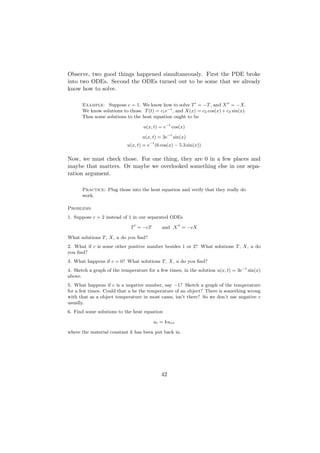
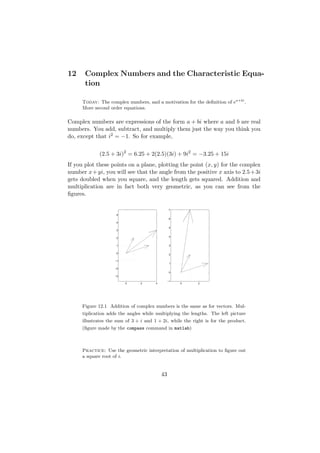
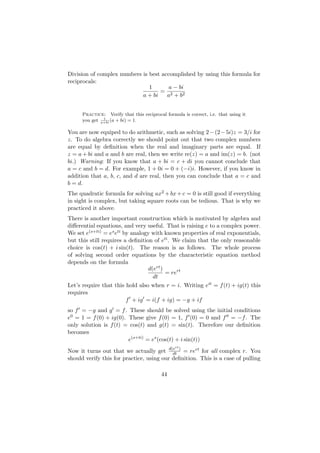
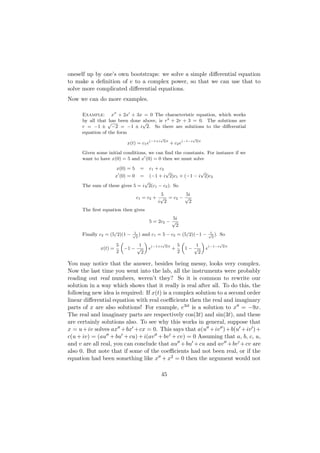
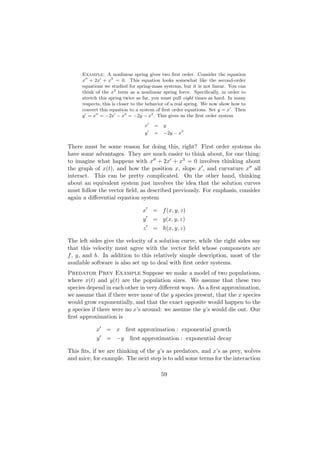
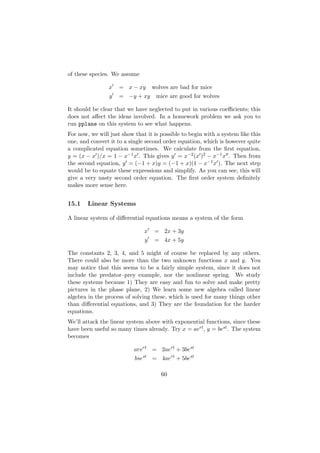
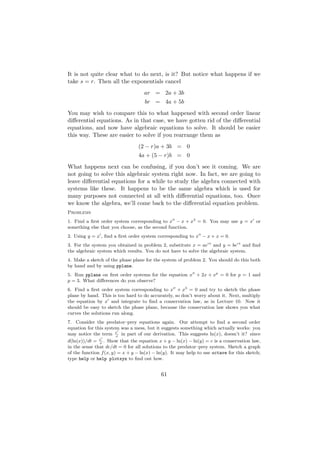
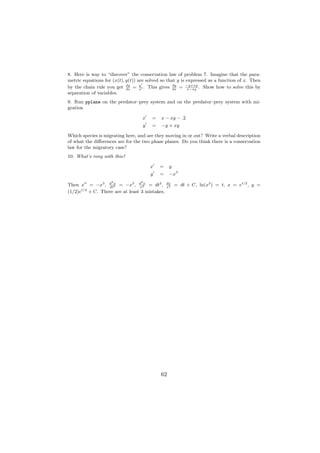
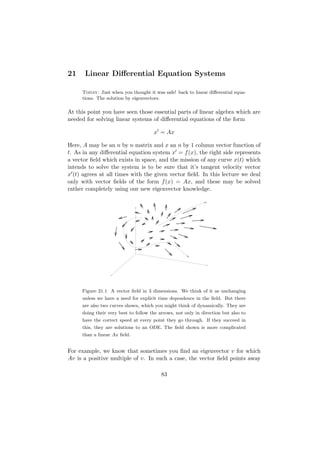
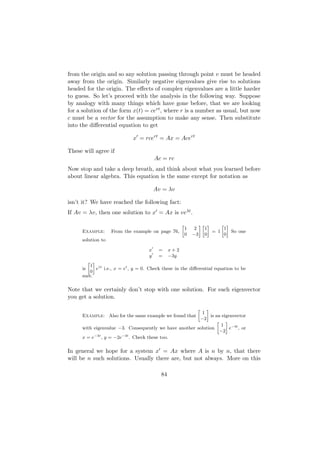
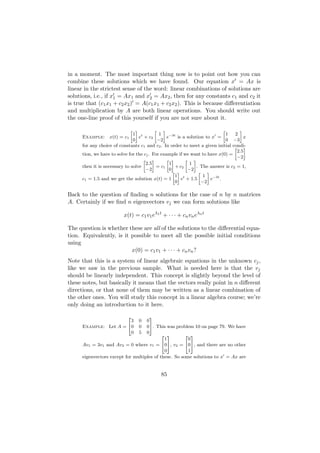
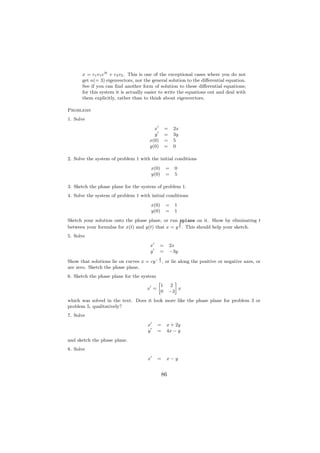
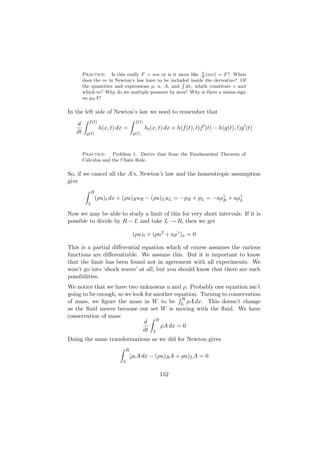
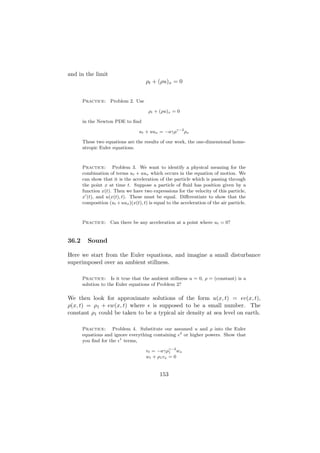
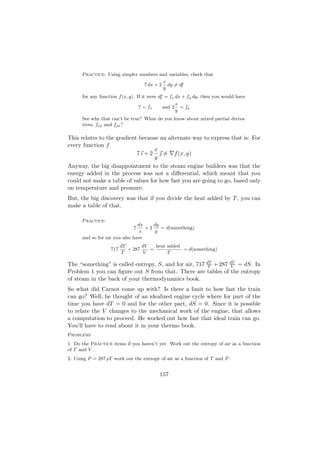
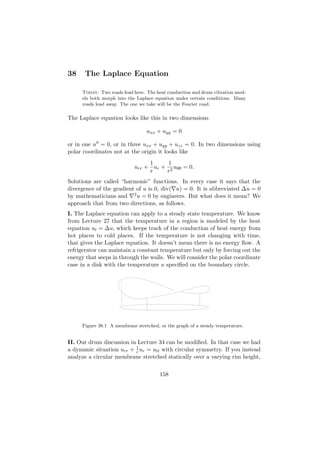
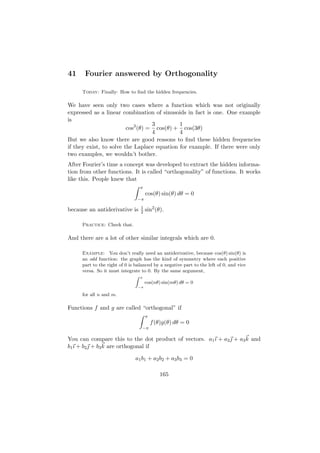
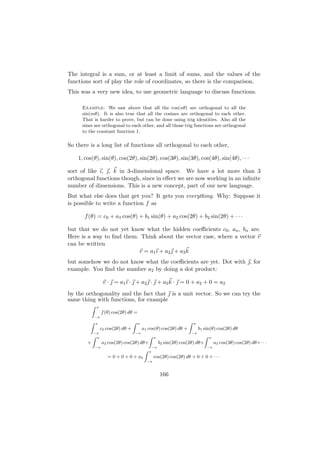
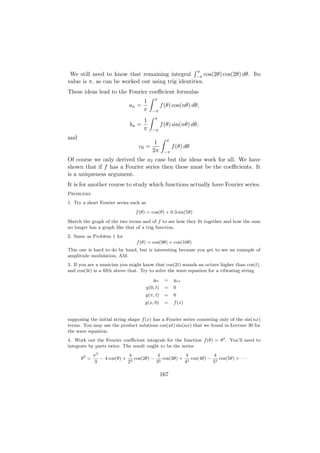
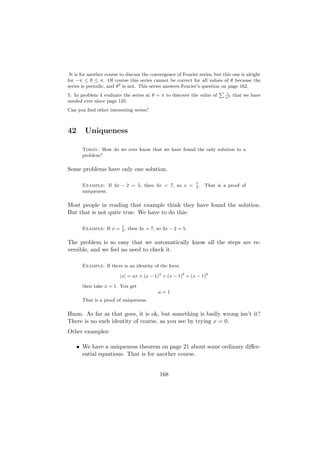
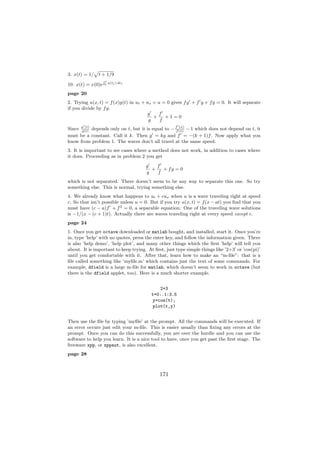
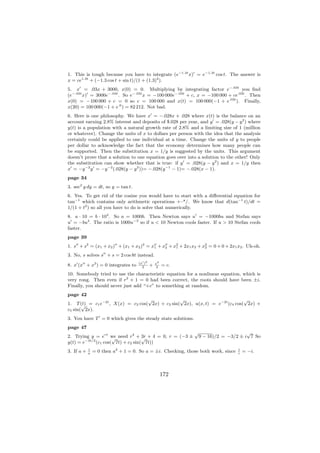
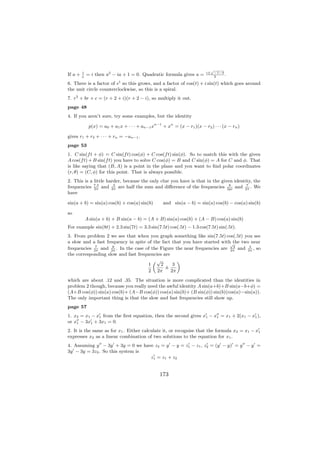
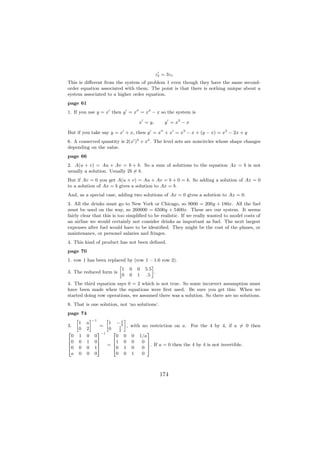
.


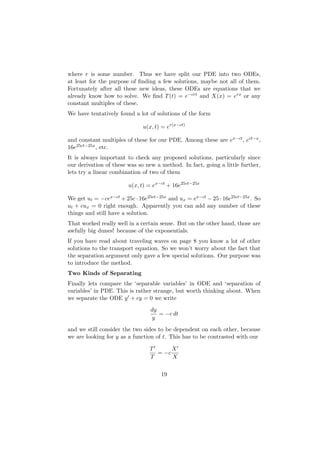
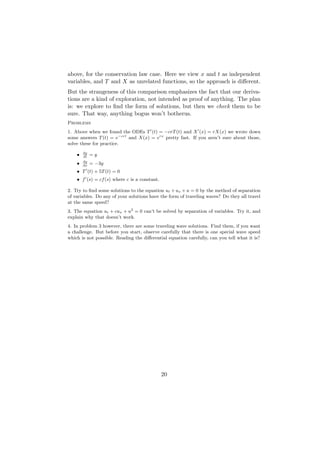
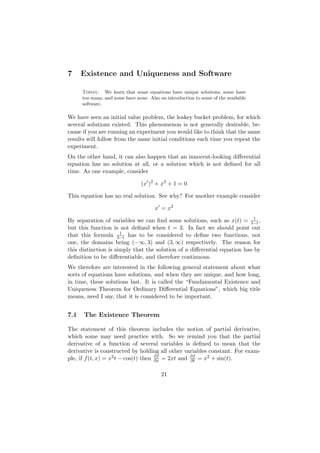
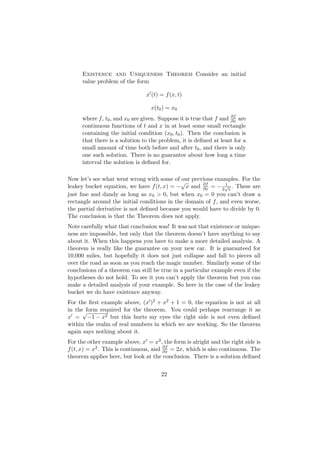
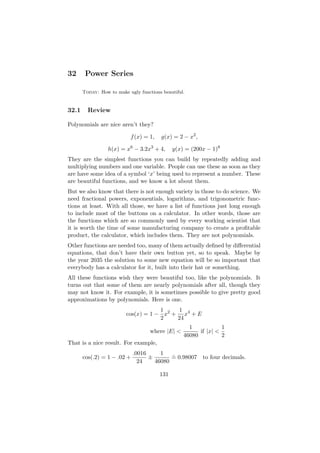
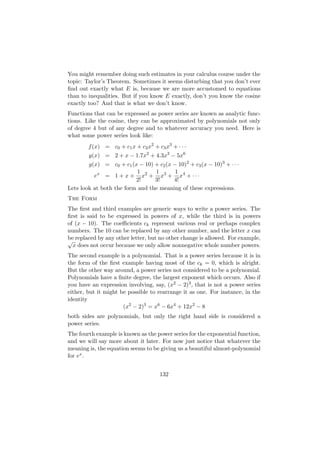
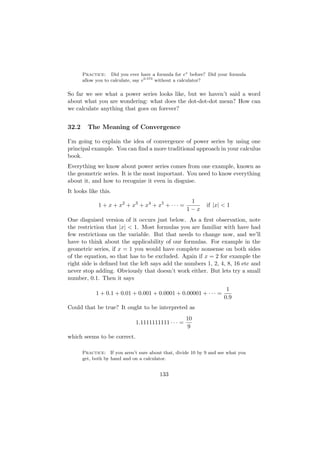
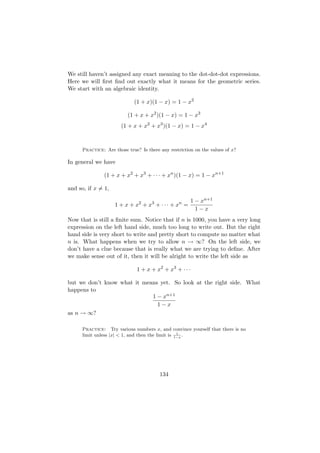
    Notes on Differential Equations
            Robert E. Terrell
Preface

Students of science and engineering often encounter a gap between their
calculus text and the applied mathematical books they need to read soon
after. What is that gap? A calculus student might have learned some
calculus without learning how to read mathematics. A science major might
be faced with an applied text which assumes the ability to read a somewhat
encyclopedic mathematics and its application. I often find myself teaching
students who are somewhere between these two states.
These notes are mostly from lectures I have given to bridge that gap, while
teaching the Engineering Mathematics courses at Cornell University. The
notes could be used for an introductory unified course on ordinary and par-
tial differential equations. However, this is not a textbook in the usual sense,
and certainly not a reference. The stress is on clarity, not completeness. It
is an introduction and an invitation. Most ideas are taught by example.
The notes have been available for many years from my web page.
For fuller coverage, see any of the excellent books:

   • Agnew, Ralph Palmer, Differential Equations, McGraw–Hill, 1960

   • Churchill, Ruel V., Fourier Series and Boundary Value Problems, Mc-
     Graw Hill, 1941

   • Hubbard, John H., and West, Beverly H.,Differential Equations, a
     Dynamical Systems Approach, Parts 1 and 2, Springer, 1995 and 1996

   • Lax, P., Burstein, S., and Lax, A., Calculus with Applications and
     Computing: Vol 1, Springer, 1983

   • Seeley, Robert T., An Introduction to Fourier Series and Integrals,
     W.A.Benjamin, 1966


Some of the exercises have the format “What’s rong with this?”. These
are either questions asked by students or errors taken from test papers of
students in this class, so it could be quite beneficial to study them.

Robert E. Terrell
January 1997 September 2005 April 2009


                                       i
Contents

1 Introduction to Ordinary Differential Equations                               1
  1.1   The Banker’s Equation . . . . . . . . . . . . . . . . . . . . . .       1
  1.2   Slope Fields . . . . . . . . . . . . . . . . . . . . . . . . . . . .    2

2 A Gallery of Differential Equations                                           5

3 Introduction to Partial Differential Equations                                 7
  3.1   A Conservation Law . . . . . . . . . . . . . . . . . . . . . . .        8
  3.2   Traveling Waves . . . . . . . . . . . . . . . . . . . . . . . . .       9

4 The Logistic Population Model                                                12

5 Separable Equations                                                          14

6 Separable Partial Differential Equations                                      17

7 Existence and Uniqueness and Software                                        21
  7.1   The Existence Theorem . . . . . . . . . . . . . . . . . . . . .        21
  7.2   Software . . . . . . . . . . . . . . . . . . . . . . . . . . . . . .   23

8 Linear First Order Equations                                                 25
  8.1   Newton’s Law of Cooling . . . . . . . . . . . . . . . . . . . .        26
  8.2   Investments . . . . . . . . . . . . . . . . . . . . . . . . . . . .    28

9 [oiler’s] Euler’s Numerical Method                                           30

10 Second Order Linear Equations                                               35
  10.1 Linearity . . . . . . . . . . . . . . . . . . . . . . . . . . . . . .   35
  10.2 The Characteristic Equation . . . . . . . . . . . . . . . . . . .       36
  10.3 Conservation laws, part 2 . . . . . . . . . . . . . . . . . . . .       38


                                       ii
11 The Heat Equation                                                          41

12 Complex Numbers and the Characteristic Equation                            43
  12.1 The Fundamental Theorem of Algebra . . . . . . . . . . . . .           47

13 Forced Second Order                                                        49

14 Systems of ODE’s, part 1                                                   54
  14.1 A Chemical Engineering problem . . . . . . . . . . . . . . . .         54
  14.2 Phase Plane . . . . . . . . . . . . . . . . . . . . . . . . . . . .    56

15 Systems of ODE’s, part 2                                                   58
  15.1 Linear Systems . . . . . . . . . . . . . . . . . . . . . . . . . .     60

16 Linear Algebra, part 1                                                     63
  16.1 Matrix . . . . . . . . . . . . . . . . . . . . . . . . . . . . . . .   64
  16.2 Geometric aspects of matrices . . . . . . . . . . . . . . . . . .      65

17 Linear Algebra, part 2                                                     67

18 Linear Algebra, part 3                                                     71
  18.1 Matrix Inverse . . . . . . . . . . . . . . . . . . . . . . . . . .     71
  18.2 Eigenvalues . . . . . . . . . . . . . . . . . . . . . . . . . . . .    73

19 Linear Algebra, part 4                                                     75

20 More on the Determinant                                                    80
  20.1 Products . . . . . . . . . . . . . . . . . . . . . . . . . . . . . .   81

21 Linear Differential Equation Systems                                        83

22 Systems with Complex Eigenvalues                                           87


                                      iii
23 Classification Theorem for Linear Plane Systems                            91

24 Nonlinear Systems in the Plane                                            96

25 Examples of Nonlinear Systems in 3 Dimensions                           100

26 Boundary Value Problems                                                 104
  26.1 Significance of Eigenvalues . . . . . . . . . . . . . . . . . . . . 106

27 The Conduction of Heat                                                  108

28 Solving the Heat Equation                                               112
  28.1 Insulation . . . . . . . . . . . . . . . . . . . . . . . . . . . . . 113
  28.2 Product Solutions     . . . . . . . . . . . . . . . . . . . . . . . . 114

29 More Heat Solutions                                                     116

30 The Wave Equation                                                       122

31 Beams and Columns                                                       127

32 Power Series                                                            131
  32.1 Review . . . . . . . . . . . . . . . . . . . . . . . . . . . . . . . 131
  32.2 The Meaning of Convergence . . . . . . . . . . . . . . . . . . 133

33 More on Power Series                                                    137

34 Power Series used: A Drum Model                                         141

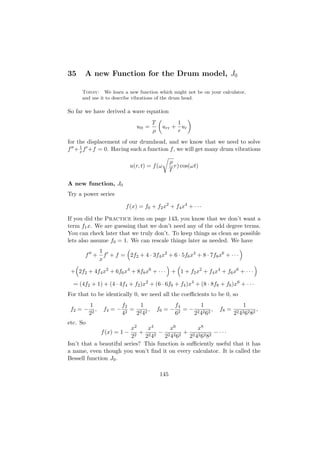
35 A new Function for the Drum model, J0                                   145
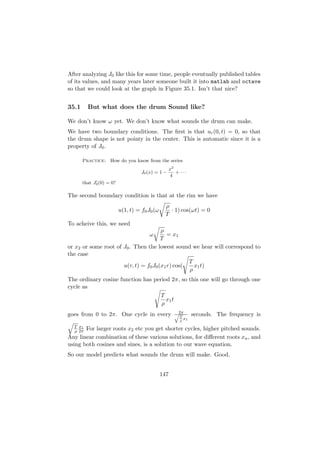
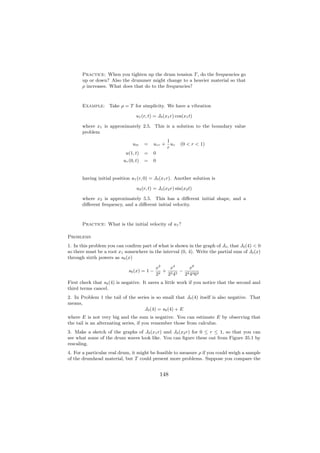
  35.1 But what does the drum Sound like? . . . . . . . . . . . . . . 147

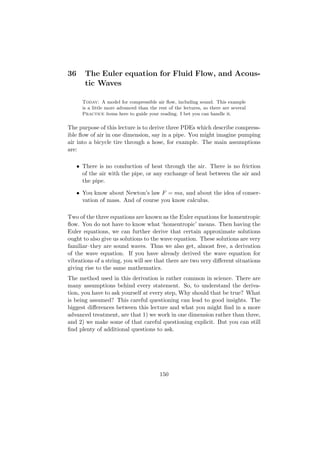
36 The Euler equation for Fluid Flow, and Acoustic Waves                   150
  36.1 The Euler equations . . . . . . . . . . . . . . . . . . . . . . . 151

                                     iv
36.2 Sound . . . . . . . . . . . . . . . . . . . . . . . . . . . . . . . 153

37 Exact equations for Air and Steam                                     156

38 The Laplace Equation                                                  158

39 Laplace leads to Fourier                                              160

40 Fourier’s Dilemma                                                     163

41 Fourier answered by Orthogonality                                     165

42 Uniqueness                                                            168

43 selected answers and hints                                            170


                                     v
1     Introduction to Ordinary Differential Equations

      Today: An example involving your bank account, and nice pictures called
      slope fields. How to read a differential equation.

Welcome to the world of differential equations! They describe many pro-
cesses in the world around you, but of course we’ll have to convince you of
that. Today we are going to give an example, and find out what it means
to read a differential equation.


1.1   The Banker’s Equation

A differential equation is an equation which contains an unknown function
and one of its unknown derivatives. Here is a differential equation.

                                    dy
                                       = .028y
                                    dt
It doesn’t look too exciting does it? Really it is, though. It might for
example represent your bank account, where the balance is y at a time t
years after you open the account, and the account is earning 2.8% interest.
Regardless of the specific interpretation, let’s see what the equation says.
Since we see the term dy/dt we can tell that y is a function of t, and that
the rate of change is a multiple, namely .028, of the value of y itself. We
definitely should always write y(t) instead of just y, and we will sometimes,
but it is traditional to be sloppy.
For example, if y happens to be 2000 at a particular time t, the rate of
change of y is then .028(2000) = 56, and the units of this rate in the bank
account case are dollars/year. Thus y is increasing, whenever y is positive.

      Practice: What do you estimate the balance will be, roughly, a year from
      now, if it is 2000 and is growing at 56 dollars/year?
      This is not supposed to be a hard question. By the way, when I ask a
      question, don’t cheat yourself by ignoring it. Think about it, and future
      things will be easier. I promise.

Later when y is, say, 5875.33, its rate of change will be .028(5875.33) =
164.509 which is much faster. We’ll sometimes refer to y = .028y as the
banker’s equation.


                                         1
Do you begin to see how you can get useful information from a differential
equation fairly easily, by just reading it carefully? One of the most important
skills to learn about differential equations is how to read them. For example
in the equation
                                 y = .028y − 10
there is a new negative influence on the rate of change, due to the −10. This
−10 could represent withdrawals from the account.

      Practice: What must be the units of the −10?

Whether the resulting value of y is actually negative depends on the current
value of y. That is an example of “reading” a differential equation. As a
result of this reading skill, you can perhaps recognize that the banker’s
equation is very idealized: It does not account for deposits or changes in
interest rate. It didn’t account for withdrawals until we appended the −10,
but even that is an unrealistic continuous rate of withdrawal. You may wish
to think about how the equation might be modified to include those things
more realistically.


1.2   Slope Fields

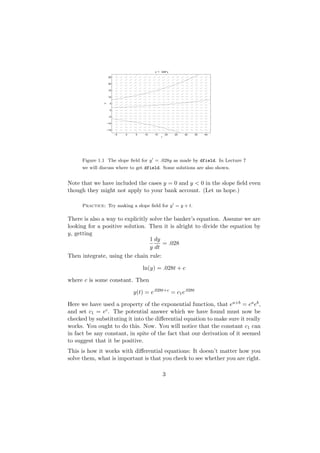
It is significant that you can make graphs of the solutions sometimes. In
the bank account problem we have already noticed that the larger y is, the
greater the rate of increase. This can be displayed by sketching a “slope
field” as in Figure 1.1. Slope fields are done as follows. First, the general
form of a differential equation is

                                  y = f (y, t)

where y(t) is the unknown function, and f is given. To make a slope field
for this equation, choose some points (y, t) and evaluate f there. According
to the differential equation, these numbers must be equal to the derivative
y , which is the slope for the graph of the solution. These resulting values
of y are then plotted using small line segments to indicate the slopes. For
example, at the point t = 6, y = 20, the equation y = .028y says that the
slope must be .028(20) = .56. So we go to this point on the graph and
place a mark having this slope. Solution curves then must be tangent to the
slope marks. This can be done by hand or computer, without solving the
differential equation.


                                       2
y’ = .028*y

                    25


                    20


                    15


                    10


               y
                     5


                     0


                   −5


                   −10


                   −15

                         −5   0    5   10   15       20   25   30   35   40
                                                 t


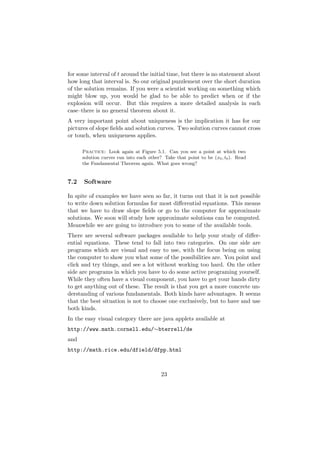
      Figure 1.1 The slope field for y = .028y as made by dfield. In Lecture 7
      we will discuss where to get dfield. Some solutions are also shown.


Note that we have included the cases y = 0 and y < 0 in the slope field even
though they might not apply to your bank account. (Let us hope.)

      Practice: Try making a slope field for y = y + t.

There is also a way to explicitly solve the banker’s equation. Assume we are
looking for a positive solution. Then it is alright to divide the equation by
y, getting
                                  1 dy
                                       = .028
                                  y dt
Then integrate, using the chain rule:

                                       ln(y) = .028t + c

where c is some constant. Then

                                  y(t) = e.028t+c = c1 e.028t

Here we have used a property of the exponential function, that ea+b = ea eb ,
and set c1 = ec . The potential answer which we have found must now be
checked by substituting it into the differential equation to make sure it really
works. You ought to do this. Now. You will notice that the constant c1 can
in fact be any constant, in spite of the fact that our derivation of it seemed
to suggest that it be positive.
This is how it works with differential equations: It doesn’t matter how you
solve them, what is important is that you check to see whether you are right.

                                                     3
Some kinds of answers in math and science can’t be checked very well, but
these can, so do it. Even guessing answers is a highly respected method! if
you check them.
Your healthy scepticism may be complaining to you at this point about any
bank account which grows exponentially. If so, good. It is clearly impossible
for anything to grow exponentially forever. Perhaps it is reasonable for a
limited time. The hope of applied mathematics is that our models will be
idealistic enough to solve while being realistic enough to be worthwhile.
The last point we want to make about this example concerns the constant
c1 further. What is the amount of money you originally deposited, y(0)? Do
you see that it is the same as c1 ? That is because y(0) = c1 e0 and e0 = 1. If
your original deposit was 300 dollars then c1 = 300. This value y(0) is called
an “initial condition”, and serves to pick the solution we are interested in
out from among all those which might be drawn in Figure 1.1.

      Example: Be sure you can do the following kind

                                        x    =   −3x
                                      x(0)   =   5

      Like before, we get a solution x(t) = ce−3t . Then x(0) = 5 = ce0 = c so
      c = 5 and the answer is
                                     x(t) = 5e−3t
      Check it to be absolutely sure.

Problems
1. Make slope fields for x = x, x = −x, x = x + t, x = −x + cos t, x = t.
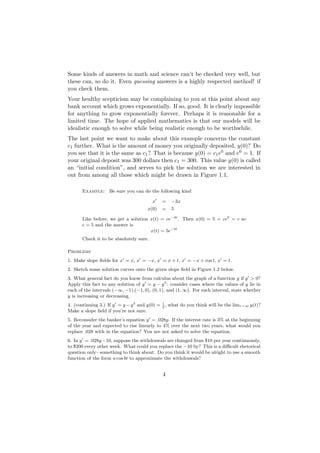
2. Sketch some solution curves onto the given slope field in Figure 1.2 below.
3. What general fact do you know from calculus about the graph of a function y if y > 0?
Apply this fact to any solution of y = y − y 3 : consider cases where the values of y lie in
each of the intervals (−∞, −1),(−1, 0), (0, 1), and (1, ∞). For each interval, state whether
y is increasing or decreasing.
4. (continuing 3.) If y = y − y 3 and y(0) = 1 , what do you think will be the limt→∞ y(t)?
                                             2
Make a slope field if you’re not sure.
5. Reconsider the banker’s equation y = .028y. If the interest rate is 3% at the beginning
of the year and expected to rise linearly to 4% over the next two years, what would you
replace .028 with in the equation? You are not asked to solve the equation.
6. In y = .028y−10, suppose the withdrawals are changed from $10 per year continuously,
to $200 every other week. What could you replace the −10 by? This is a difficult rhetorical
question only– something to think about. Do you think it would be alright to use a smooth
function of the form a cos bt to approximate the withdrawals?


                                             4
x’ = x^2−sin(t)

                    3


                    2


                    1
               x

                    0


                   −1


                   −2


                   −3

                        −2     0      2               4   6   8
                                           t


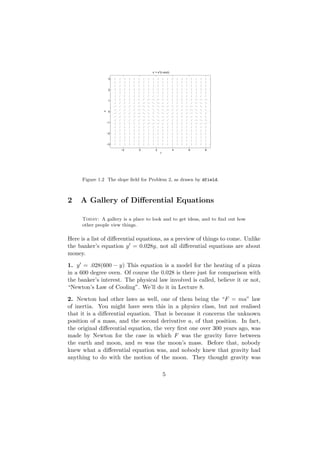
      Figure 1.2 The slope field for Problem 2, as drawn by dfield.


2    A Gallery of Differential Equations

      Today: A gallery is a place to look and to get ideas, and to find out how
      other people view things.

Here is a list of differential equations, as a preview of things to come. Unlike
the banker’s equation y = 0.028y, not all differential equations are about
money.

1. y = .028(600 − y) This equation is a model for the heating of a pizza
in a 600 degree oven. Of course the 0.028 is there just for comparison with
the banker’s interest. The physical law involved is called, believe it or not,
“Newton’s Law of Cooling”. We’ll do it in Lecture 8.

2. Newton had other laws as well, one of them being the “F = ma” law
of inertia. You might have seen this in a physics class, but not realised
that it is a differential equation. That is because it concerns the unknown
position of a mass, and the second derivative a, of that position. In fact,
the original differential equation, the very first one over 300 years ago, was
made by Newton for the case in which F was the gravity force between
the earth and moon, and m was the moon’s mass. Before that, nobody
knew what a differential equation was, and nobody knew that gravity had
anything to do with the motion of the moon. They thought gravity was

                                               5
what made their physics books heavy. You have probably heard a garbled
version of the story in which Newton saw or was hit by a falling apple while
thinking about gravity. What is frequently omitted is that he looked up to
see whence it had fallen, and saw the moon up there, behind the branches.
Thus it occured to him that there might be a connection. Maybe his thought
process was something like, “gravity, gravity, gravity, apple, gravity, gravity,
apple, moon, gravity, apple, moon, gravity, moon, gravity, moon, gravity.
Oh! Moon Gravity!”
There is a joke by the famous physicist Richard Feynmann, who said that
once people thought there were angels up there pushing against the side of
the moon to keep it moving around the earth. This is of course ridiculous,
he said. After Newton everyone knows that the angels are in fact on the far
side of the moon pushing it toward us!
Anyway Newton’s law often leads to second order differential equations.

                                                                 2
      Practice: The simplest second order equations look like d 2 = −x. You
                                                                  dt
                                                                     x

      ought to be able to guess some solutions to this equation. What are they?


3. There are also Partial Differential Equations. This does not mean that
somebody forgot to write out the whole thing! It means that the unknown
functions depend on more than one variable, so that partial derivatives show
up in the equation. One example is ut = uxx where the subscripts denote
partial derivatives. This is called the heat equation, and u(x, t) is the tem-
perature at position x and time t, when heat is allowed to conduct only
along the x axis, as through a wall or along a metal bar. It concerns a dif-
ferent aspect of heat than does Newton’s law of cooling, and we will discuss
it more in Lectures 11 and 27.
4. utt = uxx looks sort of like the heat equation, but is very different be-
cause of the second time derivative. This is the wave equation, which is
about electromagnetic waves (wireless), music, and water waves, in decreas-
ing order of accuracy. The equation for vibrations of a drum head is the two
dimensional wave equation, utt = uxx + uyy . In Lecture 34 we will derive a
special polar coordinate version of that, utt = urr + 1 ur . We’ll use that to
                                                      r
describe some of the sounds of a drum.
5. There are others which we won’t study but some of the ideas we use can
be applied to them. The reason for mentioning these here is to convince
you that the earlier statement about “many processes” in the world around
you is correct. If you bang your fist on the table top, and the table top is

                                         6
somewhat rigid, not like a drum head, then the sound which comes out is
caused by vibrations of the wood, and these are described by solutions of
utt = −(uxxxx + 2uxxyy + uyyyy ). Here u(x, y, t) is the vertical deflection of
the table top while it bends and vibrates. Can you imagine that happening
at a small scale? We will in fact do a related equation utt = −uxxxx for
vibrations of a beam in Lecture 31.
At a much smaller scale, the behavior of electrons in an atom is described
by Schr¨dinger’s equation iut = −(uxx + uyy + uzz ) +V (x, y, z)u. In this
        o
case, u(x, y, z, t) is related to the probability that the electron is at (x, y, z)
at time t. At the other end of the scale there is an equation we won’t
write down, but which was worked out by Einstein. Not E = mc2 , but a
differential equation. That must be why Einstein is so famous. He wrote
down a differential equation for the whole universe.
Problems
1. Newton’s gravity law says that the force between a big mass at the origin of the x axis
and a small mass at point x(t) is proportional to x−2 . How would you write the F = ma
law for that as a differential equation?
2. We don’t have much experience with the fourth derivatives mentioned above. Let
u(x, t) = t2 x2 − x3 + x4 . Is uxxxx positive or negative? Does this depend on the value of
x?
3. In case you didn’t do the Practice item, what functions do you know about from
calculus, that are equal to their second derivative? the negative of their second derivative?


3     Introduction to Partial Differential Equations

       Today: A first order partial differential equation.

Here is a partial differential equation, sometimes called a transport equation,
and sometimes called a wave equation.
                                     ∂w    ∂w
                                        +3    =0
                                     ∂t    ∂x


       Practice: We remind you that partial derivatives are the rates of change
       holding all but one variable fixed. For example
                 ∂ `               ´          ∂ `               ´
                    x − y 2 x + 2yt = 2y,        x − y 2 x + 2yt = 1 − y 2
                 ∂t                           ∂x
       What is the y partial?


                                             7
Our PDE is abbreviated
                                    wt + 3wx = 0
You can tell by the notation that w is to be interpreted as a function of
both t and x. You can’t tell what the equation is about. We will see that
it can describe certain types of waves. There are water waves, electromag-
netic waves, the wavelike motion of musical instrument strings, the invisible
pressure waves of sound, the waveforms of alternating electric current, and
others. This equation is a simple model.

      Practice: You know from calculus that increasing functions have positive
      derivatives. In Figure 3.1 a wave shape is indicated as a function of x at
      one particular time t. Focus on the steepest part of the wave. Is wx positive
      there, or negative? Next, look at the transport equation. Is wt positive
      there, or negative? Which way will the steep profile move next?
      Remember how important it is to read a differential equation.


3.1   A Conservation Law

We’ll derive the equation as one model for conservation of mass. You might
feel that the derivation of the equation is harder than the solving of the
equation.
We imagine that w represents the height of a sand dune which moves by the
wind, along the x direction. The assumption is that the sand blows along
the surface, crossing position (x, w(x, t)) at a rate proportional to w. The
proportionality factor is taken to be 3, which has dimensions of velocity, like
the wind.


                                                     w

                                                 a   a+h


      Figure 3.1 The wind blows sand along the surface. Some enters the segment
      (a, a+h) from the left, and some leaves at the right. The net difference causes
      changes in the height of the dune there.


The law of conservation of sand says that over each segment (a, a + h) you
have
               d a+h
                        w(x, t) dx = 3w(a, t) − 3w(a + h, t)
               dt a

                                            8
That is the time rate of the total sand on the left side, and the sand flux on
the right side. Divide by h and take the limit.

      Practice: 1. Why is there a minus sign on the right hand term?
      2. What do you know from the Fundamental Theorem of Calculus about
                                   Z
                                 1 a+h
                                         f (x) dx ?
                                 h a
      The limit we need is the case in which f is wt (x, t).

We find that wt (a, t) = −3wx (a, t). Of course a is arbitrary. That concludes
the derivation.


3.2   Traveling Waves

When you first encounter PDE, it can appear, because of having more than
one independent variable, that there is no reasonable place to start working.
Do I try t first, x, or what? In this section we’ll just explore a little. If we
try something that doesn’t help, then we try something else.

      Practice: Find all solutions to our transport equation of the form

                                       w(x, t) = ax + bt

      In case that is not clear, it does not mean ‘derive ax+bt somehow’. It means
      substitute the hypothetical w(x, t) = ax + bt into the PDE and see whether
      there are any such solutions. What is required of a and b?

Those practice solutions don’t look much like waves.

         1


        0.5


         0


       -0.5


         -1


              0        5          10              15       20       25         30


      Figure 3.1 Graphs of cos(x), cos(x − 1.5), and cos(x − 3). If you think of
      these as photographs superimposed at three different times, then you can
      see that it moves. What values of t do you associate with these graphs, and
      how fast does the wave move?


Lets try something more wavey.


                                              9
Practice: Find all solutions to our wave equation of the form w(x, t) =
      c cos(ax + bt)

So far, we have seen a lot of solutions to our transport equation. Here are a
few of them:

                         w(x, t) = x − 3t
                         w(x, t) = −2.1x + 6.3t
                         w(x, t) = 40 cos(5x − 15t)
                                     2
                         w(x, t) = − cos(8x − 24t)
                                     7


For comparison, that is a lot more variety than we found for the banker’s
equation. Remember that the only solutions to the ODE y = .028y are
constant multiples of e0.028t . Now lets go out on a limb. Since our wave
equation allows straight lines of all different slopes and cosines of all different
frequencies and amplitudes, maybe it also allows other things too.
Try
                              w(x, t) = f (x − 3t)
where we won’t specify the function f yet. Without specifying f any further,
we can’t find the derivatives we need in any literal sense, but can apply the
chain rule anyway. The intention here is that f ought to be a function of
one variable, say s, and that the number x − 3t is being inserted for that
variable, s = x − 3t. The partial derivatives are computed using the chain
rule, because we are composing f with the function x − 3t of two variables.
The chain rule here looks like this:
                             ∂w   df ∂s
                      wt =      =       = −3f (x − 3t)
                             ∂t   ds ∂t


      Practice: Figure out why wx = f (x − 3t).

Setting those into the transport equation we get

                          wt + 3wx = −3f + 3f = 0

That is interesting. It means that any differentiable function f gives us a
solution. Any dune shape is allowed. You see, it doesn’t matter at all what
f is, as long as it is some differentiable function.

                                        10
Don’t forget: differential equations are a model of the world. They are not
the world itself. Real dunes cannot have just any shape f whatsoever. They
are more specialized than our model.

      Practice:      Check the case f (s) = 22 sin(s) − 10 sin(3s). That is, verify
      that
                         w(x, t) = 22 sin(x − 3t) − 10 sin(3x − 9t)
      is a solution to our wave equation.

Problems
1. Work all the Practice items in this lecture if you have not done so yet.
2. Find a lot of solutions to the wave equation

                                       yt − 5yx = 0

and tell which direction the waves move, and how fast.
3. Check that w(x, t) = 1/(1 + (x − 3t)2 ) is one solution to the equation wt + 3wx = 0.
4. What does the initial value w(x, 0) look like in problem 3, if you graph it as a function
of x?
5. Sketch the profile of the dune shapes w(x, 1) and w(x, 2) in problem 3. What is
happening? Which way is the wind blowing? What is the velocity of the dune? Can you
tell the velocity of the wind?
                                                                                    1
6. Solve ut + ux = 0 if we also want to have the initial condition u(x, 0) =        5
                                                                                        cos(2x).
                                                           1               1
7. As in problem 6, but with initial condition u(x, 0) =   5
                                                               cos(2x) +   7
                                                                               sin(4x). Sketch the
wave shape for several times.


                                            11
4    The Logistic Population Model

      Today: The logistic equation is an improved model for population growth.

We have seen that the banker’s equation y = .028y has exponentially grow-
ing solutions. It also has a completely different interpretation from the bank
account idea. Suppose that you have a population containing about y(t) in-
dividuals. The word “about” is used because if y = 32.51 then we will have
to interpret how many individuals that is. Also the units could be, say,
thousands of individuals, rather than just plain individuals. The population
could be anything from people on earth, to deer in a certain forest, to bacte-
ria in a certain Petrie dish. We can read this differential equation to say that
the rate of change of the population is proportional to the number present.
That perhaps captures some element of truth, yet we see right away that no
population can grow exponentially forever, since sooner or later there will
be a limit imposed by space, or food, or energy, or something.
The Logistic Equation
Here is a modification to the banker’s equation that overcomes the previous
objection.
                             dy
                                = .028y(1 − y)
                             dt
In order to understand why this avoids the exponential growth problem we
must read the differential equation carefully. Remember that I said this is
an important skill.
Here we go. You may rewrite the right-hand side as .028(y − y 2 ). You know
that when y is small, y 2 is very small. Consequently the rate of change
is still about .028y when y is small, and you will get exponential growth,
approximately. After this goes on for a while, it is plausible that the y 2
term will become important. In fact as y increases toward 1 (one thousand
or whatever), the rate of change approaches 0.
For simplicity we now dispense with the .028, and for flexibility introduce a
parameter a, and consider the logistic equation y = y(a − y). Therefore if
we make a slope field for this equation we see something like Figure 4.1.


                                        12
Figure 4.1 A slope field for the Logistic Equation. Note that solutions
     starting near 0 have about the same shape as exponentials until they get
     near a. (figure made using dfield)


The solutions which begin with initial conditions between 0 and a evidently
grow toward a as a limit. This in fact can be verified by finding an explicit
formula for the solution. Proceeding much as we did for the bank account
problem, first write
                                  1
                                        dy = dt
                               ay − y 2
To make this easier to integrate, we’ll use a trick which was discovered by a
student in this class, and multiply first by y −2 /y −2 . Then integrate

                                  y −2
                                         dy =         dt
                               ay −1 − 1
                            1
                          − ln(ay −1 − 1) = t + c
                            a
The integral can be done without the trick, using partial fractions, but that
is longer. Now solve for y(t)

                        ay −1 − 1 = e−a(t+c) = c1 e−at
                                        a
                               y(t) =
                                    1 + c1 e−at
These manipulations would be somewhat scary if we had not specified that
we are interested in y values between 0 and a. For example, the ln of a
negative number is not defined. However, we emphasize that the main point
is to check any formulas found by such manipulations. So let’s check it:
                                      a2 c1 e−at
                              y =
                                    (1 + c1 e−at )2

                                         13
We must compare this expression to
                          a2           a2              (1 + c1 e−at ) − 1
         ay − y 2 =              −                = a2
                      1 + c1 e−at (1 + c1 e−at )2        (1 + c1 e−at )2
You can see that this matches y . Note that the value of c1 is not restricted
to be positive, even though the derivation above may have required it. We
have seen this kind of thing before, so checking is very important. The only
restriction here occurs when the denominator of y is 0, which can occur if
c1 is negative. If you stare long enough at y you will see that this does not
happen if the initial condition is between 0 and a, and that it restricts the
domain of definition of y if the initial conditions are outside of this interval.
All this fits very well with the slope field above. In fact, there is only one
solution to the equation which is not contained in our formula.

      Practice: Can you see what it is?

Problems
1. Suppose that we have a solution y(t) for the logistic equation y = y(a − y). Choose
some time delay, say 3 time units to be specific, and set z(t) = y(t − 3). Is z(t) also a
solution to the logistic equation?
2. The three ’S’-shaped solution curves in Figure 4.1 all appear to be exactly the same
shape. In view of Problem 1, are they?
3. Prof. Verhulst made the logistic model in the mid-1800s. The US census data from the
years 1800, 1820, and 1840, show populations of about 5.3, 9.6, and 17 million. We’ll need
to choose some time scale t1 in our solution y(t) = a(1 + c1 e−at )−1 so that t = 0 means
1800, t = t1 means 1820, and t = 2t1 means 1840. Figure out c1 , t1 , and a to match the
historical data. warning: The arithmetic is very long. It helps if you use the fact that
e−a·2t1 = (e−at1 )2 . answer: c1 = 36.2, t1 = .0031, and a = 197.
4. Using the result of Problem 3, what population do you predict for the year 1920? The
actual population in 1920 was 106 million. The Professor was pretty close wasn’t he? He
was probably surprised to predict a whole century.

      Example: Census data for 1810, 1820, and 1830 show populations of 7.2,
      9.6, and 12.8 million. Trying those, it turned out that I couldn’t fit the
      numbers due to the numerical coincidence that (7.2)(12.8) = (9.6)2 . That is
      where I switched to the years in Problem 3. This shows that the fitting of
      real data to a model is nontrivial. Mathematicians like the word ‘nontrivial’.


5     Separable Equations

      Today: Various useful examples.


                                           14
Equations of the form
                                dx
                                    = f (x)g(t)
                                dt
include the banker’s and logistic equations and some other useful equations.
You may attack these by “separating variables”: Write fdx = g(t) dt, then
                                                          (x)
try to integrate and solve for x(t). Remember that this is what we did with
the banker’s and logistic equations.

     Example:
                                                dx
                                                   = tx
                                                dt
                              t2                   1 2                        1 2
      dx
      x
           = t dt, ln |x| =    2
                                   + c, x(t) = c1 e 2 t , check : x =   2t
                                                                        2 1
                                                                           c e2t    = tx

The skeptical reader will wonder why I said “try” to integrate and solve for
x. The next two examples illustrate that there is no guarantee that either
of these steps may be completed.

     Example:
                                    dx       1
                                        =
                                    dt    1 + 3x2
     (1 + 3x2 ) dx = dt, x + x3 = t + c. Here you can do the integrals, but you
     can’t very easily solve for x.


     Example:
                                               dx      2
                                                  = e−t
                                               dt
                 2
     dx = e−t dt. Here you can’t do the integral.

The Leaking Bucket
(This example comes from the Hubbard and West book. See preface.)
We’re about to write out a differential equation to model the depth of water
in a leaking bucket, based on plausible assumptions. We’ll then try to solve
for the water depth at various times. In particular we will try to reconstruct
the history of an empty bucket. This problem is solvable by separation of
variables, but it has far greater significance that the problem has more than
one solution. Physically if you see an empty bucket with a hole at the
bottom, you just can’t tell when it last held water.
Here is a crude derivation of our equation which is not intended to be physi-
cally rigorous. We assume that the water has depth y(t) and that the speed
of a molecule pouring out at the bottom is determined by conservation of

                                                   15
energy. Namely, as it fell from the top surface it gained potential energy
proportional to y and this became kinetic energy at the bottom, propor-
tional to (y )2 . Actually y is the speed of the top surface of the water, not
the bottom, but these are proportional in a cylindrical tank. Also we could
assume a fraction of the energy is lost in friction. In any event we get (y )2
proportional to y, or

                                                        √
                                                  y = −a y
The constant is negative because the water depth is decreasing. We’ll set
a = 1 for convenience.
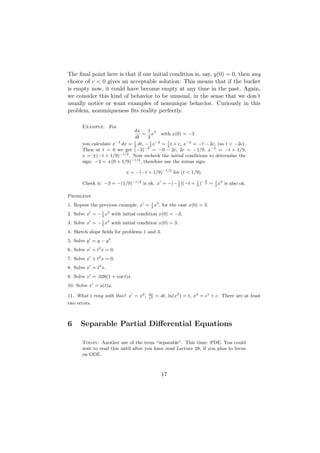
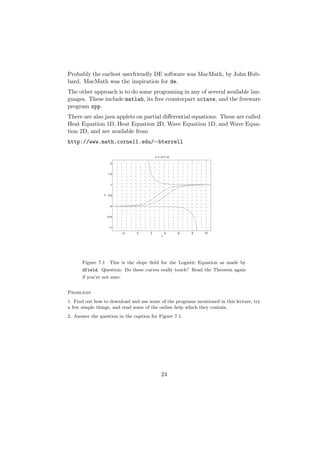
The slope field looks like the figure.

                                                       y’ = −sqrt(y)

                          8


                          7


                          6


                          5
                      y


                          4


                          3


                          2


                          1


                          0

                              −7   −6   −5   −4   −3       −2      −1   0     1   2   3
                                                            t


      Figure 5.1 Depth of water in the leaking bucket.


Separation of variables gives, if y > 0,

                                             −y −1/2 dy = dt

                                             2y 1/2 = −t + c
so here we must have t < c, otherwise the square root would be negative.
                                                            −t + c           2
                                             y=
                                                              2
Note that if t = c then y = 0 so the derivation is no good there. Comparing
our formula to the slope field we see what must happen:
                                                      −t+c 2
                                                                            if t < c
                              y(t) =                   2
                                                  0                         otherwise

                                                             16
The final point here is that if our initial condition is, say, y(0) = 0, then any
choice of c < 0 gives an acceptable solution. This means that if the bucket
is empty now, it could have become empty at any time in the past. Again,
we consider this kind of behavior to be unusual, in the sense that we don’t
usually notice or want examples of nonunique behavior. Curiously in this
problem, nonuniqueness fits reality perfectly.

       Example: For
                              dx     1
                                  = x3 with x(0) = −3
                              dt     2
       you calculate x−3 dx = 2 dt, − 1 x−2 = 1 t + c, x−2 = −t − 2c, (so t < −2c).
                              1
                                      2       2
       Then at t = 0 we get (−3)−2 = −0 − 2c, 2c = −1/9, x−2 = −t + 1/9,
       x = ±(−t + 1/9)−1/2 . Now recheck the initial conditions to determine the
       sign: −3 = ±(0 + 1/9)−1/2 , therefore use the minus sign:

                           x = −(−t + 1/9)−1/2 for (t < 1/9).
                                                                  3
       Check it: −3 = −(1/9)−1/2 is ok. x = −(− 2 )(−t + 9 )− 2 = 2 x3 is also ok.
                                                1        1        1


Problems
1. Repeat the previous example, x = 2 x3 , for the case x(0) = 3.
                                    1


2. Solve x = − 2 x3 with initial condition x(0) = −3.
               1


3. Solve x = − 2 x3 with initial condition x(0) = 3.
               1


4. Sketch slope fields for problems 1 and 3.
5. Solve y = y − y 3 .
6. Solve x + t2 x = 0.
7. Solve x + t3 x = 0.
8. Solve x = t4 x.
9. Solve x = .028(1 + cos t)x.
10. Solve x = a(t)x.

11. What’s rong with this? x = x2 ,   dx
                                      x2
                                           = dt, ln(x2 ) = t, x2 = et + c. There are at least
two errors.


6     Separable Partial Differential Equations

       Today: Another use of the term “separable”. This time: PDE. You could
       wait to read this until after you have read Lecture 28, if you plan to focus
       on ODE.


                                             17
Traditionally a distinction in terminology is made between ordinary DE with
the variables separable, and the PDE solvable by separation of variables.
That sounds confusing, doesn’t it? It is not just the sound. The method
looks different too. Here is an example using a transport equation

                                ut + cux = 0

The method of separation of variables goes like this. Suppose we look for
special solutions of the form

                             u(x, t) = X(x)T (t)

This does not mean that we think all solutions would be like this. We hope
to find that at least some of them are like this. Substitute this into our PDE
and you get
                        X(x)T (t) + cX (x)T (t) = 0
Now what? The problem is to untangle the x and t somehow. Notice that if
you divide this equation by X(x) then the first term will at least no longer
contain x. Lets do that, assuming temporarily that we are not dividing by
0.
                                    X (x)T (t)
                          T (t) + c            =0
                                      X(x)
Now what? If you divide by T (t) you can clean up the second term without
hurting the first one. Lets do that too.
                             T (t)    X (x)
                                   +c       =0
                             T (t)    X(x)
The first term only depends on t, but the second term does not depend on
t at all. The more you think about that, the stranger it becomes. We want
to argue that this forces the two terms to be constant. Write
                              T (t)      X (x)
                                    = −c
                              T (t)      X(x)
For example, when x = 0 the right hand side has a certain value, perhaps
it is 5.37. Lets write X (0) = r where −cr is 5.37 or whatever. So the left
                       X(0)
side has to be 5.37 too. Next change x to something else, say x = 1.5. This
doesn’t affect the left side, 5.37, because there is no x in the left side. But
then the right side has to still be 5.37. You see, the equation means that
each side is the same constant. Calling that constant −cr, we have that

                  T (t) = −crT (t)     and X (x) = rX(x)

                                     18
where r is some number. Thus we have split our PDE into two ODEs,
at least for the purpose of finding a few solutions, maybe not all of them.
Fortunately after all these new ideas, these ODEs are equations that we
already know how to solve. We find T (t) = e−crt and X(x) = erx or any
constant multiples of these.
We have tentatively found a lot of solutions of the form

                              u(x, t) = er(x−ct)

and constant multiples of these for our PDE. Among these are ex−ct , ect−x ,
16e25ct−25x , etc.
It is always important to check any proposed solutions, particularly since
our derivation of these was so new a method. In fact, going a little further,
lets try a linear combination of two of them

                        u(x, t) = ex−ct + 16e25ct−25x

We get ut = −cex−ct + 25c · 16e25ct−25x and ux = ex−ct − 25 · 16e25ct−25x . So
ut + cux = 0 right enough. Apparently you can add any number of these
things and still have a solution.
That worked really well in a certain sense. But on the other hand, those are
awfully big dunes! because of the exponentials.
If you have read about traveling waves on page 8 you know a lot of other
solutions to the transport equation. So we won’t worry about the fact that
the separation argument only gave a few special solutions. Our purpose was
to introduce the method.
Two Kinds of Separating
Finally lets compare the ‘separable variables’ in ODE and ‘separation of
variables’ in PDE. This is rather strange, but worth thinking about. When
we separate the ODE y + cy = 0 we write
                                 dy
                                    = −c dt
                                 y
and we still consider the two sides to be dependent on each other, because
we are looking for y as a function of t. This has to be contrasted with our

                                 T      X
                                   = −c
                                 T      X

                                     19
above, for the conservation law case. Here we view x and t as independent
variables, and T and X as unrelated functions, so the approach is different.
But the strangeness of this comparison emphasizes the fact that our deriva-
tions are a kind of exploration, not intended as proof of anything. The plan
is: we explore to find the form of solutions, but then we check them to be
sure. That way, anything bogus won’t botherus.
Problems
1. Above when we found the ODEs T (t) = −crT (t) and X (x) = rX(x) we wrote down
some answers T (t) = e−crt and X(x) = erx pretty fast. If you aren’t sure about those,
solve these for practice.
        dy
    •   dt
             =y
        dy
    •   dx
             = −3y
    • T (t) + 5T (t) = 0
    • f (s) = cf (s) where c is a constant.

2. Try to find some solutions to the equation ut + ux + u = 0 by the method of separation
of variables. Do any of your solutions have the form of traveling waves? Do they all travel
at the same speed?
3. The equation ut + cux + u2 = 0 can’t be solved by separation of variables. Try it, and
explain why that doesn’t work.
4. In problem 3 however, there are some traveling wave solutions. Find them, if you want
a challenge. But before you start, observe carefully that there is one special wave speed
which is not possible. Reading the differential equation carefully, can you tell what it is?


                                              20
7     Existence and Uniqueness and Software

      Today: We learn that some equations have unique solutions, some have
      too many, and some have none. Also an introduction to some of the available
      software.

We have seen an initial value problem, the leakey bucket problem, for which
several solutions existed. This phenomenon is not generally desirable, be-
cause if you are running an experiment you would like to think that the same
results will follow from the same initial conditions each time you repeat the
experiment.
On the other hand, it can also happen that an innocent-looking differential
equation has no solution at all, or a solution which is not defined for all
time. As one example, consider

                                (x )2 + x2 + 1 = 0

This equation has no real solution. See why? For another example consider

                                       x = x2
                                                                           1
By separation of variables we can find some solutions, such as x(t) = 3−t ,
but this function is not defined when t = 3. In fact we should point out
                      1
that this formula 3−t has to be considered to define two functions, not
one, the domains being (−∞, 3) and (3, ∞) respectively. The reason for
this distinction is simply that the solution of a differential equation has by
definition to be differentiable, and therefore continuous.
We therefore are interested in the following general statement about what
sorts of equations have solutions, and when they are unique, and how long,
in time, these solutions last. It is called the “Fundamental Existence and
Uniqueness Theorem for Ordinary Differential Equations”, which big title
means, need I say, that it is considered to be important.


7.1   The Existence Theorem

The statement of this theorem includes the notion of partial derivative,
which some may need practice with. So we remind you that the partial
derivative of a function of several variables is defined to mean that the
derivative is constructed by holding all other variables constant. For exam-
ple, if f (t, x) = x2 t − cos(t) then ∂f = 2xt and ∂f = x2 + sin(t).
                                      ∂x           ∂t


                                          21
Existence and Uniqueness Theorem Consider an initial
      value problem of the form

                                 x (t) = f (x, t)

                                   x(t0 ) = x0
      where f , t0 , and x0 are given. Suppose it is true that f and ∂f are
                                                                     ∂x
      continuous functions of t and x in at least some small rectangle
      containing the initial condition (x0 , t0 ). Then the conclusion is
      that there is a solution to the problem, it is defined at least for a
      small amount of time both before and after t0 , and there is only
      one such solution. There is no guarantee about how long a time
      interval the solution is defined for.

Now let’s see what went wrong with some of our previous examples. For the
                                             √
leakey bucket equation, we have f (t, x) = − x and ∂f = − 2√x . These are
                                                     ∂x
                                                               1

just fine and dandy as long as x0 > 0, but when x0 = 0 you can’t draw a
rectangle around the initial conditions in the domain of f , and even worse,
the partial derivative is not defined because you would have to divide by 0.
The conclusion is that the Theorem does not apply.
Note carefully what that conclusion was! It was not that existence or unique-
ness are impossible, but only that the theorem doesn’t have anything to say
about it. When this happens you have to make a more detailed analysis. A
theorem is really like the guarantee on your new car. It is guaranteed for
10,000 miles, but hopefully it does not just collapse and fall to pieces all
over the road as soon as you reach the magic number. Similarly some of the
conclusions of a theorem can still be true in a particular example even if the
hypotheses do not hold. To see it you can’t apply the theorem but you can
make a detailed analysis of your example. So here in the case of the leakey
bucket we do have existence anyway.
For the first example above, (x )2 + x2 + 1 = 0, the equation is not at all
in the√form required for the theorem. You could perhaps rearrange it as
x = −1 − x2 but this hurts my eyes–the right side is not even defined
within the realm of real numbers in which we are working. So the theorem
again says nothing about it.
For the other example above, x = x2 , the form is alright and the right side is
f (t, x) = x2 . This is continuous, and ∂f = 2x, which is also continuous. The
                                        ∂x
theorem applies here, but look at the conclusion. There is a solution defined


                                       22
for some interval of t around the initial time, but there is no statement about
how long that interval is. So our original puzzlement over the short duration
of the solution remains. If you were a scientist working on something which
might blow up, you would be glad to be able to predict when or if the
explosion will occur. But this requires a more detailed analysis in each
case–there is no general theorem about it.
A very important point about uniqueness is the implication it has for our
pictures of slope fields and solution curves. Two solution curves cannot cross
or touch, when uniqueness applies.

      Practice: Look again at Figure 5.1. Can you see a point at which two
      solution curves run into each other? Take that point to be (x0 , t0 ). Read
      the Fundamental Theorem again. What goes wrong?


7.2   Software

In spite of examples we have seen so far, it turns out that it is not possible
to write down solution formulas for most differential equations. This means
that we have to draw slope fields or go to the computer for approximate
solutions. We soon will study how approximate solutions can be computed.
Meanwhile we are going to introduce you to some of the available tools.
There are several software packages available to help your study of differ-
ential equations. These tend to fall into two categories. On one side are
programs which are visual and easy to use, with the focus being on using
the computer to show you what some of the possibilities are. You point and
click and try things, and see a lot without working too hard. On the other
side are programs in which you have to do some active programing yourself.
While they often have a visual component, you have to get your hands dirty
to get anything out of these. The result is that you get a more concrete un-
derstanding of various fundamentals. Both kinds have advantages. It seems
that the best situation is not to choose one exclusively, but to have and use
both kinds.
In the easy visual category there are java applets available at
http://www.math.cornell.edu/∼bterrell/de
and
http://math.rice.edu/dfield/dfpp.html


                                          23
Probably the earliest userfriendly DE software was MacMath, by John Hub-
bard. MacMath was the inspiration for de.
The other approach is to do some programing in any of several available lan-
guages. These include matlab, its free counterpart octave, and the freeware
program xpp.
There are also java applets on partial differential equations. These are called
Heat Equation 1D, Heat Equation 2D, Wave Equation 1D, and Wave Equa-
tion 2D, and are available from
http://www.math.cornell.edu/∼bterrell

                                          x’ = x*(1−x)

                      2


                     1.5


                      1
                x


                     0.5


                      0


                    −0.5


                     −1

                            −2   0    2            4     6   8   10
                                               t


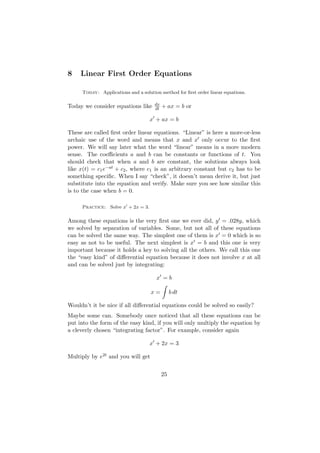
      Figure 7.1 This is the slope field for the Logistic Equation as made by
      dfield. Question: Do these curves really touch? Read the Theorem again
      if you’re not sure.


Problems
1. Find out how to download and use some of the programs mentioned in this lecture, try
a few simple things, and read some of the online help which they contain.
2. Answer the question in the caption for Figure 7.1.


                                               24
8    Linear First Order Equations

     Today: Applications and a solution method for first order linear equations.

                                     dx
Today we consider equations like     dt   + ax = b or

                                   x + ax = b

These are called first order linear equations. “Linear” is here a more-or-less
archaic use of the word and means that x and x only occur to the first
power. We will say later what the word “linear” means in a more modern
sense. The coefficients a and b can be constants or functions of t. You
should check that when a and b are constant, the solutions always look
like x(t) = c1 e−at + c2 , where c1 is an arbitrary constant but c2 has to be
something specific. When I say “check”, it doesn’t mean derive it, but just
substitute into the equation and verify. Make sure you see how similar this
is to the case when b = 0.

     Practice: Solve x + 2x = 3.

Among these equations is the very first one we ever did, y = .028y, which
we solved by separation of variables. Some, but not all of these equations
can be solved the same way. The simplest one of them is x = 0 which is so
easy as not to be useful. The next simplest is x = b and this one is very
important because it holds a key to solving all the others. We call this one
the “easy kind” of differential equation because it does not involve x at all
and can be solved just by integrating:

                                      x =b

                                   x=          b dt

Wouldn’t it be nice if all differential equations could be solved so easily?
Maybe some can. Somebody once noticed that all these equations can be
put into the form of the easy kind, if you will only multiply the equation by
a cleverly chosen “integrating factor”. For example, consider again

                                   x + 2x = 3

Multiply by e2t and you will get


                                          25
e2t x + 2e2t x = 3e2t
Then, and this is the cool part, recognise the left hand side as a total deriva-
tive, like you have in the easy kind:

                                (e2t x) = 3e2t

This uses the product rule for derivatives. Now all you have to do is integrate
and you are done.
                                             3
                        e2t x = 3e2t dt = e2t + C
                                             2
so
                                      3
                              x(t) = + Ce−2t
                                      2
What do you think the integrating factor should be for x − 1.3x = cos(t)?
In this case, which will be a homework problem, you still have an integral
to do which is a little harder, and you probably have to do integration by
parts. There is a general formula for the integrating factor which is not
too important, but here it is. For the equation above, x + ax = b, an
                       R
integrating factor is e a dt . This always works, at least within the limits of
your ability to do the integrals. As for where this formula comes from, we
have devised a homework problem so that you can answer that yourself. As
to the deeper question of how anybody ever thought up such a scheme as
integrating factors in the first place, that is much harder to answer.
Now let’s look at some applications of these equations.


8.1   Newton’s Law of Cooling

Newton’s law of cooling is the statement that the exponential growth equa-
tion x = kx applies sometimes to the temperature of an object, provided
that x is taken to mean the difference in temperature between the object
and its surroundings.
For example suppose we have placed a 100 degree pizza in a 600 degree
oven. We let x(t) be the pizza temperature at time t, minus 600. This
makes x negative, while x is certainly positive because the pizza is heating
up. Therefore the constant k which occurs must be a negative number.
The solution to the equation does not require an integrating factor; it is
x(t) = Cekt , and C = 100 − 600 as we have done previously. Therefore the


                                      26
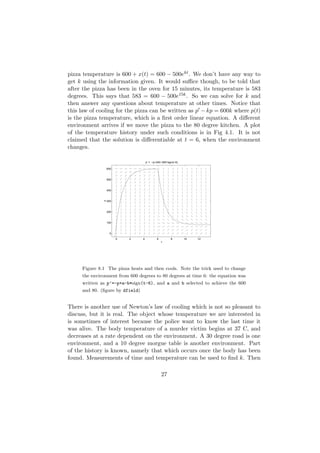
pizza temperature is 600 + x(t) = 600 − 500ekt . We don’t have any way to
get k using the information given. It would suffice though, to be told that
after the pizza has been in the oven for 15 minutes, its temperature is 583
degrees. This says that 583 = 600 − 500e15k . So we can solve for k and
then answer any questions about temperature at other times. Notice that
this law of cooling for the pizza can be written as p − kp = 600k where p(t)
is the pizza temperature, which is a first order linear equation. A different
environment arrives if we move the pizza to the 80 degree kitchen. A plot
of the temperature history under such conditions is in Fig 4.1. It is not
claimed that the solution is differentiable at t = 6, when the environment
changes.

                                     p’ = −p+340−260*sign(t−6)

                  600


                  500


                  400
              p


                  300


                  200


                  100


                   0

                        0   2    4           6          8        10   12
                                                 t


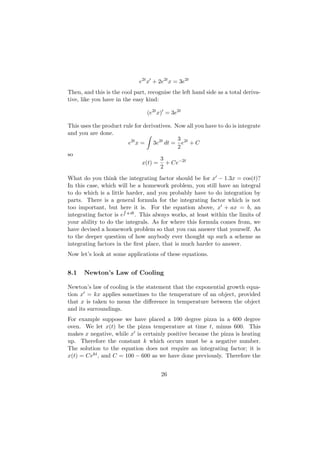
     Figure 8.1 The pizza heats and then cools. Note the trick used to change
     the environment from 600 degrees to 80 degrees at time 6: the equation was
     written as p’=-p+a-b*sign(t-6), and a and b selected to achieve the 600
     and 80. (figure by dfield)


There is another use of Newton’s law of cooling which is not so pleasant to
discuss, but it is real. The object whose temperature we are interested in
is sometimes of interest because the police want to know the last time it
was alive. The body temperature of a murder victim begins at 37 C, and
decreases at a rate dependent on the environment. A 30 degree road is one
environment, and a 10 degree morgue table is another environment. Part
of the history is known, namely that which occurs once the body has been
found. Measurements of time and temperature can be used to find k. Then

                                                 27
that part of the history from the unknown time of death to the known time
of discovery has to be reconstructed using Newton’s law of cooling. This
involves functions not unlike those in Figure 8.1. It should be clear that this
involves estimates and inaccuracies, but is useful, nonetheless.


8.2    Investments

Moving to a more uplifting subject, our bank account equation y = .028y
can be made more realistic and interesting. Suppose we make withdrawals
at a rate of $3500 per year. This can be included in the equation as a
negative influence on the rate of change.

                                   y = .028y − 3500

Again we see a first order linear equation. But the equation is good for more
than an idealised bank account. Suppose you buy a car at 2.8% financing,
paying $3500 per year. Now loosen up your point of view and imagine
what the bank sees. From the point of view of the bank, they just invested
a certain amount in you, at 2.8% interest, and the balance decreases by
“withdrawals” of about $3500 per year.
So the same equation describes two apparently different kinds of investments.
In fact it is probably more realistic as a model of the loan than as a bank
account. By changing the −3500 to +3500 you can model still other kinds
of investments.

      Example: A car is bought using the loan as described above. If the loan
      is to be paid off in 6 years, what price can we afford?
      The price is y(0). We need

                             4y = .028y − 3500     with y(6) = 0.
                 −.028t          −.028t
      Calculate e      y −.028e          y = −3500e−.028t , (e−.028t y) = −3500e−.028t ,
       −.028t                 −.028t
      e       y = (3500/.028)e        +c y = (3500/.028)+ce.028t = 125000+ce.028t ,
                               .028(6)                  .                  .
      y(6) = 0 = 125000 + ce           . This implies c = −105669, y(0) = 125000 −
      105669 = 19331

Problems
1. Solve x − 1.3x = cos t.
                                               R
2. This problem shows where the formula e a dt for the integrating factor comes from.
Suppose we have the idea to multiply x + ax = b by a factor f , so that the result of the
multiplication is (f x) = f b. Show that for this plan to work, you will need to require
                             R
that f = af . Deduce that e a dt will be a suitable choice for f .


                                             28
3. The temperature of an apple pie is recorded as a function of time. It begins in the
oven at 450 degrees, and is moved to an 80 degree kitchen. Later it is moved to a 40
degree refrigerator, and finally back to the 80 degree kitchen. Make a sketch somewhat
like Figure 8.1, which shows qualitatively the temperature history of the pie.
4. A body is found at midnight, on a night when the air temperature is 16 degrees C. Its
temperature is 32 degrees, and after another hour, its temperature has gone down to 30.5
degrees. Estimate the time of death.
5. Sara’s employer contributes $3000 per year to a retirement fund, which earns 3%
interest. Set up and solve an initial value problem to model the balance in her fund, if it
began with $0 when she was hired. How much money will she have after 20 years?
6. Show that the change of variables x = 1/y converts the logistic equation y = .028(y −
y 2 ) of Lecture 4 to the first order equation x = −.028(x − 1), and figure out a philosophy
for why this might hold.
7. A rectangular tank measures 2 meters east-west by 3 meters north-south and contains
water of depth x(t) meters, where t is measured in seconds. One pump pours water in
at the rate of 0.05 [m3 /sec] and a second variable pump draws water out at the rate of
0.07 + 0.02 cos(ωt) [m3 /sec]. The variable pump has period 1 hour. Set up a differential
equation for the water depth, including the correct value of ω.


                                         x

      Figure 8.2 Here x(t) is the length of a line of people waiting to buy tickets.
      Is the rate of change proportional to the amount present? Does the ticket
      seller work twice as fast when the line is twice as long?


                                             29
9    [oiler’s] Euler’s Numerical Method

     Today: A numerical method for solving differential equations either by
     hand or on the computer, several ways to run it, and how your calculator
     works.

Today we return to one of the first questions we asked. “If your bank balance
y(t) is $2000 now, and dy/dt = .028y so that its rate of change is $56 per
year now, about how much will you have in one year?” Hopefully you guess
that $2056 is a reasonable first approximation, and then realize that as soon
as the balance grows even a little, the rate of change goes up too. The
answer is therefore somewhat more than $2056.
The reasoning which lead you to $2056 can be formalised as follows. We
consider
                              x = f (x, t)
                                   x(t0 ) = x0
Choose a “stepsize” h and look at the points t1 = t0 + h, t2 = t0 + 2h,
etc. We plan to calculate values xn which are intended to approximate the
true values of the solution x(tn ) at those time points. The method relies on
knowing the definition of the derivative

                                      x(t + h) − x(t)
                         x (t) = lim
                                  h→0        h
We make the approximation
                                      . xn+1 − xn
                              x (tn ) =
                                            h
Then the differential equation is approximated by the difference equation
                            xn+1 − xn
                                      = f (xn , tn )
                                h


     Example: With h = 1 the bank account equation becomes
                               yn+1 − yn
                                         = .028yn
                                   h
     or
                               yn+1 = yn + .028hyn


                                       30
This leads to y1 = y0 + .028hy0 = 1.028y0 = 2056 as we did in the first
     place. For a better approximation we may take h = .2, but then 5 steps are
     required to reach the one-year mark. We calculate successively

                     y1 = y0 + .028hy0 = 1.0056y0 = 2011.200000

                     y2 = y1 + .028hy1 = 1.0056y1 = 2022.462720
                     y3 = y2 + .028hy2 = 1.0056y2 = 2033.788511
                     y4 = y3 + .028hy3 = 1.0056y3 = 2045.177726
                     y5 = y4 + .028hy4 = 1.0056y4 = 2056.630721
     Look, you get more money if you calculate more accurately!

Here the bank has in effect calculated interest 5 times during the year.
“Continuously Compounded” interest means taking h so close to 0 that you
are in the limiting situation of calculus.
Now at this point we happen to know the answer to this particular problem.
It is y(1) = 2000e.028(1) = 2056.791369.... Continuous compounding gets
you the most money. Usually we do not have such formulas for solutions,
and then we have to use this or some other numerical method.
This method is called Euler’s Method, in honour of Leonard Euler, a math-
ematician of the 18th century. He was great, really. The collected works
of most famous scientists typically fill a few books. To see all of his in the
library you will have to look over several shelves. This is more impressive
still when you find out that though he was Swiss, he worked in Russia, wrote
in Latin, and was in later life blind. Do you know what “e” stands for, as
in 2.718...? “exponential” maybe? It stands for Euler. He also invented
some things which go by other people’s names. So show some respect, and
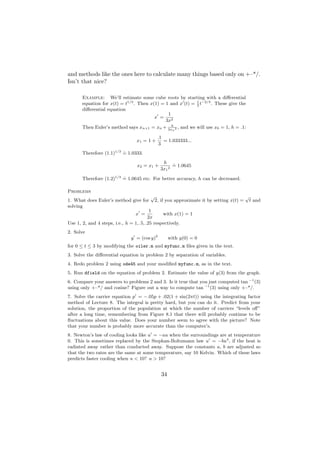
pronounce his name correctly, “oiler”.

     Example: Now we’ll do one for which the answer is not as easily known
     ahead of time. Since the calculations can be tedious, this is a good time to
     use the computer. We will set up the problem by hand, and solve it two
     ways on the machine. Assume that p(t) is the proportion of a population
     which carries but is not affected by a certain disease virus, initially 8%. The
     rate of change is influenced by two factors. First, each year about 5% of the
     carriers get sick, so are no longer counted in p. Second, the number of new
     carriers each year is about .02 of the population but varies a lot seasonally.
     The differential equation is

                           p    =   −.05p + .02(1 + sin(2πt))
                         p(0)   =   .08


                                          31
Euler’s approximation is to choose a stepsize h, put tn = nh, p0 = .08, and
      approximate p(tn ) by pn where

                       pn+1 = pn + h(−.05pn + .02(1 + sin(tn )))

      To compute in octave or matlab, use any text editor to make a function file
      to calculate the right hand side:


 %file myfunc.m
 function rate = myfunc(t,p)
 rate = -.05*p + .02*(1+sin(2*pi*t));
 %end file myfunc.m


Then make another file to drive the computation:


 %file oiler.m
 h = .01;
 p(1) = .08;
 for n = 1:5999
   p(n+1) = p(n) + h*myfunc(n*h,p(n));
 end
 plot(0:h:60-h,p)
 %end file oiler.m

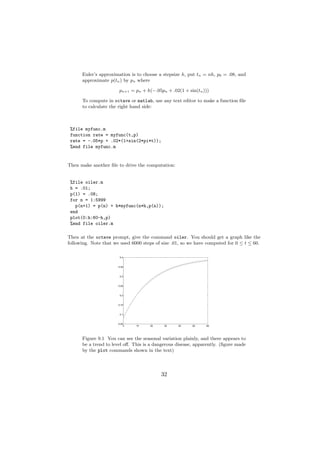
Then at the octave prompt, give the command oiler. You should get a graph like the
following. Note that we used 6000 steps of size .01, so we have computed for 0 ≤ t ≤ 60.

                        0.4


                       0.35


                        0.3


                       0.25


                        0.2


                       0.15


                        0.1


                       0.05
                           0   10    20     30    40     50    60


      Figure 9.1 You can see the seasonal variation plainly, and there appears to
      be a trend to level off. This is a dangerous disease, apparently. (figure made
      by the plot commands shown in the text)


                                          32
For additional practice you should vary h and the equation to see what happens.

There are also more sophisticated methods than Euler’s. One of them is
built into matlab under the name ode23 and you are encouraged to use it
even though we aren’t studying the internals of how it works. You should
type help ode23 in matlab to get information on it. To solve the carrier
problem using ode23, you may proceed as follows. Use the same myfunc.m
file as before. Then in Matlab give the commands


 [t,p] = ode23(’myfunc’,0,60,.08);
 plot(t,p)


Your results should be about the same as before, but generally ode23 will
give more accuracy than Euler’s method. There is also an ode45. We won’t
study error estimates in this course. However we will show one more example
to convince you that these computations come close to things you already
know. Look again at the simple equation x = x, with x(0) = 1. You know
the solution to this by now, right? Euler’s method with step h gives

                                 xn+1 = xn + hxn

This implies that
                              x1 = (1 + h)x0 = 1 + h
                            x2 = (1 + h)x1 = (1 + h)2
                                         ···
                                   xn = (1 + h)n
Thus to get an approximation for x(1) = e in n steps, we put h = 1/n and
receive
                                   .      1
                                e = (1 + )n
                                          n
Let’s see if this looks right. With n = 2 we get (3/2)2 = 9/4 = 2.25. With
                                          .
n = 6 and some arithmetic we get (7/6)6 = 2.521626, and so forth. The point
is not the accuracy right now, but just the fact that these calculations can be
done without a scientific calculator. You can even go to the grocery store,
find one of those calculators that only does +–*/, and use it to compute
important things.
Did you ever wonder how your scientific calculator works? Sometimes people
think all the answers are stored in there somewhere. But really it uses ideas

                                          33
and methods like the ones here to calculate many things based only on +–*/.
Isn’t that nice?

      Example: We’ll estimate some cube roots by starting with a differential
      equation for x(t) = t1/3 . Then x(1) = 1 and x (t) = 3 t−2/3 . These give the
                                                           1

      differential equation
                                              1
                                        x =
                                             3x2
      Then Euler’s method says xn+1 = xn + 3xh 2 , and we will use x0 = 1, h = .1:
                                                n

                                           .1
                                x1 = 1 +      = 1.033333...
                                           3
                         .
      Therefore (1.1)1/3 = 1.0333.
                                             h .
                                x2 = x1 +         = 1.0645
                                            3x1 2
                         .
      Therefore (1.2)1/3 = 1.0645 etc. For better accuracy, h can be decreased.

Problems
                                           √                                   √
1. What does Euler’s method give for 2, if you approximate it by setting x(t) = t and
solving
                                          1
                                 x =            with x(1) = 1
                                         2x
Use 1, 2, and 4 steps, i.e., h = 1, .5, .25 respectively.
2. Solve
                             y = (cos y)2        with y(0) = 0
for 0 ≤ t ≤ 3 by modifying the oiler.m and myfunc.m files given in the text.
3. Solve the differential equation in problem 2 by separation of variables.
4. Redo problem 2 using ode45 and your modified myfunc.m, as in the text.
5. Run dfield on the equation of problem 2. Estimate the value of y(3) from the graph.
6. Compare your answers to problems 2 and 3. Is it true that you just computed tan −1 (3)
using only +–*/ and cosine? Figure out a way to compute tan −1 (3) using only +–*/.
7. Solve the carrier equation p = −.05p + .02(1 + sin(2πt)) using the integrating factor
method of Lecture 8. The integral is pretty hard, but you can do it. Predict from your
solution, the proportion of the population at which the number of carriers “levels off”
after a long time, remembering from Figure 8.1 that there will probably continue to be
fluctuations about this value. Does your number seem to agree with the picture? Note
that your number is probably more accurate than the computer’s.
8. Newton’s law of cooling looks like u = −au when the surroundings are at temperature
0. This is sometimes replaced by the Stephan-Boltzmann law u = −bu4 , if the heat is
radiated away rather than conducted away. Suppose the constants a, b are adjusted so
that the two rates are the same at some temperature, say 10 Kelvin. Which of these laws
predicts faster cooling when u < 10? u > 10?


                                            34
10      Second Order Linear Equations

       Today: 2nd order equations and some applications. The characteristic
       equation. Conservation laws.

The prototype for today’s subject is x = −x. You know the solutions to
this already, though you may not realize it. Think about the functions and
derivatives you know from calculus. In fact, here is a good method for any
differential equation, not just this one. Make a list of the functions you
know, starting with the very simplest. Your list might be
                                      0
                                      1
                                      c
                                      t
                                     tn
                                     et
                                   cos(t)
                                    ...
Now run down the list trying things in the differential equation. In x = −x
try 0. Well! what do you know? It works. The next few don’t work. Then
cos(t) works. Also sin(t) works. Frequently, as here, you don’t need to use a
very long list before finding something. As it happens, cos(t) and sin(t) are
not the only solutions to x = −x. You wouldn’t think of it right away, but
2 cos(t) − 5 sin(t) also works, and in fact any c1 cos(t) + c2 sin(t) is a solution.

       Practice: Find similar solutions to x = −9x.

The equations x = cx happen to occur frequently enough that you should
know all their solutions. Try to guess all solutions of x = 0 and x = 25x
for practice.


10.1     Linearity

We will consider equations of the forms

                               ax + bx + cx = 0

                           ax + bx + cx = d cos(f t)


                                        35
These are called second order linear equations, and the first one is called
homogeneous. The strict meaning of the word ’linear’ is being stretched
somewhat here, but the terminology is traditional. Really an operation L
which may be applied to functions, such as L(x) = ax + bx + cx, is linear
if it is true that L(x + y) = L(x) + L(y) and L(kx) = kL(x). This does hold
here, and the consequence is that if x and y are both solutions to L(x) = 0,
then linear combinations like 2x + 5y are also solutions. That is true for
the homogeneous equation because we have L(2x + 5y) = L(2x) + L(5y) =
2L(x) + 5L(y) = 0. However, the nonhomogeneous second equation does
not have this property. You can see this yourself. Suppose x and y are
solutions to the same equation, say x + 3x = 2 and y + 3y = 2. Then
we want to see whether the sum s = x + y is also a solution. We have
s + 3s = x + y + 3x + 3y = 2 + 2 = 4. This is a different equation,
since we got s + 3s = 4, not s + 3s = 2. So it is a bit of a stretch to call
the nonhomogeneous equation ‘linear’, but that is the standard terminology.
You should also be sure you understand that for an equation like x +x2 = 0,
even with 0 on the right side, the sum of solutions is not usually a solution.


10.2    The Characteristic Equation

Next we look at a method for solving the homogeneous second order linear
equations. Some of the nonhomogeneous ones will be done in Lecture 13.
The motivation for this method is the observation that exponential functions
have appeared several times in the equations which we have been able to
solve. Let us try looking down our list of functions until we come to the
ones like ert . Trying x = ert in

                             ax + bx + cx = 0

we find ar2 ert + brert + cert = (ar2 + br + c)ert This will be zero only if

                              ar2 + br + c = 0

since the exponential is never 0. This is called the characteristic equation.
For example, the characteristic equation of x + 4x − 3x = 0 is r2 + 4r −
3 = 0. See the similarity? We converted a differential equation to an
algebraic equation that looks abstractly similar. Since we ended up with
quadratic equations, we will get two roots usually, hence two solutions to
our differential equation.


                                      36
Example: x + 4x − 3x = 0 has characteristic equation r2 + 4r − 3 = 0.
                                                  √
Using the quadratic formula, the roots are r√ −2 ± 7. So we have found
                        √
                                             =
two solutions x = e(−2− 7)t and x = e(−2+ 7)t . By linearity we can form
linear combinations
                                         √                √
                       x(t) = c1 e(−2−    7)t
                                                 + c2 e(−2+7)t


Example: You already know x = −x very well, right? But our method
gives the characteristic equation r2 +1 = 0. This does not have real solutions.
In Lecture 12 we’ll see how the use of complex numbers at this stage will
unify the sines and cosines we know, with the exponential functions which
our characteristic method produces.


Example: The weirdest thing which can happen is the case in which the
quadratic equation has a repeated root. For example, (r + 5)2 = r2 + 10r +
25 = 0 corresponds to x + 10x + 25x = 0. The only root is −5, so we
only get one solution x(t) = e−5t , and multiples of that. If these were the
only solutions, we could solve for say, the initial conditions x(0) = 3 and
x (0) = −15, but could not solve for x(0) = 3 and x (0) = −14. As it turns
out, we have not made a general enough guess, and have to go further down
our list of functions, so to speak, until we get to things like tert . These work.
So we end up with solutions x(t) = (c1 + c2 t)e−5t for this problem. This is a
special case, and not too important, but it takes more work than the others
for some reason.


Example:
                                  x      =        −5x
                                 x(0)    =        1
                              x (0) = 2
                                  √             √
General solution is x(t) = c1 cos( 5t) + c2 sin( 5t). Use initial conditions
                       √               2
x(0) = c1 = 1, x (0) = 5c2 = 2, c2 = √5 . So
                                   √       2    √
                        x(t) = cos( 5t) + √ sin( 5t)
                                            5


Example:
                                    y        =     4y
                                  y(0)       =     1
                                 y (0)       =     2
Characteristic equation is r2 = 4, r = ±2, y = c1 e2t + c2 e−2t , y(0) =
c1 + c2 = 1 and y (0) = 2c1 − 2c2 = 2. Then eliminate c2 : 2y(0) + y (0) =
4c1 = 4, c1 = 1, c2 = 1 − c1 = 0, y(t) = e2t , you check it.


                                         37
10.3    Conservation laws, part 2

Sometimes a second order equation can be integrated once to yield a first
order equation. Good things happen when this is possible, since we have
many tools to use on first order equations, and because usually the resulting
equation can be interpreted as conservation of energy or some similar thing.
For example, let’s pretend that we don’t know how to solve the equation
x = −x. You can try to integrate this equation with respect to t. Look
what happens:
                                x dt = −     x dt

You can do the left side, getting x , but what happens on the right? You
can’t do it can you? The right side doesn’t integrate to xt or something
like that does it? I’m asking all these questions because this is a common
place to make mistakes. Really, you just can’t do the integral on the right,
because the integrand x(t) is not yet known. But there is a way to fix this
problem. It is very clever because it seems at first to complicate the problem
rather than simplifying it. Multiply the equation x = −x by x and see
what happens. You get
                                x x = −xx
Now stare at that for a while, and see if you can integrate it now.

                              x x dt = −     xx dt

You may notice, if you look at this long enough, that according to the chain
rule you can now integrate both sides. That is because xx is the derivative
of 2 (x)2 , and x x is the derivative of 1 (x )2 . So integrating, you get
   1
                                         2

                             1            1
                               (x )2 = c − (x)2
                             2            2
Now there are several things to observe about this. First we don’t have a
second order equation any more, but a first order instead. Second we can
make a picture for this equation in the (x, x ) plane, and it just says that
solutions to our problem go around circles in this plane, since we just got the
equation of a circle whose size depends on the constant c. Third, there is a
physical interpretation for the first order equation, which is conservation of
energy. Not everyone who takes this course has had physics yet, so the next
bit of this discussion is optional, and may not make too much sense if you
have not seen an introduction to mechanics. Conservation of energy means

                                      38
the following. x is the position and x the velocity of a vibrating object.
Peek ahead to Figure 13.1 if you like, to see what it is. The energy of this
object is in two forms, which are kinetic energy and potential energy. The
kinetic energy “ 2 mv 2 ” is the (x )2 term. The potential energy “ 1 kx2 ” is the
                 1
                                                                    2
x 2 term. So what is c? It is the total energy of the oscillator, and the going

around in circles is physically the fact that when something swings back and
forth, the energy is periodically transferred from to potential to kinetic and
back. The child on a swing has a lot of kinetic energy at the bottom of the
path moving fast, and all that becomes potential energy by the top of the
swing when he is instantaneously not moving, and the cycle repeats.
This kind of calculation, finding the integral of the equation or some multiple
of the equation, is called finding a conservation law. It cannot always be
used, but is a powerful thing to know about.
Here is an example of the power. It is a little more advanced than the rest
of the lecture, but I bet you will like it.

      Theorem There is no other realvalued solution to x = −x than the ones
      you already know about.

      You probably wondered whether anything besides the sine and cosine had
      that property. Of course there are the linear combinations of those. But
      maybe we just aren’t smart enough to figure out others. The Theorem says
      no: that’s all there are.

      Proof Suppose the initial values are x(0) = a and x (0) = b, and we
      write down the answer x(t) that we know how to do. Then suppose your
      friend claims there is a second answer to the problem, called y(t). Set
      u(t) = x(t) − y(t) for the difference which we hope to prove is 0. Then
      u = −u. We know from the conservation law idea that then
                                   1            1
                                     (u )2 = c − (u)2
                                   2            2
      What is c? The initial values of u are 0, so c = 0. Do you see why that
      makes u identically 0?

Problems
1. Suppose x1 + x1 2 = 0 and x2 + x2 2 = 0, and set s = x1 + x2 . Calculate s + s2 to see
why the sum of solutions is not usually a solution.
2. Suppose x1 and x2 both solve

                                     x +x       =   0
                                       x (0)    =   2

and set s = x1 + x2 . Find out why s is not a solution.


                                           39
3. Suppose x1 and x2 both solve

                                    x +x           =     cos 8t
                                         x (0)     =     0

and set s = x1 + x2 . Is s a solution?
4. Solve

                                   4y − 3y − y               =    0
                                                  y(0)       =    1
                                                 y (0)       =    0

5. Solve the same equation as in problem 4, but with initial conditions

                                           y(0)     =        0
                                          y (0)     =        1

6. Solve the same equation as in problem 4, but with initial conditions

                                           y(0)     =        2
                                          y (0)     =        3

7. Can you see that the answer to problem 6 should be 2 times the answer to problem 4
plus 3 times the answer to problem 5?
8. Find a conservation law for the equation x + x3 = 0.
9. Do you think there are any conservation laws for x + x + x = 0?
10. What’s rong with this? y + y 2 = 0, r2 + 1 = 0, r = −1, y = e−t + c. There are at
least 3 errors.


                                                  40
11     The Heat Equation

     Today: We now have enough information to make a good start on the
     partial differential equation of heat conduction. If you want to save PDE for
     later, you could read this lecture after Lecture 28.

The heat equation looks like this:

                                    ∂u   ∂2u
                                       =k 2
                                    ∂t   ∂x
usually abbreviated ut = kuxx , and it describes the temperature of an object
in which heat energy is allowed to flow by conduction in the x direction.
Heat can also move with a flowing fluid but that, known as convection, is
not what this is about. Heat can also move as radiation, like the warming
you feel near a fire even though the air itself may be cold. It is not about
that either. It can describe the changing temperature along a metal bar or
through a thick wall. The k is a material constant. For now, take k = 1.
Later we give a derivation of this from physical principles. Right now, lets
see how close we can come to solving it.
Try the separation idea. Look for solutions of the form

                               u(x, t) = X(x)T (t)

This does not mean we think they are all like this. We hope that some are.
Substituting, we need

                            T (t)X(x) = T (t)X (x)

Now divide by XT , assuming for now that this is not 0.
Of course, later we might find that sometimes it is 0, but by then we will have
made an independent check, without dividing anything, that our answer
really is a correct answer. So right now we are just exploring, not really
proving anything. We get
                                  T    X
                                     =
                                  T     X
Again we see that since the left side only depends on t, and the right does
not depend on t, that neither side depends on t, or on x. They are the same
constant, call it −c. We must then solve the ordinary differential equations

                        T = −cT          and X = −cX

                                         41
Observe, two good things happened simultaneously. First the PDE broke
into two ODEs. Second the ODEs turned out to be some that we already
know how to solve.

      Example: Suppose c = 1. We know how to solve T = −T , and X = −X.
      We know solutions to those. T (t) = c1 e−t , and X(x) = c2 cos(x) + c3 sin(x).
      Thus some solutions to the heat equation ought to be

                                    u(x, t) = e−t cos(x)

                                   u(x, t) = 3e−t sin(x)
                            u(x, t) = e−t (6 cos(x) − 5.3 sin(x))

Now, we must check those. For one thing, they are 0 in a few places and
maybe that matters. Or maybe we overlooked something else in our sepa-
ration argument.

      Practice: Plug those into the heat equation and verify that they really do
      work.

Problems
1. Suppose c = 2 instead of 1 in our separated ODEs

                             T = −cT         and X = −cX

What solutions T , X, u do you find?
2. What if c is some other positive number besides 1 or 2? What solutions T , X, u do
you find?
3. What happens if c = 0? What solutions T , X, u do you find?
4. Sketch a graph of the temperature for a few times, in the solution u(x, t) = 3e−t sin(x)
above.
5. What happens if c is a negative number, say −1? Sketch a graph of the temperature
for a few times. Could that u be the temperature of an object? There is something wrong
with that as a object temperature in most cases, isn’t there? So we don’t use negative c
usually.
6. Find some solutions to the heat equation

                                         ut = kuxx

where the material constant k has been put back in.


                                             42
12     Complex Numbers and the Characteristic Equa-
       tion

      Today: The complex numbers, and a motivation for the definition of ea+bi .
      More second order equations.

Complex numbers are expressions of the form a + bi where a and b are real
numbers. You add, subtract, and multiply them just the way you think you
do, except that i2 = −1. So for example,


             (2.5 + 3i)2 = 6.25 + 2(2.5)(3i) + 9i2 = −3.25 + 15i
If you plot these points on a plane, plotting the point (x, y) for the complex
number x + yi, you will see that the angle from the positive x axis to 2.5 + 3i
gets doubled when you square, and the length gets squared. Addition and
multiplication are in fact both very geometric, as you can see from the
figures.

                                                  7

                      5
                                                  6
                      4

                                                  5
                      3

                                                  4
                      2


                      1                           3


                      0
                                                  2

                     −1
                                                  1

                     −2
                                                  0
                     −3

                                                 −1
                          0      2      4             0    2


      Figure 12.1 Addition of complex numbers is the same as for vectors. Mul-
      tiplication adds the angles while multiplying the lengths. The left picture
      illustrates the sum of 3 + i and 1 + 2i, while the right is for the product.
      (figure made by the compass command in matlab)


      Practice: Use the geometric interpretation of multiplication to figure out
      a square root of i.


                                            43
Division of complex numbers is best accomplished by using this formula for
reciprocals:
                               1       a − bi
                                   = 2
                            a + bi    a + b2


      Practice: Verify that this reciprocal formula is correct, i.e. that using it
               1
      you get a+bi (a + bi) = 1.

You are now equiped to do arithmetic, such as solving 2 − (2 − 5i)z = 3/i for
z. To do algebra correctly we should point out that two complex numbers
are equal by definition when the real and imaginary parts are equal. If
z = a + bi and a and b are real, then we write re(z) = a and im(z) = b. (not
bi.) Warning: If you know that a + bi = c + di you cannot conclude that
a = c and b = d. For example, 1 + 0i = 0 + (−i)i. However, if you know in
addition that a, b, c, and d are real, then you can conclude that a = c and
b = d.
The quadratic formula for solving ax2 + bx + c = 0 is still good if everything
in sight is complex, but taking square roots can be tedious. That is why we
practiced it above.
There is another important construction which is motivated by algebra and
differential equations, and very useful. That is raising e to a complex power.
We set e(s+ti) = es eti by analogy with known properties of real exponentials,
but this still requires a definition of eti . We claim that the only reasonable
choice is cos(t) + i sin(t). The reason is as follows. The whole process
of solving second order equations by the characteristic equation method
depends on the formula
                                  d(ert )
                                          = rert
                                    dt
Let’s require that this hold also when r = i. Writing eit = f (t) + ig(t) this
requires
                         f + ig = i(f + ig) = −g + if
so f = −g and g = f . These should be solved using the initial conditions
e0 = 1 = f (0) + ig(0). These give f (0) = 1, f (0) = 0 and f = −f . The
only solution is f (t) = cos(t) and g(t) = sin(t). Therefore our definition
becomes
                        e(s+ti) = es (cos(t) + i sin(t))
                                                 rt
Now it turns out that we actually get d(e ) = rert for all complex r. You
                                           dt
should verify this for practice, using our definition. This is a case of pulling

                                          44
oneself up by one’s own bootstraps: we solve a simple differential equation
to make a definition of e to a complex power, so that we can use that to
solve more complicated differential equations.
Now we can do more examples.

      Example: x + 2x + 3x = 0 The characteristic equation, which works
                              above, is r2 + 2r + 3 = 0. The solutions are
      by all that √ been done √
                  has
      r = −1 ± −2 = −1 ± i 2. So there are solutions to the differential
      equation of the form
                                           √                √
                          x(t) = c1 e(−1+i  2)t
                                                  + c2 e(−1−i   2)t


      Given some initial conditions, we can find the constants. For instance if we
      want to have x(0) = 5 and x (0) = 0 then we must solve

                     x(0) = 5     =   c1 + c2
                                             √              √
                     x (0) = 0    =   (−1 + i 2)c1 + (−1 − i 2)c2
                                  √
      The sum of these gives 5 = i 2(c1 − c2 ). So
                                            5       5i
                                 c1 = c2 + √ = c2 − √
                                           i 2        2
      The first equation then gives
                                                5i
                                      5 = 2c2 − √
                                                 2
                              1                                  1
      Finally c2 = (5/2)(1 − √2 ) and c1 = 5 − c2 = (5/2)(−1 − √2 ). So
                        „           «       √
                                                     „       «       √
                      5          1     (−1+i 2)t   5      1
               x(t) =     −1 −  √     e          +     1− √    e(−1−i 2)t
                      2           2                2       2

You may notice that the answer, besides being messy, looks very complex.
Now the last time you went into the lab, all the instruments were probably
reading out real numbers, weren’t they? So it is common to rewrite our
solution in a way which shows that it really is real after all. To do this, the
following new idea is required: If x(t) is a complex solution to a second order
linear differential equation with real coefficients then the real and imaginary
parts of x are also solutions! For example, e3it is a solution to x = −9x.
The real and imaginary parts are respectively cos(3t) and sin(3t), and these
are certainly solutions also. To see why this works in general, suppose that
x = u + iv solves ax + bx + cx = 0. This says that a(u + iv ) + b(u + iv ) +
c(u + iv) = (au + bu + cu) + i(av + bv + cv) = 0 Assuming that a, b, c, u,
and v are all real, you can conclude that au + bu + cu and av + bv + cv are
also 0. But note that if some of the coefficients had not been real, or if the
equation had been something like x + x2 = 0 then the argument would not

                                             45
have worked. Equations with explicit complex coefficients sometimes occur
in physics, in spite of what we all noticed above about lab instruments.
Schr¨dinger’s Equation is an example. In such cases you can’t simply use
     o
the real and imaginary parts.
So let’s rework the previous example slightly. After finding the values of
r above, we wrote down among other things a complex solution x(t) =
      √               √            √
e(−1+i 2)t = e−t (cos( 2t) + i sin( 2t)) Using the real and imaginary parts,
we form solutions
                                     √                 √
                   x(t) = a1 e−t cos( 2t) + a2 e−t sin( 2t)

If we apply the same initial conditions again, we need x(0) = 5 = a1 and
                  √
x (0) = 0 = −a1 + 2a2 . Solving these we end with
                                      √      5         √
                      x(t) = 5e−t cos( 2t) − √ e−t sin( 2t)
                                              2
It is important to realise that this is equal to the complex-looking solution
we found previously.

     Example: Solve for a:
                                      3
                                        − (2 + i)a = 7
                                      i
           7− 3                                    −14−6i+7i+3i2
     a=       i
          −(2+i)
                   = − 7+3i = −(7 + 3i) 22 +12 =
                        2+i
                                         2−i
                                                         5
                                                                    =   −17+i
                                                                          5


     Example: Solve
                                     y + 2y + 2y = 0
     The characteristic equation is r2 + 2r + 2 = 0, so by the quadratic formula
             √
     r = −2±2 4−8 = −1 ± i. One solution is e(−1+i)t = e−t (cos(t) + i sin(t)).
     Taking the real and imaginary parts, the solution is

                             y(t) = c1 e−t cos(t) + c2 e−t sin(t)

     Don’t forget to check it.


     Example:
                                     x + 2x + x = 0
     r + 2r + 1 = (r + 1) = 0, r = −1, −1, x = (c1 + c2 t)e−t , Check: x =
      2                       2

     c2 e−t − (c1 + c2 t)e−t = c2 e−t − x. x = −c2 e−t − x = −c2 e−t − (c2 e−t − x)
     = −2c2 e−t + x, x + 2x + x = −2c2 e−t + x + 2(c2 e−t − x) + x = 0


                                             46
Example:
                                               x + 2x − x = 0
        2
                                          √                            √               √
       r + 2r − 1 = 0, r = −1 ±               1 + 1, x(t) = c1 e(−1−    2)t
                                                                              + c2 e(−1+   2)t


Problems
1. Solve r2 − 6r + 10 = 0, r3 − 6r2 + 10r = 0, and r2 − 6r − 10 = 0.
2. Solve y + 3y + 4y = 0.
                    1                 1
3. Find a, if a +   a
                        = 0; if a +   a
                                          = i.
4. Sketch the graphs of the functions e−t cos(t), e−t cos(3t), and e−4t sin(3t).
                 d(ert )
5. Verify that     dt
                           = rert for r = a + bi, using the definition e(a+bi)t = eat (cos(bt) +
i sin(bt)).
6. For each t, e(1+i)t is a complex number, which is a point in the plane. So as t varies, a
curve is traced in the plane. Sketch it.
7. A polynomial r2 + br + c = 0 has roots r = −2 ± i. Find b and c.
8. A characteristic equation r2 + br + c = 0 has roots r = −2 ± i. What was the differential
equation?
9. What rong with this? x + 4x = 0, r2 + 4 = 0, r = ±2i, x = c1 (e2it + e−2it ).


12.1        The Fundamental Theorem of Algebra

Talk about lifting yourself by your own bootstraps. A new number writ-
ten i was invented to solve the equation x2 + 1 = 0. Of course you have
noticed that the people who invented it were not very happy about it: con-
trast “complex” and “imaginary” with “real” and “rational”. But soon the
following theorem was discovered.
By introducing the new number i, not only can you solve x2 + 1 = 0, but
you can also solve at least in principle all these: x2 + 2 = 0, x3 − i = 0,
x6 − (3 − 2i)x4 − x3 + iπx − 39.1778i + 43.2 = 0, etc, etc.

       Fundamental Theorem of Algebra Let

                    p(x) = a0 + a1 x + a2 x2 + · · · + an−1 xn−1 + xn

       be a polynomial of degree n > 0 with any complex coefficients
       ak . Then there are complex numbers r1 , r2 , . . . rn which are
       roots of p and p factors as

                             p(x) = (x − r1 )(x − r2 ) · · · (x − rn )

                                                      47
As a practical matter, we can handle the cases a0 + x and a0 + a1 x + x2 easily. We all
know the quadratic formula. There is a cubic formula that most people don’t know for
solving the n = 3 case, and a quartic formula that hardly anybody knows for the n = 4
case, which takes about a page to write. Then something interesting happens.

      Abel’s Theorem Let n ≥ 5. Suppose you figure out every formula that
      could ever be written in terms of the coefficients ak and the operations of
      addition, subtraction, multiplication, division, and extraction of roots. Then
      none of those formulas give you the roots of the polynomial.

So: the roots exist, but if you need them then you will usually have to approximate them
numerically. It is tough.
Problems
1. In the Fundamental Theorem we took the coefficient of xn to be 1 just for convenience.
But if you don’t do that the factorization must be written differently. For example,

                              −6 + x + x2 = (x − 2)(x + 3)

is correct. Figure out the number c in the case

                            −30 + 5x + 5x2 = c(x − 2)(x + 3)

2. How must the factorization be written in general if you don’t assume the coefficient of
xn is 1?
3. You know that in the factorization −6 + x + x2 = (x − 2)(x + 3) you have −6 = (−2)(3).
In general what is the product of the roots r1 r2 · · · rn in terms of parameters appearing
in the Fundamental Theorem?
4. You know that in the factorization −6 + x + x2 = (x − 2)(x + 3), the x term comes
from x = −2x + 3x when you multiply the right hand side. In general what is the sum of
the roots r1 + r2 · · · + rn in terms of parameters appearing in the Fundamental Theorem?


                                            48
13     Forced Second Order

      Today: Forced equations, and how to solve them using the undetermined
      coefficients method. Natural frequency.

Consider the equations
                                   x + 2x = 0
                                y + 2y = 9 sin 3t
The first one is called the homogeneous form of the second one, or the
second is called a forced form of the first, and there are variations on this
terminology. Mechanically what they mean is as follows. Since we know the
solutions to the first one (don’t we?) are
                                     √           √
                        x(t) = c1 cos 2t + c2 sin 2t

it seems reasonable that this first equation is about something vibrating
or oscillating. It can be interpreted as a case of Newton’s F = ma law,
if you write it as −2x = 1x . Here x is the position of a unit mass, x
is its acceleration, and there is a force −2x which seems to oppose the
displacement x. We call this a “spring–mass” system. It can be drawn as
in Figure 13.1, where x is measured up.


      Figure 13.1 Unforced and forced spring–mass systems.


The −2x is interpreted as a spring force because it is in the direction opposite
x: if you pull the spring 1.54 units up, then x = 1.54 and the force is −3.08,
or 3.08 units downward. This is also a system without friction as we see
from the fact that there are no other forces except for the spring force, and
that the oscillation continues√ undiminished forever. Note that the “natural
                                2
frequency” of this system is 2π cycles/second, in the sense that the period
        2π         2π
of x is √2 : x(t + √2 ) = x(t).

                                        49
The so–called forced equation involves an additional force, as you can see if
you write it as −2y − 9 sin 3t = 1y . The picture in this case is like the right
side of Figure 13.1.
Now we turn to solution methods for the forced equation. We are guided
by the physics. That is, ask yourself what will happen if you start with a
                                                 √
                                                  2
system which wants to vibrate at a frequency of 2π , and somebody reaches
                                     3
in and shakes it at a frequency of 2π . What could happen? If you think
about it, it is plausible that the motion might be rather complicated, but
that a part of the motion could be at each of these frequencies.
Let’s try that. Assume

                              y(t) = x(t) + A sin(3t)

where x is the solution given above for the unforced equation. Then

      y + 2y = x − 32 A sin(3t) + 2(x(t) + A sin(3t)) = −8A sin(3t)

We want this to equal 9 sin(3t). Notice how the terms involving x dropped
out. We need −8A = 9 so A = −9/8. Our solution becomes
                                √             √     9
                  y(t) = c1 cos( 2t) + c2 sin( 2t) − sin(3t)
                                                    8
In particular, our physics–style thinking did lead to a solution. Some people
who take this course have had physics, and some have not had physics. In
any case we hope you can see that a little physics, or banking, or later bio-
logical, knowledge goes a long way in helping to set up and solve differential
equations.
Notice also the coefficients of the terms in this solution. There are terms
                          √
                            2                                       3
at the natural frequency 2π and a term at the forced frequency 2π . The
                                                     9
coefficient of the forced–frequency term is fixed at − 8 , while the natural–
frequency terms have arbitrary coefficients. If you have initial conditions to
apply, now is the time.

      Example: To solve
                               y + 2y     =    9 sin(3t)
                                   y(0)   =    4
                                  y (0)   =    5
      we use the solution found above
                                    √             √     9
                      y(t) = c1 cos( 2t) + c2 sin( 2t) − sin(3t)
                                                        8

                                          50
√
      We get y(0) = 4 = c1 , y (0) = 5 = c2 2 − 3 9 . The answer becomes
                                                  8

                                 √     5+          27
                                                    8
                                                            √     9
                    y(t) = 4 cos( 2t) + √               sin( 2t) − sin(3t)
                                                   2              8
      This is graphed in the figure 13.2.

                        10

                         8

                         6

                         4

                         2

                         0

                        −2

                        −4

                        −6

                        −8

                       −10
                          0   10   20   30   40   50    60   70   80   90   100


      Figure 13.2 Can you see two frequencies at work here? They are not the
      obvious ones! Do problems 1–3 to see what they are.


There is a terminology that traditionally goes with this solution. One calls
− 9 sin(3t) a “particular” solution to y + 2y = 9 sin(3t). It is also true that
  8      √
29.3 cos( 2t) − 9 sin(3t) is a particular solution, as are many other things.
                 8
One says that the solution is the sum of a particular solution and a solution
of the homogeneous equation.
Other equations can be solved by the same method. For example, it is
possible to solve y + y + y = 3 + et by guessing a particular solution of
the form A + Bet . This will work. However this type of forcing is really not
very important for us. Sines and cosines are the important things because
they are the most practical; if you are sitting in class and happen to notice
a fan vibration in the ceiling of the room, that is an example which can
be modeled by one of these equations with sinusoidal forcing. The spring
and mass correspond to some of the ceiling materials, and the sine or cosine
forcing term represents the fan motor running at a constant speed.

      Example:
                                    y + 3y + 2y = sin(t)
      Try y = A sin(t)+B cos(t), since sine alone will not work, considering the 3y
      term. Then y + 3y + 2y = (−A + 2A − 3B) sin(t) + (−B + 2B + 3A) cos(t).


                                                  51
We need
                                       A − 3B      =    1
                                       B + 3A      =    0
     Substituting the second of these into the first gives A − 3(−3A) = 10A = 1.
     Then A = .1 and B = −3A = −.3. Our particular solution is .1 sin(t) −
     .3 cos(t). For the homogeneous equation the characteristic equation is
                             r2 + 3r + 2 = (r + 1)(r + 2) = 0
     so r = −1 or r = −2. The answer is then
                     y(t) = c1 e−t + c2 e−2t + .1 sin(t) − .3 cos(t)
     This is shown in figure 13.3, for the case c1 = 1, c2 = −1.

                      0.4

                      0.3

                      0.2

                      0.1

                       0

                     −0.1

                     −0.2

                     −0.3

                     −0.4

                     −0.5

                     −0.6
                        −5       0        5        10       15    20


     Figure 13.3 A solution to y + 3y + 2y = sin t. Only the forced solution
     remains after some time; the e−t and e−2t terms are “transient”.


There is one special case which requires more work to solve than the others.
This is the case which occurs when the forcing is at exactly the natural
frequency, and is called “resonance”. Like:

                                     x + 4x = cos(2t)

Think about what happens then. If your little brother is on the swing going
back and forth every 3 seconds, and you “help” by pushing once every 3
seconds, pretty soon he will be going higher than he wants to go! Mathe-
matically, if you try a particular solution A cos(2t) it won’t work because
you get 0 when you substitute it into the left side of the equation.
Taking these things together, it is reasonable to try something like At cos(2t)+
Bt sin(2t). These actually work, giving solutions which grow with time.


                                              52
Practice: Verify that the solution to x +4x = cos(2t) is x(t) = 1 t sin(2t)+
                                                                       4
       c1 cos(2t) + c2 sin(2t)

Problems
1. Use one of the addition formulas sin(a + b) = sin(a) cos(b)+ cos(a) sin(b) or cos(a + b) =
cos(a) cos(b)− sin(a) sin(b) to show that any function of the form A cos(f t) + B sin(f t)
can be written in the form C sin(f t + φ), for some numbers C and φ. Note that here we
were combining sinusoids having the same frequency f /2π.
2. Similarly to problem 1, show how a combination of two sinusoids of different frequencies
can be written as a sum of products of sinusoids: derive for example the identity sin(8t) +
2.3 sin(7t) = 3.3 sin(7.5t) cos(.5t) − 1.3 cos(7.5t) sin(.5t)
3. Combine the ideas of problems 1 and 2 to explain the two obvious frequencies in Figure
                                      √
                                       2      3
13.2, in particular that they are not 2π and 2π .
4. Solve x + x + 1 x = 7 sin 6t.
                 4

5. Solve x + 4x = sin 3t, and x + 4x = sin 2t, and discuss the difference.
6. Show that the addition formulas for the sine and cosine are equivalent to the complex
exponential rule ea+b = ea eb .
7. A challenge: After a lecture involving ’frequency’ one day, I noticed a crane at the
physics building, lifting a heavy load. The main load didn’t swing much, but an interme-
diate pulley seemed to oscillate too fast for safety on such large equipment.


                                                 l
                                             θ


                                                         m


                                                 l


                                                     M


       Figure 13.4 A model for a crane holding a heavy load, with an intermediate
       pulley in the cable. Doesn’t the main load rise twice as much as the pulley?

Verify that the pulley rises l − l cos(θ) from its lowest position. If you can work out the
physics, try to see that the energy ignoring friction is
                                              1
                    (mg + 2M g)(l − l cos(θ)) + m(lθ )2 = constant
                                              2
                                                                 .
Form a time derivative of that. There is an approximation sin(θ) = θ for small angles,
which is explained better in problem 1 on page 144. Using that, derive a second order
                    `        ´
linear equation θ + 2M + 1 θ = 0. Deduce that the period of oscillation of the pulley
      q               m
             l
is 2π             .
        ( 2M +1)g
           m

What that means: you can estimate how much mass M they are lifting by just timing the
swing of the pulley, and making a reasonable estimate of the pulley mass!
8. What’s rong with this? x + 4x = 0, x = cos(2t) + sin(2t) + C


                                             53
14      Systems of ODE’s, part 1

       Today: Why would anybody want to study more than one equation at a
       time? Find out. Phase plane.


14.1     A Chemical Engineering problem

Jane’s Candy Factory contains many things of importance to chemical en-
gineers. One of the processing lines contains two tanks of sugar solution.
Pure water and sugar continually enter the first one where they are mixed,
and an equal volume of the solution flows to the second, where more sugar
is added. The solution is taken out at the same rate from the second tank.
The flow rates are as shown in the table.

                                      tank 1      tank 2
                   sugar input        10 lb/hr    6 lb/hr
                   water input        25 gal/hr   0
                   solution out       25 gal/hr   25 gal/hr
                   tank contents      100 gal     125 gal
                   weight of sugar    x lb        y lb

Jane’s control system tracks the weight of sugar present in the tanks in the
variables x and y. We can figure out the rates of change easily. The basic
principle here is conservation of mass.

                                                          x [lb]
x [lb/hr] = the rate in − the rate out = 10 [lb/hr] −              (25 [gal/hr])
                                                         100 [gal]

See, you just keep an eye on the units, and everything works out. Similarly
                                    x          y
                         y =6+         (25) −     (25)
                                   100        125
Jane would like to predict the length of time required to start up this system,
i.e., beginning with pure water in brand new tanks, how long before a “steady
state” condition is reached (if ever)? This is an initial value problem:

                          x   = 10 − .25x
                          y   = 6 + .25x − .2y
                                  x(0) = 0, y(0) = 0


                                      54
Let’s solve it the quickest way we can, and then we’ll do more of an overview
of systems in general. Look–the x equation is first order linear. Jane’s Candy
Factory is in luck! We know the solution is of the form x = ae−.25t + b.
Using the equation and the initial condition yields x(t) = 40 − 40e−.25t .
Then the y equation reads y = 6 + .25(40 − 40e−.25t ) − .2y which is also first
order linear. The integrating factor is e−.2t , which brings the y equation to
(e.2t y) = 16e.2t − 10e−.05t . Then e.2t y = 80e.2t − 200e−.05t + c. The initial
condition y(0) = 0 gives finally c = 120 and our solution is

                          x(t) = 40 − 40e−.25t
                          y(t) = 80 − 200e−.25t + 120e−.2t

The figure shows a plot of these solutions. It was made using the matlab
commands

 t = 0:.2:30; % this was a guess, that 30 hours would be enough
 x = 40 - 40*exp(-.25*t);
 y = 80 - 200*exp(-.25*t) + 120*exp(-.2*t);
 plot(t,x); hold; plot(t,y)

                     90


                     80


                     70


                     60


                     50


                     40


                     30


                     20


                     10


                     0
                      0      5     10    15      20    25     30


      Figure 14.1 For Jane’s Candy Factory. See whether you can determine
      which curve is for the first tank. (figure made by plot commands as given
      in the text)


Finally we can answer Jane’s question about how long the plant is going to
take to start up. As t → ∞, x(t) approaches 40 and y(t) approaches 80.

                                        55
Using the graph, we will be within 10% of these values after about 8 hours,
and well over half there in only 3. That kind of information could be useful,
if you run a candy factory, or a chemical plant.


14.2     Phase Plane

There is an easier way to produce a plot for Jane’s system, although reading
it requires a bit of practice. The pplane utility makes the following picture.


                        120


                        100


                        80


                        60
                    y


                        40


                        20


                         0


                              −10   0   10   20       30   40   50   60
                                                  x


       Figure 14.2 Jane’s Candy Factory, t hidden. The limit point (40,80) corre-
       sponds to the limiting values in Figure 14.1. (figure made by pplane)


In order to interpret this figure, one has to realise that the time is not
shown, so that the relation between x and y may be displayed. This is
called the “phase plane” for the system. Here we explain the idea of a phase
plane. The vectors shown are made by using the expressions for x and y
as components. This can be done for any system of the form

                                         x   = f (x, y)
                                         y   = g(x, y)

It means that we are thinking of the functions f and g as components of a
vector field. We also think of (x(t), y(t)) as parametric equations for a curve
in the (x, y) plane. Then from this point of view, look at what the differential
equations say. The right–hand sides are the vector field, while the left–hand
sides give the velocity. Consequently, the differential equation system just


                                                  56
says that the velocity of a solution curve must agree with the given vector
field. This is the entire content of the diffential equation. You may observe
in Figure 14.2 that the solution curves are tangent to the vectors. You do
observe that, right?

       Practice: Choose a point in the (x, y) plane, and work out the right hand
       sides of Jane’s system for these coordinates. Then draw a vector with these
       components starting from your point (x, y). See if it is the same as the one
       pplane drew.

Converting a System to a Higher order equation
It is occasionally of interest to convert a system of differential equations
into a single higher order equation. This cannot always be done. It can
be carried out for Jane’s system as follows. The y equation gives .25x =
y − 6 + .2y, or x = 4y − 24 + .8y. Substituting this into the x equation gives
x = 4y − 0 + .8y = 10 − .25(4y − 24 + .8y) = 16 − y − .2y. Rearranging,
we find that
                            4y + 1.8y + .2y = 16
The initial conditions become y(0) = 0, and y (0) = 6 + .25x(0) − .2y(0) = 6.
Ordinarily as we’ll see, it is more useful to convert higher order equations
to lower. That always can be done.
Problems
1. Find a second order equation for x1 , if

                                     x1    =      x1 − x2
                                     x2    =      x1 + 2x2

2. Find a second order equation for x2 , for the same system as in problem 1. Is it the
same as the equation for x1 ?
3. Make a sketch of the phase plane for the system of problem 1. You should do this first
by hand, and then let the computer do the work for you by running pplane on the system.
4. Here you will find another system for the second order equation of problem 1. Set
z1 = y, z2 = y − y, and find the equations for the derivatives of z1 and z2 . Did you get
the same system as in problem 1?
5. Make a sketch of the phase plane for the system

                                      x       =     1
                                       y      =     y−x

and make a sketch of the slope field for the equation

                                           y =y−t


                                               57
How do these two sketches compare, and why?
6. Set up a system for a modified version of Jane’s Candy Factory, in which there are now
third and fourth tanks in series with the first two, with parameters as shown.


                                           tank 3         tank 4
                        sugar input        0 lb/hr        5 lb/hr
                        water input        15 gal/hr      0
                        solution out       25 gal/hr      35 gal/hr
                        tank contents      220 gal        165 gal
                        weight of sugar    z lb           w lb


You might notice that the volume of solution is no longer constant for all of the tanks.


15      Systems of ODE’s, part 2

      Today: Systems of differential equations, Newton, nonlinear springs, predator–
      prey, linear systems. Preview of algebra to come.

There are several reasons for studying systems of differential equations. One
is typified by Jane’s Candy Factory of the previous lecture, where of course
if we were accounting for 7 tanks, we would need 7 equations. Another case
comes from Newton’s F = ma law. Each mass m needs a second order
equation, and there are many masses around.

      Example: Two Newton’s Laws give 4 first order. Suppose we have two
      masses moving on the x axis pushing each other according to the system

                                  m1 x1   =   f1 (x1 , x2 )
                                  m2 x2   =   f2 (x1 , x2 )

      In fact according to another of Newton’s proclamations, f2 = −f1 , but we
      don’t need this for our present purpose. Set v1 = x1 , v2 = x2 . Then we have
      four variables representing the positions and velocities of the two masses.
      The system becomes

                                     x1   =   v1
                                     x2   =   v2
                                  m1 v1   =   f1 (x1 , x2 )
                                  m2 v2   =   f2 (x1 , x2 )


                                           58
Example: A nonlinear spring gives two first order. Consider the equation
      x + 2x + x3 = 0. This equation looks somewhat like the second-order
      equations we studied for spring-mass systems, but it is not linear. You can
      think of the x3 term as a nonlinear spring force. Specifically, in order to
      stretch this spring twice as far, you must pull eight times as hard. In many
      respects, this is closer to the behavior of a real spring. We now show how to
      convert this equation to a system of first order equations. Set y = x . Then
      y = x = −2x − x3 = −2y − x3 . This gives us the first order system

                                   x   =    y
                                   y   =    −2y − x3

There must be some reason for doing this, right? First order systems do
have some advantages. They are much easier to think about, for one thing:
to imagine what happens with x + 2x + x3 = 0 involves thinking about
the graph of x(t), and how the position x, slope x , and curvature x all
interact. This can be pretty complicated. On the other hand, thinking
about an equivalent system just involves the idea that the solution curves
must follow the vector field, as described previously. For emphasis, consider
again a differential equation system

                                  x    = f (x, y, z)
                                  y    = g(x, y, z)
                                  z    = h(x, y, z)

The left sides give the velocity of a solution curve, while the right sides say
that this velocity must agree with the vector field whose components are
f , g, and h. In addition to this relatively simple description, most of the
available software is also set up to deal with first order systems.
Predator Prey Example Suppose we make a model of two populations,
where x(t) and y(t) are the population sizes. We assume that these two
species depend in each other in very different ways. As a first approximation,
we assume that if there were none of the y species present, that the x species
would grow exponentially, and that the exact opposite would happen to the
y species if there were no x’s around: we assume the y’s would die out. Our
first approximation is

            x    = x first approximation : exponential growth
            y    = −y       first approximation : exponential decay

This fits, if we are thinking of the y’s as predators, and x’s as prey, wolves
and mice, for example. The next step is to add some terms for the interaction

                                           59
of these species. We assume

                x    = x − xy      wolves are bad for mice
                y    = −y + xy      mice are good for wolves

It should be clear that we have neglected to put in various coefficients; this
does not affect the ideas involved. In a homework problem we ask you to
run pplane on this system to see what happens.
For now, we will just show that it is possible to begin with a system like this
one, and convert it to a single second order equation, which is however quite
a complicated equation sometimes. We calculate from the first equation,
y = (x − x )/x = 1 − x−1 x . This gives y = x−2 (x )2 − x−1 x . Then from
the second equation, y = (−1 + x)y = (−1 + x)(1 − x−1 x ). The next step
would be to equate these expressions and simplify. As you can see, this will
give a very nasty second order equation. The first order system definitely
makes more sense here.


15.1    Linear Systems

A linear system of differential equations means a system of the form

                               x    = 2x + 3y
                               y    = 4x + 5y

The constants 2, 3, 4, and 5 might of course be replaced by any others.
There could also be more than the two unknown functions x and y. You
may notice that this seems to be a fairly simple system, since it does not
include the predator–prey example, nor the nonlinear spring. We study
these systems because 1) They are easy and fun to solve and make pretty
pictures in the phase plane, 2) We learn some new algebra called linear
algebra in the process of solving these, which is used for many things other
than differential equations, and 3) They are the foundation for the harder
equations.
We’ll attack the linear system above with exponential functions, since these
have been useful so many times already. Try x = aert , y = best . The system
becomes

                           arert = 2aert + 3best
                           bsest = 4aert + 5best

                                      60
It is not quite clear what to do next, is it? But notice what happens if we
take s = r. Then all the exponentials cancel
                                    ar = 2a + 3b
                                    br = 4a + 5b
You may wish to compare this to what happened with second order linear
differential equations. As in that case, we have gotten rid of the differential
equations, and now have algebraic equations to solve. It should be easier
this way. These are easier to solve if you rearrange them as
                                 (2 − r)a + 3b = 0
                                 4a + (5 − r)b = 0
What happens next can be confusing, if you don’t see it coming. We are
not going to solve this algebraic system right now. In fact, we are going to
leave differential equations for a while to study the algebra connected with
systems like these. It happens to be the same algebra which is used for
many purposes not connected at all with differential equations, too. Once
we know the algebra, we’ll come back to the differential equation problem.
Problems
1. Find a first order system corresponding to x − x + x3 = 0. You may use y = x or
something else that you choose, as the second function.
2. Using y = x , find a first order system corresponding to x − x + x = 0.
3. For the system you obtained in problem 2, substitute x = aert and y = bert and find
the algebraic system which results. You do not have to solve the algebraic system.
4. Make a sketch of the phase plane for the system of problem 2. You should do this both
by hand and by using pplane.
5. Run pplane on first order systems for the equation x + 2x + xp = 0 for p = 1 and
p = 3. What differences do you observe?
6. Find a first order system corresponding to x + x3 = 0 and try to sketch the phase
plane by hand. This is too hard to do accurately, so don’t worry about it. Next, multiply
the equation by x and integrate to find a conservation law, as in Lecture 10. Now it
should be easy to sketch the phase plane, because the conservation law shows you what
curves the solutions run along.
7. Consider the predator–prey equations again. Our attempt to find a second order
equation for this system was a mess, but it suggests something which actually works: you
may notice the term x in part of our derivation. This suggests ln(x), doesn’t it? since
                        x
d(ln(x))/dt = x . Show that the equation x + y − ln(x) − ln(y) = c is a conservation law,
               x
in the sense that dc/dt = 0 for all solutions to the predator–prey system. Sketch a graph
of the function f (x, y) = x + y − ln(x) − ln(y). It may help to use octave for this sketch;
type help or help plotxyz to find out how.


                                            61
8. Here is way to “discover” the conservation law of problem 7. Imagine that the para-
metric equations for (x(t), y(t)) are solved so that y is expressed as a function of x. Then
by the chain rule you get dx = x . This gives dx = −y+xy . Show how to solve this by
                            dy     y               dy
                                                          x−xy
separation of variables.
9. Run pplane on the predator–prey system and on the predator–prey system with mi-
gration

                                   x    =   x − xy − .2
                                   y    =   −y + xy

Which species is migrating here, and are they moving in or out? Write a verbal description
of what the differences are for the two phase planes. Do you think there is a conservation
law for the migratory case?
10. What’s rong with this?

                                       x    =    y
                                       y    =    −x3
                    2              2
Then x = −x3 , d 2 = −x3 , d 3x = dt2 ,
               dt
                  x
                               x
                                                dx
                                                x2
                                                     = dt + C, ln(x2 ) = t, x = et/2 , y =
      t/2
(1/2)e + C. There are at least 3 mistakes.


                                            62
16    Linear Algebra, part 1

     Today: Systems of linear algebraic equations. Matrices.

A system of linear algebraic equations is something like
                                    2x − 3y + 5z = 0
                                        .7x − y + 3z = 0
                                                −y − 2z = 7
You might think, based on your past experience in math courses, that there
is always exactly one answer to every problem. The situation here is a bit
more subtle: This system can be thought of as three planes. If you plot
these planes in an (x, y, z) coordinate system, you might find that all three
happen to intersect in a single point. That point is the solution, in that
case.


                   20                                               30

                                                                    20
                   10

                                                                    10
                    0
                                                                     0
                  −10
                                                                   −10

                  −20
                                                                   −20

                  −30                                              −30
                    0                                                5
                                                          0                              5
                        −20                         −10                  0
                                              −20                                    0
                                        −30
                              −40 −40                                        −5 −5


     Figure 16.1 Three planes on the left, and three on the right. When two
     planes in 3D intersect, they do so in a line unless they coincide. In one case,
     the three planes have only one point in common. In the other, something
     else happens. That is subtle in the picture. Can you see it?

It may also happen that three planes meet in a line, rather than a point.
Then there are infinitely many solutions. Again, it is possible that two of
the planes are parallel. Then there is no solution.

     Practice: 1) There is another possibility. Can you think what it might be?
     2) Which of these possibilities holds for the system x + y = 0, 2x + 2y = 3,
     z=5?


                                                              63
16.1     Matrix

A matrix is an array of numbers, such as the coefficients in our first system
                                            
                                  2 −3 5
                           A = .7 −1 3 
                                  0 −1 −2

A matrix can also be formed to hold the variables
                                     
                                      x
                                u=  y 
                                      z

as well as the numbers on the right–hand side
                                      
                                      0
                                 b = 0
                                      7

Matrices are sometimes written using bold type, or with underlines, over-
lines, overarrows, or rounded brackets, or square brackets around the name
of the matrix. We won’t use any of those. That means that when we use
the symbol A or b, you have to keep straight from the context whether we
are talking about a number or matrix or what. The size of a matrix is given
as number of rows by number of columns. A is 3 by 3, while u and b are 3
by 1. We introduce a new form of multiplication so that our system can be
written                                 
                           2 −3 5         x      0
                         .7 −1 3  y  = 0
                           0 −1 −2        z      7
or
                                  Au = b
You might notice that to do this multiplication, it is helpful to move your
left hand along the row of A, and your right hand down the column of u.
The same concept is used to multiply matrices of any sizes, except that to
multiply AB you must have the same number of columns in A as rows in
B. Otherwise some poor number is left without anybody to multiply.

       Example: A matrix multiplication:
                             »     –» – »          –
                               2 3 x       2x + 3y
                                         =
                               4 5 y       4x + 5y


                                       64
2         32 3 2 3
                            2 −3  5    1     12
                          4.7 −1  3 5 405 = 46.75
                            0 −1 −2    2     −4
                      »     –»   – »                 –
                        1 2 a b      1a + 2c 1b + 2d
                                  =
                        3 4 c d      3a + 4c 3b + 4d
                                            
                                      1 0 0
                          1 0
I is the special matrix          or 0 1 0 or . . . , one for each size. It is
                          0 1
                                      0 0 1
the identity matrix and you should check that always AI = IA = A, Iu = u.
It is also useful to abbreviate the system Au = b further by not writing the
variables at all: the 3 by 4 matrix [A b] is called the augmented matrix of
the system. In general, if you have a system of m equations in n unknowns,
Au = b, then A is m by n, b is n by 1, u is m by 1, and the augmented
matrix [A b] is m by (n + 1).


16.2    Geometric aspects of matrices

Before continuing with equation–solving, there are several remarks. Matrices
like                                  
                                       x
                                 u = y 
                                       z
which consist of one column are sometimes called column vectors, and pic-
tured as an arrow from the origin to the point with coordinates (x, y, z).
In other words, u here has exactly the same meaning as xı + y + z k, and
you can think of it in exactly the same way. Of course we are now allowing
our column vectors to contain more than three coordinates, so the three–
dimensional vector notation doesn’t carry over. Welcome to the fourth di-
mension! There are some very nice geometric ideas connected to this form of
multiplication. These seem at first very different and unrelated to equation–
solving. We’ll give one example now, just so you realise that there are several
different reasons for studying matrices. Consider the simple matrix

                                       1 0
                                 A=      1
                                       0 2

A can be applied to any “point” (x, y) in the plane by using multiplication:

                                    x   x
                                A     = y
                                    y   2


                                      65
This means that every point moves vertically closer to the x axis. In spite
of how easy this multiplication is, the effect on the plane is dramatic, as you
can see in the next figure.


        Figure 16.2 Matrices can change little smiley faces. What would happen if
        the face were not centered at the origin?


Problems
                                                 2           3
               »         –       »       –         0   1   0        »       –               » –
                   1   1           0   1                              5   0                  a
1. Let A =                 , B =           , C = 40    0   1 5, D =           , and let x =     ,
                   0   1           1   0                              0   5                  b
                                                   0   0   1
    2   3
     −1
y = 4−25. Calculate AB, A2 = AA, C 3 , DB, BD, Ax, 3Ax − 2Dz, Dx, and Cy.
     −4
2. Suppose Au = b and Av = b, and set s = u + v. Is it true that As = b? How about if
Av = 0 instead, what then?
3. An airline company plans to make x flights per month from its main hub airport to
Chicago, and y flights to New York. New York flights require 6500 lbs of fuel and 200
softdrinks, while Chicago flights require 5400 lbs of fuel and 180 softdrinks. The available
monthly supply of materials at the hub consists of 260,000 lbs of fuel and 9,000 softdrinks,
and all these are to be used if possible. Write a system of equations expressing all this.
Discuss faults of this model.
                           » –»      – »         –
                            2 1 2          2 4
4. What’s rong with this?              =
                            4 3 4          9 12


                                                 66
17     Linear Algebra, part 2

     Today: Row Operations

Now that our matrix notation is established, we turn to the question of
solving the linear system Au = b. You may have solved such things in
algebra courses in the past, by eliminating one variable at a time. This
works fine for systems of 2 or maybe 3 equations. For our purposes though,
it is important to learn a very systematic way of accomplishing this. We
will describe a procedure which applies equally well to systems with any
number of variables. In case you are wondering about the need for that,
let me reassure you that linear algebra, of all the things you study, might
be one thing that gets used in real life. Consider an airline company which
needs to keep track of 45000 passengers, 200 planes, 300 crews, 8500 spare
parts, 25 cities, 950000 pounds of jet fuel, 85600 soft drinks, etc, etc. Then
there are the airframe engineers who compute the airflow at 10000 points
around the plane, and the engine people who compute the temperature and
gas flow at 3000 points inside the engines, and you get the picture.
Before we describe row operations, you should see what the system of equa-
tions looks like in a special case like
                                         
                                   1 0 0 5
                                 0 1 0 7
                                   0 0 1 9
This is the augmented matrix for the system x = 5, y = 7, and z = 9.
There is nothing to solve in this case. Consequently, the object of these row
operations is to put the matrix into the form [I b] if possible.
We now describe “row operations” for solving the system Au = b. There
are three row operations, which are applied to the augmented matrix [Ab],
and have the effect of manipulating the various equations represented by the
augmented matrix.
1) A row may be multiplied by a non–zero number.
2) Two rows may be interchanged.
3) A row may be replaced by its sum with a multiple of another row.
Row operations do not change the solutions of the system. This is clear for
the first two, and requires a bit of thought for the third one. They only
change the appearance of the equations.

                                     67
A system may have many solutions.

     Example: The system          »           –» – » –
                                      2   3     x   1
                                                  =
                                      4   6     y   2
     represents the two lines 2x + 3y = 1 and 4x + 6y = 2. You might notice that
     these are two equations for the same line. Therefore any point on this line
     should be a solution to both equations. Let’s do the row operations and see
     what happens. We have the augmented matrix
                    »         –                        »        –
                      2 3 1                              2 3 1
                                → (row 2 − 2 row 1) →
                      4 6 2                              0 0 0

     Here we have replaced row 2 by (row 2)–2(row 1). Look at the bottom line.
     It says that 0x + 0y = 0. That is true but not helpful. The top line says
     that 2x + 3y = 1. Since this is the only requirement for a solution, there are
     indeed infinitely many solutions
                                               1   3
                                   x      =      − y
                                               2   2
                                   y      =    anything

A system may have no solutions.

     Example: The system          »           –» – » –
                                      2   3     x   0
                                                  =
                                      4   6     y   2
     has augmented matrix
                  »       –                       »                  –
                    2 3 0                           2        3   0
                            → (row 2 − 2 row 1) →
                    4 6 2                           0        0   2

     Look at the bottom line. It says that 0x + 0y = 2. Is that possible? (No.)
     So this system has no solution. It describes two parallel lines.

The next example involves a bit more arithmetic, and is our original system.
It shows that a system may have a unique solution.

     Example:
             2              3               2                  3
               2 −3   5   0                   1 −1.5 2.5 0
     [A b] = 4.7 −1   3   05 → (.5 row 1) → 4.7   −1     3   05 → (row 2 − .7 row 1) →
               0 −1 −2 7                      0   −1    −2 7
       2                3
         1 −1.5 2.5 0
       40    .05  1.25 05 → (interchange row 2 and row 3) and (−row 2) →
         0   −1    −2 7


                                               68
2                        3
       1    −1.5      2.5    0
      40      1        2    −75 → (row 1 + 1.5 row 2) and (row 3 − .05 row 2) →
       0     .05      1.25   0
                         2                  3
                           1 0 5.5 −10.5
                         40 1      2    −7 5 → (row 3)/1.15 →
                           0 0 1.15     .35
       2                        3
        1    0     5.5 −10.5
       40    1      2      −7 5 → (row 2 − 2 row 3) and (row 1 − 5.5 row 3) →
        0    0      1    −.3043
                                  2                   3
                                    1 0 0 −12.1737
                                  40 1 0 −7.6086 5
                                    0 0 1     .3043
     The solution to our original system is therefore
                                       2          3
                                         −12.1737
                                   u = 4 −7.6086 5
                                           .3043

     Notice there is only one solution, which says that these three planes intersect
     in just one point. You may notice that this is the system graphed in Figure
     17.1, on the left.

A matrix is “row–reduced” if it looks        like one of
                                                
                   1 0 0        1 4           0 5
       1 0 0              , 0 0                     1 0 3.55 8
                 , 0 1 0                      1 7 ,              , etc.
       0 0 1                                           0 1 2.17 8
                   0 0 1        0 0           0 0

i.e., the leading non–zero in each row is 1, the column of that 1 contains
no other non–zeroes, and these leading 1’s move to the right as you read
down successive rows of the matrix. Any row of zeros is at the bottom. A
row–reduced augmented matrix is easy to solve: For example the 3 by 4
matrix represents the system

                                    x + 4y = 5
                                         z = 7
                                         0 = 0

which has solutions

                                   z = 7
                                   y = anything
                                   x = 5 − 4y


                                           69
The downright pattern of 1’s allows you to solve the reduced system from
the bottom up.
We point out again the term “linear”. Multiplication of vectors by a matrix
is linear in the sense that

                             A(c1 u1 + c2 u2 ) = c1 Au1 + c2 Au2

where the c’s are any constants. Consequently if you have two solutions
u1 and u2 to Au = 0, it follows that some other solutions are the so–
called “linear combinations” c1 u1 + c2 u2 . So we say that Au = 0 is a linear
equation, and this is linearity in the strictest sense of the word. We also say
that Au = b is a linear equation, but here you have to be careful to see that
a linear combination of solutions is usually not a solution.
Problems
             »           –         »       –
                 1   2.6             1   1
1. Let A =                 and B =           . What single row operation has been done to A to
                 0    1              0   1
get B?
2. What row operation can be done to A of problem 1, to produce the identity matrix I?
                 »             –
                   1 0 3 7
3. The matrix                    needs two more row operations done, to put it into the
                   0 0 2 1
reduced form. What are they, and what is the reduced form? Note that the reduced form
is unique, but there are two different sets of row operations which are capable of producing
it.
4. Write out the system of algebraic equations corresponding to the augmented matrix
                                   2                 3
                                     1   1   −1 0
                                   41 −1      0    35
                                     0   0    0    2

Is there something odd about the third equation? How many solutions does this system
have?
5. Write the augmented matrix for the following system, row reduce it, and find all the
solutions.

                                           x−y       =   0
                                           x+y       =   1
                                         −x − 3y     =   −2

6. The following is a reduced augmented matrix for a system of 4 equations in the five
unknowns x1 . . . x5 . Find the solutions to the system.
                                    2                    3
                                      1 0 3 0 0 0
                                    60 1 0 0 0 4 7
                                    6                    7
                                    40 0 0 1 0 5 5
                                      0 0 0 0 1 0


                                                70
7. Same instructions as problem 5 for the system
                                 x − y + z − 2w     =   0
                                  x+y+z−w           =   1
                                        −x − y      =   2

8. Whats rong with this?
                                     x + 2y     =   0
                                         3y     =   0
gives y = 0, then x = 0. Therefore there are no solutions.


18      Linear Algebra, part 3

       Today: Matrix inverse, solutions to linear sytems in matlab, and the Eigen-
       value concept


18.1     Matrix Inverse

We learned last time about solving a system Ax = b by row operations – you
row reduce the augmented matrix [A b] and read the solutions, if there are
any. There is another approach which is harder to compute but helpful to
know about sometimes. It goes like this. We try to solve Ax = b by analogy
with the arithmetic problem 2x = 7. In arithmetic the answer is x =
2−1 7. Here there is sometimes a matrix which deserves to be named A−1 , so
that the solution might be expressed as x = A−1 b. A−1 is pronounced “A
inverse”. Wouldn’t that be nice? Yes, it would be nice, but we’ll see some
reasons why it can’t work in every case. It can’t work in every case because,
among other things, it would mean that there is a unique answer x, and we
have already seen that this is not at all true! Recheck the examples in the
previous sections if you need a reminder of this point. Some systems have
no solutions, some have one, and some have infinitely many. It turns out
that for some matrices A, the inverse A−1 does exist. All of these matrices
are square, and satisfy some additional restrictions which we will list below.
Before getting to that list though, return to the phrase used above, “a matrix
which deserves to be named A−1 ”. What does that mean? We’ll say that
a matrix B is an inverse of matrix A if AB = BA = I. This is the key
property. In fact, there can only be one matrix with this property: if B and
C both have this property, then B = BI = BAC = IC = C. Since there is
only one, we can name it A−1 .


                                           71
»            –                        »             –                »            –
                                  1    0                                1       0                    1        0
      Example:    For A =              1          and B =                           , we have AB =                =I
                                  0    2
                                                                        0       2                    0        1
      and BA = I. So                      »               –−1       »                   –
                                              1       0                 1           0
                                                      1         =
                                              0       2
                                                                        0           2
      and                                 »               –−1       »                   –
                                              1       0                 1           0
                                                                =                   1
                                              0       2                 0           2


                              »         –         »                                    –                »        –
                                  2   5              3                              −5                    1    0
      Example: For A =                    and B =                                        , we have AB =            =
                                  1   3             −1                              2                     0    1
      I and BA = I. So                »               –−1       »                           –
                                          2       5                 3               −5
                                                            =
                                          1       3                 −1              3
      and                             »                     –−1             »               –
                                           2          −5                        2       5
                                                                    =
                                          −1          3                         1       3

It turns out that there is a formula for the inverse of a 2 by 2 matrix, but
that there is no really good formula for the larger ones. It is:
                         −1
                 a b                     1    d −b
                              =                                                         IF ad − bc = 0.
                 c d                  ad − bc −c a

                                                     a b x y
You can derive this formula yourself: try to solve                = I for
                                                     c d z w
x, y, z, and w in terms of a, b, c, and d, and you will get it eventually.
The number ad − bc is called the “determinant” of the matrix, because it
determines whether or not the matrix has an inverse.

      Practice: You should check that this formula for the inverse agrees with
      the earlier examples.

We also are going to record the method used to find inverses of larger matri-
ces. They may be found, when they exist, by row operations. You write the
large augmented matrix [A I] which is n by 2n if A is n by n. Then do row
operations, attempting to put it into the form [I B]. If this is possible, then
B = A−1 . If this is not possible, then A−1 does not exist. The rationale for
this method is left for a later course in linear algebra, but you can consider
for yourself what equations are really being solved, when you use this large
augmented matrix.


                                                            72
2              3
                             −1 0 0
       Example: For A = 4 2         1 05 we do operations:
                               0    0 4
               2                     3
                 −1 0 0 1 0 0
       [A I] = 4 2  1 0 0 1 05 → −(row 1) and (1/4)(row 3) and (row 2 + 2 row 1) →
                  0 0 4 0 0 1
                                2                      3
                                  1 0 0 −1 0         0
                                40 1 0       2   1   0 5
                                  0 0 1      0   0 .25
                          2            32            3
                            −1 0 0        −1 0     0
       You can check that 4 2      1 05 4 2    1   0 5=I
                             0     0 4     0   0 .25

Have you heard about people who “only know enough to be dangerous”? It
means they have some special knowledge of something, but without enough
depth to use it properly. octave and matlab provide a tool to put you into
this category. Isn’t that exciting? So we hope that you will not get hurt
if you know the following: the program can sometimes solve Au = b if you
simply type u = Ab. That is a backward division symbol, intended to
suggest that one is more–or–less dividing by A on the left. It mimics the
notation u = A−1 b. In the problems, we suggest trying this to see what it
produces in several cases.


18.2     Eigenvalues

Usually when you multiply a vector by a matrix, the product has a new
length and direction, as we saw with the little smiley faces: If u is a vector
from the origin to the left eye on page 66 then Au points in a different
direction from u. This is typical. On the other hand, let v be the vector
from the origin to the top of Smiley’s head. In this case, we see that Av = 1 v.
                                                                            2
This is not typical, it is special, and turns out to be quite important. Try
to locate other vectors with this special property, that

                                   Av = λv

A vector v = 0 which has this property, for some number λ (“lambda”), is
called an eigenvector of A, and λ is called an eigenvalue. Eigen is a German
word which means here that these things are characteristic property of the
matrix. You may notice that we excluded the zero vector. That is because
it would work for every matrix, and therefore not be of any interest. It is ok


                                      73
for the eigenvalue to be 0, though. That just means that Av = 0 for some
nonzero v. Since this is not true for all matrices, it is of interest.
Note that this eigenvector equation Av = λv is superficially like the system
equation Ax = b, but there is a big difference. The difference is that b is
known, whereas the right–hand side of the eigenvector equation contains
the unknown v and the unknown λ. So the eigenvector equation is probably
harder. Let’s write out the eigenvector equation for the matrix

                                                  2 3
                                     A=
                                                  4 5

If we write a and b for the components of v, then Av = λv becomes

                                   2 3           a    a
                                                   =λ
                                   4 5           b    b
or

                                   2a + 3b = λa
                                   4a + 5b = λb

Now go back to reread the discussion of the linear system of differential
equations near the end of Lecture 15. Do you recognize the equations?

                                                      »
                                                      –
                                               1 0
      Example: Reconsider the matrix A =            1 which squeezes smiley faces
                                               0 2
      as on page 66. Any vector along the x– axis » unchanged, and is therefore an
                                       »    1     is –
                                         x1        x1
      eigenvector with eigenvalue 1: A        =1        . What happens to vertical
                                         0          0
      vectors?

Problems
1. Solve                             »         –    » –
                                         2   3       6
                                                 u=
                                         4   5       7
three ways: by row operations, matrix inverse, and the Matlab  command.
2. Same as problem 1, for      2                    3    2 3
                                 2   3       0    0       0
                               64    5       0    07     60 7
                               6                    7u = 6 7
                               40    0       1    15     40 5
                                 4   6       1    0       1


                                                 74
»   –
                                       1 a
3. Find the inverses of the matrices         and
                                       0 2
                                       2         3
                                         0 1 0 0
                                       6 0 0 1 07
                                       6         7
                                       4 0 0 0 15
                                         a 0 0 0

Is there any restriction on a in either case?
                 2         3        2 3       2 3        2 3        2 3         2 3
                   1 2 0              1        3          0          0           1
4. Given A = 42 4 05, u = 425, v = 465, w = 405, x = 405, y = 415, and
                   0 0 5              0        0          1          7           1
     2 3
       2
z = 4−15. Which of u, v, w, x, y, and z are eigenvectors of A, and what is the eigenvalue
       0
in each case?
5. Find all the eigenvalues and eigenvectors for all the identity matrices I.
6. Run matlab on the three examples of Lecture 17: to solve Ax = b, set x = Ab.
Warning: We know ahead of time that this must fail in at least two of the three cases.
Discuss the results.
7. Write down a matrix which stretches smiley faces to 4 times their original height. Find
all the eigenvectors and eigenvalues of this matrix.
                           »     –            »1 1–
                             2 4
8. Whats rong with this?           x = b, x = 2 4 b
                                               1   1
                             6 8               6   8


19      Linear Algebra, part 4

       Today: Eigenvectors and Eigenvalues

We have seen the eigenvector concept: a non-zero vector x is an eigenvector
for a matrix A with eigenvalue λ if Ax = λx, and we have seen some exam-
ples. In this lecture we will outline some methods for finding eigenvectors.
For our purposes in this course, we need to know the 2 by 2 case very well,
the 3 by 3 somewhat, and the larger sizes just a little. We begin with a 2
                    a b
by 2 matrix A =          . Consider the following statements.
                    c d
1. A does not have an inverse.
2. det A = 0.
3. One row of A is a multiple of the other.
4. 0 is an eigenvalue of A, i.e. there is a non-zero x with Ax = 0.


                                            75
5. Solutions to Ax = b, if they exist for a particular b, are not unique.
These statements are all equivalent, in that if one of them is true of a partic-
ular matrix A, then they all are true of A. We discussed the equivalence of 1
and 2 on page 72. We won’t prove all the equivalences, but the implication
(4 implies 1) is the most interesting for our purpose, so let’s think about
that one: assume that there is a non-zero vector x such that Ax = 0. Now
the claim is that A cannot have an inverse under this circumstance. The
proof is very easy. Suppose A−1 exists. Multiply the equation Ax = 0 by
A−1 to get A−1 Ax = A−1 0 or x = 0. This contradicts the fact that x is
non-zero. Therefore A−1 does not exist.
Now we pull ourselves up by our own bootstraps, using these facts about
eigenvalue 0 to help us find all eigenvalues. So suppose now that B is any 2
by 2 matrix and we want to solve

                                       Bx = λx

Note first that this may be rewritten as

                                   (B − λI)x = 0

where I is the identity matrix. Now we just apply the previous discussion,
taking A to be (B − λI). The conclusion is that

                                  det(B − λI) = 0

This is our equation for λ. You can see, or will see, that it is a quadratic
equation. Once it is solved, we solve the previous one for x.

      Example:                            »        –
                                              1  2
                                     B=
                                              0−3
                          »      –      »     –          »               –
                            1  2          1 0              1−λ      2
      det(B − λI) = det(            −λ          ) = det(                   ) = (1 −
                            0 −3          0 1               0    −3 − λ
      λ)(−3 − λ) − 0 = 0. This is already factored so we find λ = 1 or λ = −3.
      These must be the eigenvalues of B. The next step is to find the eigenvectors.
      Take the case λ = 1. We must solve (B − 1I)x = 0. Explicitly this says
                                 »        –» – » –
                                   0   2    x1       0
                                                  =
                                   0 −4 x2           0

      These require x2 = 0, and note that is the only requirement. So you can take
          » –
           x1
      x=       where x1 is anything other than 0. Usually we take the simplest
            0


                                           76
» –
                                  1
      possible thing, which is       . We have found, tentatively,
                                  0
                                          » – » –
                                           1      1
                                        B     =
                                           0      0

      and you should check this. Then do the case λ = −3: We must solve
      (B + 3I)y = 0 or           »      –» – » –
                                   4 2 y1        0
                                             =
                                   0 0 y2        0
                                                                    » –
                                                                      1
      These require y2 = −2y1 . So you can make a simple choice y =     . We
                                                                     −2
      have found                    » –       » –
                                      1         1
                                 B       = −3
                                     −2        −2
      Again, you must check this. Does it work when you multiply it out? Ok.
      Note that we took simple cases, but that there are» also–other »
                                                                     choices of
                                                                              –
                                                           5           −3.172
      eigenvectors which are multiples of these, such as        and             .
                                                         −10           6.344
      Check these too if you’re not sure.

Note that you can make a picture of the plane showing all the eigenvectors
of B, and you will find that they lie on the two lines y = 0 and y = −2x,
excluding 0. These are called the eigenspaces for the eigenvalues 1 and −3,
respectively, except that the 0 vector is included in the eigenspaces even
though it is not an eigenvector. Everything on the x axis remains unmoved
by B, while everything on the line y = −2x gets stretched by 3 and flipped to
the other side of the origin. Note that having all this eigenvector information
gives us a very complete understanding of what this matrix does to the plane:

      Practice: What would happen to a smiley face under the action of B?


      Example:                              »            –
                                                0    1
                                       C=
                                                −9   0
      We get det(C − λI) = λ2 + 9. This is zero only if λ = ±3i. For the case
      λ = 3i we solve (C − 3iI)x = 0 which reads
                                »            –» –
                                  −3i     1     x1
                                                     =0
                                  −9 −3i x2
                                 » –
                                   1
      So x2 = 3ix1 . We take x =      . Then check
                                  3i
                                     » –         » –
                                        1          1
                                   C        = 3i
                                       3i         3i


                                             77
For the case λ = −3i, the only change is to replace i by −i everywhere, and
     check that                   »    –        »    –
                                     1             1
                                C        = −3i
                                    −3i           −3i

Note that for C, one has run into complex numbers, and so the nice ge-
ometric interpretation which was available in the plane for B is no longer
available. Two complex numbers are about the same as four real numbers,
so you might have to imagine something in four dimensions in order to
visualize the action of C in the same sense as we were able to visualize B.

     Practice: It does make sense, nevertheless, that not all 2 by 2 matrices
     can be thought of as stretching vectors in the plane: figure out what what
     C does to smiley faces, if you want to understand this point better.

Larger Matrices
The procedure for 3 by 3 and larger matrices is similar to what we just did
for 2 by 2’s. The main thing which needs to be filled in is the definition of
determinant for these larger matrices. We do not want to get involved with
big determinants in this class. To find eigenvalues for a 3 by 3 matrix you
can look up determinants in your calculus book, or remember them from
high school algebra. Also see Lecture 20. There is also a possibility of using
some routines which are built into octave. These work as follows. Suppose
we have a matrix                          
                                    1 2 3
                              A = 4 5 6
                                    7 8 9
To approximate the eigenvalues of A you can type the following commands:
A=[1 2 3;4 5 6;7 8 9];
eig(A)
To get eigenvector approximations also you may type
[V D]=eig(A)
This creates a matrix V whose columns are approximate eigenvectors of A,
and a matrix D which is a “diagonal” matrix having approximate eigenvalues
along the main diagonal. For example, D in this case works out to be
                                                 
                              16.1168     0      0
                       D= 0          −1.1168 0
                                 0        0      0

                                         78
Problems
1. Sketch a smiley face centered at the origin and its image under the matrix B of the
text.
2. Repeat problem 1 for the matrix C of the text.
3. The last example                        2              3
                                          1         2   3
                                     A = 44         5   65
                                          7         8   9
seems to have 0 as an eigenvalue. Find a corresponding eigenvector.
                                                        »       –
                                                          2 −3
4. Find eigenvalues and eigenvectors for the matrix X =           .
                                                          3   2
                                                         »          –
                                                            0   1
5. Find eigenvalues and eigenvectors for the matrix W =               .
                                                           −1 −1
                        2 3 2 3 2 3 2 3
                          1    1      1       1
                        627 627 6−27 6 2 7
                        6 7, 6 7, 6 7, 6 7 are eigenvectors for the matrix
6. Which of the vectors 4 5 4 5 4 5 4 5
                          2    1     −2       2
                          1    2      1      −1
                                        2           3
                                          0 0 1 0
                                        60 0 0 1 7
                                  Z=6   41 0 0 0 5
                                                    7

                                          0 1 0 0

and what are the eigenvalues?
7. Which of the vectors in problem 6 are eigenvectors for I, the 4 by 4 identity matrix
and what are the eigenvalues?
8. Which of the vectors in problem 6 are eigenvectors for 7I and what are the eigenvalues?
9. Which of the vectors in problem 6 are   eigenvectors for the matrix
                                    2               3
                                      1    0 0 0
                                    60     0 1 07
                                    6               7
                                    40     1 0 05
                                      0    0 0 1
and what are the eigenvalues?
10. If you don’t know how to do the determinant of a 3 by 3 matrix, look it up somewhere,
or see page 80 and find the eigenvalues and eigenvectors for
                                         2         3
                                           3 0 0
                                    A = 40 0 0 5
                                           0 5 0

                                 »  –                      »             –
                               3 0                           3−λ    0
11. What’s rong with this? A =        , det(A − λI) = det(                 ) = (3 − λ)(7 −
                               5 7                            5   7−λ
λ) = 21 − 7λ − 3λ + λ2 = λ2 − 10λ + 21, so use the quadratic formula . . .


                                               79
20     More on the Determinant

      Today: The determinant determines whether the matrix is invertible.

Unlike most of the lectures we aren’t going to explain everything here, but
will indicate most critical ideas.
2×2
You know that for 2 by 2 matrices, the determinant is

                                    a b
                             det        = ad − bc
                                    c d

and it determines whether the matrix is invertible. It is used in the formula
for the inverse
                            −1
                       a b           1      d −b
                               =
                       c d       ad − bc −c a
It also tells geometric effects, for example if det(A) = −3 then A expands
areas by a factor of 3 and reverses the orientation. The determinant was
discovered when someone (like you, you could try this) solved a linear system
symbolically and realized that (ad−bc) always shows up in the denominator.
3×3
If you solve the system               
                                 a b c
                                u v w x = b
                                 r s t
symbolically then you find the expression

                      avt + bwr + cus − aws − but − cvr

in the denominators of the xk . That expression is then defined to be the
determinant of the 3 by 3 matrix. It is so complicated that people have
found various ways to express it, such as:
                   
            a b c
                                v w            u w           u v
      det u v w = a det              − b det       + c det
                                s t            r t           r s
            r s t


                                        80
2        3
                         3 0 0
       Example: det 40 .5 05 = 3. This matrix stretches or compresses the
                         0 0 2
       three axes by various factors, and it multiplies volumes by 3. The matrix is
       invertible. The determinant of the inverse is 1 .
                                                      3


Any Size
You can find the determinant of any square matrix                iteratively as in this
example, note the alternating signs:
                                    
                        a b c d                                 
                       0 1 2 0                1 2             0
                      
                  det                = a det 4 6             7
                       −2 4 6 7
                                                0 5             8
                       −3 0 5 8
                                                   
                 0 2 0            0 1 0            0 1 2
        −b det −2 6 7 + c det −2 4 7 − d det −2 4 6
                −3 5 8           −3 0 8           −3 0 5
Then do the 3 by 3’s, etc, like:
                   
            1 2 0
                                 6 7         4 7         4 6
       det 4 6 7 = 1 det           − 2 det     + 0 det
                                 5 8         0 8         0 5
            0 5 8

                  = 1(48 − 35) − 2(32 − 0) + 0(20 − 0) = −51


20.1     Products

Another generally useful fact: det(AB) = det(A) det(B). For example, if A
is invertible then

                  1 = det(I) = det(AA−1 ) = det(A) det(A−1 )
                        1
so det(A−1 ) =       det(A) .
To prove the product rule is for another course. But we can use it to prove
something good:
Cramer’s Rule: M. Cramer cleverly noticed              for example    that
                                                                        
     a b c    x1     P              a b                 c    x1 0      0     P b c
If u v w x2  = D then u v                        w  x2 1      0 = D v w
     r s t    x3     Q              r s                 t    x3 0      1     Q s t

                                           81
and taking determinants you get a formula             for the answer:
                                                           
                                        P               b c
                      det(A)x1 = det D                v w
                                        Q              s t

Similary for x2 and x3 , and for any size system. Cramer’s rule is an inter-
esting theoretical tool these days, but not computationally efficient because
it takes too long to work out determinants.
Problems
1. Is this matrix invertible?         2               3
                                        0   0   0   8
                                      61    0   0   07
                                      6               7
                                      40    1   0   05
                                        0   0   1   0

2. If a 2 by 2 matrix A has columns v and w we will write A = [v w] and think of the
determinant as a function of the two columns f (v, w) = det(A). Convince yourself that

                            f (au + bv, w) = af (u, w) + bf (v, w)

whenever u, v, and w are vectors and a and b are numbers.
We say that det is a linear function of the first column of the matrix.
3. Of course det is a linear function of the second column too. Figure out why that makes
this kind of identity hold:

           f (au + bv, cw + dz) = acf (u, w) + adf (u, z) + bcf (v, w) + bdf (v, z)


                                             82
21    Linear Differential Equation Systems

     Today: Just when you thought it was safe! back to linear differential equa-
     tions. The solution by eigenvectors.

At this point you have seen those essential parts of linear algebra which are
needed for solving linear systems of differential equations of the form

                                      x = Ax

Here, A may be an n by n matrix and x an n by 1 column vector function of
t. As in any differential equation system x = f (x), the right side represents
a vector field which exists in space, and the mission of any curve x(t) which
intends to solve the system is to be sure that it’s tangent velocity vector
x (t) agrees at all times with the given vector field. In this lecture we deal
only with vector fields of the form f (x) = Ax, and these may be solved
rather completely using our new eigenvector knowledge.


     Figure 21.1 A vector field in 3 dimensions. We think of it as unchanging
     unless we have a need for explicit time dependence in the field. But there
     are also two curves shown, which you might think of dynamically. They are
     doing their very best to follow the arrows, not only in direction but also to
     have the correct speed at every point they go through. If they succeed in
     this, they are solutions to an ODE. The field shown is more complicated
     than a linear Ax field.


For example, we know that sometimes you find an eigenvector v for which
Av is a positive multiple of v. In such a case, the vector field points away

                                          83
from the origin and so any solution passing through point v must be headed
away from the origin. Similarly negative eigenvalues give rise to solutions
headed for the origin. The effects of complex eigenvalues are a little harder
to guess. So let’s proceed with the analysis in the following way. Suppose
by analogy with many things which have gone before, that we are looking
for a solution of the form x(t) = cert , where r is a number as usual, but now
c must be a vector for the assumption to make any sense. Then substitute
into the differential equation to get

                            x = rcert = Ax = Acert

These will agree if
                                       Ac = rc
Now stop and take a deep breath, and think about what you learned before
about linear algebra. This equation is the same except for notation as

                                       Av = λv

isn’t it? We have reached the following fact:
If Av = λv, then one solution to x = Ax is veλt .

                                                    »            –» –     » –
                                                        1   2      1       1
     Example:      From the example on page 76,                       = 1     So one
                                                        0   −3     0       0
     solution to

                                   x    =     x+2
                                   y    =     −3y
       » –
        1 1t
     is    e i.e., x = et , y = 0. Check these in the differential equation to be
        0
     sure.

Note that we certainly don’t stop with one solution. For each eigenvector
you get a solution.

                                                          –  »
                                                        1
     Example: Also for the same example we found that       is an eigenvector
                                                       −2
                                                                » –
                                                                 1
     with eigenvalue −3. Consequently we have another solution       e−3t , or
                                                                 −2
     x = e−3t , y = −2e−3t . Check these too.

In general we hope for a system x = Ax where A is n by n, that there
will be n such solutions. Usually there are, but not always. More on this

                                         84
in a moment. The most important thing now is to point out how you can
combine these solutions which we have found. Our equation x = Ax is
linear in the strictest sense of the word: linear combinations of solutions are
solutions, i.e., if x1 = Ax1 and x2 = Ax2 , then for any constants c1 and c2 it
is true that (c1 x1 + c2 x2 ) = A(c1 x1 + c2 x2 ). This is because differentiation
and multiplication by A are both linear operations. You should write out
the one-line proof of this yourself if you are not sure about it.

                             » –        » –                              »         –
                              1 t         1                                1     2
      Example: x(t) = c1         e + c2        e−3t is a solution to x =             x
                              0          −2                                0    −3
      for any choice of constants c1 and c2 . In order to meet a given initial  condi-
                                                                                 » –
                                                                                  2.5
      tion, we have to solve for the cj . For example if we want to have x(0) =
                                                                                  −2
                                    » –          » –      » –
                                      2.5         1        1
      then it is necessary to solve         = c1     + c2      . The answer is c2 = 1,
                                      −2          0        −2
                                                    » –         » –
                                                     1 t          1
      c1 = 1.5 and we get the solution x(t) = 1         e + 1.5      e−3t .
                                                     0           −2

Back to the question of finding n solutions for the case of n by n matrices
A. Certainly if we find n eigenvectors vj we can form solutions like

                          x(t) = c1 v1 eλ1 t + · · · + cn vn eλn t

The question is whether these are all of the solutions to the differential equa-
tion. Equivalently, is it possible to meet all the possible initial conditions
using
                          x(0) = c1 v1 + · · · + cn vn ?
Note that this is a system of linear algebraic equations in the unknown cj ,
like we saw in the previous sample. What is needed here is that the vj
should be linearly independent. This concept is slightly beyond the level of
these notes, but basically it means that the vectors really point in n different
directions, or that none of them may be written as a linear combination of
the other ones. You will study this concept in a linear algebra course; we’re
only doing an introduction to it here.

                            2         3
                        3        0  0
      Example: Let A = 40        0  05. This was problem 10 on page 79. We have
                        0        5  0
                                            2 3        2 3
                                             1          0
      Av1 = 3v1 and Av2 = 0 where v1 = 405, v2 = 405, and there are no other
                                             0          1
      eigenvectors except for multiples of these. So some solutions to x = Ax are


                                            85
x = c1 v1 e3t + c2 v2 . This is one of the exceptional cases where you do not
       get n(= 3) eigenvectors, nor the general solution to the differential equation.
       See if you can find another form of solution to these differential equations;
       for this system it is actually easier to write the equations out and deal with
       them explicitly, rather than to think about eigenvectors.

Problems
1. Solve
                                         x           =     2x
                                         y           =     3y
                                       x(0)          =     5
                                       y(0)          =     0

2. Solve the system of problem 1 with the initial conditions
                                          x(0)       =     0
                                          y(0)       =     5

3. Sketch the phase plane for the system of problem 1.
4. Solve the system of problem 1 with initial conditions
                                          x(0)       =     1
                                          y(0)       =     1
Sketch your solution onto the phase plane, or run pplane on it. Show by eliminating t
                                                   2
between your formulas for x(t) and y(t) that x = y 3 . This should help your sketch.
5. Solve
                                       x      =          2x
                                       y      =          −3y
                                              2
Show that solutions lie on curves x = cy − 3 , or lie along the positive or negative axes, or
are zero. Sketch the phase plane.
6. Sketch the phase plane for the system
                                             »              –
                                                 1       2
                                      x =                     x
                                                 0       −3
which was solved in the text. Does it look more like the phase plane for problem 3 or
problem 5, qualitatively?
7. Solve
                                      x     =        x + 2y
                                      y     =        4x − y
and sketch the phase plane.
8. Solve
                                      x     =        x−y


                                                  86
y       =    x + 5y

and sketch the phase plane.
                                                      2 3      2 3        2 3
                                                       1         0          0
9. You are given that a matrix A has eigenvectors u = 405, v = 4 3 5, w = 4 2 5,
                                                       0        −1         −2
                                                                 2 3
                                                                    1
and that Au = 5u, Av = 4v, and Aw = 3w. Solve x = Ax, if x(0) = 4 6 5. Note that
                                                                   −2
x(0) = u + 2v.
10. What’s rong with this?

                                           x       =   Ax
                                                       » –
                                                        3
                                       x(0)        =
                                                        6
        » – »     –
         1    −7
and A      =        is given. So x = 3e−7t + C.
         2    −14


22       Systems with Complex Eigenvalues

        Today: A complex example.

Today’s lecture consists entirely of one example having complex eigenvalues.
It is not really that hard, but we want to be careful and complete, the first
time we work through one of these. Our system is

                                           x = Ax

where
                                                    1 2
                                       A=
                                                   −2 1
We know what has to be done to solve this; you find eigenvalues then eigen-
vectors of A, then the solution x(t) is in the form of linear combinations of
the veλt things. This is what we have done before, and here we will find a
bit of complex arithmetic to go along with it. Here we go.
First plot the phase plane to see what to expect. You can plot a little bit
of it by hand, or you can run pplane on our system:

                                   y       = y + 2z
                                   z       = −2y + z


                                               87
2


                    1


                    0
               z

                   −1


                   −2


                   −3


                   −4

                        −2   −1   0    1     2      3     4
                                       y


      Figure 22.1 The phase plane for our example. (figure made by pplane)


Now let the analysis begin. First we find the eigenvalues of A. We have
                                 1−λ       2
             det(A − λI) = det(                ) = λ2 − 2λ + 5
                                  −2 1 − λ
                                               √            √
                                             2± 4−4(5)
This is zero by the quadratic formula if λ =     2     = 2± 2−16 = 1 ± 2i.
So we have our eigenvalues.
Now let’s look for an eigenvector for 1+2i. We must solve (A−(1+2i)I)v =
0. Writing a and b for the components of v, this says

                                  −2ia + 2b = 0
                                  −2a − 2ib = 0

The first equation says b = ia. The simplest choice we can make is to take
a = 1, b = i. Now something strange happens. If you check these numbers
in the second equation, you will find that they work there too! In fact, you
can just forget about the second equation, because it is a multiple of the
first one. I know it might not look like a multiple of the first one, but that is
because it is an imaginary multiple of the first one. Anyway we have found
that
                           1 2 1                   1
                                      = (1 + 2i)
                          −2 1 i                   i
Read that through again to check it, because there are lots of places you
can make mistakes in complex arithmetic.

                                       88
Next let us state the solution we have found so far, and expand it so we can
see what it looks like.
                           1 (1+2i)t                            1
                             e       = et (cos(2t) + i sin(2t))
                           i                                    i

                                        cos(2t)        sin(2t)
                                = et             + iet
                                       − sin(2t)       cos(2t)
That’s a mess, isn’t it? It is neater to leave it in the original complex
exponential form, but we expanded it out so you can see exactly what the
real and imaginary parts are. Now we need a second solution, so we can go
through all this again with the other eigenvalue 1−2i. The only thing which
changes, if you read through what we just did, is that you must replace i
by −i wherever it occurs. This happens to work because A is a real matrix.
The general solution to the system can then be expressed as
                                        1 (1+2i)t      1 (1−2i)t
                          x(t) = c1       e       + c2    e
                                        i              −i
There is an alternate to this, sometimes preferred because it emphasises
real solutions. This goes back to our discussion in Lecture 12 about real and
imaginary parts of solutions to real equations. The same statement holds
here, that if x = u + vi is a solution to x = Ax where u, v, and A are real,
then u and v are also solutions. You can prove this yourself pretty easily.
Taking the real and imaginary parts we found for the first solution above
allows us to express solutions in the alternate form
                                           cos(2t)          sin(2t)
                         x(t) = a1 et               + a2 et
                                          − sin(2t)         cos(2t)
The relations between the constants are a1 = c1 + c2 and a2 = i(c1 − c2 ).
It is important to think about the phase plane and see whether it matches
the solutions we found. You can see that we got the increasing exponential
et , and this has to do with the fact that solutions are moving away from the
origin in Figure 22.1. Also we got sines and cosines, which oscillate positive
and negative. That has to do with the rotational motion in the picture.
Problems
                            »           –                               » –
                                −2   −1                                  1
1. Solve x = Ax if A =                    . Find the solution if x(0) =     .
                                 1   −2                                  0
                »          –
                    0    1
2. Solve x =                 x. What is the second order equation for the first component x1
                    −9   0
in this case?


                                                 89
3. Write out the system corresponding to x = −x using x = y and solve it, find a
conservation law for the equation and plot its level curves, and plot the phase plane for
the system. How are these plots related?
4. Solve

                                      x    =     −3x
                                      y    =     z
                                      z    =     −9y

and plot some solutions.
                                   » –              » –
                                    1 (1+2i)t        1 t
5. What’s rong with this? x =          e        =       e (cos(2t) + i sin(2t)), so re(x) =
                                     i               i
 t                  t                  t
e cos(2t), im(x) = e sin(2t), and x = e (c1 cos(2t) + c2 sin(2t)).


                                            90
23     Classification Theorem for Linear Plane Sys-
       tems

     Today: Classification of linear planar systems. Spirals, centers, saddles,
     nodes, and other things more rare.

Today we have a nice treat for you. Rather than doing a lot of computa-
tion, which we have been doing for several lectures, we are going to state
a classification theorem. If this sounds like when the doctor says “It won’t
hurt at all”, that’s because we first have to explain the significance of what
we are about to do. A classification theorem is one step higher in the world
than computation, because it is something which lists all the possible things
which could ever happen, in a given circumstance. Having such a theo-
rem is considered by mathematicians to be a good thing. There are not
very many classification theorems, and mathematicians wish they could find
more. Here is what this one says.

     Theorem on Classification of Linear Systems in the
     Plane Suppose you have a system x = Ax where A is a 2 by
     2 real matrix. Draw the phase plane. Then the picture you just
     drew has to be essentially one of the seven pictures shown below,
     and there are no other possibilities. Essentially means that you
     might have to rotate or stretch your picture a little to make it fit
     or reverse the arrows, but there will be no more difference than
     that.

There now, that was not so bad, was it? Here are the pictures. The most
important of these should look familiar from homework. The classification
proceeds by considering what the various possibilities are for the eigenvalues
of A.


                                        91
2


               1.5


                1


               0.5
          z

                0


              −0.5


               −1


              −1.5


               −2

                     −2   −1.5   −1   −0.5   0    0.5   1   1.5   2
                                             y


Figure 23.1 This is called a “node”. It is what happens when the eigen-
values are both real numbers, and have the same sign. The case shown has
both eigenvalues positive. For both negative, the arrows would be reversed.
Important: solutions do not go through the origin.


                2


               1.5


                1


               0.5
          z


                0


              −0.5


               −1


              −1.5


               −2

                     −2   −1.5   −1   −0.5   0    0.5   1   1.5   2
                                             y


Figure 23.2 This is called a “saddle”, because it is the pattern of rain running
off a saddle, as seen from above. It occurs when the eigenvalues are real, but
of opposite sign.


                                             92
2


               1.5


                1


               0.5
          z

                0


              −0.5


               −1


              −1.5


               −2

                     −2   −1.5   −1   −0.5   0    0.5   1   1.5   2
                                             y


Figure 23.3 This is called a “center”. It occurs when the eigenvalues are
±bi, for some non-zero real number b.


                2


               1.5


                1


               0.5
          z


                0


              −0.5


               −1


              −1.5


               −2

                     −2   −1.5   −1   −0.5   0    0.5   1   1.5   2
                                             y


Figure 23.4 This is a “spiral”, for obvious reasons. The eigenvalues are a±bi
with a = 0. The case a > 0 is shown, but if a < 0 the arrows are reversed.
Also this can appear clockwise or counterclockwise.


                                             93
2


              1.5


               1


              0.5
         z

               0


             −0.5


              −1


             −1.5


              −2

                    −2   −1.5   −1   −0.5   0    0.5   1   1.5   2
                                            y


Figure 23.5 A rare case in which one eigenvalue is 0.


               2


              1.5


               1


              0.5
         z


               0


             −0.5


              −1


             −1.5


              −2

                    −2   −1.5   −1   −0.5   0    0.5   1   1.5   2
                                            y


Figure 23.6 A rarer case in which both eigenvalues are 0.


                                            94
2


                     1.5


                      1


                     0.5
                z

                      0


                    −0.5


                     −1


                    −1.5


                     −2

                           −2   −1.5   −1   −0.5   0    0.5   1   1.5   2
                                                   y


      Figure 23.7 The rarest case, in which the entire matrix is 0.


Problems
1. If you did problems 1, 2, and 3 of the previous lecture, determine which of our phase
planes in this lecture applies to each of them.
2. Make up your own system x = ax + by, y = cx + dy, by choosing the coefficients
at random. Draw the phase plane for your system by hand or pplane and classify which
type it is by trying to match it with one of the figures in this lecture. The theorem says
that it should match.
3. Is there any other classification theorem that you can think of, anywhere in mathemat-
ics?
4. Why are there just dots in Figure 23.7, instead of curves?
5. Suppose you’re solving a system x = Ax and find that the eigenvalues are 4.2 ± 3i.
Which phase plane applies? Is the motion toward or away from the origin? How can you
determine whether the motion is clockwise or counterclockwise just from the differential
equation itself?
6. What’s rong with this? Figure 14.2 and Figure 24.1 don’t match any of the 7 types
listed in our classification theorem. So there must be a mistake in the theorem.


                                                   95
24     Nonlinear Systems in the Plane

     Today: Nonlinear systems in the plane, including things which cannot
     happen in a linear system. Critical points. Limit cycles.

We now know about all the possible phase planes for systems of two linear
equations. The next step is to see how this helps us analyze more realistic
systems. There are two new ideas which enter into this study, and the first
one is well illustrated by an example we looked at previously, the predator-
prey system of Lecture 15. We will see that the phase portrait for the
predator-prey system looks as though it has been made by selecting two
of the linear phase planes from Lecture 23 and pasting them together in a
certain way. In this sense, the linear systems prepare us pretty well for some
of the nonlinear systems. Then we will show a second example containing
entirely new behavior which can’t happen at all in a linear system. So from
this perspective it seems that perhaps the linear systems don’t prepare us
well enough at all for some of the nonlinear ones.
We begin with the predator-prey system

                                         x       = x − xy
                                         y       = −y + xy

which we have discussed in lecture 15. The phase plane for this system is
shown in the figure.


                        2


                       1.5


                        1
                  y


                       0.5


                        0


                      −0.5


                       −1

                             −1   −0.5       0    0.5   1    1.5   2
                                                   x


     Figure 24.1 The predator-prey system. Of course you have already noticed
     the part which looks like a center, and the part which looks like a saddle.


                                                   96
You may recognize some of its elements immediately if you have done the
homework problems for Lecture 23 already. It shows a cycling between the
sizes of the mouse and wolf populations.
The points about which the action seems to be centered are known as critical
points, and you may notice in Figure 24.1 that these are located at (0,0) and
at (1,1). There is an easy way to find the critical points for any system, and
that is to notice that they are just the constant solutions to the equations.
In other words, all you have to do is set x = 0 and y = 0 and solve the
resulting equations.
Next we modify the system to include a little bit of emigration, thinking
that perhaps the mice have discovered the inadvisability of living in this
neighborhood. The system is now

                                      x       = x − xy − .2
                                      y       = −y + xy

Observe the interesting effect this emigration has on the phase plane. What
do you think it means, when that solution curve spirals outward for a while
and then runs into one of the coordinate axes? It is not usually significant
when a curve crosses an axis, but here we are talking about populations.
When a population reaches zero, that is significant. The result of the emi-
gration can therefore be extinction, or at least absence.


                     2


                    1.5


                     1
               y


                    0.5


                     0


                   −0.5


                    −1

                          −1   −0.5       0      0.5   1      1.5   2
                                                  x


     Figure 24.2 The predator-prey system with emigration of the prey. Note
     the part which looks like a saddle and the part which looks like a spiral.


                                                  97
In both of these situations we have shown negative values of x and y. This is
because the system exists independent of its interpretation as a population
model, and we wanted to look at the whole phase plane. If your interest is
in the population aspects though, you don’t care about the negative values,
and the conclusion is that as soon as a solution curve touches an axis, the
model no longer applies.
Our second main example is a classic known as the van der Pol equation. It
is important for several reasons, partly historical and partly because it shows
behavior which is impossible in a linear equation. The historical aspect is
that this was originally a model of an electrical circuit, whose understanding
was important in radio communications. The equation is

                                   x + (−1 + x2 )x + x = 0

You should notice that it looks just like our second order equations from
Lecture 10, except that the coefficient of x is not a constant. So our char-
acteristic equation method will do no good here. It converts to the system

                                    x        = y
                                    y        = (1 − x2 )y − x

which is not of the form z = Az, so our eigenvector methods will also do
no good. So we let pplane make a picture for us to study.


                     4


                     3


                     2


                     1
                y


                     0


                    −1


                    −2


                    −3


                    −4

                         −3   −2        −1       0     1    2     3
                                                 x


      Figure 24.3 The van der Pol system contains a limit cycle. This is completely
      new, significant behavior not possible in a linear system.


                                                  98
Notice what is happening in this phase plane. There are solutions spiraling
outward from the origin. That certainly can happen in a linear system as
well. There are solutions coming inward also. But what is new is what
happens between these. There seems to be a solution which is periodic and
which the others approach. In the radio circuit what would that mean? It
must mean that there is a voltage or current which cycles back and forth
repeatedly. Now you recognize that this kind of thing happens when you
have a center in a linear system too, but there is a difference here. Here there
is only one periodic solution. This means that this radio is going to settle
down near this one special solution no matter what the initial conditions are.
That is very important. Such behavior deserves a new name; it is called a
stable limit cycle. If you run this machine in your laboratory, the only thing
you will observe is the limit cycle.
Problems
1. Run pplane on the system
                                    x        =       sin(x + y)
                                    y        =       sin(xy)
How many saddles and spirals can you find, visually?
2. Consider the system
                                         r       =    r − r2
                                         θ       =    1
The first one is the logistic equation. Look back at Lecture 2 to remind yourself that all
positive solutions approach 1. What do the solutions to this system do then, if you take
(r, θ) as polar coordinates in the plane? Convert the system to cartesian coordinates and
run pplane on it. Did you find a limit cycle?
3. Study a predator-prey system in which the predators are moving out. What happens?
This can be used as a model of a fishing industry, in which the predators and prey are two
fish species, and “move out” means get caught. Are the results reasonable or unexpected?
If the plan is to harvest the sharks so that the tuna population will increase, what would
your advice be?
4. Run pplane on the system
                                    x        =       cos(x + y)
                                    y        =       cos(xy)
How many limit cycles can you find, visually?
5. Find all critical points for the system
                                     x       =       y(1 − x2 )
                                     y       =       x+y
Sketch the phase plane and try to figure out what type of linear behavior occurs near each
of them.


                                                 99
6. Find all the critical points of the van der Pol system.
7. Try to sketch a phase plane which contains two saddles. You are not asked for any
formulas, but just to think about what such a thing could look like. Remember the
uniqueness theorem, that solutions cannot run into each other.
8. Try to sketch a phase plane containing two limit cycles.
9. What’s rong with this? Jane’s Candy Factory used the system

                                  x   =    10 − .25x
                                  y   =    6 + .25x − .2y

The critical points are the constant solutions, so we solve 0 = 10 − .25x getting x = 40,
and 0 = 6 + .25x − .2y getting y = 32.


25      Examples of Nonlinear Systems in 3 Dimen-
        sions

       Today: Nonlinear systems in space. Chaos. Why we can’t predict the
       weather.

We have seen lots of linear systems now, and we have also seen that these
provide a background for some, but only some, things which can happen in
nonlinear equations, in two dimensions. Today we move to three dimensions.
We will see that nothing you learned about two dimensions can prepare you
for three dimensions! There are aspects of systems of three equations which
can be understood using the prior knowledge, but there are also things called
“chaos”, which pretty well suggests how different and intractable they are.
This lecture is only the briefest kind of introduction to this subject, but is
here because it is important for you to know about these wonders.
We begin with an example in which your knowledge of plane linear systems
does help you understand a 3D system. Consider the system

                                       x    = −x
                                       y    = z
                                       z    = −y

These equations may be read as follows. The equation for x does not involve
y or z, and vice versa. In fact the x equation is a simple equation for
exponential decay. The y and z equations are a system corresponding to our
favorite second order equation y = −y whose solutions are sines and cosines.
We are therefore dealing with a center in the (y, z) plane. Consequently we

                                           100
can think of this system as having a circular motion in the (y, z) plane
combined with an exponential decay in the x direction. So the solutions
are curves in 3-space moving around circular cylinders centered along the
x axis, and which approach the (y, z) plane as time goes by. Any solution
already in that plane remains there, circling.
In contrast with that system let us look at the Lorentz system

                             x    = 10(y − x)
                             y    = −xz + 28x − y
                                         8
                             z    = xy − z
                                         3
This very interesting system was made by Edward Lorentz who was a meteo-
rologist at MIT, as a very simplified model of circulation in the atmosphere.
The system is nonlinear because of the xz and xy terms, and is derived
from much more complicated equations used in fluid mechanics. You may
be interested to know that the weather predictions we all hear on the radio
and TV are to some extent derived from calculations based on observational
data and the real fluid mechanics equations. Here is a phase portrait for the
Lorentz system.

                45


                40


                35


                30


                25


                20


                15


                10


                 5
                −20   −15   −10   −5     0     5     10     15    20


     Figure 25.1 The Lorentz system. (figure made using the Matlab commands
     shown in problem 2) This figure does not show a phase plane, but rather
     a projection of a phase portrait in 3 dimensions onto a plane. How do you
     suppose it occured to Lorentz, to think of the effect of a butterfly on the
     weather?


                                       101
You may notice that there seem to be two important critical points about
which the solutions circulate. One finds that the solution turns a few times
around the left one, then moves over to the right one for a while, then back,
and so on. The only problem is that it is not easy to predict how many
times it will circle each side before moving to the other! Lorentz came upon
this fact as follows. He was computing this on whatever kind of computers
they had in 1963, and noticed the pattern of random–looking jumps from
one side to the other. These were very interesting solutions, so he reran the
computation from a point part way along, to study it in more detail. In the
process, he typed in as initial conditions the numbers which had been printed
out by his program. These numbers were slightly rounded by comparison
with the precision to which they had been computed. The result made
history: the qualitative features were still there, but the solution in detail
was very different, in that after a few turns the numbers of cycles around
the left and right sides came out different, just because of rounding off a few
decimal places in the initial conditions. That means that if you try to make
a picture like the one above, it will look qualitatively the same, but will
be different in detail. It also means something about weather prediction.
Lorentz asked, “Does the Flap of a Butterfly’s Wings in Brazil Set Off a
Tornado in Texas?” This is a restatement of the effect of rounding off, i.e.
slightly changing, the initial conditions. Everybody has known for years
that weather prediction is an art, that you really can’t predict the weather
very well. Part of what Lorentz did was to explain why you can’t predict the
weather: you can never know enough about the initial conditions no matter
how many weather stations you build, when the equations of motion are so
sensitive to initial conditions.
We also have an enormous shift in the way the universe is conceived, as a
result of studying this and other chaotic systems. On the one hand there is
the uniqueness theorem which says that the future is determined uniquely by
the initial conditions. This is the Newtonian approach. On the other hand
we now know about chaotic systems in which yes, solutions are uniquely
determined by their initial conditions, but they may be so sensitive to these
conditions that as a practical matter we cannot use the predictions very far
into the future. Isn’t that interesting? It is a really major idea.
Problems
1. Check out the java applet de which is described in Lecture 7 and run some chaotic
systems on it. Several are built in as examples.
2. Solve a 3D system in Matlab. You can’t use pplane of course, but you can set up a
function file to compute your vector field, like


                                        102
% file ef.m
function vec=ef(t,w)
vec(1)=10*(w(2)-w(1));
vec(2)=-w(1)*w(3)+28*w(1)-w(2);
vec(3)=w(1)*w(2)-8*w(3)/3;
% end file ef.m
Then give commands like
[t, w] = ode45(’ef’,0,20,[5 7 9]);
plot(w(:,1),w(:,3))
This will compute the solution to the Lorentz system for 0 ≤ t 3 20 with initial conditions
                                                            2 ≤
                                                              x
(5, 7, 9), and make a plot. The symbol w was used here for 4y 5, so what was plotted was
                                                              z
x versus z. Naturally you can play with the plot command to get different views. The
hardest part is understanding why w(:, 1) means x. You have to realize that w is a list of
three lists, before it makes any sense. Change these files to solve a system of your choice.
Note that you are not restricted to just three dimensions either.
3. Change the plot command in problem 2 to plot x versus t.
4. Change the ef.m file of problem 2 to solve the linear system described in the text. You
will have to play with the plot command to get a nice perspective view, for example you
can plot x versus y + 2z or something like that. Does the picture fit the description given
in the text?
5. What’s rong with this? According to this lecture, if you have a system of 3 or more
variables you can get chaos. And, according to Lecture 15, if you have a system of 2
spring-masses, you get 2 Newton’s laws or a system of 4 first-order equations. Therefore
2 spring-masses are always chaotic.


                                           103
26    Boundary Value Problems

     Today: A change from initial conditions. Boundary values. We find that
     we don’t know everything about y = −y after all.

You have by now learned a lot about differential equations, or to be more
specific, about initial value problems for ordinary differential equations. You
have also seen some partial differential equations. In most cases we have
had initial conditions. At this time we are prepared to make a change, and
consider a new kind of conditions called boundary conditions. These are
interesting both for ODE, and also in connection with some problems in
PDE.
First you have to know what a boundary is. It is nearly the same thing in
mathematics as on a map: the boundary of a cube consists of its six faces,
the boundary of Puerto Rico is its shore line, the boundary of the interval
[a, b] consists of the two points a and b. The concept of a boundary value
problem is to require that some conditions hold at the boundary while a
differential equation holds inside the set. Here is an example.

     Example:

                                      y     =    −y
                                    y(0)    =    0
                                   y(2π)    =    0

     We are asked to solve a very familiar differential equation, but under very
     unfamiliar conditions. The function y is supposed to be 0 at 0 and π. The
     differential equation here has solutions y = A cos(t) + B sin(t). We apply the
     first boundary condition, giving y(0) = 0 = A. So we must take A = 0. That
     was easy! Now apply the second boundary condition, giving y(2π) = 0 =
     B sin(2π). Well, it just so happens that the sin(2π) is zero. So the second
     boundary condition is fulfilled no matter what B is. Answer: y(t) = B sin(t),
     B arbitrary.

Notice how different this example was from our experience with initial con-
ditions, that there were infinitely many solutions. Just the opposite thing
can happen too:

     Example:

                                      y     =    −y
                                    y(0)    =    0
                                    y(6)    =    0


                                           104
This seems close to the previous example since only 2π has been changed to
     6. This begins as before with A = 0. Then it just so happens that the sin(6)
     is not zero. So unlike the previous case, we have to set B = 0. Answer:
     y(t) = 0. There is no other possibility.

What is a physical interpretation of these problems? We know that the
equation y = −y describes an oscillator, a rock hanging from a Slinky,
                                       1
vibrating up and down at frequency 2π . If you require the condition y(0) =
0, that just means you want the rock at the origin at time 0. That alone is
not a real problem, because you can start the stopwatch when it is there.
                                       1
Since the frequency of oscillation is 2π , the rock will be back at the origin
after 2π seconds. If you then require the condition y(2π) = 0 then there is
no problem because that happens automatically. But if you require instead
that y(6) = 0, then you are asking for the impossible. The rock takes
2π = 6.283 . . . seconds to get back, period. The only exception is the
special function 0, signifying that the rock never moved at all. In that case
it will certainly be back in 6 seconds, since it is there already. That is why
there is no solution in the second case except for the 0 solution. A more
down-to-earth example of a boundary value problem: “You can go out with
your friends at 8:00 but you have to be home by 12:00.”
There is a tendency to use x as the independent variable when one is dis-
cussing boundary value problems rather than t because usually in practice
it is position rather than time, in which one is interested. We’ll do that in
the next example. There is also the concept of eigenvalue in connection with
boundary value problems.

     Example:

                 y     =   −cy   Finding c is part of the problem too.
                y(0)   =   0
                y(π)   =   0

     The “eigenvalue” here is c. We will assume we are looking for positive values
     of c to keep things simple, and a homework problem will be to analyze the
     cases in which c might be 0 or negative. To solve this equation y = −cy we
                                                                            √
     recognize that we are again looking at sines and cosines: y(x) = A cos( cx)+
            √
     B sin( cx). That is where our previous knowledge of differential equations
     comes in. If you have any doubts about these solutions, go no further! Go
     back study second order linear equations a little more. You can’t build
     a house on a foundation of sand. All set now? The boundary condition
     y(0) = 0 = A cos(0) = A determines A = 0 as before. Then we have to
                                                                 √
     deal with the other boundary condition y(π) = 0 = B sin( cπ). Certainly if
     B = 0 this is satisfied, and we have found a solution y(x) = 0. But we have


                                         105
another parameter c to play with, so let’s not give up too easily. Question:
       Is it possible that               √
                                     sin( cπ) = 0
       for some values of c? If so, B can be anything and such c will be our
       eigenvalues. Well, what do you know about where sine is zero? Certainly
       sin(0) = 0 but if c = 0 then we are back at y(x) = 0 which is uninteresting
       by now. Where else is the sine zero? The sine is zero at π, for example.
                   √
       That gives cπ = π, or c = 1. There is a good solution to our problem!
       y(x) = B sin(x), B arbitrary, c = 1. But there are other places where the
                                                            √
       sine is zero. For example sin(2π) = 0. That gives cπ = 2π, or c = 4.
       So there is another solution y(x) = B sin(2x), B arbitrary, c = 4. Also
       sin(3π) = 0, giving a solution y(x) = B sin(3x), B arbitrary, c = 9. In
       general we have solutions

                             y(x)   =    B sin(nx)        B arbitrary
                                             2
                                c   =    n       n = 1, 2, 3, . . .

       So the eigenvalues for this problem are 1, 4, 9, 16, 25, . . .


26.1     Significance of Eigenvalues

Until now you have known eigenvalues as something connected with matri-
ces. Suddenly the same word is being used in a different way, although
in both cases there is (some operation)(something) equal to (the eigen-
value)(the same something). There is an abstraction here, that the equations
Ax = λx and y = −cy have something in common. We need to suggest
that there is much more to eigenvalues than this. They are very important.
You have gotten along somehow until now without knowing about them,
but they have been all around you!
For example, the color of light from your flourescent lights as you read this
is determined by the frequency of the light, which is mainly a difference of
atomic energy levels for the atoms in the light bulb. These energy levels
are eigenvalues of something, not of a matrix, but of Schr¨dinger’s equation
                                                           o
which was mentioned earlier. The music that you might be listening to
as you read this comes in pitches which are eigenvalues of some equation
describing the guitar strings’ motion. The room you are sitting in may
occasionally vibrate a little when somebody drops something heavy, and the
frequency is an eigenvalue of something too. We will discuss just some of
these things in this course, including the guitar strings but not the atoms.
There is a drum vibration model in Lecture 34.
Problems


                                                 106
1. Find all the solutions to the c ≤ 0 cases of

                                        y     =    −cy
                                      y(0)    =    0
                                      y(π)    =    0

2. Solve

                                        y     =    −cy
                                      y(0)    =    y(5)

Finding the possible values of c is part of the problem, but to keep things simple you may
assume that c > 0.
3. Find all the solutions to

                                        y     =    −cy
                                      y(0)    =    0
                                      y(3)    =    0

4. Find all the solutions to

                                         y    =     −cy
                                       y(0)
                                       “π”    =     0
                                     y        =     0
                                        2


                                             107
27     The Conduction of Heat

      Today: A derivation of the heat equation from physical principles. Two, in
      fact.

Our survey of ordinary differential equations is now complete, and we have
done some work with partial differential equations too. As you know, they
are also somewhat different from ordinary differential equations. For exam-
ple, you could make up an ordinary differential equation almost at random
and find that many of the methods we learned will apply to it, and the
software will solve it approximately and draw pictures of the approximate
solutions. You could do that, although the motivation for doing so might
not be clear. In the case of partial differential equations, almost nobody
would just make one up, and the reason is that the equations people are
already working on, which tend to be about things in the real world, are
hard enough to solve as it is. There are no cut-and-dried software packages
for partial differential equations either, since to some extent each problem
needs its own methods. What happens is that rather than solving a lot of
equations as we did with ordinary differential equations, we study just a
few partial differential equations with many different initial and boundary
conditions. So partial differential equations are about real things and have
names to reflect this fact. The one in this lecture is called the heat equation.
The heat equation looks like

                                     ut = auxx

It is an abbreviation for
                              ∂u           ∂2u
                                 (x, t) = a 2 (x, t)
                              ∂t           ∂x
The equation concerns the temperature u(x, t) of a metal bar along which
heat is conducted. You can imagine one end of the bar in the fire and the
other in the blacksmith’s hand, to emphasize that the temperature may
change with time and with position along the bar. The number a is a
physical constant which we will explain while we derive the heat equation.
Now let’s read the heat equation carefully to see whether it makes any
sense or not. Suppose you graph the temperature as a function of x, at a
particular time. Maybe the graph is concave up as in Figure 27.1 on the
left. What do you know from calculus about functions which are concave up?

                                         108
Isn’t the second derivative positive? The heat equation contains the second
derivative, and says that the more positive it is, the bigger the time derivative
will be. What do you know from calculus about the first derivative being
positive? Doesn’t it mean that the function is increasing? So we have to
imagine what that means, and conclude that the temperature must be rising
at any point of the bar where the temperature graph is concave up. Similarly
for the right side of Figure 27.1. If the temperature graph is concave down,
the temperature must be decreasing with time. Does that seem correct?
There is no hope whatsoever of understanding partial differential equations
unless you think about things such as that.


                                           1
                                           0
                                           1
                                           0
                                           1
                                           0
                                           1
                                           0


      Figure 27.1 Temperature versus position along a metal bar. The arrows
      show the time dependence, according to the heat equation. On the left the
      temperature graph is concave up and the bar is warming, and on the right
      it is cooling. The little slab will be used in the derivation below.


As you will see from our discussion, it is not necessary to think of a metal
bar. It is also possible to think of the conduction of heat in the x direction,
where this axis passes through a door or wall, or any similar situation in
which heat energy flows in one dimension only. If you want to talk about
heat flow along the surface of a sheet of metal you will have to use the
two-dimensional heat equation

                                  ut = a(uxx + uyy )

If you want to talk about heat flow throughout a solid block of metal or
though still air, you use the three-dimensional heat equation

                               ut = a(uxx + uyy + uzz )

Our plan is to derive the one-dimensional heat equation by showing what
physical principles are behind it, and by using what you might call elemen-
tary mathematics, i.e. calculus. Later we will show a different derivation
for the three-dimensional heat equation using the exact same physical prin-
ciples, but more sophisticated mathematics, the Divergence Theorem. In
both cases we need to point out that we are assuming some familiarity with

                                           109
physics for these derivations. On the other hand it is not so much a specific
knowledge of physics as a willingness to think about heat, that you really
need for the next few paragraphs. Actually solving the equation later does
not make so many demands as the derivation does, but thinking about heat
will help a lot there too. We begin.
Consider a little slab cut from the bar between coordinates x and x + ∆x,
and suppose the density of the bar is ρ mass per length. We are going to
account for the heat energy contained within this little slab. We have
                         ∆x = length of the slab
                        ρ∆x = mass of the slab

physical principle # 1: There is something called specific heat, c, which
reflects the experimental fact that a pound of wood and a pound of steel
at the same temperature do not contain the same amount of heat energy.
According to this principle we have
                cuρ∆x = the heat energy content of the slab

physical principle # 2: Heat flows from hot to cold, and more specifically
there is something called conductivity, k, which reflects the fact that copper
conducts heat better than feathers do. According to this principle we have
           −kux (x, t) = the rate heat enters the left side of the slab
       kux (x + ∆x, t) = the rate heat enters the right side
These two principles give us two different expressions for the rate at which
heat energy enters the slab. This is wonderful! Whenever you have two
different expressions for the same thing, you are about to discover something
important. Equate them:
                   (cuρ∆x)t = kux (x + ∆x, t) − kux (x, t)
Then
                            kux (x + ∆x, t) − kux (x, t)
                     cρut =
                                        ∆x
Finally take the limit as ∆x → 0 to get
                                cρut = kuxx
This gives the heat equation, and shows us that
                                        k
                                   a=
                                        cρ

                                     110
R


         Figure 27.2 A region R inside the main block of material, with some heat
         energy flowing between R and the rest of the block. Energy conducts into R
         through its boundary surface S. There is no heat source or sink, chemical
         reaction etc., inside R. You can place R anywhere within the material.


A second derivation may be accomplished in three dimensions by using the
divergence theorem. We imagine heat conduction in a solid block of some-
thing. Fix any region R inside the solid and account for heat flow into R.
The heat content is R cρu dV and its rate of change is R cρut dV . The
rate of heat flow through the boundary surface S is S k u · n dA. By the
divergence theorem this last integral is equal to R · (k u) dV . Thus we
have

         cρut dV =             ·(k u) dV      or          (cρut − k(uxx + uyy + uzz )) dV = 0.
     R                     R                          R
for all R. Now if a function happens to integrate to zero it means nothing,
except that here it is true for all R. This turns out to be enough to insure
that the integrand is zero, and we get
                               cρut = k(uxx + uyy + uzz )

Problems
1. Suppose the same temperature distribution is present in two metal bars at a particular
time, where the first bar has ut = 3uxx and the second has ut = 4uxx , due to different
material. Which bar cools faster?
2. A new kind of physics is discovered on Mars. Their heat equation says ut = auxx − u.
Do Mars bars cool faster or slower than Earth bars?
3. Amazingly enough, we have discovered that the heat equation used by the Klingons is
different from either Earth or Mars. They have ut = auxx + u, ut = a(uxx + uyy ) + u etc.
Sometimes their pizza doesn’t cool off at all. Why?


                                            111
4. There is a way of thinking about continuous functions which is a little beyond the level
of these notes, but you might be interested to hear it: Suppose continuous function f is
not zero at some particular point a, f (a) = 0. Maybe it is 0.266 there. Then you can take
some other points x sufficiently close to a that f (x) is near 0.266, say f (x) > 0.200. This
will hold for any point x in at least some small neighborhood of a. Knowing this, we take
R in Figure 27.2 to be located right in that neighborhood. Then what can you say about
RRR
    R
      f dV ?
This shows that if these integrals are zero for all R, then f must be indentically 0.
5. What’s rong with this? The heat equation can’t be right because we already learned
Newton’s law of cooling in Lecture 8 and it doesn’t say anything about the temperature
depending on x.


28      Solving the Heat Equation

      Today: The meaning of boundary values. Steady state solutions. Product
      solutions.

There are many, many solutions to the heat equation, by comparison with
any ordinary differential equation. For example all constants are solutions.
This makes sense if you think about what the heat equation is about; a metal
bar can certainly have a constant temperature. There is another special class
of solutions which are also easy to find. These are the steady-state solutions,
i.e. the ones which do not depend on the time. Everyday experience suggests
that there are such cases; consider heat conduction through the wall of a
refrigerator. The kitchen is at a constant temperature, the inside of the
refrigerator is at a constant temperature, and there is a continual flow of heat
into the refrigerator through the walls. To find such solutions analytically we
assume that u is a function of x only. What happens to the heat equation
then? We have ut = 0 and ux = u (x), so the heat equation becomes
u = 0. That is an ordinary differential equation, and a pretty easy one to
solve. Integrating once we get u = a. Integrating again gives u = ax + b.
All straight lines are the graphs of steady-state temperature distributions?
Check by substituting into the heat equation, and you will see that these
indeed work. Note that these straight-line solutions are a generalization of
the constant solutions.
So far we have not said much about boundary conditions or initial con-
ditions. It is typical of partial differential equations that there are many
possible choices of conditions, and it takes a lot of work to decide what the
reasonable ones are. Let’s say for now that we are interested in heat con-


                                           112
duction along a bar of length l which is located in 0 ≤ x ≤ l. Then one
set of conditions which specifies a solvable problem is as follows. You may
specify the temperature at the ends of the bar, and the initial temperature
along the bar. For example here is one such problem.

         ut = uxx           the heat equation
       u(0) = 40          a boundary condition at the left end
       u(5) = 60          boundary condition at right end; the length is 5
   u(x, 0) = 40 + 4x            the initial temperature

You may consider whether these conditions seem physically reasonable or
not. The bar is going to have one end kept at 40 degrees, the other at 60
degrees, and the initial temperature is known. Should this kind of informa-
tion be adequate to determine the future temperatures in the bar? This is a
hard type of question in general, but in this case the answer turns out to be
yes. In fact we can solve this particular problem with one of our steady-state
solutions.

       Practice: Find the steady-state solution to this problem.

Next consider the problem

                                       ut   =   uxx
                                    u(0)    =   0
                                    u(5)    =   0
                                  u(x, 0)   =   40

Here we have a bar which begins uniformly at 40 degrees, and at time zero
somebody presses ice cubes against both ends of the bar and holds them
there forever. What should happen? In this case the initial condition does
not match the boundary conditions, so the solution, if it exists, cannot be a
steady-state solution. In this case, it is not possible to just quickly reason
out whether the problem has any solution, or whether it might have more
than one. Physically it does seem as though the bar should gradually cool
off to zero, probably faster at the ends where the ice cubes are pressed.


28.1     Insulation

There is another popular boundary condition known as insulation. What
does insulation do? If you put a hot pizza into one of those red insulated

                                         113
containers that the delivery people use, the pizza still eventually cools off, it
just takes longer, the better the insulation is. So the key to understanding
insulation is that we model it by the assumption that no energy passes
through it. From our derivation of the heat equation, we know that the
rate of energy conduction is a multiple of ux . You might want to reread the
derivation on this particular point. Bottom line: The boundary condition
at an insulated end is ux = 0.
Another way to think about insulation is like this: heat flows from hot to
cold. So for heat to flow, there must be a temperature difference. On the
other hand if ux = 0 somewhere, then the graph of temperature has slope
0, and microscopically there is no temperature difference for small position
changes there.
Now what is the following problem about?

                                       ut   =   uxx
                                   ux (0)   =   0
                                    u(l)    =   60
                                  u(x, 0)   =   40

This is a bar of length l, insulated at the left end and held at 60 degrees at
the right end. The initial temperature is 40 degrees all along its length.


28.2     Product Solutions

There is another class of solutions to the heat equation which can be found
by a method we have used many times before. We try a solution of the form
u = cert .
If you have read Lecture 3 then you have seen a less specific assumption about u.

This trick worked the first time on first order ordinary differential equations,
and indeed the heat equation is first order with respect to time. The trick
worked the second time with systems of linear equations. This time, we
need to allow c to be a function of x. Substituting into the heat equation
ut = auxx gives rcert = ac ert . These will agree provided that ac = rc.
Whenever you try something like this you have to take a few steps along
the path to see whether it is going to lead anywhere. In this case we have
run across something that we know, so things look hopeful. What we know
is how to solve ac = rc. It is a second order linear ordinary differential
equation for c, and it is one of the easy kind with no c term. To simplify it

                                         114
a little let’s write r = −aw2 , then what we need is c = −w2 c. The solutions
are c = A sin(wx) + B cos(wx). Thus we have found many solutions to the
                                                            2
heat equation of the form u = (A sin(wx) + B cos(wx))e−aw t . We call these
“product solutions” because they have the form of a function of x times a
function of t.

      Example: Determine the values of w such that there is a product solution
      to
                                  ut = auxx
      having frozen boundary conditions

                                       u(0) = u(π) = 0
                                      2
      We compute u(0, t) = Be−aw t in the product solution above. This will be
                                                                      2
      zero for all t only if B = 0. So far we have u = A sin(wx)e−aw t . Then we
                                         2
      compute u(π, t) = A sin(wπ)e−aw t . This will be zero for all t if we choose
      wπ to be any of the zeros of the sine function. These make w =1, 2, 3,....We
      have found a list of solutions:
                                                         2
                        un (x, t) = An sin(nx)e−an t , n = 1, 2, 3, ....

Problems
1. Describe what the following problem is about.

                                           ut       =     uxx
                                       ux (0)       =     0
                                       ux (l)       =     0
                                      u(x, 0)       =     400

Determine whether there is a steady-state solution to this problem.
2. Describe what this problem is about.

                                           ut       =     uxx
                                        u(0)        =     0
                                        u(l)        =     0
                                      u(x, 0)       =     400

Determine whether there is a steady-state solution to this problem.
3. Find a product solution to

                                         ut     =       uxx
                                      u(0)      =       0
                                      u(π)      =       0
                                    u(x, 0)     =       3 sin(x)

4. Find a solution to

                                          ut    =       5uxx


                                               115
u(0)        =       0
                                     u(π)        =       0
                                   u(x, 0)       =       2 sin(x)

5. Find a product solution to

                                            ut    =       5uxx
                                        ux (0)    =       0
                                        ux (π)    =       0
                                       u(x, 0)    =       3

6. Determine whether there is a product solution to

                                            ut       =     uxx
                                        ux (0)       =     0
                                        ux (π)       =     0
                                       u(x, 0)       =     3

7. Suppose that u1 and u2 are solutions to

                                          ut      =      uxx
                                        u(0)      =      0
                                        u(π)      =      0

Note that no initial condition has been specified. Set s = u1 + u2 . Is it true that s is also
a solution to this system?
8. Find a solution to

                                  ut     =     uxx
                               u(0)      =     0
                               u(π)      =     0
                             u(x, 0)     =     3 sin(x) + 5 sin(2x)

which is a sum of two product solutions. If you need help, look ahead to the next lecture,
for which this problem is intended to be a preview.
                                                                      2
9. Plot the graphs of the product functions un (x, t) = sin(nx)e−an t versus x for several
values of t, for the cases n = 1 and n = 2. Describe what is going on in your graphs, in
terms of temperature in a metal bar.
10. In problem 7, suppose u(x, t) = e−at y(x), i.e. an exponential function of t times a
function of x. What boundary value problem, of the type considered in Lecture 26 must
y solve?


29      More Heat Solutions

       Today: More heat equation solutions. Superposition.


                                                 116
Today we are going to analyze a heat conduction problem which happens
to be solvable using some of the product solutions found last time. Our
emphasis is not on formulas, but on understanding what the solutions mean,
and thinking about the extent to which this heat equation corresponds with
our daily experience of temperature.
Consider the problem in which a metal bar with frozen ends has temperature
initially as in Figure 29.1. We want to find out how this temperature changes
as time goes by. What do you think will happen? We know from daily
experience that heat flows from hot to cold, and in fact a quantitative version
of that statement was a major part of our derivation of the heat equation.
So probably the hot area to the left will supply energy to the cooler parts.


                  1.2


                    1


                  0.8


                  0.6


                  0.4


                  0.2


                    0
                     0     0.5    1      1.5     2    2.5     3     3.5


     Figure 29.1 Our initial conditions. Note the spot at which the bar is hottest.
     What do you think will happen to the hot spot as time goes by, i.e. will it
     cool off, will it move to the left, to the right, etc.? (figure made by the matlab
     commands x = 0:.031415:3.1415; plot(x, sin(x)+(1/3)*sin(2*x))


Our problem is as follows.
                              ut = uxx
                          u(0, t) = 0
                          u(π, t) = 0
                                                     1
                          u(x, 0) = sin(x) +           sin(2x)
                                                     3
Before attacking the problem analytically let’s just read it carefully to see
what it is about. That may be an obvious suggestion, but it is also a way

                                           117
to prevent ourselves from doing something idiotic. We see from the first
line that we are solving the case of the heat equation in which the physical
constant a has been set to 1 for convenience. We can’t see what the domain
is until we read the boundary conditions. The second two lines say that we
are dealing with the ice cube case, where the bar ends are at 0 and π on the
x axis and are kept frozen.


     Figure 29.2 Ice cubes at the ends of the bar. You might be worried about
     heat escaping from all around the sides of the bar. If so, think about heat
     conduction through a wall rather than along a bar, or else think of the bar
     surrounded by perfect insulation so that the x direction is the only one of
     any concern.


Finally the fourth line of the problem says that the initial temperature is
the sum of two terms. Graphed seperately, they look like Figure 29.3.

                      1


                     0.8


                     0.6


                     0.4


                     0.2


                      0


                    −0.2


                    −0.4
                        0   0.5   1    1.5     2    2.5    3     3.5


     Figure 29.3 The initial conditions are a sum of these two terms. (figure made
     by x = 0:.031415:3.1415; plot(x,sin(x)); hold on; plot(x,(1/3)*sin(2*x));
     hold off)


If you did problem 7 of Lecture 27, you may suspect why we have included
Figure 29.3. Solutions to the heat equation may be added to produce new
solutions. If you didn’t do that problem yet, go do it now. In mathematics

                                         118
this is called linearity, as we have emphasized several times in these notes.
In physics it is sometimes called “superposition” to crystallize the idea that
two or more things are going on at the same time and place.
Now we are ready to solve this problem. There are product solutions to the
                                              2
heat equation of the form u = A sin(wx)e−aw t for all values of w. Perhaps
the ones we need are the cases of the sine function which appear in our
initial conditions. Let’s try that. Our candidates are

                           u1 (x, t) = A1 sin(x)e−t

and
                          u2 (x, t) = A2 sin(2x)e−4t
Now check to be sure that these solve the heat equation and the boundary
conditions. Do that now. Does it work? Ok. Notice that it doesn’t matter
what the coefficients Aj are yet, and that the sum

                   u(x, t) = A1 sin(x)e−t + A2 sin(2x)e−4t

is also a solution to the heat equation with these frozen boundary conditions.
The next step is to attack the initial conditions. We need to compare

                   u(x, t) = A1 sin(x)e−t + A2 sin(2x)e−4t

which our tentative solution to the initial condition
                                             1
                        u(x, 0) = sin(x) +     sin(2x)
                                             3
Now the question is, can this be made to work? Well, yes, it is really not
hard to see at this point, since we did all the hard work already. You just
                         1
take A1 = 1 and A2 = 3 . This makes the initial conditions work, and we
have checked everything else. So we have a solution to our problem. It is
                                             1
                     u(x, t) = sin(x)e−t +     sin(2x)e−4t
                                             3
The next step is to understand what this solution means and how it behaves
as time goes by. The best way to do this is for you to sketch the graphs of
the solution for various times, thinking about what happens to each of the
two terms in the solution. If you do that yourself, and it is a good idea to
do so, you should get something like Figure 29.4 for the individual terms,
and Figure 29.5 for the solution.

                                     119
1


                     0.8


                     0.6


                     0.4


                     0.2


                          0


                    −0.2


                    −0.4
                        0      0.5   1    1.5     2    2.5    3     3.5


      Figure 29.4 The two terms in our solution, plotted for t = 0 and t = .3 Notice
      how much each of these has moved, in particular that the term involving
      sin(2x) has moved a lot more than the sin(x) term. Why is that?


                    1.2


                     1


                    0.8


                    0.6


                    0.4


                    0.2


                     0
                      0       0.5    1   1.5      2    2.5    3     3.5


      Figure 29.5 The solution temperature at times t = 0, .3, .6, .9, 1.2. Now you
      see that the hot spot moves toward the center. Why?


If you study the solution formula and the pictures you will see how significant
the n2 is in the time exponential part of the product solution.
Problems
1. Think about what should happen to a metal bar which has an initial temperature
distribution consisting of alternating hot, cold, hot, etc., in a lot of narrow bands along


                                            120
the bar. Think of a bar which is red-hot in six places and cooler in between. Do you think
it will take very long for the temperature to change? Solve

                                            ut   =     uxx
                                       u(0, t)   =     0
                                       u(π, t)   =     0
                                       u(x, 0)   =     sin(12x)

and sketch the solution for t = 0, .3, .6.
2. Solve

                             ut    =    uxx
                        u(0, t)    =    0
                        u(π, t)    =    0
                        u(x, 0)    =    sin(x) + .5 sin(3x) + .25 sin(5x)

Sketch the initial condition.
3. Solve

                             ut    =     uxx
                       ux (0, t)   =     0
                       ux (π, t)   =     0
                        u(x, 0)    =     cos(x) + .5 cos(3x) + .25 cos(5x)

Note that the initial temperature satisfies the insulated boundary conditions.
4. Run the Heat Equation 1D applet mentioned in Lecture 7. Try various initial and
boundary conditions to develop some feeling for what this equation is about.


                                                 121
30     The Wave Equation

      Today: Traveling Waves

We have now solved several heat conduction problems and are about to turn
to another partial differential equation known as the wave equation. You
can figure out what it is about. Notice that as we were working on the heat
equation we solved a fairly large number of problems distinguished from
one another by boundary and initial conditions, while the equation itself
never changed. This is typical of partial differential equations, that there
are relatively few of them which are considered to be important, and the
conditions can be changed to permit these few important equations to apply
to many different settings. For the heat equation we only dealt with heat
flow on a finite interval 0 ≤ x ≤ l. Our wave equation can apply to many
things also, such as the vibrations of a guitar string, but we are mainly
going to talk about waves on an infinitely long string, the whole x axis. The
reason for this choice is that guitar strings can be solved by methods similar
to those we used for the heat equation, and we prefer to introduce new ideas
here.
The wave equation is

                          utt = c2 uxx
                          utt = = c2 (uxx + uyy )
                          utt = = c2 (uxx + uyy + uzz )

in one, two, or three dimensions, respectively. Note that it is second order
with respect to the time, like Newton’s law. In fact it is Newton’s law in
disguise, sometimes. We know from Lecture 10 that second order equations
can oscillate, so that at least is reassuring. In one dimension u may represent
the vertical position of a vibrating string.

              20


              10


               0


              -10


              -20


                    0    0.5       1        1.5   2       2.5      3


      Figure 30.1 The one dimensional wave equation describes vibrations of a
      string, or less accurately, water waves.


                                           122
In two dimensions or three, the wave equation can represent vibrations of
a drum head or of sound in the air, and other things like electromagnetic
waves. It is a sound and light show all by itself. If you have read Lecture 34
on drums, you will have seen the equation ut t = (rur )r . That is one version
of the two dimensional wave equation, written in polar coordinates for the
case where there is circular symmetry.
Let’s read the one dimensional equation again. If u is position, what is utt ?
Think about it. Did you think about it yet? It is acceleration. Also when
you draw the graph of u as a function of x as in Figure 30.1, what does uxx
represent? Just as for the heat equation, it is the curvature of the graph.
The wave equation says that when the graph is concave up, the acceleration
must be positive. Does that seem to fit with reality? Think about swinging
a heavy jumprope. Better still, get a rope and try it. See whether you think
the acceleration direction matches the curvature in this way.
The wave equation for a string may be derived as follows. We apply Newton’s
law to a bit of the string, accounting for vertical forces.


      Figure 30.2 The tension in the string pulls at different angles on the two
      ends of any little piece of it, depending on the curvature.


The tension T in the string has a vertical component. On the left it is
approximately T ux (x, t) since the slope ux is the tangent of the angle, which
is near the sine of the angle if the angle is small. On the right it is T ux (x +
∆x, t). The difference of these must be the mass times the acceleration, so

                      T ux (x + ∆x, t) − T ux (x, t) = ρ∆xutt

where ρ is the mass per length of the string. Dividing by ∆x and taking the
limit as ∆x approaches 0 gives
                                      T
                                        uxx = utt
                                      ρ


                                          123
T
which is the wave equation with c2 =         ρ.
Now let’s try to solve the wave equation, using our usual method. We try
u = f (x)ert in utt = c2 uxx . It becomes r2 f (x)ert = c2 f (x)ert . Cancelling
the time exponentials and setting r = ac gives f = a2 f . Wow! Another
easy second order equation has popped out. Again we find that we must
remember those second order equations. Go back and review if you don’t
remember. We find solutions f (x) = eax , f (x) = e−ax , and linear combi-
nations. For example if a = 1 we have found the solutions u = ex ect and
u = e−x ect . To understand what these are, we graphed the second one in
Figure 30.3.

               10

                9

                8

                7

                6

                5

                4

                3

                2

                1

                0
                −2    −1    0     1    2     3    4    5     6    7     8


      Figure 30.3 The wave u(x, t) = e−(x−ct) , graphed for various times. Note
      that to keep the expression x−ct constant as t increases you have to increase
      x also, so this wave is moving to the right. It could make a surfer cry.


So, we have found product solutions to the wave equation of the form

                           u = ea(x+ct)    and u = ea(x−ct)

for all values of a, even complex. What does this mean? It certainly means
that there are an awful lot of solutions which are functions of x ± ct. Now
let’s get crazy and generalize. Suppose you have a function

                           u(x, t) = g(x − ct) + h(x + ct)


                                           124
not necessarily built from exponentials at all. If you have read Lecture 3
you have seen waves traveling in one direction there. These go left or right.
Taking derivatives by the chain rule we find

                          ut = −cg (x − ct) + ch (x + ct)

                                   utt = c2 g + c2 h
                            ux = g (x − ct) + h (x + ct)
                                     uxx = g + h
Woah! Look what happened there, we got utt = c2 uxx without assuming
anything about g and h except that they be differentiable. Doesn’t that
mean you can have waves of nearly any shape moving left and right? Yes it
does. They are called traveling waves.
Problems
1. Show that cos(x − 2t) and 1/(x + 2t)2 are solutions to utt = c2 uxx for some c. Find c.
Graph these waves for t = 0, 1, and 2.
2. The function sin(x + 3t) + sin(x − 3t) consists of 2 traveling waves and solves

                                       utt    =     9uxx
                                   u(0, t)    =     0
                                   u(π, t)    =     0
                                   u(x, 0)    =     2 sin(x)
                                  ut (x, 0)   =     0

Sketch the two traveling waves, both separately and together, and try to see why the sum
has the 0 boundary condition at x = 0, even though neither of the traveling waves does
so separately.
3. Use the addition formula for the sine to show that the function in problem 2 is equal
                                                                                  3
to 2 sin(x) cos(3t). It therefore represents a vibrating string having frequency 2π . Then
solve

                                      utt     =     9uxx
                                  u(0, t)     =     0
                                  u(π, t)     =     0
                                  u(x, 0)     =     2 sin(2x)
                                 ut (x, 0)    =     0

Sketch the motion for this case, and convince yourself that this vibration produces a sound
one octave up from that of problem 2, i.e. has twice the frequency.
4. Continuing in the tradition of problems 2 and 3, now use initial condition u(x, 0) =
2 sin(3x). The note you get is the fifth above the octave, musically.
5. This problem is about using the wave equation to model an echo. Consider a function
of the form u(x, t) = f (x + ct) + f (−(x − ct)) where that is the same f traveling in both


                                              125
directions. Show that u satisfies the condition ux (0, t) = 0. Think of sound waves moving
in 0 ≤ x and a wall at the point x = 0. Sketch a graph of u for several times using a
function f of your choice, and try to convince yourself that what you have sketched is a
representation of waves bouncing off a wall.
6. Repeat problem 5 for u(x, t) = f (x + ct) − f (−(x − ct)). This time you should get the
boundary condition u(0, t) = 0, which involves a different kind of bouncing at the wall.
Try to see it in your sketch. Which of problems 5 or 6 is more like a string vibration, with
the string tied down at the origin? Which one is more like water waves at the edge of a
swimming pool?
7. Try the Wave Equation 1D and 2D applets, and explore for a while to get some feeling
for how the solutions behave. Try various boundary and initial conditions.
8. What’s rong with this? The function u(x, t) = cos(t) sin(x) couldn’t be a solution to
the wave equation because it isn’t a traveling wave.


      Figure 30.4 A wave traveling initially to the left is shown at six times, t
      increasing from top to bottom in the picture. It is reflected downward and
      reversed left-right when it bounces off a wall at the left side. Does this fit
      Problem 5 or Problem 6 better?


                                           126
31     Beams and Columns

     Today: A description of some differential equations for beams and columns.


     Figure 31.1 A beam with some exaggerated deflection.


A beam is a bar loaded transverse to the axis, while a column is loaded along
the axis. Of course the orientation doesn’t matter even though we think of
a column as being vertical,


                            F
                                                           P

                    V       y
                             1
              M


                        R


     Figure 31.2 Left: A segment of the beam, with shearing force V and moment
     M acting. R is the radius of curvature.
     Right: A column buckled by an applied force.


For either case suppose x axis left to right gives position along the bar, and
we have a segment of the bar as shown with shear force V [Newtons] and
bending moment M [Newton-meters] as functions of x. Also F [N/m] is

                                       127
an applied loading. Let y(x) be the downward displacement of the beam
measured to the centerline say, and R the radius of curvature at each point,
also measured to the centerline. In mechanics class you will use ‘centroid’
which is more correct than centerline.
                                                             1
Geometric fact, not included in most calculus courses: y = R . They do
tell you about concave up and down (up is shown for the segment!) but this
quantifies it.

     Practice: Write a function whose graph is the top part of a circle, and
     verify the second derivative at the topmost point. Does it matter if you add
     some slope mx + b to your function?

The hardest part of the analysis is to see that y is also proportional to M .
Here is how that works.
For the bending shown, the top portion of the beam must stretch, and the
bottom compress. Try it with an eraser. Mechanical fact: steel has the prop-
erty that for small stretching and compressing, the stress σ =(force/area)
and the strain ε =(length change)/(original length) are related by Young’s
modulus E = 210 × 109 Newtons/(square meter) as

                                      σ = Eε

For aluminum and granite E is about 1/3 as much.
Next geometric fact: let y1 measure the distance from the centerline of the
beam, away from the center of curvature. So y1 = 0 at the centerline,
y1 = +2 at the top of the beam if the whole size of the beam is 4 units
top to bottom, etc. Then the geometric fact is that the length at level y1
changes by the factor (1 + y1 ). Exercise: check that out. Thus ε = y1 .
                            R                                       R
So, the bending moment at a particular cross section must cause the length
changes, and we have stress
                                                y1
                                   σ(y1 ) = E
                                                R
pulling or pushing normal to the cross section. Then the moment is the sum
of force times moment arm,

                                                            2      1      1
M=                      σ(y1 )y1 dA = E                    y1 dA     = EI   = EIy
        cross−section                      cross−section           R      R

This concludes the hardest part.

                                          128
For example a q × q square cross section beam has moment of inertia I =
 q/2 q/2    2            4
 −q/2 −q/2 y1 dy1 dy2 = q /12.

The easier parts are to see that M is proportional to the shear V , and that
V is proportional to F , the downward load [N/m] applied to the beam.

      Practice: For M sum moments about the left end point of the segment,
      giving −M (x) + M (x + ∆x) + (∆x)V (x + ∆x) = 0. For V sum downward
      forces on the segment, giving −V (x) + V (x + ∆x) + F (x)(∆x) = 0. Then
      divide by ∆x and take limits as ∆x → 0.

Putting all that together we summarize beams: (sign conventions may differ
in various texts)

                   EIy = M,         EIy = −V,           EIy   =F

These are differential equations, and in addition they tell us how to interpret
various boundary conditions. For example a cantilever beam embedded
solidly into concrete at one end probably has y = y = 0 at the concrete
end, and y = y = 0 at the free end.
Two more applications:
For a column which is deflected into a bent shape y(x) by an axial force P ,
you get a bending moment y(x)P at each cross section, and taking account
of signs the DE becomes
                              EIy = −P y
Finally we mention vibrating beams: Suppose y depends on x and t and
that there is no applied load F . If the mass of the beam is ρ [kg/m] then
you find a PDE
                             EIyxxxx = −ρytt
for the vibrations.
Problems
1. Find a type of boundary value problem in Lecture 26 which could be applied to the
              P
column. Take EI = 1 if that helps. What is the smallest eigenvalue at which the column
buckles?
2. Try to find some beam vibrations of the form

                               y(x, t) = a cos(bt) sin(cx)

That does not mean ‘derive this formula from scratch’. It means plug it into the beam
equation
                                   ρytt = −EIyxxxx


                                          129
and see what must be true of the numbers a, b, and c if this is to be a solution.
But: it is alright to try a separation of variables too, as one way of deriving it. We are
allowed to try more than one thing.
3. Find a list of beam vibrations from Problem 2, which have the boundary values

                                y(0, t) = 0,         y(π, t) = 0

4. Use your list in Problem 3 to find a solution to

                                 ytt   =   −yxxxx
                             y(0, t)   =   0
                             y(π, t)   =   0
                                                        1
                            y(x, 0)    =   sin(x) −        sin(3x)
                                                        10

5. The minus sign in the beam equation ρytt = −EIyxxxx looks strange if you have been
solving the heat equation recently. Suppose that at some time the shape of the beam is
y = x4 . Do you think the acceleration ought to be toward the +y or the −y direction?
6. We know that the first overtone of a string vibrates twice as fast as the fundmental.
What about a beam? Verify that it goes 4 times as fast when vibrating in two equal parts.
This is why guitars and xylophones don’t sound the same.


                                               130
32      Power Series

       Today: How to make ugly functions beautiful.


32.1     Review

Polynomials are nice aren’t they?

                           f (x) = 1,   g(x) = 2 − x2 ,

                  h(x) = x6 − 3.2x3 + 4,      y(x) = (200x − 1)8
They are the simplest functions you can build by repeatedly adding and
multiplying numbers and one variable. People can use these as soon as they
are have some idea of a symbol ‘x’ being used to represent a number. These
are beautiful functions, and we know a lot about them.
But we also know that there is not enough variety in those to do science. We
need fractional powers, exponentials, logarithms, and trigonometric func-
tions at least. With all those, we have a list of functions just long enough
to include most of the buttons on a calculator. In other words, those are
the functions which are so commonly used by every working scientist that
it is worth the time of some manufacturing company to create a profitable
product, the calculator, which includes them. They are not polynomials.
Other functions are needed too, many of them actually defined by differential
equations, that don’t have their own button yet, so to speak. Maybe by
the year 2035 the solution to some new equation will be so important that
everybody has a calculator for it, built into their hat or something.
All these functions wish they were beautiful too, like the polynomials. It
turns out that some of them are nearly polynomials after all, though they
may not know it. For example, it is sometimes possible to give pretty good
approximations by polynomials. Here is one.
                                     1     1
                         cos(x) = 1 − x2 + x4 + E
                                     2    24
                                                    1            1
                                    where |E| <         if |x| <
                                                  46080          2
That is a nice result. For example,
                             .0016     1   .
       cos(.2) = 1 − .02 +         ±       = 0.98007 to four decimals.
                               24    46080

                                        131
You might remember doing such estimates in your calculus course under the
topic: Taylor’s Theorem. Sometimes it seems disturbing that you don’t ever
find out exactly what E is, because we are more accustomed to equations
than to inequalities. But if you know E exactly, don’t you know the cosine
exactly too? And that is what we don’t know.
Functions that can be expressed as power series are known as analytic func-
tions. Like the cosine, they can be approximated by polynomials not only
of degree 4 but of any degree and to whatever accuracy you need. Here is
what some power series look like:
        f (x) = c0 + c1 x + c2 x2 + c3 x3 + · · ·
        y(x) = 2 + x − 1.7x2 + 4.3x3 − 5x6
        g(x) = c0 + c1 (x − 10) + c2 (x − 10)2 + c3 (x − 10)3 + · · ·
                          1      1       1
          ex = 1 + x + x2 + x3 + x4 + · · ·
                          2!     3!     4!
Lets look at both the form and the meaning of these expressions.
The Form
The first and third examples are generic ways to write a power series. The
first is said to be expressed in powers of x, while the third is in powers
of (x − 10). The coefficients ck represent various real or perhaps complex
numbers. The 10 can be replaced by any other number, and the letter x can
be replaced by any other letter, but no other change is allowed. For example,
√
  x does not occur because we only allow nonnegative whole number powers.
The second example is a polynomial. That is a power series because it is in
the form of the first example having most of the ck = 0, which is alright.
But the other way around, a power series not considered to be a polynomial.
Polynomials have a finite degree, the largest exponent which occurs. Also if
you have an expression involving, say, (x2 − 2)3 , that is not a power series
either, but it might be possible to rearrange it as one. For instance, in the
identity
                      (x2 − 2)3 = x6 − 6x4 + 12x2 − 8
both sides are polynomials, but only the right hand side is considered a
power series.
The fourth example is known as the power series for the exponential function,
and we will say more about it later. For now just notice that whatever the
meaning is, the equation seems to be giving us a beautiful almost-polynomial
for ex .


                                     132
Practice: Did you ever have a formula for ex before? Did your formula
       allow you to calculate, say e0.573 without a calculator?

So far we see what a power series looks like, but we haven’t said a word
about what you are wondering: what does the dot-dot-dot mean? How can
we calculate anything that goes on forever?


32.2     The Meaning of Convergence

I’m going to explain the idea of convergence of power series by using one
principal example. You can find a more traditional approach in your calculus
book.
Everything we know about power series comes from one example, known as
the geometric series. It is the most important. You need to know everything
about it, and how to recognize it even in disguise.
It looks like this.
                                                      1
              1 + x + x2 + x3 + x4 + x5 + · · · =            if |x| < 1
                                                     1−x
One disguised version of it occurs just below. As a first observation, note
the restriction that |x| < 1. Most formulas you are familiar with have had
few restrictions on the variable. But that needs to change now, and we’ll
have to think about the applicability of our formulas. For example in the
geometric series, if x = 1 you would have complete nonsense on both sides
of the equation, so that has to be excluded. Again if x = 2 for example the
right side is defined but the left says add the numbers 1, 2, 4, 8, 16 etc and
never stop adding. Obviously that doesn’t work either. But lets try a small
number, 0.1. Then it says
                                                                      1
             1 + 0.1 + 0.01 + 0.001 + 0.0001 + 0.00001 + · · · =
                                                                     0.9
Could that be true? It ought to be interpreted as
                                                     10
                              1.1111111111 · · · =
                                                     9
which seems to be correct.

       Practice: If you aren’t sure about that, divide 10 by 9 and see what you
       get, both by hand and on a calculator.


                                         133
We still haven’t assigned any exact meaning to the dot-dot-dot expressions.
Here we will first find out exactly what it means for the geometric series.
We start with an algebraic identity.

                             (1 + x)(1 − x) = 1 − x2

                          (1 + x + x2 )(1 − x) = 1 − x3
                       (1 + x + x2 + x3 )(1 − x) = 1 − x4


      Practice: Are those true? Is there any restriction on the values of x?

In general we have

               (1 + x + x2 + x3 + · · · + xn )(1 − x) = 1 − xn+1

and so, if x = 1,

                                                        1 − xn+1
                    1 + x + x2 + x3 + · · · + xn =
                                                          1−x
Now that is still a finite sum. Notice that if n is 1000, you have a very long
expression on the left hand side, much too long to write out. But the right
hand side is very short to write and pretty short to compute no matter what
n is. What happens when we try to allow n → ∞? On the left side, we
don’t have a clue because that is really what we are trying to define. After
we make sense out of it, then it will be alright to write the left side as

                              1 + x + x2 + x3 + · · ·

but we don’t know what it means yet. So look at the right side. What
happens to
                             1 − xn+1
                               1−x
as n → ∞?

      Practice: Try various numbers x, and convince yourself that there is no
                                                   1
      limit unless |x| < 1, and then the limit is 1−x .


                                         134
So we understand the meaning of the geometric series as follows: If you stop
after adding n + 1 terms you have
                                                       1   xn+1
                   1 + x + x2 + x3 + · · · + xn =        −
                                                      1−x 1−x
which is not exactly
                                            1
                                           1−x
but the error is
                                           xn+1
                                           1−x
which approaches 0 as n → ∞.

      Practice: What error does that give for the approximation
                                               .      1
                             1 + 0.02 + 0.0004 =            ?
                                                   1 − 0.02

In general we make a definition, that the meaning of any series

                              a0 + a1 + a2 + a3 + · · ·

is as follows, power series or not. Suppose there is a number L so that
whenever you stop at the n-th stage you have some remainder Rn

                     a0 + a1 + a2 + a3 + · · · + an = L − Rn

and Rn approaches 0 as n → ∞. Then we write

                            a0 + a1 + a2 + a3 + · · · = L

and we say that the series converges to L. I hope you remember from
calculus that a0 + a1 + a2 + a3 + · · · + an is called a partial sum of the series.
In the next lecture we will see many uses of the geometric series.
Problems
1. Express the repeating decimal
                                   a = 0.306306306306
as a (multiple of a) geometric series. Express a as a rational fraction a = m/n with
integers m and n.
2. More challenging: Consider the series
                                    1    1   1   1
                           s=1+        + 2 + 2 + 2 + ···
                                    22  3   4   5

                                           135
There is no number x so that the terms in s are each less than the terms of the geometric
series
                                1
                                    = 1 + x + x2 + x3 + · · ·
                              1−x
Try it, and you’ll see why. But you can group the terms in an interesting way:
                    „         « „                « „                  «
                       1    1       1          1        1           1
           s=1+          + 2 +         + ··· + 2 +          + ··· + 2 + ···
                      22    3       42        7         82         15
so that every grouping is less than the corresponding geometric term with some carefully
chosen number x. Try to figure out x. What can you conclude about the size of the
number s?
This series was a research problem somewhere around the 18th century. Eventually Euler
found that it is a special case of a Fourier series, and he was able to work out the value
           2
exactly, π . On page 167 you will work that out yourself. Even now you can see that
          6
there is something advanced about it, from the π 2 . Nobody squares π in everyday life.
It is common in calculus books to condense this interesting story into the statement that
‘the ratio test fails for this series’.


                                          136
33    More on Power Series

     Today: We use the geometric series as the spring from which a river of
     functions flows.

We have learned that
                                              1
                 1 + x + x2 + x3 + · · · =            (|x| < 1)
                                             1−x
and we have reviewed what the idea of convergence means. We have not
been very quantitative yet about other series. And we have not justified
why this is so important.
So: why on earth would anybody want to replace the perfectly simple ex-
pression 1/(1 − x) with a complicated limit, which doesn’t even work for
every value of x?
I’m so glad you asked. Let me give you eight excellent reasons.
1. We will quote a theorem below which says more about the convergence
of power series, but for now lets just integrate our geometric series from 0
to x. We get
             1    1    1
          x + x2 + x3 + x4 + · · · = − ln(1 − x)            if |x| < 1
             2    3    4
Did you ever have a formula for the natural logarithm before? What was
it? Did it allow you to calculate ln(0.9)? Lets try that:
                                 1        1
                − ln(0.9) = 0.1 + (0.01) + (0.001) + · · ·
                                 2        3
                       = 0.1 + 0.005 + 0.0003333 · · ·
So ln(0.9) = −0.1053 · · · . Nice, eh? Look Ma, no calculator! We have
turned the ugly ln into a beautiful almost-polynomial.
2. Next make a change of variables in the geometric series to get
                                                1
                1 − u2 + u4 − u6 − · · · =             (|u| < 1)
                                             1 + u2
and integrate from 0 to x to get
                   1    1
                x − x3 + x5 − · · · = tan−1 (x) (|x| < 1)
                   3    5

                                      137
Gee. We never had that before did we?
3. As a limiting case in item 2, take x → 1 to see
                                1 1 1        π
                         1−      + − + ··· =
                                3 5 7        4
We have always been told what a strange number π is, irrational, nonalge-
braic, transcendental, infinite nonrepeating decimal expansion. People have
written books about the hidden messages of the universe in the mysterious
decimals of π and other such nonsense. Here we see that somehow π is
related to the odd integers. That is unexpected.
4. Here is a standard textbook example: Determine whether the series
                                     ∞
                                           1
                                           n!
                                     n=0

converges. Lets write it out
                      1   1   1      1
                 1+     +   +    +        + ···
                      1 1·2 1·2·3 1·2·3·4
The biggest single question is whether this could be finite, because of a
fundamental fact about the real numbers. Write the n-th partial sum as
                                     1   1         1
                      sn = 1 + 1 +     +   + ··· +
                                     2 2·3         n!

     Theorem: An increasing sequence of real numbers bounded
     above has a limit, i.e. if
                        s1 ≤ s2 ≤ s3 ≤ · · · ≤ L < ∞
     then the sk have a limit which is less than or equal to L.

It is certain that our s1 ≤ s2 ≤ · · · . What about some bound L? Here is a
way to check our sequence. Since 3, 4, 5, etc are all larger than 2 you have
an inequality for each partial sum
                                  1   1   1         1
                  sn < 1 + 1 +      +   + 3 + ··· + n
                                  2 2·2 2          2
                                                          1
You see the geometric series lurking there in powers of   2?   So we can see
that all of our partial sums
                                           1
                               sn < 1 +         1   =3
                                          1−    2


                                      138
That is enough to establish convergence (to something) by the theorem. It
does not tell us exactly what the sum is, just that it is less than 3. Of course
we are supposed to know it is e = 2.718 · · · but that comes from item 5 next.
Also you can compare this approximation of e to the one on page 33.
I hope you see that a knowledge of the geometric series gives information
about many other series. In fact, if you have had a course in which the
various “convergence tests” were discussed, it will be important for you
to realize that most of those tests, such as the ratio test, are based on
comparison with a geometric series just as in this example.
5. The same kind of discussion as in item 4 reveals that the series
                                    1 2   1    1
                  f (x) = 1 + x +      x + x3 + x4 + · · ·
                                    2!    3!   4!
converges for any value of x. Again it does not tell us that it converges to
ex , as was claimed at the beginning of this section. We need a way to check
that. We are going to use the uniqueness theorem for differential equations
to do that. It is on page 22 if you need to look. Note first that the initial
condition is
                                  f (0) = 1
so it has that in common with ex at least. What characterizes ex ? Isn’t it
the derivative? If we are allowed to calculate f (x) from the series we get
                                  1      1     1
                f (x) = 0 + 1 +      2x + 3x2 + 4x3 + · · ·
                                  2!     3!    4!
                                  1 2    1
                     =1+x+          x + x3 + · · · = f (x)
                                 2!      3!
That is exactly what we expect of ex . We have the uniqueness theorem for
solutions of differential equations, so it looks strongly as though f (x) = ex .
In fact it is true. There is only one fault in the logic. We still need to know
whether it is alright to differentiate the terms of a power series to calculate
its derivative. This is similar to the problem we had in item 1 above, where
we didn’t know whether it was ok to integrate a series. Here is the theorem
we need, from another course.

      Fundamental Theorem of Power Series For each power
      series
                                     ∞
                                          cn xn
                                    n=0


                                      139
there is a number R, called the radius of convergence. If −R <
     x < R, the series converges. If x < −R or R < x, the series di-
     verges. In fact the coefficients cn are allowed to be complex num-
     bers and the series converges for all complex numbers x inside a
     circle of radius R in the complex number plane, and diverges for
     every number outside that circle.
     Within the circle of convergence it is allowed to differentiate and
     integrate the series term by term, and the resulting series still
     has the same radius of convergence.

The special cases R = 0 and R = ∞ are used to announce that the series
converges only for x = 0 or converges for all numbers, respectively. The
radius of convergence can usually be found by comparing the series with a
geometric series, or by using any of the convergence tests, most of which are
proved by comparison with a geometric series.
6. Now that we have the ex series and the Theorem we get a lot of others
almost free:
                       1                 1    1
              cosh(x) = (ex + e−x ) = 1 + x2 + x4 + · · ·
                       2                 2!   4!
                1               d              1    1
       sinh(x) = (ex − e−x ) =    cosh(x) = x + x3 + x5 + · · ·
                2              dx              3!   5!
7. And if we are comfortable with complex numbers we also get the trig
functions:
                      1                   1    1
              cos(x) = (eix + e−ix ) = 1 − x2 + x4 − · · ·
                      2                   2!   4!
                            d             1    1
                sin(x) =      cos(x) = x − x3 + x5 − · · ·
                           dx             3    5!
8. How does a calculator work? Some of the functions it has buttons for
can be calculated by series. Perhaps the buttons cause a partial sum of a
series to be computed. Is that what it really does? Maybe you know, if you
are in computer engineering.
But what about functions that we don’t know yet? The ones needed in
science but not used enough to make them profitable as consumer products,
as buttons on calculators? That is what the next section is about.
Problems


                                    140
1. What is the radius of convergence of
                                  1 + x + x2 + x3 + · · ·?
(Whatever you do, don’t apply the ratio test to this series. The ratio test is proved based
on what we already know about this series.)
Does it converge when x = − 1 ? To what?
                            3

2. What does the power series theorem give for the radius of convergence of the derivative
series
               1 + 2x + 3x2 + 4x3 + · · · = (1 + x + x2 + x3 + x4 + · · · ) ?
Does it converge when x = − 1 ? To what?
                            3

3. What is the radius of convergence of
                       1 + (x − 10) + (x − 10)2 + (x − 10)3 + · · ·?
Does it converge when x = 8.3?
4. Use your knowledge of the cosine function to figure out the value of
                                      π2   π4   π6
                                 1−      +    −    + ···
                                      2    4!   6!
It really wouldn’t pay to evaluate the first few terms of that, would it?


34      Power Series used: A Drum Model

      Today: We set up a model for the vibrations of a drum head.

The Drum
Our model of a drumhead has radius 1, and it only vibrates in circular
symmetry. That means you can only hit it in the center, so to speak. Using
polar coordinates, there is dependence on r and t but not on θ. We write

                                          u(r, t)

for the upward displacement of the drumhead out of its horizontal resting
plane, and assume that u is small and that

                                       u(1, t) = 0

since the edges of the head are pulled down against the rim of the drum.

      We will assume that there is a tension T [N/m] uniformly throughout the
      drumhead. Convince yourself that this is reasonable as follows. Imagine
      the tension forces on a small triangle of material located anywhere in the
      drumhead.


                                           141
(0,b)


                        T

                                     T


                       (0,0)        (a,0)
                                T


      Suppose a triangle with vertices (0, 0), (a, 0), and (0, b) has a force applied
      uniformly along each edge, perpendicular to the edge, in the plane of the
      triangle, with magnitude T times that edgelength. Show that the triangle is
      in equilibrium, i.e. that the sum of forces on it is 0, assuming T is a constant.

Now write Newton’s F = ma law for vertical forces on any annular region of
the drumhead. We take the annulus to have radius running from r to r + dr.
In working out the forces due to the tension T , it is best if you have already
worked on the wave equation for string vibrations. The reason is that while
the forces here are quite similar to those acting on the string, the geometry
here is a little more involved because of the curved shape of the annulus.


                                                          r+dr
                                                      r


      Figure 34.1 The annulus of drumhead material viewed from above.


The length of the inner curved edge of the annulus is 2πr. There are forces
directed inward all along that edge. We are interested only in the vertical
resultant of those forces. That is T (2πr) times the sine of the small angle
with the horizontal plane. The slope is ur (r, t). The slope ur is nearly the
same as the sine of the angle for small displacements. See Problem 1 if you
aren’t sure about that. Similarly for the outer edge.


                                            142
T


                   T


                              r                            r+dr


     Figure 34.2 A cut through the annular region, viewed on edge. The ver-
     tical displacement is greatly exaggerated. We’re accounting for the vertical
     components of the tension forces.


The net force vertically is then

                 T (2π)(r + dr)ur (r + dr, t) − T (2πr)ur (r, t)


The acceleration of the annulus is utt . Mr. Newton says that we also need
its mass. The mass of the segment is its area times its density ρ [kg/m2 ], or
ρ π(r + dr)2 − πr2 By Newton then

     T (2π)(r + dr)ur (r + dr, t) − T (2πr)ur (r, t) = ρπ(2r dr + (dr)2 )utt
                                              ∂(T rur )
Divide by dr and take dr → 0 getting             ∂r       = ρrutt .
                             T
So our equation is rutt =    ρ (rur )r    or equivalently

                                      T          1
                              utt =         urr + ur
                                      ρ          r
We will find some solutions to this having u(1, t) = 0 at the rim of the
drum. The solutions will be vibrations of our drum model, and hopefully
will resemble vibrations of a real drum.

     Practice: Polar coordinates are awkward at the origin. What should the
     slope ur (0, t) be at the center, so that the shape of the drumhead is smooth
     there?

Separation of Variables
Maybe our wave equation has some product solutions of the form u(r, t) =
R(r)T (t). Since this is supposed to represent music, lets try

                              u(r, t) = R(r) cos(ωt)

                                           143
or sine rather than cosine. Set that into the PDE to find
                                   T          1
                  −ω 2 cos(ωt)R =       R + R cos(ωt)
                                   ρ          r
We need
                                1      ω2ρ
                          R + R +           R=0
                                r       T
For any such function we can find, there will be drum vibrations R(r) cos(ωt)
and R(r) sin(ωt)
In the next Lecture we plan to find a nice solution R. However, it will be
                                                     2
easier if we don’t have to deal with the parameters ωT ρ all the time. Let
a new variable x = ar and choose a to clean up the R equation. Write
R(r) = R( x ) = f (x). We have R (r) = af (x) and R (r) = a2 f (x). The
            a
DE for R becomes
                                a       ω2ρ
                         a2 f + af +        f = 0.
                                x        T
                               ρ
Of course we set a = ω         T.    Our new DE becomes
                                             1
                                     f +       f +f =0
                                             x
Problems
1. Suppose a very acute triangle has vertices (0, 0), (1, 0), (1, m) so that the slope is m.

                                                               (1,m)


                            (0,0)                              (1,0)


Convince yourself that m is the tangent of the acute angle exactly, and the sine of the acute
angle is nearly equal to m. You could fiddle with the geometry, or try your calculator, or
try the power series for the sine and cosine, or think of something else to try.
That is why we feel it is justified to replace the sine of the angles by the ur values in our
derivation. Of course, if it turns out that the model doesn’t act like a real drum then we
have to rethink this decision.
2. If you are not clear about the limit we found, try this. First tell what this limit is:
                                           f (x + h) − f (x)
                                     lim
                                     h→0           h
Then how about
                                     (x + h)g(x + h) − xg(x)
                               lim                           ?
                               h→0              h
Finally the one we need
                                  (r + dr)ur (r + dr, t) − rur (r, t)
                            lim
                           dr→0                  dr


                                               144
35     A new Function for the Drum model, J0

     Today: We learn a new function which might not be on your calculator,
     and use it to describe vibrations of the drum head.

So far we have derived a wave equation
                                         T         1
                                 utt =        urr + ur
                                         ρ         r
for the displacement of our drumhead, and we know that we need to solve
     1
f + x f +f = 0. Having such a function f , we will get many drum vibrations

                                                    ρ
                               u(r, t) = f (ω         r) cos(ωt)
                                                    T

A new function, J0
Try a power series

                            f (x) = f0 + f2 x2 + f4 x4 + · · ·

If you did the Practice item on page 143, you know that we don’t want a
term f1 x. We are guessing that we don’t need any of the odd degree terms.
You can check later that we truly don’t. To keep things as clean as possible
lets also assume f0 = 1. We can rescale things later as needed. We have
                 1
       f +         f + f = 2f2 + 4 · 3f4 x2 + 6 · 5f6 x4 + 8 · 7f8 x6 + · · ·
                 x

 + 2f2 + 4f4 x2 + 6f6 x4 + 8f8 x6 + · · · + 1 + f2 x2 + f4 x4 + f6 x6 + · · ·

  = (4f2 + 1) + (4 · 4f4 + f2 )x2 + (6 · 6f6 + f4 )x4 + (8 · 8f8 + f6 )x6 + · · ·
For that to be identically 0, we need all the coefficients to be 0, so
          1                f2    1                    f4       1                  1
 f2 = −      ,    f4 = −       = 2 2,        f6 = −       = − 2 2 2,   f8 =                 ,
          22               4 2  2 4                   6 2    2 4 6            22 42 62 82
etc. So
                          x2    x4       x6         x8
                 f (x) = 1 − + 2 2 − 2 2 2 + 2 2 2 2 − ···
                          22   2 4     2 4 6     2 4 6 8
Isn’t that a beautiful series? This function is sufficiently useful that it has
a name, even though you won’t find it on every calculator. It is called the
Bessell function J0 .

                                              145
1


                    0.8


                    0.6


                    0.4


                    0.2


                      0


                    -0.2


                    -0.4


                           0     5    10   15     20    25        30         35     40


                                                       x2         x4           x6
      Figure 35.1 Graph of Bessell J0 (x) = 1 −        22
                                                             +   22 42
                                                                         −   22 42 62
                                                                                         + ···


So f (x) = J0 (x) or, if we need a multiple of that, f (x) = f0 J0 (x) for some
constant f0 . We need to know what this function is like, to see whether it
gives us plausible drumhead vibrations

                                                       ρ
                               u(r, t) = f0 J0 (ω        r) cos(ωt)
                                                       T
The series tells us some of the properties that we need, and the differential
equation
                                   1
                               J0 + J0 + J0 = 0
                                   x
itself gives other properties.
First the series: The series is reminiscent of that for the cosine function, so
maybe J0 has many zeros, and oscillates, and is periodic. Well, 2 out of
3 isn’t bad: J0 has infinitely many zeros and oscillates somewhat like the
cosine function, but is not periodic. In a homework problem you will use the
series to find that J0 (4) is negative. Since we know J0 (0) = 1, there must
be a number x1 between 0 and 4 where J0 (x1 ) = 0. In fact the first root x1
is roughly 2.5 and the second root x2 is near 5.5, x3 is about 8.5, and there
are infinitely many others.
From the DE we see this: suppose you have an interval like [x1 , x2 ] where
J0 is 0 at each end, and nonzero between. At any local min or max where
J0 = 0, The DE then tells that J0 = −J0 there. The graph can’t be concave
up at a local max, nor concave down at a minimum. So the graph can only
have simple humps like the cosine does, no complicated zig-zags between the
roots.

                                                146
After analyzing J0 like this for some time, people eventually published tables
of its values, and many years later someone built it into matlab and octave
so that we could look at the graph in Figure 35.1. Isn’t that nice?


35.1     But what does the drum Sound like?

We don’t know ω yet. We don’t know what sounds the drum can make.
We have two boundary conditions. The first is that ur (0, t) = 0, so that
the drum shape is not pointy in the center. This is automatic since it is a
property of J0 .

       Practice: How do you know from the series
                                                     x2
                                    J0 (x) = 1 −        + ···
                                                     4
       that J0 (0) = 0?

The second boundary condition is that at the rim we have
                                                ρ
                          u(1, t) = f0 J0 (ω      · 1) cos(ωt) = 0
                                                T
To acheive this, we need
                                       ρ
                                       ω  = x1
                                       T
or x2 or some root of J0 . Then the lowest sound we hear will correspond to
the case
                                                  T
                      u(r, t) = f0 J0 (x1 r) cos(   x1 t)
                                                  ρ
The ordinary cosine function has period 2π, so this one will go through one
cycle as
                                    T
                                      x1 t
                                    ρ
goes from 0 to 2π. One cycle in every                  q2π      seconds. The frequency is
                                                        T
                                                          x
                                                         ρ 1
  T x1
  ρ 2π For larger roots x2 etc you get shorter cycles, higher pitched sounds.
Any linear combination of these various solutions, for different roots xn , and
using both cosines and sines, is a solution to our wave equation.
So our model predicts what sounds the drum will make. Good.


                                               147
Practice: When you tighten up the drum tension T , do the frequencies go
       up or down? Also the drummer might change to a heavier material so that
       ρ increases. What does that do to the frequencies?


       Example: Take ρ = T for simplicity. We have a vibration

                                  u1 (r, t) = J0 (x1 r) cos(x1 t)

       where x1 is approximately 2.5. This is a solution to the boundary value
       problem
                                                   1
                                utt    =   urr +     ur   (0 < r < 1)
                                                   r
                            u(1, t)    =   0
                           ur (0, t)   =   0


       having initial position u1 (r, 0) = J0 (x1 r). Another solution is

                                  u2 (r, t) = J0 (x2 r) sin(x2 t)

       where x2 is approximately 5.5. This has a different initial shape, and a
       different frequency, and a different initial velocity.


       Practice: What is the initial velocity of u1 ?

Problems
1. In this problem you can confirm part of what is shown in the graph of J0 , that J0 (4) < 0
so there must be a root x1 somewhere in the interval (0, 4). Write the partial sum of J0 (x)
through sixth powers as s6 (x)

                                             x2    x4     x6
                              s6 (x) = 1 −     2
                                                 + 2 2 − 2 2 2
                                             2    2 4   2 4 6
First check that s6 (4) is negative. It saves a little work if you notice that the second and
third terms cancel.
2. In Problem 1 the tail of the series is so small that J0 (4) itself is also negative. That
means,
                                    J0 (4) = s6 (4) + E
where E is not very big and the sum is negative. You can estimate E by observing that
the tail is an alternating series, if you remember those from calculus.
3. Make a sketch of the graphs of J0 (x1 r) and J0 (x2 r) for 0 ≤ r ≤ 1, so that you can
see what some of the drum waves look like. You can figure these out from Figure 35.1 by
rescaling.
4. For a particular real drum, it might be feasible to measure ρ if you could weigh a sample
of the drumhead material, but T could present more problems. Suppose you compare the


                                               148
sound of the drum to a piano or guitar and decide that the fundamental tone is near the
note A2 = 110 [cycles/sec], the next to lowest string on a guitar. Figure out T for this
                                                                              ρ
drum.
5. Remind yourself that the first three tones of a string have frequencies in the proportion
1 : 2 : 3, i.e., there are solutions cos(t) sin(x), cos(2t) sin(2x), and cos(3t) sin(3x) to the
wave equation ytt = yxx . But what about a drum? Check the graph of J0 and find out
approximately how the lowest three frequencies of a drum are related. This is why pianos
and drums don’t sound the same.


                                             149
36      The Euler equation for Fluid Flow, and Acous-
        tic Waves

       Today: A model for compressible air flow, including sound. This example
       is a little more advanced than the rest of the lectures, so there are several
       Practice items here to guide your reading. I bet you can handle it.

The purpose of this lecture is to derive three PDEs which describe compress-
ible flow of air in one dimension, say in a pipe. You might imagine pumping
air into a bicycle tire through a hose, for example. The main assumptions
are:

     • There is no conduction of heat through the air. There is no friction
       of the air with the pipe, or any exchange of heat between the air and
       the pipe.

     • You know about Newton’s law F = ma, and about the idea of conser-
       vation of mass. And of course you know calculus.

Two of the three equations are known as the Euler equations for homentropic
flow. You do not have to know what ‘homentropic’ means. Then having the
Euler equations, we can further derive that certain approximate solutions
ought to also give us solutions to the wave equation. These solutions are very
familiar–they are sound waves. Thus we also get, almost free, a derivation
of the wave equation. If you have already derived the wave equation for
vibrations of a string, you will see that there are two very different situations
giving rise to the same mathematics.
The method used in this derivation is rather common in science. There are
many assumptions behind every statement. So, to understand the deriva-
tion, you have to ask yourself at every step, Why should that be true? What
is being assumed? This careful questioning can lead to good insights. The
biggest differences between this lecture and what you might find in a more
advanced treatment, are that 1) we work in one dimension rather than three,
and 2) we make some of that careful questioning explicit. But you can still
find plenty of additional questions to ask.


                                           150
36.1     The Euler equations

The pipe is full of air. The air velocity is u(x, t) [m/sec], and density ρ(x, t)
[kg/m3 ]. For air, the density is typically around 1.2 near the surface of the
earth, but the velocity could vary over a large range. We can think of x and
u positive toward the right.

                     111111111111111111
                     000000000000000000
         111111111111111111111111111111111111
         000000000000000000000000000000000000
                     111111111111111111
                     000000000000000000
         111111111111111111111111111111111111
         000000000000000000000000000000000000
                     111111111111111111
                     000000000000000000
                            W
                     111111111111111111
                     000000000000000000
         111111111111111111111111111111111111
         000000000000000000000000000000000000
         111111111111111111111111111111111111
         000000000000000000000000000000000000

                                   L              R

       Figure 36.1 A portion of air moving in the pipe. The pipe has cross-sectional
       area A. The ends L and R don’t have to move at the same speed because
       this is compressible flow.


We focus on a portion W of the air. The letters L and R in the figure refer
to the left and right ends of the mass W . W is mathematically just a moving
interval. The left coordinate L is moving at velocity uL , and to be more
precise,

            L (t) = u(L(t), t)          and uL is an abbreviation for this

and similarly for the right end R at velocity uR .
Besides velocity u(x, t) and density ρ(x, t), we must keep track of the air
pressure p(x, t) [N/m2 ]. It is very easy to mistake ρ and p typographically,
but this won’t happen to you because you are reading very slowly and think-
ing hard, right? The pressure provides forces pL A and pR A on the sides of
W . The homentropic assumption is that the pressure is related to the den-
sity by p = aργ , where γ = 1.4 and a is constant throughout the flow. Aside
from this thermodynamic assumption, the rest of our derivation will consist
of ordinary mechanics.
Newton: The rate of change of momentum of the matter in W is equal to
the sum of applied forces.
                                   R
                           d
                                       ρuA dx = −pR A + pL A
                           dt      L


                                            151
d
        Practice: Is this really F = ma or is it more like dt (mv) = F ? When
        does the m in Newton’s law have to be included inside the derivative? Of
                                                   R
        the quantities and expressions ρ, u, A, and dx, which constitute v and
        which m? Why do we multiply pressure by area? Why is there a minus sign
        on pR A?

In the left side of Newton’s law we need to remember that
           f (t)                    f (t)
   d
                   h(x, t) dx =             ht (x, t) dx + h(f (t), t)f (t) − h(g(t), t)g (t)
   dt    g(t)                      g(t)


        Practice: Problem 1. Derive that from the Fundamental Theorem of
        Calculus and the Chain Rule.

So, if we cancel all the A’s, Newton’s law and the homentropic assumption
give
           R
                (ρu)t dx + (ρu)R uR − (ρu)L uL = −pR + pL = −aργ + aργ
                                                               R     L
          L

Now we may be able to study a limit of this for very short intervals. If it is
possible to divide by R − L and take L → R, then we get

                                   (ρu)t + (ρu2 + aργ )x = 0

This is a partial differential equation which of course assumes the various
functions are differentiable. We assume this. But it is important to know
that the limit has been found not in agreement with all experiments. We
won’t go into ‘shock waves’ at all, but you should know that there are such
possibilities.
We notice that we have two unknowns u and ρ. Probably one equation isn’t
going to be enough, so we look for another equation. Turning to conservation
                                              R
of mass, we figure the mass in W to be L ρA dx. This doesn’t change
as the fluid moves because our set W is moving with the fluid. We have
conservation of mass
                              d R
                                     ρA dx = 0
                              dt L
Doing the same transformations as we did for Newton gives
                              R
                                  [ρt A dx − (ρu)R A + ρu)L A = 0
                             L


                                                  152
and in the limit
                                      ρt + (ρu)x = 0


       Practice: Problem 2. Use

                                        ρt + (ρu)x = 0

       in the Newton PDE to find

                                   ut + uux = −aγργ−2 ρx

       These two equations are the results of our work, the one-dimensional home-
       ntropic Euler equations.


       Practice: Problem 3. We want to identify a physical meaning for the
       combination of terms ut + uux which occurs in the equation of motion. We
       can show that it is the acceleration of the particle which is passing through
       the point x at time t. Suppose a particle of fluid has position given by a
       function x(t). Then we have two expressions for the velocity of this particle,
       x (t), and u(x(t), t). These must be equal. Differentiate to show that the
       composition (ut + uux )(x(t), t) is equal to the acceleration of the air particle.


       Practice: Can there be any acceleration at a point where ut = 0?


36.2     Sound

Here we start from the Euler equations, and imagine a small disturbance
superimposed over an ambient stillness.

       Practice: Is it true that the ambient stillness u = 0, ρ = (constant) is a
       solution to the Euler equations of Problem 2?

We then look for approximate solutions of the form u(x, t) = v(x, t),
ρ(x, t) = ρ1 + w(x, t) where is supposed to be a small number. The
constant ρ1 could be taken to be a typical air density at sea level on earth.

       Practice: Problem 4. Substitute our assumed u and ρ into the Euler
       equations and ignore everything containing 2 or higher powers. Show that
       you find for the 1 terms,

                                      vt = −aγργ−2 wx
                                                 1
                                      wt + ρ1 vx = 0


                                             153
γ−1
Combining the two PDEs in Problem 4, we have wtt = −ρ1 vxt = aγρ1 wxx
or
                             wtt = c2 wxx
where c2 = aγργ−1 So the pressure disturbance satisfies the wave equation.
              1


      Practice: What did we just now assume about the second derivatives?
      This subtlety is omitted routinely in scientific discussions. Are solutions
      to an approximate equation necessarily approximate solutions to the right
      equation? This point is also usually omitted.

      Air pressure at sea level on the earth is about 105 [N/m2 ]. Using this
      and previous information, estimate the value of the coefficient c2 occur-
      ing in our wave equation. Then, recognizing that traveling waves such as
      f (x − bt) + g(x + bt) satisfy a wave equation, what do we learn about the
      speed of sound? If lightning strikes at a distance of 3 football fields from
      you, how long before you hear it?

Finally, we have to ask: Have we proved anything about the behavior of
real air? What is the criterion for correctness in Physics? in Mathematics?
Have these notes strictly conformed to either?
Loose ends
a) We decided to look for 2 equations for our 2 variables u and ρ. How reliable is the idea
that one needs n equations in n unknowns before you can solve anything? Have you seen
examples in linear algebra, Ax = b, where two equations in three variables might have no
solution? where five equations in three variables might have a unique solution? Think
of the eigenvalue problem Ax = λx, which is nonlinear because we view both λ and x as
unknowns. Suppose A is 8 × 8, how many variables are there? equations? solutions λ?
solutions x? There is some truth in this idea, but few guarantees.
b) You might be wondering whether we need to have another equation about conservation
of energy. Ordinarily we would, but our homentropic assumption p = aργ with no heating
and no friction, has the consequence that all energy changes are accounted for already
by Newton’s law. For a simpler example, a frictionless mass on a spring has Newton’s
law mx = −kx. After multiplying by x you can integrate once to get the conservation
of energy 2 m(x )2 + 1 kx2 = constant. A similar thing happens here. If we were to
           1
                       2
allow heating of the air, then we would need another variable which could be taken to be
temperature, and another equation.
There is plenty of room for misunderstanding about ‘heating’: the word heating means
transfer of heat energy, as through the walls of the pipe. The temperature, which is not
the same as the heating, does in fact change even without heating, because air obeys the
ideal gas law p = 287ρT [mks].

d) We showed that the density disturbance w satisfies the wave equation. You can show
similarly that the velocity disturbance v satisfies the wave equation with the same coeffi-
cient c2 . What is the significance of the fact that the velocity and pressure disturbances


                                           154
satisfy the same wave equation? Specifically, is it physically plausible that these two
disturbances might travel at different speeds?
Projects
Project 1. There are at least two R
                                  ways to understand our earlier statement about the mass
                                    L
integral, that the mass in W is R ρA dx. You probably know that you can think of dx
as a bit of length, A dx as a bit of volume, ρA dx as a bit of mass, and the integral adds
them. Another interesting approach is explained by P. Lax in his calculus book. Suppose
we write S(f, I) for the mass contained in interval I = [a, b] when function f gives the
density in I. S has two physically reasonable properties:

   1. If I is broken into nonoverlapping subintervals I = I1 ∪ I2 = [a, c] ∪ [c, b], then
      S(f, I) = S(f, I1 ) + S(f, I2 )
   2. If there are numbers m and M such that m ≤ f (x) ≤ M then m(b − a) ≤
      S(f, [a, b]) ≤ M (b − a)
                                                                  Rb
Under these conditions, you can actually prove that S(f, [a, b]) = a f (x) dx. The project
is to look up whatever definitions you need and figure out why this works. The idea applies
to many applications other than mass.
Project 2. Our derivations tracked the momentum and mass of a moving portion of
fluid. Some people prefer instead to track the momentum and mass inside a fixed interval,
accounting for stuff going in and out. Do you think one of these approaches might be more
correct physically than the other? The project is to redo the Euler equation derivation
by considering a nonmoving interval N = [a, b] instead of the moving W . The mass
conservation is easiest: The rate of change of the mass which is currently contained in N
is                                        Z b
                                        d
                                              ρA dx
                                        dt a
and this ought to be equal to the rate in at b plus the rate in at a:

                                   = −ρb Aub + ρa Aua

Of course this leads to the same mass PDE as before. Try to redo the Newton law in this
context.


                                          155
37    Exact equations for Air and Steam

     Today: Some vector fields are gradients, and some are not. So some differ-
     ential equations are said to be exact. Here is the history.

It was in the early days of steam engines, when people first found out that
there was a new invention on which they could travel at 25 miles per hour.
No human had ever gone nearly that fast except on a horse, or on ice skates.
Can you imagine the thrill?


     Figure 37.1 How fast can it go?


It was an outgrowth of the coal mining industry, of all things. People used
coal to stay warm, and unfortunately for the miners, the mines tended to
fill with water. A pump was made to fix this problem and it was driven
by an engine which ran on, well, it ran on coal! But people being as they
are, it wasn’t long before somebody attached wheels to the engine and they
started competing to see who could go fastest.
At about this time people noticed that every new train went faster than
the last one. The natural question was whether there was any limit to the
speed. So M. Carnot studied this and found that he could keep track of the
temperature and pressure of the steam, but that neither of those was equal to
the energy of the moving train. Eventually it was worked out that the heat
energy added to the steam by the fuel was indeed related to the temperature
and pressure. They called the new rule the first law of thermodynamics. It
looked something like this, although the numbers I’m using here are for air,
not steam:
                                                 dV
               heat added = 717 dT + 287 T             [Joule/kg]
                                                 V
is supposed to hold whenever a process occurs that makes a small change
in the temperature T [Kelvin] and the specific volume V [m3 /kg] of the
gas. Here, the pressure comes in, again for air, through the ideal gas law
P = 287ρT , V = 1/ρ. A main point discovered: that expression is not a
differential. This was so important that they even made a special symbol
for the heat added: d Q which survives to this day in some books.
                    /


                                       156
Practice: Using simpler numbers and variables, check that
                                        x
                                7 dx + 2 dy = df
                                        y
      for any function f (x, y). If it were df = fx dx + fy dy, then you would have
                                                   x
                                  7 = fx   and 2     = fy
                                                   y
      See why that can’t be true? What do you know about mixed partial deriva-
      tives, fxy and fyx ?

This relates to the gradient because an alternate way to express that is: For
every function f
                                   x
                            7 ı + 2  = f (x, y)
                                   y
Anyway, the big disappointment to the steam engine builders was that the
energy added in the process was not a differential, which meant that you
could not make a table of values for how fast you are going to go, based only
on temperature and pressure.
But, the big discovery was that if you divide the heat added by T , you can
make a table of that.

      Practice:
                                dx    dy
                              7    +2    = d(something)
                                 x     y
      and so for air you also have
                         dT       dV   heat added
                   717      + 287    =            = d(something)
                          T        V        T

The “something” is called entropy, S, and for air, 717 dT + 287 dV = dS. In
                                                        T        V
Problem 1 you can figure out S from that. There are tables of the entropy
of steam in the back of your thermodynamics book.
So what did Carnot come up with? Is there a limit to how fast the train
can go? Well, he thought of an idealized engine cycle where for part of the
time you have dT = 0 and for the other part, dS = 0. Since it is possible
to relate the V changes to the mechanical work of the engine, that allows
a computation to proceed. He worked out how fast that ideal train can go.
You’ll have to read about it in your thermo book.
Problems
1. Do the Practice items if you haven’t yet. Work out the entropy of air as a function
of T and V .
2. Using P = 287 ρT work out the entropy of air as a function of T and P .


                                           157
38    The Laplace Equation

     Today: Two roads lead here. The heat conduction and drum vibration mod-
     els both morph into the Laplace equation under certain conditions. Many
     roads lead away. The one we take will be the Fourier road.

The Laplace equation looks like this in two dimensions

                                 uxx + uyy = 0

or in one u = 0, or in three uxx + uyy + uzz = 0. In two dimensions using
polar coordinates not at the origin it looks like
                                1     1
                           urr + ur + 2 uθθ = 0.
                                r    r
Solutions are called “harmonic” functions. In every case it says that the
divergence of the gradient of u is 0, div( u) = 0. It is abbreviated ∆u = 0
by mathematicians and 2 u = 0 by engineers. But what does it mean? We
approach that from two directions, as follows.
I. The Laplace equation can apply to a steady state temperature. We know
from Lecture 27 that the temperature in a region is modeled by the heat
equation ut = ∆u, which keeps track of the conduction of heat energy from
hot places to cold places. If the temperature is not changing with time,
that gives the Laplace equation. It doesn’t mean there is no energy flow. A
refrigerator can maintain a constant temperature but only by forcing out the
energy that seeps in through the walls. We will consider the polar coordinate
case in a disk with the temperature u specified on the boundary circle.


     Figure 38.1 A membrane stretched, or the graph of a steady temperature.


II. Our drum discussion in Lecture 34 can be modified. In that case we had
a dynamic situation urr + 1 ur = utt with circular symmetry. If you instead
                          r
analyze a circular membrane stretched statically over a varying rim height,

                                       158
you find for small angles that the same Laplace equation urr + 1 ur + r12 uθθ = 0
                                                              r
does the job for the displacement u. What is added is the θ dependence
including nonzero boundary conditions, and what is removed is the time
dependence.
So we are solving the boundary value problem
                  1      1
            urr + ur + 2 uθθ = 0      (0 < r < 1, 0 ≤ θ ≤ 2π)
                  r      r
with a specified value at the boundary circle
                                 u(1, θ) = f (θ).


      Practice: What can we try? We have traveling waves, product solutions,
      power series. Anything else?

Lets try separation u(r, θ) = R(r)F (θ). You get
                              1   1
                      R F + R F + 2 RF = 0.
                              r  r
We need to divide by F at least:
                              1    1 F
                           R + R + 2R   = 0.
                              r   r   F
                                             r2
That is not quite separated. Multiply by     R:

                            r2 R + rR         F
                                          +      = 0.
                                 R            F
Now what do we have? The R part doesn’t look at all familiar. How about
the F ? Well, there is no doubt about that. We need F to be a constant
multiple of F , and we know that equation very well by now. The possibilities
for F (θ) are cos(aθ), sin(aθ), eaθ , e−aθ , and aθ + b, for various numbers a,
b, or certain linear combinations of those. Since we want u continuous in θ
if possible, it has to connect smoothly when θ loops around to 2π which is
the same angle as 0. So we better not use aθ + b unless a = 0. A constant is
ok, say b = 1 for definiteness. Also any of the sin(nθ) or cos(nθ) for n ≥ 1
would be alright. So far our list of acceptable functions F is
          1, cos(θ), sin(θ), cos(2θ), sin(2θ), cos(3θ), sin(3θ), · · ·
and these will be enough for our purposes. We’ll abbreviate the list as
cos(nθ), sin(nθ), (n ≥ 0). Then F = −n2 .
                                F


                                       159
Practice: 1. Convince yourself of that −n2 .
      2. Would F (θ) = sin( 1 θ) be continuous at 0 if we are thinking of running θ
                            4
      from 0 to 2π?

                                                                   r2 R +rR
With those choices for F , the requirement on R is that                R        − n2 = 0,
or
                     r2 R + rR − n2 R = 0 (n ≥ 0)
Now what? This is a second order linear differential equation, but look at
the coefficients. They are not constants. So we can’t use the characteristic
equation method; that is based on trying exponentials and it won’t work
with variable coefficients.

      Practice: Check that in Lecture 10 if you don’t remember.

We can still try something else. We haven’t tried a power series for a while.
As it happens, the solution for this is the easiest power series you’ve ever
tried. It is left for the Problems. In the next lecture we’ll continue with u.
Problems
1. Having no other good ideas about the unfamiliar R equation r2 R + rR − n2 R = 0,
we could try a power series

                             R(r) = a0 + a1 r + a2 r2 + · · ·

But wait. It works out so nicely I would like to save you some work. Try just

                                       R(r) = rq

If that doesn’t work, you can always try something harder. You will like this one. Trust
me.
2. Combine your solution for R in Problem 1 with its corresponding F (θ) that we found,
and check it in the Laplace equation to make sure that you really do have a solution. Try
it for a couple of different values of n.


39      Laplace leads to Fourier

      Today: Putting together our Laplace solutions, we are lead to challenging
      questions.

We are solving the boundary value problem
                   1     1
              urr + ur + 2 uθθ = 0             (0 < r < 1, 0 ≤ θ ≤ 2π)
                   r    r


                                          160
with a specified value at the boundary circle

                                   u(1, θ) = f (θ)

and so far we have a list of solutions to the Laplace equation:

               rn cos(nθ),     rn sin(nθ),      (n > 0)      and also 1.

Now we have to think about the boundary conditions.

     Practice: What does the boundary look like for the case u(r, θ) = r sin(θ)?
     What is r sin(θ) anyway?


     Example: Suppose the boundary condition is that

                              u(1, θ) = f (θ) = 6 cos(3θ)

     Of our list of solutions to Laplace, the one which stands out is

                                       r3 cos(3θ)

     It is almost what we need. Would it be alright to multiply it by 6? (yes, see
     Problem 1.) So one solution to the BVP is

                                 u(r, θ) = 6r3 cos(3θ)

Some people call the graph in Figure 38.1 a saddle, and this r3 cos(3θ) a
monkey saddle. Can you see why?

     Example: If the boundary condition is now

                         u(1, θ) = f (θ) = 6 cos(3θ) + 3 sin(6θ)

     what will the solution be? We can try a linear combination

                         u(r, θ) = c1 r3 cos(3θ) + c2 r6 sin(6θ)

     At least that will be a solution to the Laplace equation (see Problem 2).
     Then we have to choose the coefficients ck if possible to get the boundary
     values. It will work to take c1 = 6 and c2 = 3. Answer:

                          u(r, θ) = 6r3 cos(3θ) + 3r6 sin(6θ)

     Look, you just throw the rn factors in. After all this buildup, does that seem
     strange?


                                          161
Fourier
M. Fourier observed the examples we’ve seen. He felt that something is
missing. Of course you probably feel too that our boundary conditions are
somewhat artificial, made to fit the product solutions we found. Fourier
wondered if you could work with some such boundary conditions as

                                      u(1, θ) = f (θ) = θ2

or something like that, which has nothing to do with the cosines and sines.
It is an interesting question to ask. Could it be possible that you could
somehow expand f in terms of cosines and sines?
Could a function f (θ) which is not expressed in terms of the cos(nθ) and
sin(nθ) actually have those hidden within it?
The question is more strange too, because it is nearly the opposite of what
we are used to, like
                                      θ2   θ4
                         cos(θ) = 1 −    +    − ···
                                      2    24
That goes the wrong way–we wanted θ2 in terms of trig functions. Eventu-
ally we will achieve this on page 168. But if the answer to the question is
yes, then you can solve the membrane problem by just putting in the powers
of r as we did above:

     If f (θ) = c0 + a1 cos(θ) + b1 sin(θ) + a2 cos(2θ) + b2 sin(2θ) + · · ·

then you can solve the BVP as follows, assuming convergence:

 u(r, θ) = c0 + r a1 cos(θ) + b1 sin(θ) + r2 a2 cos(2θ) + b2 sin(2θ) + · · ·

Fourier wanted to know how to extract the frequencies hidden in all func-
tions.


    1


   0.5


    0


  -0.5


    -1


         0            10             20         30           40          50             60


         Figure 39.1 What frequencies could be hidden in this function? It is plotted
         on the interval [0, 10π].


                                              162
Problems
1. We need to check carefully that when u is a solution to the Laplace equation, then
so is 6u, or cu for any constant c. How can that be checked? Start with the first order
derivative
                                             ∂u
                                             ∂r
Is it true that ∂cu = c ∂u ? Then how about the second derivatives, say (cu)θθ ? Is that
                 ∂r     ∂r
the same as c(uθθ )? That is the essential idea behind the fact that
                                                    2                2
                                                        (cu) = c         u

Why does that prove what we need?
2. We also need to know that a sum of harmonic functions is harmonic. Reason that out
similarly to Problem 1.
3. We also need to understand that a linear combination of harmonic functions is harmonic.
Part of the calculation goes like this.
                   2                        2                 2                   2                2
                       (c1 u1 + c2 u2 ) =       (c1 u1 ) +        (c2 u2 ) = c1       (u1 ) + c2       (u2 )

Which part of that is by Problem 1? 2? Why does that prove what we need?


40      Fourier’s Dilemma

      Today: We look into pictures to help Fourier find his hidden frequencies.

We now know that it is easy to solve the boundary value problem
                             1      1
                   urr +       ur + 2 uθθ = 0                     (0 < r < 1, 0 ≤ θ ≤ 2π)
                             r     r
with a specified value at the boundary circle u(1, θ) = f (θ) provided that we
can express f (θ) in terms of a series made from our list

                            cos(nθ),        sin(nθ),         (n > 0) and also 1.

Fourier wanted to know how to extract the frequencies hidden in f .

          1


         0.5


          0


        -0.5


          -1


               0              10            20               30              40            50                  60


      Figure 40.1 What frequencies could be hidden in this function on [0, 10π]?


                                                          163
1.5


          1


         0.5


          0


        -0.5


          -1


        -1.5

               0      10         20           30         40         50          60


      Figure 40.2 How about now? The function has been modified a little to
      make some features stand out. Compare with the next figure.

          1


         0.5


          0


        -0.5


          -1
               0      10         20           30         40         50          60


      Figure 40.3 Two plain sinusoids, cos(θ) and cos(4θ). The graphs are drawn
      together, but the functions are not added. One is nearly right and the other
      is perfect. Which is which?


You see from the figures that you can sometimes visually estimate the hidden
information if it is not too deeply hidden. Fourier wanted to dig further.
We’ll dig all the way to the bottom in the next lecture. For now we take
special identities that you know about.

      Example: 1. You probably remember cos2 (θ) = 1 − 1 cos(2θ).
                                                      2     2
      2. From the complex exponential identity e3iθ = (eiθ )3 we can derive that
                                           3         1
                              cos3 (θ) =     cos(θ) + cos(3θ)
                                           4         4
      So there are at least two functions not originally given as a linear combination
      of the cos(nθ) and sin(nθ), for which we have a Fourier series. There are
      just two terms in each.

We can think of the numbers 1 and 3 as the hidden (circular) frequencies
and the coefficients 3 and 4 are hidden amplitudes in the function cos3 (θ).
                    4
                          1

We got those examples sort of by luck, by trig identities. In the next lecture
we will find out a systematic method for getting this information.
Problems
1. Try to answer the captions in the figures.
2. Sketch a graph of the cos3 (θ) and sketch the two terms in its Fourier series separately
to see how they fit together. A linear combination of sinusoids is not usually a sinusoid.


                                             164
41     Fourier answered by Orthogonality

     Today: Finally: How to find the hidden frequencies.

We have seen only two cases where a function which was not originally
expressed as a linear combination of sinusoids in fact is one. One example
is
                                   3         1
                         cos3 (θ) = cos(θ) + cos(3θ)
                                   4         4
But we also know there are good reasons to find these hidden frequencies
if they exist, to solve the Laplace equation for example. If there were only
two examples, we wouldn’t bother.
After Fourier’s time a concept was developed to extract the hidden informa-
tion from other functions. It is called “orthogonality” of functions. It works
like this. People knew that
                                 π
                                     cos(θ) sin(θ) dθ = 0
                                −π
                                 1
because an antiderivative is     2   sin2 (θ).

     Practice: Check that.

And there are a lot of other similar integrals which are 0.

     Example: You don’t really need an antiderivative, because cos(θ) sin(θ) is
     an odd function: the graph has the kind of symmetry where each positive
     part to the right of 0 is balanced by a negative part to the left of 0, and vice
     versa. So it must integrate to 0. By the same argument,
                                Z π
                                    cos(nθ) sin(mθ) dθ = 0
                                −π

     for all n and m.

Functions f and g are called “orthogonal” if
                                     π
                                         f (θ)g(θ) dθ = 0
                                  −π

You can compare this to the dot product of vectors. a1 ı + a2  + a3 k and
b1 ı + b2  + b3 k are orthogonal if

                               a1 b1 + a2 b2 + a3 b3 = 0

                                            165
The integral is a sum, or at least a limit of sums, and the values of the
functions sort of play the role of coordinates, so there is the comparison.
This was a very new idea, to use geometric language to discuss functions.

     Example: We saw above that all the cos(nθ) are orthogonal to all the
     sin(mθ). It is also true that all the cosines are orthogonal to each other.
     That is harder to prove, but can be done using trig identities. Also all the
     sines are orthogonal to each other, and all those trig functions are orthogonal
     to the constant function 1.

So there is a long list of functions all orthogonal to each other,

    1, cos(θ), sin(θ), cos(2θ), sin(2θ), cos(3θ), sin(3θ), cos(4θ), sin(4θ), · · ·

sort of like ı, , k in 3-dimensional space. We have a lot more than 3
orthogonal functions though, since in effect we are now working in an infinite
number of dimensions. This is a new concept, part of our new language.
But what else does that get you? It gets you everything. Why: Suppose it
is possible to write a function f as

      f (θ) = c0 + a1 cos(θ) + b1 sin(θ) + a2 cos(2θ) + b2 sin(2θ) + · · ·

but that we do not yet know what the hidden coefficients c0 , an , bn are.
Here is a way to find them. Think about the vector case, where a vector v
can be written
                          v = a1 ı + a2  + a3 k
but somehow we do not know what the coefficients are yet. Dot with , for
example. You find the number a2 by doing a dot product:

                      v ·  = a1 ı ·  + a2  ·  + a3 k ·  = 0 + a2 + 0 = a2
by the orthogonality and the fact that  is a unit vector. So we can try the
same thing with functions, for example
            Z   π
                     f (θ) cos(2θ) dθ =
                −π
         Z      π                      Z   π                                Z   π
                     c0 cos(2θ) dθ +            a1 cos(θ) cos(2θ) dθ +               b1 sin(θ) cos(2θ) dθ
             −π                            −π                                   −π
            Z π                            Z              π                             Z   π
        +            a2 cos(2θ) cos(2θ) dθ+                   b2 sin(2θ) cos(2θ) dθ+            a3 cos(3θ) cos(2θ) dθ+· · ·
                −π                                       −π                              −π
                                                 Z   π
                        = 0 + 0 + 0 + a2                  cos(2θ) cos(2θ) dθ + 0 + 0 + · · ·
                                                     −π


                                                              166
π
 We still need to know that remaining integral −π cos(2θ) cos(2θ) dθ. Its
value is π, as can be worked out using trig identities.
These ideas lead to the Fourier coefficient formulas
                                            π
                                    1
                             an =                 f (θ) cos(nθ) dθ,
                                    π      −π
                                            π
                                    1
                             bn =                 f (θ) sin(nθ) dθ,
                                    π      −π
and                                                 π
                                            1
                                 c0 =                   f (θ) dθ
                                           2π      −π
Of course we only derived the a2 case but the ideas work for all. We have
shown that if f has a Fourier series then these must be the coefficients. It
is a uniqueness argument.
It is for another course to study which functions actually have Fourier series.
Problems
1. Try a short Fourier series such as
                                f (θ) = cos(θ) + 0.3 sin(5θ)
Sketch the graph of the two terms and of f to see how they fit together and how the sum
no longer has a graph like that of a trig function.
2. Same as Problem 1 for
                                f (θ) = cos(9θ) + cos(10θ)
This one is hard to do by hand, but is interesting because you get to see an example of
amplitude modulation, AM.
3. If you are a musician you might know that cos(2t) sounds an octave higher than cos(t),
and cos(3t) is a fifth above that. Try to solve the wave equation for a vibrating string
                                           ytt      =   yxx
                                        y(0, t)     =   0
                                     y(π, t)        =   0
                                    y(x, 0)         =   f (x)


supposing the initial string shape f (x) has a Fourier series consisting only of the sin(nx)
terms. You may use the product solutions cos(nt) sin(nx) that we found in Lecture 30 for
the wave equation.
4. Work out the Fourier coefficient integrals for the function f (θ) = θ2 . You’ll need to
integrate by parts twice. The result ought to be the series
             π2              4           4           4           4
      θ2 =      − 4 cos(θ) + 2 cos(2θ) − 2 cos(3θ) + 2 cos(4θ) − 2 cos(5θ) + · · ·
             3              2           3           4           5

                                                  167
It is for another course to discuss the convergence of Fourier series, but this one is alright
for −π ≤ θ ≤ π. Of course this series cannot be correct for all values of θ because the
series is periodic, and θ2 is not. This series answers Fourier’s question on page 162.
                                                                          P 1
5. In problem 4 evaluate the series at θ = π to discover the value of        n2
                                                                                 that we have
needed ever since page 135.
Can you find other interesting series?


42      Uniqueness

       Today: How do we ever know that we have found the only solution to a
       problem?

Some problems have only one solution.

                                                               7
       Example: If 3x − 2 = 5, then 3x = 7, so x =             3
                                                                 .   That is a proof of
       uniqueness.

Most people in reading that example think they have found the solution.
But that is not quite true. We have to do this:

       Example: If x = 7 , then 3x = 7, so 3x − 2 = 5.
                       3


The problem is so easy that we automatically know all the steps are re-
versible, and we feel no need to check it.

       Example: If there is an identity of the form

                         |x| = ax + (x − 1)4 + (x − 1)6 + (x − 1)8

       then take x = 1. You get
                                            a=1
       That is a proof of uniqueness.

Hmm. As far as that goes, it is ok, but something is badly wrong isn’t it?
There is no such identity of course, as you see by trying x = 0.
Other examples:

     • We have a uniqueness theorem on page 21 about some ordinary differ-
       ential equations. That is for another course.


                                             168
• On page 39 we proved by an energy argument that our favorite second
      order equation y = −y has only those solutions that we know from
      calculus.
    • There is no choice about Fourier coefficients as shown in Lecture 41.
      If a function has a Fourier series, there is only one. But we avoid the
      question of when a function has a series. Too advanced.

a Wave Equation example
Here is a case where you can gain a good tool for the toolbox. This is an outline of an
elegant argument which is usually considered to be outside the scope of this course. But
some of you asked about it, and it is a good challenge. This is the wave equation for a
string of length L
                                            utt    =   uxx
                                        u(0, t)    =   f (t)
                                        u(L, t)    =   g(t)
                                        u(x, 0)    =   h(x)
                                       ut (x, 0)   =   k(x)
The initial shape h and velocity k are both given, and you can even shake both ends of the
string by f and g. I claim that uniqueness holds: if u1 (x, t) and u2 (x, t) are solutions, then
they are identically equal. How can this be proved? Let w be the difference, w = u2 − u1 .
You’ll need to convince yourself that subtracting wipes out all the boundary and initial
conditions so that w solves the problem
                                            wtt = wxx
with
                           w(0, t) = w(L, t) = w(x, 0) = wt (x, 0) = 0
Once we prove that w = 0 then we will have u1 = u2 like we claim.
                      RL` 2      2
                                   ´
New idea: Let E = 0 1 wt + 1 wx dx which we call the energy of the string. In a
                          2    2
nutshell here is what happens:
       i) The energy is conserved i.e. constant in time.
       ii) E starts out being 0 at t = 0.
       iii) The only way E can be identically 0 is if w is identically 0.
Of those items only i) needs a calculation, and the others just need some careful thinking.
Here is the calculation without any explanatory comments:
                        Z L                          Z L
                 dE
                     =      (wt wtt + wx wxt ) dx =      (wt wxx + wx wxt ) dx
                  dt     0                            0
                               Z L
                             =      (wt wx )x dx = [wt wx ]L = 0
                                                           x=0
                                  0

Problem Fill in as many details of this argument as you can.


                                               169
43       selected answers and hints
page 4
3. A function increases where the derivative is positive, so y is increasing on (−1, 0) and
(1, ∞).
4. If y(0) = 1/2 then y decreases as long as it is positive, so probably y → 0.
5. y = (.03 + .005t)y
page 7
1. −kx−2 = mx , the minus because the force acts toward the large mass at the origin,
the k as a generic constant, and m the small mass. Or, if you know the physics better,
k = mM G where M is the large mass and G the gravity constant. G is about 10−10 [mks].
page 11
2. On a left face of one of these, yx > 0. The equation tells you then yt > 0. So these
waves must move left.
3. The idea here is to find the derivatives. This is not strictly necessary because we
already proved that waves traveling right at speed 3 are solutions no matter what shape
they are. But it helps to check specific cases when you are learning something new.
5. You can tell the velocity of the (model of the) dune, because that is how we interpret
our solutions. But looking at the derivation of the model, we never connected the wind
speed specifically with the dune speed. So you can’t tell how fast the wind is. It is not
part of the model.
Naturally the real wind is going the same way as the real dunes, but not at the same
speed.
page 14
1. Yes, because z (t) = y (t − 3) by the chain rule, and because y(a − y) evaluated at t is
equal to z(a−z) evaluated at t−3. The point here is that no explicit t occurs in the logistic
equation. This time translation does not occur with an equation such as x = xt − x2 .
3. Here is one way to outline the arithmetic. Write x = e−at1 as suggested. Starting with
y = a(1 + c1 e−at )−1 you have in years 1800, 1820, and 1840:
                                     5.3(1 + c1 )   =   a
                                    9.6(1 + c1 x)   =   a
                                              2
                                   17(1 + c1 x )    =   a


The first and second expressions are both a, so they are equal, and this will give you x
in terms of c1 . Similarly the first and third give you x2 in terms of c1 . Consequently c1
solves a quadratic equation, which you can solve. Then it is easy to get a, x, and t1 in
that order.
page 17
                p
2. x(t) = −1/       t + 1/9


                                            170
p
3. x(t) = 1/ t + 1/9
                   Rt
                        a(t1 ) dt1
10. x(t) = x(0)e   0


page 20
2. Trying u(x, t) = f (x)g(t) in ut + ux + u = 0 gives f g + f g + f g = 0. It will separate
if you divide by f g:
                                      g    f
                                         +    +1=0
                                       g    f
Since g (t) depends only on t, but it is equal to − f (x) − 1 which does not depend on t, it
      g(t)                                          f
                                                      (x)

must be a constant. Call it k. Then g = kg and f = −(k + 1)f . Now apply what you
know from problem 1. The waves don’t all travel at the same speed.
3. It is important to see cases where a method does not work, in addition to cases where
it does. Proceeding as in problem 2 you get
                                      g   f
                                        +   + fg = 0
                                      g   f
which is not separated. There doesn’t seem to be any way to separate this one. So try
something else. This is normal, trying something else.
4. We already know what happens to ut + cux when u is a wave traveling right at speed
c. So that isn’t possible unless u = 0. But if you try u(x, t) = f (x − at) you find that you
must have (c − a)f + f 2 = 0, a separable equation. One of the traveling wave solutions
is −1/(x − (c + 1)t). Actually there are waves traveling right at every speed except c.
page 24
1. Once you get octave downloaded or matlab bought, and installed, start it. Once you’re
in, type ’help’ with no quotes, press the enter key, and follow the information given. There
is also ’help demo’, ’help plot’, and many other things which the first ’help’ will tell you
about. It is important to keep trying. At first, just type simple things like ’2+3’ or ’cos(pi)’
until you get comfortable with it. After that, learn how to make an “m-file”: that is a
file called something like ’myfile.m’ which contains just the text of some commands. For
example, dfield is a large m-file for matlab, which doesn’t seem to work in octave (but
there is the dfield applet, too). Here is a much shorter example.


                                             2+3
                                         t=0:.1:3.5
                                         y=cos(t);
                                         plot(t,y)


Then use the file by typing ’myfile’ at the prompt. All the commands will be executed. If
an error occurs just edit your m-file. This is easier usually than fixing any errors at the
prompt. Once you can do this successfully, you are over the hurdle and you can use the
software to help you learn. It is a nice tool to have, once you get past the first stage. The
freeware xpp, or xppaut, is also excellent.
page 28


                                             171
1. This is tough because you have to integrate (e−1.3t x) = e−1.3t cos t. The answer is
x = ce1.3t + (−1.3 cos t + sin t)/(1 + (1.3)2 ).
5. x = .03x + 3000, x(0) = 0. Multiplying by integrating factor e−.03t you find
(e−.03t x) = 3000e−.03t . So e−.03t x = −100 000e−.03t + c, x = −100 000 + ce.03t . Then
x(0) = −100 000 + c = 0 so c = 100 000 and x(t) = 100 000(−1 + e.03t ). Finally,
x(20) = 100 000(−1 + e.6 ) = 82 212. Not bad.
6. Here is one philosophy. We have x = −.028x + .028 where x(t) is the balance on an
account earning 2.8% interest and deposits of $.028 per year, and y = .028(y − y 2 ) where
y(t) is a population with a natural growth rate of 2.8% and a limiting size of 1 (million
or whatever). Change the units of x to dollars per person with the idea that the analysis
certainly could be applied to one individual at a time. Change the units of y to people
per dollar to acknowledge the fact that the economy determines how many people can
be supported. Then the substitution x = 1/y is suggested by the units. This argument
doesn’t prove that a solution to one equation goes over into a solution to the other! Only
the substitution can show whether that is true: if y = .028(y − y 2 ) and x = 1/y then
x = −y −2 y = −y −2 (.028(y − y 2 ))= −.028(y −1 − 1)= −.028(x − 1).
page 34
3. sec2 y dy = dt, so y = tan t.
6. Yes. To get rid of the cosine you would have to start with a differential equation for
tan−1 which contains only arithmetic operations +–*/. We know that d(tan−1 t)/dt =
1/(1 + t2 ) so all you have to do is solve that numerically.
8. a · 10 = b · 104 . So a = 1000b. Then Newton says u = −1000bu and Stefan says
u = −bu4 . The ratio is 1000u−3 so if u < 10 Newton cools faster. If u > 10 Stefan cools
faster.
page 39
1. s + s2 = (x1 + x2 ) + (x1 + x2 )2 = x1 + x2 + x2 + 2x1 x2 + x2 = 0 + 0 + 2x1 x2 . Uh-oh.
                                                  1             2

3. No, s solves s + s = 2 cos 8t instead.
                                    (x )2       x4
8. x (x + x3 ) = 0 integrates to      2
                                            +    4
                                                     = c.
10. Somebody tried to use the characteristic equation for a nonlinear equation, which is
very rong. Then even if r2 + 1 = 0 had been correct, the roots should have been ±i.
Finally, you should never just add “+c” to something at random.
page 42
                                   √             √                            √
1. T (t) = c1 e−2t , X(x) = c2 cos( 2x) + c3 sin( 2x), u(x, t) = e−2t (c4 cos( 2x) +
       √
c5 sin( 2x).
3. You have T = 0 which gives the steady state solutions.
page 47
                                                             √                    √
2. Trying y = ert we need r2 + √ + 4 = 0, r = (−3 ±
                      √             3r                        9 − 16)/2 = −3/2 ± i 7 So
y(t) = e−3t/2 (c1 cos( 7t) + c2 sin( 7t))
3. If a +   1
            a
                = 0 then a2 + 1 = 0. So a = ±i. Checking, those both work, since   1
                                                                                   i
                                                                                       = −i.


                                                     172
√
                                                                          i± −1−4
If a +   1
         a
             = i then a2 − ia + 1 = 0. Quadratic formula gives a =            2
                                                                                  .
6. There is a factor of et so this grows, and a factor of cos(t) + i sin(t) which goes around
the unit circle counterclockwise, so this is a spiral.
7. r2 + br + c = (r + 2 + i)(r + 2 − i), so multiply it out.
page 48
4. If you aren’t sure, try some examples, but the identity

              p(x) = a0 + a1 x + · · · + an−1 xn−1 + xn = (x − r1 )(x − r2 ) · · · (x − rn )

gives r1 + r2 + · · · + rn = −an−1 .
page 53
1. C sin(f t + φ) = C sin(f t) cos(φ) + C cos(f t) sin(φ). So to match this with the given
A cos(f t) + B sin(f t) you have to solve C cos(φ) = B and C sin(φ) = A for C and φ. That
is like saying that (B, A) is a point in the plane and you want to find polar coordinates
(r, θ) = (C, φ) for this point. That is always possible.
2. This is a little harder, because the only clue you have is that in the given identity, the
frequencies 7.5 and 2π are half the sum and difference of the frequencies 2pi and 2π . We
             2π
                      .5                                                     8        7

have

sin(a + b) = sin(a) cos(b) + cos(a) sin(b)          and sin(a − b) = sin(a) cos(b) − cos(a) sin(b)

so
             A sin(a + b) + B sin(a − b) = (A + B) sin(a) cos(b) + (A − B) cos(a) sin(b)
For example sin(8t) + 2.3 sin(7t) = 3.3 sin(7.5t) cos(.5t) − 1.3 cos(7.5t) sin(.5t).
3. From problem 2 we see that when you graph something like sin(7.5t) cos(.5t) you see
a slow and a fast frequency in spite of the fact that you have started with the two near
                                                                           √
             7       8                                                       2     3
frequencies 2π and 2π . In the case of the Figure the near frequencies are 2π and 2π , so
the corresponding slow and fast frequencies are
                                        „√         «
                                     1     2     3
                                              ±
                                     2 2π       2π
which are about .12 and .35. The situation is more complicated than the identities in
problem 2 though, because you really need the awful identity A sin(a+b)+B sin(a−b+φ) =
(A+B cos(φ)) sin(a) cos(b)+ (A−B cos(φ)) cos(a) sin(b)+ (B sin(φ)) sin(b)(cos(a)−sin(a)).
The only important thing is that the slow and fast frequencies still show up.
page 57
1. x2 = x1 − x1 from the first equation, then the second gives x1 − x1 = x1 + 2(x1 − x1 ),
or x1 − 3x1 + 3x1 = 0.
2. It is the same as for x1 . Either calculate it, or recognise that the formula x2 = x1 − x1
expresses x2 as a linear combination of two solutions to the equation for x1 .
4. Assuming y − 3y + 3y = 0 we have z2 = y − y = z1 − z1 , z2 = (y − y) = y − y =
3y − 3y = 3z2 . So this system is
                                  z1 = z1 + z2


                                                  173
z2 = 3z1
This is different from the system of problem 1 even though they have the same second-
order equation associated with them. The point is that there is nothing unique about a
system associated to a higher order equation.
page 61
1. If you use y = x then y = x = x3 − x so the system is

                                       x = y,       y = x3 − x

But if you take say y = x + x, then y = x + x = x3 − x + (y − x) = x3 − 2x + y
6. A conserved quantity is 2(x )2 + x4 . The level sets are noncircles whose shape changes
depending on the value.
page 66
2. A(u + v) = Au + Av = b + b. So a sum of solutions to the equation Ax = b is not
usually a solution. Usually 2b = b.
But if Av = 0 you get A(u + v) = Au + Av = b + 0 = b. So adding a solution of Ax = 0
to a solution of Ax = b gives a solution to Ax = b.
And, as a special case, adding two solutions of Ax = 0 gives a solution to Ax = 0.
3. All the drinks must go to New York or Chicago, so 9000 = 200y + 180x. All the fuel
must be used on the way, so 260000 = 6500y + 5400x. These are our system. It seems
fairly clear that this is too simplified to be realistic. If we really wanted to model costs of
an airline we would certainly not consider drinks as important as fuel. The next largest
expenses after fuel would have to be identified. They might be the cost of the planes, or
maintenance, or personel salaries and fringes.
4. This kind of product has not been defined.
page 70
1. row 1 has been replaced by (row 1 – 1.6 row 2).
                       »              –
                         1 0 0 5.5
3. The reduced form is                  .
                         0 0 1 .5
4. The third equation says 0 = 2 which is not true. So some incorrect assumption must
have been made when the equations were first used. Be sure you get this: When we
started doing row operations, we assumed there was a solution. So there are no solutions.
8. That is one solution, not ‘no solutions’.
page 74
   »     –−1     »               –
     1 a           1       −a
3.            =             2
                             1    , with no restriction on a. For the 4 by 4, if a = 0 then
     0 2           0         2
2            3−1       2                   3
  0 1 0 0                0       0 0 1/a
6 0 0 1 07             61        0 0     0 7
6            7         6                   7. If a = 0 then the 4 by 4 is not invertible.
4 0 0 0 15 =           40        1 0     0 5
  a 0 0 0                0       0 1     0


                                                  174
For example, it can’t be invertible   because
                                2                 32 3 2 3
                                  0    1   0    0   1     0
                                60     0   1    07 607 607
                                6                 76 7 = 6 7
                                40     0   0    15 405 405
                                  0    0   0    0   0     0

5. Ix = x for all x, but 0 is not an eigenvector. So, all vectors except 0 are eigenvectors
of I, with eigenvalue 1.
6. The octave command works correctly on the case which has a unique solution, and
seems to give some answer for the other two cases.
page 79
                      2 3                               2                    3  2             3
                       x                                  1        2      3       1     2   3
3. We have to solve A 4y 5 = 0. Row operations give A → 40         −3    −6 5 → 40      1   25
                       z                                  0        −6    −12      0     0   0
   2          3                             2 3
     1 0 −1                                    1
→ 40 1      2 5 so y = −2z and x = z. So A 4−25 = 0.
     0 0    0                                  1
8. For this problem and for problem 7, note that A and 7A have the same eigenvectors,
but the eigenvalues of 7A are 7 times as large.
11. The calculation here is correct but misguided! As soon as you know that det(A−λI) =
(3 − λ)(7 − λ), stop, because this is already factored. There is no need to multiply it out
and use the quadratic formula.
page 82
                                  2  3                                    2     3
                                 8x4                                         y2
                                6 x1 7                                    6 y3 7
1. This matrix gives y = Ax = 6      7                                    6     7
                                4 x2 5 and it is easy to invert that: x = 4 y4 5. But if
                                                                            1
                                  x3                                          y
                                                                            8 1
you want to calculate the determinant as a check, the determinant is −8 = 0.
page 86
2. x(t) = 0, and y(t) = 5e3t
5. x = ae2t and y = be−3t . If some of a or b are 0 you get solutions running along a half axis
or stationary at the origin. Otherwise y −2/3 = (const)e(−2/3)(−3) = (const)e2t = (const)x.
9. x(0) = u + 2v, so x(t) = ue5t + 2ve4t .
10. Don’t add “+C” without a reason. This is correct otherwise.
page 89
3. The two plots are identical.
5. The » – and imaginery parts were taken incorrectly because somebody forgot that the
       real
        1
vector      is also complex.
        i
page 95


                                               175
3. All rational numbers have either terminating or repeating decimal expansions, while
the irrational ones have the other kind. All integers are either positive, negative, or 0. All
math teachers are mean.
4. The system of equations is just x = y = 0, so the solutions are constant, and in the
picture this means they don’t go anywhere.
5. Don’t forget that the differential equation tells you a vector field, so it shows you which
way the spiral goes.
page 99
3. I tried the system x = x − xy, y = −y + xy − .2. I found that solutions can make
increasing oscillations until the prey becomes extinct. This is not what one would hope
for! My advice is not to fool with Mother Nature.
6. (0,0) only.
page 102
5. The correct conclusion is that chaos is possible in a system of two or more masses.
page 106
1. For c = 0 there √ the solution y = 0. For c < 0 the general solution involves linear
                    is
combinations of e± −cx and these all get wiped out by the boundary conditions, except
for y = 0.
4. If c ≤ 0 then the only answer is y = 0. If c > 0 write it as c = d2 where you may as
well assume d > 0, and the general solution to y = −d2 y is y(x) = a cos(dx) + b sin(dx).
The boundary condition y(0) = 0 forces a = 0. Then the condition y (3) = 0 = db cos(3d)
                                                   ` ´
forces 3d = π , 3π , 5π , . . . . Thus y(x) = b cos kπ , for k = 1, 3, 5, . . . . No restriction on b.
             2   2    2                              6

page 111
2. In ut = auxx −u, the −u term certainly seems to be a negative influence on the time rate
of change. So it seems fairly reasonable that Mars bars will cool faster than Earth bars.
That argument doesn’t work if u is ever negative. Suppose that u is ‘bounded below’, i.e.
u > −m for some number m. Then replace u by u + m to get positive temperatures only.
That fixes the argument. So Mars bars cool faster than earth bars unless they have some
with infinitely negative cold temperatures.
page 115
1. This problem concerns heat conduction along a bar which is initially 400 degrees, and
which has insulation all around, including the ends. The steady state temperature is what
you think it is.
5. 3 cos(x)e−t
10. the heat equation for u = e−at y says that ut = −ae−at y(x) = uxx = e−at y (x). So
we must have
                          y = −ay       with y(0) = y(π) = 0

page 120
                                 2                    2
3. u(x, t) = e−t sin(x) + .5e−3 t sin(3t) + .25e−5 t sin(5t)


                                                176
page 125
3. sin(x+3t)+sin(x−3t) = sin(x) cos(3t)+cos(x) sin(3t)+sin(x) cos(3t)−cos(x) sin(3t) =
2 sin(x) cos(3t) has the initial condition 2 sin(x) of problem 2. For this problem the only
difference is that we want 2 sin(2x) instead, so the solution is 2 sin(2x) cos((2)(3t)). You
have to multiply the 3t by 2 because otherwise you would not be creating traveling waves
which are functions of x ± 3t, as required by the wave equation utt = 32 uxx .
8. We have said only that sums of left and right traveling waves are solutions. In this
case the function is seen to be a solution to utt = uxx by differentiating it, or by using the
idea of problem 3 to write it as a sum of left and right traveling waves: cos(t) sin(x) =
(1/2)(sin(x + t) + sin(x − t)).
page 129
                                            q
3. cos(kn2 t) sin(nx) where k =                 EI
                                                ρ
                                                   ,   n = 1, 2, 3...

4. the answer is not unique because of insufficient BC
page 135
         1
2. x =   2
             works, so s is no more than 2.
page 140
3. The radius of convergence is no affected by the −10, so it is 1, just like in Problem
1. But when x = 8.3, |x − 10| > 1 so you are outside the radius of convergence. You are
trying to add powers of 1.7, which diverges.
page 148
                                       16
1. J0 (4) = s6 (4) + E = 1 −            9
                                            + E = −7 + E
                                                   9
                                                                                  “                                     ”
                         48                  410                        48                 42           44
2. The tail E =      22 42 62 82
                                   −   22 42 62 82 102
                                                         + ··· =    22 42 62 82
                                                                                      1−   102
                                                                                                  +   102 122
                                                                                                                − ···       If you
                                                                             48             2
remember about alternating series, that is less than                     22 42 62 82
                                                                                       =    3
                                                                                              .
              7      2
So J0 (4) < − 9 +    3
                         < 0 as needed.
page 157
                                                           `           ´
1. Integrating 717       dT
                         T
                              + 287    dV
                                       V
                                            = dS you find ln T 717 V 287 = S + c
page 164
1. In the figure there seem to be at least two frequencies at work. The larger one has 10
cycles in the interval [0, 10π] and seems to start positively at θ = 0. So a multiple of cos(θ)
is a good guess for that one. The smaller one is harder to count. It has less amplitude
and about 4 cycles for each of the larger ones. It is probably cos or sin of 4θ or 5θ, with
a smaller amplitude than the other one.
page 167
3. We know about the product solutions cos(nt) sin(nx) for the wave equation with these
string boundary conditions. And we know that you can form linear combinations of these
solutions. So the idea: If we could write f as a series of sines, then we could use those


                                                            177
same coefficients in forming our linear combinations. If

                      f (x) = b1 sin(x) + b2 sin(2x) + b3 sin(3x) + · · ·

try
          y(x, t) = b1 cos(t) sin(x) + b2 cos(2t) sin(2x) + b3 cos(3t) sin(3x) + · · ·


                                             178
Index                                         convergence 133
                                              Cramer 81
air 151, 156
                                              de 23
answers 170
                                              density 110
applets 23
                                              determinant 80
approximation of e 33, 139
                                              dfield 23
augmented matrix 67
                                              differential equation says velocity equals vec-
banker’s equation 1
                                              tor field 56, 83
beam 7, 127
                                              divergence 111
Bessell 145
                                              dot product 166
boundary conditions 161
                                              drum 6, 141
boundary value 104
                                              eig 78
bounded 138
                                              eigenvalue 73, 105
bucket 15
                                              eigenvector solution to linear differential equa-
butterfly 101                                  tion 84
calculator 34, 145                            emigration 97
Carnot 157                                    energy 154
census 14                                     entropy 157
center 93                                     Euler 31, 136, 150
chaos 103                                     exact 157
characteristic equation 36                    existence and uniqueness theorem 21
check 3, 14, 25                               exponential function 3
chemical 54                                   exponential growth 12
classification theorem for plane linear sys-   Feynmann 6
tems 91
                                              first order linear equation 25
column 127
                                              flux 9
column vector 65
                                              forced 49
complex eigenvalue 87
                                              Fourier 136, 162
complex numbers 43
                                              Fourier coefficient 167
compressible 151
                                              frequency 10, 51
conductivity 110
                                              frozen boundary conditions 118
conservation law 8, 38
                                              fundamental theorem of algebra 47
convection 41
                                              fundamental theorem of power series 139


                                          179
geometric series 133                      membrane 158
gravity 5                                 model 11
guess 4                                   moon 6
heat                                      more than one solution 15
heat equation 6, 41, 108                  music 6
hidden frequencies 162                    natural frequency 52
homogeneous equation 51                   Newton’s F = ma 5, 49, 83, 122, 141, 151
hot spot 117                              Newton’s law of cooling 5, 26
ice cube 118                              node 92
identity matrix 65                        nonlinear 96, 100
initial condition 4                       nonuniqueness 17
insulation 113                            numerical method 30
integrating factor 26                     octave 33
interest 1                                oiler 156
intersection of planes 63                 orthogonal functions 165
inverse 71                                partial derivative 6, 21
investments 28                            partial differential equation 6, 7
Jane’s Candy Factory 54                   partial sum 135
java applets 23                           particular solution 51
Laplace 158                               phase plane 56
Lax 155                                   pizza 26
limit cycle 99                            plane 63
linear 25, 35                             plot 32
linear combination 35                     polar coordinates 158
linear algebra 63                         population 12
linear differential equation system 83     power series 131
logistic 12                               pplane 56
Lorentz 101                               predator-prey 59, 96
matlab 33                                 pressure 154
matrix 65                                 product solutions 114
matrix inverse 71                         radiation 41
Mars 111                                  radius of convergence 140


                                        180
rate of change 1                        transient 52
reading a differential equation 1        transport equation 7, 18
real part of solution 45                traveling wave 9, 122, 125
repeated root 37                        trying 35
resonance 52                            uniqueness 21, 139, 168
row operation 67                        van der Pol 98
row-reduced 69                          variable coefficients 160
saddle 92                               vector field 59, 83
Schr¨dinger 7
    o                                   wave equation 6, 7, 122
second order 6, 35                      weather 103
sensitive to initial conditions 102     xpp 24
separable 14, 18, 41
sequence 138
slope 10, 144
slope field 2
smiley face 65
software 21
solution not defined for all t 21
sound 6, 149, 153
specific heat 110
spiral 93
spring and mass 49
steady state 112, 158
steam 156
stepsize 30
string 122
sum of solutions 39, 163
systems 54
Taylor’s Theorem 133
temperature 5, 26, 158
tension 123
time of death 28


                                      181

Dn

  • 1.
    . Notes on Differential Equations Robert E. Terrell
  • 2.
    Preface Students of scienceand engineering often encounter a gap between their calculus text and the applied mathematical books they need to read soon after. What is that gap? A calculus student might have learned some calculus without learning how to read mathematics. A science major might be faced with an applied text which assumes the ability to read a somewhat encyclopedic mathematics and its application. I often find myself teaching students who are somewhere between these two states. These notes are mostly from lectures I have given to bridge that gap, while teaching the Engineering Mathematics courses at Cornell University. The notes could be used for an introductory unified course on ordinary and par- tial differential equations. However, this is not a textbook in the usual sense, and certainly not a reference. The stress is on clarity, not completeness. It is an introduction and an invitation. Most ideas are taught by example. The notes have been available for many years from my web page. For fuller coverage, see any of the excellent books: • Agnew, Ralph Palmer, Differential Equations, McGraw–Hill, 1960 • Churchill, Ruel V., Fourier Series and Boundary Value Problems, Mc- Graw Hill, 1941 • Hubbard, John H., and West, Beverly H.,Differential Equations, a Dynamical Systems Approach, Parts 1 and 2, Springer, 1995 and 1996 • Lax, P., Burstein, S., and Lax, A., Calculus with Applications and Computing: Vol 1, Springer, 1983 • Seeley, Robert T., An Introduction to Fourier Series and Integrals, W.A.Benjamin, 1966 Some of the exercises have the format “What’s rong with this?”. These are either questions asked by students or errors taken from test papers of students in this class, so it could be quite beneficial to study them. Robert E. Terrell January 1997 September 2005 April 2009 i
  • 3.
    Contents 1 Introduction toOrdinary Differential Equations 1 1.1 The Banker’s Equation . . . . . . . . . . . . . . . . . . . . . . 1 1.2 Slope Fields . . . . . . . . . . . . . . . . . . . . . . . . . . . . 2 2 A Gallery of Differential Equations 5 3 Introduction to Partial Differential Equations 7 3.1 A Conservation Law . . . . . . . . . . . . . . . . . . . . . . . 8 3.2 Traveling Waves . . . . . . . . . . . . . . . . . . . . . . . . . 9 4 The Logistic Population Model 12 5 Separable Equations 14 6 Separable Partial Differential Equations 17 7 Existence and Uniqueness and Software 21 7.1 The Existence Theorem . . . . . . . . . . . . . . . . . . . . . 21 7.2 Software . . . . . . . . . . . . . . . . . . . . . . . . . . . . . . 23 8 Linear First Order Equations 25 8.1 Newton’s Law of Cooling . . . . . . . . . . . . . . . . . . . . 26 8.2 Investments . . . . . . . . . . . . . . . . . . . . . . . . . . . . 28 9 [oiler’s] Euler’s Numerical Method 30 10 Second Order Linear Equations 35 10.1 Linearity . . . . . . . . . . . . . . . . . . . . . . . . . . . . . . 35 10.2 The Characteristic Equation . . . . . . . . . . . . . . . . . . . 36 10.3 Conservation laws, part 2 . . . . . . . . . . . . . . . . . . . . 38 ii
  • 4.
    11 The HeatEquation 41 12 Complex Numbers and the Characteristic Equation 43 12.1 The Fundamental Theorem of Algebra . . . . . . . . . . . . . 47 13 Forced Second Order 49 14 Systems of ODE’s, part 1 54 14.1 A Chemical Engineering problem . . . . . . . . . . . . . . . . 54 14.2 Phase Plane . . . . . . . . . . . . . . . . . . . . . . . . . . . . 56 15 Systems of ODE’s, part 2 58 15.1 Linear Systems . . . . . . . . . . . . . . . . . . . . . . . . . . 60 16 Linear Algebra, part 1 63 16.1 Matrix . . . . . . . . . . . . . . . . . . . . . . . . . . . . . . . 64 16.2 Geometric aspects of matrices . . . . . . . . . . . . . . . . . . 65 17 Linear Algebra, part 2 67 18 Linear Algebra, part 3 71 18.1 Matrix Inverse . . . . . . . . . . . . . . . . . . . . . . . . . . 71 18.2 Eigenvalues . . . . . . . . . . . . . . . . . . . . . . . . . . . . 73 19 Linear Algebra, part 4 75 20 More on the Determinant 80 20.1 Products . . . . . . . . . . . . . . . . . . . . . . . . . . . . . . 81 21 Linear Differential Equation Systems 83 22 Systems with Complex Eigenvalues 87 iii
  • 5.
    23 Classification Theoremfor Linear Plane Systems 91 24 Nonlinear Systems in the Plane 96 25 Examples of Nonlinear Systems in 3 Dimensions 100 26 Boundary Value Problems 104 26.1 Significance of Eigenvalues . . . . . . . . . . . . . . . . . . . . 106 27 The Conduction of Heat 108 28 Solving the Heat Equation 112 28.1 Insulation . . . . . . . . . . . . . . . . . . . . . . . . . . . . . 113 28.2 Product Solutions . . . . . . . . . . . . . . . . . . . . . . . . 114 29 More Heat Solutions 116 30 The Wave Equation 122 31 Beams and Columns 127 32 Power Series 131 32.1 Review . . . . . . . . . . . . . . . . . . . . . . . . . . . . . . . 131 32.2 The Meaning of Convergence . . . . . . . . . . . . . . . . . . 133 33 More on Power Series 137 34 Power Series used: A Drum Model 141 35 A new Function for the Drum model, J0 145 35.1 But what does the drum Sound like? . . . . . . . . . . . . . . 147 36 The Euler equation for Fluid Flow, and Acoustic Waves 150 36.1 The Euler equations . . . . . . . . . . . . . . . . . . . . . . . 151 iv
  • 6.
    36.2 Sound .. . . . . . . . . . . . . . . . . . . . . . . . . . . . . . 153 37 Exact equations for Air and Steam 156 38 The Laplace Equation 158 39 Laplace leads to Fourier 160 40 Fourier’s Dilemma 163 41 Fourier answered by Orthogonality 165 42 Uniqueness 168 43 selected answers and hints 170 v
  • 7.
    1 Introduction to Ordinary Differential Equations Today: An example involving your bank account, and nice pictures called slope fields. How to read a differential equation. Welcome to the world of differential equations! They describe many pro- cesses in the world around you, but of course we’ll have to convince you of that. Today we are going to give an example, and find out what it means to read a differential equation. 1.1 The Banker’s Equation A differential equation is an equation which contains an unknown function and one of its unknown derivatives. Here is a differential equation. dy = .028y dt It doesn’t look too exciting does it? Really it is, though. It might for example represent your bank account, where the balance is y at a time t years after you open the account, and the account is earning 2.8% interest. Regardless of the specific interpretation, let’s see what the equation says. Since we see the term dy/dt we can tell that y is a function of t, and that the rate of change is a multiple, namely .028, of the value of y itself. We definitely should always write y(t) instead of just y, and we will sometimes, but it is traditional to be sloppy. For example, if y happens to be 2000 at a particular time t, the rate of change of y is then .028(2000) = 56, and the units of this rate in the bank account case are dollars/year. Thus y is increasing, whenever y is positive. Practice: What do you estimate the balance will be, roughly, a year from now, if it is 2000 and is growing at 56 dollars/year? This is not supposed to be a hard question. By the way, when I ask a question, don’t cheat yourself by ignoring it. Think about it, and future things will be easier. I promise. Later when y is, say, 5875.33, its rate of change will be .028(5875.33) = 164.509 which is much faster. We’ll sometimes refer to y = .028y as the banker’s equation. 1
  • 8.
    Do you beginto see how you can get useful information from a differential equation fairly easily, by just reading it carefully? One of the most important skills to learn about differential equations is how to read them. For example in the equation y = .028y − 10 there is a new negative influence on the rate of change, due to the −10. This −10 could represent withdrawals from the account. Practice: What must be the units of the −10? Whether the resulting value of y is actually negative depends on the current value of y. That is an example of “reading” a differential equation. As a result of this reading skill, you can perhaps recognize that the banker’s equation is very idealized: It does not account for deposits or changes in interest rate. It didn’t account for withdrawals until we appended the −10, but even that is an unrealistic continuous rate of withdrawal. You may wish to think about how the equation might be modified to include those things more realistically. 1.2 Slope Fields It is significant that you can make graphs of the solutions sometimes. In the bank account problem we have already noticed that the larger y is, the greater the rate of increase. This can be displayed by sketching a “slope field” as in Figure 1.1. Slope fields are done as follows. First, the general form of a differential equation is y = f (y, t) where y(t) is the unknown function, and f is given. To make a slope field for this equation, choose some points (y, t) and evaluate f there. According to the differential equation, these numbers must be equal to the derivative y , which is the slope for the graph of the solution. These resulting values of y are then plotted using small line segments to indicate the slopes. For example, at the point t = 6, y = 20, the equation y = .028y says that the slope must be .028(20) = .56. So we go to this point on the graph and place a mark having this slope. Solution curves then must be tangent to the slope marks. This can be done by hand or computer, without solving the differential equation. 2
  • 9.
    y’ = .028*y 25 20 15 10 y 5 0 −5 −10 −15 −5 0 5 10 15 20 25 30 35 40 t Figure 1.1 The slope field for y = .028y as made by dfield. In Lecture 7 we will discuss where to get dfield. Some solutions are also shown. Note that we have included the cases y = 0 and y < 0 in the slope field even though they might not apply to your bank account. (Let us hope.) Practice: Try making a slope field for y = y + t. There is also a way to explicitly solve the banker’s equation. Assume we are looking for a positive solution. Then it is alright to divide the equation by y, getting 1 dy = .028 y dt Then integrate, using the chain rule: ln(y) = .028t + c where c is some constant. Then y(t) = e.028t+c = c1 e.028t Here we have used a property of the exponential function, that ea+b = ea eb , and set c1 = ec . The potential answer which we have found must now be checked by substituting it into the differential equation to make sure it really works. You ought to do this. Now. You will notice that the constant c1 can in fact be any constant, in spite of the fact that our derivation of it seemed to suggest that it be positive. This is how it works with differential equations: It doesn’t matter how you solve them, what is important is that you check to see whether you are right. 3
  • 10.
    Some kinds ofanswers in math and science can’t be checked very well, but these can, so do it. Even guessing answers is a highly respected method! if you check them. Your healthy scepticism may be complaining to you at this point about any bank account which grows exponentially. If so, good. It is clearly impossible for anything to grow exponentially forever. Perhaps it is reasonable for a limited time. The hope of applied mathematics is that our models will be idealistic enough to solve while being realistic enough to be worthwhile. The last point we want to make about this example concerns the constant c1 further. What is the amount of money you originally deposited, y(0)? Do you see that it is the same as c1 ? That is because y(0) = c1 e0 and e0 = 1. If your original deposit was 300 dollars then c1 = 300. This value y(0) is called an “initial condition”, and serves to pick the solution we are interested in out from among all those which might be drawn in Figure 1.1. Example: Be sure you can do the following kind x = −3x x(0) = 5 Like before, we get a solution x(t) = ce−3t . Then x(0) = 5 = ce0 = c so c = 5 and the answer is x(t) = 5e−3t Check it to be absolutely sure. Problems 1. Make slope fields for x = x, x = −x, x = x + t, x = −x + cos t, x = t. 2. Sketch some solution curves onto the given slope field in Figure 1.2 below. 3. What general fact do you know from calculus about the graph of a function y if y > 0? Apply this fact to any solution of y = y − y 3 : consider cases where the values of y lie in each of the intervals (−∞, −1),(−1, 0), (0, 1), and (1, ∞). For each interval, state whether y is increasing or decreasing. 4. (continuing 3.) If y = y − y 3 and y(0) = 1 , what do you think will be the limt→∞ y(t)? 2 Make a slope field if you’re not sure. 5. Reconsider the banker’s equation y = .028y. If the interest rate is 3% at the beginning of the year and expected to rise linearly to 4% over the next two years, what would you replace .028 with in the equation? You are not asked to solve the equation. 6. In y = .028y−10, suppose the withdrawals are changed from $10 per year continuously, to $200 every other week. What could you replace the −10 by? This is a difficult rhetorical question only– something to think about. Do you think it would be alright to use a smooth function of the form a cos bt to approximate the withdrawals? 4
  • 11.
    x’ = x^2−sin(t) 3 2 1 x 0 −1 −2 −3 −2 0 2 4 6 8 t Figure 1.2 The slope field for Problem 2, as drawn by dfield. 2 A Gallery of Differential Equations Today: A gallery is a place to look and to get ideas, and to find out how other people view things. Here is a list of differential equations, as a preview of things to come. Unlike the banker’s equation y = 0.028y, not all differential equations are about money. 1. y = .028(600 − y) This equation is a model for the heating of a pizza in a 600 degree oven. Of course the 0.028 is there just for comparison with the banker’s interest. The physical law involved is called, believe it or not, “Newton’s Law of Cooling”. We’ll do it in Lecture 8. 2. Newton had other laws as well, one of them being the “F = ma” law of inertia. You might have seen this in a physics class, but not realised that it is a differential equation. That is because it concerns the unknown position of a mass, and the second derivative a, of that position. In fact, the original differential equation, the very first one over 300 years ago, was made by Newton for the case in which F was the gravity force between the earth and moon, and m was the moon’s mass. Before that, nobody knew what a differential equation was, and nobody knew that gravity had anything to do with the motion of the moon. They thought gravity was 5
  • 12.
    what made theirphysics books heavy. You have probably heard a garbled version of the story in which Newton saw or was hit by a falling apple while thinking about gravity. What is frequently omitted is that he looked up to see whence it had fallen, and saw the moon up there, behind the branches. Thus it occured to him that there might be a connection. Maybe his thought process was something like, “gravity, gravity, gravity, apple, gravity, gravity, apple, moon, gravity, apple, moon, gravity, moon, gravity, moon, gravity. Oh! Moon Gravity!” There is a joke by the famous physicist Richard Feynmann, who said that once people thought there were angels up there pushing against the side of the moon to keep it moving around the earth. This is of course ridiculous, he said. After Newton everyone knows that the angels are in fact on the far side of the moon pushing it toward us! Anyway Newton’s law often leads to second order differential equations. 2 Practice: The simplest second order equations look like d 2 = −x. You dt x ought to be able to guess some solutions to this equation. What are they? 3. There are also Partial Differential Equations. This does not mean that somebody forgot to write out the whole thing! It means that the unknown functions depend on more than one variable, so that partial derivatives show up in the equation. One example is ut = uxx where the subscripts denote partial derivatives. This is called the heat equation, and u(x, t) is the tem- perature at position x and time t, when heat is allowed to conduct only along the x axis, as through a wall or along a metal bar. It concerns a dif- ferent aspect of heat than does Newton’s law of cooling, and we will discuss it more in Lectures 11 and 27. 4. utt = uxx looks sort of like the heat equation, but is very different be- cause of the second time derivative. This is the wave equation, which is about electromagnetic waves (wireless), music, and water waves, in decreas- ing order of accuracy. The equation for vibrations of a drum head is the two dimensional wave equation, utt = uxx + uyy . In Lecture 34 we will derive a special polar coordinate version of that, utt = urr + 1 ur . We’ll use that to r describe some of the sounds of a drum. 5. There are others which we won’t study but some of the ideas we use can be applied to them. The reason for mentioning these here is to convince you that the earlier statement about “many processes” in the world around you is correct. If you bang your fist on the table top, and the table top is 6
  • 13.
    somewhat rigid, notlike a drum head, then the sound which comes out is caused by vibrations of the wood, and these are described by solutions of utt = −(uxxxx + 2uxxyy + uyyyy ). Here u(x, y, t) is the vertical deflection of the table top while it bends and vibrates. Can you imagine that happening at a small scale? We will in fact do a related equation utt = −uxxxx for vibrations of a beam in Lecture 31. At a much smaller scale, the behavior of electrons in an atom is described by Schr¨dinger’s equation iut = −(uxx + uyy + uzz ) +V (x, y, z)u. In this o case, u(x, y, z, t) is related to the probability that the electron is at (x, y, z) at time t. At the other end of the scale there is an equation we won’t write down, but which was worked out by Einstein. Not E = mc2 , but a differential equation. That must be why Einstein is so famous. He wrote down a differential equation for the whole universe. Problems 1. Newton’s gravity law says that the force between a big mass at the origin of the x axis and a small mass at point x(t) is proportional to x−2 . How would you write the F = ma law for that as a differential equation? 2. We don’t have much experience with the fourth derivatives mentioned above. Let u(x, t) = t2 x2 − x3 + x4 . Is uxxxx positive or negative? Does this depend on the value of x? 3. In case you didn’t do the Practice item, what functions do you know about from calculus, that are equal to their second derivative? the negative of their second derivative? 3 Introduction to Partial Differential Equations Today: A first order partial differential equation. Here is a partial differential equation, sometimes called a transport equation, and sometimes called a wave equation. ∂w ∂w +3 =0 ∂t ∂x Practice: We remind you that partial derivatives are the rates of change holding all but one variable fixed. For example ∂ ` ´ ∂ ` ´ x − y 2 x + 2yt = 2y, x − y 2 x + 2yt = 1 − y 2 ∂t ∂x What is the y partial? 7
  • 14.
    Our PDE isabbreviated wt + 3wx = 0 You can tell by the notation that w is to be interpreted as a function of both t and x. You can’t tell what the equation is about. We will see that it can describe certain types of waves. There are water waves, electromag- netic waves, the wavelike motion of musical instrument strings, the invisible pressure waves of sound, the waveforms of alternating electric current, and others. This equation is a simple model. Practice: You know from calculus that increasing functions have positive derivatives. In Figure 3.1 a wave shape is indicated as a function of x at one particular time t. Focus on the steepest part of the wave. Is wx positive there, or negative? Next, look at the transport equation. Is wt positive there, or negative? Which way will the steep profile move next? Remember how important it is to read a differential equation. 3.1 A Conservation Law We’ll derive the equation as one model for conservation of mass. You might feel that the derivation of the equation is harder than the solving of the equation. We imagine that w represents the height of a sand dune which moves by the wind, along the x direction. The assumption is that the sand blows along the surface, crossing position (x, w(x, t)) at a rate proportional to w. The proportionality factor is taken to be 3, which has dimensions of velocity, like the wind. w a a+h Figure 3.1 The wind blows sand along the surface. Some enters the segment (a, a+h) from the left, and some leaves at the right. The net difference causes changes in the height of the dune there. The law of conservation of sand says that over each segment (a, a + h) you have d a+h w(x, t) dx = 3w(a, t) − 3w(a + h, t) dt a 8
  • 15.
    That is thetime rate of the total sand on the left side, and the sand flux on the right side. Divide by h and take the limit. Practice: 1. Why is there a minus sign on the right hand term? 2. What do you know from the Fundamental Theorem of Calculus about Z 1 a+h f (x) dx ? h a The limit we need is the case in which f is wt (x, t). We find that wt (a, t) = −3wx (a, t). Of course a is arbitrary. That concludes the derivation. 3.2 Traveling Waves When you first encounter PDE, it can appear, because of having more than one independent variable, that there is no reasonable place to start working. Do I try t first, x, or what? In this section we’ll just explore a little. If we try something that doesn’t help, then we try something else. Practice: Find all solutions to our transport equation of the form w(x, t) = ax + bt In case that is not clear, it does not mean ‘derive ax+bt somehow’. It means substitute the hypothetical w(x, t) = ax + bt into the PDE and see whether there are any such solutions. What is required of a and b? Those practice solutions don’t look much like waves. 1 0.5 0 -0.5 -1 0 5 10 15 20 25 30 Figure 3.1 Graphs of cos(x), cos(x − 1.5), and cos(x − 3). If you think of these as photographs superimposed at three different times, then you can see that it moves. What values of t do you associate with these graphs, and how fast does the wave move? Lets try something more wavey. 9
  • 16.
    Practice: Find allsolutions to our wave equation of the form w(x, t) = c cos(ax + bt) So far, we have seen a lot of solutions to our transport equation. Here are a few of them: w(x, t) = x − 3t w(x, t) = −2.1x + 6.3t w(x, t) = 40 cos(5x − 15t) 2 w(x, t) = − cos(8x − 24t) 7 For comparison, that is a lot more variety than we found for the banker’s equation. Remember that the only solutions to the ODE y = .028y are constant multiples of e0.028t . Now lets go out on a limb. Since our wave equation allows straight lines of all different slopes and cosines of all different frequencies and amplitudes, maybe it also allows other things too. Try w(x, t) = f (x − 3t) where we won’t specify the function f yet. Without specifying f any further, we can’t find the derivatives we need in any literal sense, but can apply the chain rule anyway. The intention here is that f ought to be a function of one variable, say s, and that the number x − 3t is being inserted for that variable, s = x − 3t. The partial derivatives are computed using the chain rule, because we are composing f with the function x − 3t of two variables. The chain rule here looks like this: ∂w df ∂s wt = = = −3f (x − 3t) ∂t ds ∂t Practice: Figure out why wx = f (x − 3t). Setting those into the transport equation we get wt + 3wx = −3f + 3f = 0 That is interesting. It means that any differentiable function f gives us a solution. Any dune shape is allowed. You see, it doesn’t matter at all what f is, as long as it is some differentiable function. 10
  • 17.
    Don’t forget: differentialequations are a model of the world. They are not the world itself. Real dunes cannot have just any shape f whatsoever. They are more specialized than our model. Practice: Check the case f (s) = 22 sin(s) − 10 sin(3s). That is, verify that w(x, t) = 22 sin(x − 3t) − 10 sin(3x − 9t) is a solution to our wave equation. Problems 1. Work all the Practice items in this lecture if you have not done so yet. 2. Find a lot of solutions to the wave equation yt − 5yx = 0 and tell which direction the waves move, and how fast. 3. Check that w(x, t) = 1/(1 + (x − 3t)2 ) is one solution to the equation wt + 3wx = 0. 4. What does the initial value w(x, 0) look like in problem 3, if you graph it as a function of x? 5. Sketch the profile of the dune shapes w(x, 1) and w(x, 2) in problem 3. What is happening? Which way is the wind blowing? What is the velocity of the dune? Can you tell the velocity of the wind? 1 6. Solve ut + ux = 0 if we also want to have the initial condition u(x, 0) = 5 cos(2x). 1 1 7. As in problem 6, but with initial condition u(x, 0) = 5 cos(2x) + 7 sin(4x). Sketch the wave shape for several times. 11
  • 18.
    4 The Logistic Population Model Today: The logistic equation is an improved model for population growth. We have seen that the banker’s equation y = .028y has exponentially grow- ing solutions. It also has a completely different interpretation from the bank account idea. Suppose that you have a population containing about y(t) in- dividuals. The word “about” is used because if y = 32.51 then we will have to interpret how many individuals that is. Also the units could be, say, thousands of individuals, rather than just plain individuals. The population could be anything from people on earth, to deer in a certain forest, to bacte- ria in a certain Petrie dish. We can read this differential equation to say that the rate of change of the population is proportional to the number present. That perhaps captures some element of truth, yet we see right away that no population can grow exponentially forever, since sooner or later there will be a limit imposed by space, or food, or energy, or something. The Logistic Equation Here is a modification to the banker’s equation that overcomes the previous objection. dy = .028y(1 − y) dt In order to understand why this avoids the exponential growth problem we must read the differential equation carefully. Remember that I said this is an important skill. Here we go. You may rewrite the right-hand side as .028(y − y 2 ). You know that when y is small, y 2 is very small. Consequently the rate of change is still about .028y when y is small, and you will get exponential growth, approximately. After this goes on for a while, it is plausible that the y 2 term will become important. In fact as y increases toward 1 (one thousand or whatever), the rate of change approaches 0. For simplicity we now dispense with the .028, and for flexibility introduce a parameter a, and consider the logistic equation y = y(a − y). Therefore if we make a slope field for this equation we see something like Figure 4.1. 12
  • 19.
    Figure 4.1 Aslope field for the Logistic Equation. Note that solutions starting near 0 have about the same shape as exponentials until they get near a. (figure made using dfield) The solutions which begin with initial conditions between 0 and a evidently grow toward a as a limit. This in fact can be verified by finding an explicit formula for the solution. Proceeding much as we did for the bank account problem, first write 1 dy = dt ay − y 2 To make this easier to integrate, we’ll use a trick which was discovered by a student in this class, and multiply first by y −2 /y −2 . Then integrate y −2 dy = dt ay −1 − 1 1 − ln(ay −1 − 1) = t + c a The integral can be done without the trick, using partial fractions, but that is longer. Now solve for y(t) ay −1 − 1 = e−a(t+c) = c1 e−at a y(t) = 1 + c1 e−at These manipulations would be somewhat scary if we had not specified that we are interested in y values between 0 and a. For example, the ln of a negative number is not defined. However, we emphasize that the main point is to check any formulas found by such manipulations. So let’s check it: a2 c1 e−at y = (1 + c1 e−at )2 13
  • 20.
    We must comparethis expression to a2 a2 (1 + c1 e−at ) − 1 ay − y 2 = − = a2 1 + c1 e−at (1 + c1 e−at )2 (1 + c1 e−at )2 You can see that this matches y . Note that the value of c1 is not restricted to be positive, even though the derivation above may have required it. We have seen this kind of thing before, so checking is very important. The only restriction here occurs when the denominator of y is 0, which can occur if c1 is negative. If you stare long enough at y you will see that this does not happen if the initial condition is between 0 and a, and that it restricts the domain of definition of y if the initial conditions are outside of this interval. All this fits very well with the slope field above. In fact, there is only one solution to the equation which is not contained in our formula. Practice: Can you see what it is? Problems 1. Suppose that we have a solution y(t) for the logistic equation y = y(a − y). Choose some time delay, say 3 time units to be specific, and set z(t) = y(t − 3). Is z(t) also a solution to the logistic equation? 2. The three ’S’-shaped solution curves in Figure 4.1 all appear to be exactly the same shape. In view of Problem 1, are they? 3. Prof. Verhulst made the logistic model in the mid-1800s. The US census data from the years 1800, 1820, and 1840, show populations of about 5.3, 9.6, and 17 million. We’ll need to choose some time scale t1 in our solution y(t) = a(1 + c1 e−at )−1 so that t = 0 means 1800, t = t1 means 1820, and t = 2t1 means 1840. Figure out c1 , t1 , and a to match the historical data. warning: The arithmetic is very long. It helps if you use the fact that e−a·2t1 = (e−at1 )2 . answer: c1 = 36.2, t1 = .0031, and a = 197. 4. Using the result of Problem 3, what population do you predict for the year 1920? The actual population in 1920 was 106 million. The Professor was pretty close wasn’t he? He was probably surprised to predict a whole century. Example: Census data for 1810, 1820, and 1830 show populations of 7.2, 9.6, and 12.8 million. Trying those, it turned out that I couldn’t fit the numbers due to the numerical coincidence that (7.2)(12.8) = (9.6)2 . That is where I switched to the years in Problem 3. This shows that the fitting of real data to a model is nontrivial. Mathematicians like the word ‘nontrivial’. 5 Separable Equations Today: Various useful examples. 14
  • 21.
    Equations of theform dx = f (x)g(t) dt include the banker’s and logistic equations and some other useful equations. You may attack these by “separating variables”: Write fdx = g(t) dt, then (x) try to integrate and solve for x(t). Remember that this is what we did with the banker’s and logistic equations. Example: dx = tx dt t2 1 2 1 2 dx x = t dt, ln |x| = 2 + c, x(t) = c1 e 2 t , check : x = 2t 2 1 c e2t = tx The skeptical reader will wonder why I said “try” to integrate and solve for x. The next two examples illustrate that there is no guarantee that either of these steps may be completed. Example: dx 1 = dt 1 + 3x2 (1 + 3x2 ) dx = dt, x + x3 = t + c. Here you can do the integrals, but you can’t very easily solve for x. Example: dx 2 = e−t dt 2 dx = e−t dt. Here you can’t do the integral. The Leaking Bucket (This example comes from the Hubbard and West book. See preface.) We’re about to write out a differential equation to model the depth of water in a leaking bucket, based on plausible assumptions. We’ll then try to solve for the water depth at various times. In particular we will try to reconstruct the history of an empty bucket. This problem is solvable by separation of variables, but it has far greater significance that the problem has more than one solution. Physically if you see an empty bucket with a hole at the bottom, you just can’t tell when it last held water. Here is a crude derivation of our equation which is not intended to be physi- cally rigorous. We assume that the water has depth y(t) and that the speed of a molecule pouring out at the bottom is determined by conservation of 15
  • 22.
    energy. Namely, asit fell from the top surface it gained potential energy proportional to y and this became kinetic energy at the bottom, propor- tional to (y )2 . Actually y is the speed of the top surface of the water, not the bottom, but these are proportional in a cylindrical tank. Also we could assume a fraction of the energy is lost in friction. In any event we get (y )2 proportional to y, or √ y = −a y The constant is negative because the water depth is decreasing. We’ll set a = 1 for convenience. The slope field looks like the figure. y’ = −sqrt(y) 8 7 6 5 y 4 3 2 1 0 −7 −6 −5 −4 −3 −2 −1 0 1 2 3 t Figure 5.1 Depth of water in the leaking bucket. Separation of variables gives, if y > 0, −y −1/2 dy = dt 2y 1/2 = −t + c so here we must have t < c, otherwise the square root would be negative. −t + c 2 y= 2 Note that if t = c then y = 0 so the derivation is no good there. Comparing our formula to the slope field we see what must happen: −t+c 2 if t < c y(t) = 2 0 otherwise 16
  • 23.
    The final pointhere is that if our initial condition is, say, y(0) = 0, then any choice of c < 0 gives an acceptable solution. This means that if the bucket is empty now, it could have become empty at any time in the past. Again, we consider this kind of behavior to be unusual, in the sense that we don’t usually notice or want examples of nonunique behavior. Curiously in this problem, nonuniqueness fits reality perfectly. Example: For dx 1 = x3 with x(0) = −3 dt 2 you calculate x−3 dx = 2 dt, − 1 x−2 = 1 t + c, x−2 = −t − 2c, (so t < −2c). 1 2 2 Then at t = 0 we get (−3)−2 = −0 − 2c, 2c = −1/9, x−2 = −t + 1/9, x = ±(−t + 1/9)−1/2 . Now recheck the initial conditions to determine the sign: −3 = ±(0 + 1/9)−1/2 , therefore use the minus sign: x = −(−t + 1/9)−1/2 for (t < 1/9). 3 Check it: −3 = −(1/9)−1/2 is ok. x = −(− 2 )(−t + 9 )− 2 = 2 x3 is also ok. 1 1 1 Problems 1. Repeat the previous example, x = 2 x3 , for the case x(0) = 3. 1 2. Solve x = − 2 x3 with initial condition x(0) = −3. 1 3. Solve x = − 2 x3 with initial condition x(0) = 3. 1 4. Sketch slope fields for problems 1 and 3. 5. Solve y = y − y 3 . 6. Solve x + t2 x = 0. 7. Solve x + t3 x = 0. 8. Solve x = t4 x. 9. Solve x = .028(1 + cos t)x. 10. Solve x = a(t)x. 11. What’s rong with this? x = x2 , dx x2 = dt, ln(x2 ) = t, x2 = et + c. There are at least two errors. 6 Separable Partial Differential Equations Today: Another use of the term “separable”. This time: PDE. You could wait to read this until after you have read Lecture 28, if you plan to focus on ODE. 17
  • 24.
    Traditionally a distinctionin terminology is made between ordinary DE with the variables separable, and the PDE solvable by separation of variables. That sounds confusing, doesn’t it? It is not just the sound. The method looks different too. Here is an example using a transport equation ut + cux = 0 The method of separation of variables goes like this. Suppose we look for special solutions of the form u(x, t) = X(x)T (t) This does not mean that we think all solutions would be like this. We hope to find that at least some of them are like this. Substitute this into our PDE and you get X(x)T (t) + cX (x)T (t) = 0 Now what? The problem is to untangle the x and t somehow. Notice that if you divide this equation by X(x) then the first term will at least no longer contain x. Lets do that, assuming temporarily that we are not dividing by 0. X (x)T (t) T (t) + c =0 X(x) Now what? If you divide by T (t) you can clean up the second term without hurting the first one. Lets do that too. T (t) X (x) +c =0 T (t) X(x) The first term only depends on t, but the second term does not depend on t at all. The more you think about that, the stranger it becomes. We want to argue that this forces the two terms to be constant. Write T (t) X (x) = −c T (t) X(x) For example, when x = 0 the right hand side has a certain value, perhaps it is 5.37. Lets write X (0) = r where −cr is 5.37 or whatever. So the left X(0) side has to be 5.37 too. Next change x to something else, say x = 1.5. This doesn’t affect the left side, 5.37, because there is no x in the left side. But then the right side has to still be 5.37. You see, the equation means that each side is the same constant. Calling that constant −cr, we have that T (t) = −crT (t) and X (x) = rX(x) 18
  • 25.
    where r issome number. Thus we have split our PDE into two ODEs, at least for the purpose of finding a few solutions, maybe not all of them. Fortunately after all these new ideas, these ODEs are equations that we already know how to solve. We find T (t) = e−crt and X(x) = erx or any constant multiples of these. We have tentatively found a lot of solutions of the form u(x, t) = er(x−ct) and constant multiples of these for our PDE. Among these are ex−ct , ect−x , 16e25ct−25x , etc. It is always important to check any proposed solutions, particularly since our derivation of these was so new a method. In fact, going a little further, lets try a linear combination of two of them u(x, t) = ex−ct + 16e25ct−25x We get ut = −cex−ct + 25c · 16e25ct−25x and ux = ex−ct − 25 · 16e25ct−25x . So ut + cux = 0 right enough. Apparently you can add any number of these things and still have a solution. That worked really well in a certain sense. But on the other hand, those are awfully big dunes! because of the exponentials. If you have read about traveling waves on page 8 you know a lot of other solutions to the transport equation. So we won’t worry about the fact that the separation argument only gave a few special solutions. Our purpose was to introduce the method. Two Kinds of Separating Finally lets compare the ‘separable variables’ in ODE and ‘separation of variables’ in PDE. This is rather strange, but worth thinking about. When we separate the ODE y + cy = 0 we write dy = −c dt y and we still consider the two sides to be dependent on each other, because we are looking for y as a function of t. This has to be contrasted with our T X = −c T X 19
  • 26.
    above, for theconservation law case. Here we view x and t as independent variables, and T and X as unrelated functions, so the approach is different. But the strangeness of this comparison emphasizes the fact that our deriva- tions are a kind of exploration, not intended as proof of anything. The plan is: we explore to find the form of solutions, but then we check them to be sure. That way, anything bogus won’t botherus. Problems 1. Above when we found the ODEs T (t) = −crT (t) and X (x) = rX(x) we wrote down some answers T (t) = e−crt and X(x) = erx pretty fast. If you aren’t sure about those, solve these for practice. dy • dt =y dy • dx = −3y • T (t) + 5T (t) = 0 • f (s) = cf (s) where c is a constant. 2. Try to find some solutions to the equation ut + ux + u = 0 by the method of separation of variables. Do any of your solutions have the form of traveling waves? Do they all travel at the same speed? 3. The equation ut + cux + u2 = 0 can’t be solved by separation of variables. Try it, and explain why that doesn’t work. 4. In problem 3 however, there are some traveling wave solutions. Find them, if you want a challenge. But before you start, observe carefully that there is one special wave speed which is not possible. Reading the differential equation carefully, can you tell what it is? 20
  • 27.
    7 Existence and Uniqueness and Software Today: We learn that some equations have unique solutions, some have too many, and some have none. Also an introduction to some of the available software. We have seen an initial value problem, the leakey bucket problem, for which several solutions existed. This phenomenon is not generally desirable, be- cause if you are running an experiment you would like to think that the same results will follow from the same initial conditions each time you repeat the experiment. On the other hand, it can also happen that an innocent-looking differential equation has no solution at all, or a solution which is not defined for all time. As one example, consider (x )2 + x2 + 1 = 0 This equation has no real solution. See why? For another example consider x = x2 1 By separation of variables we can find some solutions, such as x(t) = 3−t , but this function is not defined when t = 3. In fact we should point out 1 that this formula 3−t has to be considered to define two functions, not one, the domains being (−∞, 3) and (3, ∞) respectively. The reason for this distinction is simply that the solution of a differential equation has by definition to be differentiable, and therefore continuous. We therefore are interested in the following general statement about what sorts of equations have solutions, and when they are unique, and how long, in time, these solutions last. It is called the “Fundamental Existence and Uniqueness Theorem for Ordinary Differential Equations”, which big title means, need I say, that it is considered to be important. 7.1 The Existence Theorem The statement of this theorem includes the notion of partial derivative, which some may need practice with. So we remind you that the partial derivative of a function of several variables is defined to mean that the derivative is constructed by holding all other variables constant. For exam- ple, if f (t, x) = x2 t − cos(t) then ∂f = 2xt and ∂f = x2 + sin(t). ∂x ∂t 21
  • 28.
    Existence and UniquenessTheorem Consider an initial value problem of the form x (t) = f (x, t) x(t0 ) = x0 where f , t0 , and x0 are given. Suppose it is true that f and ∂f are ∂x continuous functions of t and x in at least some small rectangle containing the initial condition (x0 , t0 ). Then the conclusion is that there is a solution to the problem, it is defined at least for a small amount of time both before and after t0 , and there is only one such solution. There is no guarantee about how long a time interval the solution is defined for. Now let’s see what went wrong with some of our previous examples. For the √ leakey bucket equation, we have f (t, x) = − x and ∂f = − 2√x . These are ∂x 1 just fine and dandy as long as x0 > 0, but when x0 = 0 you can’t draw a rectangle around the initial conditions in the domain of f , and even worse, the partial derivative is not defined because you would have to divide by 0. The conclusion is that the Theorem does not apply. Note carefully what that conclusion was! It was not that existence or unique- ness are impossible, but only that the theorem doesn’t have anything to say about it. When this happens you have to make a more detailed analysis. A theorem is really like the guarantee on your new car. It is guaranteed for 10,000 miles, but hopefully it does not just collapse and fall to pieces all over the road as soon as you reach the magic number. Similarly some of the conclusions of a theorem can still be true in a particular example even if the hypotheses do not hold. To see it you can’t apply the theorem but you can make a detailed analysis of your example. So here in the case of the leakey bucket we do have existence anyway. For the first example above, (x )2 + x2 + 1 = 0, the equation is not at all in the√form required for the theorem. You could perhaps rearrange it as x = −1 − x2 but this hurts my eyes–the right side is not even defined within the realm of real numbers in which we are working. So the theorem again says nothing about it. For the other example above, x = x2 , the form is alright and the right side is f (t, x) = x2 . This is continuous, and ∂f = 2x, which is also continuous. The ∂x theorem applies here, but look at the conclusion. There is a solution defined 22
  • 29.
    for some intervalof t around the initial time, but there is no statement about how long that interval is. So our original puzzlement over the short duration of the solution remains. If you were a scientist working on something which might blow up, you would be glad to be able to predict when or if the explosion will occur. But this requires a more detailed analysis in each case–there is no general theorem about it. A very important point about uniqueness is the implication it has for our pictures of slope fields and solution curves. Two solution curves cannot cross or touch, when uniqueness applies. Practice: Look again at Figure 5.1. Can you see a point at which two solution curves run into each other? Take that point to be (x0 , t0 ). Read the Fundamental Theorem again. What goes wrong? 7.2 Software In spite of examples we have seen so far, it turns out that it is not possible to write down solution formulas for most differential equations. This means that we have to draw slope fields or go to the computer for approximate solutions. We soon will study how approximate solutions can be computed. Meanwhile we are going to introduce you to some of the available tools. There are several software packages available to help your study of differ- ential equations. These tend to fall into two categories. On one side are programs which are visual and easy to use, with the focus being on using the computer to show you what some of the possibilities are. You point and click and try things, and see a lot without working too hard. On the other side are programs in which you have to do some active programing yourself. While they often have a visual component, you have to get your hands dirty to get anything out of these. The result is that you get a more concrete un- derstanding of various fundamentals. Both kinds have advantages. It seems that the best situation is not to choose one exclusively, but to have and use both kinds. In the easy visual category there are java applets available at http://www.math.cornell.edu/∼bterrell/de and http://math.rice.edu/dfield/dfpp.html 23
  • 30.
    Probably the earliestuserfriendly DE software was MacMath, by John Hub- bard. MacMath was the inspiration for de. The other approach is to do some programing in any of several available lan- guages. These include matlab, its free counterpart octave, and the freeware program xpp. There are also java applets on partial differential equations. These are called Heat Equation 1D, Heat Equation 2D, Wave Equation 1D, and Wave Equa- tion 2D, and are available from http://www.math.cornell.edu/∼bterrell x’ = x*(1−x) 2 1.5 1 x 0.5 0 −0.5 −1 −2 0 2 4 6 8 10 t Figure 7.1 This is the slope field for the Logistic Equation as made by dfield. Question: Do these curves really touch? Read the Theorem again if you’re not sure. Problems 1. Find out how to download and use some of the programs mentioned in this lecture, try a few simple things, and read some of the online help which they contain. 2. Answer the question in the caption for Figure 7.1. 24
  • 31.
    8 Linear First Order Equations Today: Applications and a solution method for first order linear equations. dx Today we consider equations like dt + ax = b or x + ax = b These are called first order linear equations. “Linear” is here a more-or-less archaic use of the word and means that x and x only occur to the first power. We will say later what the word “linear” means in a more modern sense. The coefficients a and b can be constants or functions of t. You should check that when a and b are constant, the solutions always look like x(t) = c1 e−at + c2 , where c1 is an arbitrary constant but c2 has to be something specific. When I say “check”, it doesn’t mean derive it, but just substitute into the equation and verify. Make sure you see how similar this is to the case when b = 0. Practice: Solve x + 2x = 3. Among these equations is the very first one we ever did, y = .028y, which we solved by separation of variables. Some, but not all of these equations can be solved the same way. The simplest one of them is x = 0 which is so easy as not to be useful. The next simplest is x = b and this one is very important because it holds a key to solving all the others. We call this one the “easy kind” of differential equation because it does not involve x at all and can be solved just by integrating: x =b x= b dt Wouldn’t it be nice if all differential equations could be solved so easily? Maybe some can. Somebody once noticed that all these equations can be put into the form of the easy kind, if you will only multiply the equation by a cleverly chosen “integrating factor”. For example, consider again x + 2x = 3 Multiply by e2t and you will get 25
  • 32.
    e2t x +2e2t x = 3e2t Then, and this is the cool part, recognise the left hand side as a total deriva- tive, like you have in the easy kind: (e2t x) = 3e2t This uses the product rule for derivatives. Now all you have to do is integrate and you are done. 3 e2t x = 3e2t dt = e2t + C 2 so 3 x(t) = + Ce−2t 2 What do you think the integrating factor should be for x − 1.3x = cos(t)? In this case, which will be a homework problem, you still have an integral to do which is a little harder, and you probably have to do integration by parts. There is a general formula for the integrating factor which is not too important, but here it is. For the equation above, x + ax = b, an R integrating factor is e a dt . This always works, at least within the limits of your ability to do the integrals. As for where this formula comes from, we have devised a homework problem so that you can answer that yourself. As to the deeper question of how anybody ever thought up such a scheme as integrating factors in the first place, that is much harder to answer. Now let’s look at some applications of these equations. 8.1 Newton’s Law of Cooling Newton’s law of cooling is the statement that the exponential growth equa- tion x = kx applies sometimes to the temperature of an object, provided that x is taken to mean the difference in temperature between the object and its surroundings. For example suppose we have placed a 100 degree pizza in a 600 degree oven. We let x(t) be the pizza temperature at time t, minus 600. This makes x negative, while x is certainly positive because the pizza is heating up. Therefore the constant k which occurs must be a negative number. The solution to the equation does not require an integrating factor; it is x(t) = Cekt , and C = 100 − 600 as we have done previously. Therefore the 26
  • 33.
    pizza temperature is600 + x(t) = 600 − 500ekt . We don’t have any way to get k using the information given. It would suffice though, to be told that after the pizza has been in the oven for 15 minutes, its temperature is 583 degrees. This says that 583 = 600 − 500e15k . So we can solve for k and then answer any questions about temperature at other times. Notice that this law of cooling for the pizza can be written as p − kp = 600k where p(t) is the pizza temperature, which is a first order linear equation. A different environment arrives if we move the pizza to the 80 degree kitchen. A plot of the temperature history under such conditions is in Fig 4.1. It is not claimed that the solution is differentiable at t = 6, when the environment changes. p’ = −p+340−260*sign(t−6) 600 500 400 p 300 200 100 0 0 2 4 6 8 10 12 t Figure 8.1 The pizza heats and then cools. Note the trick used to change the environment from 600 degrees to 80 degrees at time 6: the equation was written as p’=-p+a-b*sign(t-6), and a and b selected to achieve the 600 and 80. (figure by dfield) There is another use of Newton’s law of cooling which is not so pleasant to discuss, but it is real. The object whose temperature we are interested in is sometimes of interest because the police want to know the last time it was alive. The body temperature of a murder victim begins at 37 C, and decreases at a rate dependent on the environment. A 30 degree road is one environment, and a 10 degree morgue table is another environment. Part of the history is known, namely that which occurs once the body has been found. Measurements of time and temperature can be used to find k. Then 27
  • 34.
    that part ofthe history from the unknown time of death to the known time of discovery has to be reconstructed using Newton’s law of cooling. This involves functions not unlike those in Figure 8.1. It should be clear that this involves estimates and inaccuracies, but is useful, nonetheless. 8.2 Investments Moving to a more uplifting subject, our bank account equation y = .028y can be made more realistic and interesting. Suppose we make withdrawals at a rate of $3500 per year. This can be included in the equation as a negative influence on the rate of change. y = .028y − 3500 Again we see a first order linear equation. But the equation is good for more than an idealised bank account. Suppose you buy a car at 2.8% financing, paying $3500 per year. Now loosen up your point of view and imagine what the bank sees. From the point of view of the bank, they just invested a certain amount in you, at 2.8% interest, and the balance decreases by “withdrawals” of about $3500 per year. So the same equation describes two apparently different kinds of investments. In fact it is probably more realistic as a model of the loan than as a bank account. By changing the −3500 to +3500 you can model still other kinds of investments. Example: A car is bought using the loan as described above. If the loan is to be paid off in 6 years, what price can we afford? The price is y(0). We need 4y = .028y − 3500 with y(6) = 0. −.028t −.028t Calculate e y −.028e y = −3500e−.028t , (e−.028t y) = −3500e−.028t , −.028t −.028t e y = (3500/.028)e +c y = (3500/.028)+ce.028t = 125000+ce.028t , .028(6) . . y(6) = 0 = 125000 + ce . This implies c = −105669, y(0) = 125000 − 105669 = 19331 Problems 1. Solve x − 1.3x = cos t. R 2. This problem shows where the formula e a dt for the integrating factor comes from. Suppose we have the idea to multiply x + ax = b by a factor f , so that the result of the multiplication is (f x) = f b. Show that for this plan to work, you will need to require R that f = af . Deduce that e a dt will be a suitable choice for f . 28
  • 35.
    3. The temperatureof an apple pie is recorded as a function of time. It begins in the oven at 450 degrees, and is moved to an 80 degree kitchen. Later it is moved to a 40 degree refrigerator, and finally back to the 80 degree kitchen. Make a sketch somewhat like Figure 8.1, which shows qualitatively the temperature history of the pie. 4. A body is found at midnight, on a night when the air temperature is 16 degrees C. Its temperature is 32 degrees, and after another hour, its temperature has gone down to 30.5 degrees. Estimate the time of death. 5. Sara’s employer contributes $3000 per year to a retirement fund, which earns 3% interest. Set up and solve an initial value problem to model the balance in her fund, if it began with $0 when she was hired. How much money will she have after 20 years? 6. Show that the change of variables x = 1/y converts the logistic equation y = .028(y − y 2 ) of Lecture 4 to the first order equation x = −.028(x − 1), and figure out a philosophy for why this might hold. 7. A rectangular tank measures 2 meters east-west by 3 meters north-south and contains water of depth x(t) meters, where t is measured in seconds. One pump pours water in at the rate of 0.05 [m3 /sec] and a second variable pump draws water out at the rate of 0.07 + 0.02 cos(ωt) [m3 /sec]. The variable pump has period 1 hour. Set up a differential equation for the water depth, including the correct value of ω. x Figure 8.2 Here x(t) is the length of a line of people waiting to buy tickets. Is the rate of change proportional to the amount present? Does the ticket seller work twice as fast when the line is twice as long? 29
  • 36.
    9 [oiler’s] Euler’s Numerical Method Today: A numerical method for solving differential equations either by hand or on the computer, several ways to run it, and how your calculator works. Today we return to one of the first questions we asked. “If your bank balance y(t) is $2000 now, and dy/dt = .028y so that its rate of change is $56 per year now, about how much will you have in one year?” Hopefully you guess that $2056 is a reasonable first approximation, and then realize that as soon as the balance grows even a little, the rate of change goes up too. The answer is therefore somewhat more than $2056. The reasoning which lead you to $2056 can be formalised as follows. We consider x = f (x, t) x(t0 ) = x0 Choose a “stepsize” h and look at the points t1 = t0 + h, t2 = t0 + 2h, etc. We plan to calculate values xn which are intended to approximate the true values of the solution x(tn ) at those time points. The method relies on knowing the definition of the derivative x(t + h) − x(t) x (t) = lim h→0 h We make the approximation . xn+1 − xn x (tn ) = h Then the differential equation is approximated by the difference equation xn+1 − xn = f (xn , tn ) h Example: With h = 1 the bank account equation becomes yn+1 − yn = .028yn h or yn+1 = yn + .028hyn 30
  • 37.
    This leads toy1 = y0 + .028hy0 = 1.028y0 = 2056 as we did in the first place. For a better approximation we may take h = .2, but then 5 steps are required to reach the one-year mark. We calculate successively y1 = y0 + .028hy0 = 1.0056y0 = 2011.200000 y2 = y1 + .028hy1 = 1.0056y1 = 2022.462720 y3 = y2 + .028hy2 = 1.0056y2 = 2033.788511 y4 = y3 + .028hy3 = 1.0056y3 = 2045.177726 y5 = y4 + .028hy4 = 1.0056y4 = 2056.630721 Look, you get more money if you calculate more accurately! Here the bank has in effect calculated interest 5 times during the year. “Continuously Compounded” interest means taking h so close to 0 that you are in the limiting situation of calculus. Now at this point we happen to know the answer to this particular problem. It is y(1) = 2000e.028(1) = 2056.791369.... Continuous compounding gets you the most money. Usually we do not have such formulas for solutions, and then we have to use this or some other numerical method. This method is called Euler’s Method, in honour of Leonard Euler, a math- ematician of the 18th century. He was great, really. The collected works of most famous scientists typically fill a few books. To see all of his in the library you will have to look over several shelves. This is more impressive still when you find out that though he was Swiss, he worked in Russia, wrote in Latin, and was in later life blind. Do you know what “e” stands for, as in 2.718...? “exponential” maybe? It stands for Euler. He also invented some things which go by other people’s names. So show some respect, and pronounce his name correctly, “oiler”. Example: Now we’ll do one for which the answer is not as easily known ahead of time. Since the calculations can be tedious, this is a good time to use the computer. We will set up the problem by hand, and solve it two ways on the machine. Assume that p(t) is the proportion of a population which carries but is not affected by a certain disease virus, initially 8%. The rate of change is influenced by two factors. First, each year about 5% of the carriers get sick, so are no longer counted in p. Second, the number of new carriers each year is about .02 of the population but varies a lot seasonally. The differential equation is p = −.05p + .02(1 + sin(2πt)) p(0) = .08 31
  • 38.
    Euler’s approximation isto choose a stepsize h, put tn = nh, p0 = .08, and approximate p(tn ) by pn where pn+1 = pn + h(−.05pn + .02(1 + sin(tn ))) To compute in octave or matlab, use any text editor to make a function file to calculate the right hand side: %file myfunc.m function rate = myfunc(t,p) rate = -.05*p + .02*(1+sin(2*pi*t)); %end file myfunc.m Then make another file to drive the computation: %file oiler.m h = .01; p(1) = .08; for n = 1:5999 p(n+1) = p(n) + h*myfunc(n*h,p(n)); end plot(0:h:60-h,p) %end file oiler.m Then at the octave prompt, give the command oiler. You should get a graph like the following. Note that we used 6000 steps of size .01, so we have computed for 0 ≤ t ≤ 60. 0.4 0.35 0.3 0.25 0.2 0.15 0.1 0.05 0 10 20 30 40 50 60 Figure 9.1 You can see the seasonal variation plainly, and there appears to be a trend to level off. This is a dangerous disease, apparently. (figure made by the plot commands shown in the text) 32
  • 39.
    For additional practiceyou should vary h and the equation to see what happens. There are also more sophisticated methods than Euler’s. One of them is built into matlab under the name ode23 and you are encouraged to use it even though we aren’t studying the internals of how it works. You should type help ode23 in matlab to get information on it. To solve the carrier problem using ode23, you may proceed as follows. Use the same myfunc.m file as before. Then in Matlab give the commands [t,p] = ode23(’myfunc’,0,60,.08); plot(t,p) Your results should be about the same as before, but generally ode23 will give more accuracy than Euler’s method. There is also an ode45. We won’t study error estimates in this course. However we will show one more example to convince you that these computations come close to things you already know. Look again at the simple equation x = x, with x(0) = 1. You know the solution to this by now, right? Euler’s method with step h gives xn+1 = xn + hxn This implies that x1 = (1 + h)x0 = 1 + h x2 = (1 + h)x1 = (1 + h)2 ··· xn = (1 + h)n Thus to get an approximation for x(1) = e in n steps, we put h = 1/n and receive . 1 e = (1 + )n n Let’s see if this looks right. With n = 2 we get (3/2)2 = 9/4 = 2.25. With . n = 6 and some arithmetic we get (7/6)6 = 2.521626, and so forth. The point is not the accuracy right now, but just the fact that these calculations can be done without a scientific calculator. You can even go to the grocery store, find one of those calculators that only does +–*/, and use it to compute important things. Did you ever wonder how your scientific calculator works? Sometimes people think all the answers are stored in there somewhere. But really it uses ideas 33
  • 40.
    and methods likethe ones here to calculate many things based only on +–*/. Isn’t that nice? Example: We’ll estimate some cube roots by starting with a differential equation for x(t) = t1/3 . Then x(1) = 1 and x (t) = 3 t−2/3 . These give the 1 differential equation 1 x = 3x2 Then Euler’s method says xn+1 = xn + 3xh 2 , and we will use x0 = 1, h = .1: n .1 x1 = 1 + = 1.033333... 3 . Therefore (1.1)1/3 = 1.0333. h . x2 = x1 + = 1.0645 3x1 2 . Therefore (1.2)1/3 = 1.0645 etc. For better accuracy, h can be decreased. Problems √ √ 1. What does Euler’s method give for 2, if you approximate it by setting x(t) = t and solving 1 x = with x(1) = 1 2x Use 1, 2, and 4 steps, i.e., h = 1, .5, .25 respectively. 2. Solve y = (cos y)2 with y(0) = 0 for 0 ≤ t ≤ 3 by modifying the oiler.m and myfunc.m files given in the text. 3. Solve the differential equation in problem 2 by separation of variables. 4. Redo problem 2 using ode45 and your modified myfunc.m, as in the text. 5. Run dfield on the equation of problem 2. Estimate the value of y(3) from the graph. 6. Compare your answers to problems 2 and 3. Is it true that you just computed tan −1 (3) using only +–*/ and cosine? Figure out a way to compute tan −1 (3) using only +–*/. 7. Solve the carrier equation p = −.05p + .02(1 + sin(2πt)) using the integrating factor method of Lecture 8. The integral is pretty hard, but you can do it. Predict from your solution, the proportion of the population at which the number of carriers “levels off” after a long time, remembering from Figure 8.1 that there will probably continue to be fluctuations about this value. Does your number seem to agree with the picture? Note that your number is probably more accurate than the computer’s. 8. Newton’s law of cooling looks like u = −au when the surroundings are at temperature 0. This is sometimes replaced by the Stephan-Boltzmann law u = −bu4 , if the heat is radiated away rather than conducted away. Suppose the constants a, b are adjusted so that the two rates are the same at some temperature, say 10 Kelvin. Which of these laws predicts faster cooling when u < 10? u > 10? 34
  • 41.
    10 Second Order Linear Equations Today: 2nd order equations and some applications. The characteristic equation. Conservation laws. The prototype for today’s subject is x = −x. You know the solutions to this already, though you may not realize it. Think about the functions and derivatives you know from calculus. In fact, here is a good method for any differential equation, not just this one. Make a list of the functions you know, starting with the very simplest. Your list might be 0 1 c t tn et cos(t) ... Now run down the list trying things in the differential equation. In x = −x try 0. Well! what do you know? It works. The next few don’t work. Then cos(t) works. Also sin(t) works. Frequently, as here, you don’t need to use a very long list before finding something. As it happens, cos(t) and sin(t) are not the only solutions to x = −x. You wouldn’t think of it right away, but 2 cos(t) − 5 sin(t) also works, and in fact any c1 cos(t) + c2 sin(t) is a solution. Practice: Find similar solutions to x = −9x. The equations x = cx happen to occur frequently enough that you should know all their solutions. Try to guess all solutions of x = 0 and x = 25x for practice. 10.1 Linearity We will consider equations of the forms ax + bx + cx = 0 ax + bx + cx = d cos(f t) 35
  • 42.
    These are calledsecond order linear equations, and the first one is called homogeneous. The strict meaning of the word ’linear’ is being stretched somewhat here, but the terminology is traditional. Really an operation L which may be applied to functions, such as L(x) = ax + bx + cx, is linear if it is true that L(x + y) = L(x) + L(y) and L(kx) = kL(x). This does hold here, and the consequence is that if x and y are both solutions to L(x) = 0, then linear combinations like 2x + 5y are also solutions. That is true for the homogeneous equation because we have L(2x + 5y) = L(2x) + L(5y) = 2L(x) + 5L(y) = 0. However, the nonhomogeneous second equation does not have this property. You can see this yourself. Suppose x and y are solutions to the same equation, say x + 3x = 2 and y + 3y = 2. Then we want to see whether the sum s = x + y is also a solution. We have s + 3s = x + y + 3x + 3y = 2 + 2 = 4. This is a different equation, since we got s + 3s = 4, not s + 3s = 2. So it is a bit of a stretch to call the nonhomogeneous equation ‘linear’, but that is the standard terminology. You should also be sure you understand that for an equation like x +x2 = 0, even with 0 on the right side, the sum of solutions is not usually a solution. 10.2 The Characteristic Equation Next we look at a method for solving the homogeneous second order linear equations. Some of the nonhomogeneous ones will be done in Lecture 13. The motivation for this method is the observation that exponential functions have appeared several times in the equations which we have been able to solve. Let us try looking down our list of functions until we come to the ones like ert . Trying x = ert in ax + bx + cx = 0 we find ar2 ert + brert + cert = (ar2 + br + c)ert This will be zero only if ar2 + br + c = 0 since the exponential is never 0. This is called the characteristic equation. For example, the characteristic equation of x + 4x − 3x = 0 is r2 + 4r − 3 = 0. See the similarity? We converted a differential equation to an algebraic equation that looks abstractly similar. Since we ended up with quadratic equations, we will get two roots usually, hence two solutions to our differential equation. 36
  • 43.
    Example: x +4x − 3x = 0 has characteristic equation r2 + 4r − 3 = 0. √ Using the quadratic formula, the roots are r√ −2 ± 7. So we have found √ = two solutions x = e(−2− 7)t and x = e(−2+ 7)t . By linearity we can form linear combinations √ √ x(t) = c1 e(−2− 7)t + c2 e(−2+7)t Example: You already know x = −x very well, right? But our method gives the characteristic equation r2 +1 = 0. This does not have real solutions. In Lecture 12 we’ll see how the use of complex numbers at this stage will unify the sines and cosines we know, with the exponential functions which our characteristic method produces. Example: The weirdest thing which can happen is the case in which the quadratic equation has a repeated root. For example, (r + 5)2 = r2 + 10r + 25 = 0 corresponds to x + 10x + 25x = 0. The only root is −5, so we only get one solution x(t) = e−5t , and multiples of that. If these were the only solutions, we could solve for say, the initial conditions x(0) = 3 and x (0) = −15, but could not solve for x(0) = 3 and x (0) = −14. As it turns out, we have not made a general enough guess, and have to go further down our list of functions, so to speak, until we get to things like tert . These work. So we end up with solutions x(t) = (c1 + c2 t)e−5t for this problem. This is a special case, and not too important, but it takes more work than the others for some reason. Example: x = −5x x(0) = 1 x (0) = 2 √ √ General solution is x(t) = c1 cos( 5t) + c2 sin( 5t). Use initial conditions √ 2 x(0) = c1 = 1, x (0) = 5c2 = 2, c2 = √5 . So √ 2 √ x(t) = cos( 5t) + √ sin( 5t) 5 Example: y = 4y y(0) = 1 y (0) = 2 Characteristic equation is r2 = 4, r = ±2, y = c1 e2t + c2 e−2t , y(0) = c1 + c2 = 1 and y (0) = 2c1 − 2c2 = 2. Then eliminate c2 : 2y(0) + y (0) = 4c1 = 4, c1 = 1, c2 = 1 − c1 = 0, y(t) = e2t , you check it. 37
  • 44.
    10.3 Conservation laws, part 2 Sometimes a second order equation can be integrated once to yield a first order equation. Good things happen when this is possible, since we have many tools to use on first order equations, and because usually the resulting equation can be interpreted as conservation of energy or some similar thing. For example, let’s pretend that we don’t know how to solve the equation x = −x. You can try to integrate this equation with respect to t. Look what happens: x dt = − x dt You can do the left side, getting x , but what happens on the right? You can’t do it can you? The right side doesn’t integrate to xt or something like that does it? I’m asking all these questions because this is a common place to make mistakes. Really, you just can’t do the integral on the right, because the integrand x(t) is not yet known. But there is a way to fix this problem. It is very clever because it seems at first to complicate the problem rather than simplifying it. Multiply the equation x = −x by x and see what happens. You get x x = −xx Now stare at that for a while, and see if you can integrate it now. x x dt = − xx dt You may notice, if you look at this long enough, that according to the chain rule you can now integrate both sides. That is because xx is the derivative of 2 (x)2 , and x x is the derivative of 1 (x )2 . So integrating, you get 1 2 1 1 (x )2 = c − (x)2 2 2 Now there are several things to observe about this. First we don’t have a second order equation any more, but a first order instead. Second we can make a picture for this equation in the (x, x ) plane, and it just says that solutions to our problem go around circles in this plane, since we just got the equation of a circle whose size depends on the constant c. Third, there is a physical interpretation for the first order equation, which is conservation of energy. Not everyone who takes this course has had physics yet, so the next bit of this discussion is optional, and may not make too much sense if you have not seen an introduction to mechanics. Conservation of energy means 38
  • 45.
    the following. xis the position and x the velocity of a vibrating object. Peek ahead to Figure 13.1 if you like, to see what it is. The energy of this object is in two forms, which are kinetic energy and potential energy. The kinetic energy “ 2 mv 2 ” is the (x )2 term. The potential energy “ 1 kx2 ” is the 1 2 x 2 term. So what is c? It is the total energy of the oscillator, and the going around in circles is physically the fact that when something swings back and forth, the energy is periodically transferred from to potential to kinetic and back. The child on a swing has a lot of kinetic energy at the bottom of the path moving fast, and all that becomes potential energy by the top of the swing when he is instantaneously not moving, and the cycle repeats. This kind of calculation, finding the integral of the equation or some multiple of the equation, is called finding a conservation law. It cannot always be used, but is a powerful thing to know about. Here is an example of the power. It is a little more advanced than the rest of the lecture, but I bet you will like it. Theorem There is no other realvalued solution to x = −x than the ones you already know about. You probably wondered whether anything besides the sine and cosine had that property. Of course there are the linear combinations of those. But maybe we just aren’t smart enough to figure out others. The Theorem says no: that’s all there are. Proof Suppose the initial values are x(0) = a and x (0) = b, and we write down the answer x(t) that we know how to do. Then suppose your friend claims there is a second answer to the problem, called y(t). Set u(t) = x(t) − y(t) for the difference which we hope to prove is 0. Then u = −u. We know from the conservation law idea that then 1 1 (u )2 = c − (u)2 2 2 What is c? The initial values of u are 0, so c = 0. Do you see why that makes u identically 0? Problems 1. Suppose x1 + x1 2 = 0 and x2 + x2 2 = 0, and set s = x1 + x2 . Calculate s + s2 to see why the sum of solutions is not usually a solution. 2. Suppose x1 and x2 both solve x +x = 0 x (0) = 2 and set s = x1 + x2 . Find out why s is not a solution. 39
  • 46.
    3. Suppose x1and x2 both solve x +x = cos 8t x (0) = 0 and set s = x1 + x2 . Is s a solution? 4. Solve 4y − 3y − y = 0 y(0) = 1 y (0) = 0 5. Solve the same equation as in problem 4, but with initial conditions y(0) = 0 y (0) = 1 6. Solve the same equation as in problem 4, but with initial conditions y(0) = 2 y (0) = 3 7. Can you see that the answer to problem 6 should be 2 times the answer to problem 4 plus 3 times the answer to problem 5? 8. Find a conservation law for the equation x + x3 = 0. 9. Do you think there are any conservation laws for x + x + x = 0? 10. What’s rong with this? y + y 2 = 0, r2 + 1 = 0, r = −1, y = e−t + c. There are at least 3 errors. 40
  • 47.
    11 The Heat Equation Today: We now have enough information to make a good start on the partial differential equation of heat conduction. If you want to save PDE for later, you could read this lecture after Lecture 28. The heat equation looks like this: ∂u ∂2u =k 2 ∂t ∂x usually abbreviated ut = kuxx , and it describes the temperature of an object in which heat energy is allowed to flow by conduction in the x direction. Heat can also move with a flowing fluid but that, known as convection, is not what this is about. Heat can also move as radiation, like the warming you feel near a fire even though the air itself may be cold. It is not about that either. It can describe the changing temperature along a metal bar or through a thick wall. The k is a material constant. For now, take k = 1. Later we give a derivation of this from physical principles. Right now, lets see how close we can come to solving it. Try the separation idea. Look for solutions of the form u(x, t) = X(x)T (t) This does not mean we think they are all like this. We hope that some are. Substituting, we need T (t)X(x) = T (t)X (x) Now divide by XT , assuming for now that this is not 0. Of course, later we might find that sometimes it is 0, but by then we will have made an independent check, without dividing anything, that our answer really is a correct answer. So right now we are just exploring, not really proving anything. We get T X = T X Again we see that since the left side only depends on t, and the right does not depend on t, that neither side depends on t, or on x. They are the same constant, call it −c. We must then solve the ordinary differential equations T = −cT and X = −cX 41
  • 48.
    Observe, two goodthings happened simultaneously. First the PDE broke into two ODEs. Second the ODEs turned out to be some that we already know how to solve. Example: Suppose c = 1. We know how to solve T = −T , and X = −X. We know solutions to those. T (t) = c1 e−t , and X(x) = c2 cos(x) + c3 sin(x). Thus some solutions to the heat equation ought to be u(x, t) = e−t cos(x) u(x, t) = 3e−t sin(x) u(x, t) = e−t (6 cos(x) − 5.3 sin(x)) Now, we must check those. For one thing, they are 0 in a few places and maybe that matters. Or maybe we overlooked something else in our sepa- ration argument. Practice: Plug those into the heat equation and verify that they really do work. Problems 1. Suppose c = 2 instead of 1 in our separated ODEs T = −cT and X = −cX What solutions T , X, u do you find? 2. What if c is some other positive number besides 1 or 2? What solutions T , X, u do you find? 3. What happens if c = 0? What solutions T , X, u do you find? 4. Sketch a graph of the temperature for a few times, in the solution u(x, t) = 3e−t sin(x) above. 5. What happens if c is a negative number, say −1? Sketch a graph of the temperature for a few times. Could that u be the temperature of an object? There is something wrong with that as a object temperature in most cases, isn’t there? So we don’t use negative c usually. 6. Find some solutions to the heat equation ut = kuxx where the material constant k has been put back in. 42
  • 49.
    12 Complex Numbers and the Characteristic Equa- tion Today: The complex numbers, and a motivation for the definition of ea+bi . More second order equations. Complex numbers are expressions of the form a + bi where a and b are real numbers. You add, subtract, and multiply them just the way you think you do, except that i2 = −1. So for example, (2.5 + 3i)2 = 6.25 + 2(2.5)(3i) + 9i2 = −3.25 + 15i If you plot these points on a plane, plotting the point (x, y) for the complex number x + yi, you will see that the angle from the positive x axis to 2.5 + 3i gets doubled when you square, and the length gets squared. Addition and multiplication are in fact both very geometric, as you can see from the figures. 7 5 6 4 5 3 4 2 1 3 0 2 −1 1 −2 0 −3 −1 0 2 4 0 2 Figure 12.1 Addition of complex numbers is the same as for vectors. Mul- tiplication adds the angles while multiplying the lengths. The left picture illustrates the sum of 3 + i and 1 + 2i, while the right is for the product. (figure made by the compass command in matlab) Practice: Use the geometric interpretation of multiplication to figure out a square root of i. 43
  • 50.
    Division of complexnumbers is best accomplished by using this formula for reciprocals: 1 a − bi = 2 a + bi a + b2 Practice: Verify that this reciprocal formula is correct, i.e. that using it 1 you get a+bi (a + bi) = 1. You are now equiped to do arithmetic, such as solving 2 − (2 − 5i)z = 3/i for z. To do algebra correctly we should point out that two complex numbers are equal by definition when the real and imaginary parts are equal. If z = a + bi and a and b are real, then we write re(z) = a and im(z) = b. (not bi.) Warning: If you know that a + bi = c + di you cannot conclude that a = c and b = d. For example, 1 + 0i = 0 + (−i)i. However, if you know in addition that a, b, c, and d are real, then you can conclude that a = c and b = d. The quadratic formula for solving ax2 + bx + c = 0 is still good if everything in sight is complex, but taking square roots can be tedious. That is why we practiced it above. There is another important construction which is motivated by algebra and differential equations, and very useful. That is raising e to a complex power. We set e(s+ti) = es eti by analogy with known properties of real exponentials, but this still requires a definition of eti . We claim that the only reasonable choice is cos(t) + i sin(t). The reason is as follows. The whole process of solving second order equations by the characteristic equation method depends on the formula d(ert ) = rert dt Let’s require that this hold also when r = i. Writing eit = f (t) + ig(t) this requires f + ig = i(f + ig) = −g + if so f = −g and g = f . These should be solved using the initial conditions e0 = 1 = f (0) + ig(0). These give f (0) = 1, f (0) = 0 and f = −f . The only solution is f (t) = cos(t) and g(t) = sin(t). Therefore our definition becomes e(s+ti) = es (cos(t) + i sin(t)) rt Now it turns out that we actually get d(e ) = rert for all complex r. You dt should verify this for practice, using our definition. This is a case of pulling 44
  • 51.
    oneself up byone’s own bootstraps: we solve a simple differential equation to make a definition of e to a complex power, so that we can use that to solve more complicated differential equations. Now we can do more examples. Example: x + 2x + 3x = 0 The characteristic equation, which works above, is r2 + 2r + 3 = 0. The solutions are by all that √ been done √ has r = −1 ± −2 = −1 ± i 2. So there are solutions to the differential equation of the form √ √ x(t) = c1 e(−1+i 2)t + c2 e(−1−i 2)t Given some initial conditions, we can find the constants. For instance if we want to have x(0) = 5 and x (0) = 0 then we must solve x(0) = 5 = c1 + c2 √ √ x (0) = 0 = (−1 + i 2)c1 + (−1 − i 2)c2 √ The sum of these gives 5 = i 2(c1 − c2 ). So 5 5i c1 = c2 + √ = c2 − √ i 2 2 The first equation then gives 5i 5 = 2c2 − √ 2 1 1 Finally c2 = (5/2)(1 − √2 ) and c1 = 5 − c2 = (5/2)(−1 − √2 ). So „ « √ „ « √ 5 1 (−1+i 2)t 5 1 x(t) = −1 − √ e + 1− √ e(−1−i 2)t 2 2 2 2 You may notice that the answer, besides being messy, looks very complex. Now the last time you went into the lab, all the instruments were probably reading out real numbers, weren’t they? So it is common to rewrite our solution in a way which shows that it really is real after all. To do this, the following new idea is required: If x(t) is a complex solution to a second order linear differential equation with real coefficients then the real and imaginary parts of x are also solutions! For example, e3it is a solution to x = −9x. The real and imaginary parts are respectively cos(3t) and sin(3t), and these are certainly solutions also. To see why this works in general, suppose that x = u + iv solves ax + bx + cx = 0. This says that a(u + iv ) + b(u + iv ) + c(u + iv) = (au + bu + cu) + i(av + bv + cv) = 0 Assuming that a, b, c, u, and v are all real, you can conclude that au + bu + cu and av + bv + cv are also 0. But note that if some of the coefficients had not been real, or if the equation had been something like x + x2 = 0 then the argument would not 45
  • 52.
    have worked. Equationswith explicit complex coefficients sometimes occur in physics, in spite of what we all noticed above about lab instruments. Schr¨dinger’s Equation is an example. In such cases you can’t simply use o the real and imaginary parts. So let’s rework the previous example slightly. After finding the values of r above, we wrote down among other things a complex solution x(t) = √ √ √ e(−1+i 2)t = e−t (cos( 2t) + i sin( 2t)) Using the real and imaginary parts, we form solutions √ √ x(t) = a1 e−t cos( 2t) + a2 e−t sin( 2t) If we apply the same initial conditions again, we need x(0) = 5 = a1 and √ x (0) = 0 = −a1 + 2a2 . Solving these we end with √ 5 √ x(t) = 5e−t cos( 2t) − √ e−t sin( 2t) 2 It is important to realise that this is equal to the complex-looking solution we found previously. Example: Solve for a: 3 − (2 + i)a = 7 i 7− 3 −14−6i+7i+3i2 a= i −(2+i) = − 7+3i = −(7 + 3i) 22 +12 = 2+i 2−i 5 = −17+i 5 Example: Solve y + 2y + 2y = 0 The characteristic equation is r2 + 2r + 2 = 0, so by the quadratic formula √ r = −2±2 4−8 = −1 ± i. One solution is e(−1+i)t = e−t (cos(t) + i sin(t)). Taking the real and imaginary parts, the solution is y(t) = c1 e−t cos(t) + c2 e−t sin(t) Don’t forget to check it. Example: x + 2x + x = 0 r + 2r + 1 = (r + 1) = 0, r = −1, −1, x = (c1 + c2 t)e−t , Check: x = 2 2 c2 e−t − (c1 + c2 t)e−t = c2 e−t − x. x = −c2 e−t − x = −c2 e−t − (c2 e−t − x) = −2c2 e−t + x, x + 2x + x = −2c2 e−t + x + 2(c2 e−t − x) + x = 0 46
  • 53.
    Example: x + 2x − x = 0 2 √ √ √ r + 2r − 1 = 0, r = −1 ± 1 + 1, x(t) = c1 e(−1− 2)t + c2 e(−1+ 2)t Problems 1. Solve r2 − 6r + 10 = 0, r3 − 6r2 + 10r = 0, and r2 − 6r − 10 = 0. 2. Solve y + 3y + 4y = 0. 1 1 3. Find a, if a + a = 0; if a + a = i. 4. Sketch the graphs of the functions e−t cos(t), e−t cos(3t), and e−4t sin(3t). d(ert ) 5. Verify that dt = rert for r = a + bi, using the definition e(a+bi)t = eat (cos(bt) + i sin(bt)). 6. For each t, e(1+i)t is a complex number, which is a point in the plane. So as t varies, a curve is traced in the plane. Sketch it. 7. A polynomial r2 + br + c = 0 has roots r = −2 ± i. Find b and c. 8. A characteristic equation r2 + br + c = 0 has roots r = −2 ± i. What was the differential equation? 9. What rong with this? x + 4x = 0, r2 + 4 = 0, r = ±2i, x = c1 (e2it + e−2it ). 12.1 The Fundamental Theorem of Algebra Talk about lifting yourself by your own bootstraps. A new number writ- ten i was invented to solve the equation x2 + 1 = 0. Of course you have noticed that the people who invented it were not very happy about it: con- trast “complex” and “imaginary” with “real” and “rational”. But soon the following theorem was discovered. By introducing the new number i, not only can you solve x2 + 1 = 0, but you can also solve at least in principle all these: x2 + 2 = 0, x3 − i = 0, x6 − (3 − 2i)x4 − x3 + iπx − 39.1778i + 43.2 = 0, etc, etc. Fundamental Theorem of Algebra Let p(x) = a0 + a1 x + a2 x2 + · · · + an−1 xn−1 + xn be a polynomial of degree n > 0 with any complex coefficients ak . Then there are complex numbers r1 , r2 , . . . rn which are roots of p and p factors as p(x) = (x − r1 )(x − r2 ) · · · (x − rn ) 47
  • 54.
    As a practicalmatter, we can handle the cases a0 + x and a0 + a1 x + x2 easily. We all know the quadratic formula. There is a cubic formula that most people don’t know for solving the n = 3 case, and a quartic formula that hardly anybody knows for the n = 4 case, which takes about a page to write. Then something interesting happens. Abel’s Theorem Let n ≥ 5. Suppose you figure out every formula that could ever be written in terms of the coefficients ak and the operations of addition, subtraction, multiplication, division, and extraction of roots. Then none of those formulas give you the roots of the polynomial. So: the roots exist, but if you need them then you will usually have to approximate them numerically. It is tough. Problems 1. In the Fundamental Theorem we took the coefficient of xn to be 1 just for convenience. But if you don’t do that the factorization must be written differently. For example, −6 + x + x2 = (x − 2)(x + 3) is correct. Figure out the number c in the case −30 + 5x + 5x2 = c(x − 2)(x + 3) 2. How must the factorization be written in general if you don’t assume the coefficient of xn is 1? 3. You know that in the factorization −6 + x + x2 = (x − 2)(x + 3) you have −6 = (−2)(3). In general what is the product of the roots r1 r2 · · · rn in terms of parameters appearing in the Fundamental Theorem? 4. You know that in the factorization −6 + x + x2 = (x − 2)(x + 3), the x term comes from x = −2x + 3x when you multiply the right hand side. In general what is the sum of the roots r1 + r2 · · · + rn in terms of parameters appearing in the Fundamental Theorem? 48
  • 55.
    13 Forced Second Order Today: Forced equations, and how to solve them using the undetermined coefficients method. Natural frequency. Consider the equations x + 2x = 0 y + 2y = 9 sin 3t The first one is called the homogeneous form of the second one, or the second is called a forced form of the first, and there are variations on this terminology. Mechanically what they mean is as follows. Since we know the solutions to the first one (don’t we?) are √ √ x(t) = c1 cos 2t + c2 sin 2t it seems reasonable that this first equation is about something vibrating or oscillating. It can be interpreted as a case of Newton’s F = ma law, if you write it as −2x = 1x . Here x is the position of a unit mass, x is its acceleration, and there is a force −2x which seems to oppose the displacement x. We call this a “spring–mass” system. It can be drawn as in Figure 13.1, where x is measured up. Figure 13.1 Unforced and forced spring–mass systems. The −2x is interpreted as a spring force because it is in the direction opposite x: if you pull the spring 1.54 units up, then x = 1.54 and the force is −3.08, or 3.08 units downward. This is also a system without friction as we see from the fact that there are no other forces except for the spring force, and that the oscillation continues√ undiminished forever. Note that the “natural 2 frequency” of this system is 2π cycles/second, in the sense that the period 2π 2π of x is √2 : x(t + √2 ) = x(t). 49
  • 56.
    The so–called forcedequation involves an additional force, as you can see if you write it as −2y − 9 sin 3t = 1y . The picture in this case is like the right side of Figure 13.1. Now we turn to solution methods for the forced equation. We are guided by the physics. That is, ask yourself what will happen if you start with a √ 2 system which wants to vibrate at a frequency of 2π , and somebody reaches 3 in and shakes it at a frequency of 2π . What could happen? If you think about it, it is plausible that the motion might be rather complicated, but that a part of the motion could be at each of these frequencies. Let’s try that. Assume y(t) = x(t) + A sin(3t) where x is the solution given above for the unforced equation. Then y + 2y = x − 32 A sin(3t) + 2(x(t) + A sin(3t)) = −8A sin(3t) We want this to equal 9 sin(3t). Notice how the terms involving x dropped out. We need −8A = 9 so A = −9/8. Our solution becomes √ √ 9 y(t) = c1 cos( 2t) + c2 sin( 2t) − sin(3t) 8 In particular, our physics–style thinking did lead to a solution. Some people who take this course have had physics, and some have not had physics. In any case we hope you can see that a little physics, or banking, or later bio- logical, knowledge goes a long way in helping to set up and solve differential equations. Notice also the coefficients of the terms in this solution. There are terms √ 2 3 at the natural frequency 2π and a term at the forced frequency 2π . The 9 coefficient of the forced–frequency term is fixed at − 8 , while the natural– frequency terms have arbitrary coefficients. If you have initial conditions to apply, now is the time. Example: To solve y + 2y = 9 sin(3t) y(0) = 4 y (0) = 5 we use the solution found above √ √ 9 y(t) = c1 cos( 2t) + c2 sin( 2t) − sin(3t) 8 50
  • 57.
    We get y(0) = 4 = c1 , y (0) = 5 = c2 2 − 3 9 . The answer becomes 8 √ 5+ 27 8 √ 9 y(t) = 4 cos( 2t) + √ sin( 2t) − sin(3t) 2 8 This is graphed in the figure 13.2. 10 8 6 4 2 0 −2 −4 −6 −8 −10 0 10 20 30 40 50 60 70 80 90 100 Figure 13.2 Can you see two frequencies at work here? They are not the obvious ones! Do problems 1–3 to see what they are. There is a terminology that traditionally goes with this solution. One calls − 9 sin(3t) a “particular” solution to y + 2y = 9 sin(3t). It is also true that 8 √ 29.3 cos( 2t) − 9 sin(3t) is a particular solution, as are many other things. 8 One says that the solution is the sum of a particular solution and a solution of the homogeneous equation. Other equations can be solved by the same method. For example, it is possible to solve y + y + y = 3 + et by guessing a particular solution of the form A + Bet . This will work. However this type of forcing is really not very important for us. Sines and cosines are the important things because they are the most practical; if you are sitting in class and happen to notice a fan vibration in the ceiling of the room, that is an example which can be modeled by one of these equations with sinusoidal forcing. The spring and mass correspond to some of the ceiling materials, and the sine or cosine forcing term represents the fan motor running at a constant speed. Example: y + 3y + 2y = sin(t) Try y = A sin(t)+B cos(t), since sine alone will not work, considering the 3y term. Then y + 3y + 2y = (−A + 2A − 3B) sin(t) + (−B + 2B + 3A) cos(t). 51
  • 58.
    We need A − 3B = 1 B + 3A = 0 Substituting the second of these into the first gives A − 3(−3A) = 10A = 1. Then A = .1 and B = −3A = −.3. Our particular solution is .1 sin(t) − .3 cos(t). For the homogeneous equation the characteristic equation is r2 + 3r + 2 = (r + 1)(r + 2) = 0 so r = −1 or r = −2. The answer is then y(t) = c1 e−t + c2 e−2t + .1 sin(t) − .3 cos(t) This is shown in figure 13.3, for the case c1 = 1, c2 = −1. 0.4 0.3 0.2 0.1 0 −0.1 −0.2 −0.3 −0.4 −0.5 −0.6 −5 0 5 10 15 20 Figure 13.3 A solution to y + 3y + 2y = sin t. Only the forced solution remains after some time; the e−t and e−2t terms are “transient”. There is one special case which requires more work to solve than the others. This is the case which occurs when the forcing is at exactly the natural frequency, and is called “resonance”. Like: x + 4x = cos(2t) Think about what happens then. If your little brother is on the swing going back and forth every 3 seconds, and you “help” by pushing once every 3 seconds, pretty soon he will be going higher than he wants to go! Mathe- matically, if you try a particular solution A cos(2t) it won’t work because you get 0 when you substitute it into the left side of the equation. Taking these things together, it is reasonable to try something like At cos(2t)+ Bt sin(2t). These actually work, giving solutions which grow with time. 52
  • 59.
    Practice: Verify thatthe solution to x +4x = cos(2t) is x(t) = 1 t sin(2t)+ 4 c1 cos(2t) + c2 sin(2t) Problems 1. Use one of the addition formulas sin(a + b) = sin(a) cos(b)+ cos(a) sin(b) or cos(a + b) = cos(a) cos(b)− sin(a) sin(b) to show that any function of the form A cos(f t) + B sin(f t) can be written in the form C sin(f t + φ), for some numbers C and φ. Note that here we were combining sinusoids having the same frequency f /2π. 2. Similarly to problem 1, show how a combination of two sinusoids of different frequencies can be written as a sum of products of sinusoids: derive for example the identity sin(8t) + 2.3 sin(7t) = 3.3 sin(7.5t) cos(.5t) − 1.3 cos(7.5t) sin(.5t) 3. Combine the ideas of problems 1 and 2 to explain the two obvious frequencies in Figure √ 2 3 13.2, in particular that they are not 2π and 2π . 4. Solve x + x + 1 x = 7 sin 6t. 4 5. Solve x + 4x = sin 3t, and x + 4x = sin 2t, and discuss the difference. 6. Show that the addition formulas for the sine and cosine are equivalent to the complex exponential rule ea+b = ea eb . 7. A challenge: After a lecture involving ’frequency’ one day, I noticed a crane at the physics building, lifting a heavy load. The main load didn’t swing much, but an interme- diate pulley seemed to oscillate too fast for safety on such large equipment. l θ m l M Figure 13.4 A model for a crane holding a heavy load, with an intermediate pulley in the cable. Doesn’t the main load rise twice as much as the pulley? Verify that the pulley rises l − l cos(θ) from its lowest position. If you can work out the physics, try to see that the energy ignoring friction is 1 (mg + 2M g)(l − l cos(θ)) + m(lθ )2 = constant 2 . Form a time derivative of that. There is an approximation sin(θ) = θ for small angles, which is explained better in problem 1 on page 144. Using that, derive a second order ` ´ linear equation θ + 2M + 1 θ = 0. Deduce that the period of oscillation of the pulley q m l is 2π . ( 2M +1)g m What that means: you can estimate how much mass M they are lifting by just timing the swing of the pulley, and making a reasonable estimate of the pulley mass! 8. What’s rong with this? x + 4x = 0, x = cos(2t) + sin(2t) + C 53
  • 60.
    14 Systems of ODE’s, part 1 Today: Why would anybody want to study more than one equation at a time? Find out. Phase plane. 14.1 A Chemical Engineering problem Jane’s Candy Factory contains many things of importance to chemical en- gineers. One of the processing lines contains two tanks of sugar solution. Pure water and sugar continually enter the first one where they are mixed, and an equal volume of the solution flows to the second, where more sugar is added. The solution is taken out at the same rate from the second tank. The flow rates are as shown in the table. tank 1 tank 2 sugar input 10 lb/hr 6 lb/hr water input 25 gal/hr 0 solution out 25 gal/hr 25 gal/hr tank contents 100 gal 125 gal weight of sugar x lb y lb Jane’s control system tracks the weight of sugar present in the tanks in the variables x and y. We can figure out the rates of change easily. The basic principle here is conservation of mass. x [lb] x [lb/hr] = the rate in − the rate out = 10 [lb/hr] − (25 [gal/hr]) 100 [gal] See, you just keep an eye on the units, and everything works out. Similarly x y y =6+ (25) − (25) 100 125 Jane would like to predict the length of time required to start up this system, i.e., beginning with pure water in brand new tanks, how long before a “steady state” condition is reached (if ever)? This is an initial value problem: x = 10 − .25x y = 6 + .25x − .2y x(0) = 0, y(0) = 0 54
  • 61.
    Let’s solve itthe quickest way we can, and then we’ll do more of an overview of systems in general. Look–the x equation is first order linear. Jane’s Candy Factory is in luck! We know the solution is of the form x = ae−.25t + b. Using the equation and the initial condition yields x(t) = 40 − 40e−.25t . Then the y equation reads y = 6 + .25(40 − 40e−.25t ) − .2y which is also first order linear. The integrating factor is e−.2t , which brings the y equation to (e.2t y) = 16e.2t − 10e−.05t . Then e.2t y = 80e.2t − 200e−.05t + c. The initial condition y(0) = 0 gives finally c = 120 and our solution is x(t) = 40 − 40e−.25t y(t) = 80 − 200e−.25t + 120e−.2t The figure shows a plot of these solutions. It was made using the matlab commands t = 0:.2:30; % this was a guess, that 30 hours would be enough x = 40 - 40*exp(-.25*t); y = 80 - 200*exp(-.25*t) + 120*exp(-.2*t); plot(t,x); hold; plot(t,y) 90 80 70 60 50 40 30 20 10 0 0 5 10 15 20 25 30 Figure 14.1 For Jane’s Candy Factory. See whether you can determine which curve is for the first tank. (figure made by plot commands as given in the text) Finally we can answer Jane’s question about how long the plant is going to take to start up. As t → ∞, x(t) approaches 40 and y(t) approaches 80. 55
  • 62.
    Using the graph,we will be within 10% of these values after about 8 hours, and well over half there in only 3. That kind of information could be useful, if you run a candy factory, or a chemical plant. 14.2 Phase Plane There is an easier way to produce a plot for Jane’s system, although reading it requires a bit of practice. The pplane utility makes the following picture. 120 100 80 60 y 40 20 0 −10 0 10 20 30 40 50 60 x Figure 14.2 Jane’s Candy Factory, t hidden. The limit point (40,80) corre- sponds to the limiting values in Figure 14.1. (figure made by pplane) In order to interpret this figure, one has to realise that the time is not shown, so that the relation between x and y may be displayed. This is called the “phase plane” for the system. Here we explain the idea of a phase plane. The vectors shown are made by using the expressions for x and y as components. This can be done for any system of the form x = f (x, y) y = g(x, y) It means that we are thinking of the functions f and g as components of a vector field. We also think of (x(t), y(t)) as parametric equations for a curve in the (x, y) plane. Then from this point of view, look at what the differential equations say. The right–hand sides are the vector field, while the left–hand sides give the velocity. Consequently, the differential equation system just 56
  • 63.
    says that thevelocity of a solution curve must agree with the given vector field. This is the entire content of the diffential equation. You may observe in Figure 14.2 that the solution curves are tangent to the vectors. You do observe that, right? Practice: Choose a point in the (x, y) plane, and work out the right hand sides of Jane’s system for these coordinates. Then draw a vector with these components starting from your point (x, y). See if it is the same as the one pplane drew. Converting a System to a Higher order equation It is occasionally of interest to convert a system of differential equations into a single higher order equation. This cannot always be done. It can be carried out for Jane’s system as follows. The y equation gives .25x = y − 6 + .2y, or x = 4y − 24 + .8y. Substituting this into the x equation gives x = 4y − 0 + .8y = 10 − .25(4y − 24 + .8y) = 16 − y − .2y. Rearranging, we find that 4y + 1.8y + .2y = 16 The initial conditions become y(0) = 0, and y (0) = 6 + .25x(0) − .2y(0) = 6. Ordinarily as we’ll see, it is more useful to convert higher order equations to lower. That always can be done. Problems 1. Find a second order equation for x1 , if x1 = x1 − x2 x2 = x1 + 2x2 2. Find a second order equation for x2 , for the same system as in problem 1. Is it the same as the equation for x1 ? 3. Make a sketch of the phase plane for the system of problem 1. You should do this first by hand, and then let the computer do the work for you by running pplane on the system. 4. Here you will find another system for the second order equation of problem 1. Set z1 = y, z2 = y − y, and find the equations for the derivatives of z1 and z2 . Did you get the same system as in problem 1? 5. Make a sketch of the phase plane for the system x = 1 y = y−x and make a sketch of the slope field for the equation y =y−t 57
  • 64.
    How do thesetwo sketches compare, and why? 6. Set up a system for a modified version of Jane’s Candy Factory, in which there are now third and fourth tanks in series with the first two, with parameters as shown. tank 3 tank 4 sugar input 0 lb/hr 5 lb/hr water input 15 gal/hr 0 solution out 25 gal/hr 35 gal/hr tank contents 220 gal 165 gal weight of sugar z lb w lb You might notice that the volume of solution is no longer constant for all of the tanks. 15 Systems of ODE’s, part 2 Today: Systems of differential equations, Newton, nonlinear springs, predator– prey, linear systems. Preview of algebra to come. There are several reasons for studying systems of differential equations. One is typified by Jane’s Candy Factory of the previous lecture, where of course if we were accounting for 7 tanks, we would need 7 equations. Another case comes from Newton’s F = ma law. Each mass m needs a second order equation, and there are many masses around. Example: Two Newton’s Laws give 4 first order. Suppose we have two masses moving on the x axis pushing each other according to the system m1 x1 = f1 (x1 , x2 ) m2 x2 = f2 (x1 , x2 ) In fact according to another of Newton’s proclamations, f2 = −f1 , but we don’t need this for our present purpose. Set v1 = x1 , v2 = x2 . Then we have four variables representing the positions and velocities of the two masses. The system becomes x1 = v1 x2 = v2 m1 v1 = f1 (x1 , x2 ) m2 v2 = f2 (x1 , x2 ) 58
  • 65.
    Example: A nonlinearspring gives two first order. Consider the equation x + 2x + x3 = 0. This equation looks somewhat like the second-order equations we studied for spring-mass systems, but it is not linear. You can think of the x3 term as a nonlinear spring force. Specifically, in order to stretch this spring twice as far, you must pull eight times as hard. In many respects, this is closer to the behavior of a real spring. We now show how to convert this equation to a system of first order equations. Set y = x . Then y = x = −2x − x3 = −2y − x3 . This gives us the first order system x = y y = −2y − x3 There must be some reason for doing this, right? First order systems do have some advantages. They are much easier to think about, for one thing: to imagine what happens with x + 2x + x3 = 0 involves thinking about the graph of x(t), and how the position x, slope x , and curvature x all interact. This can be pretty complicated. On the other hand, thinking about an equivalent system just involves the idea that the solution curves must follow the vector field, as described previously. For emphasis, consider again a differential equation system x = f (x, y, z) y = g(x, y, z) z = h(x, y, z) The left sides give the velocity of a solution curve, while the right sides say that this velocity must agree with the vector field whose components are f , g, and h. In addition to this relatively simple description, most of the available software is also set up to deal with first order systems. Predator Prey Example Suppose we make a model of two populations, where x(t) and y(t) are the population sizes. We assume that these two species depend in each other in very different ways. As a first approximation, we assume that if there were none of the y species present, that the x species would grow exponentially, and that the exact opposite would happen to the y species if there were no x’s around: we assume the y’s would die out. Our first approximation is x = x first approximation : exponential growth y = −y first approximation : exponential decay This fits, if we are thinking of the y’s as predators, and x’s as prey, wolves and mice, for example. The next step is to add some terms for the interaction 59
  • 66.
    of these species.We assume x = x − xy wolves are bad for mice y = −y + xy mice are good for wolves It should be clear that we have neglected to put in various coefficients; this does not affect the ideas involved. In a homework problem we ask you to run pplane on this system to see what happens. For now, we will just show that it is possible to begin with a system like this one, and convert it to a single second order equation, which is however quite a complicated equation sometimes. We calculate from the first equation, y = (x − x )/x = 1 − x−1 x . This gives y = x−2 (x )2 − x−1 x . Then from the second equation, y = (−1 + x)y = (−1 + x)(1 − x−1 x ). The next step would be to equate these expressions and simplify. As you can see, this will give a very nasty second order equation. The first order system definitely makes more sense here. 15.1 Linear Systems A linear system of differential equations means a system of the form x = 2x + 3y y = 4x + 5y The constants 2, 3, 4, and 5 might of course be replaced by any others. There could also be more than the two unknown functions x and y. You may notice that this seems to be a fairly simple system, since it does not include the predator–prey example, nor the nonlinear spring. We study these systems because 1) They are easy and fun to solve and make pretty pictures in the phase plane, 2) We learn some new algebra called linear algebra in the process of solving these, which is used for many things other than differential equations, and 3) They are the foundation for the harder equations. We’ll attack the linear system above with exponential functions, since these have been useful so many times already. Try x = aert , y = best . The system becomes arert = 2aert + 3best bsest = 4aert + 5best 60
  • 67.
    It is notquite clear what to do next, is it? But notice what happens if we take s = r. Then all the exponentials cancel ar = 2a + 3b br = 4a + 5b You may wish to compare this to what happened with second order linear differential equations. As in that case, we have gotten rid of the differential equations, and now have algebraic equations to solve. It should be easier this way. These are easier to solve if you rearrange them as (2 − r)a + 3b = 0 4a + (5 − r)b = 0 What happens next can be confusing, if you don’t see it coming. We are not going to solve this algebraic system right now. In fact, we are going to leave differential equations for a while to study the algebra connected with systems like these. It happens to be the same algebra which is used for many purposes not connected at all with differential equations, too. Once we know the algebra, we’ll come back to the differential equation problem. Problems 1. Find a first order system corresponding to x − x + x3 = 0. You may use y = x or something else that you choose, as the second function. 2. Using y = x , find a first order system corresponding to x − x + x = 0. 3. For the system you obtained in problem 2, substitute x = aert and y = bert and find the algebraic system which results. You do not have to solve the algebraic system. 4. Make a sketch of the phase plane for the system of problem 2. You should do this both by hand and by using pplane. 5. Run pplane on first order systems for the equation x + 2x + xp = 0 for p = 1 and p = 3. What differences do you observe? 6. Find a first order system corresponding to x + x3 = 0 and try to sketch the phase plane by hand. This is too hard to do accurately, so don’t worry about it. Next, multiply the equation by x and integrate to find a conservation law, as in Lecture 10. Now it should be easy to sketch the phase plane, because the conservation law shows you what curves the solutions run along. 7. Consider the predator–prey equations again. Our attempt to find a second order equation for this system was a mess, but it suggests something which actually works: you may notice the term x in part of our derivation. This suggests ln(x), doesn’t it? since x d(ln(x))/dt = x . Show that the equation x + y − ln(x) − ln(y) = c is a conservation law, x in the sense that dc/dt = 0 for all solutions to the predator–prey system. Sketch a graph of the function f (x, y) = x + y − ln(x) − ln(y). It may help to use octave for this sketch; type help or help plotxyz to find out how. 61
  • 68.
    8. Here isway to “discover” the conservation law of problem 7. Imagine that the para- metric equations for (x(t), y(t)) are solved so that y is expressed as a function of x. Then by the chain rule you get dx = x . This gives dx = −y+xy . Show how to solve this by dy y dy x−xy separation of variables. 9. Run pplane on the predator–prey system and on the predator–prey system with mi- gration x = x − xy − .2 y = −y + xy Which species is migrating here, and are they moving in or out? Write a verbal description of what the differences are for the two phase planes. Do you think there is a conservation law for the migratory case? 10. What’s rong with this? x = y y = −x3 2 2 Then x = −x3 , d 2 = −x3 , d 3x = dt2 , dt x x dx x2 = dt + C, ln(x2 ) = t, x = et/2 , y = t/2 (1/2)e + C. There are at least 3 mistakes. 62
  • 69.
    16 Linear Algebra, part 1 Today: Systems of linear algebraic equations. Matrices. A system of linear algebraic equations is something like 2x − 3y + 5z = 0 .7x − y + 3z = 0 −y − 2z = 7 You might think, based on your past experience in math courses, that there is always exactly one answer to every problem. The situation here is a bit more subtle: This system can be thought of as three planes. If you plot these planes in an (x, y, z) coordinate system, you might find that all three happen to intersect in a single point. That point is the solution, in that case. 20 30 20 10 10 0 0 −10 −10 −20 −20 −30 −30 0 5 0 5 −20 −10 0 −20 0 −30 −40 −40 −5 −5 Figure 16.1 Three planes on the left, and three on the right. When two planes in 3D intersect, they do so in a line unless they coincide. In one case, the three planes have only one point in common. In the other, something else happens. That is subtle in the picture. Can you see it? It may also happen that three planes meet in a line, rather than a point. Then there are infinitely many solutions. Again, it is possible that two of the planes are parallel. Then there is no solution. Practice: 1) There is another possibility. Can you think what it might be? 2) Which of these possibilities holds for the system x + y = 0, 2x + 2y = 3, z=5? 63
  • 70.
    16.1 Matrix A matrix is an array of numbers, such as the coefficients in our first system   2 −3 5 A = .7 −1 3  0 −1 −2 A matrix can also be formed to hold the variables   x u= y  z as well as the numbers on the right–hand side   0 b = 0 7 Matrices are sometimes written using bold type, or with underlines, over- lines, overarrows, or rounded brackets, or square brackets around the name of the matrix. We won’t use any of those. That means that when we use the symbol A or b, you have to keep straight from the context whether we are talking about a number or matrix or what. The size of a matrix is given as number of rows by number of columns. A is 3 by 3, while u and b are 3 by 1. We introduce a new form of multiplication so that our system can be written      2 −3 5 x 0 .7 −1 3  y  = 0 0 −1 −2 z 7 or Au = b You might notice that to do this multiplication, it is helpful to move your left hand along the row of A, and your right hand down the column of u. The same concept is used to multiply matrices of any sizes, except that to multiply AB you must have the same number of columns in A as rows in B. Otherwise some poor number is left without anybody to multiply. Example: A matrix multiplication: » –» – » – 2 3 x 2x + 3y = 4 5 y 4x + 5y 64
  • 71.
    2 32 3 2 3 2 −3 5 1 12 4.7 −1 3 5 405 = 46.75 0 −1 −2 2 −4 » –» – » – 1 2 a b 1a + 2c 1b + 2d = 3 4 c d 3a + 4c 3b + 4d   1 0 0 1 0 I is the special matrix or 0 1 0 or . . . , one for each size. It is 0 1 0 0 1 the identity matrix and you should check that always AI = IA = A, Iu = u. It is also useful to abbreviate the system Au = b further by not writing the variables at all: the 3 by 4 matrix [A b] is called the augmented matrix of the system. In general, if you have a system of m equations in n unknowns, Au = b, then A is m by n, b is n by 1, u is m by 1, and the augmented matrix [A b] is m by (n + 1). 16.2 Geometric aspects of matrices Before continuing with equation–solving, there are several remarks. Matrices like   x u = y  z which consist of one column are sometimes called column vectors, and pic- tured as an arrow from the origin to the point with coordinates (x, y, z). In other words, u here has exactly the same meaning as xı + y + z k, and you can think of it in exactly the same way. Of course we are now allowing our column vectors to contain more than three coordinates, so the three– dimensional vector notation doesn’t carry over. Welcome to the fourth di- mension! There are some very nice geometric ideas connected to this form of multiplication. These seem at first very different and unrelated to equation– solving. We’ll give one example now, just so you realise that there are several different reasons for studying matrices. Consider the simple matrix 1 0 A= 1 0 2 A can be applied to any “point” (x, y) in the plane by using multiplication: x x A = y y 2 65
  • 72.
    This means thatevery point moves vertically closer to the x axis. In spite of how easy this multiplication is, the effect on the plane is dramatic, as you can see in the next figure. Figure 16.2 Matrices can change little smiley faces. What would happen if the face were not centered at the origin? Problems 2 3 » – » – 0 1 0 » – » – 1 1 0 1 5 0 a 1. Let A = , B = , C = 40 0 1 5, D = , and let x = , 0 1 1 0 0 5 b 0 0 1 2 3 −1 y = 4−25. Calculate AB, A2 = AA, C 3 , DB, BD, Ax, 3Ax − 2Dz, Dx, and Cy. −4 2. Suppose Au = b and Av = b, and set s = u + v. Is it true that As = b? How about if Av = 0 instead, what then? 3. An airline company plans to make x flights per month from its main hub airport to Chicago, and y flights to New York. New York flights require 6500 lbs of fuel and 200 softdrinks, while Chicago flights require 5400 lbs of fuel and 180 softdrinks. The available monthly supply of materials at the hub consists of 260,000 lbs of fuel and 9,000 softdrinks, and all these are to be used if possible. Write a system of equations expressing all this. Discuss faults of this model. » –» – » – 2 1 2 2 4 4. What’s rong with this? = 4 3 4 9 12 66
  • 73.
    17 Linear Algebra, part 2 Today: Row Operations Now that our matrix notation is established, we turn to the question of solving the linear system Au = b. You may have solved such things in algebra courses in the past, by eliminating one variable at a time. This works fine for systems of 2 or maybe 3 equations. For our purposes though, it is important to learn a very systematic way of accomplishing this. We will describe a procedure which applies equally well to systems with any number of variables. In case you are wondering about the need for that, let me reassure you that linear algebra, of all the things you study, might be one thing that gets used in real life. Consider an airline company which needs to keep track of 45000 passengers, 200 planes, 300 crews, 8500 spare parts, 25 cities, 950000 pounds of jet fuel, 85600 soft drinks, etc, etc. Then there are the airframe engineers who compute the airflow at 10000 points around the plane, and the engine people who compute the temperature and gas flow at 3000 points inside the engines, and you get the picture. Before we describe row operations, you should see what the system of equa- tions looks like in a special case like   1 0 0 5 0 1 0 7 0 0 1 9 This is the augmented matrix for the system x = 5, y = 7, and z = 9. There is nothing to solve in this case. Consequently, the object of these row operations is to put the matrix into the form [I b] if possible. We now describe “row operations” for solving the system Au = b. There are three row operations, which are applied to the augmented matrix [Ab], and have the effect of manipulating the various equations represented by the augmented matrix. 1) A row may be multiplied by a non–zero number. 2) Two rows may be interchanged. 3) A row may be replaced by its sum with a multiple of another row. Row operations do not change the solutions of the system. This is clear for the first two, and requires a bit of thought for the third one. They only change the appearance of the equations. 67
  • 74.
    A system mayhave many solutions. Example: The system » –» – » – 2 3 x 1 = 4 6 y 2 represents the two lines 2x + 3y = 1 and 4x + 6y = 2. You might notice that these are two equations for the same line. Therefore any point on this line should be a solution to both equations. Let’s do the row operations and see what happens. We have the augmented matrix » – » – 2 3 1 2 3 1 → (row 2 − 2 row 1) → 4 6 2 0 0 0 Here we have replaced row 2 by (row 2)–2(row 1). Look at the bottom line. It says that 0x + 0y = 0. That is true but not helpful. The top line says that 2x + 3y = 1. Since this is the only requirement for a solution, there are indeed infinitely many solutions 1 3 x = − y 2 2 y = anything A system may have no solutions. Example: The system » –» – » – 2 3 x 0 = 4 6 y 2 has augmented matrix » – » – 2 3 0 2 3 0 → (row 2 − 2 row 1) → 4 6 2 0 0 2 Look at the bottom line. It says that 0x + 0y = 2. Is that possible? (No.) So this system has no solution. It describes two parallel lines. The next example involves a bit more arithmetic, and is our original system. It shows that a system may have a unique solution. Example: 2 3 2 3 2 −3 5 0 1 −1.5 2.5 0 [A b] = 4.7 −1 3 05 → (.5 row 1) → 4.7 −1 3 05 → (row 2 − .7 row 1) → 0 −1 −2 7 0 −1 −2 7 2 3 1 −1.5 2.5 0 40 .05 1.25 05 → (interchange row 2 and row 3) and (−row 2) → 0 −1 −2 7 68
  • 75.
    2 3 1 −1.5 2.5 0 40 1 2 −75 → (row 1 + 1.5 row 2) and (row 3 − .05 row 2) → 0 .05 1.25 0 2 3 1 0 5.5 −10.5 40 1 2 −7 5 → (row 3)/1.15 → 0 0 1.15 .35 2 3 1 0 5.5 −10.5 40 1 2 −7 5 → (row 2 − 2 row 3) and (row 1 − 5.5 row 3) → 0 0 1 −.3043 2 3 1 0 0 −12.1737 40 1 0 −7.6086 5 0 0 1 .3043 The solution to our original system is therefore 2 3 −12.1737 u = 4 −7.6086 5 .3043 Notice there is only one solution, which says that these three planes intersect in just one point. You may notice that this is the system graphed in Figure 17.1, on the left. A matrix is “row–reduced” if it looks like one of     1 0 0 1 4 0 5 1 0 0   , 0 0 1 0 3.55 8 , 0 1 0 1 7 , , etc. 0 0 1 0 1 2.17 8 0 0 1 0 0 0 0 i.e., the leading non–zero in each row is 1, the column of that 1 contains no other non–zeroes, and these leading 1’s move to the right as you read down successive rows of the matrix. Any row of zeros is at the bottom. A row–reduced augmented matrix is easy to solve: For example the 3 by 4 matrix represents the system x + 4y = 5 z = 7 0 = 0 which has solutions z = 7 y = anything x = 5 − 4y 69
  • 76.
    The downright patternof 1’s allows you to solve the reduced system from the bottom up. We point out again the term “linear”. Multiplication of vectors by a matrix is linear in the sense that A(c1 u1 + c2 u2 ) = c1 Au1 + c2 Au2 where the c’s are any constants. Consequently if you have two solutions u1 and u2 to Au = 0, it follows that some other solutions are the so– called “linear combinations” c1 u1 + c2 u2 . So we say that Au = 0 is a linear equation, and this is linearity in the strictest sense of the word. We also say that Au = b is a linear equation, but here you have to be careful to see that a linear combination of solutions is usually not a solution. Problems » – » – 1 2.6 1 1 1. Let A = and B = . What single row operation has been done to A to 0 1 0 1 get B? 2. What row operation can be done to A of problem 1, to produce the identity matrix I? » – 1 0 3 7 3. The matrix needs two more row operations done, to put it into the 0 0 2 1 reduced form. What are they, and what is the reduced form? Note that the reduced form is unique, but there are two different sets of row operations which are capable of producing it. 4. Write out the system of algebraic equations corresponding to the augmented matrix 2 3 1 1 −1 0 41 −1 0 35 0 0 0 2 Is there something odd about the third equation? How many solutions does this system have? 5. Write the augmented matrix for the following system, row reduce it, and find all the solutions. x−y = 0 x+y = 1 −x − 3y = −2 6. The following is a reduced augmented matrix for a system of 4 equations in the five unknowns x1 . . . x5 . Find the solutions to the system. 2 3 1 0 3 0 0 0 60 1 0 0 0 4 7 6 7 40 0 0 1 0 5 5 0 0 0 0 1 0 70
  • 77.
    7. Same instructionsas problem 5 for the system x − y + z − 2w = 0 x+y+z−w = 1 −x − y = 2 8. Whats rong with this? x + 2y = 0 3y = 0 gives y = 0, then x = 0. Therefore there are no solutions. 18 Linear Algebra, part 3 Today: Matrix inverse, solutions to linear sytems in matlab, and the Eigen- value concept 18.1 Matrix Inverse We learned last time about solving a system Ax = b by row operations – you row reduce the augmented matrix [A b] and read the solutions, if there are any. There is another approach which is harder to compute but helpful to know about sometimes. It goes like this. We try to solve Ax = b by analogy with the arithmetic problem 2x = 7. In arithmetic the answer is x = 2−1 7. Here there is sometimes a matrix which deserves to be named A−1 , so that the solution might be expressed as x = A−1 b. A−1 is pronounced “A inverse”. Wouldn’t that be nice? Yes, it would be nice, but we’ll see some reasons why it can’t work in every case. It can’t work in every case because, among other things, it would mean that there is a unique answer x, and we have already seen that this is not at all true! Recheck the examples in the previous sections if you need a reminder of this point. Some systems have no solutions, some have one, and some have infinitely many. It turns out that for some matrices A, the inverse A−1 does exist. All of these matrices are square, and satisfy some additional restrictions which we will list below. Before getting to that list though, return to the phrase used above, “a matrix which deserves to be named A−1 ”. What does that mean? We’ll say that a matrix B is an inverse of matrix A if AB = BA = I. This is the key property. In fact, there can only be one matrix with this property: if B and C both have this property, then B = BI = BAC = IC = C. Since there is only one, we can name it A−1 . 71
  • 78.
    » – » – » – 1 0 1 0 1 0 Example: For A = 1 and B = , we have AB = =I 0 2 0 2 0 1 and BA = I. So » –−1 » – 1 0 1 0 1 = 0 2 0 2 and » –−1 » – 1 0 1 0 = 1 0 2 0 2 » – » – » – 2 5 3 −5 1 0 Example: For A = and B = , we have AB = = 1 3 −1 2 0 1 I and BA = I. So » –−1 » – 2 5 3 −5 = 1 3 −1 3 and » –−1 » – 2 −5 2 5 = −1 3 1 3 It turns out that there is a formula for the inverse of a 2 by 2 matrix, but that there is no really good formula for the larger ones. It is: −1 a b 1 d −b = IF ad − bc = 0. c d ad − bc −c a a b x y You can derive this formula yourself: try to solve = I for c d z w x, y, z, and w in terms of a, b, c, and d, and you will get it eventually. The number ad − bc is called the “determinant” of the matrix, because it determines whether or not the matrix has an inverse. Practice: You should check that this formula for the inverse agrees with the earlier examples. We also are going to record the method used to find inverses of larger matri- ces. They may be found, when they exist, by row operations. You write the large augmented matrix [A I] which is n by 2n if A is n by n. Then do row operations, attempting to put it into the form [I B]. If this is possible, then B = A−1 . If this is not possible, then A−1 does not exist. The rationale for this method is left for a later course in linear algebra, but you can consider for yourself what equations are really being solved, when you use this large augmented matrix. 72
  • 79.
    2 3 −1 0 0 Example: For A = 4 2 1 05 we do operations: 0 0 4 2 3 −1 0 0 1 0 0 [A I] = 4 2 1 0 0 1 05 → −(row 1) and (1/4)(row 3) and (row 2 + 2 row 1) → 0 0 4 0 0 1 2 3 1 0 0 −1 0 0 40 1 0 2 1 0 5 0 0 1 0 0 .25 2 32 3 −1 0 0 −1 0 0 You can check that 4 2 1 05 4 2 1 0 5=I 0 0 4 0 0 .25 Have you heard about people who “only know enough to be dangerous”? It means they have some special knowledge of something, but without enough depth to use it properly. octave and matlab provide a tool to put you into this category. Isn’t that exciting? So we hope that you will not get hurt if you know the following: the program can sometimes solve Au = b if you simply type u = Ab. That is a backward division symbol, intended to suggest that one is more–or–less dividing by A on the left. It mimics the notation u = A−1 b. In the problems, we suggest trying this to see what it produces in several cases. 18.2 Eigenvalues Usually when you multiply a vector by a matrix, the product has a new length and direction, as we saw with the little smiley faces: If u is a vector from the origin to the left eye on page 66 then Au points in a different direction from u. This is typical. On the other hand, let v be the vector from the origin to the top of Smiley’s head. In this case, we see that Av = 1 v. 2 This is not typical, it is special, and turns out to be quite important. Try to locate other vectors with this special property, that Av = λv A vector v = 0 which has this property, for some number λ (“lambda”), is called an eigenvector of A, and λ is called an eigenvalue. Eigen is a German word which means here that these things are characteristic property of the matrix. You may notice that we excluded the zero vector. That is because it would work for every matrix, and therefore not be of any interest. It is ok 73
  • 80.
    for the eigenvalueto be 0, though. That just means that Av = 0 for some nonzero v. Since this is not true for all matrices, it is of interest. Note that this eigenvector equation Av = λv is superficially like the system equation Ax = b, but there is a big difference. The difference is that b is known, whereas the right–hand side of the eigenvector equation contains the unknown v and the unknown λ. So the eigenvector equation is probably harder. Let’s write out the eigenvector equation for the matrix 2 3 A= 4 5 If we write a and b for the components of v, then Av = λv becomes 2 3 a a =λ 4 5 b b or 2a + 3b = λa 4a + 5b = λb Now go back to reread the discussion of the linear system of differential equations near the end of Lecture 15. Do you recognize the equations? » – 1 0 Example: Reconsider the matrix A = 1 which squeezes smiley faces 0 2 as on page 66. Any vector along the x– axis » unchanged, and is therefore an » 1 is – x1 x1 eigenvector with eigenvalue 1: A =1 . What happens to vertical 0 0 vectors? Problems 1. Solve » – » – 2 3 6 u= 4 5 7 three ways: by row operations, matrix inverse, and the Matlab command. 2. Same as problem 1, for 2 3 2 3 2 3 0 0 0 64 5 0 07 60 7 6 7u = 6 7 40 0 1 15 40 5 4 6 1 0 1 74
  • 81.
    » – 1 a 3. Find the inverses of the matrices and 0 2 2 3 0 1 0 0 6 0 0 1 07 6 7 4 0 0 0 15 a 0 0 0 Is there any restriction on a in either case? 2 3 2 3 2 3 2 3 2 3 2 3 1 2 0 1 3 0 0 1 4. Given A = 42 4 05, u = 425, v = 465, w = 405, x = 405, y = 415, and 0 0 5 0 0 1 7 1 2 3 2 z = 4−15. Which of u, v, w, x, y, and z are eigenvectors of A, and what is the eigenvalue 0 in each case? 5. Find all the eigenvalues and eigenvectors for all the identity matrices I. 6. Run matlab on the three examples of Lecture 17: to solve Ax = b, set x = Ab. Warning: We know ahead of time that this must fail in at least two of the three cases. Discuss the results. 7. Write down a matrix which stretches smiley faces to 4 times their original height. Find all the eigenvectors and eigenvalues of this matrix. » – »1 1– 2 4 8. Whats rong with this? x = b, x = 2 4 b 1 1 6 8 6 8 19 Linear Algebra, part 4 Today: Eigenvectors and Eigenvalues We have seen the eigenvector concept: a non-zero vector x is an eigenvector for a matrix A with eigenvalue λ if Ax = λx, and we have seen some exam- ples. In this lecture we will outline some methods for finding eigenvectors. For our purposes in this course, we need to know the 2 by 2 case very well, the 3 by 3 somewhat, and the larger sizes just a little. We begin with a 2 a b by 2 matrix A = . Consider the following statements. c d 1. A does not have an inverse. 2. det A = 0. 3. One row of A is a multiple of the other. 4. 0 is an eigenvalue of A, i.e. there is a non-zero x with Ax = 0. 75
  • 82.
    5. Solutions toAx = b, if they exist for a particular b, are not unique. These statements are all equivalent, in that if one of them is true of a partic- ular matrix A, then they all are true of A. We discussed the equivalence of 1 and 2 on page 72. We won’t prove all the equivalences, but the implication (4 implies 1) is the most interesting for our purpose, so let’s think about that one: assume that there is a non-zero vector x such that Ax = 0. Now the claim is that A cannot have an inverse under this circumstance. The proof is very easy. Suppose A−1 exists. Multiply the equation Ax = 0 by A−1 to get A−1 Ax = A−1 0 or x = 0. This contradicts the fact that x is non-zero. Therefore A−1 does not exist. Now we pull ourselves up by our own bootstraps, using these facts about eigenvalue 0 to help us find all eigenvalues. So suppose now that B is any 2 by 2 matrix and we want to solve Bx = λx Note first that this may be rewritten as (B − λI)x = 0 where I is the identity matrix. Now we just apply the previous discussion, taking A to be (B − λI). The conclusion is that det(B − λI) = 0 This is our equation for λ. You can see, or will see, that it is a quadratic equation. Once it is solved, we solve the previous one for x. Example: » – 1 2 B= 0−3 » – » – » – 1 2 1 0 1−λ 2 det(B − λI) = det( −λ ) = det( ) = (1 − 0 −3 0 1 0 −3 − λ λ)(−3 − λ) − 0 = 0. This is already factored so we find λ = 1 or λ = −3. These must be the eigenvalues of B. The next step is to find the eigenvectors. Take the case λ = 1. We must solve (B − 1I)x = 0. Explicitly this says » –» – » – 0 2 x1 0 = 0 −4 x2 0 These require x2 = 0, and note that is the only requirement. So you can take » – x1 x= where x1 is anything other than 0. Usually we take the simplest 0 76
  • 83.
    » – 1 possible thing, which is . We have found, tentatively, 0 » – » – 1 1 B = 0 0 and you should check this. Then do the case λ = −3: We must solve (B + 3I)y = 0 or » –» – » – 4 2 y1 0 = 0 0 y2 0 » – 1 These require y2 = −2y1 . So you can make a simple choice y = . We −2 have found » – » – 1 1 B = −3 −2 −2 Again, you must check this. Does it work when you multiply it out? Ok. Note that we took simple cases, but that there are» also–other » choices of – 5 −3.172 eigenvectors which are multiples of these, such as and . −10 6.344 Check these too if you’re not sure. Note that you can make a picture of the plane showing all the eigenvectors of B, and you will find that they lie on the two lines y = 0 and y = −2x, excluding 0. These are called the eigenspaces for the eigenvalues 1 and −3, respectively, except that the 0 vector is included in the eigenspaces even though it is not an eigenvector. Everything on the x axis remains unmoved by B, while everything on the line y = −2x gets stretched by 3 and flipped to the other side of the origin. Note that having all this eigenvector information gives us a very complete understanding of what this matrix does to the plane: Practice: What would happen to a smiley face under the action of B? Example: » – 0 1 C= −9 0 We get det(C − λI) = λ2 + 9. This is zero only if λ = ±3i. For the case λ = 3i we solve (C − 3iI)x = 0 which reads » –» – −3i 1 x1 =0 −9 −3i x2 » – 1 So x2 = 3ix1 . We take x = . Then check 3i » – » – 1 1 C = 3i 3i 3i 77
  • 84.
    For the caseλ = −3i, the only change is to replace i by −i everywhere, and check that » – » – 1 1 C = −3i −3i −3i Note that for C, one has run into complex numbers, and so the nice ge- ometric interpretation which was available in the plane for B is no longer available. Two complex numbers are about the same as four real numbers, so you might have to imagine something in four dimensions in order to visualize the action of C in the same sense as we were able to visualize B. Practice: It does make sense, nevertheless, that not all 2 by 2 matrices can be thought of as stretching vectors in the plane: figure out what what C does to smiley faces, if you want to understand this point better. Larger Matrices The procedure for 3 by 3 and larger matrices is similar to what we just did for 2 by 2’s. The main thing which needs to be filled in is the definition of determinant for these larger matrices. We do not want to get involved with big determinants in this class. To find eigenvalues for a 3 by 3 matrix you can look up determinants in your calculus book, or remember them from high school algebra. Also see Lecture 20. There is also a possibility of using some routines which are built into octave. These work as follows. Suppose we have a matrix   1 2 3 A = 4 5 6 7 8 9 To approximate the eigenvalues of A you can type the following commands: A=[1 2 3;4 5 6;7 8 9]; eig(A) To get eigenvector approximations also you may type [V D]=eig(A) This creates a matrix V whose columns are approximate eigenvectors of A, and a matrix D which is a “diagonal” matrix having approximate eigenvalues along the main diagonal. For example, D in this case works out to be   16.1168 0 0 D= 0 −1.1168 0 0 0 0 78
  • 85.
    Problems 1. Sketch asmiley face centered at the origin and its image under the matrix B of the text. 2. Repeat problem 1 for the matrix C of the text. 3. The last example 2 3 1 2 3 A = 44 5 65 7 8 9 seems to have 0 as an eigenvalue. Find a corresponding eigenvector. » – 2 −3 4. Find eigenvalues and eigenvectors for the matrix X = . 3 2 » – 0 1 5. Find eigenvalues and eigenvectors for the matrix W = . −1 −1 2 3 2 3 2 3 2 3 1 1 1 1 627 627 6−27 6 2 7 6 7, 6 7, 6 7, 6 7 are eigenvectors for the matrix 6. Which of the vectors 4 5 4 5 4 5 4 5 2 1 −2 2 1 2 1 −1 2 3 0 0 1 0 60 0 0 1 7 Z=6 41 0 0 0 5 7 0 1 0 0 and what are the eigenvalues? 7. Which of the vectors in problem 6 are eigenvectors for I, the 4 by 4 identity matrix and what are the eigenvalues? 8. Which of the vectors in problem 6 are eigenvectors for 7I and what are the eigenvalues? 9. Which of the vectors in problem 6 are eigenvectors for the matrix 2 3 1 0 0 0 60 0 1 07 6 7 40 1 0 05 0 0 0 1 and what are the eigenvalues? 10. If you don’t know how to do the determinant of a 3 by 3 matrix, look it up somewhere, or see page 80 and find the eigenvalues and eigenvectors for 2 3 3 0 0 A = 40 0 0 5 0 5 0 » – » – 3 0 3−λ 0 11. What’s rong with this? A = , det(A − λI) = det( ) = (3 − λ)(7 − 5 7 5 7−λ λ) = 21 − 7λ − 3λ + λ2 = λ2 − 10λ + 21, so use the quadratic formula . . . 79
  • 86.
    20 More on the Determinant Today: The determinant determines whether the matrix is invertible. Unlike most of the lectures we aren’t going to explain everything here, but will indicate most critical ideas. 2×2 You know that for 2 by 2 matrices, the determinant is a b det = ad − bc c d and it determines whether the matrix is invertible. It is used in the formula for the inverse −1 a b 1 d −b = c d ad − bc −c a It also tells geometric effects, for example if det(A) = −3 then A expands areas by a factor of 3 and reverses the orientation. The determinant was discovered when someone (like you, you could try this) solved a linear system symbolically and realized that (ad−bc) always shows up in the denominator. 3×3 If you solve the system   a b c u v w x = b r s t symbolically then you find the expression avt + bwr + cus − aws − but − cvr in the denominators of the xk . That expression is then defined to be the determinant of the 3 by 3 matrix. It is so complicated that people have found various ways to express it, such as:   a b c v w u w u v det u v w = a det − b det + c det s t r t r s r s t 80
  • 87.
    2 3 3 0 0 Example: det 40 .5 05 = 3. This matrix stretches or compresses the 0 0 2 three axes by various factors, and it multiplies volumes by 3. The matrix is invertible. The determinant of the inverse is 1 . 3 Any Size You can find the determinant of any square matrix iteratively as in this example, note the alternating signs:   a b c d    0 1 2 0 1 2 0  det   = a det 4 6 7 −2 4 6 7 0 5 8 −3 0 5 8       0 2 0 0 1 0 0 1 2 −b det −2 6 7 + c det −2 4 7 − d det −2 4 6 −3 5 8 −3 0 8 −3 0 5 Then do the 3 by 3’s, etc, like:   1 2 0 6 7 4 7 4 6 det 4 6 7 = 1 det − 2 det + 0 det 5 8 0 8 0 5 0 5 8 = 1(48 − 35) − 2(32 − 0) + 0(20 − 0) = −51 20.1 Products Another generally useful fact: det(AB) = det(A) det(B). For example, if A is invertible then 1 = det(I) = det(AA−1 ) = det(A) det(A−1 ) 1 so det(A−1 ) = det(A) . To prove the product rule is for another course. But we can use it to prove something good: Cramer’s Rule: M. Cramer cleverly noticed for example that           a b c x1 P a b c x1 0 0 P b c If u v w x2  = D then u v w  x2 1 0 = D v w r s t x3 Q r s t x3 0 1 Q s t 81
  • 88.
    and taking determinantsyou get a formula for the answer:   P b c det(A)x1 = det D v w Q s t Similary for x2 and x3 , and for any size system. Cramer’s rule is an inter- esting theoretical tool these days, but not computationally efficient because it takes too long to work out determinants. Problems 1. Is this matrix invertible? 2 3 0 0 0 8 61 0 0 07 6 7 40 1 0 05 0 0 1 0 2. If a 2 by 2 matrix A has columns v and w we will write A = [v w] and think of the determinant as a function of the two columns f (v, w) = det(A). Convince yourself that f (au + bv, w) = af (u, w) + bf (v, w) whenever u, v, and w are vectors and a and b are numbers. We say that det is a linear function of the first column of the matrix. 3. Of course det is a linear function of the second column too. Figure out why that makes this kind of identity hold: f (au + bv, cw + dz) = acf (u, w) + adf (u, z) + bcf (v, w) + bdf (v, z) 82
  • 89.
    21 Linear Differential Equation Systems Today: Just when you thought it was safe! back to linear differential equa- tions. The solution by eigenvectors. At this point you have seen those essential parts of linear algebra which are needed for solving linear systems of differential equations of the form x = Ax Here, A may be an n by n matrix and x an n by 1 column vector function of t. As in any differential equation system x = f (x), the right side represents a vector field which exists in space, and the mission of any curve x(t) which intends to solve the system is to be sure that it’s tangent velocity vector x (t) agrees at all times with the given vector field. In this lecture we deal only with vector fields of the form f (x) = Ax, and these may be solved rather completely using our new eigenvector knowledge. Figure 21.1 A vector field in 3 dimensions. We think of it as unchanging unless we have a need for explicit time dependence in the field. But there are also two curves shown, which you might think of dynamically. They are doing their very best to follow the arrows, not only in direction but also to have the correct speed at every point they go through. If they succeed in this, they are solutions to an ODE. The field shown is more complicated than a linear Ax field. For example, we know that sometimes you find an eigenvector v for which Av is a positive multiple of v. In such a case, the vector field points away 83
  • 90.
    from the originand so any solution passing through point v must be headed away from the origin. Similarly negative eigenvalues give rise to solutions headed for the origin. The effects of complex eigenvalues are a little harder to guess. So let’s proceed with the analysis in the following way. Suppose by analogy with many things which have gone before, that we are looking for a solution of the form x(t) = cert , where r is a number as usual, but now c must be a vector for the assumption to make any sense. Then substitute into the differential equation to get x = rcert = Ax = Acert These will agree if Ac = rc Now stop and take a deep breath, and think about what you learned before about linear algebra. This equation is the same except for notation as Av = λv isn’t it? We have reached the following fact: If Av = λv, then one solution to x = Ax is veλt . » –» – » – 1 2 1 1 Example: From the example on page 76, = 1 So one 0 −3 0 0 solution to x = x+2 y = −3y » – 1 1t is e i.e., x = et , y = 0. Check these in the differential equation to be 0 sure. Note that we certainly don’t stop with one solution. For each eigenvector you get a solution. – » 1 Example: Also for the same example we found that is an eigenvector −2 » – 1 with eigenvalue −3. Consequently we have another solution e−3t , or −2 x = e−3t , y = −2e−3t . Check these too. In general we hope for a system x = Ax where A is n by n, that there will be n such solutions. Usually there are, but not always. More on this 84
  • 91.
    in a moment.The most important thing now is to point out how you can combine these solutions which we have found. Our equation x = Ax is linear in the strictest sense of the word: linear combinations of solutions are solutions, i.e., if x1 = Ax1 and x2 = Ax2 , then for any constants c1 and c2 it is true that (c1 x1 + c2 x2 ) = A(c1 x1 + c2 x2 ). This is because differentiation and multiplication by A are both linear operations. You should write out the one-line proof of this yourself if you are not sure about it. » – » – » – 1 t 1 1 2 Example: x(t) = c1 e + c2 e−3t is a solution to x = x 0 −2 0 −3 for any choice of constants c1 and c2 . In order to meet a given initial condi- » – 2.5 tion, we have to solve for the cj . For example if we want to have x(0) = −2 » – » – » – 2.5 1 1 then it is necessary to solve = c1 + c2 . The answer is c2 = 1, −2 0 −2 » – » – 1 t 1 c1 = 1.5 and we get the solution x(t) = 1 e + 1.5 e−3t . 0 −2 Back to the question of finding n solutions for the case of n by n matrices A. Certainly if we find n eigenvectors vj we can form solutions like x(t) = c1 v1 eλ1 t + · · · + cn vn eλn t The question is whether these are all of the solutions to the differential equa- tion. Equivalently, is it possible to meet all the possible initial conditions using x(0) = c1 v1 + · · · + cn vn ? Note that this is a system of linear algebraic equations in the unknown cj , like we saw in the previous sample. What is needed here is that the vj should be linearly independent. This concept is slightly beyond the level of these notes, but basically it means that the vectors really point in n different directions, or that none of them may be written as a linear combination of the other ones. You will study this concept in a linear algebra course; we’re only doing an introduction to it here. 2 3 3 0 0 Example: Let A = 40 0 05. This was problem 10 on page 79. We have 0 5 0 2 3 2 3 1 0 Av1 = 3v1 and Av2 = 0 where v1 = 405, v2 = 405, and there are no other 0 1 eigenvectors except for multiples of these. So some solutions to x = Ax are 85
  • 92.
    x = c1v1 e3t + c2 v2 . This is one of the exceptional cases where you do not get n(= 3) eigenvectors, nor the general solution to the differential equation. See if you can find another form of solution to these differential equations; for this system it is actually easier to write the equations out and deal with them explicitly, rather than to think about eigenvectors. Problems 1. Solve x = 2x y = 3y x(0) = 5 y(0) = 0 2. Solve the system of problem 1 with the initial conditions x(0) = 0 y(0) = 5 3. Sketch the phase plane for the system of problem 1. 4. Solve the system of problem 1 with initial conditions x(0) = 1 y(0) = 1 Sketch your solution onto the phase plane, or run pplane on it. Show by eliminating t 2 between your formulas for x(t) and y(t) that x = y 3 . This should help your sketch. 5. Solve x = 2x y = −3y 2 Show that solutions lie on curves x = cy − 3 , or lie along the positive or negative axes, or are zero. Sketch the phase plane. 6. Sketch the phase plane for the system » – 1 2 x = x 0 −3 which was solved in the text. Does it look more like the phase plane for problem 3 or problem 5, qualitatively? 7. Solve x = x + 2y y = 4x − y and sketch the phase plane. 8. Solve x = x−y 86
  • 93.
    y = x + 5y and sketch the phase plane. 2 3 2 3 2 3 1 0 0 9. You are given that a matrix A has eigenvectors u = 405, v = 4 3 5, w = 4 2 5, 0 −1 −2 2 3 1 and that Au = 5u, Av = 4v, and Aw = 3w. Solve x = Ax, if x(0) = 4 6 5. Note that −2 x(0) = u + 2v. 10. What’s rong with this? x = Ax » – 3 x(0) = 6 » – » – 1 −7 and A = is given. So x = 3e−7t + C. 2 −14 22 Systems with Complex Eigenvalues Today: A complex example. Today’s lecture consists entirely of one example having complex eigenvalues. It is not really that hard, but we want to be careful and complete, the first time we work through one of these. Our system is x = Ax where 1 2 A= −2 1 We know what has to be done to solve this; you find eigenvalues then eigen- vectors of A, then the solution x(t) is in the form of linear combinations of the veλt things. This is what we have done before, and here we will find a bit of complex arithmetic to go along with it. Here we go. First plot the phase plane to see what to expect. You can plot a little bit of it by hand, or you can run pplane on our system: y = y + 2z z = −2y + z 87
  • 94.
    2 1 0 z −1 −2 −3 −4 −2 −1 0 1 2 3 4 y Figure 22.1 The phase plane for our example. (figure made by pplane) Now let the analysis begin. First we find the eigenvalues of A. We have 1−λ 2 det(A − λI) = det( ) = λ2 − 2λ + 5 −2 1 − λ √ √ 2± 4−4(5) This is zero by the quadratic formula if λ = 2 = 2± 2−16 = 1 ± 2i. So we have our eigenvalues. Now let’s look for an eigenvector for 1+2i. We must solve (A−(1+2i)I)v = 0. Writing a and b for the components of v, this says −2ia + 2b = 0 −2a − 2ib = 0 The first equation says b = ia. The simplest choice we can make is to take a = 1, b = i. Now something strange happens. If you check these numbers in the second equation, you will find that they work there too! In fact, you can just forget about the second equation, because it is a multiple of the first one. I know it might not look like a multiple of the first one, but that is because it is an imaginary multiple of the first one. Anyway we have found that 1 2 1 1 = (1 + 2i) −2 1 i i Read that through again to check it, because there are lots of places you can make mistakes in complex arithmetic. 88
  • 95.
    Next let usstate the solution we have found so far, and expand it so we can see what it looks like. 1 (1+2i)t 1 e = et (cos(2t) + i sin(2t)) i i cos(2t) sin(2t) = et + iet − sin(2t) cos(2t) That’s a mess, isn’t it? It is neater to leave it in the original complex exponential form, but we expanded it out so you can see exactly what the real and imaginary parts are. Now we need a second solution, so we can go through all this again with the other eigenvalue 1−2i. The only thing which changes, if you read through what we just did, is that you must replace i by −i wherever it occurs. This happens to work because A is a real matrix. The general solution to the system can then be expressed as 1 (1+2i)t 1 (1−2i)t x(t) = c1 e + c2 e i −i There is an alternate to this, sometimes preferred because it emphasises real solutions. This goes back to our discussion in Lecture 12 about real and imaginary parts of solutions to real equations. The same statement holds here, that if x = u + vi is a solution to x = Ax where u, v, and A are real, then u and v are also solutions. You can prove this yourself pretty easily. Taking the real and imaginary parts we found for the first solution above allows us to express solutions in the alternate form cos(2t) sin(2t) x(t) = a1 et + a2 et − sin(2t) cos(2t) The relations between the constants are a1 = c1 + c2 and a2 = i(c1 − c2 ). It is important to think about the phase plane and see whether it matches the solutions we found. You can see that we got the increasing exponential et , and this has to do with the fact that solutions are moving away from the origin in Figure 22.1. Also we got sines and cosines, which oscillate positive and negative. That has to do with the rotational motion in the picture. Problems » – » – −2 −1 1 1. Solve x = Ax if A = . Find the solution if x(0) = . 1 −2 0 » – 0 1 2. Solve x = x. What is the second order equation for the first component x1 −9 0 in this case? 89
  • 96.
    3. Write outthe system corresponding to x = −x using x = y and solve it, find a conservation law for the equation and plot its level curves, and plot the phase plane for the system. How are these plots related? 4. Solve x = −3x y = z z = −9y and plot some solutions. » – » – 1 (1+2i)t 1 t 5. What’s rong with this? x = e = e (cos(2t) + i sin(2t)), so re(x) = i i t t t e cos(2t), im(x) = e sin(2t), and x = e (c1 cos(2t) + c2 sin(2t)). 90
  • 97.
    23 Classification Theorem for Linear Plane Sys- tems Today: Classification of linear planar systems. Spirals, centers, saddles, nodes, and other things more rare. Today we have a nice treat for you. Rather than doing a lot of computa- tion, which we have been doing for several lectures, we are going to state a classification theorem. If this sounds like when the doctor says “It won’t hurt at all”, that’s because we first have to explain the significance of what we are about to do. A classification theorem is one step higher in the world than computation, because it is something which lists all the possible things which could ever happen, in a given circumstance. Having such a theo- rem is considered by mathematicians to be a good thing. There are not very many classification theorems, and mathematicians wish they could find more. Here is what this one says. Theorem on Classification of Linear Systems in the Plane Suppose you have a system x = Ax where A is a 2 by 2 real matrix. Draw the phase plane. Then the picture you just drew has to be essentially one of the seven pictures shown below, and there are no other possibilities. Essentially means that you might have to rotate or stretch your picture a little to make it fit or reverse the arrows, but there will be no more difference than that. There now, that was not so bad, was it? Here are the pictures. The most important of these should look familiar from homework. The classification proceeds by considering what the various possibilities are for the eigenvalues of A. 91
  • 98.
    2 1.5 1 0.5 z 0 −0.5 −1 −1.5 −2 −2 −1.5 −1 −0.5 0 0.5 1 1.5 2 y Figure 23.1 This is called a “node”. It is what happens when the eigen- values are both real numbers, and have the same sign. The case shown has both eigenvalues positive. For both negative, the arrows would be reversed. Important: solutions do not go through the origin. 2 1.5 1 0.5 z 0 −0.5 −1 −1.5 −2 −2 −1.5 −1 −0.5 0 0.5 1 1.5 2 y Figure 23.2 This is called a “saddle”, because it is the pattern of rain running off a saddle, as seen from above. It occurs when the eigenvalues are real, but of opposite sign. 92
  • 99.
    2 1.5 1 0.5 z 0 −0.5 −1 −1.5 −2 −2 −1.5 −1 −0.5 0 0.5 1 1.5 2 y Figure 23.3 This is called a “center”. It occurs when the eigenvalues are ±bi, for some non-zero real number b. 2 1.5 1 0.5 z 0 −0.5 −1 −1.5 −2 −2 −1.5 −1 −0.5 0 0.5 1 1.5 2 y Figure 23.4 This is a “spiral”, for obvious reasons. The eigenvalues are a±bi with a = 0. The case a > 0 is shown, but if a < 0 the arrows are reversed. Also this can appear clockwise or counterclockwise. 93
  • 100.
    2 1.5 1 0.5 z 0 −0.5 −1 −1.5 −2 −2 −1.5 −1 −0.5 0 0.5 1 1.5 2 y Figure 23.5 A rare case in which one eigenvalue is 0. 2 1.5 1 0.5 z 0 −0.5 −1 −1.5 −2 −2 −1.5 −1 −0.5 0 0.5 1 1.5 2 y Figure 23.6 A rarer case in which both eigenvalues are 0. 94
  • 101.
    2 1.5 1 0.5 z 0 −0.5 −1 −1.5 −2 −2 −1.5 −1 −0.5 0 0.5 1 1.5 2 y Figure 23.7 The rarest case, in which the entire matrix is 0. Problems 1. If you did problems 1, 2, and 3 of the previous lecture, determine which of our phase planes in this lecture applies to each of them. 2. Make up your own system x = ax + by, y = cx + dy, by choosing the coefficients at random. Draw the phase plane for your system by hand or pplane and classify which type it is by trying to match it with one of the figures in this lecture. The theorem says that it should match. 3. Is there any other classification theorem that you can think of, anywhere in mathemat- ics? 4. Why are there just dots in Figure 23.7, instead of curves? 5. Suppose you’re solving a system x = Ax and find that the eigenvalues are 4.2 ± 3i. Which phase plane applies? Is the motion toward or away from the origin? How can you determine whether the motion is clockwise or counterclockwise just from the differential equation itself? 6. What’s rong with this? Figure 14.2 and Figure 24.1 don’t match any of the 7 types listed in our classification theorem. So there must be a mistake in the theorem. 95
  • 102.
    24 Nonlinear Systems in the Plane Today: Nonlinear systems in the plane, including things which cannot happen in a linear system. Critical points. Limit cycles. We now know about all the possible phase planes for systems of two linear equations. The next step is to see how this helps us analyze more realistic systems. There are two new ideas which enter into this study, and the first one is well illustrated by an example we looked at previously, the predator- prey system of Lecture 15. We will see that the phase portrait for the predator-prey system looks as though it has been made by selecting two of the linear phase planes from Lecture 23 and pasting them together in a certain way. In this sense, the linear systems prepare us pretty well for some of the nonlinear systems. Then we will show a second example containing entirely new behavior which can’t happen at all in a linear system. So from this perspective it seems that perhaps the linear systems don’t prepare us well enough at all for some of the nonlinear ones. We begin with the predator-prey system x = x − xy y = −y + xy which we have discussed in lecture 15. The phase plane for this system is shown in the figure. 2 1.5 1 y 0.5 0 −0.5 −1 −1 −0.5 0 0.5 1 1.5 2 x Figure 24.1 The predator-prey system. Of course you have already noticed the part which looks like a center, and the part which looks like a saddle. 96
  • 103.
    You may recognizesome of its elements immediately if you have done the homework problems for Lecture 23 already. It shows a cycling between the sizes of the mouse and wolf populations. The points about which the action seems to be centered are known as critical points, and you may notice in Figure 24.1 that these are located at (0,0) and at (1,1). There is an easy way to find the critical points for any system, and that is to notice that they are just the constant solutions to the equations. In other words, all you have to do is set x = 0 and y = 0 and solve the resulting equations. Next we modify the system to include a little bit of emigration, thinking that perhaps the mice have discovered the inadvisability of living in this neighborhood. The system is now x = x − xy − .2 y = −y + xy Observe the interesting effect this emigration has on the phase plane. What do you think it means, when that solution curve spirals outward for a while and then runs into one of the coordinate axes? It is not usually significant when a curve crosses an axis, but here we are talking about populations. When a population reaches zero, that is significant. The result of the emi- gration can therefore be extinction, or at least absence. 2 1.5 1 y 0.5 0 −0.5 −1 −1 −0.5 0 0.5 1 1.5 2 x Figure 24.2 The predator-prey system with emigration of the prey. Note the part which looks like a saddle and the part which looks like a spiral. 97
  • 104.
    In both ofthese situations we have shown negative values of x and y. This is because the system exists independent of its interpretation as a population model, and we wanted to look at the whole phase plane. If your interest is in the population aspects though, you don’t care about the negative values, and the conclusion is that as soon as a solution curve touches an axis, the model no longer applies. Our second main example is a classic known as the van der Pol equation. It is important for several reasons, partly historical and partly because it shows behavior which is impossible in a linear equation. The historical aspect is that this was originally a model of an electrical circuit, whose understanding was important in radio communications. The equation is x + (−1 + x2 )x + x = 0 You should notice that it looks just like our second order equations from Lecture 10, except that the coefficient of x is not a constant. So our char- acteristic equation method will do no good here. It converts to the system x = y y = (1 − x2 )y − x which is not of the form z = Az, so our eigenvector methods will also do no good. So we let pplane make a picture for us to study. 4 3 2 1 y 0 −1 −2 −3 −4 −3 −2 −1 0 1 2 3 x Figure 24.3 The van der Pol system contains a limit cycle. This is completely new, significant behavior not possible in a linear system. 98
  • 105.
    Notice what ishappening in this phase plane. There are solutions spiraling outward from the origin. That certainly can happen in a linear system as well. There are solutions coming inward also. But what is new is what happens between these. There seems to be a solution which is periodic and which the others approach. In the radio circuit what would that mean? It must mean that there is a voltage or current which cycles back and forth repeatedly. Now you recognize that this kind of thing happens when you have a center in a linear system too, but there is a difference here. Here there is only one periodic solution. This means that this radio is going to settle down near this one special solution no matter what the initial conditions are. That is very important. Such behavior deserves a new name; it is called a stable limit cycle. If you run this machine in your laboratory, the only thing you will observe is the limit cycle. Problems 1. Run pplane on the system x = sin(x + y) y = sin(xy) How many saddles and spirals can you find, visually? 2. Consider the system r = r − r2 θ = 1 The first one is the logistic equation. Look back at Lecture 2 to remind yourself that all positive solutions approach 1. What do the solutions to this system do then, if you take (r, θ) as polar coordinates in the plane? Convert the system to cartesian coordinates and run pplane on it. Did you find a limit cycle? 3. Study a predator-prey system in which the predators are moving out. What happens? This can be used as a model of a fishing industry, in which the predators and prey are two fish species, and “move out” means get caught. Are the results reasonable or unexpected? If the plan is to harvest the sharks so that the tuna population will increase, what would your advice be? 4. Run pplane on the system x = cos(x + y) y = cos(xy) How many limit cycles can you find, visually? 5. Find all critical points for the system x = y(1 − x2 ) y = x+y Sketch the phase plane and try to figure out what type of linear behavior occurs near each of them. 99
  • 106.
    6. Find allthe critical points of the van der Pol system. 7. Try to sketch a phase plane which contains two saddles. You are not asked for any formulas, but just to think about what such a thing could look like. Remember the uniqueness theorem, that solutions cannot run into each other. 8. Try to sketch a phase plane containing two limit cycles. 9. What’s rong with this? Jane’s Candy Factory used the system x = 10 − .25x y = 6 + .25x − .2y The critical points are the constant solutions, so we solve 0 = 10 − .25x getting x = 40, and 0 = 6 + .25x − .2y getting y = 32. 25 Examples of Nonlinear Systems in 3 Dimen- sions Today: Nonlinear systems in space. Chaos. Why we can’t predict the weather. We have seen lots of linear systems now, and we have also seen that these provide a background for some, but only some, things which can happen in nonlinear equations, in two dimensions. Today we move to three dimensions. We will see that nothing you learned about two dimensions can prepare you for three dimensions! There are aspects of systems of three equations which can be understood using the prior knowledge, but there are also things called “chaos”, which pretty well suggests how different and intractable they are. This lecture is only the briefest kind of introduction to this subject, but is here because it is important for you to know about these wonders. We begin with an example in which your knowledge of plane linear systems does help you understand a 3D system. Consider the system x = −x y = z z = −y These equations may be read as follows. The equation for x does not involve y or z, and vice versa. In fact the x equation is a simple equation for exponential decay. The y and z equations are a system corresponding to our favorite second order equation y = −y whose solutions are sines and cosines. We are therefore dealing with a center in the (y, z) plane. Consequently we 100
  • 107.
    can think ofthis system as having a circular motion in the (y, z) plane combined with an exponential decay in the x direction. So the solutions are curves in 3-space moving around circular cylinders centered along the x axis, and which approach the (y, z) plane as time goes by. Any solution already in that plane remains there, circling. In contrast with that system let us look at the Lorentz system x = 10(y − x) y = −xz + 28x − y 8 z = xy − z 3 This very interesting system was made by Edward Lorentz who was a meteo- rologist at MIT, as a very simplified model of circulation in the atmosphere. The system is nonlinear because of the xz and xy terms, and is derived from much more complicated equations used in fluid mechanics. You may be interested to know that the weather predictions we all hear on the radio and TV are to some extent derived from calculations based on observational data and the real fluid mechanics equations. Here is a phase portrait for the Lorentz system. 45 40 35 30 25 20 15 10 5 −20 −15 −10 −5 0 5 10 15 20 Figure 25.1 The Lorentz system. (figure made using the Matlab commands shown in problem 2) This figure does not show a phase plane, but rather a projection of a phase portrait in 3 dimensions onto a plane. How do you suppose it occured to Lorentz, to think of the effect of a butterfly on the weather? 101
  • 108.
    You may noticethat there seem to be two important critical points about which the solutions circulate. One finds that the solution turns a few times around the left one, then moves over to the right one for a while, then back, and so on. The only problem is that it is not easy to predict how many times it will circle each side before moving to the other! Lorentz came upon this fact as follows. He was computing this on whatever kind of computers they had in 1963, and noticed the pattern of random–looking jumps from one side to the other. These were very interesting solutions, so he reran the computation from a point part way along, to study it in more detail. In the process, he typed in as initial conditions the numbers which had been printed out by his program. These numbers were slightly rounded by comparison with the precision to which they had been computed. The result made history: the qualitative features were still there, but the solution in detail was very different, in that after a few turns the numbers of cycles around the left and right sides came out different, just because of rounding off a few decimal places in the initial conditions. That means that if you try to make a picture like the one above, it will look qualitatively the same, but will be different in detail. It also means something about weather prediction. Lorentz asked, “Does the Flap of a Butterfly’s Wings in Brazil Set Off a Tornado in Texas?” This is a restatement of the effect of rounding off, i.e. slightly changing, the initial conditions. Everybody has known for years that weather prediction is an art, that you really can’t predict the weather very well. Part of what Lorentz did was to explain why you can’t predict the weather: you can never know enough about the initial conditions no matter how many weather stations you build, when the equations of motion are so sensitive to initial conditions. We also have an enormous shift in the way the universe is conceived, as a result of studying this and other chaotic systems. On the one hand there is the uniqueness theorem which says that the future is determined uniquely by the initial conditions. This is the Newtonian approach. On the other hand we now know about chaotic systems in which yes, solutions are uniquely determined by their initial conditions, but they may be so sensitive to these conditions that as a practical matter we cannot use the predictions very far into the future. Isn’t that interesting? It is a really major idea. Problems 1. Check out the java applet de which is described in Lecture 7 and run some chaotic systems on it. Several are built in as examples. 2. Solve a 3D system in Matlab. You can’t use pplane of course, but you can set up a function file to compute your vector field, like 102
  • 109.
    % file ef.m functionvec=ef(t,w) vec(1)=10*(w(2)-w(1)); vec(2)=-w(1)*w(3)+28*w(1)-w(2); vec(3)=w(1)*w(2)-8*w(3)/3; % end file ef.m Then give commands like [t, w] = ode45(’ef’,0,20,[5 7 9]); plot(w(:,1),w(:,3)) This will compute the solution to the Lorentz system for 0 ≤ t 3 20 with initial conditions 2 ≤ x (5, 7, 9), and make a plot. The symbol w was used here for 4y 5, so what was plotted was z x versus z. Naturally you can play with the plot command to get different views. The hardest part is understanding why w(:, 1) means x. You have to realize that w is a list of three lists, before it makes any sense. Change these files to solve a system of your choice. Note that you are not restricted to just three dimensions either. 3. Change the plot command in problem 2 to plot x versus t. 4. Change the ef.m file of problem 2 to solve the linear system described in the text. You will have to play with the plot command to get a nice perspective view, for example you can plot x versus y + 2z or something like that. Does the picture fit the description given in the text? 5. What’s rong with this? According to this lecture, if you have a system of 3 or more variables you can get chaos. And, according to Lecture 15, if you have a system of 2 spring-masses, you get 2 Newton’s laws or a system of 4 first-order equations. Therefore 2 spring-masses are always chaotic. 103
  • 110.
    26 Boundary Value Problems Today: A change from initial conditions. Boundary values. We find that we don’t know everything about y = −y after all. You have by now learned a lot about differential equations, or to be more specific, about initial value problems for ordinary differential equations. You have also seen some partial differential equations. In most cases we have had initial conditions. At this time we are prepared to make a change, and consider a new kind of conditions called boundary conditions. These are interesting both for ODE, and also in connection with some problems in PDE. First you have to know what a boundary is. It is nearly the same thing in mathematics as on a map: the boundary of a cube consists of its six faces, the boundary of Puerto Rico is its shore line, the boundary of the interval [a, b] consists of the two points a and b. The concept of a boundary value problem is to require that some conditions hold at the boundary while a differential equation holds inside the set. Here is an example. Example: y = −y y(0) = 0 y(2π) = 0 We are asked to solve a very familiar differential equation, but under very unfamiliar conditions. The function y is supposed to be 0 at 0 and π. The differential equation here has solutions y = A cos(t) + B sin(t). We apply the first boundary condition, giving y(0) = 0 = A. So we must take A = 0. That was easy! Now apply the second boundary condition, giving y(2π) = 0 = B sin(2π). Well, it just so happens that the sin(2π) is zero. So the second boundary condition is fulfilled no matter what B is. Answer: y(t) = B sin(t), B arbitrary. Notice how different this example was from our experience with initial con- ditions, that there were infinitely many solutions. Just the opposite thing can happen too: Example: y = −y y(0) = 0 y(6) = 0 104
  • 111.
    This seems closeto the previous example since only 2π has been changed to 6. This begins as before with A = 0. Then it just so happens that the sin(6) is not zero. So unlike the previous case, we have to set B = 0. Answer: y(t) = 0. There is no other possibility. What is a physical interpretation of these problems? We know that the equation y = −y describes an oscillator, a rock hanging from a Slinky, 1 vibrating up and down at frequency 2π . If you require the condition y(0) = 0, that just means you want the rock at the origin at time 0. That alone is not a real problem, because you can start the stopwatch when it is there. 1 Since the frequency of oscillation is 2π , the rock will be back at the origin after 2π seconds. If you then require the condition y(2π) = 0 then there is no problem because that happens automatically. But if you require instead that y(6) = 0, then you are asking for the impossible. The rock takes 2π = 6.283 . . . seconds to get back, period. The only exception is the special function 0, signifying that the rock never moved at all. In that case it will certainly be back in 6 seconds, since it is there already. That is why there is no solution in the second case except for the 0 solution. A more down-to-earth example of a boundary value problem: “You can go out with your friends at 8:00 but you have to be home by 12:00.” There is a tendency to use x as the independent variable when one is dis- cussing boundary value problems rather than t because usually in practice it is position rather than time, in which one is interested. We’ll do that in the next example. There is also the concept of eigenvalue in connection with boundary value problems. Example: y = −cy Finding c is part of the problem too. y(0) = 0 y(π) = 0 The “eigenvalue” here is c. We will assume we are looking for positive values of c to keep things simple, and a homework problem will be to analyze the cases in which c might be 0 or negative. To solve this equation y = −cy we √ recognize that we are again looking at sines and cosines: y(x) = A cos( cx)+ √ B sin( cx). That is where our previous knowledge of differential equations comes in. If you have any doubts about these solutions, go no further! Go back study second order linear equations a little more. You can’t build a house on a foundation of sand. All set now? The boundary condition y(0) = 0 = A cos(0) = A determines A = 0 as before. Then we have to √ deal with the other boundary condition y(π) = 0 = B sin( cπ). Certainly if B = 0 this is satisfied, and we have found a solution y(x) = 0. But we have 105
  • 112.
    another parameter cto play with, so let’s not give up too easily. Question: Is it possible that √ sin( cπ) = 0 for some values of c? If so, B can be anything and such c will be our eigenvalues. Well, what do you know about where sine is zero? Certainly sin(0) = 0 but if c = 0 then we are back at y(x) = 0 which is uninteresting by now. Where else is the sine zero? The sine is zero at π, for example. √ That gives cπ = π, or c = 1. There is a good solution to our problem! y(x) = B sin(x), B arbitrary, c = 1. But there are other places where the √ sine is zero. For example sin(2π) = 0. That gives cπ = 2π, or c = 4. So there is another solution y(x) = B sin(2x), B arbitrary, c = 4. Also sin(3π) = 0, giving a solution y(x) = B sin(3x), B arbitrary, c = 9. In general we have solutions y(x) = B sin(nx) B arbitrary 2 c = n n = 1, 2, 3, . . . So the eigenvalues for this problem are 1, 4, 9, 16, 25, . . . 26.1 Significance of Eigenvalues Until now you have known eigenvalues as something connected with matri- ces. Suddenly the same word is being used in a different way, although in both cases there is (some operation)(something) equal to (the eigen- value)(the same something). There is an abstraction here, that the equations Ax = λx and y = −cy have something in common. We need to suggest that there is much more to eigenvalues than this. They are very important. You have gotten along somehow until now without knowing about them, but they have been all around you! For example, the color of light from your flourescent lights as you read this is determined by the frequency of the light, which is mainly a difference of atomic energy levels for the atoms in the light bulb. These energy levels are eigenvalues of something, not of a matrix, but of Schr¨dinger’s equation o which was mentioned earlier. The music that you might be listening to as you read this comes in pitches which are eigenvalues of some equation describing the guitar strings’ motion. The room you are sitting in may occasionally vibrate a little when somebody drops something heavy, and the frequency is an eigenvalue of something too. We will discuss just some of these things in this course, including the guitar strings but not the atoms. There is a drum vibration model in Lecture 34. Problems 106
  • 113.
    1. Find allthe solutions to the c ≤ 0 cases of y = −cy y(0) = 0 y(π) = 0 2. Solve y = −cy y(0) = y(5) Finding the possible values of c is part of the problem, but to keep things simple you may assume that c > 0. 3. Find all the solutions to y = −cy y(0) = 0 y(3) = 0 4. Find all the solutions to y = −cy y(0) “π” = 0 y = 0 2 107
  • 114.
    27 The Conduction of Heat Today: A derivation of the heat equation from physical principles. Two, in fact. Our survey of ordinary differential equations is now complete, and we have done some work with partial differential equations too. As you know, they are also somewhat different from ordinary differential equations. For exam- ple, you could make up an ordinary differential equation almost at random and find that many of the methods we learned will apply to it, and the software will solve it approximately and draw pictures of the approximate solutions. You could do that, although the motivation for doing so might not be clear. In the case of partial differential equations, almost nobody would just make one up, and the reason is that the equations people are already working on, which tend to be about things in the real world, are hard enough to solve as it is. There are no cut-and-dried software packages for partial differential equations either, since to some extent each problem needs its own methods. What happens is that rather than solving a lot of equations as we did with ordinary differential equations, we study just a few partial differential equations with many different initial and boundary conditions. So partial differential equations are about real things and have names to reflect this fact. The one in this lecture is called the heat equation. The heat equation looks like ut = auxx It is an abbreviation for ∂u ∂2u (x, t) = a 2 (x, t) ∂t ∂x The equation concerns the temperature u(x, t) of a metal bar along which heat is conducted. You can imagine one end of the bar in the fire and the other in the blacksmith’s hand, to emphasize that the temperature may change with time and with position along the bar. The number a is a physical constant which we will explain while we derive the heat equation. Now let’s read the heat equation carefully to see whether it makes any sense or not. Suppose you graph the temperature as a function of x, at a particular time. Maybe the graph is concave up as in Figure 27.1 on the left. What do you know from calculus about functions which are concave up? 108
  • 115.
    Isn’t the secondderivative positive? The heat equation contains the second derivative, and says that the more positive it is, the bigger the time derivative will be. What do you know from calculus about the first derivative being positive? Doesn’t it mean that the function is increasing? So we have to imagine what that means, and conclude that the temperature must be rising at any point of the bar where the temperature graph is concave up. Similarly for the right side of Figure 27.1. If the temperature graph is concave down, the temperature must be decreasing with time. Does that seem correct? There is no hope whatsoever of understanding partial differential equations unless you think about things such as that. 1 0 1 0 1 0 1 0 Figure 27.1 Temperature versus position along a metal bar. The arrows show the time dependence, according to the heat equation. On the left the temperature graph is concave up and the bar is warming, and on the right it is cooling. The little slab will be used in the derivation below. As you will see from our discussion, it is not necessary to think of a metal bar. It is also possible to think of the conduction of heat in the x direction, where this axis passes through a door or wall, or any similar situation in which heat energy flows in one dimension only. If you want to talk about heat flow along the surface of a sheet of metal you will have to use the two-dimensional heat equation ut = a(uxx + uyy ) If you want to talk about heat flow throughout a solid block of metal or though still air, you use the three-dimensional heat equation ut = a(uxx + uyy + uzz ) Our plan is to derive the one-dimensional heat equation by showing what physical principles are behind it, and by using what you might call elemen- tary mathematics, i.e. calculus. Later we will show a different derivation for the three-dimensional heat equation using the exact same physical prin- ciples, but more sophisticated mathematics, the Divergence Theorem. In both cases we need to point out that we are assuming some familiarity with 109
  • 116.
    physics for thesederivations. On the other hand it is not so much a specific knowledge of physics as a willingness to think about heat, that you really need for the next few paragraphs. Actually solving the equation later does not make so many demands as the derivation does, but thinking about heat will help a lot there too. We begin. Consider a little slab cut from the bar between coordinates x and x + ∆x, and suppose the density of the bar is ρ mass per length. We are going to account for the heat energy contained within this little slab. We have ∆x = length of the slab ρ∆x = mass of the slab physical principle # 1: There is something called specific heat, c, which reflects the experimental fact that a pound of wood and a pound of steel at the same temperature do not contain the same amount of heat energy. According to this principle we have cuρ∆x = the heat energy content of the slab physical principle # 2: Heat flows from hot to cold, and more specifically there is something called conductivity, k, which reflects the fact that copper conducts heat better than feathers do. According to this principle we have −kux (x, t) = the rate heat enters the left side of the slab kux (x + ∆x, t) = the rate heat enters the right side These two principles give us two different expressions for the rate at which heat energy enters the slab. This is wonderful! Whenever you have two different expressions for the same thing, you are about to discover something important. Equate them: (cuρ∆x)t = kux (x + ∆x, t) − kux (x, t) Then kux (x + ∆x, t) − kux (x, t) cρut = ∆x Finally take the limit as ∆x → 0 to get cρut = kuxx This gives the heat equation, and shows us that k a= cρ 110
  • 117.
    R Figure 27.2 A region R inside the main block of material, with some heat energy flowing between R and the rest of the block. Energy conducts into R through its boundary surface S. There is no heat source or sink, chemical reaction etc., inside R. You can place R anywhere within the material. A second derivation may be accomplished in three dimensions by using the divergence theorem. We imagine heat conduction in a solid block of some- thing. Fix any region R inside the solid and account for heat flow into R. The heat content is R cρu dV and its rate of change is R cρut dV . The rate of heat flow through the boundary surface S is S k u · n dA. By the divergence theorem this last integral is equal to R · (k u) dV . Thus we have cρut dV = ·(k u) dV or (cρut − k(uxx + uyy + uzz )) dV = 0. R R R for all R. Now if a function happens to integrate to zero it means nothing, except that here it is true for all R. This turns out to be enough to insure that the integrand is zero, and we get cρut = k(uxx + uyy + uzz ) Problems 1. Suppose the same temperature distribution is present in two metal bars at a particular time, where the first bar has ut = 3uxx and the second has ut = 4uxx , due to different material. Which bar cools faster? 2. A new kind of physics is discovered on Mars. Their heat equation says ut = auxx − u. Do Mars bars cool faster or slower than Earth bars? 3. Amazingly enough, we have discovered that the heat equation used by the Klingons is different from either Earth or Mars. They have ut = auxx + u, ut = a(uxx + uyy ) + u etc. Sometimes their pizza doesn’t cool off at all. Why? 111
  • 118.
    4. There isa way of thinking about continuous functions which is a little beyond the level of these notes, but you might be interested to hear it: Suppose continuous function f is not zero at some particular point a, f (a) = 0. Maybe it is 0.266 there. Then you can take some other points x sufficiently close to a that f (x) is near 0.266, say f (x) > 0.200. This will hold for any point x in at least some small neighborhood of a. Knowing this, we take R in Figure 27.2 to be located right in that neighborhood. Then what can you say about RRR R f dV ? This shows that if these integrals are zero for all R, then f must be indentically 0. 5. What’s rong with this? The heat equation can’t be right because we already learned Newton’s law of cooling in Lecture 8 and it doesn’t say anything about the temperature depending on x. 28 Solving the Heat Equation Today: The meaning of boundary values. Steady state solutions. Product solutions. There are many, many solutions to the heat equation, by comparison with any ordinary differential equation. For example all constants are solutions. This makes sense if you think about what the heat equation is about; a metal bar can certainly have a constant temperature. There is another special class of solutions which are also easy to find. These are the steady-state solutions, i.e. the ones which do not depend on the time. Everyday experience suggests that there are such cases; consider heat conduction through the wall of a refrigerator. The kitchen is at a constant temperature, the inside of the refrigerator is at a constant temperature, and there is a continual flow of heat into the refrigerator through the walls. To find such solutions analytically we assume that u is a function of x only. What happens to the heat equation then? We have ut = 0 and ux = u (x), so the heat equation becomes u = 0. That is an ordinary differential equation, and a pretty easy one to solve. Integrating once we get u = a. Integrating again gives u = ax + b. All straight lines are the graphs of steady-state temperature distributions? Check by substituting into the heat equation, and you will see that these indeed work. Note that these straight-line solutions are a generalization of the constant solutions. So far we have not said much about boundary conditions or initial con- ditions. It is typical of partial differential equations that there are many possible choices of conditions, and it takes a lot of work to decide what the reasonable ones are. Let’s say for now that we are interested in heat con- 112
  • 119.
    duction along abar of length l which is located in 0 ≤ x ≤ l. Then one set of conditions which specifies a solvable problem is as follows. You may specify the temperature at the ends of the bar, and the initial temperature along the bar. For example here is one such problem. ut = uxx the heat equation u(0) = 40 a boundary condition at the left end u(5) = 60 boundary condition at right end; the length is 5 u(x, 0) = 40 + 4x the initial temperature You may consider whether these conditions seem physically reasonable or not. The bar is going to have one end kept at 40 degrees, the other at 60 degrees, and the initial temperature is known. Should this kind of informa- tion be adequate to determine the future temperatures in the bar? This is a hard type of question in general, but in this case the answer turns out to be yes. In fact we can solve this particular problem with one of our steady-state solutions. Practice: Find the steady-state solution to this problem. Next consider the problem ut = uxx u(0) = 0 u(5) = 0 u(x, 0) = 40 Here we have a bar which begins uniformly at 40 degrees, and at time zero somebody presses ice cubes against both ends of the bar and holds them there forever. What should happen? In this case the initial condition does not match the boundary conditions, so the solution, if it exists, cannot be a steady-state solution. In this case, it is not possible to just quickly reason out whether the problem has any solution, or whether it might have more than one. Physically it does seem as though the bar should gradually cool off to zero, probably faster at the ends where the ice cubes are pressed. 28.1 Insulation There is another popular boundary condition known as insulation. What does insulation do? If you put a hot pizza into one of those red insulated 113
  • 120.
    containers that thedelivery people use, the pizza still eventually cools off, it just takes longer, the better the insulation is. So the key to understanding insulation is that we model it by the assumption that no energy passes through it. From our derivation of the heat equation, we know that the rate of energy conduction is a multiple of ux . You might want to reread the derivation on this particular point. Bottom line: The boundary condition at an insulated end is ux = 0. Another way to think about insulation is like this: heat flows from hot to cold. So for heat to flow, there must be a temperature difference. On the other hand if ux = 0 somewhere, then the graph of temperature has slope 0, and microscopically there is no temperature difference for small position changes there. Now what is the following problem about? ut = uxx ux (0) = 0 u(l) = 60 u(x, 0) = 40 This is a bar of length l, insulated at the left end and held at 60 degrees at the right end. The initial temperature is 40 degrees all along its length. 28.2 Product Solutions There is another class of solutions to the heat equation which can be found by a method we have used many times before. We try a solution of the form u = cert . If you have read Lecture 3 then you have seen a less specific assumption about u. This trick worked the first time on first order ordinary differential equations, and indeed the heat equation is first order with respect to time. The trick worked the second time with systems of linear equations. This time, we need to allow c to be a function of x. Substituting into the heat equation ut = auxx gives rcert = ac ert . These will agree provided that ac = rc. Whenever you try something like this you have to take a few steps along the path to see whether it is going to lead anywhere. In this case we have run across something that we know, so things look hopeful. What we know is how to solve ac = rc. It is a second order linear ordinary differential equation for c, and it is one of the easy kind with no c term. To simplify it 114
  • 121.
    a little let’swrite r = −aw2 , then what we need is c = −w2 c. The solutions are c = A sin(wx) + B cos(wx). Thus we have found many solutions to the 2 heat equation of the form u = (A sin(wx) + B cos(wx))e−aw t . We call these “product solutions” because they have the form of a function of x times a function of t. Example: Determine the values of w such that there is a product solution to ut = auxx having frozen boundary conditions u(0) = u(π) = 0 2 We compute u(0, t) = Be−aw t in the product solution above. This will be 2 zero for all t only if B = 0. So far we have u = A sin(wx)e−aw t . Then we 2 compute u(π, t) = A sin(wπ)e−aw t . This will be zero for all t if we choose wπ to be any of the zeros of the sine function. These make w =1, 2, 3,....We have found a list of solutions: 2 un (x, t) = An sin(nx)e−an t , n = 1, 2, 3, .... Problems 1. Describe what the following problem is about. ut = uxx ux (0) = 0 ux (l) = 0 u(x, 0) = 400 Determine whether there is a steady-state solution to this problem. 2. Describe what this problem is about. ut = uxx u(0) = 0 u(l) = 0 u(x, 0) = 400 Determine whether there is a steady-state solution to this problem. 3. Find a product solution to ut = uxx u(0) = 0 u(π) = 0 u(x, 0) = 3 sin(x) 4. Find a solution to ut = 5uxx 115
  • 122.
    u(0) = 0 u(π) = 0 u(x, 0) = 2 sin(x) 5. Find a product solution to ut = 5uxx ux (0) = 0 ux (π) = 0 u(x, 0) = 3 6. Determine whether there is a product solution to ut = uxx ux (0) = 0 ux (π) = 0 u(x, 0) = 3 7. Suppose that u1 and u2 are solutions to ut = uxx u(0) = 0 u(π) = 0 Note that no initial condition has been specified. Set s = u1 + u2 . Is it true that s is also a solution to this system? 8. Find a solution to ut = uxx u(0) = 0 u(π) = 0 u(x, 0) = 3 sin(x) + 5 sin(2x) which is a sum of two product solutions. If you need help, look ahead to the next lecture, for which this problem is intended to be a preview. 2 9. Plot the graphs of the product functions un (x, t) = sin(nx)e−an t versus x for several values of t, for the cases n = 1 and n = 2. Describe what is going on in your graphs, in terms of temperature in a metal bar. 10. In problem 7, suppose u(x, t) = e−at y(x), i.e. an exponential function of t times a function of x. What boundary value problem, of the type considered in Lecture 26 must y solve? 29 More Heat Solutions Today: More heat equation solutions. Superposition. 116
  • 123.
    Today we aregoing to analyze a heat conduction problem which happens to be solvable using some of the product solutions found last time. Our emphasis is not on formulas, but on understanding what the solutions mean, and thinking about the extent to which this heat equation corresponds with our daily experience of temperature. Consider the problem in which a metal bar with frozen ends has temperature initially as in Figure 29.1. We want to find out how this temperature changes as time goes by. What do you think will happen? We know from daily experience that heat flows from hot to cold, and in fact a quantitative version of that statement was a major part of our derivation of the heat equation. So probably the hot area to the left will supply energy to the cooler parts. 1.2 1 0.8 0.6 0.4 0.2 0 0 0.5 1 1.5 2 2.5 3 3.5 Figure 29.1 Our initial conditions. Note the spot at which the bar is hottest. What do you think will happen to the hot spot as time goes by, i.e. will it cool off, will it move to the left, to the right, etc.? (figure made by the matlab commands x = 0:.031415:3.1415; plot(x, sin(x)+(1/3)*sin(2*x)) Our problem is as follows. ut = uxx u(0, t) = 0 u(π, t) = 0 1 u(x, 0) = sin(x) + sin(2x) 3 Before attacking the problem analytically let’s just read it carefully to see what it is about. That may be an obvious suggestion, but it is also a way 117
  • 124.
    to prevent ourselvesfrom doing something idiotic. We see from the first line that we are solving the case of the heat equation in which the physical constant a has been set to 1 for convenience. We can’t see what the domain is until we read the boundary conditions. The second two lines say that we are dealing with the ice cube case, where the bar ends are at 0 and π on the x axis and are kept frozen. Figure 29.2 Ice cubes at the ends of the bar. You might be worried about heat escaping from all around the sides of the bar. If so, think about heat conduction through a wall rather than along a bar, or else think of the bar surrounded by perfect insulation so that the x direction is the only one of any concern. Finally the fourth line of the problem says that the initial temperature is the sum of two terms. Graphed seperately, they look like Figure 29.3. 1 0.8 0.6 0.4 0.2 0 −0.2 −0.4 0 0.5 1 1.5 2 2.5 3 3.5 Figure 29.3 The initial conditions are a sum of these two terms. (figure made by x = 0:.031415:3.1415; plot(x,sin(x)); hold on; plot(x,(1/3)*sin(2*x)); hold off) If you did problem 7 of Lecture 27, you may suspect why we have included Figure 29.3. Solutions to the heat equation may be added to produce new solutions. If you didn’t do that problem yet, go do it now. In mathematics 118
  • 125.
    this is calledlinearity, as we have emphasized several times in these notes. In physics it is sometimes called “superposition” to crystallize the idea that two or more things are going on at the same time and place. Now we are ready to solve this problem. There are product solutions to the 2 heat equation of the form u = A sin(wx)e−aw t for all values of w. Perhaps the ones we need are the cases of the sine function which appear in our initial conditions. Let’s try that. Our candidates are u1 (x, t) = A1 sin(x)e−t and u2 (x, t) = A2 sin(2x)e−4t Now check to be sure that these solve the heat equation and the boundary conditions. Do that now. Does it work? Ok. Notice that it doesn’t matter what the coefficients Aj are yet, and that the sum u(x, t) = A1 sin(x)e−t + A2 sin(2x)e−4t is also a solution to the heat equation with these frozen boundary conditions. The next step is to attack the initial conditions. We need to compare u(x, t) = A1 sin(x)e−t + A2 sin(2x)e−4t which our tentative solution to the initial condition 1 u(x, 0) = sin(x) + sin(2x) 3 Now the question is, can this be made to work? Well, yes, it is really not hard to see at this point, since we did all the hard work already. You just 1 take A1 = 1 and A2 = 3 . This makes the initial conditions work, and we have checked everything else. So we have a solution to our problem. It is 1 u(x, t) = sin(x)e−t + sin(2x)e−4t 3 The next step is to understand what this solution means and how it behaves as time goes by. The best way to do this is for you to sketch the graphs of the solution for various times, thinking about what happens to each of the two terms in the solution. If you do that yourself, and it is a good idea to do so, you should get something like Figure 29.4 for the individual terms, and Figure 29.5 for the solution. 119
  • 126.
    1 0.8 0.6 0.4 0.2 0 −0.2 −0.4 0 0.5 1 1.5 2 2.5 3 3.5 Figure 29.4 The two terms in our solution, plotted for t = 0 and t = .3 Notice how much each of these has moved, in particular that the term involving sin(2x) has moved a lot more than the sin(x) term. Why is that? 1.2 1 0.8 0.6 0.4 0.2 0 0 0.5 1 1.5 2 2.5 3 3.5 Figure 29.5 The solution temperature at times t = 0, .3, .6, .9, 1.2. Now you see that the hot spot moves toward the center. Why? If you study the solution formula and the pictures you will see how significant the n2 is in the time exponential part of the product solution. Problems 1. Think about what should happen to a metal bar which has an initial temperature distribution consisting of alternating hot, cold, hot, etc., in a lot of narrow bands along 120
  • 127.
    the bar. Thinkof a bar which is red-hot in six places and cooler in between. Do you think it will take very long for the temperature to change? Solve ut = uxx u(0, t) = 0 u(π, t) = 0 u(x, 0) = sin(12x) and sketch the solution for t = 0, .3, .6. 2. Solve ut = uxx u(0, t) = 0 u(π, t) = 0 u(x, 0) = sin(x) + .5 sin(3x) + .25 sin(5x) Sketch the initial condition. 3. Solve ut = uxx ux (0, t) = 0 ux (π, t) = 0 u(x, 0) = cos(x) + .5 cos(3x) + .25 cos(5x) Note that the initial temperature satisfies the insulated boundary conditions. 4. Run the Heat Equation 1D applet mentioned in Lecture 7. Try various initial and boundary conditions to develop some feeling for what this equation is about. 121
  • 128.
    30 The Wave Equation Today: Traveling Waves We have now solved several heat conduction problems and are about to turn to another partial differential equation known as the wave equation. You can figure out what it is about. Notice that as we were working on the heat equation we solved a fairly large number of problems distinguished from one another by boundary and initial conditions, while the equation itself never changed. This is typical of partial differential equations, that there are relatively few of them which are considered to be important, and the conditions can be changed to permit these few important equations to apply to many different settings. For the heat equation we only dealt with heat flow on a finite interval 0 ≤ x ≤ l. Our wave equation can apply to many things also, such as the vibrations of a guitar string, but we are mainly going to talk about waves on an infinitely long string, the whole x axis. The reason for this choice is that guitar strings can be solved by methods similar to those we used for the heat equation, and we prefer to introduce new ideas here. The wave equation is utt = c2 uxx utt = = c2 (uxx + uyy ) utt = = c2 (uxx + uyy + uzz ) in one, two, or three dimensions, respectively. Note that it is second order with respect to the time, like Newton’s law. In fact it is Newton’s law in disguise, sometimes. We know from Lecture 10 that second order equations can oscillate, so that at least is reassuring. In one dimension u may represent the vertical position of a vibrating string. 20 10 0 -10 -20 0 0.5 1 1.5 2 2.5 3 Figure 30.1 The one dimensional wave equation describes vibrations of a string, or less accurately, water waves. 122
  • 129.
    In two dimensionsor three, the wave equation can represent vibrations of a drum head or of sound in the air, and other things like electromagnetic waves. It is a sound and light show all by itself. If you have read Lecture 34 on drums, you will have seen the equation ut t = (rur )r . That is one version of the two dimensional wave equation, written in polar coordinates for the case where there is circular symmetry. Let’s read the one dimensional equation again. If u is position, what is utt ? Think about it. Did you think about it yet? It is acceleration. Also when you draw the graph of u as a function of x as in Figure 30.1, what does uxx represent? Just as for the heat equation, it is the curvature of the graph. The wave equation says that when the graph is concave up, the acceleration must be positive. Does that seem to fit with reality? Think about swinging a heavy jumprope. Better still, get a rope and try it. See whether you think the acceleration direction matches the curvature in this way. The wave equation for a string may be derived as follows. We apply Newton’s law to a bit of the string, accounting for vertical forces. Figure 30.2 The tension in the string pulls at different angles on the two ends of any little piece of it, depending on the curvature. The tension T in the string has a vertical component. On the left it is approximately T ux (x, t) since the slope ux is the tangent of the angle, which is near the sine of the angle if the angle is small. On the right it is T ux (x + ∆x, t). The difference of these must be the mass times the acceleration, so T ux (x + ∆x, t) − T ux (x, t) = ρ∆xutt where ρ is the mass per length of the string. Dividing by ∆x and taking the limit as ∆x approaches 0 gives T uxx = utt ρ 123
  • 130.
    T which is thewave equation with c2 = ρ. Now let’s try to solve the wave equation, using our usual method. We try u = f (x)ert in utt = c2 uxx . It becomes r2 f (x)ert = c2 f (x)ert . Cancelling the time exponentials and setting r = ac gives f = a2 f . Wow! Another easy second order equation has popped out. Again we find that we must remember those second order equations. Go back and review if you don’t remember. We find solutions f (x) = eax , f (x) = e−ax , and linear combi- nations. For example if a = 1 we have found the solutions u = ex ect and u = e−x ect . To understand what these are, we graphed the second one in Figure 30.3. 10 9 8 7 6 5 4 3 2 1 0 −2 −1 0 1 2 3 4 5 6 7 8 Figure 30.3 The wave u(x, t) = e−(x−ct) , graphed for various times. Note that to keep the expression x−ct constant as t increases you have to increase x also, so this wave is moving to the right. It could make a surfer cry. So, we have found product solutions to the wave equation of the form u = ea(x+ct) and u = ea(x−ct) for all values of a, even complex. What does this mean? It certainly means that there are an awful lot of solutions which are functions of x ± ct. Now let’s get crazy and generalize. Suppose you have a function u(x, t) = g(x − ct) + h(x + ct) 124
  • 131.
    not necessarily builtfrom exponentials at all. If you have read Lecture 3 you have seen waves traveling in one direction there. These go left or right. Taking derivatives by the chain rule we find ut = −cg (x − ct) + ch (x + ct) utt = c2 g + c2 h ux = g (x − ct) + h (x + ct) uxx = g + h Woah! Look what happened there, we got utt = c2 uxx without assuming anything about g and h except that they be differentiable. Doesn’t that mean you can have waves of nearly any shape moving left and right? Yes it does. They are called traveling waves. Problems 1. Show that cos(x − 2t) and 1/(x + 2t)2 are solutions to utt = c2 uxx for some c. Find c. Graph these waves for t = 0, 1, and 2. 2. The function sin(x + 3t) + sin(x − 3t) consists of 2 traveling waves and solves utt = 9uxx u(0, t) = 0 u(π, t) = 0 u(x, 0) = 2 sin(x) ut (x, 0) = 0 Sketch the two traveling waves, both separately and together, and try to see why the sum has the 0 boundary condition at x = 0, even though neither of the traveling waves does so separately. 3. Use the addition formula for the sine to show that the function in problem 2 is equal 3 to 2 sin(x) cos(3t). It therefore represents a vibrating string having frequency 2π . Then solve utt = 9uxx u(0, t) = 0 u(π, t) = 0 u(x, 0) = 2 sin(2x) ut (x, 0) = 0 Sketch the motion for this case, and convince yourself that this vibration produces a sound one octave up from that of problem 2, i.e. has twice the frequency. 4. Continuing in the tradition of problems 2 and 3, now use initial condition u(x, 0) = 2 sin(3x). The note you get is the fifth above the octave, musically. 5. This problem is about using the wave equation to model an echo. Consider a function of the form u(x, t) = f (x + ct) + f (−(x − ct)) where that is the same f traveling in both 125
  • 132.
    directions. Show thatu satisfies the condition ux (0, t) = 0. Think of sound waves moving in 0 ≤ x and a wall at the point x = 0. Sketch a graph of u for several times using a function f of your choice, and try to convince yourself that what you have sketched is a representation of waves bouncing off a wall. 6. Repeat problem 5 for u(x, t) = f (x + ct) − f (−(x − ct)). This time you should get the boundary condition u(0, t) = 0, which involves a different kind of bouncing at the wall. Try to see it in your sketch. Which of problems 5 or 6 is more like a string vibration, with the string tied down at the origin? Which one is more like water waves at the edge of a swimming pool? 7. Try the Wave Equation 1D and 2D applets, and explore for a while to get some feeling for how the solutions behave. Try various boundary and initial conditions. 8. What’s rong with this? The function u(x, t) = cos(t) sin(x) couldn’t be a solution to the wave equation because it isn’t a traveling wave. Figure 30.4 A wave traveling initially to the left is shown at six times, t increasing from top to bottom in the picture. It is reflected downward and reversed left-right when it bounces off a wall at the left side. Does this fit Problem 5 or Problem 6 better? 126
  • 133.
    31 Beams and Columns Today: A description of some differential equations for beams and columns. Figure 31.1 A beam with some exaggerated deflection. A beam is a bar loaded transverse to the axis, while a column is loaded along the axis. Of course the orientation doesn’t matter even though we think of a column as being vertical, F P V y 1 M R Figure 31.2 Left: A segment of the beam, with shearing force V and moment M acting. R is the radius of curvature. Right: A column buckled by an applied force. For either case suppose x axis left to right gives position along the bar, and we have a segment of the bar as shown with shear force V [Newtons] and bending moment M [Newton-meters] as functions of x. Also F [N/m] is 127
  • 134.
    an applied loading.Let y(x) be the downward displacement of the beam measured to the centerline say, and R the radius of curvature at each point, also measured to the centerline. In mechanics class you will use ‘centroid’ which is more correct than centerline. 1 Geometric fact, not included in most calculus courses: y = R . They do tell you about concave up and down (up is shown for the segment!) but this quantifies it. Practice: Write a function whose graph is the top part of a circle, and verify the second derivative at the topmost point. Does it matter if you add some slope mx + b to your function? The hardest part of the analysis is to see that y is also proportional to M . Here is how that works. For the bending shown, the top portion of the beam must stretch, and the bottom compress. Try it with an eraser. Mechanical fact: steel has the prop- erty that for small stretching and compressing, the stress σ =(force/area) and the strain ε =(length change)/(original length) are related by Young’s modulus E = 210 × 109 Newtons/(square meter) as σ = Eε For aluminum and granite E is about 1/3 as much. Next geometric fact: let y1 measure the distance from the centerline of the beam, away from the center of curvature. So y1 = 0 at the centerline, y1 = +2 at the top of the beam if the whole size of the beam is 4 units top to bottom, etc. Then the geometric fact is that the length at level y1 changes by the factor (1 + y1 ). Exercise: check that out. Thus ε = y1 . R R So, the bending moment at a particular cross section must cause the length changes, and we have stress y1 σ(y1 ) = E R pulling or pushing normal to the cross section. Then the moment is the sum of force times moment arm, 2 1 1 M= σ(y1 )y1 dA = E y1 dA = EI = EIy cross−section cross−section R R This concludes the hardest part. 128
  • 135.
    For example aq × q square cross section beam has moment of inertia I = q/2 q/2 2 4 −q/2 −q/2 y1 dy1 dy2 = q /12. The easier parts are to see that M is proportional to the shear V , and that V is proportional to F , the downward load [N/m] applied to the beam. Practice: For M sum moments about the left end point of the segment, giving −M (x) + M (x + ∆x) + (∆x)V (x + ∆x) = 0. For V sum downward forces on the segment, giving −V (x) + V (x + ∆x) + F (x)(∆x) = 0. Then divide by ∆x and take limits as ∆x → 0. Putting all that together we summarize beams: (sign conventions may differ in various texts) EIy = M, EIy = −V, EIy =F These are differential equations, and in addition they tell us how to interpret various boundary conditions. For example a cantilever beam embedded solidly into concrete at one end probably has y = y = 0 at the concrete end, and y = y = 0 at the free end. Two more applications: For a column which is deflected into a bent shape y(x) by an axial force P , you get a bending moment y(x)P at each cross section, and taking account of signs the DE becomes EIy = −P y Finally we mention vibrating beams: Suppose y depends on x and t and that there is no applied load F . If the mass of the beam is ρ [kg/m] then you find a PDE EIyxxxx = −ρytt for the vibrations. Problems 1. Find a type of boundary value problem in Lecture 26 which could be applied to the P column. Take EI = 1 if that helps. What is the smallest eigenvalue at which the column buckles? 2. Try to find some beam vibrations of the form y(x, t) = a cos(bt) sin(cx) That does not mean ‘derive this formula from scratch’. It means plug it into the beam equation ρytt = −EIyxxxx 129
  • 136.
    and see whatmust be true of the numbers a, b, and c if this is to be a solution. But: it is alright to try a separation of variables too, as one way of deriving it. We are allowed to try more than one thing. 3. Find a list of beam vibrations from Problem 2, which have the boundary values y(0, t) = 0, y(π, t) = 0 4. Use your list in Problem 3 to find a solution to ytt = −yxxxx y(0, t) = 0 y(π, t) = 0 1 y(x, 0) = sin(x) − sin(3x) 10 5. The minus sign in the beam equation ρytt = −EIyxxxx looks strange if you have been solving the heat equation recently. Suppose that at some time the shape of the beam is y = x4 . Do you think the acceleration ought to be toward the +y or the −y direction? 6. We know that the first overtone of a string vibrates twice as fast as the fundmental. What about a beam? Verify that it goes 4 times as fast when vibrating in two equal parts. This is why guitars and xylophones don’t sound the same. 130
  • 137.
    32 Power Series Today: How to make ugly functions beautiful. 32.1 Review Polynomials are nice aren’t they? f (x) = 1, g(x) = 2 − x2 , h(x) = x6 − 3.2x3 + 4, y(x) = (200x − 1)8 They are the simplest functions you can build by repeatedly adding and multiplying numbers and one variable. People can use these as soon as they are have some idea of a symbol ‘x’ being used to represent a number. These are beautiful functions, and we know a lot about them. But we also know that there is not enough variety in those to do science. We need fractional powers, exponentials, logarithms, and trigonometric func- tions at least. With all those, we have a list of functions just long enough to include most of the buttons on a calculator. In other words, those are the functions which are so commonly used by every working scientist that it is worth the time of some manufacturing company to create a profitable product, the calculator, which includes them. They are not polynomials. Other functions are needed too, many of them actually defined by differential equations, that don’t have their own button yet, so to speak. Maybe by the year 2035 the solution to some new equation will be so important that everybody has a calculator for it, built into their hat or something. All these functions wish they were beautiful too, like the polynomials. It turns out that some of them are nearly polynomials after all, though they may not know it. For example, it is sometimes possible to give pretty good approximations by polynomials. Here is one. 1 1 cos(x) = 1 − x2 + x4 + E 2 24 1 1 where |E| < if |x| < 46080 2 That is a nice result. For example, .0016 1 . cos(.2) = 1 − .02 + ± = 0.98007 to four decimals. 24 46080 131
  • 138.
    You might rememberdoing such estimates in your calculus course under the topic: Taylor’s Theorem. Sometimes it seems disturbing that you don’t ever find out exactly what E is, because we are more accustomed to equations than to inequalities. But if you know E exactly, don’t you know the cosine exactly too? And that is what we don’t know. Functions that can be expressed as power series are known as analytic func- tions. Like the cosine, they can be approximated by polynomials not only of degree 4 but of any degree and to whatever accuracy you need. Here is what some power series look like: f (x) = c0 + c1 x + c2 x2 + c3 x3 + · · · y(x) = 2 + x − 1.7x2 + 4.3x3 − 5x6 g(x) = c0 + c1 (x − 10) + c2 (x − 10)2 + c3 (x − 10)3 + · · · 1 1 1 ex = 1 + x + x2 + x3 + x4 + · · · 2! 3! 4! Lets look at both the form and the meaning of these expressions. The Form The first and third examples are generic ways to write a power series. The first is said to be expressed in powers of x, while the third is in powers of (x − 10). The coefficients ck represent various real or perhaps complex numbers. The 10 can be replaced by any other number, and the letter x can be replaced by any other letter, but no other change is allowed. For example, √ x does not occur because we only allow nonnegative whole number powers. The second example is a polynomial. That is a power series because it is in the form of the first example having most of the ck = 0, which is alright. But the other way around, a power series not considered to be a polynomial. Polynomials have a finite degree, the largest exponent which occurs. Also if you have an expression involving, say, (x2 − 2)3 , that is not a power series either, but it might be possible to rearrange it as one. For instance, in the identity (x2 − 2)3 = x6 − 6x4 + 12x2 − 8 both sides are polynomials, but only the right hand side is considered a power series. The fourth example is known as the power series for the exponential function, and we will say more about it later. For now just notice that whatever the meaning is, the equation seems to be giving us a beautiful almost-polynomial for ex . 132
  • 139.
    Practice: Did youever have a formula for ex before? Did your formula allow you to calculate, say e0.573 without a calculator? So far we see what a power series looks like, but we haven’t said a word about what you are wondering: what does the dot-dot-dot mean? How can we calculate anything that goes on forever? 32.2 The Meaning of Convergence I’m going to explain the idea of convergence of power series by using one principal example. You can find a more traditional approach in your calculus book. Everything we know about power series comes from one example, known as the geometric series. It is the most important. You need to know everything about it, and how to recognize it even in disguise. It looks like this. 1 1 + x + x2 + x3 + x4 + x5 + · · · = if |x| < 1 1−x One disguised version of it occurs just below. As a first observation, note the restriction that |x| < 1. Most formulas you are familiar with have had few restrictions on the variable. But that needs to change now, and we’ll have to think about the applicability of our formulas. For example in the geometric series, if x = 1 you would have complete nonsense on both sides of the equation, so that has to be excluded. Again if x = 2 for example the right side is defined but the left says add the numbers 1, 2, 4, 8, 16 etc and never stop adding. Obviously that doesn’t work either. But lets try a small number, 0.1. Then it says 1 1 + 0.1 + 0.01 + 0.001 + 0.0001 + 0.00001 + · · · = 0.9 Could that be true? It ought to be interpreted as 10 1.1111111111 · · · = 9 which seems to be correct. Practice: If you aren’t sure about that, divide 10 by 9 and see what you get, both by hand and on a calculator. 133
  • 140.
    We still haven’tassigned any exact meaning to the dot-dot-dot expressions. Here we will first find out exactly what it means for the geometric series. We start with an algebraic identity. (1 + x)(1 − x) = 1 − x2 (1 + x + x2 )(1 − x) = 1 − x3 (1 + x + x2 + x3 )(1 − x) = 1 − x4 Practice: Are those true? Is there any restriction on the values of x? In general we have (1 + x + x2 + x3 + · · · + xn )(1 − x) = 1 − xn+1 and so, if x = 1, 1 − xn+1 1 + x + x2 + x3 + · · · + xn = 1−x Now that is still a finite sum. Notice that if n is 1000, you have a very long expression on the left hand side, much too long to write out. But the right hand side is very short to write and pretty short to compute no matter what n is. What happens when we try to allow n → ∞? On the left side, we don’t have a clue because that is really what we are trying to define. After we make sense out of it, then it will be alright to write the left side as 1 + x + x2 + x3 + · · · but we don’t know what it means yet. So look at the right side. What happens to 1 − xn+1 1−x as n → ∞? Practice: Try various numbers x, and convince yourself that there is no 1 limit unless |x| < 1, and then the limit is 1−x . 134
  • 141.
    So we understandthe meaning of the geometric series as follows: If you stop after adding n + 1 terms you have 1 xn+1 1 + x + x2 + x3 + · · · + xn = − 1−x 1−x which is not exactly 1 1−x but the error is xn+1 1−x which approaches 0 as n → ∞. Practice: What error does that give for the approximation . 1 1 + 0.02 + 0.0004 = ? 1 − 0.02 In general we make a definition, that the meaning of any series a0 + a1 + a2 + a3 + · · · is as follows, power series or not. Suppose there is a number L so that whenever you stop at the n-th stage you have some remainder Rn a0 + a1 + a2 + a3 + · · · + an = L − Rn and Rn approaches 0 as n → ∞. Then we write a0 + a1 + a2 + a3 + · · · = L and we say that the series converges to L. I hope you remember from calculus that a0 + a1 + a2 + a3 + · · · + an is called a partial sum of the series. In the next lecture we will see many uses of the geometric series. Problems 1. Express the repeating decimal a = 0.306306306306 as a (multiple of a) geometric series. Express a as a rational fraction a = m/n with integers m and n. 2. More challenging: Consider the series 1 1 1 1 s=1+ + 2 + 2 + 2 + ··· 22 3 4 5 135
  • 142.
    There is nonumber x so that the terms in s are each less than the terms of the geometric series 1 = 1 + x + x2 + x3 + · · · 1−x Try it, and you’ll see why. But you can group the terms in an interesting way: „ « „ « „ « 1 1 1 1 1 1 s=1+ + 2 + + ··· + 2 + + ··· + 2 + ··· 22 3 42 7 82 15 so that every grouping is less than the corresponding geometric term with some carefully chosen number x. Try to figure out x. What can you conclude about the size of the number s? This series was a research problem somewhere around the 18th century. Eventually Euler found that it is a special case of a Fourier series, and he was able to work out the value 2 exactly, π . On page 167 you will work that out yourself. Even now you can see that 6 there is something advanced about it, from the π 2 . Nobody squares π in everyday life. It is common in calculus books to condense this interesting story into the statement that ‘the ratio test fails for this series’. 136
  • 143.
    33 More on Power Series Today: We use the geometric series as the spring from which a river of functions flows. We have learned that 1 1 + x + x2 + x3 + · · · = (|x| < 1) 1−x and we have reviewed what the idea of convergence means. We have not been very quantitative yet about other series. And we have not justified why this is so important. So: why on earth would anybody want to replace the perfectly simple ex- pression 1/(1 − x) with a complicated limit, which doesn’t even work for every value of x? I’m so glad you asked. Let me give you eight excellent reasons. 1. We will quote a theorem below which says more about the convergence of power series, but for now lets just integrate our geometric series from 0 to x. We get 1 1 1 x + x2 + x3 + x4 + · · · = − ln(1 − x) if |x| < 1 2 3 4 Did you ever have a formula for the natural logarithm before? What was it? Did it allow you to calculate ln(0.9)? Lets try that: 1 1 − ln(0.9) = 0.1 + (0.01) + (0.001) + · · · 2 3 = 0.1 + 0.005 + 0.0003333 · · · So ln(0.9) = −0.1053 · · · . Nice, eh? Look Ma, no calculator! We have turned the ugly ln into a beautiful almost-polynomial. 2. Next make a change of variables in the geometric series to get 1 1 − u2 + u4 − u6 − · · · = (|u| < 1) 1 + u2 and integrate from 0 to x to get 1 1 x − x3 + x5 − · · · = tan−1 (x) (|x| < 1) 3 5 137
  • 144.
    Gee. We neverhad that before did we? 3. As a limiting case in item 2, take x → 1 to see 1 1 1 π 1− + − + ··· = 3 5 7 4 We have always been told what a strange number π is, irrational, nonalge- braic, transcendental, infinite nonrepeating decimal expansion. People have written books about the hidden messages of the universe in the mysterious decimals of π and other such nonsense. Here we see that somehow π is related to the odd integers. That is unexpected. 4. Here is a standard textbook example: Determine whether the series ∞ 1 n! n=0 converges. Lets write it out 1 1 1 1 1+ + + + + ··· 1 1·2 1·2·3 1·2·3·4 The biggest single question is whether this could be finite, because of a fundamental fact about the real numbers. Write the n-th partial sum as 1 1 1 sn = 1 + 1 + + + ··· + 2 2·3 n! Theorem: An increasing sequence of real numbers bounded above has a limit, i.e. if s1 ≤ s2 ≤ s3 ≤ · · · ≤ L < ∞ then the sk have a limit which is less than or equal to L. It is certain that our s1 ≤ s2 ≤ · · · . What about some bound L? Here is a way to check our sequence. Since 3, 4, 5, etc are all larger than 2 you have an inequality for each partial sum 1 1 1 1 sn < 1 + 1 + + + 3 + ··· + n 2 2·2 2 2 1 You see the geometric series lurking there in powers of 2? So we can see that all of our partial sums 1 sn < 1 + 1 =3 1− 2 138
  • 145.
    That is enoughto establish convergence (to something) by the theorem. It does not tell us exactly what the sum is, just that it is less than 3. Of course we are supposed to know it is e = 2.718 · · · but that comes from item 5 next. Also you can compare this approximation of e to the one on page 33. I hope you see that a knowledge of the geometric series gives information about many other series. In fact, if you have had a course in which the various “convergence tests” were discussed, it will be important for you to realize that most of those tests, such as the ratio test, are based on comparison with a geometric series just as in this example. 5. The same kind of discussion as in item 4 reveals that the series 1 2 1 1 f (x) = 1 + x + x + x3 + x4 + · · · 2! 3! 4! converges for any value of x. Again it does not tell us that it converges to ex , as was claimed at the beginning of this section. We need a way to check that. We are going to use the uniqueness theorem for differential equations to do that. It is on page 22 if you need to look. Note first that the initial condition is f (0) = 1 so it has that in common with ex at least. What characterizes ex ? Isn’t it the derivative? If we are allowed to calculate f (x) from the series we get 1 1 1 f (x) = 0 + 1 + 2x + 3x2 + 4x3 + · · · 2! 3! 4! 1 2 1 =1+x+ x + x3 + · · · = f (x) 2! 3! That is exactly what we expect of ex . We have the uniqueness theorem for solutions of differential equations, so it looks strongly as though f (x) = ex . In fact it is true. There is only one fault in the logic. We still need to know whether it is alright to differentiate the terms of a power series to calculate its derivative. This is similar to the problem we had in item 1 above, where we didn’t know whether it was ok to integrate a series. Here is the theorem we need, from another course. Fundamental Theorem of Power Series For each power series ∞ cn xn n=0 139
  • 146.
    there is anumber R, called the radius of convergence. If −R < x < R, the series converges. If x < −R or R < x, the series di- verges. In fact the coefficients cn are allowed to be complex num- bers and the series converges for all complex numbers x inside a circle of radius R in the complex number plane, and diverges for every number outside that circle. Within the circle of convergence it is allowed to differentiate and integrate the series term by term, and the resulting series still has the same radius of convergence. The special cases R = 0 and R = ∞ are used to announce that the series converges only for x = 0 or converges for all numbers, respectively. The radius of convergence can usually be found by comparing the series with a geometric series, or by using any of the convergence tests, most of which are proved by comparison with a geometric series. 6. Now that we have the ex series and the Theorem we get a lot of others almost free: 1 1 1 cosh(x) = (ex + e−x ) = 1 + x2 + x4 + · · · 2 2! 4! 1 d 1 1 sinh(x) = (ex − e−x ) = cosh(x) = x + x3 + x5 + · · · 2 dx 3! 5! 7. And if we are comfortable with complex numbers we also get the trig functions: 1 1 1 cos(x) = (eix + e−ix ) = 1 − x2 + x4 − · · · 2 2! 4! d 1 1 sin(x) = cos(x) = x − x3 + x5 − · · · dx 3 5! 8. How does a calculator work? Some of the functions it has buttons for can be calculated by series. Perhaps the buttons cause a partial sum of a series to be computed. Is that what it really does? Maybe you know, if you are in computer engineering. But what about functions that we don’t know yet? The ones needed in science but not used enough to make them profitable as consumer products, as buttons on calculators? That is what the next section is about. Problems 140
  • 147.
    1. What isthe radius of convergence of 1 + x + x2 + x3 + · · ·? (Whatever you do, don’t apply the ratio test to this series. The ratio test is proved based on what we already know about this series.) Does it converge when x = − 1 ? To what? 3 2. What does the power series theorem give for the radius of convergence of the derivative series 1 + 2x + 3x2 + 4x3 + · · · = (1 + x + x2 + x3 + x4 + · · · ) ? Does it converge when x = − 1 ? To what? 3 3. What is the radius of convergence of 1 + (x − 10) + (x − 10)2 + (x − 10)3 + · · ·? Does it converge when x = 8.3? 4. Use your knowledge of the cosine function to figure out the value of π2 π4 π6 1− + − + ··· 2 4! 6! It really wouldn’t pay to evaluate the first few terms of that, would it? 34 Power Series used: A Drum Model Today: We set up a model for the vibrations of a drum head. The Drum Our model of a drumhead has radius 1, and it only vibrates in circular symmetry. That means you can only hit it in the center, so to speak. Using polar coordinates, there is dependence on r and t but not on θ. We write u(r, t) for the upward displacement of the drumhead out of its horizontal resting plane, and assume that u is small and that u(1, t) = 0 since the edges of the head are pulled down against the rim of the drum. We will assume that there is a tension T [N/m] uniformly throughout the drumhead. Convince yourself that this is reasonable as follows. Imagine the tension forces on a small triangle of material located anywhere in the drumhead. 141
  • 148.
    (0,b) T T (0,0) (a,0) T Suppose a triangle with vertices (0, 0), (a, 0), and (0, b) has a force applied uniformly along each edge, perpendicular to the edge, in the plane of the triangle, with magnitude T times that edgelength. Show that the triangle is in equilibrium, i.e. that the sum of forces on it is 0, assuming T is a constant. Now write Newton’s F = ma law for vertical forces on any annular region of the drumhead. We take the annulus to have radius running from r to r + dr. In working out the forces due to the tension T , it is best if you have already worked on the wave equation for string vibrations. The reason is that while the forces here are quite similar to those acting on the string, the geometry here is a little more involved because of the curved shape of the annulus. r+dr r Figure 34.1 The annulus of drumhead material viewed from above. The length of the inner curved edge of the annulus is 2πr. There are forces directed inward all along that edge. We are interested only in the vertical resultant of those forces. That is T (2πr) times the sine of the small angle with the horizontal plane. The slope is ur (r, t). The slope ur is nearly the same as the sine of the angle for small displacements. See Problem 1 if you aren’t sure about that. Similarly for the outer edge. 142
  • 149.
    T T r r+dr Figure 34.2 A cut through the annular region, viewed on edge. The ver- tical displacement is greatly exaggerated. We’re accounting for the vertical components of the tension forces. The net force vertically is then T (2π)(r + dr)ur (r + dr, t) − T (2πr)ur (r, t) The acceleration of the annulus is utt . Mr. Newton says that we also need its mass. The mass of the segment is its area times its density ρ [kg/m2 ], or ρ π(r + dr)2 − πr2 By Newton then T (2π)(r + dr)ur (r + dr, t) − T (2πr)ur (r, t) = ρπ(2r dr + (dr)2 )utt ∂(T rur ) Divide by dr and take dr → 0 getting ∂r = ρrutt . T So our equation is rutt = ρ (rur )r or equivalently T 1 utt = urr + ur ρ r We will find some solutions to this having u(1, t) = 0 at the rim of the drum. The solutions will be vibrations of our drum model, and hopefully will resemble vibrations of a real drum. Practice: Polar coordinates are awkward at the origin. What should the slope ur (0, t) be at the center, so that the shape of the drumhead is smooth there? Separation of Variables Maybe our wave equation has some product solutions of the form u(r, t) = R(r)T (t). Since this is supposed to represent music, lets try u(r, t) = R(r) cos(ωt) 143
  • 150.
    or sine ratherthan cosine. Set that into the PDE to find T 1 −ω 2 cos(ωt)R = R + R cos(ωt) ρ r We need 1 ω2ρ R + R + R=0 r T For any such function we can find, there will be drum vibrations R(r) cos(ωt) and R(r) sin(ωt) In the next Lecture we plan to find a nice solution R. However, it will be 2 easier if we don’t have to deal with the parameters ωT ρ all the time. Let a new variable x = ar and choose a to clean up the R equation. Write R(r) = R( x ) = f (x). We have R (r) = af (x) and R (r) = a2 f (x). The a DE for R becomes a ω2ρ a2 f + af + f = 0. x T ρ Of course we set a = ω T. Our new DE becomes 1 f + f +f =0 x Problems 1. Suppose a very acute triangle has vertices (0, 0), (1, 0), (1, m) so that the slope is m. (1,m) (0,0) (1,0) Convince yourself that m is the tangent of the acute angle exactly, and the sine of the acute angle is nearly equal to m. You could fiddle with the geometry, or try your calculator, or try the power series for the sine and cosine, or think of something else to try. That is why we feel it is justified to replace the sine of the angles by the ur values in our derivation. Of course, if it turns out that the model doesn’t act like a real drum then we have to rethink this decision. 2. If you are not clear about the limit we found, try this. First tell what this limit is: f (x + h) − f (x) lim h→0 h Then how about (x + h)g(x + h) − xg(x) lim ? h→0 h Finally the one we need (r + dr)ur (r + dr, t) − rur (r, t) lim dr→0 dr 144
  • 151.
    35 A new Function for the Drum model, J0 Today: We learn a new function which might not be on your calculator, and use it to describe vibrations of the drum head. So far we have derived a wave equation T 1 utt = urr + ur ρ r for the displacement of our drumhead, and we know that we need to solve 1 f + x f +f = 0. Having such a function f , we will get many drum vibrations ρ u(r, t) = f (ω r) cos(ωt) T A new function, J0 Try a power series f (x) = f0 + f2 x2 + f4 x4 + · · · If you did the Practice item on page 143, you know that we don’t want a term f1 x. We are guessing that we don’t need any of the odd degree terms. You can check later that we truly don’t. To keep things as clean as possible lets also assume f0 = 1. We can rescale things later as needed. We have 1 f + f + f = 2f2 + 4 · 3f4 x2 + 6 · 5f6 x4 + 8 · 7f8 x6 + · · · x + 2f2 + 4f4 x2 + 6f6 x4 + 8f8 x6 + · · · + 1 + f2 x2 + f4 x4 + f6 x6 + · · · = (4f2 + 1) + (4 · 4f4 + f2 )x2 + (6 · 6f6 + f4 )x4 + (8 · 8f8 + f6 )x6 + · · · For that to be identically 0, we need all the coefficients to be 0, so 1 f2 1 f4 1 1 f2 = − , f4 = − = 2 2, f6 = − = − 2 2 2, f8 = , 22 4 2 2 4 6 2 2 4 6 22 42 62 82 etc. So x2 x4 x6 x8 f (x) = 1 − + 2 2 − 2 2 2 + 2 2 2 2 − ··· 22 2 4 2 4 6 2 4 6 8 Isn’t that a beautiful series? This function is sufficiently useful that it has a name, even though you won’t find it on every calculator. It is called the Bessell function J0 . 145
  • 152.
    1 0.8 0.6 0.4 0.2 0 -0.2 -0.4 0 5 10 15 20 25 30 35 40 x2 x4 x6 Figure 35.1 Graph of Bessell J0 (x) = 1 − 22 + 22 42 − 22 42 62 + ··· So f (x) = J0 (x) or, if we need a multiple of that, f (x) = f0 J0 (x) for some constant f0 . We need to know what this function is like, to see whether it gives us plausible drumhead vibrations ρ u(r, t) = f0 J0 (ω r) cos(ωt) T The series tells us some of the properties that we need, and the differential equation 1 J0 + J0 + J0 = 0 x itself gives other properties. First the series: The series is reminiscent of that for the cosine function, so maybe J0 has many zeros, and oscillates, and is periodic. Well, 2 out of 3 isn’t bad: J0 has infinitely many zeros and oscillates somewhat like the cosine function, but is not periodic. In a homework problem you will use the series to find that J0 (4) is negative. Since we know J0 (0) = 1, there must be a number x1 between 0 and 4 where J0 (x1 ) = 0. In fact the first root x1 is roughly 2.5 and the second root x2 is near 5.5, x3 is about 8.5, and there are infinitely many others. From the DE we see this: suppose you have an interval like [x1 , x2 ] where J0 is 0 at each end, and nonzero between. At any local min or max where J0 = 0, The DE then tells that J0 = −J0 there. The graph can’t be concave up at a local max, nor concave down at a minimum. So the graph can only have simple humps like the cosine does, no complicated zig-zags between the roots. 146
  • 153.
    After analyzing J0like this for some time, people eventually published tables of its values, and many years later someone built it into matlab and octave so that we could look at the graph in Figure 35.1. Isn’t that nice? 35.1 But what does the drum Sound like? We don’t know ω yet. We don’t know what sounds the drum can make. We have two boundary conditions. The first is that ur (0, t) = 0, so that the drum shape is not pointy in the center. This is automatic since it is a property of J0 . Practice: How do you know from the series x2 J0 (x) = 1 − + ··· 4 that J0 (0) = 0? The second boundary condition is that at the rim we have ρ u(1, t) = f0 J0 (ω · 1) cos(ωt) = 0 T To acheive this, we need ρ ω = x1 T or x2 or some root of J0 . Then the lowest sound we hear will correspond to the case T u(r, t) = f0 J0 (x1 r) cos( x1 t) ρ The ordinary cosine function has period 2π, so this one will go through one cycle as T x1 t ρ goes from 0 to 2π. One cycle in every q2π seconds. The frequency is T x ρ 1 T x1 ρ 2π For larger roots x2 etc you get shorter cycles, higher pitched sounds. Any linear combination of these various solutions, for different roots xn , and using both cosines and sines, is a solution to our wave equation. So our model predicts what sounds the drum will make. Good. 147
  • 154.
    Practice: When youtighten up the drum tension T , do the frequencies go up or down? Also the drummer might change to a heavier material so that ρ increases. What does that do to the frequencies? Example: Take ρ = T for simplicity. We have a vibration u1 (r, t) = J0 (x1 r) cos(x1 t) where x1 is approximately 2.5. This is a solution to the boundary value problem 1 utt = urr + ur (0 < r < 1) r u(1, t) = 0 ur (0, t) = 0 having initial position u1 (r, 0) = J0 (x1 r). Another solution is u2 (r, t) = J0 (x2 r) sin(x2 t) where x2 is approximately 5.5. This has a different initial shape, and a different frequency, and a different initial velocity. Practice: What is the initial velocity of u1 ? Problems 1. In this problem you can confirm part of what is shown in the graph of J0 , that J0 (4) < 0 so there must be a root x1 somewhere in the interval (0, 4). Write the partial sum of J0 (x) through sixth powers as s6 (x) x2 x4 x6 s6 (x) = 1 − 2 + 2 2 − 2 2 2 2 2 4 2 4 6 First check that s6 (4) is negative. It saves a little work if you notice that the second and third terms cancel. 2. In Problem 1 the tail of the series is so small that J0 (4) itself is also negative. That means, J0 (4) = s6 (4) + E where E is not very big and the sum is negative. You can estimate E by observing that the tail is an alternating series, if you remember those from calculus. 3. Make a sketch of the graphs of J0 (x1 r) and J0 (x2 r) for 0 ≤ r ≤ 1, so that you can see what some of the drum waves look like. You can figure these out from Figure 35.1 by rescaling. 4. For a particular real drum, it might be feasible to measure ρ if you could weigh a sample of the drumhead material, but T could present more problems. Suppose you compare the 148
  • 155.
    sound of thedrum to a piano or guitar and decide that the fundamental tone is near the note A2 = 110 [cycles/sec], the next to lowest string on a guitar. Figure out T for this ρ drum. 5. Remind yourself that the first three tones of a string have frequencies in the proportion 1 : 2 : 3, i.e., there are solutions cos(t) sin(x), cos(2t) sin(2x), and cos(3t) sin(3x) to the wave equation ytt = yxx . But what about a drum? Check the graph of J0 and find out approximately how the lowest three frequencies of a drum are related. This is why pianos and drums don’t sound the same. 149
  • 156.
    36 The Euler equation for Fluid Flow, and Acous- tic Waves Today: A model for compressible air flow, including sound. This example is a little more advanced than the rest of the lectures, so there are several Practice items here to guide your reading. I bet you can handle it. The purpose of this lecture is to derive three PDEs which describe compress- ible flow of air in one dimension, say in a pipe. You might imagine pumping air into a bicycle tire through a hose, for example. The main assumptions are: • There is no conduction of heat through the air. There is no friction of the air with the pipe, or any exchange of heat between the air and the pipe. • You know about Newton’s law F = ma, and about the idea of conser- vation of mass. And of course you know calculus. Two of the three equations are known as the Euler equations for homentropic flow. You do not have to know what ‘homentropic’ means. Then having the Euler equations, we can further derive that certain approximate solutions ought to also give us solutions to the wave equation. These solutions are very familiar–they are sound waves. Thus we also get, almost free, a derivation of the wave equation. If you have already derived the wave equation for vibrations of a string, you will see that there are two very different situations giving rise to the same mathematics. The method used in this derivation is rather common in science. There are many assumptions behind every statement. So, to understand the deriva- tion, you have to ask yourself at every step, Why should that be true? What is being assumed? This careful questioning can lead to good insights. The biggest differences between this lecture and what you might find in a more advanced treatment, are that 1) we work in one dimension rather than three, and 2) we make some of that careful questioning explicit. But you can still find plenty of additional questions to ask. 150
  • 157.
    36.1 The Euler equations The pipe is full of air. The air velocity is u(x, t) [m/sec], and density ρ(x, t) [kg/m3 ]. For air, the density is typically around 1.2 near the surface of the earth, but the velocity could vary over a large range. We can think of x and u positive toward the right. 111111111111111111 000000000000000000 111111111111111111111111111111111111 000000000000000000000000000000000000 111111111111111111 000000000000000000 111111111111111111111111111111111111 000000000000000000000000000000000000 111111111111111111 000000000000000000 W 111111111111111111 000000000000000000 111111111111111111111111111111111111 000000000000000000000000000000000000 111111111111111111111111111111111111 000000000000000000000000000000000000 L R Figure 36.1 A portion of air moving in the pipe. The pipe has cross-sectional area A. The ends L and R don’t have to move at the same speed because this is compressible flow. We focus on a portion W of the air. The letters L and R in the figure refer to the left and right ends of the mass W . W is mathematically just a moving interval. The left coordinate L is moving at velocity uL , and to be more precise, L (t) = u(L(t), t) and uL is an abbreviation for this and similarly for the right end R at velocity uR . Besides velocity u(x, t) and density ρ(x, t), we must keep track of the air pressure p(x, t) [N/m2 ]. It is very easy to mistake ρ and p typographically, but this won’t happen to you because you are reading very slowly and think- ing hard, right? The pressure provides forces pL A and pR A on the sides of W . The homentropic assumption is that the pressure is related to the den- sity by p = aργ , where γ = 1.4 and a is constant throughout the flow. Aside from this thermodynamic assumption, the rest of our derivation will consist of ordinary mechanics. Newton: The rate of change of momentum of the matter in W is equal to the sum of applied forces. R d ρuA dx = −pR A + pL A dt L 151
  • 158.
    d Practice: Is this really F = ma or is it more like dt (mv) = F ? When does the m in Newton’s law have to be included inside the derivative? Of R the quantities and expressions ρ, u, A, and dx, which constitute v and which m? Why do we multiply pressure by area? Why is there a minus sign on pR A? In the left side of Newton’s law we need to remember that f (t) f (t) d h(x, t) dx = ht (x, t) dx + h(f (t), t)f (t) − h(g(t), t)g (t) dt g(t) g(t) Practice: Problem 1. Derive that from the Fundamental Theorem of Calculus and the Chain Rule. So, if we cancel all the A’s, Newton’s law and the homentropic assumption give R (ρu)t dx + (ρu)R uR − (ρu)L uL = −pR + pL = −aργ + aργ R L L Now we may be able to study a limit of this for very short intervals. If it is possible to divide by R − L and take L → R, then we get (ρu)t + (ρu2 + aργ )x = 0 This is a partial differential equation which of course assumes the various functions are differentiable. We assume this. But it is important to know that the limit has been found not in agreement with all experiments. We won’t go into ‘shock waves’ at all, but you should know that there are such possibilities. We notice that we have two unknowns u and ρ. Probably one equation isn’t going to be enough, so we look for another equation. Turning to conservation R of mass, we figure the mass in W to be L ρA dx. This doesn’t change as the fluid moves because our set W is moving with the fluid. We have conservation of mass d R ρA dx = 0 dt L Doing the same transformations as we did for Newton gives R [ρt A dx − (ρu)R A + ρu)L A = 0 L 152
  • 159.
    and in thelimit ρt + (ρu)x = 0 Practice: Problem 2. Use ρt + (ρu)x = 0 in the Newton PDE to find ut + uux = −aγργ−2 ρx These two equations are the results of our work, the one-dimensional home- ntropic Euler equations. Practice: Problem 3. We want to identify a physical meaning for the combination of terms ut + uux which occurs in the equation of motion. We can show that it is the acceleration of the particle which is passing through the point x at time t. Suppose a particle of fluid has position given by a function x(t). Then we have two expressions for the velocity of this particle, x (t), and u(x(t), t). These must be equal. Differentiate to show that the composition (ut + uux )(x(t), t) is equal to the acceleration of the air particle. Practice: Can there be any acceleration at a point where ut = 0? 36.2 Sound Here we start from the Euler equations, and imagine a small disturbance superimposed over an ambient stillness. Practice: Is it true that the ambient stillness u = 0, ρ = (constant) is a solution to the Euler equations of Problem 2? We then look for approximate solutions of the form u(x, t) = v(x, t), ρ(x, t) = ρ1 + w(x, t) where is supposed to be a small number. The constant ρ1 could be taken to be a typical air density at sea level on earth. Practice: Problem 4. Substitute our assumed u and ρ into the Euler equations and ignore everything containing 2 or higher powers. Show that you find for the 1 terms, vt = −aγργ−2 wx 1 wt + ρ1 vx = 0 153
  • 160.
    γ−1 Combining the twoPDEs in Problem 4, we have wtt = −ρ1 vxt = aγρ1 wxx or wtt = c2 wxx where c2 = aγργ−1 So the pressure disturbance satisfies the wave equation. 1 Practice: What did we just now assume about the second derivatives? This subtlety is omitted routinely in scientific discussions. Are solutions to an approximate equation necessarily approximate solutions to the right equation? This point is also usually omitted. Air pressure at sea level on the earth is about 105 [N/m2 ]. Using this and previous information, estimate the value of the coefficient c2 occur- ing in our wave equation. Then, recognizing that traveling waves such as f (x − bt) + g(x + bt) satisfy a wave equation, what do we learn about the speed of sound? If lightning strikes at a distance of 3 football fields from you, how long before you hear it? Finally, we have to ask: Have we proved anything about the behavior of real air? What is the criterion for correctness in Physics? in Mathematics? Have these notes strictly conformed to either? Loose ends a) We decided to look for 2 equations for our 2 variables u and ρ. How reliable is the idea that one needs n equations in n unknowns before you can solve anything? Have you seen examples in linear algebra, Ax = b, where two equations in three variables might have no solution? where five equations in three variables might have a unique solution? Think of the eigenvalue problem Ax = λx, which is nonlinear because we view both λ and x as unknowns. Suppose A is 8 × 8, how many variables are there? equations? solutions λ? solutions x? There is some truth in this idea, but few guarantees. b) You might be wondering whether we need to have another equation about conservation of energy. Ordinarily we would, but our homentropic assumption p = aργ with no heating and no friction, has the consequence that all energy changes are accounted for already by Newton’s law. For a simpler example, a frictionless mass on a spring has Newton’s law mx = −kx. After multiplying by x you can integrate once to get the conservation of energy 2 m(x )2 + 1 kx2 = constant. A similar thing happens here. If we were to 1 2 allow heating of the air, then we would need another variable which could be taken to be temperature, and another equation. There is plenty of room for misunderstanding about ‘heating’: the word heating means transfer of heat energy, as through the walls of the pipe. The temperature, which is not the same as the heating, does in fact change even without heating, because air obeys the ideal gas law p = 287ρT [mks]. d) We showed that the density disturbance w satisfies the wave equation. You can show similarly that the velocity disturbance v satisfies the wave equation with the same coeffi- cient c2 . What is the significance of the fact that the velocity and pressure disturbances 154
  • 161.
    satisfy the samewave equation? Specifically, is it physically plausible that these two disturbances might travel at different speeds? Projects Project 1. There are at least two R ways to understand our earlier statement about the mass L integral, that the mass in W is R ρA dx. You probably know that you can think of dx as a bit of length, A dx as a bit of volume, ρA dx as a bit of mass, and the integral adds them. Another interesting approach is explained by P. Lax in his calculus book. Suppose we write S(f, I) for the mass contained in interval I = [a, b] when function f gives the density in I. S has two physically reasonable properties: 1. If I is broken into nonoverlapping subintervals I = I1 ∪ I2 = [a, c] ∪ [c, b], then S(f, I) = S(f, I1 ) + S(f, I2 ) 2. If there are numbers m and M such that m ≤ f (x) ≤ M then m(b − a) ≤ S(f, [a, b]) ≤ M (b − a) Rb Under these conditions, you can actually prove that S(f, [a, b]) = a f (x) dx. The project is to look up whatever definitions you need and figure out why this works. The idea applies to many applications other than mass. Project 2. Our derivations tracked the momentum and mass of a moving portion of fluid. Some people prefer instead to track the momentum and mass inside a fixed interval, accounting for stuff going in and out. Do you think one of these approaches might be more correct physically than the other? The project is to redo the Euler equation derivation by considering a nonmoving interval N = [a, b] instead of the moving W . The mass conservation is easiest: The rate of change of the mass which is currently contained in N is Z b d ρA dx dt a and this ought to be equal to the rate in at b plus the rate in at a: = −ρb Aub + ρa Aua Of course this leads to the same mass PDE as before. Try to redo the Newton law in this context. 155
  • 162.
    37 Exact equations for Air and Steam Today: Some vector fields are gradients, and some are not. So some differ- ential equations are said to be exact. Here is the history. It was in the early days of steam engines, when people first found out that there was a new invention on which they could travel at 25 miles per hour. No human had ever gone nearly that fast except on a horse, or on ice skates. Can you imagine the thrill? Figure 37.1 How fast can it go? It was an outgrowth of the coal mining industry, of all things. People used coal to stay warm, and unfortunately for the miners, the mines tended to fill with water. A pump was made to fix this problem and it was driven by an engine which ran on, well, it ran on coal! But people being as they are, it wasn’t long before somebody attached wheels to the engine and they started competing to see who could go fastest. At about this time people noticed that every new train went faster than the last one. The natural question was whether there was any limit to the speed. So M. Carnot studied this and found that he could keep track of the temperature and pressure of the steam, but that neither of those was equal to the energy of the moving train. Eventually it was worked out that the heat energy added to the steam by the fuel was indeed related to the temperature and pressure. They called the new rule the first law of thermodynamics. It looked something like this, although the numbers I’m using here are for air, not steam: dV heat added = 717 dT + 287 T [Joule/kg] V is supposed to hold whenever a process occurs that makes a small change in the temperature T [Kelvin] and the specific volume V [m3 /kg] of the gas. Here, the pressure comes in, again for air, through the ideal gas law P = 287ρT , V = 1/ρ. A main point discovered: that expression is not a differential. This was so important that they even made a special symbol for the heat added: d Q which survives to this day in some books. / 156
  • 163.
    Practice: Using simplernumbers and variables, check that x 7 dx + 2 dy = df y for any function f (x, y). If it were df = fx dx + fy dy, then you would have x 7 = fx and 2 = fy y See why that can’t be true? What do you know about mixed partial deriva- tives, fxy and fyx ? This relates to the gradient because an alternate way to express that is: For every function f x 7 ı + 2  = f (x, y) y Anyway, the big disappointment to the steam engine builders was that the energy added in the process was not a differential, which meant that you could not make a table of values for how fast you are going to go, based only on temperature and pressure. But, the big discovery was that if you divide the heat added by T , you can make a table of that. Practice: dx dy 7 +2 = d(something) x y and so for air you also have dT dV heat added 717 + 287 = = d(something) T V T The “something” is called entropy, S, and for air, 717 dT + 287 dV = dS. In T V Problem 1 you can figure out S from that. There are tables of the entropy of steam in the back of your thermodynamics book. So what did Carnot come up with? Is there a limit to how fast the train can go? Well, he thought of an idealized engine cycle where for part of the time you have dT = 0 and for the other part, dS = 0. Since it is possible to relate the V changes to the mechanical work of the engine, that allows a computation to proceed. He worked out how fast that ideal train can go. You’ll have to read about it in your thermo book. Problems 1. Do the Practice items if you haven’t yet. Work out the entropy of air as a function of T and V . 2. Using P = 287 ρT work out the entropy of air as a function of T and P . 157
  • 164.
    38 The Laplace Equation Today: Two roads lead here. The heat conduction and drum vibration mod- els both morph into the Laplace equation under certain conditions. Many roads lead away. The one we take will be the Fourier road. The Laplace equation looks like this in two dimensions uxx + uyy = 0 or in one u = 0, or in three uxx + uyy + uzz = 0. In two dimensions using polar coordinates not at the origin it looks like 1 1 urr + ur + 2 uθθ = 0. r r Solutions are called “harmonic” functions. In every case it says that the divergence of the gradient of u is 0, div( u) = 0. It is abbreviated ∆u = 0 by mathematicians and 2 u = 0 by engineers. But what does it mean? We approach that from two directions, as follows. I. The Laplace equation can apply to a steady state temperature. We know from Lecture 27 that the temperature in a region is modeled by the heat equation ut = ∆u, which keeps track of the conduction of heat energy from hot places to cold places. If the temperature is not changing with time, that gives the Laplace equation. It doesn’t mean there is no energy flow. A refrigerator can maintain a constant temperature but only by forcing out the energy that seeps in through the walls. We will consider the polar coordinate case in a disk with the temperature u specified on the boundary circle. Figure 38.1 A membrane stretched, or the graph of a steady temperature. II. Our drum discussion in Lecture 34 can be modified. In that case we had a dynamic situation urr + 1 ur = utt with circular symmetry. If you instead r analyze a circular membrane stretched statically over a varying rim height, 158
  • 165.
    you find forsmall angles that the same Laplace equation urr + 1 ur + r12 uθθ = 0 r does the job for the displacement u. What is added is the θ dependence including nonzero boundary conditions, and what is removed is the time dependence. So we are solving the boundary value problem 1 1 urr + ur + 2 uθθ = 0 (0 < r < 1, 0 ≤ θ ≤ 2π) r r with a specified value at the boundary circle u(1, θ) = f (θ). Practice: What can we try? We have traveling waves, product solutions, power series. Anything else? Lets try separation u(r, θ) = R(r)F (θ). You get 1 1 R F + R F + 2 RF = 0. r r We need to divide by F at least: 1 1 F R + R + 2R = 0. r r F r2 That is not quite separated. Multiply by R: r2 R + rR F + = 0. R F Now what do we have? The R part doesn’t look at all familiar. How about the F ? Well, there is no doubt about that. We need F to be a constant multiple of F , and we know that equation very well by now. The possibilities for F (θ) are cos(aθ), sin(aθ), eaθ , e−aθ , and aθ + b, for various numbers a, b, or certain linear combinations of those. Since we want u continuous in θ if possible, it has to connect smoothly when θ loops around to 2π which is the same angle as 0. So we better not use aθ + b unless a = 0. A constant is ok, say b = 1 for definiteness. Also any of the sin(nθ) or cos(nθ) for n ≥ 1 would be alright. So far our list of acceptable functions F is 1, cos(θ), sin(θ), cos(2θ), sin(2θ), cos(3θ), sin(3θ), · · · and these will be enough for our purposes. We’ll abbreviate the list as cos(nθ), sin(nθ), (n ≥ 0). Then F = −n2 . F 159
  • 166.
    Practice: 1. Convinceyourself of that −n2 . 2. Would F (θ) = sin( 1 θ) be continuous at 0 if we are thinking of running θ 4 from 0 to 2π? r2 R +rR With those choices for F , the requirement on R is that R − n2 = 0, or r2 R + rR − n2 R = 0 (n ≥ 0) Now what? This is a second order linear differential equation, but look at the coefficients. They are not constants. So we can’t use the characteristic equation method; that is based on trying exponentials and it won’t work with variable coefficients. Practice: Check that in Lecture 10 if you don’t remember. We can still try something else. We haven’t tried a power series for a while. As it happens, the solution for this is the easiest power series you’ve ever tried. It is left for the Problems. In the next lecture we’ll continue with u. Problems 1. Having no other good ideas about the unfamiliar R equation r2 R + rR − n2 R = 0, we could try a power series R(r) = a0 + a1 r + a2 r2 + · · · But wait. It works out so nicely I would like to save you some work. Try just R(r) = rq If that doesn’t work, you can always try something harder. You will like this one. Trust me. 2. Combine your solution for R in Problem 1 with its corresponding F (θ) that we found, and check it in the Laplace equation to make sure that you really do have a solution. Try it for a couple of different values of n. 39 Laplace leads to Fourier Today: Putting together our Laplace solutions, we are lead to challenging questions. We are solving the boundary value problem 1 1 urr + ur + 2 uθθ = 0 (0 < r < 1, 0 ≤ θ ≤ 2π) r r 160
  • 167.
    with a specifiedvalue at the boundary circle u(1, θ) = f (θ) and so far we have a list of solutions to the Laplace equation: rn cos(nθ), rn sin(nθ), (n > 0) and also 1. Now we have to think about the boundary conditions. Practice: What does the boundary look like for the case u(r, θ) = r sin(θ)? What is r sin(θ) anyway? Example: Suppose the boundary condition is that u(1, θ) = f (θ) = 6 cos(3θ) Of our list of solutions to Laplace, the one which stands out is r3 cos(3θ) It is almost what we need. Would it be alright to multiply it by 6? (yes, see Problem 1.) So one solution to the BVP is u(r, θ) = 6r3 cos(3θ) Some people call the graph in Figure 38.1 a saddle, and this r3 cos(3θ) a monkey saddle. Can you see why? Example: If the boundary condition is now u(1, θ) = f (θ) = 6 cos(3θ) + 3 sin(6θ) what will the solution be? We can try a linear combination u(r, θ) = c1 r3 cos(3θ) + c2 r6 sin(6θ) At least that will be a solution to the Laplace equation (see Problem 2). Then we have to choose the coefficients ck if possible to get the boundary values. It will work to take c1 = 6 and c2 = 3. Answer: u(r, θ) = 6r3 cos(3θ) + 3r6 sin(6θ) Look, you just throw the rn factors in. After all this buildup, does that seem strange? 161
  • 168.
    Fourier M. Fourier observedthe examples we’ve seen. He felt that something is missing. Of course you probably feel too that our boundary conditions are somewhat artificial, made to fit the product solutions we found. Fourier wondered if you could work with some such boundary conditions as u(1, θ) = f (θ) = θ2 or something like that, which has nothing to do with the cosines and sines. It is an interesting question to ask. Could it be possible that you could somehow expand f in terms of cosines and sines? Could a function f (θ) which is not expressed in terms of the cos(nθ) and sin(nθ) actually have those hidden within it? The question is more strange too, because it is nearly the opposite of what we are used to, like θ2 θ4 cos(θ) = 1 − + − ··· 2 24 That goes the wrong way–we wanted θ2 in terms of trig functions. Eventu- ally we will achieve this on page 168. But if the answer to the question is yes, then you can solve the membrane problem by just putting in the powers of r as we did above: If f (θ) = c0 + a1 cos(θ) + b1 sin(θ) + a2 cos(2θ) + b2 sin(2θ) + · · · then you can solve the BVP as follows, assuming convergence: u(r, θ) = c0 + r a1 cos(θ) + b1 sin(θ) + r2 a2 cos(2θ) + b2 sin(2θ) + · · · Fourier wanted to know how to extract the frequencies hidden in all func- tions. 1 0.5 0 -0.5 -1 0 10 20 30 40 50 60 Figure 39.1 What frequencies could be hidden in this function? It is plotted on the interval [0, 10π]. 162
  • 169.
    Problems 1. We needto check carefully that when u is a solution to the Laplace equation, then so is 6u, or cu for any constant c. How can that be checked? Start with the first order derivative ∂u ∂r Is it true that ∂cu = c ∂u ? Then how about the second derivatives, say (cu)θθ ? Is that ∂r ∂r the same as c(uθθ )? That is the essential idea behind the fact that 2 2 (cu) = c u Why does that prove what we need? 2. We also need to know that a sum of harmonic functions is harmonic. Reason that out similarly to Problem 1. 3. We also need to understand that a linear combination of harmonic functions is harmonic. Part of the calculation goes like this. 2 2 2 2 2 (c1 u1 + c2 u2 ) = (c1 u1 ) + (c2 u2 ) = c1 (u1 ) + c2 (u2 ) Which part of that is by Problem 1? 2? Why does that prove what we need? 40 Fourier’s Dilemma Today: We look into pictures to help Fourier find his hidden frequencies. We now know that it is easy to solve the boundary value problem 1 1 urr + ur + 2 uθθ = 0 (0 < r < 1, 0 ≤ θ ≤ 2π) r r with a specified value at the boundary circle u(1, θ) = f (θ) provided that we can express f (θ) in terms of a series made from our list cos(nθ), sin(nθ), (n > 0) and also 1. Fourier wanted to know how to extract the frequencies hidden in f . 1 0.5 0 -0.5 -1 0 10 20 30 40 50 60 Figure 40.1 What frequencies could be hidden in this function on [0, 10π]? 163
  • 170.
    1.5 1 0.5 0 -0.5 -1 -1.5 0 10 20 30 40 50 60 Figure 40.2 How about now? The function has been modified a little to make some features stand out. Compare with the next figure. 1 0.5 0 -0.5 -1 0 10 20 30 40 50 60 Figure 40.3 Two plain sinusoids, cos(θ) and cos(4θ). The graphs are drawn together, but the functions are not added. One is nearly right and the other is perfect. Which is which? You see from the figures that you can sometimes visually estimate the hidden information if it is not too deeply hidden. Fourier wanted to dig further. We’ll dig all the way to the bottom in the next lecture. For now we take special identities that you know about. Example: 1. You probably remember cos2 (θ) = 1 − 1 cos(2θ). 2 2 2. From the complex exponential identity e3iθ = (eiθ )3 we can derive that 3 1 cos3 (θ) = cos(θ) + cos(3θ) 4 4 So there are at least two functions not originally given as a linear combination of the cos(nθ) and sin(nθ), for which we have a Fourier series. There are just two terms in each. We can think of the numbers 1 and 3 as the hidden (circular) frequencies and the coefficients 3 and 4 are hidden amplitudes in the function cos3 (θ). 4 1 We got those examples sort of by luck, by trig identities. In the next lecture we will find out a systematic method for getting this information. Problems 1. Try to answer the captions in the figures. 2. Sketch a graph of the cos3 (θ) and sketch the two terms in its Fourier series separately to see how they fit together. A linear combination of sinusoids is not usually a sinusoid. 164
  • 171.
    41 Fourier answered by Orthogonality Today: Finally: How to find the hidden frequencies. We have seen only two cases where a function which was not originally expressed as a linear combination of sinusoids in fact is one. One example is 3 1 cos3 (θ) = cos(θ) + cos(3θ) 4 4 But we also know there are good reasons to find these hidden frequencies if they exist, to solve the Laplace equation for example. If there were only two examples, we wouldn’t bother. After Fourier’s time a concept was developed to extract the hidden informa- tion from other functions. It is called “orthogonality” of functions. It works like this. People knew that π cos(θ) sin(θ) dθ = 0 −π 1 because an antiderivative is 2 sin2 (θ). Practice: Check that. And there are a lot of other similar integrals which are 0. Example: You don’t really need an antiderivative, because cos(θ) sin(θ) is an odd function: the graph has the kind of symmetry where each positive part to the right of 0 is balanced by a negative part to the left of 0, and vice versa. So it must integrate to 0. By the same argument, Z π cos(nθ) sin(mθ) dθ = 0 −π for all n and m. Functions f and g are called “orthogonal” if π f (θ)g(θ) dθ = 0 −π You can compare this to the dot product of vectors. a1 ı + a2  + a3 k and b1 ı + b2  + b3 k are orthogonal if a1 b1 + a2 b2 + a3 b3 = 0 165
  • 172.
    The integral isa sum, or at least a limit of sums, and the values of the functions sort of play the role of coordinates, so there is the comparison. This was a very new idea, to use geometric language to discuss functions. Example: We saw above that all the cos(nθ) are orthogonal to all the sin(mθ). It is also true that all the cosines are orthogonal to each other. That is harder to prove, but can be done using trig identities. Also all the sines are orthogonal to each other, and all those trig functions are orthogonal to the constant function 1. So there is a long list of functions all orthogonal to each other, 1, cos(θ), sin(θ), cos(2θ), sin(2θ), cos(3θ), sin(3θ), cos(4θ), sin(4θ), · · · sort of like ı, , k in 3-dimensional space. We have a lot more than 3 orthogonal functions though, since in effect we are now working in an infinite number of dimensions. This is a new concept, part of our new language. But what else does that get you? It gets you everything. Why: Suppose it is possible to write a function f as f (θ) = c0 + a1 cos(θ) + b1 sin(θ) + a2 cos(2θ) + b2 sin(2θ) + · · · but that we do not yet know what the hidden coefficients c0 , an , bn are. Here is a way to find them. Think about the vector case, where a vector v can be written v = a1 ı + a2  + a3 k but somehow we do not know what the coefficients are yet. Dot with , for example. You find the number a2 by doing a dot product: v ·  = a1 ı ·  + a2  ·  + a3 k ·  = 0 + a2 + 0 = a2 by the orthogonality and the fact that  is a unit vector. So we can try the same thing with functions, for example Z π f (θ) cos(2θ) dθ = −π Z π Z π Z π c0 cos(2θ) dθ + a1 cos(θ) cos(2θ) dθ + b1 sin(θ) cos(2θ) dθ −π −π −π Z π Z π Z π + a2 cos(2θ) cos(2θ) dθ+ b2 sin(2θ) cos(2θ) dθ+ a3 cos(3θ) cos(2θ) dθ+· · · −π −π −π Z π = 0 + 0 + 0 + a2 cos(2θ) cos(2θ) dθ + 0 + 0 + · · · −π 166
  • 173.
    π We stillneed to know that remaining integral −π cos(2θ) cos(2θ) dθ. Its value is π, as can be worked out using trig identities. These ideas lead to the Fourier coefficient formulas π 1 an = f (θ) cos(nθ) dθ, π −π π 1 bn = f (θ) sin(nθ) dθ, π −π and π 1 c0 = f (θ) dθ 2π −π Of course we only derived the a2 case but the ideas work for all. We have shown that if f has a Fourier series then these must be the coefficients. It is a uniqueness argument. It is for another course to study which functions actually have Fourier series. Problems 1. Try a short Fourier series such as f (θ) = cos(θ) + 0.3 sin(5θ) Sketch the graph of the two terms and of f to see how they fit together and how the sum no longer has a graph like that of a trig function. 2. Same as Problem 1 for f (θ) = cos(9θ) + cos(10θ) This one is hard to do by hand, but is interesting because you get to see an example of amplitude modulation, AM. 3. If you are a musician you might know that cos(2t) sounds an octave higher than cos(t), and cos(3t) is a fifth above that. Try to solve the wave equation for a vibrating string ytt = yxx y(0, t) = 0 y(π, t) = 0 y(x, 0) = f (x) supposing the initial string shape f (x) has a Fourier series consisting only of the sin(nx) terms. You may use the product solutions cos(nt) sin(nx) that we found in Lecture 30 for the wave equation. 4. Work out the Fourier coefficient integrals for the function f (θ) = θ2 . You’ll need to integrate by parts twice. The result ought to be the series π2 4 4 4 4 θ2 = − 4 cos(θ) + 2 cos(2θ) − 2 cos(3θ) + 2 cos(4θ) − 2 cos(5θ) + · · · 3 2 3 4 5 167
  • 174.
    It is foranother course to discuss the convergence of Fourier series, but this one is alright for −π ≤ θ ≤ π. Of course this series cannot be correct for all values of θ because the series is periodic, and θ2 is not. This series answers Fourier’s question on page 162. P 1 5. In problem 4 evaluate the series at θ = π to discover the value of n2 that we have needed ever since page 135. Can you find other interesting series? 42 Uniqueness Today: How do we ever know that we have found the only solution to a problem? Some problems have only one solution. 7 Example: If 3x − 2 = 5, then 3x = 7, so x = 3 . That is a proof of uniqueness. Most people in reading that example think they have found the solution. But that is not quite true. We have to do this: Example: If x = 7 , then 3x = 7, so 3x − 2 = 5. 3 The problem is so easy that we automatically know all the steps are re- versible, and we feel no need to check it. Example: If there is an identity of the form |x| = ax + (x − 1)4 + (x − 1)6 + (x − 1)8 then take x = 1. You get a=1 That is a proof of uniqueness. Hmm. As far as that goes, it is ok, but something is badly wrong isn’t it? There is no such identity of course, as you see by trying x = 0. Other examples: • We have a uniqueness theorem on page 21 about some ordinary differ- ential equations. That is for another course. 168
  • 175.
    • On page39 we proved by an energy argument that our favorite second order equation y = −y has only those solutions that we know from calculus. • There is no choice about Fourier coefficients as shown in Lecture 41. If a function has a Fourier series, there is only one. But we avoid the question of when a function has a series. Too advanced. a Wave Equation example Here is a case where you can gain a good tool for the toolbox. This is an outline of an elegant argument which is usually considered to be outside the scope of this course. But some of you asked about it, and it is a good challenge. This is the wave equation for a string of length L utt = uxx u(0, t) = f (t) u(L, t) = g(t) u(x, 0) = h(x) ut (x, 0) = k(x) The initial shape h and velocity k are both given, and you can even shake both ends of the string by f and g. I claim that uniqueness holds: if u1 (x, t) and u2 (x, t) are solutions, then they are identically equal. How can this be proved? Let w be the difference, w = u2 − u1 . You’ll need to convince yourself that subtracting wipes out all the boundary and initial conditions so that w solves the problem wtt = wxx with w(0, t) = w(L, t) = w(x, 0) = wt (x, 0) = 0 Once we prove that w = 0 then we will have u1 = u2 like we claim. RL` 2 2 ´ New idea: Let E = 0 1 wt + 1 wx dx which we call the energy of the string. In a 2 2 nutshell here is what happens: i) The energy is conserved i.e. constant in time. ii) E starts out being 0 at t = 0. iii) The only way E can be identically 0 is if w is identically 0. Of those items only i) needs a calculation, and the others just need some careful thinking. Here is the calculation without any explanatory comments: Z L Z L dE = (wt wtt + wx wxt ) dx = (wt wxx + wx wxt ) dx dt 0 0 Z L = (wt wx )x dx = [wt wx ]L = 0 x=0 0 Problem Fill in as many details of this argument as you can. 169
  • 176.
    43 selected answers and hints page 4 3. A function increases where the derivative is positive, so y is increasing on (−1, 0) and (1, ∞). 4. If y(0) = 1/2 then y decreases as long as it is positive, so probably y → 0. 5. y = (.03 + .005t)y page 7 1. −kx−2 = mx , the minus because the force acts toward the large mass at the origin, the k as a generic constant, and m the small mass. Or, if you know the physics better, k = mM G where M is the large mass and G the gravity constant. G is about 10−10 [mks]. page 11 2. On a left face of one of these, yx > 0. The equation tells you then yt > 0. So these waves must move left. 3. The idea here is to find the derivatives. This is not strictly necessary because we already proved that waves traveling right at speed 3 are solutions no matter what shape they are. But it helps to check specific cases when you are learning something new. 5. You can tell the velocity of the (model of the) dune, because that is how we interpret our solutions. But looking at the derivation of the model, we never connected the wind speed specifically with the dune speed. So you can’t tell how fast the wind is. It is not part of the model. Naturally the real wind is going the same way as the real dunes, but not at the same speed. page 14 1. Yes, because z (t) = y (t − 3) by the chain rule, and because y(a − y) evaluated at t is equal to z(a−z) evaluated at t−3. The point here is that no explicit t occurs in the logistic equation. This time translation does not occur with an equation such as x = xt − x2 . 3. Here is one way to outline the arithmetic. Write x = e−at1 as suggested. Starting with y = a(1 + c1 e−at )−1 you have in years 1800, 1820, and 1840: 5.3(1 + c1 ) = a 9.6(1 + c1 x) = a 2 17(1 + c1 x ) = a The first and second expressions are both a, so they are equal, and this will give you x in terms of c1 . Similarly the first and third give you x2 in terms of c1 . Consequently c1 solves a quadratic equation, which you can solve. Then it is easy to get a, x, and t1 in that order. page 17 p 2. x(t) = −1/ t + 1/9 170
  • 177.
    p 3. x(t) =1/ t + 1/9 Rt a(t1 ) dt1 10. x(t) = x(0)e 0 page 20 2. Trying u(x, t) = f (x)g(t) in ut + ux + u = 0 gives f g + f g + f g = 0. It will separate if you divide by f g: g f + +1=0 g f Since g (t) depends only on t, but it is equal to − f (x) − 1 which does not depend on t, it g(t) f (x) must be a constant. Call it k. Then g = kg and f = −(k + 1)f . Now apply what you know from problem 1. The waves don’t all travel at the same speed. 3. It is important to see cases where a method does not work, in addition to cases where it does. Proceeding as in problem 2 you get g f + + fg = 0 g f which is not separated. There doesn’t seem to be any way to separate this one. So try something else. This is normal, trying something else. 4. We already know what happens to ut + cux when u is a wave traveling right at speed c. So that isn’t possible unless u = 0. But if you try u(x, t) = f (x − at) you find that you must have (c − a)f + f 2 = 0, a separable equation. One of the traveling wave solutions is −1/(x − (c + 1)t). Actually there are waves traveling right at every speed except c. page 24 1. Once you get octave downloaded or matlab bought, and installed, start it. Once you’re in, type ’help’ with no quotes, press the enter key, and follow the information given. There is also ’help demo’, ’help plot’, and many other things which the first ’help’ will tell you about. It is important to keep trying. At first, just type simple things like ’2+3’ or ’cos(pi)’ until you get comfortable with it. After that, learn how to make an “m-file”: that is a file called something like ’myfile.m’ which contains just the text of some commands. For example, dfield is a large m-file for matlab, which doesn’t seem to work in octave (but there is the dfield applet, too). Here is a much shorter example. 2+3 t=0:.1:3.5 y=cos(t); plot(t,y) Then use the file by typing ’myfile’ at the prompt. All the commands will be executed. If an error occurs just edit your m-file. This is easier usually than fixing any errors at the prompt. Once you can do this successfully, you are over the hurdle and you can use the software to help you learn. It is a nice tool to have, once you get past the first stage. The freeware xpp, or xppaut, is also excellent. page 28 171
  • 178.
    1. This istough because you have to integrate (e−1.3t x) = e−1.3t cos t. The answer is x = ce1.3t + (−1.3 cos t + sin t)/(1 + (1.3)2 ). 5. x = .03x + 3000, x(0) = 0. Multiplying by integrating factor e−.03t you find (e−.03t x) = 3000e−.03t . So e−.03t x = −100 000e−.03t + c, x = −100 000 + ce.03t . Then x(0) = −100 000 + c = 0 so c = 100 000 and x(t) = 100 000(−1 + e.03t ). Finally, x(20) = 100 000(−1 + e.6 ) = 82 212. Not bad. 6. Here is one philosophy. We have x = −.028x + .028 where x(t) is the balance on an account earning 2.8% interest and deposits of $.028 per year, and y = .028(y − y 2 ) where y(t) is a population with a natural growth rate of 2.8% and a limiting size of 1 (million or whatever). Change the units of x to dollars per person with the idea that the analysis certainly could be applied to one individual at a time. Change the units of y to people per dollar to acknowledge the fact that the economy determines how many people can be supported. Then the substitution x = 1/y is suggested by the units. This argument doesn’t prove that a solution to one equation goes over into a solution to the other! Only the substitution can show whether that is true: if y = .028(y − y 2 ) and x = 1/y then x = −y −2 y = −y −2 (.028(y − y 2 ))= −.028(y −1 − 1)= −.028(x − 1). page 34 3. sec2 y dy = dt, so y = tan t. 6. Yes. To get rid of the cosine you would have to start with a differential equation for tan−1 which contains only arithmetic operations +–*/. We know that d(tan−1 t)/dt = 1/(1 + t2 ) so all you have to do is solve that numerically. 8. a · 10 = b · 104 . So a = 1000b. Then Newton says u = −1000bu and Stefan says u = −bu4 . The ratio is 1000u−3 so if u < 10 Newton cools faster. If u > 10 Stefan cools faster. page 39 1. s + s2 = (x1 + x2 ) + (x1 + x2 )2 = x1 + x2 + x2 + 2x1 x2 + x2 = 0 + 0 + 2x1 x2 . Uh-oh. 1 2 3. No, s solves s + s = 2 cos 8t instead. (x )2 x4 8. x (x + x3 ) = 0 integrates to 2 + 4 = c. 10. Somebody tried to use the characteristic equation for a nonlinear equation, which is very rong. Then even if r2 + 1 = 0 had been correct, the roots should have been ±i. Finally, you should never just add “+c” to something at random. page 42 √ √ √ 1. T (t) = c1 e−2t , X(x) = c2 cos( 2x) + c3 sin( 2x), u(x, t) = e−2t (c4 cos( 2x) + √ c5 sin( 2x). 3. You have T = 0 which gives the steady state solutions. page 47 √ √ 2. Trying y = ert we need r2 + √ + 4 = 0, r = (−3 ± √ 3r 9 − 16)/2 = −3/2 ± i 7 So y(t) = e−3t/2 (c1 cos( 7t) + c2 sin( 7t)) 3. If a + 1 a = 0 then a2 + 1 = 0. So a = ±i. Checking, those both work, since 1 i = −i. 172
  • 179.
    i± −1−4 If a + 1 a = i then a2 − ia + 1 = 0. Quadratic formula gives a = 2 . 6. There is a factor of et so this grows, and a factor of cos(t) + i sin(t) which goes around the unit circle counterclockwise, so this is a spiral. 7. r2 + br + c = (r + 2 + i)(r + 2 − i), so multiply it out. page 48 4. If you aren’t sure, try some examples, but the identity p(x) = a0 + a1 x + · · · + an−1 xn−1 + xn = (x − r1 )(x − r2 ) · · · (x − rn ) gives r1 + r2 + · · · + rn = −an−1 . page 53 1. C sin(f t + φ) = C sin(f t) cos(φ) + C cos(f t) sin(φ). So to match this with the given A cos(f t) + B sin(f t) you have to solve C cos(φ) = B and C sin(φ) = A for C and φ. That is like saying that (B, A) is a point in the plane and you want to find polar coordinates (r, θ) = (C, φ) for this point. That is always possible. 2. This is a little harder, because the only clue you have is that in the given identity, the frequencies 7.5 and 2π are half the sum and difference of the frequencies 2pi and 2π . We 2π .5 8 7 have sin(a + b) = sin(a) cos(b) + cos(a) sin(b) and sin(a − b) = sin(a) cos(b) − cos(a) sin(b) so A sin(a + b) + B sin(a − b) = (A + B) sin(a) cos(b) + (A − B) cos(a) sin(b) For example sin(8t) + 2.3 sin(7t) = 3.3 sin(7.5t) cos(.5t) − 1.3 cos(7.5t) sin(.5t). 3. From problem 2 we see that when you graph something like sin(7.5t) cos(.5t) you see a slow and a fast frequency in spite of the fact that you have started with the two near √ 7 8 2 3 frequencies 2π and 2π . In the case of the Figure the near frequencies are 2π and 2π , so the corresponding slow and fast frequencies are „√ « 1 2 3 ± 2 2π 2π which are about .12 and .35. The situation is more complicated than the identities in problem 2 though, because you really need the awful identity A sin(a+b)+B sin(a−b+φ) = (A+B cos(φ)) sin(a) cos(b)+ (A−B cos(φ)) cos(a) sin(b)+ (B sin(φ)) sin(b)(cos(a)−sin(a)). The only important thing is that the slow and fast frequencies still show up. page 57 1. x2 = x1 − x1 from the first equation, then the second gives x1 − x1 = x1 + 2(x1 − x1 ), or x1 − 3x1 + 3x1 = 0. 2. It is the same as for x1 . Either calculate it, or recognise that the formula x2 = x1 − x1 expresses x2 as a linear combination of two solutions to the equation for x1 . 4. Assuming y − 3y + 3y = 0 we have z2 = y − y = z1 − z1 , z2 = (y − y) = y − y = 3y − 3y = 3z2 . So this system is z1 = z1 + z2 173
  • 180.
    z2 = 3z1 Thisis different from the system of problem 1 even though they have the same second- order equation associated with them. The point is that there is nothing unique about a system associated to a higher order equation. page 61 1. If you use y = x then y = x = x3 − x so the system is x = y, y = x3 − x But if you take say y = x + x, then y = x + x = x3 − x + (y − x) = x3 − 2x + y 6. A conserved quantity is 2(x )2 + x4 . The level sets are noncircles whose shape changes depending on the value. page 66 2. A(u + v) = Au + Av = b + b. So a sum of solutions to the equation Ax = b is not usually a solution. Usually 2b = b. But if Av = 0 you get A(u + v) = Au + Av = b + 0 = b. So adding a solution of Ax = 0 to a solution of Ax = b gives a solution to Ax = b. And, as a special case, adding two solutions of Ax = 0 gives a solution to Ax = 0. 3. All the drinks must go to New York or Chicago, so 9000 = 200y + 180x. All the fuel must be used on the way, so 260000 = 6500y + 5400x. These are our system. It seems fairly clear that this is too simplified to be realistic. If we really wanted to model costs of an airline we would certainly not consider drinks as important as fuel. The next largest expenses after fuel would have to be identified. They might be the cost of the planes, or maintenance, or personel salaries and fringes. 4. This kind of product has not been defined. page 70 1. row 1 has been replaced by (row 1 – 1.6 row 2). » – 1 0 0 5.5 3. The reduced form is . 0 0 1 .5 4. The third equation says 0 = 2 which is not true. So some incorrect assumption must have been made when the equations were first used. Be sure you get this: When we started doing row operations, we assumed there was a solution. So there are no solutions. 8. That is one solution, not ‘no solutions’. page 74 » –−1 » – 1 a 1 −a 3. = 2 1 , with no restriction on a. For the 4 by 4, if a = 0 then 0 2 0 2 2 3−1 2 3 0 1 0 0 0 0 0 1/a 6 0 0 1 07 61 0 0 0 7 6 7 6 7. If a = 0 then the 4 by 4 is not invertible. 4 0 0 0 15 = 40 1 0 0 5 a 0 0 0 0 0 1 0 174
  • 181.
    For example, itcan’t be invertible because 2 32 3 2 3 0 1 0 0 1 0 60 0 1 07 607 607 6 76 7 = 6 7 40 0 0 15 405 405 0 0 0 0 0 0 5. Ix = x for all x, but 0 is not an eigenvector. So, all vectors except 0 are eigenvectors of I, with eigenvalue 1. 6. The octave command works correctly on the case which has a unique solution, and seems to give some answer for the other two cases. page 79 2 3 2 3 2 3 x 1 2 3 1 2 3 3. We have to solve A 4y 5 = 0. Row operations give A → 40 −3 −6 5 → 40 1 25 z 0 −6 −12 0 0 0 2 3 2 3 1 0 −1 1 → 40 1 2 5 so y = −2z and x = z. So A 4−25 = 0. 0 0 0 1 8. For this problem and for problem 7, note that A and 7A have the same eigenvectors, but the eigenvalues of 7A are 7 times as large. 11. The calculation here is correct but misguided! As soon as you know that det(A−λI) = (3 − λ)(7 − λ), stop, because this is already factored. There is no need to multiply it out and use the quadratic formula. page 82 2 3 2 3 8x4 y2 6 x1 7 6 y3 7 1. This matrix gives y = Ax = 6 7 6 7 4 x2 5 and it is easy to invert that: x = 4 y4 5. But if 1 x3 y 8 1 you want to calculate the determinant as a check, the determinant is −8 = 0. page 86 2. x(t) = 0, and y(t) = 5e3t 5. x = ae2t and y = be−3t . If some of a or b are 0 you get solutions running along a half axis or stationary at the origin. Otherwise y −2/3 = (const)e(−2/3)(−3) = (const)e2t = (const)x. 9. x(0) = u + 2v, so x(t) = ue5t + 2ve4t . 10. Don’t add “+C” without a reason. This is correct otherwise. page 89 3. The two plots are identical. 5. The » – and imaginery parts were taken incorrectly because somebody forgot that the real 1 vector is also complex. i page 95 175
  • 182.
    3. All rationalnumbers have either terminating or repeating decimal expansions, while the irrational ones have the other kind. All integers are either positive, negative, or 0. All math teachers are mean. 4. The system of equations is just x = y = 0, so the solutions are constant, and in the picture this means they don’t go anywhere. 5. Don’t forget that the differential equation tells you a vector field, so it shows you which way the spiral goes. page 99 3. I tried the system x = x − xy, y = −y + xy − .2. I found that solutions can make increasing oscillations until the prey becomes extinct. This is not what one would hope for! My advice is not to fool with Mother Nature. 6. (0,0) only. page 102 5. The correct conclusion is that chaos is possible in a system of two or more masses. page 106 1. For c = 0 there √ the solution y = 0. For c < 0 the general solution involves linear is combinations of e± −cx and these all get wiped out by the boundary conditions, except for y = 0. 4. If c ≤ 0 then the only answer is y = 0. If c > 0 write it as c = d2 where you may as well assume d > 0, and the general solution to y = −d2 y is y(x) = a cos(dx) + b sin(dx). The boundary condition y(0) = 0 forces a = 0. Then the condition y (3) = 0 = db cos(3d) ` ´ forces 3d = π , 3π , 5π , . . . . Thus y(x) = b cos kπ , for k = 1, 3, 5, . . . . No restriction on b. 2 2 2 6 page 111 2. In ut = auxx −u, the −u term certainly seems to be a negative influence on the time rate of change. So it seems fairly reasonable that Mars bars will cool faster than Earth bars. That argument doesn’t work if u is ever negative. Suppose that u is ‘bounded below’, i.e. u > −m for some number m. Then replace u by u + m to get positive temperatures only. That fixes the argument. So Mars bars cool faster than earth bars unless they have some with infinitely negative cold temperatures. page 115 1. This problem concerns heat conduction along a bar which is initially 400 degrees, and which has insulation all around, including the ends. The steady state temperature is what you think it is. 5. 3 cos(x)e−t 10. the heat equation for u = e−at y says that ut = −ae−at y(x) = uxx = e−at y (x). So we must have y = −ay with y(0) = y(π) = 0 page 120 2 2 3. u(x, t) = e−t sin(x) + .5e−3 t sin(3t) + .25e−5 t sin(5t) 176
  • 183.
    page 125 3. sin(x+3t)+sin(x−3t)= sin(x) cos(3t)+cos(x) sin(3t)+sin(x) cos(3t)−cos(x) sin(3t) = 2 sin(x) cos(3t) has the initial condition 2 sin(x) of problem 2. For this problem the only difference is that we want 2 sin(2x) instead, so the solution is 2 sin(2x) cos((2)(3t)). You have to multiply the 3t by 2 because otherwise you would not be creating traveling waves which are functions of x ± 3t, as required by the wave equation utt = 32 uxx . 8. We have said only that sums of left and right traveling waves are solutions. In this case the function is seen to be a solution to utt = uxx by differentiating it, or by using the idea of problem 3 to write it as a sum of left and right traveling waves: cos(t) sin(x) = (1/2)(sin(x + t) + sin(x − t)). page 129 q 3. cos(kn2 t) sin(nx) where k = EI ρ , n = 1, 2, 3... 4. the answer is not unique because of insufficient BC page 135 1 2. x = 2 works, so s is no more than 2. page 140 3. The radius of convergence is no affected by the −10, so it is 1, just like in Problem 1. But when x = 8.3, |x − 10| > 1 so you are outside the radius of convergence. You are trying to add powers of 1.7, which diverges. page 148 16 1. J0 (4) = s6 (4) + E = 1 − 9 + E = −7 + E 9 “ ” 48 410 48 42 44 2. The tail E = 22 42 62 82 − 22 42 62 82 102 + ··· = 22 42 62 82 1− 102 + 102 122 − ··· If you 48 2 remember about alternating series, that is less than 22 42 62 82 = 3 . 7 2 So J0 (4) < − 9 + 3 < 0 as needed. page 157 ` ´ 1. Integrating 717 dT T + 287 dV V = dS you find ln T 717 V 287 = S + c page 164 1. In the figure there seem to be at least two frequencies at work. The larger one has 10 cycles in the interval [0, 10π] and seems to start positively at θ = 0. So a multiple of cos(θ) is a good guess for that one. The smaller one is harder to count. It has less amplitude and about 4 cycles for each of the larger ones. It is probably cos or sin of 4θ or 5θ, with a smaller amplitude than the other one. page 167 3. We know about the product solutions cos(nt) sin(nx) for the wave equation with these string boundary conditions. And we know that you can form linear combinations of these solutions. So the idea: If we could write f as a series of sines, then we could use those 177
  • 184.
    same coefficients informing our linear combinations. If f (x) = b1 sin(x) + b2 sin(2x) + b3 sin(3x) + · · · try y(x, t) = b1 cos(t) sin(x) + b2 cos(2t) sin(2x) + b3 cos(3t) sin(3x) + · · · 178
  • 185.
    Index convergence 133 Cramer 81 air 151, 156 de 23 answers 170 density 110 applets 23 determinant 80 approximation of e 33, 139 dfield 23 augmented matrix 67 differential equation says velocity equals vec- banker’s equation 1 tor field 56, 83 beam 7, 127 divergence 111 Bessell 145 dot product 166 boundary conditions 161 drum 6, 141 boundary value 104 eig 78 bounded 138 eigenvalue 73, 105 bucket 15 eigenvector solution to linear differential equa- butterfly 101 tion 84 calculator 34, 145 emigration 97 Carnot 157 energy 154 census 14 entropy 157 center 93 Euler 31, 136, 150 chaos 103 exact 157 characteristic equation 36 existence and uniqueness theorem 21 check 3, 14, 25 exponential function 3 chemical 54 exponential growth 12 classification theorem for plane linear sys- Feynmann 6 tems 91 first order linear equation 25 column 127 flux 9 column vector 65 forced 49 complex eigenvalue 87 Fourier 136, 162 complex numbers 43 Fourier coefficient 167 compressible 151 frequency 10, 51 conductivity 110 frozen boundary conditions 118 conservation law 8, 38 fundamental theorem of algebra 47 convection 41 fundamental theorem of power series 139 179
  • 186.
    geometric series 133 membrane 158 gravity 5 model 11 guess 4 moon 6 heat more than one solution 15 heat equation 6, 41, 108 music 6 hidden frequencies 162 natural frequency 52 homogeneous equation 51 Newton’s F = ma 5, 49, 83, 122, 141, 151 hot spot 117 Newton’s law of cooling 5, 26 ice cube 118 node 92 identity matrix 65 nonlinear 96, 100 initial condition 4 nonuniqueness 17 insulation 113 numerical method 30 integrating factor 26 octave 33 interest 1 oiler 156 intersection of planes 63 orthogonal functions 165 inverse 71 partial derivative 6, 21 investments 28 partial differential equation 6, 7 Jane’s Candy Factory 54 partial sum 135 java applets 23 particular solution 51 Laplace 158 phase plane 56 Lax 155 pizza 26 limit cycle 99 plane 63 linear 25, 35 plot 32 linear combination 35 polar coordinates 158 linear algebra 63 population 12 linear differential equation system 83 power series 131 logistic 12 pplane 56 Lorentz 101 predator-prey 59, 96 matlab 33 pressure 154 matrix 65 product solutions 114 matrix inverse 71 radiation 41 Mars 111 radius of convergence 140 180
  • 187.
    rate of change1 transient 52 reading a differential equation 1 transport equation 7, 18 real part of solution 45 traveling wave 9, 122, 125 repeated root 37 trying 35 resonance 52 uniqueness 21, 139, 168 row operation 67 van der Pol 98 row-reduced 69 variable coefficients 160 saddle 92 vector field 59, 83 Schr¨dinger 7 o wave equation 6, 7, 122 second order 6, 35 weather 103 sensitive to initial conditions 102 xpp 24 separable 14, 18, 41 sequence 138 slope 10, 144 slope field 2 smiley face 65 software 21 solution not defined for all t 21 sound 6, 149, 153 specific heat 110 spiral 93 spring and mass 49 steady state 112, 158 steam 156 stepsize 30 string 122 sum of solutions 39, 163 systems 54 Taylor’s Theorem 133 temperature 5, 26, 158 tension 123 time of death 28 181