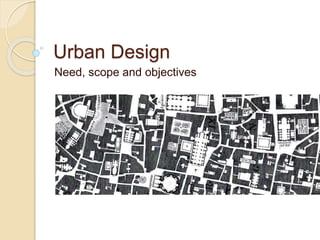
Urban Design
Need, scope and objectives
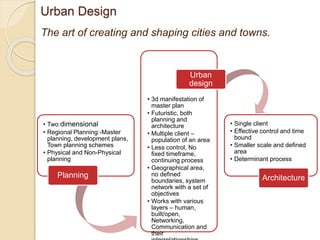
The art of creating and shaping cities and towns.
Urban Design
• Two dimensional
• Regional Planning:-Master
planning, development plans,
Town planning schemes
• Physical and Non-Physical
planning
Planning
• 3d manifestation of
master plan
• Futuristic, both
planning and
architecture
• Multiple client –
population of an area
• Less control, No
fixed timeframe,
continuing process
• Geographical area,
no defined
boundaries, system
network with a set of
objectives
• Works with various
layers – human,
built/open,
Networking,
Communication and
their
Urban
design
• Single client
• Effective control and time
bound
• Smaller scale and defined
area
• Determinant process
Architecture
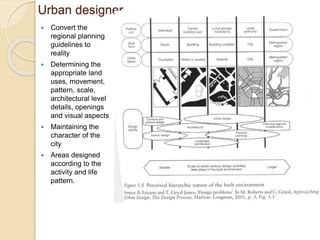
Urban designer
 Convert the
regional planning
guidelines to
reality
 Determining the
appropriate land
uses, movement,
pattern, scale,
architectural level
details, openings
and visual aspects
 Maintaining the
character of the
city
 Areas designed
according to the
activity and life
pattern.
Objectives
 Establish a comprehensive spatial development framework and a
set of development policies.
 A direct response to people’s needs and creating a livable
environment. It covers all dimensions like visual, perceptual, social,
cultural, historic and symbolic resources of community.
 Increase the functional efficiency by relating the circulation, urban
activities and use of land to physical form.
 Accommodating urban growth and should be capable of adapting
variables of unpredicted growth.
 Economically feasible solutions, geared to incremental
implementation over a substantial time period.
 Solving the environmental deficiencies that exist in terms of physical,
visual, perceptual, social and psychological terms.
Functions
 Analytical function: provides survey and identification of visual and other
human sensory qualities, development qualities, functional qualities,
opportunities and limitations of a particular urban place.
 An explicit articulation of design objectives, design evaluation criteria.
 Generation of alternative concepts for future development as well as full
illustrative images of desirable and possible consequences.
 Development of standards, incentives, policies, control techniques and
priority programs to achieve the qualitative values proposal.
 Provisions for verbal statements, illustrative graphics and communication
media capable of engaging all levels of community and choice of options of
future form.
 Integration of all elements of planning process, continuous revision
possibilities to adapt to urban growth variables.
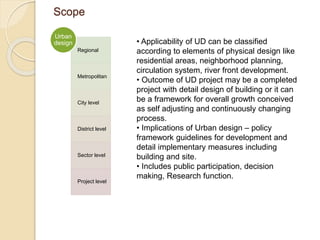
Scope
Regional
Metropolitan
City level
District level
Sector level
Project level
Urban
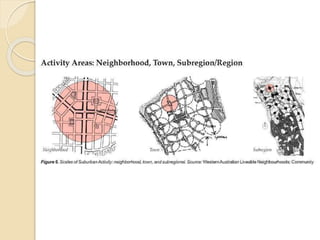
design • Applicability of UD can be classified
according to elements of physical design like
residential areas, neighborhood planning,
circulation system, river front development.
• Outcome of UD project may be a completed
project with detail design of building or it can
be a framework for overall growth conceived
as self adjusting and continuously changing
process.
• Implications of Urban design – policy
framework guidelines for development and
detail implementary measures including
building and site.
• Includes public participation, decision
making, Research function.
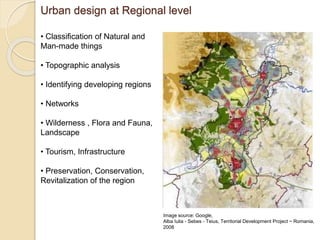
Urban design at Regional level
• Classification of Natural and
Man-made things
• Topographic analysis
• Identifying developing regions
• Networks
• Wilderness , Flora and Fauna,
Landscape
• Tourism, Infrastructure
• Preservation, Conservation,
Revitalization of the region
Image source: Google,
Alba Iulia - Sebes - Teius, Territorial Development Project ~ Romania,
2008
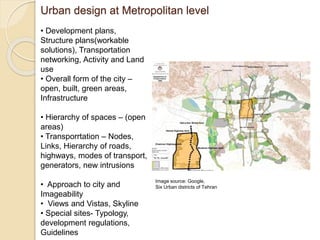
Urban design at Metropolitan level
• Development plans,
Structure plans(workable
solutions), Transportation
networking, Activity and Land
use
• Overall form of the city –
open, built, green areas,
Infrastructure
• Hierarchy of spaces – (open
areas)
• Transporrtation – Nodes,
Links, Hierarchy of roads,
highways, modes of transport,
generators, new intrusions
• Approach to city and
Imageability
• Views and Vistas, Skyline
• Special sites- Typology,
development regulations,
Guidelines
Image source: Google,
Six Urban districts of Tehran
Urban design at City level
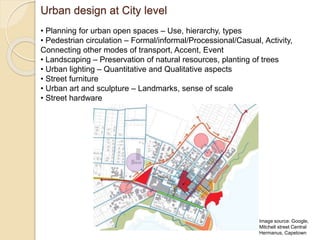
• Planning for urban open spaces – Use, hierarchy, types
• Pedestrian circulation – Formal/informal/Processional/Casual, Activity,
Connecting other modes of transport, Accent, Event
• Landscaping – Preservation of natural resources, planting of trees
• Urban lighting – Quantitative and Qualitative aspects
• Street furniture
• Urban art and sculpture – Landmarks, sense of scale
• Street hardware
Image source: Google,
Mitchell street Central
Hermanus, Capetown
Urban design at City level
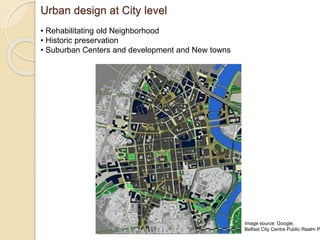
• Rehabilitating old Neighborhood
• Historic preservation
• Suburban Centers and development and New towns
Image source: Google,
Belfast City Centre Public Realm P
Urban design…
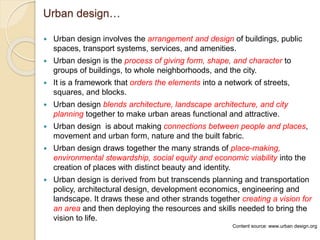
 Urban design involves the arrangement and design of buildings, public
spaces, transport systems, services, and amenities.
 Urban design is the process of giving form, shape, and character to
groups of buildings, to whole neighborhoods, and the city.
 It is a framework that orders the elements into a network of streets,
squares, and blocks.
 Urban design blends architecture, landscape architecture, and city
planning together to make urban areas functional and attractive.
 Urban design is about making connections between people and places,
movement and urban form, nature and the built fabric.
 Urban design draws together the many strands of place-making,
environmental stewardship, social equity and economic viability into the
creation of places with distinct beauty and identity.
 Urban design is derived from but transcends planning and transportation
policy, architectural design, development economics, engineering and
landscape. It draws these and other strands together creating a vision for
an area and then deploying the resources and skills needed to bring the
vision to life.
Content source: www.urban design.org
Elements of Urban design…
 Urban design involves the arrangement and design of buildings, public
spaces, transport systems, services, and amenities.
 Urban design is the process of giving form, shape, and character to
groups of buildings, to whole neighborhoods, and the city.
 It is a framework that orders the elements into a network of streets,
squares, and blocks.
 Urban design blends architecture, landscape architecture, and city
planning together to make urban areas functional and attractive.
 Urban design is about making connections between people and places,
movement and urban form, nature and the built fabric.
 Urban design draws together the many strands of place-making,
environmental stewardship, social equity and economic viability into the
creation of places with distinct beauty and identity.
 Urban design is derived from but transcends planning and transportation
policy, architectural design, development economics, engineering and
landscape. It draws these and other strands together creating a vision for
an area and then deploying the resources and skills needed to bring the
vision to life.
Conducting a Urban Design Survey
A. City as a whole
1. Shape of the city
2. Size of the city
3. Access to city
B. City as parts
C. Micro level analysis of each area
1. Topography – cliff, slope, hilly etc
2. Microclimate – Humidity, Sun, Rainfall, Wind etc
3. Shape – Physical outline in horizontal ( Radio-centric, Star, Linear, Ring,
Rectilinear, Branched)
4. Size – Population and Physical extent, Density
5. Pattern, Texture and Grain
6. Pathways or Roads, Landmarks, Districts, Nodes, Edges (Imageability
aspects)
7. Open spaces
8. Views and Vistas
9. Magnets, generators or Linkages
10. Special activity centres and Overall activity structure
11. Hubs of intense visual experience
12. Pedestrian areas
13. Urban Signage
14. Point of Conflict
15. Historic special districts
16. Community structure – ethnic groupings
17. Urban Blighted areas
18. Entry points
19. Non physical aspects like festivals, emotional aspects, intangible elements
Conducting a Urban Design Survey

250391567-Intro-Scope-and-Objectives.pptx

  • 1.
  • 2.
    The art ofcreating and shaping cities and towns. Urban Design • Two dimensional • Regional Planning:-Master planning, development plans, Town planning schemes • Physical and Non-Physical planning Planning • 3d manifestation of master plan • Futuristic, both planning and architecture • Multiple client – population of an area • Less control, No fixed timeframe, continuing process • Geographical area, no defined boundaries, system network with a set of objectives • Works with various layers – human, built/open, Networking, Communication and their Urban design • Single client • Effective control and time bound • Smaller scale and defined area • Determinant process Architecture
  • 3.
    Urban designer  Convertthe regional planning guidelines to reality  Determining the appropriate land uses, movement, pattern, scale, architectural level details, openings and visual aspects  Maintaining the character of the city  Areas designed according to the activity and life pattern.
  • 4.
    Objectives  Establish acomprehensive spatial development framework and a set of development policies.  A direct response to people’s needs and creating a livable environment. It covers all dimensions like visual, perceptual, social, cultural, historic and symbolic resources of community.  Increase the functional efficiency by relating the circulation, urban activities and use of land to physical form.  Accommodating urban growth and should be capable of adapting variables of unpredicted growth.  Economically feasible solutions, geared to incremental implementation over a substantial time period.  Solving the environmental deficiencies that exist in terms of physical, visual, perceptual, social and psychological terms.
  • 5.
    Functions  Analytical function:provides survey and identification of visual and other human sensory qualities, development qualities, functional qualities, opportunities and limitations of a particular urban place.  An explicit articulation of design objectives, design evaluation criteria.  Generation of alternative concepts for future development as well as full illustrative images of desirable and possible consequences.  Development of standards, incentives, policies, control techniques and priority programs to achieve the qualitative values proposal.  Provisions for verbal statements, illustrative graphics and communication media capable of engaging all levels of community and choice of options of future form.  Integration of all elements of planning process, continuous revision possibilities to adapt to urban growth variables.
  • 6.
    Scope Regional Metropolitan City level District level Sectorlevel Project level Urban design • Applicability of UD can be classified according to elements of physical design like residential areas, neighborhood planning, circulation system, river front development. • Outcome of UD project may be a completed project with detail design of building or it can be a framework for overall growth conceived as self adjusting and continuously changing process. • Implications of Urban design – policy framework guidelines for development and detail implementary measures including building and site. • Includes public participation, decision making, Research function.
  • 7.
    Urban design atRegional level • Classification of Natural and Man-made things • Topographic analysis • Identifying developing regions • Networks • Wilderness , Flora and Fauna, Landscape • Tourism, Infrastructure • Preservation, Conservation, Revitalization of the region Image source: Google, Alba Iulia - Sebes - Teius, Territorial Development Project ~ Romania, 2008
  • 8.
    Urban design atMetropolitan level • Development plans, Structure plans(workable solutions), Transportation networking, Activity and Land use • Overall form of the city – open, built, green areas, Infrastructure • Hierarchy of spaces – (open areas) • Transporrtation – Nodes, Links, Hierarchy of roads, highways, modes of transport, generators, new intrusions • Approach to city and Imageability • Views and Vistas, Skyline • Special sites- Typology, development regulations, Guidelines Image source: Google, Six Urban districts of Tehran
  • 9.
    Urban design atCity level • Planning for urban open spaces – Use, hierarchy, types • Pedestrian circulation – Formal/informal/Processional/Casual, Activity, Connecting other modes of transport, Accent, Event • Landscaping – Preservation of natural resources, planting of trees • Urban lighting – Quantitative and Qualitative aspects • Street furniture • Urban art and sculpture – Landmarks, sense of scale • Street hardware Image source: Google, Mitchell street Central Hermanus, Capetown
  • 10.
    Urban design atCity level • Rehabilitating old Neighborhood • Historic preservation • Suburban Centers and development and New towns Image source: Google, Belfast City Centre Public Realm P
  • 12.
    Urban design…  Urbandesign involves the arrangement and design of buildings, public spaces, transport systems, services, and amenities.  Urban design is the process of giving form, shape, and character to groups of buildings, to whole neighborhoods, and the city.  It is a framework that orders the elements into a network of streets, squares, and blocks.  Urban design blends architecture, landscape architecture, and city planning together to make urban areas functional and attractive.  Urban design is about making connections between people and places, movement and urban form, nature and the built fabric.  Urban design draws together the many strands of place-making, environmental stewardship, social equity and economic viability into the creation of places with distinct beauty and identity.  Urban design is derived from but transcends planning and transportation policy, architectural design, development economics, engineering and landscape. It draws these and other strands together creating a vision for an area and then deploying the resources and skills needed to bring the vision to life. Content source: www.urban design.org
  • 13.
    Elements of Urbandesign…  Urban design involves the arrangement and design of buildings, public spaces, transport systems, services, and amenities.  Urban design is the process of giving form, shape, and character to groups of buildings, to whole neighborhoods, and the city.  It is a framework that orders the elements into a network of streets, squares, and blocks.  Urban design blends architecture, landscape architecture, and city planning together to make urban areas functional and attractive.  Urban design is about making connections between people and places, movement and urban form, nature and the built fabric.  Urban design draws together the many strands of place-making, environmental stewardship, social equity and economic viability into the creation of places with distinct beauty and identity.  Urban design is derived from but transcends planning and transportation policy, architectural design, development economics, engineering and landscape. It draws these and other strands together creating a vision for an area and then deploying the resources and skills needed to bring the vision to life.
  • 14.
    Conducting a UrbanDesign Survey A. City as a whole 1. Shape of the city 2. Size of the city 3. Access to city B. City as parts C. Micro level analysis of each area 1. Topography – cliff, slope, hilly etc 2. Microclimate – Humidity, Sun, Rainfall, Wind etc 3. Shape – Physical outline in horizontal ( Radio-centric, Star, Linear, Ring, Rectilinear, Branched) 4. Size – Population and Physical extent, Density 5. Pattern, Texture and Grain 6. Pathways or Roads, Landmarks, Districts, Nodes, Edges (Imageability aspects) 7. Open spaces 8. Views and Vistas 9. Magnets, generators or Linkages 10. Special activity centres and Overall activity structure
  • 15.
    11. Hubs ofintense visual experience 12. Pedestrian areas 13. Urban Signage 14. Point of Conflict 15. Historic special districts 16. Community structure – ethnic groupings 17. Urban Blighted areas 18. Entry points 19. Non physical aspects like festivals, emotional aspects, intangible elements Conducting a Urban Design Survey