Measures of
Dispersion
DR. JULEE
1
Definition
 Measures of dispersion are descriptive statistics that
describe how similar a set of scores are to each other
 The more similar the scores are to each other, the lower the
measure of dispersion will be
 The less similar the scores are to each other, the higher the
measure of dispersion will be
 In general, the more spread out a distribution is, the larger
the measure of dispersion will be
2
Measures of Dispersion
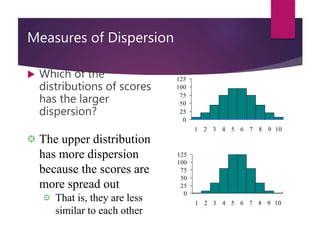
 Which of the
distributions of scores
has the larger
dispersion?
0
25
50
75
100
125
1 2 3 4 5 6 7 8 9 10
0
25
50
75
100
125
1 2 3 4 5 6 7 8 9 10
3
The upper distribution
has more dispersion
because the scores are
more spread out
That is, they are less
similar to each other
Measures of Dispersion
 There are three main measures of dispersion:
 The range
 The semi-interquartile range (SIR)
 Variance / standard deviation
 Mean Deviation and average deviation
 The Lorenz curve
4
Properties of Good measure of
Variation
 It should be simple to understand
 It should be easy to compute
 It should be based on each and every item of the
distribution
 It should not be unduly affected by the extreme items
 It should be rigidly defined.
5
Significance of Measuring
Variation
 There are four basic purpose
 To determine the reliability of an average
 To serve as the basis for the control of the variability
 To compare two or more series with regard to their
variability
 To facilitate the use of other statistical measures.
6
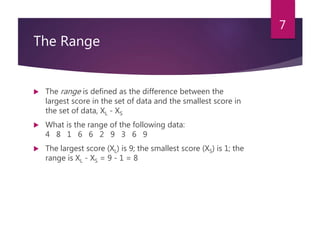
The Range
 The range is defined as the difference between the
largest score in the set of data and the smallest score in
the set of data, XL - XS
 What is the range of the following data:
4 8 1 6 6 2 9 3 6 9
 The largest score (XL) is 9; the smallest score (XS) is 1; the
range is XL - XS = 9 - 1 = 8
7
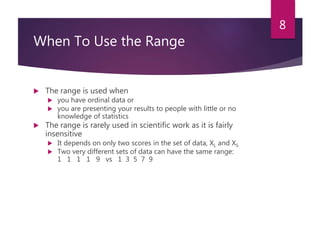
When To Use the Range
 The range is used when
 you have ordinal data or
 you are presenting your results to people with little or no
knowledge of statistics
 The range is rarely used in scientific work as it is fairly
insensitive
 It depends on only two scores in the set of data, XL and XS
 Two very different sets of data can have the same range:
1 1 1 1 9 vs 1 3 5 7 9
8
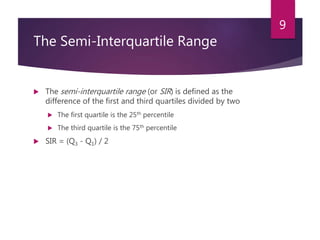
The Semi-Interquartile Range
 The semi-interquartile range (or SIR) is defined as the
difference of the first and third quartiles divided by two
 The first quartile is the 25th percentile
 The third quartile is the 75th percentile
 SIR = (Q3 - Q1) / 2
9
SIR Example
 What is the SIR for the
data to the right?
 25 % of the scores are
below 5
 5 is the first quartile
 25 % of the scores are
above 25
 25 is the third quartile
 SIR = (Q3 - Q1) / 2 = (25
- 5) / 2 = 10
2
4
6
 5 = 25th
%tile
8
10
12
14
20
30
 25 = 75th
%tile
60
10
When To Use the SIR
 The SIR is often used with skewed data as it is insensitive
to the extreme scores
11
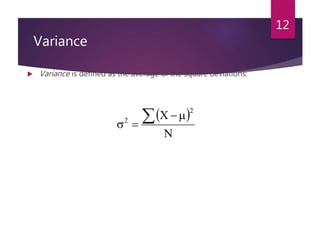
Variance
 Variance is defined as the average of the square deviations:
12
 
N
X
2
2  



What Does the Variance Formula
Mean?
 First, it says to subtract the mean from each of the scores
 This difference is called a deviate or a deviation score
 The deviate tells us how far a given score is from the typical,
or average, score
 Thus, the deviate is a measure of dispersion for a given score
13
What Does the Variance Formula
Mean?
 Why can’t we simply take the average of the deviates? That is, why isn’t
variance defined as:
14
 
N
X
2  



This is not the formula
for variance!
What Does the Variance Formula
Mean?
 One of the definitions of the mean was that it always
made the sum of the scores minus the mean equal to 0
 Thus, the average of the deviates must be 0 since the sum
of the deviates must equal 0
 To avoid this problem, statisticians square the deviate
score prior to averaging them
 Squaring the deviate score makes all the squared scores
positive
15
What Does the Variance Formula
Mean?
 Variance is the mean of the squared deviation scores
 The larger the variance is, the more the scores deviate, on
average, away from the mean
 The smaller the variance is, the less the scores deviate, on
average, from the mean
16
Standard Deviation
 When the deviate scores are squared in variance, their unit of measure is
squared as well
 E.g. If people’s weights are measured in pounds, then the variance of the weights
would be expressed in pounds2 (or squared pounds)
 Since squared units of measure are often awkward to deal with, the square root
of variance is often used instead
 The standard deviation is the square root of variance
17
Standard Deviation
 Standard deviation = variance
 Variance = standard deviation2
18
Computational Formula
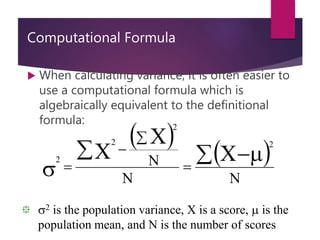
 When calculating variance, it is often easier to
use a computational formula which is
algebraically equivalent to the definitional
formula:
 
 
N
N
N X
X
X
2
2
2
2  


 



19
2 is the population variance, X is a score,  is the
population mean, and N is the number of scores
Computational Formula Example
X X2
X- (X-)2
9 81 2 4
8 64 1 1
6 36 -1 1
5 25 -2 4
8 64 1 1
6 36 -1 1
 = 42  = 306  = 0  = 12
20
Computational Formula Example
 
2
6
12
6
294
306
6
6
306
N
N
42
X
X
2
2
2
2











 
2
6
12
N
X
2
2



 


21
Variance of a Sample
 Because the sample mean is not a perfect
estimate of the population mean, the formula for
the variance of a sample is slightly different from
the formula for the variance of a population:
 
1
N
X
X
s
2
2


 
22
s2 is the sample variance, X is a score, X is the
sample mean, and N is the number of scores
Measure of Skew
 Skew is a measure of symmetry in the distribution of scores
23
Positive Skew Negative Skew
Normal (skew =
0)
Measure of Skew
 The following formula can be used to determine skew:
24
 
 
N
N
X
X
X
X
s 2
3
3
 
 

Measure of Skew
 If s3 < 0, then the distribution has a negative skew
 If s3 > 0 then the distribution has a positive skew
 If s3 = 0 then the distribution is symmetrical
 The more different s3 is from 0, the greater the skew in
the distribution
25
Kurtosis
(Not Related to Halitosis)
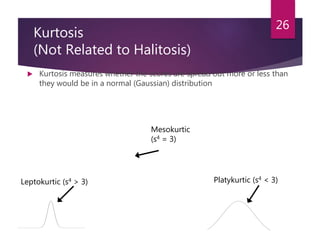
 Kurtosis measures whether the scores are spread out more or less than
they would be in a normal (Gaussian) distribution
26
Mesokurtic
(s4 = 3)
Leptokurtic (s4 > 3) Platykurtic (s4 < 3)
Kurtosis
 When the distribution is normally distributed, its kurtosis
equals 3 and it is said to be mesokurtic
 When the distribution is less spread out than normal, its
kurtosis is greater than 3 and it is said to be leptokurtic
 When the distribution is more spread out than normal, its
kurtosis is less than 3 and it is said to be platykurtic
27
Measure of Kurtosis
 The measure of kurtosis is given by:
28
 
N
N
X
X
X
X
s
4
2
4

 
















s2, s3, & s4
 Collectively, the variance (s2), skew (s3), and kurtosis (s4)
describe the shape of the distribution
29

dispersion ppt.ppt

  • 1.
  • 2.
    Definition  Measures ofdispersion are descriptive statistics that describe how similar a set of scores are to each other  The more similar the scores are to each other, the lower the measure of dispersion will be  The less similar the scores are to each other, the higher the measure of dispersion will be  In general, the more spread out a distribution is, the larger the measure of dispersion will be 2
  • 3.
    Measures of Dispersion Which of the distributions of scores has the larger dispersion? 0 25 50 75 100 125 1 2 3 4 5 6 7 8 9 10 0 25 50 75 100 125 1 2 3 4 5 6 7 8 9 10 3 The upper distribution has more dispersion because the scores are more spread out That is, they are less similar to each other
  • 4.
    Measures of Dispersion There are three main measures of dispersion:  The range  The semi-interquartile range (SIR)  Variance / standard deviation  Mean Deviation and average deviation  The Lorenz curve 4
  • 5.
    Properties of Goodmeasure of Variation  It should be simple to understand  It should be easy to compute  It should be based on each and every item of the distribution  It should not be unduly affected by the extreme items  It should be rigidly defined. 5
  • 6.
    Significance of Measuring Variation There are four basic purpose  To determine the reliability of an average  To serve as the basis for the control of the variability  To compare two or more series with regard to their variability  To facilitate the use of other statistical measures. 6
  • 7.
    The Range  Therange is defined as the difference between the largest score in the set of data and the smallest score in the set of data, XL - XS  What is the range of the following data: 4 8 1 6 6 2 9 3 6 9  The largest score (XL) is 9; the smallest score (XS) is 1; the range is XL - XS = 9 - 1 = 8 7
  • 8.
    When To Usethe Range  The range is used when  you have ordinal data or  you are presenting your results to people with little or no knowledge of statistics  The range is rarely used in scientific work as it is fairly insensitive  It depends on only two scores in the set of data, XL and XS  Two very different sets of data can have the same range: 1 1 1 1 9 vs 1 3 5 7 9 8
  • 9.
    The Semi-Interquartile Range The semi-interquartile range (or SIR) is defined as the difference of the first and third quartiles divided by two  The first quartile is the 25th percentile  The third quartile is the 75th percentile  SIR = (Q3 - Q1) / 2 9
  • 10.
    SIR Example  Whatis the SIR for the data to the right?  25 % of the scores are below 5  5 is the first quartile  25 % of the scores are above 25  25 is the third quartile  SIR = (Q3 - Q1) / 2 = (25 - 5) / 2 = 10 2 4 6  5 = 25th %tile 8 10 12 14 20 30  25 = 75th %tile 60 10
  • 11.
    When To Usethe SIR  The SIR is often used with skewed data as it is insensitive to the extreme scores 11
  • 12.
    Variance  Variance isdefined as the average of the square deviations: 12   N X 2 2     
  • 13.
    What Does theVariance Formula Mean?  First, it says to subtract the mean from each of the scores  This difference is called a deviate or a deviation score  The deviate tells us how far a given score is from the typical, or average, score  Thus, the deviate is a measure of dispersion for a given score 13
  • 14.
    What Does theVariance Formula Mean?  Why can’t we simply take the average of the deviates? That is, why isn’t variance defined as: 14   N X 2      This is not the formula for variance!
  • 15.
    What Does theVariance Formula Mean?  One of the definitions of the mean was that it always made the sum of the scores minus the mean equal to 0  Thus, the average of the deviates must be 0 since the sum of the deviates must equal 0  To avoid this problem, statisticians square the deviate score prior to averaging them  Squaring the deviate score makes all the squared scores positive 15
  • 16.
    What Does theVariance Formula Mean?  Variance is the mean of the squared deviation scores  The larger the variance is, the more the scores deviate, on average, away from the mean  The smaller the variance is, the less the scores deviate, on average, from the mean 16
  • 17.
    Standard Deviation  Whenthe deviate scores are squared in variance, their unit of measure is squared as well  E.g. If people’s weights are measured in pounds, then the variance of the weights would be expressed in pounds2 (or squared pounds)  Since squared units of measure are often awkward to deal with, the square root of variance is often used instead  The standard deviation is the square root of variance 17
  • 18.
    Standard Deviation  Standarddeviation = variance  Variance = standard deviation2 18
  • 19.
    Computational Formula  Whencalculating variance, it is often easier to use a computational formula which is algebraically equivalent to the definitional formula:     N N N X X X 2 2 2 2          19 2 is the population variance, X is a score,  is the population mean, and N is the number of scores
  • 20.
    Computational Formula Example XX2 X- (X-)2 9 81 2 4 8 64 1 1 6 36 -1 1 5 25 -2 4 8 64 1 1 6 36 -1 1  = 42  = 306  = 0  = 12 20
  • 21.
    Computational Formula Example  2 6 12 6 294 306 6 6 306 N N 42 X X 2 2 2 2              2 6 12 N X 2 2        21
  • 22.
    Variance of aSample  Because the sample mean is not a perfect estimate of the population mean, the formula for the variance of a sample is slightly different from the formula for the variance of a population:   1 N X X s 2 2     22 s2 is the sample variance, X is a score, X is the sample mean, and N is the number of scores
  • 23.
    Measure of Skew Skew is a measure of symmetry in the distribution of scores 23 Positive Skew Negative Skew Normal (skew = 0)
  • 24.
    Measure of Skew The following formula can be used to determine skew: 24     N N X X X X s 2 3 3     
  • 25.
    Measure of Skew If s3 < 0, then the distribution has a negative skew  If s3 > 0 then the distribution has a positive skew  If s3 = 0 then the distribution is symmetrical  The more different s3 is from 0, the greater the skew in the distribution 25
  • 26.
    Kurtosis (Not Related toHalitosis)  Kurtosis measures whether the scores are spread out more or less than they would be in a normal (Gaussian) distribution 26 Mesokurtic (s4 = 3) Leptokurtic (s4 > 3) Platykurtic (s4 < 3)
  • 27.
    Kurtosis  When thedistribution is normally distributed, its kurtosis equals 3 and it is said to be mesokurtic  When the distribution is less spread out than normal, its kurtosis is greater than 3 and it is said to be leptokurtic  When the distribution is more spread out than normal, its kurtosis is less than 3 and it is said to be platykurtic 27
  • 28.
    Measure of Kurtosis The measure of kurtosis is given by: 28   N N X X X X s 4 2 4                   
  • 29.
    s2, s3, &s4  Collectively, the variance (s2), skew (s3), and kurtosis (s4) describe the shape of the distribution 29