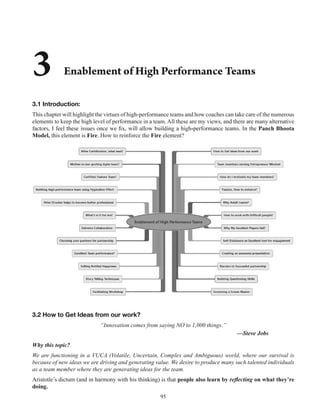






The Agilist’s Guidebook
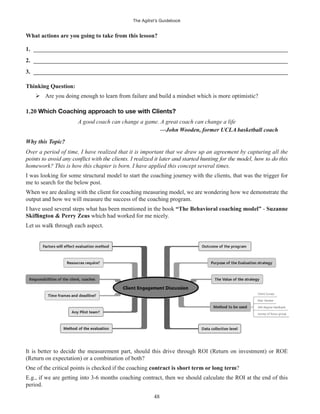
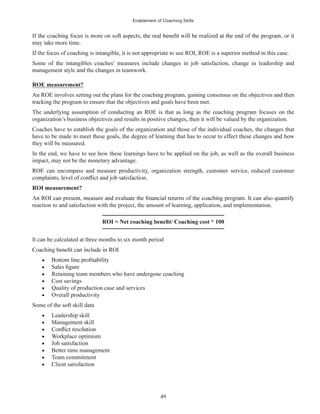
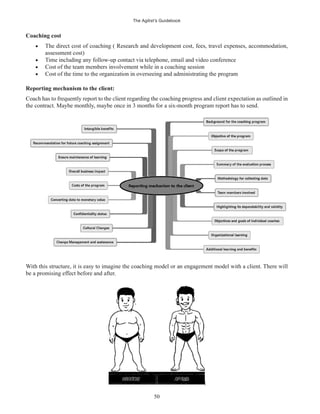
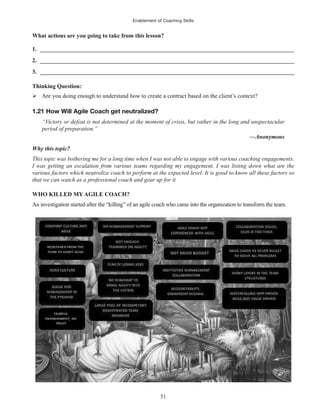
A Reference for Organizational Agile Transformation
The Agilist’s Guidebook
A Reference for Organizational Agile Transformation
Chandan Lal Patary
ZORBA BOOKS
Published in India by Zorba Books, 2018
Website: www.zorbabooks.com
Email: info@zorbabooks.com
Copyright © Chandan Lal Patary
ISBN Print Book - 978-
All rights reserved. No part of this book may be reproduced or transmitted in any form or by any means, electronic or
mechanical, including photocopying, recording, or by an information storage and retrieval system—except by a reviewer
who may quote brief passages in a review to be printed in a magazine, newspaper, or on the Web—without permission in
writing from the copyright owner.
Although the author and publisher have made every effort to ensure the accuracy and completeness of information contained
in this book, we assume no responsibility for errors, inaccuracies, omissions, or any inconsistencies herein. Any slights on
people, places, or organizations are unintentional.
Zorba Books Pvt. Ltd.(opc)
Gurgaon, INDIA
Printed in India
ZORBA BOOKS
v
About Dr Badri N. Srinivasan
He is working as an enterprise agility coach and has 20+ years’experience with a Ph.D. in Management. He has
extensive experience in process implementation and organizational change management processes and process
improvement initiatives in the travel, retail, manufacturing, real estate, mortgage and banking, healthcare
He is researching the characteristics of agile teams. His focus areas are cognitive psychology, brain research,
enterprise organizational transformation and business agility, Innovation, Strategy, People Leadership and the
His extensive experience includes coaching, managing, mentoring and training Scrum Masters, Product Owners,
by email at thirumangaiazhwar@gmail.com
badrisrinivasan.
vii
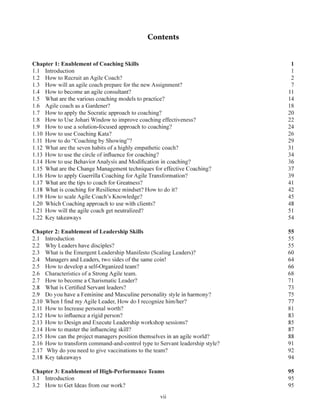
Chapter 1: Enablement of Coaching Skills 1
1.1 Introduction 1
1.2 How to Recruit an Agile Coach? 2
1.3 How will an agile coach prepare for the new Assignment? 7
1.6 Agile coach as a Gardener? 18
1.7 How to apply the Socratic approach to coaching? 20
1.8 How to Use Johari Window to improve coaching effectiveness? 22
1.10 How to use Coaching Kata? 26
1.11 How to do “Coaching by Showing”? 29
1.12 What are the seven habits of a highly empathetic coach? 31
Chapter 2: Enablement of Leadership Skills 55
2.3 What is the Emergent Leadership Manifesto (Scaling Leaders)? 60
2.6 Characteristics of a Strong Agile team. 68
2.7 How to become a Charismatic Leader? 71
2.11 How to Increase personal worth? 81
2.16 How to transform command-and-control type to Servant leadership style? 91
2.17 Why do you need to give vaccinations to the team? 92
Chapter 3: Enablement of High-Performance Teams 95
The Agilist’s Guidebook
viii
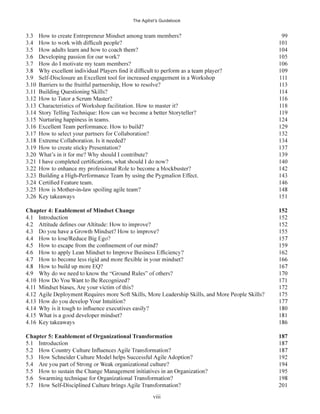
3.3 How to create Entrepreneur Mindset among team members? 99
3.7 How do I motivate my team members? 106
3.9 Self-Disclosure an Excellent tool for increased engagement in a Workshop 111
3.10 Barriers to the fruitful partnership, How to resolve? 113
3.13 Characteristics of Workshop facilitation. How to master it? 118
3.17 How to select your partners for Collaboration? 132
3.19 How to create sticky Presentation? 137
3.20 What’s in it for me? Why should I contribute? 139
Chapter 4: Enablement of Mindset Change 152
Chapter 5: Enablement of Organizational Transformation 187
ix
Contents
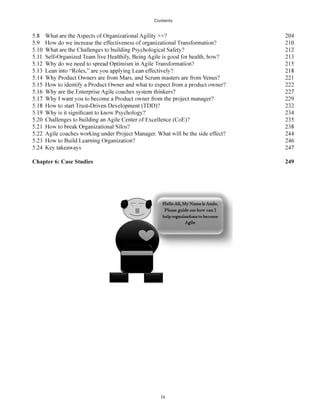
Chapter 6: Case Studies 249
xi
chapters, shared stories, or advised. All my friends and colleagues from the current and previous organization
pushed me to form this book.
and to work with.
have had the honor of listening to, coaching, advising, and learning from while conducting my work.
Special thanks to the many previous managers who have shaped, enabled, and backed my growth and
development over the 19+ years of my performing career.
I am lucky to have received valuable leadership instructions from each one of them and I am indebted for the
opportunities they have given to me.
including
Jeff Sutherland, David Anderson, Mike Cohn.
achieve this chore.
xiii
coach yourself and others down the line. Either you are a manager or a leader and you want to improve skills and
pick up techniques. When you turn each page, you will get possibilities to push yourself to a much higher level
people to discover their unknown areas and scale up their potential.
new era of working in an organization where hierarchies are diminishing and more individual contributor roles
work with people like you. I know exactly what you are passing through. I know how much more effective you
to retrospect and how you can help yourselves and others by changing some thinking, bring out the best from
you and help others do the same.
As a Coach, you can have a profound impact on those with whom you work with and encourage each one of
them to do the same to others. I hope each page will help you to think differently to execute differently at your
work. I wrote this workbook to help you become the kind of coach who brings extraordinary value to leaders
and change some of your current ways of working.
My primary intent is to share with you what it means to be a coach rather than simply teaching you coaching
can accept best practices and learn from those with greater experience than you, but who you will be as a coach
what makes it a demanding path to walk.
workbook to equip you to help people change the aspects of their lives that have the real impact: their behavior,
Who is The Agilist’s Guidebook for?
the practical challenges in agile transformation and how we can prepare ourselves to overcome all these challenges.
What’s in it for you?
The Agilist’s Guidebook- A Reference for Organizational Agile
Transformation
1. How do we get a coach who is being an agile coach?
2. How do we create an agile center of excellence with the help of excellent agile coaches?
3. How do we sustain Communities of Practices initiatives and build learning organization?
How do we strengthen the role of agile masters and Product owners?
How do we change the command-and-control style to servant leadership styles?
6. How do we bring an agile culture and create more Agile leaders?
7. How to break silos and improve collaboration?
8. How to evaluate and sustain the agile transformation?
The Agilist’s Guidebook
xiv
9. How to improve team engagement and motivation of the team members?
10. Characteristics of the best Agile team, how to build more such teams?
11.
12. How to coach tough, high attitude and high ego team members?
13. How to engage business in agile transformation?
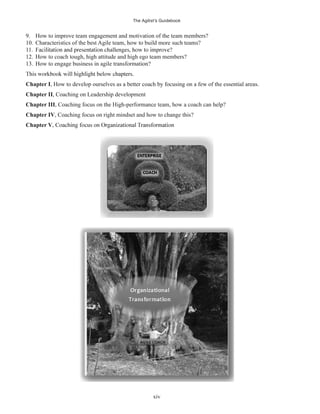
Chapter I, How to develop ourselves as a better coach by focusing on a few of the essential areas.
Chapter II, Coaching on Leadership development
Chapter III, Coaching focus on the High-performance team, how a coach can help?
Chapter IV, Coaching focus on right mindset and how to change this?
Chapter V
Preface
xv
What problem are we solving?
In the realm of software development, Agile is a philosophy. Agility is a mindset.
advocates of lightweight methodologies, seeking to discuss and identify any common ground for software
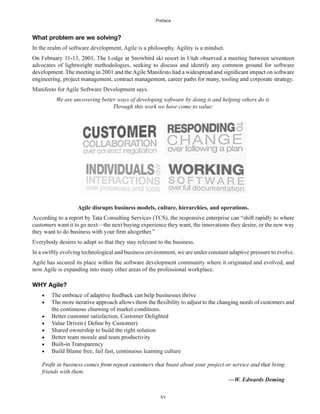
Manifesto for Agile Software Development says.
We are uncovering better ways of developing software by doing it and helping others do it.
Through this work we have come to value:
Agile disrupts business models, culture, hierarchies, and operations.
customers want it to go next—the next buying experience they want, the innovations they desire, or the new way
Everybody desires to adapt so that they stay relevant to the business.
In a swiftly evolving technological and business environment, we are under constant adaptive pressure to evolve.
Agile has secured its place within the software development community where it originated and evolved, and
now Agile is expanding into many other areas of the professional workplace.
WHY Agile?
the continuous churning of market conditions.
Better customer satisfaction, Customer Delighted
Shared ownership to build the right solution
Better team morale and team productivity
Build Blame free, fail fast, continuous learning culture
friends with them.
—W. Edwards Deming
The Agilist’s Guidebook
xvi
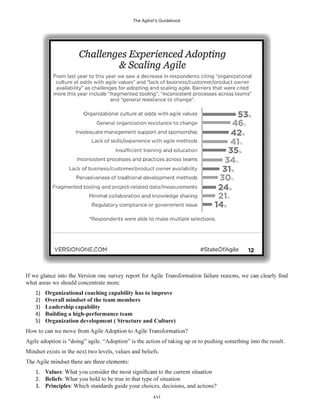
what areas we should concentrate more.
1) Organizational coaching capability has to improve
2) Overall mindset of the team members
3) Leadership capability
4) Building a high-performance team
5) Organization development ( Structure and Culture)
Agile adoption is “doing” agile. “Adoption” is the action of taking up or to pushing something into the result.
Mindset exists in the next two levels, values and beliefs.
1. Values
2. Beliefs: What you hold to be true in that type of situation
3. Principles: Which standards guide your choices, decisions, and actions?
Preface
xvii
Example of changes given by Robert B. Dilts
Pushing the gas pedal or brake of a car with one’s foot is behavior which alters its speed.
the way in which one uses one’s foot.
Respecting the speed limit is a result of valuing laws and trusting that there are penalties if they are not kept. If
one does not value the speed limit, one will not keep it, even if one is capable.
Being a “good driver” is a function of aligning all of them.
they have “become.” It could be untimely to “adopt” a practice before understanding “why” the practice was
designed.
for most.
when to present frameworks and practices. Presenting frameworks and practices too early could be counter-
productive.
coach can strengthen their skills and help organizations to transform.
Why Guidebook?
transformation especially at the large-scale agile transformation.
equip coaches for better performance. At least this procedure
will guide what can be done. It does not aim to present a solution
come across and helped me to steer through the confusion.
Who is this book for?
a)
answer without spending much time?
b) Do you get questions from the leaders related to people issues related to agile transformation and do not
know where to get the answer?
c) Are your playing the role of Product owner, scrum master, agile leaders and looking for tips to make
yourselves aware regarding transformation challenges?
d) Do you want to learn from others who have traveled the same path in Organization agile transformation
The Agilist’s Guidebook
xviii
Who should probably back away from this workbook?
If your answer is “yes” for these below points
a)
anything new?
b) Do you think there is only one way to implement Agile? Cannot learn from other’s mistake?
HOW TO USE THIS WORKBOOK?
Pancha Bhoota model to reinforce the organizational agility transformation.
What is this Pancha Bhoota?
basic elements, which, according to Hinduism, is the basis of all cosmic creation.
body as a whole is a complex constituent of Pancha Bhoota
Prithvi (Earth), Jal (Water), Agni Vayu (Air), Aakash
unique characteristics and these also account for various faculties of human experience.
What is the Pancha Bhoota model?
Pancha Bhoota Model
All these elements function in parallel within an organization.
Preface
xix
Each chapter or elements in Pancha Bhoota Model highlights various challenges a coach will come across
around these elements
about one area where someone has to do more research and develop their strength.
Each chapter will have several mind maps which reveal large concepts and break them down into a simpler
I have used XMind tool to develop all these Mindmaps.
development of our skills is essential to survive in today’s marketplace. Competitive pressure and fundamental
needed.
self-
,” from anticipated habits: from doing things the same way again and again. It is not possible for the
I have always considered the world as my classroom, soaking up lessons and stories to fuel my path forward. I
hope you do the same.
Never stop learning. Ever.
Pancha Bhoota
Model.
Note:
to follow what I have shared. It has to be read like someone else story. If you want, you can experiment with
“Companies that change may survive, but companies that transform thrive. Change brings
incremental or small-scale adaptations, while transformation brings great improvements that
ripple through the future of an organization.”
– Nick Candito
1
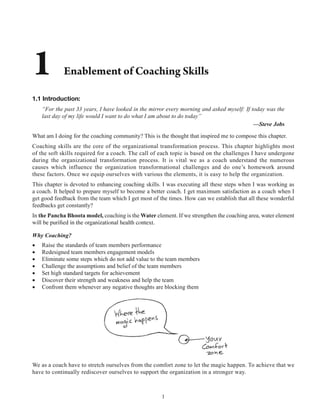
1.1 Introduction:
“For the past 33 years, I have looked in the mirror every morning and asked myself: If today was the
last day of my life would I want to do what I am about to do today”
—Steve Jobs
What am I doing for the coaching community? This is the thought that inspired me to compose this chapter.
Coaching skills are the core of the organizational transformation process. This chapter highlights most
of the soft skills required for a coach. The call of each topic is based on the challenges I have undergone
during the organizational transformation process. It is vital we as a coach understand the numerous
causes which influence the organization transformational challenges and do one’s homework around
these factors. Once we equip ourselves with various the elements, it is easy to help the organization.
This chapter is devoted to enhancing coaching skills. I was executing all these steps when I was working as
a coach. It helped to prepare myself to become a better coach. I get maximum satisfaction as a coach when I
get good feedback from the team which I get most of the times. How can we establish that all these wonderful
feedbacks get constantly?
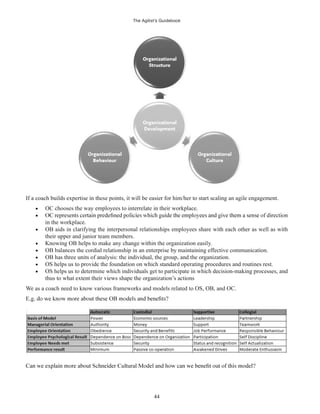
In the Pancha Bhoota model, coaching is the Water element. If we strengthen the coaching area, water element
Why Coaching?
Raise the standards of team members performance
Redesigned team members engagement models
Eliminate some steps which do not add value to the team members
Challenge the assumptions and belief of the team members
Set high standard targets for achievement
Discover their strength and weakness and help the team
Confront them whenever any negative thoughts are blocking them
We as a coach have to stretch ourselves from the comfort zone to let the magic happen. To achieve that we
have to continually rediscover ourselves to support the organization in a stronger way.
The Agilist’s Guidebook
2
1.2 How to Recruit an Agile Coach?
“Selecting the right person for the right job is the largest part of coaching.”
—Phil Crosby
Why this topic?
People who have done it once, are handy people for the greater mission. The learning curve will be less. Once
we have experimented with the water, we will be well aware of the challenges and the solutions. It is important
to validate the coach experience, especially how they have handled the various organizational challenges. I was
part of the recruitment panel for a long time. I discovered some mechanisms to validate the coach experience
which has worked with me. I have shared all these.
thought had come to my mind.
There are so many agility coaches!
Let us ask, have you DONE questions a couple of times?
Have you DONE? Really? If not, please do not waste each other’s time, if yes, please come up with real-life
stories which someone should be able to challenge and understand the context and evaluate. You win-I win, we
win.
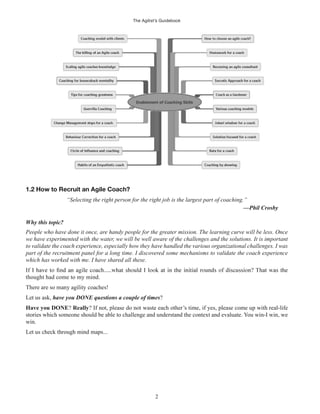
Let us check through mind maps...
Enablement of Coaching Skills
3
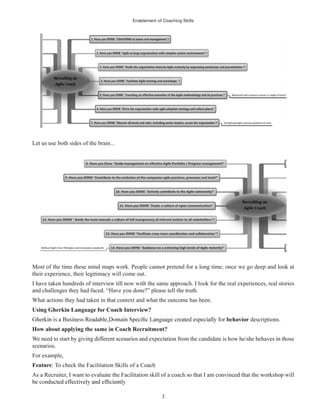
Let us use both sides of the brain...
Most of the time these mind maps work. People cannot pretend for a long time; once we go deep and look at
their experience, their legitimacy will come out.
I have taken hundreds of interview till now with the same approach. I look for the real experiences, real stories
and challenges they had faced. “Have you done?” please tell the truth.
What actions they had taken in that context and what the outcome has been.
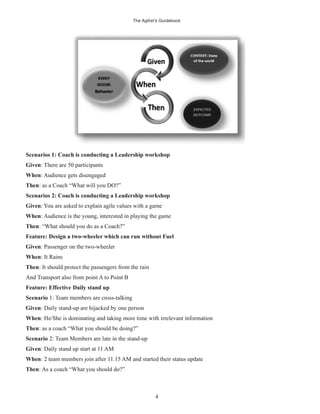
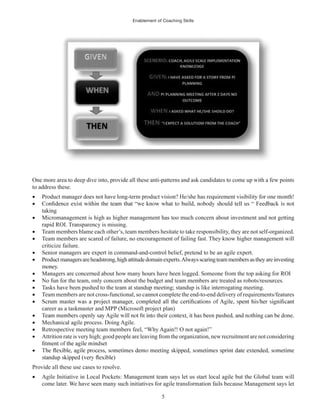
Using Gherkin Language for Coach Interview?
behavior descriptions.
How about applying the same in Coach Recruitment?
We need to start by giving different scenarios and expectation from the candidate is how he/she behaves in those
scenarios.
For example,
Feature: To check the Facilitation Skills of a Coach
As a Recruiter, I want to evaluate the Facilitation skill of a coach so that I am convinced that the workshop will
The Agilist’s Guidebook
4
Scenarios 1: Coach is conducting a Leadership workshop
Given: There are 50 participants
When: Audience gets disengaged
Then: as a Coach “What will you DO?”
Scenarios 2: Coach is conducting a Leadership workshop
Given: You are asked to explain agile values with a game
When: Audience is the young, interested in playing the game
Then: “What should you do as a Coach?”
Feature: Design a two-wheeler which can run without Fuel
Given: Passenger on the two-wheeler
When: It Rains
Then: It should protect the passengers from the rain
And Transport also from point A to Point B
Feature: Effective Daily stand up
Scenario 1: Team members are cross-talking
Given: Daily stand-up are hijacked by one person
When: He/She is dominating and taking more time with irrelevant information
Then: as a coach “What you should be doing?”
Scenario 2: Team Members are late in the stand-up
Given: Daily stand up start at 11 AM
When: 2 team members join after 11.15 AM and started their status update
Then: As a coach “What you should do?”
Enablement of Coaching Skills
5
One more area to deep dive into, provide all these anti-patterns and ask candidates to come up with a few points
to address these.
Product manager does not have long-term product vision? He/she has requirement visibility for one month!
taking
Micromanagement is high as higher management has too much concern about investment and not getting
rapid ROI. Transparency is missing.
Team members blame each other’s, team members hesitate to take responsibility, they are not self-organized.
Team members are scared of failure, no encouragement of failing fast. They know higher management will
criticize failure.
Senior managers are expert in command-and-control belief, pretend to be an agile expert.
Productmanagersareheadstrong, highattitudedomainexperts.Alwaysscaringteammembersastheyareinvesting
money.
Managers are concerned about how many hours have been logged. Someone from the top asking for ROI
No fun for the team, only concern about the budget and team members are treated as robots/resources.
Tasks have been pushed to the team at standup meeting; standup is like interrogating meeting.
Team members are not cross-functional, so cannot complete the end-to-end delivery of requirements/features
career as a taskmaster and MPP (Microsoft project plan)
Mechanical agile process. Doing Agile.
Retrospective meeting team members feel, “Why Again!! O not again!”
Attrition rate is very high; good people are leaving from the organization, new recruitment are not considering
Provide all these use cases to resolve.
Agile Initiative in Local Pockets: Management team says let us start local agile but the Global team will
come later. We have seen many such initiatives for agile transformation fails because Management says let
The Agilist’s Guidebook
6
us start with a local team, if it is successful we will spread to other sides as well. The natures of the projects
are distributed agile development. Management says let us not rock the boat!
The manager knows everything about agile: Mid Manager says, we do not have to know agile, we know
anyway! They are power point masters; it will take 30 min class on Agile for the team at any moment! Let
needs agile training? Let us start with developers and testers! These are the few sentences we keep getting
into agile transformation projects.
is wondering why things are not changing?, what’s to be done next? I cannot hire a coach, it is expensive
may be affordable for a couple of days. But I want to get faster cycle time and quality delivery from
the project.
There is no plan for agile adoption in the team. No team can become successful without a systematic plan
for agile adoption. There should be a clear roadmap and plan for agile adoption. In an organization, the team
owns the plan. Project management approach should apply- Start date and End date with milestones for
the agile adoption program. We identify backlog for the agile adoption program, we identify one Program
manager as Product owner for this program. If it is missing an agile program will not become successful.
What should I do with my Project managers? HR manager asks, my organizational structure, instead of
Pyramid, it has a bulge in the mid-area of the pyramid! There are many mid-level managers, most of them
are designated Project Manager, Sr. Project Manager, Very Sr. Project Manager, etc. what should I do with
them in the new structure(if at all we have to create), please help us to restructure this organization to
accommodate Agile adoption process.
In Agile, all the principle and practices are not required! The team thinks so, we are customizing agile
practices based on our need, we are doing scrum but whatever we feel like we are following. We are doing
the demo, but whenever it is ready! We are doing standup, but when all the team members are available,
is ready then, etc., we are following Agile BUT we are changing wherever we feel so.
We have PMO and QA departments wherein a weekly Deep Dive session gray hair Boss is asking for much
metrics which team has to provide! Teams are forced to show the agile adoption progress through various
metrics. Metric is a must and sometimes too much behind for the metrics to assess the agile adoption progress.
Where is the Data? Once data is present, Next data and NEXT data and it never end.
Organization belongs to the Organizations category which is using traditional management methods rely
on detailed planning, command-and-control, and a hierarchical structure. Have several Line managers
who used to do MPP (Microsoft Project Plan) and handle timesheet approval and used to do appraisal
management several times in a year and very busy person, what they will do in agile adoption? OK,
some of them have become Agile Guru!!, now what to do with the rest, their contribution to the entire
agile transformation process?
We are not best paymaster, we cannot afford Generalist, we have many specialists in our legacy business, what
to do now? We are in compliance domain, many things to take care, especially detailed documentation, etc.
The product manager is very busy, does not write requirement elaborately, he needs some junior product
manager to write down user story and the detail acceptance criteria and review with him! He cannot
explain the market need to the team (Busy). Team struggles to know what needs to be built. His/her
feedback is good, team members are taking more time to catch up with the requirement. They do not have
the market orientation etc. blame game.
Developers believe it is the test engineer’s job to do testing! I am a Developer, Architect feels; I am here to
sketch UML diagrams, not getting a salary to do coding! We need more team members to do blah blah jobs.
No recognition, no appreciation. “On Failure” Looks for the person to blame. On top of that Attrition rate
is >15%, One more point we have a Bell curve policy where anyway some team members will not get good
hike whatever performance level he/she might do. Good performers are not a good bootlicker! They do not
have the Godfather to get a good hike.
Enablement of Coaching Skills
7
Interconnected departments are still in the legacy process, they are in the waterfall way of executing the
work not supporting Agility.
Command and Control type boss, asking for Detail plan, asking for detail estimation! Team members are
still controlled by Line managers. Trust is missing.
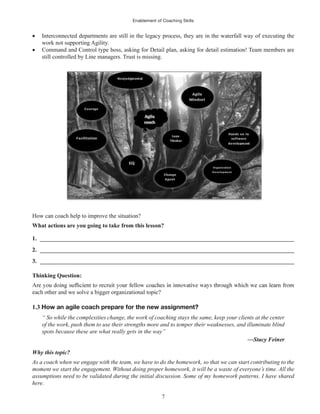
How can coach help to improve the situation?
What actions are you going to take from this lesson?
1. ______________________________________________________________________________________
2. ______________________________________________________________________________________
3. ______________________________________________________________________________________
Thinking Question:
each other and we solve a bigger organizational topic?
1.3 How an agile coach prepare for the new assignment?
“ So while the complexities change, the work of coaching stays the same, keep your clients at the center
of the work, push them to use their strengths more and to temper their weaknesses, and illuminate blind
spots because these are what really gets in the way”
—Stacy Feiner
Why this topic?
As a coach when we engage with the team, we have to do the homework, so that we can start contributing to the
moment we start the engagement. Without doing proper homework, it will be a waste of everyone’s time. All the
assumptions need to be validated during the initial discussion. Some of my homework patterns. I have shared
here.
The Agilist’s Guidebook
8
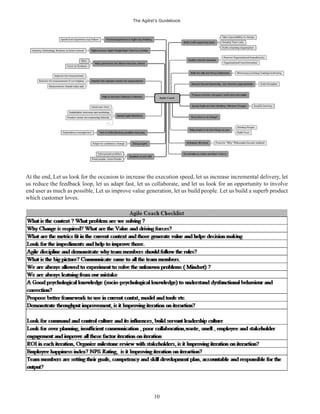
When we start a new assignment, let us look into these aspects and see where a team stands and then help teams
to increase the maturity against all these areas.
The motto should be to produce great software by applying agile.
A coach can transform a team by changing their way of thinking, doing, and unlearn the old way of operating.
How can a coach help? Good observation skill, structured feedback, mentor and support to the team members.
Coach has to be optimistic and should have the characteristics of a good leader (walk the talk).
Let us have a look at how an agile coach should start...
What is the business or context team is operating? How many team members? At what experience level? Let
us understand the business complexity. It will help us to proceed consideri
the business. E.g., are we working for the banking application development, developing any mission-critical
software which will be used in the healthcare domain, or some gaming application product, etc.?
What are the current practices followed by the team and what are the ways we can optimize the working
practices? Optimizing the work will help
simplify the work
will experiment with the new way of working and improve wherever required which will become a standard
process for the team for their need.
In this discovery path, the team will solve this new initiative together, which will help the team to
increase bonding among themselves and they will become self-organized over a period.
As a part of coaching, the coach needs to identify how this new process brings technical Excellency as a
part of the deliverable. There are several software practices that can be initiated which can enable technical
excellence in product development. All good design practices is an incremental way can enable teams to
grow and develop a superb product.
As a part of coaching, the coach needs to see how we can sustain any initiative team has taken to improve the
current situation. As people’s involvement is very high, the coach needs to always help the team members
to grow and build process around people. Need to empower team members to decide and see how any
initiative if it fails should also result in learning.
People development is an ongoing agenda which coach should always keep in his/her work list. Deploy
best practices available in the industry and improve the people and their competency. Check with the line
organization what can be done to improve the team members complains if there are any.
Agile coach needs to demonstrate to all the stakeholders how we are becoming better and better. There should
be some mechanism to collect the data which shows this evidence. It could be a demo or a deliverable which
the end user appreciates. There should not be too much overhead metrics which demotivates the team members.
Enablement of Coaching Skills
9
The agile coach need to support the team members they way meeting has been conducted, the workshop has
been conducted, communication is happening with the stakeholders. How can we maximize the output if
there is any gap?
The agile coach needs to help to create an environment where team members are willing to contribute,
share, care with others. A place everyone would like to be a part of. This will take some time to build such a
cultural transformation. The goal is to create an environment where everybody cares for each other, respects
each other, willing to experiment and fail and learn from the same. No blame whenever an incident happens.
Encourage positive ways of looking at the event.
Avoid any type of command-and-control symptom. Except for the team no one decides. The team decides
and we trust the team members. No manager should tell the team what to do and how to do. No manager
should micromanage any situation.
The coach should focus on collaboration
Create a culture for collaboration. Encourages team members to be more extroverted and to communicate
proactively in a non-judgmental environment.
Coach needs to ensure frequent deliverable from the team which can be consumed by the end user. In this
process learning will be fast, the discovery of the unknown will be fast. Tools and infrastructure have to
enable execution speed and faster frequent delivery.
Ensuring that the team keeps their focus on producing a potentially consumable solution each iteration
to the end user. Every certain interval the team captures the end user satisfaction by discussing with them.
The team assesses the value delivery process
process. Let team build a culture of asking 5 WHY questions so that they validate every assumption.
Encourage the storytelling culture where each team shares the best practices.Acoach builds the community
of best practitioners. Involve other related departments like HR, supply chain, training, etc. to be part of the
agile story so that they also start changing.
There will always be some resistance from the team members regarding the new initiatives, the coach has
to experiment with a different approach to get the buy-in from the team members. A coach can propose like
we have a common problem and ask help from team members. The new idea will come and the coach can
agree with the team and implement to solve the problem.
A coach has to create a space for himself/herself in the industry by sharing best practices and contributing
to the community by writing blogs/books etc.
Build a designation less world where everyone contributes. No hierarchy and .
“People don’t only use a coach when there is a problem with their technique; they understand that no
matter how good their technique is, there is always room for improvement.”
—John Perry, Sport Psychology
Transformation is a journey for the team, it cannot happen in a month. The coach should have the belief, trust,
and patience to see the changes happening. Senior management involvement and encouragement catalyze the
transformation process. These are some thoughts which can help an agile coach to start the journey.
The Agilist’s Guidebook
10
At the end, Let us look for the occasion to increase the execution speed, let us increase incremental delivery, let
us reduce the feedback loop, let us adapt fast, let us collaborate, and let us look for an opportunity to involve
end user as much as possible, Let us improve value generation, let us build people. Let us build a superb product
which customer loves.
Enablement of Coaching Skills
11
“Coaches are aware of how to ignite passion and motivate people.They have an energy that is contagious
and knows exactly how to get their team excited”
- Brian Cagney
What actions are you going to take from this lesson?
1. ______________________________________________________________________________________
2. ______________________________________________________________________________________
3. ______________________________________________________________________________________
Thinking Question:
Are you doing enough to create a study plan based on the various contexts where clients might be navigating
through?
1.4 How to Become an Agile Consultant?
“A consultant: someone brought in to build a one-handled wheelbarrow.”
—Fennel Hudson
Why this topic?
A Consultant, a person who provides expert advice professionally. How can we position ourselves in the
consultant model? I have worked with many consultants most of them are based in Europe. During my work
with them, I have learned some of their best practices and noted all these down for myself. I am sharing a few
of these points to improve our consultancy abilities.
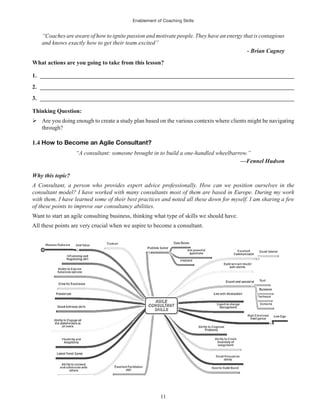
Want to start an agile consulting business, thinking what type of skills we should have.
All these points are very crucial when we aspire to become a consultant.
The Agilist’s Guidebook
12
Enablement of Coaching Skills
13
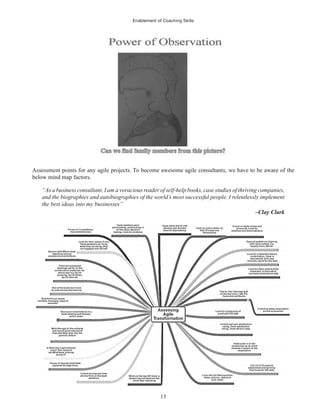
Assessment points for any agile projects. To become awesome agile consultants, we have to be aware of the
below mind map factors.
“As a business consultant, I am a voracious reader of self-help books, case studies of thriving companies,
and the biographies and autobiographies of the world’s most successful people. I relentlessly implement
the best ideas into my businesses”
–Clay Clark
The Agilist’s Guidebook
14
What actions are you going to take from this lesson?
1. ______________________________________________________________________________________
2. ______________________________________________________________________________________
3. ______________________________________________________________________________________
Thinking Question:
Are you doing enough to build the capability to become a consultant or build consultant like competences
which can aid in your work?
1.5 What are the various coaching models to use?
“Coaches have to watch for what they don’t want to see and listen to what they don’t want to hear.”
—John Madden, American Football
Why this topic?
During my various coaching engagements, I realized that various contexts demand various kinds of model,
it is good to know about these models. But not mandatory. It guides the coach to think structurally. We can
experiment with these models with our coaching assignment and learn from it
Coaching is a way of enabling others to act and build on their strengths.
To coach is to care enough about people to invest time in building personal relationships with them.
There are a number of coaching models agile coaches can refer.
We as an agile coach should know all the available coaching models. We need to know which one to use when.
There are a few
o GROW
o TGROW
o OSKAR
o OUTCOMES
o SPACE
o ACHIEVE
o POSITIVE
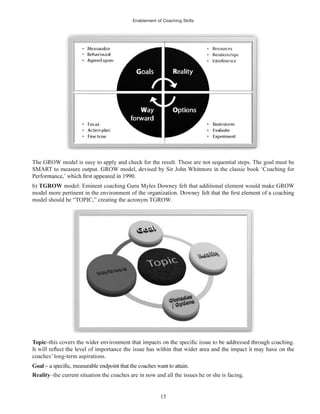
a) GROW model: The GROW model was developed by Graham Alexander and John Whitmore. The name is
an acronym with each letter standing for a different phase of the model. GROW stands for below picture
Enablement of Coaching Skills
15
The GROW model is easy to apply and check for the result. These are not sequential steps. The goal must be
SMART to measure output. GROW model, devised by Sir John Whitmore in the classic book ‘Coaching for
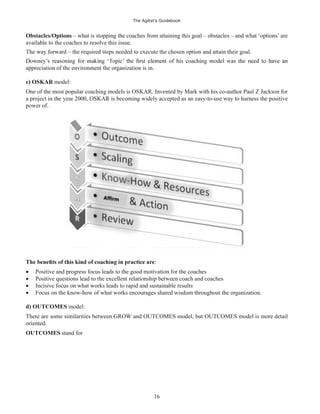
b) TGROW model: Eminent coaching Guru Myles Downey felt that additional element would make GROW
model more pertinent in the environment of
model should be “TOPIC,” creating the acronym TGROW.
Topic
coaches’ long-term aspirations.
Goal
Reality–the current situation the coaches are in now and all the issues he or she is facing.
The Agilist’s Guidebook
16
Obstacles/Options – what is stopping the coaches from attaining this goal – obstacles – and what ‘options’ are
available to the coaches to resolve this issue.
The way forward – the required steps needed to execute the chosen option and attain their goal.
appreciation of the environment the organization is in.
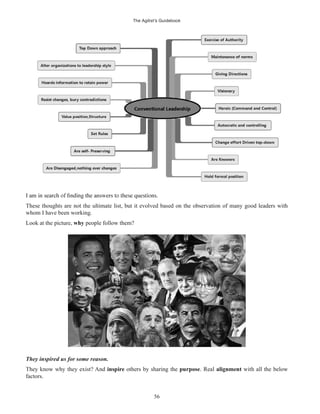
c) OSKAR model:
One of the most popular coaching models is OSKAR. Invented by Mark with his co-author Paul Z Jackson for
a project in the year 2000, OSKAR is becoming widely accepted as an easy-to-use way to harness the positive
power of.
:
Positive and progress focus leads to the good motivation for the coaches
Positive questions lead to the excellent relationship between coach and coaches
Incisive focus on what works leads to rapid and sustainable results
Focus on the know-how of what works encourages shared wisdom throughout the organization.
d) OUTCOMES model:
There are some similarities between GROW and OUTCOMES model, but OUTCOMES model is more detail
oriented.
OUTCOMES stand for
Enablement of Coaching Skills
17
O for Objectives, U for understand, T for Taking stock about the current situation, C for clarifying, O for option
Generation, M for Motivation to action, E for Enthusiasm and encouragement, S for Support.
e) SPACE model (Edgerton and Palmer, 2005) is used in the cognitive behavioral approaches to coaching and
is the acronym for the following elements:
Social context, Physiology, Action, Cognition, and Emotion. SPACE can be used in parallel with GROW
and POSITIVE to help coaches overcome psychological blocks associated with particular problems or issues
(including performance-related issues).
f) ACHIEVE Coaching Model: This is a seven-step model developed by Dembkowski and Eldridge (2003).
It includes the following steps:
(a) Assess the current situation,
(b) Creative brainstorming of alternatives to the current situation,
(c) Hone goals (i.e., helping the client to formulate goals),
(d) Initiate options (i.e., helping the client to initiate a wide range of behavioral options to achieve the desired
goal),
(e) Evaluate options,
(f) Valid action program design (i.e., a collaboration between the coach and the coachee to develop an action
plan),
(g) Encourage momentum (i.e., an ongoing process of providing encouragement and helping the client to keep
on track with the plans).
g) POSITIVE: POSITIVE model by Libri (2004), is a model developed from the GROW and ACHIEVE
models. It aims at producing an ‘optimum coaching relationship’and includes asking key questions around:
The Agilist’s Guidebook
18
The Purpose of the coachee,
Observations (e.g., of efforts up-to-date),
Strategy,
Insight (e.g., on a commitment to a goal),
Team (e.g., with whom the coachee will share his/her goal),
Initiate (e.g., when the coachee will start to act towards achieving a goal),
Value (e.g., question how the coachee would celebrate his/her success), and
Encourage (e.g., asking about the coachee’s progress in the pursuit of his/her goals) (as cited in Edgerton
and Palmer, 2005).
An important role of the coach is to ask pertinent questions and listen. Questioning and listening can help the
other person set realistic learning goals.
Coach Marshall Goldsmith says,
“My success rate as a coach has improved dramatically as I’ve realized that people’s getting better is
not a function of me; it’s a function of the person and the people around the person.”
Whatever model we follow, Improving coaching is as follows:
Communicate clear expectations,
Build relationships,
Listen actively,
Help to remove obstacles,
Give emotional support, including empathy,
Give gentle advice and guidance,
Allow for modeling of desired performance and behavior,
Gain a commitment to change, and
Applaud good results
“The [best] coaches… know that the job is to win… know that they must be decisive, that they must phase
people through their organizations, and at the same time they are sensitive to the feelings, loyalties, and
emotions that people have toward one another. If you don’t have these feelings, I do not know how you
certain players for whom I had strong feelings, but that was my job. I wasn’t hired to do anything but
win.” - Bill Walsh, American Football
What actions are you going to take from this lesson?
1. ______________________________________________________________________________________
2. ______________________________________________________________________________________
3. ______________________________________________________________________________________
Thinking Question:
Are you doing enough to absorb various coaching models which can help you to perform as a coach in the
1.6 Agile Coach as a Gardner?
“To be as good as it can be, a team has to buy into what you as the coach are doing. They have to feel
you’re a part of them and they’re a part of you.” - Bobby Knight
Enablement of Coaching Skills
19
Why this topic?
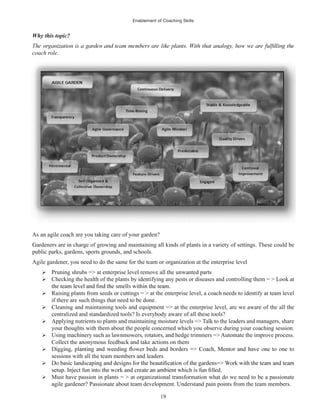
coach role.
As an agile coach are you taking care of your garden?
Gardeners are in charge of growing and maintaining all kinds of plants in a variety of settings. These could be
public parks, gardens, sports grounds, and schools.
Agile gardener, you need to do the same for the team or organization at the enterprise level
Pruning shrubs => at enterprise level remove all the unwanted parts
Checking the health of the plants by identifying any pests or diseases and controlling them = > Look at
Raising plants from seeds or cuttings = > at the enterprise level, a coach needs to identify at team level
if there are such things that need to be done.
Cleaning and maintaining tools and equipment => at the enterprise level, are we aware of the all the
centralized and standardized tools? Is everybody aware of all these tools?
Applying nutrients to plants and maintaining moisture levels => Talk to the leaders and managers, share
your thoughts with them about the people concerned which you observe during your coaching session.
Using machinery such as lawnmowers, rotators, and hedge trimmers => Automate the improve process.
Collect the anonymous feedback and take actions on them
sessions with all the team members and leaders
Must have passion in plants = > at organizational transformation what do we need to be a passionate
agile gardener? Passionate about team development. Understand pain points from the team members.
The Agilist’s Guidebook
20
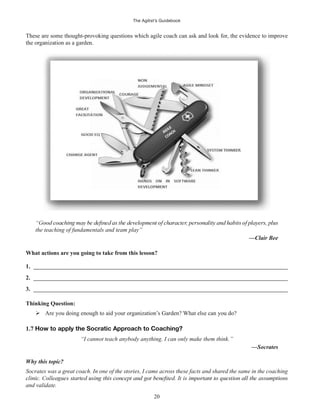
These are some thought-provoking questions which agile coach can ask and look for, the evidence to improve
the organization as a garden.
the teaching of fundamentals and team play”
—Clair Bee
What actions are you going to take from this lesson?
1. ______________________________________________________________________________________
2. ______________________________________________________________________________________
3. ______________________________________________________________________________________
Thinking Question:
Are you doing enough to aid your organization’s Garden? What else can you do?
1.7 How to apply the Socratic Approach to Coaching?
“I cannot teach anybody anything. I can only make them think.”
—Socrates
Why this topic?
Socrates was a great coach. In one of the stories, I came across these facts and shared the same in the coaching
and validate.
Enablement of Coaching Skills
21
The ancient Greek philosopher Socrates describes this as the “Allegory of the Cave.”
Dialogues. The Dialogues are a series of conversations between Plato and his old teacher, Socrates.
Socrates says a philosopher is like a prisoner who is freed from the cave and can now see reality as it truly is.
Socrates lived in ancient Greece. He was a master at asking powerful questions. Instead of lecturing, he taught by
posing his students a series of thought-provoking questions. Through these, he engaged his students’ minds in
the learning process. He uncovered their assumptions. He slowly but surely got to the heart of the issue.
Socrates would start a class by asking “What is the virtue?” or “What is good?” We use these words all the
time. But do we really know what they mean? Today, many universities around the world use the “Socratic
Method” in their teaching—one of the most famous of these is Harvard Business School. Socrates summed up
this method very clearly. He said,
“The highest form of Human Excellence is to question oneself and others.”
apparent attacks on the ruling classes. Without a struggle, he drank a cup of poison hemlock. It gradually
reached his heart and he died, leaving his enduring reputation as one of the greatest philosophers in history.
Enquiry on all the assumptions.
Question all the points which other mostly ignore or do not give much importance.
When we adopt the Socrates mindset, we approach almost every conversation differently.
“Remember that there is nothing stable in human affairs; therefore avoid undue elation in prosperity
or undue depression in adversity.”
—Socrates, 469–399 B.C.
The Agilist’s Guidebook
22
What actions are you going to take from this lesson?
1. ______________________________________________________________________________________
2. ______________________________________________________________________________________
3. ______________________________________________________________________________________
Thinking Question:
1.8 How to Use Johari Window to Improve Coaching effectiveness?
“Coaching is people management–getting people to do what you want them to do and like doing it”
—Anonymous
Why this topic?
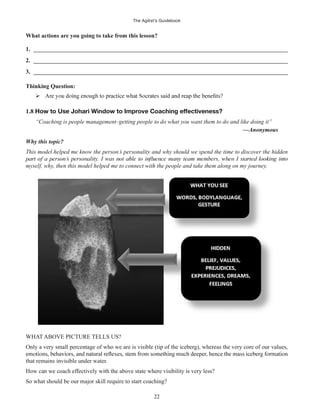
This model helped me know the person’s personality and why should we spend the time to discover the hidden
myself, why, then this model helped me to connect with the people and take them along on my journey.
WHAT ABOVE PICTURE TELLS US?
Only a very small percentage of who we are is visible (tip of the iceberg), whereas the very core of our values,
that remains invisible under water.
How can we coach effectively with the above state where visibility is very less?
So what should be our major skill require to start coaching?
Enablement of Coaching Skills
23
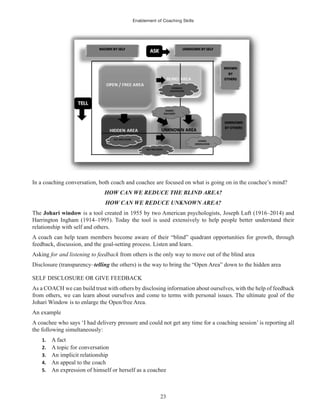
In a coaching conversation, both coach and coachee are focused on what is going on in the coachee’s mind?
HOW CAN WE REDUCE THE BLIND AREA?
HOW CAN WE REDUCE UNKNOWN AREA?
The Johari window is a tool created in 1955 by two American psychologists, Joseph Luft (1916–2014) and
Harrington Ingham (1914–1995). Today the tool is used extensively to help people better understand their
relationship with self and others.
A coach can help team members become aware of their “blind” quadrant opportunities for growth, through
feedback, discussion, and the goal-setting process. Listen and learn.
Asking for and listening to feedback from others is the only way to move out of the blind area
Disclosure (transparency–telling the others) is the way to bring the “Open Area” down to the hidden area
SELF DISCLOSURE OR GIVE FEEDBACK
As a COACH we can build trust with others by disclosing information about ourselves, with the help of feedback
from others, we can learn about ourselves and come to terms with personal issues. The ultimate goal of the
Johari Window is to enlarge the Open/free Area.
An example
A coachee who says ‘I had delivery pressure and could not get any time for a coaching session’ is reporting all
the following simultaneously:
1. A fact
2. A topic for conversation
3. An implicit relationship
4. An appeal to the coach
5. An expression of himself or herself as a coachee
The Agilist’s Guidebook
24
All of these things come together at the moment of the conversation. The coach has the choice of doing nothing,
following up on any of these messages, or indeed continuing with or proposing a completely different type of
conversation or conversational content. An overwhelming variety of choices.
somewhere in the Johari window.
At the same time, the coach has great freedom in the way (s) he responds to that information.
“Coaching is unlocking a person’s potential to maximize their own performance. It’s helping them to
learn rather than teaching them.”
—Tim Gallwey
What actions are you going to take from this lesson?
1. ______________________________________________________________________________________
2. ______________________________________________________________________________________
3. ______________________________________________________________________________________
Thinking Question:
Are you doing enough to use Johari concept to know more about people and connect with them in a
bigger way?
1.9 How to use Solution-Focused Approach to Coaching?
Why this topic?
This topic was born from, the discussion that some of the projects are very critical and challenging in nature,
a coach has to help the team by sitting with them, understand the end to end issues and solve the problem with
them by doing hand holding.
Solution-Focused Brief Coaching has emerged from Solution-Focused Brief Therapy (SFBT).
Solution Focused Brief Coaching uses questions that emphasis and redeploy the coaching sessions on results,
clients’ fortes and on the prospect.
The investigations aid to emphasize the parts of life that are ‘problem free’, such as interests, fortes and times
of relaxation.
usage of the present tense for the solution and the past tense for everything that relates to the problem - the client
has already reached the solution and needs “only” to document the steps needed to reach there.
Berg, and Yvonne Dolan being the most well-known contributors. Its development started in 1978 and continues
to date. It has been used successfully in psychotherapy and coaching, proving to be a very effective alternative
to problem-oriented techniques.
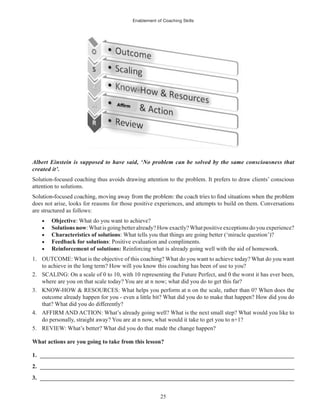
OSKAR is a framework for solution-focused coaching.
and stop doing what doesn’t work and doing something else.
Enablement of Coaching Skills
25
Albert Einstein is supposed to have said, ‘No problem can be solved by the same consciousness that
created it’.
Solution-focused coaching thus avoids drawing attention to the problem. It prefers to draw clients’ conscious
attention to solutions.
does not arise, looks for reasons for those positive experiences, and attempts to build on them. Conversations
are structured as follows:
Objective: What do you want to achieve?
Solutions now:Whatis goingbetteralready? Howexactly?Whatpositiveexceptions do you experience?
Characteristics of solutions: What tells you that things are going better (‘miracle question’)?
Feedback for solutions: Positive evaluation and compliments.
Reinforcement of solutions: Reinforcing what is already going well with the aid of homework.
1. OUTCOME: What is the objective of this coaching? What do you want to achieve today? What do you want
to achieve in the long term? How will you know this coaching has been of use to you?
2. SCALING: On a scale of 0 to 10, with 10 representing the Future Perfect, and 0 the worst it has ever been,
where are you on that scale today? You are at n now; what did you do to get this far?
3. KNOW-HOW & RESOURCES: What helps you perform at n on the scale, rather than 0? When does the
outcome already happen for you - even a little bit? What did you do to make that happen? How did you do
that? What did you do differently?
4. AFFIRM AND ACTION: What’s already going well? What is the next small step? What would you like to
do personally, straight away? You are at n now, what would it take to get you to n+1?
5. REVIEW: What’s better? What did you do that made the change happen?
What actions are you going to take from this lesson?
1. ______________________________________________________________________________________
2. ______________________________________________________________________________________
3. ______________________________________________________________________________________
The Agilist’s Guidebook
26
Thinking Question:
Are you doing enough to help others to propose solutions when they ask for?
1.10 How to use Coaching Kata?
Why this topic?
During our coaching engagement, we had many challenges. Many unique challenges. It is not written in any
as a coach? The concept was born so that we should have a coaching kata backlog and we should have a kata
session to help each other, to grow professionally. More topics we have, more discussion, we have and we are
growing as a coach in terms of knowledge
Kata is a Japanese word describing detailed patterns of movements practiced either solo or in pairs.
posture and movement to another, teaching the student proper form and position, and encouraging them
to visualize different scenarios for the use of each motion and technique.
Imagine the transition state of growth in between.
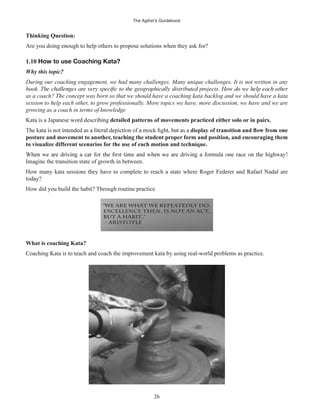
How many kata sessions they have to complete to reach a state where Roger Federer and Rafael Nadal are
today?
How did you build the habit? Through routine practice
What is coaching Kata?
Coaching Kata is to teach and coach the improvement kata by using real-world problems as practice.
Enablement of Coaching Skills
27
In the coaching kata session, one experience coach (mentor coach) who is already familiar with a similar type
of experience guides mentee coach.
Mentor coach will not provide the solution.
A mentor should teach the basis of improvement kata.
A mentee should always identify the next step with the guidance of a mentor.
We have many such mentors, we need to be humble enough to look for those people and learn from them.
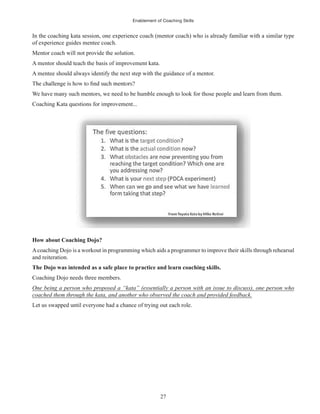
Coaching Kata questions for improvement...
How about Coaching Dojo?
Acoaching Dojo is a workout in programming which aids a programmer to improve their skills through rehearsal
and reiteration.
The Dojo was intended as a safe place to practice and learn coaching skills.
Coaching Dojo needs three members.
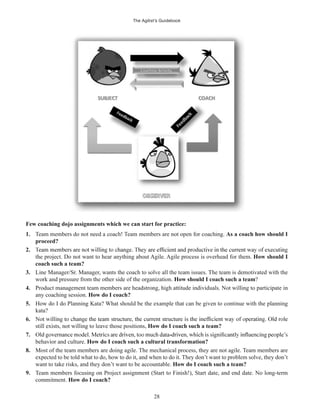
One being a person who proposed a “kata” (essentially a person with an issue to discuss), one person who
coached them through the kata, and another who observed the coach and provided feedback.
Let us swapped until everyone had a chance of trying out each role.
The Agilist’s Guidebook
28
Few coaching dojo assignments which we can start for practice:
1. Team members do not need a coach! Team members are not open for coaching. As a coach how should I
proceed?
2.
the project. Do not want to hear anything about Agile. Agile process is overhead for them. How should I
coach such a team?
3. Line Manager/Sr. Manager, wants the coach to solve all the team issues. The team is demotivated with the
work and pressure from the other side of the organization. How should I coach such a team?
4. Product management team members are headstrong, high attitude individuals. Not willing to participate in
any coaching session. How do I coach?
5. How do I do Planning Kata? What should be the example that can be given to continue with the planning
kata?
6.
still exists, not willing to leave those positions, How do I coach such a team?
7.
behavior and culture. How do I coach such a cultural transformation?
8. Most of the team members are doing agile. The mechanical process, they are not agile. Team members are
expected to be told what to do, how to do it, and when to do it. They don’t want to problem solve, they don’t
want to take risks, and they don’t want to be accountable. How do I coach such a team?
9. Team members focusing on Project assignment (Start to Finish!), Start date, and end date. No long-term
commitment. How do I coach?
Enablement of Coaching Skills
29
“Practice doesn’t make perfect. Perfect practice makes perfect.”
—Vince Lombardi, American Football
What actions are you going to take from this lesson?
1. ______________________________________________________________________________________
2. ______________________________________________________________________________________
3. ______________________________________________________________________________________
Thinking Question:
Are you doing enough to create a space where we as a coach can run the kata session to strengthen our skills?
1.11 How to do “Coaching by Showing”?
“Coaching is a profession of love. You can’t coach people unless you love them.”
—Eddy Robinson
Why this topic?
This topic came from the seagull coaching side effects, as a result of such coaching, sustenance of the agile
transformation is at risk. We agreed that we have to support the team, whoever asks for it. Every coach has to
do the homework and dry run the kata session if required and support the team.
In our coaching Dojo session, we discussed the importance of this concept, where we walk the talk. By
seeing us doing, people start changing themselves. We become the role model for the team and that change
is sustainable.
Coaching by “showing how to,” this is what I have learned from my in-laws.
When my daughter was born, my in-laws were with us and they took care of all the childcare requirements at
an early stage of my daughter. She has completely demonstrated us how to take care kid’s end to end necessities
for initial 4-5 months. But it was for a very small duration as she owns one school for kids, she has to go back
has demonstrated hands on to us.
She is a very good cook, every year whenever she visited us, we have a few new dishes, the same continues
after she left. She demonstrated to us how to cook all the new dishes. Later it is much easier for us to continue
to prepare the same dishes
She coaches my wife about all the aspects of parenting and child care. When my son was born, we did not have
much trouble with the childcare as already we have been coached by my in-laws.
The Agilist’s Guidebook
30
Learning by doing, coaching by showing.....that is what the key message I have learned
Same concepts I have been applying with the scrum team. During my coaching, I play a scrum master role for
one sprint, product owner role for one sprint and demonstrate how to run the sprint. They observe how I am
doing and take over from there.
Teams regularly have a lot of enhancement chance in how they do their Sprint Planning, Daily Scrum, Review
effectively and then tries to increase team ownership of these events.
to that context. It helps teams to get inspired to know why we are doing certain steps.
address the challenges as a team. I am an active participator—reviewing the dashboards, asking thoughtful and
appropriately placed questions, and surfacing opportunities for acknowledgment and recognition. It is important
for a coach, who is trained to listen deeply and to come from a place of inquiry, to be aware of who, how and
when their questions are offered.
I discover that consultancy service to the team where I provide information does not work, promote self-
discovery works for the long term.
Enablement of Coaching Skills
31
It is well accepted by the team and it is a game-changing moment.
What actions are you going to take from this lesson?
1. ______________________________________________________________________________________
2. ______________________________________________________________________________________
3. ______________________________________________________________________________________
Thinking Question:
Are you doing enough to help others by showing them how to do? What is the feedback on this approach to
improve?
1.12 What are the Seven Habits of a Highly Empathetic Coach?
“We think we listen, but very rarely do we listen with real understanding, true empathy. Yet listening, of
this very special kind, is one of the most potent forces for change that I know.”
—Carl Rogers
Why this topic?
This thought came to my mind when we are doing the design thinking workshop, we were emphasizing the
empathy aspect with the people who will build the product and consume the solutions. Why not we as a coach
also start exercising the same with coaching team? That’s how I started digging more into this.
Few of my fellow coaches are sharing stories from their team, where scrum masters will not allow others to talk.
He/She will keep talking about what the scrum guides say and what we should do, etc.
He/She as a scrum master will not listen to the team members.
Later they come to the coaches for help, complaint is “team members had stopped co-operating with me, what
I can do?”
When my fellow coaches looked into this problem they realized, as a coach we have to explain what empathy
is all about and how empathy can help others.
As a scrum master or a product owner, we all should develop this skill.
Why is Empathy important as a coach?
1. It helps us to understand the unspoken parts of our communication with others.
2. It helps us to understand and motivates others.
The Agilist’s Guidebook
32
3. It helps us to understand the pain points about others so that we connect with them in a better way.
4. It helps us to understand what they need from us, and how we can treat them according to how they want
to be treated.
5. It helps us to evaluate more clearly how our words and actions the surrounding people
6. It helps us to resolve any potential that may arise from misunderstandings.
What is Empathy?
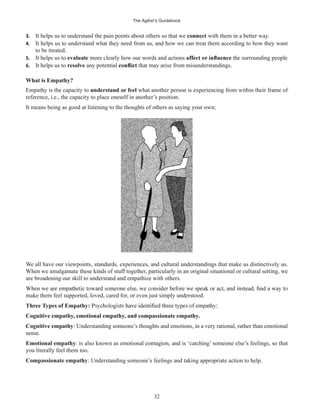
Empathy is the capacity to understand or feel what another person is experiencing from within their frame of
reference, i.e., the capacity to place oneself in another’s position.
It means being as good at listening to the thoughts of others as saying your own;
We all have our viewpoints, standards, experiences, and cultural understandings that make us distinctively us.
When we amalgamate these kinds of stuff together, particularly in an original situational or cultural setting, we
are broadening our skill to understand and empathize with others.
make them feel supported, loved, cared for, or even just simply understood.
Three Types of Empathy:
Cognitive empathy, emotional empathy, and compassionate empathy.
Cognitive empathy: Understanding someone’s thoughts and emotions, in a very rational, rather than emotional
sense.
Emotional empathy: is also known as emotional contagion, and is ‘catching’ someone else’s feelings, so that
you literally feel them too.
Compassionate empathy: Understanding someone’s feelings and taking appropriate action to help.
Enablement of Coaching Skills
33
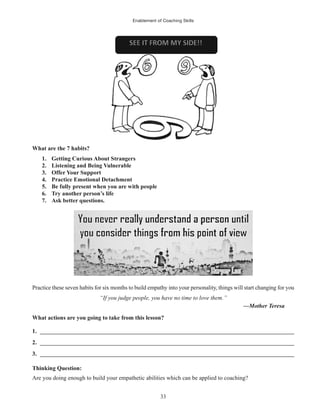
What are the 7 habits?
1. Getting Curious About Strangers
2. Listening and Being Vulnerable
3. Offer Your Support
4. Practice Emotional Detachment
5. Be fully present when you are with people
6. Try another person’s life
7. Ask better questions.
Practice these seven habits for six months to build empathy into your personality, things will start changing for you
“If you judge people, you have no time to love them.”
—Mother Teresa
What actions are you going to take from this lesson?
1. ______________________________________________________________________________________
2. ______________________________________________________________________________________
3. ______________________________________________________________________________________
Thinking Question:
Are you doing enough to build your empathetic abilities which can be applied to coaching?
The Agilist’s Guidebook
34
1.13
“Simply put, Coaching is where you work with someone to connect with yourself, redesign your
environment and your life, and then take action to implement it!”
—Emma-Louise Elsey
Why this topic?
some of them are super powerful people. To understand how much we can stretch ourselves to help them, we
need to know this concept.
When I was working with a few powerful executives, I was curious to know, how can I get the work done for
them? Then I started my homework to understand the entire game plan.
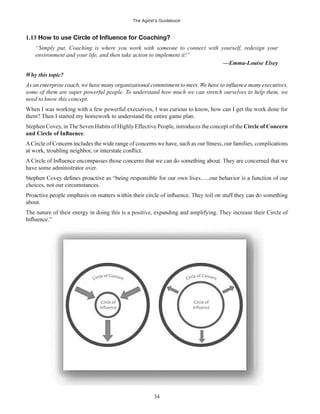
Stephen Covey, in The Seven Habits of Highly Effective People, introduces the concept of the Circle of Concern
.
have some administrator over.
choices, not our circumstances.
about.
The nature of their energy in doing this is a positive, expanding and amplifying. They increase their Circle of
Enablement of Coaching Skills
35
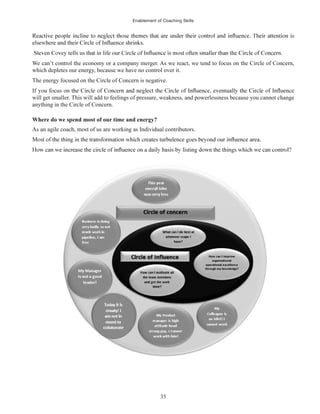
We can’t control the economy or a company merger. As we react, we tend to focus on the Circle of Concern,
which depletes our energy, because we have no control over it.
The energy focused on the Circle of Concern is negative.
will get smaller. This will add to feelings of pressure, weakness, and powerlessness because you cannot change
anything in the Circle of Concern.
Where do we spend most of our time and energy?
As an agile coach, most of us are working as Individual contributors.
The Agilist’s Guidebook
36
What actions are you going to take from this lesson?
1. ______________________________________________________________________________________
2. ______________________________________________________________________________________
3. ______________________________________________________________________________________
Thinking Question:
the parts which are beyond our control?
1.14
“Between stimulus and response, there is a space. In that space is our power to choose our response. In
our response lies our growth and our freedom.”
Why this topic?
When I worked with a few team members who are working with the same systems for 20+ years and they are not
there any way we can help them for a new way of operating easily?
, a formalized technique for promoting the frequency of desirable behaviors and
decreasing the incidence of unwanted ones.
The techniques used by behavior analysts are as varied as the list of processes that modify behavior.
Identifying goals and target behaviors
time spent studying? A decrease in weight? An increase in the use of language? A reduction in the amount
targets. For instance, a goal might be “to increase study time,” whereas the target behavior would be “to
study at least 2 hours per day on weekdays and an hour on Saturdays.”
Designing a data-recording system and recording preliminary data. To determine whether behavior
has changed, it is necessary to collect data before any changes are made in the situation. This information
provides a baseline against which future changes can be measured.
Selecting a behavior-change strategy. The crucial step is to select an appropriate strategy. Because all
the principles of learning can be employed to bring about behavior change, a “package” of treatments
is normally used. This might include the systematic use of positive reinforcement for desired behavior
(verbal praise or something more tangible, such as food), as well as a program of extinction for undesirable
behavior (ignoring a child who throws a tantrum). Selecting the right reinforcement is critical, and it may be
Implementing the program. Probably the most important aspect of program implementation is consistency.
It is also important to reinforce the intended behavior. For example, suppose a mother wants her son to
spend more time on his homework, but as soon as he sits down to study, he asks for a snack. If the mother
gets a snack for him, she is likely to be reinforcing her son’s delaying tactic, not his studying.
Keeping careful records after the program is implemented. Another crucial task is record keeping. If
the target behaviors are not monitored, there is no way of knowing whether the program has actually been
successful.
Evaluating and altering the ongoing program. Finally, the results of the program should be compared
with baseline, pre-implementation data to determine its effectiveness. If the program has been successful,
the procedures employed can be phased out gradually. For instance, if the program called for reinforcing
Enablement of Coaching Skills
37
was reinforced. However, if the program
has not been successful in bringing about the desired behavior change, consideration of other approaches
might be advisable.
Where can we apply these concepts? e.g., scrum master is not doing the ceremonies, product owners are not
attending the demo meeting, team members are not writing user stories, this is not interest, that is not working,
those managers will always blame, etc.
How do we change the world?
“The fastest way for a person to change or more precisely to change their behavioral pattern is to
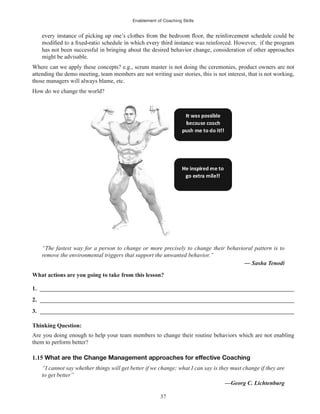
remove the environmental triggers that support the unwanted behavior.”
What actions are you going to take from this lesson?
1. ______________________________________________________________________________________
2. ______________________________________________________________________________________
3. ______________________________________________________________________________________
Thinking Question:
Are you doing enough to help your team members to change their routine behaviors which are not enabling
them to perform better?
1.15 What are the Change Management approaches for effective Coaching
“I cannot say whether things will get better if we change; what I can say is they must change if they are
to get better”
—Georg C. Lichtenburg
The Agilist’s Guidebook
38
Why this topic?
How can we sustain the transformation, in search of this question we had to dig deeper and realize these
artifacts? Without such thought, investment will be a waste.
Why People are not changing, the way they were working? This is the persistent question we have in our
mind when we coach the team and go back to the team and see they have gone back to their original habits.
I was wondering what else we need to do to ensure that changes are retained with the team members and those
new changed practices, sustains.
I put my heart and mind into the coaching but when I have found old habits were returning
gaps and improve.
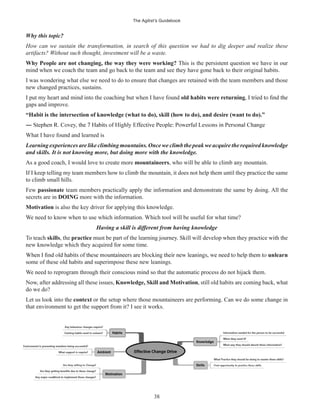
“Habit is the intersection of knowledge (what to do), skill (how to do), and desire (want to do).”
What I have found and learned is
Learning experiences are like climbing mountains.Once we climb the peak we acquire the required knowledge
and skills. It is not knowing more, but doing more with the knowledge.
As a good coach, I would love to create more mountaineers, who will be able to climb any mountain.
If I keep telling my team members how to climb the mountain, it does not help them until they practice the same
to climb small hills.
Few passionate team members practically apply the information and demonstrate the same by doing. All the
secrets are in DOING more with the information.
Motivation is also the key driver for applying this knowledge.
We need to know when to use which information. Which tool will be useful for what time?
Having a skill is different from having knowledge
To teach skills, the practice must be part of the learning journey. Skill will develop when they practice with the
new knowledge which they acquired for some time.
unlearn
some of these old habits and superimpose these new leanings.
We need to reprogram through their conscious mind so that the automatic process do not hijack them.
Now, after addressing all these issues, Knowledge, Skill and Motivation, still old habits are coming back, what
do we do?
Let us look into the context or the setup where those mountaineers are performing. Can we do some change in
that environment to get the support from it? I see it works.
Enablement of Coaching Skills
39
When I was staying alone in my earlier career, I had to cook food for myself to save money. I purchased a
period, it was consumable curry! We used to put a lot of spices to make it awesome.
Now when I prepare the same curry at a family gathering, I carry the same old habit, put a lot of spices which
nobody likes. I consciously tried to come out of that old habit, but it is taking time. Trying to unlearn some of
those old habits which do not work anymore in a family set up. The family does not like spicy food!
I get many appreciations for my cooking! Which encourages me to experiment more and try new ways to satisfy
my end users!
I do not like to cook weekdays as I am too tired to do that, if some family members appear, I do not get that
passion for cooking. But at the weekend I like to cook, I get the motivation to cook. Until I get a bigger
inspiration on weekdays, I do not cook!
I look for the perfect ambiance to cook. If the materials are ready, equipment, utensils are there, I love cooking.
If I go to my friend’s house when they ask me to prepare dishes, if there are not enough utensils I feel annoyed
I realized it needs knowledge, Skill (practice), Motivation, ambiance to do a better job. When I teach cooking
with my kids, I make sure all these factors are there, so that they can produce wow output.
“Change cannot be forced on people. The best way to instill change is to do it with them. Create it with
them”
—Lisa Bodell
What actions are you going to take from this lesson?
1. ______________________________________________________________________________________
2. ______________________________________________________________________________________
3. ______________________________________________________________________________________
Thinking Question:
Are you doing enough to build various way to sustain change management?
1.16 How to apply Guerrilla Coaching for Agile Transformation?
“Coaching works because it’s all about you. When you connect with what you really want and why - and
take action - magical things can happen.”
—Emma-Louise Elsey
The Agilist’s Guidebook
40
Why this Topic?
To change the organizational culture for agile transformation what else can we do. In one of the brainstorming
sessions, this idea was coined and we start elaborating on it.
This thought came in a conversion with a couple of leaders where they are asking how we can rapidly do
something which can change the organizational culture, the DNA of the people.
Have you heard of Guerrilla warfare?
The Spanish word “guerrilla” is the diminutive form of “guerra” (“war”).
It is a form of irregular warfare in which a small group of combatants, such as paramilitary personnel, armed
civilians, or irregulars, use military tactics, including ambushes, sabotage, raids, petty warfare, hit-and-run
tactics, and mobility
In ancient times these actions were often associated with smaller larger empire.
The term “Guerrilla coaching “is traced to guerrilla warfare, which focuses on unusual strategies to attain an
objective. The term itself was from the inspiration of guerrilla warfare which is an unconventional warfare was
using different techniques from usual and small tactical strategies used by armed civilians.
But how does that translate into the work we do every day? In coaching, guerrilla techniques, mostly play
on the element of surprise. It sets out to make highly unusual coaching that catch people surprisingly in the
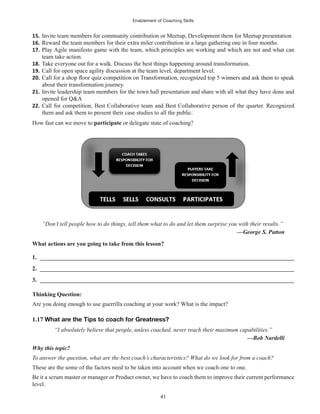
sequence of their day-to-day routines with little budget to spend. This contains high vigor and resourcefulness,
concentrating on grasping the attention of the team members at a more individual and unforgettable level.
Guerrilla coaching is unexpected. That makes it memorable.
Guerrilla coaching will bring innovation.
How can we start this Guerrilla Coaching?
1. Walk into the team daily stand-up without informing the team members. Stop attending for the next couple
of days. Share your observation about the improvements (Surprise visits)
2. Review the team product backlog with the peer coaches and share the observations by the peer coach itself
to the team for improvement
3. Call for the meeting with the Product owner to share the mid-sprint review comments.
4.
care, Repeat such events
5. Invite the other scrum team to visit the team you are coaching, Let the team explore each other and learn
from each other
6. Witness, pay attention and ask queries to know the client’s condition
7. Ensure that clients develop personal competencies and do not develop unhealthy dependencies on the
coaching or mentoring relationship.
8. Invite for a one whole day coaching and training workshop where we will discuss many topics, Pain points,
and solutions
9. Invite leaders to demo meeting of the other team, which they are not managing or accountable. Share
observation points
10. Team members from other departments, coach your team. Cross coaching and learning from each other.
11.
feedback.
12. Coach build coaching competency through demonstration and sessions (Coach Get award based on the
maximum best follower they produced)
13. Share experiences, and examples from another team to inspire other team members
14. Use Directive and non-directive coaching style, e.g., tell, ask, provide answers, ask for solutions, and share
the source of knowledge
Enablement of Coaching Skills
41
15. Invite team members for community contribution or Meetup, Development them for Meetup presentation
16. Reward the team members for their extra miler contribution in a large gathering one in four months.
17. Play Agile manifesto game with the team, which principles are working and which are not and what can
team take action.
18. Take everyone out for a walk. Discuss the best things happening around transformation.
19. Call for open space agility discussion at the team level, department level.
20.
about their transformation journey.
21. Invite leadership team members for the town hall presentation and share with all what they have done and
opened for Q&A
22. Call for competition, Best Collaborative team and Best Collaborative person of the quarter. Recognized
them and ask them to present their case studies to all the public.
How fast can we move to participate or delegate state of coaching?
“Don’t tell people how to do things, tell them what to do and let them surprise you with their results.”
—George S. Patton
What actions are you going to take from this lesson?
1. ______________________________________________________________________________________
2. ______________________________________________________________________________________
3. ______________________________________________________________________________________
Thinking Question:
Are you doing enough to use guerrilla coaching at your work? What is the impact?
1.17 What are the Tips to coach for Greatness?
“I absolutely believe that people, unless coached, never reach their maximum capabilities.”
—Bob Nardelli
Why this topic?
To answer the question, what are the best coach’s characteristics? What do we look for from a coach?
These are the some of the factors need to be taken into account when we coach one to one.
Be it a scrum master or manager or Product owner, we have to coach them to improve their current performance
level.
The Agilist’s Guidebook
42
make them realize to change some of their thoughts if needed.
These mind map highlights the aspects of coaching greatness to focus into. In our coaching engagement, we
ensure we bring into all these points for discussion.
“What a man can be, He must be. This need we call self-actualization “
—Abraham Maslow
What actions are you going to take from this lesson?
1. ______________________________________________________________________________________
2. ______________________________________________________________________________________
3. ______________________________________________________________________________________
Thinking Question:
1.18 How to Scale Agile Coach’s Knowledge?
“My biggest motivation? Just to keep challenging myself. I see life almost like one long university
education that I never had -- every day I’m learning something new.”
—Richard Branson
Why this topic?
This thought arises as a part of the organizational scaling engagement. We were preparing ourselves and
gearing ourselves to satisfy the need of the scale coach. We have interacted with many colleagues in Europe
Enablement of Coaching Skills
43
and realize it is a completely different area. I have listed down a few which can help us to become a better scale
coach.
justifying those frameworks steps. When I look at my own organizational transformation, I realized it would be
good if the scale coach knows the big picture about the Organizational aspects.
Let us think about, how an agile coach can scale their knowledge?
Scale FIFA coach! Etc. are claiming themselves as an expert Scaled Agile coach.
When I hire them, they are failing in basic Scaled Agile implementation.
What was missing was Organization Culture (OC), Organization Behavior (OB) and Organization Structure
(OS) related knowledge?
I am sure coaches who have launched these 20 or 30 Bullet trains in an organization, they have studied several
months about the OB, OC, and OS.
I felt Scale Coach could educate themselves about scaling their knowledge in OC, OB, and OS.
anything BUT importance is knowledge of all these areas.
It would be great if people equipped themselves with this knowledge so that I can get a Scaled Agile coach who
can help Organizational scaling Agile and Transformation.
Why OC, OB, and OS?
We look for all these capabilities when we hire coaches who are an integral part of enterprise agile transformation.
Organizational culture (OC): It is a structure of common Values, standards, and principles, which manages how
people perform in organizations. These shared values have a strong effect on the people in the organization
and prescribe how they dress, act, and complete their jobs. Every organization matures and keeps a unique
culture, which delivers rules and borders for the behavior of the members of the organization. Let’s explore what
elements make up an organization’s culture.
Organizational behavior (OB) is the study of the way people interact within groups. Understanding, forecasting
and managing human behavior, both individually and in a group that occurs within an organization.
Organizational structure (OS) is an arrangement that contains obvious and unspoken institutional rules and
policies designed to outline how numerous work roles and responsibilities are delegated, controlled and
organization, the verdicts are made at various diverse levels.
DO YOU see CONNECTIONS AMONG ALL THESE OC-OB-OS for Scaling Agile?
As an Enterprise Agile coach when you master all these points, how easy it will be for you to start the scaling
engagement?
Instead of just thinking about Launching bullet train from point A to point B, let us understand what problem we
are solving in the context of the organization.
The Agilist’s Guidebook
44
If a coach builds expertise in these points, it will be easier for him/her to start scaling an agile engagement.
OC chooses the way employees to interrelate in their workplace.
in the workplace.
OB aids in clarifying the interpersonal relationships employees share with each other as well as with
their upper and junior team members.
Knowing OB helps to make any change within the organization easily.
OB balances the cordial relationship in an enterprise by maintaining effective communication.
OB has three units of analysis: the individual, the group, and the organization.
OS helps us to provide the foundation on which standard operating procedures and routines rest.
OS helps us to determine which individuals get to participate in which decision-making processes, and
thus to what extent their views shape the organization’s actions
We as a coach need to know various frameworks and models related to OS, OB, and OC.
Enablement of Coaching Skills
45
OS, OC and OB world are very wide and vast, once we know these deeply, it helps the coach to structure the
dialogue with Executives to help them for Organizational development and transformation.
By the way, how do you prove that you are OS, OC and OB experts? Your questioning skill will demonstrate
that!
What actions are you going to take from this lesson?
1. ______________________________________________________________________________________
2. ______________________________________________________________________________________
3. ______________________________________________________________________________________
Thinking Question:
Are you doing enough study to scale your knowledge in the area of organizational change management aspects
and their impacts?
1.19 What is coaching for Resilience Mindset? How to do it?
“Our greatest glory is not in never failing, but in getting up every time we do”
—Confucius
Why this Topic?
Most of the time I had found that team members are getting demotivated by small failures, I started searching
what story I can share with my coaching partners? That’s how I discovered these thoughts and started sharing
in my sessions.
The Agilist’s Guidebook
46
One widely used cliché in sport is “The game is 90% mental”. It seems to have originated from a quote that is
usually attributed to baseball legend Yogi Bera: “90% of baseball is mental…the other half is physical.”
Martin Seligman (1990), a pioneer in the positive psychology movement, coined the term explanatory style to
describe personality attributes related to how people perceive troubling events and how this contributes to their
pessimism or optimism.
I have personally applied this style several times in my career. And now in coaching, it is important to explain
the same to other team members.
In Authentic Happiness (2002), Dr. Seligman describes an optimist as one who believes the cause of a positive
event is personal (as a result of one’s own skill or ability), permanent (almost always present), and pervasive
(across all domains).
A person’s explanatory style has three key components: Permanence, Pervasiveness, and Personalization.
We need to re-look at our explanatory style. If required, we have to change.
Permanence: Relates to the perception of time. Events are perceived as permanent or temporary.
Pervasiveness
Personalization: Relates to the perception of causality. Events are internally or externally caused.
One of my friends was always having an impression that he will never be able to get an on-site opportunity.
He will never be able to take his family abroad. I shared with him about Permanence which refers to how long
a person believes a troubling situation will last. Most troubling situations do not last forever and are linked to
time frames that eventually expire. He was almost in a depression situation. After several attempts now he and
his family are in Italy.
Enablement of Coaching Skills
47
I have learned to look at all these troubling events as a temporary phenomenon. Negative emotions increase
with troubling events. This time does not last for long. If we do not change our mindset, we will fall into this
permanence trap. If we start believing that temporary events last long, we start losing faith and experience
One of my friends was jobless for six months and was not able to crack any interview after having so many years
of experience in the software development. He had started thinking, I will never be available to get a job, and
there is no market for senior C++ developers in today’s market, etc. I shared the same topics about pervasiveness
of his problems and negative personal characteristics. And it was affecting his personal life. His wife started
every aspect of their lives, including his married life and health. Now by putting a good effort and networking,
he got a job in Chennai, India.
With both of my friends, the on-site aspiring friend, and the jobless friend, were thinking that the problem they
were facing was because of their problem or because of others. My on-site aspiring friend was blaming all the
managers not to give him an opportunity as he is not buttering them or not in the same community, etc. My
jobless friend was blaming himself for not being able to get a job related to C++.
My friends fell into the personalization trap when they assign responsibility for their problems exclusively to
themselves or others.
In the world of athletics, athletes are constantly facing events deemed positive and negative by not only
themselves, but also by friends, family, and in some cases, by thousands or even millions of people.
At face value, one might estimate that having an optimistic explanatory style would lead to greater and steadier
performance.
Deepa Malik ecstatic after winning Silver at Rio Paralympics 2016. Deepa Malik’s name is synonymous with
grit and courage. From Paralysis to a Paralympian. What can we learn from her story?
As a coach, I have to change the people’s explanatory style through coaching.
We have to shift a person’s explanatory style towards an optimistic way of thinking, which in turn alleviate
depressive symptoms. Fear of failure from the working environment has to change through mindset
change. We do not want to be over-optimistic, but balanced.
world, but through the power of ‘non-negative’ thinking.”
The Agilist’s Guidebook
48
What actions are you going to take from this lesson?
1. ______________________________________________________________________________________
2. ______________________________________________________________________________________
3. ______________________________________________________________________________________
Thinking Question:
Are you doing enough to learn from failure and build a mindset which is more optimistic?
1.20 Which Coaching approach to use with Clients?
A good coach can change a game. A great coach can change a life
—John Wooden, former UCLA basketball coach
Why this Topic?
Over a period of time, I have realized that it is important that we draw up an agreement by capturing all the
homework? This is how this chapter is born. I have applied this concept several times.
I was looking for some structural model to start the coaching journey with the clients, that was the trigger for
me to search for the below post.
When we are dealing with the client for coaching measuring model, we are wondering how we demonstrate the
output and how we will measure the success of the coaching program.
I have used several steps what has been mentioned in the book “The Behavioral coaching model” - Suzanne
which had worked for me nicely.
Let us walk through each aspect.
It is better to decide the measurement part, should this drive through ROI (Return on investment) or ROE
(Return on expectation) or a combination of both?
One of the critical points is checked if the coaching contract is short term or long term?
E.g., if we are getting into 3-6 months coaching contract, then we should calculate the ROI at the end of this
period.
Enablement of Coaching Skills
49
may take more time.
If the focus of coaching is intangible, it is not appropriate to use ROI, ROE is a superior method in this case.
Some of the intangibles coaches’ measures include changes in job satisfaction, change in leadership and
management style and the changes in teamwork.
ROE measurement?
An ROE involves setting out the plans for the coaching program, gaining consensus on the objectives and then
tracking the program to ensure that the objectives and goals have been met.
The underlying assumption of conducting an ROE is that as long as the coaching program focuses on the
organization’s business objectives and results in positive changes, then it will be valued by the organization.
Coaches have to establish the goals of the organization and those of the individual coaches, the changes that
have to be made to meet these goals, the degree of learning that has to occur to effect these changes and how
they will be measured.
In the end, we have to see how these learnings have to be applied on the job, as well as the overall business
impact, may not be the monetary advantage.
ROE can encompass and measure productivity, organization strength, customer service, reduced customer
ROI measurement?
reaction to and satisfaction with the project, the amount of learning, application, and implementation.
It can be calculated at three months to six month period
Retaining team members who have undergone coaching
Cost savings
Quality of production case and services
Overall productivity
Some of the soft skill data
Leadership skill
Management skill
Workplace optimism
Job satisfaction
Better time management
Team commitment
Client satisfaction
The Agilist’s Guidebook
50
Coaching cost
The direct cost of coaching ( Research and development cost, fees, travel expenses, accommodation,
assessment cost)
Time including any follow-up contact via telephone, email and video conference
Cost of the team members involvement while in a coaching session
Cost of the time to the organization in overseeing and administrating the program
Reporting mechanism to the client:
Coach has to frequently report to the client regarding the coaching progress and client expectation as outlined in
the contract. Maybe monthly, maybe once in 3 months for a six-month program report has to send.
With this structure, it is easy to imagine the coaching model or an engagement model with a client. There will
be a promising effect before and after.
Enablement of Coaching Skills
51
What actions are you going to take from this lesson?
1. ______________________________________________________________________________________
2. ______________________________________________________________________________________
3. ______________________________________________________________________________________
Thinking Question:
Are you doing enough to understand how to create a contract based on the client’s context?
1.21 How Will Agile Coach get neutralized?
“Victory or defeat is not determined at the moment of crisis, but rather in the long and unspectacular
period of preparation.”
—Anonymous
Why this topic?
This topic was bothering me for a long time when I was not able to engage with various coaching engagements.
I was getting an escalation from various teams regarding my engagement. I was listing down what are the
various factors which neutralize coach to perform at the expected level. It is good to know all these factors so
that we can watch as a professional coach and gear up for it
WHO KILLED MY AGILE COACH?
An investigation started after the “killing” of an agile coach who came into the organization to transform the team.
The Agilist’s Guidebook
52
Killing - He lost his job, sacked from his job, criticized badly etc.
The organization was a large legacy enterprise which exists for multiple decades.
Agile coach came across all the below issues and under the load of all these issues he collapsed and was killed
by all these issues.
Moral of the story is
COACH WILL GET KILLED IN THE BATTLEFIELD IF WE DO NOT HAVE ENOUGH STRATEGY,
SUPPORT, TO BRING THE AGILITY INTO THE ORGANIZATION IN A SYSTEMATIC WAY
DO WE HAVE AGILE BASE CAMP WHICH HAS AUTHORITYAND POWER TO HANDLE ANY
NEGATIVE FORCES?
DO WE HAVE DIRECT REPORT TO THE CEO OF THIS BASE CAMP WHERE ALL THE
COACHES WILL EXIST?
DO WE HAVE SUFFICIENT MONEY TO RUN THE TRANSFORMATION?
DO WE HAVE COMPETENT AND CAPABLE COACHES TO RUN THE TRANSFORMATION?
WHO ARE THE RADICAL CHANGE AGENTS?
DO THIS BASE CAMP EMPOWERED TO TAKE ANY ORGANIZATIONAL CHANGE
INITIATIVES?
DO WE HAVE AUTHORITY AND EMPOWERMENT TO ESCALATE ANY TOPICS?
DO WE HAVE KATA SESSIONS HAPPENING AMONG COACHES?
“It is not the strongest of the species that survives, nor the most intelligent, but the one most responsive
to change.”
—Charles Darwin
I want to share one more story which worth to mention here,
Learning from Corporate Abhimanyu
This is a famous story from the Epic Mahabharata. All of us know about this story.
Abhimanyu like character are everywhere in the organization.
What can we learn from this story?
In the organization transformation Journey, we come across many leaders who are the change agent acting like
Abhimanyu. They live a very short life with the system. They got killed on the battleground.Abhimanyu is often
quoted as an example of his partial knowledge about Chakaravyuha.
Abhimanyu was the son the Arjun. He was a great warrior prince, who acquired the most secretive knowledge of
strategic warfare from his father Arjun and his maternal uncle Sri Krishna. Abhimanyu inherited both courage
father owing to his prodigious feats.
Abhimanyu learned the art of breaking into the chakravyuha when he was in Subhadra’s womb. It was then
Arjuna was narrating the art of breaking into chakravyuh to Subhadra. But he did not know how to destroy the
formation once he was inside, as Subhadra fell asleep while listening to the story and (Abhimanyu in her womb)
could learn only half of the technique. This is the reason why he was only able to enter/ break and not come out
of the chakravyu.
survive if you have half knowledge?
Only two people knew how to break this chakravyuha, Krishna and Arjun. At that time they were away. All other
Pandava generals turned to Abhimanyu for help.
Enablement of Coaching Skills
53
Abhimanyu replied that though he knew how to enter the formation, he had no idea how to get out, and only his
father, Arjun and Krishna knew the full secret. Bhima recommended that all the Pandava warriors will follow
Abhimanyu agreed and led the charge. Despite Dronacharya’s efforts, Abhimanyu sliced the creation and
started to massacre the Kauravas. But before the remaining Pandavas could enter the formation, the entrance
was jammed by Jayadratha, King of the Sindhus and Abhimanyu’s fate was closed literally.
A strategy was formed and a joint attack on Abhimanyu followed. Karna cut off Abhimanyu’s bow and stopped
his attack, Kripa killed his two chariot-drivers, and Kritavarma slew his horses; Abhimanyu took up a sword
and a shield but these weapons were cut off by Drona and Ashwathama (though in other versions of the story,
the perpetrators change while the acts remain the same). Abhimanyu then took up chariot-wheel and hurled
it at Drona, but Kripa and Aswatthama protected Drona by cutting the wheel. With variations depending on
prominent ending, Abhimanyu wages war with a chariot-wheel killing hundreds of warriors; he is killed when
head, thus killing him.
“Fools rush in where angels fear to tread”
How can you not become corporate Abhimanyu?
1. Understand the organization culture by discussing with as many people as possible
2. On critical assignment, be aware of the consequence of the assignment not done
3. Courage is good, but there is a limit, how much we can take up
4.
5. Are you equipped with enough knowledge to face the situation? Acquire the experience needed to run the
show
6.
7. Take a measure of your daily performance
8. Build a safe, failure immune, the checklist for yourself. Most of the large setbacks happen due to ignoring
small setbacks
9. If you are not in the fail-free learning culture, do not dare to experiment
10.
trying to say “objection? It is an attempt to control the documents and testimony that gets into “the record.”
11. Do not fall prey to loss aversion.
12. Learn about corporate scapegoating and how to not become victims
them, and strong enough to correct them.”
What actions are you going to take from this lesson?
1. ______________________________________________________________________________________
2. ______________________________________________________________________________________
3. ______________________________________________________________________________________
Thinking Question:
Are you doing enough to learn the ploys which coach will pass through and how can a coach make
themselves rough?
The Agilist’s Guidebook
54
1.22 Key Takeaways:
Pancha
Bhoota Model, Water elements once strengthen it will be easy to achieve Organizational agility.
What we have discussed in this chapter is
1.
2. Coaching to improve tenacity among team members. Parts of optimism and explain these to the team
members.
3. Importance of knowledge around the Organizational structure, Organizational Behavior and, Organization
culture
4. Tips for coaching greatness
5.
6. Effective change management drive and internal factors to be taken care.
7.
8.
9. Empathic coach and improve empathy
10.
11. Usages of kata can help coaches to improve their expertise
12. Parts of solution the focused approach
13. Application of Johari window in coaching
14. Usage of the Socratic approach
15. As an organization is like a garden, an agile coach as a gardener needs to take care of the plants for its
growth.
16. When coach will get exterminated in an organization
17. Coaching model which can guide coaches
18. Preparing to become a better consultant.
19. Preparation to become a better coach
20. Finding a better coach, Looking into the various aspects before we select a coach
In the next chapter, we will discuss about the Leadership development or strengthen the Air element in the
Pancha Bhoota Model.
55
2.1 Introduction:
This chapter features some of the attributes which we as a leader have to be mastered. How an agile coach
can coach the leaders to become agile leaders. It is one of the toughest tasks to persuade senior executives for
coaching engagements. In the Pancha Bhoota Model, this is the Air element. If we strengthen this area Air
element of the organization will become strong. It will serve to accomplish organizational agility.
“Leaders are made, they are not born. They are made by hard effort, which is the price which all of us
must pay to achieve any goal that is worthwhile.”
- Vince Lombardi
2.2 Why Leaders have disciples?
“If you believe lack of authority prevents you from leading effectively, it is time to rethink your
understanding of leadership.”
—Mike Bonem and Roger Patterson,
Why this topic?
I have this query from many managers with whom I am taking a coaching engagement. Million Dollar Question?
Below mind map highlights some key factors about the conventional leadership styles.
The Agilist’s Guidebook
56
These thoughts are not the ultimate list, but it evolved based on the observation of many good leaders with
whom I have been working.
Look at the picture, why people follow them?
They inspired us for some reason.
They know why they exist? And inspire others by sharing the purpose. Real alignment with all the below
factors.
Enablement of Leadership Skills
57
It is not the positional power because of which people are following leaders, you have something as a leader
because of which people are following you.
Oh! Yes, people follow the commander, why?
They follow for survival!
These leaders say something which touches our emotions. They engage us through their dialogues, which is
someway like it, do not know why BUT we like them, and we want to be with them
We follow because they connect with us emotionally
Emotion matters more than logic and reason.
The Right type of people attracts the right materials. The way the magnet attracts iron.
Why are there so many followers for the world’s second richest Hindu temple?
Annually 2.5-3 crore pilgrims have Darshan of the Lord Venkateswara, Every day in the Hundi box(Donation),
Temple get count 3+ crore of Indian rupees? Belief?
Common people believed that something good will happen in their life if they visit Tirupati Balaji temples.
The Agilist’s Guidebook
58
Can we create a similar impression in people’s mind? The Belief that something good will happen if they follow
someone...
Why so many followers?
Capture the Heart and Mind of the people. Not by Hate!
Heart and Mind have to be in balance.
Enablement of Leadership Skills
59
emotions and the logic of followers?
Why do so many visitors going to the Taj Mahal? Beauty? Pride? Feel-good factor? It is one of the wonders
of the world.
As a Leader, can we provide assurance and hope to our followers?
Servant leadership: living for others and helping others.
Building Trust among followers. Can Leaders and followers trust each other?
Very few powerful steps, but with many years of conscious practice, we can master all these. Look around
The Agilist’s Guidebook
60
What actions we can take as a leader to strengthen each area and achieve mastery
—Rodger Adair
What actions are you going to take from this lesson?
1. ______________________________________________________________________________________
2. ______________________________________________________________________________________
3. ______________________________________________________________________________________
Thinking Question:
2.3 Emergent Leadership Manifesto (Scaling Leaders)?
— Edith Wharton Vesalius In Zante (1564)
Why this topic?
Leadership is in a complex world is experimental, It is more collaborative and democratic. During our leadership
coaching, we have to enlighten the leaders with numerous concepts to alter their mindset.
Enablement of Leadership Skills
61
The Agilist’s Guidebook
62
Enablement of Leadership Skills
63
The Agilist’s Guidebook
64
“True leadership must have follower-ship. Management styles can vary, but even an autocrat needs
people who believe and simply don’t follow from fear”
— James Robinson III, RRE Ventures
What actions are you going to take from this lesson?
1. ______________________________________________________________________________________
2. ______________________________________________________________________________________
3. ______________________________________________________________________________________
Thinking Question:
Are you doing enough to build your leadership skills and help others to build their skills?
2.4 The Manager and the Leader, two sides of the same coin!
Why this topic?
Elucidation this to my fellow leaders whom I was coaching, how can I easily explain this thought?
It needs the balance of both the worlds.
We cannot say, he/she is a good leader, but a poor manager, and vice versa.
Enablement of Leadership Skills
65
A leader must not only give followers a structure, organization, and control but also show courage, purpose,
commitment, accountability and a sense of value.
Management focus produces an essential order, consistency, and predictability, and then leadership produces
change and adaptability—to new competitors, new products, new markets, new regulations, and new customers.
Both sets of skills are necessary, and both must be in balance.
Every High-Performance Leader should have both strong management and strong leadership skills.
is leaning against the right wall”
—Stephen Covey
leadership.
I have worked with many good managers and good leaders. Few of them are successful in the corporate ladder
because of their management skills, a few of them have to leave because of the poor management skill and some
of them started their own company due to their excellent leadership skill.
The Agilist’s Guidebook
66
What actions are you going to take from this lesson?
1. ______________________________________________________________________________________
2. ______________________________________________________________________________________
3. ______________________________________________________________________________________
Thinking Question:
coaching?
2.5 Building self-Organized team?
“Self-organization has a curious feature in that the degrees of freedom for the separate parts are greater
than the degrees of freedom for the collection. The reduction in the degrees of freedom is in the form of
relationships and these relationships are essentially information and so it appears that information is
generated by a loss of freedom.”
Why this topic?
“The best architectures, requirements, and designs emerge from self-organizing teams”, as indicated in the
Agile Manifesto
What are the characteristics of a self-organized team? When we glance at these pictures what comes to our
mind? Awesome teamwork, world-class performance? How to reach this height of maturity?
Self-organization is a process by which a system—several components together with interaction rules—
becomes ordered in space and/or time. Often, self-organization leads to emergent properties, meaning
that the whole system has characteristics that differ qualitatively from those of the component parts
without the interactions. Self-organization is usually distinguished from self-assembly because self-
organized structures rely on a continuous input of energy to be maintained. - Jonathon Howard
Enablement of Leadership Skills
67
A self-organized team should have the below characteristics:
1. They are Autonomous
2. They have a common purpose
3. They learn from each other continuously
4. They take ownership
5. They share and care for each other’s
6. They are a leader - leader on their own(Shared leadership)
Hackman provides us with an authority matrix to distinguish four levels of team self-organization
Manager-led teams that leave team members only the authority for task execution while managers
monitor and manage work processes, design the context and set the direction.
Self-managing teams put members not just in charge of task execution but also for managing their
progress.
Self-designing teams give members the authority to modify the design of their team and/or aspects of
the organizational context in which they operate.
Self-governing teams have the responsibility for all the four core functions as shown by the corporate
boards of directors, worker cooperatives or start-ups.
“Organisms live in a stream of energy. In a stream of energy, you get increasingly complex levels of
self-organization.”
The Agilist’s Guidebook
68
What actions are you going to take from this lesson?
1. ______________________________________________________________________________________
2. ______________________________________________________________________________________
3. ______________________________________________________________________________________
Thinking Question:
2.6 Characteristics of an Agile team?
“The strength of the team is each individual member. The strength of each member is the team.”
Why this topic?
Every manager asks me to help them to form an outstanding agile team, How to accompany them?
Coaching is more an Art than a science.
job is to build an excellent agile team and move on.
At the initial stage, the coach will be the communicator, leader, role model and a collaborator. Initially, there
will be resistance as the change is tough to digest and the team needs a shoulder to cry on. The agile coach plays
a critical role as a transformer and change agent. The team should be able to see the change after some time.
The team member needs to know what done means in all the assignments they are
working on. If I am playing a game, I need to clearly know what done means for that game. Same applies
to be very clear without much ambiguity. Do all the team members know their DONE criteria all the time?
Ego checking: It is the big killer in the team-building process. As analytical people, we engineers often
associate our ego with our work. But this brings some potential negative side effects. We should have
improved our emotional capacity to control our ego to effectively work with the team members in various
circumstances.
The agile team members should have more generalists not many specialists. All the team members have to
contribute and do all types of jobs from architecture to documentation. “I am an architect, I cannot do testing
assignment” will not help the team to deliver solution fast.
Follow the sprint, and the demo and learn from the execution mistake: As soon as something is vaguely
the successes and failures are, and so the programming team is expected to learn, iterate, and push a new
Are we learning from others and doing the same for improvement?
Most of the time team members feel that others are pointing at their mistake and all they do is start defending
their solution instead of looking at the bigger picture. If this pattern continues, the team feels sprint demo
an environment where all own to build a better product and solution. The only way the team maturity grows
Enablement of Leadership Skills
69
and also increases learning by making mistakes. Make more mistakes, fast and learn from the mistakes. This
positive attitude has to be adapted by all the team members for the improvement.
Keep Time for Learning
To become an effective team, we need to share the knowledge and learn new stuff continuously. This is the only
way the team learns and the agility grows. If the team members focus too much on velocity and that becomes
of time for knowledge building. Otherwise, the technical debts will also increase.
Assumption checking:
killer of many initiatives. We assume that “If We Build It, They Will Come.”, are we sure they will come?
We have a habit of accepting everything at face value without challenging, and most of the time this habit causes
some issues. Let us change this habit.
Communication Patterns of Successful Cultures:
Communication is the major contributor to team handling. Communication, especially with geographically
telephone to effectively pass the messages to the team members, and collaborate with the team. Essential to run
the meeting effectively with a proper agenda and to follow all the meeting rules. A noble universal rule around
communication is to include as little people as needed in synchronous communication (like meetings) and to go
for a wider audience in asynchronous communication (like email).
The Servant Leader:
In today’s world, the old style of management has disappeared where command and get the resulting style is not
effective at least with the knowledge workers. The cure for the “management” disease is a liberal application of
what we call “servant leadership,” which is a nice way of saying that the most important thing a manager can
do is to serve her team; much like a butler or majordomo tends to the health and well-being of a household. The
manager has to trust the team members and be honest in all the aspects. He spread humor and joy in the team so
that the place is lively and nice to work.
Take ownership
Team members have to own the failures and success, and they have to own the outcome and responsibility. Build
it is a practice to own. If we are passing the blame, it creates a negative atmosphere and soon the place will be
Low performer
How does one coach a low performer effectively? The best analogy is to imagine you’re helping a limping
person learn to walk again, then jog, and then run alongside the rest of the team. Meet with the engineer every
week to check on the progress, and be sure you set explicit expectations around each upcoming milestone so
to both of you early in the process. At this point, the person will often acknowledge that things aren’t going
meet the expectations. Either way, by working directly with the low performer, you’re catalyzing important and
necessary changes.
Build a culture of trust:
be, and it will create a trust culture among the team members, Let us be honest and follow this practice. People
tend to enjoy interacting with people who they believe like them. No blame culture.
The Agilist’s Guidebook
70
Attitude:
Attitude is contagious, and we have to build a learning attitude from all the context, Let us experiment and learn
attitude should be avoided.
Walk the talk and energize
Demonstrate every concept wherever possible. Help the team to remove all the roadblocks. Make them
comfortable. Team members should also demonstrate the same over a period of time. Are they doing?
People Are Like Plants
The way, a gardener takes care of his/her plants, the same way, a coach has to mentor and coach all the team
members. The result will be tremendous. Are they listening? Team members have to play like a world cup
winning team, where all are contributing for one common vision “To win”!
found all these factors are common and universal and most of the agile coaches have all these challenges.
Enablement of Leadership Skills
71
“Individual commitment to a group effort - that is what makes a team work, a company work, a society
work, a civilization work.”
- Vince Lombardi
What actions are you going to take from this lesson?
1. ______________________________________________________________________________________
2. ______________________________________________________________________________________
3. ______________________________________________________________________________________
Thinking Question:
Are you doing enough to supplement your knowledge to establish the best team and aid others in building the
same?
2.7 How to Become a Charismatic Leader?
There are people who just, like, come through the door, and everybody turns around and looks at them
and feel drawn to them.”
—Edgar Ramirez
Why this topic?
charismatic leadership style, what is this style of leadership?
Charisma is a Greek word meaning a “Divinely inspired gift.” In the study of leadership, charisma is a special
the extraordinary determination differentiate them from others.
to charisma. Several years ago, he was nominated, the Time magazine person of the year by an entertainment
executive, and given this accolade: “He is a true visionary who continues to lead the technological revolution.
Year after year, Apple creates must-have products that shape how we live our lives. Jobs and Apple
continue to lead us to a wonderful new technological future.”
Charismatic leaders use impression management to deliberately cultivate a certain relationship with the group
members. In other words, they take steps to create a favorable, successful impression, recognizing that the
perception of constituents determine whether they function as charismatic leaders.
AM I DOING THE SAME?
Jane A. Halpert performed a statistical analysis of the effects charismatic leaders have on followers and found
that the three dimensions are the most important. One key dimension is the Referent power, the ability to
to exercise referent power.
Another dimension is Expert power
and designing electronic devices such as the iMac and iPod.
The third dimension of charismatic leadership is the ability to get group members excited about their work or
to experience Job involvement.
Job involvement is a key component of job satisfaction, and one empirical study has provided evidence of the
relationship between charismatic leadership and job satisfaction.
The Agilist’s Guidebook
72
The outstanding characteristic of charismatic leaders is that they are charismatic, and therefore they can attract,
motivates, or lead others! They also have other distinguishing characteristics.
1. Charismatic leaders are visionary because they offer an exciting image of where the organization is headed
and how to get there.
2. Charismatic leaders have masterful communication skills. To inspire people, the charismatic leader uses
colorful language and exciting metaphors and analogies.
3. Another key characteristic is the ability to inspire trust.
4. Charismatic leaders have an energy and action orientation. Like entrepreneurs, most charismatic leaders are
energetic and serve as role models for getting things done on time. Emotional articulateness and cordiality
are also distinguished.
5. A key characteristic of charismatic leaders is the ability to express feelings openly.
6. Another trait of charismatic leaders is that they romanticize Risk. They enjoy risk so much that they feel
empty in its absence.
7. In addition to valuing risk, charismatic leaders use unconventional strategies to achieve success. The
charismatic leader inspires others by framing unusual strategies to achieve important goals.
8.
charisma.
I am walking through this path……coming across many mentors who are having all the above characteristics, I
am admiring them and practicing all the skills to become a charismatic leader……are you?
“Truly charismatic people, in my experience, don’t come along very often.”
—Francesca Annis
Enablement of Leadership Skills
73
What actions are you going to take from this lesson?
1. ______________________________________________________________________________________
2. ______________________________________________________________________________________
3. ______________________________________________________________________________________
Thinking Question:
Are you doing enough to build knowledge about this leadership style? What else can you work out?
“Serving others prepares you to lead others.”
Why this topic?
What are the few key characteristics of servant leaders, which I can share in the leadership workshop?
I have been asked to look for a better servant leader and how to measure if at all possible, best servant leaders!
I was wondering what are the characteristics of someone who is demonstrating servant leadership consistently
and which we can measure and leads to some kinds of recognition, which I call as a
(CSL).
Mastering servant-leadership is a lifelong learning process.
These attributes are often the result of having developed a highly moral and spiritual character.
Can we observe the team members through the lens of the below characteristics?
The Agilist’s Guidebook
74
At least I have started using these factors to assess the best servant leaders, who can be a role model for others.
The following 12 characteristics of Servant-Leadership have
Greenleaf Center for Servant Leadership.
He calls them as being thoughtful to the improvement of servant leaders.
Let us have a look at each element
1. Does he/she seek to listen receptively to what is being done and said (not just said)? Listening also
encompasses getting in touch with one’s inner voice, and seeking to understand what is being communicated?
Does he/she seeks to identify and clarify the will of the group?
2. Does he/she understands and empathize with others? Does he/she accepts and recognize people’s special
talents?
3. Does he/she heal self and others? Do others believe he/she has a strong awareness of what is going on?
Does he/she look for cues from their opinions and decisions?
4. Does he/she seek to convince others, rather than coerce compliance? Does he /she successfully construct
an agreement within groups?
5. He/she is a great dreamer? Do they have the ability to look at the organization and any issues within the
organization from a conceptualizing perspective? He/she is thinking beyond the day-to-day realities?
6. Does he/she understand the lessons from the past, the realities of the present and the likely consequence
of a decision in the future?
7. Does he/she responsible for preparing it for its destiny, usually for the betterment of society? Does he/
she desire to prepare the organization to contribute to the greater good of society—not unlike preparing the
prince to serve the greater good of the kingdom?
8. Do employees believe that he/she is committed to helping them develop and grow? Does he/she believe
that all employees have something to offer beyond their tangible contributions?
9. Does he/she has a strong sense of community spirit and work hard to foster it in an organization?
10. Do employees believe that he/she is for the good of the organization?
Does he/she have a natural desire to serve others? Does he/she desires to make a difference for others
within the organization and will pursue opportunities to make a difference and to impact the lives of
employees, the organization, and the community—never for their own gain?
11. Does he/she understand the deep human need to contribute to personally meaningful enterprises? Does
he/she nurture the individual’s spirit through honest praise and supportive recognition? Does he/she
learn from both?
12. Do those served to grow as persons; do they, while being served, become healthier, wiser, freer, more
autonomous, more likely themselves to be servants?
Enablement of Leadership Skills
75
Maybe we can start observing all these above aspects and recognize individuals who are demonstrating such
characteristics?
“In a servant leadership culture we learn by choice or example that if we want to be great, we have to
serve others respectfully.”
What actions are you going to take from this lesson?
1. ______________________________________________________________________________________
2. ______________________________________________________________________________________
3. ______________________________________________________________________________________
Thinking Question:
the same?
2.9 Do you have a Feminine and Masculine personality style in harmony?
women is something masculine.”
—Susan Sontag
Why this topic?
Every individual is unique, and their leadership styles are varied, and it is useful to know both of these styles.
Coaching has to be a balance of both the masculine and feminine
one isn’t necessarily better than the other.
Do not believe?
In Taoist philosophy, ‘yin’is the feminine principle, representing the forces of earth, while ‘yang’is the masculine
principle, representing the spirit.
Marianne Williamson
It is the balance between the HARD and SOFT part of the characteristics.
It should be a healthy balance. An Unhealthy hard and soft part will cause a problem.
Please have a look, are you applying a balanced approach?
What action can we take to increase the balance based on your dominant personality style?
Masculinity and Femininity—Complements
The Agilist’s Guidebook
76
As a coach, if we demonstrate only the Masculine styles or only the Feminine styles, the end result will not be
as expected. It has to be a balance of both.
According to yoga philosophy, the male energy is known as Shiva, and the female energy is known as Shakti.
The male energy is represented by the sun and the feminine by the moon.
The important aspect is that we as a person have to be in constant balance to be able to achieve the best of our
worlds, mental, physical and emotional.
Both sides, male and female have to attain a harmonious whole.
Enablement of Leadership Skills
77
While doing coaching, we have to apply the Masculine style or the feminine style based on the circumstances.
For that, we need to know both these styles.
Some of the Feminine Qualities which helps us in coaching - Be Affectionate, Be Empathetic, Be Patient, Be
Soft and so on.
A Coach shouldn’t be all masculine or all feminine -- they need to change their style depending on who they’re
working with and the needs of the situation.
realize that men and women both contain masculine and feminine energy.”
—Nelly Furtado
What actions are you going to take from this lesson?
1. ______________________________________________________________________________________
2. ______________________________________________________________________________________
3. ______________________________________________________________________________________
Thinking Question:
team members?
2.10
Why this topic?
Many of my team members were seeking that to share with them, how an excellent agile leader should perform?
I have started netting all the information and subsequently shared with them.
I was searching for my role model Agile Leader for a long time. I was preparing myself for that time.
How do I identify that person, what are the characteristics I should be looking forward to recognizing that
person as my role model Agile Leader?
The Agilist’s Guidebook
78
After a long search, I have found the person and now many more such people I have come across. The method
which helped me to identify that person is, shared with all of you.
1) What I have observed according to the Agile Leader, Customer is the center of everything. The customer
full satisfaction through product and service.
aligned
and adjust to the varying demands of the customer. They take actions to ensure that the changing needs
are addressed and the customer agrees to the changed offering. The changes could be different offerings
extreme steps to address these changing needs.
3) Customer Satisfaction and Team satisfaction: Agile leaders balance these both aspects. They take
actions on a daily basis to address these two areas of satisfaction. They develop themselves to exhibit
leadership characteristics to achieve both. They take several initiatives to change the culture and measure
the improvements for both of these areas.
4) Feedback from customers and team members: They take continuous feedback from all and take visible
actions to change the ecosystem. Team members and customers accept and agree that there are developments
in the shortest timeline based on their feedback.
5) Co-creation:Agile Leaders encourage all the team members to participate in co-creating the solutions. They
inspire and encourage through their charismatic leadership to all the participants in the solution building
process. They never stop until they see effective collaborations are happening. They do all these steps
without using much positional power to improve the co-creation in the organization. They use their network
to bring experts from various areas to help each other.
6) They cultivate great people: Agile leaders are constantly building people capabilities. They ensure
competency is at the expected level. They take care of the team member’s emotional health. They create an
environment where team members feel the best place to work. They create a leadership production factory
through continuous coaching and mentoring.
7) They invest in infrastructure: To align with the Digital world, they invest in the latest cutting-edge
technology. They train the team members to educate themselves and create an ecosystem which is full of
the latest technology.
8) Experimental mindset: Agile leaders are learning from the mistakes. They encourage team members to fail
and learn from their mistakes. They create a community where they encourage team members to share what
mistake they did and how as a team we should avoid the mistake in the future. They give full freedom to the
team members to fail fast. They build a culture of learning from failure. They have understood that survival
in today’s world is only through learning by experiments.
9) Theybring standardization, wherever applicable.They ensurewe arenot reinventing the wheel. Uncertainty
among all the participants when implementing change. Lack of standardization often results in redundancy
especially in a reasonable period.
10) Transparency:Theyarethebelieversoftheeffectofvisualinformationradiator.Theyalwayscommunicateto
bring transparency. They share the goals, vision and inspire team members through effective communication.
They develop master communication skills.
11) Walk the talk
They inspire their team members through this process. If they do not know anything they take the help from
the team members, but they ensure that they accept that they do not know everything.
Enablement of Leadership Skills
79
12) They re-skill themselves: They are continuously learning. They ensure all the team members are learning
and growing. They keep track of all the team members’ knowledge, including self for the improvement.
They create a learning organization
13) Continuous improvement culture: They build an organizational culture of continuous improvement. They
ensure the elimination of waste on a daily basis. They maintain the waste removal backlog where they
retrospect with the team members at certain intervals and celebrate the waste removed.
14) Break silos culture and increase alignment: They look for
look for collaboration and alignment opportunity. They remove all the silos with the help of all stakeholders.
They work with all the team members to minimize dependency.
15) They are always on the ground, and they are connected
signal based power point presentation. They get the information
countries at certain intervals to get the real information from the team members. They prefer face-to-face
interaction with most of the team members. They are not sticking to the few important team members.
16) They implement small incremental delivery and get feedback from the stakeholders. They manage the
queue properly and implement work in progress limits. They decentralize the operational decisions and
own the strategic decisions. They link strategy with operations.
17) They think systems: They look at the big picture and help team members to achieve the same. By adhering
to such a perspective, team members begin to appreciate the importance of their roles and those of others in
contributing to customer satisfaction.
18) They build trust as a culture. Allow people to take ownership and come up with ideas to improve the
organizational setup. They believe in TDD (Trust-Driven Development).
The Agilist’s Guidebook
80
19) They believe in a They are not behind designations or higher positions. They understand
of executive management compete for greater growth in power and control; and procedures become so
intertwined that making change is next to impossible because it defeats the power and control of certain
people or organizations.
to inspire teammates and customers.”
—Robin S Sharma
What actions are you going to take from this lesson?
1. ______________________________________________________________________________________
2. ______________________________________________________________________________________
3. ______________________________________________________________________________________
Thinking Question:
Are you doing enough to reinforce your learning on agile leadership? What else can you look at?
Enablement of Leadership Skills
81
2.11 How to Increase your personal worth?
“To get them hooked and booked for life, you must consistently feed them – value!”
—Bernard Kelvin Clive
Why this topic?
This theme was developed based on the examination with a few team members who were getting very low salary
and a few who were getting a remarkably high salary, and most of them were enquiring, how to improve and
sustain the high salary?
The theory of supply and demand lies at the heart of market economics.
The more abundant the supply of a good or service, the lower its price will be, even to the extent that it may not
The more scarce the supply, when the competition is held back by barriers such as patents, expertise or other
Where there are such barriers, the price of a good or service no longer relates directly to its cost of production,
if the product were not available.
In the pharmaceutical industry, if there is a high demand for a product for which you have a patent and no
alternative exists, the future is a lucrative one, even if the R&D costs have been substantial.
Where does scarcity lie and where is it likely to develop?
unavailable. But as someone somewhere will come up with innovative solutions, the scarcity will not remain
the same for long.
Having the insight and knowledge to understand such changes is as important as the ability to deliver customer
value. And if you can anticipate the changes, you will be ahead of the competition.
When will the customer pay for us? When the customer gets value from our service.
The Agilist’s Guidebook
82
“Try not to become a man of success, but a man of value. Look around at how people want to get more
out of life than they put in. A man of value will give more than he receives. Be creative, but make sure
that what you create is not a curse for mankind.”
—Albert Einstein
Enablement of Leadership Skills
83
What actions are you going to take from this lesson?
1. ______________________________________________________________________________________
2. ______________________________________________________________________________________
3. ______________________________________________________________________________________
Thinking Question:
Are you doing enough to raise your value to the organization?
2.12
Why this topic?
During our coaching engagement, we come across this query. Most of the scrum masters will love to know if
a) How do we handle tough Product owners? Who will not listen to anything?
b) How do we handle tough managers? Who is arrogant, dominating and commanding?
c) How do we work with the team members who are very good at their work but will not listen?
d) How do we handle tough customers who are very demanding? And having less patience?
I have got some checklist items which can be followed and shared with all the team members who can practice
these patterns and obtain results.
“the act or power of producing an effect without apparent exertion
of force or direct exercise of command,” or “the power or capacity of causing an effect in indirect or
intangible ways.”
First, Let us apply Logical persuasion to our target person. Here we will use Logic to explain what we believe
or what we want.
So how should we structure this?
a) Know your audience well. Understand who they are and how they operate. Know what’s important to them
and what they would expect from you.
The Agilist’s Guidebook
84
b) Ask, Why would they say yes and why would they say no
compelling? How might they argue against what you are proposing (and what will you say if they do)? What
issues might they raise (and how will you respond to those issues)?
c) Be clear in your mind about why they should agree with what you are proposing. Be able to state, as
precisely as possible, your premise as well as the principal facts and arguments supporting your premise.
d) Build your case by
that information in a compelling way.
e) Make your —when other urgent businesses do not press people and when
f) Listen carefully to their responses
g) . We may need to present our case, understand where the
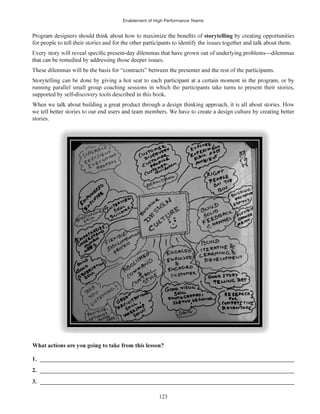
resistance lies if people say no, and then return later with a revised case that addresses their resistance.
Sometimes above approach will not work, when things have to be done, in less time, where we do not have time
We have to apply Appealing to authority (Legitimizing). This should be the last option to use. Use this
b) Refer to policies, procedures, standard practices, rules, regulations, or traditions as the basis for your decision
are making.
At the end use these steps
1. When you can, do more for people than they expect. Treat them well, and they will remember it—and
reciprocate.
2.
3. Avoid being aggressive
4. Try to use a compelling tone of voice
5. Use assertive nonverbal approach to emphasize your points.
6.
“I always dream of a pen that would be a syringe.”
Enablement of Leadership Skills
85
What actions are you going to take from this lesson?
1. ______________________________________________________________________________________
2. ______________________________________________________________________________________
3. ______________________________________________________________________________________
Thinking Question:
Are you doing enough to learn numerous approaches to persuade an individual? What further wisdom do you
desire to gain?
2.13
[In my home workshop,] generally, I’m mending things, which is interesting because you learn a lot
about why they broke.
Why This Topic?
Most of the time organizations asked to set up in-house training, execute by the in-house coaches. I was part
of establishing Agile Training institutes and courses for several years. This is the central need when you start
offering training for a wider crowd in an organization.
I have been designing and executing leadership workshops for the last several years focusing on greater customer
satisfaction.
relationship triangles function.
Someone working in this kind of programs will invest a huge amount of emotional energy engaging with
participants, challenging them while simultaneously showing empathy and care.
In order to create a truly productive, safe environment where executives can experiment with cognitions,
emotions, and behavior, participants need to be able and willing to engage in self-exploration and self-
experimentation.
One of the key challenges is how do we motivate leaders to participate in the workshop? How do we engage
them by designing the module effectively?
I am doing several inspect and adapt approaches by researching various pilot approaches.
I have tried this below approach and had got positive responses in the leadership workshop by including all
these aspects told by Kolb.
The “Experiential Learning Theory” (ELT) of Kolb was constructed on the foundation of a four-stage learning
ideas which can then be tried out through actions.
Kolb’s model, therefore, works at two levels - a four-stage cycle:
Concrete Experience - (CE)
Abstract Conceptualization - (AC)
Active Experimentation - (AE)
The Agilist’s Guidebook
86
Activists: Learning is the greatest from relatively short here-and-now tasks. These may be managerial actions
on the job or in courses: such an approach as business games and competitive teamwork exercises.
They absorb fewer concept from the circumstances relating to an inactive approach such as listening to talks or
reading.
: Learn greatest from actions where they can stand back, attend and witness. They like gathering
things without the chance to plan.
Theorists: Learn the greatest when they can review things in terms of a system, a concept, a model or a theory.
They are interested in and absorb ideas even where they may be distant from the current reality. They learn
fewer concept from the actions presented without this kind of explicit or implied design.
Pragmatists
or opportunity on the job. They like being visible to the methods or procedures which can be practical in their
instant condition. They learn fewer concept from the learning events which seem far from their truth.
We also used the social learning theory proposed by Albert Bandura
There are three core concepts at the heart of the social learning theory.
First is the idea that people can learn through observation.
Next is the notion that internal mental states are an essential part of this process.
Finally , it does not mean that it will result
in a change in behavior.
The Modeling Process developed by Bandura helps us recognize that not all perceived behaviors could be
learned effectively, nor learning can necessarily result in behavioral changes.
The modeling process includes the following steps for us to determine whether social learning is successful or
not
Step 1: Attention
Step 2: Retention
Step 3: Reproduction
Step 4: Motivation
If you are designing a leadership workshop, you also can try these approaches. It is important to take care of all
the different types of participants and how we can increase the learning of the participants.
We got an excellent result by incorporating all these concepts into the design modules.
What actions are you going to take from this lesson?
1. ______________________________________________________________________________________
2. ______________________________________________________________________________________
3. ______________________________________________________________________________________
Thinking Question:
Are you doing enough work to design an executive workshop? What are the comments? And what actions have
been picked up for these comments?
Enablement of Leadership Skills
87
2.14
Why this topic?
member. Every leader seek to grasp this skill without exception.
of our peers,
of our girlfriends/boyfriends, what not!
But how to do it effectively….? Which can help us to build a relationship with all the connected team members?
virtually every human interaction, every moment, and everywhere. It is so fundamental to leadership
We need to do the good amount of homework
We need to read other’s mind and help them with what they want to get the buy-in from others.
“Some people may be uncooperative because they are too busy elsewhere, and some because they are not
capable of helping.
may, therefore, have no desire whatsoever to help or cooperate.”
So we need to know exactly what it is and act on it to help each other.
Interests
values.
If not, then the person’s interests would not be well served by going along with you and, in this situation, most
The Agilist’s Guidebook
88
don’t keep doing the same thing. Try something else.
What works in South Africa may not work as well in India, just as the openness and informality typical in
Australia, even in business settings, may not be as acceptable in Germany or the Netherlands (in fact, it could
in every culture.
People tend to assume that what they like, everyone else will like; that what works well for them will also work
for others. This is the case because, by and large, most people believe that they are normal and that most other
people share their view of reality.
If we are observant, and if we listen to other people and observe their behavior and the environments they create
period of time and soon it will become second nature. So we need to consciously make it a habit to build those
observation skills.
Prepare our mind, know who our audience is, know their code, and structure a winning persuasive
argument accordingly.
Let us know who, what, when, where, and why about our message and our audience.
Master Persuaders know that information and structure are the seeds for perfect persuasion.
What actions are you going to take from this lesson?
1. ______________________________________________________________________________________
2. ______________________________________________________________________________________
3. ______________________________________________________________________________________
Thinking Question:
2.15
“A mind that is stretched by new experiences can never go back to its old dimensions.”
—Oliver Wendell Holmes, Jr.
Why this topic?
As an agile coach, I am supposed to coach all the project managers to reconsider themselves in the corporate
agile world. I desire to discover a way for them and what are the choices that we have?
As a Project manager, I want to create my position in the agile world
....... So that I can Value-add to the organization and the team.
How can I survive as a project manager in this new world?
I have done a good amount of work as a “Project Manager” and executed many successful projects.
Enablement of Leadership Skills
89
control.
What to do now? These activities are no more value added to a project managers to an agile project.
Agile disrupts the task-based management approach!
Edwards Deming suggests that there are two mistakes a manager can make:
They can react to an outcome as if it came from a common cause (i.e., something that is inherent in
unusual).
Or, they can react to an outcome as if it came from a special cause when, in fact, it came from a common
cause.
How can we avoid a reactive approach?
I have decided to rediscover myself!!
How can I generate value in this new world…?
I have listed down how my expertise can value-add to team members and the organization in agile projects.
I have to resign mentally from my project manager position in an agile project to start with. Classic PM taught
me to focus on the project plan as my primary tool to execute and complete the project. I had to manage the
So Plan is everything to control.
But in an agile world, the agile project manager focuses on generating business value by whatever is vital to do.
In the agile environment, the PM emphasis is moved from planning to execution
So the change is - Plan driven to Value driven management.
So the Project manager focuses more on facilitating then the tightly controlled plan. No more WBS focused, but
help to get the output. Not micromanaging those WBS elements.
Upper management encourages the project manager by not asking to show “% Schedule Variance” metrics and
“% cost variance” metrics. There is no punishment for percentage schedule variance. Help the team to create a
high-level business needs than control through the static project plan.
Allow changes to happen for better customer satisfaction and plan accordingly. Take the help from the team to
The agile project manager makes the plan, changes the plan, and watches out for the factors which will change
the plan for the betterment of all the stakeholders. Become more proactive to execute the project.
An important aspect of an agile approach is the phenomenal importance it gives to an individual. Therefore,
people, their skills, motivation, and communication are crucial ingredients of a successful agile project. From
command and control to servant leadership. Develop people and empower people.
Let us look into our new roles and responsibilities of an “Agile project manager”
1. The project manager is a facilitator and a better leader than a Manager.
2. Project manager becomes a coach and mentor for the project team.
3. The project manager is an individual contributor role and we value-add in every possible way.
4. Demonstrate more leadership abilities and walk the talk.
5. Be a Change agent and chaos controller.
6.
The Agilist’s Guidebook
90
7. A data analyst for the team or the data scientist who understands various changing scenarios and shares the
information with the right people in meaningful decision making.
8. Analyzing various “what if” scenarios and helps the team with the output
9. Effective stakeholder management. Update information to all the executive team members, external
customers or dependent project team members
10. Build trust and relationship with all others so that he/she can help in a crisis.
11. Effective collaboration among the stakeholders. Mentor and coach the team to improve the same.
12. Resolve execution challenges in all possible ways, and remove organizational impediments.
13. Help the team to see the big picture.
14.
the team.
15. Empower the team, to build a culture of trust. Look for an opportunity to improve the team performance by
removing organizational impediments (Infrastructure, policies, tools etc.).
16. Help the team to come out from a heavyweight process to a lightweight process and achieve the results.
17. Project Risk management and minimize any disruptions.
18. Help the team by playing the role of Scrum of Scrum masters to update the executive team members.
19. Help the team by playing the role of a Program Manager for multiple Scrum teams
20. Become a servant leader with excellent service.
21. Taking care of the organizational process compliance and audit (Timesheet, metrics and measurement,
22.
23. Coach the team for the organizational transformation.
As a project manager, we need to learn how to lead in an environment with the empowered teams.
As a project manager, we need to learn by knowing when to lead, when to help, and when letting the team run
on its own.
In the classic paradigm, control is very important for the project manager and in order to have control, we
need a solid plan—thus the need to maintain an up-to-date plan. In the agile project, we spend more energy on
information absorption and analysis.
An agile project manager does more shepherding and less directing.
By doing so I (Project Manager) becomes a valuable team member in the agile world.
Enablement of Leadership Skills
91
What actions are you going to take from this lesson?
1. ______________________________________________________________________________________
2. ______________________________________________________________________________________
3. ______________________________________________________________________________________
Thinking Question:
Are you doing enough to train the project managers?
2.16 How to transform command and control to a servant leadership style?
“You don’t need a title to be a leader. “
—Mark Sanborn
Why this topic?
How do we renovate ourselves from a tyranny type traditional leader to servant leaders?
Command and Control is a management style based on a strict hierarchy of authority. Managers have a
considered counterproductive (e.g., a barrier to creativity).
Many people will not agree that today’s leaders are slowly becoming servant leaders compared to positional
leaders.
There are some core personality and thinking style that needs to be changed to successfully execute this role.
Then conscious choice brings one to aspire to lead. He or she is sharply different from the person who is a leader
priority needs are being served.
Do those served to grow as persons?
Do they, while being served, become healthier, wiser, freer, more autonomous, more likely themselves to
become servants?
deprived?
even though they may not directly reporting to us, but leaders provide services to them.
We become servant leaders, how do we think now?
Think about all the team members
Think about a win-win situation for all
The Agilist’s Guidebook
92
Build trust
Greenleaf (1977) says others will only follow leaders who are proven and trusted servants.
Greenleaf goes further to see the leader as essentially not involving the overt use of power at all. Servant
needs, resulting in mature and holistic development, involving autonomy, freedom, wisdom and increased
focus on service. The core characteristics of the leader, then, include listening, empathy, healing, awareness,
conceptualization, foresight and the building of a community. In turn, such a leadership looks to make a
difference within the institution or project and beyond the group in terms of affecting those in society with the
least resources.
Key characteristics
Place service before self-interest
Inspire trust by being trustworthy
Focus on what is feasible to accomplish
Lend a hand.
Provide emotional healing
Servant leaders are committed to serving others rather than achieving their own goals. Aspects of servant
leadership include placing service before self-interest, listening to others, inspiring trust by being trustworthy,
focusing on what is feasible to accomplish, lending a hand and emotional healing.
In all the sessions while discussing with the leaders, I have highlighted all these points. I personally implement
all these in my personal life.
What actions are you going to take from this lesson?
1. ______________________________________________________________________________________
2. ______________________________________________________________________________________
3. ______________________________________________________________________________________
Thinking Question:
Are you doing enough to help the leaders to conform the Servant leadership style and let pass of the heritage
leadership style?
2.17 Why do we need to give vaccinations to the team?
The right raw materials can...double or triple the protective power of the immune system,
—Joel Fuhrman
Why this topic?
During our agile assessment, we realize that many teams require treatment for their growth!! That is how this
topic came to my notice, as an organization is a living organism, it demands all the organism to live healthily.
The immune system is a host defense system comprising many biological structures and processes within an
organism that protects against disease.
To function properly, an immune system must detect a wide variety of agents, known as pathogens, from
viruses to parasitic worms, and distinguish them from the organism’s healthy tissue.
Enablement of Leadership Skills
93
The immune system is a system, not a single entity balance and harmony.
The amazing thing about the immune system is that it’s constantly adapting and learning so that the body can
Same applies to any Performing team. They are at the performing stage because they balance and harmony
The best team has built a very good defensive system over a period of any external changes.
With many workshops, dialogue, open space discussions this defending mechanism can be penetrated and get
As a coach, we need to understand the team immune system.
How can we help this immune system to be the same with new changes?
There are many organizational changes are happening, which team has to adopt and adapt. The team can’t be
rigid with old process and practices. It always needs changes with changes environment where an organization
is operating, same as a human body.
The purpose of vaccinations is to introduce a pathogen (i.e. virus, bacteria, etc.) to the immune system so that a
person can develop immunity to the pathogen without having to experience the disease.
For the team also we need to give vaccinations to improve the team immune system.
When your immune system doesn’t work the way it should, it is called an immune system disorder.
In Team immune system, such disorder, also visible.
slowly to a threat.
Autoimmune disease:
When an intruder invades your body—like a cold virus or bacteria on a thorn that pricks your skin—your
immune system protects you. It tries to identify, kill and eliminate the invaders that might hurt you.
But sometimes problems with your immune system cause it to mistake your body’s own healthy cells
as invaders and then repeatedly attacks them. This is called an autoimmune disease. In autoimmune
diseases, the immune system turns against parts of the body it is designed to protect
Do you see more often within a team? Same performing team got affected by the team members itself or because
How can Leader ensure to boost Team Immune System?
Good Alignment among team members
Team members can give all types of feedback to each other
Trust each other
Learning mindset
Collaborate, Communicate and Care
If we have all these automatically implemented, The Team Immune system will improve.
The Agilist’s Guidebook
94
What actions are you going to take from this lesson?
1. ______________________________________________________________________________________
2. ______________________________________________________________________________________
3. ______________________________________________________________________________________
Thinking Question:
Are you doing enough to improve the immune system of the team?
2.18
All these steps will strengthen the organizational leadership capability which means in the Pancha Bhoota
Model, the Air element will become more robust.
Here are the key points to remember from this chapter:
Features for which the people follow the leaders, and the Characteristics of outstanding leaders
on the situation
Project managers need to revive themselves in the agile world through their functional skills and soft
skills
Manifesto of leadership in a new era
Manager and leadership characteristics to recognize for all of us.
Self-organized team characteristics
Strong agile team behaviors, and How to improve
Characteristics of the Charismatic leader’s, and what can we pick up from them?
Servant leadership style, and how to build up?
Understanding masculine and feminine characteristics
The agile leader styles, and how to establish them?
Aspects to study while designing a leadership workshop
Increasing our value at work, Think about and come up with an action plan
In the next chapter, we will consider into the challenges of setting up a high-performance team. By knowing this
we will strengthen the Fire element of the Pancha Bhoota Model.
95
3.1 Introduction:
This chapter will highlight the virtues of high-performance teams and how coaches can take care of the numerous
elements to keep the high level of performance in a team. All these are my views, and there are many alternative
Panch Bhoota
Model, this element is Fire. How to reinforce the Fire element?
3.2 How to Get Ideas from our work?
“Innovation comes from saying NO to 1,000 things.”
—Steve Jobs
Why this topic?
We are functioning in a VUCA (Volatile, Uncertain, Complex and Ambiguous) world, where our survival is
because of new ideas we are driving and generating value. We desire to produce many such talented individuals
as a team member where they are generating ideas for the team.
Aristotle’s dictum (and in harmony with his thinking) is that people also learn by on what they’re
doing.
The Agilist’s Guidebook
96
In other words, part of the task is to take stock of your progress as an Idea Hunter regularly.
1. What’s my daily “educational process”?
2. Did I read a newspaper in the past few days?
3. Did I take part in any stimulating conversations?
4. What have I learned this week?
5.
6.
Aristotle said, “What we have to learn to do, we learn by doing.”
the best advice is to be a more deliberate
are with?
Kansas, then interpret the data in close conversation with teams on the ground.
Speedy
“The heart and soul of the company is creativity and innovation.”
Writing down the views and comments
Maintaining them in an easily available place
unimportant.
Edison and his team knew there were two products of work: what you make and what you learn in the
process.
and industries.
Enablement of High Performance Teams
97
The Agilist’s Guidebook
98
Enablement of High Performance Teams
99
Edison’s solution was simple
1.
2.
3.
to feel sleepy, still with all his reading and thoughts on the matter fresh in his mind, it was then that he used
4.
an Idea generating machine. It worked for most of the
1. ______________________________________________________________________________________
2. ______________________________________________________________________________________
3. ______________________________________________________________________________________
Thinking Question:
Are you doing enough to generate ideas at your work and encouraging others to achieve the same?
3.3 How to create an Entrepreneurial Mindset among team members?
“I’m convinced that about half of what separates the successful entrepreneurs from the non-successful
ones is pure perseverance.”
— Steve Jobs
Why this topic?
How can we build such a team having team members where every individual is like an Entrepreneur? Where
they are committed, they own everything, they are motivated to contribute something bigger, better, and they
explore to learn more about themselves, and about the organization.
a period
1. Desire and willingness to take the initiative
The Agilist’s Guidebook
100
2. . The path is full of risk, willingness to take the calculated risk is effective.
3. had an
. Team
4. should not shy away
succeed.
5. Perseverance
simply keep trying
times; stand up eight.”
6.
7. Entrepreneurs are
a great deal of stamina.
8. Competitiveness
9. Future orientation
concerned with what they accomplished yesterday than what they can do tomorrow. Ever vigilant for new
different.
10. Skill at organizing. Managers and leaders should know how to put the right people and resources together
reality.
11.
“Money is not the driving motive of most entrepreneurs,” says Nick Grouf, founder of a high-tech company.
12. should often immerse themselves completely in their
everything on the line,” , and
pessimism from naysayers.
13.
situations—the environment in which they most often operate.
gleaned from a variety of unfamiliar sources.
14. Flexibility
warrant.
15. Tenacity
the way of their success.
Enablement of High Performance Teams
101
“Entrepreneurship is living a few years of your life like most people won’t, so you can spend the rest of
your life like most people can’t.”
1. ______________________________________________________________________________________
2. ______________________________________________________________________________________
3. ______________________________________________________________________________________
Thinking Question:
3.4
“When dealing with people, remember you are not dealing with creatures of logic, but with creatures of
emotion, creatures bristling with prejudice, and motivated by pride and vanity.”
Why this topic?
people? Why are they tough to deal with? Once someone spends a good amount of time within a certain domain,
why they become headstrong, high attitude, high ego, and less tolerance level? How to get along with them?
Different people have differing personalities.Acharacter largely determines the way individuals act.Acharacter
The Agilist’s Guidebook
102
which helped me to work with these heavyweight people. They are really good in their area of inspiration or
domain.
“Seek the best in everyone that you meet. Seek the worst when dealing with yourself.”
1. Help them: whenever
2.
3. Unproductive But smart people: the patience
4. Unproductive But Busy Person: ,
5. Working with subject matter experts: We have to give them their due recognition wherever it is due,
6. Arguing and losing temper with team members: Most of the time in situations where we are working with
7.
them.
8. Modulate your tune: Neither increase nor decrease your volume too much. Do not allow others also to do
9. Understand the underlying prerequisite
Enablement of High Performance Teams
103
10. commonality , then the connections
11.
12.
13. open up
to that person. It is our art how can we can reach that open up the situation for a long time to effectively
14. purposes. Agreement with a purpose. There is a reason to
bigger vision and they wi
bigger picture.
“Be careful in dealing with a man who cares nothing for comfort or promotion, but is simply determined
to do what he believes to be right. He is a dangerous uncomfortable enemy, because his body, which you
can always conquer, gives you little purchase upon his soul”
The Agilist’s Guidebook
104
“Everybody has a hot button. Who is pushing yours? While you probably cannot control that person,
you CAN control the way you react to them.”
1. ______________________________________________________________________________________
2. ______________________________________________________________________________________
3. ______________________________________________________________________________________
Thinking Question:
Are you doing enough to build knowledge to work with diverse types of people so that you can support the team
members to establish their collaboration skills?
3.5 How do adults learn? How to coach them?
“The wisest mind has something yet to learn “
Why this topic?
There are always fresh roles, different skills, and the new ways of working. Everything is constantly changing.
As a result of that, we have many older and elder team members are part of the re-skilling program. I had to
think about them before we start the curriculum. Why will they learn and how can we establish their journey
smooth?
Enablement of High Performance Teams
105
What do you want to take away from this mind map in your current assignment?
“Anyone who keeps learning stays young.”
1. ______________________________________________________________________________________
2. ______________________________________________________________________________________
3. ______________________________________________________________________________________
Thinking Question:
Are you doing enough to inspire people who need to up skill themselves?
3.6 Developing Passion for our work?
Why this topic?
Agile Transformation is all about excellent people developing an awesome solution for the end users, how to the
how
people think about their work.
a job, a career, and a calling.
is a way to pay the bills
work, and .
It also gives you time to develop strong relationships with
. What’s important here, however,
The Agilist’s Guidebook
106
immediate .
anyone who’s prepared to put the necessary levels of practice.
How much? Studies of elite musicians, athletes, and chess players suggest at least 10,000 hours of practice
‘deliberate practice’,
relentless practice from an early age.
prescriptive development or management process.
culture and people.
your dreams.”
1. ______________________________________________________________________________________
2. ______________________________________________________________________________________
3. ______________________________________________________________________________________
Thinking Question:
Are you doing enough to inspire people to create a life with purpose and work for their passion?
3.7 How do I motivate my team members?
You can motivate by fear, and you can motivate by reward. But both those methods are only temporary.
The only lasting thing is self-motivation.
—Homer Rice
Enablement of High Performance Teams
107
The agile manifesto says,
How to get the motivated individuals?
Aurelius
Motivation is one of the most important elements in coaching. Every coach needs to develop mastery skill in
Motivation.
1. How can we provide sensory, intellectual and emotional stimulation?
2. status to be acknowledged and also belonging to something?
3. How can we create a strong, motivating work environment where high performance is the standard?
4. How can we create ?
5. How can we create an
6. high expectations
of them?
7. How can we encourage Happiness?
8. How can we stop punishing for failure?
9. competitive wages and other forms of compensation?
10.
to their interest?
11.
Through which they can achieve personal and professional achievement?
12.
do the assignment?
The Agilist’s Guidebook
108
13. discover new
interesting work?
14.
Maslow arrived at
people. According to Maslow, they stood out from the run-of-the-mill crowd in that they were so wholly given
over to a sense of mission and performed at such a high level that they appeared at a different stage of personal
development than most people.
1.
2. Make daily choices that move one toward growth and away from defensiveness.
3.
4. Honesty.
5. A deep sense of understanding of one’s mission, destiny, and primary relationships.
6.
7.
potential.
8.
and other aspects of the self.
9.
perception of the world, into one’s relationships, and into one’s actions.
People don’t believe what you tell them. They rarely believe what you show them. They often believe
what their friends tell them. They always believe what they tell themselves.
—Seth Godin
Some points from Southwest Airlines
Wikipedia mentions these three facts:
Enablement of High Performance Teams
109
and international passengers, according to the U.S. Department of Transportation’s Bureau of
Transportation Statistics.
“To our employees: We are committed to providing our Employees a stable work environment with equal
opportunity for learning and personal growth. Creativity and innovation are encouraged for improving the
effectiveness of Southwest Airlines. Above all, Employees will be provided the same concern, respect, and caring
attitude within the organization that they are expected to share externally with every Southwest Customer.”
Zig Ziglar said that “
recommend it on a daily basis.”
1. ______________________________________________________________________________________
2. ______________________________________________________________________________________
3. ______________________________________________________________________________________
Thinking Question:
Are you doing enough to build knowledge to motivate team members regardless of any condition, where they
invariable contribute?
3.8
“We must all hang together or most assuredly we shall all hang separately.”
Why this topic?
Looking for the answer when team members are not able to handle with the other team members, where they were
performing very well as an individual contributor. What are those cases when they fail to work as a team member?
A system is a set of interacting or interdependent module parts whole.
Every system limits environment
individual units,
interactions or the relationships between the units.
In other words,
With any system, the whole is different from the sum of the individual parts.
elements.
The Agilist’s Guidebook
110
One of my roommates who is considered as an excellent personality as a friend when we were in college, is
and individuals when
The other side of “the whole is different from the sum of the parts” is that “The part derives properties from the
which has a unifying force and makes those within it act to some degree as a unit, a whole.
It is
team vs when they perform alone, we have to think of them as a system.
Frame
Enablement of High Performance Teams
111
“It is literally true that you can succeed best and quickest by helping others to succeed.”
1. ______________________________________________________________________________________
2. ______________________________________________________________________________________
3. ______________________________________________________________________________________
Thinking Question:
Am I doing enough exercise to work with the varieties of team members and describe the trade secret of the
game to work as a team?
3.9 Self-Disclosure an Excellent tool for increased engagement in a Workshop
“Employee engagement is the art and science of engaging people in an authentic and recognized
connections to strategy, roles, performance, organization, community, relationship, customers,
development, energy, and happiness to leverage, sustain, and transform work into results.”
Why this topic?
I have been taking workshops for a long time and would like to share one common trouble I have been suffering.
It has improved the effectiveness of the workshop output.
The Agilist’s Guidebook
112
As a general rule, relationships grow stronger when people are willing to reveal more
about themselves and their work experiences.
know each other.
If we encourage employees to hide their true feelings result is often a weakening of the communication process.
Self-disclosure leads to a more open and supportive environment in the workplace.
Self-disclosure is the process of letting another person know what you think, feel, or want. It is one of the
important ways you let yourself be known by others. Self-disclosure can improve interpersonal communication,
Psychologists have long known that self-disclosure is one of the hallmarks of intimate relationships. Revealing
Social penetration theory states that as we get to know someone, we engage in a reciprocal process of self-
Increased accuracy in communication. Self-disclosure often takes the guesswork out of the communication
to respond to them appropriately.
spell it out.
Stronger, deeper relationships. Another reward from self-disclosure is the strengthening of interpersonal
relationships. When two people engage in an open, authentic dialogue, they often develop a high regard for
each other’s views.
Often they discover they share common interests and concerns and these serve as a foundation for a deeper
relationship.
Increased authenticity.
different.”
themselves.
reciprocal self-disclosure reported more positive evaluations of their partner than two people who did not
divulge as much.
Enablement of High Performance Teams
113
1. ______________________________________________________________________________________
2. ______________________________________________________________________________________
3. ______________________________________________________________________________________
Thinking Question:
Are you doing enough study/experimentation/research to build a capability to enhance workshop engagement?
3.10 Barriers To Successful Partnership
“There are big problems that change the world. If we are working together, that will make us understand
each other, appreciate each other, help each other.”
Why this topic?
As a part of coaching, we demonstrate how to promote the collaboration with others. Now, what are the various
tips I can give to my team members to develop partnership?
do it. Through this work, we have come to value
“Individuals and over processes and tools
Working software over comprehensive documentation
Customer over contract negotiation
Responding to change over following a plan”
More stress on the with all the team members.
How the Best Get Better
He doesn’t need anyone else to help him.
your
partnership
will have two ideas.” — George Bernard Shaw
1.
2. One partner manipulates or dictates, or partners race for the lead
3.
4.
5.
The Agilist’s Guidebook
114
6.
7.
8.
9. Key interests and/or people missing from the partnership
10. Hidden agendas
11.
12.
13.
14.
15.
“Coming together is a beginning; keeping together is progress; working together is a success.”
1. ______________________________________________________________________________________
2. ______________________________________________________________________________________
3. ______________________________________________________________________________________
Thinking Question:
Are you building enough knowledge power to build the partnership with someone at any moment?
3.11 Building Questioning Skills?
“Questions are the root of everything great I have done in life. The most creative ideas ever experienced
are often conceptualized by asking simple questions.”
Why this topic?
Many of my teams whom I am coaching, I tell them, “You have to build up better questioning skills”. They
are sitting in a remote corner and the users are in another part of the world, how they could improve better
questioning skills so that they can get the output within a shorter timescale with the required output.
“Asking the Right questions takes as much skill as giving the right answers”
insights, innovations, and plan for action.
What they have recommended
Finding out the giant enquiries
Growing practical strategies
WHY we are doing it.
So
Enablement of High Performance Teams
115
1. Start with Relationship building questions
2. START WITH WHY What is the Purpose?
3. Listen and understand the perspective of the other person.
4. Ask with Positive Intent
5. Ask with Curiosity, To discover, to unearth the hidden assumptions
6. Ask to promote thinking
7. Ask to , Assumptions, to avoid misunderstanding, to get more information
8. More
9. Ask for More
10. examples, Learning
11. challenges
12. Roadblocks and constraints
13. inspire, generate positive energy
14. Ask Questions to create
15. Ask more Chaining
16. Ask more Funnel
“Millions saw the apple fall, but Newton was the one who asked why.”
Use also AI (Appreciative Inquiry)
Handbook of Appreciative Inquiry,
and the relevant world around them …
AI includes the
and improve an optimistic perspective …
AI practice stresses on the swiftness of the imagination and innovation.
strengthening analyses commonly used in our organizations … there is discovery, dream, design, and destiny.”
The Agilist’s Guidebook
116
How do I apply this? Start applying with the team whom you are coaching with, whom you are interacting?
1. While Interacting with the Product Owner to validate their Maturity
2.
3.
4. While coaching to understand the gap
5. While providing training, all these Questioning skills help
“The wise man doesn’t give the right answers, he poses the right questions.”
1. ______________________________________________________________________________________
2. ______________________________________________________________________________________
3. ______________________________________________________________________________________
Thinking Question:
Am I doing enough investigation to strengthen my questioning technique?
3.12 How to Tutor a Scrum Master?
“All the best performers bring to their role something more, something different from what the author
put on paper. That’s what makes theatre live. That’s why it persists.”
Why this topic?
Sustenance of the agile transformation is in a few key roles. If these roles are executed well, sustenance is
assured. The scrum master is one of the roles. How can we ensure, SM is well prepared on his/her role?
Enablement of High Performance Teams
117
1. Resourceful, he/she is creative in removing the impediments
2.
3.
4. Respected, he/she has a reputation for integrity
5. An alternative, he/she is prepared to promote a counterculture
6. Inspiring, he/she generates interest and vigor in others
7.
8. Empathic, he/she is sensitive to those around the team
9.
The Agilist’s Guidebook
118
1. ______________________________________________________________________________________
2. ______________________________________________________________________________________
3. ______________________________________________________________________________________
Thinking Question:
Are you doing enough to help your scrum masters to operate at their greatest level?
3.13 Characteristics of Workshop Facilitation? How to master it?
“Tell me, and I will forget. Show me, and I may remember. Involve me, and I will understand.”
As a coach, one of the key intentions is of a master workshop facilitator. How to build up that skill?
Unlike the stereotypical role of a school
The key to good facilitation is that you and the participants are equals
all share
for group work.
happy, and smiling faces.
Enablement of High Performance Teams
119
do them, we learn by doing them”
What should we do?
“When people who attend experience that their presence is truly wanted and valuable and that their
unique gifts are necessary for the best outcome of the gathering, the possibility for authentic engagement,
leading to success, is greatly enhanced.”
—The Art of Convening
1.
2. I have worked with GE Medical system, Honeywell Aerospace, Honeywell Building Automation, ABB
to share.
3. I am 100% curious to learn from other stories, so I encourage others to tell stories
4. I ensure 100% of the participants are engaged with me
5.
6.
7.
“I never teach my pupils. I only attempt to provide the conditions in which they can learn.”
1. ______________________________________________________________________________________
2. ______________________________________________________________________________________
3. ______________________________________________________________________________________
Thinking Question:
Are you doing enough to boost your facilitation skills? What else can you look at?
3.14 Story Telling Technique: How can we become a better Storyteller?
Why this topic?
How do we engage our audience during any presentation? By storytelling!
The art of storytelling can be used to drive change.
The Agilist’s Guidebook
120
the form of stories.
So, when we hear that “once upon a time….” there was a certain character in such and such place, our minds
are immediately transported to this imaginary scene.
In fact, according to a professional speaker Akash Karia, stories are irresistible to the human mind because
heads.
“Inside each of us is a natural born storyteller just waiting to be released?”
heroism through oral narratives.
This long tradition of storytelling is evident in ancient cultures.
Part of the powerful presentation is telling several stories in a session.
Enablement of High Performance Teams
121
“A successful talk is a little micacle—people see the world differently afterward“
The Agilist’s Guidebook
122
The three parts of any story are
a)
b)
c)
struggling life she had and she had overcome through learnings.
Stories have a unique power to move people’s hearts.
Build your story with
“Listeners are rarely hooked if they don’t sense some compelling challenge in the beginning. They won’t stay
engaged if they’re not excited by the struggle in the middle. And they won’t remember or act on the story
Entertainment group.
“Everybody likes to tell a story. Little children do it effortlessly. Great artists do it with talent and years
of practice. Somewhere in between stand you and me.”
Stories also help to arrive at a meaningful personal life integration. Other people’s stories lead to learning
Enablement of High Performance Teams
123
storytelling
running parallel small group coaching sessions in which the participants take turns to present their stories,
stories.
1. ______________________________________________________________________________________
2. ______________________________________________________________________________________
3. ______________________________________________________________________________________
The Agilist’s Guidebook
124
Thinking Question:
Are you doing enough to build our storytelling technique by studying various books and working ourt storytelling
techniques in the seminars?
3.15 Nurturing happiness in teams?
“Remember that the happiest people are not those getting more, but those giving more.”
Why this topic?
How can I make my team members happy, this is the thought that triggered me to look into this thought?
1. “When we receive a reward of any kind, dopamine
over again for something, we learn that we should keep doing whatever that is very deep, and it’s hard to
2. “Dopamine
3. As with creating a checklist, getting a streak going is a great way to increase dopamine levels. A streak is
a visual reminder of how many days in a row you’ve achieved something
achieve it, that we will have a purpose, and once we achieve the purpose Dopamine will increase. It will
drive us.
4.
Dopamine level.
5. celebration time where the team demonstrates their hobbies. Creative hobbies of all kinds
increase Dopamine levels.
1.
2. Smile
3.
in gossiping
4. chocolates, eating dark chocolates increases Endorphin. Research suggests that chocolate’s
Enablement of High Performance Teams
125
5. Take a . Athletes who run together could tolerate twice as much pain (a sign that
Oxytocin
1.
surprise someone for no reason.
2. or solving a problem with coworkers
conformity.
Serotonin
1. Light
synthesis and the total hours of sunlight during the day. In the postmortems of humans, serotonin levels are
higher during the summer months than in the winter months
2. Prolonged periods of stress can deplete serotonin levels. We should stay away from stressful situations as
3. Relive happy memories
WHEN YOUR BRAIN RELEASES ONE OF THESE CHEMICALS, YOU FEEL GOOD
Dopamine motivates us to get what we need, even when it takes lots of effort. motivates us to
Oxytocin
And serotonin motivates us to get respect.
of sales in 2009.
employees happy.
Zappos has a set of 10 core values that the staff created together. They provide the foundation for the company’s
culture and are a guide on how to treat customers, suppliers, employees and sales reps in a mindful way.
The Agilist’s Guidebook
126
These values include
1.
2. Being adventurous, creative and open-minded
3. Pursuing growth and learning
4. Building a positive team and family spirit
5. Being passionate and determined
reason?
Enablement of High Performance Teams
127
worked for me and helped me in my coaching.
starting point for any coaching, mentoring session.
joy, excitement, and enthusiasm.
mood is contagious.
alive, positive and happy.
WALK, WALK AND WALK:
GOOD COMPANY:
down. We will notice that among friends, family, and colleagues, some energies us and others drain us. When we
and repelling negative ones.
One greater mood lifter is laughing.
less negative emotions if we smile.”
The Agilist’s Guidebook
128
COLOR:
One greater mood lifter is color.
the power of colors can help.
give us a mental boost.
until you feel calmer.
Great photos and posters:
Clean up your workplace:
Acluttered
Socializing:
to a recent study.
demo where we can do informal discussion.
Enablement of High Performance Teams
129
the innovation and transformation.
The best way to cheer yourself is to try to cheer someone else up
1. ______________________________________________________________________________________
2. ______________________________________________________________________________________
3. ______________________________________________________________________________________
Thinking Question:
Are you doing enough to make your team members happy by learning more about pleasure subject?
3.16 How to build an Excellent Team performance?
“Talent wins games, but teamwork and intelligence win championships.”
Why this topic?
Alone we cannot do much, what are the ways we can work together to deliver better?
to check if I can recommend anything to improve the team performance.
Do you agree that all these factors could potentially reduce the team performance?
The Agilist’s Guidebook
130
Anti Team pattern...

The Agilist's Guidebook - First 150 Pages

  • 1.
    The Agilist’s Guidebook AReference for Organizational Agile Transformation
  • 3.
    The Agilist’s Guidebook AReference for Organizational Agile Transformation Chandan Lal Patary ZORBA BOOKS
  • 4.
    Published in Indiaby Zorba Books, 2018 Website: www.zorbabooks.com Email: info@zorbabooks.com Copyright © Chandan Lal Patary ISBN Print Book - 978- All rights reserved. No part of this book may be reproduced or transmitted in any form or by any means, electronic or mechanical, including photocopying, recording, or by an information storage and retrieval system—except by a reviewer who may quote brief passages in a review to be printed in a magazine, newspaper, or on the Web—without permission in writing from the copyright owner. Although the author and publisher have made every effort to ensure the accuracy and completeness of information contained in this book, we assume no responsibility for errors, inaccuracies, omissions, or any inconsistencies herein. Any slights on people, places, or organizations are unintentional. Zorba Books Pvt. Ltd.(opc) Gurgaon, INDIA Printed in India ZORBA BOOKS
  • 5.
    v About Dr BadriN. Srinivasan He is working as an enterprise agility coach and has 20+ years’experience with a Ph.D. in Management. He has extensive experience in process implementation and organizational change management processes and process improvement initiatives in the travel, retail, manufacturing, real estate, mortgage and banking, healthcare He is researching the characteristics of agile teams. His focus areas are cognitive psychology, brain research, enterprise organizational transformation and business agility, Innovation, Strategy, People Leadership and the His extensive experience includes coaching, managing, mentoring and training Scrum Masters, Product Owners, by email at thirumangaiazhwar@gmail.com badrisrinivasan.
  • 7.
    vii Chapter 1: Enablementof Coaching Skills 1 1.1 Introduction 1 1.2 How to Recruit an Agile Coach? 2 1.3 How will an agile coach prepare for the new Assignment? 7 1.6 Agile coach as a Gardener? 18 1.7 How to apply the Socratic approach to coaching? 20 1.8 How to Use Johari Window to improve coaching effectiveness? 22 1.10 How to use Coaching Kata? 26 1.11 How to do “Coaching by Showing”? 29 1.12 What are the seven habits of a highly empathetic coach? 31 Chapter 2: Enablement of Leadership Skills 55 2.3 What is the Emergent Leadership Manifesto (Scaling Leaders)? 60 2.6 Characteristics of a Strong Agile team. 68 2.7 How to become a Charismatic Leader? 71 2.11 How to Increase personal worth? 81 2.16 How to transform command-and-control type to Servant leadership style? 91 2.17 Why do you need to give vaccinations to the team? 92 Chapter 3: Enablement of High-Performance Teams 95
  • 8.
    The Agilist’s Guidebook viii 3.3How to create Entrepreneur Mindset among team members? 99 3.7 How do I motivate my team members? 106 3.9 Self-Disclosure an Excellent tool for increased engagement in a Workshop 111 3.10 Barriers to the fruitful partnership, How to resolve? 113 3.13 Characteristics of Workshop facilitation. How to master it? 118 3.17 How to select your partners for Collaboration? 132 3.19 How to create sticky Presentation? 137 3.20 What’s in it for me? Why should I contribute? 139 Chapter 4: Enablement of Mindset Change 152 Chapter 5: Enablement of Organizational Transformation 187
  • 9.
  • 11.
    xi chapters, shared stories,or advised. All my friends and colleagues from the current and previous organization pushed me to form this book. and to work with. have had the honor of listening to, coaching, advising, and learning from while conducting my work. Special thanks to the many previous managers who have shaped, enabled, and backed my growth and development over the 19+ years of my performing career. I am lucky to have received valuable leadership instructions from each one of them and I am indebted for the opportunities they have given to me. including Jeff Sutherland, David Anderson, Mike Cohn. achieve this chore.
  • 13.
    xiii coach yourself andothers down the line. Either you are a manager or a leader and you want to improve skills and pick up techniques. When you turn each page, you will get possibilities to push yourself to a much higher level people to discover their unknown areas and scale up their potential. new era of working in an organization where hierarchies are diminishing and more individual contributor roles work with people like you. I know exactly what you are passing through. I know how much more effective you to retrospect and how you can help yourselves and others by changing some thinking, bring out the best from you and help others do the same. As a Coach, you can have a profound impact on those with whom you work with and encourage each one of them to do the same to others. I hope each page will help you to think differently to execute differently at your work. I wrote this workbook to help you become the kind of coach who brings extraordinary value to leaders and change some of your current ways of working. My primary intent is to share with you what it means to be a coach rather than simply teaching you coaching can accept best practices and learn from those with greater experience than you, but who you will be as a coach what makes it a demanding path to walk. workbook to equip you to help people change the aspects of their lives that have the real impact: their behavior, Who is The Agilist’s Guidebook for? the practical challenges in agile transformation and how we can prepare ourselves to overcome all these challenges. What’s in it for you? The Agilist’s Guidebook- A Reference for Organizational Agile Transformation 1. How do we get a coach who is being an agile coach? 2. How do we create an agile center of excellence with the help of excellent agile coaches? 3. How do we sustain Communities of Practices initiatives and build learning organization? How do we strengthen the role of agile masters and Product owners? How do we change the command-and-control style to servant leadership styles? 6. How do we bring an agile culture and create more Agile leaders? 7. How to break silos and improve collaboration? 8. How to evaluate and sustain the agile transformation?
  • 14.
    The Agilist’s Guidebook xiv 9.How to improve team engagement and motivation of the team members? 10. Characteristics of the best Agile team, how to build more such teams? 11. 12. How to coach tough, high attitude and high ego team members? 13. How to engage business in agile transformation? Chapter I, How to develop ourselves as a better coach by focusing on a few of the essential areas. Chapter II, Coaching on Leadership development Chapter III, Coaching focus on the High-performance team, how a coach can help? Chapter IV, Coaching focus on right mindset and how to change this? Chapter V
  • 15.
    Preface xv What problem arewe solving? In the realm of software development, Agile is a philosophy. Agility is a mindset. advocates of lightweight methodologies, seeking to discuss and identify any common ground for software Manifesto for Agile Software Development says. We are uncovering better ways of developing software by doing it and helping others do it. Through this work we have come to value: Agile disrupts business models, culture, hierarchies, and operations. customers want it to go next—the next buying experience they want, the innovations they desire, or the new way Everybody desires to adapt so that they stay relevant to the business. In a swiftly evolving technological and business environment, we are under constant adaptive pressure to evolve. Agile has secured its place within the software development community where it originated and evolved, and now Agile is expanding into many other areas of the professional workplace. WHY Agile? the continuous churning of market conditions. Better customer satisfaction, Customer Delighted Shared ownership to build the right solution Better team morale and team productivity Build Blame free, fail fast, continuous learning culture friends with them. —W. Edwards Deming
  • 16.
    The Agilist’s Guidebook xvi whatareas we should concentrate more. 1) Organizational coaching capability has to improve 2) Overall mindset of the team members 3) Leadership capability 4) Building a high-performance team 5) Organization development ( Structure and Culture) Agile adoption is “doing” agile. “Adoption” is the action of taking up or to pushing something into the result. Mindset exists in the next two levels, values and beliefs. 1. Values 2. Beliefs: What you hold to be true in that type of situation 3. Principles: Which standards guide your choices, decisions, and actions?
  • 17.
    Preface xvii Example of changesgiven by Robert B. Dilts Pushing the gas pedal or brake of a car with one’s foot is behavior which alters its speed. the way in which one uses one’s foot. Respecting the speed limit is a result of valuing laws and trusting that there are penalties if they are not kept. If one does not value the speed limit, one will not keep it, even if one is capable. Being a “good driver” is a function of aligning all of them. they have “become.” It could be untimely to “adopt” a practice before understanding “why” the practice was designed. for most. when to present frameworks and practices. Presenting frameworks and practices too early could be counter- productive. coach can strengthen their skills and help organizations to transform. Why Guidebook? transformation especially at the large-scale agile transformation. equip coaches for better performance. At least this procedure will guide what can be done. It does not aim to present a solution come across and helped me to steer through the confusion. Who is this book for? a) answer without spending much time? b) Do you get questions from the leaders related to people issues related to agile transformation and do not know where to get the answer? c) Are your playing the role of Product owner, scrum master, agile leaders and looking for tips to make yourselves aware regarding transformation challenges? d) Do you want to learn from others who have traveled the same path in Organization agile transformation
  • 18.
    The Agilist’s Guidebook xviii Whoshould probably back away from this workbook? If your answer is “yes” for these below points a) anything new? b) Do you think there is only one way to implement Agile? Cannot learn from other’s mistake? HOW TO USE THIS WORKBOOK? Pancha Bhoota model to reinforce the organizational agility transformation. What is this Pancha Bhoota? basic elements, which, according to Hinduism, is the basis of all cosmic creation. body as a whole is a complex constituent of Pancha Bhoota Prithvi (Earth), Jal (Water), Agni Vayu (Air), Aakash unique characteristics and these also account for various faculties of human experience. What is the Pancha Bhoota model? Pancha Bhoota Model All these elements function in parallel within an organization.
  • 19.
    Preface xix Each chapter orelements in Pancha Bhoota Model highlights various challenges a coach will come across around these elements about one area where someone has to do more research and develop their strength. Each chapter will have several mind maps which reveal large concepts and break them down into a simpler I have used XMind tool to develop all these Mindmaps. development of our skills is essential to survive in today’s marketplace. Competitive pressure and fundamental needed. self- ,” from anticipated habits: from doing things the same way again and again. It is not possible for the I have always considered the world as my classroom, soaking up lessons and stories to fuel my path forward. I hope you do the same. Never stop learning. Ever. Pancha Bhoota Model. Note: to follow what I have shared. It has to be read like someone else story. If you want, you can experiment with “Companies that change may survive, but companies that transform thrive. Change brings incremental or small-scale adaptations, while transformation brings great improvements that ripple through the future of an organization.” – Nick Candito
  • 21.
    1 1.1 Introduction: “For thepast 33 years, I have looked in the mirror every morning and asked myself: If today was the last day of my life would I want to do what I am about to do today” —Steve Jobs What am I doing for the coaching community? This is the thought that inspired me to compose this chapter. Coaching skills are the core of the organizational transformation process. This chapter highlights most of the soft skills required for a coach. The call of each topic is based on the challenges I have undergone during the organizational transformation process. It is vital we as a coach understand the numerous causes which influence the organization transformational challenges and do one’s homework around these factors. Once we equip ourselves with various the elements, it is easy to help the organization. This chapter is devoted to enhancing coaching skills. I was executing all these steps when I was working as a coach. It helped to prepare myself to become a better coach. I get maximum satisfaction as a coach when I get good feedback from the team which I get most of the times. How can we establish that all these wonderful feedbacks get constantly? In the Pancha Bhoota model, coaching is the Water element. If we strengthen the coaching area, water element Why Coaching? Raise the standards of team members performance Redesigned team members engagement models Eliminate some steps which do not add value to the team members Challenge the assumptions and belief of the team members Set high standard targets for achievement Discover their strength and weakness and help the team Confront them whenever any negative thoughts are blocking them We as a coach have to stretch ourselves from the comfort zone to let the magic happen. To achieve that we have to continually rediscover ourselves to support the organization in a stronger way.
  • 22.
    The Agilist’s Guidebook 2 1.2How to Recruit an Agile Coach? “Selecting the right person for the right job is the largest part of coaching.” —Phil Crosby Why this topic? People who have done it once, are handy people for the greater mission. The learning curve will be less. Once we have experimented with the water, we will be well aware of the challenges and the solutions. It is important to validate the coach experience, especially how they have handled the various organizational challenges. I was part of the recruitment panel for a long time. I discovered some mechanisms to validate the coach experience which has worked with me. I have shared all these. thought had come to my mind. There are so many agility coaches! Let us ask, have you DONE questions a couple of times? Have you DONE? Really? If not, please do not waste each other’s time, if yes, please come up with real-life stories which someone should be able to challenge and understand the context and evaluate. You win-I win, we win. Let us check through mind maps...
  • 23.
    Enablement of CoachingSkills 3 Let us use both sides of the brain... Most of the time these mind maps work. People cannot pretend for a long time; once we go deep and look at their experience, their legitimacy will come out. I have taken hundreds of interview till now with the same approach. I look for the real experiences, real stories and challenges they had faced. “Have you done?” please tell the truth. What actions they had taken in that context and what the outcome has been. Using Gherkin Language for Coach Interview? behavior descriptions. How about applying the same in Coach Recruitment? We need to start by giving different scenarios and expectation from the candidate is how he/she behaves in those scenarios. For example, Feature: To check the Facilitation Skills of a Coach As a Recruiter, I want to evaluate the Facilitation skill of a coach so that I am convinced that the workshop will
  • 24.
    The Agilist’s Guidebook 4 Scenarios1: Coach is conducting a Leadership workshop Given: There are 50 participants When: Audience gets disengaged Then: as a Coach “What will you DO?” Scenarios 2: Coach is conducting a Leadership workshop Given: You are asked to explain agile values with a game When: Audience is the young, interested in playing the game Then: “What should you do as a Coach?” Feature: Design a two-wheeler which can run without Fuel Given: Passenger on the two-wheeler When: It Rains Then: It should protect the passengers from the rain And Transport also from point A to Point B Feature: Effective Daily stand up Scenario 1: Team members are cross-talking Given: Daily stand-up are hijacked by one person When: He/She is dominating and taking more time with irrelevant information Then: as a coach “What you should be doing?” Scenario 2: Team Members are late in the stand-up Given: Daily stand up start at 11 AM When: 2 team members join after 11.15 AM and started their status update Then: As a coach “What you should do?”
  • 25.
    Enablement of CoachingSkills 5 One more area to deep dive into, provide all these anti-patterns and ask candidates to come up with a few points to address these. Product manager does not have long-term product vision? He/she has requirement visibility for one month! taking Micromanagement is high as higher management has too much concern about investment and not getting rapid ROI. Transparency is missing. Team members blame each other’s, team members hesitate to take responsibility, they are not self-organized. Team members are scared of failure, no encouragement of failing fast. They know higher management will criticize failure. Senior managers are expert in command-and-control belief, pretend to be an agile expert. Productmanagersareheadstrong, highattitudedomainexperts.Alwaysscaringteammembersastheyareinvesting money. Managers are concerned about how many hours have been logged. Someone from the top asking for ROI No fun for the team, only concern about the budget and team members are treated as robots/resources. Tasks have been pushed to the team at standup meeting; standup is like interrogating meeting. Team members are not cross-functional, so cannot complete the end-to-end delivery of requirements/features career as a taskmaster and MPP (Microsoft project plan) Mechanical agile process. Doing Agile. Retrospective meeting team members feel, “Why Again!! O not again!” Attrition rate is very high; good people are leaving from the organization, new recruitment are not considering Provide all these use cases to resolve. Agile Initiative in Local Pockets: Management team says let us start local agile but the Global team will come later. We have seen many such initiatives for agile transformation fails because Management says let
  • 26.
    The Agilist’s Guidebook 6 usstart with a local team, if it is successful we will spread to other sides as well. The natures of the projects are distributed agile development. Management says let us not rock the boat! The manager knows everything about agile: Mid Manager says, we do not have to know agile, we know anyway! They are power point masters; it will take 30 min class on Agile for the team at any moment! Let needs agile training? Let us start with developers and testers! These are the few sentences we keep getting into agile transformation projects. is wondering why things are not changing?, what’s to be done next? I cannot hire a coach, it is expensive may be affordable for a couple of days. But I want to get faster cycle time and quality delivery from the project. There is no plan for agile adoption in the team. No team can become successful without a systematic plan for agile adoption. There should be a clear roadmap and plan for agile adoption. In an organization, the team owns the plan. Project management approach should apply- Start date and End date with milestones for the agile adoption program. We identify backlog for the agile adoption program, we identify one Program manager as Product owner for this program. If it is missing an agile program will not become successful. What should I do with my Project managers? HR manager asks, my organizational structure, instead of Pyramid, it has a bulge in the mid-area of the pyramid! There are many mid-level managers, most of them are designated Project Manager, Sr. Project Manager, Very Sr. Project Manager, etc. what should I do with them in the new structure(if at all we have to create), please help us to restructure this organization to accommodate Agile adoption process. In Agile, all the principle and practices are not required! The team thinks so, we are customizing agile practices based on our need, we are doing scrum but whatever we feel like we are following. We are doing the demo, but whenever it is ready! We are doing standup, but when all the team members are available, is ready then, etc., we are following Agile BUT we are changing wherever we feel so. We have PMO and QA departments wherein a weekly Deep Dive session gray hair Boss is asking for much metrics which team has to provide! Teams are forced to show the agile adoption progress through various metrics. Metric is a must and sometimes too much behind for the metrics to assess the agile adoption progress. Where is the Data? Once data is present, Next data and NEXT data and it never end. Organization belongs to the Organizations category which is using traditional management methods rely on detailed planning, command-and-control, and a hierarchical structure. Have several Line managers who used to do MPP (Microsoft Project Plan) and handle timesheet approval and used to do appraisal management several times in a year and very busy person, what they will do in agile adoption? OK, some of them have become Agile Guru!!, now what to do with the rest, their contribution to the entire agile transformation process? We are not best paymaster, we cannot afford Generalist, we have many specialists in our legacy business, what to do now? We are in compliance domain, many things to take care, especially detailed documentation, etc. The product manager is very busy, does not write requirement elaborately, he needs some junior product manager to write down user story and the detail acceptance criteria and review with him! He cannot explain the market need to the team (Busy). Team struggles to know what needs to be built. His/her feedback is good, team members are taking more time to catch up with the requirement. They do not have the market orientation etc. blame game. Developers believe it is the test engineer’s job to do testing! I am a Developer, Architect feels; I am here to sketch UML diagrams, not getting a salary to do coding! We need more team members to do blah blah jobs. No recognition, no appreciation. “On Failure” Looks for the person to blame. On top of that Attrition rate is >15%, One more point we have a Bell curve policy where anyway some team members will not get good hike whatever performance level he/she might do. Good performers are not a good bootlicker! They do not have the Godfather to get a good hike.
  • 27.
    Enablement of CoachingSkills 7 Interconnected departments are still in the legacy process, they are in the waterfall way of executing the work not supporting Agility. Command and Control type boss, asking for Detail plan, asking for detail estimation! Team members are still controlled by Line managers. Trust is missing. How can coach help to improve the situation? What actions are you going to take from this lesson? 1. ______________________________________________________________________________________ 2. ______________________________________________________________________________________ 3. ______________________________________________________________________________________ Thinking Question: each other and we solve a bigger organizational topic? 1.3 How an agile coach prepare for the new assignment? “ So while the complexities change, the work of coaching stays the same, keep your clients at the center of the work, push them to use their strengths more and to temper their weaknesses, and illuminate blind spots because these are what really gets in the way” —Stacy Feiner Why this topic? As a coach when we engage with the team, we have to do the homework, so that we can start contributing to the moment we start the engagement. Without doing proper homework, it will be a waste of everyone’s time. All the assumptions need to be validated during the initial discussion. Some of my homework patterns. I have shared here.
  • 28.
    The Agilist’s Guidebook 8 Whenwe start a new assignment, let us look into these aspects and see where a team stands and then help teams to increase the maturity against all these areas. The motto should be to produce great software by applying agile. A coach can transform a team by changing their way of thinking, doing, and unlearn the old way of operating. How can a coach help? Good observation skill, structured feedback, mentor and support to the team members. Coach has to be optimistic and should have the characteristics of a good leader (walk the talk). Let us have a look at how an agile coach should start... What is the business or context team is operating? How many team members? At what experience level? Let us understand the business complexity. It will help us to proceed consideri the business. E.g., are we working for the banking application development, developing any mission-critical software which will be used in the healthcare domain, or some gaming application product, etc.? What are the current practices followed by the team and what are the ways we can optimize the working practices? Optimizing the work will help simplify the work will experiment with the new way of working and improve wherever required which will become a standard process for the team for their need. In this discovery path, the team will solve this new initiative together, which will help the team to increase bonding among themselves and they will become self-organized over a period. As a part of coaching, the coach needs to identify how this new process brings technical Excellency as a part of the deliverable. There are several software practices that can be initiated which can enable technical excellence in product development. All good design practices is an incremental way can enable teams to grow and develop a superb product. As a part of coaching, the coach needs to see how we can sustain any initiative team has taken to improve the current situation. As people’s involvement is very high, the coach needs to always help the team members to grow and build process around people. Need to empower team members to decide and see how any initiative if it fails should also result in learning. People development is an ongoing agenda which coach should always keep in his/her work list. Deploy best practices available in the industry and improve the people and their competency. Check with the line organization what can be done to improve the team members complains if there are any. Agile coach needs to demonstrate to all the stakeholders how we are becoming better and better. There should be some mechanism to collect the data which shows this evidence. It could be a demo or a deliverable which the end user appreciates. There should not be too much overhead metrics which demotivates the team members.
  • 29.
    Enablement of CoachingSkills 9 The agile coach need to support the team members they way meeting has been conducted, the workshop has been conducted, communication is happening with the stakeholders. How can we maximize the output if there is any gap? The agile coach needs to help to create an environment where team members are willing to contribute, share, care with others. A place everyone would like to be a part of. This will take some time to build such a cultural transformation. The goal is to create an environment where everybody cares for each other, respects each other, willing to experiment and fail and learn from the same. No blame whenever an incident happens. Encourage positive ways of looking at the event. Avoid any type of command-and-control symptom. Except for the team no one decides. The team decides and we trust the team members. No manager should tell the team what to do and how to do. No manager should micromanage any situation. The coach should focus on collaboration Create a culture for collaboration. Encourages team members to be more extroverted and to communicate proactively in a non-judgmental environment. Coach needs to ensure frequent deliverable from the team which can be consumed by the end user. In this process learning will be fast, the discovery of the unknown will be fast. Tools and infrastructure have to enable execution speed and faster frequent delivery. Ensuring that the team keeps their focus on producing a potentially consumable solution each iteration to the end user. Every certain interval the team captures the end user satisfaction by discussing with them. The team assesses the value delivery process process. Let team build a culture of asking 5 WHY questions so that they validate every assumption. Encourage the storytelling culture where each team shares the best practices.Acoach builds the community of best practitioners. Involve other related departments like HR, supply chain, training, etc. to be part of the agile story so that they also start changing. There will always be some resistance from the team members regarding the new initiatives, the coach has to experiment with a different approach to get the buy-in from the team members. A coach can propose like we have a common problem and ask help from team members. The new idea will come and the coach can agree with the team and implement to solve the problem. A coach has to create a space for himself/herself in the industry by sharing best practices and contributing to the community by writing blogs/books etc. Build a designation less world where everyone contributes. No hierarchy and . “People don’t only use a coach when there is a problem with their technique; they understand that no matter how good their technique is, there is always room for improvement.” —John Perry, Sport Psychology Transformation is a journey for the team, it cannot happen in a month. The coach should have the belief, trust, and patience to see the changes happening. Senior management involvement and encouragement catalyze the transformation process. These are some thoughts which can help an agile coach to start the journey.
  • 30.
    The Agilist’s Guidebook 10 Atthe end, Let us look for the occasion to increase the execution speed, let us increase incremental delivery, let us reduce the feedback loop, let us adapt fast, let us collaborate, and let us look for an opportunity to involve end user as much as possible, Let us improve value generation, let us build people. Let us build a superb product which customer loves.
  • 31.
    Enablement of CoachingSkills 11 “Coaches are aware of how to ignite passion and motivate people.They have an energy that is contagious and knows exactly how to get their team excited” - Brian Cagney What actions are you going to take from this lesson? 1. ______________________________________________________________________________________ 2. ______________________________________________________________________________________ 3. ______________________________________________________________________________________ Thinking Question: Are you doing enough to create a study plan based on the various contexts where clients might be navigating through? 1.4 How to Become an Agile Consultant? “A consultant: someone brought in to build a one-handled wheelbarrow.” —Fennel Hudson Why this topic? A Consultant, a person who provides expert advice professionally. How can we position ourselves in the consultant model? I have worked with many consultants most of them are based in Europe. During my work with them, I have learned some of their best practices and noted all these down for myself. I am sharing a few of these points to improve our consultancy abilities. Want to start an agile consulting business, thinking what type of skills we should have. All these points are very crucial when we aspire to become a consultant.
  • 32.
  • 33.
    Enablement of CoachingSkills 13 Assessment points for any agile projects. To become awesome agile consultants, we have to be aware of the below mind map factors. “As a business consultant, I am a voracious reader of self-help books, case studies of thriving companies, and the biographies and autobiographies of the world’s most successful people. I relentlessly implement the best ideas into my businesses” –Clay Clark
  • 34.
    The Agilist’s Guidebook 14 Whatactions are you going to take from this lesson? 1. ______________________________________________________________________________________ 2. ______________________________________________________________________________________ 3. ______________________________________________________________________________________ Thinking Question: Are you doing enough to build the capability to become a consultant or build consultant like competences which can aid in your work? 1.5 What are the various coaching models to use? “Coaches have to watch for what they don’t want to see and listen to what they don’t want to hear.” —John Madden, American Football Why this topic? During my various coaching engagements, I realized that various contexts demand various kinds of model, it is good to know about these models. But not mandatory. It guides the coach to think structurally. We can experiment with these models with our coaching assignment and learn from it Coaching is a way of enabling others to act and build on their strengths. To coach is to care enough about people to invest time in building personal relationships with them. There are a number of coaching models agile coaches can refer. We as an agile coach should know all the available coaching models. We need to know which one to use when. There are a few o GROW o TGROW o OSKAR o OUTCOMES o SPACE o ACHIEVE o POSITIVE a) GROW model: The GROW model was developed by Graham Alexander and John Whitmore. The name is an acronym with each letter standing for a different phase of the model. GROW stands for below picture
  • 35.
    Enablement of CoachingSkills 15 The GROW model is easy to apply and check for the result. These are not sequential steps. The goal must be SMART to measure output. GROW model, devised by Sir John Whitmore in the classic book ‘Coaching for b) TGROW model: Eminent coaching Guru Myles Downey felt that additional element would make GROW model more pertinent in the environment of model should be “TOPIC,” creating the acronym TGROW. Topic coaches’ long-term aspirations. Goal Reality–the current situation the coaches are in now and all the issues he or she is facing.
  • 36.
    The Agilist’s Guidebook 16 Obstacles/Options– what is stopping the coaches from attaining this goal – obstacles – and what ‘options’ are available to the coaches to resolve this issue. The way forward – the required steps needed to execute the chosen option and attain their goal. appreciation of the environment the organization is in. c) OSKAR model: One of the most popular coaching models is OSKAR. Invented by Mark with his co-author Paul Z Jackson for a project in the year 2000, OSKAR is becoming widely accepted as an easy-to-use way to harness the positive power of. : Positive and progress focus leads to the good motivation for the coaches Positive questions lead to the excellent relationship between coach and coaches Incisive focus on what works leads to rapid and sustainable results Focus on the know-how of what works encourages shared wisdom throughout the organization. d) OUTCOMES model: There are some similarities between GROW and OUTCOMES model, but OUTCOMES model is more detail oriented. OUTCOMES stand for
  • 37.
    Enablement of CoachingSkills 17 O for Objectives, U for understand, T for Taking stock about the current situation, C for clarifying, O for option Generation, M for Motivation to action, E for Enthusiasm and encouragement, S for Support. e) SPACE model (Edgerton and Palmer, 2005) is used in the cognitive behavioral approaches to coaching and is the acronym for the following elements: Social context, Physiology, Action, Cognition, and Emotion. SPACE can be used in parallel with GROW and POSITIVE to help coaches overcome psychological blocks associated with particular problems or issues (including performance-related issues). f) ACHIEVE Coaching Model: This is a seven-step model developed by Dembkowski and Eldridge (2003). It includes the following steps: (a) Assess the current situation, (b) Creative brainstorming of alternatives to the current situation, (c) Hone goals (i.e., helping the client to formulate goals), (d) Initiate options (i.e., helping the client to initiate a wide range of behavioral options to achieve the desired goal), (e) Evaluate options, (f) Valid action program design (i.e., a collaboration between the coach and the coachee to develop an action plan), (g) Encourage momentum (i.e., an ongoing process of providing encouragement and helping the client to keep on track with the plans). g) POSITIVE: POSITIVE model by Libri (2004), is a model developed from the GROW and ACHIEVE models. It aims at producing an ‘optimum coaching relationship’and includes asking key questions around:
  • 38.
    The Agilist’s Guidebook 18 ThePurpose of the coachee, Observations (e.g., of efforts up-to-date), Strategy, Insight (e.g., on a commitment to a goal), Team (e.g., with whom the coachee will share his/her goal), Initiate (e.g., when the coachee will start to act towards achieving a goal), Value (e.g., question how the coachee would celebrate his/her success), and Encourage (e.g., asking about the coachee’s progress in the pursuit of his/her goals) (as cited in Edgerton and Palmer, 2005). An important role of the coach is to ask pertinent questions and listen. Questioning and listening can help the other person set realistic learning goals. Coach Marshall Goldsmith says, “My success rate as a coach has improved dramatically as I’ve realized that people’s getting better is not a function of me; it’s a function of the person and the people around the person.” Whatever model we follow, Improving coaching is as follows: Communicate clear expectations, Build relationships, Listen actively, Help to remove obstacles, Give emotional support, including empathy, Give gentle advice and guidance, Allow for modeling of desired performance and behavior, Gain a commitment to change, and Applaud good results “The [best] coaches… know that the job is to win… know that they must be decisive, that they must phase people through their organizations, and at the same time they are sensitive to the feelings, loyalties, and emotions that people have toward one another. If you don’t have these feelings, I do not know how you certain players for whom I had strong feelings, but that was my job. I wasn’t hired to do anything but win.” - Bill Walsh, American Football What actions are you going to take from this lesson? 1. ______________________________________________________________________________________ 2. ______________________________________________________________________________________ 3. ______________________________________________________________________________________ Thinking Question: Are you doing enough to absorb various coaching models which can help you to perform as a coach in the 1.6 Agile Coach as a Gardner? “To be as good as it can be, a team has to buy into what you as the coach are doing. They have to feel you’re a part of them and they’re a part of you.” - Bobby Knight
  • 39.
    Enablement of CoachingSkills 19 Why this topic? coach role. As an agile coach are you taking care of your garden? Gardeners are in charge of growing and maintaining all kinds of plants in a variety of settings. These could be public parks, gardens, sports grounds, and schools. Agile gardener, you need to do the same for the team or organization at the enterprise level Pruning shrubs => at enterprise level remove all the unwanted parts Checking the health of the plants by identifying any pests or diseases and controlling them = > Look at Raising plants from seeds or cuttings = > at the enterprise level, a coach needs to identify at team level if there are such things that need to be done. Cleaning and maintaining tools and equipment => at the enterprise level, are we aware of the all the centralized and standardized tools? Is everybody aware of all these tools? Applying nutrients to plants and maintaining moisture levels => Talk to the leaders and managers, share your thoughts with them about the people concerned which you observe during your coaching session. Using machinery such as lawnmowers, rotators, and hedge trimmers => Automate the improve process. Collect the anonymous feedback and take actions on them sessions with all the team members and leaders Must have passion in plants = > at organizational transformation what do we need to be a passionate agile gardener? Passionate about team development. Understand pain points from the team members.
  • 40.
    The Agilist’s Guidebook 20 Theseare some thought-provoking questions which agile coach can ask and look for, the evidence to improve the organization as a garden. the teaching of fundamentals and team play” —Clair Bee What actions are you going to take from this lesson? 1. ______________________________________________________________________________________ 2. ______________________________________________________________________________________ 3. ______________________________________________________________________________________ Thinking Question: Are you doing enough to aid your organization’s Garden? What else can you do? 1.7 How to apply the Socratic Approach to Coaching? “I cannot teach anybody anything. I can only make them think.” —Socrates Why this topic? Socrates was a great coach. In one of the stories, I came across these facts and shared the same in the coaching and validate.
  • 41.
    Enablement of CoachingSkills 21 The ancient Greek philosopher Socrates describes this as the “Allegory of the Cave.” Dialogues. The Dialogues are a series of conversations between Plato and his old teacher, Socrates. Socrates says a philosopher is like a prisoner who is freed from the cave and can now see reality as it truly is. Socrates lived in ancient Greece. He was a master at asking powerful questions. Instead of lecturing, he taught by posing his students a series of thought-provoking questions. Through these, he engaged his students’ minds in the learning process. He uncovered their assumptions. He slowly but surely got to the heart of the issue. Socrates would start a class by asking “What is the virtue?” or “What is good?” We use these words all the time. But do we really know what they mean? Today, many universities around the world use the “Socratic Method” in their teaching—one of the most famous of these is Harvard Business School. Socrates summed up this method very clearly. He said, “The highest form of Human Excellence is to question oneself and others.” apparent attacks on the ruling classes. Without a struggle, he drank a cup of poison hemlock. It gradually reached his heart and he died, leaving his enduring reputation as one of the greatest philosophers in history. Enquiry on all the assumptions. Question all the points which other mostly ignore or do not give much importance. When we adopt the Socrates mindset, we approach almost every conversation differently. “Remember that there is nothing stable in human affairs; therefore avoid undue elation in prosperity or undue depression in adversity.” —Socrates, 469–399 B.C.
  • 42.
    The Agilist’s Guidebook 22 Whatactions are you going to take from this lesson? 1. ______________________________________________________________________________________ 2. ______________________________________________________________________________________ 3. ______________________________________________________________________________________ Thinking Question: 1.8 How to Use Johari Window to Improve Coaching effectiveness? “Coaching is people management–getting people to do what you want them to do and like doing it” —Anonymous Why this topic? This model helped me know the person’s personality and why should we spend the time to discover the hidden myself, why, then this model helped me to connect with the people and take them along on my journey. WHAT ABOVE PICTURE TELLS US? Only a very small percentage of who we are is visible (tip of the iceberg), whereas the very core of our values, that remains invisible under water. How can we coach effectively with the above state where visibility is very less? So what should be our major skill require to start coaching?
  • 43.
    Enablement of CoachingSkills 23 In a coaching conversation, both coach and coachee are focused on what is going on in the coachee’s mind? HOW CAN WE REDUCE THE BLIND AREA? HOW CAN WE REDUCE UNKNOWN AREA? The Johari window is a tool created in 1955 by two American psychologists, Joseph Luft (1916–2014) and Harrington Ingham (1914–1995). Today the tool is used extensively to help people better understand their relationship with self and others. A coach can help team members become aware of their “blind” quadrant opportunities for growth, through feedback, discussion, and the goal-setting process. Listen and learn. Asking for and listening to feedback from others is the only way to move out of the blind area Disclosure (transparency–telling the others) is the way to bring the “Open Area” down to the hidden area SELF DISCLOSURE OR GIVE FEEDBACK As a COACH we can build trust with others by disclosing information about ourselves, with the help of feedback from others, we can learn about ourselves and come to terms with personal issues. The ultimate goal of the Johari Window is to enlarge the Open/free Area. An example A coachee who says ‘I had delivery pressure and could not get any time for a coaching session’ is reporting all the following simultaneously: 1. A fact 2. A topic for conversation 3. An implicit relationship 4. An appeal to the coach 5. An expression of himself or herself as a coachee
  • 44.
    The Agilist’s Guidebook 24 Allof these things come together at the moment of the conversation. The coach has the choice of doing nothing, following up on any of these messages, or indeed continuing with or proposing a completely different type of conversation or conversational content. An overwhelming variety of choices. somewhere in the Johari window. At the same time, the coach has great freedom in the way (s) he responds to that information. “Coaching is unlocking a person’s potential to maximize their own performance. It’s helping them to learn rather than teaching them.” —Tim Gallwey What actions are you going to take from this lesson? 1. ______________________________________________________________________________________ 2. ______________________________________________________________________________________ 3. ______________________________________________________________________________________ Thinking Question: Are you doing enough to use Johari concept to know more about people and connect with them in a bigger way? 1.9 How to use Solution-Focused Approach to Coaching? Why this topic? This topic was born from, the discussion that some of the projects are very critical and challenging in nature, a coach has to help the team by sitting with them, understand the end to end issues and solve the problem with them by doing hand holding. Solution-Focused Brief Coaching has emerged from Solution-Focused Brief Therapy (SFBT). Solution Focused Brief Coaching uses questions that emphasis and redeploy the coaching sessions on results, clients’ fortes and on the prospect. The investigations aid to emphasize the parts of life that are ‘problem free’, such as interests, fortes and times of relaxation. usage of the present tense for the solution and the past tense for everything that relates to the problem - the client has already reached the solution and needs “only” to document the steps needed to reach there. Berg, and Yvonne Dolan being the most well-known contributors. Its development started in 1978 and continues to date. It has been used successfully in psychotherapy and coaching, proving to be a very effective alternative to problem-oriented techniques. OSKAR is a framework for solution-focused coaching. and stop doing what doesn’t work and doing something else.
  • 45.
    Enablement of CoachingSkills 25 Albert Einstein is supposed to have said, ‘No problem can be solved by the same consciousness that created it’. Solution-focused coaching thus avoids drawing attention to the problem. It prefers to draw clients’ conscious attention to solutions. does not arise, looks for reasons for those positive experiences, and attempts to build on them. Conversations are structured as follows: Objective: What do you want to achieve? Solutions now:Whatis goingbetteralready? Howexactly?Whatpositiveexceptions do you experience? Characteristics of solutions: What tells you that things are going better (‘miracle question’)? Feedback for solutions: Positive evaluation and compliments. Reinforcement of solutions: Reinforcing what is already going well with the aid of homework. 1. OUTCOME: What is the objective of this coaching? What do you want to achieve today? What do you want to achieve in the long term? How will you know this coaching has been of use to you? 2. SCALING: On a scale of 0 to 10, with 10 representing the Future Perfect, and 0 the worst it has ever been, where are you on that scale today? You are at n now; what did you do to get this far? 3. KNOW-HOW & RESOURCES: What helps you perform at n on the scale, rather than 0? When does the outcome already happen for you - even a little bit? What did you do to make that happen? How did you do that? What did you do differently? 4. AFFIRM AND ACTION: What’s already going well? What is the next small step? What would you like to do personally, straight away? You are at n now, what would it take to get you to n+1? 5. REVIEW: What’s better? What did you do that made the change happen? What actions are you going to take from this lesson? 1. ______________________________________________________________________________________ 2. ______________________________________________________________________________________ 3. ______________________________________________________________________________________
  • 46.
    The Agilist’s Guidebook 26 ThinkingQuestion: Are you doing enough to help others to propose solutions when they ask for? 1.10 How to use Coaching Kata? Why this topic? During our coaching engagement, we had many challenges. Many unique challenges. It is not written in any as a coach? The concept was born so that we should have a coaching kata backlog and we should have a kata session to help each other, to grow professionally. More topics we have, more discussion, we have and we are growing as a coach in terms of knowledge Kata is a Japanese word describing detailed patterns of movements practiced either solo or in pairs. posture and movement to another, teaching the student proper form and position, and encouraging them to visualize different scenarios for the use of each motion and technique. Imagine the transition state of growth in between. How many kata sessions they have to complete to reach a state where Roger Federer and Rafael Nadal are today? How did you build the habit? Through routine practice What is coaching Kata? Coaching Kata is to teach and coach the improvement kata by using real-world problems as practice.
  • 47.
    Enablement of CoachingSkills 27 In the coaching kata session, one experience coach (mentor coach) who is already familiar with a similar type of experience guides mentee coach. Mentor coach will not provide the solution. A mentor should teach the basis of improvement kata. A mentee should always identify the next step with the guidance of a mentor. We have many such mentors, we need to be humble enough to look for those people and learn from them. Coaching Kata questions for improvement... How about Coaching Dojo? Acoaching Dojo is a workout in programming which aids a programmer to improve their skills through rehearsal and reiteration. The Dojo was intended as a safe place to practice and learn coaching skills. Coaching Dojo needs three members. One being a person who proposed a “kata” (essentially a person with an issue to discuss), one person who coached them through the kata, and another who observed the coach and provided feedback. Let us swapped until everyone had a chance of trying out each role.
  • 48.
    The Agilist’s Guidebook 28 Fewcoaching dojo assignments which we can start for practice: 1. Team members do not need a coach! Team members are not open for coaching. As a coach how should I proceed? 2. the project. Do not want to hear anything about Agile. Agile process is overhead for them. How should I coach such a team? 3. Line Manager/Sr. Manager, wants the coach to solve all the team issues. The team is demotivated with the work and pressure from the other side of the organization. How should I coach such a team? 4. Product management team members are headstrong, high attitude individuals. Not willing to participate in any coaching session. How do I coach? 5. How do I do Planning Kata? What should be the example that can be given to continue with the planning kata? 6. still exists, not willing to leave those positions, How do I coach such a team? 7. behavior and culture. How do I coach such a cultural transformation? 8. Most of the team members are doing agile. The mechanical process, they are not agile. Team members are expected to be told what to do, how to do it, and when to do it. They don’t want to problem solve, they don’t want to take risks, and they don’t want to be accountable. How do I coach such a team? 9. Team members focusing on Project assignment (Start to Finish!), Start date, and end date. No long-term commitment. How do I coach?
  • 49.
    Enablement of CoachingSkills 29 “Practice doesn’t make perfect. Perfect practice makes perfect.” —Vince Lombardi, American Football What actions are you going to take from this lesson? 1. ______________________________________________________________________________________ 2. ______________________________________________________________________________________ 3. ______________________________________________________________________________________ Thinking Question: Are you doing enough to create a space where we as a coach can run the kata session to strengthen our skills? 1.11 How to do “Coaching by Showing”? “Coaching is a profession of love. You can’t coach people unless you love them.” —Eddy Robinson Why this topic? This topic came from the seagull coaching side effects, as a result of such coaching, sustenance of the agile transformation is at risk. We agreed that we have to support the team, whoever asks for it. Every coach has to do the homework and dry run the kata session if required and support the team. In our coaching Dojo session, we discussed the importance of this concept, where we walk the talk. By seeing us doing, people start changing themselves. We become the role model for the team and that change is sustainable. Coaching by “showing how to,” this is what I have learned from my in-laws. When my daughter was born, my in-laws were with us and they took care of all the childcare requirements at an early stage of my daughter. She has completely demonstrated us how to take care kid’s end to end necessities for initial 4-5 months. But it was for a very small duration as she owns one school for kids, she has to go back has demonstrated hands on to us. She is a very good cook, every year whenever she visited us, we have a few new dishes, the same continues after she left. She demonstrated to us how to cook all the new dishes. Later it is much easier for us to continue to prepare the same dishes She coaches my wife about all the aspects of parenting and child care. When my son was born, we did not have much trouble with the childcare as already we have been coached by my in-laws.
  • 50.
    The Agilist’s Guidebook 30 Learningby doing, coaching by showing.....that is what the key message I have learned Same concepts I have been applying with the scrum team. During my coaching, I play a scrum master role for one sprint, product owner role for one sprint and demonstrate how to run the sprint. They observe how I am doing and take over from there. Teams regularly have a lot of enhancement chance in how they do their Sprint Planning, Daily Scrum, Review effectively and then tries to increase team ownership of these events. to that context. It helps teams to get inspired to know why we are doing certain steps. address the challenges as a team. I am an active participator—reviewing the dashboards, asking thoughtful and appropriately placed questions, and surfacing opportunities for acknowledgment and recognition. It is important for a coach, who is trained to listen deeply and to come from a place of inquiry, to be aware of who, how and when their questions are offered. I discover that consultancy service to the team where I provide information does not work, promote self- discovery works for the long term.
  • 51.
    Enablement of CoachingSkills 31 It is well accepted by the team and it is a game-changing moment. What actions are you going to take from this lesson? 1. ______________________________________________________________________________________ 2. ______________________________________________________________________________________ 3. ______________________________________________________________________________________ Thinking Question: Are you doing enough to help others by showing them how to do? What is the feedback on this approach to improve? 1.12 What are the Seven Habits of a Highly Empathetic Coach? “We think we listen, but very rarely do we listen with real understanding, true empathy. Yet listening, of this very special kind, is one of the most potent forces for change that I know.” —Carl Rogers Why this topic? This thought came to my mind when we are doing the design thinking workshop, we were emphasizing the empathy aspect with the people who will build the product and consume the solutions. Why not we as a coach also start exercising the same with coaching team? That’s how I started digging more into this. Few of my fellow coaches are sharing stories from their team, where scrum masters will not allow others to talk. He/She will keep talking about what the scrum guides say and what we should do, etc. He/She as a scrum master will not listen to the team members. Later they come to the coaches for help, complaint is “team members had stopped co-operating with me, what I can do?” When my fellow coaches looked into this problem they realized, as a coach we have to explain what empathy is all about and how empathy can help others. As a scrum master or a product owner, we all should develop this skill. Why is Empathy important as a coach? 1. It helps us to understand the unspoken parts of our communication with others. 2. It helps us to understand and motivates others.
  • 52.
    The Agilist’s Guidebook 32 3.It helps us to understand the pain points about others so that we connect with them in a better way. 4. It helps us to understand what they need from us, and how we can treat them according to how they want to be treated. 5. It helps us to evaluate more clearly how our words and actions the surrounding people 6. It helps us to resolve any potential that may arise from misunderstandings. What is Empathy? Empathy is the capacity to understand or feel what another person is experiencing from within their frame of reference, i.e., the capacity to place oneself in another’s position. It means being as good at listening to the thoughts of others as saying your own; We all have our viewpoints, standards, experiences, and cultural understandings that make us distinctively us. When we amalgamate these kinds of stuff together, particularly in an original situational or cultural setting, we are broadening our skill to understand and empathize with others. make them feel supported, loved, cared for, or even just simply understood. Three Types of Empathy: Cognitive empathy, emotional empathy, and compassionate empathy. Cognitive empathy: Understanding someone’s thoughts and emotions, in a very rational, rather than emotional sense. Emotional empathy: is also known as emotional contagion, and is ‘catching’ someone else’s feelings, so that you literally feel them too. Compassionate empathy: Understanding someone’s feelings and taking appropriate action to help.
  • 53.
    Enablement of CoachingSkills 33 What are the 7 habits? 1. Getting Curious About Strangers 2. Listening and Being Vulnerable 3. Offer Your Support 4. Practice Emotional Detachment 5. Be fully present when you are with people 6. Try another person’s life 7. Ask better questions. Practice these seven habits for six months to build empathy into your personality, things will start changing for you “If you judge people, you have no time to love them.” —Mother Teresa What actions are you going to take from this lesson? 1. ______________________________________________________________________________________ 2. ______________________________________________________________________________________ 3. ______________________________________________________________________________________ Thinking Question: Are you doing enough to build your empathetic abilities which can be applied to coaching?
  • 54.
    The Agilist’s Guidebook 34 1.13 “Simplyput, Coaching is where you work with someone to connect with yourself, redesign your environment and your life, and then take action to implement it!” —Emma-Louise Elsey Why this topic? some of them are super powerful people. To understand how much we can stretch ourselves to help them, we need to know this concept. When I was working with a few powerful executives, I was curious to know, how can I get the work done for them? Then I started my homework to understand the entire game plan. Stephen Covey, in The Seven Habits of Highly Effective People, introduces the concept of the Circle of Concern . have some administrator over. choices, not our circumstances. about. The nature of their energy in doing this is a positive, expanding and amplifying. They increase their Circle of
  • 55.
    Enablement of CoachingSkills 35 We can’t control the economy or a company merger. As we react, we tend to focus on the Circle of Concern, which depletes our energy, because we have no control over it. The energy focused on the Circle of Concern is negative. will get smaller. This will add to feelings of pressure, weakness, and powerlessness because you cannot change anything in the Circle of Concern. Where do we spend most of our time and energy? As an agile coach, most of us are working as Individual contributors.
  • 56.
    The Agilist’s Guidebook 36 Whatactions are you going to take from this lesson? 1. ______________________________________________________________________________________ 2. ______________________________________________________________________________________ 3. ______________________________________________________________________________________ Thinking Question: the parts which are beyond our control? 1.14 “Between stimulus and response, there is a space. In that space is our power to choose our response. In our response lies our growth and our freedom.” Why this topic? When I worked with a few team members who are working with the same systems for 20+ years and they are not there any way we can help them for a new way of operating easily? , a formalized technique for promoting the frequency of desirable behaviors and decreasing the incidence of unwanted ones. The techniques used by behavior analysts are as varied as the list of processes that modify behavior. Identifying goals and target behaviors time spent studying? A decrease in weight? An increase in the use of language? A reduction in the amount targets. For instance, a goal might be “to increase study time,” whereas the target behavior would be “to study at least 2 hours per day on weekdays and an hour on Saturdays.” Designing a data-recording system and recording preliminary data. To determine whether behavior has changed, it is necessary to collect data before any changes are made in the situation. This information provides a baseline against which future changes can be measured. Selecting a behavior-change strategy. The crucial step is to select an appropriate strategy. Because all the principles of learning can be employed to bring about behavior change, a “package” of treatments is normally used. This might include the systematic use of positive reinforcement for desired behavior (verbal praise or something more tangible, such as food), as well as a program of extinction for undesirable behavior (ignoring a child who throws a tantrum). Selecting the right reinforcement is critical, and it may be Implementing the program. Probably the most important aspect of program implementation is consistency. It is also important to reinforce the intended behavior. For example, suppose a mother wants her son to spend more time on his homework, but as soon as he sits down to study, he asks for a snack. If the mother gets a snack for him, she is likely to be reinforcing her son’s delaying tactic, not his studying. Keeping careful records after the program is implemented. Another crucial task is record keeping. If the target behaviors are not monitored, there is no way of knowing whether the program has actually been successful. Evaluating and altering the ongoing program. Finally, the results of the program should be compared with baseline, pre-implementation data to determine its effectiveness. If the program has been successful, the procedures employed can be phased out gradually. For instance, if the program called for reinforcing
  • 57.
    Enablement of CoachingSkills 37 was reinforced. However, if the program has not been successful in bringing about the desired behavior change, consideration of other approaches might be advisable. Where can we apply these concepts? e.g., scrum master is not doing the ceremonies, product owners are not attending the demo meeting, team members are not writing user stories, this is not interest, that is not working, those managers will always blame, etc. How do we change the world? “The fastest way for a person to change or more precisely to change their behavioral pattern is to remove the environmental triggers that support the unwanted behavior.” What actions are you going to take from this lesson? 1. ______________________________________________________________________________________ 2. ______________________________________________________________________________________ 3. ______________________________________________________________________________________ Thinking Question: Are you doing enough to help your team members to change their routine behaviors which are not enabling them to perform better? 1.15 What are the Change Management approaches for effective Coaching “I cannot say whether things will get better if we change; what I can say is they must change if they are to get better” —Georg C. Lichtenburg
  • 58.
    The Agilist’s Guidebook 38 Whythis topic? How can we sustain the transformation, in search of this question we had to dig deeper and realize these artifacts? Without such thought, investment will be a waste. Why People are not changing, the way they were working? This is the persistent question we have in our mind when we coach the team and go back to the team and see they have gone back to their original habits. I was wondering what else we need to do to ensure that changes are retained with the team members and those new changed practices, sustains. I put my heart and mind into the coaching but when I have found old habits were returning gaps and improve. “Habit is the intersection of knowledge (what to do), skill (how to do), and desire (want to do).” What I have found and learned is Learning experiences are like climbing mountains.Once we climb the peak we acquire the required knowledge and skills. It is not knowing more, but doing more with the knowledge. As a good coach, I would love to create more mountaineers, who will be able to climb any mountain. If I keep telling my team members how to climb the mountain, it does not help them until they practice the same to climb small hills. Few passionate team members practically apply the information and demonstrate the same by doing. All the secrets are in DOING more with the information. Motivation is also the key driver for applying this knowledge. We need to know when to use which information. Which tool will be useful for what time? Having a skill is different from having knowledge To teach skills, the practice must be part of the learning journey. Skill will develop when they practice with the new knowledge which they acquired for some time. unlearn some of these old habits and superimpose these new leanings. We need to reprogram through their conscious mind so that the automatic process do not hijack them. Now, after addressing all these issues, Knowledge, Skill and Motivation, still old habits are coming back, what do we do? Let us look into the context or the setup where those mountaineers are performing. Can we do some change in that environment to get the support from it? I see it works.
  • 59.
    Enablement of CoachingSkills 39 When I was staying alone in my earlier career, I had to cook food for myself to save money. I purchased a period, it was consumable curry! We used to put a lot of spices to make it awesome. Now when I prepare the same curry at a family gathering, I carry the same old habit, put a lot of spices which nobody likes. I consciously tried to come out of that old habit, but it is taking time. Trying to unlearn some of those old habits which do not work anymore in a family set up. The family does not like spicy food! I get many appreciations for my cooking! Which encourages me to experiment more and try new ways to satisfy my end users! I do not like to cook weekdays as I am too tired to do that, if some family members appear, I do not get that passion for cooking. But at the weekend I like to cook, I get the motivation to cook. Until I get a bigger inspiration on weekdays, I do not cook! I look for the perfect ambiance to cook. If the materials are ready, equipment, utensils are there, I love cooking. If I go to my friend’s house when they ask me to prepare dishes, if there are not enough utensils I feel annoyed I realized it needs knowledge, Skill (practice), Motivation, ambiance to do a better job. When I teach cooking with my kids, I make sure all these factors are there, so that they can produce wow output. “Change cannot be forced on people. The best way to instill change is to do it with them. Create it with them” —Lisa Bodell What actions are you going to take from this lesson? 1. ______________________________________________________________________________________ 2. ______________________________________________________________________________________ 3. ______________________________________________________________________________________ Thinking Question: Are you doing enough to build various way to sustain change management? 1.16 How to apply Guerrilla Coaching for Agile Transformation? “Coaching works because it’s all about you. When you connect with what you really want and why - and take action - magical things can happen.” —Emma-Louise Elsey
  • 60.
    The Agilist’s Guidebook 40 Whythis Topic? To change the organizational culture for agile transformation what else can we do. In one of the brainstorming sessions, this idea was coined and we start elaborating on it. This thought came in a conversion with a couple of leaders where they are asking how we can rapidly do something which can change the organizational culture, the DNA of the people. Have you heard of Guerrilla warfare? The Spanish word “guerrilla” is the diminutive form of “guerra” (“war”). It is a form of irregular warfare in which a small group of combatants, such as paramilitary personnel, armed civilians, or irregulars, use military tactics, including ambushes, sabotage, raids, petty warfare, hit-and-run tactics, and mobility In ancient times these actions were often associated with smaller larger empire. The term “Guerrilla coaching “is traced to guerrilla warfare, which focuses on unusual strategies to attain an objective. The term itself was from the inspiration of guerrilla warfare which is an unconventional warfare was using different techniques from usual and small tactical strategies used by armed civilians. But how does that translate into the work we do every day? In coaching, guerrilla techniques, mostly play on the element of surprise. It sets out to make highly unusual coaching that catch people surprisingly in the sequence of their day-to-day routines with little budget to spend. This contains high vigor and resourcefulness, concentrating on grasping the attention of the team members at a more individual and unforgettable level. Guerrilla coaching is unexpected. That makes it memorable. Guerrilla coaching will bring innovation. How can we start this Guerrilla Coaching? 1. Walk into the team daily stand-up without informing the team members. Stop attending for the next couple of days. Share your observation about the improvements (Surprise visits) 2. Review the team product backlog with the peer coaches and share the observations by the peer coach itself to the team for improvement 3. Call for the meeting with the Product owner to share the mid-sprint review comments. 4. care, Repeat such events 5. Invite the other scrum team to visit the team you are coaching, Let the team explore each other and learn from each other 6. Witness, pay attention and ask queries to know the client’s condition 7. Ensure that clients develop personal competencies and do not develop unhealthy dependencies on the coaching or mentoring relationship. 8. Invite for a one whole day coaching and training workshop where we will discuss many topics, Pain points, and solutions 9. Invite leaders to demo meeting of the other team, which they are not managing or accountable. Share observation points 10. Team members from other departments, coach your team. Cross coaching and learning from each other. 11. feedback. 12. Coach build coaching competency through demonstration and sessions (Coach Get award based on the maximum best follower they produced) 13. Share experiences, and examples from another team to inspire other team members 14. Use Directive and non-directive coaching style, e.g., tell, ask, provide answers, ask for solutions, and share the source of knowledge
  • 61.
    Enablement of CoachingSkills 41 15. Invite team members for community contribution or Meetup, Development them for Meetup presentation 16. Reward the team members for their extra miler contribution in a large gathering one in four months. 17. Play Agile manifesto game with the team, which principles are working and which are not and what can team take action. 18. Take everyone out for a walk. Discuss the best things happening around transformation. 19. Call for open space agility discussion at the team level, department level. 20. about their transformation journey. 21. Invite leadership team members for the town hall presentation and share with all what they have done and opened for Q&A 22. Call for competition, Best Collaborative team and Best Collaborative person of the quarter. Recognized them and ask them to present their case studies to all the public. How fast can we move to participate or delegate state of coaching? “Don’t tell people how to do things, tell them what to do and let them surprise you with their results.” —George S. Patton What actions are you going to take from this lesson? 1. ______________________________________________________________________________________ 2. ______________________________________________________________________________________ 3. ______________________________________________________________________________________ Thinking Question: Are you doing enough to use guerrilla coaching at your work? What is the impact? 1.17 What are the Tips to coach for Greatness? “I absolutely believe that people, unless coached, never reach their maximum capabilities.” —Bob Nardelli Why this topic? To answer the question, what are the best coach’s characteristics? What do we look for from a coach? These are the some of the factors need to be taken into account when we coach one to one. Be it a scrum master or manager or Product owner, we have to coach them to improve their current performance level.
  • 62.
    The Agilist’s Guidebook 42 makethem realize to change some of their thoughts if needed. These mind map highlights the aspects of coaching greatness to focus into. In our coaching engagement, we ensure we bring into all these points for discussion. “What a man can be, He must be. This need we call self-actualization “ —Abraham Maslow What actions are you going to take from this lesson? 1. ______________________________________________________________________________________ 2. ______________________________________________________________________________________ 3. ______________________________________________________________________________________ Thinking Question: 1.18 How to Scale Agile Coach’s Knowledge? “My biggest motivation? Just to keep challenging myself. I see life almost like one long university education that I never had -- every day I’m learning something new.” —Richard Branson Why this topic? This thought arises as a part of the organizational scaling engagement. We were preparing ourselves and gearing ourselves to satisfy the need of the scale coach. We have interacted with many colleagues in Europe
  • 63.
    Enablement of CoachingSkills 43 and realize it is a completely different area. I have listed down a few which can help us to become a better scale coach. justifying those frameworks steps. When I look at my own organizational transformation, I realized it would be good if the scale coach knows the big picture about the Organizational aspects. Let us think about, how an agile coach can scale their knowledge? Scale FIFA coach! Etc. are claiming themselves as an expert Scaled Agile coach. When I hire them, they are failing in basic Scaled Agile implementation. What was missing was Organization Culture (OC), Organization Behavior (OB) and Organization Structure (OS) related knowledge? I am sure coaches who have launched these 20 or 30 Bullet trains in an organization, they have studied several months about the OB, OC, and OS. I felt Scale Coach could educate themselves about scaling their knowledge in OC, OB, and OS. anything BUT importance is knowledge of all these areas. It would be great if people equipped themselves with this knowledge so that I can get a Scaled Agile coach who can help Organizational scaling Agile and Transformation. Why OC, OB, and OS? We look for all these capabilities when we hire coaches who are an integral part of enterprise agile transformation. Organizational culture (OC): It is a structure of common Values, standards, and principles, which manages how people perform in organizations. These shared values have a strong effect on the people in the organization and prescribe how they dress, act, and complete their jobs. Every organization matures and keeps a unique culture, which delivers rules and borders for the behavior of the members of the organization. Let’s explore what elements make up an organization’s culture. Organizational behavior (OB) is the study of the way people interact within groups. Understanding, forecasting and managing human behavior, both individually and in a group that occurs within an organization. Organizational structure (OS) is an arrangement that contains obvious and unspoken institutional rules and policies designed to outline how numerous work roles and responsibilities are delegated, controlled and organization, the verdicts are made at various diverse levels. DO YOU see CONNECTIONS AMONG ALL THESE OC-OB-OS for Scaling Agile? As an Enterprise Agile coach when you master all these points, how easy it will be for you to start the scaling engagement? Instead of just thinking about Launching bullet train from point A to point B, let us understand what problem we are solving in the context of the organization.
  • 64.
    The Agilist’s Guidebook 44 Ifa coach builds expertise in these points, it will be easier for him/her to start scaling an agile engagement. OC chooses the way employees to interrelate in their workplace. in the workplace. OB aids in clarifying the interpersonal relationships employees share with each other as well as with their upper and junior team members. Knowing OB helps to make any change within the organization easily. OB balances the cordial relationship in an enterprise by maintaining effective communication. OB has three units of analysis: the individual, the group, and the organization. OS helps us to provide the foundation on which standard operating procedures and routines rest. OS helps us to determine which individuals get to participate in which decision-making processes, and thus to what extent their views shape the organization’s actions We as a coach need to know various frameworks and models related to OS, OB, and OC.
  • 65.
    Enablement of CoachingSkills 45 OS, OC and OB world are very wide and vast, once we know these deeply, it helps the coach to structure the dialogue with Executives to help them for Organizational development and transformation. By the way, how do you prove that you are OS, OC and OB experts? Your questioning skill will demonstrate that! What actions are you going to take from this lesson? 1. ______________________________________________________________________________________ 2. ______________________________________________________________________________________ 3. ______________________________________________________________________________________ Thinking Question: Are you doing enough study to scale your knowledge in the area of organizational change management aspects and their impacts? 1.19 What is coaching for Resilience Mindset? How to do it? “Our greatest glory is not in never failing, but in getting up every time we do” —Confucius Why this Topic? Most of the time I had found that team members are getting demotivated by small failures, I started searching what story I can share with my coaching partners? That’s how I discovered these thoughts and started sharing in my sessions.
  • 66.
    The Agilist’s Guidebook 46 Onewidely used cliché in sport is “The game is 90% mental”. It seems to have originated from a quote that is usually attributed to baseball legend Yogi Bera: “90% of baseball is mental…the other half is physical.” Martin Seligman (1990), a pioneer in the positive psychology movement, coined the term explanatory style to describe personality attributes related to how people perceive troubling events and how this contributes to their pessimism or optimism. I have personally applied this style several times in my career. And now in coaching, it is important to explain the same to other team members. In Authentic Happiness (2002), Dr. Seligman describes an optimist as one who believes the cause of a positive event is personal (as a result of one’s own skill or ability), permanent (almost always present), and pervasive (across all domains). A person’s explanatory style has three key components: Permanence, Pervasiveness, and Personalization. We need to re-look at our explanatory style. If required, we have to change. Permanence: Relates to the perception of time. Events are perceived as permanent or temporary. Pervasiveness Personalization: Relates to the perception of causality. Events are internally or externally caused. One of my friends was always having an impression that he will never be able to get an on-site opportunity. He will never be able to take his family abroad. I shared with him about Permanence which refers to how long a person believes a troubling situation will last. Most troubling situations do not last forever and are linked to time frames that eventually expire. He was almost in a depression situation. After several attempts now he and his family are in Italy.
  • 67.
    Enablement of CoachingSkills 47 I have learned to look at all these troubling events as a temporary phenomenon. Negative emotions increase with troubling events. This time does not last for long. If we do not change our mindset, we will fall into this permanence trap. If we start believing that temporary events last long, we start losing faith and experience One of my friends was jobless for six months and was not able to crack any interview after having so many years of experience in the software development. He had started thinking, I will never be available to get a job, and there is no market for senior C++ developers in today’s market, etc. I shared the same topics about pervasiveness of his problems and negative personal characteristics. And it was affecting his personal life. His wife started every aspect of their lives, including his married life and health. Now by putting a good effort and networking, he got a job in Chennai, India. With both of my friends, the on-site aspiring friend, and the jobless friend, were thinking that the problem they were facing was because of their problem or because of others. My on-site aspiring friend was blaming all the managers not to give him an opportunity as he is not buttering them or not in the same community, etc. My jobless friend was blaming himself for not being able to get a job related to C++. My friends fell into the personalization trap when they assign responsibility for their problems exclusively to themselves or others. In the world of athletics, athletes are constantly facing events deemed positive and negative by not only themselves, but also by friends, family, and in some cases, by thousands or even millions of people. At face value, one might estimate that having an optimistic explanatory style would lead to greater and steadier performance. Deepa Malik ecstatic after winning Silver at Rio Paralympics 2016. Deepa Malik’s name is synonymous with grit and courage. From Paralysis to a Paralympian. What can we learn from her story? As a coach, I have to change the people’s explanatory style through coaching. We have to shift a person’s explanatory style towards an optimistic way of thinking, which in turn alleviate depressive symptoms. Fear of failure from the working environment has to change through mindset change. We do not want to be over-optimistic, but balanced. world, but through the power of ‘non-negative’ thinking.”
  • 68.
    The Agilist’s Guidebook 48 Whatactions are you going to take from this lesson? 1. ______________________________________________________________________________________ 2. ______________________________________________________________________________________ 3. ______________________________________________________________________________________ Thinking Question: Are you doing enough to learn from failure and build a mindset which is more optimistic? 1.20 Which Coaching approach to use with Clients? A good coach can change a game. A great coach can change a life —John Wooden, former UCLA basketball coach Why this Topic? Over a period of time, I have realized that it is important that we draw up an agreement by capturing all the homework? This is how this chapter is born. I have applied this concept several times. I was looking for some structural model to start the coaching journey with the clients, that was the trigger for me to search for the below post. When we are dealing with the client for coaching measuring model, we are wondering how we demonstrate the output and how we will measure the success of the coaching program. I have used several steps what has been mentioned in the book “The Behavioral coaching model” - Suzanne which had worked for me nicely. Let us walk through each aspect. It is better to decide the measurement part, should this drive through ROI (Return on investment) or ROE (Return on expectation) or a combination of both? One of the critical points is checked if the coaching contract is short term or long term? E.g., if we are getting into 3-6 months coaching contract, then we should calculate the ROI at the end of this period.
  • 69.
    Enablement of CoachingSkills 49 may take more time. If the focus of coaching is intangible, it is not appropriate to use ROI, ROE is a superior method in this case. Some of the intangibles coaches’ measures include changes in job satisfaction, change in leadership and management style and the changes in teamwork. ROE measurement? An ROE involves setting out the plans for the coaching program, gaining consensus on the objectives and then tracking the program to ensure that the objectives and goals have been met. The underlying assumption of conducting an ROE is that as long as the coaching program focuses on the organization’s business objectives and results in positive changes, then it will be valued by the organization. Coaches have to establish the goals of the organization and those of the individual coaches, the changes that have to be made to meet these goals, the degree of learning that has to occur to effect these changes and how they will be measured. In the end, we have to see how these learnings have to be applied on the job, as well as the overall business impact, may not be the monetary advantage. ROE can encompass and measure productivity, organization strength, customer service, reduced customer ROI measurement? reaction to and satisfaction with the project, the amount of learning, application, and implementation. It can be calculated at three months to six month period Retaining team members who have undergone coaching Cost savings Quality of production case and services Overall productivity Some of the soft skill data Leadership skill Management skill Workplace optimism Job satisfaction Better time management Team commitment Client satisfaction
  • 70.
    The Agilist’s Guidebook 50 Coachingcost The direct cost of coaching ( Research and development cost, fees, travel expenses, accommodation, assessment cost) Time including any follow-up contact via telephone, email and video conference Cost of the team members involvement while in a coaching session Cost of the time to the organization in overseeing and administrating the program Reporting mechanism to the client: Coach has to frequently report to the client regarding the coaching progress and client expectation as outlined in the contract. Maybe monthly, maybe once in 3 months for a six-month program report has to send. With this structure, it is easy to imagine the coaching model or an engagement model with a client. There will be a promising effect before and after.
  • 71.
    Enablement of CoachingSkills 51 What actions are you going to take from this lesson? 1. ______________________________________________________________________________________ 2. ______________________________________________________________________________________ 3. ______________________________________________________________________________________ Thinking Question: Are you doing enough to understand how to create a contract based on the client’s context? 1.21 How Will Agile Coach get neutralized? “Victory or defeat is not determined at the moment of crisis, but rather in the long and unspectacular period of preparation.” —Anonymous Why this topic? This topic was bothering me for a long time when I was not able to engage with various coaching engagements. I was getting an escalation from various teams regarding my engagement. I was listing down what are the various factors which neutralize coach to perform at the expected level. It is good to know all these factors so that we can watch as a professional coach and gear up for it WHO KILLED MY AGILE COACH? An investigation started after the “killing” of an agile coach who came into the organization to transform the team.
  • 72.
    The Agilist’s Guidebook 52 Killing- He lost his job, sacked from his job, criticized badly etc. The organization was a large legacy enterprise which exists for multiple decades. Agile coach came across all the below issues and under the load of all these issues he collapsed and was killed by all these issues. Moral of the story is COACH WILL GET KILLED IN THE BATTLEFIELD IF WE DO NOT HAVE ENOUGH STRATEGY, SUPPORT, TO BRING THE AGILITY INTO THE ORGANIZATION IN A SYSTEMATIC WAY DO WE HAVE AGILE BASE CAMP WHICH HAS AUTHORITYAND POWER TO HANDLE ANY NEGATIVE FORCES? DO WE HAVE DIRECT REPORT TO THE CEO OF THIS BASE CAMP WHERE ALL THE COACHES WILL EXIST? DO WE HAVE SUFFICIENT MONEY TO RUN THE TRANSFORMATION? DO WE HAVE COMPETENT AND CAPABLE COACHES TO RUN THE TRANSFORMATION? WHO ARE THE RADICAL CHANGE AGENTS? DO THIS BASE CAMP EMPOWERED TO TAKE ANY ORGANIZATIONAL CHANGE INITIATIVES? DO WE HAVE AUTHORITY AND EMPOWERMENT TO ESCALATE ANY TOPICS? DO WE HAVE KATA SESSIONS HAPPENING AMONG COACHES? “It is not the strongest of the species that survives, nor the most intelligent, but the one most responsive to change.” —Charles Darwin I want to share one more story which worth to mention here, Learning from Corporate Abhimanyu This is a famous story from the Epic Mahabharata. All of us know about this story. Abhimanyu like character are everywhere in the organization. What can we learn from this story? In the organization transformation Journey, we come across many leaders who are the change agent acting like Abhimanyu. They live a very short life with the system. They got killed on the battleground.Abhimanyu is often quoted as an example of his partial knowledge about Chakaravyuha. Abhimanyu was the son the Arjun. He was a great warrior prince, who acquired the most secretive knowledge of strategic warfare from his father Arjun and his maternal uncle Sri Krishna. Abhimanyu inherited both courage father owing to his prodigious feats. Abhimanyu learned the art of breaking into the chakravyuha when he was in Subhadra’s womb. It was then Arjuna was narrating the art of breaking into chakravyuh to Subhadra. But he did not know how to destroy the formation once he was inside, as Subhadra fell asleep while listening to the story and (Abhimanyu in her womb) could learn only half of the technique. This is the reason why he was only able to enter/ break and not come out of the chakravyu. survive if you have half knowledge? Only two people knew how to break this chakravyuha, Krishna and Arjun. At that time they were away. All other Pandava generals turned to Abhimanyu for help.
  • 73.
    Enablement of CoachingSkills 53 Abhimanyu replied that though he knew how to enter the formation, he had no idea how to get out, and only his father, Arjun and Krishna knew the full secret. Bhima recommended that all the Pandava warriors will follow Abhimanyu agreed and led the charge. Despite Dronacharya’s efforts, Abhimanyu sliced the creation and started to massacre the Kauravas. But before the remaining Pandavas could enter the formation, the entrance was jammed by Jayadratha, King of the Sindhus and Abhimanyu’s fate was closed literally. A strategy was formed and a joint attack on Abhimanyu followed. Karna cut off Abhimanyu’s bow and stopped his attack, Kripa killed his two chariot-drivers, and Kritavarma slew his horses; Abhimanyu took up a sword and a shield but these weapons were cut off by Drona and Ashwathama (though in other versions of the story, the perpetrators change while the acts remain the same). Abhimanyu then took up chariot-wheel and hurled it at Drona, but Kripa and Aswatthama protected Drona by cutting the wheel. With variations depending on prominent ending, Abhimanyu wages war with a chariot-wheel killing hundreds of warriors; he is killed when head, thus killing him. “Fools rush in where angels fear to tread” How can you not become corporate Abhimanyu? 1. Understand the organization culture by discussing with as many people as possible 2. On critical assignment, be aware of the consequence of the assignment not done 3. Courage is good, but there is a limit, how much we can take up 4. 5. Are you equipped with enough knowledge to face the situation? Acquire the experience needed to run the show 6. 7. Take a measure of your daily performance 8. Build a safe, failure immune, the checklist for yourself. Most of the large setbacks happen due to ignoring small setbacks 9. If you are not in the fail-free learning culture, do not dare to experiment 10. trying to say “objection? It is an attempt to control the documents and testimony that gets into “the record.” 11. Do not fall prey to loss aversion. 12. Learn about corporate scapegoating and how to not become victims them, and strong enough to correct them.” What actions are you going to take from this lesson? 1. ______________________________________________________________________________________ 2. ______________________________________________________________________________________ 3. ______________________________________________________________________________________ Thinking Question: Are you doing enough to learn the ploys which coach will pass through and how can a coach make themselves rough?
  • 74.
    The Agilist’s Guidebook 54 1.22Key Takeaways: Pancha Bhoota Model, Water elements once strengthen it will be easy to achieve Organizational agility. What we have discussed in this chapter is 1. 2. Coaching to improve tenacity among team members. Parts of optimism and explain these to the team members. 3. Importance of knowledge around the Organizational structure, Organizational Behavior and, Organization culture 4. Tips for coaching greatness 5. 6. Effective change management drive and internal factors to be taken care. 7. 8. 9. Empathic coach and improve empathy 10. 11. Usages of kata can help coaches to improve their expertise 12. Parts of solution the focused approach 13. Application of Johari window in coaching 14. Usage of the Socratic approach 15. As an organization is like a garden, an agile coach as a gardener needs to take care of the plants for its growth. 16. When coach will get exterminated in an organization 17. Coaching model which can guide coaches 18. Preparing to become a better consultant. 19. Preparation to become a better coach 20. Finding a better coach, Looking into the various aspects before we select a coach In the next chapter, we will discuss about the Leadership development or strengthen the Air element in the Pancha Bhoota Model.
  • 75.
    55 2.1 Introduction: This chapterfeatures some of the attributes which we as a leader have to be mastered. How an agile coach can coach the leaders to become agile leaders. It is one of the toughest tasks to persuade senior executives for coaching engagements. In the Pancha Bhoota Model, this is the Air element. If we strengthen this area Air element of the organization will become strong. It will serve to accomplish organizational agility. “Leaders are made, they are not born. They are made by hard effort, which is the price which all of us must pay to achieve any goal that is worthwhile.” - Vince Lombardi 2.2 Why Leaders have disciples? “If you believe lack of authority prevents you from leading effectively, it is time to rethink your understanding of leadership.” —Mike Bonem and Roger Patterson, Why this topic? I have this query from many managers with whom I am taking a coaching engagement. Million Dollar Question? Below mind map highlights some key factors about the conventional leadership styles.
  • 76.
    The Agilist’s Guidebook 56 Thesethoughts are not the ultimate list, but it evolved based on the observation of many good leaders with whom I have been working. Look at the picture, why people follow them? They inspired us for some reason. They know why they exist? And inspire others by sharing the purpose. Real alignment with all the below factors.
  • 77.
    Enablement of LeadershipSkills 57 It is not the positional power because of which people are following leaders, you have something as a leader because of which people are following you. Oh! Yes, people follow the commander, why? They follow for survival! These leaders say something which touches our emotions. They engage us through their dialogues, which is someway like it, do not know why BUT we like them, and we want to be with them We follow because they connect with us emotionally Emotion matters more than logic and reason. The Right type of people attracts the right materials. The way the magnet attracts iron. Why are there so many followers for the world’s second richest Hindu temple? Annually 2.5-3 crore pilgrims have Darshan of the Lord Venkateswara, Every day in the Hundi box(Donation), Temple get count 3+ crore of Indian rupees? Belief? Common people believed that something good will happen in their life if they visit Tirupati Balaji temples.
  • 78.
    The Agilist’s Guidebook 58 Canwe create a similar impression in people’s mind? The Belief that something good will happen if they follow someone... Why so many followers? Capture the Heart and Mind of the people. Not by Hate! Heart and Mind have to be in balance.
  • 79.
    Enablement of LeadershipSkills 59 emotions and the logic of followers? Why do so many visitors going to the Taj Mahal? Beauty? Pride? Feel-good factor? It is one of the wonders of the world. As a Leader, can we provide assurance and hope to our followers? Servant leadership: living for others and helping others. Building Trust among followers. Can Leaders and followers trust each other? Very few powerful steps, but with many years of conscious practice, we can master all these. Look around
  • 80.
    The Agilist’s Guidebook 60 Whatactions we can take as a leader to strengthen each area and achieve mastery —Rodger Adair What actions are you going to take from this lesson? 1. ______________________________________________________________________________________ 2. ______________________________________________________________________________________ 3. ______________________________________________________________________________________ Thinking Question: 2.3 Emergent Leadership Manifesto (Scaling Leaders)? — Edith Wharton Vesalius In Zante (1564) Why this topic? Leadership is in a complex world is experimental, It is more collaborative and democratic. During our leadership coaching, we have to enlighten the leaders with numerous concepts to alter their mindset.
  • 81.
  • 82.
  • 83.
  • 84.
    The Agilist’s Guidebook 64 “Trueleadership must have follower-ship. Management styles can vary, but even an autocrat needs people who believe and simply don’t follow from fear” — James Robinson III, RRE Ventures What actions are you going to take from this lesson? 1. ______________________________________________________________________________________ 2. ______________________________________________________________________________________ 3. ______________________________________________________________________________________ Thinking Question: Are you doing enough to build your leadership skills and help others to build their skills? 2.4 The Manager and the Leader, two sides of the same coin! Why this topic? Elucidation this to my fellow leaders whom I was coaching, how can I easily explain this thought? It needs the balance of both the worlds. We cannot say, he/she is a good leader, but a poor manager, and vice versa.
  • 85.
    Enablement of LeadershipSkills 65 A leader must not only give followers a structure, organization, and control but also show courage, purpose, commitment, accountability and a sense of value. Management focus produces an essential order, consistency, and predictability, and then leadership produces change and adaptability—to new competitors, new products, new markets, new regulations, and new customers. Both sets of skills are necessary, and both must be in balance. Every High-Performance Leader should have both strong management and strong leadership skills. is leaning against the right wall” —Stephen Covey leadership. I have worked with many good managers and good leaders. Few of them are successful in the corporate ladder because of their management skills, a few of them have to leave because of the poor management skill and some of them started their own company due to their excellent leadership skill.
  • 86.
    The Agilist’s Guidebook 66 Whatactions are you going to take from this lesson? 1. ______________________________________________________________________________________ 2. ______________________________________________________________________________________ 3. ______________________________________________________________________________________ Thinking Question: coaching? 2.5 Building self-Organized team? “Self-organization has a curious feature in that the degrees of freedom for the separate parts are greater than the degrees of freedom for the collection. The reduction in the degrees of freedom is in the form of relationships and these relationships are essentially information and so it appears that information is generated by a loss of freedom.” Why this topic? “The best architectures, requirements, and designs emerge from self-organizing teams”, as indicated in the Agile Manifesto What are the characteristics of a self-organized team? When we glance at these pictures what comes to our mind? Awesome teamwork, world-class performance? How to reach this height of maturity? Self-organization is a process by which a system—several components together with interaction rules— becomes ordered in space and/or time. Often, self-organization leads to emergent properties, meaning that the whole system has characteristics that differ qualitatively from those of the component parts without the interactions. Self-organization is usually distinguished from self-assembly because self- organized structures rely on a continuous input of energy to be maintained. - Jonathon Howard
  • 87.
    Enablement of LeadershipSkills 67 A self-organized team should have the below characteristics: 1. They are Autonomous 2. They have a common purpose 3. They learn from each other continuously 4. They take ownership 5. They share and care for each other’s 6. They are a leader - leader on their own(Shared leadership) Hackman provides us with an authority matrix to distinguish four levels of team self-organization Manager-led teams that leave team members only the authority for task execution while managers monitor and manage work processes, design the context and set the direction. Self-managing teams put members not just in charge of task execution but also for managing their progress. Self-designing teams give members the authority to modify the design of their team and/or aspects of the organizational context in which they operate. Self-governing teams have the responsibility for all the four core functions as shown by the corporate boards of directors, worker cooperatives or start-ups. “Organisms live in a stream of energy. In a stream of energy, you get increasingly complex levels of self-organization.”
  • 88.
    The Agilist’s Guidebook 68 Whatactions are you going to take from this lesson? 1. ______________________________________________________________________________________ 2. ______________________________________________________________________________________ 3. ______________________________________________________________________________________ Thinking Question: 2.6 Characteristics of an Agile team? “The strength of the team is each individual member. The strength of each member is the team.” Why this topic? Every manager asks me to help them to form an outstanding agile team, How to accompany them? Coaching is more an Art than a science. job is to build an excellent agile team and move on. At the initial stage, the coach will be the communicator, leader, role model and a collaborator. Initially, there will be resistance as the change is tough to digest and the team needs a shoulder to cry on. The agile coach plays a critical role as a transformer and change agent. The team should be able to see the change after some time. The team member needs to know what done means in all the assignments they are working on. If I am playing a game, I need to clearly know what done means for that game. Same applies to be very clear without much ambiguity. Do all the team members know their DONE criteria all the time? Ego checking: It is the big killer in the team-building process. As analytical people, we engineers often associate our ego with our work. But this brings some potential negative side effects. We should have improved our emotional capacity to control our ego to effectively work with the team members in various circumstances. The agile team members should have more generalists not many specialists. All the team members have to contribute and do all types of jobs from architecture to documentation. “I am an architect, I cannot do testing assignment” will not help the team to deliver solution fast. Follow the sprint, and the demo and learn from the execution mistake: As soon as something is vaguely the successes and failures are, and so the programming team is expected to learn, iterate, and push a new Are we learning from others and doing the same for improvement? Most of the time team members feel that others are pointing at their mistake and all they do is start defending their solution instead of looking at the bigger picture. If this pattern continues, the team feels sprint demo an environment where all own to build a better product and solution. The only way the team maturity grows
  • 89.
    Enablement of LeadershipSkills 69 and also increases learning by making mistakes. Make more mistakes, fast and learn from the mistakes. This positive attitude has to be adapted by all the team members for the improvement. Keep Time for Learning To become an effective team, we need to share the knowledge and learn new stuff continuously. This is the only way the team learns and the agility grows. If the team members focus too much on velocity and that becomes of time for knowledge building. Otherwise, the technical debts will also increase. Assumption checking: killer of many initiatives. We assume that “If We Build It, They Will Come.”, are we sure they will come? We have a habit of accepting everything at face value without challenging, and most of the time this habit causes some issues. Let us change this habit. Communication Patterns of Successful Cultures: Communication is the major contributor to team handling. Communication, especially with geographically telephone to effectively pass the messages to the team members, and collaborate with the team. Essential to run the meeting effectively with a proper agenda and to follow all the meeting rules. A noble universal rule around communication is to include as little people as needed in synchronous communication (like meetings) and to go for a wider audience in asynchronous communication (like email). The Servant Leader: In today’s world, the old style of management has disappeared where command and get the resulting style is not effective at least with the knowledge workers. The cure for the “management” disease is a liberal application of what we call “servant leadership,” which is a nice way of saying that the most important thing a manager can do is to serve her team; much like a butler or majordomo tends to the health and well-being of a household. The manager has to trust the team members and be honest in all the aspects. He spread humor and joy in the team so that the place is lively and nice to work. Take ownership Team members have to own the failures and success, and they have to own the outcome and responsibility. Build it is a practice to own. If we are passing the blame, it creates a negative atmosphere and soon the place will be Low performer How does one coach a low performer effectively? The best analogy is to imagine you’re helping a limping person learn to walk again, then jog, and then run alongside the rest of the team. Meet with the engineer every week to check on the progress, and be sure you set explicit expectations around each upcoming milestone so to both of you early in the process. At this point, the person will often acknowledge that things aren’t going meet the expectations. Either way, by working directly with the low performer, you’re catalyzing important and necessary changes. Build a culture of trust: be, and it will create a trust culture among the team members, Let us be honest and follow this practice. People tend to enjoy interacting with people who they believe like them. No blame culture.
  • 90.
    The Agilist’s Guidebook 70 Attitude: Attitudeis contagious, and we have to build a learning attitude from all the context, Let us experiment and learn attitude should be avoided. Walk the talk and energize Demonstrate every concept wherever possible. Help the team to remove all the roadblocks. Make them comfortable. Team members should also demonstrate the same over a period of time. Are they doing? People Are Like Plants The way, a gardener takes care of his/her plants, the same way, a coach has to mentor and coach all the team members. The result will be tremendous. Are they listening? Team members have to play like a world cup winning team, where all are contributing for one common vision “To win”! found all these factors are common and universal and most of the agile coaches have all these challenges.
  • 91.
    Enablement of LeadershipSkills 71 “Individual commitment to a group effort - that is what makes a team work, a company work, a society work, a civilization work.” - Vince Lombardi What actions are you going to take from this lesson? 1. ______________________________________________________________________________________ 2. ______________________________________________________________________________________ 3. ______________________________________________________________________________________ Thinking Question: Are you doing enough to supplement your knowledge to establish the best team and aid others in building the same? 2.7 How to Become a Charismatic Leader? There are people who just, like, come through the door, and everybody turns around and looks at them and feel drawn to them.” —Edgar Ramirez Why this topic? charismatic leadership style, what is this style of leadership? Charisma is a Greek word meaning a “Divinely inspired gift.” In the study of leadership, charisma is a special the extraordinary determination differentiate them from others. to charisma. Several years ago, he was nominated, the Time magazine person of the year by an entertainment executive, and given this accolade: “He is a true visionary who continues to lead the technological revolution. Year after year, Apple creates must-have products that shape how we live our lives. Jobs and Apple continue to lead us to a wonderful new technological future.” Charismatic leaders use impression management to deliberately cultivate a certain relationship with the group members. In other words, they take steps to create a favorable, successful impression, recognizing that the perception of constituents determine whether they function as charismatic leaders. AM I DOING THE SAME? Jane A. Halpert performed a statistical analysis of the effects charismatic leaders have on followers and found that the three dimensions are the most important. One key dimension is the Referent power, the ability to to exercise referent power. Another dimension is Expert power and designing electronic devices such as the iMac and iPod. The third dimension of charismatic leadership is the ability to get group members excited about their work or to experience Job involvement. Job involvement is a key component of job satisfaction, and one empirical study has provided evidence of the relationship between charismatic leadership and job satisfaction.
  • 92.
    The Agilist’s Guidebook 72 Theoutstanding characteristic of charismatic leaders is that they are charismatic, and therefore they can attract, motivates, or lead others! They also have other distinguishing characteristics. 1. Charismatic leaders are visionary because they offer an exciting image of where the organization is headed and how to get there. 2. Charismatic leaders have masterful communication skills. To inspire people, the charismatic leader uses colorful language and exciting metaphors and analogies. 3. Another key characteristic is the ability to inspire trust. 4. Charismatic leaders have an energy and action orientation. Like entrepreneurs, most charismatic leaders are energetic and serve as role models for getting things done on time. Emotional articulateness and cordiality are also distinguished. 5. A key characteristic of charismatic leaders is the ability to express feelings openly. 6. Another trait of charismatic leaders is that they romanticize Risk. They enjoy risk so much that they feel empty in its absence. 7. In addition to valuing risk, charismatic leaders use unconventional strategies to achieve success. The charismatic leader inspires others by framing unusual strategies to achieve important goals. 8. charisma. I am walking through this path……coming across many mentors who are having all the above characteristics, I am admiring them and practicing all the skills to become a charismatic leader……are you? “Truly charismatic people, in my experience, don’t come along very often.” —Francesca Annis
  • 93.
    Enablement of LeadershipSkills 73 What actions are you going to take from this lesson? 1. ______________________________________________________________________________________ 2. ______________________________________________________________________________________ 3. ______________________________________________________________________________________ Thinking Question: Are you doing enough to build knowledge about this leadership style? What else can you work out? “Serving others prepares you to lead others.” Why this topic? What are the few key characteristics of servant leaders, which I can share in the leadership workshop? I have been asked to look for a better servant leader and how to measure if at all possible, best servant leaders! I was wondering what are the characteristics of someone who is demonstrating servant leadership consistently and which we can measure and leads to some kinds of recognition, which I call as a (CSL). Mastering servant-leadership is a lifelong learning process. These attributes are often the result of having developed a highly moral and spiritual character. Can we observe the team members through the lens of the below characteristics?
  • 94.
    The Agilist’s Guidebook 74 Atleast I have started using these factors to assess the best servant leaders, who can be a role model for others. The following 12 characteristics of Servant-Leadership have Greenleaf Center for Servant Leadership. He calls them as being thoughtful to the improvement of servant leaders. Let us have a look at each element 1. Does he/she seek to listen receptively to what is being done and said (not just said)? Listening also encompasses getting in touch with one’s inner voice, and seeking to understand what is being communicated? Does he/she seeks to identify and clarify the will of the group? 2. Does he/she understands and empathize with others? Does he/she accepts and recognize people’s special talents? 3. Does he/she heal self and others? Do others believe he/she has a strong awareness of what is going on? Does he/she look for cues from their opinions and decisions? 4. Does he/she seek to convince others, rather than coerce compliance? Does he /she successfully construct an agreement within groups? 5. He/she is a great dreamer? Do they have the ability to look at the organization and any issues within the organization from a conceptualizing perspective? He/she is thinking beyond the day-to-day realities? 6. Does he/she understand the lessons from the past, the realities of the present and the likely consequence of a decision in the future? 7. Does he/she responsible for preparing it for its destiny, usually for the betterment of society? Does he/ she desire to prepare the organization to contribute to the greater good of society—not unlike preparing the prince to serve the greater good of the kingdom? 8. Do employees believe that he/she is committed to helping them develop and grow? Does he/she believe that all employees have something to offer beyond their tangible contributions? 9. Does he/she has a strong sense of community spirit and work hard to foster it in an organization? 10. Do employees believe that he/she is for the good of the organization? Does he/she have a natural desire to serve others? Does he/she desires to make a difference for others within the organization and will pursue opportunities to make a difference and to impact the lives of employees, the organization, and the community—never for their own gain? 11. Does he/she understand the deep human need to contribute to personally meaningful enterprises? Does he/she nurture the individual’s spirit through honest praise and supportive recognition? Does he/she learn from both? 12. Do those served to grow as persons; do they, while being served, become healthier, wiser, freer, more autonomous, more likely themselves to be servants?
  • 95.
    Enablement of LeadershipSkills 75 Maybe we can start observing all these above aspects and recognize individuals who are demonstrating such characteristics? “In a servant leadership culture we learn by choice or example that if we want to be great, we have to serve others respectfully.” What actions are you going to take from this lesson? 1. ______________________________________________________________________________________ 2. ______________________________________________________________________________________ 3. ______________________________________________________________________________________ Thinking Question: the same? 2.9 Do you have a Feminine and Masculine personality style in harmony? women is something masculine.” —Susan Sontag Why this topic? Every individual is unique, and their leadership styles are varied, and it is useful to know both of these styles. Coaching has to be a balance of both the masculine and feminine one isn’t necessarily better than the other. Do not believe? In Taoist philosophy, ‘yin’is the feminine principle, representing the forces of earth, while ‘yang’is the masculine principle, representing the spirit. Marianne Williamson It is the balance between the HARD and SOFT part of the characteristics. It should be a healthy balance. An Unhealthy hard and soft part will cause a problem. Please have a look, are you applying a balanced approach? What action can we take to increase the balance based on your dominant personality style? Masculinity and Femininity—Complements
  • 96.
    The Agilist’s Guidebook 76 Asa coach, if we demonstrate only the Masculine styles or only the Feminine styles, the end result will not be as expected. It has to be a balance of both. According to yoga philosophy, the male energy is known as Shiva, and the female energy is known as Shakti. The male energy is represented by the sun and the feminine by the moon. The important aspect is that we as a person have to be in constant balance to be able to achieve the best of our worlds, mental, physical and emotional. Both sides, male and female have to attain a harmonious whole.
  • 97.
    Enablement of LeadershipSkills 77 While doing coaching, we have to apply the Masculine style or the feminine style based on the circumstances. For that, we need to know both these styles. Some of the Feminine Qualities which helps us in coaching - Be Affectionate, Be Empathetic, Be Patient, Be Soft and so on. A Coach shouldn’t be all masculine or all feminine -- they need to change their style depending on who they’re working with and the needs of the situation. realize that men and women both contain masculine and feminine energy.” —Nelly Furtado What actions are you going to take from this lesson? 1. ______________________________________________________________________________________ 2. ______________________________________________________________________________________ 3. ______________________________________________________________________________________ Thinking Question: team members? 2.10 Why this topic? Many of my team members were seeking that to share with them, how an excellent agile leader should perform? I have started netting all the information and subsequently shared with them. I was searching for my role model Agile Leader for a long time. I was preparing myself for that time. How do I identify that person, what are the characteristics I should be looking forward to recognizing that person as my role model Agile Leader?
  • 98.
    The Agilist’s Guidebook 78 Aftera long search, I have found the person and now many more such people I have come across. The method which helped me to identify that person is, shared with all of you. 1) What I have observed according to the Agile Leader, Customer is the center of everything. The customer full satisfaction through product and service. aligned and adjust to the varying demands of the customer. They take actions to ensure that the changing needs are addressed and the customer agrees to the changed offering. The changes could be different offerings extreme steps to address these changing needs. 3) Customer Satisfaction and Team satisfaction: Agile leaders balance these both aspects. They take actions on a daily basis to address these two areas of satisfaction. They develop themselves to exhibit leadership characteristics to achieve both. They take several initiatives to change the culture and measure the improvements for both of these areas. 4) Feedback from customers and team members: They take continuous feedback from all and take visible actions to change the ecosystem. Team members and customers accept and agree that there are developments in the shortest timeline based on their feedback. 5) Co-creation:Agile Leaders encourage all the team members to participate in co-creating the solutions. They inspire and encourage through their charismatic leadership to all the participants in the solution building process. They never stop until they see effective collaborations are happening. They do all these steps without using much positional power to improve the co-creation in the organization. They use their network to bring experts from various areas to help each other. 6) They cultivate great people: Agile leaders are constantly building people capabilities. They ensure competency is at the expected level. They take care of the team member’s emotional health. They create an environment where team members feel the best place to work. They create a leadership production factory through continuous coaching and mentoring. 7) They invest in infrastructure: To align with the Digital world, they invest in the latest cutting-edge technology. They train the team members to educate themselves and create an ecosystem which is full of the latest technology. 8) Experimental mindset: Agile leaders are learning from the mistakes. They encourage team members to fail and learn from their mistakes. They create a community where they encourage team members to share what mistake they did and how as a team we should avoid the mistake in the future. They give full freedom to the team members to fail fast. They build a culture of learning from failure. They have understood that survival in today’s world is only through learning by experiments. 9) Theybring standardization, wherever applicable.They ensurewe arenot reinventing the wheel. Uncertainty among all the participants when implementing change. Lack of standardization often results in redundancy especially in a reasonable period. 10) Transparency:Theyarethebelieversoftheeffectofvisualinformationradiator.Theyalwayscommunicateto bring transparency. They share the goals, vision and inspire team members through effective communication. They develop master communication skills. 11) Walk the talk They inspire their team members through this process. If they do not know anything they take the help from the team members, but they ensure that they accept that they do not know everything.
  • 99.
    Enablement of LeadershipSkills 79 12) They re-skill themselves: They are continuously learning. They ensure all the team members are learning and growing. They keep track of all the team members’ knowledge, including self for the improvement. They create a learning organization 13) Continuous improvement culture: They build an organizational culture of continuous improvement. They ensure the elimination of waste on a daily basis. They maintain the waste removal backlog where they retrospect with the team members at certain intervals and celebrate the waste removed. 14) Break silos culture and increase alignment: They look for look for collaboration and alignment opportunity. They remove all the silos with the help of all stakeholders. They work with all the team members to minimize dependency. 15) They are always on the ground, and they are connected signal based power point presentation. They get the information countries at certain intervals to get the real information from the team members. They prefer face-to-face interaction with most of the team members. They are not sticking to the few important team members. 16) They implement small incremental delivery and get feedback from the stakeholders. They manage the queue properly and implement work in progress limits. They decentralize the operational decisions and own the strategic decisions. They link strategy with operations. 17) They think systems: They look at the big picture and help team members to achieve the same. By adhering to such a perspective, team members begin to appreciate the importance of their roles and those of others in contributing to customer satisfaction. 18) They build trust as a culture. Allow people to take ownership and come up with ideas to improve the organizational setup. They believe in TDD (Trust-Driven Development).
  • 100.
    The Agilist’s Guidebook 80 19)They believe in a They are not behind designations or higher positions. They understand of executive management compete for greater growth in power and control; and procedures become so intertwined that making change is next to impossible because it defeats the power and control of certain people or organizations. to inspire teammates and customers.” —Robin S Sharma What actions are you going to take from this lesson? 1. ______________________________________________________________________________________ 2. ______________________________________________________________________________________ 3. ______________________________________________________________________________________ Thinking Question: Are you doing enough to reinforce your learning on agile leadership? What else can you look at?
  • 101.
    Enablement of LeadershipSkills 81 2.11 How to Increase your personal worth? “To get them hooked and booked for life, you must consistently feed them – value!” —Bernard Kelvin Clive Why this topic? This theme was developed based on the examination with a few team members who were getting very low salary and a few who were getting a remarkably high salary, and most of them were enquiring, how to improve and sustain the high salary? The theory of supply and demand lies at the heart of market economics. The more abundant the supply of a good or service, the lower its price will be, even to the extent that it may not The more scarce the supply, when the competition is held back by barriers such as patents, expertise or other Where there are such barriers, the price of a good or service no longer relates directly to its cost of production, if the product were not available. In the pharmaceutical industry, if there is a high demand for a product for which you have a patent and no alternative exists, the future is a lucrative one, even if the R&D costs have been substantial. Where does scarcity lie and where is it likely to develop? unavailable. But as someone somewhere will come up with innovative solutions, the scarcity will not remain the same for long. Having the insight and knowledge to understand such changes is as important as the ability to deliver customer value. And if you can anticipate the changes, you will be ahead of the competition. When will the customer pay for us? When the customer gets value from our service.
  • 102.
    The Agilist’s Guidebook 82 “Trynot to become a man of success, but a man of value. Look around at how people want to get more out of life than they put in. A man of value will give more than he receives. Be creative, but make sure that what you create is not a curse for mankind.” —Albert Einstein
  • 103.
    Enablement of LeadershipSkills 83 What actions are you going to take from this lesson? 1. ______________________________________________________________________________________ 2. ______________________________________________________________________________________ 3. ______________________________________________________________________________________ Thinking Question: Are you doing enough to raise your value to the organization? 2.12 Why this topic? During our coaching engagement, we come across this query. Most of the scrum masters will love to know if a) How do we handle tough Product owners? Who will not listen to anything? b) How do we handle tough managers? Who is arrogant, dominating and commanding? c) How do we work with the team members who are very good at their work but will not listen? d) How do we handle tough customers who are very demanding? And having less patience? I have got some checklist items which can be followed and shared with all the team members who can practice these patterns and obtain results. “the act or power of producing an effect without apparent exertion of force or direct exercise of command,” or “the power or capacity of causing an effect in indirect or intangible ways.” First, Let us apply Logical persuasion to our target person. Here we will use Logic to explain what we believe or what we want. So how should we structure this? a) Know your audience well. Understand who they are and how they operate. Know what’s important to them and what they would expect from you.
  • 104.
    The Agilist’s Guidebook 84 b)Ask, Why would they say yes and why would they say no compelling? How might they argue against what you are proposing (and what will you say if they do)? What issues might they raise (and how will you respond to those issues)? c) Be clear in your mind about why they should agree with what you are proposing. Be able to state, as precisely as possible, your premise as well as the principal facts and arguments supporting your premise. d) Build your case by that information in a compelling way. e) Make your —when other urgent businesses do not press people and when f) Listen carefully to their responses g) . We may need to present our case, understand where the resistance lies if people say no, and then return later with a revised case that addresses their resistance. Sometimes above approach will not work, when things have to be done, in less time, where we do not have time We have to apply Appealing to authority (Legitimizing). This should be the last option to use. Use this b) Refer to policies, procedures, standard practices, rules, regulations, or traditions as the basis for your decision are making. At the end use these steps 1. When you can, do more for people than they expect. Treat them well, and they will remember it—and reciprocate. 2. 3. Avoid being aggressive 4. Try to use a compelling tone of voice 5. Use assertive nonverbal approach to emphasize your points. 6. “I always dream of a pen that would be a syringe.”
  • 105.
    Enablement of LeadershipSkills 85 What actions are you going to take from this lesson? 1. ______________________________________________________________________________________ 2. ______________________________________________________________________________________ 3. ______________________________________________________________________________________ Thinking Question: Are you doing enough to learn numerous approaches to persuade an individual? What further wisdom do you desire to gain? 2.13 [In my home workshop,] generally, I’m mending things, which is interesting because you learn a lot about why they broke. Why This Topic? Most of the time organizations asked to set up in-house training, execute by the in-house coaches. I was part of establishing Agile Training institutes and courses for several years. This is the central need when you start offering training for a wider crowd in an organization. I have been designing and executing leadership workshops for the last several years focusing on greater customer satisfaction. relationship triangles function. Someone working in this kind of programs will invest a huge amount of emotional energy engaging with participants, challenging them while simultaneously showing empathy and care. In order to create a truly productive, safe environment where executives can experiment with cognitions, emotions, and behavior, participants need to be able and willing to engage in self-exploration and self- experimentation. One of the key challenges is how do we motivate leaders to participate in the workshop? How do we engage them by designing the module effectively? I am doing several inspect and adapt approaches by researching various pilot approaches. I have tried this below approach and had got positive responses in the leadership workshop by including all these aspects told by Kolb. The “Experiential Learning Theory” (ELT) of Kolb was constructed on the foundation of a four-stage learning ideas which can then be tried out through actions. Kolb’s model, therefore, works at two levels - a four-stage cycle: Concrete Experience - (CE) Abstract Conceptualization - (AC) Active Experimentation - (AE)
  • 106.
    The Agilist’s Guidebook 86 Activists:Learning is the greatest from relatively short here-and-now tasks. These may be managerial actions on the job or in courses: such an approach as business games and competitive teamwork exercises. They absorb fewer concept from the circumstances relating to an inactive approach such as listening to talks or reading. : Learn greatest from actions where they can stand back, attend and witness. They like gathering things without the chance to plan. Theorists: Learn the greatest when they can review things in terms of a system, a concept, a model or a theory. They are interested in and absorb ideas even where they may be distant from the current reality. They learn fewer concept from the actions presented without this kind of explicit or implied design. Pragmatists or opportunity on the job. They like being visible to the methods or procedures which can be practical in their instant condition. They learn fewer concept from the learning events which seem far from their truth. We also used the social learning theory proposed by Albert Bandura There are three core concepts at the heart of the social learning theory. First is the idea that people can learn through observation. Next is the notion that internal mental states are an essential part of this process. Finally , it does not mean that it will result in a change in behavior. The Modeling Process developed by Bandura helps us recognize that not all perceived behaviors could be learned effectively, nor learning can necessarily result in behavioral changes. The modeling process includes the following steps for us to determine whether social learning is successful or not Step 1: Attention Step 2: Retention Step 3: Reproduction Step 4: Motivation If you are designing a leadership workshop, you also can try these approaches. It is important to take care of all the different types of participants and how we can increase the learning of the participants. We got an excellent result by incorporating all these concepts into the design modules. What actions are you going to take from this lesson? 1. ______________________________________________________________________________________ 2. ______________________________________________________________________________________ 3. ______________________________________________________________________________________ Thinking Question: Are you doing enough work to design an executive workshop? What are the comments? And what actions have been picked up for these comments?
  • 107.
    Enablement of LeadershipSkills 87 2.14 Why this topic? member. Every leader seek to grasp this skill without exception. of our peers, of our girlfriends/boyfriends, what not! But how to do it effectively….? Which can help us to build a relationship with all the connected team members? virtually every human interaction, every moment, and everywhere. It is so fundamental to leadership We need to do the good amount of homework We need to read other’s mind and help them with what they want to get the buy-in from others. “Some people may be uncooperative because they are too busy elsewhere, and some because they are not capable of helping. may, therefore, have no desire whatsoever to help or cooperate.” So we need to know exactly what it is and act on it to help each other. Interests values. If not, then the person’s interests would not be well served by going along with you and, in this situation, most
  • 108.
    The Agilist’s Guidebook 88 don’tkeep doing the same thing. Try something else. What works in South Africa may not work as well in India, just as the openness and informality typical in Australia, even in business settings, may not be as acceptable in Germany or the Netherlands (in fact, it could in every culture. People tend to assume that what they like, everyone else will like; that what works well for them will also work for others. This is the case because, by and large, most people believe that they are normal and that most other people share their view of reality. If we are observant, and if we listen to other people and observe their behavior and the environments they create period of time and soon it will become second nature. So we need to consciously make it a habit to build those observation skills. Prepare our mind, know who our audience is, know their code, and structure a winning persuasive argument accordingly. Let us know who, what, when, where, and why about our message and our audience. Master Persuaders know that information and structure are the seeds for perfect persuasion. What actions are you going to take from this lesson? 1. ______________________________________________________________________________________ 2. ______________________________________________________________________________________ 3. ______________________________________________________________________________________ Thinking Question: 2.15 “A mind that is stretched by new experiences can never go back to its old dimensions.” —Oliver Wendell Holmes, Jr. Why this topic? As an agile coach, I am supposed to coach all the project managers to reconsider themselves in the corporate agile world. I desire to discover a way for them and what are the choices that we have? As a Project manager, I want to create my position in the agile world ....... So that I can Value-add to the organization and the team. How can I survive as a project manager in this new world? I have done a good amount of work as a “Project Manager” and executed many successful projects.
  • 109.
    Enablement of LeadershipSkills 89 control. What to do now? These activities are no more value added to a project managers to an agile project. Agile disrupts the task-based management approach! Edwards Deming suggests that there are two mistakes a manager can make: They can react to an outcome as if it came from a common cause (i.e., something that is inherent in unusual). Or, they can react to an outcome as if it came from a special cause when, in fact, it came from a common cause. How can we avoid a reactive approach? I have decided to rediscover myself!! How can I generate value in this new world…? I have listed down how my expertise can value-add to team members and the organization in agile projects. I have to resign mentally from my project manager position in an agile project to start with. Classic PM taught me to focus on the project plan as my primary tool to execute and complete the project. I had to manage the So Plan is everything to control. But in an agile world, the agile project manager focuses on generating business value by whatever is vital to do. In the agile environment, the PM emphasis is moved from planning to execution So the change is - Plan driven to Value driven management. So the Project manager focuses more on facilitating then the tightly controlled plan. No more WBS focused, but help to get the output. Not micromanaging those WBS elements. Upper management encourages the project manager by not asking to show “% Schedule Variance” metrics and “% cost variance” metrics. There is no punishment for percentage schedule variance. Help the team to create a high-level business needs than control through the static project plan. Allow changes to happen for better customer satisfaction and plan accordingly. Take the help from the team to The agile project manager makes the plan, changes the plan, and watches out for the factors which will change the plan for the betterment of all the stakeholders. Become more proactive to execute the project. An important aspect of an agile approach is the phenomenal importance it gives to an individual. Therefore, people, their skills, motivation, and communication are crucial ingredients of a successful agile project. From command and control to servant leadership. Develop people and empower people. Let us look into our new roles and responsibilities of an “Agile project manager” 1. The project manager is a facilitator and a better leader than a Manager. 2. Project manager becomes a coach and mentor for the project team. 3. The project manager is an individual contributor role and we value-add in every possible way. 4. Demonstrate more leadership abilities and walk the talk. 5. Be a Change agent and chaos controller. 6.
  • 110.
    The Agilist’s Guidebook 90 7.A data analyst for the team or the data scientist who understands various changing scenarios and shares the information with the right people in meaningful decision making. 8. Analyzing various “what if” scenarios and helps the team with the output 9. Effective stakeholder management. Update information to all the executive team members, external customers or dependent project team members 10. Build trust and relationship with all others so that he/she can help in a crisis. 11. Effective collaboration among the stakeholders. Mentor and coach the team to improve the same. 12. Resolve execution challenges in all possible ways, and remove organizational impediments. 13. Help the team to see the big picture. 14. the team. 15. Empower the team, to build a culture of trust. Look for an opportunity to improve the team performance by removing organizational impediments (Infrastructure, policies, tools etc.). 16. Help the team to come out from a heavyweight process to a lightweight process and achieve the results. 17. Project Risk management and minimize any disruptions. 18. Help the team by playing the role of Scrum of Scrum masters to update the executive team members. 19. Help the team by playing the role of a Program Manager for multiple Scrum teams 20. Become a servant leader with excellent service. 21. Taking care of the organizational process compliance and audit (Timesheet, metrics and measurement, 22. 23. Coach the team for the organizational transformation. As a project manager, we need to learn how to lead in an environment with the empowered teams. As a project manager, we need to learn by knowing when to lead, when to help, and when letting the team run on its own. In the classic paradigm, control is very important for the project manager and in order to have control, we need a solid plan—thus the need to maintain an up-to-date plan. In the agile project, we spend more energy on information absorption and analysis. An agile project manager does more shepherding and less directing. By doing so I (Project Manager) becomes a valuable team member in the agile world.
  • 111.
    Enablement of LeadershipSkills 91 What actions are you going to take from this lesson? 1. ______________________________________________________________________________________ 2. ______________________________________________________________________________________ 3. ______________________________________________________________________________________ Thinking Question: Are you doing enough to train the project managers? 2.16 How to transform command and control to a servant leadership style? “You don’t need a title to be a leader. “ —Mark Sanborn Why this topic? How do we renovate ourselves from a tyranny type traditional leader to servant leaders? Command and Control is a management style based on a strict hierarchy of authority. Managers have a considered counterproductive (e.g., a barrier to creativity). Many people will not agree that today’s leaders are slowly becoming servant leaders compared to positional leaders. There are some core personality and thinking style that needs to be changed to successfully execute this role. Then conscious choice brings one to aspire to lead. He or she is sharply different from the person who is a leader priority needs are being served. Do those served to grow as persons? Do they, while being served, become healthier, wiser, freer, more autonomous, more likely themselves to become servants? deprived? even though they may not directly reporting to us, but leaders provide services to them. We become servant leaders, how do we think now? Think about all the team members Think about a win-win situation for all
  • 112.
    The Agilist’s Guidebook 92 Buildtrust Greenleaf (1977) says others will only follow leaders who are proven and trusted servants. Greenleaf goes further to see the leader as essentially not involving the overt use of power at all. Servant needs, resulting in mature and holistic development, involving autonomy, freedom, wisdom and increased focus on service. The core characteristics of the leader, then, include listening, empathy, healing, awareness, conceptualization, foresight and the building of a community. In turn, such a leadership looks to make a difference within the institution or project and beyond the group in terms of affecting those in society with the least resources. Key characteristics Place service before self-interest Inspire trust by being trustworthy Focus on what is feasible to accomplish Lend a hand. Provide emotional healing Servant leaders are committed to serving others rather than achieving their own goals. Aspects of servant leadership include placing service before self-interest, listening to others, inspiring trust by being trustworthy, focusing on what is feasible to accomplish, lending a hand and emotional healing. In all the sessions while discussing with the leaders, I have highlighted all these points. I personally implement all these in my personal life. What actions are you going to take from this lesson? 1. ______________________________________________________________________________________ 2. ______________________________________________________________________________________ 3. ______________________________________________________________________________________ Thinking Question: Are you doing enough to help the leaders to conform the Servant leadership style and let pass of the heritage leadership style? 2.17 Why do we need to give vaccinations to the team? The right raw materials can...double or triple the protective power of the immune system, —Joel Fuhrman Why this topic? During our agile assessment, we realize that many teams require treatment for their growth!! That is how this topic came to my notice, as an organization is a living organism, it demands all the organism to live healthily. The immune system is a host defense system comprising many biological structures and processes within an organism that protects against disease. To function properly, an immune system must detect a wide variety of agents, known as pathogens, from viruses to parasitic worms, and distinguish them from the organism’s healthy tissue.
  • 113.
    Enablement of LeadershipSkills 93 The immune system is a system, not a single entity balance and harmony. The amazing thing about the immune system is that it’s constantly adapting and learning so that the body can Same applies to any Performing team. They are at the performing stage because they balance and harmony The best team has built a very good defensive system over a period of any external changes. With many workshops, dialogue, open space discussions this defending mechanism can be penetrated and get As a coach, we need to understand the team immune system. How can we help this immune system to be the same with new changes? There are many organizational changes are happening, which team has to adopt and adapt. The team can’t be rigid with old process and practices. It always needs changes with changes environment where an organization is operating, same as a human body. The purpose of vaccinations is to introduce a pathogen (i.e. virus, bacteria, etc.) to the immune system so that a person can develop immunity to the pathogen without having to experience the disease. For the team also we need to give vaccinations to improve the team immune system. When your immune system doesn’t work the way it should, it is called an immune system disorder. In Team immune system, such disorder, also visible. slowly to a threat. Autoimmune disease: When an intruder invades your body—like a cold virus or bacteria on a thorn that pricks your skin—your immune system protects you. It tries to identify, kill and eliminate the invaders that might hurt you. But sometimes problems with your immune system cause it to mistake your body’s own healthy cells as invaders and then repeatedly attacks them. This is called an autoimmune disease. In autoimmune diseases, the immune system turns against parts of the body it is designed to protect Do you see more often within a team? Same performing team got affected by the team members itself or because How can Leader ensure to boost Team Immune System? Good Alignment among team members Team members can give all types of feedback to each other Trust each other Learning mindset Collaborate, Communicate and Care If we have all these automatically implemented, The Team Immune system will improve.
  • 114.
    The Agilist’s Guidebook 94 Whatactions are you going to take from this lesson? 1. ______________________________________________________________________________________ 2. ______________________________________________________________________________________ 3. ______________________________________________________________________________________ Thinking Question: Are you doing enough to improve the immune system of the team? 2.18 All these steps will strengthen the organizational leadership capability which means in the Pancha Bhoota Model, the Air element will become more robust. Here are the key points to remember from this chapter: Features for which the people follow the leaders, and the Characteristics of outstanding leaders on the situation Project managers need to revive themselves in the agile world through their functional skills and soft skills Manifesto of leadership in a new era Manager and leadership characteristics to recognize for all of us. Self-organized team characteristics Strong agile team behaviors, and How to improve Characteristics of the Charismatic leader’s, and what can we pick up from them? Servant leadership style, and how to build up? Understanding masculine and feminine characteristics The agile leader styles, and how to establish them? Aspects to study while designing a leadership workshop Increasing our value at work, Think about and come up with an action plan In the next chapter, we will consider into the challenges of setting up a high-performance team. By knowing this we will strengthen the Fire element of the Pancha Bhoota Model.
  • 115.
    95 3.1 Introduction: This chapterwill highlight the virtues of high-performance teams and how coaches can take care of the numerous elements to keep the high level of performance in a team. All these are my views, and there are many alternative Panch Bhoota Model, this element is Fire. How to reinforce the Fire element? 3.2 How to Get Ideas from our work? “Innovation comes from saying NO to 1,000 things.” —Steve Jobs Why this topic? We are functioning in a VUCA (Volatile, Uncertain, Complex and Ambiguous) world, where our survival is because of new ideas we are driving and generating value. We desire to produce many such talented individuals as a team member where they are generating ideas for the team. Aristotle’s dictum (and in harmony with his thinking) is that people also learn by on what they’re doing.
  • 116.
    The Agilist’s Guidebook 96 Inother words, part of the task is to take stock of your progress as an Idea Hunter regularly. 1. What’s my daily “educational process”? 2. Did I read a newspaper in the past few days? 3. Did I take part in any stimulating conversations? 4. What have I learned this week? 5. 6. Aristotle said, “What we have to learn to do, we learn by doing.” the best advice is to be a more deliberate are with? Kansas, then interpret the data in close conversation with teams on the ground. Speedy “The heart and soul of the company is creativity and innovation.” Writing down the views and comments Maintaining them in an easily available place unimportant. Edison and his team knew there were two products of work: what you make and what you learn in the process. and industries.
  • 117.
    Enablement of HighPerformance Teams 97
  • 118.
  • 119.
    Enablement of HighPerformance Teams 99 Edison’s solution was simple 1. 2. 3. to feel sleepy, still with all his reading and thoughts on the matter fresh in his mind, it was then that he used 4. an Idea generating machine. It worked for most of the 1. ______________________________________________________________________________________ 2. ______________________________________________________________________________________ 3. ______________________________________________________________________________________ Thinking Question: Are you doing enough to generate ideas at your work and encouraging others to achieve the same? 3.3 How to create an Entrepreneurial Mindset among team members? “I’m convinced that about half of what separates the successful entrepreneurs from the non-successful ones is pure perseverance.” — Steve Jobs Why this topic? How can we build such a team having team members where every individual is like an Entrepreneur? Where they are committed, they own everything, they are motivated to contribute something bigger, better, and they explore to learn more about themselves, and about the organization. a period 1. Desire and willingness to take the initiative
  • 120.
    The Agilist’s Guidebook 100 2.. The path is full of risk, willingness to take the calculated risk is effective. 3. had an . Team 4. should not shy away succeed. 5. Perseverance simply keep trying times; stand up eight.” 6. 7. Entrepreneurs are a great deal of stamina. 8. Competitiveness 9. Future orientation concerned with what they accomplished yesterday than what they can do tomorrow. Ever vigilant for new different. 10. Skill at organizing. Managers and leaders should know how to put the right people and resources together reality. 11. “Money is not the driving motive of most entrepreneurs,” says Nick Grouf, founder of a high-tech company. 12. should often immerse themselves completely in their everything on the line,” , and pessimism from naysayers. 13. situations—the environment in which they most often operate. gleaned from a variety of unfamiliar sources. 14. Flexibility warrant. 15. Tenacity the way of their success.
  • 121.
    Enablement of HighPerformance Teams 101 “Entrepreneurship is living a few years of your life like most people won’t, so you can spend the rest of your life like most people can’t.” 1. ______________________________________________________________________________________ 2. ______________________________________________________________________________________ 3. ______________________________________________________________________________________ Thinking Question: 3.4 “When dealing with people, remember you are not dealing with creatures of logic, but with creatures of emotion, creatures bristling with prejudice, and motivated by pride and vanity.” Why this topic? people? Why are they tough to deal with? Once someone spends a good amount of time within a certain domain, why they become headstrong, high attitude, high ego, and less tolerance level? How to get along with them? Different people have differing personalities.Acharacter largely determines the way individuals act.Acharacter
  • 122.
    The Agilist’s Guidebook 102 whichhelped me to work with these heavyweight people. They are really good in their area of inspiration or domain. “Seek the best in everyone that you meet. Seek the worst when dealing with yourself.” 1. Help them: whenever 2. 3. Unproductive But smart people: the patience 4. Unproductive But Busy Person: , 5. Working with subject matter experts: We have to give them their due recognition wherever it is due, 6. Arguing and losing temper with team members: Most of the time in situations where we are working with 7. them. 8. Modulate your tune: Neither increase nor decrease your volume too much. Do not allow others also to do 9. Understand the underlying prerequisite
  • 123.
    Enablement of HighPerformance Teams 103 10. commonality , then the connections 11. 12. 13. open up to that person. It is our art how can we can reach that open up the situation for a long time to effectively 14. purposes. Agreement with a purpose. There is a reason to bigger vision and they wi bigger picture. “Be careful in dealing with a man who cares nothing for comfort or promotion, but is simply determined to do what he believes to be right. He is a dangerous uncomfortable enemy, because his body, which you can always conquer, gives you little purchase upon his soul”
  • 124.
    The Agilist’s Guidebook 104 “Everybodyhas a hot button. Who is pushing yours? While you probably cannot control that person, you CAN control the way you react to them.” 1. ______________________________________________________________________________________ 2. ______________________________________________________________________________________ 3. ______________________________________________________________________________________ Thinking Question: Are you doing enough to build knowledge to work with diverse types of people so that you can support the team members to establish their collaboration skills? 3.5 How do adults learn? How to coach them? “The wisest mind has something yet to learn “ Why this topic? There are always fresh roles, different skills, and the new ways of working. Everything is constantly changing. As a result of that, we have many older and elder team members are part of the re-skilling program. I had to think about them before we start the curriculum. Why will they learn and how can we establish their journey smooth?
  • 125.
    Enablement of HighPerformance Teams 105 What do you want to take away from this mind map in your current assignment? “Anyone who keeps learning stays young.” 1. ______________________________________________________________________________________ 2. ______________________________________________________________________________________ 3. ______________________________________________________________________________________ Thinking Question: Are you doing enough to inspire people who need to up skill themselves? 3.6 Developing Passion for our work? Why this topic? Agile Transformation is all about excellent people developing an awesome solution for the end users, how to the how people think about their work. a job, a career, and a calling. is a way to pay the bills work, and . It also gives you time to develop strong relationships with . What’s important here, however,
  • 126.
    The Agilist’s Guidebook 106 immediate. anyone who’s prepared to put the necessary levels of practice. How much? Studies of elite musicians, athletes, and chess players suggest at least 10,000 hours of practice ‘deliberate practice’, relentless practice from an early age. prescriptive development or management process. culture and people. your dreams.” 1. ______________________________________________________________________________________ 2. ______________________________________________________________________________________ 3. ______________________________________________________________________________________ Thinking Question: Are you doing enough to inspire people to create a life with purpose and work for their passion? 3.7 How do I motivate my team members? You can motivate by fear, and you can motivate by reward. But both those methods are only temporary. The only lasting thing is self-motivation. —Homer Rice
  • 127.
    Enablement of HighPerformance Teams 107 The agile manifesto says, How to get the motivated individuals? Aurelius Motivation is one of the most important elements in coaching. Every coach needs to develop mastery skill in Motivation. 1. How can we provide sensory, intellectual and emotional stimulation? 2. status to be acknowledged and also belonging to something? 3. How can we create a strong, motivating work environment where high performance is the standard? 4. How can we create ? 5. How can we create an 6. high expectations of them? 7. How can we encourage Happiness? 8. How can we stop punishing for failure? 9. competitive wages and other forms of compensation? 10. to their interest? 11. Through which they can achieve personal and professional achievement? 12. do the assignment?
  • 128.
    The Agilist’s Guidebook 108 13.discover new interesting work? 14. Maslow arrived at people. According to Maslow, they stood out from the run-of-the-mill crowd in that they were so wholly given over to a sense of mission and performed at such a high level that they appeared at a different stage of personal development than most people. 1. 2. Make daily choices that move one toward growth and away from defensiveness. 3. 4. Honesty. 5. A deep sense of understanding of one’s mission, destiny, and primary relationships. 6. 7. potential. 8. and other aspects of the self. 9. perception of the world, into one’s relationships, and into one’s actions. People don’t believe what you tell them. They rarely believe what you show them. They often believe what their friends tell them. They always believe what they tell themselves. —Seth Godin Some points from Southwest Airlines Wikipedia mentions these three facts:
  • 129.
    Enablement of HighPerformance Teams 109 and international passengers, according to the U.S. Department of Transportation’s Bureau of Transportation Statistics. “To our employees: We are committed to providing our Employees a stable work environment with equal opportunity for learning and personal growth. Creativity and innovation are encouraged for improving the effectiveness of Southwest Airlines. Above all, Employees will be provided the same concern, respect, and caring attitude within the organization that they are expected to share externally with every Southwest Customer.” Zig Ziglar said that “ recommend it on a daily basis.” 1. ______________________________________________________________________________________ 2. ______________________________________________________________________________________ 3. ______________________________________________________________________________________ Thinking Question: Are you doing enough to build knowledge to motivate team members regardless of any condition, where they invariable contribute? 3.8 “We must all hang together or most assuredly we shall all hang separately.” Why this topic? Looking for the answer when team members are not able to handle with the other team members, where they were performing very well as an individual contributor. What are those cases when they fail to work as a team member? A system is a set of interacting or interdependent module parts whole. Every system limits environment individual units, interactions or the relationships between the units. In other words, With any system, the whole is different from the sum of the individual parts. elements.
  • 130.
    The Agilist’s Guidebook 110 Oneof my roommates who is considered as an excellent personality as a friend when we were in college, is and individuals when The other side of “the whole is different from the sum of the parts” is that “The part derives properties from the which has a unifying force and makes those within it act to some degree as a unit, a whole. It is team vs when they perform alone, we have to think of them as a system. Frame
  • 131.
    Enablement of HighPerformance Teams 111 “It is literally true that you can succeed best and quickest by helping others to succeed.” 1. ______________________________________________________________________________________ 2. ______________________________________________________________________________________ 3. ______________________________________________________________________________________ Thinking Question: Am I doing enough exercise to work with the varieties of team members and describe the trade secret of the game to work as a team? 3.9 Self-Disclosure an Excellent tool for increased engagement in a Workshop “Employee engagement is the art and science of engaging people in an authentic and recognized connections to strategy, roles, performance, organization, community, relationship, customers, development, energy, and happiness to leverage, sustain, and transform work into results.” Why this topic? I have been taking workshops for a long time and would like to share one common trouble I have been suffering. It has improved the effectiveness of the workshop output.
  • 132.
    The Agilist’s Guidebook 112 Asa general rule, relationships grow stronger when people are willing to reveal more about themselves and their work experiences. know each other. If we encourage employees to hide their true feelings result is often a weakening of the communication process. Self-disclosure leads to a more open and supportive environment in the workplace. Self-disclosure is the process of letting another person know what you think, feel, or want. It is one of the important ways you let yourself be known by others. Self-disclosure can improve interpersonal communication, Psychologists have long known that self-disclosure is one of the hallmarks of intimate relationships. Revealing Social penetration theory states that as we get to know someone, we engage in a reciprocal process of self- Increased accuracy in communication. Self-disclosure often takes the guesswork out of the communication to respond to them appropriately. spell it out. Stronger, deeper relationships. Another reward from self-disclosure is the strengthening of interpersonal relationships. When two people engage in an open, authentic dialogue, they often develop a high regard for each other’s views. Often they discover they share common interests and concerns and these serve as a foundation for a deeper relationship. Increased authenticity. different.” themselves. reciprocal self-disclosure reported more positive evaluations of their partner than two people who did not divulge as much.
  • 133.
    Enablement of HighPerformance Teams 113 1. ______________________________________________________________________________________ 2. ______________________________________________________________________________________ 3. ______________________________________________________________________________________ Thinking Question: Are you doing enough study/experimentation/research to build a capability to enhance workshop engagement? 3.10 Barriers To Successful Partnership “There are big problems that change the world. If we are working together, that will make us understand each other, appreciate each other, help each other.” Why this topic? As a part of coaching, we demonstrate how to promote the collaboration with others. Now, what are the various tips I can give to my team members to develop partnership? do it. Through this work, we have come to value “Individuals and over processes and tools Working software over comprehensive documentation Customer over contract negotiation Responding to change over following a plan” More stress on the with all the team members. How the Best Get Better He doesn’t need anyone else to help him. your partnership will have two ideas.” — George Bernard Shaw 1. 2. One partner manipulates or dictates, or partners race for the lead 3. 4. 5.
  • 134.
    The Agilist’s Guidebook 114 6. 7. 8. 9.Key interests and/or people missing from the partnership 10. Hidden agendas 11. 12. 13. 14. 15. “Coming together is a beginning; keeping together is progress; working together is a success.” 1. ______________________________________________________________________________________ 2. ______________________________________________________________________________________ 3. ______________________________________________________________________________________ Thinking Question: Are you building enough knowledge power to build the partnership with someone at any moment? 3.11 Building Questioning Skills? “Questions are the root of everything great I have done in life. The most creative ideas ever experienced are often conceptualized by asking simple questions.” Why this topic? Many of my teams whom I am coaching, I tell them, “You have to build up better questioning skills”. They are sitting in a remote corner and the users are in another part of the world, how they could improve better questioning skills so that they can get the output within a shorter timescale with the required output. “Asking the Right questions takes as much skill as giving the right answers” insights, innovations, and plan for action. What they have recommended Finding out the giant enquiries Growing practical strategies WHY we are doing it. So
  • 135.
    Enablement of HighPerformance Teams 115 1. Start with Relationship building questions 2. START WITH WHY What is the Purpose? 3. Listen and understand the perspective of the other person. 4. Ask with Positive Intent 5. Ask with Curiosity, To discover, to unearth the hidden assumptions 6. Ask to promote thinking 7. Ask to , Assumptions, to avoid misunderstanding, to get more information 8. More 9. Ask for More 10. examples, Learning 11. challenges 12. Roadblocks and constraints 13. inspire, generate positive energy 14. Ask Questions to create 15. Ask more Chaining 16. Ask more Funnel “Millions saw the apple fall, but Newton was the one who asked why.” Use also AI (Appreciative Inquiry) Handbook of Appreciative Inquiry, and the relevant world around them … AI includes the and improve an optimistic perspective … AI practice stresses on the swiftness of the imagination and innovation. strengthening analyses commonly used in our organizations … there is discovery, dream, design, and destiny.”
  • 136.
    The Agilist’s Guidebook 116 Howdo I apply this? Start applying with the team whom you are coaching with, whom you are interacting? 1. While Interacting with the Product Owner to validate their Maturity 2. 3. 4. While coaching to understand the gap 5. While providing training, all these Questioning skills help “The wise man doesn’t give the right answers, he poses the right questions.” 1. ______________________________________________________________________________________ 2. ______________________________________________________________________________________ 3. ______________________________________________________________________________________ Thinking Question: Am I doing enough investigation to strengthen my questioning technique? 3.12 How to Tutor a Scrum Master? “All the best performers bring to their role something more, something different from what the author put on paper. That’s what makes theatre live. That’s why it persists.” Why this topic? Sustenance of the agile transformation is in a few key roles. If these roles are executed well, sustenance is assured. The scrum master is one of the roles. How can we ensure, SM is well prepared on his/her role?
  • 137.
    Enablement of HighPerformance Teams 117 1. Resourceful, he/she is creative in removing the impediments 2. 3. 4. Respected, he/she has a reputation for integrity 5. An alternative, he/she is prepared to promote a counterculture 6. Inspiring, he/she generates interest and vigor in others 7. 8. Empathic, he/she is sensitive to those around the team 9.
  • 138.
    The Agilist’s Guidebook 118 1.______________________________________________________________________________________ 2. ______________________________________________________________________________________ 3. ______________________________________________________________________________________ Thinking Question: Are you doing enough to help your scrum masters to operate at their greatest level? 3.13 Characteristics of Workshop Facilitation? How to master it? “Tell me, and I will forget. Show me, and I may remember. Involve me, and I will understand.” As a coach, one of the key intentions is of a master workshop facilitator. How to build up that skill? Unlike the stereotypical role of a school The key to good facilitation is that you and the participants are equals all share for group work. happy, and smiling faces.
  • 139.
    Enablement of HighPerformance Teams 119 do them, we learn by doing them” What should we do? “When people who attend experience that their presence is truly wanted and valuable and that their unique gifts are necessary for the best outcome of the gathering, the possibility for authentic engagement, leading to success, is greatly enhanced.” —The Art of Convening 1. 2. I have worked with GE Medical system, Honeywell Aerospace, Honeywell Building Automation, ABB to share. 3. I am 100% curious to learn from other stories, so I encourage others to tell stories 4. I ensure 100% of the participants are engaged with me 5. 6. 7. “I never teach my pupils. I only attempt to provide the conditions in which they can learn.” 1. ______________________________________________________________________________________ 2. ______________________________________________________________________________________ 3. ______________________________________________________________________________________ Thinking Question: Are you doing enough to boost your facilitation skills? What else can you look at? 3.14 Story Telling Technique: How can we become a better Storyteller? Why this topic? How do we engage our audience during any presentation? By storytelling! The art of storytelling can be used to drive change.
  • 140.
    The Agilist’s Guidebook 120 theform of stories. So, when we hear that “once upon a time….” there was a certain character in such and such place, our minds are immediately transported to this imaginary scene. In fact, according to a professional speaker Akash Karia, stories are irresistible to the human mind because heads. “Inside each of us is a natural born storyteller just waiting to be released?” heroism through oral narratives. This long tradition of storytelling is evident in ancient cultures. Part of the powerful presentation is telling several stories in a session.
  • 141.
    Enablement of HighPerformance Teams 121 “A successful talk is a little micacle—people see the world differently afterward“
  • 142.
    The Agilist’s Guidebook 122 Thethree parts of any story are a) b) c) struggling life she had and she had overcome through learnings. Stories have a unique power to move people’s hearts. Build your story with “Listeners are rarely hooked if they don’t sense some compelling challenge in the beginning. They won’t stay engaged if they’re not excited by the struggle in the middle. And they won’t remember or act on the story Entertainment group. “Everybody likes to tell a story. Little children do it effortlessly. Great artists do it with talent and years of practice. Somewhere in between stand you and me.” Stories also help to arrive at a meaningful personal life integration. Other people’s stories lead to learning
  • 143.
    Enablement of HighPerformance Teams 123 storytelling running parallel small group coaching sessions in which the participants take turns to present their stories, stories. 1. ______________________________________________________________________________________ 2. ______________________________________________________________________________________ 3. ______________________________________________________________________________________
  • 144.
    The Agilist’s Guidebook 124 ThinkingQuestion: Are you doing enough to build our storytelling technique by studying various books and working ourt storytelling techniques in the seminars? 3.15 Nurturing happiness in teams? “Remember that the happiest people are not those getting more, but those giving more.” Why this topic? How can I make my team members happy, this is the thought that triggered me to look into this thought? 1. “When we receive a reward of any kind, dopamine over again for something, we learn that we should keep doing whatever that is very deep, and it’s hard to 2. “Dopamine 3. As with creating a checklist, getting a streak going is a great way to increase dopamine levels. A streak is a visual reminder of how many days in a row you’ve achieved something achieve it, that we will have a purpose, and once we achieve the purpose Dopamine will increase. It will drive us. 4. Dopamine level. 5. celebration time where the team demonstrates their hobbies. Creative hobbies of all kinds increase Dopamine levels. 1. 2. Smile 3. in gossiping 4. chocolates, eating dark chocolates increases Endorphin. Research suggests that chocolate’s
  • 145.
    Enablement of HighPerformance Teams 125 5. Take a . Athletes who run together could tolerate twice as much pain (a sign that Oxytocin 1. surprise someone for no reason. 2. or solving a problem with coworkers conformity. Serotonin 1. Light synthesis and the total hours of sunlight during the day. In the postmortems of humans, serotonin levels are higher during the summer months than in the winter months 2. Prolonged periods of stress can deplete serotonin levels. We should stay away from stressful situations as 3. Relive happy memories WHEN YOUR BRAIN RELEASES ONE OF THESE CHEMICALS, YOU FEEL GOOD Dopamine motivates us to get what we need, even when it takes lots of effort. motivates us to Oxytocin And serotonin motivates us to get respect. of sales in 2009. employees happy. Zappos has a set of 10 core values that the staff created together. They provide the foundation for the company’s culture and are a guide on how to treat customers, suppliers, employees and sales reps in a mindful way.
  • 146.
    The Agilist’s Guidebook 126 Thesevalues include 1. 2. Being adventurous, creative and open-minded 3. Pursuing growth and learning 4. Building a positive team and family spirit 5. Being passionate and determined reason?
  • 147.
    Enablement of HighPerformance Teams 127 worked for me and helped me in my coaching. starting point for any coaching, mentoring session. joy, excitement, and enthusiasm. mood is contagious. alive, positive and happy. WALK, WALK AND WALK: GOOD COMPANY: down. We will notice that among friends, family, and colleagues, some energies us and others drain us. When we and repelling negative ones. One greater mood lifter is laughing. less negative emotions if we smile.”
  • 148.
    The Agilist’s Guidebook 128 COLOR: Onegreater mood lifter is color. the power of colors can help. give us a mental boost. until you feel calmer. Great photos and posters: Clean up your workplace: Acluttered Socializing: to a recent study. demo where we can do informal discussion.
  • 149.
    Enablement of HighPerformance Teams 129 the innovation and transformation. The best way to cheer yourself is to try to cheer someone else up 1. ______________________________________________________________________________________ 2. ______________________________________________________________________________________ 3. ______________________________________________________________________________________ Thinking Question: Are you doing enough to make your team members happy by learning more about pleasure subject? 3.16 How to build an Excellent Team performance? “Talent wins games, but teamwork and intelligence win championships.” Why this topic? Alone we cannot do much, what are the ways we can work together to deliver better? to check if I can recommend anything to improve the team performance. Do you agree that all these factors could potentially reduce the team performance?
  • 150.