
Work done by: Mrreynon
Chapter 6
Work and Energy
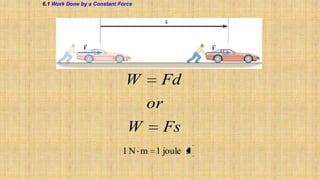
6.1 Work Done by a Constant Force

W

Fd
or

W

Fs

1 N m 1 joule J
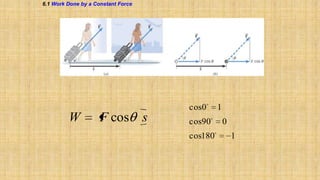
6.1 Work Done by a Constant Force

cos0 1

W

F cos s

cos90
cos180

0
1
6.1 Work Done by a Constant Force

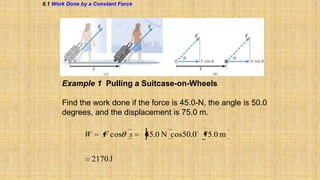
Example 1 Pulling a Suitcase-on-Wheels
Find the work done if the force is 45.0-N, the angle is 50.0
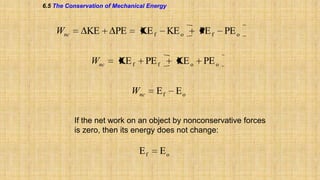
degrees, and the displacement is 75.0 m.

W

F cos s
2170 J

45.0 N cos50.0 75.0 m
6.1 Work Done by a Constant Force

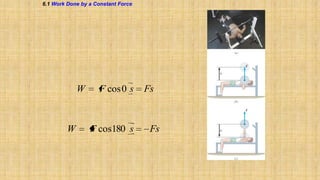
W

W

F cos 0 s

F cos180 s

Fs

Fs
6.1 Work Done by a Constant Force

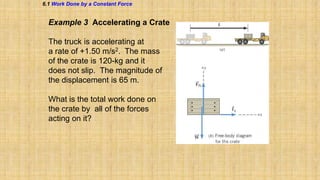
Example 3 Accelerating a Crate
The truck is accelerating at
a rate of +1.50 m/s2. The mass
of the crate is 120-kg and it
does not slip. The magnitude of
the displacement is 65 m.

What is the total work done on
the crate by all of the forces
acting on it?
6.1 Work Done by a Constant Force

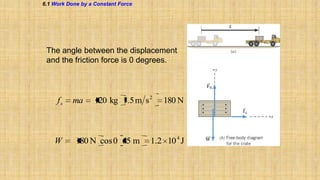
The angle between the displacement
and the friction force is 0 degrees.

fs

W

ma

120 kg 1.5 m s 2

180 N cos 0 65 m

180 N

1.2 10 4 J
6.2 The Work-Energy Theorem and Kinetic Energy

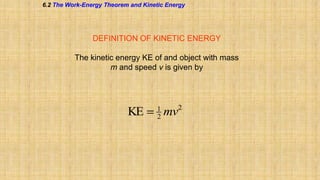
DEFINITION OF KINETIC ENERGY

The kinetic energy KE of and object with mass
m and speed v is given by

KE

1
2

mv

2
6.2 The Work-Energy Theorem and Kinetic Energy

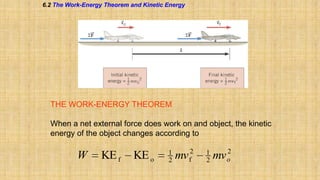
THE WORK-ENERGY THEOREM
When a net external force does work on and object, the kinetic
energy of the object changes according to

W

KE f

KE o

1
2

mv

2
f

1
2

mv

2
o
6.2 The Work-Energy Theorem and Kinetic Energy

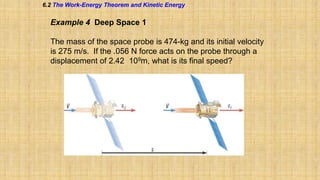
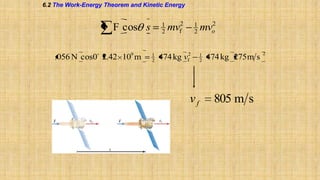
Example 4 Deep Space 1
The mass of the space probe is 474-kg and its initial velocity
is 275 m/s. If the .056 N force acts on the probe through a
displacement of 2.42 109m, what is its final speed?
6.2 The Work-Energy Theorem and Kinetic Energy

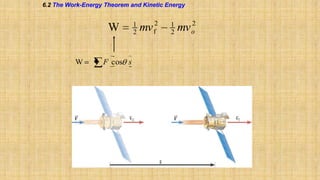
W
W

F cos s

1
2

mv

2
f

1
2

mv

2
o
6.2 The Work-Energy Theorem and Kinetic Energy

1
2

F cos s
.056 N cos0 2.42 109 m

1
2

mvf2

1
2

474 kg vf2

vf

2
mvo

1
2

474 kg 275 m s

805 m s

2
6.2 The Work-Energy Theorem and Kinetic Energy

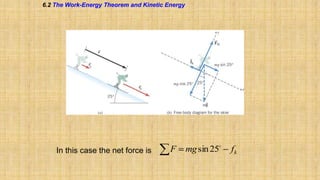
In this case the net force is

F

mg sin 25

fk
6.3 Gravitational Potential Energy

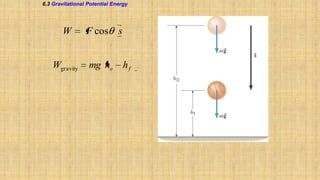
W
Wgravity

F cos s
mg ho

hf
6.3 Gravitational Potential Energy

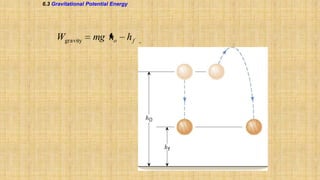
Wgravity

mg ho

hf
6.3 Gravitational Potential Energy

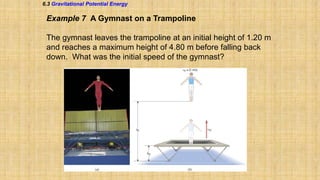
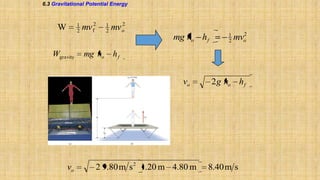
Example 7 A Gymnast on a Trampoline
The gymnast leaves the trampoline at an initial height of 1.20 m
and reaches a maximum height of 4.80 m before falling back
down. What was the initial speed of the gymnast?
6.3 Gravitational Potential Energy

1
2

W
Wgravity

mv f2
mg ho

1
2

2
mv o

mg ho h f

2
mvo

hf

vo

vo

1
2

2 9.80 m s 2 1.20 m 4.80 m

2 g ho h f

8.40 m s
6.3 Gravitational Potential Energy

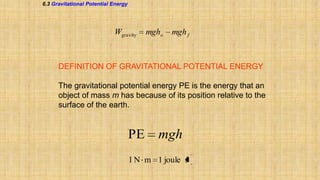
Wgravity

mgho

mgh f

DEFINITION OF GRAVITATIONAL POTENTIAL ENERGY
The gravitational potential energy PE is the energy that an
object of mass m has because of its position relative to the
surface of the earth.

PE

mgh

1 N m 1 joule J
6.4 Conservative Versus Nonconservative Forces

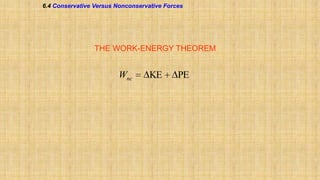
THE WORK-ENERGY THEOREM

Wnc

KE

PE
6.5 The Conservation of Mechanical Energy

Wnc

KE
Wnc

PE

KE f

KE f

KE o

PE f

Wnc

Ef

KE o

PE f

PE o

PE o

Eo

If the net work on an object by nonconservative forces
is zero, then its energy does not change:

Ef

Eo
6.5 The Conservation of Mechanical Energy

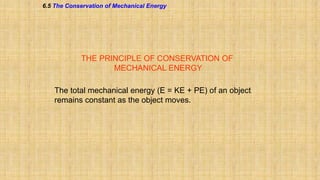
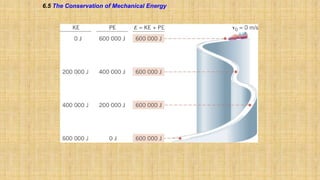
THE PRINCIPLE OF CONSERVATION OF
MECHANICAL ENERGY
The total mechanical energy (E = KE + PE) of an object
remains constant as the object moves.
6.5 The Conservation of Mechanical Energy

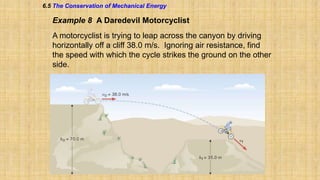
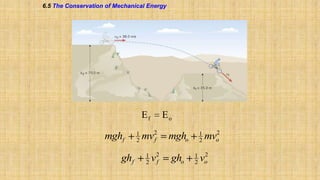
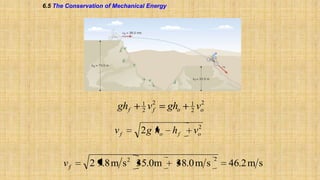
Example 8 A Daredevil Motorcyclist
A motorcyclist is trying to leap across the canyon by driving
horizontally off a cliff 38.0 m/s. Ignoring air resistance, find
the speed with which the cycle strikes the ground on the other
side.
6.5 The Conservation of Mechanical Energy

Ef

mghf
ghf

1
2

Eo
2
f

mgho

v2
f

gho

mv
1
2

1
2
1
2

2
o

mv

2
vo
6.5 The Conservation of Mechanical Energy

ghf
vf
vf

1
2

v2
f

gho

2 g ho h f
2

2 9.8 m s 35.0m

1
2

2
vo

2
vo

38.0 m s

2

46.2 m s
6.6 Nonconservative Forces and the Work-Energy Theorem

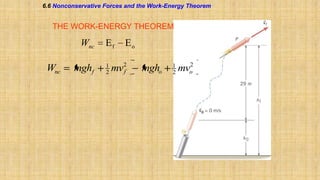
THE WORK-ENERGY THEOREM

Wnc

Wnc

mghf

Ef

Eo

1
2

2
f

mv

mgho

1
2

2
o

mv
6.6 Nonconservative Forces and the Work-Energy Theorem

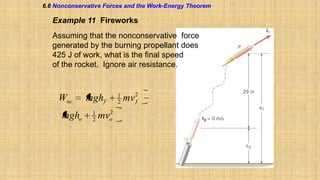
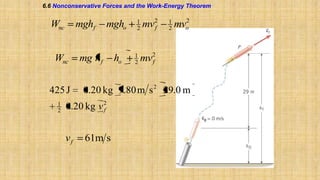
Example 11 Fireworks
Assuming that the nonconservative force
generated by the burning propellant does
425 J of work, what is the final speed
of the rocket. Ignore air resistance.

Wnc
mgho

mghf
1
2

2
mvo

1
2

mv 2
f
6.6 Nonconservative Forces and the Work-Energy Theorem

Wnc

mghf

Wnc
425 J
1
2

mgho

mg h f

1
2

mv

2
f

1
2

2
o

mv

mv2
f

0.20 kg 9.80 m s 2 29.0 m

0.20 kg v 2
f

vf

ho

1
2

61m s
6.7 Power

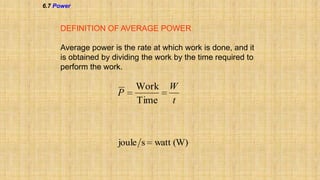
DEFINITION OF AVERAGE POWER
Average power is the rate at which work is done, and it
is obtained by dividing the work by the time required to
perform the work.

P

Work
Time

joule s

W
t

watt (W)
6.7 Power

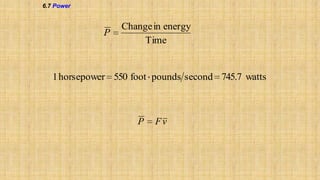
P

Change in energy
Time

1 horsepower 550 foot pounds second 745.7 watts

P

Fv
6.7 Power
6.8 Other Forms of Energy and the Conservation of Energy

THE PRINCIPLE OF CONSERVATION OF ENERGY
Energy can neither be created not destroyed, but can
only be converted from one form to another.
physics

physics

  • 1.
    Work done by:Mrreynon
  • 2.
  • 3.
    6.1 Work Doneby a Constant Force W Fd or W Fs 1 N m 1 joule J
  • 4.
    6.1 Work Doneby a Constant Force cos0 1 W F cos s cos90 cos180 0 1
  • 5.
    6.1 Work Doneby a Constant Force Example 1 Pulling a Suitcase-on-Wheels Find the work done if the force is 45.0-N, the angle is 50.0 degrees, and the displacement is 75.0 m. W F cos s 2170 J 45.0 N cos50.0 75.0 m
  • 6.
    6.1 Work Doneby a Constant Force W W F cos 0 s F cos180 s Fs Fs
  • 7.
    6.1 Work Doneby a Constant Force Example 3 Accelerating a Crate The truck is accelerating at a rate of +1.50 m/s2. The mass of the crate is 120-kg and it does not slip. The magnitude of the displacement is 65 m. What is the total work done on the crate by all of the forces acting on it?
  • 8.
    6.1 Work Doneby a Constant Force The angle between the displacement and the friction force is 0 degrees. fs W ma 120 kg 1.5 m s 2 180 N cos 0 65 m 180 N 1.2 10 4 J
  • 9.
    6.2 The Work-EnergyTheorem and Kinetic Energy DEFINITION OF KINETIC ENERGY The kinetic energy KE of and object with mass m and speed v is given by KE 1 2 mv 2
  • 10.
    6.2 The Work-EnergyTheorem and Kinetic Energy THE WORK-ENERGY THEOREM When a net external force does work on and object, the kinetic energy of the object changes according to W KE f KE o 1 2 mv 2 f 1 2 mv 2 o
  • 11.
    6.2 The Work-EnergyTheorem and Kinetic Energy Example 4 Deep Space 1 The mass of the space probe is 474-kg and its initial velocity is 275 m/s. If the .056 N force acts on the probe through a displacement of 2.42 109m, what is its final speed?
  • 12.
    6.2 The Work-EnergyTheorem and Kinetic Energy W W F cos s 1 2 mv 2 f 1 2 mv 2 o
  • 13.
    6.2 The Work-EnergyTheorem and Kinetic Energy 1 2 F cos s .056 N cos0 2.42 109 m 1 2 mvf2 1 2 474 kg vf2 vf 2 mvo 1 2 474 kg 275 m s 805 m s 2
  • 14.
    6.2 The Work-EnergyTheorem and Kinetic Energy In this case the net force is F mg sin 25 fk
  • 15.
    6.3 Gravitational PotentialEnergy W Wgravity F cos s mg ho hf
  • 16.
    6.3 Gravitational PotentialEnergy Wgravity mg ho hf
  • 17.
    6.3 Gravitational PotentialEnergy Example 7 A Gymnast on a Trampoline The gymnast leaves the trampoline at an initial height of 1.20 m and reaches a maximum height of 4.80 m before falling back down. What was the initial speed of the gymnast?
  • 18.
    6.3 Gravitational PotentialEnergy 1 2 W Wgravity mv f2 mg ho 1 2 2 mv o mg ho h f 2 mvo hf vo vo 1 2 2 9.80 m s 2 1.20 m 4.80 m 2 g ho h f 8.40 m s
  • 19.
    6.3 Gravitational PotentialEnergy Wgravity mgho mgh f DEFINITION OF GRAVITATIONAL POTENTIAL ENERGY The gravitational potential energy PE is the energy that an object of mass m has because of its position relative to the surface of the earth. PE mgh 1 N m 1 joule J
  • 20.
    6.4 Conservative VersusNonconservative Forces THE WORK-ENERGY THEOREM Wnc KE PE
  • 21.
    6.5 The Conservationof Mechanical Energy Wnc KE Wnc PE KE f KE f KE o PE f Wnc Ef KE o PE f PE o PE o Eo If the net work on an object by nonconservative forces is zero, then its energy does not change: Ef Eo
  • 22.
    6.5 The Conservationof Mechanical Energy THE PRINCIPLE OF CONSERVATION OF MECHANICAL ENERGY The total mechanical energy (E = KE + PE) of an object remains constant as the object moves.
  • 23.
    6.5 The Conservationof Mechanical Energy
  • 24.
    6.5 The Conservationof Mechanical Energy Example 8 A Daredevil Motorcyclist A motorcyclist is trying to leap across the canyon by driving horizontally off a cliff 38.0 m/s. Ignoring air resistance, find the speed with which the cycle strikes the ground on the other side.
  • 25.
    6.5 The Conservationof Mechanical Energy Ef mghf ghf 1 2 Eo 2 f mgho v2 f gho mv 1 2 1 2 1 2 2 o mv 2 vo
  • 26.
    6.5 The Conservationof Mechanical Energy ghf vf vf 1 2 v2 f gho 2 g ho h f 2 2 9.8 m s 35.0m 1 2 2 vo 2 vo 38.0 m s 2 46.2 m s
  • 27.
    6.6 Nonconservative Forcesand the Work-Energy Theorem THE WORK-ENERGY THEOREM Wnc Wnc mghf Ef Eo 1 2 2 f mv mgho 1 2 2 o mv
  • 28.
    6.6 Nonconservative Forcesand the Work-Energy Theorem Example 11 Fireworks Assuming that the nonconservative force generated by the burning propellant does 425 J of work, what is the final speed of the rocket. Ignore air resistance. Wnc mgho mghf 1 2 2 mvo 1 2 mv 2 f
  • 29.
    6.6 Nonconservative Forcesand the Work-Energy Theorem Wnc mghf Wnc 425 J 1 2 mgho mg h f 1 2 mv 2 f 1 2 2 o mv mv2 f 0.20 kg 9.80 m s 2 29.0 m 0.20 kg v 2 f vf ho 1 2 61m s
  • 30.
    6.7 Power DEFINITION OFAVERAGE POWER Average power is the rate at which work is done, and it is obtained by dividing the work by the time required to perform the work. P Work Time joule s W t watt (W)
  • 31.
    6.7 Power P Change inenergy Time 1 horsepower 550 foot pounds second 745.7 watts P Fv
  • 32.
  • 33.
    6.8 Other Formsof Energy and the Conservation of Energy THE PRINCIPLE OF CONSERVATION OF ENERGY Energy can neither be created not destroyed, but can only be converted from one form to another.