1
Get Homework/Assignment Done
Homeworkping.com
Homework Help
https://www.homeworkping.com/
Research Paper help
https://www.homeworkping.com/
Online Tutoring
https://www.homeworkping.com/
click here for freelancing tutoring sites
Sri Sharada Institute Of Indian Management - Research
Approved by AICTE
Plot No. 7, Phase-II, Institutional Area, Behind the Grand Hotel, Vasant Kunj,
New Delhi – 110070 Website: www.srisiim.org
STATISTICS
2
Project Report
ON
“TRAINING”
Submitted To:- Submitted By:-
Prof. Shraddha Bhadauria Upendra kumar(20130157)
Parshant kumar(20130132)
Rohit kumar(20130138)
Declaration
We hereby declare that the following project report titled
“TRAINING ” is an authentic work done by us. This is to declare
that all work indulged in the completion of this work such as
research, analysis of activities of an organization is a profound
and honest work of ours.
3
Place:New Delhi Upendra kumar
Parshant kumar
Rohit kumar
ACKNOWLEDGEMENT
We would like to express hearty gratitude to our faculty guide,
Prof.Shraddha Bhadauria for giving us the opportunity to
prepare a project report on “TRAINING” and for her valuable
guidance and sincere cooperation, which helped us in
completing this project.
4
Upendra kumar
Rohit kumar
Parshantkumar
PGDM Batch (2013-2015)
Sri SIIM
5
INDEX
S.NO PAGE NO.
1) Introduction…………………………………………………………………………………………………….………5
2) Types of training...........................…………………………………………………………………………..7
3) Motivation………………………………………………………………………………………………………………11
4)Areas of training.....................................……………………………….……….…………………….….13
5)Analysis.............................…………………………….………………………………………..……......……29
6
1. TRAINING
Training is the acquisition of knowledge, skills, and competencies as a result of the
teaching of vocational or practical skills and knowledge that relate to specific useful
competencies. Training has specific goals of improving
one's capability, capacity,productivity and performance. It forms the core
of apprenticeships and provides the backbone of content at institutes of
technology(also known as technical colleges or polytechnics). In addition to the
basic training required for a trade, occupation or profession, observers of the labor-
market recognize as of 2008 the need to continue training beyond initial
qualifications: to maintain, upgrade and update skills throughout working life.
People within many professions and occupations may refer to this sort of training
as professional development.
7
2.TYPES OF TRAINING
2.1 PHYSICAL TRAINING
Physical training concentrates on mechanistic goals: training-programs in this area
develop specific skills or muscles, often with a view of peaking at a particular time.
Some physical training programs focus on raising overall physical fitness.
In military use, training means gaining the physical ability to perform and survive
in combat, and learning the many skills needed in a time of war. These include how
to use a variety of weapons, outdoor survival skills, and how to survive captured by
the enemy, among many others. See military education and training.
For psychological or physiological reasons, people who believe it may be beneficial
to them can choose to practice relaxation training, or autogenic training, in an
attempt to increase their ability to relax or deal with stress.[1] While some studies
have indicated relaxation training is useful for some medical conditions, autogenic
training has limited results or has been the result of few studies.
2.2 JOB TRAINING AND DEVELOPMENT
Some commentators use a similar term for workplace learning to improve
performance: "training and development". There are also additional services
available online for those who wish to receive training above and beyond that which
is offered by their employers. Some examples of these services include career
counseling, skill assessment, and supportive services. One can generally categorize
such training as on-the-job or off-the-job.
The on-the-job training method takes place in a normal working situation, using the
actual tools, equipment, documents or materials that trainees will use when fully
trained. On-the-job training has a general reputation as most effective for vocational
work.It involves Employee training at the place of work while he or she is doing the
actual job. Usually a professional trainer (or sometimes an experienced employee)
serves as the course instructor using hands-on training often supported by formal
classroom training.
Off-the-job training method takes place away from normal work situations — implying
that the employee does not count as a directly productive worker while such training
takes place. Off-the-job training method also involves employee training at a site
8
away from the actual work environment. It often utilizes lectures, case studies, role
playing and simulation, having the advantage of allowing people to get away from
work and concentrate more thoroughly on the training itself. This type of training has
proven more effective in inculcating concepts and ideas.
 A more recent development in job training is the On the Job Training Plan, or
OJT Plan. According to the United States Department of the Interior, a proper
OJT plan should include: An overview of the subjects to be covered, the number
of hours the training is expected to take, an estimated completion date, and a
method by which the training will be evaluated.
2.3 RELIGION AND SPIRITUALITY
In religious and spiritual use, training may refer to the purification of the mind, heart,
understanding and actions to obtain a variety of spiritual goals such as (for example)
closeness to God or freedom from suffering. Note for example the institutionalized
spiritual training of Threefold Training in Buddhism, Meditation
in Hinduism or discipleship in Christianity. These aspects of training can be short
term or last a lifetime, depending on the context of the training and which religious
group it is a part of.
Compare religious ritual
2.4 PAROCHIAL SCHOOL
Parochial schools are a fairly widespread institution in the United States. A parochial
school is a primary or secondary school supervised by a religious organization,
especially a Roman Catholic day school affiliated with a parish or a holy order. As of
2004, out of the approximately 50 million children who were enrolled in
American grade schools, 4.2 million children attend a church-affiliated school, which
is approximately 1 in 12 students. Within the Christian religion, for example, one can
attend a church-affiliatedcollege with the intent of getting a degree in a field
associated with religious studies. Some people may also attend church-affiliated
colleges in pursuit of a non-religious degree, and typically do it just to deepen their
understanding of the specific religion that the school is associated with. The largest
non-public school system in the United States, the Catholic school system, operates
5,744 elementary schools and 1,206 secondary schools.
2.5 ARTIFICIAL-INTELLIGENCE FEEDBACK
Researchers have developed training-methods for artificial-intelligence devices as
well. Evolutionary algorithms, including genetic programming and other methods
of machine learning, use a system of feedback based on "fitness functions" to
9
allow computer programs to determine how well an entity performs a task. The
methods construct a series of programs, known as a “population” of programs, and
then automatically test them for "fitness", observing how well they perform the
intended task. The system automatically generates new programs based on
members of the population that perform the best. These new members replace
programs that perform the worst. The procedure repeats until the achievement of
optimum performance. In robotics, such a system can continue to run in real-
time after initial training, allowing robots to adapt to new situations and to changes in
themselves, for example, due to wear or damage. Researchers have also developed
robots that can appear to mimic simple human behavior as a starting point for
training.
Training is needed to serve the following purposes:
 Newly recruited employees require training so as to perform their tasks effectively.
Instruction, guidance, coaching help them to handle jobs competently, without any
wastage.
 Training is necessary to prepare existing employees for higher-level jobs (promotion).
 Existing employees require refresher training so as to keep abreast of the latest
developments in job operations. In the face of rapid technological changes, this is an
absolute necessity.
 Training is necessary when a person moves from one job to another (transfer). After
training, the' employee can change jobs quickly, improve his performance levels and
achieve career goals comfortably
 Training is necessary to make employees mobile and versatile. They can be placed on
various jobs depending on organizational needs.
 Training is needed to bridge the gap between what the employee has and what the job
demands.
 Training is needed to make employees more productive and useful in the long-run.
 Training is needed for employees to gain acceptance from peers (learning a job
quickly and being able to pull their own weight is one of the best ways for them to
gain acceptance).
Importance of Training :
 Training offers innumerable benefits to both employees and employers. It makes the
employee more productive and more useful to an organization. The importance of
training can be studied under the following heads:
Benefits to the business:
 Trained workers can work more efficiently. They use machines, tools, and materials
in a proper way. Wastage is thus eliminated to a large extent.
10
 There will be fewer accidents. Training improves the knowledge of employees
regarding the use of machines and equipment. Hence, trained workers need not be put
under close supervision, as they know how to handle operations properly.
 Trained workers can show superior performance. They can turn out better
performance. They can turn out better quality goods by putting the materials, tools
and equipment to good use.
 Training makes employees more loyal to an organization. They will be less inclined to
leave the unit where there are growth opportunities.
Benefits to the employees:
 Training makes an employee more useful to a firm. Hence, he will find employment
more easily.
 Training makes employees more efficient and effective. By combining materials,
tools and equipment in a right way, they can produce more with minimum effort.
 Training enables employees to secure promotions easily. They can realise their career
goals comfortably.
 Training helps an employee to move from one organization to another easily. He can
be more mobile and pursue career goals actively.
 Employees can avoid mistakes, accidents on the job. They can handle jobs with
confidence. They will be more satisfied on their jobs. Their morale would be high.
Thus, training can contribute to higher production, fewer mistakes, greater job satisfaction
and lower labour turnover. Also, it can enable employees to cope with organizational, social
and technological change. Effective training is an invaluable investment in the human
resources of an organization.
Learning Principles: The Philosophy of Training
Training is essential for job success. It can lead to higher production, fewer mistakes, greater
job satisfaction and lower turnover. These benefits accrue to both the trainee and the
organization, if managers understand the principles behind the training process. To this end,
training efforts must invariably follow certain learning-oriented guidelines.
Modelling
Modeling is simply copying someone else's behavior. Passive classroom learning does not
leave any room for modeling. If we want to change people, it would be a good idea to have
videotapes of people showing the desired behavior. The selected model should provide the
right kind of behavior to be copied by others. A great deal of human behaviour is learned by
modelling others. Children learn by modelling parents and older children, they are quite
comfortable with the process by the time they grow up. As experts put it. "managers tend to
manage as they were managed"
11
Motivation
For learning to take place, intention to learn is important. When the employee is motivated,
he pays attention to what is being said, done and presented. Motivation to learn is influenced
by the answers to questions such as: How important is my job to me? How important is the
information? Will learning help me progress in the company? etc. People learn more quickly
when the material is important and relevant to them. Learning is usually quicker and long-
lasting when the learner participates actively. Most people, for example, never forget how to
ride a bicycle because they took an active part in the learning process.
Reinforcement
Positive reinforcement consists of rewarding desired behaviors. If a behavior is rewarded, it
probably will be repeated. People avoid certain behaviors that invite criticism and
punishment. A bank officer would want to do a postgraduate course in finance, if it earns him
increments and makes him eligible for further promotions. Both the external rewards
(investments, praise) and the internal rewards (a feeling of pride and achievement) associated
with desired behaviors compel subjects to learn properly. To be effective, the trainer must
reward desired behaviors only. If he rewards poor performance, the results may be disastrous:
good performers may quit in frustration, accidents may go up, and productivity may suffer.
The reinforcement principle is also based on the premise that punishment is less effective in
learning than reward. Punishment is a pointer to undesirable behaviors. When administered, it
causes pain to the employee. He mayor may not repeat the mistakes. The reactions may be
mild or wild. Action taken to repeal a person from undesirable action is punishment. If
administered properly, punishment may force the trainee to modify the undesired or incorrect
behaviors.
Feedback
People learn best if reinforcement is given as soon as possible after training. Every employee
wants to know what is expected of him and how well he is doing. If he is off the track,
somebody must put him back on the rails. The errors in such cases must be rectified
immediately. The trainee after learning the right behaviour is motivated to do things in a
'right' way and earn the associated rewards. Positive feedback (showing the trainee the right
12
way of doing things) is to be preferred to negative feedback (telling the trainee that he is not
correct) when we want to change behaviour.
Spaced Practice
Learning takes place easily if the practice sessions are spread over a period of time. New
employees learn better if the orientation programme is spread over a two or three day period,
instead of covering it all in one day. For memorizing tasks, 'massed' practice is usually more
effective. Imagine the way schools ask the kids to say the Lord's prayer aloud. Can you
memorise a long poem by learning only one line per day? You tend to forget the beginning of
the poem by the time you reach the last stanza. For 'acquiring' skills as stated by Mathis and
Jackson, spaced practice is usually the best. This incremental approach to skill acquisition
minimises the physical fatigue that deters learning.
Whole Learning
The concept of whole learning suggests that employees learn better if the job information is
explained as an entire logical process, so that they can see how the various actions fit together
into the 'big picture'. A broad overview of what the trainee would be doing on the job should
be given top priority, if learning has to take place quickly. Research studies have also
indicated that it is more efficient to practice a whole task all at once rather than trying to
master the various components of the task at different intervals.
Active Practice
'Practice makes a man perfect': so said Bacon. To be a swimmer, you should plunge into
water instead of simply reading about swimming or looking at films of the worlds' best
swimmers. Learning is enhanced when trainees are provided ample opportunities to repeat
the task. For maximum benefit, practice sessions should be distributed over time.
Applicability of Training
Training should be as real as possible so that trainees can successfully transfer the new
knowledge to their jobs. The training situations should be set up so that trainees can visualise
- and identify with - the types of situations they can come across on the job.
13
Environment
Finally, environment plays a major role in training. It is natural that workers who are
exposed to training in comfortable environments with adequate, well spaced rest periods are
more likely to learn than employees whose training conditions are less than ideal. Generally
speaking, learning is very fast at the beginning. Thereafter, the pace of learning slows down
as opportunities for improvement taper off.
Areas of Training
The Areas of Training in which training is offered may be classified into the following
categories.
Knowledge
Here the trainee learns about a set of rules and regulations about the job, the staff and the
products or services offered by the company. The aim is to make the new employee fully
aware of what goes on inside and outside the company.
Technical Skills
The employee is taught a specific skill (e.g., operating a machine, handling computer etc.) so
that he can acquire that skill and contribute meaningfully.
Social Skills
The employee is made to learn about himself and others, and to develop a right mental
attitude towards the job, colleagues and the company. The principal focus is on teaching the
employee how to be a team member and get ahead.
Techniques
This involves the application of knowledge and skill to various on-the-job situations.
In addition to improving the skills and knowledge of employees, training aims at moulding
employee attitudes: When administered properly, a training programme will go a long way in
obt8ining employee loyalty, support and commitment to company activities.
Types of Training
14
There are many approaches to training. We focus here on the types of training that are
commonly employed in present-day organisations.
Skills training:
Skill training is most common in organisations. The process here is fairly simple. The need
for training in basic skills (such as reading, writing, computing, speaking, listening, problem
solving, managing oneself, knowing how to learn, working as part of a team, leading others)
is identified through assessment. Specific training objectives are set and training content is
developed to meet those objectives. Several methods are available for imparting these basic
skills in modern organisations (such as lectures, apprenticeship, on-the-job, coaching etc.).
Before employing these methods, managers should:
 Explain how the training will help the trainees in their jobs.
 Relate the training to the trainees' goals.
 Respect and consider participant responses and use these as a resource.
 Encourage trainees to learn by doing.
 Give feedback on progress toward meeting learning objectives.
Refresher training: Rapid changes in technology may force companies to go in for this kind
of training. By organising short-term courses which incorporate the latest developments in a
particular field, the company may keep its employees up-to-date and ready to take on
emerging challenges.
 It is conducted at regular intervals by taking the help of outside consultants who
specialise in a particular descriptive.
Cross-functional Training: Cross-functional Training involves training employees to
perform operations in areas other than their assigned job. There are many approaches to cross
functional training. Job rotation can be used to provide a manager in one functional area with
a broader perspective than he would otherwise have. Departments can exchange personnel for
a certain period so that each employee understands how other departments are functioning.
High performing workers can act as peer trainers and help employees develop skills in
another area of operation. Cross functional training provides the following benefits to an
organisation (and the workers as well) (1) Workers gain rich experience in handling diverse
jobs; they become more adaptable and versatile (2) they can better engineer their own career
paths (3) they not only know their job well but also understand how others are able to
perform under a different set of constraints (4) A broader perspective increases workers'
understanding of the business and reduces the need for supervision (5) when workers can fill
in for other workers who are absent, it is easier to use flexible scheduling, which is
increasingly in demand as more employees want to spend more time with their families. Eli
15
Lilly and Company (India), for example, encourages cross-functional movements to make the
organisation equally attractive to both specialists and generalists.
Team Training: Team training generally covers two areas; content tasks and group
processes. Content tasks specify the team's goals such as cost control and problem solving.
Group processes reflect the way members function as a team - for example how they interact
with each other, how they sort out differences, how they participate etc. Companies are
investing heavy amounts, nowadays, in training new employees to listen to each other and to
cooperate. They are using outdoor experiential training techniques to develop teamwork and
team spirit among their employees (such as scaling a mountain, preparing recipes for
colleagues at a restaurant, sailing through uncharted waters, crossing a jungle etc.). The
training basically throws light on (i) how members should communicate with each other (ii)
how they have to cooperate and get ahead (iii) how they should deal with conflict-full
situations (iv) how they should find their way, using collective wisdom and experience to
good advantage.
Creativity training: Companies like Mudra Communications, Titan Industries, Wipro
encourage their employees to think unconventionally, break the rules, take risks, go out of the
box and devise unexpected solutions.
 Postpone judgment: Don't reject any idea
 Create alternative frames of reference
 Break the boundary of thinking
 Examine a different aspect of the problem
 Make a wish list of solutions
 Borrow ideas from other fields
 Look for processes to change or eliminate
 Think up alternative methods
 Adopt another person's perspective
 Question all Assumptions.
In creativity training, trainers often focus on three things:
(a) Breaking away: In order to break away from restrictions, the trainee is expected to (i)
identify the dominant ideas influencing his own thinking (ii) define the boundaries within
which he is working (iii) bring the assumptions out into the open and challenge everything
(b) Generate new ideas: To generate new ideas, the trainee should open up his mind; look at
the problem from all possible angles and list as many alternative approaches as possible. The
trainee should allow his mind to wander over alternatives freely. Expose himself to new
influences (people, articles, books, situations), switch over from one perspective to another, -
arrange cross fertilization of ideas with other people and use analogies to spark off ideas.
16
(c) Delaying judgement: To promote creative thinking, the trainee should not try to kill off
ideas too quickly; they should be held back until he is able to generate as many ideas as
possible. He should allow ideas to grow a little. Brainstorming (getting a large number of
ideas from a group of people in a short time) often helps in generating as many ideas as
possible without pausing to evaluate them. It helps in releasing ideas, overcoming inhibitions,
cross fertilising ideas and getting away from patterned thinking.
Diversity Training: Diversity training considers all of the diverse dimensions in the
workplace race, gender, age, disabilities, lifestyles, culture, education, ideas and backgrounds
- while designing a training programme. It aims to create better cross-cultural sensitivity with
the aim of fostering more harmonious and fruitful working relationships among a firm's
employees.
The programme covers two things: (i) awareness building, which helps employees appreciate
the key benefits of diversity, and (ii) skill building, which offers the knowledge, skills and
abilities required for working with people having varied backgrounds.
Literacy Training: Inability to write, speak and work well with others could often come in
the way of discharging duties, especially at the lower levels. Workers, in such situations, may
fail to understand safety messages, appreciate the importance of sticking to rules, and commit
avoidable mistakes. Functional illiteracy (low skill level in a particular content area) may be a
serious impediment to a firm's productivity and competitiveness. Functional literacy
programmes focus on the basic skills required to perform a job adequately and capitalise on
most workers' motivation to get help in a particular area. Tutorial programmes, home
assignments, reading and writing exercises, simple mathematical tests, etc., are generally
used in all company in-house programmes meant to improve the literacy levels of employees
with weak reading, writing or arithmetic skills.
Training Methods
Training methods are usually classified by the location of instruction. On the job training is
provided when the workers are taught relevant knowledge, skills and abilities at the actual
workplace; off-the-job training, on the other hand, requires that trainees learn at a location
other than the real work spot. Some of the widely used training methods are listed below.
1. Job Instruction Training (JlT)
The JIT method (developed during World War II) is a four-step instructional process
involving preparation, presentation, performance try out and follow up. It is used primarily to
teach workers how to do their current jobs. A trainer, supervisor or co-worker acts as the
coach. The four steps followed in the JIT methods are:
1. The trainee receives an overview of the job, its purpose and its desired outcomes, with
a clear focus on the relevance of training.
17
2. The trainer demonstrates the job in order to give the employee a model to copy. The
trainer shows a right way to handle the job.
3. Next, the employee is permitted to copy the trainer's way. Demonstrations by the
trainer and practice by the trainee are repeated until the trainee masters the right way
to handle the job.
4. Finally, the employee does the job independently without supervision.
Merits:
 Trainee learns fast through practice and observation.
 It is economical as it does not require any special settings. Also, mistakes can be
corrected immediately.
 The trainee gains confidence quickly as he does the work himself in actual setting
with help from supervisor.
 It is most suitable for unskilled and semi-skilled jobs where the job operations are
simple; easy to explain and demonstrate within a short span of time.
Demerits:
 The trainee should be as good as the trainer if the trainer is not good, transference of
knowledge and skills will be poor.
 While learning, trainee may damage equipment, waste materials, cause accidents
frequently,
 Experienced workers cannot use the machinery while it is being used for training.
2. Coaching:
Coaching is a kind of daily training and feedback given to employees by immediate
supervisors. It involves a continuous process of learning by doing. It may be defined as an
informal, unplanned training and development activity provided by supervisors and peers. In
coaching, the supervisor explains things and answers questions; he throws light on why
things are done the way they are; he offers a model for trainees to copy; conducts lot of
decision making meetings with trainees; procedures are agreed upon and the trainee is given
enough authority to make divisions and even commit mistakes. Of course, coaching can be a
taxing job in that the coach may not possess requisite skills to guide the learner in a
systematic way. Sometimes, doing a full day's work may be more important than putting the
learner on track.
When to use coaching usefully? Coaching could be put to good use when:
 An employee demonstrates a new competency
 An employee expresses interest in a different job within the organisation
18
 An employee seeks feedback
 An employee is expressing low morale, violating company policies or practices or
having performance problems
 An employee needs help with a new skill following a formal training programme.
Effective working, obviously, requires patience and communication skills. It involves:
 Explaining appropriate ways of doing things
 Making clear why actions were taken
 Stating observations accurately
 Offering possible alternatives / suggestions
 Following up
3. Mentoring :
Mentoring is a relationship in which a senior manager in an organisation assumes the
responsibility for grooming a junior person. Technical, interpersonal and political skills are
generally conveyed in such a relationship from the more experienced person. A mentor is a
teacher, spouse, counsellor, developerr of skills and intellect, host, guide, exemplar, and most
importantly, supporter and facilitator in the realisation of the vision the young person
(protege) has about the kind of 1ife he wants as an adult.
The main objective is to help an employee attain psychological maturity and effectiveness
and get integrated with the organisation. In a work situation, such mentoring can take place at
both formal and informal levels, depending on the prevailing work culture and the
commitment from the top management. Formal mentoring can be very fruitful, if
management invests time and money in such relationship building exercises.
Career functions: Career functions are those aspects of the relationship that enhance career
advancement. These include:
1. Sponsorship: Where mentors actively nominate a junior person (called 'mentee') for
promotions or desirable positions.
2. Exposure and visibility: Where mentors offer opportunities for mentees to interact with
senior executives, demonstrate their abilities and exploit their potential.
3. Coaching: Mentors help mentees to analyse how they are doing their work and to define
their aspirations. Here mentors offer practical advice on how to accomplish objectives and
gain recognition from others.
4. Protection: Mentors shield the junior person from harmful situations/seniors.
19
5. Challenging assignments: Mentors help mentees develop necessary competencies through
challenging job assignments and appropriate feedback. Mentors create opportunities clients to
prove their worth to demonstrate clearly what they have to offer.
Psychological functions: Psychological functions are those aspects that enhance the mentee’s
sense of competence, and identify effectiveness in a professional role. These include:
6. Role modeling: Mentors offer mentees a pattern of values and behaviours to imitate
7. Acceptance and confirmation: mentors offer support, guidance and encouragement to
mentees so that they can solve the problems independently and gain confidence in course of
time. Mentors also help people to learn about the organisation's culture and understand why
things are done in certain ways.
8. Counseling: Mentors help mentees work out their personal problems, learn about what to
do and what not to do, offer advice on what works and what doesn't, and do everything to
demonstrate improved performance and prepare themselves for greater responsibility.
9. Friendship: Mentors offer practical help and support to mentees so that they can indulge in
mutually satisfying social interactions (with peers, subordinates, bosses and customers)
Mentoring in India is based on the time-honoured guru-shishya relationship where the guru
would do everything to develop the personality of the shishya, offering emotional support,
and guidance. Companies like TISCO, Neyveli Lignite Corporation, Polaris, Coca-Cola India
have used mentoring systems to good effect in recent times (Economic Times, 25 Oct., 2002).
Organisations like General Electric, Intel, Proctor & Gamble have given a lot of importance
to mentoring programmes, going even gone to the extent of penalising senior managers if
they fail to develop leadership skills among subordinates. Of course, mentoring is not without
its problems. Mentors who are dissatisfied with their jobs and though who teach or narrow or
distorted view of events may not help a protege's development. Not all mentors are well
prepared to transfer their skills and wisdom to their junior colleagues. When young people
are bombarded with conflicting viewpoints - about how things should go - from a series of
advisors, they may find it difficult to get ahead with confidence. Mentoring can succeed if (i)
there is genuine support and commitment from top management (ii) mentors take up their job
seriously and transfer ideas, skills and experiences in a systematic way and (iii) mentees
believe in the whole process and carry out things in an appropriate manner.
4. Job Rotation :
Job rotation may pose several problems, especially when the trainees are rolled on various
jobs at frequent intervals. In such a case, trainees do not usually stay long enough in any
single phase of the operation to develop a high degree of expertise. For slow learners, there is
little room to integrate resources properly. Trainees can become confused when they are
exposed to rotating managers, with contrasting styles of operation. Today's manager's
20
commands may be replaced by another set from another manager! Further, job rotation can
be quite expensive. A substantial amount of managerial time is lost when trainees change
positions, because they must be acquainted with different people and techniques in each
department. Development costs can go up and productivity is reduced by moving a trainee
into a new position when his efficiency levels begin to improve at the prior job.
Inexperienced trainees may fail to handle new tasks in an efficient way. Intelligent and
aggressive trainees, on the offer hand, may find the system to be thoroughly boring as they
continue to perform more or less similar jobs without any stretch, pull and challenge. To get
the best results out of the system, it should be tailored to the needs, interests and capabilities
of the individual trainee, and not be a standard sequence that all trainees undergo.
This kind of training involves the movement of trainee from one job to another. This helps
him to have a general understanding of how the organisation functions. The purpose of job
rotation is to provide trainees with a larger organisational perspective and a greater
understanding of different functional areas as well as a better sense of their own career
objectives and interests. Apart from relieving boredom, job rotation allows trainees to build
rapport with a wide range of individuals within the organisation, facilitating future
cooperation among departments. The cross-trained personnel offer a great amount of
flexibility for organisations when transfers, promotions or replacements become inevitable.
5 Apprenticeship Training
Most craft workers such as plumbers and carpenters are trained through formal
apprenticeship programmes. Apprentices are trainees who spend a prescribed amount of time
working with an experienced guide, coach or trainer. Assistantships and internships are
similar to apprenticeships because they also demand high levels of participation from the
trainee. An internship is a kind of on-the-job training that usually combines job training with
classroom instruction in trade schools, colleges or universities. Coaching, as explained above,
is similar to apprenticeship because the coach attempts to provide a model for the trainee to
copy. One important disadvantage ofthe apprenticeship methods is the uniform period of
training offered to trainees. People have different abilities and learn at varied rates. Those
who learn fast may quit the programme in frustration. Slow learners may need additional
training time. It is also likely that in these days of rapid changes in technology, old skills may
get outdated quickly. Trainees who spend years learning specific skills may find, upon
completion of their programmes, that the job skills they acquired are no longer appropriate.
6 Committee Assignments
In this method, trainees are asked to solve an actual organisational problem. The trainees
have to work together and offer solution to the problem. Assigning talented employees to
important committees can give these employees a broadening experience and can help them
to understand the personalities, issues and processes governing the organisation. It helps them
to develop team spirit and work unitedly toward common goals. However, managers should
very well understand that committee assignments could become notorious time wasting
21
activities. The above on-the-job methods are cost effective. Workers actually produce while
they learn. Since immediat.e feedback is available, they motivate trainees to observe and
learn the right way of doing things. Very few problems arise in the· case of transfer of
training because the employees learn in the actual work environment where the skills that are
learnt are actually used. On-the-job methods may cause disruptions in production schedules.
Experienced workers cannot use the facilities that are used in training. Poor learners may
damage machinery and equipment. Finally, if the trainer does not possess teaching skills,
there is very little benefit to the trainee.
Off-the-Job Methods
Under this method of training, the trainee is separated from the job situation and his attention
is focused upon learning the material related to his future job performance. Since the trainee
is not distracted by job requirements, he can focus his entire concentration on learning the job
rather than spending his time in performing it. There is an opportunity for freedom of
expression for the trainees. Off-the-job training methods are as follows:
a. Vestibule training: Vestibule training method, actual work conditions are simulated in a
classroom. Material, files and equipment - those that are used in actual job performance are
also used in the training. This type of training is commonly used for training personnel for
clerical and semi-skilled jobs. The duration of this training ranges from a few days to a few
weeks. Theory can be related to practice in this method.
b. Role playing: It is defined as a method of human interaction that involves realistic
behaviour in imaginary situations. This method of training involves action, doing and
practice. The participants play the role of certain characters, such as the production manager,
mechanical engineer, superintendents, maintenance engineers, quality control inspectors,
foreman, workers and the like. This method is mostly used for developing interpersonal
interactions and relations.
c. Lecture method: The lecture is a traditional and direct method of instruction. The
instructor organizes the material and gives it to a group of trainees in the form of a talk. To be
effective, the lecture must motivate and create interest among the trainees. An advantage of
lecture method is that it is direct and can be used for a large group of trainees. Thus, costs and
time involved are reduced. The major limitation of the lecture method is that it does not
provide for transfer of training effectively.
d. Conference/discussion approach: In this method, the trainer delivers a lecture and
involves the trainee in a discussion so that his doubts about the job get clarified. When big
organisations use this method, the trainer uses audio-visual aids such as black boards,
mockups and slides; in some cases the lectures are videotaped or audio taped. Even the
trainee's presentation can be taped for self confrontation and self-assessment.
22
The conference is, thus, a group-centered approach where there is a clarification of ideas,
communication of procedures and standards to the trainees. Those individuals who have a
general educational background and whatever specific skills are required such as typing,
shorthand, office equipment operation, filing, indexing, recording, etc. - may be provided
with specific instructions to handle their respective jobs.
e. Programmed instruction: This method has become popular in recent years. The subject
matter to be learned is presented in a series of carefully planned sequential units. These units
are arranged from simple to more complex levels of instruction. The trainee goes through
these units by answering questions or filling the blanks. This method is, thus, expensive and
time-consuming.
Behaviourally Experienced Training
Some training programmes focus on emotional and behavioural learning. Here employees can
learn about behaviour by role-playing in which the role players attempt to act their part in
respect of a case, as they would behave in a real-life situation. Business games, cases,
incidents, group discussions and short assignments are also used in behaviourally-
experienced learning methods. Sensitivity training or laboratory training is an example of a
method used for emotional learning. The focus of experiential methods is on achieving,
through group processes, a better understanding of oneself and others. These are discussed
elaborately in the section covering Executive Development Programmes.
Evaluation of a Training Programme
The specification of values forms a basis for evaluation. The basis of evaluation and the mode
of collection of information necessary for evaluation should be determined at the planning
stage.
The process of training evaluation has been defined as any attempt to obtain information on
the effects of training performance and to assess the value of training in the light of that
information. Evaluation helps in controlling and correcting the training programme. Hamblin
suggested five levels at which evaluation of training can take place, viz., reactions, learning,
job behaviour, organisation and ultimate value.
1. Reactions: Trainee's reactions to the overall usefulness of the training including the
coverage of the topics, the method of presentation, the techniques used to clarify things, often
throw light on the effectiveness of the programme. Potential questions to trainees might
include: (i) What were your learning goals for the programme? (ii) Did you achieve them?
(iii) Did you like this programme? (iv) Would you recommend it to others who have similar
23
learning goals? ( v) what suggestions do you have for improving the programme? (vi) Should
the organisation continue to offer it?
2. Learning: Training programme, trainer's ability and trainee's ability are evaluated on the
basis of quantity of content learned and time in which it is learned and learner's ability to use
or apply the content learned.
3. Job behaviour: This evaluation includes the manner and extent to which the trainee has
applied his learning to his job.
4. Organisation: This evaluation measures the use of training, learning and change in the job
behaviour of the department/organisation in the form of increased productivity, quality,
morale, sales turnover and the like.
5. Ultimate value: It. is the measurement of ultimate result of the contributions of the training
programme to the company goals like survival, growth, profitability, etc. and to the
individual goals like development of personality and social goals like maximising social
benefit.
Methods of Evaluation
Various methods can be used to collect data on the outcomes of training. Some of these are:
 Questionnaires: Comprehensive questionnaires could be used to obtain opinions,
reactions, views of trainees.
 Tests: Standard tests could be used to find out whether trainees have learnt anything
during and after the training.
 Interviews: Interviews could be conducted to find the usefulness of training offered to
operatives.
 Studies: Comprehensive studies could be carried out eliciting the opinions and
judgements of trainers, superiors and peer groups about the training.
 Human resource factors: Training can also be evaluated on the basis of employee
satisfaction, which in turn can be examined on the basis of decrease in employee
turnover, absenteeism, accidents, grievances, discharges, dismissals, etc.
 Cost benefit analysis: The costs of training (cost of hiring trainers, tools to learn,
training centre, wastage, production stoppage, opportunity cost of trainers and
trainees) could be compared with its value (in terms of reduced learning time,
improved learning, superior performance) in order to evaluate a training programme.
 Feedback: After the evaluation, the situation should be examined to identify the
probable causes for gaps in performance. The training evaluation information (about
costs, time spent, outcomes, etc.) should be provided to the instructors, trainees and
24
other parties concerned for control, correction and improvement of trainees' activities.
The training evaluator should follow it up sincerely so as to ensure effective
implementation of the feedback report at every stage.
Training Programme of Company
Purpose-
To establish and maintain a documented procedure for identifying and providing training to
all the employees of the organization with essential skill and knowledge so as to achieve
desired quality and productivity goals.
Scope-
This procedure is applicable to all employees. Company's personnel involved in quality
system.
Training Process
Training is provided both “In House” and through “Outside Agencies” Which could be for an
individual or for group of persons as a collective training.
Training is conducted either through “Planned Training Programme” “Emergent Training
Programme” which is organized by the HRD Department
Planned Training-
The planned training programme is drawn on annual basis both for individual and group of
persons for collective training at the beginning of Calendar Year by Manager HRD and HRD
Executive of factory. The departmental Heads drawn out the training requirements on the
training requisition slip and sent it to HID Dept. Training of the senior personnel at Factory Is
also catered for at Head Office on receipt of requirement from HRD Executive.
25
The annual Training Prog. at Head office is approved by from Chairman cum Managing
Director.
Annual training Prog. is prepared on format and circulated to all heads of department and is
updated. If required in case of additional training needs.
Emergent Training –
The Emergent training programme is a supplementary training programme both for
individual and collective persons which is imparted during the course of work to take care for
unforeseen or uncatered training requirements arisen due to installation of new machine,
system, procedure etc.
Identification of such training need is done by the concerned HOD at Head Office and
HOD/Supervisor at factory and accordingly forwards their request. The procedure as in case
of planned training is followed there after.
Conduct of Training
HRD Head at HO & HRD (Executive) at factory ensures that identified training in their
respective areas is conducted as scheduled.
In case of External training, liaison with the agency is done and dates, venue etc. is fixed up
and concerned person is intimated through Heads of Department.
For In-House training, date/Venue is fixed up with identified faculty and concerned
individual is informed through Heads of Department. Besides, necessary
resource/infrastructure is also provided for effective training.
External Trainers for the Company are:
 Father Son & Company
 Skill & Thoughts
 Logic Consultant
 Topics covered under Training Programme
 EFT Act & Scheme Provisions
 Rigid and Semi Rigid Packaging
 Principles of Contract Labour Act
 Self-motivational & Attitudinal Seminar
 Organic farming
 Training about operations in the company.
 Processing of Rice (value addition In Rice)
 Knowledge about rice trade
 Operational and maintenance of dryer & Cleaning Plant
26
 Silo storage Techniques
 Scientific Instrumentation
 Finished goods quality control
 Trouble shooting
Job satisfaction
Job satisfaction is in regard to one's feeling or state of mind regarding the nature of their
work. It can be influenced by a variety of factors e.g.: quality of one's relationships with there
supervisor, quality of physical environment in which they work, degree of fulfillment in there
work etc.
Locke gives a comprehensive definition of job satisfaction as involving cognitive, effective
and evaluative reactions or attitudes and states it is "a pleasurable or positive emotional state
resulting from the appraisal of one's job or job experience." Job satisfaction is a result of
employees' perception of how well their job provides those things that are viewed as
important.
There are three generally accepted dimensions to job satisfaction.
First, job satisfaction is an emotional response to a job situation, as such it cannot be seen; it
can only be inferred.
Second, job satisfaction is often determined by how well outcomes meet or exceed
expectations. For example if organizational participants feel that they are working more
harder than others in the department but are receiving fewer rewards, they will probably have
a negative attitude toward the work, the boss or the coworkers. They will be dissatisfied. On
the other hand, if they feel they are being treated very well and are being paid equitably, they
are likely to have a positive attitude toward the job.
Factors determining job satisfaction
Factors affecting jobs are the main factors of job satisfaction, which may be challenging
work, reward systems, working conditions, colleagues, learning and personality. Skill variety
autonomy and significance are challenging tasks, which provide maximum satisfaction to
employees. Many people feel bored if a job is too simple and routine, but many employees
also enjoy simple and routine jobs.
The job characteristics are important factors for providing satisfaction. Reward systems,
equitable rewards, equal pay for equal work, promotion avenues, etc are satisfaction factors.
Money is important to employees having unfulfilled basic needs, i.e. they require more award
and recognition.
27
Fairness in promotion, unbiased attitude of management, responsibilities and social status are
the factors that are said to be providing satisfaction to employees.
Working conditions influence employee's level of satisfaction. Under conducive working
condition, people prefer to work hard while in an adverse atmosphere people avoid work.
Working condition not only include physicals of the work but also the working relationships
in the organization. The physical conditions, for example, are the light, temperature,
willingness, etc. A clerk working under routine conditions likes to work hard in an air -
conditioned atmosphere with computer facilities. It increases the working capacity of the
employee.
The relationships between the employees and the managers have an important bearing on job
satisfaction.
Job satisfaction is greater in case the higher authority is sympathetic, friendly and willing to
help the employees. Employees feel satisfied when their views are listened to and regarded
by their higher authorities
Personal attitude and perceptions are the employees' angles of satisfaction, which should be
taken into consideration while motivating people to arrive at job satisfaction
Feedback from the job itself and autonomy are two of the major job-related motivational
factors. A recent found that career development was most important to both younger and
older employees.
Supervision is another moderately important of job satisfaction. There seem to be two
dimensions of supervisory style that affect job satisfaction. One is employee centeredness,
which is measured by the degree to which a supervisor takes a personal interest and cares
about the employee. It commonly is manifested in ways such as checking to see how well the
employee is doing, providing advice and assistance to the individual, and communicating
with the associate on a personal as well as an official level . The other dimension is
participation or influence, as illustrated by managers who allow their people to participate in
decisions that affect their own jobs. In most case, this approach leads higher job satisfaction.
Friendly, cooperative coworkers or team members are a modest source of job satisfaction to
individual employees. The group, especially a "tight" team, serves as a source of support,
comfort, advice, and assistance to the individual member.
Outcomes of job satisfaction
To society as a whole as well as from an individual employee's standpoint, job satisfaction in
and of itself is a desirable outcome. It is important to know, if at all, satisfaction relates to
outcomes variable. For example, if job satisfaction is high, will the employee perform better
and the organization be more effective? I f job satisfaction is low, will there be performance
problems and ineffectiveness? The following sections examine the most important of these.
28
Satisfaction and performance:
Most assume a positive relationship; the research to date indicates that there is no strong
linkage between satisfaction and performance. Conceptual, methodological, and empirical
analyses have questioned and argued against these results.
The best conclusion about satisfaction and performance is that there is, definitely a
relationship. The relationship may even be more complex than others in organization
behavior. For example, there seem to be many possible-moderating variables, the most
important of which is reward. If people receive reward they feel are equitable, they will be
satisfied, and is likely to result in greater performance effort.
Satisfaction and turnover:
Unlike that between satisfaction and performance, research has uncovered a moderately
negatively relationship between satisfaction and turnover. High job satisfaction will not, in
and of itself, keep turnover low, but it does seem to help. On the other hand, if there is
considerable job dissatisfaction, there is likely to be high turnover. Obviously, other variables
enter into an Employees decision to quit besides job satisfaction. For example, age tenure in
the organization, and commitments to the organization, may playa role. Some people cannot
see them selves working anywhere else, so they remain regardless of how dissatisfied they
feel.
Another factor is the general economy, typically there will be an increase in turnover because
will being looking for better opportunities with other organization.
Satisfaction and absenteeism:
Research has only demonstrated a weak negative relationship between satisfaction and
absenteeism. As with turnover, many variables enter into the decision to stay home besides
satisfaction with the job. For example, there are moderating variables such as the degree to
which people that there job are important. For example, research among state govt.
Employees has found those who believed that there was important had lower absenteeism
than did who did not feel this way. Additionally, it is important to remember that although
job satisfaction will not necessarily result in absenteeism, low job satisfaction more likely to
bring about absenteeism.
29
Significance of Study
Every organization desires that it will grow continuously and make and retain its position in
the competitive and continuously changing market environment. For this purpose the
employees of the organization must be skilled and talented. But all the employees may not
have the desired skills. Their skills can be improved with the help of training programs. It is
an important activity for the origination to conduct appropriate and related programme for its
employees, so that may be able to understand the terms required for the completion of his job.
This also helps the employees of the organization to know about his job and organization
very well. This also helps in better communication and relation among the organization wants
to grow rapidly, then it is essential for it to conduct periodically training programmes for its
employees to improve the skills and knowledge.
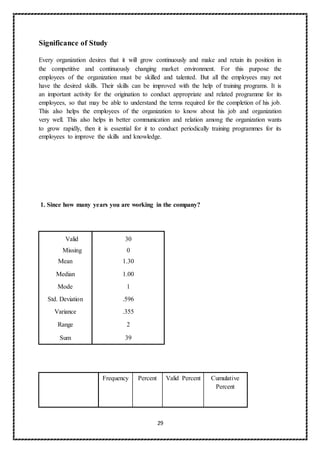
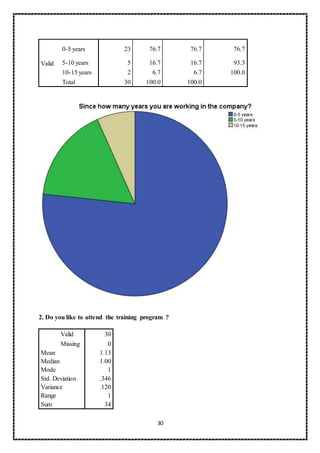
1. Since how many years you are working in the company?
Valid 30
Missing 0
Mean 1.30
Median 1.00
Mode 1
Std. Deviation .596
Variance .355
Range 2
Sum 39
Frequency Percent Valid Percent Cumulative
Percent
30
Valid
0-5 years 23 76.7 76.7 76.7
5-10 years 5 16.7 16.7 93.3
10-15 years 2 6.7 6.7 100.0
Total 30 100.0 100.0
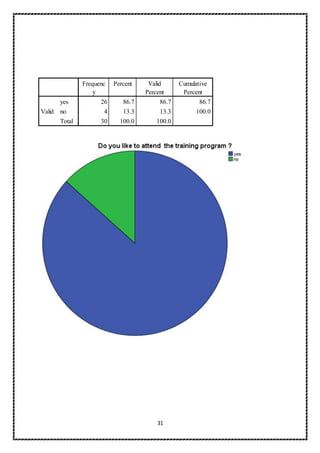
2. Do you like to attend the training program ?
Valid 30
Missing 0
Mean 1.13
Median 1.00
Mode 1
Std. Deviation .346
Variance .120
Range 1
Sum 34
31
Frequenc
y
Percent Valid
Percent
Cumulative
Percent
Valid
yes 26 86.7 86.7 86.7
no 4 13.3 13.3 100.0
Total 30 100.0 100.0
32
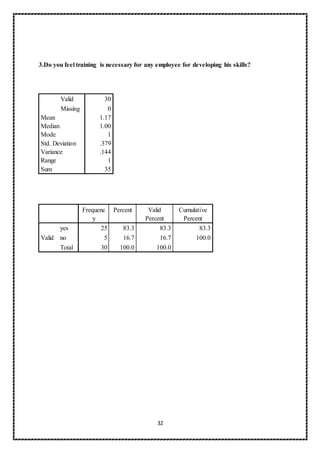
3.Do you feel training is necessary for any employee for developing his skills?
Valid 30
Missing 0
Mean 1.17
Median 1.00
Mode 1
Std. Deviation .379
Variance .144
Range 1
Sum 35
Frequenc
y
Percent Valid
Percent
Cumulative
Percent
Valid
yes 25 83.3 83.3 83.3
no 5 16.7 16.7 100.0
Total 30 100.0 100.0
33
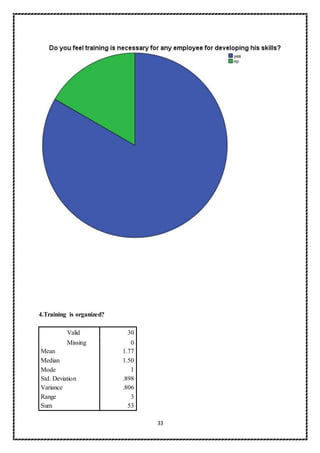
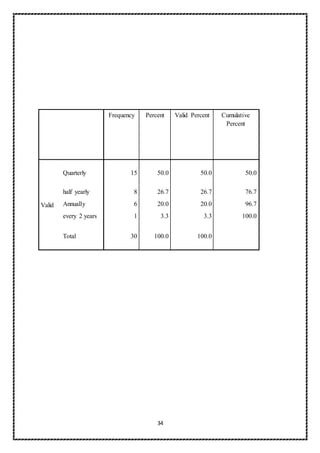
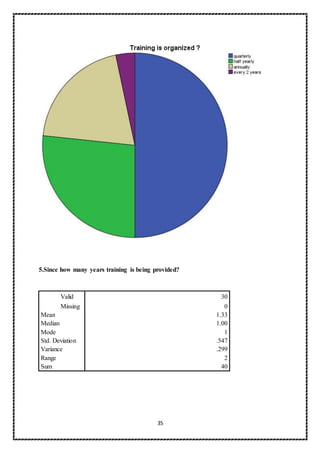
4.Training is organized?
Valid 30
Missing 0
Mean 1.77
Median 1.50
Mode 1
Std. Deviation .898
Variance .806
Range 3
Sum 53
34
Frequency Percent Valid Percent Cumulative
Percent
Valid
Quarterly 15 50.0 50.0 50.0
half yearly 8 26.7 26.7 76.7
Annually 6 20.0 20.0 96.7
every 2 years 1 3.3 3.3 100.0
Total 30 100.0 100.0
35
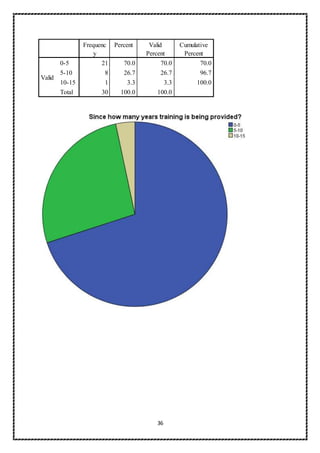
5.Since how many years training is being provided?
Valid 30
Missing 0
Mean 1.33
Median 1.00
Mode 1
Std. Deviation .547
Variance .299
Range 2
Sum 40
36
Frequenc
y
Percent Valid
Percent
Cumulative
Percent
Valid
0-5 21 70.0 70.0 70.0
5-10 8 26.7 26.7 96.7
10-15 1 3.3 3.3 100.0
Total 30 100.0 100.0
37
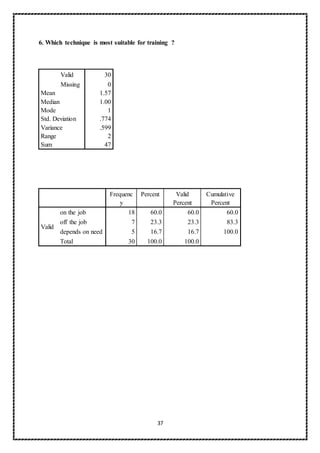
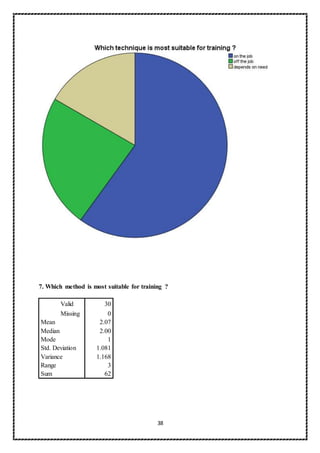
6. Which technique is most suitable for training ?
Valid 30
Missing 0
Mean 1.57
Median 1.00
Mode 1
Std. Deviation .774
Variance .599
Range 2
Sum 47
Frequenc
y
Percent Valid
Percent
Cumulative
Percent
Valid
on the job 18 60.0 60.0 60.0
off the job 7 23.3 23.3 83.3
depends on need 5 16.7 16.7 100.0
Total 30 100.0 100.0
38
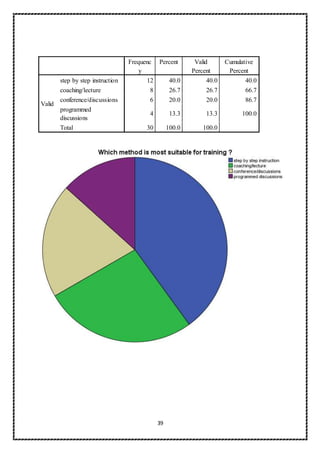
7. Which method is most suitable for training ?
Valid 30
Missing 0
Mean 2.07
Median 2.00
Mode 1
Std. Deviation 1.081
Variance 1.168
Range 3
Sum 62
39
Frequenc
y
Percent Valid
Percent
Cumulative
Percent
Valid
step by step instruction 12 40.0 40.0 40.0
coaching/lecture 8 26.7 26.7 66.7
conference/discussions 6 20.0 20.0 86.7
programmed
discussions
4 13.3 13.3 100.0
Total 30 100.0 100.0
40
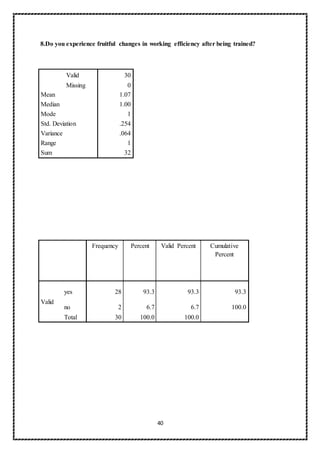
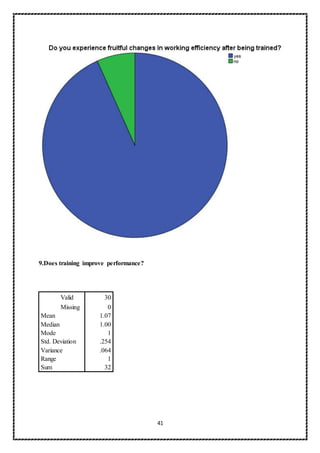
8.Do you experience fruitful changes in working efficiency after being trained?
Valid 30
Missing 0
Mean 1.07
Median 1.00
Mode 1
Std. Deviation .254
Variance .064
Range 1
Sum 32
Frequency Percent Valid Percent Cumulative
Percent
Valid
yes 28 93.3 93.3 93.3
no 2 6.7 6.7 100.0
Total 30 100.0 100.0
41
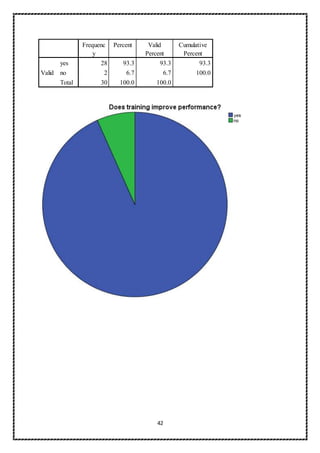
9.Does training improve performance?
Valid 30
Missing 0
Mean 1.07
Median 1.00
Mode 1
Std. Deviation .254
Variance .064
Range 1
Sum 32
42
Frequenc
y
Percent Valid
Percent
Cumulative
Percent
Valid
yes 28 93.3 93.3 93.3
no 2 6.7 6.7 100.0
Total 30 100.0 100.0
43
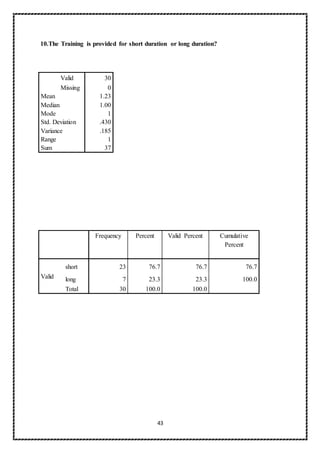
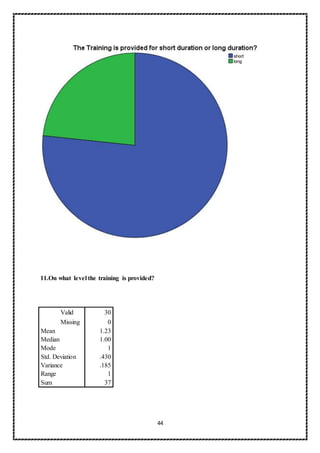
10.The Training is provided for short duration or long duration?
Valid 30
Missing 0
Mean 1.23
Median 1.00
Mode 1
Std. Deviation .430
Variance .185
Range 1
Sum 37
Frequency Percent Valid Percent Cumulative
Percent
Valid
short 23 76.7 76.7 76.7
long 7 23.3 23.3 100.0
Total 30 100.0 100.0
44
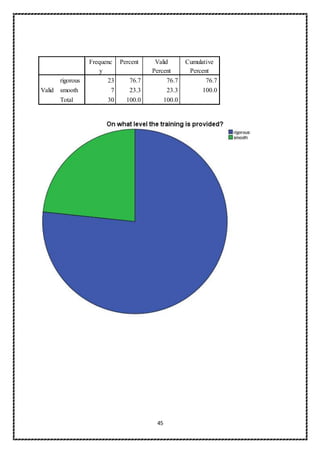
11.On what level the training is provided?
Valid 30
Missing 0
Mean 1.23
Median 1.00
Mode 1
Std. Deviation .430
Variance .185
Range 1
Sum 37
45
Frequenc
y
Percent Valid
Percent
Cumulative
Percent
Valid
rigorous 23 76.7 76.7 76.7
smooth 7 23.3 23.3 100.0
Total 30 100.0 100.0
46
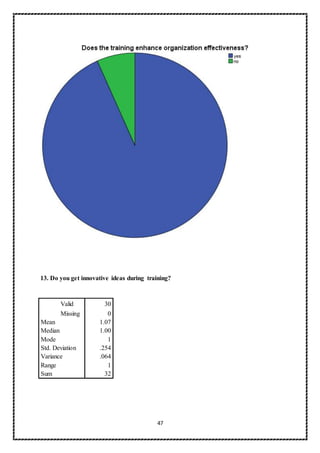
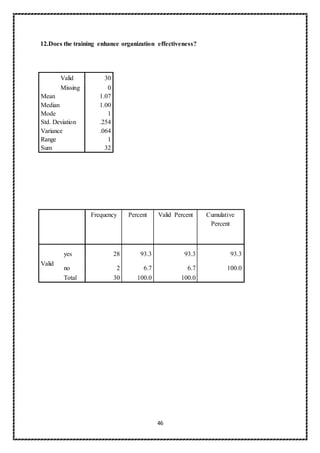
12.Does the training enhance organization effectiveness?
Valid 30
Missing 0
Mean 1.07
Median 1.00
Mode 1
Std. Deviation .254
Variance .064
Range 1
Sum 32
Frequency Percent Valid Percent Cumulative
Percent
Valid
yes 28 93.3 93.3 93.3
no 2 6.7 6.7 100.0
Total 30 100.0 100.0
47
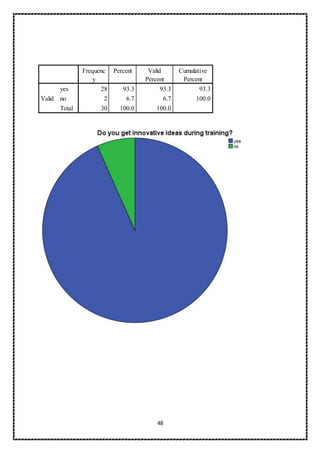
13. Do you get innovative ideas during training?
Valid 30
Missing 0
Mean 1.07
Median 1.00
Mode 1
Std. Deviation .254
Variance .064
Range 1
Sum 32
48
Frequenc
y
Percent Valid
Percent
Cumulative
Percent
Valid
yes 28 93.3 93.3 93.3
no 2 6.7 6.7 100.0
Total 30 100.0 100.0
49
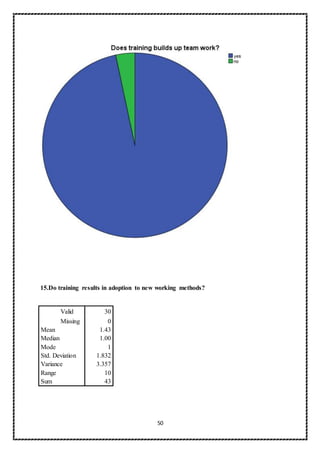
14.Does training builds up team work?
Valid 30
Missing 0
Mean 1.03
Median 1.00
Mode 1
Std. Deviation .183
Variance .033
Range 1
Sum 31
Frequenc
y
Percent Valid
Percent
Cumulative
Percent
Valid
Yes 29 96.7 96.7 96.7
No 1 3.3 3.3 100.0
Total 30 100.0 100.0
50
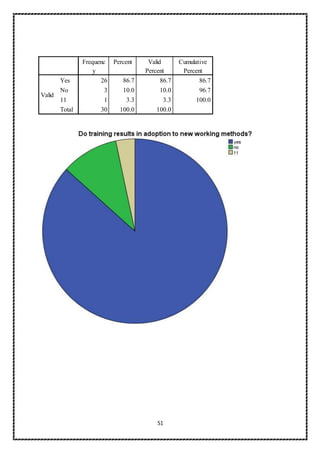
15.Do training results in adoption to new working methods?
Valid 30
Missing 0
Mean 1.43
Median 1.00
Mode 1
Std. Deviation 1.832
Variance 3.357
Range 10
Sum 43
51
Frequenc
y
Percent Valid
Percent
Cumulative
Percent
Valid
Yes 26 86.7 86.7 86.7
No 3 10.0 10.0 96.7
11 1 3.3 3.3 100.0
Total 30 100.0 100.0
52
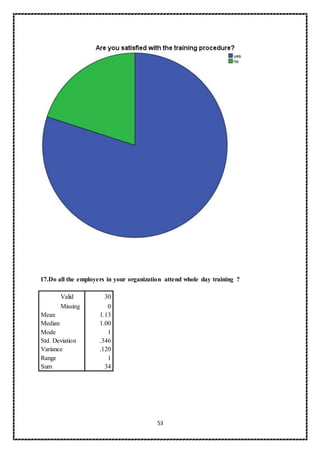
16.Are you satisfied with the training procedure?
Valid 30
Missing 0
Mean 1.20
Median 1.00
Mode 1
Std. Deviation .407
Variance .166
Range 1
Sum 36
Frequenc
y
Percent Valid
Percent
Cumulative
Percent
Valid
yes 24 80.0 80.0 80.0
no 6 20.0 20.0 100.0
Total 30 100.0 100.0
53
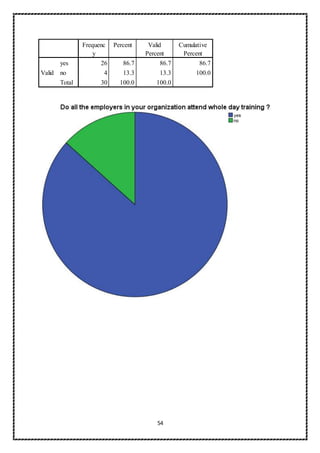
17.Do all the employers in your organization attend whole day training ?
Valid 30
Missing 0
Mean 1.13
Median 1.00
Mode 1
Std. Deviation .346
Variance .120
Range 1
Sum 34
54
Frequenc
y
Percent Valid
Percent
Cumulative
Percent
Valid
yes 26 86.7 86.7 86.7
no 4 13.3 13.3 100.0
Total 30 100.0 100.0
55
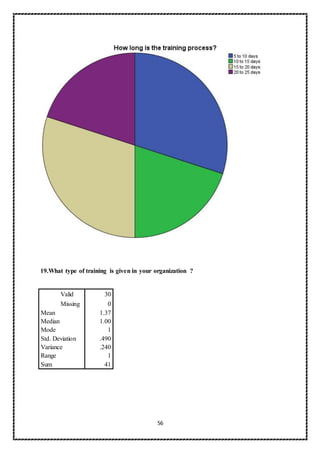
18.How long is the training process?
Valid 30
Missing 0
Mean 2.40
Median 2.50
Mode 1a
Std. Deviation 1.133
Variance 1.283
Range 3
Sum 72
a. Multiple modes exist.
The smallest value is
shown
Frequenc
y
Percent Valid
Percent
Cumulative
Percent
Valid
5 to 10 days 9 30.0 30.0 30.0
10 to 15
days
6 20.0 20.0 50.0
15 to 20
days
9 30.0 30.0 80.0
20 to 25
days
6 20.0 20.0 100.0
Total 30 100.0 100.0
56
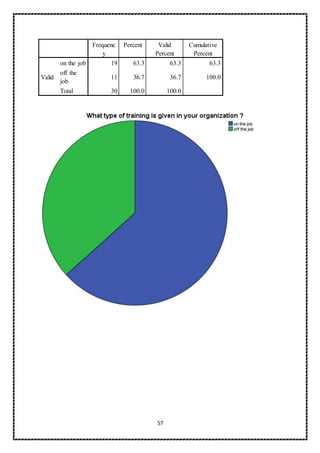
19.What type of training is given in your organization ?
Valid 30
Missing 0
Mean 1.37
Median 1.00
Mode 1
Std. Deviation .490
Variance .240
Range 1
Sum 41
57
Frequenc
y
Percent Valid
Percent
Cumulative
Percent
Valid
on the job 19 63.3 63.3 63.3
off the
job
11 36.7 36.7 100.0
Total 30 100.0 100.0
58
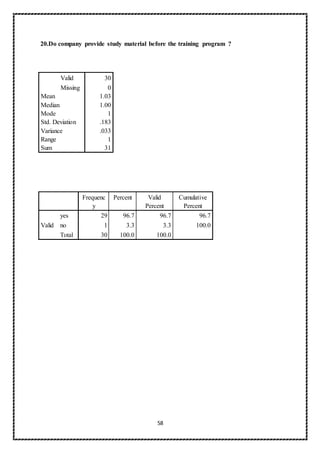
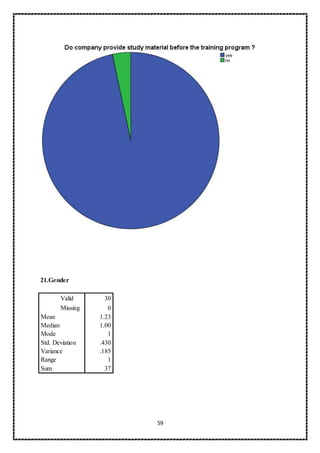
20.Do company provide study material before the training program ?
Valid 30
Missing 0
Mean 1.03
Median 1.00
Mode 1
Std. Deviation .183
Variance .033
Range 1
Sum 31
Frequenc
y
Percent Valid
Percent
Cumulative
Percent
Valid
yes 29 96.7 96.7 96.7
no 1 3.3 3.3 100.0
Total 30 100.0 100.0
59
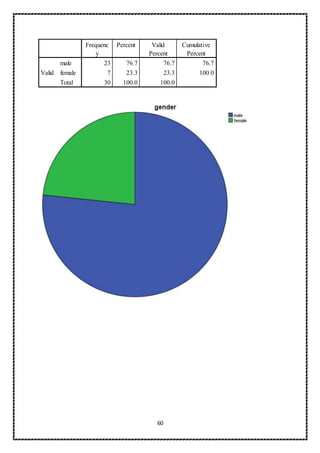
21.Gender
Valid 30
Missing 0
Mean 1.23
Median 1.00
Mode 1
Std. Deviation .430
Variance .185
Range 1
Sum 37
60
Frequenc
y
Percent Valid
Percent
Cumulative
Percent
Valid
male 23 76.7 76.7 76.7
female 7 23.3 23.3 100.0
Total 30 100.0 100.0

235794836 project-of-finance

  • 1.
    1 Get Homework/Assignment Done Homeworkping.com HomeworkHelp https://www.homeworkping.com/ Research Paper help https://www.homeworkping.com/ Online Tutoring https://www.homeworkping.com/ click here for freelancing tutoring sites Sri Sharada Institute Of Indian Management - Research Approved by AICTE Plot No. 7, Phase-II, Institutional Area, Behind the Grand Hotel, Vasant Kunj, New Delhi – 110070 Website: www.srisiim.org STATISTICS
  • 2.
    2 Project Report ON “TRAINING” Submitted To:-Submitted By:- Prof. Shraddha Bhadauria Upendra kumar(20130157) Parshant kumar(20130132) Rohit kumar(20130138) Declaration We hereby declare that the following project report titled “TRAINING ” is an authentic work done by us. This is to declare that all work indulged in the completion of this work such as research, analysis of activities of an organization is a profound and honest work of ours.
  • 3.
    3 Place:New Delhi Upendrakumar Parshant kumar Rohit kumar ACKNOWLEDGEMENT We would like to express hearty gratitude to our faculty guide, Prof.Shraddha Bhadauria for giving us the opportunity to prepare a project report on “TRAINING” and for her valuable guidance and sincere cooperation, which helped us in completing this project.
  • 4.
  • 5.
    5 INDEX S.NO PAGE NO. 1)Introduction…………………………………………………………………………………………………….………5 2) Types of training...........................…………………………………………………………………………..7 3) Motivation………………………………………………………………………………………………………………11 4)Areas of training.....................................……………………………….……….…………………….….13 5)Analysis.............................…………………………….………………………………………..……......……29
  • 6.
    6 1. TRAINING Training isthe acquisition of knowledge, skills, and competencies as a result of the teaching of vocational or practical skills and knowledge that relate to specific useful competencies. Training has specific goals of improving one's capability, capacity,productivity and performance. It forms the core of apprenticeships and provides the backbone of content at institutes of technology(also known as technical colleges or polytechnics). In addition to the basic training required for a trade, occupation or profession, observers of the labor- market recognize as of 2008 the need to continue training beyond initial qualifications: to maintain, upgrade and update skills throughout working life. People within many professions and occupations may refer to this sort of training as professional development.
  • 7.
    7 2.TYPES OF TRAINING 2.1PHYSICAL TRAINING Physical training concentrates on mechanistic goals: training-programs in this area develop specific skills or muscles, often with a view of peaking at a particular time. Some physical training programs focus on raising overall physical fitness. In military use, training means gaining the physical ability to perform and survive in combat, and learning the many skills needed in a time of war. These include how to use a variety of weapons, outdoor survival skills, and how to survive captured by the enemy, among many others. See military education and training. For psychological or physiological reasons, people who believe it may be beneficial to them can choose to practice relaxation training, or autogenic training, in an attempt to increase their ability to relax or deal with stress.[1] While some studies have indicated relaxation training is useful for some medical conditions, autogenic training has limited results or has been the result of few studies. 2.2 JOB TRAINING AND DEVELOPMENT Some commentators use a similar term for workplace learning to improve performance: "training and development". There are also additional services available online for those who wish to receive training above and beyond that which is offered by their employers. Some examples of these services include career counseling, skill assessment, and supportive services. One can generally categorize such training as on-the-job or off-the-job. The on-the-job training method takes place in a normal working situation, using the actual tools, equipment, documents or materials that trainees will use when fully trained. On-the-job training has a general reputation as most effective for vocational work.It involves Employee training at the place of work while he or she is doing the actual job. Usually a professional trainer (or sometimes an experienced employee) serves as the course instructor using hands-on training often supported by formal classroom training. Off-the-job training method takes place away from normal work situations — implying that the employee does not count as a directly productive worker while such training takes place. Off-the-job training method also involves employee training at a site
  • 8.
    8 away from theactual work environment. It often utilizes lectures, case studies, role playing and simulation, having the advantage of allowing people to get away from work and concentrate more thoroughly on the training itself. This type of training has proven more effective in inculcating concepts and ideas.  A more recent development in job training is the On the Job Training Plan, or OJT Plan. According to the United States Department of the Interior, a proper OJT plan should include: An overview of the subjects to be covered, the number of hours the training is expected to take, an estimated completion date, and a method by which the training will be evaluated. 2.3 RELIGION AND SPIRITUALITY In religious and spiritual use, training may refer to the purification of the mind, heart, understanding and actions to obtain a variety of spiritual goals such as (for example) closeness to God or freedom from suffering. Note for example the institutionalized spiritual training of Threefold Training in Buddhism, Meditation in Hinduism or discipleship in Christianity. These aspects of training can be short term or last a lifetime, depending on the context of the training and which religious group it is a part of. Compare religious ritual 2.4 PAROCHIAL SCHOOL Parochial schools are a fairly widespread institution in the United States. A parochial school is a primary or secondary school supervised by a religious organization, especially a Roman Catholic day school affiliated with a parish or a holy order. As of 2004, out of the approximately 50 million children who were enrolled in American grade schools, 4.2 million children attend a church-affiliated school, which is approximately 1 in 12 students. Within the Christian religion, for example, one can attend a church-affiliatedcollege with the intent of getting a degree in a field associated with religious studies. Some people may also attend church-affiliated colleges in pursuit of a non-religious degree, and typically do it just to deepen their understanding of the specific religion that the school is associated with. The largest non-public school system in the United States, the Catholic school system, operates 5,744 elementary schools and 1,206 secondary schools. 2.5 ARTIFICIAL-INTELLIGENCE FEEDBACK Researchers have developed training-methods for artificial-intelligence devices as well. Evolutionary algorithms, including genetic programming and other methods of machine learning, use a system of feedback based on "fitness functions" to
  • 9.
    9 allow computer programsto determine how well an entity performs a task. The methods construct a series of programs, known as a “population” of programs, and then automatically test them for "fitness", observing how well they perform the intended task. The system automatically generates new programs based on members of the population that perform the best. These new members replace programs that perform the worst. The procedure repeats until the achievement of optimum performance. In robotics, such a system can continue to run in real- time after initial training, allowing robots to adapt to new situations and to changes in themselves, for example, due to wear or damage. Researchers have also developed robots that can appear to mimic simple human behavior as a starting point for training. Training is needed to serve the following purposes:  Newly recruited employees require training so as to perform their tasks effectively. Instruction, guidance, coaching help them to handle jobs competently, without any wastage.  Training is necessary to prepare existing employees for higher-level jobs (promotion).  Existing employees require refresher training so as to keep abreast of the latest developments in job operations. In the face of rapid technological changes, this is an absolute necessity.  Training is necessary when a person moves from one job to another (transfer). After training, the' employee can change jobs quickly, improve his performance levels and achieve career goals comfortably  Training is necessary to make employees mobile and versatile. They can be placed on various jobs depending on organizational needs.  Training is needed to bridge the gap between what the employee has and what the job demands.  Training is needed to make employees more productive and useful in the long-run.  Training is needed for employees to gain acceptance from peers (learning a job quickly and being able to pull their own weight is one of the best ways for them to gain acceptance). Importance of Training :  Training offers innumerable benefits to both employees and employers. It makes the employee more productive and more useful to an organization. The importance of training can be studied under the following heads: Benefits to the business:  Trained workers can work more efficiently. They use machines, tools, and materials in a proper way. Wastage is thus eliminated to a large extent.
  • 10.
    10  There willbe fewer accidents. Training improves the knowledge of employees regarding the use of machines and equipment. Hence, trained workers need not be put under close supervision, as they know how to handle operations properly.  Trained workers can show superior performance. They can turn out better performance. They can turn out better quality goods by putting the materials, tools and equipment to good use.  Training makes employees more loyal to an organization. They will be less inclined to leave the unit where there are growth opportunities. Benefits to the employees:  Training makes an employee more useful to a firm. Hence, he will find employment more easily.  Training makes employees more efficient and effective. By combining materials, tools and equipment in a right way, they can produce more with minimum effort.  Training enables employees to secure promotions easily. They can realise their career goals comfortably.  Training helps an employee to move from one organization to another easily. He can be more mobile and pursue career goals actively.  Employees can avoid mistakes, accidents on the job. They can handle jobs with confidence. They will be more satisfied on their jobs. Their morale would be high. Thus, training can contribute to higher production, fewer mistakes, greater job satisfaction and lower labour turnover. Also, it can enable employees to cope with organizational, social and technological change. Effective training is an invaluable investment in the human resources of an organization. Learning Principles: The Philosophy of Training Training is essential for job success. It can lead to higher production, fewer mistakes, greater job satisfaction and lower turnover. These benefits accrue to both the trainee and the organization, if managers understand the principles behind the training process. To this end, training efforts must invariably follow certain learning-oriented guidelines. Modelling Modeling is simply copying someone else's behavior. Passive classroom learning does not leave any room for modeling. If we want to change people, it would be a good idea to have videotapes of people showing the desired behavior. The selected model should provide the right kind of behavior to be copied by others. A great deal of human behaviour is learned by modelling others. Children learn by modelling parents and older children, they are quite comfortable with the process by the time they grow up. As experts put it. "managers tend to manage as they were managed"
  • 11.
    11 Motivation For learning totake place, intention to learn is important. When the employee is motivated, he pays attention to what is being said, done and presented. Motivation to learn is influenced by the answers to questions such as: How important is my job to me? How important is the information? Will learning help me progress in the company? etc. People learn more quickly when the material is important and relevant to them. Learning is usually quicker and long- lasting when the learner participates actively. Most people, for example, never forget how to ride a bicycle because they took an active part in the learning process. Reinforcement Positive reinforcement consists of rewarding desired behaviors. If a behavior is rewarded, it probably will be repeated. People avoid certain behaviors that invite criticism and punishment. A bank officer would want to do a postgraduate course in finance, if it earns him increments and makes him eligible for further promotions. Both the external rewards (investments, praise) and the internal rewards (a feeling of pride and achievement) associated with desired behaviors compel subjects to learn properly. To be effective, the trainer must reward desired behaviors only. If he rewards poor performance, the results may be disastrous: good performers may quit in frustration, accidents may go up, and productivity may suffer. The reinforcement principle is also based on the premise that punishment is less effective in learning than reward. Punishment is a pointer to undesirable behaviors. When administered, it causes pain to the employee. He mayor may not repeat the mistakes. The reactions may be mild or wild. Action taken to repeal a person from undesirable action is punishment. If administered properly, punishment may force the trainee to modify the undesired or incorrect behaviors. Feedback People learn best if reinforcement is given as soon as possible after training. Every employee wants to know what is expected of him and how well he is doing. If he is off the track, somebody must put him back on the rails. The errors in such cases must be rectified immediately. The trainee after learning the right behaviour is motivated to do things in a 'right' way and earn the associated rewards. Positive feedback (showing the trainee the right
  • 12.
    12 way of doingthings) is to be preferred to negative feedback (telling the trainee that he is not correct) when we want to change behaviour. Spaced Practice Learning takes place easily if the practice sessions are spread over a period of time. New employees learn better if the orientation programme is spread over a two or three day period, instead of covering it all in one day. For memorizing tasks, 'massed' practice is usually more effective. Imagine the way schools ask the kids to say the Lord's prayer aloud. Can you memorise a long poem by learning only one line per day? You tend to forget the beginning of the poem by the time you reach the last stanza. For 'acquiring' skills as stated by Mathis and Jackson, spaced practice is usually the best. This incremental approach to skill acquisition minimises the physical fatigue that deters learning. Whole Learning The concept of whole learning suggests that employees learn better if the job information is explained as an entire logical process, so that they can see how the various actions fit together into the 'big picture'. A broad overview of what the trainee would be doing on the job should be given top priority, if learning has to take place quickly. Research studies have also indicated that it is more efficient to practice a whole task all at once rather than trying to master the various components of the task at different intervals. Active Practice 'Practice makes a man perfect': so said Bacon. To be a swimmer, you should plunge into water instead of simply reading about swimming or looking at films of the worlds' best swimmers. Learning is enhanced when trainees are provided ample opportunities to repeat the task. For maximum benefit, practice sessions should be distributed over time. Applicability of Training Training should be as real as possible so that trainees can successfully transfer the new knowledge to their jobs. The training situations should be set up so that trainees can visualise - and identify with - the types of situations they can come across on the job.
  • 13.
    13 Environment Finally, environment playsa major role in training. It is natural that workers who are exposed to training in comfortable environments with adequate, well spaced rest periods are more likely to learn than employees whose training conditions are less than ideal. Generally speaking, learning is very fast at the beginning. Thereafter, the pace of learning slows down as opportunities for improvement taper off. Areas of Training The Areas of Training in which training is offered may be classified into the following categories. Knowledge Here the trainee learns about a set of rules and regulations about the job, the staff and the products or services offered by the company. The aim is to make the new employee fully aware of what goes on inside and outside the company. Technical Skills The employee is taught a specific skill (e.g., operating a machine, handling computer etc.) so that he can acquire that skill and contribute meaningfully. Social Skills The employee is made to learn about himself and others, and to develop a right mental attitude towards the job, colleagues and the company. The principal focus is on teaching the employee how to be a team member and get ahead. Techniques This involves the application of knowledge and skill to various on-the-job situations. In addition to improving the skills and knowledge of employees, training aims at moulding employee attitudes: When administered properly, a training programme will go a long way in obt8ining employee loyalty, support and commitment to company activities. Types of Training
  • 14.
    14 There are manyapproaches to training. We focus here on the types of training that are commonly employed in present-day organisations. Skills training: Skill training is most common in organisations. The process here is fairly simple. The need for training in basic skills (such as reading, writing, computing, speaking, listening, problem solving, managing oneself, knowing how to learn, working as part of a team, leading others) is identified through assessment. Specific training objectives are set and training content is developed to meet those objectives. Several methods are available for imparting these basic skills in modern organisations (such as lectures, apprenticeship, on-the-job, coaching etc.). Before employing these methods, managers should:  Explain how the training will help the trainees in their jobs.  Relate the training to the trainees' goals.  Respect and consider participant responses and use these as a resource.  Encourage trainees to learn by doing.  Give feedback on progress toward meeting learning objectives. Refresher training: Rapid changes in technology may force companies to go in for this kind of training. By organising short-term courses which incorporate the latest developments in a particular field, the company may keep its employees up-to-date and ready to take on emerging challenges.  It is conducted at regular intervals by taking the help of outside consultants who specialise in a particular descriptive. Cross-functional Training: Cross-functional Training involves training employees to perform operations in areas other than their assigned job. There are many approaches to cross functional training. Job rotation can be used to provide a manager in one functional area with a broader perspective than he would otherwise have. Departments can exchange personnel for a certain period so that each employee understands how other departments are functioning. High performing workers can act as peer trainers and help employees develop skills in another area of operation. Cross functional training provides the following benefits to an organisation (and the workers as well) (1) Workers gain rich experience in handling diverse jobs; they become more adaptable and versatile (2) they can better engineer their own career paths (3) they not only know their job well but also understand how others are able to perform under a different set of constraints (4) A broader perspective increases workers' understanding of the business and reduces the need for supervision (5) when workers can fill in for other workers who are absent, it is easier to use flexible scheduling, which is increasingly in demand as more employees want to spend more time with their families. Eli
  • 15.
    15 Lilly and Company(India), for example, encourages cross-functional movements to make the organisation equally attractive to both specialists and generalists. Team Training: Team training generally covers two areas; content tasks and group processes. Content tasks specify the team's goals such as cost control and problem solving. Group processes reflect the way members function as a team - for example how they interact with each other, how they sort out differences, how they participate etc. Companies are investing heavy amounts, nowadays, in training new employees to listen to each other and to cooperate. They are using outdoor experiential training techniques to develop teamwork and team spirit among their employees (such as scaling a mountain, preparing recipes for colleagues at a restaurant, sailing through uncharted waters, crossing a jungle etc.). The training basically throws light on (i) how members should communicate with each other (ii) how they have to cooperate and get ahead (iii) how they should deal with conflict-full situations (iv) how they should find their way, using collective wisdom and experience to good advantage. Creativity training: Companies like Mudra Communications, Titan Industries, Wipro encourage their employees to think unconventionally, break the rules, take risks, go out of the box and devise unexpected solutions.  Postpone judgment: Don't reject any idea  Create alternative frames of reference  Break the boundary of thinking  Examine a different aspect of the problem  Make a wish list of solutions  Borrow ideas from other fields  Look for processes to change or eliminate  Think up alternative methods  Adopt another person's perspective  Question all Assumptions. In creativity training, trainers often focus on three things: (a) Breaking away: In order to break away from restrictions, the trainee is expected to (i) identify the dominant ideas influencing his own thinking (ii) define the boundaries within which he is working (iii) bring the assumptions out into the open and challenge everything (b) Generate new ideas: To generate new ideas, the trainee should open up his mind; look at the problem from all possible angles and list as many alternative approaches as possible. The trainee should allow his mind to wander over alternatives freely. Expose himself to new influences (people, articles, books, situations), switch over from one perspective to another, - arrange cross fertilization of ideas with other people and use analogies to spark off ideas.
  • 16.
    16 (c) Delaying judgement:To promote creative thinking, the trainee should not try to kill off ideas too quickly; they should be held back until he is able to generate as many ideas as possible. He should allow ideas to grow a little. Brainstorming (getting a large number of ideas from a group of people in a short time) often helps in generating as many ideas as possible without pausing to evaluate them. It helps in releasing ideas, overcoming inhibitions, cross fertilising ideas and getting away from patterned thinking. Diversity Training: Diversity training considers all of the diverse dimensions in the workplace race, gender, age, disabilities, lifestyles, culture, education, ideas and backgrounds - while designing a training programme. It aims to create better cross-cultural sensitivity with the aim of fostering more harmonious and fruitful working relationships among a firm's employees. The programme covers two things: (i) awareness building, which helps employees appreciate the key benefits of diversity, and (ii) skill building, which offers the knowledge, skills and abilities required for working with people having varied backgrounds. Literacy Training: Inability to write, speak and work well with others could often come in the way of discharging duties, especially at the lower levels. Workers, in such situations, may fail to understand safety messages, appreciate the importance of sticking to rules, and commit avoidable mistakes. Functional illiteracy (low skill level in a particular content area) may be a serious impediment to a firm's productivity and competitiveness. Functional literacy programmes focus on the basic skills required to perform a job adequately and capitalise on most workers' motivation to get help in a particular area. Tutorial programmes, home assignments, reading and writing exercises, simple mathematical tests, etc., are generally used in all company in-house programmes meant to improve the literacy levels of employees with weak reading, writing or arithmetic skills. Training Methods Training methods are usually classified by the location of instruction. On the job training is provided when the workers are taught relevant knowledge, skills and abilities at the actual workplace; off-the-job training, on the other hand, requires that trainees learn at a location other than the real work spot. Some of the widely used training methods are listed below. 1. Job Instruction Training (JlT) The JIT method (developed during World War II) is a four-step instructional process involving preparation, presentation, performance try out and follow up. It is used primarily to teach workers how to do their current jobs. A trainer, supervisor or co-worker acts as the coach. The four steps followed in the JIT methods are: 1. The trainee receives an overview of the job, its purpose and its desired outcomes, with a clear focus on the relevance of training.
  • 17.
    17 2. The trainerdemonstrates the job in order to give the employee a model to copy. The trainer shows a right way to handle the job. 3. Next, the employee is permitted to copy the trainer's way. Demonstrations by the trainer and practice by the trainee are repeated until the trainee masters the right way to handle the job. 4. Finally, the employee does the job independently without supervision. Merits:  Trainee learns fast through practice and observation.  It is economical as it does not require any special settings. Also, mistakes can be corrected immediately.  The trainee gains confidence quickly as he does the work himself in actual setting with help from supervisor.  It is most suitable for unskilled and semi-skilled jobs where the job operations are simple; easy to explain and demonstrate within a short span of time. Demerits:  The trainee should be as good as the trainer if the trainer is not good, transference of knowledge and skills will be poor.  While learning, trainee may damage equipment, waste materials, cause accidents frequently,  Experienced workers cannot use the machinery while it is being used for training. 2. Coaching: Coaching is a kind of daily training and feedback given to employees by immediate supervisors. It involves a continuous process of learning by doing. It may be defined as an informal, unplanned training and development activity provided by supervisors and peers. In coaching, the supervisor explains things and answers questions; he throws light on why things are done the way they are; he offers a model for trainees to copy; conducts lot of decision making meetings with trainees; procedures are agreed upon and the trainee is given enough authority to make divisions and even commit mistakes. Of course, coaching can be a taxing job in that the coach may not possess requisite skills to guide the learner in a systematic way. Sometimes, doing a full day's work may be more important than putting the learner on track. When to use coaching usefully? Coaching could be put to good use when:  An employee demonstrates a new competency  An employee expresses interest in a different job within the organisation
  • 18.
    18  An employeeseeks feedback  An employee is expressing low morale, violating company policies or practices or having performance problems  An employee needs help with a new skill following a formal training programme. Effective working, obviously, requires patience and communication skills. It involves:  Explaining appropriate ways of doing things  Making clear why actions were taken  Stating observations accurately  Offering possible alternatives / suggestions  Following up 3. Mentoring : Mentoring is a relationship in which a senior manager in an organisation assumes the responsibility for grooming a junior person. Technical, interpersonal and political skills are generally conveyed in such a relationship from the more experienced person. A mentor is a teacher, spouse, counsellor, developerr of skills and intellect, host, guide, exemplar, and most importantly, supporter and facilitator in the realisation of the vision the young person (protege) has about the kind of 1ife he wants as an adult. The main objective is to help an employee attain psychological maturity and effectiveness and get integrated with the organisation. In a work situation, such mentoring can take place at both formal and informal levels, depending on the prevailing work culture and the commitment from the top management. Formal mentoring can be very fruitful, if management invests time and money in such relationship building exercises. Career functions: Career functions are those aspects of the relationship that enhance career advancement. These include: 1. Sponsorship: Where mentors actively nominate a junior person (called 'mentee') for promotions or desirable positions. 2. Exposure and visibility: Where mentors offer opportunities for mentees to interact with senior executives, demonstrate their abilities and exploit their potential. 3. Coaching: Mentors help mentees to analyse how they are doing their work and to define their aspirations. Here mentors offer practical advice on how to accomplish objectives and gain recognition from others. 4. Protection: Mentors shield the junior person from harmful situations/seniors.
  • 19.
    19 5. Challenging assignments:Mentors help mentees develop necessary competencies through challenging job assignments and appropriate feedback. Mentors create opportunities clients to prove their worth to demonstrate clearly what they have to offer. Psychological functions: Psychological functions are those aspects that enhance the mentee’s sense of competence, and identify effectiveness in a professional role. These include: 6. Role modeling: Mentors offer mentees a pattern of values and behaviours to imitate 7. Acceptance and confirmation: mentors offer support, guidance and encouragement to mentees so that they can solve the problems independently and gain confidence in course of time. Mentors also help people to learn about the organisation's culture and understand why things are done in certain ways. 8. Counseling: Mentors help mentees work out their personal problems, learn about what to do and what not to do, offer advice on what works and what doesn't, and do everything to demonstrate improved performance and prepare themselves for greater responsibility. 9. Friendship: Mentors offer practical help and support to mentees so that they can indulge in mutually satisfying social interactions (with peers, subordinates, bosses and customers) Mentoring in India is based on the time-honoured guru-shishya relationship where the guru would do everything to develop the personality of the shishya, offering emotional support, and guidance. Companies like TISCO, Neyveli Lignite Corporation, Polaris, Coca-Cola India have used mentoring systems to good effect in recent times (Economic Times, 25 Oct., 2002). Organisations like General Electric, Intel, Proctor & Gamble have given a lot of importance to mentoring programmes, going even gone to the extent of penalising senior managers if they fail to develop leadership skills among subordinates. Of course, mentoring is not without its problems. Mentors who are dissatisfied with their jobs and though who teach or narrow or distorted view of events may not help a protege's development. Not all mentors are well prepared to transfer their skills and wisdom to their junior colleagues. When young people are bombarded with conflicting viewpoints - about how things should go - from a series of advisors, they may find it difficult to get ahead with confidence. Mentoring can succeed if (i) there is genuine support and commitment from top management (ii) mentors take up their job seriously and transfer ideas, skills and experiences in a systematic way and (iii) mentees believe in the whole process and carry out things in an appropriate manner. 4. Job Rotation : Job rotation may pose several problems, especially when the trainees are rolled on various jobs at frequent intervals. In such a case, trainees do not usually stay long enough in any single phase of the operation to develop a high degree of expertise. For slow learners, there is little room to integrate resources properly. Trainees can become confused when they are exposed to rotating managers, with contrasting styles of operation. Today's manager's
  • 20.
    20 commands may bereplaced by another set from another manager! Further, job rotation can be quite expensive. A substantial amount of managerial time is lost when trainees change positions, because they must be acquainted with different people and techniques in each department. Development costs can go up and productivity is reduced by moving a trainee into a new position when his efficiency levels begin to improve at the prior job. Inexperienced trainees may fail to handle new tasks in an efficient way. Intelligent and aggressive trainees, on the offer hand, may find the system to be thoroughly boring as they continue to perform more or less similar jobs without any stretch, pull and challenge. To get the best results out of the system, it should be tailored to the needs, interests and capabilities of the individual trainee, and not be a standard sequence that all trainees undergo. This kind of training involves the movement of trainee from one job to another. This helps him to have a general understanding of how the organisation functions. The purpose of job rotation is to provide trainees with a larger organisational perspective and a greater understanding of different functional areas as well as a better sense of their own career objectives and interests. Apart from relieving boredom, job rotation allows trainees to build rapport with a wide range of individuals within the organisation, facilitating future cooperation among departments. The cross-trained personnel offer a great amount of flexibility for organisations when transfers, promotions or replacements become inevitable. 5 Apprenticeship Training Most craft workers such as plumbers and carpenters are trained through formal apprenticeship programmes. Apprentices are trainees who spend a prescribed amount of time working with an experienced guide, coach or trainer. Assistantships and internships are similar to apprenticeships because they also demand high levels of participation from the trainee. An internship is a kind of on-the-job training that usually combines job training with classroom instruction in trade schools, colleges or universities. Coaching, as explained above, is similar to apprenticeship because the coach attempts to provide a model for the trainee to copy. One important disadvantage ofthe apprenticeship methods is the uniform period of training offered to trainees. People have different abilities and learn at varied rates. Those who learn fast may quit the programme in frustration. Slow learners may need additional training time. It is also likely that in these days of rapid changes in technology, old skills may get outdated quickly. Trainees who spend years learning specific skills may find, upon completion of their programmes, that the job skills they acquired are no longer appropriate. 6 Committee Assignments In this method, trainees are asked to solve an actual organisational problem. The trainees have to work together and offer solution to the problem. Assigning talented employees to important committees can give these employees a broadening experience and can help them to understand the personalities, issues and processes governing the organisation. It helps them to develop team spirit and work unitedly toward common goals. However, managers should very well understand that committee assignments could become notorious time wasting
  • 21.
    21 activities. The aboveon-the-job methods are cost effective. Workers actually produce while they learn. Since immediat.e feedback is available, they motivate trainees to observe and learn the right way of doing things. Very few problems arise in the· case of transfer of training because the employees learn in the actual work environment where the skills that are learnt are actually used. On-the-job methods may cause disruptions in production schedules. Experienced workers cannot use the facilities that are used in training. Poor learners may damage machinery and equipment. Finally, if the trainer does not possess teaching skills, there is very little benefit to the trainee. Off-the-Job Methods Under this method of training, the trainee is separated from the job situation and his attention is focused upon learning the material related to his future job performance. Since the trainee is not distracted by job requirements, he can focus his entire concentration on learning the job rather than spending his time in performing it. There is an opportunity for freedom of expression for the trainees. Off-the-job training methods are as follows: a. Vestibule training: Vestibule training method, actual work conditions are simulated in a classroom. Material, files and equipment - those that are used in actual job performance are also used in the training. This type of training is commonly used for training personnel for clerical and semi-skilled jobs. The duration of this training ranges from a few days to a few weeks. Theory can be related to practice in this method. b. Role playing: It is defined as a method of human interaction that involves realistic behaviour in imaginary situations. This method of training involves action, doing and practice. The participants play the role of certain characters, such as the production manager, mechanical engineer, superintendents, maintenance engineers, quality control inspectors, foreman, workers and the like. This method is mostly used for developing interpersonal interactions and relations. c. Lecture method: The lecture is a traditional and direct method of instruction. The instructor organizes the material and gives it to a group of trainees in the form of a talk. To be effective, the lecture must motivate and create interest among the trainees. An advantage of lecture method is that it is direct and can be used for a large group of trainees. Thus, costs and time involved are reduced. The major limitation of the lecture method is that it does not provide for transfer of training effectively. d. Conference/discussion approach: In this method, the trainer delivers a lecture and involves the trainee in a discussion so that his doubts about the job get clarified. When big organisations use this method, the trainer uses audio-visual aids such as black boards, mockups and slides; in some cases the lectures are videotaped or audio taped. Even the trainee's presentation can be taped for self confrontation and self-assessment.
  • 22.
    22 The conference is,thus, a group-centered approach where there is a clarification of ideas, communication of procedures and standards to the trainees. Those individuals who have a general educational background and whatever specific skills are required such as typing, shorthand, office equipment operation, filing, indexing, recording, etc. - may be provided with specific instructions to handle their respective jobs. e. Programmed instruction: This method has become popular in recent years. The subject matter to be learned is presented in a series of carefully planned sequential units. These units are arranged from simple to more complex levels of instruction. The trainee goes through these units by answering questions or filling the blanks. This method is, thus, expensive and time-consuming. Behaviourally Experienced Training Some training programmes focus on emotional and behavioural learning. Here employees can learn about behaviour by role-playing in which the role players attempt to act their part in respect of a case, as they would behave in a real-life situation. Business games, cases, incidents, group discussions and short assignments are also used in behaviourally- experienced learning methods. Sensitivity training or laboratory training is an example of a method used for emotional learning. The focus of experiential methods is on achieving, through group processes, a better understanding of oneself and others. These are discussed elaborately in the section covering Executive Development Programmes. Evaluation of a Training Programme The specification of values forms a basis for evaluation. The basis of evaluation and the mode of collection of information necessary for evaluation should be determined at the planning stage. The process of training evaluation has been defined as any attempt to obtain information on the effects of training performance and to assess the value of training in the light of that information. Evaluation helps in controlling and correcting the training programme. Hamblin suggested five levels at which evaluation of training can take place, viz., reactions, learning, job behaviour, organisation and ultimate value. 1. Reactions: Trainee's reactions to the overall usefulness of the training including the coverage of the topics, the method of presentation, the techniques used to clarify things, often throw light on the effectiveness of the programme. Potential questions to trainees might include: (i) What were your learning goals for the programme? (ii) Did you achieve them? (iii) Did you like this programme? (iv) Would you recommend it to others who have similar
  • 23.
    23 learning goals? (v) what suggestions do you have for improving the programme? (vi) Should the organisation continue to offer it? 2. Learning: Training programme, trainer's ability and trainee's ability are evaluated on the basis of quantity of content learned and time in which it is learned and learner's ability to use or apply the content learned. 3. Job behaviour: This evaluation includes the manner and extent to which the trainee has applied his learning to his job. 4. Organisation: This evaluation measures the use of training, learning and change in the job behaviour of the department/organisation in the form of increased productivity, quality, morale, sales turnover and the like. 5. Ultimate value: It. is the measurement of ultimate result of the contributions of the training programme to the company goals like survival, growth, profitability, etc. and to the individual goals like development of personality and social goals like maximising social benefit. Methods of Evaluation Various methods can be used to collect data on the outcomes of training. Some of these are:  Questionnaires: Comprehensive questionnaires could be used to obtain opinions, reactions, views of trainees.  Tests: Standard tests could be used to find out whether trainees have learnt anything during and after the training.  Interviews: Interviews could be conducted to find the usefulness of training offered to operatives.  Studies: Comprehensive studies could be carried out eliciting the opinions and judgements of trainers, superiors and peer groups about the training.  Human resource factors: Training can also be evaluated on the basis of employee satisfaction, which in turn can be examined on the basis of decrease in employee turnover, absenteeism, accidents, grievances, discharges, dismissals, etc.  Cost benefit analysis: The costs of training (cost of hiring trainers, tools to learn, training centre, wastage, production stoppage, opportunity cost of trainers and trainees) could be compared with its value (in terms of reduced learning time, improved learning, superior performance) in order to evaluate a training programme.  Feedback: After the evaluation, the situation should be examined to identify the probable causes for gaps in performance. The training evaluation information (about costs, time spent, outcomes, etc.) should be provided to the instructors, trainees and
  • 24.
    24 other parties concernedfor control, correction and improvement of trainees' activities. The training evaluator should follow it up sincerely so as to ensure effective implementation of the feedback report at every stage. Training Programme of Company Purpose- To establish and maintain a documented procedure for identifying and providing training to all the employees of the organization with essential skill and knowledge so as to achieve desired quality and productivity goals. Scope- This procedure is applicable to all employees. Company's personnel involved in quality system. Training Process Training is provided both “In House” and through “Outside Agencies” Which could be for an individual or for group of persons as a collective training. Training is conducted either through “Planned Training Programme” “Emergent Training Programme” which is organized by the HRD Department Planned Training- The planned training programme is drawn on annual basis both for individual and group of persons for collective training at the beginning of Calendar Year by Manager HRD and HRD Executive of factory. The departmental Heads drawn out the training requirements on the training requisition slip and sent it to HID Dept. Training of the senior personnel at Factory Is also catered for at Head Office on receipt of requirement from HRD Executive.
  • 25.
    25 The annual TrainingProg. at Head office is approved by from Chairman cum Managing Director. Annual training Prog. is prepared on format and circulated to all heads of department and is updated. If required in case of additional training needs. Emergent Training – The Emergent training programme is a supplementary training programme both for individual and collective persons which is imparted during the course of work to take care for unforeseen or uncatered training requirements arisen due to installation of new machine, system, procedure etc. Identification of such training need is done by the concerned HOD at Head Office and HOD/Supervisor at factory and accordingly forwards their request. The procedure as in case of planned training is followed there after. Conduct of Training HRD Head at HO & HRD (Executive) at factory ensures that identified training in their respective areas is conducted as scheduled. In case of External training, liaison with the agency is done and dates, venue etc. is fixed up and concerned person is intimated through Heads of Department. For In-House training, date/Venue is fixed up with identified faculty and concerned individual is informed through Heads of Department. Besides, necessary resource/infrastructure is also provided for effective training. External Trainers for the Company are:  Father Son & Company  Skill & Thoughts  Logic Consultant  Topics covered under Training Programme  EFT Act & Scheme Provisions  Rigid and Semi Rigid Packaging  Principles of Contract Labour Act  Self-motivational & Attitudinal Seminar  Organic farming  Training about operations in the company.  Processing of Rice (value addition In Rice)  Knowledge about rice trade  Operational and maintenance of dryer & Cleaning Plant
  • 26.
    26  Silo storageTechniques  Scientific Instrumentation  Finished goods quality control  Trouble shooting Job satisfaction Job satisfaction is in regard to one's feeling or state of mind regarding the nature of their work. It can be influenced by a variety of factors e.g.: quality of one's relationships with there supervisor, quality of physical environment in which they work, degree of fulfillment in there work etc. Locke gives a comprehensive definition of job satisfaction as involving cognitive, effective and evaluative reactions or attitudes and states it is "a pleasurable or positive emotional state resulting from the appraisal of one's job or job experience." Job satisfaction is a result of employees' perception of how well their job provides those things that are viewed as important. There are three generally accepted dimensions to job satisfaction. First, job satisfaction is an emotional response to a job situation, as such it cannot be seen; it can only be inferred. Second, job satisfaction is often determined by how well outcomes meet or exceed expectations. For example if organizational participants feel that they are working more harder than others in the department but are receiving fewer rewards, they will probably have a negative attitude toward the work, the boss or the coworkers. They will be dissatisfied. On the other hand, if they feel they are being treated very well and are being paid equitably, they are likely to have a positive attitude toward the job. Factors determining job satisfaction Factors affecting jobs are the main factors of job satisfaction, which may be challenging work, reward systems, working conditions, colleagues, learning and personality. Skill variety autonomy and significance are challenging tasks, which provide maximum satisfaction to employees. Many people feel bored if a job is too simple and routine, but many employees also enjoy simple and routine jobs. The job characteristics are important factors for providing satisfaction. Reward systems, equitable rewards, equal pay for equal work, promotion avenues, etc are satisfaction factors. Money is important to employees having unfulfilled basic needs, i.e. they require more award and recognition.
  • 27.
    27 Fairness in promotion,unbiased attitude of management, responsibilities and social status are the factors that are said to be providing satisfaction to employees. Working conditions influence employee's level of satisfaction. Under conducive working condition, people prefer to work hard while in an adverse atmosphere people avoid work. Working condition not only include physicals of the work but also the working relationships in the organization. The physical conditions, for example, are the light, temperature, willingness, etc. A clerk working under routine conditions likes to work hard in an air - conditioned atmosphere with computer facilities. It increases the working capacity of the employee. The relationships between the employees and the managers have an important bearing on job satisfaction. Job satisfaction is greater in case the higher authority is sympathetic, friendly and willing to help the employees. Employees feel satisfied when their views are listened to and regarded by their higher authorities Personal attitude and perceptions are the employees' angles of satisfaction, which should be taken into consideration while motivating people to arrive at job satisfaction Feedback from the job itself and autonomy are two of the major job-related motivational factors. A recent found that career development was most important to both younger and older employees. Supervision is another moderately important of job satisfaction. There seem to be two dimensions of supervisory style that affect job satisfaction. One is employee centeredness, which is measured by the degree to which a supervisor takes a personal interest and cares about the employee. It commonly is manifested in ways such as checking to see how well the employee is doing, providing advice and assistance to the individual, and communicating with the associate on a personal as well as an official level . The other dimension is participation or influence, as illustrated by managers who allow their people to participate in decisions that affect their own jobs. In most case, this approach leads higher job satisfaction. Friendly, cooperative coworkers or team members are a modest source of job satisfaction to individual employees. The group, especially a "tight" team, serves as a source of support, comfort, advice, and assistance to the individual member. Outcomes of job satisfaction To society as a whole as well as from an individual employee's standpoint, job satisfaction in and of itself is a desirable outcome. It is important to know, if at all, satisfaction relates to outcomes variable. For example, if job satisfaction is high, will the employee perform better and the organization be more effective? I f job satisfaction is low, will there be performance problems and ineffectiveness? The following sections examine the most important of these.
  • 28.
    28 Satisfaction and performance: Mostassume a positive relationship; the research to date indicates that there is no strong linkage between satisfaction and performance. Conceptual, methodological, and empirical analyses have questioned and argued against these results. The best conclusion about satisfaction and performance is that there is, definitely a relationship. The relationship may even be more complex than others in organization behavior. For example, there seem to be many possible-moderating variables, the most important of which is reward. If people receive reward they feel are equitable, they will be satisfied, and is likely to result in greater performance effort. Satisfaction and turnover: Unlike that between satisfaction and performance, research has uncovered a moderately negatively relationship between satisfaction and turnover. High job satisfaction will not, in and of itself, keep turnover low, but it does seem to help. On the other hand, if there is considerable job dissatisfaction, there is likely to be high turnover. Obviously, other variables enter into an Employees decision to quit besides job satisfaction. For example, age tenure in the organization, and commitments to the organization, may playa role. Some people cannot see them selves working anywhere else, so they remain regardless of how dissatisfied they feel. Another factor is the general economy, typically there will be an increase in turnover because will being looking for better opportunities with other organization. Satisfaction and absenteeism: Research has only demonstrated a weak negative relationship between satisfaction and absenteeism. As with turnover, many variables enter into the decision to stay home besides satisfaction with the job. For example, there are moderating variables such as the degree to which people that there job are important. For example, research among state govt. Employees has found those who believed that there was important had lower absenteeism than did who did not feel this way. Additionally, it is important to remember that although job satisfaction will not necessarily result in absenteeism, low job satisfaction more likely to bring about absenteeism.
  • 29.
    29 Significance of Study Everyorganization desires that it will grow continuously and make and retain its position in the competitive and continuously changing market environment. For this purpose the employees of the organization must be skilled and talented. But all the employees may not have the desired skills. Their skills can be improved with the help of training programs. It is an important activity for the origination to conduct appropriate and related programme for its employees, so that may be able to understand the terms required for the completion of his job. This also helps the employees of the organization to know about his job and organization very well. This also helps in better communication and relation among the organization wants to grow rapidly, then it is essential for it to conduct periodically training programmes for its employees to improve the skills and knowledge. 1. Since how many years you are working in the company? Valid 30 Missing 0 Mean 1.30 Median 1.00 Mode 1 Std. Deviation .596 Variance .355 Range 2 Sum 39 Frequency Percent Valid Percent Cumulative Percent
  • 30.
    30 Valid 0-5 years 2376.7 76.7 76.7 5-10 years 5 16.7 16.7 93.3 10-15 years 2 6.7 6.7 100.0 Total 30 100.0 100.0 2. Do you like to attend the training program ? Valid 30 Missing 0 Mean 1.13 Median 1.00 Mode 1 Std. Deviation .346 Variance .120 Range 1 Sum 34
  • 31.
    31 Frequenc y Percent Valid Percent Cumulative Percent Valid yes 2686.7 86.7 86.7 no 4 13.3 13.3 100.0 Total 30 100.0 100.0
  • 32.
    32 3.Do you feeltraining is necessary for any employee for developing his skills? Valid 30 Missing 0 Mean 1.17 Median 1.00 Mode 1 Std. Deviation .379 Variance .144 Range 1 Sum 35 Frequenc y Percent Valid Percent Cumulative Percent Valid yes 25 83.3 83.3 83.3 no 5 16.7 16.7 100.0 Total 30 100.0 100.0
  • 33.
    33 4.Training is organized? Valid30 Missing 0 Mean 1.77 Median 1.50 Mode 1 Std. Deviation .898 Variance .806 Range 3 Sum 53
  • 34.
    34 Frequency Percent ValidPercent Cumulative Percent Valid Quarterly 15 50.0 50.0 50.0 half yearly 8 26.7 26.7 76.7 Annually 6 20.0 20.0 96.7 every 2 years 1 3.3 3.3 100.0 Total 30 100.0 100.0
  • 35.
    35 5.Since how manyyears training is being provided? Valid 30 Missing 0 Mean 1.33 Median 1.00 Mode 1 Std. Deviation .547 Variance .299 Range 2 Sum 40
  • 36.
    36 Frequenc y Percent Valid Percent Cumulative Percent Valid 0-5 2170.0 70.0 70.0 5-10 8 26.7 26.7 96.7 10-15 1 3.3 3.3 100.0 Total 30 100.0 100.0
  • 37.
    37 6. Which techniqueis most suitable for training ? Valid 30 Missing 0 Mean 1.57 Median 1.00 Mode 1 Std. Deviation .774 Variance .599 Range 2 Sum 47 Frequenc y Percent Valid Percent Cumulative Percent Valid on the job 18 60.0 60.0 60.0 off the job 7 23.3 23.3 83.3 depends on need 5 16.7 16.7 100.0 Total 30 100.0 100.0
  • 38.
    38 7. Which methodis most suitable for training ? Valid 30 Missing 0 Mean 2.07 Median 2.00 Mode 1 Std. Deviation 1.081 Variance 1.168 Range 3 Sum 62
  • 39.
    39 Frequenc y Percent Valid Percent Cumulative Percent Valid step bystep instruction 12 40.0 40.0 40.0 coaching/lecture 8 26.7 26.7 66.7 conference/discussions 6 20.0 20.0 86.7 programmed discussions 4 13.3 13.3 100.0 Total 30 100.0 100.0
  • 40.
    40 8.Do you experiencefruitful changes in working efficiency after being trained? Valid 30 Missing 0 Mean 1.07 Median 1.00 Mode 1 Std. Deviation .254 Variance .064 Range 1 Sum 32 Frequency Percent Valid Percent Cumulative Percent Valid yes 28 93.3 93.3 93.3 no 2 6.7 6.7 100.0 Total 30 100.0 100.0
  • 41.
    41 9.Does training improveperformance? Valid 30 Missing 0 Mean 1.07 Median 1.00 Mode 1 Std. Deviation .254 Variance .064 Range 1 Sum 32
  • 42.
    42 Frequenc y Percent Valid Percent Cumulative Percent Valid yes 2893.3 93.3 93.3 no 2 6.7 6.7 100.0 Total 30 100.0 100.0
  • 43.
    43 10.The Training isprovided for short duration or long duration? Valid 30 Missing 0 Mean 1.23 Median 1.00 Mode 1 Std. Deviation .430 Variance .185 Range 1 Sum 37 Frequency Percent Valid Percent Cumulative Percent Valid short 23 76.7 76.7 76.7 long 7 23.3 23.3 100.0 Total 30 100.0 100.0
  • 44.
    44 11.On what levelthe training is provided? Valid 30 Missing 0 Mean 1.23 Median 1.00 Mode 1 Std. Deviation .430 Variance .185 Range 1 Sum 37
  • 45.
    45 Frequenc y Percent Valid Percent Cumulative Percent Valid rigorous 2376.7 76.7 76.7 smooth 7 23.3 23.3 100.0 Total 30 100.0 100.0
  • 46.
    46 12.Does the trainingenhance organization effectiveness? Valid 30 Missing 0 Mean 1.07 Median 1.00 Mode 1 Std. Deviation .254 Variance .064 Range 1 Sum 32 Frequency Percent Valid Percent Cumulative Percent Valid yes 28 93.3 93.3 93.3 no 2 6.7 6.7 100.0 Total 30 100.0 100.0
  • 47.
    47 13. Do youget innovative ideas during training? Valid 30 Missing 0 Mean 1.07 Median 1.00 Mode 1 Std. Deviation .254 Variance .064 Range 1 Sum 32
  • 48.
    48 Frequenc y Percent Valid Percent Cumulative Percent Valid yes 2893.3 93.3 93.3 no 2 6.7 6.7 100.0 Total 30 100.0 100.0
  • 49.
    49 14.Does training buildsup team work? Valid 30 Missing 0 Mean 1.03 Median 1.00 Mode 1 Std. Deviation .183 Variance .033 Range 1 Sum 31 Frequenc y Percent Valid Percent Cumulative Percent Valid Yes 29 96.7 96.7 96.7 No 1 3.3 3.3 100.0 Total 30 100.0 100.0
  • 50.
    50 15.Do training resultsin adoption to new working methods? Valid 30 Missing 0 Mean 1.43 Median 1.00 Mode 1 Std. Deviation 1.832 Variance 3.357 Range 10 Sum 43
  • 51.
    51 Frequenc y Percent Valid Percent Cumulative Percent Valid Yes 2686.7 86.7 86.7 No 3 10.0 10.0 96.7 11 1 3.3 3.3 100.0 Total 30 100.0 100.0
  • 52.
    52 16.Are you satisfiedwith the training procedure? Valid 30 Missing 0 Mean 1.20 Median 1.00 Mode 1 Std. Deviation .407 Variance .166 Range 1 Sum 36 Frequenc y Percent Valid Percent Cumulative Percent Valid yes 24 80.0 80.0 80.0 no 6 20.0 20.0 100.0 Total 30 100.0 100.0
  • 53.
    53 17.Do all theemployers in your organization attend whole day training ? Valid 30 Missing 0 Mean 1.13 Median 1.00 Mode 1 Std. Deviation .346 Variance .120 Range 1 Sum 34
  • 54.
    54 Frequenc y Percent Valid Percent Cumulative Percent Valid yes 2686.7 86.7 86.7 no 4 13.3 13.3 100.0 Total 30 100.0 100.0
  • 55.
    55 18.How long isthe training process? Valid 30 Missing 0 Mean 2.40 Median 2.50 Mode 1a Std. Deviation 1.133 Variance 1.283 Range 3 Sum 72 a. Multiple modes exist. The smallest value is shown Frequenc y Percent Valid Percent Cumulative Percent Valid 5 to 10 days 9 30.0 30.0 30.0 10 to 15 days 6 20.0 20.0 50.0 15 to 20 days 9 30.0 30.0 80.0 20 to 25 days 6 20.0 20.0 100.0 Total 30 100.0 100.0
  • 56.
    56 19.What type oftraining is given in your organization ? Valid 30 Missing 0 Mean 1.37 Median 1.00 Mode 1 Std. Deviation .490 Variance .240 Range 1 Sum 41
  • 57.
    57 Frequenc y Percent Valid Percent Cumulative Percent Valid on thejob 19 63.3 63.3 63.3 off the job 11 36.7 36.7 100.0 Total 30 100.0 100.0
  • 58.
    58 20.Do company providestudy material before the training program ? Valid 30 Missing 0 Mean 1.03 Median 1.00 Mode 1 Std. Deviation .183 Variance .033 Range 1 Sum 31 Frequenc y Percent Valid Percent Cumulative Percent Valid yes 29 96.7 96.7 96.7 no 1 3.3 3.3 100.0 Total 30 100.0 100.0
  • 59.
    59 21.Gender Valid 30 Missing 0 Mean1.23 Median 1.00 Mode 1 Std. Deviation .430 Variance .185 Range 1 Sum 37
  • 60.
    60 Frequenc y Percent Valid Percent Cumulative Percent Valid male 2376.7 76.7 76.7 female 7 23.3 23.3 100.0 Total 30 100.0 100.0