1
BONE PATHOLOGIES
BY
Dr. Bhuvan Nagpal
B.D.S. (Hons.), M.D.S. (Oral Pathology)
(Gold Medalist)
Consulting Oral & Maxillofacial Pathologist
Ex. Post Graduate Resident,
Dept. of Oral Pathology & Microbiology,
JSS Dental College & Hospital,
JSS University,
Mysuru, Karnataka, India
Dr. Archana S.
B.D.S., M.D.S. (Oral Pathology)
Consulting Oral & Maxillofacial Pathologist
Ex. Post Graduate Resident,
Dept. of Oral Pathology & Microbiology,
JSS Dental College & Hospital,
JSS University,
Mysuru, Karnataka, India
Dr. Anuradha Nagpal
M.B.B.S. (Hons.)
House Surgeon
Teerthanker Mahaveer Medical College & Research Centre,
Teerthanker Mahaveer University,
Moradabad, Uttar Pradesh, India
2
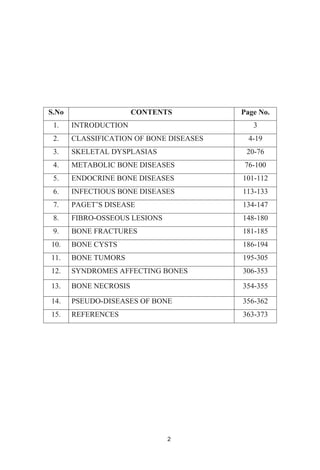
S.No CONTENTS Page No.
1. INTRODUCTION 3
2. CLASSIFICATION OF BONE DISEASES 4-19
3. SKELETAL DYSPLASIAS 20-76
4. METABOLIC BONE DISEASES 76-100
5. ENDOCRINE BONE DISEASES 101-112
6. INFECTIOUS BONE DISEASES 113-133
7. 134-147
8. FIBRO-OSSEOUS LESIONS 148-180
9. BONE FRACTURES 181-185
10. BONE CYSTS 186-194
11. BONE TUMORS 195-305
12. SYNDROMES AFFECTING BONES 306-353
13. BONE NECROSIS 354-355
14. PSEUDO-DISEASES OF BONE 356-362
15. REFERENCES 363-373
3
INTRODUCTION
Maintaining a strong and healthy skeleton is a complicated process
that requires having the right amount of bone with the right structure and
composition in the right place. Bone is a dense calcified tissue which is
specially affected by a variety of diseases that often cause it to react in a
dynamic fashion.4
Bone diseases are conditions that result in the impairment of normal
bone function and can make bones weak.Some of these diseases involve
the entire bony skeleton, while others effct only single bone. It is
characteristic for certain of these conditions to follow strict mendelian
patterns of heredity, although a specific disease will be inherited in one
case and apparently not in another.These diseases of bone, as a group, may
arise at all ages; some characteristically are congenital and present at birth,
while others develop in early childhood, young adulthood or even later in
life. In addition to conditions that affect bone directly, there are many other
disorders that indirectly affect bone by interfering with mineral
metabolism. Genetic abnormalities can produce weak, thin bones, or bones
that are too dense and also affect the size and shape of the skeleton and can
cause deformities or abnormal growth.29
The maxilla and mandible, like other bones, suffer from both the
generalized and localized forms of skeletal diseases. Although the basic
reactions are the same,the peculiar anatomic arrangement of teeth
embedded partially in bone, through which the bone may be subjected to
an unusal variety of stresses, strains and infections, often produces a
modified response of bone to the primary injury.4,2
4
CLASSIFICATION OF BONE DISEASES:
textbook of general pathology:30
I. Diseases associated with defects in Extracellular structural proteins:
Type1 collagen diseases (Osteogenesis Imperfecta )
Type 2 collagen diseases ( Achondrogenesis II,Stickler syndrome)
Type 9 collagen diseases ( Multiple epiphyseal dysplasia)
Type 10 collagen diseases (Schmid metaphyseal chondroplasia)
II.Diseases associated with defects in folding and degradation of
macromolecules:
Mucopolysaccharidoses
III. Diseases associated with defects in metabolic pathways (enzymes,
ion channels and transporters)
Osteopetrosis
IV. Diseases associated with decreased bone mass
Osteoporosis
V. Diseases caused by osteoclast dysfunction:
VI. Diseases associated with abnormal mineral homeostasis:
Rickets and Osteomalacia
Hyperparathyroidism
Renal Osteodystrophy
VII.Fractures
VIII Osteonecrosis (Avascular Necrosis)
IX. Bone infections
5
Pyogenic osteomyelitis
Tuberculous osteomyelitis
Skeletal syphilis
X Bone tumors
Benign
Chondrogenic
Osteochondroma
Chondroma
Chondroblastoma
Chondromyxoid fibroma
Osteogenic
Osteoma
Osteoid osteoma
Osteosarcoma
Unknown origin
Giant cell tumor
Histocytic origin
Fibrous histiocytoma
Fibrogenic origin
Metaphyseal fibrous defect (fibroma)
Fibrous cortical defect and nonossifying fibroma
Vascular
Hemangioma
6
Lipogenic
Lipoma
Neurogenic
Neurilemmoma
Malignant
Hematopoietic
Myeloma
Malignant lymphoma
Chondrogenic
Chondrosarcoma
Dedifferentiated chondrosarcoma
Mesenchymal chondrosarcoma
Osteogenic
Osteosarcoma
Unknown origin
Ewin
Giant cell tumor
Adamantinoma
Histiocytic origim
Malignant fibrous histiocytoma
7
Fibrogenic
Desmoplastic fibroma
Fibrosarcoma
Notochordal
Chordoma
Vascular
Hemangioendothelioma
Hemangiopericytoma
Lipogenic
Liposarcoma
2) Osteoclast diseases and dental abnormalities31
Diseases of reduced osteoclast activity
Mutation/disease Gene
defect
Osteoclast defect Tooth eruption
Recessive
osteopetrosis
TCIRG1 Normal formation,
no functional proton
pump no ruffled border
Abnormal in
human
Recessive
osteopetrosis
CLCN7 Normal formation,
no functional chloride
channel, no ruffled
border
Abnormal in
human
Recessive
osteopetrosis
CAII Normal formation,
reduced activity of CAII
enzyme
Deficient,
frequent
infections
8
Recessive
osteopetrosis
OSTM1 Unknown, disease
associated with perinatal
death
Unknown
ADO II CLCN7 Reduced activity of
chloride channel
Normal,
frequent
infections
Pycnodysostosis CTSK Osteoclast activity
reduced, intracellular
collagen fibrils
Supernumerary
teet
Diseases of increased osteoclast activity
Mutation/disease Gene defect Osteoclast defect Tooth eruption
SQSTM1 Osteoclasts
enlarged, more
nuclei, more active
Eruption normal,
loosening due to
increased jaw
remodeling
diseas
TNFRSF11B Osteoclasts
numerous
Formation
normal, reports
of early tooth
loss, cause
unknown
Early onset PDB TNFRSF11A bone similar to PDB Early tooth loss,
possibly due to
osteoclast
overactivity
Expansile TNFRSF11A Increased formation, Early tooth loss,
9
skeletal hyper-
phosphatasia
increased size likely due to
Osteoclast
overactivity
Familiar
expansile
osteolysis
TNFRSF11A Osteoclast enlarged,
more nuclei, more
active
Very early tooth
loss, due to root
resorption of
permanent teeth
ORTHOPAEDICS32
Primary bone diseases
Bone Cysts
Aneurysmal Bone Cyst
Giant Cell Tumour
Simple Bone Cysts
Bone Developmental Diseases
Basal Cell Nevus
Bone Deficiencies
Coxa Vara
Dwarfism
Dysostoses
Ectodermal Dysplasia
Femoral Anteversion
Genu Valgum
10
Gigantism
Leg Length Inequality
Marfan Syndrome
Osteochondrodysplasia
Pectus Excavatum
Bone Malalignment
Bone Resorption
Endocrine Bone Diseases
Acromegaly
Congenital Hypothyroidism
Hyperparathyroidism
Osteitis Fibrosa Cystica
Eosinophilic Granuloma
Hyperostosis
Congenital Cortical Hyperostosis
Diffuse Idiopathic Skeletal Hyperostosis
Exostosis
Hyperostosis Frontalis Interna
Sternocostoclavicular Hyperostosis
Infectious Bone Diseases
Osteitis
Osteomyelitis
Spondylitis
Tuberculosis, Osteoarticula
Metabolic Bone Diseases
11
Mucolipidoses
Osteomalacia
Osteoporosis
Pagets
Pathologic Bone Demineralization
Pseudohypoparathyroidism
Renal Osteodystrophy
Rickets
Orthopaedic Oncology
Osteitis Deformans
Osteochondritis
Osteonecrosis
Primary Hypertrophic Osteoarthropathy
Secondary Hypertrophic Osteoarthropathy
Slipped Epiphysis
Spinal Diseases
4. Skeletal dysplasias can be broadly classified into two main groups:
osteochondrodysplasias and dysostoses.33
The Osteochondrodysplasias, in which there is, generalized abnormality in
bone or cartilage. This group is subdivided into three main categories:
Defects of the growth of tubular bones and or spine
(chondrodysplasias).
Abnormalities of density or cortical diaphyseal structure and or
metaphyseal modeling.
Disorganized development of cartilage and fibrous components of
the skeleton.
12
Dysostoses: This group refers to malformations or absence of individual
bones singly or in combination. They are mostly static and their
malformations occur during blastogenesis (1st 8 weeks of embryonic life).
This is in contrast to osteochondrodysplasias, which often present after this
stage, has a more general skeletal involvement and continue to evolve as a
result of active gene involvement throughout life. The dysostoses group
can be sub-classified into three main categories:
Those primarily concerned with craniofacial involvement and
includes in various craniosynostosis.
Those with predominant axial involvement including the various
segmentation defect disorders.
Those affecting only the limbs.
5. WHO CLASSIFICATION OF BONE TUMOURS (1995)34
CARTILAGE TUMOURS
Osteochondroma 9210/0
Chondroma 9220/0
Enchondroma 9220/0
Periosteal chondroma 9221/0
Multiple chondromatosis 9220/1
Chondroblastoma 9230/0
Chondromyxoid fibroma 9241/0
Chondrosarcoma 9220/3
Central, primary, and secondary 9220/3
Peripheral 9221/3
Dedifferentiated 9243/3
Mesenchymal 9240/3
13
Clear cell 9242/3
OSTEOGENIC TUMOURS
Osteoid osteoma 9191/0
Osteoblastoma 9200/0
Osteosarcoma 9180/3
Conventional 9180/3
Chondroblastic 9181/3
Fibroblastic 9182/3
Osteoblastic 9180/3
Telangiectatic 9183/3
Small cell 9185/3
Low grade central 9187/3
Secondary 9180/3
Parosteal 9192/3
Periosteal 9193/3
High grade surface 9194/3
FIBROGENIC TUMOURS
Desmoplastic fibroma 8823/0
Fibrosarcoma 8810/3
FIBROHISTIOCYTIC TUMOURS
Benign fibrous histiocytoma 8830/0
Malignant fibrous histiocytoma 8830/3
EWING SARCOMA/PRIMITIVE
NEUROECTODERMAL TUMOUR
Ewing sarcoma 9260/3
14
HAEMATOPOIETIC TUMOURS
Plasma cell myeloma 9732/3
Malignant lymphoma, NOS 9590/3
GIANT CELL TUMOUR
Giant cell tumour 9250/1
Malignancy in giant cell tumour 9250/3
NOTOCHORDAL TUMOURS
Chordoma 9370/3
VASCULAR TUMOURS
Haemangioma 9120/0
Angiosarcoma 9120/3
SMOOTH MUSCLE TUMOURS
Leiomyoma 8890/0
Leiomyosarcoma 8890/3
LIPOGENIC TUMOURS
Lipoma 8850/0
Liposarcoma 8850/3
NEURAL TUMOURS
Neurilemmoma 9560/0
MISCELLANEOUS TUMOURS
Adamantinoma 9261/3
Metastatic malignancy
15
MISCELLANEOUS LESIONS
Aneurysmal bone cyst
Simple cyst
Fibrous dysplasia
Osteofibrous dysplasia
Langerhans cell histiocytosis 9751/1
Erdheim-Chester disease
Chest wall hamartoma
6. FIBRO-OSSEOUS LESIONS35,36,37,38,39,40
Classification by Charles.A.Waldron-1993
Fibrous Dysplasia
Reactive (dysplastic) lesions arising in the tooth-bearing area
(presumably of periodontal origin).
*periapical cemento-osseous dysplasia
*focal cemento-osseous dysplasia
*florid cemento-osseous dysplasia
Fibro-osseous neoplasms (widely designated as cementifying
fibroma, ossifying fibroma or cemento-ossifying fibroma)
Working Classification of FOLs by Miro.S.Makek-1987
I DEVELOPMENTAL DISORDER
1. Fibrous cortical defect.
2. Fibrous dysplasia.
II REACTIVE-REPARATIVE LESION
1. Traumatic periostitis.
2. Periostitis ossificans.
3. Osseous keloid.
16
4. Periapical cemental-dysplasia and florid cementoosseous
dysplasia
5. Sclerosing osteomylitis.
6. Osteitis deformans (Paget).
III FIBROMATOSIS
1. Desmoplastic fibroma.
IV NEOPLASMS
A. TOOTH BEARING AREAS
ONLY
1. Cementoblastoma.
2. Periodontoma.
a) central
b) peripheral
B. ALL CRANIO-FACIAL BONES
1. Osteoma.
a) trabecular
b) compact
2. Osteoid osteoma.
3. Psammous desmo-osteoblastoma.
4. Trabecular desmo- osteoblastoma.
Classification by WHO (1992)
Non Neoplastic Bone Lesions
2.1:Fibrous Dysplasia Of Jaws
2.2:Cemento Osseous Dysplasias
2.2.1:Periapical Cemental Dysplasia
2.2.2:Florid Cemento Osseous Dysplasia
2.2.3:Other Cemento Osseous Dysplasia
17
2.3 Cherubism
2.4.Central Giant Cell Granuloma
2.5.Aneurysmal Bone Cyst
2.6.Solitary Bone Cyst
Classification by Burket
DEPENDING ON ORIGIN
Periodontal ligament
A) Cementifying fibroma.
B) Ossifying fibroma.
C) Cementifying ossifying fibroma.
D) Fibroma.
MEDULLARY BONE.
A. Fibro osteoma.
B. Active Juvenile Ossifying fibroma.
C. Cherubism.
D. Fibrous dysplasia.
E. Giant cell tumor.
F. Aneurysmal bone cyst.
G. Hyper parathyroidism jaw lesion (Browns tumor)
H. Paget
18
Proposed classification by Slootweg PJ & Muller H based on clinical,
radiographic & histopathology.
1. Group I: Fibrous dysplasia.
2. Group II: Juvenile ossifying fibroma.
3. Group III: Ossifying fibroma.
4. Group IV: Cemento-osseous dysplasias.
1.Fibrous dysplasia.
2.Reactive/Dysplastic lesions (periodontal origin)
a. Periapical cemento-osseous dysplasia.
b. Focal cemento-osseous dysplasia.
c. Florid cemento-osseous dysplasia.
Neoplastic lesions.
a. Cementifying/Ossifying/Cemento-ossifying fibroma.
b. Juvenile/active/aggressive ossifying fibroma.
i. Trabecular.
ii. Psammomatoid.
Classification by NEVILLE-2002
Fibrous dysplasia
Cemento-osseous dysplasia
a. Periapical cemento-osseous dysplasia.
b. Focal cemento-osseous dysplasia.
c. Florid cemento-osseous dysplasia.
Ossifying fibroma.
7. BONE NECROSIS41,42
Infract
Aseptic (avascular) bone necrosis
Osteochondritis dissecans
19
Radiation necrosis
8. PSEUDO-DISEASES 41
Bone marrow defect
Osteosclerosis
Submandibular salivary gland defect
20
SKELETAL DYSPLASIA43,44
growthSkeletal dysplasias are a heterogenous group of dysplasias that
include more than 200 recognized conditions. They are disorders of growth
and remodeling of bone and cartilage. Most disorders result in short
stature, which is defined as height more than 2 standard deviations below
the mean for the population at a given age.
Achondroplasia (AP), hypochondroplasia (HP), and thanatophoric
dysplasia (TD) are among the most common skeletal dysplasias.
Epidemiology
Incidence
Achondroplasia 1/15,000-1/20,000 live births
Hypochondroplasia 1/15,000-1/40,000 live births
Thanatophoric dysplasia 1/6,500-20,000 live births
Sex equal distribution
21
Inheritance
Autosomal dominant, mostly de novo mutations in TD, with 100%
penetrance
Cause fibroblast growth factor receptor 3 (FGFR3) gene mutations
AP
99% of cases result from substitution of A or C nucleotide for
G at 1138 in the FGFR3 gene
HP
70% of cases result from substitution of A or G nucleotide for
C at 1620 in the FGFR3 gene
TD
Eleven FGFR3 mutations (6 missense and 5 read-throughs of
the native stop codon) cause 99% of TDI
A single FGFR3 mutation, K650E, is responsible for TD
Recurrence risk in offspring for phenotypically normal
parents with a previously affected pregnancy, the recurrence
risk is not increased over the general population
Classification
Superti-Furga from the International Working Group on
Constitutional Diseases of Bone classified the gene and protein
identified skeletal dysplasias based on only theirmolecular-
pathogenetics.
Gene and protein Clinical phenotype
1. Defects in structural proteins
Collagen:
COL1 Osteogenesis imperfect
22
COL2 Achondrogenesis type
II
Hypochondrogenesis
Spondyloepiphyseal dysplasia
(SED) congenita
Spondyloepimetaphyseal
dysplasia
Kniest dysplasia
Stickler syndrome I
COL9 Multiple epiphyseal dysplasia
(MED) type 2
COL10 Metaphyseal dysplasia
(Schmid type)
COL11 Stickler syndrome II
Otospondylomegaepiphyseal
dysplasia
COMP Pseudoachondroplasia
Multiple epiphyseal dysplasia
type 1
Matrillin-3 (MATN-3) Multiple epiphyseal dysplasia
type 3
Perlecan Schwartz-Jampel type-1,2
23
2. Defects in metabolic pathways:
Diastrophic dysplasia sulfate transporter (DTDST) Achondrogenesis 1B
Athelosteogenesis II
Diastrophic dysplasia
Recessive MED
Arylsulfatase E X-linked chondrodysplasia
punctata
ANKH (Pyrophosphate transporter) Craniometaphyseal dysplasia
CIC7 Severe osteopetrosis
Carboanhydrase II Osteopetrosis with renal
tubular acidosis
3. Defects in degradation of macromolecules:
Lysosomal enzymes Mucopolysaccharidoses
Mucolipidosis
Cathepsin K Pyknodysostosis
Sedlin X-linked SED tarda
.
4. Defects in growth factors and receptors
Fibroblast growth factor receptor 1, 2 Craniosynostosis
Fibroblast growth factor receptor 3 Achondroplasia
Hypochondroplasia
24
Thanatophoric
dysplasia
I,II
PTH receptor Jansen type metaphyseal dysplasia
Fibroblast growth factor receptor 23 Autosomaldominant
hypophosphatemic
rickets
PEX proteinase X linked hypophosphatemic
rickets
GNAS1 Pseudohypoparathyroidism
ROR-2 Robinow, brachydactyly type
B
5.Defects in transcription factors
SOX9 Campomelic dysplasia
GI13 Greig cephalopolysyndactyly
TRPS1 Trichorhinophalangeal
dysplasia 1-3
TWIST Saethre-Chotzen
CBFA-1 Cleidocranial dysplasia
SHOX Leri-Weill syndrome
25
Clinical Presentation
Anthropometric parameters should be compared with the gestational
age for the newborn or the chronologic age of the patient,
considering appropriate racial, ethnic, socioeconomic, and perinatal
factors. To detect disproportionately short stature, anthropometric
measurements should include the upper and lower segment ratio and
arm span.
Diagnosis of short-limb skeletal dysplasia is based on the segment of
the long bone affected most severely.
Rhizomelic shortening (short proximal segments, eg,
humerus, femur) is present in patients with achondroplasia,
hypochondroplasia, rhizomelic type of chondrodysplasia
punctata, Jansen type of metaphyseal dysplasia,
spondyloepiphyseal dysplasia (SED) congenita, thanatophoric
dysplasia, atelosteogenesis, diastrophic dysplasia, and
congenital short femur.
Mesomelic shortening (short middle segments, eg, radius,
ulna, tibia, fibula) includes the Langer and Nievergelt types of
mesomelic dysplasias, Robinow syndrome, and Reinhardt
syndrome.
Acromelic shortening (short distal segments, eg, metacarpals,
phalanges) is present in patients with acrodysostosis and
peripheral dysostosis.
26
Acromesomelic shortening (short middle and distal segments,
eg, forearms, hands) is present in patients with acromesomelic
dysplasia.
Micromelia (shortening of extremities involving entire limb)
is present in achondrogenesis, fibrochondrogenesis, Kniest
dysplasia, dys-segmental dysplasia, and Roberts syndrome.
Diagnosis of the short trunk variety includes Morquio
syndrome, Kniest syndrome, Dyggve-Melchior-Clausen
disease, metatrophic dysplasia, SED and
spondyloepimetaphyseal dysplasia (SEMD).
Mental retardation: Skeletal dysplasias associated with mental
retardation can be broadly categorized in the following terms
according to etiology or pathogenesis:
CNS developmental anomalies - Orofaciodigital
syndrome type 1 (hydrocephaly, porencephaly,
hydranencephaly, agenesis of corpus callosum) and
Rubinstein-Taybi syndrome (microcephaly, agenesis of
corpus callosum)
Intracranial pathologic processes - Craniostenosis
syndromes (pressure) and thrombocytopenia-radial
aplasia syndrome (bleeding)
Neurologic impairment - Dysosteosclerosis
(progressive cranial nerve involvement) and
mandibulofacial dysostosis (deafness)
Chromosome aberrations - Autosomal trisomies
27
Primary metabolic abnormalities - Lysosomal storage
diseases
Other disorders - Chondrodysplasia punctata, warfarin
embryopathy (teratogen), and cerebrocostomandibular
syndrome (hypoxia)
Skull
Disproportionately large head - Achondroplasia,
achondrogenesis, and thanatophoric dysplasia
Cloverleaf skull - Thanatophoric dysplasia, Apert
syndrome, Carpenter syndrome, Crouzon syndrome,
and Pfeiffer syndrome
Caput membranaceum - Hypophosphatasia and
osteogenesis imperfecta congenita
Multiple wormian bones - Cleidocranial dysplasia and
osteogenesis imperfecta
Craniosynostosis - Apert syndrome, Crouzon
syndrome, Carpenter syndrome, other craniosynostosis
syndromes, and hypophosphatasia
Eyes
Congenital cataract - Chondrodysplasia punctata
Myopia - Kniest dysplasia and SED congenita
Mouth - Bifid uvula and high arched or cleft palate, as in
Kniest dysplasia, SED congenita, diastrophic dysplasia,
metatrophic dysplasia, and camptomelic dysplasia
28
Ears - Acute swelling of the pinnae, as in diastrophic
dysplasia
Polydactyly
Preaxial - Chondroectodermal dysplasia and short-rib
polydactyly syndromes (frequently in Majewski
syndrome, rarely in Saldino-Noonan syndrome)
Postaxial - Chondroectodermal dysplasia, lethal short-
rib polydactyly syndromes, and Jeune syndrome
Hands and feet
Hitchhiker thumb - Diastrophic dysplasia
Clubfoot - Diastrophic dysplasia, Kniest dysplasia, and
osteogenesis imperfecta
Nails
Hypoplastic nails - Chondroectodermal dysplasia
Short and broad nails - McKusick metaphyseal
dysplasia
Joints - Multiple joint dislocations, as in Larsen syndrome and
otopalatodigital syndrome
Bones - Long bone fractures, as in osteogenesis imperfecta
syndromes, hypophosphatasia, osteopetrosis, and
achondrogenesis type I
Thorax
29
Long or narrow thorax - Asphyxiating thoracic
dysplasia, chondroectodermal dysplasia, and
metatrophic dysplasia
Pear-shaped chest - Thanatophoric dysplasia, short-rib
polydactyly syndromes, and homozygous
achondroplasia
Heart
Atrial septal defect or single atrium -
Chondroectodermal dysplasia
Patent ductus arteriosus - Lethal short-limbed skeletal
dysplasias
Transposition of the great vessels - Majewski syndrome
Diagnosis
First trimester ultrasound showing increased nuchal
translucency, reverse flow in ductus venosus, long-bone
shortening
Second/third trimester ultrasound examination revealing limb
shortening below 5th percentile, recognizable by 20 weeks
gestation; platyspondyly, ventriculomegaly, narrow chest cavity
with short ribs, polyhydramnios, bowed femurs (type 1),
cloverleaf skull (in type II), well-ossified spine and skull
Postnatal clinical exam
Based on clinical examination or prenatal ultrasound
Genetic testing for FGFR3 mutation panel is diagnostic when
combined with clinical examination or prenatal ultrasound
30
Treatment
Supportive
Bowing of the lower limbs may merit surgical straightening
Ultrasound of brain, especially if large fontanel, to rule out mild
hydrocephaly relating to small foramen magnum
Diagnose obstructed sleep apnea
Orthopedic neurologic evaluation of spinal stenosis and kyphosis
Be aware that short eustachian tubes may lead to frequent middle ear
infections and conductive hearing loss
Avoid obesity
CLEIDOCRANIAL DYSPLASIA29
- MARIE
(cleido = collar bone, + cranial = head, + dysplasia = abnormal forming)
,
Cleidocranial dysplasia is a condition characterized by defective
development of the cranial bones and by the complete or partial absence of
the collar bones (clavicles).
Etiology
Several chromosome abnormalities have been linked with this syndrome,
including chromosome 6p21.
Inheritance
When inherited, it appears as a dominant mendelian characteristic and may
be transmitted by either sex. In those cases which appear to have
developed sporadically, it has been suggested that they represent a
recessively inherited disease or more likely, either an incomplete
31
penetrance in a genetic trait with variable gene expression or a true new
dominant mutation.
Clinical features
The disease affects men and women in equal frequency.
Skull
Fontanels often remain open or atleast exhibit delayed closing
and for this reason tend to be rather large.
The sutures also may remain open and wormain bones are
common.
Sagittal suture is characteristically sunken, giving the skull a
flat appearance.
Frontal,parietal and occipital bones are prominent and
paranasal sinuses are underdeveloped and narrow.
Head is brachycephalic9wide and short)
Shoulder girdle
Either complete absence of clavicles or partial absence or
even thinning of one or both clavicles.
Unusal mobility of shoulders
32
Defects in the vertebral column, pelvis and long bones as well as in
the digits are also relatively more common.
Dental abnormalities
High, narrow, arched palate and actual cleft palate.
Maxilla is underdeveloped and smaller than normal in
relationto maxilla.
The lacrimal and zygomatic bones are also reported to be
underdeveloped.
33
Proloned retention of deciduous teeth and subsequent delay in
eruption of the succedaneous teeth.
The roots are often somewhat short and thinner than usual and
may be deformed.
There may be paucity or absence of cellular cementum on the
roots of the permanent teeth.
Treatment and prognosis:
Care of the oral conditions.
The retained deciduous teeth should be restored if they become
carious, since their extraction doe not necessarily induce eruption of
the permanent teeth.
Mulltidisciplinary approach utilizing the pedodontist, the
orthodontist and the oral surgeon should be followed.
34
Correct timing of surgical procedures for uncovering teeth and
orthodontic repositioning can give excellent functional results.
OSTEOGENESIS IMPERFECTA 29,39,45,46
Synonyms: BRITTLE BONE SYNDROME, ADAIR-DIGHTON
SYNDROME, VAN DER HOEVE SYNDROME, EKMAN-
LOBSTEIN SYNDROME, FRAGILITAS OSSIUM,
OSTEOPSATHYROSIS
Osteogenesis imperfecta (OI) is a group of genetic disorders that mainly
affect the bones. The term "osteogenesis imperfecta" means imperfect
bone formation.
Frequency
This condition affects an estimated 6 to 7 per 100,000 people
worldwide. Types I and IV are the most common forms of
osteogenesis imperfecta, affecting 4 to 5 per 100,000 people. Types
II and III are rarer, with an estimated incidence of 1 to 2 per 100,000
people:
No known differences based on sex exist.
Age os onset of symptoms varies depending on the type as follows:
Type I Infancy
Type II In utero
Type III Half of cases in utero, other half neonatal period
Type IV- usually in infancy
Causes:
Mutations in the COL1A1, COL1A2, CRTAP, and LEPRE1 genes
cause osteogenesis imperfecta.
35
Mutations in the COL1A1 and COL1A2 genes are responsible for
about 90 percent of all cases of osteogenesis imperfecta. These genes
provide instructions for making proteins that are used to assemble type I
collagen, which is the most abundant protein in bone, skin, and other
connective tissues that provide structure and strength to the body.
Most of the mutations that cause osteogenesis imperfecta type I
occur in the COL1A1 gene. These mutations reduce the amount of type I
collagen produced in the body, which causes bones to be brittle and
fracture easily. The mutations responsible for osteogenesis imperfecta
types II, III, and IV can occur in the COL1A1 or COL1A2 gene. These
mutations typically alter the structure of type I collagen molecules. A
defect in the structure of type I collagen weakens connective tissues,
particularly bone, resulting in the characteristic features of osteogenesis
imperfecta.
Mutations in the CRTAP and LEPRE1 genes are responsible for
rare, often severe cases of osteogenesis imperfecta. The proteins produced
from these genes work together to process collagen into its mature form.
Mutations in either gene disrupt the normal folding, assembly, and
secretion of collagen molecules. These defects weaken connective tissues,
leading to severe bone abnormalities and problems with growth.
In cases of osteogenesis imperfecta without identified mutations in
the COL1A1, COL1A2, CRTAP, or LEPRE1 gene, the cause of the
disorder is unknown. Researchers are working to identify additional genes
that are associated with this condition.
Inheritance:
Most cases of osteogenesis imperfecta have an autosomal dominant
pattern of inheritance, which means one copy of the altered gene in each
cell is sufficient to cause the condition. Many people with type I or type IV
36
osteogenesis imperfecta inherit a mutation from a parent who has the
disorder. Almost all infants with more severe forms of osteogenesis
imperfecta (type II and type III) have no history of the condition in their
family. In these infants, the condition is caused by new (sporadic)
mutations in the COL1A1 or COL1A2 gene. The disorder is not passed on
to the next generation because most affected individuals do not live long
enough to have children.
Less commonly, osteogenesis imperfecta has an autosomal recessive
pattern of inheritance. Autosomal recessive inheritance means two copies
of the gene in each cell are altered. The parents of a child with an
autosomal recessive disorder typically are not affected, but each carry one
copy of the altered gene. Some cases of osteogenesis imperfecta type III
are autosomal recessive; these cases usually result from mutations in genes
other than COL1A1 and COL1A2. Rare cases of osteogenesis imperfecta
caused by mutations in the CRTAP or LEPRE1 gene also have an
autosomal recessive pattern of inheritance.
Syndrome resembling osteogenesis imperfect
Congenital brittle bones with craniosynostosis and ocular
proptosis:
Patients develop craniosynostosis, hydrocephalus, ocular proptosis,
facial dysmorphism, and several metaphyseal fractures associated
with generalized low bone density few years after birth.
Congenital brittle bones with congenital joint contractures:
Patients are born with brittle bones, leading to multiple fractures and
joint contractures and pterygia (arthrogryposis multiplex congenita)
due to dislocation of the radial head.Wormian bones are present, and
inheritance appears to be recessive
37
The basic defect is mapped to locus 17p12 (18-cM interval), where a
bone telopeptidyl hydroxylase is located.
Osteoporosis-pseudoglioma syndrome:
Inheritance is autosomal recessive. Individuals with Osteoporosis-
pseudoglioma syndrome have mild to moderate OI with blindness
due to hyperplasia of the vitreous, corneal opacity and secondary
glaucoma. The ocular pathology may be secondary to failed
regression of the primary vitreal vasculature during fetal growth
.The genetic defect has been mapped to chromosome region 11q12-
13 The defect is specifically in the LRP5 gene that encodes for the
low-density lipoprotein receptor-related protein
Congenital brittle bones with optic atrophy, retinopathy and
severe psychomotor retardation:
Congenital brittle bones with microcephaly
Congenital brittle bones with redundant callus:
Patients with this SROI develop hyperplastic calluses in long
bones after having a fracture or orthopedic surgery involving
osteotomies. Mutations in the type I procollagen genes have not
been found in these patients. Inheritance appears to be autosomal
dominant. Their initial presentation often resembles that of OI with
bone fragility and deformity, but these patients develop hard,
painful, and warm swellings over long bones that may initially
suggest inflammation or osteosarcoma. Patients with this SROI have
white sclera and normal teeth. On radiographs, a redundant callus
38
can be observed around some fractures. The size and shape of the
callus may remain stable for many years after a rapid growth period.
Histomorphometric studies show that the bone lamella are arranged
in meshlike fashion, as opposed to the typical parallel arrangement
in patients with OI. A variant of this SROI is called aspirin-
responsible expansile bone disease.
Congenital brittle bones with mineralization defect:
This rare form of SROI is clinically indistinguishable from
moderate-to-severe OI. Diagnosis is possible only by means of bone
biopsy, in which a mineralization defect affecting the bone matrix
and sparing growth cartilage is evident. Patients have normal teeth,
and they do not have wormian bones. They have no radiologic signs
of growth-plate involvement despite the mineralization defect
evident on bone biopsy. This form of SROI shares several
characteristics with fibrogenesis imperfecta ossium, and a mild form
of this SROI may exist. The pattern of inheritance suggest gonadal
mosaicism or a somatic recessive trait. The structure of the collagen
molecule appears to be normal, and no mutations of COL1A1 and
COL1A2 genes have been found.
Congenital brittle bones with rhizomelia:
This particular form of SROI with short humerus and femora
and recessive inheritance was only described in a First Nations
community of Quebec. The severity in terms of fractures and
disability is moderate to severe. Fractures may be present at birth. In
39
linkage studies, the genetic defect has been mapped to the short arm
of chromosome 3, where no genes codify type I procollagen
Clinical presentation:
Classification b y Sillence et al (1979)
Osteogenesis imperfecta, type I
Osteogenesis imperfecta Tarda
Osteogenesis imperfect with blue sclera
Gene map locus 17q21.31-q22,7q22.1
Osteogenesis imperfect congenital: type II
Osteogenesis imperfecta congenital, neonatal lethal
Vrolik type of Osteogenesis imperfect
Gene map locus 17q21.31-q22,7q22.1
Osteogenesis imperfecta, progressively deforming, with normal
sclera: type III
Gene map locus 17q21.31-q22,7q22.1
Osteogenesis imperfect, type IV
Osteogenesis imperfect with normal sclera
Gene map locus 17q21.31-q22
40
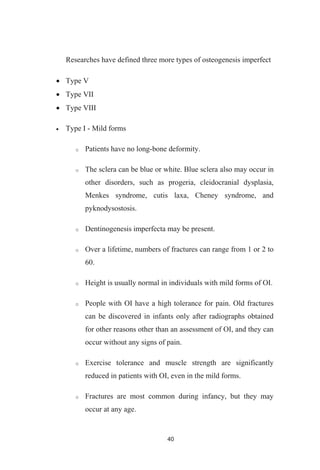
Researches have defined three more types of osteogenesis imperfect
Type V
Type VII
Type VIII
Type I - Mild forms
Patients have no long-bone deformity.
The sclera can be blue or white. Blue sclera also may occur in
other disorders, such as progeria, cleidocranial dysplasia,
Menkes syndrome, cutis laxa, Cheney syndrome, and
pyknodysostosis.
Dentinogenesis imperfecta may be present.
Over a lifetime, numbers of fractures can range from 1 or 2 to
60.
Height is usually normal in individuals with mild forms of OI.
People with OI have a high tolerance for pain. Old fractures
can be discovered in infants only after radiographs obtained
for other reasons other than an assessment of OI, and they can
occur without any signs of pain.
Exercise tolerance and muscle strength are significantly
reduced in patients with OI, even in the mild forms.
Fractures are most common during infancy, but they may
occur at any age.
41
Other possible findings include kyphoscoliosis, hearing loss,
premature arcus senilis, and easy bruising.
Type II - Extremely severe
Type II is often lethal.
Blue sclera may be present.
Patients may have a small nose and/or micrognathia.
All patients have in utero fractures, which may involved the
skull, long bones, and/or vertebrae.
The ribs are beaded, and long bones are severely deformed.
Causes of death include extreme fragility of the ribs,
pulmonary hypoplasia, and malformations or hemorrhages of
the CNS.
Type III - Severe
Patients may have joint hyperlaxity, muscle weakness,
chronic unremitting bone pain, and skull deformities (eg,
posterior flattening) due to bone fragility during infancy.
Deformities of upper limbs may compromise function and
mobility.
42
The presence of dentinogenesis imperfecta is independent of
the severity of the OI.
The sclera have variable hues.
In utero fractures are common.
Limb shortening and progressive deformities can occur.
Patients may have a triangular face with frontal bossing.
Basilar invagination is an uncommon but potentially fatal
occurrence in OI.
Vertigo is common in patients with severe OI.
The incidence of congenital malformations of the heart in
children with OI is probably similar to that of the healthy
population.
Hypercalciuria may be present in about 36% of patients with
OI, but it does not appear to affect renal function.
Respiratory complications secondary to kyphoscoliosis are
common in individuals with severe OI.
Constipation and hernias are also common in people with OI.
Type IV - Undefined
This type of OI is not clearly defined.
Whether patient have normal height or whether scleral hue
defines the type has not been established in consensus.
Dentinogenesis imperfecta may be present. Some have
suggested that this sign can be used to divide type IV OI into
subtypes a and b.
Fractures usually begin in infancy, but in utero fractures may
occur. The long bones are usually bowed.
Type V-
43
Is a mild to moderately severe autosomal dominant
osteogenesis imperfecta (OI), which does not appear to be
associated with collagen type I mutations.
There are normal coloured sclerae and ligament laxity. There
is no dentinogenesis imperfecta.
Typically patients have ossification of interosseous membrane
of the forearm with radial head dislocation, hyperplastic callus
formation and an abnormal histopathological pattern
Type VI.
This is a moderate to severe form of brittle bone disease with
accumulation of osteoid due to a mineralisation defect, in the
absence of a disturbance of mineral metabolism.
Patients with OI type VI sustain more frequent fractures than
patients with OI type IV. Fractures are first documented
between 4 and 18 months of age.
Sclerae are white or faintly blue and dentinogenesis
imperfecta is uniformly absent. All patients have vertebral
compression fractures. The underlying genetic defect is not
yet known
Type VII.
This is a moderate to severe autosomal recessive form,
characterised by fractures at birth, bluish sclerae, early
deformity of the lower extremities, coxa vara, and osteopaenia
Rhizomelia (proximal limb shortening) is a prominent
clinical feature.
The disease has been localised to chromosome 3p22-24.1,
which is outside the loci for type I collagen genes.
Diagnosis:
44
Diagnosis is made based on clinical and physical findings, accompanied by
relevant tests.
These include;
Taking a skin sample to assess the collagen production in the body.
X-rays may show thining of bones and past or current fractures.
An ultrasound may be used during pregnancy to detect limb
abnormalities at 15-18 weeks gestation. However these may not be
always accurate.
Management
Type III requires lifelong and specialised care.
Patients are of normal intelligence and prolonged admission to
hospital should not affect their education.
Multidisciplinary care including physiotherapy, rehabilitation,
bracing and splinting is good practice.
45
Intramedullary rodding and osteoclasis needs to be used very
selectively.
A specialised course of rehabilitation may be needed.
Recent advances have shown the use of growth hormone and
bisphosphonate to be beneficial
Bisphosphonate therapy is used under specialist centre guidance and
is particularly useful for pain and recurrent fractures in type 3.
(Bisphosphoantes bind to, and stabilise bone by inhibiting osteoclast
activity, whilst stimulating osteoblast activity.)
Cyclical intravenous pamidronate administration can reduce bone
pain and fracture incidence, and increase bone density and level of
mobility, with minimal side effect
Effects on bone include increase in size of vertebral bodies and
thickening of cortical bone. This also allows for better corrective
surgery, e.g. intramedullary rodding of the long bones.
However, substantial variability in individuals response to treatment
has been noted.
Research continues into use of transplanted normal stromal cells
from bone marrow.
Prevention
In families with known collagen mutations, fetal DNA analysis from
chorionic villus biopsy, in the first trimester, may be possible.
It can be difficult to give genetic advice:
In type I and type IV, there is a 50% probability of affected child,
where one parent is affected.
However, where neither parent is affected with the lethal and
progressively deforming type II and III, it may be impossible to give
46
chance of further offspring being affected, because of germline and
somatic-cell mosaicism.
However, general guidelines are, in child with type I or IV with
clinically unaffected parents, likely to be new dominant mutation
and risk of further affected offspring is probably no greater than
normal (50% of any offspring of child will be affected). Following
diagnosis of type II infant, general advice is that there is a 7%
chance of further offspring being affected.
The design of potential gene therapy is complicated by the genetic
heterogeneity of the disease and by the fact that most of the
osteogenesis imperfecta mutations are dominant negative, where the
mutant allele product interferes with the function of the normal
allele
DENTINOGENESIS IMPERFECTA (HEREDIATARY
OPALESCENT DENTIN)29,39
Dentinogenesis imperfecta represents a group of hereditary
conditions that are characterized by abnormal dentin formation. These
conditions are genetically and clinically heterogenous and can affect only
the teeth or can be associated with the condition osteogenesis imperfecta.
Frequency:
1 in 6000-8000 children
Background:
47
Among the earliest reported cases were those of Wilson and
Steinbrecher, who traced this condition through four generations of one
family. Excellent studies of the chemical, physical, histologic
roentgenographic, and clinical aspects of Dentinogenesis imperfect were
made by Finn in 1938 and br Hodge and his coworkers in 1939 and 1940.
Heys and her co-workers have described the clinical and genetic factors in
18 families affected with dentinogenesis imperfecta occurring in
association with osteogenesis imperfect.
Classification:
Shields classification;
Type I: Dentinogenesis imperfecta that always occurs in families
with osteogenesis imperfecta, although latter may occur with out
dentinogenesis imperfect. Type I segregates as an autosomal dominant
traitwith variable expressivity.but can be recessiveif the accompanying
osteogenesis imperfceta is recessive(usually the severe OI congenital type)
Type II: Dentinogenesis imperfecta that never occurs with osteogenesis
imperfceta unless by chance.This is mostly reffered as Herediatary
opalescent dentin.It is inherited as autosomal dominant trait.
isolate in Maryland.It is inherited as autosomal dominant trait.
Revised classification:
Dentinogenesis imperfect I: Dentinogenesis imperfect without
osteogenesis imperfecta(opalescent dentin).
Dentinogenesis imperfect II:Brandywine type dentinogenesis
imperfect
48
Etiology:
Mutations in the DSPP gene cause dentinogenesis imperfecta.
Mutations in the DSPP gene have been identified in people with
type II and type III dentinogenesis imperfecta. DI type II and type III are
autosomal dominant conditions that have been linked to chromosome
4q12-21, suggesting these may be allelic mutations of the DSPP gene. In
several different families the gene responsible for DI type II has been
identified as the DSPP gene that codes for the dentin sialophosphoprotein,
the most abundant noncollagenous protein in dentin Dentinogenesis
imperfecta type I occurs as part of osteogenesis imperfecta, which is
caused by mutations in one of several other genes.
The DSPP gene provides instructions for making three proteins that
are essential for normal tooth development. These proteins are involved in
the formation of dentin, which is a bone-like substance that makes up the
protective middle layer of each tooth. DSPP mutations alter the proteins
made from the gene, leading to the production of abnormally soft dentin.
Teeth with defective dentin are discolored, weak, and more likely to decay
and break
Inheritance:
This condition is inherited in an autosomal dominant pattern, which
means one copy of the altered gene in each cell is sufficient to cause the
disorder.In most cases, an affected person has one parent with the
condition.
Clinical presentation:
In all three DI types the teeth have a variable blue-gray to yellow
brown discoloration that appears opalescent due to the defective,
49
abnormally colored dentin shining through the translucent enamel. Due to
the lack of support of the poorly mineralized underlying dentin, the enamel
frequently fractures from the teeth leading to rapid wear and attrition of the
teeth. The severity of discoloration and enamel fracturing in all DI types is
highly variable even within the same family. If left untreated it is not
uncommon to see the entire DI affected dentition worn off to the gingiva.
Radiographic features:
Teeth have bulbous crowns, roots that are narrower than normal, and pulp
chambers and root canals that are smaller than normal or completely
obliterated.The pulp chambers are large in DI type III.
Histologic features:
The appearance of enamel is essentially normal except for its peculiar
shade. The dentin, on the other hand, is composed of irrgular tubules,often
with large areas of uncalcified matrix . The tubules tend to be larger in
diameter and thus less numerous than normal in a given volume of dentin
.In some areas there may be complete absence of tubules Cellular
inclusions, probably odontoblasts in the dentin are not uncommon,, the
pulp chamber is usually almost obliterated by the continued deposition of
50
dentin. . The odontoblasts have only limited ability to form well-organized
dentinal matrix, andthey appear to degenerate readily, becoming
entrapped in this matrix.
Chemical and Physical Features.
Chemical analysis explains many of the abnormal features of the
teeth of dentinogenesis imperfecta 1. Their water content is greatly
increased, as much as 60 per cent above normal, while the inorganic con-
tent is less than that of normal dentin. As might be expected, the density, x-
ray absorption, and hardness of the dentin are also low. In fact, the micro-
hardness of the dentin closely approximates that of cementum, thus
explaining the rapid attrition of affected teeth. There is no significant
information available on teeth in type III.
Treatment.
The treatment of patients with dentinogenesis imperfecta is directed
primarily toward preventing the loss of enamel and subsequent loss of
dentin through attrition. Cast metal crowns on the posterior teeth and
jacket crowns on the anterior teeth have been used with considerable
success, although care must be taken in the preparation of the teeth for
such restorations. Caution must also be exercised in the use of partial
appliances which exert stress on the teeth, because the roots are easily
fractured. Experience has further shown that fillings are not usually
permanent because of the softness of the dentin.
OSTEOPOROSIS 29.39,47,48
Osteoporosis is a disease characterized by low bone mass and
deterioration of bone structure that causes bone fragility and increases the
51
risk of fracture. There are a variety ofdifferent types of osteoporosis. The
that is, osteoporosis that is not caused by some other specific disorder.
Bone loss caused by specific diseases or medications is referred to as
secondary osteoporosis
Primary Osteoporosis
Primary osteoporosis is mainly a disease of the elderly, the result of
the cumulative impact of bone loss and deterioration of bone structure that
occurs as people age. Thisform of osteoporosis is sometimes referred to as
age-related osteoporosis. Since postmenopausal women are at greater risk,
(including children and young adults) rarely get primary osteoporosis,
although it can occur on occasion. This rare form of the disease is
exact causes of the disease are not known, or idiopathic. Since the exact
mechanisms by which aging produces bone loss are not all understood
(that is, it is not always clear why some postmenopausal women develop
osteoporosis while others do not), age-related osteoporosis is also partially
idiopathic
Idiopathic Primary Osteoporosis
There are several different forms of idiopathic osteoporosis that can
affect both children and adolescents, although these conditions are quite
rare .Juvenile osteoporosis affects previously healthy children between the
ages of 8 and 14. Over a period of several years, bone growth is impaired.
The condition may be relatively mild, causing only one or two collapsed
bones in the spine (vertebrae), or it may be severe, affecting virtually the
entire spine. The disease almost always goes into remission
52
(spontaneously) around the time of puberty with a resumption of normal
bone growth at that time. Patients with mild or moderate forms of the
disease may be left with a curvature of the spine (kyphosis) andshort
stature, but those with a more severe form of the disease may be
incapacitated for life Primary osteoporosis is quite rare in young adults. In
this age-group, the disease is usually caused by some other condition or
factor, such as anorexia nervosa or glucocorticoid use (Khosla et al. 1994).
When idiopathic forms of primary osteoporosis do occur in young adults,
they appear in men as often as they do in women (this is in contrast to age-
related primary osteoporosis, which occurs more often in women). The
characteristics of the disease can vary broadly and may involve more than
one disorder. Some young adults with idiopathic primary osteoporosis may
have a primary defect in the regulation of bone cell function, resulting in
depressed bone formation, increased bone resorption, or both Others with
a mild form of the disease may simply have failed to achieve an adequate
amount of skeletal mass during growth. In some patients, the disease runs a
mild course, even without treatment, and the clinical manifestations are
limited to asymptomatic spinal compression fractures. More typically,
however, multiple spine fractures occur over a 5 10 year period leading to
a height loss of up to 6 inches.
Age-Related Osteoporosis
Age-related osteoporosis is by far the most common form of the
disease There are many different causes of the ailment, but the bone loss
that leads to the disease typically begins relatively early in life, at a time
when corrective action (such as changes in diet and physical activity) could
potentially slow down its course. While it occurs in both sexes, the disease
is two to three times more common in women This is partly due to the fact
53
that women have two phases of age-related bone loss a rapid phase that
begins at menopause and far the most common form of the disease There
are many different causes of the ailment, but the bone loss that leads to the
disease typically begins relatively early in life, at a time when corrective
action (such as changes in diet and physical activity) could potentially slow
down its course. While it occurs in both sexes, the disease is two to three
times more common in women. This is partly due to the fact that women
have two phases of age-related bone loss a rapid phase that begins at
menopause and lasts 4 8 years, followed by a slower continuous phase that
lasts throughout the rest of life . By contrast, men go through only the
slow, continuous phase. As a result, women typically lose more bone than
do men. The rapid phase of bone loss alone in women results in losses of
5 10 percent of cortical bone (which makes up the hard outer shell of the
skeleton) and 20 30 percent of trabecular bone (which fills the ends of the
limb bones and the vertebral bodies in the spine, the sites of most
osteoporotic fractures). The slow phase of bone loss results in losses of 20
25 percent of cortical and trabecular bone in both men and women, but
over a longer period of time. Although other factors such as genetics and
nutrition contribute, both the rapid phase of bone loss in postmenopausal
women and the slow phase of bone loss in aging women and men appear to
be largely the result of estrogen deficiency. For women, the rapid phase of
bone loss is initiated by a dramatic decline in estrogen production by the
ovaries at menopause. The loss of estrogen action on estrogen receptors in
bone results in large increases in bone resorption combined with reduced
bone formation. The end result is thinning of the cortical outer shell of
bone and damage to the trabecular bone structure. There may be some
countervailing forces on this process, as the outside diameter of the bone
can increase with age, thus helping to maintain bone strength. By contrast,
54
the slower phase of bone loss is thought to be caused by a combination of
factors including age-related impairment of bone formation, decreased
calcium and vitamin D intake, decreased physical activity, and the loss of
e
kidney as well as its effects on bone . This leads to further impairment of
absorption of calcium by the intestine and reduced ability of the kidney to
conserve calcium. If the amount of calcium absorbed from the diet is
insufficient to make up for the obligatory calcium losses in the stool and
urine, serum calcium begins to fall. Parathyroid hormone levels will then
increase, removing calcium from bone to make up for the loss. The net
result of this process is an increase in bone resorption. It is important to
realize that these mineral losses need not be great to result in osteoporosis.
A negative balance of only 50 100 mg of calcium per day over a long
period of time is sufficient to produce the disease. For aging men, sex
steroid deficiency also appears to be a major factor in age-related
osteoporosis. Although testosterone is the major sex steroid in men, some
of it is converted by the aromatase enzyme into estrogen. In men, however,
the deficiency is mainly due to an increase in sex hormone binding
globulin, a substance that holds both testosterone and estrogen in a form
that is not available for use by the body. Between 30 50 percent of elderly
men are deficient in biologically active sex steroids . In fact, except for the
lack of the early postmenopausal phase, the process of bone loss in older
men is similar to that for older women. As with women, the loss of sex
steroid activity in men has an effect on calcium absorption and
conservation, leading to progressive secondary increases in parathyroid
hormone levels. As in older women, the resulting imbalance between bone
resorption and formation results in slow bone loss that continues over life.
Sinc testosterone may stimulate bone formation more than estrogen does,
55
however, decreased bone formation plays a relatively greater role in the
bone loss experienced by elderly men.
Secondary Osteoporosis
Young adults and even older individuals who get osteoporosis often
do so as a byproduct of another condition or medication use. In fact, there
are a wide variety of diseases along with certain medications and toxic
agents that can cause or contribute to the development of osteoporosis.
causes are said to
bone loss than would be expected for a normal individual of the same age,
gender, and race. Secondary causes of the disease are common in many
premenopausal women and men with osteoporosis in fact, by some
estimates the majority of men with osteoporosis exhibit secondary causes
of the disease. In addition up to a third of postmenopausal women with
56
osteoporosis also have other conditions that may contribute to their bone
loss. This section briefly describes some of the more common diseases,
disorders, and medications that can cause or contribute to the development
of osteoporosis
Diseases and Disorders That Can Cause Osteoporosis
Several genetic diseases have been linked to secondary osteoporosis.
Idiopathic hypercalciuria and cystic fibrosis are the most common. Patients
with cystic fibrosis have markedly decreased bone density and increased
fracture rates due to a variety of factors, including calcium and vitamin D
malabsorption, reduced sex steroid production and delayed puberty, and
increased inflammatory cytokines .Some patients with idiopathic
hypercalciuria have a renal defect in the ability of the kidney to conserve
calcium. This condition may be aggravated if they are advised to lower
their dietary calcium intake to prevent kidney stones. Several studies have
documented low bone density in these individuals, and they may respond
to drugs that decrease calcium excretion in the urine. Other genetic
disorders although rare, should be considered in patients with osteoporosis
after more common causes have been excluded. Estrogen or testosterone
syndrome, anorexia nervosa, athletic amenorrhea, cancer, or any chronic
illness that interferes with the onset of puberty) leads to low peak bone
mass . Estrogen deficiency that develops after peak bone mass is achieved
but before normal menopause (due to premature ovarian failure for
example) is associated with rapid bone loss. Low sex steroid levels may
also be responsible for reduced bone density in patients with androgen
insensitivity or acromegaly. By contrast, excess thyroid hormone
(thyrotoxicosis), whether spontaneous or caused by overtreatment with
57
thyroid hormone, may be associated with substantial bone loss; while bone
turnover is increased in these patients, bone resorption is increased more
than bone formation. Likewise, excess production of glucocorticoids
drome)
can lead to rapidly progressive and severe osteoporosis, as can treatment
with glucocorticoids The relationship between diabetes and osteoporosis is
more controversial .
In general, patients with type 1 (insulin-dependent) diabetes,
particularly those with poor control of their blood sugar are at greater risk
of osteoporosis than are those with type 2 (non-insulin dependent)
diabetes. Primary hyperparathyroidism is a relatively common condition in
older individuals, especially postmenopausal women, that is caused by
excessive secretion of parathyroid hormone. Most often, the cause is a
benign tumor (adenoma) in one or more parathyroid glands; very rarely
(less than 0.5 percent of the time) the cause is parathyroid cancer .
Diseases that reduce intestinal absorption of calcium and
phosphorus, or impair the availability of vitamin D, can also cause bone
disease. Moderate malabsorption results in osteoporosis, but severe
malabsorption may cause osteomalacia .Celiac disease, due to
inflammation of the small intestine by ingestion of gluten, is an important
and commonly overlooked cause of secondary osteoporosis. Likewise,
osteoporosis and fractures have been found in patients following surgery to
remove part of the stomach (gastrectomy), especially in women. Bone loss
is seen after gastric bypass surgery even in morbidly obese women who do
not have low bone mass initially. Increased osteoporosis and fractures are
Glucocorticoids, commonly used to treat both disorders, probably
contribute to the bone loss.Similarly, diseases that impair liver function
58
(primary biliary cirrhosis, chronic active hepatitis, cirrhosis due to hepatitis
B and C, and alcoholic cirrhosis) may result in disturbances in vitamin D
metabolism and may also cause bone loss by other mechanisms. Primary
biliary cirrhosis is associated with particularly severe osteoporosis.
Fractures are more frequent in patients with alcoholic cirrhosis than any
other types of liver disease, although this may be related to the increased
risk of falling among heavy drinkers Human immunodeficiency virus
(HIV) infected patients also have a higher prevalence of osteopenia or
osteoporosis. This may involve multiple endocrine, nutritional, and
metabolic factors and may also be affected by the antiviral therapy that
HIV patients receive. Autoimmune and allergic disorders are associated
with bone loss and increased fracture risk. This is due not only to the effect
of immobilization and the damage to bone by the products of inflammation
from the disorders themselves, but also from the glucocorticoids that are
used to treat these conditions. Rheumatic diseases like lupus and
rheumatoid arthritis have both been associated with lower bone mass and
an increased risk of fractures. Many neurologic disorders are associated
with impaired bone health and an increased risk of fracture. This may be
due in part to the effects of these disorders on mobility and balance or to
the effects of drugs used in treating these disorders on bone and mineral
metabolism. Unfortunately, however, health care providers often fail to
assess the bone health of patients who have these disorders or to provide
appropriate preventive and therapeutic measures. There are many disabling
conditions that can lead to bone loss, and thus it is important to pay
attention to bone health in patients with ndevelopmental disabilities, such
as cerebral palsy, as well as diseases affecting nerve and muscle, such as
poliomyelitis and multiple sclerosis. Children and adolescents with these
disorders are unlikely to achieve optimal peak bone mass, due both to an
59
increase in bone resorption and a decrease in bone formation. In some
cases very rapid bone loss can produce a large enough increase in blood
calcium levels to produce symptoms . Fractures are common in these
individuals not only because of bone loss, but also because of muscular
weakness and neurologic impairment that increases the likelihood of falls.
Bone loss can be slowed but not completelyprevented by antiresorptive
therapy. Epilepsy is another neurologic disorder that increases the risk of
bone disease, primarily because of the adverse effects of anti-epileptic
drugs. Many of the drugs used in epilepsy can impair vitamin D
metabolism, probably by acting on the liver enzyme which converts
vitamin D to 25 hydroxy vitamin D. In addition, there may be a direct
effect of these agentson bone cells. Due to the negative bone-health effects
of drugs, most epilepsy patients are at riskof developing osteoporosis. In
those who have low vitamin D intakes, intestinal malabsorption, or low
sun exposure, the additional effect of antiepileptic drugs can lead to
osteomalacia. Supplemental vitamin D may be effective in slowing bone
loss, although patients who develop osteoporosis may require additional
therapy such as bisphosphonates. Psychiatric disorders can also have a
negative impact on bone health. While anorexia nervosa is the psychiatric
disorder that is most regularly associated with osteoporosis, major
depression, a much more common disorder, is also associated with low
bone mass and an increased risk of fracture. One factor that may cause
bone loss in severely depressed individuals is increased production of
cortisol, the adrenal stress hormone. While the response of individuals with
major depression to calcium, vitamin D, or antiresorptive therapy has not
been specifically documented, it would seem reasonable toprovide these
preventive measures to patients at high risk. Finally, several diseases that
are associated with osteoporosis are not easily categorized. Aseptic
60
necrosis (also called osteonecrosis or avascular necrosis) is a well-known
skeletal disorder that may be a complication of injury, treatment with
glucocorticoids, or alcohol abuse .This condition commonly affects the
ends of the femur and the humerus. The precise cause is unknown, but at
least two theories have been suggested. One is that blood supply to the
bone is blocked by collapsing bone. The other is that microscopic fat
particles block blood flow and result in bone cell death. Chronic
obstructive pulmonary disease (emphysema and chronic bronchitis) is also
now recognized as being associated with osteoporosis and fractures even in
the absence of glucocorticoid therapy. Immobilization is clearly associated
with rapid bone loss; patients with spinal cord lesions are at particularly
high risk for fragility fractures. However, even modest reductions in
physical activity can lead to bone loss .Hematological disorders,
particularly malignancies, are commonly associated with osteoporosis and
fractures as well.
Medications and Therapies That Can Cause Osteoporosis
Osteoporosis can also be a side effect of particular medical therapies.
Glucocorticoid-Induced Osteoporosis (GIO).
GIO is by far the most common form of osteoporosis produced by drug
treatment. While it has been known for many years that excessive
production of the adrenal hormone cortisol can cause thinning of the bone
uncommon. With the increased use of prednisone and other drugs that act
like cortisol for the treatment of many inflammatory and autoimmune
diseases, this form of bone loss has become a major clinical concern. The
concern is greatest for those diseases in which the inflammation itself and/
or the immobilization caused by the illness also caused increased bone loss
61
and fracture risk. Glucocorticoids, which are used to treat a wide variety of
inflammatory conditions (e.g.,rheumatoid arthritis, asthma, emphysema,
chronic lung disease), can cause profound reductions in bone formation
and may, to a lesser extent, increase bone resorption leading to loss of
trabecular bone at the spine and hip, especially in postmenopausal women
and older men. The most rapid bone loss occurs early in the course of
treatment, and even small doses (equivalent to 2.5 7.5 mg prednisone per
day) are associated with an increase in fractures. The risk of fractures
increases rapidly in patients treated with glucocortocoids, even before
much bone has been lost. This rapid increase in fracture risk is attributed to
damage to the bone cells, which results in less healthy bone tissue. To
avoid this problem, health care providers are urged to use the lowest
possible dose of glucocorticoids for as short a time as possible. For some
diseases, providers should also consider giving glucocorticoids locally
(e.g., asthma patients can inhale them), which results in much less damage
to the bone.
Other Medications That Can Cause Osteoporosis.
Cyclosporine A and tacrolimus are widely used in conjunction with
glucocorticoids to prevent rejection after organ transplantation, and high
doses of these drugs are associated with a particularly severe form of
osteoporosis. Bone disease has also been reported with several frequently
prescribed anticonvulsants, including diphenylhydantoin, phenobarbital,
sodium valproate, and carbamazepine. Patients who are most at risk of
developing this type of bone disease include those on long-term therapy,
high medication doses, multiple anticonvulsants, and/or simultaneous
therapy with medications that raise liver enzyme levels. Low vitamin D
intake, restricted sun exposure, and the presence of other chronic illnesses
62
increase the risk, particularly among elderly and institutionalized
individuals. In contrast, high intakes of vitamin A (retinal) may increase
fracture risk. Methotrexate, a folate antagonist used to treat malignancies
and (in lower doses) inflammatory diseases such as rheumatoid arthritis,
may also cause bone loss, although research findings are not consistent. In
addition, gonadotropin-releasing hormone (GnRH) agonists, which are
used to treat endometriosis in women and prostate cancer in men, reduce
both estrogen and testosterone levels, which may cause significant, bone
loss and fragility fractures.
Diagnosis
Diagnosis of osteoporosis is made by three methods:
Radiographic measurement of bone density
Laboratory biochemical markers
Bone biopsy with pathologic assessment
Of these three the best is radiographic bone density measurement. A
variety of techniques are available, including single-photon
absorptiometry, dual-photon absorptiometry, quantitative computed
tomography, dual x-ray absorptiometry, and ultrasonography. Most often,
site specific measurements are performed. The most common sites
analyzed are those with greatest risk for fracture: hip, wrist, and vertebrae.
The forearm and heel that are easily measured using single-photon
absorptiometry, quantitative computed tomography, and ultrasonography
can be inexpensive, but these sites are typically unresponsive to therapy
and give less information about response to therapy. Increased risk for
fracture correlates with decreasing bone density. Serial measurements over
time can also give an indication of the rate of bone loss and prognosis.
63
The two main biochemical markers for bone formation are serum
alkaline phosphatase and serum osteocalcin. Markers for bone resorption
include urinary calcium and urinary hydroxyproline:
Alkaline phosphatase, which reflects osteoclast activity in bone, is
measured in serum, but it lacks sensitivity and specificity for
osteoporosis, because it can be elevated or decreased with many
diseases. It is increased with aging. Fractionating alkaline
phosphatase for the fraction more specific to bone doesn't increase
usefulness that much.
Osteocalcin, also known as bone gamma-carboxyglutamate. It is
synthesized by osteoblasts and incorporated into the extracellular
matrix of bone, but a small amount is released into the circulation,
where it can be measured in serum. The levels of circulating
osteocalcin correlate with bone mineralization, but are influenced by
age, sex, and seasonal variation. Laboratory methods also vary.
Urinary calcium can give some estimate of resorbtion (loss of) bone,
but there are many variables that affect this measurement. Thus, it is more
specific for osteoporosis when measured following overnight fasting.
Urinary hydroxyproline is derived from degradation of collagen, which
forms extracellular bone matrix. However, hydroxyproline measurement is
not specific for bone, because half of the body's collagen is outside the
bony skeleton. It is also influenced by many diseases, as well as diet.
Bone biopsy is not often utilized for assessment of bone density. This
test has limited availability, and is best utilized as a research technique for
analysis of treatment regimens for bone diseases. The best clinical use of
bone biopsy combines double tetracycline labelling to determine
64
appositional bone growth and rule out osteomalacia. Doses of tetracycline
are given weeks apart, and the bone biopsy is embedded in a plastic
compound, sliced thinly, and examined under fluorescent light, where the
lines of tetracycline (which autofluoresce) will appear and appositional
growth assessed.
Consequences of Osteoporosis
Osteoporotic bone is histologically normal in its composition--there is
just less bone. This results in weakened bones that are more prone to
fractures with trauma, even minor trauma. The areas most affected are:
Hip (femoral head and neck)
Wrist
Vertebrae
Hip fractures that occur, even with minor falls, can be disabling and
confine an elderly person to a wheelchair. It is also possible to surgically
put in a prosthetic hip joint. Wrist fractures are common with falls forward
with arms extended to break the fall, but the wrist bones break too.
Vertebral fractures are of the compressed variety and may be more subtle.
Vertebral fractures may result in back pain. Another consequence is
shortening or kyphosis (bending over) of the spine. This can lead to the
appearance of a "hunched over" appearance that, if severe enough, can
even compromise respiratory function because the thorax is reduced in
size. Persons suffering fractures are at greater risk for death, not directly
from the fracture, but from the complications that come from
hospitalization with immobilization, such as pulmonary thromboembolism
and pneumonia. Men start out with a greater bone mass to begin with, so
they have a greater reserve against loss. The best long-term approach to
65
osteoporosis is prevention. If children and young adults, particularly
women, have a good diet (with enough calcium and vitamin D) and get
plenty of exercise, then they will build up and maintain bone mass. This
will provide a good reserve against bone loss later in life. Exercise places
stress on bones that builds up bone mass, particularly skeletal loading from
muscle contraction with weight training exercises. However, any exercise
of any type is better than none at all, and exercise also provides benefits for
prevention of cardiovascular diseases that are more common in the elderly.
Athletes tend to have greater bone mass than non-athletes. Exercise in later
life will help to retard the rate of bone loss.
Treatment
Persons with osteoporosis may benefit from an improved diet,
including supplementation with vitamin D and calcium, and moderate
exercise to help slow further bone loss.
Most drug therapies work by decreasing bone resorbtion. At any
given time, there is bone that has been resorbed but not replaced, and this
accounts for about 5 to 10% of bone mass. By decreasing resorbtion of
bone, a gain in bone density of 5 to 10% is possible, taking about 2 to 3
years. However, no drug therapy will restore bone mass to normal. Women
past menopause with accelerated bone loss may benefit from hormonal
therapy using estrogen with progesterone. The estrogen retards bone
resorption and thus diminishes bone loss. This effect is most prominent in
the first years after menopause.
One of the more common non-estrogen therapies is the use of
alendronate, a biphosphonate that acts an an inhibitor of osteoclastic
activity. Alendronate may be beneficial, particularly in women who cannot
66
tolerate estrogen therapy. Alendronate is effective in inhibiting bone loss
after menopause.
Raloxifene is a selective estrogen receptor modulator that may also
replace estrogen therapy. Raloxifene can act in concert with estrogen in
bone to inhibit resorbtion and decrease the risk for fractures. Though
raloxifene inhibits bone resorbtion, it does not have an anabolic effect.
Additional potential benefits from raloxifene therapy include decreased
risk for breast cancer, because raloxifene acts antagonistically to estrogen
on the uterus. Conversely, raloxifene acts in concert with estrogen to
protect against and reduce atherogenesis.
Other drug therapies are less commonly employed. Calcitonin, a
hormone that decreases bone resorbtion, may be taken by injection or by
nasal spray. Sodium fluoride can increase the measured bone density in
vertebra, but seems to have no overall effectiveness in reducing vertebral
fracture. Fluoride helps reduce tooth decay.
OSTEOPETROSIS (MARBLE BONE DISEASE,
OSTEOSCLEROSIS) 29,39,49,50
A Osteopetrosis is a clinical syndrome characterized by the failure
of osteoclasts to resorb bone. As a consequence, bone modeling and
remodeling are impaired. The defect in bone turnover characteristically
results in skeletal fragility despite increased bone mass, and it may also
cause hematopoietic insufficiency, disturbed tooth eruption, nerve
entrapment syndromes, and growth impairment. Human osteopetrosis is a
heterogeneous disorder encompassing different molecular lesions and a
range of clinical features. However, all forms share a single pathogenic
67
nexus in the osteoclast. German radiologist, Albers-Schönberg, first
described osteopetrosis in 1904.
Frequency:
The condition is quite rare; incidences have been reported at 1 in
20,000-500,000 for the dominant form and 1 in 200,000 for the
recessive form.
Three variants of the disease are diagnosed in infancy, childhood
(intermediate), or adulthood.
Etiology:
The primary underlying defect in all types of osteopetrosis is failure of
the osteoclasts to reabsorb bone. A number of heterogeneous molecular or
genetic defects can result in impaired osteoclastic function. The exact
molecular defects or sites of these mutations largely are unknown. The
defect might lie in the osteoclast lineage itself or in the mesenchymal cells
that form and maintain the microenvironment required for proper
osteoclast function. The following is a review of some of the evidence
suggesting disease etiology and heterogeneity of these causes:
The specific genetic defect in humans is known only in osteopetrosis
caused by carbonic anhydrase II deficiency.
Infantile osteopetrosis seems to be transmitted as an autosomal
recessive manner based on its inheritance pattern.
Viruslike inclusions have been reported in osteoclasts of some
patients with benign osteopetrosis, but the clinical significance
remains uncertain.
68
Absence of biologically active colony-stimulating factor (CSF-1)
due to a mutation in its coding gene causes impairment of
osteoclastic function in the osteopetrotic (Op/Op) mouse. Altered
CSF-1 production also has been shown in toothless (tl) osteopetrotic
rats. Knockout mice of some proto-oncogenes have been shown to
have osteopetrosis.
Clinical Classification of Human Osteopetrosis
Characteristic Adult onset Infantile Intermediate
Inheritance Autosomal
dominant
Autosomal
recessive
Autosomal
recessive
Bone marrow
failure
None Severe None
Prognosis Good Poor Poor
Diagnosis Often dignosed
incidentally
Usually diagnosed
before age 1 y
Not applicable
69
CLINICAL
Infantile osteopetrosis (also called malignant osteopetrosis) is
diagnosed early in life. Its clinical manifestations are described
below.
Failure to thrive and growth retardation are symptoms.
Bony defects occur. Nasal stuffiness due to mastoid and
paranasal sinus malformation is often the presenting feature of
infantile osteopetrosis. Neuropathies related to cranial nerve
entrapment occur due to failure of the foramina in the skull to
widen completely. Manifestations include deafness, proptosis,
and hydrocephalus. Dentition might be delayed. Osteomyelitis
of the mandible is common due to an abnormal blood supply.
Bones are fragile and can fracture easily.
Defective osseous tissue tends to replace bone marrow, which
can cause bone marrow failure with resultant pancytopenia.
Patients might have anemia, easy bruising and bleeding (due
to thrombocytopenia), and recurrent infections (due to
inherent defects in the immune system). Extramedullary
hematopoiesis might occur with resultant
hepatosplenomegaly, hypersplenism, and hemolysis.
Other manifestations include sleep apnea and blindness due to
retinal degeneration.
Adult osteopetrosis (also called benign osteopetrosis) is diagnosed in
late adolescence or adulthood.
Two distinct types have been described, type I and type II, on
the basis of radiographic, biochemical, and clinical features.
70
Types of Adult Osteopetrosis
Characteristic Type I Type II
Skull sclerosis
Marked sclerosis
mainly of the vault
Sclerosis mainly of
the base
Spine
Does not show much
sclerosis
Shows the rugger-
jersey appearance
Pelvis No endobones
Shows endobones in
the pelvis
Transverse banding of
metaphysic
Absent
May or may not be
present
Risk of fracture Low High
Serum acid phosphatase Normal Very high
Recent work has demonstrated that the clinical syndrome of adult
type I osteopetrosis is not true osteopetrosis, but rather, increased
bone mass due to activating mutations of LRP5. These mutations
cause increased bone mass but no associated defect of osteoclast
function. Instead, some have hypothesized that the set point of bone
responsiveness to mechanical loading is altered, resulting in an
altered balance between bone resorption and deposition in response
to weight bearing and muscle contraction.
Some cases of type II osteopetrosis result from mutations of CLCN7,
the type 7 chloride channel. However, in other families with the
71
clinical syndrome of type II adult osteopetrosis, linkage to other
distinct genomic regions have been demonstrated. Therefore, the
clinical syndrome is genetically heterogeneous.
Approximately one half of patients are asymptomatic, and the
diagnosis is made incidentally, often in late adolescence because
radiologic abnormalities start appearing only in childhood. In other
patients, the diagnosis is based on family history. Still other patients
might present with osteomyelitis or fractures.
Many patients have bone pains. Bony defects are common and
include neuropathies due to cranial nerve entrapment (eg, with
deafness, with facial palsy), carpal tunnel syndrome, and
osteoarthritis. Bones are fragile and might fracture easily.
Approximately 40% of patients have recurrent fractures.
Osteomyelitis of the mandible occurs in 10% of patients.
Bone marrow function is not compromised.
Other manifestations include visual impairment due to retinal
degeneration and psychomotor retardation.
Physical findings are related to bony defects and include short
stature, frontal bossing, a large head, nystagmus,
hepatosplenomegaly, and genu valgum in infantile osteopetrosis.
Investigations
Diagnosis is made by x-rays which are usually diagnostic. CT scans
may occasionally be required and the use of MRI tends to be limited to
imaging of the marrow in the severe recessive disease, which is usually
fatal without marrow transplantation.
72
Generalized osteosclerosis; bones may be uniformly sclerotic, but
alternating sclerotic and lucent bands may be noted in iliac wings
and near ends of long bones.
Bones may be club-like or appear like a bone within bone.
The entire skull is thickened and dense, especially at the base.
Sinuses are small.
Vertebrae are very radiodense and may show alternating bands
(rugger-jersey sign).
There may be evidence of fractures or osteomyelitis.
Severe osteopetrosis
Characteristic changes (Erlenmeyer-Flask deformity of the
metaphyses) on X-ray.
Plasma calcium reduced, acid phosphatase raised, calcitriol
raised.
Mild osteopetrosis
X-ray show generalised increase in bone density and clubbing
of metaphyses.
In vertebral bodies, alternating lucent and dense bands cause a
sandwich-like appearance.
Associated Diseases
Deficiency of carbonic anhydrase can cause petrosis associated with
renal tubular acidosis, cerebral calcification, growth failure and mental
retardation.
Management
Vitamin D appears to help by stimulating dormant osteoclasts and
therefore stimulate bone resorption. Large doses of calcitriol, along
73
with restricted calcium intake, sometimes improve osteopetrosis
dramatically but it usually produces only modest clinical
improvement, which is not sustained after therapy is discontinued.
Gamma interferon has produced long-term benefits. It improves
white blood cell function and so decreases infections. Trabecular
bone volume substantially decreases, and bone-marrow volume
increases. This leads to an increase in haemoglobin, platelet counts
and survival rates. Combination therapy with calcitriol is superior to
calcitriol alone.
Erythropoietin can be used to correct anemia.
Corticosteroids have been used to stimulate bone resorption and
treat anemia but may be used for months or years and are not the
preferred treatment option.
Bone marrow transplant improves some cases of infantile
osteopetrosis. It can cure both bone marrow failure and metabolic
abnormalities in patients whose disease arises from an intrinsic
defect of the osteoclast lineage. Bone marrow transplant is the only
curative treatment but it may be limited to those patients whose
defects are extrinsic to the osteoclast lineage and whose condition is
unlikely to respond.
Surgery:
In infantile osteopetrosis, surgical treatment is sometimes
necessary because of fractures.
In adult osteopetrosis, surgical treatment may be needed for
aesthetic reasons (eg, in patients with notable facial
deformity), functional reasons (eg, in patients with multiple
fractures, deformity, and loss of function) or for severe related
degenerative joint disease.
74
Adult osteopetrosis requires no treatment by itself, though complications
of the disease might require intervention. No specific medical treatment
exists for the adult type.
Complications
Bone marrow failure, with severe anaemia bleeding and infections.
Growth retardation and failure to thrive.
Hereditary Multiple Exotosis (Osteochondromatosis) 32,41
This is an hereditary developmental disorder of the skeleton in
which multiple cartilage-capped bony outgrowths
(exostoses/osteochondromas) protrude from the bone cortex in the
metaphyseal region of bones Preformed in cartilage, such as the long bones
of the extremities particularly in the region of the knee, ankle, or shoulder
The exostoses tend to have a bilateral and symmetrical distribution. The
scapulae, ribs, inominate bones, vertebrae, and metacarpal and metatarsal
bones may also be involved. Although not common, hereditary multiple
exostosis is the most frequently seen systemic disorder of skeletal
development. It is apparently inherited as an autosomal dominant, but there
is an unexplained 3:1 preponderance of affected males compared to
females. The precise origin of the cartilage-capped lesions is uncertain.
The usual explanation is that the exostoses arise from foci of
misplaced or misdirected epiphyseal cartilage which grows outwardly
rather than longitudinally, abetted by a lack of normal restraint from the
covering perichondrium. The exostoses grow by endochondral ossification
75
of the cartilage cap, and growth of the exostoses ceases at or prior to the
skeletal maturation of the individual.
Pathology
Pathologically and radiographically, the exostoses are seen as sessile
or stalked bony protuberances, with various shapes (knobby,
hemispherical, conical) and sizes (1-10 cm. in diameter), protruding from
the metaphyseal region of the involved bones The exostoses of long bones
characteristically point away from the joint because the epiphyseal site of
origin of the exostoses lags behind the advancing epiphyseal growth plate
as the long bones increase in length. Grossly, the exostoses are covered
with periosteum and capped with a thin layer of cartilage In some (3-5%)
cases of hereditary multiple exostosis, the cartilage cap or remnants of it
undergoes malignant transformation to a sarcoma, most often a peripheral
chondrosarcoma. Malignant transformation is less often seen in solitary
exostosis which, although microscopically similar and much more
common than multiple exostosis, does not have an hereditary basis and is
not a systemic disorder of skeletal development.
76
METABOLIC BONE DISEASES29 ,32,39,51,52
Mature bone consists of: an organic matrix (osteoid) composed
mainly of type 1 collagen formed by osteoblasts; a mineral phase which
contains the bulk of the body's reserve of calcium and phosphorus in
crystalline form (hydroxyapatite) and deposited in close relation to the
collagen fibers; bone cells; and a blood supply with sufficient levels of
calcium and phosphate to mineralize the osteoid matrix. Bone turnover and
remodeling occurs throughout life and involves the two coupled processes
of bone formation by osteoblasts and bone resorption by osteoclasts and
perhaps osteolytic osteocytes. The metabolic bone diseases may reflect
disturbances in the organic matrix, the mineral phase, the cellular
processes of remodeling, and the endocrine, nutritional, and other factors
which regulate skeletal and mineral homeostasis These disorders may be
hereditary or acquired and usually affect the entire bony skeleton The
acquired metabolic bone diseases are the more common and include:
osteoporosis, osteomalacia, the skeletal changes of hyperparathyroidism
and chronic renal failure (renal osteodystrophy), and osteitis deformans
(Paget's disease of bone). The diagnosis of metabolic bone diseases
requires a careful history and physical examination, specific radiographic
examination, and appropriate laboratory tests. Bone biopsy may be
indicated in some cases. The ilium is the standard biopsy site for the
evaluation of metabolic bone diseases. The preparation of undecalcified
bone sections permits a distinction to be made between osteoid and
mineralized bone and thus the histological identification of disorders of
bone mineralization.
77
Rickets and Osteomalacia
The diseases resulting from vitamin D deficiency are rickets in
infants and growing children and osteomalacia in adult life.The bone
changes in both conditions are characterized by inadequate mineralization,
resulting in a deficient amount of the mineral phase of bone and an excess
of unmineralized osteoid. The osteoid excess is caused by a failure of the
process of mineralization to keep up with the new formation of osteoid
during bone formation and remodeling. In rickets, which mainly affects
children between the ages of 6-30 months, inadequate mineralization
occurs not only in bone but also in epiphysial cartilage at sites of
endochondral ossification, resulting in growth disturbances, skeletal
deformities, and susceptibility to fractures. Presenting symptoms of
osteomalacia ("softness of bone") include diffuse skeletal pain, bone
tenderness, and muscular weakness.
Types;
Nutritional rickets
There is a disturbed calcium-phosphorus metabolism due to
defective nutrition and calcium absorption, such as occurs in malnutrition,
coeliac disease and various familial genetic defects.
Coeliac or gluten induced rickets
This is a digestive disorder leading to malabsorption of both fat and
vitamin D. The disease starts in early childhood and the stools show
excessive amounts of fat. Diagnosis is confirmed by jejunal biopsy and the
serum calcium levels. Sometimes the phosphate levels are low
Etiology and Pathogenesis
Rickets and osteomalacia may be caused by: a deficiency or
abnormal metabolism of vitamin D; a deficiency or abnormal
78
utilization/excretion of inorganic phosphate (Pi). A deficiency of vitamin
D may be due to:a dietary lack of the vitamin; insufficient ultraviolet
exposure to form endogenous vitamin D; and, most commonly,
malabsorption interfering with the intestinal absorption of fats and fat-
soluble vitamin D. An abnormal metabolism of vitamin D commonly
occurs in chronic renal failure. Vitamin D3 is photosynthesized in the skin
by ultraviolet radiation of 7-dehydrocholesterol. Vitamins D2 and D3, both
of which are biologically inactive, are also absorbed in the intestines from
dietary sources. Vitamins D2 and D3 are enzymatically hydroxylated in the
liver to 25-hydroxyvitamin D, which is transported to the kidney and
converted to 1,25- and 24,25-dihydroxyvitamin D. 1,25-dihydroxyvitamin
D, termed calcitriol or vitamin D hormone, is the most active metabolite of
vitamin D. The main function of vitamin D is to maintain a normal serum
balance of calcium and phosphate (Pi) through action of the active
metabolites on target organs: the intestine, bone, and parathyroid gland.
1,25-dihydroxyvitamin D increases the intestinal absorption of calcium and
Pi, thus bringing the concentration of serum calcium and Pi to a critical
level required for the mineralization of newly formed osteoid. Conversely,
if there is an inadequate amount of 1,25- dihydroxyvitamin D, the
intestinal absorption of calcium decreases, and the serum calcium level
falls, calling forth PTH secretion to support the calcium level .(Serum
calcium has a negative feedback on PTH secretion by parathyroid chief
cells: a low serum calcium level increases PTH secretion, and a high serum
calcium level decreases PTH secretion.) The increased PTH secretion
tends to restore the serum calcium level but also stimulates increased renal
Pi clearance, resulting in lower serum Pi levels. If the concentrations of
serum calcium and Pi fall below a critical level, mineralization of osteoid
cannot take place, resulting in osteomalacia (and rickets). An inadequate
79
dietary intake of vitamin D sufficient to cause rickets or osteomalacia is
rare in developed countries which utilize foods supplemented with vitamin
D. There are exceptions: premature infants; the economically
underprivileged; elderly people; dietary idiosyncrasy. . As to the historical
role of limited exposure to ultraviolet radiation, rickets was described long
ago as a common disease of "smokey cities and cloudy skies". The most
common cause of osteomalacia today is intestinal malabsorption of fats
and fat-soluble vitamin D resulting from: hepatic disease (biliary tract
obstruction, primary biliary cirrhosis, alcoholic liver disease), chronic
pancreatitis, intestinal diseases (regional ileitis, sprue), and surgical
operations (gastrectomy, resection of portions of the small intestine).
Osteomalacia is often a component of renal osteodystrophy, the collection
of bone disorders that occur in varying degrees of severity in almost all
patients with chronic renal failure (CRF). The development of
osteomalacia and rickets ("renal rickets") in CRF is due to the loss of renal
parenchyma accompanied by: a decreased renal enzymatic capacity to
convert 25-hydroxyvitamin D to 1,25-dihydroxyvitamin D, resulting in
impaired intestinal absorption of calcium and hypocalcemia; and a
decreased renal excretion of Pi, resulting in hyperphosphatemia and a
reciprocal decrease in serum calcium to a level below that required for the
mineralization of osteoid. (This stimulates the increased secretion and
synthesis of PTH and secondary hyperplasia of the parathyroid gland,
resulting in the superimposed bone changes of osteitis fibrosa.) Drug-
induced rickets and osteomalacia may occur in association with the use of
the anticonvulsive drug phenytoin and is attributed to phenytoin's
interference with vitamin D metabolism in the liver. Rickets and
osteomalacia are also associated with hyperphosphatemia. An induced
deficiency of serum Pi may occur in peptic ulcer patients receiving long-
80
term treatment with antacids containing aluminum hydroxide, which forms
insoluble complexes with Pi in the intestine and blocks its absorption.
Rickets and osteomalacia may also accompany renal tubular disorders in
which there is an impaired renal resorption of Pi, resulting in
hyperphosphatemia and hyperphosphaturia, or metabolic acidosis which
also affects the metabolism of vitamin D, calcium, and Pi. These
hypophosphatemic disorders include: renal tubular acidosis (RTA) of
which there are several types; the Fanconi syndrome of sporadic or familial
origin; and two hereditary forms of hypophosphatemia, namely, x-linked
hypophosphatemia (also termed vitamin D-resistant rickets), which is the
most common cause of rickets in the U.S. today, and vitamin D-dependent
rickets (autosomal recessive), in which there is a defect in the synthesis or
cellular utilization of 1,25-dihydroxyvitamin D.. Rickets is also seen in
children with hypophosphatasia, a rare heritable enzyme deficiency which
is characterized by extremely low levels of alkaline phosphatase in the
blood and tissues.
Pathology
The morphological characteristics of rickets, in the order of their
development, are as follows:
failure of mineralization of the epiphyseal provisional zone of
mineralization, resulting in disordered endochondral ossification;
failure of mineralization of newly formed osteoid, resulting in an
excess of osteoid (hyperosteoidosis) as shown by wide osteoid
seams; and skeletal deformities caused by interference with
endochondral ossification or by bending of the osteomalacic
(softened) bones. Hyperosteoidosis caused by a failure of
81
mineralization is common to both osteomalacia and rickets. The
widened osteoid seams contain prominent osteoblasts. Osteoclasts
are rare (unmineralised osteoid does not stimulate an osteoclastic
reaction) Hyperosteoidosis also occurs in other skeletal disorders,
such as Paget's disease of bone and osteitis fibrosa caused by
hyperparathyroidism.
In these conditions ,in contrast to osteomalacia and rickets, there is a
high rate of bone turnover and no failure or delay of bone
mineralization. Bone biopsy is the definitive method of establishing
the diagnosis of osteomalacia.
Osteomalacic bone has a smudgy appearance of label uptake (or in
some cases no uptake at all), indicating defective and delayed
mineralization
Grossly, long-standing osteomalacia may produce fractures and
deformities of the softened bones. The main deformities are
kyphosis, bowing of the long bones, and narrowing of the pelvis.
A child with severe rickets may have: a prominent forehead ("frontal
bossing") due to osteoid excess
Beading of the ribs at the costochondral junctions ("rachitic rosary")
caused by overgrowth of cartilage and osteoid; curved limb bones;
lateral flattening of the rib cage with forward displacement of the
sternum ("pigeon breast"); and a depression ("Harrison's grove") at
the lower margin of the rib cage produced by muscle contraction of
the diaphragm.
Investigations
The diagnosis of osteomalacia (and rickets) depends upon a careful
history and physical examination, x-ray studies, appropriate laboratory
82
tests, and bone biopsy if indicated. The usual presenting symptoms are
muscle weakness and diffuse bone pain. The routine laboratory tests
usually show: decreased serum calcium and Pi; increased serum alkaline
phosphatase; and decreased 24-hour urinary calcium. Undecalcified bone
sections stained with the von Kossa technique allow a clear distinction to
be made between osteoid and mineralized bone A biopsy of severe
osteomalacia shows that virtually all (~100%) bone surfaces are covered
by osteoid (whereas in normal bone, surface osteoid is <20%).
Mineralization dynamics can be evaluated if two single 10 day-spaced
doses of tetracycline (which binds to the mineralization front and is
autofluorescent) are given to the patient before the bone biopsy is
performed. A biopsy of normal bone shows two discrete and separated
layers of fluorescent label uptake marking successive mineralization fronts.
The radiographic picture is that of diffuse osteopenia which may be
indistinguishable from that of osteoporosis except for the presence in
osteomalacia of characteristic bands of radiolucency ("pseudofractures/
Looser's zones"). Osteomalacia may coexist with osteoporosis in the aged.
Bone biopsy is the ultimate way to establish the diagnosis of osteomalacia.
BONE CHANGES IN HYPERPARATHYROIDISM
(GENERALIZED OSTEITIS FIBROSA CYSTICA, VON
RECKLINGHAUSEN'S DISEASE OF BONE)
Hyperparathyroidism is a syndrome of hypercalcemia resulting from
excessive release of parathyroid gland.
Epidemiology:
In the United States, about 100,000 people develop the disorder each
year. Women outnumber men two to one, and risk increases with age. In
83
women 60 years and older, two out of 1,000 will develop
hyperparathyroidism each year.
Types:
Primary defect of the parathyroid gland because of hypersecretion of
PTH as seen with adenoma's of the parathyroid gland
Secondaray causes arise from conditions that produces abnormally
low ionic plasma Ca levels and thereby stimulates production of
PTH.
Tertiary conditions in which PTH secretion has become autonomous
after prolonged stimulation of gland owing to secondary
parathyroidis
Pathology
In most cases is due to single parathyroid adenoma (80% of patients)
Malignant tumor: occurs in about 1% of patients with
hyperparathyroidism
Occurs often in association with multiple endocrine neoplasia
syndrome, and rarely to parathyroid carcinoma
Hyperparathyoidism is sometimes seen in renal cell carcinoma and
squamous cell carcinoma;
Clinical presentation:
The skeletal changes in hyperparathyroidism are characterized by
diffuse or focal resorptive loss and fibrous replacement of bone due
to an excess of osteoclastic over osteoblastic activity and caused by
84
an over-production of parathormone (PTH) in primary or secondary
hyperparathyroidism.
Primary hyperparathyroidism is a metabolic disorder in which
parathyroid cells, either neoplastic or hyperplastic and in the absence
of any known stimulus, secrete excessive amounts of PTH. Primary
hyperparathyroidism is usually caused by a functioning adenoma of
a single parathyroid gland, less commonly by diffuse hyperplasia of
all four parathyroid glands, and rarely by primary parathyroid
carcinoma or multiple parathyroid adenomas.Primary
hyperparathyroidism most frequently occurs in adults, has a peak
incidence between the third and fifth decades and a female to male
ratio of two or three to one, and is rarely seen in children under 10
years of age. Primary hyperparathyroidism, in the absence of renal
disease, is characterized biochemically by hypercalcemia,
hypophosphatemia, hypercalciuria, elevated serum alkaline
phosphatase activity (in the presence of bone disease), and increased
levels of PTH measured by radioimmunoassays.
Secondary hyperparathyroidism is associated with many conditions
that lead to hypocalcemia and most often occurs as a consequence of
the hyperphosphatemia and hypocalcemia of chronic renal failure.
The complex bone changes in chronic renal failure are called renal
osteodystrophy and include osteomalacia, rickets ("renal rickets"),
osteitis fibrosa and other bone changes of hyperparathyroidism.
Some non-parathyroid carcinomas (arising in lung, kidney, or
elsewhere and without bony metastases) may produce a PTH-like
hormone associated with a syndrome resembling
hyperparathyroidism. This syndrome is called
85
pseudohyperparathyroidism or ectopic hyperparathyroidism and
may be reversed by removal of the functioning tumor. The
symptoms of primary hyperparathyroidism may be minimal for
many years, depending upon the extent of the metabolic disorder.
Hypercalcemia caused by autonomous parathyroid function after
long-term hyper timulation is referred to as tertiary
hyperparathyroidism.
The clinical presentations are divisible into three categories:
most commonly, manifestations of hypercalcemia, such as
neuromuscular weakness, fatigue, gastrointestinal symptoms,
and, rarely, coma in severe hypercalcemic crisis;
renal stones (often bilateral); calcification of the kidneys
(nephrocalcinosis); and metastatic calcification of other tissues;
bone resorption and fibrous replacement resulting in diffuse
osteopenia (which may be difficult to distinguish radiologically
from common osteoporosis); in some cases, "cystic" or tumor-
like lesions of bone ("brown tumors"); pathological fractures;
and, rarely seen today, widespread alterations and deformities
affecting the demineralized and softened bones of the entire
skeleton (generalized osteitis fibrosa cystica).
Roentgenographic features;
The bones of the affected person show a general
radiolucency.Sharply defined round or oval radiolucent areas
develop,which may be lobulated.They have a ground glass appearance.
Tathe lamina dura around the teeth may be partially lost. Small cystic areas
86
may be seen in the calvarium, and large and/ or small sharply defined
radiolucencies may be present in the maxilla and/ or mandible.
Histologic features:
There is osteoclastic resorption of the trabeculae of the spongiosa
and along the blood vessels in the Haversian system of the cortex.In the
areas of resorption, there are many plump osteoblasts lining islands of
osteoid.Fibrosis is seen.The fibrobalsts replace resorbed trabeculae, and in
the fibrotic islands there is recent and old hemorrhage and much
characterized by the masses of fibroblasts growing in a loose syncytium,
among which are numerous capilleries and endothelium-lined blood
spaces, red blood cells, many areasof yellow or brown hemosiderin, and
innumerable multinucleated giant cells.
Investigations:
The diagnosis of primary hyperparathyroidism is made on the basis
of clinical findings and laboratory tests and, when indicated, confirmed by
surgical and pathological examination of the parathyroid glands. In the
past, the diagnosis was traditionally made in patients presenting with
"stone and bone" disease. Now, a presumptive early diagnosis is often
made in individuals with minimal or no symptoms. Hypercalcemia is the
most common manifestation of primary hyperparathyroidism and may be
detected by multiphasic screening tests.
The measurement and interpretation of serum PTH levels as
determined by conventional radioimmunoassays are complex because not
all of the immunoreactive fragments of PTH are biologically active.
87
Recently developed radioimmunoassays for circulating intact PTH, the
main biologically active form of the hormone, may become the future
standard for clinical evaluations of hyperparathyroidism
The bone changes of primary hyperparathyroidism regress or
disappear within a few weeks after surgical removal of the parathyroid
lesion which is usually found to be an adenoma or, less commonly, diffuse
hyperplasia of the parathyroid gland
A fall in the serum calcium to low normal levels is usually seen
within 24 hours after successful surgery. Severe postoperative
hypocalcemia and hypoparathyroidism may develop in some cases.
Differential diagnosis:
Nevertheless, many conditions are included in the differential diagnosis
of hypercalcemia, among them:
Osteolytic tumors (metastatic cancer, multiple myeloma, leukemia)
Hyperparathyroidism
Tumors that produce ectopic PTH (pseudohyperparathyroidism)
Vitamin D excess
Hyperthyroidism
Excess calcium (milk) intake
Immobilization
Sarcoidosis
Addisonian crisis
Treatment;
Excision of the parathyroid gland. Careful examination of all
parathyroid glands at the time of surgery should be carried out since
multiple tumors occur with some frequency. Pateints who have had one
parathyroid tumor should be followed for life.
88
HYPOPARATHYROIDISM:
Calcium levels in extracellular tissues are normally regulated by
parathyroid hormone in conjunction with vitamin D. If the calcium levels
drop below a certainpoint, the release of parathyroid is stimulated. The
hormone then directly acts on the kidney and the osteoclasts of bone to
restore the calcium to normal levels. In the kidney, calcium resorption is
promoted, phosphate excretion is enhanced,and the production of vitamin
D is stimulated, which increases the absorption of calcium from the gut.
Osteoclasts are activated to resorb bone and thus liberate calcium.
If a reduced amount of parathyroid hormone is produced, the
relatively rare condition known as hypoparathyroidism results.
Pathology:
Usually, hypoparathyroidism is due to inadvertent surgical removal
of the parathyroid glandswhen the thyroid gland is excised for other
reasons, but sometimes it is the result of autoimmune destruction of the
parathyroid tissue. Rare syndromes such as DiGeorge syndrome and the
endocrine-candidiasis syndrome, may be associated with
hypoparathyroidism.
Clinical features:
per
lip when the facial nerev is tapped just below the zygomatic process.
If hypoparathyroidism develop searly in life during odontogenesis, a
pitting enamel hypoplasia and failure of tooth eruption develops.
The presence of persistent oral candidiasis in a young patient may
signal the onset of endocrine-candidiasis syndrome.
89
Laboratory findings:
Parathyroid hormone can be measured by radioimmunoassay. If seru
PTH levels are decreased in conjunction with adecreased serum calcium
concentration, elevated serum phosphate level, and normal renal function,
a diagnosis of hypoparathyroidism can be made.
Treatment:
Treated with oral doses of vitamin D precursor (ergocalciferol,
vitamin D2). Additional supplements of dietary calcium may also be
necessary to maintain the proper serum calcium levels.
PSEUDOHYPOPARATHYROIDISM (ALBRIGHT HEREDIATARY
OSTEODYSTROPHY, ACRODYSOSTOSIS)
In pseudohypoparathyroidism, normal parathyroid hormone (PTH)
is present in adequate amounts but the biochemical pathways responsible
for activating the target cells are not functioning properly. The clinical
result is a patient who appears to have hypoparathyroidism.
Pathogenesis:
In case of pseudohypoparathyroidism type I, three subcategories
have been identified. For type Ia, a molecular defect or a specific
intracellular binding protein known as Gs
of cyclic adenosine monophosphate (cAMP), a critical componenet in the
activation of cell metabolism. This condition is usually inherited as
autosomal dominant trait.In pseudohypoparathyroidism type Ib, the
problem is thought to be caused by defective receptors for the PTH on the
surface of target cells. For this reason, no other endocrine tissues or
functions are affected. An autosomal dominant mode of inheritance has
90
been suggested for a few families affected by type Ib
pseudohypoparathyroidism, but most cases are apparently sporadic. The
mechanism of action for pseudohypoparathyroidism, type Ic, is less clear,
but may involve a defect in adenylate cyclase or a subtle Gs
Pseudohypoparathyroidism, type II, is characterized by the induction
of cAMP by PTH in the target cells, however, a functional response by the
cells is not involved. All the reported cases of this form of the disease
appear to be sporadic.
Clinical features
Patients affected by pseudohypoparathyroidism, either type Ia or Ic,
have a characteristic array of features:
Mild mental retardation
Obesity, round face, short neck and marked ly short stature.
Midfacial hypoplasia
Metacarpals and metatarsals are usually shortened and fingers
appear short and thick
Subcutaneous calcification (osteoma cutis)
Hypogonadism and hypothyroidism.
Patients with type Ib and II disease clinically appear normal, aside from
their symptoms of hypocalcemia.
Dental manifestations:
Generalized enamel hypoplasia
Widened pulp chambers with intrapulpal calcifications which are
often described as dagger shaped
Oligodontia
91
Delayed eruption and blunting of the apices of the teeth.
Investigations:
The diagnosis of pseudohypoparathyroidism is made based on
elevated serum levels of PTH seen concurrently with hypocalcemia,
hyperphosphatemia, and otherwise normal renal function.
Treatment:
Pseudohypoparathyroidism is managed by the administration of
vitamin D and calcium. The serum calcium levels and urinary calcium
excretion are carefully monitored.
HYPOPHOSPHATASIA
Synonyms
Hypophosphatasia
Definition
Hypophosphatasia is an inherited disorder characterized by defective
bone and teeth mineralization and deficiency of serum and bone alkaline
phosphatase (AP) activity.
Epidemiology
The birth prevalence of severe hypophosphatasia was estimated to
be 1/100 000 on the basis of pediatric hospital records in USA . Milder
cases, such as those that appear in childhood or adulthood, probably occur
more frequently.
92
Hypophosphatasia has been reported worldwide in people of various
ethnic backgrounds. This condition appears to be most common in
Caucasian (white) populations. It is particularly frequent in a Mennonite
population in Manitoba, Canada, where about 1 in 2,500 infants is born
with severe features of the condition.
Etiology
Mutations in the ALPL gene cause hypophosphatasia.
The ALPL gene provides instructions for making an enzyme called
alkaline phosphatase. This enzyme plays an essential role in mineralization
of the skeleton and teeth. Mutations in the ALPL gene lead to the
production of an abnormal version of alkaline phosphatase that cannot
participate effectively in the mineralization process. A shortage of alkaline
phosphatase allows several other substances, which are normally processed
by the enzyme, to build up abnormally in the body. Researchers believe
that a buildup of one of these compounds, inorganic pyrophosphate (PPi),
underlies the defective mineralization of bones and teeth in people with
hypophosphatasia.
ALPL mutations that almost completely eliminate the activity of
alkaline phosphatase usually result in the more severe forms of
hypophosphatasia. Other mutations, which reduce but do not eliminate the
activity of the enzyme, are often responsible for milder forms of the
condition.
Inheritance
The severe forms of hypophosphatasia that appear early in life are
inherited in an autosomal recessive pattern. Autosomal recessive
inheritance means that two copies of the gene in each cell are altered. Most
93
often, the parents of an individual with an autosomal recessive disorder
each carry one copy of the altered gene but do not show signs and
symptoms of the disorder.
Milder forms of hypophosphatasia can have either an autosomal
recessive or an autosomal dominant pattern of inheritance. Autosomal
dominant inheritance means that one copy of the altered gene in each cell
is sufficient to cause the disorder
Clinical description
Clinical expression ranges from stillbirth without mineralized bone
to pathologic fractures developing only late in adulthood. Depending on
the age at diagnosis, six clinical forms are currently recognized: perinatal
(lethal), infantile, childhood, adult, odontohypophosphatasia and a rare
benign prenatal form characterized by in utero detection but much better
prognosis than other prenatal forms
In the lethal perinatal form, the patients show markedly in utero
impaired mineralization. They have skin-covered osteochondral spurs
protruding from the forearms or legs. These spurs are often diagnostic for
hypophosphatasia. Some infants survive a few days but have respiratory
complications due to hypoplastic lungs and rachitic deformities of the
chest. Other symptoms include apnea, seizures and marked shortening of
the long bones. In the rare prenatal benign form, despite prenatal
symptoms, there is a spontaneous improvement of skeletal defects.
In the prenatal benign form, despite prenatal symptoms, there is a
spontaneous improvement of skeletal defects. The patients manifest limb
shortening and bowing and often dimples overlaying the long bones
deformities, and some ultrasounds revealed progressive improvement of
94
the skeletal deformities and mineralization during the third trimester of the
pregnancy.
Patients with the infantile form may appear normal at birth;
however, the clinical signs of hypophosphatasia appear during the first six
months. This form also has respiratory complications due to rachitic
deformities of the chest. Despite the presence of an open fontanelle,
premature craniosynostosis is a common finding that may result in
increased intracranial pressure. Radiographs show widespread
demineralization and rachitic changes in the metaphyses. Hypercalcemia
also is present, explaining in part a history of irritability, poor feeding,
anorexia, vomiting, hypotonia, polydipsia, polyuria, dehydratation, and
constipation. Increased excretion of calcium may lead to renal damage. In
infants who survive, there is often spontaneous improvement in
mineralization and remission of clinical problems, with the exception of
craniosynostosis. Short stature in adulthood and premature loss of
deciduous teeth are also common, but the long-term outlook can be
favorable.
Skeletal deformities, such as dolichocephalic skull and enlarged
joints, a delay in walking, short stature, and waddling gait accompany the
childhood form. Signs of intracranial hypertension or failure to thrive are
typical. A history of fractures and bone pain usually exists as well. Focal
bony defects near the ends of major long bones may be observed and help
point to the diagnosis. Secondary metabolic inflammation seems to be
common in the bone of patients and hyperprostaglandinism affects the
clinical severity. Premature loss of dentition is common with the incisor
teeth often being the first affected. Spontaneous remission of bone disease
has been described, but the disease may re-appear in middle or late
adulthood.
95
The adult form presents during middle age. The first complaint may
be foot pain, which is due to stress fractures of the metatarsals. Thigh pain,
due to pseudofractures of the femur, also may be a presenting symptom.
There is also a predilection for chondrocalcinosis and marked
osteoarthropathy later in life. Upon obtaining an in-depth history, many of
these patients will reveal that they had premature loss of their deciduous
teeth
Odontohypophosphatasia is characterized by premature exfoliation
of fully rooted primary teeth and/or severe dental caries, often not
associated with abnormalities of the skeletal system. The anterior
deciduous teeth are more likely to be affected and the most frequent loss
involves the incisors Dental X-rays show reduced alveolar bone, enlarged
pulp chambers and root canals. Although the only clinical feature is dental
disease, biochemical findings are generally indistinguishable from those in
patients with mild forms of hypophosphatasia (adult and childhood).
Odontohypophosphatasia should be considered in any patient with a
history of early unexplained loss of teeth or abnormally loose teeth on
dental examination
Diagnostic methods
Laboratory assays
Total serum AP activity is markedly reduced in hypophosphatasia.
Thus, the diagnosis can be suggested in individuals in whom serum AP
activity is clearly and consistently subnormal. In general, the more severe
the disease, the lower the serum AP activity level appropriate for age
However, AP activity is only a helpful diagnostic indicator as other
conditions may also show this finding: early pregnancy, drug
96
administration, hypothyroidism, anemia, celiac disease etc. It must be also
noticed that serum AP dramatically varies with age and sex.
Increased urinary phosphoethanolamine (PEA) levels supports a
diagnosis of hypophosphatasia but is not pathognomonic. It is also
observed in a variety of other conditions, including several metabolic bone
diseases, and some hypophosphatasia patients may have normal PEA
excretion. In fact, the demonstration that PEA is also a natural substrate of
TNAP in vivo remains to be confirmed .
Increased pyridoxal 5'-phosphate (PLP) may be a sensitive marker
for hypophosphatasia.
Heterozygous carriers of the severe forms are usually clinically
normal but often show modestly reduced serum AP activity and increased
urinary.
Molecular biology
Screening for mutations in the TNAP gene is essential to confirm the
hypophosphatasia diagnosis when biochemical and clinical data are not
clear enough, to offer genetic counseling or to offer molecular prenatal
diagnosis to families affected by severe forms of the disease.. Mutation
screening may be performed by single-stranded conformation
polymorphism (SSCP) or denaturing gradient gel electrophoresis (DGGE)
followed by sequencing of exons exhibiting variants , by direct sequencing
of the cDNA or by direct sequencing of genomic sequences . The exons
are small and few in number, making relatively easy the analyze. However,
the fact that the mutations are spread over all the exons often means that
the whole coding sequence has to be analyzed. In addition, some mutations
97
remain undetectable despite of exhaustive sequencing of the coding
sequence, intron-exon borders and untranslated exons. This may be due to
mutations lying in intronic or regulatory sequences, but also to the
expression of heterozygous mutations, especially in moderate (childhood,
adult and odonto-) hypophosphatasia. By using sequencing, approximately
95% of mutations are detected in severe (perinatal and infantile)
hypophosphatasia, while patients with mild forms often carry only one
detected mutated allele. This may be due to expression of the disease at the
heterozygous state in some of these patients.
Differential diagnosis
Osteogenesis imperfecta
Rickets
Achondrogenesis
Management
There is no curative treatment of hypophosphatasia, but
symptomatic treatments are starting to be used in addition to orthopedic
management. Treatments with zinc and magnesium (catalytic ions of the
enzyme), and pyridoxal 5'-phosphate were reported to not significantly
improve the patient's condition. However, the high clinical heterogeneity
and the fact that the disease is rare make almost impossible controlled
clinical trials. Preliminary results suggest that dietary phosphate restriction
could be helpful in hypophosphatasia. Non-steroidal anti-inflammatory
drugs were shown to significantly improve the clinical features of
childhood hypophosphatasia, especially in regard to pain and to the
secondary metabolic inflammation resulting from the disease. Teriparatide
98
(the recombinant human parathyroide hormone PTH 1 34) was
successfully used to improve and resolve metatarsal stress fractures in
adult hypophosphatasia
RENAL OSTEODYSTROPHY
Renal osteodystrophy (or uremic bone disease) is the term for a
complex group of bone disorders that occur in patients with chronic renal
failure (CRF). The bone disorders in renal osteodystrophy include:
osteomalacia of adults and rickets of children (so-called "renal rickets");
osteitis fibrosa and other bone changes of secondary hyperparathyroidism;
osteopenia; and osteosclerosis. Renal osteodystrophy occurs more often in
children than in adults and particularly in the presence of congenital renal
anomalies, such as renal hypoplasia and polycystic kidneys,that are
associated with the development of slowly progressive renal insufficiency.
Pathogenesis
The loss of functioning renal parenchyma in CRF is central to the
pathogenesis of renal osteodystrophy. The bone changes are brought about
by the abnormal metabolism of vitamin D, the overproduction of
parathyroid hormone (PTH), and chronic metabolic acidosis. The
diminished renal mass in CRF leads to a decreased renal conversion of 25-
hydroxyvitamin D into 1,25-dihydroxyvitamin D, the active metabolite of
vitamin D, resulting in diminished intestinal absorption of calcium,
hypocalcemia, and defective bone mineralization characterized by the
presence of wide osteoid seams, osteomalacia in adults, and rickets in
children.
The renal retention of phosphate in CRF causes hyperphosphatemia
and further hypocalcemia, resulting in an increased synthesis and secretion
of PTH, secondary hyperplasia of the parathyroid glands, and osteitis
99
fibrosa and other bone changes of hyperparathyroidism, characterized by
increased osteoclastic resorption and fibrous replacement of bone,
increased osteoblastic activity, woven bone, and reparative giant-cell
granulomas ("brown tumors").
The rapid remodeling and reorganization of bone in secondary
hyperparathyroidism may result in osteosclerosis (increased amount of
mineralized bone per unit volume). The metabolic acidosis occurring in
CRF also inhibits the conversion of 25-hydroxyvitamin D into 1,25-
dihydroxyvitamin D and increases the solubility of bone mineral,
contributing further to the osteopenia resulting from osteitis fibrosa and/or
osteomalacia. The bone changes of renal osteodystrophy as seen in an
individual patient may reflect one or more of these metabolic
abnormalities. In children, osteitis fibrosa and rickets occur separately or
combined. In adults, a mixed pattern of osteomalacia, osteitis fibrosa, and
osteosclerosis may be seen. Complications of renal osteodystrophy, such as
spontaneous fractures, avascular necrosis (of the femoral head), and
metastatic calcification of soft tissues may occur.
Clinical Aspects
Bone pain, muscle weakness, deformities and growth retardation in
children, and complicating pathological fractures.
Skeletal abnormalities are found by radiography in about one third
of patients with advanced renal failure and include: deformities and
growth retardation ;bone changes of secondary hyperparathyroidism
typically showing resorptions and erosions of the tips of the distal
phalanges and clavicles; and osteosclerosis as often noted
100
radiographically by alternating bands of increased and normal or
low density of the vertebrae (so-called "rugger jersey spine").
Investigations:
The laboratory findings in renal osteodystrophy include
hyperphosphatemia, hypocalcemia, elevated alkaline phosphatase activity
(reflecting increased osteoblastic activity), and increased PTH levels,
particularly when assayed for C-terminal PTH which is an immunoreactive
but biologically inactive fragment normally excreted only by the kidney.
Treatment
The management of patients with renal osteodystrophy includes:
treatment of hyperphosphatemia by reduction of the dietary intake and
absorption of phosphate through the use of intestinal phosphate binders
(aluminum hydroxide); and dietary supplementation with 1,25-
dihydroxyvitamin D to treat osteomalacia and osteitis fibrosa.
101
ENDOCRINE BONE DISEASES29,32,39,51,52
Acromegaly
Acromegaly is the Greek word for "extremities" and "enlargement."
When the pituitary gland produces excess growth hormones, this results in
excessive growth -- called acromegaly. The excessive growth occurs first
in the hands and feet, as soft tissue begins to swell. Acromegaly affects
mostly middle-aged adults. Untreated, the disease can lead to severe illness
and death.
Epidemiology
Small pituitary adenomas are common, affecting about 17 percent of
the population. However, these tumors rarely cause symptoms or produce
excess GH. Scientists estimate that three to four out of every million
people develop acromegaly each year and about 60 out of every million
people suffer from the disease at any time. Because the clinical diagnosis
of acromegaly is often missed, these numbers probably underestimate the
frequency of the disease
Causes
Acromegaly is caused by prolonged overproduction of GH by the
pituitary gland. The pituitary produces several important hormones that
control body functions such as growth and development, reproduction, and
metabolism. But hormones never seem to act simply and directly. They
production or
release into the bloodstream.
GH is part of a cascade of hormones that, as the name implies,
regulates the physical growth of the body. This cascade begins in a part of
102
the brain called the hypothalamus. The hypothalamus makes hormones that
r
growth hormone-releasing hormone (GHRH), which stimulates the
pituitary gland to produce GH.
Secretion of GH by the pituitary into the bloodstream stimulates the
liver to produce another hormone called insulin-like growth factor I (IGF-
I). IGF-I is what actually causes tissue growth in the body. High levels of
IGF-I, in turn, signal the pituitary to reduce GH production.
The hypothalamus makes another hormone called somatostatin,
which inhibits GH production and release. Normally, GHRH, somatostatin,
GH, and IGF-I levels in the body are tightly regulated by each other and by
sleep, exercise, stress, food intake, and blood sugar levels. If the pituitary
continues to make GH independent of the normal regulatory mechanisms,
the level of IGF-I continues to rise, leading to bone overgrowth and organ
enlargement. High levels of IGF-I also cause changes in glucose (sugar)
and lipid (fat) metabolism and can lead to diabetes, high blood pressure,
and heart disease.
Pituitary tumors
In more than 95 percent of people with acromegaly, a benign tumor
of the pituitary gland, called an adenoma, produces excess GH. Pituitary
tumors are labeled either micro- or macro-adenomas, depending on their
size. Most GH-secreting tumors are macro-adenomas, meaning they are
larger than 1 centimeter. Depending on their location, these larger tumors
may compress surrounding brain structures.
Some GH-secreting tumors may also secrete too much of other
pituitary hormones. For example, they may produce prolactin, the hormone
103
that stimulates the mammary glands to produce milk. Rarely, adenomas
may produce thyroid-stimulating hormone
Rates of GH production and the aggressiveness of the tumor vary
greatly among people with adenomas. Some adenomas grow slowly and
symptoms of GH excess are often not noticed for many years. Other
adenomas grow more rapidly and invade surrounding brain areas or the
venous sinuses, which are located near the pituitary gland. Younger
patients tend to have more aggressive tumors. Regardless of size, these
tumors are always benign.
Most pituitary tumors develop spontaneously and are not genetically
inherited. They are the result of a genetic alteration in a single pituitary
cell, which leads to increased cell division and tumor formation. This
genetic change, or mutation, is not present at birth, but happens later in
life. The mutation occurs in a gene that regulates the transmission of
chemical signals within pituitary cells. It permanently switches on the
signal that tells the cell to divide and secrete GH.
Nonpituitary Tumors
Rarely, acromegaly is caused not by pituitary tumors but by tumors
of the pancreas, lungs, and other parts of the brain. These tumors also lead
to excess GH, either because they produce GH themselves or, more
frequently, because they produce GHRH, the hormone that stimulates the
pituitary to make GH. When these nonpituitary tumors are surgically
removed, GH levels fall and the symptoms of acromegaly improve.In
patients with GHRH-producing, nonpituitary tumors, the pituitary still may
be enlarged and may be mistaken for a tumor
104
Clinical presentation
Symptoms can be divided into 2 groups.
Symptoms due to local mass effects of the tumor
Symptoms depend on the size of the intracranial tumor.
Headaches and visual field defects are the most common
symptoms. Visual field defects depend on which part of the
optic nerve pathway is compressed.
The most common manifestation is a bitemporal hemianopsia
due to pressure on the optic chiasm.
Tumor damage to the pituitary stalk might cause
hyperprolactinemia due to loss of inhibitory regulation of
prolactin secretion by the hypothalamus. Damage to normal
pituitary tissue can cause deficiencies of glucocorticoids, sex
steroids, and thyroid hormone.
Loss of end organ hormones is due to diminished anterior
pituitary secretion of corticotropin (ie, adrenocorticotropic
hormone [ACTH]), gonadotropins (eg, luteinizing hormone
[LH], follicle-stimulating hormone [FSH]), and thyrotropin
(ie, thyroid-stimulating hormone [TSH]).
Symptoms due to excess of GH/IGF-I
Soft tissue swelling and enlargement of extremities
Increase in ring and/or shoe size
Hyperhidrosis
Coarsening of facial features
Prognathism
Macroglossia
105
Arthritis
Increased incidence of obstructive sleep apnea
Increased incidence of glucose intolerance or frank diabetes
mellitus, hypertension, and cardiovascular disease
Hyperphosphatemia, hypercalcuria, and hypertriglyceridemia
possible
Increased incidence of congestive heart failure, which might
be due to uncontrolled hypertension or to an intrinsic form of
cardiomyopathy attributable to excess GH/IGF-I
Increased incidence of colonic polyps and adenocarcinoma of
the colon
Typical facies of acromegaly
Frontal bossing
Thickening of the nose
Macroglossia
Prognathism
Women can have mild hirsutism.
The thyroid gland might be enlarged and typically manifests as
multinodular goiter.
Enlarged extremities with sausage-shaped fingers are signs of
acromegaly.
Skin is oily and has skin tags. Skin tags are possible markers for
colonic polyps.
106
Investigations
Blood tests
measured to determine if it is elevated. However, a single measurement of
an elevated blood GH level is not enough to diagnose acromegaly: Because
GH is secreted by the pituitary in impulses, or spurts, its concentration in
the blood can vary widely from minute to minute. At a given moment, a
person with acromegaly may have a normal GH level, whereas a GH level
in a healthy person may even be five times higher.
More accurate information is obtained when GH is measured under
conditions that normally suppress GH secretion. Healthcare professionals
often use the oral glucose tolerance test to diagnose acromegaly because
drinking 75 to 100 grams of glucose solution lowers blood GH levels to
less than 1 nanogram per milliliter (ng/ml) in healthy people. In people
with GH overproduction, this suppression does not occur. The oral glucose
tolerance test is a highly reliable method for confirming a diagnosis of
acromegaly.
IGF-I levels can also be measured, which increase as GH levels go
up, in people with suspected acromegaly. Because IGF-I levels are much
more stable than GH levels over the course of the day, they are often a
more practical and reliable screening measure. Elevated IGF-I levels
-I
levels are two to three times higher than normal. In addition, physicians
must be aware that IGF-I levels decline with age and may also be
107
abnormally low in people with poorly controlled diabetes or liver or kidney
disease.
Imaging
After acromegaly has been diagnosed by measuring GH or IGF-I
levels, a magnetic resonance imaging (MRI) scan of the pituitary is used to
locate and detect the size of the tumor causing GH verproduction. MRI is
the most sensitive imaging technique, but computerized tomography (CT)
scans can be used if the patient should not have MRI. If a head scan fails to
umors should be
looked in the chest, abdomen, or pelvis as the cause of excess GH. The
presence of such tumors usually can be diagnosed by measuring GHRH in
the blood and by a CT scan of possible tumor sites. Rarely, a pituitary
tumor secreting GH may be too tiny to detect even with a sensitive MRI
scan.
Treatment
Currently, treatment options include surgical removal of the tumor,
medical therapy, and radiation therapy of the pituitary.
Surgery
Surgery is the first option recommended for most people with
acromegaly, as it is often a rapid and effective treatment. The surgeon
reaches the pituitary via an incision through the nose or inside the upper lip
and, with special tools, removes the tumor tissue in a procedure called
transsphenoidal surgery. This procedure promptly relieves the pressure on
the surrounding brain regions and leads to a rapid lowering of GH levels. If
108
the surgery is successful, facial appearance and soft tissue swelling
improve within a few days.
Surgery is most successful in patients with blood GH levels below
45 ng/ml before the operation and with pituitary tumors no larger than 10
millimeters in diameter. Success depends in large part on the skill and
experience of the surgeon, as well as the location of the tumor. The success
rate also depends on what level of GH is defined as a cure. The best
measure of surgical success is normalization of GH and IGF-I levels. The
overall rate of remission control of the disease after surgery ranges
from 55 to 80 percent.
Medical Therapy
Medical therapy is most often used if surgery does not result in a
cure and sometimes to shrink large tumors before surgery. Three
medication groups are used to treat acromegaly.
Somatostatin analogs (SSAs) are the first medication group used to
treat acromegaly. They shut off GH production and are effective in
lowering GH and IGF-I levels in 50 to 70 percent of patients. SSAs also
reduce tumor size in around 30 to 50 percent of patients but only to a
modest degree.. Long-acting SSAs are given by intramuscular injection
once a month.Digestive problems such as loose stools, nausea, and gas
are a side effect in about half of people taking SSAs. However, the effects
are usually temporary and rarely severe. About 10 to 20 percent of patients
develop gallstones, but the gallstones do not usually cause symptoms. In
rare cases, treatment can result in elevated blood glucose levels. More
109
commonly, SSAs reduce the need for insulin and improve blood glucose
control in some people with acromegaly who already have diabetes.
The second medication group is the GH receptor antagonists
(GHRAs), which interfere with the action of GH. They normalize IGF-I
levels in more than 90 percent of patients. They do not, however, lower
GH levels. Given once a day through injection, GHRAs are usually well
tolerated by patients.. Side effects can include headaches, fatigue, and
abnormal liver function.
Dopamine agonists make up the third medication group. These drugs
are not as effective as the other medications at lowering GH or IGF-I
levels, and they normalize IGF-I levels in only a minority of patients.
Dopamine agonists are sometimes effective in patients who have mild
degrees of excess GH and have both acromegaly and hyperprolactinemia
too much of the hormone prolactin. Side effects can include nausea,
headache, and lightheadedness.
Radiation Therapy
Radiation therapy is usually reserved for people who have some
tumor remaining after surgery and do not respond to medications. Because
radiation leads to a slow lowering of GH and IGF-I levels, these patients
often also receive medication to lower hormone levels. The full effect of
this therapy may not occur for many years.
All forms of radiation therapy cause a gradual decline in production
of other pituitary hormones over time, resulting in the need for hormone
Vision loss and brain injury are rare complications. Rarely, secondary
110
tumors can develop many years later in areas that were in the path of the
radiation beam.
CONGENITAL HYPOTHYROIDISM
Definition
The absence of thyroid function in the newborn resulting from one
of several problems or defects that can occur during pregnancy.
Incidence
Absence or lack of development of the thyroid is the most common
defect and occurs at a rate of 1 out of every 6,000 to 7,000 births. Girls are
more often affected than boys.
Causes
A small percentage of cases are inherited and caused by mutations in
the genes producing the enzymes (proteins) required to make thyroid
hormones. Other causes:
Medication during pregnancy, such as radioactive iodine therapy
Maternal autoimmune disease
Too much iodine during pregnancy
Anatomic defect in thyroid gland
Inborn error of metabolism
Symptoms
Puffy face
Coarse facial features
111
Dull look
Thick protruding tongue
Poor feeding
Choking episodes
Constipation or reduced stooling
Jaundice prolonged
Short stature
Swollen, protuberant belly button
Decreased activity
Sleeps a lot
Rarely cries or hoarse cry
Dry brittle hair; low hairline
Poor muscle tone
Cool and pale skin
Goiter (enlarged thyroid)
Birth defects (eg, heart valve abnormality)
Poor weight gain due to poor appetite
Poor growth
Difficult breathing
Slow pulse
Low temperature
Swollen hands, feet and genitals
Diagnosis
At birth, most infants are screened for congenital hypothyroidism.Tests
may include the following:
112
Measurement of free (unbound) thyroxine (T4) levels in the blood
Measurement of thyroid stimulating hormone (TSH) in the blood
Thyroid scan (technetium)
Treatment
If untreated, congenital hypothyroidism can lead to severe mental
retardation and growth retardation. However, if caught early at birth
(preferably during the first two weeks of life) when the brain and nervous
system are not yet fully developed, thyroid hormone replacement could
prevent damage.
Congenital hypothyroidism is generally treated with hormone
replacement therapy. The hormone thyroxine is given in one of the
following forms:
Levothyroxine
Levothroid
Levoxyl
Synthroid
Typically, the tablets should be given at least thirty minutes before a
meal or feeding. Treatment is individualized in that the amount that is
absorbed and handled by the body differs among individuals. Once
medication starts, the blood levels of TSH and T4 are frequently monitored
to keep the values within normal range. If values are kept within a normal
range, there are no side effects or complications.
113
INFECTIOUS BONE DISEASES29,32,39,41,42,53
OSTEOMYELITIS OF THE JAWS.
Definition
Osteomyelitis is an inflammation of the medullary portion of the
bone. However the process rarely is confined to the endosteum and usually
affects the cortical bone and the periosteum. Therefore osteomyelitis may
be considered an inflammatory condition of bone that usually begins as an
infection of the medullary cavity which rapidly involves the haversian
system and quickly extends to the periosteum of the area.The infection
becomes established in the calcified portion of bone when pus in the
medullary cavity and beneath the periosteum compromises or obstructs the
blood supply.Following ischemia the infected bone becomes necrotic.
Classification
Waldvogel classification
In 1970, Waldvogel described the first long bone osteomyelitis
staging system. He described 3 categories of osteomyelitis, as follows:
hematogenous, contiguous focus, and osteomyelitis associated with
vascular insufficiency.
Hematogenous osteomyelitis is predominantly encountered in the
pediatric population; 85% of patients are younger than 17 years. This form
of osteomyelitis is more common in males at any age. The bone infection
usually affects the long bones in children, while in adults, the lesion is
usually located in the thoracic or lumbar vertebrae.
Osteomyelitis secondary to a contiguous focus of infection can
derive from a direct infection of bone, from a source outside the body (eg,
soft tissue trauma, open fracture, surgery), or from the spread of infection
from an adjacent focus (eg, soft tissue infection, dental abscess, decubitus
114
ulcer). Contiguous focus osteomyelitis has a biphasic age distribution: the
infection occurs in younger individuals secondary to trauma and related
surgery and in older adults secondary to decubitus ulcers and infected total
joint arthroplasties.
Osteomyelitis associated with vascular insufficiency is usually seen
in individuals with diabetes mellitus. Of the 31 patients in Waldvogel's
study with this form of osteomyelitis, 25 had diabetes, 5 had severe
atherosclerosis not related to diabetes, and one had vasculitis secondary to
rheumatoid arthritis. All of the infections affected the toes, metatarsals,
tarsals, or hindfoot. Most patients in this group were aged 40-70 years.
Waldvogel's remains the primary osteomyelitis classification
system. However, it is an etiologic classification system that does not
readily lend itself to guiding surgical or antibiotic therapy. As a result,
other classification systems have been developed to emphasize different
clinical aspects of osteomyelitis.
Kelly classification
The Kelly classification system divides osteomyelitis in adults into 4
categories, as follows:
Hematogenous osteomyelitis
Osteomyelitis in a united fracture (fracture with union)
Osteomyelitis in a nonunion (fracture with nonunion)
Postoperative osteomyelitis without fracture
This classification system emphasizes the etiology of the infection
and its relationship to fracture healing.
115
Weiland classification
Weiland defined chronic osteomyelitis as a wound with exposed
bone, positive bone culture results, and drainage for more than 6 months. A
similar wound with drainage for less than 6 months was not considered to
be a site of chronic osteomyelitis. The infection was further divided on the
basis of soft tissue and the location of bone involved, as follows:
Type I osteomyelitis is defined as open exposed bone without
evidence of osseous infection but with evidence of soft tissue infection.
Type II osteomyelitis consists of circumferential, cortical, and
endosteal infection. Radiographs demonstrate a diffuse inflammatory
response, increased bone density, and spindle-shaped sclerotic thickening
of the cortex. Other radiographic findings included areas of bony
resorption and often a sequestrum with a surrounding involucrum.
Type III osteomyelitis consists of cortical and endosteal infection
associated with a segmental bone defect.
Ger classification
The Ger classification system addresses the physiology of the
wound as it relates to osteomyelitis. The categories include simple sinus,
chronic superficial ulcer, multiple sinuses, and multiple skin-lined sinuses.
If the wound is not appropriately treated, the bone infection cannot be
arrested. Early coverage of open tibial fractures with soft tissue prevents
the later development of osteomyelitis, ulceration, and, perhaps, nonunion.
May classification
The May classification system focuses on the status of the tibia after
soft tissue and skeletal debridement (May, 1989). This system is useful in
determining the length of rehabilitation that will be needed, under ideal
116
conditions, before the patient will be able to ambulate without upper
extremity aids.
Type I osteomyelitis is defined as an intact tibia and fibula capable
of withstanding functional loads (rehabilitation time, 6-12 wk).
Type II osteomyelitis consists of an intact tibia with bone graft only
needed for structural support (rehabilitation time, 3-6 mo).
Type III osteomyelitis demonstrates a tibial defect of 6 cm or less
with an intact fibula (rehabilitation time, 6-12 mo).
Type IV consists of a tibial defect greater than 6 cm and an intact
fibula (rehabilitation time, 12-18 mo).
Type V osteomyelitis consists of a tibial defect greater than 6 cm
long with no usable intact fibula (rehabilitation time, 18 mo or more).
May's classification system with the estimated time for rehabilitation
assists the decision-making process in patients with posttraumatic tibial
osteomyelitis. However, many factors, including age, metabolic status, the
mobility of the patient's foot and ankle, neurovascular integrity, and the
patient's motivation, can greatly affect the time necessary for
rehabilitation.
Gordon classification
The Gordon system classifies infected tibial nonunions and
segmental defects on the basis of the osseous defects (Gordon, 1988):
Type A includes tibial defects and nonunions without significant
segmental loss.
Type B includes tibial defects greater than 3 cm with an intact
fibula.
Type C includes tibial defects of greater than 3 cm in patients
without an intact fibula.
117
The Gordon classification system correlates with the prognosis for
successful free muscle transportation (ie, the microvascular movement of a
muscle flap). Once the wound and infection have been successfully treated
with staged microvascular muscle transplantation, the nature of the
underlying osseous problem will dictate the clinical results.
Cierny-Mader classification
The Cierny-Mader system is a good model for the diagnosis and
treatment of long bone osteomyelitis, since it permits stratification of
infection and the development of comprehensive treatment guidelines for
each stage.
The Cierny-Mader classification is based upon the anatomy of the
bone infection and the physiology of the host. The stages are dynamic and
may be altered by therapy outcome or change in host status. The
classification is determined by the condition of the disease process itself,
regardless of its etiology, region, or chronicity. The anatomic types of
osteomyelitis are medullary, superficial, localized, and diffuse.
Stage 1, or medullary osteomyelitis, denotes infection confined to
the intramedullary surfaces of the bone. Hematogenous osteomyelitis and
infected intramedullary rods are examples of this anatomic type.
Stage 2, or superficial osteomyelitis, is a true contiguous focus
infection of bone; it occurs when an exposed infected necrotic surface of
bone lies at the base of a soft tissue wound.
Stage 3, or localized osteomyelitis, usually is characterized by a full-
thickness cortical sequestration that can be removed surgically without
compromising bony stability.
Stage 4 or diffuse osteomyelitis is a through-and-through process
that usually requires an intercalary resection of the bone to arrest the
118
disease process. Diffuse osteomyelitis includes those infections with a loss
of bony stability either before or after debridement surgery.
The patient is classified as an A, B, or C host.
An A host is a patient with normal physiologic, metabolic, and
immunologic capabilities.
A B host has systemic compromise, local compromise, or both.
The C host is a patient in whom the morbidity of treatment is worse
than that of the disease itself.
The terms acute osteomyelitis and chronic osteomyelitis are not used
in this staging system, since areas of macronecrosis must be removed
regardless of the duration of an uncontrolled infection. This classification
system aids in the understanding, diagnosis, and treatment of bone
infections in children and adults. It is used mainly to stratify the infection
in research protocols but is also being built into many new research
protocols.
A simpler classification scheme characterizes osteomyelitis as:
Suppurative and non suppurative and as acute, subacute and chronic.
Suppurative Nonsuppurative
Osteomyelitis Osteomyelitis
Acute suppurative Diffuse sclerosing
Chronic Suppurative Focal sclerosing
Primary-no acute phase preceding Proliferative periostitis
Secondary-follows acute phase
Ossificans)
Osteoradionecrosis.
119
Other special and less common forms are:
Syphilitic, tuberculous, brucellar, fungal, viral chemical, Eschericia coli
and Salmonella ostemyelitis.
Predisposing Factors:
The low incidence of osteomyelitis of the jaws is remarkable
considering the high frequency and severity of odontogenic infections.
This low incidence is a result of fine balance between the host resistance
and the virulence of the microorganism.The virulence of the
microorganisms in addition to any conditions altering the host defense
mechanism and alteration of jaw vascularity are important in the onset and
resistance and influence profoundly the course of the disease include:
Diabetis mellitus, Autoimmune disorders, agranulocytosis, anemia,
especially sickle cell, leukemia, AIDS, syphilis, malnutrition,
chemotherapy therapy for cancer, steroid drug use.
The importance of controlling these conditions in order to achieve
proper response from the treatment of osteomyelitis cannot be emphasized
enough. Alcohol and tobacco use are frequently associated with
osteomyelitis. Conditions that alter the vascurarity of bone predispose
patients to develop osteomyelitis; those include: radiation, osteoporosis,
bone necrosis caused by mercury, bismuth and arsenic.
Etiology and pathogenesis:
In infants and children osteomyelitis occurs most commonly in long
bones primarily form hematogenous spread. While long bone
120
osteomyelitis in adults and the majority of cases of jaw osteomyelitis is
initiated by a contiguous focus. In the jaws contiguous spread of
odontogenic infections that originate from pulpal or periapical tissues is
the primary cause of the disease Trauma, especially not treated compound
fractures, is the second leading cause Infection from periostitis after
gingival ulcerations, lymph nodes, infected furuncles or lacerations and
hematogenous origin account for an additional small number in jaw
osteomyelitis. The extensive blood supply of the maxilla makes it less
prone to osteomyelitis when compared to the mandible. The thin cortical
plates and the porosity of the medullary portion preclude infections from
becoming contained in the bone and facilitate spread of edema and
purulent discharge into adjacent tissues. The mandible in this aspect
resembles long bones with a medullary cavity, dense cortical plates and
well defined periosteum. The bone marrow is composed of sinusoids rich
is reticuloendothelial cells, erythrocytes, granulocytes, platelets, osteblastic
precursors as well as cancellous bone, fat tissue and blood vessels. The
bone marrow is lined by the endosteum a membrane of cells containing
large numbers of osteoblasts. Bone spicules radiate centrally from the
cortical bone to produce a scaffold of interconnecting trabeculae. The
cortical bone has a distinctive architecture that includes longitudinally
oriented haversian systems (osteons). Each osteon has a central canal and
blood vessel that provide nutrients by means of canaliculi to osteocytes
contained within lacunae. Vol
interconnecting vascular and neural network that nourishes bone and
allows for repair, regeneration and function demands. These canals connect
the central canals among them and with the periosteum and the marrow
spaces. An outer fibrous layer and an inner layer of osteogenic cells that
consists the periosteum, envelopes the cortical bone. Compromise of blood
121
supply is critical factor in establishment of osteomyelitis. The primary
blood supply to the mandible is from the inferior alveolar artery, while the
periosteal supply is a secondary source.
The venous drainage from the mandible is directed to the pharyngeal
plexus and to the external jugular.
The process leading to osteomyelitis is as follows:
Inflammation leading to avascular bone Extension of pus and
Microorganisms.
Acute inflammation Pus, organism
extension
(Edema, pus formation) Haversian
system/nutrient
Increased intramedullary pressure canal involvement
Vascular collapse Elevation of periosteum
(Stasis, ischemia of bone) Disrupted blood supply
Avascular bone avascular infected bone
Acute inflammation that causes hyperemia increased capillary
permeability and infiltration of granulocytes is the process that leads to
osteomyelitis. Proteolytic enzymes are released and along with destruction
by bacteria and vascular thrombosis ensue cause tissue necrosis If this pus
is not walled off by the host and an abscess is not created or if the pus does
not escape to surrounding soft tissue from the medullary bone then the
process of osteomyelitis is initiated.Necrotic tissue, dead bacteria within
WBCs (pus) accumulate increasing intramedullary pressure resulting in
vascular collapse, venous stasis and ischemia. Pus travels through the
122
Haversian system and the nutrient canals and accumulates beneath the
periosteum which gets elevated from the cortex and further decreases the
blood supply. The inferior alveolar neurovascular bundle is compressed
further accelerating thrombosis and ischemia and results in osteomyelitis
induced inferior alveolar nerve dysfunction. If the pus continues to
accumulate then the periosteum is penetrated and mucosal and cutaneous
abscess and fistulas may develop. The periosteum in children is less well
bound to the cortical bone thus allowing for more extensive elevation. As
host defenses are more effective and the therapy becomes more effective
the process may become chronic. Inflammation regress and granulation
tissue forms, new vessels lyse bone and necrotic bone becomes separated
from the viable bone (sequestra). Small sections of bone may become
completely lysed while larger ones may become isolated by a bed of
granulation tissue encased in a sheath of new bone (involucrum). Sequestra
may follow any of the following routes: may be revascularized, remain
quiescent, resorb, or become chronically infected requiring surgical
removal for complete resolution of the infection. When the involocrum is
penetrated by channels, called cloacae, the pus escapes to the epithelial
surface creating fistulas.
Microbiology:
Appropriate collection and transportation of cultures are essential in
accurate diagnosis and initiation of appropriate therapy. Repeated cultures,
especially in cases of chronic osteomyelitis and chronic antibiotic therapy,
are paramount for identification and isolation of the involved pathogen.
Commonly isolated organisms in osteomyelitis of long bones can be
summarized as follows:
Hematogenous osteomyelitis (monomicrobial infection)
123
Infants (<1 y)
Group B Streptococcus
Staphylococcus aureus
Escherichia coli
Children (aged 1-16 y)
S aureus
Streptococcus pyogenes
Haemophilus influenzae
Adults (>16 y)
S aureus
Coagulase-negative Staphylococcus species
Gram-negative bacilli
P aeruginosa
Serratia marcescens
E coli
Contiguous focus osteomyelitis (polymicrobial infection)
S aureus
Coagulase-negative Staphylococcus species
S pyogenes
Enterococcus species
Gram-negative bacilli
Anaerobes
Diabetic foot osteomyelitis (polymicrobial Infection)
S aureus
Streptococcus species
124
Enterococcus species
Proteus mirabilis
P aeruginosa
Anaerobes
Clinical findings:
4 clinical types are observed so the findings are different for each one.
1. Acute suppurative;
2. Secondary chronic, a form that begins as acute and becomes
chronic;
3. Primary chronic, it manifests no acute phase;
4. Nonsuppurative.
A subacute phase exists in which the there are no acute symptoms, but
there is production of pus and extension into adjacent tissues.
Acute suppurative (acute intramedullary osteomyelitis):
Deep intense Pain, High intermittent fever, Paresthesia or anesthesia
of the lip, Clearly identifiable cause, No loosening of the teeth, no fistulas
and no or minimal swelling.
If is not controlled within 10-14 days after onset then subacute
suppurative ostemyelitis is established. Pus travels through haversian
canals and accumulates under the periosteum which penetrates to spread
through to soft tissues. Deep pain, malaise fever and anorexia are present.
Teeth are sensitive to percussion and become loose. Pus may be seen
around the sulcus of the teeth or through skin fistulas and is associated
with fetid odor. The skin overlying the effected bone is warm,
125
erythematous, tender to touch; firm cellulites with expansion of bone from
periosteal activity and paresthesia of mental nerve, regional
lymphadenopathy are usually present. Trismus may not be present and
-102 degrees F along with signs of
dehydration. Mild leukocytosis with a left shift and mildly elevated ESR
are present but are not valid indicators of the course or the extent of the
disease. If inadequately treated the progression to subacute or chronic form
is warranted. Findings are limited to fistulas, induration of soft tissues with
a thickened or wooden character to the affected area with pain and
tenderness.
Primary chronic form is not preceded by an episode of acute
symptoms, is insidious in onset with onset of mild pain, slow increase of
jaw size and gradual development of sequestra, often without fistulas.
Imaging Studies:
Plain films: In uncomplicated acute infection, the triad of soft tissue
swelling, bone destruction, and periosteal reaction is fairly specific for
osteomyelitis and is sufficient to warrant a course of therapy (empiric until
the microbiologic diagnosis has been established).
CT scan: The CT scan (with and without contrast) is very accurate
for detecting cortical destruction, intraosseous gas, periosteal reaction, and
soft tissue extension.
MRI: In vertebral osteomyelitis, findings on T1-weighted images
include decreased signal intensity in the disk and adjacent vertebral bodies
and loss of endplate definition. Findings on T2-weighted images include
increased signal intensity in the disk and adjacent vertebral bodies.
Ultrasonography: Ultrasound findings consistent with
osteomyelitis include fluid collection adjacent to the bone without
126
intervening soft tissue, elevation of the periosteum by more than 2 mm,
and thickening of the periosteum. Ultrasound also may improve the yield
from fine needle biopsies.
Scintigraphy: Multiple different nuclear medicine imaging
procedures are available to evaluate for osteomyelitis, including bone scan,
indium-labeled leukocyte scan, and bone marrow scan.
Indium-labeled leukocyte scan: Indium-labeled leukocyte
scanning uses white blood cells labeled with radioactive indium as the
tracer. It accumulates at sites of inflammation or infection and in the bone
marrow. Since it accumulates in marrow, it is less sensitive for imaging
those areas with red marrow (eg, the axial skeleton). The indium scan also
can be used for the diagnosis of osteomyelitis at sites of fracture nonunion.
Bone marrow scan: The bone marrow scan uses technetium Tc
99m labeled sulfur colloid as the tracer. It is taken up by the
reticuloendothelial system, including the bone marrow, spleen, and liver. It
allows one to image the marrow instead of the bone. Its main use is in
conjunction with the indium-tagged white blood cell scan to evaluate for
suspected osteomyelitis in the axial skeleton, where the presence of
marrow decreases the accuracy of the indium scan.
Gallium citrate scanning: Gallium citrate scanning uses
radioactive gallium citrate as the tracer. It acts as an analog of calcium and
iron and attaches to transferrin to accumulate at sites of inflammation.
Gallium imaging is the most sensitive and specific radionuclide scanning
technique for vertebral osteomyelitis.
Dual tracer scans: Dual tracer examinations combine an
inflammation imaging tracer (indium or gallium) with an "anatomic" tracer
(either technetium bone scan or technetium sulfur colloid marrow scan),
with images being collected either sequentially or simultaneously. Other:
127
Radiolabeled antigranulocyte antibodies are being investigated in an
attempt to find a more accurate tracer for localizing infection.
Treatment:
Medical and surgical treatments are usually required although in
some rare occasions sole antibiotic treatment may be successful.
Principles of treatment are:
Evaluation and correction of compromised host defenses.
Gram staining and culture and sensitivity testing.
Imaging of the region to determine the extend of the lesion and to
rule out the presence of tumors.
Empirical administration of Gram stain guided antibiotics.
Removal of loose teeth and sequestra.
Prescription of culture-guided antibiotic therapy.
Possible placement of irrigating drains / polymethylmethacrylate
antibiotic beads.
Sequestrectomy, debridement, decortication, resection or
reconstruction as indicated.
Acute Suppurative ostemyelitis:
The initial management usually is aided by hospitalization to
administer high doses of antibiotic therapy, identify and correct host
compromise factors and teat the cause.Since many organisms are
responsible for osteomyelitis and are resistant to penicillin, a drug effective
against those should be added to the regiment. Examples are: Penicillin +
Metronidazole, Amoxicillin + Metronidazole, Amoxicillin + Clavulanate
potassium and Ampicillin + Sulbactam sodium. Other effective regiments
are Clindamycin, Clindamycin + metronidazole and Cephalosporines.
128
Chronic Suppurative Osteomyelitis:
Requires surgical procedures in addition to antibiotic treatment.
Antibiotic therapy should be initiated with intravenous administration of
medications usually Ampicillin +Sulbactam. for 2 weeks or until patient is
showing improvement for 48-72 hours. Oral therapy should be continued
for 4-6 weeks after the patient has no symptoms or from the date of the last
debridement. Clindamycin can be used as an alternative is Unasyn is not
effective.
Other types of ostemyelitis of the jaws:
Ostemyelitis associated with fractures:
Either failure to achieve effective fixation or overzealous use of
bone plates, wires and screws that compromise the vascularity of the
fragments may lead to osteomyelitis. Immediate IMF should be employed
in order to offer comfort and decrease the ingress of microorganisms and
debris caused by movement. High doses of antibiotics along with removal
of loose teeth fragments and foreign bodies ( plates, screws, wires) are
necessary measurements to facilitate healing.
Infantile Ostemyelitis:
Although uncommon disease for the jaws it merrist special attention
since it involves risks with ocular, intracranial spread and facial
deformities. It is believed to occur by hematogenous route or from
perinatal trauma, it occurs few weeks after birth and usually involves the
maxilla. Before the antibiotic era a 30% mortality rate was
approached.Clinical findings involve facial cellulites centered about the
orbit and is associated with inner and outer canthal swelling, palpebral
edema, closure of the eye and proptosis. Purulent discharge from the nose
and the medial canthus may be evident. Generalized symptoms include
129
fever, irritability, malaise, anorexia, dehydration and even convulsions and
vomiting.Intraorally involvement of the maxilla buccally and palatally is
evident with fistulas occasionally present.
Little radiographic change is noted early, but CT scans may be used
to demonstrate orbital abscess, possible dural extension or involvement of
the sinus. Leukocytosis with left shift is usually present. The usual
offending microorganism is Staph. Aureus. Penicillin G or Ampicillin
Sulbactam, or Clindamycin should be administered early. If there are areas
of fluctuance, incision and drainage should be utilized to facilitate
decompression possibly prevent further spead and in order to obtain
specimen for cultures and sensitivity. Supportive treatment, hydration,
fever control and very close monitoring should be employed. Antibiotic
treatment should continue for 2-4 weeks after all signs of infection have
subsided.
Chronic recurrent multifocal ostemyelitis and its mandibular
manifestation diffuse sclerosing ostemyelitis and the most recently
introduced clinical term primary chronic ostemyelitis.
The term describes a disease with an insidious onset that lacks an
acute stage. It shows periodic episodes with differing intensity, lasting
from few days to several weeks. Common presentation pain, swelling,
limited mouth opening and regional lymphadenopathy. No pus formation
no fistulas and no sequestration are present. It is not limited to a certain
group, but most data reported involves adult patients.Association with the
heterogenic SAPHO syndrome is recently been suggested. SAPHO stands
for Synovitis, Acne, Pustulosis, Hyperkeratosis and Osteitis.
Radiographically there is evidence of extensive involvement of the
mandible b/l, with mixed pattern of sclerosis and osteolysis, with
extragnathic involvement evident by scintigraphic imaging. Usually
130
treatment requires more than one surgical procedures, hyperbaric oxygen
and need for long follow ups due to high risk of recurrence.
First introduced by Carl Garre 1893 as an irritation induced focal
thickening of the periosteum and cortical bone of the tibia. It occurs
primarily in children and young adults and is characterized by a localized,
hard, nontender, unilateral body swelling of the lateral and inferior borders
of the mandible. No skin involvement, no lymphadenopathy, no fever and
no leukocytosis occur. Usually a carious first molar may be present.
Since it is considered to be response to a low grade infection or irritation
that influences the potentially active periosteum of young individuals to
lay down new bone, treatment is directed towards removal of the source of
inflammation. Rarely surgical recontouring may be required.
Condensing Osteitis ( focal schlerosing ostemyelitis):
Localized area of bone sclerosis associated with the apex of a
carious tooth and periapical periodontitis. Lesion after treatment of the
source may regress or remain as a bone scar.
BONE TUBERCULOSIS
Tuberculous osteomyelitis is almost always caused by the
hematogenous spread of organisms from an active focus of tuberculosis
elsewhere in the body, usually the lung and occasionally some other site
(mediastinal or aortic lymph nodes, kidney, bowel, etc.). The bone
infection may occur at any age but is most commonly seen in children. The
vertebrae and the long bones of the extremities are most frequently
131
involved. In many cases the infection also spreads to contiguous joints
such as the hip, knee, and intervertebral joints. The bones and joints of the
hands, feet, shoulder, elbow, and ribs are also sometimes involved. In
some patients, it may be impossible to determine whether the infection
originated within the cancellous bone of the metaphysis or the joint.
Pathology
The onset of tuberculous osteomyelitis is usually insidious. The
infection is unrelenting, necrotizing, and destructive of bone, cartilage, and
soft tissue. The tuberculous exudation and the inflammatory necrosis may
extend through the medullary and cortical bone, penetrate through the
periosteum, and progress through the epiphyseal and articular cartilage
(radiographic joint space). Tunneling sinuses may extend into the
adjoining soft tissue and drain to the skin surface. Sequestration and the
formation of an involucrum are uncommon. Tuberculosis of the spine
(Pott's disease) most commonly involves the thoracic and lumbar vertebrae
and usually comprises both tuberculous osteomyelitis and tuberculous
arthritis.
Tuberculosis of spine (Pott's disease) with vertebral collapse and acute
kyphotic angulation.
The infection often begins in the anterior part of the vertebral body
and extends into the intervertebral disc: The tuberculous destruction and
collapse of the vertebral bodies and discs result in serious deformities
(kyphosis and kyphoscoliosis) of the spine. The kyphotic angulation along
with the inflammation and edema of the dura caused by vertebral collapse
may compress the spinal cord and nerve roots, resulting in pain, muscle
spasm and weakness, and paralysis.
The tuberculous exudate emerging from a bone or joint may spread
through sinuses in the soft tissue or dissect along fascial planes and muscle
132
sheaths and present at a more remote site as a "cold" abscess, socalled
because there is a milder degree of heat compared to a pyogenic abscess
and few, if any, acute inflammatory cells. In this way, tuberculous
exudation from the thoracolumbar spine may spread along paravertebral
muscles and the psoas muscle sheath and localize in the inguinal region
(psoas abscess). Microscopically, tuberculosis of bone and joint is
characterized, as are all tuberculous lesions, by the presence of epithelioid
granulomas (tubercles) with central caseous necrosis and Langhans'
multinucleate giant cells:
For a definitive diagnosis, tubercle bacilli must be demonstrated
microscopically in the lesions or cultured from bone, joint, or synovial
fluid.
Tubercle-like (tuberculoid) granulomas may be seen in some other
inflammatory diseases of bone such as coccidioidomycosis and Boeck's
sarcoid, which is characterized by granulomas that rarely, if ever, caseate
or calcify.
BONESYPHILIS
Syphilitic infection may be acquired in-utero (congenital syphilis) or
postnatally (acquired syphilis). Bone syphilis is produced by the
hematogenous spread of Treponema pallidum during the secondary or
tertiary stages of the disease. In congenital syphilis, the infection is spread
to the fetus by way of the placenta. The spirochetes localize at active sites
of endochondral ossification in the metaphysis of long tubular bones.
Pathology
The two chief bone lesions of congenital syphilis are osteochondritis
and periostitis Syphilitic osteochondritis involves the metaphyseal-
epiphyseal junctions of long bones and the costo-chondral junctions.
133
Microscopically, the lesions reveal little evidence of osteoblast activity or
endochondral bone formation, the epiphyseal zone of provisional
calcification is widened (as also shown radiologically), and syphilitic
inflammatory granulation tissue extends across the metaphysis. The
connection between the metaphysis and epiphysis may be loosened and
result in epiphyseal separation. The inflammatory granulation tissue
permeating the metaphysis contains an abundance of proliferating
capillaries and a prominent perivascular infiltrate of mononuclear
inflammatory cells, with large numbers of plasma cells. In florid cases,
spirochetes may be demonstrated in the lesions by silver stains. Syphilitic
periostitis is usually seen in early childhood and is characterized by the
infiltration of inflammatory granulation tissue between the periosteum and
the bone cortex and by subperiosteal new-bone formation. The tibia is
most often affected. The deposition of new bone along the anterior cortical
surface produces a forward bowing and sharpening of the tibia, the "saber
shin" deformity of congenital syphilis. Acquired syphilis of bone occurs in
the tertiary stage of the disease and involves the long tubular bones, the
skull, and the vertebrae.
The lesions include syphilitic osteochondritis, periostitis with
extensive subperiosteal new-bone formation, and osteomyelitis, usually
caused by the formation of gummas in the medullary cavity.
FUNGAL INFECTIONS OF BONE
Mycotic osteomyelitis is rare and usually occurs from the spread of
a contiguous infection of soft tissue or sometimes by hematogenous
spread. The fungus diseases most often reported as a cause of skeletal
infection are coccidioidomycosis (San Joaquin Valley Fever),
actinomycosis, blastomycosis, cryptococcosis, and sporotrichosis.
134
EFORMANS)29,39,54,55
Paget's disease of bone is the second commonest osteodystrophic
condition, and is characterized by accelerated deposition and remodelling
of bone with the consequent enlargement and functional weakness of
affected bone. Paget disease is named after Sir James Paget, an English
surgeon who described the clinical course of this disorder in his 1877
paper.He originally named the condition osteitis deformans because he
believed the disease was caused by chronic inflammation.
Epidemiology
The reported overall prevalenee of Paget's disease in population
surveys rangesfrom 0.5% to 10% of individuals over 40 years of age, and
increases in incidence with age (by 0.3%, per annum after 55 yr.Paget's
disease is rare in patients under 40 yr, and has a male;female ratio of
approximately 3: I
Causes
Genetic factors
7- to 10-fold increase in the incidence of Paget disease was observed in
relatives of patients diagnosed with the condition.
An association was found between HLA-A, HLA-B, and HLA-C
(class I) and clinical evidence of disease. Two studies reported an
increased frequency of DQW1 and DR2 antigens (class II HLA).
Subsequent genome linkage studies identified several loci associated
with Paget disease. Mutations in the sequestosome SQSTM1/p62
gene were identified in 30% of familial Paget cases. The
SQSTM1/p62 protein is a selective activator of NFB (nuclear factor
kappa-B) transcription factor, which is involved in osteoclast
135
differentiation and activation in response to the cytokines
interleukin-1 and RANKL (receptor activator of nuclear factor
kappa-B ligand).
Environmental factors also may contribute to the pathogenesis of Paget
disease. Observations that support this include the variable penetrance of
Paget disease within families with a genetic predisposition, the fact that the
disease remains highly localized to a particular bone or bones rather than
affecting the entire skeleton, and data that reveal a declining incidence and
severity of the disease over the past 20-25 years.
Viruses
Another possible etiology is related to viral infection. Some studies
have shown the presence of viral inclusion particles in pagetic
osteoclasts.Furthermore, dense fibrillar material associated with some
inclusions is similar to that found in the nuclei of virus-infected cells.
Certain immunocytologic data and viral antibody titers against the
measles virus reinforce the viral hypothesis. The presence of
minimal inflammation and few inflammatory cells in bone and
peripheral blood is consistent with a chronic infectious process.
Viral infections may take several years for clinical expression,
which may account for the advanced age of most people diagnosed
with Paget disease. Familial and geographic clustering also may
support the theory of a viral process. Suspected viruses are
paramyxoviruses, such as measles or canine distemper viruses.
Respiratory syncytial virus also is suspected; however, no virus has
been cultured from pagetic tissue, and extracted ribonucleic acid
(RNA) has not confirmed a viral presence.
136
Other suggested etiologies include an inflammatory cause, which is
supported by evidence of clinical improvement after treatment with anti-
inflammatory medications. Autoimmune, connective tissue, and vascular
disorders are proposed as other possible etiologies.
Etiology:
Paget disease of bone is characterized by enhanced resorption of
bone by giant, multinucleated osteoclasts, with formation by osteoblasts of
disorganized, woven bone. This process evolves through various phases of
activity, followed by a quiescent stage.
Excessive osteoclastic activity with resorption of normal bone by
giant, multinucleated cells begins the cycle. Subsequently, an intense
osteoblastic response produces increased disorganized bone formation (in
the form of vascular, primitively woven bone) and connective tissue
reaction. As the osteoclastic and osteoblastic activity repeats, causing bone
destruction and formation, a high degree of bone turnover occurs.
After a variable amount of time, osteoclastic activity may decrease,
but abnormal bone formation continues. Some pockets of normal-
appearing lamellar bone may replace immature woven bone. Eventually,
osteoblastic activity also declines, and the condition becomes quiescent.
Sclerotic bone is the hallmark of this stage, and continued bone resorption
and formation are minimal or absent. Hence, Paget disease typically
consists of the following 3 phases: (1) lytic, (2) mixed lytic and blastic, and
(3) sclerotic or burned out.
Note that the above sequence of stages (characterized by increased
osteoclastic and then osteoblastic activity, followed by decreased
137
osteoclastic activity and finally by decreased osteoblastic activity) is
variable. Each skeletal lesion also has its own pathophysiology and its own
unique rate of progression. At any one time, multiple stages of the disease
may be demonstrated in different skeletal regions.
Clinical features
Paget's disease is characterised by progressive enlargement and
deformity of the affected bone resultitig in structural weakness. The signs,
symptoms and overall morbidity are largely determined by the sites
involved. Focal disease, in a vertebra or the articular surface of a joint,
may produce severe symptoms, whereas relatively extensive involvement
of the jaws may be functionally asymptomatic. Of the facial bones the
frontal bone is the most commonly affected, although overall the facial
bones are involved in less than One-third of patients .The classic symptom
of Paget's disease of the skull is enlarging head size or flattening of the
occipital region (platybasia). Eithcr jaw may be affected, although the
maxilla is more commonly involved. Despite pagetic jaws being
functionally weakened, in contrast to the long bones, pathological fracture
has not yet been reported in the mandible. In the long bones an association
between localised disease and areas of biomechanical stress has beeni
described although this has not been reported in the facial region.
Enlargement is the commonest symptom of jaw involvetnent. producing
the typical "Ieonine" appearance where the maxilla is affected and
conspicuous mandibular prognathism in mandibular involvement.
Increased prominence of the temporal vessels may also occur and is
presumed to reflect the increasing blood to the affected bones,
demonstriable by imaging techniques.This enlargement is associated with
increasing alveolar width and palatal flattening in the maxilla. Involved
138
teeth may become loosened in the resorptive phase or,
conversely.ankylosed due to servere hypercementosis An increased
incidetice of salivary calculi has also been reported .Progressive bony
deformity may result in neural compression, thought to be the cause ofthe
diffuse pain in affected bones. Neural compression is probably responsible
for the palsies, headaches .Basilar skull involvement produces the most
severely debilitating manifestation of the disease, severe deafness, which
rcsponds little, if at all, to treatment
Oro-faclal manifestations
The most frequent complications of Paget's disease of the jaws are
associated with dental extractions.Hypercementosis and ankylosis may
necessitate surgical extraction of teeth. This may be complicated by
139
excessive bleeding in the highly vascular lytic phase of the disease, or
post-operatively by poor healing and infection in the avascular phase.
Histopathology
The initial osteolytic phase is marked by disordered areas of
resorption by an increased number of overly large osteoclasts. These
abnormal osteoclasts may contain as many as 100 nuclei. The subsequent
osteoblastic phase follows, with haphazard laying of new bone matrix and
formation of woven bone. Repeated episodes of bone removal and
formation result in the appearance of many small, irregularly shaped bone
fragments that appear to be joined in a jigsaw or mosaic pattern. This
pattern is the histologic hallmark of Paget disease.
As the disease progresses, the osteoblastic phase predominates, and
excessive abnormal bone formation occurs, resulting in more compact and
dense bone. The pagetic bone is coarse and fibrous, with an avidity for
calcium and phosphorus. Marrow spaces fill with loose, highly
vascularized connective tissue. The hypervascular bone, combined with
cutaneous vasodilation, causes an increase in the regional blood flow and
accounts for the rise in skin temperature seen clinically. The
hypervascularity consists of an increased number of patent capillaries and
dilated arterioles, as well as of larger venous sinuses.
The normal trabecular appearance is distorted, with a mosaic pattern
of irregular cement lines joining areas of lamellar bone. Pagetic bone
shows no tendency to form haversian systems or to center on blood
vessels; the bones are very hard and dense. Eventually, the osteoblastic
activity diminishes, and an osteosclerotic or burned-out phase
140
predominates. The new bone is disordered, is poorly mineralized, and lacks
structural integrity.
Lab Studies
The increased osteoclastic activity in the disease results in collagen
or bone matrix degradation, producing an abnormally high excretion of
urinary hydroxyproline and proline; both are reliable markers of the
activity of the disease Compensatory osteoblastic activity results in
abnormally high serum alkaline phosphatases which may be raised up to
20 fold in patients with active disease. Sudden rises may signal malignant
transformation in patients with longstanding disease, or be the result of
bony metastases in patients with extra-osseous primary tumors. Increases
in serum alkaline phosphatase and urinary hydroxyproline reflect the
extent and severity of the disease. Alkaline phosphatase is the more
sensitive and hydroxyproline the most accurate of the indices. Extra-
cellular calcium homeostasis is usually maintained, though increased
scrum calcium levels may result from immobility. Serum alkaline
phosphatase and urinary hydroxyproline may also be used to monitor
reliably the effects of treatment. As Paget's disease is relatively common in
the older age group, other osteodystrophics may co-exist with it. .Several
141
other biochemical markers of bone mctabolism are also altered, including
ostcocalcin. acid phosphatase and a, HS-glycoproteins
Imaging Studies
Radiographs
The radiographic changes which occur in Paget's disease reflect the
activity of the disease and generally become more common with age. The
initial wave of osteoclastic activity produces a resorptive phase
characterised by increased radiolucency of the affectedbone. Subsequent
appositional phases produce irregular areas of patchy osteosclerosiswith
radiolucency and radio-pacity. In the skull this commonly begins as a
rarified area, termed osteopetrosis circuinscripta in the frontal region and
may ultimately producea loss of disjunction between the inner and outer
tables and the diploe, with a resultant characteristic "cottonwool"
appearance .The incidence of radiological changes is more frequent in the
skull than the jaws. Normal trabeculations may be lost and replaced
withabnormal, granular bone, which in the maxilla may occlude the antra.
The radiologicalchanges in Paget's disease of the jaws are usually
generalised, whereas in long bones the lesions often appear to be focal ,
where the roots of teeth are involved there mav be areas of
hypercementosts or the lamina dura may be focally lost.
142
Bone imaging
Bone imaging is increasingly used in the diagnosis and investigation
of Paget's disease. The avid uptake of the nuclide 99m
Tc-technetium by
activated osleoblasts enables the extent of thedisease to be accurately
assessed and the effects of treatment to be demonstrated. Following
treatment, scintigrams show progressive improvement, although prolonged
increased uptakemay be due to alteration of bony architecture. Uptake of
the radionuclide is dependent upon the extent and also the duration of the
disease.Scintillant uptake of pagetic mandibles produces a characteristic
"black beard" sign.
143
Medical Issues/Complications
Many potential complications are associated with Paget disease.
Fractures
Incomplete stress fractures frequently occur in Paget disease.
Cortical stress fractures are common in the femur and tibia, with
distinctive horizontal radiolucencies affecting the convex surface of the
bone, in contrast to similar findings in osteomalacia on the concave aspects
of the bone. Cartilaginous calluses, which do not mineralize fully in the
fracture clefts, account for the relative radiolucency. The incomplete
fissure fractures can extend into complete fractures.
Mild injuries may cause acute true pathologic fractures in weakened
pagetic bone. Pathologic fractures are more common in women than in
men. The most frequent site of these fractures is the femur, but fractures
commonly occur in the tibia, humerus, spine, and pelvis. Nonunion and
refracture at the same sites are much more common, as developing calluses
may be affected by Paget disease. The rate of nonunion has been
reported to be 40%. Biopsies of pathologic fractures may be recommended
to rule out sarcoma.
Neoplasm
Sarcomatous degeneration of pagetic bone is a deadly complication.
Pagetic sarcoma is malignant, and the course usually is rapid and fatal.
Sarcomatous degeneration may occur in 5-10% of patients with extensive
pagetic skeletal involvement. In less widespread involvement,
osteosarcoma occurs in less than 1% of patients with Paget disease.
144
Men are affected with sarcomatous degeneration slightly more
frequently than are women. Peak incidence is in the seventh and eighth
decades of life. The femur is the most commonly affected site, followed by
the proximal humerus; however, no bone is exempt, including sites of
previously healed fractures. Sarcomas appear to originate from the fibrotic
substrate of pagetic bone, and the predominance of certain cells determines
the diagnosis. Osteosarcoma is the most common type of pagetic sarcoma
(50-60%), followed by fibrosarcoma (20-25%), chondrosarcoma (10%),
and sarcoma of myeloid and mesenchymal elements. Sarcomatous bone
destruction or osteolysis is more characteristic of pagetic sarcoma than
osteosclerosis.
Giant cell tumors are benign and may arise from pagetic bone. They
usually involve the facial bones and mandible, although other sites, such as
the pelvis, may be affected in rare cases. Giant cell tumors commonly
affect elderly patients. They share some characteristics of sarcomas, as
they typically affect patients with widespread polyostotic
The prognosis for patients with Paget disease who have giant cell tumors
usually is good. High doses of steroids have been shown to reduce tumor
mass. Radiation and surgery also have been used to treat symptomatic
giant cell tumors.
Neuromuscular syndromes
Acute spinal cord compression may occur from pathologic fractures,
such as vertebral body compression fractures. Enlargement of the pedicle,
lamina, or vertebral body from the pagetic process also may cause spinal
cord injury. Spinal cord compression is most frequent in the upper thoracic
145
spine because of the small vertebal canal.Spastic quadriplegia can result
from platybasia. Basilar invagination or compression of posterior fossa
structures may lead to cerebellar or brainstem compressive syndromes.
Hydrocephalus can be a rare complication. Entrapment of cranial
nerves by pagetic bone may result in the expected cranial nerve palsies.
The most common of these is injury to the eighth cranial nerve (the
vestibulocochlear nerve), with resultant impaired hearing and deafness.
The hearing loss may be sensorineural, conductive, or mixed and may be
caused by compression from pagetic bone involvement of the temporal
bone and labyrinth. Structural abnormalities of the ossicles of the middle
ear and toxic effects to the inner ear have been observed. The optic nerve
may be the second most commonly affected cranial nerve. Sciatic nerve
compression between an enlarged ischium and lesser trochanter of the
femur in external rotation or between the ilium and the piriformis muscle
in internal rotation also has been described.
Joint disease
Degenerative joint disease is associated with Paget disease. The
most commonly reported site of articular abnormality is the hip. The knee
also is commonly affected. Degenerative joint disease of the hip associated
with Paget disease differs in appearance from primary degenerative joint
disease. Osteophyte formation is not prominent. Joint space loss at the
superior aspect of the hip articulation is the most common pattern, with a
frequency of 80-85%. Acetabular involvement may cause either medial or
axial joint space narrowing, especially if the femoral head also is affected.
Acetabular protrusion may occur, causing hip pain that is aggravated by
ambulation. Hyperuricemia may cause clinical gout in some patients.
146
Cardiovascular abnormalities
Increased cardiac output has been observed in patients with
widespread Paget disease, those with at least 15% involvement of the
skeleton. Left ventricular hypertrophy is an associated finding. Increased
soft-tissue and pagetic bone vascularity has been implicated as a
contributing factor. Calcific aortic stenosis is 4 times more common in
patients with Paget disease, especially those with severe disease, than in
individuals without Paget disease. Calcifications may be produced by the
turbulent blood flow across cardiac valves caused by increased cardiac
output. Calcifications have been found in the interventricular septum,
which may cause heart block and conduction abnormalities.
Retinal streaks and other associations
Angioid streaks of the retina have been found more commonly in
patients with Paget disease and are quite frequent in pseudoxanthoma
elasticum. Angioid streaks are linear disruptions of the Bruch membrane,
with proliferative connective tissue emerging through the defects.
Hashimoto thyroiditis, Dupuytren contracture, chondrocalcinosis,
osteogenesis imperfecta, and osteopetrosis all have been associated with
Paget disease.
TREATMENT
good diet and exercise are also important.
Medicine
147
Bisphosphonates. These medicines help relieve pain and keep the
disease from getting worse.
Calcitonin. This is a hormone made by the thyroid gland. It may be
used for certain
Patients but it does not work as well as bisphosphonates and is not
used as often.
Surgery
Surgery is sometimes needed to treat broken bones, malformed
bones, or severe arthritis.
Broken bones. Surgery may be needed to set a broken bone.
Malformed bones. Surgery to straighten bones may reduce the pain
in joints such as the knee.
Severe arthritis. People with severe arthritis are treated with
medicine and physical therapy. If these do not work well, a hip or
knee may need to be replaced.
Diet
maintain strong bones, thepatient should get 1,200 mg of calcium and at
least 400 IU of vitamin D every day. After age 70, he/she should take 600
IU of vitamin D each day. If he/ she have had kidney stones, then consult
the doctoe regarding the calcium and vitamin D
Exercise
Exercise helps build strong bones, prevents weight gain, and keeps
joints mobile.
148
FIBRO-OSSEOUS LESIONS29,29,37,38,56,57,58,59
A group of lesions affecting the cranio-facial skeleton &
characterized microscopically by fibrous stroma containing various
combinations of bone & cementum-like material fall under general rubric
Benign Fibro-Osseous Lesions.They include a variety of lesions of
developmental, dysplastic & neoplastic origins with differing clinical &
radiographic presentation & behavior. Fibro-osseous lesions (FOL) are
characterized by replacement of normal bone architecture by collagen
fibres and fibroblasts containing calcified tissue.
The maxillofacial FOLs considers lesions that are different (with the
exception of fibrous dysplasia) to those found in the rest of the skeleton.
The term FOL in the maxillofacial region is applied to cemento-ossifying
dysplasia (COD), fibrous dysplasia (FD) and cemento-ossifying fibroma
(COF) and their subtypes
FIBROUS DYSPLASIA:
This term was first suggested by Lichtenstein in 1938 as a
designation for multiple (polyostotic) bone lesions of the type described by
Albright et al. as ostetis fibrosa disseminate. Lichtenstein and Jaffe later
expanded this concept and noted that an isolated (monostotic) form of the
disease was considerably more common than the polyostotic form.
dysplasia became very popular and was used almost all- inclusively as a
diagnosis for benign bone lesions consisting of fibrous tissue and bone
trabeculae. More recently there has been a trend to define fibrous dysplasia
by more exact clinical, radiological, and histologic criteria. However, the
specific histologic criteria for diagnosing fibrous dysplasia are still
149
somewhat controversial. Most authorities consider the disease to be a non
neoplastic developmental (hamartomatous) lesion of bone.60
Fibrous dysplasia is a developmental tumor like condition that is
characterized by replacement of normal bone by an excessive proliferation
of cellular fibrous connective tissue intermixed with irregular bony
trabeculae. Although considerable confusion has existed regarding the
nature of fibrous dysplasia, much has been learned about the genetics of
this group of disorders, and this knowledge makes the wide variety of
clinical patterns more understandable.
Frequency
The exact incidence is not clearly established.
No specific racial predilection exists.
The incidence rates are equal in males and females.
The initial manifestations of fibrous dysplasia are most commonly
found in persons aged 3-15 years.
Two thirds of patients with polyostotic disease are
asymptomatic before they are aged 10 years.
With monostotic disease, patients as old as 20 or 30 years are
asymptomatic.
Pathogenesis
No general agreement seems to exist as to the etiology of the lesion.
Lichtenstein and Jaffe thought that it was caused by aberrant activity in the
bone forming mesenchymal tissue and this theory was most readily
accepted at that time. Sternberg and Joseph believed that the cause is a
complex endocrine disturbance with local tissue susceptibility.
Schlumberger stated that non-specific reaction of bone to injury could be
150
the cause, with disturbances in the normal separative process.61
It is widely
considered to be a developmental (hamartomatous) lesion. Although it is
usually classified as a nonneoplastic disorder, some examples show
neoplastic-like clinical features.62
With the occurrence of polyostotic
cherubism it strongly suggested a fundamental genetic defect of embryonic
origin. The probable mode of inheritance is highly indicative of an
autosomal dominant trait in both the monostotic and polyostotic varieties
of the condition.63
The disease is caused by a somatic mutation of GNAS1 gene
(guanine nucleotide-binding protein, alpha-stimulating activity polypeptide
1; chromosome 20). There is a so-called gain of function mutation
resulting in an increased hyper-function of osteoblasts, melanocytes &
endocrine cells.There is also an increase in IL-6-induced osteoclastic bone
resorption. Due to postzygotic mutation in the GNAS-1 gene, mutation
occurs in undifferentiated stem cells of osteoblasts, melanocytes &
endocrine cells. The progeny of the mutated cell will carry the mutation
and express the mutated gene. The clinical expression is depending on the
size of the cell mass and where in the cell mass the mutation occurs:
a) If mutation occurs in early embryonic life, it results in multiple bone
lesions, cutaneous pigmentation & endocrine disturbances (Mc-
Cune-Albright syndrome).
b) If it occurs in later stages of normal skeletal formation, it results in
multiple bone lesions [polyostotic (Jaffe type)].
c) If it occurs during postnatal life, confined to one bone, results in FD
of a single bone (monostotic fibrous dysplasia).
151
Types
The following 3 disease patterns are recognized:
Monostotic form
Polyostotic form
Craniofacial form
Clinical Details
Monostotic form
Approximately 70-80% of fibrous dysplasias are monostotic. This
form most frequently occurs in the rib (28%), femur (23%), tibia or
craniofacial bones (10-25%), humerus, and vertebrae, in decreasing order
of frequency. 20-25% of skull bones are involved.
This form may present with pain or a pathologic fracture in patients
aged 10-70 years, but this form most frequently occurs in those aged 10-30
years. Jaws are more commonly affected (mandibular lesions are
monostotic).In maxillary lesions pathos cross sutural lines & thus it is
designated as Craniofacial-Fibrous Dysplasia. A painless swelling is a
common feature & this swelling is beneath an essentially normal
mucosa.Growth is usually slow. Teeth involved are malaligned / displaced
by bony mass, if the condition occurs during tooth formation / eruption.
Both buccal and lingual expansion may be seen. Maxilla is more involved
than mandible The condition often tends to slow its growth as the patients
reach maturity.
152
Polyostotic form
Approximately 20-30% of fibrous dysplasias are polyostotic.
Polyostotic fibrous dysplasia more frequently involves the skull and facial
bones, pelvis, spine, and shoulder girdle. The sites of involvement are the
femur (91%), tibia (81%), pelvis (78%), ribs, skull and facial bones (50%),
upper extremities, lumbar spine, clavicle, and cervical spine, in decreasing
order of frequency. The dysplasia may be unilateral or bilateral, and it may
affect several bones of a single limb or both limbs with or without axial
skeleton involvement. Although the polyostotic variety tends to occur in a
unilateral distribution, involvement is asymmetric and generalized when
disease is bilateral.
Two thirds of patients are symptomatic before they are 10 years of age.
Often, the initial symptom is pain in the involved limb associated with a
limp, a spontaneous fracture, or both. In one series, pathologic fracture was
present in 85% of polyostotic fibrous dysplasias. Leg-length discrepancy
153
of varying degrees occurs in about 70% of patients with limb involvement.
The structural integrity of the bone is weakened, and the weight-bearing
bones become bowed. The curvature of the femoral neck and proximal
shaft of the femur markedly increase because a femoral lesion commonly
causes a severe coxa vara abnormality, shepherd's-crook deformity, which
is a characteristic sign of the disease. Overgrowth of adjacent soft tissues
may be present.
Craniofacial form
This pattern of the disease occurs in 10-25% of patients with the
monostotic form and in 50% with the polyostotic form. It also occurs in an
isolated craniofacial form. In the isolated variety, no extracranial lesions
are present. Sites of involvement most commonly include the frontal,
sphenoid, maxillary, and ethmoidal bones. The occipital and temporal
bones are less commonly affected.
Hypertelorism, cranial asymmetry, facial deformity (ie, leontiasis
ossea), visual impairment, exophthalmos, and blindness may occur because
of involvement of orbital and periorbital bones. Involvement of the
sphenoid wing and temporal bones may result in vestibular dysfunction,
154
tinnitus, and hearing loss. When the cribriform plate is involved, hyposmia
or anosmia may result.
Other features
Fibrous dysplasia may be associated with endocrinopathies in 2-3%
of cases; these include precocious puberty in girls, hyperthyroidism,
hyperparathyroidism, acromegaly, diabetes mellitus, and Cushing
syndrome. McCune-Albright syndrome may be associated with
hyperthyroidism and, hence, exophthalmos.
The prevalence rate of scoliosis in patients with polyostotic fibrous
dysplasia is 40-52%. Most spinal lesions are located in the lumbar and
thoracic spines, with very few located in the sacrum and cervical spine.
The posterior elements of vertebrae are involved in 71%. In a series of 62
patients studied by Leet et al (2004), 40% had scoliosis and 48% had no
scoliosis.
Sexual precocity in girls, with polyostotic fibrous dysplasia and
cutaneous pigmentation, constitutes McCune-Albright syndrome.
Cutaneous pigmentation is the most common extraskeletal manifestation in
fibrous dysplasia. It occurs in more than 50% of cases of the polyostotic
form. Cutaneous pigmentation in polyostotic fibrous dysplasia is ipsilateral
to the side of bony lesions, a feature that differentiates this disease from
pigmentation in neurofibromatosis.
The pigmented macules, or cafe-au-lait spots, are related to
increased amounts of melanin in the basal cells of the epidermis. They tend
be arranged in a linear or segmental pattern near the midline of the body,
usually overlying the lower lumbar spine, sacrum, buttocks, upper back,
155
neck, and shoulders. Similar lesions may occur on the lips and oral
mucosa. Pigmentation may occur at birth, and in fact, it occasionally
precedes the development of skeletal and endocrine abnormalities.
The only significant laboratory abnormality is an elevated alkaline
phosphatase level.
McCune-Albright Syndrome (Jaffe-Lichtenstein syndrome)
First recorded case was in 1922, by Weil. In this there is
involvement of two or more bones.Relatively uncommon condition. Bones
involved will be few to 75% of skeleton.
When only café au lait pigmentation is seen, then it is termed as
Jaffe-Lichtenstein syndrome. When café au lait pigmentation is associated
with multiple endocrinopathies like sexual precocities (in females),
hyperthyroidism, pituitary adenoma then it is known as McCune-Albright
syndrome
1. Bone deformity
Long bones > Craniofacial bones
Pathological fracture
Femur - Hockey stick deformity
2. Skin
Café au lait spots
Unilateral
156
Trunks and Thighs
Irregular margins
Endocrine problem
Commonly in females
Sexual preocsity
Menstural bleeding
Breast development
Pubic hair
All at early age group 3-4 years.
157
Histopathology
Macroscopy:
The macroscopic features of FD are characterized by a grayish-
whitish tissue mainly involving the medullary portion of jaws, making it
impossible to determine accurately the gross limits of the process.
Deformity of the affected bone is observed, and distinct thickening may be
apparent. The consistency may range from soft to very hard but the gritty
feel of their cut surface is the most characteristic feature. Even within
different parts of the same growth, the consistency may vary considerably.
Microscopic :
Histologically, the lesions in the polyostotic, monostotic, and
Albright types are identical. The microscopic features of FD vary
considerably with duration of disease and stages of development. Fibrous
dysplasia replaces normal bone with cellular, fibrous tissue containing
irregularly shaped bony trabeculae. These trabeculae are usually coarse
woven bone but may be lamellar, although not as well organized as
lamellar bone. The trabecular arrangement has been compared to the
appearance of Chinese characters and, therefore, has often referred to as
a fibroblastic tissue which was richly cellular, often revealing a whorled
pattern with little bone. Affected bone usually fuses with the adjacent non
affected, whether cortical or cancellous. As FD progresses, the amount of
lamellar trabeculae increases. These trabeculae are slender and tend to run
parallel to each other. They lie very closely together in a moderately
cellular fibrous stroma.64
158
Monostotic FD of the jaws may exhibit varying amounts of
spherical, amorphous calcifications and curved/linear, round, calcified
trabeculae which tend to form conglomerate structures. These are
considered by some researchers to be more representative of cementum
than bone. Another feature that is generally not observed elsewhere in the
skeleton of patients with FD but which may occur in the jaws is lamellar
bone bordered by osteoblasts. There also may be a higher incidence of
lamellar bone in MFD compared to PFD.
Radiographic features
Fibrous dysplasia has a ill-defined borders, process in which the
abnormal bone blends imperceptibly with areas of normal osseous tissue.In
earlier stages it is radiolucent, unilocular or large multilocular well
circumscribed with network of fine bony trabeculae. Next it will be having
mottled opaque appearance due to increased trabeculae.Finally Ground
superimposition of poorly calcified bone trabeculae arranged in
disorganized pattern.
159
X-Ray Mandible
Expansion of the cortical plates
Superior displacement of inferior alveolar canal
Periodontal space
Loss of Lamina dura
X-Ray - Maxilla
Displaces sinus floor
Obliterates the Maxillary sinus
Density of the bone
Occiput
Sphenoid
160
Roof of the orbit
Frontal bones
Treatment
In the majority of patients the lesions tend to grow slowly and show
a marked tendency to stabilize early in adult life. For patients who have
minimal bone involvement, no treatment may be necessary. Management
of FD of the facial skeleton and jaws may be major problem, especially
when associated with gross facial disfigurement. Small lesions, particularly
those of the mandible, may be surgically resected. Due to the diffuse
nature and large size of a number of lesions, particularly those of the
maxillary complex, extensive surgical procedures may be necessary. The
treatment of choice is principally surgical, depending on the size and
consistency of the lesion. Surgical recontouring and surgical reduction of
the dysplasia to an acceptable contour without complete removal is usually
recommended. It is probably wise to defer surgery until the active growth
phase of the lesion has slowed. It has been suggested that surgery for
craniofacial FD is indicated at any age if important functions are
threatened; deformity becomes substantial; or complications such as
obstruction and infection of paranasal sinuses, dental malocclusion, or
severe epistaxis develop. During surgery on active-phase FD, excessive
bleeding may occur.65
OSSIFYING FIBROMA29,39,66,67
Ossifying fibroma is a destructive, deforming, slow growing, benign
fibro-osseous tumor that can occur almost anywhere in the facial skeleton
but has a predilection for the mandibular body and ramus of the jaw. The
first description of this disorder was attributed to Menzel, in 1827.68
161
In 1927, Montgomery first used the term ossifying fibroma, by
which the lesion is currently known.69
Various terms have been applied to
these benign fibro-osseous neoplasms over the years. When bone
predominates in a particular lesion, it is called an ossifying fibroma; the
term cementifying fibroma is used when curved/linear trabeculae or
spheroidal calcifications are encountered. When tumors contain both bone
and cementum-like material, with or without psammoma-like bodies, and
are well circumscribed radiographically, a diagnosis of cemento-ossifying
fibroma is made.60
Previously, many investigators classified cementifying fibromas
separately from ossifying fibromas because the former were considered to
be of odontogenic origin and the latter to be osteogenic. It is now agreed
that both types fall under the same classification as osteogenic neoplasms.
It should be stressed that differentiating between the cemento-
ossifying fibroma and fibrous dysplasia based on clinical/radiologic and
histopathologic features may be difficult. The erroneous view that both
lesions are part of the same spectrum still persists.70
ETIOPATHOGENESIS
The pathologic nature of ossifying fibroma of jaws is not clearly
understood. The close proximity to the periodontal ligament has led to a
presumption that these ossifying fibroma originate in the periodontal
ligament with the potential for both osseous and cemental differentiation.71
There is however no scientific evidence to support this hypothesis. A
neoplastic etiology is supported by examples of lesions that achieve a large
size, exhibit aggressive behavior, and produce significant osseous
destruction. Chromosomal translocations have been identified in a few
cases of ossifying fibroma. Others regard this lesion as an example of a
162
localized dysplastic process in which bone metabolism is altered. Waldron
and his associates assessed forty three cases of benign fibro-osseous
lesions in which thirteen cases were diagnosed as ossifying fibroma. The
authors preferred to view these lesions as a spectrum of fibro-osseous
processes which appear to arise from elements of the periodontal
ligament.60
Some authors have pointed to antecedents of trauma in the area
of the lesion, the performance of tooth extractions, and the prior existence
of periodontitis, as possible triggering factors.72
Trauma- induced
stimulation of the progenitor tissues has been proposed, but no firm
correlation exists between trauma and the occurrence of the ossifying
fibroma. It has been recognized or proposed that those ossifying fibromas
associated with trauma seem to behave more aggressively than the typical
benign lesion of moderate size in the adult population.73
DEMOGRAPHICS
AGE
The central ossifying fibroma may occur at any age, but is far more
common in young adults. The age range of occurrence in a series of 31
cases presented was 9 to 52, with mean of 33 years of age.
The average was found to be 36 years, with a predilection for the
third and fourth decades accounting for 56% of the 64 cases studied.
Fifteen occurred in persons under the age of 20, while the remaining
patients exceeded 40 years of age.68
In a review of all published cases of ossifying fibroma, it was found
that the mean patient age at the time of presentation to be 25 years.72
163
Su and colleagues reviewed clinical details of 75 cases of ossifying
fibroma. The mean age was 32 years (range, 10-59 years). Ossifying
fibroma was not seen in patients over 60 years of age and is detected 10
years earlier than focal cemento-osseous dysplasia (FCOD).74
Based on pooled, comparable data retrieved from three reports on
OFs, 79.6% of tumors were diagnosed before 40 years of age, and 58.6%
before 30 years of age. There is distinct peak in the 3rd
decade for women,
with cases in men occurring slightly earlier.65
Juvenile ossifying fibroma is a more aggressive variant affecting the
craniomaxillofacial bones, with rapid growth and presentation in
individuals under 15 years of age.72
SEX
Female predilection has been reported as high as 5:1 in studies
conducted in sixty four cases of benign fibro-osseous lesions whereas in
other studies conducted, the male:female ratio varying from 1:3.2 to
1:4.3.74
However in another study it was observed that in the 10-29 years
age range, where a greater prevalence of cemento-ossifying fibroms has
been recorded, no such female predilection appears to exist.72
SITE
These lesions can arise from any part of the facial skeleton and skull
with over 70% of cases arising in the head and neck region. These cases
involve mainly the mandible and maxilla but occasionally, they are
reported in the orbitofrontal bone, nasopharynx, paranasal sinus and skull
base.
164
Either jaw may be involved, but there appears to be a predilection
for the mandible. In the series of Shafer, there were 26 cases in the
mandible but only five in the maxilla.
In a study it was reported that 52(70%) out of 75 cases of OFs were
located in the mandible, with 43% located in the posterior region-including
the ramus area, followed by 22% in the posterior of maxilla.74
The mandible premolar and molar is the most common site.
Infrequently, it may invol the jaws bilaterally or multiple quadrants.
Some cases of ossifying fibroma have been reported in craniofacial
bones like frontal, ethmoid, sphenoid and temporal bones or orbit, as well
as in the anterior cranial fossa.
CLINICAL FEATURES
It commonly presents as a progressively growing lesion that can
attain enormous size with resultant deformity if left untreated. It appears as
a hard, localized and slow-growing mass that displaces the teeth, though
the latter remain vital and the overlying mucosa is characteristically intact.
Tooth displacement and root resorption are common findings.72
The slow
but persistent growth of the tumor may ultimately produce expansion and
thinning of buccal and lingual cortical plates, although perforation and
mucosal ulcerations are rare. Most of these lesions are solitary, although
instances of multiple synchronous lesions have been reported; there is
rarely a familial background for synchronous lesions. Although central
ossifying fibroma is a relatively common lesion, the familial, multiple-
lesion variety is rarely seen.
165
RADIOGRAPHIC FEATURES
The neoplasm presents an extremely variable radiographic
appearance depending upon its stage of development. Yet despite the stage
of development, the lesion is always well circumscribed and demarcated
from the surrounding bone, in contrast to fibrous dysplasia. In its early
stages, the central ossifying fibroma paradoxically appears as radiolucent
area with no evidence of internal radiopacities. As the tumor bone
apparently matures, there is increasing calcification, so that the radiolucent
areas becomes flecked with opacities until, ultimately, the lesion appears
as relatively uniform radiopaque mass. Displacement of adjacent teeth is
common, as well as impingement upon other adjacent structures. True
ossifying fibromas that become largely radiopaque with only a thin
radiolucent periphery are uncommon; many reported examples with this
radiographic pattern likely represent end-stage of focal cemento-osseous
dysplasia.
The radiographic features of focal cemento-osseous dysplasia and
cemento-ossifying fibroma were compared to provide guidelines to
distinguish between these two entities. It was emphasized that radiographic
distinction of FCOD and OF has its limits, especially for small OFs and
unusually large examples of FCOD. Under these circumstances, an
adequate biopsy with correlation of histopathologic features is essential to
reach an accurate diagnosis.74
All neoplasms arose in tooth-bearing regions, and none were
associated with the crowns of impacted teeth. All the cases exhibited well-
demarcated borders, being unilocular radiolucencies, target lesions, or
multilocular radiolucencies. Root divergence was featured in 17% of the
instances, while root resorption was seen in 11%. Thirty five percent were
166
detected in edentulous areas in a study on sixty four cases of ossifying
fibroma.75
HISTOLOGICAL FEATURES
Histologically, ossifying fibroma shows a range of histologic
patterns. The lesion is well demarcated from the surrounding bone, thus
permitting relatively easy separation of the tumor from its bony bed. A few
ossifying fibromas will show grossly and microscopically a fibrous capsule
167
surrounding the tumor. The cut surface of the tumor is whitish yellow, and
the consistency of the lesion varies with the amount of calcified material.65
In a study it was reported that 88% of COFs exhibited a single or
large enucleated fragment, whereas 12% had multiple curetted fragments
that were not a result of incisional biopsy procedure. A fibrous capsule was
identified in 44% of the lesions.76
According to the 1992 World Health Organization classification, an
consisting of fibrous tissue containing varying amounts of mineralized
It is defined as a benign osteogenic, well demarcated neoplasm
composed of calcified material and a fibroblastic stroma, which may be
very cellular. The calcified component is usually a combination of bone
trabeculae and strongly basophilic cementum-like structures with variable
osteoblastic rimming. Osteoclast-like giant cells and occasional
aneurysmal bone cavity components characterized by sinusoidal blood
spaces may be present. 65
A study was designed to evaluate 20 pathologic parameters in a
series of 316 cases in an attempt to explore characteristic features that may
aid in distinguishing ossifying fibroma and focal cemento-osseous
dysplasia. In 75 cases of OFs three histologic subtypes were found. The
first and most common subtype had an equal amount of calcified material
and fibroblastic stroma. The calcified structures consisted of both separate
and retiform bony trabeculae with a prominent osteoblastic rim and
occasional osteoclasts. Rounded or lobulated cementum-like bodies were
scattered throughout the lesion and constituted a major component. The
connective tissue consisted of sheets of spindle-shaped, fibroblastic, or
stellate cells with focal areas of storiform pattern. The second and least
168
common type of ossifying fibroma was characterized by predominantly
storiform cellularity in the stroma containing scant separate osteoid or
bony trabeculae, often without osteoblastic rimming. Some cells in the
storiform pattern exhibited stellate or rounded nuclei which resembled
potential osteoblast, and dense collagen fibers were sometimes
intermingled with the storiform. The third subtype of ossifying fibroma
represented a combination of the first two, which were each seen in
different areas of large lesions.76
The delicate interlacing collagen fibers present in OF are seldom
arranged in discrete bundles and are generally interspersed by large
numbers of active, proliferating fibroblasts. Mitotic figures may be present
in small numbers but there is seldom any remarkable cellular
pleomorphism. The connective tissue characteristically presents many
small foci of irregular bony trabeculae which may bear some similarity to
the bizarre Chinese-character shape of the bony trabeculae in fibrous
dysplasia of bone.
This particular pattern of calcification was seen in a case presented
by Touhy and Jones who compared the histologic appearance of ossifying
fibroma to fibrous dysplasia and stated the findings in the reported case
lend support to the statement made by Lucas that the ossifying fibroma
l and
clinical features make it desirable no to include in that group, atleast
77
The circumference about the hard tissue deposits may hint of
uncalcified deposition of immature hard tissue in various patterns with
respect to the arrangement of the collagen bundles in the immediate
vicinity.78
In some cases where the calcified materials predominate the
169
tissue such lesions are designated as psammomatoid ossifying fibromas,
from Greek psammos: sand.
TREATMENT AND PROGNOSIS
Surgical curettage or enucleation is the initial treatment of choice for
most small OFs.For large tumors or a sudden growth spurt connoting
aggressive behavior, en bloc resection should be considered as secondary
definitive therapy.
A review of the literature concerning ossifying fibromas of the mid-
face, however, suggests that a more aggressive en bloc resection may be
advisable initially to preven recurrence and the potential for more
complicated and mutilative surgery.
In the absence of a reliable diagnostic or prognostic predictor to
indicate the potential of OF for aggressive behavior or the likelihood of
recurrence, periodic clinical and radiographic follow-up should be pursued.
No definitive predictor variables with regard to histopathologic features
have been uncovered to aid in determining the potential for aggressive
behavior or propensity of recurrence
170
CEMENTO-OSSEOUS DYSPLASIA29,39,79,80,81
A benign, self-limiting fibro-osseous condition that is a possible
reaction to local injury; it appears as radiolucent and radiopaque lesions at
the apices of vital teeth; once this disease is identified, no therapy is
necessary. Cemento-osseous dysplasia is thought to be a reaction to local
injury. Controversy has always surrounded this condition. Some consider it
neoplastic, others consider it developmental, and still others consider it a
reaction to local injury. Given clinical and radiographic features, the
reaction to local injury hypothesis seems most likely. For years, the
calcified tissue found in this lesion coupled with its periapical location led
Later, pathologists consider the calcified material to be bone; they
compromis -
its cause, and however it develops, the condition develops over decades
and causes few, if any, complications.
Three types of cemento-osseous dysplasia are currently recognized.
There are three versions of cemento-osseous dysplasia: the
periapical version, the florid version, and the focal version. Periapical
cemento-osseous dysplasia is found around the apices of the lower incisor
teeth; it is the most common form of the condition. The more extensive
florid version may occur in any jaw quadrant. Finally, the focal version
occurs as single isolated lesions around apex of any tooth anywhere.
171
PERIAPICAL CEMENTO-OSSEOUS DYSPLASIA (OSSEOUS
DYSPLASIA, CEMENTOMA, PERIAPICAL CEMENTAL
DYSPLASIA)
Periapical cemento-osseous dysplasia is a common reactive fibro-
osseous lesion that has been recognized as early as 1934 by Stafne, if not
much earlier than that. It was classified as being of tooth origin until 1992,
when WHO recognized it as a fibro-osseous lesion, changing their original
classification of 1971 as one of four cementomas under the category of
Odontogenic tumors. Prior to 1971, this lesion was known by many names
including fibrocementoma, periapical osteofibroma, local osteofibroma,
periapical cementifying dysplasia, periapical fibrous dysplasia, and
multiple cementomas.
Although it is a common lesion, its etiology remains enigmatic. It is
agreed to be a reactive rather than a neoplastic condition. It has a very
strong prevalence for females (14:1) around 30-40 years of age; it is very
rare in patients under 20 years of age. It is most common in black females
(83% of all cases) followed by Asians, Hispanics and Caucasians. The
latter are the least common. Chronic mild local trauma, such as from
periodontitis, has been suggested, especially in a study in which 74% of
patients had some degree of periodontitis. This lesion can also occur in
families, which is suggestive of some type of genetic mutation. This lesion
characteristically affects multiple teeth in the anterior mandible. Maxillary
teeth may be affected, but rarely. It may also affect multiple posterior
teeth. When posterior teeth are affected, it is very difficult to distinguish
between it and florid cemento-osseous dysplasia, an entity that also usually
affects middle-aged black females. It is therefore reasonable to suggest that
172
florid osseous dysplasia may represent an exuberant case of periapical
cemental dysplasia as previously suggested by several authors. A third
lesion needs to be addressed and that is focal cement-osseous dysplasia.
This lesion is also very common in females and has an age, ethnicity and
gender predilection similar to those of both periapical and florid cemento-
osseous dysplasia, but is seen more frequently in white females than the
other two types. It occurs more in the posterior mandible and can be
bilateral.
In its earliest stages, cemento-osseous dysplasia is composed largely
of proliferating fibrous connective tissue; bone deposition comes later.
This means, of course, that early lesions are radiolucent, later lesions are
radiopaque, and intermediate lesions are a mixture of radiolucencies and
radiopacities. When radiopacities manifest, the true nature of the condition
is determined easily. It is the presence of periapical radiolucencies that
may lead to an erroneous diagnosis. Extirpation of the mandibular anterior
tooth pulps is an all too common consequence of this mistake. Usually,
there is more than one lesion of cemento-osseous dysplasia. By the time
the typical case is detected, many lesions may be observed at the apices of
many teeth.
Cemento-osseous dysplasia is composed of proliferating fibrous and
cemento-osseous connective tissue. Depending on the stage in which the
lesion is biopsied, the lesion may be composed offibrous connective tissue
only or of a mixture of fibrous connective tissue and bone.
Cemento- -
signifying that although the condition may progress for a time, it will
eventually stop without interv -
173
doubt concerning the nature of a periapical radiolucency/radiopacity, an
incisional biopsy is the appropriate measure to determine its true nature.
FLORID CEMENTO-OSSEOUS DYSPLASIA
The term florid cement-osseous osseous dysplasia (FCOD) was first
suggested by Melrose et al in 1976 to describe a condition of exuberant
multi quadrant masses of cementura and/or bone in both jaws and in some
cases, simple bone cavity like lesions in affected quadrant. The word
'florid' was introduced to describe the wide spread, extensive
manifestations of the disease in the jaws. Florid cementoosseous dysplasia
(FCOD) is not associated with any other extragnathic abnormalities and
there are no abnormalities in blood chemistry of patients The disease has a
striking tendency for bilateral occurrence, often presenting symmetrically
in the jaws . When the lesions are large, jaw expansion may be noted and
symptoms of dull pain or drainage may be noted in the involved area.
Florid cemento-osseous dysplasia is a benign, self-limiting fibro-
osseous condition that invariably affects African-American women and
appears as multiple radiolucent and radiopaque lesions at the apices of vital
teeth in both jaws. Waldron et al haveproposed that reactive or dysplasiac
changes in the periodontal ligament might because for the disease. These
174
lesions are characterized by replacement of bone by connective tissue
matrix, the matrix displaying varying degrees of mineralization inthe form
of woven bone or cementum-like round basophilic acellular structures.The
affected area undergoes changes fromvascularboneinto auricular
cementum-like lesion. Clinically, FCOD are asymptomatic but sometimes
there may be localized expansion of the cortical plates. or symptoms of
dull aching pain or drainage. Patients exhibiting this form of the condition
have multiple radiolucent and radiopaque lesions involving the anterior
and posterior regions of one or both jaws. Some of the radiolucent lesions
may be particularly large; biopsies of these lesions usually demonstrate
-
to describe widespread involvement of both jaws. In spite of the extensive
nature of florid cemento-osseous dysplasia, it, too, reaches a self-limiting
175
equilibrium. Florid cemento-osseous dysplasia is found almost exclusively
in African-American females. Several studies indicate that over 90% of the
cases are detected in this group. There is no explanation for relationship
except for the keloid hypothesis raised earlier. That many of the affected
patients have had tooth extractions in the affected areas has led some
credence to the hypothesis that florid cemento-osseous dysplasia and, for
that matter, periapical cemento-osseous dysplasia, is a reaction to local
-
It is
necessary, however, to prevent infection in these patients and, therefore, to
maintain their dental health. Incisional biopsy may be necessary, however,
to determine its true nature. Microscopically shows fragments of cellular
fibrous connective tissue with fragments of bone and cementum-like
material.
176
FOCAL CEMENTO-OSSEOUS DYSPLASIA
Single lesions of cemento-osseous dysplasia may occur near the
apex of any tooth in any location of the jaw. Most often a patient may
demonstrate only one lesion (
area of the jaws, predominant location: posterior mandible.
Clinical features
Appears with multifocal involvement.
In anterior as well as posterior region of the jaws.
Like the periapical pattern, this is seen in black women (in some
series, more than 90% of patients).
Marked predilection for middle-aged to the elderly.
Have a tendency for bilateral and symmetric involvement and may
be seen as extensive lesions in all four posterior quadrants.
Completely asymptomatic & discovered in routine radiographs.
Dull pain persists.
Alveolar sinus tract may be seen with exposed bone.
Cortical plates expansion may be seen.
177
Both dentulous and edentulous areas may be affected, and
involvement appears to be unrelated to the presence or absence of
teeth.
Fluid and the neurovascular bundle can be seen through the opening
in the buccal plate.
Radiographic features
Typically they demonstrate an identical pattern of maturation noted
in the other two forms.
Initially, the lesions are predominantly radiolucent but with time
become mixed, then predominantly radiopaque with only a thin
peripheral radiolucent rim.
Some times lesion can become almost totally radiopaque and blend
with the adjacent normal- appearing bone. Contains nodular
opacities
178
Histologic features
The tissue consists of fragments of cellular mesenchymal tissue
composed of spindle-shaped fibroblasts and collagen fibers with numerous
small blood vessels.Free hemorrhage is typically noted interspersed
throughout the lesion.Within this fibrous connective tissue background is a
mixture of woven bone, lamellar bone, and cementum-like particles. The
proportion of each mineralized material varies from lesion to lesion and
from area to area in individual sites of involvement.They become more
sclerotic, as lesions become mature. Islands of calcification surrounded by
fibrocollagenous connective tissue. Cementum is usually deposited within
the stroma in a droplet pattern
Treatment
For the asymptomatic patients by regular recall examinations with
prophylaxis and reinforcement of good home hygiene care to control
periodontal disease/tooth loss.
Antibiotics may be indicated but often are not effective,as there is an
inflammatory component to the disease.
Sequestration of the sclerotic cementum-like masses occurs slowly
and is followed by healing.
179
Saucerization of dead bone may speed healing
Familial Gigantiform Cementoma
Familial gigantiform cementoma (FGC) is an autosomal dominant
disorder that demonstrates high penetrance and variable expressivity. FGC
is a disorder of gnathic bone that ultimately leads to the formation of
massive sclerotic masses of disorganized mineralized material. It was used
in the past as a synonym for Florid cemento-osseous dysplasia, Now, this
term is used to an uncommon hereditary disorder that is significantly
different than conventional cemento-osseous dysplasia.
Clinical features
Seen in Caucasians & African blacks,
No sexual predilection.
Radiographic alterations may be seen during the first decade of life.
By adolescence, clinically obvious alterations are seen & grows
rapidly by an expansive pattern.
The osseous pathosis limits to the jaws & multifocal involvement is
seen in both the maxilla & mandible.
Elevated serum alkaline phosphatase level is increased in some
cases, that subsequently declines after surgical removal of the
osseous proliferations.
Anemia has been reported in affected females.
Many of affected females in some families demonstrated multifocal
polypoid adenomas of the uterus that were associated with chronic
hemorrhage (multifocal polypoid adenomas are thought responsible
for this anemia).
180
A gynecologic examination appears prudent all affected females,
especially those with anemia.
Radiographic features
The initial features appear as multiple radiolucencies in the
periapical regions.
Affected sites expand to replace much of the normal bone within the
involved quadrant and develop a mixed radiolucent and radiopaque
pattern at later stages.
With further maturation, the lesions become predominantly
radiopaque but often maintain a thin radiolucent rim.
Treatment
The attempts made before the final sclerotic stage, by shave-down
surgical procedures to improve the aesthetics, have not been
successful as the dysplastic tissue rapidly regrows.
In the lesions, which are predominantly radiopaque, part removal
may lead to sequestration of the remaining affected bone.
The extent the required surgical procedures often is greater for
patients who are treated during the later stages of the disease
Extensive resection and reconstruction of the facial skeleton and
associated soft tissues have been recommended and can produce
acceptable functional and aesthetic results
181
BONE FRACTURES41,42
A fracture is the most common bone lesion and is defined as a break
in the continuity of a bone or a part of its mineralized structure caused by a
traumatic physical force. A fracture may be the result of an excessive
impact, rotation, bending, or other mechanical force acting on previously
normal bone or may be the consequence of an unnoticed or trivial injury of
previously diseased bone (pathologic or spontaneous fracture). A fracture
is described as complete or incomplete, simple (closed) or compound
(open) if contiguous to an open external or internal wound, and
comminuted if the bone is grossly splintered. A stress fracture is one that is
caused by the cumulative effect of repeated episodes of physical stress on
previously normal bone.
Many factors influence fracture repair, among them: the severity of injury;
type of fracture; vascular damage; method of treatment; infection; age of
patient; hormonal and nutritional factors and systemic disease.
PATHOLOGY
The immediate effects of a simple fracture of a human bone are to
break the bone cortex and trabeculae, lift up or tear the periosteum, and
sever the periosteal, endosteal, and Haversian blood vessels, resulting in
the extravasation and pooling of blood and blood clots between the bone
fragments, beneath the elevated periosteum, and in the adjacent muscle and
other soft tissues. Many bone cells and other cells at the fracture site
undergo necrosis as a result of physical injury and ischemia. An acute
inflammatory response occurs in regions of tissue injury and necrosis.
The process of fracture repair proceeds both internally (endosteally)
and externally (subperiosteally) and, while continuous, is arbitrarily
divisible into three stages occurring at approximately the following time
182
intervals: by the second or third day, organization of hematoma and
exudate by granulation tissue; by the fifth or sixth day, beginning
formation of primitive or woven bone around the fracture (primary callus)
which bridges the gap between the bone fragments and immobilizes them;
by six weeks and beyond, replacement of callus by mature lamellar bone
(secondary callus) and establishment of bony union.
Soon after injury, the hematoma produced internally and externally to the
cortical walls begins to clot, a network of fibrin strands is formed,
connective-tissue cells from the surrounding tissues migrate along the
network, capillary endothelial buds enter the coagulated mass, and the
hematoma eventually becomes organized and converted into granulation
tissue.
Meanwhile in adequately vascularized regions, plump activated
osteoblasts, derived from precursor cells in the elevated periosteum, the
cortical surface, and the trabeculae on either side of the fracture, begin to
deposit osteoid on the existing cortex and trabeculae or other solid tissue
base. The osteoid becomes mineralized and forms primitive (woven) bone
which surrounds the fracture, bridges the fracture gap, plugs the medullary
cavity, and immobilizes the bone fragments. At this stage, a periosteal
shell of mineralized callus may first appear in the clinical x-ray film. Small
islands of cartilage may also be formed in the repair process, more so
apparently in less vascularized or poorly immobilized regions of the
fracture.
Next, the bulky external and internal callus of woven bone is slowly
decreased in size and replaced by strong lamellar bone, and firm bony
union is established. The process of bone remodeling by osteoclastic
resorption and osteoblastic reformation takes place over subsequent weeks
183
or months. The final result of fracture healing in a setting of good
alignment, close positioning, and firm immobilization of bone fragments is
to attain a normal anatomical and functional reconstitution of the bone
cortex and medulla.
CLINICAL ASPECTS
Fracture healing may be complicated by delayed union, non-union,
formation of false joint (pseudarthrosis), necrosis, infection, and
underlying bone disease (pathologic fracture).
Contributory factors in delayed or non-union of fractures include:
severe tissue injury; delayed vascularization; poor alignment; inadequate
immobilization; and interposition of soft tissues between bone fragments.
Under such circumstances, fibrous and fibrocartilaginous tissue formation
may predominate in the repair process, resulting in fibrous union of the
fracture or in the development of a false joint surfaced by fibrocartilage
where the bone ends meet.
Pathologic fracture develops in bone that is weakened by disease,
such as: metastatic carcinoma, multiple myeloma, osteoporosis or other
metabolic bone disease, primary tumor, and tumor-like disorders
NON NEOPLASTIC DISORDERS OF BONE
FIBROUS CORTICAL DEFECT AND NONOSSIFYING FIBROMA
41,42
Fibrous cortical defect is a common developmental anomaly
occurring mainly in children over 2 years of age and characterized by the
presence of one or more fibrous defects in the metaphysial cortex of the
femur or other long bones of the lower limbs. Skeletal surveys show that
between 30-40% of children, particularly those of younger age, develop
one or more fibrous cortical defects which usually are small,
184
asymptomatic, and gradually disappear, apparently by bony replacement
and remodeling. Infrequently, a fibrous cortical defect may persist and
enlarge by fibroblastic proliferation, extend into the medullary cavity, and
become symptomatic, resulting in local pain and tenderness, bone
swelling, and predisposition to fracture. This tumor-like lesion is
commonly termed a nonossifying (or nonosteogenic) fibroma or
sometimes, in keeping with its apparent developmental and non-neoplastic
origin, a metaphysial fibrous defect. Fibrous cortical defect and
nonossifying fibroma have essentially the same histological appearance
and are thought to arise by the same basic process of periosteal fibroblastic
proliferation.
Nonossifying fibroma is much less common than fibrous cortical
defect and occurs mainly in the age range of 10-20 years or sometimes
beyond, with slight male predominance.It occurs in the metaphysis of a
long bone, most commonly in the lower part of the femur followed in
frequency by tibia and fibula.
Pathology
The radiological features of the larger nonossifying fibroma (as well
as the smaller fibrous cortical defect) are usually characteristic and
diagnostic with a high degree of accuracy.
Nonossifying fibroma is typically located in the metaphysis; in
profile view is positioned eccentrically in the cortical wall; has a
radiolucent multiloculated "soap bubble" appearance; is usually longer
than it is wide; and commonly measures between 4 and 7 cm in greatest
diameter. The lesion is outlined by a narrow margin of cortical or sclerotic
bone.
185
Grossly, a nonossifying fibroma is composed of firm fibrous-like
tissue with gray, tan, or yellow color, sometimes with areas of hemorrhage,
and surrounded by a thin shell of sclerotic bone.
Histologically, the lesion consists of foci of interlacing or whorling
bundles of spindle-shaped fibroblasts, along with infrequent small
multinucleate giant cells and small or large collections of "foam" cells,
which are thought to be lipid-laden fibroblasts and may be the predominant
cell-type in some lesions. Focal hemorrhage and hemosiderin deposition
may also be seen.
Clinical Aspects
Fibrous cortical defect is usually asymptomatic and spontaneously
disappears over time.
The radiological diagnosis of fibrous cortical defect or nonossifying
fibroma with typical features is highly accurate. Fibrous cortical defect is
rarely biopsied whereas nonossifying fibroma comprises a small but
significant proportion of all benign bone biopsies. The cytological features
of nonossifying fibroma may be a possible source of confusion to those
unfamiliar with its appearance and may suggest a serious bone lesion, such
as fibrosarcoma or giant cell tumor.
A small, clinically silent fibrous cortical defect requires no treatment,
whereas a large nonossifying fibroma with a predisposition to fracture is
usually treated by curettage and packing with bone chips if necessary.
186
BONE CYSTS29,32,81
SOLITARY BONE CYST (UNICAMERAL BONE CYST , SIMPLE
BONE CYST)
A unicameral (simple) bone cyst is a cavity found within a bone that
is filled with straw-colored fluid. It is a benign (non-cancerous)
condition..Jaffe and Lichtenstein provided a detailed discussion of simple
bone cysts in 1942
Etiology
Evidence exists that venous obstruction and blockage of interstitial
fluid drainage, in an area of rapidly growing and remodeling cancellous
bone, may play an important role in the formation of unicameral bone
cysts.
On gross examination, the cyst expands the cortex of the bone. An
intact periosteum covers this thin cortical shell. The cyst usually contains
clear serous fluid. Occasionally, blood products may be found within the
fluid if a previous fracture has occurred. A membrane of varying thickness
lines the inner wall of the cyst. Fibrous septa may form after a fracture and
create a multilocular appearance.
Frequency
Simple bone cysts are found in 3% of all biopsies of primary
osseous neoplasms.
Simple bone cysts occur more frequently in boys than in girls. The
male-to-female ratio is 2:1.
187
Most cysts occur in the first and second decades of life, with most
occurring in children aged 4-10 years.
Unicameral bone cysts occur in one bone, in one location. The
location of the cysts tends to be in the upper arm (proximal
humerus) or thighbone (proximal femur). Less common locations
include the pelvis, ankle (talus), or heel (calcaneus). In jaws
mandible (most of cases); premolar-molar area is the most common
site.Patients with multiple bone cysts are generally in the higher age
group and show a very high male predominance.
Clinical Details
Simple bone cysts usually are asymptomatic unless complicated by
fracture. Simple bone cysts enlarge during skeletal growth and become
inactive, or latent, after skeletal maturity. If a unicameral bone cyst is
thinning the bone, there may be pain with weightbearing activities. If there
is a pathologic fracture through the cyst, the affected arm or leg may have
pain, swelling, and deformity.
Histopathology
Histologically, mesothelial cells line simple bone cysts. The inner
wall of bone adjacent to the mesothelial membrane consists of well-
vascularized new bone produced by the overlying periosteum.
Multinucleated giant cells occasionally may be present within the cyst
wall.
188
Radiograph
Radiographs demonstrate simple bone cysts as well-defined,
geographic lesions with narrow transition zones. A thin sclerotic margin is
a typical finding. Simple bone cysts usually are situated in the
intramedullary metaphyseal region immediately adjacent to the physis.
Occasionally, they may be diaphyseal.
The long axis of the lesion parallels that of the long axis of the
tubular bone. Simple bone cysts may cause expansion of the bone with
thinning of the overlying cortex. Some may have a multilocular
appearance. In long bones, simple bone cysts typically are centrally located
within the medullary cavity.
A pathologic fracture through a simple bone cyst is a common
occurrence. This may lead to the "fallen fragment" sign, which describes
the migration of a fragment of bone to a dependent portion of the fluid-
filled cyst.
sign is pathognomonic of a simple bone cyst.
In intraoral radiographs, there is well-delineated radiolucency.When
multupleteeth involved, domelike projections scallop upward between
roots.
TREATMENT
The goal of treatment of simple bone cysts is to prevent pathologic
fracture, promote cyst healing, and to avoid cyst recurrence or refracture.
Simple bone cysts can be treated with curettage and bone grafting,
cryotherapy, intramedullary nailing, injection of methylprednisolone under
189
image-intensifier guidance, injection of bone marrow, or a combination of
the above methods.
Some authors have reported better healing rates and lower
complication rates with steroid injections compared to surgery. The
mechanism of action of methylprednisolone injection is unclear. A
possible theory is a reparative response to the minor injury caused by the
injection process.
Advantages of methylprednisolone injection include shorter
operating times, less bleeding, and minimum hospital stay and
rehabilitation. However, the healing rate with methylprednisolone injection
has been reported as unpredictable and usually is incomplete even after
multiple injections. The failure rate in weight-bearing bones has been
reported to be high.
ANEURYSMAL BONE CYST
An aneurysmal bone cyst is a blood-filled fibrous tumor-like cyst
that expands the bone, giving it a "blow-out" appearance.
Etiology
Local hemodynamic alterations related to venous obstruction or
arteriovenous fistulae that occur after an injury are important in the
pathogenesis of an aneurysmal bone cyst.
The lesion is a component of, or arises within, a preexisting bone
tumor in about one third of cases; this finding further substantiates the fact
that aneurysmal bone cysts occur in an abnormal bone as a result of
associated hemodynamic changes. An aneurysmal bone cyst can arise from
190
a preexisting chondroblastoma, a chondromyxoid fibroma, an
osteoblastoma, a giant cell tumor, or fibrous dysplasia. Less frequently, it
results from some malignant tumors, such as osteosarcoma,
chondrosarcoma, and hemangioendothelioma.
Aneurysmal bone cysts may be purely intraosseous, arising from the
bone marrow cavity Four phases of pathogenesis are recognized, as
follows:
Osteolytic initial phase
Active growth phase, which is characterized by rapid destruction of
bone and a subperiosteal blow-out pattern
Mature stage, also known as stage of stabilization, which is
manifested by formation of a distinct peripheral bony shell and
internal bony septae and trabeculae that produce the classic soap-
bubble appearance.
Healing phase with progressive calcification and ossification of the
cyst and its eventual transformation into a dense bony mass with an
irregular structure.
Clinical features
No specific racial distribution has been identified.
Most commonly in long bones; < 30 yrs
Jaw lesions only 2% of cases; 20 yrs
No sex predilection
Compared with males, females have an increased incidence ,with the
ratio of female to male being 2:1
191
Aneurysmal bone cysts may occur in patients aged 10-30 years, with
a peak incidence in those aged 16 years. About 75% of patients are
younger than 20 years.
Site
Regarding the location of the lesions, any bone may be affected.
Approximate frequencies by site are shown below:
Skull and mandible (4%)
Spine (16%)
Clavicle and ribs (5%)
Upper extremity (21%)
Pelvis and sacrum (12%)
Femur (13%)
Lower leg (24%)
Foot (3%)
The most common site is the metaphyseal region of the knee. Short
tubular bones are less frequently affected and are involved in about 10% of
cases. Spinal involvement demonstrates a predilection for the posterior
elements. In decreasing order of frequency, the following parts of the spine
are involved: cervical, thoracic, lumbar. Contiguous vertebrae may be
involved in 25% of cases.
Clinical Details
The clinical manifestation depends on the specific site of
involvement. A common presentation includes pain of relatively acute
onset that rapidly increases in severity over 6-12 weeks.
192
The local skin temperature may increase, a palpable bony swelling
may be present, and movement in an adjacent joint may be restricted.
Spinal lesions may cause neurologic radiculopathy or quadriplegia,
and patients with skull lesions may have moderate to severe headaches
Histopathology
Spaces of varying size filled with blood surrounded by
fibrovascularconnective tissue with giant cells and bony trabeculae
Vascular spaces are not lined by endothelial cells.20% of cases ABC
associated with CGCG or fibro-osseous lesion.
Investigations
Radiograph
Tubular bones
The classic description of an aneurysmal bone cyst includes an
eccentric radiolucency and a purely lytic or, occasionally, trabecular
process, with its epicenter in the metaphysis of an unfused long bone.The
193
trabeculae in the cyst may create a soap-bubble appearance in the lesion.
The margins of the lesion are well defined, with a smooth inner margin and
a rim of bone sclerosis. The tumor does not usually extend into the
epiphyseal plate until after complete fusion, when it may occasionally do
so.
Spine
Typically, the spinal lesion is osteolytic, with a predilection for the
posterior elements. The lesion may involve the lamina, arches, pedicles, or
spinous processes, with or without extension into the vertebral body. The
lesion may extend into the adjacent vertebral body, violating the
intervertebral disk and causing vertebral collapse and/or extension into the
spinal canal, adjacent ribs, and paravertebral soft tissues.
Magnetic Resonance Imaging (MRI)
This test is particularly useful to confirm the diagnosis by
demonstrating the characteristic fluid levels within the cyst.
Computerized Tomography scan (CT or CAT scan)
This test is also particularly useful in confirming the diagnosis by
demonstrating the characteristic fluid levels within the cyst.
Bone scan It tells whether there are other tumor sites (although this
would be unusual in aneurysmal bone cyst).
Additional tests may include:
Complete blood count (CBC) - a measurement of size, number and
maturity of different blood cells in a specific volume of blood
194
Blood tests - (including blood chemistries)
Treatment
Treatment for the cyst will likely involve one or a combination of the
following surgical procedures
Curettage/Bone Grafting: This is the most common form of
treatment for an aneurysmal bone cyst. In the case of an aneurysmal
bone cyst where the chance for recurrence is high, surgeons must
scrape aggressively so that there are no remaining remnants of the
tumor. The remaining cavity is then packed with donor bone tissue
(allograft), bone chips taken from another bone (autograft), or other
materials depending on the preference of the surgeon.
Marginal or wide excision of the host bone. Wide excision is
recommended when the cyst is located in bones considered
expendable, such as the ribs or fibula. .
Cryotherapy: Due to the high risk of recurrence associated with
these cysts, adjuvant therapies, such as cryotherapy, a surgical
freezing of the cyst, are sometimes considered. Cryotherapy is
associated with complications such as fracture of the bone, nerve
injury and others, so is not widely accepted as standard treatment in
many institutions.
Radiation therapy: is sometimes used as an adjuvant therapy.
Because of risks associated with high doses of radiation in young
children, radiation is used only if other means of treatment have
failed.
195
BONE TUMORS
HISTIOCYTOSIS X (LANGERHANS CELL HISTIOCYTOSIS,
IDIOPATHIC HISTIOCYTOSIS, LANGERHANS CELL
GRANULOMA)29,39,82,83,84
The term histiocytosis X was introduced as a collective designation
for a spectrum of clinicopathologic disorders characterized by clonal
proliferation of langerhans cells accompanied by varying numbers of
eosinophils, lymphocytes, plasma cells, and multinucleated giant cells and
abnormal cells deriving from bone marrow and are capable of migrating
from skin to lymph nodes.
The working group of the Histiocyte Society has divided histocytic
disorders into 3 different groups: (1) dendritic cell histiocytosis, (2)
erythrophagocytic macrophage disorders, and (3) malignant histiocytosis.
Langerhans cell histiocytosis belongs in group 1 and encompasses a
number of diseases. The clinical spectrum includes on one end, an acute
fulminant, disseminated disease called Letterer-Siwe disease and, on the
other end, solitary or few, indolent and chronic, lesions of bone or other
organs called eosinophilic granulomas. The intermediate clinical form
called Hand-Schüller-Christian disease is characterized by multifocal,
chronic involvement and classically presents as the triad of diabetes
insipidus, proptosis, and lytic bone lesions
Etiology
The cause of LCH is unknown, although there are some theories
which have grown from the research conducted over the past few years.
One theory, for example, is that LCH might be triggered by an unusual
reaction of the immune system to something commonly found in the
196
environment. Other research has suggested that the disease originates from
an inflammatory process.
An ongoing debate exists over whether this is a reactive or
neoplastic process. Arguments supporting the reactive nature of this
disorder include the occurrence of spontaneous remissions, the failure to
detect aneuploidy, metaphase or karyotypic abnormalities, and the good
survival rate in patients without organ dysfunction. On the other hand, the
infiltration of organs by aberrant cells, a possible lethal evolution, and the
cancer-based modalities of successful treatment are all consistent with a
neoplastic process. In addition, the demonstration of LCH as a monoclonal
proliferation by X chromosome linked DNA probes supports a neoplastic
origin for this proliferation; however, the presence of this finding in
distinct subtypes with different evolutions demands further investigations
to evaluate its significance.
Frequency:
The prevalence of LCH is estimated to be 1:50,000, of whom most
are infants and young children, although children up to age 15 are often
affected. However, the disease also affects adults, even older adults, with a
male predominance. Letterer-Siwe disease occurs predominantly in
children younger than 2 years. The chronic multifocal form, including
Hand-Schüller-Christian syndrome, has a peak of onset in children aged 2-
10 years. Localized eosinophilic granuloma occurs mostly frequently in
those aged 5-15 years.
Inheritance
LCH is usually sporadic and non-hereditary condition but familial
clustering has been noted in limited number of cases. Hashimoto-Pritzker
197
disease, a variant of Hand-Schüller-Christian disease, is a congenital self-
healing form.
Clinical features:
Langerhans Cell Histiocytoses are traditionally divided into three group
Unifocal (also known as "Eosinophilic granuloma"): a slowly
progressing disease, characterized by an expanding proliferation of
Langerhans cells in various bones, skin, lungs or stomach. Chronic
unifocal LCH (eosinophilic granuloma of bone) classically presents
as a solitary calvarial lesion in young adults; other sites of
involvement include the vertebra, the rib, the mandible, the femur,
the ilium, and the scapula.
Lesions are usually asymptomatic, but bone pain and a soft
tissue mass may occur.
When the calvarial lesions extend into the nervous system, a
variety of neurologic manifestations may be seen.
Bony lesions may cause otitis media by destruction of the
temporal and mastoid bones, proptosis secondary to orbital
masses, loose teeth from infiltration of the mandibles, or
pituitary dysfunction due to involvement of the sella turcica.
Spontaneous fractures can result from osteolytic lesions of the
long bones, and vertebral collapse with spinal cord
compression has occasionally been described.
Cutaneous disease presents with noduloulcerative lesions in
the oral, perineal, perivulvar, or retroauricular regions.
198
Pulmonary lesions may be the presenting and only
manifestation. In adults, the pulmonary system is most
frequently involved.
Rarely, solitary cerebral lesions may occur.
Multifocal unisystem: characterized by fever and diffuse eruptions,
usually on the scalp and in the ear canals, as well as bone lesions. Mostly
seen in children. In 50% of cases the stalk of the pituitary gland is
involved, leading to diabetes insipidus. The triad of diabetes insipidus,
proptosis, and lytic bone lesions is known as Hand-Schuller-Christian
triad.
Lesions may affect a variety of systems, including the liver
(20%), the spleen (30%), and the lymph nodes (50%).
Pulmonary involvement may occur.
Osteolytic lesions of the long bones can lead to spontaneous
fractures.
One third of patients have mucocutaneous lesions, most
frequently infiltrated nodules and ulcerated plaques,
especially in the mouth, the axillae, and the anogenital region.
Other cutaneous manifestations include extensive coalescing,
scaling, or crusted papules.
Multifocal multisystem (Letterer-Siwe disease): a rapidly
progressing disease where Langerhans cells proliferate in many tissues. It
is mostly seen in children under age 2, and the prognosis is poor: even with
aggressive chemotherapy, the 5-year survival is only 50%. Patients with
acute disseminated LCH (multiorgan involvement) present with fever;
199
anemia; thrombocytopenia; pulmonary infiltrates; skin lesions; and
enlargement of the lymph nodes, the spleen, and the liver.
Cutaneous abnormalities are present in almost 80% of
patients; frequently, this is the first sign.
The eruption may be extensive, involving the scalp, the face,
the trunk, and the buttocks as well as the intertriginous areas.
Lesions consist of closely set petechiae and yellow-brown
papules topped with scale and crust. The papules may
coalesce to form an erythematous, weeping eruption
mimicking seborrheic dermatitis.
Intertriginous lesions are often exudative, and secondary
infection and ulceration may occur.
Osteolytic lesions are not common in the disseminated form
of LCH, but the mastoid can be affected, resulting in a clinical
picture of otitis media that may be the presenting complaint.
Aural discharge, conductive hearing loss, and postauricular
swelling have been described.
Patients with pulmonary involvement present with chest pain,
hemoptysis, dyspnea, failure to thrive, cystic changes, and
pneumothorax; if lung disease is extensive, oxygen diffusion
and lung capacity may be reduced.
Neurologic involvement may produce seizures, vertigo,
headache, ataxia, and cognitive defects.
Congenital self-healing histiocytosis presents at birth or during the
early neonatal period with firm, red-brown, painless, papulonodules (1-10
mm in diameter) or vesicles and crusts that are scattered over the scalp, the
200
face, and, to a lesser extent, the trunk and the extremities. Ulceration may
occur in the lesions.
Solitary lesions may occur.
Lesions may be followed by residual hypopigmented or
hyperpigmented macules.
Investigations:
Lab Studies:
Blood cell count
Recommended baseline diagnostic evaluation includes a CBC
count and differential, a reticulocyte count, an erythrocyte
sedimentation rate, a direct and indirect Coombs test, and
immunoglobulin levels.
In case of anemia, leukopenia, or thrombocytopenia, a bone
marrow aspirate is required.
Coagulation studies may be indicated.
If liver function test results are abnormal, a biopsy of the liver
should be considered to differentiate LCH from cirrhosis.
Urine osmolarity is measured after overnight water deprivation to
screen for diabetes insipidus.
Imaging Studies:
Chest radiographs (posteroanterior and lateral)
201
LCH can present as a micronodular and interstitial infiltrate in
the mid zone and base of the lung, with sparing of the
costophrenic angles.
Older lesions show a honeycomb appearance.
Skeletal radiograph survey
Unifocal LCH presents as a single osteolytic lesion, usually
affecting long or flat bones (in children, the calvaria and the
femur; in adults, the ribs).
Multifocal LCH show osteolytic lesions involving the
calvaria, the sella turcica, the mandible, the vertebrae, and/or
the long bones of the upper extremities.
202
CT scan or MRI of the hypothalamic-pituitary region may reveal
abnormalities of these organs. In particular, magnetic resonance
spectroscopy may be valuable in the early detection and evaluation
of the neurodegenerative component.
A small bowel series and a biopsy are indicated in cases of
unexplained diarrhea, failure to thrive, and malabsorption.
Hormonal studies of the hypothalamic-pituitary axis may reveal
abnormalities.
Visual and neurologic testing may be required.
Histopathologic features:
It consists of a large, ovoid, mononuclear cell that is 15-25 mm in
diameter, with a folded nucleus, a discrete nucleolus, and a moderate
amount of slightly eosinophilic homogeneous cytoplasm. When the
indentation of the nucleus affects its center, it acquires a reniform pattern;
however, if it is peripheral, the nucleus has a coffee-bean shape. The
Birbeck granule is the distinctive ultrastructural hallmark of the langerhan
cells. It consists of an intracytoplasmic membranous body that is 33 nm
wide and 190-360 nm long, possessing a short, rodlike shape with a dotted
line down the midline of the space between the membranes (resembling a
zipper) and a terminal expansion in the form of a vesicle giving a racquet
appearance. Langerhans cell histiocytosis cells are positive for major
histocompatibility (MHC) class II and CD1a (which is found on fresh or
frozen tissue) and with the mononuclear antibody O10 on paraffin-
embedded tissue. The pathologic langerhan cell expresses phenotypic
markers of an activated normal langerhan cell in its early stages.
203
Treatment;
Single-system disease
Solitary bone lesions are treated locally with curettage or excision.
Painful bone lesions may require intralesional steroid injection
(triamcinolone acetonide).
Polyostotic bone lesions are best treated with indomethacin or a
short course of systemic steroids.
204
Rarely, lesions that are unusually large and painful occur in
inaccessible sites or involve vital structures. They require radiation
(3-6 Gy [300-600 rad]).
Localized skin disease is best treated with moderate-to-potent
topical steroids (eg, mometasone furoate [Elocon] cream 0.1%,
triamcinolone [Kenalog] cream 0.1%, fluocinolone [Synalar]
ointment 0.025%) or super-potent topical steroids (eg, clobetasol
propionate 0.05%).
In cases of severe cutaneous involvement, topical nitrogen mustard
(20% solution) may be used, based on its easy administration
especially in outpatient settings and freedom from adverse effects.
For single lymph node infiltration, excision is the treatment of
choice.
Regional lymph node enlargement can be treated with a short course
of systemic steroids.
Treatment-resistant nodes with sinus tracts to the skin may require
systemic chemotherapy.
Multisystem disease
Systemic chemotherapy is indicated for cases of multisystem disease
and those cases of single-system disease that are not responsive to
other treatment.
The combination of cytotoxic drugs and systemic steroids is
effective. Low-to-moderate doses of methotrexate, prednisone, and
vinblastine are used.
BONE LESIONS OF GAUCHER'S DISEASE41,42
Gaucher's disease, an autosomal recessive genetic disorder, is a
lysosomal storage disease caused by a deficiency of the enzyme
205
glucocerebrosidase and an excessive accumulation of glucocerebrosides in
distinctive large pale cells(Gaucher cells) derived from, and distributed
throughout, the reticuloendothelial system and also in neurons of the
central nervous system. Gaucher's disease has a higher racial incidence
among persons of Hebrew descent and most particularly among Ashkenazi
Jews.
There are three clinical subtypes of Gaucher's disease: adult (type I),
infantile (type II), and juvenile (type III) which is intermediate between I
and II. In the adult form of disease, Gaucher cells containing
glucocerebrosides accumulate in the spleen, liver, lymph nodes, and bone
marrow, but not in neurons. The clinical course of the adult disease is
chronic and characterized by enlargement of the spleen (commonly to ten
or more times the normal size and weight), liver, and lymph nodes,
hematologic abnormalities, and bone lesions caused by the infiltration of
Gaucher cells. In the infantile form of disease, glucocerebrosides
accumulate in neurons as well as in Gaucher cells. The clinical course is
acute, rapidly fatal, and dominated by the involvement of the central
nervous system. There are no gross bone lesions although the bone marrow
may contain diagnostic Gaucher cells.
Pathology
The enlargement of spleen and liver resulting from a massive
infiltration of Gaucher cells is the most common pathological finding in
the adult form of Gaucher's disease. The splenic pulp is infiltrated with
sheets of Gaucher cells which typically are large, pale, polyhedral shaped
cells possessing a single, relatively small, eccentrically located nucleus.
Bone lesions are also frequently seen by radiography, and these are often
found in the femur, humerus, spine, pelvis, and ribs. Radiographically, a
typical lesion of a long bone is radiolucent and diffuse and is characterized
206
by a widened radiolucent medullary cacity, thin cortex, and expanded
contour
The radiograph shows a diffuse radiolucent lesion which erodes the
inner cortex and widens the medullary cavity of the lower end of the
femur. The bone lesions are caused by a diffuse infiltration of Gaucher
cells in the bone marrow and eroding the inner cortex. The affected bone
may be the site of pathologic fracture or avascular necrosis
The gross section shows that the cancellous bone is diffusely
infiltrated with pale yellow tissue distinguishable from fatty marrow (and
histologically proven to be an infiltration of Gaucher cells). The Gaucher
cell is a reticuloendothelial cell that is morphologically distinguishable
from virtually any other cell-type. It is a large, polyhedral shaped, cell
(~20-40 micrometer diameter) with a relatively small, often eccentrically
located, nucleus and weakly eosinophilic cytoplasm containing delicate
striations or wavy fibrils that impart a distinctive "wrinkled tissue paper"
appearance.Gaucher cells are characterized as large, pale, polyhedral
shaped cells possessing a single, relatively small, eccentric nucleus and
weakly eosinophilic cytoplasm containing indistinct striations which
impart a "wrinked tissue paper" appearance. H&E. The identification of
Gaucher cells in smears or sections of a bone marrow biopsy establishes
the pathological diagnosis of Gaucher's disease.
Clinical Aspects
The adult form of Gaucher's disease is chronic and progressive but
compatible with longevity. The current treatment is palliative. Definitive
therapy awaits further technological advances for replacement of the
deficient enzyme (glucocerebrosidase) or gene
207
CHERUBISM29,85,86
Cherubism is a non-neoplastic hereditary bone lesion and affects the
jaws of children bilaterally and symmetrically, usually producing the
socalled cherubic look. The disease was first described in 1933 by
Jones,who called it familial multilocular disease of the jaws, but after the
cystic nature of the condition was invalidated, Jones and others were the
Organization classification, cherubism belongs to a group of non-
neoplastic bone lesions affecting only the jaws. It is a rare, benign
condition with autosomal dominant inheritance, and it is one of the very
few genetically determined osteoclastic lesions in the human body.
Typically, the jaw lesions of cherubism remit spontaneously when affected
children reach puberty, but the reason for this remission is unknown. The
reduction in osteoclast formation caused by sex steroids and the increase in
plasma concentrations of estradiol and testosterone at puberty both suggest
that the genetic defect responsible for the localized increase in osteoclasts
in cherubism is overridden and normalized by the increased synthesis of
sex steroids.
Clinical Features
Affected children are normal at birth and are without clinically or
radiographically evident disease until 14 months to 3 years of age. At that
time, symmetric enlargement of the jaws begins. Typically, the earlier the
lesion appears, the more rapidly it progresses. The self-limited bone
growth usually begins to slow down when the patient reaches 5 years of
age, and stops by the age of 12 to 15 years. At puberty the lesions begin to
regress. Jaw remodelling continues through the third decade of life, at the
end of which the clinical abnormality may be subtle.The signs and
208
symptoms depend on the severity of the condition and range from
clinically or radiologically undetectable features to grotesquely deforming
mandibular and maxillary overgrowth with respiratory obstruction and
impairment of vision and hearing.
The jaw lesions are usually painless and symmetric and have florid
maxillary involvement. The lesions, which are firm to palpation and
nontender, most commonly involve the molar to coronoid regions, the
condyles always being spared and are often associated with cervical
lymphadenopathy. Enlargement of the cervical lymph nodes contributes to
-faced appearance and is said to be caused by
reticuloendothelial hyperplasia with fibrosis. The lymph nodes become
enlarged before the patient reaches 6 years of age, decrease in size after the
age of 8 years and are rarely enlarged after the age of 12 years.16 Intraoral
swelling of the alveolar ridges may occur. When the maxillary ridge is
involved, the palate assumes a V shape.
A rim of sclera may be visible beneath the iris, giving the classic
Numerous dental abnormalities have been reported, such as agenesis
of the second and third molars of the mandible, displacement of the teeth,
premature exfoliation of the primary teeth, delayed eruption of the
permanent teeth and transpositions and rotation of the teeth. In severe
cases, tooth resorption occurs.
209
Genetic Basis
The locus for the cherubism gene is 4p16
Grading System
Arnott (1979)
Grade I- Involvement of both mandibular ascending rami
Grade II- Involvement of both maxillary tuberosities as well as the
mandibular ascending rami
Grade III- Massive involvement of the whole maxilla and mandible except
the coronoid processes and condyles
Dr. Kalantar Motamedi M H (1998)
Grade I
Lesions of the mandible without signs of root resorption . it is
divided into five classes:
Class 1- solitary lesion of the mandibular body;
Class 2- multiple lesions of the mandibular body;
Class 3- solitary lesion of the ramus;
210
Class 4- multiple lesions of the rami;
Class 5- lesions involving the mandibular bodyand rami.
Grade II
Lesions involving the mandible and maxilla without signs of root
resorption, its divided into three classes:
Class 1- lesions involving the mandible and maxillary tuberosities;
Class 2- lesions Involving the mandible and anterior maxilla;
Class 3- lesions involving the mandible and entire maxilla.
Grade III
Aggressive lesions of the mandible wit signs of root resorption,,its
divided into five classes:
Class 1- solitary lesion of the mandibular body;
Class 2- multiple lesions of the mandibular body;
Class 3- solitary lesion of the ramus;
Class 4- multiple lesions of the mandibular rami;
Class 5- lesions involving the mandibular body and rami.
Grade IV
Lesions involving the mandible and maxilla and showing signs of
root resorption, its divided into three classes:
Class 1- lesions involving the mandible and maxillary tuberosity;
Class 2- lesions involving the mandible and anterior maxilla;
Class 3- lesions involving the mandible and entire maxilla.
Grade V
211
The rare, massively growing, aggressive and extensively deforming
juvenile cases involving the maxilla and mandible, and may include the
coronoid and condyles.
Radiographic Features
Radiologically, cherubism is characterized by bilateral multilocular
cystic expansion of the jaws. Early lesions occur in the posterior body of
the mandible and the ascending rami. Maxillary lesions may occur at the
same time but escape early radiographic detection because of overlap of
the sinus and nasal cavities. Displacement of the inferior alveolar canal has
been reported. Thedestruction of the alveolar cavity may displace the teeth,
syndrome. -ossified,
which results in irregular patchy sclerosis. There is a classic (but
nonspecific) ground glass appearance because of the small, tightly
compressed trabecular pattern.
212
Histopathologic Features
Histologic examination of the lesions usually reveals numerous
multinucleated giant cells.These multinucleated cells show strong
positivity for monoclonal antibody 23c6 and tartarate-resistant acid
phosphatase, which is characteristic of osteoclasts.The collagenous
stroma,which contains a large number of spindle-shaped fibroblasts, is
considered unique because of its water-logged granular nature. Numerous
small vessels are present, and the capillaries exhibit large endothelial cells
and perivascular capillary cuffing. The eosinophilic cuffing appears to be
specific to cherubism. However, these deposits are not present in many
cases, and their absence does not exclude the diagnosis of cherubism.
Older, resolving lesions of cherubism show an increase in fibrous tissue, a
decrease in the number of giant cells and formation of new bone.
Treatment
the known natural course of the disease and the clinical behaviour of the
Therefore, surgery to correct the jaw deformities of
cherubism is rarely indicated. If necessary, surgery is usually undertaken
after puberty, when the self-limitations of the lesions have been reached,
213
unless esthetic considerations or severe functional problems justify earlier
treatment. Although exacerbation has sometimes been reported after
surgery, it is believed that surgery ultimately accelerates the involution
process. Liposuction has been used to change the contour of the jaws in a
patient with cherubism. Radiation has been used successfully, but it is
discouraged because of possible retardation of jaw growth as well as the
risks of osteoradionecrosis and induction of malignancy. The treatment of
choice is curettage, but equally good results have been obtained with
simple contouring to produce a more cosmetically acceptable appearance.
Medical therapy in the form of calcitonin is theoretically appropriate.
TORUS, EXOSTOSIS29,32,39
An exostoses is just a general thickening of bone. 'Exostosis' is
medically meant for benign (non-cancerous) bone tumour i.e., extra bone
otherwise called 'Osteocartilaginous exostosis' named after its contents.
Basically, it is a connective tissue tumour with proliferation of bone tissue
(lamellar osteon). It appears as a localised round or oval hard bony mass
with or without pain.
A torus (tori-plural) is a non-pathological outgrowth of bone.
Exostoses are genetically linked. They are genetically linked only in that
the personalities of the parents could be inherited because the personality
of an individual can be the result of being in the same environmental
situation as the parents. It usually appears in the premolar area. Multiple
masses can appear. Though it does not interfere with eating, speaking or
swallowing, it can interfere with the application of dentures and will have
to be removed.
214
An individual transmits his/her stresses to the teeth in the form of
clenching or squeezing of the teeth together (one directional force) and
bruxing or mashing of the teeth together (lateral motions put on the teeth).
Ther are the result of just one of the various responses the body has to
stress. The bone gets stimulated by the vibrations or ionization within the
rocking of the teeth by laying down more bone to help stabilize or support
the teeth. Other responses to this force could be to flatten, chip, break and
loosen teeth or cause sensitivity. It could also cause recession of bone and
tissue. The torus, which appears only in adulthood, is a developmental
anomaly. It can continue to slowly grow throughout life. About 27/1,000
adults experience this condition.
Torus can appear in three forms: torus palatinus, mandibular torus,
and buccal exostosis. The torus palatinus appears in the midline of the hard
palate, or the roof of your mouth. The mandibuluar torus appears on the
lingual surface of the mandible that is, the portion of the lower jaw
facing the tongue. The buccal exostosis appears on the facial surface of the
alveolar bone the outward-facing side of the bone that forms the tooth
sockets surrounding the teeth. Tori found anywhere else in the mouth are
usually diagnosed as one of two conditions: an osteoma, a slowly growing
benign tumor made of bone tissue, or an exostosis, a trauma-induced
overgrowth of bone tissue. The bone proliferation must be specifically
located in order to qualify as a torus. It is difficult to differentiate an
exostosis from an osteoma unless the bony proliferation is associated with
an osteoma-producing syndrome.
215
Tori range from 1.5 to 3 or 4 centimetres in diameter. The condition
seems to be hereditary, and is especially widespread among Asian
populations.
Torus consists of dense, layered bone with scattered osteocytes and
small marrow spaces filled with fatty marrow and other tissues. A slim
frame of outer bone on top of inactive cancellous, or porous, bone with
considerable fatty or hematopoietic (red blood cell-forming) marrow
surrounds some lesions.
216
The torus does not require treatment unless it becomes large to the
point where it interferes with denture placement or mouth functions, or
suffers from repeated traumatic surface ulceration. Ulceration can be
caused by sharp foods, such as potato chips or fish bones. Treatment
usually consists of chiseling off the lesions.
The presence of numerous tori may indicate Gardner's syndrome, a
condition characterized by bony tumours of the skull, polyps in the colon,
extra teeth, and fatty cysts in the skin.
ENOSTOSIS:32,41,42
A bone island, also known as an enostosis, is a focus of compact
bone located in cancellous bone. This is a benign entity that is usually
found incidentally on imaging studies; however, the bone island may
mimic a more sinister process, such as an osteoblastic metastasis.
Pathophysiology: Although the exact etiology of bone islands is not clear,
they are almost certainly developmental in nature, likely representing
cortical bone that has failed to undergo medullary resorption during the
process of endochondral ossification.
217
Frequency:
The exact frequency is unknown; however, reports have described a
frequency of 1-14%.
No racial predilection is recognized.
The prevalence of bone islands is approximately equal in men and
women.
Bone islands are common in the adult population and rare in
children.
Site: Bone islands can be found in any osseous site; however, they are
most commonly identified in the pelvis, long bones, ribs, spine carpal and
tarsal bones, and the thoracolumbar vertebral bodies.
Clinical Details: Bone islands are almost invariably asymptomatic lesions
Investigations
Radiograph
Bone islands are round or ovoid intramedullary sclerotic foci that do
not extend beyond the cortex. The long axis of a bone island typically
parallels the long axis of the involved bone. Bone islands appear
cules that extend
from the center of the lesion and blend with the trabeculae.
They are 1 mm to 2 cm in diameter, and their size typically remains
stable; however, reports have described bone islands that have increased or
decreased in size; complete disappearance has also been reported.
218
When bone islands are larger than 2 cm, they are classified as giant
bone islands. With the exception of size, giant bone islands demonstrate
the same radiographic features as smaller bone islands
CT SCAN
Bone islands demonstrate CT findings that correlate with their plain
film appearance. They are sclerotic and hyperdense foci with "thorny"
radiations that blend with surrounding trabeculae.
MRI
Since bone islands are composed of cortical bone, they demonstrate
low signal intensity on both T1- and T2-weighted images characteristic of
cortical bone.
219
Histopathology:
Histologically, bone islands are intramedullary foci of normal
compact bone with haversian canals and "thorny" radiations that merge
with the trabeculae of surrounding normal cancellous bone.
Treatment
If the bone island is unusually large, shows rapid growth,
demonstrates increased scintigraphic activity, or is found in a symptomatic
patient or a patient with a history of malignancy that could produce
osteoblastic metastases, follow-up and/or biopsy may be indicated.
Follow-up can be performed at 3, 6, and 12 months. Open biopsy
can be performed if growth exceeds 25% of the lesion's diameter within 6
months or 50% within 1 year
Differential diagnosis:
Osteopoikilosis is a skeletal dysplasia that manifests
radiographically as multiple bone islands, typically situated in a
periarticular distribution in the epiphyses (and often metaphyses) of long
and short tubular bones, as well as within the pelvis and scapulae .The
distribution is typically bilateral and symmetric. The ribs, clavicles, spine,
and skull are rarely involved. As with solitary bone islands, since the
multiple bone islands of osteopoikilosis usually are not apparent on bone
scintigraphy studies, they usually can be distinguished from multifocal
osteoblastic metastases.
220
OSTEOCHONDROMA (OSTEOCARTILAGINOUS
EXOSTOSIS)41,42
Osteochondroma is the most common of the benign tumors or
tumorlike lesions of bone, may occur in almost any bone preformed in
cartilage, particularly long tubular bones, and presents as a solitary
cartilage-capped bony outgrowth protruding from the bone surface near the
metaphysis. Solitary osteochondroma most commonly occurs in children
and shows no notable difference in sex incidence. An osteochondroma is
quite as much an anomaly of skeletal development as a neoplasm. It grows
by the aberrant proliferation of epiphysial cartilage cells and resulting
endochondral ossification, and its growth ceases at, or prior to, the time of
skeletal maturation. The most common location of an osteochondroma is in
the region of the knee, particularly the lower metaphysis of the femur or
the upper metaphysis of the tibia.
An osteochondroma of a long bone characteristically points away
from the joint because its epiphysial site of origin lags behind the
advancing growth plate as the bone lengthens. Occasionally, an
osteochondroma originates in a flat bone, such as a rib, clavicle, ilium, or
vertebra.
Pathology
Anatomically, an osteochondroma is a sessile or stalked, cartilage-
capped, bony protusion which extends from the metaphysial region of the
affected bone.
Microscopically, an osteochondroma has a cap of mature cartilage
beneath which, if the lesion is actively growing, are proliferating cartilage
cells growing in columns and undergoing endochondral ossification, much
as seen in the epiphysial growth plate.
221
The cortex and the medullary cavity of the stalk of an
osteochondroma are composed of normal bone which merges with the
bone of origin. In older individuals, the cartilage cap usually disappears
although rarely the cap, or remants of it, undergoes malignant
transformation to peripheral chondrosarcoma, which is a less frequent
complication of solitary osteochondroma (<1% of all cases) than of
osteochondromatosis (~20%).
SOLITARY ENCHONDROMA (CENTRAL CHONDROMA) 29,32,41,42
Enchondromas are benign cartilaginous neoplasms that are usually
solitary lesions in intramedullary bone. When multiple enchondromas
coexist, the diagnosis of enchondromatosis should be considered.
Multiple enchondromas may occur in 3 distinct disorders:
Ollier disease is a nonhereditary disorder characterized by multiple
enchondromas with a predilection for unilateral distribution. The
enchondromas can grow large and can be disfiguring.
Maffucci syndrome is nonhereditary and is less common than Ollier
disease. This syndrome results in multiple hemangiomas in addition to
enchondromas.
Metachondromatosis consists of multiple enchondromas and
osteochondromas. Of the 3 disorders, metachondromatosis is the only one
that is hereditary, which is by autosomal dominant transmission.
Pathophysiology: Enchondromas are ectopic hyaline cartilage rests in
intramedullary bone. The lesions replace normal bone with mineralized or
unmineralized hyaline cartilage, thereby generating a lytic pattern on
radiographs or, more commonly, a lytic area containing rings and arcs of
222
chondroid calcifications. The lesions likely arise from cartilaginous rests
that are displaced from the growth plate.
Endosteal growth may occur and does not imply malignant
transformation in the hands and feet, wherein the lesions appear to be more
cellular. Although the extent of cellularity is not correlated with malignant
transformation, mitotic figures are seldom seen in the lesions, and their
presence may be correlated with malignancy. Pathologic fracture
predisposed by thinning of the cortex is not typically associated with
malignancy in the hands and feet; however, in other areas such as the long
bones and flat bones, pathologic fracture is suggestive of malignant
transformation.
Frequency:
Enchondromas account for 12-14% of benign bone neoplasms and
3-10% of osseous neoplasms in general.
Most often, enchondromas are of no consequence and patients are
asymptomatic. Enchondromas are not life threatening; however,
painful malignant transformation should be the primary concern and
cannot be excluded, even in the presence of a benign appearance on
radiographs and images from other modalities. Malignant
transformation is virtually nonexistent in the hands and feet but may
be seen in the long bones and flat bones. In a patient with
enchondromatosis, the incidence of chondrosarcoma is much higher
than in other patients, and the rate may be as high as 50%.
No racial predilection is known.
Enchondromas occur equally in males and females.
223
Solitary enchondromas most often are discovered in those aged 20-
40 years. Ollier disease is usually detected in those aged 0-10 years.
Site: Solitary enchondromas are intramedullary lesions, although they may
expand enough to cause endosteal scalloping of the cortex. They have a
predilection for the small bones of the hands and feet, where most occur.
Of these, half are in the proximal phalanx, followed in frequency by the
metacarpal and middle phalanx and, lastly, by the distal phalanges and
carpus. Other locations are the shoulder, pelvis, and long bones.
Enchondromas tend to occupy the diaphyseal region in the short tubular
bones and the metaphyseal region in the longer bones. Ollier disease
occurs with highest frequency in the long bones. Enchondromas at the mid
shaft of the tibia are rare.
Clinical Details: When patients have pain and/or rapid growth of the
lesion, malignant transformation should be suspected. Enchondromas are
metabolically active and may continue to grow and evolve throughout the
patient's lifetime; thus, progressive calcification over a period of years is
not unusual. Loss of calcification in a focal region suggests malignant
degeneration with destruction of the underlying enchondroma by
sarcomatous tissue.
Primary clinical complications include pathologic fracture and
malignant transformation, which may be concomitant.
Investigations
Radiograph
A classic pattern of calcifications, described as rings and arcs, is
pathognomonic when it is seen in the hands.
224
Low-grade chondrosarcoma may be indistinguishable from
enchondroma; however, in most cases, chondrosarcoma has certain
imaging features that are indicative of its aggressive behavior. Cortical
breakthrough, soft-tissue mass, and deep endosteal scalloping of the cortex
are 3 features that are described more frequently in chondrosarcoma.
However, deep endosteal scalloping with consequent pathologic fracture in
the small bones of the hands and feet does not imply malignancy, because
enchondromas are more cellular and expansile in these locations.
In Ollier disease, enchondromas often appear to be larger than they
do in other conditions. Because enchondromas occur in young patients and
can be large, growth of the affected limbs may be adversely affected, and
pathologic fractures may occur. Enchondromatosis can occasionally have
the appearance of linear lucencies, in which the chondrocytes appear to
line up in a vertical orientation along the length of the bone.
In Maffucci syndrome, associated soft-tissue hemangiomas are seen.
Soft-tissue hemangiomas typically have numerous rounded calcifications
with central lucencies, which are consistent with phleboliths on plain
radiograph.
Metachondromatosis has associated osteochondromas, which differ from
conventional osteochondromas in that they point toward rather than away
from the joint.
225
CT SCAN
Enchondromas are endosteal lesions with a lobular morphology and
variable mineralization. Often, the mineralization is in the form of rings
and arcs, which correspond to calcification around lobules of cartilage. A
pathologic fracture may be present. Sometimes, endosteal scalloping is
present, but this feature may be suggestive of degeneration of the
enchondroma to a chondrosarcoma
MRI
226
Enchondromas tend to have lobulated borders with a cluster of
numerous tiny locules of high-signal-intensity foci on T2-weighted images
that appear to coalesce with one another and reflect the high fluid content
of hyaline cartilage. On T1-weighted images, enchondromas demonstrate
low-to-intermediate signal intensity.
Treatment
CT-guided percutaneous needle biopsy occasionally is indicated in
the management of enchondroma. If CT scans show a densely mineralized
or uniformly mineralized lesion with a lucent region, degeneration of the
enchondroma to a chondrosarcoma is suggested, and biopsy is likely
necessary
Differential diagnosis;
When the lesion has calcifications, the primary differential
diagnoses are bone infarct and chondrosarcoma. When the lesion is purely
lytic, as shown on radiographs, the differential diagnosis consists of benign
lytic lesions such as nonossifying fibroma, simple bone cyst, fibrous
dysplasia, eosinophilic granuloma, and clear cell chondrosarcoma (which
tends to involve the end of the bone in particular, the proximal humerus).
CHONDROBLASTOMA41,42
Sometimes called Codman's tumor, a chondroblastoma is a rare type
of benign bone tumor that originates from cartilage. Cartilage is the
specialized, gristly connective tissue that is present in adults and the tissue
from which most bones develop. Cartilage plays an important role in the
growth process. There are many different types of cartilage that are present
throughout the body. Chondroblastoma most often affects the ends of the
227
long bones in the arms and legs at the hip, shoulder, and knee
Chondroblastoma is a rare type of bone tumor that can affect people of all
ages. It is, however, most common in children and young adults. This type
of tumor is also more common in males than females.
The exact cause of chondroblastoma is not known. The tumors are
believed to originate from immature cartilage producing cells called
chondroblasts.
Symptoms
Symptoms of chondroblastoma may vary depending on the location
of the tumor. The following are the most common symptoms of
chondroblastoma. However, each individual may experience symptoms
differently. Symptoms may include:pain in the knee, hip, and shoulder
joint (pain may be slight or moderate and may be present for months or
years),withered or shrunken appearance of the muscle near the affected
bone,impaired mobility of the adjacent joint,fluid accumulation in the joint
adjacent to the affected bone
Diagnosis
In addition to a complete medical history and physical examination,
diagnostic procedures for chondroblastoma may include the following:
X-RAYS - a diagnostic test which uses invisible electromagnetic energy
beams to produce images of internal tissues, bones, and organs onto film
MRI - a diagnostic procedure that uses a combination of large magnets,
radiofrequencies, and a computer to produce detailed images of organs and
structures within the body. This test is done to rule out any associated
abnormalities of the spinal cord and nerves.
228
Treatment
Specific treatment for chondroblastoma will be determined by the
physician based on:age, overall health, and medical history,extent of the
disease,tolerance of specific medications, procedures, or
therapies,expectations for the course of the disease,opinion or preference
The goal for treatment of chondroblastoma is to remove the tumor and
prevent damage to the end of the affected bone. Treatment may
include:surgical removal of the tumor
bone grafting - a surgical procedure in which healthy bone is
transplanted from another part of the patient's body into the affected
area, if necessary, to repair damaged bone.
physical therapy (to restore strength and function after surgery)
The tumor may recur. For this reason, follow-up is essential.
CHONDROMYXOFIBROMA41,42
It is locally painfull benign cartilaginous lesion of bone. It occurrs in
adolescents.It is located in metaphyses of major long bones.This lesion
most often presents as an active stage 2 lesion which is locally destructive
& has a high recurrance rate (up to 25%);It does not undergo malignant
transformation.
Histology
Lobulated areas of spindle shaped cells and abundant myxoid or
chondroid intercellular material.
Low magnification reveals lobulations;
229
transition from hyaline cartilage to more cellular regions may be
abrupt.
shows immature myxoid cartilage stellate shaped chondrocytes
enmeshed in lightly staining myxomatous chondroid matrix.
distributed throughout lesion are strands of benign fibrous tissue and
small multinucleated giant cells.
benign giant cells are usually seen between the lobules of tumor.
Pleomorphic cellular pattern is typical.
Diagnostic Studies:
radiographs reveal an eccentric radiolucent defect w/ no
calcification.
Adjacent cortex may be expanded thinned or even absent.
Look for sclerotic and scalloped rim.
Typically located in the metaphyseal region of long bones, and in
some cases it is possible for it to invade the epiphyseal plate.
Treatment:
curettage is indicated for well encapsulated stage 2 lesions;
stage 3 lesions, most often seen in the pelvis, require wide excision
to prevent recurrance;
OSTEOID OSTEOMA29,39,87,88
Osteoid osteoma is a benign tumor that consists of osteblastic mass
called a nidus that is surrounded by a distinct zone of reactive bone
sclerosis. The zone of sclerosis represents a secondary reversible change
that gradually disappears after the removal of the nidus. The nidus tissue
230
has a limited local growth potential and usually is less than 1 cm in
diameter
Etiology:
The tumor consists of an ovoid or spherical nidus of osteoid-rich
tissue and interconnected bone trabeculae superimposed on a background
of highly vascularized connective tissue containing large dilated vascular
channels. The amount of osseous and osteoid tissue varies within the nidus
and is reflected in its radiologic opacity. The average size of the nidus is
approximately 1.5 cm, but its size can be 0.5-2 cm. Generally, the amount
of osteoid tissue exceeds that of mineralized bone.
Multinucleated giant cells and osteoclasts are frequently observed.
The degree of bone sclerosis varies around the central nidus, but such
reactions may be minimal and sometimes absent.
Classification
Osteoid osteoma is classified as cortical, cancellous, or subperiosteal.
Cortical tumors are the most common. The radiolucent nidus is
within the cortical bone surrounded by a fusiform cortical thickening or
solid or laminated periosteal new bone formation.
Cancellous osteoid osteoma has an intramedullary location. Intra-
articular osteoid osteomas are difficult to identify, and a delay of 4 months
to 5 years before diagnosis is not unusual. The most common sites affected
by cancellous osteoid osteomas include the juxta-articular region of the
femoral neck, the posterior elements of the spine, and the small bones of
the hands and feet. Usually, little sclerosis occurs around the nidus. Intra-
articular tumors are associated with joint-space widening due to joint
effusion or synovitis.
231
Subperiosteal osteoid osteoma a rare form of the disease, and it
usually presents as a rounded soft-tissue mass adjacent to a bony cortex,
which it excavates. Surrounding reactive changes are usually absent. The
common sites involved include juxta- or intra-articular regions of the
medial aspect of the femoral neck and the hands and feet, in particular, the
neck of the talus.
Frequency:
Osteoid osteomas account for about 10 percent to 12 percent of all
benign bone tumors.
The males are three times more commonly affected than females.
More than 80 percent of the patients are between 5 and 25 years age,
and the peak incidence is in the second decade of life.
Osteoid osteoma can occur in any bone, but in approximately two
thirds of patients, the appendicular skeleton is involved. The skull
and facial bones are involved exceptionally. As many as 80% of
cases involve the cortical bone; the remainder of the tumors are
intramedullary. The femoral neck is the single most frequently
affected site anatomically.In the long bones, osteoid osteoma is
usually located near the end of the shaft, are often present in the
small bones of the hands and feet. In vertebrae, they are nearly
exclusively located in the posterior arch. The primary location in the
vertebral body is very rare. Osteoid osteomas occur very rarely in
flat bones and almost never occur in craniofacial bone
232
Clinical Details: The classic presentation includes focal skeletal bone
pain, which worsens at night and is frequently relieved with a small dose
of aspirin. Pain that increases with activity and at night occurs in 95% of
patients with spinal tumors. In 29% of patients, the pain is severe enough
to waken the patient. The site of involvement may be tender to touch or
pressure. Constitutional symptoms are usually absent.
When the spinal column is involved, muscle spasms may cause
abnormal alignment. A painful scoliosis may be concave toward the lesion.
Kyphoscoliosis, torticollis, and exaggerated lordosis may also be seen. The
onset of scoliosis may be acute and is frequently initiated by physical
exertion. Osteoid osteoma has been called the most common cause of
painful scoliosis.
Definite neurologic abnormalities are seen in 6.5% of patients with
spinal osteoid osteomas. An osteoid osteoma affecting the hip may cause
referred pain, simulating that due to nerve root compression by an
intervertebral disc lesion. An intracapsular lesion often provokes a
considerable intra-articular inflammatory response, mimicking erosive
arthropathy, crystal arthropathy, or infective arthritis. Approximately one
half of patients with intra-articular lesions may have complications of
osteoarthrosis 1.5-22 years after the onset of symptoms. Rarely, marked
weakness associated with muscular atrophy may affect the involved limb,
particularly when the tumor is long-standing.
Investigations
Radiograph
Radiographic features depend on the site of involvement, the
duration of symptoms, and the age of the patient.
233
The radiographic features of osteoid osteoma are characteristic and
diagnostic. Conventional radiographs reveal a well-demarcated lytic lesion
(nidus) surrounded by a distinct zone of sclerosis. A zone of central
opacity that represnts a more sclerosis. A zone of central opacity that
represents a more slecrotic portion of the nidus and is surrounded by a
lucent halo may be present within the nidus.
The intracortical lesions of long bones produce extensive fusiform
thickening of the cortex with dense radiopacity that sometimes obscures
the nidus.
In many cases, nidus may not be visible, so additional imaging
techniques, such as computed tomography, radioisotope scanning, and
magnetic resonance imaging, may be necessary to document the lesions.
In vertebral locations, conventional radiographs show increased
density of the pedicle, loss of a distinct contour, or both features. The nidus
is often not seen on conventional radiographs. Exact anatomic localization
of the nidus usually requires computed tomography. Most frequently, the
nidus is present in the area of the posterior arch or at the base of a pedicle.
In very unusual instances, it is present within the transverse or spinous
process.
234
CT SCAN
CT is the ultimate diagnostic tool for the precise localization of the
nidus. The nidus enhances after the intravenous administration of contrast
medium. The nidus shows a variable degree of mineralization, which may
be amorphous, punctate, ringlike or uniformly dense Reactive sclerosis
around the nidus varies from extremely dense to no reaction at all.
MRI
Bone marrow edema is depicted around the nidus in approximately 60% of
patients. Soft tissue edema is depicted adjacent to the tumor in just less
than one half of patients. Perinidal edema is more pronounced in young
patients.
Intra-articular lesions cause synovial thickening or inflammation and
joint effusion, which may be readily apparent on MRIs.
Treatment
235
Osteoid osteomas has limited growth potential. The majority of
lesions are about 0.5 cm in diameter. Some may even spontaneously
regress.
The primary treatment is surgical removal of the nidus and some of
the surrounding bone by enbloc excision after precise localization of the
nidus.
Some of these patients can be managed with prolonged treatment
with nonsteroidal anti-inflammatory durgs.Ablation of the nidus with a
percutaneously placed radiofrequency electrode has also been advocated as
an alternative approach. This could prove to be valuable where it is
difficult to surgically remove the tumor.
Different Diagnoses
Chronic and acute osteomyelits
Bone abscess
Intracortical hemangioma
Bone island
Stress fracture
Intracortical osteosarcoma.
OSTEOBLASTOMA41,42,89,90
An osteoblastoma is a benign lesion of bone. It is an aggressive
osteoblastic tumor and results in deposition of new bone. It is a
progressively growing lesion of larger size and is characterized by the
absence of any reactive perifocal bone formation.
236
Frequency
Osteoblastomas account for only 0.5-2% of all primary bone tumors
and only 3% of benign bone tumors.
Conventional osteoblastomas are benign lesions with little
associated morbidity. However, the tumors may be painful, and
spinal lesions may be associated with scoliosis and neurologic
manifestations.Metastases and even death have been reported with
the controversial aggressive variant of osteoblastoma
No racial predilection is recognized for cases of osteoblastoma.
Osteoblastoma affects males more often than females, with an
incidence of 2-3:1.
Although osteoblastoma can occur in patients of any age, the tumor
predominantly affects younger persons, with about 80% of these
tumors occurring in those younger than 30 years.The mean patient
age at presentation is 20 years.
The long tubular bones are another common site of involvement,
with a preponderance in the lower extremities. Osteoblastoma of the
long tubular bones is often diaphyseal, and fewer are located in the
metaphysis. Epiphyseal involvement is extremely rare. Other
reported sites include the bones of the hands, wrists, feet and ankles;
the skull and facial bones, the ribs, and the sternum, clavicles,
scapulae, patellae, and pelvis.
Clinical Details
Patients with osteoblastomas usually present with pain of several
months' duration. In contrast to the pain that is associated with osteoid
osteoma, the pain of an osteoblastoma is usually less intense, is usually not
237
worse at night, and is not relieved readily with salicylates. If the lesion is
superficial, the patient may have localized swelling and tenderness. Spinal
lesions can cause painful scoliosis, although this is less common with
osteoblastomas than with osteoid osteomas. In addition, lesions may
mechanically interfere with the spinal cord or nerve roots, producing
neurologic deficits.
Investigations
Radiograph
The radiographic appearances of osteoblastomas vary. Occasionally,
the osteoblastoma appears as a sclerotic lesion, and in other instances, it
appears as a lucent expansile lesion. Findings in as many as 25% of
patients may demonstrate features that are suggestive of a malignant
process, such as cortical thinning, expansion of the bone, and the presence
of a soft-tissue mass.
An osteoblastoma in the skull produces a sharply marginated
radiolucent defect that contains central calcification or ossification; this
finding is highly suggestive of the diagnosis. Lesions in the mandible are
often located near the tooth root.
The nidus of an osteoblastoma is larger than that of an osteoid
osteoma, with some investigators using 2 cm as a size distinction. If the
nidus is eccentrically located in the bone, thick periosteal reaction may be
prominent.
The lesions may have radiographic features that are similar to those
of an aneurysmal bone cyst, eosinophilic granuloma, enchondroma, fibrous
238
dysplasia, chondromyxoid fibroma, or solitary bone cyst Osteoblastomas
in the long tubular bones may arise from the medullary or cortical bone .
These lesions usually appear as geographic lucencies with internal
calcification and/or ossification, and they often expand the cortex
CT SCAN
CT scans, may demonstrate a predominantly osteolytic and
expansile lesion, with or without central mineralization. The images may
also show a predominantly sclerotic lesion or a mixed lesion.The
medullary or cortical location of the tumor can be well defined. Adjacent
bony sclerosis, periosteal reaction, or cortical erosion may be
demonstrated.
MRI
Adjacent cortical thickening may be demonstrate . MRI often
reveals inflammatory edema-type changes in the adjacent marrow and soft
tissues.
Histopathology
Irregular spicules of mineralized bone and eosinophilic osteoid
rimmed by osteoblasts. The vascular stroma is characterized by
pleomorphic spindle cells. The tumor cells differentiate into osteoblasts
which make varying amounts of osteoid and woven bone. Cartilage
production is a very rare finding in an osteoblastoma.
Treatment
Surgical resection by curettage, intralesional excision or en-bloc
excision are all treatment options depending on the site. Cryosurgery,
239
radiation and chemotherapy may have a role in aggressive and surgically
unresectable lesions of the spine
Giant Cell Tumor29,91,92
A giant cell tumor is one that is made up of a large number of benign (non-
cancerous) cells that form an aggressive tumor - usually near the end of the
bone near a joint. Cooper first reported giant cell tumors in the 18th
century; in 1940, Jaffe and Lichtenstein defined giant cell tumor more
strictly to distinguish it from other tumors. Giant cell tumors usually occur
de novo but may also occur as a rare complication of Paget disease of the
bone.
Causes
The tumor is usually seen as a soft, brown mass; areas of
hemorrhage, which appear dark red, and areas of collagen, which appear
gray, may be observed.
The origin of these mononuclear cells is not fully known, but they
are believed to be derived from primitive mesenchymal stem cells or cells
of a histiocytic macrophage origin.
Osteoclastlike giant cells have an identical nuclear morphology,
presumably formed by the fusion of mononuclear stromal cells.
Mononuclear cells commonly have a round or ovoid nucleus, but
occasionally they can be spindle shaped. They possess a variable amount
of eosinophilic cytoplasm. No intercellular matrix is produced by the
mononuclear cells or the multinucleated giant cells. Mitotic activity is
highly variable and of no prognostic significance. Similarly, the grade of a
240
giant cell tumor of the bone has no prognostic significance. Osteoclastlike
giant cells can be found in a wide variety of normal, reactive, benign, and
malignant neoplastic conditions. Brown tumor in hyperparathyroid bone
disease is an important nonneoplastic mimic of giant cell tumors. Giant
cell reparative granuloma is a benign reparative lesion that affects the
small bones of the hands and feet. It is histologically similar to giant cell
tumors of bone. Other primary bone tumors that contain osteoclastlike
giant cells include chondroblastoma, chondromyxoid fibroma, and giant
cell osteosarcoma.
Frequency
Giant cell tumor of the bone accounts for 4-5% of primary bone
tumors and 18.2% of benign bone tumors.
Giant cell tumors are commonly benign.The tumors are malignant in
5-10% ofpatients.Malignant giant cell tumors of bone usually result
from secondary malignant transformation after radiation treatment.
All races are affected
A slight female predominance is noted; approximately 50-57% of
cases involve female patients.
Typically, giant cell tumors occur in skeletally mature patients aged
20-40 years. The incidence peaks in those aged 20-30 years. Giant
cell tumors are much less common in children; the rate is 5.7% in
skeletally immature patients. Vertebral tumors tend to occur in
younger patients; 29% of these tumors occur in patients younger
than 20 years. Multicentric giant cell tumors also occur in a younger
group, with a peak incidence in patients aged 10-20 years.
241
Most giant cell tumors (60%) occur in the long bones, and almost all
are located at the articular end of the bone. Metaphyseal
involvement may occur in skeletally immature patients. Common
sites include the proximal tibia, distal femur, distal radius, and
proximal humerus, although giant cell tumors have also been
reported to occur in the pubic bone, calcaneus, and feet.Giant cell
tumors may also occur in the vertebrae . Giant cell tumors are 3-4
times as common in the sacrum as they are in the rest of the spine
Clinical Detail
Symptoms may include:
pain at the adjacent joint
a visible mass
swelling
bone fracture
limited movement in the adjacent joint
fluid accumulation in the joint adjacent to the affected bone
HISTOLOGIC FEATURES:
The tumor consists of a solid, cellular proliferation of oval to spindle
fibroblasts that lack pleomorphism and have few mitoses. Scattered
throughout these stromal cells are numerous multinucleated giant cells that
give this tumor its name.
242
Staging:
stage I:
benign latent giant cell tumors;
no local agressive activity;
stage II:
benign active GCT;
imaging studies demonstrate alteration of the cortical bone
structure
243
stage III:
locally aggressive tumors;
imaging studies demonstrate a lytic lesion surrounding
medullary and ortical bone.
There may be indication of tumor penetration through the
cortex into the soft tissues;
Investigations
Radiograph
The most important radiographic findings of giant cell tumor are the
location of the tumor, its lytic nature, and the lack of a host response.
Typically, giant cell tumors are expansile, osteolytic, radiolucent
lesions without sclerotic margins and usually without a periosteal reaction.
Septa may be seen in the lesion in 33-57% of patients these represent
nonuniform growth of the tumor rather than true septa. The tumors are
typically in the range of 5-7 cm in diameter when they are discovered.
On radiographs, the tumors may be seen in areas of destruction of
the vertebral body with invasion of the posterior elements. The tumor can
cause vertebral collapse and spinal cord compression, especially when it
involves the posterior elements.
244
CT SCAN
Marginal sclerosis, cortical destruction, and soft-tissue masses are
seen more clearly on CT scans than on radiographs. Fluid-fluid levels are
occasionally seen but are not specific.
MRI
On T1-weighted images, giant cell tumors may show heterogeneous
or homogeneous signal intensity characteristics. The signal intensity is
usually low or intermediate, but areas of high signal-intensity, caused by
recent hemorrhage, may be noted.
On T2-weighted images, heterogeneous low-to-intermediate signal
intensity is seen in solid areas of the tumor. Hemosiderin is detected in
more than 63% of giant cell tumors, and its presence is probably the result
of extravasated red blood cells coupled with the phagocytic function of the
tumor cells.
Cystic areas are common and are seen as areas of high signal
intensity on T2-weighted images. Fluid-fluid levels may be seen.
Peritumoral edema is uncommon in the absence of a fracture.
245
Treatment
Specific treatment for giant cell tumors will be determined based on:
age, overall health, and medical history
extent of the disease
tolerance for specific medications, procedures, or therapies
expectations for the course of the disease
The goal for treatment of a giant cell tumor is to remove the tumor and
prevent damage to the affected bone. Treatment may include:
surgery (to remove the tumor and any damaged bone)
bone grafting - a surgical procedure in which healthy bone is
transplanted from another part of the patient's body into the affected
area.
bone reconstruction
amputation (may be required in severe cases)
physical therapy (to regain strength and mobility to the affected
area)
Giant cell tumors can recur. Follow- may be required for several years.
Other bone tumors with giant cells
A number of tumors have giant cells, but are not true benign giant
cell tumors. These include, aneurysmal bone cyst, chondroblastoma,
simple bone cyst, osteoid osteoma, osteoblastoma, osteosarcoma, giant cell
reparative granuloma, and brown tumor of hyperparathyroidism.
246
MALIGNANCIES OF THE JAW93,94,95,96
PLASMA CELL NEOPLASMS
MULTIPLE MYELOMA93,96
Multiple myeloma (also known as myeloma, plasma cell
myeloma, or as Kahler's disease) is a type of cancer of plasma cells. First
described in 1848, multiple myeloma is a disease characterized by a
proliferation of malignant plasma cells and a subsequent overabundance of
monoclonal paraprotein.
Pathophysiology
Myeloma begins when a plasma cell becomes abnormal. The
abnormal cell divides to make copies of itself. The new cells divide again
and again, making more and more abnormal cells. The abnormal plasma
cells are myeloma cells. Myeloma cells make antibodies called M proteins.
In time, myeloma cells collect in the bone marrow. They may crowd
out normal blood cells. Myeloma cells also collect in the solid part of the
bone. The disease is called "multiple myeloma" because it affects many
bones. (If myeloma cells collect in only one bone, the single mass is called
a plasmacytoma.)
The proliferation of plasma cells may interfere with the normal
production of blood cells, resulting in leukopenia, anemia, and
thrombocytopenia. The cells may cause soft tissue masses
(plasmacytomas) or lytic lesions in the skeleton. A chromosomal
translocation between the immunoglobulin heavy chain gene (on the
fourteenth chromosome, locus 14q32) and an oncogene (often 11q13,
4p16.3, 6p21, 16q23 and 20q11[6]
) is frequently observed in patients with
multiple myeloma. This mutation results in dysregulation of the oncogene
247
which is thought to be an important initiating event in the pathogenesis of
myeloma. The result is proliferation of a plasma cell clone and genomic
instability that leads to further mutations and translocations. The
chromosome 14 abnormality is observed in about 50% of all cases of
myeloma. Deletion of (parts of) the thirteenth chromosome is also
observed in about 50% of cases.
Feared complications of this malignancy are bone pain,
hypercalcemia, and spinal cord compression. The aberrant antibodies that
are produced lead to impaired humoral immunity, and patients have a high
prevalence of infection, especially with encapsulated organisms. The
overproduction of these antibodies may lead to hyperviscosity,
amyloidosis, and renal failure.
Frequency:
Age-adjusted annual incidence is 4.3 cases per 100,000 white men, 3
cases per 100,000 white women, 9.6 cases per 100,000 black men,
and 6.7 cases per 100,000 black women.
The male-to-female ratio is 3:2.
The median age of patients is 68 years for men and 70 years for
women.
248
CLINICAL
History: Presenting symptoms include bone pain, pathologic
fractures, weakness, anemia, infection (often resulting from pneumococcal
infection), hypercalcemia, spinal cord compression, or renal failure
Bone pain
This is the most common presenting symptom. Most series report
that 70% of patients have bone pain at presentation.The lumbar vertebrae
are one of the most common sites of pain.
Pathologic fractures and bone lesions
Pathologic fractures are very common; 93% of patients have more
than one site of bony involvement.
Spinal cord compression
The symptoms of spinal cord compression are back pain, weakness,
numbness, or dysesthesias in the extremities. The most common cause of
weakness in patients with myeloma is anemia, which may be quite severe.
Bleeding
Occasionally, a patient may come to medical attention for bleeding
resulting from thrombocytopenia. In some patients, monoclonal protein
may absorb clotting factors and lead to bleeding, but this development is
rare.
Hypercalcemia
Patients may have hypercalcemia if they present with confusion,
somnolence, bone pain, constipation, nausea, and thirst.
This complication may be present in as many as 30% of patients at
presentation.
Infection
Abnormal humoral immunity and leukopenia may lead to infection.
249
Pneumococcal organisms are commonly involved, but shingles (ie, herpes
zoster) and Haemophilus infections are also more common among patients
with myeloma.
Hyperviscosity
Epistaxis may be a presenting symptom of myeloma with a high
tumor volume. Occasionally, patients may have such a high volume of
monoclonal protein that their blood viscosity increases, resulting in
complications such as stroke, myocardial ischemia, or infarction.
Patients may report headaches and somnolence, and they may bruise easily
and have hazy vision.
Neurologic symptoms
Carpal tunnel syndrome is a common complication of myeloma.
Meningitis (especially resulting from pneumococcal or meningococcal
infection) is more common in patients with myeloma.
Some peripheral neuropathies have been attributed to myeloma.
Physical:
Patients may have pallor resulting from anemia.
Patients may have ecchymoses or purpura resulting from
thrombocytopenia.
Bony tenderness is not uncommon, resulting from focal lytic
destructive bone lesions or pathologic fracture. Pain without
tenderness is typical.
Neurologic findings may include a sensory level change (ie, loss of
sensation below a dermatome corresponding to a spinal cord
compression), weakness, or carpal tunnel syndrome.
Extramedullary plasmacytomas, which consist of soft tissue masses
of plasma cells, are not uncommon. Plasmacytomas have been
250
described in almost every site in the body. Although the
aerodigestive tract is the most common location, reports also
describe orbital, ear canal, cutaneous, gastric, rectal, prostatic, and
retroperitoneal lesions.
Amyloidosis may develop in some patients with multiple myeloma.
The characteristic physical examination findings that suggest
amyloidosis include the following:
The shoulder pad sign is defined by bilateral swelling of the
shoulder joints secondary to amyloid deposition. Physicians
describe the swelling as hard and rubbery. Amyloidosis may
also be associated with carpal tunnel syndrome and
subcutaneous nodules.
Macroglossia is a common finding in patients with
amyloidosis.
Skin lesions that have been described as wax papules or
nodules may occur on the torso, ears, or lips.
Postprotoscopic peripalpebral purpura strongly suggests
amyloidosis. Patients may develop raccoonlike dark circles
around their eyes following any procedure that parallels a
prolonged Valsalva maneuver. The capillary fragility
associated with amyloidosis may account for this observation.
The correlation was observed when patients in the past
underwent rectal biopsies to make the diagnosis.
The most widely accepted schema for diagnosis is as follows:
I = Plasmacytoma on tissue biopsy
II = Bone marrow with greater than 30% plasma cells
251
III = Monoclonal globulin spike on serum protein electrophoresis, with an
immunoglobulin G (IgG) peak of greater than 3.5 g/dL or an
immunoglobulin A (IgA) peak of greater than 2 g/dL, or urine protein
electrophoresis (in the presence of amyloidosis) result of greater than 1
g/24 h
a = Bone marrow with 10-30% plasma cells
b = Monoclonal globulin spike present but less than category III
c = Lytic bone lesions
d = Residual normal immunoglobulin M (IgM) level of less than 50
mg/dL, IgA level of less than 100 mg/dL, or IgG level of less than 600
mg/dL
The following combinations of findings are used to make the diagnosis:
I plus b
I plus c
I plus d
II plus b
II plus c
II plus d
III plus a
III plus c
III plus d
a plus b plus c or a plus b plus d
Investigations
Lab studies of Blood and Urine
The blood and/or urine can be examined for an abnormal
immunoglobulin (or antibody) that may build up to high levels in the
blood. Often, parts of this protein are excreted by the kidneys into the
252
urine.Finding the abnormal immunoglobulin in the blood and/or urine can
help determine whether a plasma cell tumor is present. These abnormal
proteins have several names, including monoclonal immunoglobulin, M
protein, M spike, and paraprotein. Any amount of this protein is abnormal,
but it usually it increases as the disease progresses. The procedures used
for finding a monoclonal immunoglobulin are laboratory techniques
known as serum protein electrophoresis (SPEP) and urine protein
electrophoresis (UPEP). The presence of high levels of another protein,
beta-2-microglobulin, may also indicate that myeloma is present.
Bone Marrow Biopsy
A bone marrow biopsy and aspiration (removing a sample of the
inside of the bone with a needle) can be done to confirm a diagnosis of
multiple myeloma.
ImagingStudies
Bone X-rays
Bone destruction caused by the myeloma cells can be detected with
x-rays. Often l x-rays will be done for most of the bones, particularly in the
arms and legs where there is the possibility of fractures.
253
MRI scan
Findings from MRI scans of the vertebrae are often positive when
plain radiographs are not.For this reason, evaluate symptomatic patients
with MRI to obtain a clear view of the spinal column and to assess the
integrity of the spinal cord.
Blood tests
Complete blood count to determine if the patient has anemia,
thrombocytopenia, or leukopenia
Comprehensive metabolic panel to assess a patient's total protein,
albumin and globulin, BUN, creatinine, and uric acid, which is high
if the patient has high cell turnover or is dehydrated
A 24-hour urine collection for the Bence Jones protein (ie, lambda
light chains), protein, and creatinine
Quantification of proteinuria is useful for diagnosis (>1 g of
protein in 24 h is a major criterion) and for monitoring the
patient's response to therapy.
Creatinine clearance can be useful for defining the severity of
the patient's renal impairment.
Quantitative immunoglobulin (ie, IgG, IgA, IgM) levels
A minor diagnostic criterion for myeloma is the suppression
of nonmyelomatous immunoglobulin.
Also, the level of myeloma protein (ie, M protein level), as
documented by the immunoglobulin level, can be useful as a
marker to assess the patient's response to therapy.
254
Beta-2 microglobulin
Beta-2 microglobulin is a very strong predictor of outcome;
some studies suggest it is more powerful than stage.
Beta-2 microglobulin is a surrogate marker for the overall
body tumor burden.
The level of beta-2 microglobulin is increased in patients with
renal insufficiency without myeloma, which is one reason that
it is a useful prognosticator in myeloma. The prognosis of
patients with myeloma and impaired renal function is reduced.
C-reactive protein
C-reactive protein is useful for prognostication.
C-reactive protein is a surrogate marker of interleukin 6
activity. Interleukin 6 is often referred to as the plasma cell
growth factor.
Histologic Findings: In patients with myeloma, plasma cells proliferate
within the bone marrow, typically in sheets. Plasma cells are 2-3 times
larger than typical lymphocytes; they have eccentric nuclei that are smooth
(round or oval) in contour with clumped chromatin and have a perinuclear
halo or pale zone. The cytoplasm is basophilic. Many descriptions of
myeloma cells include characteristic, but not diagnostic, cytoplasmic
inclusions, usually containing immunoglobulin. The variants include Mott
cells, Russell bodies, grape cells, and morula cells. Bone marrow
examination reveals plasma cell infiltration, often in sheets or clumps. This
infiltration is different from the lymphoplasmacytic infiltration observed in
patients with Waldenström macroglobulinemia.
255
Staging:
The Durie-Salmon staging system is based on 4 factors:
The amount of abnormal monoclonal immunoglobulin in the blood or
urine: Large amounts of monoclonal immunoglobulin indicate that many
malignant plasma cells are present and are producing that abnormal
protein.
The amount of calcium in the blood: High blood calcium levels are also
related to advanced bone damage. Because bone normally contains lots of
calcium, bone destruction releases calcium into the blood.
The severity of bone damage based on x-rays: Multiple areas of bone
damage seen on x-rays indicate an advanced stage of multiple myeloma.
The amount of hemoglobin in the blood: Hemoglobin is the substance in
red blood cells that carries oxygen. Low hemoglobin levels indicate that
the myeloma cells occupy much of the bone marrow and that not enough
space is left for the normal red blood cell-producing marrow cells.
There are 3 stages for the classification of the extent of the multiple
myeloma.
Stage I: A relatively small number of myeloma cells are found. All of the
following features must be present:
256
hemoglobin level only slightly below normal (above 10
grams/deciliter)
bone x-rays appear normal or show only 1 area of bone damage
normal blood calcium levels (less than 12 milligrams/deciliter)
relatively small amount of monoclonal immunoglobulin in blood or
urine
Stage II: A moderate number of myeloma cells are present. Features are
between stage I and stage III.
Stage III: A large number of myeloma cells are found. One or more of the
following features must be present:
hemoglobin level quite low (below 8.5 g/dl)
high blood calcium level (above 12 mg/dl)
three or more areas of bone destroyed by the cancer
large amount of monoclonal immunoglobulin in blood or urine
The International Staging System uses only the serum beta-2
microglobulin and serum albumin levels.
Stage I
Serum beta-2 microglobulin is less than 3.5 (mg/L)
Albumin is above 3.5 (g/L)
Stage II -- Neither stage I or III, meaning:
Either 1) the beta-2 microglobulin level is between 3.5 and 5.5
regardless of the albumin level,
or 2) the albumin is below 3.5 while the beta-2 microglobulin is less
than 3.5
257
Stage III
Serum beta-2 microglobulin is greater than 5.5.
Albumin is above 3.5.
TREATMENT
Solitary plasmacytomas: These are treated with radiation therapy.
No drugs are given unless or until it becomes clear that multiple myeloma
has developed.
Indolent or smoldering myeloma: For patients who have no
symptoms, careful follow-up testing without immediate treatment is
usually recommended.
All other stages: For patients with symptoms or the beginning signs
of bone damage and not expected to have a transplant, combination
chemotherapy is recommended. The usual drug treatment is MP or MP
with thalidomide, but other combinations, such as VBMCP may be used.
Bisphosphonates may also be given at this time. When areas of
damaged bone causing symptoms do not respond to chemotherapy or
bisphosphonates, external beam radiation therapy may be used.
If a transplant is planned, then either VAD or Thal-Dex will be
given. A transplant will follow this. Stem cells will be collected after drug
treatment with cyclophosphamide and white blood cell-stimulating drugs.
High doses of melphalan will then be given intravenously. In most
instances, the transplant will be autologous. It may be repeated in 6-12
months.
Another possible treatment is allogeneic SCT. This can be curative
but is more toxic than the autologous transplant and can be fatal. SCT with
high-dose chemotherapy is only suitable for people younger than 45 to 50
years old, which for myeloma patients means only a handful of people.
258
Another approach, particularly for older people, is the nonmyeloablative
allogeneic SCT.
Treatment with interferon after chemotherapy may help keep the
myeloma from coming back, but it can cause serious side effects.
Treatment of recurrent myeloma depends on the original drugs used.
These will usually not be effective if given again. Whatever new drug is
used is frequently given along with dexamethasone, often in high doses.
The most useful new drug for treating recurrent myeloma has been
bortezomib (Velcade).
SOLITARY PLASMACYTOMA OF BONE93
Solitary plasmacytoma is the disease of adulthood, with a mean age
of 50 years at presentation and a predominance in men.It rarely occurs in
jaws but when they do, they are often located in the angle of the
mandible.For a diagnosis of solitary plasmacytoma to be established, a
radiologic bone survey and random bone marrow aspirate and biopsy
specimen should reveal no plasmacytosis in other areas of the
body.However 50% 75% 0f solitary palsmacytoma progress to multiple
myeloma.It is not possible to predict which patients will develop
disseminated disease and which will not.
Radiographically, solitary plamacytoma is a well defined lytic lesion
that may be multilocular.It may destroythe cortical bone and spread into
the adjacent soft tissue.patients have normal peripheral blood picture and a
normal differential and clinical chemistry profile. In up to 25% of cases, a
monoclonal immunoglobulin can be demonstrated in serum or urine.
Biopsy specimen reveals a monotonous proliferation of neoplastic plasma
cells producing monoclonal immunoglobulin components.
259
Solitary plasmacytoma is treated primarily by local radiotherapy.
Accessible lesions may be surgically excised, followed by radiation
therapy.10% to 15% of patients have local recurrences, and small numbers
of patients may develop an additional solitary plasmacytoma of bone. The
overall survival time of patients with solitary plasmacytoma is 10 years.
OSTEOSARCOMA88,97,98,99
Boyer first used the term osteosarcoma .The term osteosarcoma
refers to a heterogeneous group of primary malignant neoplasms affecting
bone-forming or mesenchymal tissue that have histopathological evidence
of osteogenic differentiation. It is the most common primary malignant
bone tumor, accounting 20% of the sarcomas, but only 5% of the
osteosarcoma occurs in the jaws. The WHO recognizes several variants
that differ in location, clinical behavior, and degree of cytologic atypia.
Conventional osteosarcomas have to be distinguished from the centrally
occurring low-grade medullary osteosarcomas and paraosteal
osteosarcoma, which arise subperiosteally.
Frequency
Incidence is 400 cases per year (4.8 per million population <20 y).
African Americans - 5.2 cases per million per year (persons <20 y)
,Whites - 4.6 cases per million per year
Incidence of osteosarcoma is slightly higher in males than in
females..
Osteosarcoma is very rare in young children (0.5 cases per million
per year in children <5 y). Incidence increases steadily with age,
increasing more dramatically in adolescence, corresponding with the
260
growth spurt. In most cases it is found in the bones around the knee.
It is usually located in the growing ends of the bone (metaphysis).
The most common sites are the femur, tibia, and humerus. Other
significant locations are the skull and jaw and pelvis.
Etiology: Osteosarcomas are believed to arise from immature bone-
forming cells or through neoplastic differentiation of other immature
mesenchymal cells into osteoblasts.Three main factors generally are
purported to be etiologically significant in the development of
osteosarcoma-irradiation, pre-existing benign bone disorders such as
s disease, fibrous dysplasia, giant cell tumor, multiple
osteochondromas, bone infarcts, chronic osteomyelitis and osteogenesis
imperfecta and trauma.A number of risk factors are apparent, as follows:
Rapid bone growth: Rapid bone growth appears to predispose
persons to osteosarcoma, as suggested by the increased incidence
during the adolescent growth spurt, the high incidence among large
breed dogs (eg, Great Dane, St. Bernard, German shepherd), and
osteosarcoma's typical location in the metaphyseal area adjacent to
the growth plate (physis) of long bones.
Environmental factors: The only known environmental risk factor is
exposure to radiation. Radiation-induced osteosarcoma is a form of
secondary osteosarcoma and is not discussed further in this article.
Genetic predisposition: Bone dysplasias, including Paget disease,
fibrous dysplasia, enchondromatosis, and hereditary multiple
exostoses and retinoblastoma (germ-line form) are risk factors. The
combination of constitutional mutation of the RB gene (germline
retinoblastoma) and radiation therapy is associated with a
particularly high risk of developing osteosarcoma; Li-Fraumeni
261
syndrome (germline p53 mutation), Rothmund-Thomson syndrome
(autosomal recessive association of congenital bone defects, hair and
skin dysplasias, hypogonadism, and cataracts).
DEMOGRAPHICS
AGE
The average age of occurrence of osteosarcoma of jaws is about a
decade later than patients with long bone osteosarcomas. The mean age
was found to be 30 years and nine months and the median was 27 years
and the range was 4 years to 64 years in analysis of 56 cases of
osteosarcomas of the jaws by Garrington et al. According to this study the
median age for patients with maxillary tumors was 28 years and the range
was 15 to 50 years. For patients with mandibular tumors the median age
was 25 years and the range was 4 to 64 years.99
The mean age of presentation was 36.9 years in a 30-year
retrospective review of osteosarcoma of jaws whereas in a similar
retrospective study the mean age was 31 years.101
SEX
The sex ratio was almost heavily weighted in favour of male
patients, and there were 31 male patients affected compared to 24 female
patients in 56 patients analyzed by Garrington et al.99
Of the 66 patients, 64% were males and 24% were females74
but
female patients were affected more than male patents with female-male
ratio being 1.9:1 in a study done on nineteen cases of osteosarcomas of
skull.103
262
According to Slootweg and Muller, age can be an important factor in
the differentiation of OS in several anatomic regions and in prognostic
estimates. For those authors, older patients have better prognosis due to an
increased resistance to the tumor.102
SITE
Different studies showed different results with respect to the site but
mostly there is equal involvement of maxilla and mandible.
Of the 56 osteosarcomas 38 were mandibular and 18 were maxillary,
a ratio of more than two to one. Sex distribution by the site of origin is
interesting in that 22 of the 24 female patients had osteosarcoma of the
mandible, whereas the tumors were equally divided between mandible and
maxilla in male patients.34 of the tumors occurred in the maxilla, and 32
occurred in the mandible. Most of the tumors of the maxilla occurred in the
alveolar ridge and the antrum. 19 of the 32 mandibular tumors were
located in the body of the mandible.99
There are differences in the clinical behavior of tumors in maxillary
bones that have a strong influence on disease progression, treatment and
outcome.
Osteosarcomas of maxillary bones are less aggressive than those
long bones, since they rarely generate metastasis and are present in slightly
older age groups. In addition, early diagnosis is favored by aesthetical and
functional reasons, especially in the maxillofacial region.
263
CLINICAL FEATURES
A number of variants of osteosarcoma are: conventional types
(osteoblastic, chondroblastic and fibroblastic); multifocal; telangiectatic;
small cell; intraosseous well differentiated; intracortical; periosteal;
paraosteal; high-grade surface; and extraosseous.
The primary difficulty encountered in the diagnosis of jaw lesions
appears to be that of the clinical features of a number of common dental
disorders resemble those of rapidly growing osteosarcomas.
The presence of a mass is the most common presenting symptom.
Pain is an associated symptom in slightly less than half of the cases at the
time of presentation. About one-fourth of cases will present with dental
symptoms such as loose teeth. Paresthesia may be a presenting symptom of
mandibular osteosarcoma, and nasal obstruction may be a symptom of
maxillary osteosarcoma.
Swelling in the facial region can be detected at an early stage, in as
much as any asymmetry of this area causes either an esthetic problem or a
functional one if the swelling is intraoral or spreads to the aerodigestive
tract. Maxillary tumors may extend to the infratemporal fossa and to the
maxillary sinus and attain a greater volume before diagnosis. This was case
in a study, in which maxillary tumors had a greater average volume than
mandibular ones and every maxillary tumor extended into the maxillary
sinus.102
Paresthesia of the lower lips is an important sign and is almost
pathognomonic for a malignant tumor invading the inferior alveolar nerve.
Osteosarcoma spreads microscopically along marrow spaces.
Another possible route is the mandibular canal. Structures connecting
intraosseous components and soft tissues, such as periodontal ligaments,
264
the mental nerve, and the inferior alveolar nerve at the mandibular
foramen, may facilitate spread of an intraosseous lesion into adjacent soft
tissue. Extraosseous spread may be enhanced through recently extracted
tooth sockets. The spread of osteosarcoma in the bone marrow dictates the
establishment of surgical margin extending beyond the clinical and
radiographic presentation of the disease. Maxillary tumors easily breach
the thin cortex of the maxillary bones, extending into the oral and nasal
cavities, maxillary antrum, and infratemporal fossa.
RADIOGRAPHIC FEATURES
Radiographs of most fully developed osteosarcomas of the jaws
show a unicentric bone destructive lesions with indefinite margins and are
diagnostically suggestive of malignancy. The roentgenographic appearance
of a particular osteosarcoma usually will be sclerotic, lytic or mixed, in
which areas of calcification and of lysis are intermingled. Some
-
a sun-burst pattern about the periphery of the lesion or from the surface of
the affected bone. This pattern was present in about 25% of the cases
reported by Garrington and his associates. Although it may add to the
diagnostic value of the roentgenogram, the sun-ray pattern is not specific
for osteosarcoma since it may be seen in other bone conditions.98
In the jaws the sclerosis may appear confined by the cortical plates
in the early stage of the disease. There are commonly intermingled areas of
radiolucency due to foci of bone destruction. As the tumor progresses, the
cortical plates become involved by tumor, expanded and perforated.
The osteolytic form of osteosarcoma presents few characteristic
features on the roentgenogram, and this imparts considerable difficulty to
the diagnosis. The lesion is essentially a destructive one, producing an
265
irregular radiolucency and demonstrating both expansion of the cortical
plates and destruction.
The importance of CT scanning in osteosarcoma of jaws was
analyzed and its importance in predicting the outcome was reported. The
CT findings were correlated with the histological picture of the lesion. The
points analyzed on CT were pattern of osteogenesis and a sign of bone
destruction. The CT pattern was classified into the following four types;
osteolytic and bone destruction positive, osteolytic and bone destruction
negative, osteogenic and bone destruction positive and osteogenic and
bone destruction negative. There was a significant association seen
between the osteogenesis found on the CT images and the outcome,
between the grade and the outcome and between the outcome and the
affected jaw site.82
266
HISTOLOGICAL FEATURES
The gross appearance of conventional osteosarcoma is highly
variable and dependent on the relative contribution of various tissue
constituents. When osteoid and bone are the predominant finding, the
lesion tends to be dense, granular, and sclerotic and may vary from yellow-
brown to ivory white. If there is significant amount of cartilage, the tumor
may have an overall gray blue, lobulated chondroid appearance. If little
matrix is present, the tumors tend to be gray tan; hemorrhage may occur
and impart additional features.
Microscopically, osteosarcoma is characterized by the proliferation
of both atypical osteoblasts and their less differentiated precursors. These
obviously atypical, neoplastic osteoblasts exhibit considerable variation in
size and shape, show, large, deeply staining nuclei and are arranged in a
disorderly fashion about trabeculae of bone. In addition, there is a great
deal of new tumor osteoid and bone formation, mostly in an irregular
pattern and sometimes in solid sheets rather than in trabeculae. Osteoid is a
dense, uniform, eosionophilic intercellular material. It tends to lack the
internal longitudinal lamellations of nonosseous collagen. Whereas
nonosseous collagen tends to compress parallel to the axis of highly
cellular tumors, osteoid tends to remain curvilinear as if it retains some
primitive potential for lacunar formation. This constitutes the osteoblastic
type of osteosarcoma. Varying degrees of proliferation of anaplastic
fibroblasts are also found and, in the absence of significant tumor osteoid
or bone, when these cells predominate, the lesion is designated as a
fibroblastic type of osteosarcoma. Some tumors show occasional areas of
neoplastic myxomatous tissue and cartilage. It is purported that even
though a lesion is composed chiefly of malignant cartilage, it should be
diagnosed as osteosarcoma if malignant osteoblasts and tumor osteoid or
267
bone can be identified, since the course of the lesion will probably be that
of osteosarcoma rather than of a chondrosarcoma.
Osteoclast-type giant cells may be present but only rarely are they a
prominent feature. Osteoid and bone production may vary from small
scattered foci to densely packed, irregular and interlacing, poorly formed
and irregularly calcified bundles and trabeculae with relatively little
intervening stroma. Vascularity is usually relatively rich and the channels
may vary from capillary size to quite large cavernous structures.
Mitosis is not common but may not be found in every tumor even
when careful search is made. Similarly, the tumors usually demonstrate
unrestricted growth but many show a condensation of connective tissue
peripherally with the appearance of pseudoencapsulation. Frequently, even
in an osteosarcoma that is producing abundant densely calcified tumor
bone, the periphery of the tumor mass will be rich in tumor cells and have
only scanty calcification or no calcification at all.
Different studies showed different predominance of the histologic
subtypes. In one study the information regarding histologic type was
available in 316 cases. The main types were chondroblastic (41%),
osteoblastic (33%), and fibroblastic (26%).81
Whereas the predominant
histologic type was osteoblastic (63%), followed by fibroblastic (3 cases),
telangieactic (2 cases) and mixed (2 cases) types in study on osteosarcoma
of the skull.100
About one half of the osteosarcomas were (48%) chondroblastic,
29% were osteoblastic and the remaining 23% were fibroblastic variant.104
The main types were osteoblastic (80%), fibroblastic (34%), and
chondroblastic (10%) in the study done by Garrington and his associates.99
268
Grading:
Mainly osteosarcomas are graded according to the method of
Borders. Cellularity and nuclear atypia are us
grading the tumor. The most differentiated tumors are Grade 1 and Grade 2
and the least differentiated tumors are Grade 3 and Grade 4. Most cases of
the long bones are high grade, 85% being grade 3 or grade 4, according to
the system of Border. Several studies suggest that osteosarcoma of jaws
have a lower incidence of high-grade malignancy.
Well differentiated (grade 1 and grade 2) osteosarcomas are rare in
long bones, whereas 44% of jaw sarcomas are grade 2. This difference
may be partly responsible for better prognosis for patients with jaw
sarcomas. However, this difference also might lead to an erroneous
diagnosis of some benign lesions and to inadequate treatment.104,105
Staging: The purpose of staging tumors is to stratify risk groups. The
conventional staging system used for other solid tumors is not appropriate
for skeletal tumors because these tumors rarely involve lymph nodes or
spread regionally.
The osteosarcoma staging system can be summarized as follows
269
Stages
Stage I- low grade lesions
Stage II- high-grade lesions
Stage III- metastatic disease
Sub-stages
A- intramedullary lesion
B- Local extramedullary spread
TREATMENT
The type of treatment will depend on the position and size of the
cancer, whether it has spread, the grade of the cancer and your general
health. Surgery is a very important part of treatment and is used to remove
the tumour in the bone. If surgery is not possible, radiotherapy may be
used instead. Chemotherapy is used for most people with an osteosarcoma.
It is often given to shrink the tumour before surgery.
Surgery
Major improvements have been made in surgery for bone
cancer. In the past, it was often necessary to remove the limb
if cancer was found. Now, however, it is often possible just to
remove the affected part of the bone and some of the healthy
tissue around it. The bone is then replaced with a specially
designed metal replacement (prosthesis) or a bone graft (bone
taken from another part of the body). If the cancer affects a
bone in or near a joint the whole joint can often be replaced
with an artificial one. These operations are known as limb-
sparing surgery.
270
Unfortunately, it is not always possible to use limb-sparing
surgery and sometimes removing the whole of the affected
limb (amputation) may be the only way to treat the cancer.
This is often due to the cancer spreading from the bone into
the nerves and blood vessels around it.
The type of surgery you have will depend on a number of
factors. Your surgeon will discuss the different types of
surgery with you before any decision is made about your
treatment.
It is often helpful to talk to someone who has had the same
operation as you are going to have. The medical and nursing
staff will be able to arrange this for you. On some wards a
special counsellor may be available to discuss any worries
you may have
Chemotherapy
This is an important treatment for most people with
osteosarcoma as it can greatly improve the results of surgical
treatment. It is usually given before surgery and may shrink
large tumours enough to avoid the need for amputation. The
course of chemotherapy continues after surgery in order to
destroy any remaining cancer cells and stop the sarcoma from
spreading outside the bone this is known as adjuvant
chemotherapy.
271
Radiotherapy
Osteosarcomas are not very sensitive to radiation treatment,
so radiotherapy is not often used to treat this type of tumour.
However, it may be given after surgery to destroy any
remaining cancer cells or if a limb has fractured and the risk
of the cancer spreading is increased, especially into the
surrounding tissues.
Radiotherapy can cause general side effects such as feeling
sick (nausea) and tiredness. These side effects can be mild or
more troublesome, depending on the strength of the
radiotherapy dose and the length of treatment.
The prognosis remains serious. Various studies indicate a 30% to
50% survival rate. Survival rates of up to 80% have been reported for
patients receiving initial radical surgery. Patients who have a good
histopathologic response to neoadjuvant chemotherapy have a better
prognosis than those whose tumors do not respond as favorably. The
prognosis also depends considerably upon the condition upon of the patient
and the lesion when treatment is instituted.
Biologic Behavior of Osteosarcoma
An osteosarcoma grows in a radial manner, forming a ball-like mass.
When it penetrates the bony cortex, it compresses the surrounding muscles
nodules representing microextensions of the primary mass invade the
mass, including the reactive zone (satellites), must be resected to ensure
removal of all gross tumor. Thus, the surgical margin must be wide. The
tumor may metastasize regionally (within the same extremity) or
272
systemically (to other organs, such as the lung). With metastasis, the
prognosis worsens dramati cally. Tumor nodules growing outside the
reactive rim but within the same bone or across a neighboring joint are
metastases, respectively Systemic metastases have a predilection for the
lungs. The bones are the second most common site of metastasis and
usually become involved only after pulmonary metastases have occurred.
Distant bone metastases represent the latest stage of disease and are
associated with the poorest prognosis.
CHONDROSARCOMA29,39,106,107,108,109,110
Chondrosarcoma is a malignant cancer whose tumor cells produce a
pure hyaline cartilage that results in abnormal bone and/or cartilage
growth. People who have chondrosarcoma have a tumor growth, or
abnormal bony type of bump, which can vary in size and location. The
term chondrosarcoma is used to define a heterogeneous group of lesions
with diverse morphologic features and clinical behavior. Primary
chondrosarcoma (or conventional chondrosarcoma) usually develops
centrally in a previously normal bone
Pathophysiology: Chondrosarcoma is a malignant tumor of cartilaginous
origin, in which the tumor matrix formation is entirely chondroid in nature.
Etiology:
Certain hereditary conditions may make people more susceptible to
chondrosarcomas. These include Ollier's Disease, Maffucci
Syndrome, Multiple Hereditary Exostoses (MHE, a.k.a.,
osteochondromatoses), and Wilms Tumor. People affected by these
conditions are at a higher risk because they usually develop several
273
benign bone tumors (sometimes called bone spurs in the case of
MHE), which have a higher chance of becoming malignant. People
with these hereditary conditions who experience sudden growth
spurts or increases in hormone production, such as pregnancy, have
a slight increased risk of a benign bone tumor changing into a
chondrosarcoma. These patients should be followed by a bone
tumor specialist for all of their lives.
The genetic changes specific to chondrosarcoma continue to be
investigated extensively. Different chondrosarcomas have
demonstrated anomalies in several tumor suppressor genes,
oncogenes, and transcription factors, including TP53, RAS, EXT1,
EXT2, and Sox9.
An number of chromosomes have been demonstrated to be affected
in chondrosarcomas, by either loss or gain of genetic information,
many with implications on prognosis or clinical significance. For
example, 6q13~q21 changes in chondrosarcoma appear to be
associated with locally aggressive behavior ,loss of 13q may be a
predictor of metastases, c-MYC amplification and polysomy 8 can
be used for prognostic purposes , and overexpression of the STK15
gene may play a role in tumor progression, particularly in
dedifferentiated chondrosarcoma, and can be used as a prognostic
factor for identifying patients who are at high risk for the
development of local recurrence or distant metastases
TYPES
1. Chondrosarcomas can be classified by their location within the bone
(i.e., central, peripheral, periosteal)
274
2. Lesions are designated as primary when they arise de novo or as
secondary when they occur within a preexisting lesion such as an
enchondroma or osteochondroma.
3. Tumors are further categorized by grade :
but may surround areas of lamellar bone (which is not seen in
benign lesions), or show atypical cells including binucleate forms
(cells with two nuclei instead of one)
greater degree of nuclear atypia, hyperchromasia and nuclear size
.
marked pleomorphism, large cells with more hyperchromatic
nuclei than grade II, occasional giant cells and abundant
necrosis. Mitoses are frequently detected.
4. Chondrosarcomas may also be classified by their histologic sub-
type:
Clear cell chondrosarcomas are low-grade tumors with significant
amounts of glycogen. They typically involve the proximal portion of
femur, tibia or humerus. Histologically, cells have abundant clear
cytoplasm embedded in a loose hyaline cartilaginous matrix and an
infiltrative growth pattern. Radiographs show a lytic defect at epiphyseal
end of long bones that is sharply demarcated with sclerotic margins. They
carry a low recurrence rate and a good prognosis with wide resection.
Mesenchymal chondrosarcomas are highly aggressive tumors that are
radiographically and histologically distinct from conventional and
dedifferentiated types. They are eccentrically located in bone and
275
commonly extend into soft tissues. This variant of chondrosarcoma is
characterized by a bimorphic pattern that is composed of highly
undifferentiated small round cells and islands of well-differentiated hyaline
cartilage. This tumor usually affects young adults and teenagers and shows
a widespread distribution in skeleton. The craniofacial bones, the ribs, the
ilium and the vertebrae are the most common site. The treatment is radical
surgery combined with chemotherapy.
De-differentiated chondrosarcomas represent about 10% of all
chondrosarcomas. The most common sites of involvement are pelvis
bones, femur and humerus. This tumor is a distinct variety of
chondrosarcoma containing two clearly defined components: a well-
differentiated cartilage tumor (enchondroma or chondrosarcoma grade I
and II) juxtaposed to a high grade non-cartilaginous sarcoma. They are
most often found in the femur, pelvis, or humerus bones, although they
may also occur in the head, spine, breast, and prostate. Histologically
there is a typical abrupt transition between the two components,
cartilaginous and non-cartilaginous; both tumor components are evident in
varying proportions. The malignant non-cartilaginous component is most
frequently malignant fibrous histiocytoma, osteosarcoma or fibrosarcoma,
although other malignant tumors have been reported as the differentiated
component. The cartilaginous and non-cartilaginous components are often
lesion. Radiographically the tumor produces an ill defined, lytic,
intraosseous lesion associated with cortical disruption and extension into
the soft tissues.
276
Frequency:
The incidence rate of chondrosarcoma is dependent on patient age,
peaking at 8 cases per 1 million population in those aged 80-84
years. The incidence in children is low. Most tumors arise in patients
older than 40 years
A slight male predilection exists, with a male-to-female ratio of 1.5-
2:1.
The age range is wide, but most cases occur in patients older than 40
years.
Tumors are predominantly axial, and they most commonly involve
the pelvic bones, femur, humerus, ribs, scapula, sternum, or spine. In
tubular bones, the metaphysis is the most common site of origin.
The proximal metaphysis is more frequently involved than the distal
end of the bone.
Clinical Details: The most common symptom at presentation is pain,
which is often present for months and typically dull in character. It may be
worse at night. Local swelling may be present, and when the tumor occurs
close to a joint, effusion may be present, or movement may be restricted.
The average duration of symptoms prior to presentation is 1-2 years. The
tumor may occasionally occur as a pathologic fracture
Investigations
Radiograph
Radiographs typically show a lucent lesion, which frequently
contains matrix calcification, particularly in well-differentiated tumors.
The degree of organization of the matrix calcification can be correlated
277
with the grade of the tumor. Aggressive tumors contain irregular
calcifications, and they often have large areas showing no calcification at
all. Well-differentiated lesions tend to have more developed matrix with
the typical appearance of rings and arcs.
The margin of intramedullary lesions is determined by the degree of
aggression of the tumor, and it is frequently ill defined. Endosteal
scalloping may be present, and when its depth is more than two-thirds the
normal thickness of the cortex
Cortical destruction and/or a soft tissue mass are indicators of the
malignant nature of the tumor. Destruction of matrix calcification that was
previously visible in an enchondroma is also an indicator of malignant
transformation.
278
Bone scan
A bone scan of the entire body can also be helpful in differentiating
between benign and malignant tumors, and in identifying whether more
than one bone is involved (although multiple bone involvement is rare with
chondrosarcomas). This test works by injecting a small amount of
radioactive material into the blood stream and taking images using a
gamma camera to detect uptake of radioactive material. Lesions
demonstrated on bone scan can be compared to internal controls. Those
lesions demonstrating a higher degree of uptake are more likely to be of
higher histologic grade.
Axial computed tomography (CT) can assist in determining the extent of
bony destruction, and in better delineating bony architecture. CT will also
help in better understanding intralesional calcifications.
Magnetic Resonance Imaging (MRI) can be helpful in differentiating
between benign and malignant lesions in several ways. First, the degree to
which the tumor fills the medullary canal can be helpful . Greater than
90% medullary involvement can be suggestive of chondrosarcoma. In
279
addition, the timing and progression of gadolinium contrast enhancement
patterns may help direct a clinician toward or away from a diagnosis of
malignancy Early enhancement (within 10 seconds of arterial
enhancement) may be seen in chondrosarcoma but not in enchondroma
Histopathology
On microscopic analysis, lower grade chondrosarcomas will exhibit
increasing amounts of relatively acellular heavily calcified areas as well as
regions of increased activity exhibiting immature cartilage cells with
multiple nuclei. By contrast, higher-grade lesions tend to harbor regions of
densely packed hyperchromatic malignant looking cells. There may
sometimes be difficulty in determining that these cells are truly of
cartilaginous origin. In some regions, myxomatous changes, and highly
degenerative areas may make identification impossible.
280
Treatment
For benign-appearing, asymptomatic cartilage tumors (i.e.,
enchondroma), patients are usually followed with clinical evaluation and
sequential x-rays 3, 6 and then 12 months apart. This is continued unless
there is a change in clinical examination findings or the radiographic
appearance of the lesion at different points in time. Symptomatic
enchondromas (i.e., those that cause pain, discomfort, or are disfiguring
but do not show indications of malignancy) can be treated with a relatively
non-invasive procedure, involving curettage of the lesion within the bone
with placement of a bone graft. Fractures through the tumor (called a
pathologic fracture) can be treated with either concurrent or staged
treatment of both the fracture and the lesion if there is concern over the
risk of recurrent pathologic fracture.
Surgical resection remains the primary and most successful means
of treating chondrosarcomas. The decision regarding the extent of surgical
resection and adjuvant therapy is dependent upon the clinical and
histologic characteristics of the lesion. For higher-grade tumors, with a
worse prognosis for recurrence and metastasis, adjuvant therapies may be
considered .Proton beam radiation is generally reserved for refractory
281
tumors in high risk anatomic areas such as the skull base and axial
skeleton.
Irradiation may be useful in younger patients or those with
metastatic disease, where surgery would cause major unacceptable
morbidity or be technically impossible. This remains controversial.
Cytotoxic chemotherapy is ineffetive against traditional chondrosarcomas,
but may have a role in the dedifferentiated subtype or in stage IV disease.
There are no established regiments for such cases. For patients who have
developed pulmonary metastatic disease, treatment in a clinical trial at a
Sarcoma center, or with conventional chemotherapy, if appropriate for the
patient, may be indicated.
Survival rates:
EWING SARCOMA29,39,111
Ewing's sarcoma/primitive neuroepithelial tumor is a rare disease in
which cancer (malignant) cells are found in the bone.Ewing sarcoma, a
Five-year
Survival
Metastatic
Potential
Recurrence
rate
Grade I 90% 0% Low
Grade II 81% 10-15% Fair
Grade III 29% >50% High
Dedifferentiated <10% (1-year) Most High
282
highly malignant primary bone tumor that is derived from red bone
marrow, was first described by James Ewing in 1921.
Frequency
The annual incidence of Ewing sarcoma is less than 2 cases per 1
million children.
Ewing sarcoma occurs predominantly in whites and, to a lesser
extent, in blacks and Asians. This condition is rare in black and
Chinese children.
Males are affected more frequently than females, with a ratio of
approximately 1.5:1.
Ewing sarcoma most commonly occurs in children and adolescents
aged 4-15 years and rarely develops in adults older than 30 years.
Although Ewing sarcoma is uncommon in older individuals, it has
been reported in those as old as 60-70 years. Ewing sarcoma is the
most lethal and second most common malignant bone tumor in
young patients.
The most common areas in which it occurs are the pelvis, the thigh
bone (femur), the upper arm bone (humerus), and the ribs.
Clinical Details
Ewing sarcoma is rare; therefore, a screening program is not
recommended. The most important and earliest symptom is pain, which is
initially intermittent but becomes intense. The pain may radiate to the
limbs, particularly with tumors in the vertebral or pelvic region.
Neurologic signs such as nerve root signs and cord compression are
283
present in 50% of patients with involvement of the axial skeleton. Rarely, a
patient may have a pathologic fracture.
Occasionally, the clinical picture may include remittent fever, mild
anemia, leukocytosis, and an elevated erythrocyte sedimentation rate
(ESR). Increased serum lactic dehydrogenase (LDH) levels and weight
loss may also be observed. Symptoms usually last a few weeks to a few
months. Eventually, most patients have a large palpable mass, which grows
rapidly, with a tense and tender local swelling. Patients with Ewing
sarcoma usually are assigned to 1 of 2 groups, and the tumor is classified
as either localized or metastatic disease. The prognosis is highly affected
by the group to which the patient is assigned. Some prognostic factors may
be used to subdivide the local disease classification into a high-risk group
and a low-risk group.
Stageexplanation
StagesofEwing'ssarcoma/primitiveneuroepithelialtumor
Once Ewing's sarcoma/primitive neuroepithelial tumor has been found,
more tests will be done to find out if cancer cells have spread to other parts
of the body. This is called staging. Most patients are grouped depending on
whether cancer is found in only one part of the body (localized disease) or
whether cancer has spread from one part of the body to another (metastatic
disease). The following groups are used for Ewing's
sarcoma/primitiveneuroepithelialtumor:
Localized
The cancer cells have not been shown to have spread beyond the bone in
which the cancer began or are found only in the bone and nearby tissues.
284
Metastatic
The cancer cells have spread from the bone in which the cancer began to
other parts of the body. The cancer most often spreads to the lung, other
bones, and bone marrow. Spread of cancer to the lymph or the central
nervous system (brain and spinal cord) is less common.
Recurrent
Recurrent disease means that the cancer has come back (recurred) after it
has been treated. It may come back in the tissues where it first started or it
may come back in another part of the body.
HISTOLOGIC FEATURES
The tumor is composed of sheets of compact, small, round tumor
cells with uniform nuclear size and scant cytoplasm. Trabeculae of fibrous
stroma may course through the tumor dividing sheets of tumor cells into
small aggregatesApproximately 80% of Ewing tumors will have tumor
cells whose cytoplasm is rich in glycogen. This can be demonstrated with
the PAS (periodic acid-Schiff) stain. This is helpful in distinguishing this
tumor from other small cell tumors, most of which lack glycogen.
285
Investigations
Radiograph
Both long and flat bones are affected in Ewing sarcoma because no bone is
immune to tumor development. In the long bones, the tumor is almost
always metaphyseal or diaphyseal. Most commonly, radiographs show a
long, permeative lytic lesion in the metadiaphysis and diaphysis of the
bone, with a prominent soft-tissue mass extending from the bone.
Sclerotic lesions are less common but may occur in approximately 25% of
cases. Plain radiographs of the long bones may show a lesion with poorly
defined margins that is destroying the bone. The lesion may invade the
cortical bone, although Ewing sarcoma may also traverse the haversian
system and cause a large soft-tissue mass outside the bone despite the
absence of cortical destruction. This phenomenon is noted in
approximately 50% of patients with Ewing sarcoma. A periosteal reaction
is usually present, and it often has an onion-skin or sunburst pattern, which
indicates an aggressive process.
In some patients, Codman triangles may be present at the margins of the
lesion. These result from the elevation of the periosteum and central
destruction of the periosteal reaction caused by the tumor. In rare cases, a
lesion is not visible on plain radiographs.
286
CT SCAN
CT scanning helps to define the bone destruction that is associated with
Ewing sarcoma. Tumor size can be evaluated with contrast-enhanced CT
scanning, which may be used in follow-up evaluation during
chemotherapy.
MRI
MRI is essential to elucidate soft-tissue involvement
Treatment option overview
There are treatments for all patients with Ewing's sarcoma/primitive
neuroepithelial tumor. Three kinds of treatment are used:
Surgery may be used in certain cases to try to remove the cancer and some
of the tissue around it. Surgery may also be used to remove any tumor that
is left after chemotherapy or radiation therapy.
Radiation therapy Radiation for Ewing's sarcoma/primitive
neuroepithelial tumor usually comes from a machine outside the body
(external radiation therapy). Clinical trials are evaluating radiation given
inside the body during surgery (intraoperative radiation therapy).
Chemotherapy. For treating Ewing's sarcoma/primitive neuroepithelial
tumor, surgery or radiation is often used to remove the local tumor and
chemotherapy is then given to kill any cancer cells that remain in the body.
287
Treatment by stage
Treatment for Ewing's sarcoma/primitive neuroepithelial tumor depends on
where the cancer is located, how far the cancer has spread, the stage of the
disease, and the age and general health of the patient.
A patient may receive treatment that is considered standard based on its
effectiveness in a number of patients in past studies, or may choose to go
into a clinical trial. Not all patients are cured with standard therapy and
some standard treatments may have more side effects than are desired. For
these reasons, clinical trials are designed to find better ways to treat cancer
patients and are based on the most up-to-date information. Clinical trials
for Ewing's sarcoma/primitive neuroepithelial tumor are going on in many
parts of the country.
Localized Ewing's sarcoma/primitive neuroepithelial tumor
Treatment for localized Ewing's sarcoma/primitive neuroepithelial tumor
depends on where the cancer is found in the body.
If the cancer is in the bone below the elbow or knee or in the jaw, skull,
face, shoulder blade, collar bone, or segments of the spinal column,
treatment may be one of the following:
a) Combination chemotherapy
b) Surgery and combination chemotherapy.
c) Radiation therapy and combination chemotherapy.
d) A clinical trial of chemotherapy and new ways of giving radiation
therapy.
e) A clinical trial of chemotherapy followed by surgery, with or
without radiation therapy.
288
Metastatic Ewing's sarcoma/primitive neuroepithelial tumor
Treatment may be one of the following:
a) Combination chemotherapy.
b) Radiation therapy plus combination chemotherapy.
c) Combination chemotherapy plus surgery to remove cancer that has
spread to the lungs.
d) Clinical trials are evaluating new doses and combinations of
chemotherapy with or without radiation treatment.
Recurrent Ewing's sarcoma/primitive neuroepithelial tumors
Treatment depends on where the cancer recurred, how the cancer was
treated before, and individual patient factors. Radiation treatment may be
given to reduce symptoms. Clinical trials are testing new treatments.
29,39,91
ma is a high grade non-
is endemic in Africa and occurs only sporadically in North America and
Western Europe. It was first recognized in 1958 by Dennis Burkitt in
Uganda as a jaw malignancy occurring with high frequency in African
c
recognized in the United States.
characterized by a translocation of the distal part of chromosome 8 to
chromosome 14. The former is the site of the c-myc oncogene, and the
latter, the immunoglobulin heavy-chain locus.thsi translocation may be
lymphoma, which has been shown to have the highest proliferation rate of
289
any neoplasm in humans, with a potential doubling time of 24 hours and a
growth fraction of nearly 100%.
Clinical features:
Accounts for 50% of all childhood malignancies.
Has a peak incidence between 3 and 8 years of age and 2:1 male
predominance. The sporadic forms affects a slightly older age-group
with a mean age of 11 years with no gender predilection.
The majority of cases occur in whites.
Endemic form involves mandible,maxilla and abdomen, with
extranodal involvement of the retroperitoneum, kidneys, liver,
ovaries and endocrine glands. The sporadic form presents most often
as an abdominal mass involving the mesenteric lymph nodes or
ileocecal region, often with intestinal obstruction.Involvement of
retroperitoneum, gonads and other viscera is occurs less often.
Epstein-Barr virus genome can be detected in 95% of the endemic
cases but in only 10% sporadic cases.
When the mandible or maxilla are involved, the initial focus is
usually in the posterior region, more commonly in maxilla than in
mandible.The tumors in sporadic form appear more localized,
whereas in the endemic form, they commonly involve all the four
quadrants.
The usual signs associated with the jaw lesions are an expanding
intraoral mass and mobility of teeth. Pain and paresthesia are
occasionally present along with toothache.
290
Radiographic features:
Moth-eaten, poorly marginated destruction of bone is observed. The
cortex may be expanded, eroded, or perforated, with soft tissue
involvement.
Histologic features:
stic B-cell proliferation that conatin
cell-surface B-lineage differentiation antigens and monoclonal surface
immunoglobulin. The proliferation is extremely monomorphic, composed
of medium sized lymphocytes with round nuclei and 3-5 small basophilic
nucleoli. Throughout the lymphoid proliferation are numerous scattered
macrophages containing nuclear debris, contributing to the so called
starry sky appearance.
Histologic differential diagnosis:
Non-
metastatic neuroblastoma and acute leukemia.
Treatment:
It is extremely sensitive to combination chemotherapy because of its
high proliferation rate.
METASTATIC CARCINOMA93
The most common malignancy affecting skeletal bones is metastatic
carcinoma. However, metastatic disease to mandible and maxilla is unusal;
it is estimated that 1% of malignant neoplasms metastasize to tehse sites.
Approximately, 80% of these metastasis are to the mandible, 14% to the
maxilla, and 5% to both jaws. Occasionally, metastatic deposits are seen in
291
the gingival with a clinical appearance that stimulates pyogenic granuloma.
In adults metastases to the jaws most commonly originate from primary
carcinomas of breast in women and of the lung in men.Other common
primary sites in decreasing order of requency are the prostrate, GIT,
Kidney , colon and rectum, Jawbone metastasis may be the frist sign of
malignancy in as many as 30% of cases.
Clinical features:
Older age group , most in the fifth to seventh decades of life, with an
average age of 45 years
Within the jaw, the premolar-molar region, the angle and the body
of the mandible are commonly involved sites.
Bone pain.loosening of teeth, lip paresthesia, bone swelling, gingival
mass and pathologic fracture may be clinically evident
Radiographic features:
Poorly marginated, radiolucent defects. Some metastatic
carcinomas, notably prostrate and thyroid , are often characterized by an
osteoblastic process.
Histopathology:
The histologic appearance depends on tumor type and grade of
tumor differentiation. A prominent desmoplastic stromal response is often
present.The diagnosis in difficult cases cane be verified by
immunoperoxidase stain for cytokeratin, which is present in all carcinoma
cells.In addition immunoperoxidase staining to identify tissue-specific
markers such as prostrate-specific antigen, prostrate alkaline phosphatase ,
thyroglubulin or calcitonin can indicate a primary origin in the prostrate or
thyroid gland. Antibodies to tumor specific antigens that are reactive in
292
formalin-fixed, paraffin-embedded material and capable of pointing to a
primary site in the lung, breast, colon or kidney are becoming increasingly
available and is very useful in identifying tumors of unknown origin.
Differential diagnosis:
Anaplastic sarcoma, lymphoma and amelanotic melanoma.
Treatment
Metastatic carcinoma of the jaws requires to identify the primary site
and to stage the degree of metastatic involvement.Thsi is useful in
identifying whether the jaw metastasis represents a solitary focus, or,as is
often the case, is merely the clinical sign of disseminated skeletal disease.
A single focus can be treated by surgical;l excision or chemoradiotherapy.
Generalized skeletal metastases are usually an ominous vent and are
treated palliatively.The prognosis of patients is grave with dismal 10% 5-
year survival rate.
LYMPHOMA, BONE112,113
Primary lymphoma of bone (PLB) is a rare malignant neoplastic
disorder of the skeleton. In 1939, it was described as a distinct clinical
condition by Parker and Jackson. Later that year, it was included in the
classification of bone tumors used in the Bone Sarcoma Registry bEwing,
under the heading of reticulum cell lymphosarcoma. In 1963, the term PLB
was introduced by Ivins and Dahlin.
Etiology
Most (94%) PLB cases result from non Hodgkin lymphoma. In the
past, most authorities considered all cases of Hodgkin disease in bone to be
293
metastatic. Currently, Hodgkin disease is reported as occurring as a
primary bone tumor. PLB tumors produce osteoclast-stimulating factors
that cause lytic bone destruction.
Frequency
Primary lymphoma of bone constitutes approximately 5% of all
extranodal non- 7% of primary bone
tumors
Patients of all races are affected.
Male-to-female ratio ranges from 1.5-2:1.
PLB has been reported in patients as young as 2 years and as old as
88 years. The incidence of disease is distributed fairly evenly in the
second through eighth decades. This disease is rare in children
younger than 10 years, as are most primary bone malignancies.
Clinical Details
Prolonged pain is the usual clinical symptom. Patients may detect an area
of swelling at the site of pain. The diagnostic criteria, adopted by the
World Health Organization include the following:
A primary focus in a single bone
Histologic confirmation
No evidence at diagnosis of distant soft tissue or distant lymph node
involvement. Regional lymph node involvement at diagnosis is not
considered exclusionary using these criteria. Currently, it is
recognized that PLB may involve multiple bones, as long as the
other 2 criteria are met.
294
Currently, it is recognized that PLB may involve multiple bones, as long as
the other 2 criteria are met.
Investigations
Radiograph
The most common radiographic features, include the following :
Permeative lytic pattern of bone destruction
Metadiaphyseal location
Periosteal reaction
Soft tissue mass
Some patients (11%) demonstrate focal geographic lesions that may
have a mixed or blastic appearance.
The location can be epiphyseal, metaphyseal, or diaphyseal.
Intracortical lesions have been noted.
Typical lesions occasionally are large enough for patients to present
with pathologic fracture (22%).
Periosteal reaction varies, ranging from a single continuous layer to
interrupted multiple layers. Interrupted single or multiple layers
were the most common type of periosteal reaction (52%).
Sequestra have been reported in 11-16% of patients with PLB.
One other uncommon feature of PLB is involvement of adjacent
bones (4%).
295
CT SCAN
The pattern appears as extensive evidence of disease within the
marrow cavity associated with a surrounding soft tissue mass but without
extensive cortical destructio. This pattern has been reported only in PLB,
Ewing sarcoma, and myeloma.
MRI
MRI signal intensities are nonspecific, with signal typically lower
than muscle on T1-weighted sequences and higher or brighter than muscle
on T2-weighted sequences.
Treatment
Treatment for PLB usually involves radiation therapy to control the
tumor in the affected bone.
Surgical intervention for control of the primary bone lesion may be needed
or desirable in certain instances.
Chemotherapeutic regimens usually are employed as well and may
be used before and/or after radiation therapy or surgery to control the
296
primary bone lesion. These treatment decisions are complex and are made
in concert by the orthopedic surgeon, radiation oncologist, and medical
oncologist.
VASCULAR TUMORS:41
HEMANGIOMAS
These lesions should probably regarded as vascular malformations
than true neoplasma.The most common locations of osseous hemangiomas
are skull, vertebrae & jaw bones.When it involves flat bones, sunburst
trabeculation occurs because of elevation of the periosteum.Grossly, the
cut section of these tumors has a current jelly appearance.Microscopically,
there is thick wall lattice like pattern of endothelial lined cavernous spaces
filled with blood.
Multiple hemangiomas are mainly seen in children .Hemangiomas
of sacrum in infants are accompanied by variety of congenital
abnormalities.
DISEASE)
It has a destructive nature.It results in reabsorption of whole bone or
several bones & the filling of the residual spaces by a heavily vascularized
fibrous tissue.
LYMPHANGIOMAS
Most cases are multiple & are associated with soft tissue
tumors.Other names are angiomatosis & hamartomatous
hemolymphangiomatosis.
GLOMUS TUMOR
297
Glomus tumor of the sublingual soft tissues may erode the
underlying bone.Much rarer is the occurance of a purely intraosseous
glomus tumor involving the terminal phalanx
HEMANGIOPERICYTOMA
Can present as primary bone lesion, the most common location
being pelvis.The diffential diagnosis include metastatic
hemangiopericytoma of meninges, which is more common.
PHOSPHATURIC MESENCHYMAL TUMOR
These peculiar tumors of bone can cause osteomalacia or rickets
through the production of a renal phosphaturic substance that depletes total
body phosphates by reducing the tubular reabsorption of phosphates. This
substance is said to be fibroblastic growth factor 23. Teir behavior is
usually benign.Microscopically, it has foci of gaint cells, osteoid
production & poorly developed cartilaginous areas.
EPITHELOID HEMANGIOENDOTHELIOMA
Most common & most destructive bone lesion of epitheliod
(histiocytoid) vascular neoplasms.Microscopically,characterized by
presence of epithelial or histiocyte like endothelial cells with abundant
acidophilic & often vacuolated cytoplasm,large vesicular
nucleus(sometimes with prominent grooves),modest atypia,scanty mitotic
activity,inconspicuous or absent anastomosing channels,recent & old
hemorrhage,& an inconstant but sometimes prominent inflammatory
component rich in eosinophils.
298
ANGIOSARCOMA(MALIGNANTHEMANGIOENDOTHELIOMA,
HEMANGIOENDOTHELIAL SARCOMA)
It exhibits obvious atypia of the tumor cells, formation of solid areas
alternating with others with anastomising vascular channels, foci of
necrosis, & hemorrhage.A wide range of differentiation exists from tumor
to tumor.Ultrastructurally & immunohistochemically,the large majority of
tumor elements have phenotype of endothelial cells, with only an
occasional admixture of pericytes.Distant metastases are common.
MUSCLE TUMORS
Malignat smooth muscle tumors of bone are very rare.
Leiomyosarcoma mostly occurs in jaw & femur.the tumor cells are
immunoreactive for smooth muscle actin, desmin, &h-caldesmon & they
are enveloped by type IV collagen. Ultrastructurally, cytoplasmic
microfilaments with focal densities are found.
ADIPOSE TUMORS
Lipoma of bone is very rare tumor. Usually occurs in adults &
presents radiographically as sharply outlined lytic
lesions.Microscopically,they are composed of mature adipose tissue devoid
of hematopoietic elements, dystrophic calcifications, fat necrosis, &
hemorrhage may be present.
CHORDOMA32,41,42,113
Chordomas are rare tumors that arise from embryonic notochordal
remnants along the length of the neuraxis at developmentally active sites.
These sites are the ends of the neuraxis and the vertebral bodies.
Chordomas are thought to arise from ectopic notochord remnants.
In 1857, Virchow originally described chordomas and was named as
ecchondrosis physaliphora, believing they were cartilaginous in origin. In
299
1895, Ribbert pierced a nucleus pulposus and found similar tumors. From
this bit of evidence, he correctly surmised the notochordal origin of
chordomas.
Ecchordosis physaliphora is a term that refers to small, well-
circumscribed, gelatinous masses adherent to the brainstem. Although
composed of notochordal remnants, ecchordosis physaliphora seldom, if
ever, progresses into chordoma. Ecchordosis physaliphora is a reported
finding in approximately 2% of autopsy examinations, but chordomas are
quite rare. .
Frequency:
As primary intracranial neoplasms, they only constitute 0.2% of all
CNS tumors; however, they constitute 2-4% of all primary bone
neoplasms.
Chordomas generally occur in 3 locations, which are, in descending
order of frequency, the sacrum, intracranially at the clivus, and
along the spinal axis. Fifty percent of chordomas occur in the
sacrum, and spinal axis chordomas are rare. Occasional parasellar
and sellar examples have been described, and extraaxial sites
When considering all locations, the male-to-female ratio is 2:1.
However, skull base tumors, as a subgroup, tend to have a more
equal sex distribution.
Chordomas are seen in all age groups, with the peak incidence
varying by site. Intracranial chordomas present in a much younger
age group than their spinal counterparts because the relevant
anatomy of the clival region produces earlier symptomatology.
When considered by site, the average age for intracranial chordomas
is 48 years; as a subgroup, chordomas of the sphenoccipital area
300
have an average occurrence age of 38 years. The average age for
sacrococcygeal chordomas is 56 years. For chordomas occurring
along the vertebrae, the average age is 46 years.
The location of the notochord along the spinal canal is directly
related to the location of notochord remnants, particularly at the
ends of the spinal axis. Of chordomas, 49% occur at the
sacrococcygeal region, and 30% occur at the sphenoccipital region,
with nearly all of these occurring at the clivus. Vertebral chordomas
account for only 15% of total chordomas and occur in the lumbar,
cervical, and thoracic regions in descending order of frequency.
Causes: Chordomas are thought to arise from primitive notochordal
remnants along the axial skeleton. During development, the notochord is
surrounded by the developing vertebral column. In adults, remnants of the
notochord are present as the nucleus pulposus of the intervertebral discs.
Notochordal remnants that are extradural are most common at the
sacrococcygeal region but can be found at any site along the length of the
axial skeleton. The distribution of tumors matches the distribution of
notochordal remnants.
A genetic basis has been described for some chordomas. However,
most exhibit complex abnormal karyotypes including whole or partial
losses of chromosomes 3, 4, 10, and 13, gains in chromosome 7, and
rearrangements of chromosome 1p.
Clinical: The clinical presentation is entirely dependent on the location of
the chordoma. At the sacrum, common presenting symptoms are back
and/or lower extremity pain. About one half of patients with chordomas
have autonomic symptoms, particularly rectal dysfunction or urinary
incontinence.
301
With intracranial tumors, the most common presenting symptoms
are diplopia and headache. Neurologic signs also occur in over one half of
the patients, primarily as cranial nerve palsies. Palsies of cranial nerve VI,
the sensory branch of V, and the sensory branch of III are the most
common.
Patients with tumors located along lower vertebrae may present with
pain, bladder dysfunction, or lower extremity weakness. Patients with
tumors located along cervical vertebrae present with hoarseness,
dysphagia, and, occasionally, pharyngeal bleeding. The time span from the
onset of symptoms to diagnosis averages 10 months.
Lab Studies:
No laboratory studies are required for the evaluation of chordomas,
except as needed for routine preoperative evaluation in patients
scheduled to undergo surgical resection.
Imaging Studies:
CT scan or MRI studies are indicated to evaluate the extent of
the tumor and to identify the tissues that the chordoma has
infiltrated.
With CT scans, chordomas at any site appear as single or
multiple areas of decreased attenuation within the clivus,
vertebrae, or sacrum. Fingers of low density radiate
throughout the mass and into the adjacent tissues. If the
chordoma has a significant chondroid component, focal
regions of hyperdensity may be present. The lesions are
expansile with destructive or lytic lesions in the bone.
302
On MRI, the appearance of a chordoma is similar to the
appearance on CT scan, with better resolution of the soft-
tissue component, resulting in better anatomical definition
Plain films (x-ray) may be useful to demonstrate the amount
of bone involvement.Plain-film radiographs may show an ill-
defined endosteal margin or a bulky mass in the soft tissue.
The lesions also may be lytic.
Biopsies of chordomas are useful only when other bone lesions
remain in the differential diagnosis after imaging studies are
performed.Fine needle aspiration (FNA) is the preferred method for
establishing the preoperative morphologic diagnosis of chordoma
.The diagnostic criteria for chordoma in FNA include the presence
of physaliphorous cells with round nuclei, bland chromatin and
distinct cytoplasmic borders in a background of abundant myxoid
ground substance.
Histologic Findings:
Microscopically, chordomas are composed of uniform cells with small
oval or round eccentric nuclei and dense chromatin. The hallmark
microscopic features of chordomas are the numerous, variably sized
vacuoles located in the tumor cell cytoplasm, the physaliphorous cells.
Some tumor cells may have more solid or eosinophilic cytoplasm.
Various histologic growth patterns can be seen in chordomas. The
cells may be arranged in a diffuse or lobular pattern, or they may be
clustered in groups or islands in a sheet like pattern. Areas of tumor cells
may be seen in a solid, perivascular, or even ribbonlike pattern. Between
the cells or clusters, an abundant basophilic-to-metachromatic mucinous
303
matrix exists. Mitoses, foci of pleomorphic cells, or focal hemorrhage
rarely can be seen but are not prominent features. Fibrous tissue surrounds
the neoplasm and extends projections into the tumor, usually without
forming a true capsule.
A chondroid variant of chordoma is well recognized. In these
tumors, a significant cartilaginous component is present with features of
either chondrosarcomas or chordomas. Some authors believe these entities
are separate and that studies with both immunoperoxidase staining and
electron microscopy can distinguish them.
With specialized histochemistry, chordoma tumor cells tend to be
periodic acid-Schiff (PAS) positive. The matrix stains diffusely with
mucicarmine and Alcian blue, and it stains metachromatically with
toluidine blue; it is negative with Sudan black.
In electron microscopy, ultrastructural features in chordomas include
desmosomal attachments and prominent mucinous vacuoles.
Immunohistochemically, the tumor cells label with cytokeratins and
epithelial membrane antigen (EMA). Both chordomas and the embryologic
notochord are S-100 positive, whereas most carcinomas are negative.
Positivity for cytokeratins and EMA can be helpful in distinguishing the
chondroid variant of chordoma from chondrosarcoma. The role of MIB-1
immunohistochemical staining (a proliferation marker) as a prognostic
indicator in chordomas is controversial, but data suggest that an increased
MIB-1 labeling index correlates with recurrence.
304
TREATMENT
Medical therapy: Clinical trials are underway to study the effectiveness of
imatinib mesylate in the treatment of chordoma. Imatinib mesylate is a
tyrosine kinase inhibitor targeting several enzymes including platelet-
derived growth factor receptor--b (PDGFRB), which can be expressed in
chordomas. Adjuvant radiation therapy is used in cases where incomplete
resection is suspected. Chemotherapy has not been shown to be effective.
Surgical therapy: The treatment of chordomas depends on the extent and
location of the tumor. In general, a more complete removal with wide
excision delays the time interval between surgery and eventual recurrence.
Radical resections of tumors with clean margins are associated with
a longer disease-free interval. If subtotal excision is the only option
(generally due to location and proximity to delicate anatomy), the addition
of radiation therapy can lengthen the interval to recurrence. In cases in
which radiation therapy is utilized without surgical resection, an average of
only 50% for 10-year local control is seen for skull-based and cervical
spine tumors.
305
COMPLICATIONS
Complications occur at a higher rate after radical resections than
with subtotal resections and depend somewhat on the location of the
tumor.
Morbidity from surgery can be very mild or severe following tumor
resection. With the resection of sacrococcygeal chordomas, bowel and
bladder dysfunction are the most frequent complications.
306
SYNDROMES AFFECTING BONE:29,39,93,114,115,116
MARFAN SYNDRME
Marfan syndrome is a heritable condition that affects the connective
tissue and transmitted as an autosomal dominant trait. About three
quarters of patients have an affected parent; new mutations account for the
remainder. Marfan syndrome is fully penetrant with marked interfamilial
and intrafamilial variability.
Etiology
Mutations in the FBN1 gene cause Marfan syndrome. The FBN1
gene provides instructions for making a protein called fibrillin-1. Fibrillin-
1 binds to itself and other proteins and molecules to form threadlike
filaments called microfibrils. Microfibrils become part of the fibers that
provide strength and flexibility to connective tissue. Additionally,
microfibrils hold molecules called growth factors and release them at the
appropriate time to control the growth and repair of tissues and organs
throughout the body. A mutation in the FBN1 gene can reduce the amount
and/or quality of fibrillin-1 that is available to form microfibrils. As a
result, growth factors are released inappropriately, causing the
characteristic features of Marfan syndrome.
Some researchers believe that a small percentage of Marfan
syndrome cases are caused by mutations in the TGFBR2 gene. These cases
are called Marfan syndrome type II. (MFS2 mapped at 3p24.2-p25) Other
researchers believe that TGFBR2 mutations cause a disorder that may have
some Marfan-like features but is not Marfan syndrome. The TGFBR2 gene
provides instructions for making a protein that transmits signals from the
cell surface to other signaling molecules inside the cell. These molecules
307
then relay signals to the nucleus to either turn on or turn off specific genes.
Through this signaling process, the environment outside the cell affects
activities inside the cell such as division and growth. Mutations in the
TGFBR2 gene alter the signaling activity of the protein, which disturbs the
growth and development of cells and tissues.
Inheritance
This condition is inherited in an autosomal dominant pattern, which
means one copy of the altered gene in each cell is sufficient to cause the
disorder.
At least 25 percent of classic Marfan syndrome cases result from a new
mutation in the FBN1 gene. These cases occur in people with no history of
the disorder in their family.
Frequency
Marfan syndrome affects about 1 in 10,000 individuals and perhaps
as many as 1 in 3000-5000.
Marfan syndrome is panethnic.
No sex predilection is known.
Marfan syndrome may be diagnosed prenatally, at birth, or well into
adulthood. Neonatal presentation is associated with a more severe
course than that associated with other presentations..
CLINICAL
History
Marfan syndrome is currently diagnosed using criteria based on an
evaluation of the family history, molecular data, and 6 organ systems..
308
With the previous Berlin criteria, Marfan syndrome was diagnosed on the
basis of involvement of the skeletal system and 2 other systems, with the
requirement of at least one major manifestation (ectopia lentis, aortic
dilatation or dissection, or dural ectasia).
In 1995, a group of the world's leading clinicians and investigators in
Marfan syndrome proposed revised diagnostic criteria. Known as the
Ghent criteria, they identify major and minor diagnostic findings, which
are largely based on clinical observation of various organ systems and on
the family history. A major criterion is defined as one that carries high
diagnostic precision because it is relatively infrequent in other conditions
and in the general population.
Clinical presentations are as follows:
Delayed achievement of gross and fine motor milestones
secondary to ligamentous laxity of the hips, knees, ankles,
arches, wrists, and fingers
A decrescendo diastolic murmur from aortic regurgitation
An ejection click at the apex followed by a holosystolic high-
pitched murmur from mitral prolapse and regurgitation
Dysrhythmia (a primary feature)
Abrupt onset of thoracic pain, which occurs in more than 90%
of patients with aortic dissection .Other signs include
syncope, shock, pallor, pulselessness, and paresthesia or
paralysis in the extremities. Onset of hypotension may
indicate aortic rupture.
Low back pain near the tailbone, burning sensation and
numbness or weakness in the legs in serious dural ectasia
309
(Dural ectasia may cause headaches and even neurologic
deficits.)
Joint pain in adult patients
Dyspnea, severe palpitations, and substernal pain in severe
pectus excavatum
Breathlessness, often with chest pain, in spontaneous
pneumothorax
Visual problems, possibly loss of vision, from lens dislocation
or retinal detachment (The most common refractory errors are
myopia and amblyopia.)
Skeletal findings
Affected patients are usually taller and thinner than their
family members. Their limbs are disproportionately long
compared with the trunk (dolichostenomelia). Arachnodactyly
is a common feature.
Major criteria include the following:
Pectus excavatum that requires surgery or pectus
carinatum
Reduced upper-to-lower body segment ratio (0.85 vs
0.93) or arm span to-height ratio greater than 1.05:
Arms and legs may be unusually long in proportion to
the torso.
Positive wrist (Walker) and thumb (Steinberg) signs:
Two simple maneuvers may help demonstrate
arachnodactyly. First, the thumb sign is positive if the
thumb, when completely opposed within the clenched
hand, projects beyond the ulnar border. Second, the
wrist sign is positive if the distal phalanges of the first
310
and fifth digits of 1 hand overlap when wrapped around
the opposite wrist.
Scoliosis greater than 20°: More than 60% of patients
have scoliosis. Progression is most likely with
curvature of more than 20° in growing patients.
Reduced extension of the elbows (<170°)
Medial displacement of the medial malleolus, resulting
in pes planus. Pes planus is best diagnosed by
examining the foot from behind. A valgus deviation of
the hindfoot indicates pes planus.
Protrusio acetabula (a deformity of the hip joint in
which the medial wall of the acetabulum invades the
pelvic cavity with associated medial displacement of
the femoral head) of any degree (ascertained using
radiography): The prevalence is about 50%.
Minor criteria are as follows:
Pectus excavatum of moderate severity
Scoliosis less than 20°
Thoracic lordosis
Joint hypermobility
Highly arched palate
Dental crowding
Typical facies (dolichocephaly, malar hypoplasia,
enophthalmos, retrognathia, down-slanting palpebral
fissures)
For the skeletal system to be involved, at least 2 major criteria or 1
major criterion plus 2 minor criteria must be present.
311
Ocular findings
The major criterion is ectopia lentis. About 50% of patients
have lens dislocation. The dislocation is usually superior and
temporal. This may present at birth or develop during
childhood or adolescence.
Minor criteria for the ocular system include the following:
Flat cornea (measured by keratometry)
Increased axial length of the globe (measured by
ultrasound)
Cataract (nuclear sclerotic) in patients younger than 50
years
Hypoplastic iris or hypoplastic ciliary muscle that
causes decreased miosis
Nearsightedness regardless of whether the lens is in
place: The most common refraction error is myopia due
to elongated globe and amblyopia.
Glaucoma (patients <50 y)
Retinal detachment
At least 2 minor criteria must be present
Cardiovascular findings
Cardiovascular involvement is the most serious problem
associated with Marfan syndrome.
Major criteria include the following
Aortic root dilatation involving the sinuses of Valsalva:
The prevalence of aortic dilatation in Marfan syndrome
is 70-80%. It manifests at an early age and tends to be
312
more common in men than women. A diastolic murmur
over the aortic valve may be present.
Aortic dissections involving the ascending aorta
Minor criteria are listed as follows:
Mitral valve prolapse (55-69%): Midsystolic clicks may
be followed by a high-pitched late-systolic murmur
and, in severe cases, a holosystolic murmur.
Dilatation of proximal main pulmonary artery in the
absence of peripheral pulmonic stenosis or other cause.
Calcification of mitral annulus (patients <40 y)
Dilatation of abdominal or descending thoracic aorta
(patients <50
For the cardiovascular system to be involved, a minor
criterion must be present.
Pulmonary findings
For the pulmonary system, only minor criteria
are noted. For the pulmonary system to be
involved, a minor criterion must be present.
Minor criteria include the following
Spontaneous pneumothorax (about 5% of patients)
Apical blebs on chest radiography
Skin and integumentary findings
For skin and integument, only minor criteria are noted. For
the skin and integument system to be involved, a minor
criterion must be present.
Minor criteria include the following:
313
Striae atrophicae in the absence of marked weight
changes, pregnancy, or repetitive stress: Stretch marks
are usually found on the shoulder, mid back, and thighs.
Recurrent or incisional hernia
Dural findings
For the dura, only one major criterion is defined: Dural ectasia
must be present and confirmed using CT or MRI.
Dural ectasia is an enlargement of the neural canal that is
usually asymptomatic, is nearly always found in the
lumbosacral region, and is a common feature of Marfan
syndrome. The prevalence of dural ectasia among patients
with Marfan syndrome is 65-92%
Dural ectasia is defined as a ballooning or widening of the
dural sac, often associated with herniation of the nerve root
sleeves out of the associated foramina.
Dural ectasia most frequently occurs in the lumbosacral spine
Severity appears to increase with age, supporting the
hypothesis that a weakened dural sac expands from the
cumulative effect of increased intrathecal pressure at the base
of the spine from upright posture. Less than 20% of patients
have serious dural ectasia.
Dural ectasia also can be associated with conditions such as
Ehlers-Danlos syndrome, neurofibromatosis type 1,
ankylosing spondylitis, trauma, scoliosis, or tumors.
314
Lab Studies
Because no common mutations have been identified, genetic testing
includes screening the entire FBN1 gene. DNA testing cannot
exclude a diagnosis of Marfan syndrome.
Mutation analysis can identify the exact mutation in the fibrillin
gene, and linkage analysis can be used to track an abnormal fibrillin
gene within a family.
Sequencing of the entire gene for the purpose of detecting mutations
is tedious and expensive. Mutations detected using sequencing may
represent normal variations, resulting in both false-positive and
false-negative results.
Imaging Studies
Radiography
Chest radiography should be focused on apical blebs. Chest
radiographs may also be of value in detecting a thoracic aortic
dissection by demonstrating enlargement of the aortic and
cardiac silhouette.
Pelvic radiography is required only if a positive finding of
protrusio acetabula is needed for the diagnosis.
Echocardiography
Cross-sectional echocardiography is a common tool in the
diagnosis and management of aortic root dilatation.
Standard echocardiography is valuable in assessing mitral valve
prolapse, left ventricular size and function, left atrial size, and
function of the tricuspid valve.
315
Transesophageal echocardiography depicts the distal ascending
and descending aorta. It also improves assessment of the
prosthetic valves.
Doppler echocardiography is useful in detecting and grading the
severity of aortic and mitral regurgitation.
CT and MRI
CT or MRI of the lumbosacral spine may be needed to detect
dural ectasia. The following MRI and CT criteria for dural
ectasia in adults have been proposed:
Presence of dural ectasia requires one major criterion or
both minor criteria
Major criterion - Sagittal width of the dural sac at S1 or
below that is greater than the sagittal width of the dural
sac above L4
Minor criteria - Nerve root sleeve at L5 of more than
6.5 mm in diameter or scalloping at S1 of more than 3.5
mm
Aortography
Many still consider this procedure the criterion standard for
diagnosing acute aortic dissection.
However, the sensitivity is not 100%, and aortography has
associated risks.
Other Tests
An ambulatory electrocardiogram should be obtained in patients
with symptomatic palpitations, syncope, or near syncope or a
baseline ECG that shows major rhythm or conduction disturbance.
316
Histologic Findings
Electron microscopy of fibrillin from cultured fibroblasts has shown
a substantial increase in fraying of microfibrils in patients with Marfan
syndrome. In neonatal Marfan syndrome, electron microscopy of fibrillin
strands reveals only beads that are not strung together in the usual
necklacelike pattern, resulting in poor elastic tissue strength.
TREATMENT
Medical Care
Beta-blockers
Beta-adrenergic receptor antagonists have gained acceptance
as potential agents for delaying aortic expansion and for
delaying the progression to rupture or dissection. The rate of
surgical interventions has substantially declined during the
past decade of beta-blockade use. Beta-blocker therapy retards
aortic growth in children and adolescents with Marfan
syndrome
The optimal age to begin beta-blockade therapy has not been
determined. Some investigators begin therapy during infancy,
but others wait until the aortic diameter exceeds the 95th
percentile or a rapid rate of dilation is observed.
In asymptomatic patients, the elastic properties of the aortic
root appear to have a heterogeneous response after long-term
treatment with atenolol.
Other therapy
317
Anticoagulant medications such as warfarin are needed after
artificial heart-valve placement.
Intravenous antibiotic therapy is required during cardiac and
noncardiac procedures to prevent bacterial endocarditis.
Progesterone and estrogen therapy have been used to induce
puberty and reduce the patient's ultimate height if hormonal
treatment is begun before puberty.
Myopia is treatable with refraction.
Patients with flat feet may wear shoes with adequate arch
support, though custom orthotics may be required.
Psychological counseling is helpful for families coping with
feelings of denial, anger, blame, depression, or guilt.
Genetic counseling
Affected individuals can transmit the condition to 50% of
their offspring.
The recurrence risk is 50% if one parent is affected. The
recurrence risk is small if neither parent is affected.
During counseling, the variability of the disease should be
emphasized because an affected child may be more or less
affected than the parent.
Surgical Care
Cardiovascular surgery
Cardiovascular surgery can substantially prolong survival.
Prophylactic and emergency cardiovascular surgery is needed
for treatment of aortic and mitral regurgitation, aortic
aneurysm, and aortic dissection. Emergency surgical
318
replacement of the aortic root is indicated for survivors of
acute proximal aortic dissection.
Scoliosis surgery
Severe scoliosis requires surgery. Bracing has a limited role in
treating the most severe form of infantile scoliosis.
Surgery should not be performed on a child younger than 4
years because many patients with large curves before this age
spontaneously die of cardiac complications. Results of spinal
fusion are better in children older than 5 years.
Pectus repair
The shape of the front of the thorax becomes stable and
established by mid adolescence. Therefore, repair of pectus
excavatum to improve respiratory mechanics should be
delayed until then to lessen the risk of recurrence.
Pneumothorax therapy
A chest tube is an appropriate initial therapy.
Ocular therapy
Lasers can be used to restore a detached retina.
Complications
Complications that affect the aorta are the primary cause of death.
Aortic dissection can result in lethal hemorrhage, acute aortic
valvular insufficiency, mitral insufficiency, pericardial
tamponade, or visceral ischemia.
Mitral valve prolapse may cause clinically significant mitral
regurgitation, the most common cause of death in children
with Marfan syndrome.
319
Bacterial endocarditis commonly occurs after procedures and
surgeries.
Severe pectus excavatum can compromise cardiac and pulmonary
function.
Rarely, the retina may detach
CROUZON SYNDROME
Crouzon's syndrome, or craniofacial dystosis, is a genetic disorder
characterized by the premature fusion of certain skull bones
(craniosynostosis). This early fusion prevents the skull from growing
normally and affects the shape of the head and face.In 1912, Crouzon
described the hereditary syndrome of craniofacial dysostosis in a mother
and son.
Pathophysiology
Crouzon syndrome is caused by mutations in the fibroblast growth
factor receptor-2 (FGFR2) gene which is mapped to chromosome locus
10q25-10q26 .Among its multiple functions, this protein signals immature
cells to become bone cells during embryonic development. Mutations in
the FGFR2 gene probably overstimulate signaling by the FGFR2 protein,
which causes the bones of the skull to fuse prematurely.
Inheritance
This condition is inherited in an autosomal dominant pattern, which
means one copy of the altered gene in each cell is sufficient to cause the
disorder.In some cases, an affected person inherits the mutation from one
affected parent. Other cases may result from new mutations in the gene.
These cases occur in people with no history of the disorder in their family.
320
Frequency
Prevalence is 1 case per 60,000 (approximately 16.5 cases per
million population) live births. Crouzon syndrome is responsible for
approximately 4.8% of all cases of craniosynostosis
Crouzon syndrome has no race or sex predilection..
The condition is detected in the newborn or infant period because of
dysmorphic features.
CLINICAL
Skull
Craniosynostosis: Craniosynostosis commonly begins during
the first year of life and usually completes by the second or
third year. Coronal and sagittal sutures are most commonly
involved, resulting in acrocephaly, brachycephaly,
turricephaly, oxycephaly, flat occiput, and high prominent
forehead with or without frontal bossing. Ridging of the skull
is usually palpable. Cloverleaf skull is rare (only 7%) and
occurs in the most severely affected individuals.
Flattened sphenoid bone
Shallow orbits
Hydrocephalus (progressive in 30%)
Face: Midface (maxillary) hypoplasia may be present.
Eyes
Exophthalmos (proptosis) secondary to shallow orbits
resulting in frequent exposure conjunctivitis or keratitis
Ocular hypertelorism
Divergent strabismus
321
Rare occurrence of nystagmus, iris coloboma, aniridia,
anisocoria, microcornea, megalocornea, cataract, ectopia
lentis, blue sclera, glaucoma, luxation of the eye globes,
papilledema, and optic atrophy from raised intracranial
pressure leading to blindness
Nose
Beaked appearance
Compressed nasal passage
Choanal atresia or stenosis
Deviated nasal septum
Mouth
Mandibular prognathism
Overcrowding of upper teeth, malocclusions, and V-shaped
maxillary dental arch
Narrow, high, or cleft palate and bifid uvula
Occasional oligodontia, macrodontia, peg-shaped, and widely
spaced teeth
322
Ears
Narrow or absent ear canals
Deformed middle ears
Other skeletal features
Cervical fusion (18%), C2-C3 and C5-C6
Block fusions involving multiple vertebrae
Subluxation of the radial heads
Ankylosis of the elbows
Skin: Approximately 5% of patients have acanthosis nigricans,
which is detectable after infancy. The hallmark of these lesions is a
darkened thickened skin with accentuated markings and a velvety
feel.
CNS
Approximately 73% of patients have chronic tonsillar
herniation (47% have progressive hydrocephalus).
Syringomyelia may be present.
323
Lab Studies
Molecular analysis
All patients with associated acanthosis nigricans have the
FGFR3 Ala391Glu mutation. If testing is performed on a
child with features of Crouzon syndrome during the first year
of life (before the usual onset of acanthosis nigricans),
concurrently testing for FGFR2 and FGFR3 mutations is
recommended.
Imaging Studies
Skull radiography
Radiographic findings demonstrate synostosis, craniofacial
deformities, digital markings of skull, basilar kyphosis,
widening of hypophyseal fossa, small paranasal sinuses, and
maxillary hypoplasia with shallow orbits.
The coronal, sagittal, lambdoidal, and metopic sutures may be
involved.
Cervical radiography
Radiologic abnormalities include butterfly vertebrae and
fusions of the bodies and the posterior elements.
Cervical fusions are present in approximately 18% of patients.
C2-C3 and C5-C6 are affected equally.
Block fusions involving multiple vertebrae are also observed.
Limb radiography
Hand abnormalities are radiographically detectable by
metacarpophalangeal analysis, although the hands are
considered normal clinically.
324
Subluxation of the radial head occurs.
CT scanning: Comparative 3-dimensional reconstruction analysis of
the calvaria and cranial bases precisely defines the pathologic
anatomy and permits specific operative planning.
MRI: MRI is used to demonstrate occasional corpus callosum
agenesis and optic atrophy.
Other Tests
Sleep study
Psychometric evaluation
TREATMENT
Medical Care
Early detection of eye problems to reduce amblyopia by correction
of refractory errors and timely treatment of strabismus and patching
is indicated. Optic atrophy remains an important cause of visual
impairment before decompressive craniectomy.
To relieve airway obstruction, a nasal continuous positive airway
pressure device may be needed.
Close otologic and audiologic follow-up is indicated to detect
sensorineural hearing loss.
Management of speech may be necessary.
Genetic counseling should include discussion of the following:
The risk that an affected individual will have affected
offspring is 50%.
The recurrence risk for unaffected parents is negligible except
in the case of germinal mosaicism.
325
The risk for future siblings depends on the proportion of germ
cells bearing the mutant allele.
An advanced paternal age effect in new mutations has been
reported.
Surgical Care
The goal is to stage reconstruction to coincide with facial growth
patterns, visceral function, and psychosocial development.
Early craniectomy with frontal bone advancement is most often
indicated to prevent or treat increased intracranial pressure because
newborns with Crouzon syndrome develop multiple suture
synostoses and fused synchondroses.
Fronto-orbital and midfacial advancements help in the cosmetic
reconstruction of facial dysmorphisms.
The following treatments may be necessary:
Shunting procedures for hydrocephalus
Tracheostomy for airway compromise
Myringotomy to drain middle ear secretions secondary to
distorted nasopharynx
Orthodontic management
Complications
Wound infections, frontal bone osteomyelitis, extradural abscess,
and periorbital abscess
Increased intracranial pressure and postoperative hydrocephalus
Cerebrospinal fluid (CSF) leak
Respiratory distress and obstructive sleep apnea
326
Facial nerve palsy, blindness, diplopia, and velopharyngeal
incompetence
Optic atrophy remains an important cause of visual impairment
before decompressive craniectomy.
APERT SYNDROME (Acrocephalosyndactyly, Type I,Syndactylic
Oxycephaly)
Apert syndrome is named for the French physician who described
the syndrome acrocephalosyndactylia in 1906. Apert syndrome is a rare
autosomal dominant disorder characterized by craniosynostosis,
craniofacial anomalies, and severe symmetrical syndactyly (cutaneous and
bony fusion) of the hands and feet
Pathophysiology
Mutations in the FGFR2 gene cause Apert syndrome. This gene
produces a protein called fibroblast growth factor receptor 2. Among its
multiple functions, this protein signals immature cells to become bone cells
during embryonic development. A mutation in a specific part of the
FGFR2 gene alters the protein and causes prolonged signaling, which can
promote the premature fusion of bones in the skull, hands, and feet
The first genetic evidence that syndactyly in Apert syndrome is a
keratinocyte growth factor receptor (KGFR)-mediated effect was provided
by the observation of the correlation between KGFR expression in
fibroblasts and severity of syndactyly. Patients with Ser252Trp and those
with Pro253Arg have different phenotypic expression. The syndactyly is
more severe with Pro253Arg mutation for both hands and feet, whereas
327
cleft palate is significantly more common with Ser252Trp
mutation.Amblyopia and strabismus is more common in patients with
the FGFR2 Ser252Trp mutation, and optic disc pallor is more frequent in
patients with the FGFR2 Pro253Arg mutation. Patients with FGR2
Ser252Trp mutations have a significantly greater prevalence of visual
impairment compared with patients with the FGFR2 Pro253Arg mutation.
Inheritance
Apert syndrome is inherited in an autosomal dominant pattern,
which means one copy of the altered gene in each cell is sufficient to cause
the disorder. Almost all cases of Apert syndrome result from new
mutations in the gene, and occur in people with no history of the disorder
in their family. Individuals with Apert syndrome, however, can pass along
the condition to the next generation
Frequency
Prevalence is estimated at 1 in 65,000 (approximately 15.5 in
1,000,000) live births. Apert syndrome accounts for 4.5% of all
cases of craniostenosis.
Asians have the highest prevalence (22.3 per million live births), and
Hispanics have the lowest prevalence (7.6 per million live births).
Apert syndrome has no sex predilection.
Apert syndrome is detected in the newborn period due to
craniosynostosis and associated findings of syndactyly in the hands
and feet.
328
CLINICAL
Skull and face
Craniostenosis is present. Coronal sutures most commonly are
involved, resulting in acrocephaly, brachycephaly,
turribrachycephaly, flat occiput, and high prominent forehead.
Large late-closing fontanels are observed.
A gaping midline defect is present.
A rare cloverleaf skull anomaly is present in approximately
4% of infants.
Common facial features during infancy include horizontal
grooves above the supraorbital ridges that disappear with age,
a break in the continuity of the eyebrows, and a trapezoid-
shaped mouth at rest.
A flattened, often asymmetric face is observed.
Maxillary hypoplasia with retruded midface is present.
Ears, eyes, nose, and mouth
Patients have apparent low-set ears with occasional
conductive hearing loss and congenital fixation of stapedial
footplate.
329
Eyes exhibit down-slanting palpebral fissures, hypertelorism,
shallow orbits, proptosis, exophthalmos, strabismus,
amblyopia, optic atrophy, and, rarely, luxation of the eye
globes, keratoconus, ectopic lentis, congenital glaucoma, lack
of pigment in the fundi with occasional papilledema, and
preventable visual loss or blindness.
The nose has a markedly depressed nasal bridge. It is short
and wide with a bulbous tip, parrot-beaked appearance, and
choanal stenosis or atresia.
The mouth area has a prominent mandible, down-turned
corners, high arched palate, bifid uvula, and cleft palate.
Orthodontic problems include crowded upper teeth,
malocclusion, delayed dentition, ectopic eruption, shovel-
shaped incisors, supernumerary teeth, V-shaped maxillary
dental arch, bulging alveolar ridges, dentitio tarda, some
impaction, partial eruption, idiopathic root resorption,
transposition or other aberrations in the position of the tooth
germs, and severe crowding.
330
Extremities and digits
The upper limbs are more severely affected than lower limbs.
Coalition of distal phalanges and synonychia found in the
hands is never present in the feet. The glenohumeral joint and
proximal humerus are more severely affected than the pelvic
girdle and femur. The elbow is much less severely involved
than the proximal portion of the upper limb.
Syndactyly involves the hands and feet with partial-to-
complete fusion of the digits, often involving second, third,
and fourth digits. These are often termed mitten hands and
sock feet. In severe cases, all digits are fused, with the palm
deeply concave and cup-shaped and the sole supinated.
Hitchhiker posture or radial deviation of short or broad
thumbs results from abnormal proximal phalanx.
Brachydactyly occurs.
331
Nailbeds are contiguous (synonychia).
Some patients have subacromial dimples and elbow dimples
during infancy.
Mobility at the glenohumeral joint is limited with progressive
limitation in abduction, forward flexion, and external rotation
with growth.
Limited elbow mobility is common with decreased elbow
extension, flexion, pronation, and supination.
Short humeri are a constant finding beyond infancy.
Limited genu valga is present in many cases.
CNS
Intelligence varies from normal to mental deficiency, although
a significant number of patients are mentally retarded.
Malformations of the CNS may be responsible for most cases.
Common CNS malformations include megalencephaly,
agenesis of the corpus callosum, malformed limbic structures,
variable ventriculomegaly, encephalocele, gyral
abnormalities, hypoplastic cerebral white matter, pyramidal
332
tract abnormalities, and heterotopic gray matter. Progressive
hydrocephalus is uncommon.
Papilledema and optic atrophy with loss of vision may be
present in cases of subtle increased intracranial pressure.
Other skeletal and cartilaginous segmentation defects
Congenital cervical spinal fusion (68%), especially C5-C6
Aplasia or ankylosis of shoulder, elbow, and hip joints
Tracheal cartilage anomalies
Rhizomelia
Skin
Hyperhidrosis (common)
Synonychia
Brittle nails
Acneiform lesions (frequent after adolescence)
Interruption of the eyebrows
Hypopigmentation
Hyperkeratosis in the plantar surface
Paronychial infections (more common in feet than hands
and in patients who are institutionalized patients)
Excessive skin wrinkling of forehead
Skin dimples at knuckles, shoulders, and elbows
Cardiovascular (10%)
Atrial septal defect
Patent ductus arteriosus
Ventricular septal defect
Pulmonary stenosis
Overriding aorta
Coarctation of aorta
333
Dextrocardia
Tetralogy of Fallot
Endocardial fibroelastosis
Genitourinary (9.6%)
Polycystic kidneys
Duplication of renal pelvis
Hydronephrosis
Stenosis of bladder neck
Bicornuate uterus
Vaginal atresia
Protuberant labia majora
Clitoromegaly
Cryptorchidism
Gastrointestinal (1.5%)
Pyloric stenosis
Esophageal atresia and tracheoesophageal fistula
Ectopic or imperforate anus
Partial biliary atresia with agenesis of gallbladder
Respiratory (1.5%)
Anomalous tracheal cartilage
Tracheoesophageal fistula
Pulmonary aplasia
Absent right middle lobe of lung
Absent interlobular lung fissures
Lab Studies
Molecular analysis
334
More than 98% of cases are caused by specific missense
substitution mutations, involving adjacent amino acids
(Ser252Trp, Ser252Phe, or Pro253Arg) in exon 7 of FGFR2.
The remaining cases are due to Alu-element insertion
mutations in or near exon 9.
Imaging Studies
Skull radiography
Skull radiography can be performed to evaluate for
craniostenosis, which usually involves coronal sutures and
maxillary hypoplasia.
Abnormalities include sclerosis of suture line, bony bridging
and beaking along the suture line, an indistinct suture line,
turribrachycephaly, shallow orbits, and hypoplastic maxillae.
Spinal radiography
Spinal fusions, most commonly at the levels of C3-4 and C5-
6, appear to be progressive and occur at the site of subtle
congenital anomalies. They may not be apparent as congenital
features.
Small-sized vertebral body and reduced intervertebral disc
space are indicators of subsequent bony fusion.
Limb radiography: Radiographs of the limbs depict multiple epiphyseal
dysplasia, short humeri, and glenoid dysplasia.
Hand radiography
Radiography of the hands can be performed to evaluate for
cutaneous and osseous syndactyly.
335
The characteristic finding is complete syndactyly involving
the second and fifth digits (mitten hands).
Multiple progressive synostosis involves distal phalanges,
proximal fourth and fifth metacarpals, capitate, and hamate.
Radiography of the distal phalanx reveals shortened and radial
deviation.
Foot radiography
. The characteristic finding is complete syndactyly involving
the second and fifth digits (sock feet).
Fusion of tarsal bones, metatarsophalangeal and
interphalangeal joints, and adjacent metatarsals
CT scanning
CT with comparative 3-dimensional reconstruction analysis of
the calvaria and cranial bases has become the most useful
radiological examination in identifying skull shape and
presence or absence of involved sutures.
MRI
MRI reveals the anatomy of the soft-tissue structures and
associated brain abnormalities (ie, nonprogressive
ventriculomegaly; hydrocephalus; complete or partial absence
of the septum pellucidum; absence of septal leaflets; and
thinning, deficiency, or agenesis of the corpus callosum).
Other Tests
Psychometric evaluation
Hearing assessment
336
TREATMENT
Medical Care
Consider early optimization of hearing with possible hearing aids.
Provide airway management.
Psychological counseling should include attachment and interaction
with peers.
Genetic counseling should include discussion of the following:
Recurrence risk for an affected individual to have an affected
offspring is 50%.
Recurrence risk for unaffected parents is negligible, except in
the case of germinal mosaicism, in which the risk for future
sibs depends on the proportion of germ cells bearing the
mutant allele.
Advanced paternal age effect in new mutations has been
shown clinically and demonstrated conclusively at the
molecular level.
Surgical Care
Surgical care involves early release of the coronal suture and fronto-
orbital advancement and reshaping to reduce dysmorphic and
unwanted skull growth changes. Craniosynostosis requires
multistaged operative procedures. A significant cosmetic
improvement is possible. Initial surgery is often performed as early
as age 3 months.
Facial cosmetic reconstruction for dysmorphisms is indicated.
337
Surgical separation of digits (mitten-glove syndactyly) provides
relatively little functional improvement.
Shunting procedure reduces intracranial pressure.
For orthodontic treatment, most patients require 2-jaw surgery
(bilateral sagittal split osteotomy with mandibular setback and
distraction in the maxilla). During the period of distraction, the
orthodontist guides the maxilla into final position using bite planes
and intermaxillary elastics.
Complications
Potential eye or brain injury
Wound infections
Leakage of cerebrospinal fluid or meningocele formation
Increased intracranial pressure and hydrocephalus
Airway obstruction, respiratory insufficiency, and sleep apnea
MANDIBULOFACIAL DYSOSTOSIS (TREACHER COLLINS
SYNDROME)
Mandibulofacial dysostosis, also known as Treacher Collins
syndrome, is an inherited developmental disorder. This syndrome was
named after the eminent British ophthalmologist Edward Treacher Collins
(1862-1932), who described the essential features of this syndrome in a
paper in 1900. However, some features of this syndrome were probably
first described by Thomson and Toynbee in 1846-1847 and later by Berry
(1889), who is usually given credit for its discovery It can also be known
by other names such as, Franceschetti-Klein Syndrome, Franceschetti-
Zwahlen Syndrome and Thomson complex
338
Frequency
Prevalence of Treacher Collins syndrome is in the range 1 per
25,000 to 1 in 50,000 live births.
Males and females are equally affected.
In the vast majority of cases, Treacher Collins syndrome is clearly
diagnosed at birth. Because of typical facial dysmorphology in
severe cases, it may also be diagnosed prenatally by
ultrasonography. In mild cases, with minimal expression of facial
features, the syndrome may be undiagnosed at birth.
CLINICAL
Dysmorphology and symptoms are as follows
Facies
The face of an individual with Treacher Collins syndrome is
characteristic. Abnormalities are usually present bilaterally
and symmetrically.
The nose has a normal size; however, it appears large because
of hypoplastic supraorbital rims and hypoplastic zygomas.
The palpebral fissures are downward-sloping, the cheekbones
are depressed, the pinnae are malformed with widely varying
severity, and the chin recedes with a large, down-turned
mouth .
Skull
On radiographs, the malar bones, zygomatic process of frontal
bone, lateral pterygoid plates, paranasal sinuses, and
mandibular condyles are hypoplastic.
339
The mastoids are not pneumatized.
The lateral margins of the orbits may be defective, and the
orbits are hyperteloric.
The cranial base is progressively kyphotic.
The calvaria are essentially normal.
Eyes
The palpebral fissures are short and slope laterally downward.
In the outer third of the lower lid, a coloboma is present, and
the cilia (ie, eyelashes) may be deficient medially from the
lower lid .
Ears
The pinnae are often malformed, crumpled forward, or
misplaced toward the angle of the mandible.
Frequently, meatal atresia, external auditory canal stenosis or
atresia, hypoplasia or agenesis of the malleus and the incus,
monopodal stapes, ankylosis of stapes in the oval window,
and absence of the middle ear and tympanic spaces are
present, resulting in a conductive hearing loss.
The inner ears are normal.
Extra ear tags and blind fistulas may develop anywhere
between the tragus and the angle of the mouth.
340
Nose: The nose appears large because of the lack of malar
development and hypoplastic supraorbital ridges.
Mouth and throat
A cleft palate is found in one third of patients with Treacher
Collins syndrome, and congenital palatopharyngeal
incompetence (foreshortened, immobile, or absent soft palate;
submucous cleft palate) is found in an additional one third of
patients.
The parotid glands are missing or hypoplastic.
Pharyngeal hypoplasia is a constant finding.
Radiographically, the mandibular angle is more obtuse than
normal and the ramus is deficient. The coronoid and
condyloid processes are flat or aplastic.
341
Mental status
Intelligence is usually normal.
Developmental delay may be secondary to undiagnosed
hearing loss.
Dysfunctional symptoms
Hypoplasia and a retropositioned tongue
Difficulties with swallowing and feeding (caused by
musculoskeletal underdevelopment and a cleft palate)
Conductive hearing loss (caused by maldevelopment of the
auditory canal and middle ear ossicles)
Impaired vision (caused by underdeveloped lateral orbit and
extraocular muscles)
Causes
Embryology
Failure of neural crest cells to migrate into the first and
second branchial arches leads to dysplasia, hypoplasia, or
aplasia of the musculoskeletal derivatives of these arches.
Therefore, the abnormalities are bilateral and symmetrical.
342
The critical period occurs approximately between the sixth
and seventh week of embryonal development.
Genetic
Mutations in the TCOF1 gene cause Treacher Collins
syndrome.The TCOF1 gene provides instructions for making
a protein called treacle. Although researchers have not
determined the precise function of this protein, they believe
that it plays a critical role before birth in the development of
bones and other tissues in the face. Mutations in the TCOF1
gene reduce the amount of treacle that is produced in cells.
Researchers believe that a loss of this protein signals cells that
are important for the development of facial bones to self-
destruct (undergo apoptosis). This abnormal cell death may
lead to the specific problems with facial development found in
Treacher Collins syndrome.
Inheritance
This condition has an autosomal dominant pattern of inheritance,
which means one copy of the altered gene in each cell is sufficient to cause
the disorder. About 60 percent of cases result from new mutations in the
TCOF1 gene. These cases occur in people with no history of the disorder
in their family. In the remaining cases, a person with Treacher Collins
syndrome inherits the altered gene from an affected parent.
343
Lab Studies
Midtrimester ultrasonography can detect facial dysmorphology and,
because of its noninvasive quality, is preferred to fetoscopy.
Mutations of the TCOF1 gene can be detected as single-nucleotide
polymorphisms. Thus, prenatal diagnosis is possible but not yet
clinically available.
Imaging Studies
The following imaging studies should be obtained to visualize
craniofacial dysmorphology in detail and repeated, as needed, for
surgical planning:
Anteroposterior and lateral cephalography
Full craniofacial CT scan (axial and coronal slices from the
top of the skulthrough the cervical spine)
As follow-up, CT scans from orbits through mandible (usually
enough for surgical planning)
Panoramic radiography
Brain MRI for inner auditory canal (IAC) study preferred (If
MRI is not available, CT scan may be obtained for IAC.)
If the clinical diagnosis of Treacher Collins syndrome is in doubt,
radiological assessment can be useful. These tests are more helpful
when mild expression is suspected upon clinical evaluation. The
occipitomental projection of the skull (Waters view, anteroposterior
with the canthomeatal line extended 45° with no inclination of the
incident ray) can confirm zygomatic arch hypoplasia or aplasia.
Orthopantomography should be used to demonstrate mandibular
hypoplasia and changes in mandibular configuration.
344
Temporomandibular joint abnormalities and asymmetry can be
evaluated on these orthopantomograms. Roentgenography can also
reveal any bony asymmetry in mild cases of Treacher Collins
syndrome. If a patient needs any surgical correction or treatment, CT
scan or MRI is mandatory.
PIERRE ROBIN SYNDROME
Pierre Robin Sequence (PRS), also known as Pierre Robin
Syndrome or Pierre Robin Malformation, is a congenital condition of facial
abnormalities in humansLannelongue and Menard first described Pierre
Robin syndrome in 1891 in a patients with micrognathia, cleft palate, and
retroglossoptosis. In 1926, Pierre Robin published the case of an infant
with the complete syndrome. Until 1974, the triad was known as Pierre
Robin syndrome; however, the term syndrome is now reserved for those
errors of morphogenesis with the simultaneous presence of multiple
anomalies caused by a single etiology. The term sequence has been
introduced to include any condition that includes a series of anomalies
caused by a cascade of events initiated by a single malformation
ETIOLOGY AND PATHOGENESIS
Frequency
This heterogeneous birth defect has a prevalence of approximately 1
per 8500 live births.
The male-to-female ratio is 1:1, except in the X-linked form.
345
Inheritance
Autosomal recessive inheritance is possible. An X-linked variant has
been reported involving cardiac malformations and clubfeet.
Pathogenesis
Three pathophysiological theories exist to explain the occurrence of
Pierre Robin sequence.
1. The mechanical theory: This theory is the most accepted. The
initial event, mandibular hypoplasia, occurs between the 7th and
11th week of gestation. This keeps the tongue high in the oral cavity,
causing a cleft in the palate by preventing the closure of the palatal
shelves. This theory explains the classic inverted U-shaped cleft and
the absence of an associated cleft lip. Oligohydramnios could play a
role in the etiology since the lack of amniotic fluid could cause
deformation of the chin and subsequent impaction of the tongue
between the palatal shelves.
2. The neurological maturation theory: A delay in neurological
maturation has been noted on electromyography of the tongue
musculature, the pharyngeal pillars, and the palate, as has a delay in
hypoglossal nerve conduction. The spontaneous correction of the
majority of cases with age supports this theory.
3. The rhombencephalic dysneurulation theory: In this theory, the
motor and regulatory organization of the rhombencephalus is related
to a major problem of ontogenesis.
346
OTOLARYNGOLOGIC MANIFESTATIONS
Micrognathia is reported in the majority of cases (91.7%). It is
characterized by retraction of the inferior dental arch 10-12 mm
behind the superior arch. The mandible has a small body, obtuse
genial angle, and a posteriorly located condyle. The growth of the
mandible catches up during the first year; however, mandibular
hypoplasia resolves and the child attains a normal profile by
approximately age 5-6 years
Glossoptosis is noted in 70-85% of reported cases. Macroglossia and
ankyloglossia are relatively rare findings, noted in 10-15% of
reported cases.The combination of micrognathia and glossoptosis
may cause severe respiratory and feeding difficulty in the newborn.
Obstructive sleep apnea may also occur .Occasionally, it may
present as a bifid or double uvula or as an occult submucous cleft.
The most common otic anomaly is otitis media, followed by
auricular anomalies. Hearing loss, mostly conductive, occurs in 60%
of patients, while external auditory canal atresia occurs in only 5%
of patients.
Nasal deformities are infrequent and consist mostly of anomalies of
the nasal root. Dental and philtral malformations occur in one third
of cases. Laryngomalacia occurs in approximately 10-15% of
patients with Pierre Robin sequence.
Gastroesophageal reflux and esophagitis has also been described.
Speech defects occur frequently in patients with Pierre Robin
sequence. Velopharyngeal insufficiency is usually more pronounced
in these patients than in those with isolated cleft palate.
347
SYSTEMIC MANIFESTATIONS
Ocular anomalies are reported in 10-30% of patients. The following
lesions occur in decreasing order of frequency: hypermetropia,
myopia, astigmatism, corneal sclerosis, and nasolacrimal duct
stenosis.
Cardiovascular findings such as benign murmurs, pulmonary
stenosis, patent ductus arteriosus, patent foramen ovale, atrial septal
defect, and pulmonary hypertension have all been documented.
Anomalies involving the musculoskeletal system are the most
frequent systemic anomalies (noted in 70-80% of cases). They
include syndactyly, dysplastic phalanges, polydactyly, clinodactyly,
hyperextensible joints, and oligodactyly in the upper limbs. In the
lower extremities, foot anomalies (clubfeet, metatarsus adductus),
femoral malformations (coxa varus or valgus, short femur), hip
anomalies (flexure contractures, congenital dislocation), anomalies
of the knee (genu valgus, synchondrosis), and tibial abnormalities
have been reported. Vertebral column deformities include scoliosis,
kyphosis, lordosis, vertebral dysplasia, sacral agenesis, and
coccygeal sinus.
Central nervous system (CNS) defects such as language delay,
epilepsy, neurodevelopmental delay, hypotonia, and hydrocephalus
may occur. The incidence of CNS defects is around 50%.
Genitourinary defects may include undescended testes (25%),
hydronephrosis (15%), and hydrocele (10%).
Associated syndromes and conditions include Stickler syndrome, trisomy
11q syndrome, trisomy 18 syndrome, velocardiofacial (Shprintzen)
348
syndrome, deletion 4q syndrome, rheumatoid arthropathy,
hypochondroplasia, Möbius syndrome, and charge association.
CONSERVATIVE MANAGEMENT
Children with severe micrognathia may have significant respiratory
obstruction at birth, requiring a nasopharyngeal airway or intubation
For most newborns, the earliest physical problem involves feeding.
The cleft hampers the generation of enough negative pressure to
nurse. The milk or formula has to be delivered through a bottle with
a nipple that has a large hole cut into the top to make the delivery
effortless.
A multidisciplinary approach is required to manage the complex
features involved in the care of these children and their families. The
cleft palate team includes pediatricians, otolaryngologists, plastic
surgeons, pedodontists, orthodontists, nurses, speech therapists,
audiologists, and social workers.
Fetal sonographic identification of glossoptosis with micrognathia is
possible in early and mid pregnancy and suggests the possibility of
Pierre Robin sequence.
SURGICAL MANAGEMENT
Treatment is prioritized according to the severity of airway
compromise followed by the extent of feeding difficulties. Infants
with pronounced micrognathia may experience severe respiratory
distress or failure to thrive. Surgical intervention is necessary in
these cases. While many different surgical procedures have been
described, tracheostomy remains the most widely used technique.
349
Mandibular lengthening by gradual distraction may be used for
severe mandibular hypoplasia that causes obstructive apnea.
As the therapy of choice to correct the conductive hearing loss and
prevent middle ear complications, tympanostomy tubes are usually
inserted when the palatoplasty is performed.
Surgical procedures to repair the cleft palate, fall into 1 of 2
categories. The first category comprises all the one-stage
procedures, and the second includes all multistage approaches in
which the velum is initially closed and hard palate repair is delayed.
CONGENITAL ACROMICRIA SYNDROME)
Down syndrome is a frequent form of mental retardation associated
with characresitic morphologic features(mongolism) & many somatic
abnormalities due to anumber of chromosomal aberrations.The
characteristic clinical features that discriminate the syndrome from other
mental deficiencies were first described by John Langdon Down in 1866.
Causes
Human cells normally contain 23 pairs of chromosomes. One
chromosome in each pair comes from your father, the other from your
mother.
The cause of Down syndrome is one of three types of abnormal cell
division involving the 21st chromosome. All three abnormalities result in
extra genetic material from chromosome 21, which is responsible for the
characteristic features and developmental problems of Down syndrome.
The three genetic variations that can cause Down syndrome include:
350
Trisomy 21. More than 90 percent of cases of Down syndrome are
caused by trisomy 21. A child with trisomy 21 has three copies of
chromosome 21 instead of the usual two copies in all of his or
her cells. This form of Down syndrome is caused by abnormal cell
division during the development of the sperm cell or the egg cell.
Mosaic Down syndrome. In this rare form of Down syndrome,
children have some cells with an extra copy of chromosome 21, but
not all. This mosaic of normal and abnormal cells is caused by
abnormal cell division after fertilization.
Translocation Down syndrome. Down syndrome can also occur
when part of chromosome 21 becomes attached (translocated) onto
another chromosome, before or at conception. Children with
translocation Down syndrome have the usual two copies of
chromosome 21, but they also have additional material from
chromosome 21 stuck to the translocated chromosome. This form of
Down syndrome is uncommon.
There are no known behavioral or environmental factors that cause
Down syndrome.
Most cases of Down syndrome aren't inherited. They're caused by a
mistake in cell division during the development of the egg, sperm or
embryo.
Translocation Down syndrome is the only form of the disorder that can
be passed from parent to child. However, only about 4 percent of children
with Down syndrome have translocation. And only about half of these
cases are inherited from one of the parents.
In these cases, the mother or father is a balanced carrier of the
translocation, which means he or she has some rearranged genetic material,
351
but no extra genetic material. A balanced carrier has no signs or symptoms
of Down syndrome, but he or she can pass the translocation on to children.
The chance of passing on the translocation depends on the sex of the
parent who carries the rearranged chromosome 21:
If the father is the carrier, the risk is about 3 percent.
If the mother is the carrier, the risk is about 12 percent.
INCIDENCE
The incidence of this syndrome at various maternal ages is as follows:
15-29 years: 1 case in 1500 live births
30-34 years: 1 case in 800 live births.
35-39 years: 1 case in 270 live births.
40-44 years : 1 case in 100 live birtsh.
Older than 45 years: 1 case in 50 live births.
On rare occasions, the disease can be observed in a few members of a
family.
Risk factors
Some parents have a greater risk of having a baby with Down syndrome.
Risk factors include:
Advancing maternal age. As a woman's eggs age, there's a greater
inclination for chromosomes to divide improperly. So a woman's
chances of giving birth to a child with Down syndrome increase
with age. By age 35, a woman's risk of conceiving a child with
Down syndrome is 1 in 385. By age 40, the risk is 1 in 106. And by
age 45, the risk is 1 in 30. However, most children with Down
352
syndrome are actually born to women under age 35 because this
younger group of women has far more babies.
Mothers who already have one child with Down syndrome.
Typically, a woman who has one child with Down syndrome has
about a 1 percent chance of having another child with Down
syndrome.
Parents who are carriers of the genetic translocation for Down
syndrome. Both men and women can pass the genetic translocation
for Down syndrome on to their children.
CLINICAL FEATURES:
It has been reported in people of all races.Both genders are equally
affected.Characeristic morphologic features of Mongolism can be
recognized immediately at birth,but they are obvious in children older
than one year.The main features are:
Mental retardation which can be mild to severe with an intelligence
quotient of 25-50
Characteristic head appearance(small head/brachycephaly)
Flat facies with increased interoccular distance (hypertelorism)
Depressed nasal bridge ,flat occiput,broad short neck
Narrow,upward,&outward slanting of the palpebral fissures,medial
epicanthal folds,strabismus,cataract & retinal detachment.
Small & mishashapen ears.
Shoort stature ,broad & short hands,feet & digits,short curved fifth
finger (dysplsia of midphalanx),clinicodactyly of the fifth finger
Dysplasia of pelvis
A wide gap between the first & second ftoes.
Atlanto-occipital instability.
353
Muscle hypotonia in newborns with decreased response to normal
stimulus.
Protuberant abdomen (with or without umbilical hernia)
Hypogenitalism,hypospadia,cryptorchism,delayed & incomplete
puberty.
Congenital defects of heart or endocardial defects
Duodenal atresia
Hirschsprung disease,polydactylia & syndactylia
Recurrent respiratory infections, leukemia, epilepsy,
hypothyroidism& presenile dementia.
ORAL MANIFESTATIONS:
Small mouth with protusion of tongue with difficulty in eating &
speaking,scrotal tongue
Hypoplasia of the maxilla
Delayed eruotion tooth eruption, partial anodontia,enamel
hypoplasia,juvenile periodontitis
Cleft lip or palate
Fissuring & thickening of the lis, angular cheilitis
Fissured or geographic tongue.
TREATMENT & PROGNOSIS
There's no medical treatment for Down syndrome that will provide a cure.
But children with Down syndrome do benefit from medical help and early
interventions, starting in infancy.About 25-30% of patients with Down
syndrome die during the first year of life. The most frequent causes of
death are respiratory infections (bronchopneumonia) & congenital heart
disease
354
BONE NECROSIS;41,42
INFRACT
Bone infract can be the result of a large number of etilogical
factors.Radiographically the changes depend on the age of the lesion & the
degree of repair.During the first 1or 2 weeks,no abnormalities are detected
on a plain X-ray.Resorption of a dead bone results in areas of decreased
density,whereas new bone formation growing in apposition to dead
trabeculae (creeping apposition) leads to an increase in bone density. The
process of reossification is often irregular,& the combination of incomplete
resorption of dead bone & focal deposition of new bone results in a
mottled & irregular radiographic appearance.
An increased incidence of primary malignant bone tumors had been
seen in association with large infracts of long bones.Most of the reported
cases occur in medulla of the femur or tibia of male adults.
ASEPTIC (AVASCULAR)BONE NECROSIS
Also known as osteonecrosis has been reported in practically every
secondary epiphysis & in many primary epiphyses.The pathogenetic
mechanism is thought to be interruption of the blood supply induced by
mechanical disruption such as fracture or dislocation, but sometimes by
thrombosis induced by sickle cell disease.The initial necrosis of epiphyseal
bone is followd by hyperemia of the surrounding tissues. The epiphyseal
cartilage may or may not remain viable. The dead bone gradually
slow process that may take months or even years & that results in a dense
radiographic appearance, well appreciated in lesions of the femoral neck.
Microscoipcally, ii is typical to see osteoclastic activity on one side of the
dead trabeculae & osteoblastic activity on the other. The newly formed
355
bone, which is of soft consistency,may flatten because of pressure,
resulting in degenerative joint disease.
OSTEOCHONDRITIS DISSECANS
It results from a small area of necrosis involving the articular
cartilage & subchondral bone that totally or partially separates from the
adjacent structures.The etiology is probably related totrauma in most cases.
It occurs most frequently on the lateral aspect of the medial femoral
condyle,near the intercondylar notch. Microscopically,a portion of articular
cartilage is always present,often exhibiting secondary calcification,in
addition a fragment of subchondral bone is also found.If this
osteochondromatous body remains attached to the joint surface or
synovium,both components remain viable.If becomes completely
detached,its osseous portion dies,but the cartilage remains alive,apparently
through nutrients obtained from the synivial fluid.
RADIATION NECROSIS
Damage to the underlying bone can be major complication of
radiation therapy, whether alone or combined with
chemotherapy.Radiation changes usually occurs in jaws,
ribs,pelvis,spine,humerus etc. It usually occurs within 3 years of the
therapy.Microscopically, these changes consists of necrotic bone,fibrosis
of the bone marrow & neovascularization.
356
PSEUDO-DISEASES29,39,93
BONE MARROW DEFECT
(Also, osteoporotic bone marrow defect, hematopoietic bone marrow
defect)
The osteporotic bone marrow defect is a variant of normal but is
often mistakenly diagnosed as abnormal. There are usually no clinical
signs nor symptoms.
RADIOGRAPHIC FEATURES: The bone marrow defect appears as a
radiolucent area in bone. Although they occur in all areas of the jaws, the
most common location is the molar and premolar region of the mandible.
One study reports that 23% of marrow defects occur in old extraction sites.
Women are more often affected than men and the median age is 41
years.The size is ordinarily a few millimeters in diameter and seldom
exceeds 1.5 cm. The perimeter may be sharply defined or gradually fade
over a narrow zone into surrounding normal bone. This is especially true of
the inferior border.
357
HISTOLOGIC FEATURES
red, jelly-like substance. Microscopic examination shows it to consist of
normal hematopoietic tissue. The empty vacuoles are fat cells and the
intervening cells are erythrocytes and leukocytes in various stages of
maturation. Occasional multinucleated megakaryocytes (precursor cell of
platelets) are encountered.
TREATMENT -
diagnosed as a cyst, an infection, or tumor.
OSTEOSCLEROSIS
In sharp contrast to bone marrow defects, osteosclerosis is an area of
dense bone within the jaw without apparent cause. There are no signs or
symptoms.
358
RADIOGRAPHIC FEATURES: The size ranges from a few millimeters
to several centimeters. Most are less than 1.0 cm. They appear as a
homogeneous radiodense area that has a sharp interface with surrounding
bone, although some may fade into surrounding bone.. Their occurrence in
areas of previous tooth extractions suggests that some cases of
osteosclerosis may be old foci of condensing osteitis or perhaps the result
of deposition of excessive bone during the course of bone repair. While
some areas of sclerosis may be a reaction to past episodes of trauma or
infection, others cannot be explained on that basis and may be
developmental malformation. When they occur in the apical area, they are
confused with condensing osteitis.
HISTOLOGIC FEATURES: Osteosclerosis is seldom biopsied because
it is recognized radiographically. The sclerotic areas consist of dense but
otherwise normal bone.
TREATMENT: No treatment is required. The principle reason for
recognizing osteosclerosis is to guard against over-diagnosis. Bone lesions
359
such as ossifying fibroma and even osteosarcoma may appear as
radiodense lesions. Unlike true tumors, osteosclerosis does not displace
teeth, does not expand bone and causes no symptoms. Osteosclerosis is
ordinarily a solitary lesion. In people with several areas of osteosclerosis,
inherited condition consists of multiple areas of bone sclerosis (called
osteomas), supernumerary teeth, premalignant intestinal polyps, and skin
lesions that may be either fibromas or epidermoid inclusion cysts.
SUBMANDIBULAR SALIVARY GLAND DEFECT
(Also lingual mandibular salivary gland depression, static bone cyst,
latent bone cyst, Stafne bone cyst)
The submandibular salivary gland defect is a developmental abnormality
that appears as a radiolucent area in the mandible. It may be mistakenly
diagnosed as a cyst or a tumor. There are no clinical signs nor symptoms
RADIOGRAPHIC FEATURES: It occurs as a well-defined radiolucent
area, is oval to round, and located below the mandibular canal and above
the inferior border of the mandible and just anterior to the angle of the
mandible. A portion of the perimeter may have a radiodense border. One
survey of almost 5,000 panoramic films uncovered 18 cases of salivary
gland defect (0.4%). They are rarely bilateral. The cause is a
developmental defect in which a lobe of the submandibular salivary gland
encroaches on the developing mandible. The mandible has a scooped-out
surface defect to accommodate the gland. Although the area appears as a
hole in the bone, it is really a depression on the lingual surface of the bone.
The sublingual gland will rarely encroach on the mandible to produce a
radiographic defect. On even rarer occasions, salivary gland tissue may
actually become entrapped in bone and lie dormant for years. In later
360
years, the glandular tissue may become neoplastic and produce the
paradoxicalsituation of a salivary gland cancer arising as a primary cancer
within bone.
TREATMENT: No treatment required. Differential diagnosis is usually
no problem because of the characteristic appearance and location of the
defect
INVESTIGATIONS OF BONE DISEASES:117
Biochemical tests:
Som
caharcteristic abnornalities on biochemical testing which are useful in
diagnosis and monitoring response to treatment. Specific biochemical
markers of collagen breakdown (urine pyridinium cross-links or urinaru
hydroxyproline) and osteoblast function (serum osteocalcin, collagen
propeptides) can be used to assess bone turnover.
361
Imaging:
Radiographs are valuable in the diagnosis and assessment of bone
structure, suspeceted fractures and bone deformity. They are of limited
value, however, in the detection of early osteolytic lesions and
osteoporosis as a large amount of bone mineral (30%) must be lost from
the skeleton before it can be detected by radiography.
Bone mineral density (BMD) are invaluable for the assessment of
patients with suspected psteoporosis. Although there are several ways of
measuring BMD, dual energy X-ray absorptiometry (DXA) ia currently the
method of choice because of its sensitivity, precision and low radiation
dose. DXA scanning is based on the fact that mineralized tissue impedes
the passage of X-rays through bone tissue.
Quantitative ultrasound examination provides an alternative to bone
densitometry in the assessment of patients with osteoporosis and fracture
risk, but at present this is mainly used as a research tool.
Radionuclide bone scanning is of value in the diagnosis of metastatic
incorporation of radio-labelled bisphosphonate within newly formed bone
at sites of actine remodeling, with imaging of tracer uptake (hot spots) by a
gamma camera. Although the incorporation of isotope is not specific to a
particular disease, the patterns of uptake in different diseases usually a
diagnosis to be made. Bone scans are more sensitive than radiographs in
detecting metastatic disease but negative results can occur in multiple
myeloma where the osteoblastic response is often suppressed.
362
Bone biopsy
Bone biopsy is helpful in establishing the diagnosis in selected
patients with metabolic disease when other tests have proved inconclusive.
The biopsy is taken using a large-diameter (8mm) trephine from the iliac
crest under local anaenthetic and the sample is processed for histology,
preferably without decalcification. The biopsy sample can then be analysed
for the presence of mineralization defects (osteomalacia) or marrow
infilterates (mastocytosis, secondary tumors), and to determine the extent
of osteoblast and osteoclast activity.
363
REFERENCES
1) Williams P, Bannister LH, Berry MM, Collins P, Dyson M, Dussek
JE et al: th
edition. New York. Churchill
Livingstone. 1995.
2) Tortora , Derrickson .Principles of Anatomy and Physiology.9th
ed
.Wiley & Sons.
3) Johnson DR. Introductory Anatomy: Faculty of Biological Sciences,
University of Leeds Available from :
URL:http://www.leeds.ac.uk/chh/lectures//anatomy3.html.
4) The basis of bone in health and disease Available from : URL:
http://www.surgeongeneral.gov/libraray/bonehealth/html.
5) Poddar S, Bhagat A. Handbook Of Osteology.11th
ed New Delhi:
Saunders;2002.
6) Yang YJ.Histology of Bone 2002 Availablefrom:URL:
http://www.emedicine.com/orthoped/topic403.html.
7) Ten Cate AR. Development, Structure and Function . 6th
ed .Mosby
Inc ;2003.
8) Walter LD. Oral histology Cell Structure and Function. W B
Saunders; August 1986.
9) Berkovitz BKB ,Holland GR, Moxham BJ Oral anatomy, histology
and embryology 3rd
edition.Mosby;2002.
10) Katagiri T .Regulatory mechanisms of osteoblast and osteoclast
differentiation.Oral Dis (2002) ;8:147 159.
11) Marks SC. The origin of osteoelasts: J Oral Pathol 1983;12: 226-
256.
364
12) Blue Histology - Skeletal Tissues Bone, School of Anatomy and
Human Biology. The University of Western Australia.
Availablefrom:URL:
http://www.lab.anhb.uwa.edu.au/mbl40/corepages/bone/bone.html.
13) Mosekilde L. Bone Dynamics: School of Anatomy and Human
Biology - The University of Western Australia.Availa blefrom:
URL:http://www.lab.anhb.uwa.edu.au/mbl40/bonedynamics.html.
14) Bhalaji SI.Orthodontics The Art and science 3rd
ed New
Delhi:Arya (Medi) Publishing House.
15) Thomas G, Vanarsdall R. Orthodontic :current principles and
technique. 4th
ed, St Louis: Mosby; 2005.
16) Price JS, Oyajobi BO. The cell biology of bone growth. Available
from: URL:
http://www.unu.edu./Unupress/food2/UID/06E/uid06e0u.html.
17) CarlTB.Epiphysealboneformation.Availablefrom:URL:http://cal.up
enn.edu./projects/s aortho/chapter_02/02mast.html.
18) Price JS. Regulation of growth plate chondrocytes and bone cells.
Available from: URL:
http://www.unu.edu./Unupress/food2/UID/06E/uid06e0u.html.
19) Christopher LB. Applied oral physiology. 2nd ed, John Wright;
September 1988.
20) Baker C. The Essentials of Calcium, Magnesium and Phosphate
Metabolism. Crit Care Resus 2002; 4: 301-306.
21) Harvey Z. A review of normal calcium and phosphorus
metabolism. Canad. M. A. J 1956; 74(1):912-21.
22) Sadler TW. Langmans medical embryology. 9th edition. Lippincott
Williams & Wilkins; 2003.
365
23) SperberH. Craniofacial embryology.4th edition, London: Wright
Sydney Butterworths;1989.
24) Enlow. Essentials of Growth .2nd
ed .W B Saunders: 1996.
25) Bhaskar SN. Oral Histology and embryology 4th
ed .Mosby.
26) Avery JK. Essentials of Oral Histology.3rd
ed, St. Louis: Mosby;
2000.
27) Newmann MG, Takei H, Carranza FA. Glickmann's Clinical
Periodontology. 9th
ed. Saunders; 2001.
28) Jaro S. Molecular and cellular biology of alveolar bone:
Periodontol 2000 2000; 22: 299 126.
29) Shafer WG, Hine MK, Levy BM. Rajendran R,
Sivapathasundharam B, editors. Text book of oral pathology. 5th
ed.
New Delhi: Elsevier; 2006.
30) Kumar, Robbins, Cotran. Pathological basis of disease. 7th
ed.
Saunders;2004.
31) Miep H .Osteoclast diseases and dental abnormalities: Arch Oral
Bio (2005); 50:115-122.
32) Wheelers'TextbookofOrthopaedics,2008,Availablefrom:URL:http:/
/www.wheelesson
line.com/ortho/wheeless_textbook_of_orthopaedics_6.
33) TemaniS.GeneticdisordersoflimbandskeletonAvailablefrom:URL:h
ttp://www.charite.
de/ch/medgen/eumedis/embryology04/gen.disorders.html.
34) Fritz S, HubertA. Sissons, Leslie H, Sobin. The World Health
1995; 75:1208-14.
35) th
edition. Lippincott
Williams & Wilkins; July 1994 .
366
36) Ghom A. Textbook of oral medicine. 1st
ed .New Delhi : Jaypee
Brothers, 2005.
37) Charles A .Fibro-osseous lsions of the jaws.J Oral Maxillofac.Surg
1993;51:828-835.
38) Charles A Fibro-osseous lsions of the jaws, J Oral Maxillofac. Surg,
1985; 43:249-262,1985.
39) Neville BW, Damm DD, Allen CM, Bouquot JE. Oral and
Maxillofacial Pathology. 5th
ed. New Delhi: Saunders; 2004.
40) Slootweg PJ, Muller H. Classification of fibro-osseous lesions.
IAOMR 2004; VIII(II): 3-5.
41) Damjanov I ,Linder J. - vol 2. 10th
ed..St.
Louis: Mosby;1996.
42) -vol
2.Mosby;1998.
43) Beyhan T .A new concept of Skeletal Dysplasis: The Turkish
journal of Pediatrics 2004;46:197-203.
44) Chen H. Skeletal Dysplasia .December 2005 Available from :URL:
http://www.emedicine.com/PED/topic625.html.
45) Horado P. Syndromes with congenital brittle bones.BMC Pediatrics
2004; 4-16.
46) Therapeutic strategies for Osteogenesis Imperfecta : a guide for
physical and occupationa Therapies.
Availablefrom:URL:http://www.naims.nih.gov/Health_info/Bone/
Osteogenesis_Imperfecta.html.
47) Bone health and osteoporosis, Available from : URL:
http://www.surgeongeneral.gov/libraray/bonehealth/html.
48) Osteoporosis and related bone disorders. National institute of
Arthritis and Musculoskeletalskindiseases
367
Availablefrom:URL:http://www.naims.nih.gov/Health_info/Bone/o
steoporosis.html.
49) BhargavaA.OsteopetrosisSep,2007Availablefrom:URL:http://www.
emedicine.com/M ED/topic1692.html.
50) CarolinoJ,PerezJA,PopaA.Osteopetrosis.March,1998Availablefrom:
URL:http://www.aafp.org./afp/980315ap/carolino.html.
51) Etienne M .Hypophosphatasia Orphanet encyclopedia 2004;1-7.
52) Hypothyroidism,AmericanThyroidassociation.Availablefrom:URL:
http://www.thyrod.org/patients/brochures/Postpartum_Thyroiditis_b
rochure.pdf.
53) Kolokythas A. Osteomyelitis of the Jaws. Dept of OMFS, UIC.
Grand Rounds.
54) Thomas D. Paget's disease of bone: current concepts in
pathogenesis and treatment J Oral Pathol Med 1994;23:12- 16.
55)
Investigations, 2005 ; 115 (2):200-208.
56) Joseph P .Odontogenic cysts, tumors, fibro-osseous and Giant cell
lesions of the jaws:Mod pathol 2002;15 (3),:331-341.
57) James E. Benign Fibro-osseous Jaw lesions of periodontal Origin.
Cancer 1968; 22:861-878.
58) Marcus J .Fibrous dysplasia of bone .JBJS 1962; 44B (2): 302-318.
59) Micheal M .Etiology of Fibrous Dysplasia and Mccune Albright
syndromeInternational J Oral Maxillofac Surg:1998;28:366-371.
60) Waldron CA. Fibro-osseous lesions of the jaws. J Oral Maxillofac
Surg 1985; 43: 249-62
61) Schofied IDF. An aggressive fibrous dysplasia. Oral Surg 1974; 38:
29-35.
368
62) Poritt HB, Hanft RJ. Fibrous dysplasia. Oral Surg Oral Med Oral
Pathol 1962; 15: 897-903.
63) Catena DL, Conn H, Glick GL. Monostotic fibrous dysplasia with
dental anomalies Oral Surg 1971; 32: 136-39.
64) Eslami M, Baghaee F, Alaeddini M. Diagnostic value of silver-
stained nucleolar organizer regions in osteosarcoma, fibrous
dysplasia and ossifying fibroma of the jaws. Acta Medica Iranica
2005; 43(4): 243-48.
65) Reichart PA, Philipsen HP. Ossifying fibroma. Odontogenic tumors
and allied lesions. London: Quintessence Publishing Co Ltd; 2004,
273-81.
66) Abdulbaset D. Cemento-ossifying fibroma occurring in an elderly
patient: . Libyan J Med Dec 2006;1-7.
67) Slootweg PG . Juvenile Ossifying Fibroma, J Oral Pathol Med
1994;28:385-388.
68) Sciubba JJ, Younai F. Ossifying fibroma of the mandible and
maxilla: review of 18 cases. J Oral Pathol 1989; 315-21.
69) Makek M. Introduction. In: Karger. Clinical Pathology of fibro-
osteo-cemental lesions in the cranio-facial and jaw bones. A new
approach to differential diagnosis. 1- 2.
70) Voytek TM, Ro JY, Edekien J, Ayala AG. Fibrous dysplasia and
cemento-ossifying fibroma. A histologic spectrum. Am J Surg
Pathol 1995; 19(7): 775-81.
71) Mesquita RA, Sousa SCOM, Araujo NS. Proliferation activity in
peripheral ossifying fibroma and ossifying fibroma. J Oral Pathol
Med 1998; 27: 64-7.
369
72) Perez-Gracia S, Berini-Aytes L, Gay-Escoda C. Ossifying fibroma
of the upper jaw: report of a case and review of the literature. Med
Oral 2004; 9: 333-9.
73) Eversole LR, Leider AS, Nelson K. Ossifying fibroma: A
clinicopathologic study of sixty-four cases Oral Surg Oral Med Oral
Pathol 1985; 60: 505-11.
74) Su L, Weathers DR, Waldron CA. distinguishing features of focal
cemento-osseous dysplasia and cemento-ossifying fibromas. II. A
clinical and radiologic spectrum of 316 cases. Oral Surg Oral Med
Oral Pathol Oral Radiol Endod 1997; 84: 540-9.
75) Eversole LR, Merrell PW, Strub D. Radiographic characteristics of
central ossifying fibroma. Oral Surg Oral Med Oral Pathol 1985;
59: 522-27.
76) Su L, Weathers DR, Waldron CA. distinguishing features of focal
cemento-osseous dysplasia and cemento-ossifying fibromas. I. A
pathologic spectrum of 316 cases. Oral Surg Oral Med Oral Pathol
Oral Radiol Endod 1997; 84: 301-9
77) Touhy O, Jones H. Central ossifying fibroma or fibrous dysplasia?
Oral Surg Oral Med Oral Pathol 1967; 24: 664-69.
78) Hauser MS, Freije S, Payne RW, Timen S. Bilateral ossifying
fibroma of the maxillary sinus. Oral Surg Oral Med Oral Pathol
1989; 68: 759-63.
79) Marcelo O. Clinical ,Radiographic, Biochemical and Histological
findings of Florid Cemento- osseous dysplsia,.Braz Dent J
2005;16(3):247-250.
80) Ogunsalu C .Cemento-Osseous Dysplasia in Jamaica. West Indian
Med J (2005); 54(4): 264-268.
370
81) Mupparapu M. Simultaneous presentation of focal cemento-
osseous dysplasia and simple bone cyst of the mandible
masquerading as a multilocular radiolucency Dentomaxillofac
Radiol 2005 ;34:39 43.
82) Ignacio P. Bone lesions in eosinophilic granuloma, hand-schüller-
christian disease, and letterer-siwe .J Bone Joint Surg
Am.1948;30:811-833.
83) Micheal P .Langerhans Cell Histiocytosis : Unversity of
Pennsylvania Orthopaedic Journal 2002;67-73.
84) Plasochaert F. Eosinophilic granuloma . J Bone Joint Surg Br
200;870-872.
85) Ravikiran O.Cherubism in Siblings. J Can Dent Assoc 2003;
69(3):150 4.
86) Nina von W. Cherubism: A 36-year long-term follow-up of 2
generations in different families and review of the literature Oral
Surg Oral Med Oral Pathol Oral Radiol Endod 2000;90:765-72.
87) Matsuzaka M.Lesions related to formation of Bone, Cartilage,
Cementum arising in the oral area : Bull Tokyo Dent Coll 2002 ;
43(3):173-180.
88) Huang J.Osteoid osteoma .Bone and Spine health survey Available
from : URL: http: www.spine-health.com/treatment/pain-
medication/preserving.html.
89) Slootweg PJ .Cementoblastoma and osteoblastoma: a comparison of
histologic Features J Oral Pathol Med 1992; 21: 385-389.
90) Cláudia R Classical osteoblastoma, atypical osteoblastoma, and
osteosarcoma. a comparative study based on clinical, histological,
and biological parameters.Clinics 2007;62(2):167-74.
371
91) Farzaneh AH.Central giant cell granuloma and Fibrous Dysplasia
occurring in the same jaw .Med Oral Patol Oral Cir Bucal 2005;10
Suppl2: 30-2..
92) Stavropoulos F Central giant cell granulomas: A systematic review
of the radiographic characteristics with the addition of 20 new
cases..Dentomaxillofac Radiology 2002 ;31: 213 217.
93) Regezi JA, Sciubba JJ. Oral pathology- clinical pathological
correlations. 3rd
ed. Saunders.
94) Ralph E. Multiple Primary Malignant Bone Tumors: Annals of
Surgery 1955; 11- 315.
95) Rochester The Differential Diagnosis Of Malignant Bone Tumors:
Annals of Surgery 1950,888-898.
96) Multiple myeloma. American cancer Society; Detailed guide
Available from : URL : http://www.cancer.org/docroot/CRI.html.
97) Mark LC. Osteosarcoma of jaw bones. Oral Oncol 2001 ;37 ;545-
457.
98) Bennett JH. Osteosarcoma of the jaws: A 30-year retrospective
review .Oral Surg Oral Med Oral Pathol Oral Radiol Endod
2000;90:323-33.
99) Garrington GE, Scofield HH, Cornyn J, Hooker SP. Osteosarcoma
of the jaws. Analysis of 56 cases. Cancer 1967; 20: 377-91.
100)Baghaie F, Motahhary P. Osteosarcoma of the jaws: A retrospective
study. Acta Medica Iranica 2003; 41(2): 113-21
101)Salvati M, Ciappetta P, Raco A. Osteosarcoma of the skull. Clinical
remarks of 19 cases. Cancer 1993; 71: 2210-6.
102)Slootweg PJ, Muller M. Osteosarcoma of the jaw bones. J Oral
Maxillofac Surg 1985; 13: 158-66.
372
103)Mardinger O, Givol N, Talmi YP, Taicher S. Osteosarcoma of the
jaw. The chaim sheba medical centre experience. Oral Surg Oral
Med Oral Pathol Oral Radiol Endod 2001; 91: 445-51.
104)Clark JL, Krishnen K, Dahlin DC, Kenneth D. Osteosarcoma of the
jaw. Cancer 1983; 51: 2311-16.
105)Nakayama E, Sugiura K, Kobayashi I, Oobu K, Ishibashi H, Kanda
S. The association between the computed tomography findings,
histologic features, and the outcome of osteosarcoma of the jaw. J
Oral Maxillofac Surg 2005; 63 :311-18.
106)Randall RL.Chondrosarcoma of Bone. The liddy Shriver Sarcoma
Institute 2004; 1-12.
107)Bertoni, F., Picci, P., Bacchini, P., Capanna, R., Innao, V., Bacci, G.
et al. Mesenchymal chondrosarcoma of bone and soft tissues.
Cancer 1983; 52:533-41.
108)Bjornsson, J., McLeod RA, Unni KK,Ilstrup DM, Pritchard DJ.
Primary chondrosarcoma of long bones and limb girdles.
Cancer1983; 83;2105-19.
109)Evans HL, Ayala AG,Romsdahl MM. (1977). Prognostic factors in
chondrosarcoma of bone: a clinicopathologic analysis with
emphasis on histologic grading. Cancer 1977;40: 818-31.
110)Pritchard, DJ, Lunke RJ, Taylor WF, Dahlin DC , Medley B E.
Chondrosarcoma: a clinicopathologic and statistical analysis.
Cancer 1980; 45;149-57
111)
www.cancer.gov/cancertopics/pdq/treatment/ewings/patient.html.
112) Mary LO. Malignant Lymphoma of Bone.Cancer 1986; 58:2646-
2655.
373
113)Bernard M .Primary Lymphoma of Bone, MRI and CT
characterstics: American Journal of Roentology 2005;184 (11) :185-
192.
114)Chordoma. Diagnosis and treatment. Available from: URL:
http://upmc.com/services/minc/conditionstreatment/pages.html.
115)Uwe K. Genetic Disorders of the Skeleton: A Developmental
Approach. Am. J. Hum.Genet. 2003; 73:447 474.
116)Sara H.Treacher Collins Syndrome.Gene Review 2004;1-18.
117)Nicholas AB, Colledge NR,Walker
General Medicine.16th
ed.Elesvier;2006.
23. BONE PATHOLOGIES - LAMBERT

23. BONE PATHOLOGIES - LAMBERT

  • 6.
    1 BONE PATHOLOGIES BY Dr. BhuvanNagpal B.D.S. (Hons.), M.D.S. (Oral Pathology) (Gold Medalist) Consulting Oral & Maxillofacial Pathologist Ex. Post Graduate Resident, Dept. of Oral Pathology & Microbiology, JSS Dental College & Hospital, JSS University, Mysuru, Karnataka, India Dr. Archana S. B.D.S., M.D.S. (Oral Pathology) Consulting Oral & Maxillofacial Pathologist Ex. Post Graduate Resident, Dept. of Oral Pathology & Microbiology, JSS Dental College & Hospital, JSS University, Mysuru, Karnataka, India Dr. Anuradha Nagpal M.B.B.S. (Hons.) House Surgeon Teerthanker Mahaveer Medical College & Research Centre, Teerthanker Mahaveer University, Moradabad, Uttar Pradesh, India
  • 7.
    2 S.No CONTENTS PageNo. 1. INTRODUCTION 3 2. CLASSIFICATION OF BONE DISEASES 4-19 3. SKELETAL DYSPLASIAS 20-76 4. METABOLIC BONE DISEASES 76-100 5. ENDOCRINE BONE DISEASES 101-112 6. INFECTIOUS BONE DISEASES 113-133 7. 134-147 8. FIBRO-OSSEOUS LESIONS 148-180 9. BONE FRACTURES 181-185 10. BONE CYSTS 186-194 11. BONE TUMORS 195-305 12. SYNDROMES AFFECTING BONES 306-353 13. BONE NECROSIS 354-355 14. PSEUDO-DISEASES OF BONE 356-362 15. REFERENCES 363-373
  • 8.
    3 INTRODUCTION Maintaining a strongand healthy skeleton is a complicated process that requires having the right amount of bone with the right structure and composition in the right place. Bone is a dense calcified tissue which is specially affected by a variety of diseases that often cause it to react in a dynamic fashion.4 Bone diseases are conditions that result in the impairment of normal bone function and can make bones weak.Some of these diseases involve the entire bony skeleton, while others effct only single bone. It is characteristic for certain of these conditions to follow strict mendelian patterns of heredity, although a specific disease will be inherited in one case and apparently not in another.These diseases of bone, as a group, may arise at all ages; some characteristically are congenital and present at birth, while others develop in early childhood, young adulthood or even later in life. In addition to conditions that affect bone directly, there are many other disorders that indirectly affect bone by interfering with mineral metabolism. Genetic abnormalities can produce weak, thin bones, or bones that are too dense and also affect the size and shape of the skeleton and can cause deformities or abnormal growth.29 The maxilla and mandible, like other bones, suffer from both the generalized and localized forms of skeletal diseases. Although the basic reactions are the same,the peculiar anatomic arrangement of teeth embedded partially in bone, through which the bone may be subjected to an unusal variety of stresses, strains and infections, often produces a modified response of bone to the primary injury.4,2
  • 9.
    4 CLASSIFICATION OF BONEDISEASES: textbook of general pathology:30 I. Diseases associated with defects in Extracellular structural proteins: Type1 collagen diseases (Osteogenesis Imperfecta ) Type 2 collagen diseases ( Achondrogenesis II,Stickler syndrome) Type 9 collagen diseases ( Multiple epiphyseal dysplasia) Type 10 collagen diseases (Schmid metaphyseal chondroplasia) II.Diseases associated with defects in folding and degradation of macromolecules: Mucopolysaccharidoses III. Diseases associated with defects in metabolic pathways (enzymes, ion channels and transporters) Osteopetrosis IV. Diseases associated with decreased bone mass Osteoporosis V. Diseases caused by osteoclast dysfunction: VI. Diseases associated with abnormal mineral homeostasis: Rickets and Osteomalacia Hyperparathyroidism Renal Osteodystrophy VII.Fractures VIII Osteonecrosis (Avascular Necrosis) IX. Bone infections
  • 10.
    5 Pyogenic osteomyelitis Tuberculous osteomyelitis Skeletalsyphilis X Bone tumors Benign Chondrogenic Osteochondroma Chondroma Chondroblastoma Chondromyxoid fibroma Osteogenic Osteoma Osteoid osteoma Osteosarcoma Unknown origin Giant cell tumor Histocytic origin Fibrous histiocytoma Fibrogenic origin Metaphyseal fibrous defect (fibroma) Fibrous cortical defect and nonossifying fibroma Vascular Hemangioma
  • 11.
    6 Lipogenic Lipoma Neurogenic Neurilemmoma Malignant Hematopoietic Myeloma Malignant lymphoma Chondrogenic Chondrosarcoma Dedifferentiated chondrosarcoma Mesenchymalchondrosarcoma Osteogenic Osteosarcoma Unknown origin Ewin Giant cell tumor Adamantinoma Histiocytic origim Malignant fibrous histiocytoma
  • 12.
    7 Fibrogenic Desmoplastic fibroma Fibrosarcoma Notochordal Chordoma Vascular Hemangioendothelioma Hemangiopericytoma Lipogenic Liposarcoma 2) Osteoclastdiseases and dental abnormalities31 Diseases of reduced osteoclast activity Mutation/disease Gene defect Osteoclast defect Tooth eruption Recessive osteopetrosis TCIRG1 Normal formation, no functional proton pump no ruffled border Abnormal in human Recessive osteopetrosis CLCN7 Normal formation, no functional chloride channel, no ruffled border Abnormal in human Recessive osteopetrosis CAII Normal formation, reduced activity of CAII enzyme Deficient, frequent infections
  • 13.
    8 Recessive osteopetrosis OSTM1 Unknown, disease associatedwith perinatal death Unknown ADO II CLCN7 Reduced activity of chloride channel Normal, frequent infections Pycnodysostosis CTSK Osteoclast activity reduced, intracellular collagen fibrils Supernumerary teet Diseases of increased osteoclast activity Mutation/disease Gene defect Osteoclast defect Tooth eruption SQSTM1 Osteoclasts enlarged, more nuclei, more active Eruption normal, loosening due to increased jaw remodeling diseas TNFRSF11B Osteoclasts numerous Formation normal, reports of early tooth loss, cause unknown Early onset PDB TNFRSF11A bone similar to PDB Early tooth loss, possibly due to osteoclast overactivity Expansile TNFRSF11A Increased formation, Early tooth loss,
  • 14.
    9 skeletal hyper- phosphatasia increased sizelikely due to Osteoclast overactivity Familiar expansile osteolysis TNFRSF11A Osteoclast enlarged, more nuclei, more active Very early tooth loss, due to root resorption of permanent teeth ORTHOPAEDICS32 Primary bone diseases Bone Cysts Aneurysmal Bone Cyst Giant Cell Tumour Simple Bone Cysts Bone Developmental Diseases Basal Cell Nevus Bone Deficiencies Coxa Vara Dwarfism Dysostoses Ectodermal Dysplasia Femoral Anteversion Genu Valgum
  • 15.
    10 Gigantism Leg Length Inequality MarfanSyndrome Osteochondrodysplasia Pectus Excavatum Bone Malalignment Bone Resorption Endocrine Bone Diseases Acromegaly Congenital Hypothyroidism Hyperparathyroidism Osteitis Fibrosa Cystica Eosinophilic Granuloma Hyperostosis Congenital Cortical Hyperostosis Diffuse Idiopathic Skeletal Hyperostosis Exostosis Hyperostosis Frontalis Interna Sternocostoclavicular Hyperostosis Infectious Bone Diseases Osteitis Osteomyelitis Spondylitis Tuberculosis, Osteoarticula Metabolic Bone Diseases
  • 16.
    11 Mucolipidoses Osteomalacia Osteoporosis Pagets Pathologic Bone Demineralization Pseudohypoparathyroidism RenalOsteodystrophy Rickets Orthopaedic Oncology Osteitis Deformans Osteochondritis Osteonecrosis Primary Hypertrophic Osteoarthropathy Secondary Hypertrophic Osteoarthropathy Slipped Epiphysis Spinal Diseases 4. Skeletal dysplasias can be broadly classified into two main groups: osteochondrodysplasias and dysostoses.33 The Osteochondrodysplasias, in which there is, generalized abnormality in bone or cartilage. This group is subdivided into three main categories: Defects of the growth of tubular bones and or spine (chondrodysplasias). Abnormalities of density or cortical diaphyseal structure and or metaphyseal modeling. Disorganized development of cartilage and fibrous components of the skeleton.
  • 17.
    12 Dysostoses: This grouprefers to malformations or absence of individual bones singly or in combination. They are mostly static and their malformations occur during blastogenesis (1st 8 weeks of embryonic life). This is in contrast to osteochondrodysplasias, which often present after this stage, has a more general skeletal involvement and continue to evolve as a result of active gene involvement throughout life. The dysostoses group can be sub-classified into three main categories: Those primarily concerned with craniofacial involvement and includes in various craniosynostosis. Those with predominant axial involvement including the various segmentation defect disorders. Those affecting only the limbs. 5. WHO CLASSIFICATION OF BONE TUMOURS (1995)34 CARTILAGE TUMOURS Osteochondroma 9210/0 Chondroma 9220/0 Enchondroma 9220/0 Periosteal chondroma 9221/0 Multiple chondromatosis 9220/1 Chondroblastoma 9230/0 Chondromyxoid fibroma 9241/0 Chondrosarcoma 9220/3 Central, primary, and secondary 9220/3 Peripheral 9221/3 Dedifferentiated 9243/3 Mesenchymal 9240/3
  • 18.
    13 Clear cell 9242/3 OSTEOGENICTUMOURS Osteoid osteoma 9191/0 Osteoblastoma 9200/0 Osteosarcoma 9180/3 Conventional 9180/3 Chondroblastic 9181/3 Fibroblastic 9182/3 Osteoblastic 9180/3 Telangiectatic 9183/3 Small cell 9185/3 Low grade central 9187/3 Secondary 9180/3 Parosteal 9192/3 Periosteal 9193/3 High grade surface 9194/3 FIBROGENIC TUMOURS Desmoplastic fibroma 8823/0 Fibrosarcoma 8810/3 FIBROHISTIOCYTIC TUMOURS Benign fibrous histiocytoma 8830/0 Malignant fibrous histiocytoma 8830/3 EWING SARCOMA/PRIMITIVE NEUROECTODERMAL TUMOUR Ewing sarcoma 9260/3
  • 19.
    14 HAEMATOPOIETIC TUMOURS Plasma cellmyeloma 9732/3 Malignant lymphoma, NOS 9590/3 GIANT CELL TUMOUR Giant cell tumour 9250/1 Malignancy in giant cell tumour 9250/3 NOTOCHORDAL TUMOURS Chordoma 9370/3 VASCULAR TUMOURS Haemangioma 9120/0 Angiosarcoma 9120/3 SMOOTH MUSCLE TUMOURS Leiomyoma 8890/0 Leiomyosarcoma 8890/3 LIPOGENIC TUMOURS Lipoma 8850/0 Liposarcoma 8850/3 NEURAL TUMOURS Neurilemmoma 9560/0 MISCELLANEOUS TUMOURS Adamantinoma 9261/3 Metastatic malignancy
  • 20.
    15 MISCELLANEOUS LESIONS Aneurysmal bonecyst Simple cyst Fibrous dysplasia Osteofibrous dysplasia Langerhans cell histiocytosis 9751/1 Erdheim-Chester disease Chest wall hamartoma 6. FIBRO-OSSEOUS LESIONS35,36,37,38,39,40 Classification by Charles.A.Waldron-1993 Fibrous Dysplasia Reactive (dysplastic) lesions arising in the tooth-bearing area (presumably of periodontal origin). *periapical cemento-osseous dysplasia *focal cemento-osseous dysplasia *florid cemento-osseous dysplasia Fibro-osseous neoplasms (widely designated as cementifying fibroma, ossifying fibroma or cemento-ossifying fibroma) Working Classification of FOLs by Miro.S.Makek-1987 I DEVELOPMENTAL DISORDER 1. Fibrous cortical defect. 2. Fibrous dysplasia. II REACTIVE-REPARATIVE LESION 1. Traumatic periostitis. 2. Periostitis ossificans. 3. Osseous keloid.
  • 21.
    16 4. Periapical cemental-dysplasiaand florid cementoosseous dysplasia 5. Sclerosing osteomylitis. 6. Osteitis deformans (Paget). III FIBROMATOSIS 1. Desmoplastic fibroma. IV NEOPLASMS A. TOOTH BEARING AREAS ONLY 1. Cementoblastoma. 2. Periodontoma. a) central b) peripheral B. ALL CRANIO-FACIAL BONES 1. Osteoma. a) trabecular b) compact 2. Osteoid osteoma. 3. Psammous desmo-osteoblastoma. 4. Trabecular desmo- osteoblastoma. Classification by WHO (1992) Non Neoplastic Bone Lesions 2.1:Fibrous Dysplasia Of Jaws 2.2:Cemento Osseous Dysplasias 2.2.1:Periapical Cemental Dysplasia 2.2.2:Florid Cemento Osseous Dysplasia 2.2.3:Other Cemento Osseous Dysplasia
  • 22.
    17 2.3 Cherubism 2.4.Central GiantCell Granuloma 2.5.Aneurysmal Bone Cyst 2.6.Solitary Bone Cyst Classification by Burket DEPENDING ON ORIGIN Periodontal ligament A) Cementifying fibroma. B) Ossifying fibroma. C) Cementifying ossifying fibroma. D) Fibroma. MEDULLARY BONE. A. Fibro osteoma. B. Active Juvenile Ossifying fibroma. C. Cherubism. D. Fibrous dysplasia. E. Giant cell tumor. F. Aneurysmal bone cyst. G. Hyper parathyroidism jaw lesion (Browns tumor) H. Paget
  • 23.
    18 Proposed classification bySlootweg PJ & Muller H based on clinical, radiographic & histopathology. 1. Group I: Fibrous dysplasia. 2. Group II: Juvenile ossifying fibroma. 3. Group III: Ossifying fibroma. 4. Group IV: Cemento-osseous dysplasias. 1.Fibrous dysplasia. 2.Reactive/Dysplastic lesions (periodontal origin) a. Periapical cemento-osseous dysplasia. b. Focal cemento-osseous dysplasia. c. Florid cemento-osseous dysplasia. Neoplastic lesions. a. Cementifying/Ossifying/Cemento-ossifying fibroma. b. Juvenile/active/aggressive ossifying fibroma. i. Trabecular. ii. Psammomatoid. Classification by NEVILLE-2002 Fibrous dysplasia Cemento-osseous dysplasia a. Periapical cemento-osseous dysplasia. b. Focal cemento-osseous dysplasia. c. Florid cemento-osseous dysplasia. Ossifying fibroma. 7. BONE NECROSIS41,42 Infract Aseptic (avascular) bone necrosis Osteochondritis dissecans
  • 24.
    19 Radiation necrosis 8. PSEUDO-DISEASES41 Bone marrow defect Osteosclerosis Submandibular salivary gland defect
  • 25.
    20 SKELETAL DYSPLASIA43,44 growthSkeletal dysplasiasare a heterogenous group of dysplasias that include more than 200 recognized conditions. They are disorders of growth and remodeling of bone and cartilage. Most disorders result in short stature, which is defined as height more than 2 standard deviations below the mean for the population at a given age. Achondroplasia (AP), hypochondroplasia (HP), and thanatophoric dysplasia (TD) are among the most common skeletal dysplasias. Epidemiology Incidence Achondroplasia 1/15,000-1/20,000 live births Hypochondroplasia 1/15,000-1/40,000 live births Thanatophoric dysplasia 1/6,500-20,000 live births Sex equal distribution
  • 26.
    21 Inheritance Autosomal dominant, mostlyde novo mutations in TD, with 100% penetrance Cause fibroblast growth factor receptor 3 (FGFR3) gene mutations AP 99% of cases result from substitution of A or C nucleotide for G at 1138 in the FGFR3 gene HP 70% of cases result from substitution of A or G nucleotide for C at 1620 in the FGFR3 gene TD Eleven FGFR3 mutations (6 missense and 5 read-throughs of the native stop codon) cause 99% of TDI A single FGFR3 mutation, K650E, is responsible for TD Recurrence risk in offspring for phenotypically normal parents with a previously affected pregnancy, the recurrence risk is not increased over the general population Classification Superti-Furga from the International Working Group on Constitutional Diseases of Bone classified the gene and protein identified skeletal dysplasias based on only theirmolecular- pathogenetics. Gene and protein Clinical phenotype 1. Defects in structural proteins Collagen: COL1 Osteogenesis imperfect
  • 27.
    22 COL2 Achondrogenesis type II Hypochondrogenesis Spondyloepiphysealdysplasia (SED) congenita Spondyloepimetaphyseal dysplasia Kniest dysplasia Stickler syndrome I COL9 Multiple epiphyseal dysplasia (MED) type 2 COL10 Metaphyseal dysplasia (Schmid type) COL11 Stickler syndrome II Otospondylomegaepiphyseal dysplasia COMP Pseudoachondroplasia Multiple epiphyseal dysplasia type 1 Matrillin-3 (MATN-3) Multiple epiphyseal dysplasia type 3 Perlecan Schwartz-Jampel type-1,2
  • 28.
    23 2. Defects inmetabolic pathways: Diastrophic dysplasia sulfate transporter (DTDST) Achondrogenesis 1B Athelosteogenesis II Diastrophic dysplasia Recessive MED Arylsulfatase E X-linked chondrodysplasia punctata ANKH (Pyrophosphate transporter) Craniometaphyseal dysplasia CIC7 Severe osteopetrosis Carboanhydrase II Osteopetrosis with renal tubular acidosis 3. Defects in degradation of macromolecules: Lysosomal enzymes Mucopolysaccharidoses Mucolipidosis Cathepsin K Pyknodysostosis Sedlin X-linked SED tarda . 4. Defects in growth factors and receptors Fibroblast growth factor receptor 1, 2 Craniosynostosis Fibroblast growth factor receptor 3 Achondroplasia Hypochondroplasia
  • 29.
    24 Thanatophoric dysplasia I,II PTH receptor Jansentype metaphyseal dysplasia Fibroblast growth factor receptor 23 Autosomaldominant hypophosphatemic rickets PEX proteinase X linked hypophosphatemic rickets GNAS1 Pseudohypoparathyroidism ROR-2 Robinow, brachydactyly type B 5.Defects in transcription factors SOX9 Campomelic dysplasia GI13 Greig cephalopolysyndactyly TRPS1 Trichorhinophalangeal dysplasia 1-3 TWIST Saethre-Chotzen CBFA-1 Cleidocranial dysplasia SHOX Leri-Weill syndrome
  • 30.
    25 Clinical Presentation Anthropometric parametersshould be compared with the gestational age for the newborn or the chronologic age of the patient, considering appropriate racial, ethnic, socioeconomic, and perinatal factors. To detect disproportionately short stature, anthropometric measurements should include the upper and lower segment ratio and arm span. Diagnosis of short-limb skeletal dysplasia is based on the segment of the long bone affected most severely. Rhizomelic shortening (short proximal segments, eg, humerus, femur) is present in patients with achondroplasia, hypochondroplasia, rhizomelic type of chondrodysplasia punctata, Jansen type of metaphyseal dysplasia, spondyloepiphyseal dysplasia (SED) congenita, thanatophoric dysplasia, atelosteogenesis, diastrophic dysplasia, and congenital short femur. Mesomelic shortening (short middle segments, eg, radius, ulna, tibia, fibula) includes the Langer and Nievergelt types of mesomelic dysplasias, Robinow syndrome, and Reinhardt syndrome. Acromelic shortening (short distal segments, eg, metacarpals, phalanges) is present in patients with acrodysostosis and peripheral dysostosis.
  • 31.
    26 Acromesomelic shortening (shortmiddle and distal segments, eg, forearms, hands) is present in patients with acromesomelic dysplasia. Micromelia (shortening of extremities involving entire limb) is present in achondrogenesis, fibrochondrogenesis, Kniest dysplasia, dys-segmental dysplasia, and Roberts syndrome. Diagnosis of the short trunk variety includes Morquio syndrome, Kniest syndrome, Dyggve-Melchior-Clausen disease, metatrophic dysplasia, SED and spondyloepimetaphyseal dysplasia (SEMD). Mental retardation: Skeletal dysplasias associated with mental retardation can be broadly categorized in the following terms according to etiology or pathogenesis: CNS developmental anomalies - Orofaciodigital syndrome type 1 (hydrocephaly, porencephaly, hydranencephaly, agenesis of corpus callosum) and Rubinstein-Taybi syndrome (microcephaly, agenesis of corpus callosum) Intracranial pathologic processes - Craniostenosis syndromes (pressure) and thrombocytopenia-radial aplasia syndrome (bleeding) Neurologic impairment - Dysosteosclerosis (progressive cranial nerve involvement) and mandibulofacial dysostosis (deafness) Chromosome aberrations - Autosomal trisomies
  • 32.
    27 Primary metabolic abnormalities- Lysosomal storage diseases Other disorders - Chondrodysplasia punctata, warfarin embryopathy (teratogen), and cerebrocostomandibular syndrome (hypoxia) Skull Disproportionately large head - Achondroplasia, achondrogenesis, and thanatophoric dysplasia Cloverleaf skull - Thanatophoric dysplasia, Apert syndrome, Carpenter syndrome, Crouzon syndrome, and Pfeiffer syndrome Caput membranaceum - Hypophosphatasia and osteogenesis imperfecta congenita Multiple wormian bones - Cleidocranial dysplasia and osteogenesis imperfecta Craniosynostosis - Apert syndrome, Crouzon syndrome, Carpenter syndrome, other craniosynostosis syndromes, and hypophosphatasia Eyes Congenital cataract - Chondrodysplasia punctata Myopia - Kniest dysplasia and SED congenita Mouth - Bifid uvula and high arched or cleft palate, as in Kniest dysplasia, SED congenita, diastrophic dysplasia, metatrophic dysplasia, and camptomelic dysplasia
  • 33.
    28 Ears - Acuteswelling of the pinnae, as in diastrophic dysplasia Polydactyly Preaxial - Chondroectodermal dysplasia and short-rib polydactyly syndromes (frequently in Majewski syndrome, rarely in Saldino-Noonan syndrome) Postaxial - Chondroectodermal dysplasia, lethal short- rib polydactyly syndromes, and Jeune syndrome Hands and feet Hitchhiker thumb - Diastrophic dysplasia Clubfoot - Diastrophic dysplasia, Kniest dysplasia, and osteogenesis imperfecta Nails Hypoplastic nails - Chondroectodermal dysplasia Short and broad nails - McKusick metaphyseal dysplasia Joints - Multiple joint dislocations, as in Larsen syndrome and otopalatodigital syndrome Bones - Long bone fractures, as in osteogenesis imperfecta syndromes, hypophosphatasia, osteopetrosis, and achondrogenesis type I Thorax
  • 34.
    29 Long or narrowthorax - Asphyxiating thoracic dysplasia, chondroectodermal dysplasia, and metatrophic dysplasia Pear-shaped chest - Thanatophoric dysplasia, short-rib polydactyly syndromes, and homozygous achondroplasia Heart Atrial septal defect or single atrium - Chondroectodermal dysplasia Patent ductus arteriosus - Lethal short-limbed skeletal dysplasias Transposition of the great vessels - Majewski syndrome Diagnosis First trimester ultrasound showing increased nuchal translucency, reverse flow in ductus venosus, long-bone shortening Second/third trimester ultrasound examination revealing limb shortening below 5th percentile, recognizable by 20 weeks gestation; platyspondyly, ventriculomegaly, narrow chest cavity with short ribs, polyhydramnios, bowed femurs (type 1), cloverleaf skull (in type II), well-ossified spine and skull Postnatal clinical exam Based on clinical examination or prenatal ultrasound Genetic testing for FGFR3 mutation panel is diagnostic when combined with clinical examination or prenatal ultrasound
  • 35.
    30 Treatment Supportive Bowing of thelower limbs may merit surgical straightening Ultrasound of brain, especially if large fontanel, to rule out mild hydrocephaly relating to small foramen magnum Diagnose obstructed sleep apnea Orthopedic neurologic evaluation of spinal stenosis and kyphosis Be aware that short eustachian tubes may lead to frequent middle ear infections and conductive hearing loss Avoid obesity CLEIDOCRANIAL DYSPLASIA29 - MARIE (cleido = collar bone, + cranial = head, + dysplasia = abnormal forming) , Cleidocranial dysplasia is a condition characterized by defective development of the cranial bones and by the complete or partial absence of the collar bones (clavicles). Etiology Several chromosome abnormalities have been linked with this syndrome, including chromosome 6p21. Inheritance When inherited, it appears as a dominant mendelian characteristic and may be transmitted by either sex. In those cases which appear to have developed sporadically, it has been suggested that they represent a recessively inherited disease or more likely, either an incomplete
  • 36.
    31 penetrance in agenetic trait with variable gene expression or a true new dominant mutation. Clinical features The disease affects men and women in equal frequency. Skull Fontanels often remain open or atleast exhibit delayed closing and for this reason tend to be rather large. The sutures also may remain open and wormain bones are common. Sagittal suture is characteristically sunken, giving the skull a flat appearance. Frontal,parietal and occipital bones are prominent and paranasal sinuses are underdeveloped and narrow. Head is brachycephalic9wide and short) Shoulder girdle Either complete absence of clavicles or partial absence or even thinning of one or both clavicles. Unusal mobility of shoulders
  • 37.
    32 Defects in thevertebral column, pelvis and long bones as well as in the digits are also relatively more common. Dental abnormalities High, narrow, arched palate and actual cleft palate. Maxilla is underdeveloped and smaller than normal in relationto maxilla. The lacrimal and zygomatic bones are also reported to be underdeveloped.
  • 38.
    33 Proloned retention ofdeciduous teeth and subsequent delay in eruption of the succedaneous teeth. The roots are often somewhat short and thinner than usual and may be deformed. There may be paucity or absence of cellular cementum on the roots of the permanent teeth. Treatment and prognosis: Care of the oral conditions. The retained deciduous teeth should be restored if they become carious, since their extraction doe not necessarily induce eruption of the permanent teeth. Mulltidisciplinary approach utilizing the pedodontist, the orthodontist and the oral surgeon should be followed.
  • 39.
    34 Correct timing ofsurgical procedures for uncovering teeth and orthodontic repositioning can give excellent functional results. OSTEOGENESIS IMPERFECTA 29,39,45,46 Synonyms: BRITTLE BONE SYNDROME, ADAIR-DIGHTON SYNDROME, VAN DER HOEVE SYNDROME, EKMAN- LOBSTEIN SYNDROME, FRAGILITAS OSSIUM, OSTEOPSATHYROSIS Osteogenesis imperfecta (OI) is a group of genetic disorders that mainly affect the bones. The term "osteogenesis imperfecta" means imperfect bone formation. Frequency This condition affects an estimated 6 to 7 per 100,000 people worldwide. Types I and IV are the most common forms of osteogenesis imperfecta, affecting 4 to 5 per 100,000 people. Types II and III are rarer, with an estimated incidence of 1 to 2 per 100,000 people: No known differences based on sex exist. Age os onset of symptoms varies depending on the type as follows: Type I Infancy Type II In utero Type III Half of cases in utero, other half neonatal period Type IV- usually in infancy Causes: Mutations in the COL1A1, COL1A2, CRTAP, and LEPRE1 genes cause osteogenesis imperfecta.
  • 40.
    35 Mutations in theCOL1A1 and COL1A2 genes are responsible for about 90 percent of all cases of osteogenesis imperfecta. These genes provide instructions for making proteins that are used to assemble type I collagen, which is the most abundant protein in bone, skin, and other connective tissues that provide structure and strength to the body. Most of the mutations that cause osteogenesis imperfecta type I occur in the COL1A1 gene. These mutations reduce the amount of type I collagen produced in the body, which causes bones to be brittle and fracture easily. The mutations responsible for osteogenesis imperfecta types II, III, and IV can occur in the COL1A1 or COL1A2 gene. These mutations typically alter the structure of type I collagen molecules. A defect in the structure of type I collagen weakens connective tissues, particularly bone, resulting in the characteristic features of osteogenesis imperfecta. Mutations in the CRTAP and LEPRE1 genes are responsible for rare, often severe cases of osteogenesis imperfecta. The proteins produced from these genes work together to process collagen into its mature form. Mutations in either gene disrupt the normal folding, assembly, and secretion of collagen molecules. These defects weaken connective tissues, leading to severe bone abnormalities and problems with growth. In cases of osteogenesis imperfecta without identified mutations in the COL1A1, COL1A2, CRTAP, or LEPRE1 gene, the cause of the disorder is unknown. Researchers are working to identify additional genes that are associated with this condition. Inheritance: Most cases of osteogenesis imperfecta have an autosomal dominant pattern of inheritance, which means one copy of the altered gene in each cell is sufficient to cause the condition. Many people with type I or type IV
  • 41.
    36 osteogenesis imperfecta inherita mutation from a parent who has the disorder. Almost all infants with more severe forms of osteogenesis imperfecta (type II and type III) have no history of the condition in their family. In these infants, the condition is caused by new (sporadic) mutations in the COL1A1 or COL1A2 gene. The disorder is not passed on to the next generation because most affected individuals do not live long enough to have children. Less commonly, osteogenesis imperfecta has an autosomal recessive pattern of inheritance. Autosomal recessive inheritance means two copies of the gene in each cell are altered. The parents of a child with an autosomal recessive disorder typically are not affected, but each carry one copy of the altered gene. Some cases of osteogenesis imperfecta type III are autosomal recessive; these cases usually result from mutations in genes other than COL1A1 and COL1A2. Rare cases of osteogenesis imperfecta caused by mutations in the CRTAP or LEPRE1 gene also have an autosomal recessive pattern of inheritance. Syndrome resembling osteogenesis imperfect Congenital brittle bones with craniosynostosis and ocular proptosis: Patients develop craniosynostosis, hydrocephalus, ocular proptosis, facial dysmorphism, and several metaphyseal fractures associated with generalized low bone density few years after birth. Congenital brittle bones with congenital joint contractures: Patients are born with brittle bones, leading to multiple fractures and joint contractures and pterygia (arthrogryposis multiplex congenita) due to dislocation of the radial head.Wormian bones are present, and inheritance appears to be recessive
  • 42.
    37 The basic defectis mapped to locus 17p12 (18-cM interval), where a bone telopeptidyl hydroxylase is located. Osteoporosis-pseudoglioma syndrome: Inheritance is autosomal recessive. Individuals with Osteoporosis- pseudoglioma syndrome have mild to moderate OI with blindness due to hyperplasia of the vitreous, corneal opacity and secondary glaucoma. The ocular pathology may be secondary to failed regression of the primary vitreal vasculature during fetal growth .The genetic defect has been mapped to chromosome region 11q12- 13 The defect is specifically in the LRP5 gene that encodes for the low-density lipoprotein receptor-related protein Congenital brittle bones with optic atrophy, retinopathy and severe psychomotor retardation: Congenital brittle bones with microcephaly Congenital brittle bones with redundant callus: Patients with this SROI develop hyperplastic calluses in long bones after having a fracture or orthopedic surgery involving osteotomies. Mutations in the type I procollagen genes have not been found in these patients. Inheritance appears to be autosomal dominant. Their initial presentation often resembles that of OI with bone fragility and deformity, but these patients develop hard, painful, and warm swellings over long bones that may initially suggest inflammation or osteosarcoma. Patients with this SROI have white sclera and normal teeth. On radiographs, a redundant callus
  • 43.
    38 can be observedaround some fractures. The size and shape of the callus may remain stable for many years after a rapid growth period. Histomorphometric studies show that the bone lamella are arranged in meshlike fashion, as opposed to the typical parallel arrangement in patients with OI. A variant of this SROI is called aspirin- responsible expansile bone disease. Congenital brittle bones with mineralization defect: This rare form of SROI is clinically indistinguishable from moderate-to-severe OI. Diagnosis is possible only by means of bone biopsy, in which a mineralization defect affecting the bone matrix and sparing growth cartilage is evident. Patients have normal teeth, and they do not have wormian bones. They have no radiologic signs of growth-plate involvement despite the mineralization defect evident on bone biopsy. This form of SROI shares several characteristics with fibrogenesis imperfecta ossium, and a mild form of this SROI may exist. The pattern of inheritance suggest gonadal mosaicism or a somatic recessive trait. The structure of the collagen molecule appears to be normal, and no mutations of COL1A1 and COL1A2 genes have been found. Congenital brittle bones with rhizomelia: This particular form of SROI with short humerus and femora and recessive inheritance was only described in a First Nations community of Quebec. The severity in terms of fractures and disability is moderate to severe. Fractures may be present at birth. In
  • 44.
    39 linkage studies, thegenetic defect has been mapped to the short arm of chromosome 3, where no genes codify type I procollagen Clinical presentation: Classification b y Sillence et al (1979) Osteogenesis imperfecta, type I Osteogenesis imperfecta Tarda Osteogenesis imperfect with blue sclera Gene map locus 17q21.31-q22,7q22.1 Osteogenesis imperfect congenital: type II Osteogenesis imperfecta congenital, neonatal lethal Vrolik type of Osteogenesis imperfect Gene map locus 17q21.31-q22,7q22.1 Osteogenesis imperfecta, progressively deforming, with normal sclera: type III Gene map locus 17q21.31-q22,7q22.1 Osteogenesis imperfect, type IV Osteogenesis imperfect with normal sclera Gene map locus 17q21.31-q22
  • 45.
    40 Researches have definedthree more types of osteogenesis imperfect Type V Type VII Type VIII Type I - Mild forms Patients have no long-bone deformity. The sclera can be blue or white. Blue sclera also may occur in other disorders, such as progeria, cleidocranial dysplasia, Menkes syndrome, cutis laxa, Cheney syndrome, and pyknodysostosis. Dentinogenesis imperfecta may be present. Over a lifetime, numbers of fractures can range from 1 or 2 to 60. Height is usually normal in individuals with mild forms of OI. People with OI have a high tolerance for pain. Old fractures can be discovered in infants only after radiographs obtained for other reasons other than an assessment of OI, and they can occur without any signs of pain. Exercise tolerance and muscle strength are significantly reduced in patients with OI, even in the mild forms. Fractures are most common during infancy, but they may occur at any age.
  • 46.
    41 Other possible findingsinclude kyphoscoliosis, hearing loss, premature arcus senilis, and easy bruising. Type II - Extremely severe Type II is often lethal. Blue sclera may be present. Patients may have a small nose and/or micrognathia. All patients have in utero fractures, which may involved the skull, long bones, and/or vertebrae. The ribs are beaded, and long bones are severely deformed. Causes of death include extreme fragility of the ribs, pulmonary hypoplasia, and malformations or hemorrhages of the CNS. Type III - Severe Patients may have joint hyperlaxity, muscle weakness, chronic unremitting bone pain, and skull deformities (eg, posterior flattening) due to bone fragility during infancy. Deformities of upper limbs may compromise function and mobility.
  • 47.
    42 The presence ofdentinogenesis imperfecta is independent of the severity of the OI. The sclera have variable hues. In utero fractures are common. Limb shortening and progressive deformities can occur. Patients may have a triangular face with frontal bossing. Basilar invagination is an uncommon but potentially fatal occurrence in OI. Vertigo is common in patients with severe OI. The incidence of congenital malformations of the heart in children with OI is probably similar to that of the healthy population. Hypercalciuria may be present in about 36% of patients with OI, but it does not appear to affect renal function. Respiratory complications secondary to kyphoscoliosis are common in individuals with severe OI. Constipation and hernias are also common in people with OI. Type IV - Undefined This type of OI is not clearly defined. Whether patient have normal height or whether scleral hue defines the type has not been established in consensus. Dentinogenesis imperfecta may be present. Some have suggested that this sign can be used to divide type IV OI into subtypes a and b. Fractures usually begin in infancy, but in utero fractures may occur. The long bones are usually bowed. Type V-
  • 48.
    43 Is a mildto moderately severe autosomal dominant osteogenesis imperfecta (OI), which does not appear to be associated with collagen type I mutations. There are normal coloured sclerae and ligament laxity. There is no dentinogenesis imperfecta. Typically patients have ossification of interosseous membrane of the forearm with radial head dislocation, hyperplastic callus formation and an abnormal histopathological pattern Type VI. This is a moderate to severe form of brittle bone disease with accumulation of osteoid due to a mineralisation defect, in the absence of a disturbance of mineral metabolism. Patients with OI type VI sustain more frequent fractures than patients with OI type IV. Fractures are first documented between 4 and 18 months of age. Sclerae are white or faintly blue and dentinogenesis imperfecta is uniformly absent. All patients have vertebral compression fractures. The underlying genetic defect is not yet known Type VII. This is a moderate to severe autosomal recessive form, characterised by fractures at birth, bluish sclerae, early deformity of the lower extremities, coxa vara, and osteopaenia Rhizomelia (proximal limb shortening) is a prominent clinical feature. The disease has been localised to chromosome 3p22-24.1, which is outside the loci for type I collagen genes. Diagnosis:
  • 49.
    44 Diagnosis is madebased on clinical and physical findings, accompanied by relevant tests. These include; Taking a skin sample to assess the collagen production in the body. X-rays may show thining of bones and past or current fractures. An ultrasound may be used during pregnancy to detect limb abnormalities at 15-18 weeks gestation. However these may not be always accurate. Management Type III requires lifelong and specialised care. Patients are of normal intelligence and prolonged admission to hospital should not affect their education. Multidisciplinary care including physiotherapy, rehabilitation, bracing and splinting is good practice.
  • 50.
    45 Intramedullary rodding andosteoclasis needs to be used very selectively. A specialised course of rehabilitation may be needed. Recent advances have shown the use of growth hormone and bisphosphonate to be beneficial Bisphosphonate therapy is used under specialist centre guidance and is particularly useful for pain and recurrent fractures in type 3. (Bisphosphoantes bind to, and stabilise bone by inhibiting osteoclast activity, whilst stimulating osteoblast activity.) Cyclical intravenous pamidronate administration can reduce bone pain and fracture incidence, and increase bone density and level of mobility, with minimal side effect Effects on bone include increase in size of vertebral bodies and thickening of cortical bone. This also allows for better corrective surgery, e.g. intramedullary rodding of the long bones. However, substantial variability in individuals response to treatment has been noted. Research continues into use of transplanted normal stromal cells from bone marrow. Prevention In families with known collagen mutations, fetal DNA analysis from chorionic villus biopsy, in the first trimester, may be possible. It can be difficult to give genetic advice: In type I and type IV, there is a 50% probability of affected child, where one parent is affected. However, where neither parent is affected with the lethal and progressively deforming type II and III, it may be impossible to give
  • 51.
    46 chance of furtheroffspring being affected, because of germline and somatic-cell mosaicism. However, general guidelines are, in child with type I or IV with clinically unaffected parents, likely to be new dominant mutation and risk of further affected offspring is probably no greater than normal (50% of any offspring of child will be affected). Following diagnosis of type II infant, general advice is that there is a 7% chance of further offspring being affected. The design of potential gene therapy is complicated by the genetic heterogeneity of the disease and by the fact that most of the osteogenesis imperfecta mutations are dominant negative, where the mutant allele product interferes with the function of the normal allele DENTINOGENESIS IMPERFECTA (HEREDIATARY OPALESCENT DENTIN)29,39 Dentinogenesis imperfecta represents a group of hereditary conditions that are characterized by abnormal dentin formation. These conditions are genetically and clinically heterogenous and can affect only the teeth or can be associated with the condition osteogenesis imperfecta. Frequency: 1 in 6000-8000 children Background:
  • 52.
    47 Among the earliestreported cases were those of Wilson and Steinbrecher, who traced this condition through four generations of one family. Excellent studies of the chemical, physical, histologic roentgenographic, and clinical aspects of Dentinogenesis imperfect were made by Finn in 1938 and br Hodge and his coworkers in 1939 and 1940. Heys and her co-workers have described the clinical and genetic factors in 18 families affected with dentinogenesis imperfecta occurring in association with osteogenesis imperfect. Classification: Shields classification; Type I: Dentinogenesis imperfecta that always occurs in families with osteogenesis imperfecta, although latter may occur with out dentinogenesis imperfect. Type I segregates as an autosomal dominant traitwith variable expressivity.but can be recessiveif the accompanying osteogenesis imperfceta is recessive(usually the severe OI congenital type) Type II: Dentinogenesis imperfecta that never occurs with osteogenesis imperfceta unless by chance.This is mostly reffered as Herediatary opalescent dentin.It is inherited as autosomal dominant trait. isolate in Maryland.It is inherited as autosomal dominant trait. Revised classification: Dentinogenesis imperfect I: Dentinogenesis imperfect without osteogenesis imperfecta(opalescent dentin). Dentinogenesis imperfect II:Brandywine type dentinogenesis imperfect
  • 53.
    48 Etiology: Mutations in theDSPP gene cause dentinogenesis imperfecta. Mutations in the DSPP gene have been identified in people with type II and type III dentinogenesis imperfecta. DI type II and type III are autosomal dominant conditions that have been linked to chromosome 4q12-21, suggesting these may be allelic mutations of the DSPP gene. In several different families the gene responsible for DI type II has been identified as the DSPP gene that codes for the dentin sialophosphoprotein, the most abundant noncollagenous protein in dentin Dentinogenesis imperfecta type I occurs as part of osteogenesis imperfecta, which is caused by mutations in one of several other genes. The DSPP gene provides instructions for making three proteins that are essential for normal tooth development. These proteins are involved in the formation of dentin, which is a bone-like substance that makes up the protective middle layer of each tooth. DSPP mutations alter the proteins made from the gene, leading to the production of abnormally soft dentin. Teeth with defective dentin are discolored, weak, and more likely to decay and break Inheritance: This condition is inherited in an autosomal dominant pattern, which means one copy of the altered gene in each cell is sufficient to cause the disorder.In most cases, an affected person has one parent with the condition. Clinical presentation: In all three DI types the teeth have a variable blue-gray to yellow brown discoloration that appears opalescent due to the defective,
  • 54.
    49 abnormally colored dentinshining through the translucent enamel. Due to the lack of support of the poorly mineralized underlying dentin, the enamel frequently fractures from the teeth leading to rapid wear and attrition of the teeth. The severity of discoloration and enamel fracturing in all DI types is highly variable even within the same family. If left untreated it is not uncommon to see the entire DI affected dentition worn off to the gingiva. Radiographic features: Teeth have bulbous crowns, roots that are narrower than normal, and pulp chambers and root canals that are smaller than normal or completely obliterated.The pulp chambers are large in DI type III. Histologic features: The appearance of enamel is essentially normal except for its peculiar shade. The dentin, on the other hand, is composed of irrgular tubules,often with large areas of uncalcified matrix . The tubules tend to be larger in diameter and thus less numerous than normal in a given volume of dentin .In some areas there may be complete absence of tubules Cellular inclusions, probably odontoblasts in the dentin are not uncommon,, the pulp chamber is usually almost obliterated by the continued deposition of
  • 55.
    50 dentin. . Theodontoblasts have only limited ability to form well-organized dentinal matrix, andthey appear to degenerate readily, becoming entrapped in this matrix. Chemical and Physical Features. Chemical analysis explains many of the abnormal features of the teeth of dentinogenesis imperfecta 1. Their water content is greatly increased, as much as 60 per cent above normal, while the inorganic con- tent is less than that of normal dentin. As might be expected, the density, x- ray absorption, and hardness of the dentin are also low. In fact, the micro- hardness of the dentin closely approximates that of cementum, thus explaining the rapid attrition of affected teeth. There is no significant information available on teeth in type III. Treatment. The treatment of patients with dentinogenesis imperfecta is directed primarily toward preventing the loss of enamel and subsequent loss of dentin through attrition. Cast metal crowns on the posterior teeth and jacket crowns on the anterior teeth have been used with considerable success, although care must be taken in the preparation of the teeth for such restorations. Caution must also be exercised in the use of partial appliances which exert stress on the teeth, because the roots are easily fractured. Experience has further shown that fillings are not usually permanent because of the softness of the dentin. OSTEOPOROSIS 29.39,47,48 Osteoporosis is a disease characterized by low bone mass and deterioration of bone structure that causes bone fragility and increases the
  • 56.
    51 risk of fracture.There are a variety ofdifferent types of osteoporosis. The that is, osteoporosis that is not caused by some other specific disorder. Bone loss caused by specific diseases or medications is referred to as secondary osteoporosis Primary Osteoporosis Primary osteoporosis is mainly a disease of the elderly, the result of the cumulative impact of bone loss and deterioration of bone structure that occurs as people age. Thisform of osteoporosis is sometimes referred to as age-related osteoporosis. Since postmenopausal women are at greater risk, (including children and young adults) rarely get primary osteoporosis, although it can occur on occasion. This rare form of the disease is exact causes of the disease are not known, or idiopathic. Since the exact mechanisms by which aging produces bone loss are not all understood (that is, it is not always clear why some postmenopausal women develop osteoporosis while others do not), age-related osteoporosis is also partially idiopathic Idiopathic Primary Osteoporosis There are several different forms of idiopathic osteoporosis that can affect both children and adolescents, although these conditions are quite rare .Juvenile osteoporosis affects previously healthy children between the ages of 8 and 14. Over a period of several years, bone growth is impaired. The condition may be relatively mild, causing only one or two collapsed bones in the spine (vertebrae), or it may be severe, affecting virtually the entire spine. The disease almost always goes into remission
  • 57.
    52 (spontaneously) around thetime of puberty with a resumption of normal bone growth at that time. Patients with mild or moderate forms of the disease may be left with a curvature of the spine (kyphosis) andshort stature, but those with a more severe form of the disease may be incapacitated for life Primary osteoporosis is quite rare in young adults. In this age-group, the disease is usually caused by some other condition or factor, such as anorexia nervosa or glucocorticoid use (Khosla et al. 1994). When idiopathic forms of primary osteoporosis do occur in young adults, they appear in men as often as they do in women (this is in contrast to age- related primary osteoporosis, which occurs more often in women). The characteristics of the disease can vary broadly and may involve more than one disorder. Some young adults with idiopathic primary osteoporosis may have a primary defect in the regulation of bone cell function, resulting in depressed bone formation, increased bone resorption, or both Others with a mild form of the disease may simply have failed to achieve an adequate amount of skeletal mass during growth. In some patients, the disease runs a mild course, even without treatment, and the clinical manifestations are limited to asymptomatic spinal compression fractures. More typically, however, multiple spine fractures occur over a 5 10 year period leading to a height loss of up to 6 inches. Age-Related Osteoporosis Age-related osteoporosis is by far the most common form of the disease There are many different causes of the ailment, but the bone loss that leads to the disease typically begins relatively early in life, at a time when corrective action (such as changes in diet and physical activity) could potentially slow down its course. While it occurs in both sexes, the disease is two to three times more common in women This is partly due to the fact
  • 58.
    53 that women havetwo phases of age-related bone loss a rapid phase that begins at menopause and far the most common form of the disease There are many different causes of the ailment, but the bone loss that leads to the disease typically begins relatively early in life, at a time when corrective action (such as changes in diet and physical activity) could potentially slow down its course. While it occurs in both sexes, the disease is two to three times more common in women. This is partly due to the fact that women have two phases of age-related bone loss a rapid phase that begins at menopause and lasts 4 8 years, followed by a slower continuous phase that lasts throughout the rest of life . By contrast, men go through only the slow, continuous phase. As a result, women typically lose more bone than do men. The rapid phase of bone loss alone in women results in losses of 5 10 percent of cortical bone (which makes up the hard outer shell of the skeleton) and 20 30 percent of trabecular bone (which fills the ends of the limb bones and the vertebral bodies in the spine, the sites of most osteoporotic fractures). The slow phase of bone loss results in losses of 20 25 percent of cortical and trabecular bone in both men and women, but over a longer period of time. Although other factors such as genetics and nutrition contribute, both the rapid phase of bone loss in postmenopausal women and the slow phase of bone loss in aging women and men appear to be largely the result of estrogen deficiency. For women, the rapid phase of bone loss is initiated by a dramatic decline in estrogen production by the ovaries at menopause. The loss of estrogen action on estrogen receptors in bone results in large increases in bone resorption combined with reduced bone formation. The end result is thinning of the cortical outer shell of bone and damage to the trabecular bone structure. There may be some countervailing forces on this process, as the outside diameter of the bone can increase with age, thus helping to maintain bone strength. By contrast,
  • 59.
    54 the slower phaseof bone loss is thought to be caused by a combination of factors including age-related impairment of bone formation, decreased calcium and vitamin D intake, decreased physical activity, and the loss of e kidney as well as its effects on bone . This leads to further impairment of absorption of calcium by the intestine and reduced ability of the kidney to conserve calcium. If the amount of calcium absorbed from the diet is insufficient to make up for the obligatory calcium losses in the stool and urine, serum calcium begins to fall. Parathyroid hormone levels will then increase, removing calcium from bone to make up for the loss. The net result of this process is an increase in bone resorption. It is important to realize that these mineral losses need not be great to result in osteoporosis. A negative balance of only 50 100 mg of calcium per day over a long period of time is sufficient to produce the disease. For aging men, sex steroid deficiency also appears to be a major factor in age-related osteoporosis. Although testosterone is the major sex steroid in men, some of it is converted by the aromatase enzyme into estrogen. In men, however, the deficiency is mainly due to an increase in sex hormone binding globulin, a substance that holds both testosterone and estrogen in a form that is not available for use by the body. Between 30 50 percent of elderly men are deficient in biologically active sex steroids . In fact, except for the lack of the early postmenopausal phase, the process of bone loss in older men is similar to that for older women. As with women, the loss of sex steroid activity in men has an effect on calcium absorption and conservation, leading to progressive secondary increases in parathyroid hormone levels. As in older women, the resulting imbalance between bone resorption and formation results in slow bone loss that continues over life. Sinc testosterone may stimulate bone formation more than estrogen does,
  • 60.
    55 however, decreased boneformation plays a relatively greater role in the bone loss experienced by elderly men. Secondary Osteoporosis Young adults and even older individuals who get osteoporosis often do so as a byproduct of another condition or medication use. In fact, there are a wide variety of diseases along with certain medications and toxic agents that can cause or contribute to the development of osteoporosis. causes are said to bone loss than would be expected for a normal individual of the same age, gender, and race. Secondary causes of the disease are common in many premenopausal women and men with osteoporosis in fact, by some estimates the majority of men with osteoporosis exhibit secondary causes of the disease. In addition up to a third of postmenopausal women with
  • 61.
    56 osteoporosis also haveother conditions that may contribute to their bone loss. This section briefly describes some of the more common diseases, disorders, and medications that can cause or contribute to the development of osteoporosis Diseases and Disorders That Can Cause Osteoporosis Several genetic diseases have been linked to secondary osteoporosis. Idiopathic hypercalciuria and cystic fibrosis are the most common. Patients with cystic fibrosis have markedly decreased bone density and increased fracture rates due to a variety of factors, including calcium and vitamin D malabsorption, reduced sex steroid production and delayed puberty, and increased inflammatory cytokines .Some patients with idiopathic hypercalciuria have a renal defect in the ability of the kidney to conserve calcium. This condition may be aggravated if they are advised to lower their dietary calcium intake to prevent kidney stones. Several studies have documented low bone density in these individuals, and they may respond to drugs that decrease calcium excretion in the urine. Other genetic disorders although rare, should be considered in patients with osteoporosis after more common causes have been excluded. Estrogen or testosterone syndrome, anorexia nervosa, athletic amenorrhea, cancer, or any chronic illness that interferes with the onset of puberty) leads to low peak bone mass . Estrogen deficiency that develops after peak bone mass is achieved but before normal menopause (due to premature ovarian failure for example) is associated with rapid bone loss. Low sex steroid levels may also be responsible for reduced bone density in patients with androgen insensitivity or acromegaly. By contrast, excess thyroid hormone (thyrotoxicosis), whether spontaneous or caused by overtreatment with
  • 62.
    57 thyroid hormone, maybe associated with substantial bone loss; while bone turnover is increased in these patients, bone resorption is increased more than bone formation. Likewise, excess production of glucocorticoids drome) can lead to rapidly progressive and severe osteoporosis, as can treatment with glucocorticoids The relationship between diabetes and osteoporosis is more controversial . In general, patients with type 1 (insulin-dependent) diabetes, particularly those with poor control of their blood sugar are at greater risk of osteoporosis than are those with type 2 (non-insulin dependent) diabetes. Primary hyperparathyroidism is a relatively common condition in older individuals, especially postmenopausal women, that is caused by excessive secretion of parathyroid hormone. Most often, the cause is a benign tumor (adenoma) in one or more parathyroid glands; very rarely (less than 0.5 percent of the time) the cause is parathyroid cancer . Diseases that reduce intestinal absorption of calcium and phosphorus, or impair the availability of vitamin D, can also cause bone disease. Moderate malabsorption results in osteoporosis, but severe malabsorption may cause osteomalacia .Celiac disease, due to inflammation of the small intestine by ingestion of gluten, is an important and commonly overlooked cause of secondary osteoporosis. Likewise, osteoporosis and fractures have been found in patients following surgery to remove part of the stomach (gastrectomy), especially in women. Bone loss is seen after gastric bypass surgery even in morbidly obese women who do not have low bone mass initially. Increased osteoporosis and fractures are Glucocorticoids, commonly used to treat both disorders, probably contribute to the bone loss.Similarly, diseases that impair liver function
  • 63.
    58 (primary biliary cirrhosis,chronic active hepatitis, cirrhosis due to hepatitis B and C, and alcoholic cirrhosis) may result in disturbances in vitamin D metabolism and may also cause bone loss by other mechanisms. Primary biliary cirrhosis is associated with particularly severe osteoporosis. Fractures are more frequent in patients with alcoholic cirrhosis than any other types of liver disease, although this may be related to the increased risk of falling among heavy drinkers Human immunodeficiency virus (HIV) infected patients also have a higher prevalence of osteopenia or osteoporosis. This may involve multiple endocrine, nutritional, and metabolic factors and may also be affected by the antiviral therapy that HIV patients receive. Autoimmune and allergic disorders are associated with bone loss and increased fracture risk. This is due not only to the effect of immobilization and the damage to bone by the products of inflammation from the disorders themselves, but also from the glucocorticoids that are used to treat these conditions. Rheumatic diseases like lupus and rheumatoid arthritis have both been associated with lower bone mass and an increased risk of fractures. Many neurologic disorders are associated with impaired bone health and an increased risk of fracture. This may be due in part to the effects of these disorders on mobility and balance or to the effects of drugs used in treating these disorders on bone and mineral metabolism. Unfortunately, however, health care providers often fail to assess the bone health of patients who have these disorders or to provide appropriate preventive and therapeutic measures. There are many disabling conditions that can lead to bone loss, and thus it is important to pay attention to bone health in patients with ndevelopmental disabilities, such as cerebral palsy, as well as diseases affecting nerve and muscle, such as poliomyelitis and multiple sclerosis. Children and adolescents with these disorders are unlikely to achieve optimal peak bone mass, due both to an
  • 64.
    59 increase in boneresorption and a decrease in bone formation. In some cases very rapid bone loss can produce a large enough increase in blood calcium levels to produce symptoms . Fractures are common in these individuals not only because of bone loss, but also because of muscular weakness and neurologic impairment that increases the likelihood of falls. Bone loss can be slowed but not completelyprevented by antiresorptive therapy. Epilepsy is another neurologic disorder that increases the risk of bone disease, primarily because of the adverse effects of anti-epileptic drugs. Many of the drugs used in epilepsy can impair vitamin D metabolism, probably by acting on the liver enzyme which converts vitamin D to 25 hydroxy vitamin D. In addition, there may be a direct effect of these agentson bone cells. Due to the negative bone-health effects of drugs, most epilepsy patients are at riskof developing osteoporosis. In those who have low vitamin D intakes, intestinal malabsorption, or low sun exposure, the additional effect of antiepileptic drugs can lead to osteomalacia. Supplemental vitamin D may be effective in slowing bone loss, although patients who develop osteoporosis may require additional therapy such as bisphosphonates. Psychiatric disorders can also have a negative impact on bone health. While anorexia nervosa is the psychiatric disorder that is most regularly associated with osteoporosis, major depression, a much more common disorder, is also associated with low bone mass and an increased risk of fracture. One factor that may cause bone loss in severely depressed individuals is increased production of cortisol, the adrenal stress hormone. While the response of individuals with major depression to calcium, vitamin D, or antiresorptive therapy has not been specifically documented, it would seem reasonable toprovide these preventive measures to patients at high risk. Finally, several diseases that are associated with osteoporosis are not easily categorized. Aseptic
  • 65.
    60 necrosis (also calledosteonecrosis or avascular necrosis) is a well-known skeletal disorder that may be a complication of injury, treatment with glucocorticoids, or alcohol abuse .This condition commonly affects the ends of the femur and the humerus. The precise cause is unknown, but at least two theories have been suggested. One is that blood supply to the bone is blocked by collapsing bone. The other is that microscopic fat particles block blood flow and result in bone cell death. Chronic obstructive pulmonary disease (emphysema and chronic bronchitis) is also now recognized as being associated with osteoporosis and fractures even in the absence of glucocorticoid therapy. Immobilization is clearly associated with rapid bone loss; patients with spinal cord lesions are at particularly high risk for fragility fractures. However, even modest reductions in physical activity can lead to bone loss .Hematological disorders, particularly malignancies, are commonly associated with osteoporosis and fractures as well. Medications and Therapies That Can Cause Osteoporosis Osteoporosis can also be a side effect of particular medical therapies. Glucocorticoid-Induced Osteoporosis (GIO). GIO is by far the most common form of osteoporosis produced by drug treatment. While it has been known for many years that excessive production of the adrenal hormone cortisol can cause thinning of the bone uncommon. With the increased use of prednisone and other drugs that act like cortisol for the treatment of many inflammatory and autoimmune diseases, this form of bone loss has become a major clinical concern. The concern is greatest for those diseases in which the inflammation itself and/ or the immobilization caused by the illness also caused increased bone loss
  • 66.
    61 and fracture risk.Glucocorticoids, which are used to treat a wide variety of inflammatory conditions (e.g.,rheumatoid arthritis, asthma, emphysema, chronic lung disease), can cause profound reductions in bone formation and may, to a lesser extent, increase bone resorption leading to loss of trabecular bone at the spine and hip, especially in postmenopausal women and older men. The most rapid bone loss occurs early in the course of treatment, and even small doses (equivalent to 2.5 7.5 mg prednisone per day) are associated with an increase in fractures. The risk of fractures increases rapidly in patients treated with glucocortocoids, even before much bone has been lost. This rapid increase in fracture risk is attributed to damage to the bone cells, which results in less healthy bone tissue. To avoid this problem, health care providers are urged to use the lowest possible dose of glucocorticoids for as short a time as possible. For some diseases, providers should also consider giving glucocorticoids locally (e.g., asthma patients can inhale them), which results in much less damage to the bone. Other Medications That Can Cause Osteoporosis. Cyclosporine A and tacrolimus are widely used in conjunction with glucocorticoids to prevent rejection after organ transplantation, and high doses of these drugs are associated with a particularly severe form of osteoporosis. Bone disease has also been reported with several frequently prescribed anticonvulsants, including diphenylhydantoin, phenobarbital, sodium valproate, and carbamazepine. Patients who are most at risk of developing this type of bone disease include those on long-term therapy, high medication doses, multiple anticonvulsants, and/or simultaneous therapy with medications that raise liver enzyme levels. Low vitamin D intake, restricted sun exposure, and the presence of other chronic illnesses
  • 67.
    62 increase the risk,particularly among elderly and institutionalized individuals. In contrast, high intakes of vitamin A (retinal) may increase fracture risk. Methotrexate, a folate antagonist used to treat malignancies and (in lower doses) inflammatory diseases such as rheumatoid arthritis, may also cause bone loss, although research findings are not consistent. In addition, gonadotropin-releasing hormone (GnRH) agonists, which are used to treat endometriosis in women and prostate cancer in men, reduce both estrogen and testosterone levels, which may cause significant, bone loss and fragility fractures. Diagnosis Diagnosis of osteoporosis is made by three methods: Radiographic measurement of bone density Laboratory biochemical markers Bone biopsy with pathologic assessment Of these three the best is radiographic bone density measurement. A variety of techniques are available, including single-photon absorptiometry, dual-photon absorptiometry, quantitative computed tomography, dual x-ray absorptiometry, and ultrasonography. Most often, site specific measurements are performed. The most common sites analyzed are those with greatest risk for fracture: hip, wrist, and vertebrae. The forearm and heel that are easily measured using single-photon absorptiometry, quantitative computed tomography, and ultrasonography can be inexpensive, but these sites are typically unresponsive to therapy and give less information about response to therapy. Increased risk for fracture correlates with decreasing bone density. Serial measurements over time can also give an indication of the rate of bone loss and prognosis.
  • 68.
    63 The two mainbiochemical markers for bone formation are serum alkaline phosphatase and serum osteocalcin. Markers for bone resorption include urinary calcium and urinary hydroxyproline: Alkaline phosphatase, which reflects osteoclast activity in bone, is measured in serum, but it lacks sensitivity and specificity for osteoporosis, because it can be elevated or decreased with many diseases. It is increased with aging. Fractionating alkaline phosphatase for the fraction more specific to bone doesn't increase usefulness that much. Osteocalcin, also known as bone gamma-carboxyglutamate. It is synthesized by osteoblasts and incorporated into the extracellular matrix of bone, but a small amount is released into the circulation, where it can be measured in serum. The levels of circulating osteocalcin correlate with bone mineralization, but are influenced by age, sex, and seasonal variation. Laboratory methods also vary. Urinary calcium can give some estimate of resorbtion (loss of) bone, but there are many variables that affect this measurement. Thus, it is more specific for osteoporosis when measured following overnight fasting. Urinary hydroxyproline is derived from degradation of collagen, which forms extracellular bone matrix. However, hydroxyproline measurement is not specific for bone, because half of the body's collagen is outside the bony skeleton. It is also influenced by many diseases, as well as diet. Bone biopsy is not often utilized for assessment of bone density. This test has limited availability, and is best utilized as a research technique for analysis of treatment regimens for bone diseases. The best clinical use of bone biopsy combines double tetracycline labelling to determine
  • 69.
    64 appositional bone growthand rule out osteomalacia. Doses of tetracycline are given weeks apart, and the bone biopsy is embedded in a plastic compound, sliced thinly, and examined under fluorescent light, where the lines of tetracycline (which autofluoresce) will appear and appositional growth assessed. Consequences of Osteoporosis Osteoporotic bone is histologically normal in its composition--there is just less bone. This results in weakened bones that are more prone to fractures with trauma, even minor trauma. The areas most affected are: Hip (femoral head and neck) Wrist Vertebrae Hip fractures that occur, even with minor falls, can be disabling and confine an elderly person to a wheelchair. It is also possible to surgically put in a prosthetic hip joint. Wrist fractures are common with falls forward with arms extended to break the fall, but the wrist bones break too. Vertebral fractures are of the compressed variety and may be more subtle. Vertebral fractures may result in back pain. Another consequence is shortening or kyphosis (bending over) of the spine. This can lead to the appearance of a "hunched over" appearance that, if severe enough, can even compromise respiratory function because the thorax is reduced in size. Persons suffering fractures are at greater risk for death, not directly from the fracture, but from the complications that come from hospitalization with immobilization, such as pulmonary thromboembolism and pneumonia. Men start out with a greater bone mass to begin with, so they have a greater reserve against loss. The best long-term approach to
  • 70.
    65 osteoporosis is prevention.If children and young adults, particularly women, have a good diet (with enough calcium and vitamin D) and get plenty of exercise, then they will build up and maintain bone mass. This will provide a good reserve against bone loss later in life. Exercise places stress on bones that builds up bone mass, particularly skeletal loading from muscle contraction with weight training exercises. However, any exercise of any type is better than none at all, and exercise also provides benefits for prevention of cardiovascular diseases that are more common in the elderly. Athletes tend to have greater bone mass than non-athletes. Exercise in later life will help to retard the rate of bone loss. Treatment Persons with osteoporosis may benefit from an improved diet, including supplementation with vitamin D and calcium, and moderate exercise to help slow further bone loss. Most drug therapies work by decreasing bone resorbtion. At any given time, there is bone that has been resorbed but not replaced, and this accounts for about 5 to 10% of bone mass. By decreasing resorbtion of bone, a gain in bone density of 5 to 10% is possible, taking about 2 to 3 years. However, no drug therapy will restore bone mass to normal. Women past menopause with accelerated bone loss may benefit from hormonal therapy using estrogen with progesterone. The estrogen retards bone resorption and thus diminishes bone loss. This effect is most prominent in the first years after menopause. One of the more common non-estrogen therapies is the use of alendronate, a biphosphonate that acts an an inhibitor of osteoclastic activity. Alendronate may be beneficial, particularly in women who cannot
  • 71.
    66 tolerate estrogen therapy.Alendronate is effective in inhibiting bone loss after menopause. Raloxifene is a selective estrogen receptor modulator that may also replace estrogen therapy. Raloxifene can act in concert with estrogen in bone to inhibit resorbtion and decrease the risk for fractures. Though raloxifene inhibits bone resorbtion, it does not have an anabolic effect. Additional potential benefits from raloxifene therapy include decreased risk for breast cancer, because raloxifene acts antagonistically to estrogen on the uterus. Conversely, raloxifene acts in concert with estrogen to protect against and reduce atherogenesis. Other drug therapies are less commonly employed. Calcitonin, a hormone that decreases bone resorbtion, may be taken by injection or by nasal spray. Sodium fluoride can increase the measured bone density in vertebra, but seems to have no overall effectiveness in reducing vertebral fracture. Fluoride helps reduce tooth decay. OSTEOPETROSIS (MARBLE BONE DISEASE, OSTEOSCLEROSIS) 29,39,49,50 A Osteopetrosis is a clinical syndrome characterized by the failure of osteoclasts to resorb bone. As a consequence, bone modeling and remodeling are impaired. The defect in bone turnover characteristically results in skeletal fragility despite increased bone mass, and it may also cause hematopoietic insufficiency, disturbed tooth eruption, nerve entrapment syndromes, and growth impairment. Human osteopetrosis is a heterogeneous disorder encompassing different molecular lesions and a range of clinical features. However, all forms share a single pathogenic
  • 72.
    67 nexus in theosteoclast. German radiologist, Albers-Schönberg, first described osteopetrosis in 1904. Frequency: The condition is quite rare; incidences have been reported at 1 in 20,000-500,000 for the dominant form and 1 in 200,000 for the recessive form. Three variants of the disease are diagnosed in infancy, childhood (intermediate), or adulthood. Etiology: The primary underlying defect in all types of osteopetrosis is failure of the osteoclasts to reabsorb bone. A number of heterogeneous molecular or genetic defects can result in impaired osteoclastic function. The exact molecular defects or sites of these mutations largely are unknown. The defect might lie in the osteoclast lineage itself or in the mesenchymal cells that form and maintain the microenvironment required for proper osteoclast function. The following is a review of some of the evidence suggesting disease etiology and heterogeneity of these causes: The specific genetic defect in humans is known only in osteopetrosis caused by carbonic anhydrase II deficiency. Infantile osteopetrosis seems to be transmitted as an autosomal recessive manner based on its inheritance pattern. Viruslike inclusions have been reported in osteoclasts of some patients with benign osteopetrosis, but the clinical significance remains uncertain.
  • 73.
    68 Absence of biologicallyactive colony-stimulating factor (CSF-1) due to a mutation in its coding gene causes impairment of osteoclastic function in the osteopetrotic (Op/Op) mouse. Altered CSF-1 production also has been shown in toothless (tl) osteopetrotic rats. Knockout mice of some proto-oncogenes have been shown to have osteopetrosis. Clinical Classification of Human Osteopetrosis Characteristic Adult onset Infantile Intermediate Inheritance Autosomal dominant Autosomal recessive Autosomal recessive Bone marrow failure None Severe None Prognosis Good Poor Poor Diagnosis Often dignosed incidentally Usually diagnosed before age 1 y Not applicable
  • 74.
    69 CLINICAL Infantile osteopetrosis (alsocalled malignant osteopetrosis) is diagnosed early in life. Its clinical manifestations are described below. Failure to thrive and growth retardation are symptoms. Bony defects occur. Nasal stuffiness due to mastoid and paranasal sinus malformation is often the presenting feature of infantile osteopetrosis. Neuropathies related to cranial nerve entrapment occur due to failure of the foramina in the skull to widen completely. Manifestations include deafness, proptosis, and hydrocephalus. Dentition might be delayed. Osteomyelitis of the mandible is common due to an abnormal blood supply. Bones are fragile and can fracture easily. Defective osseous tissue tends to replace bone marrow, which can cause bone marrow failure with resultant pancytopenia. Patients might have anemia, easy bruising and bleeding (due to thrombocytopenia), and recurrent infections (due to inherent defects in the immune system). Extramedullary hematopoiesis might occur with resultant hepatosplenomegaly, hypersplenism, and hemolysis. Other manifestations include sleep apnea and blindness due to retinal degeneration. Adult osteopetrosis (also called benign osteopetrosis) is diagnosed in late adolescence or adulthood. Two distinct types have been described, type I and type II, on the basis of radiographic, biochemical, and clinical features.
  • 75.
    70 Types of AdultOsteopetrosis Characteristic Type I Type II Skull sclerosis Marked sclerosis mainly of the vault Sclerosis mainly of the base Spine Does not show much sclerosis Shows the rugger- jersey appearance Pelvis No endobones Shows endobones in the pelvis Transverse banding of metaphysic Absent May or may not be present Risk of fracture Low High Serum acid phosphatase Normal Very high Recent work has demonstrated that the clinical syndrome of adult type I osteopetrosis is not true osteopetrosis, but rather, increased bone mass due to activating mutations of LRP5. These mutations cause increased bone mass but no associated defect of osteoclast function. Instead, some have hypothesized that the set point of bone responsiveness to mechanical loading is altered, resulting in an altered balance between bone resorption and deposition in response to weight bearing and muscle contraction. Some cases of type II osteopetrosis result from mutations of CLCN7, the type 7 chloride channel. However, in other families with the
  • 76.
    71 clinical syndrome oftype II adult osteopetrosis, linkage to other distinct genomic regions have been demonstrated. Therefore, the clinical syndrome is genetically heterogeneous. Approximately one half of patients are asymptomatic, and the diagnosis is made incidentally, often in late adolescence because radiologic abnormalities start appearing only in childhood. In other patients, the diagnosis is based on family history. Still other patients might present with osteomyelitis or fractures. Many patients have bone pains. Bony defects are common and include neuropathies due to cranial nerve entrapment (eg, with deafness, with facial palsy), carpal tunnel syndrome, and osteoarthritis. Bones are fragile and might fracture easily. Approximately 40% of patients have recurrent fractures. Osteomyelitis of the mandible occurs in 10% of patients. Bone marrow function is not compromised. Other manifestations include visual impairment due to retinal degeneration and psychomotor retardation. Physical findings are related to bony defects and include short stature, frontal bossing, a large head, nystagmus, hepatosplenomegaly, and genu valgum in infantile osteopetrosis. Investigations Diagnosis is made by x-rays which are usually diagnostic. CT scans may occasionally be required and the use of MRI tends to be limited to imaging of the marrow in the severe recessive disease, which is usually fatal without marrow transplantation.
  • 77.
    72 Generalized osteosclerosis; bonesmay be uniformly sclerotic, but alternating sclerotic and lucent bands may be noted in iliac wings and near ends of long bones. Bones may be club-like or appear like a bone within bone. The entire skull is thickened and dense, especially at the base. Sinuses are small. Vertebrae are very radiodense and may show alternating bands (rugger-jersey sign). There may be evidence of fractures or osteomyelitis. Severe osteopetrosis Characteristic changes (Erlenmeyer-Flask deformity of the metaphyses) on X-ray. Plasma calcium reduced, acid phosphatase raised, calcitriol raised. Mild osteopetrosis X-ray show generalised increase in bone density and clubbing of metaphyses. In vertebral bodies, alternating lucent and dense bands cause a sandwich-like appearance. Associated Diseases Deficiency of carbonic anhydrase can cause petrosis associated with renal tubular acidosis, cerebral calcification, growth failure and mental retardation. Management Vitamin D appears to help by stimulating dormant osteoclasts and therefore stimulate bone resorption. Large doses of calcitriol, along
  • 78.
    73 with restricted calciumintake, sometimes improve osteopetrosis dramatically but it usually produces only modest clinical improvement, which is not sustained after therapy is discontinued. Gamma interferon has produced long-term benefits. It improves white blood cell function and so decreases infections. Trabecular bone volume substantially decreases, and bone-marrow volume increases. This leads to an increase in haemoglobin, platelet counts and survival rates. Combination therapy with calcitriol is superior to calcitriol alone. Erythropoietin can be used to correct anemia. Corticosteroids have been used to stimulate bone resorption and treat anemia but may be used for months or years and are not the preferred treatment option. Bone marrow transplant improves some cases of infantile osteopetrosis. It can cure both bone marrow failure and metabolic abnormalities in patients whose disease arises from an intrinsic defect of the osteoclast lineage. Bone marrow transplant is the only curative treatment but it may be limited to those patients whose defects are extrinsic to the osteoclast lineage and whose condition is unlikely to respond. Surgery: In infantile osteopetrosis, surgical treatment is sometimes necessary because of fractures. In adult osteopetrosis, surgical treatment may be needed for aesthetic reasons (eg, in patients with notable facial deformity), functional reasons (eg, in patients with multiple fractures, deformity, and loss of function) or for severe related degenerative joint disease.
  • 79.
    74 Adult osteopetrosis requiresno treatment by itself, though complications of the disease might require intervention. No specific medical treatment exists for the adult type. Complications Bone marrow failure, with severe anaemia bleeding and infections. Growth retardation and failure to thrive. Hereditary Multiple Exotosis (Osteochondromatosis) 32,41 This is an hereditary developmental disorder of the skeleton in which multiple cartilage-capped bony outgrowths (exostoses/osteochondromas) protrude from the bone cortex in the metaphyseal region of bones Preformed in cartilage, such as the long bones of the extremities particularly in the region of the knee, ankle, or shoulder The exostoses tend to have a bilateral and symmetrical distribution. The scapulae, ribs, inominate bones, vertebrae, and metacarpal and metatarsal bones may also be involved. Although not common, hereditary multiple exostosis is the most frequently seen systemic disorder of skeletal development. It is apparently inherited as an autosomal dominant, but there is an unexplained 3:1 preponderance of affected males compared to females. The precise origin of the cartilage-capped lesions is uncertain. The usual explanation is that the exostoses arise from foci of misplaced or misdirected epiphyseal cartilage which grows outwardly rather than longitudinally, abetted by a lack of normal restraint from the covering perichondrium. The exostoses grow by endochondral ossification
  • 80.
    75 of the cartilagecap, and growth of the exostoses ceases at or prior to the skeletal maturation of the individual. Pathology Pathologically and radiographically, the exostoses are seen as sessile or stalked bony protuberances, with various shapes (knobby, hemispherical, conical) and sizes (1-10 cm. in diameter), protruding from the metaphyseal region of the involved bones The exostoses of long bones characteristically point away from the joint because the epiphyseal site of origin of the exostoses lags behind the advancing epiphyseal growth plate as the long bones increase in length. Grossly, the exostoses are covered with periosteum and capped with a thin layer of cartilage In some (3-5%) cases of hereditary multiple exostosis, the cartilage cap or remnants of it undergoes malignant transformation to a sarcoma, most often a peripheral chondrosarcoma. Malignant transformation is less often seen in solitary exostosis which, although microscopically similar and much more common than multiple exostosis, does not have an hereditary basis and is not a systemic disorder of skeletal development.
  • 81.
    76 METABOLIC BONE DISEASES29,32,39,51,52 Mature bone consists of: an organic matrix (osteoid) composed mainly of type 1 collagen formed by osteoblasts; a mineral phase which contains the bulk of the body's reserve of calcium and phosphorus in crystalline form (hydroxyapatite) and deposited in close relation to the collagen fibers; bone cells; and a blood supply with sufficient levels of calcium and phosphate to mineralize the osteoid matrix. Bone turnover and remodeling occurs throughout life and involves the two coupled processes of bone formation by osteoblasts and bone resorption by osteoclasts and perhaps osteolytic osteocytes. The metabolic bone diseases may reflect disturbances in the organic matrix, the mineral phase, the cellular processes of remodeling, and the endocrine, nutritional, and other factors which regulate skeletal and mineral homeostasis These disorders may be hereditary or acquired and usually affect the entire bony skeleton The acquired metabolic bone diseases are the more common and include: osteoporosis, osteomalacia, the skeletal changes of hyperparathyroidism and chronic renal failure (renal osteodystrophy), and osteitis deformans (Paget's disease of bone). The diagnosis of metabolic bone diseases requires a careful history and physical examination, specific radiographic examination, and appropriate laboratory tests. Bone biopsy may be indicated in some cases. The ilium is the standard biopsy site for the evaluation of metabolic bone diseases. The preparation of undecalcified bone sections permits a distinction to be made between osteoid and mineralized bone and thus the histological identification of disorders of bone mineralization.
  • 82.
    77 Rickets and Osteomalacia Thediseases resulting from vitamin D deficiency are rickets in infants and growing children and osteomalacia in adult life.The bone changes in both conditions are characterized by inadequate mineralization, resulting in a deficient amount of the mineral phase of bone and an excess of unmineralized osteoid. The osteoid excess is caused by a failure of the process of mineralization to keep up with the new formation of osteoid during bone formation and remodeling. In rickets, which mainly affects children between the ages of 6-30 months, inadequate mineralization occurs not only in bone but also in epiphysial cartilage at sites of endochondral ossification, resulting in growth disturbances, skeletal deformities, and susceptibility to fractures. Presenting symptoms of osteomalacia ("softness of bone") include diffuse skeletal pain, bone tenderness, and muscular weakness. Types; Nutritional rickets There is a disturbed calcium-phosphorus metabolism due to defective nutrition and calcium absorption, such as occurs in malnutrition, coeliac disease and various familial genetic defects. Coeliac or gluten induced rickets This is a digestive disorder leading to malabsorption of both fat and vitamin D. The disease starts in early childhood and the stools show excessive amounts of fat. Diagnosis is confirmed by jejunal biopsy and the serum calcium levels. Sometimes the phosphate levels are low Etiology and Pathogenesis Rickets and osteomalacia may be caused by: a deficiency or abnormal metabolism of vitamin D; a deficiency or abnormal
  • 83.
    78 utilization/excretion of inorganicphosphate (Pi). A deficiency of vitamin D may be due to:a dietary lack of the vitamin; insufficient ultraviolet exposure to form endogenous vitamin D; and, most commonly, malabsorption interfering with the intestinal absorption of fats and fat- soluble vitamin D. An abnormal metabolism of vitamin D commonly occurs in chronic renal failure. Vitamin D3 is photosynthesized in the skin by ultraviolet radiation of 7-dehydrocholesterol. Vitamins D2 and D3, both of which are biologically inactive, are also absorbed in the intestines from dietary sources. Vitamins D2 and D3 are enzymatically hydroxylated in the liver to 25-hydroxyvitamin D, which is transported to the kidney and converted to 1,25- and 24,25-dihydroxyvitamin D. 1,25-dihydroxyvitamin D, termed calcitriol or vitamin D hormone, is the most active metabolite of vitamin D. The main function of vitamin D is to maintain a normal serum balance of calcium and phosphate (Pi) through action of the active metabolites on target organs: the intestine, bone, and parathyroid gland. 1,25-dihydroxyvitamin D increases the intestinal absorption of calcium and Pi, thus bringing the concentration of serum calcium and Pi to a critical level required for the mineralization of newly formed osteoid. Conversely, if there is an inadequate amount of 1,25- dihydroxyvitamin D, the intestinal absorption of calcium decreases, and the serum calcium level falls, calling forth PTH secretion to support the calcium level .(Serum calcium has a negative feedback on PTH secretion by parathyroid chief cells: a low serum calcium level increases PTH secretion, and a high serum calcium level decreases PTH secretion.) The increased PTH secretion tends to restore the serum calcium level but also stimulates increased renal Pi clearance, resulting in lower serum Pi levels. If the concentrations of serum calcium and Pi fall below a critical level, mineralization of osteoid cannot take place, resulting in osteomalacia (and rickets). An inadequate
  • 84.
    79 dietary intake ofvitamin D sufficient to cause rickets or osteomalacia is rare in developed countries which utilize foods supplemented with vitamin D. There are exceptions: premature infants; the economically underprivileged; elderly people; dietary idiosyncrasy. . As to the historical role of limited exposure to ultraviolet radiation, rickets was described long ago as a common disease of "smokey cities and cloudy skies". The most common cause of osteomalacia today is intestinal malabsorption of fats and fat-soluble vitamin D resulting from: hepatic disease (biliary tract obstruction, primary biliary cirrhosis, alcoholic liver disease), chronic pancreatitis, intestinal diseases (regional ileitis, sprue), and surgical operations (gastrectomy, resection of portions of the small intestine). Osteomalacia is often a component of renal osteodystrophy, the collection of bone disorders that occur in varying degrees of severity in almost all patients with chronic renal failure (CRF). The development of osteomalacia and rickets ("renal rickets") in CRF is due to the loss of renal parenchyma accompanied by: a decreased renal enzymatic capacity to convert 25-hydroxyvitamin D to 1,25-dihydroxyvitamin D, resulting in impaired intestinal absorption of calcium and hypocalcemia; and a decreased renal excretion of Pi, resulting in hyperphosphatemia and a reciprocal decrease in serum calcium to a level below that required for the mineralization of osteoid. (This stimulates the increased secretion and synthesis of PTH and secondary hyperplasia of the parathyroid gland, resulting in the superimposed bone changes of osteitis fibrosa.) Drug- induced rickets and osteomalacia may occur in association with the use of the anticonvulsive drug phenytoin and is attributed to phenytoin's interference with vitamin D metabolism in the liver. Rickets and osteomalacia are also associated with hyperphosphatemia. An induced deficiency of serum Pi may occur in peptic ulcer patients receiving long-
  • 85.
    80 term treatment withantacids containing aluminum hydroxide, which forms insoluble complexes with Pi in the intestine and blocks its absorption. Rickets and osteomalacia may also accompany renal tubular disorders in which there is an impaired renal resorption of Pi, resulting in hyperphosphatemia and hyperphosphaturia, or metabolic acidosis which also affects the metabolism of vitamin D, calcium, and Pi. These hypophosphatemic disorders include: renal tubular acidosis (RTA) of which there are several types; the Fanconi syndrome of sporadic or familial origin; and two hereditary forms of hypophosphatemia, namely, x-linked hypophosphatemia (also termed vitamin D-resistant rickets), which is the most common cause of rickets in the U.S. today, and vitamin D-dependent rickets (autosomal recessive), in which there is a defect in the synthesis or cellular utilization of 1,25-dihydroxyvitamin D.. Rickets is also seen in children with hypophosphatasia, a rare heritable enzyme deficiency which is characterized by extremely low levels of alkaline phosphatase in the blood and tissues. Pathology The morphological characteristics of rickets, in the order of their development, are as follows: failure of mineralization of the epiphyseal provisional zone of mineralization, resulting in disordered endochondral ossification; failure of mineralization of newly formed osteoid, resulting in an excess of osteoid (hyperosteoidosis) as shown by wide osteoid seams; and skeletal deformities caused by interference with endochondral ossification or by bending of the osteomalacic (softened) bones. Hyperosteoidosis caused by a failure of
  • 86.
    81 mineralization is commonto both osteomalacia and rickets. The widened osteoid seams contain prominent osteoblasts. Osteoclasts are rare (unmineralised osteoid does not stimulate an osteoclastic reaction) Hyperosteoidosis also occurs in other skeletal disorders, such as Paget's disease of bone and osteitis fibrosa caused by hyperparathyroidism. In these conditions ,in contrast to osteomalacia and rickets, there is a high rate of bone turnover and no failure or delay of bone mineralization. Bone biopsy is the definitive method of establishing the diagnosis of osteomalacia. Osteomalacic bone has a smudgy appearance of label uptake (or in some cases no uptake at all), indicating defective and delayed mineralization Grossly, long-standing osteomalacia may produce fractures and deformities of the softened bones. The main deformities are kyphosis, bowing of the long bones, and narrowing of the pelvis. A child with severe rickets may have: a prominent forehead ("frontal bossing") due to osteoid excess Beading of the ribs at the costochondral junctions ("rachitic rosary") caused by overgrowth of cartilage and osteoid; curved limb bones; lateral flattening of the rib cage with forward displacement of the sternum ("pigeon breast"); and a depression ("Harrison's grove") at the lower margin of the rib cage produced by muscle contraction of the diaphragm. Investigations The diagnosis of osteomalacia (and rickets) depends upon a careful history and physical examination, x-ray studies, appropriate laboratory
  • 87.
    82 tests, and bonebiopsy if indicated. The usual presenting symptoms are muscle weakness and diffuse bone pain. The routine laboratory tests usually show: decreased serum calcium and Pi; increased serum alkaline phosphatase; and decreased 24-hour urinary calcium. Undecalcified bone sections stained with the von Kossa technique allow a clear distinction to be made between osteoid and mineralized bone A biopsy of severe osteomalacia shows that virtually all (~100%) bone surfaces are covered by osteoid (whereas in normal bone, surface osteoid is <20%). Mineralization dynamics can be evaluated if two single 10 day-spaced doses of tetracycline (which binds to the mineralization front and is autofluorescent) are given to the patient before the bone biopsy is performed. A biopsy of normal bone shows two discrete and separated layers of fluorescent label uptake marking successive mineralization fronts. The radiographic picture is that of diffuse osteopenia which may be indistinguishable from that of osteoporosis except for the presence in osteomalacia of characteristic bands of radiolucency ("pseudofractures/ Looser's zones"). Osteomalacia may coexist with osteoporosis in the aged. Bone biopsy is the ultimate way to establish the diagnosis of osteomalacia. BONE CHANGES IN HYPERPARATHYROIDISM (GENERALIZED OSTEITIS FIBROSA CYSTICA, VON RECKLINGHAUSEN'S DISEASE OF BONE) Hyperparathyroidism is a syndrome of hypercalcemia resulting from excessive release of parathyroid gland. Epidemiology: In the United States, about 100,000 people develop the disorder each year. Women outnumber men two to one, and risk increases with age. In
  • 88.
    83 women 60 yearsand older, two out of 1,000 will develop hyperparathyroidism each year. Types: Primary defect of the parathyroid gland because of hypersecretion of PTH as seen with adenoma's of the parathyroid gland Secondaray causes arise from conditions that produces abnormally low ionic plasma Ca levels and thereby stimulates production of PTH. Tertiary conditions in which PTH secretion has become autonomous after prolonged stimulation of gland owing to secondary parathyroidis Pathology In most cases is due to single parathyroid adenoma (80% of patients) Malignant tumor: occurs in about 1% of patients with hyperparathyroidism Occurs often in association with multiple endocrine neoplasia syndrome, and rarely to parathyroid carcinoma Hyperparathyoidism is sometimes seen in renal cell carcinoma and squamous cell carcinoma; Clinical presentation: The skeletal changes in hyperparathyroidism are characterized by diffuse or focal resorptive loss and fibrous replacement of bone due to an excess of osteoclastic over osteoblastic activity and caused by
  • 89.
    84 an over-production ofparathormone (PTH) in primary or secondary hyperparathyroidism. Primary hyperparathyroidism is a metabolic disorder in which parathyroid cells, either neoplastic or hyperplastic and in the absence of any known stimulus, secrete excessive amounts of PTH. Primary hyperparathyroidism is usually caused by a functioning adenoma of a single parathyroid gland, less commonly by diffuse hyperplasia of all four parathyroid glands, and rarely by primary parathyroid carcinoma or multiple parathyroid adenomas.Primary hyperparathyroidism most frequently occurs in adults, has a peak incidence between the third and fifth decades and a female to male ratio of two or three to one, and is rarely seen in children under 10 years of age. Primary hyperparathyroidism, in the absence of renal disease, is characterized biochemically by hypercalcemia, hypophosphatemia, hypercalciuria, elevated serum alkaline phosphatase activity (in the presence of bone disease), and increased levels of PTH measured by radioimmunoassays. Secondary hyperparathyroidism is associated with many conditions that lead to hypocalcemia and most often occurs as a consequence of the hyperphosphatemia and hypocalcemia of chronic renal failure. The complex bone changes in chronic renal failure are called renal osteodystrophy and include osteomalacia, rickets ("renal rickets"), osteitis fibrosa and other bone changes of hyperparathyroidism. Some non-parathyroid carcinomas (arising in lung, kidney, or elsewhere and without bony metastases) may produce a PTH-like hormone associated with a syndrome resembling hyperparathyroidism. This syndrome is called
  • 90.
    85 pseudohyperparathyroidism or ectopichyperparathyroidism and may be reversed by removal of the functioning tumor. The symptoms of primary hyperparathyroidism may be minimal for many years, depending upon the extent of the metabolic disorder. Hypercalcemia caused by autonomous parathyroid function after long-term hyper timulation is referred to as tertiary hyperparathyroidism. The clinical presentations are divisible into three categories: most commonly, manifestations of hypercalcemia, such as neuromuscular weakness, fatigue, gastrointestinal symptoms, and, rarely, coma in severe hypercalcemic crisis; renal stones (often bilateral); calcification of the kidneys (nephrocalcinosis); and metastatic calcification of other tissues; bone resorption and fibrous replacement resulting in diffuse osteopenia (which may be difficult to distinguish radiologically from common osteoporosis); in some cases, "cystic" or tumor- like lesions of bone ("brown tumors"); pathological fractures; and, rarely seen today, widespread alterations and deformities affecting the demineralized and softened bones of the entire skeleton (generalized osteitis fibrosa cystica). Roentgenographic features; The bones of the affected person show a general radiolucency.Sharply defined round or oval radiolucent areas develop,which may be lobulated.They have a ground glass appearance. Tathe lamina dura around the teeth may be partially lost. Small cystic areas
  • 91.
    86 may be seenin the calvarium, and large and/ or small sharply defined radiolucencies may be present in the maxilla and/ or mandible. Histologic features: There is osteoclastic resorption of the trabeculae of the spongiosa and along the blood vessels in the Haversian system of the cortex.In the areas of resorption, there are many plump osteoblasts lining islands of osteoid.Fibrosis is seen.The fibrobalsts replace resorbed trabeculae, and in the fibrotic islands there is recent and old hemorrhage and much characterized by the masses of fibroblasts growing in a loose syncytium, among which are numerous capilleries and endothelium-lined blood spaces, red blood cells, many areasof yellow or brown hemosiderin, and innumerable multinucleated giant cells. Investigations: The diagnosis of primary hyperparathyroidism is made on the basis of clinical findings and laboratory tests and, when indicated, confirmed by surgical and pathological examination of the parathyroid glands. In the past, the diagnosis was traditionally made in patients presenting with "stone and bone" disease. Now, a presumptive early diagnosis is often made in individuals with minimal or no symptoms. Hypercalcemia is the most common manifestation of primary hyperparathyroidism and may be detected by multiphasic screening tests. The measurement and interpretation of serum PTH levels as determined by conventional radioimmunoassays are complex because not all of the immunoreactive fragments of PTH are biologically active.
  • 92.
    87 Recently developed radioimmunoassaysfor circulating intact PTH, the main biologically active form of the hormone, may become the future standard for clinical evaluations of hyperparathyroidism The bone changes of primary hyperparathyroidism regress or disappear within a few weeks after surgical removal of the parathyroid lesion which is usually found to be an adenoma or, less commonly, diffuse hyperplasia of the parathyroid gland A fall in the serum calcium to low normal levels is usually seen within 24 hours after successful surgery. Severe postoperative hypocalcemia and hypoparathyroidism may develop in some cases. Differential diagnosis: Nevertheless, many conditions are included in the differential diagnosis of hypercalcemia, among them: Osteolytic tumors (metastatic cancer, multiple myeloma, leukemia) Hyperparathyroidism Tumors that produce ectopic PTH (pseudohyperparathyroidism) Vitamin D excess Hyperthyroidism Excess calcium (milk) intake Immobilization Sarcoidosis Addisonian crisis Treatment; Excision of the parathyroid gland. Careful examination of all parathyroid glands at the time of surgery should be carried out since multiple tumors occur with some frequency. Pateints who have had one parathyroid tumor should be followed for life.
  • 93.
    88 HYPOPARATHYROIDISM: Calcium levels inextracellular tissues are normally regulated by parathyroid hormone in conjunction with vitamin D. If the calcium levels drop below a certainpoint, the release of parathyroid is stimulated. The hormone then directly acts on the kidney and the osteoclasts of bone to restore the calcium to normal levels. In the kidney, calcium resorption is promoted, phosphate excretion is enhanced,and the production of vitamin D is stimulated, which increases the absorption of calcium from the gut. Osteoclasts are activated to resorb bone and thus liberate calcium. If a reduced amount of parathyroid hormone is produced, the relatively rare condition known as hypoparathyroidism results. Pathology: Usually, hypoparathyroidism is due to inadvertent surgical removal of the parathyroid glandswhen the thyroid gland is excised for other reasons, but sometimes it is the result of autoimmune destruction of the parathyroid tissue. Rare syndromes such as DiGeorge syndrome and the endocrine-candidiasis syndrome, may be associated with hypoparathyroidism. Clinical features: per lip when the facial nerev is tapped just below the zygomatic process. If hypoparathyroidism develop searly in life during odontogenesis, a pitting enamel hypoplasia and failure of tooth eruption develops. The presence of persistent oral candidiasis in a young patient may signal the onset of endocrine-candidiasis syndrome.
  • 94.
    89 Laboratory findings: Parathyroid hormonecan be measured by radioimmunoassay. If seru PTH levels are decreased in conjunction with adecreased serum calcium concentration, elevated serum phosphate level, and normal renal function, a diagnosis of hypoparathyroidism can be made. Treatment: Treated with oral doses of vitamin D precursor (ergocalciferol, vitamin D2). Additional supplements of dietary calcium may also be necessary to maintain the proper serum calcium levels. PSEUDOHYPOPARATHYROIDISM (ALBRIGHT HEREDIATARY OSTEODYSTROPHY, ACRODYSOSTOSIS) In pseudohypoparathyroidism, normal parathyroid hormone (PTH) is present in adequate amounts but the biochemical pathways responsible for activating the target cells are not functioning properly. The clinical result is a patient who appears to have hypoparathyroidism. Pathogenesis: In case of pseudohypoparathyroidism type I, three subcategories have been identified. For type Ia, a molecular defect or a specific intracellular binding protein known as Gs of cyclic adenosine monophosphate (cAMP), a critical componenet in the activation of cell metabolism. This condition is usually inherited as autosomal dominant trait.In pseudohypoparathyroidism type Ib, the problem is thought to be caused by defective receptors for the PTH on the surface of target cells. For this reason, no other endocrine tissues or functions are affected. An autosomal dominant mode of inheritance has
  • 95.
    90 been suggested fora few families affected by type Ib pseudohypoparathyroidism, but most cases are apparently sporadic. The mechanism of action for pseudohypoparathyroidism, type Ic, is less clear, but may involve a defect in adenylate cyclase or a subtle Gs Pseudohypoparathyroidism, type II, is characterized by the induction of cAMP by PTH in the target cells, however, a functional response by the cells is not involved. All the reported cases of this form of the disease appear to be sporadic. Clinical features Patients affected by pseudohypoparathyroidism, either type Ia or Ic, have a characteristic array of features: Mild mental retardation Obesity, round face, short neck and marked ly short stature. Midfacial hypoplasia Metacarpals and metatarsals are usually shortened and fingers appear short and thick Subcutaneous calcification (osteoma cutis) Hypogonadism and hypothyroidism. Patients with type Ib and II disease clinically appear normal, aside from their symptoms of hypocalcemia. Dental manifestations: Generalized enamel hypoplasia Widened pulp chambers with intrapulpal calcifications which are often described as dagger shaped Oligodontia
  • 96.
    91 Delayed eruption andblunting of the apices of the teeth. Investigations: The diagnosis of pseudohypoparathyroidism is made based on elevated serum levels of PTH seen concurrently with hypocalcemia, hyperphosphatemia, and otherwise normal renal function. Treatment: Pseudohypoparathyroidism is managed by the administration of vitamin D and calcium. The serum calcium levels and urinary calcium excretion are carefully monitored. HYPOPHOSPHATASIA Synonyms Hypophosphatasia Definition Hypophosphatasia is an inherited disorder characterized by defective bone and teeth mineralization and deficiency of serum and bone alkaline phosphatase (AP) activity. Epidemiology The birth prevalence of severe hypophosphatasia was estimated to be 1/100 000 on the basis of pediatric hospital records in USA . Milder cases, such as those that appear in childhood or adulthood, probably occur more frequently.
  • 97.
    92 Hypophosphatasia has beenreported worldwide in people of various ethnic backgrounds. This condition appears to be most common in Caucasian (white) populations. It is particularly frequent in a Mennonite population in Manitoba, Canada, where about 1 in 2,500 infants is born with severe features of the condition. Etiology Mutations in the ALPL gene cause hypophosphatasia. The ALPL gene provides instructions for making an enzyme called alkaline phosphatase. This enzyme plays an essential role in mineralization of the skeleton and teeth. Mutations in the ALPL gene lead to the production of an abnormal version of alkaline phosphatase that cannot participate effectively in the mineralization process. A shortage of alkaline phosphatase allows several other substances, which are normally processed by the enzyme, to build up abnormally in the body. Researchers believe that a buildup of one of these compounds, inorganic pyrophosphate (PPi), underlies the defective mineralization of bones and teeth in people with hypophosphatasia. ALPL mutations that almost completely eliminate the activity of alkaline phosphatase usually result in the more severe forms of hypophosphatasia. Other mutations, which reduce but do not eliminate the activity of the enzyme, are often responsible for milder forms of the condition. Inheritance The severe forms of hypophosphatasia that appear early in life are inherited in an autosomal recessive pattern. Autosomal recessive inheritance means that two copies of the gene in each cell are altered. Most
  • 98.
    93 often, the parentsof an individual with an autosomal recessive disorder each carry one copy of the altered gene but do not show signs and symptoms of the disorder. Milder forms of hypophosphatasia can have either an autosomal recessive or an autosomal dominant pattern of inheritance. Autosomal dominant inheritance means that one copy of the altered gene in each cell is sufficient to cause the disorder Clinical description Clinical expression ranges from stillbirth without mineralized bone to pathologic fractures developing only late in adulthood. Depending on the age at diagnosis, six clinical forms are currently recognized: perinatal (lethal), infantile, childhood, adult, odontohypophosphatasia and a rare benign prenatal form characterized by in utero detection but much better prognosis than other prenatal forms In the lethal perinatal form, the patients show markedly in utero impaired mineralization. They have skin-covered osteochondral spurs protruding from the forearms or legs. These spurs are often diagnostic for hypophosphatasia. Some infants survive a few days but have respiratory complications due to hypoplastic lungs and rachitic deformities of the chest. Other symptoms include apnea, seizures and marked shortening of the long bones. In the rare prenatal benign form, despite prenatal symptoms, there is a spontaneous improvement of skeletal defects. In the prenatal benign form, despite prenatal symptoms, there is a spontaneous improvement of skeletal defects. The patients manifest limb shortening and bowing and often dimples overlaying the long bones deformities, and some ultrasounds revealed progressive improvement of
  • 99.
    94 the skeletal deformitiesand mineralization during the third trimester of the pregnancy. Patients with the infantile form may appear normal at birth; however, the clinical signs of hypophosphatasia appear during the first six months. This form also has respiratory complications due to rachitic deformities of the chest. Despite the presence of an open fontanelle, premature craniosynostosis is a common finding that may result in increased intracranial pressure. Radiographs show widespread demineralization and rachitic changes in the metaphyses. Hypercalcemia also is present, explaining in part a history of irritability, poor feeding, anorexia, vomiting, hypotonia, polydipsia, polyuria, dehydratation, and constipation. Increased excretion of calcium may lead to renal damage. In infants who survive, there is often spontaneous improvement in mineralization and remission of clinical problems, with the exception of craniosynostosis. Short stature in adulthood and premature loss of deciduous teeth are also common, but the long-term outlook can be favorable. Skeletal deformities, such as dolichocephalic skull and enlarged joints, a delay in walking, short stature, and waddling gait accompany the childhood form. Signs of intracranial hypertension or failure to thrive are typical. A history of fractures and bone pain usually exists as well. Focal bony defects near the ends of major long bones may be observed and help point to the diagnosis. Secondary metabolic inflammation seems to be common in the bone of patients and hyperprostaglandinism affects the clinical severity. Premature loss of dentition is common with the incisor teeth often being the first affected. Spontaneous remission of bone disease has been described, but the disease may re-appear in middle or late adulthood.
  • 100.
    95 The adult formpresents during middle age. The first complaint may be foot pain, which is due to stress fractures of the metatarsals. Thigh pain, due to pseudofractures of the femur, also may be a presenting symptom. There is also a predilection for chondrocalcinosis and marked osteoarthropathy later in life. Upon obtaining an in-depth history, many of these patients will reveal that they had premature loss of their deciduous teeth Odontohypophosphatasia is characterized by premature exfoliation of fully rooted primary teeth and/or severe dental caries, often not associated with abnormalities of the skeletal system. The anterior deciduous teeth are more likely to be affected and the most frequent loss involves the incisors Dental X-rays show reduced alveolar bone, enlarged pulp chambers and root canals. Although the only clinical feature is dental disease, biochemical findings are generally indistinguishable from those in patients with mild forms of hypophosphatasia (adult and childhood). Odontohypophosphatasia should be considered in any patient with a history of early unexplained loss of teeth or abnormally loose teeth on dental examination Diagnostic methods Laboratory assays Total serum AP activity is markedly reduced in hypophosphatasia. Thus, the diagnosis can be suggested in individuals in whom serum AP activity is clearly and consistently subnormal. In general, the more severe the disease, the lower the serum AP activity level appropriate for age However, AP activity is only a helpful diagnostic indicator as other conditions may also show this finding: early pregnancy, drug
  • 101.
    96 administration, hypothyroidism, anemia,celiac disease etc. It must be also noticed that serum AP dramatically varies with age and sex. Increased urinary phosphoethanolamine (PEA) levels supports a diagnosis of hypophosphatasia but is not pathognomonic. It is also observed in a variety of other conditions, including several metabolic bone diseases, and some hypophosphatasia patients may have normal PEA excretion. In fact, the demonstration that PEA is also a natural substrate of TNAP in vivo remains to be confirmed . Increased pyridoxal 5'-phosphate (PLP) may be a sensitive marker for hypophosphatasia. Heterozygous carriers of the severe forms are usually clinically normal but often show modestly reduced serum AP activity and increased urinary. Molecular biology Screening for mutations in the TNAP gene is essential to confirm the hypophosphatasia diagnosis when biochemical and clinical data are not clear enough, to offer genetic counseling or to offer molecular prenatal diagnosis to families affected by severe forms of the disease.. Mutation screening may be performed by single-stranded conformation polymorphism (SSCP) or denaturing gradient gel electrophoresis (DGGE) followed by sequencing of exons exhibiting variants , by direct sequencing of the cDNA or by direct sequencing of genomic sequences . The exons are small and few in number, making relatively easy the analyze. However, the fact that the mutations are spread over all the exons often means that the whole coding sequence has to be analyzed. In addition, some mutations
  • 102.
    97 remain undetectable despiteof exhaustive sequencing of the coding sequence, intron-exon borders and untranslated exons. This may be due to mutations lying in intronic or regulatory sequences, but also to the expression of heterozygous mutations, especially in moderate (childhood, adult and odonto-) hypophosphatasia. By using sequencing, approximately 95% of mutations are detected in severe (perinatal and infantile) hypophosphatasia, while patients with mild forms often carry only one detected mutated allele. This may be due to expression of the disease at the heterozygous state in some of these patients. Differential diagnosis Osteogenesis imperfecta Rickets Achondrogenesis Management There is no curative treatment of hypophosphatasia, but symptomatic treatments are starting to be used in addition to orthopedic management. Treatments with zinc and magnesium (catalytic ions of the enzyme), and pyridoxal 5'-phosphate were reported to not significantly improve the patient's condition. However, the high clinical heterogeneity and the fact that the disease is rare make almost impossible controlled clinical trials. Preliminary results suggest that dietary phosphate restriction could be helpful in hypophosphatasia. Non-steroidal anti-inflammatory drugs were shown to significantly improve the clinical features of childhood hypophosphatasia, especially in regard to pain and to the secondary metabolic inflammation resulting from the disease. Teriparatide
  • 103.
    98 (the recombinant humanparathyroide hormone PTH 1 34) was successfully used to improve and resolve metatarsal stress fractures in adult hypophosphatasia RENAL OSTEODYSTROPHY Renal osteodystrophy (or uremic bone disease) is the term for a complex group of bone disorders that occur in patients with chronic renal failure (CRF). The bone disorders in renal osteodystrophy include: osteomalacia of adults and rickets of children (so-called "renal rickets"); osteitis fibrosa and other bone changes of secondary hyperparathyroidism; osteopenia; and osteosclerosis. Renal osteodystrophy occurs more often in children than in adults and particularly in the presence of congenital renal anomalies, such as renal hypoplasia and polycystic kidneys,that are associated with the development of slowly progressive renal insufficiency. Pathogenesis The loss of functioning renal parenchyma in CRF is central to the pathogenesis of renal osteodystrophy. The bone changes are brought about by the abnormal metabolism of vitamin D, the overproduction of parathyroid hormone (PTH), and chronic metabolic acidosis. The diminished renal mass in CRF leads to a decreased renal conversion of 25- hydroxyvitamin D into 1,25-dihydroxyvitamin D, the active metabolite of vitamin D, resulting in diminished intestinal absorption of calcium, hypocalcemia, and defective bone mineralization characterized by the presence of wide osteoid seams, osteomalacia in adults, and rickets in children. The renal retention of phosphate in CRF causes hyperphosphatemia and further hypocalcemia, resulting in an increased synthesis and secretion of PTH, secondary hyperplasia of the parathyroid glands, and osteitis
  • 104.
    99 fibrosa and otherbone changes of hyperparathyroidism, characterized by increased osteoclastic resorption and fibrous replacement of bone, increased osteoblastic activity, woven bone, and reparative giant-cell granulomas ("brown tumors"). The rapid remodeling and reorganization of bone in secondary hyperparathyroidism may result in osteosclerosis (increased amount of mineralized bone per unit volume). The metabolic acidosis occurring in CRF also inhibits the conversion of 25-hydroxyvitamin D into 1,25- dihydroxyvitamin D and increases the solubility of bone mineral, contributing further to the osteopenia resulting from osteitis fibrosa and/or osteomalacia. The bone changes of renal osteodystrophy as seen in an individual patient may reflect one or more of these metabolic abnormalities. In children, osteitis fibrosa and rickets occur separately or combined. In adults, a mixed pattern of osteomalacia, osteitis fibrosa, and osteosclerosis may be seen. Complications of renal osteodystrophy, such as spontaneous fractures, avascular necrosis (of the femoral head), and metastatic calcification of soft tissues may occur. Clinical Aspects Bone pain, muscle weakness, deformities and growth retardation in children, and complicating pathological fractures. Skeletal abnormalities are found by radiography in about one third of patients with advanced renal failure and include: deformities and growth retardation ;bone changes of secondary hyperparathyroidism typically showing resorptions and erosions of the tips of the distal phalanges and clavicles; and osteosclerosis as often noted
  • 105.
    100 radiographically by alternatingbands of increased and normal or low density of the vertebrae (so-called "rugger jersey spine"). Investigations: The laboratory findings in renal osteodystrophy include hyperphosphatemia, hypocalcemia, elevated alkaline phosphatase activity (reflecting increased osteoblastic activity), and increased PTH levels, particularly when assayed for C-terminal PTH which is an immunoreactive but biologically inactive fragment normally excreted only by the kidney. Treatment The management of patients with renal osteodystrophy includes: treatment of hyperphosphatemia by reduction of the dietary intake and absorption of phosphate through the use of intestinal phosphate binders (aluminum hydroxide); and dietary supplementation with 1,25- dihydroxyvitamin D to treat osteomalacia and osteitis fibrosa.
  • 106.
    101 ENDOCRINE BONE DISEASES29,32,39,51,52 Acromegaly Acromegalyis the Greek word for "extremities" and "enlargement." When the pituitary gland produces excess growth hormones, this results in excessive growth -- called acromegaly. The excessive growth occurs first in the hands and feet, as soft tissue begins to swell. Acromegaly affects mostly middle-aged adults. Untreated, the disease can lead to severe illness and death. Epidemiology Small pituitary adenomas are common, affecting about 17 percent of the population. However, these tumors rarely cause symptoms or produce excess GH. Scientists estimate that three to four out of every million people develop acromegaly each year and about 60 out of every million people suffer from the disease at any time. Because the clinical diagnosis of acromegaly is often missed, these numbers probably underestimate the frequency of the disease Causes Acromegaly is caused by prolonged overproduction of GH by the pituitary gland. The pituitary produces several important hormones that control body functions such as growth and development, reproduction, and metabolism. But hormones never seem to act simply and directly. They production or release into the bloodstream. GH is part of a cascade of hormones that, as the name implies, regulates the physical growth of the body. This cascade begins in a part of
  • 107.
    102 the brain calledthe hypothalamus. The hypothalamus makes hormones that r growth hormone-releasing hormone (GHRH), which stimulates the pituitary gland to produce GH. Secretion of GH by the pituitary into the bloodstream stimulates the liver to produce another hormone called insulin-like growth factor I (IGF- I). IGF-I is what actually causes tissue growth in the body. High levels of IGF-I, in turn, signal the pituitary to reduce GH production. The hypothalamus makes another hormone called somatostatin, which inhibits GH production and release. Normally, GHRH, somatostatin, GH, and IGF-I levels in the body are tightly regulated by each other and by sleep, exercise, stress, food intake, and blood sugar levels. If the pituitary continues to make GH independent of the normal regulatory mechanisms, the level of IGF-I continues to rise, leading to bone overgrowth and organ enlargement. High levels of IGF-I also cause changes in glucose (sugar) and lipid (fat) metabolism and can lead to diabetes, high blood pressure, and heart disease. Pituitary tumors In more than 95 percent of people with acromegaly, a benign tumor of the pituitary gland, called an adenoma, produces excess GH. Pituitary tumors are labeled either micro- or macro-adenomas, depending on their size. Most GH-secreting tumors are macro-adenomas, meaning they are larger than 1 centimeter. Depending on their location, these larger tumors may compress surrounding brain structures. Some GH-secreting tumors may also secrete too much of other pituitary hormones. For example, they may produce prolactin, the hormone
  • 108.
    103 that stimulates themammary glands to produce milk. Rarely, adenomas may produce thyroid-stimulating hormone Rates of GH production and the aggressiveness of the tumor vary greatly among people with adenomas. Some adenomas grow slowly and symptoms of GH excess are often not noticed for many years. Other adenomas grow more rapidly and invade surrounding brain areas or the venous sinuses, which are located near the pituitary gland. Younger patients tend to have more aggressive tumors. Regardless of size, these tumors are always benign. Most pituitary tumors develop spontaneously and are not genetically inherited. They are the result of a genetic alteration in a single pituitary cell, which leads to increased cell division and tumor formation. This genetic change, or mutation, is not present at birth, but happens later in life. The mutation occurs in a gene that regulates the transmission of chemical signals within pituitary cells. It permanently switches on the signal that tells the cell to divide and secrete GH. Nonpituitary Tumors Rarely, acromegaly is caused not by pituitary tumors but by tumors of the pancreas, lungs, and other parts of the brain. These tumors also lead to excess GH, either because they produce GH themselves or, more frequently, because they produce GHRH, the hormone that stimulates the pituitary to make GH. When these nonpituitary tumors are surgically removed, GH levels fall and the symptoms of acromegaly improve.In patients with GHRH-producing, nonpituitary tumors, the pituitary still may be enlarged and may be mistaken for a tumor
  • 109.
    104 Clinical presentation Symptoms canbe divided into 2 groups. Symptoms due to local mass effects of the tumor Symptoms depend on the size of the intracranial tumor. Headaches and visual field defects are the most common symptoms. Visual field defects depend on which part of the optic nerve pathway is compressed. The most common manifestation is a bitemporal hemianopsia due to pressure on the optic chiasm. Tumor damage to the pituitary stalk might cause hyperprolactinemia due to loss of inhibitory regulation of prolactin secretion by the hypothalamus. Damage to normal pituitary tissue can cause deficiencies of glucocorticoids, sex steroids, and thyroid hormone. Loss of end organ hormones is due to diminished anterior pituitary secretion of corticotropin (ie, adrenocorticotropic hormone [ACTH]), gonadotropins (eg, luteinizing hormone [LH], follicle-stimulating hormone [FSH]), and thyrotropin (ie, thyroid-stimulating hormone [TSH]). Symptoms due to excess of GH/IGF-I Soft tissue swelling and enlargement of extremities Increase in ring and/or shoe size Hyperhidrosis Coarsening of facial features Prognathism Macroglossia
  • 110.
    105 Arthritis Increased incidence ofobstructive sleep apnea Increased incidence of glucose intolerance or frank diabetes mellitus, hypertension, and cardiovascular disease Hyperphosphatemia, hypercalcuria, and hypertriglyceridemia possible Increased incidence of congestive heart failure, which might be due to uncontrolled hypertension or to an intrinsic form of cardiomyopathy attributable to excess GH/IGF-I Increased incidence of colonic polyps and adenocarcinoma of the colon Typical facies of acromegaly Frontal bossing Thickening of the nose Macroglossia Prognathism Women can have mild hirsutism. The thyroid gland might be enlarged and typically manifests as multinodular goiter. Enlarged extremities with sausage-shaped fingers are signs of acromegaly. Skin is oily and has skin tags. Skin tags are possible markers for colonic polyps.
  • 111.
    106 Investigations Blood tests measured todetermine if it is elevated. However, a single measurement of an elevated blood GH level is not enough to diagnose acromegaly: Because GH is secreted by the pituitary in impulses, or spurts, its concentration in the blood can vary widely from minute to minute. At a given moment, a person with acromegaly may have a normal GH level, whereas a GH level in a healthy person may even be five times higher. More accurate information is obtained when GH is measured under conditions that normally suppress GH secretion. Healthcare professionals often use the oral glucose tolerance test to diagnose acromegaly because drinking 75 to 100 grams of glucose solution lowers blood GH levels to less than 1 nanogram per milliliter (ng/ml) in healthy people. In people with GH overproduction, this suppression does not occur. The oral glucose tolerance test is a highly reliable method for confirming a diagnosis of acromegaly. IGF-I levels can also be measured, which increase as GH levels go up, in people with suspected acromegaly. Because IGF-I levels are much more stable than GH levels over the course of the day, they are often a more practical and reliable screening measure. Elevated IGF-I levels -I levels are two to three times higher than normal. In addition, physicians must be aware that IGF-I levels decline with age and may also be
  • 112.
    107 abnormally low inpeople with poorly controlled diabetes or liver or kidney disease. Imaging After acromegaly has been diagnosed by measuring GH or IGF-I levels, a magnetic resonance imaging (MRI) scan of the pituitary is used to locate and detect the size of the tumor causing GH verproduction. MRI is the most sensitive imaging technique, but computerized tomography (CT) scans can be used if the patient should not have MRI. If a head scan fails to umors should be looked in the chest, abdomen, or pelvis as the cause of excess GH. The presence of such tumors usually can be diagnosed by measuring GHRH in the blood and by a CT scan of possible tumor sites. Rarely, a pituitary tumor secreting GH may be too tiny to detect even with a sensitive MRI scan. Treatment Currently, treatment options include surgical removal of the tumor, medical therapy, and radiation therapy of the pituitary. Surgery Surgery is the first option recommended for most people with acromegaly, as it is often a rapid and effective treatment. The surgeon reaches the pituitary via an incision through the nose or inside the upper lip and, with special tools, removes the tumor tissue in a procedure called transsphenoidal surgery. This procedure promptly relieves the pressure on the surrounding brain regions and leads to a rapid lowering of GH levels. If
  • 113.
    108 the surgery issuccessful, facial appearance and soft tissue swelling improve within a few days. Surgery is most successful in patients with blood GH levels below 45 ng/ml before the operation and with pituitary tumors no larger than 10 millimeters in diameter. Success depends in large part on the skill and experience of the surgeon, as well as the location of the tumor. The success rate also depends on what level of GH is defined as a cure. The best measure of surgical success is normalization of GH and IGF-I levels. The overall rate of remission control of the disease after surgery ranges from 55 to 80 percent. Medical Therapy Medical therapy is most often used if surgery does not result in a cure and sometimes to shrink large tumors before surgery. Three medication groups are used to treat acromegaly. Somatostatin analogs (SSAs) are the first medication group used to treat acromegaly. They shut off GH production and are effective in lowering GH and IGF-I levels in 50 to 70 percent of patients. SSAs also reduce tumor size in around 30 to 50 percent of patients but only to a modest degree.. Long-acting SSAs are given by intramuscular injection once a month.Digestive problems such as loose stools, nausea, and gas are a side effect in about half of people taking SSAs. However, the effects are usually temporary and rarely severe. About 10 to 20 percent of patients develop gallstones, but the gallstones do not usually cause symptoms. In rare cases, treatment can result in elevated blood glucose levels. More
  • 114.
    109 commonly, SSAs reducethe need for insulin and improve blood glucose control in some people with acromegaly who already have diabetes. The second medication group is the GH receptor antagonists (GHRAs), which interfere with the action of GH. They normalize IGF-I levels in more than 90 percent of patients. They do not, however, lower GH levels. Given once a day through injection, GHRAs are usually well tolerated by patients.. Side effects can include headaches, fatigue, and abnormal liver function. Dopamine agonists make up the third medication group. These drugs are not as effective as the other medications at lowering GH or IGF-I levels, and they normalize IGF-I levels in only a minority of patients. Dopamine agonists are sometimes effective in patients who have mild degrees of excess GH and have both acromegaly and hyperprolactinemia too much of the hormone prolactin. Side effects can include nausea, headache, and lightheadedness. Radiation Therapy Radiation therapy is usually reserved for people who have some tumor remaining after surgery and do not respond to medications. Because radiation leads to a slow lowering of GH and IGF-I levels, these patients often also receive medication to lower hormone levels. The full effect of this therapy may not occur for many years. All forms of radiation therapy cause a gradual decline in production of other pituitary hormones over time, resulting in the need for hormone Vision loss and brain injury are rare complications. Rarely, secondary
  • 115.
    110 tumors can developmany years later in areas that were in the path of the radiation beam. CONGENITAL HYPOTHYROIDISM Definition The absence of thyroid function in the newborn resulting from one of several problems or defects that can occur during pregnancy. Incidence Absence or lack of development of the thyroid is the most common defect and occurs at a rate of 1 out of every 6,000 to 7,000 births. Girls are more often affected than boys. Causes A small percentage of cases are inherited and caused by mutations in the genes producing the enzymes (proteins) required to make thyroid hormones. Other causes: Medication during pregnancy, such as radioactive iodine therapy Maternal autoimmune disease Too much iodine during pregnancy Anatomic defect in thyroid gland Inborn error of metabolism Symptoms Puffy face Coarse facial features
  • 116.
    111 Dull look Thick protrudingtongue Poor feeding Choking episodes Constipation or reduced stooling Jaundice prolonged Short stature Swollen, protuberant belly button Decreased activity Sleeps a lot Rarely cries or hoarse cry Dry brittle hair; low hairline Poor muscle tone Cool and pale skin Goiter (enlarged thyroid) Birth defects (eg, heart valve abnormality) Poor weight gain due to poor appetite Poor growth Difficult breathing Slow pulse Low temperature Swollen hands, feet and genitals Diagnosis At birth, most infants are screened for congenital hypothyroidism.Tests may include the following:
  • 117.
    112 Measurement of free(unbound) thyroxine (T4) levels in the blood Measurement of thyroid stimulating hormone (TSH) in the blood Thyroid scan (technetium) Treatment If untreated, congenital hypothyroidism can lead to severe mental retardation and growth retardation. However, if caught early at birth (preferably during the first two weeks of life) when the brain and nervous system are not yet fully developed, thyroid hormone replacement could prevent damage. Congenital hypothyroidism is generally treated with hormone replacement therapy. The hormone thyroxine is given in one of the following forms: Levothyroxine Levothroid Levoxyl Synthroid Typically, the tablets should be given at least thirty minutes before a meal or feeding. Treatment is individualized in that the amount that is absorbed and handled by the body differs among individuals. Once medication starts, the blood levels of TSH and T4 are frequently monitored to keep the values within normal range. If values are kept within a normal range, there are no side effects or complications.
  • 118.
    113 INFECTIOUS BONE DISEASES29,32,39,41,42,53 OSTEOMYELITISOF THE JAWS. Definition Osteomyelitis is an inflammation of the medullary portion of the bone. However the process rarely is confined to the endosteum and usually affects the cortical bone and the periosteum. Therefore osteomyelitis may be considered an inflammatory condition of bone that usually begins as an infection of the medullary cavity which rapidly involves the haversian system and quickly extends to the periosteum of the area.The infection becomes established in the calcified portion of bone when pus in the medullary cavity and beneath the periosteum compromises or obstructs the blood supply.Following ischemia the infected bone becomes necrotic. Classification Waldvogel classification In 1970, Waldvogel described the first long bone osteomyelitis staging system. He described 3 categories of osteomyelitis, as follows: hematogenous, contiguous focus, and osteomyelitis associated with vascular insufficiency. Hematogenous osteomyelitis is predominantly encountered in the pediatric population; 85% of patients are younger than 17 years. This form of osteomyelitis is more common in males at any age. The bone infection usually affects the long bones in children, while in adults, the lesion is usually located in the thoracic or lumbar vertebrae. Osteomyelitis secondary to a contiguous focus of infection can derive from a direct infection of bone, from a source outside the body (eg, soft tissue trauma, open fracture, surgery), or from the spread of infection from an adjacent focus (eg, soft tissue infection, dental abscess, decubitus
  • 119.
    114 ulcer). Contiguous focusosteomyelitis has a biphasic age distribution: the infection occurs in younger individuals secondary to trauma and related surgery and in older adults secondary to decubitus ulcers and infected total joint arthroplasties. Osteomyelitis associated with vascular insufficiency is usually seen in individuals with diabetes mellitus. Of the 31 patients in Waldvogel's study with this form of osteomyelitis, 25 had diabetes, 5 had severe atherosclerosis not related to diabetes, and one had vasculitis secondary to rheumatoid arthritis. All of the infections affected the toes, metatarsals, tarsals, or hindfoot. Most patients in this group were aged 40-70 years. Waldvogel's remains the primary osteomyelitis classification system. However, it is an etiologic classification system that does not readily lend itself to guiding surgical or antibiotic therapy. As a result, other classification systems have been developed to emphasize different clinical aspects of osteomyelitis. Kelly classification The Kelly classification system divides osteomyelitis in adults into 4 categories, as follows: Hematogenous osteomyelitis Osteomyelitis in a united fracture (fracture with union) Osteomyelitis in a nonunion (fracture with nonunion) Postoperative osteomyelitis without fracture This classification system emphasizes the etiology of the infection and its relationship to fracture healing.
  • 120.
    115 Weiland classification Weiland definedchronic osteomyelitis as a wound with exposed bone, positive bone culture results, and drainage for more than 6 months. A similar wound with drainage for less than 6 months was not considered to be a site of chronic osteomyelitis. The infection was further divided on the basis of soft tissue and the location of bone involved, as follows: Type I osteomyelitis is defined as open exposed bone without evidence of osseous infection but with evidence of soft tissue infection. Type II osteomyelitis consists of circumferential, cortical, and endosteal infection. Radiographs demonstrate a diffuse inflammatory response, increased bone density, and spindle-shaped sclerotic thickening of the cortex. Other radiographic findings included areas of bony resorption and often a sequestrum with a surrounding involucrum. Type III osteomyelitis consists of cortical and endosteal infection associated with a segmental bone defect. Ger classification The Ger classification system addresses the physiology of the wound as it relates to osteomyelitis. The categories include simple sinus, chronic superficial ulcer, multiple sinuses, and multiple skin-lined sinuses. If the wound is not appropriately treated, the bone infection cannot be arrested. Early coverage of open tibial fractures with soft tissue prevents the later development of osteomyelitis, ulceration, and, perhaps, nonunion. May classification The May classification system focuses on the status of the tibia after soft tissue and skeletal debridement (May, 1989). This system is useful in determining the length of rehabilitation that will be needed, under ideal
  • 121.
    116 conditions, before thepatient will be able to ambulate without upper extremity aids. Type I osteomyelitis is defined as an intact tibia and fibula capable of withstanding functional loads (rehabilitation time, 6-12 wk). Type II osteomyelitis consists of an intact tibia with bone graft only needed for structural support (rehabilitation time, 3-6 mo). Type III osteomyelitis demonstrates a tibial defect of 6 cm or less with an intact fibula (rehabilitation time, 6-12 mo). Type IV consists of a tibial defect greater than 6 cm and an intact fibula (rehabilitation time, 12-18 mo). Type V osteomyelitis consists of a tibial defect greater than 6 cm long with no usable intact fibula (rehabilitation time, 18 mo or more). May's classification system with the estimated time for rehabilitation assists the decision-making process in patients with posttraumatic tibial osteomyelitis. However, many factors, including age, metabolic status, the mobility of the patient's foot and ankle, neurovascular integrity, and the patient's motivation, can greatly affect the time necessary for rehabilitation. Gordon classification The Gordon system classifies infected tibial nonunions and segmental defects on the basis of the osseous defects (Gordon, 1988): Type A includes tibial defects and nonunions without significant segmental loss. Type B includes tibial defects greater than 3 cm with an intact fibula. Type C includes tibial defects of greater than 3 cm in patients without an intact fibula.
  • 122.
    117 The Gordon classificationsystem correlates with the prognosis for successful free muscle transportation (ie, the microvascular movement of a muscle flap). Once the wound and infection have been successfully treated with staged microvascular muscle transplantation, the nature of the underlying osseous problem will dictate the clinical results. Cierny-Mader classification The Cierny-Mader system is a good model for the diagnosis and treatment of long bone osteomyelitis, since it permits stratification of infection and the development of comprehensive treatment guidelines for each stage. The Cierny-Mader classification is based upon the anatomy of the bone infection and the physiology of the host. The stages are dynamic and may be altered by therapy outcome or change in host status. The classification is determined by the condition of the disease process itself, regardless of its etiology, region, or chronicity. The anatomic types of osteomyelitis are medullary, superficial, localized, and diffuse. Stage 1, or medullary osteomyelitis, denotes infection confined to the intramedullary surfaces of the bone. Hematogenous osteomyelitis and infected intramedullary rods are examples of this anatomic type. Stage 2, or superficial osteomyelitis, is a true contiguous focus infection of bone; it occurs when an exposed infected necrotic surface of bone lies at the base of a soft tissue wound. Stage 3, or localized osteomyelitis, usually is characterized by a full- thickness cortical sequestration that can be removed surgically without compromising bony stability. Stage 4 or diffuse osteomyelitis is a through-and-through process that usually requires an intercalary resection of the bone to arrest the
  • 123.
    118 disease process. Diffuseosteomyelitis includes those infections with a loss of bony stability either before or after debridement surgery. The patient is classified as an A, B, or C host. An A host is a patient with normal physiologic, metabolic, and immunologic capabilities. A B host has systemic compromise, local compromise, or both. The C host is a patient in whom the morbidity of treatment is worse than that of the disease itself. The terms acute osteomyelitis and chronic osteomyelitis are not used in this staging system, since areas of macronecrosis must be removed regardless of the duration of an uncontrolled infection. This classification system aids in the understanding, diagnosis, and treatment of bone infections in children and adults. It is used mainly to stratify the infection in research protocols but is also being built into many new research protocols. A simpler classification scheme characterizes osteomyelitis as: Suppurative and non suppurative and as acute, subacute and chronic. Suppurative Nonsuppurative Osteomyelitis Osteomyelitis Acute suppurative Diffuse sclerosing Chronic Suppurative Focal sclerosing Primary-no acute phase preceding Proliferative periostitis Secondary-follows acute phase Ossificans) Osteoradionecrosis.
  • 124.
    119 Other special andless common forms are: Syphilitic, tuberculous, brucellar, fungal, viral chemical, Eschericia coli and Salmonella ostemyelitis. Predisposing Factors: The low incidence of osteomyelitis of the jaws is remarkable considering the high frequency and severity of odontogenic infections. This low incidence is a result of fine balance between the host resistance and the virulence of the microorganism.The virulence of the microorganisms in addition to any conditions altering the host defense mechanism and alteration of jaw vascularity are important in the onset and resistance and influence profoundly the course of the disease include: Diabetis mellitus, Autoimmune disorders, agranulocytosis, anemia, especially sickle cell, leukemia, AIDS, syphilis, malnutrition, chemotherapy therapy for cancer, steroid drug use. The importance of controlling these conditions in order to achieve proper response from the treatment of osteomyelitis cannot be emphasized enough. Alcohol and tobacco use are frequently associated with osteomyelitis. Conditions that alter the vascurarity of bone predispose patients to develop osteomyelitis; those include: radiation, osteoporosis, bone necrosis caused by mercury, bismuth and arsenic. Etiology and pathogenesis: In infants and children osteomyelitis occurs most commonly in long bones primarily form hematogenous spread. While long bone
  • 125.
    120 osteomyelitis in adultsand the majority of cases of jaw osteomyelitis is initiated by a contiguous focus. In the jaws contiguous spread of odontogenic infections that originate from pulpal or periapical tissues is the primary cause of the disease Trauma, especially not treated compound fractures, is the second leading cause Infection from periostitis after gingival ulcerations, lymph nodes, infected furuncles or lacerations and hematogenous origin account for an additional small number in jaw osteomyelitis. The extensive blood supply of the maxilla makes it less prone to osteomyelitis when compared to the mandible. The thin cortical plates and the porosity of the medullary portion preclude infections from becoming contained in the bone and facilitate spread of edema and purulent discharge into adjacent tissues. The mandible in this aspect resembles long bones with a medullary cavity, dense cortical plates and well defined periosteum. The bone marrow is composed of sinusoids rich is reticuloendothelial cells, erythrocytes, granulocytes, platelets, osteblastic precursors as well as cancellous bone, fat tissue and blood vessels. The bone marrow is lined by the endosteum a membrane of cells containing large numbers of osteoblasts. Bone spicules radiate centrally from the cortical bone to produce a scaffold of interconnecting trabeculae. The cortical bone has a distinctive architecture that includes longitudinally oriented haversian systems (osteons). Each osteon has a central canal and blood vessel that provide nutrients by means of canaliculi to osteocytes contained within lacunae. Vol interconnecting vascular and neural network that nourishes bone and allows for repair, regeneration and function demands. These canals connect the central canals among them and with the periosteum and the marrow spaces. An outer fibrous layer and an inner layer of osteogenic cells that consists the periosteum, envelopes the cortical bone. Compromise of blood
  • 126.
    121 supply is criticalfactor in establishment of osteomyelitis. The primary blood supply to the mandible is from the inferior alveolar artery, while the periosteal supply is a secondary source. The venous drainage from the mandible is directed to the pharyngeal plexus and to the external jugular. The process leading to osteomyelitis is as follows: Inflammation leading to avascular bone Extension of pus and Microorganisms. Acute inflammation Pus, organism extension (Edema, pus formation) Haversian system/nutrient Increased intramedullary pressure canal involvement Vascular collapse Elevation of periosteum (Stasis, ischemia of bone) Disrupted blood supply Avascular bone avascular infected bone Acute inflammation that causes hyperemia increased capillary permeability and infiltration of granulocytes is the process that leads to osteomyelitis. Proteolytic enzymes are released and along with destruction by bacteria and vascular thrombosis ensue cause tissue necrosis If this pus is not walled off by the host and an abscess is not created or if the pus does not escape to surrounding soft tissue from the medullary bone then the process of osteomyelitis is initiated.Necrotic tissue, dead bacteria within WBCs (pus) accumulate increasing intramedullary pressure resulting in vascular collapse, venous stasis and ischemia. Pus travels through the
  • 127.
    122 Haversian system andthe nutrient canals and accumulates beneath the periosteum which gets elevated from the cortex and further decreases the blood supply. The inferior alveolar neurovascular bundle is compressed further accelerating thrombosis and ischemia and results in osteomyelitis induced inferior alveolar nerve dysfunction. If the pus continues to accumulate then the periosteum is penetrated and mucosal and cutaneous abscess and fistulas may develop. The periosteum in children is less well bound to the cortical bone thus allowing for more extensive elevation. As host defenses are more effective and the therapy becomes more effective the process may become chronic. Inflammation regress and granulation tissue forms, new vessels lyse bone and necrotic bone becomes separated from the viable bone (sequestra). Small sections of bone may become completely lysed while larger ones may become isolated by a bed of granulation tissue encased in a sheath of new bone (involucrum). Sequestra may follow any of the following routes: may be revascularized, remain quiescent, resorb, or become chronically infected requiring surgical removal for complete resolution of the infection. When the involocrum is penetrated by channels, called cloacae, the pus escapes to the epithelial surface creating fistulas. Microbiology: Appropriate collection and transportation of cultures are essential in accurate diagnosis and initiation of appropriate therapy. Repeated cultures, especially in cases of chronic osteomyelitis and chronic antibiotic therapy, are paramount for identification and isolation of the involved pathogen. Commonly isolated organisms in osteomyelitis of long bones can be summarized as follows: Hematogenous osteomyelitis (monomicrobial infection)
  • 128.
    123 Infants (<1 y) GroupB Streptococcus Staphylococcus aureus Escherichia coli Children (aged 1-16 y) S aureus Streptococcus pyogenes Haemophilus influenzae Adults (>16 y) S aureus Coagulase-negative Staphylococcus species Gram-negative bacilli P aeruginosa Serratia marcescens E coli Contiguous focus osteomyelitis (polymicrobial infection) S aureus Coagulase-negative Staphylococcus species S pyogenes Enterococcus species Gram-negative bacilli Anaerobes Diabetic foot osteomyelitis (polymicrobial Infection) S aureus Streptococcus species
  • 129.
    124 Enterococcus species Proteus mirabilis Paeruginosa Anaerobes Clinical findings: 4 clinical types are observed so the findings are different for each one. 1. Acute suppurative; 2. Secondary chronic, a form that begins as acute and becomes chronic; 3. Primary chronic, it manifests no acute phase; 4. Nonsuppurative. A subacute phase exists in which the there are no acute symptoms, but there is production of pus and extension into adjacent tissues. Acute suppurative (acute intramedullary osteomyelitis): Deep intense Pain, High intermittent fever, Paresthesia or anesthesia of the lip, Clearly identifiable cause, No loosening of the teeth, no fistulas and no or minimal swelling. If is not controlled within 10-14 days after onset then subacute suppurative ostemyelitis is established. Pus travels through haversian canals and accumulates under the periosteum which penetrates to spread through to soft tissues. Deep pain, malaise fever and anorexia are present. Teeth are sensitive to percussion and become loose. Pus may be seen around the sulcus of the teeth or through skin fistulas and is associated with fetid odor. The skin overlying the effected bone is warm,
  • 130.
    125 erythematous, tender totouch; firm cellulites with expansion of bone from periosteal activity and paresthesia of mental nerve, regional lymphadenopathy are usually present. Trismus may not be present and -102 degrees F along with signs of dehydration. Mild leukocytosis with a left shift and mildly elevated ESR are present but are not valid indicators of the course or the extent of the disease. If inadequately treated the progression to subacute or chronic form is warranted. Findings are limited to fistulas, induration of soft tissues with a thickened or wooden character to the affected area with pain and tenderness. Primary chronic form is not preceded by an episode of acute symptoms, is insidious in onset with onset of mild pain, slow increase of jaw size and gradual development of sequestra, often without fistulas. Imaging Studies: Plain films: In uncomplicated acute infection, the triad of soft tissue swelling, bone destruction, and periosteal reaction is fairly specific for osteomyelitis and is sufficient to warrant a course of therapy (empiric until the microbiologic diagnosis has been established). CT scan: The CT scan (with and without contrast) is very accurate for detecting cortical destruction, intraosseous gas, periosteal reaction, and soft tissue extension. MRI: In vertebral osteomyelitis, findings on T1-weighted images include decreased signal intensity in the disk and adjacent vertebral bodies and loss of endplate definition. Findings on T2-weighted images include increased signal intensity in the disk and adjacent vertebral bodies. Ultrasonography: Ultrasound findings consistent with osteomyelitis include fluid collection adjacent to the bone without
  • 131.
    126 intervening soft tissue,elevation of the periosteum by more than 2 mm, and thickening of the periosteum. Ultrasound also may improve the yield from fine needle biopsies. Scintigraphy: Multiple different nuclear medicine imaging procedures are available to evaluate for osteomyelitis, including bone scan, indium-labeled leukocyte scan, and bone marrow scan. Indium-labeled leukocyte scan: Indium-labeled leukocyte scanning uses white blood cells labeled with radioactive indium as the tracer. It accumulates at sites of inflammation or infection and in the bone marrow. Since it accumulates in marrow, it is less sensitive for imaging those areas with red marrow (eg, the axial skeleton). The indium scan also can be used for the diagnosis of osteomyelitis at sites of fracture nonunion. Bone marrow scan: The bone marrow scan uses technetium Tc 99m labeled sulfur colloid as the tracer. It is taken up by the reticuloendothelial system, including the bone marrow, spleen, and liver. It allows one to image the marrow instead of the bone. Its main use is in conjunction with the indium-tagged white blood cell scan to evaluate for suspected osteomyelitis in the axial skeleton, where the presence of marrow decreases the accuracy of the indium scan. Gallium citrate scanning: Gallium citrate scanning uses radioactive gallium citrate as the tracer. It acts as an analog of calcium and iron and attaches to transferrin to accumulate at sites of inflammation. Gallium imaging is the most sensitive and specific radionuclide scanning technique for vertebral osteomyelitis. Dual tracer scans: Dual tracer examinations combine an inflammation imaging tracer (indium or gallium) with an "anatomic" tracer (either technetium bone scan or technetium sulfur colloid marrow scan), with images being collected either sequentially or simultaneously. Other:
  • 132.
    127 Radiolabeled antigranulocyte antibodiesare being investigated in an attempt to find a more accurate tracer for localizing infection. Treatment: Medical and surgical treatments are usually required although in some rare occasions sole antibiotic treatment may be successful. Principles of treatment are: Evaluation and correction of compromised host defenses. Gram staining and culture and sensitivity testing. Imaging of the region to determine the extend of the lesion and to rule out the presence of tumors. Empirical administration of Gram stain guided antibiotics. Removal of loose teeth and sequestra. Prescription of culture-guided antibiotic therapy. Possible placement of irrigating drains / polymethylmethacrylate antibiotic beads. Sequestrectomy, debridement, decortication, resection or reconstruction as indicated. Acute Suppurative ostemyelitis: The initial management usually is aided by hospitalization to administer high doses of antibiotic therapy, identify and correct host compromise factors and teat the cause.Since many organisms are responsible for osteomyelitis and are resistant to penicillin, a drug effective against those should be added to the regiment. Examples are: Penicillin + Metronidazole, Amoxicillin + Metronidazole, Amoxicillin + Clavulanate potassium and Ampicillin + Sulbactam sodium. Other effective regiments are Clindamycin, Clindamycin + metronidazole and Cephalosporines.
  • 133.
    128 Chronic Suppurative Osteomyelitis: Requiressurgical procedures in addition to antibiotic treatment. Antibiotic therapy should be initiated with intravenous administration of medications usually Ampicillin +Sulbactam. for 2 weeks or until patient is showing improvement for 48-72 hours. Oral therapy should be continued for 4-6 weeks after the patient has no symptoms or from the date of the last debridement. Clindamycin can be used as an alternative is Unasyn is not effective. Other types of ostemyelitis of the jaws: Ostemyelitis associated with fractures: Either failure to achieve effective fixation or overzealous use of bone plates, wires and screws that compromise the vascularity of the fragments may lead to osteomyelitis. Immediate IMF should be employed in order to offer comfort and decrease the ingress of microorganisms and debris caused by movement. High doses of antibiotics along with removal of loose teeth fragments and foreign bodies ( plates, screws, wires) are necessary measurements to facilitate healing. Infantile Ostemyelitis: Although uncommon disease for the jaws it merrist special attention since it involves risks with ocular, intracranial spread and facial deformities. It is believed to occur by hematogenous route or from perinatal trauma, it occurs few weeks after birth and usually involves the maxilla. Before the antibiotic era a 30% mortality rate was approached.Clinical findings involve facial cellulites centered about the orbit and is associated with inner and outer canthal swelling, palpebral edema, closure of the eye and proptosis. Purulent discharge from the nose and the medial canthus may be evident. Generalized symptoms include
  • 134.
    129 fever, irritability, malaise,anorexia, dehydration and even convulsions and vomiting.Intraorally involvement of the maxilla buccally and palatally is evident with fistulas occasionally present. Little radiographic change is noted early, but CT scans may be used to demonstrate orbital abscess, possible dural extension or involvement of the sinus. Leukocytosis with left shift is usually present. The usual offending microorganism is Staph. Aureus. Penicillin G or Ampicillin Sulbactam, or Clindamycin should be administered early. If there are areas of fluctuance, incision and drainage should be utilized to facilitate decompression possibly prevent further spead and in order to obtain specimen for cultures and sensitivity. Supportive treatment, hydration, fever control and very close monitoring should be employed. Antibiotic treatment should continue for 2-4 weeks after all signs of infection have subsided. Chronic recurrent multifocal ostemyelitis and its mandibular manifestation diffuse sclerosing ostemyelitis and the most recently introduced clinical term primary chronic ostemyelitis. The term describes a disease with an insidious onset that lacks an acute stage. It shows periodic episodes with differing intensity, lasting from few days to several weeks. Common presentation pain, swelling, limited mouth opening and regional lymphadenopathy. No pus formation no fistulas and no sequestration are present. It is not limited to a certain group, but most data reported involves adult patients.Association with the heterogenic SAPHO syndrome is recently been suggested. SAPHO stands for Synovitis, Acne, Pustulosis, Hyperkeratosis and Osteitis. Radiographically there is evidence of extensive involvement of the mandible b/l, with mixed pattern of sclerosis and osteolysis, with extragnathic involvement evident by scintigraphic imaging. Usually
  • 135.
    130 treatment requires morethan one surgical procedures, hyperbaric oxygen and need for long follow ups due to high risk of recurrence. First introduced by Carl Garre 1893 as an irritation induced focal thickening of the periosteum and cortical bone of the tibia. It occurs primarily in children and young adults and is characterized by a localized, hard, nontender, unilateral body swelling of the lateral and inferior borders of the mandible. No skin involvement, no lymphadenopathy, no fever and no leukocytosis occur. Usually a carious first molar may be present. Since it is considered to be response to a low grade infection or irritation that influences the potentially active periosteum of young individuals to lay down new bone, treatment is directed towards removal of the source of inflammation. Rarely surgical recontouring may be required. Condensing Osteitis ( focal schlerosing ostemyelitis): Localized area of bone sclerosis associated with the apex of a carious tooth and periapical periodontitis. Lesion after treatment of the source may regress or remain as a bone scar. BONE TUBERCULOSIS Tuberculous osteomyelitis is almost always caused by the hematogenous spread of organisms from an active focus of tuberculosis elsewhere in the body, usually the lung and occasionally some other site (mediastinal or aortic lymph nodes, kidney, bowel, etc.). The bone infection may occur at any age but is most commonly seen in children. The vertebrae and the long bones of the extremities are most frequently
  • 136.
    131 involved. In manycases the infection also spreads to contiguous joints such as the hip, knee, and intervertebral joints. The bones and joints of the hands, feet, shoulder, elbow, and ribs are also sometimes involved. In some patients, it may be impossible to determine whether the infection originated within the cancellous bone of the metaphysis or the joint. Pathology The onset of tuberculous osteomyelitis is usually insidious. The infection is unrelenting, necrotizing, and destructive of bone, cartilage, and soft tissue. The tuberculous exudation and the inflammatory necrosis may extend through the medullary and cortical bone, penetrate through the periosteum, and progress through the epiphyseal and articular cartilage (radiographic joint space). Tunneling sinuses may extend into the adjoining soft tissue and drain to the skin surface. Sequestration and the formation of an involucrum are uncommon. Tuberculosis of the spine (Pott's disease) most commonly involves the thoracic and lumbar vertebrae and usually comprises both tuberculous osteomyelitis and tuberculous arthritis. Tuberculosis of spine (Pott's disease) with vertebral collapse and acute kyphotic angulation. The infection often begins in the anterior part of the vertebral body and extends into the intervertebral disc: The tuberculous destruction and collapse of the vertebral bodies and discs result in serious deformities (kyphosis and kyphoscoliosis) of the spine. The kyphotic angulation along with the inflammation and edema of the dura caused by vertebral collapse may compress the spinal cord and nerve roots, resulting in pain, muscle spasm and weakness, and paralysis. The tuberculous exudate emerging from a bone or joint may spread through sinuses in the soft tissue or dissect along fascial planes and muscle
  • 137.
    132 sheaths and presentat a more remote site as a "cold" abscess, socalled because there is a milder degree of heat compared to a pyogenic abscess and few, if any, acute inflammatory cells. In this way, tuberculous exudation from the thoracolumbar spine may spread along paravertebral muscles and the psoas muscle sheath and localize in the inguinal region (psoas abscess). Microscopically, tuberculosis of bone and joint is characterized, as are all tuberculous lesions, by the presence of epithelioid granulomas (tubercles) with central caseous necrosis and Langhans' multinucleate giant cells: For a definitive diagnosis, tubercle bacilli must be demonstrated microscopically in the lesions or cultured from bone, joint, or synovial fluid. Tubercle-like (tuberculoid) granulomas may be seen in some other inflammatory diseases of bone such as coccidioidomycosis and Boeck's sarcoid, which is characterized by granulomas that rarely, if ever, caseate or calcify. BONESYPHILIS Syphilitic infection may be acquired in-utero (congenital syphilis) or postnatally (acquired syphilis). Bone syphilis is produced by the hematogenous spread of Treponema pallidum during the secondary or tertiary stages of the disease. In congenital syphilis, the infection is spread to the fetus by way of the placenta. The spirochetes localize at active sites of endochondral ossification in the metaphysis of long tubular bones. Pathology The two chief bone lesions of congenital syphilis are osteochondritis and periostitis Syphilitic osteochondritis involves the metaphyseal- epiphyseal junctions of long bones and the costo-chondral junctions.
  • 138.
    133 Microscopically, the lesionsreveal little evidence of osteoblast activity or endochondral bone formation, the epiphyseal zone of provisional calcification is widened (as also shown radiologically), and syphilitic inflammatory granulation tissue extends across the metaphysis. The connection between the metaphysis and epiphysis may be loosened and result in epiphyseal separation. The inflammatory granulation tissue permeating the metaphysis contains an abundance of proliferating capillaries and a prominent perivascular infiltrate of mononuclear inflammatory cells, with large numbers of plasma cells. In florid cases, spirochetes may be demonstrated in the lesions by silver stains. Syphilitic periostitis is usually seen in early childhood and is characterized by the infiltration of inflammatory granulation tissue between the periosteum and the bone cortex and by subperiosteal new-bone formation. The tibia is most often affected. The deposition of new bone along the anterior cortical surface produces a forward bowing and sharpening of the tibia, the "saber shin" deformity of congenital syphilis. Acquired syphilis of bone occurs in the tertiary stage of the disease and involves the long tubular bones, the skull, and the vertebrae. The lesions include syphilitic osteochondritis, periostitis with extensive subperiosteal new-bone formation, and osteomyelitis, usually caused by the formation of gummas in the medullary cavity. FUNGAL INFECTIONS OF BONE Mycotic osteomyelitis is rare and usually occurs from the spread of a contiguous infection of soft tissue or sometimes by hematogenous spread. The fungus diseases most often reported as a cause of skeletal infection are coccidioidomycosis (San Joaquin Valley Fever), actinomycosis, blastomycosis, cryptococcosis, and sporotrichosis.
  • 139.
    134 EFORMANS)29,39,54,55 Paget's disease ofbone is the second commonest osteodystrophic condition, and is characterized by accelerated deposition and remodelling of bone with the consequent enlargement and functional weakness of affected bone. Paget disease is named after Sir James Paget, an English surgeon who described the clinical course of this disorder in his 1877 paper.He originally named the condition osteitis deformans because he believed the disease was caused by chronic inflammation. Epidemiology The reported overall prevalenee of Paget's disease in population surveys rangesfrom 0.5% to 10% of individuals over 40 years of age, and increases in incidence with age (by 0.3%, per annum after 55 yr.Paget's disease is rare in patients under 40 yr, and has a male;female ratio of approximately 3: I Causes Genetic factors 7- to 10-fold increase in the incidence of Paget disease was observed in relatives of patients diagnosed with the condition. An association was found between HLA-A, HLA-B, and HLA-C (class I) and clinical evidence of disease. Two studies reported an increased frequency of DQW1 and DR2 antigens (class II HLA). Subsequent genome linkage studies identified several loci associated with Paget disease. Mutations in the sequestosome SQSTM1/p62 gene were identified in 30% of familial Paget cases. The SQSTM1/p62 protein is a selective activator of NFB (nuclear factor kappa-B) transcription factor, which is involved in osteoclast
  • 140.
    135 differentiation and activationin response to the cytokines interleukin-1 and RANKL (receptor activator of nuclear factor kappa-B ligand). Environmental factors also may contribute to the pathogenesis of Paget disease. Observations that support this include the variable penetrance of Paget disease within families with a genetic predisposition, the fact that the disease remains highly localized to a particular bone or bones rather than affecting the entire skeleton, and data that reveal a declining incidence and severity of the disease over the past 20-25 years. Viruses Another possible etiology is related to viral infection. Some studies have shown the presence of viral inclusion particles in pagetic osteoclasts.Furthermore, dense fibrillar material associated with some inclusions is similar to that found in the nuclei of virus-infected cells. Certain immunocytologic data and viral antibody titers against the measles virus reinforce the viral hypothesis. The presence of minimal inflammation and few inflammatory cells in bone and peripheral blood is consistent with a chronic infectious process. Viral infections may take several years for clinical expression, which may account for the advanced age of most people diagnosed with Paget disease. Familial and geographic clustering also may support the theory of a viral process. Suspected viruses are paramyxoviruses, such as measles or canine distemper viruses. Respiratory syncytial virus also is suspected; however, no virus has been cultured from pagetic tissue, and extracted ribonucleic acid (RNA) has not confirmed a viral presence.
  • 141.
    136 Other suggested etiologiesinclude an inflammatory cause, which is supported by evidence of clinical improvement after treatment with anti- inflammatory medications. Autoimmune, connective tissue, and vascular disorders are proposed as other possible etiologies. Etiology: Paget disease of bone is characterized by enhanced resorption of bone by giant, multinucleated osteoclasts, with formation by osteoblasts of disorganized, woven bone. This process evolves through various phases of activity, followed by a quiescent stage. Excessive osteoclastic activity with resorption of normal bone by giant, multinucleated cells begins the cycle. Subsequently, an intense osteoblastic response produces increased disorganized bone formation (in the form of vascular, primitively woven bone) and connective tissue reaction. As the osteoclastic and osteoblastic activity repeats, causing bone destruction and formation, a high degree of bone turnover occurs. After a variable amount of time, osteoclastic activity may decrease, but abnormal bone formation continues. Some pockets of normal- appearing lamellar bone may replace immature woven bone. Eventually, osteoblastic activity also declines, and the condition becomes quiescent. Sclerotic bone is the hallmark of this stage, and continued bone resorption and formation are minimal or absent. Hence, Paget disease typically consists of the following 3 phases: (1) lytic, (2) mixed lytic and blastic, and (3) sclerotic or burned out. Note that the above sequence of stages (characterized by increased osteoclastic and then osteoblastic activity, followed by decreased
  • 142.
    137 osteoclastic activity andfinally by decreased osteoblastic activity) is variable. Each skeletal lesion also has its own pathophysiology and its own unique rate of progression. At any one time, multiple stages of the disease may be demonstrated in different skeletal regions. Clinical features Paget's disease is characterised by progressive enlargement and deformity of the affected bone resultitig in structural weakness. The signs, symptoms and overall morbidity are largely determined by the sites involved. Focal disease, in a vertebra or the articular surface of a joint, may produce severe symptoms, whereas relatively extensive involvement of the jaws may be functionally asymptomatic. Of the facial bones the frontal bone is the most commonly affected, although overall the facial bones are involved in less than One-third of patients .The classic symptom of Paget's disease of the skull is enlarging head size or flattening of the occipital region (platybasia). Eithcr jaw may be affected, although the maxilla is more commonly involved. Despite pagetic jaws being functionally weakened, in contrast to the long bones, pathological fracture has not yet been reported in the mandible. In the long bones an association between localised disease and areas of biomechanical stress has beeni described although this has not been reported in the facial region. Enlargement is the commonest symptom of jaw involvetnent. producing the typical "Ieonine" appearance where the maxilla is affected and conspicuous mandibular prognathism in mandibular involvement. Increased prominence of the temporal vessels may also occur and is presumed to reflect the increasing blood to the affected bones, demonstriable by imaging techniques.This enlargement is associated with increasing alveolar width and palatal flattening in the maxilla. Involved
  • 143.
    138 teeth may becomeloosened in the resorptive phase or, conversely.ankylosed due to servere hypercementosis An increased incidetice of salivary calculi has also been reported .Progressive bony deformity may result in neural compression, thought to be the cause ofthe diffuse pain in affected bones. Neural compression is probably responsible for the palsies, headaches .Basilar skull involvement produces the most severely debilitating manifestation of the disease, severe deafness, which rcsponds little, if at all, to treatment Oro-faclal manifestations The most frequent complications of Paget's disease of the jaws are associated with dental extractions.Hypercementosis and ankylosis may necessitate surgical extraction of teeth. This may be complicated by
  • 144.
    139 excessive bleeding inthe highly vascular lytic phase of the disease, or post-operatively by poor healing and infection in the avascular phase. Histopathology The initial osteolytic phase is marked by disordered areas of resorption by an increased number of overly large osteoclasts. These abnormal osteoclasts may contain as many as 100 nuclei. The subsequent osteoblastic phase follows, with haphazard laying of new bone matrix and formation of woven bone. Repeated episodes of bone removal and formation result in the appearance of many small, irregularly shaped bone fragments that appear to be joined in a jigsaw or mosaic pattern. This pattern is the histologic hallmark of Paget disease. As the disease progresses, the osteoblastic phase predominates, and excessive abnormal bone formation occurs, resulting in more compact and dense bone. The pagetic bone is coarse and fibrous, with an avidity for calcium and phosphorus. Marrow spaces fill with loose, highly vascularized connective tissue. The hypervascular bone, combined with cutaneous vasodilation, causes an increase in the regional blood flow and accounts for the rise in skin temperature seen clinically. The hypervascularity consists of an increased number of patent capillaries and dilated arterioles, as well as of larger venous sinuses. The normal trabecular appearance is distorted, with a mosaic pattern of irregular cement lines joining areas of lamellar bone. Pagetic bone shows no tendency to form haversian systems or to center on blood vessels; the bones are very hard and dense. Eventually, the osteoblastic activity diminishes, and an osteosclerotic or burned-out phase
  • 145.
    140 predominates. The newbone is disordered, is poorly mineralized, and lacks structural integrity. Lab Studies The increased osteoclastic activity in the disease results in collagen or bone matrix degradation, producing an abnormally high excretion of urinary hydroxyproline and proline; both are reliable markers of the activity of the disease Compensatory osteoblastic activity results in abnormally high serum alkaline phosphatases which may be raised up to 20 fold in patients with active disease. Sudden rises may signal malignant transformation in patients with longstanding disease, or be the result of bony metastases in patients with extra-osseous primary tumors. Increases in serum alkaline phosphatase and urinary hydroxyproline reflect the extent and severity of the disease. Alkaline phosphatase is the more sensitive and hydroxyproline the most accurate of the indices. Extra- cellular calcium homeostasis is usually maintained, though increased scrum calcium levels may result from immobility. Serum alkaline phosphatase and urinary hydroxyproline may also be used to monitor reliably the effects of treatment. As Paget's disease is relatively common in the older age group, other osteodystrophics may co-exist with it. .Several
  • 146.
    141 other biochemical markersof bone mctabolism are also altered, including ostcocalcin. acid phosphatase and a, HS-glycoproteins Imaging Studies Radiographs The radiographic changes which occur in Paget's disease reflect the activity of the disease and generally become more common with age. The initial wave of osteoclastic activity produces a resorptive phase characterised by increased radiolucency of the affectedbone. Subsequent appositional phases produce irregular areas of patchy osteosclerosiswith radiolucency and radio-pacity. In the skull this commonly begins as a rarified area, termed osteopetrosis circuinscripta in the frontal region and may ultimately producea loss of disjunction between the inner and outer tables and the diploe, with a resultant characteristic "cottonwool" appearance .The incidence of radiological changes is more frequent in the skull than the jaws. Normal trabeculations may be lost and replaced withabnormal, granular bone, which in the maxilla may occlude the antra. The radiologicalchanges in Paget's disease of the jaws are usually generalised, whereas in long bones the lesions often appear to be focal , where the roots of teeth are involved there mav be areas of hypercementosts or the lamina dura may be focally lost.
  • 147.
    142 Bone imaging Bone imagingis increasingly used in the diagnosis and investigation of Paget's disease. The avid uptake of the nuclide 99m Tc-technetium by activated osleoblasts enables the extent of thedisease to be accurately assessed and the effects of treatment to be demonstrated. Following treatment, scintigrams show progressive improvement, although prolonged increased uptakemay be due to alteration of bony architecture. Uptake of the radionuclide is dependent upon the extent and also the duration of the disease.Scintillant uptake of pagetic mandibles produces a characteristic "black beard" sign.
  • 148.
    143 Medical Issues/Complications Many potentialcomplications are associated with Paget disease. Fractures Incomplete stress fractures frequently occur in Paget disease. Cortical stress fractures are common in the femur and tibia, with distinctive horizontal radiolucencies affecting the convex surface of the bone, in contrast to similar findings in osteomalacia on the concave aspects of the bone. Cartilaginous calluses, which do not mineralize fully in the fracture clefts, account for the relative radiolucency. The incomplete fissure fractures can extend into complete fractures. Mild injuries may cause acute true pathologic fractures in weakened pagetic bone. Pathologic fractures are more common in women than in men. The most frequent site of these fractures is the femur, but fractures commonly occur in the tibia, humerus, spine, and pelvis. Nonunion and refracture at the same sites are much more common, as developing calluses may be affected by Paget disease. The rate of nonunion has been reported to be 40%. Biopsies of pathologic fractures may be recommended to rule out sarcoma. Neoplasm Sarcomatous degeneration of pagetic bone is a deadly complication. Pagetic sarcoma is malignant, and the course usually is rapid and fatal. Sarcomatous degeneration may occur in 5-10% of patients with extensive pagetic skeletal involvement. In less widespread involvement, osteosarcoma occurs in less than 1% of patients with Paget disease.
  • 149.
    144 Men are affectedwith sarcomatous degeneration slightly more frequently than are women. Peak incidence is in the seventh and eighth decades of life. The femur is the most commonly affected site, followed by the proximal humerus; however, no bone is exempt, including sites of previously healed fractures. Sarcomas appear to originate from the fibrotic substrate of pagetic bone, and the predominance of certain cells determines the diagnosis. Osteosarcoma is the most common type of pagetic sarcoma (50-60%), followed by fibrosarcoma (20-25%), chondrosarcoma (10%), and sarcoma of myeloid and mesenchymal elements. Sarcomatous bone destruction or osteolysis is more characteristic of pagetic sarcoma than osteosclerosis. Giant cell tumors are benign and may arise from pagetic bone. They usually involve the facial bones and mandible, although other sites, such as the pelvis, may be affected in rare cases. Giant cell tumors commonly affect elderly patients. They share some characteristics of sarcomas, as they typically affect patients with widespread polyostotic The prognosis for patients with Paget disease who have giant cell tumors usually is good. High doses of steroids have been shown to reduce tumor mass. Radiation and surgery also have been used to treat symptomatic giant cell tumors. Neuromuscular syndromes Acute spinal cord compression may occur from pathologic fractures, such as vertebral body compression fractures. Enlargement of the pedicle, lamina, or vertebral body from the pagetic process also may cause spinal cord injury. Spinal cord compression is most frequent in the upper thoracic
  • 150.
    145 spine because ofthe small vertebal canal.Spastic quadriplegia can result from platybasia. Basilar invagination or compression of posterior fossa structures may lead to cerebellar or brainstem compressive syndromes. Hydrocephalus can be a rare complication. Entrapment of cranial nerves by pagetic bone may result in the expected cranial nerve palsies. The most common of these is injury to the eighth cranial nerve (the vestibulocochlear nerve), with resultant impaired hearing and deafness. The hearing loss may be sensorineural, conductive, or mixed and may be caused by compression from pagetic bone involvement of the temporal bone and labyrinth. Structural abnormalities of the ossicles of the middle ear and toxic effects to the inner ear have been observed. The optic nerve may be the second most commonly affected cranial nerve. Sciatic nerve compression between an enlarged ischium and lesser trochanter of the femur in external rotation or between the ilium and the piriformis muscle in internal rotation also has been described. Joint disease Degenerative joint disease is associated with Paget disease. The most commonly reported site of articular abnormality is the hip. The knee also is commonly affected. Degenerative joint disease of the hip associated with Paget disease differs in appearance from primary degenerative joint disease. Osteophyte formation is not prominent. Joint space loss at the superior aspect of the hip articulation is the most common pattern, with a frequency of 80-85%. Acetabular involvement may cause either medial or axial joint space narrowing, especially if the femoral head also is affected. Acetabular protrusion may occur, causing hip pain that is aggravated by ambulation. Hyperuricemia may cause clinical gout in some patients.
  • 151.
    146 Cardiovascular abnormalities Increased cardiacoutput has been observed in patients with widespread Paget disease, those with at least 15% involvement of the skeleton. Left ventricular hypertrophy is an associated finding. Increased soft-tissue and pagetic bone vascularity has been implicated as a contributing factor. Calcific aortic stenosis is 4 times more common in patients with Paget disease, especially those with severe disease, than in individuals without Paget disease. Calcifications may be produced by the turbulent blood flow across cardiac valves caused by increased cardiac output. Calcifications have been found in the interventricular septum, which may cause heart block and conduction abnormalities. Retinal streaks and other associations Angioid streaks of the retina have been found more commonly in patients with Paget disease and are quite frequent in pseudoxanthoma elasticum. Angioid streaks are linear disruptions of the Bruch membrane, with proliferative connective tissue emerging through the defects. Hashimoto thyroiditis, Dupuytren contracture, chondrocalcinosis, osteogenesis imperfecta, and osteopetrosis all have been associated with Paget disease. TREATMENT good diet and exercise are also important. Medicine
  • 152.
    147 Bisphosphonates. These medicineshelp relieve pain and keep the disease from getting worse. Calcitonin. This is a hormone made by the thyroid gland. It may be used for certain Patients but it does not work as well as bisphosphonates and is not used as often. Surgery Surgery is sometimes needed to treat broken bones, malformed bones, or severe arthritis. Broken bones. Surgery may be needed to set a broken bone. Malformed bones. Surgery to straighten bones may reduce the pain in joints such as the knee. Severe arthritis. People with severe arthritis are treated with medicine and physical therapy. If these do not work well, a hip or knee may need to be replaced. Diet maintain strong bones, thepatient should get 1,200 mg of calcium and at least 400 IU of vitamin D every day. After age 70, he/she should take 600 IU of vitamin D each day. If he/ she have had kidney stones, then consult the doctoe regarding the calcium and vitamin D Exercise Exercise helps build strong bones, prevents weight gain, and keeps joints mobile.
  • 153.
    148 FIBRO-OSSEOUS LESIONS29,29,37,38,56,57,58,59 A groupof lesions affecting the cranio-facial skeleton & characterized microscopically by fibrous stroma containing various combinations of bone & cementum-like material fall under general rubric Benign Fibro-Osseous Lesions.They include a variety of lesions of developmental, dysplastic & neoplastic origins with differing clinical & radiographic presentation & behavior. Fibro-osseous lesions (FOL) are characterized by replacement of normal bone architecture by collagen fibres and fibroblasts containing calcified tissue. The maxillofacial FOLs considers lesions that are different (with the exception of fibrous dysplasia) to those found in the rest of the skeleton. The term FOL in the maxillofacial region is applied to cemento-ossifying dysplasia (COD), fibrous dysplasia (FD) and cemento-ossifying fibroma (COF) and their subtypes FIBROUS DYSPLASIA: This term was first suggested by Lichtenstein in 1938 as a designation for multiple (polyostotic) bone lesions of the type described by Albright et al. as ostetis fibrosa disseminate. Lichtenstein and Jaffe later expanded this concept and noted that an isolated (monostotic) form of the disease was considerably more common than the polyostotic form. dysplasia became very popular and was used almost all- inclusively as a diagnosis for benign bone lesions consisting of fibrous tissue and bone trabeculae. More recently there has been a trend to define fibrous dysplasia by more exact clinical, radiological, and histologic criteria. However, the specific histologic criteria for diagnosing fibrous dysplasia are still
  • 154.
    149 somewhat controversial. Mostauthorities consider the disease to be a non neoplastic developmental (hamartomatous) lesion of bone.60 Fibrous dysplasia is a developmental tumor like condition that is characterized by replacement of normal bone by an excessive proliferation of cellular fibrous connective tissue intermixed with irregular bony trabeculae. Although considerable confusion has existed regarding the nature of fibrous dysplasia, much has been learned about the genetics of this group of disorders, and this knowledge makes the wide variety of clinical patterns more understandable. Frequency The exact incidence is not clearly established. No specific racial predilection exists. The incidence rates are equal in males and females. The initial manifestations of fibrous dysplasia are most commonly found in persons aged 3-15 years. Two thirds of patients with polyostotic disease are asymptomatic before they are aged 10 years. With monostotic disease, patients as old as 20 or 30 years are asymptomatic. Pathogenesis No general agreement seems to exist as to the etiology of the lesion. Lichtenstein and Jaffe thought that it was caused by aberrant activity in the bone forming mesenchymal tissue and this theory was most readily accepted at that time. Sternberg and Joseph believed that the cause is a complex endocrine disturbance with local tissue susceptibility. Schlumberger stated that non-specific reaction of bone to injury could be
  • 155.
    150 the cause, withdisturbances in the normal separative process.61 It is widely considered to be a developmental (hamartomatous) lesion. Although it is usually classified as a nonneoplastic disorder, some examples show neoplastic-like clinical features.62 With the occurrence of polyostotic cherubism it strongly suggested a fundamental genetic defect of embryonic origin. The probable mode of inheritance is highly indicative of an autosomal dominant trait in both the monostotic and polyostotic varieties of the condition.63 The disease is caused by a somatic mutation of GNAS1 gene (guanine nucleotide-binding protein, alpha-stimulating activity polypeptide 1; chromosome 20). There is a so-called gain of function mutation resulting in an increased hyper-function of osteoblasts, melanocytes & endocrine cells.There is also an increase in IL-6-induced osteoclastic bone resorption. Due to postzygotic mutation in the GNAS-1 gene, mutation occurs in undifferentiated stem cells of osteoblasts, melanocytes & endocrine cells. The progeny of the mutated cell will carry the mutation and express the mutated gene. The clinical expression is depending on the size of the cell mass and where in the cell mass the mutation occurs: a) If mutation occurs in early embryonic life, it results in multiple bone lesions, cutaneous pigmentation & endocrine disturbances (Mc- Cune-Albright syndrome). b) If it occurs in later stages of normal skeletal formation, it results in multiple bone lesions [polyostotic (Jaffe type)]. c) If it occurs during postnatal life, confined to one bone, results in FD of a single bone (monostotic fibrous dysplasia).
  • 156.
    151 Types The following 3disease patterns are recognized: Monostotic form Polyostotic form Craniofacial form Clinical Details Monostotic form Approximately 70-80% of fibrous dysplasias are monostotic. This form most frequently occurs in the rib (28%), femur (23%), tibia or craniofacial bones (10-25%), humerus, and vertebrae, in decreasing order of frequency. 20-25% of skull bones are involved. This form may present with pain or a pathologic fracture in patients aged 10-70 years, but this form most frequently occurs in those aged 10-30 years. Jaws are more commonly affected (mandibular lesions are monostotic).In maxillary lesions pathos cross sutural lines & thus it is designated as Craniofacial-Fibrous Dysplasia. A painless swelling is a common feature & this swelling is beneath an essentially normal mucosa.Growth is usually slow. Teeth involved are malaligned / displaced by bony mass, if the condition occurs during tooth formation / eruption. Both buccal and lingual expansion may be seen. Maxilla is more involved than mandible The condition often tends to slow its growth as the patients reach maturity.
  • 157.
    152 Polyostotic form Approximately 20-30%of fibrous dysplasias are polyostotic. Polyostotic fibrous dysplasia more frequently involves the skull and facial bones, pelvis, spine, and shoulder girdle. The sites of involvement are the femur (91%), tibia (81%), pelvis (78%), ribs, skull and facial bones (50%), upper extremities, lumbar spine, clavicle, and cervical spine, in decreasing order of frequency. The dysplasia may be unilateral or bilateral, and it may affect several bones of a single limb or both limbs with or without axial skeleton involvement. Although the polyostotic variety tends to occur in a unilateral distribution, involvement is asymmetric and generalized when disease is bilateral. Two thirds of patients are symptomatic before they are 10 years of age. Often, the initial symptom is pain in the involved limb associated with a limp, a spontaneous fracture, or both. In one series, pathologic fracture was present in 85% of polyostotic fibrous dysplasias. Leg-length discrepancy
  • 158.
    153 of varying degreesoccurs in about 70% of patients with limb involvement. The structural integrity of the bone is weakened, and the weight-bearing bones become bowed. The curvature of the femoral neck and proximal shaft of the femur markedly increase because a femoral lesion commonly causes a severe coxa vara abnormality, shepherd's-crook deformity, which is a characteristic sign of the disease. Overgrowth of adjacent soft tissues may be present. Craniofacial form This pattern of the disease occurs in 10-25% of patients with the monostotic form and in 50% with the polyostotic form. It also occurs in an isolated craniofacial form. In the isolated variety, no extracranial lesions are present. Sites of involvement most commonly include the frontal, sphenoid, maxillary, and ethmoidal bones. The occipital and temporal bones are less commonly affected. Hypertelorism, cranial asymmetry, facial deformity (ie, leontiasis ossea), visual impairment, exophthalmos, and blindness may occur because of involvement of orbital and periorbital bones. Involvement of the sphenoid wing and temporal bones may result in vestibular dysfunction,
  • 159.
    154 tinnitus, and hearingloss. When the cribriform plate is involved, hyposmia or anosmia may result. Other features Fibrous dysplasia may be associated with endocrinopathies in 2-3% of cases; these include precocious puberty in girls, hyperthyroidism, hyperparathyroidism, acromegaly, diabetes mellitus, and Cushing syndrome. McCune-Albright syndrome may be associated with hyperthyroidism and, hence, exophthalmos. The prevalence rate of scoliosis in patients with polyostotic fibrous dysplasia is 40-52%. Most spinal lesions are located in the lumbar and thoracic spines, with very few located in the sacrum and cervical spine. The posterior elements of vertebrae are involved in 71%. In a series of 62 patients studied by Leet et al (2004), 40% had scoliosis and 48% had no scoliosis. Sexual precocity in girls, with polyostotic fibrous dysplasia and cutaneous pigmentation, constitutes McCune-Albright syndrome. Cutaneous pigmentation is the most common extraskeletal manifestation in fibrous dysplasia. It occurs in more than 50% of cases of the polyostotic form. Cutaneous pigmentation in polyostotic fibrous dysplasia is ipsilateral to the side of bony lesions, a feature that differentiates this disease from pigmentation in neurofibromatosis. The pigmented macules, or cafe-au-lait spots, are related to increased amounts of melanin in the basal cells of the epidermis. They tend be arranged in a linear or segmental pattern near the midline of the body, usually overlying the lower lumbar spine, sacrum, buttocks, upper back,
  • 160.
    155 neck, and shoulders.Similar lesions may occur on the lips and oral mucosa. Pigmentation may occur at birth, and in fact, it occasionally precedes the development of skeletal and endocrine abnormalities. The only significant laboratory abnormality is an elevated alkaline phosphatase level. McCune-Albright Syndrome (Jaffe-Lichtenstein syndrome) First recorded case was in 1922, by Weil. In this there is involvement of two or more bones.Relatively uncommon condition. Bones involved will be few to 75% of skeleton. When only café au lait pigmentation is seen, then it is termed as Jaffe-Lichtenstein syndrome. When café au lait pigmentation is associated with multiple endocrinopathies like sexual precocities (in females), hyperthyroidism, pituitary adenoma then it is known as McCune-Albright syndrome 1. Bone deformity Long bones > Craniofacial bones Pathological fracture Femur - Hockey stick deformity 2. Skin Café au lait spots Unilateral
  • 161.
    156 Trunks and Thighs Irregularmargins Endocrine problem Commonly in females Sexual preocsity Menstural bleeding Breast development Pubic hair All at early age group 3-4 years.
  • 162.
    157 Histopathology Macroscopy: The macroscopic featuresof FD are characterized by a grayish- whitish tissue mainly involving the medullary portion of jaws, making it impossible to determine accurately the gross limits of the process. Deformity of the affected bone is observed, and distinct thickening may be apparent. The consistency may range from soft to very hard but the gritty feel of their cut surface is the most characteristic feature. Even within different parts of the same growth, the consistency may vary considerably. Microscopic : Histologically, the lesions in the polyostotic, monostotic, and Albright types are identical. The microscopic features of FD vary considerably with duration of disease and stages of development. Fibrous dysplasia replaces normal bone with cellular, fibrous tissue containing irregularly shaped bony trabeculae. These trabeculae are usually coarse woven bone but may be lamellar, although not as well organized as lamellar bone. The trabecular arrangement has been compared to the appearance of Chinese characters and, therefore, has often referred to as a fibroblastic tissue which was richly cellular, often revealing a whorled pattern with little bone. Affected bone usually fuses with the adjacent non affected, whether cortical or cancellous. As FD progresses, the amount of lamellar trabeculae increases. These trabeculae are slender and tend to run parallel to each other. They lie very closely together in a moderately cellular fibrous stroma.64
  • 163.
    158 Monostotic FD ofthe jaws may exhibit varying amounts of spherical, amorphous calcifications and curved/linear, round, calcified trabeculae which tend to form conglomerate structures. These are considered by some researchers to be more representative of cementum than bone. Another feature that is generally not observed elsewhere in the skeleton of patients with FD but which may occur in the jaws is lamellar bone bordered by osteoblasts. There also may be a higher incidence of lamellar bone in MFD compared to PFD. Radiographic features Fibrous dysplasia has a ill-defined borders, process in which the abnormal bone blends imperceptibly with areas of normal osseous tissue.In earlier stages it is radiolucent, unilocular or large multilocular well circumscribed with network of fine bony trabeculae. Next it will be having mottled opaque appearance due to increased trabeculae.Finally Ground superimposition of poorly calcified bone trabeculae arranged in disorganized pattern.
  • 164.
    159 X-Ray Mandible Expansion ofthe cortical plates Superior displacement of inferior alveolar canal Periodontal space Loss of Lamina dura X-Ray - Maxilla Displaces sinus floor Obliterates the Maxillary sinus Density of the bone Occiput Sphenoid
  • 165.
    160 Roof of theorbit Frontal bones Treatment In the majority of patients the lesions tend to grow slowly and show a marked tendency to stabilize early in adult life. For patients who have minimal bone involvement, no treatment may be necessary. Management of FD of the facial skeleton and jaws may be major problem, especially when associated with gross facial disfigurement. Small lesions, particularly those of the mandible, may be surgically resected. Due to the diffuse nature and large size of a number of lesions, particularly those of the maxillary complex, extensive surgical procedures may be necessary. The treatment of choice is principally surgical, depending on the size and consistency of the lesion. Surgical recontouring and surgical reduction of the dysplasia to an acceptable contour without complete removal is usually recommended. It is probably wise to defer surgery until the active growth phase of the lesion has slowed. It has been suggested that surgery for craniofacial FD is indicated at any age if important functions are threatened; deformity becomes substantial; or complications such as obstruction and infection of paranasal sinuses, dental malocclusion, or severe epistaxis develop. During surgery on active-phase FD, excessive bleeding may occur.65 OSSIFYING FIBROMA29,39,66,67 Ossifying fibroma is a destructive, deforming, slow growing, benign fibro-osseous tumor that can occur almost anywhere in the facial skeleton but has a predilection for the mandibular body and ramus of the jaw. The first description of this disorder was attributed to Menzel, in 1827.68
  • 166.
    161 In 1927, Montgomeryfirst used the term ossifying fibroma, by which the lesion is currently known.69 Various terms have been applied to these benign fibro-osseous neoplasms over the years. When bone predominates in a particular lesion, it is called an ossifying fibroma; the term cementifying fibroma is used when curved/linear trabeculae or spheroidal calcifications are encountered. When tumors contain both bone and cementum-like material, with or without psammoma-like bodies, and are well circumscribed radiographically, a diagnosis of cemento-ossifying fibroma is made.60 Previously, many investigators classified cementifying fibromas separately from ossifying fibromas because the former were considered to be of odontogenic origin and the latter to be osteogenic. It is now agreed that both types fall under the same classification as osteogenic neoplasms. It should be stressed that differentiating between the cemento- ossifying fibroma and fibrous dysplasia based on clinical/radiologic and histopathologic features may be difficult. The erroneous view that both lesions are part of the same spectrum still persists.70 ETIOPATHOGENESIS The pathologic nature of ossifying fibroma of jaws is not clearly understood. The close proximity to the periodontal ligament has led to a presumption that these ossifying fibroma originate in the periodontal ligament with the potential for both osseous and cemental differentiation.71 There is however no scientific evidence to support this hypothesis. A neoplastic etiology is supported by examples of lesions that achieve a large size, exhibit aggressive behavior, and produce significant osseous destruction. Chromosomal translocations have been identified in a few cases of ossifying fibroma. Others regard this lesion as an example of a
  • 167.
    162 localized dysplastic processin which bone metabolism is altered. Waldron and his associates assessed forty three cases of benign fibro-osseous lesions in which thirteen cases were diagnosed as ossifying fibroma. The authors preferred to view these lesions as a spectrum of fibro-osseous processes which appear to arise from elements of the periodontal ligament.60 Some authors have pointed to antecedents of trauma in the area of the lesion, the performance of tooth extractions, and the prior existence of periodontitis, as possible triggering factors.72 Trauma- induced stimulation of the progenitor tissues has been proposed, but no firm correlation exists between trauma and the occurrence of the ossifying fibroma. It has been recognized or proposed that those ossifying fibromas associated with trauma seem to behave more aggressively than the typical benign lesion of moderate size in the adult population.73 DEMOGRAPHICS AGE The central ossifying fibroma may occur at any age, but is far more common in young adults. The age range of occurrence in a series of 31 cases presented was 9 to 52, with mean of 33 years of age. The average was found to be 36 years, with a predilection for the third and fourth decades accounting for 56% of the 64 cases studied. Fifteen occurred in persons under the age of 20, while the remaining patients exceeded 40 years of age.68 In a review of all published cases of ossifying fibroma, it was found that the mean patient age at the time of presentation to be 25 years.72
  • 168.
    163 Su and colleaguesreviewed clinical details of 75 cases of ossifying fibroma. The mean age was 32 years (range, 10-59 years). Ossifying fibroma was not seen in patients over 60 years of age and is detected 10 years earlier than focal cemento-osseous dysplasia (FCOD).74 Based on pooled, comparable data retrieved from three reports on OFs, 79.6% of tumors were diagnosed before 40 years of age, and 58.6% before 30 years of age. There is distinct peak in the 3rd decade for women, with cases in men occurring slightly earlier.65 Juvenile ossifying fibroma is a more aggressive variant affecting the craniomaxillofacial bones, with rapid growth and presentation in individuals under 15 years of age.72 SEX Female predilection has been reported as high as 5:1 in studies conducted in sixty four cases of benign fibro-osseous lesions whereas in other studies conducted, the male:female ratio varying from 1:3.2 to 1:4.3.74 However in another study it was observed that in the 10-29 years age range, where a greater prevalence of cemento-ossifying fibroms has been recorded, no such female predilection appears to exist.72 SITE These lesions can arise from any part of the facial skeleton and skull with over 70% of cases arising in the head and neck region. These cases involve mainly the mandible and maxilla but occasionally, they are reported in the orbitofrontal bone, nasopharynx, paranasal sinus and skull base.
  • 169.
    164 Either jaw maybe involved, but there appears to be a predilection for the mandible. In the series of Shafer, there were 26 cases in the mandible but only five in the maxilla. In a study it was reported that 52(70%) out of 75 cases of OFs were located in the mandible, with 43% located in the posterior region-including the ramus area, followed by 22% in the posterior of maxilla.74 The mandible premolar and molar is the most common site. Infrequently, it may invol the jaws bilaterally or multiple quadrants. Some cases of ossifying fibroma have been reported in craniofacial bones like frontal, ethmoid, sphenoid and temporal bones or orbit, as well as in the anterior cranial fossa. CLINICAL FEATURES It commonly presents as a progressively growing lesion that can attain enormous size with resultant deformity if left untreated. It appears as a hard, localized and slow-growing mass that displaces the teeth, though the latter remain vital and the overlying mucosa is characteristically intact. Tooth displacement and root resorption are common findings.72 The slow but persistent growth of the tumor may ultimately produce expansion and thinning of buccal and lingual cortical plates, although perforation and mucosal ulcerations are rare. Most of these lesions are solitary, although instances of multiple synchronous lesions have been reported; there is rarely a familial background for synchronous lesions. Although central ossifying fibroma is a relatively common lesion, the familial, multiple- lesion variety is rarely seen.
  • 170.
    165 RADIOGRAPHIC FEATURES The neoplasmpresents an extremely variable radiographic appearance depending upon its stage of development. Yet despite the stage of development, the lesion is always well circumscribed and demarcated from the surrounding bone, in contrast to fibrous dysplasia. In its early stages, the central ossifying fibroma paradoxically appears as radiolucent area with no evidence of internal radiopacities. As the tumor bone apparently matures, there is increasing calcification, so that the radiolucent areas becomes flecked with opacities until, ultimately, the lesion appears as relatively uniform radiopaque mass. Displacement of adjacent teeth is common, as well as impingement upon other adjacent structures. True ossifying fibromas that become largely radiopaque with only a thin radiolucent periphery are uncommon; many reported examples with this radiographic pattern likely represent end-stage of focal cemento-osseous dysplasia. The radiographic features of focal cemento-osseous dysplasia and cemento-ossifying fibroma were compared to provide guidelines to distinguish between these two entities. It was emphasized that radiographic distinction of FCOD and OF has its limits, especially for small OFs and unusually large examples of FCOD. Under these circumstances, an adequate biopsy with correlation of histopathologic features is essential to reach an accurate diagnosis.74 All neoplasms arose in tooth-bearing regions, and none were associated with the crowns of impacted teeth. All the cases exhibited well- demarcated borders, being unilocular radiolucencies, target lesions, or multilocular radiolucencies. Root divergence was featured in 17% of the instances, while root resorption was seen in 11%. Thirty five percent were
  • 171.
    166 detected in edentulousareas in a study on sixty four cases of ossifying fibroma.75 HISTOLOGICAL FEATURES Histologically, ossifying fibroma shows a range of histologic patterns. The lesion is well demarcated from the surrounding bone, thus permitting relatively easy separation of the tumor from its bony bed. A few ossifying fibromas will show grossly and microscopically a fibrous capsule
  • 172.
    167 surrounding the tumor.The cut surface of the tumor is whitish yellow, and the consistency of the lesion varies with the amount of calcified material.65 In a study it was reported that 88% of COFs exhibited a single or large enucleated fragment, whereas 12% had multiple curetted fragments that were not a result of incisional biopsy procedure. A fibrous capsule was identified in 44% of the lesions.76 According to the 1992 World Health Organization classification, an consisting of fibrous tissue containing varying amounts of mineralized It is defined as a benign osteogenic, well demarcated neoplasm composed of calcified material and a fibroblastic stroma, which may be very cellular. The calcified component is usually a combination of bone trabeculae and strongly basophilic cementum-like structures with variable osteoblastic rimming. Osteoclast-like giant cells and occasional aneurysmal bone cavity components characterized by sinusoidal blood spaces may be present. 65 A study was designed to evaluate 20 pathologic parameters in a series of 316 cases in an attempt to explore characteristic features that may aid in distinguishing ossifying fibroma and focal cemento-osseous dysplasia. In 75 cases of OFs three histologic subtypes were found. The first and most common subtype had an equal amount of calcified material and fibroblastic stroma. The calcified structures consisted of both separate and retiform bony trabeculae with a prominent osteoblastic rim and occasional osteoclasts. Rounded or lobulated cementum-like bodies were scattered throughout the lesion and constituted a major component. The connective tissue consisted of sheets of spindle-shaped, fibroblastic, or stellate cells with focal areas of storiform pattern. The second and least
  • 173.
    168 common type ofossifying fibroma was characterized by predominantly storiform cellularity in the stroma containing scant separate osteoid or bony trabeculae, often without osteoblastic rimming. Some cells in the storiform pattern exhibited stellate or rounded nuclei which resembled potential osteoblast, and dense collagen fibers were sometimes intermingled with the storiform. The third subtype of ossifying fibroma represented a combination of the first two, which were each seen in different areas of large lesions.76 The delicate interlacing collagen fibers present in OF are seldom arranged in discrete bundles and are generally interspersed by large numbers of active, proliferating fibroblasts. Mitotic figures may be present in small numbers but there is seldom any remarkable cellular pleomorphism. The connective tissue characteristically presents many small foci of irregular bony trabeculae which may bear some similarity to the bizarre Chinese-character shape of the bony trabeculae in fibrous dysplasia of bone. This particular pattern of calcification was seen in a case presented by Touhy and Jones who compared the histologic appearance of ossifying fibroma to fibrous dysplasia and stated the findings in the reported case lend support to the statement made by Lucas that the ossifying fibroma l and clinical features make it desirable no to include in that group, atleast 77 The circumference about the hard tissue deposits may hint of uncalcified deposition of immature hard tissue in various patterns with respect to the arrangement of the collagen bundles in the immediate vicinity.78 In some cases where the calcified materials predominate the
  • 174.
    169 tissue such lesionsare designated as psammomatoid ossifying fibromas, from Greek psammos: sand. TREATMENT AND PROGNOSIS Surgical curettage or enucleation is the initial treatment of choice for most small OFs.For large tumors or a sudden growth spurt connoting aggressive behavior, en bloc resection should be considered as secondary definitive therapy. A review of the literature concerning ossifying fibromas of the mid- face, however, suggests that a more aggressive en bloc resection may be advisable initially to preven recurrence and the potential for more complicated and mutilative surgery. In the absence of a reliable diagnostic or prognostic predictor to indicate the potential of OF for aggressive behavior or the likelihood of recurrence, periodic clinical and radiographic follow-up should be pursued. No definitive predictor variables with regard to histopathologic features have been uncovered to aid in determining the potential for aggressive behavior or propensity of recurrence
  • 175.
    170 CEMENTO-OSSEOUS DYSPLASIA29,39,79,80,81 A benign,self-limiting fibro-osseous condition that is a possible reaction to local injury; it appears as radiolucent and radiopaque lesions at the apices of vital teeth; once this disease is identified, no therapy is necessary. Cemento-osseous dysplasia is thought to be a reaction to local injury. Controversy has always surrounded this condition. Some consider it neoplastic, others consider it developmental, and still others consider it a reaction to local injury. Given clinical and radiographic features, the reaction to local injury hypothesis seems most likely. For years, the calcified tissue found in this lesion coupled with its periapical location led Later, pathologists consider the calcified material to be bone; they compromis - its cause, and however it develops, the condition develops over decades and causes few, if any, complications. Three types of cemento-osseous dysplasia are currently recognized. There are three versions of cemento-osseous dysplasia: the periapical version, the florid version, and the focal version. Periapical cemento-osseous dysplasia is found around the apices of the lower incisor teeth; it is the most common form of the condition. The more extensive florid version may occur in any jaw quadrant. Finally, the focal version occurs as single isolated lesions around apex of any tooth anywhere.
  • 176.
    171 PERIAPICAL CEMENTO-OSSEOUS DYSPLASIA(OSSEOUS DYSPLASIA, CEMENTOMA, PERIAPICAL CEMENTAL DYSPLASIA) Periapical cemento-osseous dysplasia is a common reactive fibro- osseous lesion that has been recognized as early as 1934 by Stafne, if not much earlier than that. It was classified as being of tooth origin until 1992, when WHO recognized it as a fibro-osseous lesion, changing their original classification of 1971 as one of four cementomas under the category of Odontogenic tumors. Prior to 1971, this lesion was known by many names including fibrocementoma, periapical osteofibroma, local osteofibroma, periapical cementifying dysplasia, periapical fibrous dysplasia, and multiple cementomas. Although it is a common lesion, its etiology remains enigmatic. It is agreed to be a reactive rather than a neoplastic condition. It has a very strong prevalence for females (14:1) around 30-40 years of age; it is very rare in patients under 20 years of age. It is most common in black females (83% of all cases) followed by Asians, Hispanics and Caucasians. The latter are the least common. Chronic mild local trauma, such as from periodontitis, has been suggested, especially in a study in which 74% of patients had some degree of periodontitis. This lesion can also occur in families, which is suggestive of some type of genetic mutation. This lesion characteristically affects multiple teeth in the anterior mandible. Maxillary teeth may be affected, but rarely. It may also affect multiple posterior teeth. When posterior teeth are affected, it is very difficult to distinguish between it and florid cemento-osseous dysplasia, an entity that also usually affects middle-aged black females. It is therefore reasonable to suggest that
  • 177.
    172 florid osseous dysplasiamay represent an exuberant case of periapical cemental dysplasia as previously suggested by several authors. A third lesion needs to be addressed and that is focal cement-osseous dysplasia. This lesion is also very common in females and has an age, ethnicity and gender predilection similar to those of both periapical and florid cemento- osseous dysplasia, but is seen more frequently in white females than the other two types. It occurs more in the posterior mandible and can be bilateral. In its earliest stages, cemento-osseous dysplasia is composed largely of proliferating fibrous connective tissue; bone deposition comes later. This means, of course, that early lesions are radiolucent, later lesions are radiopaque, and intermediate lesions are a mixture of radiolucencies and radiopacities. When radiopacities manifest, the true nature of the condition is determined easily. It is the presence of periapical radiolucencies that may lead to an erroneous diagnosis. Extirpation of the mandibular anterior tooth pulps is an all too common consequence of this mistake. Usually, there is more than one lesion of cemento-osseous dysplasia. By the time the typical case is detected, many lesions may be observed at the apices of many teeth. Cemento-osseous dysplasia is composed of proliferating fibrous and cemento-osseous connective tissue. Depending on the stage in which the lesion is biopsied, the lesion may be composed offibrous connective tissue only or of a mixture of fibrous connective tissue and bone. Cemento- - signifying that although the condition may progress for a time, it will eventually stop without interv -
  • 178.
    173 doubt concerning thenature of a periapical radiolucency/radiopacity, an incisional biopsy is the appropriate measure to determine its true nature. FLORID CEMENTO-OSSEOUS DYSPLASIA The term florid cement-osseous osseous dysplasia (FCOD) was first suggested by Melrose et al in 1976 to describe a condition of exuberant multi quadrant masses of cementura and/or bone in both jaws and in some cases, simple bone cavity like lesions in affected quadrant. The word 'florid' was introduced to describe the wide spread, extensive manifestations of the disease in the jaws. Florid cementoosseous dysplasia (FCOD) is not associated with any other extragnathic abnormalities and there are no abnormalities in blood chemistry of patients The disease has a striking tendency for bilateral occurrence, often presenting symmetrically in the jaws . When the lesions are large, jaw expansion may be noted and symptoms of dull pain or drainage may be noted in the involved area. Florid cemento-osseous dysplasia is a benign, self-limiting fibro- osseous condition that invariably affects African-American women and appears as multiple radiolucent and radiopaque lesions at the apices of vital teeth in both jaws. Waldron et al haveproposed that reactive or dysplasiac changes in the periodontal ligament might because for the disease. These
  • 179.
    174 lesions are characterizedby replacement of bone by connective tissue matrix, the matrix displaying varying degrees of mineralization inthe form of woven bone or cementum-like round basophilic acellular structures.The affected area undergoes changes fromvascularboneinto auricular cementum-like lesion. Clinically, FCOD are asymptomatic but sometimes there may be localized expansion of the cortical plates. or symptoms of dull aching pain or drainage. Patients exhibiting this form of the condition have multiple radiolucent and radiopaque lesions involving the anterior and posterior regions of one or both jaws. Some of the radiolucent lesions may be particularly large; biopsies of these lesions usually demonstrate - to describe widespread involvement of both jaws. In spite of the extensive nature of florid cemento-osseous dysplasia, it, too, reaches a self-limiting
  • 180.
    175 equilibrium. Florid cemento-osseousdysplasia is found almost exclusively in African-American females. Several studies indicate that over 90% of the cases are detected in this group. There is no explanation for relationship except for the keloid hypothesis raised earlier. That many of the affected patients have had tooth extractions in the affected areas has led some credence to the hypothesis that florid cemento-osseous dysplasia and, for that matter, periapical cemento-osseous dysplasia, is a reaction to local - It is necessary, however, to prevent infection in these patients and, therefore, to maintain their dental health. Incisional biopsy may be necessary, however, to determine its true nature. Microscopically shows fragments of cellular fibrous connective tissue with fragments of bone and cementum-like material.
  • 181.
    176 FOCAL CEMENTO-OSSEOUS DYSPLASIA Singlelesions of cemento-osseous dysplasia may occur near the apex of any tooth in any location of the jaw. Most often a patient may demonstrate only one lesion ( area of the jaws, predominant location: posterior mandible. Clinical features Appears with multifocal involvement. In anterior as well as posterior region of the jaws. Like the periapical pattern, this is seen in black women (in some series, more than 90% of patients). Marked predilection for middle-aged to the elderly. Have a tendency for bilateral and symmetric involvement and may be seen as extensive lesions in all four posterior quadrants. Completely asymptomatic & discovered in routine radiographs. Dull pain persists. Alveolar sinus tract may be seen with exposed bone. Cortical plates expansion may be seen.
  • 182.
    177 Both dentulous andedentulous areas may be affected, and involvement appears to be unrelated to the presence or absence of teeth. Fluid and the neurovascular bundle can be seen through the opening in the buccal plate. Radiographic features Typically they demonstrate an identical pattern of maturation noted in the other two forms. Initially, the lesions are predominantly radiolucent but with time become mixed, then predominantly radiopaque with only a thin peripheral radiolucent rim. Some times lesion can become almost totally radiopaque and blend with the adjacent normal- appearing bone. Contains nodular opacities
  • 183.
    178 Histologic features The tissueconsists of fragments of cellular mesenchymal tissue composed of spindle-shaped fibroblasts and collagen fibers with numerous small blood vessels.Free hemorrhage is typically noted interspersed throughout the lesion.Within this fibrous connective tissue background is a mixture of woven bone, lamellar bone, and cementum-like particles. The proportion of each mineralized material varies from lesion to lesion and from area to area in individual sites of involvement.They become more sclerotic, as lesions become mature. Islands of calcification surrounded by fibrocollagenous connective tissue. Cementum is usually deposited within the stroma in a droplet pattern Treatment For the asymptomatic patients by regular recall examinations with prophylaxis and reinforcement of good home hygiene care to control periodontal disease/tooth loss. Antibiotics may be indicated but often are not effective,as there is an inflammatory component to the disease. Sequestration of the sclerotic cementum-like masses occurs slowly and is followed by healing.
  • 184.
    179 Saucerization of deadbone may speed healing Familial Gigantiform Cementoma Familial gigantiform cementoma (FGC) is an autosomal dominant disorder that demonstrates high penetrance and variable expressivity. FGC is a disorder of gnathic bone that ultimately leads to the formation of massive sclerotic masses of disorganized mineralized material. It was used in the past as a synonym for Florid cemento-osseous dysplasia, Now, this term is used to an uncommon hereditary disorder that is significantly different than conventional cemento-osseous dysplasia. Clinical features Seen in Caucasians & African blacks, No sexual predilection. Radiographic alterations may be seen during the first decade of life. By adolescence, clinically obvious alterations are seen & grows rapidly by an expansive pattern. The osseous pathosis limits to the jaws & multifocal involvement is seen in both the maxilla & mandible. Elevated serum alkaline phosphatase level is increased in some cases, that subsequently declines after surgical removal of the osseous proliferations. Anemia has been reported in affected females. Many of affected females in some families demonstrated multifocal polypoid adenomas of the uterus that were associated with chronic hemorrhage (multifocal polypoid adenomas are thought responsible for this anemia).
  • 185.
    180 A gynecologic examinationappears prudent all affected females, especially those with anemia. Radiographic features The initial features appear as multiple radiolucencies in the periapical regions. Affected sites expand to replace much of the normal bone within the involved quadrant and develop a mixed radiolucent and radiopaque pattern at later stages. With further maturation, the lesions become predominantly radiopaque but often maintain a thin radiolucent rim. Treatment The attempts made before the final sclerotic stage, by shave-down surgical procedures to improve the aesthetics, have not been successful as the dysplastic tissue rapidly regrows. In the lesions, which are predominantly radiopaque, part removal may lead to sequestration of the remaining affected bone. The extent the required surgical procedures often is greater for patients who are treated during the later stages of the disease Extensive resection and reconstruction of the facial skeleton and associated soft tissues have been recommended and can produce acceptable functional and aesthetic results
  • 186.
    181 BONE FRACTURES41,42 A fractureis the most common bone lesion and is defined as a break in the continuity of a bone or a part of its mineralized structure caused by a traumatic physical force. A fracture may be the result of an excessive impact, rotation, bending, or other mechanical force acting on previously normal bone or may be the consequence of an unnoticed or trivial injury of previously diseased bone (pathologic or spontaneous fracture). A fracture is described as complete or incomplete, simple (closed) or compound (open) if contiguous to an open external or internal wound, and comminuted if the bone is grossly splintered. A stress fracture is one that is caused by the cumulative effect of repeated episodes of physical stress on previously normal bone. Many factors influence fracture repair, among them: the severity of injury; type of fracture; vascular damage; method of treatment; infection; age of patient; hormonal and nutritional factors and systemic disease. PATHOLOGY The immediate effects of a simple fracture of a human bone are to break the bone cortex and trabeculae, lift up or tear the periosteum, and sever the periosteal, endosteal, and Haversian blood vessels, resulting in the extravasation and pooling of blood and blood clots between the bone fragments, beneath the elevated periosteum, and in the adjacent muscle and other soft tissues. Many bone cells and other cells at the fracture site undergo necrosis as a result of physical injury and ischemia. An acute inflammatory response occurs in regions of tissue injury and necrosis. The process of fracture repair proceeds both internally (endosteally) and externally (subperiosteally) and, while continuous, is arbitrarily divisible into three stages occurring at approximately the following time
  • 187.
    182 intervals: by thesecond or third day, organization of hematoma and exudate by granulation tissue; by the fifth or sixth day, beginning formation of primitive or woven bone around the fracture (primary callus) which bridges the gap between the bone fragments and immobilizes them; by six weeks and beyond, replacement of callus by mature lamellar bone (secondary callus) and establishment of bony union. Soon after injury, the hematoma produced internally and externally to the cortical walls begins to clot, a network of fibrin strands is formed, connective-tissue cells from the surrounding tissues migrate along the network, capillary endothelial buds enter the coagulated mass, and the hematoma eventually becomes organized and converted into granulation tissue. Meanwhile in adequately vascularized regions, plump activated osteoblasts, derived from precursor cells in the elevated periosteum, the cortical surface, and the trabeculae on either side of the fracture, begin to deposit osteoid on the existing cortex and trabeculae or other solid tissue base. The osteoid becomes mineralized and forms primitive (woven) bone which surrounds the fracture, bridges the fracture gap, plugs the medullary cavity, and immobilizes the bone fragments. At this stage, a periosteal shell of mineralized callus may first appear in the clinical x-ray film. Small islands of cartilage may also be formed in the repair process, more so apparently in less vascularized or poorly immobilized regions of the fracture. Next, the bulky external and internal callus of woven bone is slowly decreased in size and replaced by strong lamellar bone, and firm bony union is established. The process of bone remodeling by osteoclastic resorption and osteoblastic reformation takes place over subsequent weeks
  • 188.
    183 or months. Thefinal result of fracture healing in a setting of good alignment, close positioning, and firm immobilization of bone fragments is to attain a normal anatomical and functional reconstitution of the bone cortex and medulla. CLINICAL ASPECTS Fracture healing may be complicated by delayed union, non-union, formation of false joint (pseudarthrosis), necrosis, infection, and underlying bone disease (pathologic fracture). Contributory factors in delayed or non-union of fractures include: severe tissue injury; delayed vascularization; poor alignment; inadequate immobilization; and interposition of soft tissues between bone fragments. Under such circumstances, fibrous and fibrocartilaginous tissue formation may predominate in the repair process, resulting in fibrous union of the fracture or in the development of a false joint surfaced by fibrocartilage where the bone ends meet. Pathologic fracture develops in bone that is weakened by disease, such as: metastatic carcinoma, multiple myeloma, osteoporosis or other metabolic bone disease, primary tumor, and tumor-like disorders NON NEOPLASTIC DISORDERS OF BONE FIBROUS CORTICAL DEFECT AND NONOSSIFYING FIBROMA 41,42 Fibrous cortical defect is a common developmental anomaly occurring mainly in children over 2 years of age and characterized by the presence of one or more fibrous defects in the metaphysial cortex of the femur or other long bones of the lower limbs. Skeletal surveys show that between 30-40% of children, particularly those of younger age, develop one or more fibrous cortical defects which usually are small,
  • 189.
    184 asymptomatic, and graduallydisappear, apparently by bony replacement and remodeling. Infrequently, a fibrous cortical defect may persist and enlarge by fibroblastic proliferation, extend into the medullary cavity, and become symptomatic, resulting in local pain and tenderness, bone swelling, and predisposition to fracture. This tumor-like lesion is commonly termed a nonossifying (or nonosteogenic) fibroma or sometimes, in keeping with its apparent developmental and non-neoplastic origin, a metaphysial fibrous defect. Fibrous cortical defect and nonossifying fibroma have essentially the same histological appearance and are thought to arise by the same basic process of periosteal fibroblastic proliferation. Nonossifying fibroma is much less common than fibrous cortical defect and occurs mainly in the age range of 10-20 years or sometimes beyond, with slight male predominance.It occurs in the metaphysis of a long bone, most commonly in the lower part of the femur followed in frequency by tibia and fibula. Pathology The radiological features of the larger nonossifying fibroma (as well as the smaller fibrous cortical defect) are usually characteristic and diagnostic with a high degree of accuracy. Nonossifying fibroma is typically located in the metaphysis; in profile view is positioned eccentrically in the cortical wall; has a radiolucent multiloculated "soap bubble" appearance; is usually longer than it is wide; and commonly measures between 4 and 7 cm in greatest diameter. The lesion is outlined by a narrow margin of cortical or sclerotic bone.
  • 190.
    185 Grossly, a nonossifyingfibroma is composed of firm fibrous-like tissue with gray, tan, or yellow color, sometimes with areas of hemorrhage, and surrounded by a thin shell of sclerotic bone. Histologically, the lesion consists of foci of interlacing or whorling bundles of spindle-shaped fibroblasts, along with infrequent small multinucleate giant cells and small or large collections of "foam" cells, which are thought to be lipid-laden fibroblasts and may be the predominant cell-type in some lesions. Focal hemorrhage and hemosiderin deposition may also be seen. Clinical Aspects Fibrous cortical defect is usually asymptomatic and spontaneously disappears over time. The radiological diagnosis of fibrous cortical defect or nonossifying fibroma with typical features is highly accurate. Fibrous cortical defect is rarely biopsied whereas nonossifying fibroma comprises a small but significant proportion of all benign bone biopsies. The cytological features of nonossifying fibroma may be a possible source of confusion to those unfamiliar with its appearance and may suggest a serious bone lesion, such as fibrosarcoma or giant cell tumor. A small, clinically silent fibrous cortical defect requires no treatment, whereas a large nonossifying fibroma with a predisposition to fracture is usually treated by curettage and packing with bone chips if necessary.
  • 191.
    186 BONE CYSTS29,32,81 SOLITARY BONECYST (UNICAMERAL BONE CYST , SIMPLE BONE CYST) A unicameral (simple) bone cyst is a cavity found within a bone that is filled with straw-colored fluid. It is a benign (non-cancerous) condition..Jaffe and Lichtenstein provided a detailed discussion of simple bone cysts in 1942 Etiology Evidence exists that venous obstruction and blockage of interstitial fluid drainage, in an area of rapidly growing and remodeling cancellous bone, may play an important role in the formation of unicameral bone cysts. On gross examination, the cyst expands the cortex of the bone. An intact periosteum covers this thin cortical shell. The cyst usually contains clear serous fluid. Occasionally, blood products may be found within the fluid if a previous fracture has occurred. A membrane of varying thickness lines the inner wall of the cyst. Fibrous septa may form after a fracture and create a multilocular appearance. Frequency Simple bone cysts are found in 3% of all biopsies of primary osseous neoplasms. Simple bone cysts occur more frequently in boys than in girls. The male-to-female ratio is 2:1.
  • 192.
    187 Most cysts occurin the first and second decades of life, with most occurring in children aged 4-10 years. Unicameral bone cysts occur in one bone, in one location. The location of the cysts tends to be in the upper arm (proximal humerus) or thighbone (proximal femur). Less common locations include the pelvis, ankle (talus), or heel (calcaneus). In jaws mandible (most of cases); premolar-molar area is the most common site.Patients with multiple bone cysts are generally in the higher age group and show a very high male predominance. Clinical Details Simple bone cysts usually are asymptomatic unless complicated by fracture. Simple bone cysts enlarge during skeletal growth and become inactive, or latent, after skeletal maturity. If a unicameral bone cyst is thinning the bone, there may be pain with weightbearing activities. If there is a pathologic fracture through the cyst, the affected arm or leg may have pain, swelling, and deformity. Histopathology Histologically, mesothelial cells line simple bone cysts. The inner wall of bone adjacent to the mesothelial membrane consists of well- vascularized new bone produced by the overlying periosteum. Multinucleated giant cells occasionally may be present within the cyst wall.
  • 193.
    188 Radiograph Radiographs demonstrate simplebone cysts as well-defined, geographic lesions with narrow transition zones. A thin sclerotic margin is a typical finding. Simple bone cysts usually are situated in the intramedullary metaphyseal region immediately adjacent to the physis. Occasionally, they may be diaphyseal. The long axis of the lesion parallels that of the long axis of the tubular bone. Simple bone cysts may cause expansion of the bone with thinning of the overlying cortex. Some may have a multilocular appearance. In long bones, simple bone cysts typically are centrally located within the medullary cavity. A pathologic fracture through a simple bone cyst is a common occurrence. This may lead to the "fallen fragment" sign, which describes the migration of a fragment of bone to a dependent portion of the fluid- filled cyst. sign is pathognomonic of a simple bone cyst. In intraoral radiographs, there is well-delineated radiolucency.When multupleteeth involved, domelike projections scallop upward between roots. TREATMENT The goal of treatment of simple bone cysts is to prevent pathologic fracture, promote cyst healing, and to avoid cyst recurrence or refracture. Simple bone cysts can be treated with curettage and bone grafting, cryotherapy, intramedullary nailing, injection of methylprednisolone under
  • 194.
    189 image-intensifier guidance, injectionof bone marrow, or a combination of the above methods. Some authors have reported better healing rates and lower complication rates with steroid injections compared to surgery. The mechanism of action of methylprednisolone injection is unclear. A possible theory is a reparative response to the minor injury caused by the injection process. Advantages of methylprednisolone injection include shorter operating times, less bleeding, and minimum hospital stay and rehabilitation. However, the healing rate with methylprednisolone injection has been reported as unpredictable and usually is incomplete even after multiple injections. The failure rate in weight-bearing bones has been reported to be high. ANEURYSMAL BONE CYST An aneurysmal bone cyst is a blood-filled fibrous tumor-like cyst that expands the bone, giving it a "blow-out" appearance. Etiology Local hemodynamic alterations related to venous obstruction or arteriovenous fistulae that occur after an injury are important in the pathogenesis of an aneurysmal bone cyst. The lesion is a component of, or arises within, a preexisting bone tumor in about one third of cases; this finding further substantiates the fact that aneurysmal bone cysts occur in an abnormal bone as a result of associated hemodynamic changes. An aneurysmal bone cyst can arise from
  • 195.
    190 a preexisting chondroblastoma,a chondromyxoid fibroma, an osteoblastoma, a giant cell tumor, or fibrous dysplasia. Less frequently, it results from some malignant tumors, such as osteosarcoma, chondrosarcoma, and hemangioendothelioma. Aneurysmal bone cysts may be purely intraosseous, arising from the bone marrow cavity Four phases of pathogenesis are recognized, as follows: Osteolytic initial phase Active growth phase, which is characterized by rapid destruction of bone and a subperiosteal blow-out pattern Mature stage, also known as stage of stabilization, which is manifested by formation of a distinct peripheral bony shell and internal bony septae and trabeculae that produce the classic soap- bubble appearance. Healing phase with progressive calcification and ossification of the cyst and its eventual transformation into a dense bony mass with an irregular structure. Clinical features No specific racial distribution has been identified. Most commonly in long bones; < 30 yrs Jaw lesions only 2% of cases; 20 yrs No sex predilection Compared with males, females have an increased incidence ,with the ratio of female to male being 2:1
  • 196.
    191 Aneurysmal bone cystsmay occur in patients aged 10-30 years, with a peak incidence in those aged 16 years. About 75% of patients are younger than 20 years. Site Regarding the location of the lesions, any bone may be affected. Approximate frequencies by site are shown below: Skull and mandible (4%) Spine (16%) Clavicle and ribs (5%) Upper extremity (21%) Pelvis and sacrum (12%) Femur (13%) Lower leg (24%) Foot (3%) The most common site is the metaphyseal region of the knee. Short tubular bones are less frequently affected and are involved in about 10% of cases. Spinal involvement demonstrates a predilection for the posterior elements. In decreasing order of frequency, the following parts of the spine are involved: cervical, thoracic, lumbar. Contiguous vertebrae may be involved in 25% of cases. Clinical Details The clinical manifestation depends on the specific site of involvement. A common presentation includes pain of relatively acute onset that rapidly increases in severity over 6-12 weeks.
  • 197.
    192 The local skintemperature may increase, a palpable bony swelling may be present, and movement in an adjacent joint may be restricted. Spinal lesions may cause neurologic radiculopathy or quadriplegia, and patients with skull lesions may have moderate to severe headaches Histopathology Spaces of varying size filled with blood surrounded by fibrovascularconnective tissue with giant cells and bony trabeculae Vascular spaces are not lined by endothelial cells.20% of cases ABC associated with CGCG or fibro-osseous lesion. Investigations Radiograph Tubular bones The classic description of an aneurysmal bone cyst includes an eccentric radiolucency and a purely lytic or, occasionally, trabecular process, with its epicenter in the metaphysis of an unfused long bone.The
  • 198.
    193 trabeculae in thecyst may create a soap-bubble appearance in the lesion. The margins of the lesion are well defined, with a smooth inner margin and a rim of bone sclerosis. The tumor does not usually extend into the epiphyseal plate until after complete fusion, when it may occasionally do so. Spine Typically, the spinal lesion is osteolytic, with a predilection for the posterior elements. The lesion may involve the lamina, arches, pedicles, or spinous processes, with or without extension into the vertebral body. The lesion may extend into the adjacent vertebral body, violating the intervertebral disk and causing vertebral collapse and/or extension into the spinal canal, adjacent ribs, and paravertebral soft tissues. Magnetic Resonance Imaging (MRI) This test is particularly useful to confirm the diagnosis by demonstrating the characteristic fluid levels within the cyst. Computerized Tomography scan (CT or CAT scan) This test is also particularly useful in confirming the diagnosis by demonstrating the characteristic fluid levels within the cyst. Bone scan It tells whether there are other tumor sites (although this would be unusual in aneurysmal bone cyst). Additional tests may include: Complete blood count (CBC) - a measurement of size, number and maturity of different blood cells in a specific volume of blood
  • 199.
    194 Blood tests -(including blood chemistries) Treatment Treatment for the cyst will likely involve one or a combination of the following surgical procedures Curettage/Bone Grafting: This is the most common form of treatment for an aneurysmal bone cyst. In the case of an aneurysmal bone cyst where the chance for recurrence is high, surgeons must scrape aggressively so that there are no remaining remnants of the tumor. The remaining cavity is then packed with donor bone tissue (allograft), bone chips taken from another bone (autograft), or other materials depending on the preference of the surgeon. Marginal or wide excision of the host bone. Wide excision is recommended when the cyst is located in bones considered expendable, such as the ribs or fibula. . Cryotherapy: Due to the high risk of recurrence associated with these cysts, adjuvant therapies, such as cryotherapy, a surgical freezing of the cyst, are sometimes considered. Cryotherapy is associated with complications such as fracture of the bone, nerve injury and others, so is not widely accepted as standard treatment in many institutions. Radiation therapy: is sometimes used as an adjuvant therapy. Because of risks associated with high doses of radiation in young children, radiation is used only if other means of treatment have failed.
  • 200.
    195 BONE TUMORS HISTIOCYTOSIS X(LANGERHANS CELL HISTIOCYTOSIS, IDIOPATHIC HISTIOCYTOSIS, LANGERHANS CELL GRANULOMA)29,39,82,83,84 The term histiocytosis X was introduced as a collective designation for a spectrum of clinicopathologic disorders characterized by clonal proliferation of langerhans cells accompanied by varying numbers of eosinophils, lymphocytes, plasma cells, and multinucleated giant cells and abnormal cells deriving from bone marrow and are capable of migrating from skin to lymph nodes. The working group of the Histiocyte Society has divided histocytic disorders into 3 different groups: (1) dendritic cell histiocytosis, (2) erythrophagocytic macrophage disorders, and (3) malignant histiocytosis. Langerhans cell histiocytosis belongs in group 1 and encompasses a number of diseases. The clinical spectrum includes on one end, an acute fulminant, disseminated disease called Letterer-Siwe disease and, on the other end, solitary or few, indolent and chronic, lesions of bone or other organs called eosinophilic granulomas. The intermediate clinical form called Hand-Schüller-Christian disease is characterized by multifocal, chronic involvement and classically presents as the triad of diabetes insipidus, proptosis, and lytic bone lesions Etiology The cause of LCH is unknown, although there are some theories which have grown from the research conducted over the past few years. One theory, for example, is that LCH might be triggered by an unusual reaction of the immune system to something commonly found in the
  • 201.
    196 environment. Other researchhas suggested that the disease originates from an inflammatory process. An ongoing debate exists over whether this is a reactive or neoplastic process. Arguments supporting the reactive nature of this disorder include the occurrence of spontaneous remissions, the failure to detect aneuploidy, metaphase or karyotypic abnormalities, and the good survival rate in patients without organ dysfunction. On the other hand, the infiltration of organs by aberrant cells, a possible lethal evolution, and the cancer-based modalities of successful treatment are all consistent with a neoplastic process. In addition, the demonstration of LCH as a monoclonal proliferation by X chromosome linked DNA probes supports a neoplastic origin for this proliferation; however, the presence of this finding in distinct subtypes with different evolutions demands further investigations to evaluate its significance. Frequency: The prevalence of LCH is estimated to be 1:50,000, of whom most are infants and young children, although children up to age 15 are often affected. However, the disease also affects adults, even older adults, with a male predominance. Letterer-Siwe disease occurs predominantly in children younger than 2 years. The chronic multifocal form, including Hand-Schüller-Christian syndrome, has a peak of onset in children aged 2- 10 years. Localized eosinophilic granuloma occurs mostly frequently in those aged 5-15 years. Inheritance LCH is usually sporadic and non-hereditary condition but familial clustering has been noted in limited number of cases. Hashimoto-Pritzker
  • 202.
    197 disease, a variantof Hand-Schüller-Christian disease, is a congenital self- healing form. Clinical features: Langerhans Cell Histiocytoses are traditionally divided into three group Unifocal (also known as "Eosinophilic granuloma"): a slowly progressing disease, characterized by an expanding proliferation of Langerhans cells in various bones, skin, lungs or stomach. Chronic unifocal LCH (eosinophilic granuloma of bone) classically presents as a solitary calvarial lesion in young adults; other sites of involvement include the vertebra, the rib, the mandible, the femur, the ilium, and the scapula. Lesions are usually asymptomatic, but bone pain and a soft tissue mass may occur. When the calvarial lesions extend into the nervous system, a variety of neurologic manifestations may be seen. Bony lesions may cause otitis media by destruction of the temporal and mastoid bones, proptosis secondary to orbital masses, loose teeth from infiltration of the mandibles, or pituitary dysfunction due to involvement of the sella turcica. Spontaneous fractures can result from osteolytic lesions of the long bones, and vertebral collapse with spinal cord compression has occasionally been described. Cutaneous disease presents with noduloulcerative lesions in the oral, perineal, perivulvar, or retroauricular regions.
  • 203.
    198 Pulmonary lesions maybe the presenting and only manifestation. In adults, the pulmonary system is most frequently involved. Rarely, solitary cerebral lesions may occur. Multifocal unisystem: characterized by fever and diffuse eruptions, usually on the scalp and in the ear canals, as well as bone lesions. Mostly seen in children. In 50% of cases the stalk of the pituitary gland is involved, leading to diabetes insipidus. The triad of diabetes insipidus, proptosis, and lytic bone lesions is known as Hand-Schuller-Christian triad. Lesions may affect a variety of systems, including the liver (20%), the spleen (30%), and the lymph nodes (50%). Pulmonary involvement may occur. Osteolytic lesions of the long bones can lead to spontaneous fractures. One third of patients have mucocutaneous lesions, most frequently infiltrated nodules and ulcerated plaques, especially in the mouth, the axillae, and the anogenital region. Other cutaneous manifestations include extensive coalescing, scaling, or crusted papules. Multifocal multisystem (Letterer-Siwe disease): a rapidly progressing disease where Langerhans cells proliferate in many tissues. It is mostly seen in children under age 2, and the prognosis is poor: even with aggressive chemotherapy, the 5-year survival is only 50%. Patients with acute disseminated LCH (multiorgan involvement) present with fever;
  • 204.
    199 anemia; thrombocytopenia; pulmonaryinfiltrates; skin lesions; and enlargement of the lymph nodes, the spleen, and the liver. Cutaneous abnormalities are present in almost 80% of patients; frequently, this is the first sign. The eruption may be extensive, involving the scalp, the face, the trunk, and the buttocks as well as the intertriginous areas. Lesions consist of closely set petechiae and yellow-brown papules topped with scale and crust. The papules may coalesce to form an erythematous, weeping eruption mimicking seborrheic dermatitis. Intertriginous lesions are often exudative, and secondary infection and ulceration may occur. Osteolytic lesions are not common in the disseminated form of LCH, but the mastoid can be affected, resulting in a clinical picture of otitis media that may be the presenting complaint. Aural discharge, conductive hearing loss, and postauricular swelling have been described. Patients with pulmonary involvement present with chest pain, hemoptysis, dyspnea, failure to thrive, cystic changes, and pneumothorax; if lung disease is extensive, oxygen diffusion and lung capacity may be reduced. Neurologic involvement may produce seizures, vertigo, headache, ataxia, and cognitive defects. Congenital self-healing histiocytosis presents at birth or during the early neonatal period with firm, red-brown, painless, papulonodules (1-10 mm in diameter) or vesicles and crusts that are scattered over the scalp, the
  • 205.
    200 face, and, toa lesser extent, the trunk and the extremities. Ulceration may occur in the lesions. Solitary lesions may occur. Lesions may be followed by residual hypopigmented or hyperpigmented macules. Investigations: Lab Studies: Blood cell count Recommended baseline diagnostic evaluation includes a CBC count and differential, a reticulocyte count, an erythrocyte sedimentation rate, a direct and indirect Coombs test, and immunoglobulin levels. In case of anemia, leukopenia, or thrombocytopenia, a bone marrow aspirate is required. Coagulation studies may be indicated. If liver function test results are abnormal, a biopsy of the liver should be considered to differentiate LCH from cirrhosis. Urine osmolarity is measured after overnight water deprivation to screen for diabetes insipidus. Imaging Studies: Chest radiographs (posteroanterior and lateral)
  • 206.
    201 LCH can presentas a micronodular and interstitial infiltrate in the mid zone and base of the lung, with sparing of the costophrenic angles. Older lesions show a honeycomb appearance. Skeletal radiograph survey Unifocal LCH presents as a single osteolytic lesion, usually affecting long or flat bones (in children, the calvaria and the femur; in adults, the ribs). Multifocal LCH show osteolytic lesions involving the calvaria, the sella turcica, the mandible, the vertebrae, and/or the long bones of the upper extremities.
  • 207.
    202 CT scan orMRI of the hypothalamic-pituitary region may reveal abnormalities of these organs. In particular, magnetic resonance spectroscopy may be valuable in the early detection and evaluation of the neurodegenerative component. A small bowel series and a biopsy are indicated in cases of unexplained diarrhea, failure to thrive, and malabsorption. Hormonal studies of the hypothalamic-pituitary axis may reveal abnormalities. Visual and neurologic testing may be required. Histopathologic features: It consists of a large, ovoid, mononuclear cell that is 15-25 mm in diameter, with a folded nucleus, a discrete nucleolus, and a moderate amount of slightly eosinophilic homogeneous cytoplasm. When the indentation of the nucleus affects its center, it acquires a reniform pattern; however, if it is peripheral, the nucleus has a coffee-bean shape. The Birbeck granule is the distinctive ultrastructural hallmark of the langerhan cells. It consists of an intracytoplasmic membranous body that is 33 nm wide and 190-360 nm long, possessing a short, rodlike shape with a dotted line down the midline of the space between the membranes (resembling a zipper) and a terminal expansion in the form of a vesicle giving a racquet appearance. Langerhans cell histiocytosis cells are positive for major histocompatibility (MHC) class II and CD1a (which is found on fresh or frozen tissue) and with the mononuclear antibody O10 on paraffin- embedded tissue. The pathologic langerhan cell expresses phenotypic markers of an activated normal langerhan cell in its early stages.
  • 208.
    203 Treatment; Single-system disease Solitary bonelesions are treated locally with curettage or excision. Painful bone lesions may require intralesional steroid injection (triamcinolone acetonide). Polyostotic bone lesions are best treated with indomethacin or a short course of systemic steroids.
  • 209.
    204 Rarely, lesions thatare unusually large and painful occur in inaccessible sites or involve vital structures. They require radiation (3-6 Gy [300-600 rad]). Localized skin disease is best treated with moderate-to-potent topical steroids (eg, mometasone furoate [Elocon] cream 0.1%, triamcinolone [Kenalog] cream 0.1%, fluocinolone [Synalar] ointment 0.025%) or super-potent topical steroids (eg, clobetasol propionate 0.05%). In cases of severe cutaneous involvement, topical nitrogen mustard (20% solution) may be used, based on its easy administration especially in outpatient settings and freedom from adverse effects. For single lymph node infiltration, excision is the treatment of choice. Regional lymph node enlargement can be treated with a short course of systemic steroids. Treatment-resistant nodes with sinus tracts to the skin may require systemic chemotherapy. Multisystem disease Systemic chemotherapy is indicated for cases of multisystem disease and those cases of single-system disease that are not responsive to other treatment. The combination of cytotoxic drugs and systemic steroids is effective. Low-to-moderate doses of methotrexate, prednisone, and vinblastine are used. BONE LESIONS OF GAUCHER'S DISEASE41,42 Gaucher's disease, an autosomal recessive genetic disorder, is a lysosomal storage disease caused by a deficiency of the enzyme
  • 210.
    205 glucocerebrosidase and anexcessive accumulation of glucocerebrosides in distinctive large pale cells(Gaucher cells) derived from, and distributed throughout, the reticuloendothelial system and also in neurons of the central nervous system. Gaucher's disease has a higher racial incidence among persons of Hebrew descent and most particularly among Ashkenazi Jews. There are three clinical subtypes of Gaucher's disease: adult (type I), infantile (type II), and juvenile (type III) which is intermediate between I and II. In the adult form of disease, Gaucher cells containing glucocerebrosides accumulate in the spleen, liver, lymph nodes, and bone marrow, but not in neurons. The clinical course of the adult disease is chronic and characterized by enlargement of the spleen (commonly to ten or more times the normal size and weight), liver, and lymph nodes, hematologic abnormalities, and bone lesions caused by the infiltration of Gaucher cells. In the infantile form of disease, glucocerebrosides accumulate in neurons as well as in Gaucher cells. The clinical course is acute, rapidly fatal, and dominated by the involvement of the central nervous system. There are no gross bone lesions although the bone marrow may contain diagnostic Gaucher cells. Pathology The enlargement of spleen and liver resulting from a massive infiltration of Gaucher cells is the most common pathological finding in the adult form of Gaucher's disease. The splenic pulp is infiltrated with sheets of Gaucher cells which typically are large, pale, polyhedral shaped cells possessing a single, relatively small, eccentrically located nucleus. Bone lesions are also frequently seen by radiography, and these are often found in the femur, humerus, spine, pelvis, and ribs. Radiographically, a typical lesion of a long bone is radiolucent and diffuse and is characterized
  • 211.
    206 by a widenedradiolucent medullary cacity, thin cortex, and expanded contour The radiograph shows a diffuse radiolucent lesion which erodes the inner cortex and widens the medullary cavity of the lower end of the femur. The bone lesions are caused by a diffuse infiltration of Gaucher cells in the bone marrow and eroding the inner cortex. The affected bone may be the site of pathologic fracture or avascular necrosis The gross section shows that the cancellous bone is diffusely infiltrated with pale yellow tissue distinguishable from fatty marrow (and histologically proven to be an infiltration of Gaucher cells). The Gaucher cell is a reticuloendothelial cell that is morphologically distinguishable from virtually any other cell-type. It is a large, polyhedral shaped, cell (~20-40 micrometer diameter) with a relatively small, often eccentrically located, nucleus and weakly eosinophilic cytoplasm containing delicate striations or wavy fibrils that impart a distinctive "wrinkled tissue paper" appearance.Gaucher cells are characterized as large, pale, polyhedral shaped cells possessing a single, relatively small, eccentric nucleus and weakly eosinophilic cytoplasm containing indistinct striations which impart a "wrinked tissue paper" appearance. H&E. The identification of Gaucher cells in smears or sections of a bone marrow biopsy establishes the pathological diagnosis of Gaucher's disease. Clinical Aspects The adult form of Gaucher's disease is chronic and progressive but compatible with longevity. The current treatment is palliative. Definitive therapy awaits further technological advances for replacement of the deficient enzyme (glucocerebrosidase) or gene
  • 212.
    207 CHERUBISM29,85,86 Cherubism is anon-neoplastic hereditary bone lesion and affects the jaws of children bilaterally and symmetrically, usually producing the socalled cherubic look. The disease was first described in 1933 by Jones,who called it familial multilocular disease of the jaws, but after the cystic nature of the condition was invalidated, Jones and others were the Organization classification, cherubism belongs to a group of non- neoplastic bone lesions affecting only the jaws. It is a rare, benign condition with autosomal dominant inheritance, and it is one of the very few genetically determined osteoclastic lesions in the human body. Typically, the jaw lesions of cherubism remit spontaneously when affected children reach puberty, but the reason for this remission is unknown. The reduction in osteoclast formation caused by sex steroids and the increase in plasma concentrations of estradiol and testosterone at puberty both suggest that the genetic defect responsible for the localized increase in osteoclasts in cherubism is overridden and normalized by the increased synthesis of sex steroids. Clinical Features Affected children are normal at birth and are without clinically or radiographically evident disease until 14 months to 3 years of age. At that time, symmetric enlargement of the jaws begins. Typically, the earlier the lesion appears, the more rapidly it progresses. The self-limited bone growth usually begins to slow down when the patient reaches 5 years of age, and stops by the age of 12 to 15 years. At puberty the lesions begin to regress. Jaw remodelling continues through the third decade of life, at the end of which the clinical abnormality may be subtle.The signs and
  • 213.
    208 symptoms depend onthe severity of the condition and range from clinically or radiologically undetectable features to grotesquely deforming mandibular and maxillary overgrowth with respiratory obstruction and impairment of vision and hearing. The jaw lesions are usually painless and symmetric and have florid maxillary involvement. The lesions, which are firm to palpation and nontender, most commonly involve the molar to coronoid regions, the condyles always being spared and are often associated with cervical lymphadenopathy. Enlargement of the cervical lymph nodes contributes to -faced appearance and is said to be caused by reticuloendothelial hyperplasia with fibrosis. The lymph nodes become enlarged before the patient reaches 6 years of age, decrease in size after the age of 8 years and are rarely enlarged after the age of 12 years.16 Intraoral swelling of the alveolar ridges may occur. When the maxillary ridge is involved, the palate assumes a V shape. A rim of sclera may be visible beneath the iris, giving the classic Numerous dental abnormalities have been reported, such as agenesis of the second and third molars of the mandible, displacement of the teeth, premature exfoliation of the primary teeth, delayed eruption of the permanent teeth and transpositions and rotation of the teeth. In severe cases, tooth resorption occurs.
  • 214.
    209 Genetic Basis The locusfor the cherubism gene is 4p16 Grading System Arnott (1979) Grade I- Involvement of both mandibular ascending rami Grade II- Involvement of both maxillary tuberosities as well as the mandibular ascending rami Grade III- Massive involvement of the whole maxilla and mandible except the coronoid processes and condyles Dr. Kalantar Motamedi M H (1998) Grade I Lesions of the mandible without signs of root resorption . it is divided into five classes: Class 1- solitary lesion of the mandibular body; Class 2- multiple lesions of the mandibular body; Class 3- solitary lesion of the ramus;
  • 215.
    210 Class 4- multiplelesions of the rami; Class 5- lesions involving the mandibular bodyand rami. Grade II Lesions involving the mandible and maxilla without signs of root resorption, its divided into three classes: Class 1- lesions involving the mandible and maxillary tuberosities; Class 2- lesions Involving the mandible and anterior maxilla; Class 3- lesions involving the mandible and entire maxilla. Grade III Aggressive lesions of the mandible wit signs of root resorption,,its divided into five classes: Class 1- solitary lesion of the mandibular body; Class 2- multiple lesions of the mandibular body; Class 3- solitary lesion of the ramus; Class 4- multiple lesions of the mandibular rami; Class 5- lesions involving the mandibular body and rami. Grade IV Lesions involving the mandible and maxilla and showing signs of root resorption, its divided into three classes: Class 1- lesions involving the mandible and maxillary tuberosity; Class 2- lesions involving the mandible and anterior maxilla; Class 3- lesions involving the mandible and entire maxilla. Grade V
  • 216.
    211 The rare, massivelygrowing, aggressive and extensively deforming juvenile cases involving the maxilla and mandible, and may include the coronoid and condyles. Radiographic Features Radiologically, cherubism is characterized by bilateral multilocular cystic expansion of the jaws. Early lesions occur in the posterior body of the mandible and the ascending rami. Maxillary lesions may occur at the same time but escape early radiographic detection because of overlap of the sinus and nasal cavities. Displacement of the inferior alveolar canal has been reported. Thedestruction of the alveolar cavity may displace the teeth, syndrome. -ossified, which results in irregular patchy sclerosis. There is a classic (but nonspecific) ground glass appearance because of the small, tightly compressed trabecular pattern.
  • 217.
    212 Histopathologic Features Histologic examinationof the lesions usually reveals numerous multinucleated giant cells.These multinucleated cells show strong positivity for monoclonal antibody 23c6 and tartarate-resistant acid phosphatase, which is characteristic of osteoclasts.The collagenous stroma,which contains a large number of spindle-shaped fibroblasts, is considered unique because of its water-logged granular nature. Numerous small vessels are present, and the capillaries exhibit large endothelial cells and perivascular capillary cuffing. The eosinophilic cuffing appears to be specific to cherubism. However, these deposits are not present in many cases, and their absence does not exclude the diagnosis of cherubism. Older, resolving lesions of cherubism show an increase in fibrous tissue, a decrease in the number of giant cells and formation of new bone. Treatment the known natural course of the disease and the clinical behaviour of the Therefore, surgery to correct the jaw deformities of cherubism is rarely indicated. If necessary, surgery is usually undertaken after puberty, when the self-limitations of the lesions have been reached,
  • 218.
    213 unless esthetic considerationsor severe functional problems justify earlier treatment. Although exacerbation has sometimes been reported after surgery, it is believed that surgery ultimately accelerates the involution process. Liposuction has been used to change the contour of the jaws in a patient with cherubism. Radiation has been used successfully, but it is discouraged because of possible retardation of jaw growth as well as the risks of osteoradionecrosis and induction of malignancy. The treatment of choice is curettage, but equally good results have been obtained with simple contouring to produce a more cosmetically acceptable appearance. Medical therapy in the form of calcitonin is theoretically appropriate. TORUS, EXOSTOSIS29,32,39 An exostoses is just a general thickening of bone. 'Exostosis' is medically meant for benign (non-cancerous) bone tumour i.e., extra bone otherwise called 'Osteocartilaginous exostosis' named after its contents. Basically, it is a connective tissue tumour with proliferation of bone tissue (lamellar osteon). It appears as a localised round or oval hard bony mass with or without pain. A torus (tori-plural) is a non-pathological outgrowth of bone. Exostoses are genetically linked. They are genetically linked only in that the personalities of the parents could be inherited because the personality of an individual can be the result of being in the same environmental situation as the parents. It usually appears in the premolar area. Multiple masses can appear. Though it does not interfere with eating, speaking or swallowing, it can interfere with the application of dentures and will have to be removed.
  • 219.
    214 An individual transmitshis/her stresses to the teeth in the form of clenching or squeezing of the teeth together (one directional force) and bruxing or mashing of the teeth together (lateral motions put on the teeth). Ther are the result of just one of the various responses the body has to stress. The bone gets stimulated by the vibrations or ionization within the rocking of the teeth by laying down more bone to help stabilize or support the teeth. Other responses to this force could be to flatten, chip, break and loosen teeth or cause sensitivity. It could also cause recession of bone and tissue. The torus, which appears only in adulthood, is a developmental anomaly. It can continue to slowly grow throughout life. About 27/1,000 adults experience this condition. Torus can appear in three forms: torus palatinus, mandibular torus, and buccal exostosis. The torus palatinus appears in the midline of the hard palate, or the roof of your mouth. The mandibuluar torus appears on the lingual surface of the mandible that is, the portion of the lower jaw facing the tongue. The buccal exostosis appears on the facial surface of the alveolar bone the outward-facing side of the bone that forms the tooth sockets surrounding the teeth. Tori found anywhere else in the mouth are usually diagnosed as one of two conditions: an osteoma, a slowly growing benign tumor made of bone tissue, or an exostosis, a trauma-induced overgrowth of bone tissue. The bone proliferation must be specifically located in order to qualify as a torus. It is difficult to differentiate an exostosis from an osteoma unless the bony proliferation is associated with an osteoma-producing syndrome.
  • 220.
    215 Tori range from1.5 to 3 or 4 centimetres in diameter. The condition seems to be hereditary, and is especially widespread among Asian populations. Torus consists of dense, layered bone with scattered osteocytes and small marrow spaces filled with fatty marrow and other tissues. A slim frame of outer bone on top of inactive cancellous, or porous, bone with considerable fatty or hematopoietic (red blood cell-forming) marrow surrounds some lesions.
  • 221.
    216 The torus doesnot require treatment unless it becomes large to the point where it interferes with denture placement or mouth functions, or suffers from repeated traumatic surface ulceration. Ulceration can be caused by sharp foods, such as potato chips or fish bones. Treatment usually consists of chiseling off the lesions. The presence of numerous tori may indicate Gardner's syndrome, a condition characterized by bony tumours of the skull, polyps in the colon, extra teeth, and fatty cysts in the skin. ENOSTOSIS:32,41,42 A bone island, also known as an enostosis, is a focus of compact bone located in cancellous bone. This is a benign entity that is usually found incidentally on imaging studies; however, the bone island may mimic a more sinister process, such as an osteoblastic metastasis. Pathophysiology: Although the exact etiology of bone islands is not clear, they are almost certainly developmental in nature, likely representing cortical bone that has failed to undergo medullary resorption during the process of endochondral ossification.
  • 222.
    217 Frequency: The exact frequencyis unknown; however, reports have described a frequency of 1-14%. No racial predilection is recognized. The prevalence of bone islands is approximately equal in men and women. Bone islands are common in the adult population and rare in children. Site: Bone islands can be found in any osseous site; however, they are most commonly identified in the pelvis, long bones, ribs, spine carpal and tarsal bones, and the thoracolumbar vertebral bodies. Clinical Details: Bone islands are almost invariably asymptomatic lesions Investigations Radiograph Bone islands are round or ovoid intramedullary sclerotic foci that do not extend beyond the cortex. The long axis of a bone island typically parallels the long axis of the involved bone. Bone islands appear cules that extend from the center of the lesion and blend with the trabeculae. They are 1 mm to 2 cm in diameter, and their size typically remains stable; however, reports have described bone islands that have increased or decreased in size; complete disappearance has also been reported.
  • 223.
    218 When bone islandsare larger than 2 cm, they are classified as giant bone islands. With the exception of size, giant bone islands demonstrate the same radiographic features as smaller bone islands CT SCAN Bone islands demonstrate CT findings that correlate with their plain film appearance. They are sclerotic and hyperdense foci with "thorny" radiations that blend with surrounding trabeculae. MRI Since bone islands are composed of cortical bone, they demonstrate low signal intensity on both T1- and T2-weighted images characteristic of cortical bone.
  • 224.
    219 Histopathology: Histologically, bone islandsare intramedullary foci of normal compact bone with haversian canals and "thorny" radiations that merge with the trabeculae of surrounding normal cancellous bone. Treatment If the bone island is unusually large, shows rapid growth, demonstrates increased scintigraphic activity, or is found in a symptomatic patient or a patient with a history of malignancy that could produce osteoblastic metastases, follow-up and/or biopsy may be indicated. Follow-up can be performed at 3, 6, and 12 months. Open biopsy can be performed if growth exceeds 25% of the lesion's diameter within 6 months or 50% within 1 year Differential diagnosis: Osteopoikilosis is a skeletal dysplasia that manifests radiographically as multiple bone islands, typically situated in a periarticular distribution in the epiphyses (and often metaphyses) of long and short tubular bones, as well as within the pelvis and scapulae .The distribution is typically bilateral and symmetric. The ribs, clavicles, spine, and skull are rarely involved. As with solitary bone islands, since the multiple bone islands of osteopoikilosis usually are not apparent on bone scintigraphy studies, they usually can be distinguished from multifocal osteoblastic metastases.
  • 225.
    220 OSTEOCHONDROMA (OSTEOCARTILAGINOUS EXOSTOSIS)41,42 Osteochondroma isthe most common of the benign tumors or tumorlike lesions of bone, may occur in almost any bone preformed in cartilage, particularly long tubular bones, and presents as a solitary cartilage-capped bony outgrowth protruding from the bone surface near the metaphysis. Solitary osteochondroma most commonly occurs in children and shows no notable difference in sex incidence. An osteochondroma is quite as much an anomaly of skeletal development as a neoplasm. It grows by the aberrant proliferation of epiphysial cartilage cells and resulting endochondral ossification, and its growth ceases at, or prior to, the time of skeletal maturation. The most common location of an osteochondroma is in the region of the knee, particularly the lower metaphysis of the femur or the upper metaphysis of the tibia. An osteochondroma of a long bone characteristically points away from the joint because its epiphysial site of origin lags behind the advancing growth plate as the bone lengthens. Occasionally, an osteochondroma originates in a flat bone, such as a rib, clavicle, ilium, or vertebra. Pathology Anatomically, an osteochondroma is a sessile or stalked, cartilage- capped, bony protusion which extends from the metaphysial region of the affected bone. Microscopically, an osteochondroma has a cap of mature cartilage beneath which, if the lesion is actively growing, are proliferating cartilage cells growing in columns and undergoing endochondral ossification, much as seen in the epiphysial growth plate.
  • 226.
    221 The cortex andthe medullary cavity of the stalk of an osteochondroma are composed of normal bone which merges with the bone of origin. In older individuals, the cartilage cap usually disappears although rarely the cap, or remants of it, undergoes malignant transformation to peripheral chondrosarcoma, which is a less frequent complication of solitary osteochondroma (<1% of all cases) than of osteochondromatosis (~20%). SOLITARY ENCHONDROMA (CENTRAL CHONDROMA) 29,32,41,42 Enchondromas are benign cartilaginous neoplasms that are usually solitary lesions in intramedullary bone. When multiple enchondromas coexist, the diagnosis of enchondromatosis should be considered. Multiple enchondromas may occur in 3 distinct disorders: Ollier disease is a nonhereditary disorder characterized by multiple enchondromas with a predilection for unilateral distribution. The enchondromas can grow large and can be disfiguring. Maffucci syndrome is nonhereditary and is less common than Ollier disease. This syndrome results in multiple hemangiomas in addition to enchondromas. Metachondromatosis consists of multiple enchondromas and osteochondromas. Of the 3 disorders, metachondromatosis is the only one that is hereditary, which is by autosomal dominant transmission. Pathophysiology: Enchondromas are ectopic hyaline cartilage rests in intramedullary bone. The lesions replace normal bone with mineralized or unmineralized hyaline cartilage, thereby generating a lytic pattern on radiographs or, more commonly, a lytic area containing rings and arcs of
  • 227.
    222 chondroid calcifications. Thelesions likely arise from cartilaginous rests that are displaced from the growth plate. Endosteal growth may occur and does not imply malignant transformation in the hands and feet, wherein the lesions appear to be more cellular. Although the extent of cellularity is not correlated with malignant transformation, mitotic figures are seldom seen in the lesions, and their presence may be correlated with malignancy. Pathologic fracture predisposed by thinning of the cortex is not typically associated with malignancy in the hands and feet; however, in other areas such as the long bones and flat bones, pathologic fracture is suggestive of malignant transformation. Frequency: Enchondromas account for 12-14% of benign bone neoplasms and 3-10% of osseous neoplasms in general. Most often, enchondromas are of no consequence and patients are asymptomatic. Enchondromas are not life threatening; however, painful malignant transformation should be the primary concern and cannot be excluded, even in the presence of a benign appearance on radiographs and images from other modalities. Malignant transformation is virtually nonexistent in the hands and feet but may be seen in the long bones and flat bones. In a patient with enchondromatosis, the incidence of chondrosarcoma is much higher than in other patients, and the rate may be as high as 50%. No racial predilection is known. Enchondromas occur equally in males and females.
  • 228.
    223 Solitary enchondromas mostoften are discovered in those aged 20- 40 years. Ollier disease is usually detected in those aged 0-10 years. Site: Solitary enchondromas are intramedullary lesions, although they may expand enough to cause endosteal scalloping of the cortex. They have a predilection for the small bones of the hands and feet, where most occur. Of these, half are in the proximal phalanx, followed in frequency by the metacarpal and middle phalanx and, lastly, by the distal phalanges and carpus. Other locations are the shoulder, pelvis, and long bones. Enchondromas tend to occupy the diaphyseal region in the short tubular bones and the metaphyseal region in the longer bones. Ollier disease occurs with highest frequency in the long bones. Enchondromas at the mid shaft of the tibia are rare. Clinical Details: When patients have pain and/or rapid growth of the lesion, malignant transformation should be suspected. Enchondromas are metabolically active and may continue to grow and evolve throughout the patient's lifetime; thus, progressive calcification over a period of years is not unusual. Loss of calcification in a focal region suggests malignant degeneration with destruction of the underlying enchondroma by sarcomatous tissue. Primary clinical complications include pathologic fracture and malignant transformation, which may be concomitant. Investigations Radiograph A classic pattern of calcifications, described as rings and arcs, is pathognomonic when it is seen in the hands.
  • 229.
    224 Low-grade chondrosarcoma maybe indistinguishable from enchondroma; however, in most cases, chondrosarcoma has certain imaging features that are indicative of its aggressive behavior. Cortical breakthrough, soft-tissue mass, and deep endosteal scalloping of the cortex are 3 features that are described more frequently in chondrosarcoma. However, deep endosteal scalloping with consequent pathologic fracture in the small bones of the hands and feet does not imply malignancy, because enchondromas are more cellular and expansile in these locations. In Ollier disease, enchondromas often appear to be larger than they do in other conditions. Because enchondromas occur in young patients and can be large, growth of the affected limbs may be adversely affected, and pathologic fractures may occur. Enchondromatosis can occasionally have the appearance of linear lucencies, in which the chondrocytes appear to line up in a vertical orientation along the length of the bone. In Maffucci syndrome, associated soft-tissue hemangiomas are seen. Soft-tissue hemangiomas typically have numerous rounded calcifications with central lucencies, which are consistent with phleboliths on plain radiograph. Metachondromatosis has associated osteochondromas, which differ from conventional osteochondromas in that they point toward rather than away from the joint.
  • 230.
    225 CT SCAN Enchondromas areendosteal lesions with a lobular morphology and variable mineralization. Often, the mineralization is in the form of rings and arcs, which correspond to calcification around lobules of cartilage. A pathologic fracture may be present. Sometimes, endosteal scalloping is present, but this feature may be suggestive of degeneration of the enchondroma to a chondrosarcoma MRI
  • 231.
    226 Enchondromas tend tohave lobulated borders with a cluster of numerous tiny locules of high-signal-intensity foci on T2-weighted images that appear to coalesce with one another and reflect the high fluid content of hyaline cartilage. On T1-weighted images, enchondromas demonstrate low-to-intermediate signal intensity. Treatment CT-guided percutaneous needle biopsy occasionally is indicated in the management of enchondroma. If CT scans show a densely mineralized or uniformly mineralized lesion with a lucent region, degeneration of the enchondroma to a chondrosarcoma is suggested, and biopsy is likely necessary Differential diagnosis; When the lesion has calcifications, the primary differential diagnoses are bone infarct and chondrosarcoma. When the lesion is purely lytic, as shown on radiographs, the differential diagnosis consists of benign lytic lesions such as nonossifying fibroma, simple bone cyst, fibrous dysplasia, eosinophilic granuloma, and clear cell chondrosarcoma (which tends to involve the end of the bone in particular, the proximal humerus). CHONDROBLASTOMA41,42 Sometimes called Codman's tumor, a chondroblastoma is a rare type of benign bone tumor that originates from cartilage. Cartilage is the specialized, gristly connective tissue that is present in adults and the tissue from which most bones develop. Cartilage plays an important role in the growth process. There are many different types of cartilage that are present throughout the body. Chondroblastoma most often affects the ends of the
  • 232.
    227 long bones inthe arms and legs at the hip, shoulder, and knee Chondroblastoma is a rare type of bone tumor that can affect people of all ages. It is, however, most common in children and young adults. This type of tumor is also more common in males than females. The exact cause of chondroblastoma is not known. The tumors are believed to originate from immature cartilage producing cells called chondroblasts. Symptoms Symptoms of chondroblastoma may vary depending on the location of the tumor. The following are the most common symptoms of chondroblastoma. However, each individual may experience symptoms differently. Symptoms may include:pain in the knee, hip, and shoulder joint (pain may be slight or moderate and may be present for months or years),withered or shrunken appearance of the muscle near the affected bone,impaired mobility of the adjacent joint,fluid accumulation in the joint adjacent to the affected bone Diagnosis In addition to a complete medical history and physical examination, diagnostic procedures for chondroblastoma may include the following: X-RAYS - a diagnostic test which uses invisible electromagnetic energy beams to produce images of internal tissues, bones, and organs onto film MRI - a diagnostic procedure that uses a combination of large magnets, radiofrequencies, and a computer to produce detailed images of organs and structures within the body. This test is done to rule out any associated abnormalities of the spinal cord and nerves.
  • 233.
    228 Treatment Specific treatment forchondroblastoma will be determined by the physician based on:age, overall health, and medical history,extent of the disease,tolerance of specific medications, procedures, or therapies,expectations for the course of the disease,opinion or preference The goal for treatment of chondroblastoma is to remove the tumor and prevent damage to the end of the affected bone. Treatment may include:surgical removal of the tumor bone grafting - a surgical procedure in which healthy bone is transplanted from another part of the patient's body into the affected area, if necessary, to repair damaged bone. physical therapy (to restore strength and function after surgery) The tumor may recur. For this reason, follow-up is essential. CHONDROMYXOFIBROMA41,42 It is locally painfull benign cartilaginous lesion of bone. It occurrs in adolescents.It is located in metaphyses of major long bones.This lesion most often presents as an active stage 2 lesion which is locally destructive & has a high recurrance rate (up to 25%);It does not undergo malignant transformation. Histology Lobulated areas of spindle shaped cells and abundant myxoid or chondroid intercellular material. Low magnification reveals lobulations;
  • 234.
    229 transition from hyalinecartilage to more cellular regions may be abrupt. shows immature myxoid cartilage stellate shaped chondrocytes enmeshed in lightly staining myxomatous chondroid matrix. distributed throughout lesion are strands of benign fibrous tissue and small multinucleated giant cells. benign giant cells are usually seen between the lobules of tumor. Pleomorphic cellular pattern is typical. Diagnostic Studies: radiographs reveal an eccentric radiolucent defect w/ no calcification. Adjacent cortex may be expanded thinned or even absent. Look for sclerotic and scalloped rim. Typically located in the metaphyseal region of long bones, and in some cases it is possible for it to invade the epiphyseal plate. Treatment: curettage is indicated for well encapsulated stage 2 lesions; stage 3 lesions, most often seen in the pelvis, require wide excision to prevent recurrance; OSTEOID OSTEOMA29,39,87,88 Osteoid osteoma is a benign tumor that consists of osteblastic mass called a nidus that is surrounded by a distinct zone of reactive bone sclerosis. The zone of sclerosis represents a secondary reversible change that gradually disappears after the removal of the nidus. The nidus tissue
  • 235.
    230 has a limitedlocal growth potential and usually is less than 1 cm in diameter Etiology: The tumor consists of an ovoid or spherical nidus of osteoid-rich tissue and interconnected bone trabeculae superimposed on a background of highly vascularized connective tissue containing large dilated vascular channels. The amount of osseous and osteoid tissue varies within the nidus and is reflected in its radiologic opacity. The average size of the nidus is approximately 1.5 cm, but its size can be 0.5-2 cm. Generally, the amount of osteoid tissue exceeds that of mineralized bone. Multinucleated giant cells and osteoclasts are frequently observed. The degree of bone sclerosis varies around the central nidus, but such reactions may be minimal and sometimes absent. Classification Osteoid osteoma is classified as cortical, cancellous, or subperiosteal. Cortical tumors are the most common. The radiolucent nidus is within the cortical bone surrounded by a fusiform cortical thickening or solid or laminated periosteal new bone formation. Cancellous osteoid osteoma has an intramedullary location. Intra- articular osteoid osteomas are difficult to identify, and a delay of 4 months to 5 years before diagnosis is not unusual. The most common sites affected by cancellous osteoid osteomas include the juxta-articular region of the femoral neck, the posterior elements of the spine, and the small bones of the hands and feet. Usually, little sclerosis occurs around the nidus. Intra- articular tumors are associated with joint-space widening due to joint effusion or synovitis.
  • 236.
    231 Subperiosteal osteoid osteomaa rare form of the disease, and it usually presents as a rounded soft-tissue mass adjacent to a bony cortex, which it excavates. Surrounding reactive changes are usually absent. The common sites involved include juxta- or intra-articular regions of the medial aspect of the femoral neck and the hands and feet, in particular, the neck of the talus. Frequency: Osteoid osteomas account for about 10 percent to 12 percent of all benign bone tumors. The males are three times more commonly affected than females. More than 80 percent of the patients are between 5 and 25 years age, and the peak incidence is in the second decade of life. Osteoid osteoma can occur in any bone, but in approximately two thirds of patients, the appendicular skeleton is involved. The skull and facial bones are involved exceptionally. As many as 80% of cases involve the cortical bone; the remainder of the tumors are intramedullary. The femoral neck is the single most frequently affected site anatomically.In the long bones, osteoid osteoma is usually located near the end of the shaft, are often present in the small bones of the hands and feet. In vertebrae, they are nearly exclusively located in the posterior arch. The primary location in the vertebral body is very rare. Osteoid osteomas occur very rarely in flat bones and almost never occur in craniofacial bone
  • 237.
    232 Clinical Details: Theclassic presentation includes focal skeletal bone pain, which worsens at night and is frequently relieved with a small dose of aspirin. Pain that increases with activity and at night occurs in 95% of patients with spinal tumors. In 29% of patients, the pain is severe enough to waken the patient. The site of involvement may be tender to touch or pressure. Constitutional symptoms are usually absent. When the spinal column is involved, muscle spasms may cause abnormal alignment. A painful scoliosis may be concave toward the lesion. Kyphoscoliosis, torticollis, and exaggerated lordosis may also be seen. The onset of scoliosis may be acute and is frequently initiated by physical exertion. Osteoid osteoma has been called the most common cause of painful scoliosis. Definite neurologic abnormalities are seen in 6.5% of patients with spinal osteoid osteomas. An osteoid osteoma affecting the hip may cause referred pain, simulating that due to nerve root compression by an intervertebral disc lesion. An intracapsular lesion often provokes a considerable intra-articular inflammatory response, mimicking erosive arthropathy, crystal arthropathy, or infective arthritis. Approximately one half of patients with intra-articular lesions may have complications of osteoarthrosis 1.5-22 years after the onset of symptoms. Rarely, marked weakness associated with muscular atrophy may affect the involved limb, particularly when the tumor is long-standing. Investigations Radiograph Radiographic features depend on the site of involvement, the duration of symptoms, and the age of the patient.
  • 238.
    233 The radiographic featuresof osteoid osteoma are characteristic and diagnostic. Conventional radiographs reveal a well-demarcated lytic lesion (nidus) surrounded by a distinct zone of sclerosis. A zone of central opacity that represnts a more sclerosis. A zone of central opacity that represents a more slecrotic portion of the nidus and is surrounded by a lucent halo may be present within the nidus. The intracortical lesions of long bones produce extensive fusiform thickening of the cortex with dense radiopacity that sometimes obscures the nidus. In many cases, nidus may not be visible, so additional imaging techniques, such as computed tomography, radioisotope scanning, and magnetic resonance imaging, may be necessary to document the lesions. In vertebral locations, conventional radiographs show increased density of the pedicle, loss of a distinct contour, or both features. The nidus is often not seen on conventional radiographs. Exact anatomic localization of the nidus usually requires computed tomography. Most frequently, the nidus is present in the area of the posterior arch or at the base of a pedicle. In very unusual instances, it is present within the transverse or spinous process.
  • 239.
    234 CT SCAN CT isthe ultimate diagnostic tool for the precise localization of the nidus. The nidus enhances after the intravenous administration of contrast medium. The nidus shows a variable degree of mineralization, which may be amorphous, punctate, ringlike or uniformly dense Reactive sclerosis around the nidus varies from extremely dense to no reaction at all. MRI Bone marrow edema is depicted around the nidus in approximately 60% of patients. Soft tissue edema is depicted adjacent to the tumor in just less than one half of patients. Perinidal edema is more pronounced in young patients. Intra-articular lesions cause synovial thickening or inflammation and joint effusion, which may be readily apparent on MRIs. Treatment
  • 240.
    235 Osteoid osteomas haslimited growth potential. The majority of lesions are about 0.5 cm in diameter. Some may even spontaneously regress. The primary treatment is surgical removal of the nidus and some of the surrounding bone by enbloc excision after precise localization of the nidus. Some of these patients can be managed with prolonged treatment with nonsteroidal anti-inflammatory durgs.Ablation of the nidus with a percutaneously placed radiofrequency electrode has also been advocated as an alternative approach. This could prove to be valuable where it is difficult to surgically remove the tumor. Different Diagnoses Chronic and acute osteomyelits Bone abscess Intracortical hemangioma Bone island Stress fracture Intracortical osteosarcoma. OSTEOBLASTOMA41,42,89,90 An osteoblastoma is a benign lesion of bone. It is an aggressive osteoblastic tumor and results in deposition of new bone. It is a progressively growing lesion of larger size and is characterized by the absence of any reactive perifocal bone formation.
  • 241.
    236 Frequency Osteoblastomas account foronly 0.5-2% of all primary bone tumors and only 3% of benign bone tumors. Conventional osteoblastomas are benign lesions with little associated morbidity. However, the tumors may be painful, and spinal lesions may be associated with scoliosis and neurologic manifestations.Metastases and even death have been reported with the controversial aggressive variant of osteoblastoma No racial predilection is recognized for cases of osteoblastoma. Osteoblastoma affects males more often than females, with an incidence of 2-3:1. Although osteoblastoma can occur in patients of any age, the tumor predominantly affects younger persons, with about 80% of these tumors occurring in those younger than 30 years.The mean patient age at presentation is 20 years. The long tubular bones are another common site of involvement, with a preponderance in the lower extremities. Osteoblastoma of the long tubular bones is often diaphyseal, and fewer are located in the metaphysis. Epiphyseal involvement is extremely rare. Other reported sites include the bones of the hands, wrists, feet and ankles; the skull and facial bones, the ribs, and the sternum, clavicles, scapulae, patellae, and pelvis. Clinical Details Patients with osteoblastomas usually present with pain of several months' duration. In contrast to the pain that is associated with osteoid osteoma, the pain of an osteoblastoma is usually less intense, is usually not
  • 242.
    237 worse at night,and is not relieved readily with salicylates. If the lesion is superficial, the patient may have localized swelling and tenderness. Spinal lesions can cause painful scoliosis, although this is less common with osteoblastomas than with osteoid osteomas. In addition, lesions may mechanically interfere with the spinal cord or nerve roots, producing neurologic deficits. Investigations Radiograph The radiographic appearances of osteoblastomas vary. Occasionally, the osteoblastoma appears as a sclerotic lesion, and in other instances, it appears as a lucent expansile lesion. Findings in as many as 25% of patients may demonstrate features that are suggestive of a malignant process, such as cortical thinning, expansion of the bone, and the presence of a soft-tissue mass. An osteoblastoma in the skull produces a sharply marginated radiolucent defect that contains central calcification or ossification; this finding is highly suggestive of the diagnosis. Lesions in the mandible are often located near the tooth root. The nidus of an osteoblastoma is larger than that of an osteoid osteoma, with some investigators using 2 cm as a size distinction. If the nidus is eccentrically located in the bone, thick periosteal reaction may be prominent. The lesions may have radiographic features that are similar to those of an aneurysmal bone cyst, eosinophilic granuloma, enchondroma, fibrous
  • 243.
    238 dysplasia, chondromyxoid fibroma,or solitary bone cyst Osteoblastomas in the long tubular bones may arise from the medullary or cortical bone . These lesions usually appear as geographic lucencies with internal calcification and/or ossification, and they often expand the cortex CT SCAN CT scans, may demonstrate a predominantly osteolytic and expansile lesion, with or without central mineralization. The images may also show a predominantly sclerotic lesion or a mixed lesion.The medullary or cortical location of the tumor can be well defined. Adjacent bony sclerosis, periosteal reaction, or cortical erosion may be demonstrated. MRI Adjacent cortical thickening may be demonstrate . MRI often reveals inflammatory edema-type changes in the adjacent marrow and soft tissues. Histopathology Irregular spicules of mineralized bone and eosinophilic osteoid rimmed by osteoblasts. The vascular stroma is characterized by pleomorphic spindle cells. The tumor cells differentiate into osteoblasts which make varying amounts of osteoid and woven bone. Cartilage production is a very rare finding in an osteoblastoma. Treatment Surgical resection by curettage, intralesional excision or en-bloc excision are all treatment options depending on the site. Cryosurgery,
  • 244.
    239 radiation and chemotherapymay have a role in aggressive and surgically unresectable lesions of the spine Giant Cell Tumor29,91,92 A giant cell tumor is one that is made up of a large number of benign (non- cancerous) cells that form an aggressive tumor - usually near the end of the bone near a joint. Cooper first reported giant cell tumors in the 18th century; in 1940, Jaffe and Lichtenstein defined giant cell tumor more strictly to distinguish it from other tumors. Giant cell tumors usually occur de novo but may also occur as a rare complication of Paget disease of the bone. Causes The tumor is usually seen as a soft, brown mass; areas of hemorrhage, which appear dark red, and areas of collagen, which appear gray, may be observed. The origin of these mononuclear cells is not fully known, but they are believed to be derived from primitive mesenchymal stem cells or cells of a histiocytic macrophage origin. Osteoclastlike giant cells have an identical nuclear morphology, presumably formed by the fusion of mononuclear stromal cells. Mononuclear cells commonly have a round or ovoid nucleus, but occasionally they can be spindle shaped. They possess a variable amount of eosinophilic cytoplasm. No intercellular matrix is produced by the mononuclear cells or the multinucleated giant cells. Mitotic activity is highly variable and of no prognostic significance. Similarly, the grade of a
  • 245.
    240 giant cell tumorof the bone has no prognostic significance. Osteoclastlike giant cells can be found in a wide variety of normal, reactive, benign, and malignant neoplastic conditions. Brown tumor in hyperparathyroid bone disease is an important nonneoplastic mimic of giant cell tumors. Giant cell reparative granuloma is a benign reparative lesion that affects the small bones of the hands and feet. It is histologically similar to giant cell tumors of bone. Other primary bone tumors that contain osteoclastlike giant cells include chondroblastoma, chondromyxoid fibroma, and giant cell osteosarcoma. Frequency Giant cell tumor of the bone accounts for 4-5% of primary bone tumors and 18.2% of benign bone tumors. Giant cell tumors are commonly benign.The tumors are malignant in 5-10% ofpatients.Malignant giant cell tumors of bone usually result from secondary malignant transformation after radiation treatment. All races are affected A slight female predominance is noted; approximately 50-57% of cases involve female patients. Typically, giant cell tumors occur in skeletally mature patients aged 20-40 years. The incidence peaks in those aged 20-30 years. Giant cell tumors are much less common in children; the rate is 5.7% in skeletally immature patients. Vertebral tumors tend to occur in younger patients; 29% of these tumors occur in patients younger than 20 years. Multicentric giant cell tumors also occur in a younger group, with a peak incidence in patients aged 10-20 years.
  • 246.
    241 Most giant celltumors (60%) occur in the long bones, and almost all are located at the articular end of the bone. Metaphyseal involvement may occur in skeletally immature patients. Common sites include the proximal tibia, distal femur, distal radius, and proximal humerus, although giant cell tumors have also been reported to occur in the pubic bone, calcaneus, and feet.Giant cell tumors may also occur in the vertebrae . Giant cell tumors are 3-4 times as common in the sacrum as they are in the rest of the spine Clinical Detail Symptoms may include: pain at the adjacent joint a visible mass swelling bone fracture limited movement in the adjacent joint fluid accumulation in the joint adjacent to the affected bone HISTOLOGIC FEATURES: The tumor consists of a solid, cellular proliferation of oval to spindle fibroblasts that lack pleomorphism and have few mitoses. Scattered throughout these stromal cells are numerous multinucleated giant cells that give this tumor its name.
  • 247.
    242 Staging: stage I: benign latentgiant cell tumors; no local agressive activity; stage II: benign active GCT; imaging studies demonstrate alteration of the cortical bone structure
  • 248.
    243 stage III: locally aggressivetumors; imaging studies demonstrate a lytic lesion surrounding medullary and ortical bone. There may be indication of tumor penetration through the cortex into the soft tissues; Investigations Radiograph The most important radiographic findings of giant cell tumor are the location of the tumor, its lytic nature, and the lack of a host response. Typically, giant cell tumors are expansile, osteolytic, radiolucent lesions without sclerotic margins and usually without a periosteal reaction. Septa may be seen in the lesion in 33-57% of patients these represent nonuniform growth of the tumor rather than true septa. The tumors are typically in the range of 5-7 cm in diameter when they are discovered. On radiographs, the tumors may be seen in areas of destruction of the vertebral body with invasion of the posterior elements. The tumor can cause vertebral collapse and spinal cord compression, especially when it involves the posterior elements.
  • 249.
    244 CT SCAN Marginal sclerosis,cortical destruction, and soft-tissue masses are seen more clearly on CT scans than on radiographs. Fluid-fluid levels are occasionally seen but are not specific. MRI On T1-weighted images, giant cell tumors may show heterogeneous or homogeneous signal intensity characteristics. The signal intensity is usually low or intermediate, but areas of high signal-intensity, caused by recent hemorrhage, may be noted. On T2-weighted images, heterogeneous low-to-intermediate signal intensity is seen in solid areas of the tumor. Hemosiderin is detected in more than 63% of giant cell tumors, and its presence is probably the result of extravasated red blood cells coupled with the phagocytic function of the tumor cells. Cystic areas are common and are seen as areas of high signal intensity on T2-weighted images. Fluid-fluid levels may be seen. Peritumoral edema is uncommon in the absence of a fracture.
  • 250.
    245 Treatment Specific treatment forgiant cell tumors will be determined based on: age, overall health, and medical history extent of the disease tolerance for specific medications, procedures, or therapies expectations for the course of the disease The goal for treatment of a giant cell tumor is to remove the tumor and prevent damage to the affected bone. Treatment may include: surgery (to remove the tumor and any damaged bone) bone grafting - a surgical procedure in which healthy bone is transplanted from another part of the patient's body into the affected area. bone reconstruction amputation (may be required in severe cases) physical therapy (to regain strength and mobility to the affected area) Giant cell tumors can recur. Follow- may be required for several years. Other bone tumors with giant cells A number of tumors have giant cells, but are not true benign giant cell tumors. These include, aneurysmal bone cyst, chondroblastoma, simple bone cyst, osteoid osteoma, osteoblastoma, osteosarcoma, giant cell reparative granuloma, and brown tumor of hyperparathyroidism.
  • 251.
    246 MALIGNANCIES OF THEJAW93,94,95,96 PLASMA CELL NEOPLASMS MULTIPLE MYELOMA93,96 Multiple myeloma (also known as myeloma, plasma cell myeloma, or as Kahler's disease) is a type of cancer of plasma cells. First described in 1848, multiple myeloma is a disease characterized by a proliferation of malignant plasma cells and a subsequent overabundance of monoclonal paraprotein. Pathophysiology Myeloma begins when a plasma cell becomes abnormal. The abnormal cell divides to make copies of itself. The new cells divide again and again, making more and more abnormal cells. The abnormal plasma cells are myeloma cells. Myeloma cells make antibodies called M proteins. In time, myeloma cells collect in the bone marrow. They may crowd out normal blood cells. Myeloma cells also collect in the solid part of the bone. The disease is called "multiple myeloma" because it affects many bones. (If myeloma cells collect in only one bone, the single mass is called a plasmacytoma.) The proliferation of plasma cells may interfere with the normal production of blood cells, resulting in leukopenia, anemia, and thrombocytopenia. The cells may cause soft tissue masses (plasmacytomas) or lytic lesions in the skeleton. A chromosomal translocation between the immunoglobulin heavy chain gene (on the fourteenth chromosome, locus 14q32) and an oncogene (often 11q13, 4p16.3, 6p21, 16q23 and 20q11[6] ) is frequently observed in patients with multiple myeloma. This mutation results in dysregulation of the oncogene
  • 252.
    247 which is thoughtto be an important initiating event in the pathogenesis of myeloma. The result is proliferation of a plasma cell clone and genomic instability that leads to further mutations and translocations. The chromosome 14 abnormality is observed in about 50% of all cases of myeloma. Deletion of (parts of) the thirteenth chromosome is also observed in about 50% of cases. Feared complications of this malignancy are bone pain, hypercalcemia, and spinal cord compression. The aberrant antibodies that are produced lead to impaired humoral immunity, and patients have a high prevalence of infection, especially with encapsulated organisms. The overproduction of these antibodies may lead to hyperviscosity, amyloidosis, and renal failure. Frequency: Age-adjusted annual incidence is 4.3 cases per 100,000 white men, 3 cases per 100,000 white women, 9.6 cases per 100,000 black men, and 6.7 cases per 100,000 black women. The male-to-female ratio is 3:2. The median age of patients is 68 years for men and 70 years for women.
  • 253.
    248 CLINICAL History: Presenting symptomsinclude bone pain, pathologic fractures, weakness, anemia, infection (often resulting from pneumococcal infection), hypercalcemia, spinal cord compression, or renal failure Bone pain This is the most common presenting symptom. Most series report that 70% of patients have bone pain at presentation.The lumbar vertebrae are one of the most common sites of pain. Pathologic fractures and bone lesions Pathologic fractures are very common; 93% of patients have more than one site of bony involvement. Spinal cord compression The symptoms of spinal cord compression are back pain, weakness, numbness, or dysesthesias in the extremities. The most common cause of weakness in patients with myeloma is anemia, which may be quite severe. Bleeding Occasionally, a patient may come to medical attention for bleeding resulting from thrombocytopenia. In some patients, monoclonal protein may absorb clotting factors and lead to bleeding, but this development is rare. Hypercalcemia Patients may have hypercalcemia if they present with confusion, somnolence, bone pain, constipation, nausea, and thirst. This complication may be present in as many as 30% of patients at presentation. Infection Abnormal humoral immunity and leukopenia may lead to infection.
  • 254.
    249 Pneumococcal organisms arecommonly involved, but shingles (ie, herpes zoster) and Haemophilus infections are also more common among patients with myeloma. Hyperviscosity Epistaxis may be a presenting symptom of myeloma with a high tumor volume. Occasionally, patients may have such a high volume of monoclonal protein that their blood viscosity increases, resulting in complications such as stroke, myocardial ischemia, or infarction. Patients may report headaches and somnolence, and they may bruise easily and have hazy vision. Neurologic symptoms Carpal tunnel syndrome is a common complication of myeloma. Meningitis (especially resulting from pneumococcal or meningococcal infection) is more common in patients with myeloma. Some peripheral neuropathies have been attributed to myeloma. Physical: Patients may have pallor resulting from anemia. Patients may have ecchymoses or purpura resulting from thrombocytopenia. Bony tenderness is not uncommon, resulting from focal lytic destructive bone lesions or pathologic fracture. Pain without tenderness is typical. Neurologic findings may include a sensory level change (ie, loss of sensation below a dermatome corresponding to a spinal cord compression), weakness, or carpal tunnel syndrome. Extramedullary plasmacytomas, which consist of soft tissue masses of plasma cells, are not uncommon. Plasmacytomas have been
  • 255.
    250 described in almostevery site in the body. Although the aerodigestive tract is the most common location, reports also describe orbital, ear canal, cutaneous, gastric, rectal, prostatic, and retroperitoneal lesions. Amyloidosis may develop in some patients with multiple myeloma. The characteristic physical examination findings that suggest amyloidosis include the following: The shoulder pad sign is defined by bilateral swelling of the shoulder joints secondary to amyloid deposition. Physicians describe the swelling as hard and rubbery. Amyloidosis may also be associated with carpal tunnel syndrome and subcutaneous nodules. Macroglossia is a common finding in patients with amyloidosis. Skin lesions that have been described as wax papules or nodules may occur on the torso, ears, or lips. Postprotoscopic peripalpebral purpura strongly suggests amyloidosis. Patients may develop raccoonlike dark circles around their eyes following any procedure that parallels a prolonged Valsalva maneuver. The capillary fragility associated with amyloidosis may account for this observation. The correlation was observed when patients in the past underwent rectal biopsies to make the diagnosis. The most widely accepted schema for diagnosis is as follows: I = Plasmacytoma on tissue biopsy II = Bone marrow with greater than 30% plasma cells
  • 256.
    251 III = Monoclonalglobulin spike on serum protein electrophoresis, with an immunoglobulin G (IgG) peak of greater than 3.5 g/dL or an immunoglobulin A (IgA) peak of greater than 2 g/dL, or urine protein electrophoresis (in the presence of amyloidosis) result of greater than 1 g/24 h a = Bone marrow with 10-30% plasma cells b = Monoclonal globulin spike present but less than category III c = Lytic bone lesions d = Residual normal immunoglobulin M (IgM) level of less than 50 mg/dL, IgA level of less than 100 mg/dL, or IgG level of less than 600 mg/dL The following combinations of findings are used to make the diagnosis: I plus b I plus c I plus d II plus b II plus c II plus d III plus a III plus c III plus d a plus b plus c or a plus b plus d Investigations Lab studies of Blood and Urine The blood and/or urine can be examined for an abnormal immunoglobulin (or antibody) that may build up to high levels in the blood. Often, parts of this protein are excreted by the kidneys into the
  • 257.
    252 urine.Finding the abnormalimmunoglobulin in the blood and/or urine can help determine whether a plasma cell tumor is present. These abnormal proteins have several names, including monoclonal immunoglobulin, M protein, M spike, and paraprotein. Any amount of this protein is abnormal, but it usually it increases as the disease progresses. The procedures used for finding a monoclonal immunoglobulin are laboratory techniques known as serum protein electrophoresis (SPEP) and urine protein electrophoresis (UPEP). The presence of high levels of another protein, beta-2-microglobulin, may also indicate that myeloma is present. Bone Marrow Biopsy A bone marrow biopsy and aspiration (removing a sample of the inside of the bone with a needle) can be done to confirm a diagnosis of multiple myeloma. ImagingStudies Bone X-rays Bone destruction caused by the myeloma cells can be detected with x-rays. Often l x-rays will be done for most of the bones, particularly in the arms and legs where there is the possibility of fractures.
  • 258.
    253 MRI scan Findings fromMRI scans of the vertebrae are often positive when plain radiographs are not.For this reason, evaluate symptomatic patients with MRI to obtain a clear view of the spinal column and to assess the integrity of the spinal cord. Blood tests Complete blood count to determine if the patient has anemia, thrombocytopenia, or leukopenia Comprehensive metabolic panel to assess a patient's total protein, albumin and globulin, BUN, creatinine, and uric acid, which is high if the patient has high cell turnover or is dehydrated A 24-hour urine collection for the Bence Jones protein (ie, lambda light chains), protein, and creatinine Quantification of proteinuria is useful for diagnosis (>1 g of protein in 24 h is a major criterion) and for monitoring the patient's response to therapy. Creatinine clearance can be useful for defining the severity of the patient's renal impairment. Quantitative immunoglobulin (ie, IgG, IgA, IgM) levels A minor diagnostic criterion for myeloma is the suppression of nonmyelomatous immunoglobulin. Also, the level of myeloma protein (ie, M protein level), as documented by the immunoglobulin level, can be useful as a marker to assess the patient's response to therapy.
  • 259.
    254 Beta-2 microglobulin Beta-2 microglobulinis a very strong predictor of outcome; some studies suggest it is more powerful than stage. Beta-2 microglobulin is a surrogate marker for the overall body tumor burden. The level of beta-2 microglobulin is increased in patients with renal insufficiency without myeloma, which is one reason that it is a useful prognosticator in myeloma. The prognosis of patients with myeloma and impaired renal function is reduced. C-reactive protein C-reactive protein is useful for prognostication. C-reactive protein is a surrogate marker of interleukin 6 activity. Interleukin 6 is often referred to as the plasma cell growth factor. Histologic Findings: In patients with myeloma, plasma cells proliferate within the bone marrow, typically in sheets. Plasma cells are 2-3 times larger than typical lymphocytes; they have eccentric nuclei that are smooth (round or oval) in contour with clumped chromatin and have a perinuclear halo or pale zone. The cytoplasm is basophilic. Many descriptions of myeloma cells include characteristic, but not diagnostic, cytoplasmic inclusions, usually containing immunoglobulin. The variants include Mott cells, Russell bodies, grape cells, and morula cells. Bone marrow examination reveals plasma cell infiltration, often in sheets or clumps. This infiltration is different from the lymphoplasmacytic infiltration observed in patients with Waldenström macroglobulinemia.
  • 260.
    255 Staging: The Durie-Salmon stagingsystem is based on 4 factors: The amount of abnormal monoclonal immunoglobulin in the blood or urine: Large amounts of monoclonal immunoglobulin indicate that many malignant plasma cells are present and are producing that abnormal protein. The amount of calcium in the blood: High blood calcium levels are also related to advanced bone damage. Because bone normally contains lots of calcium, bone destruction releases calcium into the blood. The severity of bone damage based on x-rays: Multiple areas of bone damage seen on x-rays indicate an advanced stage of multiple myeloma. The amount of hemoglobin in the blood: Hemoglobin is the substance in red blood cells that carries oxygen. Low hemoglobin levels indicate that the myeloma cells occupy much of the bone marrow and that not enough space is left for the normal red blood cell-producing marrow cells. There are 3 stages for the classification of the extent of the multiple myeloma. Stage I: A relatively small number of myeloma cells are found. All of the following features must be present:
  • 261.
    256 hemoglobin level onlyslightly below normal (above 10 grams/deciliter) bone x-rays appear normal or show only 1 area of bone damage normal blood calcium levels (less than 12 milligrams/deciliter) relatively small amount of monoclonal immunoglobulin in blood or urine Stage II: A moderate number of myeloma cells are present. Features are between stage I and stage III. Stage III: A large number of myeloma cells are found. One or more of the following features must be present: hemoglobin level quite low (below 8.5 g/dl) high blood calcium level (above 12 mg/dl) three or more areas of bone destroyed by the cancer large amount of monoclonal immunoglobulin in blood or urine The International Staging System uses only the serum beta-2 microglobulin and serum albumin levels. Stage I Serum beta-2 microglobulin is less than 3.5 (mg/L) Albumin is above 3.5 (g/L) Stage II -- Neither stage I or III, meaning: Either 1) the beta-2 microglobulin level is between 3.5 and 5.5 regardless of the albumin level, or 2) the albumin is below 3.5 while the beta-2 microglobulin is less than 3.5
  • 262.
    257 Stage III Serum beta-2microglobulin is greater than 5.5. Albumin is above 3.5. TREATMENT Solitary plasmacytomas: These are treated with radiation therapy. No drugs are given unless or until it becomes clear that multiple myeloma has developed. Indolent or smoldering myeloma: For patients who have no symptoms, careful follow-up testing without immediate treatment is usually recommended. All other stages: For patients with symptoms or the beginning signs of bone damage and not expected to have a transplant, combination chemotherapy is recommended. The usual drug treatment is MP or MP with thalidomide, but other combinations, such as VBMCP may be used. Bisphosphonates may also be given at this time. When areas of damaged bone causing symptoms do not respond to chemotherapy or bisphosphonates, external beam radiation therapy may be used. If a transplant is planned, then either VAD or Thal-Dex will be given. A transplant will follow this. Stem cells will be collected after drug treatment with cyclophosphamide and white blood cell-stimulating drugs. High doses of melphalan will then be given intravenously. In most instances, the transplant will be autologous. It may be repeated in 6-12 months. Another possible treatment is allogeneic SCT. This can be curative but is more toxic than the autologous transplant and can be fatal. SCT with high-dose chemotherapy is only suitable for people younger than 45 to 50 years old, which for myeloma patients means only a handful of people.
  • 263.
    258 Another approach, particularlyfor older people, is the nonmyeloablative allogeneic SCT. Treatment with interferon after chemotherapy may help keep the myeloma from coming back, but it can cause serious side effects. Treatment of recurrent myeloma depends on the original drugs used. These will usually not be effective if given again. Whatever new drug is used is frequently given along with dexamethasone, often in high doses. The most useful new drug for treating recurrent myeloma has been bortezomib (Velcade). SOLITARY PLASMACYTOMA OF BONE93 Solitary plasmacytoma is the disease of adulthood, with a mean age of 50 years at presentation and a predominance in men.It rarely occurs in jaws but when they do, they are often located in the angle of the mandible.For a diagnosis of solitary plasmacytoma to be established, a radiologic bone survey and random bone marrow aspirate and biopsy specimen should reveal no plasmacytosis in other areas of the body.However 50% 75% 0f solitary palsmacytoma progress to multiple myeloma.It is not possible to predict which patients will develop disseminated disease and which will not. Radiographically, solitary plamacytoma is a well defined lytic lesion that may be multilocular.It may destroythe cortical bone and spread into the adjacent soft tissue.patients have normal peripheral blood picture and a normal differential and clinical chemistry profile. In up to 25% of cases, a monoclonal immunoglobulin can be demonstrated in serum or urine. Biopsy specimen reveals a monotonous proliferation of neoplastic plasma cells producing monoclonal immunoglobulin components.
  • 264.
    259 Solitary plasmacytoma istreated primarily by local radiotherapy. Accessible lesions may be surgically excised, followed by radiation therapy.10% to 15% of patients have local recurrences, and small numbers of patients may develop an additional solitary plasmacytoma of bone. The overall survival time of patients with solitary plasmacytoma is 10 years. OSTEOSARCOMA88,97,98,99 Boyer first used the term osteosarcoma .The term osteosarcoma refers to a heterogeneous group of primary malignant neoplasms affecting bone-forming or mesenchymal tissue that have histopathological evidence of osteogenic differentiation. It is the most common primary malignant bone tumor, accounting 20% of the sarcomas, but only 5% of the osteosarcoma occurs in the jaws. The WHO recognizes several variants that differ in location, clinical behavior, and degree of cytologic atypia. Conventional osteosarcomas have to be distinguished from the centrally occurring low-grade medullary osteosarcomas and paraosteal osteosarcoma, which arise subperiosteally. Frequency Incidence is 400 cases per year (4.8 per million population <20 y). African Americans - 5.2 cases per million per year (persons <20 y) ,Whites - 4.6 cases per million per year Incidence of osteosarcoma is slightly higher in males than in females.. Osteosarcoma is very rare in young children (0.5 cases per million per year in children <5 y). Incidence increases steadily with age, increasing more dramatically in adolescence, corresponding with the
  • 265.
    260 growth spurt. Inmost cases it is found in the bones around the knee. It is usually located in the growing ends of the bone (metaphysis). The most common sites are the femur, tibia, and humerus. Other significant locations are the skull and jaw and pelvis. Etiology: Osteosarcomas are believed to arise from immature bone- forming cells or through neoplastic differentiation of other immature mesenchymal cells into osteoblasts.Three main factors generally are purported to be etiologically significant in the development of osteosarcoma-irradiation, pre-existing benign bone disorders such as s disease, fibrous dysplasia, giant cell tumor, multiple osteochondromas, bone infarcts, chronic osteomyelitis and osteogenesis imperfecta and trauma.A number of risk factors are apparent, as follows: Rapid bone growth: Rapid bone growth appears to predispose persons to osteosarcoma, as suggested by the increased incidence during the adolescent growth spurt, the high incidence among large breed dogs (eg, Great Dane, St. Bernard, German shepherd), and osteosarcoma's typical location in the metaphyseal area adjacent to the growth plate (physis) of long bones. Environmental factors: The only known environmental risk factor is exposure to radiation. Radiation-induced osteosarcoma is a form of secondary osteosarcoma and is not discussed further in this article. Genetic predisposition: Bone dysplasias, including Paget disease, fibrous dysplasia, enchondromatosis, and hereditary multiple exostoses and retinoblastoma (germ-line form) are risk factors. The combination of constitutional mutation of the RB gene (germline retinoblastoma) and radiation therapy is associated with a particularly high risk of developing osteosarcoma; Li-Fraumeni
  • 266.
    261 syndrome (germline p53mutation), Rothmund-Thomson syndrome (autosomal recessive association of congenital bone defects, hair and skin dysplasias, hypogonadism, and cataracts). DEMOGRAPHICS AGE The average age of occurrence of osteosarcoma of jaws is about a decade later than patients with long bone osteosarcomas. The mean age was found to be 30 years and nine months and the median was 27 years and the range was 4 years to 64 years in analysis of 56 cases of osteosarcomas of the jaws by Garrington et al. According to this study the median age for patients with maxillary tumors was 28 years and the range was 15 to 50 years. For patients with mandibular tumors the median age was 25 years and the range was 4 to 64 years.99 The mean age of presentation was 36.9 years in a 30-year retrospective review of osteosarcoma of jaws whereas in a similar retrospective study the mean age was 31 years.101 SEX The sex ratio was almost heavily weighted in favour of male patients, and there were 31 male patients affected compared to 24 female patients in 56 patients analyzed by Garrington et al.99 Of the 66 patients, 64% were males and 24% were females74 but female patients were affected more than male patents with female-male ratio being 1.9:1 in a study done on nineteen cases of osteosarcomas of skull.103
  • 267.
    262 According to Slootwegand Muller, age can be an important factor in the differentiation of OS in several anatomic regions and in prognostic estimates. For those authors, older patients have better prognosis due to an increased resistance to the tumor.102 SITE Different studies showed different results with respect to the site but mostly there is equal involvement of maxilla and mandible. Of the 56 osteosarcomas 38 were mandibular and 18 were maxillary, a ratio of more than two to one. Sex distribution by the site of origin is interesting in that 22 of the 24 female patients had osteosarcoma of the mandible, whereas the tumors were equally divided between mandible and maxilla in male patients.34 of the tumors occurred in the maxilla, and 32 occurred in the mandible. Most of the tumors of the maxilla occurred in the alveolar ridge and the antrum. 19 of the 32 mandibular tumors were located in the body of the mandible.99 There are differences in the clinical behavior of tumors in maxillary bones that have a strong influence on disease progression, treatment and outcome. Osteosarcomas of maxillary bones are less aggressive than those long bones, since they rarely generate metastasis and are present in slightly older age groups. In addition, early diagnosis is favored by aesthetical and functional reasons, especially in the maxillofacial region.
  • 268.
    263 CLINICAL FEATURES A numberof variants of osteosarcoma are: conventional types (osteoblastic, chondroblastic and fibroblastic); multifocal; telangiectatic; small cell; intraosseous well differentiated; intracortical; periosteal; paraosteal; high-grade surface; and extraosseous. The primary difficulty encountered in the diagnosis of jaw lesions appears to be that of the clinical features of a number of common dental disorders resemble those of rapidly growing osteosarcomas. The presence of a mass is the most common presenting symptom. Pain is an associated symptom in slightly less than half of the cases at the time of presentation. About one-fourth of cases will present with dental symptoms such as loose teeth. Paresthesia may be a presenting symptom of mandibular osteosarcoma, and nasal obstruction may be a symptom of maxillary osteosarcoma. Swelling in the facial region can be detected at an early stage, in as much as any asymmetry of this area causes either an esthetic problem or a functional one if the swelling is intraoral or spreads to the aerodigestive tract. Maxillary tumors may extend to the infratemporal fossa and to the maxillary sinus and attain a greater volume before diagnosis. This was case in a study, in which maxillary tumors had a greater average volume than mandibular ones and every maxillary tumor extended into the maxillary sinus.102 Paresthesia of the lower lips is an important sign and is almost pathognomonic for a malignant tumor invading the inferior alveolar nerve. Osteosarcoma spreads microscopically along marrow spaces. Another possible route is the mandibular canal. Structures connecting intraosseous components and soft tissues, such as periodontal ligaments,
  • 269.
    264 the mental nerve,and the inferior alveolar nerve at the mandibular foramen, may facilitate spread of an intraosseous lesion into adjacent soft tissue. Extraosseous spread may be enhanced through recently extracted tooth sockets. The spread of osteosarcoma in the bone marrow dictates the establishment of surgical margin extending beyond the clinical and radiographic presentation of the disease. Maxillary tumors easily breach the thin cortex of the maxillary bones, extending into the oral and nasal cavities, maxillary antrum, and infratemporal fossa. RADIOGRAPHIC FEATURES Radiographs of most fully developed osteosarcomas of the jaws show a unicentric bone destructive lesions with indefinite margins and are diagnostically suggestive of malignancy. The roentgenographic appearance of a particular osteosarcoma usually will be sclerotic, lytic or mixed, in which areas of calcification and of lysis are intermingled. Some - a sun-burst pattern about the periphery of the lesion or from the surface of the affected bone. This pattern was present in about 25% of the cases reported by Garrington and his associates. Although it may add to the diagnostic value of the roentgenogram, the sun-ray pattern is not specific for osteosarcoma since it may be seen in other bone conditions.98 In the jaws the sclerosis may appear confined by the cortical plates in the early stage of the disease. There are commonly intermingled areas of radiolucency due to foci of bone destruction. As the tumor progresses, the cortical plates become involved by tumor, expanded and perforated. The osteolytic form of osteosarcoma presents few characteristic features on the roentgenogram, and this imparts considerable difficulty to the diagnosis. The lesion is essentially a destructive one, producing an
  • 270.
    265 irregular radiolucency anddemonstrating both expansion of the cortical plates and destruction. The importance of CT scanning in osteosarcoma of jaws was analyzed and its importance in predicting the outcome was reported. The CT findings were correlated with the histological picture of the lesion. The points analyzed on CT were pattern of osteogenesis and a sign of bone destruction. The CT pattern was classified into the following four types; osteolytic and bone destruction positive, osteolytic and bone destruction negative, osteogenic and bone destruction positive and osteogenic and bone destruction negative. There was a significant association seen between the osteogenesis found on the CT images and the outcome, between the grade and the outcome and between the outcome and the affected jaw site.82
  • 271.
    266 HISTOLOGICAL FEATURES The grossappearance of conventional osteosarcoma is highly variable and dependent on the relative contribution of various tissue constituents. When osteoid and bone are the predominant finding, the lesion tends to be dense, granular, and sclerotic and may vary from yellow- brown to ivory white. If there is significant amount of cartilage, the tumor may have an overall gray blue, lobulated chondroid appearance. If little matrix is present, the tumors tend to be gray tan; hemorrhage may occur and impart additional features. Microscopically, osteosarcoma is characterized by the proliferation of both atypical osteoblasts and their less differentiated precursors. These obviously atypical, neoplastic osteoblasts exhibit considerable variation in size and shape, show, large, deeply staining nuclei and are arranged in a disorderly fashion about trabeculae of bone. In addition, there is a great deal of new tumor osteoid and bone formation, mostly in an irregular pattern and sometimes in solid sheets rather than in trabeculae. Osteoid is a dense, uniform, eosionophilic intercellular material. It tends to lack the internal longitudinal lamellations of nonosseous collagen. Whereas nonosseous collagen tends to compress parallel to the axis of highly cellular tumors, osteoid tends to remain curvilinear as if it retains some primitive potential for lacunar formation. This constitutes the osteoblastic type of osteosarcoma. Varying degrees of proliferation of anaplastic fibroblasts are also found and, in the absence of significant tumor osteoid or bone, when these cells predominate, the lesion is designated as a fibroblastic type of osteosarcoma. Some tumors show occasional areas of neoplastic myxomatous tissue and cartilage. It is purported that even though a lesion is composed chiefly of malignant cartilage, it should be diagnosed as osteosarcoma if malignant osteoblasts and tumor osteoid or
  • 272.
    267 bone can beidentified, since the course of the lesion will probably be that of osteosarcoma rather than of a chondrosarcoma. Osteoclast-type giant cells may be present but only rarely are they a prominent feature. Osteoid and bone production may vary from small scattered foci to densely packed, irregular and interlacing, poorly formed and irregularly calcified bundles and trabeculae with relatively little intervening stroma. Vascularity is usually relatively rich and the channels may vary from capillary size to quite large cavernous structures. Mitosis is not common but may not be found in every tumor even when careful search is made. Similarly, the tumors usually demonstrate unrestricted growth but many show a condensation of connective tissue peripherally with the appearance of pseudoencapsulation. Frequently, even in an osteosarcoma that is producing abundant densely calcified tumor bone, the periphery of the tumor mass will be rich in tumor cells and have only scanty calcification or no calcification at all. Different studies showed different predominance of the histologic subtypes. In one study the information regarding histologic type was available in 316 cases. The main types were chondroblastic (41%), osteoblastic (33%), and fibroblastic (26%).81 Whereas the predominant histologic type was osteoblastic (63%), followed by fibroblastic (3 cases), telangieactic (2 cases) and mixed (2 cases) types in study on osteosarcoma of the skull.100 About one half of the osteosarcomas were (48%) chondroblastic, 29% were osteoblastic and the remaining 23% were fibroblastic variant.104 The main types were osteoblastic (80%), fibroblastic (34%), and chondroblastic (10%) in the study done by Garrington and his associates.99
  • 273.
    268 Grading: Mainly osteosarcomas aregraded according to the method of Borders. Cellularity and nuclear atypia are us grading the tumor. The most differentiated tumors are Grade 1 and Grade 2 and the least differentiated tumors are Grade 3 and Grade 4. Most cases of the long bones are high grade, 85% being grade 3 or grade 4, according to the system of Border. Several studies suggest that osteosarcoma of jaws have a lower incidence of high-grade malignancy. Well differentiated (grade 1 and grade 2) osteosarcomas are rare in long bones, whereas 44% of jaw sarcomas are grade 2. This difference may be partly responsible for better prognosis for patients with jaw sarcomas. However, this difference also might lead to an erroneous diagnosis of some benign lesions and to inadequate treatment.104,105 Staging: The purpose of staging tumors is to stratify risk groups. The conventional staging system used for other solid tumors is not appropriate for skeletal tumors because these tumors rarely involve lymph nodes or spread regionally. The osteosarcoma staging system can be summarized as follows
  • 274.
    269 Stages Stage I- lowgrade lesions Stage II- high-grade lesions Stage III- metastatic disease Sub-stages A- intramedullary lesion B- Local extramedullary spread TREATMENT The type of treatment will depend on the position and size of the cancer, whether it has spread, the grade of the cancer and your general health. Surgery is a very important part of treatment and is used to remove the tumour in the bone. If surgery is not possible, radiotherapy may be used instead. Chemotherapy is used for most people with an osteosarcoma. It is often given to shrink the tumour before surgery. Surgery Major improvements have been made in surgery for bone cancer. In the past, it was often necessary to remove the limb if cancer was found. Now, however, it is often possible just to remove the affected part of the bone and some of the healthy tissue around it. The bone is then replaced with a specially designed metal replacement (prosthesis) or a bone graft (bone taken from another part of the body). If the cancer affects a bone in or near a joint the whole joint can often be replaced with an artificial one. These operations are known as limb- sparing surgery.
  • 275.
    270 Unfortunately, it isnot always possible to use limb-sparing surgery and sometimes removing the whole of the affected limb (amputation) may be the only way to treat the cancer. This is often due to the cancer spreading from the bone into the nerves and blood vessels around it. The type of surgery you have will depend on a number of factors. Your surgeon will discuss the different types of surgery with you before any decision is made about your treatment. It is often helpful to talk to someone who has had the same operation as you are going to have. The medical and nursing staff will be able to arrange this for you. On some wards a special counsellor may be available to discuss any worries you may have Chemotherapy This is an important treatment for most people with osteosarcoma as it can greatly improve the results of surgical treatment. It is usually given before surgery and may shrink large tumours enough to avoid the need for amputation. The course of chemotherapy continues after surgery in order to destroy any remaining cancer cells and stop the sarcoma from spreading outside the bone this is known as adjuvant chemotherapy.
  • 276.
    271 Radiotherapy Osteosarcomas are notvery sensitive to radiation treatment, so radiotherapy is not often used to treat this type of tumour. However, it may be given after surgery to destroy any remaining cancer cells or if a limb has fractured and the risk of the cancer spreading is increased, especially into the surrounding tissues. Radiotherapy can cause general side effects such as feeling sick (nausea) and tiredness. These side effects can be mild or more troublesome, depending on the strength of the radiotherapy dose and the length of treatment. The prognosis remains serious. Various studies indicate a 30% to 50% survival rate. Survival rates of up to 80% have been reported for patients receiving initial radical surgery. Patients who have a good histopathologic response to neoadjuvant chemotherapy have a better prognosis than those whose tumors do not respond as favorably. The prognosis also depends considerably upon the condition upon of the patient and the lesion when treatment is instituted. Biologic Behavior of Osteosarcoma An osteosarcoma grows in a radial manner, forming a ball-like mass. When it penetrates the bony cortex, it compresses the surrounding muscles nodules representing microextensions of the primary mass invade the mass, including the reactive zone (satellites), must be resected to ensure removal of all gross tumor. Thus, the surgical margin must be wide. The tumor may metastasize regionally (within the same extremity) or
  • 277.
    272 systemically (to otherorgans, such as the lung). With metastasis, the prognosis worsens dramati cally. Tumor nodules growing outside the reactive rim but within the same bone or across a neighboring joint are metastases, respectively Systemic metastases have a predilection for the lungs. The bones are the second most common site of metastasis and usually become involved only after pulmonary metastases have occurred. Distant bone metastases represent the latest stage of disease and are associated with the poorest prognosis. CHONDROSARCOMA29,39,106,107,108,109,110 Chondrosarcoma is a malignant cancer whose tumor cells produce a pure hyaline cartilage that results in abnormal bone and/or cartilage growth. People who have chondrosarcoma have a tumor growth, or abnormal bony type of bump, which can vary in size and location. The term chondrosarcoma is used to define a heterogeneous group of lesions with diverse morphologic features and clinical behavior. Primary chondrosarcoma (or conventional chondrosarcoma) usually develops centrally in a previously normal bone Pathophysiology: Chondrosarcoma is a malignant tumor of cartilaginous origin, in which the tumor matrix formation is entirely chondroid in nature. Etiology: Certain hereditary conditions may make people more susceptible to chondrosarcomas. These include Ollier's Disease, Maffucci Syndrome, Multiple Hereditary Exostoses (MHE, a.k.a., osteochondromatoses), and Wilms Tumor. People affected by these conditions are at a higher risk because they usually develop several
  • 278.
    273 benign bone tumors(sometimes called bone spurs in the case of MHE), which have a higher chance of becoming malignant. People with these hereditary conditions who experience sudden growth spurts or increases in hormone production, such as pregnancy, have a slight increased risk of a benign bone tumor changing into a chondrosarcoma. These patients should be followed by a bone tumor specialist for all of their lives. The genetic changes specific to chondrosarcoma continue to be investigated extensively. Different chondrosarcomas have demonstrated anomalies in several tumor suppressor genes, oncogenes, and transcription factors, including TP53, RAS, EXT1, EXT2, and Sox9. An number of chromosomes have been demonstrated to be affected in chondrosarcomas, by either loss or gain of genetic information, many with implications on prognosis or clinical significance. For example, 6q13~q21 changes in chondrosarcoma appear to be associated with locally aggressive behavior ,loss of 13q may be a predictor of metastases, c-MYC amplification and polysomy 8 can be used for prognostic purposes , and overexpression of the STK15 gene may play a role in tumor progression, particularly in dedifferentiated chondrosarcoma, and can be used as a prognostic factor for identifying patients who are at high risk for the development of local recurrence or distant metastases TYPES 1. Chondrosarcomas can be classified by their location within the bone (i.e., central, peripheral, periosteal)
  • 279.
    274 2. Lesions aredesignated as primary when they arise de novo or as secondary when they occur within a preexisting lesion such as an enchondroma or osteochondroma. 3. Tumors are further categorized by grade : but may surround areas of lamellar bone (which is not seen in benign lesions), or show atypical cells including binucleate forms (cells with two nuclei instead of one) greater degree of nuclear atypia, hyperchromasia and nuclear size . marked pleomorphism, large cells with more hyperchromatic nuclei than grade II, occasional giant cells and abundant necrosis. Mitoses are frequently detected. 4. Chondrosarcomas may also be classified by their histologic sub- type: Clear cell chondrosarcomas are low-grade tumors with significant amounts of glycogen. They typically involve the proximal portion of femur, tibia or humerus. Histologically, cells have abundant clear cytoplasm embedded in a loose hyaline cartilaginous matrix and an infiltrative growth pattern. Radiographs show a lytic defect at epiphyseal end of long bones that is sharply demarcated with sclerotic margins. They carry a low recurrence rate and a good prognosis with wide resection. Mesenchymal chondrosarcomas are highly aggressive tumors that are radiographically and histologically distinct from conventional and dedifferentiated types. They are eccentrically located in bone and
  • 280.
    275 commonly extend intosoft tissues. This variant of chondrosarcoma is characterized by a bimorphic pattern that is composed of highly undifferentiated small round cells and islands of well-differentiated hyaline cartilage. This tumor usually affects young adults and teenagers and shows a widespread distribution in skeleton. The craniofacial bones, the ribs, the ilium and the vertebrae are the most common site. The treatment is radical surgery combined with chemotherapy. De-differentiated chondrosarcomas represent about 10% of all chondrosarcomas. The most common sites of involvement are pelvis bones, femur and humerus. This tumor is a distinct variety of chondrosarcoma containing two clearly defined components: a well- differentiated cartilage tumor (enchondroma or chondrosarcoma grade I and II) juxtaposed to a high grade non-cartilaginous sarcoma. They are most often found in the femur, pelvis, or humerus bones, although they may also occur in the head, spine, breast, and prostate. Histologically there is a typical abrupt transition between the two components, cartilaginous and non-cartilaginous; both tumor components are evident in varying proportions. The malignant non-cartilaginous component is most frequently malignant fibrous histiocytoma, osteosarcoma or fibrosarcoma, although other malignant tumors have been reported as the differentiated component. The cartilaginous and non-cartilaginous components are often lesion. Radiographically the tumor produces an ill defined, lytic, intraosseous lesion associated with cortical disruption and extension into the soft tissues.
  • 281.
    276 Frequency: The incidence rateof chondrosarcoma is dependent on patient age, peaking at 8 cases per 1 million population in those aged 80-84 years. The incidence in children is low. Most tumors arise in patients older than 40 years A slight male predilection exists, with a male-to-female ratio of 1.5- 2:1. The age range is wide, but most cases occur in patients older than 40 years. Tumors are predominantly axial, and they most commonly involve the pelvic bones, femur, humerus, ribs, scapula, sternum, or spine. In tubular bones, the metaphysis is the most common site of origin. The proximal metaphysis is more frequently involved than the distal end of the bone. Clinical Details: The most common symptom at presentation is pain, which is often present for months and typically dull in character. It may be worse at night. Local swelling may be present, and when the tumor occurs close to a joint, effusion may be present, or movement may be restricted. The average duration of symptoms prior to presentation is 1-2 years. The tumor may occasionally occur as a pathologic fracture Investigations Radiograph Radiographs typically show a lucent lesion, which frequently contains matrix calcification, particularly in well-differentiated tumors. The degree of organization of the matrix calcification can be correlated
  • 282.
    277 with the gradeof the tumor. Aggressive tumors contain irregular calcifications, and they often have large areas showing no calcification at all. Well-differentiated lesions tend to have more developed matrix with the typical appearance of rings and arcs. The margin of intramedullary lesions is determined by the degree of aggression of the tumor, and it is frequently ill defined. Endosteal scalloping may be present, and when its depth is more than two-thirds the normal thickness of the cortex Cortical destruction and/or a soft tissue mass are indicators of the malignant nature of the tumor. Destruction of matrix calcification that was previously visible in an enchondroma is also an indicator of malignant transformation.
  • 283.
    278 Bone scan A bonescan of the entire body can also be helpful in differentiating between benign and malignant tumors, and in identifying whether more than one bone is involved (although multiple bone involvement is rare with chondrosarcomas). This test works by injecting a small amount of radioactive material into the blood stream and taking images using a gamma camera to detect uptake of radioactive material. Lesions demonstrated on bone scan can be compared to internal controls. Those lesions demonstrating a higher degree of uptake are more likely to be of higher histologic grade. Axial computed tomography (CT) can assist in determining the extent of bony destruction, and in better delineating bony architecture. CT will also help in better understanding intralesional calcifications. Magnetic Resonance Imaging (MRI) can be helpful in differentiating between benign and malignant lesions in several ways. First, the degree to which the tumor fills the medullary canal can be helpful . Greater than 90% medullary involvement can be suggestive of chondrosarcoma. In
  • 284.
    279 addition, the timingand progression of gadolinium contrast enhancement patterns may help direct a clinician toward or away from a diagnosis of malignancy Early enhancement (within 10 seconds of arterial enhancement) may be seen in chondrosarcoma but not in enchondroma Histopathology On microscopic analysis, lower grade chondrosarcomas will exhibit increasing amounts of relatively acellular heavily calcified areas as well as regions of increased activity exhibiting immature cartilage cells with multiple nuclei. By contrast, higher-grade lesions tend to harbor regions of densely packed hyperchromatic malignant looking cells. There may sometimes be difficulty in determining that these cells are truly of cartilaginous origin. In some regions, myxomatous changes, and highly degenerative areas may make identification impossible.
  • 285.
    280 Treatment For benign-appearing, asymptomaticcartilage tumors (i.e., enchondroma), patients are usually followed with clinical evaluation and sequential x-rays 3, 6 and then 12 months apart. This is continued unless there is a change in clinical examination findings or the radiographic appearance of the lesion at different points in time. Symptomatic enchondromas (i.e., those that cause pain, discomfort, or are disfiguring but do not show indications of malignancy) can be treated with a relatively non-invasive procedure, involving curettage of the lesion within the bone with placement of a bone graft. Fractures through the tumor (called a pathologic fracture) can be treated with either concurrent or staged treatment of both the fracture and the lesion if there is concern over the risk of recurrent pathologic fracture. Surgical resection remains the primary and most successful means of treating chondrosarcomas. The decision regarding the extent of surgical resection and adjuvant therapy is dependent upon the clinical and histologic characteristics of the lesion. For higher-grade tumors, with a worse prognosis for recurrence and metastasis, adjuvant therapies may be considered .Proton beam radiation is generally reserved for refractory
  • 286.
    281 tumors in highrisk anatomic areas such as the skull base and axial skeleton. Irradiation may be useful in younger patients or those with metastatic disease, where surgery would cause major unacceptable morbidity or be technically impossible. This remains controversial. Cytotoxic chemotherapy is ineffetive against traditional chondrosarcomas, but may have a role in the dedifferentiated subtype or in stage IV disease. There are no established regiments for such cases. For patients who have developed pulmonary metastatic disease, treatment in a clinical trial at a Sarcoma center, or with conventional chemotherapy, if appropriate for the patient, may be indicated. Survival rates: EWING SARCOMA29,39,111 Ewing's sarcoma/primitive neuroepithelial tumor is a rare disease in which cancer (malignant) cells are found in the bone.Ewing sarcoma, a Five-year Survival Metastatic Potential Recurrence rate Grade I 90% 0% Low Grade II 81% 10-15% Fair Grade III 29% >50% High Dedifferentiated <10% (1-year) Most High
  • 287.
    282 highly malignant primarybone tumor that is derived from red bone marrow, was first described by James Ewing in 1921. Frequency The annual incidence of Ewing sarcoma is less than 2 cases per 1 million children. Ewing sarcoma occurs predominantly in whites and, to a lesser extent, in blacks and Asians. This condition is rare in black and Chinese children. Males are affected more frequently than females, with a ratio of approximately 1.5:1. Ewing sarcoma most commonly occurs in children and adolescents aged 4-15 years and rarely develops in adults older than 30 years. Although Ewing sarcoma is uncommon in older individuals, it has been reported in those as old as 60-70 years. Ewing sarcoma is the most lethal and second most common malignant bone tumor in young patients. The most common areas in which it occurs are the pelvis, the thigh bone (femur), the upper arm bone (humerus), and the ribs. Clinical Details Ewing sarcoma is rare; therefore, a screening program is not recommended. The most important and earliest symptom is pain, which is initially intermittent but becomes intense. The pain may radiate to the limbs, particularly with tumors in the vertebral or pelvic region. Neurologic signs such as nerve root signs and cord compression are
  • 288.
    283 present in 50%of patients with involvement of the axial skeleton. Rarely, a patient may have a pathologic fracture. Occasionally, the clinical picture may include remittent fever, mild anemia, leukocytosis, and an elevated erythrocyte sedimentation rate (ESR). Increased serum lactic dehydrogenase (LDH) levels and weight loss may also be observed. Symptoms usually last a few weeks to a few months. Eventually, most patients have a large palpable mass, which grows rapidly, with a tense and tender local swelling. Patients with Ewing sarcoma usually are assigned to 1 of 2 groups, and the tumor is classified as either localized or metastatic disease. The prognosis is highly affected by the group to which the patient is assigned. Some prognostic factors may be used to subdivide the local disease classification into a high-risk group and a low-risk group. Stageexplanation StagesofEwing'ssarcoma/primitiveneuroepithelialtumor Once Ewing's sarcoma/primitive neuroepithelial tumor has been found, more tests will be done to find out if cancer cells have spread to other parts of the body. This is called staging. Most patients are grouped depending on whether cancer is found in only one part of the body (localized disease) or whether cancer has spread from one part of the body to another (metastatic disease). The following groups are used for Ewing's sarcoma/primitiveneuroepithelialtumor: Localized The cancer cells have not been shown to have spread beyond the bone in which the cancer began or are found only in the bone and nearby tissues.
  • 289.
    284 Metastatic The cancer cellshave spread from the bone in which the cancer began to other parts of the body. The cancer most often spreads to the lung, other bones, and bone marrow. Spread of cancer to the lymph or the central nervous system (brain and spinal cord) is less common. Recurrent Recurrent disease means that the cancer has come back (recurred) after it has been treated. It may come back in the tissues where it first started or it may come back in another part of the body. HISTOLOGIC FEATURES The tumor is composed of sheets of compact, small, round tumor cells with uniform nuclear size and scant cytoplasm. Trabeculae of fibrous stroma may course through the tumor dividing sheets of tumor cells into small aggregatesApproximately 80% of Ewing tumors will have tumor cells whose cytoplasm is rich in glycogen. This can be demonstrated with the PAS (periodic acid-Schiff) stain. This is helpful in distinguishing this tumor from other small cell tumors, most of which lack glycogen.
  • 290.
    285 Investigations Radiograph Both long andflat bones are affected in Ewing sarcoma because no bone is immune to tumor development. In the long bones, the tumor is almost always metaphyseal or diaphyseal. Most commonly, radiographs show a long, permeative lytic lesion in the metadiaphysis and diaphysis of the bone, with a prominent soft-tissue mass extending from the bone. Sclerotic lesions are less common but may occur in approximately 25% of cases. Plain radiographs of the long bones may show a lesion with poorly defined margins that is destroying the bone. The lesion may invade the cortical bone, although Ewing sarcoma may also traverse the haversian system and cause a large soft-tissue mass outside the bone despite the absence of cortical destruction. This phenomenon is noted in approximately 50% of patients with Ewing sarcoma. A periosteal reaction is usually present, and it often has an onion-skin or sunburst pattern, which indicates an aggressive process. In some patients, Codman triangles may be present at the margins of the lesion. These result from the elevation of the periosteum and central destruction of the periosteal reaction caused by the tumor. In rare cases, a lesion is not visible on plain radiographs.
  • 291.
    286 CT SCAN CT scanninghelps to define the bone destruction that is associated with Ewing sarcoma. Tumor size can be evaluated with contrast-enhanced CT scanning, which may be used in follow-up evaluation during chemotherapy. MRI MRI is essential to elucidate soft-tissue involvement Treatment option overview There are treatments for all patients with Ewing's sarcoma/primitive neuroepithelial tumor. Three kinds of treatment are used: Surgery may be used in certain cases to try to remove the cancer and some of the tissue around it. Surgery may also be used to remove any tumor that is left after chemotherapy or radiation therapy. Radiation therapy Radiation for Ewing's sarcoma/primitive neuroepithelial tumor usually comes from a machine outside the body (external radiation therapy). Clinical trials are evaluating radiation given inside the body during surgery (intraoperative radiation therapy). Chemotherapy. For treating Ewing's sarcoma/primitive neuroepithelial tumor, surgery or radiation is often used to remove the local tumor and chemotherapy is then given to kill any cancer cells that remain in the body.
  • 292.
    287 Treatment by stage Treatmentfor Ewing's sarcoma/primitive neuroepithelial tumor depends on where the cancer is located, how far the cancer has spread, the stage of the disease, and the age and general health of the patient. A patient may receive treatment that is considered standard based on its effectiveness in a number of patients in past studies, or may choose to go into a clinical trial. Not all patients are cured with standard therapy and some standard treatments may have more side effects than are desired. For these reasons, clinical trials are designed to find better ways to treat cancer patients and are based on the most up-to-date information. Clinical trials for Ewing's sarcoma/primitive neuroepithelial tumor are going on in many parts of the country. Localized Ewing's sarcoma/primitive neuroepithelial tumor Treatment for localized Ewing's sarcoma/primitive neuroepithelial tumor depends on where the cancer is found in the body. If the cancer is in the bone below the elbow or knee or in the jaw, skull, face, shoulder blade, collar bone, or segments of the spinal column, treatment may be one of the following: a) Combination chemotherapy b) Surgery and combination chemotherapy. c) Radiation therapy and combination chemotherapy. d) A clinical trial of chemotherapy and new ways of giving radiation therapy. e) A clinical trial of chemotherapy followed by surgery, with or without radiation therapy.
  • 293.
    288 Metastatic Ewing's sarcoma/primitiveneuroepithelial tumor Treatment may be one of the following: a) Combination chemotherapy. b) Radiation therapy plus combination chemotherapy. c) Combination chemotherapy plus surgery to remove cancer that has spread to the lungs. d) Clinical trials are evaluating new doses and combinations of chemotherapy with or without radiation treatment. Recurrent Ewing's sarcoma/primitive neuroepithelial tumors Treatment depends on where the cancer recurred, how the cancer was treated before, and individual patient factors. Radiation treatment may be given to reduce symptoms. Clinical trials are testing new treatments. 29,39,91 ma is a high grade non- is endemic in Africa and occurs only sporadically in North America and Western Europe. It was first recognized in 1958 by Dennis Burkitt in Uganda as a jaw malignancy occurring with high frequency in African c recognized in the United States. characterized by a translocation of the distal part of chromosome 8 to chromosome 14. The former is the site of the c-myc oncogene, and the latter, the immunoglobulin heavy-chain locus.thsi translocation may be lymphoma, which has been shown to have the highest proliferation rate of
  • 294.
    289 any neoplasm inhumans, with a potential doubling time of 24 hours and a growth fraction of nearly 100%. Clinical features: Accounts for 50% of all childhood malignancies. Has a peak incidence between 3 and 8 years of age and 2:1 male predominance. The sporadic forms affects a slightly older age-group with a mean age of 11 years with no gender predilection. The majority of cases occur in whites. Endemic form involves mandible,maxilla and abdomen, with extranodal involvement of the retroperitoneum, kidneys, liver, ovaries and endocrine glands. The sporadic form presents most often as an abdominal mass involving the mesenteric lymph nodes or ileocecal region, often with intestinal obstruction.Involvement of retroperitoneum, gonads and other viscera is occurs less often. Epstein-Barr virus genome can be detected in 95% of the endemic cases but in only 10% sporadic cases. When the mandible or maxilla are involved, the initial focus is usually in the posterior region, more commonly in maxilla than in mandible.The tumors in sporadic form appear more localized, whereas in the endemic form, they commonly involve all the four quadrants. The usual signs associated with the jaw lesions are an expanding intraoral mass and mobility of teeth. Pain and paresthesia are occasionally present along with toothache.
  • 295.
    290 Radiographic features: Moth-eaten, poorlymarginated destruction of bone is observed. The cortex may be expanded, eroded, or perforated, with soft tissue involvement. Histologic features: stic B-cell proliferation that conatin cell-surface B-lineage differentiation antigens and monoclonal surface immunoglobulin. The proliferation is extremely monomorphic, composed of medium sized lymphocytes with round nuclei and 3-5 small basophilic nucleoli. Throughout the lymphoid proliferation are numerous scattered macrophages containing nuclear debris, contributing to the so called starry sky appearance. Histologic differential diagnosis: Non- metastatic neuroblastoma and acute leukemia. Treatment: It is extremely sensitive to combination chemotherapy because of its high proliferation rate. METASTATIC CARCINOMA93 The most common malignancy affecting skeletal bones is metastatic carcinoma. However, metastatic disease to mandible and maxilla is unusal; it is estimated that 1% of malignant neoplasms metastasize to tehse sites. Approximately, 80% of these metastasis are to the mandible, 14% to the maxilla, and 5% to both jaws. Occasionally, metastatic deposits are seen in
  • 296.
    291 the gingival witha clinical appearance that stimulates pyogenic granuloma. In adults metastases to the jaws most commonly originate from primary carcinomas of breast in women and of the lung in men.Other common primary sites in decreasing order of requency are the prostrate, GIT, Kidney , colon and rectum, Jawbone metastasis may be the frist sign of malignancy in as many as 30% of cases. Clinical features: Older age group , most in the fifth to seventh decades of life, with an average age of 45 years Within the jaw, the premolar-molar region, the angle and the body of the mandible are commonly involved sites. Bone pain.loosening of teeth, lip paresthesia, bone swelling, gingival mass and pathologic fracture may be clinically evident Radiographic features: Poorly marginated, radiolucent defects. Some metastatic carcinomas, notably prostrate and thyroid , are often characterized by an osteoblastic process. Histopathology: The histologic appearance depends on tumor type and grade of tumor differentiation. A prominent desmoplastic stromal response is often present.The diagnosis in difficult cases cane be verified by immunoperoxidase stain for cytokeratin, which is present in all carcinoma cells.In addition immunoperoxidase staining to identify tissue-specific markers such as prostrate-specific antigen, prostrate alkaline phosphatase , thyroglubulin or calcitonin can indicate a primary origin in the prostrate or thyroid gland. Antibodies to tumor specific antigens that are reactive in
  • 297.
    292 formalin-fixed, paraffin-embedded materialand capable of pointing to a primary site in the lung, breast, colon or kidney are becoming increasingly available and is very useful in identifying tumors of unknown origin. Differential diagnosis: Anaplastic sarcoma, lymphoma and amelanotic melanoma. Treatment Metastatic carcinoma of the jaws requires to identify the primary site and to stage the degree of metastatic involvement.Thsi is useful in identifying whether the jaw metastasis represents a solitary focus, or,as is often the case, is merely the clinical sign of disseminated skeletal disease. A single focus can be treated by surgical;l excision or chemoradiotherapy. Generalized skeletal metastases are usually an ominous vent and are treated palliatively.The prognosis of patients is grave with dismal 10% 5- year survival rate. LYMPHOMA, BONE112,113 Primary lymphoma of bone (PLB) is a rare malignant neoplastic disorder of the skeleton. In 1939, it was described as a distinct clinical condition by Parker and Jackson. Later that year, it was included in the classification of bone tumors used in the Bone Sarcoma Registry bEwing, under the heading of reticulum cell lymphosarcoma. In 1963, the term PLB was introduced by Ivins and Dahlin. Etiology Most (94%) PLB cases result from non Hodgkin lymphoma. In the past, most authorities considered all cases of Hodgkin disease in bone to be
  • 298.
    293 metastatic. Currently, Hodgkindisease is reported as occurring as a primary bone tumor. PLB tumors produce osteoclast-stimulating factors that cause lytic bone destruction. Frequency Primary lymphoma of bone constitutes approximately 5% of all extranodal non- 7% of primary bone tumors Patients of all races are affected. Male-to-female ratio ranges from 1.5-2:1. PLB has been reported in patients as young as 2 years and as old as 88 years. The incidence of disease is distributed fairly evenly in the second through eighth decades. This disease is rare in children younger than 10 years, as are most primary bone malignancies. Clinical Details Prolonged pain is the usual clinical symptom. Patients may detect an area of swelling at the site of pain. The diagnostic criteria, adopted by the World Health Organization include the following: A primary focus in a single bone Histologic confirmation No evidence at diagnosis of distant soft tissue or distant lymph node involvement. Regional lymph node involvement at diagnosis is not considered exclusionary using these criteria. Currently, it is recognized that PLB may involve multiple bones, as long as the other 2 criteria are met.
  • 299.
    294 Currently, it isrecognized that PLB may involve multiple bones, as long as the other 2 criteria are met. Investigations Radiograph The most common radiographic features, include the following : Permeative lytic pattern of bone destruction Metadiaphyseal location Periosteal reaction Soft tissue mass Some patients (11%) demonstrate focal geographic lesions that may have a mixed or blastic appearance. The location can be epiphyseal, metaphyseal, or diaphyseal. Intracortical lesions have been noted. Typical lesions occasionally are large enough for patients to present with pathologic fracture (22%). Periosteal reaction varies, ranging from a single continuous layer to interrupted multiple layers. Interrupted single or multiple layers were the most common type of periosteal reaction (52%). Sequestra have been reported in 11-16% of patients with PLB. One other uncommon feature of PLB is involvement of adjacent bones (4%).
  • 300.
    295 CT SCAN The patternappears as extensive evidence of disease within the marrow cavity associated with a surrounding soft tissue mass but without extensive cortical destructio. This pattern has been reported only in PLB, Ewing sarcoma, and myeloma. MRI MRI signal intensities are nonspecific, with signal typically lower than muscle on T1-weighted sequences and higher or brighter than muscle on T2-weighted sequences. Treatment Treatment for PLB usually involves radiation therapy to control the tumor in the affected bone. Surgical intervention for control of the primary bone lesion may be needed or desirable in certain instances. Chemotherapeutic regimens usually are employed as well and may be used before and/or after radiation therapy or surgery to control the
  • 301.
    296 primary bone lesion.These treatment decisions are complex and are made in concert by the orthopedic surgeon, radiation oncologist, and medical oncologist. VASCULAR TUMORS:41 HEMANGIOMAS These lesions should probably regarded as vascular malformations than true neoplasma.The most common locations of osseous hemangiomas are skull, vertebrae & jaw bones.When it involves flat bones, sunburst trabeculation occurs because of elevation of the periosteum.Grossly, the cut section of these tumors has a current jelly appearance.Microscopically, there is thick wall lattice like pattern of endothelial lined cavernous spaces filled with blood. Multiple hemangiomas are mainly seen in children .Hemangiomas of sacrum in infants are accompanied by variety of congenital abnormalities. DISEASE) It has a destructive nature.It results in reabsorption of whole bone or several bones & the filling of the residual spaces by a heavily vascularized fibrous tissue. LYMPHANGIOMAS Most cases are multiple & are associated with soft tissue tumors.Other names are angiomatosis & hamartomatous hemolymphangiomatosis. GLOMUS TUMOR
  • 302.
    297 Glomus tumor ofthe sublingual soft tissues may erode the underlying bone.Much rarer is the occurance of a purely intraosseous glomus tumor involving the terminal phalanx HEMANGIOPERICYTOMA Can present as primary bone lesion, the most common location being pelvis.The diffential diagnosis include metastatic hemangiopericytoma of meninges, which is more common. PHOSPHATURIC MESENCHYMAL TUMOR These peculiar tumors of bone can cause osteomalacia or rickets through the production of a renal phosphaturic substance that depletes total body phosphates by reducing the tubular reabsorption of phosphates. This substance is said to be fibroblastic growth factor 23. Teir behavior is usually benign.Microscopically, it has foci of gaint cells, osteoid production & poorly developed cartilaginous areas. EPITHELOID HEMANGIOENDOTHELIOMA Most common & most destructive bone lesion of epitheliod (histiocytoid) vascular neoplasms.Microscopically,characterized by presence of epithelial or histiocyte like endothelial cells with abundant acidophilic & often vacuolated cytoplasm,large vesicular nucleus(sometimes with prominent grooves),modest atypia,scanty mitotic activity,inconspicuous or absent anastomosing channels,recent & old hemorrhage,& an inconstant but sometimes prominent inflammatory component rich in eosinophils.
  • 303.
    298 ANGIOSARCOMA(MALIGNANTHEMANGIOENDOTHELIOMA, HEMANGIOENDOTHELIAL SARCOMA) It exhibitsobvious atypia of the tumor cells, formation of solid areas alternating with others with anastomising vascular channels, foci of necrosis, & hemorrhage.A wide range of differentiation exists from tumor to tumor.Ultrastructurally & immunohistochemically,the large majority of tumor elements have phenotype of endothelial cells, with only an occasional admixture of pericytes.Distant metastases are common. MUSCLE TUMORS Malignat smooth muscle tumors of bone are very rare. Leiomyosarcoma mostly occurs in jaw & femur.the tumor cells are immunoreactive for smooth muscle actin, desmin, &h-caldesmon & they are enveloped by type IV collagen. Ultrastructurally, cytoplasmic microfilaments with focal densities are found. ADIPOSE TUMORS Lipoma of bone is very rare tumor. Usually occurs in adults & presents radiographically as sharply outlined lytic lesions.Microscopically,they are composed of mature adipose tissue devoid of hematopoietic elements, dystrophic calcifications, fat necrosis, & hemorrhage may be present. CHORDOMA32,41,42,113 Chordomas are rare tumors that arise from embryonic notochordal remnants along the length of the neuraxis at developmentally active sites. These sites are the ends of the neuraxis and the vertebral bodies. Chordomas are thought to arise from ectopic notochord remnants. In 1857, Virchow originally described chordomas and was named as ecchondrosis physaliphora, believing they were cartilaginous in origin. In
  • 304.
    299 1895, Ribbert pierceda nucleus pulposus and found similar tumors. From this bit of evidence, he correctly surmised the notochordal origin of chordomas. Ecchordosis physaliphora is a term that refers to small, well- circumscribed, gelatinous masses adherent to the brainstem. Although composed of notochordal remnants, ecchordosis physaliphora seldom, if ever, progresses into chordoma. Ecchordosis physaliphora is a reported finding in approximately 2% of autopsy examinations, but chordomas are quite rare. . Frequency: As primary intracranial neoplasms, they only constitute 0.2% of all CNS tumors; however, they constitute 2-4% of all primary bone neoplasms. Chordomas generally occur in 3 locations, which are, in descending order of frequency, the sacrum, intracranially at the clivus, and along the spinal axis. Fifty percent of chordomas occur in the sacrum, and spinal axis chordomas are rare. Occasional parasellar and sellar examples have been described, and extraaxial sites When considering all locations, the male-to-female ratio is 2:1. However, skull base tumors, as a subgroup, tend to have a more equal sex distribution. Chordomas are seen in all age groups, with the peak incidence varying by site. Intracranial chordomas present in a much younger age group than their spinal counterparts because the relevant anatomy of the clival region produces earlier symptomatology. When considered by site, the average age for intracranial chordomas is 48 years; as a subgroup, chordomas of the sphenoccipital area
  • 305.
    300 have an averageoccurrence age of 38 years. The average age for sacrococcygeal chordomas is 56 years. For chordomas occurring along the vertebrae, the average age is 46 years. The location of the notochord along the spinal canal is directly related to the location of notochord remnants, particularly at the ends of the spinal axis. Of chordomas, 49% occur at the sacrococcygeal region, and 30% occur at the sphenoccipital region, with nearly all of these occurring at the clivus. Vertebral chordomas account for only 15% of total chordomas and occur in the lumbar, cervical, and thoracic regions in descending order of frequency. Causes: Chordomas are thought to arise from primitive notochordal remnants along the axial skeleton. During development, the notochord is surrounded by the developing vertebral column. In adults, remnants of the notochord are present as the nucleus pulposus of the intervertebral discs. Notochordal remnants that are extradural are most common at the sacrococcygeal region but can be found at any site along the length of the axial skeleton. The distribution of tumors matches the distribution of notochordal remnants. A genetic basis has been described for some chordomas. However, most exhibit complex abnormal karyotypes including whole or partial losses of chromosomes 3, 4, 10, and 13, gains in chromosome 7, and rearrangements of chromosome 1p. Clinical: The clinical presentation is entirely dependent on the location of the chordoma. At the sacrum, common presenting symptoms are back and/or lower extremity pain. About one half of patients with chordomas have autonomic symptoms, particularly rectal dysfunction or urinary incontinence.
  • 306.
    301 With intracranial tumors,the most common presenting symptoms are diplopia and headache. Neurologic signs also occur in over one half of the patients, primarily as cranial nerve palsies. Palsies of cranial nerve VI, the sensory branch of V, and the sensory branch of III are the most common. Patients with tumors located along lower vertebrae may present with pain, bladder dysfunction, or lower extremity weakness. Patients with tumors located along cervical vertebrae present with hoarseness, dysphagia, and, occasionally, pharyngeal bleeding. The time span from the onset of symptoms to diagnosis averages 10 months. Lab Studies: No laboratory studies are required for the evaluation of chordomas, except as needed for routine preoperative evaluation in patients scheduled to undergo surgical resection. Imaging Studies: CT scan or MRI studies are indicated to evaluate the extent of the tumor and to identify the tissues that the chordoma has infiltrated. With CT scans, chordomas at any site appear as single or multiple areas of decreased attenuation within the clivus, vertebrae, or sacrum. Fingers of low density radiate throughout the mass and into the adjacent tissues. If the chordoma has a significant chondroid component, focal regions of hyperdensity may be present. The lesions are expansile with destructive or lytic lesions in the bone.
  • 307.
    302 On MRI, theappearance of a chordoma is similar to the appearance on CT scan, with better resolution of the soft- tissue component, resulting in better anatomical definition Plain films (x-ray) may be useful to demonstrate the amount of bone involvement.Plain-film radiographs may show an ill- defined endosteal margin or a bulky mass in the soft tissue. The lesions also may be lytic. Biopsies of chordomas are useful only when other bone lesions remain in the differential diagnosis after imaging studies are performed.Fine needle aspiration (FNA) is the preferred method for establishing the preoperative morphologic diagnosis of chordoma .The diagnostic criteria for chordoma in FNA include the presence of physaliphorous cells with round nuclei, bland chromatin and distinct cytoplasmic borders in a background of abundant myxoid ground substance. Histologic Findings: Microscopically, chordomas are composed of uniform cells with small oval or round eccentric nuclei and dense chromatin. The hallmark microscopic features of chordomas are the numerous, variably sized vacuoles located in the tumor cell cytoplasm, the physaliphorous cells. Some tumor cells may have more solid or eosinophilic cytoplasm. Various histologic growth patterns can be seen in chordomas. The cells may be arranged in a diffuse or lobular pattern, or they may be clustered in groups or islands in a sheet like pattern. Areas of tumor cells may be seen in a solid, perivascular, or even ribbonlike pattern. Between the cells or clusters, an abundant basophilic-to-metachromatic mucinous
  • 308.
    303 matrix exists. Mitoses,foci of pleomorphic cells, or focal hemorrhage rarely can be seen but are not prominent features. Fibrous tissue surrounds the neoplasm and extends projections into the tumor, usually without forming a true capsule. A chondroid variant of chordoma is well recognized. In these tumors, a significant cartilaginous component is present with features of either chondrosarcomas or chordomas. Some authors believe these entities are separate and that studies with both immunoperoxidase staining and electron microscopy can distinguish them. With specialized histochemistry, chordoma tumor cells tend to be periodic acid-Schiff (PAS) positive. The matrix stains diffusely with mucicarmine and Alcian blue, and it stains metachromatically with toluidine blue; it is negative with Sudan black. In electron microscopy, ultrastructural features in chordomas include desmosomal attachments and prominent mucinous vacuoles. Immunohistochemically, the tumor cells label with cytokeratins and epithelial membrane antigen (EMA). Both chordomas and the embryologic notochord are S-100 positive, whereas most carcinomas are negative. Positivity for cytokeratins and EMA can be helpful in distinguishing the chondroid variant of chordoma from chondrosarcoma. The role of MIB-1 immunohistochemical staining (a proliferation marker) as a prognostic indicator in chordomas is controversial, but data suggest that an increased MIB-1 labeling index correlates with recurrence.
  • 309.
    304 TREATMENT Medical therapy: Clinicaltrials are underway to study the effectiveness of imatinib mesylate in the treatment of chordoma. Imatinib mesylate is a tyrosine kinase inhibitor targeting several enzymes including platelet- derived growth factor receptor--b (PDGFRB), which can be expressed in chordomas. Adjuvant radiation therapy is used in cases where incomplete resection is suspected. Chemotherapy has not been shown to be effective. Surgical therapy: The treatment of chordomas depends on the extent and location of the tumor. In general, a more complete removal with wide excision delays the time interval between surgery and eventual recurrence. Radical resections of tumors with clean margins are associated with a longer disease-free interval. If subtotal excision is the only option (generally due to location and proximity to delicate anatomy), the addition of radiation therapy can lengthen the interval to recurrence. In cases in which radiation therapy is utilized without surgical resection, an average of only 50% for 10-year local control is seen for skull-based and cervical spine tumors.
  • 310.
    305 COMPLICATIONS Complications occur ata higher rate after radical resections than with subtotal resections and depend somewhat on the location of the tumor. Morbidity from surgery can be very mild or severe following tumor resection. With the resection of sacrococcygeal chordomas, bowel and bladder dysfunction are the most frequent complications.
  • 311.
    306 SYNDROMES AFFECTING BONE:29,39,93,114,115,116 MARFANSYNDRME Marfan syndrome is a heritable condition that affects the connective tissue and transmitted as an autosomal dominant trait. About three quarters of patients have an affected parent; new mutations account for the remainder. Marfan syndrome is fully penetrant with marked interfamilial and intrafamilial variability. Etiology Mutations in the FBN1 gene cause Marfan syndrome. The FBN1 gene provides instructions for making a protein called fibrillin-1. Fibrillin- 1 binds to itself and other proteins and molecules to form threadlike filaments called microfibrils. Microfibrils become part of the fibers that provide strength and flexibility to connective tissue. Additionally, microfibrils hold molecules called growth factors and release them at the appropriate time to control the growth and repair of tissues and organs throughout the body. A mutation in the FBN1 gene can reduce the amount and/or quality of fibrillin-1 that is available to form microfibrils. As a result, growth factors are released inappropriately, causing the characteristic features of Marfan syndrome. Some researchers believe that a small percentage of Marfan syndrome cases are caused by mutations in the TGFBR2 gene. These cases are called Marfan syndrome type II. (MFS2 mapped at 3p24.2-p25) Other researchers believe that TGFBR2 mutations cause a disorder that may have some Marfan-like features but is not Marfan syndrome. The TGFBR2 gene provides instructions for making a protein that transmits signals from the cell surface to other signaling molecules inside the cell. These molecules
  • 312.
    307 then relay signalsto the nucleus to either turn on or turn off specific genes. Through this signaling process, the environment outside the cell affects activities inside the cell such as division and growth. Mutations in the TGFBR2 gene alter the signaling activity of the protein, which disturbs the growth and development of cells and tissues. Inheritance This condition is inherited in an autosomal dominant pattern, which means one copy of the altered gene in each cell is sufficient to cause the disorder. At least 25 percent of classic Marfan syndrome cases result from a new mutation in the FBN1 gene. These cases occur in people with no history of the disorder in their family. Frequency Marfan syndrome affects about 1 in 10,000 individuals and perhaps as many as 1 in 3000-5000. Marfan syndrome is panethnic. No sex predilection is known. Marfan syndrome may be diagnosed prenatally, at birth, or well into adulthood. Neonatal presentation is associated with a more severe course than that associated with other presentations.. CLINICAL History Marfan syndrome is currently diagnosed using criteria based on an evaluation of the family history, molecular data, and 6 organ systems..
  • 313.
    308 With the previousBerlin criteria, Marfan syndrome was diagnosed on the basis of involvement of the skeletal system and 2 other systems, with the requirement of at least one major manifestation (ectopia lentis, aortic dilatation or dissection, or dural ectasia). In 1995, a group of the world's leading clinicians and investigators in Marfan syndrome proposed revised diagnostic criteria. Known as the Ghent criteria, they identify major and minor diagnostic findings, which are largely based on clinical observation of various organ systems and on the family history. A major criterion is defined as one that carries high diagnostic precision because it is relatively infrequent in other conditions and in the general population. Clinical presentations are as follows: Delayed achievement of gross and fine motor milestones secondary to ligamentous laxity of the hips, knees, ankles, arches, wrists, and fingers A decrescendo diastolic murmur from aortic regurgitation An ejection click at the apex followed by a holosystolic high- pitched murmur from mitral prolapse and regurgitation Dysrhythmia (a primary feature) Abrupt onset of thoracic pain, which occurs in more than 90% of patients with aortic dissection .Other signs include syncope, shock, pallor, pulselessness, and paresthesia or paralysis in the extremities. Onset of hypotension may indicate aortic rupture. Low back pain near the tailbone, burning sensation and numbness or weakness in the legs in serious dural ectasia
  • 314.
    309 (Dural ectasia maycause headaches and even neurologic deficits.) Joint pain in adult patients Dyspnea, severe palpitations, and substernal pain in severe pectus excavatum Breathlessness, often with chest pain, in spontaneous pneumothorax Visual problems, possibly loss of vision, from lens dislocation or retinal detachment (The most common refractory errors are myopia and amblyopia.) Skeletal findings Affected patients are usually taller and thinner than their family members. Their limbs are disproportionately long compared with the trunk (dolichostenomelia). Arachnodactyly is a common feature. Major criteria include the following: Pectus excavatum that requires surgery or pectus carinatum Reduced upper-to-lower body segment ratio (0.85 vs 0.93) or arm span to-height ratio greater than 1.05: Arms and legs may be unusually long in proportion to the torso. Positive wrist (Walker) and thumb (Steinberg) signs: Two simple maneuvers may help demonstrate arachnodactyly. First, the thumb sign is positive if the thumb, when completely opposed within the clenched hand, projects beyond the ulnar border. Second, the wrist sign is positive if the distal phalanges of the first
  • 315.
    310 and fifth digitsof 1 hand overlap when wrapped around the opposite wrist. Scoliosis greater than 20°: More than 60% of patients have scoliosis. Progression is most likely with curvature of more than 20° in growing patients. Reduced extension of the elbows (<170°) Medial displacement of the medial malleolus, resulting in pes planus. Pes planus is best diagnosed by examining the foot from behind. A valgus deviation of the hindfoot indicates pes planus. Protrusio acetabula (a deformity of the hip joint in which the medial wall of the acetabulum invades the pelvic cavity with associated medial displacement of the femoral head) of any degree (ascertained using radiography): The prevalence is about 50%. Minor criteria are as follows: Pectus excavatum of moderate severity Scoliosis less than 20° Thoracic lordosis Joint hypermobility Highly arched palate Dental crowding Typical facies (dolichocephaly, malar hypoplasia, enophthalmos, retrognathia, down-slanting palpebral fissures) For the skeletal system to be involved, at least 2 major criteria or 1 major criterion plus 2 minor criteria must be present.
  • 316.
    311 Ocular findings The majorcriterion is ectopia lentis. About 50% of patients have lens dislocation. The dislocation is usually superior and temporal. This may present at birth or develop during childhood or adolescence. Minor criteria for the ocular system include the following: Flat cornea (measured by keratometry) Increased axial length of the globe (measured by ultrasound) Cataract (nuclear sclerotic) in patients younger than 50 years Hypoplastic iris or hypoplastic ciliary muscle that causes decreased miosis Nearsightedness regardless of whether the lens is in place: The most common refraction error is myopia due to elongated globe and amblyopia. Glaucoma (patients <50 y) Retinal detachment At least 2 minor criteria must be present Cardiovascular findings Cardiovascular involvement is the most serious problem associated with Marfan syndrome. Major criteria include the following Aortic root dilatation involving the sinuses of Valsalva: The prevalence of aortic dilatation in Marfan syndrome is 70-80%. It manifests at an early age and tends to be
  • 317.
    312 more common inmen than women. A diastolic murmur over the aortic valve may be present. Aortic dissections involving the ascending aorta Minor criteria are listed as follows: Mitral valve prolapse (55-69%): Midsystolic clicks may be followed by a high-pitched late-systolic murmur and, in severe cases, a holosystolic murmur. Dilatation of proximal main pulmonary artery in the absence of peripheral pulmonic stenosis or other cause. Calcification of mitral annulus (patients <40 y) Dilatation of abdominal or descending thoracic aorta (patients <50 For the cardiovascular system to be involved, a minor criterion must be present. Pulmonary findings For the pulmonary system, only minor criteria are noted. For the pulmonary system to be involved, a minor criterion must be present. Minor criteria include the following Spontaneous pneumothorax (about 5% of patients) Apical blebs on chest radiography Skin and integumentary findings For skin and integument, only minor criteria are noted. For the skin and integument system to be involved, a minor criterion must be present. Minor criteria include the following:
  • 318.
    313 Striae atrophicae inthe absence of marked weight changes, pregnancy, or repetitive stress: Stretch marks are usually found on the shoulder, mid back, and thighs. Recurrent or incisional hernia Dural findings For the dura, only one major criterion is defined: Dural ectasia must be present and confirmed using CT or MRI. Dural ectasia is an enlargement of the neural canal that is usually asymptomatic, is nearly always found in the lumbosacral region, and is a common feature of Marfan syndrome. The prevalence of dural ectasia among patients with Marfan syndrome is 65-92% Dural ectasia is defined as a ballooning or widening of the dural sac, often associated with herniation of the nerve root sleeves out of the associated foramina. Dural ectasia most frequently occurs in the lumbosacral spine Severity appears to increase with age, supporting the hypothesis that a weakened dural sac expands from the cumulative effect of increased intrathecal pressure at the base of the spine from upright posture. Less than 20% of patients have serious dural ectasia. Dural ectasia also can be associated with conditions such as Ehlers-Danlos syndrome, neurofibromatosis type 1, ankylosing spondylitis, trauma, scoliosis, or tumors.
  • 319.
    314 Lab Studies Because nocommon mutations have been identified, genetic testing includes screening the entire FBN1 gene. DNA testing cannot exclude a diagnosis of Marfan syndrome. Mutation analysis can identify the exact mutation in the fibrillin gene, and linkage analysis can be used to track an abnormal fibrillin gene within a family. Sequencing of the entire gene for the purpose of detecting mutations is tedious and expensive. Mutations detected using sequencing may represent normal variations, resulting in both false-positive and false-negative results. Imaging Studies Radiography Chest radiography should be focused on apical blebs. Chest radiographs may also be of value in detecting a thoracic aortic dissection by demonstrating enlargement of the aortic and cardiac silhouette. Pelvic radiography is required only if a positive finding of protrusio acetabula is needed for the diagnosis. Echocardiography Cross-sectional echocardiography is a common tool in the diagnosis and management of aortic root dilatation. Standard echocardiography is valuable in assessing mitral valve prolapse, left ventricular size and function, left atrial size, and function of the tricuspid valve.
  • 320.
    315 Transesophageal echocardiography depictsthe distal ascending and descending aorta. It also improves assessment of the prosthetic valves. Doppler echocardiography is useful in detecting and grading the severity of aortic and mitral regurgitation. CT and MRI CT or MRI of the lumbosacral spine may be needed to detect dural ectasia. The following MRI and CT criteria for dural ectasia in adults have been proposed: Presence of dural ectasia requires one major criterion or both minor criteria Major criterion - Sagittal width of the dural sac at S1 or below that is greater than the sagittal width of the dural sac above L4 Minor criteria - Nerve root sleeve at L5 of more than 6.5 mm in diameter or scalloping at S1 of more than 3.5 mm Aortography Many still consider this procedure the criterion standard for diagnosing acute aortic dissection. However, the sensitivity is not 100%, and aortography has associated risks. Other Tests An ambulatory electrocardiogram should be obtained in patients with symptomatic palpitations, syncope, or near syncope or a baseline ECG that shows major rhythm or conduction disturbance.
  • 321.
    316 Histologic Findings Electron microscopyof fibrillin from cultured fibroblasts has shown a substantial increase in fraying of microfibrils in patients with Marfan syndrome. In neonatal Marfan syndrome, electron microscopy of fibrillin strands reveals only beads that are not strung together in the usual necklacelike pattern, resulting in poor elastic tissue strength. TREATMENT Medical Care Beta-blockers Beta-adrenergic receptor antagonists have gained acceptance as potential agents for delaying aortic expansion and for delaying the progression to rupture or dissection. The rate of surgical interventions has substantially declined during the past decade of beta-blockade use. Beta-blocker therapy retards aortic growth in children and adolescents with Marfan syndrome The optimal age to begin beta-blockade therapy has not been determined. Some investigators begin therapy during infancy, but others wait until the aortic diameter exceeds the 95th percentile or a rapid rate of dilation is observed. In asymptomatic patients, the elastic properties of the aortic root appear to have a heterogeneous response after long-term treatment with atenolol. Other therapy
  • 322.
    317 Anticoagulant medications suchas warfarin are needed after artificial heart-valve placement. Intravenous antibiotic therapy is required during cardiac and noncardiac procedures to prevent bacterial endocarditis. Progesterone and estrogen therapy have been used to induce puberty and reduce the patient's ultimate height if hormonal treatment is begun before puberty. Myopia is treatable with refraction. Patients with flat feet may wear shoes with adequate arch support, though custom orthotics may be required. Psychological counseling is helpful for families coping with feelings of denial, anger, blame, depression, or guilt. Genetic counseling Affected individuals can transmit the condition to 50% of their offspring. The recurrence risk is 50% if one parent is affected. The recurrence risk is small if neither parent is affected. During counseling, the variability of the disease should be emphasized because an affected child may be more or less affected than the parent. Surgical Care Cardiovascular surgery Cardiovascular surgery can substantially prolong survival. Prophylactic and emergency cardiovascular surgery is needed for treatment of aortic and mitral regurgitation, aortic aneurysm, and aortic dissection. Emergency surgical
  • 323.
    318 replacement of theaortic root is indicated for survivors of acute proximal aortic dissection. Scoliosis surgery Severe scoliosis requires surgery. Bracing has a limited role in treating the most severe form of infantile scoliosis. Surgery should not be performed on a child younger than 4 years because many patients with large curves before this age spontaneously die of cardiac complications. Results of spinal fusion are better in children older than 5 years. Pectus repair The shape of the front of the thorax becomes stable and established by mid adolescence. Therefore, repair of pectus excavatum to improve respiratory mechanics should be delayed until then to lessen the risk of recurrence. Pneumothorax therapy A chest tube is an appropriate initial therapy. Ocular therapy Lasers can be used to restore a detached retina. Complications Complications that affect the aorta are the primary cause of death. Aortic dissection can result in lethal hemorrhage, acute aortic valvular insufficiency, mitral insufficiency, pericardial tamponade, or visceral ischemia. Mitral valve prolapse may cause clinically significant mitral regurgitation, the most common cause of death in children with Marfan syndrome.
  • 324.
    319 Bacterial endocarditis commonlyoccurs after procedures and surgeries. Severe pectus excavatum can compromise cardiac and pulmonary function. Rarely, the retina may detach CROUZON SYNDROME Crouzon's syndrome, or craniofacial dystosis, is a genetic disorder characterized by the premature fusion of certain skull bones (craniosynostosis). This early fusion prevents the skull from growing normally and affects the shape of the head and face.In 1912, Crouzon described the hereditary syndrome of craniofacial dysostosis in a mother and son. Pathophysiology Crouzon syndrome is caused by mutations in the fibroblast growth factor receptor-2 (FGFR2) gene which is mapped to chromosome locus 10q25-10q26 .Among its multiple functions, this protein signals immature cells to become bone cells during embryonic development. Mutations in the FGFR2 gene probably overstimulate signaling by the FGFR2 protein, which causes the bones of the skull to fuse prematurely. Inheritance This condition is inherited in an autosomal dominant pattern, which means one copy of the altered gene in each cell is sufficient to cause the disorder.In some cases, an affected person inherits the mutation from one affected parent. Other cases may result from new mutations in the gene. These cases occur in people with no history of the disorder in their family.
  • 325.
    320 Frequency Prevalence is 1case per 60,000 (approximately 16.5 cases per million population) live births. Crouzon syndrome is responsible for approximately 4.8% of all cases of craniosynostosis Crouzon syndrome has no race or sex predilection.. The condition is detected in the newborn or infant period because of dysmorphic features. CLINICAL Skull Craniosynostosis: Craniosynostosis commonly begins during the first year of life and usually completes by the second or third year. Coronal and sagittal sutures are most commonly involved, resulting in acrocephaly, brachycephaly, turricephaly, oxycephaly, flat occiput, and high prominent forehead with or without frontal bossing. Ridging of the skull is usually palpable. Cloverleaf skull is rare (only 7%) and occurs in the most severely affected individuals. Flattened sphenoid bone Shallow orbits Hydrocephalus (progressive in 30%) Face: Midface (maxillary) hypoplasia may be present. Eyes Exophthalmos (proptosis) secondary to shallow orbits resulting in frequent exposure conjunctivitis or keratitis Ocular hypertelorism Divergent strabismus
  • 326.
    321 Rare occurrence ofnystagmus, iris coloboma, aniridia, anisocoria, microcornea, megalocornea, cataract, ectopia lentis, blue sclera, glaucoma, luxation of the eye globes, papilledema, and optic atrophy from raised intracranial pressure leading to blindness Nose Beaked appearance Compressed nasal passage Choanal atresia or stenosis Deviated nasal septum Mouth Mandibular prognathism Overcrowding of upper teeth, malocclusions, and V-shaped maxillary dental arch Narrow, high, or cleft palate and bifid uvula Occasional oligodontia, macrodontia, peg-shaped, and widely spaced teeth
  • 327.
    322 Ears Narrow or absentear canals Deformed middle ears Other skeletal features Cervical fusion (18%), C2-C3 and C5-C6 Block fusions involving multiple vertebrae Subluxation of the radial heads Ankylosis of the elbows Skin: Approximately 5% of patients have acanthosis nigricans, which is detectable after infancy. The hallmark of these lesions is a darkened thickened skin with accentuated markings and a velvety feel. CNS Approximately 73% of patients have chronic tonsillar herniation (47% have progressive hydrocephalus). Syringomyelia may be present.
  • 328.
    323 Lab Studies Molecular analysis Allpatients with associated acanthosis nigricans have the FGFR3 Ala391Glu mutation. If testing is performed on a child with features of Crouzon syndrome during the first year of life (before the usual onset of acanthosis nigricans), concurrently testing for FGFR2 and FGFR3 mutations is recommended. Imaging Studies Skull radiography Radiographic findings demonstrate synostosis, craniofacial deformities, digital markings of skull, basilar kyphosis, widening of hypophyseal fossa, small paranasal sinuses, and maxillary hypoplasia with shallow orbits. The coronal, sagittal, lambdoidal, and metopic sutures may be involved. Cervical radiography Radiologic abnormalities include butterfly vertebrae and fusions of the bodies and the posterior elements. Cervical fusions are present in approximately 18% of patients. C2-C3 and C5-C6 are affected equally. Block fusions involving multiple vertebrae are also observed. Limb radiography Hand abnormalities are radiographically detectable by metacarpophalangeal analysis, although the hands are considered normal clinically.
  • 329.
    324 Subluxation of theradial head occurs. CT scanning: Comparative 3-dimensional reconstruction analysis of the calvaria and cranial bases precisely defines the pathologic anatomy and permits specific operative planning. MRI: MRI is used to demonstrate occasional corpus callosum agenesis and optic atrophy. Other Tests Sleep study Psychometric evaluation TREATMENT Medical Care Early detection of eye problems to reduce amblyopia by correction of refractory errors and timely treatment of strabismus and patching is indicated. Optic atrophy remains an important cause of visual impairment before decompressive craniectomy. To relieve airway obstruction, a nasal continuous positive airway pressure device may be needed. Close otologic and audiologic follow-up is indicated to detect sensorineural hearing loss. Management of speech may be necessary. Genetic counseling should include discussion of the following: The risk that an affected individual will have affected offspring is 50%. The recurrence risk for unaffected parents is negligible except in the case of germinal mosaicism.
  • 330.
    325 The risk forfuture siblings depends on the proportion of germ cells bearing the mutant allele. An advanced paternal age effect in new mutations has been reported. Surgical Care The goal is to stage reconstruction to coincide with facial growth patterns, visceral function, and psychosocial development. Early craniectomy with frontal bone advancement is most often indicated to prevent or treat increased intracranial pressure because newborns with Crouzon syndrome develop multiple suture synostoses and fused synchondroses. Fronto-orbital and midfacial advancements help in the cosmetic reconstruction of facial dysmorphisms. The following treatments may be necessary: Shunting procedures for hydrocephalus Tracheostomy for airway compromise Myringotomy to drain middle ear secretions secondary to distorted nasopharynx Orthodontic management Complications Wound infections, frontal bone osteomyelitis, extradural abscess, and periorbital abscess Increased intracranial pressure and postoperative hydrocephalus Cerebrospinal fluid (CSF) leak Respiratory distress and obstructive sleep apnea
  • 331.
    326 Facial nerve palsy,blindness, diplopia, and velopharyngeal incompetence Optic atrophy remains an important cause of visual impairment before decompressive craniectomy. APERT SYNDROME (Acrocephalosyndactyly, Type I,Syndactylic Oxycephaly) Apert syndrome is named for the French physician who described the syndrome acrocephalosyndactylia in 1906. Apert syndrome is a rare autosomal dominant disorder characterized by craniosynostosis, craniofacial anomalies, and severe symmetrical syndactyly (cutaneous and bony fusion) of the hands and feet Pathophysiology Mutations in the FGFR2 gene cause Apert syndrome. This gene produces a protein called fibroblast growth factor receptor 2. Among its multiple functions, this protein signals immature cells to become bone cells during embryonic development. A mutation in a specific part of the FGFR2 gene alters the protein and causes prolonged signaling, which can promote the premature fusion of bones in the skull, hands, and feet The first genetic evidence that syndactyly in Apert syndrome is a keratinocyte growth factor receptor (KGFR)-mediated effect was provided by the observation of the correlation between KGFR expression in fibroblasts and severity of syndactyly. Patients with Ser252Trp and those with Pro253Arg have different phenotypic expression. The syndactyly is more severe with Pro253Arg mutation for both hands and feet, whereas
  • 332.
    327 cleft palate issignificantly more common with Ser252Trp mutation.Amblyopia and strabismus is more common in patients with the FGFR2 Ser252Trp mutation, and optic disc pallor is more frequent in patients with the FGFR2 Pro253Arg mutation. Patients with FGR2 Ser252Trp mutations have a significantly greater prevalence of visual impairment compared with patients with the FGFR2 Pro253Arg mutation. Inheritance Apert syndrome is inherited in an autosomal dominant pattern, which means one copy of the altered gene in each cell is sufficient to cause the disorder. Almost all cases of Apert syndrome result from new mutations in the gene, and occur in people with no history of the disorder in their family. Individuals with Apert syndrome, however, can pass along the condition to the next generation Frequency Prevalence is estimated at 1 in 65,000 (approximately 15.5 in 1,000,000) live births. Apert syndrome accounts for 4.5% of all cases of craniostenosis. Asians have the highest prevalence (22.3 per million live births), and Hispanics have the lowest prevalence (7.6 per million live births). Apert syndrome has no sex predilection. Apert syndrome is detected in the newborn period due to craniosynostosis and associated findings of syndactyly in the hands and feet.
  • 333.
    328 CLINICAL Skull and face Craniostenosisis present. Coronal sutures most commonly are involved, resulting in acrocephaly, brachycephaly, turribrachycephaly, flat occiput, and high prominent forehead. Large late-closing fontanels are observed. A gaping midline defect is present. A rare cloverleaf skull anomaly is present in approximately 4% of infants. Common facial features during infancy include horizontal grooves above the supraorbital ridges that disappear with age, a break in the continuity of the eyebrows, and a trapezoid- shaped mouth at rest. A flattened, often asymmetric face is observed. Maxillary hypoplasia with retruded midface is present. Ears, eyes, nose, and mouth Patients have apparent low-set ears with occasional conductive hearing loss and congenital fixation of stapedial footplate.
  • 334.
    329 Eyes exhibit down-slantingpalpebral fissures, hypertelorism, shallow orbits, proptosis, exophthalmos, strabismus, amblyopia, optic atrophy, and, rarely, luxation of the eye globes, keratoconus, ectopic lentis, congenital glaucoma, lack of pigment in the fundi with occasional papilledema, and preventable visual loss or blindness. The nose has a markedly depressed nasal bridge. It is short and wide with a bulbous tip, parrot-beaked appearance, and choanal stenosis or atresia. The mouth area has a prominent mandible, down-turned corners, high arched palate, bifid uvula, and cleft palate. Orthodontic problems include crowded upper teeth, malocclusion, delayed dentition, ectopic eruption, shovel- shaped incisors, supernumerary teeth, V-shaped maxillary dental arch, bulging alveolar ridges, dentitio tarda, some impaction, partial eruption, idiopathic root resorption, transposition or other aberrations in the position of the tooth germs, and severe crowding.
  • 335.
    330 Extremities and digits Theupper limbs are more severely affected than lower limbs. Coalition of distal phalanges and synonychia found in the hands is never present in the feet. The glenohumeral joint and proximal humerus are more severely affected than the pelvic girdle and femur. The elbow is much less severely involved than the proximal portion of the upper limb. Syndactyly involves the hands and feet with partial-to- complete fusion of the digits, often involving second, third, and fourth digits. These are often termed mitten hands and sock feet. In severe cases, all digits are fused, with the palm deeply concave and cup-shaped and the sole supinated. Hitchhiker posture or radial deviation of short or broad thumbs results from abnormal proximal phalanx. Brachydactyly occurs.
  • 336.
    331 Nailbeds are contiguous(synonychia). Some patients have subacromial dimples and elbow dimples during infancy. Mobility at the glenohumeral joint is limited with progressive limitation in abduction, forward flexion, and external rotation with growth. Limited elbow mobility is common with decreased elbow extension, flexion, pronation, and supination. Short humeri are a constant finding beyond infancy. Limited genu valga is present in many cases. CNS Intelligence varies from normal to mental deficiency, although a significant number of patients are mentally retarded. Malformations of the CNS may be responsible for most cases. Common CNS malformations include megalencephaly, agenesis of the corpus callosum, malformed limbic structures, variable ventriculomegaly, encephalocele, gyral abnormalities, hypoplastic cerebral white matter, pyramidal
  • 337.
    332 tract abnormalities, andheterotopic gray matter. Progressive hydrocephalus is uncommon. Papilledema and optic atrophy with loss of vision may be present in cases of subtle increased intracranial pressure. Other skeletal and cartilaginous segmentation defects Congenital cervical spinal fusion (68%), especially C5-C6 Aplasia or ankylosis of shoulder, elbow, and hip joints Tracheal cartilage anomalies Rhizomelia Skin Hyperhidrosis (common) Synonychia Brittle nails Acneiform lesions (frequent after adolescence) Interruption of the eyebrows Hypopigmentation Hyperkeratosis in the plantar surface Paronychial infections (more common in feet than hands and in patients who are institutionalized patients) Excessive skin wrinkling of forehead Skin dimples at knuckles, shoulders, and elbows Cardiovascular (10%) Atrial septal defect Patent ductus arteriosus Ventricular septal defect Pulmonary stenosis Overriding aorta Coarctation of aorta
  • 338.
    333 Dextrocardia Tetralogy of Fallot Endocardialfibroelastosis Genitourinary (9.6%) Polycystic kidneys Duplication of renal pelvis Hydronephrosis Stenosis of bladder neck Bicornuate uterus Vaginal atresia Protuberant labia majora Clitoromegaly Cryptorchidism Gastrointestinal (1.5%) Pyloric stenosis Esophageal atresia and tracheoesophageal fistula Ectopic or imperforate anus Partial biliary atresia with agenesis of gallbladder Respiratory (1.5%) Anomalous tracheal cartilage Tracheoesophageal fistula Pulmonary aplasia Absent right middle lobe of lung Absent interlobular lung fissures Lab Studies Molecular analysis
  • 339.
    334 More than 98%of cases are caused by specific missense substitution mutations, involving adjacent amino acids (Ser252Trp, Ser252Phe, or Pro253Arg) in exon 7 of FGFR2. The remaining cases are due to Alu-element insertion mutations in or near exon 9. Imaging Studies Skull radiography Skull radiography can be performed to evaluate for craniostenosis, which usually involves coronal sutures and maxillary hypoplasia. Abnormalities include sclerosis of suture line, bony bridging and beaking along the suture line, an indistinct suture line, turribrachycephaly, shallow orbits, and hypoplastic maxillae. Spinal radiography Spinal fusions, most commonly at the levels of C3-4 and C5- 6, appear to be progressive and occur at the site of subtle congenital anomalies. They may not be apparent as congenital features. Small-sized vertebral body and reduced intervertebral disc space are indicators of subsequent bony fusion. Limb radiography: Radiographs of the limbs depict multiple epiphyseal dysplasia, short humeri, and glenoid dysplasia. Hand radiography Radiography of the hands can be performed to evaluate for cutaneous and osseous syndactyly.
  • 340.
    335 The characteristic findingis complete syndactyly involving the second and fifth digits (mitten hands). Multiple progressive synostosis involves distal phalanges, proximal fourth and fifth metacarpals, capitate, and hamate. Radiography of the distal phalanx reveals shortened and radial deviation. Foot radiography . The characteristic finding is complete syndactyly involving the second and fifth digits (sock feet). Fusion of tarsal bones, metatarsophalangeal and interphalangeal joints, and adjacent metatarsals CT scanning CT with comparative 3-dimensional reconstruction analysis of the calvaria and cranial bases has become the most useful radiological examination in identifying skull shape and presence or absence of involved sutures. MRI MRI reveals the anatomy of the soft-tissue structures and associated brain abnormalities (ie, nonprogressive ventriculomegaly; hydrocephalus; complete or partial absence of the septum pellucidum; absence of septal leaflets; and thinning, deficiency, or agenesis of the corpus callosum). Other Tests Psychometric evaluation Hearing assessment
  • 341.
    336 TREATMENT Medical Care Consider earlyoptimization of hearing with possible hearing aids. Provide airway management. Psychological counseling should include attachment and interaction with peers. Genetic counseling should include discussion of the following: Recurrence risk for an affected individual to have an affected offspring is 50%. Recurrence risk for unaffected parents is negligible, except in the case of germinal mosaicism, in which the risk for future sibs depends on the proportion of germ cells bearing the mutant allele. Advanced paternal age effect in new mutations has been shown clinically and demonstrated conclusively at the molecular level. Surgical Care Surgical care involves early release of the coronal suture and fronto- orbital advancement and reshaping to reduce dysmorphic and unwanted skull growth changes. Craniosynostosis requires multistaged operative procedures. A significant cosmetic improvement is possible. Initial surgery is often performed as early as age 3 months. Facial cosmetic reconstruction for dysmorphisms is indicated.
  • 342.
    337 Surgical separation ofdigits (mitten-glove syndactyly) provides relatively little functional improvement. Shunting procedure reduces intracranial pressure. For orthodontic treatment, most patients require 2-jaw surgery (bilateral sagittal split osteotomy with mandibular setback and distraction in the maxilla). During the period of distraction, the orthodontist guides the maxilla into final position using bite planes and intermaxillary elastics. Complications Potential eye or brain injury Wound infections Leakage of cerebrospinal fluid or meningocele formation Increased intracranial pressure and hydrocephalus Airway obstruction, respiratory insufficiency, and sleep apnea MANDIBULOFACIAL DYSOSTOSIS (TREACHER COLLINS SYNDROME) Mandibulofacial dysostosis, also known as Treacher Collins syndrome, is an inherited developmental disorder. This syndrome was named after the eminent British ophthalmologist Edward Treacher Collins (1862-1932), who described the essential features of this syndrome in a paper in 1900. However, some features of this syndrome were probably first described by Thomson and Toynbee in 1846-1847 and later by Berry (1889), who is usually given credit for its discovery It can also be known by other names such as, Franceschetti-Klein Syndrome, Franceschetti- Zwahlen Syndrome and Thomson complex
  • 343.
    338 Frequency Prevalence of TreacherCollins syndrome is in the range 1 per 25,000 to 1 in 50,000 live births. Males and females are equally affected. In the vast majority of cases, Treacher Collins syndrome is clearly diagnosed at birth. Because of typical facial dysmorphology in severe cases, it may also be diagnosed prenatally by ultrasonography. In mild cases, with minimal expression of facial features, the syndrome may be undiagnosed at birth. CLINICAL Dysmorphology and symptoms are as follows Facies The face of an individual with Treacher Collins syndrome is characteristic. Abnormalities are usually present bilaterally and symmetrically. The nose has a normal size; however, it appears large because of hypoplastic supraorbital rims and hypoplastic zygomas. The palpebral fissures are downward-sloping, the cheekbones are depressed, the pinnae are malformed with widely varying severity, and the chin recedes with a large, down-turned mouth . Skull On radiographs, the malar bones, zygomatic process of frontal bone, lateral pterygoid plates, paranasal sinuses, and mandibular condyles are hypoplastic.
  • 344.
    339 The mastoids arenot pneumatized. The lateral margins of the orbits may be defective, and the orbits are hyperteloric. The cranial base is progressively kyphotic. The calvaria are essentially normal. Eyes The palpebral fissures are short and slope laterally downward. In the outer third of the lower lid, a coloboma is present, and the cilia (ie, eyelashes) may be deficient medially from the lower lid . Ears The pinnae are often malformed, crumpled forward, or misplaced toward the angle of the mandible. Frequently, meatal atresia, external auditory canal stenosis or atresia, hypoplasia or agenesis of the malleus and the incus, monopodal stapes, ankylosis of stapes in the oval window, and absence of the middle ear and tympanic spaces are present, resulting in a conductive hearing loss. The inner ears are normal. Extra ear tags and blind fistulas may develop anywhere between the tragus and the angle of the mouth.
  • 345.
    340 Nose: The noseappears large because of the lack of malar development and hypoplastic supraorbital ridges. Mouth and throat A cleft palate is found in one third of patients with Treacher Collins syndrome, and congenital palatopharyngeal incompetence (foreshortened, immobile, or absent soft palate; submucous cleft palate) is found in an additional one third of patients. The parotid glands are missing or hypoplastic. Pharyngeal hypoplasia is a constant finding. Radiographically, the mandibular angle is more obtuse than normal and the ramus is deficient. The coronoid and condyloid processes are flat or aplastic.
  • 346.
    341 Mental status Intelligence isusually normal. Developmental delay may be secondary to undiagnosed hearing loss. Dysfunctional symptoms Hypoplasia and a retropositioned tongue Difficulties with swallowing and feeding (caused by musculoskeletal underdevelopment and a cleft palate) Conductive hearing loss (caused by maldevelopment of the auditory canal and middle ear ossicles) Impaired vision (caused by underdeveloped lateral orbit and extraocular muscles) Causes Embryology Failure of neural crest cells to migrate into the first and second branchial arches leads to dysplasia, hypoplasia, or aplasia of the musculoskeletal derivatives of these arches. Therefore, the abnormalities are bilateral and symmetrical.
  • 347.
    342 The critical periodoccurs approximately between the sixth and seventh week of embryonal development. Genetic Mutations in the TCOF1 gene cause Treacher Collins syndrome.The TCOF1 gene provides instructions for making a protein called treacle. Although researchers have not determined the precise function of this protein, they believe that it plays a critical role before birth in the development of bones and other tissues in the face. Mutations in the TCOF1 gene reduce the amount of treacle that is produced in cells. Researchers believe that a loss of this protein signals cells that are important for the development of facial bones to self- destruct (undergo apoptosis). This abnormal cell death may lead to the specific problems with facial development found in Treacher Collins syndrome. Inheritance This condition has an autosomal dominant pattern of inheritance, which means one copy of the altered gene in each cell is sufficient to cause the disorder. About 60 percent of cases result from new mutations in the TCOF1 gene. These cases occur in people with no history of the disorder in their family. In the remaining cases, a person with Treacher Collins syndrome inherits the altered gene from an affected parent.
  • 348.
    343 Lab Studies Midtrimester ultrasonographycan detect facial dysmorphology and, because of its noninvasive quality, is preferred to fetoscopy. Mutations of the TCOF1 gene can be detected as single-nucleotide polymorphisms. Thus, prenatal diagnosis is possible but not yet clinically available. Imaging Studies The following imaging studies should be obtained to visualize craniofacial dysmorphology in detail and repeated, as needed, for surgical planning: Anteroposterior and lateral cephalography Full craniofacial CT scan (axial and coronal slices from the top of the skulthrough the cervical spine) As follow-up, CT scans from orbits through mandible (usually enough for surgical planning) Panoramic radiography Brain MRI for inner auditory canal (IAC) study preferred (If MRI is not available, CT scan may be obtained for IAC.) If the clinical diagnosis of Treacher Collins syndrome is in doubt, radiological assessment can be useful. These tests are more helpful when mild expression is suspected upon clinical evaluation. The occipitomental projection of the skull (Waters view, anteroposterior with the canthomeatal line extended 45° with no inclination of the incident ray) can confirm zygomatic arch hypoplasia or aplasia. Orthopantomography should be used to demonstrate mandibular hypoplasia and changes in mandibular configuration.
  • 349.
    344 Temporomandibular joint abnormalitiesand asymmetry can be evaluated on these orthopantomograms. Roentgenography can also reveal any bony asymmetry in mild cases of Treacher Collins syndrome. If a patient needs any surgical correction or treatment, CT scan or MRI is mandatory. PIERRE ROBIN SYNDROME Pierre Robin Sequence (PRS), also known as Pierre Robin Syndrome or Pierre Robin Malformation, is a congenital condition of facial abnormalities in humansLannelongue and Menard first described Pierre Robin syndrome in 1891 in a patients with micrognathia, cleft palate, and retroglossoptosis. In 1926, Pierre Robin published the case of an infant with the complete syndrome. Until 1974, the triad was known as Pierre Robin syndrome; however, the term syndrome is now reserved for those errors of morphogenesis with the simultaneous presence of multiple anomalies caused by a single etiology. The term sequence has been introduced to include any condition that includes a series of anomalies caused by a cascade of events initiated by a single malformation ETIOLOGY AND PATHOGENESIS Frequency This heterogeneous birth defect has a prevalence of approximately 1 per 8500 live births. The male-to-female ratio is 1:1, except in the X-linked form.
  • 350.
    345 Inheritance Autosomal recessive inheritanceis possible. An X-linked variant has been reported involving cardiac malformations and clubfeet. Pathogenesis Three pathophysiological theories exist to explain the occurrence of Pierre Robin sequence. 1. The mechanical theory: This theory is the most accepted. The initial event, mandibular hypoplasia, occurs between the 7th and 11th week of gestation. This keeps the tongue high in the oral cavity, causing a cleft in the palate by preventing the closure of the palatal shelves. This theory explains the classic inverted U-shaped cleft and the absence of an associated cleft lip. Oligohydramnios could play a role in the etiology since the lack of amniotic fluid could cause deformation of the chin and subsequent impaction of the tongue between the palatal shelves. 2. The neurological maturation theory: A delay in neurological maturation has been noted on electromyography of the tongue musculature, the pharyngeal pillars, and the palate, as has a delay in hypoglossal nerve conduction. The spontaneous correction of the majority of cases with age supports this theory. 3. The rhombencephalic dysneurulation theory: In this theory, the motor and regulatory organization of the rhombencephalus is related to a major problem of ontogenesis.
  • 351.
    346 OTOLARYNGOLOGIC MANIFESTATIONS Micrognathia isreported in the majority of cases (91.7%). It is characterized by retraction of the inferior dental arch 10-12 mm behind the superior arch. The mandible has a small body, obtuse genial angle, and a posteriorly located condyle. The growth of the mandible catches up during the first year; however, mandibular hypoplasia resolves and the child attains a normal profile by approximately age 5-6 years Glossoptosis is noted in 70-85% of reported cases. Macroglossia and ankyloglossia are relatively rare findings, noted in 10-15% of reported cases.The combination of micrognathia and glossoptosis may cause severe respiratory and feeding difficulty in the newborn. Obstructive sleep apnea may also occur .Occasionally, it may present as a bifid or double uvula or as an occult submucous cleft. The most common otic anomaly is otitis media, followed by auricular anomalies. Hearing loss, mostly conductive, occurs in 60% of patients, while external auditory canal atresia occurs in only 5% of patients. Nasal deformities are infrequent and consist mostly of anomalies of the nasal root. Dental and philtral malformations occur in one third of cases. Laryngomalacia occurs in approximately 10-15% of patients with Pierre Robin sequence. Gastroesophageal reflux and esophagitis has also been described. Speech defects occur frequently in patients with Pierre Robin sequence. Velopharyngeal insufficiency is usually more pronounced in these patients than in those with isolated cleft palate.
  • 352.
    347 SYSTEMIC MANIFESTATIONS Ocular anomaliesare reported in 10-30% of patients. The following lesions occur in decreasing order of frequency: hypermetropia, myopia, astigmatism, corneal sclerosis, and nasolacrimal duct stenosis. Cardiovascular findings such as benign murmurs, pulmonary stenosis, patent ductus arteriosus, patent foramen ovale, atrial septal defect, and pulmonary hypertension have all been documented. Anomalies involving the musculoskeletal system are the most frequent systemic anomalies (noted in 70-80% of cases). They include syndactyly, dysplastic phalanges, polydactyly, clinodactyly, hyperextensible joints, and oligodactyly in the upper limbs. In the lower extremities, foot anomalies (clubfeet, metatarsus adductus), femoral malformations (coxa varus or valgus, short femur), hip anomalies (flexure contractures, congenital dislocation), anomalies of the knee (genu valgus, synchondrosis), and tibial abnormalities have been reported. Vertebral column deformities include scoliosis, kyphosis, lordosis, vertebral dysplasia, sacral agenesis, and coccygeal sinus. Central nervous system (CNS) defects such as language delay, epilepsy, neurodevelopmental delay, hypotonia, and hydrocephalus may occur. The incidence of CNS defects is around 50%. Genitourinary defects may include undescended testes (25%), hydronephrosis (15%), and hydrocele (10%). Associated syndromes and conditions include Stickler syndrome, trisomy 11q syndrome, trisomy 18 syndrome, velocardiofacial (Shprintzen)
  • 353.
    348 syndrome, deletion 4qsyndrome, rheumatoid arthropathy, hypochondroplasia, Möbius syndrome, and charge association. CONSERVATIVE MANAGEMENT Children with severe micrognathia may have significant respiratory obstruction at birth, requiring a nasopharyngeal airway or intubation For most newborns, the earliest physical problem involves feeding. The cleft hampers the generation of enough negative pressure to nurse. The milk or formula has to be delivered through a bottle with a nipple that has a large hole cut into the top to make the delivery effortless. A multidisciplinary approach is required to manage the complex features involved in the care of these children and their families. The cleft palate team includes pediatricians, otolaryngologists, plastic surgeons, pedodontists, orthodontists, nurses, speech therapists, audiologists, and social workers. Fetal sonographic identification of glossoptosis with micrognathia is possible in early and mid pregnancy and suggests the possibility of Pierre Robin sequence. SURGICAL MANAGEMENT Treatment is prioritized according to the severity of airway compromise followed by the extent of feeding difficulties. Infants with pronounced micrognathia may experience severe respiratory distress or failure to thrive. Surgical intervention is necessary in these cases. While many different surgical procedures have been described, tracheostomy remains the most widely used technique.
  • 354.
    349 Mandibular lengthening bygradual distraction may be used for severe mandibular hypoplasia that causes obstructive apnea. As the therapy of choice to correct the conductive hearing loss and prevent middle ear complications, tympanostomy tubes are usually inserted when the palatoplasty is performed. Surgical procedures to repair the cleft palate, fall into 1 of 2 categories. The first category comprises all the one-stage procedures, and the second includes all multistage approaches in which the velum is initially closed and hard palate repair is delayed. CONGENITAL ACROMICRIA SYNDROME) Down syndrome is a frequent form of mental retardation associated with characresitic morphologic features(mongolism) & many somatic abnormalities due to anumber of chromosomal aberrations.The characteristic clinical features that discriminate the syndrome from other mental deficiencies were first described by John Langdon Down in 1866. Causes Human cells normally contain 23 pairs of chromosomes. One chromosome in each pair comes from your father, the other from your mother. The cause of Down syndrome is one of three types of abnormal cell division involving the 21st chromosome. All three abnormalities result in extra genetic material from chromosome 21, which is responsible for the characteristic features and developmental problems of Down syndrome. The three genetic variations that can cause Down syndrome include:
  • 355.
    350 Trisomy 21. Morethan 90 percent of cases of Down syndrome are caused by trisomy 21. A child with trisomy 21 has three copies of chromosome 21 instead of the usual two copies in all of his or her cells. This form of Down syndrome is caused by abnormal cell division during the development of the sperm cell or the egg cell. Mosaic Down syndrome. In this rare form of Down syndrome, children have some cells with an extra copy of chromosome 21, but not all. This mosaic of normal and abnormal cells is caused by abnormal cell division after fertilization. Translocation Down syndrome. Down syndrome can also occur when part of chromosome 21 becomes attached (translocated) onto another chromosome, before or at conception. Children with translocation Down syndrome have the usual two copies of chromosome 21, but they also have additional material from chromosome 21 stuck to the translocated chromosome. This form of Down syndrome is uncommon. There are no known behavioral or environmental factors that cause Down syndrome. Most cases of Down syndrome aren't inherited. They're caused by a mistake in cell division during the development of the egg, sperm or embryo. Translocation Down syndrome is the only form of the disorder that can be passed from parent to child. However, only about 4 percent of children with Down syndrome have translocation. And only about half of these cases are inherited from one of the parents. In these cases, the mother or father is a balanced carrier of the translocation, which means he or she has some rearranged genetic material,
  • 356.
    351 but no extragenetic material. A balanced carrier has no signs or symptoms of Down syndrome, but he or she can pass the translocation on to children. The chance of passing on the translocation depends on the sex of the parent who carries the rearranged chromosome 21: If the father is the carrier, the risk is about 3 percent. If the mother is the carrier, the risk is about 12 percent. INCIDENCE The incidence of this syndrome at various maternal ages is as follows: 15-29 years: 1 case in 1500 live births 30-34 years: 1 case in 800 live births. 35-39 years: 1 case in 270 live births. 40-44 years : 1 case in 100 live birtsh. Older than 45 years: 1 case in 50 live births. On rare occasions, the disease can be observed in a few members of a family. Risk factors Some parents have a greater risk of having a baby with Down syndrome. Risk factors include: Advancing maternal age. As a woman's eggs age, there's a greater inclination for chromosomes to divide improperly. So a woman's chances of giving birth to a child with Down syndrome increase with age. By age 35, a woman's risk of conceiving a child with Down syndrome is 1 in 385. By age 40, the risk is 1 in 106. And by age 45, the risk is 1 in 30. However, most children with Down
  • 357.
    352 syndrome are actuallyborn to women under age 35 because this younger group of women has far more babies. Mothers who already have one child with Down syndrome. Typically, a woman who has one child with Down syndrome has about a 1 percent chance of having another child with Down syndrome. Parents who are carriers of the genetic translocation for Down syndrome. Both men and women can pass the genetic translocation for Down syndrome on to their children. CLINICAL FEATURES: It has been reported in people of all races.Both genders are equally affected.Characeristic morphologic features of Mongolism can be recognized immediately at birth,but they are obvious in children older than one year.The main features are: Mental retardation which can be mild to severe with an intelligence quotient of 25-50 Characteristic head appearance(small head/brachycephaly) Flat facies with increased interoccular distance (hypertelorism) Depressed nasal bridge ,flat occiput,broad short neck Narrow,upward,&outward slanting of the palpebral fissures,medial epicanthal folds,strabismus,cataract & retinal detachment. Small & mishashapen ears. Shoort stature ,broad & short hands,feet & digits,short curved fifth finger (dysplsia of midphalanx),clinicodactyly of the fifth finger Dysplasia of pelvis A wide gap between the first & second ftoes. Atlanto-occipital instability.
  • 358.
    353 Muscle hypotonia innewborns with decreased response to normal stimulus. Protuberant abdomen (with or without umbilical hernia) Hypogenitalism,hypospadia,cryptorchism,delayed & incomplete puberty. Congenital defects of heart or endocardial defects Duodenal atresia Hirschsprung disease,polydactylia & syndactylia Recurrent respiratory infections, leukemia, epilepsy, hypothyroidism& presenile dementia. ORAL MANIFESTATIONS: Small mouth with protusion of tongue with difficulty in eating & speaking,scrotal tongue Hypoplasia of the maxilla Delayed eruotion tooth eruption, partial anodontia,enamel hypoplasia,juvenile periodontitis Cleft lip or palate Fissuring & thickening of the lis, angular cheilitis Fissured or geographic tongue. TREATMENT & PROGNOSIS There's no medical treatment for Down syndrome that will provide a cure. But children with Down syndrome do benefit from medical help and early interventions, starting in infancy.About 25-30% of patients with Down syndrome die during the first year of life. The most frequent causes of death are respiratory infections (bronchopneumonia) & congenital heart disease
  • 359.
    354 BONE NECROSIS;41,42 INFRACT Bone infractcan be the result of a large number of etilogical factors.Radiographically the changes depend on the age of the lesion & the degree of repair.During the first 1or 2 weeks,no abnormalities are detected on a plain X-ray.Resorption of a dead bone results in areas of decreased density,whereas new bone formation growing in apposition to dead trabeculae (creeping apposition) leads to an increase in bone density. The process of reossification is often irregular,& the combination of incomplete resorption of dead bone & focal deposition of new bone results in a mottled & irregular radiographic appearance. An increased incidence of primary malignant bone tumors had been seen in association with large infracts of long bones.Most of the reported cases occur in medulla of the femur or tibia of male adults. ASEPTIC (AVASCULAR)BONE NECROSIS Also known as osteonecrosis has been reported in practically every secondary epiphysis & in many primary epiphyses.The pathogenetic mechanism is thought to be interruption of the blood supply induced by mechanical disruption such as fracture or dislocation, but sometimes by thrombosis induced by sickle cell disease.The initial necrosis of epiphyseal bone is followd by hyperemia of the surrounding tissues. The epiphyseal cartilage may or may not remain viable. The dead bone gradually slow process that may take months or even years & that results in a dense radiographic appearance, well appreciated in lesions of the femoral neck. Microscoipcally, ii is typical to see osteoclastic activity on one side of the dead trabeculae & osteoblastic activity on the other. The newly formed
  • 360.
    355 bone, which isof soft consistency,may flatten because of pressure, resulting in degenerative joint disease. OSTEOCHONDRITIS DISSECANS It results from a small area of necrosis involving the articular cartilage & subchondral bone that totally or partially separates from the adjacent structures.The etiology is probably related totrauma in most cases. It occurs most frequently on the lateral aspect of the medial femoral condyle,near the intercondylar notch. Microscopically,a portion of articular cartilage is always present,often exhibiting secondary calcification,in addition a fragment of subchondral bone is also found.If this osteochondromatous body remains attached to the joint surface or synovium,both components remain viable.If becomes completely detached,its osseous portion dies,but the cartilage remains alive,apparently through nutrients obtained from the synivial fluid. RADIATION NECROSIS Damage to the underlying bone can be major complication of radiation therapy, whether alone or combined with chemotherapy.Radiation changes usually occurs in jaws, ribs,pelvis,spine,humerus etc. It usually occurs within 3 years of the therapy.Microscopically, these changes consists of necrotic bone,fibrosis of the bone marrow & neovascularization.
  • 361.
    356 PSEUDO-DISEASES29,39,93 BONE MARROW DEFECT (Also,osteoporotic bone marrow defect, hematopoietic bone marrow defect) The osteporotic bone marrow defect is a variant of normal but is often mistakenly diagnosed as abnormal. There are usually no clinical signs nor symptoms. RADIOGRAPHIC FEATURES: The bone marrow defect appears as a radiolucent area in bone. Although they occur in all areas of the jaws, the most common location is the molar and premolar region of the mandible. One study reports that 23% of marrow defects occur in old extraction sites. Women are more often affected than men and the median age is 41 years.The size is ordinarily a few millimeters in diameter and seldom exceeds 1.5 cm. The perimeter may be sharply defined or gradually fade over a narrow zone into surrounding normal bone. This is especially true of the inferior border.
  • 362.
    357 HISTOLOGIC FEATURES red, jelly-likesubstance. Microscopic examination shows it to consist of normal hematopoietic tissue. The empty vacuoles are fat cells and the intervening cells are erythrocytes and leukocytes in various stages of maturation. Occasional multinucleated megakaryocytes (precursor cell of platelets) are encountered. TREATMENT - diagnosed as a cyst, an infection, or tumor. OSTEOSCLEROSIS In sharp contrast to bone marrow defects, osteosclerosis is an area of dense bone within the jaw without apparent cause. There are no signs or symptoms.
  • 363.
    358 RADIOGRAPHIC FEATURES: Thesize ranges from a few millimeters to several centimeters. Most are less than 1.0 cm. They appear as a homogeneous radiodense area that has a sharp interface with surrounding bone, although some may fade into surrounding bone.. Their occurrence in areas of previous tooth extractions suggests that some cases of osteosclerosis may be old foci of condensing osteitis or perhaps the result of deposition of excessive bone during the course of bone repair. While some areas of sclerosis may be a reaction to past episodes of trauma or infection, others cannot be explained on that basis and may be developmental malformation. When they occur in the apical area, they are confused with condensing osteitis. HISTOLOGIC FEATURES: Osteosclerosis is seldom biopsied because it is recognized radiographically. The sclerotic areas consist of dense but otherwise normal bone. TREATMENT: No treatment is required. The principle reason for recognizing osteosclerosis is to guard against over-diagnosis. Bone lesions
  • 364.
    359 such as ossifyingfibroma and even osteosarcoma may appear as radiodense lesions. Unlike true tumors, osteosclerosis does not displace teeth, does not expand bone and causes no symptoms. Osteosclerosis is ordinarily a solitary lesion. In people with several areas of osteosclerosis, inherited condition consists of multiple areas of bone sclerosis (called osteomas), supernumerary teeth, premalignant intestinal polyps, and skin lesions that may be either fibromas or epidermoid inclusion cysts. SUBMANDIBULAR SALIVARY GLAND DEFECT (Also lingual mandibular salivary gland depression, static bone cyst, latent bone cyst, Stafne bone cyst) The submandibular salivary gland defect is a developmental abnormality that appears as a radiolucent area in the mandible. It may be mistakenly diagnosed as a cyst or a tumor. There are no clinical signs nor symptoms RADIOGRAPHIC FEATURES: It occurs as a well-defined radiolucent area, is oval to round, and located below the mandibular canal and above the inferior border of the mandible and just anterior to the angle of the mandible. A portion of the perimeter may have a radiodense border. One survey of almost 5,000 panoramic films uncovered 18 cases of salivary gland defect (0.4%). They are rarely bilateral. The cause is a developmental defect in which a lobe of the submandibular salivary gland encroaches on the developing mandible. The mandible has a scooped-out surface defect to accommodate the gland. Although the area appears as a hole in the bone, it is really a depression on the lingual surface of the bone. The sublingual gland will rarely encroach on the mandible to produce a radiographic defect. On even rarer occasions, salivary gland tissue may actually become entrapped in bone and lie dormant for years. In later
  • 365.
    360 years, the glandulartissue may become neoplastic and produce the paradoxicalsituation of a salivary gland cancer arising as a primary cancer within bone. TREATMENT: No treatment required. Differential diagnosis is usually no problem because of the characteristic appearance and location of the defect INVESTIGATIONS OF BONE DISEASES:117 Biochemical tests: Som caharcteristic abnornalities on biochemical testing which are useful in diagnosis and monitoring response to treatment. Specific biochemical markers of collagen breakdown (urine pyridinium cross-links or urinaru hydroxyproline) and osteoblast function (serum osteocalcin, collagen propeptides) can be used to assess bone turnover.
  • 366.
    361 Imaging: Radiographs are valuablein the diagnosis and assessment of bone structure, suspeceted fractures and bone deformity. They are of limited value, however, in the detection of early osteolytic lesions and osteoporosis as a large amount of bone mineral (30%) must be lost from the skeleton before it can be detected by radiography. Bone mineral density (BMD) are invaluable for the assessment of patients with suspected psteoporosis. Although there are several ways of measuring BMD, dual energy X-ray absorptiometry (DXA) ia currently the method of choice because of its sensitivity, precision and low radiation dose. DXA scanning is based on the fact that mineralized tissue impedes the passage of X-rays through bone tissue. Quantitative ultrasound examination provides an alternative to bone densitometry in the assessment of patients with osteoporosis and fracture risk, but at present this is mainly used as a research tool. Radionuclide bone scanning is of value in the diagnosis of metastatic incorporation of radio-labelled bisphosphonate within newly formed bone at sites of actine remodeling, with imaging of tracer uptake (hot spots) by a gamma camera. Although the incorporation of isotope is not specific to a particular disease, the patterns of uptake in different diseases usually a diagnosis to be made. Bone scans are more sensitive than radiographs in detecting metastatic disease but negative results can occur in multiple myeloma where the osteoblastic response is often suppressed.
  • 367.
    362 Bone biopsy Bone biopsyis helpful in establishing the diagnosis in selected patients with metabolic disease when other tests have proved inconclusive. The biopsy is taken using a large-diameter (8mm) trephine from the iliac crest under local anaenthetic and the sample is processed for histology, preferably without decalcification. The biopsy sample can then be analysed for the presence of mineralization defects (osteomalacia) or marrow infilterates (mastocytosis, secondary tumors), and to determine the extent of osteoblast and osteoclast activity.
  • 368.
    363 REFERENCES 1) Williams P,Bannister LH, Berry MM, Collins P, Dyson M, Dussek JE et al: th edition. New York. Churchill Livingstone. 1995. 2) Tortora , Derrickson .Principles of Anatomy and Physiology.9th ed .Wiley & Sons. 3) Johnson DR. Introductory Anatomy: Faculty of Biological Sciences, University of Leeds Available from : URL:http://www.leeds.ac.uk/chh/lectures//anatomy3.html. 4) The basis of bone in health and disease Available from : URL: http://www.surgeongeneral.gov/libraray/bonehealth/html. 5) Poddar S, Bhagat A. Handbook Of Osteology.11th ed New Delhi: Saunders;2002. 6) Yang YJ.Histology of Bone 2002 Availablefrom:URL: http://www.emedicine.com/orthoped/topic403.html. 7) Ten Cate AR. Development, Structure and Function . 6th ed .Mosby Inc ;2003. 8) Walter LD. Oral histology Cell Structure and Function. W B Saunders; August 1986. 9) Berkovitz BKB ,Holland GR, Moxham BJ Oral anatomy, histology and embryology 3rd edition.Mosby;2002. 10) Katagiri T .Regulatory mechanisms of osteoblast and osteoclast differentiation.Oral Dis (2002) ;8:147 159. 11) Marks SC. The origin of osteoelasts: J Oral Pathol 1983;12: 226- 256.
  • 369.
    364 12) Blue Histology- Skeletal Tissues Bone, School of Anatomy and Human Biology. The University of Western Australia. Availablefrom:URL: http://www.lab.anhb.uwa.edu.au/mbl40/corepages/bone/bone.html. 13) Mosekilde L. Bone Dynamics: School of Anatomy and Human Biology - The University of Western Australia.Availa blefrom: URL:http://www.lab.anhb.uwa.edu.au/mbl40/bonedynamics.html. 14) Bhalaji SI.Orthodontics The Art and science 3rd ed New Delhi:Arya (Medi) Publishing House. 15) Thomas G, Vanarsdall R. Orthodontic :current principles and technique. 4th ed, St Louis: Mosby; 2005. 16) Price JS, Oyajobi BO. The cell biology of bone growth. Available from: URL: http://www.unu.edu./Unupress/food2/UID/06E/uid06e0u.html. 17) CarlTB.Epiphysealboneformation.Availablefrom:URL:http://cal.up enn.edu./projects/s aortho/chapter_02/02mast.html. 18) Price JS. Regulation of growth plate chondrocytes and bone cells. Available from: URL: http://www.unu.edu./Unupress/food2/UID/06E/uid06e0u.html. 19) Christopher LB. Applied oral physiology. 2nd ed, John Wright; September 1988. 20) Baker C. The Essentials of Calcium, Magnesium and Phosphate Metabolism. Crit Care Resus 2002; 4: 301-306. 21) Harvey Z. A review of normal calcium and phosphorus metabolism. Canad. M. A. J 1956; 74(1):912-21. 22) Sadler TW. Langmans medical embryology. 9th edition. Lippincott Williams & Wilkins; 2003.
  • 370.
    365 23) SperberH. Craniofacialembryology.4th edition, London: Wright Sydney Butterworths;1989. 24) Enlow. Essentials of Growth .2nd ed .W B Saunders: 1996. 25) Bhaskar SN. Oral Histology and embryology 4th ed .Mosby. 26) Avery JK. Essentials of Oral Histology.3rd ed, St. Louis: Mosby; 2000. 27) Newmann MG, Takei H, Carranza FA. Glickmann's Clinical Periodontology. 9th ed. Saunders; 2001. 28) Jaro S. Molecular and cellular biology of alveolar bone: Periodontol 2000 2000; 22: 299 126. 29) Shafer WG, Hine MK, Levy BM. Rajendran R, Sivapathasundharam B, editors. Text book of oral pathology. 5th ed. New Delhi: Elsevier; 2006. 30) Kumar, Robbins, Cotran. Pathological basis of disease. 7th ed. Saunders;2004. 31) Miep H .Osteoclast diseases and dental abnormalities: Arch Oral Bio (2005); 50:115-122. 32) Wheelers'TextbookofOrthopaedics,2008,Availablefrom:URL:http:/ /www.wheelesson line.com/ortho/wheeless_textbook_of_orthopaedics_6. 33) TemaniS.GeneticdisordersoflimbandskeletonAvailablefrom:URL:h ttp://www.charite. de/ch/medgen/eumedis/embryology04/gen.disorders.html. 34) Fritz S, HubertA. Sissons, Leslie H, Sobin. The World Health 1995; 75:1208-14. 35) th edition. Lippincott Williams & Wilkins; July 1994 .
  • 371.
    366 36) Ghom A.Textbook of oral medicine. 1st ed .New Delhi : Jaypee Brothers, 2005. 37) Charles A .Fibro-osseous lsions of the jaws.J Oral Maxillofac.Surg 1993;51:828-835. 38) Charles A Fibro-osseous lsions of the jaws, J Oral Maxillofac. Surg, 1985; 43:249-262,1985. 39) Neville BW, Damm DD, Allen CM, Bouquot JE. Oral and Maxillofacial Pathology. 5th ed. New Delhi: Saunders; 2004. 40) Slootweg PJ, Muller H. Classification of fibro-osseous lesions. IAOMR 2004; VIII(II): 3-5. 41) Damjanov I ,Linder J. - vol 2. 10th ed..St. Louis: Mosby;1996. 42) -vol 2.Mosby;1998. 43) Beyhan T .A new concept of Skeletal Dysplasis: The Turkish journal of Pediatrics 2004;46:197-203. 44) Chen H. Skeletal Dysplasia .December 2005 Available from :URL: http://www.emedicine.com/PED/topic625.html. 45) Horado P. Syndromes with congenital brittle bones.BMC Pediatrics 2004; 4-16. 46) Therapeutic strategies for Osteogenesis Imperfecta : a guide for physical and occupationa Therapies. Availablefrom:URL:http://www.naims.nih.gov/Health_info/Bone/ Osteogenesis_Imperfecta.html. 47) Bone health and osteoporosis, Available from : URL: http://www.surgeongeneral.gov/libraray/bonehealth/html. 48) Osteoporosis and related bone disorders. National institute of Arthritis and Musculoskeletalskindiseases
  • 372.
    367 Availablefrom:URL:http://www.naims.nih.gov/Health_info/Bone/o steoporosis.html. 49) BhargavaA.OsteopetrosisSep,2007Availablefrom:URL:http://www. emedicine.com/M ED/topic1692.html. 50)CarolinoJ,PerezJA,PopaA.Osteopetrosis.March,1998Availablefrom: URL:http://www.aafp.org./afp/980315ap/carolino.html. 51) Etienne M .Hypophosphatasia Orphanet encyclopedia 2004;1-7. 52) Hypothyroidism,AmericanThyroidassociation.Availablefrom:URL: http://www.thyrod.org/patients/brochures/Postpartum_Thyroiditis_b rochure.pdf. 53) Kolokythas A. Osteomyelitis of the Jaws. Dept of OMFS, UIC. Grand Rounds. 54) Thomas D. Paget's disease of bone: current concepts in pathogenesis and treatment J Oral Pathol Med 1994;23:12- 16. 55) Investigations, 2005 ; 115 (2):200-208. 56) Joseph P .Odontogenic cysts, tumors, fibro-osseous and Giant cell lesions of the jaws:Mod pathol 2002;15 (3),:331-341. 57) James E. Benign Fibro-osseous Jaw lesions of periodontal Origin. Cancer 1968; 22:861-878. 58) Marcus J .Fibrous dysplasia of bone .JBJS 1962; 44B (2): 302-318. 59) Micheal M .Etiology of Fibrous Dysplasia and Mccune Albright syndromeInternational J Oral Maxillofac Surg:1998;28:366-371. 60) Waldron CA. Fibro-osseous lesions of the jaws. J Oral Maxillofac Surg 1985; 43: 249-62 61) Schofied IDF. An aggressive fibrous dysplasia. Oral Surg 1974; 38: 29-35.
  • 373.
    368 62) Poritt HB,Hanft RJ. Fibrous dysplasia. Oral Surg Oral Med Oral Pathol 1962; 15: 897-903. 63) Catena DL, Conn H, Glick GL. Monostotic fibrous dysplasia with dental anomalies Oral Surg 1971; 32: 136-39. 64) Eslami M, Baghaee F, Alaeddini M. Diagnostic value of silver- stained nucleolar organizer regions in osteosarcoma, fibrous dysplasia and ossifying fibroma of the jaws. Acta Medica Iranica 2005; 43(4): 243-48. 65) Reichart PA, Philipsen HP. Ossifying fibroma. Odontogenic tumors and allied lesions. London: Quintessence Publishing Co Ltd; 2004, 273-81. 66) Abdulbaset D. Cemento-ossifying fibroma occurring in an elderly patient: . Libyan J Med Dec 2006;1-7. 67) Slootweg PG . Juvenile Ossifying Fibroma, J Oral Pathol Med 1994;28:385-388. 68) Sciubba JJ, Younai F. Ossifying fibroma of the mandible and maxilla: review of 18 cases. J Oral Pathol 1989; 315-21. 69) Makek M. Introduction. In: Karger. Clinical Pathology of fibro- osteo-cemental lesions in the cranio-facial and jaw bones. A new approach to differential diagnosis. 1- 2. 70) Voytek TM, Ro JY, Edekien J, Ayala AG. Fibrous dysplasia and cemento-ossifying fibroma. A histologic spectrum. Am J Surg Pathol 1995; 19(7): 775-81. 71) Mesquita RA, Sousa SCOM, Araujo NS. Proliferation activity in peripheral ossifying fibroma and ossifying fibroma. J Oral Pathol Med 1998; 27: 64-7.
  • 374.
    369 72) Perez-Gracia S,Berini-Aytes L, Gay-Escoda C. Ossifying fibroma of the upper jaw: report of a case and review of the literature. Med Oral 2004; 9: 333-9. 73) Eversole LR, Leider AS, Nelson K. Ossifying fibroma: A clinicopathologic study of sixty-four cases Oral Surg Oral Med Oral Pathol 1985; 60: 505-11. 74) Su L, Weathers DR, Waldron CA. distinguishing features of focal cemento-osseous dysplasia and cemento-ossifying fibromas. II. A clinical and radiologic spectrum of 316 cases. Oral Surg Oral Med Oral Pathol Oral Radiol Endod 1997; 84: 540-9. 75) Eversole LR, Merrell PW, Strub D. Radiographic characteristics of central ossifying fibroma. Oral Surg Oral Med Oral Pathol 1985; 59: 522-27. 76) Su L, Weathers DR, Waldron CA. distinguishing features of focal cemento-osseous dysplasia and cemento-ossifying fibromas. I. A pathologic spectrum of 316 cases. Oral Surg Oral Med Oral Pathol Oral Radiol Endod 1997; 84: 301-9 77) Touhy O, Jones H. Central ossifying fibroma or fibrous dysplasia? Oral Surg Oral Med Oral Pathol 1967; 24: 664-69. 78) Hauser MS, Freije S, Payne RW, Timen S. Bilateral ossifying fibroma of the maxillary sinus. Oral Surg Oral Med Oral Pathol 1989; 68: 759-63. 79) Marcelo O. Clinical ,Radiographic, Biochemical and Histological findings of Florid Cemento- osseous dysplsia,.Braz Dent J 2005;16(3):247-250. 80) Ogunsalu C .Cemento-Osseous Dysplasia in Jamaica. West Indian Med J (2005); 54(4): 264-268.
  • 375.
    370 81) Mupparapu M.Simultaneous presentation of focal cemento- osseous dysplasia and simple bone cyst of the mandible masquerading as a multilocular radiolucency Dentomaxillofac Radiol 2005 ;34:39 43. 82) Ignacio P. Bone lesions in eosinophilic granuloma, hand-schüller- christian disease, and letterer-siwe .J Bone Joint Surg Am.1948;30:811-833. 83) Micheal P .Langerhans Cell Histiocytosis : Unversity of Pennsylvania Orthopaedic Journal 2002;67-73. 84) Plasochaert F. Eosinophilic granuloma . J Bone Joint Surg Br 200;870-872. 85) Ravikiran O.Cherubism in Siblings. J Can Dent Assoc 2003; 69(3):150 4. 86) Nina von W. Cherubism: A 36-year long-term follow-up of 2 generations in different families and review of the literature Oral Surg Oral Med Oral Pathol Oral Radiol Endod 2000;90:765-72. 87) Matsuzaka M.Lesions related to formation of Bone, Cartilage, Cementum arising in the oral area : Bull Tokyo Dent Coll 2002 ; 43(3):173-180. 88) Huang J.Osteoid osteoma .Bone and Spine health survey Available from : URL: http: www.spine-health.com/treatment/pain- medication/preserving.html. 89) Slootweg PJ .Cementoblastoma and osteoblastoma: a comparison of histologic Features J Oral Pathol Med 1992; 21: 385-389. 90) Cláudia R Classical osteoblastoma, atypical osteoblastoma, and osteosarcoma. a comparative study based on clinical, histological, and biological parameters.Clinics 2007;62(2):167-74.
  • 376.
    371 91) Farzaneh AH.Centralgiant cell granuloma and Fibrous Dysplasia occurring in the same jaw .Med Oral Patol Oral Cir Bucal 2005;10 Suppl2: 30-2.. 92) Stavropoulos F Central giant cell granulomas: A systematic review of the radiographic characteristics with the addition of 20 new cases..Dentomaxillofac Radiology 2002 ;31: 213 217. 93) Regezi JA, Sciubba JJ. Oral pathology- clinical pathological correlations. 3rd ed. Saunders. 94) Ralph E. Multiple Primary Malignant Bone Tumors: Annals of Surgery 1955; 11- 315. 95) Rochester The Differential Diagnosis Of Malignant Bone Tumors: Annals of Surgery 1950,888-898. 96) Multiple myeloma. American cancer Society; Detailed guide Available from : URL : http://www.cancer.org/docroot/CRI.html. 97) Mark LC. Osteosarcoma of jaw bones. Oral Oncol 2001 ;37 ;545- 457. 98) Bennett JH. Osteosarcoma of the jaws: A 30-year retrospective review .Oral Surg Oral Med Oral Pathol Oral Radiol Endod 2000;90:323-33. 99) Garrington GE, Scofield HH, Cornyn J, Hooker SP. Osteosarcoma of the jaws. Analysis of 56 cases. Cancer 1967; 20: 377-91. 100)Baghaie F, Motahhary P. Osteosarcoma of the jaws: A retrospective study. Acta Medica Iranica 2003; 41(2): 113-21 101)Salvati M, Ciappetta P, Raco A. Osteosarcoma of the skull. Clinical remarks of 19 cases. Cancer 1993; 71: 2210-6. 102)Slootweg PJ, Muller M. Osteosarcoma of the jaw bones. J Oral Maxillofac Surg 1985; 13: 158-66.
  • 377.
    372 103)Mardinger O, GivolN, Talmi YP, Taicher S. Osteosarcoma of the jaw. The chaim sheba medical centre experience. Oral Surg Oral Med Oral Pathol Oral Radiol Endod 2001; 91: 445-51. 104)Clark JL, Krishnen K, Dahlin DC, Kenneth D. Osteosarcoma of the jaw. Cancer 1983; 51: 2311-16. 105)Nakayama E, Sugiura K, Kobayashi I, Oobu K, Ishibashi H, Kanda S. The association between the computed tomography findings, histologic features, and the outcome of osteosarcoma of the jaw. J Oral Maxillofac Surg 2005; 63 :311-18. 106)Randall RL.Chondrosarcoma of Bone. The liddy Shriver Sarcoma Institute 2004; 1-12. 107)Bertoni, F., Picci, P., Bacchini, P., Capanna, R., Innao, V., Bacci, G. et al. Mesenchymal chondrosarcoma of bone and soft tissues. Cancer 1983; 52:533-41. 108)Bjornsson, J., McLeod RA, Unni KK,Ilstrup DM, Pritchard DJ. Primary chondrosarcoma of long bones and limb girdles. Cancer1983; 83;2105-19. 109)Evans HL, Ayala AG,Romsdahl MM. (1977). Prognostic factors in chondrosarcoma of bone: a clinicopathologic analysis with emphasis on histologic grading. Cancer 1977;40: 818-31. 110)Pritchard, DJ, Lunke RJ, Taylor WF, Dahlin DC , Medley B E. Chondrosarcoma: a clinicopathologic and statistical analysis. Cancer 1980; 45;149-57 111) www.cancer.gov/cancertopics/pdq/treatment/ewings/patient.html. 112) Mary LO. Malignant Lymphoma of Bone.Cancer 1986; 58:2646- 2655.
  • 378.
    373 113)Bernard M .PrimaryLymphoma of Bone, MRI and CT characterstics: American Journal of Roentology 2005;184 (11) :185- 192. 114)Chordoma. Diagnosis and treatment. Available from: URL: http://upmc.com/services/minc/conditionstreatment/pages.html. 115)Uwe K. Genetic Disorders of the Skeleton: A Developmental Approach. Am. J. Hum.Genet. 2003; 73:447 474. 116)Sara H.Treacher Collins Syndrome.Gene Review 2004;1-18. 117)Nicholas AB, Colledge NR,Walker General Medicine.16th ed.Elesvier;2006.