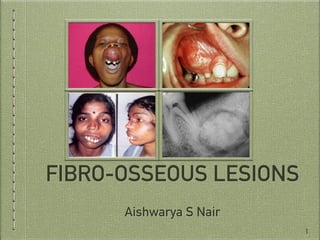
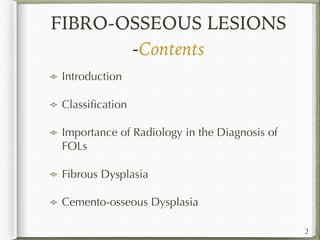
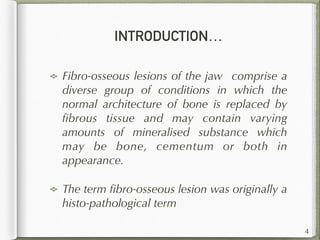
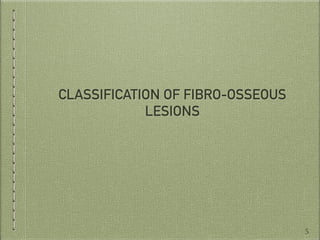
FIBRO-OSSEOUS LESIONS
Aishwarya S Nair
1
FIBRO-OSSEOUS LESIONS
-Contents
Introduction
Classification
Importance of Radiology in the Diagnosis of
FOLs
Fibrous Dysplasia
Cemento-osseous Dysplasia
2
INTRODUCTION…
3
INTRODUCTION…
Fibro-osseous lesions of the jaw comprise a
diverse group of conditions in which the
normal architecture of bone is replaced by
fibrous tissue and may contain varying
amounts of mineralised substance which
may be bone, cementum or both in
appearance.
The term fibro-osseous lesion was originally a
histo-pathological term
4
CLASSIFICATION OF FIBRO-OSSEOUS
LESIONS
5
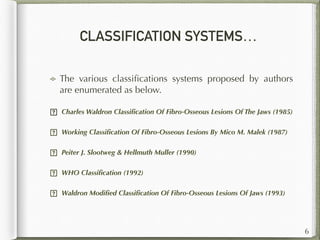
CLASSIFICATION SYSTEMS…
The various classifications systems proposed by authors
are enumerated as below.
 Charles Waldron Classification Of Fibro-Osseous Lesions Of The Jaws (1985)
 Working Classification Of Fibro-Osseous Lesions By Mico M. Malek (1987)
 Peiter J. Slootweg & Hellmuth Muller (1990)
 WHO Classification (1992)
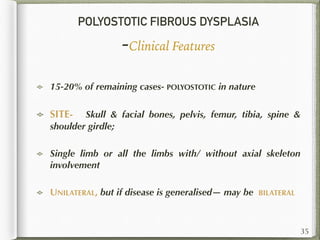
 Waldron Modified Classification Of Fibro-Osseous Lesions Of Jaws (1993) 

6
CLASSIFICATION SYSTEMS…
The various classifications systems proposed by
authors are enumerated as below. 

 Brannon & Fowler Classification (2001)
 WHO Classification Of Fibro-Osseous Lesions Of Jaws (2005)
 Paul M. Speight & Roman Carlos Classification (2006)
 Eversole Classification (2008) 

7
CLASSIFICATION…
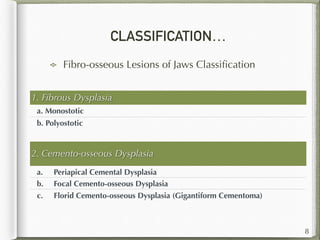
Fibro-osseous Lesions of Jaws Classification
1. Fibrous Dysplasia
a. Monostotic
b. Polyostotic
8
2. Cemento-osseous Dysplasia
a. Periapical Cemental Dysplasia
b. Focal Cemento-osseous Dysplasia
c. Florid Cemento-osseous Dysplasia (Gigantiform Cementoma)
CLASSIFICATION…
9
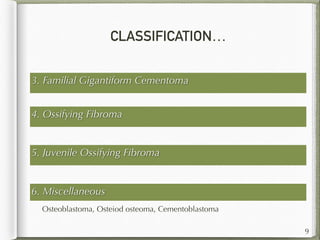
3. Familial Gigantiform Cementoma
6. Miscellaneous
Osteoblastoma, Osteiod osteoma, Cementoblastoma
5. Juvenile Ossifying Fibroma
4. Ossifying Fibroma
CLASSIFICATION…
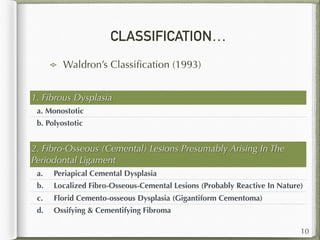
Waldron’s Classification (1993)
1. Fibrous Dysplasia
a. Monostotic
b. Polyostotic
10
2. Fibro-Osseous (Cemental) Lesions Presumably Arising In The
Periodontal Ligament
a. Periapical Cemental Dysplasia
b. Localized Fibro-Osseous-Cemental Lesions (Probably Reactive In Nature)
c. Florid Cemento-osseous Dysplasia (Gigantiform Cementoma)
d. Ossifying & Cementifying Fibroma
CLASSIFICATION…
Waldron’s Classification (1993)
11
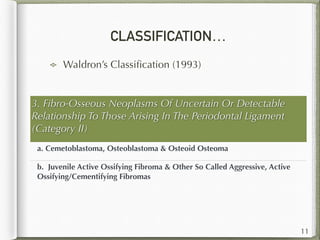
3. Fibro-Osseous Neoplasms Of Uncertain Or Detectable
Relationship To Those Arising In The Periodontal Ligament
(Category II) 

a. Cemetoblastoma, Osteoblastoma & Osteoid Osteoma 

b. Juvenile Active Ossifying Fibroma & Other So Called Aggressive, Active
Ossifying/Cementifying Fibromas 

CLASSIFICATION…
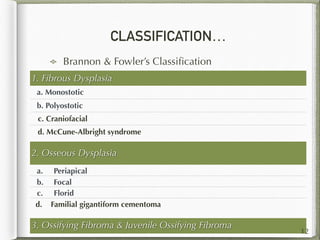
Brannon & Fowler’s Classification
1. Fibrous Dysplasia
a. Monostotic
b. Polyostotic
c. Craniofacial
d. McCune-Albright syndrome
2. Osseous Dysplasia
a. Periapical
b. Focal
c. Florid
d. Familial gigantiform cementoma
3. Ossifying Fibroma & Juvenile Ossifying Fibroma
12
IMPORTANCE OF RADIOLOGY IN
DIAGNOSIS OF FIBRO-OSSEOUS
LESIONS…
The radiologist plays a central role in diagnosis of
fibro-osseous lesions.
Charles Waldron had stated
“In the absence of good clinical & radiologic
information, a pathologist can only state a biopsy to be
consistent with a fibro-osseous lesion”
Therefore, identification of majority of FOLs is based
on clinical and radiological features.
13
IMPORTANCE OF RADIOLOGY IN
DIAGNOSIS OF FIBRO-OSSEOUS
LESIONS…
Many fibro-osseous lesions are symptomless and
require no surgery. Therefore, diagnosis of the
lesions on clinical & radiological features may
obviate the need for surgery
This my benefit the patient, as fibrous dysplasia
may show exaggerated growth after surgery
14
IMPORTANCE OF RADIOLOGY IN
DIAGNOSIS OF FIBRO-OSSEOUS
LESIONS…
Radiological evaluation-
Plain radiography
IOPAR
Occlusal radiograph
Bitewing radiograph
15
IMPORTANCE OF RADIOLOGY IN
DIAGNOSIS OF FIBRO-OSSEOUS
LESIONS…
Radiological evaluation-
CT- expansile, destructive lesions, cortical
breakthrough & extra-osseous extensions
MRI- solid from non-solid masses
16
FIBROUS DYSPLASIA
17
FIBROUS DYSPLASIA
-Introduction
WHO (1992) defined fibrous dysplasia as
“A benign lesion, presumably developmental in nature,
characterised by a presence of fibrous connective tissue
with a characteristic whorled pattern and containing
trabeculae of immature bone”
Asymptomatic regional alteration of bone in which normal
architecture of bone is replaced by trabeculae-like osseous
structures; lesions may be monostotic or polyostotic, with or
without associated endocrinal disturbances
- Eversole
18
FIBROUS DYSPLASIA
-Introduction
Congenital, skeletal disorder wherein bone is
formed and the maturation is arrested in the
“woven bone stage”.
NON-HEREDITARY DISORDER
19
FIBROUS DYSPLASIA
-History
First citation by von Recklinghausen in 1891
Albright pointed out that 2 cases mentioned by von
Recklinghausen- fibrous dysplasia
Lichtenstein- term FIBROUS DYSPLASIA (1938)
Initially considered- Polyostotic
Lichtenstein & Jaffe expanded the concept-
monostotic
20
FIBROUS DYSPLASIA
-History
McCune & Albright (1936 &1937) described an
association of abnormal skin pigmentation &
precocious puberty
(McCune-Albright Syndrome)
Jaffe-Lichtenstein described the association of
polyostotic fibrous dysplasia with abnormal
pigmentation
(Jaffe-Lichtenstein Syndrome)
21
FIBROUS DYSPLASIA
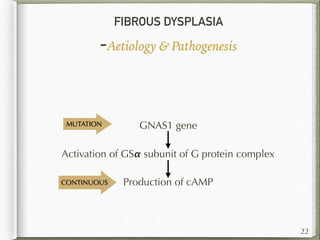
-Aetiology & Pathogenesis
GNAS1 gene
Activation of GS𝞪 subunit of G protein complex
Production of cAMP
22
MUTATION
CONTINUOUS
FIBROUS DYSPLASIA
-Pathogenesis
1. Hyperfunction of endocrine glands
2. Increased production of melanocytes
3. Affects differentiation of osteoblasts— impairs
ability to form mature osteoblasts
Fibrous tissue is produced + trabeculae contain
“fluid-filled cysts” — GROUND-GLASS APPEARANCE
23
FIBROUS DYSPLASIA
-Pathogenesis
Undifferentiated stem cells—
Melanocyte progenitor cells
Skeletal progenitor cells
Endocrinal progenitor cells
24
FIBROUS DYSPLASIA
-Pathogenesis
Skeletal progenitor cells— Migrate to form
different bones
Multiple bones
Post natal mutation—
Single bone is affected
25
FIBROUS DYSPLASIA
-Classification
Monostotic—
Juvenile
Juvenile, aggressive
Adult
26
Polyostotic—
Craniofacial
M c C u n e - A l b r i g h t
Syndrome
Ja f f e - L i ch t e n s t e i n
Syndrome
JUVENILE FIBROUS DYSPLASIA
-Clinical Features
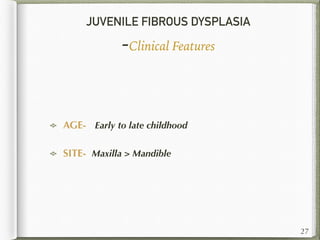
AGE- Early to late childhood
SITE- Maxilla > Mandible
27
JUVENILE FIBROUS DYSPLASIA
-Clinical Presentation
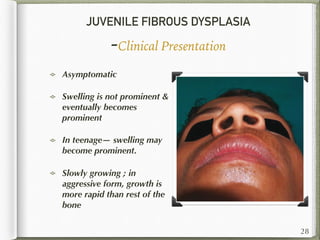
Asymptomatic
Swelling is not prominent &
eventually becomes
prominent
In teenage— swelling may
become prominent.
Slowly growing ; in
aggressive form, growth is
more rapid than rest of the
bone
28
JUVENILE FIBROUS DYSPLASIA
-Clinical Presentation
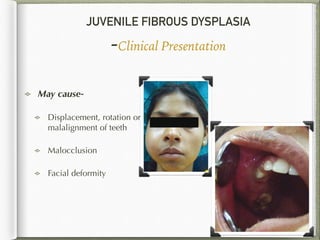
May cause-
Displacement, rotation or
malalignment of teeth
Malocclusion
Facial deformity
29
JUVENILE FIBROUS DYSPLASIA
-Clinical Presentation
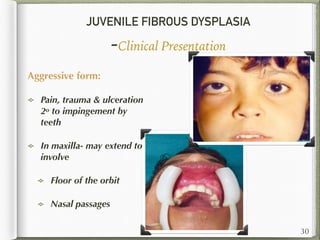
Aggressive form:
Pain, trauma & ulceration
2o to impingement by
teeth
In maxilla- may extend to
involve
Floor of the orbit
Nasal passages
30
ADULT MONOSTOTIC FIBROUS DYSPLASIA
-Introduction
Rare form
Spontaneously occurring
May appear similar to ossifying fibroma but must be
differentiated from it
31
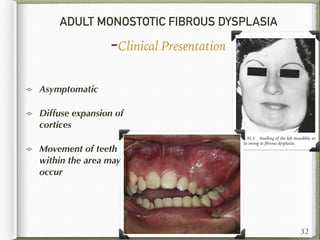
ADULT MONOSTOTIC FIBROUS DYSPLASIA
-Clinical Presentation
Asymptomatic
Diffuse expansion of
cortices
Movement of teeth
within the area may
occur
32
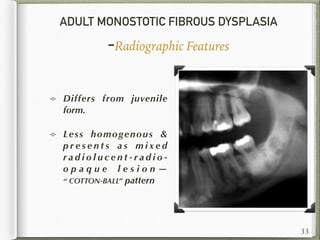
ADULT MONOSTOTIC FIBROUS DYSPLASIA
-Radiographic Features
Differs from juvenile
form.
Less homogenous &
p r e s e n t s a s m i x e d
r a d i o l u c e n t - r a d i o -
o p a q u e l e s i o n —
“ COTTON-BALL” pattern
33
POLYOSTOTIC FIBROUS DYSPLASIA
-Introduction
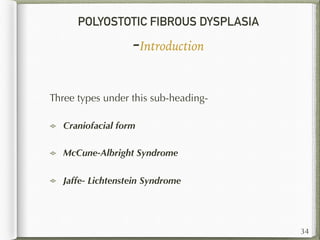
Three types under this sub-heading-
Craniofacial form
McCune-Albright Syndrome
Jaffe- Lichtenstein Syndrome
34
POLYOSTOTIC FIBROUS DYSPLASIA
-Clinical Features
15-20% of remaining cases- POLYOSTOTIC in nature
SITE- Skull & facial bones, pelvis, femur, tibia, spine &
shoulder girdle;
Single limb or all the limbs with/ without axial skeleton
involvement
UNILATERAL, but if disease is generalised— may be BILATERAL
35
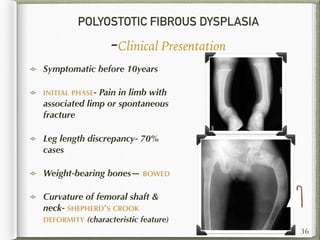
POLYOSTOTIC FIBROUS DYSPLASIA
-Clinical Presentation
Symptomatic before 10years
INITIAL PHASE- Pain in limb with
associated limp or spontaneous
fracture
Leg length discrepancy- 70%
cases
Weight-bearing bones— BOWED
Curvature of femoral shaft &
neck- SHEPHERD’S CROOK
DEFORMITY (characteristic feature)
36
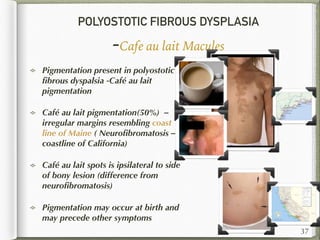
POLYOSTOTIC FIBROUS DYSPLASIA
-Cafe au lait Macules
Pigmentation present in polyostotic
fibrous dyspalsia -Café au lait
pigmentation
Café au lait pigmentation(50%) –
irregular margins resembling coast
line of Maine ( Neurofibromatosis –
coastline of California)
Café au lait spots is ipsilateral to side
of bony lesion (difference from
neurofibromatosis)
Pigmentation may occur at birth and
may precede other symptoms
37
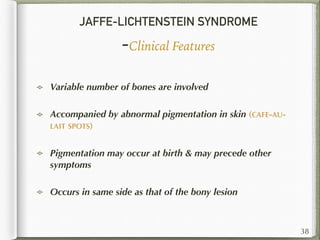
JAFFE-LICHTENSTEIN SYNDROME
-Clinical Features
Variable number of bones are involved
Accompanied by abnormal pigmentation in skin (CAFE-AU-
LAIT SPOTS)
Pigmentation may occur at birth & may precede other
symptoms
Occurs in same side as that of the bony lesion
38
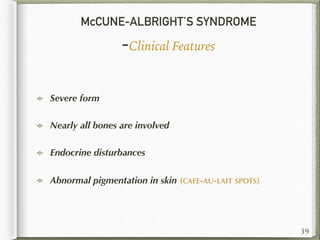
McCUNE-ALBRIGHT’S SYNDROME
-Clinical Features
Severe form
Nearly all bones are involved
Endocrine disturbances
Abnormal pigmentation in skin (CAFE-AU-LAIT SPOTS)
39
McCUNE-ALBRIGHT’S SYNDROME
-Clinical Features
McCune Albright syndrome affects females >males
The most common endocrinal abnormality: sexual precocity
Other endocrinal manifestations are:
Accelerated skeletal growth Acromegaly
Gigantism Hyperprolactenimia
Cushing’s syndrome Hyperthyroidism
Diabetes mellitus Hypothalamic hypogonadism
Hypophospahtemic rickets Gynecomastia
Spermatogenesis
40
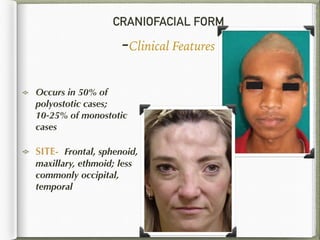
CRANIOFACIAL FORM
-Clinical Features
Occurs in 50% of
polyostotic cases;
10-25% of monostotic
cases
SITE- Frontal, sphenoid,
maxillary, ethmoid; less
commonly occipital,
temporal
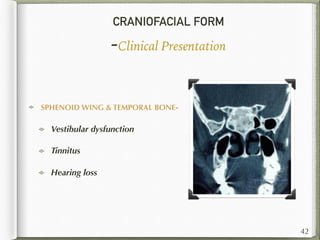
CRANIOFACIAL FORM
-Clinical Presentation
SPHENOID WING & TEMPORAL BONE-
Vestibular dysfunction
Tinnitus
Hearing loss
42
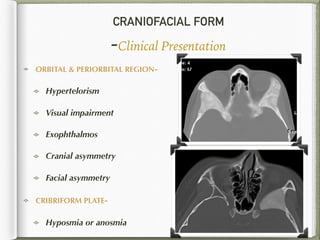
CRANIOFACIAL FORM
-Clinical Presentation
ORBITAL & PERIORBITAL REGION-
Hypertelorism
Visual impairment
Exophthalmos
Cranial asymmetry
Facial asymmetry
CRIBRIFORM PLATE-
Hyposmia or anosmia
43
FIBROUS DYSPLASIA
-Mazabraud’s Syndrome
44
Rare disease
Association of fibrous dysplasia and intramuscular
myxoma
Greater risk of malignant transformation in fibrous
dysplasia
FIBROUS DYSPLASIA
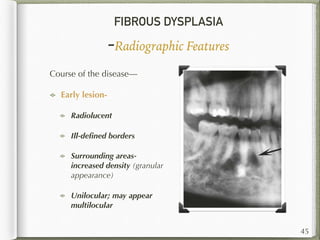
-Radiographic Features
Course of the disease—
Early lesion-
Radiolucent
Ill-defined borders
Surrounding areas-
increased density (granular
appearance)
Unilocular; may appear
multilocular
45
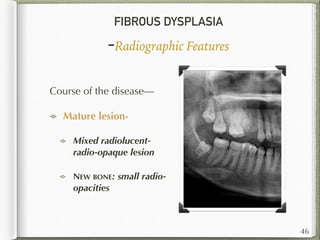
FIBROUS DYSPLASIA
-Radiographic Features
Course of the disease—
Mature lesion-
Mixed radiolucent-
radio-opaque lesion
NEW BONE: small radio-
opacities
46
FIBROUS DYSPLASIA
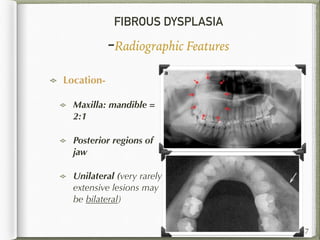
-Radiographic Features
Location-
Maxilla: mandible =
2:1
Posterior regions of
jaw
Unilateral (very rarely
extensive lesions may
be bilateral)
47
FIBROUS DYSPLASIA
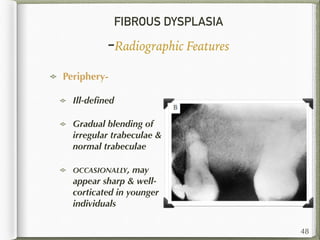
-Radiographic Features
Periphery-
Ill-defined
Gradual blending of
irregular trabeculae &
normal trabeculae
OCCASIONALLY, may
appear sharp & well-
corticated in younger
individuals
48
FIBROUS DYSPLASIA
-Radiographic Features
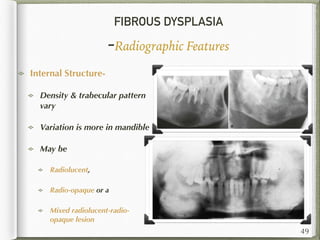
Internal Structure-
Density & trabecular pattern
vary
Variation is more in mandible
May be
Radiolucent,
Radio-opaque or a
Mixed radiolucent-radio-
opaque lesion
49
FIBROUS DYSPLASIA
-Radiographic Features
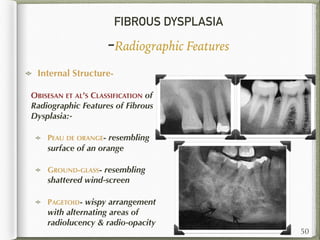
Internal Structure-
OBISESAN ET AL’S CLASSIFICATION of
Radiographic Features of Fibrous
Dysplasia:-
PEAU DE ORANGE- resembling
surface of an orange
GROUND-GLASS- resembling
shattered wind-screen
PAGETOID- wispy arrangement
with alternating areas of
radiolucency & radio-opacity
50
FIBROUS DYSPLASIA
-Radiographic Features
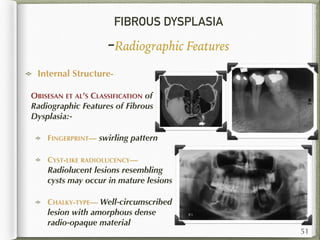
Internal Structure-
OBISESAN ET AL’S CLASSIFICATION of
Radiographic Features of Fibrous
Dysplasia:-
FINGERPRINT— swirling pattern
CYST-LIKE RADIOLUCENCY—
Radiolucent lesions resembling
cysts may occur in mature lesions
CHALKY-TYPE— Well-circumscribed
lesion with amorphous dense
radio-opaque material
51
FIBROUS DYSPLASIA
-Radiographic Features
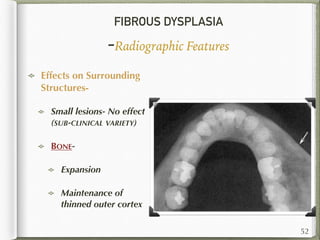
Effects on Surrounding
Structures-
Small lesions- No effect
(SUB-CLINICAL VARIETY)
BONE-
Expansion
Maintenance of
thinned outer cortex
52
FIBROUS DYSPLASIA
-Radiographic Features
Effects on Surrounding
Structures-
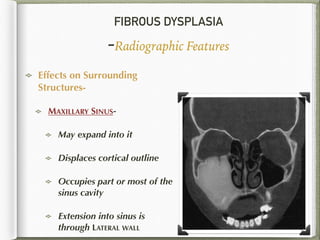
MAXILLARY SINUS-
May expand into it
Displaces cortical outline
Occupies part or most of the
sinus cavity
Extension into sinus is
through LATERAL WALL
53
FIBROUS DYSPLASIA
-Radiographic Features
Effects on Surrounding
Structures-
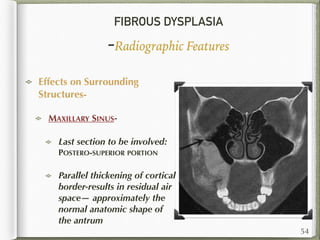
MAXILLARY SINUS-
Last section to be involved:
POSTERO-SUPERIOR PORTION
Parallel thickening of cortical
border-results in residual air
space— approximately the
normal anatomic shape of
the antrum
54
FIBROUS DYSPLASIA
-Radiographic Features
Effects on Surrounding
Structures-
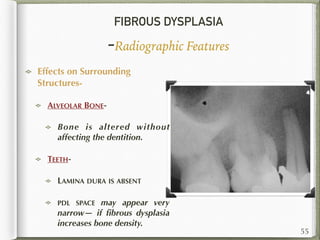
ALVEOLAR BONE-
Bone is altered without
affecting the dentition.
TEETH-
LAMINA DURA IS ABSENT
PDL SPACE may appear very
narrow— if fibrous dysplasia
increases bone density.
55
FIBROUS DYSPLASIA
-Radiographic Features
Effects on Surrounding
Structures-
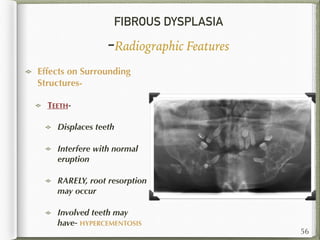
TEETH-
Displaces teeth
Interfere with normal
eruption
RARELY, root resorption
may occur
Involved teeth may
have- HYPERCEMENTOSIS
56
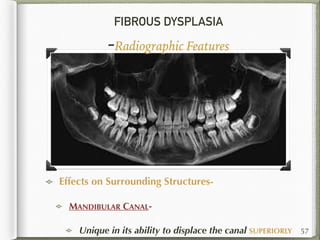
FIBROUS DYSPLASIA
-Radiographic Features
Effects on Surrounding Structures-
MANDIBULAR CANAL-
Unique in its ability to displace the canal SUPERIORLY 57
FIBROUS DYSPLASIA
-Other Imaging Modalities
58
ROLE OF ULTRASOUND:
Helpful for assessing extraskeletal manifestations
Usually USG of thyroid and gonads done : evaluate
activity and structure of glands and gonads
ROLE OF MRI:
Not useful as CT and plain films. On T1-weighted
MRIs, the lesion has low-to-intermediate signal
intensity equal to that of muscle. T2-weighted images
also show low signal intensity owing to the high
content of collagen and bone
FIBROUS DYSPLASIA
-Other Imaging Modalities
59
BONE SCINTIGRAPHY:
Accumulation of isotope increases because of the
lesion's hypervascularity.
Pathologic or stress fractures also can increase
isotopic activity in the lesions.
The features on the bone scan are nonspecific for a
conclusive diagnosis based solely on the distribution
of the isotope.
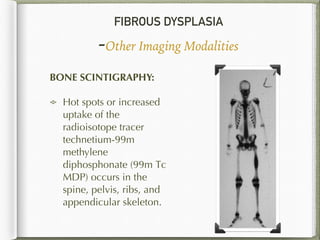
FIBROUS DYSPLASIA
-Other Imaging Modalities
BONE SCINTIGRAPHY:
Hot spots or increased
uptake of the
radioisotope tracer
technetium-99m
methylene
diphosphonate (99m Tc
MDP) occurs in the
spine, pelvis, ribs, and
appendicular skeleton.
FIBROUS DYSPLASIA
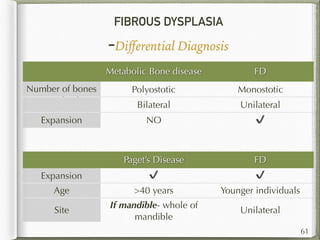
-Differential Diagnosis
Metabolic Bone disease FD
Number of bones
involved
Polyostotic Monostotic
Bilateral Unilateral
Expansion NO ✔
61
Paget’s Disease FD
Expansion ✔ ✔
Age >40 years Younger individuals
Site
If mandible- whole of
mandible
Unilateral
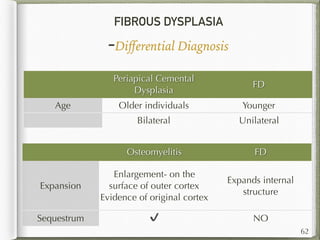
FIBROUS DYSPLASIA
-Differential Diagnosis
Periapical Cemental
Dysplasia
FD
Age Older individuals Younger
Bilateral Unilateral
62
Osteomyelitis FD
Expansion
Enlargement- on the
surface of outer cortex
Evidence of original cortex
Expands internal
structure
Sequestrum ✔ NO
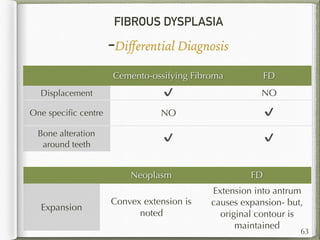
FIBROUS DYSPLASIA
-Differential Diagnosis
Cemento-ossifying Fibroma FD
Displacement ✔ NO
One specific centre NO ✔
Bone alteration
around teeth
✔ ✔
63
Neoplasm FD
Expansion
Convex extension is
noted
Extension into antrum
causes expansion- but,
original contour is
maintained
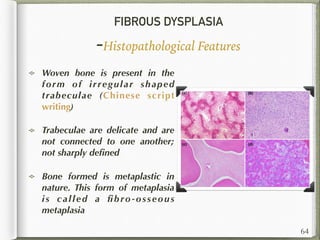
FIBROUS DYSPLASIA
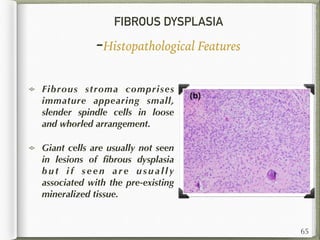
-Histopathological Features
Woven bone is present in the
form of irregular shaped
trabeculae (Chinese script
writing)
Trabeculae are delicate and are
not connected to one another;
not sharply defined
Bone formed is metaplastic in
nature. This form of metaplasia
is called a fibro-osseous
metaplasia
64
FIBROUS DYSPLASIA
-Histopathological Features
Fibrous stroma comprises
immature appearing small,
slender spindle cells in loose
and whorled arrangement.
Giant cells are usually not seen
in lesions of fibrous dysplasia
b u t i f s e e n a r e u s u a l l y
associated with the pre-existing
mineralized tissue.
65
FIBROUS DYSPLASIA
-Laboratory Investigations
Serum Ca2+ & P : normal
Serum Alk Phosphatase: ed
Urinary hydroxyproline, specific index of bone
collagen resorption: ed
McCune-Albright’s Syndrome- circulating hormones:
ed
FIBROUS DYSPLASIA
-Management
67
Mostly clinical & radiological features are
sufficient to make a diagnosis of Fibrous dysplasia
Reports- exaggeration of growth of lesion— due to
surgical intervention
Monitor the lesion
Ask patient to report if any changes
FIBROUS DYSPLASIA
-Medical Management
68
Limited use in polyostotic cases
1. Bisphosphonates: Palmidronate 180mg i.v. every
6months/ i.v. 1-1.5mg/kg/day for 3 consecutive days,
given every 4months
➡es- bone pain
➡es- bone resorption
es- bone mineral density
FIBROUS DYSPLASIA
-Medical Management
69
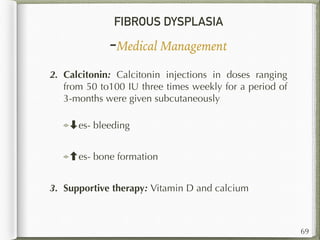
2. Calcitonin: Calcitonin injections in doses ranging
from 50 to100 IU three times weekly for a period of
3-months were given subcutaneously
➡es- bleeding
es- bone formation
3. Supportive therapy: Vitamin D and calcium
FIBROUS DYSPLASIA
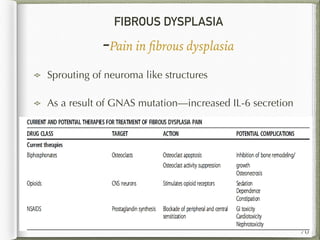
-Pain in fibrous dysplasia
70
Sprouting of neuroma like structures
As a result of GNAS mutation—increased IL-6 secretion
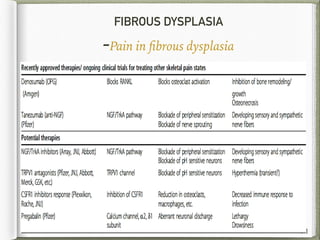
FIBROUS DYSPLASIA
-Pain in fibrous dysplasia
71
PERIAPICAL CEMENTO-OSSEOUS DYSPLASIA
72
PERIAPICAL CEMENTO-OSSEOUS DYSPLASIA
-Introduction
Localised change in normal bone metabolism
that results in replacement of the components of
normal cancellous bone with fibrous tissue and
cementum-like material, abnormal bone or a
mixture of the two.
Lesion located near the apex of the tooth
73
PERIAPICAL CEMENTO-OSSEOUS DYSPLASIA
-Clinical Features
AGE- Middle age; >30years and mean age is 39years
GENDER- ♀ : ♂ = 9 : 1
RACE- Blacks : Whites= 3 : 1 ; frequently seen in
Asians
74
PERIAPICAL CEMENTO-OSSEOUS DYSPLASIA
-Clinical Presentation
VITAL teeth
No h/o pain, sensitivity
Incidental finding
May become very large— expansion of bone— slow
growth
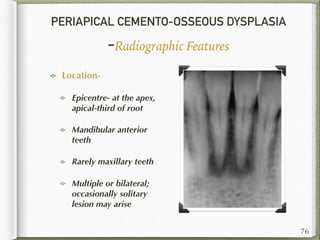
PERIAPICAL CEMENTO-OSSEOUS DYSPLASIA
-Radiographic Features
Location-
Epicentre- at the apex,
apical-third of root
Mandibular anterior
teeth
Rarely maxillary teeth
Multiple or bilateral;
occasionally solitary
lesion may arise
76
PERIAPICAL CEMENTO-OSSEOUS DYSPLASIA
-Radiographic Features
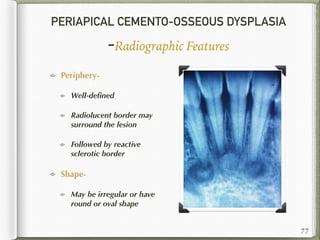
Periphery-
Well-defined
Radiolucent border may
surround the lesion
Followed by reactive
sclerotic border
Shape-
May be irregular or have
round or oval shape
77
PERIAPICAL CEMENTO-OSSEOUS DYSPLASIA
-Radiographic Features
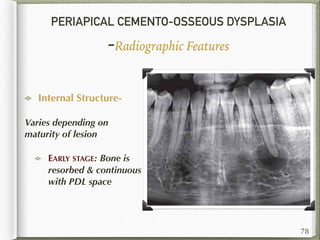
Internal Structure-
Varies depending on
maturity of lesion
EARLY STAGE: Bone is
resorbed & continuous
with PDL space
78
PERIAPICAL CEMENTO-OSSEOUS DYSPLASIA
-Radiographic Features
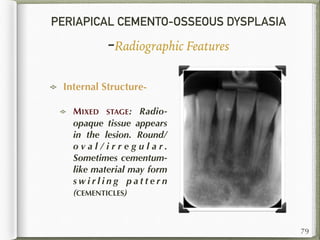
Internal Structure-
MIXED STAGE: Radio-
opaque tissue appears
in the lesion. Round/
o v a l / i r r e g u l a r .
Sometimes cementum-
like material may form
s w i r l i n g p a t t e r n
(CEMENTICLES)
79
PERIAPICAL CEMENTO-OSSEOUS DYSPLASIA
-Radiographic Features
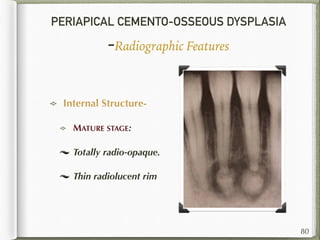
Internal Structure-
MATURE STAGE:
Totally radio-opaque.
Thin radiolucent rim
80
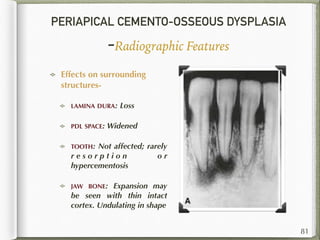
PERIAPICAL CEMENTO-OSSEOUS DYSPLASIA
-Radiographic Features
Effects on surrounding
structures-
LAMINA DURA: Loss
PDL SPACE: Widened
TOOTH: Not affected; rarely
r e s o r p t i o n o r
hypercementosis
JAW BONE: Expansion may
be seen with thin intact
cortex. Undulating in shape
81
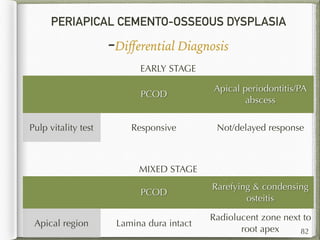
PERIAPICAL CEMENTO-OSSEOUS DYSPLASIA
-Differential Diagnosis
EARLY STAGE
PCOD
Apical periodontitis/PA
abscess
Pulp vitality test Responsive Not/delayed response
82
MIXED STAGE
PCOD
Rarefying & condensing
osteitis
Apical region Lamina dura intact
Radiolucent zone next to
root apex
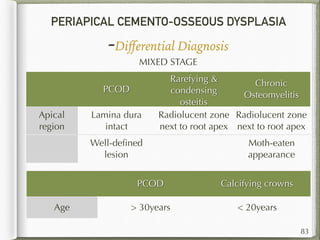
PERIAPICAL CEMENTO-OSSEOUS DYSPLASIA
-Differential Diagnosis
83
MIXED STAGE
PCOD
Rarefying &
condensing
osteitis
Chronic
Osteomyelitis
Apical
region
Lamina dura
intact
Radiolucent zone
next to root apex
Radiolucent zone
next to root apex
Well-defined
lesion
Moth-eaten
appearance
PCOD Calcifying crowns
Age > 30years < 20years
PERIAPICAL CEMENTO-OSSEOUS DYSPLASIA
-Differential Diagnosis
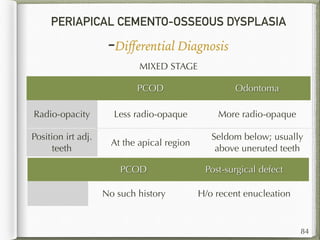
84
MIXED STAGE
PCOD Odontoma
Radio-opacity Less radio-opaque More radio-opaque
Position irt adj.
teeth
At the apical region
Seldom below; usually
above uneruted teeth
PCOD Post-surgical defect
No such history H/o recent enucleation
PERIAPICAL CEMENTO-OSSEOUS DYSPLASIA
-Differential Diagnosis
85
MIXED STAGE
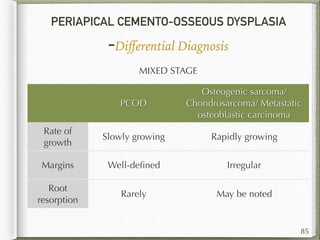
PCOD
Osteogenic sarcoma/
Chondrosarcoma/ Metastatic
osteoblastic carcinoma
Rate of
growth
Slowly growing Rapidly growing
Margins Well-defined Irregular
Root
resorption
Rarely May be noted
PERIAPICAL CEMENTO-OSSEOUS DYSPLASIA
-Differential Diagnosis
86
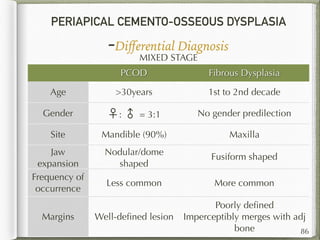
MIXED STAGE
PCOD Fibrous Dysplasia
Age >30years 1st to 2nd decade
Gender ♀: ♂ = 3:1 No gender predilection
Site Mandible (90%) Maxilla
Jaw
expansion
Nodular/dome
shaped
Fusiform shaped
Frequency of
occurrence
Less common More common
Margins Well-defined lesion
Poorly defined
Imperceptibly merges with adj
bone
PERIAPICAL CEMENTO-OSSEOUS DYSPLASIA
-Differential Diagnosis
87
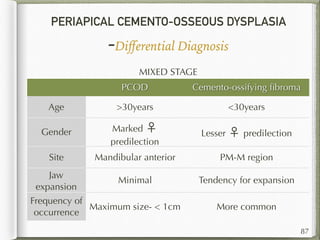
MIXED STAGE
PCOD Cemento-ossifying fibroma
Age >30years <30years
Gender Marked ♀
predilection
Lesser ♀ predilection
Site Mandibular anterior PM-M region
Jaw
expansion
Minimal Tendency for expansion
Frequency of
occurrence
Maximum size- < 1cm More common
PERIAPICAL CEMENTO-OSSEOUS DYSPLASIA
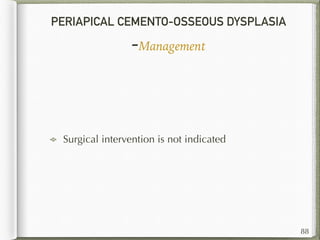
-Management
88
Surgical intervention is not indicated
FOCAL CEMENTO-OSSEOUS DYSPLASIA
89
FOCAL CEMENTO-OSSEOUS DYSPLASIA
-Introduction
The term Focal Cemento-osseous Dysplasia was
first used by Tomich and Summerlin in 1989
90
FOCAL CEMENTO-OSSEOUS DYSPLASIA
-Clinical Features
AGE- 4th to 5th decade
GENDER- Female predilection
SITE- Edentulous posterior areas of the mandible
91
FOCAL CEMENTO-OSSEOUS DYSPLASIA
-Clinical Presentation
Asymptomatic; no swelling unless it is an old lesion-
has caused expansion
FOCAL CEMENTO-OSSEOUS DYSPLASIA
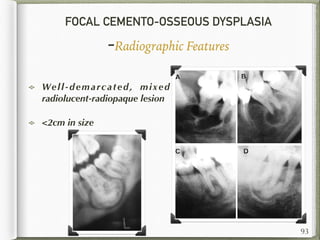
-Radiographic Features
Well-demarcated, mixed
radiolucent-radiopaque lesion
<2cm in size
93
FOCAL CEMENTO-OSSEOUS DYSPLASIA
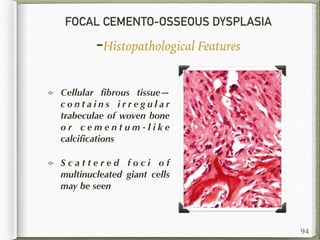
-Histopathological Features
Cellular fibrous tissue—
c o n t a i n s i r r e g u l a r
trabeculae of woven bone
o r c e m e n t u m - l i k e
calcifications
S c a t t e r e d f o c i o f
multinucleated giant cells
may be seen
94
FOCAL CEMENTO-OSSEOUS DYSPLASIA
-Management
95
Lesion shows NO tendency to recur
Partial removal- large lesions (doesn’t recur)
FIBRO-OSSEOUS LESIONS
Aishwarya S Nair
96
FIBRO-OSSEOUS LESIONS
-Contents
Florid Osseous Dysplasia
Gigantiform Cementoma
Cementifying, Cemento-osseous, Ossifying fibroma
Juvenile Ossifying Fibroma
Diagnostic Clues
Conclusion
97
FLORID CEMENTO-OSSEOUS DYSPLASIA
98
FLORID CEMENTO-OSSEOUS DYSPLASIA
-Introduction
Also called Familial Multiple Cementoma
The term was introduced by Melrose et al in 1976
It is a widespread form of Periapical Cemento-osseous
Dysplasia
Diagnosis-
PCOD in 3-4 quadrants (or)
Extensively formed in one jaw
99
FLORID CEMENTO-OSSEOUS DYSPLASIA
-Aetiology
Aetiological factor unknown
Waldron et al have proposed that reactive or
dysplastic changes in PDL may trigger the disease.
100
FLORID CEMENTO-OSSEOUS DYSPLASIA
-Clinical Features
AGE- middle age (mean age= 42years)
GENDER- Female predilection; uncommon in males
SITE-
Bilaterally occurring and symmetrical lesions in
jaws
Limited to alveolar bone of the jaws
101
FLORID CEMENTO-OSSEOUS DYSPLASIA
-Clinical Presentation
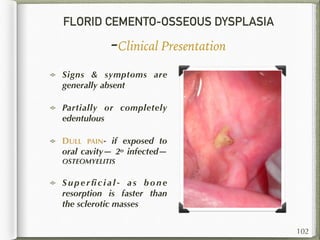
Signs & symptoms are
generally absent
Partially or completely
edentulous
DULL PAIN- if exposed to
oral cavity— 2o infected—
OSTEOMYELITIS
S u p e r fi c i a l - a s b o n e
resorption is faster than
the sclerotic masses
102
FLORID CEMENTO-OSSEOUS DYSPLASIA
-Radiographic Features
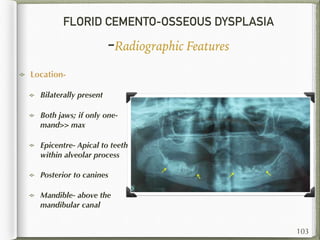
Location-
Bilaterally present
Both jaws; if only one-
mand>> max
Epicentre- Apical to teeth
within alveolar process
Posterior to canines
Mandible- above the
mandibular canal
103
FLORID CEMENTO-OSSEOUS DYSPLASIA
-Radiographic Features
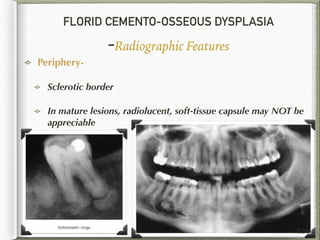
Periphery-
Sclerotic border
In mature lesions, radiolucent, soft-tissue capsule may NOT be
appreciable
104
FLORID CEMENTO-OSSEOUS DYSPLASIA
-Radiographic Features
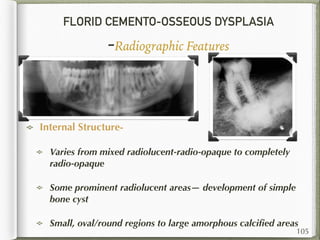
Internal Structure-
Varies from mixed radiolucent-radio-opaque to completely
radio-opaque
Some prominent radiolucent areas— development of simple
bone cyst
Small, oval/round regions to large amorphous calcified areas
105
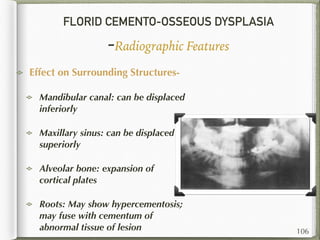
FLORID CEMENTO-OSSEOUS DYSPLASIA
-Radiographic Features
Effect on Surrounding Structures-
Mandibular canal: can be displaced
inferiorly
Maxillary sinus: can be displaced
superiorly
Alveolar bone: expansion of
cortical plates
Roots: May show hypercementosis;
may fuse with cementum of
abnormal tissue of lesion 106
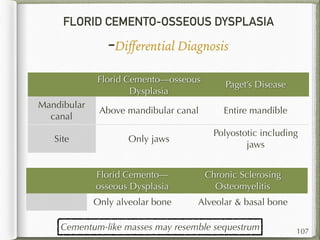
FLORID CEMENTO-OSSEOUS DYSPLASIA
-Differential Diagnosis
107
Florid Cemento—osseous
Dysplasia
Paget’s Disease
Mandibular
canal
Above mandibular canal Entire mandible
Site Only jaws
Polyostotic including
jaws
Florid Cemento—
osseous Dysplasia
Chronic Sclerosing
Osteomyelitis
Only alveolar bone Alveolar & basal bone
Cementum-like masses may resemble sequestrum
FLORID CEMENTO-OSSEOUS DYSPLASIA
-Management
108
No T/t required
No age limit for cessation of growth
Propensity for 2o infection— oral hygiene must be
maintained
GIGANTIFORM CEMENTOMA
109
GIGANTIFORM CEMENTOMA
-Introduction
Rare, benign fibro-osseous disease of the jaws
Characterised by formation of massive sclerotic masses of
disorganised mineralised tissue
Norberg in 1931, first described Gigantiform Cementoma
Familial cases > Sporadic cases; autosomal dominant
WHO in 1971, later re-classified it under cemental
lesions
110
GIGANTIFORM CEMENTOMA
-Clinical Features
AGE- Younger age group; occasionally older
individuals
GENDER- No gender predilection
SITE- Both the jaws; multifocal & multiquadrant
Lesions tend to plateau after cessation of growth
111
GIGANTIFORM CEMENTOMA
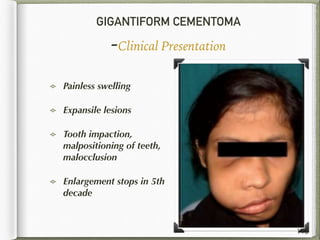
-Clinical Presentation
Painless swelling
Expansile lesions
Tooth impaction,
malpositioning of teeth,
malocclusion
Enlargement stops in 5th
decade
112
GIGANTIFORM CEMENTOMA
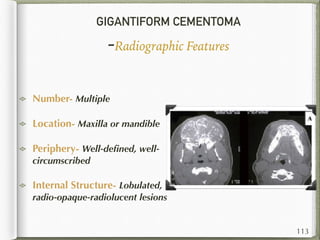
-Radiographic Features
Number- Multiple
Location- Maxilla or mandible
Periphery- Well-defined, well-
circumscribed
Internal Structure- Lobulated,
radio-opaque-radiolucent lesions
113
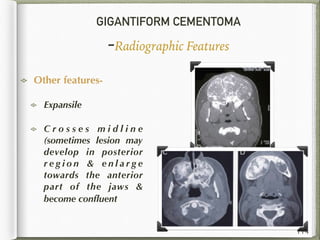
GIGANTIFORM CEMENTOMA
-Radiographic Features
Other features-
Expansile
C r o s s e s m i d l i n e
(sometimes lesion may
develop in posterior
r e g i o n & e n l a r g e
towards the anterior
part of the jaws &
become confluent
114
GIGANTIFORM CEMENTOMA
-Management
115
Surgical removal
Incomplete- recurrence
Complete + conservative approach— ideal
approach
OSSIFYING FIBROMA
116
OSSIFYING FIBROMA
-Introduction
Before refining the concept of focal cemento-
osseous dysplasia, Ossifying fibroma, was thought
to be common
Presently— relatively rare
Radiographically- focal cemento-osseous dysplasia
Histopathologically- neoplasm with significant
growth potential
117
OSSIFYING FIBROMA
-Introduction
In 1972, WHO classification separated
cementifying and ossifying fibroma
Cementifying fibroma- spherical calcifications
Ossifying fibroma- predominant osseous
component
118
OSSIFYING FIBROMA
-Introduction
Origin of these cementum-like calcifications—
uncertain— extra-gnathic sites
Bone & cementum— cannot be distinguished
histologically
119
OSSIFYING FIBROMA
-Aetiology & Pathogenesis
Occurs mostly in jaws— originate from pluripotent cells-
periodontal membrane
Recently mutations in HRPT2 gene— rare syndrome called
Hyperparathyroidism- jaw tumour syndrome
Characterised by
Parathyroid adenoma/carcinoma
Ossifying fibromas of the jaws
Renal cysts
Wilm’s tumour
120
OSSIFYING FIBROMA
-Aetiology & Pathogenesis
Identification of HRPT2 gene mutation— 2
sporadic cases
Function of parafibromin & mechanism of
tumour formation— NOT KNOWN
121
OSSIFYING FIBROMA
-Clinical Features
AGE- 3rd- 4th decade of life
GENDER- Female predilection
SITE- Mandible>> Maxilla
Premolar-molar region
Tooth-bearing areas— may extend into ramus
122
OSSIFYING FIBROMA
-Clinical Presentation
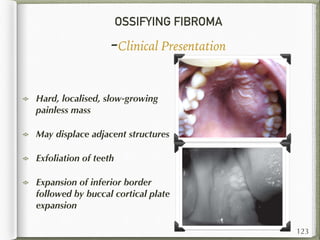
Hard, localised, slow-growing
painless mass
May displace adjacent structures
Exfoliation of teeth
Expansion of inferior border
followed by buccal cortical plate
expansion
123
OSSIFYING FIBROMA
-Gross Appearance
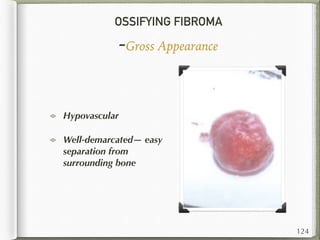
Hypovascular
Well-demarcated— easy
separation from
surrounding bone
124
OSSIFYING FIBROMA
-Radiographic Features
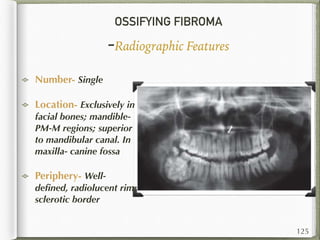
Number- Single
Location- Exclusively in
facial bones; mandible-
PM-M regions; superior
to mandibular canal. In
maxilla- canine fossa
Periphery- Well-
defined, radiolucent rim;
sclerotic border
125
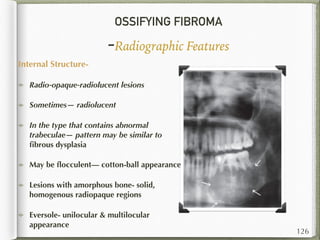
OSSIFYING FIBROMA
-Radiographic Features
Internal Structure-
Radio-opaque-radiolucent lesions
Sometimes— radiolucent
In the type that contains abnormal
trabeculae— pattern may be similar to
fibrous dysplasia
May be flocculent— cotton-ball appearance
Lesions with amorphous bone- solid,
homogenous radiopaque regions
Eversole- unilocular & multilocular
appearance
126
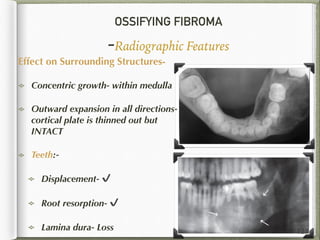
OSSIFYING FIBROMA
-Radiographic Features
Effect on Surrounding Structures-
Concentric growth- within medulla
Outward expansion in all directions-
cortical plate is thinned out but
INTACT
Teeth:-
Displacement- ✔
Root resorption- ✔
Lamina dura- Loss 127
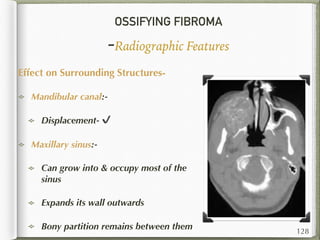
OSSIFYING FIBROMA
-Radiographic Features
Effect on Surrounding Structures-
Mandibular canal:-
Displacement- ✔
Maxillary sinus:-
Can grow into & occupy most of the
sinus
Expands its wall outwards
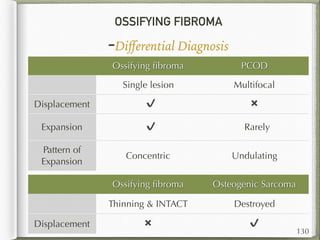
Bony partition remains between them 128
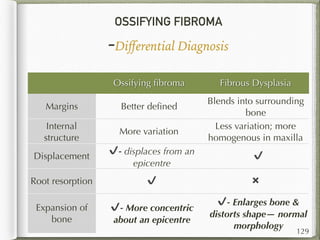
OSSIFYING FIBROMA
-Differential Diagnosis
129
Ossifying fibroma Fibrous Dysplasia
Margins Better defined
Blends into surrounding
bone
Internal
structure
More variation
Less variation; more
homogenous in maxilla
Displacement
✔- displaces from an
epicentre
✔
Root resorption ✔ ✖
Expansion of
bone
✔- More concentric
about an epicentre
✔- Enlarges bone &
distorts shape— normal
morphology
OSSIFYING FIBROMA
-Differential Diagnosis
130
Ossifying fibroma PCOD
Single lesion Multifocal
Displacement ✔ ✖
Expansion ✔ Rarely
Pattern of
Expansion
Concentric Undulating
Ossifying fibroma Osteogenic Sarcoma
Thinning & INTACT Destroyed
Displacement ✖ ✔
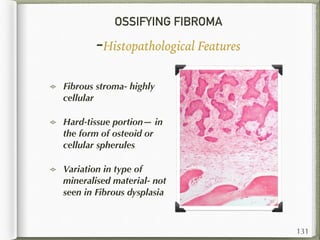
OSSIFYING FIBROMA
-Histopathological Features
Fibrous stroma- highly
cellular
Hard-tissue portion— in
the form of osteoid or
cellular spherules
Variation in type of
mineralised material- not
seen in Fibrous dysplasia
131
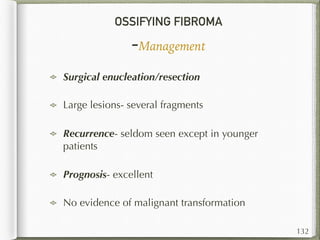
OSSIFYING FIBROMA
-Management
132
Surgical enucleation/resection
Large lesions- several fragments
Recurrence- seldom seen except in younger
patients
Prognosis- excellent
No evidence of malignant transformation
JUVENILE OSSIFYING FIBROMA
133
JUVENILE OSSIFYING FIBROMA
-Introduction
Controversial lesion
Distinguished from the larger group of ossifying fibromas
based on
Age
Common site of involvement
Clinical behaviour
2 patterns have been noted- Trabecular & Psammomatoid
134
JUVENILE OSSIFYING FIBROMA
-Introduction
According to WHO,
“A fibro-osseous lesion that is characterised by
cellular rich fibrous tissue, bands of cellular
osteoid trabeculae and giant cells.”
135
JUVENILE OSSIFYING FIBROMA
-Clinical Features
AGE- Mean age are 11years and 22 years; 2-15
years
GENDER- No gender predilection (slight male
predilection)
SITE- Maxillary predominance
Psammomatoid- extra-gnathic sites ( 70%-
orbital, frontal bones & paranasal sinuses)
136
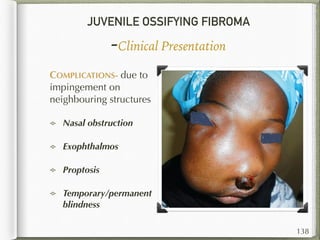
JUVENILE OSSIFYING FIBROMA
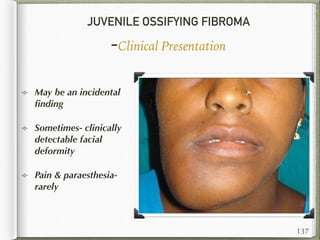
-Clinical Presentation
May be an incidental
finding
Sometimes- clinically
detectable facial
deformity
Pain & paraesthesia-
rarely
137
JUVENILE OSSIFYING FIBROMA
-Clinical Presentation
COMPLICATIONS- due to
impingement on
neighbouring structures
Nasal obstruction
Exophthalmos
Proptosis
Temporary/permanent
blindness
138
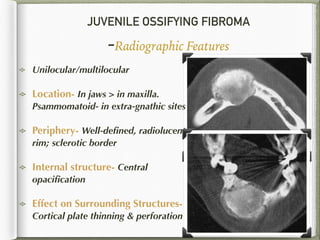
JUVENILE OSSIFYING FIBROMA
-Radiographic Features
Unilocular/multilocular
Location- In jaws > in maxilla.
Psammomatoid- in extra-gnathic sites
Periphery- Well-defined, radiolucent
rim; sclerotic border
Internal structure- Central
opacification
Effect on Surrounding Structures-
Cortical plate thinning & perforation
139
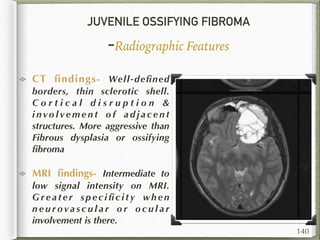
JUVENILE OSSIFYING FIBROMA
-Radiographic Features
CT findings- Well-defined
borders, thin sclerotic shell.
C o r t i c a l d i s r u p t i o n &
i n vo l v e m e n t o f a d j a c e n t
structures. More aggressive than
Fibrous dysplasia or ossifying
fibroma
MRI findings- Intermediate to
low signal intensity on MRI.
G r e a t e r s p e c i fi c i t y wh e n
n e u r o va s c u l a r o r o c u l a r
involvement is there.
140
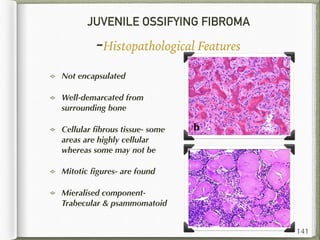
JUVENILE OSSIFYING FIBROMA
-Histopathological Features
Not encapsulated
Well-demarcated from
surrounding bone
Cellular fibrous tissue- some
areas are highly cellular
whereas some may not be
Mitotic figures- are found
Mieralised component-
Trabecular & psammomatoid
141
JUVENILE OSSIFYING FIBROMA
-Management
142
Non-aggressive forms- conservative approach
Aggressive form- enbloc resection
Troulis & colleagues- 4 stages of treatment
Kaban & colleagues- 2 stages of treatment
( Aggressive JOF in maxilla & orbit)
Recurrence- 30-58%
No evidence of malignant transformation
A NOTE ON FEW OTHER SIMILAR APPEARING
LESIONS
143
NOTE ON FEW OTHER LESIONS
-Diagnostic Clues
144
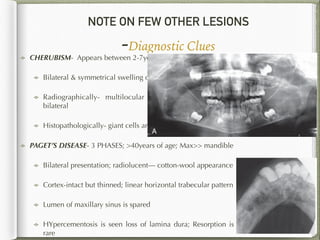
CHERUBISM- Appears between 2-7years of age
Bilateral & symmetrical swelling of mandible
Radiographically- multilocular lesion in the mandible,
bilateral
Histopathologically- giant cells are preponderant
PAGET’S DISEASE- 3 PHASES; >40years of age; Max>> mandible
Bilateral presentation; radiolucent— cotton-wool appearance
Cortex-intact but thinned; linear horizontal trabecular pattern
Lumen of maxillary sinus is spared
HYpercementosis is seen loss of lamina dura; Resorption is
rare
NOTE ON FEW OTHER LESIONS
-Diagnostic Clues
145
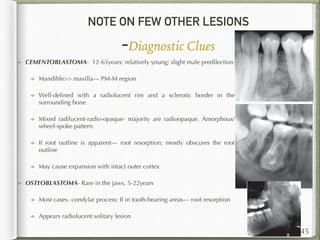
CEMENTOBLASTOMA- 12-65years; relatively young; slight male predilection
Mandible>> maxilla— PM-M region
Well-defined with a radiolucent rim and a sclerotic border in the
surrounding bone
Mixed radilucent-radio-opaque- majority are radioopaque. Amorphous/
wheel-spoke pattern
If root outline is apparent— root resorption; mostly obscures the root
outline
May cause expansion with intact outer cortex
OSTEOBLASTOMA- Rare in the jaws, 5-22years
Most cases- condylar process; If in tooth-bearing areas— root resorption
Appears radiolucent solitary lesion
DIAGNOSING BASED ON VARIOUS
PARAMETERS
146
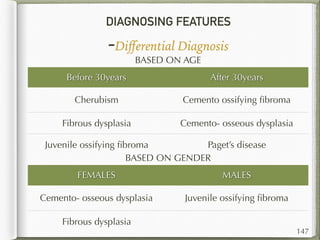
DIAGNOSING FEATURES
-Differential Diagnosis
147
BASED ON AGE
Before 30years After 30years
Cherubism Cemento ossifying fibroma
Fibrous dysplasia Cemento- osseous dysplasia
Juvenile ossifying fibroma Paget’s disease
BASED ON GENDER
FEMALES MALES
Cemento- osseous dysplasia Juvenile ossifying fibroma
Fibrous dysplasia
DIAGNOSING FEATURES
-Differential Diagnosis
148
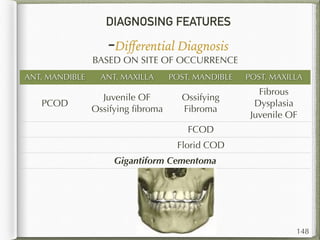
BASED ON SITE OF OCCURRENCE
ANT. MANDIBLE ANT. MAXILLA POST. MANDIBLE POST. MAXILLA
PCOD
Juvenile OF
Ossifying fibroma
Ossifying
Fibroma
Fibrous
Dysplasia
Juvenile OF
FCOD
Florid COD
Gigantiform Cementoma
DIAGNOSING FEATURES
-Differential Diagnosis
149
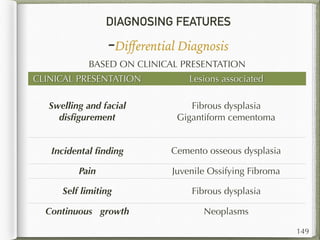
BASED ON CLINICAL PRESENTATION
CLINICAL PRESENTATION Lesions associated
Swelling and facial
disfigurement
Fibrous dysplasia
Gigantiform cementoma
Incidental finding Cemento osseous dysplasia
Pain Juvenile Ossifying Fibroma
Self limiting Fibrous dysplasia
Continuous growth Neoplasms
FIBRO-OSSEOUS LESIONS
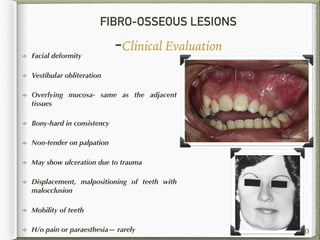
-Clinical Evaluation
150
Facial deformity
Vestibular obliteration
Overlying mucosa- same as the adjacent
tissues
Bony-hard in consistency
Non-tender on palpation
May show ulceration due to trauma
Displacement, malpositioning of teeth with
malocclusion
Mobility of teeth
H/o pain or paraesthesia— rarely
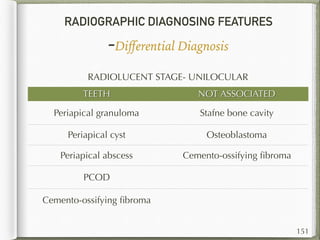
RADIOGRAPHIC DIAGNOSING FEATURES
-Differential Diagnosis
151
RADIOLUCENT STAGE- UNILOCULAR
TEETH NOT ASSOCIATED
Periapical granuloma Stafne bone cavity
Periapical cyst Osteoblastoma
Periapical abscess Cemento-ossifying fibroma
PCOD
Cemento-ossifying fibroma
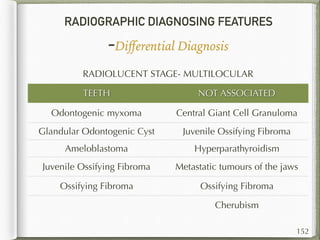
RADIOGRAPHIC DIAGNOSING FEATURES
-Differential Diagnosis
152
RADIOLUCENT STAGE- MULTILOCULAR
TEETH NOT ASSOCIATED
Odontogenic myxoma Central Giant Cell Granuloma
Glandular Odontogenic Cyst Juvenile Ossifying Fibroma
Ameloblastoma Hyperparathyroidism
Juvenile Ossifying Fibroma Metastatic tumours of the jaws
Ossifying Fibroma Ossifying Fibroma
Cherubism
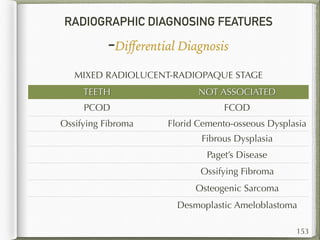
RADIOGRAPHIC DIAGNOSING FEATURES
-Differential Diagnosis
153
MIXED RADIOLUCENT-RADIOPAQUE STAGE
TEETH NOT ASSOCIATED
PCOD FCOD
Ossifying Fibroma Florid Cemento-osseous Dysplasia
Fibrous Dysplasia
Paget’s Disease
Ossifying Fibroma
Osteogenic Sarcoma
Desmoplastic Ameloblastoma
RADIOGRAPHIC DIAGNOSING FEATURES
-Differential Diagnosis
154
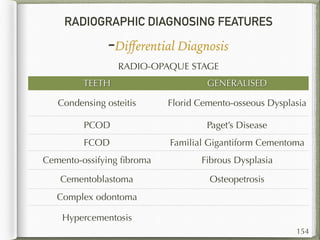
RADIO-OPAQUE STAGE
TEETH GENERALISED
Condensing osteitis Florid Cemento-osseous Dysplasia
PCOD Paget’s Disease
FCOD Familial Gigantiform Cementoma
Cemento-ossifying fibroma Fibrous Dysplasia
Cementoblastoma Osteopetrosis
Complex odontoma
Hypercementosis
RADIOGRAPHIC DIAGNOSING FEATURES
-Differential Diagnosis
155
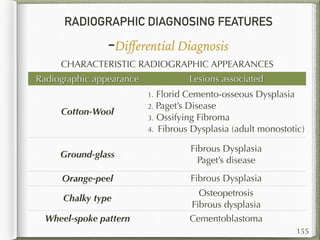
CHARACTERISTIC RADIOGRAPHIC APPEARANCES
Radiographic appearance Lesions associated
Cotton-Wool
1. Florid Cemento-osseous Dysplasia
2. Paget’s Disease
3. Ossifying Fibroma
4. Fibrous Dysplasia (adult monostotic)
Ground-glass
Fibrous Dysplasia
Paget’s disease
Orange-peel Fibrous Dysplasia
Chalky type
Osteopetrosis
Fibrous dysplasia
Wheel-spoke pattern Cementoblastoma
FIBRO-OSSEOUS LESIONS
-Conclusions
156
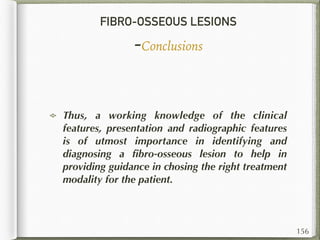
Thus, a working knowledge of the clinical
features, presentation and radiographic features
is of utmost importance in identifying and
diagnosing a fibro-osseous lesion to help in
providing guidance in chosing the right treatment
modality for the patient.
Thank you…

Fibro-osseous Lesions

  • 1.
  • 2.
    FIBRO-OSSEOUS LESIONS -Contents Introduction Classification Importance ofRadiology in the Diagnosis of FOLs Fibrous Dysplasia Cemento-osseous Dysplasia 2
  • 3.
  • 4.
    INTRODUCTION… Fibro-osseous lesions ofthe jaw comprise a diverse group of conditions in which the normal architecture of bone is replaced by fibrous tissue and may contain varying amounts of mineralised substance which may be bone, cementum or both in appearance. The term fibro-osseous lesion was originally a histo-pathological term 4
  • 5.
  • 6.
    CLASSIFICATION SYSTEMS… The variousclassifications systems proposed by authors are enumerated as below.  Charles Waldron Classification Of Fibro-Osseous Lesions Of The Jaws (1985)  Working Classification Of Fibro-Osseous Lesions By Mico M. Malek (1987)  Peiter J. Slootweg & Hellmuth Muller (1990)  WHO Classification (1992)  Waldron Modified Classification Of Fibro-Osseous Lesions Of Jaws (1993) 
 6
  • 7.
    CLASSIFICATION SYSTEMS… The variousclassifications systems proposed by authors are enumerated as below. 
  Brannon & Fowler Classification (2001)  WHO Classification Of Fibro-Osseous Lesions Of Jaws (2005)  Paul M. Speight & Roman Carlos Classification (2006)  Eversole Classification (2008) 
 7
  • 8.
    CLASSIFICATION… Fibro-osseous Lesions ofJaws Classification 1. Fibrous Dysplasia a. Monostotic b. Polyostotic 8 2. Cemento-osseous Dysplasia a. Periapical Cemental Dysplasia b. Focal Cemento-osseous Dysplasia c. Florid Cemento-osseous Dysplasia (Gigantiform Cementoma)
  • 9.
    CLASSIFICATION… 9 3. Familial GigantiformCementoma 6. Miscellaneous Osteoblastoma, Osteiod osteoma, Cementoblastoma 5. Juvenile Ossifying Fibroma 4. Ossifying Fibroma
  • 10.
    CLASSIFICATION… Waldron’s Classification (1993) 1.Fibrous Dysplasia a. Monostotic b. Polyostotic 10 2. Fibro-Osseous (Cemental) Lesions Presumably Arising In The Periodontal Ligament a. Periapical Cemental Dysplasia b. Localized Fibro-Osseous-Cemental Lesions (Probably Reactive In Nature) c. Florid Cemento-osseous Dysplasia (Gigantiform Cementoma) d. Ossifying & Cementifying Fibroma
  • 11.
    CLASSIFICATION… Waldron’s Classification (1993) 11 3.Fibro-Osseous Neoplasms Of Uncertain Or Detectable Relationship To Those Arising In The Periodontal Ligament (Category II) 
 a. Cemetoblastoma, Osteoblastoma & Osteoid Osteoma 
 b. Juvenile Active Ossifying Fibroma & Other So Called Aggressive, Active Ossifying/Cementifying Fibromas 

  • 12.
    CLASSIFICATION… Brannon & Fowler’sClassification 1. Fibrous Dysplasia a. Monostotic b. Polyostotic c. Craniofacial d. McCune-Albright syndrome 2. Osseous Dysplasia a. Periapical b. Focal c. Florid d. Familial gigantiform cementoma 3. Ossifying Fibroma & Juvenile Ossifying Fibroma 12
  • 13.
    IMPORTANCE OF RADIOLOGYIN DIAGNOSIS OF FIBRO-OSSEOUS LESIONS… The radiologist plays a central role in diagnosis of fibro-osseous lesions. Charles Waldron had stated “In the absence of good clinical & radiologic information, a pathologist can only state a biopsy to be consistent with a fibro-osseous lesion” Therefore, identification of majority of FOLs is based on clinical and radiological features. 13
  • 14.
    IMPORTANCE OF RADIOLOGYIN DIAGNOSIS OF FIBRO-OSSEOUS LESIONS… Many fibro-osseous lesions are symptomless and require no surgery. Therefore, diagnosis of the lesions on clinical & radiological features may obviate the need for surgery This my benefit the patient, as fibrous dysplasia may show exaggerated growth after surgery 14
  • 15.
    IMPORTANCE OF RADIOLOGYIN DIAGNOSIS OF FIBRO-OSSEOUS LESIONS… Radiological evaluation- Plain radiography IOPAR Occlusal radiograph Bitewing radiograph 15
  • 16.
    IMPORTANCE OF RADIOLOGYIN DIAGNOSIS OF FIBRO-OSSEOUS LESIONS… Radiological evaluation- CT- expansile, destructive lesions, cortical breakthrough & extra-osseous extensions MRI- solid from non-solid masses 16
  • 17.
  • 18.
    FIBROUS DYSPLASIA -Introduction WHO (1992)defined fibrous dysplasia as “A benign lesion, presumably developmental in nature, characterised by a presence of fibrous connective tissue with a characteristic whorled pattern and containing trabeculae of immature bone” Asymptomatic regional alteration of bone in which normal architecture of bone is replaced by trabeculae-like osseous structures; lesions may be monostotic or polyostotic, with or without associated endocrinal disturbances - Eversole 18
  • 19.
    FIBROUS DYSPLASIA -Introduction Congenital, skeletaldisorder wherein bone is formed and the maturation is arrested in the “woven bone stage”. NON-HEREDITARY DISORDER 19
  • 20.
    FIBROUS DYSPLASIA -History First citationby von Recklinghausen in 1891 Albright pointed out that 2 cases mentioned by von Recklinghausen- fibrous dysplasia Lichtenstein- term FIBROUS DYSPLASIA (1938) Initially considered- Polyostotic Lichtenstein & Jaffe expanded the concept- monostotic 20
  • 21.
    FIBROUS DYSPLASIA -History McCune &Albright (1936 &1937) described an association of abnormal skin pigmentation & precocious puberty (McCune-Albright Syndrome) Jaffe-Lichtenstein described the association of polyostotic fibrous dysplasia with abnormal pigmentation (Jaffe-Lichtenstein Syndrome) 21
  • 22.
    FIBROUS DYSPLASIA -Aetiology &Pathogenesis GNAS1 gene Activation of GS𝞪 subunit of G protein complex Production of cAMP 22 MUTATION CONTINUOUS
  • 23.
    FIBROUS DYSPLASIA -Pathogenesis 1. Hyperfunctionof endocrine glands 2. Increased production of melanocytes 3. Affects differentiation of osteoblasts— impairs ability to form mature osteoblasts Fibrous tissue is produced + trabeculae contain “fluid-filled cysts” — GROUND-GLASS APPEARANCE 23
  • 24.
    FIBROUS DYSPLASIA -Pathogenesis Undifferentiated stemcells— Melanocyte progenitor cells Skeletal progenitor cells Endocrinal progenitor cells 24
  • 25.
    FIBROUS DYSPLASIA -Pathogenesis Skeletal progenitorcells— Migrate to form different bones Multiple bones Post natal mutation— Single bone is affected 25
  • 26.
    FIBROUS DYSPLASIA -Classification Monostotic— Juvenile Juvenile, aggressive Adult 26 Polyostotic— Craniofacial Mc C u n e - A l b r i g h t Syndrome Ja f f e - L i ch t e n s t e i n Syndrome
  • 27.
    JUVENILE FIBROUS DYSPLASIA -ClinicalFeatures AGE- Early to late childhood SITE- Maxilla > Mandible 27
  • 28.
    JUVENILE FIBROUS DYSPLASIA -ClinicalPresentation Asymptomatic Swelling is not prominent & eventually becomes prominent In teenage— swelling may become prominent. Slowly growing ; in aggressive form, growth is more rapid than rest of the bone 28
  • 29.
    JUVENILE FIBROUS DYSPLASIA -ClinicalPresentation May cause- Displacement, rotation or malalignment of teeth Malocclusion Facial deformity 29
  • 30.
    JUVENILE FIBROUS DYSPLASIA -ClinicalPresentation Aggressive form: Pain, trauma & ulceration 2o to impingement by teeth In maxilla- may extend to involve Floor of the orbit Nasal passages 30
  • 31.
    ADULT MONOSTOTIC FIBROUSDYSPLASIA -Introduction Rare form Spontaneously occurring May appear similar to ossifying fibroma but must be differentiated from it 31
  • 32.
    ADULT MONOSTOTIC FIBROUSDYSPLASIA -Clinical Presentation Asymptomatic Diffuse expansion of cortices Movement of teeth within the area may occur 32
  • 33.
    ADULT MONOSTOTIC FIBROUSDYSPLASIA -Radiographic Features Differs from juvenile form. Less homogenous & p r e s e n t s a s m i x e d r a d i o l u c e n t - r a d i o - o p a q u e l e s i o n — “ COTTON-BALL” pattern 33
  • 34.
    POLYOSTOTIC FIBROUS DYSPLASIA -Introduction Threetypes under this sub-heading- Craniofacial form McCune-Albright Syndrome Jaffe- Lichtenstein Syndrome 34
  • 35.
    POLYOSTOTIC FIBROUS DYSPLASIA -ClinicalFeatures 15-20% of remaining cases- POLYOSTOTIC in nature SITE- Skull & facial bones, pelvis, femur, tibia, spine & shoulder girdle; Single limb or all the limbs with/ without axial skeleton involvement UNILATERAL, but if disease is generalised— may be BILATERAL 35
  • 36.
    POLYOSTOTIC FIBROUS DYSPLASIA -ClinicalPresentation Symptomatic before 10years INITIAL PHASE- Pain in limb with associated limp or spontaneous fracture Leg length discrepancy- 70% cases Weight-bearing bones— BOWED Curvature of femoral shaft & neck- SHEPHERD’S CROOK DEFORMITY (characteristic feature) 36
  • 37.
    POLYOSTOTIC FIBROUS DYSPLASIA -Cafeau lait Macules Pigmentation present in polyostotic fibrous dyspalsia -Café au lait pigmentation Café au lait pigmentation(50%) – irregular margins resembling coast line of Maine ( Neurofibromatosis – coastline of California) Café au lait spots is ipsilateral to side of bony lesion (difference from neurofibromatosis) Pigmentation may occur at birth and may precede other symptoms 37
  • 38.
    JAFFE-LICHTENSTEIN SYNDROME -Clinical Features Variablenumber of bones are involved Accompanied by abnormal pigmentation in skin (CAFE-AU- LAIT SPOTS) Pigmentation may occur at birth & may precede other symptoms Occurs in same side as that of the bony lesion 38
  • 39.
    McCUNE-ALBRIGHT’S SYNDROME -Clinical Features Severeform Nearly all bones are involved Endocrine disturbances Abnormal pigmentation in skin (CAFE-AU-LAIT SPOTS) 39
  • 40.
    McCUNE-ALBRIGHT’S SYNDROME -Clinical Features McCuneAlbright syndrome affects females >males The most common endocrinal abnormality: sexual precocity Other endocrinal manifestations are: Accelerated skeletal growth Acromegaly Gigantism Hyperprolactenimia Cushing’s syndrome Hyperthyroidism Diabetes mellitus Hypothalamic hypogonadism Hypophospahtemic rickets Gynecomastia Spermatogenesis 40
  • 41.
    CRANIOFACIAL FORM -Clinical Features Occursin 50% of polyostotic cases; 10-25% of monostotic cases SITE- Frontal, sphenoid, maxillary, ethmoid; less commonly occipital, temporal
  • 42.
    CRANIOFACIAL FORM -Clinical Presentation SPHENOIDWING & TEMPORAL BONE- Vestibular dysfunction Tinnitus Hearing loss 42
  • 43.
    CRANIOFACIAL FORM -Clinical Presentation ORBITAL& PERIORBITAL REGION- Hypertelorism Visual impairment Exophthalmos Cranial asymmetry Facial asymmetry CRIBRIFORM PLATE- Hyposmia or anosmia 43
  • 44.
    FIBROUS DYSPLASIA -Mazabraud’s Syndrome 44 Raredisease Association of fibrous dysplasia and intramuscular myxoma Greater risk of malignant transformation in fibrous dysplasia
  • 45.
    FIBROUS DYSPLASIA -Radiographic Features Courseof the disease— Early lesion- Radiolucent Ill-defined borders Surrounding areas- increased density (granular appearance) Unilocular; may appear multilocular 45
  • 46.
    FIBROUS DYSPLASIA -Radiographic Features Courseof the disease— Mature lesion- Mixed radiolucent- radio-opaque lesion NEW BONE: small radio- opacities 46
  • 47.
    FIBROUS DYSPLASIA -Radiographic Features Location- Maxilla:mandible = 2:1 Posterior regions of jaw Unilateral (very rarely extensive lesions may be bilateral) 47
  • 48.
    FIBROUS DYSPLASIA -Radiographic Features Periphery- Ill-defined Gradualblending of irregular trabeculae & normal trabeculae OCCASIONALLY, may appear sharp & well- corticated in younger individuals 48
  • 49.
    FIBROUS DYSPLASIA -Radiographic Features InternalStructure- Density & trabecular pattern vary Variation is more in mandible May be Radiolucent, Radio-opaque or a Mixed radiolucent-radio- opaque lesion 49
  • 50.
    FIBROUS DYSPLASIA -Radiographic Features InternalStructure- OBISESAN ET AL’S CLASSIFICATION of Radiographic Features of Fibrous Dysplasia:- PEAU DE ORANGE- resembling surface of an orange GROUND-GLASS- resembling shattered wind-screen PAGETOID- wispy arrangement with alternating areas of radiolucency & radio-opacity 50
  • 51.
    FIBROUS DYSPLASIA -Radiographic Features InternalStructure- OBISESAN ET AL’S CLASSIFICATION of Radiographic Features of Fibrous Dysplasia:- FINGERPRINT— swirling pattern CYST-LIKE RADIOLUCENCY— Radiolucent lesions resembling cysts may occur in mature lesions CHALKY-TYPE— Well-circumscribed lesion with amorphous dense radio-opaque material 51
  • 52.
    FIBROUS DYSPLASIA -Radiographic Features Effectson Surrounding Structures- Small lesions- No effect (SUB-CLINICAL VARIETY) BONE- Expansion Maintenance of thinned outer cortex 52
  • 53.
    FIBROUS DYSPLASIA -Radiographic Features Effectson Surrounding Structures- MAXILLARY SINUS- May expand into it Displaces cortical outline Occupies part or most of the sinus cavity Extension into sinus is through LATERAL WALL 53
  • 54.
    FIBROUS DYSPLASIA -Radiographic Features Effectson Surrounding Structures- MAXILLARY SINUS- Last section to be involved: POSTERO-SUPERIOR PORTION Parallel thickening of cortical border-results in residual air space— approximately the normal anatomic shape of the antrum 54
  • 55.
    FIBROUS DYSPLASIA -Radiographic Features Effectson Surrounding Structures- ALVEOLAR BONE- Bone is altered without affecting the dentition. TEETH- LAMINA DURA IS ABSENT PDL SPACE may appear very narrow— if fibrous dysplasia increases bone density. 55
  • 56.
    FIBROUS DYSPLASIA -Radiographic Features Effectson Surrounding Structures- TEETH- Displaces teeth Interfere with normal eruption RARELY, root resorption may occur Involved teeth may have- HYPERCEMENTOSIS 56
  • 57.
    FIBROUS DYSPLASIA -Radiographic Features Effectson Surrounding Structures- MANDIBULAR CANAL- Unique in its ability to displace the canal SUPERIORLY 57
  • 58.
    FIBROUS DYSPLASIA -Other ImagingModalities 58 ROLE OF ULTRASOUND: Helpful for assessing extraskeletal manifestations Usually USG of thyroid and gonads done : evaluate activity and structure of glands and gonads ROLE OF MRI: Not useful as CT and plain films. On T1-weighted MRIs, the lesion has low-to-intermediate signal intensity equal to that of muscle. T2-weighted images also show low signal intensity owing to the high content of collagen and bone
  • 59.
    FIBROUS DYSPLASIA -Other ImagingModalities 59 BONE SCINTIGRAPHY: Accumulation of isotope increases because of the lesion's hypervascularity. Pathologic or stress fractures also can increase isotopic activity in the lesions. The features on the bone scan are nonspecific for a conclusive diagnosis based solely on the distribution of the isotope.
  • 60.
    FIBROUS DYSPLASIA -Other ImagingModalities BONE SCINTIGRAPHY: Hot spots or increased uptake of the radioisotope tracer technetium-99m methylene diphosphonate (99m Tc MDP) occurs in the spine, pelvis, ribs, and appendicular skeleton.
  • 61.
    FIBROUS DYSPLASIA -Differential Diagnosis MetabolicBone disease FD Number of bones involved Polyostotic Monostotic Bilateral Unilateral Expansion NO ✔ 61 Paget’s Disease FD Expansion ✔ ✔ Age >40 years Younger individuals Site If mandible- whole of mandible Unilateral
  • 62.
    FIBROUS DYSPLASIA -Differential Diagnosis PeriapicalCemental Dysplasia FD Age Older individuals Younger Bilateral Unilateral 62 Osteomyelitis FD Expansion Enlargement- on the surface of outer cortex Evidence of original cortex Expands internal structure Sequestrum ✔ NO
  • 63.
    FIBROUS DYSPLASIA -Differential Diagnosis Cemento-ossifyingFibroma FD Displacement ✔ NO One specific centre NO ✔ Bone alteration around teeth ✔ ✔ 63 Neoplasm FD Expansion Convex extension is noted Extension into antrum causes expansion- but, original contour is maintained
  • 64.
    FIBROUS DYSPLASIA -Histopathological Features Wovenbone is present in the form of irregular shaped trabeculae (Chinese script writing) Trabeculae are delicate and are not connected to one another; not sharply defined Bone formed is metaplastic in nature. This form of metaplasia is called a fibro-osseous metaplasia 64
  • 65.
    FIBROUS DYSPLASIA -Histopathological Features Fibrousstroma comprises immature appearing small, slender spindle cells in loose and whorled arrangement. Giant cells are usually not seen in lesions of fibrous dysplasia b u t i f s e e n a r e u s u a l l y associated with the pre-existing mineralized tissue. 65
  • 66.
    FIBROUS DYSPLASIA -Laboratory Investigations SerumCa2+ & P : normal Serum Alk Phosphatase: ed Urinary hydroxyproline, specific index of bone collagen resorption: ed McCune-Albright’s Syndrome- circulating hormones: ed
  • 67.
    FIBROUS DYSPLASIA -Management 67 Mostly clinical& radiological features are sufficient to make a diagnosis of Fibrous dysplasia Reports- exaggeration of growth of lesion— due to surgical intervention Monitor the lesion Ask patient to report if any changes
  • 68.
    FIBROUS DYSPLASIA -Medical Management 68 Limiteduse in polyostotic cases 1. Bisphosphonates: Palmidronate 180mg i.v. every 6months/ i.v. 1-1.5mg/kg/day for 3 consecutive days, given every 4months ➡es- bone pain ➡es- bone resorption es- bone mineral density
  • 69.
    FIBROUS DYSPLASIA -Medical Management 69 2.Calcitonin: Calcitonin injections in doses ranging from 50 to100 IU three times weekly for a period of 3-months were given subcutaneously ➡es- bleeding es- bone formation 3. Supportive therapy: Vitamin D and calcium
  • 70.
    FIBROUS DYSPLASIA -Pain infibrous dysplasia 70 Sprouting of neuroma like structures As a result of GNAS mutation—increased IL-6 secretion
  • 71.
    FIBROUS DYSPLASIA -Pain infibrous dysplasia 71
  • 72.
  • 73.
    PERIAPICAL CEMENTO-OSSEOUS DYSPLASIA -Introduction Localisedchange in normal bone metabolism that results in replacement of the components of normal cancellous bone with fibrous tissue and cementum-like material, abnormal bone or a mixture of the two. Lesion located near the apex of the tooth 73
  • 74.
    PERIAPICAL CEMENTO-OSSEOUS DYSPLASIA -ClinicalFeatures AGE- Middle age; >30years and mean age is 39years GENDER- ♀ : ♂ = 9 : 1 RACE- Blacks : Whites= 3 : 1 ; frequently seen in Asians 74
  • 75.
    PERIAPICAL CEMENTO-OSSEOUS DYSPLASIA -ClinicalPresentation VITAL teeth No h/o pain, sensitivity Incidental finding May become very large— expansion of bone— slow growth
  • 76.
    PERIAPICAL CEMENTO-OSSEOUS DYSPLASIA -RadiographicFeatures Location- Epicentre- at the apex, apical-third of root Mandibular anterior teeth Rarely maxillary teeth Multiple or bilateral; occasionally solitary lesion may arise 76
  • 77.
    PERIAPICAL CEMENTO-OSSEOUS DYSPLASIA -RadiographicFeatures Periphery- Well-defined Radiolucent border may surround the lesion Followed by reactive sclerotic border Shape- May be irregular or have round or oval shape 77
  • 78.
    PERIAPICAL CEMENTO-OSSEOUS DYSPLASIA -RadiographicFeatures Internal Structure- Varies depending on maturity of lesion EARLY STAGE: Bone is resorbed & continuous with PDL space 78
  • 79.
    PERIAPICAL CEMENTO-OSSEOUS DYSPLASIA -RadiographicFeatures Internal Structure- MIXED STAGE: Radio- opaque tissue appears in the lesion. Round/ o v a l / i r r e g u l a r . Sometimes cementum- like material may form s w i r l i n g p a t t e r n (CEMENTICLES) 79
  • 80.
    PERIAPICAL CEMENTO-OSSEOUS DYSPLASIA -RadiographicFeatures Internal Structure- MATURE STAGE: Totally radio-opaque. Thin radiolucent rim 80
  • 81.
    PERIAPICAL CEMENTO-OSSEOUS DYSPLASIA -RadiographicFeatures Effects on surrounding structures- LAMINA DURA: Loss PDL SPACE: Widened TOOTH: Not affected; rarely r e s o r p t i o n o r hypercementosis JAW BONE: Expansion may be seen with thin intact cortex. Undulating in shape 81
  • 82.
    PERIAPICAL CEMENTO-OSSEOUS DYSPLASIA -DifferentialDiagnosis EARLY STAGE PCOD Apical periodontitis/PA abscess Pulp vitality test Responsive Not/delayed response 82 MIXED STAGE PCOD Rarefying & condensing osteitis Apical region Lamina dura intact Radiolucent zone next to root apex
  • 83.
    PERIAPICAL CEMENTO-OSSEOUS DYSPLASIA -DifferentialDiagnosis 83 MIXED STAGE PCOD Rarefying & condensing osteitis Chronic Osteomyelitis Apical region Lamina dura intact Radiolucent zone next to root apex Radiolucent zone next to root apex Well-defined lesion Moth-eaten appearance PCOD Calcifying crowns Age > 30years < 20years
  • 84.
    PERIAPICAL CEMENTO-OSSEOUS DYSPLASIA -DifferentialDiagnosis 84 MIXED STAGE PCOD Odontoma Radio-opacity Less radio-opaque More radio-opaque Position irt adj. teeth At the apical region Seldom below; usually above uneruted teeth PCOD Post-surgical defect No such history H/o recent enucleation
  • 85.
    PERIAPICAL CEMENTO-OSSEOUS DYSPLASIA -DifferentialDiagnosis 85 MIXED STAGE PCOD Osteogenic sarcoma/ Chondrosarcoma/ Metastatic osteoblastic carcinoma Rate of growth Slowly growing Rapidly growing Margins Well-defined Irregular Root resorption Rarely May be noted
  • 86.
    PERIAPICAL CEMENTO-OSSEOUS DYSPLASIA -DifferentialDiagnosis 86 MIXED STAGE PCOD Fibrous Dysplasia Age >30years 1st to 2nd decade Gender ♀: ♂ = 3:1 No gender predilection Site Mandible (90%) Maxilla Jaw expansion Nodular/dome shaped Fusiform shaped Frequency of occurrence Less common More common Margins Well-defined lesion Poorly defined Imperceptibly merges with adj bone
  • 87.
    PERIAPICAL CEMENTO-OSSEOUS DYSPLASIA -DifferentialDiagnosis 87 MIXED STAGE PCOD Cemento-ossifying fibroma Age >30years <30years Gender Marked ♀ predilection Lesser ♀ predilection Site Mandibular anterior PM-M region Jaw expansion Minimal Tendency for expansion Frequency of occurrence Maximum size- < 1cm More common
  • 88.
  • 89.
  • 90.
    FOCAL CEMENTO-OSSEOUS DYSPLASIA -Introduction Theterm Focal Cemento-osseous Dysplasia was first used by Tomich and Summerlin in 1989 90
  • 91.
    FOCAL CEMENTO-OSSEOUS DYSPLASIA -ClinicalFeatures AGE- 4th to 5th decade GENDER- Female predilection SITE- Edentulous posterior areas of the mandible 91
  • 92.
    FOCAL CEMENTO-OSSEOUS DYSPLASIA -ClinicalPresentation Asymptomatic; no swelling unless it is an old lesion- has caused expansion
  • 93.
    FOCAL CEMENTO-OSSEOUS DYSPLASIA -RadiographicFeatures Well-demarcated, mixed radiolucent-radiopaque lesion <2cm in size 93
  • 94.
    FOCAL CEMENTO-OSSEOUS DYSPLASIA -HistopathologicalFeatures Cellular fibrous tissue— c o n t a i n s i r r e g u l a r trabeculae of woven bone o r c e m e n t u m - l i k e calcifications S c a t t e r e d f o c i o f multinucleated giant cells may be seen 94
  • 95.
    FOCAL CEMENTO-OSSEOUS DYSPLASIA -Management 95 Lesionshows NO tendency to recur Partial removal- large lesions (doesn’t recur)
  • 96.
  • 97.
    FIBRO-OSSEOUS LESIONS -Contents Florid OsseousDysplasia Gigantiform Cementoma Cementifying, Cemento-osseous, Ossifying fibroma Juvenile Ossifying Fibroma Diagnostic Clues Conclusion 97
  • 98.
  • 99.
    FLORID CEMENTO-OSSEOUS DYSPLASIA -Introduction Alsocalled Familial Multiple Cementoma The term was introduced by Melrose et al in 1976 It is a widespread form of Periapical Cemento-osseous Dysplasia Diagnosis- PCOD in 3-4 quadrants (or) Extensively formed in one jaw 99
  • 100.
    FLORID CEMENTO-OSSEOUS DYSPLASIA -Aetiology Aetiologicalfactor unknown Waldron et al have proposed that reactive or dysplastic changes in PDL may trigger the disease. 100
  • 101.
    FLORID CEMENTO-OSSEOUS DYSPLASIA -ClinicalFeatures AGE- middle age (mean age= 42years) GENDER- Female predilection; uncommon in males SITE- Bilaterally occurring and symmetrical lesions in jaws Limited to alveolar bone of the jaws 101
  • 102.
    FLORID CEMENTO-OSSEOUS DYSPLASIA -ClinicalPresentation Signs & symptoms are generally absent Partially or completely edentulous DULL PAIN- if exposed to oral cavity— 2o infected— OSTEOMYELITIS S u p e r fi c i a l - a s b o n e resorption is faster than the sclerotic masses 102
  • 103.
    FLORID CEMENTO-OSSEOUS DYSPLASIA -RadiographicFeatures Location- Bilaterally present Both jaws; if only one- mand>> max Epicentre- Apical to teeth within alveolar process Posterior to canines Mandible- above the mandibular canal 103
  • 104.
    FLORID CEMENTO-OSSEOUS DYSPLASIA -RadiographicFeatures Periphery- Sclerotic border In mature lesions, radiolucent, soft-tissue capsule may NOT be appreciable 104
  • 105.
    FLORID CEMENTO-OSSEOUS DYSPLASIA -RadiographicFeatures Internal Structure- Varies from mixed radiolucent-radio-opaque to completely radio-opaque Some prominent radiolucent areas— development of simple bone cyst Small, oval/round regions to large amorphous calcified areas 105
  • 106.
    FLORID CEMENTO-OSSEOUS DYSPLASIA -RadiographicFeatures Effect on Surrounding Structures- Mandibular canal: can be displaced inferiorly Maxillary sinus: can be displaced superiorly Alveolar bone: expansion of cortical plates Roots: May show hypercementosis; may fuse with cementum of abnormal tissue of lesion 106
  • 107.
    FLORID CEMENTO-OSSEOUS DYSPLASIA -DifferentialDiagnosis 107 Florid Cemento—osseous Dysplasia Paget’s Disease Mandibular canal Above mandibular canal Entire mandible Site Only jaws Polyostotic including jaws Florid Cemento— osseous Dysplasia Chronic Sclerosing Osteomyelitis Only alveolar bone Alveolar & basal bone Cementum-like masses may resemble sequestrum
  • 108.
    FLORID CEMENTO-OSSEOUS DYSPLASIA -Management 108 NoT/t required No age limit for cessation of growth Propensity for 2o infection— oral hygiene must be maintained
  • 109.
  • 110.
    GIGANTIFORM CEMENTOMA -Introduction Rare, benignfibro-osseous disease of the jaws Characterised by formation of massive sclerotic masses of disorganised mineralised tissue Norberg in 1931, first described Gigantiform Cementoma Familial cases > Sporadic cases; autosomal dominant WHO in 1971, later re-classified it under cemental lesions 110
  • 111.
    GIGANTIFORM CEMENTOMA -Clinical Features AGE-Younger age group; occasionally older individuals GENDER- No gender predilection SITE- Both the jaws; multifocal & multiquadrant Lesions tend to plateau after cessation of growth 111
  • 112.
    GIGANTIFORM CEMENTOMA -Clinical Presentation Painlessswelling Expansile lesions Tooth impaction, malpositioning of teeth, malocclusion Enlargement stops in 5th decade 112
  • 113.
    GIGANTIFORM CEMENTOMA -Radiographic Features Number-Multiple Location- Maxilla or mandible Periphery- Well-defined, well- circumscribed Internal Structure- Lobulated, radio-opaque-radiolucent lesions 113
  • 114.
    GIGANTIFORM CEMENTOMA -Radiographic Features Otherfeatures- Expansile C r o s s e s m i d l i n e (sometimes lesion may develop in posterior r e g i o n & e n l a r g e towards the anterior part of the jaws & become confluent 114
  • 115.
    GIGANTIFORM CEMENTOMA -Management 115 Surgical removal Incomplete-recurrence Complete + conservative approach— ideal approach
  • 116.
  • 117.
    OSSIFYING FIBROMA -Introduction Before refiningthe concept of focal cemento- osseous dysplasia, Ossifying fibroma, was thought to be common Presently— relatively rare Radiographically- focal cemento-osseous dysplasia Histopathologically- neoplasm with significant growth potential 117
  • 118.
    OSSIFYING FIBROMA -Introduction In 1972,WHO classification separated cementifying and ossifying fibroma Cementifying fibroma- spherical calcifications Ossifying fibroma- predominant osseous component 118
  • 119.
    OSSIFYING FIBROMA -Introduction Origin ofthese cementum-like calcifications— uncertain— extra-gnathic sites Bone & cementum— cannot be distinguished histologically 119
  • 120.
    OSSIFYING FIBROMA -Aetiology &Pathogenesis Occurs mostly in jaws— originate from pluripotent cells- periodontal membrane Recently mutations in HRPT2 gene— rare syndrome called Hyperparathyroidism- jaw tumour syndrome Characterised by Parathyroid adenoma/carcinoma Ossifying fibromas of the jaws Renal cysts Wilm’s tumour 120
  • 121.
    OSSIFYING FIBROMA -Aetiology &Pathogenesis Identification of HRPT2 gene mutation— 2 sporadic cases Function of parafibromin & mechanism of tumour formation— NOT KNOWN 121
  • 122.
    OSSIFYING FIBROMA -Clinical Features AGE-3rd- 4th decade of life GENDER- Female predilection SITE- Mandible>> Maxilla Premolar-molar region Tooth-bearing areas— may extend into ramus 122
  • 123.
    OSSIFYING FIBROMA -Clinical Presentation Hard,localised, slow-growing painless mass May displace adjacent structures Exfoliation of teeth Expansion of inferior border followed by buccal cortical plate expansion 123
  • 124.
  • 125.
    OSSIFYING FIBROMA -Radiographic Features Number-Single Location- Exclusively in facial bones; mandible- PM-M regions; superior to mandibular canal. In maxilla- canine fossa Periphery- Well- defined, radiolucent rim; sclerotic border 125
  • 126.
    OSSIFYING FIBROMA -Radiographic Features InternalStructure- Radio-opaque-radiolucent lesions Sometimes— radiolucent In the type that contains abnormal trabeculae— pattern may be similar to fibrous dysplasia May be flocculent— cotton-ball appearance Lesions with amorphous bone- solid, homogenous radiopaque regions Eversole- unilocular & multilocular appearance 126
  • 127.
    OSSIFYING FIBROMA -Radiographic Features Effecton Surrounding Structures- Concentric growth- within medulla Outward expansion in all directions- cortical plate is thinned out but INTACT Teeth:- Displacement- ✔ Root resorption- ✔ Lamina dura- Loss 127
  • 128.
    OSSIFYING FIBROMA -Radiographic Features Effecton Surrounding Structures- Mandibular canal:- Displacement- ✔ Maxillary sinus:- Can grow into & occupy most of the sinus Expands its wall outwards Bony partition remains between them 128
  • 129.
    OSSIFYING FIBROMA -Differential Diagnosis 129 Ossifyingfibroma Fibrous Dysplasia Margins Better defined Blends into surrounding bone Internal structure More variation Less variation; more homogenous in maxilla Displacement ✔- displaces from an epicentre ✔ Root resorption ✔ ✖ Expansion of bone ✔- More concentric about an epicentre ✔- Enlarges bone & distorts shape— normal morphology
  • 130.
    OSSIFYING FIBROMA -Differential Diagnosis 130 Ossifyingfibroma PCOD Single lesion Multifocal Displacement ✔ ✖ Expansion ✔ Rarely Pattern of Expansion Concentric Undulating Ossifying fibroma Osteogenic Sarcoma Thinning & INTACT Destroyed Displacement ✖ ✔
  • 131.
    OSSIFYING FIBROMA -Histopathological Features Fibrousstroma- highly cellular Hard-tissue portion— in the form of osteoid or cellular spherules Variation in type of mineralised material- not seen in Fibrous dysplasia 131
  • 132.
    OSSIFYING FIBROMA -Management 132 Surgical enucleation/resection Largelesions- several fragments Recurrence- seldom seen except in younger patients Prognosis- excellent No evidence of malignant transformation
  • 133.
  • 134.
    JUVENILE OSSIFYING FIBROMA -Introduction Controversiallesion Distinguished from the larger group of ossifying fibromas based on Age Common site of involvement Clinical behaviour 2 patterns have been noted- Trabecular & Psammomatoid 134
  • 135.
    JUVENILE OSSIFYING FIBROMA -Introduction Accordingto WHO, “A fibro-osseous lesion that is characterised by cellular rich fibrous tissue, bands of cellular osteoid trabeculae and giant cells.” 135
  • 136.
    JUVENILE OSSIFYING FIBROMA -ClinicalFeatures AGE- Mean age are 11years and 22 years; 2-15 years GENDER- No gender predilection (slight male predilection) SITE- Maxillary predominance Psammomatoid- extra-gnathic sites ( 70%- orbital, frontal bones & paranasal sinuses) 136
  • 137.
    JUVENILE OSSIFYING FIBROMA -ClinicalPresentation May be an incidental finding Sometimes- clinically detectable facial deformity Pain & paraesthesia- rarely 137
  • 138.
    JUVENILE OSSIFYING FIBROMA -ClinicalPresentation COMPLICATIONS- due to impingement on neighbouring structures Nasal obstruction Exophthalmos Proptosis Temporary/permanent blindness 138
  • 139.
    JUVENILE OSSIFYING FIBROMA -RadiographicFeatures Unilocular/multilocular Location- In jaws > in maxilla. Psammomatoid- in extra-gnathic sites Periphery- Well-defined, radiolucent rim; sclerotic border Internal structure- Central opacification Effect on Surrounding Structures- Cortical plate thinning & perforation 139
  • 140.
    JUVENILE OSSIFYING FIBROMA -RadiographicFeatures CT findings- Well-defined borders, thin sclerotic shell. C o r t i c a l d i s r u p t i o n & i n vo l v e m e n t o f a d j a c e n t structures. More aggressive than Fibrous dysplasia or ossifying fibroma MRI findings- Intermediate to low signal intensity on MRI. G r e a t e r s p e c i fi c i t y wh e n n e u r o va s c u l a r o r o c u l a r involvement is there. 140
  • 141.
    JUVENILE OSSIFYING FIBROMA -HistopathologicalFeatures Not encapsulated Well-demarcated from surrounding bone Cellular fibrous tissue- some areas are highly cellular whereas some may not be Mitotic figures- are found Mieralised component- Trabecular & psammomatoid 141
  • 142.
    JUVENILE OSSIFYING FIBROMA -Management 142 Non-aggressiveforms- conservative approach Aggressive form- enbloc resection Troulis & colleagues- 4 stages of treatment Kaban & colleagues- 2 stages of treatment ( Aggressive JOF in maxilla & orbit) Recurrence- 30-58% No evidence of malignant transformation
  • 143.
    A NOTE ONFEW OTHER SIMILAR APPEARING LESIONS 143
  • 144.
    NOTE ON FEWOTHER LESIONS -Diagnostic Clues 144 CHERUBISM- Appears between 2-7years of age Bilateral & symmetrical swelling of mandible Radiographically- multilocular lesion in the mandible, bilateral Histopathologically- giant cells are preponderant PAGET’S DISEASE- 3 PHASES; >40years of age; Max>> mandible Bilateral presentation; radiolucent— cotton-wool appearance Cortex-intact but thinned; linear horizontal trabecular pattern Lumen of maxillary sinus is spared HYpercementosis is seen loss of lamina dura; Resorption is rare
  • 145.
    NOTE ON FEWOTHER LESIONS -Diagnostic Clues 145 CEMENTOBLASTOMA- 12-65years; relatively young; slight male predilection Mandible>> maxilla— PM-M region Well-defined with a radiolucent rim and a sclerotic border in the surrounding bone Mixed radilucent-radio-opaque- majority are radioopaque. Amorphous/ wheel-spoke pattern If root outline is apparent— root resorption; mostly obscures the root outline May cause expansion with intact outer cortex OSTEOBLASTOMA- Rare in the jaws, 5-22years Most cases- condylar process; If in tooth-bearing areas— root resorption Appears radiolucent solitary lesion
  • 146.
    DIAGNOSING BASED ONVARIOUS PARAMETERS 146
  • 147.
    DIAGNOSING FEATURES -Differential Diagnosis 147 BASEDON AGE Before 30years After 30years Cherubism Cemento ossifying fibroma Fibrous dysplasia Cemento- osseous dysplasia Juvenile ossifying fibroma Paget’s disease BASED ON GENDER FEMALES MALES Cemento- osseous dysplasia Juvenile ossifying fibroma Fibrous dysplasia
  • 148.
    DIAGNOSING FEATURES -Differential Diagnosis 148 BASEDON SITE OF OCCURRENCE ANT. MANDIBLE ANT. MAXILLA POST. MANDIBLE POST. MAXILLA PCOD Juvenile OF Ossifying fibroma Ossifying Fibroma Fibrous Dysplasia Juvenile OF FCOD Florid COD Gigantiform Cementoma
  • 149.
    DIAGNOSING FEATURES -Differential Diagnosis 149 BASEDON CLINICAL PRESENTATION CLINICAL PRESENTATION Lesions associated Swelling and facial disfigurement Fibrous dysplasia Gigantiform cementoma Incidental finding Cemento osseous dysplasia Pain Juvenile Ossifying Fibroma Self limiting Fibrous dysplasia Continuous growth Neoplasms
  • 150.
    FIBRO-OSSEOUS LESIONS -Clinical Evaluation 150 Facialdeformity Vestibular obliteration Overlying mucosa- same as the adjacent tissues Bony-hard in consistency Non-tender on palpation May show ulceration due to trauma Displacement, malpositioning of teeth with malocclusion Mobility of teeth H/o pain or paraesthesia— rarely
  • 151.
    RADIOGRAPHIC DIAGNOSING FEATURES -DifferentialDiagnosis 151 RADIOLUCENT STAGE- UNILOCULAR TEETH NOT ASSOCIATED Periapical granuloma Stafne bone cavity Periapical cyst Osteoblastoma Periapical abscess Cemento-ossifying fibroma PCOD Cemento-ossifying fibroma
  • 152.
    RADIOGRAPHIC DIAGNOSING FEATURES -DifferentialDiagnosis 152 RADIOLUCENT STAGE- MULTILOCULAR TEETH NOT ASSOCIATED Odontogenic myxoma Central Giant Cell Granuloma Glandular Odontogenic Cyst Juvenile Ossifying Fibroma Ameloblastoma Hyperparathyroidism Juvenile Ossifying Fibroma Metastatic tumours of the jaws Ossifying Fibroma Ossifying Fibroma Cherubism
  • 153.
    RADIOGRAPHIC DIAGNOSING FEATURES -DifferentialDiagnosis 153 MIXED RADIOLUCENT-RADIOPAQUE STAGE TEETH NOT ASSOCIATED PCOD FCOD Ossifying Fibroma Florid Cemento-osseous Dysplasia Fibrous Dysplasia Paget’s Disease Ossifying Fibroma Osteogenic Sarcoma Desmoplastic Ameloblastoma
  • 154.
    RADIOGRAPHIC DIAGNOSING FEATURES -DifferentialDiagnosis 154 RADIO-OPAQUE STAGE TEETH GENERALISED Condensing osteitis Florid Cemento-osseous Dysplasia PCOD Paget’s Disease FCOD Familial Gigantiform Cementoma Cemento-ossifying fibroma Fibrous Dysplasia Cementoblastoma Osteopetrosis Complex odontoma Hypercementosis
  • 155.
    RADIOGRAPHIC DIAGNOSING FEATURES -DifferentialDiagnosis 155 CHARACTERISTIC RADIOGRAPHIC APPEARANCES Radiographic appearance Lesions associated Cotton-Wool 1. Florid Cemento-osseous Dysplasia 2. Paget’s Disease 3. Ossifying Fibroma 4. Fibrous Dysplasia (adult monostotic) Ground-glass Fibrous Dysplasia Paget’s disease Orange-peel Fibrous Dysplasia Chalky type Osteopetrosis Fibrous dysplasia Wheel-spoke pattern Cementoblastoma
  • 156.
    FIBRO-OSSEOUS LESIONS -Conclusions 156 Thus, aworking knowledge of the clinical features, presentation and radiographic features is of utmost importance in identifying and diagnosing a fibro-osseous lesion to help in providing guidance in chosing the right treatment modality for the patient.
  • 157.