Bone diseases
Dr.Reham AA Morsy
Composition of bone
• Organic collagen
• Inorganic calcium & phosphorus
Types of bone
• Lamellar bone
• Woven bone
• Bundle bone
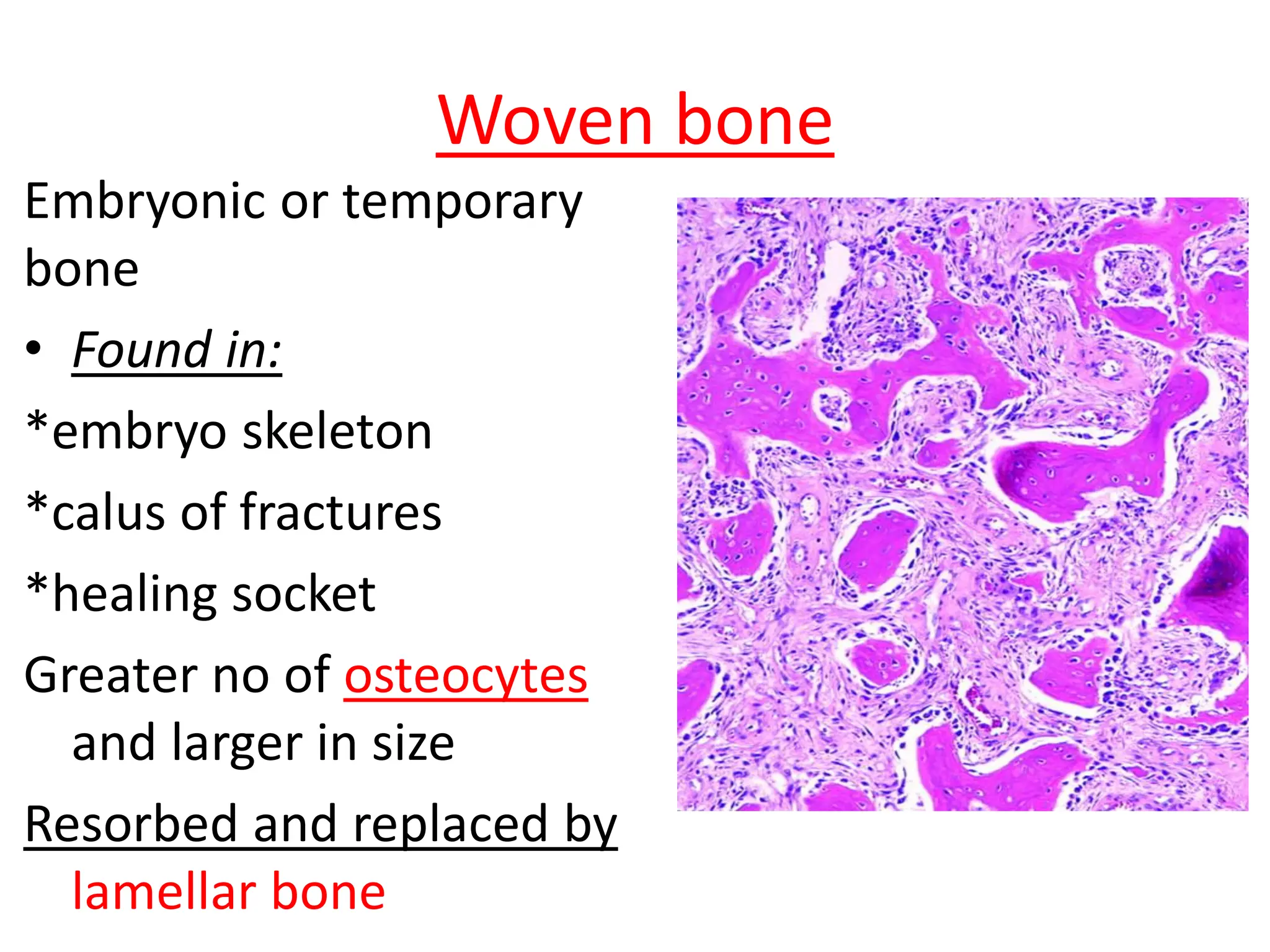
Woven bone
Embryonic or temporary
bone
• Found in:
*embryo skeleton
*calus of fractures
*healing socket
Greater no of osteocytes
and larger in size
Resorbed and replaced by
lamellar bone
Lamellar bone
• Lamellar= It is formed in layers
• Adult type
• It is of two types:
• Compact & Cancellous(Spongy)
compact
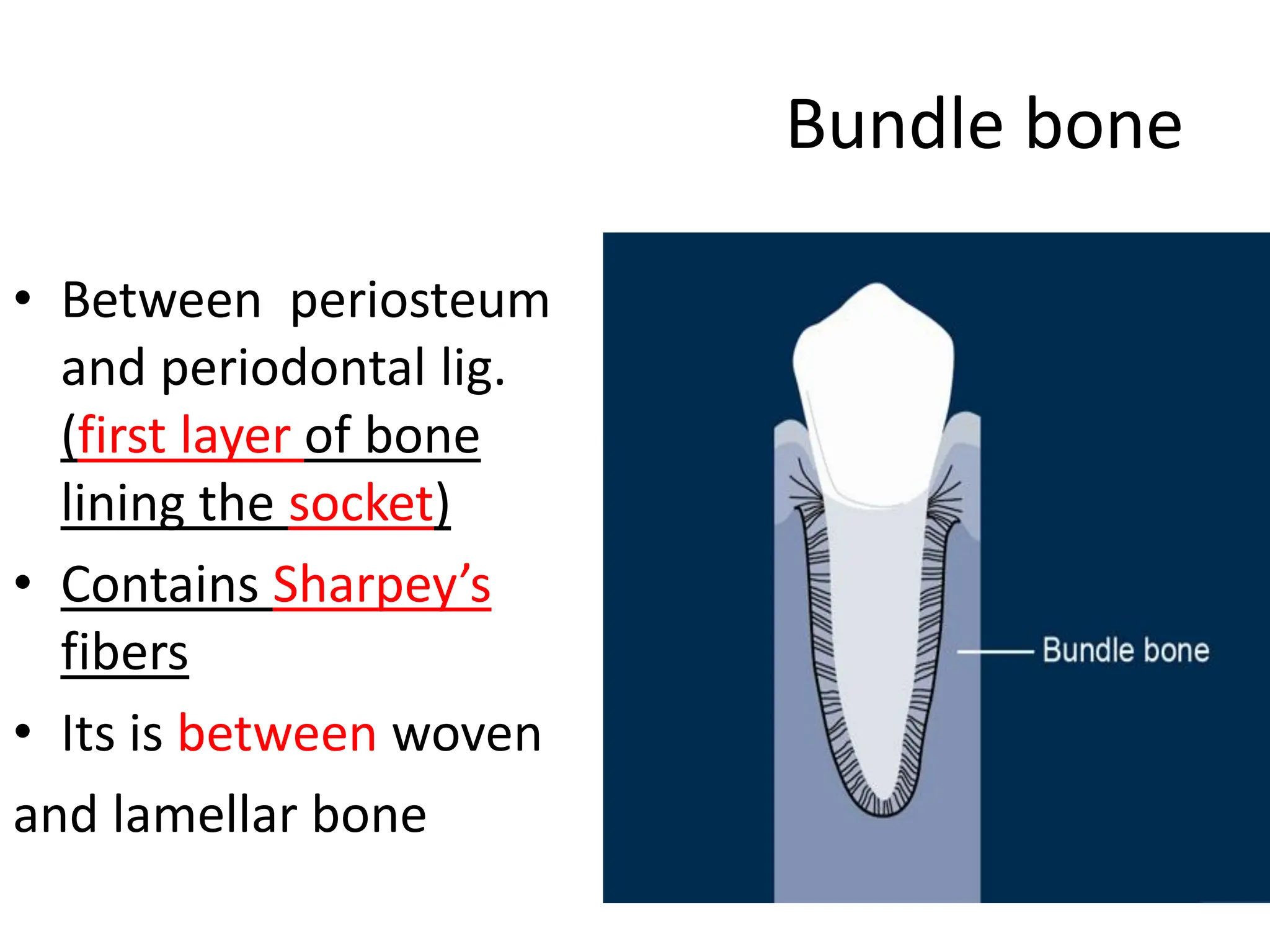
Bundle bone
• Between periosteum
and periodontal lig.
(first layer of bone
lining the socket)
• Contains Sharpey’s
fibers
• Its is between woven
and lamellar bone
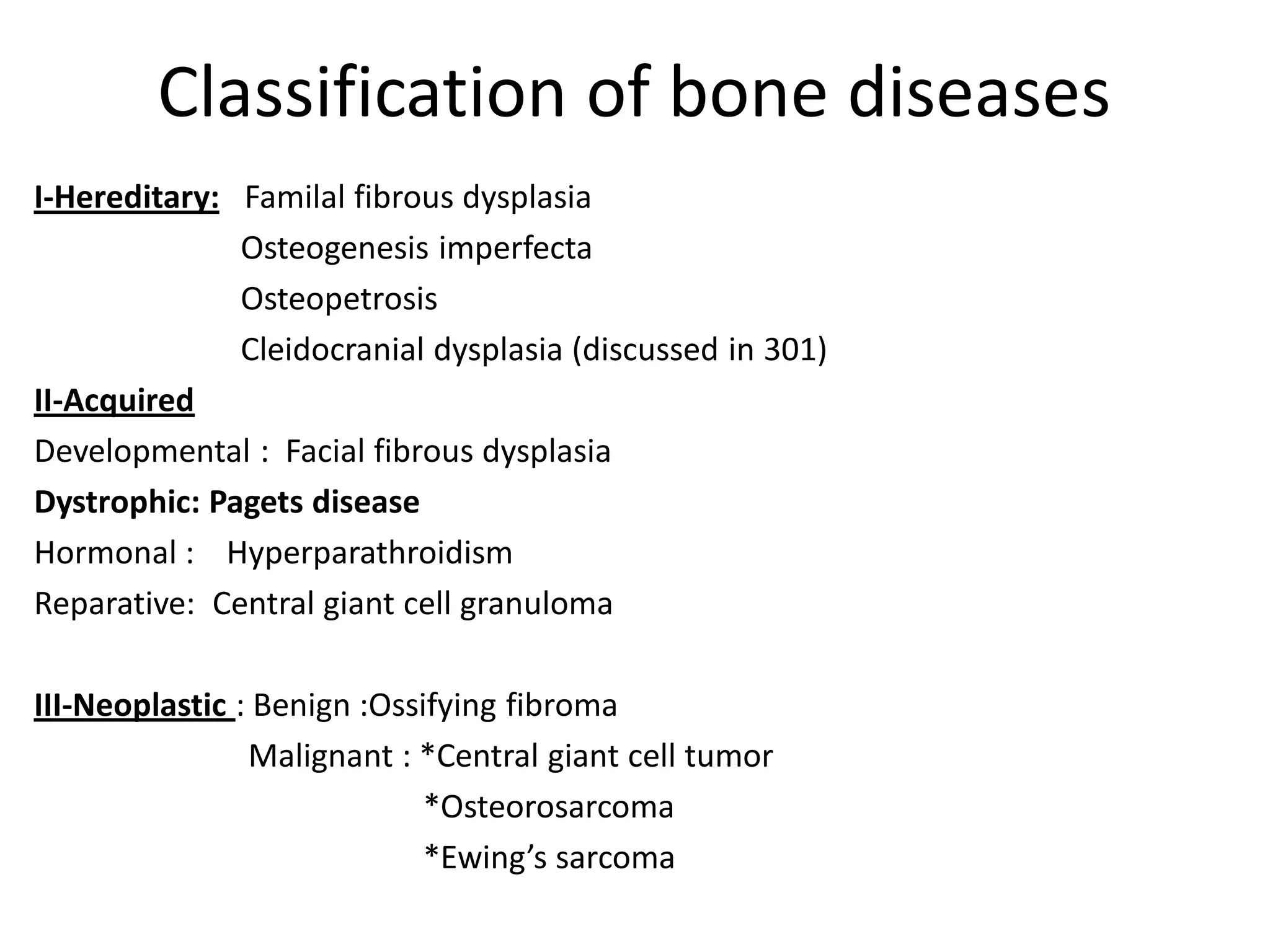
Classification of bone diseases
I-Hereditary: Familal fibrous dysplasia
Osteogenesis imperfecta
Osteopetrosis
Cleidocranial dysplasia (discussed in 301)
II-Acquired
Developmental : Facial fibrous dysplasia
Dystrophic: Pagets disease
Hormonal : Hyperparathroidism
Reparative: Central giant cell granuloma
III-Neoplastic : Benign :Ossifying fibroma
Malignant : *Central giant cell tumor
*Osteorosarcoma
*Ewing’s sarcoma
1-Familial fibrous dysplasia
(Cherubism)
• Hereditary
• Appears at 2 years
• Males= females
• Mandible> maxilla
• Bilateral
• Painless
• Slowly growing
(stops with cessation of skeletal growth)
• Smooth
• Bulges buccally > lingually
Why.…Cherubism??
??
There is an “eyes up
turned to heaven “
appearance.
*Increase in amount of
sclera because lower
eye lid is stretched on
bilateral bony
swelling
Dental Features
• The developing teeth
are displaced and fail to
erupt.
• Early shedding of
deciduous
• Early loss of permenant
• Malocclusion.
Panoramic radiograph shows bilateral
multilocular radiolucency in the mandible(red
arrows) and multiple un-erupted teeth.
Familial fibrous dysplasia
Histologically:
Central giant
cell lesions
Familial fibrous dysplasia
(Cherubism)
Histologically:
* C.T stroma containing
variable numbers of
multinucleated giant
cells which are focally
aggregated around:….
*Thin walled BV
*Few osteoid & bone
trabeculae
2-Osteogenesis imperfecta
• Autosomal dominant trait: defect in collagen
type 1
Bone is fragile
• Children and infants
• Males=females
• X-ray bending of bone
• Thin long bones
• Severe deformity
• Multiple fractures
Osteogenesisis imperfecta
* *Thin blue sclera (sclera is
transparent showing the blue
color of the choroid)
**Deafness (defect in ear
ossicles)
**Dentinogenesis imperfecta
• Thin cortex and thin cancellous bone trabeculae
and increase in marrow spaces
• Severe forms of the disease are fatal
• Avoid minor trauma which may lead to bone
fracture
3-Osteopetrosis (Marble bone
disease)
• Genetic disease
• (Inactive osteoclasts)
decrease bone resorption
• Resulting in excessive
bone formation which is
brittle
• X-ray
Increase in bone density
No distinction between
cortical and medullary
bone
Mandible is affected more
than maxilla
Histopathology
- Thickened bone cortex
- Thickenend
cancellous bone
trabeculae
- Decrease in marrow
cavities
Bone marrow
transplant as ttt.
Lack of Bone Marrow cavities leads to:
• Decreased blood supply:
brittle bone fractures
• Osteomyelitis as a complication of WBCs
• Anemia due to decrease in medullary cavity
Classification of bone diseases
I-Hereditary: Familal fibrous dysplasia
Osteogenesis imperfecta
Osteopetrosis
Cleidocranial dysplasia (discussed in 301)
II-Acquired
Developmental : Facial fibrous dysplasia
Dystrophic: Pagets disease
Hormonal : Hyperparathroidism
Reparative: Central giant cell granuloma
III-Neoplastic : Benign :Ossifying fibroma
Malignant :Central giant cell tumor
Osteorosarcoma chondrosarcoma
Ewing’s sarcoma Fibrosarcoma
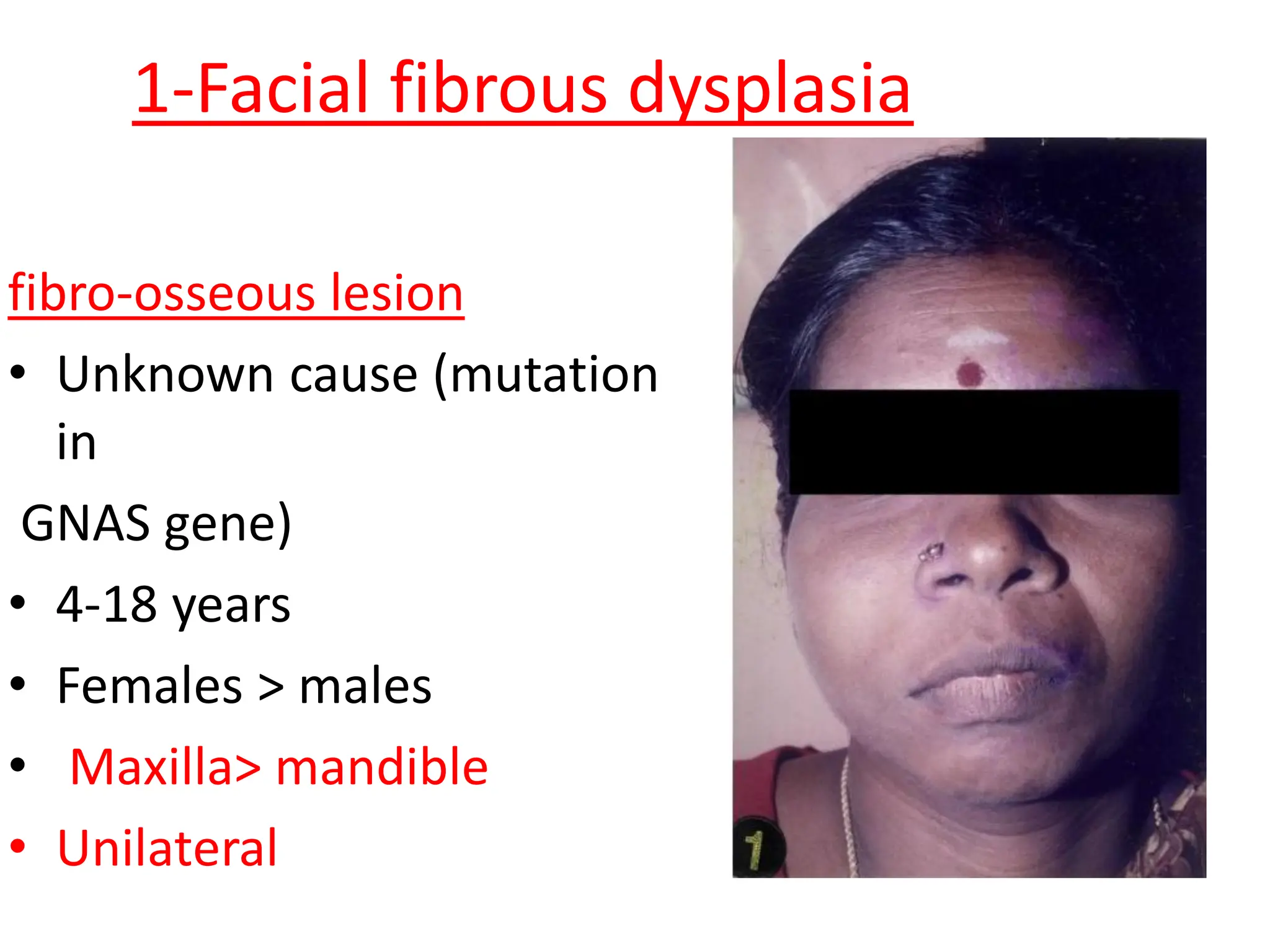
1-Facial fibrous dysplasia
fibro-osseous lesion
• Unknown cause (mutation
in
GNAS gene)
• 4-18 years
• Females > males
• Maxilla> mandible
• Unilateral
Swelling in the alveolar ridge:
 Painless, hard, smooth&
slowly growing
(stops with cessation of skeletal
growth)
Bulging buccally more than
lingually
Normal covering mucosa
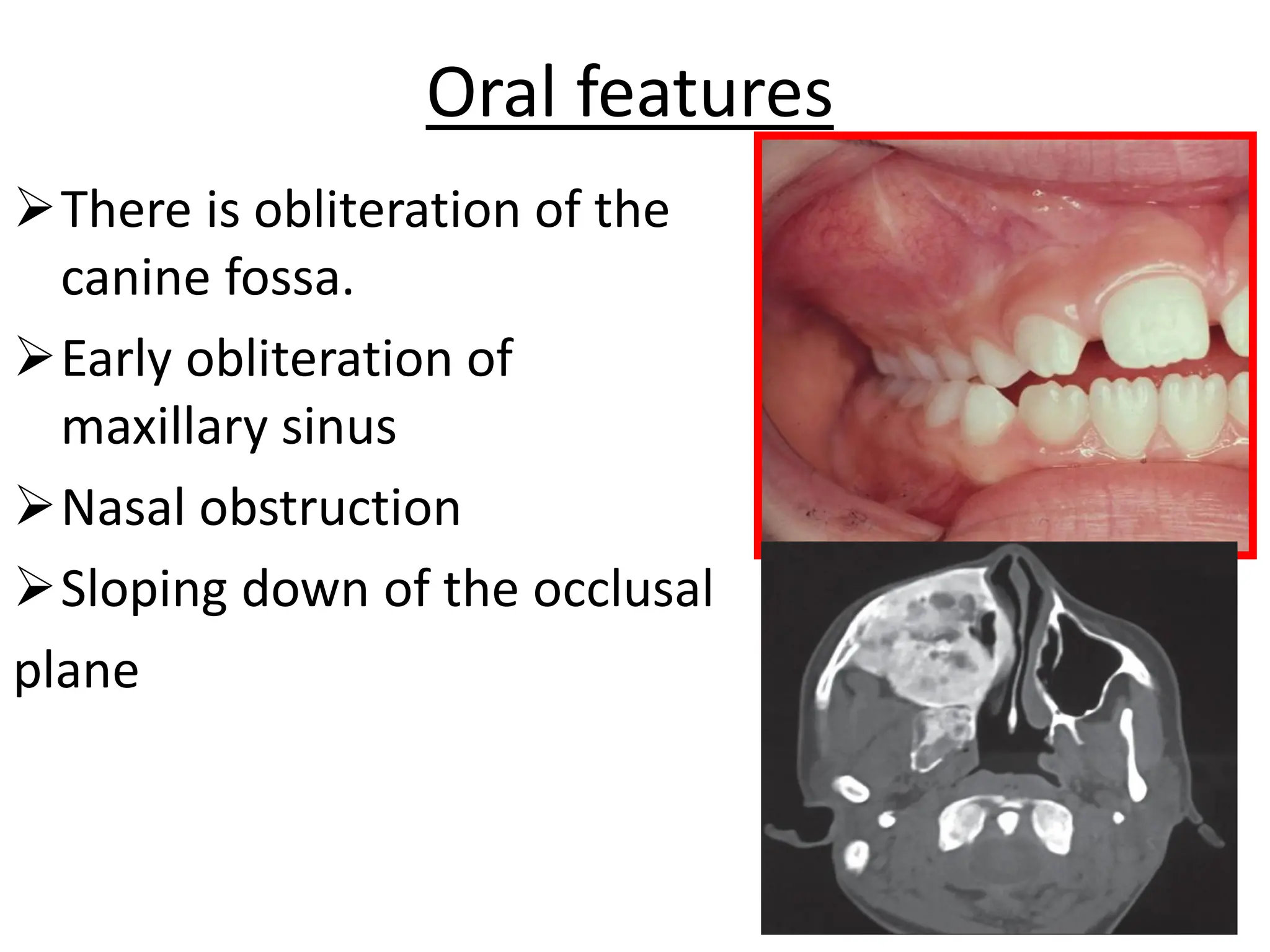
Oral features
There is obliteration of the
canine fossa.
Early obliteration of
maxillary sinus
Nasal obstruction
Sloping down of the occlusal
plane
X-ray 3 patterns
1-Orange peel
pattern in
intraoral &
occlusal films
2- Ground glass
appearance in
extra oral films
Lesion pushes
sutures, but does
not cross them
Extra oral radiographs shows ground glass
appearance.
• 3- Smoke screen pattern
radiolucency with radiopacities
Early oblitertion of max. sinus
Facial fibrous dysplasia
U/M:A fibrous stroma containing osteoid tissue
(osteoid stage). Later, the lesion tends to be
calcified forming bone trabeculae (osseous stage)
with few giant cells
• Bone trabeculae are equidistant
• Chinese letter appearance or I, C , U , W
Osteoid stage & Osseous Stage
Complications
• If treated before 20 years it will
grow rapidly resembling a neoplasm
• Orbital deformity and
exophthalmous
• Obliteration of paranasal sinuses
• Nasal obstruction
• Pathological fractures
Facial fibrous dysplasia
• Jaffe ‘s classification:
Monostotic one bone
Polystotic many bones
Albright syndrome
Polystotic fibrous dysplasia
Melanin pigmentation………..
Early maturation in females
Paget’s disease of bone(osteitis
deformans)
• Chronic disease
• Unknown cause(may be viral or genetic)
• Not inflammatory (osteitis deformans is a
misnomer)
• Pathogenesis: excessive bone formation
• Above 40 years males > females maxilla>
*Enlargement of the
vault of the skull
*Stretching of skin
over bone (face-
mask)
Bowing of the legs and
spine (kyphosis).
*Narrowing of
foraminae
(headache &
blindness
loss of hearing )
Oral manifestations
• Short Lips and Shallow palate
• Mouth remains opened
• Mucosa is erythematous if the disease
is active.
• Enlargement of the maxillary alveolar
ridge so denture no longer fit.
• Difficult extraction bec:
*Loss of bone plasticity
*Hypercementosis
After extraction ……severe bleeding , dry
socket and osteomyelitis.
• Late obliteration of max.
sinus
• Facial fibrous dysplasia
(early obliteration of max.
sinus)
X-ray
• Osteolytic stage
• Osteoblastic
• Osteoblastic stage
• Bone formation in vault gives the shape of
cotton wool appearance
• Obliteration(loss) of the lamina dura
• Hypercementosis
• Obliteration of maxillary sinus (late FFd)
• Osteolytic stage
Radiolucent areas and osteoporosis in jaws
Teeth have floating on air appearance due to:
*loss of lamina dura & *root resorption
Paget’s disease of bone
U/M: A C.T stroma containing bone trabeculae
showing basophilic reversal lines (mosaic pattern)
C.T shows A-V shunt
Focal collections of
lymphocytes
Giant cells
Hypercementosis: new
cementum shows many
reversal lines (mosaic
pattern)
Complications (excessive
abnormal bone)
• Pathological fracture
• Enlarged maxilla displaced teeth
denture remake
• Difficult extraction loss of bone pliability
hypercementosis
• After extraction : bleeding (due to A-V shunt), dry
socket & osteomyelitis : bec. new bone has poor
blood supply and decreased resistance to infection
• 2% sarcomatous change
• Facial neuralgia due to narrowing of foraminae
• Left sided heart failure
Treatment
No treatment……. but
Careful management:
• Good oral hygiene to avoid osteomyelitis
• Removal of teeth must be done surgically
• Socket is saucerized to reduce blood clot size
• Sutured to control bleeding
• Dentures need periodic remake to avoid
pressure on bone and necrosis
• Analgesics to relieve pain
• Calcitonin
Hyperparathyroidism (Brown nodes
disease)
Hormonal
Primary:due to
parathyroid adenoma
Secondary:
hypertrophy due to
glomerulonephritis
(kidney disease)
Role of parathyroid
hormone is to
increases bone resorption to
increase Ca in blood
Hyperparathyroidism (Brown
nodes disease)
old woman
Osteoporosis and path. fracture
Pain in the back and extremities
A-Bones
An early
loss of the lamina-dura
around the teeth.
There is also a
decrease in the
density of bone
trabeculae .
Best way to diagnose it is intra oral radiograph
bec. radiodensity of teeth is not changed
Why?????
??
Later, bone resorption producing multiple
radiolucent lesions affects all bones of the
skeleton especially jaw bones.
Due to increase in serum Ca
B-Stones
*Metastatic calcifications
in the oral mucosa.
*Renal stones (calculi)
*Pulp obliteration
C- Abdominal groans
Dudenal ulcers
D- Psycic moans
Dementia
Confusion due to Ca deposition in brain
Lab findings show
• Elevated Parathyroid hormone
• Elevated serum calcium
• Elevated alkaline phosphatase
enzyme (reactionary to compensate
for bone resorption)
• Decrease in serum phosphorus.
U/M: It is a central giant
cell lesion composed of
numerous
multinucleated
osteoclast-type giant
cells in a vascular C.T
stroma .
Hyperparathroidism
Brown nodes
disease
Hyperparathroidism
At the time of surgery,
the specimen is
brown in color
(brown nodes) due to
excessive
hemosiderin
pigments.
C.G.C. Granuloma
• Reparative process in bone
• 12-25 years
• Females
• Mandible > maxilla
• Anterior part of mandible
• Painless & slowly growing
• It is with no secondary metastasis)
Unilocular or Multilocular
radiolucent area
Histopathology
fibro-vascular c.t stroma
• Giant cells (focal arrangement) around b.v,
hemorrhage, haemosiderin
• C.T stroma
• Osteoid tissue(little amount)
• Ttt: curretage
• Recurrence is rare
Neoplastic bone diseases
• Ossifying fibroma
• Central giant cell tumor (Osteoclastoma )
1-Ossifying fibroma
• Benign neoplasm
• Antrum & mandibular
molar area
• Subperiosteally more than
centrally
• Painless &slowly growing
X-ray
• Well defined
radiolucency with
radiopacities
surrounded by
radiopaque rim
Then , radiopaque
surrounded by a
radiolucent rim
Histology
• Proliferating
fibroblasts
• Little collagen fibers
• Globules of
dystrophic
calcification
(degenerative)+
bone+ cementum
One of fibro-osseous
lesions
2- Central giant cell tumor
(Osteoclastoma)
• Malignant neoplasm
• 40 years
• Males =females
• Rare intra-orally….
……Posterior mandible
• Painful rapidly growing
swelling destroying the
bone
• Metastasis to lungs
Multilocular radiolucent area
Histopathology
• Osteolytic lesion
- Giant cells in a syncitial pattern
(irregular)
- Giant cell are larger and contain
more nuclei than central giant
cell granuloma
- Abnormal mitosis&pleomorphism
- C.T stroma with little fibers
- Ttt: hemi-resection
- Recurrence is common
THANK YOU

bone diseases I&II Dr Reham (1).pd vvvvf

  • 1.
  • 2.
    Composition of bone •Organic collagen • Inorganic calcium & phosphorus Types of bone • Lamellar bone • Woven bone • Bundle bone
  • 3.
    Woven bone Embryonic ortemporary bone • Found in: *embryo skeleton *calus of fractures *healing socket Greater no of osteocytes and larger in size Resorbed and replaced by lamellar bone
  • 4.
    Lamellar bone • Lamellar=It is formed in layers • Adult type • It is of two types: • Compact & Cancellous(Spongy) compact
  • 5.
    Bundle bone • Betweenperiosteum and periodontal lig. (first layer of bone lining the socket) • Contains Sharpey’s fibers • Its is between woven and lamellar bone
  • 6.
    Classification of bonediseases I-Hereditary: Familal fibrous dysplasia Osteogenesis imperfecta Osteopetrosis Cleidocranial dysplasia (discussed in 301) II-Acquired Developmental : Facial fibrous dysplasia Dystrophic: Pagets disease Hormonal : Hyperparathroidism Reparative: Central giant cell granuloma III-Neoplastic : Benign :Ossifying fibroma Malignant : *Central giant cell tumor *Osteorosarcoma *Ewing’s sarcoma
  • 7.
    1-Familial fibrous dysplasia (Cherubism) •Hereditary • Appears at 2 years • Males= females • Mandible> maxilla • Bilateral • Painless • Slowly growing (stops with cessation of skeletal growth) • Smooth • Bulges buccally > lingually
  • 8.
    Why.…Cherubism?? ?? There is an“eyes up turned to heaven “ appearance. *Increase in amount of sclera because lower eye lid is stretched on bilateral bony swelling
  • 9.
    Dental Features • Thedeveloping teeth are displaced and fail to erupt. • Early shedding of deciduous • Early loss of permenant • Malocclusion.
  • 10.
    Panoramic radiograph showsbilateral multilocular radiolucency in the mandible(red arrows) and multiple un-erupted teeth.
  • 11.
  • 12.
    Familial fibrous dysplasia (Cherubism) Histologically: *C.T stroma containing variable numbers of multinucleated giant cells which are focally aggregated around:…. *Thin walled BV *Few osteoid & bone trabeculae
  • 13.
    2-Osteogenesis imperfecta • Autosomaldominant trait: defect in collagen type 1 Bone is fragile • Children and infants • Males=females • X-ray bending of bone
  • 14.
    • Thin longbones • Severe deformity • Multiple fractures
  • 15.
    Osteogenesisis imperfecta * *Thinblue sclera (sclera is transparent showing the blue color of the choroid) **Deafness (defect in ear ossicles) **Dentinogenesis imperfecta
  • 16.
    • Thin cortexand thin cancellous bone trabeculae and increase in marrow spaces • Severe forms of the disease are fatal • Avoid minor trauma which may lead to bone fracture
  • 17.
    3-Osteopetrosis (Marble bone disease) •Genetic disease • (Inactive osteoclasts) decrease bone resorption • Resulting in excessive bone formation which is brittle
  • 18.
    • X-ray Increase inbone density No distinction between cortical and medullary bone Mandible is affected more than maxilla
  • 19.
    Histopathology - Thickened bonecortex - Thickenend cancellous bone trabeculae - Decrease in marrow cavities Bone marrow transplant as ttt.
  • 20.
    Lack of BoneMarrow cavities leads to: • Decreased blood supply: brittle bone fractures • Osteomyelitis as a complication of WBCs • Anemia due to decrease in medullary cavity
  • 21.
    Classification of bonediseases I-Hereditary: Familal fibrous dysplasia Osteogenesis imperfecta Osteopetrosis Cleidocranial dysplasia (discussed in 301) II-Acquired Developmental : Facial fibrous dysplasia Dystrophic: Pagets disease Hormonal : Hyperparathroidism Reparative: Central giant cell granuloma III-Neoplastic : Benign :Ossifying fibroma Malignant :Central giant cell tumor Osteorosarcoma chondrosarcoma Ewing’s sarcoma Fibrosarcoma
  • 22.
    1-Facial fibrous dysplasia fibro-osseouslesion • Unknown cause (mutation in GNAS gene) • 4-18 years • Females > males • Maxilla> mandible • Unilateral
  • 23.
    Swelling in thealveolar ridge:  Painless, hard, smooth& slowly growing (stops with cessation of skeletal growth) Bulging buccally more than lingually Normal covering mucosa
  • 24.
    Oral features There isobliteration of the canine fossa. Early obliteration of maxillary sinus Nasal obstruction Sloping down of the occlusal plane
  • 25.
    X-ray 3 patterns 1-Orangepeel pattern in intraoral & occlusal films 2- Ground glass appearance in extra oral films Lesion pushes sutures, but does not cross them
  • 26.
    Extra oral radiographsshows ground glass appearance.
  • 27.
    • 3- Smokescreen pattern radiolucency with radiopacities
  • 28.
  • 29.
    Facial fibrous dysplasia U/M:Afibrous stroma containing osteoid tissue (osteoid stage). Later, the lesion tends to be calcified forming bone trabeculae (osseous stage) with few giant cells • Bone trabeculae are equidistant • Chinese letter appearance or I, C , U , W Osteoid stage & Osseous Stage
  • 30.
    Complications • If treatedbefore 20 years it will grow rapidly resembling a neoplasm • Orbital deformity and exophthalmous • Obliteration of paranasal sinuses • Nasal obstruction • Pathological fractures
  • 31.
    Facial fibrous dysplasia •Jaffe ‘s classification: Monostotic one bone Polystotic many bones Albright syndrome Polystotic fibrous dysplasia Melanin pigmentation……….. Early maturation in females
  • 32.
    Paget’s disease ofbone(osteitis deformans) • Chronic disease • Unknown cause(may be viral or genetic) • Not inflammatory (osteitis deformans is a misnomer) • Pathogenesis: excessive bone formation • Above 40 years males > females maxilla>
  • 33.
    *Enlargement of the vaultof the skull *Stretching of skin over bone (face- mask) Bowing of the legs and spine (kyphosis). *Narrowing of foraminae (headache & blindness loss of hearing )
  • 34.
    Oral manifestations • ShortLips and Shallow palate • Mouth remains opened • Mucosa is erythematous if the disease is active. • Enlargement of the maxillary alveolar ridge so denture no longer fit. • Difficult extraction bec: *Loss of bone plasticity *Hypercementosis After extraction ……severe bleeding , dry socket and osteomyelitis.
  • 35.
    • Late obliterationof max. sinus • Facial fibrous dysplasia (early obliteration of max. sinus)
  • 36.
  • 37.
    • Osteoblastic stage •Bone formation in vault gives the shape of cotton wool appearance • Obliteration(loss) of the lamina dura • Hypercementosis • Obliteration of maxillary sinus (late FFd)
  • 38.
    • Osteolytic stage Radiolucentareas and osteoporosis in jaws Teeth have floating on air appearance due to: *loss of lamina dura & *root resorption
  • 39.
    Paget’s disease ofbone U/M: A C.T stroma containing bone trabeculae showing basophilic reversal lines (mosaic pattern) C.T shows A-V shunt Focal collections of lymphocytes Giant cells Hypercementosis: new cementum shows many reversal lines (mosaic pattern)
  • 40.
    Complications (excessive abnormal bone) •Pathological fracture • Enlarged maxilla displaced teeth denture remake • Difficult extraction loss of bone pliability hypercementosis • After extraction : bleeding (due to A-V shunt), dry socket & osteomyelitis : bec. new bone has poor blood supply and decreased resistance to infection • 2% sarcomatous change • Facial neuralgia due to narrowing of foraminae • Left sided heart failure
  • 41.
    Treatment No treatment……. but Carefulmanagement: • Good oral hygiene to avoid osteomyelitis • Removal of teeth must be done surgically • Socket is saucerized to reduce blood clot size • Sutured to control bleeding • Dentures need periodic remake to avoid pressure on bone and necrosis • Analgesics to relieve pain • Calcitonin
  • 42.
    Hyperparathyroidism (Brown nodes disease) Hormonal Primary:dueto parathyroid adenoma Secondary: hypertrophy due to glomerulonephritis (kidney disease) Role of parathyroid hormone is to increases bone resorption to increase Ca in blood
  • 43.
    Hyperparathyroidism (Brown nodes disease) oldwoman Osteoporosis and path. fracture Pain in the back and extremities
  • 44.
    A-Bones An early loss ofthe lamina-dura around the teeth. There is also a decrease in the density of bone trabeculae .
  • 45.
    Best way todiagnose it is intra oral radiograph bec. radiodensity of teeth is not changed Why????? ??
  • 46.
    Later, bone resorptionproducing multiple radiolucent lesions affects all bones of the skeleton especially jaw bones.
  • 47.
    Due to increasein serum Ca B-Stones *Metastatic calcifications in the oral mucosa. *Renal stones (calculi) *Pulp obliteration
  • 48.
    C- Abdominal groans Dudenalulcers D- Psycic moans Dementia Confusion due to Ca deposition in brain
  • 49.
    Lab findings show •Elevated Parathyroid hormone • Elevated serum calcium • Elevated alkaline phosphatase enzyme (reactionary to compensate for bone resorption) • Decrease in serum phosphorus.
  • 50.
    U/M: It isa central giant cell lesion composed of numerous multinucleated osteoclast-type giant cells in a vascular C.T stroma .
  • 51.
  • 52.
    Hyperparathroidism At the timeof surgery, the specimen is brown in color (brown nodes) due to excessive hemosiderin pigments.
  • 53.
    C.G.C. Granuloma • Reparativeprocess in bone • 12-25 years • Females • Mandible > maxilla • Anterior part of mandible • Painless & slowly growing • It is with no secondary metastasis)
  • 54.
  • 55.
    Histopathology fibro-vascular c.t stroma •Giant cells (focal arrangement) around b.v, hemorrhage, haemosiderin • C.T stroma • Osteoid tissue(little amount) • Ttt: curretage • Recurrence is rare
  • 56.
    Neoplastic bone diseases •Ossifying fibroma • Central giant cell tumor (Osteoclastoma )
  • 57.
    1-Ossifying fibroma • Benignneoplasm • Antrum & mandibular molar area • Subperiosteally more than centrally • Painless &slowly growing
  • 58.
    X-ray • Well defined radiolucencywith radiopacities surrounded by radiopaque rim Then , radiopaque surrounded by a radiolucent rim
  • 59.
    Histology • Proliferating fibroblasts • Littlecollagen fibers • Globules of dystrophic calcification (degenerative)+ bone+ cementum One of fibro-osseous lesions
  • 60.
    2- Central giantcell tumor (Osteoclastoma) • Malignant neoplasm • 40 years • Males =females • Rare intra-orally…. ……Posterior mandible • Painful rapidly growing swelling destroying the bone • Metastasis to lungs
  • 61.
  • 62.
    Histopathology • Osteolytic lesion -Giant cells in a syncitial pattern (irregular) - Giant cell are larger and contain more nuclei than central giant cell granuloma - Abnormal mitosis&pleomorphism - C.T stroma with little fibers - Ttt: hemi-resection - Recurrence is common
  • 63.