LESSONS LEARNED
@tompeham I @usersnap
FROM INTERVIEWING
THE WORLD TOP DEVELOPERS
THIS IS ME!
@TOMPEHAM
Say hi!
THIS IS ME!
@TOMPEHAM
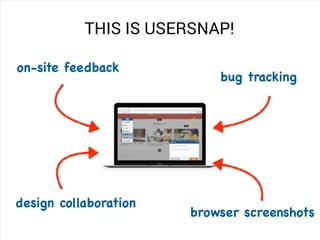
on-site feedback
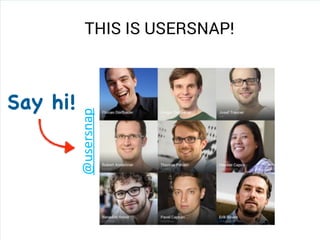
THIS IS USERSNAP!
bug tracking
browser screenshots
design collaboration
THIS IS USERSNAP!
Say hi!
@usersnap
You can find all lessons learned here:
http://goo.gl/X5WYgG
23 LESSONS
LEARNED.
23 LESSONS
LEARNED.
FROM INTERVIEWING
SOME OF THE BEST
DEVELOPERS.
Morten Primdahl, CTO and Co-Founder at
Zendesk
1. Scaling your tech is a challenge.
“We went from a scrappy start-up of 3 guys with everything in their
heads to a big organization that can take on scalability, operations,
databases and product development. If you really get passionate
about business in your life, that’s where you need to go.
When you grow from a couple of dozen guys in 2009 to the size
we have today, the company changes a lot all the time, and you
need to adapt to that. The challenges are both technical and
organizational. Scaling your business means growing fast and
hiring engineers. And that’s a big global challenge. To put it that
way: It’s just hard.”
2. Follow your passion.
“Do what you like. Do what you’re passionate
about. Don’t do whatever anyone else thinks.
Figure out how to be yourself, and beat your
own path. It’s going to be all right.”
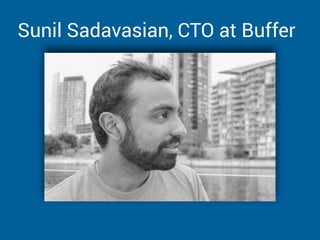
Sunil Sadavasian, CTO at Buffer
4. Roles are more important than job titles
“In an unnatural hierarchy my role is considered to
be the CTO. But in a natural hierarchy, someone
can take on some of the roles that I have that if
they feel fulfilled in that way.
Therefore at Buffer, job titles have started to feel
quite odd – since most of us take on quite a few
different roles.”
5. Invest in yourself.
“Mark Cuban says “The best investment you can
make is in yourself,” and it’s compounding really.
Even though it didn’t work out with my previous
startup, it was probably the best thing that I had
ever done because it was an investment.
I invested that time to focus on myself.”
6. 100% test coverage isn’t that important.
“We’re not too concerned with 100% test
coverage.
It’s more about using your best judgment on
what’s really critical and what will break, and
then add testing to it on that way.”
PJ Hagerty, Team Lead at Engine Yard
7. Challenge yourself in boot camp and free
online courses
“So I’ve always been an advocate of going to
do the weekend rails bridge course just to
challenge yourself and see if its something
you’re interested in.
It’s much better than spending forty grand and
finding out that you didn’t really like it.”
8. Test first, release often.
One of the things that we are very espoused to
is the idea of testing first. There is very little
that goes into our products that go public
without a high standard of testing.
I don’t think there is any way to make
everything a hundred percent bug proof.
Rani Angel, Head of Web Development at
Infragistics
9. Managing remote workers is a challenge.
“The biggest challenge is definitely working on a globally
dispersed team. It is a huge challenge. One of the
biggest struggles is when the overlap between the times
the two teams are both working is only a few hours.
The challenge is how to make sure that as a manager
you are going to keep on top of everything. Plus, you
want to make sure that your team is shielded from the
the pain of not being in the same location.”
10. Explore various industries
“I would have loved to have different opportunities while I
was growing up, like being able to do an internship, do
some marketing, do a little bit of sales to be able to
understand the areas a little better instead of having to
wait so long.
Having experience at a younger age would have changed
my perspective a lot more and would have made me
more comfortable as I moved into the workforce.”
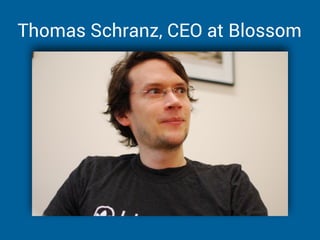
Thomas Schranz, CEO at Blossom
11. Learn how to code no matter how old you
are.
“I thought: “Yeah, I can’t program, and learning to
program is really complicated.” I already knew back
then that there are children being younger than me but
already started with programming, and I thought: “Yeah,
I’m already late.” And then, just by accident, I learnt it.
I would recommend to anyone, literally anyone, in any
age group to at least just start programming.”
12. Learn how to say No.
“Sometimes saying “no” is harder than actually doing this thing.
I think one recurring challenge is saying “no” to requirements. If it’s
from a customer, if it’s from your own team, if it’s from yourself.
Saying “no” to an idea doesn’t mean that the idea has to be bad.
Saying “no” is the more taxing thing. We would have to explain it to
everyone involved, convince them and then basically leave the
meeting with low motivation for everyone. And just building the
thing, even knowing it isn’t the right thing, is the easier thing to do.”
Access all lessons learned?
Yes,	
  please!	
  
THAT WAS A LOT…
THAT WAS A LOT…
Hey, wait. There’s more.
THAT WAS A LOT…
Hey, wait. There’s more.
Further Lessons Learned!
THAT WAS A LOT…
Hey, wait. There’s more.
Further Lessons Learned!
Check them out!
 	
  Enjoyed	
  this	
  presentation?
 	
  Enjoyed	
  this	
  presentation?


  Yes	
  you	
  did?	
  Awesome.
 	
  Enjoyed	
  this	
  presentation?


  Yes	
  you	
  did?	
  Awesome.


  Give	
  it	
  a	
  tweet!
 	
  Enjoyed	
  this	
  presentation?


  Yes	
  you	
  did?	
  Awesome.


  Give	
  it	
  a	
  tweet!


  PLEASE!!!11!!!
ONE LAST THING…
JUST PING US ON TWITTER.

23 Amazing Lessons Learned From Interviewing The World's Top Developers!

  • 1.
    LESSONS LEARNED @tompeham I@usersnap FROM INTERVIEWING THE WORLD TOP DEVELOPERS
  • 2.
  • 3.
    Say hi! THIS ISME! @TOMPEHAM
  • 4.
    on-site feedback THIS ISUSERSNAP! bug tracking browser screenshots design collaboration
  • 5.
    THIS IS USERSNAP! Sayhi! @usersnap
  • 6.
    You can findall lessons learned here: http://goo.gl/X5WYgG
  • 7.
  • 8.
  • 9.
    Morten Primdahl, CTOand Co-Founder at Zendesk
  • 10.
    1. Scaling yourtech is a challenge. “We went from a scrappy start-up of 3 guys with everything in their heads to a big organization that can take on scalability, operations, databases and product development. If you really get passionate about business in your life, that’s where you need to go. When you grow from a couple of dozen guys in 2009 to the size we have today, the company changes a lot all the time, and you need to adapt to that. The challenges are both technical and organizational. Scaling your business means growing fast and hiring engineers. And that’s a big global challenge. To put it that way: It’s just hard.”
  • 11.
    2. Follow yourpassion. “Do what you like. Do what you’re passionate about. Don’t do whatever anyone else thinks. Figure out how to be yourself, and beat your own path. It’s going to be all right.”
  • 12.
  • 13.
    4. Roles aremore important than job titles “In an unnatural hierarchy my role is considered to be the CTO. But in a natural hierarchy, someone can take on some of the roles that I have that if they feel fulfilled in that way. Therefore at Buffer, job titles have started to feel quite odd – since most of us take on quite a few different roles.”
  • 14.
    5. Invest inyourself. “Mark Cuban says “The best investment you can make is in yourself,” and it’s compounding really. Even though it didn’t work out with my previous startup, it was probably the best thing that I had ever done because it was an investment. I invested that time to focus on myself.”
  • 15.
    6. 100% testcoverage isn’t that important. “We’re not too concerned with 100% test coverage. It’s more about using your best judgment on what’s really critical and what will break, and then add testing to it on that way.”
  • 16.
    PJ Hagerty, TeamLead at Engine Yard
  • 17.
    7. Challenge yourselfin boot camp and free online courses “So I’ve always been an advocate of going to do the weekend rails bridge course just to challenge yourself and see if its something you’re interested in. It’s much better than spending forty grand and finding out that you didn’t really like it.”
  • 18.
    8. Test first,release often. One of the things that we are very espoused to is the idea of testing first. There is very little that goes into our products that go public without a high standard of testing. I don’t think there is any way to make everything a hundred percent bug proof.
  • 19.
    Rani Angel, Headof Web Development at Infragistics
  • 20.
    9. Managing remoteworkers is a challenge. “The biggest challenge is definitely working on a globally dispersed team. It is a huge challenge. One of the biggest struggles is when the overlap between the times the two teams are both working is only a few hours. The challenge is how to make sure that as a manager you are going to keep on top of everything. Plus, you want to make sure that your team is shielded from the the pain of not being in the same location.”
  • 21.
    10. Explore variousindustries “I would have loved to have different opportunities while I was growing up, like being able to do an internship, do some marketing, do a little bit of sales to be able to understand the areas a little better instead of having to wait so long. Having experience at a younger age would have changed my perspective a lot more and would have made me more comfortable as I moved into the workforce.”
  • 22.
  • 23.
    11. Learn howto code no matter how old you are. “I thought: “Yeah, I can’t program, and learning to program is really complicated.” I already knew back then that there are children being younger than me but already started with programming, and I thought: “Yeah, I’m already late.” And then, just by accident, I learnt it. I would recommend to anyone, literally anyone, in any age group to at least just start programming.”
  • 24.
    12. Learn howto say No. “Sometimes saying “no” is harder than actually doing this thing. I think one recurring challenge is saying “no” to requirements. If it’s from a customer, if it’s from your own team, if it’s from yourself. Saying “no” to an idea doesn’t mean that the idea has to be bad. Saying “no” is the more taxing thing. We would have to explain it to everyone involved, convince them and then basically leave the meeting with low motivation for everyone. And just building the thing, even knowing it isn’t the right thing, is the easier thing to do.”
  • 25.
    Access all lessonslearned? Yes,  please!  
  • 26.
    THAT WAS ALOT…
  • 27.
    THAT WAS ALOT… Hey, wait. There’s more.
  • 28.
    THAT WAS ALOT… Hey, wait. There’s more. Further Lessons Learned!
  • 29.
    THAT WAS ALOT… Hey, wait. There’s more. Further Lessons Learned! Check them out!
  • 30.
       Enjoyed  this  presentation?
  • 31.
       Enjoyed  this  presentation?      Yes  you  did?  Awesome.
  • 32.
       Enjoyed  this  presentation?      Yes  you  did?  Awesome.                    Give  it  a  tweet!
  • 33.
       Enjoyed  this  presentation?      Yes  you  did?  Awesome.                    Give  it  a  tweet!                          PLEASE!!!11!!!
  • 34.
    ONE LAST THING… JUSTPING US ON TWITTER.