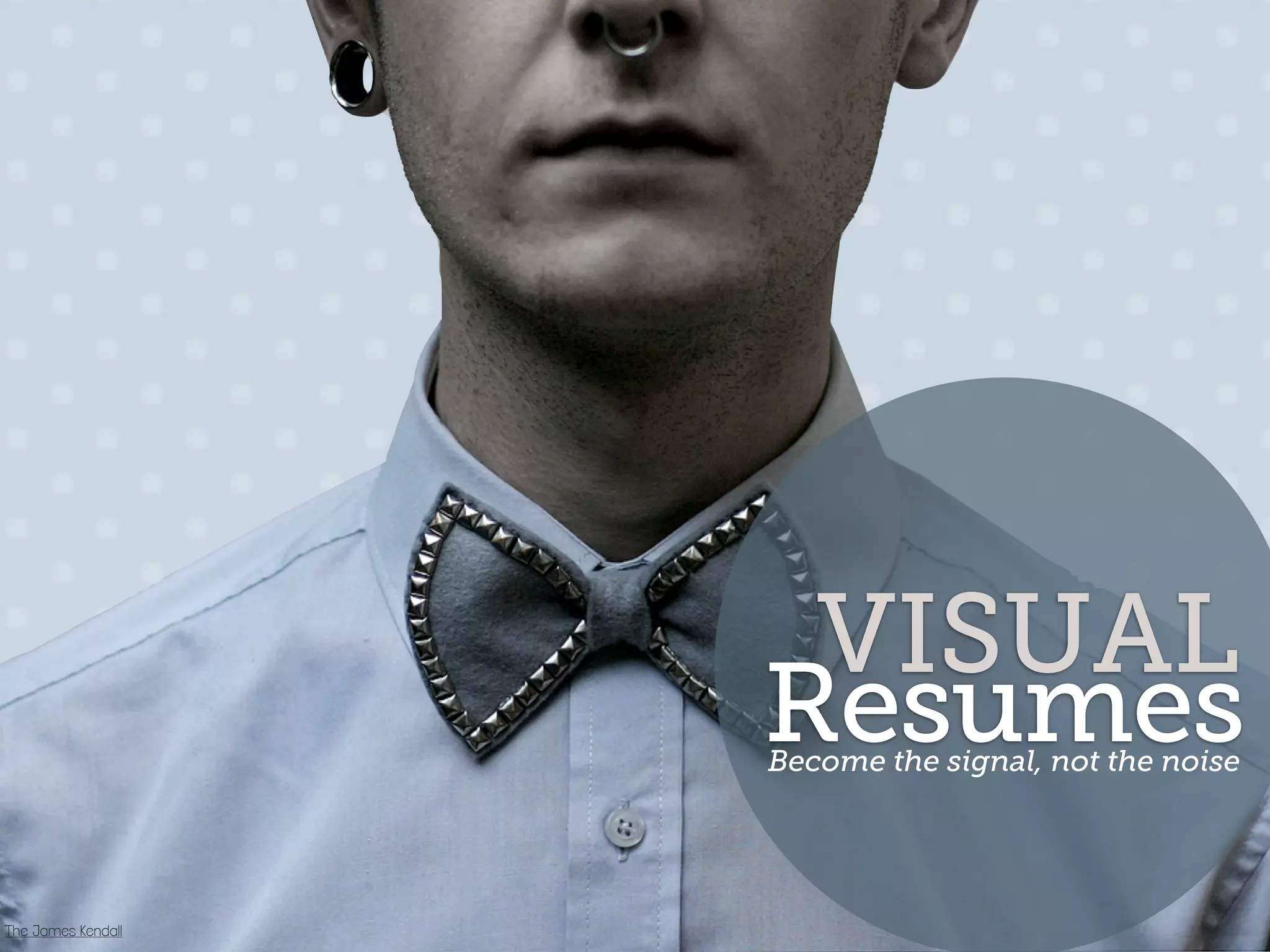
VISUAL
                    Resumes
                    Become the signal, not the noise


The James Kendall
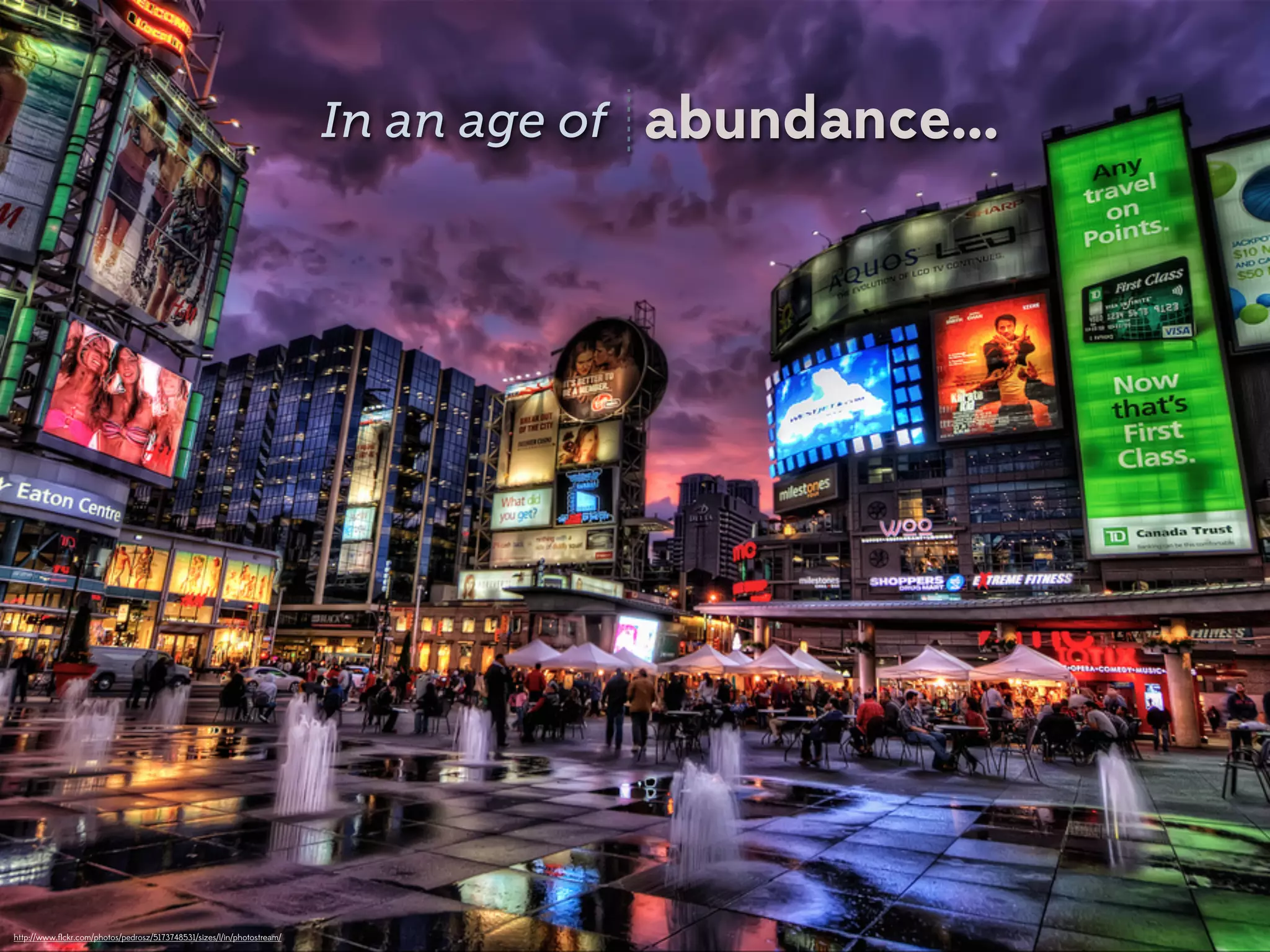
In an age of abundance...


http://www.flickr.com/photos/pedrosz/5173748531/sizes/l/in/photostream/
[M]eaning has become a central
aspect of our work and our lives.
      --Dan Pink, A Whole New Mind


                                     http://www.flickr.com/photos/mobilestreetlife/5946319814/sizes/l/in/photostream/
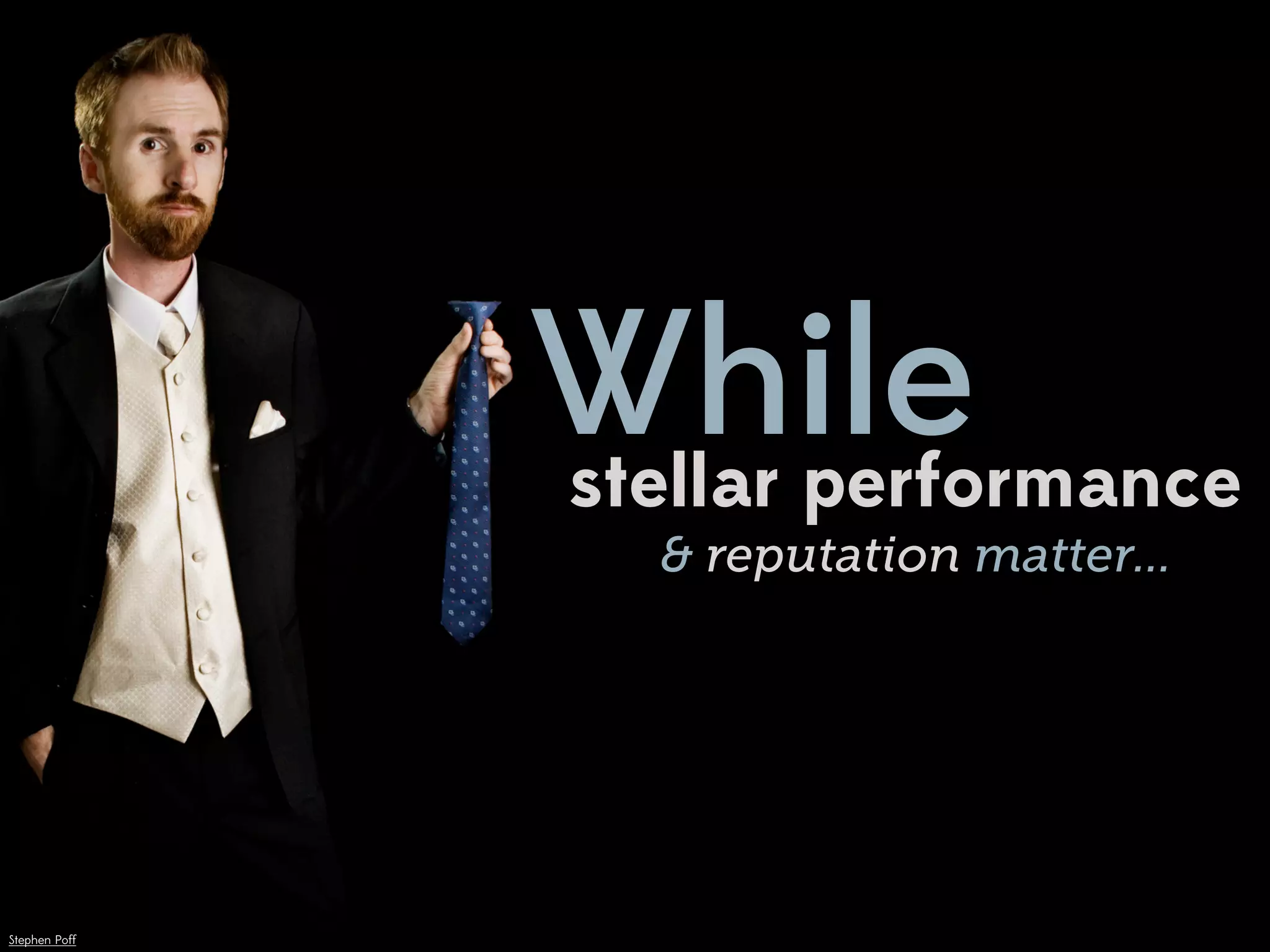
While
               stellar performance
                  & reputation matter...


Stephen Poff
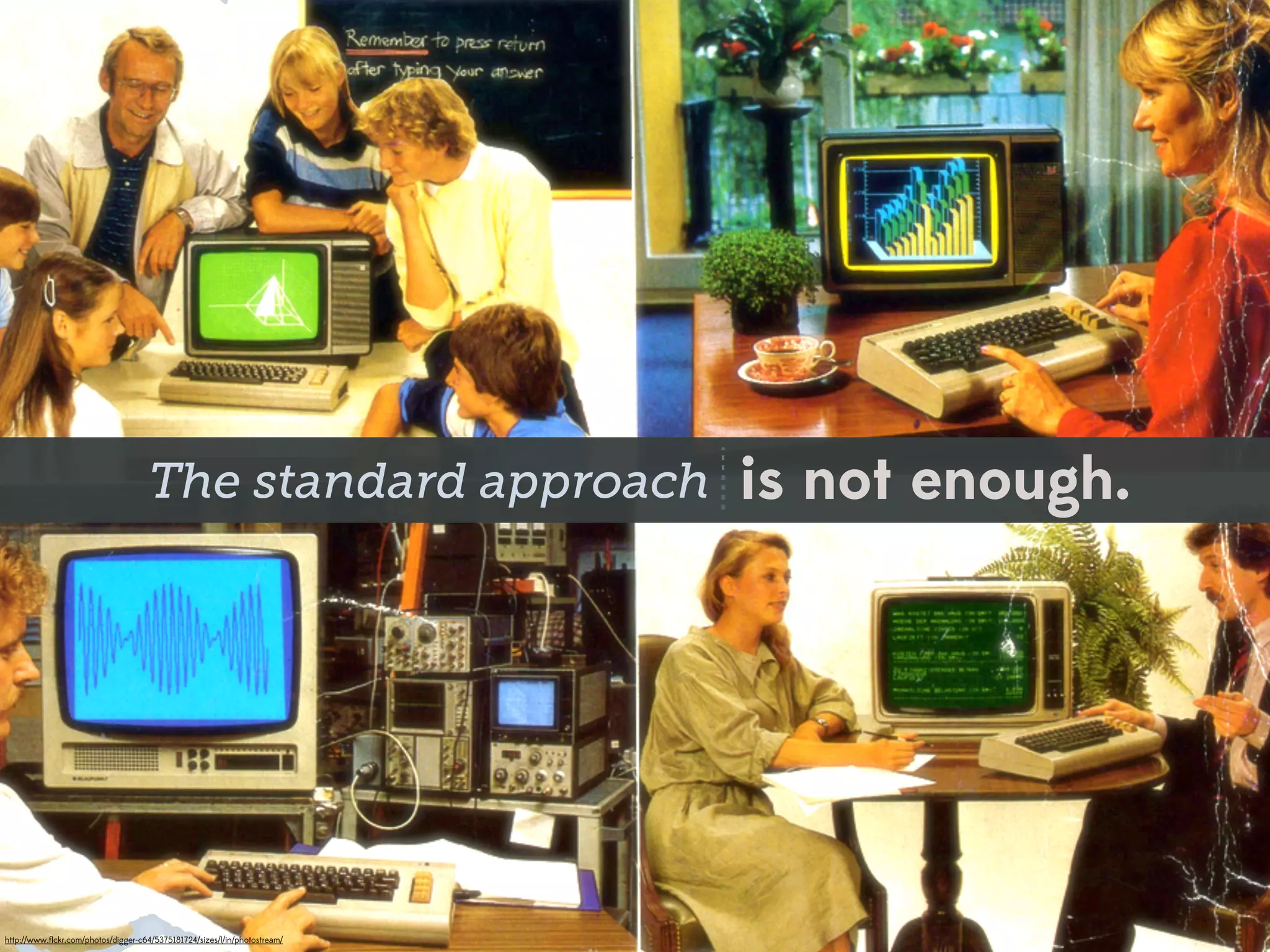
The standard approach is not enough.


http://www.flickr.com/photos/digger-c64/5375181724/sizes/l/in/photostream/
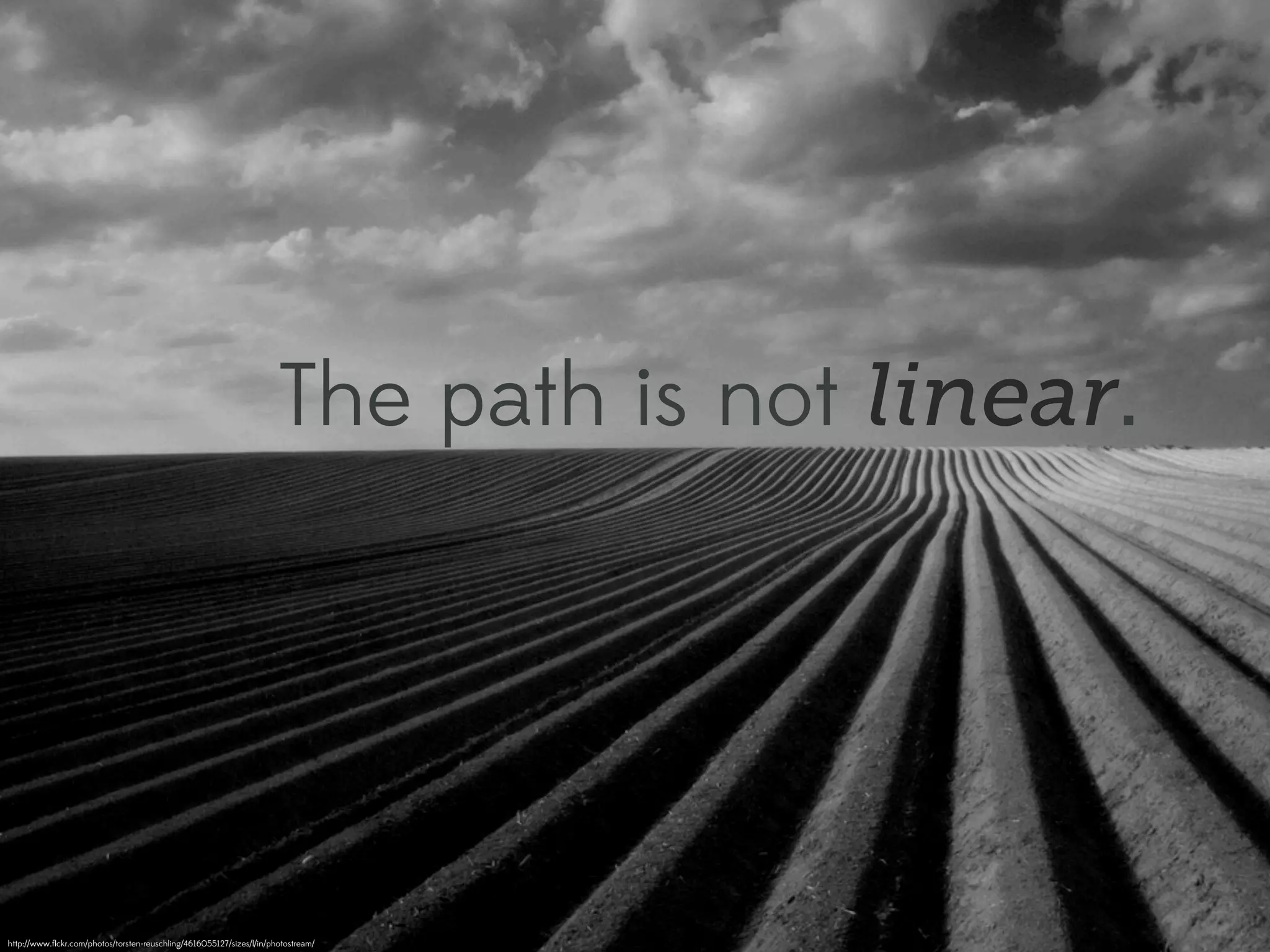
The path is not linear.


http://www.flickr.com/photos/torsten-reuschling/4616055127/sizes/l/in/photostream/
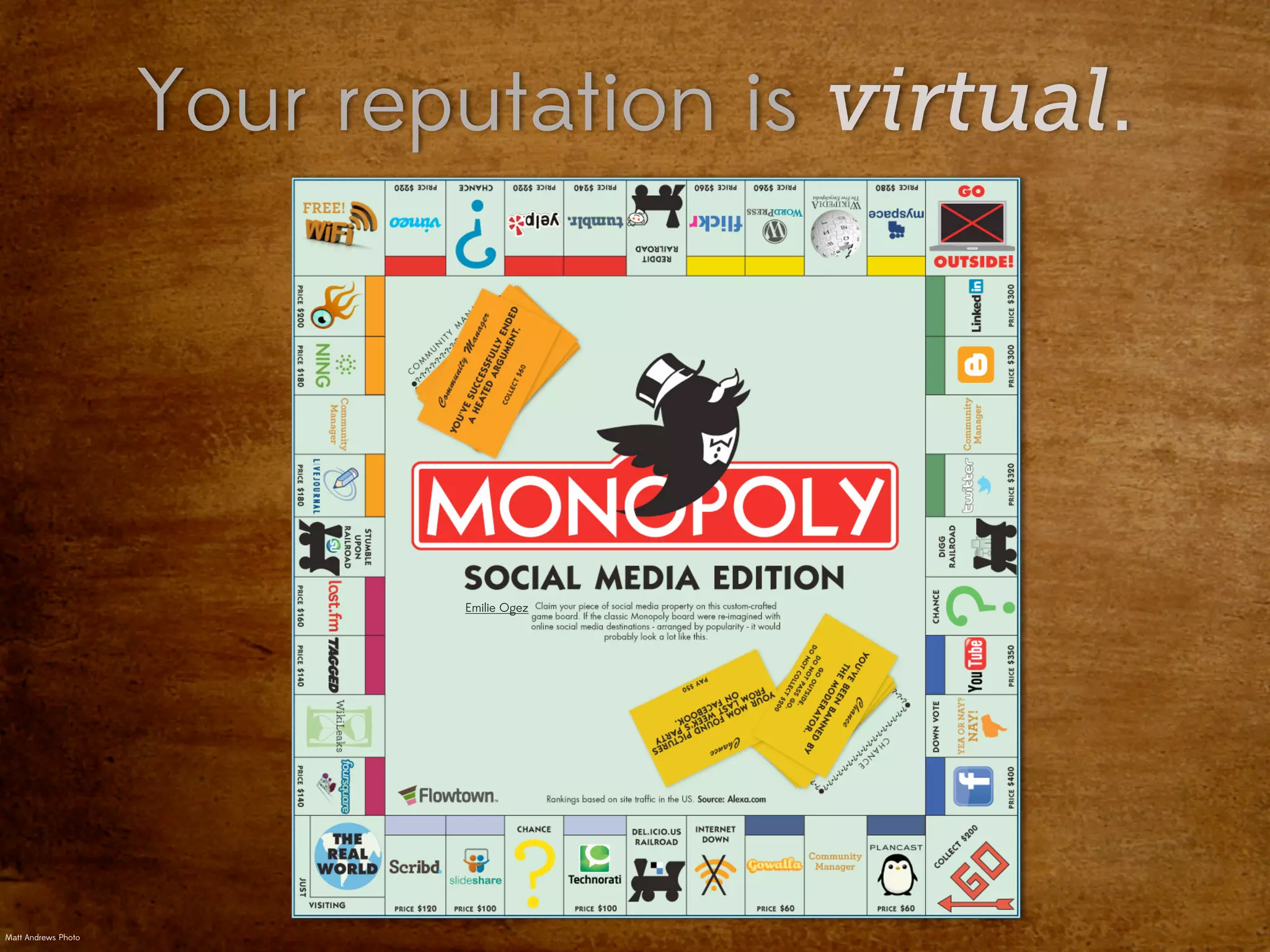
Your reputation is virtual.


                             Emilie Ogez


Matt Andrews Photo
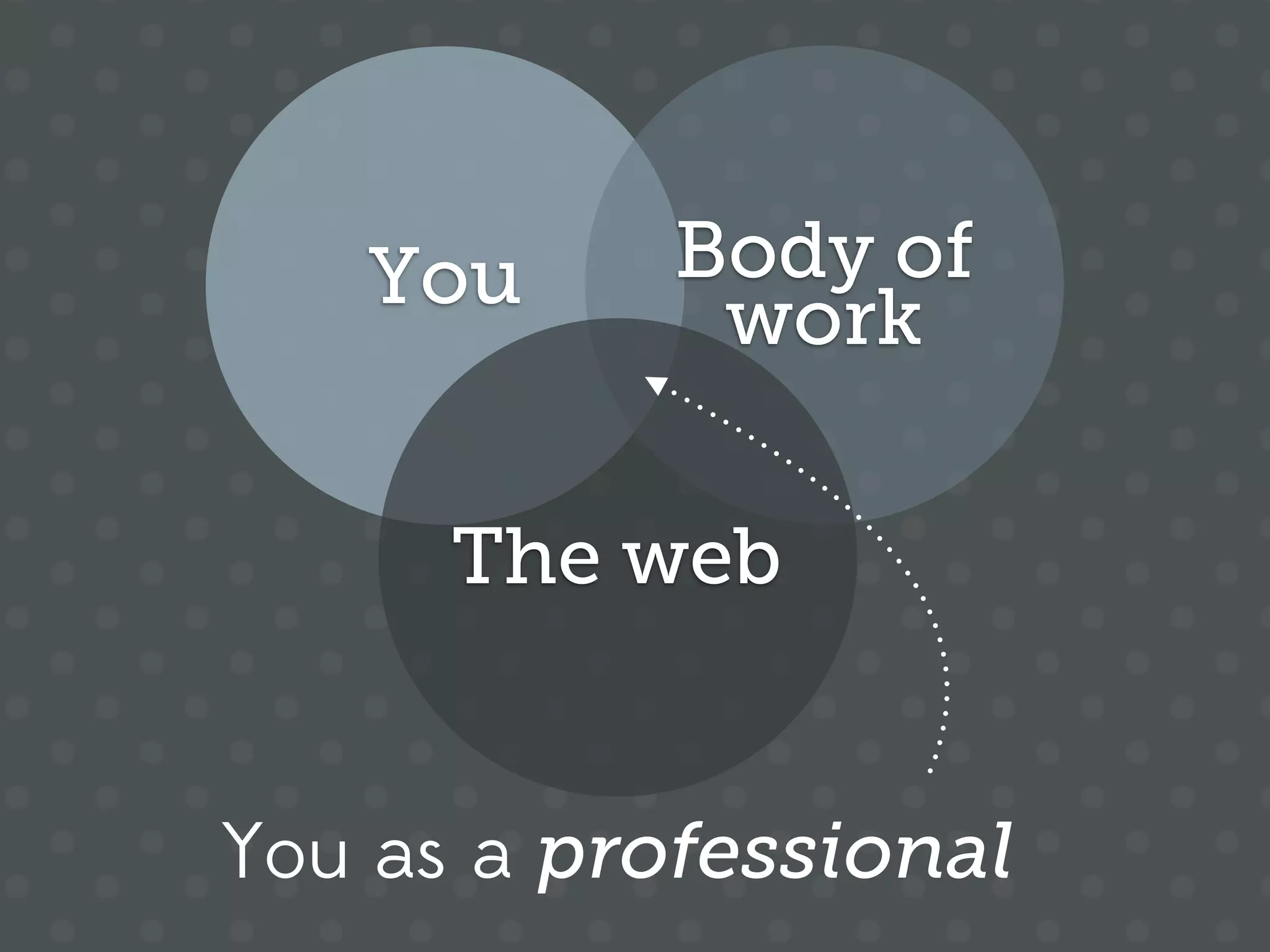
You     Body of
            work


      The web


You as a professional
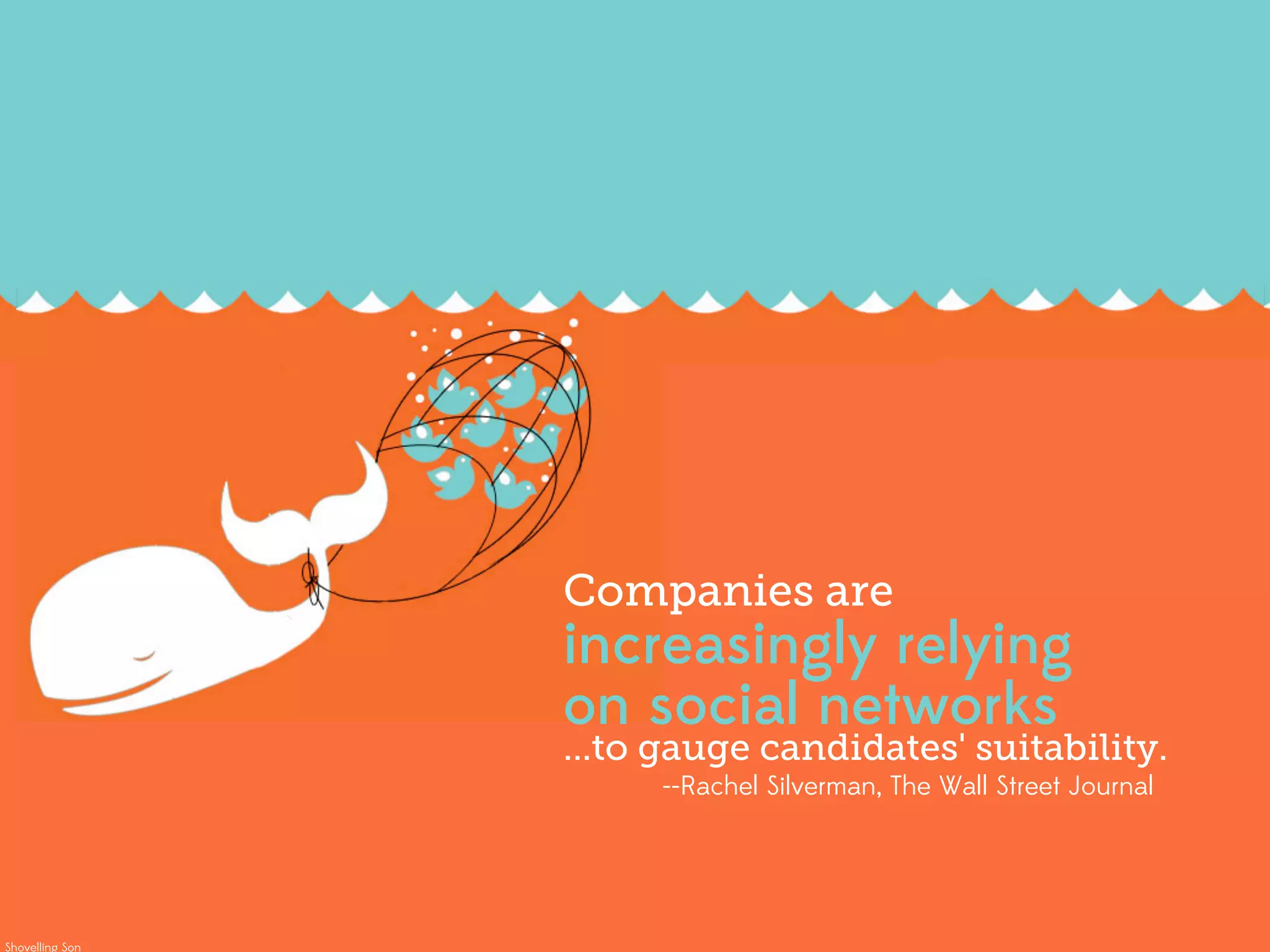
Companies are
                 increasingly relying
                 on social networks
                 ...to gauge candidates' suitability.
                      --Rachel Silverman, The Wall Street Journal


Shovelling Son
buzz.bishop


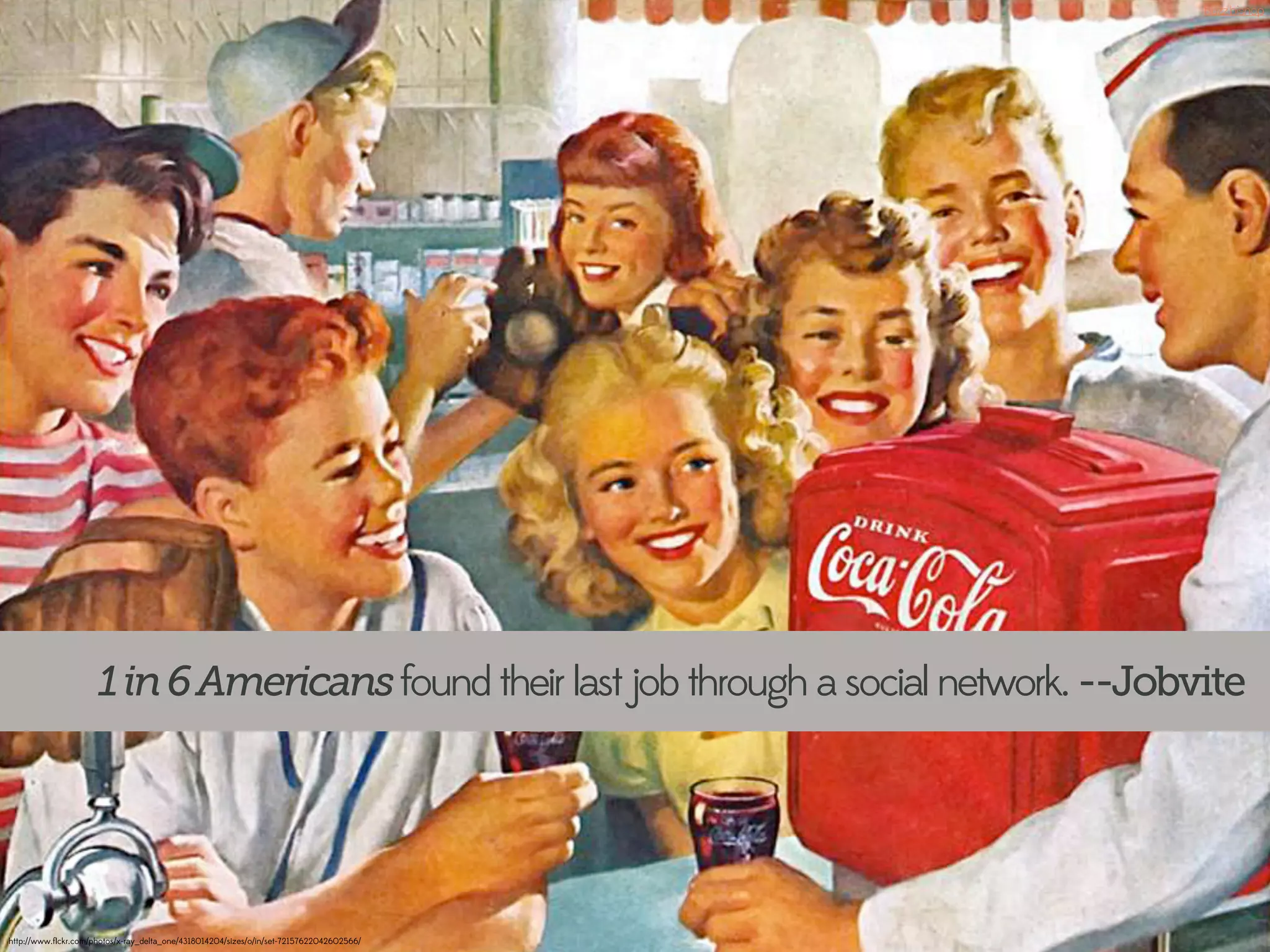
                      1 in 6 Americans found their last job through a social network. --Jobvite


http://www.flickr.com/photos/x-ray_delta_one/4318014204/sizes/o/in/set-72157622042602566/
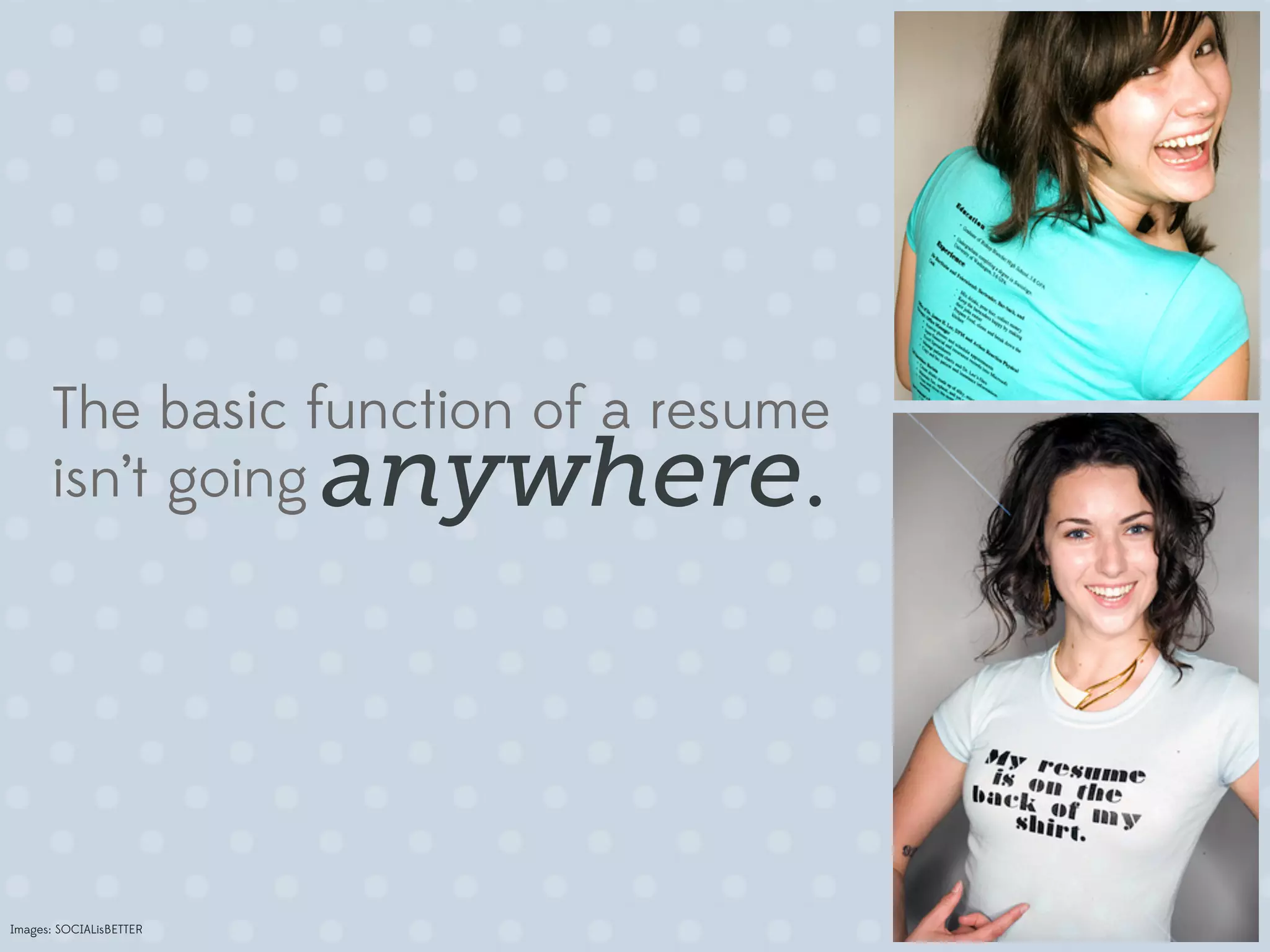
The basic function of a resume
      isn’t going        anywhere.


Images: SOCIALisBETTER
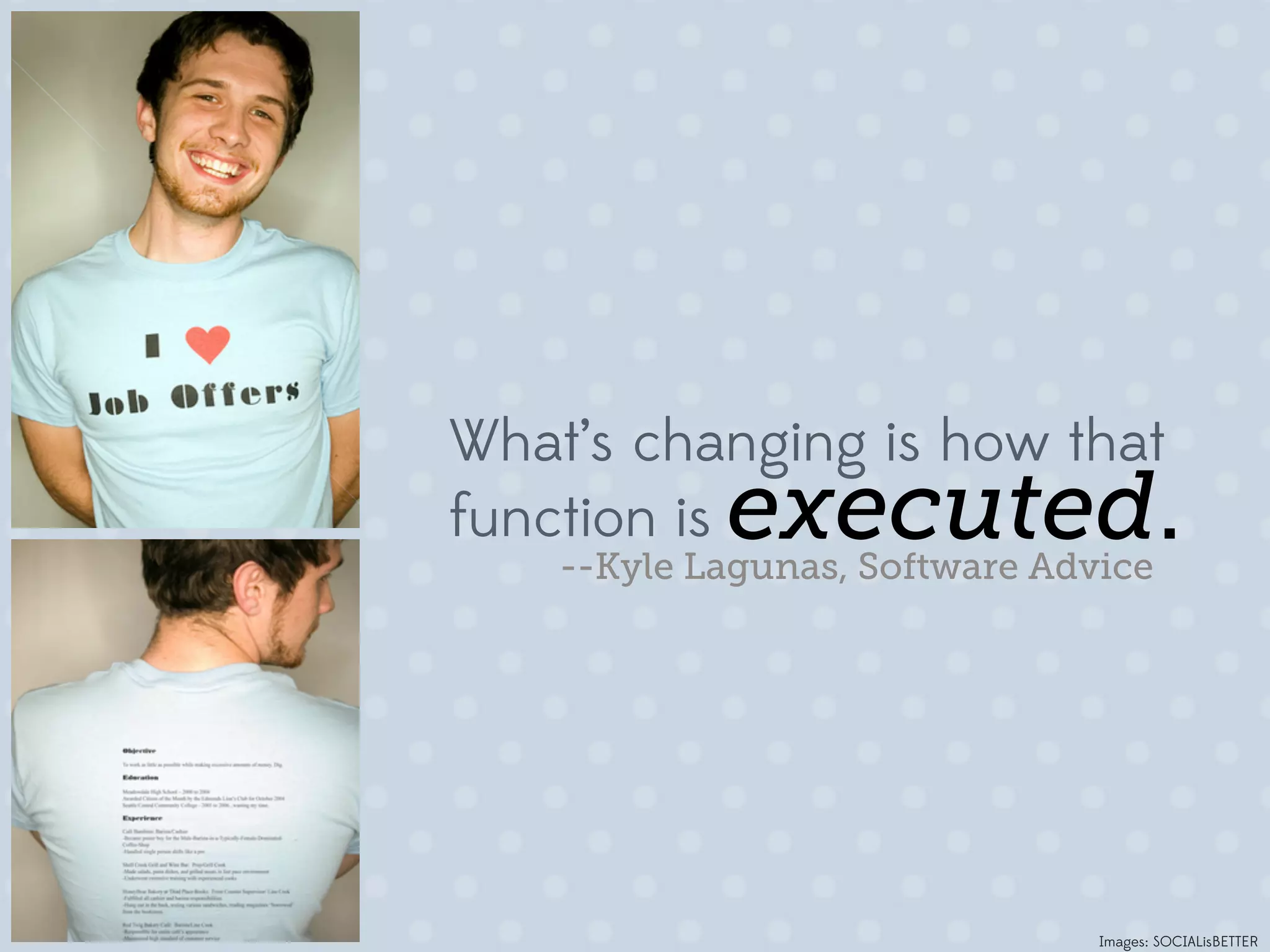
What’s changing is how that
function is executed.
    --Kyle Lagunas, Software Advice


                                Images: SOCIALisBETTER
http://www.flickr.com/photos/uravms/7979108304/sizes/l/in/photostream/


Execute function
I’m not creative.


Kalense Kid
Wrong.

Kalense Kid
Truth is, in most companies, you’re probabl y not going
to get ahead just by doing a good job. To get
promoted, you first have to promote yourself.


                    --Anne Libby, The Daily Muse
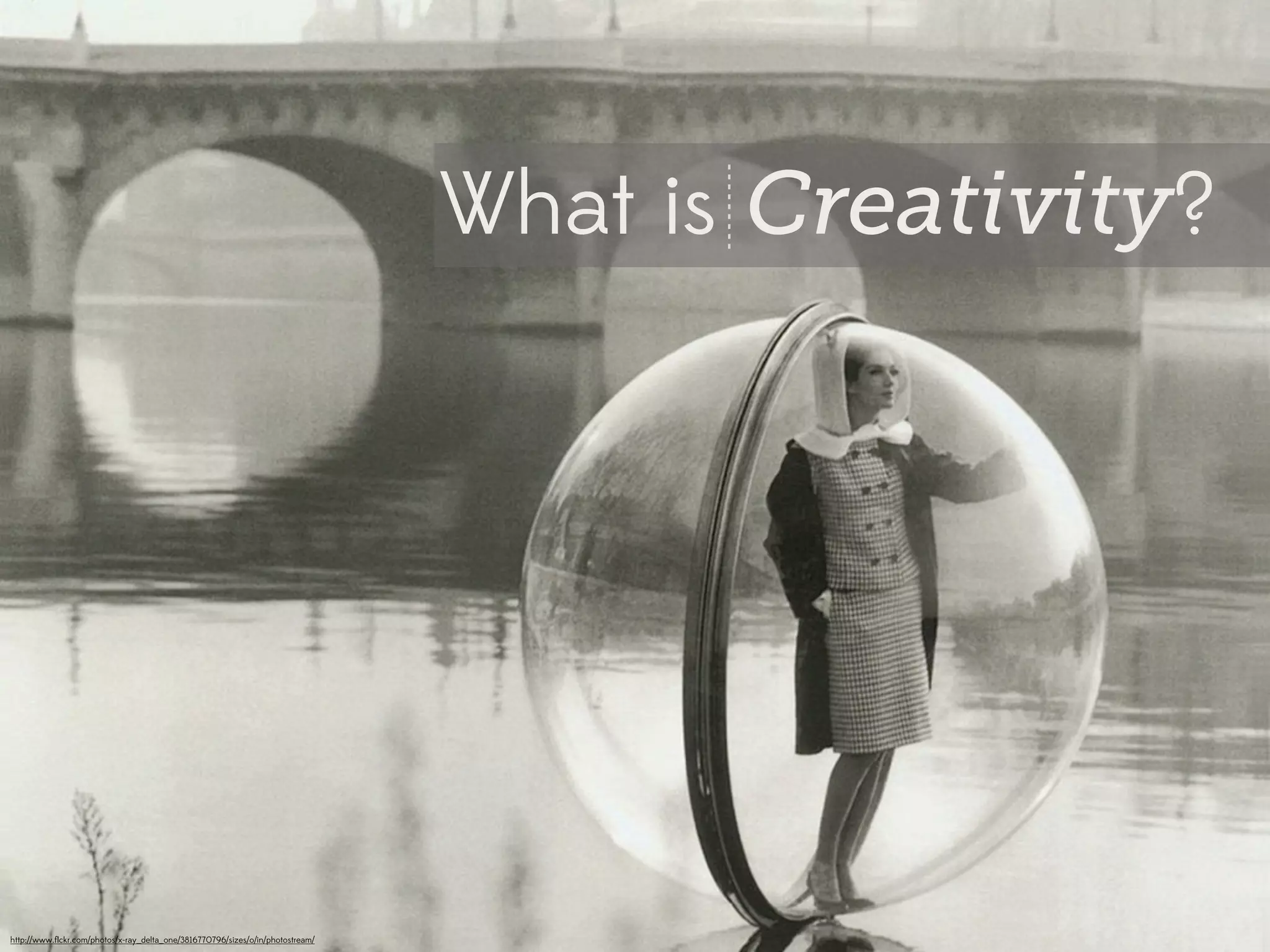
What is Creativity?


http://www.flickr.com/photos/x-ray_delta_one/3816770796/sizes/o/in/photostream/
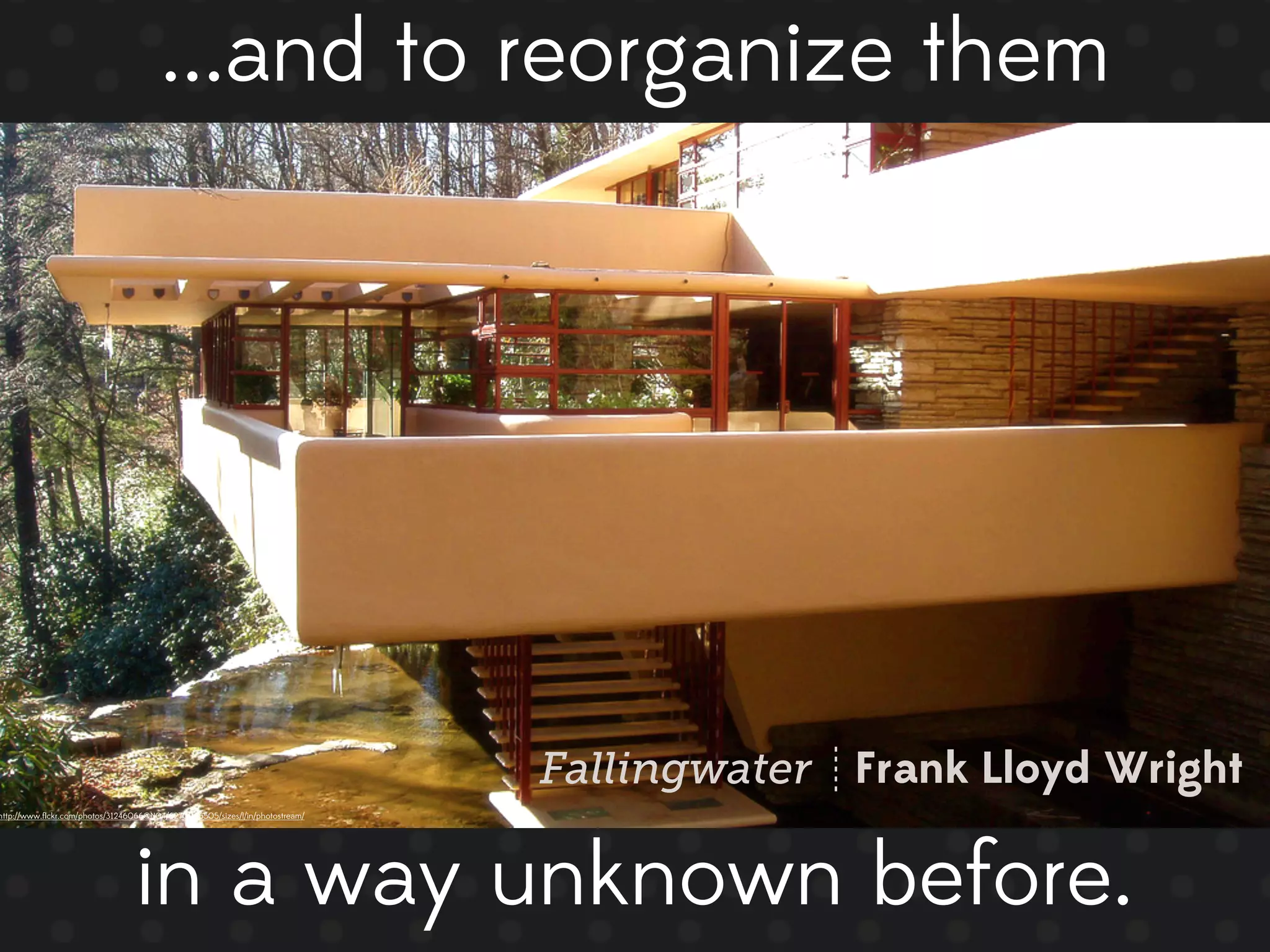
The ability to disorganize


http://www.flickr.com/photos/31246066@N04/6270966505/sizes/l/in/photostream/


                                received ways of thinking...
...and to reorganize them


                                                                              Fallingwater Frank Lloyd Wright
http://www.flickr.com/photos/31246066@N04/6270966505/sizes/l/in/photostream/


                                 in a way unknown before.
http://www.flickr.com/photos/x-ray_delta_one/4134629421/sizes/l/in/photostream/


The process whereby one's ideas or productions
delight, surprise, and inspire others.
                    --Marshall Duke, Emory University
First, develop a brand mantra
ā€œa ...simple...statement describing who
you are and what you have to offer.ā€
                   --Megan Marrs, The Daily Muse
                                                   Image: darkmatter
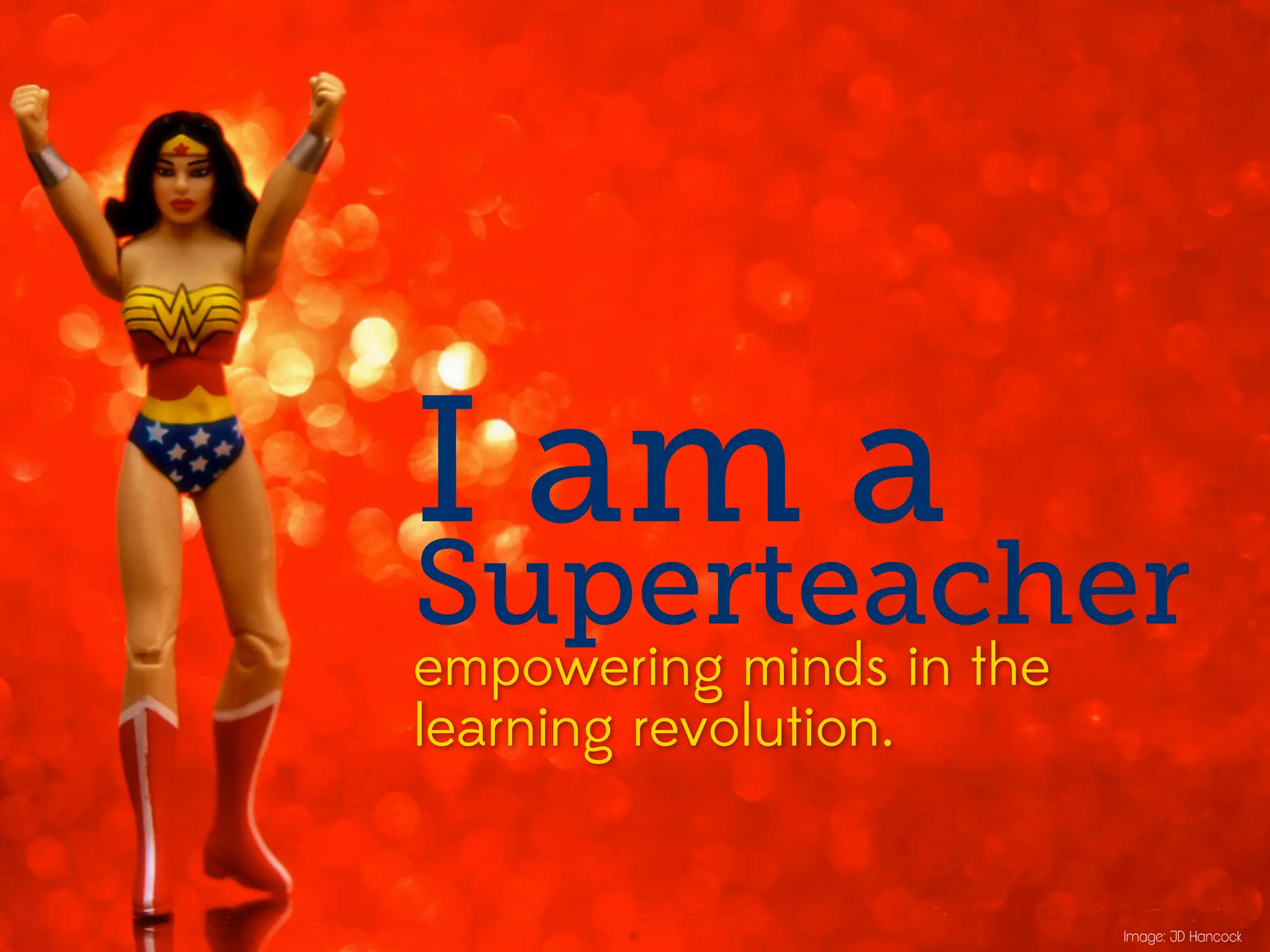
I am a
Superteacher
empowering minds in the
learning revolution.


                          Image: JD Hancock
Avoid the overdone & cliche.
Organizational Innovative
        Track record Motivated Dynamic
        Creative Communication skills
    Extensive experience Effective
 Problem solving


10 most overused professional buzzwords
                              -- LinkedIN
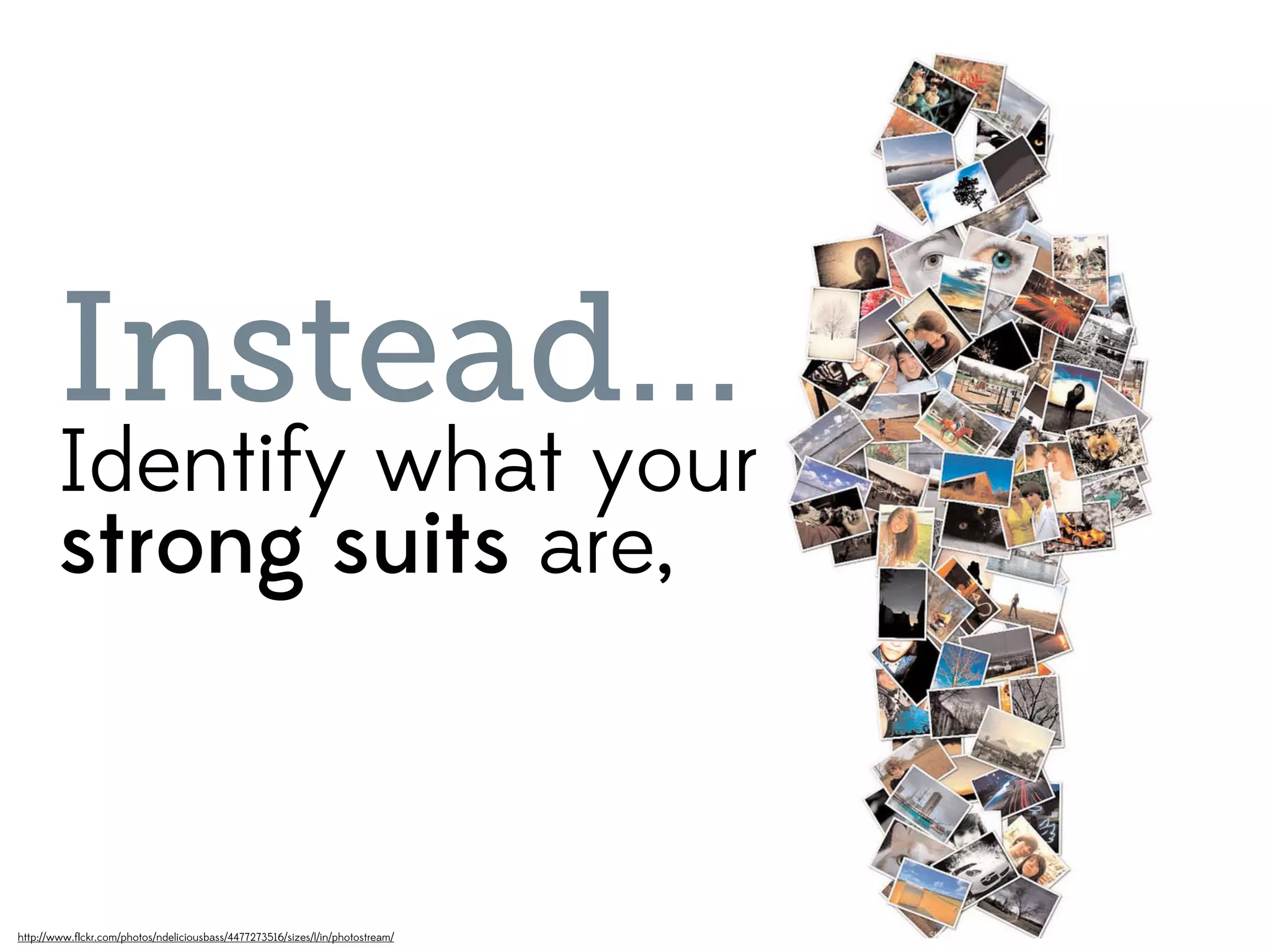
Instead...
        Identify what your
        strong suits are,


http://www.flickr.com/photos/ndeliciousbass/4477273516/sizes/l/in/photostream/
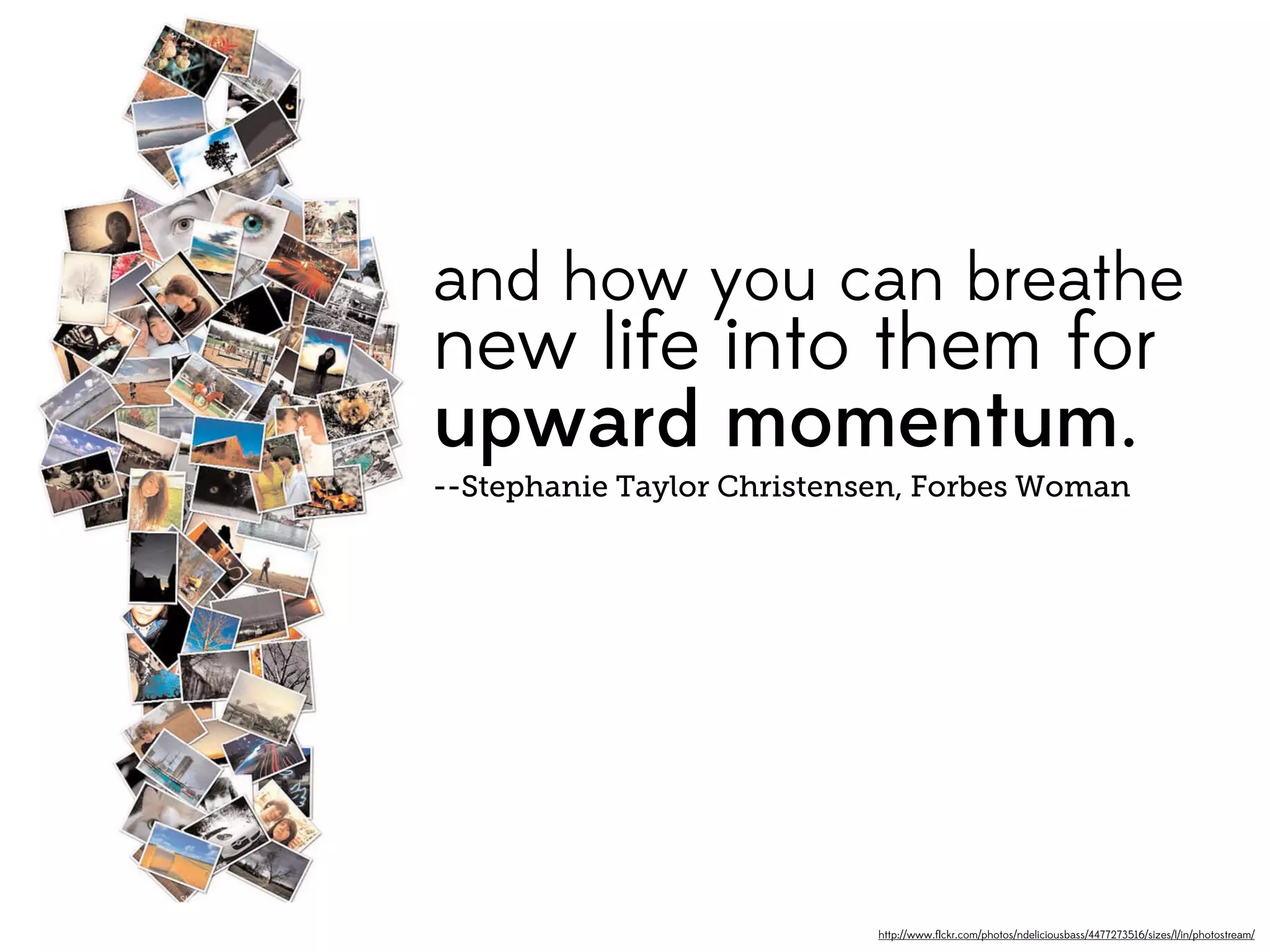
and how you can breathe
new life into them for
upward momentum.
--Stephanie Taylor Christensen, Forbes Woman


                            http://www.flickr.com/photos/ndeliciousbass/4477273516/sizes/l/in/photostream/
So, what is your   brand mantra?
http://www.flickr.com/photos/x-ray_delta_one/3886469710/sizes/l/in/set-72157622042602566/


A job doesn’t court you--you court the job.
So, get to know   your audience.
Seven Questions to Knowing Your Audience

                                1   What are they like?
                                    Demographics and psychographics are a great start, but connecting with your audience means
                                    understanding them on a personal level. Take a walk in their shoes and describe what their life
                                    looks like each day.


                                2   Why are they here?
                                    What do they think they’re going to get out of this presentation? Why did they come to hear you?
                                    Are they willing participants or mandatory attendees? This is also a bit of a situation analysis.


                                3   What keeps them up at night?
Insert a representative
                                    Everyone has a fear, a pain point, a thorn in the side. Let your audience know you empathize—and
picture or illustration of an
                                    offer a solution.
audience member in this
rectangle. It helps to put a
face on the audience.           4   How can you solve their problem?
                                    What’s in it for the audience? How are you going to make their lives better?


                                5   What do you want them to do?
                                    Answer the question ā€œso what?ā€ā€”and make sure there’s clear action for your audience to take.


                                6   How can you best reach them?
                                    People vary in how they receive information. This can include the set up of the room to the availability
                                    of materials after the presentation. Give the audience what they want, how they want it.


                                7   How might they resist?
                                    What will keep them from adopting your message and carrying out your call to action?
Ā© duarte.com 2008
Seven Questions to Knowing Your Audience

                                1   What are they like?
                                    Demographics and psychographics are a great start, but connecting with your audience means
                                    understanding them on a personal level. Take a walk in their shoes and describe what their life
                                    looks like each day.


                                2   Why are they here?
                                    What do they think they’re going to get out of this presentation? Why did they come to hear you?
                                    Are they willing participants or mandatory attendees? This is also a bit of a situation analysis.


                                3   What keeps them up at night?
Insert a representative


 Download @ www.duarte.com/books
                                    Everyone has a fear, a pain point, a thorn in the side. Let your audience know you empathize—and
picture or illustration of an
                                    offer a solution.
audience member in this
rectangle. It helps to put a
face on the audience.           4   How can you solve their problem?
                                    What’s in it for the audience? How are you going to make their lives better?


                                5   What do you want them to do?
                                    Answer the question ā€œso what?ā€ā€”and make sure there’s clear action for your audience to take.


                                6   How can you best reach them?
                                    People vary in how they receive information. This can include the set up of the room to the availability
                                    of materials after the presentation. Give the audience what they want, how they want it.


                                7   How might they resist?
                                    What will keep them from adopting your message and carrying out your call to action?
Ā© duarte.com 2008
Focus on creating a   professional persona
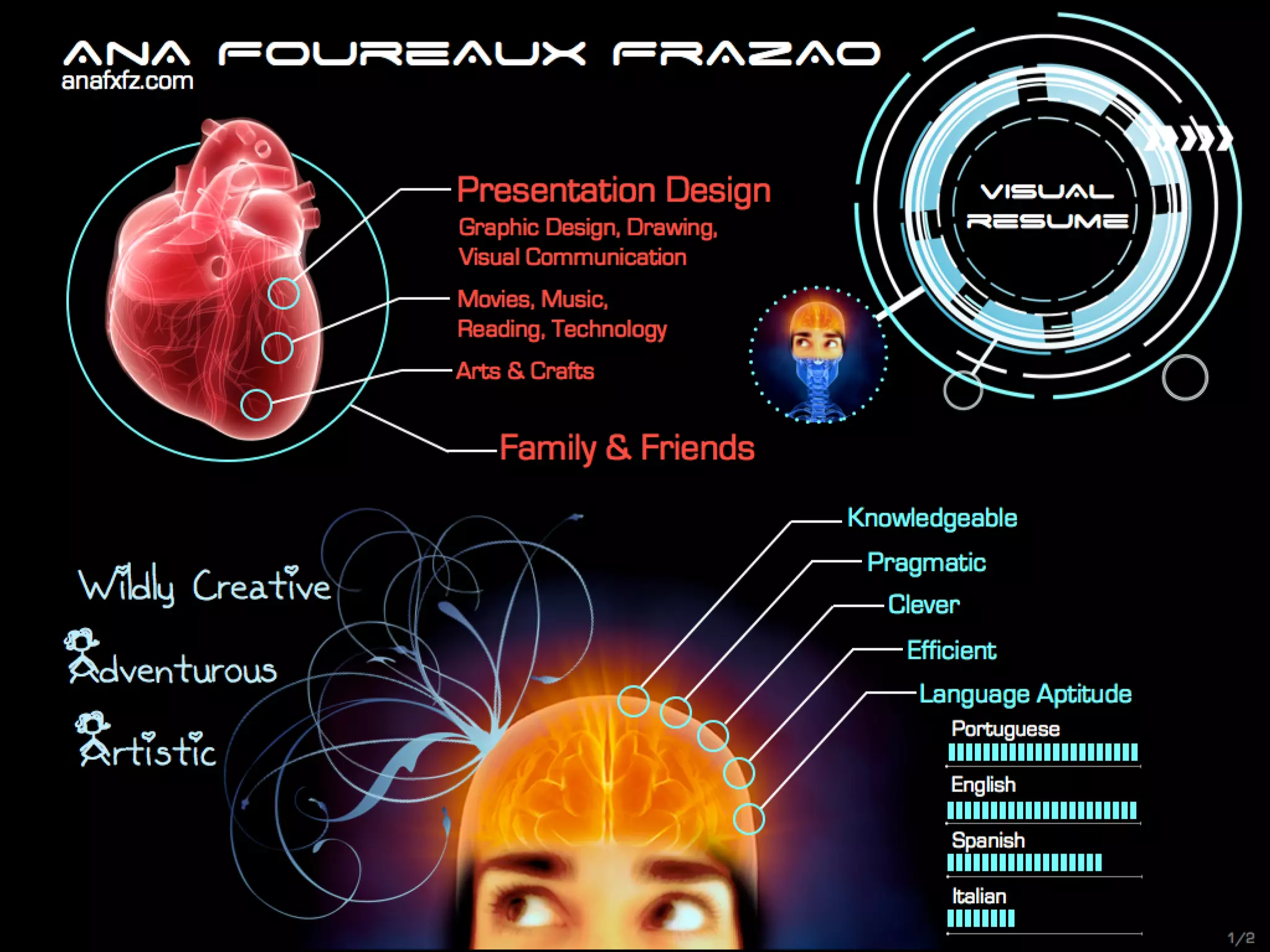
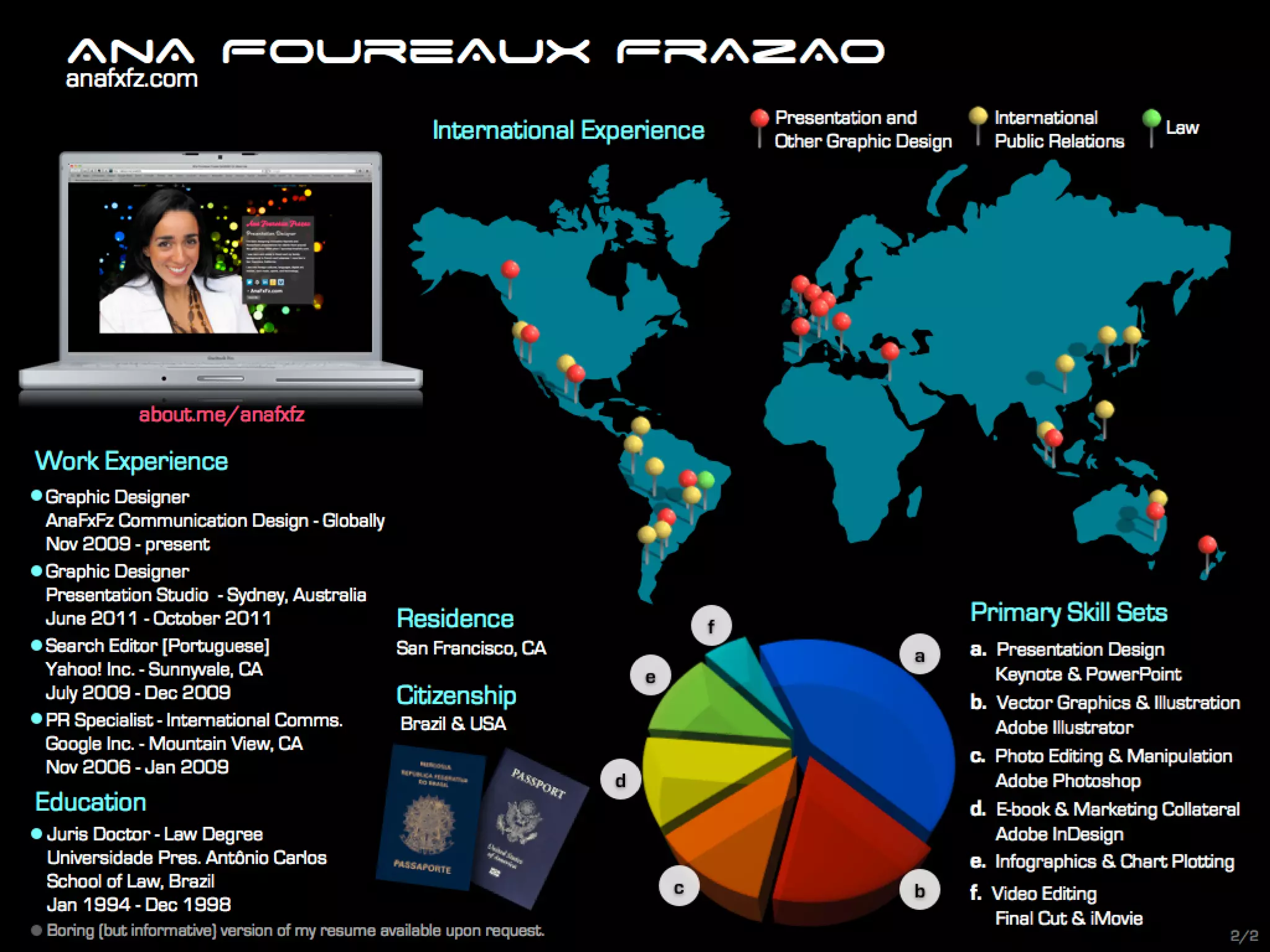
Resume &
  Visual   Website/
 resume    portfolio


    Relevant
   networking
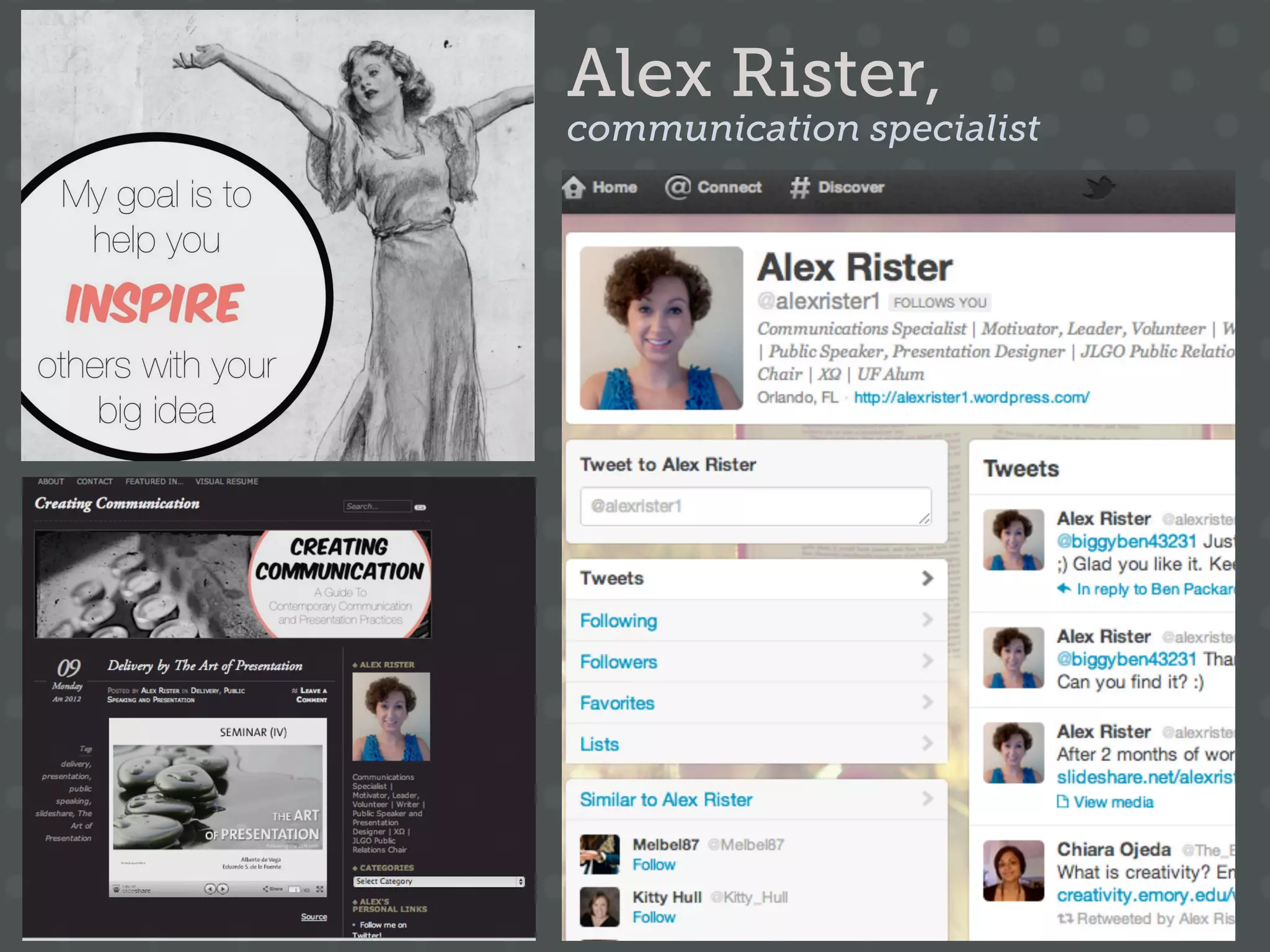
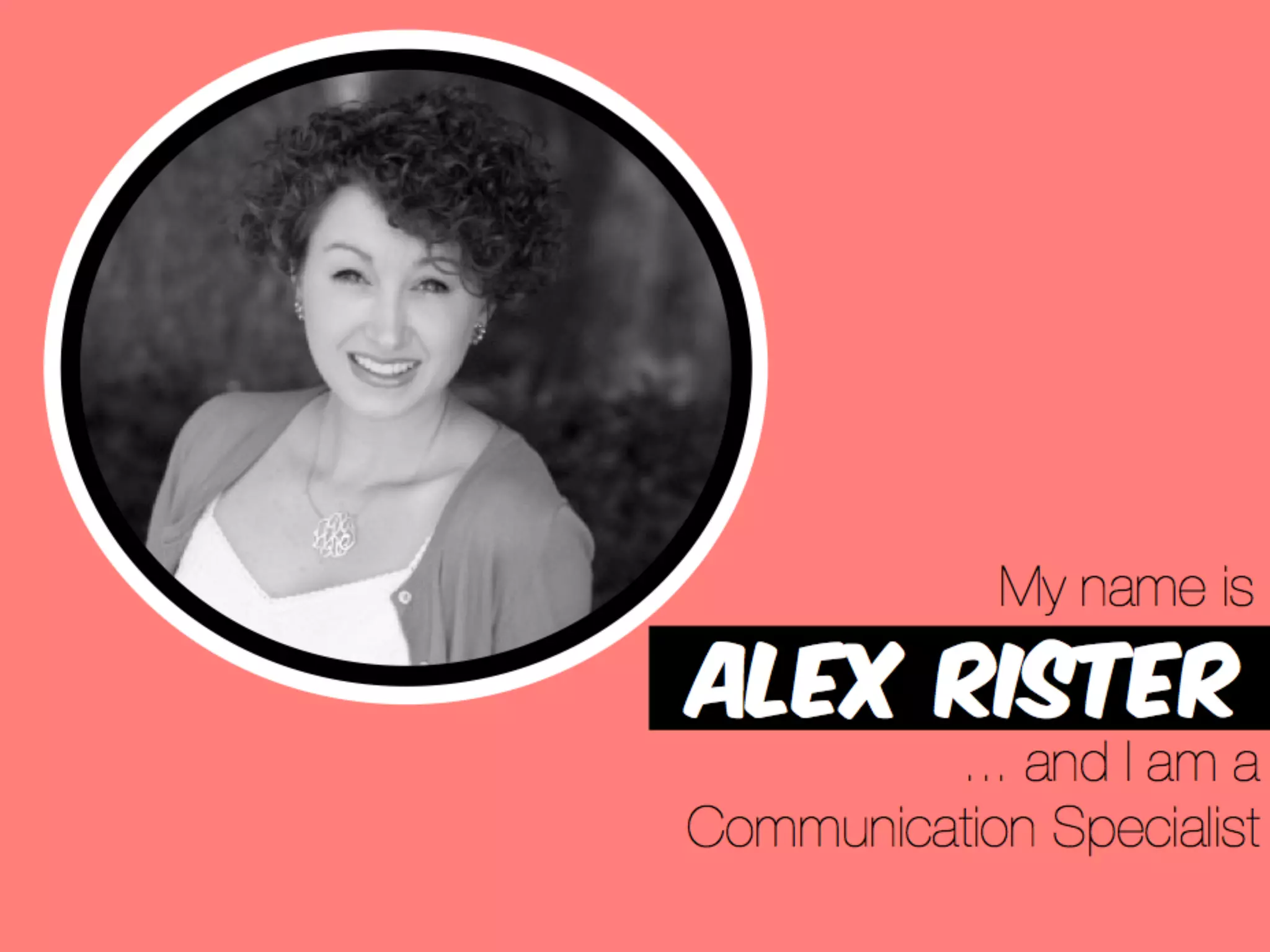
Alex Rister,
communication specialist
What makes
  for a great
visual resume?
Supplement,
      not replacement.


Image: S. Diddy
Juhan Sonin’s word
            cloud resume

Showcases
technical &
creative abilities
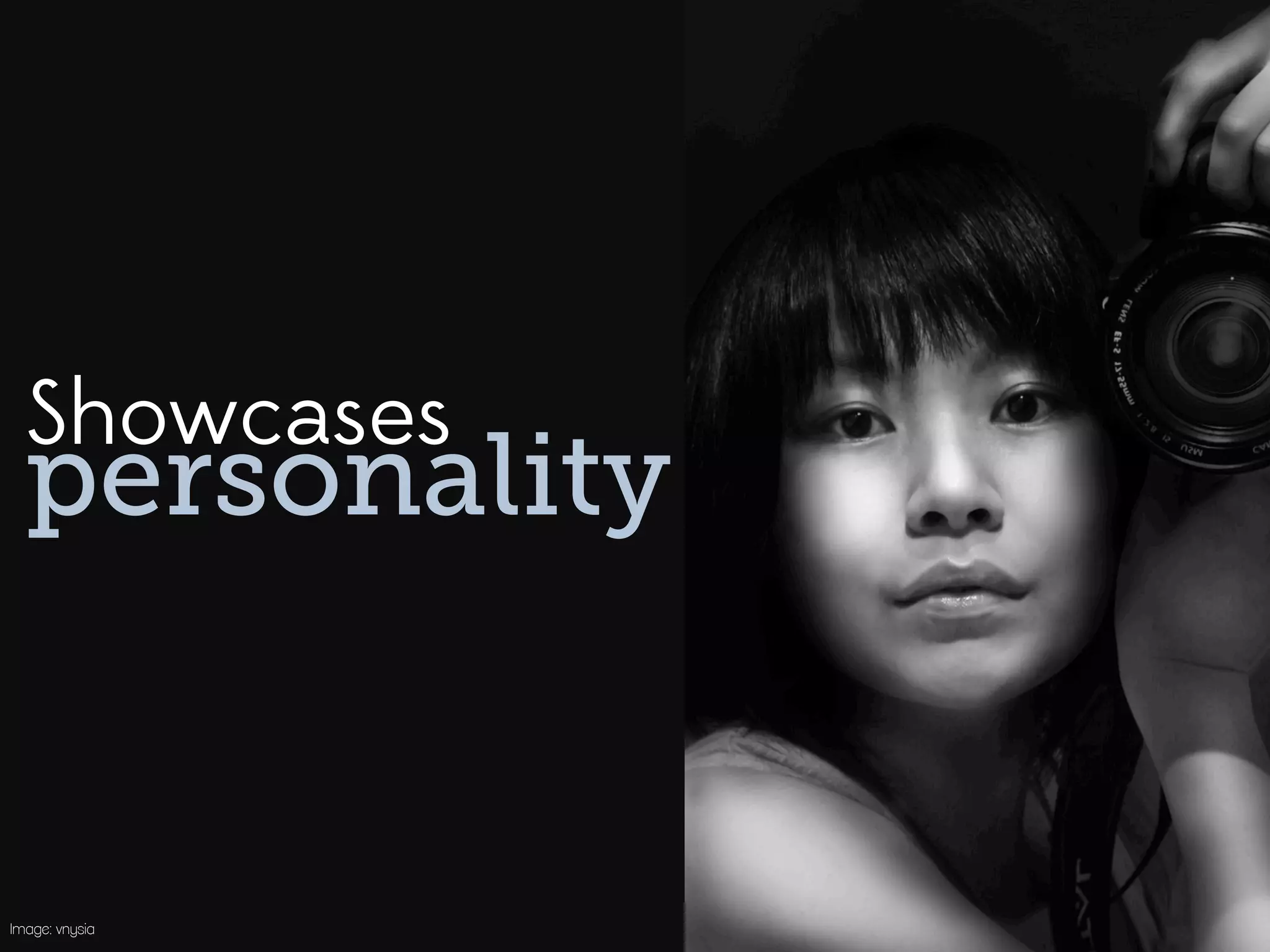
Showcases
  personality


Image: vnysia
Student visual resume   examples
Crysta Timmerman
Spencer House
Slideshare visual resumes
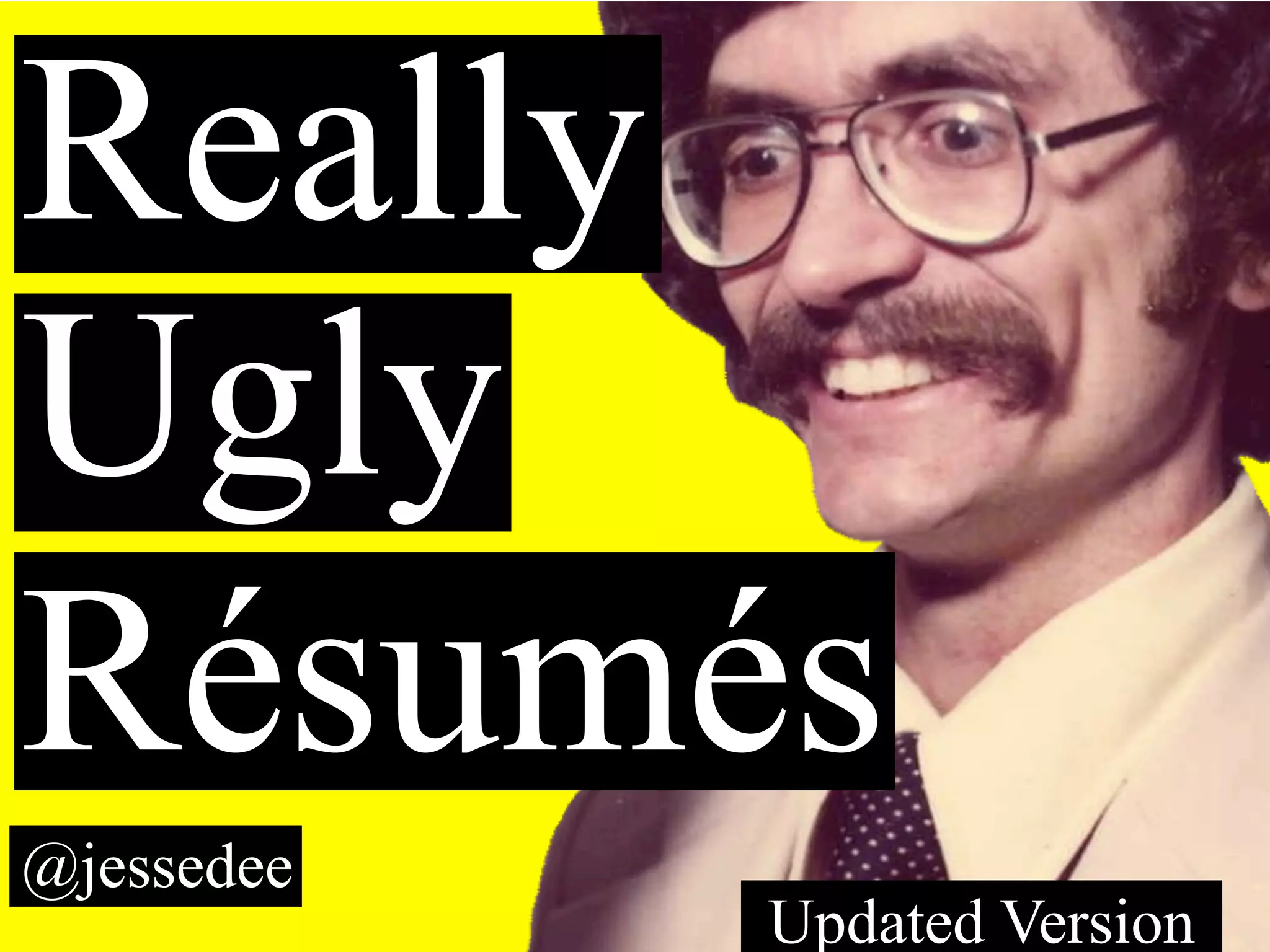
Really
Ugly
RƩsumƩs
@jessedee
            Updated Version
MY
AN T I-RESUME
DAVID CRANDALL        MANIFESTO
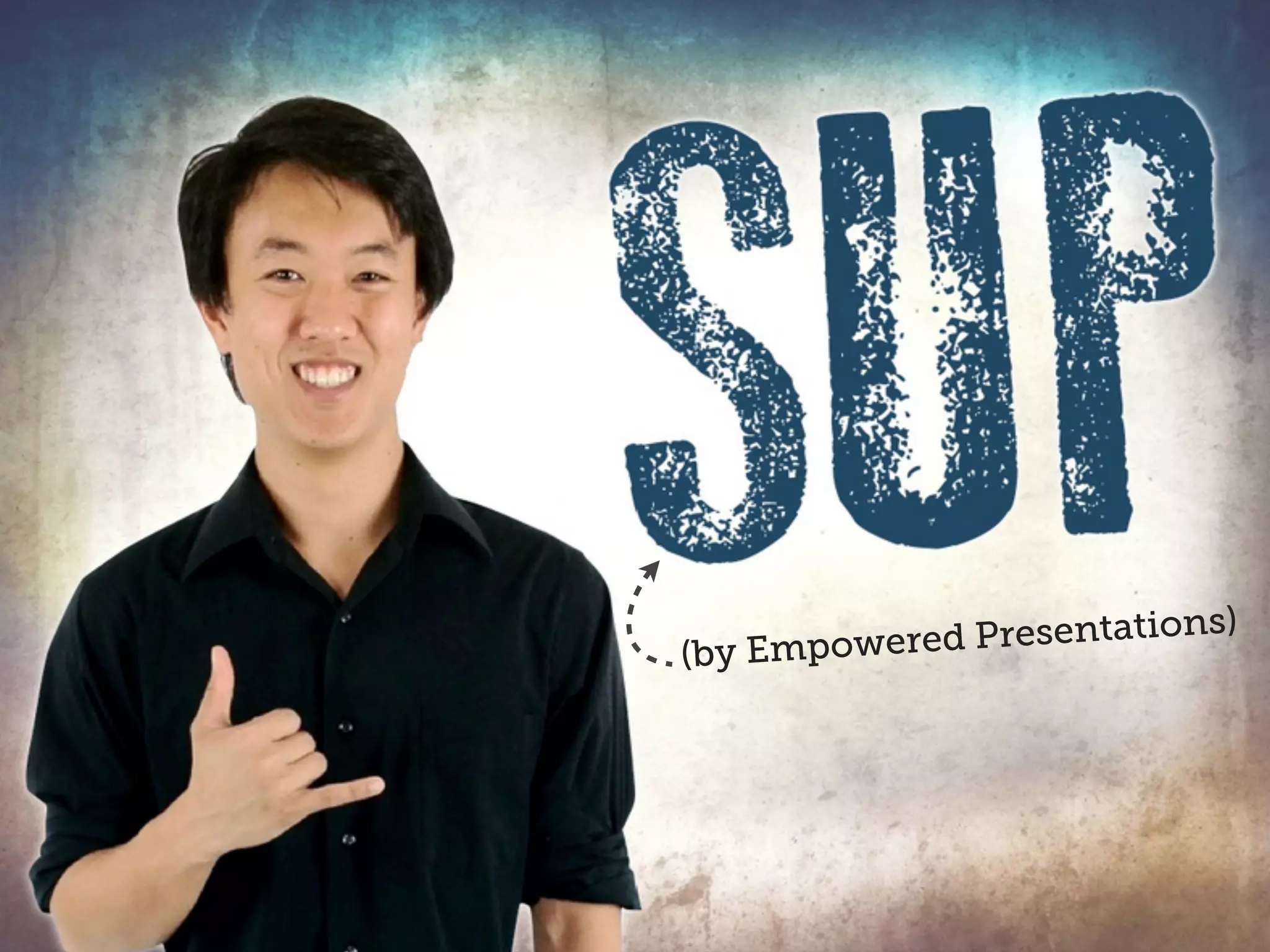
(by Empowered Presentations)

about. me
Online business card/gateway
LinkedIn   visualizers
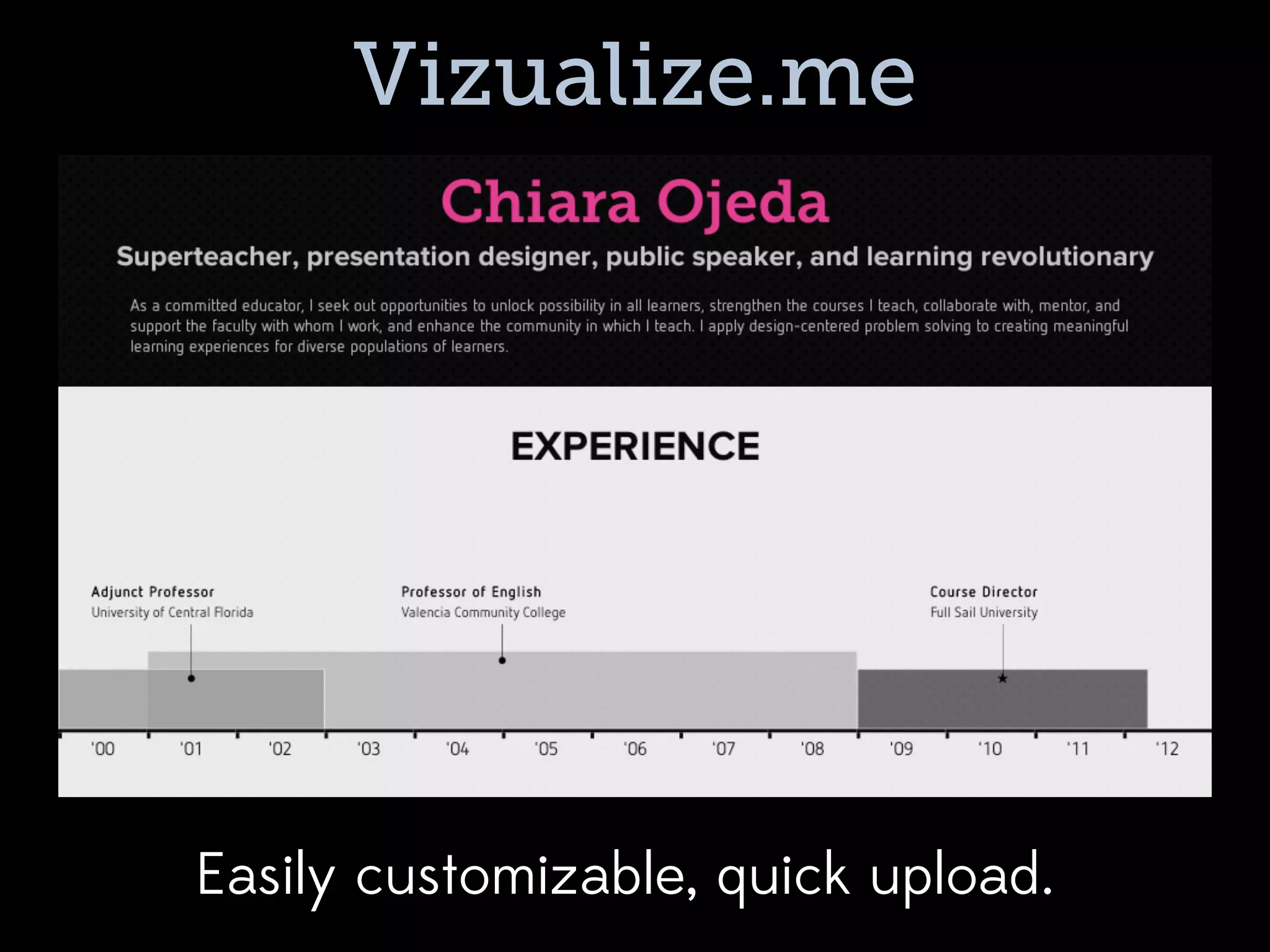
Vizualize.me


Easily customizable, quick upload.
re.vu


More options/visualizations. Slightly buggy.
Graphic design visual resumes
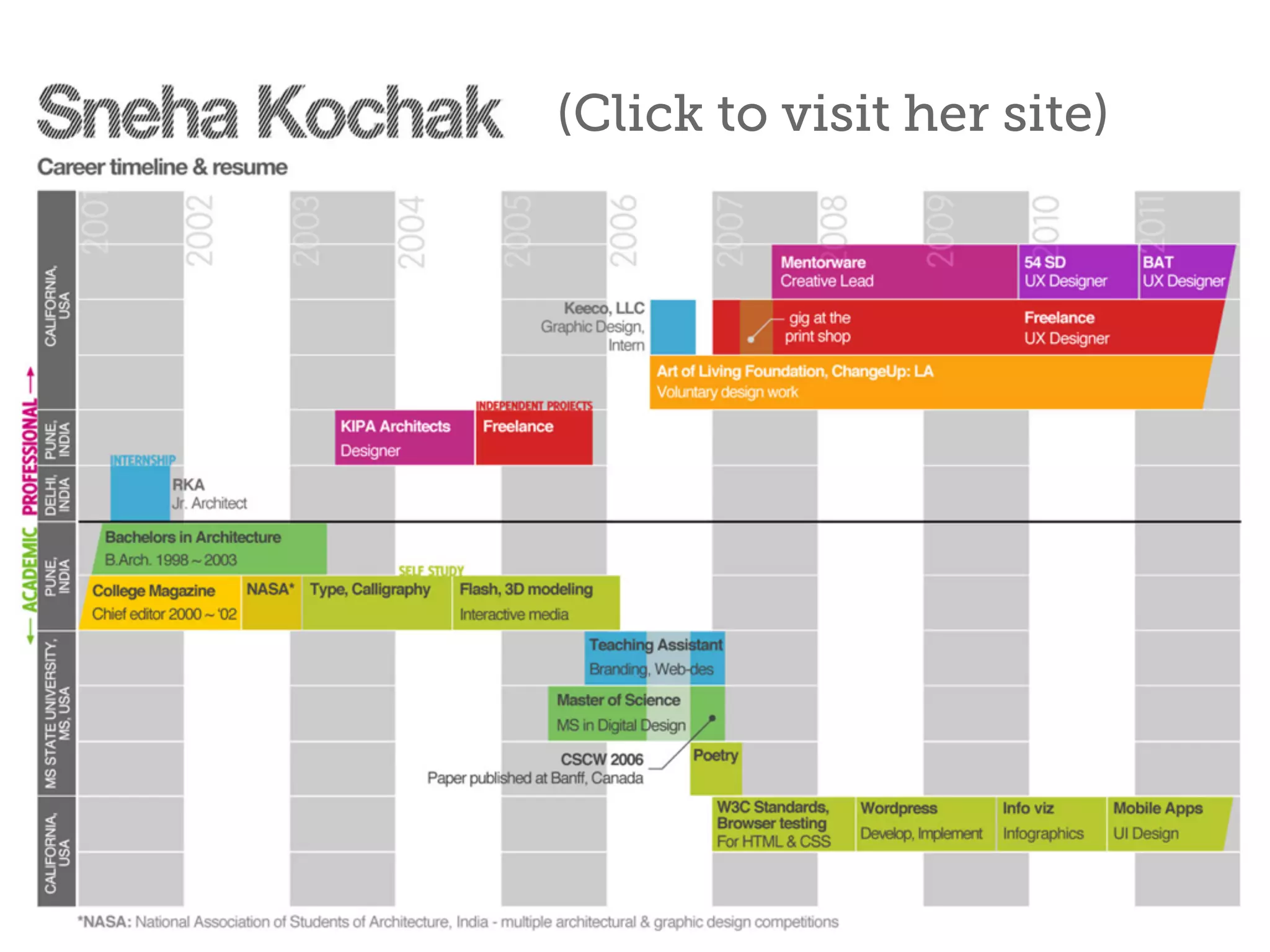
(Click to visit his site)
Janegardner.com
One final thought   to get you started...
thinkingdigital


[I]t comes down to what you value, what you do, and for whom
you do it. --Nancy Duarte, presentation goddess
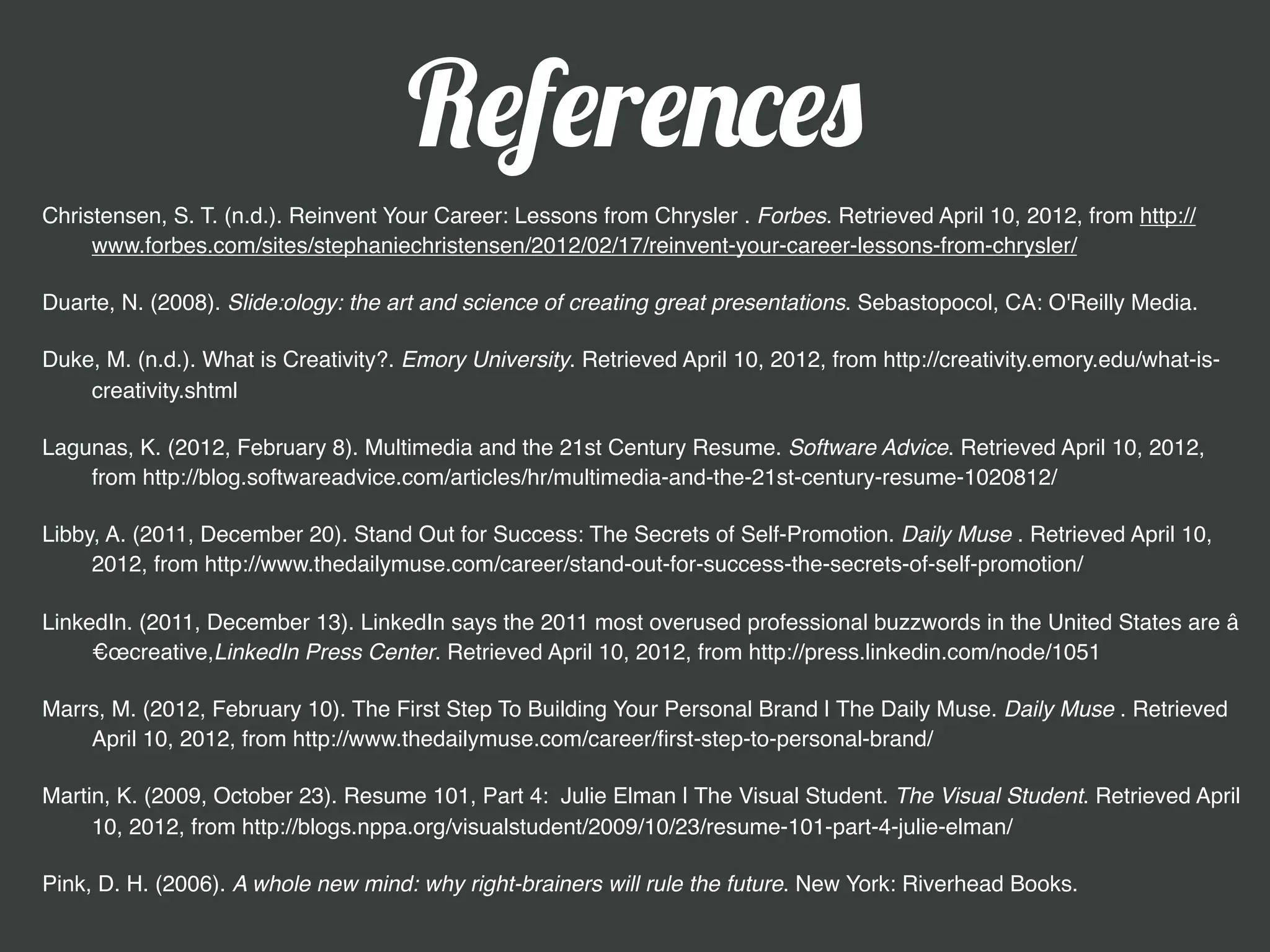
References
Typefaces: Museo Slab by Jos Buivenga and EdmondSans James T. Edmondson

Christensen, S. T. (n.d.). Reinvent Your Career: Lessons from Chrysler . Forbes. Retrieved April 10, 2012, from http://www.forbes.com/
      sites/stephaniechristensen/2012/02/17/reinvent-your-career-lessons-from-chrysler/

Duarte, N. (2008). Slide:ology: the art and science of creating great presentations. Sebastopocol, CA: O'Reilly Media.

Duke, M. (n.d.). What is Creativity?. Emory University. Retrieved April 10, 2012, from http://creativity.emory.edu/what-is-creativity.shtml

Lagunas, K. (2012, February 8). Multimedia and the 21st Century Resume. Software Advice. Retrieved April 10, 2012, from http://
    blog.softwareadvice.com/articles/hr/multimedia-and-the-21st-century-resume-1020812/

Libby, A. (2011, December 20). Stand Out for Success: The Secrets of Self-Promotion. Daily Muse . Retrieved April 10, 2012, from http://
      www.thedailymuse.com/career/stand-out-for-success-the-secrets-of-self-promotion/

LinkedIn. (2011, December 13). LinkedIn says the 2011 most overused professional buzzwords in the United States are â
     €œcreative,LinkedIn Press Center. Retrieved April 10, 2012, from http://press.linkedin.com/node/1051

Marrs, M. (2012, February 10). The First Step To Building Your Personal Brand | The Daily Muse. Daily Muse . Retrieved April 10, 2012,
     from http://www.thedailymuse.com/career/first-step-to-personal-brand/

Martin, K. (2009, October 23). Resume 101, Part 4: Julie Elman | The Visual Student. The Visual Student. Retrieved April 10, 2012, from
     http://blogs.nppa.org/visualstudent/2009/10/23/resume-101-part-4-julie-elman/

Pink, D. H. (2006). A whole new mind: why right-brainers will rule the future. New York: Riverhead Books.

Visualizing Resumes 2.0

  • 1.
    VISUAL Resumes Become the signal, not the noise The James Kendall
  • 2.
    In an ageof abundance... http://www.flickr.com/photos/pedrosz/5173748531/sizes/l/in/photostream/
  • 3.
    [M]eaning has becomea central aspect of our work and our lives. --Dan Pink, A Whole New Mind http://www.flickr.com/photos/mobilestreetlife/5946319814/sizes/l/in/photostream/
  • 4.
    While stellar performance & reputation matter... Stephen Poff
  • 5.
    The standard approachis not enough. http://www.flickr.com/photos/digger-c64/5375181724/sizes/l/in/photostream/
  • 6.
    The path isnot linear. http://www.flickr.com/photos/torsten-reuschling/4616055127/sizes/l/in/photostream/
  • 7.
    Your reputation isvirtual. Emilie Ogez Matt Andrews Photo
  • 8.
    You Body of work The web You as a professional
  • 9.
    Companies are increasingly relying on social networks ...to gauge candidates' suitability. --Rachel Silverman, The Wall Street Journal Shovelling Son
  • 10.
    buzz.bishop 1 in 6 Americans found their last job through a social network. --Jobvite http://www.flickr.com/photos/x-ray_delta_one/4318014204/sizes/o/in/set-72157622042602566/
  • 11.
    The basic functionof a resume isn’t going anywhere. Images: SOCIALisBETTER
  • 12.
    What’s changing ishow that function is executed. --Kyle Lagunas, Software Advice Images: SOCIALisBETTER
  • 13.
  • 14.
  • 15.
  • 16.
    Truth is, inmost companies, you’re probabl y not going to get ahead just by doing a good job. To get promoted, you first have to promote yourself. --Anne Libby, The Daily Muse
  • 17.
  • 18.
    The ability todisorganize http://www.flickr.com/photos/31246066@N04/6270966505/sizes/l/in/photostream/ received ways of thinking...
  • 19.
    ...and to reorganizethem Fallingwater Frank Lloyd Wright http://www.flickr.com/photos/31246066@N04/6270966505/sizes/l/in/photostream/ in a way unknown before.
  • 20.
    http://www.flickr.com/photos/x-ray_delta_one/4134629421/sizes/l/in/photostream/ The process wherebyone's ideas or productions delight, surprise, and inspire others. --Marshall Duke, Emory University
  • 21.
    First, develop abrand mantra ā€œa ...simple...statement describing who you are and what you have to offer.ā€ --Megan Marrs, The Daily Muse Image: darkmatter
  • 22.
    I am a Superteacher empoweringminds in the learning revolution. Image: JD Hancock
  • 23.
  • 24.
    Organizational Innovative Track record Motivated Dynamic Creative Communication skills Extensive experience Effective Problem solving 10 most overused professional buzzwords -- LinkedIN
  • 25.
    Instead... Identify what your strong suits are, http://www.flickr.com/photos/ndeliciousbass/4477273516/sizes/l/in/photostream/
  • 26.
    and how youcan breathe new life into them for upward momentum. --Stephanie Taylor Christensen, Forbes Woman http://www.flickr.com/photos/ndeliciousbass/4477273516/sizes/l/in/photostream/
  • 27.
    So, what isyour brand mantra?
  • 28.
  • 29.
    So, get toknow your audience.
  • 30.
    Seven Questions toKnowing Your Audience 1 What are they like? Demographics and psychographics are a great start, but connecting with your audience means understanding them on a personal level. Take a walk in their shoes and describe what their life looks like each day. 2 Why are they here? What do they think they’re going to get out of this presentation? Why did they come to hear you? Are they willing participants or mandatory attendees? This is also a bit of a situation analysis. 3 What keeps them up at night? Insert a representative Everyone has a fear, a pain point, a thorn in the side. Let your audience know you empathize—and picture or illustration of an offer a solution. audience member in this rectangle. It helps to put a face on the audience. 4 How can you solve their problem? What’s in it for the audience? How are you going to make their lives better? 5 What do you want them to do? Answer the question ā€œso what?ā€ā€”and make sure there’s clear action for your audience to take. 6 How can you best reach them? People vary in how they receive information. This can include the set up of the room to the availability of materials after the presentation. Give the audience what they want, how they want it. 7 How might they resist? What will keep them from adopting your message and carrying out your call to action? Ā© duarte.com 2008
  • 31.
    Seven Questions toKnowing Your Audience 1 What are they like? Demographics and psychographics are a great start, but connecting with your audience means understanding them on a personal level. Take a walk in their shoes and describe what their life looks like each day. 2 Why are they here? What do they think they’re going to get out of this presentation? Why did they come to hear you? Are they willing participants or mandatory attendees? This is also a bit of a situation analysis. 3 What keeps them up at night? Insert a representative Download @ www.duarte.com/books Everyone has a fear, a pain point, a thorn in the side. Let your audience know you empathize—and picture or illustration of an offer a solution. audience member in this rectangle. It helps to put a face on the audience. 4 How can you solve their problem? What’s in it for the audience? How are you going to make their lives better? 5 What do you want them to do? Answer the question ā€œso what?ā€ā€”and make sure there’s clear action for your audience to take. 6 How can you best reach them? People vary in how they receive information. This can include the set up of the room to the availability of materials after the presentation. Give the audience what they want, how they want it. 7 How might they resist? What will keep them from adopting your message and carrying out your call to action? Ā© duarte.com 2008
  • 32.
    Focus on creatinga professional persona
  • 33.
    Resume & Visual Website/ resume portfolio Relevant networking
  • 34.
  • 35.
    What makes for a great visual resume?
  • 36.
    Supplement, not replacement. Image: S. Diddy
  • 37.
    Juhan Sonin’s word cloud resume Showcases technical & creative abilities
  • 38.
  • 39.
  • 40.
  • 41.
  • 42.
  • 43.
  • 44.
    MY AN T I-RESUME DAVIDCRANDALL MANIFESTO
  • 47.
  • 48.
  • 49.
  • 50.
    LinkedIn visualizers
  • 51.
  • 52.
  • 53.
  • 54.
    (Click to visithis site)
  • 56.
  • 59.
    One final thought to get you started...
  • 60.
    thinkingdigital [I]t comes downto what you value, what you do, and for whom you do it. --Nancy Duarte, presentation goddess
  • 61.
    References Typefaces: Museo Slabby Jos Buivenga and EdmondSans James T. Edmondson Christensen, S. T. (n.d.). Reinvent Your Career: Lessons from Chrysler . Forbes. Retrieved April 10, 2012, from http://www.forbes.com/ sites/stephaniechristensen/2012/02/17/reinvent-your-career-lessons-from-chrysler/ Duarte, N. (2008). Slide:ology: the art and science of creating great presentations. Sebastopocol, CA: O'Reilly Media. Duke, M. (n.d.). What is Creativity?. Emory University. Retrieved April 10, 2012, from http://creativity.emory.edu/what-is-creativity.shtml Lagunas, K. (2012, February 8). Multimedia and the 21st Century Resume. Software Advice. Retrieved April 10, 2012, from http:// blog.softwareadvice.com/articles/hr/multimedia-and-the-21st-century-resume-1020812/ Libby, A. (2011, December 20). Stand Out for Success: The Secrets of Self-Promotion. Daily Muse . Retrieved April 10, 2012, from http:// www.thedailymuse.com/career/stand-out-for-success-the-secrets-of-self-promotion/ LinkedIn. (2011, December 13). LinkedIn says the 2011 most overused professional buzzwords in the United States are Ć¢ €œcreative,LinkedIn Press Center. Retrieved April 10, 2012, from http://press.linkedin.com/node/1051 Marrs, M. (2012, February 10). The First Step To Building Your Personal Brand | The Daily Muse. Daily Muse . Retrieved April 10, 2012, from http://www.thedailymuse.com/career/first-step-to-personal-brand/ Martin, K. (2009, October 23). Resume 101, Part 4: Julie Elman | The Visual Student. The Visual Student. Retrieved April 10, 2012, from http://blogs.nppa.org/visualstudent/2009/10/23/resume-101-part-4-julie-elman/ Pink, D. H. (2006). A whole new mind: why right-brainers will rule the future. New York: Riverhead Books.