@tompeham I @usersnap
USER ACCEPTANCE TESTS
5 TYPES OF
THIS IS ME!
@TOMPEHAM I @USERSNAP
Say hi!
THIS IS ME!
You can access the entire article here.
IF YOU’RE NEW TO UAT
GO CHECK OUT OUR SLIDES
IF YOU’RE NEW TO UAT
GO CHECK OUT OUR SLIDES
here.
Getting started with UAT
If you’re just getting started with User Acceptance Testing,
we’ve prepared a UAT checklist you can download.
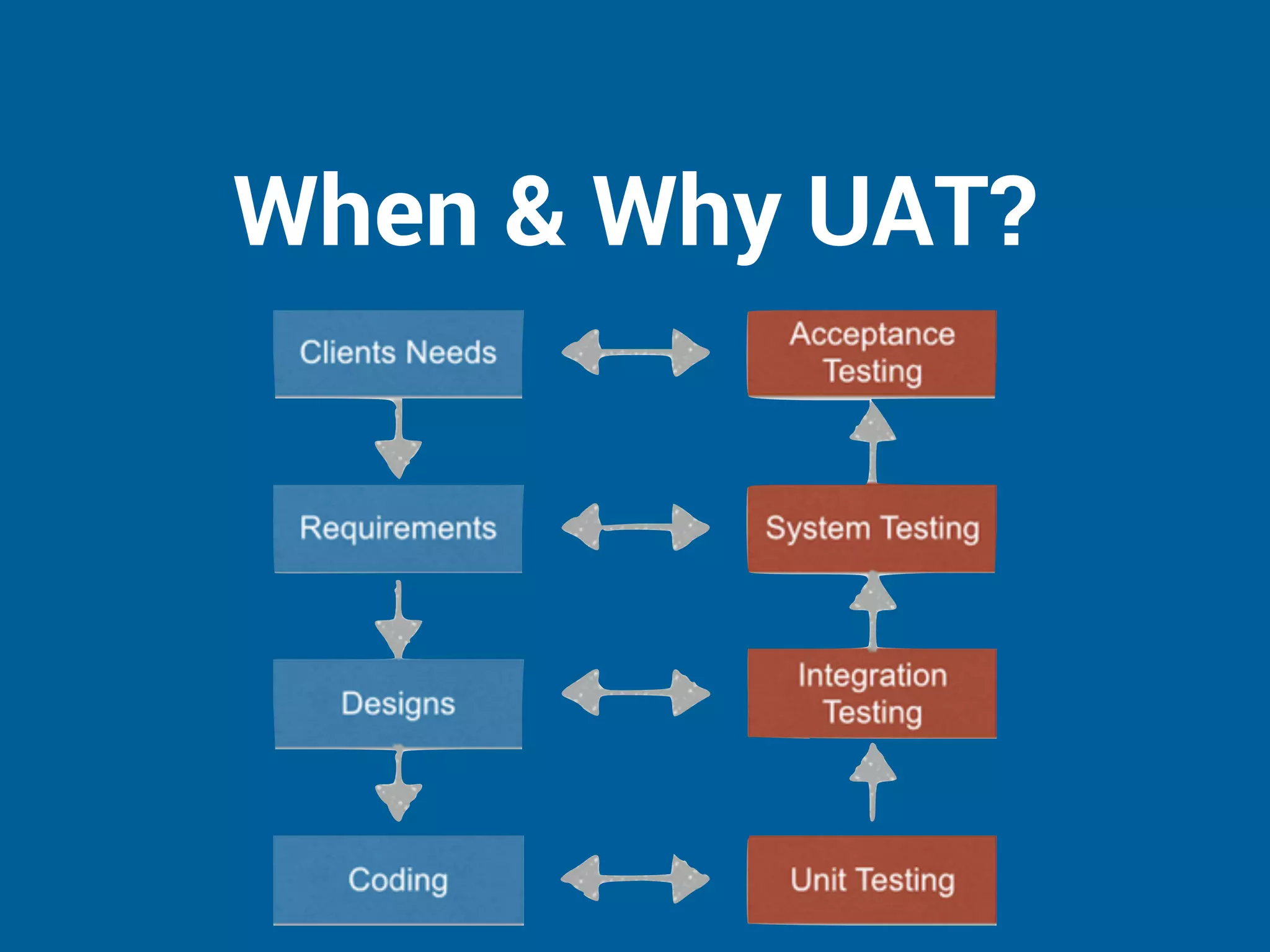
When & Why UAT?
Running those acceptance tests also ensures that no
requirement change has happened in the meantime and
that everything is as it should be to satisfy the customer.
When & Why UAT?
Acceptance tests are useful, because:

they capture user requirements in a directly verifiable way,
they identify problems which unit or integration tests
might have missed,
and they provide an overview on how “done” the system is.
When & Why UAT?
How is UAT different from functional testing?
User Acceptance Tests consist of a set of test steps,
which verify if specific requirements are working for the
user. If the customer and the supplier agree on the product,
the software development is done. Legally. And practically.
Functional testing, on the other hand, tests specific
requirements and specifications of the software. It lacks the user
component. A functional test could conclude that the software
meets its specifications. However, it doesn’t verify if it actually
works for the user. The functional dimension is only one of many.
Types of UAT
Now that we’ve clearly separated functional testing from
User Acceptance Testing, we can look at the various types
of User Acceptance Testing.
Types of UAT
Alpha Testing:
Alpha Testing takes place in the development environment and is usually done
by internal staff – long before the product is even released to external testers
or customers. Alpha Testing can also be done by potential user groups, but the
important thing here is that it takes place in the development environment.
Beta Testing:
Beta Testing, also known as “field testing”, takes place in the customer’s
environment and involves some extensive testing by a group of customers
who use the system in their environment. These beta testers then provide
feedback, which in turn leads to improvements of the product.
Types of UAT
Contract Acceptance Testing:
Contract Acceptance Testing means that a developed
software is tested against certain criteria and specifications
which are predefined and agreed upon in a contract.
The relevant criteria and specifications for acceptance must
be defined when the contract itself is defined and agreed
upon.
Types of UAT
Regulation Acceptance Testing:
Regulation Acceptance Testing, also known as
Compliance Acceptance Testing, examines whether
the software complies with the regulations. This
includes governmental and legal regulations.
Types of UAT
Operational Acceptance Testing
Also known as Operational Readiness Testing or Production
Acceptance Testing, these test cases ensure there are
workflows in place to allow the software or system to be
used.
This should include workflows for backup plans, user
training, and various maintenance processes and security
checks.
Types of UAT
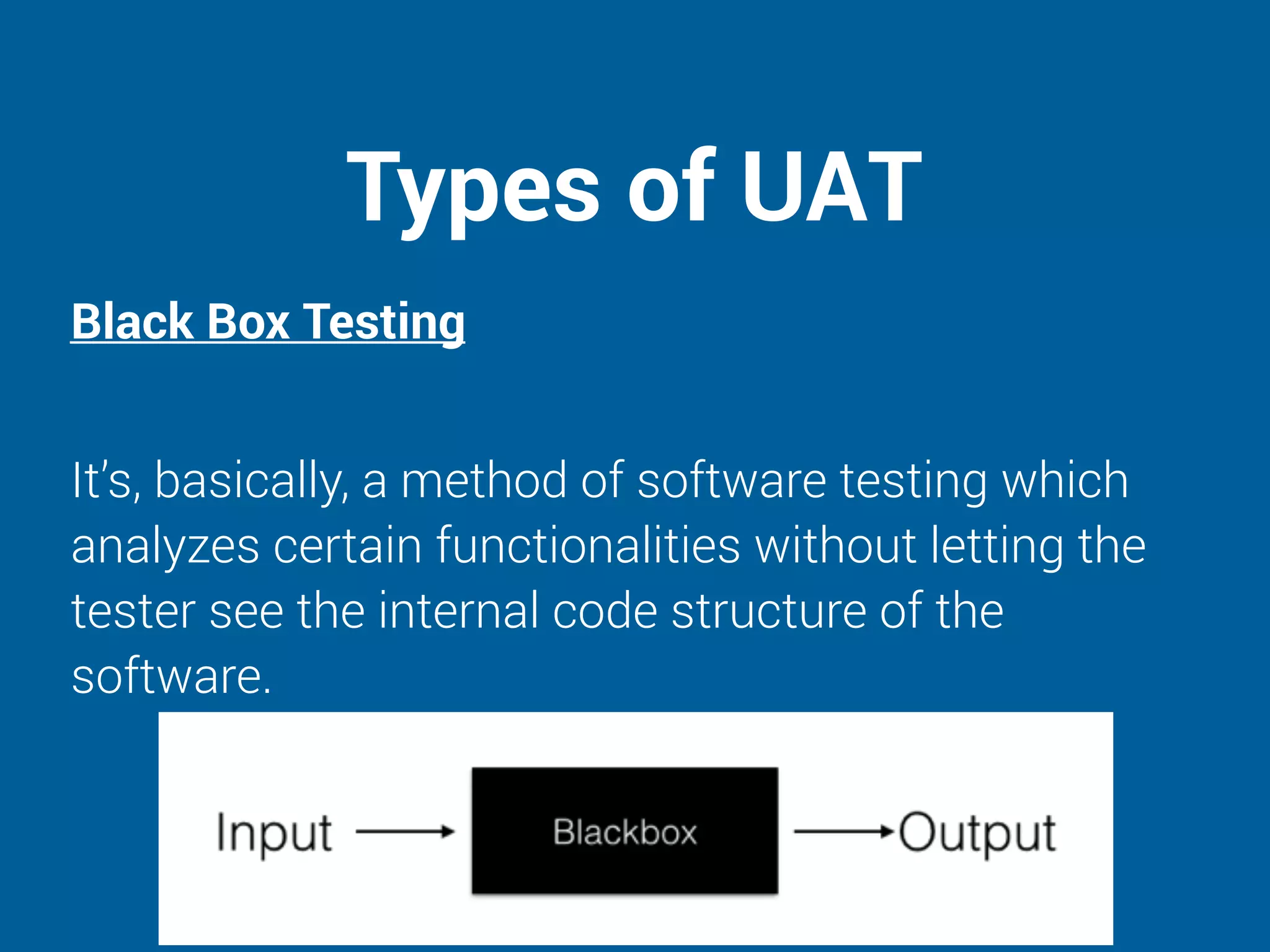
Black Box Testing
It’s, basically, a method of software testing which
analyzes certain functionalities without letting the
tester see the internal code structure of the
software.
OVER TO
YOU
Of course, there are many more types of and
frameworks for User Acceptance Testing.
I hope that, by providing you with our basic
overview of 5 types of User Acceptance Testing,
we shed some light into the darkness of UAT.
@tompeham I @usersnap
OUR BLOG AT
ALSO CHECK OUT
USERSNAP.COM/BLOG

5 Types of USER ACCEPTANCE TESTING (UAT)

  • 1.
    @tompeham I @usersnap USERACCEPTANCE TESTS 5 TYPES OF
  • 2.
  • 3.
  • 4.
    You can accessthe entire article here.
  • 5.
    IF YOU’RE NEWTO UAT GO CHECK OUT OUR SLIDES
  • 6.
    IF YOU’RE NEWTO UAT GO CHECK OUT OUR SLIDES here.
  • 7.
  • 8.
    Getting started withUAT If you’re just getting started with User Acceptance Testing, we’ve prepared a UAT checklist you can download.
  • 9.
    When & WhyUAT? Running those acceptance tests also ensures that no requirement change has happened in the meantime and that everything is as it should be to satisfy the customer.
  • 10.
    When & WhyUAT? Acceptance tests are useful, because:
 they capture user requirements in a directly verifiable way, they identify problems which unit or integration tests might have missed, and they provide an overview on how “done” the system is.
  • 11.
  • 12.
    How is UATdifferent from functional testing? User Acceptance Tests consist of a set of test steps, which verify if specific requirements are working for the user. If the customer and the supplier agree on the product, the software development is done. Legally. And practically. Functional testing, on the other hand, tests specific requirements and specifications of the software. It lacks the user component. A functional test could conclude that the software meets its specifications. However, it doesn’t verify if it actually works for the user. The functional dimension is only one of many.
  • 13.
    Types of UAT Nowthat we’ve clearly separated functional testing from User Acceptance Testing, we can look at the various types of User Acceptance Testing.
  • 14.
    Types of UAT AlphaTesting: Alpha Testing takes place in the development environment and is usually done by internal staff – long before the product is even released to external testers or customers. Alpha Testing can also be done by potential user groups, but the important thing here is that it takes place in the development environment. Beta Testing: Beta Testing, also known as “field testing”, takes place in the customer’s environment and involves some extensive testing by a group of customers who use the system in their environment. These beta testers then provide feedback, which in turn leads to improvements of the product.
  • 15.
    Types of UAT ContractAcceptance Testing: Contract Acceptance Testing means that a developed software is tested against certain criteria and specifications which are predefined and agreed upon in a contract. The relevant criteria and specifications for acceptance must be defined when the contract itself is defined and agreed upon.
  • 16.
    Types of UAT RegulationAcceptance Testing: Regulation Acceptance Testing, also known as Compliance Acceptance Testing, examines whether the software complies with the regulations. This includes governmental and legal regulations.
  • 17.
    Types of UAT OperationalAcceptance Testing Also known as Operational Readiness Testing or Production Acceptance Testing, these test cases ensure there are workflows in place to allow the software or system to be used. This should include workflows for backup plans, user training, and various maintenance processes and security checks.
  • 18.
    Types of UAT BlackBox Testing It’s, basically, a method of software testing which analyzes certain functionalities without letting the tester see the internal code structure of the software.
  • 19.
    OVER TO YOU Of course,there are many more types of and frameworks for User Acceptance Testing. I hope that, by providing you with our basic overview of 5 types of User Acceptance Testing, we shed some light into the darkness of UAT.
  • 20.
    @tompeham I @usersnap OURBLOG AT ALSO CHECK OUT USERSNAP.COM/BLOG