© Copyright 2015, First Solar, Inc.
2
©Copyright2015,FirstSolar,Inc.
Current State of Spectral Correction
.
Absolute Air Mass (AMa) 3-4
• Sandia Array Performance Model computes
spectral shift as a function of air mass:
McSi = a0 + a1·AMa + a2·(AMa)2 + a3·(AMa)3 + a4·(AMa)4
• Coefficients determined from module testing
0.98
0.99
1
1.01
1.02
1.03
1.04
1.05
1 2 3 4 5
SpectralShift
Absolute Air Mass
Nameplate
Precipitable Water (Pwat) 1-2
• First Solar spectral shift model is calculated using
precipitable water:
MCdTe = 1.266 – 0.091exp(1.199(Pwat + 0.5)-0.210)
• Coefficients calculated empirically from 13 TMY
locations across the US input into SMARTS
0.95
0.97
0.99
1.01
1.03
1.05
1.07
0 1 2 3 4 5
SpectralShift
Precipitable Water (cm)
Nameplate
1. L. Nelson, M. Frichtl, and A. Panchula, “Changes in cadmium telluride photovoltaic performance due to spectrum,” IEEE Journal of Photovoltaics, vol. 3, No. 1, pp. 488-493, 2013.
2. Mitchell Lee, Lauren Ngan, William Hayes, and Alex F. Panchula, “Comparison of the Effects of Spectrum on Cadmium Telluride and Monocrystalline Silicon Photovoltaic Module
Performance,” 42nd IEEE Photovoltaic Specialists Conference, 2015
3. D. King, W. Boyson, and J. Kratochvill, Photovoltaic Array Performance Model, SAND2004-3535. Albuquerque, New Mexico: Sandia National Laboratories, 2004.
4. D. King, J. Kratochvill, and W. Boyson, “Measuring solar spectral and angle-of-incidence effects on photovoltaic modules and solar irradiance sensors,” in 26th IEEE Photovoltaic
Specialists Conference, 1997, p. 1113 – 1116.
3
©Copyright2015,FirstSolar,Inc.
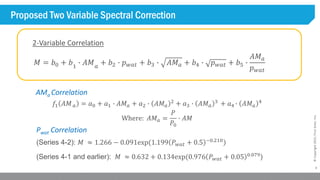
𝑀 = 𝑏0 + 𝑏1
∙ 𝐴𝑀 𝑎
+ 𝑏2 ∙ 𝑝 𝑤𝑎𝑡 + 𝑏3 ∙ 𝐴𝑀 𝑎 + 𝑏4 ∙ 𝑝 𝑤𝑎𝑡 + 𝑏5 ∙
𝐴𝑀 𝑎
𝑝 𝑤𝑎𝑡
Proposed Two Variable Spectral Correction
2-Variable Correlation
AMa Correlation
Pwat Correlation
(Series 4-2): 𝑀 ≈ 1.266 − 0.091exp(1.199 𝑃 𝑤𝑎𝑡 + 0.5 −0.210
(Series 4-1 and earlier): 𝑀 ≈ 0.632 + 0.134exp(0.976 𝑃 𝑤𝑎𝑡 + 0.05 0.079
)
𝑓1 𝐴𝑀 𝑎 = 𝑎0 + 𝑎1 ∙ 𝐴𝑀 𝑎 + 𝑎2 ∙ 𝐴𝑀 𝑎
2
+ 𝑎3 ∙ 𝐴𝑀 𝑎
3
+ 𝑎4 ∙ 𝐴𝑀 𝑎
4
Where: 𝐴𝑀 𝑎 =
𝑃
𝑃0
∙ 𝐴𝑀
© Copyright 2015, First Solar, Inc.
6
©Copyright2015,FirstSolar,Inc.
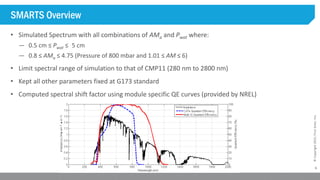
SMARTS Overview
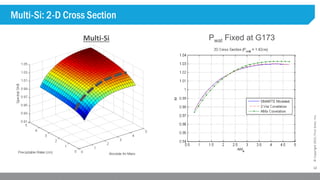
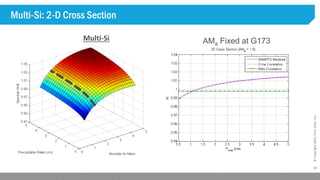
• Simulated Spectrum with all combinations of AMa and Pwat where:
— 0.5 cm ≤ Pwat ≤ 5 cm
— 0.8 ≤ AMa ≤ 4.75 (Pressure of 800 mbar and 1.01 ≤ AM ≤ 6)
• Limit spectral range of simulation to that of CMP11 (280 nm to 2800 nm)
• Kept all other parameters fixed at G173 standard
• Computed spectral shift factor using module specific QE curves (provided by NREL)
7
©Copyright2015,FirstSolar,Inc.
SMARTS Output
CdTe Multi-Si
9
©Copyright2015,FirstSolar,Inc.
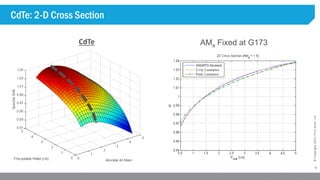
CdTe: 2-D Cross Section
AMa Fixed at G173CdTe
10
©Copyright2015,FirstSolar,Inc.
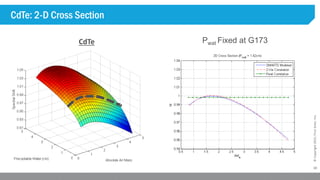
CdTe: 2-D Cross Section
Pwat Fixed at G173CdTe
12
©Copyright2015,FirstSolar,Inc.
Multi-Si: 2-D Cross Section
Pwat Fixed at G173Multi-Si
13
©Copyright2015,FirstSolar,Inc.
Multi-Si: 2-D Cross Section
AMa Fixed at G173Multi-Si
© Copyright 2015, First Solar, Inc.
15
©Copyright2015,FirstSolar,Inc.
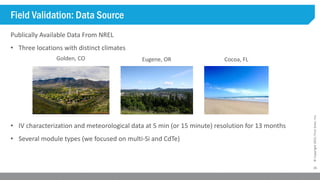
Field Validation: Data Source
Publically Available Data From NREL
• Three locations with distinct climates
• IV characterization and meteorological data at 5 min (or 15 minute) resolution for 13 months
• Several module types (we focused on multi-Si and CdTe)
Golden, CO Eugene, OR Cocoa, FL
16
©Copyright2015,FirstSolar,Inc.
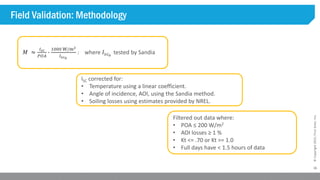
Field Validation: Methodology
𝑀 ≈
𝐼𝑠𝑐
𝑃𝑂𝐴
∙
1000 W/m2
𝐼𝑠𝑐0
: where 𝐼𝑠𝑐0
tested by Sandia
ISC corrected for:
• Temperature using a linear coefficient.
• Angle of incidence, AOI, using the Sandia method.
• Soiling losses using estimates provided by NREL.
Filtered out data where:
• POA ≤ 200 W/m2
• AOI losses ≥ 1 %
• Kt <= .70 or Kt >= 1.0
• Full days have < 1.5 hours of data
18
©Copyright2015,FirstSolar,Inc.
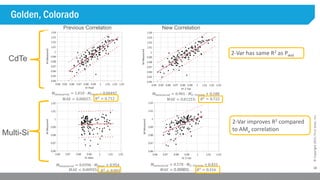
Golden, Colorado
CdTe
Previous Correlation New Correlation
Multi-Si
𝑀 𝑚𝑒𝑎𝑠𝑢𝑟𝑒𝑑 = 1.010 ∙ 𝑀 𝑃𝑤𝑎𝑡 − 0.00492
𝑅2
= 0.712
𝑀 𝑚𝑒𝑎𝑠𝑢𝑟𝑒𝑑 = 0.901 ∙ 𝑀2−𝑃𝑎𝑟𝑎𝑚 + 0.108
𝑀 𝑚𝑒𝑎𝑠𝑢𝑟𝑒𝑑 = 0.0396 ∙ 𝑀 𝑃𝑤𝑎𝑡 + 0.954
𝑅2
= 0.001
𝑀 𝑚𝑒𝑎𝑠𝑢𝑟𝑒𝑑 = 0.570 ∙ 𝑀2−𝑃𝑎𝑟𝑎𝑚 + 0.431
𝑅2 = 0.316
2-Var has same R2 as Pwat
2-Var improves R2 compared
to AMa correlation
𝑅2 = 0.722𝑀𝐴𝐸 = 0.00827; 𝑀𝐴𝐸 = 0.01253;
𝑀𝐴𝐸 = 0.00955; 𝑀𝐴𝐸 = 0.00903;
19
©Copyright2015,FirstSolar,Inc.
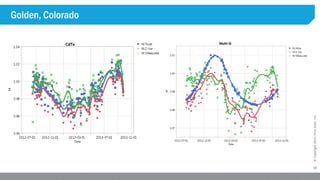
Golden, Colorado
20
©Copyright2015,FirstSolar,Inc.
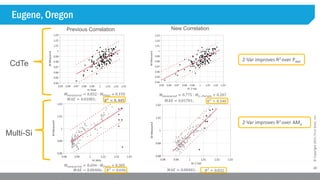
Eugene, Oregon
CdTe
Previous Correlation New Correlation
Multi-Si
𝑀 𝑚𝑒𝑎𝑠𝑢𝑟𝑒𝑑 = 0.832 ∙ 𝑀 𝑃𝑤𝑎𝑡 + 0.150
𝑅2 = 0. 445
𝑀 𝑚𝑒𝑎𝑠𝑢𝑟𝑒𝑑 = 0.775 ∙ 𝑀2−𝑃𝑎𝑟𝑎𝑚 + 0.207
𝑅2
= 0.540
𝑀 𝑚𝑒𝑎𝑠𝑢𝑟𝑒𝑑 = 0.694 ∙ 𝑀 𝑃𝑤𝑎𝑡 + 0.305
𝑅2
= 0.696
𝑀 𝑚𝑒𝑎𝑠𝑢𝑟𝑒𝑑 = 1.033 ∙ 𝑀2−𝑃𝑎𝑟𝑎𝑚 − 0.0360
𝑅2
= 0.832
2-Var improves R2 over Pwat
2-Var improves R2 over AMa
𝑀𝐴𝐸 = 0.01881;
𝑀𝐴𝐸 = 0.00406; 𝑀𝐴𝐸 = 0.00401;
𝑀𝐴𝐸 = 0.01781;
21
©Copyright2015,FirstSolar,Inc.
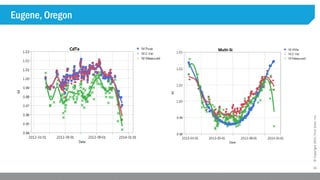
Eugene, Oregon
22
©Copyright2015,FirstSolar,Inc.
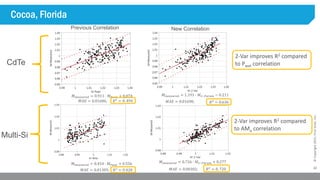
Cocoa, Florida
CdTe
Previous Correlation New Correlation
Multi-Si
𝑀 𝑚𝑒𝑎𝑠𝑢𝑟𝑒𝑑 = 0.911 ∙ 𝑀 𝑃𝑤𝑎𝑡 + 0.074
𝑅2
= 0. 494
𝑀 𝑚𝑒𝑎𝑠𝑢𝑟𝑒𝑑 = 1.191 ∙ 𝑀2−𝑃𝑎𝑟𝑎𝑚 − 0.211
𝑅2
= 0.636
𝑀 𝑚𝑒𝑎𝑠𝑢𝑟𝑒𝑑 = 0.454 ∙ 𝑀 𝑃𝑤𝑎𝑡 + 0.556
𝑅2
= 0.428
𝑀 𝑚𝑒𝑎𝑠𝑢𝑟𝑒𝑑 = 0.726 ∙ 𝑀2−𝑃𝑎𝑟𝑎𝑚 + 0.277
𝑅2
= 0. 720
2-Var improves R2 compared
to Pwat correlation
2-Var improves R2 compared
to AMa correlation
𝑀𝐴𝐸 = 0.01686;
𝑀𝐴𝐸 = 0.01305; 𝑀𝐴𝐸 = 0.00302;
𝑀𝐴𝐸 = 0.01690;
23
©Copyright2015,FirstSolar,Inc.
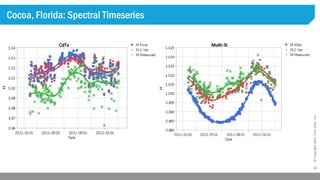
Cocoa, Florida: Spectral Timeseries
24
©Copyright2015,FirstSolar,Inc.
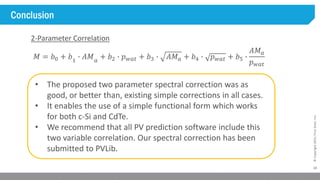
Conclusion
• The proposed two parameter spectral correction was as
good, or better than, existing simple corrections in all cases.
• It enables the use of a simple functional form which works
for both c-Si and CdTe.
• We recommend that all PV prediction software include this
two variable correlation. Our spectral correction has been
submitted to PVLib.
𝑀 = 𝑏0 + 𝑏1
∙ 𝐴𝑀 𝑎
+ 𝑏2 ∙ 𝑝 𝑤𝑎𝑡 + 𝑏3 ∙ 𝐴𝑀 𝑎 + 𝑏4 ∙ 𝑝 𝑤𝑎𝑡 + 𝑏5 ∙
𝐴𝑀 𝑎
𝑝 𝑤𝑎𝑡
2-Parameter Correlation
25
©Copyright2015,FirstSolar,Inc.
Acknowledgements
Special Thanks To:
• Bill Marion and NREL for making such a great data set of PV module field performance, and
providing us with anonymized QE curves.
• Lauren Ngan for all of the work she did to understand spectral effects on CdTe Modules, and for
helping me to understand her work.
• Chris Gueymard; without SMARTS, this work would have been impossible.
26
©Copyright2015,FirstSolar,Inc.
Questions?

22 mitchell lee_am_and_pwat_spectral_correction

  • 1.
    © Copyright 2015,First Solar, Inc.
  • 2.
    2 ©Copyright2015,FirstSolar,Inc. Current State ofSpectral Correction . Absolute Air Mass (AMa) 3-4 • Sandia Array Performance Model computes spectral shift as a function of air mass: McSi = a0 + a1·AMa + a2·(AMa)2 + a3·(AMa)3 + a4·(AMa)4 • Coefficients determined from module testing 0.98 0.99 1 1.01 1.02 1.03 1.04 1.05 1 2 3 4 5 SpectralShift Absolute Air Mass Nameplate Precipitable Water (Pwat) 1-2 • First Solar spectral shift model is calculated using precipitable water: MCdTe = 1.266 – 0.091exp(1.199(Pwat + 0.5)-0.210) • Coefficients calculated empirically from 13 TMY locations across the US input into SMARTS 0.95 0.97 0.99 1.01 1.03 1.05 1.07 0 1 2 3 4 5 SpectralShift Precipitable Water (cm) Nameplate 1. L. Nelson, M. Frichtl, and A. Panchula, “Changes in cadmium telluride photovoltaic performance due to spectrum,” IEEE Journal of Photovoltaics, vol. 3, No. 1, pp. 488-493, 2013. 2. Mitchell Lee, Lauren Ngan, William Hayes, and Alex F. Panchula, “Comparison of the Effects of Spectrum on Cadmium Telluride and Monocrystalline Silicon Photovoltaic Module Performance,” 42nd IEEE Photovoltaic Specialists Conference, 2015 3. D. King, W. Boyson, and J. Kratochvill, Photovoltaic Array Performance Model, SAND2004-3535. Albuquerque, New Mexico: Sandia National Laboratories, 2004. 4. D. King, J. Kratochvill, and W. Boyson, “Measuring solar spectral and angle-of-incidence effects on photovoltaic modules and solar irradiance sensors,” in 26th IEEE Photovoltaic Specialists Conference, 1997, p. 1113 – 1116.
  • 3.
    3 ©Copyright2015,FirstSolar,Inc. 𝑀 = 𝑏0+ 𝑏1 ∙ 𝐴𝑀 𝑎 + 𝑏2 ∙ 𝑝 𝑤𝑎𝑡 + 𝑏3 ∙ 𝐴𝑀 𝑎 + 𝑏4 ∙ 𝑝 𝑤𝑎𝑡 + 𝑏5 ∙ 𝐴𝑀 𝑎 𝑝 𝑤𝑎𝑡 Proposed Two Variable Spectral Correction 2-Variable Correlation AMa Correlation Pwat Correlation (Series 4-2): 𝑀 ≈ 1.266 − 0.091exp(1.199 𝑃 𝑤𝑎𝑡 + 0.5 −0.210 (Series 4-1 and earlier): 𝑀 ≈ 0.632 + 0.134exp(0.976 𝑃 𝑤𝑎𝑡 + 0.05 0.079 ) 𝑓1 𝐴𝑀 𝑎 = 𝑎0 + 𝑎1 ∙ 𝐴𝑀 𝑎 + 𝑎2 ∙ 𝐴𝑀 𝑎 2 + 𝑎3 ∙ 𝐴𝑀 𝑎 3 + 𝑎4 ∙ 𝐴𝑀 𝑎 4 Where: 𝐴𝑀 𝑎 = 𝑃 𝑃0 ∙ 𝐴𝑀
  • 4.
    © Copyright 2015,First Solar, Inc.
  • 5.
    6 ©Copyright2015,FirstSolar,Inc. SMARTS Overview • SimulatedSpectrum with all combinations of AMa and Pwat where: — 0.5 cm ≤ Pwat ≤ 5 cm — 0.8 ≤ AMa ≤ 4.75 (Pressure of 800 mbar and 1.01 ≤ AM ≤ 6) • Limit spectral range of simulation to that of CMP11 (280 nm to 2800 nm) • Kept all other parameters fixed at G173 standard • Computed spectral shift factor using module specific QE curves (provided by NREL)
  • 6.
  • 7.
  • 8.
  • 9.
  • 10.
  • 11.
    © Copyright 2015,First Solar, Inc.
  • 12.
    15 ©Copyright2015,FirstSolar,Inc. Field Validation: DataSource Publically Available Data From NREL • Three locations with distinct climates • IV characterization and meteorological data at 5 min (or 15 minute) resolution for 13 months • Several module types (we focused on multi-Si and CdTe) Golden, CO Eugene, OR Cocoa, FL
  • 13.
    16 ©Copyright2015,FirstSolar,Inc. Field Validation: Methodology 𝑀≈ 𝐼𝑠𝑐 𝑃𝑂𝐴 ∙ 1000 W/m2 𝐼𝑠𝑐0 : where 𝐼𝑠𝑐0 tested by Sandia ISC corrected for: • Temperature using a linear coefficient. • Angle of incidence, AOI, using the Sandia method. • Soiling losses using estimates provided by NREL. Filtered out data where: • POA ≤ 200 W/m2 • AOI losses ≥ 1 % • Kt <= .70 or Kt >= 1.0 • Full days have < 1.5 hours of data
  • 14.
    18 ©Copyright2015,FirstSolar,Inc. Golden, Colorado CdTe Previous CorrelationNew Correlation Multi-Si 𝑀 𝑚𝑒𝑎𝑠𝑢𝑟𝑒𝑑 = 1.010 ∙ 𝑀 𝑃𝑤𝑎𝑡 − 0.00492 𝑅2 = 0.712 𝑀 𝑚𝑒𝑎𝑠𝑢𝑟𝑒𝑑 = 0.901 ∙ 𝑀2−𝑃𝑎𝑟𝑎𝑚 + 0.108 𝑀 𝑚𝑒𝑎𝑠𝑢𝑟𝑒𝑑 = 0.0396 ∙ 𝑀 𝑃𝑤𝑎𝑡 + 0.954 𝑅2 = 0.001 𝑀 𝑚𝑒𝑎𝑠𝑢𝑟𝑒𝑑 = 0.570 ∙ 𝑀2−𝑃𝑎𝑟𝑎𝑚 + 0.431 𝑅2 = 0.316 2-Var has same R2 as Pwat 2-Var improves R2 compared to AMa correlation 𝑅2 = 0.722𝑀𝐴𝐸 = 0.00827; 𝑀𝐴𝐸 = 0.01253; 𝑀𝐴𝐸 = 0.00955; 𝑀𝐴𝐸 = 0.00903;
  • 15.
  • 16.
    20 ©Copyright2015,FirstSolar,Inc. Eugene, Oregon CdTe Previous CorrelationNew Correlation Multi-Si 𝑀 𝑚𝑒𝑎𝑠𝑢𝑟𝑒𝑑 = 0.832 ∙ 𝑀 𝑃𝑤𝑎𝑡 + 0.150 𝑅2 = 0. 445 𝑀 𝑚𝑒𝑎𝑠𝑢𝑟𝑒𝑑 = 0.775 ∙ 𝑀2−𝑃𝑎𝑟𝑎𝑚 + 0.207 𝑅2 = 0.540 𝑀 𝑚𝑒𝑎𝑠𝑢𝑟𝑒𝑑 = 0.694 ∙ 𝑀 𝑃𝑤𝑎𝑡 + 0.305 𝑅2 = 0.696 𝑀 𝑚𝑒𝑎𝑠𝑢𝑟𝑒𝑑 = 1.033 ∙ 𝑀2−𝑃𝑎𝑟𝑎𝑚 − 0.0360 𝑅2 = 0.832 2-Var improves R2 over Pwat 2-Var improves R2 over AMa 𝑀𝐴𝐸 = 0.01881; 𝑀𝐴𝐸 = 0.00406; 𝑀𝐴𝐸 = 0.00401; 𝑀𝐴𝐸 = 0.01781;
  • 17.
  • 18.
    22 ©Copyright2015,FirstSolar,Inc. Cocoa, Florida CdTe Previous CorrelationNew Correlation Multi-Si 𝑀 𝑚𝑒𝑎𝑠𝑢𝑟𝑒𝑑 = 0.911 ∙ 𝑀 𝑃𝑤𝑎𝑡 + 0.074 𝑅2 = 0. 494 𝑀 𝑚𝑒𝑎𝑠𝑢𝑟𝑒𝑑 = 1.191 ∙ 𝑀2−𝑃𝑎𝑟𝑎𝑚 − 0.211 𝑅2 = 0.636 𝑀 𝑚𝑒𝑎𝑠𝑢𝑟𝑒𝑑 = 0.454 ∙ 𝑀 𝑃𝑤𝑎𝑡 + 0.556 𝑅2 = 0.428 𝑀 𝑚𝑒𝑎𝑠𝑢𝑟𝑒𝑑 = 0.726 ∙ 𝑀2−𝑃𝑎𝑟𝑎𝑚 + 0.277 𝑅2 = 0. 720 2-Var improves R2 compared to Pwat correlation 2-Var improves R2 compared to AMa correlation 𝑀𝐴𝐸 = 0.01686; 𝑀𝐴𝐸 = 0.01305; 𝑀𝐴𝐸 = 0.00302; 𝑀𝐴𝐸 = 0.01690;
  • 19.
  • 20.
    24 ©Copyright2015,FirstSolar,Inc. Conclusion • The proposedtwo parameter spectral correction was as good, or better than, existing simple corrections in all cases. • It enables the use of a simple functional form which works for both c-Si and CdTe. • We recommend that all PV prediction software include this two variable correlation. Our spectral correction has been submitted to PVLib. 𝑀 = 𝑏0 + 𝑏1 ∙ 𝐴𝑀 𝑎 + 𝑏2 ∙ 𝑝 𝑤𝑎𝑡 + 𝑏3 ∙ 𝐴𝑀 𝑎 + 𝑏4 ∙ 𝑝 𝑤𝑎𝑡 + 𝑏5 ∙ 𝐴𝑀 𝑎 𝑝 𝑤𝑎𝑡 2-Parameter Correlation
  • 21.
    25 ©Copyright2015,FirstSolar,Inc. Acknowledgements Special Thanks To: •Bill Marion and NREL for making such a great data set of PV module field performance, and providing us with anonymized QE curves. • Lauren Ngan for all of the work she did to understand spectral effects on CdTe Modules, and for helping me to understand her work. • Chris Gueymard; without SMARTS, this work would have been impossible.
  • 22.