21ST CENTURY WATER
TESTING
A Comparative Look at Testing Equipment for
the Well Water Industry
By George Bailey
What will we cover today?
• Why do we test well water?
• Fracking and well contamination
• What to test for in well water?
• Field test methods, pros and
cons
• Testing best practices
• Changes in colorimeters
• 21st Century innovation
A brief history
• Until the 1970s, ground water was believed to be naturally
protected from contamination
• Between 1971 and 1985, 245 groundwater related
disease outbreaks, with 52,181 associated illnesses, were
reported
• SDWA passed by Congress in 1974 regulates public
drinking water supply but not private wells
• Revised Total Coliform Rule (RTCR) and the 1989 Total
Coliform Rule (TCR) are the only microbial drinking water
regulation that applies to all public water systems
Why do we test well water?
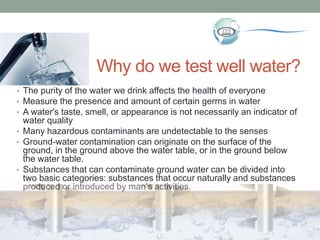
• The purity of the water we drink affects the health of everyone
• Measure the presence and amount of certain germs in water
• A water's taste, smell, or appearance is not necessarily an indicator of
water quality
• Many hazardous contaminants are undetectable to the senses
• Ground-water contamination can originate on the surface of the
ground, in the ground above the water table, or in the ground below
the water table.
• Substances that can contaminate ground water can be divided into
two basic categories: substances that occur naturally and substances
produced or introduced by man’s activities.
What the Frack?
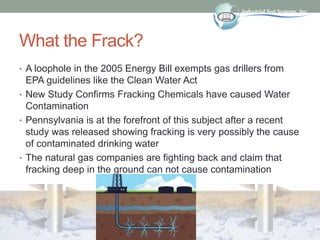
• A loophole in the 2005 Energy Bill exempts gas drillers from
EPA guidelines like the Clean Water Act
• New Study Confirms Fracking Chemicals have caused Water
Contamination
• Pennsylvania is at the forefront of this subject after a recent
study was released showing fracking is very possibly the cause
of contaminated drinking water
• The natural gas companies are fighting back and claim that
fracking deep in the ground can not cause contamination
What should we test for?
• Total/Fecal Coliform
• Arsenic
• Lead
• Zinc
• Nitrates
• Nitrites
• Total Dissolved Solids (TDS)
• Copper
• Iron
• Manganese
• Mercury
• Sodium
• pH
• In areas near fracking also include:
• Barium
• Bromide
• Chloride (Salt)
• Foaming Agents
• Methane / Ethane
• Sulfate
• Strontium
• Total Petroleum Hydrocarbons or
Oil & Grease (HEM)
To achieve good field results, tests should be:
• Practical for field use
• Acceptable or compliant (i.e., Chlorine test uses DPD)
• Appropriate for staff technical ability
• Robust, reagents & equipment are reliable & stable
• Unaffected by interferences
• Accurate when staff performs test correctly
Test Methods & Equipment Considerations
• Selectivity refers to how specific a method is for
determining a particular chemical in presence of other
components
• Dynamic Range refers to the upper and lower test range
(i.e., pH 6.0 to 9.0; Chlorine 0.01 to 11.0)
• Limit of Detection (LOD) is lowest concentration level
that can be determined to be statistically different from a
blank, sometimes referred to as sensitivity
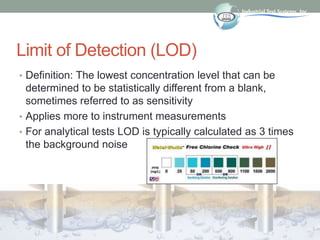
Limit of Detection (LOD)
• Definition: The lowest concentration level that can be
determined to be statistically different from a blank,
sometimes referred to as sensitivity
• Applies more to instrument measurements
• For analytical tests LOD is typically calculated as 3 times
the background noise
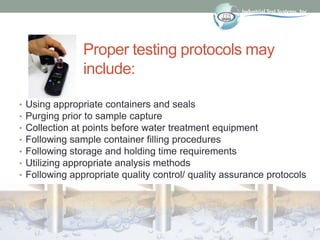
Proper testing protocols may
include:
• Using appropriate containers and seals
• Purging prior to sample capture
• Collection at points before water treatment equipment
• Following sample container filling procedures
• Following storage and holding time requirements
• Utilizing appropriate analysis methods
• Following appropriate quality control/ quality assurance protocols
What procedures and equipment do we use
• Measurement Techniques:
• Gravimetric
• Electrochemical
• Colorimetric
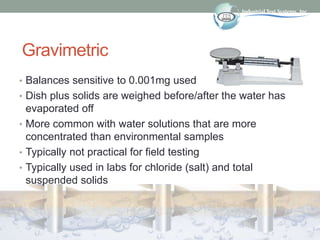
Gravimetric
• Balances sensitive to 0.001mg used
• Dish plus solids are weighed before/after the water has
evaporated off
• More common with water solutions that are more
concentrated than environmental samples
• Typically not practical for field testing
• Typically used in labs for chloride (salt) and total
suspended solids
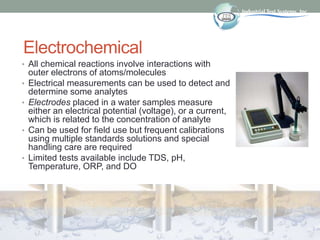
Electrochemical
• All chemical reactions involve interactions with
outer electrons of atoms/molecules
• Electrical measurements can be used to detect and
determine some analytes
• Electrodes placed in a water samples measure
either an electrical potential (voltage), or a current,
which is related to the concentration of analyte
• Can be used for field use but frequent calibrations
using multiple standards solutions and special
handling care are required
• Limited tests available include TDS, pH,
Temperature, ORP, and DO
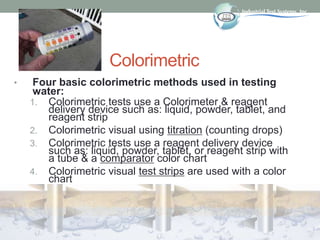
Colorimetric
• Four basic colorimetric methods used in testing
water:
1. Colorimetric tests use a Colorimeter & reagent
delivery device such as: liquid, powder, tablet, and
reagent strip
2. Colorimetric visual using titration (counting drops)
3. Colorimetric tests use a reagent delivery device
such as: liquid, powder, tablet, or reagent strip with
a tube & a comparator color chart
4. Colorimetric visual test strips are used with a color
chart
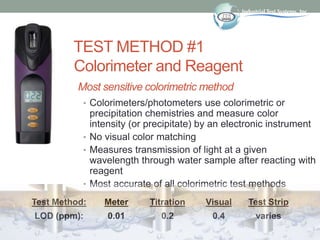
TEST METHOD #1
Colorimeter and Reagent
Most sensitive colorimetric method
• Colorimeters/photometers use colorimetric or
precipitation chemistries and measure color
intensity (or precipitate) by an electronic instrument
• No visual color matching
• Measures transmission of light at a given
wavelength through water sample after reacting with
reagent
• Most accurate of all colorimetric test methods
Test Method: Meter Titration Visual Test Strip
LOD (ppm): 0.01 0.2 0.4 varies
16
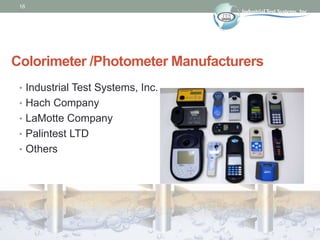
Colorimeter /Photometer Manufacturers
• Industrial Test Systems, Inc.
• Hach Company
• LaMotte Company
• Palintest LTD
• Others
17
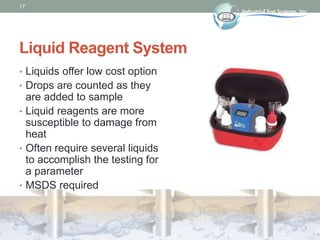
Liquid Reagent System
• Liquids offer low cost option
• Drops are counted as they
are added to sample
• Liquid reagents are more
susceptible to damage from
heat
• Often require several liquids
to accomplish the testing for
a parameter
• MSDS required
18
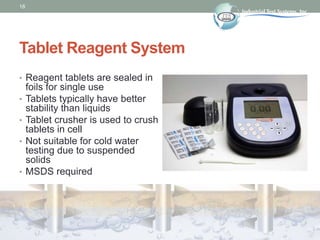
Tablet Reagent System
• Reagent tablets are sealed in
foils for single use
• Tablets typically have better
stability than liquids
• Tablet crusher is used to crush
tablets in cell
• Not suitable for cold water
testing due to suspended
solids
• MSDS required
19
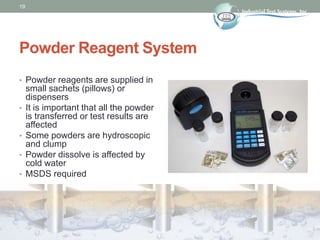
Powder Reagent System
• Powder reagents are supplied in
small sachets (pillows) or
dispensers
• It is important that all the powder
is transferred or test results are
affected
• Some powders are hydroscopic
and clump
• Powder dissolve is affected by
cold water
• MSDS required
20
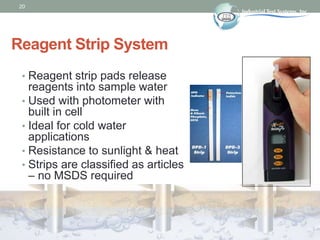
Reagent Strip System
• Reagent strip pads release
reagents into sample water
• Used with photometer with
built in cell
• Ideal for cold water
applications
• Resistance to sunlight & heat
• Strips are classified as articles
– no MSDS required
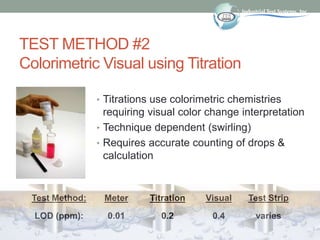
TEST METHOD #2
Colorimetric Visual using Titration
• Titrations use colorimetric chemistries
requiring visual color change interpretation
• Technique dependent (swirling)
• Requires accurate counting of drops &
calculation
Test Method: Meter Titration Visual Test Strip
LOD (ppm): 0.01 0.2 0.4 varies
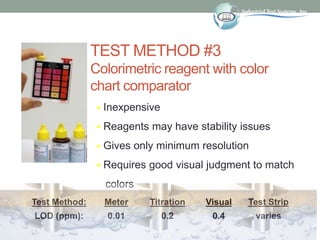
TEST METHOD #3
Colorimetric reagent with color
chart comparator
 Inexpensive
 Reagents may have stability issues
 Gives only minimum resolution
 Requires good visual judgment to match
colors
Test Method: Meter Titration Visual Test Strip
LOD (ppm): 0.01 0.2 0.4 varies
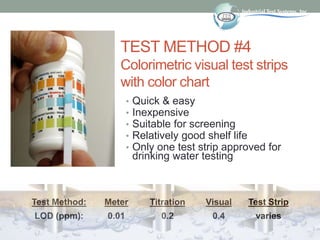
TEST METHOD #4
Colorimetric visual test strips
with color chart
• Quick & easy
• Inexpensive
• Suitable for screening
• Relatively good shelf life
• Only one test strip approved for
drinking water testing
Test Method: Meter Titration Visual Test Strip
LOD (ppm): 0.01 0.2 0.4 varies
Test Methods & Equipment
Considerations
• Cost per test ($0.02 to $0.30 up to $10)
• Time to run test (30 seconds to 5 minutes)
• Ease of use
• Level of operator training required
• Portability & stability of test kits & reagents
• Compliance with testing regulations
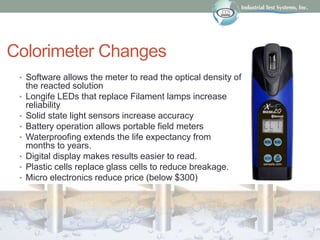
Colorimeter Changes
• Software allows the meter to read the optical density of
the reacted solution
• Longife LEDs that replace Filament lamps increase
reliability
• Solid state light sensors increase accuracy
• Battery operation allows portable field meters
• Waterproofing extends the life expectancy from
months to years.
• Digital display makes results easier to read.
• Plastic cells replace glass cells to reduce breakage.
• Micro electronics reduce price (below $300)
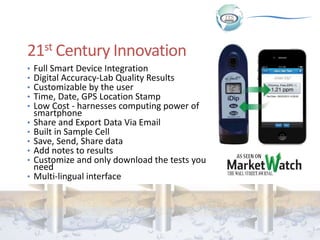
21st Century Innovation
• Full Smart Device Integration
• Digital Accuracy-Lab Quality Results
• Customizable by the user
• Time, Date, GPS Location Stamp
• Low Cost - harnesses computing power of
smartphone
• Share and Export Data Via Email
• Built in Sample Cell
• Save, Send, Share data
• Add notes to results
• Customize and only download the tests you
need
• Multi-lingual interface
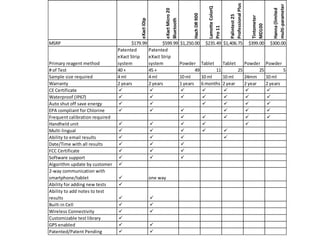
eXactiDip
eXactMicro20
Bluetooth
HachDR900
LamotteColorQ
Pro11
Palintest25
ProfessionalPlus
Tintometer
MD100
Hanna(limited
multi-parameter
MSRP $179.99 $599.99 $1,250.00 $235.49 $1,406.75 $399.00 $300.00
Primary reagent method
Patented
eXact Strip
system
Patented
eXact Strip
system Powder Tablet Tablet Powder Powder
# of Test 40 + 45 + 49 11 25 25 5
Sample size required 4 ml 4 ml 10 ml 10 ml 10 ml 24mm 10 ml
Warranty 2 years 2 years 1 years 6 months 2 year 2 year 2 years
CE Certificate       
Waterproof (IP67)       
Auto shut off save energy      
EPA compliant for Chlorine      
Frequent calibration required     
Handheld unit     
Multi-lingual     
Ability to email results    
Date/Time with all results   
FCC Certificate   
Software support   
Algorithm update by customer 
2-way communication with
smartphone/tablet  one way
Ability for adding new tests 
Ability to add notes to test
results  
Built-in Cell  
Wireless Connectivity  
Customizable test library 
GPS enabled  
Patented/Patent Pending  
Benefits to the Well Industry
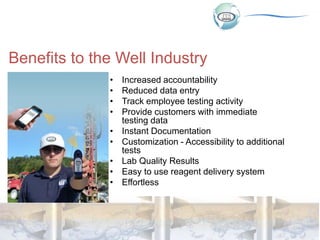
• Increased accountability
• Reduced data entry
• Track employee testing activity
• Provide customers with immediate
testing data
• Instant Documentation
• Customization - Accessibility to additional
tests
• Lab Quality Results
• Easy to use reagent delivery system
• Effortless
ANY QUESTIONS?
A Comparative Look at Testing Equipment for
the Well Water Industry
By George Bailey
gbailey@sensafe.com

21st Century Water Testing

  • 1.
    21ST CENTURY WATER TESTING AComparative Look at Testing Equipment for the Well Water Industry By George Bailey
  • 2.
    What will wecover today? • Why do we test well water? • Fracking and well contamination • What to test for in well water? • Field test methods, pros and cons • Testing best practices • Changes in colorimeters • 21st Century innovation
  • 3.
    A brief history •Until the 1970s, ground water was believed to be naturally protected from contamination • Between 1971 and 1985, 245 groundwater related disease outbreaks, with 52,181 associated illnesses, were reported • SDWA passed by Congress in 1974 regulates public drinking water supply but not private wells • Revised Total Coliform Rule (RTCR) and the 1989 Total Coliform Rule (TCR) are the only microbial drinking water regulation that applies to all public water systems
  • 4.
    Why do wetest well water? • The purity of the water we drink affects the health of everyone • Measure the presence and amount of certain germs in water • A water's taste, smell, or appearance is not necessarily an indicator of water quality • Many hazardous contaminants are undetectable to the senses • Ground-water contamination can originate on the surface of the ground, in the ground above the water table, or in the ground below the water table. • Substances that can contaminate ground water can be divided into two basic categories: substances that occur naturally and substances produced or introduced by man’s activities.
  • 5.
    What the Frack? •A loophole in the 2005 Energy Bill exempts gas drillers from EPA guidelines like the Clean Water Act • New Study Confirms Fracking Chemicals have caused Water Contamination • Pennsylvania is at the forefront of this subject after a recent study was released showing fracking is very possibly the cause of contaminated drinking water • The natural gas companies are fighting back and claim that fracking deep in the ground can not cause contamination
  • 6.
    What should wetest for? • Total/Fecal Coliform • Arsenic • Lead • Zinc • Nitrates • Nitrites • Total Dissolved Solids (TDS) • Copper • Iron • Manganese • Mercury • Sodium • pH • In areas near fracking also include: • Barium • Bromide • Chloride (Salt) • Foaming Agents • Methane / Ethane • Sulfate • Strontium • Total Petroleum Hydrocarbons or Oil & Grease (HEM)
  • 7.
    To achieve goodfield results, tests should be: • Practical for field use • Acceptable or compliant (i.e., Chlorine test uses DPD) • Appropriate for staff technical ability • Robust, reagents & equipment are reliable & stable • Unaffected by interferences • Accurate when staff performs test correctly
  • 8.
    Test Methods &Equipment Considerations • Selectivity refers to how specific a method is for determining a particular chemical in presence of other components • Dynamic Range refers to the upper and lower test range (i.e., pH 6.0 to 9.0; Chlorine 0.01 to 11.0) • Limit of Detection (LOD) is lowest concentration level that can be determined to be statistically different from a blank, sometimes referred to as sensitivity
  • 9.
    Limit of Detection(LOD) • Definition: The lowest concentration level that can be determined to be statistically different from a blank, sometimes referred to as sensitivity • Applies more to instrument measurements • For analytical tests LOD is typically calculated as 3 times the background noise
  • 10.
    Proper testing protocolsmay include: • Using appropriate containers and seals • Purging prior to sample capture • Collection at points before water treatment equipment • Following sample container filling procedures • Following storage and holding time requirements • Utilizing appropriate analysis methods • Following appropriate quality control/ quality assurance protocols
  • 11.
    What procedures andequipment do we use • Measurement Techniques: • Gravimetric • Electrochemical • Colorimetric
  • 12.
    Gravimetric • Balances sensitiveto 0.001mg used • Dish plus solids are weighed before/after the water has evaporated off • More common with water solutions that are more concentrated than environmental samples • Typically not practical for field testing • Typically used in labs for chloride (salt) and total suspended solids
  • 13.
    Electrochemical • All chemicalreactions involve interactions with outer electrons of atoms/molecules • Electrical measurements can be used to detect and determine some analytes • Electrodes placed in a water samples measure either an electrical potential (voltage), or a current, which is related to the concentration of analyte • Can be used for field use but frequent calibrations using multiple standards solutions and special handling care are required • Limited tests available include TDS, pH, Temperature, ORP, and DO
  • 14.
    Colorimetric • Four basiccolorimetric methods used in testing water: 1. Colorimetric tests use a Colorimeter & reagent delivery device such as: liquid, powder, tablet, and reagent strip 2. Colorimetric visual using titration (counting drops) 3. Colorimetric tests use a reagent delivery device such as: liquid, powder, tablet, or reagent strip with a tube & a comparator color chart 4. Colorimetric visual test strips are used with a color chart
  • 15.
    TEST METHOD #1 Colorimeterand Reagent Most sensitive colorimetric method • Colorimeters/photometers use colorimetric or precipitation chemistries and measure color intensity (or precipitate) by an electronic instrument • No visual color matching • Measures transmission of light at a given wavelength through water sample after reacting with reagent • Most accurate of all colorimetric test methods Test Method: Meter Titration Visual Test Strip LOD (ppm): 0.01 0.2 0.4 varies
  • 16.
    16 Colorimeter /Photometer Manufacturers •Industrial Test Systems, Inc. • Hach Company • LaMotte Company • Palintest LTD • Others
  • 17.
    17 Liquid Reagent System •Liquids offer low cost option • Drops are counted as they are added to sample • Liquid reagents are more susceptible to damage from heat • Often require several liquids to accomplish the testing for a parameter • MSDS required
  • 18.
    18 Tablet Reagent System •Reagent tablets are sealed in foils for single use • Tablets typically have better stability than liquids • Tablet crusher is used to crush tablets in cell • Not suitable for cold water testing due to suspended solids • MSDS required
  • 19.
    19 Powder Reagent System •Powder reagents are supplied in small sachets (pillows) or dispensers • It is important that all the powder is transferred or test results are affected • Some powders are hydroscopic and clump • Powder dissolve is affected by cold water • MSDS required
  • 20.
    20 Reagent Strip System •Reagent strip pads release reagents into sample water • Used with photometer with built in cell • Ideal for cold water applications • Resistance to sunlight & heat • Strips are classified as articles – no MSDS required
  • 21.
    TEST METHOD #2 ColorimetricVisual using Titration • Titrations use colorimetric chemistries requiring visual color change interpretation • Technique dependent (swirling) • Requires accurate counting of drops & calculation Test Method: Meter Titration Visual Test Strip LOD (ppm): 0.01 0.2 0.4 varies
  • 22.
    TEST METHOD #3 Colorimetricreagent with color chart comparator  Inexpensive  Reagents may have stability issues  Gives only minimum resolution  Requires good visual judgment to match colors Test Method: Meter Titration Visual Test Strip LOD (ppm): 0.01 0.2 0.4 varies
  • 23.
    TEST METHOD #4 Colorimetricvisual test strips with color chart • Quick & easy • Inexpensive • Suitable for screening • Relatively good shelf life • Only one test strip approved for drinking water testing Test Method: Meter Titration Visual Test Strip LOD (ppm): 0.01 0.2 0.4 varies
  • 24.
    Test Methods &Equipment Considerations • Cost per test ($0.02 to $0.30 up to $10) • Time to run test (30 seconds to 5 minutes) • Ease of use • Level of operator training required • Portability & stability of test kits & reagents • Compliance with testing regulations
  • 25.
    Colorimeter Changes • Softwareallows the meter to read the optical density of the reacted solution • Longife LEDs that replace Filament lamps increase reliability • Solid state light sensors increase accuracy • Battery operation allows portable field meters • Waterproofing extends the life expectancy from months to years. • Digital display makes results easier to read. • Plastic cells replace glass cells to reduce breakage. • Micro electronics reduce price (below $300)
  • 26.
    21st Century Innovation •Full Smart Device Integration • Digital Accuracy-Lab Quality Results • Customizable by the user • Time, Date, GPS Location Stamp • Low Cost - harnesses computing power of smartphone • Share and Export Data Via Email • Built in Sample Cell • Save, Send, Share data • Add notes to results • Customize and only download the tests you need • Multi-lingual interface
  • 28.
    eXactiDip eXactMicro20 Bluetooth HachDR900 LamotteColorQ Pro11 Palintest25 ProfessionalPlus Tintometer MD100 Hanna(limited multi-parameter MSRP $179.99 $599.99$1,250.00 $235.49 $1,406.75 $399.00 $300.00 Primary reagent method Patented eXact Strip system Patented eXact Strip system Powder Tablet Tablet Powder Powder # of Test 40 + 45 + 49 11 25 25 5 Sample size required 4 ml 4 ml 10 ml 10 ml 10 ml 24mm 10 ml Warranty 2 years 2 years 1 years 6 months 2 year 2 year 2 years CE Certificate        Waterproof (IP67)        Auto shut off save energy       EPA compliant for Chlorine       Frequent calibration required      Handheld unit      Multi-lingual      Ability to email results     Date/Time with all results    FCC Certificate    Software support    Algorithm update by customer  2-way communication with smartphone/tablet  one way Ability for adding new tests  Ability to add notes to test results   Built-in Cell   Wireless Connectivity   Customizable test library  GPS enabled   Patented/Patent Pending  
  • 29.
    Benefits to theWell Industry • Increased accountability • Reduced data entry • Track employee testing activity • Provide customers with immediate testing data • Instant Documentation • Customization - Accessibility to additional tests • Lab Quality Results • Easy to use reagent delivery system • Effortless
  • 30.
    ANY QUESTIONS? A ComparativeLook at Testing Equipment for the Well Water Industry By George Bailey gbailey@sensafe.com