‘Sweet’ strategies for
higher education
developers working
in the third space
Photo credit: Ellen Lessner
Professor Rhona Sharpe
Oxford Brookes University
SEDA Conference
2 Nov 2016
@rjsharpe
My interests
Learner
experience
research
Supporting online
learners
Developing
digital leaders
About the Oxford Centre for Staff and
Learning Development (OCSLD)
“OCSLD specialises in providing bespoke staff and
educational development interventions which meet
institutional strategic and operational needs.
About the Oxford Centre for Staff and
Learning Development (OCSLD)
Our approach to working with you is distinctive and
transformative, tailoring and delivering work-based
interventions for existing teams to meet their
immediate and future needs. This is supported by
strong expertise in evaluation to monitor outcomes.”
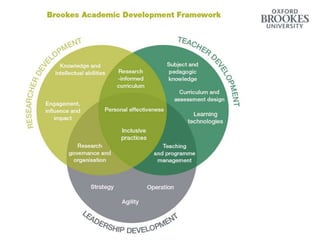
Academic Development Framework
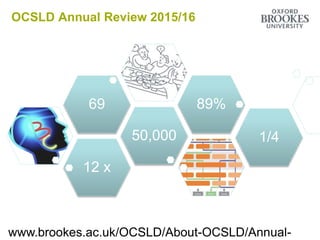
12 x
50,000
69 89%
1/4
OCSLD Annual Review 2015/16
www.brookes.ac.uk/OCSLD/About-OCSLD/Annual-
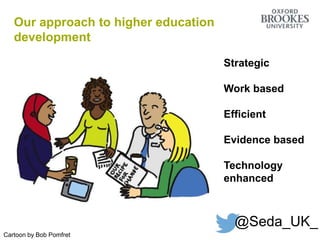
Strategic
Work based
Efficient
Evidence based
Technology
enhanced
Our approach to higher education
development
Cartoon by Bob Pomfret
@Seda_UK_
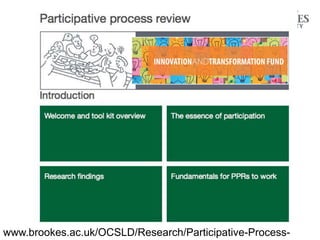
www.brookes.ac.uk/OCSLD/Research/Participative-Process-
Working in the third space
OCSLD exists in the third space between
academic and professional services.
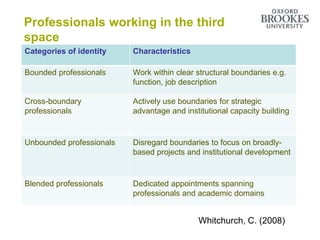
Where we work as unbounded professionals .
. .
. . . who have evolved a SWEET approach to
higher education development
… which we use to help Brookes thrive in
these changing times.
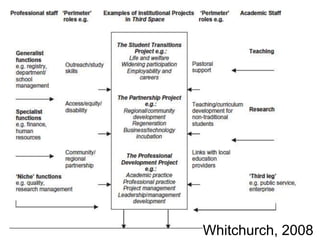
Whitchurch, 2008
Whitchurch, 2008
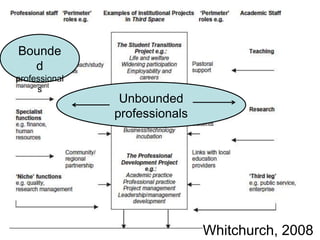
Bounde
d
professional
s
Unbounded
professionals
Professionals working in the third
space
Categories of identity Characteristics
Bounded professionals Work within clear structural boundaries e.g.
function, job description
Cross-boundary
professionals
Actively use boundaries for strategic
advantage and institutional capacity building
Unbounded professionals Disregard boundaries to focus on broadly-
based projects and institutional development
Blended professionals Dedicated appointments spanning
professionals and academic domains
Whitchurch, C. (2008)
Make it easier to disrupt institutional
practices
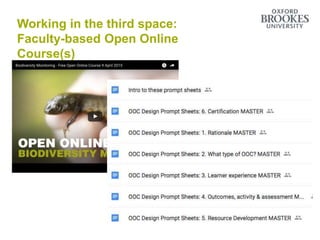
Working in the third space:
Faculty-based Open Online
Course(s)
Make it easier to disrupt institutional
practices
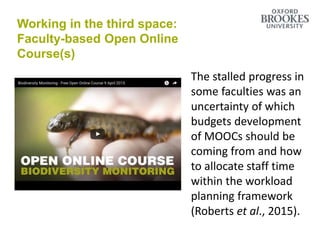
The stalled progress in
some faculties was an
uncertainty of which
budgets development
of MOOCs should be
coming from and how
to allocate staff time
within the workload
planning framework
(Roberts et al., 2015).
Working in the third space:
Faculty-based Open Online
Course(s)
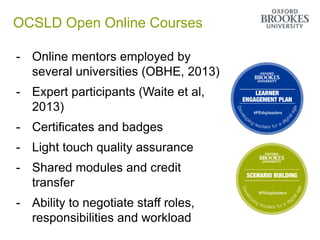
OCSLD Open Online Courses
- Online mentors employed by
several universities (OBHE, 2013)
- Expert participants (Waite et al,
2013)
- Certificates and badges
- Light touch quality assurance
- Shared modules and credit
transfer
- Ability to negotiate staff roles,
responsibilities and workload
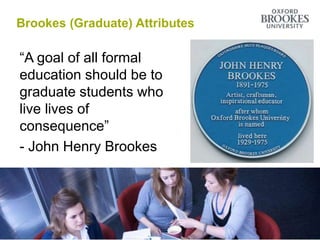
“A goal of all formal
education should be to
graduate students who
live lives of
consequence”
- John Henry Brookes
Brookes (Graduate) Attributes
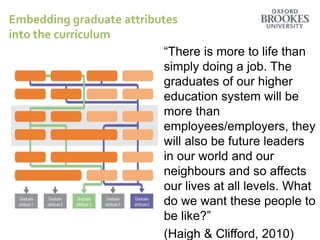
Embedding graduate attributes
into the curriculum
“There is more to life than
simply doing a job. The
graduates of our higher
education system will be
more than
employees/employers, they
will also be future leaders
in our world and our
neighbours and so affects
our lives at all levels. What
do we want these people to
be like?”
(Haigh & Clifford, 2010)
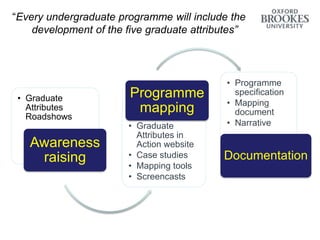
Why graduate attributes?
“Every undergraduate programme will include the
development of the five graduate attributes”
• Graduate
Attributes
Roadshows
Awareness
raising
• Graduate
Attributes in
Action website
• Case studies
• Mapping tools
• Screencasts
Programme
mapping
• Programme
specification
• Mapping
document
• Narrative
Documentation
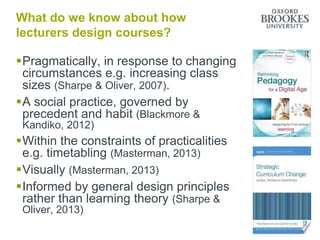
What do we know about how
lecturers design courses?
Pragmatically, in response to changing
circumstances e.g. increasing class
sizes (Sharpe & Oliver, 2007).
A social practice, governed by
precedent and habit (Blackmore &
Kandiko, 2012)
Within the constraints of practicalities
e.g. timetabling (Masterman, 2013)
Visually (Masterman, 2013)
Informed by general design principles
rather than learning theory (Sharpe &
Oliver, 2013)
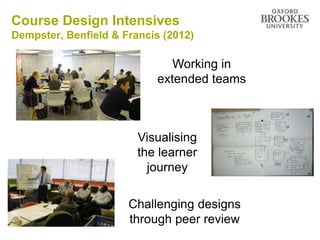
Course Design Intensives
Dempster, Benfield & Francis (2012)
Working in
extended teams
Visualising
the learner
journey
Challenging designs
through peer review
Documentary analysis of 90 programme
specification documents.
Sharing of examples of how graduate attributes
had been interpreted within the disciplines
The disciplinary differences between how
graduate attributes are expressed are in
explaining the ways and contexts in which
elements of the attributes are put to use.
Evaluation Part 1
Staff Engagement
Evaluation Part 1
Staff Engagement
Evaluation Part 2
Student Engagement
• How much has your coursework emphasised
the following mental activities?
• How often have you done each of the
following?
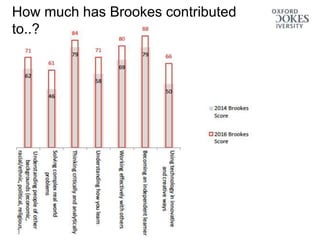
• How much has your experience at this
institution contributed to your knowledge, skills
and personal development in these areas?
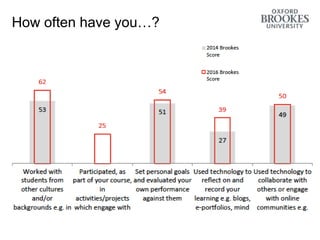
How often have you…?
How much has Brookes contributed
to..?
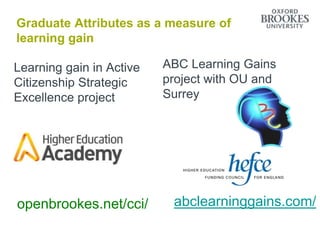
Graduate Attributes as a measure of
learning gain
Learning gain in Active
Citizenship Strategic
Excellence project
ABC Learning Gains
project with OU and
Surrey
abclearninggains.com/openbrookes.net/cci/
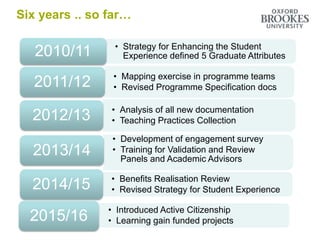
• Strategy for Enhancing the Student
Experience defined 5 Graduate Attributes2010/11
• Mapping exercise in programme teams
• Revised Programme Specification docs2011/12
• Analysis of all new documentation
• Teaching Practices Collection2012/13
• Development of engagement survey
• Training for Validation and Review
Panels and Academic Advisors
2013/14
• Benefits Realisation Review
• Revised Strategy for Student Experience2014/15
• Introduced Active Citizenship
• Learning gain funded projects2015/16
Six years .. so far…
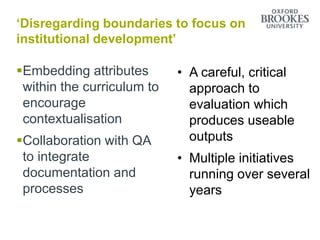
‘Disregarding boundaries to focus on
institutional development’
Embedding attributes
within the curriculum to
encourage
contextualisation
Collaboration with QA
to integrate
documentation and
processes
• A careful, critical
approach to
evaluation which
produces useable
outputs
• Multiple initiatives
running over several
years
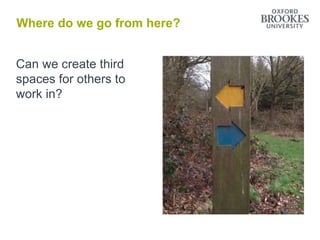
Where do we go from here?
Can we create third
spaces for others to
work in?
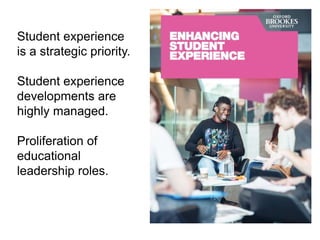
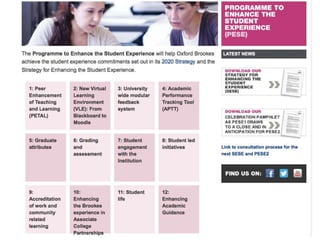
Student experience
is a strategic priority.
Student experience
developments are
highly managed.
Proliferation of
educational
leadership roles.
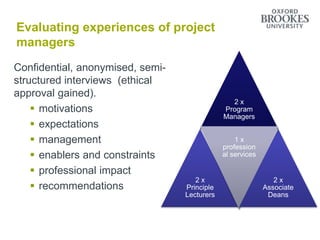
Evaluating experiences of project
managers
Confidential, anonymised, semi-
structured interviews (ethical
approval gained).
 motivations
 expectations
 management
 enablers and constraints
 professional impact
 recommendations
2 x
Program
Managers
2 x
Principle
Lecturers
1 x
profession
al services
2 x
Associate
Deans
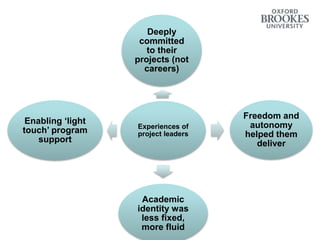
Experiences of
project leaders
Deeply
committed
to their
projects (not
careers)
Freedom and
autonomy
helped them
deliver
Academic
identity was
less fixed,
more fluid
Enabling ‘light
touch’ program
support
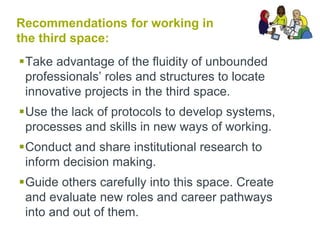
Recommendations for working in
the third space:
Take advantage of the fluidity of unbounded
professionals’ roles and structures to locate
innovative projects in the third space.
Use the lack of protocols to develop systems,
processes and skills in new ways of working.
Conduct and share institutional research to
inform decision making.
Guide others carefully into this space. Create
and evaluate new roles and career pathways
into and out of them.
The importance of evaluation
In this presentation I have drawn on the following internal
reports:
Moore, S. (2016) Oxford Brookes Engagement Survey,
October 2016.
Pavlakou, M. & Sharpe, R. (2014) Leading institutional
change projects: a qualitative study and lessons for the
second Programme for Enhancing the Student Experience..
Roberts, G., Llewellyn, S., Sharpe, R. & Benfield. G. (2015)
Project final report: Developing Open Online Courses for
Oxford Brookes.
Sharpe, R., Benfield, G., Corrywright, D. & Green, L. (2013).
Evaluation of the Brookes Graduate Attributes: Year 1 Final
Report.
References
Ansoff, H. (1957) Strategies for diversification. Harvard Business Review, (Sept-Oct)
Beetham, H. & Sharpe, R. (2013) Rethinking Pedagogy for a Digital Age. Second edition. Routledge. Chapters by Liz
Masterman and Martin Oliver
Blackmore, P. and Kandiko, C. (2012) Strategic Curriculum Change: Global trends in universities. London and New York:
Routledge.
Dempster, J., Benfield, G. & Francis, R. (2012) An academic development model for fostering innovation and sharing in
curriculum design. Innovations in Education and Teaching International, 49 (2), 135-147
Haigh, M. & Clifford, V. (2010) Widening the Graduate Attribute debate: a higher education for global citizenship. Brookes
eJournal of Learning and Teaching. 2 (5)
OBHE (2013) Horizon Scanning: What will higher education look like in 2020?, Observatory of Borderless Higher Education.
Oliver, M. (2015) From openness to permeability: reframing open education in terms of positive liberty in the enactment of
academic practices. Learning, Media and Technology, 40 (3), 365-384.
PA Consulting (2015) Lagging behind: are UK universities falling behind in the global innovation race? PA Consulting group
Higher Education Survey 2015 http://www.paconsulting.com/our-thinking/higher-education-report-2015
Roberts, G., Llewellyn, S., Sharpe, R. & Benfield. G. (2015) Project final report: Developing Open Online Courses for Oxford
Brookes, January 2015, Oxford Brookes University, Oxford.
Waite, M., Mackness, J., Roberts, G. & Lovegrove, E. (2013) Liminal Participants and Skilled Orienteers: Learner Participation
in a MOOC for New Lecturers, Journal of Online Learning and Teaching, 9 (2), http://jolt.merlot.org/vol9no2/waite_0613.htm
Whitchurch, C. (2008) Shifting identities and blurring boundaries: the emergence of Third Space professionals in UK higher
education, Higher Education Quarterly, 62 (4), 377-396.
Whitchurch, C. & Gordon (2013) Staffing models and institutional flexibility, Leadership Foundation for Higher Education:
London.

‘Sweet’ strategies for higher education developers working in the third space

  • 1.
    ‘Sweet’ strategies for highereducation developers working in the third space Photo credit: Ellen Lessner Professor Rhona Sharpe Oxford Brookes University SEDA Conference 2 Nov 2016 @rjsharpe
  • 2.
  • 3.
    About the OxfordCentre for Staff and Learning Development (OCSLD) “OCSLD specialises in providing bespoke staff and educational development interventions which meet institutional strategic and operational needs.
  • 4.
    About the OxfordCentre for Staff and Learning Development (OCSLD) Our approach to working with you is distinctive and transformative, tailoring and delivering work-based interventions for existing teams to meet their immediate and future needs. This is supported by strong expertise in evaluation to monitor outcomes.”
  • 5.
  • 6.
    12 x 50,000 69 89% 1/4 OCSLDAnnual Review 2015/16 www.brookes.ac.uk/OCSLD/About-OCSLD/Annual-
  • 7.
    Strategic Work based Efficient Evidence based Technology enhanced Ourapproach to higher education development Cartoon by Bob Pomfret @Seda_UK_
  • 8.
  • 10.
    Working in thethird space OCSLD exists in the third space between academic and professional services. Where we work as unbounded professionals . . . . . . who have evolved a SWEET approach to higher education development … which we use to help Brookes thrive in these changing times.
  • 11.
  • 12.
  • 13.
    Professionals working inthe third space Categories of identity Characteristics Bounded professionals Work within clear structural boundaries e.g. function, job description Cross-boundary professionals Actively use boundaries for strategic advantage and institutional capacity building Unbounded professionals Disregard boundaries to focus on broadly- based projects and institutional development Blended professionals Dedicated appointments spanning professionals and academic domains Whitchurch, C. (2008)
  • 14.
    Make it easierto disrupt institutional practices Working in the third space: Faculty-based Open Online Course(s)
  • 15.
    Make it easierto disrupt institutional practices The stalled progress in some faculties was an uncertainty of which budgets development of MOOCs should be coming from and how to allocate staff time within the workload planning framework (Roberts et al., 2015). Working in the third space: Faculty-based Open Online Course(s)
  • 16.
    OCSLD Open OnlineCourses - Online mentors employed by several universities (OBHE, 2013) - Expert participants (Waite et al, 2013) - Certificates and badges - Light touch quality assurance - Shared modules and credit transfer - Ability to negotiate staff roles, responsibilities and workload
  • 17.
    “A goal ofall formal education should be to graduate students who live lives of consequence” - John Henry Brookes Brookes (Graduate) Attributes
  • 18.
    Embedding graduate attributes intothe curriculum “There is more to life than simply doing a job. The graduates of our higher education system will be more than employees/employers, they will also be future leaders in our world and our neighbours and so affects our lives at all levels. What do we want these people to be like?” (Haigh & Clifford, 2010)
  • 19.
    Why graduate attributes? “Everyundergraduate programme will include the development of the five graduate attributes” • Graduate Attributes Roadshows Awareness raising • Graduate Attributes in Action website • Case studies • Mapping tools • Screencasts Programme mapping • Programme specification • Mapping document • Narrative Documentation
  • 20.
    What do weknow about how lecturers design courses? Pragmatically, in response to changing circumstances e.g. increasing class sizes (Sharpe & Oliver, 2007). A social practice, governed by precedent and habit (Blackmore & Kandiko, 2012) Within the constraints of practicalities e.g. timetabling (Masterman, 2013) Visually (Masterman, 2013) Informed by general design principles rather than learning theory (Sharpe & Oliver, 2013)
  • 21.
    Course Design Intensives Dempster,Benfield & Francis (2012) Working in extended teams Visualising the learner journey Challenging designs through peer review
  • 22.
    Documentary analysis of90 programme specification documents. Sharing of examples of how graduate attributes had been interpreted within the disciplines The disciplinary differences between how graduate attributes are expressed are in explaining the ways and contexts in which elements of the attributes are put to use. Evaluation Part 1 Staff Engagement Evaluation Part 1 Staff Engagement
  • 23.
    Evaluation Part 2 StudentEngagement • How much has your coursework emphasised the following mental activities? • How often have you done each of the following? • How much has your experience at this institution contributed to your knowledge, skills and personal development in these areas?
  • 24.
  • 25.
    How much hasBrookes contributed to..?
  • 26.
    Graduate Attributes asa measure of learning gain Learning gain in Active Citizenship Strategic Excellence project ABC Learning Gains project with OU and Surrey abclearninggains.com/openbrookes.net/cci/
  • 27.
    • Strategy forEnhancing the Student Experience defined 5 Graduate Attributes2010/11 • Mapping exercise in programme teams • Revised Programme Specification docs2011/12 • Analysis of all new documentation • Teaching Practices Collection2012/13 • Development of engagement survey • Training for Validation and Review Panels and Academic Advisors 2013/14 • Benefits Realisation Review • Revised Strategy for Student Experience2014/15 • Introduced Active Citizenship • Learning gain funded projects2015/16 Six years .. so far…
  • 28.
    ‘Disregarding boundaries tofocus on institutional development’ Embedding attributes within the curriculum to encourage contextualisation Collaboration with QA to integrate documentation and processes • A careful, critical approach to evaluation which produces useable outputs • Multiple initiatives running over several years
  • 29.
    Where do wego from here? Can we create third spaces for others to work in?
  • 30.
    Student experience is astrategic priority. Student experience developments are highly managed. Proliferation of educational leadership roles.
  • 32.
    Evaluating experiences ofproject managers Confidential, anonymised, semi- structured interviews (ethical approval gained).  motivations  expectations  management  enablers and constraints  professional impact  recommendations 2 x Program Managers 2 x Principle Lecturers 1 x profession al services 2 x Associate Deans
  • 33.
    Experiences of project leaders Deeply committed totheir projects (not careers) Freedom and autonomy helped them deliver Academic identity was less fixed, more fluid Enabling ‘light touch’ program support
  • 34.
    Recommendations for workingin the third space: Take advantage of the fluidity of unbounded professionals’ roles and structures to locate innovative projects in the third space. Use the lack of protocols to develop systems, processes and skills in new ways of working. Conduct and share institutional research to inform decision making. Guide others carefully into this space. Create and evaluate new roles and career pathways into and out of them.
  • 35.
    The importance ofevaluation In this presentation I have drawn on the following internal reports: Moore, S. (2016) Oxford Brookes Engagement Survey, October 2016. Pavlakou, M. & Sharpe, R. (2014) Leading institutional change projects: a qualitative study and lessons for the second Programme for Enhancing the Student Experience.. Roberts, G., Llewellyn, S., Sharpe, R. & Benfield. G. (2015) Project final report: Developing Open Online Courses for Oxford Brookes. Sharpe, R., Benfield, G., Corrywright, D. & Green, L. (2013). Evaluation of the Brookes Graduate Attributes: Year 1 Final Report.
  • 36.
    References Ansoff, H. (1957)Strategies for diversification. Harvard Business Review, (Sept-Oct) Beetham, H. & Sharpe, R. (2013) Rethinking Pedagogy for a Digital Age. Second edition. Routledge. Chapters by Liz Masterman and Martin Oliver Blackmore, P. and Kandiko, C. (2012) Strategic Curriculum Change: Global trends in universities. London and New York: Routledge. Dempster, J., Benfield, G. & Francis, R. (2012) An academic development model for fostering innovation and sharing in curriculum design. Innovations in Education and Teaching International, 49 (2), 135-147 Haigh, M. & Clifford, V. (2010) Widening the Graduate Attribute debate: a higher education for global citizenship. Brookes eJournal of Learning and Teaching. 2 (5) OBHE (2013) Horizon Scanning: What will higher education look like in 2020?, Observatory of Borderless Higher Education. Oliver, M. (2015) From openness to permeability: reframing open education in terms of positive liberty in the enactment of academic practices. Learning, Media and Technology, 40 (3), 365-384. PA Consulting (2015) Lagging behind: are UK universities falling behind in the global innovation race? PA Consulting group Higher Education Survey 2015 http://www.paconsulting.com/our-thinking/higher-education-report-2015 Roberts, G., Llewellyn, S., Sharpe, R. & Benfield. G. (2015) Project final report: Developing Open Online Courses for Oxford Brookes, January 2015, Oxford Brookes University, Oxford. Waite, M., Mackness, J., Roberts, G. & Lovegrove, E. (2013) Liminal Participants and Skilled Orienteers: Learner Participation in a MOOC for New Lecturers, Journal of Online Learning and Teaching, 9 (2), http://jolt.merlot.org/vol9no2/waite_0613.htm Whitchurch, C. (2008) Shifting identities and blurring boundaries: the emergence of Third Space professionals in UK higher education, Higher Education Quarterly, 62 (4), 377-396. Whitchurch, C. & Gordon (2013) Staffing models and institutional flexibility, Leadership Foundation for Higher Education: London.