Effective Business
Communication
The structure of effective
Presentations and Reports.
Communication Checklist
How do you construct an effective
presentation or report?
Who is your audience?
What are they interested in?
What do you want them to remember?
Meaning of Communication
What makes a good communicator?
Process
Communication game
What did we learn?
Active listing
Six ways of using non-verbal communication
skills effectively
Effective presentation skills
Reference
CONTENT
Communication is a dynamic process…
through this process we convey a
thought or feeling to someone else.
how it is received depends on a set of
events, stimuli, that person is exposed
to.
how you say what you say plays an
important role in communication.
COMMUNICATION - MEANING
An Active Listener,
An Effective Presenter,
A Quick Thinker.
A Win-Win Negotiator.
WHAT MAKES A GOOD COMMUNICATOR?
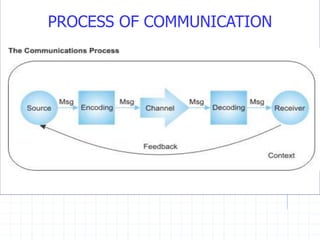
PROCESS OF COMMUNICATION
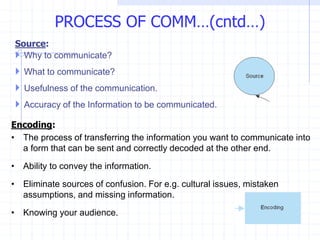
Source:
 Why to communicate?
 What to communicate?
 Usefulness of the communication.
 Accuracy of the Information to be communicated.
PROCESS OF COMM…(cntd…)
Encoding:
• The process of transferring the information you want to communicate into
a form that can be sent and correctly decoded at the other end.
• Ability to convey the information.
• Eliminate sources of confusion. For e.g. cultural issues, mistaken
assumptions, and missing information.
• Knowing your audience.
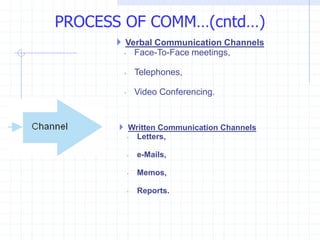
 Written Communication Channels
◦ Letters,
◦ e-Mails,
◦ Memos,
◦ Reports.
 Verbal Communication Channels
◦ Face-To-Face meetings,
◦ Telephones,
◦ Video Conferencing.
PROCESS OF COMM…(cntd…)
Strengths and Weaknesses
Verbal Communication:
Strength - Role of Body Language.
Weakness - Not possible to give long list of
directions
Written Communication:
Strength - A proof of a communication
Weakness - Written words does not show a
person’s actual feelings.
PROCESS OF COMM…(cntd…)
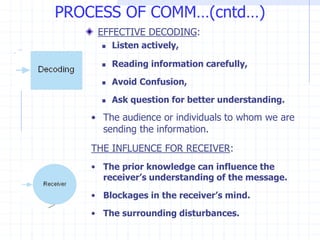
EFFECTIVE DECODING:
 Listen actively,
 Reading information carefully,
 Avoid Confusion,
 Ask question for better understanding.
PROCESS OF COMM…(cntd…)
• The audience or individuals to whom we are
sending the information.
THE INFLUENCE FOR RECEIVER:
• The prior knowledge can influence the
receiver’s understanding of the message.
• Blockages in the receiver’s mind.
• The surrounding disturbances.
FEEDBACK:
Feedback can be:
Verbal Reactions and Non-Verbal Reactions.
Positive feedback and Negative feedback.
PROCESS OF COMM…(cntd…)
CONTEXT:
1.Various Cultures (Corporate, International, Regional, etc),
2.Language,
3.Location or Place (Restaurant, Office, Auditorium, Room,
etc).
4.Situation
The sender needs to communicate the context to the
receiver for better clarity in the communication
process.
PROCESS OF COMM…(…end)
Few tips towards Active Listening:
1. Understand your own communication style.
2. Be an active listener.
3. Use normal communication.
4. Give Feedback
ACTIVE LISTENING
1. Understand your own communication
style:
 High level of self-awareness to creating good & long lasting impression
on others.
 Understand how others perceive you.
 Avoid being CHAMELEON by changing with every personality you meet.
 Make others comfortable by selecting appropriate behavior that suits
your personality while listening. (Ideally nodding your head).
ACTIVE LISTENING…(cntd…)
2. Be An Active Listener:
 People speak @ 100 to 175 WPM but can listen intelligently @ 300
WPM.
 One part of human mind pays attention, so it is easy to go into mind
drift.
 Listen with a purpose.
 Purpose can be to gain information, obtain directions, understand
others, solve problems, share interest, see how another person
feels, show support, etc.
 If it is difficult to concentrate then repeat the speakers words in your
mind.
ACTIVE LISTENING…(cntd…)
3. Use Non-verbal Communication:
 Smile,
 Gestures,
 Eye contact,
 Your posture.
ACTIVE LISTENING…(cntd…)
4. Give Feedback
 Remember that what someone says and what we hear can be
amazingly different.
 Repeat back or summarize to ensure that you understand.
 Restate what you think you heard and ask, "Have I understood you
correctly?"
ACTIVE LISTENING…(cntd…)
Some major areas of nonverbal behaviors to explore are:
Eye contact
Facial expressions
Gestures
Posture and body orientation
Proximity
Paralinguistic
Humor
SIX WAYS OF USING NON-VERBAL
COMMUNICATION SKILLS EFFECTIVELY
SIX WAYS OF …(cntd…)
EYE CONTACT:
Eye is an direct and most expressive part of our body.
Different ways of Eye Contact
 Direct Eye Contact: (Shows confidence)
 Looking downwards (Listening carefully or Guilty)
 Single raised eyebrow (Doubting)
 Both raised eyebrows (Admiring)
 Bent eyebrows (Sudden focus)
 Tears coming out (Emotional either happy or hurt)
………and many more
FACIAL EXPRESSION:
Smile covers the most part of facial expression:
Smiling is a powerful cue that transmits:
◦ Happiness
◦ Friendliness
◦ Warmth
◦ Liking
◦ Affiliation
SIX WAYS OF …(cntd…)
GESTURES:
If you fail to gesture while speaking, you may be
perceived as boring, stiff and unanimated.
A lively and animated teaching style captures students'
attention, makes the material more interesting, facilitates
learning and provides a bit of entertainment.
Head nods, a form of gestures, communicate positive
reinforcement to students and indicate that you are
listening.
SIX WAYS OF …(cntd…)
POSTURE AND BODY ORIENTATION:
• You communicate numerous messages by the way you walk, talk,
stand and sit.
• Standing erect, but not rigid, and leaning slightly forward
communicates to students that you are approachable, receptive and
friendly.
• Furthermore, interpersonal closeness results when you and your
students face each other.
• Speaking with your back turned or looking at the floor or ceiling
should be avoided; it communicates disinterest to your class.
SIX WAYS OF …(cntd…)
PROXIMITY:
 Cultural norms dictate a comfortable distance for interaction with
audience.
 You should look for signals of discomfort caused by invading young
audience‘s space.
Some of these are:
 Rocking,
 Leg swinging,
 Tapping,
 Gaze aversion,
 To counteract this, move around the classroom to increase
interaction with your students. Increasing proximity enables you to
make better eye contact and increases the opportunities for students
to speak.
SIX WAYS OF …(cntd…)
Paralinguistic :
This facet of nonverbal communication includes such vocal
elements as:
- Tone
- Pitch
- Rhythm
- Timbre
- Loudness
- Inflection
FEW FACTS
- You have over 630 muscles in your body.
- Eye muscles are the busiest muscles in the body. Scientists estimate
they may move more than 100,000 times a day.
- You have over 30 muscles in your face to help you smile or frown. It
takes 17 muscles to smile and 43 to frown.
SO SMILE EVERYTIME YOU SEE SOMEONE.
- The strongest muscle in your body is your tongue. USE IT
EFFECTIVELY.
- It takes the interaction of 72 different muscles to produce human
speech.
Presentation Skills while appearing for an
interview.
 Your Dressing sense (Males & Females),
 Documents needed to be carried,
 Your body language (while standing, while sitting, while
walking),
 Your attitude (Soberness, Soft words, avoid western accent),
 Your Confidence (while talking, body movements, aggression,
etc).
EFFECTIVE PRESENTATION SKILLS
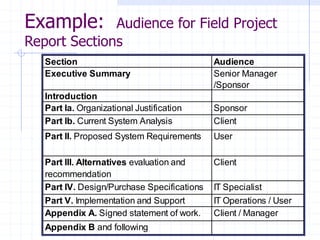
Example: Audience for Field Project
Report Sections
Section Audience
Executive Summary Senior Manager
/Sponsor
Introduction
Part Ia. Organizational Justification Sponsor
Part Ib. Current System Analysis Client
Part II. Proposed System Requirements User
Part III. Alternatives evaluation and
recommendation
Client
Part IV. Design/Purchase Specifications IT Specialist
Part V. Implementation and Support IT Operations / User
Appendix A. Signed statement of work. Client / Manager
Appendix B and following
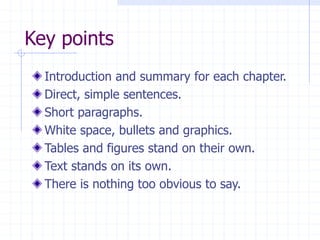
Key points
Introduction and summary for each chapter.
Direct, simple sentences.
Short paragraphs.
White space, bullets and graphics.
Tables and figures stand on their own.
Text stands on its own.
There is nothing too obvious to say.
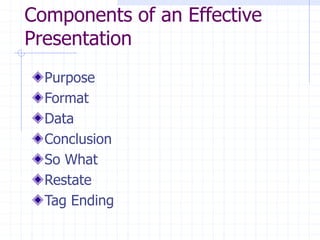
Components of an Effective
Presentation
Purpose
Format
Data
Conclusion
So What
Restate
Tag Ending
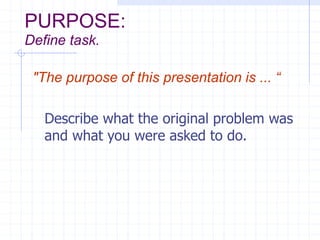
PURPOSE:
Define task.
"The purpose of this presentation is ... “
Describe what the original problem was
and what you were asked to do.
FORMAT:
What is the presentation going to do?
"This presentation recommends
o ...
o ... "
Tell them what you are going to say. This is
the agenda. Effective presentations use this
to outline the critical things that will be
covered, not copy the grading sheets.
DATA:
Information and data about the problem.
"You should note the following facts in
support of these recommendations...”
This is background. Spend only the
time here that you absolutely need.
CONCLUSION:
What does the data tell you?
"The conclusions to be drawn from these
facts are ..."
This is the setup, not the final conclusion.
SO WHAT:
What should the audience do?
"This means that we must ..."
What do these recommendations mean
to the audience? This is the part of the
presentation that your audience cares
most about. Try to spend most of your
time here.
RESTATE:
Summarize, preferably in action terms.
"In summary ...”
Wrap up the meeting.
Repeat your critical points.
List any action items.
Indicate what happens next.
Thank your clients.
TAG ENDING:
Verbal hook for your audience.
"In one sentence we say ..."
This is generally not done in formal
written communication. It is very
important in oral presentations.
Presentation Keys
Time the sections. Focus on “So What?”
Customize the presentation with logos or
names for your audience.
Use graphics effectively. Graphics stick in
people’s mind, but too much is clutter.
Use motion sparingly and sound never.
Rehearse. Try to use the same equipment
and room you will use.
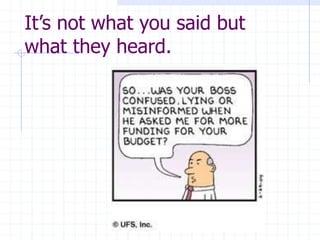
It’s not what you said but
what they heard.

EffectiveBusinessCommunication (1) (1).ppt

  • 1.
    Effective Business Communication The structureof effective Presentations and Reports.
  • 2.
    Communication Checklist How doyou construct an effective presentation or report? Who is your audience? What are they interested in? What do you want them to remember?
  • 3.
    Meaning of Communication Whatmakes a good communicator? Process Communication game What did we learn? Active listing Six ways of using non-verbal communication skills effectively Effective presentation skills Reference CONTENT
  • 4.
    Communication is adynamic process… through this process we convey a thought or feeling to someone else. how it is received depends on a set of events, stimuli, that person is exposed to. how you say what you say plays an important role in communication. COMMUNICATION - MEANING
  • 5.
    An Active Listener, AnEffective Presenter, A Quick Thinker. A Win-Win Negotiator. WHAT MAKES A GOOD COMMUNICATOR?
  • 6.
  • 7.
    Source:  Why tocommunicate?  What to communicate?  Usefulness of the communication.  Accuracy of the Information to be communicated. PROCESS OF COMM…(cntd…) Encoding: • The process of transferring the information you want to communicate into a form that can be sent and correctly decoded at the other end. • Ability to convey the information. • Eliminate sources of confusion. For e.g. cultural issues, mistaken assumptions, and missing information. • Knowing your audience.
  • 8.
     Written CommunicationChannels ◦ Letters, ◦ e-Mails, ◦ Memos, ◦ Reports.  Verbal Communication Channels ◦ Face-To-Face meetings, ◦ Telephones, ◦ Video Conferencing. PROCESS OF COMM…(cntd…)
  • 9.
    Strengths and Weaknesses VerbalCommunication: Strength - Role of Body Language. Weakness - Not possible to give long list of directions Written Communication: Strength - A proof of a communication Weakness - Written words does not show a person’s actual feelings. PROCESS OF COMM…(cntd…)
  • 10.
    EFFECTIVE DECODING:  Listenactively,  Reading information carefully,  Avoid Confusion,  Ask question for better understanding. PROCESS OF COMM…(cntd…) • The audience or individuals to whom we are sending the information. THE INFLUENCE FOR RECEIVER: • The prior knowledge can influence the receiver’s understanding of the message. • Blockages in the receiver’s mind. • The surrounding disturbances.
  • 11.
    FEEDBACK: Feedback can be: VerbalReactions and Non-Verbal Reactions. Positive feedback and Negative feedback. PROCESS OF COMM…(cntd…)
  • 12.
    CONTEXT: 1.Various Cultures (Corporate,International, Regional, etc), 2.Language, 3.Location or Place (Restaurant, Office, Auditorium, Room, etc). 4.Situation The sender needs to communicate the context to the receiver for better clarity in the communication process. PROCESS OF COMM…(…end)
  • 13.
    Few tips towardsActive Listening: 1. Understand your own communication style. 2. Be an active listener. 3. Use normal communication. 4. Give Feedback ACTIVE LISTENING
  • 14.
    1. Understand yourown communication style:  High level of self-awareness to creating good & long lasting impression on others.  Understand how others perceive you.  Avoid being CHAMELEON by changing with every personality you meet.  Make others comfortable by selecting appropriate behavior that suits your personality while listening. (Ideally nodding your head). ACTIVE LISTENING…(cntd…)
  • 15.
    2. Be AnActive Listener:  People speak @ 100 to 175 WPM but can listen intelligently @ 300 WPM.  One part of human mind pays attention, so it is easy to go into mind drift.  Listen with a purpose.  Purpose can be to gain information, obtain directions, understand others, solve problems, share interest, see how another person feels, show support, etc.  If it is difficult to concentrate then repeat the speakers words in your mind. ACTIVE LISTENING…(cntd…)
  • 16.
    3. Use Non-verbalCommunication:  Smile,  Gestures,  Eye contact,  Your posture. ACTIVE LISTENING…(cntd…)
  • 17.
    4. Give Feedback Remember that what someone says and what we hear can be amazingly different.  Repeat back or summarize to ensure that you understand.  Restate what you think you heard and ask, "Have I understood you correctly?" ACTIVE LISTENING…(cntd…)
  • 18.
    Some major areasof nonverbal behaviors to explore are: Eye contact Facial expressions Gestures Posture and body orientation Proximity Paralinguistic Humor SIX WAYS OF USING NON-VERBAL COMMUNICATION SKILLS EFFECTIVELY
  • 19.
    SIX WAYS OF…(cntd…) EYE CONTACT: Eye is an direct and most expressive part of our body. Different ways of Eye Contact  Direct Eye Contact: (Shows confidence)  Looking downwards (Listening carefully or Guilty)  Single raised eyebrow (Doubting)  Both raised eyebrows (Admiring)  Bent eyebrows (Sudden focus)  Tears coming out (Emotional either happy or hurt) ………and many more
  • 20.
    FACIAL EXPRESSION: Smile coversthe most part of facial expression: Smiling is a powerful cue that transmits: ◦ Happiness ◦ Friendliness ◦ Warmth ◦ Liking ◦ Affiliation SIX WAYS OF …(cntd…)
  • 21.
    GESTURES: If you failto gesture while speaking, you may be perceived as boring, stiff and unanimated. A lively and animated teaching style captures students' attention, makes the material more interesting, facilitates learning and provides a bit of entertainment. Head nods, a form of gestures, communicate positive reinforcement to students and indicate that you are listening. SIX WAYS OF …(cntd…)
  • 22.
    POSTURE AND BODYORIENTATION: • You communicate numerous messages by the way you walk, talk, stand and sit. • Standing erect, but not rigid, and leaning slightly forward communicates to students that you are approachable, receptive and friendly. • Furthermore, interpersonal closeness results when you and your students face each other. • Speaking with your back turned or looking at the floor or ceiling should be avoided; it communicates disinterest to your class. SIX WAYS OF …(cntd…)
  • 23.
    PROXIMITY:  Cultural normsdictate a comfortable distance for interaction with audience.  You should look for signals of discomfort caused by invading young audience‘s space. Some of these are:  Rocking,  Leg swinging,  Tapping,  Gaze aversion,  To counteract this, move around the classroom to increase interaction with your students. Increasing proximity enables you to make better eye contact and increases the opportunities for students to speak. SIX WAYS OF …(cntd…)
  • 24.
    SIX WAYS OF…(cntd…) Paralinguistic : This facet of nonverbal communication includes such vocal elements as: - Tone - Pitch - Rhythm - Timbre - Loudness - Inflection
  • 25.
    FEW FACTS - Youhave over 630 muscles in your body. - Eye muscles are the busiest muscles in the body. Scientists estimate they may move more than 100,000 times a day. - You have over 30 muscles in your face to help you smile or frown. It takes 17 muscles to smile and 43 to frown. SO SMILE EVERYTIME YOU SEE SOMEONE. - The strongest muscle in your body is your tongue. USE IT EFFECTIVELY. - It takes the interaction of 72 different muscles to produce human speech.
  • 26.
    Presentation Skills whileappearing for an interview.  Your Dressing sense (Males & Females),  Documents needed to be carried,  Your body language (while standing, while sitting, while walking),  Your attitude (Soberness, Soft words, avoid western accent),  Your Confidence (while talking, body movements, aggression, etc). EFFECTIVE PRESENTATION SKILLS
  • 27.
    Example: Audience forField Project Report Sections Section Audience Executive Summary Senior Manager /Sponsor Introduction Part Ia. Organizational Justification Sponsor Part Ib. Current System Analysis Client Part II. Proposed System Requirements User Part III. Alternatives evaluation and recommendation Client Part IV. Design/Purchase Specifications IT Specialist Part V. Implementation and Support IT Operations / User Appendix A. Signed statement of work. Client / Manager Appendix B and following
  • 28.
    Key points Introduction andsummary for each chapter. Direct, simple sentences. Short paragraphs. White space, bullets and graphics. Tables and figures stand on their own. Text stands on its own. There is nothing too obvious to say.
  • 29.
    Components of anEffective Presentation Purpose Format Data Conclusion So What Restate Tag Ending
  • 30.
    PURPOSE: Define task. "The purposeof this presentation is ... “ Describe what the original problem was and what you were asked to do.
  • 31.
    FORMAT: What is thepresentation going to do? "This presentation recommends o ... o ... " Tell them what you are going to say. This is the agenda. Effective presentations use this to outline the critical things that will be covered, not copy the grading sheets.
  • 32.
    DATA: Information and dataabout the problem. "You should note the following facts in support of these recommendations...” This is background. Spend only the time here that you absolutely need.
  • 33.
    CONCLUSION: What does thedata tell you? "The conclusions to be drawn from these facts are ..." This is the setup, not the final conclusion.
  • 34.
    SO WHAT: What shouldthe audience do? "This means that we must ..." What do these recommendations mean to the audience? This is the part of the presentation that your audience cares most about. Try to spend most of your time here.
  • 35.
    RESTATE: Summarize, preferably inaction terms. "In summary ...” Wrap up the meeting. Repeat your critical points. List any action items. Indicate what happens next. Thank your clients.
  • 36.
    TAG ENDING: Verbal hookfor your audience. "In one sentence we say ..." This is generally not done in formal written communication. It is very important in oral presentations.
  • 37.
    Presentation Keys Time thesections. Focus on “So What?” Customize the presentation with logos or names for your audience. Use graphics effectively. Graphics stick in people’s mind, but too much is clutter. Use motion sparingly and sound never. Rehearse. Try to use the same equipment and room you will use.
  • 38.
    It’s not whatyou said but what they heard.