2139EPS Technology Education
Lecture 3: Working Technologically
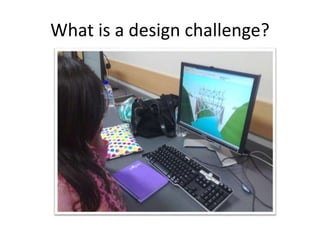
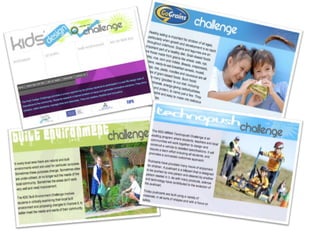
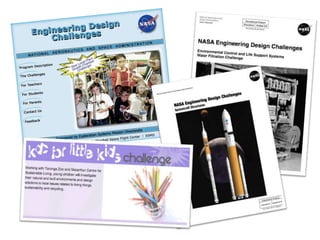
What is a design challenge?
A Design challenge is a situation,
problem or task that provides a
meaningful context in which students
ca ‘work technologically’ to
demonstrate learning outcomes in
technology.
DESIGN CHALLENGE
DESIGN CHALLENGE
DESIGN CHALLENGE
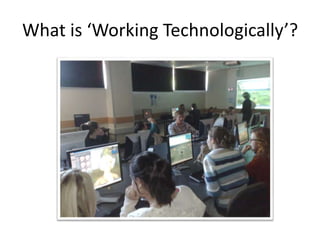
What is ‘Working Technologically’?
Design – Develop - Evaluate
Using materials, information, and systems
Design – Develop - Evaluate
Considering appropriateness, contexts and management
Using materials, information, and systems
Queensland Curriculum
ESSENTIAL LEARNINGS
QUEENSLAND CURRICULUM, ASSESSMENT AND REPORTING FRAMEWORK
Students use their understandings of the relationships between
technology and society to consider the roles people play in shaping
products and processes. They use their imagination and creativity to
investigate and identify needs, wants, design specifications and
constraints. They understand the characteristics of a range of resources
(information, materials and/or systems) and assess their suitability for a
specific purpose and context. They compare and describe the
characteristics of Australian and imported resources, investigating their
impact on Australian technological processes and products. They
investigate design challenges and consider the roles that people play in
shaping technologies to meet changing needs and wants and preferred
futures. They recognise the many different fields of technology and the
people who work in occupations that use technology to design solutions
for community needs.
Students use their understandings of the relationships between
technology and society to consider the roles people play in shaping
products and processes. They use their imagination and creativity to
investigate and identify needs, wants, design specifications and
constraints. They understand the characteristics of a range of resources
(information, materials and/or systems) and assess their suitability for a
specific purpose and context. They compare and describe the
characteristics of Australian and imported resources, investigating their
impact on Australian technological processes and products. They
investigate design challenges and consider the roles that people play in
shaping technologies to meet changing needs and wants and preferred
futures. They recognise the many different fields of technology and the
people who work in occupations that use technology to design solutions
for community needs.
Students use their understandings of the relationships between
technology and society to consider the roles people play in shaping
products and processes. They use their imagination and creativity to
investigate and identify needs, wants, design specifications and
constraints. They understand the characteristics of a range of resources
(information, materials and/or systems) and assess their suitability for a
specific purpose and context. They compare and describe the
characteristics of Australian and imported resources, investigating their
impact on Australian technological processes and products. They
investigate design challenges and consider the roles that people play in
shaping technologies to meet changing needs and wants and preferred
futures. They recognise the many different fields of technology and the
people who work in occupations that use technology to design solutions
for community needs.
Students use their understandings of the relationships between
technology and society to consider the roles people play in shaping
products and processes. They use their imagination and creativity to
investigate and identify needs, wants, design specifications and
constraints. They understand the characteristics of a range of resources
(information, materials and/or systems) and assess their suitability for a
specific purpose and context. They compare and describe the
characteristics of Australian and imported resources, investigating their
impact on Australian technological processes and products. They
investigate design challenges and consider the roles that people play in
shaping technologies to meet changing needs and wants and preferred
futures. They recognise the many different fields of technology and the
people who work in occupations that use technology to design solutions
for community needs.
Students use their understandings of the relationships between
technology and society to consider the roles people play in shaping
products and processes. They use their imagination and creativity to
investigate and identify needs, wants, design specifications and
constraints. They understand the characteristics of a range of resources
(information, materials and/or systems) and assess their suitability for a
specific purpose and context. They compare and describe the
characteristics of Australian and imported resources, investigating their
impact on Australian technological processes and products. They
investigate design challenges and consider the roles that people play in
shaping technologies to meet changing needs and wants and preferred
futures. They recognise the many different fields of technology and the
people who work in occupations that use technology to design solutions
for community needs.
Students use their understandings of the relationships between
technology and society to consider the roles people play in shaping
products and processes. They use their imagination and creativity to
investigate and identify needs, wants, design specifications and
constraints. They understand the characteristics of a range of resources
(information, materials and/or systems) and assess their suitability for a
specific purpose and context. They compare and describe the
characteristics of Australian and imported resources, investigating their
impact on Australian technological processes and products. They
investigate design challenges and consider the roles that people play in
shaping technologies to meet changing needs and wants and preferred
futures. They recognise the many different fields of technology and the
people who work in occupations that use technology to design solutions
for community needs.
Students use their understandings of the relationships between
technology and society to consider the roles people play in shaping
products and processes. They use their imagination and creativity to
investigate and identify needs, wants, design specifications and
constraints. They understand the characteristics of a range of resources
(information, materials and/or systems) and assess their suitability for a
specific purpose and context. They compare and describe the
characteristics of Australian and imported resources, investigating their
impact on Australian technological processes and products. They
investigate design challenges and consider the roles that people play in
shaping technologies to meet changing needs and wants and preferred
futures. They recognise the many different fields of technology and the
people who work in occupations that use technology to design solutions
for community needs.
Students use their understandings of the relationships between
technology and society to consider the roles people play in shaping
products and processes. They use their imagination and creativity to
investigate and identify needs, wants, design specifications and
constraints. They understand the characteristics of a range of resources
(information, materials and/or systems) and assess their suitability for a
specific purpose and context. They compare and describe the
characteristics of Australian and imported resources, investigating their
impact on Australian technological processes and products. They
investigate design challenges and consider the roles that people play in
shaping technologies to meet changing needs and wants and preferred
futures. They recognise the many different fields of technology and the
people who work in occupations that use technology to design solutions
for community needs.
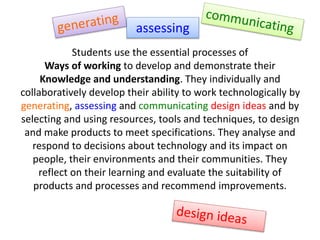
Students use the essential processes of
Ways of working to develop and demonstrate their
Knowledge and understanding. They individually and
collaboratively develop their ability to work technologically by
generating, assessing and communicating design ideas and by
selecting and using resources, tools and techniques, to design
and make products to meet specifications. They analyse and
respond to decisions about technology and its impact on
people, their environments and their communities. They
reflect on their learning and evaluate the suitability of
products and processes and recommend improvements.
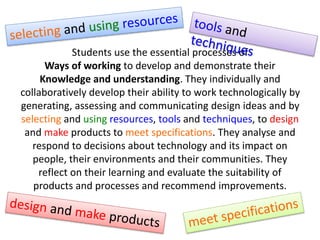
Students use the essential processes of
Ways of working to develop and demonstrate their
Knowledge and understanding. They individually and
collaboratively develop their ability to work technologically by
generating, assessing and communicating design ideas and by
selecting and using resources, tools and techniques, to design
and make products to meet specifications. They analyse and
respond to decisions about technology and its impact on
people, their environments and their communities. They
reflect on their learning and evaluate the suitability of
products and processes and recommend improvements.
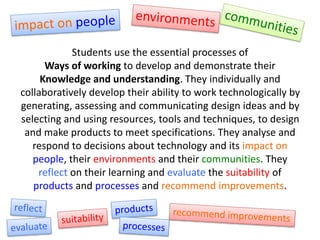
Students use the essential processes of
Ways of working to develop and demonstrate their
Knowledge and understanding. They individually and
collaboratively develop their ability to work technologically by
generating, assessing and communicating design ideas and by
selecting and using resources, tools and techniques, to design
and make products to meet specifications. They analyse and
respond to decisions about technology and its impact on
people, their environments and their communities. They
reflect on their learning and evaluate the suitability of
products and processes and recommend improvements.
assessing
Students use the essential processes of
Ways of working to develop and demonstrate their
Knowledge and understanding. They individually and
collaboratively develop their ability to work technologically by
generating, assessing and communicating design ideas and by
selecting and using resources, tools and techniques, to design
and make products to meet specifications. They analyse and
respond to decisions about technology and its impact on
people, their environments and their communities. They
reflect on their learning and evaluate the suitability of
products and processes and recommend improvements.
Students use the essential processes of
Ways of working to develop and demonstrate their
Knowledge and understanding. They individually and
collaboratively develop their ability to work technologically by
generating, assessing and communicating design ideas and by
selecting and using resources, tools and techniques, to design
and make products to meet specifications. They analyse and
respond to decisions about technology and its impact on
people, their environments and their communities. They
reflect on their learning and evaluate the suitability of
products and processes and recommend improvements.
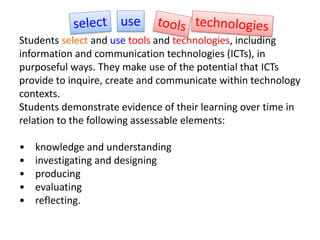
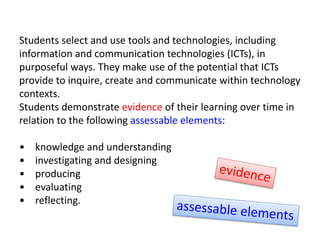
Students select and use tools and technologies, including
information and communication technologies (ICTs), in
purposeful ways. They make use of the potential that ICTs
provide to inquire, create and communicate within technology
contexts.
Students demonstrate evidence of their learning over time in
relation to the following assessable elements:
• knowledge and understanding
• investigating and designing
• producing
• evaluating
• reflecting.
use
Students select and use tools and technologies, including
information and communication technologies (ICTs), in
purposeful ways. They make use of the potential that ICTs
provide to inquire, create and communicate within technology
contexts.
Students demonstrate evidence of their learning over time in
relation to the following assessable elements:
• knowledge and understanding
• investigating and designing
• producing
• evaluating
• reflecting.
Students select and use tools and technologies, including
information and communication technologies (ICTs), in
purposeful ways. They make use of the potential that ICTs
provide to inquire, create and communicate within technology
contexts.
Students demonstrate evidence of their learning over time in
relation to the following assessable elements:
• knowledge and understanding
• investigating and designing
• producing
• evaluating
• reflecting
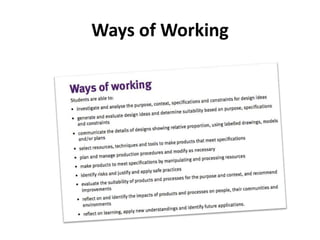
Ways of Working
Students are able to:
• investigate and analyse the purpose, context, specifications and constraints for
design ideas
• generate and evaluate design ideas and determine suitability based on purpose,
specifications and constraints
• communicate the details of designs showing relative proportion, using labelled
drawings, models and/or plans
• select resources, techniques and tools to make products that meet specifications
• plan and manage production procedures and modify as necessary
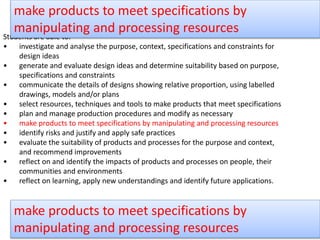
• make products to meet specifications by manipulating and processing resources
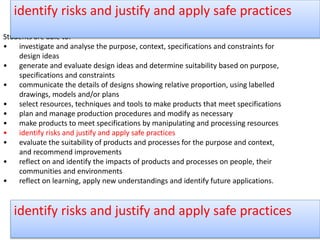
• identify risks and justify and apply safe practices
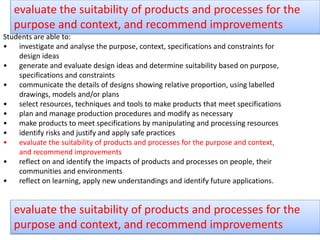
• evaluate the suitability of products and processes for the purpose and context,
and recommend improvements
• reflect on and identify the impacts of products and processes on people, their
communities and environments
• reflect on learning, apply new understandings and identify future applications.
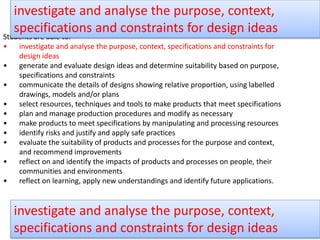
investigate and analyse the purpose, context,
specifications and constraints for design ideas
investigate and analyse the purpose, context,
specifications and constraints for design ideas
Students are able to:
• investigate and analyse the purpose, context, specifications and constraints for
design ideas
• generate and evaluate design ideas and determine suitability based on purpose,
specifications and constraints
• communicate the details of designs showing relative proportion, using labelled
drawings, models and/or plans
• select resources, techniques and tools to make products that meet specifications
• plan and manage production procedures and modify as necessary
• make products to meet specifications by manipulating and processing resources
• identify risks and justify and apply safe practices
• evaluate the suitability of products and processes for the purpose and context,
and recommend improvements
• reflect on and identify the impacts of products and processes on people, their
communities and environments
• reflect on learning, apply new understandings and identify future applications.
generate and evaluate design ideas and determine
suitability based on purpose, specifications and constraints
generate and evaluate design ideas and determine
suitability based on purpose, specifications and constraints
Students are able to:
• investigate and analyse the purpose, context, specifications and constraints for
design ideas
• generate and evaluate design ideas and determine suitability based on purpose,
specifications and constraints
• communicate the details of designs showing relative proportion, using labelled
drawings, models and/or plans
• select resources, techniques and tools to make products that meet specifications
• plan and manage production procedures and modify as necessary
• make products to meet specifications by manipulating and processing resources
• identify risks and justify and apply safe practices
• evaluate the suitability of products and processes for the purpose and context,
and recommend improvements
• reflect on and identify the impacts of products and processes on people, their
communities and environments
• reflect on learning, apply new understandings and identify future applications.
communicate the details of designs showing relative
proportion, using labelled drawings, models and/or plans
communicate the details of designs showing relative
proportion, using labelled drawings, models and/or plans
Students are able to:
• investigate and analyse the purpose, context, specifications and constraints for
design ideas
• generate and evaluate design ideas and determine suitability based on purpose,
specifications and constraints
• communicate the details of designs showing relative proportion, using labelled
drawings, models and/or plans
• select resources, techniques and tools to make products that meet specifications
• plan and manage production procedures and modify as necessary
• make products to meet specifications by manipulating and processing resources
• identify risks and justify and apply safe practices
• evaluate the suitability of products and processes for the purpose and context,
and recommend improvements
• reflect on and identify the impacts of products and processes on people, their
communities and environments
• reflect on learning, apply new understandings and identify future applications.
select resources, techniques and tools to make
products that meet specifications
select resources, techniques and tools to make
products that meet specifications
Students are able to:
• investigate and analyse the purpose, context, specifications and constraints for
design ideas
• generate and evaluate design ideas and determine suitability based on purpose,
specifications and constraints
• communicate the details of designs showing relative proportion, using labelled
drawings, models and/or plans
• select resources, techniques and tools to make products that meet specifications
• plan and manage production procedures and modify as necessary
• make products to meet specifications by manipulating and processing resources
• identify risks and justify and apply safe practices
• evaluate the suitability of products and processes for the purpose and context,
and recommend improvements
• reflect on and identify the impacts of products and processes on people, their
communities and environments
• reflect on learning, apply new understandings and identify future applications.
plan and manage production procedures and
modify as necessary
plan and manage production procedures and
modify as necessary
Students are able to:
• investigate and analyse the purpose, context, specifications and constraints for
design ideas
• generate and evaluate design ideas and determine suitability based on purpose,
specifications and constraints
• communicate the details of designs showing relative proportion, using labelled
drawings, models and/or plans
• select resources, techniques and tools to make products that meet specifications
• plan and manage production procedures and modify as necessary
• make products to meet specifications by manipulating and processing resources
• identify risks and justify and apply safe practices
• evaluate the suitability of products and processes for the purpose and context,
and recommend improvements
• reflect on and identify the impacts of products and processes on people, their
communities and environments
• reflect on learning, apply new understandings and identify future applications.
make products to meet specifications by
manipulating and processing resources
make products to meet specifications by
manipulating and processing resources
Students are able to:
• investigate and analyse the purpose, context, specifications and constraints for
design ideas
• generate and evaluate design ideas and determine suitability based on purpose,
specifications and constraints
• communicate the details of designs showing relative proportion, using labelled
drawings, models and/or plans
• select resources, techniques and tools to make products that meet specifications
• plan and manage production procedures and modify as necessary
• make products to meet specifications by manipulating and processing resources
• identify risks and justify and apply safe practices
• evaluate the suitability of products and processes for the purpose and context,
and recommend improvements
• reflect on and identify the impacts of products and processes on people, their
communities and environments
• reflect on learning, apply new understandings and identify future applications.
identify risks and justify and apply safe practices
Students are able to:
• investigate and analyse the purpose, context, specifications and constraints for
design ideas
• generate and evaluate design ideas and determine suitability based on purpose,
specifications and constraints
• communicate the details of designs showing relative proportion, using labelled
drawings, models and/or plans
• select resources, techniques and tools to make products that meet specifications
• plan and manage production procedures and modify as necessary
• make products to meet specifications by manipulating and processing resources
• identify risks and justify and apply safe practices
• evaluate the suitability of products and processes for the purpose and context,
and recommend improvements
• reflect on and identify the impacts of products and processes on people, their
communities and environments
• reflect on learning, apply new understandings and identify future applications.
evaluate the suitability of products and processes for the
purpose and context, and recommend improvements
evaluate the suitability of products and processes for the
purpose and context, and recommend improvements
Students are able to:
• investigate and analyse the purpose, context, specifications and constraints for
design ideas
• generate and evaluate design ideas and determine suitability based on purpose,
specifications and constraints
• communicate the details of designs showing relative proportion, using labelled
drawings, models and/or plans
• select resources, techniques and tools to make products that meet specifications
• plan and manage production procedures and modify as necessary
• make products to meet specifications by manipulating and processing resources
• identify risks and justify and apply safe practices
• evaluate the suitability of products and processes for the purpose and context,
and recommend improvements
• reflect on and identify the impacts of products and processes on people, their
communities and environments
• reflect on learning, apply new understandings and identify future applications.
reflect on and identify the impacts of products and
processes on people, their communities and environments
reflect on and identify the impacts of products and
processes on people, their communities and environments
Students are able to:
• investigate and analyse the purpose, context, specifications and constraints for
design ideas
• generate and evaluate design ideas and determine suitability based on purpose,
specifications and constraints
• communicate the details of designs showing relative proportion, using labelled
drawings, models and/or plans
• select resources, techniques and tools to make products that meet specifications
• plan and manage production procedures and modify as necessary
• make products to meet specifications by manipulating and processing resources
• identify risks and justify and apply safe practices
• evaluate the suitability of products and processes for the purpose and context,
and recommend improvements
• reflect on and identify the impacts of products and processes on people, their
communities and environments
• reflect on learning, apply new understandings and identify future applications.
reflect on learning, apply new understandings and
identify future applications.
reflect on learning, apply new understandings and
identify future applications.
Knowledge and understanding
Technology as a human endeavour
Technology influences and impacts on people, their communities and environments.
• Design and development of products are influenced by societies’ changing needs
and wants, and include artefacts, systems, environments and services
e.g. telephone technologies continue to develop as lifestyles change and demand
more time-efficient practices.
• Product design and production decisions are influenced by specifications,
constraints and aspects of appropriateness including functions, aesthetics, ethics,
culture, available finances and resources, and sustainability
e.g. menu design is influenced by type of cuisine, cultural theme and cost.
• Decisions made about the design, development and use of products can impact
positively or negatively on people, their communities and environments
e.g. food packages can be designed and developed using recycled materials.
Design and development of products are influenced by
societies’ changing needs and wants, and include
artefacts, systems, environments and services
e.g.telephone technologies continue to develop as lifestyles change
and demand more time-efficient practices.
Technology as a human endeavour
Technology influences and impacts on people, their communities and environments.
• Design and development of products are influenced by societies’ changing needs
and wants, and include artefacts, systems, environments and services
e.g. telephone technologies continue to develop as lifestyles change and demand
more time-efficient practices.
• Product design and production decisions are influenced by specifications,
constraints and aspects of appropriateness including functions, aesthetics, ethics,
culture, available finances and resources, and sustainability
e.g. menu design is influenced by type of cuisine, cultural theme and cost.
• Decisions made about the design, development and use of products can impact
positively or negatively on people, their communities and environments
e.g. food packages can be designed and developed using recycled materials.
Product design and production decisions are influenced by
specifications, constraints and aspects of appropriateness
including functions, aesthetics, ethics, culture, available
finances and resources, and sustainability
e.g.menu design is influenced by type of cuisine, cultural theme
and cost.
Technology as a human endeavour
Technology influences and impacts on people, their communities and environments.
• Design and development of products are influenced by societies’ changing needs
and wants, and include artefacts, systems, environments and services
e.g. telephone technologies continue to develop as lifestyles change and demand
more time-efficient practices.
• Product design and production decisions are influenced by specifications,
constraints and aspects of appropriateness including functions, aesthetics, ethics,
culture, available finances and resources, and sustainability
e.g. menu design is influenced by type of cuisine, cultural theme and cost.
• Decisions made about the design, development and use of products can impact
positively or negatively on people, their communities and environments
e.g. food packages can be designed and developed using recycled materials.
Decisions made about the design, development and use of
products can impact positively or negatively on people,
their communities and environments
e.g.food packages can be designed and developed using recycled
materials.
Information, materials and systems (resources)
The characteristics of resources are matched with tools and
techniques to make products to meet design challenges.
• Resources are selected according to their characteristics, to match
requirements of design challenges and suit the user
e.g.an indoor or outdoor hydroponics garden and irrigation system can
be designed based on suitability of materials and characteristics.
• Techniques and tools are selected to manipulate or process
resources to enhance the quality of products and to match design
ideas, standards and specifications
e.g.a story can be recreated with digital media to make it more
appealing.
Information, materials and systems (resources)
The characteristics of resources are matched with tools and
techniques to make products to meet design challenges.
• Resources are selected according to their characteristics, to match
requirements of design challenges and suit the user
e.g.an indoor or outdoor hydroponics garden and irrigation system can
be designed based on suitability of materials and characteristics.
• Techniques and tools are selected to manipulate or process
resources to enhance the quality of products and to match design
ideas, standards and specifications
e.g.a story can be recreated with digital media to make it more
appealing.
Resources are selected according to their characteristics,
to match requirements of design challenges and suit the
user
e.g.an indoor or outdoor hydroponics garden and irrigation system
can be designed based on suitability of materials and characteristics.
Information, materials and systems (resources)
The characteristics of resources are matched with tools and
techniques to make products to meet design challenges.
• Resources are selected according to their characteristics, to match
requirements of design challenges and suit the user
e.g.an indoor or outdoor hydroponics garden and irrigation system can
be designed based on suitability of materials and characteristics.
• Techniques and tools are selected to manipulate or process
resources to enhance the quality of products and to match design
ideas, standards and specifications
e.g.a story can be recreated with digital media to make it more
appealing.
Techniques and tools are selected to manipulate or
process resources to enhance the quality of products and
to match design ideas, standards and specifications
e.g.a story can be recreated with digital media to make it more
appealing.
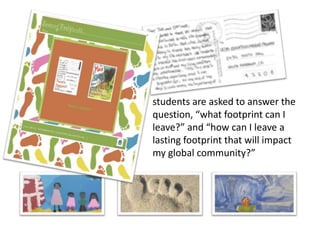
students are asked to answer the
question, “what footprint can I
leave?” and “how can I leave a
lasting footprint that will impact
my global community?”
TakingITGlobal.org is an
online community that
connects youth to find
inspiration, access
information, get involved,
and take action in their local
and global communities. It's
the world's most popular
online community for young
people interested in making a
difference.
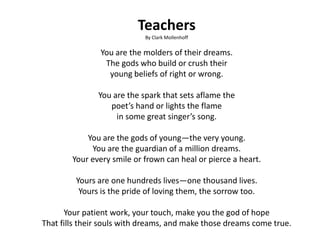
Teachers
By Clark Mollenhoff
You are the molders of their dreams.
The gods who build or crush their
young beliefs of right or wrong.
You are the spark that sets aflame the
poet’s hand or lights the flame
in some great singer’s song.
You are the gods of young—the very young.
You are the guardian of a million dreams.
Your every smile or frown can heal or pierce a heart.
Yours are one hundreds lives—one thousand lives.
Yours is the pride of loving them, the sorrow too.
Your patient work, your touch, make you the god of hope
That fills their souls with dreams, and make those dreams come true.

2139EPS09 L3

  • 1.
    2139EPS Technology Education Lecture3: Working Technologically
  • 2.
    What is adesign challenge?
  • 3.
    A Design challengeis a situation, problem or task that provides a meaningful context in which students ca ‘work technologically’ to demonstrate learning outcomes in technology.
  • 4.
  • 5.
  • 6.
  • 7.
    What is ‘WorkingTechnologically’?
  • 8.
  • 9.
  • 10.
  • 11.
    Design – Develop- Evaluate Using materials, information, and systems
  • 12.
    Design – Develop- Evaluate Considering appropriateness, contexts and management Using materials, information, and systems
  • 13.
    Queensland Curriculum ESSENTIAL LEARNINGS QUEENSLANDCURRICULUM, ASSESSMENT AND REPORTING FRAMEWORK
  • 14.
    Students use theirunderstandings of the relationships between technology and society to consider the roles people play in shaping products and processes. They use their imagination and creativity to investigate and identify needs, wants, design specifications and constraints. They understand the characteristics of a range of resources (information, materials and/or systems) and assess their suitability for a specific purpose and context. They compare and describe the characteristics of Australian and imported resources, investigating their impact on Australian technological processes and products. They investigate design challenges and consider the roles that people play in shaping technologies to meet changing needs and wants and preferred futures. They recognise the many different fields of technology and the people who work in occupations that use technology to design solutions for community needs.
  • 15.
    Students use theirunderstandings of the relationships between technology and society to consider the roles people play in shaping products and processes. They use their imagination and creativity to investigate and identify needs, wants, design specifications and constraints. They understand the characteristics of a range of resources (information, materials and/or systems) and assess their suitability for a specific purpose and context. They compare and describe the characteristics of Australian and imported resources, investigating their impact on Australian technological processes and products. They investigate design challenges and consider the roles that people play in shaping technologies to meet changing needs and wants and preferred futures. They recognise the many different fields of technology and the people who work in occupations that use technology to design solutions for community needs.
  • 16.
    Students use theirunderstandings of the relationships between technology and society to consider the roles people play in shaping products and processes. They use their imagination and creativity to investigate and identify needs, wants, design specifications and constraints. They understand the characteristics of a range of resources (information, materials and/or systems) and assess their suitability for a specific purpose and context. They compare and describe the characteristics of Australian and imported resources, investigating their impact on Australian technological processes and products. They investigate design challenges and consider the roles that people play in shaping technologies to meet changing needs and wants and preferred futures. They recognise the many different fields of technology and the people who work in occupations that use technology to design solutions for community needs.
  • 17.
    Students use theirunderstandings of the relationships between technology and society to consider the roles people play in shaping products and processes. They use their imagination and creativity to investigate and identify needs, wants, design specifications and constraints. They understand the characteristics of a range of resources (information, materials and/or systems) and assess their suitability for a specific purpose and context. They compare and describe the characteristics of Australian and imported resources, investigating their impact on Australian technological processes and products. They investigate design challenges and consider the roles that people play in shaping technologies to meet changing needs and wants and preferred futures. They recognise the many different fields of technology and the people who work in occupations that use technology to design solutions for community needs.
  • 18.
    Students use theirunderstandings of the relationships between technology and society to consider the roles people play in shaping products and processes. They use their imagination and creativity to investigate and identify needs, wants, design specifications and constraints. They understand the characteristics of a range of resources (information, materials and/or systems) and assess their suitability for a specific purpose and context. They compare and describe the characteristics of Australian and imported resources, investigating their impact on Australian technological processes and products. They investigate design challenges and consider the roles that people play in shaping technologies to meet changing needs and wants and preferred futures. They recognise the many different fields of technology and the people who work in occupations that use technology to design solutions for community needs.
  • 19.
    Students use theirunderstandings of the relationships between technology and society to consider the roles people play in shaping products and processes. They use their imagination and creativity to investigate and identify needs, wants, design specifications and constraints. They understand the characteristics of a range of resources (information, materials and/or systems) and assess their suitability for a specific purpose and context. They compare and describe the characteristics of Australian and imported resources, investigating their impact on Australian technological processes and products. They investigate design challenges and consider the roles that people play in shaping technologies to meet changing needs and wants and preferred futures. They recognise the many different fields of technology and the people who work in occupations that use technology to design solutions for community needs.
  • 20.
    Students use theirunderstandings of the relationships between technology and society to consider the roles people play in shaping products and processes. They use their imagination and creativity to investigate and identify needs, wants, design specifications and constraints. They understand the characteristics of a range of resources (information, materials and/or systems) and assess their suitability for a specific purpose and context. They compare and describe the characteristics of Australian and imported resources, investigating their impact on Australian technological processes and products. They investigate design challenges and consider the roles that people play in shaping technologies to meet changing needs and wants and preferred futures. They recognise the many different fields of technology and the people who work in occupations that use technology to design solutions for community needs.
  • 21.
    Students use theirunderstandings of the relationships between technology and society to consider the roles people play in shaping products and processes. They use their imagination and creativity to investigate and identify needs, wants, design specifications and constraints. They understand the characteristics of a range of resources (information, materials and/or systems) and assess their suitability for a specific purpose and context. They compare and describe the characteristics of Australian and imported resources, investigating their impact on Australian technological processes and products. They investigate design challenges and consider the roles that people play in shaping technologies to meet changing needs and wants and preferred futures. They recognise the many different fields of technology and the people who work in occupations that use technology to design solutions for community needs.
  • 22.
    Students use theessential processes of Ways of working to develop and demonstrate their Knowledge and understanding. They individually and collaboratively develop their ability to work technologically by generating, assessing and communicating design ideas and by selecting and using resources, tools and techniques, to design and make products to meet specifications. They analyse and respond to decisions about technology and its impact on people, their environments and their communities. They reflect on their learning and evaluate the suitability of products and processes and recommend improvements.
  • 23.
    Students use theessential processes of Ways of working to develop and demonstrate their Knowledge and understanding. They individually and collaboratively develop their ability to work technologically by generating, assessing and communicating design ideas and by selecting and using resources, tools and techniques, to design and make products to meet specifications. They analyse and respond to decisions about technology and its impact on people, their environments and their communities. They reflect on their learning and evaluate the suitability of products and processes and recommend improvements.
  • 24.
    Students use theessential processes of Ways of working to develop and demonstrate their Knowledge and understanding. They individually and collaboratively develop their ability to work technologically by generating, assessing and communicating design ideas and by selecting and using resources, tools and techniques, to design and make products to meet specifications. They analyse and respond to decisions about technology and its impact on people, their environments and their communities. They reflect on their learning and evaluate the suitability of products and processes and recommend improvements. assessing
  • 25.
    Students use theessential processes of Ways of working to develop and demonstrate their Knowledge and understanding. They individually and collaboratively develop their ability to work technologically by generating, assessing and communicating design ideas and by selecting and using resources, tools and techniques, to design and make products to meet specifications. They analyse and respond to decisions about technology and its impact on people, their environments and their communities. They reflect on their learning and evaluate the suitability of products and processes and recommend improvements.
  • 26.
    Students use theessential processes of Ways of working to develop and demonstrate their Knowledge and understanding. They individually and collaboratively develop their ability to work technologically by generating, assessing and communicating design ideas and by selecting and using resources, tools and techniques, to design and make products to meet specifications. They analyse and respond to decisions about technology and its impact on people, their environments and their communities. They reflect on their learning and evaluate the suitability of products and processes and recommend improvements.
  • 27.
    Students select anduse tools and technologies, including information and communication technologies (ICTs), in purposeful ways. They make use of the potential that ICTs provide to inquire, create and communicate within technology contexts. Students demonstrate evidence of their learning over time in relation to the following assessable elements: • knowledge and understanding • investigating and designing • producing • evaluating • reflecting. use
  • 28.
    Students select anduse tools and technologies, including information and communication technologies (ICTs), in purposeful ways. They make use of the potential that ICTs provide to inquire, create and communicate within technology contexts. Students demonstrate evidence of their learning over time in relation to the following assessable elements: • knowledge and understanding • investigating and designing • producing • evaluating • reflecting.
  • 29.
    Students select anduse tools and technologies, including information and communication technologies (ICTs), in purposeful ways. They make use of the potential that ICTs provide to inquire, create and communicate within technology contexts. Students demonstrate evidence of their learning over time in relation to the following assessable elements: • knowledge and understanding • investigating and designing • producing • evaluating • reflecting
  • 30.
  • 31.
    Students are ableto: • investigate and analyse the purpose, context, specifications and constraints for design ideas • generate and evaluate design ideas and determine suitability based on purpose, specifications and constraints • communicate the details of designs showing relative proportion, using labelled drawings, models and/or plans • select resources, techniques and tools to make products that meet specifications • plan and manage production procedures and modify as necessary • make products to meet specifications by manipulating and processing resources • identify risks and justify and apply safe practices • evaluate the suitability of products and processes for the purpose and context, and recommend improvements • reflect on and identify the impacts of products and processes on people, their communities and environments • reflect on learning, apply new understandings and identify future applications. investigate and analyse the purpose, context, specifications and constraints for design ideas investigate and analyse the purpose, context, specifications and constraints for design ideas
  • 32.
    Students are ableto: • investigate and analyse the purpose, context, specifications and constraints for design ideas • generate and evaluate design ideas and determine suitability based on purpose, specifications and constraints • communicate the details of designs showing relative proportion, using labelled drawings, models and/or plans • select resources, techniques and tools to make products that meet specifications • plan and manage production procedures and modify as necessary • make products to meet specifications by manipulating and processing resources • identify risks and justify and apply safe practices • evaluate the suitability of products and processes for the purpose and context, and recommend improvements • reflect on and identify the impacts of products and processes on people, their communities and environments • reflect on learning, apply new understandings and identify future applications. generate and evaluate design ideas and determine suitability based on purpose, specifications and constraints generate and evaluate design ideas and determine suitability based on purpose, specifications and constraints
  • 33.
    Students are ableto: • investigate and analyse the purpose, context, specifications and constraints for design ideas • generate and evaluate design ideas and determine suitability based on purpose, specifications and constraints • communicate the details of designs showing relative proportion, using labelled drawings, models and/or plans • select resources, techniques and tools to make products that meet specifications • plan and manage production procedures and modify as necessary • make products to meet specifications by manipulating and processing resources • identify risks and justify and apply safe practices • evaluate the suitability of products and processes for the purpose and context, and recommend improvements • reflect on and identify the impacts of products and processes on people, their communities and environments • reflect on learning, apply new understandings and identify future applications. communicate the details of designs showing relative proportion, using labelled drawings, models and/or plans communicate the details of designs showing relative proportion, using labelled drawings, models and/or plans
  • 34.
    Students are ableto: • investigate and analyse the purpose, context, specifications and constraints for design ideas • generate and evaluate design ideas and determine suitability based on purpose, specifications and constraints • communicate the details of designs showing relative proportion, using labelled drawings, models and/or plans • select resources, techniques and tools to make products that meet specifications • plan and manage production procedures and modify as necessary • make products to meet specifications by manipulating and processing resources • identify risks and justify and apply safe practices • evaluate the suitability of products and processes for the purpose and context, and recommend improvements • reflect on and identify the impacts of products and processes on people, their communities and environments • reflect on learning, apply new understandings and identify future applications. select resources, techniques and tools to make products that meet specifications select resources, techniques and tools to make products that meet specifications
  • 35.
    Students are ableto: • investigate and analyse the purpose, context, specifications and constraints for design ideas • generate and evaluate design ideas and determine suitability based on purpose, specifications and constraints • communicate the details of designs showing relative proportion, using labelled drawings, models and/or plans • select resources, techniques and tools to make products that meet specifications • plan and manage production procedures and modify as necessary • make products to meet specifications by manipulating and processing resources • identify risks and justify and apply safe practices • evaluate the suitability of products and processes for the purpose and context, and recommend improvements • reflect on and identify the impacts of products and processes on people, their communities and environments • reflect on learning, apply new understandings and identify future applications. plan and manage production procedures and modify as necessary plan and manage production procedures and modify as necessary
  • 36.
    Students are ableto: • investigate and analyse the purpose, context, specifications and constraints for design ideas • generate and evaluate design ideas and determine suitability based on purpose, specifications and constraints • communicate the details of designs showing relative proportion, using labelled drawings, models and/or plans • select resources, techniques and tools to make products that meet specifications • plan and manage production procedures and modify as necessary • make products to meet specifications by manipulating and processing resources • identify risks and justify and apply safe practices • evaluate the suitability of products and processes for the purpose and context, and recommend improvements • reflect on and identify the impacts of products and processes on people, their communities and environments • reflect on learning, apply new understandings and identify future applications. make products to meet specifications by manipulating and processing resources make products to meet specifications by manipulating and processing resources
  • 37.
    Students are ableto: • investigate and analyse the purpose, context, specifications and constraints for design ideas • generate and evaluate design ideas and determine suitability based on purpose, specifications and constraints • communicate the details of designs showing relative proportion, using labelled drawings, models and/or plans • select resources, techniques and tools to make products that meet specifications • plan and manage production procedures and modify as necessary • make products to meet specifications by manipulating and processing resources • identify risks and justify and apply safe practices • evaluate the suitability of products and processes for the purpose and context, and recommend improvements • reflect on and identify the impacts of products and processes on people, their communities and environments • reflect on learning, apply new understandings and identify future applications. identify risks and justify and apply safe practices identify risks and justify and apply safe practices
  • 38.
    Students are ableto: • investigate and analyse the purpose, context, specifications and constraints for design ideas • generate and evaluate design ideas and determine suitability based on purpose, specifications and constraints • communicate the details of designs showing relative proportion, using labelled drawings, models and/or plans • select resources, techniques and tools to make products that meet specifications • plan and manage production procedures and modify as necessary • make products to meet specifications by manipulating and processing resources • identify risks and justify and apply safe practices • evaluate the suitability of products and processes for the purpose and context, and recommend improvements • reflect on and identify the impacts of products and processes on people, their communities and environments • reflect on learning, apply new understandings and identify future applications. evaluate the suitability of products and processes for the purpose and context, and recommend improvements evaluate the suitability of products and processes for the purpose and context, and recommend improvements
  • 39.
    Students are ableto: • investigate and analyse the purpose, context, specifications and constraints for design ideas • generate and evaluate design ideas and determine suitability based on purpose, specifications and constraints • communicate the details of designs showing relative proportion, using labelled drawings, models and/or plans • select resources, techniques and tools to make products that meet specifications • plan and manage production procedures and modify as necessary • make products to meet specifications by manipulating and processing resources • identify risks and justify and apply safe practices • evaluate the suitability of products and processes for the purpose and context, and recommend improvements • reflect on and identify the impacts of products and processes on people, their communities and environments • reflect on learning, apply new understandings and identify future applications. reflect on and identify the impacts of products and processes on people, their communities and environments reflect on and identify the impacts of products and processes on people, their communities and environments
  • 40.
    Students are ableto: • investigate and analyse the purpose, context, specifications and constraints for design ideas • generate and evaluate design ideas and determine suitability based on purpose, specifications and constraints • communicate the details of designs showing relative proportion, using labelled drawings, models and/or plans • select resources, techniques and tools to make products that meet specifications • plan and manage production procedures and modify as necessary • make products to meet specifications by manipulating and processing resources • identify risks and justify and apply safe practices • evaluate the suitability of products and processes for the purpose and context, and recommend improvements • reflect on and identify the impacts of products and processes on people, their communities and environments • reflect on learning, apply new understandings and identify future applications. reflect on learning, apply new understandings and identify future applications. reflect on learning, apply new understandings and identify future applications.
  • 41.
  • 42.
    Technology as ahuman endeavour Technology influences and impacts on people, their communities and environments. • Design and development of products are influenced by societies’ changing needs and wants, and include artefacts, systems, environments and services e.g. telephone technologies continue to develop as lifestyles change and demand more time-efficient practices. • Product design and production decisions are influenced by specifications, constraints and aspects of appropriateness including functions, aesthetics, ethics, culture, available finances and resources, and sustainability e.g. menu design is influenced by type of cuisine, cultural theme and cost. • Decisions made about the design, development and use of products can impact positively or negatively on people, their communities and environments e.g. food packages can be designed and developed using recycled materials. Design and development of products are influenced by societies’ changing needs and wants, and include artefacts, systems, environments and services e.g.telephone technologies continue to develop as lifestyles change and demand more time-efficient practices.
  • 43.
    Technology as ahuman endeavour Technology influences and impacts on people, their communities and environments. • Design and development of products are influenced by societies’ changing needs and wants, and include artefacts, systems, environments and services e.g. telephone technologies continue to develop as lifestyles change and demand more time-efficient practices. • Product design and production decisions are influenced by specifications, constraints and aspects of appropriateness including functions, aesthetics, ethics, culture, available finances and resources, and sustainability e.g. menu design is influenced by type of cuisine, cultural theme and cost. • Decisions made about the design, development and use of products can impact positively or negatively on people, their communities and environments e.g. food packages can be designed and developed using recycled materials. Product design and production decisions are influenced by specifications, constraints and aspects of appropriateness including functions, aesthetics, ethics, culture, available finances and resources, and sustainability e.g.menu design is influenced by type of cuisine, cultural theme and cost.
  • 44.
    Technology as ahuman endeavour Technology influences and impacts on people, their communities and environments. • Design and development of products are influenced by societies’ changing needs and wants, and include artefacts, systems, environments and services e.g. telephone technologies continue to develop as lifestyles change and demand more time-efficient practices. • Product design and production decisions are influenced by specifications, constraints and aspects of appropriateness including functions, aesthetics, ethics, culture, available finances and resources, and sustainability e.g. menu design is influenced by type of cuisine, cultural theme and cost. • Decisions made about the design, development and use of products can impact positively or negatively on people, their communities and environments e.g. food packages can be designed and developed using recycled materials. Decisions made about the design, development and use of products can impact positively or negatively on people, their communities and environments e.g.food packages can be designed and developed using recycled materials.
  • 45.
    Information, materials andsystems (resources) The characteristics of resources are matched with tools and techniques to make products to meet design challenges. • Resources are selected according to their characteristics, to match requirements of design challenges and suit the user e.g.an indoor or outdoor hydroponics garden and irrigation system can be designed based on suitability of materials and characteristics. • Techniques and tools are selected to manipulate or process resources to enhance the quality of products and to match design ideas, standards and specifications e.g.a story can be recreated with digital media to make it more appealing.
  • 46.
    Information, materials andsystems (resources) The characteristics of resources are matched with tools and techniques to make products to meet design challenges. • Resources are selected according to their characteristics, to match requirements of design challenges and suit the user e.g.an indoor or outdoor hydroponics garden and irrigation system can be designed based on suitability of materials and characteristics. • Techniques and tools are selected to manipulate or process resources to enhance the quality of products and to match design ideas, standards and specifications e.g.a story can be recreated with digital media to make it more appealing. Resources are selected according to their characteristics, to match requirements of design challenges and suit the user e.g.an indoor or outdoor hydroponics garden and irrigation system can be designed based on suitability of materials and characteristics.
  • 47.
    Information, materials andsystems (resources) The characteristics of resources are matched with tools and techniques to make products to meet design challenges. • Resources are selected according to their characteristics, to match requirements of design challenges and suit the user e.g.an indoor or outdoor hydroponics garden and irrigation system can be designed based on suitability of materials and characteristics. • Techniques and tools are selected to manipulate or process resources to enhance the quality of products and to match design ideas, standards and specifications e.g.a story can be recreated with digital media to make it more appealing. Techniques and tools are selected to manipulate or process resources to enhance the quality of products and to match design ideas, standards and specifications e.g.a story can be recreated with digital media to make it more appealing.
  • 53.
    students are askedto answer the question, “what footprint can I leave?” and “how can I leave a lasting footprint that will impact my global community?”
  • 56.
    TakingITGlobal.org is an onlinecommunity that connects youth to find inspiration, access information, get involved, and take action in their local and global communities. It's the world's most popular online community for young people interested in making a difference.
  • 58.
    Teachers By Clark Mollenhoff Youare the molders of their dreams. The gods who build or crush their young beliefs of right or wrong. You are the spark that sets aflame the poet’s hand or lights the flame in some great singer’s song. You are the gods of young—the very young. You are the guardian of a million dreams. Your every smile or frown can heal or pierce a heart. Yours are one hundreds lives—one thousand lives. Yours is the pride of loving them, the sorrow too. Your patient work, your touch, make you the god of hope That fills their souls with dreams, and make those dreams come true.