


PUBLIC PRIVATE
PARTNERSHIP
SUBMITED BY:
Divyajit (Reg. No. 16351050)
Section A
Masters of Business Administration
Indian Institute of Tourism & Travel Management
Gwalior - 474011
Definition of PPP
• Public private partnerships (PPPs) are agreements between
government and the private sector for the purpose of providing
public infrastructure, community facilities and related services.
• The private sector enter into a contract with government for the
design, delivery, and operation of the facility or infrastructure and
the services provided.
• The private sector finance the capital investment and recover the
investment over the course of the contract.
• The asset transfers back to the public sector at the end of the
contract.
Why Should Governments Consider PPP?
Governments look to the private sector for other reasons:
• Exploring PPPs as a way of introducing private sector technology and
innovation in providing better public services through improved
operational efficiency.
• Incentivizing the private sector to deliver projects on time and within
budget
• Imposing budgetary certainty by setting present and the future costs
of infrastructure projects over time.
• Utilizing PPPs as a way of developing local private sector capabilities
through joint ventures with large international firms, as well as sub-
contracting opportunities for local firms in areas such as civil works,
electrical works, facilities management, security services, cleaning
services, maintenance services
• Using PPPs as a way of gradually exposing state owned enterprises
and government to increasing levels of private sector participation
(especially foreign) and structuring PPPs in a way so as to ensure
transfer of skills leading to national champions that can run their own
operations professionally and eventually export their competencies by
bidding for projects/ joint ventures
What makes a successful PPP?
• Political will
• Government commitment
• PPP Champion
• Clear output specification
• Appropriate risk sharing
• Value for money
• Performance management
Requirements of a Successful PPP Program
• Political commitment (continuity of policy)
• Enabling legislation (enabling legislation - concession laws,
tax anomalies)
• Expertise (capacity-building in both sectors)
• Project prioritization (focus to improve success rates)
• Deal flow and standardization (regularity of deals based on
standard contracts)
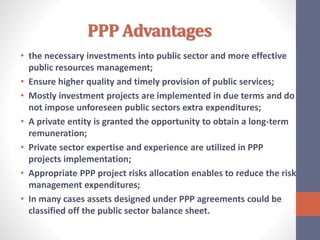
PPP Advantages
• the necessary investments into public sector and more effective
public resources management;
• Ensure higher quality and timely provision of public services;
• Mostly investment projects are implemented in due terms and do
not impose unforeseen public sectors extra expenditures;
• A private entity is granted the opportunity to obtain a long-term
remuneration;
• Private sector expertise and experience are utilized in PPP
projects implementation;
• Appropriate PPP project risks allocation enables to reduce the risk
management expenditures;
• In many cases assets designed under PPP agreements could be
classified off the public sector balance sheet.
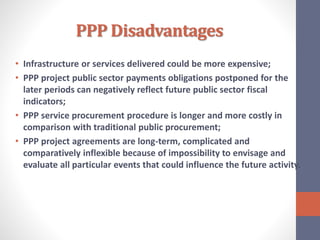
PPP Disadvantages
• Infrastructure or services delivered could be more expensive;
• PPP project public sector payments obligations postponed for the
later periods can negatively reflect future public sector fiscal
indicators;
• PPP service procurement procedure is longer and more costly in
comparison with traditional public procurement;
• PPP project agreements are long-term, complicated and
comparatively inflexible because of impossibility to envisage and
evaluate all particular events that could influence the future activity.
Thank You  

Public private partnership

  • 1.
    PUBLIC PRIVATE PARTNERSHIP SUBMITED BY: Divyajit(Reg. No. 16351050) Section A Masters of Business Administration Indian Institute of Tourism & Travel Management Gwalior - 474011
  • 2.
    Definition of PPP •Public private partnerships (PPPs) are agreements between government and the private sector for the purpose of providing public infrastructure, community facilities and related services. • The private sector enter into a contract with government for the design, delivery, and operation of the facility or infrastructure and the services provided. • The private sector finance the capital investment and recover the investment over the course of the contract. • The asset transfers back to the public sector at the end of the contract.
  • 3.
    Why Should GovernmentsConsider PPP? Governments look to the private sector for other reasons: • Exploring PPPs as a way of introducing private sector technology and innovation in providing better public services through improved operational efficiency. • Incentivizing the private sector to deliver projects on time and within budget • Imposing budgetary certainty by setting present and the future costs of infrastructure projects over time. • Utilizing PPPs as a way of developing local private sector capabilities through joint ventures with large international firms, as well as sub- contracting opportunities for local firms in areas such as civil works, electrical works, facilities management, security services, cleaning services, maintenance services • Using PPPs as a way of gradually exposing state owned enterprises and government to increasing levels of private sector participation (especially foreign) and structuring PPPs in a way so as to ensure transfer of skills leading to national champions that can run their own operations professionally and eventually export their competencies by bidding for projects/ joint ventures
  • 4.
    What makes asuccessful PPP? • Political will • Government commitment • PPP Champion • Clear output specification • Appropriate risk sharing • Value for money • Performance management
  • 5.
    Requirements of aSuccessful PPP Program • Political commitment (continuity of policy) • Enabling legislation (enabling legislation - concession laws, tax anomalies) • Expertise (capacity-building in both sectors) • Project prioritization (focus to improve success rates) • Deal flow and standardization (regularity of deals based on standard contracts)
  • 6.
    PPP Advantages • thenecessary investments into public sector and more effective public resources management; • Ensure higher quality and timely provision of public services; • Mostly investment projects are implemented in due terms and do not impose unforeseen public sectors extra expenditures; • A private entity is granted the opportunity to obtain a long-term remuneration; • Private sector expertise and experience are utilized in PPP projects implementation; • Appropriate PPP project risks allocation enables to reduce the risk management expenditures; • In many cases assets designed under PPP agreements could be classified off the public sector balance sheet.
  • 7.
    PPP Disadvantages • Infrastructureor services delivered could be more expensive; • PPP project public sector payments obligations postponed for the later periods can negatively reflect future public sector fiscal indicators; • PPP service procurement procedure is longer and more costly in comparison with traditional public procurement; • PPP project agreements are long-term, complicated and comparatively inflexible because of impossibility to envisage and evaluate all particular events that could influence the future activity.
  • 8.