Security & Compliance in the Cloud
DefCamp 2019
Bucharest, November 7th, 2019
• Managing Partner & CIO @ Avaelgo
• Offering Peace of Mind as-a-Service
• IT Advisory, Cloud Strategy, Managed Services, IT Security, Training
• Co-founder @ ITCamp & ITCamp Community
• Cloud and Datacenter Management MVP (Microsoft)
• Certified Ethical Hacker (EC-Council)
• Certified Security Professional (CQURE)
• Contact: tudor.damian@avaelgo.ro / tudy.tel
Tudor Damian
• Why the Cloud?
• Digital Transformation & Current Cloud adoption trends
• How to get there?
• Defining a strategy to move to the Cloud
• I’m there, now what?
• Security & Compliance in the Cloud
• What’s next?
• Key takeaways & next steps
• Case Study:
• Example: Microsoft Azure
• Our approach (Avaelgo)
Objectives
(The mirage of) Digital Transformation
• A recent survey found that Digital
Transformation (DT) is the #1 concern in
2019 for directors, CEOs and senior
executives (WSJ)
• Yet, nearly 70% of all DT initiatives do not reach
their goals – in 2018, out of $1.3 trillion spent,
$900 billion went to waste (Forbes)
• Most digital technologies provide
possibilities for efficiency gains
• If people lack the right mindset to change and if
current organizational practices are flawed, DT
will only magnify those flaws
The pitfalls of Digital Transformation
https://blogs.wsj.com/riskandcompliance/2018/12/05/businesses-predict-digital-transformation-to-be-biggest-risk-factors-in-2019/
https://www.forbes.com/sites/forbestechcouncil/2018/03/13/why-digital-transformations-fail-closing-the-900-billion-hole-in-enterprise-strategy/#4f74e9207b8b
Failed
69%
Successful
31%
Digital Transformation
initiatives (2018)
• Figure out your business strategy before you invest in anything
• Figure out what’s important – speed, innovation, digitalization, production lead
times, increased time-to-market, improved use of data, enhanced supply chain, etc.
• Leverage insiders
• Don’t just rely on outside consultants, use staff with intimate knowledge about what
works and what doesn’t
• Design customer experience from the outside in
• Ask your customer for feedback, have them describe your strengths and
weaknesses
• Recognize employees’ fear of being replaced
• People may unconsciously resist change if they feel their job is at stake
• Learn from the start-up culture
• Agile decision making, rapid prototyping, flat structures, fail fast
What is there to do?
Open LDAP
New PCs
bought ad-hoc
PCs refreshed
when dead
Employees
using personal
mobile devices
IT purchasing
decisions
made “on the spot”
What does today
look like for you?
“Good
enough”
platforms
No
technology
strategy
Legacy
back office
Fragmented
end-point
solutions
Increasingly
complex
demands
Multiple tech
products
Tougher
competitive
environment
Custom solutions
required for
interoperability
Cross-platform
device management
requirements
Race to the bottom
pricing impacts
deal profitability
Multiple technology
vendors servicing
single client
Greater effort
to maintain
customer base
Increased
implementation
and
management
complexity
Difficulty
differentiating
brand
Increased security
exposure
Need to source
best of breed
solutions
What does today
look like for you?
So, why the Cloud?
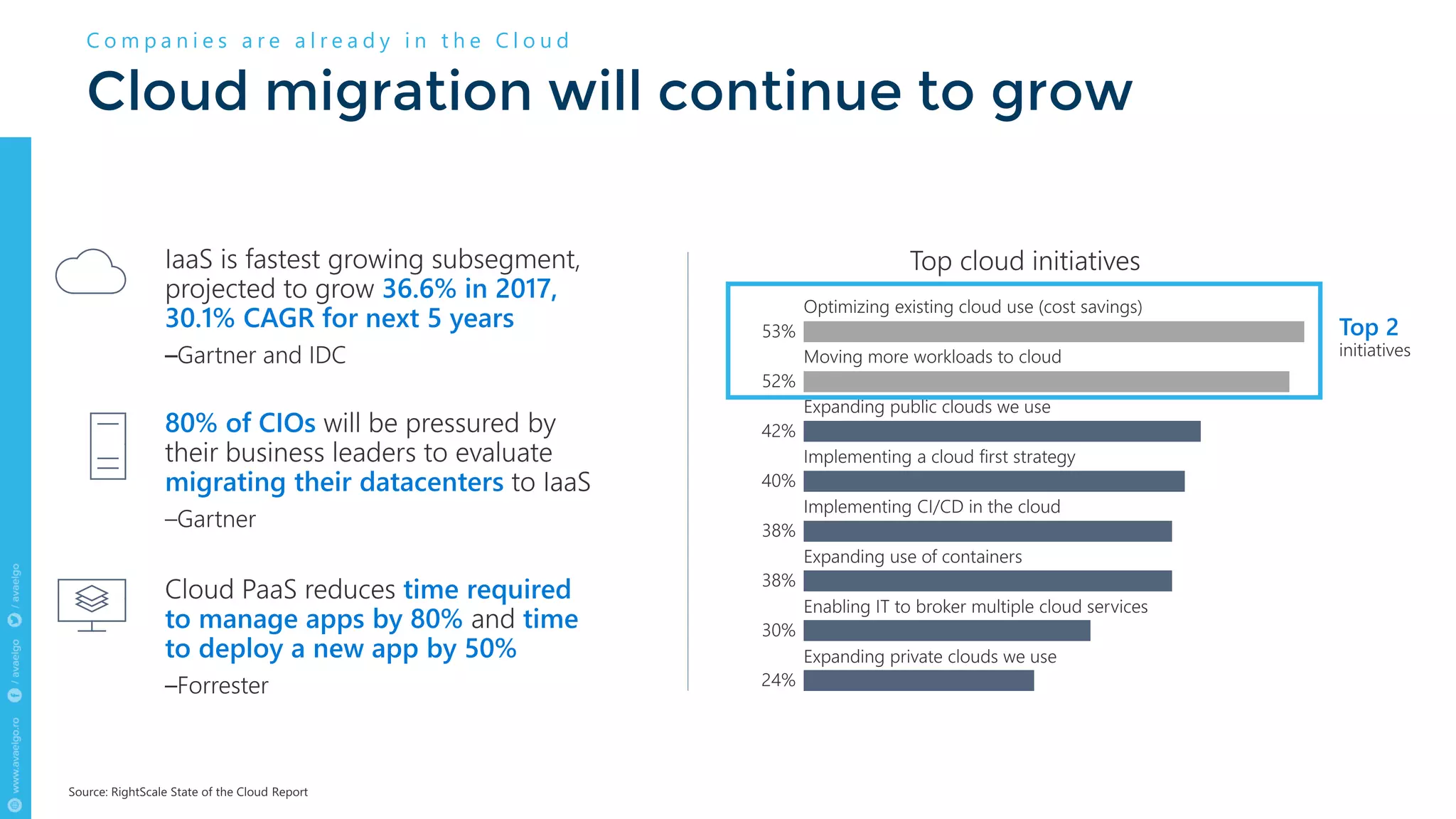
Cloud migration will continue to grow
C o m p a n i e s a r e a l r e a d y i n t h e C l o u d
• Cost control: Utility services cost less even though they cost more
• Higher cost per unit time than leasing or upfront purchase
• Zero cost when not used
• Efficiency & scalability: on-demand is better than prediction
• Forecasting is estimative, often wrong, sometimes impossible
• Better to be able to scale up or down “immediately” depending on demand
• Workloads: address odd workload patterns
• On-and-off, growing fast, unpredictable bursting, predictable bursting
• Innovation: access to technology not available on-premises
• Making use of some Cloud-native solutions (e.g. AI, ML, DBs, storage)
• Consolidating platforms, technologies, expertise
• Starting up: new company, startup, spinoff, new market, etc.
• Security & compliance: GDPR, data protection, data classification, etc.
Why the Cloud? (examples)
• Identity & Data
• Data Classification & Labeling, Data Protection
• Monitoring & Response
• Geography
• Multi-geo deployments & GDPR
• Latency
• Financials
• OPEX vs CAPEX
• Understand PAYG vs CSP vs EA vs MCA
• Understand constants and variables in Cloud consumption
• Apply relevant tools for cost visualization, control and budgeting
• Governance
• Cloud subscriptions will get very messy very quickly without proper governance
• Locks, Groups, Tags, Policies, Auditing & Monitoring – it all has little value unless properly
understood and employed
• Process
• This is not a walk in the park, it’s a lengthy and rather complex project
Common Cloud challenges
The Cloud migration journey
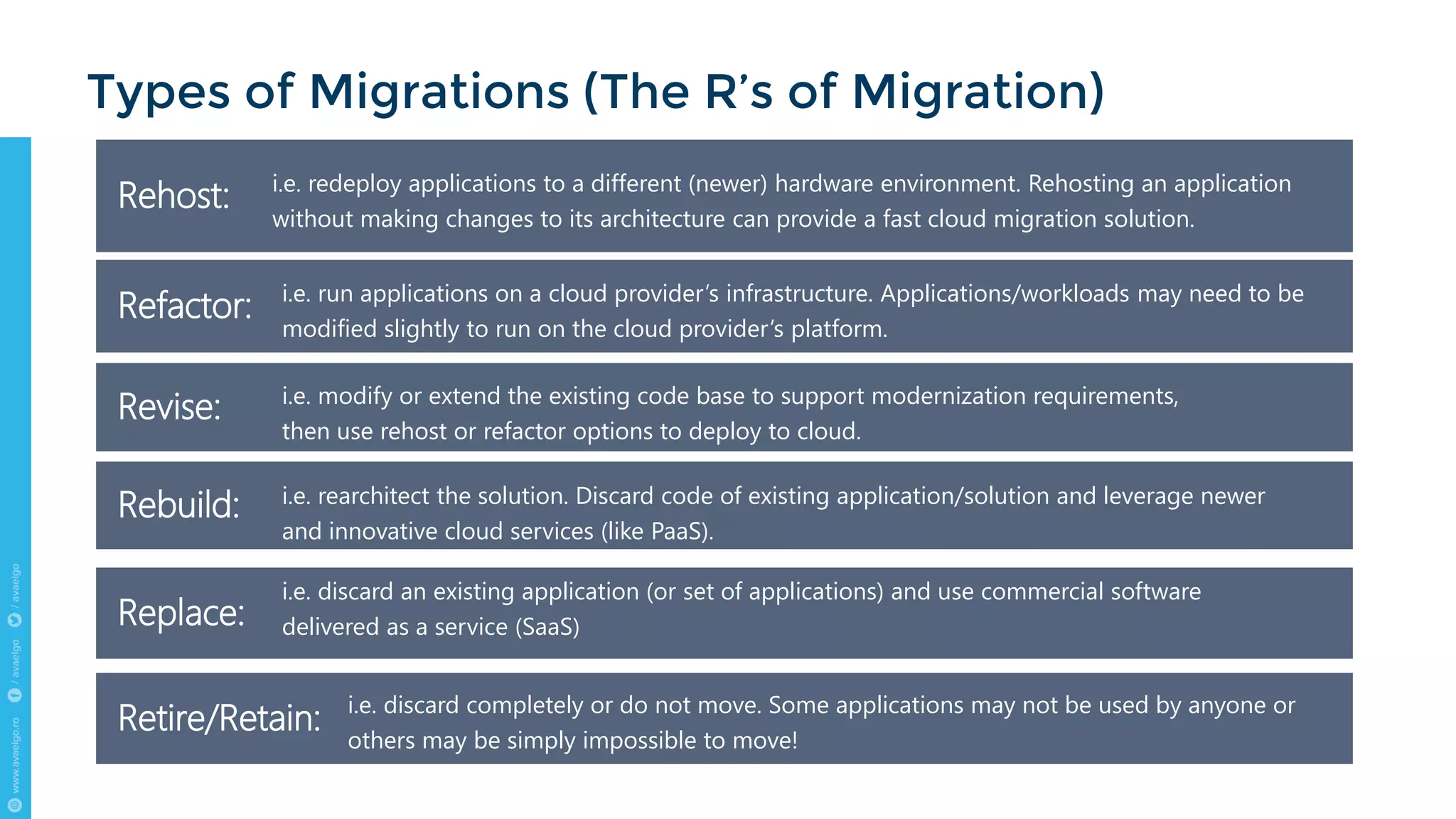
Types of Migrations (The R’s of Migration)
Rehost: i.e. redeploy applications to a different (newer) hardware environment. Rehosting an application
without making changes to its architecture can provide a fast cloud migration solution.
Revise: i.e. modify or extend the existing code base to support modernization requirements,
then use rehost or refactor options to deploy to cloud.
Rebuild: i.e. rearchitect the solution. Discard code of existing application/solution and leverage newer
and innovative cloud services (like PaaS).
Replace:
i.e. discard an existing application (or set of applications) and use commercial software
delivered as a service (SaaS)
Refactor: i.e. run applications on a cloud provider’s infrastructure. Applications/workloads may need to be
modified slightly to run on the cloud provider’s platform.
Retire/Retain: i.e. discard completely or do not move. Some applications may not be used by anyone or
others may be simply impossible to move!
Responsibility zones in the Cloud
E x a m p l e
Data classification, governance,
accountability & rights management
Client endpoint protection
Account access & management
Identity & directory infrastructure
Application-level controls
Network controls
Virtual OS controls
Physical hosts
Physical network
Physical datacenter
PaaSIaaS SaaS
On-
prem
Always retained by customer
Varies by service type
Transfers to Cloud Provider
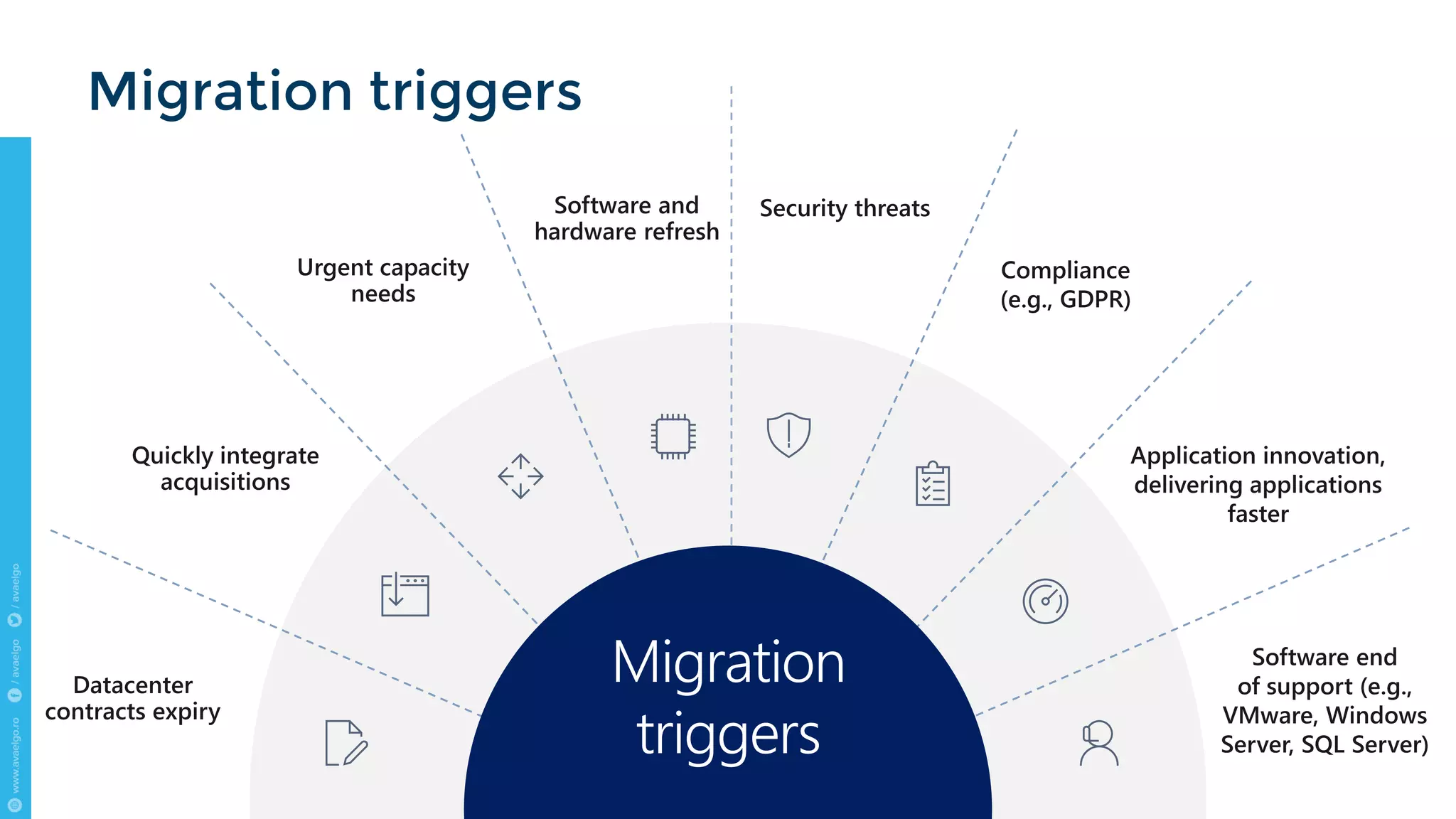
Migration triggers
• Is the app modern or legacy?
• Topology
• Transient faults
• Latency, performance
• Security and compliance
• Maintainability
• DevOps
• Degree of technology lock-in
• Multi-tenancy
• Cloud perception
• New features, possible only in the Cloud
• Application architecture guidance
PaaS migrations are even more fun ☺
The Security & Compliance talk
Understanding cloud security controls
W h a t d o e s t h e C l o u d d o f o r m e ? W h a t d o I s t i l l n e e d t o d o ?
On-premises IaaS PaaS SaaS
1. Security Strategy, Governance, and Operationalization: Provide clear vision, standards and guidance for the company
2. Administrative Control: Defend against loss of control of your Cloud services and on-premises systems
3. Data: Identify and protect your most important information assets
4. User Identity and Device Security: Strengthen protection for accounts and devices
5. Application Security: Ensure application code is resilient to attacks
6. Network: Ensure connectivity, isolation, and visibility into anomalous attacks
7. OS and Middleware: Protect integrity of (virtual) hosts
8. On-prem / private
environments: Secure
the foundation
• Governance, risk management & compliance (GRC) are three facets
that help to ensure that an organization meets its objectives
• Goals:
• Keeping risk at acceptable levels
• Maintaining availability to systems and services
• Complying with relevant laws and regulations
• Protecting customer and internal data
GRC – are you doing it today?
G o v e r n a n c e , R i s k m a n a g e m e n t & C o m p l i a n c e
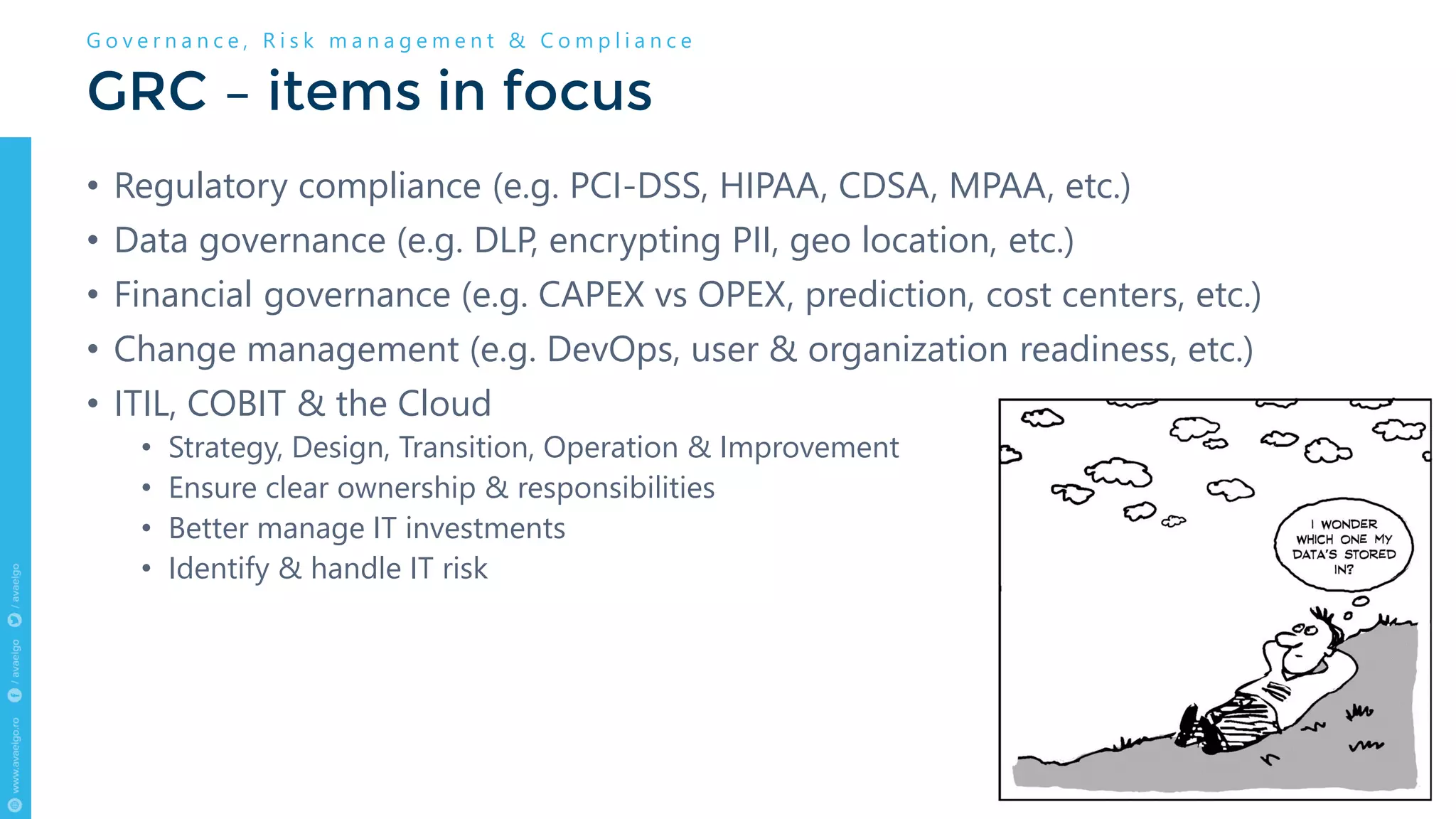
• Regulatory compliance (e.g. PCI-DSS, HIPAA, CDSA, MPAA, etc.)
• Data governance (e.g. DLP, encrypting PII, geo location, etc.)
• Financial governance (e.g. CAPEX vs OPEX, prediction, cost centers, etc.)
• Change management (e.g. DevOps, user & organization readiness, etc.)
• ITIL, COBIT & the Cloud
• Strategy, Design, Transition, Operation & Improvement
• Ensure clear ownership & responsibilities
• Better manage IT investments
• Identify & handle IT risk
GRC – items in focus
G o v e r n a n c e , R i s k m a n a g e m e n t & C o m p l i a n c e
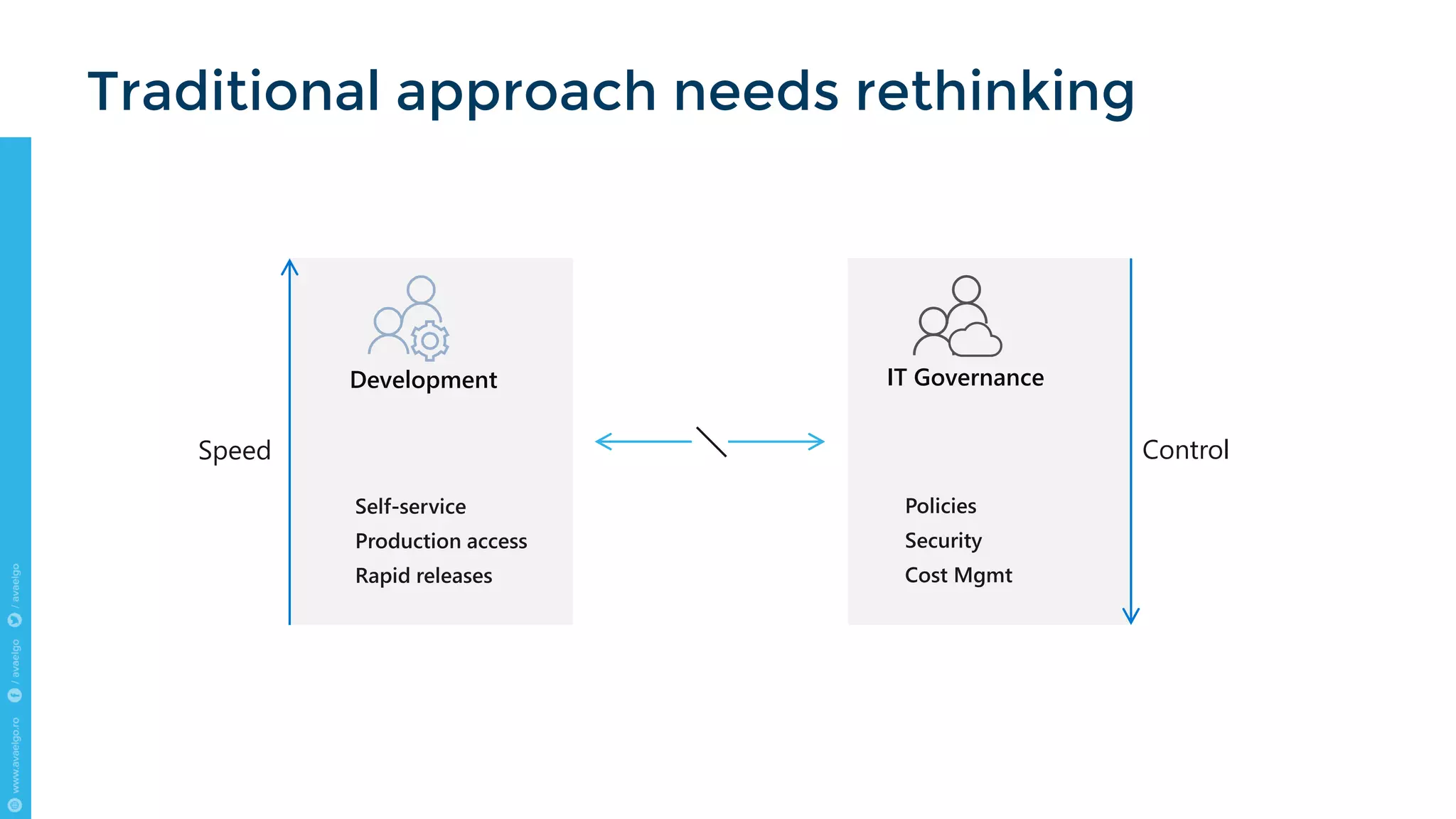
Traditional approach needs rethinking
Development IT Governance
Speed Control
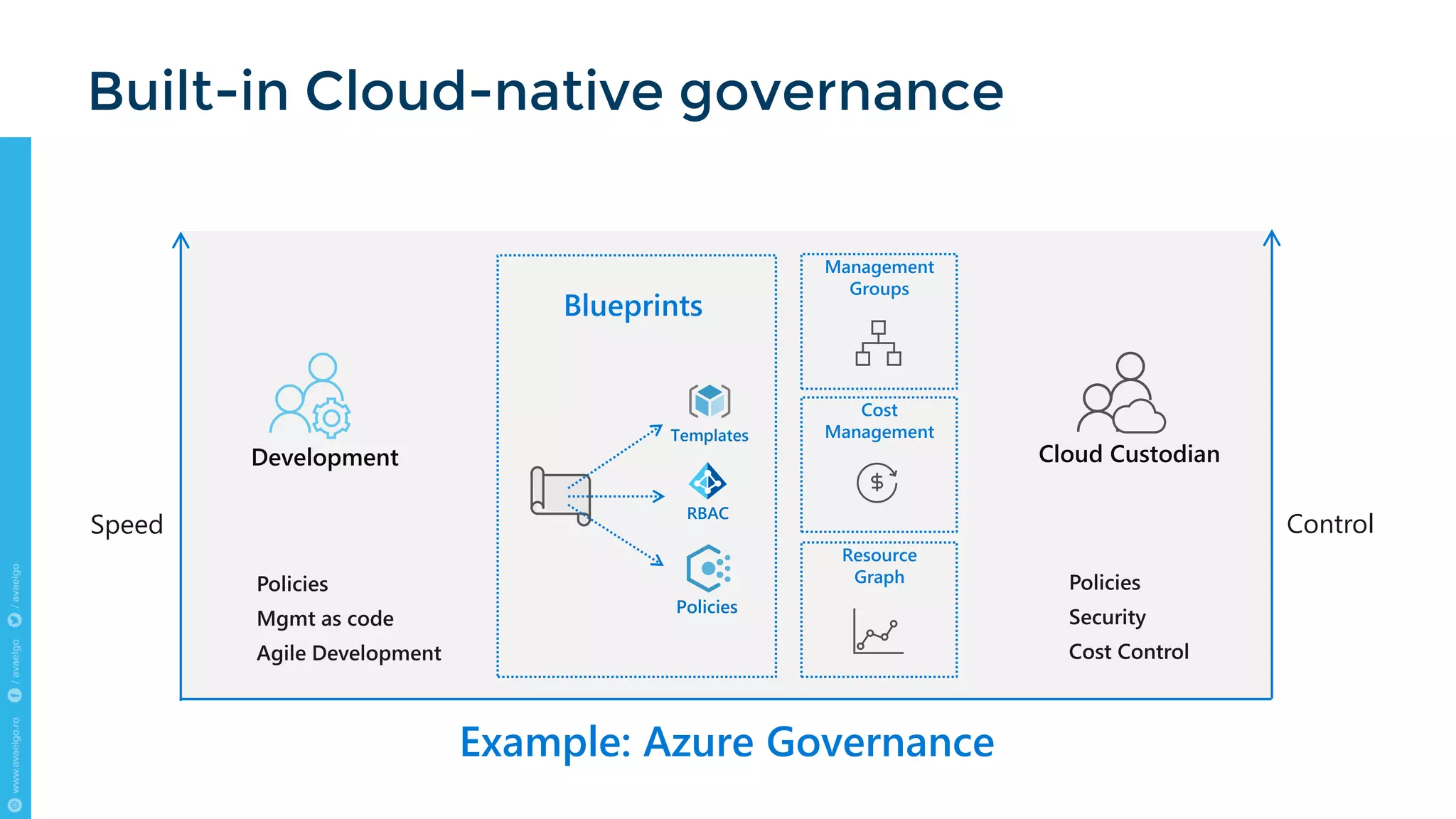
Built-in Cloud-native governance
Speed Control
Example: Azure Governance
Development Cloud Custodian
Templates
Policies
RBAC
Blueprints
Management
Groups
Cost
Management
Resource
Graph
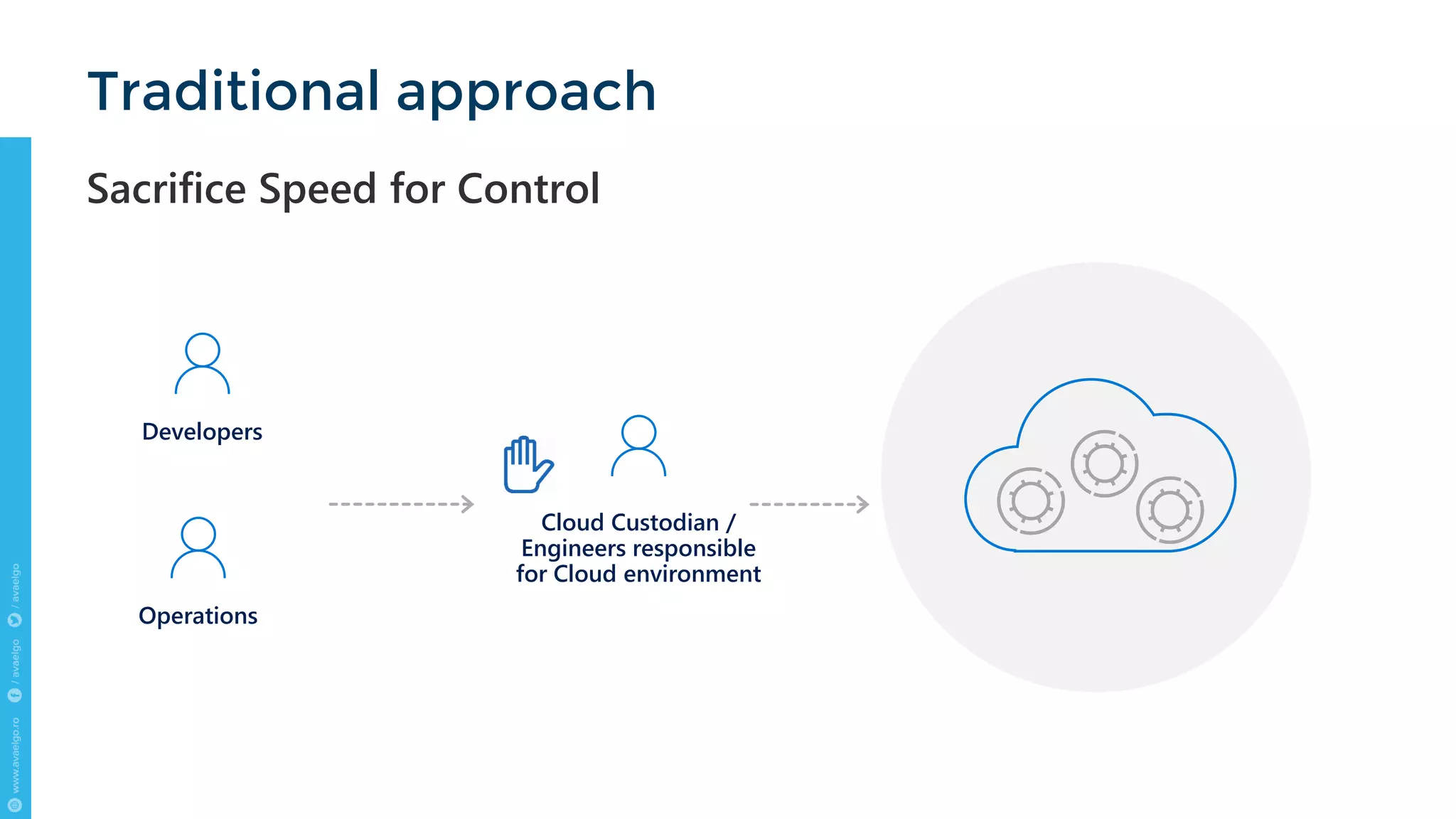
Sacrifice Speed for Control
Traditional approach
Developers
Operations
Cloud Custodian /
Engineers responsible
for Cloud environment
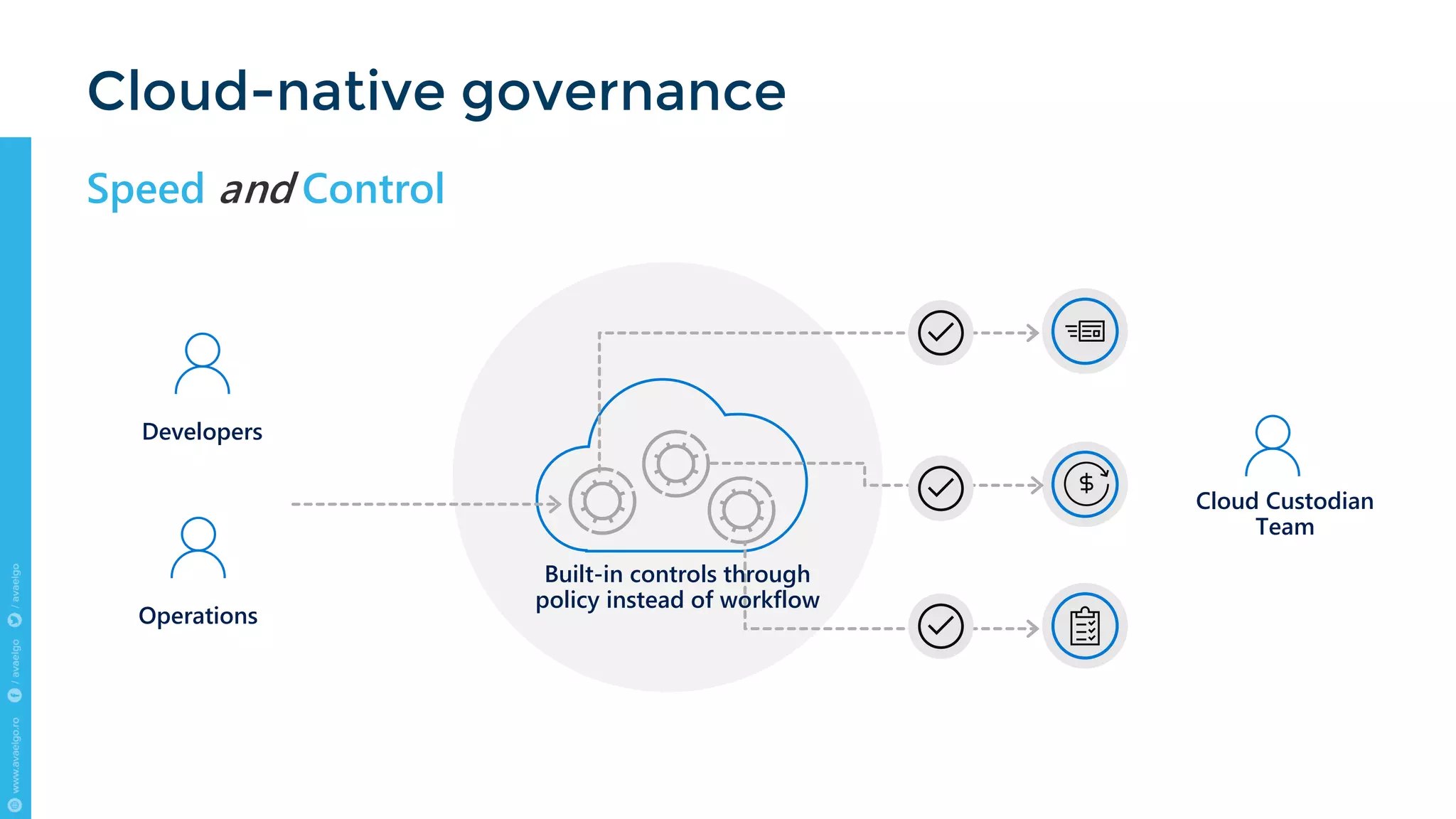
Speed and Control
Cloud-native governance
Developers
Built-in controls through
policy instead of workflow
Operations
Cloud Custodian
Team
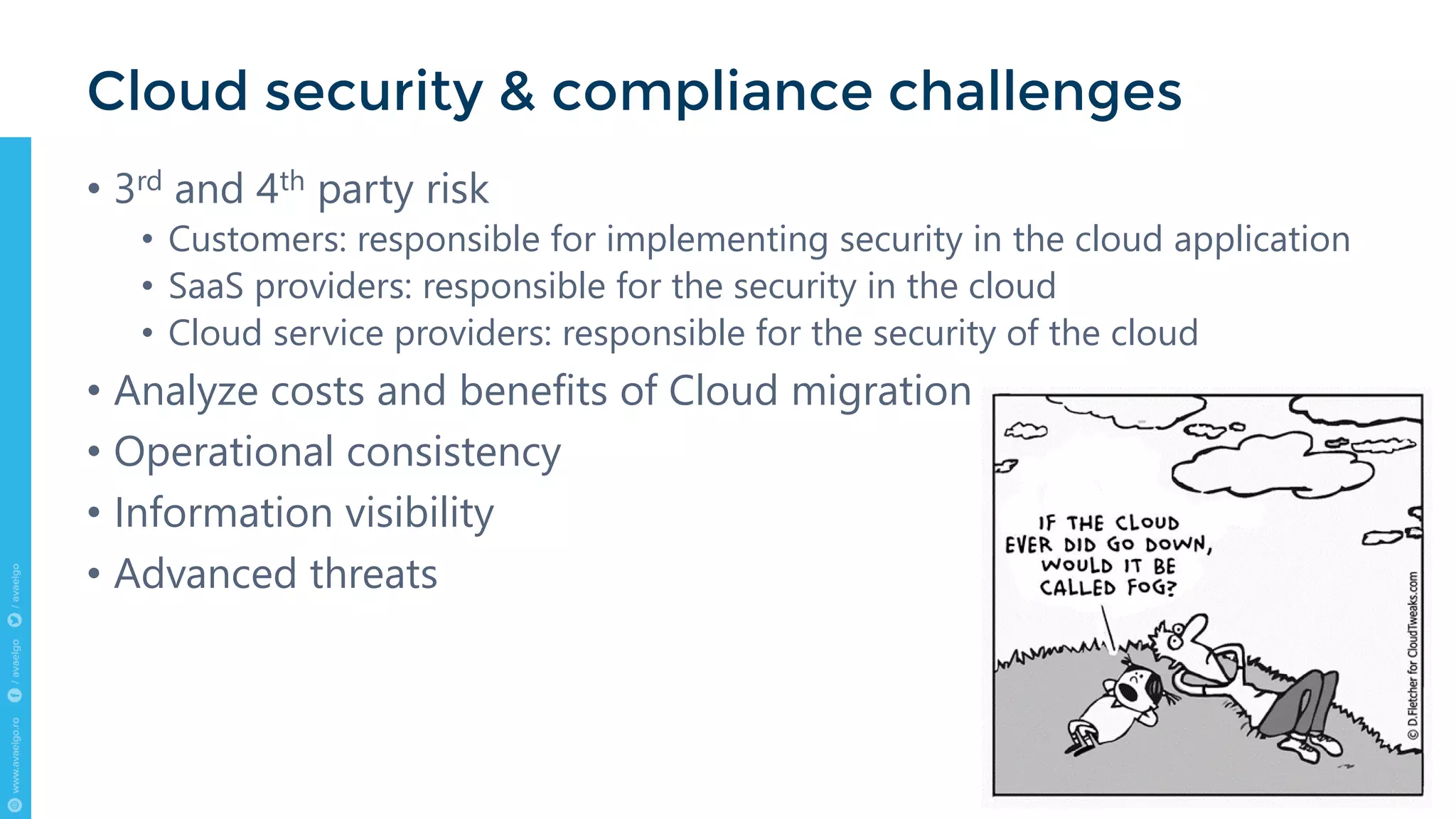
• 3rd and 4th party risk
• Customers: responsible for implementing security in the cloud application
• SaaS providers: responsible for the security in the cloud
• Cloud service providers: responsible for the security of the cloud
• Analyze costs and benefits of Cloud migration
• Operational consistency
• Information visibility
• Advanced threats
Cloud security & compliance challenges
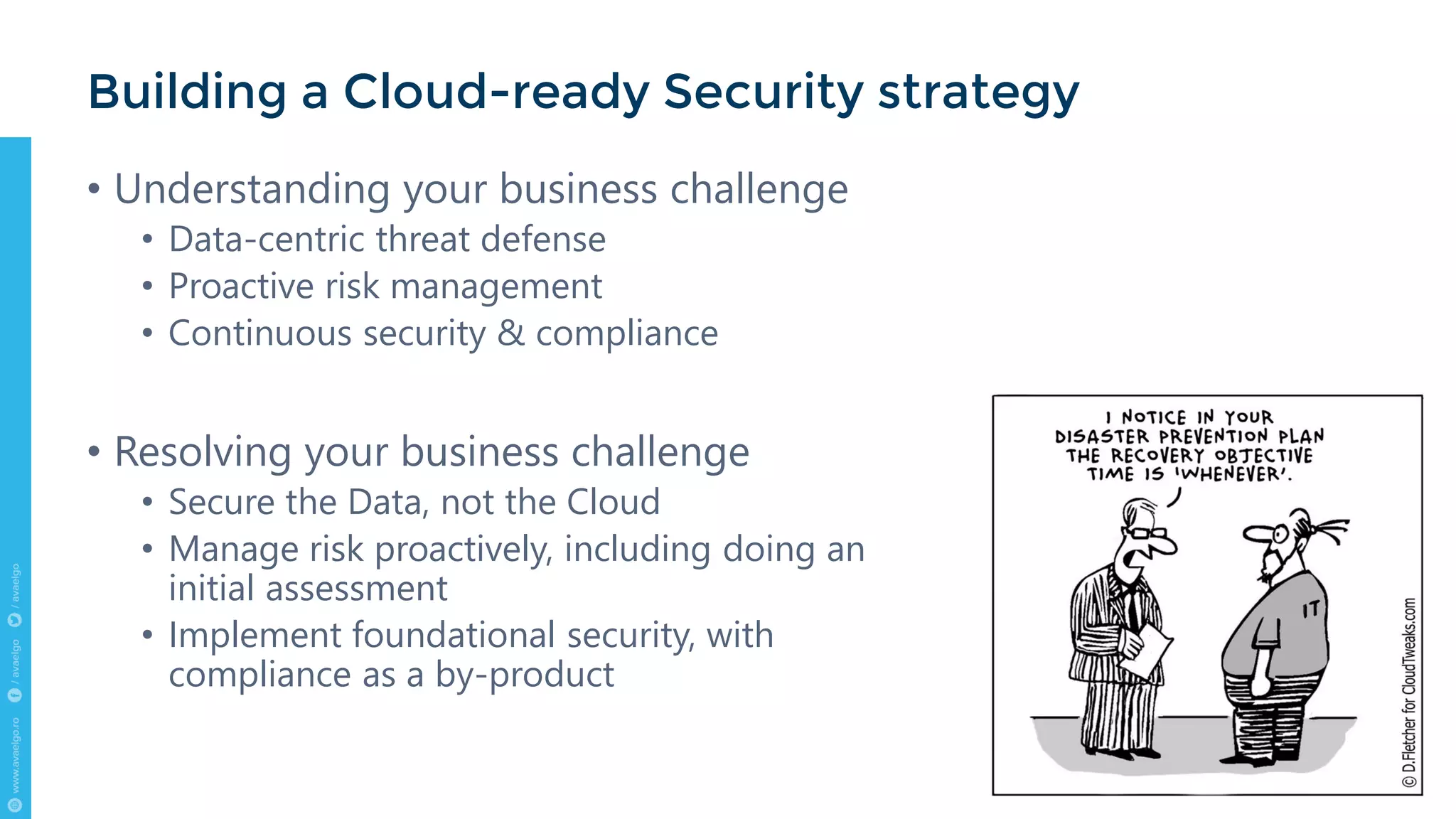
• Understanding your business challenge
• Data-centric threat defense
• Proactive risk management
• Continuous security & compliance
• Resolving your business challenge
• Secure the Data, not the Cloud
• Manage risk proactively, including doing an
initial assessment
• Implement foundational security, with
compliance as a by-product
Building a Cloud-ready Security strategy
Microsoft Azure
C l o u d S e c u r i t y & C o m p l i a n c e e x a m p l e
Example: Azure Compliance offering
S o u r c e : h t t p s : / / a z u r e . m i c r o s o f t . c o m / e n - u s / o v e r v i e w / t r u s t e d - c l o u d / c o m p l i a n c e /
HIPAA /
HITECH Act
FERPA
GxP
21 CFR Part 11
Singapore
MTCS
UK
G-Cloud
Australia
IRAP/CCSL
FISC Japan
New Zealand
GCIO
China
GB 18030
EU
Model Clauses
ENISA
IAF
Argentina
PDPA
Japan CS
Mark Gold
CDSA
Shared
Assessments
Japan My
Number Act
FACT UK GLBA
Spain
ENS
PCI DSS
Level 1 MARS-E FFIEC
China
TRUCS
Canada
Privacy Laws
MPAA
Privacy
Shield
India
MeitY
Germany IT
Grundschutz
workbook
Spain
DPA
HITRUST IG Toolkit UK
China
DJCP
ITAR
Section 508
VPAT
SP 800-171 FIPS 140-2
High
JAB P-ATO
CJIS
DoD DISA
SRG Level 2
DoD DISA
SRG Level 4
IRS 1075
DoD DISA
SRG Level 5
Moderate
JAB P-ATO
GLOBALUSGOVINDUSTRYREGIONAL
ISO 27001
SOC 1
Type 2ISO 27018
CSA STAR
Self-AssessmentISO 27017
SOC 2
Type 2
SOC 3ISO 22301
CSA STAR
Certification
CSA STAR
AttestationISO 9001
Physical Datacenter Security
M i c r o s o f t A z u r e
Two-factor
authentication
with biometrics
Employee &
contractor vetting
Metal
detectors
Video coverage
rack front & back
Inability to identify
location of specific
customer data
Secure
destruction bins
Ongoing
roaming patrols
Video
coverage
Ongoing
roaming patrols
Front
entrance gate
1 defined
access point
Video
coverage
Perimeter
fencing
Two-factor
authentication
with biometrics
Video
coverage
No building
signage
24x7x365
security operations
Verified single
person entry
Ongoing
roaming patrols
Background
check
System
check
Access
approval
Perimeter
Building
Server
environment
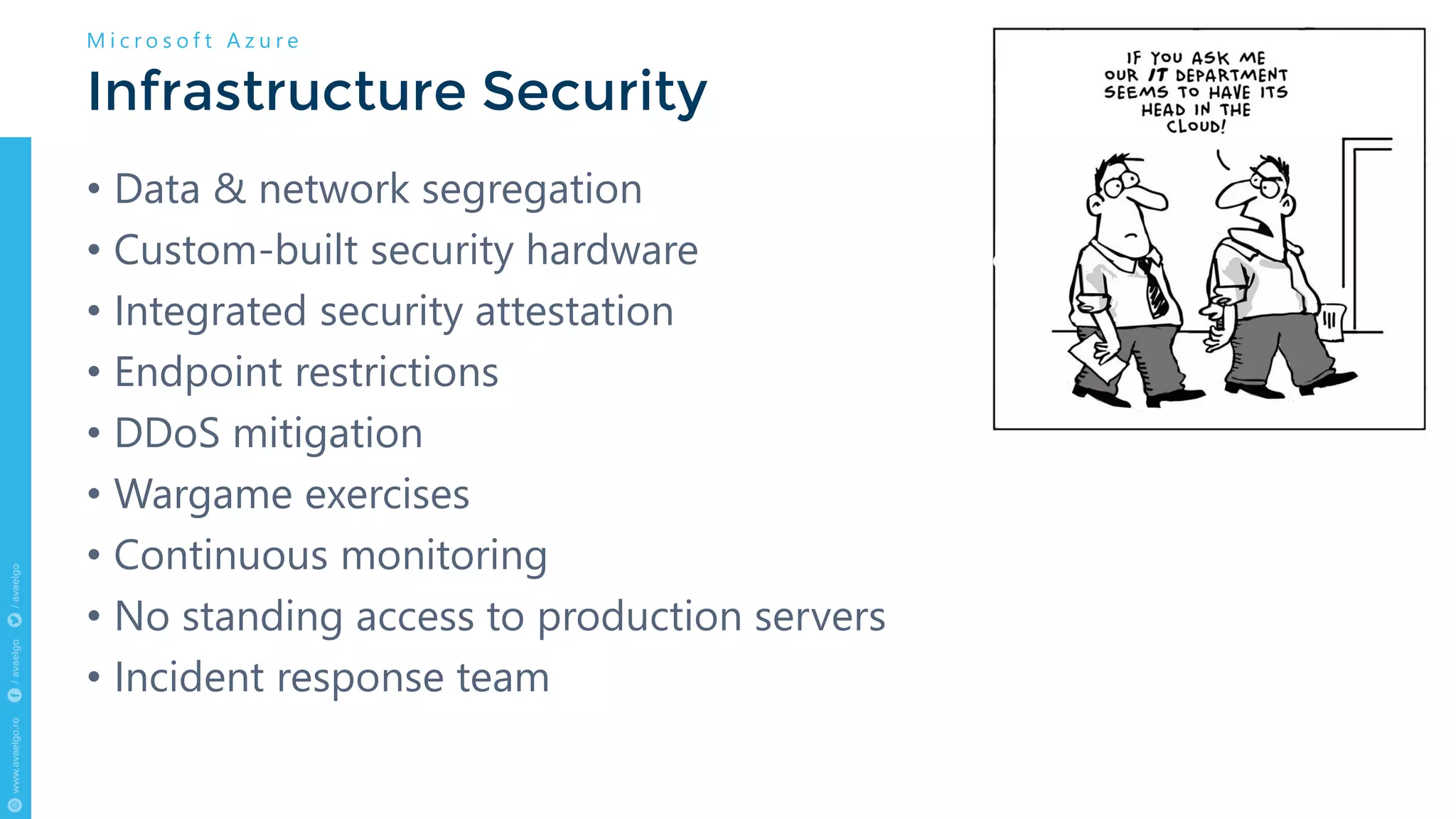
• Data & network segregation
• Custom-built security hardware
• Integrated security attestation
• Endpoint restrictions
• DDoS mitigation
• Wargame exercises
• Continuous monitoring
• No standing access to production servers
• Incident response team
Infrastructure Security
M i c r o s o f t A z u r e
• Virtual network isolation
• Network Security Groups
• User-Defined Routing
• VPN configuration
• Web Application Firewall
• Network Firewall
• DDoS Protection
• ExpressRoute
Network Security
M i c r o s o f t A z u r e
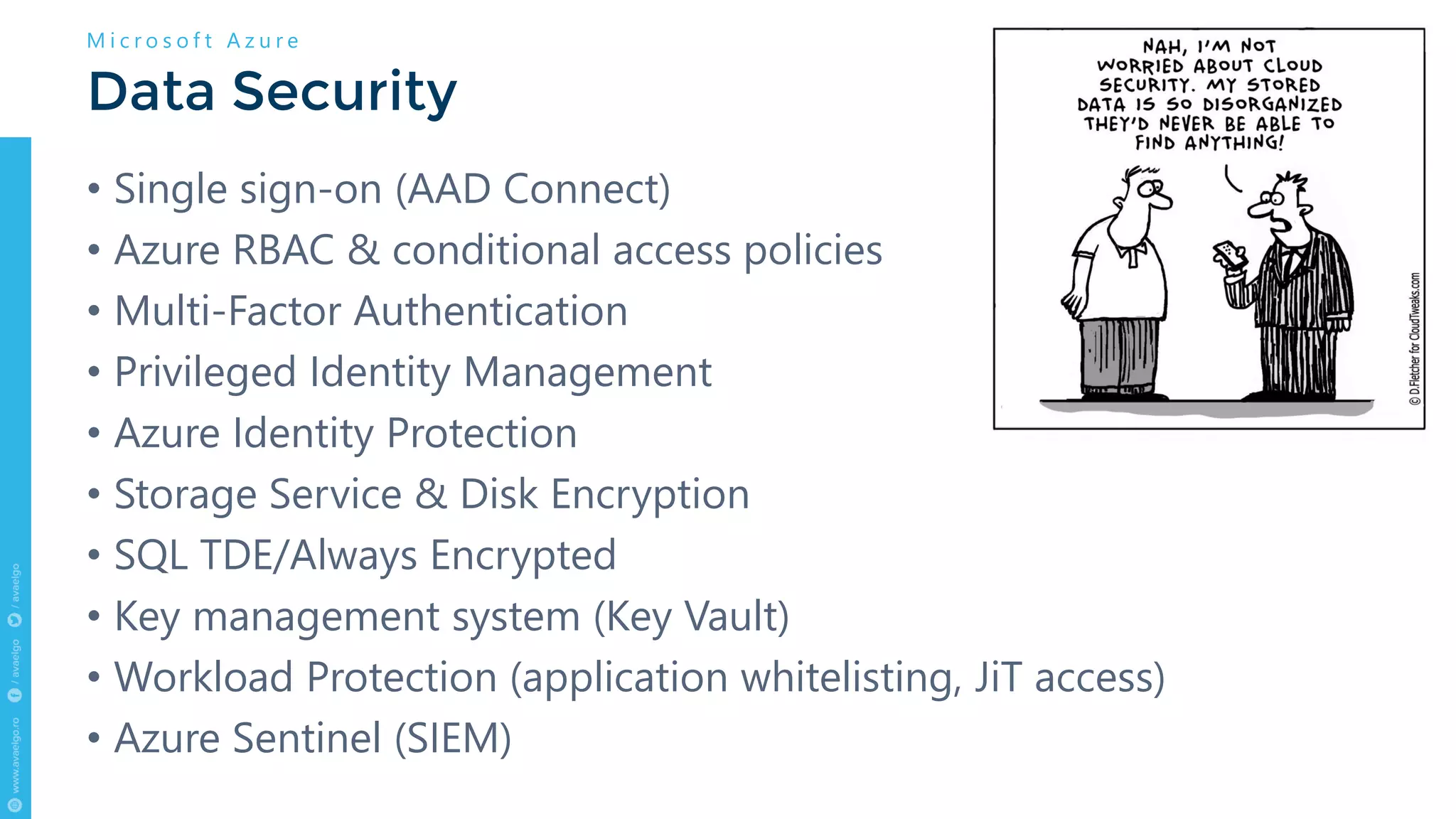
• Single sign-on (AAD Connect)
• Azure RBAC & conditional access policies
• Multi-Factor Authentication
• Privileged Identity Management
• Azure Identity Protection
• Storage Service & Disk Encryption
• SQL TDE/Always Encrypted
• Key management system (Key Vault)
• Workload Protection (application whitelisting, JiT access)
• Azure Sentinel (SIEM)
Data Security
M i c r o s o f t A z u r e
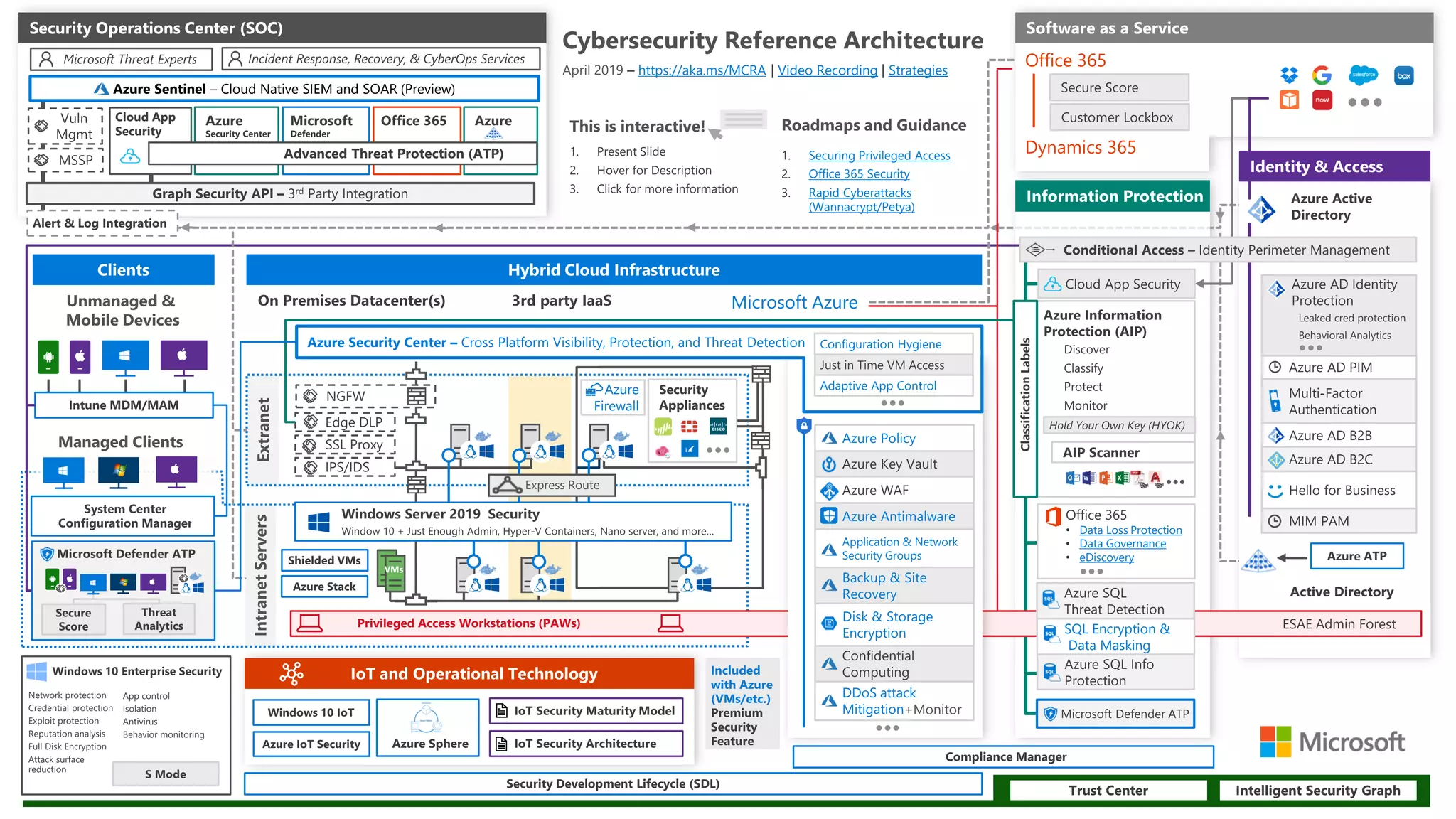
Securing Privileged Access
Office 365 Security
Rapid Cyberattacks
(Wannacrypt/Petya)
https://aka.ms/MCRA Video Recording Strategies
Office 365
Dynamics 365
+Monitor
Azure Sentinel – Cloud Native SIEM and SOAR (Preview)
SQL Encryption &
Data Masking
Data Loss Protection
Data Governance
eDiscovery
Securing Privileged Access
Office 365 Security
Rapid Cyberattacks
(Wannacrypt/Petya)
https://aka.ms/MCRA Video Recording Strategies
Office 365
Dynamics 365
+Monitor
Azure Sentinel – Cloud Native SIEM and SOAR (Preview)
SQL Encryption &
Data Masking
Data Loss Protection
Data Governance
eDiscovery
So, how do we do it?
C a s e s t u d y : A v a e l g o
Cloud
Optimize
• Proactive Support
• Governance & Security
• Budgeting & Cost Control
• Monitoring & Alerts
• DevOps & Automation
• Usage Optimizations
• Best Practices
Cloud
Support
• Operational Baseline
• 24/7 SLA-based Support
• Root-Cause Analysis
• Critical Issue Escalation
• Config Management
• Business Continuity
• Disaster Recovery
Cloud
Empower
• Power Platform Apps
o PowerApps & Flow
o PowerBI
• Avaelgo Pre-built Apps
• Technology Onboarding
• Custom Software Dev
o Cloud-ready
o AI & ML
Envision, Readiness &
Cloud Onboarding
Example: Avaelgo 365
A v a e l g o C l o u d M a n a g e d S e r v i c e s F r a m e w o r k
Peace of Mind
as-a-Service
Growth &
Innovation
Cloud
Migrate
• Rehost (Lift & Shift)
• Refactor (PaaS)
• Revise (Re-architect)
• Rebuild (Cloud-native)
• Replace (SaaS)
• CI & CD (DevOps)
Cloud
Strategy
• Incubation Workshop
• Learn-Try-Adopt
o Hands-on training
o Implementing POCs
• Define Cloud Strategy
o Planning & Roadmap
Ongoing Advisory & Training
Designed for:
Wrapping up
• So, we’ve (briefly) discussed:
• Why, when and how to move to the Cloud?
• Cloud migration, security & governance concerns
• Example: Microsoft Azure
• Case-study: Avaelgo
• First steps:
• Ensure you have a clear Cloud Strategy (including Security & Governance)
• Discover what you’ve got and where you’re starting from
• Don’t forget, you’re mostly just extending your practices to the Cloud
• Consider the details – identity, geography, financials, monitoring, operations
Summary
Q & A
PEACE OF MIND
AS-A-SERVICE
CLOUD STRATEGY | MANAGED SERVICES | IT SECURITY | TRAINING

Security & Compliance in the Cloud [2019]

  • 1.
    Security & Compliancein the Cloud DefCamp 2019 Bucharest, November 7th, 2019
  • 2.
    • Managing Partner& CIO @ Avaelgo • Offering Peace of Mind as-a-Service • IT Advisory, Cloud Strategy, Managed Services, IT Security, Training • Co-founder @ ITCamp & ITCamp Community • Cloud and Datacenter Management MVP (Microsoft) • Certified Ethical Hacker (EC-Council) • Certified Security Professional (CQURE) • Contact: tudor.damian@avaelgo.ro / tudy.tel Tudor Damian
  • 3.
    • Why theCloud? • Digital Transformation & Current Cloud adoption trends • How to get there? • Defining a strategy to move to the Cloud • I’m there, now what? • Security & Compliance in the Cloud • What’s next? • Key takeaways & next steps • Case Study: • Example: Microsoft Azure • Our approach (Avaelgo) Objectives
  • 4.
    (The mirage of)Digital Transformation
  • 5.
    • A recentsurvey found that Digital Transformation (DT) is the #1 concern in 2019 for directors, CEOs and senior executives (WSJ) • Yet, nearly 70% of all DT initiatives do not reach their goals – in 2018, out of $1.3 trillion spent, $900 billion went to waste (Forbes) • Most digital technologies provide possibilities for efficiency gains • If people lack the right mindset to change and if current organizational practices are flawed, DT will only magnify those flaws The pitfalls of Digital Transformation https://blogs.wsj.com/riskandcompliance/2018/12/05/businesses-predict-digital-transformation-to-be-biggest-risk-factors-in-2019/ https://www.forbes.com/sites/forbestechcouncil/2018/03/13/why-digital-transformations-fail-closing-the-900-billion-hole-in-enterprise-strategy/#4f74e9207b8b Failed 69% Successful 31% Digital Transformation initiatives (2018)
  • 6.
    • Figure outyour business strategy before you invest in anything • Figure out what’s important – speed, innovation, digitalization, production lead times, increased time-to-market, improved use of data, enhanced supply chain, etc. • Leverage insiders • Don’t just rely on outside consultants, use staff with intimate knowledge about what works and what doesn’t • Design customer experience from the outside in • Ask your customer for feedback, have them describe your strengths and weaknesses • Recognize employees’ fear of being replaced • People may unconsciously resist change if they feel their job is at stake • Learn from the start-up culture • Agile decision making, rapid prototyping, flat structures, fail fast What is there to do?
  • 7.
    Open LDAP New PCs boughtad-hoc PCs refreshed when dead Employees using personal mobile devices IT purchasing decisions made “on the spot” What does today look like for you? “Good enough” platforms No technology strategy Legacy back office Fragmented end-point solutions
  • 8.
    Increasingly complex demands Multiple tech products Tougher competitive environment Custom solutions requiredfor interoperability Cross-platform device management requirements Race to the bottom pricing impacts deal profitability Multiple technology vendors servicing single client Greater effort to maintain customer base Increased implementation and management complexity Difficulty differentiating brand Increased security exposure Need to source best of breed solutions What does today look like for you?
  • 9.
  • 10.
    Cloud migration willcontinue to grow C o m p a n i e s a r e a l r e a d y i n t h e C l o u d
  • 11.
    • Cost control:Utility services cost less even though they cost more • Higher cost per unit time than leasing or upfront purchase • Zero cost when not used • Efficiency & scalability: on-demand is better than prediction • Forecasting is estimative, often wrong, sometimes impossible • Better to be able to scale up or down “immediately” depending on demand • Workloads: address odd workload patterns • On-and-off, growing fast, unpredictable bursting, predictable bursting • Innovation: access to technology not available on-premises • Making use of some Cloud-native solutions (e.g. AI, ML, DBs, storage) • Consolidating platforms, technologies, expertise • Starting up: new company, startup, spinoff, new market, etc. • Security & compliance: GDPR, data protection, data classification, etc. Why the Cloud? (examples)
  • 12.
    • Identity &Data • Data Classification & Labeling, Data Protection • Monitoring & Response • Geography • Multi-geo deployments & GDPR • Latency • Financials • OPEX vs CAPEX • Understand PAYG vs CSP vs EA vs MCA • Understand constants and variables in Cloud consumption • Apply relevant tools for cost visualization, control and budgeting • Governance • Cloud subscriptions will get very messy very quickly without proper governance • Locks, Groups, Tags, Policies, Auditing & Monitoring – it all has little value unless properly understood and employed • Process • This is not a walk in the park, it’s a lengthy and rather complex project Common Cloud challenges
  • 13.
  • 14.
    Types of Migrations(The R’s of Migration) Rehost: i.e. redeploy applications to a different (newer) hardware environment. Rehosting an application without making changes to its architecture can provide a fast cloud migration solution. Revise: i.e. modify or extend the existing code base to support modernization requirements, then use rehost or refactor options to deploy to cloud. Rebuild: i.e. rearchitect the solution. Discard code of existing application/solution and leverage newer and innovative cloud services (like PaaS). Replace: i.e. discard an existing application (or set of applications) and use commercial software delivered as a service (SaaS) Refactor: i.e. run applications on a cloud provider’s infrastructure. Applications/workloads may need to be modified slightly to run on the cloud provider’s platform. Retire/Retain: i.e. discard completely or do not move. Some applications may not be used by anyone or others may be simply impossible to move!
  • 15.
    Responsibility zones inthe Cloud E x a m p l e Data classification, governance, accountability & rights management Client endpoint protection Account access & management Identity & directory infrastructure Application-level controls Network controls Virtual OS controls Physical hosts Physical network Physical datacenter PaaSIaaS SaaS On- prem Always retained by customer Varies by service type Transfers to Cloud Provider
  • 16.
  • 17.
    • Is theapp modern or legacy? • Topology • Transient faults • Latency, performance • Security and compliance • Maintainability • DevOps • Degree of technology lock-in • Multi-tenancy • Cloud perception • New features, possible only in the Cloud • Application architecture guidance PaaS migrations are even more fun ☺
  • 18.
    The Security &Compliance talk
  • 19.
    Understanding cloud securitycontrols W h a t d o e s t h e C l o u d d o f o r m e ? W h a t d o I s t i l l n e e d t o d o ? On-premises IaaS PaaS SaaS 1. Security Strategy, Governance, and Operationalization: Provide clear vision, standards and guidance for the company 2. Administrative Control: Defend against loss of control of your Cloud services and on-premises systems 3. Data: Identify and protect your most important information assets 4. User Identity and Device Security: Strengthen protection for accounts and devices 5. Application Security: Ensure application code is resilient to attacks 6. Network: Ensure connectivity, isolation, and visibility into anomalous attacks 7. OS and Middleware: Protect integrity of (virtual) hosts 8. On-prem / private environments: Secure the foundation
  • 20.
    • Governance, riskmanagement & compliance (GRC) are three facets that help to ensure that an organization meets its objectives • Goals: • Keeping risk at acceptable levels • Maintaining availability to systems and services • Complying with relevant laws and regulations • Protecting customer and internal data GRC – are you doing it today? G o v e r n a n c e , R i s k m a n a g e m e n t & C o m p l i a n c e
  • 21.
    • Regulatory compliance(e.g. PCI-DSS, HIPAA, CDSA, MPAA, etc.) • Data governance (e.g. DLP, encrypting PII, geo location, etc.) • Financial governance (e.g. CAPEX vs OPEX, prediction, cost centers, etc.) • Change management (e.g. DevOps, user & organization readiness, etc.) • ITIL, COBIT & the Cloud • Strategy, Design, Transition, Operation & Improvement • Ensure clear ownership & responsibilities • Better manage IT investments • Identify & handle IT risk GRC – items in focus G o v e r n a n c e , R i s k m a n a g e m e n t & C o m p l i a n c e
  • 22.
    Traditional approach needsrethinking Development IT Governance Speed Control
  • 23.
    Built-in Cloud-native governance SpeedControl Example: Azure Governance Development Cloud Custodian Templates Policies RBAC Blueprints Management Groups Cost Management Resource Graph
  • 24.
    Sacrifice Speed forControl Traditional approach Developers Operations Cloud Custodian / Engineers responsible for Cloud environment
  • 25.
    Speed and Control Cloud-nativegovernance Developers Built-in controls through policy instead of workflow Operations Cloud Custodian Team
  • 26.
    • 3rd and4th party risk • Customers: responsible for implementing security in the cloud application • SaaS providers: responsible for the security in the cloud • Cloud service providers: responsible for the security of the cloud • Analyze costs and benefits of Cloud migration • Operational consistency • Information visibility • Advanced threats Cloud security & compliance challenges
  • 27.
    • Understanding yourbusiness challenge • Data-centric threat defense • Proactive risk management • Continuous security & compliance • Resolving your business challenge • Secure the Data, not the Cloud • Manage risk proactively, including doing an initial assessment • Implement foundational security, with compliance as a by-product Building a Cloud-ready Security strategy
  • 28.
    Microsoft Azure C lo u d S e c u r i t y & C o m p l i a n c e e x a m p l e
  • 29.
    Example: Azure Complianceoffering S o u r c e : h t t p s : / / a z u r e . m i c r o s o f t . c o m / e n - u s / o v e r v i e w / t r u s t e d - c l o u d / c o m p l i a n c e / HIPAA / HITECH Act FERPA GxP 21 CFR Part 11 Singapore MTCS UK G-Cloud Australia IRAP/CCSL FISC Japan New Zealand GCIO China GB 18030 EU Model Clauses ENISA IAF Argentina PDPA Japan CS Mark Gold CDSA Shared Assessments Japan My Number Act FACT UK GLBA Spain ENS PCI DSS Level 1 MARS-E FFIEC China TRUCS Canada Privacy Laws MPAA Privacy Shield India MeitY Germany IT Grundschutz workbook Spain DPA HITRUST IG Toolkit UK China DJCP ITAR Section 508 VPAT SP 800-171 FIPS 140-2 High JAB P-ATO CJIS DoD DISA SRG Level 2 DoD DISA SRG Level 4 IRS 1075 DoD DISA SRG Level 5 Moderate JAB P-ATO GLOBALUSGOVINDUSTRYREGIONAL ISO 27001 SOC 1 Type 2ISO 27018 CSA STAR Self-AssessmentISO 27017 SOC 2 Type 2 SOC 3ISO 22301 CSA STAR Certification CSA STAR AttestationISO 9001
  • 30.
    Physical Datacenter Security Mi c r o s o f t A z u r e Two-factor authentication with biometrics Employee & contractor vetting Metal detectors Video coverage rack front & back Inability to identify location of specific customer data Secure destruction bins Ongoing roaming patrols Video coverage Ongoing roaming patrols Front entrance gate 1 defined access point Video coverage Perimeter fencing Two-factor authentication with biometrics Video coverage No building signage 24x7x365 security operations Verified single person entry Ongoing roaming patrols Background check System check Access approval Perimeter Building Server environment
  • 31.
    • Data &network segregation • Custom-built security hardware • Integrated security attestation • Endpoint restrictions • DDoS mitigation • Wargame exercises • Continuous monitoring • No standing access to production servers • Incident response team Infrastructure Security M i c r o s o f t A z u r e
  • 32.
    • Virtual networkisolation • Network Security Groups • User-Defined Routing • VPN configuration • Web Application Firewall • Network Firewall • DDoS Protection • ExpressRoute Network Security M i c r o s o f t A z u r e
  • 33.
    • Single sign-on(AAD Connect) • Azure RBAC & conditional access policies • Multi-Factor Authentication • Privileged Identity Management • Azure Identity Protection • Storage Service & Disk Encryption • SQL TDE/Always Encrypted • Key management system (Key Vault) • Workload Protection (application whitelisting, JiT access) • Azure Sentinel (SIEM) Data Security M i c r o s o f t A z u r e
  • 34.
    Securing Privileged Access Office365 Security Rapid Cyberattacks (Wannacrypt/Petya) https://aka.ms/MCRA Video Recording Strategies Office 365 Dynamics 365 +Monitor Azure Sentinel – Cloud Native SIEM and SOAR (Preview) SQL Encryption & Data Masking Data Loss Protection Data Governance eDiscovery
  • 35.
    Securing Privileged Access Office365 Security Rapid Cyberattacks (Wannacrypt/Petya) https://aka.ms/MCRA Video Recording Strategies Office 365 Dynamics 365 +Monitor Azure Sentinel – Cloud Native SIEM and SOAR (Preview) SQL Encryption & Data Masking Data Loss Protection Data Governance eDiscovery
  • 36.
    So, how dowe do it? C a s e s t u d y : A v a e l g o
  • 37.
    Cloud Optimize • Proactive Support •Governance & Security • Budgeting & Cost Control • Monitoring & Alerts • DevOps & Automation • Usage Optimizations • Best Practices Cloud Support • Operational Baseline • 24/7 SLA-based Support • Root-Cause Analysis • Critical Issue Escalation • Config Management • Business Continuity • Disaster Recovery Cloud Empower • Power Platform Apps o PowerApps & Flow o PowerBI • Avaelgo Pre-built Apps • Technology Onboarding • Custom Software Dev o Cloud-ready o AI & ML Envision, Readiness & Cloud Onboarding Example: Avaelgo 365 A v a e l g o C l o u d M a n a g e d S e r v i c e s F r a m e w o r k Peace of Mind as-a-Service Growth & Innovation Cloud Migrate • Rehost (Lift & Shift) • Refactor (PaaS) • Revise (Re-architect) • Rebuild (Cloud-native) • Replace (SaaS) • CI & CD (DevOps) Cloud Strategy • Incubation Workshop • Learn-Try-Adopt o Hands-on training o Implementing POCs • Define Cloud Strategy o Planning & Roadmap Ongoing Advisory & Training Designed for:
  • 38.
  • 39.
    • So, we’ve(briefly) discussed: • Why, when and how to move to the Cloud? • Cloud migration, security & governance concerns • Example: Microsoft Azure • Case-study: Avaelgo • First steps: • Ensure you have a clear Cloud Strategy (including Security & Governance) • Discover what you’ve got and where you’re starting from • Don’t forget, you’re mostly just extending your practices to the Cloud • Consider the details – identity, geography, financials, monitoring, operations Summary
  • 40.
  • 41.
    PEACE OF MIND AS-A-SERVICE CLOUDSTRATEGY | MANAGED SERVICES | IT SECURITY | TRAINING