Top Trends and Challenges
in the Cloud
John de Saint Phalle
Senior Director of Product Management
Precisely
A conversation with
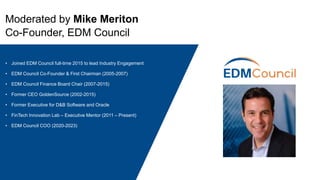
Moderated by Mike Meriton
Co-Founder, EDM Council
• Joined EDM Council full-time 2015 to lead Industry Engagement
• EDM Council Co-Founder & First Chairman (2005-2007)
• EDM Council Finance Board Chair (2007-2015)
• Former CEO GoldenSource (2002-2015)
• Former Executive for D&B Software and Oracle
• FinTech Innovation Lab – Executive Mentor (2011 – Present)
• EDM Council COO (2020-2023)
3
© 2023 EDM Council Inc.
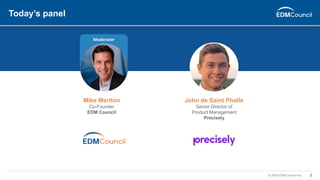
Today’s panel
John de Saint Phalle
Senior Director of
Product Management
Precisely
Moderator
Mike Meriton
Co-Founder
EDM Council
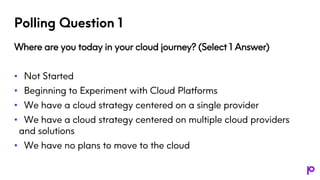
Polling Question 1
Where are you today in your cloud journey? (Select 1 Answer)
• Not Started
• Beginning to Experiment with Cloud Platforms
• We have a cloud strategy centered on a single provider
• We have a cloud strategy centered on multiple cloud providers
and solutions
• We have no plans to move to the cloud
How did we get here?
“The world is experiencing
a level of disruption and
business risk not seen
in generations…
…some companies freeze
and fail, while others
innovate, advance,
and even thrive.”
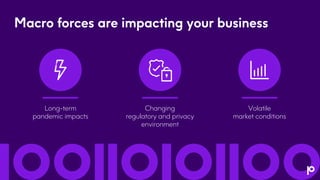
Macro forces are impacting your business
Changing
regulatory and privacy
environment
Volatile
market conditions
Long-term
pandemic impacts
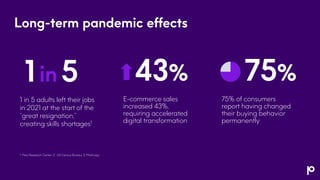
Long-term pandemic effects
E-commerce sales
increased 43%,
requiring accelerated
digital transformation
43% 75%
75% of consumers
report having changed
their buying behavior
permanently
1 in 5 adults left their jobs
in 2021 at the start of the
“great resignation,”
creating skills shortages1
1in 5
1. Pew Research Center, 2. US Census Bureau, 3. McKinsey
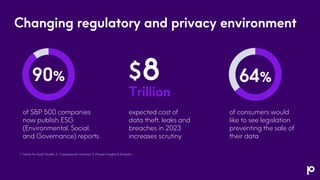
Changing regulatory and privacy environment
expected cost of
data theft, leaks and
breaches in 2023
increases scrutiny
8
of consumers would
like to see legislation
preventing the sale of
their data
of S&P 500 companies
now publish ESG
(Environmental, Social,
and Governance) reports.
64%
90%
1. Center for Audit Quality, 2. Cybersecurity Ventures, 3. Prosper Insights & Analytics
$
Trillion
Volatile market conditions
How are organizations reacting?
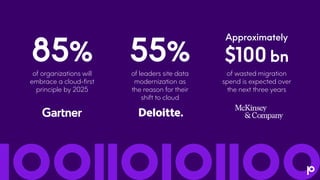
of organizations will
embrace a cloud-first
principle by 2025
85%
of leaders site data
modernization as
the reason for their
shift to cloud
55%
of wasted migration
spend is expected over
the next three years
$100 bn
Approximately
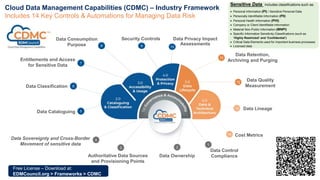
Cost Metrics
14
Data Control
Compliance
Data Ownership
Authoritative Data Sources
and Provisioning Points
Data Sovereignty and Cross-Border
Movement of sensitive data
Data Classification
Entitlements and Access
for Sensitive Data
Security Controls
Data Consumption
Purpose
Data Privacy Impact
Assessments
Data Retention,
Archiving and Purging
Data Quality
Measurement
Data Lineage
8
12
13
3
Data Cataloguing
6
5
11
9 10
1
2
4
7
Cloud Data Management Capabilities (CDMC) – Industry Framework
Includes 14 Key Controls & Automations for Managing Data Risk
Sensitive Data includes classifications such as:
 Personal Information (PI) / Sensitive Personal Data
 Personally Identifiable Information (PII)
 Personal Health Information (PHI)
 Company or Client Identifiable Information
 Material Non-Public Information (MNPI)
 Specific Information Sensitivity Classifications (such as
‘Highly Restricted’ and ‘Confidential’)
 Critical Data Elements used for important business processes
 Licensed data
Free License – Download at:
EDMCouncil.org > Frameworks > CDMC
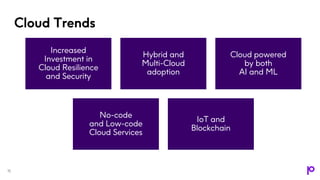
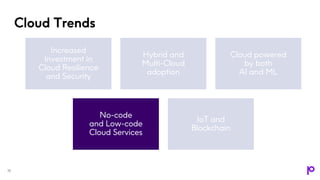
Cloud Trends
15
Increased
Investment in
Cloud Resilience
and Security
Hybrid and
Multi-Cloud
adoption
Cloud powered
by both
AI and ML
No-code
and Low-code
Cloud Services
IoT and
Blockchain
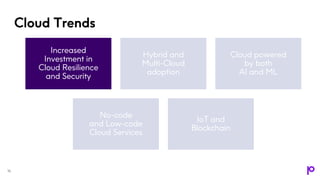
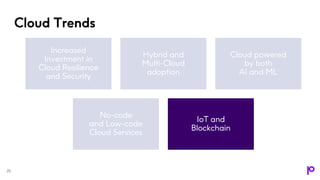
Cloud Trends
16
Increased
Investment in
Cloud Resilience
and Security
Hybrid and
Multi-Cloud
adoption
Cloud powered
by both
AI and ML
No-code
and Low-code
Cloud Services
IoT and
Blockchain
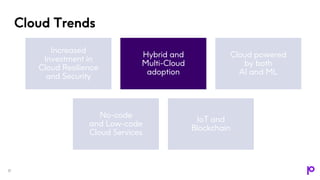
Cloud Trends
17
Increased
Investment in
Cloud Resilience
and Security
Hybrid and
Multi-Cloud
adoption
Cloud powered
by both
AI and ML
No-code
and Low-code
Cloud Services
IoT and
Blockchain
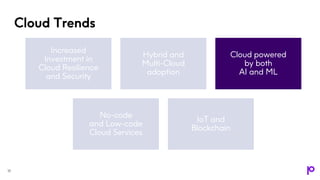
Cloud Trends
18
Increased
Investment in
Cloud Resilience
and Security
Hybrid and
Multi-Cloud
adoption
Cloud powered
by both
AI and ML
No-code
and Low-code
Cloud Services
IoT and
Blockchain
Cloud Trends
19
Increased
Investment in
Cloud Resilience
and Security
Hybrid and
Multi-Cloud
adoption
Cloud powered
by both
AI and ML
No-code
and Low-code
Cloud Services
IoT and
Blockchain
Cloud Trends
20
Increased
Investment in
Cloud Resilience
and Security
Hybrid and
Multi-Cloud
adoption
Cloud powered
by both
AI and ML
No-code
and Low-code
Cloud Services
IoT and
Blockchain
Digging deeper
into the cloud
22
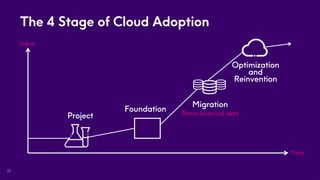
The 4 Stage of Cloud Adoption
Project
Foundation
Migration
Retire technical debt
Optimization
and
Reinvention
Value
Time
23
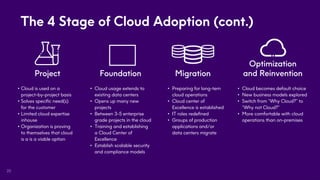
The 4 Stage of Cloud Adoption (cont.)
Project Foundation Migration
Optimization
and Reinvention
• Cloud is used on a
project-by-project basis
• Solves specific need(s)
for the customer
• Limited cloud expertise
inhouse
• Organization is proving
to themselves that cloud
is a is a viable option
• Cloud usage extends to
existing data centers
• Opens up many new
projects
• Between 3-5 enterprise
grade projects in the cloud
• Training and establishing
a Cloud Center of
Excellence
• Establish scalable security
and compliance models
• Preparing for long-tern
cloud operations
• Cloud center of
Excellence is established
• IT roles redefined
• Groups of production
applications and/or
data centers migrate
• Cloud becomes default choice
• New business models explored
• Switch from “Why Cloud?” to
“Why not Cloud?”
• More comfortable with cloud
operations than on-premises
24
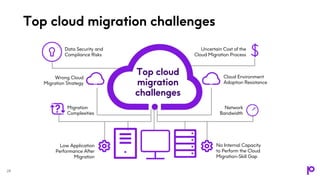
Data Security and
Compliance Risks
Wrong Cloud
Migration Strategy
Migration
Complexities
Low Application
Performance After
Migration
Uncertain Cost of the
Cloud Migration Process
Cloud Environment
Adoption Resistance
Network
Bandwidth
No Internal Capacity
to Perform the Cloud
Migration-Skill Gap
Top cloud migration challenges
?
Top cloud
migration
challenges
How does this impact
organizations?
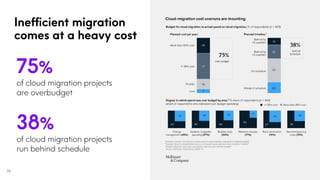
Inefficient migration
comes at a heavy cost
26
75%
of cloud migration projects
are overbudget
38%
of cloud migration projects
run behind schedule
27
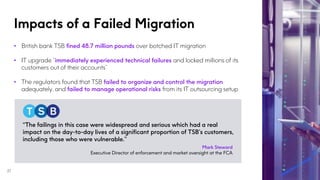
Impacts of a Failed Migration
• British bank TSB fined 48.7 million pounds over botched IT migration
• IT upgrade “immediately experienced technical failures and locked millions of its
customers out of their accounts”
• The regulators found that TSB failed to organize and control the migration
adequately, and failed to manage operational risks from its IT outsourcing setup
“The failings in this case were widespread and serious which had a real
impact on the day-to-day lives of a significant proportion of TSB’s customers,
including those who were vulnerable.”
Mark Steward
Executive Director of enforcement and market oversight at the FCA
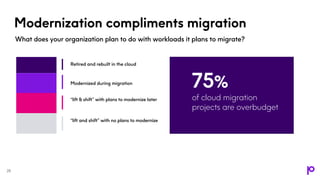
Modernization compliments migration
28
75%
of cloud migration
projects are overbudget
What does your organization plan to do with workloads it plans to migrate?
Retired and rebuilt in the cloud
Modernized during migration
“lift & shift” with plans to modernize later
“lift and shift” with no plans to modernize
20%
27%
27%
26%
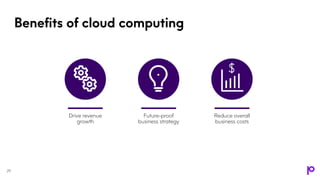
Benefits of cloud computing
Drive revenue
growth
Future-proof
business strategy
Reduce overall
business costs
29
How can you avoid mistakes?
Polling Question 2
What is your biggest challenge in embracing a cloud-first
approach? (Select 1 Answer)
• IT Security / Infosec Policies
• Lack of Cloud Skills / Personnel
• Difficulty of Migrating Existing Applications
• Cost / Pricing
• Latency
• Service / Solution Availability
32
Do’s and Don’ts
• Employ a cloud strategy that works
for your business (hybrid, multi-cloud,
public cloud, private cloud)
• Work with a 3rd party to ensure a
successful migration
• Track how members of your
organization are using cloud
• Future-proof your architecture
• Evaluate and reevaluate vendor
agreements
• Migrate every workload to
the cloud
• Assume your costs and priorities
on day one of will be the same
as year one
• Avoid talking about costs when
planning your architecture
• Forget to account for changing
regulatory requirements and
market conditions
• Treat every cloud workload
the same
Questions?
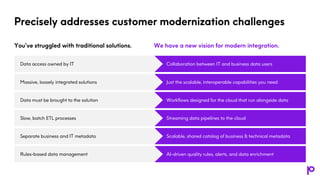
Precisely addresses customer modernization challenges
You’ve struggled with traditional solutions. We have a new vision for modern integration.
Data access owned by IT Collaboration between IT and business data users
Massive, loosely integrated solutions Just the scalable, interoperable capabilities you need
Data must be brought to the solution Workflows designed for the cloud that run alongside data
Slow, batch ETL processes Streaming data pipelines to the cloud
Separate business and IT metadata Scalable, shared catalog of business & technical metadata
Rules-based data management AI-driven quality rules, alerts, and data enrichment
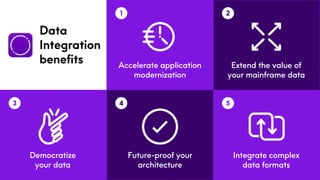
Data
Integration
benefits Accelerate application
modernization
Extend the value of
your mainframe data
Future-proof your
architecture
Integrate complex
data formats
Democratize
your data
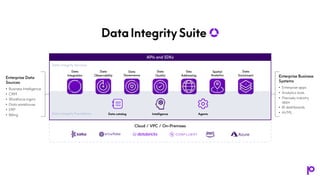
Cloud / VPC / On-Premises
Data
Integration
Data
Observability
Data
Quality
Geo
Addressing
Spatial
Analytics
Data
Governance
Data
Enrichment
APIs and SDKs
Enterprise Business
Systems
• Enterprise apps
• Analytics tools
• Precisely industry
apps
• BI dashboards
• AI/ML
Enterprise Data
Sources
• Business Intelligence
• CRM
• Workforce mgmt.
• Data warehouse
• ERP
• Billing
Data Integrity Services
Data Integrity Foundation Data catalog Intelligence Agents
Let’s continue the
conversation…
Contact us
Set up a 30-minute personalized
demo
Precisely.com/contact
www.precisely.com
Demos
White Papers
Case Studies
© 2023 EDM Council Inc.
38
Join EDM Council and our membership
community of companies…
Worldwide
Americas, Europe,
Africa, Asia, Australia
350+ Member Firms
Cross-industry,
including Regulators
25,000+
Professionals
edmcouncil.org

Top Trends and Challenges in the Cloud

  • 1.
    Top Trends andChallenges in the Cloud John de Saint Phalle Senior Director of Product Management Precisely A conversation with
  • 2.
    Moderated by MikeMeriton Co-Founder, EDM Council • Joined EDM Council full-time 2015 to lead Industry Engagement • EDM Council Co-Founder & First Chairman (2005-2007) • EDM Council Finance Board Chair (2007-2015) • Former CEO GoldenSource (2002-2015) • Former Executive for D&B Software and Oracle • FinTech Innovation Lab – Executive Mentor (2011 – Present) • EDM Council COO (2020-2023)
  • 3.
    3 © 2023 EDMCouncil Inc. Today’s panel John de Saint Phalle Senior Director of Product Management Precisely Moderator Mike Meriton Co-Founder EDM Council
  • 4.
    Polling Question 1 Whereare you today in your cloud journey? (Select 1 Answer) • Not Started • Beginning to Experiment with Cloud Platforms • We have a cloud strategy centered on a single provider • We have a cloud strategy centered on multiple cloud providers and solutions • We have no plans to move to the cloud
  • 5.
    How did weget here?
  • 6.
    “The world isexperiencing a level of disruption and business risk not seen in generations…
  • 7.
    …some companies freeze andfail, while others innovate, advance, and even thrive.”
  • 8.
    Macro forces areimpacting your business Changing regulatory and privacy environment Volatile market conditions Long-term pandemic impacts
  • 9.
    Long-term pandemic effects E-commercesales increased 43%, requiring accelerated digital transformation 43% 75% 75% of consumers report having changed their buying behavior permanently 1 in 5 adults left their jobs in 2021 at the start of the “great resignation,” creating skills shortages1 1in 5 1. Pew Research Center, 2. US Census Bureau, 3. McKinsey
  • 10.
    Changing regulatory andprivacy environment expected cost of data theft, leaks and breaches in 2023 increases scrutiny 8 of consumers would like to see legislation preventing the sale of their data of S&P 500 companies now publish ESG (Environmental, Social, and Governance) reports. 64% 90% 1. Center for Audit Quality, 2. Cybersecurity Ventures, 3. Prosper Insights & Analytics $ Trillion
  • 11.
  • 12.
  • 13.
    of organizations will embracea cloud-first principle by 2025 85% of leaders site data modernization as the reason for their shift to cloud 55% of wasted migration spend is expected over the next three years $100 bn Approximately
  • 14.
    Cost Metrics 14 Data Control Compliance DataOwnership Authoritative Data Sources and Provisioning Points Data Sovereignty and Cross-Border Movement of sensitive data Data Classification Entitlements and Access for Sensitive Data Security Controls Data Consumption Purpose Data Privacy Impact Assessments Data Retention, Archiving and Purging Data Quality Measurement Data Lineage 8 12 13 3 Data Cataloguing 6 5 11 9 10 1 2 4 7 Cloud Data Management Capabilities (CDMC) – Industry Framework Includes 14 Key Controls & Automations for Managing Data Risk Sensitive Data includes classifications such as:  Personal Information (PI) / Sensitive Personal Data  Personally Identifiable Information (PII)  Personal Health Information (PHI)  Company or Client Identifiable Information  Material Non-Public Information (MNPI)  Specific Information Sensitivity Classifications (such as ‘Highly Restricted’ and ‘Confidential’)  Critical Data Elements used for important business processes  Licensed data Free License – Download at: EDMCouncil.org > Frameworks > CDMC
  • 15.
    Cloud Trends 15 Increased Investment in CloudResilience and Security Hybrid and Multi-Cloud adoption Cloud powered by both AI and ML No-code and Low-code Cloud Services IoT and Blockchain
  • 16.
    Cloud Trends 16 Increased Investment in CloudResilience and Security Hybrid and Multi-Cloud adoption Cloud powered by both AI and ML No-code and Low-code Cloud Services IoT and Blockchain
  • 17.
    Cloud Trends 17 Increased Investment in CloudResilience and Security Hybrid and Multi-Cloud adoption Cloud powered by both AI and ML No-code and Low-code Cloud Services IoT and Blockchain
  • 18.
    Cloud Trends 18 Increased Investment in CloudResilience and Security Hybrid and Multi-Cloud adoption Cloud powered by both AI and ML No-code and Low-code Cloud Services IoT and Blockchain
  • 19.
    Cloud Trends 19 Increased Investment in CloudResilience and Security Hybrid and Multi-Cloud adoption Cloud powered by both AI and ML No-code and Low-code Cloud Services IoT and Blockchain
  • 20.
    Cloud Trends 20 Increased Investment in CloudResilience and Security Hybrid and Multi-Cloud adoption Cloud powered by both AI and ML No-code and Low-code Cloud Services IoT and Blockchain
  • 21.
  • 22.
    22 The 4 Stageof Cloud Adoption Project Foundation Migration Retire technical debt Optimization and Reinvention Value Time
  • 23.
    23 The 4 Stageof Cloud Adoption (cont.) Project Foundation Migration Optimization and Reinvention • Cloud is used on a project-by-project basis • Solves specific need(s) for the customer • Limited cloud expertise inhouse • Organization is proving to themselves that cloud is a is a viable option • Cloud usage extends to existing data centers • Opens up many new projects • Between 3-5 enterprise grade projects in the cloud • Training and establishing a Cloud Center of Excellence • Establish scalable security and compliance models • Preparing for long-tern cloud operations • Cloud center of Excellence is established • IT roles redefined • Groups of production applications and/or data centers migrate • Cloud becomes default choice • New business models explored • Switch from “Why Cloud?” to “Why not Cloud?” • More comfortable with cloud operations than on-premises
  • 24.
    24 Data Security and ComplianceRisks Wrong Cloud Migration Strategy Migration Complexities Low Application Performance After Migration Uncertain Cost of the Cloud Migration Process Cloud Environment Adoption Resistance Network Bandwidth No Internal Capacity to Perform the Cloud Migration-Skill Gap Top cloud migration challenges ? Top cloud migration challenges
  • 25.
    How does thisimpact organizations?
  • 26.
    Inefficient migration comes ata heavy cost 26 75% of cloud migration projects are overbudget 38% of cloud migration projects run behind schedule
  • 27.
    27 Impacts of aFailed Migration • British bank TSB fined 48.7 million pounds over botched IT migration • IT upgrade “immediately experienced technical failures and locked millions of its customers out of their accounts” • The regulators found that TSB failed to organize and control the migration adequately, and failed to manage operational risks from its IT outsourcing setup “The failings in this case were widespread and serious which had a real impact on the day-to-day lives of a significant proportion of TSB’s customers, including those who were vulnerable.” Mark Steward Executive Director of enforcement and market oversight at the FCA
  • 28.
    Modernization compliments migration 28 75% ofcloud migration projects are overbudget What does your organization plan to do with workloads it plans to migrate? Retired and rebuilt in the cloud Modernized during migration “lift & shift” with plans to modernize later “lift and shift” with no plans to modernize 20% 27% 27% 26%
  • 29.
    Benefits of cloudcomputing Drive revenue growth Future-proof business strategy Reduce overall business costs 29
  • 30.
    How can youavoid mistakes?
  • 31.
    Polling Question 2 Whatis your biggest challenge in embracing a cloud-first approach? (Select 1 Answer) • IT Security / Infosec Policies • Lack of Cloud Skills / Personnel • Difficulty of Migrating Existing Applications • Cost / Pricing • Latency • Service / Solution Availability
  • 32.
    32 Do’s and Don’ts •Employ a cloud strategy that works for your business (hybrid, multi-cloud, public cloud, private cloud) • Work with a 3rd party to ensure a successful migration • Track how members of your organization are using cloud • Future-proof your architecture • Evaluate and reevaluate vendor agreements • Migrate every workload to the cloud • Assume your costs and priorities on day one of will be the same as year one • Avoid talking about costs when planning your architecture • Forget to account for changing regulatory requirements and market conditions • Treat every cloud workload the same
  • 33.
  • 34.
    Precisely addresses customermodernization challenges You’ve struggled with traditional solutions. We have a new vision for modern integration. Data access owned by IT Collaboration between IT and business data users Massive, loosely integrated solutions Just the scalable, interoperable capabilities you need Data must be brought to the solution Workflows designed for the cloud that run alongside data Slow, batch ETL processes Streaming data pipelines to the cloud Separate business and IT metadata Scalable, shared catalog of business & technical metadata Rules-based data management AI-driven quality rules, alerts, and data enrichment
  • 35.
    Data Integration benefits Accelerate application modernization Extendthe value of your mainframe data Future-proof your architecture Integrate complex data formats Democratize your data
  • 36.
    Cloud / VPC/ On-Premises Data Integration Data Observability Data Quality Geo Addressing Spatial Analytics Data Governance Data Enrichment APIs and SDKs Enterprise Business Systems • Enterprise apps • Analytics tools • Precisely industry apps • BI dashboards • AI/ML Enterprise Data Sources • Business Intelligence • CRM • Workforce mgmt. • Data warehouse • ERP • Billing Data Integrity Services Data Integrity Foundation Data catalog Intelligence Agents
  • 37.
    Let’s continue the conversation… Contactus Set up a 30-minute personalized demo Precisely.com/contact www.precisely.com Demos White Papers Case Studies
  • 38.
    © 2023 EDMCouncil Inc. 38 Join EDM Council and our membership community of companies… Worldwide Americas, Europe, Africa, Asia, Australia 350+ Member Firms Cross-industry, including Regulators 25,000+ Professionals edmcouncil.org

Editor's Notes

  • #7 To begin, I want to share this quote that I came across, and which I think describes the current environment and the risks and opportunities that exist today. “The world is experiencing a level of disruption and business risk not seen in generations...
  • #8 …some companies freeze and fail, while other innovate, advance, and even thrive.” So, today, let’s talk about some of those disruptive trends, how they’re influencing your data strategy, and how Precisely can help you be one of those companies that innovates, advances, and thrives!
  • #9 No one can deny that the last couple of years have been an absolute whirlwind. I’m going to take a few minutes to reflect on the sheer magnitude of the changes we’ve experienced and their business impacts. First and foremost, we all know the Pandemic created a seismic shift that has impacted virtually every part of daily life and business for a protracted period of time. Compliance with the changing regulatory and privacy requirements imposed by states, industries, business partners, and customers has also demanded increased investment. And, unprecedented geopolitical instability has created sustained global economic uncertainty that we must all reckon with.
  • #10 Let’s take a moment to consider just the impacts of the pandemic that have changed the priorities of business. Precisely and other organizations, pivoted to a remote workforce where possible – connecting everyone via technology and reducing physical office footprints. But It wasn’t enough to just be connected, we put more focus on employee health, safety and engagement than ever before to retain employees during difficult times. Despite those efforts, a variety of factors, mostly around personal priorities and tight labor markets, led to the “Great Resignation” in healthcare, education, tech and other areas. According to a Pew Research survey, one in five nonretired adults left their job by choice in 2021, which created labor and skills shortages. Being at home and online also required businesses to accelerate digital transformation due to E-commerce sales increasing by 43% in 20202 alone. And 75% of consumers3 reported they changed their buying behavior and patterns for good. And you have had to transform your teams, your processes, and your technology to adapt.
  • #11 Businesses today are also operating in a changing regulatory and privacy environment. The Great Resignation opened up an important dialogue between employers and employees, notably around mental health and well-being, empathy, and environmental, social, and corporate governance. And at the same time, investors and consumers have increased their focus on ESG and corporate social responsibility for the companies they do business with. In fact, more than 90 percent of S&P 500 companies now publish ESG reports as they embrace their responsibility around environmental and social causes and provide greater transparency into how they do business. Accelerated digital transformation has also raised the stakes for both cyber security and data privacy. In fact, a survey by Prosper Insights & Analytics showed that 64.5% of consumers would like to see legislation that prevents companies from selling their personal, online and mobile location data. Data theft, leaks and breaches are expected to cost companies $8 trillion in 2023. And as a result, we see increased regulatory and consumer scrutiny on how companies manage personal data.
  • #12 And our third macro trend impacting businesses today is unprecedented geopolitical instability that has created sustained global economic uncertainty - from Brexit to war in Ukraine, the World Uncertainty Index is at an all time high5. The significant spike in demand for goods and services emerging from the pandemic led to increased inflation, causing the US Federal Reserve and banks around the world to dramatically raise interest rates – resulting in the most rapid succession of interest rate increases in 40 years. This rapid rate of interest rate increase has created unintended consequences and has particularly impaired the value of loan portfolios that has resulted in failure of Silicon Valley Bank and the merger of Credit Suisse. All told, these unpredictable variables and the threat of a global recession have required businesses to recast their investments and returns on those investments. Leaders like you are operating in a truly volatile environment.  
  • #14 Research shows that: 85% of organizations will embrace a cloud-first principle by 2025 55% of leaders site data modernization as the reason for their shift to cloud Approximately $100 billion of wasted migration spend is expected over the next three years So despite the excitement around getting to the cloud, organizations need to be careful…
  • #25 https://www.ecdevstudio.com/blog/cloud-migration-challenges-in-2023/
  • #27 Because moving to cloud comes with a heavy cost if not done strategically. McKinsey & Company recently conducted a study that shows that: Over 75% of cloud migration projects are overbudget 37% is spent on systems integrators since they do not have the cloud skills in house to manage these projects 15% on decommissioning costs for other platforms 38% of cloud migration projects run behind schedule Companies are looking to staff 50% of their cloud talent in house so they do not need to rely as heavily on third parties (If you are interested in learning more about this topic, all of this data came from this McKinsey Study https://www.mckinsey.com/industries/technology-media-and-telecommunications/our-insights/cloud-migration-opportunity-business-value-grows-but-missteps-abound)
  • #28 When we talk about the challenfes with migration we knoe that there are technical issues, but it is clear that there can be financial implications as well As an example, this is a British bank that ended up with almost 50 milliom ppounds for a failed migration project Regulators found that TSB failed to organize and control the migration as well as manage operational risks FCA (regulatory agency) said the fines would have been significantly higher if the bank had not been cooperative and worked closely with a 3rd party to help them with the migration
  • #29 Cloud Migration and Modernization: Trends for 2023 – Global Research Report by Microsoft Azure
  • #35 You’ve likely been working on this for a long time, but legacy solutions aren’t serving you today. We have a vision for delivering data with integrity to your business.
  • #36 Another key module of the Data Integrity Suite that I’m excited to introduce is Data Observability. This ensures data reliability by monitoring your organization’s data with added context, performing analysis to determine potential adverse data events, and alerting those who need to resolve the issues. For example, if you view a sales pipeline report, you may find that the report doesn’t have new sales opportunities added in recent weeks. This is data freshness. Or there are missing opportunities for a product line that were there last week, which is called data drift. Through a combination of profiling and automated anomaly detection, you can more quickly and accurately surface issues before they get into the hands of your business users. _____ Automated monitoring, alerting & triaging critical data quality issues, based on historical trends e.g. Freshness: changes in data update frequency Volume: changes in number of records added/deleted Data drifts: changes in value ranges, distributions, patterns, completeness, etc. Schema: changes in new/deleted columns Lineage: assess impact of data changes on upstream/downstream pipelines
  • #37 The modular, interoperable Precisely Data Integrity Suite contains everything you need to deliver accurate, consistent, contextual data to your business - wherever and whenever it’s needed. Data Integration: Break down data silos by quickly building modern data pipelines that drive innovation Data Observability: Proactively uncover data anomalies and act before they become costly downstream issues Data Governance: Manage data policy and processes with greater insight into your data’s meaning, lineage, and impact Data Quality: Deliver data that’s accurate, consistent, and fit for purpose across operational and analytical systems Geo Addressing: Verify, standardize, cleanse, and geocode addresses to unlock valuable context for more informed decision making Spatial Analytics: Derive and visualize spatial relationships hidden in your data to reveal critical context for better decisions Data Enrichment: Enrich your business data with expertly curated datasets containing thousands of attributes for faster, confident decisions